WO2015016261A1 - ポリカーボネートジオールの製造方法及びポリカーボネートジオール並びにポリウレタンの製造方法及びポリウレタン - Google Patents
ポリカーボネートジオールの製造方法及びポリカーボネートジオール並びにポリウレタンの製造方法及びポリウレタン Download PDFInfo
- Publication number
- WO2015016261A1 WO2015016261A1 PCT/JP2014/070060 JP2014070060W WO2015016261A1 WO 2015016261 A1 WO2015016261 A1 WO 2015016261A1 JP 2014070060 W JP2014070060 W JP 2014070060W WO 2015016261 A1 WO2015016261 A1 WO 2015016261A1
- Authority
- WO
- WIPO (PCT)
- Prior art keywords
- polyurethane
- polycarbonate diol
- sugar
- compound
- derivative
- Prior art date
- Legal status (The legal status is an assumption and is not a legal conclusion. Google has not performed a legal analysis and makes no representation as to the accuracy of the status listed.)
- Ceased
Links
Classifications
-
- C—CHEMISTRY; METALLURGY
- C08—ORGANIC MACROMOLECULAR COMPOUNDS; THEIR PREPARATION OR CHEMICAL WORKING-UP; COMPOSITIONS BASED THEREON
- C08G—MACROMOLECULAR COMPOUNDS OBTAINED OTHERWISE THAN BY REACTIONS ONLY INVOLVING UNSATURATED CARBON-TO-CARBON BONDS
- C08G18/00—Polymeric products of isocyanates or isothiocyanates
- C08G18/06—Polymeric products of isocyanates or isothiocyanates with compounds having active hydrogen
- C08G18/28—Polymeric products of isocyanates or isothiocyanates with compounds having active hydrogen characterised by the compounds used containing active hydrogen
- C08G18/40—High-molecular-weight compounds
- C08G18/42—Polycondensates having carboxylic or carbonic ester groups in the main chain
- C08G18/44—Polycarbonates
-
- C—CHEMISTRY; METALLURGY
- C08—ORGANIC MACROMOLECULAR COMPOUNDS; THEIR PREPARATION OR CHEMICAL WORKING-UP; COMPOSITIONS BASED THEREON
- C08G—MACROMOLECULAR COMPOUNDS OBTAINED OTHERWISE THAN BY REACTIONS ONLY INVOLVING UNSATURATED CARBON-TO-CARBON BONDS
- C08G18/00—Polymeric products of isocyanates or isothiocyanates
- C08G18/06—Polymeric products of isocyanates or isothiocyanates with compounds having active hydrogen
- C08G18/08—Processes
- C08G18/10—Prepolymer processes involving reaction of isocyanates or isothiocyanates with compounds having active hydrogen in a first reaction step
-
- C—CHEMISTRY; METALLURGY
- C08—ORGANIC MACROMOLECULAR COMPOUNDS; THEIR PREPARATION OR CHEMICAL WORKING-UP; COMPOSITIONS BASED THEREON
- C08G—MACROMOLECULAR COMPOUNDS OBTAINED OTHERWISE THAN BY REACTIONS ONLY INVOLVING UNSATURATED CARBON-TO-CARBON BONDS
- C08G18/00—Polymeric products of isocyanates or isothiocyanates
- C08G18/06—Polymeric products of isocyanates or isothiocyanates with compounds having active hydrogen
- C08G18/28—Polymeric products of isocyanates or isothiocyanates with compounds having active hydrogen characterised by the compounds used containing active hydrogen
- C08G18/65—Low-molecular-weight compounds having active hydrogen with high-molecular-weight compounds having active hydrogen
- C08G18/66—Compounds of groups C08G18/42, C08G18/48, or C08G18/52
- C08G18/6633—Compounds of group C08G18/42
- C08G18/6637—Compounds of group C08G18/42 with compounds of group C08G18/32 or polyamines of C08G18/38
- C08G18/664—Compounds of group C08G18/42 with compounds of group C08G18/32 or polyamines of C08G18/38 with compounds of group C08G18/3203
-
- C—CHEMISTRY; METALLURGY
- C08—ORGANIC MACROMOLECULAR COMPOUNDS; THEIR PREPARATION OR CHEMICAL WORKING-UP; COMPOSITIONS BASED THEREON
- C08G—MACROMOLECULAR COMPOUNDS OBTAINED OTHERWISE THAN BY REACTIONS ONLY INVOLVING UNSATURATED CARBON-TO-CARBON BONDS
- C08G18/00—Polymeric products of isocyanates or isothiocyanates
- C08G18/06—Polymeric products of isocyanates or isothiocyanates with compounds having active hydrogen
- C08G18/70—Polymeric products of isocyanates or isothiocyanates with compounds having active hydrogen characterised by the isocyanates or isothiocyanates used
- C08G18/72—Polyisocyanates or polyisothiocyanates
- C08G18/74—Polyisocyanates or polyisothiocyanates cyclic
- C08G18/76—Polyisocyanates or polyisothiocyanates cyclic aromatic
- C08G18/7657—Polyisocyanates or polyisothiocyanates cyclic aromatic containing two or more aromatic rings
- C08G18/7664—Polyisocyanates or polyisothiocyanates cyclic aromatic containing two or more aromatic rings containing alkylene polyphenyl groups
- C08G18/7671—Polyisocyanates or polyisothiocyanates cyclic aromatic containing two or more aromatic rings containing alkylene polyphenyl groups containing only one alkylene bisphenyl group
-
- C—CHEMISTRY; METALLURGY
- C08—ORGANIC MACROMOLECULAR COMPOUNDS; THEIR PREPARATION OR CHEMICAL WORKING-UP; COMPOSITIONS BASED THEREON
- C08G—MACROMOLECULAR COMPOUNDS OBTAINED OTHERWISE THAN BY REACTIONS ONLY INVOLVING UNSATURATED CARBON-TO-CARBON BONDS
- C08G64/00—Macromolecular compounds obtained by reactions forming a carbonic ester link in the main chain of the macromolecule
- C08G64/20—General preparatory processes
- C08G64/30—General preparatory processes using carbonates
- C08G64/305—General preparatory processes using carbonates and alcohols
-
- C—CHEMISTRY; METALLURGY
- C09—DYES; PAINTS; POLISHES; NATURAL RESINS; ADHESIVES; COMPOSITIONS NOT OTHERWISE PROVIDED FOR; APPLICATIONS OF MATERIALS NOT OTHERWISE PROVIDED FOR
- C09D—COATING COMPOSITIONS, e.g. PAINTS, VARNISHES OR LACQUERS; FILLING PASTES; CHEMICAL PAINT OR INK REMOVERS; INKS; CORRECTING FLUIDS; WOODSTAINS; PASTES OR SOLIDS FOR COLOURING OR PRINTING; USE OF MATERIALS THEREFOR
- C09D175/00—Coating compositions based on polyureas or polyurethanes; Coating compositions based on derivatives of such polymers
- C09D175/04—Polyurethanes
- C09D175/06—Polyurethanes from polyesters
Definitions
- the present invention relates to a method for producing a polycarbonate diol. Specifically, the reaction rate with an isocyanate compound during polyurethane production is optimized by subjecting a dihydroxy compound and a carbonate compound to a transesterification reaction in the presence of sugar and / or a derivative thereof.
- the present invention relates to a method for producing a polycarbonate diol which can improve the tensile strength, the elastic recovery rate and the like, and the polycarbonate diol produced by this method.
- the present invention also relates to a method for producing a polyurethane using the polycarbonate diol, and a polyurethane produced by this method.
- polyol is a polyether type typified by polypropylene glycol and polytetramethylene glycol, a polyester polyol type typified by dicarboxylic acid polyester, a poly It is classified into a polylactone type typified by caprolactone and a polycarbonate type obtained by reacting a carbonate source with a diol (Non-patent Document 1).
- the polycarbonate type that is, the polyurethane obtained by reacting the polycarbonate diol and the isocyanate compound has a feature that is extremely excellent in heat resistance, hydrolysis resistance, weather resistance and the like, and is applied to a wide range of applications.
- Patent Document 1 describes that a polyurethane is produced using a polycarbonate diol produced using a diol derived from biomass resources.
- Patent Document 1 does not describe that a diol as a polycarbonate diol production raw material or a polycarbonate diol as a polyurethane production raw material contains sugar and / or a derivative thereof.
- the biomass resource-derived diol described in Patent Document 1 is obtained, for example, by fermenting sugar, but the fermentation liquor obtained by fermentation removes polymers and other impurities.
- the multi-step purification process such as extraction, crystallization, distillation, etc., high-boiling sugars and the like are separated and removed and generally do not contain them.
- Patent Document 2 describes that a polyurethane prepolymer is produced by reacting a polyhydric alcohol containing molasses or a sugar compound with a polyisocyanate.
- the polyurethane prepolymer is excellent in biodegradability and physically durable.
- Patent Document 3 discloses a method for producing a flexible polyurethane foam, not a thermoplastic polyurethane, by adding one or both of propylene oxide and ethylene oxide to a sugar alcohol having 5 or more OH groups. It is described that a flexible polyurethane foam having high water resistance can be obtained by reacting a polyol mixture containing 0.5% or more of a low molecular polyol with a polyisocyanate having an average number of NCO groups of 2.1 to 2.5. ing. Since the method described in Patent Document 3 is a method for producing a flexible polyurethane foam, the reaction conditions are different from the method for producing a thermoplastic polyurethane, which is a reaction different from the reaction for producing a thermoplastic polyurethane.
- Japanese Unexamined Patent Publication No. 2011-225863 Japanese Unexamined Patent Publication No. 2000-1646 Japanese Unexamined Patent Publication No. 2009-191223 Japanese Unexamined Patent Publication No. 2005-48141
- polyurethane containing the polycarbonate diol component In the production of polyurethane containing the polycarbonate diol component, it is possible to improve the reaction rate between the polycarbonate diol and the isocyanate compound, and to obtain a polyurethane having a molecular weight within a certain time in a short time. This is an industrially very important improvement item in terms of reducing the amount of isocyanate compound used. Further, in the use of polyurethane, increasing mechanical properties such as tensile strength and elastic recovery rate is also an important item in terms of improving product durability and expanding applications. Furthermore, when processing polyurethane into various products, it is also important that the polyurethane is not colored in order to improve the design.
- the present invention optimizes the reaction rate when a polyurethane is produced by reacting a polycarbonate diol and an isocyanate compound to obtain a molecular weight within a predetermined range, which is optimal for improving productivity, and to obtain a polyurethane obtained It is an object of the present invention to provide a method for producing a polycarbonate diol that can improve the tensile strength, the elastic recovery rate, and the like, and a method for producing a polyurethane using the polycarbonate diol.
- the inventors of the present invention have prepared a predetermined amount of sugar and a predetermined amount of sugar with respect to the raw dihydroxy compound when producing a polycarbonate diol by a transesterification reaction between the dihydroxy compound and the carbonate compound.
- polycarbonate diol By producing polycarbonate diol in the presence of a derivative diol in the reaction system, it is possible to obtain a good quality polycarbonate diol.
- polyurethane is produced using this polycarbonate diol and an isocyanate compound, the reaction rate is optimized, It was also found that the resulting polyurethane is not colored and has excellent tensile strength and elastic recovery rate.
- the present invention has been achieved on the basis of such findings, and the gist thereof is as follows.
- a method for producing a polycarbonate diol comprising a step of polymerizing a dihydroxy compound and a carbonate compound by a transesterification reaction in the presence of a sugar and / or a derivative thereof to obtain a polycarbonate diol, the sugar and / or the derivative thereof
- a method for producing a polycarbonate diol wherein the content of the sugar and / or derivative thereof is 0.1 to 80 ppm by weight with respect to the total of the dihydroxy compound and the dihydroxy compound.
- a process for producing a polyurethane comprising a step of reacting a polycarbonate diol and an isocyanate compound to obtain a polyurethane, and prior to the step of obtaining the polyurethane, the polycarbonate diol combines a dihydroxy compound and a carbonate compound with sugar and / or It is obtained through a step of polymerizing by transesterification in the presence of the derivative, and in the step of obtaining the polycarbonate diol, the sugar and / or the sum of the sugar and / or the derivative thereof and the dihydroxy compound
- a method for producing a polyurethane having a content of a derivative thereof of 0.1 to 80 ppm by weight is a method for producing a polyurethane having a content of a derivative thereof of 0.1 to 80 ppm by weight.
- the present invention it is possible to efficiently produce a polyurethane having a molecular weight within a predetermined range, which is optimal for improving productivity by optimizing the reaction rate between the polycarbonate diol and the isocyanate compound. Moreover, since the obtained polyurethane is not colored and is excellent in tensile strength, elastic recovery rate, etc., it is useful for various applications.
- the method for producing a polycarbonate diol of the present invention is a method for producing a polycarbonate diol having a step of polymerizing a dihydroxy compound and a carbonate compound by a transesterification reaction in the presence of sugar and / or a derivative thereof to obtain a polycarbonate diol,
- the amount of the sugar and / or derivative thereof relative to the sum of the sugar and / or derivative and the dihydroxy compound is 0.1 to 80 ppm by weight.
- the manufacturing method of the polyurethane of this invention has the process of making the polycarbonate diol of this invention obtained by the manufacturing method of said polycarbonate diol and an isocyanate compound react, and obtaining a polyurethane, It is characterized by the above-mentioned.
- a chain extender may be further present in the reaction of the polycarbonate diol of the present invention with an isocyanate compound.
- polyurethane as used in the present invention indicates thermoplastic polyurethane or polyurethane urea unless otherwise specified, and it has been conventionally known that these two types of resins have substantially the same physical properties.
- polyurethane is manufactured using a short-chain polyol as a chain extender
- polyurethane urea is manufactured using a polyamine compound as a chain extender. Is.
- a sugar present in a transesterification reaction system of a dihydroxy compound and a carbonate compound (hereinafter sometimes simply referred to as “transesterification reaction system”).
- transesterification reaction system examples thereof include hexoses such as glucose, mannose, galactose, fructose, sorbose and tagatose, pentoses such as arabinose, xylose, ribose, xylulose and ribulose, and disaccharides or polysaccharides such as sucrose, raffinose and starch.
- glucose, sucrose, and xylose are preferable.
- One reason why these saccharides are preferable is that they react efficiently with isocyanate compounds and become the core of crosslinking.
- the sugar derivative in the method for producing the polycarbonate diol of the present invention and the method for producing the polyurethane of the present invention includes deoxysaccharides, uronic acids, aminosaccharides, sugar alcohols, sugar dehydrogenated products obtained by dehydrogenating sugars, It is a sugar dehydrated product obtained by dehydrating sugar, a retroaldol product of sugar, an oxide, a reduced product, or a pyrolysis product of sugar obtained by pyrolyzing sugar. These reaction products of 2 to 6 molecules and products obtained by dehydration, dehydrogenation, oxidation, reduction, and thermal decomposition of the reaction products are also included.
- deoxy sugars such as deoxyribose, fucose, fucose, rhamnose, quinobose, and paratose
- sugar alcohols such as sorbitol, mannitol, and xylitol
- sugar dehydrogenated substances such as gluconolactone and glucuronic acid, levoglucosan
- 4 1-molecule dehydrates such as deoxy-3-hexosulose
- 3-molecule dehydrates such as hydroxymethylfurfural and furfural
- retroaldol products of glucose such as 2-hydroxy-3-oxobutanal
- erythrose erythrose
- Thermal decomposition products of sugars such as 3-methylcyclopentane-1,2-dione, 4-hydroxy-2-pentenoic acid lactone, levulinic acid, 2-acetylfuran, hydroquinone, etc.
- hydrogenation products of the above specific examples and their Examples include dehydrated bodies.
- sugar dehydrogenates 1 to 4 molecular dehydrates of glucose and xylose, and sugar retroaldol products are preferable because of easy control of the reaction rate, and among them, carbonyl compounds containing two or more oxygen atoms Is particularly preferred.
- gluconolactone which is a sugar dehydrogenator
- hydroxymethylfurfural which is a dehydrated molecule
- erythrose which is a retroaldol product of glucose, and the like.
- gluconolactone and erythrose having two or more hydroxyl groups are preferred.
- one or more of the above sugars may be present in the transesterification reaction system, one or more of the sugar derivatives may be present in the transesterification reaction system, One or more species or two or more of the sugar derivatives may be present in the transesterification reaction system.
- the sugar and / or derivative thereof may be added separately from the dihydroxy compound and the carbonate compound during the production of the polycarbonate diol, but may be included in the dihydroxy compound or the carbonate compound in advance.
- some of the saccharides and / or derivatives thereof of the present invention may be present as components of the polycarbonate diol, the saccharide and / or derivatives thereof can be removed by a subsequent purification step or the like.
- the sugar and / or derivative thereof is preferably contained in the dihydroxy compound and present in the transesterification reaction system.
- a step of adjusting the concentration of sugar and / or its derivative in the dihydroxy compound to 0.1 to 80 ppm by weight in advance Adjusting the content of the sugar and / or derivative thereof in the dihydroxy compound containing the sugar and / or derivative thereof to 0.1 to 80 ppm by weight with respect to the total of the sugar and / or derivative and the dihydroxy compound. It is preferable that sugar and / or a derivative thereof be present in the transesterification reaction system in the above amount by passing through this step.
- the polycarbonate diol obtained by the method for producing a polycarbonate diol of the present invention is a polycarbonate in which sugar and / or a derivative thereof are involved in the reaction in a transesterification reaction, and the sugar and / or a derivative thereof are contained as a component of the polycarbonate diol.
- a diol or a polycarbonate diol in which saccharides and / or derivatives thereof are not involved in the reaction in the transesterification reaction and unreacted saccharides and / or derivatives thereof that are not included as constituents are present. May be.
- a raw material dihydroxy compound and / or carbonate compound preferably as a dihydroxy compound, sugar and / or its
- Polycarbonate diols containing sugars and / or derivatives thereof obtained by using dihydroxy compounds containing derivatives refer to these polycarbonate diols.
- the amount of sugar and / or derivative thereof present in the transesterification reaction system during the production of the polycarbonate diol is 0.1 to 80 with respect to the total of the sugar and / or derivative thereof and the dihydroxy compound in the transesterification reaction system. Ppm by weight.
- the amount of the sugar and / or derivative thereof is less than 0.1 ppm by weight, when the urethanization reaction is performed using the obtained polycarbonate diol, the reaction rate is improved by the presence of the sugar and / or derivative thereof, Polyurethane diol polymerization is inhibited and the reaction rate during the production of the polycarbonate diol is increased when the obtained polyurethane cannot sufficiently obtain the effect of improving physical properties such as tensile strength and elastic recovery rate.
- the reaction rate of polyurethane using this polycarbonate diol increases too much, and the molecular weight and viscosity that are optimal for the processing process are exceeded, resulting in decreased productivity and design. It tends to be yellow-colored and impair the design of products using these.
- the cause of the inhibition of the polymerization of the polycarbonate diol is presumed to be due to the deterioration of the catalyst used in the production of the polycarbonate diol by sugar and / or its derivative.
- the increase in the reaction rate of polyurethane using the polycarbonate diol is presumed to be caused by the formation of an excessive cross-linked structure with sugar and / or its derivative.
- the presumed factor about formation of a crosslinked structure is as mentioning later.
- the lower limit of the abundance (content) of the sugar and / or derivative thereof is preferably 0.2 ppm by weight, more preferably relative to the total of the sugar and / or derivative thereof and the dihydroxy compound in the transesterification reaction system. 0.3 ppm by weight, more preferably 0.4 ppm by weight, particularly preferably 0.5 ppm by weight, and most preferably 0.6 ppm by weight.
- the upper limit is preferably 70 ppm by weight, more preferably 60 ppm by weight, still more preferably 50 ppm by weight, particularly preferably 40 ppm by weight, particularly preferably 30 ppm by weight, and most preferably 20 ppm by weight.
- a urethane reaction can be achieved by using a polycarbonate diol containing sugar and / or its derivative obtained by allowing sugar and / or its derivative to be present in the transesterification reaction system.
- sugars and / or derivatives thereof are responsible for urethane reactions such as hydroxyl groups in the molecule.
- the presence of sugars and / or derivatives thereof due to having functional groups involved can increase the degree of crosslinking of the polyurethane obtained by the urethane reaction.
- sugars having at least a tetrasaccharide and / or derivatives thereof generally have one primary hydroxyl group and two or more secondary hydroxyl groups in the molecule. Therefore, in the production of polycarbonate diol, if the sugar and / or derivative thereof is in the preferred content range, there is little influence on the molecular weight change or the formation of a crosslinked structure in the production of polycarbonate diol, and one primary hydroxyl group is the end of the polycarbonate diol.
- the reaction rate slightly decreases as the content of sugar and / or derivative thereof is increased to a certain amount, and when it exceeds a certain amount, the reaction rate tends to be faster than the preferred range.
- the sugar and / or derivative thereof and the urethane reaction catalyst interact with each other by coordination, etc., so that the catalytic activity decreases as the sugar and / or derivative thereof is increased to a certain amount and the reaction proceeds.
- the rate decreases, but if the amount exceeds a certain level, the decrease in catalytic activity bottoms out, and the concentration of sugar and / or its derivative increases and the action as a cross-linking agent becomes stronger. It is estimated that it will exceed.
- This polycarbonate diol is produced by polymerizing a dihydroxy compound and a carbonate compound by a transesterification reaction.
- Dihydroxy compound examples include aliphatic dihydroxy compounds having two hydroxyl groups, aromatic dihydroxy compounds, both-end hydroxy polyethers, compounds having a cyclic ether structure, and the like. 1 type may be used independently and 2 or more types may be mixed and used for it. Of these, aliphatic dihydroxy compounds, that is, linear or branched chain or alicyclic dihydroxy compounds are preferred from the viewpoint of easy handling of the resulting polycarbonate diol and the balance of physical properties among them.
- the lower limit of the carbon number is preferably 2, and the upper limit is preferably 20, more preferably 15.
- aliphatic dihydroxy compound examples include 1,2-butanediol, 1,3-butanediol, 2-methyl-1,3-propanediol, 2-methyl-1,4-butanediol, 2- Branched aliphatic dihydroxy compounds such as ethyl-1,6-hexanediol, 2,4-diethyl-1,5-pentanediol, neopentyl glycol, 3-methyl-1,5-pentanediol, ethylene glycol, 1,3-propanediol, 1,4-butanediol, 1,5-pentanediol, 1,6-hexanediol, 1,7-heptanediol, 1,8-octanediol, 1,9-nonanediol, , 10-decanediol, 1,11-undecanediol, 1,12-dodecane
- an aliphatic dihydroxy compound having no branched chain is preferable in terms of improving the physical properties such as chemical resistance and heat resistance of the polyurethane produced using the obtained polycarbonate diol.
- dihydroxy compounds having a small number of carbon atoms are preferable in that the chemical resistance and heat resistance of polyurethane are good.
- 1,3-propanediol, 1,4-butanediol and 1,5-pentanediol are preferred. It is preferable to include at least one selected from the group consisting of: Among these, it is more preferable to contain any one of 1,3-propanediol and 1,4-butanediol.
- the dihydroxy compound used in the present invention is preferably a plant-derived compound, that is, a dihydroxy compound derived from biomass resources.
- dihydroxy compounds include 1,3-propanediol, 1,4-butanediol, 1,5-propanediol, 1,6-hexanediol, 1,9-nonanediol, 1,10-decanediol, Examples include 1,11-undecanediol, 1,12-dodecanediol, 1,13-tridecanediol, 1,20-eicosanediol, and the like. Of these, 1,4-butanediol and 1,3-propanediol are preferable, and among them, 1,4-butanediol as a main component or 1,4-butanediol is particularly preferable.
- polycarbonate diol may be produced using these plant-derived dihydroxy compounds and petroleum-derived dihydroxy compounds, or a plurality of plant-derived dihydroxy compounds as raw materials.
- plant-derived dihydroxy compounds among the above-mentioned plant-derived dihydroxy compounds, at least one kind of short-chain dihydroxy compounds having 3 to 5 carbon atoms and at least one kind among long-chain dihydroxy compounds having 9 to 20 carbon atoms may be combined. Examples of such combinations include a combination of 1,4-butanediol and 1,10-decanediol.
- Polyurethanes produced from polycarbonate diols using these as raw materials have an excellent balance between flexibility at low temperatures and chemical resistance.
- main component is preferably usually 50 mol% or more, more preferably 60 mol% or more, still more preferably 70 mol% or more, particularly preferably 90 mol%, based on the total dihydroxy compound. It means that it is more than mol%.
- the aromatic dihydroxy compound is not particularly limited as long as it is an aromatic dihydroxy compound having two hydroxyl groups, but the lower limit of the carbon number is preferably 6, and the upper limit is usually preferably 15 Compounds.
- aromatic dihydroxy compound examples include, for example, hydroquinone, 1,5-dihydroxynaphthalene, 4,4′-dihydroxydiphenyl, bis (p-hydroxyphenyl) methane, bis (p-hydroxyphenyl) -2,2- Propane, 9,9-bis (4- (2-hydroxyethoxy) phenyl) fluorene, 9,9-bis (4- (2-hydroxyethoxy) -3-methylphenyl) fluorene, 9,9-bis (4- (2-hydroxyethoxy) -3-isopropylphenyl) fluorene, 9,9-bis (4- (2-hydroxyethoxy) -3-isobutylphenyl) fluorene, 9,9-bis (4- (2-hydroxyethoxy) -3-tert-butylphenyl) fluorene, 9,9-bis (4- (2-hydroxyethoxy) -3 Cyclohexylphenyl) fluorene, 9,9-bis (4- (2-hydroxyethoxy) -3 Cy
- the content of the aromatic dihydroxy compound in the total dihydroxy compound used for the production of the polycarbonate diol is preferably usually 30 mol% or less, more preferably 20 mol% or less, still more preferably 10 mol% or less. It is.
- both terminal hydroxy polyethers can also be used as the dihydroxy compound.
- the lower limit of the number of carbon atoms of both terminal hydroxy polyethers is usually preferably 4, more preferably 10, and the upper limit is usually preferably 1000, more preferably 200, still more preferably 100.
- both terminal hydroxy polyethers include diethylene glycol, triethylene glycol, polyethylene glycol, polypropylene glycol, polytetramethylene glycol, poly 1,3-propanediol, and poly 1,6-hexamethylene glycol. .
- a copolymerized polyether of polyethylene glycol and polypropylene glycol can be used.
- the amount of these both terminal hydroxy polyethers used is usually preferably 90% by weight or less, more preferably 50% by weight or less, as the content of structural units derived from both terminal hydroxy polyethers in the resulting polyester polyol. More preferably, it is 30% by weight or less.
- a compound having a cyclic ether structure can be used, and examples thereof include isosorbide and 2,5-bis (hydroxymethyl) tetrahydrofuran.
- compounds having a cyclic ether structure compounds having a plurality of cyclic ether structures are more preferable, and compounds having two cyclic ether structures are more preferable.
- an anhydrous sugar alcohol represented by a dihydroxy compound represented by the following formula (A) is particularly preferable. These may be used alone or in combination of two or more depending on the required performance of the polycarbonate diol obtained.
- these dihydroxy compounds may be derived from biomass resources as described above.
- the dihydroxy compound may be produced directly from a carbon source such as glucose by a fermentation method, or dihydroxy acid, dicarboxylic acid anhydride or cyclic ether obtained by the fermentation method is chemically reacted with dihydroxy compound. It may be converted into a compound.
- 1,4-butanediol for example, from succinic acid, succinic anhydride, succinic acid ester, maleic acid, maleic acid anhydride, maleic acid ester, tetrahydrofuran and ⁇ -butyrolactone obtained by fermentation.
- 1,4-butanediol may be produced by chemical synthesis, 1,4-butanediol may be produced directly by a fermentation method, or 1,4-butanediol may be produced from 1,3-butadiene obtained by the fermentation method.
- -Butanediol may be produced. Among them, a method of directly producing 1,4-butanediol by a fermentation method and a method of obtaining 1,4-butanediol by hydrogenating succinic acid with a reduction catalyst are efficient and preferable.
- Examples of the reduction catalyst used when hydrogenating succinic acid include Pd, Ru, Re, Rh, Ni, Cu, Co, and compounds thereof. More specifically, Pd / Ag / Re, Ru / Ni / Co / ZnO, Cu / Zn oxide, Cu / Zn / Cr oxide, Ru / Re, Re / C, Ru / Sn, Ru / Pt / Sn, Pt / Re / alkali, Pt / Re, Pd / Co / Re, Cu / Si, Cu / Cr / Mn, ReO / CuO / ZnO, CuO / CrO, Pd / Re, Ni / Co, Pd / CuO / Examples include CrO 3 , phosphoric acid Ru, Ni / Co, Co / Ru / Mn, Cu / Pd / KOH, and Cu / Cr / Zn. Among these, Ru / Sn or Ru / Pt / Sn is preferable in terms of catalytic
- a method for producing a dihydroxy compound from a biomass resource by a combination of known organic chemical catalytic reactions can also be used.
- pentose when used as a biomass resource, it can be easily combined with a known dehydration reaction and catalytic reaction.
- Dihydroxy compounds such as butanediol can be produced.
- Dihydroxy compounds derived from biomass resources may contain nitrogen atoms as impurities due to biomass resources origin, fermentation treatment and purification treatment including neutralization step with acid.
- nitrogen atoms derived from amino acids, proteins, ammonia, urea or fermenting bacteria are included.
- the nitrogen atom content contained in the dihydroxy compound produced by the fermentation method is preferably a weight concentration with respect to the dihydroxy compound, and the upper limit is usually 2000 ppm, more preferably 1000 ppm, more preferably 100 ppm, still more preferably 100 ppm, most preferably 50 ppm. It is.
- the lower limit is not particularly limited, but it is usually preferably 0.01 ppm, more preferably 0.05 ppm, still more preferably 0.1 ppm for economic reasons of the purification step, still more preferably 1 ppm, particularly preferably. Is 10 ppm.
- the nitrogen atom content contained in the dihydroxy compound produced by the fermentation method is a value measured by a known elemental analysis method.
- the nitrogen atom content contained in the dihydroxy compound is a weight concentration relative to the polycarbonate diol production raw material total, and the upper limit is usually preferably 2000 ppm, more preferably 1000 ppm, still more preferably 100 ppm, Most preferably, it is 50 ppm.
- the lower limit is not particularly limited, but is usually preferably 0.01 ppm, more preferably 0.05 ppm, and still more preferably 0.1 ppm.
- sulfur atoms When using a dihydroxy compound produced by a fermentation method, sulfur atoms may be contained by a purification treatment including a neutralization step with an acid.
- impurities containing sulfur atoms include sulfuric acid, sulfurous acid, and organic sulfonates.
- the sulfur atom content contained in the dihydroxy compound produced by the fermentation method is a weight concentration with respect to the dihydroxy compound, and the upper limit is preferably preferably 100 ppm, more preferably 20 ppm, still more preferably 10 ppm, particularly preferably 5 ppm. Most preferably, it is 0.5 ppm.
- the lower limit is not particularly limited, but is usually preferably 0.001 ppm, more preferably 0.01 ppm, still more preferably 0.05 ppm, and particularly preferably 0.1 ppm.
- the sulfur atom content contained in the dihydroxy compound produced by the fermentation method is set to the upper limit or less, the polymerization reaction is delayed, the resulting polycarbonate diol is colored, partially gelled, and the stability is reduced. Can be prevented.
- the sulfur atom content is a value measured by a known elemental analysis method.
- the sulfur atom content contained in the dihydroxy compound and the carbonate compound is a weight concentration with respect to the polycarbonate diol production raw material total, and the upper limit is usually 100 ppm, more preferably 20 ppm, More preferred is 10 ppm, particularly preferred is 5 ppm, and most preferred is 0.5 ppm.
- the lower limit is not particularly limited, but is usually preferably 0.001 ppm, more preferably 0.01 ppm, still more preferably 0.05 ppm, and particularly preferably 0.1 ppm.
- the dihydroxy compound connected to the transesterification reaction system is stored in order to suppress problems such as polycarbonate diol and polyurethane coloring caused by the impurities.
- the oxygen concentration or temperature in the tank to be controlled may be controlled.
- a tank In order to store the raw material by controlling the oxygen concentration, a tank is usually used.
- the apparatus is not particularly limited as long as the apparatus can control the oxygen concentration other than the tank.
- the type of the storage tank is not specifically limited, and for example, a known metal, or an inner surface of which a lining such as glass or resin is applied, or a glass or resin container is used. From the viewpoint of strength and the like, metal or those with lining on them can be mentioned.
- the constituent material of the metal tank known materials are used. Specifically, for example, carbon steel, ferritic stainless steel, martensitic stainless steel such as SUS410, austenitic stainless steel such as SUS310, SUS304, and SUS316. Examples include steel, clad steel, cast iron, copper, copper alloy, aluminum, inconel, hastelloy, and titanium.
- the oxygen concentration in the storage tank of the dihydroxy compound is not particularly limited as the volume% with respect to the total volume of the storage tank, but is usually preferably 0.00001 volume%, more preferably 0.0001 volume%, More preferably, it is 0.001% by volume, most preferably 0.01% by volume, and the upper limit is usually preferably 10% by volume, more preferably 5% by volume, still more preferably 1% by volume, most preferably 0%. .1% by volume.
- the management process is prevented from becoming complicated, which is economically advantageous. Moreover, it can prevent that the problem of coloring of the polyurethane by the oxidation reaction product of a dihydroxy compound, etc. increases by making oxygen concentration into 10 volume% or less.
- the lower limit of the storage temperature of the dihydroxy compound in the storage tank is usually preferably 15 ° C, more preferably 30 ° C, still more preferably 50 ° C, most preferably 100 ° C, and the upper limit is 230 ° C. It is preferably 200 ° C, more preferably 180 ° C, and most preferably 160 ° C.
- the storage temperature in the storage tank of the dihydroxy compound By setting the storage temperature in the storage tank of the dihydroxy compound to 15 ° C. or higher, it is possible to prevent the temperature increase during the production of the polycarbonate diol, making the production of the polycarbonate diol economically advantageous. Can prevent this from solidifying.
- the temperature By setting the temperature to 230 ° C. or lower, it is possible to suppress the vaporization of the dihydroxy compound and to prevent the need for a high-pressure storage facility, which is economically advantageous and to prevent the dihydroxy compound from deteriorating.
- the pressure in the dihydroxy compound storage tank is usually preferably a slight pressurization with dry nitrogen gas or dry air. If the pressure is too low or too high, the management facilities become complicated and economically disadvantageous.
- the upper limit of the content of the oxidation reaction product of the dihydroxy compound used for the production of the polycarbonate diol is usually preferably 10,000 ppm as the weight concentration in the dihydroxy compound. More preferably, it is 5000 ppm, More preferably, it is 3000 ppm, Most preferably, it is 2000 ppm.
- the lower limit is not particularly limited, but it is usually preferably 1 ppm, more preferably 10 ppm, and even more preferably 100 ppm for reasons of economic efficiency of the purification process.
- the dihydroxy compound derived from biomass resources is normally refine
- the content of the saccharide and / or the derivative in the raw dihydroxy compound depends on the sugar and / or the transesterification reaction system.
- the amount of the derivative is not limited as long as it can be present in the above-described amount.
- the lower limit of the content of sugar and / or the derivative thereof is preferably 0.2 ppm by weight, more preferably 0.3.
- Weight ppm more preferably 0.4 ppm by weight, particularly preferably 0.5 ppm by weight, most preferably 0.6 ppm by weight, and the upper limit is preferably 70 ppm by weight, more preferably 60 ppm by weight, still more preferably 50 ppm by weight, particularly preferably 40 ppm by weight, particularly preferably 30 ppm by weight, most preferably 20 ppm by weight
- That dihydroxy compounds can be used.
- the content of the sugar and / or derivative thereof is the content in the dihydroxy compound containing the sugar and / or derivative thereof, that is, the sugar and / or the sum of the sugar and / or derivative thereof and the dihydroxy compound. The content of the derivative.
- the sugar is added to the dihydroxy compound that does not contain sugar and / or its derivative or has a low content of sugar and / or its derivative.
- / or a method of adding a derivative thereof a method of appropriately purifying a dihydroxy compound containing an excessive amount of sugar and / or a derivative thereof by distillation or the like, and reducing the content of sugar and / or a derivative thereof, a sugar and / or a derivative thereof And a method of diluting a dihydroxy compound containing an excess amount of a dihydroxy compound not containing sugar and / or its derivative.
- Carbonate compound used in the present invention is not limited as long as the effects of the present invention are not impaired, and examples thereof include dialkyl carbonate, diaryl carbonate, and alkylene carbonate. Of these, diaryl carbonate is preferred from the viewpoint of reactivity.
- Examples of the carbonate compound dialkyl carbonate that can be used in the production of the polycarbonate diol of the present invention include dimethyl carbonate, diethyl carbonate, dibutyl carbonate, dicyclohexyl carbonate, diisobutyl carbonate, ethyl-n-butyl carbonate, ethyl isobutyl carbonate, and the like. Of these, dimethyl carbonate and diethyl carbonate are preferred.
- Examples of diaryl carbonates include diphenyl carbonate, ditolyl carbonate, bis (chlorophenyl) carbonate, di m-cresyl carbonate, and preferably diphenyl carbonate.
- alkylene carbonates examples include ethylene carbonate, trimethylene carbonate, tetramethylene carbonate, 1,2-propylene carbonate, 1,2-butylene carbonate, 1,3-butylene carbonate, 2,3-butylene carbonate, 1,2 -Pentylene carbonate, 1,3-pentylene carbonate, 1,4-pentylene carbonate, 1,5-pentylene carbonate, 2,3-pentylene carbonate, 2,4-pentylene carbonate, neopentyl carbonate, etc.
- it is ethylene carbonate. These may be used alone or in combination of two or more.
- diaryl carbonate is preferable because it is excellent in reactivity, and even a dihydroxy compound having low reactivity can proceed under mild conditions.
- diphenyl carbonate hereinafter sometimes abbreviated as “DPC” that is easily and inexpensively available as an industrial raw material is preferable.
- the use amount of the carbonate compound is not particularly limited, but is a molar ratio with respect to 1 mol of all dihydroxy compounds used in the transesterification reaction, and the lower limit is preferably 0.35, more preferably 0.50.
- the upper limit is preferably 1.00, more preferably 0.98, and still more preferably 0.97. If the amount of carbonate compound used exceeds the above upper limit, the proportion of the polycarbonate diol end group that is not a hydroxyl group may increase or the molecular weight may not fall within the predetermined range. May not progress.
- transesterification catalyst (hereinafter sometimes referred to as “catalyst”) is used.
- the transesterification catalyst any compound that is generally considered to have transesterification ability can be used without limitation.
- transesterification catalysts include compounds of long-period periodic table group 1 elements (excluding hydrogen) such as lithium, sodium, potassium, rubidium and cesium; long-periodic periods such as magnesium, calcium, strontium and barium Table 2 Group element compounds; Long Periodic Periodic Table Group 4 element compounds such as titanium and zirconium; Long Periodic Table 5 Group element compounds such as hafnium; Long Periodic Periodic Table 9 such as cobalt Group element compound; Long period type periodic table group 12 element compound such as zinc; Long period type periodic table group 13 element compound such as aluminum; Long period type periodic table group 14 such as germanium, tin, lead, etc.
- long-period periodic table group 1 elements such as lithium, sodium, potassium, rubidium and cesium
- long-periodic periods such as magnesium, calcium, strontium and barium Table 2 Group element compounds
- Long Periodic Periodic Table Group 4 element compounds such as titanium and zirconium
- Long Periodic Table 5 Group element compounds such as hafnium
- Long Periodic Periodic Table 9
- long-period periodic table group 1 elements (excluding hydrogen), long-period periodic table group 2 elements, long-period periodic table group 4 elements, long Periodic Periodic Table Group 5 Element, Long Periodic Periodic Group 9 Element, Long Periodic Periodic Group 12 Element, Long Periodic Periodic Group 13 Element and Long Periodic Periodic Group 14 Element
- a compound of at least one element selected from the group is preferred, and at least one element selected from the group consisting of long-period periodic table group 1 elements (excluding hydrogen) and long-period periodic table group 2 elements
- a compound of an element is more preferable, and a compound of a long-period periodic table group 2 element is more preferable.
- lithium, potassium, and sodium compounds are preferable, lithium and sodium compounds are more preferable, and sodium compounds are more preferable.
- compounds of Group 2 elements of the long-period type periodic table compounds of magnesium, calcium and barium are preferable, compounds of calcium and magnesium are more preferable, and compounds of magnesium are more preferable.
- These metal compounds are mainly used as hydroxides and salts. Examples of salts when used as salts include halide salts such as chloride, bromide, iodide; carboxylates such as acetate, formate, benzoate; carbonates, sulfates, nitrates, etc.
- Inorganic acid salts such as methanesulfonic acid, toluenesulfonic acid, and trifluoromethanesulfonic acid; phosphorus-containing salts such as phosphate, hydrogen phosphate, and dihydrogen phosphate; acetylacetonate salts; Can be mentioned.
- the catalyst metal can also be used as an alkoxide such as methoxide or ethoxide.
- an acetate, nitrate, sulfate, carbonate, phosphate, hydroxide, halide, alkoxide of at least one metal selected from Group 2 elements of the long-period type periodic table is used. More preferably, long-period periodic table group 2 element acetates, carbonates and hydroxides are used, and magnesium, calcium acetates, carbonates and hydroxides are more preferably used. Preferably, magnesium and calcium acetate are used, and most preferably magnesium acetate is used.
- the amount of the catalyst used is usually 1 ⁇ mol to 200 ⁇ mol, and the lower limit is preferably 5 ⁇ mol, more preferably 10 ⁇ mol, and even more preferably 15 ⁇ mol per 1 mol of all dihydroxy compounds used. Molar times.
- the upper limit is preferably 100 ⁇ mol times, more preferably 70 ⁇ mol times, and even more preferably 50 ⁇ mol times. If the amount of the catalyst used is too small, sufficient polymerization activity cannot be obtained and the progress of the polymerization reaction is slowed down, so that it is difficult to obtain a polycarbonate diol having a desired molecular weight, not only the production efficiency is lowered, but also the raw material monomer is polymerized.
- the time remaining in the system in an unreacted state becomes long, so that the color tone may be deteriorated.
- the amount of monomer distilling with the by-produced monohydroxy compound increases, and as a result, the raw material basic unit may be deteriorated and extra energy may be required for its recovery.
- the composition ratio of the monomer used as the raw material and the composition ratio of the constituent monomer units in the product polycarbonate diol may change.
- the amount of catalyst used is too large, an excessive amount of catalyst may remain after the transesterification reaction, and the polycarbonate diol may become cloudy or may be easily colored by heating.
- reaction may be inhibited or reaction may be accelerated
- the amount of catalyst remaining in the polycarbonate diol is not particularly limited, but is preferably 0.1 ppm or more, more preferably 0.5 ppm or more, still more preferably 1 ppm or more, and particularly preferably 2 ppm as the content in terms of catalyst metal. Above, most preferably 3 ppm or more. Moreover, 100 ppm or less is preferable, More preferably, it is 50 ppm or less, More preferably, it is 30 ppm or less, Especially preferably, it is 20 ppm or less, Most preferably, it is 10 ppm or less.
- the polycarbonate diol of the present invention comprises one or more of the above-mentioned dihydroxy compounds and one or more of the above-mentioned carbonate compounds, and the aforementioned predetermined amount of sugar and / or In the presence of the derivative, it can be preferably produced by polymerization by transesterification using the above catalyst.
- the method for charging the reaction raw material and a method in which all of the dihydroxy compound, carbonate compound and catalyst are charged simultaneously and used for the reaction, or if the carbonate compound is solid, the carbonate compound is first charged and heated and melted.
- the method can be freely selected, for example, a method of adding a dihydroxy compound and a catalyst, or a method of charging a dihydroxy compound first and melting it, and then adding the carbonate compound and catalyst thereto.
- the sugar and / or derivative thereof is also not particularly limited in the charging timing, but as described above, it is preferable to add the sugar and / or its derivative to the dihydroxy compound.
- the reaction temperature in the transesterification reaction can be arbitrarily adopted as long as a practical reaction rate can be obtained.
- the temperature is not particularly limited, but the lower limit is usually 70 ° C, preferably 100 ° C, more preferably 130 ° C.
- the upper limit of reaction temperature is 250 degreeC normally, Preferably it is 200 degreeC, More preferably, it is 190 degreeC, More preferably, it is 180 degreeC, Most preferably, it is 170 degreeC. If the reaction temperature is below the lower limit, the transesterification reaction may not proceed at a practical rate. If the reaction temperature exceeds the above upper limit, the obtained polycarbonate diol may be colored, an ether structure may be generated, or turbidity may be deteriorated.
- the reaction can be carried out at normal pressure
- the transesterification reaction is an equilibrium reaction
- the reaction can be biased toward the production system by distilling off by-produced monohydroxy compounds and dihydroxy compounds out of the system. Therefore, it is usually preferable to carry out the reaction while distilling off by-product monohydroxy compounds and dihydroxy compounds by adopting reduced pressure conditions in the latter half of the reaction process. Or it is also possible to make it react, distilling off the monohydroxy compound and dihydroxy compound byproduced by reducing pressure gradually in the middle of reaction.
- reaction pressure at the end of the reaction is not particularly limited, but the upper limit is usually 10 kPa as an absolute pressure, preferably 5 kPa, more preferably 1 kPa.
- an inert gas such as nitrogen, argon or helium into the reaction system.
- the reaction When using a carbonate compound or dihydroxy compound having a low boiling point during the transesterification reaction, the reaction is initially performed near the boiling point of the carbonate compound or dihydroxy compound, and the temperature is gradually increased as the reaction proceeds. A method of allowing the reaction to proceed can also be employed. In this case, the unreacted carbonate compound or dihydroxy compound can be prevented from being distilled off at the initial stage of the reaction, which is preferable. Furthermore, a reflux pipe is attached to the reactor in order to prevent the raw materials from distilling off at the initial stage of the reaction, and the monohydroxy compounds and dihydroxy compounds by-produced from the carbonate compounds are distilled off while refluxing the carbonate compounds and dihydroxy compounds of the raw materials. It is also possible to carry out a transesterification reaction. In this case, the charged raw material monomers are not lost, and the amount ratio of the reagents can be adjusted accurately, which is preferable.
- the polycondensation reaction can be carried out either batchwise or continuously, but the continuous method is superior from the viewpoint of the stability of the quality such as the molecular weight of the product.
- the apparatus to be used may be any of a tank type, a tube type and a tower type, and a known polymerization tank equipped with various stirring blades can be used.
- the atmosphere during the temperature rise of the apparatus is not particularly limited, but from the viewpoint of product quality, it is preferably carried out in an inert gas such as nitrogen gas under normal pressure or reduced pressure.
- the time required for the transesterification reaction to obtain the polycarbonate diol of the present invention cannot be generally defined because it varies greatly depending on the dihydroxy compound, carbonate compound, presence / absence of the catalyst used, and the type of catalyst used.
- the reaction time required to reach the predetermined molecular weight is 50 hours or less, preferably 20 hours or less, more preferably 10 hours or less.
- Catalyst deactivator As described above, when a catalyst is used in the transesterification reaction, the catalyst remains in the usually obtained polycarbonate diol, and the polyurethane formation reaction cannot be controlled by the remaining catalyst. There is. In order to suppress the influence of this remaining catalyst, after the transesterification reaction, an approximately equimolar amount of a catalyst deactivator, such as a phosphorus compound, is added to the transesterification catalyst to deactivate the transesterification catalyst. It is preferable to do. Further, after the addition of the catalyst deactivator, the transesterification catalyst can be efficiently deactivated by heat treatment or the like as described later.
- a catalyst deactivator such as a phosphorus compound
- Examples of phosphorus compounds used for inactivating the transesterification catalyst include inorganic phosphoric acid such as phosphoric acid and phosphorous acid, dibutyl phosphate, tributyl phosphate, trioctyl phosphate, triphenyl phosphate, And organic phosphate esters such as triphenyl phosphate.
- the amount of the phosphorus compound used is not particularly limited, but as described above, it may be approximately equimolar with the transesterification catalyst used, and specifically, with respect to 1 mol of the transesterification catalyst used.
- the upper limit is preferably 5 mol, more preferably 2 mol, and the lower limit is preferably 0.8 mol, more preferably 1.0 mol.
- the transesterification catalyst in the reaction product polycarbonate diol is not sufficiently deactivated, and the obtained polycarbonate diol is used as a raw material for polyurethane production, for example.
- the transesterification catalyst is not sufficiently deactivated, and an abnormal reaction such as crosslinking may be caused during polyurethane polymerization. Moreover, when the phosphorus compound exceeding the said upper limit is used, the obtained polycarbonate diol may color.
- Inactivation of the transesterification catalyst by adding a phosphorus compound can be performed at room temperature, but heat treatment is more efficient.
- the temperature of this heat treatment is not particularly limited, but the upper limit is preferably 150 ° C., more preferably 120 ° C., still more preferably 100 ° C., and the lower limit is preferably 50 ° C., more preferably 60 ° C., even more preferably. Is 70 ° C.
- the heat treatment temperature is lower than the lower limit, it takes time to inactivate the transesterification catalyst, which is not efficient, and the degree of inactivation may be insufficient.
- the heat treatment temperature exceeds the above upper limit, the obtained polycarbonate diol may be colored.
- the reaction time with the phosphorus compound is not particularly limited, but is usually 1 to 5 hours.
- the terminal structure in the polycarbonate diol is an alkyloxy group impurity, an aryloxy group impurity, an unreacted dihydroxy compound or carbonate compound, a by-product monohydroxy compound or dihydroxy compound, and light boiling.
- Purification can be carried out for the purpose of removing the cyclic carbonate and the added catalyst.
- a method of distilling off a light boiling compound by distillation can be employed.
- the specific method of distillation is not particularly limited, such as vacuum distillation, steam distillation, thin film distillation, etc., but thin film distillation is particularly effective.
- water-soluble impurities it may be washed with water, alkaline water, acidic water, a chelating agent solution or the like. In that case, the compound dissolved in water can be selected arbitrarily.
- the thin film distillation conditions are not particularly limited, but the upper limit of the temperature during thin film distillation is preferably 250 ° C., and preferably 210 ° C. Moreover, it is preferable that a minimum is 120 degreeC, and it is more preferable that it is 150 degreeC.
- the lower limit of the temperature during thin film distillation is set to the above value, the effect of removing light boiling components is sufficient. Moreover, it can prevent that the polycarbonate diol obtained after thin film distillation is colored by making an upper limit into said value.
- the upper limit of the pressure during thin film distillation is preferably 500 Pa, more preferably 150 Pa, and even more preferably 70 Pa.
- the upper limit of the temperature of the polycarbonate diol just before thin film distillation is preferably 250 ° C, and more preferably 150 ° C. Moreover, it is preferable that a minimum is 80 degreeC, and it is more preferable that it is 120 degreeC.
- the lower limit of the hydroxyl value of the polycarbonate diol of the present invention produced by the method for producing the polycarbonate diol of the present invention is 20 mg-KOH / g, preferably 25 mg-KOH / g, more preferably 30 mg-KOH / g. More preferably, it is 35 mg-KOH / g.
- the upper limit is 450 mg-KOH / g, preferably 230 mg-KOH / g, more preferably 150 mg-KOH / g, still more preferably 120 mg-KOH / g, particularly preferably 75 mg-KOH / g, most preferably 60 mg- KOH / g.
- the hydroxyl value is less than the above lower limit, the viscosity may be too high and handling during polyurethane formation may be difficult. If the upper limit is exceeded, physical properties such as flexibility and low-temperature characteristics may be insufficient when polyurethane is used. Specifically, the hydroxyl value of the polycarbonate diol is measured by the method described in the Examples section described later.
- Mw / Mn Molecular weight distribution (Mw / Mn) Ratio of polystyrene-equivalent weight average molecular weight (Mw) to polystyrene-equivalent number average molecular weight (Mn) measured by gel permeation chromatography (hereinafter sometimes abbreviated as “GPC”) of the polycarbonate diol of the present invention ( Mw / Mn) is preferably 1.5 to 3.0.
- the lower limit of this Mw / Mn is more preferably 1.7, still more preferably 1.8, and the upper limit is more preferably 2.5, still more preferably 2.3.
- the molecular chain terminal of the polycarbonate diol of this invention manufactured by the manufacturing method of the polycarbonate diol of this invention is mainly a hydroxyl group.
- the molecular chain terminal is an alkyloxy group or an aryloxy group, and many have a structure derived from a carbonate compound.
- a hydroxyethoxy group (HOCH 2 CH 2 O-) may remain as a molecular chain end (where Ph represents a phenyl group, Me represents a methyl group). Et represents an ethyl group).
- the molecular chain terminal of the polycarbonate diol of the present invention has a ratio of the total number of terminals derived from the dihydroxy compound to the total number of terminals, preferably 90 mol% or more, more preferably 95 mol% or more, even more preferably. Is 97 mol% or more, particularly preferably 99 mol% or more.
- the ratio of the total number of terminals derived from the dihydroxy compound is not less than the above lower limit, when this polycarbonate diol is used as a polyurethane raw material, a polyurethane having a desired molecular weight can be easily produced, and the physical property balance is excellent. Polyurethane can be obtained.
- the ratio of the number of terminal groups derived from the carbonate compound is preferably 10 mol% or less, more preferably 5 mol% or less, and more preferably 5 mol% or less. Preferably it is 3 mol% or less, Most preferably, it is 1 mol% or less.
- Residual monomers When diaryl carbonate such as diphenyl carbonate is used as the carbonate compound raw material, phenols are by-produced during the production of the polycarbonate diol. Since phenols are monofunctional compounds, they may be an inhibitory factor in the production of polyurethane, and the urethane bonds formed by phenols are weak in their bonding strength, so they are heated by subsequent processes. It may dissociate, causing isocyanates and phenols to be regenerated and causing problems. Moreover, since phenols are also stimulating substances, it is preferable that the residual amount of phenols in the polycarbonate diol is smaller.
- the residual amount of phenols in the polycarbonate diol is preferably 1000 ppm or less, more preferably 500 ppm or less, still more preferably 300 ppm or less, and particularly preferably 100 ppm or less as a weight ratio with respect to the polycarbonate diol.
- the pressure during the polymerization reaction of the polycarbonate diol is set to a high vacuum of 1 kPa or less as the absolute pressure, or the above-described thin film distillation is performed after the polymerization of the polycarbonate diol. It is effective to do.
- the weight ratio with respect to the polycarbonate diol is preferably 1.0% by weight or less, more preferably 0.5% by weight.
- it is more preferably 0.3% by weight or less, and particularly preferably 0.1% by weight or less.
- the carbonate compound used as a raw material during production may remain.
- the remaining amount of the carbonate compound in the polycarbonate diol is not limited, but a smaller amount is preferable, and the upper limit is preferably 5% by weight, more preferably 3% by weight, still more preferably 1% by weight, Even more preferably, it is 0.1% by weight, particularly preferably 0.01% by weight. If the content of the carbonate compound in the polycarbonate diol is too large, the reaction during polyurethane formation may be inhibited or the physical properties may be lowered.
- the content of the carbonate compound in the polycarbonate diol is most preferably 0% by weight.
- the dihydroxy compound used during production may remain.
- the residual amount of the dihydroxy compound in the polycarbonate diol is not limited, but a smaller amount is preferable, and the weight ratio with respect to the polycarbonate diol is preferably 1% by weight or less, more preferably 0.1% by weight or less, and still more preferably. Is 0.05% by weight or less.
- the residual amount of the dihydroxy compound in the polycarbonate diol is large, the molecular length of the soft segment portion in the case of polyurethane is insufficient, and the elastic modulus may be higher than desired physical properties.
- the lower limit of the residual amount of the dihydroxy compound in the polycarbonate diol is preferably 0% by weight.
- the polycarbonate diol may contain cyclic carbonate (cyclic oligomer) by-produced during production.
- cyclic carbonate cyclic oligomer
- 1,3-propanediol is used as the dihydroxy compound
- 1,3-dioxan-2-one or a compound obtained by forming two or more of these molecules into a cyclic carbonate is generated and contained in the polycarbonate diol. May be.
- These compounds may cause side reactions in the polyurethane formation reaction and cause turbidity. Therefore, the pressure of the polymerization reaction of the polycarbonate diol is set to a high vacuum of 1 kPa or less as an absolute pressure, or the synthesis of the polycarbonate diol is performed.
- the content of these cyclic carbonates contained in the polycarbonate diol is not limited, but is preferably 3% by weight or less, more preferably 1% by weight or less, and still more preferably 0.5% by weight as a weight ratio with respect to the polycarbonate diol. % Or less.
- the color of the polycarbonate diol of the present invention produced by the method for producing a polycarbonate diol of the present invention is a value expressed by Hazen color number (according to JIS K0071-1: 1998) (hereinafter referred to as "APHA value"). It is preferably 150 or less, more preferably 100 or less, still more preferably 80 or less, particularly preferably 60 or less, and most preferably 40 or less. When the APHA value exceeds 150, the color tone of polyurethane obtained using polycarbonate diol as a raw material is deteriorated, and the commercial value is lowered or the thermal stability is deteriorated.
- the amount of sugar and / or its derivative present in the transesterification reaction system needs to be 80 ppm by weight or less based on the amount of the dihydroxy compound. It is necessary to comprehensively control the catalyst at the time of production, the selection of the type and amount of additives, the thermal history, the concentration of the monohydroxy compound during and after the polymerization, and the concentration of the unreacted monomer. In addition, light shielding during and after polymerization is also effective. It is also important to set the molecular weight of the polycarbonate diol and to select the dihydroxy compound species that is a monomer.
- Polycarbonate diols made from aliphatic dihydroxy compounds having alcoholic hydroxyl groups as raw materials show various excellent performances such as flexibility, water resistance, and light resistance when processed into polyurethane, but aromatic dihydroxy compounds are used as raw materials.
- the heat history and the coloration due to the catalyst tend to be remarkably higher, and it is not easy to make the APHA value 150 or less.
- APHA is measured by the method described in the Examples section below.
- the polycarbonate diol of the present invention produced by the method of producing a polycarbonate diol of the present invention has a melt viscosity of 100 mPa ⁇ s or more, particularly 300 mPa ⁇ s, as measured by the method described in the section of Examples below. It is preferably s or more, particularly 500 mPa ⁇ s or more and 1000000 mPa ⁇ s or less, particularly 10000 mPa ⁇ s or less, particularly 7000 mPa ⁇ s or less.
- the melt viscosity of the polycarbonate diol is not less than the above lower limit, the degree of polymerization of the polycarbonate diol is sufficient, and the urethane produced using this tends to have excellent flexibility and elastic recovery properties. It is preferable because the handleability is improved and the production efficiency is not lowered.
- a dihydroxy compound and a carbonate compound are polymerized by a transesterification reaction in the presence of a predetermined amount of sugar and / or a derivative thereof according to the above-described method for producing a polycarbonate diol of the present invention.
- a polyurethane is produced by reacting the obtained polycarbonate diol with an isocyanate compound. That is, the polycarbonate diol obtained by the reaction in the presence of sugar and / or its derivative in this way contains sugar and / or its derivative. Therefore, it is included in the reaction system for producing the polyurethane of the present invention. In this case, sugar and / or derivatives thereof contained in polycarbonate diol are present.
- the amount of sugar and / or its derivative present during the polyurethane reaction is the content in the polycarbonate diol containing sugar and / or its derivative, that is, the sugar and / or its derivative and the polycarbonate diol in total.
- the lower limit of the content of the / or derivative thereof is preferably 0.01 ppm by weight, more preferably 0.05 ppm by weight, still more preferably 0.1 ppm by weight, particularly preferably 0.2 ppm by weight, and most preferably 0. .3 ppm by weight.
- the upper limit is preferably 70 ppm by weight, more preferably 50 ppm by weight, still more preferably 30 ppm by weight, and particularly preferably 10 ppm by weight.
- one of the above-described polycarbonate polyols of the present invention may be used alone, or two or more kinds may be mixed and used. Further, a polycarbonate diol other than the polycarbonate diol of the present invention may be used in combination, or the polycarbonate polyol of the present invention may be used in combination with a polyester diol and / or a polyether diol. May be. Moreover, when manufacturing the polyurethane by this invention, you may use a chain extender as needed.
- the lower limit of the sugar and / or derivative content in the polyurethane production reaction system is preferably 0.005 with respect to the polyurethane to be produced. It is preferable that the content is ppm by weight, more preferably 0.02 ppm by weight, particularly preferably 0.05 ppm by weight.
- the upper limit is preferably 65 ppm by weight, more preferably 30 ppm by weight, and even more preferably 7 ppm by weight.
- the above-mentioned polycarbonate diol of the present invention can be modified for use in the production of polyurethane.
- the polycarbonate diol is modified by adding an ether group by adding an epoxy compound such as ethylene oxide, propylene oxide or butylene oxide to the polycarbonate diol, or by converting the polycarbonate diol into a cyclic lactone such as ⁇ -caprolactone, adipic acid or succinic acid.
- There is a method of introducing an ester group by reacting with dicarboxylic acid compounds such as sebacic acid and terephthalic acid and ester compounds thereof.
- the viscosity of the polycarbonate diol is lowered by modification with ethylene oxide, propylene oxide or the like, which is preferable for reasons such as handling.
- the polycarbonate diol of the present invention using 1,4-butanediol as a raw material is modified with ethylene oxide or propylene oxide, thereby lowering the crystallinity of the polycarbonate diol and improving flexibility at low temperatures. May increase the water absorption and moisture permeability of polyurethanes produced using ethylene oxide-modified polycarbonate diol, so that the performance as artificial leather or synthetic leather may be improved.
- the addition amount of ethylene oxide or propylene oxide increases, the physical properties such as mechanical strength, heat resistance, chemical resistance and the like of the polyurethane produced using the modified polycarbonate diol decrease.
- -50 wt% is suitable, preferably 5-40 wt%, more preferably 5-30 wt%.
- the method of introducing an ester group is preferable for reasons such as handling because the viscosity of the polycarbonate diol is lowered by modification with ⁇ -caprolactone.
- the addition amount of ⁇ -caprolactone to the polycarbonate diol is preferably 5 to 50% by weight, preferably 5 to 40% by weight, more preferably 5 to 30% by weight. When the addition amount of ⁇ -caprolactone exceeds 50% by weight, the hydrolysis resistance, chemical resistance, etc. of the polyurethane produced using the modified polycarbonate diol are lowered.
- Isocyanate compound examples include 2,4- or 2,6-tolylene diisocyanate (TDI), xylylene diisocyanate, 4,4'-diphenylmethane diisocyanate (MDI), and paraphenylene.
- TDI 2,4- or 2,6-tolylene diisocyanate
- MDI 4,4'-diphenylmethane diisocyanate
- paraphenylene examples include 2,4- or 2,6-tolylene diisocyanate (TDI), xylylene diisocyanate, 4,4'-diphenylmethane diisocyanate (MDI), and paraphenylene.
- Aromatic diisocyanates such as diisocyanate, 1,5-naphthalene diisocyanate and tolidine diisocyanate, and aliphatic diisocyanates having aromatic rings such as ⁇ , ⁇ , ⁇ ', ⁇ '-tetramethylxylylene diisocyanate, methylene diisocyanate, propylene diisocyanate, lysine diisocyanate
- Aliphatic diisocyanates such as 2,2,4- or 2,4,4-trimethylhexamethylene diisocyanate and 1,6-hexamethylene diisocyanate, , 4-cyclohexane diisocyanate, methylcyclohexane diisocyanate (hydrogenated TDI), 1-isocyanate-3-isocyanate methyl-3,5,5-trimethylcyclohexane (IPDI), 4,4'-dicyclohexylmethane diisocyanate and isopropylidene dicyclohexy
- Suitable isocyanate compounds vary depending on the use of the polyurethane to be produced. For example, in applications requiring weather resistance such as synthetic / artificial leather and paint, aliphatic diisocyanate and It is preferable to use alicyclic diisocyanate. Of these, 1,6-hexamethylene diisocyanate, 1-isocyanate-3-isocyanate methyl-3,5,5-trimethylcyclohexane, and 4,4'-dicyclohexylmethane diisocyanate are preferably used because of their good physical properties and availability. .
- aromatic diisocyanates with high cohesive strength for applications that require strength such as elastic fibers, and in particular, tolylene diisocyanate (TDI) and diphenylmethane diisocyanate from the viewpoint of good physical properties and availability.
- TDI tolylene diisocyanate
- MDI diphenylmethane diisocyanate
- a part of the NCO group of the isocyanate compound may be modified to urethane, urea, burette, allophanate, carbodiimide, oxazolidone, amide, imide, etc., and the polynuclear substance contains isomers other than the above. Some are included.
- the amount of these isocyanate compounds used is usually preferably from 0.1 equivalents to 10 equivalents, more preferably from 1 equivalent to the hydroxyl group of the polycarbonate diol and 1 equivalent of the hydroxyl group and amino group of the chain extender used as necessary. Is 0.8 equivalents to 1.5 equivalents, more preferably 0.9 equivalents to 1.05 equivalents. *
- the amount of the isocyanate compound used By setting the amount of the isocyanate compound used to the upper limit or less, it is possible to prevent an unreacted isocyanate group from causing an undesirable reaction and to obtain desired physical properties. Moreover, by making the usage-amount of an isocyanate compound more than the said minimum, the molecular weight of the polyurethane obtained becomes large enough, and desired performance can be expressed.
- the isocyanate compound reacts with the moisture contained in the polyurethane raw material other than the isocyanate compound, such as polycarbonate diol and a chain extender used as necessary, so that it partially disappears. You may add to. Specifically, before mixing with the isocyanate compound in the reaction, the water content of polycarbonate diol, chain extender, etc. is measured, and an isocyanate compound having an isocyanate group corresponding to twice the water content is added. In addition to the predetermined usage amount.
- the mechanism by which the isocyanate group disappears by reacting with moisture is that the isocyanate group reacts with water molecules to become an amine compound, and the amine compound further reacts with the isocyanate group to form a urea bond. Two isocyanate groups disappear. Since the disappearance of the isocyanate compound required due to this disappearance may result in failure to obtain the desired physical properties, it is effective to add an isocyanate compound to compensate for the amount of water by the method described above. is there.
- Chain extender In the present invention, a chain extender having two or more active hydrogens may be used as necessary. Chain extenders are mainly classified into compounds having two or more hydroxyl groups and compounds having two or more amino groups. Among these, short-chain polyols, specifically compounds having two or more hydroxyl groups, are preferred for polyurethane applications, and polyamine compounds, specifically compounds having two or more amino groups, are preferred for polyurethane urea applications.
- Examples of the compound having two or more hydroxyl groups include ethylene glycol, diethylene glycol, triethylene glycol, propylene glycol, dipropylene glycol, tripropylene glycol, 1,3-propanediol, 1,2-butanediol, 1,3 -Butanediol, 1,4-butanediol, 2,3-butanediol, 3-methyl-1,5-pentanediol, neopentyl glycol, 2-methyl-1,3-propanediol, 2-methyl-2- Propyl-1,3-propanediol, 2-butyl-2-ethyl-1,3-propanediol, 1,5-pentanediol, 1,6-hexanediol, 2-methyl-2,4-pentanediol, 2 , 2,4-Trimethyl-1,3-pentanediol, 2-ethyl-1 3-hexaned
- Examples of the compound having two or more amino groups include aromatic diamines such as 2,4- or 2,6-tolylenediamine, xylylenediamine and 4,4′-diphenylmethanediamine, ethylenediamine, 1,2- Propylenediamine, 1,6-hexanediamine, 2,2-dimethyl-1,3-propanediamine, 2-methyl-1,5-pentanediamine, 1,3-diaminopentane, 2,2,4- or 2, Aliphatic diamines such as 4,4-trimethylhexanediamine, 2-butyl-2-ethyl-1,5-pentanediamine, 1,8-octanediamine, 1,9-nonanediamine and 1,10-decanediamine; Amino-3-aminomethyl-3,5,5-trimethylcyclohexane (IPDA), 4,4'-dicyclohexylmeta Diamine (hydrogenated MDA), isopropylidene cyclohexyl-4,4'-
- ethylene glycol diethylene glycol, 1,3-propanediol, 1,4-butanediol, 3-methyl-1,5-pentanediol, neopentyl glycol, 2-methyl-1,3 are preferable in the present invention.
- -Propanediol, isophoronediamine, hexamethylenediamine, ethylenediamine, propylenediamine, 1,3-diaminopentane and 2-methyl-1,5-pentanediamine especially the ease of handling and storage and the properties of the resulting polyurethane In view of excellent balance, 1,4-butanediol is preferred.
- those derived from biomass resources can also be used, and the production method in that case is the same as the production method of the aforementioned dihydroxy compound derived from biomass resources.
- chain extenders those having a hydroxyl group when an aromatic polyisocyanate is used as the isocyanate compound, and those having an amino group are preferred when an aliphatic polyisocyanate is used.
- chain extenders may be used individually by 1 type, and 2 or more types may be mixed and used for them.
- the amount of these chain extenders to be used is not particularly limited, but is usually 0.8 with respect to 1 equivalent of an isocyanate group or a hydroxyl group remaining at the molecular end when a prepolymer is obtained by reacting an isocyanate compound with a polycarbonate diol. It is preferable that it is equal to or more than 1.2 equivalent.
- the obtained polyurethane (or polyurethane urea) can be prevented from becoming too hard, desired characteristics can be obtained, and it can be easily dissolved in a solvent and easily processed. Moreover, since the molecular weight of the obtained polyurethane (or polyurethane urea) becomes sufficiently high by setting it to the above lower limit or more, sufficient strength, elastic recovery performance or elastic retention performance can be obtained without being too soft, and high temperature characteristics can be obtained. Can be improved.
- a chain extender containing a sugar and / or derivative thereof may be used so that a predetermined amount of the sugar and / or derivative derived from the chain extender is present in the reaction system.
- the content of the sugar and / or derivative thereof in the chain extender is such that the sugar and / or derivative thereof is present in the reaction system in total with the sugar and / or derivative thereof derived from the polycarbonate diol.
- the content of the sugar and / or the derivative thereof is the content in the chain extender containing the sugar and / or the derivative thereof, that is, the sugar and the sugar and / or the derivative and the chain extender in total. / Or the content of its derivatives.
- Chain terminator In the present invention, a chain terminator having one active hydrogen group may be used as necessary for the purpose of controlling the molecular weight of the resulting polyurethane.
- chain terminators include aliphatic monohydroxy compounds such as methanol, ethanol, propanol, butanol and hexanol having a hydroxyl group, and aliphatics such as morpholine, diethylamine, dibutylamine, monoethanolamine and diethanolamine having an amino group. Examples are monoamines. These may be used alone or in combination of two or more.
- the polycarbonate diol of the present invention may be used in combination with other polyols as required.
- the polyol other than the polycarbonate diol of the present invention is not particularly limited as long as it is used in normal polyurethane production, and examples thereof include polyether polyols, polyester polyols, and polycarbonate diols other than the polycarbonate diol of the present invention. It is done.
- the weight ratio of the polycarbonate diol of the present invention to the combined weight of the polycarbonate diol of the present invention and the other polyol is preferably 70% or more, more preferably 90% or more. When the weight ratio of the polycarbonate diol of the present invention is small, the above-mentioned effects due to the use of the polycarbonate diol of the present invention as a polyurethane raw material may not be sufficiently obtained.
- crosslinking agent in the present invention, a crosslinking agent having three or more active hydrogen groups or isocyanate groups can be used as necessary for the purpose of increasing the heat resistance and strength of the resulting polyurethane.
- these cross-linking agents trimethylolpropane, glycerin, isocyanate-modified products thereof, polymeric MDI, and the like can be used.
- polyurethane is manufactured using the above-mentioned polycarbonate diol and isocyanate compound of this invention, and the above-mentioned chain extender, chain terminator, etc. as needed.
- the polyurethane may be produced by reacting in bulk, that is, without solvent, or may be produced by reacting in a solvent excellent in solubility of polyurethane such as an aprotic polar solvent.
- Examples of the production method include a one-stage method and a two-stage method.
- the one-step method is a method in which a polycarbonate diol, an isocyanate compound and a chain extender are reacted at the same time.
- the two-stage method is a method in which a polycarbonate diol and an isocyanate compound are first reacted to prepare a prepolymer having isocyanate groups at both ends, and then the prepolymer and a chain extender are reacted (hereinafter referred to as two-stage isocyanate group). Also called the law).
- Another example is a method in which a prepolymer having hydroxyl groups at both ends is prepared and then the prepolymer and an isocyanate compound are reacted (hereinafter also referred to as a two-stage method having hydroxyl groups).
- the isocyanate group-terminated two-step method involves a step of preparing an intermediate sealed with isocyanate at both ends corresponding to a soft segment of polyurethane by reacting polycarbonate diol with one or more equivalents of an isocyanate compound in advance. is there.
- the hydroxyl group-terminated two-step method involves a step of preparing an intermediate sealed with isocyanate at both ends corresponding to the soft segment of polyurethane by reacting polycarbonate diol with less than one equivalent of isocyanate in advance. is there.
- the chain extender is a diamine
- the reaction rate with the isocyanate group is greatly different from that of the hydroxyl group of the polycarbonate diol. Therefore, it is more preferable to carry out the polyurethane urea formation by the prepolymer method.
- the one-stage method is also called a one-shot method, and is a method in which a reaction is performed by charging together a polycarbonate diol, an isocyanate compound, and a chain extender.
- the amount of each compound used may be the amount described above.
- the one-shot method may or may not use a solvent.
- a solvent is not used, the isocyanate compound and polycarbonate diol may be reacted using a low pressure foaming machine or a high pressure foaming machine, or may be reacted by stirring and mixing using a high speed rotary mixer.
- examples of the solvent include ketones such as acetone, methyl ethyl ketone, methyl isobutyl ketone and cyclohexanone, ethers such as dioxane and tetrahydrofuran, hydrocarbons such as hexane and cyclohexane, and aromatics such as toluene and xylene.
- ketones such as acetone, methyl ethyl ketone, methyl isobutyl ketone and cyclohexanone
- ethers such as dioxane and tetrahydrofuran
- hydrocarbons such as hexane and cyclohexane
- aromatics such as toluene and xylene.
- Hydrocarbons esters such as ethyl acetate and butyl acetate, alcohols such as methanol, ethanol, propyl alcohol and isopropyl alcohol, halogenated hydrocarbons such as chlorobenzene, trichrene and parkrene, and ⁇ -butyrolactone, dimethyl sulfoxide, And aprotic polar solvents such as N-methyl-2-pyrrolidone, N, N-dimethylformamide and N, N-dimethylacetamide, and mixtures of two or more thereof.
- an aprotic polar solvent is preferable from the viewpoint of solubility.
- Preferred specific examples of the aprotic polar solvent include methyl ethyl ketone, methyl isobutyl ketone, ethyl acetate, N, N-dimethylacetamide, N, N-dimethylformamide, N-methyl-2-pyrrolidone and dimethyl sulfoxide. More preferred are N, N-dimethylformamide and N, N-dimethylacetamide.
- the lower limit of the reaction equivalent ratio of NCO / active hydrogen group is usually preferably 0.50, more preferably 0.8, and the upper limit is usually 1. 5 is preferable, and 1.2 is more preferable.
- reaction equivalent ratio 1.5 or less, it is possible to prevent excessive isocyanate groups from causing side reactions and undesirably affecting the physical properties of the polyurethane. Moreover, by setting it as 0.50 or more, it can prevent that the molecular weight of the polyurethane obtained rises sufficiently and a problem arises in an intensity
- the reaction is preferably performed at a temperature of 0 to 100 ° C., but this temperature is preferably adjusted according to the amount of the solvent, the reactivity of the raw materials used, the reaction equipment, and the like. If the reaction temperature is too low, the progress of the reaction is too slow, and the solubility of the raw materials and the polymer is low, so that the productivity is poor. On the other hand, if the reaction temperature is too high, side reactions and polyurethane decomposition occur. The reaction may be performed while degassing under reduced pressure.
- a catalyst, a stabilizer, etc. can be added to the reaction system as necessary.
- the catalyst examples include triethylamine, tributylamine, dibutyltin dilaurate, dioctyltin dilaurate, dioctyltin dineodecanate, stannous octylate, acetic acid, phosphoric acid, sulfuric acid, hydrochloric acid, and sulfonic acid.
- stabilizer examples include 2,6-dibutyl-4-methylphenol, distearylthiodipropionate, di- ⁇ -naphthylphenylenediamine, and tri (dinonylphenyl) phosphite.
- the two-stage method is also called a prepolymer method, and a prepolymer is produced by reacting an isocyanate compound and a polycarbonate diol in advance at a reaction equivalent ratio of preferably 0.1 to 10.00.
- an isocyanate compound or an active hydrogen compound component which is a chain extender, is added to the prepolymer and reacted in two steps.
- the two-stage method may or may not use a solvent.
- a solvent examples of the solvent include ketones such as acetone, methyl ethyl ketone, methyl isobutyl ketone and cyclohexanone, ethers such as dioxane and tetrahydrofuran, hydrocarbons such as hexane and cyclohexane, and aromatic carbonization such as toluene and xylene.
- esters such as ethyl acetate and butyl acetate, alcohols such as methanol, ethanol, propyl alcohol and isopropyl alcohol, halogenated hydrocarbons such as chlorobenzene, trichrene and parkrene, ⁇ -butyrolactone, dimethyl sulfoxide, N- And aprotic polar solvents such as methyl-2-pyrrolidone, N, N-dimethylformamide and N, N-dimethylacetamide, and mixtures of two or more thereof.
- an aprotic polar solvent is preferable from the viewpoint of solubility.
- Preferred specific examples of the aprotic polar solvent include methyl ethyl ketone, methyl isobutyl ketone, ethyl acetate, N, N-dimethylacetamide, N, N-dimethylformamide, N-methyl-2-pyrrolidone and dimethyl sulfoxide. More preferred are N, N-dimethylformamide and N, N-dimethylacetamide.
- a prepolymer When synthesizing an isocyanate group-terminated or hydroxyl-terminated prepolymer, (a) a prepolymer may be synthesized by directly reacting an isocyanate compound and a polycarbonate diol without using a solvent, and (b) ( The prepolymer may be synthesized by the method a) and then dissolved in a solvent, and (c) the prepolymer may be synthesized by reacting the isocyanate compound and the polycarbonate diol using the solvent.
- the polyurethane when the chain extender is allowed to act, the polyurethane is allowed to coexist with the solvent by dissolving the chain extender in the solvent or simultaneously introducing the prepolymer and the chain extender into the solvent. It is preferable to obtain.
- the lower limit is usually preferably 0.6, more preferably 0.8, and the upper limit is usually preferably 10. , More preferably 5, and still more preferably 3.
- the amount of chain extender used is not particularly limited, but the lower limit is usually preferably 0.8, more preferably 0.9, relative to the equivalent of NCO groups or OH groups contained in the prepolymer.
- the upper limit is usually preferably 2, more preferably 1.2.
- a monofunctional organic amine or alcohol may coexist during the reaction.
- Specific examples thereof include the same substances as described in the above (3) chain terminator.
- the reaction temperature is preferably 0 to 250 ° C., but this temperature is preferably adjusted according to the amount of solvent, the reactivity of raw materials used, reaction equipment, and the like. If the reaction temperature is too low, the progress of the reaction is too slow, or the solubility of the raw materials and the polymer is low, resulting in poor productivity. On the other hand, if the reaction temperature is too high, side reactions and polyurethane decomposition occur. The reaction may be performed while degassing under reduced pressure.
- a catalyst, a stabilizer and the like can be added to the reaction system as necessary.
- the catalyst examples include triethylamine, tributylamine, dibutyltin dilaurate, dioctyltin dilaurate, dioctyltin dineodecanate, stannous octylate, acetic acid, phosphoric acid, sulfuric acid, hydrochloric acid, and sulfonic acid.
- the isocyanate compound is an aromatic diisocyanate and / or when the chain extender is highly reactive such as a short-chain aliphatic amine, it is preferable to carry out without adding a catalyst.
- stabilizer examples include 2,6-dibutyl-4-methylphenol, distearylthiodipropionate, di- ⁇ -naphthylphenylenediamine, and tri (dinonylphenyl) phosphite.
- the polycarbonate diol of the present invention is more effective than the use of a commonly used petroleum-derived polycarbonate diol. It is preferable to reduce the addition amount.
- a prepolymer is produced by reacting a polyol containing polycarbonate diol and an excess isocyanate compound, a compound having at least one hydrophilic functional group and at least two isocyanate-reactive groups is mixed. It is preferable to form a prepolymer and form a water-based polyurethane emulsion through a neutralization chlorination step of hydrophilic functional groups, an emulsification step by addition of water, and a chain extension reaction step.
- the hydrophilic functional group of the compound having at least one hydrophilic functional group and at least two isocyanate-reactive groups used here is, for example, a carboxyl group or a sulfonic acid group, and can be neutralized with an alkaline group. It is a basic group.
- the isocyanate-reactive group is a group that generally reacts with isocyanate to form a urethane bond or a urea bond, such as a hydroxyl group, a primary amino group, or a secondary amino group, and these are mixed in the same molecule. It does not matter.
- the compound having at least one hydrophilic functional group and at least two isocyanate-reactive groups include 2,2′-dimethylolpropionic acid, 2,2-methylolbutyric acid, 2,2 ′. -Dimethylolvaleric acid and the like.
- diaminocarboxylic acids such as lysine, cystine, 3,5-diaminocarboxylic acid and the like can also be mentioned. These may be used alone or in combination of two or more.
- an amine such as trimethylamine, triethylamine, tri-n-propylamine, tributylamine, triethanolamine, or an alkaline compound such as sodium hydroxide, potassium hydroxide, or ammonia. be able to.
- the amount of the compound having at least one hydrophilic functional group and at least two isocyanate-reactive groups is used in order to increase the dispersion performance in water.
- it is 1 weight% with respect to the total weight of the polyol containing polycarbonate diol, More preferably, it is 5 weight%, More preferably, it is 10 weight%.
- the upper limit is preferably 50% by weight, more preferably 40% by weight, and even more preferably 30% by weight. It is.
- the reaction may be carried out in the prepolymer step in the presence of a solvent such as methyl ethyl ketone, acetone, or N-methyl-2-pyrrolidone, or may be carried out without a solvent.
- a solvent such as methyl ethyl ketone, acetone, or N-methyl-2-pyrrolidone
- the upper limit of the number average molecular weight determined from the hydroxyl value of the polycarbonate diol used is preferably 5000, more preferably 4500, and still more preferably 4000. It is.
- the lower limit is preferably 300, more preferably 500, and still more preferably 800.
- anionic interfaces represented by higher fatty acids, resin acids, acidic fatty alcohols, sulfate esters, higher alkyl sulfonates, alkyl aryl sulfonates, sulfonated castor oil, sulfosuccinate esters, etc.
- the emulsion stability may be maintained by using a nonionic surfactant represented by the known reaction product.
- water is mechanically mixed under high shear in the presence of an emulsifier in the presence of an emulsifier in a prepolymer organic solvent solution, if necessary, to produce an emulsion.
- the aqueous polyurethane emulsion produced in this manner can be used for various purposes.
- the water-based polyurethane emulsion for example, it is preferable to use it for coating agents, water-based paints, adhesives, synthetic leather, and artificial leather.
- the water-based polyurethane emulsion produced using the polycarbonate diol of the present invention has a sugar and / or derivative thereof in the polycarbonate diol, so that it has excellent productivity and high mechanical properties as a coating agent. It is possible to effectively use the water-based polyurethane emulsion using the polycarbonate diol.
- a urethane (meth) acrylate oligomer can be produced by addition reaction of an isocyanate compound and a hydroxyalkyl (meth) acrylate using the polycarbonate diol of the present invention.
- a polyol which is another raw material compound, and a chain extender are used in combination
- a urethane (meth) acrylate oligomer can be produced by addition reaction of these other raw material compounds with an isocyanate compound. .
- the charging ratio of each raw material compound at that time is substantially the same as or the same as the composition of the target urethane (meth) acrylate oligomer.
- the hydroxyalkyl (meth) acrylate used for the production of the urethane (meth) acrylate oligomer is a compound having one or more hydroxyl groups, one or more (meth) acryloyl groups, and a hydrocarbon group having 1 to 30 carbon atoms. Only 1 type may be used for a hydroxyalkyl (meth) acrylate, and 2 or more types may be used together.
- Examples of the hydroxyalkyl (meth) acrylate include 2-hydroxyethyl (meth) acrylate, 2-hydroxypropyl (meth) acrylate, 4-hydroxybutyl (meth) acrylate, 6-hydroxyhexyl (meth) acrylate, and cyclohexane di
- Examples include reactants, mono (meth) acrylates of glycol, pentaerythritol tri (meth) acrylate, and dipentaerythritol penta (meth) acrylate.
- the molecular weight of the hydroxyalkyl (meth) acrylate is preferably 40 or more, more preferably 80 or more, and from the viewpoint of mechanical strength of the obtained urethane (meth) acrylate oligomer, it is 800 or less, and further 400 or less. Is preferred.
- this molecular weight is a number average molecular weight.
- hydroxyalkyl (meth) acrylates (meth) acryloyl group and hydroxyl group such as 2-hydroxyethyl (meth) acrylate, 2-hydroxypropyl (meth) acrylate, 4-hydroxybutyl (meth) acrylate, etc.
- a hydroxyalkyl (meth) acrylate having an alkylene group having 2 to 4 carbon atoms is particularly preferred from the viewpoint of mechanical strength of the resulting urethane (meth) acrylate oligomer.
- the amount of all isocyanate groups in the urethane (meth) acrylate oligomer and the amount of all functional groups that react with isocyanate groups such as hydroxyl groups and amino groups are theoretically equimolar.
- the amount of hydroxyalkyl (meth) acrylate used is hydroxyalkyl (meth) acrylate, the polycarbonate diol of the present invention, and other raw material compounds used as necessary. It is usually 10 mol% or more, preferably 15 mol% or more, more preferably 25 mol% or more, and usually 70 mol%, based on the total amount of compounds containing functional groups that react with isocyanates such as polyols and chain extenders. The mol% or less, preferably 50 mol% or less. According to this ratio, the molecular weight of the urethane (meth) acrylate oligomer obtained can be controlled.
- the amount of polycarbonate diol of the present invention is preferably 25 mol% or more with respect to the total amount of polycarbonate diol of the present invention and other polyols, More preferably, it is 50 mol% or more, More preferably, it is 70 mol% or more. It is preferable that the amount of the polycarbonate diol used in the present invention is equal to or more than the above lower limit value because it is easy to obtain the improvement in productivity, which is the effect of the present invention, and the improvement in mechanical properties of the resulting cured product.
- the amount of the polycarbonate diol of the present invention is preferably 10% by weight or more, more preferably 30% by weight or more, and still more preferably with respect to the total amount of the polycarbonate diol of the present invention and other polyols. Is 50% by weight or more, particularly preferably 70% by weight or more. It is preferable that the amount of the polycarbonate diol used in the present invention is equal to or more than the above lower limit value because it is easy to obtain the improvement in productivity, which is the effect of the present invention, and the improvement in mechanical properties of the resulting cured product.
- a compound obtained by combining the polycarbonate diol of the present invention and another polyol with respect to the total amount of the compound obtained by combining the polycarbonate diol of the present invention and other polyol and the chain extender is preferably 70 mol% or more, more preferably 80 mol% or more, still more preferably 90 mol% or more, and particularly preferably 95 mol% or more.
- the amount of the polycarbonate diol of the present invention is not less than the above lower limit, the liquid stability tends to be improved, which is preferable.
- a solvent can be used for the purpose of adjusting the viscosity.
- a solvent may be used individually by 1 type and may be used in mixture of 2 or more types.
- any known solvent can be used.
- Preferable solvents include toluene, xylene, ethyl acetate, butyl acetate, cyclohexanone, methyl ethyl ketone, and methyl isobutyl ketone.
- the solvent can be used usually in an amount of less than 300 parts by weight with respect to 100 parts by weight of the solid content in the reaction system.
- the total content of the urethane (meth) acrylate oligomer generated in the reaction system and its raw material compound is 20% by weight or more based on the total amount of the reaction system. Preferably, it is 40% by weight or more. The upper limit of the total content is 100% by weight. It is preferable for the total content of the urethane (meth) acrylate oligomer and its raw material compound to be 20% by weight or more because the reaction rate tends to increase and the production efficiency tends to improve.
- An addition reaction catalyst can be used in the production of the urethane (meth) acrylate oligomer.
- the addition reaction catalyst include dibutyltin laurate, dibutyltin dioctoate, dioctyltin dilaurate, dioctyltin dioctoate, dioctyltin dineodecanate, and the like.
- An addition reaction catalyst may be used individually by 1 type, and 2 or more types may be mixed and used for it. Of these, the addition reaction catalyst is preferably dioctyltin dilaurate or dioctyltin dineodecanate from the viewpoints of environmental adaptability, catalytic activity, and storage stability.
- the addition reaction catalyst has an upper limit of usually 1000 ppm, preferably 500 ppm, and a lower limit of usually 10 ppm, preferably 30 ppm, based on the total content of urethane (meth) acrylate oligomers and raw material compounds produced in the reaction system. Used.
- a polymerization inhibitor can be used in combination when the reaction system contains a (meth) acryloyl group.
- a polymerization inhibitor include phenols such as hydroquinone, methylhydroquinone, hydroquinone monoethyl ether and dibutylhydroxytoluene, amines such as phenothiazine and diphenylamine, copper salts such as copper dibutyldithiocarbamate, and manganese such as manganese acetate. Examples thereof include salts, nitro compounds, and nitroso compounds.
- a polymerization inhibitor may be used individually by 1 type, and 2 or more types may be mixed and used for it. Of these, phenols are preferable as the polymerization inhibitor.
- the polymerization inhibitor has an upper limit of usually 3000 ppm, preferably 1000 ppm, particularly preferably 500 ppm, and a lower limit of usually 50 ppm based on the total content of urethane (meth) acrylate oligomers and raw material compounds produced in the reaction system. , Preferably at 100 ppm.
- the reaction temperature is usually 20 ° C. or higher, preferably 40 ° C. or higher, and more preferably 60 ° C. or higher.
- a reaction temperature of 20 ° C. or higher is preferable because the reaction rate increases and the production efficiency tends to improve.
- reaction temperature is 120 degrees C or less normally, and it is preferable that it is 100 degrees C or less. It is preferable for the reaction temperature to be 120 ° C. or lower because side reactions such as allophanatization reaction are less likely to occur.
- the reaction temperature is preferably not higher than the boiling point of the solvent.
- (meth) acrylate is contained in the solvent structure, the reaction of the (meth) acryloyl group is prevented. In view of the above, it is preferably 70 ° C. or lower.
- the reaction time is usually about 5 to 20 hours.
- the number average molecular weight in terms of polystyrene measured by gel permeation chromatography (GPC) of the urethane (meth) acrylate oligomer thus obtained is preferably 500 or more, particularly preferably 1000 or more, whereas 10000 The following is preferable, and it is particularly preferable that it is 5000 or less, especially 3000 or less.
- the number average molecular weight of the urethane (meth) acrylate oligomer is not less than the above lower limit, the cured film obtained using this has good three-dimensional workability and tends to have a good balance between three-dimensional workability and stain resistance. It is preferable.
- the cured film obtained by using this has good stain resistance and tends to have a good balance between three-dimensional processability and stain resistance. Therefore, it is preferable. This is because the three-dimensional workability and stain resistance depend on the distance between the cross-linking points in the network structure, and as this distance increases, the structure becomes flexible and easily stretched, and the three-dimensional workability is superior. This is presumed to be because the structure becomes a strong structure and is excellent in stain resistance.
- the urethane (meth) acrylate oligomer may further contain other components as necessary, and may be an active energy ray curable composition.
- other components include an active energy ray reactive monomer, an active energy ray curable oligomer, a polymerization initiator, a photosensitizer, an additive, and a solvent.
- the polyurethane of the present invention produced by the method for producing a polyurethane of the present invention is a polycarbonate having a molecular weight of 2000 converted from a hydroxyl value produced using 1,4-butanediol as a dihydroxy compound.
- diol as a raw material, 2 equivalents of 4,4′-diphenylmethane diisocyanate (MDI) is reacted with 1 equivalent of polycarbonate diol in a 30% by weight solution of N, N-dimethylformamide, and chained with 1,4-butanediol.
- MDI 4,4′-diphenylmethane diisocyanate
- the total number of isocyanate groups of the isocyanate compound used as the raw material is relative to the total number of hydroxyl groups of the polyol and chain extender containing the polycarbonate diol of the present invention used as the raw material.
- the upper limit is preferably 225,000, more preferably 220,000, still more preferably 215000, particularly preferably 210,000, particularly preferably 200000, and most preferably 190000.
- it is below the said upper limit since it becomes possible to adjust even to the target final reached molecular weight, it is preferable.
- the upper limit is preferably 300 Pa ⁇ s, more preferably 250 Pa ⁇ s, still more preferably 200 Pa ⁇ s, and particularly preferably 150 Pa ⁇ s.
- the polyurethane of the present invention is measured on a strip-shaped sample having a width of 10 mm, a length of 100 mm and a thickness of about 50 to 100 ⁇ m at a temperature of 23 ° C. and a relative humidity of 55% at a distance between chucks of 50 mm and a tensile speed of 500 mm / min.
- the lower limit of the tensile rupture strength is preferably 60 MPa, more preferably 65 MPa, and still more preferably 70 MPa.
- the upper limit is preferably 200 MPa, more preferably 180 MPa, and still more preferably 150 MPa. If the tensile strength at break is less than the above lower limit, sufficient product strength tends not to be obtained, and if it exceeds the above upper limit, product flexibility may be impaired.
- the polyurethane of the present invention is a strip sample having a width of 10 mm, a length of 100 mm, and a thickness of about 50 to 100 ⁇ m, a distance between chucks of 50 mm, a tensile speed of 500 mm / min, a temperature of 23 ° C., and a relative humidity of 55%.
- the lower limit of the tensile elongation at break measured in (1) is preferably 350%, more preferably 400%, still more preferably 450%, and the upper limit is preferably 900%, more preferably 850%, still more preferably 800%.
- the polyurethane of the present invention is measured on a strip-shaped sample having a width of 10 mm, a length of 100 mm and a thickness of about 50 to 100 ⁇ m at a temperature of 23 ° C. and a relative humidity of 55% at a distance between chucks of 50 mm and a tensile speed of 500 mm / min.
- the lower limit of the 100% modulus (elastic modulus when the elongation is 100%) is preferably 1.0 MPa, more preferably 2.0 MPa, still more preferably 3.0 MPa
- the upper limit is preferably 10 MPa, more preferably 8 MPa. More preferably, it is 6 MPa. If the 100% modulus is less than the above lower limit, the product strength may not be sufficient, and if it exceeds the upper limit, flexibility tends to be insufficient, and handling properties such as workability tend to be impaired.
- the polyurethane of the present invention is a strip sample having a width of 10 mm, a length of 100 mm, and a thickness of about 50 to 100 ⁇ m, a distance between chucks of 50 mm, a tensile speed of 500 mm / min, a temperature of 23 ° C., and a relative humidity of 55%.
- the lower limit of the 300% modulus (elastic modulus at an elongation of 300%) measured in (1) is preferably 12.0 MPa, more preferably 12.5 MPa, and the upper limit is preferably 40 MPa, more preferably 30 MPa, and even more preferably 20 MPa. It is. If the 300% modulus is less than the above lower limit, the product strength may not be sufficient, and if it exceeds the upper limit, flexibility tends to be insufficient or handling properties such as workability tend to be impaired.
- the polyurethane of the present invention can also be a polyurethane possessing a wide range of properties beyond the range as described above when targeting a specific application. These characteristics can be arbitrarily adjusted by changing the types of polyurethane raw materials and additives, polymerization conditions, molding conditions, and the like according to the purpose of use.
- the upper limit of the sulfur atom content of the polyurethane of the present invention is preferably 50 ppm, more preferably 5 ppm, still more preferably 3 ppm, and most preferably 0.3 ppm, in terms of atoms relative to the weight of the polyurethane.
- the lower limit is not particularly limited, but is preferably 0.0001 ppm, more preferably 0.001 ppm, still more preferably 0.01 ppm, particularly preferably 0.05 ppm, and most preferably 0.1 ppm. It is.
- the thermal stability or hydrolysis resistance of polyurethane can be improved. Further, when the content is 0.0001 ppm or more, the refining cost is prevented from becoming extremely high, which is economically advantageous in the production of polyurethane.
- the polyurethane of the present invention is usually preferably a polyurethane with little coloring.
- the upper limit of the YI value (based on JIS-K7373) of the polyurethane of the present invention is preferably 3.0 when measured on a fluororesin sheet with respect to a polyurethane film having a thickness of about 80 ⁇ m. More preferably 2.9, still more preferably 2.8, particularly preferably 2.7, while the lower limit thereof is not particularly limited, but is usually preferably ⁇ 20, more preferably ⁇ 5, More preferably, it is -1.
- Polyurethane having a YI value of 3.0 or less has an advantage that usage of films and sheets is not limited.
- a polyurethane having a YI value of ⁇ 20 or more is economically advantageous because the production process for producing the polyurethane does not become complicated, and an extremely high capital investment is not required.
- the weight average molecular weight of polyurethane measured by gel permeation chromatography varies depending on the application, but for applications such as synthetic leather / artificial leather, polyurethane for shoe soles, films, sheets, tubes, moisture-permeable resins, etc.
- the polymerization solution is preferably 10,000 to 1,000,000 in terms of polystyrene standard, more preferably 50,000 to 500,000, still more preferably 100,000 to 400,000, and particularly preferably 100,000 to 350,000.
- Mw / Mn is preferably 1.5 to 3.5, more preferably 1.8 to 2.5, and still more preferably 1.9 to 2.3.
- the molecular weight is 1 million or less
- the viscosity of the solution is prevented from becoming too high, and the handleability is improved.
- it can prevent that the physical property of the obtained polyurethane falls too much by setting it as 10,000 or more.
- the molecular weight distribution is set to 1.5 or more, it is possible to prevent the economics of polyurethane production from being excessively deteriorated and to improve the elastic modulus of the obtained polyurethane.
- by making it 3.5 or less it prevents that a solution viscosity becomes high too much, a handleability improves, and prevents the elasticity modulus of the polyurethane obtained too high, and an elastic recovery property improves.
- Polyurethane solution A solution obtained by dissolving the polyurethane of the present invention in an aprotic solvent (hereinafter, also referred to as “polyurethane solution”) is less prone to gelation and has less storage stability such as a small change in viscosity over time. Moreover, since thixotropy is small, it is convenient for processing into films and yarns.
- Examples of the aprotic solvent preferably used in the polyurethane solution of the present invention include the aforementioned methyl ethyl ketone, methyl isobutyl ketone, ethyl acetate, N, N-dimethylacetamide, N, N-dimethylformamide, N-methyl-2-pyrrolidone and Dimethyl sulfoxide is mentioned, More preferably, N, N-dimethylformamide and N, N-dimethylacetamide are mentioned.
- the content of polyurethane in the polyurethane solution is usually preferably 1 to 99% by weight, more preferably 5 to 90% by weight, still more preferably 10 to 70% by weight, particularly based on the total weight of the polyurethane solution. Preferably, it is 15 to 50% by weight.
- the viscosity of the polyurethane solution of the present invention is preferably 100 Pa ⁇ s or more, more preferably 200 Pa ⁇ s or more, and more preferably 300 Pa as a solution viscosity measured by the method described in the Examples section below. -It is especially preferable that it is s or more. On the other hand, it is preferably 1000 Pa ⁇ s or less, more preferably 900 Pa ⁇ s or less, and particularly preferably 800 Pa ⁇ s or less.
- the viscosity of the polyurethane solution is not less than the above lower limit, the processability of the polyurethane solution becomes easy during production, and sufficient mechanical properties tend to be exhibited, and when it is not more than the above upper limit, the handleability of the polyurethane solution is improved. It is preferable because productivity is improved.
- the polyurethane solution is not particularly specified, but is preferably stored in an inert gas atmosphere such as nitrogen or argon when stored over a long period of time.
- additives for polyurethane
- Various additives may be added to the polyurethane of the present invention as necessary.
- these additives include CYANOX 1790 (manufactured by Cyanamid Co., Ltd.), IRGANOX245, IRGANOX 1010 (manufactured by Ciba Specialty Chemicals Co., Ltd.), Sumilizer GA-80 (manufactured by Sumitomo Chemical Co., Ltd.) and 2 , 6-dibutyl-4-methylphenol (BHT), etc., TINUVIN 622LD, TINUVIN 765 (above, manufactured by Ciba Specialty Chemicals Co., Ltd.), SANOL LS-2626, LS-765 (above, Sankyo Co., Ltd.) )), Etc., UV absorbers such as TINUVIN 328 and TINUVIN 234 (manufactured by Ciba Specialty Chemicals Co., Ltd.), silicon compounds such as dimethylsiloxan
- pigments such as titanium dioxide, colorings such as dyes and carbon black Agent, hydrolysis inhibitor such as carbodiimide compound, short glass fiber, carbon fiber, alumina, talc, graphite, filler such as melamine and clay, lubricant, oil agent, surfactant, other inorganic extender and organic solvent It is done.
- foaming agents such as water and a substitute Freon. It is particularly useful for polyurethane foam for shoe soles.
- polyurethane moldings and uses The polyurethane of the present invention and the polyurethane solution thereof can develop various properties, such as foams, elastomers, paints, coatings, fibers, adhesives, flooring materials, sealants, medical materials, artificial materials. It can be widely used for leather, synthetic leather and the like.
- foams such as foams, elastomers, paints, coatings, fibers, adhesives, flooring materials, sealants, medical materials, artificial materials. It can be widely used for leather, synthetic leather and the like.
- the use of the polyurethane and polyurethane solution of the present invention is not limited to the following.
- (A) Use as a cast polyurethane elastomer.
- rolls such as rolling rolls, papermaking rolls, office equipment and pretension rolls, solid tires such as forklifts, automobile vehicles neutrals, trolleys and transporters, casters, conveyor belt idlers, guide rolls, pulleys, steel pipe linings, ores Industrial products such as rubber screens, gears, connection rings, liners, pump impellers, cyclone cones and cyclone liners.
- thermoplastic elastomer For example, tubes or hoses, spiral tubes and fire hoses in pneumatic equipment, coating equipment, analytical equipment, physics and chemistry equipment, metering pumps, water treatment equipment and industrial robots used in the food and medical fields.
- Various belts such as round belts, V-balts and flat belts, various transmission mechanisms, spinning machines, packing equipment and printing machines.
- (E) Use as a solvent-based two-component paint.
- wood products such as musical instruments, Buddhist altars, furniture, decorative plywood and sports equipment.
- Components such as moisture-curing one-component paints, blocked isocyanate solvent paints, alkyd resin paints, urethane-modified synthetic resin paints, and ultraviolet curing paints.
- plastic bumper paints strippable paints, magnetic tape coatings, floor tiles, flooring, paper, wood-printed film and other overprint varnishes, wood varnishes, high processing coil coats, optical fiber protective coatings, solder resists , Top coat for metal printing, base coat for vapor deposition, white coat for food cans, etc.
- Examples of adhesives include shoes, footwear, magnetic tape binders, decorative paper, wood, and structural members. Low temperature adhesive, hot melt component.
- (K) For synthetic leather and artificial leather.
- Polyurethanes produced using the polycarbonate diol of the present invention have extremely excellent heat resistance, hydrolysis resistance, weather resistance, and strength. Therefore, they are used in applications requiring a long service life, such as automobiles and high-quality furniture. Suitable for use in synthetic leather and artificial leather.
- Artificial leather or synthetic leather which is an example of typical uses of the polyurethane of the present invention will be described in detail.
- Artificial leather or synthetic leather has a base fabric, an adhesive layer, and a skin layer as main components.
- the skin layer is made of a skin layer compounded liquid obtained by mixing the polyurethane of the present invention with other resins, antioxidants, UV absorbers, etc. to create a polyurethane solution, and mixing this with a colorant and an organic solvent.
- a hydrolysis inhibitor, a pigment, a dye, a flame retardant, a filler, a crosslinking agent, and the like can be added to the polyurethane solution as necessary.
- Examples of other resins include polyurethanes other than the polyurethane of the present invention, poly (meth) acrylic resins, vinyl chloride-vinyl acetate copolymers, vinyl chloride-vinyl propionate copolymers, polyvinyl butyral resins, fibers
- examples thereof include a base resin, a polyester resin, an epoxy resin and a phenoxy resin, and a polyamide resin.
- cross-linking agent examples include organic polyisocyanates, crude MDI, trimethylolpropane TDI adducts, and polyisocyanate compounds such as triphenylmethane triisocyanate.
- the base fabric examples include Tetoron / Rayon, cotton wool cloth, knitted fabric, nylon tricot, and the like.
- the 2 liquid type polyurethane which consists of a polyurethane, a polyisocyanate compound, and a catalyst is mentioned, for example.
- examples of the polyisocyanate compound include a TDI adduct of trimethylolpropane.
- examples of the catalyst include amine-based or tin-based catalysts.
- a synthetic leather using the polyurethane of the present invention for example, first, other resins and the like are mixed with the polyurethane of the present invention to prepare a polyurethane solution, and a colorant and the like are mixed therewith. Make a mixture. Next, this compounded solution is applied onto a release paper and dried, and then an adhesive is further applied to form an adhesive layer. After aging, the release paper is peeled off to obtain artificial leather / synthetic leather.
- the manufactured artificial leather and synthetic leather can be used for automobile interior materials, furniture, clothing, shoes, bags, and the like.
- Mn (OHV) 56.11 ⁇ 2 ⁇ 1000 ⁇ hydroxyl value
- APHA value was measured by comparing a melted polycarbonate diol with a standard solution in a colorimetric tube.
- the reagent used was a chromaticity standard solution of 1000 degrees (1 mg Pt / mL) (Kishida Chemical Co., Ltd.).
- melt viscosity After the polycarbonate diol was heated to 80 ° C. and melted, the melt viscosity was measured at 80 ° C. using an E-type viscometer (BROOKFIELD DV-II + Pro, Cone: CPE-52).
- the molecular weight of polyurethane is such that an N, N-dimethylacetamide solution is prepared so that the concentration of polyurethane is 0.14% by weight, and a GPC apparatus [manufactured by Tosoh Corporation, product name “HLC-8220” (column: Tskel GMH-XL The number average molecular weight (Mn) and the weight average molecular weight (Mw) in terms of standard polystyrene were measured using 2) and an eluent using a solution in which 2.6 g of lithium bromide was dissolved in 1 L of dimethylacetamide.
- the produced polyurethane solution was applied on a fluororesin sheet (fluorine tape nitoflon 900, thickness 0.1 mm, manufactured by Nitto Denko Corporation) with a 9.5 MIL applicator and dried at 80 ° C. for 15 hours.
- the obtained polyurethane film was formed into a strip having a width of 10 mm, a length of 100 mm, and a thickness of 50 to 100 ⁇ m, and a tensile tester (Orientec Co., Ltd. Tensilon UTM-III-100) was used. Under the conditions of 500 mm / min and temperature of 23 ° C. (relative humidity 55%), the tensile rupture strength, tensile rupture elongation, elastic modulus at 100% and 300% elongation were measured. 5 to 10 points were measured per sample, and the average value was adopted.
- the produced polyurethane solution was applied on a fluororesin sheet (fluorine tape nitoflon 900, thickness 0.1 mm, manufactured by Nitto Denko Corporation) with a 9.5 MIL applicator and dried at 80 ° C. for 15 hours.
- the obtained polyurethane film having a thickness of 75 to 84 ⁇ m was placed on a color difference meter (color meter ZE2000 manufactured by Nippon Denshoku Industries Co., Ltd.) so that the polyurethane film was directed to the light source side in a state of being placed on the fluororesin sheet.
- a standard white plate was placed on the fluororesin sheet side, and the YI value (based on JIS K7373) was measured.
- Examples 2 to 6> A polycarbonate diol-containing composition was obtained in the same manner as in Example 1 except that 14BD containing D-(+)-glucose in the amount shown in Table 1 was used. Table 1 shows the evaluation results of properties and physical properties of the obtained polycarbonate diol-containing composition.
- Examples 7 to 8> A polycarbonate diol-containing composition was obtained in the same manner as in Example 1 except that 14BD containing gluconolactone in an amount shown in Table 1 was used instead of D-(+)-glucose. Table 1 shows the evaluation results of properties and physical properties of the obtained polycarbonate diol-containing composition.
- Example 3 The reaction was carried out in the same manner as in Example 1 except that the raw material 14BD was changed to 14BD containing 100 ppm of gluconolactone instead of D-(+)-glucose to obtain a polycarbonate diol-containing composition. It was. Table 1 shows the evaluation results of properties and physical properties of the obtained polycarbonate diol-containing composition.
- Example 9 In a separable flask equipped with a stirring blade equipped with a thermocouple, 72.69 g of polycarbonate diol obtained by thin film distillation obtained in Example 1 and heated in advance at 80 ° C., 1,4-butanediol (Mitsubishi Chemical Corporation) 3.18 g, dehydrated N, N-dimethylformamide (hereinafter DMF, manufactured by Wako Pure Chemical Industries, Ltd.) 218.2 g, urethanization catalyst (Nitto Kasei Co., Ltd.
- Neostan U-830 16.8 mg, 55 This separable flask was immersed in an oil bath set at 0 ° C., and the separable flask was stirred at 60 rpm for about 1 hour while being heated in a nitrogen atmosphere. After the polycarbonate diol was dissolved in the solvent, 17.45 g of MDI (manufactured by Nippon Polyurethane Industry) was added. After the rise in the internal temperature due to the heat of reaction had subsided and the temperature began to drop, the oil bath was heated to 70 ° C. and stirred for 1 hour.
- MDI manufactured by Nippon Polyurethane Industry
- the ratio of the total amount of MDI substance (hereinafter referred to as NCO / OH molar ratio) to the value obtained by subtracting the total amount of water content from the total amount of polycarbonate diol and 1,4-butanediol was 0.95, and the viscosity was 9.14 Pa ⁇ s, and the weight average molecular weight was 106,000. Thereafter, 0.78 g of MDI was additionally added to obtain a polyurethane solution having an NCO / OH molar ratio of 0.99, a viscosity exceeding 416.7 Pa ⁇ s, and a weight average molecular weight of 318,000. Table 3 shows the evaluation results of the properties and physical properties of this polyurethane.
- Example 10 to 16 Comparative Examples 6 to 9
- Example 11 and Comparative Example 9 pentaerythritol tetrakis [3- (3,5-di-tert-butyl-4-hydroxyphenyl) propionate], which is a kind of known sugar derivative, is included in the present invention. It can be seen that the effect of is not obtained. In addition, it can be seen from the results of Example 11 and Comparative Example 10 that when added after the production of the polycarbonate diol, the sugar is remarkably colored as compared with the method in which sugar is present in advance in the production of the polycarbonate diol.
- the reaction rate at the time of producing polyurethane by reacting with an isocyanate compound is improved, and the molecular weight within a certain range that is optimal for improving productivity is obtained.
- the obtained polyurethane is not colored and the tensile strength can be improved.
- the polyurethane produced is particularly desirable for synthetic / artificial leather, paint / coating applications, and elastic fiber applications.
Landscapes
- Chemical & Material Sciences (AREA)
- Organic Chemistry (AREA)
- Health & Medical Sciences (AREA)
- Chemical Kinetics & Catalysis (AREA)
- Medicinal Chemistry (AREA)
- Polymers & Plastics (AREA)
- Life Sciences & Earth Sciences (AREA)
- Engineering & Computer Science (AREA)
- Materials Engineering (AREA)
- Wood Science & Technology (AREA)
- Polyesters Or Polycarbonates (AREA)
- Polyurethanes Or Polyureas (AREA)
Abstract
Description
本発明はまた、このポリカーボネートジオールを用いたポリウレタンの製造方法と、この方法により製造されたポリウレタンに関する。
特許文献3に記載の方法は、軟質ポリウレタンフォームの製造方法であるため、熱可塑性ポリウレタンの製造方法とは反応条件が異なり、熱可塑性ポリウレタンの製造反応とは別異の反応となる。このため、特許文献3の軟質ポリウレタンフォームの製造では、架橋度を大きく増加させて強度を確保する必要があることから、低分子ポリオールとしての多官能の糖アルコール誘導体の使用量も多く、0.5%(5000重量ppm)以上を必須としている。
特許文献4には、1,4-ブタンジオールを原料ジオールとして含むポリカーボネートジオールを得る反応において、副生するテトラヒドロフランの抑制剤として、ペンタエリスリトールテトラキス[3-(3,5-ジ-tert-ブチル-4-ヒドロキシフェニル)プロピオネート]を原料ジオールに対して125ppm添加する例が挙げられているが、糖やその誘導体であることが好ましいという記載はない。
また、本発明のポリウレタンの製造方法は、上記のポリカーボネートジオールの製造方法で得られた本発明のポリカーボネートジオールとイソシアネート化合物とを反応させてポリウレタンを得る工程を有することを特徴とする。
本発明のポリカーボネートジオールとイソシアネート化合物との反応に際しては更に鎖延長剤を存在させてもよい。
本発明のポリカーボネートジオールの製造方法及び本発明のポリウレタンの製造方法において、ジヒドロキシ化合物とカーボネート化合物とのエステル交換反応系(以下、単に「エステル交換反応系」と称す場合がある。)に存在させる糖としては、例えば、グルコース、マンノース、ガラクトース、フルクトース、ソルボース、タガトース等のヘキソース、アラビノース、キシロース、リボース、キシルロース、リブロース等のペントース、スクロース、ラフィノース、デンプン等の2糖又は多糖類が挙げられる。これらの中でも、グルコース、スクロース、キシロースが好ましい。これらの糖類が好ましい理由の一つは、イソシアネート化合物と効率的に反応して、架橋の核となることが挙げられる。
糖及び/又はその誘導体の存在量(含有量)は、エステル交換反応系内の糖及び/又はその誘導体とジヒドロキシ化合物との合計に対して、下限は好ましくは0.2重量ppm、より好ましくは0.3重量ppm、更に好ましくは0.4重量ppm、特に好ましくは0.5重量ppm、最も好ましくは0.6重量ppmである。また、上限は好ましくは70重量ppm、より好ましくは60重量ppm、更に好ましくは50重量ppm、特に好ましくは40重量ppm、とりわけ好ましくは30重量ppm、最も好ましくは20重量ppmである。
特に、四単糖以上の糖及び/又はその誘導体においては、一般的に分子内に一つの第一級水酸基と、二つ以上の第二級水酸基を持つ。そのため、ポリカーボネートジオール製造においては、糖及び/又はその誘導体が好ましい含有量の範囲であれば、ポリカーボネートジオール製造における分子量変化や架橋構造形成などの影響は少なく、一つの第一級水酸基がポリカーボネートジオール末端に導入されると考えられる。しかし、続くポリウレタン反応においては、ポリカーボネートジオール末端等に残存する二つ以上の第二級水酸基が反応するため、架橋構造を形成し、上記記載の効果を発現するものと考えられる。
また、本発明において、糖及び/又はその誘導体の含有量を一定量まで上げるほど反応速度がやや低下していき、一定量以上になると反応速度が好ましい範囲を超えて早くなる傾向にある。この作用機構の詳細は明らかではないが、糖及び/又はその誘導体とウレタン反応触媒とが配位などによって相互作用するため、糖及び/又はその誘導体を一定量まで増やすほど触媒活性が低下し反応速度が低下するが、一定量を超えると触媒活性の低下が底打ちとなり、糖及び/又はその誘導体の濃度が上がり架橋剤としての作用が強くなるため、反応速度上昇の作用が触媒活性の低下を上回るものと推定している。
次に、本発明のポリウレタンの製造原料として好適に用いられる本発明のポリカーボネートジオールの製造方法について説明する。
本発明に用いるジヒドロキシ化合物としては、2個の水酸基を有する、脂肪族ジヒドロキシ化合物、芳香族ジヒドロキシ化合物、両末端ヒドロキシポリエーテル、環状エーテル構造を有する化合物等が挙げられ、これらの1種を単独で用いてもよく、2種以上を混合して用いてもよい。
ジヒドロキシ化合物としては、これらのうち、得られるポリカーボネートジオールの取扱いのし易さや物性のバランスの点で、脂肪族ジヒドロキシ化合物、即ち、直鎖又は分岐の鎖状或いは脂環式ジヒドロキシ化合物が好ましく、その炭素数の下限値は好ましくは2であり、上限値が好ましくは20、より好ましくは15のものが挙げられる。
この内、1,4-ブタンジオール、1,3-プロパンジオールが好ましく、その中でも、1,4-ブタンジオールを主成分とするもの、又は、1,4-ブタンジオールが特に好ましい。

ジヒドロキシ化合物中の糖及び/又はその誘導体の含有量を上記のような割合とするためには、糖及び/又はその誘導体を含まない或いは糖及び/又はその誘導体の含有量の少ないジヒドロキシ化合物に糖及び/又はその誘導体を添加する方法、糖及び/又はその誘導体を過剰量含むジヒドロキシ化合物を蒸留等により適度に精製して糖及び/又はその誘導体含有量を低減する方法、糖及び/又はその誘導体を過剰量含むジヒドロキシ化合物に糖及び/又はその誘導体を含まないジヒドロキシ化合物を添加して希釈する方法などが挙げられる。
本発明に用いるカーボネート化合物としては、本発明の効果を損なわない限り限定されないが、ジアルキルカーボネート、ジアリールカーボネート、またはアルキレンカーボネートが挙げられる。このうち反応性の観点からジアリールカーボネートが好ましい。
これらは1種を単独で用いてもよく、2種以上を併用してもよい。
前記カーボネート化合物の使用量は、特に限定されないが、エステル交換反応に用いる全ジヒドロキシ化合物1モルに対するモル比率で、下限が好ましくは0.35、より好ましくは0.50、さらに好ましくは0.60であり、上限は好ましくは1.00、より好ましくは0.98、さらに好ましくは0.97である。カーボネート化合物の使用量が上記上限超過では得られるポリカーボネートジオールの末端基が水酸基でないものの割合が増加したり、分子量が所定の範囲とならなかったりする場合があり、前記下限未満では所定の分子量まで重合が進行しない場合がある。
本発明のポリカーボネートジオールの製造方法では、エステル交換触媒(以下、「触媒」と称する場合がある)を用いる。
エステル交換触媒としては、一般にエステル交換能があるとされている化合物であれば制限なく用いることができる。
本発明のポリカーボネートジオールは、前記のジヒドロキシ化合物の1種又は2種以上と、前記のカーボネート化合物の1種又は2種以上とを、前述の所定量の糖及び/又はその誘導体の存在下に、好ましくは上記の触媒を用いてエステル交換反応により重合させることにより製造することができる。
反応原料の仕込み方法は、特に制限はなく、ジヒドロキシ化合物とカーボネート化合物と触媒の全量を同時に仕込み反応に供する方法や、カーボネート化合物が固体の場合まずカーボネート化合物を仕込んで加温、溶融させておき後からジヒドロキシ化合物と触媒を添加する方法、逆にジヒドロキシ化合物を先に仕込んでおいて溶融させ、ここへカーボネート化合物と触媒を投入する方法、など自由にその方法は選択できる。糖及び/又はその誘導体についても、その仕込み時期には特に制限はないが、前述のように、ジヒドロキシ化合物に含有させて仕込むことが好ましい。
この際の反応終了時の反応圧力は、特に限定はされないが、通常上限が絶対圧力として10kPa、好ましくは5kPa、より好ましくは1kPaである。これら軽沸成分の留出を効果的に行うために、反応系へ窒素、アルゴン、ヘリウムなどの不活性ガスを少量通じながら該反応を行うこともできる。
前述の如く、エステル交換反応の際に触媒を用いた場合、通常得られたポリカーボネートジオールには触媒が残存し、残存する触媒により、ポリウレタン化反応の制御ができなくなる場合がある。この残存する触媒の影響を抑制するために、エステル交換反応後は、使用されたエステル交換触媒とほぼ等モルの触媒失活剤、例えばリン系化合物等を添加し、エステル交換触媒を不活性化することが好ましい。さらには触媒失活剤の添加後、後述のように加熱処理等により、エステル交換触媒を効率的に不活性化することができる。
リン系化合物と反応させる時間は特に限定するものではないが、通常1~5時間である。
重合反応後は、ポリカーボネートジオール中の末端構造がアルキルオキシ基である不純物、アリールオキシ基である不純物、未反応ジヒドロキシ化合物やカーボネート化合物、副生するモノヒドロキシ化合物やジヒドロキシ化合物および軽沸の環状カーボネート、さらには添加した触媒などを除去する目的で精製を行うことができる。その際の精製は軽沸化合物については、蒸留で留去する方法が採用できる。蒸留の具体的な方法としては減圧蒸留、水蒸気蒸留、薄膜蒸留など特にその形態に制限はないが、中でも薄膜蒸留が効果的である。また、水溶性の不純物を除くために水、アルカリ性水、酸性水、キレート剤溶解溶液などで洗浄してもよい。その場合、水に溶解させる化合物は任意に選択できる。
薄膜蒸留直前のポリカーボネートジオールの保温の温度を上記下限以上とすることにより、薄膜蒸留直前のポリカーボネートジオールの流動性が低下するのを防ぐことができる。一方、上記上限以下とすることにより、薄膜蒸留後に得られるポリカーボネートジオールが着色するのを防ぐことができる。
本発明のポリカーボネートジオールの製造方法により製造される本発明のポリカーボネートジオールの水酸基価の下限は20mg-KOH/g、好ましくは25mg-KOH/g、より好ましくは30mg-KOH/g、さらに好ましくは35mg-KOH/gである。また、上限は450mg-KOH/g、好ましくは230mg-KOH/g、より好ましくは150mg-KOH/g、さらに好ましくは120mg-KOH/g、特に好ましくは75mg-KOH/g、最も好ましくは60mg-KOH/gである。水酸基価が上記下限未満では、粘度が高くなりすぎポリウレタン化の際のハンドリングが困難となる場合があり、上記上限超過ではポリウレタンとした時に柔軟性や低温特性などの物性が不足する場合がある。
ポリカーボネートジオールの水酸基価は、具体的には、後述の実施例の項に記載される方法で測定される。
本発明のポリカーボネートジオールのゲルパーミエーションクロマトグラフィー(以下「GPC」と略記する場合がある。)により測定されたポリスチレン換算の重量平均分子量(Mw)のポリスチレン換算の数平均分子量(Mn)に対する比(Mw/Mn)は1.5~3.0が好ましい。このMw/Mnの下限はより好ましくは1.7、さらに好ましくは1.8であり、上限はより好ましくは2.5、さらに好ましくは2.3である。Mw/Mnが上記上限を超える場合、このポリカーボネートジオールを用いて製造したポリウレタンの物性として、低温で硬くなる、伸びが低下する等の傾向があり、Mw/Mnが上記下限未満のポリカーボネートジオールを製造しようとすると、オリゴマーを除くなどの高度な精製操作が必要になる場合がある。
本発明のポリカーボネートジオールの製造方法により製造される本発明のポリカーボネートジオールの分子鎖末端は主に水酸基である。しかしながら、ジヒドロキシ化合物とカーボネート化合物との反応で得られるポリカーボネートジオールの場合には、不純物として一部分子鎖末端が水酸基ではないものが存在する可能性がある。その具体例としては、分子鎖末端がアルキルオキシ基又はアリールオキシ基のものであり、多くはカーボネート化合物由来の構造である。
一方、本発明のポリカーボネートジオールの分子鎖末端のうち、カーボネート化合物に由来する末端基の数の割合は、全末端数に対して、好ましくは10モル%以下、より好ましくは5モル%以下、さらに好ましくは3モル%以下、特に好ましくは1モル%以下である。
カーボネート化合物原料として例えばジフェニルカーボネート等のジアリールカーボネートを使用した場合、ポリカーボネートジオール製造中にフェノール類が副生する。フェノール類は一官能性化合物なので、ポリウレタンを製造する際の阻害因子となる可能性がある上、フェノール類によって形成されたウレタン結合は、その結合力が弱いために、その後の工程等で熱によって解離してしまい、イソシアネートやフェノール類が再生し、不具合を起こす可能性がある。また、フェノール類は刺激性物質でもあるため、ポリカーボネートジオール中のフェノール類の残存量は、より少ない方が好ましい。ポリカーボネートジオール中のフェノール類の残存量は、具体的にはポリカーボネートジオールに対する重量割合として好ましくは1000ppm以下、より好ましくは500ppm以下、さらに好ましくは300ppm以下、中でも100ppm以下であることが好ましい。ポリカーボネートジオール中のフェノール類を低減するためには、前述のようにポリカーボネートジオールの重合反応時の圧力を絶対圧力として1kPa以下の高真空としたり、ポリカーボネートジオールの重合後に前述の薄膜蒸留等を行ったりすることが有効である。前述の薄膜蒸留等に行なう場合においても、重合後のポリカーボネートジオール含有組成物中のフェノール類の残存量が多いと、フェノール類の低減に大型の薄膜蒸留装置を用いたり、薄膜蒸留等のフェノール低減工程を繰り返したりしなければならないため、生産性が大きく低下する。そのため、重合後のポリカーボネートジオール含有組成物中のフェノール残存量はより少ない方が好ましく、具体的には、ポリカーボネートジオールに対する重量割合として好ましくは1.0重量%以下、より好ましくは0.5重量%以下、さらに好ましくは0.3重量%以下、中でも0.1重量%以下であることが好ましい。
本発明のポリカーボネートジオールの製造方法により製造される本発明のポリカーボネートジオールの色は、ハーゼン色数(JIS K0071-1:1998に準拠)で表した場合の値(以下「APHA値」と表記する。)で150以下であることが好ましく、より好ましくは100以下、更に好ましくは80以下、特に好ましくは60以下、最も好ましくは40以下である。APHA値が150を超えると、ポリカーボネートジオールを原料として得られるポリウレタンの色調が悪化し、商品価値を低下させたり、熱安定性が悪くなったりする。ポリカーボネートジオールのAPHA値を150以下にするためには、エステル交換反応系に存在する糖及び/又はその誘導体の量を、ジヒドロキシ化合物量に対して80重量ppm以下にする必要がある他、ポリカーボネートジオール製造時の触媒、添加剤の種類や量の選択、熱履歴、重合中及び重合終了後のモノヒドロキシ化合物の濃度や未反応モノマーの濃度を総合的に制御する必要がある。また、重合中及び重合終了後の遮光も効果的である。また、ポリカーボネートジオールの分子量の設定やモノマーであるジヒドロキシ化合物種の選定も重要である。特にアルコール性水酸基を有する脂肪族ジヒドロキシ化合物を原料とするポリカーボネートジオールは、ポリウレタンに加工した場合に、柔軟性や耐水性、耐光性等の種々の優れた性能を示すが、芳香族ジヒドロキシ化合物を原料とした場合より熱履歴や触媒による着色が著しくなる傾向にあり、APHA値を150以下にするのは容易ではない。
APHAは、具体的には、後述の実施例の項に記載される方法で測定される。
本発明のポリカーボネートジオールの製造方法により製造される本発明のポリカーボネートジオールは、後述の実施例の項に記載される方法で測定される溶融粘度が100mPa・s以上、特に300mPa・s以上、とりわけ500mPa・s以上で、1000000mPa・s以下、特に10000mPa・s以下、とりわけ7000mPa・s以下であることが好ましい。ポリカーボネートジオールの溶融粘度が上記下限以上であるとポリカーボネートジオールの重合度が十分であり、これを用いて製造したウレタンの柔軟性や弾性回復性が優れる傾向にあり、上記上限以下であるとポリカーボネートの取扱い性が向上し、製造の効率を落とさないため好ましい。
次に、本発明によるポリウレタンの製造方法について説明する。
また、本発明によるポリウレタンの製造時には、必要に応じて鎖延長剤を用いてもよい。
いずれの場合であっても、本発明のポリカーボネートジオールを用いることにより、ポリウレタンの製造反応系内の糖及び/又はその誘導体の含有量が、製造されるポリウレタンに対して下限は好ましくは0.005重量ppm、より好ましくは0.02重量ppm、特に好ましくは0.05重量ppmであることが好ましい。また上限は好ましくは65重量ppm、より好ましくは30重量ppm、更に好ましくは7重量ppmとなることが好ましい。
本発明において用いられるイソシアネート化合物としては、例えば、2,4-もしくは2,6-トリレンジイソシアネート(TDI)、キシリレンジイソシアネート、4,4′-ジフェニルメタンジイソシアネート(MDI)、パラフェニレンジイソシアネート、1,5-ナフタレンジイソシアネート、トリジンジイソシアネート等の芳香族ジイソシアネート及びα,α,α′,α′-テトラメチルキシリレンジイソシアネート等の芳香環を有する脂肪族ジイソシアネート、メチレンジイソシアネート、プロピレンジイソシアネート、リジンジイソシアネート、2,2,4-又は2,4,4-トリメチルヘキサメチレンジイソシアネート及び1,6-ヘキサメチレンジイソシアネート等の脂肪族ジイソシアネート、1,4-シクロヘキサンジイソシアネート、メチルシクロヘキサンジイソシアネート(水添TDI)、1-イソシアネート-3-イソシアネートメチル-3,5,5-トリメチルシクロヘキサン(IPDI)、4,4′-ジシクロヘキシルメタンジイソシアネート及びイソプロピリデンジシクロヘキシル-4,4′-ジイソシアネート等の脂環族ジイソシアネート等が挙げられる。これらは、1種を単独で用いてもよく、2種以上を混合して用いてもよい。
イソシアネート基が水分と反応して消失する機構は、イソシアネート基が水分子との反応でアミン化合物となり、そのアミン化合物が更にイソシアネート基と反応してウレア結合を形成することにより、水1分子に対しイソシアネート基2つが消失するものである。この消失により必要とされるイソシアネート化合物が不足し、所望の物性が得られなくなる恐れがあるため、上記に記載の方法で水分量に見合う量を補填するためのイソシアネート化合物を添加することが有効である。
本発明においては、必要に応じて2個以上の活性水素を有する鎖延長剤を用いてもよい。鎖延長剤は、主として、2個以上の水酸基を有する化合物及び2個以上のアミノ基を有する化合物に分類される。この中でも、ポリウレタン用途には短鎖ポリオール、具体的には2個以上の水酸基を有する化合物を、ポリウレタンウレア用途には、ポリアミン化合物、具体的には2個以上のアミノ基を有する化合物が好ましい。
本発明においてはまた、得られるポリウレタンの分子量を制御する目的で、必要に応じて1個の活性水素基を持つ鎖停止剤を使用することもできる。これらの鎖停止剤としては、水酸基を有するメタノール、エタノール、プロパノール、ブタノール及びヘキサノール等の脂肪族モノヒドロキシ化合物、並びにアミノ基を有するモルフォリン、ジエチルアミン、ジブチルアミン、モノエタノールアミン及びジエタノールアミン等の脂肪族モノアミンが例示される。これらは1種を単独で用いてもよく、2種以上を混合して用いてもよい。
本発明のポリウレタンを製造する際、本発明のポリカーボネートジオールと必要に応じてそれ以外のポリオールを併用してもよい。ここで、本発明のポリカーボネートジオール以外のポリオールとは、通常のポリウレタン製造の際に用いるものであれば特に限定されず、例えばポリエーテルポリオール、ポリエステルポリオール、本発明のポリカーボネートジオール以外のポリカーボネートジオールが挙げられる。ここで、本発明のポリカーボネートジオールとそれ以外のポリオールを合わせた重量に対する本発明のポリカーボネートジオールの重量割合は70%以上が好ましく、90%以上がさらに好ましい。本発明のポリカーボネートジオールの重量割合が少ないと、ポリウレタン原料として本発明のポリカーボネートジオールを用いることによる前述の効果を十分に得ることができない場合がある。
本発明においてはまた、得られるポリウレタンの耐熱性や強度を上げる目的で、必要に応じて3個以上の活性水素基やイソシアネート基を持つ架橋剤を使用することができる。これらの架橋剤にはトリメチロールプロパンやグリセリン並びにそのイソシアネート変性物、ポリメリックMDI等が使用できる。
本発明においては、前述の本発明のポリカーボネートジオールとイソシアネート化合物と、必要に応じて、上述の鎖延長剤、鎖停止剤等を用いてポリウレタンを製造する。
一段法とは、ワンショット法とも呼ばれ、ポリカーボネートジオール、イソシアネート化合物及び鎖延長剤を一緒に仕込むことで反応を行う方法である。各化合物の使用量は、上記記載の量を使用すればよい。
二段法は、プレポリマー法ともよばれ、あらかじめイソシアネート化合物とポリカーボネートジオールとを、好ましくは0.1~10.00の反応当量比で反応させてプレポリマーを製造する。次いで該プレポリマーに鎖延長剤であるイソシアネート化合物または活性水素化合物成分を加えて2段階反応させる。
本発明のポリカーボネートジオールを用いて、水系ポリウレタンエマルションを製造することも可能である。その場合、ポリカーボネートジオールを含むポリオールと過剰のイソシアネート化合物を反応させてプレポリマーを製造する際に、少なくとも1個の親水性官能基と少なくとも2個のイソシアネート反応性の基を有する化合物を混合してプレポリマーを形成し、親水性官能基の中和塩化工程、水添加による乳化工程、鎖延長反応工程を経て水系ポリウレタンエマルションとすることが好ましい。
また、本発明のポリカーボネートジオールを用いて、イソシアネート化合物とヒドロキシアルキル(メタ)アクリレートを付加反応させることによりウレタン(メタ)アクリレート系オリゴマーを製造することができる。その他の原料化合物であるポリオール、及び鎖延長剤等を併用する場合は、ウレタン(メタ)アクリレート系オリゴマーは、イソシアネート化合物に、更にこれらのその他の原料化合物も付加反応させることにより製造することができる。
その際の各原料化合物の仕込み比は、目的とするウレタン(メタ)アクリレート系オリゴマーの組成と実質的に同等、ないしは同一とする。
また、本発明のポリカーボネートジオールとその他のポリオールとの総使用量に対して、本発明のポリカーボネートジオールの使用量は、10重量%以上とすることが好ましく、より好ましくは30重量%以上、さらに好ましくは50重量%以上、特に好ましくは70重量%以上である。本発明のポリカーボネートジオールの使用量が前記の下限値以上であると、本発明の効果である生産性の向上、および得られる硬化物の機械物性改善の傾向が得られやすく好ましい。
付加反応触媒は、反応系内の生成するウレタン(メタ)アクリレート系オリゴマー及びその原料化合物の総含有量に対して、上限が通常1000ppm、好ましくは500ppmであり、下限が通常10ppm、好ましくは30ppmで用いられる。
本発明のポリウレタンの製造方法により製造される本発明のポリウレタンは、ジヒドロキシ化合物として1,4-ブタンジオールを用いて製造された水酸基価から換算した分子量が2000であるポリカーボネートジオールを原料とし、N,N-ジメチルホルムアミドの30重量%溶液中で、ポリカーボネートジオール1当量に対して4,4’-ジフェニルメタンジイソシアネート(MDI)を2当量反応させ、1,4-ブタンジオールで鎖延長したポリウレタンを例に説明すると、以下のような物性を示すことが好ましい。
NCO/OH=0.95時点でのMwが上記下限以上の場合、十分な強度を持つ分子量まで到達するまでの反応時間が短く、生産効率が向上する。また、上記上限以下の場合、目的の最終到達分子量にまで調整することが可能となるため好ましい。
NCO/OH=0.95時点での粘度が上記下限以上の場合、十分な強度を持つポリウレタンにまで到達するまでの反応時間が短く、生産効率が向上する。また、上記上限以下の場合、目的の最終粘度にまで調整することが可能となるため好ましい。
本発明のポリウレタンを非プロトン性溶媒に溶解させた溶液(以下、「ポリウレタン溶液」ともいう。)は、ゲル化が進行しにくく、粘度の経時変化が小さいなど保存安定性が良く、また、チクソトロピー性も小さいため、フィルム及び糸等に加工するためにも都合がよい。
本発明のポリウレタンには、必要に応じて各種の添加剤を加えてもよい。これらの添加剤としては、例えば、CYANOX1790(CYANAMID(株)製)、IRGANOX245、IRGANOX1010(以上、チバ・スペシャリティー・ケミカルズ(株)製)、Sumilizer GA-80(住友化学(株)製)及び2,6-ジブチル-4-メチルフェノール(BHT)等の酸化防止剤、TINUVIN622LD、TINUVIN765(以上、チバ・スペシャリティー・ケミカルズ(株)製)、SANOL LS-2626、LS-765(以上、三共(株)製)等の光安定剤、TINUVIN328及びTINUVIN234(以上、チバ・スペシャリティー・ケミカルズ(株)製)等の紫外線吸収剤、ジメチルシロキサンポリオキシアルキレン共重合体等のシリコン化合物、赤燐、有機リン化合物、リン及びハロゲン含有有機化合物、臭素又は塩素含有有機化合物、ポリリン酸アンンモニウム、水酸化アルミニウム、酸化アンチモン等の添加及び反応型難燃剤、二酸化チタン等の顔料、染料及びカーボンブラック等の着色剤、カルボジイミド化合物等の加水分解防止剤、ガラス短繊維、カーボンファイバー、アルミナ、タルク、グラファイト、メラミン及び白土等のフィラー、滑剤、油剤、界面活性剤、その他の無機増量剤並びに有機溶媒などが挙げられる。また、水並びに代替フロン等の発泡剤も加えてもよい。特に靴底用ポリウレタンフォームには有用である。
本発明のポリウレタン及びそのポリウレタン溶液は、多様な特性を発現させることができ、フォーム、エラストマー、塗料、コーティング、繊維、接着剤、床材、シーラント、医用材料、人工皮革、合成皮革等に広く用いることができる。以下、その用途を挙げるが、本発明のポリウレタン及びポリウレタン溶液の用途は何ら以下のものに限定されるものではない。
例えば、プラスチックバンパー用塗料、ストリッパブルペイント、磁気テープ用コーティング剤、床タイル、床材、紙、木目印刷フィルムなどのオーバープリントワニス、木材用ワニス、高加工用コイルコート、光ファイバー保護コーティング、ソルダーレジスト、金属印刷用トップコート、蒸着用ベースコート、食品缶用ホワイトコートなど。
以下、本発明のポリウレタンの代表的な用途の一例である人工皮革又は合成皮革について詳細に説明する。
人工皮革又は合成皮革は、基布と接着剤層と表皮層とを主要構成要素とする。表皮層は本発明のポリウレタンにその他の樹脂、酸化防止剤及び紫外線吸収剤等を混合してポリウレタン溶液を作成し、これに着色剤及び有機溶剤等を混合して得られる表皮層配合液からなる。ポリウレタン溶液には、その他必要に応じて、加水分解防止剤、顔料、染料、難燃剤、充填材及び架橋剤などを添加することができる。
<フェノキシ基量及びフェノール含有量の定量>
ポリカーボネートジオールをCDCl3に溶解し、400MHz 1H-NMR(日本電子株式会社製AL-400)を測定し、各成分のシグナル位置より、ポリカーボネートジオール由来の官能基、フェノキシ基、フェノールを同定し、積分値より数平均分子量(Mn)及び各々の含有量を算出した。フェノキシ基の割合は、フェノキシ基の1プロトン分の積分値と末端全体の1プロトン分の積分値の比から求めており、フェノキシ基の検出限界は末端全体に対して0.05%である。また、フェノール含有量の検出限界はサンプル全体の重量に対するフェノールの重量として100ppmである。
JIS K1557-1に準拠して、アセチル化試薬を用いた方法にてポリカーボネートジオールの水酸基価を測定し、その値から下式によりMn(OHV)を算出した。
Mn(OHV)=56.11×2×1000÷水酸基価
JIS K0071-1(1998)に準拠して、溶融させたポリカーボネートジオールを比色管に入れた標準液と比較してAPHA値を測定した。試薬は色度標準液1000度(1mgPt/mL)(キシダ化学株式会社)を使用した。
ポリカーボネートジオールを80℃に加熱して溶融させた後、E型粘度計(BROOKFIELD製DV-II+Pro、コーン:CPE-52)を用いて80℃で溶融粘度を測定した。
ポリウレタン製造原料中の水分の分析はカールフィッシャー法を用いて行った。装置は三菱化学(株)製の水分分析計CA-21型を用い、陽極液としてアクアミクロンAKXを、陰極液としてアクアミクロンCXUをそれぞれ使用した。
<溶液粘度>
VISCOMETER TV-22(東機産業株式会社製)に3°×R14のローターを設置し、25℃でポリウレタンをN,N-ジメチルホルムアミドに溶解した溶液(濃度:30重量%)の溶液粘度を測定した。
ポリウレタンの分子量は、ポリウレタンの濃度が0.14重量%になるようにN,N-ジメチルアセトアミド溶液を調製し、GPC装置〔東ソー社製、製品名「HLC-8220」(カラム:TskgelGMH-XL・2本)、溶離液にはリチウムブロマイド2.6gをジメチルアセトアミド1Lに溶解させた溶液を使用〕を用い、標準ポリスチレン換算での数平均分子量(Mn)及び重量平均分子量(Mw)を測定した。
製造されたポリウレタン溶液を9.5MILのアプリケーターでフッ素樹脂シート(フッ素テープニトフロン900、厚さ0.1mm、日東電工株式会社製)上に塗布し、80℃で15時間乾燥させた。得られたポリウレタンフィルムを幅10mm、長さ100mm、厚み50~100μmの短冊状とし、引張試験機((株)オリエンテック製テンシロンUTM-III-100)を用いて、チャック間距離50mm、引張速度500mm/分、温度23℃(相対湿度55%)の条件下で引張破断強度と引張破断伸度と伸度100%及び300%のときの弾性率を測定した。1サンプルにつき5~10点測定し、その平均値を採用した。
製造されたポリウレタン溶液を9.5MILのアプリケーターでフッ素樹脂シート(フッ素テープニトフロン900、厚さ0.1mm、日東電工株式会社製)上に塗布し、80℃で15時間乾燥させた。得られた厚み75~84μmのポリウレタンフィルムを、フッ素樹脂シート上に載せた状態でポリウレタンフィルムが光源側に向くように色差計(日本電色工業(株)製のカラーメーターZE2000)に設置し、フッ素樹脂シート側には標準白板を置いてYI値(JIS K7373に準拠)を測定した。
<実施例1>
攪拌機、留出液トラップ、及び圧力調整装置を備えた5Lガラス製セパラブルフラスコに、D-(+)-グルコースを1ppm含有する1,4-ブタンジオール(三菱化学(株)製、14BD):1247.2g、ジフェニルカーボネート:2752.8g、酢酸マグネシウム4水和物水溶液:7.1mL(濃度:8.4g/L、酢酸マグネシウム4水和物:59mg)を入れ、窒素ガス置換した。攪拌下、内温を160℃まで昇温して、内容物を加熱溶解した。その後、2分間かけて圧力を24kPaまで下げた後、フェノールを系外へ除去しながら90分間反応させた。次いで、圧力を9.3kPaまで90分間かけて下げ、さらに0.7kPaまで30分間かけて下げて反応を続けた後に、170℃まで温度を上げてフェノール及び未反応のジヒドロキシ化合物を系外へ除きながら90分間反応させて、ポリカーボネートジオール含有組成物を得た。得られたポリカーボネートジオール含有組成物の性状及び物性の評価結果を表1に示す。
D-(+)-グルコースを表1に示す量で含有する14BDを使用した以外は、実施例1と同様にしてポリカーボネートジオール含有組成物を得た。得られたポリカーボネートジオール含有組成物の性状及び物性の評価結果を表1に示す。
D-(+)-グルコースの代わりにグルコノラクトンを表1に示す量で含有する14BDを使用した以外は、実施例1と同様にしてポリカーボネートジオール含有組成物を得た。得られたポリカーボネートジオール含有組成物の性状及び物性の評価結果を表1に示す。
原料の14BDを、D-(+)-グルコースを表1に示す量で含有する14BDに変更したこと以外は、実施例1と同様の方法で反応を実施し、ポリカーボネートジオール含有組成物を得た。得られたポリカーボネートジオール含有組成物の性状及び物性の評価結果を表1に示す。比較例2で得られたポリカーボネートジオールについては、目的の分子量が得られず、末端のフェノキシ基量が高いため、続く蒸留およびポリウレタン化とその物性測定は実施できなかった。
原料の14BDを、D-(+)-グルコースの代わりにグルコノラクトンを100ppm含有する14BDに変更したこと以外は、実施例1と同様の方法で反応を実施し、ポリカーボネートジオール含有組成物を得た。得られたポリカーボネートジオール含有組成物の性状及び物性の評価結果を表1に示す。
原料の14BDを、糖や糖誘導体を含有しない14BDに変更したこと以外は、実施例1と同様の方法で反応を実施し、ポリカーボネートジオール含有組成物を得た。得られたポリカーボネートジオール含有組成物の性状及び物性の評価結果を表1に示す。
原料の14BDを、D-(+)-グルコースの代わりに、ペンタエリスリトールテトラキス[3-(3,5-ジ-tert-ブチル-4-ヒドロキシフェニル)プロピオネート](BASFジャパン製、商品名IRGANOX1010)を10ppm含有する14BDに変更したこと以外は、実施例1と同様の方法で反応を実施し、ポリカーボネートジオール含有組成物を得た。得られたポリカーボネートジオール含有組成物の性状及び物性の評価結果を表1に示す。
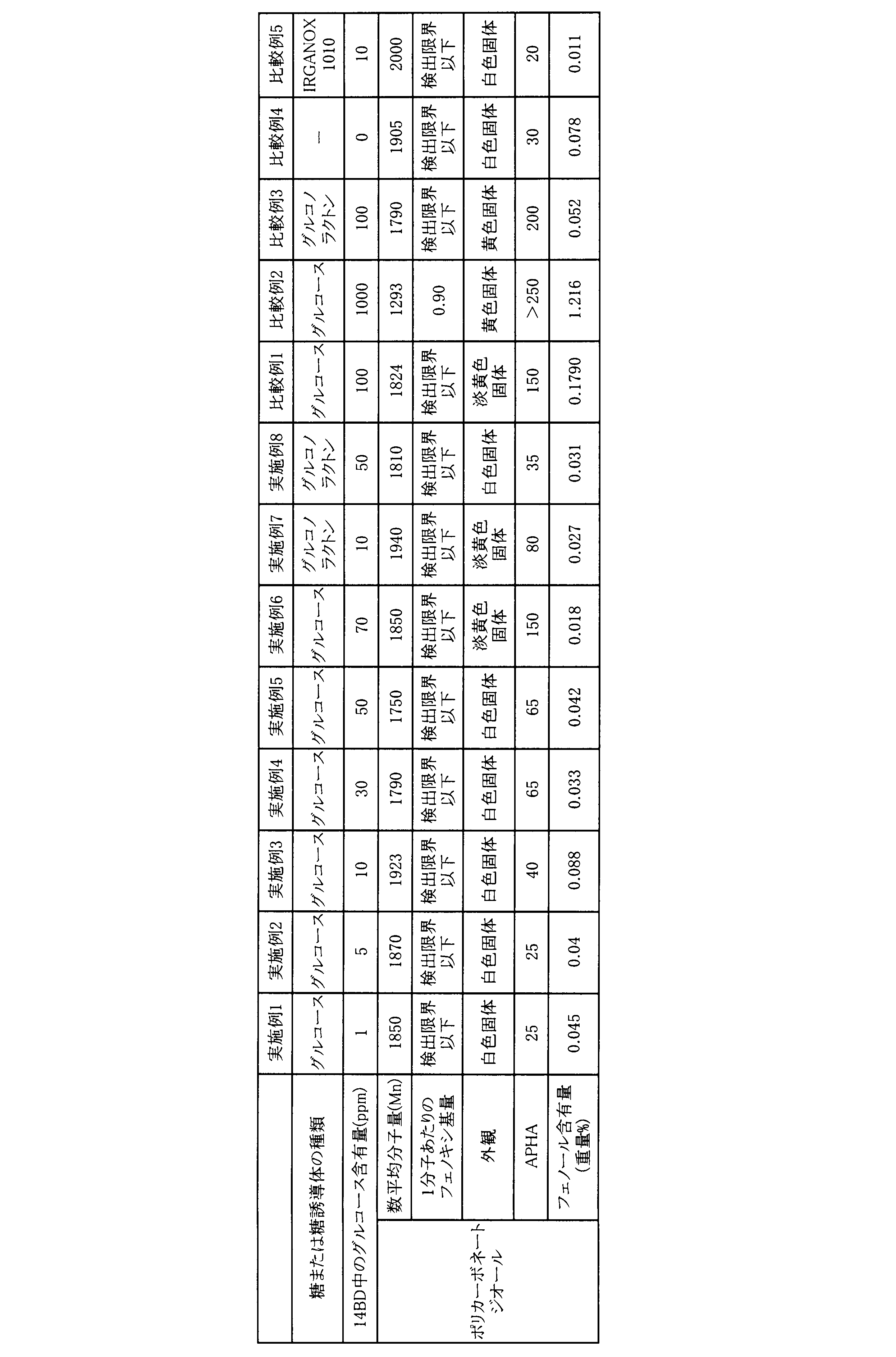
<実施例1~8、比較例1、比較例3~5>
実施例1~8、比較例1、比較例3~5で得られたポリカーボネートジオール含有組成物を20g/分の流量で薄膜蒸留装置に送液し、薄膜蒸留(温度:210℃、圧力:53~67Pa)を行った。薄膜蒸留装置としては、直径50mm、高さ200mm、面積0.0314m2の内部コンデンサー、ジャケット付きの柴田科学株式会社製、分子蒸留装置MS-300特型を使用した。薄膜蒸留で得られたポリカーボネートジオールの性状及び物性の評価結果を表2に示す。
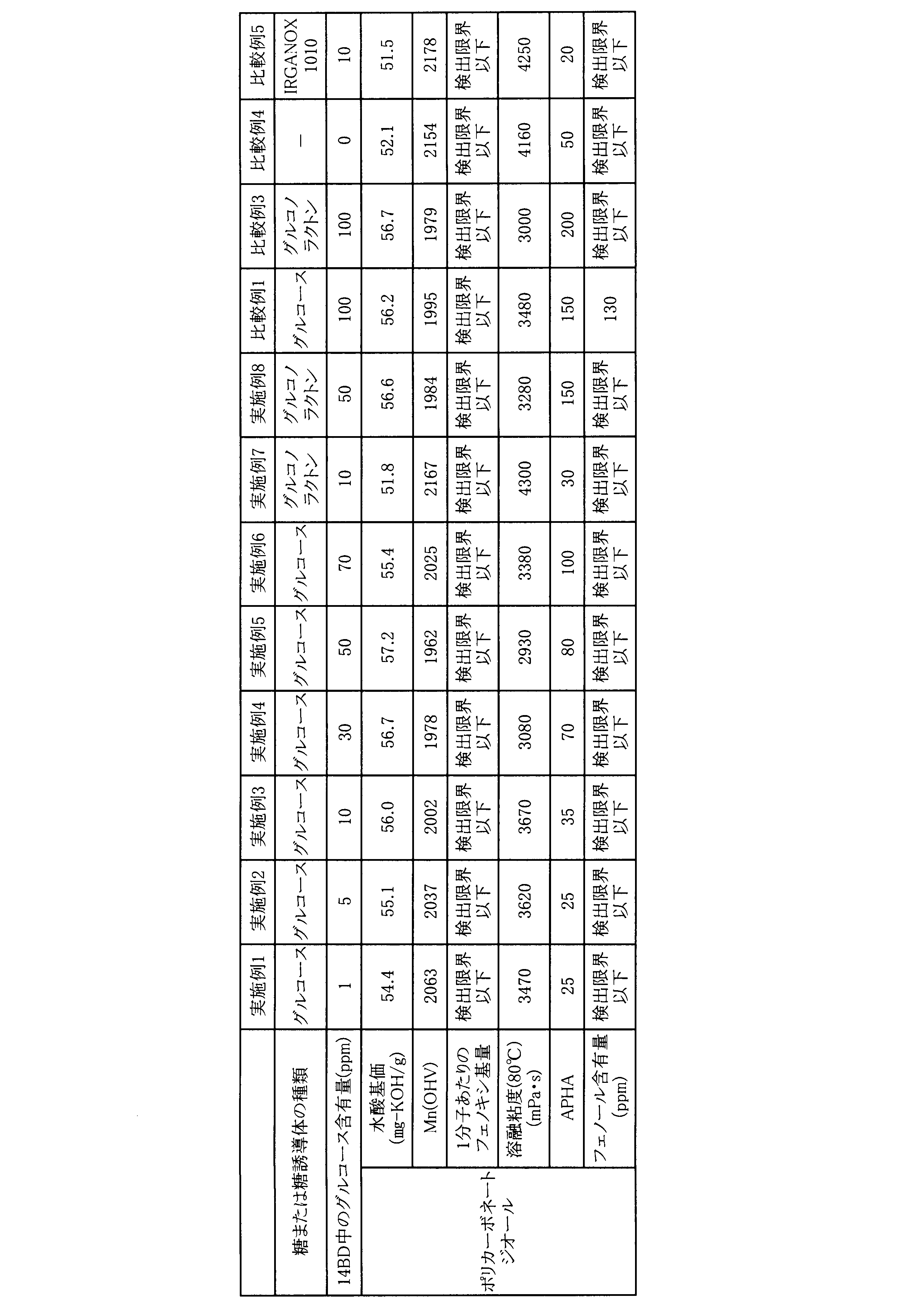
<実施例9>
熱電対を設置した攪拌翼を具備したセパラブルフラスコに、あらかじめ80℃に加温した実施例1で得られた薄膜蒸留後のポリカーボネートジオール72.69g、1,4-ブタンジオール(三菱化学株式会社製)3.18g、脱水N,N-ジメチルホルムアミド(以下DMF、和光純薬工業株式会社製)218.2g、ウレタン化触媒(日東化成株式会社製ネオスタンU-830)16.8mgを入れ、55℃に設定されたオイルバスにこのセパラブルフラスコを浸し、セパラブルフラスコ内を窒素雰囲気下で加温しつつ、60rpmで1時間程度撹拌した。ポリカーボネートジオールが溶媒に溶解した後、MDI(日本ポリウレタン工業製)17.45gを添加した。反応熱による内温上昇がおさまり温度低下が始まってから、オイルバスの設定を70℃に昇温し、1時間撹拌した。このときのポリカーボネートジオール及び1,4-ブタンジオールの物質量総量から含有水分物質量総量を減じた値に対するMDIの物質量総量の割合(以下NCO/OHモル比)は0.95であり、粘度は9.14Pa・s、重量平均分子量は10.6万であった。その後、MDI0.78gを追添加し、NCO/OHモル比0.99、粘度416.7Pa・s超、重量平均分子量31.8万のポリウレタン溶液を得た。このポリウレタンの性状及び物性の評価結果を表3に示す。
実施例2~8、比較例1、比較例3~5で得られた薄膜蒸留後のポリカーボネートジオールを用いた以外は、表3に示す原料仕込み量にて、実施例9と同様にしてポリウレタン溶液を得た。このポリウレタンの性状及び物性の評価結果を表3に示す。
比較例4で得られたポリカーボネートジオール101.54gに、D-(+)-グルコースの1.2重量%DMF溶液71.3mgを添加して均一に混合した。このとき、D-(+)-グルコースの濃度は、D-(+)-グルコースとポリカーボネートジオールの構成単位である原料1,4-ブタンジオールを合計した重量に対して、10.6重量ppmであった。得られたポリカーボネートジオールを用いて、表3に示す原料仕込み量にて、実施例9と同様にしてポリウレタン溶液を得た。このポリウレタンの性状及び物性の評価結果を表3に示す。
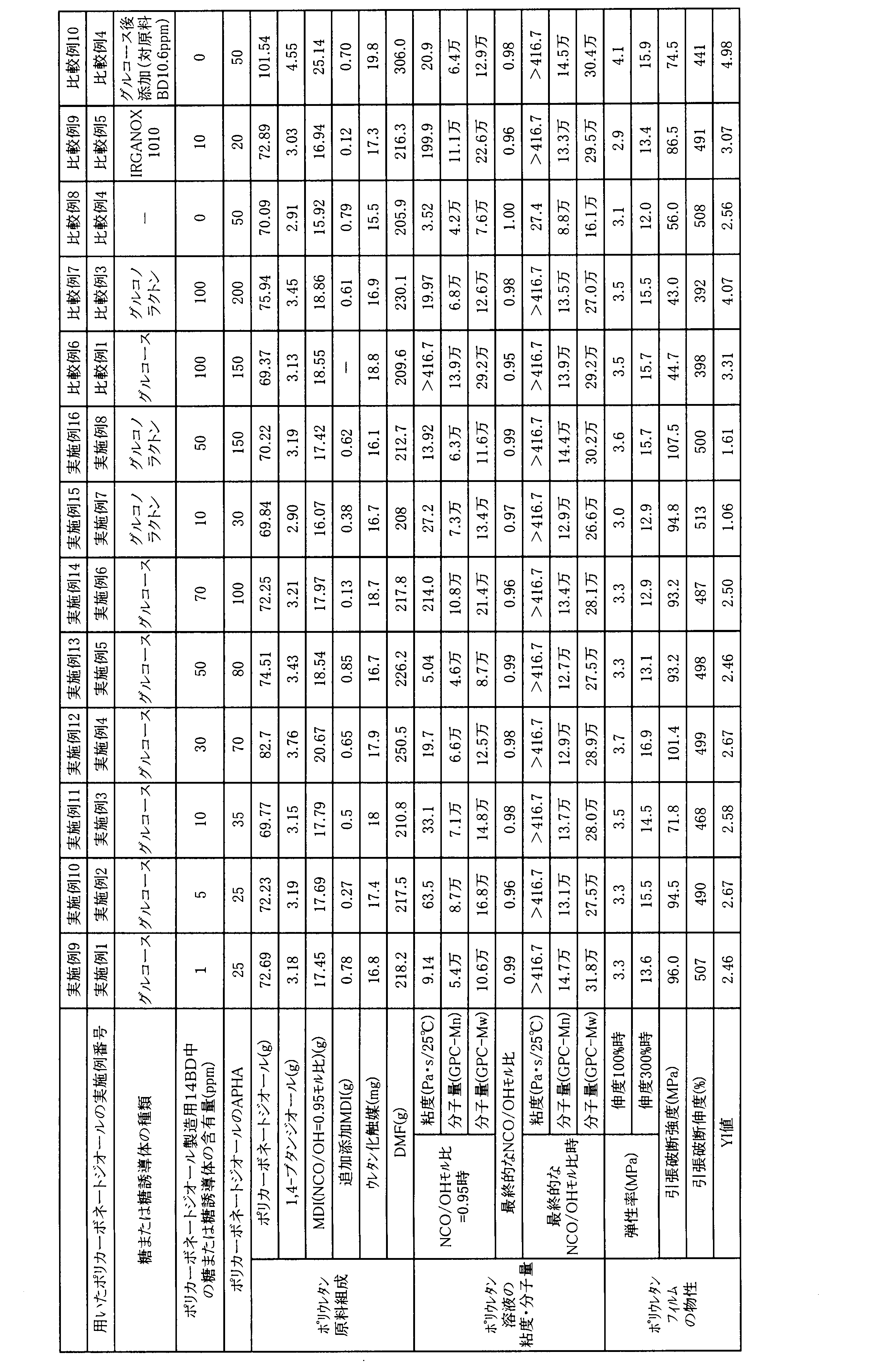
よって、本発明の製造方法で得られたポリカーボネートジオールを用いることで、イソシアネート化合物と反応させてポリウレタンを製造する際の反応速度を向上させ、生産性の向上のために最適な一定以内の分子量を得ると共に、得られるポリウレタンの着色がなく、かつ引張強度を改善することができる。製造されたポリウレタンは特に合成・人工皮革、塗料・コーティング用途、弾性繊維用途として望ましい。
Claims (14)
- ジヒドロキシ化合物とカーボネート化合物とを糖及び/又はその誘導体の存在下にエステル交換反応により重合させてポリカーボネートジオールを得る工程を有するポリカーボネートジオールの製造方法であって、
該糖及び/又はその誘導体と該ジヒドロキシ化合物との合計に対する該糖及び/又はその誘導体の含有量が0.1~80重量ppmであるポリカーボネートジオールの製造方法。 - 前記ポリカーボネートジオールを得る工程に先立ち、予め前記糖及び/又はその誘導体を含む前記ジヒドロキシ化合物中の該糖及び/又はその誘導体量を調整する工程を有し、該調整工程において、該糖及び/又はその誘導体と該ジヒドロキシ化合物との合計に対する該糖及び/又はその誘導体の含有量を0.1~80重量ppmに調整する請求項1に記載のポリカーボネートジオールの製造方法。
- 前記ジヒドロキシ化合物が1,4-ブタンジオールを含む請求項1又は請求項2に記載のポリカーボネートジオールの製造方法。
- 前記ポリカーボネートジオールの数平均分子量が500以上5000以下である請求項1~請求項3のいずれか1項に記載のポリカーボネートジオールの製造方法。
- 請求項1~請求項4のいずれか1項に記載のポリカーボネートジオールの製造方法により製造されたポリカーボネートジオール。
- ポリカーボネートジオールとイソシアネート化合物とを反応させてポリウレタンを得る工程を有するポリウレタンの製造方法であって、
該ポリウレタンを得る工程に先立ち、該ポリカーボネートジオールがジヒドロキシ化合物とカーボネート化合物とを糖及び/又はその誘導体の存在下にエステル交換反応により重合させる工程を経て得られたものであって、該ポリカーボネートジオールを得る工程における、該糖及び/又はその誘導体と該ジヒドロキシ化合物との合計に対する該糖及び/又はその誘導体の含有量が0.1~80重量ppmであるポリウレタンの製造方法。 - 前記ポリカーボネートジオールと前記イソシアネート化合物に加えて、更に鎖延長剤を反応させてポリウレタンを得る請求項6に記載のポリウレタンの製造方法。
- 前記鎖延長剤が前記糖及び/又はその誘導体を含有する請求項7に記載のポリウレタンの製造方法。
- 前記鎖延長剤が1,4-ブタンジオールを含む請求項7又は請求項8に記載のポリウレタンの製造方法。
- 前記糖及び/又はその誘導体が、2以上の酸素原子を含むカルボニル化合物である請求項6~請求項9のいずれか1項に記載のポリウレタンの製造方法。
- 前記ポリウレタンが熱可塑性ポリウレタンである請求項6~請求項10のいずれか1項に記載のポリウレタンの製造方法。
- 請求項6~請求項11のいずれか1項に記載のポリウレタンの製造方法により製造されたポリウレタン。
- 合成皮革又は人工皮革用ポリウレタンである請求項12に記載のポリウレタン。
- 塗料又はコーティング用ポリウレタンである請求項12に記載のポリウレタン。
Priority Applications (4)
| Application Number | Priority Date | Filing Date | Title |
|---|---|---|---|
| KR1020167002483A KR102110107B1 (ko) | 2013-07-31 | 2014-07-30 | 폴리카보네이트디올의 제조 방법 및 폴리카보네이트디올 그리고 폴리우레탄의 제조 방법 및 폴리우레탄 |
| CN201480042894.9A CN105452332B (zh) | 2013-07-31 | 2014-07-30 | 聚碳酸酯二醇的制造方法和聚碳酸酯二醇以及聚氨酯的制造方法和聚氨酯 |
| ES14831512T ES2959409T3 (es) | 2013-07-31 | 2014-07-30 | Método para producir policarbonato diol, policarbonato diol, método para producir poliuretano y poliuretanos |
| EP14831512.0A EP3029086B1 (en) | 2013-07-31 | 2014-07-30 | Method for producing polycarbonate diol, polycarbonate diol, method for producing polyurethane and polyurethane |
Applications Claiming Priority (2)
| Application Number | Priority Date | Filing Date | Title |
|---|---|---|---|
| JP2013-159231 | 2013-07-31 | ||
| JP2013159231 | 2013-07-31 |
Publications (1)
| Publication Number | Publication Date |
|---|---|
| WO2015016261A1 true WO2015016261A1 (ja) | 2015-02-05 |
Family
ID=52431791
Family Applications (1)
| Application Number | Title | Priority Date | Filing Date |
|---|---|---|---|
| PCT/JP2014/070060 Ceased WO2015016261A1 (ja) | 2013-07-31 | 2014-07-30 | ポリカーボネートジオールの製造方法及びポリカーボネートジオール並びにポリウレタンの製造方法及びポリウレタン |
Country Status (7)
| Country | Link |
|---|---|
| EP (1) | EP3029086B1 (ja) |
| JP (1) | JP6241389B2 (ja) |
| KR (1) | KR102110107B1 (ja) |
| CN (1) | CN105452332B (ja) |
| ES (1) | ES2959409T3 (ja) |
| TW (1) | TWI659979B (ja) |
| WO (1) | WO2015016261A1 (ja) |
Cited By (5)
| Publication number | Priority date | Publication date | Assignee | Title |
|---|---|---|---|---|
| WO2020179462A1 (ja) * | 2019-03-05 | 2020-09-10 | 旭化成株式会社 | ポリカーボネートジオール |
| CN114149734A (zh) * | 2021-12-28 | 2022-03-08 | 南通科顺建筑新材料有限公司 | 一种反射隔热聚氨酯防水涂料及其制备方法 |
| TWI796009B (zh) * | 2021-11-23 | 2023-03-11 | 南亞塑膠工業股份有限公司 | 聚氨酯樹脂及其製造方法 |
| WO2024166926A1 (ja) | 2023-02-09 | 2024-08-15 | 三菱ケミカル株式会社 | ポリカーボネートジオール、ポリカーボネートジオールの製造方法、及びポリウレタン |
| WO2024166560A1 (ja) | 2023-02-07 | 2024-08-15 | 三菱ケミカル株式会社 | ポリカーボネートジオール組成物、ポリカーボネートジオール組成物の製造方法、及びポリウレタン |
Families Citing this family (18)
| Publication number | Priority date | Publication date | Assignee | Title |
|---|---|---|---|---|
| KR102454221B1 (ko) * | 2016-03-31 | 2022-10-14 | 한국화학연구원 | 인장강도 및 굴곡강도를 향상시키는 폴리우레탄 강화제를 포함하는 에폭시 몰딩 조성물 및 이의 경화물 |
| JP6866037B2 (ja) * | 2016-06-29 | 2021-04-28 | 旭化成株式会社 | ポリカーボネートジオール組成物 |
| KR102180456B1 (ko) * | 2018-11-20 | 2020-11-18 | 한국생산기술연구원 | 폴리우레탄 기반 자기치유 소재 및 그를 포함하는 물품 |
| WO2020218507A1 (ja) | 2019-04-24 | 2020-10-29 | 三菱ケミカル株式会社 | 熱可塑性ポリウレタン樹脂エラストマー |
| KR102870377B1 (ko) * | 2019-05-17 | 2025-10-16 | 한국전력공사 | 인장물성이 우수한 형상기억 폴리우레탄 제조방법 및 이에 의해 제조된 형상기억 폴리우레탄 |
| KR102245471B1 (ko) * | 2019-05-27 | 2021-04-28 | (주)화성인터내셔날 | 바이오 소재를 이용한 원단 코팅용 폴리우레탄 수지 제조방법 |
| ES3060736T3 (en) * | 2019-08-07 | 2026-03-27 | Mitsubishi Chem Corp | Polyether polycarbonate diol and method for producing same |
| JP7272247B2 (ja) * | 2019-11-28 | 2023-05-12 | 株式会社プロテリアル | ケーブルおよび電線 |
| CN111187564A (zh) * | 2020-03-05 | 2020-05-22 | 清远粤绿新材料技术有限公司 | 一种可加热聚氨酯类汽车装饰膜的导热涂料及其制造方法 |
| CN112680084A (zh) * | 2020-12-29 | 2021-04-20 | 广东花王涂料有限公司 | 一种水性木器漆及其制备方法 |
| KR102621860B1 (ko) * | 2021-01-08 | 2024-01-09 | 한국전력공사 | 측면 가교화된 다기능성 폴리우레탄 및 이의 제조방법 |
| DE102021109750A1 (de) * | 2021-04-19 | 2022-10-20 | Voith Patent Gmbh | Polyurethan, Walzenbezug und Herstellungsverfahren |
| KR102925833B1 (ko) * | 2021-04-23 | 2026-02-10 | 한국전력공사 | 측면 가교화된 기능성 폴리우레탄 및 이의 제조방법. |
| CN115869131A (zh) * | 2022-10-12 | 2023-03-31 | 浙江珍琦护理用品有限公司 | 一种高弹高贴合性裤型纸尿裤弹性腰围 |
| EP4357390A1 (de) | 2022-10-18 | 2024-04-24 | Hilti Aktiengesellschaft | Biogene methacrylate auf basis von polycarbonatdiolen als reaktive harze für die härtung von reaktivharzen |
| CN115739573A (zh) * | 2022-11-28 | 2023-03-07 | 成都彩星化工有限公司 | 一种用于化工原料储存的聚氨酯面漆加工方法 |
| CN116731301B (zh) * | 2023-06-30 | 2024-03-19 | 珠海市凯拓塑料制品有限公司 | 一种生物基防刮花吸塑托盘及其制备方法 |
| CN118895042A (zh) * | 2024-09-30 | 2024-11-05 | 山东元利科技有限公司 | 一种聚碳酸酯二元醇组合物及其制备方法 |
Citations (9)
| Publication number | Priority date | Publication date | Assignee | Title |
|---|---|---|---|---|
| JPH06329752A (ja) * | 1993-05-26 | 1994-11-29 | Nippon Polyurethane Ind Co Ltd | ポリウレタン用ポリオール組成物 |
| JP2000001646A (ja) | 1998-06-12 | 2000-01-07 | Agency Of Ind Science & Technol | 生分解性被膜形成材料及び生分解性被膜を有する水溶性又は吸水性固体物質 |
| JP2000319350A (ja) * | 1999-05-10 | 2000-11-21 | Agency Of Ind Science & Technol | 生分解性ポリウレタン複合体及びその製造方法 |
| WO2005003202A2 (ja) * | 2003-06-06 | 2005-01-13 | Hyoe Hatakeyama | ポリウレタン及びその製造方法 |
| JP2005048141A (ja) | 2003-07-31 | 2005-02-24 | Nippon Polyurethane Ind Co Ltd | 1,4−ブタンジオールを主剤とするコポリカーボネートジオールの製造方法、およびそのコポリカーボネートジオールを用いたポリウレタン樹脂。 |
| JP2007161905A (ja) * | 2005-12-14 | 2007-06-28 | Toyo Ink Mfg Co Ltd | 天然物由来の原料を用いた高水酸基価を有するウレタン樹脂 |
| JP2009191223A (ja) | 2008-02-18 | 2009-08-27 | Nippon Polyurethane Ind Co Ltd | 耐水性軟質ポリウレタンフォームの製造方法 |
| JP2011225863A (ja) | 2010-04-02 | 2011-11-10 | Dainichiseika Color & Chem Mfg Co Ltd | バイオポリウレタン樹脂 |
| JP2012072350A (ja) * | 2010-04-14 | 2012-04-12 | Mitsubishi Chemicals Corp | ポリカーボネートジオール及びその製造法、並びにそれを用いたポリウレタン及び活性エネルギー線硬化性重合体組成物 |
Family Cites Families (4)
| Publication number | Priority date | Publication date | Assignee | Title |
|---|---|---|---|---|
| JP3859241B2 (ja) * | 1992-09-29 | 2006-12-20 | 旭化成ケミカルズ株式会社 | ポリテトラメチレンカーボネートジオールを用いた熱可塑性ポリウレタン及びポリテトラメチレンカーボネートジオールの製造法 |
| WO2008029746A1 (en) * | 2006-09-01 | 2008-03-13 | Teijin Limited | Polycarbonate having plant-derived component and method for producing the same |
| US7863404B2 (en) * | 2008-09-26 | 2011-01-04 | Sabic Innovative Plastics Ip B.V. | Method of making isosorbide polycarbonate |
| JP6146961B2 (ja) * | 2011-06-16 | 2017-06-14 | 三菱ケミカル株式会社 | ポリカーボネートジオール含有組成物およびその製造方法、並びにポリカーボネートジオール含有組成物を用いたポリウレタン |
-
2014
- 2014-07-29 JP JP2014153991A patent/JP6241389B2/ja active Active
- 2014-07-30 TW TW103126134A patent/TWI659979B/zh active
- 2014-07-30 ES ES14831512T patent/ES2959409T3/es active Active
- 2014-07-30 WO PCT/JP2014/070060 patent/WO2015016261A1/ja not_active Ceased
- 2014-07-30 KR KR1020167002483A patent/KR102110107B1/ko active Active
- 2014-07-30 EP EP14831512.0A patent/EP3029086B1/en active Active
- 2014-07-30 CN CN201480042894.9A patent/CN105452332B/zh active Active
Patent Citations (9)
| Publication number | Priority date | Publication date | Assignee | Title |
|---|---|---|---|---|
| JPH06329752A (ja) * | 1993-05-26 | 1994-11-29 | Nippon Polyurethane Ind Co Ltd | ポリウレタン用ポリオール組成物 |
| JP2000001646A (ja) | 1998-06-12 | 2000-01-07 | Agency Of Ind Science & Technol | 生分解性被膜形成材料及び生分解性被膜を有する水溶性又は吸水性固体物質 |
| JP2000319350A (ja) * | 1999-05-10 | 2000-11-21 | Agency Of Ind Science & Technol | 生分解性ポリウレタン複合体及びその製造方法 |
| WO2005003202A2 (ja) * | 2003-06-06 | 2005-01-13 | Hyoe Hatakeyama | ポリウレタン及びその製造方法 |
| JP2005048141A (ja) | 2003-07-31 | 2005-02-24 | Nippon Polyurethane Ind Co Ltd | 1,4−ブタンジオールを主剤とするコポリカーボネートジオールの製造方法、およびそのコポリカーボネートジオールを用いたポリウレタン樹脂。 |
| JP2007161905A (ja) * | 2005-12-14 | 2007-06-28 | Toyo Ink Mfg Co Ltd | 天然物由来の原料を用いた高水酸基価を有するウレタン樹脂 |
| JP2009191223A (ja) | 2008-02-18 | 2009-08-27 | Nippon Polyurethane Ind Co Ltd | 耐水性軟質ポリウレタンフォームの製造方法 |
| JP2011225863A (ja) | 2010-04-02 | 2011-11-10 | Dainichiseika Color & Chem Mfg Co Ltd | バイオポリウレタン樹脂 |
| JP2012072350A (ja) * | 2010-04-14 | 2012-04-12 | Mitsubishi Chemicals Corp | ポリカーボネートジオール及びその製造法、並びにそれを用いたポリウレタン及び活性エネルギー線硬化性重合体組成物 |
Non-Patent Citations (2)
| Title |
|---|
| KATSUJI MATSUNAGA,: "Polyurethane no Kiso to Oyo (Basis and Application of Polyurethane", November 2006, CMC SHUPPAN, pages: 96 |
| See also references of EP3029086A4 |
Cited By (10)
| Publication number | Priority date | Publication date | Assignee | Title |
|---|---|---|---|---|
| WO2020179462A1 (ja) * | 2019-03-05 | 2020-09-10 | 旭化成株式会社 | ポリカーボネートジオール |
| CN113544188A (zh) * | 2019-03-05 | 2021-10-22 | 旭化成株式会社 | 聚碳酸酯二醇 |
| JPWO2020179462A1 (ja) * | 2019-03-05 | 2021-10-28 | 旭化成株式会社 | ポリカーボネートジオール |
| JP7253035B2 (ja) | 2019-03-05 | 2023-04-05 | 旭化成株式会社 | ポリカーボネートジオール |
| CN113544188B (zh) * | 2019-03-05 | 2024-02-27 | 旭化成株式会社 | 聚碳酸酯二醇 |
| TWI796009B (zh) * | 2021-11-23 | 2023-03-11 | 南亞塑膠工業股份有限公司 | 聚氨酯樹脂及其製造方法 |
| CN114149734A (zh) * | 2021-12-28 | 2022-03-08 | 南通科顺建筑新材料有限公司 | 一种反射隔热聚氨酯防水涂料及其制备方法 |
| CN114149734B (zh) * | 2021-12-28 | 2022-08-05 | 南通科顺建筑新材料有限公司 | 一种反射隔热聚氨酯防水涂料及其制备方法 |
| WO2024166560A1 (ja) | 2023-02-07 | 2024-08-15 | 三菱ケミカル株式会社 | ポリカーボネートジオール組成物、ポリカーボネートジオール組成物の製造方法、及びポリウレタン |
| WO2024166926A1 (ja) | 2023-02-09 | 2024-08-15 | 三菱ケミカル株式会社 | ポリカーボネートジオール、ポリカーボネートジオールの製造方法、及びポリウレタン |
Also Published As
| Publication number | Publication date |
|---|---|
| EP3029086A4 (en) | 2016-08-03 |
| CN105452332B (zh) | 2017-07-14 |
| CN105452332A (zh) | 2016-03-30 |
| JP2015044986A (ja) | 2015-03-12 |
| TW201509990A (zh) | 2015-03-16 |
| KR102110107B1 (ko) | 2020-05-13 |
| ES2959409T3 (es) | 2024-02-26 |
| JP6241389B2 (ja) | 2017-12-06 |
| TWI659979B (zh) | 2019-05-21 |
| EP3029086B1 (en) | 2023-09-06 |
| EP3029086A1 (en) | 2016-06-08 |
| KR20160037921A (ko) | 2016-04-06 |
Similar Documents
| Publication | Publication Date | Title |
|---|---|---|
| JP6241389B2 (ja) | ポリカーボネートジオールの製造方法及びポリウレタンの製造方法 | |
| JP5742202B2 (ja) | ポリカーボネートジオール含有組成物およびその製造方法、並びにそれを用いたポリウレタンおよびその製造方法。 | |
| KR102025074B1 (ko) | 폴리카보네이트디올 및 그것을 사용한 폴리우레탄 | |
| JP6252070B2 (ja) | ポリカーボネートジオール | |
| CN108409955B (zh) | 汽车部件和汽车 | |
| JP6078988B2 (ja) | ポリカーボネートポリオールの製造方法 | |
| JP6544889B2 (ja) | ポリカーボネートジオールおよびその製造方法並びにそれを用いたポリウレタン | |
| KR20220044896A (ko) | 폴리에테르폴리카보네이트디올 및 그 제조 방법 | |
| KR20130092383A (ko) | 폴리카보네이트디올 및 그 제조법, 그리고 그것을 사용한 폴리우레탄 및 활성 에너지선 경화성 중합체 조성물 | |
| JP6048159B2 (ja) | ポリウレタンの製造方法 | |
| JP2022145545A (ja) | ポリカーボネートジオール及びそれを用いたポリウレタン | |
| JP2022120570A (ja) | ポリエーテルポリカーボネートジオール及びその製造方法 | |
| JP2023103002A (ja) | ポリエーテルポリカーボネートジオール及びその製造方法 | |
| JP2022078712A (ja) | ポリエーテルポリカーボネートジオール及びその製造方法 |
Legal Events
| Date | Code | Title | Description |
|---|---|---|---|
| WWE | Wipo information: entry into national phase |
Ref document number: 201480042894.9 Country of ref document: CN |
|
| 121 | Ep: the epo has been informed by wipo that ep was designated in this application |
Ref document number: 14831512 Country of ref document: EP Kind code of ref document: A1 |
|
| ENP | Entry into the national phase |
Ref document number: 20167002483 Country of ref document: KR Kind code of ref document: A |
|
| WWE | Wipo information: entry into national phase |
Ref document number: 2014831512 Country of ref document: EP |
|
| NENP | Non-entry into the national phase |
Ref country code: DE |