WO2015012111A1 - フィルムと繊維シートからなる積層体 - Google Patents
フィルムと繊維シートからなる積層体 Download PDFInfo
- Publication number
- WO2015012111A1 WO2015012111A1 PCT/JP2014/068388 JP2014068388W WO2015012111A1 WO 2015012111 A1 WO2015012111 A1 WO 2015012111A1 JP 2014068388 W JP2014068388 W JP 2014068388W WO 2015012111 A1 WO2015012111 A1 WO 2015012111A1
- Authority
- WO
- WIPO (PCT)
- Prior art keywords
- pps
- layer
- film
- laminate
- fiber sheet
- Prior art date
- Legal status (The legal status is an assumption and is not a legal conclusion. Google has not performed a legal analysis and makes no representation as to the accuracy of the status listed.)
- Ceased
Links
Images

Classifications
-
- B—PERFORMING OPERATIONS; TRANSPORTING
- B32—LAYERED PRODUCTS
- B32B—LAYERED PRODUCTS, i.e. PRODUCTS BUILT-UP OF STRATA OF FLAT OR NON-FLAT, e.g. CELLULAR OR HONEYCOMB, FORM
- B32B27/00—Layered products comprising a layer of synthetic resin
- B32B27/12—Layered products comprising a layer of synthetic resin next to a fibrous or filamentary layer
-
- B—PERFORMING OPERATIONS; TRANSPORTING
- B32—LAYERED PRODUCTS
- B32B—LAYERED PRODUCTS, i.e. PRODUCTS BUILT-UP OF STRATA OF FLAT OR NON-FLAT, e.g. CELLULAR OR HONEYCOMB, FORM
- B32B27/00—Layered products comprising a layer of synthetic resin
- B32B27/28—Layered products comprising a layer of synthetic resin comprising synthetic resins not wholly covered by any one of the sub-groups B32B27/30 - B32B27/42
- B32B27/286—Layered products comprising a layer of synthetic resin comprising synthetic resins not wholly covered by any one of the sub-groups B32B27/30 - B32B27/42 comprising polysulphones; polysulfides
-
- B—PERFORMING OPERATIONS; TRANSPORTING
- B32—LAYERED PRODUCTS
- B32B—LAYERED PRODUCTS, i.e. PRODUCTS BUILT-UP OF STRATA OF FLAT OR NON-FLAT, e.g. CELLULAR OR HONEYCOMB, FORM
- B32B5/00—Layered products characterised by the non- homogeneity or physical structure, i.e. comprising a fibrous, filamentary, particulate or foam layer; Layered products characterised by having a layer differing constitutionally or physically in different parts
- B32B5/22—Layered products characterised by the non- homogeneity or physical structure, i.e. comprising a fibrous, filamentary, particulate or foam layer; Layered products characterised by having a layer differing constitutionally or physically in different parts characterised by the presence of two or more layers which are next to each other and are fibrous, filamentary, formed of particles or foamed
- B32B5/24—Layered products characterised by the non- homogeneity or physical structure, i.e. comprising a fibrous, filamentary, particulate or foam layer; Layered products characterised by having a layer differing constitutionally or physically in different parts characterised by the presence of two or more layers which are next to each other and are fibrous, filamentary, formed of particles or foamed one layer being a fibrous or filamentary layer
-
- B—PERFORMING OPERATIONS; TRANSPORTING
- B32—LAYERED PRODUCTS
- B32B—LAYERED PRODUCTS, i.e. PRODUCTS BUILT-UP OF STRATA OF FLAT OR NON-FLAT, e.g. CELLULAR OR HONEYCOMB, FORM
- B32B2262/00—Composition or structural features of fibres which form a fibrous or filamentary layer or are present as additives
- B32B2262/02—Synthetic macromolecular fibres
- B32B2262/0207—Elastomeric fibres
-
- B—PERFORMING OPERATIONS; TRANSPORTING
- B32—LAYERED PRODUCTS
- B32B—LAYERED PRODUCTS, i.e. PRODUCTS BUILT-UP OF STRATA OF FLAT OR NON-FLAT, e.g. CELLULAR OR HONEYCOMB, FORM
- B32B2262/00—Composition or structural features of fibres which form a fibrous or filamentary layer or are present as additives
- B32B2262/02—Synthetic macromolecular fibres
- B32B2262/0261—Polyamide fibres
- B32B2262/0269—Aromatic polyamide fibres
-
- B—PERFORMING OPERATIONS; TRANSPORTING
- B32—LAYERED PRODUCTS
- B32B—LAYERED PRODUCTS, i.e. PRODUCTS BUILT-UP OF STRATA OF FLAT OR NON-FLAT, e.g. CELLULAR OR HONEYCOMB, FORM
- B32B2264/00—Composition or properties of particles which form a particulate layer or are present as additives
- B32B2264/10—Inorganic particles
- B32B2264/102—Oxide or hydroxide
-
- B—PERFORMING OPERATIONS; TRANSPORTING
- B32—LAYERED PRODUCTS
- B32B—LAYERED PRODUCTS, i.e. PRODUCTS BUILT-UP OF STRATA OF FLAT OR NON-FLAT, e.g. CELLULAR OR HONEYCOMB, FORM
- B32B2264/00—Composition or properties of particles which form a particulate layer or are present as additives
- B32B2264/10—Inorganic particles
- B32B2264/104—Oxysalt, e.g. carbonate, sulfate, phosphate or nitrate particles
-
- B—PERFORMING OPERATIONS; TRANSPORTING
- B32—LAYERED PRODUCTS
- B32B—LAYERED PRODUCTS, i.e. PRODUCTS BUILT-UP OF STRATA OF FLAT OR NON-FLAT, e.g. CELLULAR OR HONEYCOMB, FORM
- B32B2264/00—Composition or properties of particles which form a particulate layer or are present as additives
- B32B2264/10—Inorganic particles
- B32B2264/105—Metal
-
- B—PERFORMING OPERATIONS; TRANSPORTING
- B32—LAYERED PRODUCTS
- B32B—LAYERED PRODUCTS, i.e. PRODUCTS BUILT-UP OF STRATA OF FLAT OR NON-FLAT, e.g. CELLULAR OR HONEYCOMB, FORM
- B32B2264/00—Composition or properties of particles which form a particulate layer or are present as additives
- B32B2264/12—Mixture of at least two particles made of different materials
-
- B—PERFORMING OPERATIONS; TRANSPORTING
- B32—LAYERED PRODUCTS
- B32B—LAYERED PRODUCTS, i.e. PRODUCTS BUILT-UP OF STRATA OF FLAT OR NON-FLAT, e.g. CELLULAR OR HONEYCOMB, FORM
- B32B2307/00—Properties of the layers or laminate
- B32B2307/20—Properties of the layers or laminate having particular electrical or magnetic properties, e.g. piezoelectric
- B32B2307/206—Insulating
-
- B—PERFORMING OPERATIONS; TRANSPORTING
- B32—LAYERED PRODUCTS
- B32B—LAYERED PRODUCTS, i.e. PRODUCTS BUILT-UP OF STRATA OF FLAT OR NON-FLAT, e.g. CELLULAR OR HONEYCOMB, FORM
- B32B2307/00—Properties of the layers or laminate
- B32B2307/30—Properties of the layers or laminate having particular thermal properties
- B32B2307/306—Resistant to heat
-
- B—PERFORMING OPERATIONS; TRANSPORTING
- B32—LAYERED PRODUCTS
- B32B—LAYERED PRODUCTS, i.e. PRODUCTS BUILT-UP OF STRATA OF FLAT OR NON-FLAT, e.g. CELLULAR OR HONEYCOMB, FORM
- B32B2307/00—Properties of the layers or laminate
- B32B2307/50—Properties of the layers or laminate having particular mechanical properties
- B32B2307/514—Oriented
- B32B2307/518—Oriented bi-axially
-
- B—PERFORMING OPERATIONS; TRANSPORTING
- B32—LAYERED PRODUCTS
- B32B—LAYERED PRODUCTS, i.e. PRODUCTS BUILT-UP OF STRATA OF FLAT OR NON-FLAT, e.g. CELLULAR OR HONEYCOMB, FORM
- B32B2307/00—Properties of the layers or laminate
- B32B2307/50—Properties of the layers or laminate having particular mechanical properties
- B32B2307/54—Yield strength; Tensile strength
-
- B—PERFORMING OPERATIONS; TRANSPORTING
- B32—LAYERED PRODUCTS
- B32B—LAYERED PRODUCTS, i.e. PRODUCTS BUILT-UP OF STRATA OF FLAT OR NON-FLAT, e.g. CELLULAR OR HONEYCOMB, FORM
- B32B2307/00—Properties of the layers or laminate
- B32B2307/50—Properties of the layers or laminate having particular mechanical properties
- B32B2307/582—Tearability
- B32B2307/5825—Tear resistant
-
- B—PERFORMING OPERATIONS; TRANSPORTING
- B32—LAYERED PRODUCTS
- B32B—LAYERED PRODUCTS, i.e. PRODUCTS BUILT-UP OF STRATA OF FLAT OR NON-FLAT, e.g. CELLULAR OR HONEYCOMB, FORM
- B32B2307/00—Properties of the layers or laminate
- B32B2307/70—Other properties
- B32B2307/732—Dimensional properties
-
- B—PERFORMING OPERATIONS; TRANSPORTING
- B32—LAYERED PRODUCTS
- B32B—LAYERED PRODUCTS, i.e. PRODUCTS BUILT-UP OF STRATA OF FLAT OR NON-FLAT, e.g. CELLULAR OR HONEYCOMB, FORM
- B32B2457/00—Electrical equipment
- B32B2457/04—Insulators
-
- B—PERFORMING OPERATIONS; TRANSPORTING
- B32—LAYERED PRODUCTS
- B32B—LAYERED PRODUCTS, i.e. PRODUCTS BUILT-UP OF STRATA OF FLAT OR NON-FLAT, e.g. CELLULAR OR HONEYCOMB, FORM
- B32B2457/00—Electrical equipment
- B32B2457/16—Capacitors
-
- B—PERFORMING OPERATIONS; TRANSPORTING
- B32—LAYERED PRODUCTS
- B32B—LAYERED PRODUCTS, i.e. PRODUCTS BUILT-UP OF STRATA OF FLAT OR NON-FLAT, e.g. CELLULAR OR HONEYCOMB, FORM
- B32B2605/00—Vehicles
-
- B—PERFORMING OPERATIONS; TRANSPORTING
- B32—LAYERED PRODUCTS
- B32B—LAYERED PRODUCTS, i.e. PRODUCTS BUILT-UP OF STRATA OF FLAT OR NON-FLAT, e.g. CELLULAR OR HONEYCOMB, FORM
- B32B27/00—Layered products comprising a layer of synthetic resin
- B32B27/18—Layered products comprising a layer of synthetic resin characterised by the use of special additives
- B32B27/20—Layered products comprising a layer of synthetic resin characterised by the use of special additives using fillers, pigments, thixotroping agents
Definitions
- the present invention relates to a laminate in which a biaxially oriented polyphenylene sulfide film and a fiber sheet made of an aromatic polymer are joined.
- a polyphenylene sulfide (hereinafter also referred to as PPS) film has been widely used as a main material of an insulating material for motors because it has the above-mentioned various properties in a well-balanced manner.
- a fiber sheet is generally used to protect the film surface.
- a laminate in which an aromatic polyamide paper is laminated on the surface layer of a PPS film (patented) Documents 1) and laminates (Patent Documents 2 and 3) in which a PPS fiber sheet is laminated on the surface layer of a PPS film have been proposed.
- the conventional laminate has high hydrolysis resistance and chemical resistance due to the characteristics of the PPS film, since the interfacial adhesion between the fiber sheet and the PPS film is insufficient, surface friction and pulling during processing are difficult. In some cases, the fiber sheet layer is peeled off by scratches, and the scratches reach the inner film, so that the role of the fiber sheet as the surface protective layer may be insufficient.
- plasma treatment is not sufficient to improve interfacial adhesion. On the other hand, the application of the adhesive deteriorates the long-term heat resistance and hydrolysis resistance, and in some cases, the reliability is insufficient.
- An object of the present invention is to provide a laminate having excellent scratch resistance, high heat resistance and high electrical insulation (dielectric breakdown voltage), which are important for electrical insulation applications, and good insertability during processing. is there.
- the laminate of the present invention has the following configuration. That is, it is as follows. (1) A laminate in which a fiber sheet (A layer) made of an aromatic polymer is bonded to at least one surface of a biaxially oriented polyphenylene sulfide film layer (B layer) without using an adhesive, and tears in two orthogonal directions A laminate having an average strength value in the range of 1 to 6 N / mm. (2) The laminate according to (1), wherein the fiber sheet is made of polyphenylene sulfide resin. (3) The biaxially oriented polyphenylene sulfide film layer (B layer) has a three-layer structure of X / Y / X or a two-layer structure of X / Y.
- the melting point Tm (X) of the X layer and the melting point Tm ( Y) has a relationship of Tm (X) ⁇ [Tm (Y) -10], and the ratio of the thickness of the Y layer to the total thickness of the film layer is in the range of 40% to 90%.
- a laminate excellent in scratch resistance can be obtained, and furthermore, it has high heat resistance and high electrical insulation (dielectric breakdown voltage), which are important for electrical insulation applications, and good insertability during processing.
- a laminate can be provided.
- the biaxially oriented polyphenylene sulfide film layer (B layer) is composed only of a film obtained by melt-molding a resin composition containing polyphenylene sulfide as a main component into a sheet, biaxially stretching, and heat-treating. Is a layer.
- a resin composition containing polyphenylene sulfide as a main component refers to a composition containing 70% by mass or more, preferably 90% by mass or more of polyphenylene sulfide. If the PPS content is less than 70% by mass, the heat resistance, dimensional stability, mechanical properties, etc., which are the characteristics of PPS fibers and PPS films, may be impaired.
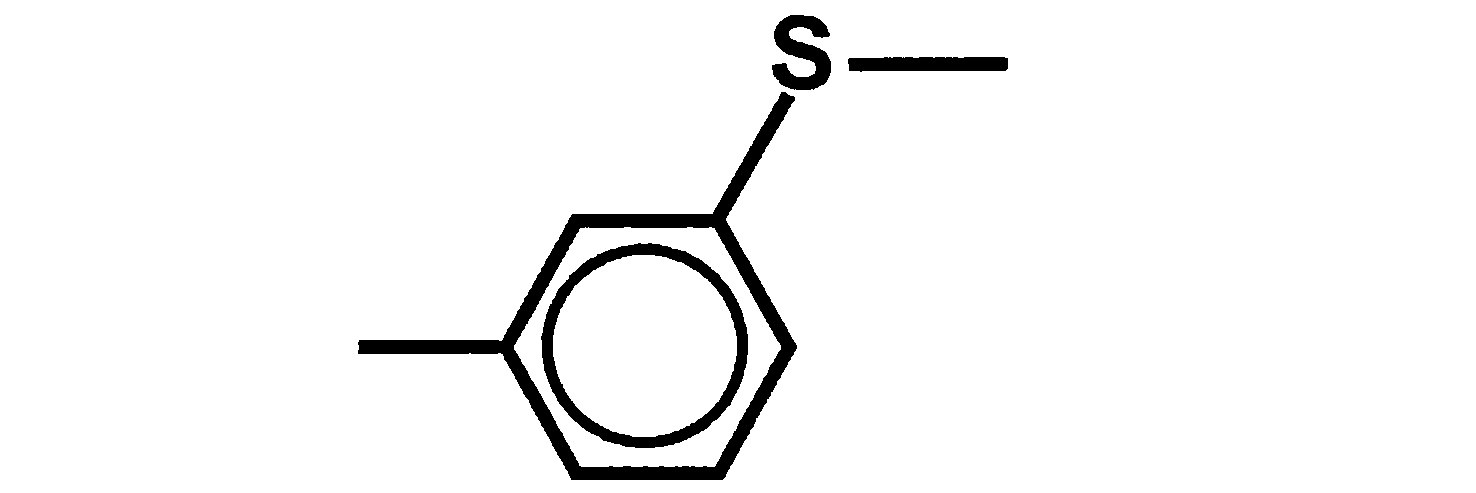
- PPS refers to a polymer in which 70 mol% or more (preferably 85 mol% or more) of repeating units are composed of p-phenylene sulfide units represented by the structural formula (A). If the component is less than 70 mol%, the crystallinity, thermal transition temperature, etc. of the polymer are lowered, and the heat resistance, dimensional stability, mechanical properties, etc., which are the features of PPS, may be impaired. If the repeating unit is less than 30 mol%, preferably less than 15 mol%, a unit containing a copolymerizable sulfide bond may be contained.
- the molecular weight of PPS is preferably in the range of weight average molecular weight of 7,500 to 500,000 for stable spinning and film formation, and more preferably 10,000 to 100,000.
- the PPS resin composition is less than 30% by mass, additives such as inorganic fillers, resins other than PPS (heterogeneous polymers), lubricants, colorants, ultraviolet absorbers and the like can be contained.
- the inorganic filler include calcium carbonate, silica, titanium oxide, alumina, kaolin, calcium phosphate, barium sulfate, talc, zinc oxide, metal and the like.
- One type of these particles may be used alone, or two or more types may be used in combination.
- the shape of the particles is not particularly limited, and particles such as a spherical shape, a rectangular parallelepiped shape, a monodispersed shape, and an aggregated shape can be used.
- polymers include polytetrafluoroethylene particles, silicone particles, crosslinked polystyrene particles, organic particles that do not melt up to 300 ° C, polymethylpentene, cyclic cycloolefin, polyphenylene ether, polyethylene naphthalate, polyetherimide, syndi Examples thereof include polymers that can be processed at a high temperature of 300 ° C. or higher, such as tactic polystyrene.
- the melt viscosity of the composition is in the range of 100 to 2,000 Pa ⁇ s at a temperature of 310 ° C. and a shear rate of 1,000 (1 / sec) from the viewpoint of fiber and film moldability. Preferably, it is in the range of 200 to 1,000 Pa ⁇ s.
- the fiber sheet made of an aromatic polymer is a thin leaf composed of an assembly of fibers obtained by spinning a resin composition containing an aromatic polymer as a main component by a known method, It is a general term for what is usually called non-woven fabric, paper, woven fabric, felt and the like.
- the aromatic polymer means aromatic polyamide, aromatic polyamideimide, aromatic polyimide, aromatic polyester, aromatic polysulfide, aromatic polysulfone, aromatic polysulfoxide, aromatic polyethersulfone, aromatic polyether. , Aromatic polyether ketone, aromatic polyether ether ketone, aromatic polycarbonate and the like. Among them, aromatic polyamide and aromatic polysulfide are particularly preferable from the viewpoints of interfacial adhesion with the biaxially oriented polyphenylene sulfide film of the B layer, long-term heat resistance, hydrolysis resistance, workability, and electrical insulation.
- the PPS film used in the present invention is not an unstretched film or a uniaxially oriented film in order to fully exhibit the characteristics of the PPS film, such as high electrical insulation, strength, workability, heat resistance, and hydrolysis resistance. It is important that the film is a biaxially oriented film.
- a sequential biaxial stretching method stretching method combining stretching in one direction such as a method of stretching in the vertical direction of the longitudinal direction after stretching in the longitudinal direction
- simultaneous biaxial stretching method with the longitudinal direction and A method in which the vertical direction of the longitudinal direction is simultaneously stretched
- a combination thereof can be used.
- the draw ratio is preferably 2.5 to 4.1 times in both the longitudinal direction and the direction perpendicular to the longitudinal direction, more preferably 3.0 to 3.8 times.
- the draw ratio is less than 2.5 times, the flatness of the film may be significantly deteriorated when the film is heat-treated after drawing.
- the draw ratio exceeds 4.1 times, the in-plane orientation of the film becomes too high, the tear strength decreases, and cracks and cracks may occur during processing such as punching and bending.
- the PPS film (B layer) used in the present invention comprises two types of PPS resin compositions having different compositions (respective resin compositions are X and Y), a three-layer structure of X / Y / X or X / It is preferable to laminate in a two-layer configuration of Y.
- the melting point Tm (X) (° C.) of the X layer and the melting point Tm (Y) (° C.) of the Y layer preferably satisfy the relationship of Tm (X) ⁇ [Tm (Y) ⁇ 10], more preferably Tm (X) ⁇ [Tm (Y) -15].
- the film and the fiber sheet are bonded by thermal lamination without using an adhesive (if the film is a three-layer laminated structure, the fiber sheet is bonded to both surfaces of the film).
- the interfacial adhesion between the film and the fiber sheet can be enhanced to join the fiber sheet only to the X layer side).
- Tm (X) ⁇ [Tm (Y) -10] for example, a PPS in which an m-phenylene skeleton represented by the structural formula (B) is introduced into a molecular chain by copolymerization (hereinafter, referred to as a PPS)
- a layer made of a PPS resin composition containing a meta-copolymerized PPS may be an X layer
- a layer made of a PPS resin composition containing only a p-phenylene skeleton may be a Y layer.
- the temperature range of Tm (Y) is substantially in the range of 240 to 290 ° C., more preferably 250 to 285 ° C., considering the general melting point characteristics of the PPS resin composition.
- the melting point of the PPS resin composition constituting each layer of the above-described biaxially oriented PPS film is determined by observing the cross section of the laminate cut with a microtome with a scanning electron microscope to determine the interface position between the film layer and the fiber sheet layer. After cutting out a trace sample about arbitrary parts of a film by ion beam cutting, it can measure using a high sensitivity differential scanning calorimeter.
- the lamination ratio of the X layer and the Y layer of the biaxially oriented PPS film is such that the thickness of the X layer on both surfaces is x and x ′, and the thickness of the Y layer forming the intermediate layer is y.
- the layer thickness ratio (y / (x + x ′ + y) ⁇ 100) is preferably in the range of 40% to 90%, more preferably 50% to 80%. When the ratio of the thickness of the Y layer is less than 40%, wrinkles may occur due to heat shrinkage of the film when thermally bonded to the fiber sheet by thermal lamination.
- the ratio x / x ′ of the thicknesses of the X layers on both surfaces is preferably in the range of 0.5 to 2 in order to reduce processing spots on the front and back surfaces during thermal lamination.
- the lamination ratio of the biaxially oriented PPS film is appropriately adjusted by changing the flow path volume in the laminating apparatus where the layers merge and the discharge amount of the extruder when the film is formed by a known melt extrusion method. be able to. When it is desired to increase the thickness of a certain layer, the flow path volume and discharge amount of that layer may be increased.
- the thickness of the biaxially oriented PPS film used in the present invention is preferably in the range of 20 to 120 ⁇ m, more preferably in the range of 25 to 90 ⁇ m. Within this range, in addition to enabling stable film formation, the thickness of the laminate after joining with the fiber sheet can be reduced, and a laminate suitable for miniaturization and weight reduction of electrical equipment can be obtained.
- the thickness of the biaxially oriented PPS film can be adjusted by changing the discharge amount of the extruder when forming the film and the stretching ratio. The greater the discharge amount and the greater the draw ratio, the thinner the film.
- the fiber sheet used in the present invention has an apparent specific gravity [value (g / cm 3 ) obtained by dividing the basis weight (g / m 2 ) by the sheet thickness ( ⁇ m)] before being bonded to the PPS film is 0 It is preferably in the range of 2 to 1.1 g / cm 3 , more preferably in the range of 0.3 to 0.9 g / cm 3 .
- the apparent specific gravity within this range, the protective effect (scratch resistance) of the film layer after joining with the PPS film can be enhanced.
- unstretched fibers are formed on at least a part of the constituting fibers at a stage before being joined to the PPS film. It is preferable to include.
- An unstretched fiber refers to a fiber obtained by melt spinning through a die with an extruder-type spinning machine or the like and then performing no or almost stretching with molecular chain orientation. By including unstretched fibers, it is possible to increase the adhesion at the lamination interface when the PPS film and the fiber sheet are thermally bonded, and to improve scratch resistance.
- the undrawn yarn can be drawn and drawn in a heating medium such as heated ethylene glycol.
- the fiber sheet used in the present invention can be produced by using a general dry method or wet method, and among them, a wet nonwoven fabric method that is easy to form a thin film and has high thickness uniformity is preferable.
- a spun resin composition is cut into short fibers and then dispersed in water to produce a paper slurry.
- This is a method for producing a fiber sheet by making paper using and drying it.
- When making paper it is possible to arbitrarily mix short fibers having different resin compositions and short fibers having different stretched states. Therefore, by combining the short fibers of the unstretched fibers and making paper, the PPS film and the fiber sheet can be made. It is also possible to further increase the adhesion of the laminated interface when the two are thermally bonded.
- the fiber sheet used in the present invention preferably has a fiber fineness of 0.05 dtex or more and 5 dtex or less before being joined to the PPS film. If it is thinner than 0.05 dtex, the fibers tend to be entangled with each other, making it difficult to produce a fiber sheet having a uniform thickness. If it becomes thicker than 10 dtex, the fiber becomes thick and hard, and the entanglement force between the fibers becomes weak, so that the fiber sheet is easily broken. It is preferable that all the fibers have a fineness of 0.05 dtex or more and 10 dtex or less. However, fibers outside the above range may be included to such an extent that the effects of the present invention are not impaired.
- the thickness of the fiber sheet used in the present invention is preferably in the range of 5 to 40 ⁇ m, more preferably 7 to 30 ⁇ m. If the thickness of the fiber sheet is less than 5 ⁇ m, scratch resistance may be significantly reduced. Moreover, when the thickness of a fiber sheet exceeds 40 micrometers, long-term heat resistance may deteriorate.
- the fiber sheet is bonded to at least one surface of the biaxially oriented PPS film without using an adhesive.
- the absence of an adhesive means that only the PPS resin composition constituting the biaxially oriented PPS film and the aromatic polymer constituting the fiber sheet are present at the interface between the film and the fiber sheet. To do. Since there is no low heat-resistant layer such as an adhesive at the interface, deterioration over time is small even when used for a long time under high temperature and high humidity, and high mechanical properties can be maintained.
- the fact that only the PPS resin composition is present at the interface of the laminate is obtained by analyzing the cross section in the thickness direction of the laminate using an energy dispersive X-ray spectrometer or a Fourier transform infrared spectrophotometer and mapping in the thickness direction. Can be determined.
- thermal lamination is a technique in which a PPS film and a fiber sheet are heated in an overlapped state, and are bonded by being pressed with a pressure roll or the like.
- the step of joining the PPS film and the fiber sheet by thermal lamination is preferably performed after biaxial stretching of the PPS film for ease of processing, but the fiber sheet is thermally laminated on at least one side of the unstretched PPS film, The film and the fiber sheet may be simultaneously biaxially stretched.
- a general thermal laminating apparatus or calendering apparatus can be used, but it is difficult to provide sufficient interfacial adhesion with only conventional thermal lamination. Thus, a laminate having high scratch resistance could not be obtained.
- the reason for this is that when the temperature and pressure of the laminate are increased to increase the interfacial adhesion, the fibers of the fiber sheet are strongly crushed and formed into a film, losing the original protective layer, or the fiber sheet in the laminate. This is because it sticks to the pressure roll, or the film expands due to thermal expansion at a high temperature and is later cooled and wrinkled.
- the PPS film is laminated so that the resin of the surface layer and the inner layer have a sufficient melting point difference, and in addition, the lamination ratio is set in a range suitable for thermal lamination, and the preferred thickness and fineness It has been found that, by laminating in combination with a fiber sheet having the above, it is possible to impart a high interfacial adhesion strength, which is not conventional, and a laminate having excellent scratch resistance.
- the processing temperature of the thermal laminate is preferably in the range of 220 ° C. or higher and 265 ° C. or lower, more preferably 225 ° C. or higher and 260 ° C. or lower.
- the processing temperature is less than 220 ° C., the film and the fiber sheet are not sufficiently adhered to each other, and the scratch resistance is lowered.
- the processing temperature exceeds 265 ° C., the fiber sheet is adhered to the pressure roll and wrinkles are reduced. May occur, or the fiber of the fiber sheet may be strongly crushed and lose its role as a protective layer.
- the processing pressure linear pressure should be over 50 kgf / cm and below 100 kgf / cm when the processing temperature is 220 ° C. or more and 250 ° C.
- the processing speed of the thermal laminate is preferably in the range of 0.5 to 15 m / min, more preferably in the range of 1 to 12 m / min. When the processing speed is less than 0.5 m / min, the speed control of the laminate is not stable, and the processing spots of the laminate may occur. When the processing speed exceeds 15 m / min, heat transfer at the time of pressurization becomes insufficient, and adhesion between the film and the fiber sheet becomes insufficient, and scratch resistance may be reduced.
- the PPS film and fiber sheet Prior to the thermal lamination, the PPS film and fiber sheet may be subjected to a surface treatment such as corona treatment or plasma treatment.
- the laminate of the present invention is the fiber that forms the outermost layer of the fiber sheet. At least one or more is preferably observed as a circular or elliptical shape having an interface with an independent cross section, and more preferably five or more are observed.
- the fibers of the fiber sheet are thermally fused to form a film, the role of the fiber sheet as a protective film is lost, and scratch resistance may be significantly deteriorated.
- the thickness of the laminate of the present invention is preferably in the range of 40 ⁇ m to 150 ⁇ m, more preferably 50 ⁇ m to 110 ⁇ m. By keeping the thickness of the laminated body within this range, it is possible to save space for the insulation material without reducing the handleability as an insulation material in motor insulation applications where miniaturization is required. This contributes to higher motor output through higher efficiency.
- the thickness of the laminated body is less than 40 ⁇ m, the rigidity of the laminated body becomes small, so that the film may easily buckle when inserted into a gap of a motor or the like.
- the thickness of the laminated body exceeds 150 ⁇ m, not only the purpose of saving space by reducing the thickness of the insulating material cannot be achieved, but the rigidity is too high and cracks and cracks may occur during processing.
- the laminate of the present invention has a configuration in which the fiber sheet and the PPS film are laminated in the order of fiber sheet / biaxially oriented PPS film / fiber sheet.
- the thickness of the fiber sheet layer (A layer) on both surfaces is a ⁇ m and a ′ ⁇ m
- the thickness of the biaxially oriented PPS film layer (B layer) forming the intermediate layer is b ⁇ m
- the total thickness of the laminate is
- the thickness ratio (b / (a + a ′ + b) ⁇ 100) of the occupying biaxially oriented PPS film layer (B layer) is preferably in the range of 50% or more and 90% or less, more preferably 55% or more, 90% or less.
- the ratio of the thickness of the biaxially oriented PPS film layer (B layer) in the total thickness of the laminate is less than 50%, the mechanical strength retention rate after being held at a high temperature for a long time is reduced, and as an insulating material Reliability may be impaired. If the ratio of the thickness of the biaxially oriented PPS film layer (B layer) to the total thickness of the laminate exceeds 90%, the stiffness of the laminate will be too high, and cracks and cracks will occur during punching and bending processes. Or the fiber sheet layer may become too thin and the effect of protecting the film layer may be lost.
- the ratio a / a ′ of the thicknesses of the A layers on both surfaces is in the range of 0.5 to 2 to reduce unevenness in the physical properties of the front and back of the laminate of the present invention, and to process the front and back during thermal lamination It is preferable for reducing spots.
- the thickness of the fiber sheet layer (A layer) is a ⁇ m
- the thickness of the biaxially oriented PPS film layer (B layer) is b ⁇ m.
- the ratio of the thickness of the biaxially oriented PPS film layer (B layer) in the thickness is (b / (a + b) ⁇ 100), and for the same reason as described above, the ratio is in the range of 50% or more and 90% or less. Is more preferable, and more preferably 55% or more and 90% or less.
- the average value of tear strength in two orthogonal directions is 1 N / mm or more and 6 N / mm or less, more preferably 1.5 N / mm or more, 4.5 N / mm. mm or less, more preferably 2 N / mm or more and 3.5 N / mm or less.
- the tear strength is set to 6 N / mm or less, the interfacial adhesion between the fiber sheet and the biaxially oriented PPS film is increased, and thus scratch resistance is improved.
- the toughness can be imparted by setting the tear strength to 1 N / mm or more, it is possible to suppress the cracking or cracking of the film that occurs during processing such as punching or bending.
- the tear strength is less than 1 N / mm, the toughness as an insulator is insufficient, and film breakage or cracking may occur during processing such as punching or bending. Further, when the tear strength exceeds 6 N / mm, the adhesion at the laminated interface between the fiber sheet and the biaxially oriented PPS film is insufficient, and therefore, interface peeling easily occurs due to surface friction or scratching during handling. .
- the mechanism in which interfacial peeling easily occurs in a laminate having a tear strength exceeding 6 N / mm is that the fiber sheet and the film are torn independently when the fiber sheet is in a floating state without sufficiently adhering to the film, As a result, it is considered that the tear strength is increased.
- the laminate of the present invention does not show a stress drop that satisfies both of the following (1) and (2) in the stress-strain curve obtained by tensile measurement according to the method defined in JIS-C2151. .
- (1) The stress decreases by 5 MPa or more while the elongation increases by 2%.
- (2) The behavior of (1) is observed at a stage where the elongation is smaller than the breaking elongation.
- the laminate of the present invention preferably has a dielectric breakdown voltage of 60 kV / mm to 350 kV / mm, more preferably 110 kV / mm to 350 kV / mm.
- the dielectric breakdown voltage is less than 60 kV / mm, the reliability as a thin film insulating material is low, and there are cases where it cannot be used in applications where high voltage is applied.
- the upper limit of the dielectric breakdown voltage is limited to about 350 kV / mm because of the characteristics of the biaxially oriented PPS film that plays a role as an electrical insulating layer.
- the dielectric breakdown voltage 60 kV / mm or more
- the PPS film is laminated so that the resin on the surface layer and the inner layer have a sufficient melting point difference, and the resin on the film surface layer is between the fibers of the fiber sheet when thermally laminated in combination with the fiber sheet.
- the thickness of the X layer of the PPS film is smaller than the thickness of the fiber sheet.
- the powder After adding an amide polar solvent and washing by stirring at a temperature of 30 to 100 ° C., washing with ion exchange water several times at 30 to 80 ° C., washing several times with an aqueous metal salt solution such as calcium acetate, Dry to obtain PPS powder.
- the powder is melt kneaded with a single screw extruder set at 250 to 350 ° C., extruded into a strand shape, cut with a cutter, and pelletized.
- the raw material dichlorobenzene preferably contains 70 mol% or more of p-dichlorobenzene, but in order to adjust the melting point of polyphenylene sulfide, it is less than 30 mol%, preferably less than 15 mol%, such as m-dichlorobenzene. Thus, a unit containing a copolymerizable sulfide bond may be included.
- the three-layer laminated sheet has a three-layer configuration of X / Y / X, and the lamination ratio of the X layer and the Y layer is such that the thickness of the X layer on both surfaces is x and x ′, respectively, Is y, the ratio of the thickness of the Y layer to the total thickness (y / (x + x ′ + y) ⁇ 100) is preferably in the range of 40% or more and 90% or less, more preferably 50% or more, 80% or less.
- this unstretched film is biaxially stretched and biaxially oriented.
- a sequential biaxial stretching method stretching method combining stretching in one direction such as a method of stretching in the vertical direction of the longitudinal direction after stretching in the longitudinal direction
- simultaneous biaxial stretching method with the longitudinal direction and A method in which the vertical direction of the longitudinal direction is simultaneously stretched
- a combination thereof can be used.
- an example using a sequential biaxial stretching method in which stretching is performed first in the longitudinal direction and then in the vertical direction of the longitudinal direction will be described.
- the unstretched polyphenylene sulfide film is heated with a heating roll group, it is stretched in multiple stages of one or two or more stages in the longitudinal direction at 2.5 to 4.1 times, preferably 3.0 to 3.8 times.
- the stretching temperature is preferably 70 to 130 ° C, more preferably 80 to 110 ° C.
- a cooling roll group of 20 to 50 ° C.
- a stretching method in the vertical direction in the longitudinal direction for example, a method using a tenter is common.
- the both ends of the film after stretching in the longitudinal direction are held by clips and guided to a tenter to perform stretching in the vertical direction of the longitudinal direction.
- the stretching temperature is preferably 70 to 130 ° C, more preferably 80 to 110 ° C.
- the draw ratio is in the range of 2.5 to 4.1 times, preferably 3.0 to 3.8 times.
- the heat treatment temperature is preferably in the range of 160 to 280 ° C., and the heat treatment is performed in one or more stages. At this time, it is preferable from the viewpoint of thermal dimensional stability that a relaxation treatment is performed in the range of 0 to 10% in the film width direction at the heat treatment temperature.
- the first stage heat treatment temperature should be in the range of 160 to 220 ° C.
- the second stage heat treatment temperature should be in the range of 230 to 280 ° C. and higher than the first stage temperature. It is preferable for improving the flatness of the film and for stable film formation.
- the film is cooled to room temperature.
- the melt section of the extruder is heated to a temperature of 250 to 350 ° C., preferably 270 to 340 ° C.
- the yarn is produced at a take-up speed of 200 to 5000 m / min and cut to a length of 1 to 50 mm to produce unstretched PPS short fibers.
- the undrawn PPS yarn can be drawn and drawn 3 to 6 times in ethylene glycol heated to 80 to 150 ° C.
- the drawn undrawn yarn is drawn at a draw ratio of 2.5 to 4.5 times at a temperature of 80 to 110 ° C.
- the obtained unstretched PPS short fibers and the stretched PPS short fibers are mixed so that the ratio of unstretched PPS short fibers is 10 to 90%, more preferably 20 to 80, and water is used as a dispersion.
- Paper making is carried out using a paper machine provided with a 500 mesh paper making net to obtain a PPS fiber sheet.
- the temperature is preferably in the range of 220 ° C. or higher and 265 ° C. or lower, more preferably 225 ° C. or higher and 260 ° C. or lower.
- the processing pressure linear pressure should be over 50 kgf / cm and below 100 kgf / cm when the processing temperature is 220 ° C. or more and 250 ° C. or less, and when the processing temperature is over 250 ° C.
- the processing speed of the thermal laminate is preferably in the range of 0.5 to 15 m / min, more preferably in the range of 1 to 12 m / min.
- the physical property value measurement method and effect evaluation method are as follows.
- the thickness of the biaxially oriented PPS film layer (B layer) forming the intermediate layer was set to b ⁇ m, and was calculated by the formula (b / (a + a ′ + b) ⁇ 100).
- the thickness of the fiber sheet layer (A layer) is a ⁇ m
- the thickness of the biaxially oriented PPS film layer (B layer) is b ⁇ m
- the size of the test piece was a square of 25 cm ⁇ 25 cm, and the sample was conditioned in an environment of 23 ° C. and 65% RH and measured at a frequency of 60 Hz and a boosting speed of 1000 V / sec.
- the shape of the electrode used is a cylindrical shape with a lower electrode serving as a pedestal of ⁇ 75 mm and a height of 15 mm, and an upper electrode having a cylindrical shape of ⁇ 25 mm and a height of 25 mm.
- the surface on the side sandwiching the test piece was chamfered with R3 mm.
- Fiber shape maintenance A The cross section of the fiber was confirmed to be a circular or elliptical shape.
- the scratching process is performed by reciprocating the wire 5 times under the conditions of a moving length of 10 mm and a moving speed of 300 mm / min.
- the cross-section was observed with a scanning electron microscope.
- the same scratching process is performed while changing the load applied to the tip of the wire in the range of 0 g to 500 g, and the minimum load at which the scratch reaches the film layer is obtained. Was judged.
- the measurement was performed 10 times for each surface on which the fiber sheets of the laminate were laminated, and the value of the surface having the smaller minimum load was used for the determination.
- Scratch resistance AA Minimum load is 220 g or more A: Minimum load is 200 g or more and less than 220 g B: Minimum load is 150 g or more and less than 200 g C: Minimum load is less than 150 g
- a U-shaped slit base (one side of the U-shape is 4 mm, slit depth is 50 mm, FIG. 1) capable of adjusting the slit gap, and all the slit gaps are uniformly laminated. After adjusting the gap to be 1.2 times the thickness, the handleability was determined as described below from the state when the laminated body bent into a U-shape was inserted about 20 mm.
- the material of the slit base was silicon steel, and the surface roughness (SRa) was 2 ⁇ m.
- the U-shaped bending process was performed using a motor processing machine (manufactured by Odawara Engineering Co., Ltd.). Specifically, after punching into a 12 mm ⁇ 80 mm rectangle, the short side was folded in three at intervals of 4 mm. Processing from punching to bending was continuously performed to produce 100 test pieces, and the following handling properties were evaluated.
- Handling AA Insertability is not a problem at all and can be inserted relatively easily. A: Although insertion is possible, it is caught a little at the time of insertion, or a waist is weak and it buckles a little. B: Cracks and cracks may occur in the laminate at the stage of processing. C: The laminate is caught during insertion, or the waist is weak and easily buckled, making insertion difficult.
- Strength retention (%) Y / Y0 ⁇ 100 Y0: Breaking strength before heat treatment (MPa) Y: Breaking strength after heat treatment (MPa) Long-term heat resistance A: strength retention is 85% or more B: strength retention is 80% or more and less than 85% C: strength retention is less than 80%.
- Interfacial adhesion (fir test) A rub test according to JIS-K-6328 was performed using a Scott anti-wear and wear tester (manufactured by Toyo Seiki). The sample size is measured at a width of 10 mm, a length of 200 mm, and a load of 2.5 kg, and the number of times until the cleavage and breakage at the interface between the film and the fiber sheet can be confirmed visually is obtained. Interfacial adhesion was determined according to the following criteria. Interfacial adhesion (stagnation test) AA: 100 times or more A: 60 times or more and less than 100 times B: 30 times or more and less than 60 times C: Less than 30 times.
- Interfacial adhesion (tensile test) According to the method defined in JIS-C2151, measurement was performed under the following conditions using an Instron type tensile tester. Measuring device: Orientec Co., Ltd. film strong elongation automatic measuring device "Tensilon AMF / RTA-100" Sample size: width 10mm x test length 100mm Tensile speed: 300 mm / min Measurement environment: temperature 23 ° C., humidity 65% RH The stress-strain curve (SS curve) obtained by the measurement is analyzed, and the stepwise stress drop (elongation) before reaching the final breaking point (when the elongation is smaller than the breaking elongation) Whether or not a section of change in which the stress decreases by 5 MPa or more while 2% increases is observed, and the interfacial adhesion is determined according to the following criteria. Interfacial adhesion (tensile test) A: Stepwise stress reduction is not observed. C: Stepwise stress reduction is observed.
- the obtained particles were dried with hot air at 60 ° C., and dried under reduced pressure at 120 ° C. for 20 hours to obtain white polyphenylene sulfide resin particles.
- the granular material was melt-kneaded with a single screw extruder set at 320 ° C., extruded into a strand shape, and cut into a pellet by a cutter.
- the obtained PPS resin pellet had a melting point of 280 ° C.
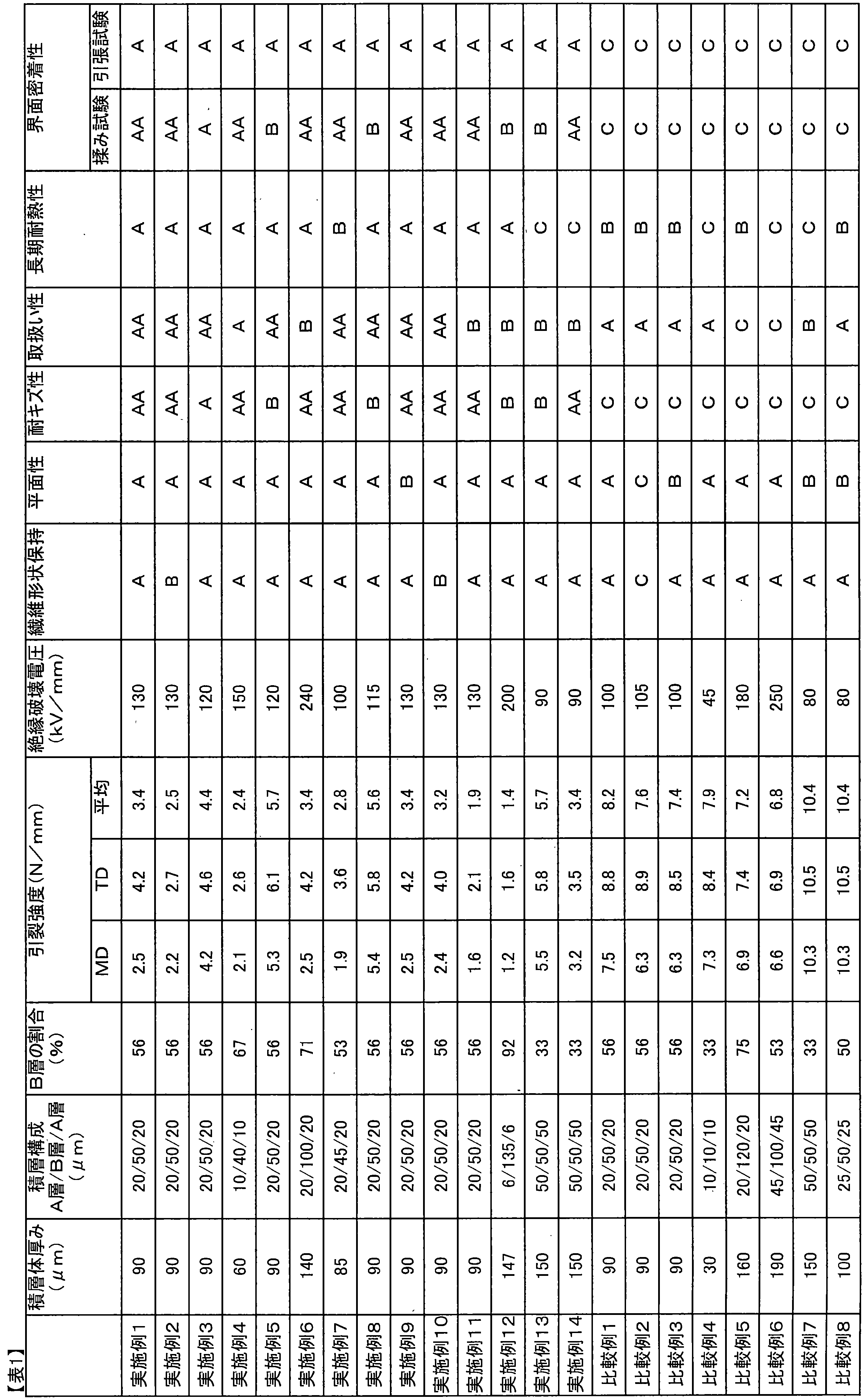
- Example 1 Film formation of biaxially oriented PPS film PPS-1 and PPS-2 pellets produced in Reference Example 1 and Reference Example 2 were vacuum dried at a temperature of 180 ° C. for 3 hours, respectively, and then two extruders In the melted state, it is led to be 3 layers (stacking order is PPS-2 / PPS-1 / PPS-2, stacking ratio is 1: 4: 1) by the laminating device at the upper part of the die in the molten state, Then, it was discharged from a T-die die, and was rapidly cooled and solidified while applying an electrostatic charge to a cast drum having a surface temperature of 25 ° C. to obtain an unstretched three-layer laminated sheet.
- the obtained laminated sheet was caused to travel in contact with a plurality of heating rolls having a surface temperature of 95 ° C., and 3.6 ° in the longitudinal direction between the heating rolls and the 30 ° C. cooling rolls having different peripheral speeds.
- the film was stretched twice.
- the uniaxially stretched sheet thus obtained was stretched 3.7 times at a temperature of 100 ° C. in the direction perpendicular to the longitudinal direction using a tenter, followed by a first stage heat treatment at a temperature of 200 ° C., A second heat treatment was performed at 265 ° C., followed by a 5% relaxation treatment in a transverse direction at a 260 ° C.
- Example 2 A laminate having a thickness of 90 ⁇ m was obtained in the same manner as in Example 1 except that the lamination temperature was 260 ° C.
- Example 3 A laminate having a thickness of 90 ⁇ m was obtained in the same manner as in Example 1 except that the laminating pressure was changed to 30 kgf / cm.
- Example 4 A meta-copolymer PPS / PPS having a thickness of 40 ⁇ m in the same manner as in Example 1 except that the discharge amount of the film forming extruder of the biaxially oriented PPS film was adjusted so that the final thickness of the film was 40 ⁇ m.
- a biaxially oriented three-layer laminated film of / metacopolymerized PPS was obtained.
- the PPS short fibers having a fineness of 0.6 dtex were produced by cutting to 6 mm in length.
- the obtained unstretched PPS short fibers and the stretched PPS short fibers were mixed so that the ratio of unstretched PPS short fibers was 40%, and paper was made using a paper machine with water as a dispersion.
- a PPS fiber sheet having a thickness of m 2 and a thickness of 13 ⁇ m was obtained.
- Example 5 The constituent resin of the three-layer lamination of the biaxially oriented PPS film is a mixture in which the intermediate layer is PPS-1 alone, and both surface layers are 30% by mass of PPS-1 and 70% by mass of PPS-2.
- the intermediate layer is PPS-1 alone, and both surface layers are 30% by mass of PPS-1 and 70% by mass of PPS-2.
- the melting point of the film was 280 ° C. for the intermediate layer and 266 ° C. for both surface layers.
- Example 6 A laminate with a thickness of 140 ⁇ m was obtained in the same manner as in Example 1 except that the amount of discharge was adjusted so that the final thickness of the biaxially oriented PPS film was 100 ⁇ m.
- Example 7 (A) Production of biaxially oriented PPS film Instead of using PPS-2, PPS-3 produced in Reference Example 3 was used as a raw material, and the discharge amount was adjusted so that the final thickness of the film was 45 ⁇ m. In the same manner as in Example 1, a three-layer laminated film having a thickness of 45 ⁇ m was obtained. The melting point of the film was 280 ° C. for the intermediate layer and 235 ° C. for both surface layers. (B) Production of PPS fiber sheet A PPS fiber sheet having a thickness of 25 ⁇ m was produced in the same manner as in Example 1.
- Example 8 Laminate having a thickness of 90 ⁇ m as in Example 1 except that the biaxially oriented PPS film was adjusted so that the lamination ratio of PPS-1 and PPS-2 was 1: 25: 1. Got.
- Example 9 A laminate having a thickness of 90 ⁇ m in the same manner as in Example 1 except that when the biaxially oriented PPS film was formed, the lamination ratio of PPS-1 and PPS-2 was adjusted to 1: 1: 1. Got.
- Example 10 A laminate having a thickness of 90 ⁇ m was obtained in the same manner as in Example 1 except that the lamination conditions were a temperature of 270 ° C. and a pressure of 30 kgf / cm.
- Example 11 A laminate having a thickness of 90 ⁇ m was prepared in the same manner as in Example 1 except that when the biaxially oriented PPS film was produced, the draw ratio was 3.9 times in the longitudinal direction and 4.0 times in the direction perpendicular to the longitudinal direction. Got.
- Example 12 (A) Adjust the discharge amount of the film forming extruder of the biaxially oriented PPS film so that the final thickness of the film is 135 ⁇ m, and the lamination ratio of PPS-1 and PPS-2 is 1: 25: 1 A biaxially oriented three-layer laminate film of a metacopolymer PPS / PPS / metacopolymer PPS having a thickness of 135 ⁇ m was obtained in the same manner as in Example 1 except that the thickness was adjusted to 1.
- the cut PPS short fibers having a fineness of 0.4 dtex were produced by cutting to a length of 6 mm.
- the obtained unstretched PPS short fibers and the stretched PPS short fibers were mixed so that the ratio of unstretched PPS short fibers was 40%, and paper was made using a paper machine as a dispersion, and the basis weight was 6 g /
- Example 13 As a representative example of an aromatic polyamide fiber sheet, “Nomex” (registered trademark) type 410 of DuPont Teijin Advanced Paper Co., Ltd., type 410 having a thickness of 50 ⁇ m was prepared, and the same as Example 1 except that it was used as a fiber sheet. Thus, a laminate having a thickness of 150 ⁇ m was obtained.
- Example 14 In Example 1, a PPS fiber sheet having a thickness of 50 ⁇ m was obtained by changing the basis weight of the papermaking to 40 g / m 2 when producing the PPS fiber sheet. A laminate having a thickness of 150 ⁇ m was obtained in the same manner as in Example 1 except that it was used as a fiber sheet.
- Example 1 A laminate having a thickness of 90 ⁇ m was obtained in the same manner as in Example 1 except that a single-layer biaxially oriented PPS film was produced using only PPS-1 as a raw material when producing the biaxially oriented PPS film.
- Comparative Example 2 A laminate having a thickness of 40 ⁇ m was obtained in the same manner as in Comparative Example 1 except that the lamination conditions were a temperature of 270 ° C. and a pressure of 70 kgf / cm.
- Comparative Example 3 A laminate having a thickness of 90 ⁇ m was formed in the same manner as in Comparative Example 1 except that plasma treatment (treatment strength: 650 w ⁇ min / m 2 ) was performed on the surface to which the PPS film and the PPS fiber sheet were bonded before thermal lamination. Obtained.
- the resin constituting the biaxially oriented three-layer laminated PPS film is composed of two units so that the intermediate layer is PPS-1 alone, and both surface layers are a mixture of 80% by mass of PPS-1 and 20% by mass of PPS-2.
- a laminate having a thickness of 160 ⁇ m was obtained in the same manner as in Example 6 except that the raw material was supplied to the extruder and the discharge rate was adjusted so that the final thickness of the film was 120 ⁇ m.
- the melting point of the laminated film was 280 ° C. for the intermediate layer and 275 ° C. for both surface layers.
- the film was supplied to a tenter, stretched 3.5 times in the width direction at a stretching temperature of 98 ° C., and heat-treated at 265 ° C. for 10 seconds to obtain a biaxially oriented PPS film having a thickness of 50 ⁇ m.
- the biaxially oriented PPS film was subjected to a corona discharge treatment of 6000 J / m 2 on both sides.
- the laminate of the present invention can be used as an electrical insulating paper used for motors, capacitors, transformers, cables, high voltage transmission transformers and the like.
Landscapes
- Laminated Bodies (AREA)
Abstract
Description
本発明の目的は、耐キズ性に優れ、さらに、電気絶縁用途として重要な高い耐熱性や高い電気絶縁性(絶縁破壊電圧)、加工時の良好な挿入性を有する積層体を提供することにある。
すなわち、以下の通りである。
(1)
二軸配向ポリフェニレンスルフィドフィルム層(B層)の少なくとも片面に芳香族系重合体からなる繊維シート(A層)が接着剤を介することなく接合された積層体であって、直交する二方向の引裂強度の平均値が、1~6N/mmの範囲にあることを特徴とする積層体。
(2)
前記繊維シートがポリフェニレンスルフィド樹脂からなることを特徴とする(1)に記載の積層体。
(3)
二軸配向ポリフェニレンスルフィドフィルム層(B層)が、X/Y/Xの3層積層構成あるいはX/Yの2層積層構成からなり、X層の融点Tm(X)とY層の融点Tm(Y)がTm(X)<[Tm(Y)-10]の関係にあって、フィルム層の全体厚みに占めるY層の厚みの割合が、40%以上、90%以下の範囲であること特徴とする(1)または(2)に記載の積層体。
(4)
前記直交する二方向の引裂強度の平均値が、2~3.5N/mmの範囲にあることを特徴とする(1)~(3)のいずれかに記載の積層体。
(5)
積層体の全体厚みが40~150μmの範囲であることを特徴とする(1)~(4)のいずれかに記載の積層体。
(6)
積層体断面において積層体全体に占めるB層の割合が50~90%の範囲にあることを特徴とする(1)~(5)のいずれかに記載の積層体。
(7)
絶縁破壊電圧が60~350kV/mmの範囲にあることを特徴とする(1)~(6)のいずれかに記載の積層体。
(8)
前記積層体が、モーター用絶縁紙に用いられるものであることを特徴とする(1)~(7)のいずれかに記載の積層体。
(9)
JIS-C2151に規定された方法に従って引張測定により得られた応力-ひずみ曲線において次の(i)、(ii)をともに満たすような応力低下がみられないことを特徴とする(1)~(8)のいずれかに記載の積層体。
(i)伸度が2%増加する間に応力が5MPa以上低下
(ii)伸度が破断伸度よりも小さい段階で(i)の挙動がみられる。
本発明において、二軸配向ポリフェニレンスルフィドフィルム層(B層)とは、ポリフェニレンスルフィドを主成分とする樹脂組成物を、溶融成形してシート状とし、二軸延伸、熱処理してなるフィルムのみからなる層である。

本発明において、芳香族系重合体からなる繊維シートとは、芳香族系重合体を主成分とする樹脂組成物を周知の方法で紡糸した繊維の集合体によって構成される薄葉体であって、通常、不織布、紙、織布、フェルトなどと呼ばれているものの総称である。
ここで芳香族系重合体とは、芳香族ポリアミド、芳香族ポリアミドイミド、芳香族ポリイミド、芳香族ポリエステル、芳香族ポリスルフィド、芳香族ポリスルホン、芳香族ポリスルホキシド、芳香族ポリエーテルスルホン、芳香族ポリエーテル、芳香族ポリエーテルケトン、芳香族ポリエーテルエーテルケトン、芳香族ポリカーボネートなどが挙げられる。中でも、芳香族ポリアミドや、芳香族ポリスルフィドが前記B層の二軸配向ポリフェニレンスルフィドフィルムとの界面密着性や長期耐熱性、耐加水分解性、加工性、電気絶縁性の観点から特に好ましい。
(1)伸度が2%増加する間に応力が5MPa以上低下
(2)伸度が破断伸度によりも小さい段階で(1)の挙動がみられる。
上記(1),(2)を共に満たすような応力低下がみられる場合には、繊維シートと二軸配向PPSフィルムの積層界面の密着性が不十分であるために、取扱い時の表面摩擦や引掻によって容易に界面剥離が発生する場合がある。
本発明の積層体の製造方法について、繊維シートとしてPPS繊維シートを用いた場合を例にとって説明するが、本発明はかかる例に限定して解釈されるものではない。
硫化ナトリウムとジクロロベンゼンをN-メチル-2-ピロリドン(NMP)などのアミド系極性溶媒中で、高温高圧下で反応させる。必要に応じて、トリハロベンゼンなどの共重合成分を含ませることも可能である。重合度調整剤として苛性カリやカルボン酸アルカリ金属塩などを添加し230~280℃で重合反応させる。重合後にポリマーを冷却し、ポリマーを水スラリーとしてフィルターで濾過後、粒状ポリマーを得る。アミド系極性溶媒を加えて30~100℃の温度で攪拌処理して洗浄し、イオン交換水にて30~80℃で数回洗浄し、酢酸カルシウムなどの金属塩水溶液で数回洗浄した後、乾燥してPPS粉末を得る。該粉粒体を250~350℃に設定した単軸押出機にて溶融混練してストランド形状に押し出し、カッターで切断してペレット化する。原料のジクロロベンゼンはp-ジクロロベンゼンを70モル%以上含むことが好ましいが、ポリフェニレンスルフィドの融点を調整するために、30モル%未満、好ましくは15モル%未満であればm-ジクロロベンゼンなどのように共重合可能なスルフィド結合を含有する単位が含まれていても差し支えない。
上述のようにして得られたPPSペレットを減圧下で乾燥した後、押出機の溶融部を250~350℃の温度、好ましくは270~340℃に加熱された押出機に投入する。フィルムを3層の積層構成とする場合、口金上部にある積層装置によって融点がより低い側の樹脂が表層にくるように導き、続いてTダイ型口金から吐出させ、20~70℃の冷却ドラム上に静電荷を印加させながら密着急冷固化させ、未延伸3層積層シートを得る。3層積層シートはX/Y/Xの3層構成であり、X層とY層の積層比は、両表面のX層の厚みをそれぞれx、x’とし、中間層をなすY層の厚みをyとすると、全体厚みに占めるY層の厚みの割合(y/(x+x’+y)×100)が、40%以上、90%以下の範囲であることが好ましく、より好ましくは50%以上、80%以下である。
PPSペレットを、減圧下で乾燥した後、押出機の溶融部を250~350℃の温度、好ましくは270~340℃に加熱された単軸型の溶融紡糸押出機に投入する。押出後、引取速度200~5000m/分で製糸し、1~50mmの長さに切断して、未延伸PPS短繊維を製造する。未延伸糸の繊維径を細くする目的で、未延伸PPS糸を80~150℃に加熱したエチレングリコール中で3~6倍にドロー延伸して用いることもできる。同様に、製糸した未延伸糸を、切断前に80~110℃の温度で延伸倍率2.5~4.5倍で延伸し、1~50mmの長さに切断して、延伸されたPPS短繊維を製造する。得られた未延伸PPS短繊維と、延伸されたPPS短繊維を、未延伸PPS短繊維比率が10~90%、より好ましくは20~80になるように混合し、水を分散液として30~500メッシュの抄紙網を設置した抄紙機を用いて抄紙し、PPS繊維シートを得る。
加熱した金属ロールとシリコーンゴムロールとからなる熱ラミネート加工機を用い、二軸配向PPSフィルムの表面にPPS繊維シートが密着するように重ねて熱ラミネートすることでPPSフィルムとPPS繊維シートとを貼り合わせる。温度は220℃以上、265℃以下の範囲が好ましく、より好ましくは225℃以上、260℃以下である。加工圧力(線圧)は、加工温度が220℃以上、250℃以下の場合には50kgf/cm超、100kgf/cm未満となるようにし、加工温度が250℃超、265℃以下の場合には10kgf/cm以上、50kgf/cm以下の範囲とすることが好ましい。熱ラミネートの加工速度は0.5~15m/minの範囲が好ましく、より好ましくは1~12m/minの範囲である。
JIS K7121-1987に準じ、示差走査熱量計としてセイコーインスツルメンツ社製DSC(RDC220)、データ解析装置として同社製ディスクステーション(SSC/5200)を用いて測定した。試料3mgをアルミニウム製受皿上で室温から340℃まで昇温速度20℃/分で昇温し、そのとき、観測される融解の吸熱ピークのピーク温度を融点(℃)とした。
先端が平坦なダイヤルゲージ厚み計(ミツトヨ社製)を用いて面内をまんべんなく20点測定し、平均値を求めた。
ミクロトームで切削した積層体の断面を走査型電子顕微鏡で倍率500倍で観察して断面の拡大画像を撮影し、イメージアナライザーを用いて各層の厚みを測定した。試験片を10個作製して同様の厚み測定を行い、その平均値から積層体の積層構成(μm)を求めた。PPSフィルム層(B層)の割合は、PPSフィルムの両面に繊維シートが積層されている場合には、最外層をなす両表面の繊維シート層(A層)の厚みをそれぞれaμm、a’μmとし、中間層をなす二軸配向PPSフィルム層(B層)の厚みをbμmとし、式(b/(a+a’+b)×100)によって算出した。PPSフィルムの片面のみに繊維シートが積層されている場合には、繊維シート層(A層)の厚みをaμm、二軸配向PPSフィルム層(B層)の厚みをbμmとし、式(b/(a+b)×100)によって算出した。
JIS K7128(およびJIS P8116)に準じ、軽荷重引裂試験機(東洋精機社製、Type-D)を用いて測定した。試料の直交する任意の2方向について、それぞれ20回ずつ測定して平均値を求め、その各方向の値を平均して求めた。試験片は長さ63.5mm、幅50mmの長方形として切り出し、短辺側の中央の端部に長辺と平行な長さ12.7mmの切り込みを入れて引裂の起点とした。
JIS C2151に準じ、交流絶縁破壊試験器(春日電機株式会社製、AC30kV)を用いて測定した。試験片のサイズは25cm×25cmの正方形とし、23℃、65%RHの環境下で調湿したものを用い、周波数60Hz、昇圧速度1000V/secで測定した。用いた電極の形状は、台座となる下電極がφ75mm、高さ15mmの円柱形であり、上電極がφ25mm、高さ25mmの円柱形である。いずれの電極も、試験片を挟む側の面はR3mmで面取りされたものを用いた。
ミクロトームで切削した積層体の断面を走査型電子顕微鏡で500倍にて観察し、繊維シートの最外層(フィルムとの接着界面の反対側)を形成する繊維の断面が独立した界面を有する円形もしくは楕円形の形状として観察されるかどうかを目視で確認した。同様の操作を10個の試験片の断面について行い、下記の基準で判定した。
A:繊維の断面が5個以上円形もしくは楕円形の形状として確認できた。
5m×1mサイズのサンプルを準備し、サンプルより大きな平らな板に四隅を固定して設置(四方に張力をかけ、全体が折れたり弛んだりしないよう設置)して暗室に運び、板の横方向から一定の照度及び照射角にて蛍光灯の光を照射した。サンプル面内に膨れや凹みがあると周囲に陰影ができるため、照射する方向を変えながら目視にて膨れや凹みの概形を見積もり、その形を縁取るようにペンでマーキングした。マーキングにより囲われた面積の総和から、膨れや凹みが面内を占める割合を算出し、下記の基準で平面性を判定した。
A:陰影が確認できなかった。
JIS K5600-5-4の鉛筆硬度試験を参考にし、鉛筆の代わりに先端を半球状に加工したφ0.9mmのステンレス製針金を用いて試験片の表面引掻試験を行った。装置は表面性状測定機(新東科学株式会社製、HEIDON-14D)を用い、針金はピンバイスに挟んで固定した上で、鉛筆用の専用ホルダーにセットした。試験片は平滑なガラス板の上に固定して定位置にセットし、針金の球状先端が斜め45°の角度で積層体の表面に接地するように調整した。引掻処理は移動長10mm、移動速度300mm/minの条件で針金を5往復させて行い、発生した傷が繊維シートを貫通してフィルム層にまで到達しているかどうかを判別するため、傷と直交する方向の断面出しを行ったうえで、断面を走査型電子顕微鏡で観察した。同様の引掻処理を、針金の先端にかかる荷重を0g~500gの範囲で変えながら行い、傷がフィルム層にまで到達する最低荷重を求め、その荷重をもとに下記基準にて耐キズ性を判定した。なお、測定は積層体の繊維シートが積層されている各面に対して10回ずつ行い、最低荷重がより小さかった方の面の値を判定に用いた。
AA:最低荷重が220g以上
A:最低荷重が200g以上、220g未満
B:最低荷重が150g以上、200g未満
C:最低荷重が150g未満。
スリット間隙の調節が可能なコの字型のスリット台(コの字の一辺が4mm、スリット深さは50mm、図1)を作製し、全てのスリット間隙が一律で積層体厚みの1.2倍の間隙となるように調整した後、コの字型に折り曲げ成型した積層体を約20mm挿入する際の状態から下記の通り取扱い性を判定した。スリット台の素材は珪素鋼であり、表面粗度(SRa)は2μmであった。コの字型の折り曲げ加工は、モーター加工機(小田原エンジニアリング社製)を用いて行い、具体的には、12mm×80mmの長方形に打ち抜いた後に、短辺側を4mm間隔で三つ折りした。打ち抜きから折り曲げまでの加工を連続で行って100個の試験片を作製し、以下の取り扱い性を評価した。
AA:挿入性は全く問題なく、比較的容易に挿入できる。
A:挿入はできるが、挿入時に少し引っ掛かる、または腰が弱くて少し座屈する。
B:加工の段階で積層体に割れや亀裂が発生する場合がある。
C:挿入時に積層体が引っ掛かる、または腰が弱くて座屈しやすく、挿入が困難である。
幅10mm、長さ250mmの試験片を210℃の温度に設定した熱風オーブン中に入れて2000時間の加熱処理を行い、加熱処理前後での破断強度を測定し、下記の式から強度保持率を算出した。その結果について下記の判定基準で判定を行った。破断強度は、JIS-C2151に規定された方法に従って、テンシロン引張試験機を用いて、幅10mmのサンプル片をチャック間長さ100mmとなるようセットし、引張速度300mm/minで引張試験を行う。この条件で10回測定し、その平均値を求めた。
強度保持率(%)=Y/Y0×100
Y0:加熱処理前の破断強度(MPa)
Y:加熱処理後の破断強度(MPa)
長期耐熱性
A:強度保持率が85%以上
B:強度保持率が80%以上、85%未満
C:強度保持率が80%未満。
スコット耐揉摩耗試験機(東洋精機製)を用いて、JIS-K-6328に従ったもみ試験を実施した。サンプルサイズは幅10mm、長さ200mm、荷重2.5kgで測定し、目視でフィルムと繊維シートの界面での劈開や破断が確認できるまでの回数を求める。以下の基準で界面密着性を判定した。
界面密着性(揉み試験)
AA:100 回以上
A:60 回以上100 回未満
B:30 回以上60 回未満
C:30回未満。
JIS-C2151に規定された方法に従って、インストロンタイプの引張試験機を用い下記条件にて測定した。
測定装置:オリエンテック( 株)製フイルム強伸度自動測定装置“ テンシロンAMF/RTA-100”
試料サイズ:幅10mm×試長間100mm
引張速度:300mm/分
測定環境:温度23℃、湿度65%RH
測定によって得られた応力-ひずみ曲線(S-Sカーブ)を解析し、最終的な破断点に到達する以前(伸度が破断伸度よりも小さい時点)にて階段状の応力低下(伸度が2%増加する間に応力が5MPa以上低下するような変化)の区間がみられるかどうかを調べ、下記基準にて界面密着性を判定した。
界面密着性(引張試験)
A:階段状の応力低下がみられない
C:階段状の応力低下がみられる。
オートクレーブに、47%水硫化ナトリウム9.44kg(80モル)、96%水酸化ナトリウム3.43kg(82.4モル)、N-メチル-2-ピロリドン(NMP)13.0kg(131モル)、酢酸ナトリウム2.86kg(34.9モル)、及びイオン交換水12kgを仕込み、常圧で窒素を通じながら235℃まで3時間かけて徐々に加熱し、水17.0kgおよびNMP0.3kg(3.23モル)を留出したのち、反応容器を160℃に冷却した。次に、主要モノマーとしてp-ジクロロベンゼン(p-DCB)11.5kg(78.4モル)、副成分モノマーとして1,2,4-トリクロロベンゼン 0.007kg(0.04モル)、を加え、NMP22.2kg(223モル)を追添加して反応容器を窒素ガス下に密封し、400rpmで撹拌しながら、200℃から270℃まで0.6℃/分の速度で昇温した。270℃で30分経過後、水1.11kg(61.6モル)を10分かけて系内に注入し、270℃で更に反応を100分間継続した。その後、水1.60kg(88.8モル)を系内に再度注入し、240℃まで冷却した後、210℃まで0.4℃/分の速度で冷却し、その後室温近傍まで急冷した。内容物を取り出し、32リットルのNMPで希釈後、溶剤と固形物をふるい(80mesh)で濾別した。得られた粒子を再度38リットルのNMPにより85℃で洗浄した。その後67リットルの温水で5回洗浄、濾別し、0.05質量%酢酸カルシウム水溶液70,000gで5回洗浄、濾別した。得られた粒子を60℃で熱風乾燥し、120℃で20時間減圧乾燥することによって白色のポリフェニレンスルフィド樹脂の粉粒体を得た。該粉粒体を320℃に設定した単軸押出機にて溶融混練してストランド形状に押し出し、カッターで切断してペレット化した。得られたPPS樹脂のペレットは、融点が280℃であった。
主要モノマーとして70.6モルのp-ジクロベンゼン、副成分モノマーとして7.8モルのm-ジクロロベンゼン、および0.04モルの1,2,4-トリクロルベンゼンを用いたこと以外は、上記参考例1と同様にしてメタ共重合PPS樹脂の粉粒体を作製した。該粉粒体を300℃に設定した単軸押出機にて溶融混練してストランド形状に押し出し、カッターで切断してペレット化した。得られたメタ共重合PPS樹脂のペレットは、融点が255℃であった。
主要モノマーとして66.6モルのp-ジクロベンゼン、副成分モノマーとして11.8モルのm-ジクロロベンゼン、および0.04モルの1,2,4-トリクロルベンゼンを用いたこと以外は、上記参考例1と同様にしてメタ共重合PPS樹脂の粉粒体を作製した。該粉粒体を300℃に設定した単軸押出機にて溶融混練してストランド形状に押し出し、カッターで切断してペレット化した。得られたメタ共重合PPS樹脂のペレットは、融点が235℃であった。
(a)二軸配向PPSフィルムの製膜
参考例1および参考例2で作製したPPS-1およびPPS-2のペレットを、それぞれ180℃の温度で3時間、真空乾燥した後、2台のエクストルーダに別々に供給し、溶融状態で口金上部にある積層装置で3層(積層順はPPS-2/PPS-1/PPS-2、積層比は1:4:1)になるように導き、続いてTダイ型口金から吐出させ、表面温度25℃のキャストドラムに静電荷を印加させながら密着急冷固化させ、未延伸3層積層シートを得た。次いで、得られた積層シートを、表面温度95℃の複数の加熱ロールに接触走行させ、加熱ロールの次に設けられた周速の異なる30℃の冷却ロールとの間で長手方向に3.6倍延伸した。このようにして得られた1軸延伸シートを、テンターを用いて長手方向と直交方向に100℃の温度で3.7倍に延伸し、続いて温度200℃で1段目熱処理行い、続いて265℃で2段目熱処理を行い、引き続き、260℃の弛緩処理ゾーンで横方向に5%弛緩処理を行った後、室温まで冷却し、ついでフィルムエッジを除去することで、厚み50μmのメタ共重合PPS/PPS/メタ共重合PPSの二軸配向3層積層フィルムを得た。
参考例1で作製したPPS-1のペレットを、165℃の温度で5時間、真空乾燥した後、単軸型の溶融紡糸設備を用いて押出温度320℃、引取速度1000m/分で製糸し、長さ6mmに切断して、繊度3.0dtexの未延伸PPS短繊維を製造した。同様に、単軸型の溶融紡糸設備を用いて押出温度320℃、引取速度1000m/分で製糸し、さらに温度95℃、延伸倍率3.2倍で延伸し、長さ6mmに切断した繊度1.0dtexの延伸されたPPS短繊維を製造した。得られた未延伸PPS短繊維と、延伸されたPPS短繊維を、未延伸PPS短繊維比率が40%になるように混合し、水を分散液として底に150メッシュの抄紙網を設置した手すき抄紙機(熊谷理機工業社製)を用いて抄紙し、目付17g/m2、厚み25μmのPPS繊維シートを得た。
金属ロールとシリコーンゴムロールとからなる熱ラミネート加工機を用い、PPSフィルムの両面にPPS繊維シートが密着するように重ねて熱ラミネートすることでPPSフィルムとPPS繊維シートとを貼り合わせ、厚み90μmの積層体を得た。ラミネート条件は、温度245℃、圧力70kgf/cm、速度2m/minとした。
ラミネート温度を260℃にした以外は、実施例1と同様にして厚み90μmの積層体を得た。
ラミネート圧力を30kgf/cmにした以外は、実施例1と同様にして厚み90μmの積層体を得た。
(a)二軸配向PPSフィルムの製膜
エクストルーダの吐出量を調整し、フィルムの最終厚みが40μmとなるようにした以外は、実施例1と同様にして、厚み40μmのメタ共重合PPS/PPS/メタ共重合PPSの二軸配向3層積層フィルムを得た。
参考例1で作製したPPS-1のペレットを、165℃の温度で5時間、真空乾燥した後、溶融紡糸設備を用いて押出温度320℃、引取速度1000m/分で製糸し、その後、115℃のエチレングリコール中で延伸倍率4倍でドロー延伸し、長さ6mmに切断して、繊度1.5dtexの未延伸PPS短繊維を製造した。同様に、溶融紡糸設備を用いて押出温度320℃、引取速度1000m/分で製糸し、115℃のエチレングリコール中で延伸倍率4倍でドロー延伸し、さらに温度95℃、延伸倍率3.2倍で延伸した後、長さ6mmに切断することで、繊度0.6dtexの延伸されたPPS短繊維を製造した。得られた未延伸PPS短繊維と、延伸されたPPS短繊維を、未延伸PPS短繊維比率が40%になるように混合し、水を分散液として抄紙機を用いて抄紙し、目付10g/m2、厚み13μmのPPS繊維シートを得た。
本実施例における(a)、(b)で作製したPPSフィルムとPPS繊維シートを用い、実施例1と同様にして、厚み60μmの積層体を得た。
(a)二軸配向PPSフィルムの製膜
3層積層の構成樹脂が、中間層はPPS-1単独、両表層はPPS-1が30質量%、PPS-2が70質量%の混合体となるように、2台のエクストルーダに原料を供給した以外は、実施例1と同様にして、厚み50μmの3層積層フィルムを得た。フィルムの融点は、中間層が280℃、両表層が266℃であった。
実施例1と同様にして厚み25μmのPPS繊維シートを作製した。
本実施例における(a)、(b)で作製したPPSフィルムとPPS繊維シートを用い、実施例1と同様にして、厚み90μmの積層体を得た。
二軸配向PPSフィルムの製膜の際、フィルムの最終厚みが100μmとなるように吐出量を調整した以外は、実施例1と同様にして、厚み140μmの積層体を得た。
(a)二軸配向PPSフィルムの製膜
PPS-2の代わりに、参考例3で作製したPPS-3を原料として用い、さらにフィルムの最終厚みが45μmとなるように吐出量を調整した以外は、実施例1と同様にして、厚み45μmの3層積層フィルムを得た。フィルムの融点は、中間層が280℃、両表層が235℃であった。
(b)PPS繊維シートの作製
実施例1と同様にして厚み25μmのPPS繊維シートを作製した。
(c)PPSフィルムとPPS繊維シートの接合
本実施例における(a)、(b)で作製したPPSフィルムとPPS繊維シートを用い、ラミネート温度を235℃とした以外は、実施例1と同様にして、厚み85μmの積層体を得た。
二軸配向PPSフィルムを製膜する際に、PPS-1とPPS-2の積層比が1:25:1になるように調整した以外は、実施例1と同様にして、厚み90μmの積層体を得た。
二軸配向PPSフィルムを製膜する際に、PPS-1とPPS-2の積層比が1:1:1になるように調整した以外は、実施例1と同様にして、厚み90μmの積層体を得た。
ラミネート条件を、温度270℃、圧力30kgf/cmにした以外は、実施例1と同様にして厚み90μmの積層体を得た。
二軸配向PPSフィルムを作製する際、延伸倍率を長手方向に3.9倍、長手方向と直交する方向に4.0倍とした以外は、実施例1と同様にして、厚み90μmの積層体を得た。
(a)二軸配向PPSフィルムの製膜
エクストルーダの吐出量を調整し、フィルムの最終厚みが135μmとなるようにし、さらにPPS-1とPPS-2の積層比が1:25:1になるように調整した以外は、実施例1と同様にして、厚み135μmのメタ共重合PPS/PPS/メタ共重合PPSの二軸配向3層積層フィルムを得た。
参考例1で作製したPPS-1のペレットを、165℃の温度で5時間、真空乾燥した後、溶融紡糸設備を用いて押出温度320℃、引取速度1000m/分で製糸し、その後、115℃のエチレングリコール中で延伸倍率6倍でドロー延伸し、長さ6mmに切断して、繊度0.7dtexの未延伸PPS短繊維を製造した。同様に、溶融紡糸設備を用いて押出温度320℃、引取速度1000m/分で製糸し、115℃のエチレングリコール中で延伸倍率6倍でドロー延伸し、さらに温度95℃、延伸倍率3.3倍で延伸した後、長さ6mmに切断することで、繊度0.4dtexの延伸されたPPS短繊維を製造した。得られた未延伸PPS短繊維と、延伸されたPPS短繊維を、未延伸PPS短繊維比率が40%になるように混合し、水を分散液として抄紙機を用いて抄紙し、目付6g/m2、厚み7μmのPPS繊維シートを得た。
本実施例における(a)、(b)で作製したPPSフィルムとPPS繊維シートを用い、実施例1と同様にして、厚み147μmの積層体を得た。
芳香族ポリアミド繊維シートの代表例として、デュポン帝人アドバンスドペーパー社の「ノーメックス」(商標登録)のタイプ410の50μm厚みのものを準備し、それを繊維シートとして用いた以外は、実施例1と同様にして厚み150μmの積層体を得た。
実施例1で、PPS繊維シートの作製時に抄紙の目付量を変えて40g/m2とし、厚み50μmのPPS繊維シートを得た。それを繊維シートとして用いた以外は、実施例1と同様にして厚み150μmの積層体を得た。
二軸配向PPSフィルムの作製の際、原料としてPPS-1のみを用いて単層の二軸配向PPSフィルムを作製した以外は、実施例1と同様にして厚み90μmの積層体を得た。
ラミネート条件を温度270℃、圧力70kgf/cmとした以外は、比較例1と同様にして、厚み40μmの積層体を得た。
熱ラミネートを行う前に、PPSフィルムとPPS繊維シートの接合される面にプラズマ処理(処理強度650w・min/m2)を施した以外は、比較例1と同様して厚み90μmの積層体を得た。
二軸配向PPSフィルムを作製する際、原料としてPPS-1のみを用い、フィルムの最終厚みが10μmとなるように吐出量を調整し、さらに、PPSフィルムとPPS繊維シートを接合する際のラミネート条件を温度245℃、圧力を70kgf/cmとした以外は、実施例4と同様にして、厚み30μmの積層体を得た。
二軸配向3層積層PPSフィルムの構成樹脂が、中間層はPPS-1単独、両表層はPPS-1が80質量%、PPS-2が20質量%の混合体となるように、2台のエクストルーダに原料を供給し、さらにフィルムの最終厚みが120μmとなるように吐出量を調整した以外は、実施例6と同様にして、厚み160μmの積層体を得た。積層フィルムの融点は、中間層が280℃、両表層が275℃であった。
(a)未延伸および二軸延伸PPSフィルムの製膜
参考例1で作製したPPS-1のペレットを、180℃の温度で3時間、真空乾燥した後、エクストルーダに供給し、続いてTダイ型口金から吐出させ、表面温度25℃のキャストドラムに静電荷を印加させながら密着急冷固化させ、厚み25μmの未延伸単層PPSフィルムを得た。
また、上記と同様の方法で450μmの未延伸単層PPSフィルムを得た後、該フィルムをロール群からなる縦延伸装置によって、長手方向に延伸温度98℃で3.6倍に延伸し、続いてフィルムをテンターに供給し延伸温度98℃で幅方向に3.5倍に延伸し、265℃10秒間の条件で熱処理して厚さ50μmの二軸配向PPSフィルムを得た。該二軸配向PPSフィルムは、両面に6000J/m2のコロナ放電処理を施した。
参考例1で作製したPPS-1のペレットを、165℃の温度で5時間、真空乾燥した後、単軸型の溶融紡糸設備を用いて押出温度320℃、引取速度1000m/分で製糸し、長さ6mmに切断して短繊維を製造した。続いて該短繊維を積層し、針深度5mm、針密度150/cm2になる条件でニードルパンチ加工した後、温度240℃でカレンダー処理し、厚み50μmのPPS繊維シートを得た。
上記で得られた未延伸単層PPSフィルム、二軸配向PPSフィルム、PPS繊維シートを、PPS繊維シート/未延伸単層PPSフィルム/二軸配向PPSフィルム/未延伸単層PPSフィルム/PPS繊維シートの順で5層に重ね合せ、熱ラミネート加工機を用いて熱ラミネートすることでPPSフィルムとPPS繊維シートとを貼り合わせ、厚み190μmの積層体を得た。ラミネート条件は、温度240℃、圧力10kgf/cm、速度1m/minとした。なお、積層体の積層構成は未延伸単層PPSフィルム層および二軸配向PPSフィルム層を足し合わせたものをB層として割合を計算した。
芳香族ポリアミド繊維シートの代表例として、デュポン帝人アドバンスドペーパー社の「ノーメックス」(商標登録)のタイプ410の50μm厚みのものを準備し、それを繊維シートとして用いた以外は、比較例3と同様にして厚み150μmの積層体を得た。
2 4mm
Claims (9)
- 二軸配向ポリフェニレンスルフィドフィルム層(B層)の少なくとも片面に芳香族系重合体からなる繊維シート(A層)が接着剤を介することなく接合された積層体であって、直交する二方向の引裂強度の平均値が、1~6N/mmの範囲にあることを特徴とする積層体。
- 前記繊維シートがポリフェニレンスルフィド樹脂からなることを特徴とする請求項1に記載の積層体。
- 二軸配向ポリフェニレンスルフィドフィルム層(B層)が、X/Y/Xの3層積層構成あるいはX/Yの2層積層構成からなり、X層の融点Tm(X)とY層の融点Tm(Y)がTm(X)<[Tm(Y)-10]の関係にあって、フィルム層の全体厚みに占めるY層の厚みの割合が、40%以上、90%以下の範囲であること特徴とする請求項1に記載の積層体。
- 前記直交する二方向の引裂強度の平均値が、2~3.5N/mmの範囲にあることを特徴とする請求項1に記載の積層体。
- 積層体の全体厚みが40~150μmの範囲であることを特徴とする請求項1に記載の積層体。
- 積層体断面において積層体全体に占めるB層の割合が50~90%の範囲にあることを特徴とする請求項1に記載の積層体。
- 絶縁破壊電圧が60~350kV/mmの範囲にあることを特徴とする請求項1に記載の積層体。
- 前記積層体が、モーター用絶縁紙に用いられるものであることを特徴とする請求項1~7のいずれかに記載の積層体。
- JIS-C2151に規定された方法に従って引張測定により得られた応力-ひずみ曲線において次の(1)、(2)をともに満たすような応力低下がみられないことを特徴とする請求項1に記載の積層体。
(1)伸度が2%増加する間に応力が5MPa以上低下
(2)伸度が破断伸度よりも小さい段階で(1)の挙動がみられる。
Priority Applications (3)
| Application Number | Priority Date | Filing Date | Title |
|---|---|---|---|
| US14/907,142 US20160159055A1 (en) | 2013-07-25 | 2014-07-10 | Laminate comprising film and fiber sheet |
| JP2014547588A JP6354587B2 (ja) | 2013-07-25 | 2014-07-10 | フィルムと繊維シートからなる積層体 |
| CN201480041847.2A CN105408111B (zh) | 2013-07-25 | 2014-07-10 | 由膜与纤维片材形成的层合体 |
Applications Claiming Priority (4)
| Application Number | Priority Date | Filing Date | Title |
|---|---|---|---|
| JP2013-154332 | 2013-07-25 | ||
| JP2013154332 | 2013-07-25 | ||
| JP2014032634 | 2014-02-24 | ||
| JP2014-032634 | 2014-02-24 |
Publications (1)
| Publication Number | Publication Date |
|---|---|
| WO2015012111A1 true WO2015012111A1 (ja) | 2015-01-29 |
Family
ID=52393158
Family Applications (1)
| Application Number | Title | Priority Date | Filing Date |
|---|---|---|---|
| PCT/JP2014/068388 Ceased WO2015012111A1 (ja) | 2013-07-25 | 2014-07-10 | フィルムと繊維シートからなる積層体 |
Country Status (4)
| Country | Link |
|---|---|
| US (1) | US20160159055A1 (ja) |
| JP (1) | JP6354587B2 (ja) |
| CN (1) | CN105408111B (ja) |
| WO (1) | WO2015012111A1 (ja) |
Citations (3)
| Publication number | Priority date | Publication date | Assignee | Title |
|---|---|---|---|---|
| JPH08197689A (ja) * | 1995-01-20 | 1996-08-06 | Toray Ind Inc | 積層体 |
| WO2010150669A1 (ja) * | 2009-06-22 | 2010-12-29 | 河村産業株式会社 | 電動機用絶縁シートおよびその製造方法 |
| JP2011173418A (ja) * | 2010-02-01 | 2011-09-08 | Toray Ind Inc | 不織布とフィルムとからなる積層体 |
Family Cites Families (9)
| Publication number | Priority date | Publication date | Assignee | Title |
|---|---|---|---|---|
| JPH0773902B2 (ja) * | 1990-02-02 | 1995-08-09 | 東レ株式会社 | 積層体 |
| US5256234A (en) * | 1990-02-02 | 1993-10-26 | Toray Industries, Inc. | Laminate and process for producing it |
| JPH07189169A (ja) * | 1993-12-27 | 1995-07-25 | Toyobo Co Ltd | 耐熱性機能紙の製造方法 |
| JP2004285536A (ja) * | 2003-03-25 | 2004-10-14 | Toray Ind Inc | 耐熱性湿式不織布 |
| JP2007326362A (ja) * | 2006-05-08 | 2007-12-20 | Toray Ind Inc | 積層ポリフェニレンスルフィドフィルムおよび積層ポリフェニレンスルフィドフィルムの製造方法。 |
| JP4402734B1 (ja) * | 2008-07-30 | 2010-01-20 | 株式会社日立エンジニアリング・アンド・サービス | 無接着剤アラミド−ポリフェニレンサルファイド積層体の製造方法、回転電機の絶縁部材及び絶縁構造 |
| JP2011140150A (ja) * | 2010-01-06 | 2011-07-21 | Toray Ind Inc | 積層体 |
| JP2011140151A (ja) * | 2010-01-06 | 2011-07-21 | Toray Ind Inc | 積層体 |
| EP2615206A4 (en) * | 2010-09-07 | 2015-04-01 | Toray Industries | NONWOVEN FABRIC COMPRISING PHENYLENE POLYSULFIDE FIBERS |
-
2014
- 2014-07-10 JP JP2014547588A patent/JP6354587B2/ja active Active
- 2014-07-10 CN CN201480041847.2A patent/CN105408111B/zh active Active
- 2014-07-10 WO PCT/JP2014/068388 patent/WO2015012111A1/ja not_active Ceased
- 2014-07-10 US US14/907,142 patent/US20160159055A1/en not_active Abandoned
Patent Citations (3)
| Publication number | Priority date | Publication date | Assignee | Title |
|---|---|---|---|---|
| JPH08197689A (ja) * | 1995-01-20 | 1996-08-06 | Toray Ind Inc | 積層体 |
| WO2010150669A1 (ja) * | 2009-06-22 | 2010-12-29 | 河村産業株式会社 | 電動機用絶縁シートおよびその製造方法 |
| JP2011173418A (ja) * | 2010-02-01 | 2011-09-08 | Toray Ind Inc | 不織布とフィルムとからなる積層体 |
Also Published As
| Publication number | Publication date |
|---|---|
| US20160159055A1 (en) | 2016-06-09 |
| JP6354587B2 (ja) | 2018-07-11 |
| CN105408111B (zh) | 2017-11-24 |
| JPWO2015012111A1 (ja) | 2017-03-02 |
| CN105408111A (zh) | 2016-03-16 |
Similar Documents
| Publication | Publication Date | Title |
|---|---|---|
| EP3219461B1 (en) | Polyolefin-based porous film and method for producing the same | |
| KR102157492B1 (ko) | 적층 폴리올레핀 미세 다공막, 전지용 세퍼레이터 및 그것들의 제조 방법 | |
| CN105745071B (zh) | 聚烯烃制叠层多孔质膜、使用其的电池用隔膜以及聚烯烃制叠层多孔质膜的制造方法 | |
| CN115149204B (zh) | 聚烯烃微多孔膜 | |
| CN107108945B (zh) | 聚烯烃微多孔膜、电池用隔膜及其制造方法 | |
| CN108370014A (zh) | 聚烯烃微多孔膜、电池用隔膜以及它们的制造方法 | |
| WO2017018483A1 (ja) | 電池用セパレータおよびその製造方法 | |
| JP6316631B2 (ja) | 積層体及びその製造方法 | |
| CN108431108A (zh) | 聚烯烃微多孔膜、电池用隔膜以及它们的制造方法 | |
| JP5794043B2 (ja) | 離型用二軸配向ポリアリーレンスルフィド複合フィルム | |
| CN107614256B (zh) | 叠层膜及其制造方法 | |
| JP6354587B2 (ja) | フィルムと繊維シートからなる積層体 | |
| JP5732934B2 (ja) | Pps積層フィルム | |
| JP2016163948A (ja) | 積層体およびその製造方法 | |
| JP2019127033A (ja) | 積層体及びその製造方法 | |
| JP2011140151A (ja) | 積層体 | |
| JP2014189718A (ja) | 二軸延伸ポリアリーレンスルフィドフィルム | |
| JP2011140150A (ja) | 積層体 | |
| JP5824909B2 (ja) | 複合フィルムおよびその製造方法 | |
| JP2016010876A (ja) | 積層体およびその製造方法 | |
| JP4802500B2 (ja) | ポリアリーレンスルフィド積層シート | |
| JP2016027564A (ja) | 電気絶縁性積層体 | |
| JP4774788B2 (ja) | 成型用フィルム | |
| JP2016064644A (ja) | 積層体 | |
| JP2015098577A (ja) | 電気絶縁用ポリフェニレンスルフィドフィルム |
Legal Events
| Date | Code | Title | Description |
|---|---|---|---|
| WWE | Wipo information: entry into national phase |
Ref document number: 201480041847.2 Country of ref document: CN |
|
| ENP | Entry into the national phase |
Ref document number: 2014547588 Country of ref document: JP Kind code of ref document: A |
|
| 121 | Ep: the epo has been informed by wipo that ep was designated in this application |
Ref document number: 14828916 Country of ref document: EP Kind code of ref document: A1 |
|
| WWE | Wipo information: entry into national phase |
Ref document number: 14907142 Country of ref document: US |
|
| NENP | Non-entry into the national phase |
Ref country code: DE |
|
| 122 | Ep: pct application non-entry in european phase |
Ref document number: 14828916 Country of ref document: EP Kind code of ref document: A1 |