WO2015011993A1 - 薄肉光学部材用ポリカーボネート樹脂ペレット及びその製造方法 - Google Patents
薄肉光学部材用ポリカーボネート樹脂ペレット及びその製造方法 Download PDFInfo
- Publication number
- WO2015011993A1 WO2015011993A1 PCT/JP2014/064715 JP2014064715W WO2015011993A1 WO 2015011993 A1 WO2015011993 A1 WO 2015011993A1 JP 2014064715 W JP2014064715 W JP 2014064715W WO 2015011993 A1 WO2015011993 A1 WO 2015011993A1
- Authority
- WO
- WIPO (PCT)
- Prior art keywords
- polycarbonate resin
- pellet
- thin
- resin pellet
- strand
- Prior art date
- Legal status (The legal status is an assumption and is not a legal conclusion. Google has not performed a legal analysis and makes no representation as to the accuracy of the status listed.)
- Ceased
Links
Images


Classifications
-
- B—PERFORMING OPERATIONS; TRANSPORTING
- B29—WORKING OF PLASTICS; WORKING OF SUBSTANCES IN A PLASTIC STATE IN GENERAL
- B29B—PREPARATION OR PRETREATMENT OF THE MATERIAL TO BE SHAPED; MAKING GRANULES OR PREFORMS; RECOVERY OF PLASTICS OR OTHER CONSTITUENTS OF WASTE MATERIAL CONTAINING PLASTICS
- B29B9/00—Making granules
- B29B9/02—Making granules by dividing preformed material
- B29B9/06—Making granules by dividing preformed material in the form of filamentary material, e.g. combined with extrusion
-
- B—PERFORMING OPERATIONS; TRANSPORTING
- B29—WORKING OF PLASTICS; WORKING OF SUBSTANCES IN A PLASTIC STATE IN GENERAL
- B29B—PREPARATION OR PRETREATMENT OF THE MATERIAL TO BE SHAPED; MAKING GRANULES OR PREFORMS; RECOVERY OF PLASTICS OR OTHER CONSTITUENTS OF WASTE MATERIAL CONTAINING PLASTICS
- B29B7/00—Mixing; Kneading
- B29B7/30—Mixing; Kneading continuous, with mechanical mixing or kneading devices
- B29B7/58—Component parts, details or accessories; Auxiliary operations
- B29B7/72—Measuring, controlling or regulating
-
- B—PERFORMING OPERATIONS; TRANSPORTING
- B29—WORKING OF PLASTICS; WORKING OF SUBSTANCES IN A PLASTIC STATE IN GENERAL
- B29B—PREPARATION OR PRETREATMENT OF THE MATERIAL TO BE SHAPED; MAKING GRANULES OR PREFORMS; RECOVERY OF PLASTICS OR OTHER CONSTITUENTS OF WASTE MATERIAL CONTAINING PLASTICS
- B29B9/00—Making granules
- B29B9/12—Making granules characterised by structure or composition
Definitions
- the present invention relates to a polycarbonate resin pellet for a thin-walled optical member and a method for producing the same.
- the thin-walled material has excellent mechanical properties, thermal properties, electrical properties, and weather resistance, and also has high transmittance and good hue. It is related with the polycarbonate resin pellet for optical members, and its manufacturing method.
- a liquid crystal display device used in personal computers, mobile phones, tablet PCs, smart phones, etc. incorporates a surface light source device in order to meet the demands for thinning, lightening, labor saving, and high definition. It is.
- the surface light source device has a wedge-shaped cross-section light guide plate having a uniform inclined surface and a flat plate shape for the purpose of uniformly and efficiently guiding incident light to the liquid crystal display side.
- a light guide plate is provided. In some cases, an uneven pattern is formed on the surface of the light guide plate to provide a light scattering function.
- the light guide plate as described above is obtained by injection molding of a thermoplastic resin, and the concavo-convex pattern is given by transferring the concavo-convex portion formed on the surface of the insert.
- the light guide plate has been molded from a resin material such as polymethylmethacrylate (PMMA).
- PMMA polymethylmethacrylate
- the polycarbonate resin for the light guide As the polycarbonate resin for the light guide, it is thin-molded at a temperature higher than the molding temperature of normal polycarbonate resin, so even if it sacrifices mechanical strength, it is required to lower the viscosity average molecular weight and increase the fluidity. It has been.
- the polycarbonate resin for thin optical members typified by the light guide is a material having a low mechanical strength compared to the conventional polycarbonate resin, when producing pellets with an extruder, The extruded polycarbonate resin strands are easily broken during cooling, and there is a problem that stable production is difficult.
- the average length of pellets is in the range of 2.5 to 3.5 mm, and 70% or more of the average length is plus or minus 0.
- a polycarbonate resin pellet for optical discs in the range of 1 mm has been proposed.
- the pellet aggregate with such a small amount of fine powder does not involve air entrainment during plasticization, and an optical disk substrate free from silver streak is obtained.
- the shape of the pellet is described. It has not been.
- the average value of the pellet length is 2.5 to 3.5 mm
- the average value of the major axis of the cross-sectional ellipse is 2.60 to 3.2 mm
- a polycarbonate molding material for an optical disk substrate has been proposed in which 70% or more of the pellets are contained in an average length ⁇ 0.08 mm and an average long diameter ⁇ 0.12 mm.
- a balanced three-dimensional shape with a ratio of the major axis to the major axis of about 0.7 to 1.5 is obtained, and the distribution is a narrow range.
- Patent Document 2 is also characterized in that the pellet aggregate has a uniform shape, but there is no description of the details of the elliptical shape of the individual pellets, and the specific manufacturing method of the pellets is simply a strand. It only describes that it is cut and manufactured.
- the present invention has been made in view of the above circumstances, and its object (problem) is to process from a low molecular weight polycarbonate resin having a low mechanical strength into a shape that generates a relatively small amount of fine powder even when the pellets contact each other. Then, by making it possible to form a light guide using this, it is desirable to provide a light guide that is less likely to cause yellowing and optical fluctuation of the molded product. Moreover, it is providing the method of manufacturing such a pellet stably.
- the present inventors have made the strands elastic by flattening the cross-sectional shape of the strands during extrusion when producing pellets from such a polycarbonate resin. By making it difficult to break during cooling, it was possible to stably produce pellets for thin optical members.
- the pellet shape after pelletizing into a specific flat shape it is found that it is difficult to pulverize even when the pellets contact each other, and as a result, such as a light guide that hardly causes yellowing of the molded product and optical fluctuation
- the present invention was found to be extremely excellent as a pellet for a thin optical member.
- the present invention provides the following polycarbonate resin pellet for a thin optical member, a method for producing the same, a thin optical member, and a light guide.
- An elliptical columnar pellet made of a polycarbonate resin having a viscosity average molecular weight of 10,000 to 15,500, having a length of 2.0 to 5.0 mm, and a ratio of major axis / minor axis of the elliptical cross section Is a polycarbonate resin pellet for a thin-walled optical member, characterized by having a minor axis of 1.5 to 4 and a minor axis of 1.0 to 3.0 mm.
- the polycarbonate resin pellet for a thin-walled optical member according to the above [1] which has a viscosity average molecular weight of 11,500 to 15,000.
- the polycarbonate resin pellet is fixed by placing a 2 liter polyethylene sealed container having an outer diameter of 125 mm and a total height of 233 mm containing 500 g of the polycarbonate resin pellet in a 50 liter tumbler and rotating at a rotation speed of 30 rpm for 20 minutes.
- [5] A method for producing a polycarbonate resin pellet as described in any one of [1] to [4] above, wherein a polycarbonate resin having a viscosity average molecular weight of 10,000 to 15,500 is applied to the tip of an extruder.
- Thin-walled optics characterized by being extruded as a strand from a discharge nozzle having an elliptical die hole provided with the major axis of the cross-sectional ellipse in a substantially horizontal state, cooled and solidified in a cooling water tank, and cut by a strand cutter Manufacturing method of polycarbonate resin pellets for members.
- the polycarbonate resin pellets of the present invention have a low viscosity average molecular weight of 10,000 to 15,500, they are difficult to be pulverized by contact between the pellets, resulting in yellowing of the molded product and optical fluctuations. It is extremely excellent as a pellet for thin optical members such as difficult light guides. In addition, when producing pellets, it is possible to stably produce pellets for thin-walled optical members by flattening the cross-sectional shape of the strands during extrusion, thereby making the strands elastic and making them difficult to crack during cooling. it can.
- FIG. 1 is a schematic diagram of a polycarbonate resin pellet for a thin optical member of the present invention.
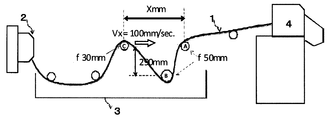
- FIG. 2 is a conceptual diagram of a process for producing a polycarbonate resin pellet by extruding a strand from an extruder and a method for evaluating the limit strength.
- FIG. 3 is a conceptual diagram showing details of the limit strength evaluation method.
- the polycarbonate resin pellet for a thin optical member of the present invention is an elliptical columnar pellet made of a polycarbonate resin having a viscosity average molecular weight of 10,000 to 15,500 and has a length in the range of 2.0 to 5.0 mm.
- the major axis / minor axis ratio of the cross-sectional ellipse is 1.5 to 4 and the minor axis is in the range of 1.0 to 3.0 mm.
- the polycarbonate resin used in the present invention includes an aromatic polycarbonate resin, an aliphatic polycarbonate resin, and an aromatic-aliphatic polycarbonate resin, preferably an aromatic polycarbonate resin, specifically, an aromatic dihydroxy compound.
- a thermoplastic aromatic polycarbonate polymer or copolymer obtained by reacting with phosgene or a diester of carbonic acid is used.
- Aromatic dihydroxy compounds include 2,2-bis (4-hydroxyphenyl) propane (bisphenol A), tetramethylbisphenol A, ⁇ , ⁇ '-bis (4-hydroxyphenyl) -p-diisopropylbenzene, hydroquinone, resorcinol 4,4′-dihydroxydiphenyl and the like. Further, as a part of the dihydroxy compound, when the above-mentioned aromatic dihydroxy compound is combined with one or more tetraalkylphosphonium sulfonates, or a polymer or oligomer containing both terminal phenolic OH groups having a siloxane structure, A highly flame-retardant polycarbonate resin can be obtained.
- Preferred examples of the polycarbonate resin used in the present invention include 2,2-bis (4-hydroxyphenyl) propane as a dihydroxy compound, or 2,2-bis (4-hydroxyphenyl) propane and another aromatic dihydroxy compound. The polycarbonate resin used together is mentioned.
- the production method of the polycarbonate resin is not particularly limited, but it is usually produced by an interfacial polymerization method (phosgene method) or a melt method (transesterification method).
- the polymerization reaction is usually carried out in the presence of an organic solvent inert to the reaction and an aqueous alkaline solution, and the pH is usually kept at 9 or higher.
- Polycarbonate resin by using an antioxidant for preventing oxidation of aromatic dihydroxy compounds and reacting with phosgene, adding a polymerization catalyst such as tertiary amine or quaternary ammonium salt, and conducting interfacial polymerization Get.
- the addition of the molecular weight regulator is not particularly limited as long as it is from the time of phosgenation to the start of the polymerization reaction.
- the reaction temperature is, for example, 0 to 40 ° C.
- the reaction time is, for example, several minutes (for example, 10 minutes) to several hours (for example, 6 hours).
- examples of the organic solvent inert to the reaction include chlorinated hydrocarbons such as dichloromethane, 1,2-dichloroethane, chloroform, monochlorobenzene and dichlorobenzene.
- examples of the alkali compound used in the alkaline aqueous solution include hydroxides of alkali metals such as sodium hydroxide and potassium hydroxide.
- molecular weight regulators include compounds having a monovalent phenolic hydroxyl group, such as m-methylphenol, p-methylphenol, m-propylphenol, p-propylphenol, p-tert-butylphenol and p-long chain alkyl. Preferred examples include substituted phenols.
- the amount of the molecular weight regulator used is preferably 50 to 0.5 mol, more preferably 30 to 1 mol, per 100 mol of the aromatic dihydroxy compound.
- Polymerization catalysts include tertiary amines such as trimethylamine, triethylamine, tributylamine, tripropylamine, trihexylamine, pyridine, and quaternary ammonium salts such as trimethylbenzylammonium chloride, tetramethylammonium chloride, and triethylbenzylammonium chloride. Etc.
- the polymerization reaction in this production method is, for example, an ester exchange reaction between a carbonic acid diester and an aromatic dihydroxy compound.
- the carbonic acid diester include dialkyl carbonate compounds such as dimethyl carbonate, diethyl carbonate and di-tert-butyl carbonate, substituted diphenyl carbonates such as diphenyl carbonate and ditolyl carbonate, and the like.
- the carbonic acid diester is preferably diphenyl carbonate or substituted diphenyl carbonate, more preferably diphenyl carbonate.
- the mixing ratio of the carbonic acid diester and the aromatic dihydroxy compound and the degree of pressure reduction during the transesterification reaction are adjusted to obtain an aromatic polycarbonate resin having the desired molecular weight and terminal hydroxyl group content adjusted. be able to.
- an equimolar amount or more of a carbonic acid diester is used with respect to 1 mol of an aromatic dihydroxy compound, among which 1.001 to 1.3 mol, particularly 1.01 to 1.2 mol is used. preferable.
- a terminal terminator separately at the time of reaction
- examples of the terminal terminator in this case include monohydric phenols, monovalent carboxylic acids, and carbonic acid diesters. It is done.
- the polycarbonate resin used in the present invention may be produced by any of the above interfacial polymerization method and melt polymerization method.
- the polycarbonate resin used in the present invention has a viscosity average molecular weight [Mv] of 10,000 to 15,500.
- a viscosity average molecular weight [Mv] is in this range, a molded product having good fluidity and low residual stress can be obtained, which is preferable for a thin optical member.
- the viscosity average molecular weight [Mv] is less than 10,000, the strength of the molded product is remarkably lowered.
- the viscosity average molecular weight [Mv] is more than 15,500, the fluidity is insufficient, and it is difficult to mold the thin optical member.
- the viscosity average molecular weight [Mv] is preferably 10,500 or more, more preferably 11,000 or more, still more preferably 11,500 or more, and preferably 15,000 or less.
- the intrinsic viscosity [ ⁇ ] is a value calculated from the following equation by measuring the specific viscosity [ ⁇ sp ] at each solution concentration [C] (g / dl).
- polycarbonate resin two or more kinds of polycarbonate resins may be used in combination, and those having a viscosity average molecular weight [Mv] out of the range of 10,000 to 15,500 are used in combination, so that the total is 10,000. Those adjusted to a molecular weight of ⁇ 15,500 may be used.
- Polycarbonate resins are heat stabilizers, antioxidants, mold release agents, UV absorbers, fluorescent brighteners, pigments, dyes, other polymers, flame retardants, impact resistance improvers, antistatic agents, plasticizers, Additives such as compatibilizers can be included. These additives may be used alone or in combination of two or more. Among these, it is particularly preferable to use a heat stabilizer and an antioxidant.
- a phosphorus compound is mentioned preferably. Any known phosphorous compound can be used. Specific examples include phosphorus oxo acids such as phosphoric acid, phosphonic acid, phosphorous acid, phosphinic acid, polyphosphoric acid, acidic pyrophosphoric acid metal salts such as acidic sodium pyrophosphate, acidic potassium pyrophosphate, acidic calcium pyrophosphate, and phosphoric acid. Examples include Group 1 or Group 10 metal phosphates such as potassium, sodium phosphate, cesium phosphate, and zinc phosphate, organic phosphate compounds, organic phosphite compounds, and organic phosphonite compounds.
- triphenyl phosphite tris (monononylphenyl) phosphite, tris (monononyl / dinonyl phenyl) phosphite, tris (2,4-di-tert-butylphenyl) phosphite, monooctyl diphenyl phosphite, Dioctyl monophenyl phosphite, monodecyl diphenyl phosphite, didecyl monophenyl phosphite, tridecyl phosphite, trilauryl phosphite, tristearyl phosphite, 2,2-methylenebis (4,6-di-tert-butylphenyl) ) Organic phosphites such as octyl phosphite are preferred.
- the content of the heat stabilizer is usually 0.001 part by mass or more, preferably 0.01 part by mass or more, more preferably 0.03 part by mass or more, based on 100 parts by mass of the polycarbonate resin. It is not more than part by mass, preferably not more than 0.7 part by mass, more preferably not more than 0.5 part by mass. If the amount of the heat stabilizer is too small, the heat stabilization effect may be insufficient. If the amount of the heat stabilizer is too large, the effect may reach a peak and may not be economical.
- antioxidant for example, a hindered phenol-based antioxidant is preferably mentioned. Specific examples thereof include pentaerythritol tetrakis [3- (3,5-di-tert-butyl-4-hydroxyphenyl) propionate], octadecyl-3- (3,5-di-tert-butyl-4-hydroxyphenyl).
- phenolic antioxidants include, for example, “Irganox 1010” (registered trademark, the same shall apply hereinafter) manufactured by BASF, “Irganox 1076”, “Adeka Stub AO-50” manufactured by ADEKA, “ADK STAB AO-60” and the like can be mentioned.
- 1 type may contain antioxidant and 2 or more types may contain it by arbitrary combinations and a ratio.
- the content of the antioxidant is usually 0.001 part by mass or more, preferably 0.01 part by mass or more, and usually 1 part by mass or less, preferably 0.5 part by mass with respect to 100 parts by mass of the polycarbonate resin. Or less.
- the content of the antioxidant is less than the lower limit of the range, the effect as an antioxidant may be insufficient, and when the content of the antioxidant exceeds the upper limit of the range, There is a possibility that the effect reaches its peak and is not economical.
- the polycarbonate resin in the present invention not only a virgin raw material but also a polycarbonate resin regenerated from a used product, a so-called material recycled polycarbonate resin may be used. It is also possible to use a pulverized product obtained from the above or a granular material obtained by melting them.
- the regenerated polycarbonate resin is used by being mixed with a polycarbonate resin in the form of a granular material that is not a regenerated product, and the mixing amount is preferably 80% by mass or less, more preferably 50% by mass of the total polycarbonate resin component. % Or less, in particular 30% by mass.
- FIG. 1 is a schematic diagram of a polycarbonate resin pellet for a thin optical member of the present invention.
- the polycarbonate resin pellet of the present invention has a length L in the range of 2.0 to 5.0 mm, and the ratio of the major axis d to the minor axis a (d / a) of the elliptical cross section of the pellet is in the range of 1.5 to 4.
- the minor axis a of the ellipse is in the range of 1.0 to 3.0 mm.
- the length L is not in the range of 2.0 to 5.0 mm, the pellets are easily crushed, the amount of fine powder generated is increased, and the ratio (d / a) of the major axis d to the minor axis a is 1.5 to If it is out of the range of 4, the strength of the resin strands decreases, the production of pellets by extrusion becomes unstable, and if the elliptical minor axis a is not in the range of 1.0 to 3.0 mm, the pellets are easily crushed, The amount of fine powder is likely to increase.
- the ratio of the major axis d to the minor axis a is preferably 1.6 or more, more preferably 1.7 or more, still more preferably 1.8 or more, and preferably 3.5 or less. Yes, more preferably 3.0 or less.
- the polycarbonate resin pellet of the present invention has such a shape that the pellet is accommodated in a paper bag, a flexible container or the like, and it is difficult to generate fine powder even when subjected to vibration or load when transporting and delivering it. Have. Since the major axis direction of the elliptical cross section of the pellet becomes horizontal and receives the load, it is considered that it is difficult to pulverize.
- the amount of fine powder generated from the polycarbonate resin pellets of the present invention is as follows.
- the amount of fine powder having a particle diameter of 1 mm or less generated after rotating at a rotational speed for 20 minutes is preferably 50 ppm or less.
- the polycarbonate resin having the above-described viscosity average molecular weight is stored in a raw material supply machine, and from there, is supplied to the extruder by a feeder (quantitative supply machine) from a hopper installed on the extruder.
- the polycarbonate resin may be in the form of pellets or powder.
- the mixing can be blended at an arbitrary stage before being charged into the extruder. For example, after all components are blended by a tumbler, a Henschel mixer, and a blender, they may be fed into a hopper chute via a feeder and supplied to an extruder as necessary.
- As the extruder a single screw extruder, a twin screw extruder or the like can be used. Moreover, you may supply to a hopper chute
- the extruder may be a single screw extruder or a twin screw extruder, but a twin screw extruder is preferred.
- the L / D of the screw of the extruder is preferably 10 to 80, more preferably 15 to 70, and more preferably 20 to 60. If the screw is too short, deaeration tends to be insufficient, and if it is too long, the color tone tends to deteriorate.
- the polycarbonate resin is extruded in a strand form from the discharge nozzle at the tip of the extruder, and it is preferable to use a die having an elliptical die hole as the die of the discharge nozzle.
- a die having an elliptical die hole As the die of the discharge nozzle, the flatness of the pellet can be changed.
- the dies of the discharge nozzle are preferably extruded by attaching the major axis of the elliptical die hole in a substantially horizontal state, and attaching the strand having an elliptical cross section to be extruded so that the major axis is substantially horizontal.
- the temperature of the polycarbonate resin immediately after being extruded is usually about 300 ° C.
- the strand having an elliptical cross-section has a major axis that is substantially horizontal and is taken up by a take-up roller, and is cooled by being transported through the water stored in the cooling water tank. In order to reduce the deterioration of the resin, it is better that the time from when the strand is pushed out of the die until entering the water is shorter. Normally, it is better to enter the water within 1 second after being pushed out of the die.
- the cooled strand is sent to a pelletizer by a take-up roller, cut to a pellet length of 2.0 to 5.0 mm, and made into a pellet.
- FIG. 2 is a conceptual diagram showing a process for producing a polycarbonate resin pellet by extruding a strand from an extruder
- FIG. 3 is a conceptual diagram showing details of a limit strength evaluation method.
- an interval (X mm, hereinafter also referred to as “limit interval”) defined as an interval between the support C and the support A where the strand is not broken by continuous operation is 300 mm or less.
- the polycarbonate resin pellet obtained by the present invention is molded into an arbitrary shape and used as a thin-walled optical member.
- the term “thin” means that the thickness of the thin part is usually 1 mm or less, preferably 0.8 mm or less, more preferably 0.6 mm or less, particularly 0.5 mm or less, and the lower limit is usually 0.1 mm. Above, preferably 0.2 mm or more.
- the molded body having a thin portion may have such a thin portion at least partially, and there is no limitation on the shape, size, and the like. There is no limitation on the shape, pattern, color, size, etc. of the thin optical member, and it may be set arbitrarily according to the application.
- the method for producing the thin optical member is not particularly limited, and a molding method generally adopted for the polycarbonate resin composition can be arbitrarily adopted.
- a molding method generally adopted for the polycarbonate resin composition can be arbitrarily adopted.
- injection molding method, ultra-high speed injection molding method, injection compression molding method, two-color molding method, hollow molding method such as gas assist, molding method using heat insulating mold, rapid heating mold were used.
- a molding method using a hot runner method can also be used.
- a typical example of the thin optical member is a light guide such as a light guide plate.
- the light guide plate is used to transmit light from a light source such as an LED in a liquid crystal backlight unit, various display devices, and lighting devices. Diffuses with unevenness and emits uniform light.
- the shape is usually flat, and the surface may or may not have irregularities.
- the light guide plate is usually formed preferably by an injection molding method, an ultra-high speed injection molding method, an injection compression molding method, or the like.
- the thin molded body molded using the resin pellet of the present invention is free from yellowing, white spot defects and vacuum voids, and can be preferably used as various thin optical members including a light guide plate.
- optical members mobile phones, mobile notebooks, netbooks, slate PCs, tablet PCs, smart phones, tablet-type terminals, etc. These optical members can be mentioned.
- Example 1 Aromatic polycarbonate resin (trade name “Iupilon”, manufactured by Mitsubishi Engineering Plastics Co., Ltd.) using bisphenol A having a viscosity average molecular weight (Mv) of 13,000 as a starting material is vented twin screw extruder (Japan)
- the steel maker's “TEX44 ⁇ II”) hopper is continuously supplied to the extruder, melted and mixed in the extruder, and the extrusion conditions are as follows: cylinder temperature 240 ° C., discharge rate 150 kg / h, screw rotation speed 250 rpm.
- a die having an elliptical die hole as described in 1 was extruded from an extrusion nozzle provided with its major axis horizontal, in a strand form with the major axis of the elliptical section approximately horizontal, introduced into a cooling water tank, and shown in Table 1.
- the pellet was cut with a pelletizer at the described strand take-up speed and cutter blade rotation speed to obtain polycarbonate resin pellets.
- the limit strength of the strand was evaluated by the following method. As shown in FIG. 2, the strand obtained by extruding the obtained polycarbonate resin pellets from the extruder is sent to the pelletizer while being supported by the support C to the support B and the support A. As shown in detail in FIG. 3, when the strand take-up speed (Vx) is 100 mm / sec and the height difference between the support C and A and the support B at the same height supporting the strand is 290 mm It evaluated as the space
- the particle size of the fine powder in this measurement is 1 mm or less (if the particle size exceeds 1 mm, it precipitates with the pellets by its weight, so it is not included in the supernatant liquid and the fine powder remaining on the filter paper is considered to be 1 mm or less.) .
- YI Yellow Index
- an optical path length was determined using a long optical path molded product (300 mm ⁇ 7 mm ⁇ 4 mm) molded at a temperature of 340 ° C. by an injection molding machine (“EC100SX-2A” manufactured by Toshiba Machine Co., Ltd.). YI was measured at 300 mm.
- a long optical path spectral transmission colorimeter (“ASA1” manufactured by Nippon Denshoku Industries Co., Ltd.) was used.
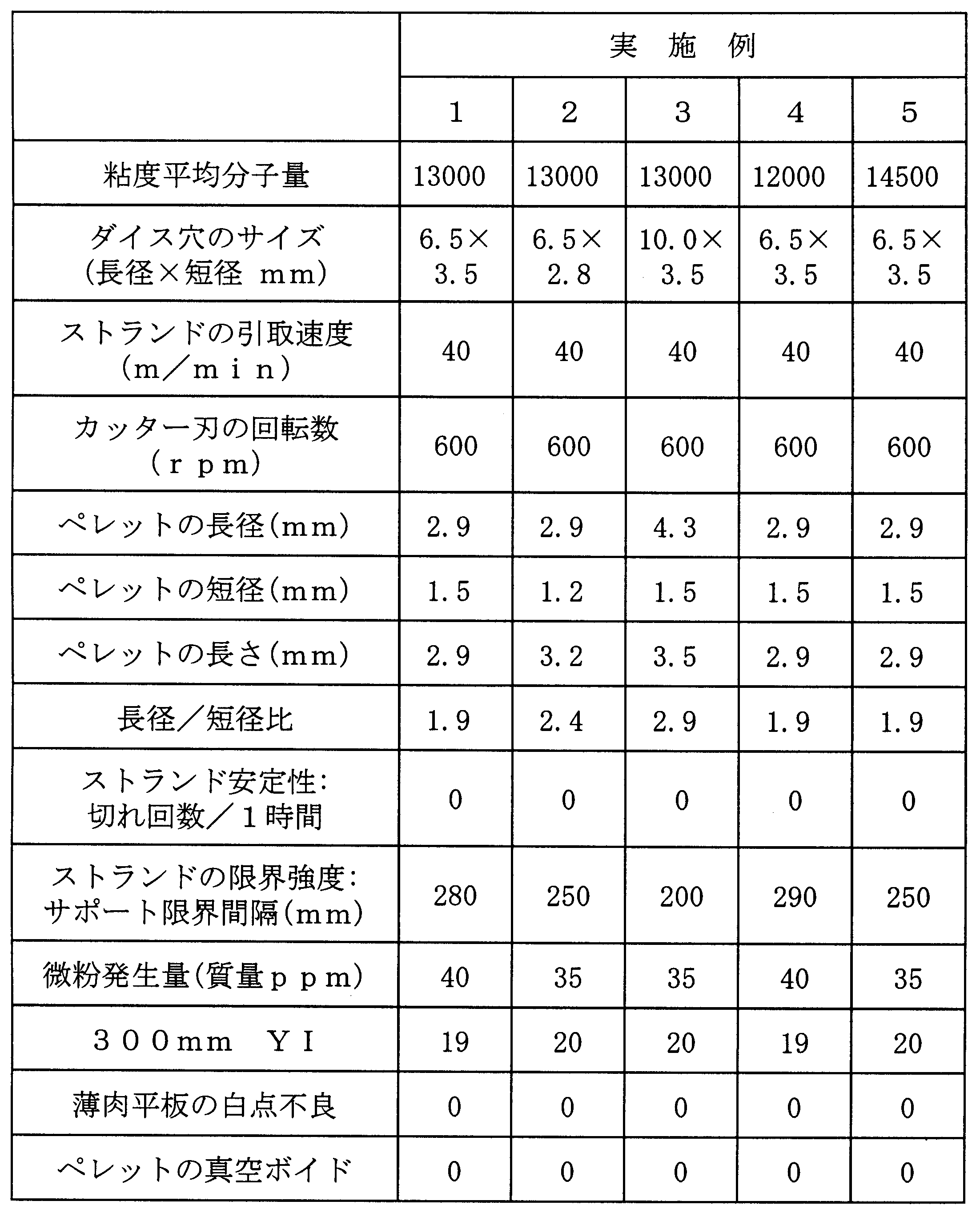
- Example 2 Polycarbonate resin pellets were obtained in the same manner as in Example 1, except that the dies were changed to those having the long and short diameters of the die holes shown in Table 1. The results are shown in Table 1.
- Example 4 In Example 1, the polycarbonate resin was changed to an aromatic polycarbonate resin (trade name “Iupilon (registered trademark)” manufactured by Mitsubishi Engineering Plastics Co., Ltd.) starting from bisphenol A having a viscosity average molecular weight (Mv) of 12,000. Except that, polycarbonate resin pellets were obtained in the same manner. The results are shown in Table 1. (Example 5) In Example 1, the polycarbonate resin was changed to an aromatic polycarbonate resin starting from bisphenol A having a viscosity average molecular weight (Mv) of 14,500 (manufactured by Mitsubishi Engineering Plastics, trade name “Iupilon (registered trademark)”). Except that, polycarbonate resin pellets were obtained in the same manner. The results are shown in Table 1.
- an aromatic polycarbonate resin trade name “Iupilon (registered trademark)” manufactured by Mitsubishi Engineering Plastics Co., Ltd.
- Example 1 Polycarbonate resin pellets were obtained in the same manner as in Example 1, except that the dies were changed to those having the long and short diameters of the die holes shown in Table 1. The results are shown in Table 2.
- Example 5 the number of revolutions of the cutter blade was changed as shown in Table 2, and the length of the pellet was changed while maintaining the major axis and minor axis dimensions and the major axis / minor axis ratio of the pellet, and polycarbonate resin Pellets were obtained. The results are shown in Table 2.
- the polycarbonate resin pellet for a thin optical member of the present invention is excellent in mechanical properties, thermal properties, electrical properties and weather resistance, and can provide a thin molded product having high transmittance and good hue. It can be suitably applied as an optical member, and industrial utility is very high.
Landscapes
- Mechanical Engineering (AREA)
- Engineering & Computer Science (AREA)
- Processing And Handling Of Plastics And Other Materials For Molding In General (AREA)
- Chemical & Material Sciences (AREA)
- Physics & Mathematics (AREA)
- Compositions Of Macromolecular Compounds (AREA)
- General Physics & Mathematics (AREA)
- Chemical Kinetics & Catalysis (AREA)
- Medicinal Chemistry (AREA)
- Polymers & Plastics (AREA)
- Organic Chemistry (AREA)
- Health & Medical Sciences (AREA)
- Optics & Photonics (AREA)
- Processes Of Treating Macromolecular Substances (AREA)
- Polyesters Or Polycarbonates (AREA)
Abstract
Description
また、工場で製造されたペレットを配送のため紙袋やフレキシブルコンテナ等に入れ、輸送しただけでも、ペレット同士の接触により一部が微粉化してしまう。このような微粉が混入したペレットを用いて、導光体等を成形すると、成形物の黄変や光学的ゆらぎが発生しやすいといった問題点がある。
微粉による問題を解決する手段としては、成形する際に微粉除去機を経由して微粉を取り除くことで解消できるが、工程が一つ余計に入り異物混入の恐れがあることから、できれば経由したくないといった要望がある。
また、ペレタイズ後のペレット形状を特定の扁平形状とすることで、ペレット同士の接触でも微粉化しにくいことを見出し、結果として、成形物の黄変、光学的ゆらぎが発生し難い導光体等の薄肉光学部材用のペレットとして極めて優れていることを見出し、本発明に至った。
本発明は、以下の薄肉光学部材用ポリカーボネート樹脂ペレット、その製造方法、薄肉光学部材および導光体を提供する。
[2]粘度平均分子量が11,500~15,000である上記[1]に記載の薄肉光学部材用ポリカーボネート樹脂ペレット。
[3]前記ポリカーボネート樹脂ペレットは、ポリカーボネート樹脂ペレット500gを収容した外径125mm、全高233mmの容量2リットルのポリエチレン製密閉容器を50リットルのタンブラーに入れて固定し、30rpmの回転数で20分間回転させた後に発生する粒径1mm以下の微粉の量が50ppm以下である上記[1]または[2]に記載の薄肉光学部材用ポリカーボネート樹脂ペレット。
[4]ペレットの断面楕円の長径/短径の比が1.8~4である上記[1]~[3]のいずれかに記載の薄肉光学部材用ポリカーボネート樹脂ペレット。
[6]ストランドの引取速度が100mm/secにおけるストランドを支えるサポートの高低差が290mmであるとき、1時間以上の連続運転でストランドが折れない、同じ高さにあるサポートの間隔が300mm以下である上記[5]に記載の薄肉光学部材用ポリカーボネート樹脂ペレットの製造方法。
[7]上記[1]~[4]のいずれかに記載の薄肉光学部材用ポリカーボネート樹脂ペレットから成形された薄肉光学部材。
[8]上記[1]~[4]のいずれかに記載の薄肉光学部材用ポリカーボネート樹脂ペレットから成形された導光体。
なお、本願明細書において、「~」とは、特に断りのない限り、その前後に記載される数値を下限値および上限値として含む意味で使用される。
本発明に使用するポリカーボネート樹脂は、芳香族ポリカーボネート樹脂、脂肪族ポリカーボネート樹脂、芳香族-脂肪族ポリカーボネート樹脂が挙げられ、好ましくは、芳香族ポリカーボネート樹脂であり、具体的には、芳香族ジヒドロキシ化合物をホスゲン又は炭酸のジエステルと反応させることによって得られる熱可塑性芳香族ポリカーボネート重合体又は共重合体が用いられる。
本発明で用いるポリカーボネート樹脂の好ましい例としては、ジヒドロキシ化合物として2,2-ビス(4-ヒドロキシフェニル)プロパン、又は2,2-ビス(4-ヒドロキシフェニル)プロパンと他の芳香族ジヒドロキシ化合物とを併用したポリカーボネート樹脂が挙げられる。

なお、酸化防止剤は、1種が含有されていてもよく、2種以上が任意の組み合わせ及び比率で含有されていても良い。
本発明のポリカーボネート樹脂ペレットは、楕円柱状の形状を有する。図1は、本発明の薄肉光学部材用ポリカーボネート樹脂ペレットの摸式図である。
本発明のポリカーボネート樹脂ペレットは、長さLが2.0~5.0mmの範囲にあり、ペレットの楕円断面の長径dと短径aの比(d/a)が1.5~4の範囲にあり、かつ楕円短径aが1.0~3.0mmの範囲にあることを特徴とする。
長径dと短径aの比(d/a)は、好ましくは1.6以上であり、より好ましくは1.7以上、さらに好ましくは1.8以上であり、また好ましくは3.5以下であり、より好ましくは3.0以下である。
本発明のポリカーボネート樹脂ペレットの微粉発生の量は、樹脂ペレット500gを外径125mm、全高233mmの容量2リットルのポリエチレン製密閉容器に収容し、それを50リットルのタンブラーに入れて固定し、30rpmの回転数で20分間回転させた後に発生する粒径が1mm以下の微粉の量が好ましくは50ppm以下である。
本発明のポリカーボネート樹脂ペレットを製造する方法としては、各種の方法が適用可能であるが、以下にその好適な態様を説明する。
ポリカーボネート樹脂以外の他の成分を配合する場合には、その混合は押出機に投入される前の任意の段階で配合することができる。例えば、タンブラー、ヘンシェルミキサー、ブレンダーによって全成分を配合したのち、必要に応じてフィーダーを介してホッパーシュートに投入し、押出機に供給してもよい。押出機には一軸押出機、二軸押出機などが使用出来る。また、ポリカーボネート樹脂とは別経路でホッパーシュートに供給してもよい。
楕円断面状のストランドは、その長径を略水平にして引き取りローラーによって引き取られ、冷却水槽に溜められた水中を搬送されるようにして、冷却される。樹脂の劣化を少なくするために、ストランドがダイから押し出されてから水に入るまでの時間は短い方が良い。通常は、ダイから押し出されてから1秒以内に水中に入るのが良い。
ポリカーボネート樹脂ペレットを押出機の吐出ノズル2から押出されたストランド1は、冷却水槽3に導入して冷却された後、引き取りローラーのサポートC、B、Aに順に支持されながら引き取られ、ペレタイザー4に送られる。この際、ストランドの引取速度(Vx)が100mm/secで、ストランド1を支える同じ高さにあるサポートC及びAとC-A間にあるサポートBの高低差が290mmであるとき、1時間以上の連続運転でストランドが折れないサポートCとサポートAの間隔として定義される間隔(Xmm、以下「限界間隔」ともいう。)が、300mm以下であることが好ましい。
本発明によって得られたポリカーボネート樹脂ペレットは、任意の形状に成形して薄肉光学部材として用いられる。
ここで薄肉とは、薄肉部の厚さとして、通常1mm以下、好ましくは0.8mm以下、より好ましくは0.6mm以下、特には0.5mm以下をいい、また、その下限は通常0.1mm以上、好ましくは0.2mm以上である。薄肉部を有する成形体としては、少なくとも一部にこのような薄肉部を有していればよく、その形状、寸法などに制限はない。
薄肉光学部材の形状、模様、色彩、寸法などに制限はなく、その用途に応じて任意に設定すればよい。
導光板の成形は、通常、好ましくは射出成形法、超高速射出成形法、射出圧縮成形法などにより行われる。
本発明の樹脂ペレットを用いて成形した薄肉成形体は、黄変あるいは白点不良や真空ボイドの発生の問題がなく、導光板を初めとして各種の薄肉光学部材として、好ましく使用することができる。
粘度平均分子量(Mv)が13,000のビスフェノールAを出発原料とする芳香族ポリカーボネート樹脂(三菱エンジニアリングプラスチックス社製、商品名「ユーピロン(登録商標)」)を、ベント式二軸押出機(日本製鋼所社製「TEX44αII」)のホッパーから押出機に連続的に供給し、押出機内で溶融混合し、シリンダー温度240℃、吐出量150kg/h、スクリュー回転数250rpmの押出条件にて、表1に記載の楕円状のダイス穴を有するダイスを、その長径を水平にして設けた押出ノズルから、ストランド状にその楕円断面の長径を略水平にして押出し、冷却水槽に導入して、表1に記載したストランドの引取速度、カッター刃の回転速度にて、ペレタイザーで切断してポリカーボネート樹脂のペレットを得た。
得られたポリカーボネート樹脂ペレットの長径と短径、長さを測定し、それぞれ100個の平均値を示した。長径/短径の平均値の比をペレット扁平率とした。
ダイスから出てくるストランドは、押出の方向が定まらずに蛇行することを防ぐため、ストランドにサポートを押し付けて一定の負荷をかけることにより、ストランドが真直ぐに押出されるようにしている。
この状態で、1時間当たりのストランドが切れた回数をカウントし、押出の安定性を評価した。
また、ストランドの限界強度を以下の方法で評価した。
図2に示すように、得られたポリカーボネート樹脂ペレットを押出機から押出されたストランドは、サポートCからサポートB、サポートAに支えながらペレタイザーに送られる。ストランドの限界強度は、図3に詳細に示すとおり、ストランドの引取速度(Vx)が100mm/secで、ストランドを支える同じ高さにあるサポートC及びAとサポートBの高低差が290mmであるとき、1時間以上の連続運転でストランドが折れないサポートCとサポートAの間隔(Xmm)として評価した。限界間隔は300mm以下であることが好ましい。
得られたポリカーボネート樹脂ペレット500gを外径125mm、全高233mmの容量2リットルのポリエチレン製密閉容器に収容し、それを50リットルのタンブラー(誠和鉄工所社製「SKD-50」)に入れて固定し、30rpmの回転数で20分間回転させ、ペレット同士が擦れて微粉が発生する状況にした。
微粉量の測定は、水とエチルアルコールを1:1で混合した液体1リットル中に振動試験後のペレット500gを入れて充分に撹拌した後、濾紙を用いてペレットの微粉を含む上澄み液を濾過した後の濾紙を120℃のオーブンで2時間乾燥した後の質量を測定し、濾紙質量の純増量から付着微粉量(質量ppm)を算出し、それを微粉発生量とした。本測定における微粉の粒径は1mm以下である(粒径が1mmを超えるとその重さでペレットと共に沈殿するため、上澄み液には含まれず、濾紙に残る微粉は1mm以下になると考えられる。)。
得られたポリカーボネート樹脂ペレットを用い、射出成形機(東芝機械社製「EC100SX-2A」)により、340℃の温度で成形した長光路成形品(300mm×7mm×4mm)を用いて、光路長が300mmでのYIの測定を行った。YIの測定には長光路分光透過色計(日本電色工業社製「ASA1」)を使用した。
得られたポリカーボネート樹脂ペレットを用い、射出成形機(東芝機械社製「EC100SX-2A」)により、340℃の温度で、100mm×100mm×0.4mm厚の薄肉平板を成形し、10枚当たりの白点不良を生じた枚数をカウントした。
得られたポリカーボネート樹脂ペレット100個について、目視観察を行い、真空ボイドが存在するペレットの数をカウントした。
実施例1において、ダイスを表1に記載のダイス穴の長径と短径のものに変更した以外は同様にして、ポリカーボネート樹脂ペレットを得た。
結果を表1に示す。
実施例1において、ポリカーボネート樹脂を粘度平均分子量(Mv)が12,000のビスフェノールAを出発原料とする芳香族ポリカーボネート樹脂(三菱エンジニアリングプラスチックス社製、商品名「ユーピロン(登録商標)」)に変更した以外は同様にして、ポリカーボネート樹脂ペレットを得た。
結果を表1に示す。
(実施例5)
実施例1において、ポリカーボネート樹脂を粘度平均分子量(Mv)が14,500のビスフェノールAを出発原料とする芳香族ポリカーボネート樹脂(三菱エンジニアリングプラスチックス社製、商品名「ユーピロン(登録商標)」)に変更した以外は同様にして、ポリカーボネート樹脂ペレットを得た。
結果を表1に示す。
実施例1において、ダイスを表1に記載のダイス穴の長径と短径ものに変更した以外は同様にして、ポリカーボネート樹脂ペレットを得た。
結果を表2に示す。
(比較例5~6)
実施例1において、カッター刃の回転数を表2に記載のとおりに変更し、ペレットの長径、短径の寸法と長径/短径比を保持したままペレットの長さを変化させて、ポリカーボネート樹脂ペレットを得た。
結果を表2に示す。

Claims (8)
- 粘度平均分子量が10,000~15,500のポリカーボネート樹脂からなる楕円柱状のペレットであって、長さが2.0~5.0mmであり、その楕円断面の長径/短径の比が1.5~4、短径が1.0~3.0mmであることを特徴とする薄肉光学部材用ポリカーボネート樹脂ペレット。
- 粘度平均分子量が11,500~15,000である請求項1に記載の薄肉光学部材用ポリカーボネート樹脂ペレット。
- 前記ポリカーボネート樹脂ペレットは、ポリカーボネート樹脂ペレット500gを収容した外径125mm、全高233mmの容量2リットルのポリエチレン製密閉容器を50リットルのタンブラーに入れて固定し、30rpmの回転数で20分間回転させた後に発生する粒径1mm以下の微粉の量が50ppm以下である請求項1または2に記載の薄肉光学部材用ポリカーボネート樹脂ペレット。
- ペレットの断面楕円の長径/短径の比が1.8~4である請求項1~3のいずれか1項に記載の薄肉光学部材用ポリカーボネート樹脂ペレット。
- 請求項1~4のいずれか1項に記載のポリカーボネート樹脂ペレットを製造する方法であって、粘度平均分子量が10,000~15,500のポリカーボネート樹脂を、押出機の先端部に設けた楕円状のダイス穴を有する吐出ノズルから、断面楕円の長径部を略水平状態にしてストランドとして押出し、これを冷却水槽中で冷却固化し、ストランドカッターによってカットすることを特徴とする薄肉光学部材用ポリカーボネート樹脂ペレットの製造方法。
- ストランドの引取速度が100mm/secにおけるストランドを支えるサポートの高低差が290mmであるとき、1時間以上の連続運転でストランドが折れない、同じ高さにあるサポートの間隔が300mm以下である請求項5に記載の薄肉光学部材用ポリカーボネート樹脂ペレットの製造方法。
- 請求項1~4のいずれか1項に記載の薄肉光学部材用ポリカーボネート樹脂ペレットから成形された薄肉光学部材。
- 請求項1~4のいずれか1項に記載の薄肉光学部材用ポリカーボネート樹脂ペレットから成形された導光体。
Priority Applications (2)
| Application Number | Priority Date | Filing Date | Title |
|---|---|---|---|
| CN201480034286.3A CN105307827B (zh) | 2013-07-24 | 2014-06-03 | 薄壁光学构件用聚碳酸酯树脂颗粒及其制造方法 |
| KR1020167001937A KR101622905B1 (ko) | 2013-07-24 | 2014-06-03 | 얇은 광학 부재용 폴리카르보네이트 수지 펠렛 및 이의 제조 방법 |
Applications Claiming Priority (2)
| Application Number | Priority Date | Filing Date | Title |
|---|---|---|---|
| JP2013-153239 | 2013-07-24 | ||
| JP2013153239A JP5653489B1 (ja) | 2013-07-24 | 2013-07-24 | 薄肉光学部材用ポリカーボネート樹脂ペレット及びその製造方法 |
Publications (1)
| Publication Number | Publication Date |
|---|---|
| WO2015011993A1 true WO2015011993A1 (ja) | 2015-01-29 |
Family
ID=52339845
Family Applications (1)
| Application Number | Title | Priority Date | Filing Date |
|---|---|---|---|
| PCT/JP2014/064715 Ceased WO2015011993A1 (ja) | 2013-07-24 | 2014-06-03 | 薄肉光学部材用ポリカーボネート樹脂ペレット及びその製造方法 |
Country Status (4)
| Country | Link |
|---|---|
| JP (1) | JP5653489B1 (ja) |
| KR (1) | KR101622905B1 (ja) |
| CN (1) | CN105307827B (ja) |
| WO (1) | WO2015011993A1 (ja) |
Cited By (1)
| Publication number | Priority date | Publication date | Assignee | Title |
|---|---|---|---|---|
| WO2018219807A1 (en) | 2017-06-02 | 2018-12-06 | Bayer Aktiengesellschaft | Combination of regorafenib and pd-1/pd-l1(2) inhibitors for treating cancer |
Families Citing this family (4)
| Publication number | Priority date | Publication date | Assignee | Title |
|---|---|---|---|---|
| JP6926476B2 (ja) * | 2015-12-23 | 2021-08-25 | 三菱ケミカル株式会社 | 樹脂組成物ペレット |
| JP6932003B2 (ja) * | 2017-02-13 | 2021-09-08 | 三菱エンジニアリングプラスチックス株式会社 | ペレットの選別方法 |
| JP6745008B1 (ja) * | 2019-05-17 | 2020-08-19 | 住友化学株式会社 | 液晶ポリエステル樹脂組成物のペレット |
| EP4667177A1 (en) * | 2023-02-13 | 2025-12-24 | Mitsubishi Engineering-Plastics Corporation | Method for producing resin pellets |
Citations (5)
| Publication number | Priority date | Publication date | Assignee | Title |
|---|---|---|---|---|
| JPS62160210A (ja) * | 1986-01-08 | 1987-07-16 | Mitsubishi Gas Chem Co Inc | ポリカーボネート樹脂ペレットおよびその製法 |
| JPH1135692A (ja) * | 1997-07-23 | 1999-02-09 | Mitsubishi Eng Plast Kk | 光ディスク基板用ポリカーボネート成形材料 |
| JP2000234052A (ja) * | 1999-02-16 | 2000-08-29 | Mitsubishi Engineering Plastics Corp | 光ディスク基板用ポリカーボネート成形材料 |
| JP2002265623A (ja) * | 2001-03-07 | 2002-09-18 | Teijin Chem Ltd | 光学用途向けポリカーボネート樹脂成形材料 |
| JP2005041075A (ja) * | 2003-07-28 | 2005-02-17 | Mitsubishi Chemicals Corp | 成型用ポリカーボネート材料の製造方法及び溶融ポリカーボネートの冷却固化装置 |
Family Cites Families (4)
| Publication number | Priority date | Publication date | Assignee | Title |
|---|---|---|---|---|
| JP3915932B2 (ja) | 1993-08-18 | 2007-05-16 | 三菱化学株式会社 | 光ディスク用ポリカーボネート成形材料 |
| US6133193A (en) * | 1994-10-26 | 2000-10-17 | Nippon Shokubai Co., Ltd. | Absorbent resin composition and method for production thereof |
| BRPI0609874B1 (pt) * | 2005-04-27 | 2018-02-27 | Polymetrix Ag | Processo para produção de partículas de poliéster |
| EP1970410B1 (en) * | 2006-01-06 | 2012-11-14 | Mitsubishi Engineering-Plastics Corporation | Aromatic polycarbonate resin composition for lightguide plate and lightguide plate |
-
2013
- 2013-07-24 JP JP2013153239A patent/JP5653489B1/ja active Active
-
2014
- 2014-06-03 CN CN201480034286.3A patent/CN105307827B/zh active Active
- 2014-06-03 WO PCT/JP2014/064715 patent/WO2015011993A1/ja not_active Ceased
- 2014-06-03 KR KR1020167001937A patent/KR101622905B1/ko active Active
Patent Citations (5)
| Publication number | Priority date | Publication date | Assignee | Title |
|---|---|---|---|---|
| JPS62160210A (ja) * | 1986-01-08 | 1987-07-16 | Mitsubishi Gas Chem Co Inc | ポリカーボネート樹脂ペレットおよびその製法 |
| JPH1135692A (ja) * | 1997-07-23 | 1999-02-09 | Mitsubishi Eng Plast Kk | 光ディスク基板用ポリカーボネート成形材料 |
| JP2000234052A (ja) * | 1999-02-16 | 2000-08-29 | Mitsubishi Engineering Plastics Corp | 光ディスク基板用ポリカーボネート成形材料 |
| JP2002265623A (ja) * | 2001-03-07 | 2002-09-18 | Teijin Chem Ltd | 光学用途向けポリカーボネート樹脂成形材料 |
| JP2005041075A (ja) * | 2003-07-28 | 2005-02-17 | Mitsubishi Chemicals Corp | 成型用ポリカーボネート材料の製造方法及び溶融ポリカーボネートの冷却固化装置 |
Cited By (2)
| Publication number | Priority date | Publication date | Assignee | Title |
|---|---|---|---|---|
| WO2018219807A1 (en) | 2017-06-02 | 2018-12-06 | Bayer Aktiengesellschaft | Combination of regorafenib and pd-1/pd-l1(2) inhibitors for treating cancer |
| EP4342542A2 (en) | 2017-06-02 | 2024-03-27 | Bayer HealthCare LLC | Combination of regorafenib and nivolumab for treating cancer |
Also Published As
| Publication number | Publication date |
|---|---|
| JP2015020427A (ja) | 2015-02-02 |
| KR20160015395A (ko) | 2016-02-12 |
| KR101622905B1 (ko) | 2016-05-19 |
| JP5653489B1 (ja) | 2015-01-14 |
| CN105307827A (zh) | 2016-02-03 |
| CN105307827B (zh) | 2017-04-05 |
Similar Documents
| Publication | Publication Date | Title |
|---|---|---|
| JP5699188B2 (ja) | 薄肉光学部品用ポリカーボネート樹脂組成物および薄肉光学部品 | |
| CN105431488B (zh) | 薄壁光学构件用聚碳酸酯树脂组合物及薄壁光学构件 | |
| CN108368248B (zh) | 薄壁光学部件用聚碳酸酯树脂组合物和薄壁光学部件的制造方法 | |
| JP5653489B1 (ja) | 薄肉光学部材用ポリカーボネート樹脂ペレット及びその製造方法 | |
| WO2015011994A1 (ja) | 薄肉光学部品用ポリカーボネート樹脂組成物および薄肉光学部品 | |
| JP6409617B2 (ja) | 芳香族ポリカーボネート樹脂及び成形体 | |
| JP6023381B1 (ja) | ポリカーボネート樹脂ペレットおよびその製造方法 | |
| CN1433440A (zh) | 再分布聚碳酸酯树脂 | |
| JP6893340B2 (ja) | 光学部品用ポリカーボネート樹脂組成物および光学部品 | |
| JP2016108526A (ja) | ポリカーボネート樹脂組成物およびその製造方法 | |
| JP6494987B2 (ja) | ポリカーボネート樹脂組成物の製造方法 | |
| JP6606904B2 (ja) | ポリカーボネート樹脂を成形してなる導光板 | |
| JP7231343B2 (ja) | ポリカーボネート樹脂組成物及び成形品 | |
| JP2015129212A (ja) | 導光板 | |
| JP6710613B2 (ja) | ポリカーボネート樹脂組成物の製造方法 | |
| JP2016113570A (ja) | 超臨界発泡成形用ポリカーボネート樹脂組成物及び成形品 | |
| JP6396792B2 (ja) | 導光部材用ポリカーボネート樹脂組成物及び導光部材 | |
| JP6438291B2 (ja) | 超臨界発泡成形用ポリカーボネート樹脂組成物及び成形品 | |
| JP4802460B2 (ja) | 芳香族ポリカーボネート組成物、それを用いた中空容器、及びそれを用いた押出成型品 | |
| JP6610104B2 (ja) | ポリカーボネート樹脂及びポリカーボネート樹脂の製造方法並びにポリカーボネート樹脂成形体の製造方法 | |
| JP2005126496A (ja) | 芳香族ポリカーボネート | |
| JP2015187204A (ja) | ポリカーボネート樹脂からなる押出成形品 | |
| JP2016210895A (ja) | ポリカーボネート樹脂組成物および薄肉光学部品 | |
| JP2018202616A (ja) | ポリカーボネート樹脂ペレットの製造方法 | |
| JP2016113571A (ja) | 超臨界発泡成形用ポリカーボネート樹脂組成物及び成形品 |
Legal Events
| Date | Code | Title | Description |
|---|---|---|---|
| WWE | Wipo information: entry into national phase |
Ref document number: 201480034286.3 Country of ref document: CN |
|
| 121 | Ep: the epo has been informed by wipo that ep was designated in this application |
Ref document number: 14829362 Country of ref document: EP Kind code of ref document: A1 |
|
| ENP | Entry into the national phase |
Ref document number: 20167001937 Country of ref document: KR Kind code of ref document: A |
|
| NENP | Non-entry into the national phase |
Ref country code: DE |
|
| 122 | Ep: pct application non-entry in european phase |
Ref document number: 14829362 Country of ref document: EP Kind code of ref document: A1 |