WO2014208640A1 - パンツ型使い捨ておむつ及びパンツ型使い捨ておむつの製造方法 - Google Patents
パンツ型使い捨ておむつ及びパンツ型使い捨ておむつの製造方法 Download PDFInfo
- Publication number
- WO2014208640A1 WO2014208640A1 PCT/JP2014/066925 JP2014066925W WO2014208640A1 WO 2014208640 A1 WO2014208640 A1 WO 2014208640A1 JP 2014066925 W JP2014066925 W JP 2014066925W WO 2014208640 A1 WO2014208640 A1 WO 2014208640A1
- Authority
- WO
- WIPO (PCT)
- Prior art keywords
- sheet
- side seal
- disposable diaper
- pants
- type disposable
- Prior art date
- Legal status (The legal status is an assumption and is not a legal conclusion. Google has not performed a legal analysis and makes no representation as to the accuracy of the status listed.)
- Ceased
Links
Images


Classifications
-
- A—HUMAN NECESSITIES
- A61—MEDICAL OR VETERINARY SCIENCE; HYGIENE
- A61F—FILTERS IMPLANTABLE INTO BLOOD VESSELS; PROSTHESES; DEVICES PROVIDING PATENCY TO, OR PREVENTING COLLAPSING OF, TUBULAR STRUCTURES OF THE BODY, e.g. STENTS; ORTHOPAEDIC, NURSING OR CONTRACEPTIVE DEVICES; FOMENTATION; TREATMENT OR PROTECTION OF EYES OR EARS; BANDAGES, DRESSINGS OR ABSORBENT PADS; FIRST-AID KITS
- A61F13/00—Bandages or dressings; Absorbent pads
- A61F13/15—Absorbent pads, e.g. sanitary towels, swabs or tampons for external or internal application to the body; Supporting or fastening means therefor; Tampon applicators
- A61F13/45—Absorbent pads, e.g. sanitary towels, swabs or tampons for external or internal application to the body; Supporting or fastening means therefor; Tampon applicators characterised by the shape
- A61F13/49—Absorbent pads, e.g. sanitary towels, swabs or tampons for external or internal application to the body; Supporting or fastening means therefor; Tampon applicators characterised by the shape specially adapted to be worn around the waist, e.g. diapers, nappies
- A61F13/496—Absorbent pads, e.g. sanitary towels, swabs or tampons for external or internal application to the body; Supporting or fastening means therefor; Tampon applicators characterised by the shape specially adapted to be worn around the waist, e.g. diapers, nappies in the form of pants or briefs
- A61F13/4963—Absorbent pads, e.g. sanitary towels, swabs or tampons for external or internal application to the body; Supporting or fastening means therefor; Tampon applicators characterised by the shape specially adapted to be worn around the waist, e.g. diapers, nappies in the form of pants or briefs characterized by the seam
-
- A—HUMAN NECESSITIES
- A61—MEDICAL OR VETERINARY SCIENCE; HYGIENE
- A61F—FILTERS IMPLANTABLE INTO BLOOD VESSELS; PROSTHESES; DEVICES PROVIDING PATENCY TO, OR PREVENTING COLLAPSING OF, TUBULAR STRUCTURES OF THE BODY, e.g. STENTS; ORTHOPAEDIC, NURSING OR CONTRACEPTIVE DEVICES; FOMENTATION; TREATMENT OR PROTECTION OF EYES OR EARS; BANDAGES, DRESSINGS OR ABSORBENT PADS; FIRST-AID KITS
- A61F13/00—Bandages or dressings; Absorbent pads
- A61F13/15—Absorbent pads, e.g. sanitary towels, swabs or tampons for external or internal application to the body; Supporting or fastening means therefor; Tampon applicators
- A61F13/45—Absorbent pads, e.g. sanitary towels, swabs or tampons for external or internal application to the body; Supporting or fastening means therefor; Tampon applicators characterised by the shape
- A61F13/49—Absorbent pads, e.g. sanitary towels, swabs or tampons for external or internal application to the body; Supporting or fastening means therefor; Tampon applicators characterised by the shape specially adapted to be worn around the waist, e.g. diapers, nappies
- A61F13/496—Absorbent pads, e.g. sanitary towels, swabs or tampons for external or internal application to the body; Supporting or fastening means therefor; Tampon applicators characterised by the shape specially adapted to be worn around the waist, e.g. diapers, nappies in the form of pants or briefs
Definitions
- the present invention relates to a pants-type disposable diaper having a side seal portion.
- an absorbent main body and an exterior body arranged on the non-skin-facing surface side of the absorbent body and fixing the absorbent body are provided, and the exterior body of the front body
- a pair of side seal portions, a waist opening portion, and a pair of leg openings are formed by joining the left and right side edges and the left and right side edges of the exterior body in the back body is widely used.
- the seal strength (bonding strength) of the side seal portion is partially varied from the viewpoint of good fit regardless of the wearer's body shape. It is described.
- the seal strength of the side seal part is partially varied by partially varying the pattern of the seal part formed by heat seal processing or the like.
- ⁇ Pants-type disposable diapers are usually manufactured through the following processes. That is, a diaper continuous body in which a plurality of diapers are continuous in one direction (conveying direction), and the front body side and the back body side of the exterior body that overlap each other at the side seal portion formation planned site in the diaper continuous body, Are joined to each other by a joining means such as a heat roll device, and then the joined portion is cut by a cutting means such as a cutter, thereby being divided into individual diapers.
- Side seal portions of the conventional pants-type disposable diaper manufactured by such a so-called heat seal method are the left and right sides of the front body when the diaper is worn. It protrudes from the outer surface of the diaper in a shape in which the edge and the left and right side edges of the back body overlap in a palm-like shape.
- the present invention comprises an absorbent main body and an exterior body that is disposed on the non-skin-facing surface side of the absorbent main body and fixes the absorbent main body, and both side edges of the exterior body on the ventral side
- a pants-type disposable diaper in which a pair of side seals, a waist opening, and a pair of leg openings are formed by joining both side edges of the exterior body on the back side.
- the thickness of the side seal portion is larger than the thicknesses of the portions other than the side seal portion of the abdomen side portion and the back side portion constituting the side seal portion.
- the ventral side portion and the back side portion constituting the side seal portion are each configured to include a laminated structure of a plurality of sheet-like members, and at least one sheet-like shape among the plurality of sheet-like members.
- the melting point of the constituent fibers of the member is different from the melting point of the constituent fibers of the other sheet-like members.
- the laminated structures of the ventral side portion and the back side portion each include a low melting point innermost layer type laminated structure in which an innermost layer is a low melting point sheet-like member having the lowest melting point among the plurality of sheet-like members. .
- the side seal part is formed by irradiating a continuous diaper obtained by superimposing a front body continuum including the ventral part and a back body continuum including the back side by irradiating a laser beam. It is formed by.
- FIG. 1 is a perspective view schematically showing one embodiment of a pants-type disposable diaper of the present invention.
- FIG. 2 is a plan view schematically showing an unfolded and extended state of the diaper shown in FIG.
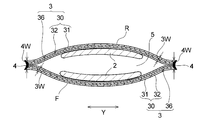
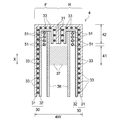
- FIG. 3 is a cross-sectional view schematically showing a cross section taken along line II of FIG. 4 is a cross-sectional view schematically showing a cross section taken along line II-II in FIG.
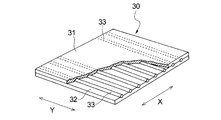
- FIG. 5 is a partially broken perspective view schematically showing an elastic sheet used as an outer package of the diaper shown in FIG.
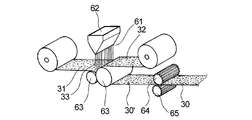
- FIG. 6 is a perspective view schematically showing an apparatus suitably used for manufacturing the stretchable sheet shown in FIG.
- pants-type disposable diapers have been required to have the same appearance as normal underwear.
- the pants-type disposable diaper has a side seal portion that does not exist in normal underwear.
- the conventional side seal portion protrudes outward from the diaper rather than the peripheral portion, and is very conspicuous in the appearance of the diaper.
- underpants-type disposable diapers are difficult to say with the same appearance as underwear.
- the side seal portion formed by heat sealing processing or the like as described in Patent Documents 1 and 2 is hard and difficult to say because it is formed by heating and compressing the exterior body. This is a cause of lowering the wearing feeling of diapers. Such a decrease in wearing feeling due to the side seal portion is not in normal underwear.
- a conventional side seal portion formed according to a conventional method using heat sealing processing, ultrasonic processing, or the like as described in Patent Documents 1 and 2 as a method for imparting an appearance similar to normal underwear to a pants-type disposable diaper A method of lowering the protruding height of the side seal part from the outer surface of the diaper by physically cutting the tip part of the side seal part by a cutting means such as a cutter is conceivable.
- the side seal part formed according to the ordinary method is formed by compressing the exterior body in the thickness direction, so the thickness (width) of the fused part of the forming material in the side seal part is compared.
- the sensation of “chickle” means a sensation (pain) that is usually felt when a protrusion is touched with a finger.
- the tip of an object that is smaller than a fingertip or has a tip is used. It is a sensation (pain) when touched with a fingertip.
- the “projections” that can cause such a tingling sensation include, for example, a resin that has been hardened and cured by melting, a resin that has been compressed simultaneously with heat melting, and has become a projection. And a resin having a comparatively sharp shape by cutting the resin sharply.
- the side seal part (fused part) is easily broken when the diaper is discarded, on the premise that the side seal part will not be broken when the diaper is worn.
- the operability is required to be excellent.
- a pants-type disposable diaper having an appearance like an underwear and having an excellent feeling of wearing has not been provided yet, while having a side seal portion having a practically sufficient seal strength and excellent operability.
- the present invention relates to a pants-type disposable diaper having an underwear-like appearance and excellent wearing feeling while having a side seal portion having practically sufficient sealing strength and excellent operability.
- a diaper 1 which is an embodiment of a pants-type disposable diaper according to the present invention is disposed on an absorbent main body 2 and a non-skin facing surface side of the absorbent main body 2 to absorb the absorbent.
- a pants-type disposable diaper in which the side edges 3R, 3R are joined to form a pair of side seals 4, 4, a waist opening 5, and a pair of leg openings 6, 6.
- FIG. 4 from the viewpoint of ease of explanation, there are places where adjacent constituent members in the side seal portion 4 are described without being in close contact with each other, but in fact, adjacent constituent members in the side seal portion. The two are in close contact.
- the diaper 1 has a longitudinal direction X corresponding to the wearer's front-rear direction and a lateral direction Y orthogonal to the wearer's front-rear direction in a developed and extended plan view as shown in FIG.
- the diaper 1 can be divided into a crotch part M disposed in the crotch part when worn, and a ventral side part F and a back side part R located in the longitudinal direction X.
- the vertical direction X is a direction extending from the ventral side F to the back side R via the crotch M.
- the crotch part M is an area in which recessed portions for forming the leg openings 6 and 6 are formed at both side edges along the vertical direction X.
- a skin opposing surface is a surface turned to a wearer's skin side at the time of wear of a disposable diaper in a disposable diaper or its component (for example, absorptive main part 2), and a non-skin opposing surface is It is a surface in the disposable diaper or a component thereof directed to the side opposite to the skin side (clothing side) when the disposable diaper is worn.
- the vertical direction X corresponds to the direction (longitudinal direction) along the long side of the absorbent main body 2 which is a disposable diaper or its constituent member
- the horizontal direction Y is the absorbent main body 2 which is a disposable diaper or its constituent member. Matches the width direction of.
- the absorbent main body 2 has a vertically long shape in which one direction (vertical direction X) is relatively long, and includes a topsheet 21 that forms a skin facing surface and a non-skin facing surface. A back sheet 22 to be formed and a liquid-retaining absorbent 23 interposed between the two sheets 21 and 22 are provided.
- the absorbent 23 has a shape that is long in the same direction as the longitudinal direction X. .
- the absorbent main body 2 has its longitudinal direction aligned with the longitudinal direction X of the diaper 1 in the unfolded and extended state (the state shown in FIG. 2), and a known joining means (such as an adhesive) at the center of the outer package 3. It is joined by.
- the top sheet 21, the back sheet 22, and the absorber 23 constituting the absorbent main body 2 various types conventionally used in the technical field can be used without particular limitation.
- a liquid permeable sheet such as various nonwoven fabrics or perforated films subjected to a hydrophilic treatment can be used.
- a liquid-impermeable material or a water-repellent material can be used.
- a resin film, a resin film having fine pores and moisture permeability, a laminate material of a resin film and a nonwoven fabric, and the like can be used.
- a composite nonwoven fabric having a multilayer structure composed of bond, meltblown, spunbond, or the like, a spunbond nonwoven fabric, a heat bond nonwoven fabric, an air-through nonwoven fabric, or the like can be used.
- an absorbent core comprising an absorbent core made of water-absorbing polymer particles and a fiber material such as pulp fiber can be used.
- the absorbent core is a core wrap sheet such as tissue paper. It may be covered.
- side cuffs 24 and 24 made of a sheet material that is liquid-resistant or water-repellent and breathable are provided on both the left and right sides of the absorbent main body 2 along the longitudinal direction X. .
- Each side cuff 24 stands up when the side cuff elastic member 25 arranged in an extended state along the free end contracts, and prevents the liquid from flowing out in the lateral direction Y.
- the expanded and extended state means that the side seal portion is peeled off, the diaper is set in the expanded state, the elastic member of each part is expanded in the expanded diaper, and the design dimensions (the influence of the elastic member is eliminated at all). In this state, it is expanded until it becomes the same size as when expanded in a flat shape.
- the exterior body 3 includes a laminated body of the first exterior sheet 30 and the second exterior sheet 36.
- the sheet 30 forms the outer surface of the diaper 1 (the non-skin facing surface of the exterior body 3), and the sheet 36 forms the inner surface of the diaper 1 (the skin facing surface of the exterior body 3).
- the sheets 30 and 36 are bonded to each other by a known bonding means such as an adhesive, a heat seal, an ultrasonic seal, or the like on the opposing surfaces.
- a known bonding means such as an adhesive, a heat seal, an ultrasonic seal, or the like on the opposing surfaces.
- FIGS. 2 and 4 the front and rear end portions of the sheet 30 in the vertical direction X (extending portions from the front and rear end portions in the vertical direction X of the sheet 36) are respectively folded back to the skin facing surface side.
- a plurality of thread-like waist elastic members 51 are bonded and fixed together with an adhesive in an expanded state between the two sheets 30 and 30 facing each other by the folding. As a result, a
- the first exterior sheet 30 includes two sheets, an outer layer sheet 31 and an inner layer sheet 32, and a plurality of thread-like elastic filaments 33 sandwiched between the sheets 31 and 32.
- the elastic sheet is extendable in the same direction as the direction in which the elastic filament 33 extends (lateral direction Y).
- the first exterior sheet 30 and the second exterior sheet 36 are joined to each other on opposite surfaces under the stretched state of the sheet 30, so that the exterior body 3 as a whole is at least in the sheet 30.
- the elastic filament 33 has elasticity in the extending direction.
- the outer layer sheet 31 forms the outer surface of the diaper 1 (the non-skin facing surface of the outer package 3), and the inner layer sheet 32 forms a bonding surface with the second outer sheet 36. Details of the first exterior sheet 30 will be described later.
- a body cover sheet 37 that crosses the absorbent body 2 in the lateral direction Y is disposed on the skin facing surface of the exterior body 3 (second exterior sheet 36).
- the sheet 37 has an adhesive, a heat seal, and other components of the diaper 1 opposite to the sheet 37 (absorbent body 2 (surface sheet 21), side cuff 24, exterior body 3 (second exterior sheet 36)). It is joined partially or entirely by a known joining means such as an ultrasonic seal.
- the sheet 37 is arranged so as to cross the front and rear end portions in the longitudinal direction X of the absorbent main body 2 in the lateral direction Y, and one sheet 37 is arranged on each of the ventral side portion F and the back side portion R.
- Each sheet 37 has a rectangular shape that is long in the lateral direction Y in a plan view as shown in FIG. 2, and is continuous over the entire length of the exterior body 3 in the lateral direction Y.
- Each sheet 37 is arranged in the vicinity of the opening end of the waist opening 5 (the folded portion of the first exterior sheet 30 and the arrangement site of the waist elastic member 51), and is longer than the longitudinal end of the absorbent main body 2. Extending in the transverse direction Y through the outside in the direction X, and extending in the transverse direction Y through the inside in the longitudinal direction X (on the absorbent main body 2) than the longitudinal end portion, A longitudinally inward portion.
- the side seal portion 4 includes a plurality of sheets constituting the exterior body 3 [first exterior sheet 30 (outer layer sheet 31, inner layer sheet 32), second exterior sheet 36] and other sheets superimposed on the exterior body 3 (
- the main body cover sheet 37) is formed by fusing with overlapping edges, and has a fusing part.
- the thickness (width) 4W (see FIG. 3) of the side seal portion 4 (the fused portion of the side seal portion 4) is less noticeable from the viewpoint of giving the diaper 1 an appearance like underwear. The smaller one is desirable, but if it is too small, the sealing strength is lowered and the side seal portion 4 may be broken while the diaper 1 is worn.
- the thickness 4W of the side seal portion 4 is preferably 0.2 mm or more, more preferably 0.25 mm or more, and preferably 2 mm or less, more preferably 1.5 mm or less, more specifically, The thickness is preferably 0.2 to 2 mm, more preferably 0.25 to 1.5 mm.
- a front body continuous body (not shown) including the ventral side F and a back body continuous including the back side R are provided.
- a laser beam is used as a fusing means for a diaper continuous body (not shown) obtained by superimposing a body (not shown), and a portion of the diaper continuous body where the side seal portion 4 is to be formed is irradiated with the laser light.
- the method of forming the side seal part 4 by fusing this is mentioned. That is, when the side seal portion 4 is formed by irradiating the diaper continuous body with laser light and fusing it, the thickness 4W of the side seal portion 4 can be in the specific range.
- the abdominal side F side is the front body of the diaper 1 and the back side R side is the back body of the diaper 1.
- the front body continuum is formed with a plurality of front bodies connected in one direction (conveying direction)
- the back body continuum is formed with a plurality of back bodies connected in one direction (conveying direction).
- the thickness (width) 4W of the side seal portion 4 (the fused portion of the side seal portion 4) is the side seal portion 4 of each of the ventral portion F and the back portion R constituting the side seal portion 4 ( It is larger than the thickness 3W of the portion other than the fused portion).
- the specific magnitude relationship of the thickness [the thickness 3W of the portion other than the side seal portion 4 of the ventral portion F or the back portion R ⁇ the thickness 4W of the side seal portion 4 (fused portion)] is such as a heat roll device. It is difficult to realize by the side seal portion forming method using the pressure heating means.
- the side seal part (fused part) formed in accordance with a conventional method using a pressure heating means has the side seal part because the abdominal side part and the back side part constituting the side seal part are pressurized in the thickness direction. Is smaller than the original thickness of the ventral part and the dorsal part (thickness of the part other than the side seal part in each of the ventral part and the dorsal part). That is, in a diaper having a side seal part formed by heating and pressurizing the diaper continuum (the front body continuum and the back body continuum), (thickness 3W> thickness 4W).
- the side seal part formed by such a method satisfies the relationship (thickness 3W ⁇ thickness 4W), and the tactile sensation is improved as compared with the side seal part formed by heating and pressurizing the diaper continuous body.
- the tingling sensation is reduced.
- the “feeling of tingling” here is as described above.
- “the part other than the side seal part 4 of the ventral side part F or the back side part R”, which is a measurement target of the thickness 3W, is a part having the same layer configuration as the part constituting the side seal part 4. For example, the part located between the absorptive main body 2 and the side seal part 4 is mentioned.
- the difference between the thickness 4W and the thickness 3W (4W-3W) is preferably 0.10 mm or more, more preferably 0.15 mm or more, and preferably 0.5 mm or less, more preferably 0.45 mm or less, more specifically. Is preferably 0.10 to 0.5 mm, more preferably 0.15 to 0.45 mm.
- Thicknesses 4W and 3W were measured at a magnification of 50 to 200 times with a microscope (VHX-1000, manufactured by KEYENCE Corp.) at three cross-sections spaced apart in the longitudinal direction in the side seal part of one diaper. In the cross section, the thickness of the part to be measured can be obtained, and can be obtained as an average value of the three thicknesses. During the cross-sectional observation, the measurement target part was observed with no load for thickness 4W, and the measurement target part was observed with a load of 0.5 cN / cm 2 sandwiched between flat plates.
- the abdominal side part F and the back side part R which comprise the side seal part 4 are each comprised including the laminated structure of a some sheet-like member, Among the sheet-like members, the melting point of the constituent fibers of at least one sheet-like member is configured to be different from the melting point of the constituent fibers of the other sheet-like members, and the laminated structure of the ventral side portion F and the back side portion R is The low melting-point innermost layer type laminated structure 41 and the high melting point innermost layer type laminated structure 42 are included.
- the low-melting innermost layer type laminated structure 41 has an innermost layer [a laminated structure (a laminated structure of the dorsal side R or the ventral side F) opposite to the inner layer structure (a laminated structure of the ventral part F or the dorsal side R).
- the layer forming the facing surface] is a laminated structure composed of a low melting point sheet-like member having the lowest melting point of the constituent fibers among the plurality of sheet-like members constituting the laminated structure 41.
- the high melting innermost layer type laminated structure 42 is a laminated structure in which the innermost layer is a high melting point sheet-like member having the highest melting point of the constituent fibers among the plurality of sheet-like members constituting the laminated structure 41.
- the constituent fiber when the sheet-like member includes two or more kinds of constituent fibers having different melting points, the constituent fiber having a relatively high melting point among the two or more kinds of constituent fibers. Let the melting point be the “melting point of the constituent fibers” of the sheet-like member.
- the constituent fiber when the constituent fiber includes two or more kinds of resins having different melting points, such as a composite fiber, the melting point of the resin having a relatively high melting point out of the two or more kinds of resins is set to the melting point of the constituent fiber.
- the “constituent fiber” in the “melting point of the constituent fiber” is a fiber having a constituent fiber ratio of the sheet-like member of 15% by mass or more (a mass ratio of 15% by mass or more of the total mass of all constituent fibers of the sheet-like member). Fiber) or a fiber having a fiber resin composition ratio of 15% or more (a fiber having a resin content ratio of 15 mass% or more in the total mass of the resin derived from all the constituent fibers of the sheet-like member).
- the laminated structure including these four types of sheets includes two types of sheet-like members (two types of the sheet 31 and the sheets 32, 36, and 37) having different melting points of the constituent fibers, and the relative structure thereof is included.
- the sheet 31 that is a sheet-like member having a high fiber melting point is the high-melting sheet-like member, and the sheets 32, 36, and 37 that are sheet-like members having relatively low melting points of the constituent fibers are all in the low-melting sheet shape. It corresponds to a member.
- symbol 41 in FIG. 4 in each of the abdominal part F and the back part R is the innermost layer (the abdominal part F and the back part R in the side seal part 4) of this part. Since the layer adjacent to the boundary is formed from the sheet 37 which is the low melting point sheet-like member, the low melting innermost layer type laminated structure is formed. Moreover, the part (sheet
- the low-melting-point innermost layer type laminated structure 41 is arranged in a portion other than the upper end portion and the lower end portion in the longitudinal direction (longitudinal direction X) of the side seal portion 4.
- the upper end of the vertical direction X is arranged.
- the refractory innermost layered laminated structure 42 has an upper end portion in the longitudinal direction (vertical direction X) of the side seal portion 4, that is, an open end portion (
- the low melting innermost layer laminated structure 41 is disposed at the folded portion of the first exterior sheet 30 and the waist elastic member 51, and the low melting innermost layer laminated structure 41 is located at the upper end in the longitudinal direction of the side seal portion 4. It is arranged near the laminated structure 42 (position away from the lower end in the longitudinal direction).
- the sheets having a low melting point of the constituent fibers are used.
- the joining strength may be smaller than joining by fusion of sheets having a high melting point such as the high melting point sheet-like member.
- a laser beam sealing method that is, by irradiating a diaper continuum obtained by overlaying the front body continuum and the back body continuum with laser light and fusing it.
- the joining strength is high.
- formation of the side seal part 4 by the laser seal method is adopted, and the ventral side part F and the back side part constituting the side seal part 4 are at least the low melting point maximum.
- the inner layer type laminated structure 41 is included. Therefore, in this embodiment, the peel strength of the side seal portion 4 is higher in the portion where the low melting innermost layer type laminated structure 41 exists than in the portion where the high melting point innermost layer type laminated structure 42 exists.
- the abdomen side portion F and the back side portion R constituting the side seal portion 4 are each the low melting point innermost layer type in which the sheet 37 that is the low melting point sheet-like member is the innermost layer. Since the laminated structure 41 is included, in the side seal portion 4, the ventral side portion F and the back side portion R are firmly bonded via the seat 37, and thereby, a practically sufficient seal strength (peeling) is applied to the side seal portion 4. Strength). Therefore, it is difficult for the side seal part 4 to be broken when the diaper 1 is worn.
- the peel strength of the side seal portion is measured as follows.
- the peel strength was measured using TENSILON RTC-1150A manufactured by ORIENTEC. Using a sample with the side seal portion cut to a length of 30 mm, the sample was opened at the center layer, chucked on the apparatus, and then peeled off at a speed of 300 mm / min. The value of the maximum point load at this time was defined as the peel strength of the side seal portion.
- the sample size is less than 30 mm, the sample is cut with the maximum length x (mm) that can be collected, and the peel strength is measured by the same method. The obtained peel strength a was converted by the formula “a ⁇ (30 / x)” to obtain 30 mm peel strength.
- the diaper 1 when the diaper 1 is discarded, usually, an operation of grasping the opening end portion of the waist opening 5 and the vicinity thereof (the upper end side of the diaper 1) with both hands and tearing the diaper 1 by the side seal portion 4 is performed.
- the upper end portion in the longitudinal direction of the side seal portion 4 that is the starting point of tearing of the diaper 1 is not the low melting point innermost layer type laminated structure 41 having relatively high seal strength (peel strength). Since the high melting point innermost layer type laminated structure 42 having relatively low sealing strength (peeling strength) is located, the diaper 1 can be easily torn at the side seal portion 4. Thus, the diaper 1 has a practically sufficient seal strength and is excellent in operability.
- the high melting innermost layer type laminated structure 42 includes a folded portion of the first exterior sheet 30 (expandable sheet) including the two sheets 31 and 32. Therefore, the number of the sheet-like members is larger than that of the low-melting-point innermost layer type laminated structure 41 that does not include the folded portion of the sheet. With such a configuration, there is an effect that the feeling of wearing the diaper is improved by increasing the firm feeling of the waist part, which is a part including a high melting innermost layer type laminated structure having a relatively large number of laminated sheet-like members. .
- the specific magnitude relationship is implement
- the side seal portion 4 is formed by irradiating the diaper continuous body with laser light and fusing it, and is formed through fusing by such laser light irradiation.
- a large number of gaps exist in the fused portion of the forming material in the side seal portion 4 formed. It is inferred that such voids originate from voids between the constituent fibers of the sheet before fusing by fusing.
- the form of the sheet before the fusing is maintained without being almost destroyed.
- This is not the heat sealing process widely used as the means for forming the side seal portion.
- the heat sealing process since the sheet to be processed is pressed in the thickness direction, the gaps between the constituent fibers of the sheet are crushed by this pressure, so that the gaps are not formed in the finally obtained side seal part. Is almost nonexistent.
- the shape of the constituent fibers of the sheet is maintained by subjecting the sheet to be heat-sealed without crushing the processed sheet in the thickness direction, and inside the side seal part (fused part).
- the cushioning property and flexibility of the side seal portion are enhanced, and the air permeability is ensured.
- the feeling of use such as the texture of the diaper, the improvement of the wearing feeling, and the reduction of the feeling of stuffiness in the diaper is led to.
- the gap exists in the fusion part of the side seal part 4 the state of the fusion part becomes close to the vicinity thereof, so that the appearance of the diaper is similar to that of underwear. It is done.
- Examples of the method for forming the side seal portion using laser light include the following methods.
- the workpiece sheet (continuous diaper) is brought into contact with a support member having a light passage portion through which laser light can pass, and the light passing from the support member side to the workpiece sheet in a pressurized state.
- the light passage portion can be, for example, a slit-like opening that penetrates the support member in the thickness direction.
- the laser light irradiation conditions used for forming the side seal portion include the following conditions: preferable. That is, using a CO 2 laser, the wavelength output of the laser beam is 24 W, the spot (the portion irradiated with the laser beam) has a diameter of 0.3 mm, and the scanning speed of the laser beam is 325 mm / s. From the same viewpoint, the width of the slit-shaped opening (light passage portion) of the support member (the length in the direction orthogonal to the conveyance direction of the processed sheet) is preferably 2 mm. From the same point of view, it is preferable that the applied pressure for bringing the processed sheet into a pressurized state at the time of laser light irradiation is 0.4 MPa.
- nonwoven fabrics by various manufacturing methods are preferably used.
- a heat roll nonwoven fabric, a spunlace nonwoven fabric, a spunbond nonwoven fabric, a melt blown nonwoven fabric, a needle punched nonwoven fabric, etc. are mentioned.
- the nonwoven fabric comprised from a short fiber is comparatively bulky, its texture is particularly good.
- the nonwoven fabric comprised from a long fiber has a comparatively high fiber density, it becomes easy to obtain high sealing strength.
- a spunbond nonwoven fabric is particularly preferable as the low-melting sheet-like member, and an air-through nonwoven fabric is preferable as the high-melting-point sheet-like member from the viewpoint of the balance between the texture of the diaper and the seal strength.
- polyester such as polyethylene (PE), polypropylene (PP), polyethylene terephthalate (PET) or polybutylene terephthalate (PBT),
- PET polyethylene terephthalate
- PBT polybutylene terephthalate
- fibers made of polyamide and the like These fibers may be short fibers or long fibers, and may be hydrophilic or water repellent.
- a core-sheath type or side-by-side type composite fiber, a split fiber, a modified cross-section fiber, a crimped fiber, a heat-shrinkable fiber, or the like can be used.
- a conjugate fiber for example, a combination of PET / PE, PP / PE, PP / low-melting point PP, PET / low-melting point PET, etc. can be used. These fibers can be used alone or in combination of two or more. In addition, these fibers can also be used as a copolymer to which each material is added or an additive such as a lubricant is added.
- the low-melting-point sheet-like member is composed of a single fiber made of PP (PP single fiber content: 100% by mass), and the high-melting-point sheet-like member has a core portion.
- the core-sheath-type composite fiber PET / PE core-sheath-type composite fiber content rate 100 mass% which PET and a sheath part consist of PE is mentioned. According to such a combination of fibers, the above-described effects can be more reliably achieved.
- the diaper 1 described above can be manufactured basically in the same manner as this type of pants-type disposable diaper. That is, the diaper 1 is obtained by superimposing the front body continuum including the ventral side F and the back body continuum including the back side R to obtain a diaper continuum, and the side seal part 4 is scheduled to be formed in the diaper continuum. It can be manufactured by a manufacturing method including a step of forming the side seal portion 4 by cutting a part. In the diaper continuous body, a plurality of diaper 1 precursors (pants-type disposable diapers in which the pair of side seal portions 4 and 4 are not formed) are continuous in one direction (lateral direction Y).
- the cutting of the site where the side seal portion 4 is to be formed in the diaper continuous body is preferably performed by fusing to melt and cut the site to be formed, from the viewpoint of further ensuring the above-described effects.
- the fusing means include laser light, a heated cutting blade, heat sealing using a known overheated heat sealing means, ultrasonic sealing using a known ultrasonic sealing means that has been overvibrated, and the like. It is done.
- laser light is particularly preferable because the width 4W (see FIG. 3) of the side seal portion 4 can be made relatively small and effective for making the side seal portion 4 inconspicuous from the outside.
- FIG. 5 shows the sheet 30.
- the sheet 30 has a configuration in which a thread-like elastic filament is bonded to one surface of an extensible fiber layer mainly composed of inelastic fibers.
- the outer layer sheet 31 and the inner layer The sheet 32 includes two sheets and a plurality of thread-like elastic filaments 33 sandwiched between the sheets 31 and 32.
- the sheets 31 and 32 are both “extensible fiber layers mainly composed of inelastic fibers” (in FIG. 5, illustration of inelastic fibers is omitted).
- the content of non-elastic fibers in the sheets 31 and 32 mainly composed of non-elastic fibers is preferably 60% by mass or more, more preferably 80% by mass or more, and may be 100% by mass.
- the outer layer sheet 31 and the inner layer sheet 32 are both extensible.
- the sheets 31 and 32 can be extended in the same direction as the direction in which the elastic filament 33 extends (lateral direction Y).
- Stretchable means (a) when the constituent fibers themselves of the sheets 31 and 32 are stretched, and (b) even if the constituent fibers themselves are not stretched, the fibers bonded at the intersections are separated or the fibers are This includes the case where the three-dimensional structure formed by a plurality of fibers is structurally changed due to bonding or the like, or the constituent fibers are broken, and the sheets 31 and 32 are extended as a whole.
- the outer layer sheet 31 and the inner layer sheet 32 may already be stretchable in the state of the original fabric before being joined to the elastic filament 33. Alternatively, it is not stretchable in the state of the original fabric before being joined to the elastic filament 33, but is processed so as to be stretchable after being joined to the elastic filament 33, and becomes stretchable. Also good. Specific methods for making the sheet stretchable include heat treatment, roll-to-roll stretching, bite-and-gap stretching with teeth and gears, and tensile stretching with a tenter. In view of a preferable manufacturing method of the first exterior sheet 30 to be described later, the sheets 31 and 32 have good transportability when the elastic filament 33 is fused to the sheets 31 and 32. It is preferable that the original fabric is not stretchable.
- the outer layer sheet 31 and the inner layer sheet 32 are extendable and substantially inelastic.
- Elasticity is a property that can be stretched and contracts when released from the stretched force, and the sheets 31 and 32 do not have such a property.
- the sheets 31 and 32 have elasticity, a fiber containing an elastic resin is required as a constituent fiber thereof, and the fiber containing the elastic resin tends to exhibit a sticky feeling that contributes to lowering the texture of the nonwoven fabric. Therefore, in this embodiment, the sheets 31 and 32 are made substantially inelastic to prevent the texture from being lowered.
- the elastic filament 33 is formed by being stretched in a state where the elastic resin is melted or softened, as will be described later.
- Each of the plurality of elastic filaments 33 is substantially continuous over the entire length of the first exterior sheet 30 (the entire length in the lateral direction Y of the exterior body 3).
- the plurality of elastic filaments 33 are arranged so as to extend in one direction (lateral direction Y) without crossing each other.
- the elastic filaments 33 are allowed to cross unintentionally due to unavoidable fluctuations in the manufacturing conditions of the sheet 30.
- the plurality of elastic filaments 33 may each extend linearly or may meander while meandering as long as they do not cross each other.
- the elastic filament 33 is joined to the outer layer sheet 31 and the inner layer sheet 32 in a substantially non-stretched state. Since the elastic filament 33 is not stretched, relaxation (creep) due to stretching does not occur, and the stretchability is reduced during storage of the original fabric after the elastic filament 33 is bonded to the sheets 31 and 32 or after processing such as stretching. There is an advantage that there is no. Further, there is no deformation due to the tightness of the wound-up raw material. Further, for example, when the elastic filament 33 is stretched twice and bonded to the sheets 31 and 32, if it is temporarily returned to 1.3 times the initial value, it can be stretched only 1.7 times from this state.
- the diameter of the elastic filament 33 is not particularly limited, but is preferably 10 ⁇ m or more, more preferably 20 ⁇ m or more, and preferably 200 ⁇ m from the viewpoint of the balance between the texture of the first exterior sheet 30 and the productivity of the elastic filament 33.
- it is more preferably 130 ⁇ m or less, more specifically preferably 10 to 200 ⁇ m, and further preferably 20 to 130 ⁇ m.
- the elastic filament 33 may have a circular cross section, but in some cases may have an elliptical cross section.
- the cross section of the elastic filament 33 tends to become an ellipse.
- the elastic filament 33 is arranged so that the major axis of the ellipse is in the same direction as the planar direction of the sheet 30 and the minor axis is in the same direction as the thickness direction of the sheet 30. It is preferable.
- the pitch of the adjacent elastic filaments 33, 33 is the elastic filament 33 from the viewpoint of the first exterior sheet 30 exhibiting sufficient stretchability and good cloth-like texture.
- the thickness is preferably 0.1 to 5.0 mm, more preferably 0.4 to 1.0 mm.
- the plurality of elastic filaments 33 are joined to the outer layer sheet 31 and the inner layer sheet 32 over their entire length.
- “bonded over the entire length” does not require that all the fibers in contact with the elastic filament 33 (component fibers of the sheets 31 and 32) are bonded to the elastic filament 33.
- the elastic filament 33 and the constituent fibers (non-elastic fibers) of the sheets 31 and 32 are bonded to the elastic filament 33 in such a manner that there is no intentionally formed non-bonded portion. Since the elastic filament 33 is bonded to the sheets 31 and 32 over their entire length, the bonding force between the elastic filament 33 and the sheets 31 and 32 can be sufficiently increased.
- the elastic filament 33 is difficult to peel from the sheets 31 and 32.
- the elastic filament 33 is peeled off from the sheets 31 and 32, in the natural state (relaxed state), floating occurs between the elastic filament 33 and the sheets 31 and 32, and the sheet 30 is easily wrinkled.
- the sheet 30 as a whole lacks a sense of unity.
- the non-elastic fibers buried in the elastic filament 33 may be all or a part of the non-elastic fibers existing around the elastic filament 33.
- “buried” means that at the intersection of the inelastic fiber and the elastic filament 33, the portion of the inelastic fiber that is present at the intersection is the intersection of the elastic filament 33. The state that has entered the part that exists in the.
- the state where the non-elastic fibers and the elastic filaments 33 are joined by dots or lines on their surfaces is not included in the burial according to the present invention.
- the non-elastic fiber is preferably embedded in the elastic filament 33 with a degree of half or more of its diameter.
- the bonding state between the elastic filament 33 and the non-elastic fibers contained in the outer layer sheet 31 and the inner layer sheet 32 is as described above, so that the bonding strength between the elastic filament 33 and the sheets 31 and 32 is increased.
- peeling between the two is less likely to occur.
- the sheets 31 and 32 follow the elongation of the elastic filament 33 and stretch with good responsiveness, so that an advantageous effect that the stretchability of the sheet 30 becomes good is achieved.
- the elastic filament 33 and the non-elastic fibers included in the sheets 31 and 32 are joined as described above, the elastic filament 33 and the sheets 31 and 32 are in close contact with each other, and the presence of the elastic filament 33 is present. Since it is more difficult to feel the level difference between the part that is present and the part that is not present, there is also an advantageous effect that the texture of the sheet 30 is improved.
- the embedded state of the non-elastic fiber in the elastic filament 33 is seen in the portion of the first exterior sheet 30 where the sealing process is not performed, but the sealing process such as the side seal portion 4 is performed. It is not always seen in the part.
- the sealing process is a process involving melting of the forming material (resin) of the sheet 30, and examples thereof include a heat and pressure process such as an emboss process, an ultrasonic seal process, and a laser beam irradiation process.
- a change occurs in the buried state of the inelastic fiber in the elastic filament 33 which originally existed, and the buried state may disappear. Therefore, confirmation of whether or not the inelastic fiber is buried in the elastic filament 33 should be performed at a portion of the exterior body 3 where the sealing process is not performed.
- the first exterior sheet 30 is manufactured according to the manufacturing method (see FIG. 7) described later, a “state in which the non-elastic fibers are fused with the elastic filaments 33 and embedded in the elastic filaments 33” is obtained.
- heat is not applied to the sheets 31 and 32, and the elastic filaments 33 are fused to the sheets 31 and 32 before the elastic filaments 33 obtained by melt spinning are solidified. Only the fibers present around the filament 33 are bonded to the elastic filament 33, and the fibers located further away from the filament 33 maintain the texture of the sheets 31 and 32, so the texture of the sheet 30 is good. There is an advantage that it is kept.
- the elastic filament 33 in the first exterior sheet 30 is joined to the sheets 31 and 32 in a state where the fibers (non-elastic fibers) constituting the sheets 31 and 32 are buried in the elastic filament 33. It is made by fusing to a metal, and is not made by using an adhesive such as a hot-melt adhesive. Therefore, there is no adhesive between the sheets 31 and 32 (extensible fiber layer mainly composed of non-elastic fibers) and the elastic filaments 33 bonded thereto. Since there is no adhesive between the sheets 31 and 32 and the elastic filament 33, the seal strength of the side seal portion including these becomes higher.
- the first exterior sheet 30 can be expanded and contracted in the same direction as the direction in which the elastic filament 33 extends (lateral direction Y).
- the stretchability of the sheet 30 appears due to the elasticity of the elastic filament 33.
- the elastic filament 33 and the sheets 31 and 32 extend.
- the stretching of the sheet 30 is released, the elastic filament 33 contracts, and the sheets 31 and 32 return to the state before stretching as the contraction occurs.
- the sheet 30 there is no other elastic filament bonded in a state orthogonal to the elastic filament 33, so the sheet 30 is stretched in the same direction as the direction in which the elastic filament 33 extends (lateral direction Y).
- the stretchable sheet 30 stretches with little so-called width shrinkage shrinking in the lateral direction Y.
- the constituent fibers and forms of the outer layer sheet 31 and the inner layer sheet 32 (extensible fiber layer mainly composed of inelastic fibers) constituting the first exterior sheet 30 are as described above.
- the sheet 31 and the sheet 32 may be the same type or different types.
- the “same type of sheet” means sheets having the same manufacturing process, types of constituent fibers of the sheet, fiber diameters and lengths of the constituent fibers, sheet thickness, basis weight, and the like. . When at least one of these is different, it is a “heterogeneous sheet”.
- the thicknesses of the outer layer sheet 31 and the inner layer sheet 32 are each preferably 0.05 mm or more, more preferably 0.1 mm or more, and preferably 5.0 mm or less, more preferably 1 mm or less, more specifically preferably Is 0.05 to 5.0 mm, more preferably 0.1 to 1.0 mm.
- the thickness of the sheet is such that the sheet to be measured is sandwiched between flat plates with a load of 0.5 cN / cm 2 , and the cross section of the three sheets separated in the longitudinal direction in one diaper is a microscope (VHX made by KEYENCE Corporation). 1000) and the like, and the thickness is obtained for each cross section, and can be obtained as an average value of three thicknesses.
- the basis weights of the sheets 31 and 32 are each preferably 3 g / m 2 or more, more preferably 5 g / m 2 or more, and preferably 100 g / m 2 or less, from the viewpoints of texture, thickness, and design properties. More preferably, it is 30 g / m 2 or less, more specifically, preferably 3 to 100 g / m 2 , more preferably 5 to 30 g / m 2 .
- the basis weight of the plurality of elastic filaments 33 arranged between the sheets 31 and 32 is preferably 3 g / m 2 or more from the viewpoints of stretchability, texture, thickness, cost, and the like. preferably 4g / m 2 or more, and preferably 30 g / m 2 or less, more preferably 15 g / m 2 or less, more specifically, preferably 3 ⁇ 30g / m 2, more preferably 4 ⁇ 15 g / m 2 .
- the elastic filament 33 is made of, for example, a thermoplastic elastomer or rubber.
- a thermoplastic elastomer is used as a raw material, melt spinning using an extruder is possible in the same manner as a normal thermoplastic resin, and the elastic filament thus obtained is easy to be heat-sealed.
- Suitable for the exterior sheet 30 Suitable for the exterior sheet 30.
- thermoplastic elastomer examples include styrene such as SBS (styrene-butadiene-styrene), SIS (styrene-isoprene-styrene), SEBS (styrene-ethylene-butadiene-styrene), and SEPS (styrene-ethylene-propylene-styrene).
- SBS styrene-butadiene-styrene
- SIS styrene-isoprene-styrene
- SEBS styrene-ethylene-butadiene-styrene
- SEPS styrene-ethylene-propylene-styrene
- olefin-based elastomers ethylene-based ⁇ -olefin elastomers, propylene-based elastomers copolymerized with ethylene, butene, octene, etc.
- polyester-based elastomers polyurethane-based elastomers, and the like.
- Two or more kinds can be used in combination.
- core-sheath type or side-by-side type composite fibers made of these resins can also be used.
- the elastic filament 33 is spun from the spinning nozzle 61 and drawn and stretched at a predetermined speed before the elastic filament 33 is solidified.
- the elastic filaments 33 are fused to the outer layer sheet 31 and the inner layer sheet 32 so that the filaments 33 are arranged in one direction without crossing each other, and then the sheets 31, 32 to which the elastic filaments 33 are fused are joined to the elastic filaments 33.
- the sheet is stretched along the extending direction of the sheet to impart extensibility to the sheets 31 and 32.
- the spinning nozzle 61 is provided in the spinning head 62.
- the spinning head 62 is connected to the extruder.
- the resin can also be supplied to the spinning head 62 via a gear pump.
- the elastic resin melt-kneaded by the extruder is supplied to the spinning head 62.
- a large number of spinning nozzles 61 are arranged in a straight line.
- the spinning nozzle 61 is disposed along the width direction of the sheets 31 and 32.
- the interval between the adjacent spinning nozzles 61 corresponds to the interval between the elastic filaments 33 in the target first exterior sheet 30.
- the spinning nozzle 61 is usually circular and has a cylindrical nozzle hole.
- the spun melted elastic filament 33 joins the sheets 31 and 32 fed from the original fabric at the same speed, and is sandwiched between the sheets 31 and 32 and taken up at a predetermined speed.
- the take-up speed of the elastic filament 33 coincides with the feeding speed of both sheets 31 and 32.
- the take-up speed of the elastic filament 33 affects the diameter of the elastic filament 33 and the draw ratio.
- the tension generated in the elastic filament 33 by stretching prevents the elastic filament 33 from being disturbed due to wind or static electricity when the elastic filament 33 is bonded to the sheets 31 and 32. Thereby, the elastic filaments can be arranged in one direction without crossing each other.
- the elastic filament 33 joins the sheets 31 and 32 before solidification, that is, in a state where it can be fused. As a result, the elastic filament 33 is fused to the sheets 31 and 32 while being sandwiched between the sheets 31 and 32. That is, the elastic filament 33 is pulled and stretched by fusing the elastic filament 33 before solidification to the conveyed sheets 31 and 32. When the elastic filament 33 is fused, heat is not applied to the sheets 31 and 32 from the outside. That is, the elastic filament 33 and the sheets 31 and 32 are fused only by heat of fusion caused by the elastic filament 33 that can be fused.
- the elastic filament 33 is stretched and molecules are oriented in the stretching direction. Also, the diameter is reduced. From the viewpoint of sufficiently stretching the elastic filament 33 and from the viewpoint of preventing yarn breakage of the elastic filament 33, wind of a predetermined temperature (hot air or cold air) is blown onto the spun elastic filament 33 to adjust the temperature of the elastic filament 33. You may adjust it.
- a predetermined temperature hot air or cold air
- the stretching of the elastic filament 33 is not only stretching in the molten state (melt stretching) of the resin composition (elastic resin) constituting the elastic filament 33, but also stretching in the softened state (softening stretching) in the cooling process. Also good.
- the molten state is a state in which the resin flows when an external force is applied.
- the melting temperature of the resin is measured as a peak temperature of Tan ⁇ by viscoelasticity measurement (for example, measured by adding vibration strain in the rotational direction to a resin sandwiched between circular parallel plates). In order to prevent yarn breakage during stretching of the resin composition, it is preferable to secure a long stretching section. From this viewpoint, the melting temperature of the resin composition is preferably 130 to 300 ° C.
- the melting temperature is preferably 130 to 220 ° C.
- the softening temperature is measured as the temperature at the inflection point of the storage elastic modulus G ′ in the viscoelastic property of the measurement sample of the resin composition in sheet form.
- the range from the softening temperature to the melting temperature is called a softened state.
- the softening temperature is preferably 60 ° C. or higher, and more preferably 80 ° C. to 180 ° C., from the viewpoints of crystal growth of the resin composition during storage of the stretchable sheet 30 and a decrease in stretchability of the stretchable sheet 30 due to body temperature.
- the elastic filament 33 is substantially in an unstretched state (a state in which the elastic filament 33 does not shrink when an external force is removed).
- unstretched state a state in which the elastic filament 33 does not shrink when an external force is removed.
- the fibers constituting the sheets 31 and 32 are fused to the elastic filament 33, or further, the fibers constituting the sheets 31 and 32 are formed with the elastic filament 33. It is more preferable that both at least a part are fused. This is because sufficient bonding strength can be obtained.
- the expansion / contraction characteristics of the obtained first exterior sheet 30 are affected by the density of the joining points between the elastic filament 33 and the sheets 31 and 32.
- the expansion / contraction characteristics can be adjusted by the joining temperature, the joining pressure, and the deviation of the joining points due to the stretching of the sheets 31 and 32 described later.
- the bonding strength of each bonding point increases. Lowering the density of the joining points is preferable because the first exterior sheet 30 having a sufficient joining strength can be obtained because the expansion and contraction inhibition by the sheets 31 and 32 is reduced.
- the elastic filaments 33 When the elastic filaments 33 are merged with the sheets 31 and 32, the elastic filaments 33 are arranged in one direction without crossing each other. Then, in a state where the elastic filament 33 is joined with the sheets 31 and 32 and the elastic filament 33 is sandwiched between the sheets 31 and 32, these three members are clamped by a pair of nip rolls 63 and 63.
- a composite 30 ′ in which the elastic filament 33 is sandwiched between the two sheets 31 and 32 is obtained.
- the composite 30 ′ becomes the first exterior sheet 30 (expandable sheet) itself.
- the composite 30 ′ including the sheets 31 and 32 is stretched. This stretching process is performed by an operation of stretching the composite 30 ′ along the direction in which the elastic filament 33 extends to impart extensibility to the sheets 31 and 32. In this manufacturing method, as shown in FIG.
- the target first exterior sheet 30 (expandable sheet) is obtained.
- the high melting point innermost layer type laminated structure 42 is disposed only at the upper end in the longitudinal direction of the side seal portion 4, but may be disposed only at the lower end, and is disposed at both upper and lower ends. May be.
- the exterior body 3 may have either one or both of both sheets 30 and 36.
- a pants-type disposable diaper in which a pair of side seal parts, a waist opening part and a pair of leg opening parts are formed by joining both side edges of the exterior body,
- the thickness of the side seal portion is larger than the thickness of the portion other than the side seal portion of the ventral side portion and the back side portion constituting the side seal portion
- the ventral side portion and the back side portion constituting the side seal portion are each configured to include a laminated structure of a plurality of sheet-like members, and at least one sheet-like shape among the plurality of sheet-like members.
- the melting point of the constituent fiber of the member is different from the melting point of the constituent fiber of the other sheet-like member
- the laminated structures of the ventral side portion and the dorsal side portion each include a low melting point innermost layer type laminated structure in which an innermost layer is a low melting point sheet-like member having the lowest melting point among the plurality of sheet-like members.
- the side seal part is formed by irradiating a continuous diaper obtained by superimposing a front body continuum including the ventral part and a back body continuum including the back side by irradiating a laser beam.
- a pants-type disposable diaper that is formed by. ⁇ 2> The pants-type disposable diaper according to ⁇ 1>, wherein the low melting innermost layer type laminated structure is arranged in a portion other than the upper end and the lower end in the longitudinal direction of the side seal portion.
- the laminated structure of the ventral side portion and the dorsal side portion includes a high melting point innermost layer type laminated structure in which an innermost layer is composed of a high melting point sheet-like member having the highest melting point among the plurality of sheet-like members.
- the high-melting innermost layer type laminated structure is a pants-type disposable diaper according to the item ⁇ 3>, wherein the number of laminated sheet-like members is larger than that of the low melting point innermost layer type laminated structure.
- the exterior body includes a laminated body of a first exterior sheet that forms a non-skin facing surface of the exterior body and a second exterior sheet that forms a skin facing surface of the exterior body, In the first exterior sheet, the longitudinal front and rear end portions (extending portions from the longitudinal front and rear end portions of the first exterior sheet) are respectively folded back to the skin facing surface side.
- the underpants-type disposable diaper according to any one of the above.
- a body cover sheet that crosses the absorbent body in the lateral direction is disposed on the skin facing surface of the exterior body (the second exterior sheet), and the body cover sheet has an overall length in the lateral direction of the exterior body.
- the underpants-type disposable diaper according to any one of ⁇ 1> to ⁇ 5>, which is continuous over and constitutes the side seal portion.
- ⁇ 7> The pants-type disposable diaper according to any one of ⁇ 1> to ⁇ 6>, wherein the side seal portion has a thickness 4W of preferably 0.2 mm or more, and more preferably 0.25 mm or more.
- ⁇ 8> The pants-type disposable diaper according to any one of ⁇ 1> to ⁇ 7>, wherein the side seal portion has a thickness 4W of preferably 2 mm or less, more preferably 1.5 mm or less.
- the difference (4W-3W) between the thickness 4W of the side seal portion and the thickness 3W of the portions other than the side seal portions of the ventral side portion and the back side portion constituting the side seal portion is preferably 0.
- the pants-type disposable diaper according to any one of ⁇ 1> to ⁇ 8> which is 10 mm or more, more preferably 0.15 mm or more.
- the difference (4W-3W) between the thickness 4W of the side seal portion and the thickness 3W of the portions other than the side seal portions of the ventral side portion and the back side portion constituting the side seal portion is preferably 0.
- the outer-layer sheet positioned in the outermost layer is made up of constituent fibers compared to other sheet-like members.
- the other sheet-like members other than the outer-layer sheet positioned in the outermost layer have the same composition.
- the low-melting-point sheet-like member is composed of a single fiber made of polypropylene
- the high-melting-point sheet-like member is composed of a core-sheath type composite fiber having a core part made of polyethylene terephthalate and a sheath part made of polyethylene.
- ⁇ 14> The pants-type disposable diaper according to any one of ⁇ 3> to ⁇ 13>, wherein the low-melting-point sheet-like member is a spunbond nonwoven fabric, and the high-melting-point sheet-like member is an air-through nonwoven fabric.
- the peel strength of the side seal portion is greater in the portion where the low melting innermost layer type laminated structure is present than in the portion where the high melting point innermost layer type laminated structure exists, any of the above ⁇ 3> to ⁇ 14>
- the constituent fibers of the low-melting-point sheet-like member and the high-melting-point sheet-like member are one or more selected from the group consisting of polyethylene fiber, polypropylene fiber, polyethylene terephthalate fiber, polybutylene terephthalate fiber, and polyamide fiber.
- the pants-type disposable diaper according to any one of ⁇ 3> to ⁇ 15>.
- the constituent fibers of the low melting point sheet-like member and the high melting point sheet-like member are one or more selected from the group consisting of the following core-sheath type composite fibers
- Core-sheath type composite fiber whose core part is made of polypropylene and whose sheath part is made of polyethylene.
- the underpants-type disposable diaper according to any one of the above items ⁇ 1> to ⁇ 18>, wherein a large number of voids are present in the fused portion of the forming material in the side seal portion.
- the exterior body is configured to include an elastic sheet, and the elastic sheet has a configuration in which a thread-like elastic filament is bonded to one surface of an extensible fiber layer mainly composed of non-elastic fibers.
- the underpants type according to any one of ⁇ 1> to ⁇ 19>, wherein a part of the inelastic fiber is fused with the elastic filament and buried in the elastic filament in a portion other than the side seal portion Disposable diapers.
- the stretchable sheet includes two sheets of an outer layer sheet and an inner layer sheet as the fiber layer, and these two sheets are extendable in the same direction as the direction in which the elastic filament extends (lateral direction).
- the pants-type disposable diaper according to any one of ⁇ 1> to ⁇ 20>.
- ⁇ 24> The pants-type disposable diaper according to any one of ⁇ 20> to ⁇ 23>, wherein no adhesive is present between the fiber layer and the elastic filaments bonded thereto.
- ⁇ 25> The pants-type disposable diaper according to any one of ⁇ 20> to ⁇ 24>, wherein the elastic filament is bonded to the fiber layer in a substantially non-stretched state.
- ⁇ 26> The pants-type disposable diaper according to any one of ⁇ 1> to ⁇ 25>, wherein the elastic filament is formed by being stretched in a state where an elastic resin is melted or softened.
- the exterior body includes a stretchable sheet having a configuration in which a thread-like elastic filament is bonded to one surface of an extensible fiber layer mainly composed of inelastic fibers, and the fiber layer is heat-treated, stretched between rolls,
- the underpants-type disposable diaper according to any one of ⁇ 1> to ⁇ 26>, wherein the pants-type disposable diaper is stretchable by biting or stretching by a tooth gap or a gear or by tensile stretching by a tenter.
- ⁇ 28> The method for producing a pants-type disposable diaper according to any one of the above ⁇ 1> to ⁇ 27>, comprising a front body continuum including the abdomen and a back body continuum including the back side.
- the diaper continuum obtained by superimposing has a step of forming the side seal part by irradiating a laser beam and fusing it.
- Each of the front body continuum and the back body continuum includes the exterior body, and the exterior body has a thread-like elastic filament bonded to one surface of an extensible fiber layer mainly composed of non-elastic fibers.
- the manufacturing method of the underpants type disposable diaper which is comprised including the elastic sheet which has the structure which carried out.
- ⁇ 29> The method for producing a pants-type disposable diaper according to ⁇ 28>, wherein the elastic filament is formed by being stretched in a state where an elastic resin is melted or softened.
- ⁇ 30> The method for producing a pants-type disposable diaper according to the above ⁇ 28> or ⁇ 29>, wherein the fiber layer is stretchable by heat treatment, inter-roll stretching, biting or gear biting or tensile stretching using a tenter.
- ⁇ 31> The method for producing a pants-type disposable diaper according to any one of ⁇ 28> to ⁇ 30>, wherein the fiber layer is not stretchable in a state of a raw fabric before being bonded to the elastic filament.
- the diaper continuum is brought into contact with a support member having a light passage portion through which laser light can pass, and the diaper continuum in a pressurized state is brought into contact with the support member.
- the diaper continuum Irradiate the diaper continuum with laser light from the side through the light passage part.
- the laser light a CO 2 laser is used, the wavelength output of the laser light is 24 W, the spot diameter of the laser light is 0.3 mm, the scanning speed of the laser light is 325 mm / s,
- the light passage portion is a slit-like opening that penetrates the support member in the thickness direction, and the width of the opening is 2 mm,
- Example 1 According to a conventional method, a pants-type disposable diaper having the same basic configuration as the diaper 1 shown in FIGS. 1 to 4 was produced.
- an absorbent main body As an absorbent main body, an absorbent main body of a commercially available pants-type disposable diaper (made by Kao, trade name “Relief is a pants-like undergarment”) is shown in FIG. 5 as a first exterior sheet constituting the exterior body.
- the following stretchable sheet A having the same structure as the stretchable sheet 30 is used, and a spunbond nonwoven fabric having a basis weight of 18 g / m 2 made of a single fiber of PP is used as the second exterior sheet, and the skin facing surface side of the exterior body (the outermost side)
- the following stretchable sheet A was disposed on the second exterior sheet on the inner layer) and on the non-skin facing surface side (outermost layer).
- a spunbonded nonwoven fabric having a basis weight of 18 g / m 2 made of a single fiber of PP was used as the main body cover sheet.
- the diaper continuum a laminate of a front body continuum including the abdomen and a back body continuum including the back side
- the side seal portion was formed by irradiating a laser beam to the portion where the side seal portion was to be formed and fusing it.
- the laser beam irradiation was performed using an apparatus having the same configuration as the laser type bonding apparatus described in Japanese Patent Application Laid-Open No. 2010-188629 related to the previous application of the present applicant.
- the energy density D (unit: J / mm 2 ) is a value obtained by dividing the energy of the irradiated laser light by the area of the irradiated region, and is calculated by the following formula (1).
- P is the laser output (W)
- ⁇ is the diameter (mm) of the spot of the laser beam on the sheet to be melted (diaper continuum)
- v is the scanning speed (mm / s) of the laser beam.
- the elastic sheet A has a large number of elastic filaments arranged in parallel with each other at a predetermined interval.
- Elastic filament Styrenic thermoplastic elastomer, fiber diameter 110 ⁇ m -Basis weight of elastic filament: 10 g / m 2
- the other fiber layer (the outer layer sheet).
- Basis weight of air-through nonwoven fabric / elastic sheet A having a basis weight of 20 g / m 2 made of core-sheath type composite fiber (non-elastic fiber, fiber thickness: 3.0 dtex) of PET (core) / PE (sheath): 48 g / m 2
- the core of the constituent fiber of the sheet 31 is PET is a core-sheath type composite fiber whose sheath is made of PE, and the constituent fibers of the other sheets 32, 36, 37 are all single fibers of PP.
- the melting point of the PET / PE core-sheath composite fiber is the melting point of the resin having a relatively high melting point as described above, it is the melting point of PET (265 ° C.).
- the melting point of the single fiber of PP is 165 ° C.
- the sheets 32, 36, and 37 are all the low-melting-point sheet-like members, and the sheet 31 is the high-melting-point sheet-like member. It is. Therefore, as shown in FIG. 4, the ventral side portion and the back side portion constituting the side seal portion of the diaper of Example 1 are respectively arranged in order from the upper end side in the longitudinal direction of the side seal portion in order of the low melting point maximum 41.
- An inner layer type laminated structure and a high melting point innermost layer type laminated structure 42 indicated by reference numeral 42 are included.
- Example 2 A pants-type disposable diaper was produced in the same manner as in Example 1 except that the following elastic sheet B was used instead of the elastic sheet A.
- elastic filament Styrenic thermoplastic elastomer
- fiber diameter 110 ⁇ m -Basis weight of elastic filament 10 g / m 2
- Basis weight of nonwoven fabric / elastic sheet B 50 g / m 2
- the sheets 31 and 32 are core-sheath type composite fibers in which the core part is made of PET and the sheath part is made of PE, and the constituent fibers of the other sheets 36 and 37 are all single fibers of PP. That is, the sheets 36 and 37 are both the low melting point sheet-like members, and the sheets 31 and 32 are both the high melting point sheet-like members. Therefore, as shown in FIG.
- the ventral side portion and the back side portion constituting the side seal portion of the diaper of Example 2 are respectively arranged in order from the upper end side in the longitudinal direction of the side seal portion in order of the lowest melting point indicated by reference numeral 41.
- An inner layer type laminated structure and a high melting point innermost layer type laminated structure 42 indicated by reference numeral 42 are included.
- Example 1 As the constituent fibers of each of the second exterior sheet and the main body cover sheet, the same fibers as the two sheets constituting the first exterior sheet (core-sheath type composite fiber having a core part made of PET and a sheath part made of PE) were used. A pants-type disposable diaper was produced in the same manner as Example 2 except for the above.
- elastic filament Styrenic thermoplastic elastomer, fiber diameter 110 ⁇ m -Basis weight of elastic filament: 10 g / m 2
- Fiber layer (the inner layer sheet and the outer layer sheet): a spunbonded nonwoven fabric having a basis weight of 18 g / m 2 made of a single fiber of PP (non-elastic fiber, fiber thickness 3.5 dtex), basis weight of the stretch sheet C: 46 g / m 2
- the constituent fibers of the four types of sheets 31, 32, 36, and 37 existing in the side seal part are:
- Each is a core-sheath type composite fiber in which the core part is made of PET and the sheath part is made of PE
- the constituent fibers of the four types of sheets 31, 32, 36, 37 existing in the side seal part are: Both are single PP fibers.
- the low-melting-point sheet-like member and the high-melting-point sheet-like member do not exist in the side seal portions of the diapers of Comparative Examples 1 and 2, and therefore, the ventral side portion and the back side that constitute these side seal portions.
- the portion does not include the low melting point innermost layer type laminated structure and the high melting point innermost layer type laminated structure 42.
- the seal strength of the side seal part if each panelist peels off the side seal part, as a feeling at that time, if the seal strength is sufficient and feels easy to peel off, wear diapers that are easy to peel off.
- the case where the occurrence of inconvenience such as tearing of the side seal portion was concerned was rated as x, the case where there were 4 or more panelists evaluated as ⁇ , the overall evaluation, and the case where the number was 3 or less was regarded as the overall evaluation x.
- the underpants type disposable diaper which has the appearance like underwear and is excellent in a feeling of wear is provided.
Landscapes
- Health & Medical Sciences (AREA)
- Epidemiology (AREA)
- Engineering & Computer Science (AREA)
- Biomedical Technology (AREA)
- Heart & Thoracic Surgery (AREA)
- Vascular Medicine (AREA)
- Life Sciences & Earth Sciences (AREA)
- Animal Behavior & Ethology (AREA)
- General Health & Medical Sciences (AREA)
- Public Health (AREA)
- Veterinary Medicine (AREA)
- Absorbent Articles And Supports Therefor (AREA)
Abstract
Description
剥離強度は、ORIENTEC社製のTENSILON RTC-1150Aを用いて測定した。サイドシール部を長さ30mmなるようにカットしたサンプルを用い、そのサンプルを中央層の部分で開き、装置にチャックした後、300mm/minの速度で剥離させた。この時の最大点荷重の値をサイドシール部の剥離強度とした。サンプルサイズが30mmに満たない場合は、採取できる最大長さx(mm)でカットし、同様の方法で剥離強度を測定する。得られた剥離強度aを数式「a×(30/x)」で換算し、30mm剥離強度とした。
吸収性本体と、該吸収性本体の非肌対向面側に配されて該吸収性本体を固定している外装体とを備え、腹側部における該外装体の両側縁部と背側部における該外装体の両側縁部とが接合されて一対のサイドシール部、ウエスト開口部及び一対のレッグ開口部が形成されているパンツ型使い捨ておむつであって、
前記サイドシール部の厚みは、これを構成する前記腹側部及び前記背側部それぞれの該サイドシール部以外の部分の厚みに比して大きく、
前記サイドシール部を構成する前記腹側部及び前記背側部は、それぞれ、複数のシート状部材の積層構造を含んで構成されており、複数の該シート状部材のうち、少なくとも一つのシート状部材の構成繊維の融点は、他のシート状部材の構成繊維の融点と異なり、
前記腹側部及び前記背側部の前記積層構造は、それぞれ、最内層が複数の前記シート状部材のうち最も前記融点の低い低融点シート状部材からなる、低融点最内層型積層構造を含み、
前記サイドシール部は、前記腹側部を含む前身頃連続体と前記背側部を含む後身頃連続体とを重ね合わせて得られたおむつ連続体にレーザー光を照射してこれを溶断することによって形成されたものであるパンツ型使い捨ておむつ。
<2>
前記低融点最内層型積層構造は、前記サイドシール部の長手方向上端部及び下端部以外の部分に配されている前記<1>記載のパンツ型使い捨ておむつ。
前記腹側部及び前記背側部の前記積層構造は、それぞれ、最内層が複数の前記シート状部材のうち最も前記融点の高い高融点シート状部材からなる、高融点最内層型積層構造を含み、
前記高融点最内層型積層構造は、前記サイドシール部の長手方向上端部及び下端部の少なくとも一方に配されている前記<1>又は<2>記載のパンツ型使い捨ておむつ。
<4>
前記高融点最内層型積層構造は、前記低融点最内層型積層構造に比して前記シート状部材の積層数が多い前記<3>記載のパンツ型使い捨ておむつ。
<5>
前記外装体は、該外装体の非肌対向面を形成する第1外装シートと該外装体の肌対向面を形成する第2外装シートとの積層体を含んで構成されており、
前記第1外装シートは、その縦方向の前後端部(該第1外装シートの縦方向の前後端部からの延出部)がそれぞれ肌対向面側に折り返されている前記<1>~<4>の何れか一項に記載のパンツ型使い捨ておむつ。
<6>
前記外装体(前記第2外装シート)の肌対向面に、前記吸収性本体を横方向に横断する本体カバーシートが配されており、該本体カバーシートは、該外装体の横方向の全長に亘って連続し、前記サイドシール部を構成している前記<1>~<5>の何れか一項に記載のパンツ型使い捨ておむつ。
前記サイドシール部の厚み4Wは、好ましくは0.2mm以上、更に好ましくは0.25mm以上である前記<1>~<6>の何れか一項に記載のパンツ型使い捨ておむつ。
<8>
前記サイドシール部の厚み4Wは、好ましくは2mm以下、更に好ましくは1.5mm以下である前記<1>~<7>の何れか一項に記載のパンツ型使い捨ておむつ。
<9>
前記サイドシール部の厚み4Wと、該サイドシール部を構成する前記腹側部及び前記背側部それぞれの該サイドシール部以外の部分の厚み3Wとの差(4W-3W)は、好ましくは0.10mm以上、更に好ましくは0.15mm以上である前記<1>~<8>の何れか一項に記載のパンツ型使い捨ておむつ。
<10>
前記サイドシール部の厚み4Wと、該サイドシール部を構成する前記腹側部及び前記背側部それぞれの該サイドシール部以外の部分の厚み3Wとの差(4W-3W)は、好ましくは0.5mm以下、更に好ましくは0.45mm以下である前記<1>~<9>の何れか一項に記載のパンツ型使い捨ておむつ。
前記サイドシール部の前記腹側部及び前記背側部それぞれにおいて、そこに含まれる複数のシート状部材のうち、最外層に位置する外層シートが、他のシート状部材に比して構成繊維の融点が高い前記<1>~<10>の何れか一項に記載のパンツ型使い捨ておむつ。
<12>
前記サイドシール部の前記腹側部及び前記背側部それぞれにおいて、そこに含まれる複数のシート状部材のうち、最外層に位置する外層シート以外の他のシート状部材は、互いに組成が同一で、構成繊維の融点も同一である前記<1>~<11>の何れか一項に記載のパンツ型使い捨ておむつ。
前記低融点シート状部材は、ポリプロピレンからなる単一繊維から構成され、前記高融点シート状部材は、芯部がポリエチレンテレフタレート、鞘部がポリエチレンからなる芯鞘型複合繊維から構成される前記<3>~<12>の何れか一項に記載のパンツ型使い捨ておむつ。
<14>
前記低融点シート状部材はスパンボンド不織布であり、前記高融点シート状部材はエアスルー不織布である前記<3>~<13>の何れか一項に記載のパンツ型使い捨ておむつ。
<15>
前記サイドシール部の剥離強度は、前記低融点最内層型積層構造が存する部分の方が、前記高融点最内層型積層構造が存する部分に比して大きい前記<3>~<14>の何れか一項に記載のパンツ型使い捨ておむつ。
<16>
前記低融点シート状部材及び前記高融点シート状部材それぞれの構成繊維は、ポリエチレン繊維、ポリプロピレン繊維、ポリエチレンテレフタレート繊維、ポリブチレンテレフタレート繊維及びポリアミド繊維からなる群から選択される1種又は2種以上である前記<3>~<15>の何れか一項に記載のパンツ型使い捨ておむつ。
<17>
前記低融点シート状部材及び前記高融点シート状部材それぞれの構成繊維は長繊維である前記<3>~<16>の何れか一項に記載のパンツ型使い捨ておむつ。
<18>
前記低融点シート状部材及び前記高融点シート状部材それぞれの構成繊維は、下記芯鞘型複合繊維からなる群から選択される1種又は2種以上である前記<3>~<17>の何れか一項に記載のパンツ型使い捨ておむつ。
・芯部がポリエチレンテレフタレート、鞘部がポリエチレンからなる芯鞘型複合繊維
・芯部がポリプロピレン、鞘部がポリエチレンからなる芯鞘型複合繊維
・芯部がポリプロピレン、鞘部が低融点ポリプロピレンからなる芯鞘型複合繊維
・芯部がポリエチレンテレフタレート、鞘部が低融点ポリエチレンテレフタレートからなる芯鞘型複合繊維
<19>
前記サイドシール部における形成材料の融着部に空隙が多数存在する前記<1>~<18>の何れか一項に記載のパンツ型使い捨ておむつ。
前記外装体は、伸縮シートを含んで構成され、該伸縮シートは、非弾性繊維を主体とする伸長可能な繊維層の一面に糸状の弾性フィラメントが接合した構成を有し、該外装体における前記サイドシール部以外の部分において、該非弾性繊維の一部が該弾性フィラメントと融着して該弾性フィラメント中に埋没している前記<1>~<19>の何れか一項に記載のパンツ型使い捨ておむつ。
<21>
前記伸縮シートは、前記繊維層として外層シート及び内層シートの2枚のシートを含み、これら2枚のシートは、前記弾性フィラメントの延びる方向(横方向)と同方向に伸長可能になっている前記<1>~<20>の何れか一項に記載のパンツ型使い捨ておむつ。
<22>
前記繊維層の構成繊維自体が伸長することにより、該繊維層が前記弾性フィラメントの延びる方向(横方向)と同方向に伸長可能になっている前記<20>又は<21>記載のパンツ型使い捨ておむつ。
<23>
前記繊維層の構成繊維自体は伸長しなくても、1)交点において結合していた繊維どうしが離れる、2)繊維どうしの結合により複数本の繊維で形成された立体構造が構造的に変化する、又は3)構成繊維がちぎれることにより、該繊維層が前記弾性フィラメントの延びる方向(横方向)と同方向に伸長可能になっている前記<20>又は<21>記載のパンツ型使い捨ておむつ。
<24>
前記繊維層とこれに接合されている前記弾性フィラメントとの間には接着剤が存在しない前記<20>~<23>の何れか一項に記載のパンツ型使い捨ておむつ。
<25>
前記弾性フィラメントは、実質的に非伸長状態で前記繊維層に接合されている前記<20>~<24>の何れか一項に記載のパンツ型使い捨ておむつ。
<26>
前記弾性フィラメントは、弾性樹脂が溶融又は軟化した状態で延伸されて形成されたものである前記<1>~<25>の何れか一項に記載のパンツ型使い捨ておむつ。
<27>
前記外装体は、非弾性繊維を主体とする伸長可能な繊維層の一面に糸状の弾性フィラメントが接合した構成を有する、伸縮シートを含んで構成され、該繊維層は、熱処理、ロール間延伸、歯溝若しくはギアによるかみ込み延伸又はテンターによる引張延伸によって伸長可能になされている前記<1>~<26>の何れか一項に記載のパンツ型使い捨ておむつ。
前記<1>~<27>の何れか一項に記載のパンツ型使い捨ておむつの製造方法であって、前記腹側部を含む前身頃連続体と前記背側部を含む後身頃連続体とを重ね合わせて得られたおむつ連続体に、レーザー光を照射してこれを溶断することによって前記サイドシール部を形成する工程を有し、
前記前身頃連続体及び前記後身頃連続体は、それぞれ、前記外装体を含んで構成され、該外装体は、非弾性繊維を主体とする伸長可能な繊維層の一面に糸状の弾性フィラメントが接合した構成を有する、伸縮シートを含んで構成されている、パンツ型使い捨ておむつの製造方法。
<29>
前記弾性フィラメントは、弾性樹脂が溶融又は軟化した状態で延伸されて形成されたものである前記<28>記載のパンツ型使い捨ておむつの製造方法。
<30>
前記繊維層は、熱処理、ロール間延伸、歯溝若しくはギアによるかみ込み延伸又はテンターによる引張延伸によって伸長可能になされている前記<28>又は<29>記載のパンツ型使い捨ておむつの製造方法。
<31>
前記繊維層は、前記弾性フィラメントと接合される前の原反の状態では伸長可能ではない前記<28>~<30>の何れか一項に記載のパンツ型使い捨ておむつの製造方法。
<32>
前記サイドシール部の形成工程では、前記おむつ連続体を、レーザー光が通過可能な光通過部を有する支持部材に当接させ、加圧状態となった該おむつ連続体に対して、該支持部材側から該光通過部を介して、該おむつ連続体にレーザー光を照射し、
前記レーザー光としてCO2レーザーを用い、且つレーザー光の波長出力24W、レーザー光のスポットの直径0.3mm、レーザー光の走査速度325mm/sとし、
前記光通過部は、前記支持部材を厚み方向に貫通するスリット状の開口部であり、該開口部の幅は2mmであり、
加圧状態の前記おむつ連続体に対する加圧力は0.4MPaである前記<28>~<31>の何れか一項に記載のパンツ型使い捨ておむつの製造方法。
<33>
前記<28>~<32>の何れか一項に記載の製造方法により製造されたパンツ型使い捨ておむつ。
常法に従い、図1~図4に示すおむつ1と同様の基本構成を有するパンツ型使い捨ておむつを作製した。吸収性本体として、市販のパンツ型使い捨ておむつ(花王製、商品名「リリーフはつらつパンツ超うす型まるで下着」)の吸収性本体を用い、外装体を構成する第1外装シートとして、図5に示す伸縮シート30と同様の構成の下記伸縮シートAを用い、第2外装シートとして、PPの単一繊維からなる坪量18g/m2のスパンボンド不織布を用い、外装体の肌対向面側(最内層)に第2外装シート、非肌対向面側(最外層)に下記伸縮シートAを配置した。また、本体カバーシートとして、PPの単一繊維からなる坪量18g/m2のスパンボンド不織布を用いた。実施例1のおむつの製造において、おむつ連続体(腹側部を含む前身頃連続体と背側部を含む後身頃連続体との積層体)の溶断手段としてレーザー光を用い、該おむつ連続体におけるサイドシール部の形成予定部位にレーザー光を照射してこれを溶断することにより、サイドシール部を形成した。レーザー光の照射は、本出願人の先の出願に係る特開2010-188629号公報に記載のレーザー式接合装置と同様の構成の装置を用いて行った。レーザー光としては、CO2レーザーを用い、レーザー出力24W、スポット直径0.3mm、走査速度90mm/sとし、エネルギー密度Dは0.89J/mm2とした。エネルギー密度D(単位:J/mm2)は、照射されたレーザー光のエネルギーを照射領域の面積で割った値であり、下記式(1)によって算出される。式(1)中、Pはレーザー出力(W)、φは被溶断シート(おむつ連続体)におけるレーザー光のスポットの直径(mm)、vはレーザー光の走査速度(mm/s)である。

図6に示す製造方法に従い、非弾性繊維からなる(非弾性繊維の含有率100質量%)の2枚の異種の繊維層間に弾性フィラメントが狭持された構成の伸縮シートAを製造した。伸縮シートAの製造時においては、図6に示すように、2枚のシート間に弾性フィラメントが挟持された複合体を、一対の歯溝ロール64,65の如き、歯と歯底が周方向(実長方向)に交互に形成された一対の歯溝ロールを備えた弾性発現処理装置(延伸装置)を通すことにより、該複合体に伸縮性を付与し、伸縮シートAを得た。伸縮シートAには、多数本の弾性フィラメントが所定の間隔で互いに平行に配されている。
・弾性フィラメント:スチレン系の熱可塑性エラストマー、繊維径110μm
・弾性フィラメントの坪量:10g/m2
・一方の繊維層(前記内層シート):PPの単一繊維(非弾性繊維、繊維太さ3.5dtex)からなる坪量18g/m2のスパンボンド不織布
・他方の繊維層(前記外層シート):PET(芯)/PE(鞘)の芯鞘型複合繊維(非弾性繊維、繊維太さ3.0dtex)からなる坪量20g/m2のエアスルー不織布
・伸縮シートAの坪量:48g/m2
伸縮シートAに代えて下記伸縮シートBを用いた以外は、実施例1と同様にしてパンツ型使い捨ておむつを作製した。
図6に示す製造方法に従い、非弾性繊維からなる(非弾性繊維の含有率100質量%)の2枚の同種の繊維層間に弾性フィラメントが狭持された構成の伸縮シートBを製造した。伸縮シートBの製造時においては、図6に示すように、2枚のシート間に弾性フィラメントが挟持された複合体を、一対の歯溝ロール64,65の如き、歯と歯底が周方向(実長方向)に交互に形成された一対の歯溝ロールを備えた弾性発現処理装置(延伸装置)を通すことにより、該複合体に伸縮性を付与し、伸縮シートBを得た。伸縮シートBには、多数本の弾性フィラメントが所定の間隔で互いに平行に配されている。
・弾性フィラメント:スチレン系の熱可塑性エラストマー、繊維径110μm
・弾性フィラメントの坪量:10g/m2
・繊維層(前記内層シート及び前記外層シート):PET(芯)/PE(鞘)の芯鞘型複合繊維(非弾性繊維、繊維太さ3.0dtex)からなる坪量20g/m2のエアスルー不織布
・伸縮シートBの坪量:50g/m2
第2外装シート及び本体カバーシートそれぞれの構成繊維として、第1外装シートを構成する2枚のシートと同一の繊維(芯部がPET、鞘部がPEからなる芯鞘型複合繊維)を用いた以外は、実施例2と同様にしてパンツ型使い捨ておむつを作製した。
伸縮シートBに代えて下記伸縮シートCを用いた以外は、実施例2と同様にしてパンツ型使い捨ておむつを作製した。
図6に示す製造方法に従い、非弾性繊維からなる(非弾性繊維の含有率100質量%)の2枚の同種の繊維層間に弾性フィラメントが狭持された構成の伸縮シートCを製造した。伸縮シートCの製造時においては、図6に示すように、2枚のシート間に弾性フィラメントが挟持された複合体を、一対の歯溝ロール64,65の如き、歯と歯底が周方向(実長方向)に交互に形成された一対の歯溝ロールを備えた弾性発現処理装置(延伸装置)を通すことにより、該複合体に伸縮性を付与し、伸縮シートCを得た。伸縮シートCには、多数本の弾性フィラメントが所定の間隔で互いに平行に配されている。
・弾性フィラメント:スチレン系の熱可塑性エラストマー、繊維径110μm
・弾性フィラメントの坪量:10g/m2
・繊維層(前記内層シート及び前記外層シート):PPの単一繊維(非弾性繊維、繊維太さ3.5dtex)からなる坪量18g/m2のスパンボンド不織布
・伸縮シートCの坪量:46g/m2
各実施例及び比較例のおむつについて、5名のパネラーに、サイドシール部の風合い及びシール強度をそれぞれ評価してもらった。サイドシール部の風合いについては、各パネラーにサイドシール部を触ってもらい、柔らかいと感じた場合を○、硬いと感じた場合を×とし、○と評価したパネラーが4名以上の場合を、総合評価○、3名以下の場合を総合評価×とした。また、サイドシール部のシール強度については、各パネラーにサイドシール部を剥がしてもらい、そのときの感覚として、シール強度が十分にあって且つ剥がしやすいと感じた場合を○、剥がれやすくおむつの着用中にサイドシール部の破れ等の不都合の発生が懸念された場合を×とし、○と評価したパネラーが4名以上の場合を、総合評価○、3名以下の場合を総合評価×とした。
Claims (29)
- 吸収性本体と、該吸収性本体の非肌対向面側に配されて該吸収性本体を固定している外装体とを備え、腹側部における該外装体の両側縁部と背側部における該外装体の両側縁部とが接合されて一対のサイドシール部、ウエスト開口部及び一対のレッグ開口部が形成されているパンツ型使い捨ておむつであって、
前記サイドシール部の厚みは、これを構成する前記腹側部及び前記背側部それぞれの該サイドシール部以外の部分の厚みに比して大きく、
前記サイドシール部を構成する前記腹側部及び前記背側部は、それぞれ、複数のシート状部材の積層構造を含んで構成されており、複数の該シート状部材のうち、少なくとも一つのシート状部材の構成繊維の融点は、他のシート状部材の構成繊維の融点と異なり、
前記腹側部及び前記背側部の前記積層構造は、それぞれ、最内層が複数の前記シート状部材のうち最も前記融点の低い低融点シート状部材からなる、低融点最内層型積層構造を含み、
前記サイドシール部は、前記腹側部を含む前身頃連続体と前記背側部を含む後身頃連続体とを重ね合わせて得られたおむつ連続体にレーザー光を照射してこれを溶断することによって形成されたものであるパンツ型使い捨ておむつ。 - 前記低融点最内層型積層構造は、前記サイドシール部の長手方向上端部及び下端部以外の部分に配されている請求項1記載のパンツ型使い捨ておむつ。
- 前記腹側部及び前記背側部の前記積層構造は、それぞれ、最内層が複数の前記シート状部材のうち最も前記融点の高い高融点シート状部材からなる、高融点最内層型積層構造を含み、
前記高融点最内層型積層構造は、前記サイドシール部の長手方向上端部及び下端部の少なくとも一方に配されている請求項1又は2記載のパンツ型使い捨ておむつ。 - 前記高融点最内層型積層構造は、前記低融点最内層型積層構造に比して前記シート状部材の積層数が多い請求項3記載のパンツ型使い捨ておむつ。
- 前記外装体は、該外装体の非肌対向面を形成する第1外装シートと該外装体の肌対向面を形成する第2外装シートとの積層体を含んで構成されており、
前記第1外装シートは、その縦方向の前後端部がそれぞれ肌対向面側に折り返されている請求項1~4の何れか一項に記載のパンツ型使い捨ておむつ。 - 前記外装体の肌対向面に、前記吸収性本体を横方向に横断する本体カバーシートが配されており、該本体カバーシートは、該外装体の横方向の全長に亘って連続し、前記サイドシール部を構成している請求項1~5の何れか一項に記載のパンツ型使い捨ておむつ。
- 前記サイドシール部の厚みは0.2mm以上である請求項1~6の何れか一項に記載のパンツ型使い捨ておむつ。
- 前記サイドシール部の厚みは0.25mm以上である請求項1~7の何れか一項に記載のパンツ型使い捨ておむつ。
- 前記サイドシール部の厚みは2mm以下である請求項1~8の何れか一項に記載のパンツ型使い捨ておむつ。
- 前記サイドシール部の厚みは1.5mm以下である請求項1~9の何れか一項に記載のパンツ型使い捨ておむつ。
- 前記サイドシール部の厚みと、該サイドシール部を構成する前記腹側部及び前記背側部それぞれの該サイドシール部以外の部分の厚みとの差(前者-後者)は、0.10mm以上である請求項1~10の何れか一項に記載のパンツ型使い捨ておむつ。
- 前記サイドシール部の厚みと、該サイドシール部を構成する前記腹側部及び前記背側部それぞれの該サイドシール部以外の部分の厚みとの差(前者-後者)は、0.15mm以上である請求項1~11の何れか一項に記載のパンツ型使い捨ておむつ。
- 前記サイドシール部の厚みと、該サイドシール部を構成する前記腹側部及び前記背側部それぞれの該サイドシール部以外の部分の厚みとの差(前者-後者)は、0.5mm以下である請求項1~12の何れか一項に記載のパンツ型使い捨ておむつ。
- 前記サイドシール部の厚みと、該サイドシール部を構成する前記腹側部及び前記背側部それぞれの該サイドシール部以外の部分の厚みとの差(前者-後者)は、0.45mm以下である請求項1~13の何れか一項に記載のパンツ型使い捨ておむつ。
- 前記サイドシール部の前記腹側部及び前記背側部それぞれにおいて、そこに含まれる複数のシート状部材のうち、最外層に位置する外層シートが、他のシート状部材に比して構成繊維の融点が高い請求項1~14の何れか一項に記載のパンツ型使い捨ておむつ。
- 前記サイドシール部の前記腹側部及び前記背側部それぞれにおいて、そこに含まれる複数のシート状部材のうち、最外層に位置する外層シート以外の他のシート状部材は、互いに組成が同一で、構成繊維の融点も同一である請求項1~15の何れか一項に記載のパンツ型使い捨ておむつ。
- 前記低融点シート状部材は、ポリプロピレンからなる単一繊維から構成され、前記高融点シート状部材は、芯部がポリエチレンテレフタレート、鞘部がポリエチレンからなる芯鞘型複合繊維から構成される請求項3~16の何れか一項に記載のパンツ型使い捨ておむつ。
- 前記低融点シート状部材はスパンボンド不織布であり、前記高融点シート状部材はエアスルー不織布である請求項3~17の何れか一項に記載のパンツ型使い捨ておむつ。
- 前記サイドシール部の剥離強度は、前記低融点最内層型積層構造が存する部分の方が、前記高融点最内層型積層構造が存する部分に比して大きい請求項3~18の何れか一項に記載のパンツ型使い捨ておむつ。
- 前記低融点シート状部材及び前記高融点シート状部材それぞれの構成繊維は、ポリエチレン繊維、ポリプロピレン繊維、ポリエチレンテレフタレート繊維、ポリブチレンテレフタレート繊維及びポリアミド繊維からなる群から選択される1種又は2種以上である請求項3~19の何れか一項に記載のパンツ型使い捨ておむつ。
- 前記低融点シート状部材及び前記高融点シート状部材それぞれの構成繊維は長繊維である請求項3~20の何れか一項に記載のパンツ型使い捨ておむつ。
- 前記低融点シート状部材及び前記高融点シート状部材それぞれの構成繊維は、下記芯鞘型複合繊維からなる群から選択される1種又は2種以上である請求項3~21の何れか一項に記載のパンツ型使い捨ておむつ。
・芯部がポリエチレンテレフタレート、鞘部がポリエチレンからなる芯鞘型複合繊維
・芯部がポリプロピレン、鞘部がポリエチレンからなる芯鞘型複合繊維
・芯部がポリプロピレン、鞘部が低融点ポリプロピレンからなる芯鞘型複合繊維
・芯部がポリエチレンテレフタレート、鞘部が低融点ポリエチレンテレフタレートからなる芯鞘型複合繊維 - 前記サイドシール部における形成材料の融着部に空隙が多数存在する請求項1~22の何れか一項に記載のパンツ型使い捨ておむつ。
- 前記外装体は、伸縮シートを含んで構成され、該伸縮シートは、非弾性繊維を主体とする伸長可能な繊維層の一面に糸状の弾性フィラメントが接合した構成を有し、該外装体における前記サイドシール部以外の部分において、該非弾性繊維の一部が該弾性フィラメントと融着して該弾性フィラメント中に埋没している請求項1~23の何れか一項に記載のパンツ型使い捨ておむつ。
- 前記伸縮シートは、前記繊維層として外層シート及び内層シートの2枚のシートを含み、これら2枚のシートは、前記弾性フィラメントの延びる方向と同方向に伸長可能になっている請求項1~24の何れか一項に記載のパンツ型使い捨ておむつ。
- 前記繊維層の構成繊維自体が伸長することにより、該繊維層が前記弾性フィラメントの延びる方向と同方向に伸長可能になっている請求項24又は25記載のパンツ型使い捨ておむつ。
- 請求項1~26の何れか一項に記載のパンツ型使い捨ておむつの製造方法であって、前記腹側部を含む前身頃連続体と前記背側部を含む後身頃連続体とを重ね合わせて得られたおむつ連続体に、レーザー光を照射してこれを溶断することによって前記サイドシール部を形成する工程を有し、
前記前身頃連続体及び前記後身頃連続体は、それぞれ、前記外装体を含んで構成され、該外装体は、非弾性繊維を主体とする伸長可能な繊維層の一面に糸状の弾性フィラメントが接合した構成を有する、伸縮シートを含んで構成されている、パンツ型使い捨ておむつの製造方法。 - 前記サイドシール部の形成工程では、前記おむつ連続体を、レーザー光が通過可能な光通過部を有する支持部材に当接させ、加圧状態となった該おむつ連続体に対して、該支持部材側から該光通過部を介して、該おむつ連続体にレーザー光を照射し、
前記レーザー光としてCO2レーザーを用い、且つレーザー光の波長出力24W、レーザー光のスポットの直径0.3mm、レーザー光の走査速度325mm/sとし、
前記光通過部は、前記支持部材を厚み方向に貫通するスリット状の開口部であり、該開口部の幅は2mmであり、
加圧状態の前記おむつ連続体に対する加圧力は0.4MPaである請求項27記載のパンツ型使い捨ておむつの製造方法。 - 請求項27又は28記載の製造方法により製造されたパンツ型使い捨ておむつ。
Priority Applications (2)
| Application Number | Priority Date | Filing Date | Title |
|---|---|---|---|
| CN201480032878.1A CN105283160B (zh) | 2013-06-28 | 2014-06-26 | 短裤型一次性尿布和短裤型一次性尿布的制造方法 |
| RU2016102600A RU2643948C2 (ru) | 2013-06-28 | 2014-06-26 | Одноразовый подгузник типа трусов и способ изготовления одноразового подгузника типа трусов |
Applications Claiming Priority (4)
| Application Number | Priority Date | Filing Date | Title |
|---|---|---|---|
| JP2013137397 | 2013-06-28 | ||
| JP2013-137397 | 2013-06-28 | ||
| JP2014-050685 | 2014-03-13 | ||
| JP2014050685A JP6342680B2 (ja) | 2013-06-28 | 2014-03-13 | パンツ型使い捨ておむつ |
Publications (1)
| Publication Number | Publication Date |
|---|---|
| WO2014208640A1 true WO2014208640A1 (ja) | 2014-12-31 |
Family
ID=52141967
Family Applications (1)
| Application Number | Title | Priority Date | Filing Date |
|---|---|---|---|
| PCT/JP2014/066925 Ceased WO2014208640A1 (ja) | 2013-06-28 | 2014-06-26 | パンツ型使い捨ておむつ及びパンツ型使い捨ておむつの製造方法 |
Country Status (5)
| Country | Link |
|---|---|
| JP (1) | JP6342680B2 (ja) |
| CN (1) | CN105283160B (ja) |
| RU (1) | RU2643948C2 (ja) |
| TW (1) | TWM506588U (ja) |
| WO (1) | WO2014208640A1 (ja) |
Cited By (5)
| Publication number | Priority date | Publication date | Assignee | Title |
|---|---|---|---|---|
| US10390998B2 (en) | 2014-11-07 | 2019-08-27 | The Procter & Gamble Company | Process and apparatus for manufacturing an absorbent article using a laser source |
| US10806635B2 (en) | 2016-03-15 | 2020-10-20 | The Procter & Gamble Company | Methods and apparatuses for separating and positioning discrete articles |
| CN114469531A (zh) * | 2022-01-28 | 2022-05-13 | 鹤山市嘉美诗保健用品有限公司 | 一种用于拉拉裤上的封边结构及使用其的拉拉裤 |
| US12409080B2 (en) | 2019-10-22 | 2025-09-09 | Essity Hygiene And Health Aktiebolag | Pant-type garment and method for the production thereof |
| US12478518B2 (en) | 2021-02-23 | 2025-11-25 | Kimberly-Clark Worldwide, Inc. | Absorbent article with side seam bond |
Families Citing this family (5)
| Publication number | Priority date | Publication date | Assignee | Title |
|---|---|---|---|---|
| JP7207690B2 (ja) * | 2018-06-29 | 2023-01-18 | ユニ・チャーム株式会社 | パンツ型の着用物品 |
| JP7516238B2 (ja) * | 2020-12-24 | 2024-07-16 | 花王株式会社 | 吸収性物品用伸縮性シート及びその製造方法 |
| JP7708657B2 (ja) * | 2021-12-24 | 2025-07-15 | 花王株式会社 | 伸縮性積層体の製造方法 |
| JP7684896B2 (ja) * | 2021-12-24 | 2025-05-28 | 花王株式会社 | 伸縮性積層体の製造方法 |
| CN115154054B (zh) * | 2022-07-07 | 2023-07-04 | 瑞光(上海)电气设备有限公司 | 一种短裤型吸收性物品 |
Citations (7)
| Publication number | Priority date | Publication date | Assignee | Title |
|---|---|---|---|---|
| JPH0775653A (ja) * | 1993-05-26 | 1995-03-20 | Toyo Eizai Kk | 使い捨てパンツ |
| JPH0856988A (ja) * | 1994-08-26 | 1996-03-05 | Toyo Eizai Kk | 使い捨てパンツの製造方法 |
| JP2000279444A (ja) * | 1999-03-31 | 2000-10-10 | Toyo Eizai Corp | 使い捨てパンツ |
| JP2010005938A (ja) * | 2008-06-27 | 2010-01-14 | Kao Corp | 伸縮シート |
| JP2010284228A (ja) * | 2009-06-09 | 2010-12-24 | Kao Corp | 吸収性物品 |
| JP2011131556A (ja) * | 2009-12-25 | 2011-07-07 | Kao Corp | シートの融着方法、シート融着体の製造方法及びレーザー式接合装置 |
| JP2013119008A (ja) * | 2011-12-08 | 2013-06-17 | Daio Paper Corp | パンツタイプ使い捨ておむつ |
Family Cites Families (5)
| Publication number | Priority date | Publication date | Assignee | Title |
|---|---|---|---|---|
| AR074979A1 (es) * | 2008-12-25 | 2011-03-02 | Uni Charm Corp | Prenda tipo bombacha |
| JP5612274B2 (ja) * | 2009-05-29 | 2014-10-22 | 株式会社リブドゥコーポレーション | 使い捨てパンツ型おむつ |
| US8323167B2 (en) * | 2009-06-26 | 2012-12-04 | Sca Hygiene Products Ab | Method for manufacturing a pants-type diaper |
| JP5530196B2 (ja) * | 2010-01-21 | 2014-06-25 | ユニ・チャーム株式会社 | 使い捨てのパンツ型着用物品 |
| US20120021186A1 (en) * | 2010-06-07 | 2012-01-26 | Uwe Schneider | Seam structure and method for making a seam |
-
2014
- 2014-03-13 JP JP2014050685A patent/JP6342680B2/ja active Active
- 2014-06-26 CN CN201480032878.1A patent/CN105283160B/zh active Active
- 2014-06-26 WO PCT/JP2014/066925 patent/WO2014208640A1/ja not_active Ceased
- 2014-06-26 TW TW103211362U patent/TWM506588U/zh not_active IP Right Cessation
- 2014-06-26 RU RU2016102600A patent/RU2643948C2/ru active
Patent Citations (7)
| Publication number | Priority date | Publication date | Assignee | Title |
|---|---|---|---|---|
| JPH0775653A (ja) * | 1993-05-26 | 1995-03-20 | Toyo Eizai Kk | 使い捨てパンツ |
| JPH0856988A (ja) * | 1994-08-26 | 1996-03-05 | Toyo Eizai Kk | 使い捨てパンツの製造方法 |
| JP2000279444A (ja) * | 1999-03-31 | 2000-10-10 | Toyo Eizai Corp | 使い捨てパンツ |
| JP2010005938A (ja) * | 2008-06-27 | 2010-01-14 | Kao Corp | 伸縮シート |
| JP2010284228A (ja) * | 2009-06-09 | 2010-12-24 | Kao Corp | 吸収性物品 |
| JP2011131556A (ja) * | 2009-12-25 | 2011-07-07 | Kao Corp | シートの融着方法、シート融着体の製造方法及びレーザー式接合装置 |
| JP2013119008A (ja) * | 2011-12-08 | 2013-06-17 | Daio Paper Corp | パンツタイプ使い捨ておむつ |
Cited By (5)
| Publication number | Priority date | Publication date | Assignee | Title |
|---|---|---|---|---|
| US10390998B2 (en) | 2014-11-07 | 2019-08-27 | The Procter & Gamble Company | Process and apparatus for manufacturing an absorbent article using a laser source |
| US10806635B2 (en) | 2016-03-15 | 2020-10-20 | The Procter & Gamble Company | Methods and apparatuses for separating and positioning discrete articles |
| US12409080B2 (en) | 2019-10-22 | 2025-09-09 | Essity Hygiene And Health Aktiebolag | Pant-type garment and method for the production thereof |
| US12478518B2 (en) | 2021-02-23 | 2025-11-25 | Kimberly-Clark Worldwide, Inc. | Absorbent article with side seam bond |
| CN114469531A (zh) * | 2022-01-28 | 2022-05-13 | 鹤山市嘉美诗保健用品有限公司 | 一种用于拉拉裤上的封边结构及使用其的拉拉裤 |
Also Published As
| Publication number | Publication date |
|---|---|
| RU2016102600A (ru) | 2017-08-03 |
| JP2015027427A (ja) | 2015-02-12 |
| JP6342680B2 (ja) | 2018-06-13 |
| CN105283160B (zh) | 2019-06-07 |
| CN105283160A (zh) | 2016-01-27 |
| RU2643948C2 (ru) | 2018-02-06 |
| TWM506588U (zh) | 2015-08-11 |
Similar Documents
| Publication | Publication Date | Title |
|---|---|---|
| JP6342680B2 (ja) | パンツ型使い捨ておむつ | |
| JP5604041B2 (ja) | 伸縮性複合シート | |
| JP5828463B2 (ja) | パンツ型使い捨ておむつ | |
| JP6641461B2 (ja) | ウエストバンド部品を有するシャーシウェブを製造する方法及び該シャーシウェブから製造された使い捨てパンツ用品 | |
| TW201813607A (zh) | 拋棄式穿著用物品及其製造方法 | |
| JP5374242B2 (ja) | 吸収性物品 | |
| JP5705347B2 (ja) | パンツ型着用物品及びその製造方法 | |
| JP5075564B2 (ja) | 使い捨ておむつ | |
| JP2008228835A (ja) | 使い捨ておむつ | |
| JP5336154B2 (ja) | 伸縮性複合シート | |
| JP6712525B2 (ja) | 吸収性物品 | |
| JP4889439B2 (ja) | 伸縮性不織布 | |
| WO2014208639A1 (ja) | パンツ型使い捨ておむつ及びその製造方法 | |
| JP6727086B2 (ja) | 吸収性物品 | |
| JP6245644B2 (ja) | パンツ型使い捨ておむつ及びその製造方法 | |
| JP6284793B2 (ja) | パンツ型使い捨ておむつ | |
| JP6442017B1 (ja) | 使い捨て着用物品 | |
| JP2013066556A (ja) | テープタイプ使い捨ておむつ | |
| JP3196084U (ja) | 伸縮性シート | |
| RU2659888C2 (ru) | Одноразовый подгузник типа трусов и способ его производства | |
| JP7548703B2 (ja) | 吸収性物品用不織布及び吸収性物品 | |
| JP5643633B2 (ja) | 不織布 | |
| JP6560089B2 (ja) | パンツ型使い捨ておむつ | |
| JP2007321287A (ja) | 伸縮性不織布 | |
| TWI619480B (zh) | Pants type disposable diaper and manufacturing method thereof |
Legal Events
| Date | Code | Title | Description |
|---|---|---|---|
| WWE | Wipo information: entry into national phase |
Ref document number: 201480032878.1 Country of ref document: CN |
|
| 121 | Ep: the epo has been informed by wipo that ep was designated in this application |
Ref document number: 14818594 Country of ref document: EP Kind code of ref document: A1 |
|
| NENP | Non-entry into the national phase |
Ref country code: DE |
|
| WWE | Wipo information: entry into national phase |
Ref document number: IDP00201600344 Country of ref document: ID |
|
| ENP | Entry into the national phase |
Ref document number: 2016102600 Country of ref document: RU Kind code of ref document: A |
|
| 122 | Ep: pct application non-entry in european phase |
Ref document number: 14818594 Country of ref document: EP Kind code of ref document: A1 |