WO2014208514A1 - フタロシアニン化合物、近赤外線吸収色素及び近赤外線吸収材料 - Google Patents
フタロシアニン化合物、近赤外線吸収色素及び近赤外線吸収材料 Download PDFInfo
- Publication number
- WO2014208514A1 WO2014208514A1 PCT/JP2014/066604 JP2014066604W WO2014208514A1 WO 2014208514 A1 WO2014208514 A1 WO 2014208514A1 JP 2014066604 W JP2014066604 W JP 2014066604W WO 2014208514 A1 WO2014208514 A1 WO 2014208514A1
- Authority
- WO
- WIPO (PCT)
- Prior art keywords
- group
- substituent
- compound
- same
- different
- Prior art date
- Legal status (The legal status is an assumption and is not a legal conclusion. Google has not performed a legal analysis and makes no representation as to the accuracy of the status listed.)
- Ceased
Links
- 0 CC(c1c2c(*C(CCCCC3)=C3C(CCCCCC3)=C3*3)c3c(*)c1*)=NC2=NC Chemical compound CC(c1c2c(*C(CCCCC3)=C3C(CCCCCC3)=C3*3)c3c(*)c1*)=NC2=NC 0.000 description 5
Classifications
-
- C—CHEMISTRY; METALLURGY
- C07—ORGANIC CHEMISTRY
- C07D—HETEROCYCLIC COMPOUNDS
- C07D491/00—Heterocyclic compounds containing in the condensed ring system both one or more rings having oxygen atoms as the only ring hetero atoms and one or more rings having nitrogen atoms as the only ring hetero atoms, not provided for by groups C07D451/00 - C07D459/00, C07D463/00, C07D477/00 or C07D489/00
- C07D491/22—Heterocyclic compounds containing in the condensed ring system both one or more rings having oxygen atoms as the only ring hetero atoms and one or more rings having nitrogen atoms as the only ring hetero atoms, not provided for by groups C07D451/00 - C07D459/00, C07D463/00, C07D477/00 or C07D489/00 in which the condensed system contains four or more hetero rings
-
- G—PHYSICS
- G11—INFORMATION STORAGE
- G11B—INFORMATION STORAGE BASED ON RELATIVE MOVEMENT BETWEEN RECORD CARRIER AND TRANSDUCER
- G11B7/00—Recording or reproducing by optical means, e.g. recording using a thermal beam of optical radiation by modifying optical properties or the physical structure, reproducing using an optical beam at lower power by sensing optical properties; Record carriers therefor
- G11B7/24—Record carriers characterised by shape, structure or physical properties, or by the selection of the material
- G11B7/241—Record carriers characterised by shape, structure or physical properties, or by the selection of the material characterised by the selection of the material
- G11B7/242—Record carriers characterised by shape, structure or physical properties, or by the selection of the material characterised by the selection of the material of recording layers
- G11B7/244—Record carriers characterised by shape, structure or physical properties, or by the selection of the material characterised by the selection of the material of recording layers comprising organic materials only
- G11B7/246—Record carriers characterised by shape, structure or physical properties, or by the selection of the material characterised by the selection of the material of recording layers comprising organic materials only containing dyes
- G11B7/248—Record carriers characterised by shape, structure or physical properties, or by the selection of the material characterised by the selection of the material of recording layers comprising organic materials only containing dyes porphines; azaporphines, e.g. phthalocyanines
Definitions
- the present invention relates to a novel phthalocyanine compound having an absorptivity in the near infrared region and a method for producing the same.
- Patent Document 1 discloses a phthalocyanine compound having a specific structure as a compound having an absorption maximum in the near infrared region.
- compounds having absorption ability in the near infrared region are required to have further light resistance and solubility.
- An object of the present invention is to provide a phthalocyanine compound having absorptivity in the near-infrared wavelength region of 750 to 1200 nm, having excellent light resistance and solubility, a production method thereof, and a use of the compound.
- the present inventors have succeeded in developing a novel phthalocyanine compound having a specific structure, and the phthalocyanine compound has excellent light resistance and solubility, and is a problem of the present invention. I found out that it can be solved.
- the present invention has been completed based on such findings.
- R 1 and R 2 are the same or different and may have an alkoxy group which may have a substituent, an aryloxy group which may have a substituent, or a substituent.
- Alkylthio group, arylthio group optionally having substituent, heteroaryloxy group optionally having substituent, heteroarylthio group optionally having substituent, NR 3 R 4 group or halogen X 1 and X 2 are the same or different and each represents an oxygen atom or a sulfur atom, and A 1 and A 2 are the same or different and each represents an aromatic ring which may have a substituent.
- R 1 is an NR 3 R 4 group or an aryloxy group which may have a substituent
- R 2 is an NR 3 R 4 group, an aryloxy group which may have a substituent or an arylthio group which may have a substituent
- R 3 and R 4 may be the same or different and each may have a hydrogen atom, an alkyl group that may have a substituent, an aryl group that may have a substituent, or a substituent.
- An arylalkyl group, X 1 and X 2 are both oxygen atoms, Item 3.
- the compound according to Item 1 or 2 wherein A 1 and A 2 are both a benzene ring which may have a substituent or a naphthalene ring which may have a substituent.
- R 1 and R 2 are the same or different and may have an alkoxy group which may have a substituent, an aryloxy group which may have a substituent, or a substituent.
- Alkylthio group, arylthio group optionally having substituent, heteroaryloxy group optionally having substituent, heteroarylthio group optionally having substituent, NR 3 R 4 group or halogen X 1 and X 2 are the same or different and each represents an oxygen atom or a sulfur atom, and A 1 and A 2 are the same or different and each represents an aromatic ring which may have a substituent.
- R 3 and R 4 are the same or different and each is a hydrogen atom, an alkyl group that may have a substituent, an aryl group that may have a substituent, or a hetero that may have a substituent.
- An aryl group or an ant optionally having a substituent It shows the Ruarukiru group.
- Item 8. A phthalocyanine compound produced by the method according to Item 5.
- Item 12. A heat shielding material comprising the phthalocyanine compound according to any one of Items 1 to 4.
- Item 13 Item 5. A heat ray absorbing material containing the phthalocyanine compound according to any one of Items 1 to 4.
- the novel phthalocyanine compound of the present invention has an absorption ability in the near-infrared absorption region of 750 to 1200 nm and is excellent in light resistance and solubility. Therefore, the novel phthalocyanine compound is useful as a near-infrared absorber. In use, it can be suitably used.
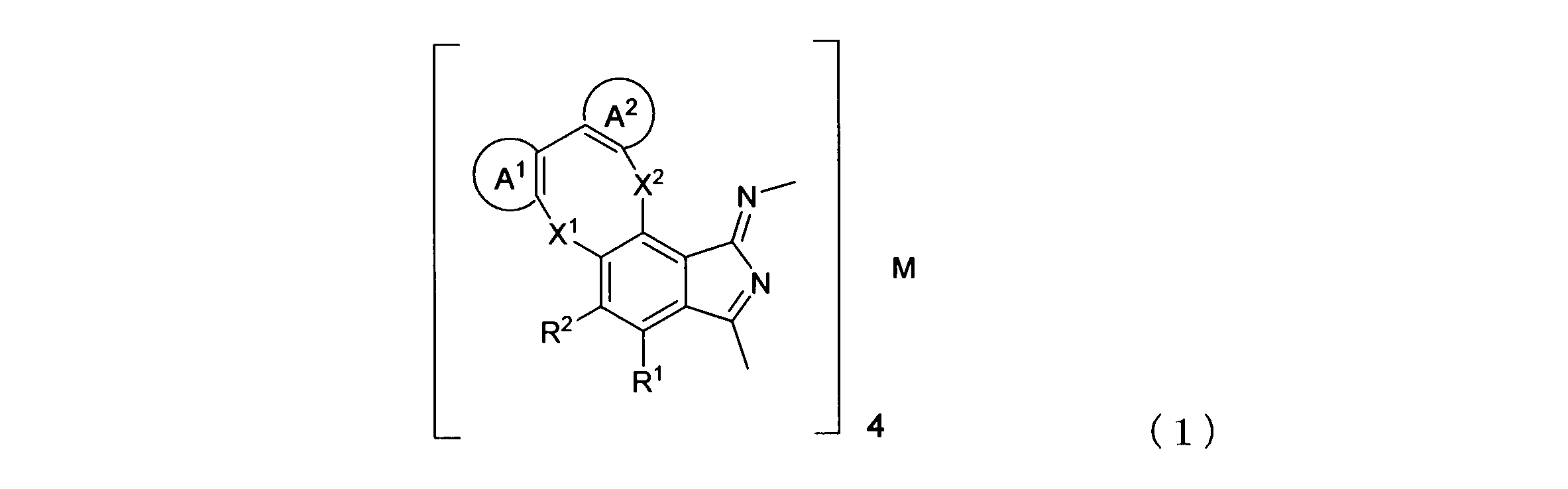
- Phthalocyanine Compound The phthalocyanine compound of the present invention is a compound represented by the following general formula (1).
- R 1 and R 2 may be the same or different and each may have an alkoxy group which may have a substituent, an aryloxy group which may have a substituent, or a substituent.
- a good alkylthio group, an arylthio group which may have a substituent, a heteroaryloxy group which may have a substituent, a heteroarylthio group which may have a substituent, an NR 3 R 4 group or X 1 and X 2 are the same or different and each represents an oxygen atom or a sulfur atom, and A 1 and A 2 are the same or different and each may have a substituent.
- the phthalocyanine compound represented by the above general formula (1) is a novel compound not described in any literature, has an absorptivity in the near infrared wavelength region of 750 to 1200 nm, and has light resistance and solubility (particularly, solubility in an organic solvent). It is a compound useful as a near-infrared absorber because of its excellent properties, solubility in resins (compatibility) and the like.
- the phthalocyanine compound of the present invention comprises at least one kind represented by the following general formulas (1a) to (1d).
- Examples of the alkoxy group represented by R 1 and R 2 include, for example, a linear chain having 1 to 12 carbon atoms, a branched chain having 3 to 12 carbon atoms, or a cyclic alkyl group having 3 to 12 carbon atoms bonded to an oxygen atom. Groups.
- n- means normal
- s- means secondary (sec-)
- t- means tertiary (tert-).
- Examples of the aryloxy group represented by R 1 and R 2 include a group in which a monocyclic or polycyclic (for example, bicyclic or tricyclic) aryl group is bonded to an oxygen atom.
- Specific examples include a phenoxy group, a naphthoxy group, an anthryloxy group, a phenanthrenyloxy group, a fluorenyloxy group, and a pyrenyloxy group.
- a group in which a monocyclic or bicyclic aryl group is bonded to an oxygen atom is preferable.
- Particularly preferred are a phenoxy group, a 1-naphthoxy group (1-naphthyloxy group) and a 2-naphthoxy group (2-naphthyloxy group).
- alkylthio group represented by R 1 and R 2 for example, a linear chain having 1 to 12 carbon atoms, a branched chain having 3 to 12 carbon atoms, or a cyclic alkyl group having 3 to 12 carbon atoms is bonded to a sulfur atom. Groups.
- Particularly preferred is a group in which a linear alkyl group having 1 to 8 carbon atoms, a branched chain having 3 to 8 carbon atoms, or a cyclic alkyl group having 3 to 8 carbon atoms is bonded to a sulfur atom.
- Examples of the arylthio group represented by R 1 and R 2 include a group in which a monocyclic or polycyclic (for example, bicyclic or tricyclic) aryl group is bonded to a sulfur atom.
- Specific examples include a phenylthio group, a naphthylthio group, an anthrylthio group, and a pyrenylthio group.
- a group in which a monocyclic or bicyclic aryl group is bonded to a sulfur atom is preferable.
- Particularly preferred are a phenylthio group and a naphthylthio group.
- Examples of the heteroaryloxy group represented by R 1 and R 2 include a group in which a monocyclic or polycyclic (eg, bicyclic or tricyclic) heteroaryl group is bonded to an oxygen atom.
- Specific examples include groups in which a pyridyl group, a pyrimidine group, an indolyl group, a quinoline group, a benzimidazole group, a furanyl group, a thienyl group, a benzofuran group, a 1,3,4-thiadiazole group, and the like are bonded to an oxygen atom. it can.
- a group in which a monocyclic or bicyclic heteroaryl group is bonded to an oxygen atom is preferable.
- heteroarylthio group represented by R 1 and R 2 examples include a group in which a monocyclic or polycyclic (for example, bicyclic or tricyclic) heteroaryl group is bonded to a sulfur atom.
- Specific examples include groups in which a pyridyl group, a pyrimidine group, an indolyl group, a quinoline group, a benzimidazole group, a furanyl group, a thienyl group, a benzofuran group, a 1,3,4-thiadiazole group, etc. are bonded to a sulfur atom.
- a group in which a monocyclic or bicyclic heteroaryl group is bonded to a sulfur atom is preferable.
- R 1 and R 2 described above are the same or different and are each an alkoxy group, an aryloxy group, an alkylthio group, an arylthio group, a heteroaryloxy group, or a heteroarylthio group, these groups each have a substituent. You may have.
- Substituents on the alkyl chain, aryl ring or heteroaryl ring of the alkoxy group, aryloxy group, alkylthio group, arylthio group, heteroaryloxy group or heteroarylthio group (on the alkyl chain, aryl ring or heteroaryl ring)
- Examples of the group that can be substituted include an alkyl group, a haloalkyl group, an alkoxy group, a hydroxyalkyl group, an alkylthio group, an alkylamino group, a dialkylamino group, a cyclic amino group, a halogen atom, an acyl group, an alkoxycarbonyl group, and a ureido group.
- the substituent may have 1 to 5 substituents on the alkyl chain, aryl ring or heteroaryl ring in R 1 and R 2 .
- alkyl group examples include straight chain having 1 to 12 carbon atoms, branched chain having 3 to 12 carbon atoms, and cyclic alkyl group having 3 to 12 carbon atoms.
- Preferred is a straight chain having 1 to 8 carbon atoms, a branched chain having 3 to 8 carbon atoms, or a cyclic alkyl group having 3 to 8 carbon atoms, particularly preferably a methyl group, an ethyl group, an n-propyl group, or isopropyl.
- haloalkyl group examples include haloalkyl groups having 1 to 6 carbon atoms. Specifically, chloromethyl group, dichloromethyl group, trichloromethyl group, fluoromethyl group, difluoromethyl group, trifluoromethyl group, trifluoroethyl group, pentafluorobutyl group, nonafluorobutyl group, undecafluoropentyl group And a tridecafluorohexyl group.
- alkoxy group examples include an alkoxy group having 1 to 8 carbon atoms. Specifically, methoxy group, ethoxy group, n-propoxy group, isopropoxy group, n-butoxy group, isobutoxy group, s-butoxy group, t-butoxy group, n-pentoxy group, isopentoxy group, neopentoxy group, n Examples include -hexyloxy group, cyclohexyloxy group, n-heptyloxy group, n-octyloxy group, 2-ethylhexyloxy group, t-octyloxy group and the like.
- hydroxyalkyl group examples include hydroxyalkyl groups having 1 to 8 carbon atoms. Specifically, hydroxymethyl group, 2-hydroxyethyl group, 3-hydroxypropyl group, 4-hydroxybutyl group, 5-hydroxypentyl group, 6-hydroxyhexyl group, 7-hydroxyheptyl group, 8-hydroxyoctyl group Etc.
- alkylthio group examples include thioalkoxy groups having 1 to 8 carbon atoms. Specifically, methylthio group, ethylthio group, n-propylthio group, isopropylthio group, n-butylthio group, isobutylthio group, s-butylthio group, t-butylthio group, n-pentylthio group, isopentylthio group, neo A pentylthio group, n-hexylthio group, cyclohexylthio group, n-heptylthio group, n-octylthio group, 2-ethylhexylthio group, t-octylthio group and the like can be mentioned.
- alkylamino group examples include an amino group substituted with a linear chain having 1 to 12 carbon atoms, a branched chain having 3 to 12 carbon atoms, or a cyclic alkyl group having 3 to 12 carbon atoms.
- alkyl group of the alkylamino group specifically, methyl group, ethyl group, n-propyl group, isopropyl group, n-butyl group, isobutyl group, s-butyl group, t-butyl group, n-pentyl group, 2-methylbutyl group, 1-methylbutyl group, neopentyl group, 1,2-dimethylpropyl group, 1,1-dimethylpropyl group, cyclopentyl group, n-hexyl group, 4-methylpentyl group, 3-methylpentyl group, 2 -Methylpentyl group, 1-methylpentyl group, 3,3-dimethylbutyl group,
- dialkylamino group examples include, for example, amino groups which are the same or different and are substituted by a linear chain having 1 to 12 carbon atoms, a branched chain having 3 to 12 carbon atoms, or two cyclic alkyl groups having 3 to 12 carbon atoms. It is done.
- alkyl group of the dialkylamino group include the same alkyl groups as those described above as the alkyl group of the alkylamino group.
- cyclic amino group examples include cyclic amines in which two substituents on the nitrogen atom form a ring structure together with the nitrogen atom and may contain N, O, and S heteroatoms as ring constituent atoms. It is done. Specific examples include pyrrolidyl group, piperidino group, piperazino group, morpholino group, thiomorpholino group and the like.
- the cyclic amino group is preferably a 5- to 8-membered cyclic amino group.
- halogen atom examples include fluorine, chlorine, bromine and iodine.
- acyl group examples include an acetyl group, an ethylcarbonyl group, a pivaloyl group, and a benzoyl group.
- the alkylcarbamoyl group is represented by —CON (R 5 ) 2 .
- R 5 s are the same or different and each represents a hydrogen atom, a straight chain having 1 to 12 carbon atoms, a branched chain having 3 to 12 carbon atoms, or a cyclic alkyl group having 3 to 12 carbon atoms.
- Examples of the alkyl group include the same alkyl groups as those described above as the alkyl group of the alkylamino group.
- Specific examples include a methylcarbamoyl group, an ethylcarbamoyl group, a propylcarbamoyl group, a dimethylcarbamoyl group, a diethylcarbamoyl group, and a dipropylcarbamoyl group.
- arylsulfonyl group examples include a sulfonyl group substituted with an aryl group having 6 to 12 carbon atoms. Specific examples include a phenylsulfonyl group and a naphthylsulfonyl group.
- cyclic amino group examples include the same cyclic amino groups as those exemplified as the group that can be substituted on the alkyl chain, aryl ring or heteroaryl ring in R 1 and R 2 .
- they are a straight chain having 1 to 8 carbon atoms, a branched chain having 3 to 8 carbon atoms, or a cyclic alkyl group having 3 to 8 carbon atoms, and a cyclic amino group having 5 to 8 members.
- Examples of the aryl group represented by R 3 and R 4 in the NR 3 R 4 group represented by R 1 and R 2 include monocyclic and polycyclic (for example, bicyclic or tricyclic) aryl groups. . Specific examples include a phenyl group, a naphthyl group, and an anthryl group. A monocyclic or bicyclic aryl group is preferable, and a phenyl group and a naphthyl group are particularly preferable.
- it is an alkyl group in which one of hydrogen atoms of an alkyl group having 1 to 3 carbon atoms is substituted with a monocyclic or bicyclic aryl group, and particularly preferably a benzyl group, a phenylethyl group, or a naphthylethyl group. is there.
- alkyl group having a substituent examples include 2-chloroethyl group, 2,2,2-trifluoroethyl group, 2,2,3,3,3-pentafluoropropyl group, benzyl group, phenethyl group, Examples thereof include 2-phenylethyl group, 3-phenylethyl group, 4-hydroxybutyl group, 2-methoxyethyl group, 3-methoxypropyl group, 2-isopropoxyethyl group, and butanoic acid ethyl group.
- Examples of the NR 3 R 4 group represented by R 1 and R 2 include a secondary or tertiary amino group. Specifically, n-propylamino group, isopropylamino group, n-butylamino group, n-pentylamino group, n-hexylamino group, cyclohexylamino group, n-heptylamino group, n-octylamino group, 2 -Ethylhexylamino group, phenylamino group, 1-naphthylamino group, 2-naphthylamino group, benzylamino group, 1-phenylethylamino group, 2-phenylethylamino group, 1- (p-tolyl) ethylamino group, ⁇ , ⁇ -dimethylbenzylamino group, 1-naphthylethylamino group, 1,1-diphenylmethylamino group
- halogen atom represented by R 1 and R 2 examples include fluorine, chlorine, bromine and iodine.
- Examples of the aromatic ring represented by A 1 and A 2 include monocyclic and polycyclic (eg, bicyclic or tricyclic) aromatic rings. Specific examples include benzene (ring), naphthalene (ring), anthracene (ring), phenanthrene (ring), and the like. Preferably, it is a monocyclic or bicyclic aromatic ring, more preferably a benzene ring or a naphthalene ring, and particularly preferably a benzene ring. As will be described later, each of these aromatic rings may have a substituent.
- the aromatic rings represented by A 1 and A 2 described above each may have a substituent.
- substituents include alkyl groups, haloalkyl groups, alkoxy groups, hydroxyalkyl groups, alkylthio groups, alkylamino groups, dialkylamino groups, cyclic amino groups, halogen atoms, acyl groups, alkoxycarbonyl groups, ureido groups, and sulfamoyl groups.
- Examples of the divalent metal represented by M include metal atoms belonging to Groups 3 to 15 of the periodic table. Specific examples include Cu, Zn, Fe, Co, Ni, Ru, Pb, Rh, Pd, Pt, Mn, Sn, and Pb.
- Examples of the trivalent or tetravalent metal compound represented by M include halides, hydroxides and oxides of metals belonging to Groups 3 to 15 of the periodic table. Specifically, AlCl, AlOH, InCl, FeCl , MnOH, SiCl 2, SnCl 2, GeCl 2, Si (OH) 2, Si (OCH 3) 2, Si (OPh) 2, Si (OSiCH 3) 2, Sn (OH) 2 , Ge (OH) 2 , VO, TiO, etc. can be mentioned. In addition, said Ph shows a phenyl group.
- X 1 and X 2 it is preferable that at least one is an oxygen atom, X 1 and X 2 are both oxygen atoms It is more preferable that As the R 1, is preferably NR 3 R 4 group or an optionally substituted aryl group, examples of R 2, NR 3 R 4 group, which may have a substituent A good aryloxy group or an arylthio group which may have a substituent is preferable. As the R 1 and R 2, it is preferable that at least one of which is NR 3 R 4 group, and more preferably R 1 is NR 3 R 4 group.
- R 3 and R 4 groups are the same or different and each has a hydrogen atom, an alkyl group which may have a substituent, an aryl group which may have a substituent, or a substituent.
- An arylalkyl group that may be present is preferable.
- R 1 to R 4 R 1 is an NR 3 R 4 group, and one of R 3 and R 4 is a hydrogen atom, and the other is an alkyl group (for example, When R 1 is an NR 3 R 4 group, and R 3 is a hydrogen atom and R 4 is an alkyl group, the solubility is more excellent, which is particularly preferable.
- a 1 and A 2 are each preferably a benzene ring which may have a substituent or a naphthalene ring which may have a substituent.
- M is preferably Cu, Zn, Co, Ni, Pd, Pb, MnOH, AlCl, FeCl, InCl, SnCl 2 , VO or TiO, and more preferably VO or Cu.
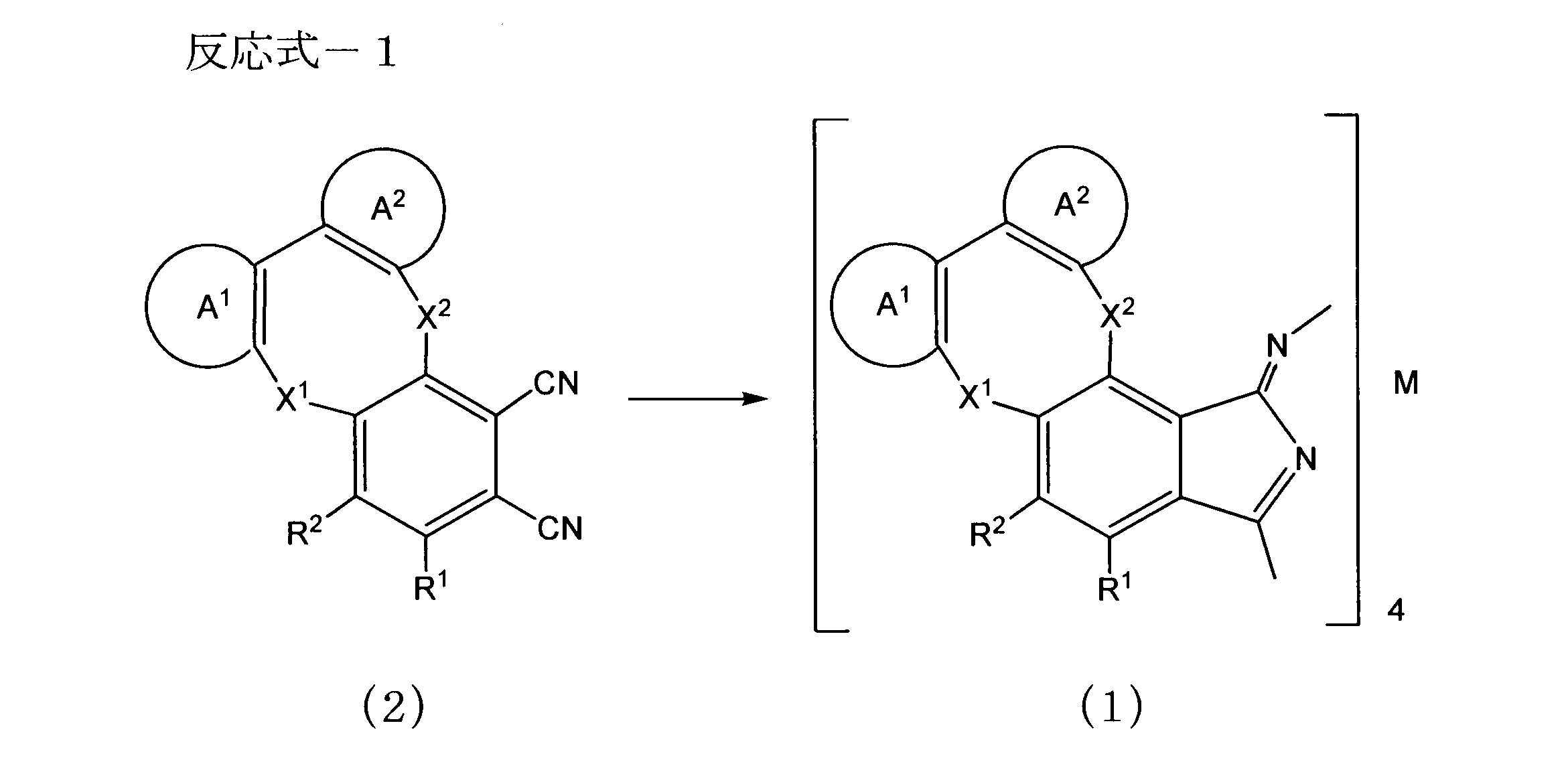
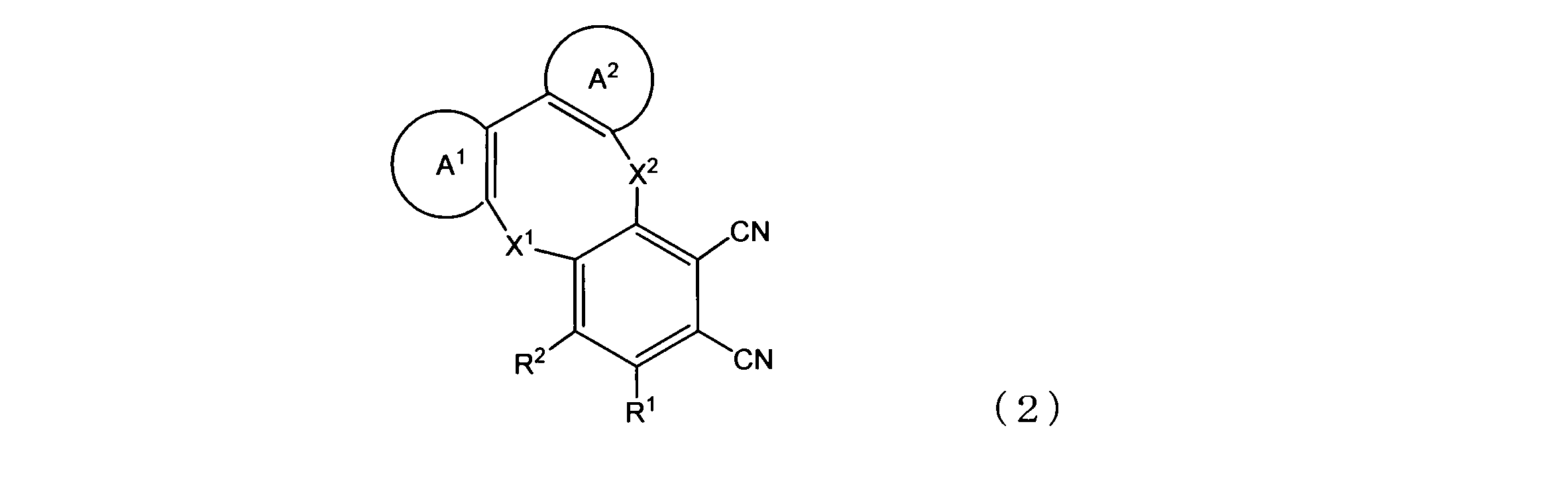
- the phthalocyanine compound of the present invention is produced by reacting compound (2) with a metal or an inorganic or organometallic compound in the presence of a base, as shown in the following reaction formula-1. Can do.
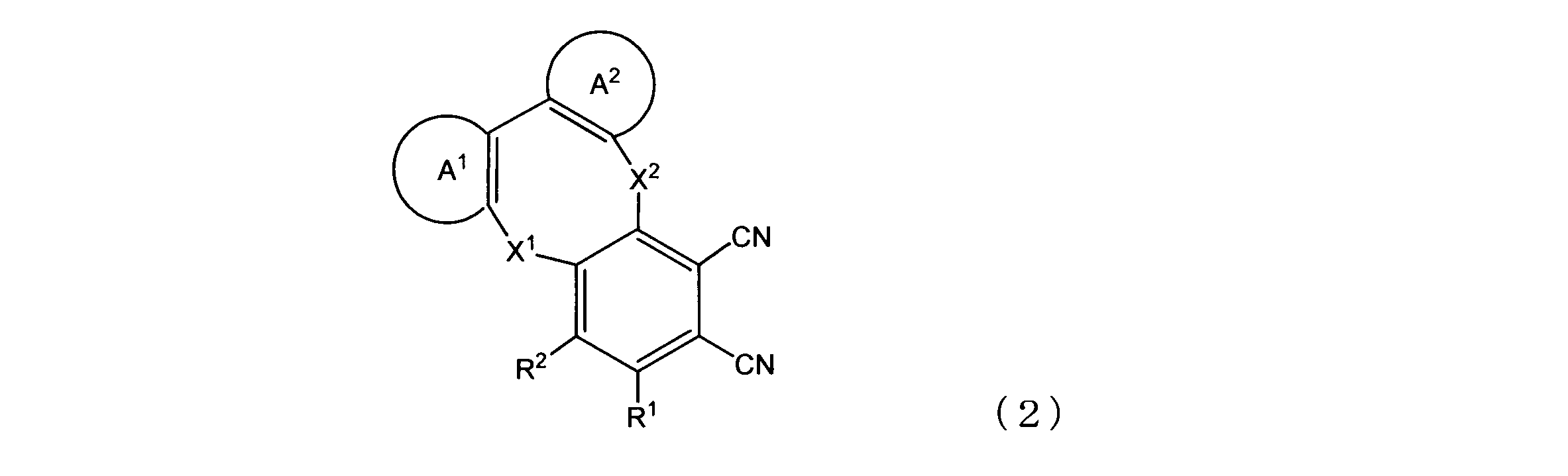
- the above compound (2) is also a novel compound not described in the literature, and is a useful substance that can be a raw material for producing the phthalocyanine compound of the present invention.
- the method for producing the compound will be described in “3. Intermediate for producing phthalocyanine compound and method for producing the same” below.
- Examples of the metal to be reacted with the compound (2) include metals belonging to Groups 3 to 15 of the periodic table. Specific examples include Al, Si, Ti, V, Mn, Fe, Co, Ni, Cu, Zn, Ge, Ru, Rh, Pd, In, Sn, Pt, and Pb.
- Examples of the inorganic metal compound include halides, carboxylates, sulfates, nitrates, oxides and complexes of the above metals.
- organometallic compound examples include carbonyl compounds of the above metals. Specific examples include manganese acetylacetone.
- the amount of the metal or inorganic or organic metal compound used is usually 0.2 mol or more, preferably 0.25 to 0.5 mol, per 1 mol of compound (2).
- Examples of the base include metal alkoxide, diazabicycloundecene, diazabicyclononene and the like.
- metal alkoxide examples include sodium or potassium methoxide, ethoxide, propoxide, butoxide, pentoxide and the like.
- tBuOK sodium-t-butoxide
- tBuOK potassium-t-butoxide
- the base is generally used in an amount of about 1 to 3 mol, preferably about 1.2 to 1.8 mol, per 1 mol of compound (2).
- formamide ammonia, urea or the like
- a nitrogen source if necessary.
- it is formamide.
- the reaction of the compound (2) with a metal or inorganic or organic metal compound is usually performed in a solvent.
- a solvent known solvents can be widely used as long as they are inert to the reaction. Examples include aromatic hydrocarbons, halogenated hydrocarbons, ethers, alcohols, amines, amides, sulfoxides, nitriles, nitrobenzene, and the like.
- aromatic hydrocarbons include xylene and methylnaphthalene.
- halogenated hydrocarbons include chlorobenzene, o-dichlorobenzene, trichlorobenzene, chloronaphthalene, tetrachloroethylene, and trichloroethylene.
- ethers include diethylene glycol dimethyl ether.
- alcohols include n-propanol, isopropanol, n-butanol, isobutanol, s-butanol, t-butanol, n-hexanol (sometimes referred to as 1-hexanol), n-amyl alcohol, Cyclohexanol, 2-methyl-1-pentanol, 1-heptanol, 2-heptanol, 1-octanol (sometimes referred to as n-octanol), 2-ethylhexanol, benzyl alcohol, ethanediol, propylene glycol, methoxyethanol Ethoxyethanol, propoxyethanol, butoxyethanol, dimethylaminoethanol, diethylaminoethanol and the like.
- amines include tri-n-butylamine.
- amides include N, N-dimethylformamide (hereinafter sometimes referred to as DMF), N, N-dimethylacetamide (hereinafter also referred to as DMA), N-methylpyrrolidone (hereinafter referred to as DMA). And NMP), 1,3-dimethylimidazolidinone and the like.
- DMF N, N-dimethylformamide
- DMA N, N-dimethylacetamide
- DMA N-methylpyrrolidone
- NMP 1,3-dimethylimidazolidinone and the like.
- sulfoxides include sulfolane and dimethyl sulfoxide (hereinafter sometimes referred to as DMSO).
- nitriles examples include benzonitrile.
- solvents are used singly or in combination of two or more.
- Preferred are n-amyl alcohol, n-hexanol, 1-heptanol, and 1-octanol.
- the amount of these solvents to be used may be appropriately set depending on the kind of the compound to be used and the like. Usually, about 1 to 100 parts by weight, preferably about 2 to 30 parts by weight is used with respect to 1 part by weight of the compound (2). Is done.
- the reaction time varies depending on the type of raw material compound and the reaction temperature and cannot be generally specified, but is usually about 1 to 24 hours.
- the compound obtained by the above reaction can be separated from the reaction system by a normal separation means and further purified.
- known separation and purification means can be widely used, and examples thereof include a recrystallization method, a solvent extraction method, column chromatography, gel chromatography, preparative chromatography, etc.
- a phthalocyanine compound can be obtained efficiently and with high purity also by a conventionally known method such as filtration, washing or drying.
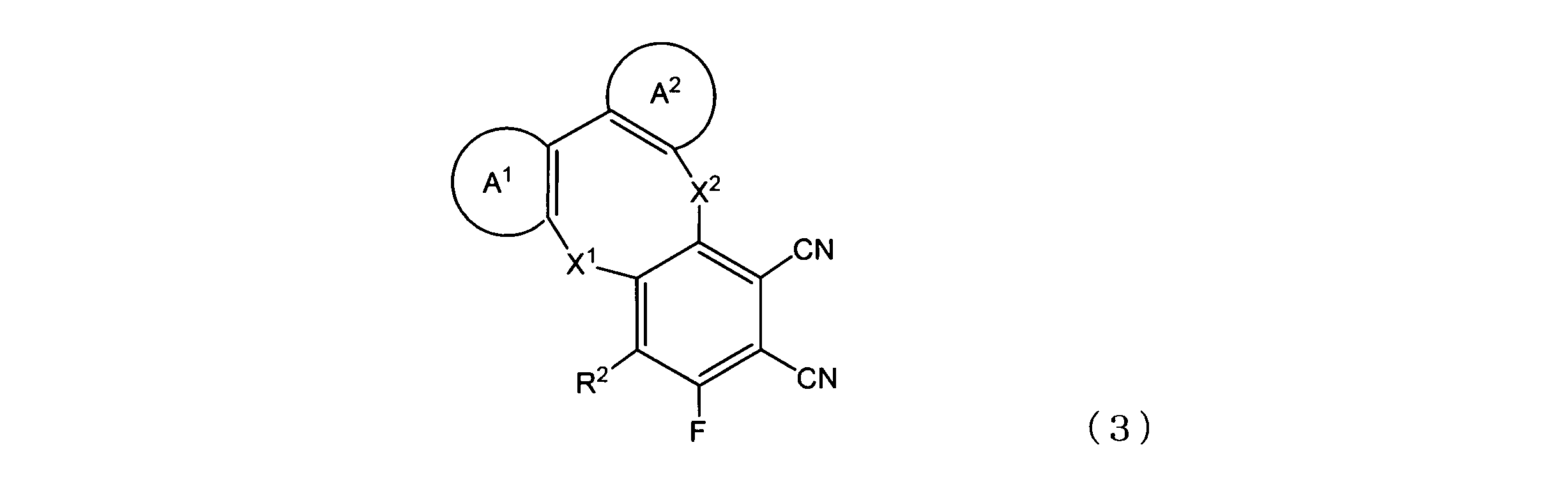
- reaction formula-2 As shown in the above reaction formula-2, first, compound (5) (tetrafluorophthalonitrile) is reacted with compound (a) to produce compound (4) (step 1). Next, the compound (4) obtained in the step 1 is reacted with the compound (b) to be converted into the compound (3) (step 2). Furthermore, the compound (2) can be produced by reacting the obtained compound (3) with the compound (c) (step 3).
- Compound (4) is usually produced by reacting compound (5) with compound (a) in the presence of a base in a solvent.
- a base for example, known methods disclosed in Japanese Patent Application Laid-Open Nos. 01-045474 and 08-120186 can be used, and the details are as follows.
- Examples of the compound (a) include alcohols, phenols, naphthols, thiols, thiophenols, amines (primary amines or secondary amines), and the like. Specifically, methanol, ethanol, n-propanol, isopropanol, n-butanol, isobutanol, t-butanol, n-pentanol, n-hexanol, cyclohexanol, n-heptanol, n-octanol, 2-ethylhexanol , T-octanol, phenol, 2-methylphenol (o-cresol), 3-methylphenol, 4-methylphenol, 2,3-dimethylphenol, 2,4-dimethylphenol, 2,5-dimethylphenol, 2, 6-dimethylphenol, 2,3,5-trimethylphenol, 2,3,6-trimethylphenol, 2,4,5-trimethylphenol, 2,4,6-trimethylphenol, 2-ethyl
- the amount of compound (a) to be used is generally about 0.9 to 2 equivalents, preferably about 0.9 to 1.5 equivalents, more preferably about 0.95 to 1.1 equivalents relative to compound (5). is there.
- Examples of the base used in this reaction include alkaline substances. Specific examples include potassium fluoride, potassium carbonate, potassium hydroxide, sodium hydroxide and the like. These bases are used individually by 1 type or in mixture of 2 or more types. Preferred are potassium fluoride and potassium carbonate.
- the amount of such base used is appropriately set according to the type of base used and the amount used, but is generally 0.9 to 3 equivalents, preferably 1 with respect to compound (5). It may be about 2 equivalents, more preferably about 1 to 1.3 equivalents.
- MEK methyl ethyl ketone
- the amount of these solvents to be used may be appropriately set depending on the kind of base to be used and the like, but is usually about 1 to 50 parts by weight, preferably about 1 to 20 parts by weight with respect to 1 part by weight of compound (5) More preferably, about 1.5 to 15 parts by weight may be used.
- This reaction is usually performed at ⁇ 10 to 40 ° C., preferably ⁇ 5 to 15 ° C.
- reaction time varies depending on the type of base used, reaction temperature, etc., and cannot be generally stated, but the reaction is usually completed in about 1 to 12 hours.
- Examples of the compound (b) include biphenols, binaphthols, and bianthracenols. Specifically, 2,2′-biphenol, 1,1′-bi-2-naphthol (2,2′-dihydroxy-1,1′-binaphthyl), 3,3 ′, 5,5′-tetra- tert-butyl-2,2′-biphenol, 5,5 ′, 6,6 ′, 7,7 ′, 8,8′-octahydro-1,1′-bi-2-naphthol, 3,3 ′, 5 , 5′-tetramethyl-2,2′-dihydroxybiphenyl, and the like.
- 2,2'-biphenol 3,3 ', 5,5'-tetramethyl-2,2'-dihydroxybiphenyl, and 2,2'-dihydroxy-1,1'-binaphthyl At least one of them.
- the amount of such a base used is appropriately set according to the type of compound used and the amount used, but is usually 1 to 10 equivalents, preferably 1 to 8 with respect to compound (4). Equivalent, more preferably about 1.2 to 3.5 equivalents.
- solvents can be widely used as long as they are inert to the reaction, but acetone, acetonitrile, DMSO, DMA, DMF, MEK, etc. are used. Is desirable.
- the amount of the solvent used may be appropriately set depending on the type of the compound used and the like, but is usually about 0.5 to 50 parts by weight, preferably 1 to 30 parts by weight with respect to 1 part by weight of the compound (4). About 1 to 20 parts by weight, more preferably about 1 to 20 parts by weight.
- This reaction is usually carried out at about 20 to 100 ° C, preferably 20 to 85 ° C.
- the compound obtained by the above reaction can be separated from the reaction system by a normal separation means and further purified.
- a normal separation means for example, the means described above in “2. Method for producing phthalocyanine compound” can be applied.
- Process 3 Compound (2) is usually produced by reacting compound (3) with compound (c) in a solvent in the presence of a base.
- Examples of the compound (c) include alcohols, phenols, naphthols, thiols, thiophenols, amines (primary amines or secondary amines), and the like. Specifically, the same compounds as the compounds mentioned as the compound (a) can be mentioned.
- the amount of compound (c) to be used is generally about 1 to 5 equivalents, preferably about 1 to 3.5 equivalents, more preferably about 1.05 to 3 equivalents relative to compound (3).
- the inorganic base examples include alkali metal carbonates, alkali metal hydroxides, alkali metal hydrides and the like.
- an organic base examples include an amine etc. are mentioned, for example.
- alkali metal carbonate examples include sodium carbonate, potassium carbonate, and sodium bicarbonate.
- alkali metal hydroxide examples include sodium hydroxide and potassium hydroxide.
- alkali metal hydride examples include sodium hydride and potassium hydride.
- bases are used singly or in combination of two or more.
- they are triethylamine and potassium carbonate.
- the amount of the base used is appropriately set according to the type of compound to be used and the amount used, but is usually 1 to 10 equivalents, preferably 1 to 8 equivalents, relative to compound (3). More preferably, it may be about 1.1 to 3.5 equivalents.
- the amount of the solvent used may be appropriately set depending on the type of the compound to be used and the like, but is usually about 0.5 to 50 parts by weight, preferably 0.5 to 30 parts per 1 part by weight of the compound (3). About part by weight, more preferably about 0.8 to 20 parts by weight may be used.
- the compound obtained by the above reaction can be separated from the reaction system by a normal separation means and further purified.
- a normal separation means for example, the means described above in “2. Method for producing phthalocyanine compound” can be applied.
- intermediate compound (2 ′) for producing a phthalocyanine compound obtained by the above reaction (in the above compound (2), R 1 is NR 3 R 4 , and R 3 is a hydrogen atom) Can be converted into the intermediate compound (2 ′′) by the method shown in the following reaction scheme-3.
- R 6 has an alkyl group which may have a substituent and a substituent.
- Compound (2 ′′) is usually produced by reacting compound (2 ′) with compound (d) in a solvent in the presence of a base.
- R 6 in the compound (d) is an alkyl group which may have a substituent, an aryl group which may have a substituent, a heteroaryl group which may have a substituent, or a substituent.
- arylalkyl group which may have an alkyl group which may have a substituent in the above R 3 and R 4, an aryl group which may have a substituent, and a substituent, respectively. Examples thereof include the same heteroaryl group which may be substituted, and the same arylalkyl group which may have a substituent.
- Examples of the leaving group for Y in the compound (d) include a halogen atom, a p-toluenesulfonyl group, a methanesulfonyl group, and a trifluoromethanesulfonyl group.
- halogen atoms include chlorine, bromine and iodine.
- the compound (d) include benzyl chloride, bromomethane, bromoethane, 1-bromopropane, 2-bromopropane, 1-bromobutane (hereinafter sometimes referred to as n-BuBr), 2-bromobutane, -Bromo-2-methylpropane, t-butylbromide, 1-bromopentane, 1-bromo-2-methylbutane, 1-bromo-3-methylbutane, 2-bromo-2-methylbutane, bromocyclopentane, 1-bromohexane 2-bromohexane, 3-bromohexane, 1-bromo-4-methylpentane, 1-bromo-2-ethylbutane, bromocyclohexane, 1-bromoheptane, 2-bromoheptane, 3-bromoheptane, 1-bromooctane , 2-bromooctane
- the amount of compound (d) to be used is generally about 0.9 to 3 equivalents, preferably about 1 to 2.5 equivalents, more preferably about 1.2 to 2 equivalents, relative to compound (2 ').
- the base used in this reaction known inorganic bases and organic bases can be used.
- the same base as mentioned in the above (Step 2) can be used.
- the amount of the base used is appropriately set according to the type of compound used and the amount used, but is usually 1 to 10 equivalents, preferably 1 to 5 equivalents, relative to compound (2 ′). More preferably, it may be about 1.2 to 2.5 equivalents.
- aprotic polar solvents that are inert to the reaction can be widely used.
- DMF, DMA, DMSO, etc. can be mentioned.
- the amount of the solvent used may be appropriately set depending on the kind of the compound to be used and the like, but is usually about 0.5 to 50 parts by weight, preferably 1 to 30 parts by weight with respect to 1 part by weight of the compound (2 ′). About 1 part, more preferably about 1 to 20 parts by weight may be used.
- This reaction is usually performed at about 50 to 140 ° C., preferably 60 to 120 ° C.
- the reaction time varies depending on the type of compound used, the reaction temperature, and the like, and cannot be generally specified, but the reaction is usually completed in about 1 to 12 hours.
- the compound obtained by the above reaction can be separated from the reaction system by a normal separation means and further purified.
- a normal separation means for example, the means described above in “2. Method for producing phthalocyanine compound” can be applied.
- the phthalocyanine compound of the present invention has an absorption ability in the near-infrared wavelength region of 750 to 1200 nm, it can be used as a near-infrared absorbing dye. That is, the near-infrared absorbing dye of the present invention comprises the phthalocyanine compound of the present invention.
- the phthalocyanine compound of the present invention has an absorptivity in the near-infrared wavelength region of 750 to 1200 nm, it is a near-infrared absorbing material, more specifically, a near-infrared absorbing filter, protective glasses, agricultural film, heat ray It can be used for blocking filters, light receiving elements, long wavelength laser compatible optical recording media, anti-counterfeiting printing inks, camouflage coatings, and the like. That is, the near-infrared absorbing material of the present invention contains the phthalocyanine compound of the present invention.
- the phthalocyanine compound of the present invention is applied as it is or together with a binder resin or additive to paper, a plastic sheet, a plastic film, glass, a resin, or the like, hard-coated, or mixed with a monomer to be polymerized. Therefore, it can be used for various applications as a near-infrared absorbing material.
- the binder resin is not particularly limited, and examples thereof include a homopolymer or copolymer of an acrylic acid monomer, a cellulose polymer, a vinyl polymer, a condensation polymer, a rubber thermoplastic polymer, and a photopolymerizable compound. Examples include coalescence.
- acrylic monomer examples include acrylic acid, methacrylic acid, acrylic ester, and methacrylic ester.
- vinyl polymer examples include polystyrene, vinyl chloride-vinyl acetate copolymer, polyvinyl pyrrolidone, polyvinyl butyral, and polyvinyl alcohol.
- condensation polymer examples include polyester and polyamide.
- rubber-based thermoplastic polymers include butadiene-styrene copolymers.
- photopolymerizable compound examples include an epoxy compound.
- Examples of the resin on which the phthalocyanine compound of the present invention is applied or mixed include a transparent resin.
- a transparent resin include transparent resins such as polyacrylonitrile resin, methacrylonitrile resin, polymethyl methacrylate resin, ABS resin, polystyrene resin, and polyethylene terephthalate resin.
- Examples of the monomer mixed with the phthalocyanine compound of the present invention include, for example, hexamethylene diisocyanate, isophorone diisocyanate, tolylene diisocyanate, 4,4′-diphenylmethane diisocyanate, mesitylene triisocyanate, 1,4-bis ( ⁇ , ⁇ ′- Examples thereof include dimethyl isocyanate methyl) benzene, 1,3,5-tris (3-thiopropyl) isocyanurate, 2,2′-dimethylpropanediol bis (2-thioacetate) and the like.
- a molded article can be obtained by polymerizing the phthalocyanine compound of the present invention after mixing with these monomers.
- the phthalocyanine compound of the present invention Since the phthalocyanine compound of the present invention has an absorption ability in the near infrared wavelength region of 750 to 1200 nm, it is a photothermal conversion material that absorbs laser light in this region and converts it into heat, more specifically, laser direct. It can be used for an original plate for plate making (CTP), a recording material (laser thermosensitive recording material, laser thermal transfer recording material, etc.) and the like. That is, the photothermal conversion material of the present invention contains the phthalocyanine compound of the present invention.
- the photothermal conversion material may contain a binder resin or the like in addition to the phthalocyanine compound of the present invention as a photothermal conversion agent, and examples of the binder resin include the same materials as the near infrared absorbing material.
- the photothermal conversion material When the photothermal conversion material is used as a recording material such as a laser thermal recording material or a laser thermal transfer recording material, the material may be used with a coloring component or coloring component used, or the coloring component or coloring component may be used. You may provide the layer containing this separately.
- the coloring component or coloring component is not particularly limited, and known components can be used. Examples thereof include a combination of a sublimable dye / pigment, an electron-donating dye precursor and an electron-accepting compound, and a substance (polymerizable polymer or the like) that forms an image by a physical or chemical change by heat.
- the electron donating dye precursor used in the laser thermosensitive recording material include triphenylmethane compounds, fluoran compounds, phenothiazine compounds, indolylphthalide compounds, leucooramine compounds, rhodamine lactams. Compounds, triphenylmethanephthalide compounds, triazene compounds, spiropyran compounds, fluorene compounds, and the like.
- the electron-accepting compound include a phenolic compound, an organic acid or a metal salt thereof, and an oxybenzoic acid ester.
- coloring components used in laser thermal transfer recording materials include titanium dioxide, carbon black, zinc oxide, Prussian blue, cadmium sulfide, iron oxide, lead, zinc, barium and calcium chromates.
- examples include inorganic pigments, azo-based, thioindigo-based, anthraquinone-based, anthanthrone-based, triphendioxazine-based, phthalocyanine-based, and quinacridone-based organic pigments.
- the dye include acid dyes, direct dyes, disperse dyes, oil-soluble dyes, metal-containing oil-soluble dyes, and the like.
- a photothermal conversion layer is provided on the support.
- a silicon rubber layer may be laminated on the photothermal conversion layer, or a protective layer or the like may be further laminated.
- the support examples include paper, paper laminated with plastic (for example, polyethylene, polypropylene, polystyrene, etc.), a metal plate such as aluminum (including aluminum alloy), zinc, copper, etc., cellulose diacetate, triacetic acid
- plastic films such as cellulose, cellulose butyrate, polyethylene terephthalate, polyethylene, polystyrene, polypropylene, polycarbonate, and polyvinyl acetal.
- the photothermal conversion layer contains an image forming component, a binder resin, and the like, and examples of the binder resin include the same materials as the near infrared absorbing material.
- a layer containing an image forming component may be provided by being laminated on the photothermal conversion layer.
- the image forming component is not particularly limited, and a known component that forms an image by a physical or chemical change by heat can be used.
- an image part may be formed by laminating a silicon rubber layer on a light-to-heat conversion layer (photosensitive layer or heat-sensitive recording layer), and after exposure, the silicon rubber layer is adhered or peeled off.
- a lithographic printing plate precursor for printing is prepared by dispersing or dissolving a photothermal conversion material, an image forming component, a binder resin or the like in an organic solvent or the like and applying it to a support.
- a primer layer may be provided between the support and the light-to-heat conversion layer to improve adhesion and print characteristics, or the support itself may be surface-treated. It does not specifically limit as a primer layer to be used, A well-known component can be used.
- a protective film may be formed on the photothermal conversion layer or the silicon rubber layer for surface protection.
- polyethylene, polypropylene, polyvinyl chloride, polyvinylidene chloride, polyvinyl alcohol, polyethylene terephthalate, cellophane, or the like can be laminated, or these films can be stretched to form a protective film.
- Heat-shielding material The phthalocyanine compound of the present invention has an absorptivity in the near-infrared wavelength region of 750 to 1200 nm and can be used as a heat-shielding material. That is, the heat shielding material of the present invention contains the phthalocyanine compound of the present invention.
- the heat shielding material of the present invention include, for example, a heat ray absorbing material (of the present invention).
- the heat ray absorbing material means a material having an absorptivity in a wavelength region of 800 to 2500 nm. Since the heat ray absorbing material of the present invention contains the phthalocyanine compound of the present invention, it is particularly excellent in absorption ability in the near infrared wavelength region of 800 to 1200 nm.
- the heat ray absorbing material include a heat ray blocking filter (heat shielding film); an interlayer film for laminated glass (particularly window glass), and the like.
- the laminated glass using the said intermediate film for laminated glasses is also contained in the heat ray absorbing material of this invention.
- the use of the said heat shield film and laminated glass is not specifically limited, respectively.
- Specific applications of laminated glass include, for example, for vehicles (trains, automobiles, etc.), buildings (buildings, houses, etc.) and the like.
- the heat ray absorbing material uses a heat ray absorbent other than the phthalocyanine compound of the present invention.
- the heat ray absorbent include inorganic fine particles such as tin-doped indium oxide (ITO), antimony-doped tin oxide (ATO), and tungsten oxide.
- ITO tin-doped indium oxide
- ATO antimony-doped tin oxide
- tungsten oxide tungsten oxide.
- the said heat ray absorber can be used 1 type or in combination of 2 or more types.
- the heat ray absorbing material may contain a binder resin in addition to the phthalocyanine compound of the present invention.
- the binder resin include those similar to the binder resin in the near-infrared absorbing material.
- the method for producing the heat ray absorbing material of the present invention is not particularly limited.
- the laminated film (the heat ray absorbing material of the present invention) can be obtained by sandwiching the interlayer film for glass between two or more glasses and press-bonding them under predetermined conditions (temperature, pressure, etc.). it can.
- the first layer containing the phthalocyanine compound of the present invention and the second layer containing the heat ray absorbent may be laminated to form a multilayered intermediate film.
- each value was measured as follows.
- a 8.0 ⁇ 10 ⁇ 6 to 11 ⁇ 10 ⁇ 6 mol / L chloroform solution was prepared, and a quartz cell having an optical path length of 1 cm was used.
- Test Example 1 (Light resistance evaluation) ⁇ Thin film production> 10 mg of the phthalocyanine compounds obtained in Examples 1, 2, 4, 6 to 8, and 10 to 15 were dissolved in 5 ml of a polymethacrylate 18 wt% toluene solution, applied onto a glass substrate by a spin coat method, and dried. A thin film having a thickness of 1.4 ⁇ m was prepared.
- Dye residual ratio (%) 100 ⁇ (1 ⁇ transmittance after irradiation) / (1 ⁇ transmittance before irradiation) ⁇ : Dye remaining ratio of 65% or more ⁇ : Dye remaining ratio of 50% or more and less than 65% ⁇ : Dye remaining ratio of less than 50%
- Test Example 2 Solubility Evaluation The compound phthalocyanine compounds obtained in Examples 1, 4, 6, 11 and 12 were weighed into a glass sample bottle, mixed with acetone, stirred and dissolved at room temperature, and the state of the solution was visually observed. Dissolvable weight concentration was evaluated according to the following criteria.
- the phthalocyanine compound of the present invention has an absorption ability in the near infrared absorption region of 750 to 1200 nm, and is excellent in light resistance and solubility. In particular, it can be suitably used in various applications such as a heat ray absorbing material.
Landscapes
- Chemical & Material Sciences (AREA)
- Organic Chemistry (AREA)
- Nitrogen Condensed Heterocyclic Rings (AREA)
- Optical Record Carriers And Manufacture Thereof (AREA)
Abstract
Description

で表されるフタロシアニン化合物。
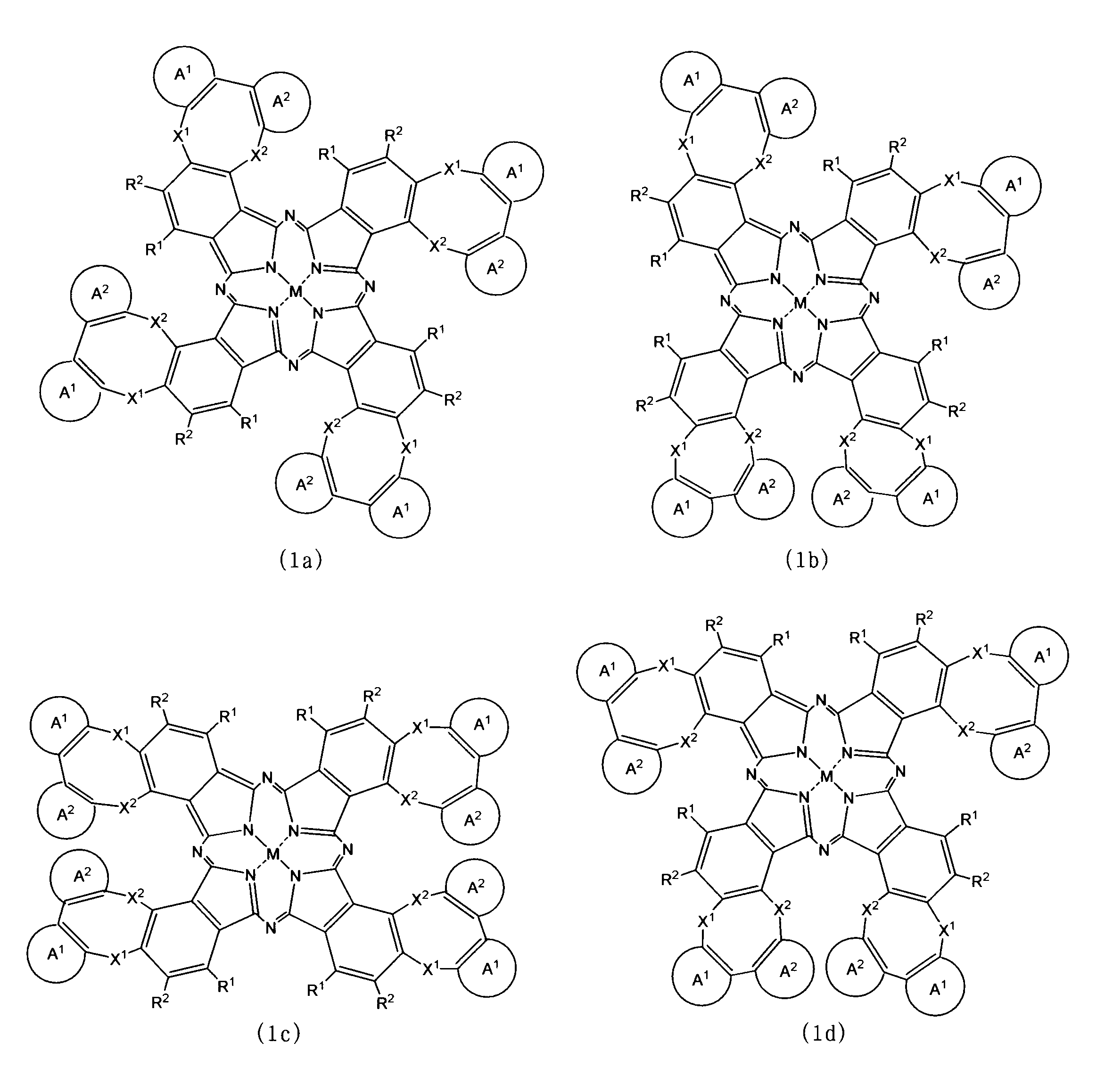
で表される少なくとも1種からなるフタロシアニン化合物。
R2が、NR3R4基、置換基を有していてもよいアリールオキシ基又は置換基を有していてもよいアリールチオ基であり、
前記R3及び前記R4が、同一又は異なって、水素原子、置換基を有していてもよいアルキル基、置換基を有していてもよいアリール基又は置換基を有していてもよいアリールアルキル基であり、
X1及びX2が、共に酸素原子であり、
A1及びA2が、共に置換基を有していてもよいベンゼン環又は置換基を有していてもよいナフタレン環である、項1又は2に記載の化合物。

で表されるフタロシアニン化合物の製造方法であって、
一般式(2)

で表される化合物と、金属又は無機若しくは有機金属化合物とを、塩基の存在下に反応させる方法。

で表される化合物。

で表される化合物の製造方法であって、
一般式(3)
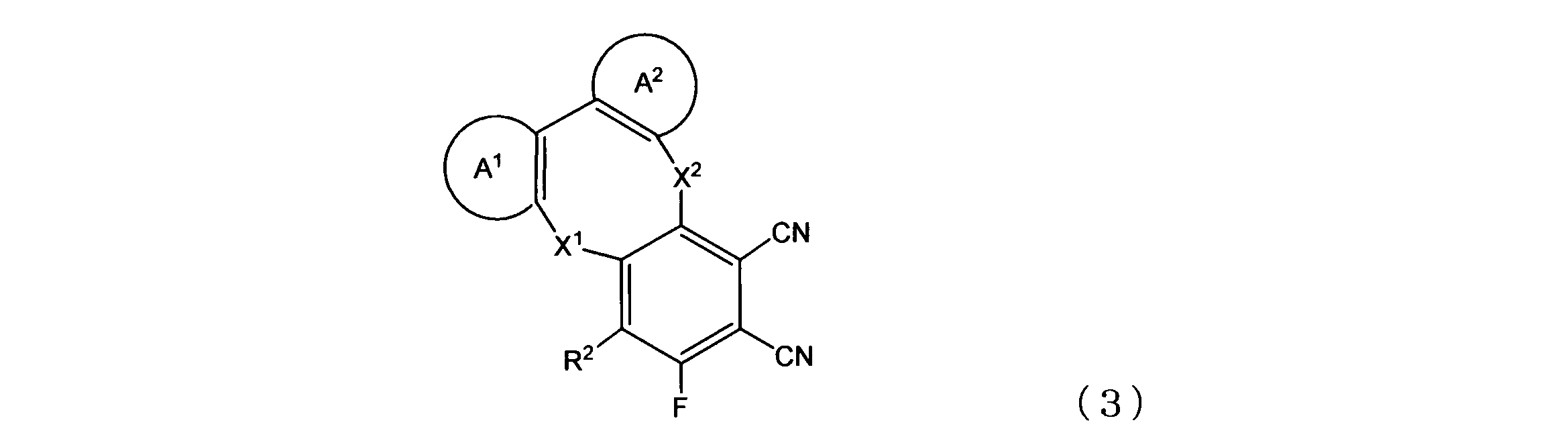
で表される化合物と、下記化合物(b)

とを、塩基の存在下に反応させる方法。
本発明のフタロシアニン化合物は、下記一般式(1)で表される化合物である。
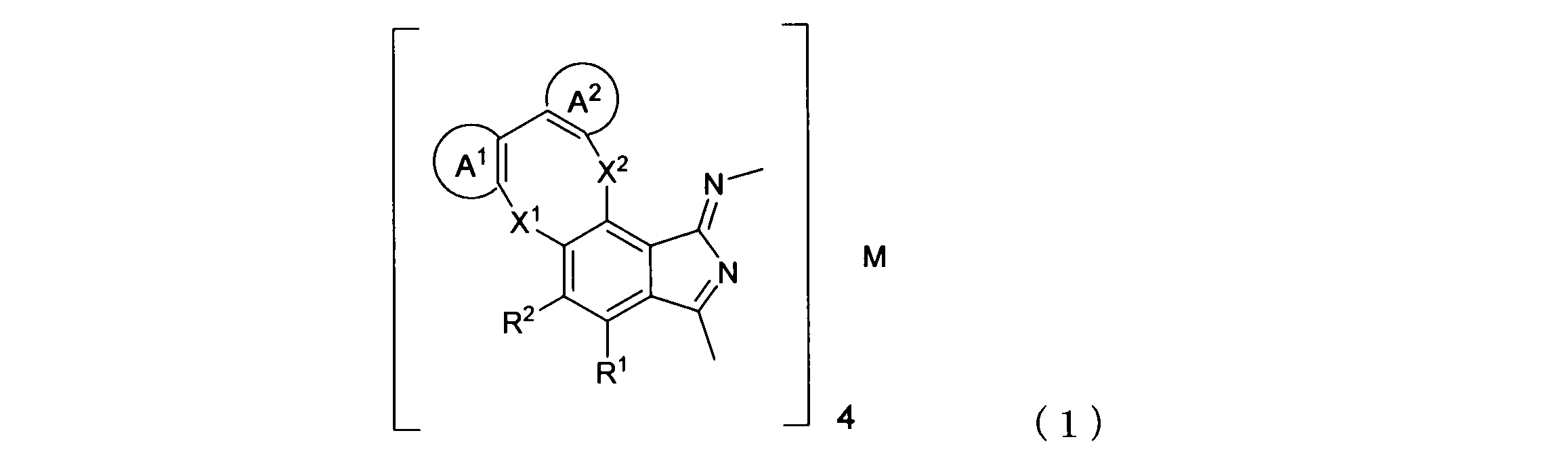

本発明のフタロシアニン化合物は、下記反応式-1に示すとおり、化合物(2)と、金属又は無機若しくは有機金属化合物とを、塩基の存在下に反応させることにより、製造することができる。
本発明の、上記一般式(2)で表される、フタロシアニン化合物を製造するための中間体は、例えば、次の反応式-2に示す方法により製造することができる。
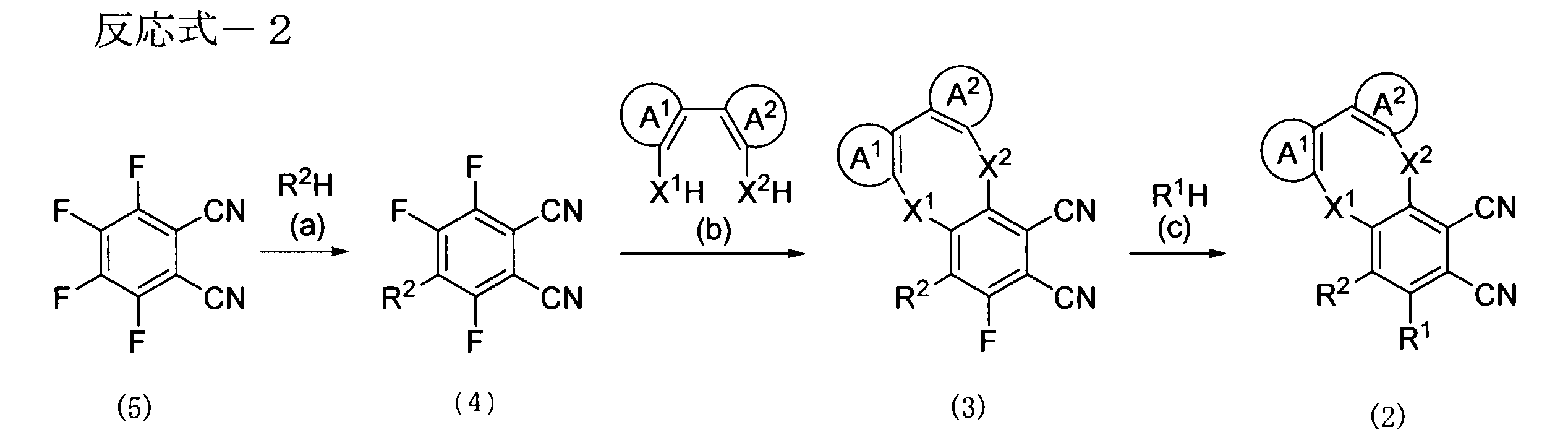
化合物(4)は、通常、溶媒中で、塩基の存在下に、化合物(5)と化合物(a)を反応させることにより製造される。例えば、特開平01-045474号公報、特開平08-120186号公報に開示される公知の方法を用いることができるが、より詳細には、下記のとおりである。
2-n-ペンチルフェノール、3-n-ペンチルフェノール、4-n-ペンチルフェノール、2-t-アミルフェノール、3-t-アミルフェノール、4-t-アミルフェノール、2,4-ジ-t-アミルフェノール、2-n-ヘキシルフェノール、3-n-ヘキシルフェノール、4-n-ヘキシルフェノール、4-シクロヘキシルフェノール、2-n-ヘプチルフェノール、3-n-ヘプチルフェノール、4-n-ヘプチルフェノール、2-n-オクチルフェノール、3-n-オクチルフェノール、4-n-オクチルフェノール、2-(2-エチルヘキシル)フェノール、3-(2-エチルヘキシル)フェノール、4-(2-エチルヘキシル)フェノール、2-t-オクチルフェノール、3-t-オクチルフェノール、4-t-オクチルフェノール、2-n-ノニルフェノール、3-n-ノニルフェノール、4-n-ノニルフェノール、2-n-デシルフェノール、3-n-デシルフェノール、4-n-デシルフェノール、2-n-ウンデシルフェノール、3-n-ウンデシルフェノール、4-n-ウンデシルフェノール、2-n-ドデシルフェノール、3-n-ドデシルフェノール、4-n-ドデシルフェノール、2,6-ジ-t-ブチル-4-エチルフェノール、4-t-ブチル-2,6-ジイソプロピルフェノール、4-s-ブチル-2,6-ジ-t-ブチルフェノール、4-ドデシルクレゾール、2-(ジメチルアミノ)フェノール、3-(ジメチルアミノ)フェノール、4-(ジメチルアミノ)フェノール、2-(ジエチルアミノ)フェノール、3-(ジエチルアミノ)フェノール、4-(ジエチルアミノ)フェノール、2-(ジ-n-ブチルアミノ)フェノール、3-(ジ-n-ブチルアミノ)フェノール、4-(ジ-n-ブチルアミノ)フェノール、1-(4-ヒドロキシフェニル)ピペラジン、8-ヒドロキシジュロリジン、2-(4-ヒドロキシフェニル)-N,N-ジメチルエチルアミン、2,4,6-トリス(ジメチルアミノメチル)フェノール、2-フルオロフェノール、3-フルオロフェノール、4-フルオロフェノール、5-フルオロフェノール、6-フルオロフェノール、2,3-ジフルオロフェノール、2,4-ジフルオロフェノール、2,5-ジフルオロフェノール、2,6-ジフルオロフェノール、2,3,5-トリフルオロフェノール、2,3,6-トリフルオロフェノール、2,4,5-トリフルオロフェノール、2,4,6-トリフルオロフェノール、2-トリフルオロメチルフェノール、3-トリフルオロメチルフェノール、4-トリフルオロメチルフェノール、2-クロロフェノール、3-クロロフェノール、4-クロロフェノール、5-クロロフェノール、6-クロロフェノール、2,3-ジクロロフェノール、2,4-ジクロロフェノール、2,5-ジクロロフェノール、2,6-ジクロロフェノール、2,3,5-クロロフェノール、2,3,6-トリクロロフェノール、2,4,5-トリクロロフェノール、2,4,6-トリクロロフェノール、2-ニトロフェノール、3-ニトロフェノール、4-ニトロフェノール、5-ニトロフェノール、6-ニトロフェノール、2,3-ジニトロフェノール、2,4-ジニトロフェノール、2,5-ジニトロフェノール、
2,6-ジニトロフェノール、2-シアノフェノール、3-シアノフェノール、4-シアノフェノール、5-シアノフェノール、6-シアノフェノール、1-ナフトール(α-ナフトール)、2-ナフトール(β-ナフトール)、4-メトキシ-1-ナフトール、5-メトキシ-1-ナフトール、5-ジメチルアミノ-1-ナフトール、6-ジメチルアミノ-1-ナフトール、6-シアノ-2-ナフトール、4-ニトロ-1-ナフトール、メタンチオール、エタンチオール、プロパンチオール、2-プロパンチオール、n-ブタンチオール、イソブチルメルカプタン、s-ブチルメルカプタン、t-ブタンチオール、n-ペンタンチオール、n-ヘキサンチオール、シクロヘキサンチオール、n-ヘプタンチオール、n-オクタンチオール、t-オクタンチオール、ベンゼンチオール、2-トルエンチオール、3-トルエンチオール、4-トルエンチオール、2,3-ジメチルベンゼンチオール、2,4-ジメチルベンゼンチオール、2,5-ジメチルベンゼンチオール、3,4-ジメチルベンゼンチオール、3,5-ジメチルベンゼンチオール、2,3,4-トリメチルベンゼンチオール、2,3,5-トリメチルベンゼンチオール、2,3,6-トリメチルベンゼンチオール、2,4,5-トリメチルベンゼンチオール、2,4,6-トリメチルベンゼンチオール(2,4,6-トリメチルチオフェノール)、2-エチルベンゼンチオール、3-エチルベンゼンチオール、4-エチルベンゼンチオール、2,4,6-トリエチルベンゼンチオール、2-n-プロピルベンゼンチオール、3-n-プロピルベンゼンチオール、4-n-プロピルベンゼンチオール、2-イソプロピルベンゼンチオール、3-イソプロピルベンゼンチオール、4-イソプロピルベンゼンチオール、2-n-ブチルベンゼンチオール、3-n-ブチルベンゼンチオール、4-n-ブチルベンゼンチオール、2-t-ブチルベンゼンチオール、3-t-ブチルベンゼンチオール、4-t-ブチルベンゼンチオール、2,4,6-トリ-t-ブチルベンゼンチオール、2-n-ペンチルベンゼンチオール、3-n-ペンチルベンゼンチオール、4-n-ペンチルベンゼンチオール、2-t-アミルベンゼンチオール、3-t-アミルベンゼンチオール、4-t-アミルベンゼンチオール、4-n-ヘキシルベンゼンチオール、5-t-ブチル-2-メチルベンゼンチオール2-フルオロベンゼンチオール、3-フルオロベンゼンチオール、4-フルオロベンゼンチオール、2,3-ジフルオロベンゼンチオール、2,4-ジフルオロベンゼンチオール、2,5-ジフルオロベンゼンチオール、3,4-ジフルオロベンゼンチオール、3,5-ジフルオロベンゼンチオール、2,3,4-トリフルオロベンゼンチオール、2,3,5-トリフルオロベンゼンチオール、2,3,6-トリフルオロベンゼンチオール、2,4,5-トリフルオロベンゼンチオール、2,4,6-トリフルオロベンゼンチオール、2-クロロベンゼンチオール、3-クロロベンゼンチオール、4-クロロベンゼンチオール、2,3-ジクロロベンゼンチオール、2,4-ジクロロベンゼンチオール、2,5-ジクロロベンゼンチオール、3,4-ジクロロベンゼンチオール、3,5-ジクロロベンゼンチオール、2,3,4-トリクロロベンゼンチオール、2,3,5-トリクロロベンゼンチオール、2,3,6-トリクロロベンゼンチオール、2,4,5-トリクロロベンゼンチオール、2,4,6-トリクロロベンゼンチオール、
化合物(3)は、通常、溶媒中、塩基の存在下に、化合物(4)と化合物(b)とを反応させることにより製造される。
化合物(2)は、通常、塩基の存在下に、溶媒中、化合物(3)と化合物(c)とを反応させることにより製造される。

本発明のフタロシアニン化合物は、750~1200nmの近赤外線波長領域に吸収能を有することから、近赤外線吸収色素として使用することができる。即ち、本発明の近赤外線吸収色素は、本発明のフタロシアニン化合物からなる。
本発明のフタロシアニン化合物は、750~1200nmの近赤外線波長領域に吸収能を有することから、近赤外線吸収材料、より詳細には、近赤外線吸収フィルター、保護眼鏡、農業用フィルム、熱線遮断フィルター、受光素子、長波長レーザー対応光記録媒体、偽造防止用の印刷インク、カモフラージュ用塗装等に使用することができる。即ち、本発明の近赤外線吸収材料は、本発明のフタロシアニン化合物を含有する。
本発明のフタロシアニン化合物は、750~1200nmの近赤外線波長領域に吸収能を有することから、この領域のレーザー光を吸収して熱に変換する光熱変換材料、より詳細には、レーザーダイレクト製版(CTP)用原版、記録材料(レーザー感熱記録材料、レーザー熱転写記録材料等)等に使用することができる。即ち、本発明の光熱変換材料は、本発明のフタロシアニン化合物を含有する。
光熱変換材料を、レーザー感熱記録材料又はレーザー熱転写記録材料等の記録材料とする場合、当該材料には、発色成分又は着色成分等を配合して使用してもよいし、発色成分又は着色成分等を含有する層を別途設けてもよい。
光変換材料を、ダイレクト製版用平版印刷原版とする場合、支持体上に光熱変換層を設ける。光熱変換層上には、シリコンゴム層を積層してもよいし、更に、保護層等を積層してもよい。
本発明のフタロシアニン化合物は、750~1200nmの近赤外線波長領域に吸収能を有することから、遮熱材料に使用することができる。即ち、本発明の遮熱材料は、本発明のフタロシアニン化合物を含有する。
<GCMS>
(株)島津製作所製ガスクロマトグラフ質量分析装置GCMS-QP2010Plus(EI法)
<LCMS>
(株)島津製作所高速液体クロマトグラフ質量分析計LCMS-2010EV(ESI法)
<MALDI-TOFMS>
BrukerDaltonics社製質量分析装置AutoflexII
<波長(λmax)、モル吸光係数(ε)>
日本分光(株)製分光光度計V-570
測定には、8.0×10⁻⁶~11×10-6mol/Lのクロロホルム溶液を調製し、光路長1cmの石英セルを用いた。
<1H-NMR>
日本電子(株)製Lambda300(300MHz)
実施例1

温度計を取り付けた100mlの4つ口反応器に、テトラフルオロフタロニトリル(化合物(5))6.0g(30mmol)、フッ化カリウム21g(36mmol,1.2eq.)及びアセトニトリル50mlを仕込み、撹拌下、5℃に冷却した。ここに、β-ナフトール(化合物(a-1))4.3g (30mmol、1.0eq.)を滴下した。滴下終了後、混合物を5℃以下で1時間反応させた後、室温まで昇温し、2時間反応させた。反応終了後、反応混合物を水に放出し、析出固体を濾過して取り出した。得られた粗生成物を、イソプロパノールでよく洗い、乾燥させて、化合物(4-1)6.7gを、白色固体として得た(収率69%)。
GC-MS m/z=324(M+)
冷却管及び温度計を取り付けた50mlの4つ口反応器に、化合物(4-1)3.2g(10mmol)、フッ化カリウム1.4g(24mmol、2.4eq.)及びMEK20mlを仕込み、60℃に昇温した。ここに、2,2’-ビフェノール(化合物(b-1))1.9g(10mmol、1.0eq.)を、MEK5mlに溶解させた溶液を滴下した。滴下終了後、同温度で5時間反応させた。反応終了後、反応混合物を水に放出し、析出固体を濾過して取り出した。得られた固体をメタノールでよく洗い、乾燥させて、化合物(3-1)3.4gを得た(収率72.3%)。
LC-MS m/z=470(M+)
冷却管及び温度計を取り付けた25mlの4つ口反応器に、化合物(3-1)3.3g(7mmol)、トリエチルアミン1.4g(14mmol、2.0eq.)、DMA4mlを仕込み、室温で撹拌した。ここに、n-ブチルアミン(化合物(c-1))0.66g(9.1mmol、1.3eq.)を滴下した。混合物を70℃に昇温し、1時間反応させた。反応終了後、反応混合物を水に放出し、析出固体を濾過して取り出した。得られた粗生成物をメタノールでよく洗い、化合物(2-1)3.4g得た(収率92.9%)。
LC-MS m/z=524([M+H]+)
1H-NMR (CDCl3, δ in ppm): 0.82-0.87(m, 3H), 1.23-1.36(m, 2H), 1.49-1.59(m, 2H), 3.60-3.66(m, 2H), 4.74-4.78(m, 1H), 6.34-6.37(dd, 1H), 7.04-7.14(m, 2H), 7.21-7.51(m, 9H), 7.66-7.69(m, 1H), 7.82-7.87(m, 2H)
冷却管及び温度計を取り付けた25mlの4つ口反応器に、化合物(2-1)3.1g(6mmol)、1-ヘキサノール10ml 、ホルムアミド 0.38g(8.4mmol、1.4eq.)及びt-BuOK 0.94g(8.4mmol、1.4eq.)を仕込み、100℃で30分撹拌した。薄層クロマトグラフィー(TLC)で原料が僅かなことを確認した後、反応液に、VCl30.38g(2.4mmol、0.4eq.)を投入し、反応液を150℃に昇温して、3時間反応させた後、エアー気流下に20時間反応させた。反応終了後、反応混合物を室温に冷却し、トルエン3mlを加えた。その後、反応混合物を、メタノール(MeOH)65mlに放出し、固体を析出させた。濾過して固体を取り出し、メタノールで洗浄した。100℃で乾燥して、粗生成物を2.6g得た。得られた固体をトルエン70mlに溶かし、活性白土26g、シリカゲル5gを加えて攪拌し、不溶物をろ別して濃縮した。得られた固形物をメタノールでよく洗い、120℃で乾燥して、化合物(1-1)1.1gを得た(収率35.8%)。
MALDI TOF-MS m/z=2160(M+)
λmax=906nm ε=147000 l/mol・cm(クロロホルム)
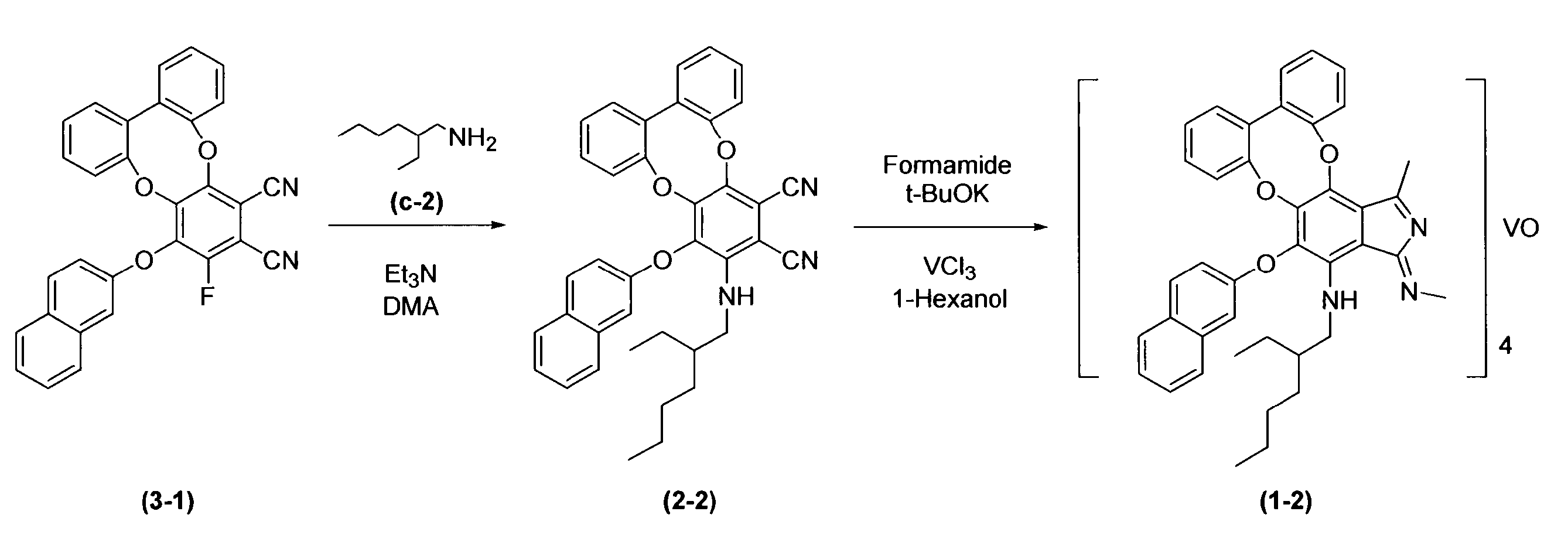
実施例1(3)化合物(2-1)の合成において、n-ブチルアミン(化合物(c-1))を、2-エチルヘキシルアミン(化合物(c-2))に変えた以外は、同様にして、化合物(2-2)を得た(収率88.6%)。
LC-MS m/z=580([M+H]+)
1H-NMR (CDCl3, δ in ppm): 0.72-0.79(m, 6H), 1.06-1.26(m, 8H), 1.46-1.57(m, 1H), 3.53-3.57(m, 2H), 4.70-4.73(t, 1H), 6.41-6.44(dd, 1H), 7.06-7.13(m, 2H), 7.22-7.51(m, 9H), 7.66-7.68(m, 1H), 7.81-7.87(m, 2H)
実施例1(4)化合物(1-1)の合成において、化合物(2-1)を、化合物(2-2)に変えた以外は、同様にして、化合物(1-2)を得た(収率47.5%)。
MALDI TOF-MS m/z=2384(M+)
λmax=911nm ε=165000 l/mol・cm(クロロホルム)
実施例3

MALDI TOF-MS m/z=2380(M+)
λmax=853nm ε=189000 l/mol・cm(クロロホルム)

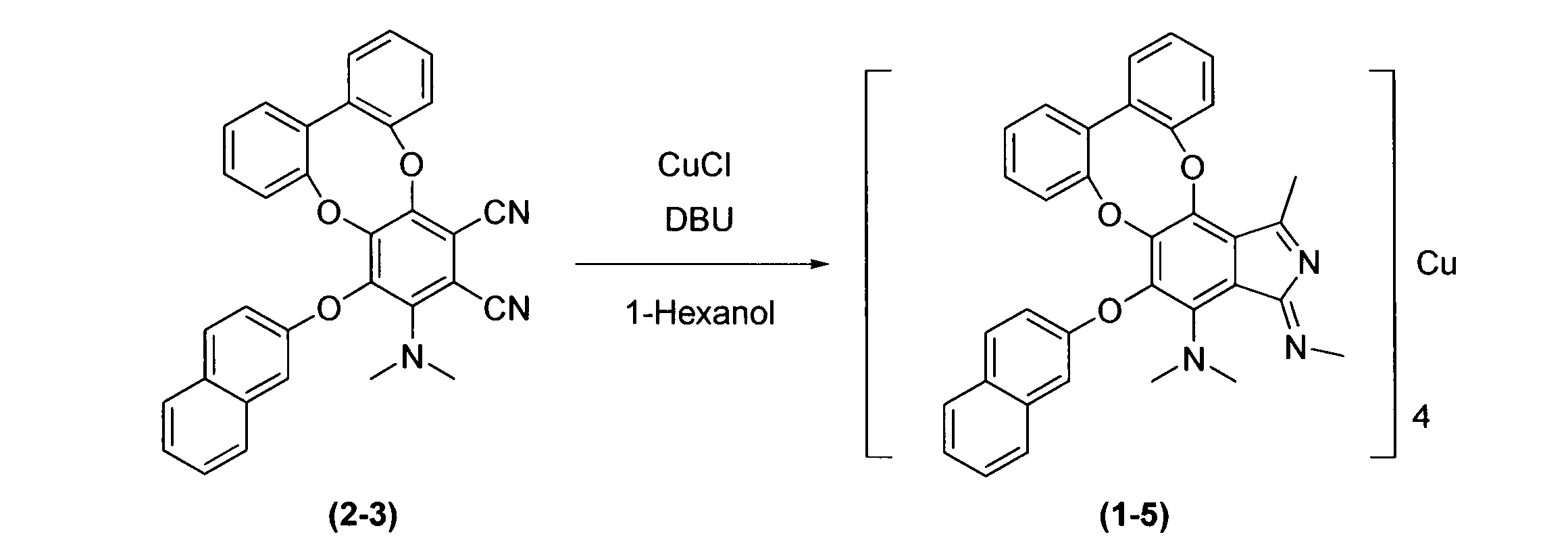
実施例1(3)化合物(2-1)の合成において、n-ブチルアミン(化合物(c-1))を、ジメチルアミン(化合物(c-3))に変えた以外は、同様にして、化合物(2-3)を得た(収率94.3%)。
LC-MS m/z=496([M+H]+)
1H-NMR (CDCl3, δ in ppm): 2.93(s, 6H), 6.61-6.64(dd, 1H), 7.01-7.02(d, 1H), 7.12-7.50(m, 10H), 7.65-7.67(d, 1H), 7.82-7.86(m, 2H)
実施例1(4)化合物(1-1)の合成において、化合物(2-1)を、化合物(2-3)に変えた以外は、同様にして、化合物(1-4)を得た(収率34.2%)。
MALDI TOF-MS m/z=2048(M+)
λmax=862nm ε=104000 l/mol・cm(クロロホルム)
MALDI TOF-MS m/z=2044(M+)
λmax=807nm ε=147000 l/mol・cm(クロロホルム)
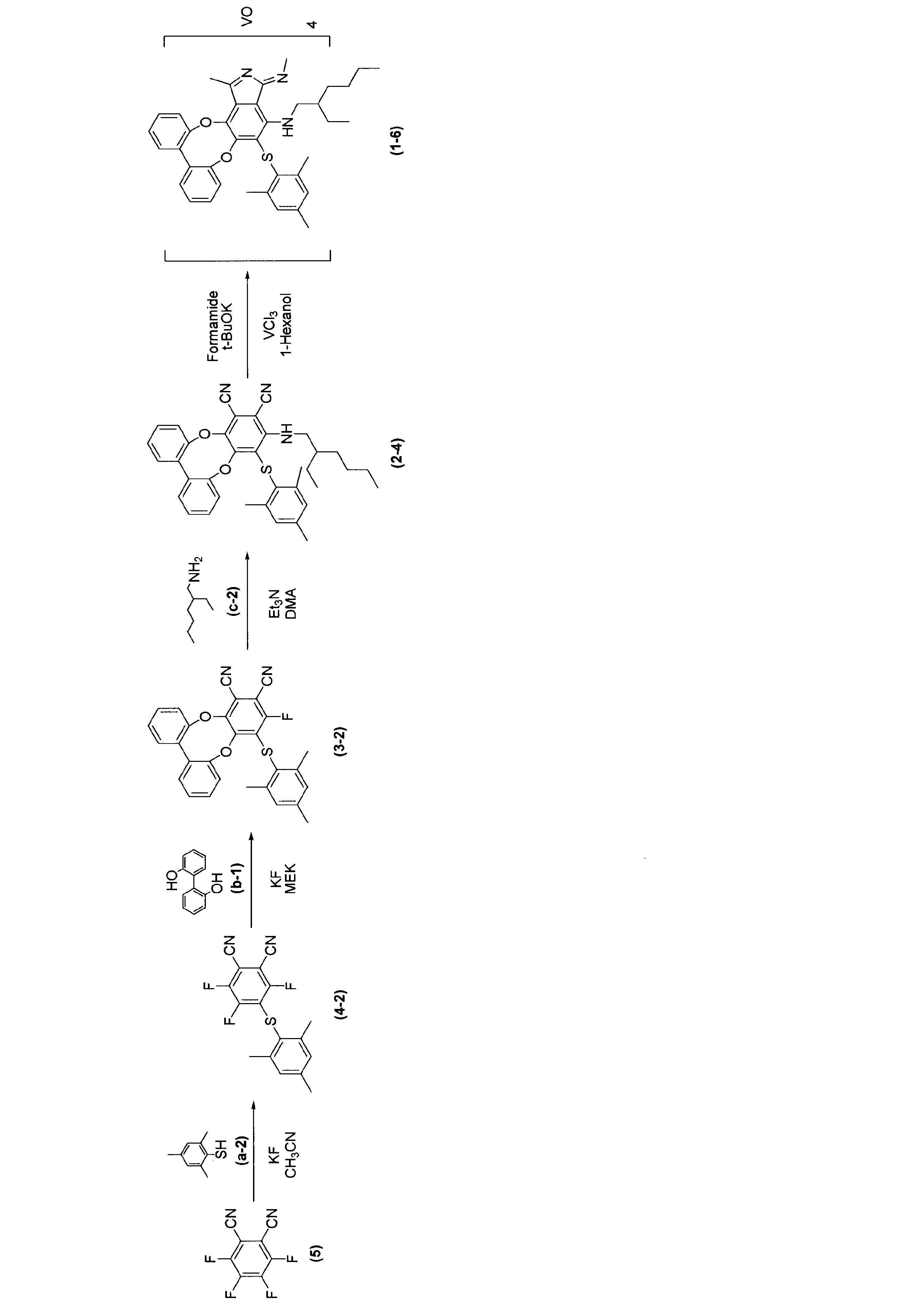
実施例1(1)化合物(4-1)の合成において、β-ナフトール(化合物(a-1))を、2,4,6-トリメチルチオフェノール(化合物(a-2))に変えた以外は、同様にして、化合物(4-2)を得た(収率68.1%)。
GC-MS m/z=332(M+)
実施例1(2)化合物(3-1)の合成において、化合物(4-1)を、化合物(4-2)に変えた以外は、同様にして、化合物(3-2)を得た(収率90.6%)。
LC-MS m/z=479([M+H]+)
実施例1(3)化合物(2-1)の合成において、化合物(3-1)を、化合物(3-2)に変え、n-ブチルアミン(化合物(c-1))を、2-エチルヘキシルアミン(化合物(c-2))に変えた以外は、同様にして、化合物(2-4)を得た(収率86.9%)。
LC-MS m/z=588([M+H]+)
1H-NMR (CDCl3, δ in ppm): 0.88-0.93(m, 6H), 1.29-1.56(m, 8H), 1.48-1.56(m, 1H), 2.28-2.30(m, 9H), 3.59-3.63(t, 2H), 5.60-5.62(t, 1H), 5.70-5.73(d, 1H), 6.92(s, 2H), 7.04-7.10(m, 1H), 7.23-7.28(m, 1H), 7.32-7.49(m, 5H)
実施例1(4)化合物(1-1)の合成において、化合物(2-1)を、化合物(2-4)に変えた以外は、同様にして、化合物(1-6)を得た(収率31.0%)。
MALDI TOF-MS m/z=2416(M+)
λmax=910nm ε=142000 l/mol・cm(クロロホルム)
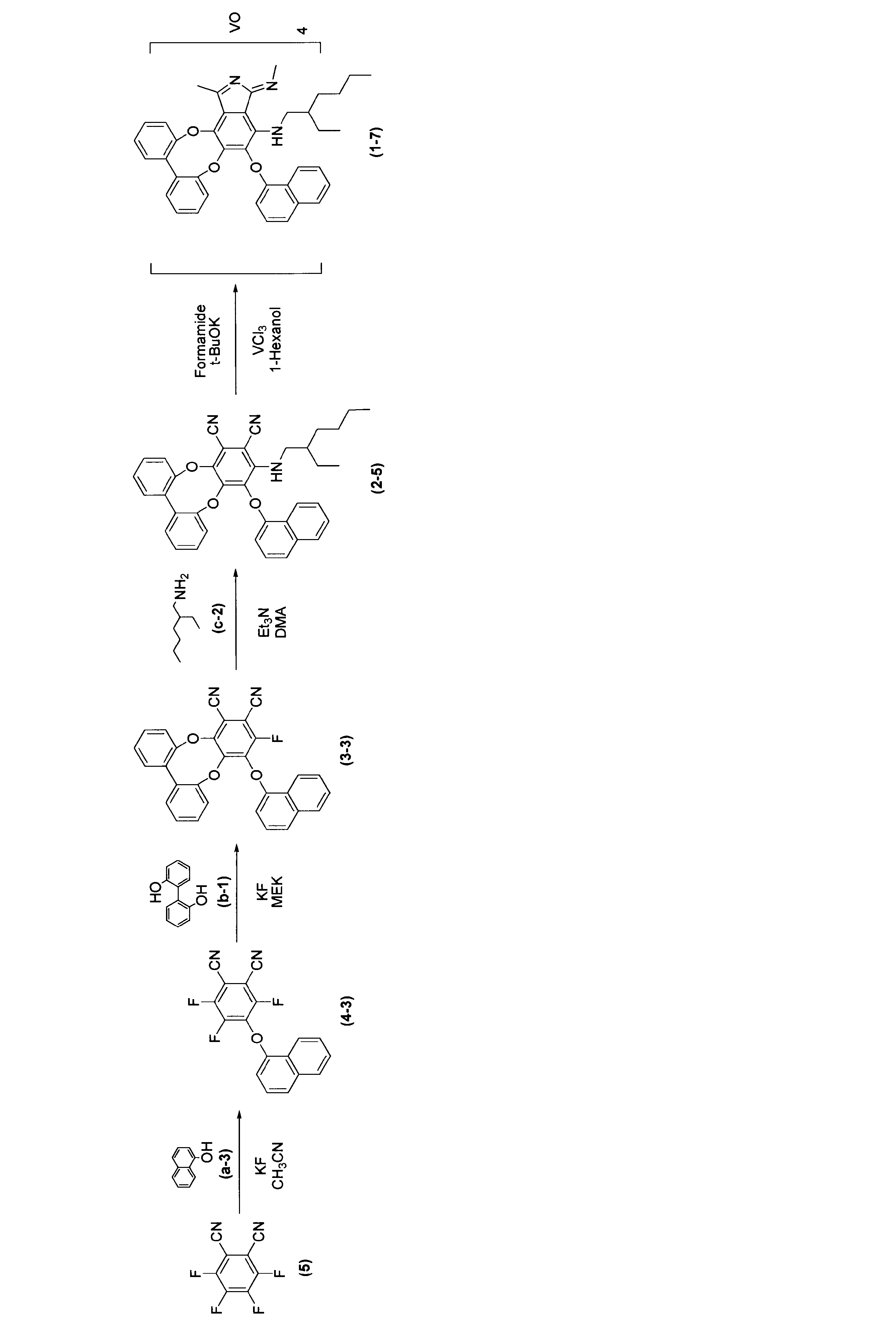
実施例1(1)化合物(4-1)の合成において、β-ナフトール(化合物(a-1))を、α-ナフトール(化合物(a-3))に変えた以外は、同様にして、化合物(4-3)を得た(収率88.0%)。
GC-MS m/z=324(M+)
実施例1(2)化合物(3-1)の合成において、化合物(4-1)を、化合物(4-3)に変えた以外は、同様にして、化合物(3-3)を得た(収率84.6%)。
LC-MS m/z=580([M+H]+)
実施例1(3)化合物(2-1)の合成において、化合物(3-1)を、化合物(3-3)に変え、n-ブチルアミン(化合物(c-1))を、2-エチルヘキシルアミン(化合物(c-2))に変えた以外は、同様にして、化合物(2-5)を得た(収率79.4%)。
LC-MS m/z=580([M+H]+)
1H-NMR (CDCl3, δ in ppm): 0.71-0.78(m, 6H), 1.07-1.22(m, 8H), 1.38-1.42(m, 1H), 3.50-3.53(t, 2H), 4.67-4.70(t, 1H), 6.61-6.63(d, 1H), 7.16-7.65(m, 12H), 7.86-7.90(m, 1H), 8.37-8.40(m, 1H)
実施例1(4)化合物(1-1)の合成において、化合物(2-1)を、化合物(2-5)に変えた以外は、同様にして、化合物(1-7)を得た(収率26.4%)。
MALDI TOF-MS m/z=2384(M+)
λmax=910nm ε=168000 l/mol・cm(クロロホルム)
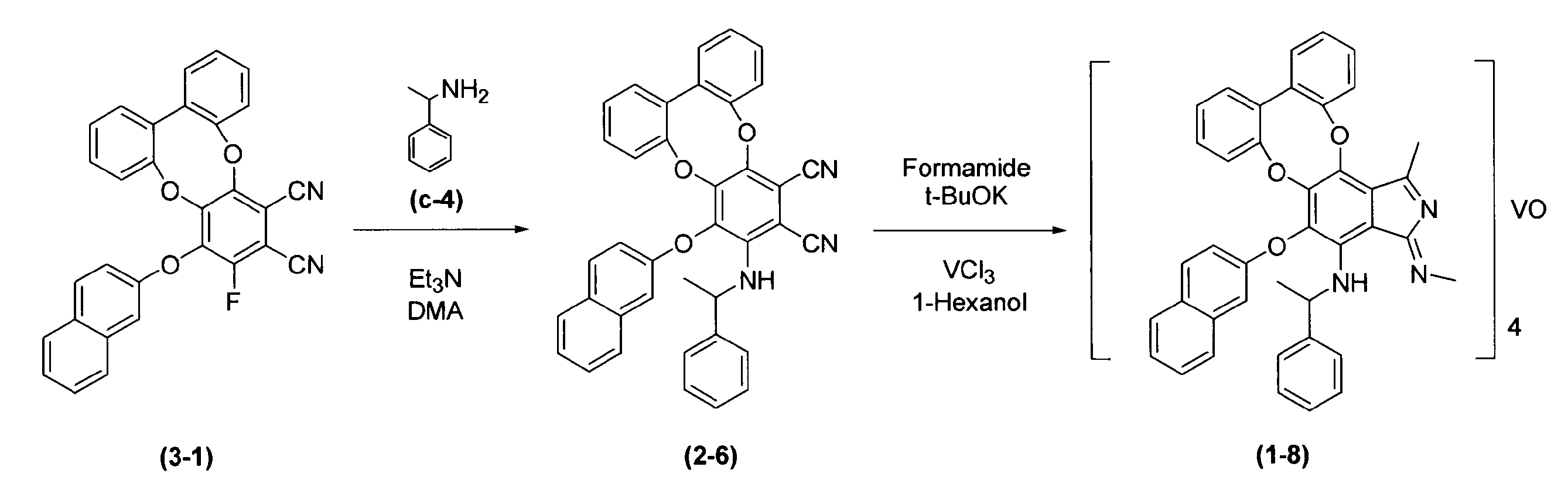
実施例1(3)化合物(2-1)の合成において、n-ブチルアミン(化合物(c-1))を、1-フェニルエチルアミン(化合物(c-4))に変えた以外は、同様にして、化合物(2-6)を得た(収率82.0%)。
LC-MS m/z=572([M+H]+)
1H-NMR (CDCl3, δ in ppm): 1.19-1.21(d, 1H), 1.47-1.49(d, 3H), 5.06-5.09(d, 1H), 5.43-5.48(m, 1H), 6.30-6.33(d, 1H), 7.02-7.07(m, 2H), 7.20-7.52(m, 13H), 7.63-7.66(m, 1H), 7.83-7.87(m, 2H)
実施例1(4)化合物(1-1)の合成において、化合物(2-1)を、化合物(2-6)に変えた以外は、同様にして、化合物(1-8)を得た(収率63.0%)。
MALDI TOF-MS m/z=2352(M+)
λmax=880nm ε=166000 l/mol・cm(クロロホルム)
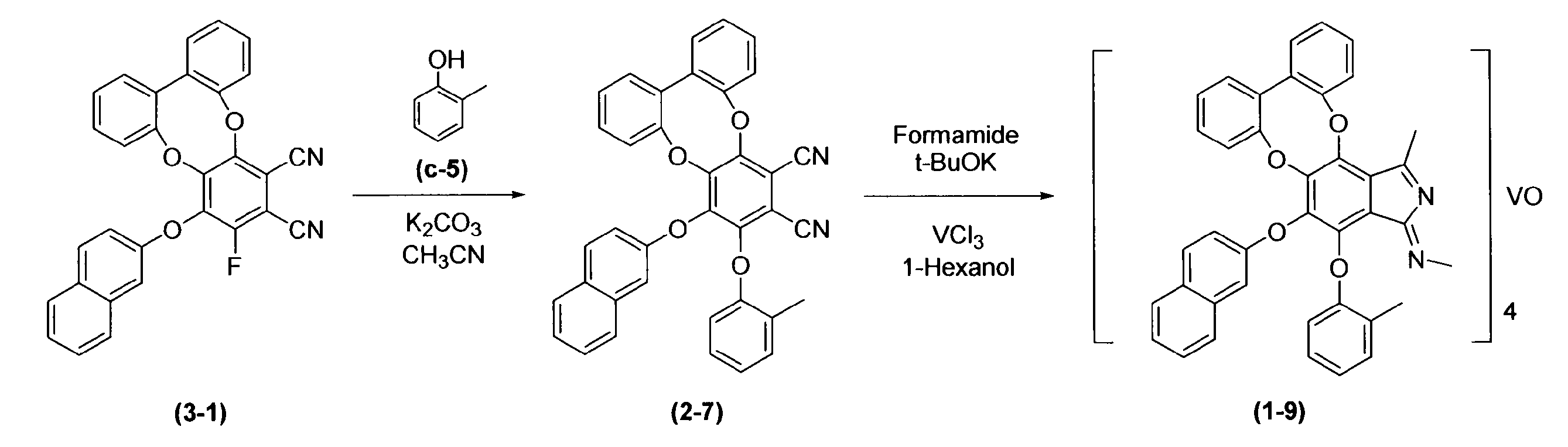
冷却管及び温度計を取り付けた50mlの4つ口反応器に、化合物(3-1)4.7g(10mmol)、炭酸カリウム2.1g(15mmol、1.5eq.)、アセトニトリル20mlを仕込み、室温で撹拌した。ここに、o-クレゾール(化合物(c-5))1.3g(12mmol、1.2eq.)を滴下した。混合物を70℃に昇温し、4時間反応させた。反応終了後、反応混合物を水に放出し、析出固体を濾過して取り出した。得られた粗生成物を2-プロパノールで再結晶し、化合物(2-7)を4.1g得た(収率73.0%)。
LC-MS m/z=559([M+H]+)
1H-NMR (CDCl3, δ in ppm): 1.74(s, 3H), 6.57-6.58(d, 1H), 6.73-6.73(dd, 1H), 6.76-6.97(m, 3H), 7.01-7.09(m, 2H), 7.20-7.26(m, 1H), 7.30-7.36(m, 1H), 7.38-7.54(m, 7H), 7.61-7.64(d, 1H), 7.70-7.73(d, 1H), 7.78-7.80(d, 1H)
実施例1(4)化合物(1-1)の合成において、化合物(2-1)を、化合物(2-7)に変えた以外は、同様にして、化合物(1-9)を得た(収率60.0%)。
MALDI TOF-MS m/z=2300(M+)
λmax=768nm ε=254000 l/mol・cm(クロロホルム)
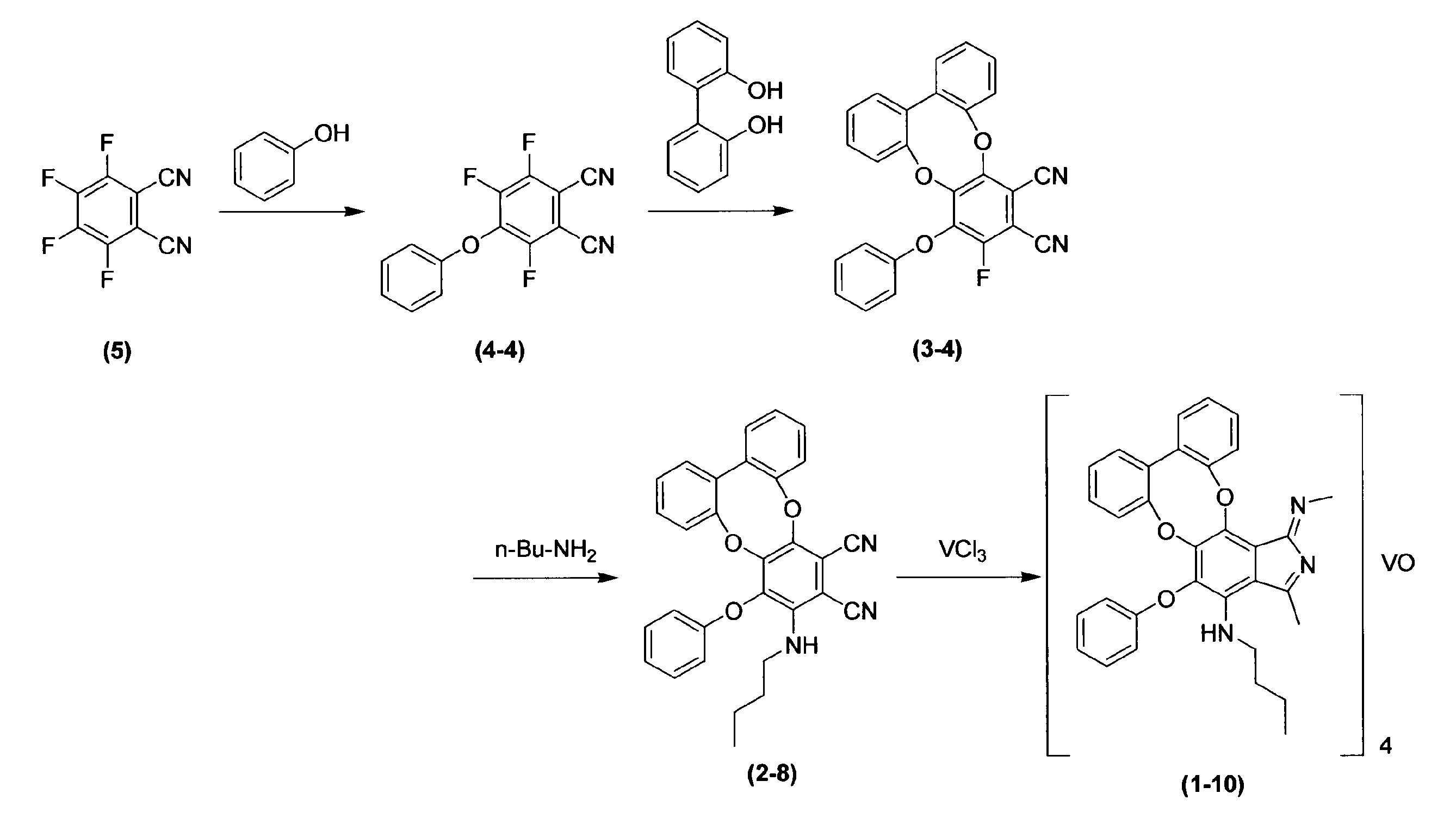
(1)化合物4-4の調製
実施例1(1)化合物(4-1)の調製において、β-ナフトール(化合物(a-1))をフェノールに変えた以外は、同様にして、化合物(4-4)を得た(収率68%)。
GC-MS m/z=274(M+)
実施例1(2)化合物(3-1)の調製において、化合物(4-1)を化合物(4-4)に変えた以外は、同様にして、化合物(3-4)を得た(収率89%)。
GC-MS m/z=420(M+)
実施例1(3)化合物(2-1)の合成において、化合物(3-1)を化合物(3-4)に変えた以外は、同様にして、化合物(2-8)を得た(収率100%)。
LC-MS m/z=474 ([M+H]+)
1H-NMR (CDCl3,δ in ppm) 0.87-0.92(m, 3H), 1.27-1.39(m, 2H), 1.51-1.61(m, 2H), 3.60-3.66(m, 2H), 4.73-4.77(t, 1H), 6.22-6.25(dd, 1H), 6.92-6.97(m, 2H), 7.13-7.21(m, 2H), 7.25-7.47(m, 8H)
実施例1(4)化合物(1-1)の合成において、化合物(2-1)を化合物(2-8)に変えた以外は、同様にして、化合物(1-10)を得た(収率40.8%)。
MALDI TOF-MS m/z=1960(M+)
λmax=900nm ε=164000 l/mol・cm(クロロホルム)
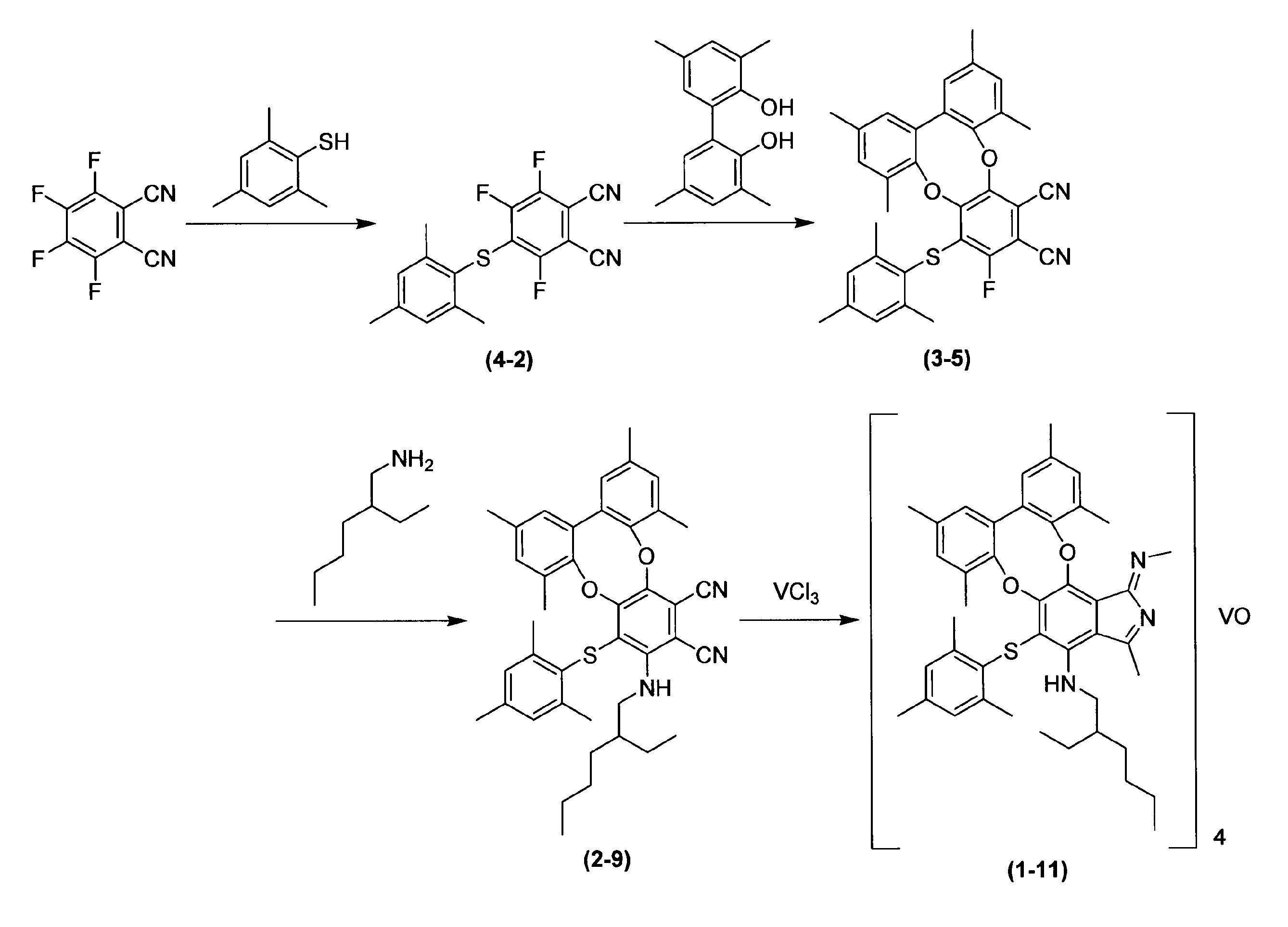
(1)化合物(3-5)の調製
実施例1(2)化合物(3-1)の調製において、化合物(4-1)を化合物(4-2)に変え、2,2’-ビフェノール(化合物(b-1))を3,3’,5,5’-テトラメチル-2,2’-ジヒドロキシビフェニルに変えた以外は、同様にして、化合物(3-5)を得た(収率92.0%)。
LC-MS m/z=535 ([M+H]+)
実施例1(3)化合物(2-1)の合成において、化合物(3-1)を化合物(3-5)に変え、n-ブチルアミン(化合物(c-1))を2-エチルヘキシルアミンに変えた以外は、同様にして、化合物(2-9)を得た(収率90.0%)。
LC-MS m/z=644 ([M+H]+)
1H-NMR (CDCl3,δ in ppm) 0.81-0.91(m, 6H), 1.19-1.38(m, 9H), 2.04-2.34(m, 21H), 3.22-3.32(m, 1H), 3.54-3.64(m, 1H), 4.97-4.98(m, 1H), 6.67(s, 2H), 6.93-7.01(m, 4H)
実施例1(4)化合物(1-1)の合成において、化合物(2-1)を化合物(2-9)に変えた以外は、同様にして、化合物(1-11)を得た(収率45.0%)。
MALDI TOF-MS m/z=2640 (M+)
λmax=940nm ε=152000 l/mol・cm(クロロホルム)
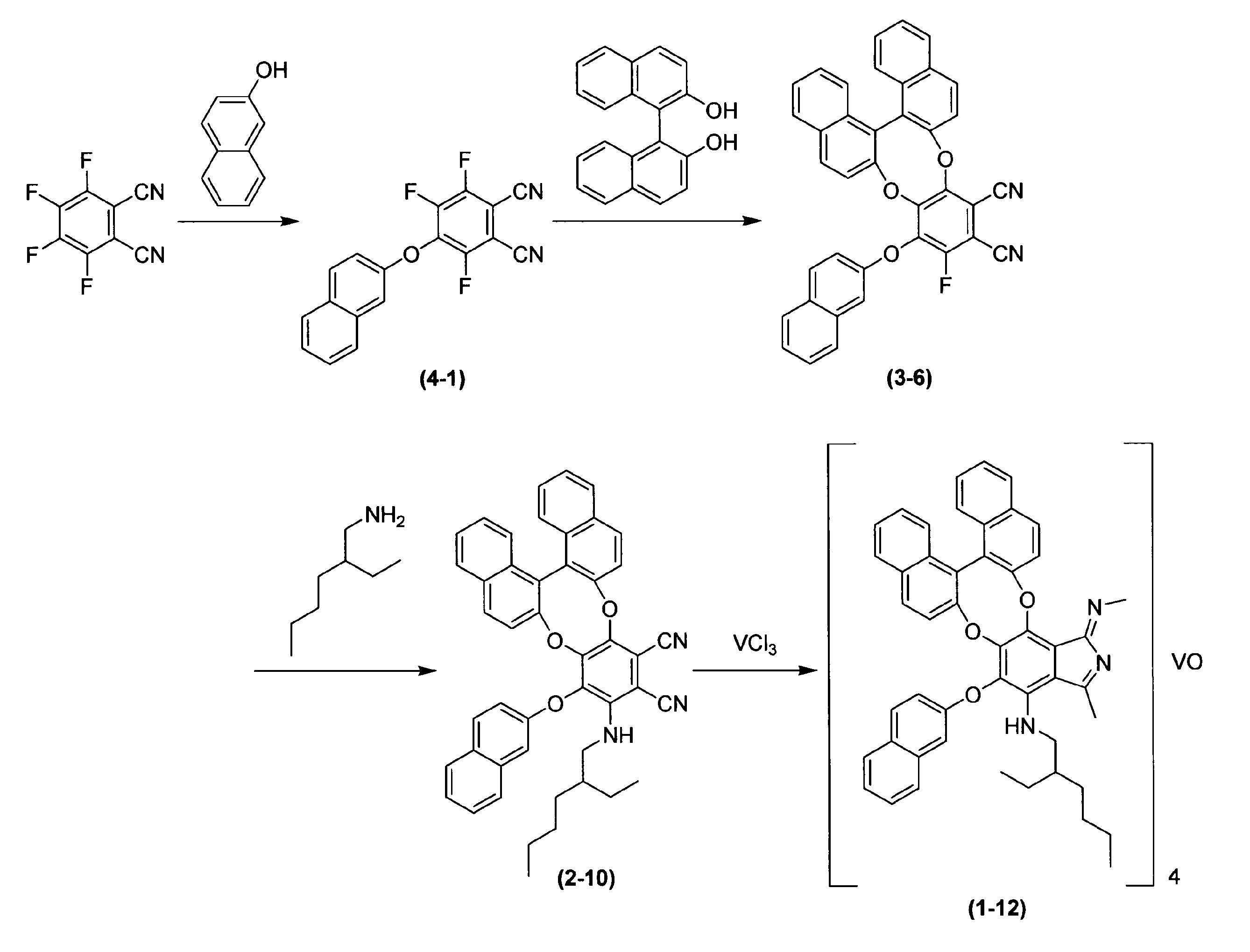
(1)化合物(3-6)の調製
実施例1(2)化合物(3-1)の調製において、2,2’-ビフェノール(化合物(b-1))を2,2’-ジヒドロキシ-1,1’-ビナフチルに変えた以外は、同様にして、化合物(3-6)を得た(収率53.8%)。
GC-MS m/z=570 (M+)
実施例1(3)化合物(2-1)の合成において、化合物(3-1)を化合物(3-6)に変え、n-ブチルアミン(化合物(c-1))を2-エチルヘキシルアミンに変えた以外は、同様にして、化合物(2-10)を得た(収率81.0%)。
LC-MS m/z=680 ([M+H]+)
1H-NMR (CDCl3,δin ppm) 0.70-0.78(m, 6H), 1.07-1.26(m, 8H), 1.46-1.48(m, 1H), 3.52-3.56(m, 2H), 4.67-4.70(t, 1H), 6.59-6.62(dd, 1H), 7.13-7.13(d, 1H), 7.26-7.51(m, 9H), 7.62-7.68(t, 3H), 7.80-7.88(m, 3H), 7.93-7.96(d, 1H), 8.02-8.05(d, 1H)
実施例1(4)化合物(1-1)の合成において、化合物(2-1)を化合物(2-10)に変えた以外は、同様にして、化合物(1-12)を得た(収率46.0%)。
MALDI TOF-MS m/z=2784 (M+)
λmax=913nm ε=172000 l/mol・cm(クロロホルム)

(1)化合物(2-11)の合成
冷却管及び温度計を取り付けた25mlの4つ口反応器に、化合物(2-1)5.2g(0.01mol)、炭酸カリウム2.7g(0.02mol,2.0eq.)、1-ブロモブタン2.2g(0.016mol,1.6eq.)、DMSO 10mlを仕込み、80℃で4時間攪拌した。反応終了後、反応混合物を水に排出し、析出した固体を濾取した。得られた粗生成物をメタノールでよく洗い、化合物(2-11)を5.1g得た(収率87.9%)。
LC-MS m/z=580 ([M+H]+)
1H-NMR (CDCl3,δ in ppm) 0.55-0.60(t, 3H), 0.96-1.13(m, 5H), 1.20-1.21(m, 2H), 1.39-1.51(m, 2H), 1.73-1.83(m, 2H), 3.73-3.79(m, 4H), 6.78-6.82(m, 1H), 7.19-7.28(m, 2H), 7.36-7.55(m, 9H), 7.64-7.71(m, 3H)
実施例1(4)化合物(1-1)の合成において、化合物(2-1)を化合物(2-11)に変えた以外は同様にして、化合物(1-13)を得た(収率42.0%)。
MALDI TOF-MS m/z=2384 (M+)
λmax=838nm ε=128000 l/mol・cm(クロロホルム)
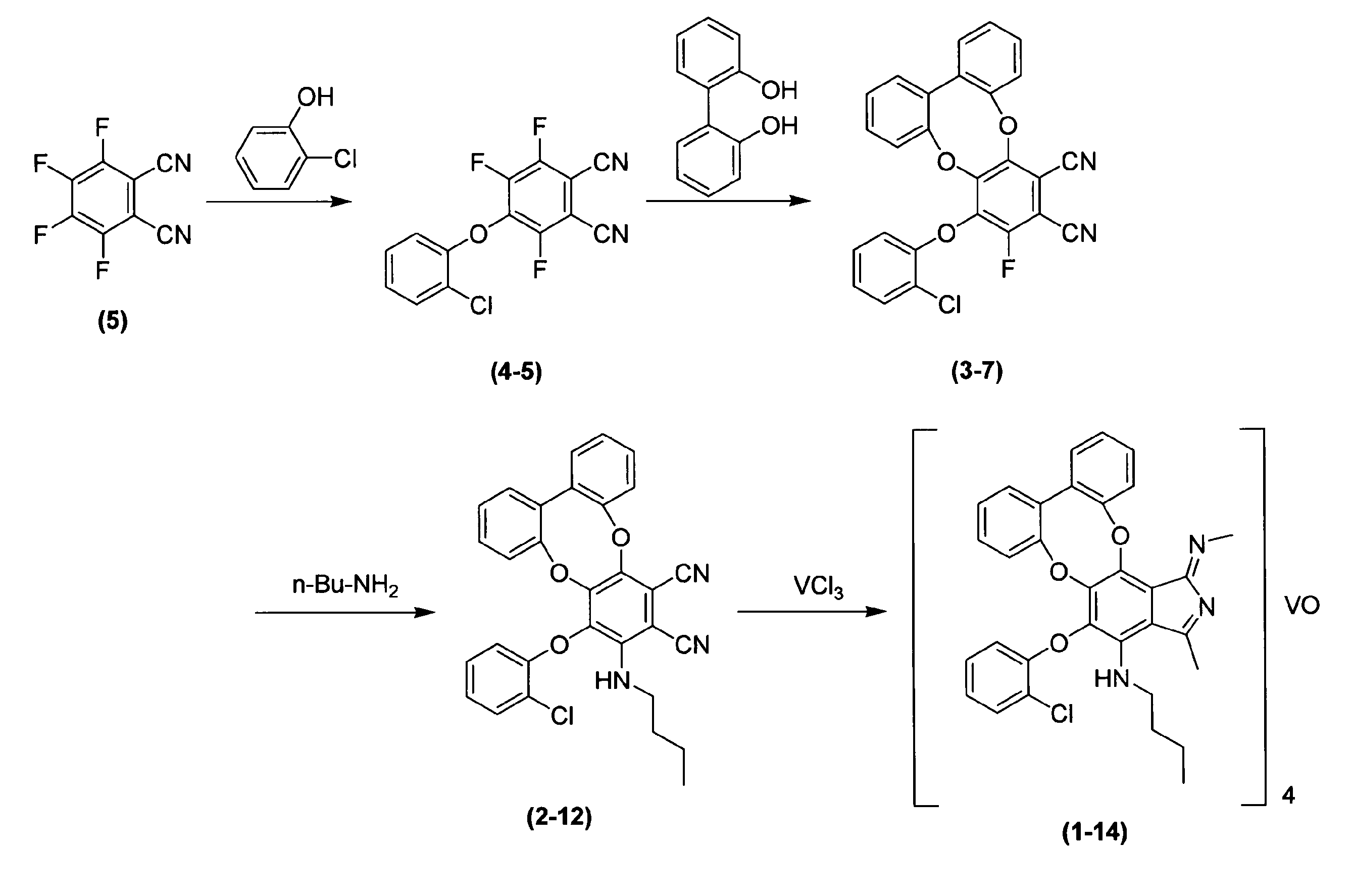
(1)化合物4-5の調製
実施例1(1)化合物(4-1)の調製において、β-ナフトール(化合物(a-1))を2-クロロフェノールに変えた以外は、同様にして、化合物(4-5)を得た(収率100%)。
GC-MS m/z=308(M+)
実施例1(2)化合物(3-1)の調製において、化合物(4-1)を化合物(4-5)に変えた以外は、同様にして、化合物(3-7)を得た(収率84.5%)。
LC-MS m/z=454(M+)
実施例1(3)化合物(2-1)の合成において、化合物(3-1)を化合物(3-7)に変えた以外は、同様にして、化合物(2-12)を得た(収率63.0%)。
LC-MS m/z=508 ([M+H]+)
1H-NMR (CDCl3,δ in ppm) 0.88-0.94(m, 3H), 1.28-1.41(m, 2H), 1.53-1.63(m, 2H), 3.59-3.64(m, 2H), 4.73-4.77(t, 1H), 6.61-6.66(m, 2H), 7.03-7.17(m, 2H), 7.23-7.47(m, 8H)
実施例1(4)化合物(1-1)の合成において、化合物(2-1)を化合物(2-12)に変えた以外は、同様にして、化合物(1-14)を得た(収率19.7%)。
MALDI TOF-MS m/z=2095(M+)
λmax=904 nm ε=165000 l/mol・cm(クロロホルム)
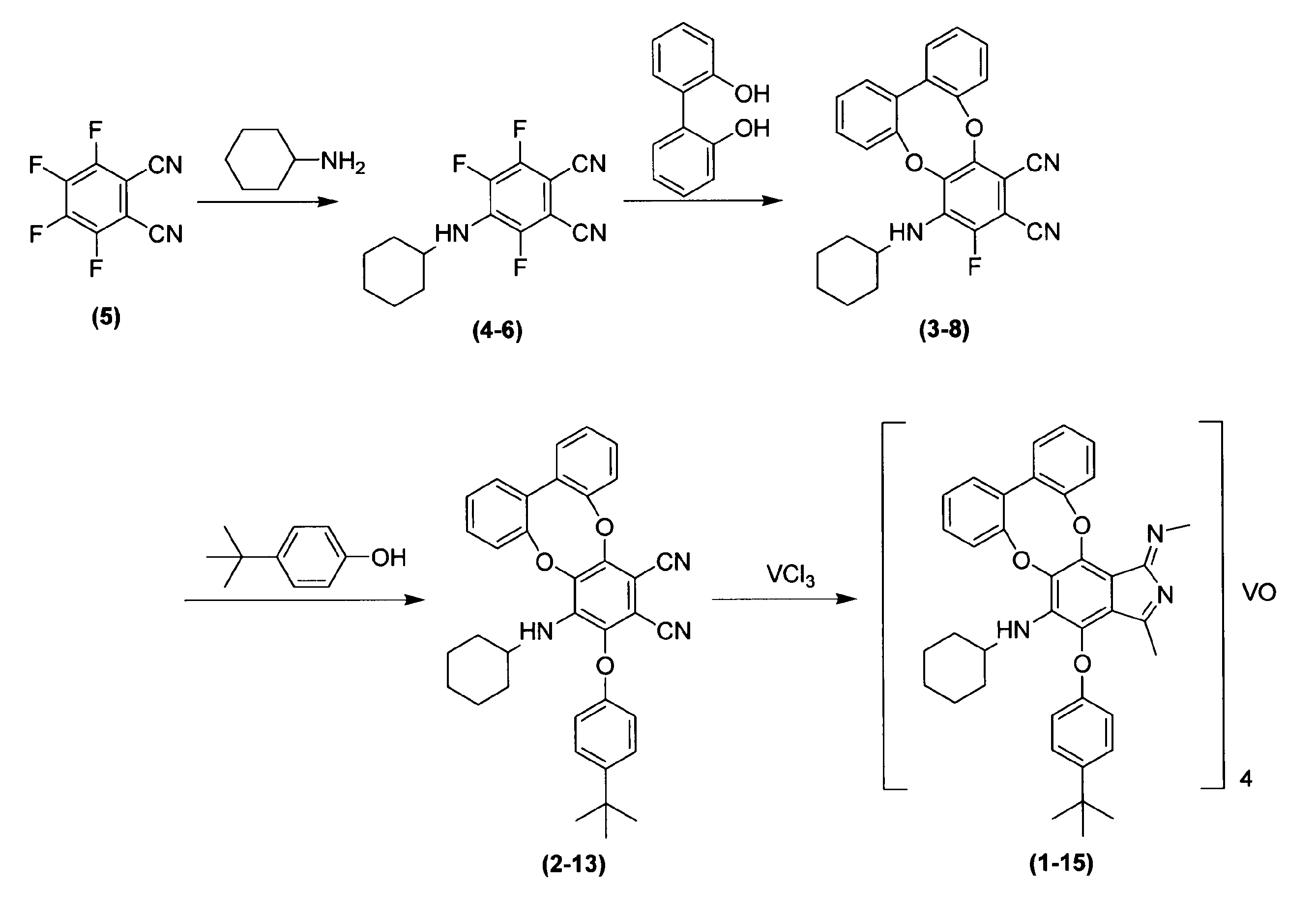
(1)化合物4-6の調製
実施例1(1)化合物(4-1)の調製において、β-ナフトール(化合物(a-1))をシクロヘキシルアミンに変えた以外は、同様にして、化合物(4-6)を得た(収率55.5%)。
GC-MS m/z=279(M+)
実施例1(2)化合物(3-1)の調製において、化合物(4-1)を化合物(4-6)に変えた以外は、同様にして、化合物(3-8)を得た(収率71.3%)。
GC-MS m/z=425(M+)
実施例1(3)化合物(2-1)の合成において、化合物(3-1)を化合物(3-8)に変え、n-ブチルアミン(化合物(c-1))を4-t-ブチルフェノールに変えた以外は、同様にして、化合物(2-13)を得た(収率82.9%)。
LC-MS m/z=556 ([M+H]+)
実施例1(4)化合物(1-1)の合成において、化合物(2-1)を化合物(2-13)に変えた以外は、同様にして、化合物(1-15)を得た(収率31.5%)。
MALDI TOF-MS m/z=2288(M+)
λmax=787 nm ε=216000 l/mol・cm(クロロホルム)
<薄膜作製>
実施例1、2、4、6~8、10~15で得られたフタロシアニン化合物10mgを、それぞれポリメタクリレート18wt%トルエン溶液5mlに溶解し、ガラス基板上にスピンコート法により塗布して乾燥させて、膜厚1.4μmの薄膜を作製した。
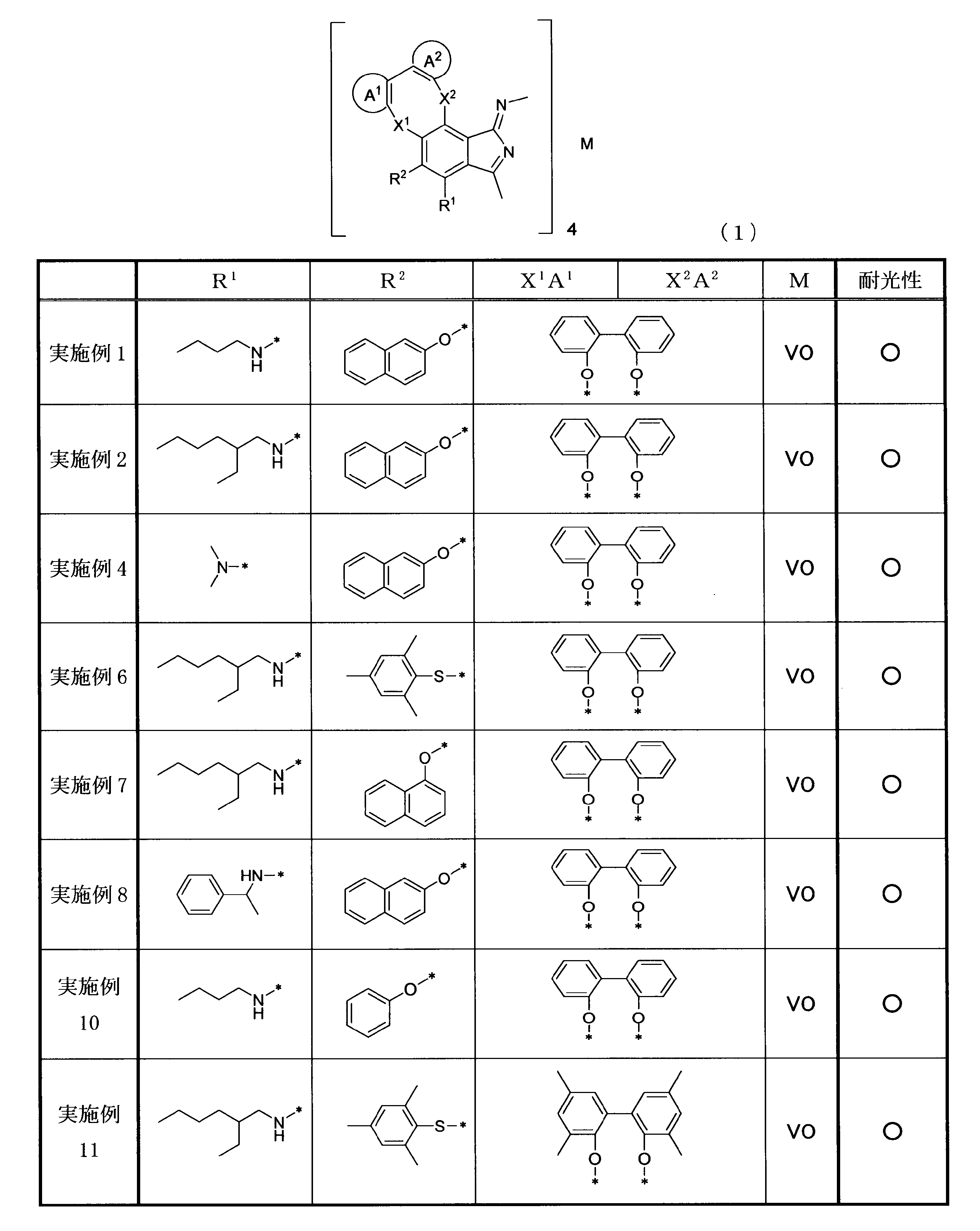
上記<薄膜作成>で得られた薄膜に、キセノン光(142klux)を96時間照射し、照射後の色素残存率をそれぞれ測定した。残存率は次式に従い計算した。透過率とは、作製した薄膜の、吸収極大波長で測定した値である。算出した色素残存率は、下記基準によって評価し、結果を表1及び表2に示した。
○:色素残存率65%以上
△:色素残存率50%以上、65%未満
×:色素残存率50%未満

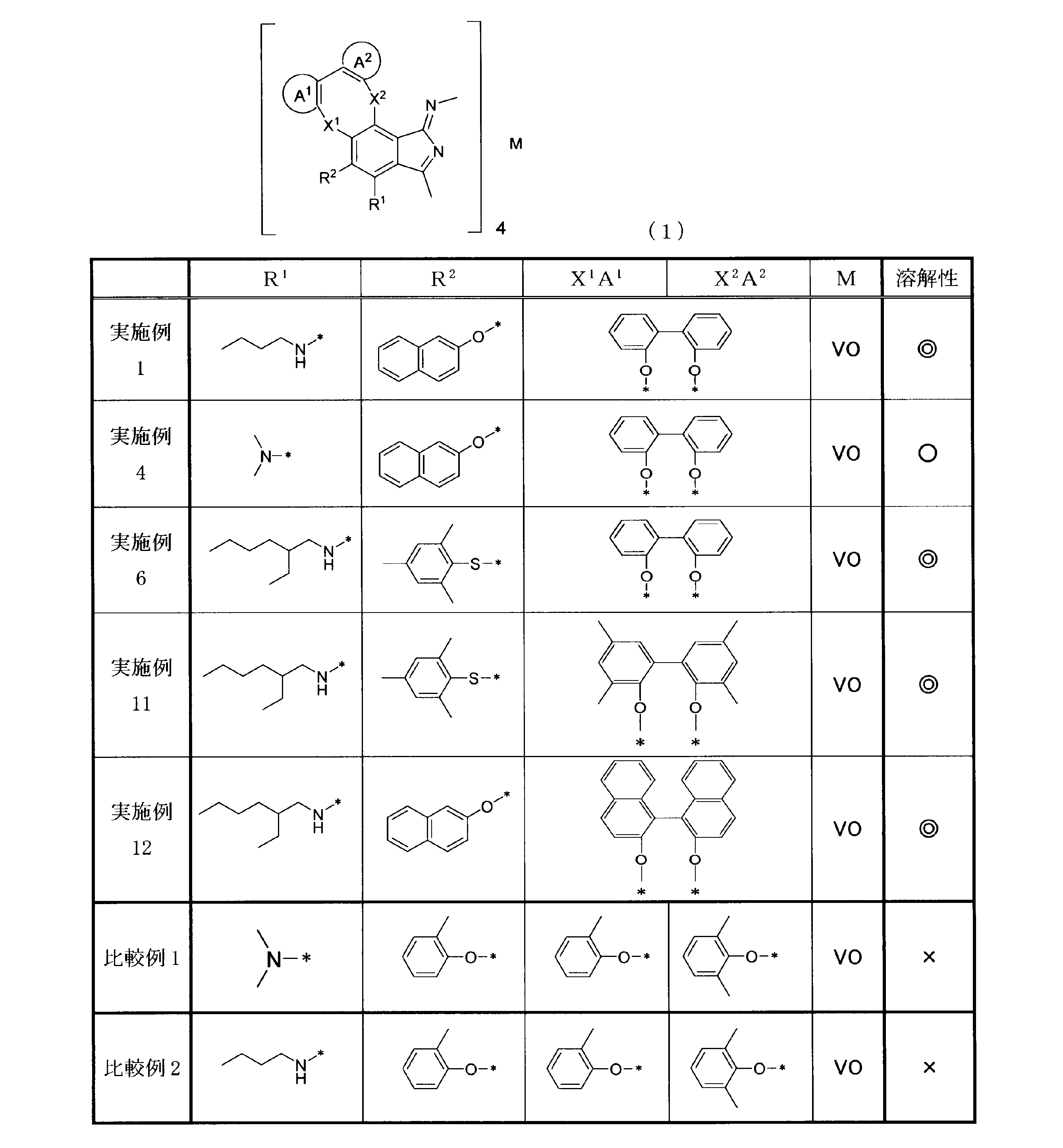
実施例1、4、6、11及び12で得られた化合物フタロシアニン化合物を、ガラス製サンプル瓶に秤り取り、アセトンを混合し室温で攪拌して溶解させ、その溶液の状態を目視観察し、溶解可能な重量濃度を下記基準によって評価した。
○: 10 g/L以上25 g/L未満溶解する
×: 10 g/L未満しか溶解しない
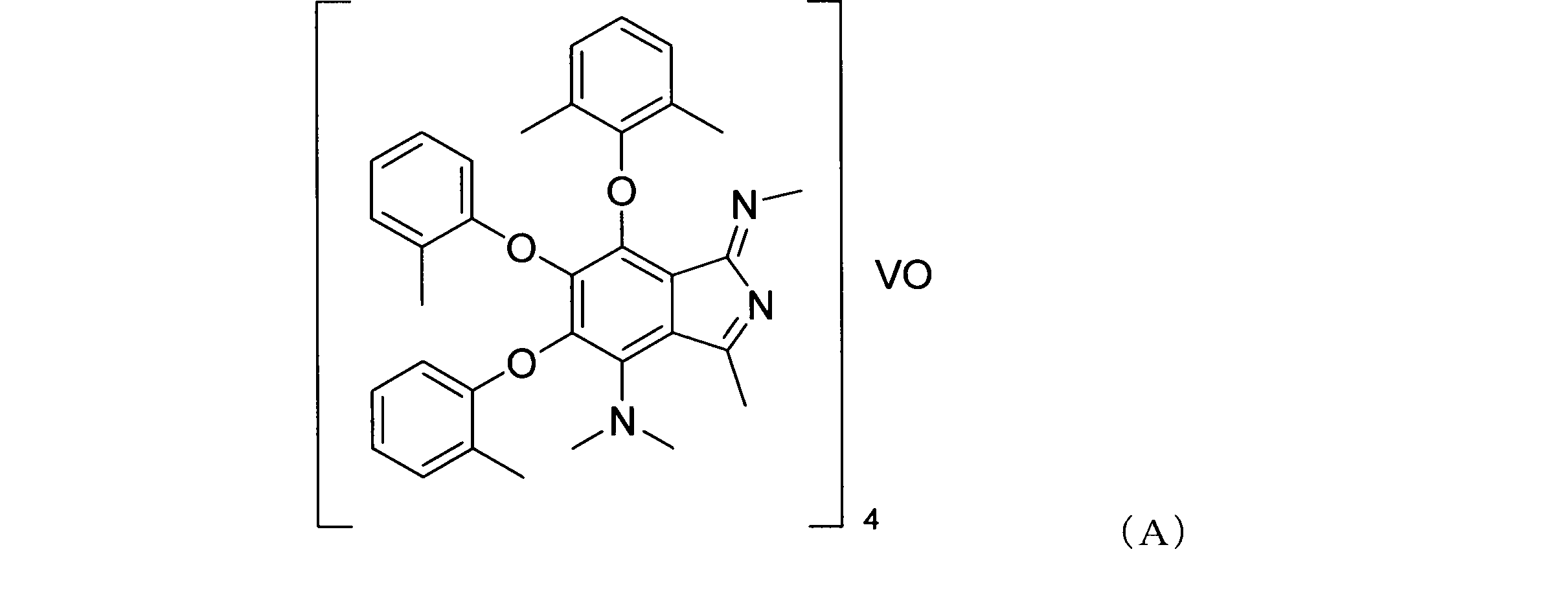
また、比較例として、上記式Aで表される化合物、及び下記式Bで表される化合物(比較例2)についても、同様にして、溶解性評価を行った。結果を表3に示した。

Claims (13)
- 一般式(1)

で表されるフタロシアニン化合物。 - 一般式(1a)~(1d)
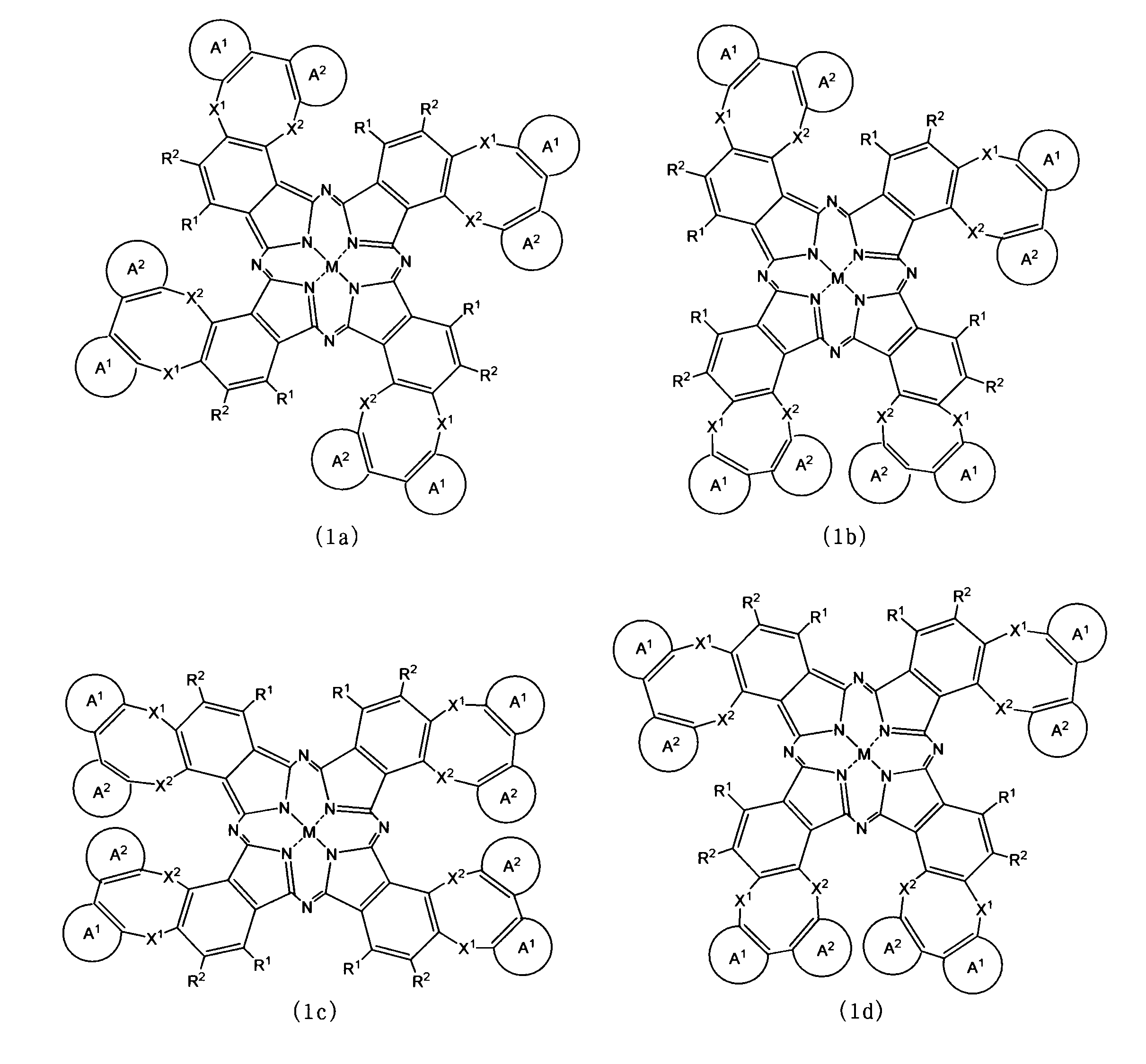
で表される少なくとも1種からなるフタロシアニン化合物。 - R1が、NR3R4基又は置換基を有していてもよいアリールオキシ基であり、
R2が、NR3R4基、置換基を有していてもよいアリールオキシ基又は置換基を有していてもよいアリールチオ基であり、
前記R3及び前記R4が、同一又は異なって、水素原子、置換基を有していてもよいアルキル基、置換基を有していてもよいアリール基又は置換基を有していてもよいアリールアルキル基であり、
X1及びX2が、共に酸素原子であり、
A1及びA2が、共に置換基を有していてもよいベンゼン環又は置換基を有していてもよいナフタレン環である、
請求項1又は2に記載の化合物。 - Mが、Cu、Zn、Co、Ni、Pd、Pb、MnOH、AlCl、FeCl、InCl、SnCl2、VO又はTiOである、請求項1~3のいずれかに記載の化合物。
- 一般式(1)
で表されるフタロシアニン化合物の製造方法であって、
一般式(2)
で表される化合物と、金属又は無機若しくは有機金属化合物とを、塩基の存在下に反応させる方法。 - 一般式(2)
で表される化合物。 - 一般式(2)

で表される化合物の製造方法であって、
一般式(3)
で表される化合物と、下記化合物(b)

とを、塩基の存在下に反応させる方法。 - 請求項5に記載の方法により製造されるフタロシアニン化合物。
- 請求項1~4のいずれかに記載のフタロシアニン化合物からなる近赤外線吸収色素。
- 請求項1~4のいずれかに記載のフタロシアニン化合物を含有する、近赤外線吸収材料。
- 請求項1~4のいずれかに記載のフタロシアニン化合物を含有する、光熱変換材料。
- 請求項1~4のいずれかに記載のフタロシアニン化合物を含有する、遮熱材料。
- 請求項1~4のいずれかに記載のフタロシアニン化合物を含有する、熱線吸収材料。
Priority Applications (2)
| Application Number | Priority Date | Filing Date | Title |
|---|---|---|---|
| JP2015524045A JP6339073B2 (ja) | 2013-06-28 | 2014-06-24 | フタロシアニン化合物、近赤外線吸収色素及び近赤外線吸収材料 |
| KR1020157028091A KR102232999B1 (ko) | 2013-06-28 | 2014-06-24 | 프탈로시아닌 화합물, 근적외선 흡수 색소 및 근적외선 흡수 재료 |
Applications Claiming Priority (2)
| Application Number | Priority Date | Filing Date | Title |
|---|---|---|---|
| JP2013-136971 | 2013-06-28 | ||
| JP2013136971 | 2013-06-28 |
Publications (1)
| Publication Number | Publication Date |
|---|---|
| WO2014208514A1 true WO2014208514A1 (ja) | 2014-12-31 |
Family
ID=52141848
Family Applications (1)
| Application Number | Title | Priority Date | Filing Date |
|---|---|---|---|
| PCT/JP2014/066604 Ceased WO2014208514A1 (ja) | 2013-06-28 | 2014-06-24 | フタロシアニン化合物、近赤外線吸収色素及び近赤外線吸収材料 |
Country Status (4)
| Country | Link |
|---|---|
| JP (1) | JP6339073B2 (ja) |
| KR (1) | KR102232999B1 (ja) |
| TW (1) | TWI621620B (ja) |
| WO (1) | WO2014208514A1 (ja) |
Cited By (6)
| Publication number | Priority date | Publication date | Assignee | Title |
|---|---|---|---|---|
| WO2016163487A1 (ja) * | 2015-04-08 | 2016-10-13 | 出光ユニテック株式会社 | ジッパーテープ、ジッパーテープ付袋体、および、ジッパーテープ付袋体の製造方法、並びに長尺部材を良好に接合できる長尺部材の接合方法、その装置およびジッパーテープの接合装置 |
| JP2016198919A (ja) * | 2015-04-08 | 2016-12-01 | 出光ユニテック株式会社 | 長尺部材の接合方法およびその装置、並びにジッパーテープ付袋体の製造方法 |
| KR20170003451A (ko) * | 2015-06-30 | 2017-01-09 | 주식회사 두산 | 유기 발광 화합물 및 이를 이용한 유기 전계 발광 소자 |
| WO2021070693A1 (ja) | 2019-10-07 | 2021-04-15 | 住友化学株式会社 | 着色硬化性樹脂組成物 |
| JP2021060580A (ja) * | 2019-10-07 | 2021-04-15 | 住友化学株式会社 | 着色樹脂組成物 |
| WO2022013112A1 (fr) * | 2020-07-16 | 2022-01-20 | Commissariat à l'Energie Atomique et aux Energies Alternatives | Composes organiques a emission de fluorescence retardee et de lumiere circulairement polarisee et leur utilisation |
Citations (4)
| Publication number | Priority date | Publication date | Assignee | Title |
|---|---|---|---|---|
| JPH101481A (ja) * | 1996-02-02 | 1998-01-06 | Zeneca Ltd | フタロシアニン化合物 |
| JP2005272588A (ja) * | 2004-03-24 | 2005-10-06 | Toyo Ink Mfg Co Ltd | 近赤外線吸収組成物、およびそれを使用して成る近赤外線吸収積層体 |
| JP2008101188A (ja) * | 2006-09-21 | 2008-05-01 | Nitto Denko Corp | 光半導体封止用エポキシ樹脂組成物およびその硬化体ならびにそれを用いた光半導体装置 |
| JP2011063540A (ja) * | 2009-09-16 | 2011-03-31 | Nippon Shokubai Co Ltd | フタロシアニン化合物 |
Family Cites Families (2)
| Publication number | Priority date | Publication date | Assignee | Title |
|---|---|---|---|---|
| JP4436481B2 (ja) * | 1999-03-30 | 2010-03-24 | 山本化成株式会社 | フタロシアニン化合物、その製造方法及びこれを含有する近赤外線吸収剤 |
| JP6007428B2 (ja) | 2011-10-26 | 2016-10-12 | 山田化学工業株式会社 | フタロシアニン化合物及びその合成方法、近赤外吸収色素並びに近赤外吸収材 |
-
2014
- 2014-06-24 WO PCT/JP2014/066604 patent/WO2014208514A1/ja not_active Ceased
- 2014-06-24 KR KR1020157028091A patent/KR102232999B1/ko active Active
- 2014-06-24 JP JP2015524045A patent/JP6339073B2/ja active Active
- 2014-06-27 TW TW103122272A patent/TWI621620B/zh active
Patent Citations (4)
| Publication number | Priority date | Publication date | Assignee | Title |
|---|---|---|---|---|
| JPH101481A (ja) * | 1996-02-02 | 1998-01-06 | Zeneca Ltd | フタロシアニン化合物 |
| JP2005272588A (ja) * | 2004-03-24 | 2005-10-06 | Toyo Ink Mfg Co Ltd | 近赤外線吸収組成物、およびそれを使用して成る近赤外線吸収積層体 |
| JP2008101188A (ja) * | 2006-09-21 | 2008-05-01 | Nitto Denko Corp | 光半導体封止用エポキシ樹脂組成物およびその硬化体ならびにそれを用いた光半導体装置 |
| JP2011063540A (ja) * | 2009-09-16 | 2011-03-31 | Nippon Shokubai Co Ltd | フタロシアニン化合物 |
Cited By (18)
| Publication number | Priority date | Publication date | Assignee | Title |
|---|---|---|---|---|
| US11370064B2 (en) | 2015-04-08 | 2022-06-28 | Idemitsu Unitech Co., Ltd. | Zipper tape, bag with zipper tape, method for manufacturing bag with zipper tape, long member-bonding method capable of favorably bonding long members, device therefor, and zipper tape-bonding device |
| JP2016198919A (ja) * | 2015-04-08 | 2016-12-01 | 出光ユニテック株式会社 | 長尺部材の接合方法およびその装置、並びにジッパーテープ付袋体の製造方法 |
| TWI681907B (zh) * | 2015-04-08 | 2020-01-11 | 日商出光統一科技股份有限公司 | 夾鏈帶、附夾鏈帶之袋體、及附夾鏈帶之袋體之製造方法、以及可良好接合長形構件之長形構件之接合方法、其裝置及夾鏈帶之接合裝置 |
| WO2016163487A1 (ja) * | 2015-04-08 | 2016-10-13 | 出光ユニテック株式会社 | ジッパーテープ、ジッパーテープ付袋体、および、ジッパーテープ付袋体の製造方法、並びに長尺部材を良好に接合できる長尺部材の接合方法、その装置およびジッパーテープの接合装置 |
| KR20170003451A (ko) * | 2015-06-30 | 2017-01-09 | 주식회사 두산 | 유기 발광 화합물 및 이를 이용한 유기 전계 발광 소자 |
| KR102736381B1 (ko) * | 2015-06-30 | 2024-12-02 | 솔루스첨단소재 주식회사 | 유기 발광 화합물 및 이를 이용한 유기 전계 발광 소자 |
| US20220289944A1 (en) * | 2019-10-07 | 2022-09-15 | Sumitomo Chemical Company, Limited | Colored resin composition |
| WO2021070694A1 (ja) | 2019-10-07 | 2021-04-15 | 住友化学株式会社 | 着色樹脂組成物 |
| CN114402017A (zh) * | 2019-10-07 | 2022-04-26 | 住友化学株式会社 | 着色树脂组合物 |
| JP2021059721A (ja) * | 2019-10-07 | 2021-04-15 | 住友化学株式会社 | 着色硬化性樹脂組成物 |
| JP2021060580A (ja) * | 2019-10-07 | 2021-04-15 | 住友化学株式会社 | 着色樹脂組成物 |
| JP7572827B2 (ja) | 2019-10-07 | 2024-10-24 | 住友化学株式会社 | 着色硬化性樹脂組成物 |
| WO2021070693A1 (ja) | 2019-10-07 | 2021-04-15 | 住友化学株式会社 | 着色硬化性樹脂組成物 |
| JP7594402B2 (ja) | 2019-10-07 | 2024-12-04 | 住友化学株式会社 | 着色樹脂組成物 |
| WO2022013112A1 (fr) * | 2020-07-16 | 2022-01-20 | Commissariat à l'Energie Atomique et aux Energies Alternatives | Composes organiques a emission de fluorescence retardee et de lumiere circulairement polarisee et leur utilisation |
| FR3112550A1 (fr) * | 2020-07-16 | 2022-01-21 | Commissariat A L'energie Atomique Et Aux Energies Alternatives | Composes organiques a emission de fluorescence retardee et de lumiere circulairement polarisee et leur utilisation |
| JP2023533581A (ja) * | 2020-07-16 | 2023-08-03 | コミサリア ア レネルジィ アトミーク エ オ ゼネ ルジイ アルテアナティーフ | 遅延蛍光発光及び円偏光発光を有する有機化合物並びにその使用 |
| JP7857906B2 (ja) | 2020-07-16 | 2026-05-13 | コミサリア ア レネルジィ アトミーク エ オ ゼネ ルジイ アルテアナティーフ | 遅延蛍光発光及び円偏光発光を有する有機化合物並びにその使用 |
Also Published As
| Publication number | Publication date |
|---|---|
| KR20160040133A (ko) | 2016-04-12 |
| TW201518303A (zh) | 2015-05-16 |
| JPWO2014208514A1 (ja) | 2017-02-23 |
| JP6339073B2 (ja) | 2018-06-06 |
| KR102232999B1 (ko) | 2021-03-26 |
| TWI621620B (zh) | 2018-04-21 |
Similar Documents
| Publication | Publication Date | Title |
|---|---|---|
| JP6339073B2 (ja) | フタロシアニン化合物、近赤外線吸収色素及び近赤外線吸収材料 | |
| JP6233811B2 (ja) | フタロシアニン化合物、近赤外線吸収色素及び近赤外線吸収材料 | |
| US20100274023A1 (en) | Novel intermediate compounds for the preparation of meso-substituted cyanine, merocyanine and oxonole dyes | |
| JP2614890B2 (ja) | フタロシアニン化合物 | |
| WO2006124602A2 (en) | Novel rhodamine dyes | |
| JP6396194B2 (ja) | フタロシアニン化合物、近赤外線吸収色素及び近赤外線吸収材料 | |
| JP3260317B2 (ja) | アミノ置換芳香族化合物の製造方法 | |
| JP3565071B2 (ja) | フタロシアニン化合物、その中間体、該化合物の製造方法及びその用途 | |
| JPH06192584A (ja) | 新規フタロシアニン化合物、その製造方法およびそれらを含んでなる近赤外線吸収材料 | |
| JPH10182995A (ja) | 新規フタロシアニン化合物、その製造方法および近赤外吸収材料 | |
| JP2000063691A (ja) | フタロシアニン化合物およびこれを用いてなる近赤外吸収色素 | |
| JP3287129B2 (ja) | フタロシアニン化合物、その中間体、該化合物の製造方法及びこれを含有する近赤外線吸収材料 | |
| US6093832A (en) | Diiminoisoindoline compound and the process for producing the compound and use thereof | |
| JP6407713B2 (ja) | レーザー溶着用樹脂組成物 | |
| DE69613620T2 (de) | Neue Indoanilinmetallkomplexe, Verfahren an deren Herstellung , transparentes Aufzeichnungsmaterial und optisches Aufzeichnungsmaterial durch deren Verwendung | |
| JP3271893B2 (ja) | 新規インドアニリン金属錯体、その製造方法、それを用いた透明記録体及び光学記録媒体 | |
| JP3781466B2 (ja) | 近赤外線吸収化合物およびその製造方法 | |
| JPH0796540B2 (ja) | フタロシアニン化合物およびその中間体 | |
| EP1686157A1 (en) | Nonsolvate-form crystal of polymethine compound and process for producing the same | |
| JPH1036376A (ja) | 赤外線吸収性フタロシアニン | |
| JP4790631B2 (ja) | ポリメチン系化合物の非溶媒和型結晶、その製造方法及び用途 | |
| JP2000281918A (ja) | フタロシアニン化合物及びこれを用いた近赤外線吸収剤 | |
| JPH08225752A (ja) | 近赤外線吸収化合物およびその製造方法 | |
| JPH1059921A (ja) | フタロニトリル化合物およびフタロシアニン化合物の新規製造方法 | |
| JPWO2004113453A1 (ja) | 結晶性非溶媒和型ポリメチン系化合物 |
Legal Events
| Date | Code | Title | Description |
|---|---|---|---|
| 121 | Ep: the epo has been informed by wipo that ep was designated in this application |
Ref document number: 14817773 Country of ref document: EP Kind code of ref document: A1 |
|
| ENP | Entry into the national phase |
Ref document number: 2015524045 Country of ref document: JP Kind code of ref document: A |
|
| ENP | Entry into the national phase |
Ref document number: 20157028091 Country of ref document: KR Kind code of ref document: A |
|
| NENP | Non-entry into the national phase |
Ref country code: DE |
|
| 122 | Ep: pct application non-entry in european phase |
Ref document number: 14817773 Country of ref document: EP Kind code of ref document: A1 |