WO2014199872A1 - 赤外遮蔽フィルムおよびこれを用いた赤外遮蔽体および熱線反射合わせガラス - Google Patents
赤外遮蔽フィルムおよびこれを用いた赤外遮蔽体および熱線反射合わせガラス Download PDFInfo
- Publication number
- WO2014199872A1 WO2014199872A1 PCT/JP2014/064782 JP2014064782W WO2014199872A1 WO 2014199872 A1 WO2014199872 A1 WO 2014199872A1 JP 2014064782 W JP2014064782 W JP 2014064782W WO 2014199872 A1 WO2014199872 A1 WO 2014199872A1
- Authority
- WO
- WIPO (PCT)
- Prior art keywords
- refractive index
- layer
- infrared shielding
- film
- hard coat
- Prior art date
- Legal status (The legal status is an assumption and is not a legal conclusion. Google has not performed a legal analysis and makes no representation as to the accuracy of the status listed.)
- Ceased
Links
Classifications
-
- C—CHEMISTRY; METALLURGY
- C03—GLASS; MINERAL OR SLAG WOOL
- C03C—CHEMICAL COMPOSITION OF GLASSES, GLAZES OR VITREOUS ENAMELS; SURFACE TREATMENT OF GLASS; SURFACE TREATMENT OF FIBRES OR FILAMENTS MADE FROM GLASS, MINERALS OR SLAGS; JOINING GLASS TO GLASS OR OTHER MATERIALS
- C03C17/00—Surface treatment of glass, not in the form of fibres or filaments, by coating
- C03C17/34—Surface treatment of glass, not in the form of fibres or filaments, by coating with at least two coatings having different compositions
-
- B—PERFORMING OPERATIONS; TRANSPORTING
- B32—LAYERED PRODUCTS
- B32B—LAYERED PRODUCTS, i.e. PRODUCTS BUILT-UP OF STRATA OF FLAT OR NON-FLAT, e.g. CELLULAR OR HONEYCOMB, FORM
- B32B17/00—Layered products essentially comprising sheet glass, or glass, slag, or like fibres
- B32B17/06—Layered products essentially comprising sheet glass, or glass, slag, or like fibres comprising glass as the main or only constituent of a layer, next to another layer of a specific material
- B32B17/10—Layered products essentially comprising sheet glass, or glass, slag, or like fibres comprising glass as the main or only constituent of a layer, next to another layer of a specific material of synthetic resin
- B32B17/10005—Layered products essentially comprising sheet glass, or glass, slag, or like fibres comprising glass as the main or only constituent of a layer, next to another layer of a specific material of synthetic resin laminated safety glass or glazing
- B32B17/1055—Layered products essentially comprising sheet glass, or glass, slag, or like fibres comprising glass as the main or only constituent of a layer, next to another layer of a specific material of synthetic resin laminated safety glass or glazing characterized by the resin layer, i.e. interlayer
- B32B17/10614—Layered products essentially comprising sheet glass, or glass, slag, or like fibres comprising glass as the main or only constituent of a layer, next to another layer of a specific material of synthetic resin laminated safety glass or glazing characterized by the resin layer, i.e. interlayer comprising particles for purposes other than dyeing
- B32B17/10633—Infrared radiation absorbing or reflecting agents
-
- B—PERFORMING OPERATIONS; TRANSPORTING
- B32—LAYERED PRODUCTS
- B32B—LAYERED PRODUCTS, i.e. PRODUCTS BUILT-UP OF STRATA OF FLAT OR NON-FLAT, e.g. CELLULAR OR HONEYCOMB, FORM
- B32B17/00—Layered products essentially comprising sheet glass, or glass, slag, or like fibres
- B32B17/06—Layered products essentially comprising sheet glass, or glass, slag, or like fibres comprising glass as the main or only constituent of a layer, next to another layer of a specific material
- B32B17/10—Layered products essentially comprising sheet glass, or glass, slag, or like fibres comprising glass as the main or only constituent of a layer, next to another layer of a specific material of synthetic resin
- B32B17/10005—Layered products essentially comprising sheet glass, or glass, slag, or like fibres comprising glass as the main or only constituent of a layer, next to another layer of a specific material of synthetic resin laminated safety glass or glazing
- B32B17/1055—Layered products essentially comprising sheet glass, or glass, slag, or like fibres comprising glass as the main or only constituent of a layer, next to another layer of a specific material of synthetic resin laminated safety glass or glazing characterized by the resin layer, i.e. interlayer
- B32B17/10651—Layered products essentially comprising sheet glass, or glass, slag, or like fibres comprising glass as the main or only constituent of a layer, next to another layer of a specific material of synthetic resin laminated safety glass or glazing characterized by the resin layer, i.e. interlayer comprising colorants, e.g. dyes or pigments
-
- B—PERFORMING OPERATIONS; TRANSPORTING
- B32—LAYERED PRODUCTS
- B32B—LAYERED PRODUCTS, i.e. PRODUCTS BUILT-UP OF STRATA OF FLAT OR NON-FLAT, e.g. CELLULAR OR HONEYCOMB, FORM
- B32B17/00—Layered products essentially comprising sheet glass, or glass, slag, or like fibres
- B32B17/06—Layered products essentially comprising sheet glass, or glass, slag, or like fibres comprising glass as the main or only constituent of a layer, next to another layer of a specific material
- B32B17/10—Layered products essentially comprising sheet glass, or glass, slag, or like fibres comprising glass as the main or only constituent of a layer, next to another layer of a specific material of synthetic resin
- B32B17/10005—Layered products essentially comprising sheet glass, or glass, slag, or like fibres comprising glass as the main or only constituent of a layer, next to another layer of a specific material of synthetic resin laminated safety glass or glazing
- B32B17/1055—Layered products essentially comprising sheet glass, or glass, slag, or like fibres comprising glass as the main or only constituent of a layer, next to another layer of a specific material of synthetic resin laminated safety glass or glazing characterized by the resin layer, i.e. interlayer
- B32B17/10761—Layered products essentially comprising sheet glass, or glass, slag, or like fibres comprising glass as the main or only constituent of a layer, next to another layer of a specific material of synthetic resin laminated safety glass or glazing characterized by the resin layer, i.e. interlayer containing vinyl acetal
-
- B—PERFORMING OPERATIONS; TRANSPORTING
- B32—LAYERED PRODUCTS
- B32B—LAYERED PRODUCTS, i.e. PRODUCTS BUILT-UP OF STRATA OF FLAT OR NON-FLAT, e.g. CELLULAR OR HONEYCOMB, FORM
- B32B17/00—Layered products essentially comprising sheet glass, or glass, slag, or like fibres
- B32B17/06—Layered products essentially comprising sheet glass, or glass, slag, or like fibres comprising glass as the main or only constituent of a layer, next to another layer of a specific material
- B32B17/10—Layered products essentially comprising sheet glass, or glass, slag, or like fibres comprising glass as the main or only constituent of a layer, next to another layer of a specific material of synthetic resin
- B32B17/10005—Layered products essentially comprising sheet glass, or glass, slag, or like fibres comprising glass as the main or only constituent of a layer, next to another layer of a specific material of synthetic resin laminated safety glass or glazing
- B32B17/1055—Layered products essentially comprising sheet glass, or glass, slag, or like fibres comprising glass as the main or only constituent of a layer, next to another layer of a specific material of synthetic resin laminated safety glass or glazing characterized by the resin layer, i.e. interlayer
- B32B17/10788—Layered products essentially comprising sheet glass, or glass, slag, or like fibres comprising glass as the main or only constituent of a layer, next to another layer of a specific material of synthetic resin laminated safety glass or glazing characterized by the resin layer, i.e. interlayer containing ethylene vinylacetate
-
- B—PERFORMING OPERATIONS; TRANSPORTING
- B32—LAYERED PRODUCTS
- B32B—LAYERED PRODUCTS, i.e. PRODUCTS BUILT-UP OF STRATA OF FLAT OR NON-FLAT, e.g. CELLULAR OR HONEYCOMB, FORM
- B32B7/00—Layered products characterised by the relation between layers; Layered products characterised by the relative orientation of features between layers, or by the relative values of a measurable parameter between layers, i.e. products comprising layers having different physical, chemical or physicochemical properties; Layered products characterised by the interconnection of layers
- B32B7/02—Physical, chemical or physicochemical properties
- B32B7/023—Optical properties
-
- G—PHYSICS
- G02—OPTICS
- G02B—OPTICAL ELEMENTS, SYSTEMS OR APPARATUS
- G02B5/00—Optical elements other than lenses
- G02B5/20—Filters
- G02B5/28—Interference filters
- G02B5/281—Interference filters designed for the infrared light
- G02B5/282—Interference filters designed for the infrared light reflecting for infrared and transparent for visible light, e.g. heat reflectors, laser protection
-
- G—PHYSICS
- G02—OPTICS
- G02B—OPTICAL ELEMENTS, SYSTEMS OR APPARATUS
- G02B5/00—Optical elements other than lenses
- G02B5/20—Filters
- G02B5/28—Interference filters
- G02B5/285—Interference filters comprising deposited thin solid films
-
- B—PERFORMING OPERATIONS; TRANSPORTING
- B32—LAYERED PRODUCTS
- B32B—LAYERED PRODUCTS, i.e. PRODUCTS BUILT-UP OF STRATA OF FLAT OR NON-FLAT, e.g. CELLULAR OR HONEYCOMB, FORM
- B32B2307/00—Properties of the layers or laminate
- B32B2307/40—Properties of the layers or laminate having particular optical properties
-
- B—PERFORMING OPERATIONS; TRANSPORTING
- B32—LAYERED PRODUCTS
- B32B—LAYERED PRODUCTS, i.e. PRODUCTS BUILT-UP OF STRATA OF FLAT OR NON-FLAT, e.g. CELLULAR OR HONEYCOMB, FORM
- B32B2605/00—Vehicles
-
- C—CHEMISTRY; METALLURGY
- C03—GLASS; MINERAL OR SLAG WOOL
- C03C—CHEMICAL COMPOSITION OF GLASSES, GLAZES OR VITREOUS ENAMELS; SURFACE TREATMENT OF GLASS; SURFACE TREATMENT OF FIBRES OR FILAMENTS MADE FROM GLASS, MINERALS OR SLAGS; JOINING GLASS TO GLASS OR OTHER MATERIALS
- C03C2217/00—Coatings on glass
- C03C2217/40—Coatings comprising at least one inhomogeneous layer
- C03C2217/43—Coatings comprising at least one inhomogeneous layer consisting of a dispersed phase in a continuous phase
- C03C2217/46—Coatings comprising at least one inhomogeneous layer consisting of a dispersed phase in a continuous phase characterized by the dispersed phase
- C03C2217/47—Coatings comprising at least one inhomogeneous layer consisting of a dispersed phase in a continuous phase characterized by the dispersed phase consisting of a specific material
- C03C2217/475—Inorganic materials
-
- C—CHEMISTRY; METALLURGY
- C03—GLASS; MINERAL OR SLAG WOOL
- C03C—CHEMICAL COMPOSITION OF GLASSES, GLAZES OR VITREOUS ENAMELS; SURFACE TREATMENT OF GLASS; SURFACE TREATMENT OF FIBRES OR FILAMENTS MADE FROM GLASS, MINERALS OR SLAGS; JOINING GLASS TO GLASS OR OTHER MATERIALS
- C03C2217/00—Coatings on glass
- C03C2217/70—Properties of coatings
- C03C2217/73—Anti-reflective coatings with specific characteristics
- C03C2217/734—Anti-reflective coatings with specific characteristics comprising an alternation of high and low refractive indexes
Definitions
- the present invention relates to an infrared shielding film, an infrared shielding body using the same, and a heat ray reflective laminated glass.
- the light emitted from the sun has a wide spectrum from the ultraviolet region to the infrared light region.
- infrared light occupies about 50% of sunlight, and the infrared light mainly includes near infrared light having a wavelength close to that of visible light (wavelength of about 750 to 2500 nm) and mid-infrared light having a wavelength longer than that. (About 2500 to 4000 nm) and far infrared (wavelength of about 4000 nm or more).
- Such infrared light has a long wavelength compared to ultraviolet light, so its energy is small.
- its thermal effect is large, and when it is absorbed by a substance, it is released as heat and causes a temperature rise. For this reason, infrared light is also called heat rays, and by reflecting infrared light, for example, an increase in indoor temperature can be suppressed.
- the film that reflects infrared light is attached to the window glass of buildings and vehicles, and the load on the cooling equipment is reduced by reflecting the transmission of solar heat rays. An attempt is being made. On the other hand, if such an infrared shielding film reflects visible light having a wavelength close to that of infrared light, the transparency of the film cannot be secured and the film is colored. Therefore, it can be said that an infrared shielding film that selectively reflects infrared light and transmits visible light is preferable.
- Such an infrared shielding film capable of selectively reflecting infrared light and transmitting visible light is usually a low refractive index layer having a relatively low refractive index and a relatively high refractive index. And a high-refractive index layer having a dielectric multilayer film. At this time, for the high refractive index layer and the low refractive index layer, infrared light can be selectively reflected by controlling the optical film thickness, which is the product of the refractive index and the film thickness, to cause interference.
- the hard coat layer is used for the purpose of preventing the surface from being scratched during cleaning. Sometimes formed.
- JP 2010-191969 A discloses a transparent hard coat film having a transparent hard coat film composed of a cured product of a coating liquid containing an ionizing radiation curable resin and a blue inorganic pigment.
- An invention relating to a coat film is described.
- JP 2010-191969 discloses, L * values in the material of the film thickness and the L * a * b * color system constituting the transparent hard coat film, a * value, and b * controls the value of By doing so, it is described that a desired hue can be obtained.
- the optical film thickness of the above-described infrared shielding film is controlled so that infrared rays can be selectively reflected.
- the infrared shielding film in which the control of the optical film thickness is controlled may have a different color tone depending on the viewing angle.
- an object of the present invention is to provide an infrared shielding film having excellent heat shielding performance while reducing the angle dependency of the color tone.
- the present inventors have found that the above problem can be solved by controlling the values of a * and b * in the L * a * b * color system of an infrared shielding film provided with a hard coat layer. The inventors have found that this can be solved, and have completed the present invention.
- the dielectric multi-layer film comprising a high refractive index layer and the low refractive index layer comprises a hard coat layer, a, L * a * b * a in the color system * is a * ⁇ -3.5, And an infrared shielding film in which b * is ⁇ 12 ⁇ b * ⁇ 5; (2) The infrared shielding film according to (1), wherein b * is ⁇ 12 ⁇ b * ⁇ 2.
- an infrared shielding film including a dielectric multilayer film including a high refractive index layer and a low refractive index layer, and a hard coat layer.
- a * in the L * a * b * color system of the infrared shielding film is a * ⁇ -3.5, and wherein the b * is -12 ⁇ b * ⁇ 5 .
- the infrared shielding film which concerns on this form, the infrared shielding film which is excellent in heat-shielding performance can be provided, reducing the angle dependence of a color tone.
- the infrared shielding film includes a dielectric multilayer film and a hard coat layer.
- L * a * b * color system was developed by the International Commission on Illumination (CIE).
- L * is called “lightness index” and indicates lightness
- a * ” and “b * ” are called “chromicness index” and indicate positions corresponding to hue and saturation. Is. Regarding the hue and saturation, if the value of a * is negative, the color is green, and if the value of a * is positive, the color is red. If the value of b * is negative, the color is blue. If the value of b * is positive, the color is yellow.
- the value of a * in the L * a * b * color system is ⁇ 3.5 or less (a * ⁇ ⁇ 3.5), preferably ⁇ 10 to ⁇ 3.5 ( ⁇ 10 ⁇ a * ⁇ ⁇ 3.5), more preferably ⁇ 5.0 to ⁇ 3.5 ( ⁇ 5.0 ⁇ a * ⁇ ⁇ 3.5).
- the value of b * in the L * a * b * color system is ⁇ 12 to 5 ( ⁇ 12 ⁇ b * ⁇ 5), preferably ⁇ 12 to 2 ( ⁇ 12 ⁇ b * ⁇ 2). More preferably, it is ⁇ 10 to ⁇ 1.0 ( ⁇ 10 ⁇ b * ⁇ ⁇ 1.0).
- the combinations of the values of a * and b * in the L * a * b * color system are a * ⁇ ⁇ 3.5 and ⁇ 12 ⁇ b * ⁇ 5, preferably a * ⁇ ⁇ . 3.5 and ⁇ 12 ⁇ b * ⁇ 2, more preferably ⁇ 5.0 ⁇ a * ⁇ ⁇ 3.5 and ⁇ 10 ⁇ b * ⁇ ⁇ 1.0.
- L * is not particularly limited, but is preferably 80 or more, and more preferably 80 to 90. It is preferable that the value of L * is 80 or more because the transmittance can be increased.
- the “a * value”, “b * value”, and “L * value” in the L * a * b * color system refer to a spectrophotometer U-4100 (manufactured by Shimadzu Corporation). The value obtained by measuring the transmittance in the visible light region (360 to 740 nm) is used.
- the optical film thickness of the infrared shielding film having the dielectric multilayer film in which the high refractive index layer and the low refractive index layer are laminated is controlled so that infrared rays can be selectively reflected.
- the optical film thickness is adjusted to be 1 ⁇ 4 of the desired wavelength. For this reason, the longer the optical film thickness, the longer the wavelength of light is reflected.
- the optical film thickness is relatively increased as compared with the case where the light is incident vertically. As a result, compared with the case where the infrared shielding film is viewed from the front, a red color based on long wavelength light can be observed when viewed from an oblique direction.
- the color tone depending on the observation angle is controlled by controlling the a * value and b * in the L * a * b * color system of the infrared shielding film in which the hard coat layer is provided on the dielectric multilayer film. Changes can be prevented.
- the value of a * and the value of b * tend to decrease by reducing the optical film thickness of the dielectric multilayer film.
- the value of a * tends to decrease by adding a green pigment or dye to the hard coat layer.
- the value of b * tends to decrease by adding a blue pigment or dye to the hard coat layer.
- the degree of color tone change depending on the observation angle can be evaluated using reflectance. Specifically, the change in color tone depending on the observation angle is evaluated by comparing the regular reflectance with an incident angle of 5 degrees with the regular reflectance with an incident angle of 60 degrees with respect to the normal of the dielectric multilayer film. can do. At this time, the wavelength of the irradiated light is 730 nm.
- the value of “regular reflectance” is a value measured using a spectrophotometer U-4100 (manufactured by Shimadzu Corporation).
- the dielectric multilayer film includes a high refractive index layer and a low refractive index layer.
- the dielectric multilayer film includes a refractive index layer having a different refractive index, so that when infrared light is irradiated, at least part of the infrared light is reflected and an infrared shielding effect is exhibited. it can.
- whether the refractive index layer constituting the dielectric multilayer film is a high refractive index layer or a low refractive index layer is determined by comparing the refractive index with the adjacent refractive index layer. Specifically, when a refractive index layer is used as a reference layer, if the refractive index layer adjacent to the reference layer has a lower refractive index than the reference layer, the reference layer is a high refractive index layer (the adjacent layer is a low refractive index layer). It is judged to be a rate layer.
- the refractive index of the adjacent layer is higher than that of the reference layer, it is determined that the reference layer is a low refractive index layer (the adjacent layer is a high refractive index layer). Therefore, whether the refractive index layer is a high refractive index layer or a low refractive index layer is a relative one determined by the relationship with the refractive index of the adjacent layer. Depending on the relationship, it can be a high refractive index layer or a low refractive index layer.
- refractive index layer a refractive index layer formed using a dry film forming method, a refractive index layer formed by extrusion molding of a resin, and a refractive index layer formed using a wet film forming method Is mentioned.
- the layer is a low refractive index layer or a high refractive index layer is a relative one that is determined by the relationship with the adjacent refractive index layer.
- the structure of a typical high refractive index layer and low refractive index layer among the refractive index layers that can be formed by the respective methods will be described below.
- the refractive index layer can be formed by evaporating a dielectric material.
- the material of the high refractive index layer in this embodiment is not particularly limited, but is preferably a transparent dielectric material.
- Specific examples include titanium oxide (TiO 2 ), zinc oxide (ZnO), zirconium oxide (ZrO 2 ), niobium oxide (Nb 2 O 5 ), aluminum oxide (Al 2 O 3 ), and the like.
- the material of the high refractive index layer is preferably titanium oxide or zinc oxide.
- the material of said high refractive index layer may be used independently, or may be used in combination of 2 or more type.
- the material of the low refractive index layer is not particularly limited, but is preferably a transparent dielectric material. Specific examples include silicon oxide (SiO 2 ), calcium fluoride (CaF 2 ), magnesium fluoride (MgF 2 ), indium tin oxide (ITO), antimony tin oxide (ATO), and the like. Of these, the material of the low refractive index layer is preferably silicon oxide or magnesium fluoride. In addition, the material of said low refractive index layer may be used independently, or may be used in combination of 2 or more type.
- Examples of a method for forming a refractive index layer formed by resin extrusion include a method in which a molten resin obtained by melting a resin is extruded onto a casting drum from a multilayer extrusion die and then rapidly cooled. At this time, after extruding and cooling the molten resin, the resin sheet may be stretched.
- the stretching ratio of the resin can be appropriately selected according to the resin, but is preferably 2 to 10 times in the vertical axis direction and the horizontal axis direction.
- Refractive Index Layer In this embodiment, a high refractive index layer and a low refractive index layer will be described together as a refractive index layer.
- the resin constituting the refractive index layer is not particularly limited as long as it is a thermoplastic resin.
- a thermoplastic resin for example, polyalkylene resin, polyester resin, polycarbonate resin, (meth) acrylic resin, amide resin, silicone resin And fluorine-based resins.
- polyalkylene resin examples include polyethylene (PE) and polypropylene (PP).
- polyester resin examples include polyester resins having a dicarboxylic acid component and a diol component as main components.
- the dicarboxylic acid component includes terephthalic acid, isophthalic acid, phthalic acid, 2,6-naphthalenedicarboxylic acid, 2,7-naphthalenedicarboxylic acid, diphenylsulfone dicarboxylic acid, diphenyl ether dicarboxylic acid, diphenylethanedicarboxylic acid, cyclohexane.
- Examples include dicarboxylic acid, diphenyldicarboxylic acid, diphenylthioether dicarboxylic acid, diphenylketone dicarboxylic acid, and phenylindane dicarboxylic acid.
- the diol component include ethylene glycol, propylene glycol, tetramethylene glycol, 1,4-butanediol, cyclohexanedimethanol, 2,2-bis (4-hydroxyphenyl) propane, and 2,2-bis (4- Hydroxyethoxyphenyl) propane, bis (4-hydroxyphenyl) sulfone, bisphenol fluorange hydroxyethyl ether, diethylene glycol, neopentyl glycol, hydroquinone, cyclohexanediol and the like.
- PET polyethylene terephthalate
- PBT polybutylene terephthalate
- polycarbonate resin examples include a reaction product of bisphenol A or its derivative bisphenol and phosgene or phenyl dicarbonate.
- Examples of the (meth) acrylic resin include acrylic acid, methacrylic acid, acrylonitrile, methacrylonitrile, methyl (meth) acrylate, ethyl (meth) acrylate, butyl (meth) acrylate, and (meth) acrylic acid-2.
- amide resin examples include aliphatic amide resins such as 6,6-nylon, 6-nylon, 11-nylon, 12-nylon, 4,6-nylon, 6,10-nylon, and 6,12-nylon;
- aromatic polyamide such as an aromatic diamine such as phenylenediamine and an aromatic dicarboxylic acid such as terephthaloyl chloride or isophthaloyl chloride or a derivative thereof may be used.
- silicone resin examples include resins containing a siloxane bond having an organic group such as an alkyl group or an aromatic group as a structural unit.
- the alkyl group is not particularly limited, and examples thereof include a methyl group, an ethyl group, a propyl group, an isopropyl group, a butyl group, an iobutyl group, a sec-butyl group, a tert-butyl group, a pentyl group, and a hexyl group.
- the aromatic group is not particularly limited, and examples thereof include a phenyl group, a tolyl group, a xylyl group, and a benzyl group.
- those having a methyl group and / or a phenyl group are preferable, and dimethylpolysiloxane, methylphenylpolysiloxane, diphenylpolysiloxane, and modified products thereof are more preferable.
- fluororesin examples include homopolymers or copolymers such as tetrafluoroethylene, hexafluoropropylene, chlorotrifluoroethylene, vinylidene fluoride, vinyl fluoride, and perfluoroalkyl vinyl ether.
- the above-described resins may be used alone or in combination of two or more.
- a preferable combination of materials of a high refractive index layer and a low refractive index layer includes PET-PEN and the like.
- the refractive index layer can be formed by a method of sequentially applying and drying a coating solution, a method of applying and drying a coating solution in multiple layers, or the like.
- the high refractive index layer includes a first water-soluble resin.
- the first metal oxide particles, a curing agent, a surfactant, and other additives may be included as necessary.
- the first water-soluble resin is not particularly limited, and polyvinyl alcohol resins, gelatin, celluloses, thickening polysaccharides, and polymers having reactive functional groups can be used. . Of these, it is preferable to use a polyvinyl alcohol-based resin.
- water-soluble means a G2 glass filter (maximum pores 40 to 40) when dissolved in water at a temperature at which the polymer is most dissolved at a concentration of 0.5% by mass. Means that the mass of the insoluble matter to be filtered out is within 50% by mass of the added polymer.
- Polyvinyl alcohol resin As the polyvinyl alcohol resin, ordinary polyvinyl alcohol obtained by hydrolyzing polyvinyl acetate (unmodified polyvinyl alcohol), cation-modified polyvinyl alcohol, anion-modified polyvinyl alcohol, nonion-modified polyvinyl alcohol, vinyl alcohol Examples thereof include modified polyvinyl alcohol such as a polymer.
- the modified polyvinyl alcohol may improve the film adhesion, water resistance, and flexibility.
- the polyvinyl alcohol may be a synthetic product or a commercially available product.
- Commercially available products include PVA-102, PVA-103, PVA-105, PVA-110, PVA-117, PVA-120, PVA-124, PVA-203, PVA-205, PVA-210, PVA-217, PVA -220, PVA-224, PVA-235 (manufactured by Kuraray Co., Ltd.), JC-25, JC-33, JF-03, JF-04, JF-05, JP-03, JP-04JP-05, JP-45 (Nippon Vinegar & Poval Co., Ltd.).
- Examples of the cation-modified polyvinyl alcohol include primary to tertiary amino groups and quaternary ammonium groups as described in JP-A-61-10383 in the main chain or side chain of the polyvinyl alcohol. And polyvinyl alcohol.
- the cation-modified polyvinyl alcohol can be obtained by saponifying a copolymer of an ethylenically unsaturated monomer having a cationic group and vinyl acetate.
- Examples of the ethylenically unsaturated monomer having a cationic group include trimethyl- (2-acrylamido-2,2-dimethylethyl) ammonium chloride, trimethyl- (3-acrylamido-3,3-dimethylpropyl).
- the ratio of the cation-modified group-containing monomer of the cation-modified polyvinyl alcohol is preferably 0.1 to 10 mol%, more preferably 0.2 to 5 mol%, relative to vinyl acetate.
- anion-modified polyvinyl alcohol examples include polyvinyl alcohol having an anionic group as described in JP-A-1-206088, JP-A-61-237681 and JP-A-63-30779. And a copolymer of vinyl alcohol and a vinyl compound having a water-soluble group as described in JP-A-7-285265, and modified polyvinyl alcohol having a water-soluble group as described in JP-A-7-285265.
- nonionic modified polyvinyl alcohol for example, a polyvinyl alcohol derivative obtained by adding a polyalkylene oxide group to a part of vinyl alcohol as described in JP-A No. 7-9758, JP-A No. 8-25795 Reactive group modification having reactive groups such as block copolymers of vinyl compounds having a hydrophobic group and vinyl alcohol, silanol modified polyvinyl alcohol having silanol groups, acetoacetyl group, carbonyl group, carboxy group Polyvinyl alcohol etc. are mentioned.
- polyvinyl alcohol-based water-soluble polymer examples include EXEVAL (registered trademark, manufactured by Kuraray Co., Ltd.) and Nichigo G polymer (registered trademark, manufactured by Nippon Synthetic Chemical Industry Co., Ltd.).
- Gelatin As the gelatin, various gelatins conventionally used widely in the field of silver halide photographic light-sensitive materials can be applied. For example, acid-treated gelatin, alkali-treated gelatin, enzyme-treated gelatin that undergoes enzyme treatment in the production process of gelatin, a group having an amino group, imino group, hydroxyl group, carboxyl group as a functional group in the molecule, and a group that can react with it And gelatin derivatives modified by treatment with a reagent having
- gelatin When gelatin is used, a gelatin hardener can be added as necessary.
- a water-soluble cellulose derivative can be preferably used.
- water-soluble cellulose derivatives such as carboxymethyl cellulose (cellulose carboxymethyl ether), methyl cellulose, hydroxymethyl cellulose, hydroxyethyl cellulose, and hydroxypropyl cellulose; carboxylic acid group-containing celluloses such as carboxymethyl cellulose (cellulose carboxymethyl ether) and carboxyethyl cellulose; Examples thereof include cellulose derivatives such as cellulose, cellulose acetate propionate, cellulose acetate, and cellulose sulfate.
- the thickening polysaccharide is a polymer of saccharides and has many hydrogen bonding groups in the molecule.
- the thickening polysaccharide has a characteristic that the viscosity difference at low temperature and the viscosity at high temperature are large due to the difference in hydrogen bonding force between molecules depending on temperature. Further, when metal oxide fine particles are added to the thickening polysaccharide, the viscosity is increased due to hydrogen bonding with the metal oxide fine particles at a low temperature.
- the viscosity at 15 ° C. is usually 1.0 mPa ⁇ s or more, preferably 5.0 mPa ⁇ s or more, more preferably 10.0 mPa ⁇ s or more.
- the thickening polysaccharide that can be used is not particularly limited, and examples include generally known natural polysaccharides, natural complex polysaccharides, synthetic simple polysaccharides, and synthetic complex polysaccharides.
- synthetic simple polysaccharides for details of these polysaccharides, reference can be made to “Biochemical Encyclopedia (2nd edition), Tokyo Chemical Doujinshi”, “Food Industry”, Vol. 31 (1988), p.
- thickening polysaccharides include, for example, galactan (eg, agarose, agaropectin, etc.), galactomannoglycan (eg, locust bean gum, guaran, etc.), xyloglucan (eg, tamarind gum, etc.), glucomanno Glycan (for example, potato mannan, wood-derived glucomannan, xanthan gum, etc.), galactoglucomannoglycan (for example, softwood-derived glycan), arabinogalactoglycan (for example, soybean-derived glycan, microorganism-derived glycan, etc.) Derived from red algae such as glycans (eg gellan gum), glycosaminoglycans (eg hyaluronic acid, keratan sulfate, etc.), alginic acid and alginate, agar, ⁇ -carrageenan, ⁇ -carrageenan, etc.
- a carboxylic acid group or sulfonic acid is used as the structural unit. It is preferable that it does not have a group.
- thickening polysaccharides include pentoses such as L-arabitose, D-ribose, 2-deoxyribose and D-xylose, and hexoses such as D-glucose, D-fructose, D-mannose and D-galactose. The polysaccharide which consists only of is mentioned.
- tamarind seed gum known as xyloglucan whose main chain is glucose and side chain is glucose
- guar gum and cationized guar gum known as galactomannan whose main chain is mannose and side chain is glucose
- Hydroxypropyl guar gum whose main chain is galactose and whose side chain is arabinose
- Polymer having reactive functional group examples include polyvinylpyrrolidones, polyacrylic acid, acrylic acid-acrylonitrile copolymer, potassium acrylate-acrylonitrile copolymer, vinyl acetate-acrylic acid.
- Acrylic resins such as ester copolymers and acrylic acid-acrylic acid ester copolymers; styrene-acrylic acid copolymers, styrene-methacrylic acid copolymers, styrene-methacrylic acid-acrylic acid ester copolymers, styrene- Styrene acrylic resin such as ⁇ -methylstyrene-acrylic acid copolymer, styrene- ⁇ -methylstyrene-acrylic acid-acrylic acid ester copolymer; styrene-sodium styrenesulfonate copolymer, styrene-2-hydroxyethyl Acrylate copolymer Len-2-hydroxyethyl acrylate-potassium styrene sulfonate copolymer, styrene-maleic acid copolymer, styrene-maleic anhydride copolymer, vinyl
- the above water-soluble resins may be used alone or in combination of two or more.
- a preferred example of the first water-soluble polymer is a polyvinyl alcohol resin.
- the polymerization degree of the polyvinyl alcohol-based resin is preferably 1000 or more, more preferably 1500 to 5000, and still more preferably 2000 to 5000.
- degree of polymerization refers to the viscosity average degree of polymerization, and a value measured according to JIS-K6726 (1994) is adopted. Specifically, after the polyvinyl alcohol-based resin is completely re-saponified and purified, the intrinsic viscosity [ ⁇ ] (dl / g) measured in water at 30 ° C. can be obtained by the following formula.
- P represents the degree of polymerization
- ⁇ represents the intrinsic viscosity
- the first water-soluble resin include water-soluble resins other than polyvinyl alcohol resins having a mass average molecular weight of 1,000 to 200,000, and more preferably a mass average molecular weight of 3,000 to 40,000.
- the value measured by gel permeation chromatography (GPC) is adopted as the value of “mass average molecular weight”.
- the content of the first water-soluble resin is preferably 5 to 50% by mass and more preferably 10 to 40% by mass with respect to 100% by mass of the solid content of the high refractive index layer.
- the first metal oxide particles mean metal oxide particles that can be contained in the high refractive index layer.
- the first metal oxide particles are not particularly limited, but are preferably metal oxide particles having a refractive index of 2.0 to 3.0. Specifically, titanium oxide, zirconium oxide, zinc oxide, alumina, colloidal alumina, lead titanate, red lead, yellow lead, zinc yellow, chromium oxide, ferric oxide, iron black, copper oxide, magnesium oxide, water Examples thereof include magnesium oxide, strontium titanate, yttrium oxide, niobium oxide, europium oxide, lanthanum oxide, zircon, and tin oxide. Among these, the first metal oxide particles are preferably titanium oxide or zirconium oxide from the viewpoint of forming a transparent and high refractive index layer having a high refractive index. From the viewpoint of improving weather resistance, the first metal oxide particles are preferably a rutile type (tetragonal type). ) Titanium oxide is more preferable.
- the titanium oxide may be in the form of core / shell particles coated with a silicon-containing hydrated oxide.
- the core / shell particles have a structure in which the surface of the titanium oxide particles is coated with a shell made of a silicon-containing hydrated oxide on titanium oxide serving as a core.
- the volume average particle size of the titanium oxide particles serving as the core portion is preferably more than 1 nm and less than 30 nm, and more preferably 4 nm or more and less than 30 nm.
- the first metal oxide particles described above may be used alone or in combination of two or more.
- the content of the first metal oxide particles is 15 to 80% by mass with respect to 100% by mass of the solid content of the high refractive index layer from the viewpoint of increasing the refractive index difference from the low refractive index layer. It is preferably 20 to 77% by mass, more preferably 30 to 75% by mass.
- the first metal oxide particles preferably have a volume average particle size of 30 nm or less, more preferably 1 to 30 nm, and even more preferably 5 to 15 nm.
- a volume average particle size of 30 nm or less is preferable because it has less haze and is excellent in visible light transmittance.
- the value measured by the following method is adopted as the value of “volume average particle diameter”. Specifically, arbitrary 1000 particles appearing on the cross section or surface of the refractive index layer are observed with an electron microscope to measure the particle size, and particles having particle sizes of d1, d2,. In the group of n1, n2... Ni... Nk metal oxide particles, where the volume per particle is vi, the volume average particle size (mv) is calculated by the following formula.
- the curing agent has a function of reacting with a water-soluble resin (preferably a polyvinyl alcohol-based resin) contained in the high refractive index layer to form a hydrogen bond network.
- a water-soluble resin preferably a polyvinyl alcohol-based resin
- the curing agent is not particularly limited as long as it causes a curing reaction with the first water-soluble resin, but in general, a compound having a group capable of reacting with the water-soluble resin or a different group possessed by the water-soluble resin.
- stimulates mutual reaction is mentioned.
- boric acid and its salt as a curing agent.
- curing agents other than boric acid and its salt may be used.
- Examples of the known curing agent include epoxy curing agents (diglycidyl ethyl ether, ethylene glycol diglycidyl ether, 1,4-butanediol diglycidyl ether, 1,6-diglycidyl cyclohexane, N, N-diglycidyl- 4-glycidyloxyaniline, sorbitol polyglycidyl ether, glycerol polyglycidyl ether, etc.), aldehyde curing agents (eg, formaldehyde, glioxal, etc.), active halogen curing agents (2,4-dichloro-4-hydroxy-1,3) , 5, -s-triazine, etc.), active vinyl compounds (1,3,5-trisacryloyl-hexahydro-s-triazine, bisvinylsulfonylmethyl ether, etc.), aluminum alum, and the like.
- epoxy curing agents diglycidyl eth
- boric acid and its salt mean oxygen acid and its salt having a boron atom as a central atom.
- Specific examples include orthoboric acid, diboric acid, metaboric acid, tetraboric acid, pentaboric acid, octaboric acid, and salts thereof.
- the content of the curing agent is preferably 1 to 10% by mass and more preferably 2 to 6% by mass with respect to 100% by mass of the solid content of the high refractive index layer.
- the total amount of the curing agent used is preferably 1 to 600 mg per 1 g of polyvinyl alcohol, and more preferably 100 to 600 mg per 1 g of polyvinyl alcohol. preferable.
- the surfactant is not particularly limited, and examples thereof include amphoteric surfactants, cationic surfactants, anionic surfactants, and nonionic surfactants. Among these, betaine-type zwitterionic surfactants, quaternary ammonium salt-type cationic surfactants, fluorine-type cationic surfactants, dialkylsulfosuccinate-type anionic surfactants, acetylene glycol-type nonionic interfaces It is preferred to use an activator.
- additives examples include amino acids, emulsion resins, and lithium compounds.
- the low refractive index layer contains a second water-soluble resin.
- the second metal oxide particles, a curing agent, a surfactant, other additives, and the like may be included as necessary.
- the second water-soluble resin may be the same as the first water-soluble resin.
- the high refractive index layer and the low refractive index layer both use a polyvinyl alcohol-based resin as the first water-soluble resin and the second water-soluble resin
- the polyvinyl alcohol-based resins having different degrees of saponification are used. It is preferable to use a resin. Thereby, mixing of the interface is suppressed, the infrared reflectance (infrared shielding rate) becomes better, and the haze can be lowered.
- the “degree of saponification” means the ratio of hydroxy groups to the total number of acetyloxy groups (derived from vinyl acetate as a raw material) and hydroxy groups in polyvinyl alcohol.
- the difference in the absolute value of the saponification degree of the polyvinyl alcohol resin contained in the high refractive index layer and the low refractive index layer is preferably 3 mol% or more, more preferably 5 mol% or more.
- the difference between the absolute values of the saponification degree is 3 mol% or more, the interlayer mixed state of the high refractive index layer and the low refractive index layer can be brought to a preferable level.
- the difference in absolute value of the saponification degree is preferably as large as possible, but from the viewpoint of solubility of polyvinyl alcohol in water, the difference in absolute value of the saponification degree is preferably 20 mol% or less. .
- the saponification degree of the polyvinyl alcohol resin contained in the high refractive index layer and the low refractive index layer is preferably 75 mol% or more from the viewpoint of solubility in water.
- the saponification degree of the polyvinyl alcohol resin contained in the high refractive index layer and the low refractive index layer is 90 mol% or more for one refractive index layer and 90 mol% for the other refractive index layer.
- the saponification of one refractive index layer is preferably 90 mol% or less, and the saponification degree of the refractive index layer is more preferably 95 mol% or more.
- the degree of saponification of the polyvinyl alcohol-based resin in the high refractive index layer and the low refractive index layer is in the above relationship because the intermixed state of the high refractive index layer and the low refractive index layer can be brought to a preferable level.
- the upper limit of the saponification degree of the polyvinyl alcohol-based resin is not particularly limited, but is preferably less than 100 mol%, and more preferably 99.9 mol% or less.
- the saponification degree and the polymerization degree are determined in the refractive index layer. It means the saponification degree and polymerization degree of the polyvinyl alcohol resin having the highest content.
- the polyvinyl alcohol resin having the highest content in the refractive index layer when determining the “polyvinyl alcohol resin having the highest content in the refractive index layer”, the polyvinyl alcohol resin having a difference in saponification degree of 3 mol% or less is regarded as the same polyvinyl alcohol resin. to decide.
- a low polymerization degree polyvinyl alcohol having a polymerization degree of 1000 or less is handled as a different polyvinyl alcohol. That is, even if there is a low polymerization degree polyvinyl alcohol having a difference in saponification degree within 3 mol%, the low polymerization degree polyvinyl alcohol is not treated as the same polyvinyl alcohol.
- polyvinyl alcohol having a saponification degree of 90 mol%, a saponification degree of 91 mol%, and a saponification degree of 93 mol% is contained in the same layer by 10 mass%, 40 mass%, and 50 mass%, respectively.
- the three polyvinyl alcohols are the same polyvinyl alcohol, and the mixture of these three is the “polyvinyl alcohol resin having the highest content in the refractive index layer”.
- the “polyvinyl alcohol having a saponification degree difference of 3 mol% or less” may be 3 mol% or less when attention is paid to any polyvinyl alcohol.
- the polyvinyl alcohol is included, since the difference in the saponification degree of any polyvinyl alcohol is within 3 mol% when paying attention to 91 mol% of the polyvinyl alcohol, they all become the same polyvinyl alcohol.
- polyvinyl alcohol having a saponification degree different by 3 mol% or more is contained in the same layer, it is regarded as a mixture of different polyvinyl alcohols, and the polymerization degree and the saponification degree are calculated for each.
- PVA203 5% by mass
- PVA117 25% by mass
- PVA217 10% by mass
- PVA220 10% by mass
- PVA224 10% by mass
- PVA235 20% by mass
- PVA245 20% by mass
- most contained A large amount of PVA (polyvinyl alcohol) is a mixture of PVA 217 to 245 (the difference in the degree of saponification of PVA 217 to 245 is within 3 mol%, and is the same polyvinyl alcohol).
- the “polyvinyl alcohol resin having a high content” is preferably 40 to 100% by mass, more preferably 60 to 95% by mass with respect to the total mass of all the polyvinyl alcohol resins in the high refractive index layer. Further, the “polyvinyl alcohol resin having the highest content in the refractive index layer” in the low refractive index layer is 40 to 100% by mass with respect to the total mass of all polyvinyl alcohol resins in the low refractive index layer. Preferably, it is 60 to 95% by mass.
- a water-soluble resin when polyvinyl alcohol having a high saponification degree is used for the high refractive index layer and polyvinyl alcohol having a low saponification degree is used for the low refractive index layer, Is preferably 40 to 100% by mass, more preferably 60 to 95% by mass with respect to the total mass of all polyvinyl alcohol resins in the high refractive index layer. preferable. Further, the “polyvinyl alcohol resin having the highest content in the refractive index layer” in the low refractive index layer is 40 to 100% by mass with respect to the total mass of all polyvinyl alcohol resins in the low refractive index layer. Preferably, it is 60 to 95% by mass.
- the second metal oxide particles mean typical metal oxide particles that can be contained in the low refractive index layer.
- the second metal oxide particles are not particularly limited, but silica (silicon dioxide) such as synthetic amorphous silica and colloidal silica is preferably used, and acidic colloidal silica sol is more preferably used. Further, from the viewpoint of further reducing the refractive index, hollow fine particles having pores inside the particles can be used as the second metal oxide particles, and it is particularly preferable to use hollow fine particles of silica (silicon dioxide). .
- the colloidal silica used in the present invention is obtained by heating and aging a silica sol obtained by metathesis with an acid of sodium silicate or the like and passing through an ion exchange resin layer.
- colloidal silica may be a synthetic product or a commercially available product.
- examples of commercially available products include the Snowtex series (Snowtex OS, OXS, S, OS, 20, 30, 40, O, N, C, etc.) sold by Nissan Chemical Industries, Ltd.
- the surface of the colloidal silica may be cation-modified, or may be treated with Al, Ca, Mg, Ba or the like.
- the second metal oxide particles may be surface-coated with a surface coating component.
- the average particle diameter (number average; diameter) of the first metal oxide particles (preferably silicon dioxide) contained in the low refractive index layer of the present invention is preferably 3 to 100 nm, and preferably 3 to 50 nm. It is more preferable.
- the “average particle diameter (number average; diameter)” of the metal oxide fine particles is 1,000 particles observed by an electron microscope on the particles themselves or on the cross section or surface of the refractive index layer. The particle size of any of the particles is measured and determined as a simple average value (number average).
- the particle diameter of each particle is represented by a diameter assuming a circle equal to the projected area.
- the average particle pore size is preferably 3 to 70 nm, more preferably 5 to 50 nm, and even more preferably 5 to 45 nm. .
- the refractive index of the low refractive index layer is sufficiently lowered.
- the “average particle pore diameter of the hollow particles” is an average value of the inner diameters of the hollow particles.
- the value of “average particle pore diameter” is determined by observing 50 or more random pore diameters that can be observed as a circle, an ellipse, or substantially a circle or an ellipse by electron microscope observation. And the value obtained by obtaining the number average value thereof is adopted.
- the “average particle hole diameter” means the minimum distance among the distances between the outer edges of the hole diameter that can be observed as a circle, an ellipse, or a substantially circle or ellipse, between two parallel lines. To do.
- the content of the second metal oxide particles in the low refractive index layer is preferably 0.1 to 75% by mass, and preferably 30 to 70% by mass with respect to 100% by mass of the total solid content of the low refractive index layer. More preferred is 45 to 65% by mass.
- the above-described second metal oxide may be used alone or in combination of two or more from the viewpoint of adjusting the refractive index.
- curing agent the same materials as those for the high refractive index layer can be used, and thus the description thereof is omitted here.
- the dielectric multilayer film including the high refractive index layer and the low refractive index layer that can have the above-described configuration, at least one of the high refractive index layer and the low refractive index layer is formed by a wet film forming method.
- the refractive index layer is preferable, and both the high refractive index layer and the low refractive index layer are more preferably refractive index layers formed by a wet film forming method.
- at least one of the high refractive index layer and the low refractive index layer includes metal oxide particles, and it is more preferable that both the high refractive index layer and the low refractive index layer include metal oxide particles.
- the difference in refractive index between the adjacent low refractive index layer and high refractive index layer may be 0.1 or more.
- it is 0.3 or more, more preferably 0.35 or more, and particularly preferably 0.4 or more.
- the refractive index difference between the high refractive index layer and the low refractive index layer in all the laminated bodies is within the above-mentioned preferable range.
- the refractive index layers constituting the uppermost layer and the lowermost layer of the dielectric multilayer film may have a configuration outside the above preferred range.
- the reflectance in a specific wavelength region is determined by the difference in refractive index between two adjacent layers and the number of layers, and the larger the difference in refractive index, the same reflectance can be obtained with a smaller number of layers.
- the refractive index difference and the required number of layers can be calculated using commercially available optical design software. For example, in order to obtain an infrared reflectance of 90% or more, if the refractive index difference is smaller than 0.1, it is necessary to stack 200 layers or more. In such cases, productivity loss, increased scattering at the stack interface, reduced transparency, and manufacturing failures can occur.
- the refractive index of the high refractive index layer is preferably 1.80 to 2.50, more preferably 1.90 to 2.20.
- the refractive index of the low refractive index layer is preferably 1.10 to 1.60, and more preferably 1.30 to 1.50.
- the number of refractive index layers of the dielectric multilayer film (total number of high refractive index layers and low refractive index layers) is preferably 6 to 50 layers, and preferably 8 to 40 layers from the above viewpoint. Is more preferably 9 to 30 layers, and particularly preferably 11 to 31 layers. It is preferable that the number of refractive index layers in the dielectric multilayer film be in the above range because excellent heat shielding performance and transparency, suppression of film peeling and cracking, and the like can be realized.
- each high refractive index layer and / or each low refractive index layer is the same or different. It may be.
- the dielectric multilayer film may be provided only on one side of the base material, or may be provided on both sides of the base material. Whether the dielectric multilayer film is provided on one side or both sides can be appropriately determined from the viewpoint of film properties. For example, when another layer is provided on one side of the substrate, depending on the physical properties of the other layer, it may be possible to solve problems such as curling by providing a dielectric multilayer film on the opposite side. Moreover, these problems may be solved by providing the dielectric multilayer film on both sides.
- the thickness per layer of the high refractive index layer is preferably 20 to 800 nm, and more preferably 50 to 500 nm.
- the thickness per layer of the low refractive index layer is preferably 20 to 800 nm, and more preferably 50 to 500 nm.
- the composition when measuring the thickness per layer, the composition may change continuously without having a clear interface at the boundary between the high refractive index layer and the low refractive index layer.
- the above composition can be observed from the concentration profile of the metal oxide particles.
- the metal oxide concentration profile is formed by etching from the surface to the depth direction using a sputtering method, and using an XPS surface analyzer, sputtering is performed at a rate of 0.5 nm / min, with the outermost surface being 0 nm. It can be seen by measuring the ratio. Further, the laminated film may be cut and the cut surface may be confirmed by measuring the atomic composition ratio with an XPS surface analyzer.
- the XPS surface analyzer is not particularly limited, and any model can be used.
- the XPS surface analyzer for example, ESCALAB-200R manufactured by VG Scientific, Inc. can be used. Mg is used for the X-ray anode, and measurement is performed at an output of 600 W (acceleration voltage: 15 kV, emission current: 40 mA).
- the hard coat layer has a function of preventing scratches on the infrared shielding film.
- the hard coat layer includes a hard coat material.
- infrared absorbers, pigments and dyes, surfactants, inorganic particles and the like may be included as necessary.
- the film thickness of the hard coat layer is preferably from 0.1 to 50 ⁇ m, and more preferably from 1 to 20 ⁇ m.
- a film thickness of 0.1 ⁇ m or more is preferable because hard coat properties can be improved.
- the film thickness of 50 ⁇ m or less is preferable because the transparency of the infrared shielding film can be improved.
- the hardness of the hard coat layer is preferably at least 2H because the moldability is easy.
- the hard coat material is not particularly limited, and examples thereof include a cured resin.
- the curable resin is not particularly limited, and examples thereof include a thermosetting resin and an active energy ray curable resin.
- the “active energy ray” represents an active ray such as an ultraviolet ray or an electron beam, and preferably means an ultraviolet ray.
- thermosetting resin is not particularly limited, and examples thereof include a cured resin obtained from a polysiloxane precursor represented by the following formula.
- R 1 and R 2 are each independently an alkyl group having 1 to 10 carbon atoms.
- Specific polysiloxane precursors are not particularly limited, but include tetramethoxysilane, tetraethoxysilane, tetra-iso-propoxysilane, tetra-n-popoxysilane, tetra-n-butoxysilane, tetra-sec-butoxysilane, Tetra-tert-butoxysilane, terapentaethoxysilane, tetrapenta-iso-propoxysilane, tetrapenta-n-propoxysilane, tetrapenta-n-butoxysilane, tetrapenta-sec-butoxysilane, tetrapenta-tert-butoxysilane, methyltriethoxy Silane, methyltripropoxysilane, methyltributoxysilane, dimethyldimethoxysilane, dimethyldiethoxysilane, dimethylethoxysilane, dimethylmethoxys
- polysiloxane precursors include ⁇ - (2-aminoethyl) aminopropyltrimethoxysilane, ⁇ - (2-aminoethyl) aminopropylmethyldimethoxysilane, ⁇ - (3,4-epoxycyclohexyl) ethyltrimethoxy.
- polysiloxane precursor commercially available products such as Surcoat Series (manufactured by Doken), SR2441 (Toray Dow Corning), and Perma-New 6000 (California Hardcoating Company) may be used.
- Surcoat Series manufactured by Doken
- SR2441 Toray Dow Corning
- Perma-New 6000 California Hardcoating Company
- the active energy ray curable resin is not particularly limited, but is an ultraviolet curable urethane (meth) acrylate resin, an ultraviolet curable polyester (meth) acrylate resin, an ultraviolet curable epoxy (meth) acrylate resin, an ultraviolet curable polyol (meth) acrylate resin, or the like. Is mentioned. Among these, it is preferable to use an ultraviolet curable (meth) acrylate resin.
- the active energy ray-curable resin can be usually obtained by curing a resin precursor with active energy rays.
- the resin precursor of the ultraviolet curable urethane (meth) acrylate resin is obtained by reacting a polyester polyol with an isocyanate monomer or a prepolymer, and further adding 2-hydroxyethyl (meth) acrylate and 2-hydroxyethyl (meth). It can be easily obtained by reacting a (meth) acrylate monomer having a hydroxyl group such as acrylate or 2-hydroxypropyl (meth) acrylate.
- a mixture of 100 parts Unidic 17-806 (manufactured by DIC Corporation) and 1 part of Coronate L (manufactured by Nippon Polyurethane Industry Co., Ltd.) described in JP-A-59-151110 is preferably used.
- the resin precursor of the UV curable polyester (meth) acrylate resin is obtained by reacting 2-hydroxyethyl (meth) acrylate, glycidyl (meth) acrylate, (meth) acrylic acid or the like with the hydroxyl group or carboxy group of the polyester terminal. (E.g., JP-A-59-151112).
- a resin precursor of an ultraviolet curable epoxy (meth) acrylate resin is obtained by reacting a monomer such as (meth) acrylic acid, (meth) acrylic acid chloride, or glycidyl (meth) acrylate with a hydroxyl group at the terminal of the epoxy resin.
- a monomer such as (meth) acrylic acid, (meth) acrylic acid chloride, or glycidyl (meth) acrylate with a hydroxyl group at the terminal of the epoxy resin.
- a monomer such as (meth) acrylic acid, (meth) acrylic acid chloride, or glycidyl (meth) acrylate
- a hydroxyl group at the terminal of the epoxy resin.
- Unidic V-5500 manufactured by DIC Corporation
- the resin precursor of the UV curable polyol (meth) acrylate resin is not particularly limited, but ethylene glycol (meth) acrylate, polyethylene glycol di (meth) acrylate, glycerin tri (meth) acrylate, trimethylolpropane tri (meth) Examples include acrylate, pentaerythritol tri (meth) acrylate, pentaerythritol tetra (meth) acrylate, dipentaerythritol penta (meth) acrylate, dipentaerythritol hexa (meth) acrylate, and alkyl-modified dipentaerythritol penta (meth) acrylate. .
- the above resin precursors may be used alone or in combination of two or more.
- the hard coat material can be usually obtained by curing the polysiloxane precursor, the resin precursor, and the like.
- the resin precursor is cured through a crosslinking reaction or the like, and becomes an active energy ray curable resin as a hard coat material.
- the curing method include heating and active energy ray irradiation, but active energy ray irradiation is preferable from the viewpoint of curing temperature, curing time, cost, and the like.
- the infrared absorbing agent has a function of imparting a certain infrared absorbing ability to the hard coat layer.
- a hard-coat layer contains an infrared absorber.
- the infrared absorber is not particularly limited, and examples thereof include inorganic infrared absorbers and organic infrared absorbers.
- Inorganic infrared absorbers include zinc oxide, aluminum-doped zinc oxide (AZO), indium-doped zinc oxide (IZO), gallium-doped zinc oxide (GZO), tin oxide, antimony-doped tin oxide (ATO), indium-doped tin oxide ( ITO), lanthanum boride, and nickel complex compounds.
- the infrared absorber is preferably a zinc oxide-based infrared absorber from the viewpoints of visible light transmittance, infrared absorptivity, dispersibility in the resin, and the like, and is AZO, ATO, ITO, zinc antimonate. It is more preferable that
- examples of the organic infrared absorber include imonium compounds, phthalocyanine compounds, aminium compounds, and the like.
- the infrared absorber may be used as the infrared absorber. Although it does not restrict
- the above-mentioned infrared absorbers may be used alone or in combination of two or more.
- the content of the infrared absorber varies depending on the type of the infrared absorber to be used, but is preferably 25% by mass or more, and preferably 25 to 65% by mass with respect to the total mass of the hard coat layer. Preferably, it is 45 to 65% by mass. It is preferable for the content of the infrared absorber to be 25% by mass or more because the hard coat layer can suitably absorb infrared rays.
- the pigment and the dye have a function of adjusting the color tone of the infrared shielding film.
- the hard coat layer preferably contains at least one of a pigment and a dye.
- Such commercial products include Ceres Blue RR-J Gran. (Bayer Chemicals AG) Savinyl Blue RS (CLARIANT) and the like.
- pigments and dyes may be used singly or in combination of two or more, but control the value of a * and b * of L * a * b * of the infrared shielding film. From the viewpoint, it is preferable to adjust the color tone by mixing two or more pigments and / or dyes.
- the content of at least one of the pigment and the dye varies depending on the pigment / dye to be used, but is preferably 0.002% by mass or more based on the total mass of the hard coat layer, and 0.002 to 0.02 More preferably, the mass is 0.002 to 0.01 mass%. It is preferable that the content of at least one of the pigment and the dye is 0.002% by mass or more because the hue of the hard coat layer can be changed.
- the hard coat layer includes an infrared absorber
- the pigment and the dye The content of at least one of the dyes varies depending on the pigment / dye used, but is preferably 0.001 to 0.01% by mass, and 0.001 to 0.005% by mass with respect to the mass of the infrared absorber. % Is more preferable.
- the surfactant has a function of imparting leveling properties, water repellency, slipperiness, and the like.
- the surfactant is not particularly limited, and examples thereof include acrylic surfactants, silicon surfactants, and fluorine surfactants. Among these, it is preferable to use a fluorochemical surfactant.
- a commercially available product may be used as the surfactant.
- the commercial products include F series (Megafax F-430, F-477, F-552 to F-559, F-561, F-562, etc., manufactured by DIC Corporation), RS-76-E (DIC stock) Company-made), Surflon series (manufactured by AGC Seimi Chemical Co., Ltd.), POLYFOX series (manufactured by OMNOVA SOLUTIONS), ZX series (manufactured by T & K TOKA), OPTOOL series (manufactured by Daikin) and the like.
- Inorganic particles Although it does not restrict
- the average particle diameter of the inorganic particles is preferably 1000 nm or less, more preferably 10 to 500 nm, from the viewpoint of ensuring visible light transmittance.
- inorganic particles have a higher bonding force with the hard coat material, and can be prevented from falling off the hard coat layer. Therefore, a photosensitive group having photopolymerization reactivity such as monofunctional or polyfunctional acrylate is introduced on the surface. What is doing is preferable.
- the refractive index of the substrate and the hard coat layer is preferably a close value from the viewpoint of uneven interference.
- the refractive index of the hard coat layer is preferably 1.50 to 1.65.
- the substrate has a function of supporting the dielectric multilayer film.
- the substrate is preferably transparent, and various resin films can be used.
- polyolefin film polyethylene, polypropylene, etc.
- polyester film polyethylene terephthalate, polyethylene naphthalate, etc.
- polyvinyl chloride polyvinyl chloride
- cellulose triacetate polyimide
- polybutyral film polybutyral film
- cycloolefin polymer film transparent cellulose nanofiber film, etc.
- polyester films from the viewpoint of transparency, mechanical strength and dimensional stability, dicarboxylic acid components such as terephthalic acid and 2,6-naphthalenedicarboxylic acid, and diols such as ethylene glycol and 1,4-cyclohexanedimethanol It is preferable that it is polyester which has the film formation property which makes a component a main structural component.
- polyesters mainly composed of polyethylene terephthalate and polyethylene naphthalate, copolymerized polyesters composed of terephthalic acid, 2,6-naphthalenedicarboxylic acid and ethylene glycol, and mixtures of two or more of these polyesters are mainly used. Polyester as a constituent component is preferable.
- the material and film thickness of the base material are preferably set so that the value obtained by dividing the thermal shrinkage rate of the infrared shielding film by the thermal shrinkage rate of the base material is in the range of 1 to 3.
- the thickness of the substrate is preferably 30 to 200 ⁇ m, more preferably 30 to 150 ⁇ m, and most preferably 35 to 125 ⁇ m. It is preferable that the thickness of the substrate is 30 ⁇ m or more because wrinkles during handling are less likely to occur. On the other hand, when the thickness of the substrate is 200 ⁇ m or less, for example, when the substrate is bonded to the transparent substrate, the followability to the curved transparent substrate is improved and wrinkles are less likely to occur.
- the substrate is preferably a biaxially oriented polyester film, but an unstretched or at least one stretched polyester film can also be used.
- a stretched film is preferable from the viewpoint of improving strength and suppressing thermal expansion. In particular, when used as a windshield of an automobile, a stretched film is more preferable.
- the refractive index of the substrate is preferably a value close to the refractive index of the layer adjacent to the substrate.
- the refractive index of the base material is 1.50 to 1.70 in relation to the refractive index of a general resin. Is preferred.
- the intermediate layer has a function of improving the adhesion between adjacent layers.
- the intermediate layer is usually disposed between the dielectric multilayer film and the hard coat layer.
- the film thickness of the intermediate layer-hard coat layer laminate is preferably 10 ⁇ m or more, and more preferably 16 ⁇ m or more. It is preferable that the thickness of the laminate is 10 ⁇ m or more because rainbow unevenness due to optical interference can be prevented.
- the material for the intermediate layer is not particularly limited, and examples thereof include resins such as polyvinyl acetal resin, acrylic resin, and urethane resin.
- the polyvinyl acetal resin is a resin obtained by acetalizing polyvinyl alcohol with at least one aldehyde.
- Specific examples of the polyvinyl acetal include copolymer acetals such as polyvinyl acetal, polyvinyl formal, polyvinyl butyral, polyvinyl butyral containing a partially formalized part, and polyvinyl butyral acetal.
- the said polyvinyl acetal resin may have another repeating unit.
- These polyvinyl acetal resins may use commercially available products.
- Examples of the commercially available products include Denkabutyral # 2000L, # 3000-1, # 3000-K, # 4000-1, # 5000-A, # 6000-C, Denka Formal # 20, # 100, # 200 (Electric Manufactured by Chemical Industry Co., Ltd.), ESREC B Series BL-1, BL-2, BL-S, BM-1, BM-2, BH-1, BX-1, BX-10, BL-1, BL-SH, Examples include BX-L, ESREC K series KS-10, ESREC KW series KW-1, KW-3, KW-10, ESREC KX series KX-1, KX-5 (manufactured by Sekisui Chemical Co., Ltd.).
- the degree of acetalization of the polyvinyl acetal resin is preferably 5 to 65 mol%, and more preferably 15 to 50 mol% from the viewpoints of solubility in water and adhesion.
- the degree of acetalization is 5 mol% or more, the adhesion with the hard coat layer is preferable.
- the degree of acetalization is 65 mol% or less, the adhesion with the dielectric multilayer film is preferable.
- the acrylic resin is not particularly limited, and examples thereof include resins having a polymer constituent component such as methacrylic acid, acrylic acid, esters or salts thereof, acrylamide, methacrylamide and the like.
- acrylic acid; methacrylic acid; alkyl acrylate (methyl acrylate, ethyl acrylate, n-propyl acrylate, isopropyl acrylate, n-butyl acrylate, isobutyl acrylate, t-butyl acrylate, 2-ethylhexyl acrylate, cyclohexyl acrylate, phenyl Acrylate, benzyl acrylate, phenylethyl acrylate, etc.), acrylic esters such as hydroxy-containing alkyl acrylates (2-hydroxyethyl acrylate, 2-hydroxypropyl acrylate, etc.); alkyl methacrylates (methyl methacrylate, ethyl methacrylate, n-propyl me
- the above monomers may be used alone or in combination of two or more.
- methyl methacrylate-ethyl acrylate-ammonium acrylate-acrylamide copolymer, methacrylamide-butyl acrylate-sodium acrylate-methyl methacrylate-N-methylol acrylamide copolymer, etc. are used. It is preferable.
- the acrylic resin may contain isocyanate as a crosslinking agent.
- isocyanate examples include cyclic diisocyanates such as xylylene diisocyanate, isophorone diisocyanate and alicyclic diisocyanates; aromatic diisocyanates such as tolylene diisocyanate and 4,4-diphenylmethane diisocyanate; aliphatic diisocyanates such as hexamethylene diisocyanate. And organic diisocyanate compounds.
- a blocked isocyanate for example, product number 214 manufactured by Baxenden can be used.
- the urethane resin is a general term for polymers having a urethane bond in the main chain, and is usually obtained by reaction of polyisocyanate and polyol.
- TDI tolylene diisocyanate
- MDI diphenylmethane diisocyanate
- NDI nophthylene diisocyanate
- TODI toluidine diisocyanate
- HDI hexamethylene dicyanate
- IPDI isophorone diisocyanate
- the polyol is not particularly limited, and examples thereof include ethylene glycol, propylene glycol, glycerin, hexanetriol and the like.
- the urethane resin may be a urethane resin obtained by subjecting a polyurethane polymer obtained by the reaction of polyisocyanate and polyol to chain extension treatment to increase the molecular weight.
- a commercially available polyurethane resin may be used.
- the commercial product is not particularly limited, but Superflex 150HS, Superflex 470, etc. (Daiichi Kogyo Seiyaku Co., Ltd.), Hydran AP-20, Hydran WLS-210, Hydran HW-161, etc. (Dic Corporation) 8UA series (Taisei Fine Chemical).
- polyvinyl acetal resin acrylic resin, and urethane resin may be used alone or in combination of two or more.
- the glass transition temperature (Tg) of the resin is preferably ⁇ 30 to 60 ° C., more preferably ⁇ 20 to 40 ° C.
- a glass transition temperature (Tg) of ⁇ 30 ° C. or higher is preferable because stability is improved.
- the glass transition temperature (Tg) is 60 ° C. or less because good adhesion can be obtained.
- the film thickness of the intermediate layer is preferably 4.0 ⁇ m or more, more preferably 6.0 ⁇ m or more, and further preferably 6.0 to 30 ⁇ m.
- the total film thickness of the intermediate layer-dielectric multilayer film stack is preferably 10 ⁇ m or more.
- the refractive index of the intermediate layer is preferably a value between the refractive index of the dielectric multilayer film and the refractive index of the hard coat layer from the relationship of the refractive index with the adjacent dielectric multilayer film and the hard coat layer.
- the refractive index of the intermediate layer is 1.48 to 1.58. It is preferable that
- an infrared absorbing layer As other functional layers, an infrared absorbing layer, a heat insulating layer, an adhesive layer, a transparent resin layer, and the like may be provided as long as the object and effects of the present invention are not impaired. Among these, when attaching an infrared shielding film to a building member, a window glass, etc., it is preferable to provide an adhesive layer.
- the material of the adhesive layer is not particularly limited, but is a dry laminating agent, a wet laminating agent, a polyester resin, a urethane resin, a polyvinyl acetate resin, an acrylic resin, an adhesive such as nitrile rubber, a heat seal agent, A hot melt agent etc. are mentioned.
- the thickness of the pressure-sensitive adhesive layer is preferably 1 to 100 ⁇ m from the viewpoints of the pressure-sensitive adhesive effect and the drying speed.
- the manufacturing method of an infrared shielding film includes the process of forming a dielectric multilayer film, and the process of forming a hard-coat layer. In addition, the process of forming an intermediate
- the method of forming the dielectric multilayer film can be roughly classified into a dry film forming method and a wet film forming method according to the above-described refractive index layer forming method.
- an infrared shielding film can be manufactured by sequentially forming a refractive index layer by vapor-depositing two or more dielectric materials on a substrate.
- the vapor deposition method includes physical vapor deposition and chemical vapor deposition. Of these, it is preferable to use physical vapor deposition, and it is more preferable to use vacuum vapor deposition or sputtering.
- the vacuum deposition method is a method in which a dielectric material is heated and evaporated by resistance heating or electron gun irradiation to form a thin film on a substrate.
- Sputtering on the other hand, generates plasma between a substrate and a target using a plasma generator, bombards the dielectric material with ions using an electric potential gradient, and strikes the dielectric material on the substrate. It is the method of forming into a film. For these methods, known methods can be referred to as appropriate.
- a refractive index layer is formed by applying a coating solution on a substrate and drying to form a refractive index layer sequentially, applying a coating solution in layers, drying, or a combination thereof. By doing so, an infrared shielding film can be manufactured.
- the coating solution can usually contain a solvent in addition to the water-soluble resin and / or metal oxide particles and other additives.
- the solvent may be water, an organic solvent, or a mixed solvent thereof.
- the component that can be contained in the coating solution can be appropriately selected depending on whether the coating solution is a coating solution for a high refractive index layer or a coating solution for a low refractive index layer.
- a water-soluble resin first water-soluble resin and second water-soluble resin
- metal oxide particles first metal oxide particles and second metal oxide particles
- organic solvent examples include alcohols such as methanol, ethanol, 2-propanol and 1-butanol, esters such as ethyl acetate, butyl acetate, propylene glycol monomethyl ether acetate and propylene glycol monoethyl ether acetate, diethyl ether, Examples thereof include ethers such as propylene glycol monomethyl ether and ethylene glycol monoethyl ether, amides such as dimethylformamide and N-methylpyrrolidone, and ketones such as acetone, methyl ethyl ketone, acetylacetone and cyclohexanone. These organic solvents may be used alone or in admixture of two or more.
- the solvent of the coating solution is preferably water or a mixed solvent of water and methanol, ethanol, or ethyl acetate, and more preferably water.
- the concentration of the water-soluble resin in the coating solution is preferably 1 to 10% by mass.
- the concentration of the metal oxide particles is preferably 1 to 50% by mass.
- the method for preparing the coating solution is not particularly limited, and examples thereof include a method in which a water-soluble resin, metal oxide particles added as necessary, and other additives are added and stirred and mixed.
- the order of addition of the respective components is not particularly limited, and the respective components may be sequentially added and mixed while stirring, or may be added and mixed at one time while stirring. If necessary, it may be adjusted to an appropriate viscosity using a solvent.
- a coating solution containing metal oxide particles in the form of core / shell particles for example, titanium oxide coated with silicon-containing hydrated oxide
- the pH is 5.0 to 7.0.
- the coating method of the coating liquid for example, a roll coating method, a rod bar coating method, an air knife coating method, a spray coating method, a slide curtain coating method, a slide hopper coating method and the like are preferably used.
- the viscosity of the coating solution at 40 to 45 ° C. is preferably 5 to 300 mPa ⁇ s, and preferably 10 to 250 mPa ⁇ s. Is more preferable.
- the viscosity of the coating solution at 40 to 45 ° C. is preferably 5 to 1200 mPa ⁇ s, more preferably 25 to 500 mPa ⁇ s. preferable.
- the viscosity at 15 ° C. of the coating solution is preferably 10 mPa ⁇ s or more, more preferably 15 to 30000 mPa ⁇ s, further preferably 20 to 20000 mPa ⁇ s, and 20 to 18000 mPa ⁇ s. It is particularly preferred that
- the coating film obtained by applying the coating solution varies depending on the components of the coating solution to be used, but the refractive index layer can be formed by preferably drying at 60 to 120 ° C., preferably 80 to 95 ° C.
- the drying temperature is preferably 30 ° C. or higher.
- drying is preferably performed at a wet bulb temperature of 5 to 50 ° C. and a film surface temperature of 30 to 100 ° C. (preferably 10 to 50 ° C.).
- a drying method warm air drying, infrared drying, and microwave drying are used. Specific examples of the drying method include a method of blowing warm air of 40 to 60 ° C. for 1 to 5 seconds.
- drying may be performed by a single process or a multistage process, drying is preferably performed by a multistage process. In this case, it is more preferable that the temperature of the constant rate drying unit is smaller than the temperature of the reduction rate drying unit.
- the temperature range of the constant rate drying section is preferably 30 to 60 ° C.
- the temperature range of the decreasing rate drying section is preferably 50 to 100 ° C.
- a setting process means the process of cooling the coating film obtained by application
- the temperature of the cold air in the setting process is preferably 1 to 15 ° C, more preferably 5 to 10 ° C.
- the time for which the coating film is exposed to the cold air is preferably 10 to 360 seconds, more preferably 10 to 300 seconds, and further preferably 10 to 120 seconds, although it depends on the transport speed of the coating film.
- the time until the setting step is completed is preferably within 5 minutes, and more preferably within 2 minutes.
- the set time is within 5 minutes, interlayer diffusion of the refractive index layer components (metal oxide particles, etc.) is suppressed, and the value of the refractive index difference between the high refractive index layer and the low refractive index layer can increase.
- the set time can be controlled by adjusting the concentration of the water-soluble resin and metal oxide particles in the coating solution and adding additives such as gelatin pectin, agar, carrageenan, gellan gum and the like.
- the set time can be controlled by appropriately adjusting the type and concentration of the water-soluble resin and the metal oxide particles added as necessary.
- the “completion of the setting process” means a state in which the coating film component does not adhere to the finger when the finger is pressed against the surface of the coating film.
- the hard coat layer can usually be formed by a wet film forming method in which a hard coat layer coating solution is applied and dried, followed by heating and / or irradiation with active energy rays, a dry film forming method in which vapor deposition is performed, or the like. Among these, it is preferable to carry out by a hard coat layer wet film forming method.
- the coating liquid for hard coat layers contains a hard coat material and a solvent. If necessary, an infrared absorber, a pigment and a dye, a surfactant, inorganic particles, and the like may be included.
- the solvent is not particularly limited, and methyl acetate, propylene glycol monomethyl ether, methyl ethyl ketone, ethyl acetate and the like can be used.
- the concentration of the hard coat material that can be contained in the coating liquid for the hard coat layer is preferably 10 to 50% by mass, and more preferably 10 to 20% by mass.
- the coating is not particularly limited, but can be performed by continuous coating using a die coater, gravure coater, comma coater, or the like, in addition to coating by wire bar, spin coating, dip coating.
- the drying method is not particularly limited, and examples thereof include heating and blowing of warm air.
- the drying temperature is not particularly limited, but is preferably 30 to 150 ° C.
- thermosetting resin in the coating liquid for hard coat layer When the thermosetting resin in the coating liquid for hard coat layer is heated, the thermosetting resin undergoes crosslinking or the like, and can become a hard coat agent.
- active energy ray-curable resin in the hard coat layer coating solution can be used as a hard coat agent by irradiating an active energy ray (for example, an ultraviolet lamp) to cause crosslinking or the like of the active energy ray-curable resin. .
- the coating liquid for hard coat layer contains a polysiloxane precursor
- drying and heating may be performed simultaneously by adjusting the temperature in the drying step.
- the intermediate layer can usually be formed by applying and drying an intermediate layer coating solution.
- the intermediate layer coating solution contains an intermediate layer forming monomer and a solvent. Other additives may be included as necessary.
- the solvent is not particularly limited as long as it does not interact with the monomer.
- the coating and drying methods are not particularly limited, and the intermediate layer can be formed by appropriately taking into account known techniques.
- the above-described infrared shielding film can be applied to a wide range of fields.
- a film for window pasting such as a heat ray reflecting film that gives a heat ray reflecting effect, a film for an agricultural greenhouse, etc. As, it is mainly used for the purpose of improving the weather resistance.
- the infrared shielding film according to the present invention is suitably used for a member to be bonded to a substrate such as glass or a glass substitute resin directly or via an adhesive.
- a substrate such as glass or a glass substitute resin directly or via an adhesive.
- pasting to windows exposed to sunlight such as outdoor windows of buildings and automobile windows, film for window pasting that gives infrared reflection effect to suppress excessive rise in indoor temperature, film for agricultural greenhouse, etc.
- it is mainly used for the purpose of an agricultural film provided with an infrared shielding effect for suppressing an excessive increase in the temperature in the house.
- the infrared shielding film of the present invention is sandwiched between glasses and used as an infrared shielding film for automobiles.
- the infrared shielding film can be sealed from outside air gas. From the viewpoint of durability, it is preferable.
- an infrared shielding body including a base and the above-described infrared shielding film disposed on at least one surface of the base.
- the infrared shielding film described above a pair of intermediate films sandwiching the infrared shielding film, and a pair of plate glasses sandwiching the infrared shielding film and the intermediate film.
- a heat ray reflective laminated glass is provided.
- the infrared shielding body of the present invention means an embodiment in which the infrared shielding film of the present invention is provided on at least one surface of the substrate.
- the infrared shielding film of the present invention is provided on a plurality of surfaces of the substrate.
- a plurality of substrates may be provided on the substrate.
- the laminated glass has a structure in which an infrared shielding film is sandwiched between two sheet glasses using two interlayer films.
- the substrate include, for example, glass, polycarbonate resin, polysulfone resin, acrylic resin, polyolefin resin, polyether resin, polyester resin, polyamide resin, polysulfide resin, unsaturated polyester resin, epoxy
- examples thereof include resins, melamine resins, phenol resins, diallyl phthalate resins, polyimide resins, urethane resins, polyvinyl acetate resins, polyvinyl alcohol resins, styrene resins, vinyl chloride resins, metal plates, ceramics, and cloths.
- the type of the resin may be any of a thermoplastic resin, a thermosetting resin, and an ionizing radiation curable resin, or two or more of these may be used in combination.
- the substrate may be in various forms such as a film, plate, sphere, cube, and cuboid.
- an infrared shielding body in which the infrared shielding film of the present invention is provided on a plate-like ceramic substrate or glass substrate is preferable.
- the film thickness of the substrate is not particularly limited, but is preferably 0.1 mm to 5 cm.
- the glass substrate are preferably, for example, float plate glass and polished plate glass described in JIS R 3202: 2011.
- the glass thickness is preferably 0.01 mm to 20 mm.
- an adhesive layer such as an adhesive (adhesive) is coated on the infrared shielding film, and the substrate is interposed via the adhesive layer.
- adhesive layer such as an adhesive (adhesive) is coated on the infrared shielding film, and the substrate is interposed via the adhesive layer.
- the method of affixing to is used suitably.
- Examples of the adhesive applicable to the present invention include an adhesive mainly composed of a photocurable or thermosetting resin.
- the adhesive preferably has durability against ultraviolet rays, and is preferably an acrylic adhesive or a silicone adhesive.
- an acrylic adhesive is preferable from the viewpoint of adhesive properties and cost.
- solvent-based and emulsion-based acrylic adhesives are preferable, and solvent-based acrylic adhesives are more preferable because the peel strength can be easily controlled.
- solvent-based acrylic adhesive are preferable, and solvent-based acrylic adhesives are more preferable because the peel strength can be easily controlled.
- the adhesive layer for bonding the infrared shielding film of the present invention and the substrate is preferably installed so that the infrared shielding film is on the sunlight (heat ray) incident surface side. Further, it is preferable to sandwich the infrared shielding film of the present invention between a window glass and a substrate because it can be sealed from surrounding gas such as moisture and has excellent durability. Even if the infrared shielding film of the present invention is installed outdoors or on the outside of a vehicle (for external application), it is preferable because of environmental durability.
- polyvinyl butyral resin or ethylene-vinyl acetate copolymer resin may be used as the adhesive.
- specific examples thereof include plastic polyvinyl butyral (manufactured by Sekisui Chemical Co., Ltd., Mitsubishi Monsanto Co., Ltd.), ethylene-vinyl acetate copolymer (manufactured by DuPont, Takeda Pharmaceutical Co., Ltd., duramin), modified ethylene-acetic acid Vinyl copolymer (manufactured by Tosoh Corporation, Mersen G).
- laminated glass As for laminated glass, the same glass as described above can be used.
- plate glass inorganic glass and organic glass, such as the above-mentioned glass base
- substrate are mentioned.
- the inorganic glass is not particularly limited, and examples thereof include various types of inorganic glass such as float plate glass, polished plate glass, mold plate glass, netted plate glass, wire-containing plate glass, heat ray absorbing plate glass, and colored plate glass.
- examples of the organic glass include glass plates made of resins such as polycarbonates, polystyrenes, and polymethyl methacrylates. These organic glass plates may be a laminate formed by laminating a plurality of sheet-shaped ones made of the resin. Regarding the color, not only the transparent glass plate but also glass plates of various colors such as general-purpose green, brown and blue used for vehicles and the like can be used.
- the same type of plate glass may be used, or two or more types may be used in combination.
- the thickness of the plate glass is preferably about 1 to 10 mm in consideration of the strength and the transmittance of infrared light in the visible light region.
- the curved plate glass preferably has a radius of curvature of 0.5 to 2.0 m. If the radius of curvature of the plate glass is within this range, the infrared shielding film can follow the curved shape of the glass.
- any film can be used as long as it has a bonding performance for bonding the infrared shielding film and the glass.
- interlayer film examples include a polyvinyl butyral resin that can also be used as an adhesive or an ethylene-vinyl acetate copolymer resin.
- the intermediate film may be composed of a single layer of the resin film or may be used in a state where two or more layers are laminated.
- the two intermediate films may be made of the same type of resin, or may be made of different types of resin.
- the intermediate film preferably contains heat ray shielding fine particles having an average particle diameter of 0.2 ⁇ m or less having heat ray shielding absorption ability from the viewpoint of the heat ray shielding effect.
- heat ray shielding fine particles having an average particle diameter of 0.2 ⁇ m or less having heat ray shielding absorption ability from the viewpoint of the heat ray shielding effect.
- the functional fine particles include Sn, Ti, Si, Zn, Zr, Fe, Al, Cr, Co, Ce, In, Ni, Ag, Cu, Pt, Mn, Ta, W, V, and Mo metals, oxidation
- ATO antimony-doped tin oxide
- ITO indium tin oxide
- the average particle size of the heat ray-shielding fine particles is 0.2 ⁇ m or less because the heat ray shielding effect can be secured while suppressing the reflection of visible light, and haze deterioration due to scattering does not occur and transparency can be secured. Is preferable, and it is more preferable that it is 0.15 micrometer or less.
- the lower limit of the average particle diameter is not particularly limited, but is preferably 0.10 ⁇ m or more.
- the average particle size is determined by observing particles themselves or particles appearing on the cross section or surface of the refractive index layer with an electron microscope, measuring the particle size of 1,000 arbitrary particles, and calculating the simple average value (number average). As required.
- the particle diameter of each particle is represented by a diameter assuming a circle equal to the projected area.
- the content of the heat ray shielding fine particles is not particularly limited, but is preferably 0.5 to 10% by mass with respect to the total mass of the intermediate film from the viewpoint of the heat ray shielding effect, and preferably 0.5 to More preferably, it is 5 mass%.
- the film thickness of the intermediate layer is usually about 0.1 to 2 mm.
- a coating solution for a low refractive index layer was prepared. Specifically, 430 parts of colloidal silica (10% by mass) (Snowtex OXS; manufactured by Nissan Chemical Industries, Ltd.), 150 parts of boric acid aqueous solution (3% by mass), 85 parts of water, 300 parts of polyvinyl alcohol (4% by mass) (JP-45; degree of polymerization: 4500; degree of saponification: 88 mol%; manufactured by Nihon Acetate Bipoval Co., Ltd.), 3 parts of surfactant (5% by mass) (softazoline LSB-R; river Were added in this order at 45 ° C. And it finished to 1000 parts with pure water, and prepared the coating liquid for low refractive index layers.
- a coating solution for a high refractive index layer was prepared. Specifically, a dispersion of silica-modified titanium oxide particles was prepared in advance, and a solvent or the like was added thereto.
- a dispersion of silica-modified titanium oxide particles was prepared as follows.
- An aqueous titanium sulfate solution was thermally hydrolyzed by a known method to obtain titanium oxide hydrate.
- the obtained titanium oxide hydrate was suspended in water to obtain 10 L of an aqueous suspension (TiO 2 concentration: 100 g / L).
- To this was added 30 L of an aqueous sodium hydroxide solution (concentration: 10 mol / L) with stirring, the temperature was raised to 90 ° C., and the mixture was aged for 5 hours.
- the obtained solution was neutralized with hydrochloric acid, filtered and washed with water to obtain a base-treated titanium compound.
- the base-treated titanium compound was suspended in pure water and stirred so that the TiO 2 concentration was 20 g / L. Under stirring, it was added citric acid in an amount of 0.4 mol% with respect to TiO 2 weight. The temperature was raised to 95 ° C., concentrated hydrochloric acid was added to a hydrochloric acid concentration of 30 g / L, and the liquid temperature was maintained, followed by stirring for 3 hours.
- the pH and zeta potential of the obtained mixed solution were measured, the pH was 1.4 and the zeta potential was +40 mV.
- the particle size was measured with Zetasizer Nano (manufactured by Malvern), the volume average particle size was 35 nm and the monodispersity was 16%.
- a solvent or the like was added to the silica-modified titanium oxide particle sol aqueous dispersion prepared in this way to prepare a coating solution for a high refractive index layer.
- a polyethylene terephthalate film (A4300, double-sided easy-adhesion layer, thickness: 50 ⁇ m, length: 200 m ⁇ width 210 mm, refractive index: 1.58, manufactured by Toyobo Co., Ltd.) was prepared as a substrate.
- a 9-layer multilayer coating was performed on the back surface of the 9-layer multilayer coated product (a substrate surface (back surface) opposite to the 9-layer multilayer coated substrate surface).
- the formed high refractive index layer had a refractive index of 1.95, and the low refractive index layer had a refractive index of 1.45.
- the intermediate layer coating solution is applied and dried using a wire bar so that the dry film thickness is 6.0 ⁇ m. Formed.
- the refractive index of the intermediate layer was 1.49.
- [Hard coat layer] (Coating solution 1 for hard coat layer) Cellulax CX-Z410K (infrared doped zinc oxide (AZO) methyl isobutyl ketone dispersion sol, manufactured by Nissan Chemical Industries, Ltd.), pentaerythritol triacrylate (manufactured by Daicel-Cytech), and methyl ethyl ketone as a solvent.
- AZO infrared doped zinc oxide
- a fluorosurfactant Megafax F-552, manufactured by DIC Corporation
- the hard coat layer coating solution 1 is applied using a wire bar so that the dry film thickness is 6.0 ⁇ m, and dried at a drying section temperature of 90 ° C. By doing so, a coating film was formed.
- the coating film obtained above was irradiated with ultraviolet rays using an ultraviolet lamp as an active energy ray to form a hard coat layer.
- the illuminance of the irradiation part of the ultraviolet lamp was 100 mW / cm 2 and the irradiation amount was 0.5 J / cm 2 .
- an infrared shielding film composed of a dielectric multilayer film (9 layers laminated) -base material-dielectric multilayer film (9 layers laminated) -intermediate layer-hard coat layer was obtained.
- the refractive index of the hard coat layer was 1.59.
- the transmittance of the visible light region was measured using a spectrophotometer U-4100 (manufactured by Shimadzu Corporation). * a * b * were measured value and b * values of a * in the color system, the value of a * of -4.1, b * values was 3.3.
- Example 2 In the same manner as in Example 1, a second film comprising a dielectric multilayer film (9 layers laminated) -base material-dielectric multilayer film (9 layers laminated) -intermediate layer was obtained.
- the hard coat layer coating solution 2 is applied using a wire bar so that the dry film thickness is 4.0 ⁇ m, and dried at a drying section temperature of 90 ° C. By doing so, a coating film was formed.
- the coating film obtained above was irradiated with ultraviolet rays using an ultraviolet lamp as an active energy ray to form a hard coat layer.
- the illuminance of the irradiation part of the ultraviolet lamp was 100 mW / cm 2 and the irradiation amount was 0.5 J / cm 2 .
- an infrared shielding film composed of a dielectric multilayer film (9 layers laminated) -base material-dielectric multilayer film (9 layers laminated) -intermediate layer-hard coat layer was obtained.
- the refractive index of the hard coat layer was 1.59.
- Example 3 Except that 0.001% by mass of Savinyl Blue RS (manufactured by CLARIANT) with respect to the mass of AZO was added to the coating solution 1 for hard coat layer of Example 1, except that the coating solution for hard coat layer was used.
- an infrared shielding film composed of a dielectric multilayer film (9 layers laminated) -base material-dielectric multilayer film (9 layers laminated) -intermediate layer-hard coat layer was produced.
- the refractive index of the hard coat layer was 1.59.
- Example 4 Except that 0.008% by mass of Savinyl Blue RS (manufactured by CLARIANT) with respect to the mass of AZO was added to the coating solution 1 for hard coat layer of Example 1, except that the coating solution for hard coat layer was used.
- an infrared shielding film composed of a dielectric multilayer film (9 layers laminated) -base material-dielectric multilayer film (9 layers laminated) -intermediate layer-hard coat layer was produced.
- the refractive index of the hard coat layer was 1.59.
- Example 5 Except for using the hard coat layer coating solution obtained by adding 0.01% by weight of Savinyl Blue RS (manufactured by CLARIANT) to the hard coat layer coating solution 1 of Example 1 in the same manner as in Example 1, an infrared shielding film composed of a dielectric multilayer film (9 layers laminated) -base material-dielectric multilayer film (9 layers laminated) -intermediate layer-hard coat layer was produced.
- Savinyl Blue RS manufactured by CLARIANT
- the refractive index of the hard coat layer was 1.59.
- Example 6 In the coating liquid 1 for hard coat layer of Example 1, 0.002% by mass of Ceres Blue RR-J Gran. Dielectric multilayer film (9 layers laminated) -base material-dielectric multilayer film (9) in the same manner as in Example 1 except that the coating liquid for hard coat layer added with (Bayer Chemicals AG) was used. An infrared shielding film composed of (layer lamination) -intermediate layer-hard coat layer was produced.
- the refractive index of the hard coat layer was 1.59.
- Example 7 In the hard coat layer coating solution 1 of Example 1, 0.005% by mass of Ceres Blue RR-J Gran. Dielectric multilayer film (9 layers laminated) -base material-dielectric multilayer film (9) in the same manner as in Example 1 except that the coating liquid for hard coat layer added with (Bayer Chemicals AG) was used. An infrared shielding film composed of (layer lamination) -intermediate layer-hard coat layer was produced.
- the refractive index of the hard coat layer was 1.59.
- Example 8> In the hard coat layer coating solution 1 of Example 1, 0.007% by mass of Ceres Blue RR-J Gran. Dielectric multilayer film (9 layers laminated) -base material-dielectric multilayer film (9) in the same manner as in Example 1 except that the coating liquid for hard coat layer added with (Bayer Chemicals AG) was used. An infrared shielding film composed of (layer lamination) -intermediate layer-hard coat layer was produced.
- the refractive index of the hard coat layer was 1.59.
- Example 9 In the same manner as in Example 1, a second film comprising a dielectric multilayer film (9 layers laminated) -base material-dielectric multilayer film (9 layers laminated) -intermediate layer was obtained.
- [Hard coat layer] (Coating liquid 3 for hard coat layer) Infrared absorbent (gallium-doped zinc oxide (GZO) methyl ethyl ketone dispersion sol, manufactured by Hakusui Tech Co., Ltd.), pentaerythritol triacrylate (Daicel Cytec Co., Ltd.) and solvent methyl ethyl ketone are mixed, and then a fluorosurfactant (mega 0.1 wt% of Fax F-552 (manufactured by DIC Corporation) was added to prepare a coating liquid 3 for hard coat layer. Under the present circumstances, it adjusted so that the total solid content of the coating liquid 3 for hard-coat layers might be 37 mass%. Moreover, it adjusted so that the density
- GZO gallium-doped zinc oxide
- the hard coat layer coating solution 3 is applied using a wire bar so that the dry film thickness is 7 ⁇ m, and dried at a drying section temperature of 90 ° C. A coating film was formed.
- the coating film obtained above was irradiated with ultraviolet rays using an ultraviolet lamp as an active energy ray to form a hard coat layer.
- the illuminance of the irradiation part of the ultraviolet lamp was 100 mW / cm 2 and the irradiation amount was 0.5 J / cm 2 .
- an infrared shielding film composed of a dielectric multilayer film (9 layers laminated) -base material-dielectric multilayer film (9 layers laminated) -intermediate layer-hard coat layer was obtained.
- the refractive index of the hard coat layer was 1.58.
- Example 10 [Dielectric multilayer film] Based on the description in paragraphs “0046” to “0049” of JP-T-2008-528313, coPEN / PETG is alternately laminated on the base material used in Example 1 by resin extrusion (coextrusion method). A dielectric multilayer film was formed. At this time, the total number of refractive index layers including the coPEN layer and the PETG layer is 50 layers.
- the film thickness of the formed low refractive index layer was 170 nm for each layer
- the film thickness of the high refractive index layer was 170 nm for each layer.
- the refractive index of the high refractive index layer was 1.64
- the refractive index of the low refractive index layer was 1.57.
- the refractive index of the intermediate layer was 1.49.
- a hard coat layer is formed on the intermediate layer of the fourth film produced as described above in the same manner as in Example 1, and consists of a base material-dielectric multilayer film (50 layers laminated) -intermediate layer-hard coat layer. An infrared shielding film was produced.
- the refractive index of the hard coat layer was 1.59.
- Example 11 In the same manner as in Example 10, a fourth film composed of a base material-dielectric multilayer film (laminated 50 layers) -intermediate layer was obtained.
- [Hard coat layer] (Coating solution 4 for hard coat layer) Infrared absorber (antimony-doped tin oxide (ATO) methyl isobutyl ketone dispersion sol, manufactured by ANP), pentaerythritol triacrylate (manufactured by Daicel Cytec), and methyl ethyl ketone as a solvent are mixed, and then a fluorosurfactant 0.1% by mass (Megafax F-552, manufactured by DIC Corporation) was added. And the coating liquid 4 for hard-coat layers was prepared by adding 0.004 mass% Savinyl Blue RS (made by CLARIANT) with respect to the mass of AZO. Under the present circumstances, it adjusted so that the total solid content of the coating liquid 4 for hard-coat layers might be 30 mass%. Moreover, it adjusted so that the density
- ATO antimony-doped tin oxide
- a hard coat layer was formed on the intermediate layer of the fourth film by the same method as in Example 2 using the coating liquid 4 for hard coat layer.
- an infrared shielding film composed of a base material-dielectric multilayer film (50 layers laminated) -intermediate layer-hard coat layer was obtained.
- the refractive index of the hard coat layer was 1.59.
- Example 1 A base material-dielectric multilayer film (50 layers) was prepared in the same manner as in Example 11 except that Savinyl Blue RS (manufactured by CLARIANT) was not added to the coating liquid 4 for hard coat layer of Example 11. An infrared shielding film comprising a laminate) -intermediate layer-hard coat layer was produced.
- Savinyl Blue RS manufactured by CLARIANT
- the refractive index of the hard coat layer was 1.59.
- the refractive index of the hard coat layer was 1.59.
- a hard coat layer is formed on the base material used in Example 1 by using the hard coat layer coating solution 5 in the same manner as in Example 9 to produce an infrared shielding film composed of the base material and the hard coat layer. did.
- the refractive index of the hard coat layer was 1.58.
- Example 4 Similar to Example 1 except that the hard coat layer coating solution 1 of Example 1 with 0.004% by mass of cadmium red added to the mass of AZO was used. In this way, an infrared shielding film comprising a dielectric multilayer film (9 layers laminated) -base material-dielectric multilayer film (9 layers laminated) -intermediate layer-hard coat layer was produced.
- the refractive index of the hard coat layer was 1.59.
- Example 5 Similar to Example 1 except that the hard coat layer coating solution 1 of Example 1 was added with 0.001% by mass of cadmium red based on the mass of AZO. In this way, an infrared shielding film comprising a dielectric multilayer film (9 layers laminated) -base material-dielectric multilayer film (9 layers laminated) -intermediate layer-hard coat layer was produced.
- the refractive index of the hard coat layer was 1.59.
- Example 1 is the same as Example 1 except that the hard coat layer coating solution 1 is obtained by adding 0.01% by weight of a phthalocyanine pigment to the AZO weight to the hard coat layer coating solution 1 of Example 1.
- an infrared shielding film composed of a dielectric multilayer film (9 layers laminated) -base material-dielectric multilayer film (9 layers laminated) -intermediate layer-hard coat layer was produced.
- the refractive index of the hard coat layer was 1.59.
- Example 7 Except for using hard coat layer coating solution in which 0.01% by mass of cobalt green was added to the AZO mass to hard coat layer coating solution 1 of Example 1, the same as Example 1 was used. In this way, an infrared shielding film comprising a dielectric multilayer film (9 layers laminated) -base material-dielectric multilayer film (9 layers laminated) -intermediate layer-hard coat layer was produced.
- the refractive index of the hard coat layer was 1.59.
- the transmittance and reflectance were measured by irradiating light having a wavelength of 250 nm to 2500 nm from the opposite direction to the surface of the infrared shielding film on which the hard coat layer was formed.
- the solar radiation acquisition rate (Tts) was calculated
- a spectrophotometer U-4100 manufactured by Shimadzu Corporation was used for measurement of transmittance and reflectance.
- Tts The value of solar radiation acquisition rate (Tts) is less than 55%
- O The value of solar radiation acquisition rate (Tts) is 55% or more and less than 57%
- ⁇ The value of solar radiation acquisition rate (Tts) is 57% or more
- 59 The value of solar radiation acquisition rate (Tts) is 59% or more.
- a three-wavelength fluorescent lamp (white light, FHF32EXNH-10P Mellow Line 32W, manufactured by Toshiba Corporation) is turned on from the surface on which the hard coat layer is formed in an environment of 25 ° C. and 55% RH. Irradiated. At this time, the color tone of the infrared shielding film was visually observed while sequentially changing the observation angle of the infrared shielding film, and the color tone change was evaluated according to the following criteria.
- the infrared shielding films according to the examples have excellent heat shielding performance.
- the infrared shielding films according to the examples show good results in the color tone change depending on the observation angle, and since the reflection intensity ratio is close to 1, regular reflectances of 5 degrees and 60 degrees with respect to the normal of the film surface There was no difference. That is, it turns out that the infrared shielding film which concerns on an Example has low angle dependence of a color tone.
- the infrared shielding film according to the comparative example has not realized both the heat shielding performance and the reduction of the angle dependency of the color tone.
- the angle dependency of the color tone is low, but it is understood that the heat shielding performance is insufficient.
- Comparative Examples 4 to 7 it can be seen that although the thermal insulation performance is obtained by the dielectric multilayer film, the angle dependency of the color tone is high.
Landscapes
- Physics & Mathematics (AREA)
- Chemical & Material Sciences (AREA)
- Optics & Photonics (AREA)
- General Physics & Mathematics (AREA)
- Chemical Kinetics & Catalysis (AREA)
- Geochemistry & Mineralogy (AREA)
- Materials Engineering (AREA)
- Organic Chemistry (AREA)
- General Chemical & Material Sciences (AREA)
- Life Sciences & Earth Sciences (AREA)
- Engineering & Computer Science (AREA)
- Optical Filters (AREA)
- Laminated Bodies (AREA)
- Surface Treatment Of Optical Elements (AREA)
- Joining Of Glass To Other Materials (AREA)
Abstract
【課題】色調の角度依存性を低減しつつ、遮熱性能に優れる赤外遮蔽フィルムを提供する。 【解決手段】高屈折率層および低屈折率層を含む誘電多層膜と、ハードコート層と、を含み、 L*a*b*表色系におけるa*がa*≦-3.5であり、かつ、b*が-12≦b*≦5である、赤外遮蔽フィルム。
Description
本発明は、赤外遮蔽フィルムおよびこれを用いた赤外遮蔽体および熱線反射合わせガラスに関する。
太陽から放射される光は、紫外領域から赤外光領域まで幅広いスペクトルを有している。このうち、赤外光は太陽光の約50%を占めており、当該赤外光は、主として、波長が可視光に近い近赤外線(波長約750~2500nm)、それ以上の波長を有する中赤外線(約2500~4000nm)および遠赤外線(波長約4000nm以上)に分類される。このような赤外光は、紫外光と比較すると波長が長波長であることからエネルギーは小さいが、一方で熱的作用は大きく、物質に吸収されると熱として放出されて温度上昇をもたらす。このことから赤外光は熱線とも呼ばれており、赤外光を反射することにより、例えば、室内の温度上昇を抑制することができる。
近年、省エネルギー対策への関心の高まりから、上記赤外光を反射させるフィルムを建物や車両の窓ガラスに装着し、太陽光の熱線の透過を反射させて冷房設備にかかる負荷を減らそうとする試みが行われている。一方で、このような赤外遮蔽フィルムが赤外光に波長が近い可視光をも反射させてしまうと、フィルムの透明性が確保できず、フィルムが着色してしまう。したがって、赤外光を選択的に反射させ、可視光は透過させる赤外遮蔽フィルムが好ましいといえる。
このような、赤外光を選択的に反射させ、可視光を透過させることができる赤外遮蔽フィルムは、通常、相対的に低い屈折率を有する低屈折率層と、相対的に高い屈折率を有する高屈折率層と、が積層された誘電多層膜を有する。この際、高屈折率層および低屈折率層について、屈折率および膜厚の積である光学膜厚を制御し、干渉を生じさせることで、赤外光を選択的に反射させることができる。
ところで、赤外遮蔽フィルムは、上述のように、建物や車両の窓ガラスに装着するものであることから、清掃などの際に表面に傷等がつくことを防止する目的として、ハードコート層が形成されることがある。
上記ハードコート層に関連する技術として、例えば、特開2010-191969号公報には、電離放射線硬化型樹脂と青色無機顔料を含む塗布液の硬化物で構成される透明ハードコート膜を有する透明ハードコートフィルムに係る発明が記載されている。特開2010-191969号公報によれば、透明ハードコートフィルムを構成する材質の膜厚およびL*a*b*表色系におけるL*の値、a*の値、およびb*の値を制御することで、所望の色相が得られることが記載されている。
上述の赤外遮蔽フィルムは、赤外線を選択的に反射できるように光学膜厚が制御されている。しかしながら、光学膜厚の制御が制御された赤外遮蔽フィルムは、観察する角度によって色調が異なる場合があることが判明した。
なお、このような色調の角度依存性に対しては、赤外遮蔽フィルムに特開2010-191969号公報のハードコート層を設けて色調を調整することが考えられる。しかしながら、特開2010-191969号公報の技術は、ハードコート層の厚みムラに起因する干渉縞を防止するものであり、誘電多層膜に基づく色調の角度依存性の低減に対しては効果的とはいえない。
また、色調の角度依存性を防止する観点から、誘電多層膜を使用しない赤外遮蔽フィルムを用いることも考えられる。しかしながら、このような赤外遮蔽フィルムでは、十分な遮熱性能を得ることができない。
そこで本発明は、色調の角度依存性を低減しつつ、遮熱性能に優れる赤外遮蔽フィルムを提供することを目的とする。
本発明者は鋭意研究を行った結果、ハードコート層を設けた赤外遮蔽フィルムのL*a*b*表色系におけるa*の値およびb*の値を制御することで、上記課題が解決できることを見出し、本発明を完成させるに至った。
すなわち、本発明の上記課題は以下の手段により達成される。
(1)高屈折率層および低屈折率層を含む誘電多層膜と、ハードコート層と、を含み、L*a*b*表色系におけるa*がa*≦-3.5であり、かつ、b*が-12≦b*≦5である、赤外遮蔽フィルム;
(2)前記b*が、-12≦b*≦2である、(1)に記載の赤外遮蔽フィルム;
(3)前記高屈折率層および前記低屈折率層の少なくとも一方が、金属酸化物粒子を含む、(1)または(2)に記載の赤外遮蔽フィルム;
(4)前記ハードコート層が、赤外線吸収剤を含む、(1)~(3)のいずれか1つに記載の赤外遮蔽フィルム;
(5)前記ハードコート層が、顔料および染料の少なくとも一方を含む、(1)~(4)のいずれか1つに記載の赤外遮蔽フィルム;
(6)基体と、前記基体の少なくとも一方の面に配置された(1)~(5)のいずれか1つに記載の赤外遮蔽フィルムと、を含む、赤外遮蔽体;
(7)(1)~(5)のいずれか1つに記載の赤外遮蔽フィルムと、前記赤外遮蔽フィルムを挟持する一対の中間膜と、前記赤外遮蔽フィルムおよび前記中間膜を挟持する一対の板ガラスと、を含む、熱線反射合わせガラス。
(2)前記b*が、-12≦b*≦2である、(1)に記載の赤外遮蔽フィルム;
(3)前記高屈折率層および前記低屈折率層の少なくとも一方が、金属酸化物粒子を含む、(1)または(2)に記載の赤外遮蔽フィルム;
(4)前記ハードコート層が、赤外線吸収剤を含む、(1)~(3)のいずれか1つに記載の赤外遮蔽フィルム;
(5)前記ハードコート層が、顔料および染料の少なくとも一方を含む、(1)~(4)のいずれか1つに記載の赤外遮蔽フィルム;
(6)基体と、前記基体の少なくとも一方の面に配置された(1)~(5)のいずれか1つに記載の赤外遮蔽フィルムと、を含む、赤外遮蔽体;
(7)(1)~(5)のいずれか1つに記載の赤外遮蔽フィルムと、前記赤外遮蔽フィルムを挟持する一対の中間膜と、前記赤外遮蔽フィルムおよび前記中間膜を挟持する一対の板ガラスと、を含む、熱線反射合わせガラス。
以下、本発明を実施するための形態について詳細に説明する。
本発明の一形態によれば、高屈折率層および低屈折率層を含む誘電多層膜と、ハードコート層と、を含む、赤外遮蔽フィルムが提供される。この際、赤外遮蔽フィルムのL*a*b*表色系におけるa*がa*≦-3.5であり、かつ、b*が-12≦b*≦5であることを特徴とする。本形態に係る赤外遮蔽フィルムによれば、色調の角度依存性を低減しつつ、遮熱性能に優れる赤外遮蔽フィルムが提供できる。
<赤外遮蔽フィルム>
赤外遮蔽フィルムは、誘電多層膜およびハードコート層を含む。その他必要に応じて、基材、中間層、他の機能層等を有していてもよい。
赤外遮蔽フィルムは、誘電多層膜およびハードコート層を含む。その他必要に応じて、基材、中間層、他の機能層等を有していてもよい。
上記赤外遮蔽フィルムにおいては、L*a*b*表色系におけるa*の値およびb*の値が制御される。ここで、「L*a*b*表色系」とは、国際照明委員会(CIE)が策定したものである。「L*」は「明度指数」と呼ばれ、明度を示すものであり、「a*」および「b*」は、「クロマティクネス指数」と呼ばれ、色相と彩度に相当する位置を示すものである。前記色相と彩度については、a*の値が負であれば緑色系の色となり、a*の値が正であれば赤色系の色となる。また、b*の値が負であれば青色系の色となり、b*の値が正であれば黄色系の色となる。
本形態において、L*a*b*表色系におけるa*の値は、-3.5以下(a*≦-3.5)であり、好ましくは-10~-3.5(-10≦a*≦-3.5)であり、より好ましくは-5.0~-3.5(-5.0≦a*≦-3.5)である。
また、L*a*b*表色系におけるb*の値は、-12~5(-12≦b*≦5)であり、好ましくは-12~2(-12≦b*≦2)であり、より好ましくは-10~-1.0(-10≦b*≦-1.0)である。
L*a*b*表色系におけるa*の値およびb*の値の組み合わせとしては、a*≦-3.5、かつ、-12≦b*≦5であり、好ましくはa*≦-3.5、かつ、-12≦b*≦2であり、より好ましくは-5.0≦a*≦-3.5、かつ、-10≦b*≦-1.0である。
なお、L*の値については、特に制限されないが、80以上であることが好ましく、80~90であることがより好ましい。L*の値が80以上であると、透過率を上げることができることから好ましい。
本明細書において、L*a*b*表色系における「a*の値」「b*の値」および「L*の値」は、分光光度計U-4100(株式会社島津製作所製)を用いて、可視光域(360~740nm)の透過率を測定して求めた値を採用するものとする。
上述のように、高屈折率層および低屈折率層が積層された誘電多層膜を有する赤外遮蔽フィルムは、赤外線を選択的に反射できるように光学膜厚が制御されている。具体的には、光学膜厚は所望の波長の1/4となるように調整されている。このため、光学膜厚が大きいほど、長波長の光が反射することとなる。そして、誘電多層膜に対して、斜め方向から光が入射する場合には、垂直に入射する場合と比べて、相対的に光学膜厚が大きくなる。その結果、赤外遮蔽フィルムを正面から見た場合と比べて、斜め方向から見た場合には、長波長の光に基づく赤色系の色が観察されうる。
本形態においては、誘電多層膜にハードコート層を設けた赤外遮蔽フィルムのL*a*b*表色系におけるa*の値およびb*を上記値に制御することにより、観察角度による色調変化を防止することができる。なお、誘電多層膜の光学膜厚を小さくすることにより、a*の値およびb*の値が小さくなる傾向がある。また、ハードコート層に緑色系の顔料・染料を添加することにより、a*の値が小さくなる傾向がある。さらに、ハードコート層に青色系の顔料・染料を添加することにより、b*の値が小さくなる傾向がある。
この際、観察角度による色調変化の程度については、反射率を用いて評価することができる。具体的には、誘電多層膜の法線に対して、入射角が5度となる正反射率と、入射角が60度となる正反射率とを対比することにより観察角度による色調変化を評価することができる。この際、照射する光の波長は、730nmである。なお、本明細書において、「正反射率」の値は、分光光度計U-4100(株式会社島津製作所製)を用いて測定された値を採用するものとする。
なお、このような色調の角度依存性の低減については、あくまで推測のものであり、その他の機構によって色調の角度依存性の低減が実現される場合であっても本発明の技術的範囲に含まれる。
[誘電多層膜]
誘電多層膜は、高屈折率層および低屈折率層を含む。誘電多層膜が、異なる屈折率を有する屈折率層を含む構成であることにより、赤外光を照射した場合に、少なくとも赤外光の一部を反射して赤外遮蔽効果を発揮することができる。
誘電多層膜は、高屈折率層および低屈折率層を含む。誘電多層膜が、異なる屈折率を有する屈折率層を含む構成であることにより、赤外光を照射した場合に、少なくとも赤外光の一部を反射して赤外遮蔽効果を発揮することができる。
本形態において、誘電多層膜を構成する屈折率層が、高屈折率層であるか低屈折率層であるかは、隣接する屈折率層との屈折率の対比によって判断される。具体的には、ある屈折率層を基準層としたとき、当該基準層に隣接する屈折率層が基準層より屈折率が低ければ、基準層は高屈折率層である(隣接層は低屈折率層である)と判断される。一方、基準層より隣接層の屈折率が高ければ、基準層は低屈折率層である(隣接層は高屈折率層である)と判断される。したがって、屈折率層が高屈折率層であるか低屈折率層であるかは、隣接層が有する屈折率との関係で定まる相対的なものであり、ある屈折率層は、隣接層との関係によって高屈折率層にも低屈折率層にもなりうる。
屈折率層としては、特に制限はないが、好ましくは当該技術分野において用いられる公知の屈折率層を用いることが好ましい。公知の屈折率層としては、例えば、乾式製膜法を用いて形成する屈折率層と、樹脂の押出成形によって形成される屈折率層と、湿式製膜法を用いて形成する屈折率層とが挙げられる。
上述のように、低屈折率層であるか高屈折率層であるかは、隣接する屈折率層との関係で定まる相対的なものであり、ある屈折率層は低屈折率層にも高屈折率層にもなりうるが、以下、それぞれの方法で形成されうる屈折率層のうち、代表的な高屈折率層および低屈折率層の構成について説明する。
(乾式成膜法を用いて形成される屈折率層)
乾式成膜法では、誘電体材料を蒸着等することによって屈折率層が形成されうる。
乾式成膜法では、誘電体材料を蒸着等することによって屈折率層が形成されうる。
高屈折率層
本形態における高屈折率層の材料としては、特に制限されないが、透明な誘電体材料であることが好ましい。具体例としては、酸化チタン(TiO2)、酸化亜鉛(ZnO)、酸化ジルコニウム(ZrO2)、酸化ニオブ(Nb2O5)、酸化アルミニウム(Al2O3)等が挙げられる。これらのうち、高屈折率層の材料は、酸化チタン、酸化亜鉛であることが好ましい。なお、上記の高屈折率層の材料は、単独で用いても、2種以上を組み合わせて用いてもよい。
本形態における高屈折率層の材料としては、特に制限されないが、透明な誘電体材料であることが好ましい。具体例としては、酸化チタン(TiO2)、酸化亜鉛(ZnO)、酸化ジルコニウム(ZrO2)、酸化ニオブ(Nb2O5)、酸化アルミニウム(Al2O3)等が挙げられる。これらのうち、高屈折率層の材料は、酸化チタン、酸化亜鉛であることが好ましい。なお、上記の高屈折率層の材料は、単独で用いても、2種以上を組み合わせて用いてもよい。
低屈折率層
低屈折率層の材料としては特に制限されないが、透明な誘電体材料であることが好ましい。具体例としては、酸化ケイ素(SiO2)、フッ化カルシウム(CaF2)、フッ化マグネシウム(MgF2)、酸化インジウムスズ(ITO)、酸化アンチモンスズ(ATO)等が挙げられる。これらのうち、低屈折率層の材料は、酸化ケイ素、フッ化マグネシウムであることが好ましい。なお、上記の低屈折率層の材料は、単独で用いても、2種以上を組み合わせて用いてもよい。
低屈折率層の材料としては特に制限されないが、透明な誘電体材料であることが好ましい。具体例としては、酸化ケイ素(SiO2)、フッ化カルシウム(CaF2)、フッ化マグネシウム(MgF2)、酸化インジウムスズ(ITO)、酸化アンチモンスズ(ATO)等が挙げられる。これらのうち、低屈折率層の材料は、酸化ケイ素、フッ化マグネシウムであることが好ましい。なお、上記の低屈折率層の材料は、単独で用いても、2種以上を組み合わせて用いてもよい。
(樹脂の押出成形によって形成される屈折率層)
樹脂の押出成形によって形成される屈折率層の形成方法としては、例えば、樹脂を溶融して得られた溶融樹脂を、多層押し出しダイよりキャスティングドラム上に押し出した後、急冷する方法が挙げられる。この際、溶融樹脂の押し出し冷却後、樹脂シートを延伸させてもよい。樹脂の延伸倍率としては、樹脂に合わせて適宜選択することできるが、縦軸方向および横軸方向にそれぞれ2~10倍であることが好ましい。
樹脂の押出成形によって形成される屈折率層の形成方法としては、例えば、樹脂を溶融して得られた溶融樹脂を、多層押し出しダイよりキャスティングドラム上に押し出した後、急冷する方法が挙げられる。この際、溶融樹脂の押し出し冷却後、樹脂シートを延伸させてもよい。樹脂の延伸倍率としては、樹脂に合わせて適宜選択することできるが、縦軸方向および横軸方向にそれぞれ2~10倍であることが好ましい。
屈折率層
本形態においては、高屈折率層および低屈折率層を屈折率層として併せて説明する。
本形態においては、高屈折率層および低屈折率層を屈折率層として併せて説明する。
屈折率層を構成する樹脂としては、熱可塑性樹脂であれば特に制限されないが、例えば、ポリアルキレン系樹脂、ポリエステル系樹脂、ポリカーボネート系樹脂、(メタ)アクリル系樹脂、アミド系樹脂、シリコーン系樹脂、フッ素系樹脂等が挙げられる。
前記ポリアルキレン系樹脂としては、ポリエチレン(PE)、ポリプロピレン(PP)等が挙げられる。
前記ポリエステル系樹脂としては、ジカルボン酸成分とジオール成分を主要な構成成分とするポリエステル樹脂が挙げられる。この際、前記ジカルボン酸成分としては、テレフタル酸、イソフタル酸、フタル酸、2,6-ナフタレンジカルボン酸、2,7-ナフタレンジカルボン酸、ジフェニルスルホンジカルボン酸、ジフェニルエーテルジカルボン酸、ジフェニルエタンジカルボン酸、シクロヘキサンジカルボン酸、ジフェニルジカルボン酸、ジフェニルチオエーテルジカルボン酸、ジフェニルケトンジカルボン酸、フェニルインダンジカルボン酸等が挙げられる。また、前記ジオール成分としては、エチレングリコール、プロピレングリコール、テトラメチレングリコール、1,4-ブタンジオール、シクロヘキサンジメタノール、2,2-ビス(4-ヒドロキシフェニル)プロパン、2,2-ビス(4-ヒドロキシエトキシフェニル)プロパン、ビス(4-ヒドロキシフェニル)スルホン、ビスフェノールフルオレンジヒドロキシエチルエーテル、ジエチレングリコール
、ネオペンチルグリコール、ハイドロキノン、シクロヘキサンジオール等が挙げられる。これらのうち、ポリエチレンテレフタレート(PET)、ポリブチレンテレフタレート(PBT)、ポリ-1,4-シクロヘキサンジメチレンテレフタレート、ポリエチレンナフタレート(PEN)であることが好ましい。
、ネオペンチルグリコール、ハイドロキノン、シクロヘキサンジオール等が挙げられる。これらのうち、ポリエチレンテレフタレート(PET)、ポリブチレンテレフタレート(PBT)、ポリ-1,4-シクロヘキサンジメチレンテレフタレート、ポリエチレンナフタレート(PEN)であることが好ましい。
前記ポリカーボネート系樹脂としては、ビスフェノールAやその誘導体であるビスフェノール類と、ホスゲンまたはフェニルジカーボネートとの反応物等が挙げられる。
前記(メタ)アクリル系樹脂としては、アクリル酸、メタクリル酸、アクリロニトリル、メタクリロニトリル、(メタ)アクリル酸メチル、(メタ)アクリル酸エチル、(メタ)アクリル酸ブチル、(メタ)アクリル酸-2-エチルヘキシル、(メタ)アクリル酸シクロヘキシル、(メタ)アクリル酸ベンジル、(メタ)アクリル酸ヒドロキシエチル、(メタ)アクリル酸-2-メトキシエチル、(メタ)アクリル酸-2-エトキシエチル、(メタ)アクリル酸-2-ブトキシエチル、(メタ)アクリルアミド、N-メチル(メタ)アクリルアミド、N-エチル(メタ)アクリルアミド、N,N-ジメチル(メタ)アクリルアミド、N,N-ジエチル(メタ)アクリルアミド、N-イソプロピル(メタ)アクリルアミド、N-tert-オクチル(メタ)アクリルアミド等の単独重合体または共重合体が挙げられる。
前記アミド系樹脂としては、6,6-ナイロン、6-ナイロン、11-ナイロン、12-ナイロン、4,6-ナイロン、6,10-ナイロン、6,12-ナイロン等の脂肪族アミド系樹脂;フェニレンジアミン等の芳香族ジアミンと塩化テレフタロイルや塩化イソフタロイル等の芳香族ジカルボン酸またはその誘導体からなる芳香族ポリアミド等が挙げられる。
前記シリコーン系樹脂としては、構成単位としてアルキル基、芳香族基等の有機基を有するシロキサン結合を含む樹脂が挙げられる。前記アルキル基としては、特に制限されないが、メチル基、エチル基、プロピル基、イソプロピル基、ブチル基、イオブチル基、sec-ブチル基、tert-ブチル基、ペンチル基、ヘキシル基等が挙げられる。また、前記芳香族基としては、特に制限されないが、フェニル基、トリル基、キシリル基、ベンジル基等が挙げられる。これらのうち、メチル基および/またはフェニル基を有するものが好ましく、ジメチルポリシロキサン、メチルフェニルポリシロキサン、ジフェニルポリシロキサン、およびこれらの変性体がより好ましい。
前記フッ素系樹脂としては、テトラフルオロエチレン、ヘキサフルオロプロピレン、クロロトリフルオロエチレン、フッ化ビリニデン、フッ化ビニル、ペルフルオロアルキルビニルエーテル等の単独重合体または共重合体等が挙げられる。
上述した樹脂は、単独で用いても、2種以上を混合して用いてもよい。
溶融樹脂の押出し成形を用いた屈折率層の形成において、好ましい高屈折率層-低屈折率層の材料の組み合わせとしては、PET-PEN等が挙げられる。
(湿式製膜法を用いて形成する屈折率層)
湿式成膜法では、塗布液を順次塗布、乾燥する方法、塗布液を重層塗布、乾燥する方法等によって屈折率層が形成されうる。
湿式成膜法では、塗布液を順次塗布、乾燥する方法、塗布液を重層塗布、乾燥する方法等によって屈折率層が形成されうる。
高屈折率層
高屈折率層は、第1の水溶性樹脂を含む。その他必要に応じて、第1の金属酸化物粒子、硬化剤、界面活性剤、その他の添加剤を含んでいてもよい。
高屈折率層は、第1の水溶性樹脂を含む。その他必要に応じて、第1の金属酸化物粒子、硬化剤、界面活性剤、その他の添加剤を含んでいてもよい。
(1)第1の水溶性樹脂
第1の水溶性樹脂としては、特に制限されないが、ポリビニルアルコール系樹脂、ゼラチン、セルロース類、増粘多糖類、および反応性官能基を有するポリマーが用いられうる。これらのうち、ポリビニルアルコール系樹脂を用いることが好ましい。なお、本明細書において、「水溶性」とは、高分子が最も溶解する温度で、0.5質量%の濃度となるように水に溶解させた際、G2グラスフィルタ(最大細孔40~50μm)で濾過した場合に、濾別される不溶物の質量が加えた高分子の50質量%以内であるものを意味する。
第1の水溶性樹脂としては、特に制限されないが、ポリビニルアルコール系樹脂、ゼラチン、セルロース類、増粘多糖類、および反応性官能基を有するポリマーが用いられうる。これらのうち、ポリビニルアルコール系樹脂を用いることが好ましい。なお、本明細書において、「水溶性」とは、高分子が最も溶解する温度で、0.5質量%の濃度となるように水に溶解させた際、G2グラスフィルタ(最大細孔40~50μm)で濾過した場合に、濾別される不溶物の質量が加えた高分子の50質量%以内であるものを意味する。
ポリビニルアルコール系樹脂
前記ポリビニルアルコール系樹脂としては、ポリ酢酸ビニルを加水分解して得られる通常のポリビニルアルコール(未変性ポリビニルアルコール)、カチオン変性ポリビニルアルコール、アニオン変性ポリビニルアルコール、ノニオン変性ポリビニルアルコール、ビニルアルコール系ポリマー等の変性ポリビニルアルコールが挙げられる。なお、変性ポリビニルアルコールにより、膜の密着性、耐水性、柔軟性が改良される場合がある。
前記ポリビニルアルコール系樹脂としては、ポリ酢酸ビニルを加水分解して得られる通常のポリビニルアルコール(未変性ポリビニルアルコール)、カチオン変性ポリビニルアルコール、アニオン変性ポリビニルアルコール、ノニオン変性ポリビニルアルコール、ビニルアルコール系ポリマー等の変性ポリビニルアルコールが挙げられる。なお、変性ポリビニルアルコールにより、膜の密着性、耐水性、柔軟性が改良される場合がある。
前記ポリビニルアルコール(未変性ポリビニルアルコール)は、合成品を用いてもよいし、市販品を用いてもよい。市販品としては、PVA-102、PVA-103、PVA-105、PVA-110、PVA-117、PVA-120、PVA-124、PVA-203、PVA-205、PVA-210、PVA-217、PVA-220、PVA-224、PVA-235(株式会社クラレ製)、JC-25、JC-33、JF-03、JF-04、JF-05、JP-03、JP-04JP-05、JP-45(日本酢ビ・ポバール株式会社製)等が挙げられる。
カチオン変性ポリビニルアルコールとしては、例えば、特開昭61-10483号公報に記載されているような第1級~第3級アミノ基や第4級アンモニウム基を上記ポリビニルアルコールの主鎖または側鎖中に有するポリビニルアルコールが挙げられる。カチオン変性ポリビニルアルコールは、カチオン性基を有するエチレン性不飽和単量体と酢酸ビニルとの共重合体をケン化することにより得ることができる。
なお、当該カチオン性基を有するエチレン性不飽和単量体としては、例えば、トリメチル-(2-アクリルアミド-2,2-ジメチルエチル)アンモニウムクロライド、トリメチル-(3-アクリルアミド-3,3-ジメチルプロピル)アンモニウムクロライド、N-ビニルイミダゾール、N-ビニル-2-メチルイミダゾール、N-(3-ジメチルアミノプロピル)メタクリルアミド、ヒドロキシルエチルトリメチルアンモニウムクロライド、トリメチル-(2-メタクリルアミドプロピル)アンモニウムクロライド、N-(1,1-ジメチル-3-ジメチルアミノプロピル)アクリルアミド等が挙げられる。カチオン変性ポリビニルアルコールのカチオン変性基含有単量体の比率は、酢酸ビニルに対して0.1~10モル%であることが好ましく、0.2~5モル%であることがより好ましい。
また、アニオン変性ポリビニルアルコールとしては、例えば、特開平1-206088号公報に記載されているようなアニオン性基を有するポリビニルアルコール、特開昭61-237681号公報および特開昭63-307979号公報に記載されているようなビニルアルコールと水溶性基を有するビニル化合物との共重合体、特開平7-285265号公報に記載されているような水溶性基を有する変性ポリビニルアルコールが挙げられる。
さらに、ノニオン変性ポリビニルアルコールとしては、例えば、特開平7-9758号公報に記載されているようなポリアルキレンオキサイド基をビニルアルコールの一部に付加したポリビニルアルコール誘導体、特開平8-25795号公報に記載されている疎水性基を有するビニル化合物とビニルアルコールとのブロック共重合体、シラノール基を有するシラノール変性ポリビニルアルコール、アセトアセチル基、カルボニル基、カルボキシ基などの反応性基を有する反応性基変性ポリビニルアルコール等が挙げられる。
また、ポリビニルアルコール系水溶性ポリマーを用いることも好ましい。前記ポリビニルアルコール系水溶性ポリマーとしては、例えば、エクセバール(登録商標、株式会社クラレ製)やニチゴーGポリマー(登録商標、日本合成化学工業株式会社製)などが挙げられる。
ゼラチン
前記ゼラチンとしては、従来、ハロゲン化銀写真感光材料分野で広く用いられてきた各種ゼラチンを適用することができる。例えば、酸処理ゼラチン、アルカリ処理ゼラチン、ゼラチンの製造過程で酵素処理をする酵素処理ゼラチン、分子中に官能基としてのアミノ基、イミノ基、ヒドロキシル基、カルボキシル基を有し、それと反応し得る基を持った試薬で処理し改質したゼラチン誘導体等が挙げられる。
前記ゼラチンとしては、従来、ハロゲン化銀写真感光材料分野で広く用いられてきた各種ゼラチンを適用することができる。例えば、酸処理ゼラチン、アルカリ処理ゼラチン、ゼラチンの製造過程で酵素処理をする酵素処理ゼラチン、分子中に官能基としてのアミノ基、イミノ基、ヒドロキシル基、カルボキシル基を有し、それと反応し得る基を持った試薬で処理し改質したゼラチン誘導体等が挙げられる。
ゼラチンの一般的製造法に関しては良く知られており、例えば、T.H.James:The Theory of Photographic Process 4th. ed. 1977(Macmillan)55項、科学写真便覧(上)72~75項(丸善)、写真工学の基礎-銀塩写真編119~124頁(コロナ社)等の記載を参考にすることができる。また、リサーチ・ディスクロージャー誌第176巻、No.17643(1978年12月)のIX項に記載されているゼラチンを挙げることができる。
なお、ゼラチンを用いる場合、必要に応じてゼラチンの硬膜剤を添加することもできる。
セルロース類
前記セルロース類としては、水溶性のセルロース誘導体を好ましく用いることができる。例えば、カルボキシメチルセルロース(セルロースカルボキシメチルエーテル)、メチルセルロース、ヒドロキシメチルセルロース、ヒドロキシエチルセルロース、ヒドロキシプロピルセルロース等の水溶性セルロース誘導体;カルボキシメチルセルロース(セルロースカルボキシメチルエーテル)、カルボキシエチルセルロース等のカルボン酸基含有セルロース類;ニトロセルロース、セルロースアセテートプロピオネート、酢酸セルロース、セルロース硫酸エステル等のセルロース誘導体が挙げられる。
前記セルロース類としては、水溶性のセルロース誘導体を好ましく用いることができる。例えば、カルボキシメチルセルロース(セルロースカルボキシメチルエーテル)、メチルセルロース、ヒドロキシメチルセルロース、ヒドロキシエチルセルロース、ヒドロキシプロピルセルロース等の水溶性セルロース誘導体;カルボキシメチルセルロース(セルロースカルボキシメチルエーテル)、カルボキシエチルセルロース等のカルボン酸基含有セルロース類;ニトロセルロース、セルロースアセテートプロピオネート、酢酸セルロース、セルロース硫酸エステル等のセルロース誘導体が挙げられる。
増粘多糖類
前記増粘多糖類は、糖類の重合体であり、分子内に水素結合基を多数有するものである。当該増粘多糖類は、温度による分子間の水素結合力の違いにより、低温時の粘度と高温時の粘度差が大きいという特性を有する。また、増粘多糖類に金属酸化物微粒子を添加すると、低温時にその金属酸化物微粒子との水素結合によると思われる粘度上昇を起こす。その粘度上昇幅は、15℃における粘度が、通常、1.0mPa・s以上であり、好ましくは5.0mPa・s以上であり、よりに好ましくは10.0mPa・s以上である。
前記増粘多糖類は、糖類の重合体であり、分子内に水素結合基を多数有するものである。当該増粘多糖類は、温度による分子間の水素結合力の違いにより、低温時の粘度と高温時の粘度差が大きいという特性を有する。また、増粘多糖類に金属酸化物微粒子を添加すると、低温時にその金属酸化物微粒子との水素結合によると思われる粘度上昇を起こす。その粘度上昇幅は、15℃における粘度が、通常、1.0mPa・s以上であり、好ましくは5.0mPa・s以上であり、よりに好ましくは10.0mPa・s以上である。
用いられうる増粘多糖類としては、特に制限はなく、一般に知られている天然単純多糖類、天然複合多糖類、合成単純多糖類、合成複合多糖類が挙げられる。これら多糖類の詳細については、「生化学事典(第2版),東京化学同人出版」、「食品工業」第31巻(1988)21頁等を参照することができる。
具体的な増粘多糖類としては、例えば、ガラクタン(例えば、アガロース、アガロペクチン等)、ガラクトマンノグリカン(例えば、ローカストビーンガム、グアラン等)、キシログルカン(例えば、タマリンドガム等)、グルコマンノグリカン(例えば、蒟蒻マンナン、木材由来グルコマンナン、キサンタンガム等)、ガラクトグルコマンノグリカン(例えば、針葉樹材由来グリカン)、アラビノガラクトグリカン(例えば、大豆由来グリカン、微生物由来グリカン等)、グルコラムノグリカン(例えば、ジェランガム等)、グリコサミノグリカン(例えば、ヒアルロン酸、ケラタン硫酸等)、アルギン酸およびアルギン酸塩、寒天、κ-カラギーナン、λ-カラギーナン、ι-カラギーナン、ファーセレラン等の紅藻類に由来する天然高分子多糖類等が挙げられる。これらのうち、高屈折率層が後述の金属酸化微粒子を含む場合に、高屈折率層を形成するための塗布液の分散安定性を低下させない観点から、その構成単位としてカルボン酸基やスルホン酸基を有しないものであることが好ましい。このような増粘多糖類としては、例えば、L-アラビトース、D-リボース、2-デオキシリボース、D-キシロースなどのペントース、D-グルコース、D-フルクトース、D-マンノース、D-ガラクトースなどのヘキソースのみからなる多糖類が挙げられる。具体的には、主鎖がグルコースであり、側鎖もグルコースであるキシログルカンとして知られるタマリンドシードガム;主鎖がマンノースであり、側鎖がグルコースであるガラクトマンナンとして知られるグアーガム、カチオン化グアーガム、ヒドロキシプロピルグアーガム、ローカストビーンガム、タラガム;主鎖がガラクトースであり、側鎖がアラビノースであるアラビノガラクタンを用いることが好ましい。これらのうち、タマリンド、グアーガム、カチオン化グアーガム、ヒドロキシプロピルグアーガムを用いることが特に好ましい。
反応性官能基を有するポリマー
前記反応性官能基を有するポリマーとしては、例えば、ポリビニルピロリドン類、ポリアクリル酸、アクリル酸-アクリロニトリル共重合体、アクリル酸カリウム-アクリロニトリル共重合体、酢酸ビニル-アクリル酸エステル共重合体、アクリル酸-アクリル酸エステル共重合体などのアクリル系樹脂;スチレン-アクリル酸共重合体、スチレン-メタクリル酸共重合体、スチレン-メタクリル酸-アクリル酸エステル共重合体、スチレン-α-メチルスチレン-アクリル酸共重合体、スチレン-α-メチルスチレン-アクリル酸-アクリル酸エステル共重合体などのスチレンアクリル酸樹脂;スチレン-スチレンスルホン酸ナトリウム共重合体、スチレン-2-ヒドロキシエチルアクリレート共重合体、スチレン-2-ヒドロキシエチルアクリレート-スチレンスルホン酸カリウム共重合体、スチレン-マレイン酸共重合体、スチレン-無水マレイン酸共重合体、ビニルナフタレン-アクリル酸共重合体、ビニルナフタレン-マレイン酸共重合体、酢酸ビニル-マレイン酸エステル共重合体、酢酸ビニル-クロトン酸共重合体、酢酸ビニル-アクリル酸共重合体などの酢酸ビニル系共重合体;およびこれらの塩が挙げられる。これらのうち、ポリビニルピロリドン類およびこれを含有する共重合体を用いることが好ましい。
前記反応性官能基を有するポリマーとしては、例えば、ポリビニルピロリドン類、ポリアクリル酸、アクリル酸-アクリロニトリル共重合体、アクリル酸カリウム-アクリロニトリル共重合体、酢酸ビニル-アクリル酸エステル共重合体、アクリル酸-アクリル酸エステル共重合体などのアクリル系樹脂;スチレン-アクリル酸共重合体、スチレン-メタクリル酸共重合体、スチレン-メタクリル酸-アクリル酸エステル共重合体、スチレン-α-メチルスチレン-アクリル酸共重合体、スチレン-α-メチルスチレン-アクリル酸-アクリル酸エステル共重合体などのスチレンアクリル酸樹脂;スチレン-スチレンスルホン酸ナトリウム共重合体、スチレン-2-ヒドロキシエチルアクリレート共重合体、スチレン-2-ヒドロキシエチルアクリレート-スチレンスルホン酸カリウム共重合体、スチレン-マレイン酸共重合体、スチレン-無水マレイン酸共重合体、ビニルナフタレン-アクリル酸共重合体、ビニルナフタレン-マレイン酸共重合体、酢酸ビニル-マレイン酸エステル共重合体、酢酸ビニル-クロトン酸共重合体、酢酸ビニル-アクリル酸共重合体などの酢酸ビニル系共重合体;およびこれらの塩が挙げられる。これらのうち、ポリビニルピロリドン類およびこれを含有する共重合体を用いることが好ましい。
上述の水溶性樹脂は、単独で用いても、2種以上を混合して用いてもよい。
第1の水溶性高分子の好ましい一例としては、ポリビニルアルコール系樹脂が挙げられる。
ポリビニアルアルコール系樹脂の重合度は、1000以上であることが好ましく、1500~5000であることがより好ましく、2000~5000であることがさらに好ましい。重合度が1000以上であると、屈折率層の形成時における塗布膜のひび割れ耐性が良くなることから好ましい。なお、本明細書において、「重合度」とは、粘度平均重合度を指し、JIS-K6726(1994)に準じて測定された値を採用するものとする。具体的には、ポリビニルアルコール系樹脂を完全に再ケン化して精製した後、30℃の水中で測定した極限粘度[η](dl/g)から下記式により求めることができる。

上記式において、上記式中、Pは重合度を表し、ηは極限粘度を表す。
第1の水溶性樹脂の他の好ましい一例としては、質量平均分子量が1000~200000であるポリビニルアルコール系樹脂以外の水溶性樹脂が挙げられ、質量平均分子量が3000~40000であることがより好ましい。なお、本明細書において、「質量平均分子量」の値は、ゲルパーミエーションクロマトグラフィ(GPC)によって測定した値を採用するものとする。
第1の水溶性樹脂の含有量は、高屈折率層の固形分100質量%に対して、5~50質量%であることが好ましく、10~40質量%であることがより好ましい。
(2)第1の金属酸化物粒子
第1の金属酸化物粒子とは、高屈折率層に含有されうる金属酸化物粒子を意味する。
第1の金属酸化物粒子とは、高屈折率層に含有されうる金属酸化物粒子を意味する。
第1の金属酸化物粒子としては、特に制限されないが、屈折率が2.0~3.0である金属酸化物粒子であることが好ましい。具体的には、酸化チタン、酸化ジルコニウム、酸化亜鉛、アルミナ、コロイダルアルミナ、チタン酸鉛、鉛丹、黄鉛、亜鉛黄、酸化クロム、酸化第二鉄、鉄黒、酸化銅、酸化マグネシウム、水酸化マグネシウム、チタン酸ストロンチウム、酸化イットリウム、酸化ニオブ、酸化ユーロピウム、酸化ランタン、ジルコン、酸化スズなどが挙げられる。これらのうち、第1の金属酸化物粒子は、透明で屈折率の高い高屈折率層を形成する観点から酸化チタン、酸化ジルコニウムであることが好ましく、耐候性向上の観点からルチル型(正方晶形)酸化チタンであることがより好ましい。
また、前記酸化チタンは、含ケイ素の水和酸化物で被覆されたコア・シェル粒子の形態であってもよい。当該コア・シェル粒子は、酸化チタン粒子の表面を、コアとなる酸化チタンに含ケイ素の水和酸化物からなるシェルが被覆してなる構造を有する。この際のコアの部分となる酸化チタン粒子の体積平均粒径は、1nm超30nm未満であることが好ましく、4nm以上30nm未満であることがより好ましい。かようなコア・シェル粒子を含有させることで、シェル層の含ケイ素の水和酸化物と水溶性樹脂との相互作用により、高屈折率層と低屈折率層との層間混合が抑制されうる。
上述の第1の金属酸化物粒子は、単独で用いても、2種以上を混合して用いてもよい。
第1の金属酸化物粒子の含有量は、低屈折率層との屈折率差が大きくなる観点から、高屈折率層の固形分100質量%に対して、15~80質量%であることが好ましく、20~77質量%であることがより好ましく、30~75質量%であることがさらに好ましい。
また、第1の金属酸化物粒子は、体積平均粒径が30nm以下であることが好ましく、1~30nmであることがより好ましく、5~15nmであることがさらに好ましい。体積平均粒径が30nm以下であると、ヘイズが少なく可視光透過性に優れることから好ましい。なお、本明細書において、「体積平均粒径」の値は、以下の方法によって測定した値を採用するものとする。具体的には、屈折率層の断面や表面に現れた任意の1000個の粒子を電子顕微鏡で観察して粒径を測定し、それぞれd1、d2……di……dkの粒径を持つ粒子がそれぞれn1、n2……ni……nk個存在する金属酸化物粒子の集団において、粒子1個当りの体積をviとした場合に、下記式により体積平均粒径(mv)を算出する。

(3)硬化剤
硬化剤は、高屈折率層に含有される水溶性樹脂(好ましくは、ポリビニルアルコール系樹脂)と反応して、水素結合のネットワークを形成する機能を有する。
硬化剤は、高屈折率層に含有される水溶性樹脂(好ましくは、ポリビニルアルコール系樹脂)と反応して、水素結合のネットワークを形成する機能を有する。
硬化剤としては、第1の水溶性樹脂と硬化反応を起こすものであれば特に制限はないが、一般的には、水溶性樹脂と反応しうる基を有する化合物または水溶性樹脂が有する異なる基同士の反応を促進するような化合物が挙げられる。
具体例として、第1の水溶性樹脂としてポリビニルアルコールを用いる場合には、硬化剤としてホウ酸およびその塩を用いることが好ましい。また、ホウ酸およびその塩以外の公知の硬化剤を使用してもよい。当該公知の硬化剤としては、例えば、エポキシ系硬化剤(ジグリシジルエチルエーテル、エチレングリコールジグリシジルエーテル、1,4-ブタンジオールジグリシジルエーテル、1,6-ジグリシジルシクロヘキサン、N,N-ジグリシジル-4-グリシジルオキシアニリン、ソルビトールポリグリシジルエーテル、グリセロールポリグリシジルエーテル等)、アルデヒド系硬化剤(例えば、ホルムアルデヒド、グリオキザール等)、活性ハロゲン系硬化剤(2,4-ジクロロ-4-ヒドロキシ-1,3,5,-s-トリアジン等)、活性ビニル系化合物(1,3,5-トリスアクリロイル-ヘキサヒドロ-s-トリアジン、ビスビニルスルホニルメチルエーテル等)、アルミニウム明礬等が挙げられる。
なお、ホウ酸およびその塩とは、硼素原子を中心原子とする酸素酸およびその塩のことを意味する。具体的には、オルトホウ酸、二ホウ酸、メタホウ酸、四ホウ酸、五ホウ酸、八ホウ酸、およびこれらの塩が挙げられる。
硬化剤の含有量は、高屈折率層の固形分100質量%に対して、1~10質量%であることが好ましく、2~6質量%であることがより好ましい。
特に、第1の水溶性バインダー樹脂としてポリビニルアルコールを使用する場合の硬化剤の総使用量は、ポリビニルアルコール1g当たり1~600mgであることが好ましく、ポリビニルアルコール1g当たり100~600mgであることがより好ましい。
(4)界面活性剤
界面活性剤としては、特に制限されないが、両性イオン性界面活性剤、カチオン性界面活性剤、アニオン性界面活性剤、ノニオン性界面活性剤が挙げられる。これらのうち、ベタイン系両性イオン性界面活性剤、第4級アンモニウム塩系カチオン性界面活性剤、フッ素系カチオン性界面活性剤、ジアルキルスルホコハク酸塩系アニオン性界面活性剤、アセチレングリコール系ノニオン性界面活性剤を用いることが好ましい。
界面活性剤としては、特に制限されないが、両性イオン性界面活性剤、カチオン性界面活性剤、アニオン性界面活性剤、ノニオン性界面活性剤が挙げられる。これらのうち、ベタイン系両性イオン性界面活性剤、第4級アンモニウム塩系カチオン性界面活性剤、フッ素系カチオン性界面活性剤、ジアルキルスルホコハク酸塩系アニオン性界面活性剤、アセチレングリコール系ノニオン性界面活性剤を用いることが好ましい。
(5)その他の添加剤
その他の添加剤としては、アミノ酸、エマルジョン樹脂、リチウム化合物等が挙げられる。また、特開昭57-74193号公報、特開昭57-87988号公報、特開昭62-261476号公報に記載の紫外線吸収剤;特開昭57-74192号、特開昭57-87989号公報、特開昭60-72785号公報、特開昭61-146591号公報、特開平1-95091号公報、特開平3-13376号公報等に記載の退色防止剤;特開昭59-42993号公報、特開昭59-52689号公報、特開昭62-280069号公報、特開昭61-242871号公報、特開平4-219266号公報等に記載の蛍光増白剤;硫酸、リン酸、酢酸、クエン酸、水酸化ナトリウム、水酸化カリウム、炭酸カリウム等のpH調整剤;消泡剤;ジエチレングリコール等の潤滑剤;防腐剤;防黴剤;帯電防止剤;マット剤;熱安定剤;酸化防止剤;難燃剤;結晶核剤;無機粒子;有機粒子;減粘剤;滑剤;赤外線吸収剤;色素;顔料等の公知の各種添加剤等がその他の添加剤として使用されてもよい。
その他の添加剤としては、アミノ酸、エマルジョン樹脂、リチウム化合物等が挙げられる。また、特開昭57-74193号公報、特開昭57-87988号公報、特開昭62-261476号公報に記載の紫外線吸収剤;特開昭57-74192号、特開昭57-87989号公報、特開昭60-72785号公報、特開昭61-146591号公報、特開平1-95091号公報、特開平3-13376号公報等に記載の退色防止剤;特開昭59-42993号公報、特開昭59-52689号公報、特開昭62-280069号公報、特開昭61-242871号公報、特開平4-219266号公報等に記載の蛍光増白剤;硫酸、リン酸、酢酸、クエン酸、水酸化ナトリウム、水酸化カリウム、炭酸カリウム等のpH調整剤;消泡剤;ジエチレングリコール等の潤滑剤;防腐剤;防黴剤;帯電防止剤;マット剤;熱安定剤;酸化防止剤;難燃剤;結晶核剤;無機粒子;有機粒子;減粘剤;滑剤;赤外線吸収剤;色素;顔料等の公知の各種添加剤等がその他の添加剤として使用されてもよい。
低屈折率層
低屈折率層は、第2の水溶性樹脂を含む。その他必要に応じて、第2の金属酸化物粒子、硬化剤、界面活性剤、その他の添加剤等を含んでいてもよい。
低屈折率層は、第2の水溶性樹脂を含む。その他必要に応じて、第2の金属酸化物粒子、硬化剤、界面活性剤、その他の添加剤等を含んでいてもよい。
(1)第2の水溶性樹脂
第2の水溶性樹脂は、第1の水溶性樹脂と同様のものが用いられうる。
第2の水溶性樹脂は、第1の水溶性樹脂と同様のものが用いられうる。
この際、高屈折率層および低屈折率層が、第1の水溶性樹脂および第2の水溶性樹脂として、ともにポリビニルアルコール系樹脂を使用する場合には、それぞれケン化度の異なるポリビニルアルコール系樹脂を用いることが好ましい。これにより、界面の混合が抑制され、赤外反射率(赤外遮蔽率)がより良好となり、ヘイズが低くなりうる。なお、本明細書において「ケン化度」とは、ポリビニルアルコール中のアセチルオキシ基(原料の酢酸ビニル由来のもの)とヒドロキシ基との合計数に対するヒドロキシ基の割合を意味する。
高屈折率層および低屈折率層に含まれるポリビニルアルコール系樹脂のケン化度の絶対値の差は、3mol%以上であることが好ましく、5mol%以上であることがより好ましい。ケン化度の絶対値の差が3mol%以上であると、高屈折率層および低屈折率層の層間混合状態を好ましいレベルにすることができる。なお、ケン化度の絶対値の差は可能な限り大きいことが好ましいが、ポリビニルアルコールの水への溶解性の観点から、前記ケン化度の絶対値の差は20mol%以下であることが好ましい。
高屈折率層および低屈折率層に含まれるポリビニルアルコール系樹脂のケン化度は、水への溶解性の観点から、75mol%以上であることが好ましい。また、高屈折率層および低屈折率層に含まれるポリビニルアルコール系樹脂のケン化度は、一方の屈折率層のケン化が90mol%以上、もう一方の屈折率層のケン化度が90mol%以下であることが好ましく、一方の屈折率層のケン化が90mol%以下、もう一方が屈折率層のケン化度が95mol%以上であることがより好ましい。高屈折率層および低屈折率層のポリビニルアルコール系樹脂のケン化度が上記関係にあると、高屈折率層と低屈折率層との層間混合状態を好ましいレベルにできることから好ましい。なお、ポリビニルアルコール系樹脂のケン化度の上限は特に限定されるものではないが、100mol%未満であることが好ましく、99.9mol%以下であることがより好ましい。
なお、高屈折率層および/または低屈折率層がケン化度や重合度が異なる2種以上のポリビニルアルコール系樹脂を含有する場合には、当該ケン化度、重合度は、屈折率層中で最も含有量の高いポリビニルアルコール系樹脂のケン化度、重合度を意味するものとする。
ここで、「屈折率層中で最も含有量の高いポリビニルアルコール系樹脂」を決定する場合、ケン化度の差が3mol%以内のポリビニルアルコール系樹脂は同一のポリビニルアルコール系樹脂であるとみなして判断する。ただし、重合度1000以下の低重合度ポリビニルアルコールについては、異なるポリビニルアルコールとして取り扱う。すなわち、仮にケン化度の差が3mol%以内の低重合度ポリビニルアルコールがあったとしても、当該低重合度ポリビニルアルコールは同一のポリビニルアルコールとは扱わない。具体例を挙げると、ケン化度が90mol%、ケン化度が91mol%、ケン化度が93mol%のポリビニルアルコールが同一層内にそれぞれ10質量%、40質量%、50質量%含まれる場合には、これら3つのポリビニルアルコールは同一のポリビニルアルコールとし、これら3つの混合物を「屈折率層中で最も含有量の高いポリビニルアルコール系樹脂」とする。
なお、「ケン化度の差が3mol%以内のポリビニルアルコール」とは、いずれかのポリビニルアルコールに着目した場合に3mol%以内であればよく、例えば、90mol%、91mol%、92mol%、94mol%のポリビニルアルコールを含む場合には、91mol%のポリビニルアルコールに着目した場合に、いずれのポリビニルアルコールのケン化度の差も3mol%以内であることから、これらはすべて同一のポリビニルアルコールとなる。
同一層内にケン化度が3mol%以上異なるポリビニルアルコールが含まれる場合には、異なるポリビニルアルコールの混合物とみなし、それぞれについて重合度およびケン化度を算出する。例えば、PVA203:5質量%、PVA117:25質量%、PVA217:10質量%、PVA220:10質量%、PVA224:10質量%、PVA235:20質量%、PVA245:20質量%が含まれる場合、最も含有量の多いPVA(ポリビニルアルコール)は、PVA217~245の混合物であり(PVA217~245のケン化度の差は3mol%以内なので同一のポリビニルアルコールである)、この混合物が「屈折率層中で最も含有量の高いポリビニルアルコール系樹脂」となる。そして、PVA217~245の混合物における重合度は(1700×0.1+2000×0.1+2400×0.1+3500×0.2+4500×0.7)/0.7=3200となり、ケン化度は88mol%となる。
水溶性樹脂として、高屈折率層に低ケン化度のポリビニルアルコールを用い、低屈折率層に高ケン化度のポリビニルアルコールを用いる場合には、高屈折率層における「屈折率層中で最も含有量の高いポリビニルアルコール系樹脂」が高屈折率層中の全ポリビニルアルコール系樹脂の全質量に対し、40~100質量%であることが好ましく、60~95質量%であることがより好ましい。また、低屈折率層における「屈折率層中で最も含有量の高いポリビニルアルコール系樹脂」が低屈折率層中の全ポリビニルアルコール系樹脂の全質量に対し、40~100質量%であることが好ましく、60~95質量%であることがより好ましい。
他方、水溶性樹脂として、高屈折率層に高ケン化度のポリビニルアルコールを用い、低屈折率層に低ケン化度のポリビニルアルコールを用いる場合には、高屈折率層における「屈折率層中で最も含有量の高いポリビニルアルコール系樹脂」が高屈折率層中の全ポリビニルアルコール系樹脂の全質量に対し、40~100質量%であることが好ましく、60~95質量%であることがより好ましい。また、低屈折率層における「屈折率層中で最も含有量の高いポリビニルアルコール系樹脂」が低屈折率層中の全ポリビニルアルコール系樹脂の全質量に対し、40~100質量%であることが好ましく、60~95質量%であることがより好ましい。
(2)第2の金属酸化物粒子
第2の金属酸化物粒子とは、低屈折率層に含有されうる代表的な金属酸化物粒子を意味する。
第2の金属酸化物粒子とは、低屈折率層に含有されうる代表的な金属酸化物粒子を意味する。
当該第2の金属酸化物粒子としては、特に制限されないが、合成非晶質シリカ、コロイダルシリカ等のシリカ(二酸化ケイ素)を用いることが好ましく、酸性のコロイダルシリカゾルを用いることがより好ましい。また、屈折率をより低減させる観点から、第2の金属酸化物粒子として、粒子の内部に空孔を有する中空微粒子を用いることができ、特にシリカ(二酸化ケイ素)の中空微粒子を用いることが好ましい。
本発明で用いられるコロイダルシリカは、ケイ酸ナトリウムの酸等による複分解やイオン交換樹脂層を通過させて得られるシリカゾルを加熱熟成して得られるものであり、例えば、特開昭57-14091号公報、特開昭60-219083号公報、特開昭60-219084号公報、特開昭61-20792号公報、特開昭61-188183号公報、特開昭63-17807号公報、特開平4-93284号公報、特開平5-278324号公報、特開平6-92011号公報、特開平6-183134号公報、特開平6-297830号公報、特開平7-81214号公報、特開平7-101142号公報、特開平7-179029号公報、特開平7-137431号公報、および国際公開第94/26530号などに記載されているものである。
このようなコロイダルシリカは合成品を用いてもよいし、市販品を用いてもよい。市販品としては、日産化学工業株式会社から販売されているスノーテックスシリーズ(スノーテックスOS、OXS、S、OS、20、30、40、O、N、C等)が挙げられる。
コロイダルシリカは、その表面をカチオン変性されたものであってもよく、また、Al、Ca、MgまたはBa等で処理されたものであってもよい。
また、第2の金属酸化物粒子は、表面被覆成分により表面コーティングされていてもよい。
本発明の低屈折率層に含まれる第1の金属酸化物粒子(好ましくは二酸化ケイ素)は、その平均粒径(個数平均;直径)が3~100nmであることが好ましく、3~50nmであることがより好ましい。なお、本明細書中、金属酸化物微粒子の「平均粒径(個数平均;直径)」は、粒子そのものあるいは屈折率層の断面や表面に現れた粒子を電子顕微鏡で観察し、1,000個の任意の粒子の粒径を測定し、その単純平均値(個数平均)として求められる。ここで個々の粒子の粒径は、その投影面積に等しい円を仮定したときの直径で表したものである。
第2の金属酸化物粒子として中空粒子を用いる場合には、平均粒子空孔径が、3~70nmであることが好ましく、5~50nmであることがより好ましく、5~45nmであることがさらに好ましい。中空粒子の平均粒子空孔径が上記範囲であれば、十分に低屈折率層の屈折率が低屈折率化される。なお、本明細書において、「中空粒子の平均粒子空孔径」とは、中空粒子の内径の平均値である。また、「平均粒子空孔径」の値は、電子顕微鏡観察で、円形、楕円形、または実質的に円形もしくは楕円形として観察できる空孔径を、ランダムに50個以上観察し、各粒子の空孔径を求め、その数平均値を求めることにより得られた値を採用するものとる。この際、「平均粒子空孔径」は、円形、楕円形、または実質的に円形もしくは楕円形として観察できる空孔径の外縁を、2本の平行線で挟んだ距離のうち、最小の距離を意味する。
低屈折率層における第2の金属酸化物粒子の含有量は、低屈折率層の全固形分100質量%に対して、0.1~75質量%であることが好ましく、30~70質量%であることがより好ましく、45~65質量%であることがさらに好ましい。
上述の第2の金属酸化物は、屈折率を調整する等の観点から、単独で用いても、2種以上を組み合わせて用いてもよい。
(3)硬化剤、界面活性剤、その他の添加剤
硬化剤、界面活性剤、その他の添加剤としては、高屈折率層と同様のものが用いられうることからここでは説明を省略する。
硬化剤、界面活性剤、その他の添加剤としては、高屈折率層と同様のものが用いられうることからここでは説明を省略する。
以上のような構成を有しうる高屈折率層および低屈折率層を含む誘電多層膜において、高屈折率層および低屈折率層の少なくとも一方が、湿式製膜法を用いて形成された屈折率層であることが好ましく、高屈折率層および低屈折率層の両方が、湿式製膜法を用いて形成された屈折率層であることがより好ましい。さらに、高屈折率層および低屈折率層の少なくとも一方が、金属酸化物粒子を含むことが好ましく、高屈折率層および低屈折率層の両方が金属酸化物粒子を含むことがより好ましい。
一般に、赤外遮蔽フィルムにおいては、低屈折率層と高屈折率層との屈折率の差を大きく設計することが、少ない層数で赤外反射率を高くすることができるという観点から好ましい。本形態では、低屈折率層および高屈折率層から構成される積層体の少なくとも1つにおいて、隣接する低屈折率層と高屈折率層との屈折率差が0.1以上であることが好ましく、0.3以上であることがより好ましく、0.35以上であることがさらに好ましく、0.4以上であることが特に好ましい。高屈折率層および低屈折率層の積層体を複数有する場合には、全ての積層体における高屈折率層と低屈折率層との屈折率差が上記好適な範囲内にあることが好ましい。ただし、この場合でも誘電多層膜の最上層や最下層を構成する屈折率層に関しては、上記好適な範囲外の構成であってもよい。
特定波長領域の反射率は、隣接する2層の屈折率差と積層数で決まり、屈折率の差が大きいほど、少ない層数で同じ反射率を得られる。この屈折率差と必要な層数については、市販の光学設計ソフトを用いて計算することができる。例えば、赤外反射率90%以上を得るためには、屈折率差が0.1より小さいと、200層以上の積層が必要になる。このような場合、生産性の低下、積層界面における散乱の増大、透明性の低下、および製造時の故障が生じうる。
高屈折率層の屈折率は、1.80~2.50であることが好ましく、1.90~2.20であることがより好ましい。
また、低屈折率層の屈折率は、1.10~1.60であることが好ましく、1.30~1.50であることがより好ましい。
誘電多層膜の屈折率層の層数(高屈折率層および低屈折率層の総層数)としては、上記の観点から、6~50層であることが好ましく、8~40層であることがより好ましく、9~30層であることがさらに好ましく、11~31層であることが特に好ましい。誘電多層膜の屈折率層の層数が上記範囲にあると、優れた遮熱性能および透明性、膜剥がれやひび割れの抑制等が実現されうることから好ましい。なお、誘電多層膜が、複数の高屈折率層および/または低屈折率層を有する場合には、各高屈折率層および/または各低屈折率層はそれぞれ同じものであっても、異なるものであってもよい。
誘電体多層膜は、本発明の効果が得られる限りは、基材の片面のみに設けてもよいし、基材の両面に設けてもよい。誘電体多層膜を片面に設けるか、または両面に設けるかは、フィルム物性などの観点より、適宜決定することができる。たとえば、基材の片面に他の層を設けるとき、他の層の物性にもよるが、反対側の面に誘電多層膜を設けることでカールなどの問題を解決できる場合もあり得る。また、誘電多層膜を両面に設けることで、これらの問題を解決できる場合もあり得る。
高屈折率層の1層当たりの厚さは、20~800nmであることが好ましく、50~500nmであることがより好ましい。
また、低屈折率層の1層当たりの厚さは、20~800nmであることが好ましく、50~500nmであることがより好ましい。
ここで、1層あたりの厚さを測定する場合、高屈折率層および低屈折率層の境界において明確な界面を持たず、連続的に組成が変化する場合がある。このような組成が連続的に変化するような界面領域においては、最大屈折率-最小屈折率=Δnとした場合、2層間の最小屈折率+Δn/2の地点を層界面とみなすものとする。
なお、高屈折率層および低屈折率層が金属酸化物粒子を含む場合には、当該金属酸化物粒子の濃度プロファイルにより上記組成を観察することができる。当該金属酸化物濃度プロファイルは、スパッタ法を用いて表面から深さ方向へエッチングを行い、XPS表面分析装置を用いて、最表面を0nmとして、0.5nm/minの速度でスパッタし、原子組成比を測定することで見ることができる。また、積層膜を切断して、切断面をXPS表面分析装置で原子組成比を測定することで確認してもよい。
XPS表面分析装置は、特に制限されず、いかなる機種も使用することができる。当該XPS表面分析装置としては、例えば、VGサイエンティフィックス社製ESCALAB-200Rを用いることができる。X線アノードにはMgを用い、出力600W(加速電圧15kV、エミッション電流40mA)で測定する。
[ハードコート層]
ハードコート層は、赤外遮蔽フィルムの傷を防止する機能を有する。
ハードコート層は、赤外遮蔽フィルムの傷を防止する機能を有する。
当該ハードコート層は、ハードコート材料を含む。その他必要に応じて赤外線吸収剤、顔料および染料、界面活性剤、無機粒子等を含んでいてもよい。
ハードコート層の膜厚は、0.1~50μmであることが好ましく、1~20μmであることがより好ましい。膜厚が0.1μm以上であると、ハードコート性が向上しうることから好ましい。一方、膜厚が50μm以下であると、赤外線遮蔽フィルムの透明性が向上しうることから好ましい。
また、ハードコート層の硬度としては、成形性が容易であることから、鉛筆硬度が少なくとも2Hであることが好ましい。
(ハードコート材料)
ハードコート材料としては、特に制限されないが、硬化樹脂等が挙げられる。
ハードコート材料としては、特に制限されないが、硬化樹脂等が挙げられる。
前記硬化樹脂としては、特に制限されないが、熱硬化樹脂および活性エネルギー線硬化樹脂が挙げられる。なお、本明細書において、「活性エネルギー線」とは、紫外線や電子線等の活性線を表し、好ましくは紫外線を意味する。
前記熱硬化樹脂としては、特に制限されないが、下記式で表されるポリシロキサン前駆体から得られる硬化樹脂が挙げられる。

上記式中、R1およびR2は、それぞれ独立して、炭素数1~10のアルキル基である。また、mおよびnは、m+n=4の関係を満たす整数である。
具体的なポリシロキサン前駆体としては、特に制限されないが、テトラメトキシシラン、テトラエトキシシラン、テトラ-iso-プロポキシシラン、テトラ-n-ポロポキシシラン、テトラ-n-ブトキシシラン、テトラ-sec-ブトキシシラン、テトラ-tert-ブトキシシラン、テロラペンタエトキシシラン、テトラペンタ-iso-プロポキシシラン、テトラペンタ-n-プロポキシシラン、テトラペンタ-n-ブトキシシラン、テトラペンタ-sec-ブトキシシラン、テトラペンタ-tert-ブトキシシラン、メチルトリエトキシシラン、メチルトリプロポキシシラン、メチルトリブトキシシラン、ジメチルジメトキシシラン、ジメチルジエトキシシラン、ジメチルエトキシシラン、ジメチルメトキシシラン、ジメチルプロポキシシラン、ジメチルブトキシシラン、ジメチルジメトキシシラン、ジメチルジエトキシシラン、ヘキシルトリメトキシシラン等が挙げられる。
その他のポリシロキサン前駆体としては、γ-(2-アミノエチル)アミノプロピルトリメトキシシラン、γ-(2-アミノエチル)アミノプロピルメチルジメトキシシラン、β-(3,4-エポキシシクロヘキシル)エチルトリメトキシシラン、N-β-(N-アミノベンジルアミノエチル)-γ-アミノプロピルメトキシシラン・塩酸塩、γ-グリシドキシプロピルトリメトキシシラン、アミノシラン、メチルメトキシシラン、ビニルトリアセトキシシラン、γ-メルカプトプロピルトリメトキシシラン、γ-クロロプロピルトリリメトキシシラン、ヘキサメチルジシラザン、ビニルトリス(β-メトキシエトキシ)シラン、オクタデシルジメチル[3-(トリメトキシシリル)プロピル]アンモニウムクロライド等が挙げられる。
なお、ポリシロキサン前駆体として、サーコートシリーズ(動研製)、SR2441(東レ・ダウコーニング社)、Perma‐New 6000(California Hardcoating Company)等の市販品を使用してもよい。
前記活性エネルギー線硬化樹脂としては、特に制限されないが、紫外線硬化ウレタン(メタ)アクリレート樹脂、紫外線硬化ポリエステル(メタ)アクリレート樹脂、紫外線硬化エポキシ(メタ)アクリレート樹脂、紫外線硬化ポリオール(メタ)アクリレート樹脂等が挙げられる。これらのうち、紫外線硬化(メタ)アクリレート系樹脂を用いることが好ましい。
上記活性エネルギー線硬化樹脂は、通常、樹脂前駆体を活性エネルギー線で硬化することで得ることができる。
紫外線硬化ウレタン(メタ)アクリレート樹脂の樹脂前駆体は、ポリエステルポリオールにイソシアネートモノマーまたはプレポリマーを反応させて得られた生成物に、さらに2-ヒドロキシエチル(メタ)アクリレート、2-ヒドロキシエチル(メタ)アクリレート、2-ヒドロキシプロピル(メタ)アクリレート等の水酸基を有する(メタ)アクリレート系のモノマーを反応させることによって容易に得ることができる。例えば、特開昭59-151110号公報に記載のユニディック17-806(DIC株式会社製)100部とコロネートL(日本ポリウレタン工業株式会社製)1部との混合物等が好ましく用いられる。
紫外線硬化ポリエステル(メタ)アクリレート樹脂の樹脂前駆体は、ポリエステル末端の水酸基やカルボキシ基に、2-ヒドロキシエチル(メタ)アクリレート、グリシジル(メタ)アクリレート、(メタ)アクリル酸等のモノマーを反応させることによって容易に得ることができる(例えば、特開昭59-151112号公報)。
紫外線硬化エポキシ(メタ)アクリレート樹脂の樹脂前駆体は、エポキシ樹脂の末端の水酸基に、(メタ)アクリル酸、(メタ)アクリル酸クロライド、グリシジル(メタ)アクリレート等のモノマーを反応させることによって得ることができる。例えばユニディックV-5500(DIC株式会社製)等が挙げられる。
紫外線硬化型ポリオール(メタ)アクリレート樹脂の樹脂前駆体としては、特に制限されないが、エチレングリコール(メタ)アクリレート、ポリエチレングリコールジ(メタ)アクリレート、グリセリントリ(メタ)アクリレート、トリメチロールプロパントリ(メタ)アクリレート、ペンタエリスリトールトリ(メタ)アクリレート、ペンタエリスリトールテトラ(メタ)アクリレート、ジペンタエリスリトールペンタ(メタ)アクリレート、ジペンタエリスリトールヘキサ(メタ)アクリレート、アルキル変性ジペンタエリスリトールペンタ(メタ)アクリレート等が挙げられる。
上述の樹脂前駆体は、単独で用いても、2種以上を混合して用いてもよい。
ハードコート材料は、通常、上記ポリシロキサン前駆体、樹脂前駆体等を硬化させて得ることができる。例えば、活性エネルギー線硬化樹脂の樹脂前駆体に、活性エネルギー線を照射することで、架橋反応等を経て当該樹脂前駆体が硬化し、ハードコート材料としての活性エネルギー線硬化樹脂となる。硬化方法としては、加熱、活性エネルギー線照射等が挙げられるが、硬化温度、硬化時間、コスト等の観点から活性エネルギー線照射であることが好ましい。
(赤外線吸収剤)
赤外線吸収剤は、ハードコート層に一定の赤外線吸収能を付与する機能を有する。本発明の一実施形態において、ハードコート層が赤外線吸収剤を含むことが好ましい。
赤外線吸収剤は、ハードコート層に一定の赤外線吸収能を付与する機能を有する。本発明の一実施形態において、ハードコート層が赤外線吸収剤を含むことが好ましい。
赤外線吸収剤としては、特に制限されないが、無機赤外線吸収剤および有機赤外線吸収剤が挙げられる。
無機赤外線吸収剤としては、酸化亜鉛、アルミニウムドープ酸化亜鉛(AZO)、インジウムドープ酸化亜鉛(IZO)、ガリウムドープ酸化亜鉛(GZO)、酸化スズ、アンチモンドープ酸化スズ(ATO)、インジウムドープ酸化スズ(ITO)、ホウ素化ランタン、ニッケル錯体系化合物が上げられる。これらのうち、赤外線吸収剤は、可視光線透過率、赤外線吸収性、樹脂中への分散適性等の観点から、酸化亜鉛系赤外線吸収剤であることが好ましく、AZO、ATO、ITO、アンチモン酸亜鉛であることがより好ましい。
また、有機赤外線吸収剤としては、イモニウム系化合物、フタロシアニン系化合物、アミニウム系化合物等が挙げられる。
赤外線吸収剤としては市販品を用いてもよい。無機赤外線吸収剤の市販品としては、特に制限されないが、セルナックスシリーズ(日産化学工業社製)、パゼットシリーズ(ハクスイテック社製)、ATO分散液、ITO分散液(三菱マテリアル製)、KHシリーズ(住友金属鉱山社製)等が挙げられる。また、有機赤外線吸収剤の市販品としては、NIR-IM1、NIR-AM1(ナガセケミテックス社製)、Lumogenシリーズ(BASF社製)等が挙げられる。
上述の赤外線吸収剤は、単独で用いても、2種以上を組み合わせて用いてもよい。
赤外線吸収剤の含有量としては、使用する赤外線吸収剤の種類によっても異なるが、ハードコート層の全質量に対して、25質量%以上であることが好ましく、25~65質量%であることが好ましく、45~65質量%であることがより好ましい。赤外線吸収剤の含有量が25質量%以上であると、ハードコート層が好適に赤外線を吸収できることから好ましい。
(顔料および染料)
顔料および染料は、赤外遮蔽フィルムの色調を調整する機能を有する。本発明の一実施形態において、ハードコート層が顔料および染料の少なくとも一方を含むことが好ましい。
顔料および染料は、赤外遮蔽フィルムの色調を調整する機能を有する。本発明の一実施形態において、ハードコート層が顔料および染料の少なくとも一方を含むことが好ましい。
顔料および染料としては、特に制限されないが、カドミウムレッド、モリブデンレッド、クロムパーミリオン、酸化クロム、ビリジアン、チタンコバルトグリーン、コバルトグリーン、コバルトクロムグリーン、ビクトリアグリーン、群青、ウルトラマリンブルー、紺青、ベルリンブルー、ミロリブルー、コバルトブルー、セルリアンブルー、コバルトシリカブルー、コバルト亜鉛ブルー、マンガンバイオレット、ミネラルバイオレッド、コバルトバイオレット等の有色無機顔料や、アゾ系、縮合アゾ系、フタロシアニン系、アンスラキノン系、インディゴ系、ペリノン系、ペリレン系、ジオキサジン系、キナクリドン系、メチン系、イソインドリノン系、キノフタロン系、ピロール系、チオインジゴ系、金属錯体系の有機顔料および有機染料等が挙げられる。これらのうち、顔料および染料としては、赤外遮蔽フィルムを斜め方向から見た場合に観察される赤色系の色を制御する観点から、アントラキノン系を用いることが好ましい。
顔料および染料は市販品を使用してもよい。当該市販品としては、Ceres Blue RR-J Gran.(Bayer Chemials AG社製)Savinyl Blue RS(CLARIANT社製)等が挙げられる。
これらの顔料および染料は、単独で用いても、2種以上を混合して用いてもよいが、赤外遮蔽フィルムのL*a*b*のa*の値およびb*の値を制御する観点から、2種以上の顔料および/または染料を混合して色調を調整することが好ましい。
顔料および染料の少なくとも一方の含有量は、使用する顔料・染料によっても異なるが、ハードコート層の全質量に対して、0.002質量%以上であることが好ましく、0.002~0.02質量%であることがより好ましく、0.002~0.01質量%であることがさらに好ましい。顔料および染料の少なくとも一方の含有量が0.002質量%以上であると、ハードコート層の色相を変化させることができることから好ましい また、ハードコート層が赤外線吸収剤を含む場合には、顔料および染料の少なくとも一方の含有量は、使用する顔料・染料によっても異なるが、赤外線吸収剤の質量に対して0.001~0.01質量%であることが好ましく、0.001~0.005質量%であることがより好ましい。
(界面活性剤)
界面活性剤は、レべリング性、撥水性、滑り性等を付与する機能を有する。
界面活性剤は、レべリング性、撥水性、滑り性等を付与する機能を有する。
界面活性剤としては、特に制限されないが、アクリル系界面活性剤、シリコン系界面活性剤、フッ素系界面活性剤等が挙げられる。これらのうち、フッ素系界面活性剤を用いることが好ましい。
当該界面活性剤としては、市販品を用いてもよい。当該市販品としては、Fシリーズ(メガファックスF-430、F-477、F-552~F-559、F-561、F-562等、DIC株式会社製)、RS-76-E(DIC株式会社製)、サーフロンシリーズ(AGCセイミケミカル社製)、POLYFOXシリーズ(OMNOVA SOLUTIONS社製)、ZXシリーズ(T&K TOKA社製)、オプツールシリーズ(ダイキン社製)等が挙げられる。
(無機粒子)
無機粒子としては、特に制限されないが、チタン、シリカ、ジルコニウム、アルミニウム、マグネシウム、アンチモン、亜鉛、スズ等の金属を含む無機化合物の微粒子が挙げられる。
無機粒子としては、特に制限されないが、チタン、シリカ、ジルコニウム、アルミニウム、マグネシウム、アンチモン、亜鉛、スズ等の金属を含む無機化合物の微粒子が挙げられる。
無機粒子の平均粒径は、可視光線の透過性を確保する観点から、1000nm以下であることが好ましく、10~500nmであることがより好ましい。
また、無機粒子は、ハードコート材料との結合力が高い方がハードコート層からの脱落を抑制できることから、単官能または多官能のアクリレートなどの光重合反応性を有する感光性基を表面に導入しているものが好ましい。
ハードコート層を基材上に形成する場合には、干渉ムラの観点から基材とハードコート層の屈折率が近い値であることが好ましい。例えば基材として屈折率が1.65のポリエチレンテレフタレートフィルムを用いる場合、ハードコート層の屈折率は1.50~1.65であることが好ましい。
[基材]
基材は、誘電多層膜を支持する機能を有する。
基材は、誘電多層膜を支持する機能を有する。
基材は、透明であることが好ましく、種々の樹脂フィルムを用いることができる。例えば、ポリオレフィンフィルム(ポリエチレン、ポリプロピレン等)、ポリエステルフィルム(ポリエチレンテレフタレート、ポリエチレンナフタレート等)、ポリ塩化ビニル、3酢酸セルロース、ポリイミド、ポリブチラールフィルム、シクロオレフィンポリマーフィルム、透明なセルロースナノファイバーフィルム等を用いることができる。これらのうち、ポリエステルフィルムを用いることが好ましい。
当該ポリエステルフィルムの中でも透明性、機械的強度、寸法安定性などの観点から、テレフタル酸、2,6-ナフタレンジカルボン酸等のジカルボン酸成分と、エチレングリコールや1,4-シクロヘキサンジメタノール等のジオール成分と、を主要な構成成分とするフィルム形成性を有するポリエステルであることが好ましい。なかでも、ポリエチレンテレフタレートやポリエチレンナフタレートを主要な構成成分とするポリエステルや、テレフタル酸と2,6-ナフタレンジカルボン酸とエチレングリコールからなる共重合ポリエステル、およびこれらのポリエステルの2種以上の混合物を主要な構成成分とするポリエステルが好ましい。
基材の材料および膜厚は、赤外線遮蔽フィルムの熱収縮率を基材の熱収縮率で除した値が1~3の範囲内となるように設定されたものであることが好ましい。
なかでも基材の膜厚は、30~200μmであることが好ましく、30~150μmであることがより好ましく、35~125μmであることが最も好ましい。基材の膜厚が30μm以上であると、取扱い中のシワが発生しにくくなることから好ましい。一方、基材の膜厚が200μm以下であると、透明基材と貼り合わせる際に、例えば、曲面の透明基材への追従性が良くなり、シワが発生しにくくなることから好ましい。
基材は、二軸配向ポリエステルフィルムであることが好ましいが、未延伸または少なくとも一方に延伸されたポリエステルフィルムを用いることもできる。強度向上、熱膨張抑制の観点から延伸フィルムであることが好ましい。特に自動車のフロントガラスとして用いられる際には、延伸フィルムであることがより好ましい。
基材の屈折率は、基材と隣接する層の屈折率と近い値であることが好ましい。たとえば隣接する層に用いられる材料は一般的な樹脂である可能性が高いことより、一般的な樹脂の屈折率との関係から、基材の屈折率は1.50~1.70であることが好ましい。
[中間層]
中間層は、隣接する層の密着性を向上させる機能を有する。中間層は、通常、誘電多層膜およびハードコート層の間に配置される。
中間層は、隣接する層の密着性を向上させる機能を有する。中間層は、通常、誘電多層膜およびハードコート層の間に配置される。
また、一実施形態において、中間層上にハードコート層を配置した積層形態とすることで、当該中間層-ハードコート層の積層体として大きい膜厚を実現することができる。具体的には、中間層-ハードコート層の積層体の膜厚は、10μm以上であることが好ましく、16μm以上であることがより好ましい。上記積層体の膜厚が10μm以上であると、光学干渉による虹ムラを防止できることから好ましい。
中間層の材料としては、特に制限されないが、ポリビニルアセタール樹脂、アクリル樹脂、ウレタン樹脂等の樹脂が挙げられる。
前記ポリビニルアセタール樹脂は、ポリビニルアルコールを、少なくとも1種のアルデヒドと反応させてアセタール化した樹脂である。当該ポリビニルアセタールの具体例としては、ポリビニルアセタール、ポリビニルホルマール、ポリビニルブチラールや部分的にホルマール化した部分を含むポリビニルブチラール、ポリビニルブチラールアセタール等の共重合アセタール等が挙げられる。なお、上記ポリビニルアセタール樹脂は、その他の繰り返し単位を有していてもよい。
これらのポリビニルアセタール樹脂は、市販品を使用してもよい。当該市販品としては、例えば、デンカブチラール#2000L、#3000-1、#3000-K、#4000-1、#5000-A、#6000-C、デンカホルマール#20、#100、#200(電気化学工業株式会社製)、エスレックBシリーズBL-1、BL-2、BL-S、BM-1、BM-2、BH-1、BX-1、BX-10、BL-1、BL-SH、BX-L、エスレックKシリーズKS-10、エスレックKWシリーズKW-1、KW-3、KW-10、エスレックKXシリーズKX-1、KX-5(積水化学工業株式会社製)等が挙げられる。
ポリビニルアセタール系樹脂のアセタール化度は、5~65mol%であることが好ましく、水への溶解性と密着性の効果の観点から、15~50mol%であることがより好ましい。アセタール化度が5mol%以上であると、ハードコート層との密着性が好適となることから好ましい。一方、アセタール化度が65mol%以下であると、誘電多層膜との密着性が好適となることから好ましい。
前記アクリル樹脂としては、特に制限されないが、メタクリル酸、アクリル酸、これらのエステルまたは塩、アクリルアミド、メタクリルアミド等のアクリル系モノマーをポリマー構成成分とする樹脂が挙げられる。具体的には、アクリル酸;メタクリル酸;アルキルアクリレート(メチルアクリレート、エチルアクリレート、n-プロピルアクリレート、イソプロピルアクリレート、n-ブチルアクリレート、イソブチルアクリレート、t-ブチルアクリレート、2-エチルヘキシルアクリレート、シクロヘキシルアクリレート、フェニルアクリレート、ベンジルアクリレート、フェニルエチルアクリレート等)、ヒドロキシ含有アルキルアクリレート(2-ヒドロキシエチルアクリレート、2-ヒドロキシプロピルアクリレート等)等のアクリル酸エステル、;アルキルメタクリレート(メチルメタクリレート、エチルメタクリレート、n-プロピルメタクリレート、イソプロピルメタクリレート、n-ブチルメタクリレート、イソブチルメタクリレート、t-ブチルメタクリレート、2-エチルヘキシルメタクリレート、シクロヘキシルメタクリレート、フェニルメタクリレート、ベンジルメタクリレート、フェニルエチルメタクリレート等)、ヒドロキシ含有アルキルメタクリレート(2-ヒドロキシエチルメタクリレート、2-ヒドロキシプロピルメタクリレート等)等のメタクリル酸エステル;アクリルアミド;N-メチルアクリルアミド、N-メチロールアクリルアミド、N,N-ジメチロールアクリルアミド、N-メトキシメチルアクリルアミド等の置換アクリルアミド;メタクリルアミド;N-メチルメタクリルアミド、N-メチロールメタクリルアミド、N,N-ジメチロールメタクリルアミド、N-メトキシメチルメタクリルアミド等の置換メタクリルアミド;N,N-ジエチルアミノエチルアクリレート等のアミノ基置換アルキルアクリレート;N,N-ジエチルアミメタクリレート等のアミノ基置換アルキルメタクリレート;グリシジルアクリレート等のエポキシ基含有アクリレート;グリシジルメタクリレート等のエポキシ基含有メタクリレート;アクリル酸のナトリウム塩、アクリル酸のカリウム塩、アクリル酸のアンモニウム塩等のアクリル酸の塩;メタクリル酸のナトリウム塩、メタクリル酸のカリウム塩、メタクリル酸のアンモニウム塩等のメタクリル酸の塩が挙げられる。
上記モノマーは単独で用いても、2種以上を組み合わせて用いてもよい。
上述のアクリル樹脂のうち、メタクリル酸メチル-アクリル酸エチル-アクリル酸アンモニウム-アクリルアミド共重合体、メタクリルアミド-アクリル酸ブチル-アクリル酸ソーダ-メタクリル酸メチル-N-メチロールアクリルアミド系共重合体等を用いることが好ましい。
上記アクリル樹脂は、架橋剤としてイソシアネートを含んでいてもよい。当該イソシアネートとしては、キシリレンジイソシアネート、イソホロンジイソシアネート等や脂環式ジイソシアネート類等の環状ジイソシアネート類;トリレンジイソシアネート、4,4-ジフェニルメタンジイソシアネート等の芳香族ジイソシアネート類;ヘキサメチレンジイソシアネート等の脂肪族ジイソシアネート類等の有機ジイソシアネート化合物が挙げられる。アクリル樹脂を水系で用いる場合には、ブロックイソシアネート、例えば、Baxenden社の品番214を用いることができる。
前記ウレタン樹脂とは、主鎖にウレタン結合を有するポリマーの総称であり、通常ポリイソシアネートとポリオールの反応によって得られる。
前記ポリイソシアネートとしては、特に制限されないが、TDI(トリレンジイソシアネート)、MDI(ジフェニルメタンジイソシアネート)、NDI(ナフチレンジイソシアネート)、TODI(トルイジンジイソシアネート)、HDI(ヘキサメチレンジシアネート)、IPDI(イソホロンジイソシアネート)等が挙げられる。
一方、前記ポリオールとしては、特に制限されないが、エチレングリコール、プロピレングリコール、グリセリン、ヘキサントリオール等が挙げられる。
なお、上記ウレタン樹脂は、ポリイソシアネートおよびポリオールの反応によって得られたポリウレタンポリマーに鎖延長処理をして分子量を増大させたウレタン樹脂であってもよい。
ポリウレタン樹脂は市販品を用いてもよい。当該市販品としては、特に制限されないが、スーパーフレックス150HS、スーパーフレックス470等(第一工業製薬株式会社製)、ハイドランAP-20、ハイドランWLS-210、ハイドランHW-161等(DIC株式会社製)、8UAシリーズ(大成ファインケミカル)が挙げられる。
上述のポリビニルアセタール樹脂、アクリル樹脂、ウレタン樹脂は、単独で用いても、2種以上を組み合わせて用いてもよい。
上記樹脂のガラス転移温度(Tg)は、-30~60℃であることが好ましく、-20~40℃であることがより好ましい。ガラス転移温度(Tg)が-30℃以上であると、安定性が向上することから好ましい。一方、ガラス転移温度(Tg)が60℃以下であると、良好な密着性が得られることから好ましい。
中間層の膜厚は、4.0μm以上であることが好ましく、6.0μm以上であることがより好ましく、6.0~30μmであることがさらに好ましい。
また、誘電多層膜を中間層上に配置した場合における中間層-誘電多層膜積層体の総膜厚は、10μm以上であることが好ましい。
中間層の屈折率は、隣接する誘電多層膜およびハードコート層との屈折率の関係から、誘電多層膜の屈折率とハードコート層の屈折率の間の値であることが好ましい。たとえば、誘電多層膜の最上層がSiO2膜で屈折率1.48であり、ハードコート層の屈折率が1.58である場合には、中間層の屈折率は1.48~1.58であることが好ましい。
[他の機能層]
他の機能層としては、本発明の目的効果を損なわない範囲で赤外線吸収層、断熱層、粘着層、透明樹脂層等を設けてもよい。これらのうち、赤外遮蔽フィルムを建築部材、窓ガラス等に装着させる場合には、粘着層を設けることが好ましい。
他の機能層としては、本発明の目的効果を損なわない範囲で赤外線吸収層、断熱層、粘着層、透明樹脂層等を設けてもよい。これらのうち、赤外遮蔽フィルムを建築部材、窓ガラス等に装着させる場合には、粘着層を設けることが好ましい。
前記粘着層の材料としては、特に制限されないが、ドライラミネート剤、ウエットラミネート剤、ポリエステル系樹脂、ウレタン系樹脂、ポリ酢酸ビニル系樹脂、アクリル系樹脂、ニトリルゴム等の粘着剤、ヒートシール剤、ホットメルト剤等が挙げられる。
なお、粘着層の厚さは、粘着効果、乾燥速度等の観点から、1~100μmであることが好ましい。
<赤外遮蔽フィルムの製造方法>
赤外遮蔽フィルムの製造方法は、誘電多層膜を形成する工程と、ハードコート層を形成する工程と、を含む。その他、必要に応じて、中間層を形成する工程等を含んでいてもよい。
赤外遮蔽フィルムの製造方法は、誘電多層膜を形成する工程と、ハードコート層を形成する工程と、を含む。その他、必要に応じて、中間層を形成する工程等を含んでいてもよい。
[誘電多層膜を形成する工程]
誘電多層膜を形成する方法は、上述の屈折率層の形成方法によって乾式成膜法および湿式成膜法に大別することができる。
誘電多層膜を形成する方法は、上述の屈折率層の形成方法によって乾式成膜法および湿式成膜法に大別することができる。
(乾式成膜法)
乾式成膜法では、例えば、基材上に2以上の誘電体材料を蒸着等させて、屈折率層を順次形成することで、赤外遮蔽フィルムが製造されうる。
乾式成膜法では、例えば、基材上に2以上の誘電体材料を蒸着等させて、屈折率層を順次形成することで、赤外遮蔽フィルムが製造されうる。
前記蒸着法としては、物理蒸着法および化学蒸着法が挙げられる。これらのうち、物理蒸着法を用いることが好ましく、なかでも真空蒸着法またはスパッタリング法を用いることがより好ましい。なお、真空蒸着法とは、抵抗加熱や電子銃照射により誘電体材料を加熱蒸発させ、基材上に薄膜を形成する方法である。一方、スパッタリング法とは、プラズマ発生装置により基材とターゲットの間にプラズマを発生させ、電位勾配を利用して誘電体材料にイオンを照射衝突させて、誘電体材料を叩き出して基材上に成膜する方法である。これらの方法は、適宜公知の手法が参照されうる。
(湿式成膜法)
湿式成膜法では、例えば、基材上に塗布液を塗布、乾燥して屈折率層を順次形成する方法、塗布液を重層塗布、乾燥する方法、またはこれらの組み合わせ等によって屈折率層を形成することで、赤外遮蔽フィルムが製造されうる。
湿式成膜法では、例えば、基材上に塗布液を塗布、乾燥して屈折率層を順次形成する方法、塗布液を重層塗布、乾燥する方法、またはこれらの組み合わせ等によって屈折率層を形成することで、赤外遮蔽フィルムが製造されうる。
前記塗布液には、通常、水溶性樹脂および/または金属酸化物粒子、並びにその他の添加物のほか、溶媒が含有されうる。前記溶媒は、水、有機溶媒、またはこれらの混合溶媒でありうる。
なお、塗布液に含有されうる成分は、当該塗布液が、高屈折率層用塗布液であるか、低屈折率層用塗布液であるかによって適宜選択されうる。この際、塗布液に用いられうる水溶性樹脂(第1の水溶性樹脂および第2の水溶性樹脂)や金属酸化物粒子(第1の金属酸化物粒子および第2の金属酸化物粒子)、その他の添加剤の成分については、上述したものと同様のものが用いられうる。
前記有機溶媒としては、例えば、メタノール、エタノール、2-プロパノール、1-ブタノールなどのアルコール類、酢酸エチル、酢酸ブチル、プロピレングリコールモノメチルエーテルアセテート、プロピレングリコールモノエチルエーテルアセテートなどのエステル類、ジエチルエーテル、プロピレングリコールモノメチルエーテル、エチレングリコールモノエチルエーテルなどのエーテル類、ジメチルホルムアミド、N-メチルピロリドンなどのアミド類、アセトン、メチルエチルケトン、アセチルアセトン、シクロヘキサノンなどのケトン類などが挙げられる。これら有機溶媒は、単独でもまたは2種以上を混合して用いてもよい。
環境面、操作の簡便性などから、塗布液の溶媒としては、水、または水とメタノール、エタノール、もしくは酢酸エチルとの混合溶媒を用いることが好ましく、水を用いることがより好ましい。
塗布液中の水溶性樹脂の濃度は1~10質量%であることが好ましい。また、塗布液が金属酸化物粒子を含む場合には、金属酸化物粒子の濃度は1~50質量%であることが好ましい。これら各材料の濃度を変更することで、光学フィルムの熱収縮率を変化させることができ、光学フィルムの熱収縮率を透明樹脂フィルムの熱収縮率で除した値を1~3の範囲内に調整することができる。
塗布液の調製方法は、特に制限されず、例えば、水溶性樹脂、および必要に応じて添加される金属酸化物粒子やその他の添加剤を添加し、撹拌混合する方法が挙げられる。この際、各成分の添加順も特に制限されず、撹拌しながら各成分を順次添加して混合してもよいし、撹拌しながら一度に添加し混合してもよい。必要に応じて、さらに溶媒を用いて、適当な粘度に調整してもよい。
なお、コア・シェル粒子の形態の金属酸化物粒子(例えば、含ケイ素の水和酸化物で被覆された酸化チタン)を含む塗布液を調製する場合には、pHが5.0~7.0であり、かつ、粒子のゼータ電位が負である金属酸化物粒子のゾルを溶媒に添加して塗布液を調製することが好ましい。
塗布液の塗布方式としては、例えば、ロールコーティング法、ロッドバーコーティング法、エアナイフコーティング法、スプレーコーティング法、スライドカーテン塗布方法、スライドホッパー塗布法等が好ましく用いられる。
前記塗布方式がスライドホッパー塗布法を用いた同時重層塗布である場合には、塗布液の40~45℃における粘度は、5~300mPa・sであることが好ましく、10~250mPa・sであることがより好ましい。また、スライドカーテン塗布法を用いた同時重層塗布である場合には、塗布液の40~45℃における粘度は、5~1200mPa・sであることが好ましく、25~500mPa・sであることがより好ましい。
なお、塗布液の15℃における粘度は、10mPa・s以上であることが好ましく、15~30000mPa・sであることがより好ましく、20~20000mPa・sであることがさらに好ましく、20~18000mPa・sであることが特に好ましい。
塗布液の塗布によって得られた塗膜は、用いる塗布液の成分によっても異なるが、好ましくは60~120℃、好ましくは80~95℃で乾燥させることで、屈折率層が形成されうる。
乾燥温度は、30℃以上であることが好ましい。例えば、湿球温度5~50℃、膜面温度30~100℃(好ましくは10~50℃)で乾燥することが好ましい。乾燥方法としては、温風乾燥、赤外乾燥、マイクロ波乾燥が用いられる。具体的な乾燥方法としては、40~60℃の温風を1~5秒吹き付ける方法が挙げられる。また乾燥は、単一プロセスで行っても、多段プロセスで行ってもよいが、乾燥は好ましくは多段プロセスで行われる。この場合には、恒率乾燥部の温度<減率乾燥部の温度とすることがより好ましい。前記恒率乾燥部の温度範囲は30~60℃、前記減率乾燥部の温度範囲は50~100℃とすることが好ましい。
なお、塗布後、乾燥前にセット工程を行ってもよい。セット工程とは、塗布によって得られた塗膜を乾燥前に1度冷却する工程をいう。セット工程を行うことで、塗膜の粘度が向上し、またはゲル化することで、各層間および各層内の物質の流動性が低下しうる。これにより、層間の混合を防止し、塗膜均一性が向上しうる。
セット工程における冷風の温度は、1~15℃であることが好ましく、5~10℃であることがより好ましい。
また、塗膜が冷風に晒される時間は、塗膜の搬送速度にもよるが、好ましくは10~360秒、より好ましくは10~300秒、さらに好ましくは10~120秒である。
セット工程が完了するまでの時間(セット時間)は、5分以内であることが好ましく、2分以内であることがより好ましい。セット時間が5分以内であると、屈折率層の成分(金属酸化物粒子等)の層間拡散を抑制し、高屈折率層および低屈折率層の屈折率差の値が大きくなりうることから好ましい。なお、セット時間の下限については特に制限はないが、層中の成分を好適に混合する観点から、45秒以上であることが好ましい。セット時間は、塗布液中の水溶性樹脂や金属酸化物粒子等の濃度の調整や、ゼラチンペクチン、寒天、カラギーナン、ゲランガム等の添加剤の添加によって制御することができる。なお、セット時間は、水溶性樹脂や、必要に応じて添加される金属酸化物粒子等の種類および濃度等を適宜調節することで制御することができる。なお、「セット工程の完了」とは、塗膜の表面に指を押し付けたときに指に塗膜成分が付着しない状態をいう。
[ハードコート層を形成する工程]
ハードコート層は、通常、ハードコート層用塗布液を塗布、乾燥し、さらに加熱および/または活性エネルギー線を照射する湿式製膜法、蒸着を行う乾式製膜法等により形成することができる。これらのうち、ハードコート層湿式製膜法で行うことが好ましい。
ハードコート層は、通常、ハードコート層用塗布液を塗布、乾燥し、さらに加熱および/または活性エネルギー線を照射する湿式製膜法、蒸着を行う乾式製膜法等により形成することができる。これらのうち、ハードコート層湿式製膜法で行うことが好ましい。
(ハードコート層用塗布液)
ハードコート層用塗布液は、ハードコート材料および溶媒を含む。必要に応じて、赤外線吸収剤、顔料および染料、界面活性剤、無機粒子等を含んでいてもよい。
ハードコート層用塗布液は、ハードコート材料および溶媒を含む。必要に応じて、赤外線吸収剤、顔料および染料、界面活性剤、無機粒子等を含んでいてもよい。
ハードコート材料、赤外線吸収剤、顔料および染料、界面活性剤、無機粒子等は上述したものと同様のものが用いられうることから、ここでは説明を省略する。
溶媒は、特に制限されないが、酢酸メチル、プロピレングリコールモノメチルエーテル、メチルエチルケトン、酢酸エチル等が用いられうる。
ハードコート層用塗布液中の含まれうるハードコート材料の濃度は、10~50質量%であることが好ましく、10~20質量%であることがより好ましい。
(塗布、乾燥)
塗布は、特に制限されないが、ワイヤーバーによるコーティング、スピンコーティング、ディップコーティングによる塗布の他、ダイコーター、グラビアコーター、コンマコーターなどを用いた連続塗布により行うことができる。
塗布は、特に制限されないが、ワイヤーバーによるコーティング、スピンコーティング、ディップコーティングによる塗布の他、ダイコーター、グラビアコーター、コンマコーターなどを用いた連続塗布により行うことができる。
乾燥方法としては、特に制限されないが、加熱、温風の送風等が挙げられる。
乾燥温度としては、特に制限されないが、30~150℃であることが好ましい。
(加熱、活性エネルギー線の照射)
ハードコート層用塗布液中の熱硬化性樹脂は、加熱することにより熱硬化性樹脂が架橋等を起こし、ハードコート剤となりうる。また、ハードコート層用塗布液中の活性エネルギー線硬化性樹脂は、活性エネルギー線(例えば紫外線ランプ等)を照射することにより、活性エネルギー線硬化性樹脂が架橋等を起こし、ハードコート剤となりうる。
ハードコート層用塗布液中の熱硬化性樹脂は、加熱することにより熱硬化性樹脂が架橋等を起こし、ハードコート剤となりうる。また、ハードコート層用塗布液中の活性エネルギー線硬化性樹脂は、活性エネルギー線(例えば紫外線ランプ等)を照射することにより、活性エネルギー線硬化性樹脂が架橋等を起こし、ハードコート剤となりうる。
具体例を挙げると、ハードコート層用塗布液がポリシロキサン前駆体を含む場合には、50~150℃で30分~数日間の熱処理を行うことが好ましく、基材の耐熱性や積層ロール状にした際の基材の安定性等の観点から、40~80℃で2日間以上熱処理することがより好ましい。
なお、場合によっては、上記乾燥段階での温度を調節し、乾燥と加熱を同時に行ってもよい。
[中間層を形成する工程]
中間層は、通常、中間層用塗布液を塗布、乾燥により形成することができる。
中間層は、通常、中間層用塗布液を塗布、乾燥により形成することができる。
(中間層用塗布液)
中間層用塗布液は、中間層形成用モノマーおよび溶媒を含む。必要に応じて、その他の添加剤を含んでいてもよい。
中間層用塗布液は、中間層形成用モノマーおよび溶媒を含む。必要に応じて、その他の添加剤を含んでいてもよい。
前記中間層形成用モノマーとしては、上述したものが用いられうることからここでは説明を省略する。
また、溶媒としては、モノマーと相互作用等を起こさないものであれば特に制限されない。
(塗布、乾燥)
塗布、乾燥方法についても特に制限されず、公知の技術を適宜参酌することで、中間層を形成することができる。
塗布、乾燥方法についても特に制限されず、公知の技術を適宜参酌することで、中間層を形成することができる。
<赤外遮蔽体および合わせガラス>
上述の赤外遮蔽フィルムは、幅広い分野に応用することができる。例えば、建物の屋外の窓や自動車窓等の長期間太陽光に晒らされる設備に貼り合せ、熱線反射効果を付与する熱線反射フィルム等の窓貼用フィルムや、農業用ビニールハウス用フィルム等として、主として耐候性を高める目的で用いられる。
上述の赤外遮蔽フィルムは、幅広い分野に応用することができる。例えば、建物の屋外の窓や自動車窓等の長期間太陽光に晒らされる設備に貼り合せ、熱線反射効果を付与する熱線反射フィルム等の窓貼用フィルムや、農業用ビニールハウス用フィルム等として、主として耐候性を高める目的で用いられる。
特に、本発明に係る赤外遮蔽フィルムは、直接または接着剤を介して、ガラスまたはガラス代替の樹脂などの基体に貼合される部材に好適に用いられる。例えば、建物の屋外の窓や自動車窓等太陽光に晒らされる窓ガラスに貼り合せ、室内温度の過上昇を抑える赤外反射効果を付与する窓貼用フィルム、農業用ビニールハウス用フィルム等として、主としてハウス内温度の過上昇を抑える赤外遮蔽効果を付与した農業用フィルムの目的で用いられる。
また自動車用の合わせガラスのように、本発明の赤外遮蔽フィルムをガラスとガラスの間に挟み、自動車用赤外遮蔽フィルムとして用いられ、この場合外気ガスから赤外遮蔽フィルムを封止できるため、耐久性の観点から好ましい。
すなわち、本発明の一形態によれば、基体と、前記基体の少なくとも一方の面に配置された上述の赤外遮蔽フィルムと、を含む、赤外遮蔽体が提供される。
また、本発明の別の一形態によれば、上述の赤外遮蔽フィルムと、前記赤外遮蔽フィルムを挟持する一対の中間膜と、前記赤外遮蔽フィルムおよび前記中間膜を挟持する一対の板ガラスと、を含む、熱線反射合わせガラスが提供される。
本発明の赤外遮蔽体とは、本発明の赤外遮蔽フィルムを基体の少なくとも一方の面に設けられた態様を意味するが、基体の複数面に設けた状態、本発明の赤外遮蔽フィルムに複数の基体を設けた状態でもよい。
このうち、特に、合わせガラスについては、2枚の板ガラスの間に、2枚の中間膜を用いて赤外遮蔽フィルムが挟持されてなる構造をとる。
赤外遮蔽体において、基体の具体的な例としては、例えば、ガラス、ポリカーボネート樹脂、ポリスルホン樹脂、アクリル樹脂、ポリオレフィン樹脂、ポリエーテル樹脂、ポリエステル樹脂、ポリアミド樹脂、ポリスルフィド樹脂、不飽和ポリエステル樹脂、エポキシ樹脂、メラミン樹脂、フェノール樹脂、ジアリルフタレート樹脂、ポリイミド樹脂、ウレタン樹脂、ポリ酢酸ビニル樹脂、ポリビニルアルコール樹脂、スチレン樹脂、塩化ビニル樹脂、金属板、セラミック、布等が挙げられる。樹脂の種類は、熱可塑性樹脂、熱硬化性樹脂、電離放射線硬化性樹脂のいずれでもあってもよく、これらを2種以上組み合わせて用いてもよい。
また、基体は、フィルム状、板状、球状、立方体状、直方体状等様々な形態であってよい。
これらのうち、板状のセラミック基体またはガラス基体に本発明の赤外遮蔽フィルムを設けた、赤外遮蔽体が好ましい。
基体の膜厚は、特に制限されないが、0.1mm~5cmであることが好ましい。
ガラス基体の例としては、例えば、JIS R 3202:2011に記されたフロート板ガラス、および磨き板ガラスであることが好ましい。また、ガラス厚みとしては0.01mm~20mmであることが好ましい。
基体に、本発明の赤外遮蔽フィルムを設ける方法としては、上述のように赤外遮蔽フィルムに接着剤(粘着剤)などの接着層(粘着層)を塗設し、粘着層を介して基体に貼り付ける方法が好適に用いられる。
本発明に適用可能な接着剤としては、光硬化性または熱硬化性の樹脂を主成分とする接着剤が挙げられる。接着剤は紫外線に対して耐久性を有するものが好ましく、アクリル接着剤またはシリコーン接着剤が好ましい。さらに粘着特性やコストの観点から、アクリル接着剤が好ましい。特に剥離強さの制御が容易なことから、溶剤系およびエマルジョン系アクリル接着剤が好ましく、溶剤系アクリル接着剤がより好ましい。溶剤系アクリル接着剤として溶液重合ポリマーを使用する場合、そのモノマーとしては公知のものを使用できる。
本発明の赤外遮蔽フィルムと基体とを貼り合わせる接着層は、赤外遮蔽フィルムが日光(熱線)入射面側にあるように設置することが好ましい。また、本発明の赤外遮蔽フィルムを、窓ガラスと基体との間に挟持すると、水分等の周囲のガスから封止でき耐久性に優れるため好ましい。本発明の赤外遮蔽フィルムを、屋外や車の外側(外貼り用)に設置しても環境耐久性があって好ましい。
また、ポリビニルブチラール系樹脂、あるいはエチレン-酢酸ビニル共重合体系樹脂を上記の接着剤として用いてもよい。その具体例としては、たとえば、可塑性ポリビニルブチラール(積水化学工業社製、三菱モンサント社製等)、エチレン-酢酸ビニル共重合体(デュポン社製、武田薬品工業社製、デュラミン)、変性エチレン-酢酸ビニル共重合体(東ソー社製、メルセンG)等である。
なお、接着層または粘着層には、紫外線吸収剤、抗酸化剤、帯電防止剤、熱安定剤、滑剤、充填剤、着色、接着(粘着)調整剤等を適宜添加配合してもよい。
合わせガラスについても、上記と同様のものが用いられうる。
なお、板ガラスについては、上述のガラス基体等の無機ガラスおよび有機ガラスが挙げられる。
無機ガラスとしては、特に限定されないが、フロート板ガラス、磨き板ガラス、型板ガラス、網入り板ガラス、線入り板ガラス、熱線吸収板ガラス、着色板ガラスなどの各種無機ガラスなどが挙げられる。
また、有機ガラスとしては、ポリカーボネート類、ポリスチレン類、ポリメチルメタクリレート類等の樹脂からなるガラス板などが挙げられる。これらの有機ガラス板は、上記樹脂からなるシート形状のものを複数積層してなる積層体であってもよい。色についても、透明ガラス板に限らず車両等に用いられる汎用の緑色、茶色、青色等の様々な色のガラス板を用いることができる。
板ガラスは同一の種類であってもよく、2種以上併用してもよい。
板ガラスの厚さは、強度および可視光域の赤外光の透過性を考慮して、1~10mm程度であることが好ましい。
曲面形状の板ガラスは、板ガラスの曲率半径が0.5~2.0mであることが好ましい。板ガラスの曲率半径がこの範囲であれば、赤外遮蔽フィルムがガラスの曲面形状に沿うことができる。
また、合わせガラスを構成する中間層については、赤外遮蔽フィルムとガラスとを張り合わせる接着性能を有する膜であればいずれの膜も用いることができる。
好ましい中間膜としては、接着剤としても使用されうるポリビニルブチラール系樹脂、あるいはエチレン-酢酸ビニル共重合体系樹脂などが挙げられる。
中間膜は上記樹脂膜の単層で構成されてもよいし、2層以上を積層された状態で用いられてもよい。また、2枚の中間膜とは同一種類の樹脂から構成されていてもよいし、異なる種類の樹脂から構成されていてもよい。
また、中間膜は、熱線遮蔽効果の点から、熱線遮蔽吸収能を有する平均粒径が0.2μm以下の熱線遮蔽性微粒子を含有することが好ましい。熱線遮蔽性微粒子を含有した中間膜を用いると、フィルムを曲面形状のガラスに適用した場合の可視光の反射による色ムラが低減される効果もある。これは熱線遮蔽性微粒子による散乱および吸収により可視光の反射が目立たなくなるためであると考えられる。
前記機能性微粒子としては、Sn、Ti、Si、Zn、Zr、Fe、Al、Cr、Co、Ce、In、Ni、Ag、Cu、Pt、Mn、Ta、W、V、Moの金属、酸化物、窒化物、硫化物あるいはSbやFのドープ物の各単独物もしくはこれらの中から少なくとも2種以上を選択してなる複合物が挙げられ、熱線遮蔽効果の点からはアンチモンドープ酸化スズ(ATO)または酸化インジウムスズ(ITO)であることが好ましい。
熱線遮蔽性微粒子の平均粒径は、可視光の反射を抑制しつつ、熱線遮蔽効果を確保できること、また散乱によるヘイズの劣化が生じず、透明性を確保できることから、0.2μm以下であることが好ましく、0.15μm以下であることがより好ましい。なお、平均粒径の下限は特に限定されるものではないが、0.10μm以上であることが好ましい。上記平均粒径は、粒子そのものあるいは屈折率層の断面や表面に現れた粒子を電子顕微鏡で観察し、1,000個の任意の粒子の粒径を測定し、その単純平均値(個数平均)として求められる。ここで個々の粒子の粒径は、その投影面積に等しい円を仮定したときの直径で表したものである。
熱線遮蔽性微粒子の含有量は、特に限定されるものではないが、熱線遮蔽効果の点から、中間膜の全質量に対し、0.5~10質量%であることが好ましく、0.5~5質量%であることがより好ましい。
なお、中間層には紫外線吸収剤、抗酸化剤、帯電防止剤、熱安定剤、滑剤、充填剤、着色、接着調整剤等を適宜添加配合してもよい。
中間層の膜厚は、通常0.1~2mm程度である。
以下、実施例を挙げて本発明を具体的に説明するが、本発明はこれらに限定されるものではない。なお、実施例において「部」または「%」の表示を用いるが、特に断りがない限り「質量部」または「質量%」を表す。
<実施例1>
[誘電多層膜]
(低屈折率層用塗布液)
はじめに低屈折率層用塗布液を調製した。具体的には、430部のコロイダルシリカ(10質量%)(スノーテックスOXS;日産化学工業株式会社製)、150部のホウ酸水溶液(3質量%)、85部の水、300部のポリビニルアルコール(4質量%)(JP-45;重合度:4500;ケン化度:88mol%;日本酢ビ・ポバール株式会社製)、3部の界面活性剤(5質量%)(ソフタゾリンLSB-R;川研ファインケミカル株式会社製)、を45℃でこの順に添加した。そして、純水で1000部に仕上げ、低屈折率層用塗布液を調製した。
[誘電多層膜]
(低屈折率層用塗布液)
はじめに低屈折率層用塗布液を調製した。具体的には、430部のコロイダルシリカ(10質量%)(スノーテックスOXS;日産化学工業株式会社製)、150部のホウ酸水溶液(3質量%)、85部の水、300部のポリビニルアルコール(4質量%)(JP-45;重合度:4500;ケン化度:88mol%;日本酢ビ・ポバール株式会社製)、3部の界面活性剤(5質量%)(ソフタゾリンLSB-R;川研ファインケミカル株式会社製)、を45℃でこの順に添加した。そして、純水で1000部に仕上げ、低屈折率層用塗布液を調製した。
(高屈折率層用塗布液)
次に、高屈折率層用塗布液を調製した。具体的には、あらかじめシリカ変性酸化チタン粒子の分散液を調製し、これに溶媒等を添加した。
次に、高屈折率層用塗布液を調製した。具体的には、あらかじめシリカ変性酸化チタン粒子の分散液を調製し、これに溶媒等を添加した。
シリカ変性酸化チタン粒子の分散液は以下のように調製した。
硫酸チタン水溶液を公知の手法により熱加水分解して酸化チタン水和物を得た。得られた酸化チタン水和物を水に懸濁させて、水性懸濁液(TiO2濃度:100g/L)10Lを得た。これに水酸化ナトリウム水溶液(濃度10mol/L)30Lを撹拌下で添加し、90℃に昇温して、5時間熟成した。得られた溶液を塩酸で中和し、ろ過、水洗することで、塩基処理チタン化合物を得た。
次に、塩基処理チタン化合物をTiO2濃度20g/Lになるよう純水に懸濁させて撹拌した。撹拌下、TiO2量に対し0.4mol%の量のクエン酸を添加した。95℃まで昇温し、濃塩酸を塩酸濃度30g/Lとなるように加え、液温を維持して3時間撹拌した。ここで、得られた混合液のpHおよびゼータ電位を測定したところ、pHは1.4、ゼータ電位は+40mVであった。また、ゼータサイザーナノ(マルバーン社製)により粒径測定を行ったところ、体積平均粒径は35nm、単分散度は16%であった。
ルチル型酸化チタン粒子を含む20.0質量%酸化チタンゾル水系分散液1kgに純水1kgを添加して、10.0質量%酸化チタンゾル水系分散液を調製した。
上記の10.0質量%酸化チタンゾル水系分散液0.5kgに、純水2kgを加えた後、90℃に加熱した。その後、SiO2濃度が2.0質量%のケイ酸水溶液1.3kgを徐々に添加した。得られた分散液をオートクレーブ中、175℃で18時間加熱処理を行い、さらに濃縮することで、SiO2で被覆されたルチル型構造を有する酸化チタンを含む、20質量%のシリカ変性酸化チタン粒子の分散液(ゾル水分散液)を得た。
このように調製したシリカ変性酸化チタン粒子のゾル水分散液に溶媒等を添加して高屈折率層用塗布液を調製した。具体的には、320部のシリカ変性酸化チタン粒子のゾル水分散液(20.0質量%)、120部のクエン酸水溶液(1.92質量%)、20部のポリビニルアルコール(10質量%)(PVA-103、重合度:300、ケン化度:99mol%、株式会社クラレ製)、100部のホウ酸水溶液(3質量%)、350部のポリビニルアルコール(4質量%)(PVA-124、重合度:2400、ケン化度:99mol%、株式会社クラレ製)、1部の界面活性剤(5質量%)(ソフタゾリンLSB-R、川研ファインケミカル株式会社製)を45℃でこの順に添加した。そして、純水で1000部に仕上げ、高屈折率層用塗布液を調製した。
(塗布、乾燥)
基材として、ポリエチレンテレフタレートフィルム(A4300、両面易接着層、厚さ:50μm、長さ:200m×幅210mm、屈折率:1.58、東洋紡績株式会社製)を準備した。
基材として、ポリエチレンテレフタレートフィルム(A4300、両面易接着層、厚さ:50μm、長さ:200m×幅210mm、屈折率:1.58、東洋紡績株式会社製)を準備した。
9層重層塗布可能なスライドホッパー塗布装置を用い、低屈折率層用塗布液および高屈折率層用塗布液を45℃に保温しながら、45℃に加温した基材上に、9層重層塗布を行った。この際、最下層および最上層は低屈折率層とし、それ以外は低屈折率層および高屈折率層がそれぞれ交互に積層されるように設定した。塗布量については、乾燥時の膜厚が低屈折率層は各層150nm、高屈折率層は各層130nmになるように調節した。なお、前記膜厚は、製造した赤外遮蔽フィルムを切断し、その切断面を電子顕微鏡により観察することで確認した。この際、2つの層間の界面を明確に観測することができない場合には、XPS表面分析装置により得た層中に含まれるTiO2の厚さ方向のXPSプロファイルにより界面を決定した。
塗布直後、5℃の冷風を吹き付けてセットした。このとき、表面を指で触れても指に何もつかなくなるまでの時間(セット時間)は5分であった。
セット完了後、80℃の温風を吹き付けて乾燥させて、9層からなる重層塗布品を作製した。
上記9層重層塗布品の裏面(9層重層塗布された基材面とは反対側の基材面(裏面))に、さらに9層重層塗布を行った。
これにより誘電多層膜(9層積層)-基材-誘電多層膜(9層積層)からなる第1のフィルムを得た。
なお、形成した高屈折率層の屈折率は1.95であり、低屈折率層の屈折率は1.45であった。
[中間層]
(中間層用塗布液)
EMB498(高酸価アクリル樹脂の高分子量タイプ、Tg:60℃、三菱レイヨン株式会社製)を、濃度が20質量%となるようにエタノールで溶解して、中間層用塗布液を調製した。
(中間層用塗布液)
EMB498(高酸価アクリル樹脂の高分子量タイプ、Tg:60℃、三菱レイヨン株式会社製)を、濃度が20質量%となるようにエタノールで溶解して、中間層用塗布液を調製した。
(塗布、乾燥)
上記で作製した第1のフィルムの一方の誘電多層膜上に、中間層用塗布液を、乾燥膜厚が6.0μmとなるように、ワイヤーバーを用いて、塗布、乾燥を行い、中間層を形成した。
上記で作製した第1のフィルムの一方の誘電多層膜上に、中間層用塗布液を、乾燥膜厚が6.0μmとなるように、ワイヤーバーを用いて、塗布、乾燥を行い、中間層を形成した。
これにより、誘電多層膜(9層積層)-基材-誘電多層膜(9層積層)-中間層からなる第2のフィルムを得た。
なお、中間層の屈折率は、1.49であった。
[ハードコート層]
(ハードコート層用塗布液1)
赤外線吸収剤であるセルナックスCX-Z410K(アルミニウムドープ酸化亜鉛(AZO)のメチルイソブチルケトン分散ゾル、日産化学工業株式会社製)、ペンタエリスリトールトリアクリレート(ダイセル・サイテック社製)、溶媒であるメチルエチルケトンを混合し、ついで、フッ素系界面活性剤(メガファックスF-552、DIC株式会社製)を0.1質量%添加して、ハードコート層用塗布液1を調製した。この際、ハードコート層用塗布液1の全固形分が37質量%となるように調整した。また、AZOの濃度が固形分に対して65質量%となるように調整した。
(ハードコート層用塗布液1)
赤外線吸収剤であるセルナックスCX-Z410K(アルミニウムドープ酸化亜鉛(AZO)のメチルイソブチルケトン分散ゾル、日産化学工業株式会社製)、ペンタエリスリトールトリアクリレート(ダイセル・サイテック社製)、溶媒であるメチルエチルケトンを混合し、ついで、フッ素系界面活性剤(メガファックスF-552、DIC株式会社製)を0.1質量%添加して、ハードコート層用塗布液1を調製した。この際、ハードコート層用塗布液1の全固形分が37質量%となるように調整した。また、AZOの濃度が固形分に対して65質量%となるように調整した。
(塗布、乾燥)
上記で作製した第2のフィルムの中間膜上に、ハードコート層用塗布液1を、乾燥膜厚が6.0μmとなるように、ワイヤーバーを用いて塗布し、乾燥区間温度90℃で乾燥することで塗膜を形成した。
上記で作製した第2のフィルムの中間膜上に、ハードコート層用塗布液1を、乾燥膜厚が6.0μmとなるように、ワイヤーバーを用いて塗布し、乾燥区間温度90℃で乾燥することで塗膜を形成した。
(活性エネルギー線の照射)
上記で得られた塗膜に、活性エネルギー線として紫外線ランプを用いて塗膜に紫外線を照射して、ハードコート層を形成した。この際、紫外線ランプの照射部の照度は100mW/cm2とし、照射量は0.5J/cm2とした。
上記で得られた塗膜に、活性エネルギー線として紫外線ランプを用いて塗膜に紫外線を照射して、ハードコート層を形成した。この際、紫外線ランプの照射部の照度は100mW/cm2とし、照射量は0.5J/cm2とした。
これにより、誘電多層膜(9層積層)-基材-誘電多層膜(9層積層)-中間層-ハードコート層からなる赤外遮蔽フィルムを得た。
なお、ハードコート層の屈折率は、1.59であった。
また、製造した赤外遮蔽フィルムにおいて、分光光度計U-4100(株式会社島津製作所製)を用いて、可視光域(360~740nm)の透過率を測定することで、赤外遮蔽フィルムのL*a*b*表色系におけるa*の値およびb*の値を測定したところ、a*の値は-4.1であり、b*の値は3.3であった。
<実施例2>
実施例1と同様の方法で、誘電多層膜(9層積層)-基材-誘電多層膜(9層積層)-中間層からなる第2のフィルムを得た。
実施例1と同様の方法で、誘電多層膜(9層積層)-基材-誘電多層膜(9層積層)-中間層からなる第2のフィルムを得た。
[ハードコート層]
(ハードコート層用塗布液2)
赤外線吸収剤(アンチモンドープ酸化スズ(ATO)のメチルイソブチルケトン分散ゾル、ANP社製)、ペンタエリスリトールトリアクリレート(ダイセル・サイテック社製)、溶媒であるメチルエチルケトンを混合し、次いで、フッ素系界面活性剤(メガファックスF-552、DIC株式会社製)を0.1質量%添加して、ハードコート層用塗布液2を調製した。この際、ハードコート層用塗布液2の全固形分が30質量%となるように調整した。また、ATOの濃度が固形分に対して50質量%となるように調整した。
(ハードコート層用塗布液2)
赤外線吸収剤(アンチモンドープ酸化スズ(ATO)のメチルイソブチルケトン分散ゾル、ANP社製)、ペンタエリスリトールトリアクリレート(ダイセル・サイテック社製)、溶媒であるメチルエチルケトンを混合し、次いで、フッ素系界面活性剤(メガファックスF-552、DIC株式会社製)を0.1質量%添加して、ハードコート層用塗布液2を調製した。この際、ハードコート層用塗布液2の全固形分が30質量%となるように調整した。また、ATOの濃度が固形分に対して50質量%となるように調整した。
(塗布、乾燥)
上記で作製した第2のフィルムの中間膜上に、ハードコート層用塗布液2を、乾燥膜厚が4.0μmとなるように、ワイヤーバーを用いて塗布し、乾燥区間温度90℃で乾燥することで塗膜を形成した。
上記で作製した第2のフィルムの中間膜上に、ハードコート層用塗布液2を、乾燥膜厚が4.0μmとなるように、ワイヤーバーを用いて塗布し、乾燥区間温度90℃で乾燥することで塗膜を形成した。
(活性エネルギー線の照射)
上記で得られた塗膜に、活性エネルギー線として紫外線ランプを用いて塗膜に紫外線を照射して、ハードコート層を形成した。この際、紫外線ランプの照射部の照度は100mW/cm2とし、照射量は0.5J/cm2とした。
上記で得られた塗膜に、活性エネルギー線として紫外線ランプを用いて塗膜に紫外線を照射して、ハードコート層を形成した。この際、紫外線ランプの照射部の照度は100mW/cm2とし、照射量は0.5J/cm2とした。
これにより、誘電多層膜(9層積層)-基材-誘電多層膜(9層積層)-中間層-ハードコート層からなる赤外遮蔽フィルムを得た。
なお、ハードコート層の屈折率は、1.59であった。
また、実施例1と同様の方法で、赤外遮蔽フィルムのL*a*b*表色系におけるa*の値およびb*の値を測定したところ、a*の値は-3.5であり、b*の値は0.4であった。
<実施例3>
実施例1のハードコート層用塗布液1に、AZOの質量に対して0.001質量%のSavinyl Blue RS(CLARIANT社製)を添加したハードコート層用塗布液を用いたことを除いては、実施例1と同様の方法で誘電多層膜(9層積層)-基材-誘電多層膜(9層積層)-中間層-ハードコート層からなる赤外遮蔽フィルムを製造した。
実施例1のハードコート層用塗布液1に、AZOの質量に対して0.001質量%のSavinyl Blue RS(CLARIANT社製)を添加したハードコート層用塗布液を用いたことを除いては、実施例1と同様の方法で誘電多層膜(9層積層)-基材-誘電多層膜(9層積層)-中間層-ハードコート層からなる赤外遮蔽フィルムを製造した。
なお、ハードコート層の屈折率は、1.59であった。
また、実施例1と同様の方法で、赤外遮蔽フィルムのL*a*b*表色系におけるa*の値およびb*の値を測定したところ、a*の値は-4.4であり、b*の値は1.5であった。
<実施例4>
実施例1のハードコート層用塗布液1に、AZOの質量に対して0.008質量%のSavinyl Blue RS(CLARIANT社製)を添加したハードコート層用塗布液を用いたことを除いては、実施例1と同様の方法で誘電多層膜(9層積層)-基材-誘電多層膜(9層積層)-中間層-ハードコート層からなる赤外遮蔽フィルムを製造した。
実施例1のハードコート層用塗布液1に、AZOの質量に対して0.008質量%のSavinyl Blue RS(CLARIANT社製)を添加したハードコート層用塗布液を用いたことを除いては、実施例1と同様の方法で誘電多層膜(9層積層)-基材-誘電多層膜(9層積層)-中間層-ハードコート層からなる赤外遮蔽フィルムを製造した。
なお、ハードコート層の屈折率は、1.59であった。
また、実施例1と同様の方法で、赤外遮蔽フィルムのL*a*b*表色系におけるa*の値およびb*の値を測定したところ、a*の値は-5.0であり、b*の値は-6.4であった。
<実施例5>
実施例1のハードコート層用塗布液1に、AZOの質量に対して0.01質量%のSavinyl Blue RS(CLARIANT社製)を添加したハードコート層用塗布液を用いたことを除いては、実施例1と同様の方法で誘電多層膜(9層積層)-基材-誘電多層膜(9層積層)-中間層-ハードコート層からなる赤外遮蔽フィルムを製造した。
実施例1のハードコート層用塗布液1に、AZOの質量に対して0.01質量%のSavinyl Blue RS(CLARIANT社製)を添加したハードコート層用塗布液を用いたことを除いては、実施例1と同様の方法で誘電多層膜(9層積層)-基材-誘電多層膜(9層積層)-中間層-ハードコート層からなる赤外遮蔽フィルムを製造した。
なお、ハードコート層の屈折率は、1.59であった。
また、実施例1と同様の方法で、赤外遮蔽フィルムのL*a*b*表色系におけるa*の値およびb*の値を測定したところ、a*の値は-6.3であり、b*の値は-10.0であった。
<実施例6>
実施例1のハードコート層用塗布液1に、AZOの質量に対して0.002質量%のCeres Blue RR-J Gran.(Bayer Chemials AG社製)を添加したハードコート層用塗布液を用いたことを除いては、実施例1と同様の方法で誘電多層膜(9層積層)-基材-誘電多層膜(9層積層)-中間層-ハードコート層からなる赤外遮蔽フィルムを製造した。
実施例1のハードコート層用塗布液1に、AZOの質量に対して0.002質量%のCeres Blue RR-J Gran.(Bayer Chemials AG社製)を添加したハードコート層用塗布液を用いたことを除いては、実施例1と同様の方法で誘電多層膜(9層積層)-基材-誘電多層膜(9層積層)-中間層-ハードコート層からなる赤外遮蔽フィルムを製造した。
なお、ハードコート層の屈折率は、1.59であった。
また、実施例1と同様の方法で、赤外遮蔽フィルムのL*a*b*表色系におけるa*の値およびb*の値を測定したところ、a*の値は-7.5であり、b*の値は-5.2であった。
<実施例7>
実施例1のハードコート層用塗布液1に、AZOの質量に対して0.005質量%のCeres Blue RR-J Gran.(Bayer Chemials AG社製)を添加したハードコート層用塗布液を用いたことを除いては、実施例1と同様の方法で誘電多層膜(9層積層)-基材-誘電多層膜(9層積層)-中間層-ハードコート層からなる赤外遮蔽フィルムを製造した。
実施例1のハードコート層用塗布液1に、AZOの質量に対して0.005質量%のCeres Blue RR-J Gran.(Bayer Chemials AG社製)を添加したハードコート層用塗布液を用いたことを除いては、実施例1と同様の方法で誘電多層膜(9層積層)-基材-誘電多層膜(9層積層)-中間層-ハードコート層からなる赤外遮蔽フィルムを製造した。
なお、ハードコート層の屈折率は、1.59であった。
また、実施例1と同様の方法で、赤外遮蔽フィルムのL*a*b*表色系におけるa*の値およびb*の値を測定したところ、a*の値は-9.0であり、b*の値は-10.0であった。
<実施例8>
実施例1のハードコート層用塗布液1に、AZOの質量に対して0.007質量%のCeres Blue RR-J Gran.(Bayer Chemials AG社製)を添加したハードコート層用塗布液を用いたことを除いては、実施例1と同様の方法で誘電多層膜(9層積層)-基材-誘電多層膜(9層積層)-中間層-ハードコート層からなる赤外遮蔽フィルムを製造した。
実施例1のハードコート層用塗布液1に、AZOの質量に対して0.007質量%のCeres Blue RR-J Gran.(Bayer Chemials AG社製)を添加したハードコート層用塗布液を用いたことを除いては、実施例1と同様の方法で誘電多層膜(9層積層)-基材-誘電多層膜(9層積層)-中間層-ハードコート層からなる赤外遮蔽フィルムを製造した。
なお、ハードコート層の屈折率は、1.59であった。
また、実施例1と同様の方法で、赤外遮蔽フィルムのL*a*b*表色系におけるa*の値およびb*の値を測定したところ、a*の値は-9.3であり、b*の値は-11.3であった。
<実施例9>
実施例1と同様の方法で、誘電多層膜(9層積層)-基材-誘電多層膜(9層積層)-中間層からなる第2のフィルムを得た。
実施例1と同様の方法で、誘電多層膜(9層積層)-基材-誘電多層膜(9層積層)-中間層からなる第2のフィルムを得た。
[ハードコート層]
(ハードコート層用塗布液3)
赤外線吸収剤(ガリウムドープ酸化亜鉛(GZO)のメチルエチルケトン分散ゾル、ハクスイテック社製)、ペンタエリスリトールトリアクリレート(ダイセル・サイテック社製)、溶媒であるメチルエチルケトンを混合し、次いで、フッ素系界面活性剤(メガファックスF-552、DIC株式会社製)を0.1質量%添加して、ハードコート層用塗布液3を調製した。この際、ハードコート層用塗布液3の全固形分が37質量%となるように調整した。また、GZOの濃度が固形分に対して65質量%となるように調整した。
(ハードコート層用塗布液3)
赤外線吸収剤(ガリウムドープ酸化亜鉛(GZO)のメチルエチルケトン分散ゾル、ハクスイテック社製)、ペンタエリスリトールトリアクリレート(ダイセル・サイテック社製)、溶媒であるメチルエチルケトンを混合し、次いで、フッ素系界面活性剤(メガファックスF-552、DIC株式会社製)を0.1質量%添加して、ハードコート層用塗布液3を調製した。この際、ハードコート層用塗布液3の全固形分が37質量%となるように調整した。また、GZOの濃度が固形分に対して65質量%となるように調整した。
(塗布、乾燥)
上記で作製した第2のフィルムの中間膜上に、ハードコート層用塗布液3を、乾燥膜厚が7μmとなるように、ワイヤーバーを用いて塗布し、乾燥区間温度90℃で乾燥することで塗膜を形成した。
上記で作製した第2のフィルムの中間膜上に、ハードコート層用塗布液3を、乾燥膜厚が7μmとなるように、ワイヤーバーを用いて塗布し、乾燥区間温度90℃で乾燥することで塗膜を形成した。
(活性エネルギー線の照射)
上記で得られた塗膜に、活性エネルギー線として紫外線ランプを用いて塗膜に紫外線を照射して、ハードコート層を形成した。この際、紫外線ランプの照射部の照度は100mW/cm2とし、照射量は0.5J/cm2とした。
上記で得られた塗膜に、活性エネルギー線として紫外線ランプを用いて塗膜に紫外線を照射して、ハードコート層を形成した。この際、紫外線ランプの照射部の照度は100mW/cm2とし、照射量は0.5J/cm2とした。
これにより、誘電多層膜(9層積層)-基材-誘電多層膜(9層積層)-中間層-ハードコート層からなる赤外遮蔽フィルムを得た。
なお、ハードコート層の屈折率は、1.58であった。
また、実施例1と同様の方法で、赤外遮蔽フィルムのL*a*b*表色系におけるa*の値およびb*の値を測定したところ、a*の値は-3.7であり、b*の値は3.1であった。
<実施例10>
[誘電多層膜]
特表2008-528313号公報の段落「0046」~「0049」の記載に基づき、実施例1で使用した基材上に、樹脂の押出成形(共押出法)によりcoPEN/PETGが交互に積層された誘電多層膜を形成した。この際、coPEN層およびPETG層をあわせた屈折率層の総数は50層である。
[誘電多層膜]
特表2008-528313号公報の段落「0046」~「0049」の記載に基づき、実施例1で使用した基材上に、樹脂の押出成形(共押出法)によりcoPEN/PETGが交互に積層された誘電多層膜を形成した。この際、coPEN層およびPETG層をあわせた屈折率層の総数は50層である。
これにより基材-誘電多層膜(50層積層)からなる第3のフィルムを得た。
なお、形成した低屈折率層(PETG層)の膜厚は各層170nmであり、高屈折率層(coPEN層)の膜厚は各層170nmであった。また、高屈折率層の屈折率は1.64であり、低屈折率層の屈折率は1.57であった。
[中間層]
実施例1と同様の方法で、第3のフィルムの誘電多層膜上に中間層を形成した。
実施例1と同様の方法で、第3のフィルムの誘電多層膜上に中間層を形成した。
これにより、基材-誘電多層膜(50層積層)-中間層からなる第4のフィルムを得た。
なお、中間層の屈折率は、1.49であった。
[ハードコート層]
上記で作製した第4のフィルムの中間層上に、実施例1と同様の方法でハードコート層を形成して、基材-誘電多層膜(50層積層)-中間層-ハードコート層からなる赤外遮蔽フィルムを製造した。
上記で作製した第4のフィルムの中間層上に、実施例1と同様の方法でハードコート層を形成して、基材-誘電多層膜(50層積層)-中間層-ハードコート層からなる赤外遮蔽フィルムを製造した。
なお、ハードコート層の屈折率は、1.59であった。
また、実施例1と同様の方法で、赤外遮蔽フィルムのL*a*b*表色系におけるa*の値およびb*の値を測定したところ、a*の値は-4.5であり、b*の値は2.5であった。
<実施例11>
実施例10と同様の方法で、基材-誘電多層膜(50層積層)-中間層からなる第4のフィルムを得た。
実施例10と同様の方法で、基材-誘電多層膜(50層積層)-中間層からなる第4のフィルムを得た。
[ハードコート層]
(ハードコート層用塗布液4)
赤外線吸収剤(アンチモンドープ酸化スズ(ATO)のメチルイソブチルケトン分散ゾル、ANP社製)、ペンタエリスリトールトリアクリレート(ダイセル・サイテック社製)、溶媒であるメチルエチルケトンを混合し、次いで、フッ素系界面活性剤(メガファックスF-552、DIC株式会社製)を0.1質量%添加した。そして、AZOの質量に対して0.004質量%のSavinyl Blue RS(CLARIANT社製)を添加することで、ハードコート層用塗布液4を調製した。この際、ハードコート層用塗布液4の全固形分が30質量%となるように調整した。また、ATOの濃度が固形分に対して50質量%となるように調整した。
(ハードコート層用塗布液4)
赤外線吸収剤(アンチモンドープ酸化スズ(ATO)のメチルイソブチルケトン分散ゾル、ANP社製)、ペンタエリスリトールトリアクリレート(ダイセル・サイテック社製)、溶媒であるメチルエチルケトンを混合し、次いで、フッ素系界面活性剤(メガファックスF-552、DIC株式会社製)を0.1質量%添加した。そして、AZOの質量に対して0.004質量%のSavinyl Blue RS(CLARIANT社製)を添加することで、ハードコート層用塗布液4を調製した。この際、ハードコート層用塗布液4の全固形分が30質量%となるように調整した。また、ATOの濃度が固形分に対して50質量%となるように調整した。
(塗布、乾燥、活性エネルギー線の照射)
第4のフィルムの中間層上に、ハードコート層用塗布液4を用いて実施例2と同様の方法で、ハードコート層を形成した。
第4のフィルムの中間層上に、ハードコート層用塗布液4を用いて実施例2と同様の方法で、ハードコート層を形成した。
これにより、基材-誘電多層膜(50層積層)-中間層-ハードコート層からなる赤外遮蔽フィルムを得た。
なお、ハードコート層の屈折率は、1.59であった。
また、実施例1と同様の方法で、赤外遮蔽フィルムのL*a*b*表色系におけるa*の値およびb*の値を測定したところ、a*の値は-4.5であり、b*の値は-2.3であった。
<比較例1>
実施例11のハードコート層用塗布液4に、Savinyl Blue RS(CLARIANT社製)を添加しなかったことを除いては、実施例11と同様の方法で、基材-誘電多層膜(50層積層)-中間層-ハードコート層からなる赤外遮蔽フィルムを製造した。
実施例11のハードコート層用塗布液4に、Savinyl Blue RS(CLARIANT社製)を添加しなかったことを除いては、実施例11と同様の方法で、基材-誘電多層膜(50層積層)-中間層-ハードコート層からなる赤外遮蔽フィルムを製造した。
なお、ハードコート層の屈折率は、1.59であった。
また、実施例1と同様の方法で、赤外遮蔽フィルムのL*a*b*表色系におけるa*の値およびb*の値を測定したところ、a*の値は-2.3であり、b*の値は-1.0であった。
<比較例2>
実施例1で使用した基材上に、比較例1で用いたハードコート層用塗布液を用いて実施例1と同様の方法で、基材-ハードコート層からなる赤外遮蔽フィルムを製造した。
実施例1で使用した基材上に、比較例1で用いたハードコート層用塗布液を用いて実施例1と同様の方法で、基材-ハードコート層からなる赤外遮蔽フィルムを製造した。
なお、ハードコート層の屈折率は、1.59であった。
また、実施例1と同様の方法で、赤外遮蔽フィルムのL*a*b*表色系におけるa*の値およびb*の値を測定したところ、a*の値は-2.6であり、b*の値は4.3であった。
<比較例3>
[ハードコート層]
(ハードコート層用塗布液5)
赤外線吸収剤(ガリウムドープ酸化亜鉛(GZO)のメチルエチルケトン分散ゾル、ハクスイテック社製)、ペンタエリスリトールトリアクリレート(ダイセル・サイテック社製)、溶媒であるメチルエチルケトンを混合し、次いで、フッ素系界面活性剤(メガファックスF-552、DIC株式会社製)を0.1質量%添加した。そして、GZOの質量に対して0.004質量%のカドミウムレッドを添加することで、ハードコート層用塗布液5を調製した。この際、ハードコート層用塗布液5の全固形分が37質量%となるように調整した。また、GZOの濃度が固形分に対して65質量%となるように調整した。
[ハードコート層]
(ハードコート層用塗布液5)
赤外線吸収剤(ガリウムドープ酸化亜鉛(GZO)のメチルエチルケトン分散ゾル、ハクスイテック社製)、ペンタエリスリトールトリアクリレート(ダイセル・サイテック社製)、溶媒であるメチルエチルケトンを混合し、次いで、フッ素系界面活性剤(メガファックスF-552、DIC株式会社製)を0.1質量%添加した。そして、GZOの質量に対して0.004質量%のカドミウムレッドを添加することで、ハードコート層用塗布液5を調製した。この際、ハードコート層用塗布液5の全固形分が37質量%となるように調整した。また、GZOの濃度が固形分に対して65質量%となるように調整した。
(塗布、乾燥、活性エネルギー線の照射)
実施例1で使用した基材上に、ハードコート層用塗布液5を用いて実施例9と同様の方法でハードコート層を形成し、基材-ハードコート層からなる赤外遮蔽フィルムを製造した。
実施例1で使用した基材上に、ハードコート層用塗布液5を用いて実施例9と同様の方法でハードコート層を形成し、基材-ハードコート層からなる赤外遮蔽フィルムを製造した。
なお、ハードコート層の屈折率は、1.58であった。
また、実施例1と同様の方法で、赤外遮蔽フィルムのL*a*b*表色系におけるa*の値およびb*の値を測定したところ、a*の値は6.0であり、b*の値は3.3であった。
<比較例4>
実施例1のハードコート層用塗布液1に、AZOの質量に対して0.004質量%のカドミウムレッドを添加したハードコート層用塗布液を用いたことを除いては、実施例1と同様の方法で誘電多層膜(9層積層)-基材-誘電多層膜(9層積層)-中間層-ハードコート層からなる赤外遮蔽フィルムを製造した。
実施例1のハードコート層用塗布液1に、AZOの質量に対して0.004質量%のカドミウムレッドを添加したハードコート層用塗布液を用いたことを除いては、実施例1と同様の方法で誘電多層膜(9層積層)-基材-誘電多層膜(9層積層)-中間層-ハードコート層からなる赤外遮蔽フィルムを製造した。
なお、ハードコート層の屈折率は、1.59であった。
また、実施例1と同様の方法で、赤外遮蔽フィルムのL*a*b*表色系におけるa*の値およびb*の値を測定したところ、a*の値は3.9であり、b*の値は5.9であった。
<比較例5>
実施例1のハードコート層用塗布液1に、AZOの質量に対して0.001質量%のカドミウムレッドを添加したハードコート層用塗布液を用いたことを除いては、実施例1と同様の方法で誘電多層膜(9層積層)-基材-誘電多層膜(9層積層)-中間層-ハードコート層からなる赤外遮蔽フィルムを製造した。
実施例1のハードコート層用塗布液1に、AZOの質量に対して0.001質量%のカドミウムレッドを添加したハードコート層用塗布液を用いたことを除いては、実施例1と同様の方法で誘電多層膜(9層積層)-基材-誘電多層膜(9層積層)-中間層-ハードコート層からなる赤外遮蔽フィルムを製造した。
なお、ハードコート層の屈折率は、1.59であった。
また、実施例1と同様の方法で、赤外遮蔽フィルムのL*a*b*表色系におけるa*の値およびb*の値を測定したところ、a*の値は0.5であり、b*の値は4.9であった。
<比較例6>
実施例1のハードコート層用塗布液1に、AZOの質量に対して0.01質量%のフタロシアニン系顔料を添加したハードコート層用塗布液を用いたことを除いては、実施例1と同様の方法で誘電多層膜(9層積層)-基材-誘電多層膜(9層積層)-中間層-ハードコート層からなる赤外遮蔽フィルムを製造した。
実施例1のハードコート層用塗布液1に、AZOの質量に対して0.01質量%のフタロシアニン系顔料を添加したハードコート層用塗布液を用いたことを除いては、実施例1と同様の方法で誘電多層膜(9層積層)-基材-誘電多層膜(9層積層)-中間層-ハードコート層からなる赤外遮蔽フィルムを製造した。
なお、ハードコート層の屈折率は、1.59であった。
また、実施例1と同様の方法で、赤外遮蔽フィルムのL*a*b*表色系におけるa*の値およびb*の値を測定したところ、a*の値は-3.5であり、b*の値は-13.0であった。
<比較例7>
実施例1のハードコート層用塗布液1に、AZOの質量に対して0.01質量%のコバルトグリーンを添加したハードコート層用塗布液を用いたことを除いては、実施例1と同様の方法で誘電多層膜(9層積層)-基材-誘電多層膜(9層積層)-中間層-ハードコート層からなる赤外遮蔽フィルムを製造した。
実施例1のハードコート層用塗布液1に、AZOの質量に対して0.01質量%のコバルトグリーンを添加したハードコート層用塗布液を用いたことを除いては、実施例1と同様の方法で誘電多層膜(9層積層)-基材-誘電多層膜(9層積層)-中間層-ハードコート層からなる赤外遮蔽フィルムを製造した。
なお、ハードコート層の屈折率は、1.59であった。
また、実施例1と同様の方法で、赤外遮蔽フィルムのL*a*b*表色系におけるa*の値およびb*の値を測定したところ、a*の値は-3.5であり、b*の値は5.9であった。
<性能評価>
実施例1~11および比較例1~7で製造した赤外遮蔽フィルムについて各種性能評価を行った。
実施例1~11および比較例1~7で製造した赤外遮蔽フィルムについて各種性能評価を行った。
[遮熱性能]
赤外線遮蔽フィルムのハードコート層が形成された面とは逆の方向から波長250nm~2500nmの光を照射して、透過率および反射率を測定した。これらの値を用いて日射反射重価係数との演算処理を行うことにより、日射取得率(Tts)を求めた。この際、透過率および反射率の測定には、分光光度計U-4100(株式会社島津製作所製)を使用した。
赤外線遮蔽フィルムのハードコート層が形成された面とは逆の方向から波長250nm~2500nmの光を照射して、透過率および反射率を測定した。これらの値を用いて日射反射重価係数との演算処理を行うことにより、日射取得率(Tts)を求めた。この際、透過率および反射率の測定には、分光光度計U-4100(株式会社島津製作所製)を使用した。
遮熱性能は下記の基準に従って評価を行った。
◎:日射取得率(Tts)の値が55%未満である
○:日射取得率(Tts)の値が55%以上57%未満である
△:日射取得率(Tts)の値が57%以上59%未満である
×:日射取得率(Tts)の値が59%以上である。
○:日射取得率(Tts)の値が55%以上57%未満である
△:日射取得率(Tts)の値が57%以上59%未満である
×:日射取得率(Tts)の値が59%以上である。
[色調変化]
赤外線遮蔽フィルムを、25℃、55%RHの環境下で、ハードコート層が形成された面から、三波長型蛍光灯(白色光、FHF32EXNH-10P メロウライン 32W形、株式会社東芝製)を点灯照射した。この際の赤外線遮蔽フィルムの色調を、赤外遮蔽フィルムを、観察角度を順次変更しながら目視で観察し、以下の基準に従って、色調変化の評価を行った。
赤外線遮蔽フィルムを、25℃、55%RHの環境下で、ハードコート層が形成された面から、三波長型蛍光灯(白色光、FHF32EXNH-10P メロウライン 32W形、株式会社東芝製)を点灯照射した。この際の赤外線遮蔽フィルムの色調を、赤外遮蔽フィルムを、観察角度を順次変更しながら目視で観察し、以下の基準に従って、色調変化の評価を行った。
5:色調の角度依存性の発生がほとんど認められず、外観が良好である
4:色調の角度依存性が若干認められるが、非常に弱い角度依存性であり、ほぼ良好な外観である
3:色調の角度依存性が認められ、実用上やや懸念される外観である
2:色調の角度依存性が比較的強く認められ、実用上懸念される外観である
1:色調の角度依存性が強く認められ、実用に耐えない外観である。
4:色調の角度依存性が若干認められるが、非常に弱い角度依存性であり、ほぼ良好な外観である
3:色調の角度依存性が認められ、実用上やや懸念される外観である
2:色調の角度依存性が比較的強く認められ、実用上懸念される外観である
1:色調の角度依存性が強く認められ、実用に耐えない外観である。
[反射強度比]
赤外線遮蔽フィルムのハードコート層が形成された面とは逆の方向から、波長730nmの光照射し、誘電多層膜の法線に対して、入射角が5度となる正反射率と、入射角が60度となる正反射率と、を測定した。この際、正反射率の測定には、分光光度計U-4100(株式会社島津製作所製)を用いた。そして、5度正反射率の反射強度を1とした場合における、60度正反射率の反射強度(反射強度比)を算出した。
赤外線遮蔽フィルムのハードコート層が形成された面とは逆の方向から、波長730nmの光照射し、誘電多層膜の法線に対して、入射角が5度となる正反射率と、入射角が60度となる正反射率と、を測定した。この際、正反射率の測定には、分光光度計U-4100(株式会社島津製作所製)を用いた。そして、5度正反射率の反射強度を1とした場合における、60度正反射率の反射強度(反射強度比)を算出した。
得られた結果を下記表1に示す。
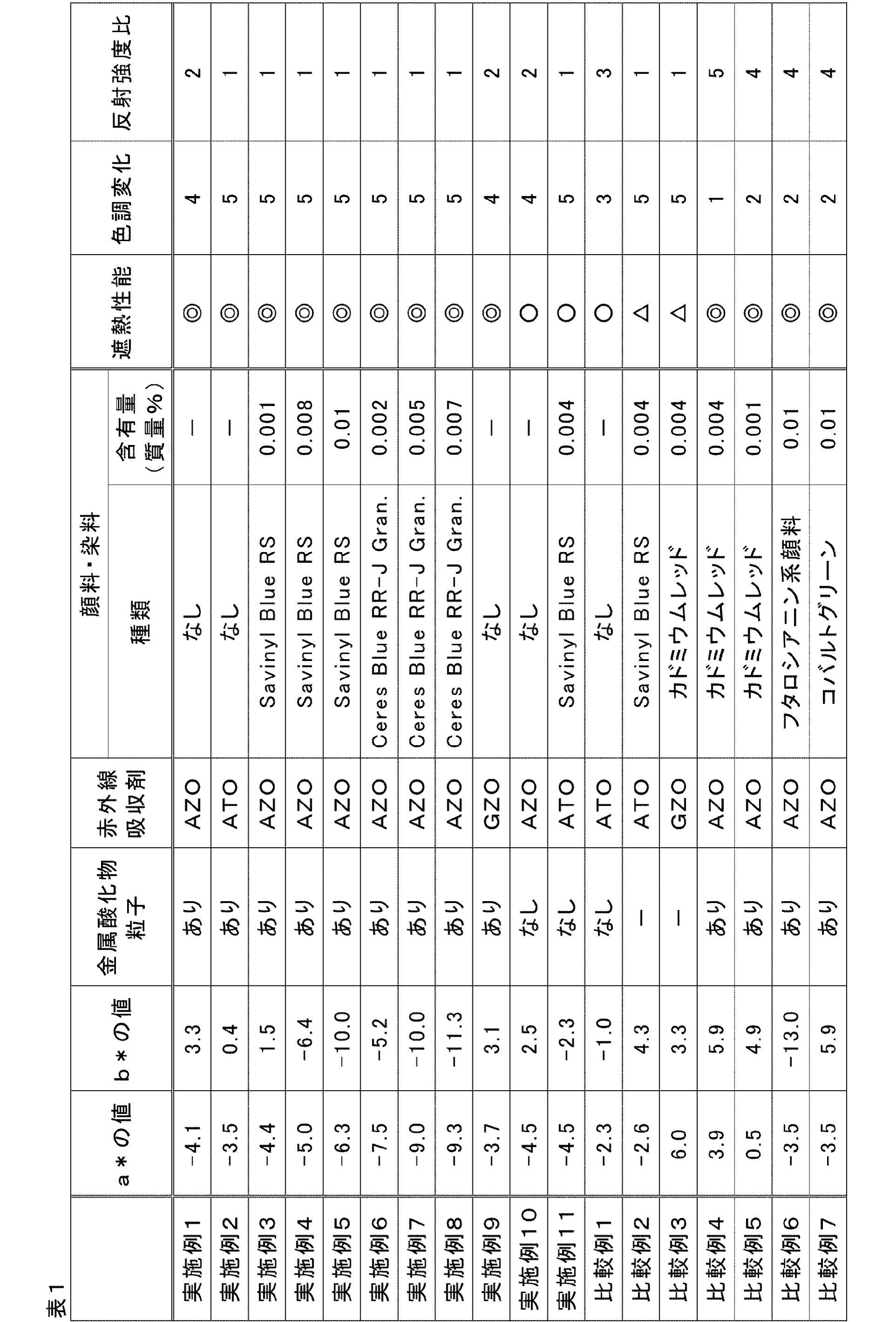
表1の結果からも明らかなように、実施例に係る赤外遮蔽フィルムは優れた遮熱性能を有していることが分かる。また、実施例に係る赤外遮蔽フィルムは、観察角度による色調変化において良好な結果を示し、反射強度比が1に近いことからフィルム面の法線に対して5度および60度の正反射率に差がなかった。すなわち、実施例に係る赤外遮蔽フィルムは、色調の角度依存性が低いことが分かる。
一方、比較例に係る赤外遮蔽フィルムは、遮熱性能および色調の角度依存性の低減の両者を実現できていないことが分かる。例えば、比較例2および3では、誘電多層膜がないため色調の角度依存性は低いが、遮熱性能は不十分であることが分かる。また、例えば、比較例4~7では、誘電多層膜により良好な遮熱性能が得られているものの、色調の角度依存性が高いことが分かる。
本出願は、2013年6月14日に出願された日本特許出願第2013-125802号に基づいており、その開示内容は、参照により全体として組み入れられている。
Claims (7)
- 高屈折率層および低屈折率層を含む誘電多層膜と、ハードコート層と、を含み、 L*a*b*表色系におけるa*がa*≦-3.5であり、かつ、b*が-12≦b*≦5である、赤外遮蔽フィルム。
- 前記b*が、-12≦b*≦2である、請求項1に記載の赤外遮蔽フィルム。
- 前記高屈折率層および前記低屈折率層の少なくとも一方が、金属酸化物粒子を含む、請求項1または2に記載の赤外遮蔽フィルム。
- 前記ハードコート層が、赤外線吸収剤を含む、請求項1~3のいずれか1項に記載の赤外遮蔽フィルム。
- 前記ハードコート層が、顔料および染料の少なくとも一方を含む、請求項1~4のいずれか1項に記載の赤外遮蔽フィルム。
- 基体と、前記基体の少なくとも一方の面に配置された請求項1~5のいずれか1項に記載の赤外遮蔽フィルムと、を含む、赤外遮蔽体。
- 請求項1~5のいずれか1項に記載の赤外遮蔽フィルムと、前記赤外遮蔽フィルムを挟持する一対の中間膜と、前記赤外遮蔽フィルムおよび前記中間膜を挟持する一対の板ガラスと、を含む、熱線反射合わせガラス。
Priority Applications (1)
| Application Number | Priority Date | Filing Date | Title |
|---|---|---|---|
| JP2015522726A JPWO2014199872A1 (ja) | 2013-06-14 | 2014-06-03 | 赤外遮蔽フィルムおよびこれを用いた赤外遮蔽体および熱線反射合わせガラス |
Applications Claiming Priority (2)
| Application Number | Priority Date | Filing Date | Title |
|---|---|---|---|
| JP2013-125802 | 2013-06-14 | ||
| JP2013125802 | 2013-06-14 |
Publications (1)
| Publication Number | Publication Date |
|---|---|
| WO2014199872A1 true WO2014199872A1 (ja) | 2014-12-18 |
Family
ID=52022169
Family Applications (1)
| Application Number | Title | Priority Date | Filing Date |
|---|---|---|---|
| PCT/JP2014/064782 Ceased WO2014199872A1 (ja) | 2013-06-14 | 2014-06-03 | 赤外遮蔽フィルムおよびこれを用いた赤外遮蔽体および熱線反射合わせガラス |
Country Status (2)
| Country | Link |
|---|---|
| JP (1) | JPWO2014199872A1 (ja) |
| WO (1) | WO2014199872A1 (ja) |
Cited By (9)
| Publication number | Priority date | Publication date | Assignee | Title |
|---|---|---|---|---|
| WO2017094453A1 (ja) * | 2015-11-30 | 2017-06-08 | コニカミノルタ株式会社 | 合わせガラス |
| WO2017154276A1 (ja) * | 2016-03-08 | 2017-09-14 | 住友理工株式会社 | 光透過性積層体および光透過性積層体の製造方法 |
| WO2017217230A1 (ja) * | 2016-06-15 | 2017-12-21 | 日本化薬株式会社 | 赤外線遮蔽シート、赤外線遮蔽合わせガラス用中間膜並びに赤外線遮蔽合わせガラス及びその製造方法 |
| JP2018054760A (ja) * | 2016-09-27 | 2018-04-05 | 株式会社日本触媒 | 光選択吸収樹脂積層体 |
| CN108367540A (zh) * | 2016-03-08 | 2018-08-03 | 住友理工株式会社 | 光透过性层叠体及光透过性层叠体的制造方法 |
| JP2019155621A (ja) * | 2018-03-08 | 2019-09-19 | 東レ株式会社 | 積層体 |
| JP2020132453A (ja) * | 2019-02-15 | 2020-08-31 | 日本化薬株式会社 | 熱線遮蔽構造体、熱線遮蔽シート、熱線遮蔽中間膜、及び合わせガラス |
| JP2020132454A (ja) * | 2019-02-15 | 2020-08-31 | 日本化薬株式会社 | 熱線遮蔽構造体、熱線遮蔽シート、熱線遮蔽中間膜、及び合わせガラス |
| JP2020530134A (ja) * | 2017-08-07 | 2020-10-15 | エヴェリックス インコーポレイテッド | 超薄型薄膜光干渉フィルタ |
Citations (4)
| Publication number | Priority date | Publication date | Assignee | Title |
|---|---|---|---|---|
| JP2004525403A (ja) * | 2001-01-15 | 2004-08-19 | スリーエム イノベイティブ プロパティズ カンパニー | 可視波長領域における透過が高く、かつ平滑な多層赤外反射フィルム、およびそれから製造される積層物品 |
| JP2012519648A (ja) * | 2009-03-09 | 2012-08-30 | サン−ゴバン グラス フランス | 熱特性を有し高屈折率層を含む積重体を備えた基材 |
| WO2012128109A1 (ja) * | 2011-03-18 | 2012-09-27 | コニカミノルタホールディングス株式会社 | 熱線反射フィルム、その製造方法、及び熱線反射体 |
| WO2013065679A1 (ja) * | 2011-10-31 | 2013-05-10 | コニカミノルタホールディングス株式会社 | 光学反射フィルム及びそれを用いた光学反射体 |
Family Cites Families (1)
| Publication number | Priority date | Publication date | Assignee | Title |
|---|---|---|---|---|
| BE1019345A3 (fr) * | 2010-05-25 | 2012-06-05 | Agc Glass Europe | Vitrage de controle solaire a faible facteur solaire. |
-
2014
- 2014-06-03 WO PCT/JP2014/064782 patent/WO2014199872A1/ja not_active Ceased
- 2014-06-03 JP JP2015522726A patent/JPWO2014199872A1/ja active Pending
Patent Citations (4)
| Publication number | Priority date | Publication date | Assignee | Title |
|---|---|---|---|---|
| JP2004525403A (ja) * | 2001-01-15 | 2004-08-19 | スリーエム イノベイティブ プロパティズ カンパニー | 可視波長領域における透過が高く、かつ平滑な多層赤外反射フィルム、およびそれから製造される積層物品 |
| JP2012519648A (ja) * | 2009-03-09 | 2012-08-30 | サン−ゴバン グラス フランス | 熱特性を有し高屈折率層を含む積重体を備えた基材 |
| WO2012128109A1 (ja) * | 2011-03-18 | 2012-09-27 | コニカミノルタホールディングス株式会社 | 熱線反射フィルム、その製造方法、及び熱線反射体 |
| WO2013065679A1 (ja) * | 2011-10-31 | 2013-05-10 | コニカミノルタホールディングス株式会社 | 光学反射フィルム及びそれを用いた光学反射体 |
Cited By (18)
| Publication number | Priority date | Publication date | Assignee | Title |
|---|---|---|---|---|
| WO2017094453A1 (ja) * | 2015-11-30 | 2017-06-08 | コニカミノルタ株式会社 | 合わせガラス |
| WO2017154276A1 (ja) * | 2016-03-08 | 2017-09-14 | 住友理工株式会社 | 光透過性積層体および光透過性積層体の製造方法 |
| CN108367540A (zh) * | 2016-03-08 | 2018-08-03 | 住友理工株式会社 | 光透过性层叠体及光透过性层叠体的制造方法 |
| EP3427942A4 (en) * | 2016-03-08 | 2019-03-27 | Sumitomo Riko Company Limited | LIGHT-TRANSMITTING LAMINATE AND METHOD FOR PRODUCING LIGHT-TRANSMITTING LAMINATE |
| EP3474048A4 (en) * | 2016-06-15 | 2020-01-22 | Nippon Kayaku Kabushiki Kaisha | INFRARED SHIELDING FILM, INTERLAYER FILM FOR INFRARED SHIELDING COMPOSITE GLASS AND INFRARED SHIELDING COMPOSITE GLASS AND METHOD FOR PRODUCING THE SAME |
| WO2017217230A1 (ja) * | 2016-06-15 | 2017-12-21 | 日本化薬株式会社 | 赤外線遮蔽シート、赤外線遮蔽合わせガラス用中間膜並びに赤外線遮蔽合わせガラス及びその製造方法 |
| JP2017223827A (ja) * | 2016-06-15 | 2017-12-21 | 日本化薬株式会社 | 赤外線遮蔽シート、赤外線遮蔽合わせガラス用中間膜並びに赤外線遮蔽合わせガラス及びその製造方法 |
| CN109313297A (zh) * | 2016-06-15 | 2019-02-05 | 日本化药株式会社 | 红外线屏蔽片、红外线屏蔽夹层玻璃用中间膜以及红外线屏蔽夹层玻璃及其制造方法 |
| JP2018054760A (ja) * | 2016-09-27 | 2018-04-05 | 株式会社日本触媒 | 光選択吸収樹脂積層体 |
| JP2020530134A (ja) * | 2017-08-07 | 2020-10-15 | エヴェリックス インコーポレイテッド | 超薄型薄膜光干渉フィルタ |
| JP2023178283A (ja) * | 2017-08-07 | 2023-12-14 | エヴェリックス インコーポレイテッド | 超薄型薄膜光干渉フィルタ |
| US11906765B2 (en) | 2017-08-07 | 2024-02-20 | Everix, Inc. | Ultra-thin thin-film optical interference filters |
| JP7679433B2 (ja) | 2017-08-07 | 2025-05-19 | エヴェリックス インコーポレイテッド | 超薄型薄膜光干渉フィルタ |
| JP2019155621A (ja) * | 2018-03-08 | 2019-09-19 | 東レ株式会社 | 積層体 |
| JP7087470B2 (ja) | 2018-03-08 | 2022-06-21 | 東レ株式会社 | 積層体 |
| JP2020132453A (ja) * | 2019-02-15 | 2020-08-31 | 日本化薬株式会社 | 熱線遮蔽構造体、熱線遮蔽シート、熱線遮蔽中間膜、及び合わせガラス |
| JP2020132454A (ja) * | 2019-02-15 | 2020-08-31 | 日本化薬株式会社 | 熱線遮蔽構造体、熱線遮蔽シート、熱線遮蔽中間膜、及び合わせガラス |
| JP7188859B2 (ja) | 2019-02-15 | 2022-12-13 | 日本化薬株式会社 | 熱線遮蔽構造体、熱線遮蔽シート、熱線遮蔽中間膜、及び合わせガラス |
Also Published As
| Publication number | Publication date |
|---|---|
| JPWO2014199872A1 (ja) | 2017-02-23 |
Similar Documents
| Publication | Publication Date | Title |
|---|---|---|
| US9778402B2 (en) | Light reflective film and light reflector produced using the same | |
| WO2014199872A1 (ja) | 赤外遮蔽フィルムおよびこれを用いた赤外遮蔽体および熱線反射合わせガラス | |
| CN107710035B (zh) | 光学膜及含有其的光学叠层体 | |
| WO2015056752A1 (ja) | 赤外遮蔽フィルムおよびこれを用いた赤外遮蔽体および熱線反射合わせガラス | |
| JP6115675B2 (ja) | 光学反射フィルム及びそれを用いた光学反射体 | |
| US20170131445A1 (en) | Optical film and method for manufacturing optical film | |
| EP2821820A1 (en) | Near-infrared reflective film and near-infrared reflective glass using same | |
| CN105102395A (zh) | 夹层玻璃 | |
| WO2014199990A1 (ja) | 誘導体多層膜フィルム | |
| WO2016006388A1 (ja) | 光学フィルム | |
| JP6428608B2 (ja) | 赤外線遮蔽フィルム、赤外線遮蔽フィルムの設置方法及び赤外線遮蔽フィルムの虹彩防止方法 | |
| WO2014069507A1 (ja) | 光学反射フィルム、赤外遮蔽フィルムおよびその製造方法 | |
| CN108369303B (zh) | 光学反射膜 | |
| US20160062000A1 (en) | Optical reflective film, method for manufacturing the same, and optical reflector using the same | |
| WO2013077274A1 (ja) | 赤外遮蔽フィルム | |
| JP5811536B2 (ja) | 近赤外線反射フィルム | |
| CN107615117B (zh) | 光学反射膜 | |
| JP6146410B2 (ja) | 赤外遮蔽フィルムおよび赤外遮蔽体 | |
| WO2017169810A1 (ja) | 光学反射フィルム | |
| US9599758B2 (en) | Optical reflective film and optical reflector using the same | |
| JP6787336B2 (ja) | 光学反射フィルムおよび光学反射体 | |
| JP2017203965A (ja) | ロール状の光学反射フィルム | |
| WO2016104295A1 (ja) | 赤外遮蔽フィルムおよびこれを用いた赤外遮蔽体 | |
| JP6672984B2 (ja) | 光学反射フィルム、光学反射フィルムの製造方法、及び、光学反射体 | |
| JP2016138906A (ja) | 光学反射フィルム及び光学反射体 |
Legal Events
| Date | Code | Title | Description |
|---|---|---|---|
| 121 | Ep: the epo has been informed by wipo that ep was designated in this application |
Ref document number: 14811283 Country of ref document: EP Kind code of ref document: A1 |
|
| ENP | Entry into the national phase |
Ref document number: 2015522726 Country of ref document: JP Kind code of ref document: A |
|
| NENP | Non-entry into the national phase |
Ref country code: DE |
|
| 122 | Ep: pct application non-entry in european phase |
Ref document number: 14811283 Country of ref document: EP Kind code of ref document: A1 |