WO2014185079A1 - 高分子化合物ならびにそれを用いた有機電界発光素子用材料および有機電界発光素子 - Google Patents
高分子化合物ならびにそれを用いた有機電界発光素子用材料および有機電界発光素子 Download PDFInfo
- Publication number
- WO2014185079A1 WO2014185079A1 PCT/JP2014/002576 JP2014002576W WO2014185079A1 WO 2014185079 A1 WO2014185079 A1 WO 2014185079A1 JP 2014002576 W JP2014002576 W JP 2014002576W WO 2014185079 A1 WO2014185079 A1 WO 2014185079A1
- Authority
- WO
- WIPO (PCT)
- Prior art keywords
- group
- carbon atoms
- ring
- polymer compound
- linear
- Prior art date
- Legal status (The legal status is an assumption and is not a legal conclusion. Google has not performed a legal analysis and makes no representation as to the accuracy of the status listed.)
- Ceased
Links
- 0 CCC(C)(C)c1ccc(c(ccc(C=*)c2)c2[n]2-c(cc3C(C4C=CC=CC4)(c4c5)c6ccccc6)ccc3-c4ccc5N(C3C=C(C)C=CC3)c3cc(C)ccc3)c2c1 Chemical compound CCC(C)(C)c1ccc(c(ccc(C=*)c2)c2[n]2-c(cc3C(C4C=CC=CC4)(c4c5)c6ccccc6)ccc3-c4ccc5N(C3C=C(C)C=CC3)c3cc(C)ccc3)c2c1 0.000 description 6
- CZZYITDELCSZES-UHFFFAOYSA-N C(c1ccccc1)c1ccccc1 Chemical compound C(c1ccccc1)c1ccccc1 CZZYITDELCSZES-UHFFFAOYSA-N 0.000 description 1
- MOMVFDBBWZRUMU-UHFFFAOYSA-N Cc(cc1)ccc1N(c1ccc(C)cc1)c(cc1CC2=C3)ccc1C2=CCC3N Chemical compound Cc(cc1)ccc1N(c1ccc(C)cc1)c(cc1CC2=C3)ccc1C2=CCC3N MOMVFDBBWZRUMU-UHFFFAOYSA-N 0.000 description 1
Classifications
-
- C—CHEMISTRY; METALLURGY
- C08—ORGANIC MACROMOLECULAR COMPOUNDS; THEIR PREPARATION OR CHEMICAL WORKING-UP; COMPOSITIONS BASED THEREON
- C08G—MACROMOLECULAR COMPOUNDS OBTAINED OTHERWISE THAN BY REACTIONS ONLY INVOLVING UNSATURATED CARBON-TO-CARBON BONDS
- C08G61/00—Macromolecular compounds obtained by reactions forming a carbon-to-carbon link in the main chain of the macromolecule
- C08G61/12—Macromolecular compounds containing atoms other than carbon in the main chain of the macromolecule
- C08G61/122—Macromolecular compounds containing atoms other than carbon in the main chain of the macromolecule derived from five- or six-membered heterocyclic compounds, other than imides
- C08G61/123—Macromolecular compounds containing atoms other than carbon in the main chain of the macromolecule derived from five- or six-membered heterocyclic compounds, other than imides derived from five-membered heterocyclic compounds
- C08G61/124—Macromolecular compounds containing atoms other than carbon in the main chain of the macromolecule derived from five- or six-membered heterocyclic compounds, other than imides derived from five-membered heterocyclic compounds with a five-membered ring containing one nitrogen atom in the ring
-
- C—CHEMISTRY; METALLURGY
- C08—ORGANIC MACROMOLECULAR COMPOUNDS; THEIR PREPARATION OR CHEMICAL WORKING-UP; COMPOSITIONS BASED THEREON
- C08G—MACROMOLECULAR COMPOUNDS OBTAINED OTHERWISE THAN BY REACTIONS ONLY INVOLVING UNSATURATED CARBON-TO-CARBON BONDS
- C08G73/00—Macromolecular compounds obtained by reactions forming a linkage containing nitrogen with or without oxygen or carbon in the main chain of the macromolecule, not provided for in groups C08G12/00 - C08G71/00
- C08G73/06—Polycondensates having nitrogen-containing heterocyclic rings in the main chain of the macromolecule
- C08G73/0666—Polycondensates containing five-membered rings, condensed with other rings, with nitrogen atoms as the only ring hetero atoms
- C08G73/0672—Polycondensates containing five-membered rings, condensed with other rings, with nitrogen atoms as the only ring hetero atoms with only one nitrogen atom in the ring
-
- H—ELECTRICITY
- H05—ELECTRIC TECHNIQUES NOT OTHERWISE PROVIDED FOR
- H05B—ELECTRIC HEATING; ELECTRIC LIGHT SOURCES NOT OTHERWISE PROVIDED FOR; CIRCUIT ARRANGEMENTS FOR ELECTRIC LIGHT SOURCES, IN GENERAL
- H05B33/00—Electroluminescent light sources
- H05B33/12—Light sources with substantially two-dimensional [2D] radiating surfaces
- H05B33/22—Light sources with substantially two-dimensional [2D] radiating surfaces characterised by the chemical or physical composition or the arrangement of auxiliary dielectric or reflective layers
-
- H—ELECTRICITY
- H10—SEMICONDUCTOR DEVICES; ELECTRIC SOLID-STATE DEVICES NOT OTHERWISE PROVIDED FOR
- H10K—ORGANIC ELECTRIC SOLID-STATE DEVICES
- H10K85/00—Organic materials used in the body or electrodes of devices covered by this subclass
- H10K85/10—Organic polymers or oligomers
- H10K85/111—Organic polymers or oligomers comprising aromatic, heteroaromatic, or aryl chains, e.g. polyaniline, polyphenylene or polyphenylene vinylene
-
- H—ELECTRICITY
- H10—SEMICONDUCTOR DEVICES; ELECTRIC SOLID-STATE DEVICES NOT OTHERWISE PROVIDED FOR
- H10K—ORGANIC ELECTRIC SOLID-STATE DEVICES
- H10K85/00—Organic materials used in the body or electrodes of devices covered by this subclass
- H10K85/10—Organic polymers or oligomers
- H10K85/111—Organic polymers or oligomers comprising aromatic, heteroaromatic, or aryl chains, e.g. polyaniline, polyphenylene or polyphenylene vinylene
- H10K85/113—Heteroaromatic compounds comprising sulfur or selene, e.g. polythiophene
- H10K85/1135—Polyethylene dioxythiophene [PEDOT]; Derivatives thereof
-
- H—ELECTRICITY
- H10—SEMICONDUCTOR DEVICES; ELECTRIC SOLID-STATE DEVICES NOT OTHERWISE PROVIDED FOR
- H10K—ORGANIC ELECTRIC SOLID-STATE DEVICES
- H10K85/00—Organic materials used in the body or electrodes of devices covered by this subclass
- H10K85/10—Organic polymers or oligomers
- H10K85/111—Organic polymers or oligomers comprising aromatic, heteroaromatic, or aryl chains, e.g. polyaniline, polyphenylene or polyphenylene vinylene
- H10K85/115—Polyfluorene; Derivatives thereof
-
- H—ELECTRICITY
- H10—SEMICONDUCTOR DEVICES; ELECTRIC SOLID-STATE DEVICES NOT OTHERWISE PROVIDED FOR
- H10K—ORGANIC ELECTRIC SOLID-STATE DEVICES
- H10K85/00—Organic materials used in the body or electrodes of devices covered by this subclass
- H10K85/10—Organic polymers or oligomers
- H10K85/151—Copolymers
-
- H—ELECTRICITY
- H10—SEMICONDUCTOR DEVICES; ELECTRIC SOLID-STATE DEVICES NOT OTHERWISE PROVIDED FOR
- H10K—ORGANIC ELECTRIC SOLID-STATE DEVICES
- H10K85/00—Organic materials used in the body or electrodes of devices covered by this subclass
- H10K85/30—Coordination compounds
- H10K85/321—Metal complexes comprising a group IIIA element, e.g. Tris (8-hydroxyquinoline) gallium [Gaq3]
- H10K85/324—Metal complexes comprising a group IIIA element, e.g. Tris (8-hydroxyquinoline) gallium [Gaq3] comprising aluminium, e.g. Alq3
-
- H—ELECTRICITY
- H10—SEMICONDUCTOR DEVICES; ELECTRIC SOLID-STATE DEVICES NOT OTHERWISE PROVIDED FOR
- H10K—ORGANIC ELECTRIC SOLID-STATE DEVICES
- H10K85/00—Organic materials used in the body or electrodes of devices covered by this subclass
- H10K85/60—Organic compounds having low molecular weight
- H10K85/615—Polycyclic condensed aromatic hydrocarbons, e.g. anthracene
- H10K85/626—Polycyclic condensed aromatic hydrocarbons, e.g. anthracene containing more than one polycyclic condensed aromatic rings, e.g. bis-anthracene
-
- H—ELECTRICITY
- H10—SEMICONDUCTOR DEVICES; ELECTRIC SOLID-STATE DEVICES NOT OTHERWISE PROVIDED FOR
- H10K—ORGANIC ELECTRIC SOLID-STATE DEVICES
- H10K85/00—Organic materials used in the body or electrodes of devices covered by this subclass
- H10K85/60—Organic compounds having low molecular weight
- H10K85/631—Amine compounds having at least two aryl rest on at least one amine-nitrogen atom, e.g. triphenylamine
- H10K85/633—Amine compounds having at least two aryl rest on at least one amine-nitrogen atom, e.g. triphenylamine comprising polycyclic condensed aromatic hydrocarbons as substituents on the nitrogen atom
-
- C—CHEMISTRY; METALLURGY
- C08—ORGANIC MACROMOLECULAR COMPOUNDS; THEIR PREPARATION OR CHEMICAL WORKING-UP; COMPOSITIONS BASED THEREON
- C08G—MACROMOLECULAR COMPOUNDS OBTAINED OTHERWISE THAN BY REACTIONS ONLY INVOLVING UNSATURATED CARBON-TO-CARBON BONDS
- C08G2261/00—Macromolecular compounds obtained by reactions forming a carbon-to-carbon link in the main chain of the macromolecule
- C08G2261/10—Definition of the polymer structure
- C08G2261/14—Side-groups
- C08G2261/143—Side-chains containing nitrogen
-
- C—CHEMISTRY; METALLURGY
- C08—ORGANIC MACROMOLECULAR COMPOUNDS; THEIR PREPARATION OR CHEMICAL WORKING-UP; COMPOSITIONS BASED THEREON
- C08G—MACROMOLECULAR COMPOUNDS OBTAINED OTHERWISE THAN BY REACTIONS ONLY INVOLVING UNSATURATED CARBON-TO-CARBON BONDS
- C08G2261/00—Macromolecular compounds obtained by reactions forming a carbon-to-carbon link in the main chain of the macromolecule
- C08G2261/10—Definition of the polymer structure
- C08G2261/14—Side-groups
- C08G2261/148—Side-chains having aromatic units
-
- C—CHEMISTRY; METALLURGY
- C08—ORGANIC MACROMOLECULAR COMPOUNDS; THEIR PREPARATION OR CHEMICAL WORKING-UP; COMPOSITIONS BASED THEREON
- C08G—MACROMOLECULAR COMPOUNDS OBTAINED OTHERWISE THAN BY REACTIONS ONLY INVOLVING UNSATURATED CARBON-TO-CARBON BONDS
- C08G2261/00—Macromolecular compounds obtained by reactions forming a carbon-to-carbon link in the main chain of the macromolecule
- C08G2261/30—Monomer units or repeat units incorporating structural elements in the main chain
- C08G2261/32—Monomer units or repeat units incorporating structural elements in the main chain incorporating heteroaromatic structural elements in the main chain
- C08G2261/324—Monomer units or repeat units incorporating structural elements in the main chain incorporating heteroaromatic structural elements in the main chain condensed
- C08G2261/3241—Monomer units or repeat units incorporating structural elements in the main chain incorporating heteroaromatic structural elements in the main chain condensed containing one or more nitrogen atoms as the only heteroatom, e.g. carbazole
-
- C—CHEMISTRY; METALLURGY
- C09—DYES; PAINTS; POLISHES; NATURAL RESINS; ADHESIVES; COMPOSITIONS NOT OTHERWISE PROVIDED FOR; APPLICATIONS OF MATERIALS NOT OTHERWISE PROVIDED FOR
- C09K—MATERIALS FOR MISCELLANEOUS APPLICATIONS, NOT PROVIDED FOR ELSEWHERE
- C09K11/00—Luminescent materials, e.g. electroluminescent or chemiluminescent
- C09K11/06—Luminescent materials, e.g. electroluminescent or chemiluminescent containing organic luminescent materials
-
- C—CHEMISTRY; METALLURGY
- C09—DYES; PAINTS; POLISHES; NATURAL RESINS; ADHESIVES; COMPOSITIONS NOT OTHERWISE PROVIDED FOR; APPLICATIONS OF MATERIALS NOT OTHERWISE PROVIDED FOR
- C09K—MATERIALS FOR MISCELLANEOUS APPLICATIONS, NOT PROVIDED FOR ELSEWHERE
- C09K2211/00—Chemical nature of organic luminescent or tenebrescent compounds
- C09K2211/10—Non-macromolecular compounds
- C09K2211/1003—Carbocyclic compounds
- C09K2211/1007—Non-condensed systems
-
- C—CHEMISTRY; METALLURGY
- C09—DYES; PAINTS; POLISHES; NATURAL RESINS; ADHESIVES; COMPOSITIONS NOT OTHERWISE PROVIDED FOR; APPLICATIONS OF MATERIALS NOT OTHERWISE PROVIDED FOR
- C09K—MATERIALS FOR MISCELLANEOUS APPLICATIONS, NOT PROVIDED FOR ELSEWHERE
- C09K2211/00—Chemical nature of organic luminescent or tenebrescent compounds
- C09K2211/10—Non-macromolecular compounds
- C09K2211/1003—Carbocyclic compounds
- C09K2211/1011—Condensed systems
-
- C—CHEMISTRY; METALLURGY
- C09—DYES; PAINTS; POLISHES; NATURAL RESINS; ADHESIVES; COMPOSITIONS NOT OTHERWISE PROVIDED FOR; APPLICATIONS OF MATERIALS NOT OTHERWISE PROVIDED FOR
- C09K—MATERIALS FOR MISCELLANEOUS APPLICATIONS, NOT PROVIDED FOR ELSEWHERE
- C09K2211/00—Chemical nature of organic luminescent or tenebrescent compounds
- C09K2211/10—Non-macromolecular compounds
- C09K2211/1003—Carbocyclic compounds
- C09K2211/1014—Carbocyclic compounds bridged by heteroatoms, e.g. N, P, Si or B
-
- H—ELECTRICITY
- H10—SEMICONDUCTOR DEVICES; ELECTRIC SOLID-STATE DEVICES NOT OTHERWISE PROVIDED FOR
- H10K—ORGANIC ELECTRIC SOLID-STATE DEVICES
- H10K50/00—Organic light-emitting devices
- H10K50/10—OLEDs or polymer light-emitting diodes [PLED]
- H10K50/11—OLEDs or polymer light-emitting diodes [PLED] characterised by the electroluminescent [EL] layers
-
- H—ELECTRICITY
- H10—SEMICONDUCTOR DEVICES; ELECTRIC SOLID-STATE DEVICES NOT OTHERWISE PROVIDED FOR
- H10K—ORGANIC ELECTRIC SOLID-STATE DEVICES
- H10K50/00—Organic light-emitting devices
- H10K50/10—OLEDs or polymer light-emitting diodes [PLED]
- H10K50/14—Carrier transporting layers
- H10K50/15—Hole transporting layers
-
- H—ELECTRICITY
- H10—SEMICONDUCTOR DEVICES; ELECTRIC SOLID-STATE DEVICES NOT OTHERWISE PROVIDED FOR
- H10K—ORGANIC ELECTRIC SOLID-STATE DEVICES
- H10K50/00—Organic light-emitting devices
- H10K50/10—OLEDs or polymer light-emitting diodes [PLED]
- H10K50/17—Carrier injection layers
-
- H—ELECTRICITY
- H10—SEMICONDUCTOR DEVICES; ELECTRIC SOLID-STATE DEVICES NOT OTHERWISE PROVIDED FOR
- H10K—ORGANIC ELECTRIC SOLID-STATE DEVICES
- H10K50/00—Organic light-emitting devices
- H10K50/10—OLEDs or polymer light-emitting diodes [PLED]
- H10K50/17—Carrier injection layers
- H10K50/171—Electron injection layers
-
- H—ELECTRICITY
- H10—SEMICONDUCTOR DEVICES; ELECTRIC SOLID-STATE DEVICES NOT OTHERWISE PROVIDED FOR
- H10K—ORGANIC ELECTRIC SOLID-STATE DEVICES
- H10K85/00—Organic materials used in the body or electrodes of devices covered by this subclass
- H10K85/60—Organic compounds having low molecular weight
- H10K85/615—Polycyclic condensed aromatic hydrocarbons, e.g. anthracene
-
- H—ELECTRICITY
- H10—SEMICONDUCTOR DEVICES; ELECTRIC SOLID-STATE DEVICES NOT OTHERWISE PROVIDED FOR
- H10K—ORGANIC ELECTRIC SOLID-STATE DEVICES
- H10K85/00—Organic materials used in the body or electrodes of devices covered by this subclass
- H10K85/60—Organic compounds having low molecular weight
- H10K85/631—Amine compounds having at least two aryl rest on at least one amine-nitrogen atom, e.g. triphenylamine
Definitions
- the present invention relates to a polymer compound, a material for an organic electroluminescence device using the polymer compound, and an organic electroluminescence device.
- organic electroluminescence element organic electroluminescence element: organic EL element
- the organic electroluminescent element has a structure in which a thin film containing a luminescent organic compound is sandwiched between an anode and a cathode.
- the organic electroluminescence device injects electrons and holes into the thin film and recombines them to generate excitons, and uses the light emitted when the excitons are deactivated. And emits light.
- Organic electroluminescent devices can emit light at a low direct current voltage of several volts to several tens of volts, and various colors (for example, red, blue, green, etc.) can be selected by selecting the type of light-emitting organic compound. ) Can be emitted.
- the organic electroluminescent device having such characteristics is expected to be applied to various light emitting devices and display devices.
- a thin film having a thickness of 1 ⁇ m or less containing a light-emitting organic compound containing a low molecular compound is produced by using a vacuum vapor deposition method.
- the vacuum vapor deposition method requires an expensive vapor deposition apparatus. The production efficiency is not high, and it may be difficult to increase the area of the substrate.
- the mechanical strength and thermal stability of the thin film may be inferior.
- the present inventors have also developed and proposed a novel polymer compound containing a thiophene derivative in the main chain (see, for example, Patent Document 1).
- the polymer organic electroluminescent element has an advantage that it can be formed by a coating or printing method, and various studies have been made (Patent Documents 2 to 4).
- Patent Documents 2 to 4 there has been a problem that the light emission efficiency is lower than that of an organic electroluminescent device using a low molecular compound.
- organic electroluminescent devices using a polymer compound have been desired to be further improved in terms of efficiency and lifetime.
- An object of the present invention is to provide a new polymer compound suitable for an organic electroluminescent device, and an organic electroluminescent device containing the compound.
- the present inventors have found that a polymer compound having a high charge transport ability and capable of forming a uniform thin film and a high molecular compound by using the polymer compound are used.
- the present inventors have found that an organic electroluminescent device having an efficiency and a long life can be obtained, and have completed the present invention.
- the present inventors have found that a polymer compound containing a repeating unit represented by the following formula (1-1) or (1-2) is useful as a hole transporting material or the like.
- the present invention has been completed. That is, the present invention provides the following [1] to [10].
- each of R 1 to R 6 is independently a linear or branched alkyl group having 1 to 20 carbon atoms, a linear or branched alkoxy group having 1 to 20 carbon atoms, or 1 to 20 linear or branched alkylthio groups, linear or branched alkenyl groups having 2 to 20 carbon atoms, cycloalkyl groups having 3 to 20 carbon atoms, aryl groups having 6 to 30 ring carbon atoms, or rings It is a heteroaryl group having 5 to 30 atoms.
- a and b each represents an integer of 0 to 4.
- c and d each represents an integer of 0 to 3.
- Ar 1 to Ar 4 are each independently a substituted or unsubstituted aryl group having 6 to 30 ring carbon atoms, or a substituted or unsubstituted heteroaryl group having 5 to 30 ring atoms.
- R 1 to R 6 are each a linear or branched alkyl group having 1 to 20 carbon atoms, a linear or branched alkenyl group having 2 to 20 carbon atoms, or a cyclohexane having 3 to 20 carbon atoms.
- R 1 to R 6 are each a linear or branched alkyl group having 1 to 20 carbon atoms, a linear or branched alkoxy group having 1 to 20 carbon atoms, or a straight line having 1 to 20 carbon atoms.
- the polymer compound according to [1] which is a heteroaryl group of 5 to 24.
- R 1 to R 6 are each a linear or branched alkyl group having 1 to 20 carbon atoms, a linear or branched alkenyl group having 2 to 20 carbon atoms, or a cyclohexane having 3 to 20 carbon atoms.
- Ar 1 , Ar 2 , Ar 3 and Ar 4 are each independently a substituted or unsubstituted aryl group having 6 to 24 ring carbon atoms, or a substituted or unsubstituted ring atom having 5 to 24 ring atoms.
- each of R 7 , R 8 , R 9 and R 10 independently represents a linear or branched alkyl group having 1 to 20 carbon atoms, or a linear or branched alkenyl group having 2 to 20 carbon atoms.
- R 9 and R 10 may be bonded to each other to form a hydrocarbon ring.
- e and f each represents an integer of 0 to 3.
- each other R 10 to R 9 each other or adjacent adjacent may form a hydrocarbon ring bonded to each other.
- at least one of R 7 , R 8 , R 9 and R 10 is substituted with a group containing a polymerizable functional group.
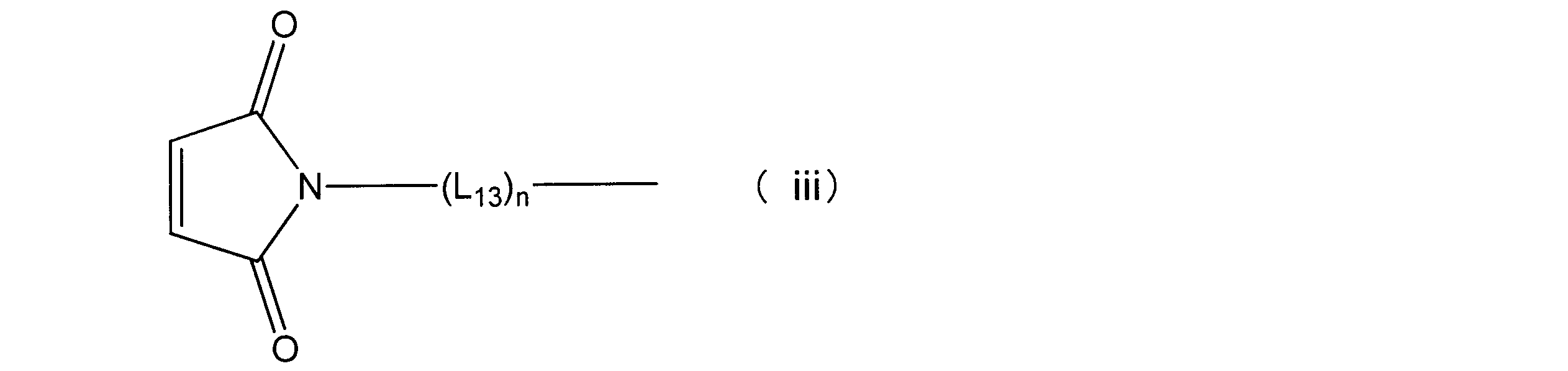
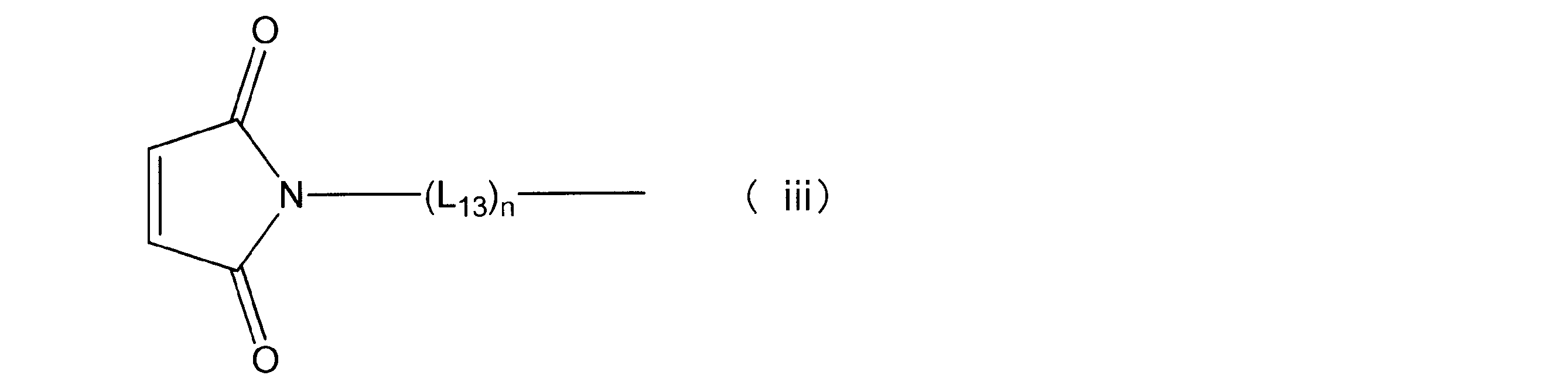
- the group containing the polymerizable functional group is represented by the following formula (i); the following formula (ii); the following formula (iii); the following formula (iv): A group represented by the following formula (v); a group having a substituted or unsubstituted norbornene skeleton, a substituted or unsubstituted epoxy group other than the groups represented by the following formulas (i) to (v); A group having an oxetane group, a group having a lactone structure or a lactam structure, a cyclooctatetraene group, a 1,5-cyclooctadiene group, a 1, ⁇ -diene group, an O-divinylbenzene group, and a 1, ⁇ -diyne group [7]
- the polymer compound according to [7] which is a group containing a functional group capable of cyclopolymerization or ring-opening polymerization selected from the group consisting of: In the formula, each
- L 11 is a divalent linking group. n is an integer of 0 or 1, and when n is 0, L 11 is a single bond.
- L 12 is a divalent linking group. n is an integer of 0 or 1, and when n is 0, L 12 is a single bond.
- L 13 is a divalent linking group. n is an integer of 0 or 1, and when n is 0, L 13 is a single bond.
- L 14 is a divalent linking group. n is an integer of 0 or 1, and when n is 0, L 14 is a single bond.
- R 14 is a hydrogen atom, a substituted or unsubstituted linear or branched alkyl group having 1 to 20 carbon atoms, or a substituted or unsubstituted aryl group having 6 to 24 ring carbon atoms.
- L 15 is a divalent linking group.
- n is an integer of 0 or 1, and when n is 0, L 15 is a single bond.
- the organic electroluminescence device according to any one of [10] to [13], which has a layer containing a compound having an electron injection function other than the polymer compound as an electron injection / transport layer between a pair of electrodes.
- An organic electroluminescent element using a material for an organic electroluminescent element containing the polymer compound of the present invention has a high luminous efficiency and a long element lifetime.
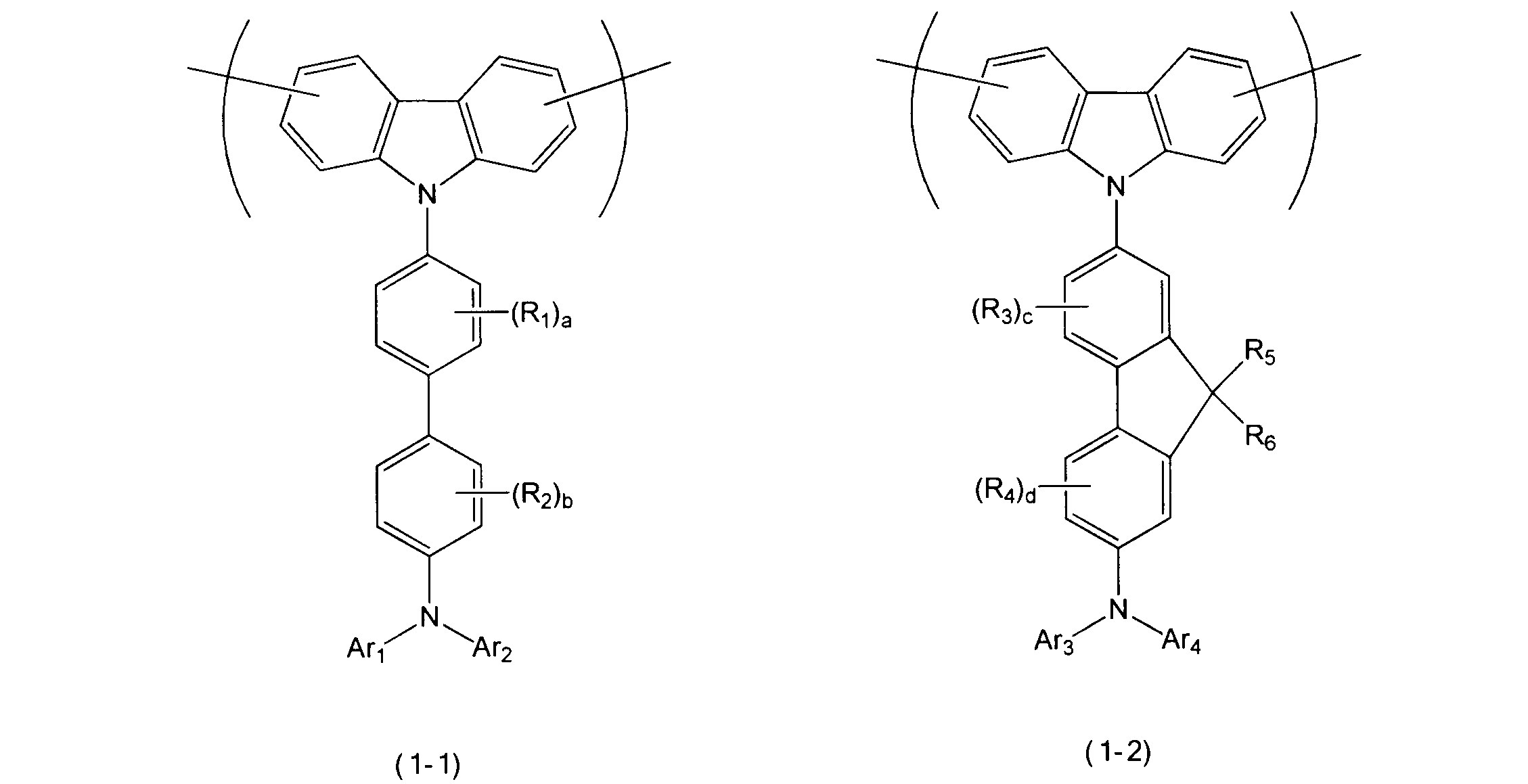
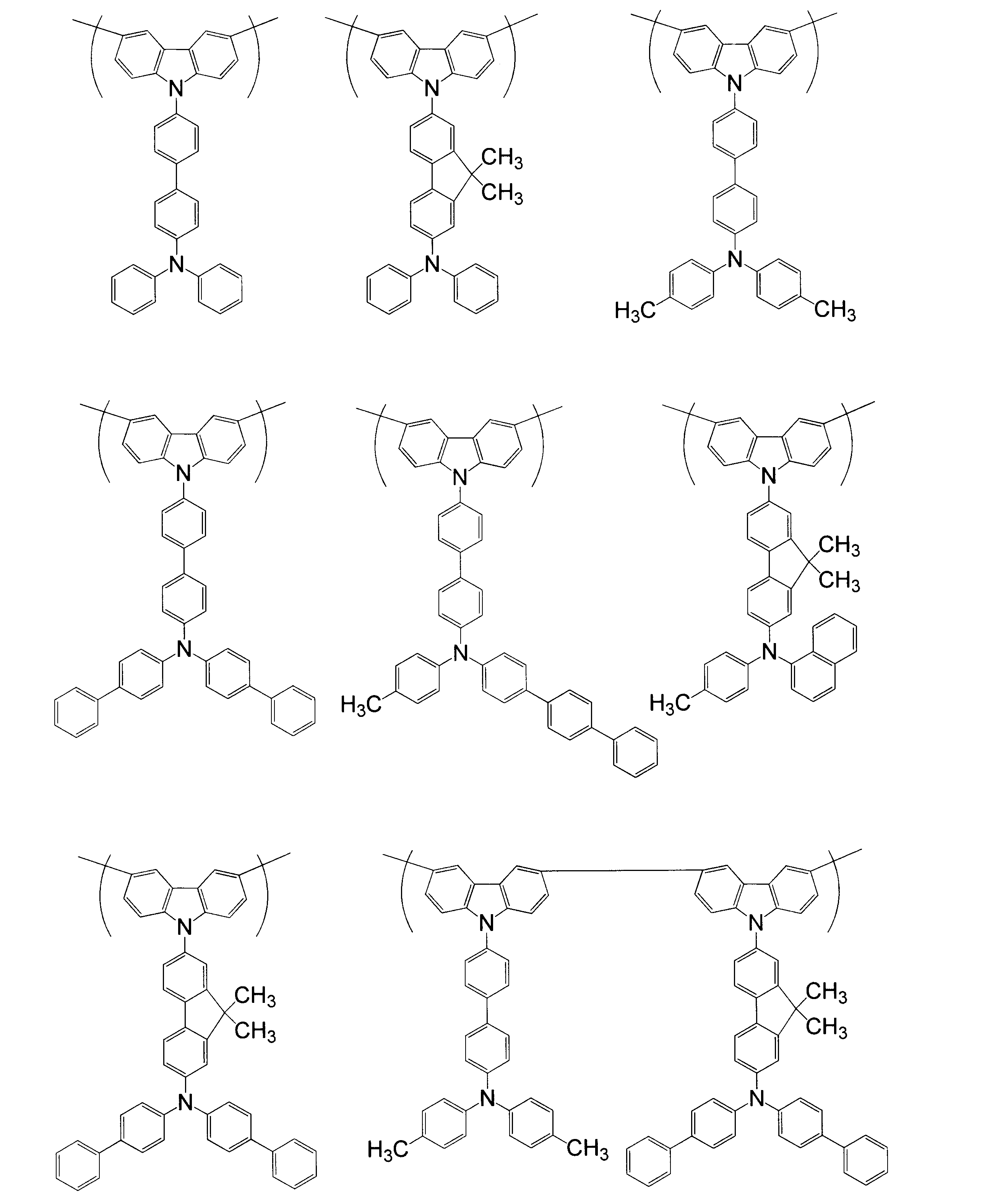
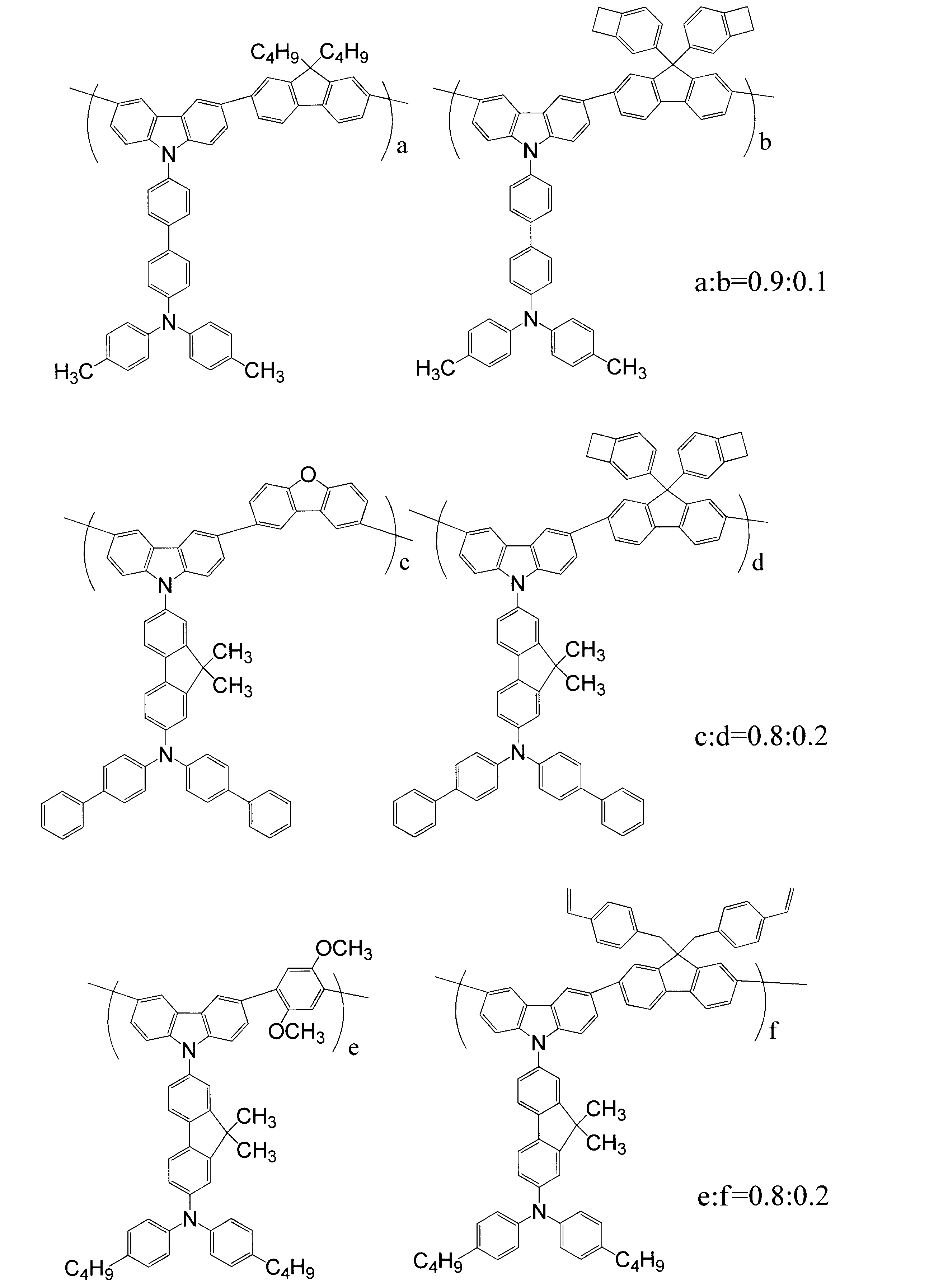
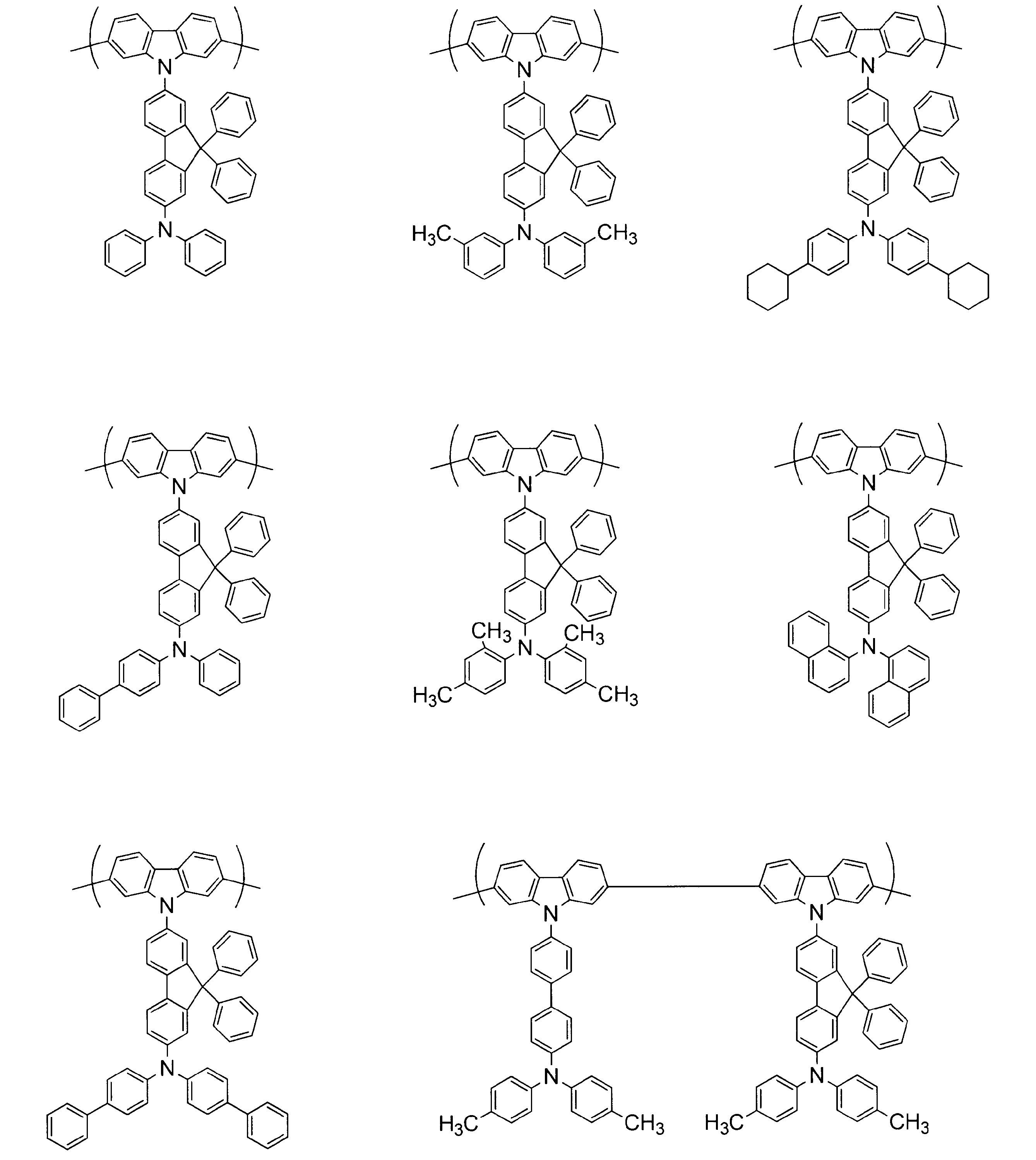
- the polymer compound of the present invention contains a repeating unit represented by the following formula (1-1) or (1-2).
- One type of repeating unit represented by formula (1-1) or (1-2) may be included, or two or more types of repeating units may be included.
- the repeating units may be bonded alternately or randomly, or a certain type of unit may be continuous. Another type of unit may be continued later.
- R 1 to R 6 are each independently a linear or branched alkyl group having 1 to 20 carbon atoms, or a linear chain having 1 to 20 carbon atoms. Or branched alkoxy group, linear or branched alkylthio group having 1 to 20 carbon atoms, linear or branched alkenyl group having 2 to 20 carbon atoms, cycloalkyl group having 3 to 20 carbon atoms, ring It is an aryl group having 6 to 30 carbon atoms or a heteroaryl group having 5 to 30 ring atoms.
- R 1 to R 6 are each independently a linear or branched alkyl group having 1 to 20 carbon atoms, or a linear chain having 2 to 20 carbon atoms. And a branched or alkenyl group, a cycloalkyl group having 3 to 20 carbon atoms, an aryl group having 6 to 30 ring carbon atoms, or a heteroaryl group having 5 to 30 ring atoms.
- R 1 to R 6 are each independently a linear or branched alkyl group having 1 to 20 carbon atoms, or a linear chain having 1 to 20 carbon atoms. Or branched alkoxy group, linear or branched alkylthio group having 1 to 20 carbon atoms, linear or branched alkenyl group having 2 to 20 carbon atoms, cycloalkyl group having 3 to 20 carbon atoms, ring An aryl group having 6 to 24 carbon atoms or a heteroaryl group having 5 to 24 ring atoms is preferable.
- R 1 to R 6 are each independently a linear or branched alkyl group having 1 to 20 carbon atoms, or a linear chain having 2 to 20 carbon atoms. Or a branched alkenyl group, a cycloalkyl group having 3 to 20 carbon atoms, an aryl group having 6 to 24 ring carbon atoms, or a heteroaryl group having 5 to 24 ring atoms.
- a and b represent integers of 0 to 4.
- c and d each represents an integer of 0 to 3.
- Ar 1 to Ar 4 are each independently a substituted or unsubstituted aryl group having 6 to 30 ring carbon atoms, or a substituted or unsubstituted heteroaryl group having 5 to 30 ring atoms.
- Ar 1 to Ar 4 are preferably each independently a substituted or unsubstituted aryl group having 6 to 24 ring carbon atoms or a substituted or unsubstituted heteroaryl group having 5 to 24 ring atoms.
- linear or branched alkyl group having 1 to 20 carbon atoms include methyl group, ethyl group, propyl group, i-propyl group, butyl group, i-butyl group, t-butyl group, and pentyl group. Hexyl, heptyl, octyl, 2-ethylhexyl, nonyl, decyl, 3,7-dimethyloctyl, lauryl and the like.
- a pentyl group, hexyl group, octyl group, 2-ethylhexyl group, decyl group, and 3,7-dimethyloctyl group are preferable.
- linear or branched alkoxy group having 1 to 20 carbon atoms include methoxy group, ethoxy group, propyloxy group, i-propyloxy group, butoxy group, i-butoxy group, t-butoxy group, Examples include a pentyloxy group, a hexyloxy group, a cyclohexyloxy group, a heptyloxy group, an octyloxy group, a 2-ethylhexyloxy group, a nonyloxy group, a decyloxy group, a 3,7-dimethyloctyloxy group, and a lauryloxy group.
- linear or branched alkylthio group having 1 to 20 carbon atoms include methylthio group, ethylthio group, propylthio group, i-propylthio group, butylthio group, i-butylthio group, t-butylthio group, pentylthio group, Examples include a hexylthio group, a heptylthio group, an octylthio group, a 2-ethylhexylthio group, a nonylthio group, a decylthio group, a 3,7-dimethyloctylthio group, and a laurylthio group.
- a pentylthio group, hexylthio group, octylthio group, 2-ethylhexylthio group, decylthio group, and 3,7-dimethyloctylthio group are preferable.
- linear or branched alkenyl group having 2 to 20 carbon atoms include vinyl group, allyl group, 1-butenyl group, 2-butenyl group, 3-butenyl group, 1,3-butanedienyl group, 1 -Methylvinyl group, styryl group, 2,2-diphenylvinyl group, 1,2-diphenylvinyl group, 1-methylallyl group, 1,1-dimethylallyl group, 2-methylallyl group, 1-phenylallyl group, 2- Examples include phenylallyl group, 3-phenylallyl group, 3,3-diphenylallyl group, 1,2-dimethylallyl group, 1-phenyl-1-butenyl group, 3-phenyl-1-butenyl group and the like. From the viewpoint of solubility of the polymer compound in an organic solvent, device characteristics, and production, a styryl group, a 2,2-diphenylvinyl group, and a 1,2-diphenyl
- cycloalkyl group having 3 to 20 carbon atoms include a cyclopropyl group, a cyclobutyl group, a cyclopentyl group, a cyclohexyl group, and the like, and a cyclopentyl group and a cyclohexyl group are preferable.
- An aryl group is an atomic group obtained by removing one hydrogen atom from an aromatic hydrocarbon, having a condensed ring, or having two or more independent benzene rings or condensed rings bonded directly or via a group such as vinylene Is also included.
- aryl group having 6 to 30 ring carbon atoms include phenyl group, 1-naphthyl group, 2-naphthyl group, 1-anthracenyl group, 2-anthracenyl group, 9-anthracenyl group, 1-phenanthryl group, 2 -Phenanthryl group, 3-phenanthryl group, 4-phenanthryl group, 9-phenanthryl group, 1-naphthacenyl group, 2-naphthacenyl group, 9-naphthacenyl group, 1-pyrenyl group, 2-pyrenyl group, 4-pyrenyl group, fluorenyl Group, 2-biphenylyl group, 3-biphenylyl group, 4-biphenylyl group, p-terphenyl-4-yl group, p-terphenyl-3-yl group, p-terphenyl-2-yl group, m-terphenyl-4-yl group
- a heteroaryl group refers to the remaining atomic group obtained by removing one hydrogen atom from a heterocyclic compound.
- Specific examples of the heteroaryl group having 5 to 30 ring atoms include 1-pyrrolyl group, 2-pyrrolyl group, 3-pyrrolyl group, 2-furyl group, 3-furyl group, 2-thienyl group and 3-thienyl group.
- a furyl group, a thienyl group, a benzofuranyl group, a benzothiophenyl group, a dibenzofuranyl group, and a dibenzothiophenyl group are preferable.
- the polymer compound of the present invention may further contain a repeating unit represented by the following formula (2).
- Ar 5 is an arylene group having 6 to 24 ring carbon atoms or a heteroarylene group having 5 to 24 ring atoms.
- the arylene group is selected from divalent groups obtained by removing one hydrogen atom from the aryl group.
- Specific examples of the arylene group include phenylene group, biphenylene group, terphenylene group, quarterphenylene group, naphthylene group, anthracenylene group, phenanthrylene group, chrysenylene group, pyrenylene group, peryleneylene group, fluorenylene group and the like.
- the heteroarylene group is selected from divalent groups obtained by removing one hydrogen atom from the heteroaryl group.
- Specific examples of heteroarylene groups include pyridine-diyl, pyrazine-diyl, quinoline-diyl, isoquinoline-diyl, acridine-diyl, phenanthroline-diyl, furan-diyl, pyrrole-diyl, thiophene-diyl, oxazole-diyl, oxa Diazole-diyl, thiadiazole-diyl, triazole-diyl, benzoxazole-diyl, benzooxadiazole-diyl, benzothiadiazole-diyl, benzotriazole-diyl, benzothiophene-diyl, benzofurandiyl, dibenzothiophene-diyl, dibenzofur
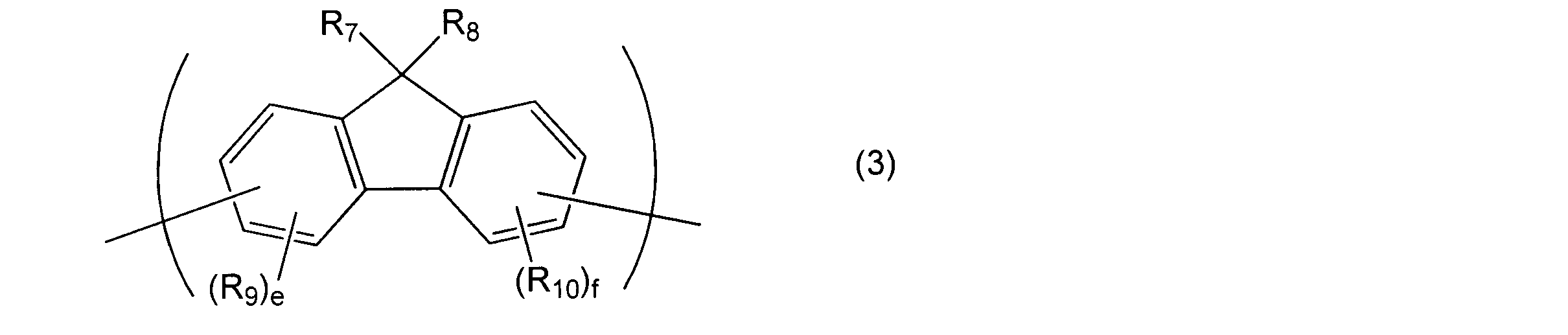
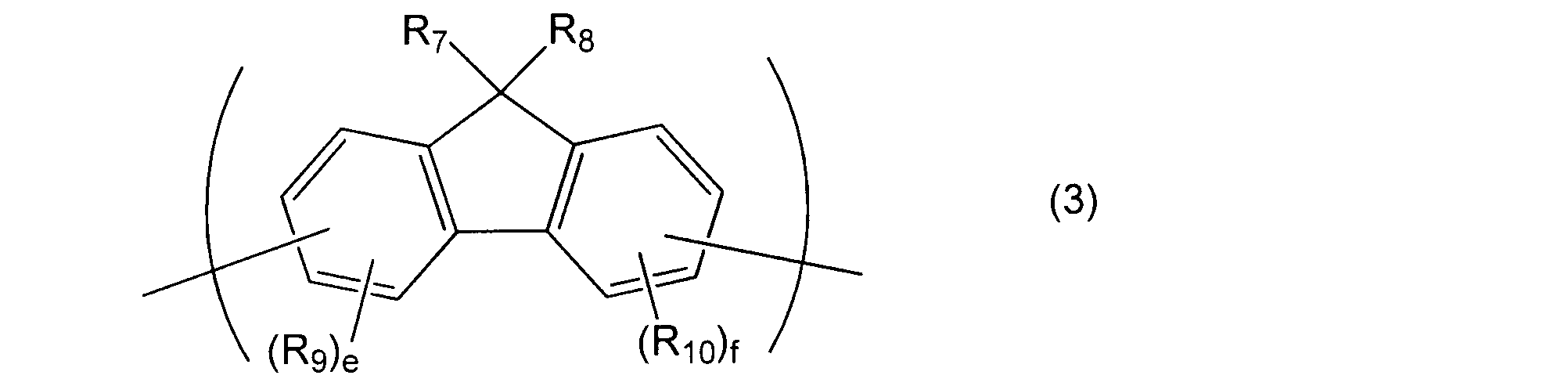
- the polymer compound of the present invention may further contain a repeating unit represented by the following formula (3).
- each of R 7 , R 8 , R 9 and R 10 independently represents a linear or branched alkyl group having 1 to 20 carbon atoms, or a linear or branched alkenyl group having 2 to 20 carbon atoms.
- R 7 , R 8 , R 9 and R 10 are each independently a linear or branched alkyl group having 1 to 20 carbon atoms, or a linear or branched group having 2 to 20 carbon atoms. And a cycloalkyl group having 3 to 20 carbon atoms, an aryl group having 6 to 24 ring carbon atoms, or a heteroaryl group having 5 to 24 ring atoms.
- Examples of the alkyl group, alkenyl group, cycloalkyl group, aryl group, and heteroaryl group represented by R 7 , R 8 , R 9, and R 10 include R 1 in formula (1-1) or formula (1-2). The same substituents as the alkyl group, alkenyl group, cycloalkyl group, aryl group, and heteroaryl group represented by -R 6 are included.
- R 9 and R 10 may be bonded to each other to form a hydrocarbon ring.
- Examples of the ring formed by combining R 9 and R 10 include the following rings.
- each other R 10 to R 9 each other or adjacent adjacent may form a hydrocarbon ring bonded to each other. Adjacent R 9 together, examples of the hydrocarbon ring to each other R 10 adjacent forms include rings as follows.
- At least one of R 7 , R 8 , R 9 and R 10 is substituted with a group containing a polymerizable functional group.
- a polymerizable functional group reacts with other molecules in the vicinity by irradiation with heat and / or active energy rays, or receives energy from other molecules such as a sensitizer, and generates a new chemical bond. It is a group to do.
- the polymerizable functional group is not particularly limited, but a group containing an unsaturated double bond, a cyclic ether, a benzocyclobutane ring or the like is preferable.
- the polymerizable functional group is preferably a group represented by the following formula (i); a group represented by the following formula (ii); and a formula (iii) below from the viewpoint that the polymer compound is easily insolubilized.
- each of R 11 , R 12 and R 13 independently represents a hydrogen atom, a fluorine atom, a linear or branched alkyl group having 1 to 20 carbon atoms, or a substituted or unsubstituted ring-forming carbon number of 6 ⁇ 30 aryl groups.
- L 11 is a divalent linking group. n is an integer of 0 or 1, and when n is 0, L 11 is a single bond.
- L 12 is a divalent linking group. n is an integer of 0 or 1, and when n is 0, L 12 is a single bond.
- L 13 is a divalent linking group. n is an integer of 0 or 1, and when n is 0, L 13 is a single bond.
- L 14 is a divalent linking group. n is an integer of 0 or 1, and when n is 0, L 14 is a single bond.
- R 14 is a hydrogen atom, a substituted or unsubstituted linear or branched alkyl group having 1 to 20 carbon atoms, or a substituted or unsubstituted aryl group having 6 to 30 ring carbon atoms.
- L 15 is a divalent linking group. n is an integer of 0 or 1, and when n is 0, L 15 is a single bond.
- R 11 , R 12 and R 13 in formula (i); and an alkyl group and aryl group represented by R 14 in formula (v) include R 1 to R 1 in formula (1-1) or formula (1-2). The same substituent as the alkyl group and aryl group represented by R 6 is included.
- R 11 , R 12 and R 13 in formula (i); the aryl group represented by R 14 in formula (v) is preferably a substituted or unsubstituted aryl group having 6 to 24 ring carbon atoms.
- L 21 represents a substituted or unsubstituted arylene group having 6 to 24 ring carbon atoms, a substituted or unsubstituted divalent heterocyclic group having 3 to 24 ring atoms, a substituted or unsubstituted carbon group having 1 to 20 carbon atoms.
- a linking group selected from the group consisting of a linear or branched alkylene group, a substituted or unsubstituted vinylene group, a substituted or unsubstituted vinylidene group, and an ethynylene group, or two or more selected from these groups Is a linking group formed by bonding the groups in any order.
- L 21 is preferably a linking group containing a substituted or unsubstituted linear or branched alkylene group having 3 to 12 carbon atoms.
- L 21 contains a linear or branched alkylene group having 3 to 12 carbon atoms, the solubility of the polymer compound of the present invention in a coating solvent can be improved.
- R 15 to R 17 are each independently a hydrogen atom, a substituted or unsubstituted linear or branched alkyl group having 1 to 20 carbon atoms, and a substituted or unsubstituted aryl group having 6 to 30 ring carbon atoms. Selected from the group consisting of groups.
- R 15 to R 17 are each independently a hydrogen atom, a substituted or unsubstituted linear or branched alkyl group having 1 to 20 carbon atoms, and a substituted or unsubstituted ring forming carbon number of 6 to 24. It is preferably selected from the group consisting of:
- L 11 to L 15 are a linking group as described above, the solubility of the polymer compound of the present invention in a coating solvent is improved. Moreover, the polymerization reaction rate of the polymer compound of the present invention is increased, and unreacted polymerizable groups are reduced. Therefore, durability and lifetime of an organic device, particularly an organic electroluminescent element can be improved.
- the polymer compound of the present invention has a polystyrene-equivalent number average molecular weight (Mn) of usually 1 ⁇ 10 3 to 1 ⁇ 10 8 , preferably 1 ⁇ 10 3 to 1 ⁇ 10 6 .
- the weight average molecular weight (Mw) is usually 1 ⁇ 10 3 to 1 ⁇ 10 8 , preferably 1 ⁇ 10 3 to 1 ⁇ 10 6 .
- the molecular weight distribution represented by Mw / Mn is not particularly limited, but is preferably 10 or less, more preferably 5 or less.
- a solvent can be used.
- the solvent include chloro solvents such as chloroform, methylene chloride and 1,2-dichloroethane, ether solvents such as dibutyl ether, tetrahydrofuran and dioxane, and aromatics such as toluene, xylene, mesitylene, tetralin and n-butylbenzene. System solvents and the like. These organic solvents can be used alone or in combination.
- the polymer compound of the present invention can usually be dissolved in these solvents in an amount of 0.1% by weight or more.
- oxidative polymerization using FeCl 3 Yamamoto reaction using an aromatic dihalogen compound and a zerovalent nickel catalyst in a stoichiometric manner, and having an aromatic dihalogen compound and a diboronic acid group
- Yamamoto reaction using an aromatic dihalogen compound and a zerovalent nickel catalyst in a stoichiometric manner, and having an aromatic dihalogen compound and a diboronic acid group A Suzuki reaction in which a compound is polymerized using a zerovalent palladium catalyst can be used.
- the base may be added as an aqueous solution and reacted in a two-phase system.
- phase transfer catalysts such as a quaternary ammonium salt
- a temperature of about 50 to 160 ° C. is suitable for the reaction.
- the reaction system may be heated to near the boiling point of the solvent and reacted while refluxing.
- the reaction time is about 0.5 to 200 hours.
- the reaction is carried out under an inert atmosphere such as argon gas or nitrogen gas under conditions that do not deactivate the catalyst.
- Examples of the palladium catalyst in the Suzuki reaction include palladium [tetrakis (triphenylphosphine)], palladium acetates, dichlorobis (triphenylphosphine) palladium (II) and the like.
- the addition amount of the palladium catalyst in the Suzuki reaction is not particularly limited as long as it is an effective amount as a catalyst, but is usually 0.0001 mol to 0.5 mol, preferably 0, relative to 1 mol of the compound used. .0003 mol to 0.1 mol.
- a phosphorus compound such as triphenylphosphine, tri (o-tolyl) phosphine, tri (o-methoxyphenyl) phosphine can be added as a ligand.
- the addition amount of the ligand is usually 0.5 mol to 100 mol, preferably 0.9 mol to 20 mol, more preferably 1 mol to 10 mol, relative to 1 mol of the palladium catalyst. is there.
- the base in the Suzuki reaction can be an inorganic base, an organic base, an inorganic salt, or the like.
- the inorganic base include potassium carbonate, sodium carbonate, barium hydroxide and the like.
- the organic base include triethylamine and tributylamine.
- the inorganic salt include cesium fluoride.
- the amount of base added in the Suzuki reaction is usually 0.5 mol to 100 mol, preferably 0.9 mol to 30 mol, more preferably 1 mol to 20 mol, per 1 mol of the compound used.
- the polymerization solvent is not particularly limited.
- aromatic hydrocarbon solvents such as toluene, xylene and chlorobenzene, halogenated hydrocarbon solvents such as methylene chloride, dichloroethane and chloroform, ether solvents such as tetrahydrofuran and dioxane, N
- ether solvents such as tetrahydrofuran and dioxane
- N examples thereof include amide solvents such as N-dimethylformamide, alcohol solvents such as methanol, ester solvents such as ethyl acetate, and ketone solvents such as acetone.
- solution polymerization for polymerization in a homogeneous system and precipitation polymerization for precipitation of the produced polymer can also be performed.
- These organic solvents may be used alone or in combination of two or more.
- the reaction temperature of the Suzuki reaction is usually about 0 to 200 ° C., although depending on the solvent, and is preferably 40 to 120 ° C. from the viewpoint of increasing the molecular weight of the polymer compound.
- the reaction time varies depending on the reaction conditions such as reaction temperature, but usually the end point is reached when the desired degree of polymerization is reached. Usually, it is preferably 1 hour or longer, more preferably 2 to 200 hours.
- the Suzuki reaction is preferably performed in an inert atmosphere.
- it is performed in a system sufficiently deaerated with argon gas or nitrogen gas.
- the compound used for the reaction tetrakis (triphenylphosphine) palladium (0)
- a solvent degassed by bubbling with nitrogen gas in advance such as toluene, is added.
- a base degassed by bubbling with nitrogen gas in advance for example, an aqueous sodium carbonate solution
- a base degassed by bubbling with nitrogen gas in advance for example, an aqueous sodium carbonate solution
- polymerization is performed while maintaining an inert atmosphere at a reflux temperature for 30 hours.
- the polymer compound of the present invention can be used by being contained in a material for an organic EL device.
- the polymer compound of the present invention can be contained as a hole transport material in a hole transport layer or a hole injection layer of a polymer organic electroluminescence device.
- the polymer organic electroluminescent device of the present invention is a polymer organic electroluminescent device having an electrode composed of an anode and a cathode, and one or more organic thin film layers including at least a light emitting layer sandwiched between the electrodes. . At least one of the organic thin film layers contains at least one of the polymer compounds of the present invention alone or as a mixed component with other components.
- the organic thin film layer of the polymer organic electroluminescence device of the present invention has a charge transport layer and / or a charge injection layer (the charge transport layer and the charge injection layer are also referred to as a charge injection transport layer), and the charge injection transport.
- the layer preferably contains the polymer compound of the present invention.
- the polymer compound of the present invention is preferably contained in the charge transport layer or the charge injection layer as a main component.
- the organic thin film layer of the polymer organic electroluminescence device of the present invention has a hole transport layer and / or a hole injection layer as the charge transport injection layer (a hole injection transport layer combined with a hole transport layer and a hole injection layer). It is also preferred that the polymer compound of the present invention is contained in these layers. In particular, the polymer compound of the present invention is preferably contained in the hole transport layer or the hole injection layer as a main component.
- the organic thin film layer of the polymer organic electroluminescence device of the present invention includes an electron transport layer and / or an electron injection layer (also referred to as an electron injection / transport layer together with the electron transport layer and the electron injection layer) as the charge transport injection layer. You may have.
- the electron injection / transport layer may be a layer containing the polymer compound of the present invention, or may be a layer containing a compound having an electron injection function other than the polymer compound of the present invention.
- the polymer compound of the present invention is preferably contained in the electron transport layer or the electron injection layer as a main component.
- the light emitting layer of the polymer organic electroluminescent element of the present invention may be a layer containing a compound having a light emitting function other than the polymer compound of the present invention.
- the element structure of the polymer organic electroluminescent element of the present invention will be described.
- the following structures a) to e) are exemplified.
- the structure e) is usually preferably used, but is not limited thereto (in the following structure, “/” indicates that each layer is laminated adjacently).
- Anode / light emitting layer / cathode b) Anode / hole injection layer / light emitting layer / cathode c) Anode / light emitting layer / electron transport layer / cathode d) Anode / hole transport layer / light emitting layer / electron transport layer / cathode e) Anode / hole injection layer / hole transport layer / light emitting layer / electron transport layer / cathode
- the method for forming the organic thin film layer is not limited, but a method using film formation from a solution is exemplified.
- film formation methods from solutions include spin coating, casting, micro gravure coating, gravure coating, bar coating, roll coating, wire bar coating, dip coating, spray coating, and nozzle coating.
- Method capillary coating method, screen printing method, flexographic printing method, offset printing method, inkjet printing method and the like. When pattern formation is performed, screen printing, flexographic printing, offset printing, and inkjet printing are preferred.
- the optimum thickness of the organic thin film layer varies depending on the material used.
- a film thickness with an appropriate driving voltage and light emission efficiency may be selected.
- the film thickness is 1 nm to 1 ⁇ m, preferably 2 nm to 500 nm, and more preferably 5 nm to 200 nm.
- the solvent used for film formation from a solution is not particularly limited as long as it dissolves an organic material constituting the organic thin film layer.
- the solvent include chlorine solvents such as chloroform, methylene chloride, dichloroethane, ether solvents such as tetrahydrofuran, aromatic hydrocarbon solvents such as toluene and xylene, ketone solvents such as acetone and methyl ethyl ketone, ethyl acetate, Ester solvents such as butyl acetate and ethyl cellosolve acetate are included.
- At least one of an electrode composed of an anode and a cathode is transparent or translucent.
- the anode is preferably transparent or translucent.
- the material of the anode is preferably a conductive metal oxide film, a translucent metal thin film, or the like.
- anode materials include indium oxide, zinc oxide, tin oxide, and conductive inorganic compounds composed of indium / tin / oxide (ITO), indium / zinc / oxide, etc., gold, platinum, etc. , Silver, copper and the like. Of these, ITO, indium / zinc / oxide, tin oxide and the like are preferable.
- organic substances such as polyaniline and derivatives thereof, polythiophene and derivatives thereof may be used.
- Examples of the film forming method for the anode include a vacuum deposition method, a sputtering method, an ion plating method, and a plating method.
- the film thickness of the anode can be appropriately selected in consideration of light transmittance and electrical conductivity. For example, it is 10 nm to 10 ⁇ m, preferably 20 nm to 1 ⁇ m, and more preferably 50 nm to 500 nm. It is.
- a layer made of a phthalocyanine derivative, a conductive polymer, carbon, or the like, or a layer made of a metal oxide, a metal fluoride, an organic insulating material, or the like may be provided on the anode.
- the cathode material is preferably a material having a small work function.
- metals such as lithium, sodium, potassium, rubidium, cesium, beryllium, magnesium, calcium, strontium, barium, aluminum, scandium, vanadium, zinc, yttrium, indium, cerium, samarium, europium, terbium, ytterbium; and their An alloy of two or more of them; or an alloy of one or more of them with one or more of gold, silver, platinum, copper, manganese, titanium, cobalt, nickel, tungsten, tin; Graphite or a graphite intercalation compound is used.
- Examples of the alloy include magnesium-silver alloy, magnesium-indium alloy, magnesium-aluminum alloy, indium-silver alloy, lithium-aluminum alloy, lithium-magnesium alloy, lithium-indium alloy, calcium-aluminum alloy and the like.
- the cathode may have a laminated structure of two or more layers.
- the film thickness of the cathode can be appropriately selected in consideration of electric conductivity and durability, but is, for example, 10 nm to 10 ⁇ m, preferably 20 nm to 1 ⁇ m, and more preferably 50 nm to 500 nm.
- Examples of the method for producing the cathode include a vacuum deposition method, a sputtering method, and a laminating method in which a metal thin film is thermocompression bonded.
- a layer made of a conductive polymer or a layer made of a metal oxide, a metal fluoride, an organic insulating material, or the like may be provided between the cathode and the organic material layer.
- a protective member for protecting the polymer light emitting element may be attached after the cathode is manufactured. In order to use the polymer light emitting device stably for a long period of time, it is preferable to protect the device from the outside by attaching a protective layer and / or a protective cover.
- the protective layer contains resin, metal oxide, metal fluoride, metal boride and the like.
- the protective cover can be a glass plate, a plastic plate having a surface subjected to low water permeability treatment, or the like.
- the protective cover is sealed by being bonded to the element substrate via a thermosetting resin or a photocurable resin. If a space is secured between the element and the protective cover using a spacer, the element can be easily prevented from being scratched. If an inert gas such as nitrogen or argon is sealed in the space, oxidation of the cathode can be prevented. Further, if a desiccant such as barium oxide is installed in the space, damage to the element due to moisture adsorbed in the manufacturing process can be easily suppressed. Among these, it is preferable to take any one or more measures.
- the weight average molecular weight and the number average molecular weight are a polystyrene-converted weight average molecular weight and number average molecular weight determined by gel permeation chromatography (GPC) using tetrahydrofuran as a solvent.
- the reaction solution was cooled to around room temperature.
- the cooled reaction solution was charged with phenylboronic acid (0.0646 g) and further reacted under reflux for 2 hours.
- the reaction solution was cooled to near room temperature, and then water (150 ml) was added and washed with water three times.
- the catalyst was removed from the washed toluene solution through a laminated column of 400 ml of silica gel / 50 ml of alumina, and the toluene solution was concentrated under reduced pressure. Thereafter, it was washed with a methanol / acetone solution to obtain a polymer (2.72 g).
- the obtained polymer compound had a polystyrene equivalent weight average molecular weight of 2.71 ⁇ 10 4 and a polystyrene equivalent number average molecular weight of 1.05 ⁇ 10 4 .
- the structure of the repeating unit contained in the polymer compound is estimated from the reaction raw material as follows (polymer compound 1).
- reaction solution was cooled to around room temperature, and then charged with phenylboronic acid (1.0 g), and further reacted under reflux for 2 hours. After completion of the reaction, the reaction solution was cooled to near room temperature, and then water (150 ml) was added and washed with water three times.
- the catalyst was removed from the washed toluene solution through a stacked column of silica gel (100 ml) / alumina (50 ml), and the toluene solution was concentrated under reduced pressure. Thereafter, a solid was precipitated with methanol (25 ml). This solid was dissolved in 20 ml of toluene and reprecipitated in a methanol / acetone solution to obtain a polymer (2.6 g). The obtained polymer compound had a polystyrene equivalent weight average molecular weight of 1.87 ⁇ 10 5 and a polystyrene equivalent number average molecular weight of 1.78 ⁇ 10 4 .
- the structure of the repeating unit contained in the polymer compound is estimated from the reaction raw material as follows (polymer compound 2).
- Example 3 In Example 2, the same reaction was performed except that 4.00 g of intermediate 6 was used instead of intermediate 3, and 2.4 g of polymer was obtained.
- the obtained polymer compound had a polystyrene-equivalent weight average molecular weight of 2.87 ⁇ 10 4 and a polystyrene-equivalent number average molecular weight of 1.18 ⁇ 10 4 .
- the structure of the repeating unit contained in the polymer compound is estimated from the reaction raw material as follows (polymer compound 3).
- reaction solution was cooled to near room temperature.
- the cooled reaction solution was charged with phenylboronic acid (0.0646 g) and further reacted under reflux for 2 hours.
- the reaction solution was cooled to near room temperature, and then water (150 ml) was added and washed with water three times.
- the catalyst was removed from the washed toluene solution through a stacked column of silica gel (400 ml) / alumina (50 ml), and the toluene solution was concentrated under reduced pressure.
- the polymer was obtained by washing with a methanol / acetone solution (2.72 g).
- the obtained polymer compound had a polystyrene equivalent weight average molecular weight of 2.71 ⁇ 10 4 and a polystyrene equivalent number average molecular weight of 1.05 ⁇ 10 4 .
- the structure of the repeating unit contained in the polymer compound is estimated from the reaction raw material as follows (polymer compound 4).
- Example 5 (Production and evaluation of organic electroluminescent elements) A glass substrate with ITO transparent electrode line (manufactured by Geomatic Co., Ltd.) having a thickness of 25 mm ⁇ 75 mm ⁇ 1.1 mm was ultrasonically cleaned in isopropyl alcohol for 5 minutes. Further, UV ozone cleaning was performed for 30 minutes. The glass substrate with a transparent electrode line after washing was mounted on a substrate holder of a vacuum deposition apparatus.
- a hole injection layer made of polyethylenedioxythiophene / polystyrene sulfonic acid (PEDOT / PSS) is applied to the surface of the glass substrate on which the transparent electrode line is formed so as to cover the transparent electrode by spin coating. (Film thickness: 60 nm).
- a hole transport layer is formed on the hole injection layer by spin coating using a toluene solution (1.0 wt%) of the polymer compound (polymer compound 1) obtained in Example 1. Filmed and dried under reduced pressure at 120 ° C. for 1 hour. A uniform film was obtained (thickness: 20 nm).
- the following compound EM1 and the following amine compound D1 having a styryl group as a light emitting molecule were co-evaporated so that the weight ratio of EM1 to D1 was 40: 2, and a light emitting layer was formed (film) Thickness: 40 nm).
- a light emitting layer was formed (film) Thickness: 40 nm).
- an Alq film having a thickness of 10 nm was formed on the light emitting layer. This functions as an electron injection layer.
- Li Li source: manufactured by Saesgetter Co.
- Alq Alq
- Table 1 shows the results obtained by observing the emission color of the organic electroluminescence device thus manufactured and measuring the initial luminance of 5000 cd / m 2 , room temperature, luminous efficiency under DC constant current drive, and half-life.
- Example 6 In Example 5, the same procedure was performed except that the polymer compound obtained in Example 2 (polymer compound 2) was used in place of the polymer compound obtained in Example 1 as the hole transport material. An organic electroluminescent device was prepared and evaluated in the same manner. The results are shown in Table 1.
- Example 7 In Example 5, the same procedure was performed except that the polymer compound obtained in Example 3 (polymer compound 3) was used instead of the polymer compound obtained in Example 1 as the hole transport material. An organic electroluminescent device was prepared and evaluated in the same manner. The results are shown in Table 1.
- Example 8 A glass substrate with an ITO transparent electrode having a thickness of 25 mm ⁇ 75 mm ⁇ 1.1 mm (manufactured by Geomatic) was ultrasonically cleaned in isopropyl alcohol for 5 minutes. Further, UV ozone cleaning was performed for 30 minutes. The glass substrate with a transparent electrode line after washing was mounted on a substrate holder of a vacuum deposition apparatus.
- a hole injection layer made of polyethylenedioxythiophene / polystyrene sulfonic acid (PEDOT / PSS) is applied to the surface of the glass substrate on which the transparent electrode line is formed so as to cover the transparent electrode by spin coating. (Film thickness: 60 nm).
- a hole transport layer is formed on the hole injection layer by spin coating using a toluene solution (1.0 wt%) of the polymer compound (polymer compound 4) obtained in Example 4.
- a film was formed, dried at 250 ° C. for 60 minutes and thermally cured to obtain a uniform film (thickness: 20 nm).
- the compound EM1 and the amine compound D1 as a light emitting molecule were co-evaporated so that the weight ratio of EM1 and D1 was 40: 2, and a light emitting layer was formed (film thickness: 40 nm).
- An Alq film having a thickness of 10 nm was formed on the light emitting layer. This functions as an electron injection layer. Thereafter, Li (Li source: manufactured by Saesgetter Co.), which is a reducing dopant, and Alq were vapor-deposited, and an Alq: Li film (film thickness: 10 nm) was formed as an electron injection layer (cathode). On the Alq: Li film, metal Al was deposited to form a metal cathode, thereby manufacturing an organic electroluminescent device.
- Li Li source: manufactured by Saesgetter Co.
- Table 1 shows the results obtained by observing the emission color of the obtained organic electroluminescence device and measuring the initial luminance of 5000 cd / m 2 , room temperature, luminous efficiency under DC constant current drive, and half-life.
- Example 5 instead of depositing the polymer compound 1 as a hole transporting material, a 1.0 wt% toluene solution of poly (N-vinylcarbazole) (PVCz) was used to spin-coat positively with a thickness of 60 nm.
- An organic electroluminescent element was produced in the same manner as in Example 5 except that the hole transport layer was formed. The obtained organic electroluminescent element was evaluated in the same manner as in Example 5. The results are shown in Table 1.
- Example 5 instead of forming the polymer compound 1 as a hole transport material, a 1.0 wt% toluene solution of a polyfluorene derivative (TFB) was used to form a hole transport layer having a thickness of 60 nm by spin coating.
- An organic electroluminescent element was produced in the same manner as in Example 5 except that the film was formed. About the produced organic electroluminescent element, it evaluated similarly to Example 5.
- FIG. The results are shown in Table 1.
- the polymer compound of the present invention is suitable as an organic material for an organic electroluminescence device, particularly as a charge transport material.
- the organic electroluminescent element of the present invention has high efficiency and long life.
Landscapes
- Chemical & Material Sciences (AREA)
- Engineering & Computer Science (AREA)
- Materials Engineering (AREA)
- Organic Chemistry (AREA)
- Polymers & Plastics (AREA)
- Medicinal Chemistry (AREA)
- Chemical Kinetics & Catalysis (AREA)
- Health & Medical Sciences (AREA)
- Physics & Mathematics (AREA)
- Spectroscopy & Molecular Physics (AREA)
- Inorganic Chemistry (AREA)
- Electroluminescent Light Sources (AREA)
- Polyoxymethylene Polymers And Polymers With Carbon-To-Carbon Bonds (AREA)
Abstract
Description







本発明の高分子化合物は、下記式(1-1)または(1-2)で表される繰り返し単位を含む。式(1-1)または(1-2)で表される繰り返し単位は、1種類のみ含まれていても、2種以上含まれていてもよい。式(1-1)または(1-2)で表される繰り返し単位が2種以上含まれる場合には、繰り返し単位が交互またはランダムに結合していてもよいし、ある種類の単位が連続した後に別の種類の単位が連続するものでもよい。
前記式(1-1)または(1-2)において、R1~R6は、それぞれ独立に、炭素数1~20の直鎖状もしくは分岐状のアルキル基、炭素数1~20の直鎖状もしくは分岐状のアルコキシ基、炭素数1~20の直線状もしくは分岐状のアルキルチオ基、炭素数2~20の直鎖状もしくは分岐状のアルケニル基、炭素数3~20のシクロアルキル基、環形成炭素数6~24のアリール基、又は環形成原子数5~24のヘテロアリール基であることが好ましい。
前記式(1-1)または(1-2)において、R1~R6は、それぞれ独立に、炭素数1~20の直鎖状もしくは分岐状のアルキル基、炭素数2~20の直鎖状もしくは分岐状のアルケニル基、炭素数3~20のシクロアルキル基、環形成炭素数6~24のアリール基、又は環形成原子数5~24のヘテロアリール基であることが好ましい。










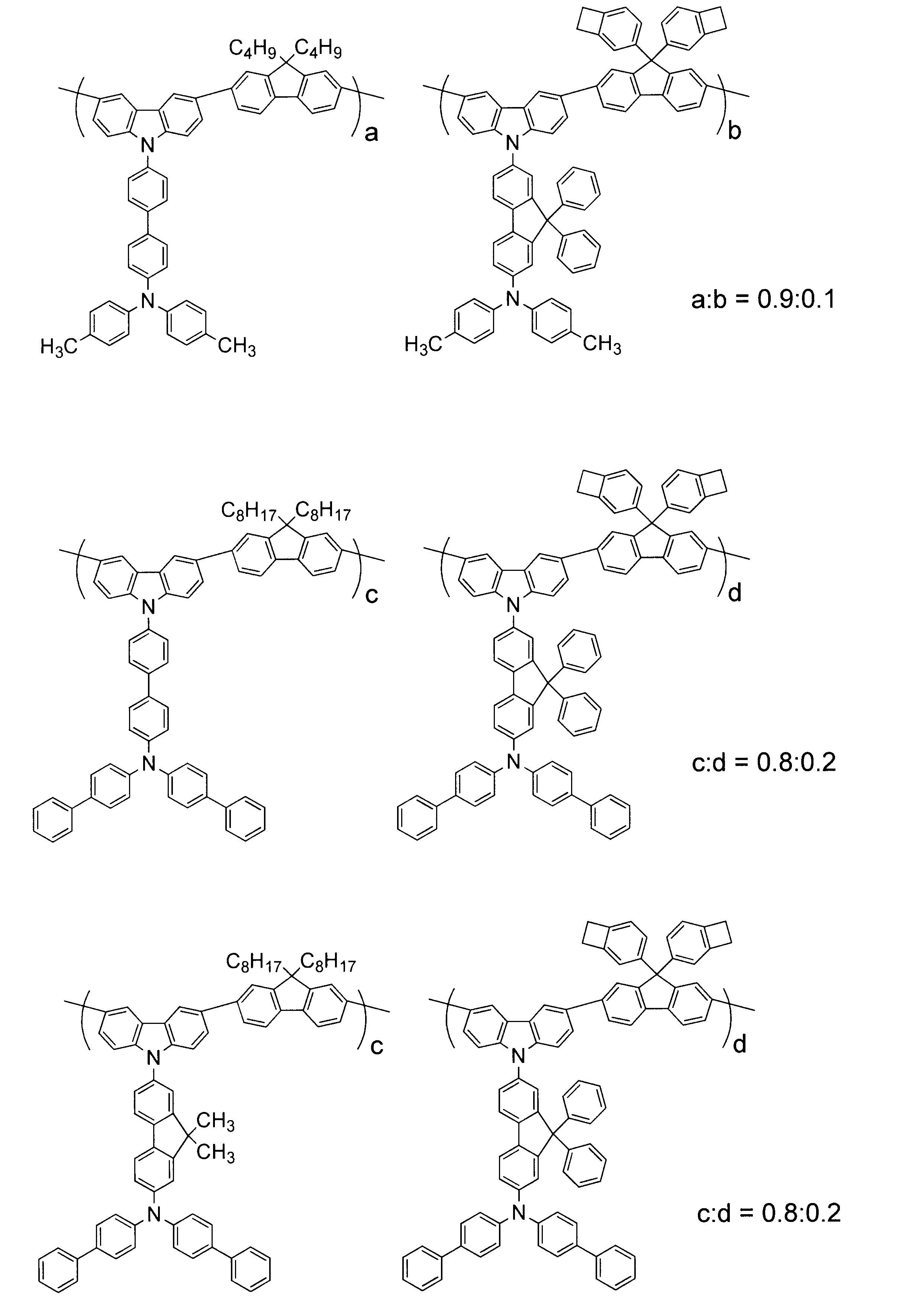

次に、本発明の高分子化合物の製造方法について説明する。
本発明の高分子化合物は、有機EL素子用材料に含有させて用いることができる。特に、本発明の高分子化合物は、正孔輸送材料として、高分子有機電界発光素子の正孔輸送層または正孔注入層に含有させることができる。
次に、本発明の高分子有機電界発光素子について説明する。
a)陽極/発光層/陰極
b)陽極/正孔注入層/発光層/陰極
c)陽極/発光層/電子輸送層/陰極
d)陽極/正孔輸送層/発光層/電子輸送層/陰極
e)陽極/正孔注入層/正孔輸送層/発光層/電子輸送層/陰極
装置:ゲル浸透クロマトグラフGPC 101(Shodex社製)
検出器:示差屈折率計
カラム:GPC K-806LX3(8.0mmI.D.×30cm、Shodex社製)
カラム温度:40℃
溶媒:クロロホルム
注入量:100μl
流速 :1ml/min
標準物質:単分散ポリスチレン(Shodex社製)
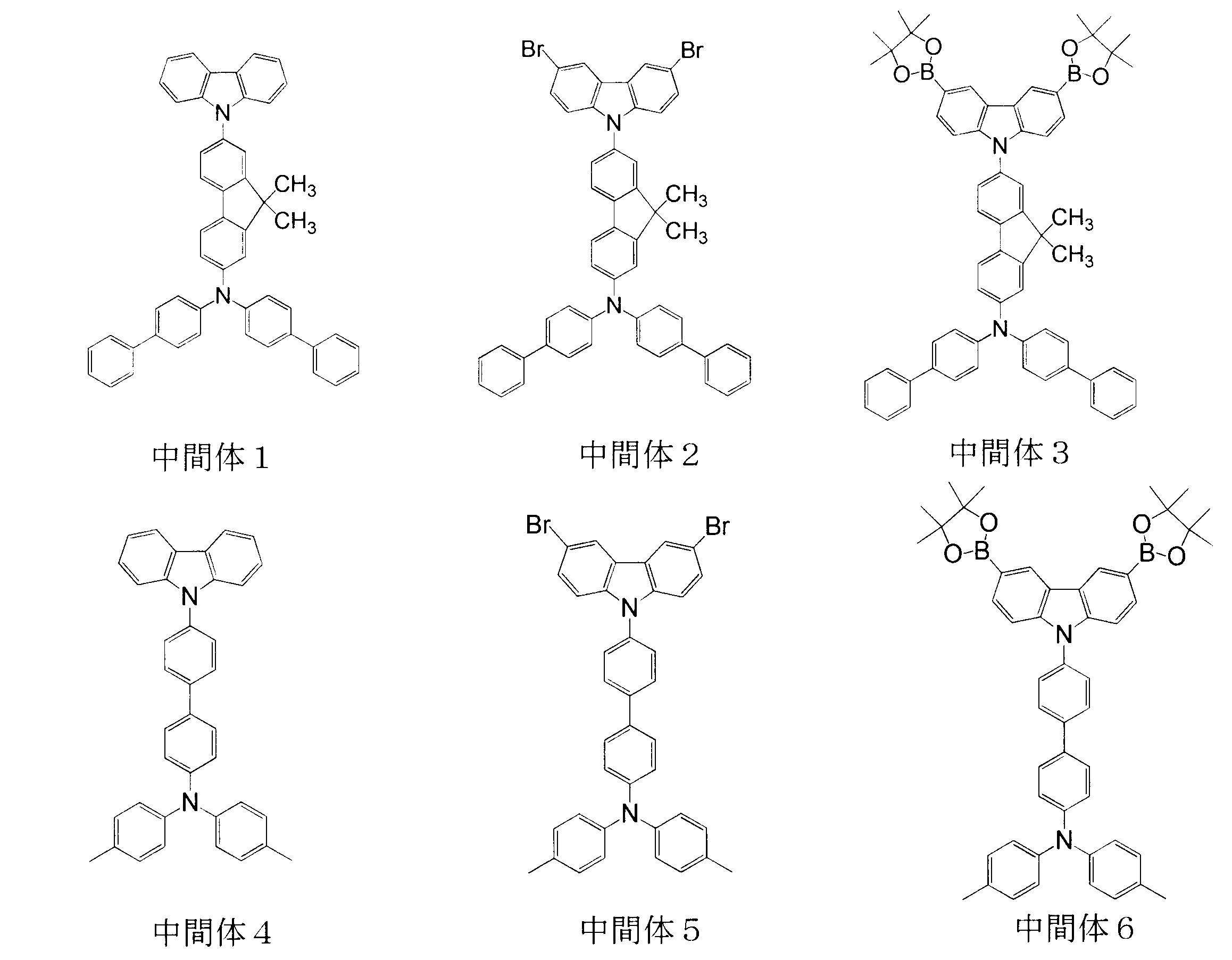
窒素気流下、特開2000-302756に記載の方法を参考にして合成した中間体1(67.8g)をテトラヒドロフラン(1500ml)に装入してアイスバスにより20℃に冷却した。さらに、N-ブロモスクシンイミド(NBS,42.7g)を溶解したテトラヒドロフラン溶液を滴下した。滴下後、室温にて20時間反応した。その後、蒸留水(800ml)を加えて結晶を析出させた。濾別した結晶にメタノール(300ml)を加えて60℃で1時間攪拌させて、冷却後ろ過をして乾燥させた。クロロベンゼンで再結晶を行い、51.1gの白色固体を得た。FD-MS分析により、中間体2であることを同定した。
窒素気流下、中間体2(10.0g)、ビス(ピナコラト)ジボロン(7.28g,0.029モル)、脱水1,4-ジオキサン(100ml)、および酢酸カリウム(7.71g)を装入した反応器に、Pd(dppf)Cl2(0.58g)を装入して、90℃で6時間反応させた。冷却後、トルエン(150ml)を装入した。蒸留水(200ml)で3回水洗を行った。有機層をシリカゲルのショートカラムを通して触媒を除去し、トルエンを濃縮した。その後、メタノール(100ml)加えて洗浄を行い、乾燥させて10.3gの固体を得た。FD-MS分析により、中間体3であると同定した。
中間体合成例1において、中間体1の代わりに特開2000-302756に記載の方法を参考にして合成した中間体4を50.0g用いた以外は同様の反応を行ったところ、42.4gの白色固体を得た。FD-MS分析により、中間体5であることを確認した。
中間体合成例2において、中間体2の代わりに中間体5を20.0g用いた以外は同様の反応を行ったところ、18.2gの白色固体を得た。FD-MS分析により、中間体6であることを確認した。
単量体としての中間体2(4.49g)、単量体としての中間体3(5.00g)、トルエン(60ml)、テトラブチルアンモニウムブロマイド(0.19g)、炭酸ナトリウム(1.51g)の水溶液(30ml)を反応器内に装入し、窒素置換を行った。置換後、テトラキス(トリフェニルホスフィン)パラジウム(0)(0.12g)を装入して、還流下で40時間反応させた。反応は、窒素ガス雰囲気下で行った。

単量体としての中間体3(3.35g)、下記の構造式で表されるジブロマイド(アルドリッチ製)2.00g、トルエン(50ml)、テトラブチルアンモニウムクロライド(0.28g)、炭酸ナトリウム(2.24g)の水溶液(25ml)を反応器内に装入し、窒素置換を行った。置換後、テトラキス(トリフェニルホスフィン)パラジウム(0)0.028gを装入して還流下で48時間反応させた。反応は、窒素ガス雰囲気下で行った。

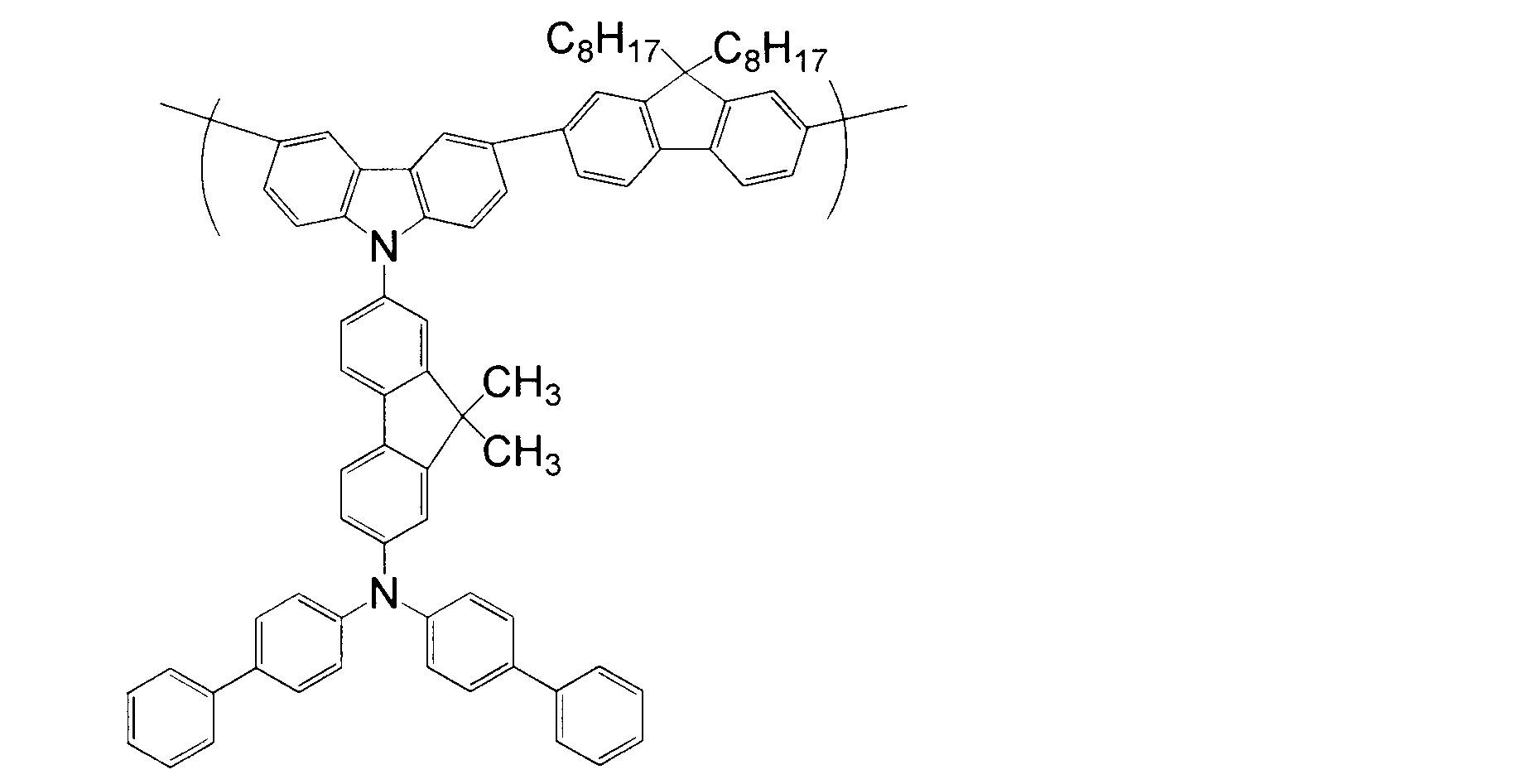
実施例2において、中間体3の代わりに中間体6を4.00g用いた以外は同様の反応を行ったところ、2.4gの重合体を得た。得られた高分子化合物は、ポリスチレン換算の重量平均分子量が2.87×10⁴であり、ポリスチレン換算の数平均分子量が1.18×10⁴であった。
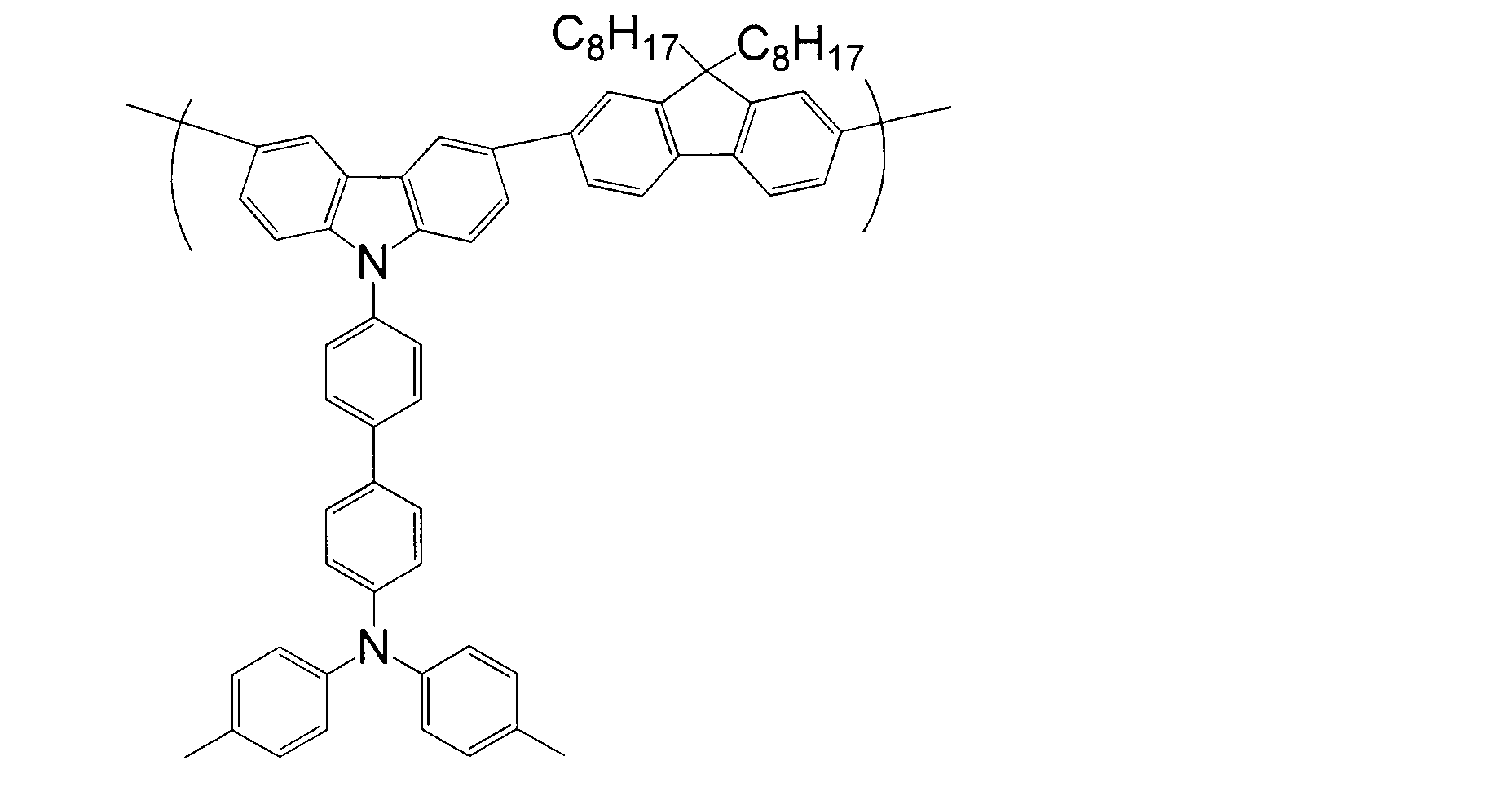
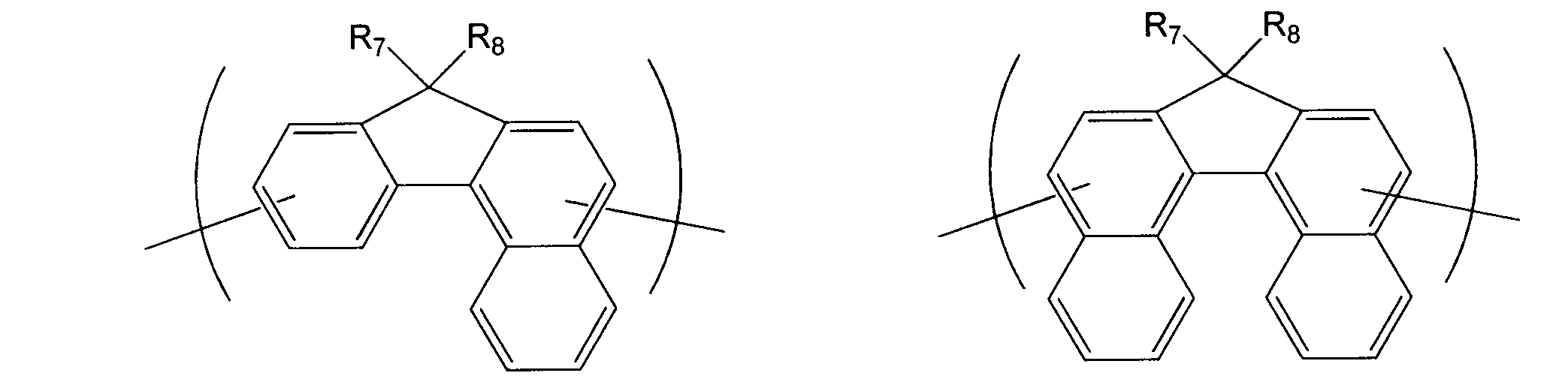
単量体としての中間体3(5.00g,0.0054モル)、下記左側構造式で表されるジブロマイド(アルドリッチ製)(2.24g,0.0041モル)、下記右側構造式で表されるジブロマイド(0.54g,0.0010モル)、トルエン(60ml)、テトラブチルアンモニウムブロマイド(0.19g)、および炭酸ナトリウム(1.51g)の水溶液(30ml)を反応器内に装入し、窒素置換を行った。置換後、テトラキス(トリフェニルホスフィン)パラジウム(0)(0.12g)を装入して還流下で40時間反応させた。反応は、窒素ガス雰囲気下で行った。

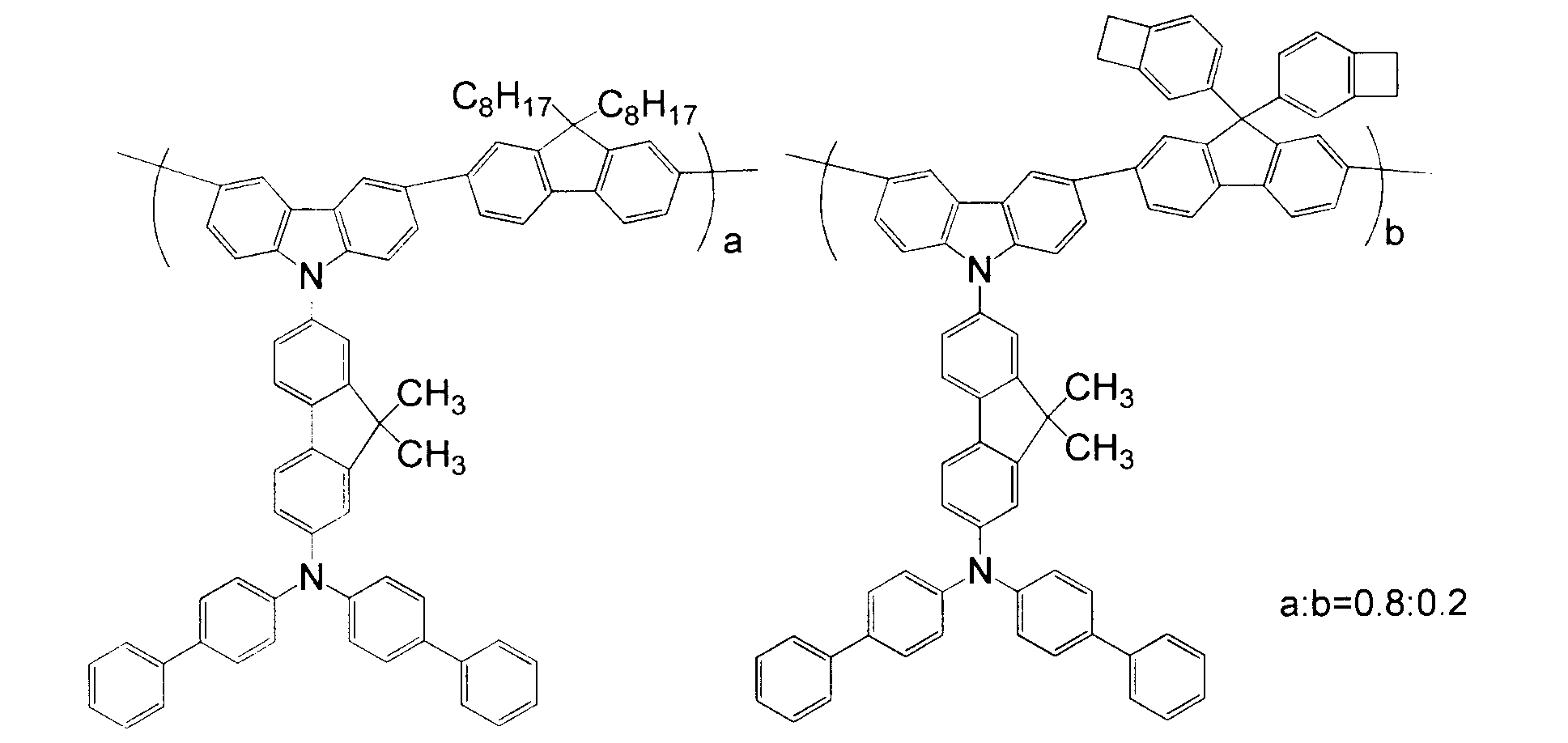
(有機電界発光素子作製と評価)
25mm×75mm×1.1mm厚のITO透明電極ライン付きガラス基板(ジオマティック社製)をイソプロピルアルコール中で、5分間超音波洗浄した。さらに、30分間UVオゾン洗浄を行なった。洗浄後の透明電極ライン付きガラス基板を、真空蒸着装置の基板ホルダーに装着した。

実施例5において、正孔輸送材料として、実施例1で得られた高分子化合物の代わりに、実施例2で得られた高分子化合物(高分子化合物2)を用いた以外は、同様にして有機電界発光素子を作成し、同様の評価をした。結果を表1に示す。
実施例5において、正孔輸送材料として、実施例1で得られた高分子化合物の代わりに、実施例3で得られた高分子化合物(高分子化合物3)を用いた以外は、同様にして有機電界発光素子を作成し、同様の評価をした。結果を表1に示す。
25mm×75mm×1.1mm厚のITO透明電極付きガラス基板(ジオマティック社製)をイソプロピルアルコール中で、5分間超音波洗浄した。さらに、30分間UVオゾン洗浄を行なった。洗浄後の透明電極ライン付きガラス基板を真空蒸着装置の基板ホルダーに装着した。
実施例5において、正孔輸送材料として高分子化合物1を成膜する代わりにポリ(N-ビニルカルバゾール)(PVCz)の1.0重量%トルエン溶液を用いて、スピンコートにより60nmの厚みの正孔輸送層を成膜した以外は、実施例5と同様にして有機電界発光素子を作製した。得られた有機電界発光素子について、実施例5と同様に評価した。結果を表1に示す。
実施例5において、正孔輸送材料として高分子化合物1を成膜する代わりにポリフルオレン誘導体(TFB)の1.0重量%トルエン溶液を用いて、スピンコートにより60nmの厚みの正孔輸送層を成膜した以外は、実施例5と同様にして有機電界発光素子を作製した。作製した有機電界発光素子について、実施例5と同様に評価した。結果を表1に示す。

Claims (14)
- 下記式(1-1)または(1-2)で表される繰り返し単位を含む高分子化合物。

aおよびbは、それぞれ0~4の整数を表し、
cおよびdは、それぞれ0~3の整数を表し、
Ar1、Ar2、Ar3およびAr4は、それぞれ独立に、置換もしくは無置換の環形成炭素数6~30のアリール基、又は置換もしくは無置換の環形成原子数5~30のヘテロアリール基である〕 - 前記R1~R6は、炭素数1~20の直鎖状もしくは分岐状のアルキル基、炭素数2~20の直鎖状もしくは分岐状のアルケニル基、炭素数3~20のシクロアルキル基、環形成炭素数6~30のアリール基、又は環形成原子数5~30のヘテロアリール基である、請求項1に記載の高分子化合物。
- 前記R1~R6は、炭素数1~20の直鎖状もしくは分岐状のアルキル基、炭素数1~20の直鎖状もしくは分岐状のアルコキシ基、炭素数1~20の直線状もしくは分岐状のアルキルチオ基、炭素数2~20の直鎖状もしくは分岐状のアルケニル基、炭素数3~20のシクロアルキル基、環形成炭素数6~24のアリール基、又は環形成原子数5~24のヘテロアリール基である、請求項1に記載の高分子化合物。
- 前記R1~R6は、炭素数1~20の直鎖状もしくは分岐状のアルキル基、炭素数2~20の直鎖状もしくは分岐状のアルケニル基、炭素数3~20のシクロアルキル基、環形成炭素数6~24のアリール基、又は環形成原子数5~24のヘテロアリール基である、請求項1に記載の高分子化合物。
- Ar1、Ar2、Ar3およびAr4は、それぞれ独立に、置換もしくは無置換の環形成炭素数6~24のアリール基、又は置換もしくは無置換の環形成原子数5~24のヘテロアリール基である、請求項1~4のいずれか1項に記載の高分子化合物。
- 下記式(2)で表される繰り返し単位をさらに含む、請求項1~5のいずれか1項に記載の高分子化合物。

- 下記式(3)で表される繰り返し単位をさらに含む、請求項1~6のいずれか1項に記載の高分子化合物。

R9およびR10は、それぞれ互いに結合して炭化水素環を形成してもよく、
eおよびfは、それぞれ0~3の整数を表し、eまたはfが2である場合に、隣接するR9同士または隣接するR10同士は、互いに結合して炭化水素環を形成してもよく、
R7、R8、R9およびR10の少なくとも1つに重合性官能基を含む基が置換されている〕 - 前記重合性官能基を含む基が、下記式(i)で表わされる基;下記式(ii)で表わされる基;下記式(iii)で表わされる基;下記式(iv)で表わされる基;下記式(v)で表わされる基;または、下記式(i)~(v)で表わされる基以外の、置換もしくは無置換のノルボルネン骨格を有する基、置換もしくは無置換のエポキシ基又はオキセタン基を有する基、ラクトン構造もしくはラクタム構造を有する基、シクロオクタテトラエン基、1,5-シクロオクタジエン基、1,ω-ジエン基、O-ジビニルベンゼン基、及び1,ω-ジイン基からなる群から選択される環化重合又は開環重合可能な官能基を含む基、である請求項7に記載の高分子化合物。

L11は2価の連結基であり、
nは0又は1の整数であり、nが0の場合L11は単結合である〕



L15は2価の連結基であり、
nは0又は1の整数であり、nが0の場合L15は単結合である〕 - 請求項1~8のいずれか一項に記載の高分子化合物を含有する有機電界発光素子用材料。
- 一対の電極間に、請求項1~8のいずれか一項に記載の高分子化合物を少なくとも一種含有する層を、少なくとも一層挟持してなる有機電界発光素子。
- 前記高分子化合物を含有する層が、電荷注入輸送層である請求項10に記載の有機電界発光素子。
- 前記電荷注入輸送層が正孔注入輸送層である請求項11に記載の有機電界発光素子。
- 前記一対の電極間に発光層として、前記高分子化合物以外の発光機能を有する化合物を含有する層を有する請求項10~12のいずれか一項に記載の有機電界発光素子。
- 前記一対の電極間に電子注入輸送層として、前記高分子化合物以外の電子注入機能を有する化合物を含有する層を有する請求項10~13のいずれか一項に記載の有機電界発光素子。
Priority Applications (4)
| Application Number | Priority Date | Filing Date | Title |
|---|---|---|---|
| US14/891,812 US9882134B2 (en) | 2013-05-17 | 2014-05-16 | Polymer compound, material for organic electroluminescence element using same, and organic electroluminescence element |
| JP2015516923A JP6055913B2 (ja) | 2013-05-17 | 2014-05-16 | 高分子化合物ならびにそれを用いた有機電界発光素子用材料および有機電界発光素子 |
| CN201480028646.9A CN105452326B (zh) | 2013-05-17 | 2014-05-16 | 高分子化合物以及使用其的有机电致发光元件用材料和有机电致发光元件 |
| KR1020157032688A KR20160009562A (ko) | 2013-05-17 | 2014-05-16 | 고분자 화합물, 및 그것을 이용한 유기 전계발광 소자용 재료 및 유기 전계발광 소자 |
Applications Claiming Priority (2)
| Application Number | Priority Date | Filing Date | Title |
|---|---|---|---|
| JP2013-105083 | 2013-05-17 | ||
| JP2013105083 | 2013-05-17 |
Publications (1)
| Publication Number | Publication Date |
|---|---|
| WO2014185079A1 true WO2014185079A1 (ja) | 2014-11-20 |
Family
ID=51898067
Family Applications (1)
| Application Number | Title | Priority Date | Filing Date |
|---|---|---|---|
| PCT/JP2014/002576 Ceased WO2014185079A1 (ja) | 2013-05-17 | 2014-05-16 | 高分子化合物ならびにそれを用いた有機電界発光素子用材料および有機電界発光素子 |
Country Status (5)
| Country | Link |
|---|---|
| US (1) | US9882134B2 (ja) |
| JP (1) | JP6055913B2 (ja) |
| KR (1) | KR20160009562A (ja) |
| CN (1) | CN105452326B (ja) |
| WO (1) | WO2014185079A1 (ja) |
Cited By (5)
| Publication number | Priority date | Publication date | Assignee | Title |
|---|---|---|---|---|
| JP2019119831A (ja) * | 2018-01-10 | 2019-07-22 | 三星電子株式会社Samsung Electronics Co.,Ltd. | 高分子材料、エレクトロルミネッセンス素子用材料、液状組成物、薄膜及びエレクトロルミネッセンス素子 |
| JPWO2018225674A1 (ja) * | 2017-06-07 | 2020-04-09 | 住友化学株式会社 | 高分子化合物の製造方法 |
| JP2021138915A (ja) * | 2020-03-05 | 2021-09-16 | 三星電子株式会社Samsung Electronics Co., Ltd. | アリールアミン−フルオレン交互共重合体、ならびに当該共重合体を用いるエレクトロルミネッセンス素子材料およびエレクトロルミネッセンス素子 |
| JP2022090346A (ja) * | 2020-12-07 | 2022-06-17 | 三星電子株式会社 | 共重合体、ならびに当該共重合体を用いるエレクトロルミネッセンス素子材料およびエレクトロルミネッセンス素子 |
| US12054565B2 (en) | 2018-07-31 | 2024-08-06 | Lg Chem, Ltd. | Polymer and organic light emitting device comprising the same |
Families Citing this family (7)
| Publication number | Priority date | Publication date | Assignee | Title |
|---|---|---|---|---|
| JP6995563B2 (ja) * | 2016-12-27 | 2022-01-14 | 三星電子株式会社 | 高分子化合物、組成物、液状組成物、薄膜、並びにエレクトロルミネッセンス素子用材料、及びエレクトロルミネッセンス素子 |
| JP7044515B2 (ja) * | 2016-12-27 | 2022-03-30 | 三星電子株式会社 | 高分子化合物、組成物、液状組成物、薄膜並びにエレクトロルミネッセンス素子用材料及びエレクトロルミネッセンス素子 |
| EP3512307B1 (en) * | 2018-01-10 | 2021-04-21 | Samsung Electronics Co., Ltd. | Polymer material, material for electroluminescence device, composition, thin film, and electroluminescence device comprising the same |
| KR102861232B1 (ko) | 2018-03-16 | 2025-09-18 | 미쯔비시 케미컬 주식회사 | 중합체, 유기 전계 발광 소자용 조성물, 유기 전계 발광 소자, 유기 el 표시 장치, 유기 el 조명 및 유기 전계 발광 소자의 제조 방법 |
| JP2020200397A (ja) | 2019-06-10 | 2020-12-17 | 三星電子株式会社Samsung Electronics Co.,Ltd. | 高分子材料、エレクトロルミネッセンス素子用材料、液状組成物、薄膜及びエレクトロルミネッセンス素子 |
| JP7555221B2 (ja) | 2020-09-09 | 2024-09-24 | 三星電子株式会社 | 共重合体、ならびに当該共重合体を用いるエレクトロルミネッセンス素子材料およびエレクトロルミネッセンス素子 |
| US11912816B2 (en) | 2021-04-28 | 2024-02-27 | Industrial Technology Research Institute | Polymer and light-emitting device |
Citations (9)
| Publication number | Priority date | Publication date | Assignee | Title |
|---|---|---|---|---|
| JP2003226744A (ja) * | 2001-11-09 | 2003-08-12 | Sumitomo Chem Co Ltd | 高分子化合物およびそれを用いた高分子発光素子 |
| JP2008174661A (ja) * | 2007-01-19 | 2008-07-31 | Tsujiden Co Ltd | カルバゾール系ランダム共重合体 |
| JP2009521118A (ja) * | 2005-12-22 | 2009-05-28 | ケンブリッジ ディスプレイ テクノロジー リミテッド | 電子装置 |
| WO2009123269A1 (ja) * | 2008-04-02 | 2009-10-08 | 三菱化学株式会社 | 高分子化合物、該高分子化合物を架橋させてなる網目状高分子化合物、有機電界発光素子用組成物、有機電界発光素子、有機elディスプレイ及び有機el照明 |
| JP2009283509A (ja) * | 2008-05-19 | 2009-12-03 | Nippon Hoso Kyokai <Nhk> | 有機el素子および有機elディスプレイ |
| JP2010062442A (ja) * | 2008-09-05 | 2010-03-18 | Canon Inc | 有機発光素子 |
| WO2010140553A1 (ja) * | 2009-06-01 | 2010-12-09 | 日立化成工業株式会社 | 有機エレクトロニクス材料およびそれを含むインク組成物、ならびにそれらを用いて形成された有機薄膜、有機エレクトロニクス素子、有機エレクトロルミネセンス素子、照明装置および表示装置 |
| JP2011105842A (ja) * | 2009-11-17 | 2011-06-02 | Nippon Hoso Kyokai <Nhk> | 化合物および組成物、有機電界発光素子 |
| JP2012092181A (ja) * | 2010-10-25 | 2012-05-17 | Tosoh Corp | ランダム共重合体 |
Family Cites Families (6)
| Publication number | Priority date | Publication date | Assignee | Title |
|---|---|---|---|---|
| TWI249542B (en) | 2001-11-09 | 2006-02-21 | Sumitomo Chemical Co | Polymer compound and polymer light-emitting device using the same |
| JP4557794B2 (ja) | 2005-05-16 | 2010-10-06 | 山本化成株式会社 | チオフェンを主鎖に含む高分子化合物、および該化合物を含有する有機電界発光素子 |
| US7947109B2 (en) | 2005-10-06 | 2011-05-24 | 3M Innovative Properties Company | Powered air purifying respirator with battery passivation sensing/correction and method therefor |
| US8617724B2 (en) | 2010-01-28 | 2013-12-31 | Sumitomo Chemical Company, Limited | Polymer compound and light emitting device using the same |
| TWI507441B (zh) | 2010-12-21 | 2015-11-11 | Sumitomo Chemical Co | 高分子化合物及使用該化合物之發光元件 |
| CN103547611B (zh) | 2011-03-25 | 2016-06-08 | 住友化学株式会社 | 高分子化合物和使用其形成的发光元件 |
-
2014
- 2014-05-16 JP JP2015516923A patent/JP6055913B2/ja not_active Expired - Fee Related
- 2014-05-16 KR KR1020157032688A patent/KR20160009562A/ko not_active Ceased
- 2014-05-16 CN CN201480028646.9A patent/CN105452326B/zh not_active Expired - Fee Related
- 2014-05-16 US US14/891,812 patent/US9882134B2/en active Active
- 2014-05-16 WO PCT/JP2014/002576 patent/WO2014185079A1/ja not_active Ceased
Patent Citations (9)
| Publication number | Priority date | Publication date | Assignee | Title |
|---|---|---|---|---|
| JP2003226744A (ja) * | 2001-11-09 | 2003-08-12 | Sumitomo Chem Co Ltd | 高分子化合物およびそれを用いた高分子発光素子 |
| JP2009521118A (ja) * | 2005-12-22 | 2009-05-28 | ケンブリッジ ディスプレイ テクノロジー リミテッド | 電子装置 |
| JP2008174661A (ja) * | 2007-01-19 | 2008-07-31 | Tsujiden Co Ltd | カルバゾール系ランダム共重合体 |
| WO2009123269A1 (ja) * | 2008-04-02 | 2009-10-08 | 三菱化学株式会社 | 高分子化合物、該高分子化合物を架橋させてなる網目状高分子化合物、有機電界発光素子用組成物、有機電界発光素子、有機elディスプレイ及び有機el照明 |
| JP2009283509A (ja) * | 2008-05-19 | 2009-12-03 | Nippon Hoso Kyokai <Nhk> | 有機el素子および有機elディスプレイ |
| JP2010062442A (ja) * | 2008-09-05 | 2010-03-18 | Canon Inc | 有機発光素子 |
| WO2010140553A1 (ja) * | 2009-06-01 | 2010-12-09 | 日立化成工業株式会社 | 有機エレクトロニクス材料およびそれを含むインク組成物、ならびにそれらを用いて形成された有機薄膜、有機エレクトロニクス素子、有機エレクトロルミネセンス素子、照明装置および表示装置 |
| JP2011105842A (ja) * | 2009-11-17 | 2011-06-02 | Nippon Hoso Kyokai <Nhk> | 化合物および組成物、有機電界発光素子 |
| JP2012092181A (ja) * | 2010-10-25 | 2012-05-17 | Tosoh Corp | ランダム共重合体 |
Non-Patent Citations (1)
| Title |
|---|
| "High Triplet Energy Polymer as Host for Electrophosphorescence with High Efficiency", JOURNAL OF THE AMERICAN CHEMICAL SOCIETY, vol. 128, no. 26, 2006, pages 8549 - 8558 * |
Cited By (8)
| Publication number | Priority date | Publication date | Assignee | Title |
|---|---|---|---|---|
| JPWO2018225674A1 (ja) * | 2017-06-07 | 2020-04-09 | 住友化学株式会社 | 高分子化合物の製造方法 |
| JP7102403B2 (ja) | 2017-06-07 | 2022-07-19 | 住友化学株式会社 | 高分子化合物の製造方法 |
| JP2019119831A (ja) * | 2018-01-10 | 2019-07-22 | 三星電子株式会社Samsung Electronics Co.,Ltd. | 高分子材料、エレクトロルミネッセンス素子用材料、液状組成物、薄膜及びエレクトロルミネッセンス素子 |
| JP7104518B2 (ja) | 2018-01-10 | 2022-07-21 | 三星電子株式会社 | 高分子材料、エレクトロルミネッセンス素子用材料、液状組成物、薄膜及びエレクトロルミネッセンス素子 |
| US12054565B2 (en) | 2018-07-31 | 2024-08-06 | Lg Chem, Ltd. | Polymer and organic light emitting device comprising the same |
| JP2021138915A (ja) * | 2020-03-05 | 2021-09-16 | 三星電子株式会社Samsung Electronics Co., Ltd. | アリールアミン−フルオレン交互共重合体、ならびに当該共重合体を用いるエレクトロルミネッセンス素子材料およびエレクトロルミネッセンス素子 |
| JP2022090346A (ja) * | 2020-12-07 | 2022-06-17 | 三星電子株式会社 | 共重合体、ならびに当該共重合体を用いるエレクトロルミネッセンス素子材料およびエレクトロルミネッセンス素子 |
| JP7658740B2 (ja) | 2020-12-07 | 2025-04-08 | 三星電子株式会社 | 共重合体、ならびに当該共重合体を用いるエレクトロルミネッセンス素子材料およびエレクトロルミネッセンス素子 |
Also Published As
| Publication number | Publication date |
|---|---|
| US9882134B2 (en) | 2018-01-30 |
| CN105452326B (zh) | 2017-11-24 |
| JP6055913B2 (ja) | 2016-12-27 |
| US20160133842A1 (en) | 2016-05-12 |
| CN105452326A (zh) | 2016-03-30 |
| KR20160009562A (ko) | 2016-01-26 |
| JPWO2014185079A1 (ja) | 2017-02-23 |
Similar Documents
| Publication | Publication Date | Title |
|---|---|---|
| JP6055913B2 (ja) | 高分子化合物ならびにそれを用いた有機電界発光素子用材料および有機電界発光素子 | |
| EP2695882B1 (en) | Organic compound, charge transport material, composition containing said compound, organic electroluminescent element, display device, and lighting device | |
| JP5688930B2 (ja) | 金属錯体組成物及び錯体高分子 | |
| KR102055545B1 (ko) | 모노아민 화합물, 전하 수송 재료, 전하 수송막용 조성물, 유기 전계 발광 소자, 유기 el 표시 장치 및 유기 el 조명 | |
| JP5742092B2 (ja) | 有機化合物、電荷輸送材料、有機電界発光素子用組成物、有機電界発光素子、有機elディスプレイ及び有機el照明 | |
| JP6922734B2 (ja) | イリジウム錯体化合物、該化合物を含有する有機電界発光素子、表示装置及び照明装置 | |
| JP2012062450A (ja) | 新規重合性単量体と高分子化合物、それを用いた有機デバイス用材料、有機エレクトロルミネッセンス用材料、有機デバイス及び有機エレクトロルミネッセンス素子 | |
| KR20080101910A (ko) | 유기 전계 발광용 고분자 화합물 및 그의 제조 방법 | |
| JP6307565B2 (ja) | カルバゾール系重合体とそれを用いた有機エレクトロルミネッセンス素子 | |
| CN103339167B (zh) | 聚合物 | |
| WO2013014908A1 (ja) | 芳香族アミン誘導体、及びそれを含む有機エレクトロルミネッセンス素子 | |
| KR20190055184A (ko) | 발광 소자 | |
| WO2010098023A1 (ja) | 新規重合性単量体とその重合体、それを用いた有機デバイス用材料、正孔注入輸送材料及び有機エレクトロルミネッセンス素子 | |
| EP3708571A1 (en) | Iridium complex compound, composition containing said compound and solvent, organic electroluminescent element containing said compound, display device, and illumination device | |
| JP5501864B2 (ja) | 薄膜及びこれに用いられる化合物 | |
| JP7544040B2 (ja) | イリジウム錯体化合物、該化合物および溶剤を含有する組成物、該化合物を含有する有機電界発光素子、表示装置および照明装置 | |
| KR20190047099A (ko) | 발광 소자 | |
| EP4349814B1 (en) | Iridium complex compound, composition containing iridium complex compound, organic electroluminescent element and method for producing same | |
| JP2013087217A (ja) | 架橋型重合体及びそれを用いた有機エレクトロルミネッセンス素子 | |
| CN112390811A (zh) | 一种双硫杂蒽酮类衍生物及其制备方法和应用 | |
| KR20240167433A (ko) | 발광층용 조성물, 그리고, 유기 전계 발광 소자 및 그 제조 방법 |
Legal Events
| Date | Code | Title | Description |
|---|---|---|---|
| WWE | Wipo information: entry into national phase |
Ref document number: 201480028646.9 Country of ref document: CN |
|
| 121 | Ep: the epo has been informed by wipo that ep was designated in this application |
Ref document number: 14797818 Country of ref document: EP Kind code of ref document: A1 |
|
| ENP | Entry into the national phase |
Ref document number: 2015516923 Country of ref document: JP Kind code of ref document: A |
|
| ENP | Entry into the national phase |
Ref document number: 20157032688 Country of ref document: KR Kind code of ref document: A |
|
| NENP | Non-entry into the national phase |
Ref country code: DE |
|
| WWE | Wipo information: entry into national phase |
Ref document number: 14891812 Country of ref document: US |
|
| 122 | Ep: pct application non-entry in european phase |
Ref document number: 14797818 Country of ref document: EP Kind code of ref document: A1 |