WO2014181880A1 - 吸湿材料及びその製造方法並びに包装材料 - Google Patents
吸湿材料及びその製造方法並びに包装材料 Download PDFInfo
- Publication number
- WO2014181880A1 WO2014181880A1 PCT/JP2014/062525 JP2014062525W WO2014181880A1 WO 2014181880 A1 WO2014181880 A1 WO 2014181880A1 JP 2014062525 W JP2014062525 W JP 2014062525W WO 2014181880 A1 WO2014181880 A1 WO 2014181880A1
- Authority
- WO
- WIPO (PCT)
- Prior art keywords
- moisture
- layer
- hygroscopic
- absorbing
- silica
- Prior art date
- Legal status (The legal status is an assumption and is not a legal conclusion. Google has not performed a legal analysis and makes no representation as to the accuracy of the status listed.)
- Ceased
Links
Images


Classifications
-
- B—PERFORMING OPERATIONS; TRANSPORTING
- B01—PHYSICAL OR CHEMICAL PROCESSES OR APPARATUS IN GENERAL
- B01J—CHEMICAL OR PHYSICAL PROCESSES, e.g. CATALYSIS OR COLLOID CHEMISTRY; THEIR RELEVANT APPARATUS
- B01J20/00—Solid sorbent compositions or filter aid compositions; Sorbents for chromatography; Processes for preparing, regenerating or reactivating thereof
- B01J20/22—Solid sorbent compositions or filter aid compositions; Sorbents for chromatography; Processes for preparing, regenerating or reactivating thereof comprising organic material
- B01J20/26—Synthetic macromolecular compounds
-
- B—PERFORMING OPERATIONS; TRANSPORTING
- B01—PHYSICAL OR CHEMICAL PROCESSES OR APPARATUS IN GENERAL
- B01J—CHEMICAL OR PHYSICAL PROCESSES, e.g. CATALYSIS OR COLLOID CHEMISTRY; THEIR RELEVANT APPARATUS
- B01J20/00—Solid sorbent compositions or filter aid compositions; Sorbents for chromatography; Processes for preparing, regenerating or reactivating thereof
- B01J20/02—Solid sorbent compositions or filter aid compositions; Sorbents for chromatography; Processes for preparing, regenerating or reactivating thereof comprising inorganic material
- B01J20/04—Solid sorbent compositions or filter aid compositions; Sorbents for chromatography; Processes for preparing, regenerating or reactivating thereof comprising inorganic material comprising compounds of alkali metals, alkaline earth metals or magnesium
- B01J20/046—Solid sorbent compositions or filter aid compositions; Sorbents for chromatography; Processes for preparing, regenerating or reactivating thereof comprising inorganic material comprising compounds of alkali metals, alkaline earth metals or magnesium containing halogens, e.g. halides
-
- B—PERFORMING OPERATIONS; TRANSPORTING
- B01—PHYSICAL OR CHEMICAL PROCESSES OR APPARATUS IN GENERAL
- B01J—CHEMICAL OR PHYSICAL PROCESSES, e.g. CATALYSIS OR COLLOID CHEMISTRY; THEIR RELEVANT APPARATUS
- B01J20/00—Solid sorbent compositions or filter aid compositions; Sorbents for chromatography; Processes for preparing, regenerating or reactivating thereof
- B01J20/02—Solid sorbent compositions or filter aid compositions; Sorbents for chromatography; Processes for preparing, regenerating or reactivating thereof comprising inorganic material
- B01J20/10—Solid sorbent compositions or filter aid compositions; Sorbents for chromatography; Processes for preparing, regenerating or reactivating thereof comprising inorganic material comprising silica or silicate
- B01J20/103—Solid sorbent compositions or filter aid compositions; Sorbents for chromatography; Processes for preparing, regenerating or reactivating thereof comprising inorganic material comprising silica or silicate comprising silica
-
- B—PERFORMING OPERATIONS; TRANSPORTING
- B01—PHYSICAL OR CHEMICAL PROCESSES OR APPARATUS IN GENERAL
- B01J—CHEMICAL OR PHYSICAL PROCESSES, e.g. CATALYSIS OR COLLOID CHEMISTRY; THEIR RELEVANT APPARATUS
- B01J20/00—Solid sorbent compositions or filter aid compositions; Sorbents for chromatography; Processes for preparing, regenerating or reactivating thereof
- B01J20/22—Solid sorbent compositions or filter aid compositions; Sorbents for chromatography; Processes for preparing, regenerating or reactivating thereof comprising organic material
- B01J20/26—Synthetic macromolecular compounds
- B01J20/262—Synthetic macromolecular compounds obtained otherwise than by reactions only involving carbon to carbon unsaturated bonds, e.g. obtained by polycondensation
-
- B—PERFORMING OPERATIONS; TRANSPORTING
- B01—PHYSICAL OR CHEMICAL PROCESSES OR APPARATUS IN GENERAL
- B01J—CHEMICAL OR PHYSICAL PROCESSES, e.g. CATALYSIS OR COLLOID CHEMISTRY; THEIR RELEVANT APPARATUS
- B01J20/00—Solid sorbent compositions or filter aid compositions; Sorbents for chromatography; Processes for preparing, regenerating or reactivating thereof
- B01J20/22—Solid sorbent compositions or filter aid compositions; Sorbents for chromatography; Processes for preparing, regenerating or reactivating thereof comprising organic material
- B01J20/26—Synthetic macromolecular compounds
- B01J20/265—Synthetic macromolecular compounds modified or post-treated polymers
- B01J20/267—Cross-linked polymers
-
- B—PERFORMING OPERATIONS; TRANSPORTING
- B01—PHYSICAL OR CHEMICAL PROCESSES OR APPARATUS IN GENERAL
- B01J—CHEMICAL OR PHYSICAL PROCESSES, e.g. CATALYSIS OR COLLOID CHEMISTRY; THEIR RELEVANT APPARATUS
- B01J20/00—Solid sorbent compositions or filter aid compositions; Sorbents for chromatography; Processes for preparing, regenerating or reactivating thereof
- B01J20/28—Solid sorbent compositions or filter aid compositions; Sorbents for chromatography; Processes for preparing, regenerating or reactivating thereof characterised by their form or physical properties
- B01J20/28002—Solid sorbent compositions or filter aid compositions; Sorbents for chromatography; Processes for preparing, regenerating or reactivating thereof characterised by their form or physical properties characterised by their physical properties
- B01J20/28004—Sorbent size or size distribution, e.g. particle size
- B01J20/28007—Sorbent size or size distribution, e.g. particle size with size in the range 1-100 nanometers, e.g. nanosized particles, nanofibers, nanotubes, nanowires or the like
-
- B—PERFORMING OPERATIONS; TRANSPORTING
- B01—PHYSICAL OR CHEMICAL PROCESSES OR APPARATUS IN GENERAL
- B01J—CHEMICAL OR PHYSICAL PROCESSES, e.g. CATALYSIS OR COLLOID CHEMISTRY; THEIR RELEVANT APPARATUS
- B01J20/00—Solid sorbent compositions or filter aid compositions; Sorbents for chromatography; Processes for preparing, regenerating or reactivating thereof
- B01J20/28—Solid sorbent compositions or filter aid compositions; Sorbents for chromatography; Processes for preparing, regenerating or reactivating thereof characterised by their form or physical properties
- B01J20/28014—Solid sorbent compositions or filter aid compositions; Sorbents for chromatography; Processes for preparing, regenerating or reactivating thereof characterised by their form or physical properties characterised by their form
- B01J20/28026—Particles within, immobilised, dispersed, entrapped in or on a matrix, e.g. a resin
-
- B—PERFORMING OPERATIONS; TRANSPORTING
- B01—PHYSICAL OR CHEMICAL PROCESSES OR APPARATUS IN GENERAL
- B01J—CHEMICAL OR PHYSICAL PROCESSES, e.g. CATALYSIS OR COLLOID CHEMISTRY; THEIR RELEVANT APPARATUS
- B01J20/00—Solid sorbent compositions or filter aid compositions; Sorbents for chromatography; Processes for preparing, regenerating or reactivating thereof
- B01J20/28—Solid sorbent compositions or filter aid compositions; Sorbents for chromatography; Processes for preparing, regenerating or reactivating thereof characterised by their form or physical properties
- B01J20/28014—Solid sorbent compositions or filter aid compositions; Sorbents for chromatography; Processes for preparing, regenerating or reactivating thereof characterised by their form or physical properties characterised by their form
- B01J20/28033—Membrane, sheet, cloth, pad, lamellar or mat
- B01J20/2804—Sheets with a specific shape, e.g. corrugated, folded, pleated, helical
-
- B—PERFORMING OPERATIONS; TRANSPORTING
- B01—PHYSICAL OR CHEMICAL PROCESSES OR APPARATUS IN GENERAL
- B01J—CHEMICAL OR PHYSICAL PROCESSES, e.g. CATALYSIS OR COLLOID CHEMISTRY; THEIR RELEVANT APPARATUS
- B01J20/00—Solid sorbent compositions or filter aid compositions; Sorbents for chromatography; Processes for preparing, regenerating or reactivating thereof
- B01J20/28—Solid sorbent compositions or filter aid compositions; Sorbents for chromatography; Processes for preparing, regenerating or reactivating thereof characterised by their form or physical properties
- B01J20/28054—Solid sorbent compositions or filter aid compositions; Sorbents for chromatography; Processes for preparing, regenerating or reactivating thereof characterised by their form or physical properties characterised by their surface properties or porosity
- B01J20/28078—Pore diameter
-
- B—PERFORMING OPERATIONS; TRANSPORTING
- B01—PHYSICAL OR CHEMICAL PROCESSES OR APPARATUS IN GENERAL
- B01J—CHEMICAL OR PHYSICAL PROCESSES, e.g. CATALYSIS OR COLLOID CHEMISTRY; THEIR RELEVANT APPARATUS
- B01J20/00—Solid sorbent compositions or filter aid compositions; Sorbents for chromatography; Processes for preparing, regenerating or reactivating thereof
- B01J20/30—Processes for preparing, regenerating, or reactivating
- B01J20/32—Impregnating or coating ; Solid sorbent compositions obtained from processes involving impregnating or coating
- B01J20/3231—Impregnating or coating ; Solid sorbent compositions obtained from processes involving impregnating or coating characterised by the coating or impregnating layer
- B01J20/3234—Inorganic material layers
- B01J20/3236—Inorganic material layers containing metal, other than zeolites, e.g. oxides, hydroxides, sulphides or salts
-
- B—PERFORMING OPERATIONS; TRANSPORTING
- B01—PHYSICAL OR CHEMICAL PROCESSES OR APPARATUS IN GENERAL
- B01J—CHEMICAL OR PHYSICAL PROCESSES, e.g. CATALYSIS OR COLLOID CHEMISTRY; THEIR RELEVANT APPARATUS
- B01J20/00—Solid sorbent compositions or filter aid compositions; Sorbents for chromatography; Processes for preparing, regenerating or reactivating thereof
- B01J20/30—Processes for preparing, regenerating, or reactivating
- B01J20/32—Impregnating or coating ; Solid sorbent compositions obtained from processes involving impregnating or coating
- B01J20/3231—Impregnating or coating ; Solid sorbent compositions obtained from processes involving impregnating or coating characterised by the coating or impregnating layer
- B01J20/3287—Layers in the form of a liquid
-
- B—PERFORMING OPERATIONS; TRANSPORTING
- B32—LAYERED PRODUCTS
- B32B—LAYERED PRODUCTS, i.e. PRODUCTS BUILT-UP OF STRATA OF FLAT OR NON-FLAT, e.g. CELLULAR OR HONEYCOMB, FORM
- B32B27/00—Layered products comprising a layer of synthetic resin
- B32B27/06—Layered products comprising a layer of synthetic resin as the main or only constituent of a layer, which is next to another layer of the same or of a different material
- B32B27/08—Layered products comprising a layer of synthetic resin as the main or only constituent of a layer, which is next to another layer of the same or of a different material of synthetic resin
-
- B—PERFORMING OPERATIONS; TRANSPORTING
- B32—LAYERED PRODUCTS
- B32B—LAYERED PRODUCTS, i.e. PRODUCTS BUILT-UP OF STRATA OF FLAT OR NON-FLAT, e.g. CELLULAR OR HONEYCOMB, FORM
- B32B27/00—Layered products comprising a layer of synthetic resin
- B32B27/32—Layered products comprising a layer of synthetic resin comprising polyolefins
-
- B—PERFORMING OPERATIONS; TRANSPORTING
- B32—LAYERED PRODUCTS
- B32B—LAYERED PRODUCTS, i.e. PRODUCTS BUILT-UP OF STRATA OF FLAT OR NON-FLAT, e.g. CELLULAR OR HONEYCOMB, FORM
- B32B27/00—Layered products comprising a layer of synthetic resin
- B32B27/36—Layered products comprising a layer of synthetic resin comprising polyesters
-
- B—PERFORMING OPERATIONS; TRANSPORTING
- B32—LAYERED PRODUCTS
- B32B—LAYERED PRODUCTS, i.e. PRODUCTS BUILT-UP OF STRATA OF FLAT OR NON-FLAT, e.g. CELLULAR OR HONEYCOMB, FORM
- B32B37/00—Methods or apparatus for laminating, e.g. by curing or by ultrasonic bonding
- B32B37/14—Methods or apparatus for laminating, e.g. by curing or by ultrasonic bonding characterised by the properties of the layers
-
- B—PERFORMING OPERATIONS; TRANSPORTING
- B32—LAYERED PRODUCTS
- B32B—LAYERED PRODUCTS, i.e. PRODUCTS BUILT-UP OF STRATA OF FLAT OR NON-FLAT, e.g. CELLULAR OR HONEYCOMB, FORM
- B32B7/00—Layered products characterised by the relation between layers; Layered products characterised by the relative orientation of features between layers, or by the relative values of a measurable parameter between layers, i.e. products comprising layers having different physical, chemical or physicochemical properties; Layered products characterised by the interconnection of layers
- B32B7/04—Interconnection of layers
- B32B7/12—Interconnection of layers using interposed adhesives or interposed materials with bonding properties
-
- B—PERFORMING OPERATIONS; TRANSPORTING
- B01—PHYSICAL OR CHEMICAL PROCESSES OR APPARATUS IN GENERAL
- B01D—SEPARATION
- B01D2253/00—Adsorbents used in seperation treatment of gases and vapours
- B01D2253/10—Inorganic adsorbents
- B01D2253/106—Silica or silicates
-
- B—PERFORMING OPERATIONS; TRANSPORTING
- B01—PHYSICAL OR CHEMICAL PROCESSES OR APPARATUS IN GENERAL
- B01D—SEPARATION
- B01D2253/00—Adsorbents used in seperation treatment of gases and vapours
- B01D2253/30—Physical properties of adsorbents
- B01D2253/302—Dimensions
-
- B—PERFORMING OPERATIONS; TRANSPORTING
- B01—PHYSICAL OR CHEMICAL PROCESSES OR APPARATUS IN GENERAL
- B01D—SEPARATION
- B01D53/00—Separation of gases or vapours; Recovering vapours of volatile solvents from gases; Chemical or biological purification of waste gases, e.g. engine exhaust gases, smoke, fumes, flue gases, aerosols
- B01D53/26—Drying gases or vapours
- B01D53/28—Selection of materials for use as drying agents
-
- B—PERFORMING OPERATIONS; TRANSPORTING
- B32—LAYERED PRODUCTS
- B32B—LAYERED PRODUCTS, i.e. PRODUCTS BUILT-UP OF STRATA OF FLAT OR NON-FLAT, e.g. CELLULAR OR HONEYCOMB, FORM
- B32B2255/00—Coating on the layer surface
- B32B2255/10—Coating on the layer surface on synthetic resin layer or on natural or synthetic rubber layer
-
- B—PERFORMING OPERATIONS; TRANSPORTING
- B32—LAYERED PRODUCTS
- B32B—LAYERED PRODUCTS, i.e. PRODUCTS BUILT-UP OF STRATA OF FLAT OR NON-FLAT, e.g. CELLULAR OR HONEYCOMB, FORM
- B32B2255/00—Coating on the layer surface
- B32B2255/20—Inorganic coating
-
- B—PERFORMING OPERATIONS; TRANSPORTING
- B32—LAYERED PRODUCTS
- B32B—LAYERED PRODUCTS, i.e. PRODUCTS BUILT-UP OF STRATA OF FLAT OR NON-FLAT, e.g. CELLULAR OR HONEYCOMB, FORM
- B32B2255/00—Coating on the layer surface
- B32B2255/26—Polymeric coating
-
- B—PERFORMING OPERATIONS; TRANSPORTING
- B32—LAYERED PRODUCTS
- B32B—LAYERED PRODUCTS, i.e. PRODUCTS BUILT-UP OF STRATA OF FLAT OR NON-FLAT, e.g. CELLULAR OR HONEYCOMB, FORM
- B32B2255/00—Coating on the layer surface
- B32B2255/28—Multiple coating on one surface
-
- B—PERFORMING OPERATIONS; TRANSPORTING
- B32—LAYERED PRODUCTS
- B32B—LAYERED PRODUCTS, i.e. PRODUCTS BUILT-UP OF STRATA OF FLAT OR NON-FLAT, e.g. CELLULAR OR HONEYCOMB, FORM
- B32B2264/00—Composition or properties of particles which form a particulate layer or are present as additives
- B32B2264/10—Inorganic particles
- B32B2264/102—Oxide or hydroxide
-
- B—PERFORMING OPERATIONS; TRANSPORTING
- B32—LAYERED PRODUCTS
- B32B—LAYERED PRODUCTS, i.e. PRODUCTS BUILT-UP OF STRATA OF FLAT OR NON-FLAT, e.g. CELLULAR OR HONEYCOMB, FORM
- B32B2307/00—Properties of the layers or laminate
- B32B2307/70—Other properties
- B32B2307/724—Permeability to gases, adsorption
- B32B2307/7242—Non-permeable
- B32B2307/7246—Water vapor barrier
-
- B—PERFORMING OPERATIONS; TRANSPORTING
- B32—LAYERED PRODUCTS
- B32B—LAYERED PRODUCTS, i.e. PRODUCTS BUILT-UP OF STRATA OF FLAT OR NON-FLAT, e.g. CELLULAR OR HONEYCOMB, FORM
- B32B2307/00—Properties of the layers or laminate
- B32B2307/70—Other properties
- B32B2307/726—Permeability to liquids, absorption
-
- B—PERFORMING OPERATIONS; TRANSPORTING
- B32—LAYERED PRODUCTS
- B32B—LAYERED PRODUCTS, i.e. PRODUCTS BUILT-UP OF STRATA OF FLAT OR NON-FLAT, e.g. CELLULAR OR HONEYCOMB, FORM
- B32B2307/00—Properties of the layers or laminate
- B32B2307/70—Other properties
- B32B2307/728—Hydrophilic
-
- B—PERFORMING OPERATIONS; TRANSPORTING
- B32—LAYERED PRODUCTS
- B32B—LAYERED PRODUCTS, i.e. PRODUCTS BUILT-UP OF STRATA OF FLAT OR NON-FLAT, e.g. CELLULAR OR HONEYCOMB, FORM
- B32B2439/00—Containers; Receptacles
- B32B2439/70—Food packaging
-
- B—PERFORMING OPERATIONS; TRANSPORTING
- B32—LAYERED PRODUCTS
- B32B—LAYERED PRODUCTS, i.e. PRODUCTS BUILT-UP OF STRATA OF FLAT OR NON-FLAT, e.g. CELLULAR OR HONEYCOMB, FORM
- B32B2439/00—Containers; Receptacles
- B32B2439/80—Medical packaging
-
- B—PERFORMING OPERATIONS; TRANSPORTING
- B65—CONVEYING; PACKING; STORING; HANDLING THIN OR FILAMENTARY MATERIAL
- B65D—CONTAINERS FOR STORAGE OR TRANSPORT OF ARTICLES OR MATERIALS, e.g. BAGS, BARRELS, BOTTLES, BOXES, CANS, CARTONS, CRATES, DRUMS, JARS, TANKS, HOPPERS, FORWARDING CONTAINERS; ACCESSORIES, CLOSURES, OR FITTINGS THEREFOR; PACKAGING ELEMENTS; PACKAGES
- B65D81/00—Containers, packaging elements, or packages, for contents presenting particular transport or storage problems, or adapted to be used for non-packaging purposes after removal of contents
- B65D81/24—Adaptations for preventing deterioration or decay of contents; Applications to the container or packaging material of food preservatives, fungicides, pesticides or animal repellants
- B65D81/26—Adaptations for preventing deterioration or decay of contents; Applications to the container or packaging material of food preservatives, fungicides, pesticides or animal repellants with provision for draining away, or absorbing, or removing by ventilation, fluids, e.g. exuded by contents; Applications of corrosion inhibitors or desiccators
- B65D81/266—Adaptations for preventing deterioration or decay of contents; Applications to the container or packaging material of food preservatives, fungicides, pesticides or animal repellants with provision for draining away, or absorbing, or removing by ventilation, fluids, e.g. exuded by contents; Applications of corrosion inhibitors or desiccators for absorbing gases, e.g. oxygen absorbers or desiccants
- B65D81/267—Adaptations for preventing deterioration or decay of contents; Applications to the container or packaging material of food preservatives, fungicides, pesticides or animal repellants with provision for draining away, or absorbing, or removing by ventilation, fluids, e.g. exuded by contents; Applications of corrosion inhibitors or desiccators for absorbing gases, e.g. oxygen absorbers or desiccants the absorber being in sheet form
Definitions
- the present invention relates to a hygroscopic material, a manufacturing method thereof, and a packaging material.
- dry products such as foods and pharmaceuticals are packaged with a small bag containing a desiccant such as silica gel in order to keep the humidity in the package low and protect the contents from moisture in the atmosphere.
- a desiccant such as silica gel
- This packaging procedure is carried out by putting a dry product into a bag-shaped packaging material, and then putting a small bag containing a desiccant and sealing the bag-shaped packaging material.
- the process of adding a desiccant-containing sachet is usually automated, but the introduction of the desiccant-containing sachet itself makes the packaging process complicated, and depending on the dry product, the desiccant-containing sachet is manually inserted. There is and is troublesome.
- the dried product is a food such as confectionery, the desiccant is enclosed in the food, so that the desiccant may be mistakenly mixed with the food or accidentally swallowed.
- Japanese Patent No. 3919503 discloses a desiccant mixed film formed by kneading a powdery desiccant such as molecular sieve into a resin.
- the moisture absorption performance of the desiccant mixed film is determined by the moisture absorption capacity of the desiccant to be kneaded and the moisture absorption rate of the desiccant.
- the content of the desiccant in the film is limited to express the physical properties of the film, and there is a problem that the moisture absorption capacity is insufficient in applications that require long-term storage.
- the moisture absorption rate of the desiccant is too fast, the desiccant is saturated immediately, and there is a problem that the function as a desiccant is not expressed.
- JP 2009-240935 A discloses a dehumidifying sheet in which a hygroscopic agent is supported on porous silica and contained in a fiber sheet as a packaging material having an increased moisture absorption capacity.
- Japanese Unexamined Patent Application Publication No. 2012-110818 discloses a moisture absorbing / releasing sheet containing a hygroscopic agent composed of porous silica and a binder of a water-soluble organic polymer compound.
- International Publication No. 2005/75068 discloses a packaging material using an adsorbent imparting agent containing porous silica having a specific average pore diameter, average particle diameter, and specific surface area.
- Japanese Patent Application Laid-Open No. 2006-44777 discloses a method of using a plate-like molded body obtained by foaming a thermoplastic resin with a physical foaming agent such as nitrogen as a method for controlling the moisture absorption rate.
- International Publication No. 2005/053821 discloses a method of laminating various films such as polyolefin on a film containing zeolite.
- An object of the present invention is to provide a moisture-absorbing material having a large moisture-absorbing capacity, high transparency, and capable of adjusting a moisture-absorbing speed by a constituent material, a manufacturing method thereof, and a packaging material.
- ⁇ 3> The moisture-absorbing material according to ⁇ 1> or ⁇ 2>, wherein the amorphous silica is at least one of gas phase method silica and wet silica.
- ⁇ 4> The moisture absorbent material according to any one of ⁇ 1> to ⁇ 3>, wherein the moisture absorption layer has an average pore diameter of 40 nm or less.
- ⁇ 5> The moisture-absorbing material according to ⁇ 3> or ⁇ 4>, wherein the average primary particle diameter of the vapor phase method silica is 10 nm or less.
- ⁇ 6> The moisture-absorbing material according to ⁇ 5>, wherein the average secondary particle diameter of the vapor phase method silica is 25 nm or less.
- ⁇ 7> The moisture-absorbing material according to any one of ⁇ 1> to ⁇ 6>, wherein the water-soluble resin is polyvinyl alcohol having a saponification degree of 99% or less and a polymerization degree of 3300 or more.
- the moisture-absorbing layer further contains boric acid as a crosslinking agent.
- the moisture absorbent is calcium chloride.
- the polymer layer has a thickness of 20 ⁇ m to 100 ⁇ m.
- ⁇ 11> The moisture-absorbing material according to any one of ⁇ 1> to ⁇ 10>, further comprising an adhesive layer between the moisture-proof layer and the moisture-absorbing layer.
- ⁇ 12> The moisture-absorbing material according to ⁇ 11>, wherein at least one of the adhesives in the adhesive layer is a urethane resin adhesive, and the thickness of the adhesive layer is 3 ⁇ m to 15 ⁇ m.
- a porous structure is formed by applying a coating solution containing amorphous silica having an average secondary particle diameter of 10 ⁇ m or less and a water-soluble resin on one of a polymer layer having moisture permeability and a moisture-proof layer. Forming a layer, applying a solution containing a hygroscopic agent to the porous structure, and impregnating the hygroscopic agent into the porous structure to form the hygroscopic layer; and on the hygroscopic layer impregnated with the hygroscopic agent, A step of laminating the other of the polymer layer and the moisture barrier layer.
- a hygroscopic material having a large hygroscopic capacity, high transparency, and capable of adjusting the hygroscopic rate by a constituent material, a manufacturing method thereof, and a packaging material.
- the amount of each component in the composition when there are a plurality of substances corresponding to each component in the composition, the plurality present in the composition unless otherwise specified. Means the total amount of substances.
- the solid content in the present specification includes liquid components such as low molecular weight components other than the solvent.
- a numerical range indicated by using “to” indicates a range including the numerical values described before and after “to” as the minimum value and the maximum value, respectively.
- the hygroscopic material in the present invention includes a polymer layer having moisture permeability, a hygroscopic layer having a porous structure containing amorphous silica having an average secondary particle diameter of 10 ⁇ m or less, a water-soluble resin, and a hygroscopic agent, and a moisture-proof layer. Configured.
- the moisture-absorbing material in the present invention may include other layers such as an adhesive layer as necessary.
- the hygroscopic material in the present invention has a three-dimensional structure in which a hygroscopic layer containing small-diameter amorphous silica, a water-soluble resin, and a hygroscopic agent has a high porosity.
- the hygroscopic agent is adsorbed on the surface of the amorphous silica forming the three-dimensional structure, and in addition to the hygroscopic capacity of the hygroscopic agent, moisture can be retained in the voids of the hygroscopic layer having a large surface area. it can.
- the hygroscopic material can secure a wide hygroscopic surface, has a high hygroscopic rate, and is considered to have a higher hygroscopic capacity than the conventional hygroscopic material.
- the secondary particle diameter of the amorphous silica is controlled to be small and dispersed in the moisture absorbing layer, the transparency of the moisture absorbing material can be maintained high. Therefore, it is considered that the hygroscopic material can achieve both a large hygroscopic capacity and transparency. This is particularly effective when the porous structure of the hygroscopic layer is formed of vapor phase silica.
- the hygroscopic layer in the present invention has a porous structure containing amorphous silica having an average secondary particle size of 10 ⁇ m or less, a water-soluble resin, and a hygroscopic agent, and the hygroscopic layer may further contain a crosslinking agent.
- a moisture absorption layer may also contain other components, such as a dispersing agent and surfactant, as needed.
- the moisture absorption layer can control the moisture absorption rate by changing the thickness of the layer and the type of the moisture absorbent.
- the moisture absorption layer can also control the moisture absorption rate of the moisture absorbent material by changing the thickness of the adhesive layer used for bonding between the layers and the type of the adhesive.
- the hygroscopic layer in the present invention contains at least one amorphous silica having an average secondary particle diameter of 10 ⁇ m or less.
- Amorphous silica is porous amorphous fine particles in which a three-dimensional structure of SiO 2 is formed, and is generally roughly classified into wet method particles and dry method (gas phase method) particles depending on the production method.
- the Examples of the amorphous silica include gas phase method silica obtained by a dry method and synthetic amorphous silica such as wet silica obtained by a wet method.
- silica is silica (silica fine particles) synthesized by vaporizing silicon chloride and causing gas phase reaction in a high-temperature hydrogen flame. Since vapor-phase process silica has a low refractive index, it is possible to impart transparency to the moisture-absorbing layer by dispersing it to an appropriate fine particle size. The fact that the moisture absorbing layer is transparent in this way is important from the viewpoint that the contents of the package can be visually confirmed and an indicator function can be provided.
- Vapor phase silica is different from hydrous silica in the density of silanol groups on the surface, presence or absence of vacancies, etc., and exhibits different properties, but is suitable for forming a three-dimensional structure with high porosity. Yes.
- the reason for this is not clear, but in the case of hydrous silica, the density of silanol groups on the surface of the fine particles is as high as 5 / nm 2 to 8 / nm 2 and the silica particles tend to aggregate (aggregate) easily.
- the density of silanol groups on the surface of the fine particles is small as 2 / nm 2 to 3 / nm 2 , so that loose soft aggregation (flocculate) results. It is presumed to have a high porous structure.
- the vapor phase silica contained in the hygroscopic layer is preferably vapor phase silica having a density of silanol groups on the surface of 2 / nm 2 to 3 / nm 2 .
- the average primary particle size of the vapor phase silica contained in the moisture absorption layer is preferably 20 nm or less, and more preferably 10 nm or less.
- the average secondary particle size of the vapor phase silica contained in the moisture absorption layer is 10 ⁇ m or less, preferably 50 nm or less, and more preferably 25 nm or less.
- the secondary particle size distribution is preferably uniform from the viewpoint of the transparency of the hygroscopic layer, preferably 10 nm or less as a standard deviation, more preferably 8 nm or less, and 5 nm or less. Is particularly preferred. When the average secondary particle diameter of the vapor phase method silica exceeds 10 ⁇ m, transparency and visibility cannot be secured.
- the average primary particle diameter in the present invention is observed with a transmission electron microscope, and for each of 100 fine particles, the projected area is obtained and the diameter when assuming a circle equal to the area is obtained. The average diameter of primary particles obtained by simply averaging the diameters.
- the average secondary particle diameter in the present invention is observed with a scanning electron microscope, and for each of 100 aggregated particles, the projected area is obtained and the diameter when assuming a circle equal to the area is obtained. The average diameter of secondary particles obtained by simply averaging the diameters of the aggregated particles.
- vapor phase silica examples include AEROSIL (manufactured by Nippon Aerosil Co., Ltd.), Leorosil (manufactured by Tokuyama Co., Ltd.), WAKER HDK (manufactured by Asahi Kasei Co., Ltd.), and CAB-O-SIL (manufactured by CABOT Co., Ltd.).
- AEROSIL300SF75 manufactured by Nippon Aerosil Co., Ltd. is preferable.
- -Wet silica- Wet silica is water-containing silica obtained by generating active silica by acid decomposition of silicate, polymerizing it appropriately, and aggregating and precipitating.
- Precipitated silica is produced by reacting sodium silicate and sulfuric acid under alkaline conditions, and the silica particles that have grown are aggregated and settled, and then obtained through filtration, washing, drying, pulverization, and classification.
- the precipitated silica include nip seals manufactured by Tosoh Silica and Toku Seals manufactured by Tokuyama.
- the gel method silica is produced by reacting sodium silicate and sulfuric acid under acidic conditions, and specific examples include nip gel manufactured by Tosoh Silica Co., thyroid manufactured by Grace Japan, and silo jet.
- the specific surface area of the amorphous silica contained in the moisture absorption layer by the BET method is preferably 200 m 2 / g or more, and more preferably 250 m 2 / g or more.
- the specific surface area of the vapor-phase process silica is 200 m 2 / g or more, it is possible to keep the moisture-absorbing layer highly transparent.
- the BET method referred to in the present invention is one of the powder surface area measurement methods by the gas phase adsorption method, and is a method for obtaining the total surface area, that is, the specific surface area of a 1 g sample from the adsorption isotherm.
- nitrogen gas is often used as the adsorbed gas, and the most frequently used measurement method is to measure the amount of adsorption from the pressure or volume change of the gas to be adsorbed.
- the most prominent expression for expressing the isotherm of multimolecular adsorption is the Brunauer Emmett Teller equation, called the BET equation, which is widely used for determining the surface area.
- the surface area is calculated by calculating the amount of adsorption based on the BET formula and multiplying the area occupied by one adsorbed molecule on the surface.
- the content of amorphous silica in the moisture absorption layer is preferably 20% by mass to 80% by mass, and preferably 30% by mass to 70% by mass with respect to the total solid content of the moisture absorption layer, from the viewpoint of the moisture absorption capacity and transparency of the moisture absorption layer.
- the mass% is more preferable.
- a dispersing agent is preferably added as a dispersing means for realizing the secondary particle diameter of the vapor phase method silica.
- a chaotic polymer can be used.
- the chaotic polymer include mordant examples described in paragraphs [0138] to [0148] of JP-A-2006-321176.
- the dispersion method for realizing the secondary particle size of the vapor phase silica include high-speed rotary dispersers, medium agitating dispersers (such as a ball mill, sand mill, and bead mill), ultrasonic dispersers, and colloids.
- Various conventionally known dispersers such as a mill disperser and a high-pressure disperser can be used.
- a disperser a bead mill disperser and a liquid / liquid collision type disperser are preferable, and a liquid / liquid collision type disperser is more preferable.
- the liquid-liquid collision type disperser include an optimizer (manufactured by Sugino Machine).
- the moisture absorption layer contains at least one water-soluble resin.
- the moisture-absorbing layer is contained in a state in which the vapor phase silica is more suitably dispersed by containing the water-soluble resin, and the layer strength is further improved.
- the water-soluble resin in the present invention refers to a resin that dissolves in an amount of 0.05 g or more with respect to 100 g of water at 20 ° C. through a heating or cooling step, preferably 0.1 g or more. .
- a polyvinyl alcohol resin polyvinyl alcohol (PVA), acetoacetyl-modified polyvinyl alcohol, cation-modified polyvinyl alcohol, anion-modified polyvinyl alcohol, which is a resin having a hydroxy group as a hydrophilic structural unit, Silanol-modified polyvinyl alcohol, polyvinyl acetal, etc.], cellulose resin [methyl cellulose (MC), ethyl cellulose (EC), hydroxyethyl cellulose (HEC), carboxymethyl cellulose (CMC), hydroxypropyl cellulose (HPC), hydroxyethyl methyl cellulose, and hydroxy Propylmethylcellulose, etc.), chitins, chitosans, starch, resins having an ether bond [polypropylene oxy Id (PPO), polyethylene glycol (PEG), and poly ether (PVE)], and resins having carbamoyl groups [
- the polyacrylic acid salt which has a carboxyl group as a dissociable group maleic acid resin, alginate, gelatins, etc.
- water-soluble resins a polyvinyl alcohol-based resin is preferable from the viewpoint of the film strength of the moisture absorption layer, and polyvinyl alcohol is particularly preferable.
- the polymerization degree of the water-soluble resin is preferably 1500 or more, more preferably 2000 or more, and further preferably 3300 or more. Further, the polymerization degree of the water-soluble resin is preferably 4500 or less.
- the water-soluble resin is a polyvinyl alcohol resin, and the polymerization degree of the polyvinyl alcohol resin is preferably 1800 or more, and the polymerization degree of the polyvinyl alcohol resin is 2000 or more. More preferably, the degree of polymerization of the polyvinyl alcohol-based resin is preferably 2400 or more.
- the polymerization degree of the polyvinyl alcohol resin is more preferably 4500 or less.
- the saponification degree of the water-soluble resin is preferably 99% or less, more preferably 95% or less, and further preferably 90% or less. Further, the saponification degree of the water-soluble resin is preferably 70% or more, more preferably 78% or more, and further preferably 85% or more.
- the water-soluble resin is a polyvinyl alcohol resin
- the saponification degree of the polyvinyl alcohol resin is preferably 70% to 99%, and the saponification degree of the polyvinyl alcohol resin. Is more preferably 78% or more and 99% or less, and further preferably the saponification degree of the polyvinyl alcohol resin is 85% or more and 99% or less.
- the water-soluble resin has a saponification degree of 70% or more, it is practically suitable for maintaining water-solubility.
- the water-soluble resin is preferably polyvinyl alcohol.
- the saponification degree and the polymerization degree are preferably in the following ranges. That is, when boric acid is used as a crosslinking agent for crosslinking polyvinyl alcohols, the saponification degree of polyvinyl alcohol is preferably in the range of 78% to 99%, and the polymerization degree is preferably in the range of 1500 to 4500. A range of ⁇ 3500 is more preferred.
- a crosslinking agent when a crosslinking agent is not used, it is preferable that polyvinyl alcohol has a low degree of saponification and a high degree of polymerization because a porous structure equivalent to the case where a crosslinking agent is used can be formed.
- the saponification degree of polyvinyl alcohol is preferably in the range of 78% to 99%, and the polymerization degree of polyvinyl alcohol is preferably in the range of 2400 to 4500.
- the water-soluble resin includes derivatives of the above specific examples.
- 1 type of water-soluble resin contained in a moisture absorption layer may be single, and it may use 2 or more types together.
- the content of the water-soluble resin in the moisture absorption layer prevents the film strength from decreasing and cracks during drying due to the excessive content, and the voids due to the excessive content.
- 4.0% by mass to 16.0% by mass with respect to the total solid content of the moisture absorption layer Preferably, 6.0% by mass to 14.0% by mass is more preferable.
- water-soluble resin is polyvinyl alcohol and boric acid is used as a crosslinking agent when cross-linking polyvinyl alcohols
- the content of polyvinyl alcohol in the moisture absorption layer is 10% by mass with respect to the amount of amorphous silica. -60% by mass is preferable, and 15% by mass to 30% by mass is more preferable.
- the content of polyvinyl alcohol in the hygroscopic layer is preferably in the range of 25% by mass to 60% by mass with respect to the amount of amorphous silica.
- the water-soluble resin has a hydroxyl group in its structural unit, and this hydroxyl group and a silanol group on the surface of the vapor phase method silica form a hydrogen bond, and a three-dimensional network having a secondary particle of the vapor phase method silica as a chain unit. Make the structure easier to form. It is considered that a hygroscopic layer having a porous structure with a high porosity can be formed by forming such a three-dimensional network structure.
- the obtained moisture absorption layer having a porous structure is presumed to function as a layer for retaining moisture after moisture absorption.
- the hygroscopic layer in the present invention can contain at least one kind of cross-linking.
- the moisture absorbing layer preferably has a porous structure cured by a crosslinking reaction of a water-soluble resin (for example, polyvinyl alcohol).
- boron compounds are preferable in that the crosslinking reaction is rapid.
- examples of boron compounds include borax, boric acid, and borate (for example, orthoborate, InBO 3 , ScBO 3 , YBO 3 , LaBO 3 , Mg 3 (BO 3 ) 2 , Co 3 (BO 3 ) 2 , diborate (eg, Mg 2 B 2 O 5 , Co 2 B 2 O 5 ), metaborate (eg, LiBO 2 , Ca (BO 2 ) 2 , NaBO 2 , KBO 2 ), tetraborate (eg, Na 2 B 4 O 7 ⁇ 10H 2 O), and pentaborate (eg, KB 5 O 8 ⁇ 4H 2 O, Ca 2 B 6 O 11 ⁇ 7H 2 O, can be cited CsB 5 O 5) or the like.
- borax boric acid
- boric acid is particularly preferable in that the crosslinking reaction can proceed more rapidly.
- Polyvinyl alcohol-based resin suitably used as a water-soluble resin. Most preferably used in combination. On the other hand, from the viewpoint of environmental suitability, it may be configured not to contain boric acid.
- the content of the boron compound in the moisture absorption layer is preferably in the range of 0.15% by mass to 5.80% by mass with respect to 4.0% by mass to 16.0% by mass of polyvinyl alcohol, and preferably 0.75% by mass to 3%.
- the range of .50 mass% is more preferable.
- crosslinking agent When gelatin is used as the water-soluble resin, the following compounds other than the boron compound can also be used as a crosslinking agent (hereinafter also referred to as “other crosslinking agent”).
- other crosslinking agents include aldehyde compounds such as formaldehyde, glyoxal, and glutaraldehyde; ketone compounds such as diacetyl and cyclopentanedione; bis (2-chloroethylurea) -2-hydroxy-4,6-dichloro Active halogen compounds such as 1,3,5-triazine and 2,4-dichloro-6-S-triazine sodium salt; divinylsulfonic acid, 1,3-vinylsulfonyl-2-propanol, N, N′-ethylene Active vinyl compounds such as bis (vinylsulfonylacetamide) and 1,3,5-triacryloyl-hexahydro-S-triazine; N-methylol
- the hygroscopic layer in the present invention contains at least one hygroscopic agent.
- the hygroscopic agent include silica gel, zeolite, water-absorbing polymer, and hygroscopic salt, and the hygroscopic salt is preferable in terms of the hygroscopic rate.
- Specific examples of hygroscopic salts include metal halides such as lithium chloride, calcium chloride, magnesium chloride, and aluminum chloride, metal sulfates such as sodium sulfate, calcium sulfate, magnesium sulfate, and zinc sulfate, and metals such as potassium acetate.
- Amine salts such as acetate, dimethylamine hydrochloride, phosphate compounds such as orthophosphoric acid, guanidine hydrochloride, guanidine phosphate, guanidine sulfamate, guanidine methylol phosphate, guanidine carbonate, potassium hydroxide, sodium hydroxide, Examples thereof include magnesium hydroxide. Among these, calcium chloride is preferable from the viewpoint of moisture absorption capacity.
- the coating amount of the moisture absorbent in the wicking layer from the viewpoint of compatibility of moisture capacity and transparency preferably 1g / m 2 ⁇ 20g / m 2, more preferably 2.5g / m 2 ⁇ 15g / m 2, 5g / Particularly preferred is m 2 to 13 g / m 2 .
- the thickness of the hygroscopic layer in the present invention is preferably 20 ⁇ m to 50 ⁇ m, more preferably 25 ⁇ m to 45 ⁇ m, and particularly preferably 30 ⁇ m to 45 ⁇ m, from the viewpoint of achieving both the hygroscopic capacity and transparency.
- the porosity of the moisture absorbing layer is preferably 45% to 85%, more preferably 50% to 80%, and particularly preferably 55% to 75%.
- the porosity of the moisture absorption layer is 45% or more, a larger moisture absorption capacity can be obtained, and when the porosity of the moisture absorption layer is 85% or less, the film strength is prevented from lowering and cracking during drying is suppressed. be able to.
- the method for measuring the porosity the mercury intrusion method or the moisture absorption layer is immersed in an organic solvent such as diethylene glycol, the void volume is measured from the mass change, and the thickness of the moisture absorption layer is measured and observed by microscopic observation of the cross section. A method is mentioned.
- the hygroscopic layer in the present invention preferably has a thickness of 20 ⁇ m to 50 ⁇ m and a porosity of 45% to 85%.
- the average pore diameter of the moisture absorbing layer is preferably 40 nm or less, more preferably 30 nm or less, and particularly preferably 25 nm or less from the viewpoint of moisture absorption capacity. Sufficient transparency is obtained when the average pore diameter of the moisture absorption layer is 40 nm or less.
- the average pore diameter is a value measured by a mercury intrusion method using Shimadzu Autopore 9220 (manufactured by Shimadzu Corporation).
- the content ratio of amorphous silica (x) to water-soluble resin (y) [PB ratio (x / y), the mass of amorphous silica relative to 1 part by mass of water-soluble resin] is:
- the layer structure of the moisture absorption layer may be greatly affected. That is, as the PB ratio increases, the porosity and pore volume increase. Specifically, as the PB ratio (x / y) of the hygroscopic layer, a decrease in layer strength due to an excessively large PB ratio and cracking during drying are prevented, and the PB ratio is too small.
- the PB ratio of the moisture absorption layer is more preferably 1.5 / 1 to 8/1 from the viewpoint of more effectively increasing the effect of suppressing film strength reduction and cracking during drying.
- the moisture absorbing material of the present invention is used as a packaging material, the moisture absorbing layer needs to have sufficient film strength from the viewpoint of protecting the contents. Further, when the film is cut, the moisture absorption layer needs to have sufficient film strength in order to prevent the moisture absorption layer from cracking and peeling. From such a viewpoint, the PB ratio (x / y) of the moisture absorption layer is preferably 10/1 or less.
- a three-dimensional network structure is formed in which the secondary particles of silica particles are chain units, the average pore diameter is 20 nm or less, the porosity is 45% to 85%, transparent It is possible to easily form a film having a highly porous structure.
- the hygroscopic material in the present invention includes a polymer layer having moisture permeability (hereinafter also referred to as a polymer layer).
- the polymer layer in the present invention has moisture permeability corresponding to the moisture permeability described below, and the moisture permeability of the polymer layer having moisture permeability is preferably 1 g / m 2 ⁇ day to 50 g / m 2 ⁇ day.
- the moisture permeability is a value measured by a method defined by JIS Z 0208.
- the polymer layer contains at least a polymer, and may contain other components as necessary.
- Polymer types include linear low density polyethylene (LLDPE), low density polyethylene (LDPE), high density polyethylene (HDPE), unstretched polypropylene (CPP), biaxially stretched polypropylene (OPP), and polyacrylonitrile (PAN). Etc.
- LLDPE and CPP are preferable from the viewpoint of versatility, and CPP is more preferable.
- the thickness of the polymer layer is preferably 20 ⁇ m to 100 ⁇ m, more preferably 25 ⁇ m to 80 ⁇ m.
- the handleability of the entire hygroscopic material and the handleability when used as a packaging material can be achieved at a higher level.
- the polymer layer in this invention can control the moisture absorption rate to a moisture absorption layer with a material or thickness.
- the polymer layer can be used as an adhesion site.
- the moisture-absorbing material in the present invention has a moisture-proof layer.
- the moisture-proof layer in the present invention is not particularly limited as long as it is a layer containing a moisture-proof material.
- the moisture-proof layer is preferably a layer having a moisture permeability of less than 1 g / m 2 ⁇ day.
- the moisture permeability is a value measured by a method defined by JIS Z 0208.
- As the moisture barrier layer one material may be used, or a laminate of two or more materials may be used.
- As the moisture-proof layer for example, a material on which a metal is deposited in advance may be used.
- the material having moisture resistance it is preferable to use a silica deposited film or an alumina deposited film from the viewpoint of moisture resistance. Moreover, you may use aluminum foil and aluminum vapor deposition film with high moisture-proof property.
- Commercially-available products may be used as the material having moisture resistance, and examples of commercially available products include Tech Barrier MX (silica vapor-deposited PET) manufactured by Mitsubishi Plastics, Barrier Rocks (alumina-deposited PET) manufactured by Toray. It is done.
- the thickness of the moisture-proof layer is preferably 6 ⁇ m to 120 ⁇ m, more preferably 6 ⁇ m to 100 ⁇ m, from the viewpoint of moisture resistance.
- the hygroscopic material in the present invention may have an adhesive layer.
- the adhesive layer has moisture permeability, and the moisture absorption rate in the moisture absorption layer can be controlled by the thickness and type of the adhesive layer.
- the type of adhesive used for the adhesive layer is not particularly limited, but examples include urethane resin-based, polyester-based, acrylic resin-based, ethylene vinyl acetate resin-based, polyvinyl alcohol-based, polyamide-based, and silicone-based adhesive strength. To urethane resin adhesives are preferred.
- the adhesive layer preferably contains at least one urethane resin-based adhesive, and one or more other adhesives may be used in combination.
- the thickness of the adhesive layer is preferably 3 ⁇ m to 15 ⁇ m, more preferably 3 ⁇ m to 10 ⁇ m, from the viewpoint of adhesive strength and handleability when used as a packaging material.
- the thickness of the adhesive layer is in the above range, both the adhesive strength and the handleability when used as a packaging material can be achieved at a higher level.
- rate of a moisture absorption layer is controllable by selecting thickness in the said range.
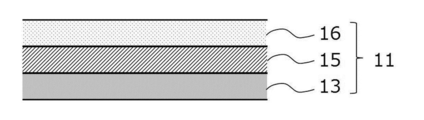
- the hygroscopic material of the present invention may be, for example, a polymer layer 16, a hygroscopic layer 15, and a moisture-proof layer 13 laminated in this order to form the hygroscopic material 11, as shown in FIG. And an moisture-proof layer 13 may be provided via an adhesive layer by applying an adhesive.
- the method for producing a moisture-absorbing material in the present invention comprises a coating liquid comprising amorphous silica having an average secondary particle size of 10 ⁇ m or less and a water-soluble resin on either one of a polymer layer having moisture permeability and a moisture-proof layer.
- a layer having a porous structure is formed by coating, a solution containing a hygroscopic agent is applied to the porous structure, and a hygroscopic layer is formed by impregnating the hygroscopic agent in the porous structure (moisture absorbing layer forming step); A step of laminating the other of the polymer layer and the moisture-proof layer (lamination step) on the moisture-absorbing layer impregnated with the agent.
- the hygroscopic agent is adsorbed on the silica surface forming the porous structure by applying the hygroscopic agent.
- the hygroscopic material can ensure a wide hygroscopic surface, and the hygroscopic material has a high hygroscopic rate and a high hygroscopic capacity.
- the porous structure is formed of vapor phase method silica, transparency is also imparted, and the hygroscopic material has light permeability (that is, visibility through the material).
- the moisture absorption layer forming step in the present invention is a coating liquid containing amorphous silica having an average secondary particle size of 10 ⁇ m or less and a water-soluble resin on either one of a polymer layer having moisture permeability and a moisture-proof layer.
- a layer having a porous structure is formed by coating, a solution containing a hygroscopic agent is applied to the porous structure, and a hygroscopic layer is formed by impregnating the hygroscopic agent in the porous structure.
- the coating liquid can be prepared by mixing amorphous silica, a water-soluble resin, and, if necessary, a plurality of components such as a dispersant, water, and a crosslinking agent, followed by dispersion treatment.
- gas phase method silica particles which are pigments, and a dispersant are added to water, and a high-speed rotating wet colloid mill (for example, CLEARMIX manufactured by M Technique Co., Ltd.) or a liquid-liquid collision type disperser (for example, SUGINO MACHINE Co., Ltd.)
- a high-speed rotating wet colloid mill for example, CLEARMIX manufactured by M Technique Co., Ltd.
- a liquid-liquid collision type disperser for example, SUGINO MACHINE Co., Ltd.
- crosslinking agent for example, boric acid
- It can be prepared by adding a water-soluble resin (preferably an aqueous polyvinyl alcohol solution) and further adding other components as necessary, and dispersing under the same rotational conditions as described above.
- the obtained coating liquid is a highly uniform sol-like liquid, and the coating liquid is applied onto a support by a coating method and dried to form a porous moisture-absorbing layer having a three-dimensional network structure.
- the aqueous dispersion containing amorphous silica and a dispersant may be prepared in advance by preparing an amorphous silica aqueous dispersion and adding this aqueous dispersion to the aqueous dispersant solution. May be added to the amorphous silica aqueous dispersion or may be mixed at the same time. Further, instead of the amorphous silica aqueous dispersion, powdery amorphous silica may be used and added to the aqueous dispersant as described above.
- the obtained mixed liquid is refined with a disperser, whereby an aqueous dispersion having an average particle diameter of 20 nm to 5000 nm can be obtained.
- a disperser various conventionally known dispersers such as a high-speed rotating disperser, a medium agitating disperser (such as a ball mill and a sand mill), an ultrasonic disperser, a colloid mill disperser, and a high pressure disperser can be used.
- the dispersing machine is preferably a stirring type dispersing machine, a colloid mill dispersing machine, or a high pressure dispersing machine.
- a solvent can be used for preparing the coating solution.
- the solvent include water, an organic solvent, or a mixed solvent thereof.
- the organic solvent include alcohols such as methanol, ethanol, n-propanol, i-propanol and methoxypropanol, ketones such as acetone and methyl ethyl ketone, tetrahydrofuran, acetonitrile, ethyl acetate and toluene.
- Coating can be performed by a coating method using, for example, a blade coater, an air knife coater, a roll coater, a bar coater, a gravure coater, a reverse coater, or the like.
- Drying after applying the coating solution is performed until the moisture absorption layer shows reduced rate drying. Drying can be generally carried out at 40 ° C. to 180 ° C. for 0.5 minutes to 10 minutes (preferably 0.5 minutes to 5 minutes).
- a liquid containing a basic compound may be applied to the formed layer after applying a coating liquid and drying to form a porous layer (coating layer). .
- a method for applying a solution containing a basic compound include a method of applying a liquid containing a basic compound on the moisture absorbing layer, a method of spraying a liquid containing a basic compound by a method such as spraying, and a liquid containing a basic compound. The method etc. which immerse the support body in which the coating layer was formed in the inside can be mentioned.
- the liquid containing a basic compound contains at least one basic compound.
- Basic compounds include ammonium salts of weak acids, alkali metal salts of weak acids (eg, lithium carbonate, sodium carbonate, potassium carbonate, lithium acetate, sodium acetate, potassium acetate, etc.), alkaline earth metal salts of weak acids (eg, carbonate Magnesium, barium carbonate, magnesium acetate, barium acetate, etc.), hydroxyammonium, primary to tertiary amines (eg, triethylamine, tripropylamine, tributylamine, trihexylamine, dibutylamine, butylamine), primary to tertiary anilines (Eg, diethylaniline, dibutylaniline, ethylaniline, aniline, etc.), optionally substituted pyridines (eg, 2-aminopyridine, 3-aminopyridine, 4-aminopyridine, and 4- (2-hydroxy) Ethyl
- another basic substance and / or a salt thereof may be used in combination.
- other basic substances include ammonia, primary amines such as ethylamine and polyallylamine, secondary amines such as dimethylamine, tertiary amines such as N-ethyl-N-methylbutylamine, and alkali metals. And alkaline earth metal hydroxides.
- ammonium salts of weak acids are particularly preferred.
- the weak acid is an inorganic acid or an organic acid described in Chemical Handbook Fundamentals II (Maruzen Co., Ltd.) or the like and having an pKa of 2 or more.
- Examples of the weak acid ammonium salt include ammonium carbonate, ammonium hydrogen carbonate, ammonium borate, ammonium acetate, and ammonium carbamate.
- ammonium carbonate, ammonium hydrogen carbonate, and ammonium carbamate are preferable, and are effective in that ink bleeding can be reduced without remaining in the layer after drying.
- a basic compound can use 2 or more types together.
- the content of the basic compound (especially ammonium salt of weak acid) in the “liquid containing the basic compound” is 0.5% by mass or more with respect to the total mass (including the solvent) of the “liquid containing the basic compound”. 10 mass% or less is preferable, More preferably, it is 1 mass% or more and 5 mass% or less. When the content of the basic compound (especially ammonium salt of weak acid) is within the above range, the curing degree is good and the ammonia concentration becomes too high and the working environment is not impaired.
- the liquid containing a basic compound can further contain a metal compound, a crosslinking agent, other mordant components, a surfactant, and the like, if necessary.
- the liquid containing the basic compound accelerates the curing of the film by being used as an alkaline solution.
- the pH (25 ° C.) of the liquid containing the basic compound is preferably 7.1 or higher, more preferably pH 8.0 or higher, and further preferably pH 9.0 or higher. When the pH is 7.1 or more, the crosslinking reaction of the water-soluble resin contained in the coating solution is further promoted, and cracking of the layer is more effectively suppressed.
- the liquid containing the basic compound is, for example, ion-exchanged water, a crosslinking agent (eg, boron compound, eg 0.1% by mass to 1% by mass), and a basic compound (eg ammonium carbonate; eg 1% by mass to 10% by mass) and, if necessary, an additive such as a surfactant can be added and stirred.
- a crosslinking agent eg, boron compound, eg 0.1% by mass to 1% by mass
- a basic compound eg ammonium carbonate; eg 1% by mass to 10% by mass
- the same method as the coating method of the coating liquid used for forming the hygroscopic layer can be exemplified.
- the application amount of the solution containing the basic compound is preferably an amount such that the application amount of the hygroscopic agent is 1 g / m 2 or more and 20 g / m 2 or less from the viewpoint of the hygroscopic ability of the hygroscopic layer, and the application amount of the hygroscopic agent is 3 g. / m 2 or more 12 g / m 2 or less and comprising an amount is preferable.
- the solution containing the basic compound After the application of the solution containing the basic compound, it is generally heated at 40 ° C. to 180 ° C. for 0.5 to 30 minutes to be dried and cured. Among them, it is preferable to heat at 40 ° C. to 150 ° C. for 1 minute to 20 minutes.
- heating at 60 ° C. to 100 ° C. is preferably performed for 0.5 to 15 minutes.
- the liquid containing the basic compound may be applied simultaneously with the application of the coating liquid for forming the moisture absorption layer.
- the coating liquid and the liquid containing the basic compound are simultaneously coated (multilayer coating) on the support so that the coating liquid is in contact with the support, and then dried and cured to have a porous structure. It can be a layer.
- Simultaneous coating can be performed by a coating method using, for example, an extrusion die coater or a curtain flow coater. After the simultaneous application, the formed application layer is dried. In this case, the drying is generally performed by heating the application layer at 40 ° C. to 150 ° C. for 0.5 to 10 minutes. Preferably, it is carried out by heating at 40 to 100 ° C. for 0.5 to 5 minutes.
- the drying is generally performed by heating the application layer at 40 ° C. to 150 ° C. for 0.5 to 10 minutes.
- it is carried out by heating at 40 to 100 ° C. for 0.5 to 5 minutes.
- borax or boric acid is used as a crosslinking agent contained in a liquid containing a basic compound, it is preferable to perform heating at 60 to 100 ° C. for 5 to 20 minutes.
- a hygroscopic layer is formed by applying a solution containing a hygroscopic agent to this layer and impregnating the hygroscopic agent in the porous structure.
- Application of the solution containing the hygroscopic agent includes a method of applying the solution on the hygroscopic layer, a method of spraying the solution by a method such as spraying, a method of immersing a layer having a porous structure in the solution, and the like.
- examples of the coating method include the same method as the coating method of the coating solution used for forming the hygroscopic layer.
- the solution containing a hygroscopic agent contains at least one type of hygroscopic agent, and may contain other components such as a surfactant and a solvent as necessary.
- a liquid containing a hygroscopic agent can be prepared, for example, by adding a hygroscopic agent (for example, an inorganic salt) to ion-exchanged water and, if necessary, an additive such as a surfactant and stirring.
- the application amount of the solution containing the hygroscopic agent is preferably an amount in which the application amount of the hygroscopic agent is 1 g / m 2 or more and 20 g / m 2 or less from the viewpoint of the hygroscopic amount of the hygroscopic layer and the hygroscopic rate. Is more preferably 3 g / m 2 or more and 12 g / m 2 or less.
- the solution containing the hygroscopic agent After the application of the solution containing the hygroscopic agent, it is generally heated at 40 ° C. to 180 ° C. for 0.5 to 30 minutes to be dried and cured. Among them, it is preferable to heat at 40 ° C. to 150 ° C. for 1 minute to 20 minutes.
- the above solution contains borax or boric acid as a boron compound
- heating at 60 ° C. to 100 ° C. is preferably performed for 0.5 to 15 minutes.
- the other of the polymer layer and the moisture-proof layer is laminated on the moisture-absorbing layer formed by impregnating the moisture-absorbing agent in the moisture-absorbing layer forming step.
- the formation method of the moisture-proof layer is not particularly limited, and a moisture-proof material (or moisture permeability) is formed on the moisture-absorbing layer provided on the polymer layer (or moisture-proof layer). It may be formed by bonding the material having the same. Alternatively, a coating solution containing a moisture-proof material (or a material having moisture permeability) may be prepared, and the coating solution may be applied on the moisture-absorbing layer to form a moisture-proof layer (or polymer layer).
- the hygroscopic material in the present invention may be used as a packaging material, and the packaging material may have a bag shape.
- the packaging material according to the first aspect of the present invention has a bonding portion where a part of the polymer layer of one moisture absorbent material A and the other part of the moisture absorbent material A are bonded, and packages the moisture absorbent material. You may form in the aspect put inside.
- the packaging material according to the second aspect of the present invention includes a part of the polymer layer of the first moisture absorbent material selected from a plurality of moisture absorbent materials, and a part of the second moisture absorbent material different from the first moisture absorbent material. , May be formed in such a manner that it has a bonded site and a hygroscopic material is placed inside the package.
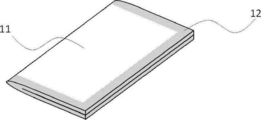
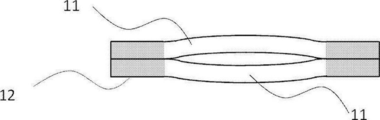
- the hygroscopic material in the present invention bends one hygroscopic material 11 to bond a part of the polymer layer of the hygroscopic material 11 and another part of the hygroscopic material 11, It may be used in the form of a bag.
- a single hygroscopic material 11 is folded and the polymer layers 16 overlapped with each other are bonded together by thermocompression bonding or the like, thereby forming a bag shape.
- 2 to 4 have a structure in which a moisture-proof layer 13, an adhesive layer 14, a moisture-absorbing layer 15, and a polymer layer 16 are laminated as shown in FIG.
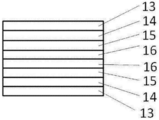
- FIG. 5 is an enlarged cross-sectional view showing the layer configuration of the adhesion site 12 of FIG. 4 in an enlarged manner.
- a part of the polymer layer of the first hygroscopic material 21 selected from a plurality of hygroscopic materials and a part of the second hygroscopic material 31 different from the first hygroscopic material 21 are bonded.
- it may be used in the form of a bag.
- the two hygroscopic materials are overlapped so that the polymer layers 16 are in contact with each other, and heat is applied from the moisture-proof layer side of one of the hygroscopic materials (for example, the hygroscopic material 21) to bond them by pressure bonding or the like.
- It may be a packaging material constituted by a plate-like mating base material 41 adhered to the polymer layer 16 at a non-recessed portion on the surface side.
- the moisture-absorbing material 11 and the mating base material 41 can be bonded to form a packaging material having an accommodation portion.
- the packaging material of the present invention is used as a blister pack (also referred to as PTP packaging) used for medicine packaging.
- the application of heat can be performed not only by heating a heated bar or plate in contact, but also by hot plate sealing by thermocompression bonding, impulse sealing, or ultrasonic sealing.
- Example 1 ⁇ Formation of moisture absorption layer> -Preparation of coating liquid for moisture absorption layer formation- (1) Vapor phase silica 1, (2) ion-exchanged water, (3) Charol DC-902P, and (4) Zircozol ZA-30 shown in the following composition were mixed, and a liquid-liquid collision type disperser (Ultimizer, (This process is appropriately referred to as silica dispersion treatment). Thereafter, the obtained dispersion was heated to 45 ° C. and held for 20 hours.
- a liquid-liquid collision type disperser (Ultimizer, (This process is appropriately referred to as silica dispersion treatment).
- the dispersion was kept at 30 ° C., and (5) an aqueous boric acid solution and (6) a polyvinyl alcohol (PVA) solution were added to the dispersion to prepare a coating solution for forming a moisture absorbing layer.
- PVA polyvinyl alcohol
- LLDPE sheet As the polymer layer, a sheet of linear low density polyethylene (LLDPE) having a thickness shown in Table 1 below (hereinafter also referred to as an LLDPE sheet) was prepared. On this LLDPE sheet, the coating solution for forming a moisture absorption layer obtained above was applied with an extrusion die coater so that the coating amount was 165 g / m 2 . The coating layer formed by coating was dried with a hot air drier at 80 ° C. (wind speed 3 m / second to 8 m / second) until the solid content concentration of the coating layer reached 36%. The coating layer during drying showed constant rate drying.
- a moisture absorbent coating solution having the following composition was applied to the formed layer with an extrusion die coater at a coating amount of 50 g / m 2 (CaCl 2 applied amount: 7 g / m 2 ), and then applied to a hot air dryer. And dried at 80 ° C. (wind speed 3 m / second to 8 m / second) to obtain a moisture absorption layer having a thickness of 40 ⁇ m.
- the formed moisture absorption layer had a porosity of 60% and an average pore diameter of 20 nm.
- the obtained moisture-absorbing material has a laminated structure of LLDPE sheet / moisture-absorbing layer / adhesive layer / (deposition surface) silica-deposited PET.
- Table 1 an adhesive application amount of 3 g / m 2 corresponds to an adhesive thickness of 3 ⁇ m, and an adhesive application amount of 15 g / m 2 corresponds to an adhesive thickness of 15 ⁇ m.
- the unit of the numerical value in the column of “Adhesive thickness” in Table 1 is “ ⁇ m”.
- the hygroscopic material obtained above is preheated at 130 ° C. for 2 seconds with a hot plate, and then sandwiched between concavo-convex molds heated to 100 ° C., thereby forming a concave accommodating portion as shown in FIG. A molded product was prepared.
- ⁇ Average pore diameter> The average pore diameter was measured by a mercury intrusion method using Shimadzu Autopore 9220 (manufactured by Shimadzu Corporation).
- ⁇ Measurement of particle size> The surface of the obtained moisture-absorbing layer was observed with an electron microscope (JEM2100, manufactured by JEOL Ltd.), and the projected area of each of 100 silica particles at an arbitrary position on the surface was determined. The diameter of each particle was calculated, and the average primary particle diameter was determined by simply averaging the diameters of 100 silica particles. Further, the surface of the obtained moisture absorption layer was observed with an electron microscope (S-4700, manufactured by HITACHI) at an acceleration voltage of 10 kV, and the projected area of each of 100 aggregated particles at an arbitrary position on the surface was determined. The diameter when a circle equivalent to the area was calculated was obtained, and the average secondary particle diameter was obtained by simply averaging the diameters of 100 aggregated particles.
- ⁇ Transparency> The total light transmittance of the hygroscopic material was measured using a haze meter HGM-2DP (manufactured by Suga Test Instruments Co., Ltd.) and evaluated according to the following criteria.
- ⁇ Visibility> Visibility evaluation of the hygroscopic material is performed by placing images of 12-point Ming Dynasty “hawk” on each polymer layer side of the hygroscopic material for each of yellow ink, magenta ink, cyan ink, and black ink.
- the visibility of the “hawk” character when viewed from the layer side was evaluated according to the following criteria.
- B The moisture absorption capacity at 23 ° C. and 50% RH is 6 g / m 2 or more and less than 10 g / m 2 .
- C The moisture absorption capacity at 23 ° C. and 50% RH is 3 g / m 2 or more and less than 6 g / m 2 .
- D The moisture absorption capacity at 23 ° C. and 50% RH is less than 3 g / m 2 .
- the moisture absorption rate of the obtained moisture absorbing material was evaluated as follows.
- the hygroscopic material obtained above was cut into 100 mm ⁇ 100 mm to prepare a sample.
- the sample was stored in a constant temperature and humidity chamber at 60 ° C. and 10% RH for 1 hour and dried.
- the mass immediately after the sample was transferred to a 23 ° C. and 50% RH environment was measured and taken as the dry mass. Thereafter, the amount of water absorption of the sample was measured from the change in mass of the sample over time, and the time from the start of water absorption until saturation was taken as the moisture absorption rate.
- ⁇ Porosity> The amount of voids per unit thickness was calculated from the amount of voids (ml / m 2 ) and thickness ( ⁇ m) of the hygroscopic layer of the hygroscopic material obtained above, and the porosity was determined.
- the thickness of the moisture absorption layer was determined from the result of observation with an optical microscope.
- the void amount of the moisture absorption layer was calculated by calculating the change in weight (absorbed liquid amount per unit area) before and after the addition by dropping 1 ml of diethylene glycol on the moisture absorption layer and wiping the dropping surface with a cloth after 1 minute. This calculated value was defined as the void amount.
- ⁇ Break> The molded product obtained above was visually observed, and the presence or absence of cracks in the moisture absorption layer was evaluated according to the following evaluation criteria.
- Example 2 In Example 1, the silica dispersion treatment was changed from a liquid-liquid collision type disperser (Ultimizer, manufactured by Sugino Machine Co.) to a bead mill disperser (Dynomill KDP, manufactured by Shinmaru Enterprise Co.), and the gas phase obtained under the following conditions: A hygroscopic layer was formed in the same manner as in Example 1 except that the method silica 2 (average primary particle size 7 nm, average secondary particle size: 26 nm) was used.
- Example 1a Silica dispersion treatment conditions
- Bead type Zirconia beads
- Bead diameter 1.0 mm ⁇
- Bead filling rate 80%
- Peripheral speed 8m / sec
- Number of processing 2 times
- Discharge flow rate 590 g / min
- a moisture-proof layer was bonded to form a moisture-absorbing material, and a molded product was produced and evaluated. The evaluation results are shown in Table 1 below.
- Example 3 In Example 1, (1) gas phase method silica 1 (AEROSIL300SF75 made by Nippon Aerosil Co., Ltd., average primary particle size: 7 nm) gas phase method silica 3 (AEROSIL200 product made by Nippon Aerosil Co., Ltd., average primary particle size) : 12 nm, average secondary particle size: 30 nm) except that the silica dispersion treatment was performed in the same manner as in Example 1 to form a moisture absorption layer. Further, in the same manner as in Example 1, a moisture-proof layer was bonded to obtain a moisture-absorbing material, and a molded product was produced and evaluated. The evaluation results are shown in Table 1 below.
- Example 4 In Example 1, a hygroscopic layer was formed in the same manner as in Example 1 except that the thickness of the polymer layer (material: LLDPE) was 120 ⁇ m. Further, as in Example 1a, a moisture-proof layer was bonded to form a moisture-absorbing material, and a molded product was produced and evaluated. The evaluation results are shown in Table 1 below.
- Example 5 In Example 1, a hygroscopic material was formed and a molded product was produced and evaluated in the same manner as in Example 1a except that the application amount of the adhesive layer was 2 g / m 2 (equivalent to a thickness of 2 ⁇ m). The evaluation results are shown in Table 1 below.
- Example 1 (Comparative Example 1) In Example 1, a hygroscopic layer was formed in the same manner as in Example 1a except that the hygroscopic agent coating liquid was not applied. Further, as in Example 1a, a moisture-proof layer was bonded to form a moisture-absorbing material, and a molded product was produced and evaluated. The evaluation results are shown in Table 1 below.
- Example 2 moisture absorption was performed in the same manner as in Example 1a except that (5) boric acid (5% aqueous solution) and (6) polyvinyl alcohol (water-soluble resin) solution were removed from the coating solution for forming the moisture absorption layer. Layers were formed and molded articles were prepared and evaluated. The evaluation results are shown in Table 1 below.
- Example 3 (Comparative Example 3)
- Gas phase method silica 1 (AEROSIL300SF75, manufactured by Nippon Aerosil Co., Ltd., average primary particle size 7 nm, average secondary particle size 20 nm) was converted to silica gel (P78D, manufactured by Mizusawa Chemical Co., Ltd.)
- a hygroscopic layer was formed in the same manner as in Example 1a except that the average secondary particle size was changed to 12 ⁇ m.
- a moisture-proof layer was bonded to form a moisture-absorbing material, and a molded product was produced and evaluated. The evaluation results are shown in Table 1 below.
- the examples are hygroscopic materials that are excellent in transparency and visibility and have a large hygroscopic capacity. It can also be seen that the moisture absorption rate can be adjusted by the thickness of the polymer layer.
- Comparative Example 1 containing no hygroscopic agent has a small hygroscopic capacity, and cannot achieve both transparency and hygroscopic capacity.
- Comparative Example 2 containing no water-soluble resin and a crosslinking agent cannot form a hygroscopic layer, and Comparative Example 3 using coarse silica gel in the hygroscopic layer has a large secondary particle size, so that transparency and visibility are high. It turns out that it is inferior to.
- Example 6 A moisture-absorbing layer-forming coating solution prepared in the same manner as in Example 1 was applied to the silica-deposited surface of silica-deposited PET (Tech Barrier MX, manufactured by Mitsubishi Plastics), which is a moisture-proof layer, with an extrusion die coater. Then, a moisture absorption layer having a thickness of 40 ⁇ m was formed in the same procedure as in Example 1. Moreover, the LLDPE sheet of the thickness shown in following Table 2 was prepared as a polymer layer. On this LLDPE sheet, an adhesive manufactured by Toyo Ink Co., Ltd. (urethane resin adhesive: LIS-073-50U, curing agent: CR-001) was applied so that the coating amount after drying would be the thickness shown in Table 2 below.
- an adhesive manufactured by Toyo Ink Co., Ltd. urethane resin adhesive: LIS-073-50U, curing agent: CR-001
- the moisture-proof layer on which the moisture-absorbing layer was formed was laminated by dry lamination so that the moisture-absorbing layer-formed surface side of the moisture-proof layer was in contact with the adhesive.
- the hygroscopic material of the present invention was obtained.
- a molded product was produced.
- the obtained moisture-absorbing material has a laminated structure of LLDPE sheet / adhesive layer / moisture-absorbing layer / (deposition surface) silica-deposited PET.
- the obtained hygroscopic material and molded product were evaluated in the same manner as in Example 1. The evaluation results are shown in Table 2 below.
- Example 7 a hygroscopic layer was formed in the same manner as in Example 6 except that gas phase method silica 2 obtained by carrying out the same silica dispersion treatment as in Example 2 was used.
- a polymer layer was bonded in the same manner as in Example 6a to form a hygroscopic material, and a molded product was produced, and evaluated in the same manner as in Example 1. The evaluation results are shown in Table 2 below.
- Example 8 In Example 6, (1) Gas phase method silica 1 was changed to Gas phase method silica 3 (AEROSIL200 made by Nippon Aerosil Co., Ltd., average primary particle size: 12 nm, average secondary particle size: 30 nm) In the same manner as in Example 6, a silica dispersion treatment was performed to form a moisture absorption layer. In addition, the polymer layer was bonded in the same manner as in Example 6 to obtain a hygroscopic material, and a molded product was produced, and evaluated in the same manner as in Example 1. The evaluation results are shown in Table 2 below.
- AEROSIL200 made by Nippon Aerosil Co., Ltd., average primary particle size: 12 nm, average secondary particle size: 30 nm
- Example 9 A hygroscopic material is formed in the same manner as in Example 6a except that a hygroscopic layer is formed in the same manner as in Example 6 and the thickness of the polymer layer is 120 ⁇ m, and a molded product is produced and evaluated in the same manner as in Example 1. did. The evaluation results are shown in Table 2 below.
- Example 10 In Example 6, except that the coating amount of the adhesive layer was 2 g / m 2 (equivalent to a thickness of 2 ⁇ m), a hygroscopic material was formed and a molded product was produced in the same manner as in Example 6a. Evaluated. The evaluation results are shown in Table 2 below.
- Example 6 (Comparative Example 4)
- a hygroscopic layer was formed in the same manner as in Example 6 except that the hygroscopic agent coating solution was not applied.
- a polymer layer was bonded in the same manner as in Example 6a to form a hygroscopic material, and a molded product was produced, and evaluated in the same manner as in Example 1. The evaluation results are shown in Table 2 below.
- Example 5 moisture absorption was performed in the same manner as in Example 6a except that (5) boric acid (5% aqueous solution) and (6) polyvinyl alcohol (water-soluble resin) solution were removed from the coating solution for forming the moisture absorption layer. A layer was formed and a molded product was produced and evaluated in the same manner as in Example 1. The evaluation results are shown in Table 2 below.
- Example 6 (Comparative Example 6)
- the vapor-phase process silica 1 was changed to silica gel (P78D, manufactured by Mizusawa Chemical Co., Ltd., average secondary particle size: 12 ⁇ m), and the moisture absorption layer was formed in the same manner as in Example 6.
- a polymer layer was bonded in the same manner as in Example 6a to form a hygroscopic material, and a molded product was produced, and evaluated in the same manner as in Example 1.
- Table 2 The evaluation results are shown in Table 2 below.
- the examples are hygroscopic materials that are excellent in transparency and visibility and have a large hygroscopic capacity. Moreover, it turns out that a moisture absorption rate can be adjusted with the application quantity of an adhesive agent, and the thickness of a polymer layer.
- Comparative Example 4 containing no hygroscopic agent has a small moisture absorption capacity, and it is understood that both transparency and moisture absorption capacity cannot be achieved.
- Comparative Example 5 which does not contain a water-soluble resin and a crosslinking agent cannot form a hygroscopic layer, and Comparative Example 6 using coarse silica gel in the hygroscopic layer has a large secondary particle size, so that transparency and visibility are high. It turns out that it is inferior.
- Example 11 In Example 1, the type and amount of polyvinyl alcohol (PVA) which is a water-soluble resin, the thickness of the moisture absorption layer, and the porosity are changed as shown in Table 3 below, and boric acid which is a crosslinking agent is not used. Obtained a hygroscopic material in the same manner as in Example 1, and further produced a molded product. The obtained hygroscopic material and molded product were evaluated in the same manner as in Example 1. The evaluation results are shown in Table 3 below.
- PVA polyvinyl alcohol
- Example 16 to 18 In Example 1, amorphous silica is replaced with wet silica (Mizukasil P705, manufactured by Mizusawa Chemical Industry Co., Ltd.), and the type and amount of polyvinyl alcohol (PVA), which is a water-soluble resin, and the presence or absence of a crosslinking agent are listed in Table 3 below. Except for the change as described above, a hygroscopic material was obtained in the same manner as in Example 1, and a molded product was produced. The obtained hygroscopic material and molded product were evaluated in the same manner as in Example 1. The evaluation results are shown in Table 3 below.
- Example 19 the moisture-absorbing material was obtained in the same manner as in Example 1 except that the type and amount of polyvinyl alcohol (PVA), which is a water-soluble resin, and the presence or absence of a crosslinking agent were changed as shown in Table 3 below. Further, a molded product was produced. The obtained hygroscopic material and molded product were evaluated in the same manner as in Example 1. The evaluation results are shown in Table 3 below.
- PVA polyvinyl alcohol
- Example 24 In Example 1, a hygroscopic material was obtained and a molded product was produced in the same manner as in Example 1 except that calcium chloride as the hygroscopic agent was replaced with magnesium sulfate. The obtained hygroscopic material and molded product were evaluated in the same manner as in Example 1. The evaluation results are shown in Table 3 below.
- a hygroscopic material having a large hygroscopic capacity, high transparency, and capable of adjusting the hygroscopic rate by the constituent materials, a manufacturing method thereof, and a packaging material.
Landscapes
- Chemical & Material Sciences (AREA)
- Analytical Chemistry (AREA)
- Organic Chemistry (AREA)
- Chemical Kinetics & Catalysis (AREA)
- Inorganic Chemistry (AREA)
- Engineering & Computer Science (AREA)
- Dispersion Chemistry (AREA)
- Nanotechnology (AREA)
- Materials Engineering (AREA)
- Crystallography & Structural Chemistry (AREA)
- Packages (AREA)
- Laminated Bodies (AREA)
- Drying Of Gases (AREA)
- Mechanical Engineering (AREA)
- Food Science & Technology (AREA)
- Wrappers (AREA)
- Solid-Sorbent Or Filter-Aiding Compositions (AREA)
Abstract
Description
例えば、特許第3919503号公報には、モレキュラーシーブなどの粉末状の乾燥剤を樹脂に混練して成形した乾燥剤混入フィルムが開示されている。この乾燥剤混入フィルムの吸湿性能は、混練する乾燥剤の吸湿容量と乾燥剤の吸湿速度によって決定する。フィルムにおける乾燥剤の含有量は、フィルムとしての物性を発現させるため制限され、長期保存を要する用途において吸湿容量が不足することが問題となる。また、乾燥剤の吸湿速度が速すぎると、乾燥剤がすぐに飽和してしまい、乾燥剤として機能を発現しなくなることが問題となる。
<1> 透湿性を有するポリマー層、平均2次粒子径が10μm以下である非晶質シリカと水溶性樹脂と吸湿剤とを含み多孔構造を有する吸湿層、及び防湿層をこの順に有する吸湿材料。
<2> 吸湿層の厚みが20μm~50μmであり、かつ、吸湿層の空隙率が45%~85%である<1>に記載の吸湿材料。
<3> 非晶質シリカが、気相法シリカ及び湿式シリカの少なくとも一方である<1>又は<2>に記載の吸湿材料。
<4> 吸湿層の平均細孔径が40nm以下である<1>~<3>のいずれか1つに記載の吸湿材料。
<6> 気相法シリカの平均2次粒子径が、25nm以下である<5>に記載の吸湿材料。
<8> 吸湿層は、更に、架橋剤としてホウ酸を含有する<1>~<7>のいずれか1つに記載の吸湿材料。
<9> 吸湿剤が、塩化カルシウムである<1>~<8>のいずれか1つに記載の吸湿材料。
<10> ポリマー層の厚みが、20μm~100μmである<1>~<9>のいずれか1つに記載の吸湿材料。
<12> 接着剤層の接着剤の少なくとも1種が、ウレタン樹脂系接着剤であり、かつ接着剤層の厚みが、3μm~15μmである<11>に記載の吸湿材料。
<14> <1>~<12>のいずれか1つに記載の1つ又は複数の吸湿材料を含み、
1つの吸湿材料Aのポリマー層の一部と吸湿材料Aの他の一部とが接着された接着部位、又は、複数の吸湿材料から選ばれる、第1の吸湿材料のポリマー層の一部と、第1の吸湿材料とは異なる第2の吸湿材料の一部と、が接着された接着部位、を有する包装材料。
<16> 吸湿剤が、塩化カルシウムである<15>に記載の吸湿材料の製造方法。
本明細書における固形分は、溶剤以外の低分子量成分などの液状の成分も含まれる。
本明細書において「~」を用いて示された数値範囲は、「~」の前後に記載される数値をそれぞれ最小値及び最大値として含む範囲を示す。
本発明における吸湿材料は、透湿性を有するポリマー層、平均2次粒子径が10μm以下である非晶質シリカと水溶性樹脂と吸湿剤とを含む多孔構造を有する吸湿層、及び防湿層を設けて構成されている。
本発明における吸湿材料は、必要に応じて接着剤層などの他の層を含んでもよい。
本発明における吸湿材料は、小径の非晶質シリカと水溶性樹脂と吸湿剤とを含む吸湿層が空隙率の高い三次元構造を有している。吸湿剤が、三次元構造を形成している非晶質シリカ表面に吸着した状態となることで、吸湿剤の吸湿容量に加え、表面積の広い吸湿層の空隙内にも水分を保持することができる。これにより、吸湿材料は吸湿表面を広く確保することが可能になり、吸湿速度が高く、従来の吸湿材料より大きな吸湿容量が得られると考えられる。また、非晶質シリカの2次粒子径を小さく制御し吸湿層に分散されていることで、吸湿材料の透明性を高く維持することができる。そのため、吸湿材料は、大きな吸湿容量と透明性を両立することができるものと考えられる。これは、特に吸湿層の多孔構造が気相法シリカで形成されている場合により効果的である。
本発明における吸湿層は、平均2次粒子径が10μm以下である非晶質シリカ、水溶性樹脂、及び吸湿剤を含む多孔構造を有しており、吸湿層はさらに架橋剤を含んでもよい。また、吸湿層は、必要に応じて、分散剤や界面活性剤などの他の成分を含んでもよい。
本発明における吸湿層は、平均2次粒子径が10μm以下である非晶質シリカの少なくとも一種を含有する。
非晶質シリカとは、SiO2の三次元構造が形成された多孔性の不定形微粒子のことであり、一般には製造法によって湿式法粒子と乾式法(気相法)粒子とに大別される。非晶質シリカとしては、例えば、乾式法により得られる気相法シリカ、及び湿式法により得られる湿式シリカ等の合成非晶質シリカなどが挙げられる。
気相法シリカとは、ケイ素塩化物を気化し、高温の水素炎中において気相反応させることで合成されるシリカ(シリカ微粒子)である。
気相法シリカは、屈折率が低いため、適切な微小粒子径まで分散を行なうことで吸湿層に透明性を付与することができる。このように吸湿層が透明であるということは、包装の内容物の視認が可能であり、また、インジケータ機能などを付与することができるという観点より重要である。
吸湿層に含まれる気相法シリカの平均2次粒子径は、吸湿層の透明性の観点から、10μm以下であり、50nm以下であることが好ましく、25nm以下であることがより好ましい。また、2次粒子径分布は、吸湿層の透明性の観点から、均一であることが好ましく、標準偏差として10nm以下であることが好ましく、8nm以下であることがより好ましく、5nm以下であることが特に好ましい。
気相法シリカの平均2次粒子径が10μmを超えると、透明性、視認性を確保することができない。
また、本発明における平均2次粒子径とは、走査型電子顕微鏡で観察し、100個の凝集粒子について、それぞれ投影面積を求めてその面積に等しい円を仮定した場合の直径を求め、100個の凝集粒子の直径を単純平均して求めた2次粒子の平均径をいう。
湿式シリカは、ケイ酸塩の酸分解により活性シリカを生成し、これを適度に重合させて凝集沈降させて得られる含水シリカである。
また、上記気相法シリカの2次粒子径を実現するための分散方法としては、例えば、高速回転分散機、媒体攪拌型分散機(ボールミル、サンドミル、及びビーズミルなど)、超音波分散機、コロイドミル分散機、及び高圧分散機など、従来公知の各種分散機を用いることができる。その中でも分散機として、ビーズミル分散機、及び液液衝突型分散機が好ましく、液液衝突型分散機がより好ましい。液液衝突型分散機としては、例えば、アルティマイザー(スギノマシン社製)が挙げられる。
吸湿層は、水溶性樹脂の少なくとも一種を含有する。
吸湿層は、水溶性樹脂の含有により、気相法シリカがより好適に分散された状態で含有され、層強度がより向上したものとなる。
本発明における水溶性樹脂とは、加熱もしくは冷却工程を経て、最終的に20℃の水100gに対して0.05g以上溶解するものをいい、好ましくは0.1g以上溶解する樹脂のことをいう。
水溶性樹脂の中でも、吸湿層の膜強度の観点でポリビニルアルコール系樹脂が好ましく、特にポリビニルアルコールが好ましい。
中でも、吸湿層の膜強度の観点から、水溶性樹脂がポリビニルアルコール系樹脂であって、ポリビニルアルコール系樹脂の重合度が1800以上であるのが好ましく、ポリビニルアルコール系樹脂の重合度が2000以上であるのがより好ましく、更には、ポリビニルアルコール系樹脂の重合度が2400以上であるのが好ましい。また、ポリビニルアルコール系樹脂の重合度は、4500以下がより好ましい。
中でも、吸湿層の透明性の観点から、水溶性樹脂がポリビニルアルコール系樹脂であって、ポリビニルアルコール系樹脂のけん化度が70%以上99%以下であるのが好ましく、ポリビニルアルコール系樹脂のけん化度が78%以上99%以下であるのがより好ましく、更には、ポリビニルアルコール系樹脂のけん化度が85%以上99%以下であるのが好ましい。
水溶性樹脂のけん化度が70%以上であると、実用上水溶性を保つのに適している。
すなわち、ポリビニルアルコール同士を架橋する際の架橋剤としてホウ酸を用いる場合は、ポリビニルアルコールのけん化度は78%~99%の範囲が好ましく、また、重合度は1500~4500の範囲が好ましく、2400~3500の範囲がより好ましい。
一方、架橋剤を用いない場合は、ポリビニルアルコールはけん化度が低く高重合度であることが、架橋剤を用いた場合と同等の多孔構造を形成できる点で好ましい。具体的には、ポリビニルアルコールのけん化度は78%~99%の範囲が好ましく、ポリビニルアルコールの重合度は2400~4500の範囲が好ましい。
吸湿層における水溶性樹脂の含有量(2種以上を併用する場合はその合計量)は、含有量の過少による、膜強度の低下や乾燥時のひび割れを防止すると共に、含有量の過多によって空隙が樹脂により塞がれ易くなり、空隙率が減少することで吸湿性が低下するのを防止する観点から、吸湿層の全固形分に対して、4.0質量%~16.0質量%が好ましく、6.0質量%~14.0質量%がより好ましい。
また、水溶性樹脂をポリビニルアルコールとし、ポリビニルアルコール同士を架橋する際に架橋剤としてホウ酸を用いる場合、ポリビニルアルコールの吸湿層における含有量は、非晶質シリカの量に対して、10質量%~60質量%が好ましく、15質量%~30質量%がより好ましい。水溶性樹脂をポリビニルアルコールとし、ポリビニルアルコールの架橋剤を用いない場合、ポリビニルアルコールの吸湿層における含有量は、非晶質シリカの量に対して、25質量%~60質量%の範囲が好ましい。
本発明における吸湿層には、架橋の少なくとも一種を含有することができる。吸湿層は、水溶性樹脂(例えばポリビニルアルコール)の架橋反応によって硬化された多孔構造を有する態様が好ましい。
ホウ素化合物の中では、より速やかに架橋反応を進行させることができる点で、ホウ砂、ホウ酸、ホウ酸塩が好ましく、特にホウ酸が好ましく、水溶性樹脂として好適に用いられるポリビニルアルコール系樹脂と組合せて使用することが最も好ましい。
一方、環境適正の観点からは、ホウ酸を含まない構成にしてもよい。
他の架橋剤としては、例えば、ホルムアルデヒド、グリオキザール、グルタールアルデヒド等のアルデヒド系化合物;ジアセチル、シクロペンタンジオン等のケトン系化合物;ビス(2-クロロエチル尿素)-2-ヒドロキシ-4,6-ジクロロ-1,3,5-トリアジン、2,4-ジクロロ-6-S-トリアジン・ナトリウム塩等の活性ハロゲン化合物;ジビニルスルホン酸、1,3-ビニルスルホニル-2-プロパノール、N,N'-エチレンビス(ビニルスルホニルアセタミド)、1,3,5-トリアクリロイル-ヘキサヒドロ-S-トリアジン等の活性ビニル化合物;ジメチロ-ル尿素、メチロールジメチルヒダントイン等のN-メチロール化合物;メラミン樹脂(例えば、メチロールメラミン、アルキル化メチロールメラミン);エポキシ樹脂;1,6-ヘキサメチレンジイソシアネート等のイソシアネート系化合物;米国特許第3017280号明細書、同第2983611号明細書に記載のアジリジン系化合物;米国特許第3100704号明細書に記載のカルボキシイミド系化合物;グリセロールトリグリシジルエーテル等のエポキシ系化合物;1,6-ヘキサメチレン-N,N'-ビスエチレン尿素等のエチレンイミノ系化合物;ムコクロル酸、ムコフェノキシクロル酸等のハロゲン化カルボキシアルデヒド系化合物;2,3-ジヒドロキシジオキサン等のジオキサン系化合物;乳酸チタン、硫酸アルミ、クロム明ばん、カリ明ばん、酢酸ジルコニル、酢酸クロム等の金属含有化合物、テトラエチレンペンタミン等のポリアミン化合物、アジピン酸ジヒドラジド等のヒドラジド化合物、オキサゾリン基を2個以上含有する低分子又はポリマー等である。他の架橋剤は、1種単独でも、2種以上を組み合わせて用いてもよい。
本発明における吸湿層は、吸湿剤の少なくとも一種を含有する。
吸湿剤としては、例えば、シリカゲル、ゼオライト、吸水ポリマー、吸湿性塩が挙げられ、吸湿速度の点で吸湿性塩が好ましい。
吸湿性塩としては、具体的には塩化リチウム、塩化カルシウム、塩化マグネシウム、塩化アルミニウム等のハロゲン化金属塩、硫酸ナトリウム、硫酸カルシウム、硫酸マグネシウム、硫酸亜鉛などの金属硫酸塩、酢酸カリウム等の金属酢酸塩、塩酸ジメチルアミンなどのアミン塩類、オルトリン酸などのリン酸化合物、塩酸グアニジン、リン酸グアニジン、スルファミン酸グアニジン、メチロールリン酸グアニジン、炭酸グアニジンなどのグアニジン塩、水酸化カリウム、水酸化ナトリウム、水酸化マグネシウム等が挙げられる。中でも、吸湿容量の観点から、塩化カルシウムが好ましい。
本発明における吸湿層の空隙率は、45%~85%が好ましく、50%~80%がより好ましく、55%~75%が特に好ましい。吸湿層の空隙率が45%以上であると、より大きな吸湿容量が得られ、また、吸湿層の空隙率が85%以下であると、膜強度の低下防止、及び乾燥時のひび割れを抑制することができる。
空隙率の測定方法の例としては、水銀圧入法又は吸湿層をジエチレングリコール等の有機溶剤に浸漬させてその質量変化から空隙容量を測定し、吸湿層の厚みを断面の顕微鏡観察により測定し算出する方法が挙げられる。
本願発明における吸湿層は、厚みが20μm~50μmであり、かつ、空隙率が45%~85%であることが好ましい。
本発明の吸湿層において、非晶質シリカ(x)と水溶性樹脂(y)との含有比〔PB比(x/y)、水溶性樹脂1質量部に対する非晶質シリカの質量〕は、吸湿層の層構造にも大きな影響を与える場合がある。すなわち、PB比が大きくなると、空隙率や細孔容積が大きくなる。
具体的には、吸湿層のPB比(x/y)としては、PB比が大き過ぎることに起因する層強度の低下や乾燥時のひび割れを防止し、かつPB比が小さ過ぎることによって、空隙が樹脂により塞がれ易くなり、空隙率が減少することで吸湿容量が低下するのを防止する観点から、1.5/1~10/1が好ましい。また、吸湿層のPB比は、膜強度の低下や乾燥時のひび割れの抑制効果をより効果的に高める観点から、1.5/1~8/1がより好ましい。
また、本発明の吸湿材料が包装材料として使用される場合、内容物を保護する観点から、吸湿層は充分な膜強度を有していることが必要である。さらにフィルムに裁断加工する場合、吸湿層の割れ及び剥がれ等を防止する上でも、吸湿層には充分な膜強度が必要である。このような観点より、吸湿層のPB比(x/y)としては10/1以下が好ましい。
本発明における吸湿材料は、透湿性を有するポリマー層(以下、ポリマー層ともいう)を含む。
本発明におけるポリマー層は、下記の透湿度に見合う透湿性を有しており、透湿性を有するポリマー層の透湿度は、1g/m2・day~50g/m2・dayが好ましい。透湿度は、JIS Z 0208により規定された方法で測定される値である。
ポリマー層は少なくともポリマーを含み、必要に応じて他の成分を含んでもよい。
ポリマーの種類としては、直鎖状低密度ポリエチレン(LLDPE)、低密度ポリエチレン(LDPE)、高密度ポリエチレン(HDPE)、無延伸ポリプロピレン(CPP)、二軸延伸ポリプロピレン(OPP)、ポリアクリロニトリル(PAN)等が挙げられる。特に汎用性の点でLLDPE、CPPが好ましく、CPPがより好ましい。
ポリマー層の厚みが上記の範囲であると、吸湿材料全体のハンドリング性と、包装材料等とした場合の取り扱い性と、をより高いレベルで両立することができる。
本発明の吸湿材料を包装材料として用いる場合、ポリマー層を接着部位とすることができる。
本発明における吸湿材料は防湿層を有する。
本発明における防湿層は、防湿性を有する材料を含む層であれば特に限定されない。防湿層は、透湿度1g/m2・day未満の層であることが好ましい。透湿度は、JIS Z 0208により規定された方法で測定される値である。
防湿層としては、1つの材料を用いてもよく、2以上の材料を積層したものを用いてもよい。防湿層として、例えば、あらかじめ金属が蒸着された材料を用いてもよい。
本発明における吸湿材料は接着剤層を有してもよい。
接着剤層は、透湿性を有しており、接着剤層の厚み及び種類により、吸湿層における吸湿速度を制御することができる。
接着剤層に用いる接着剤の種類は特に限定されないが、例えばウレタン樹脂系、ポリエステル系、アクリル樹脂系、エチレン酢酸ビニル樹脂系、ポリビニルアルコール系、ポリアミド系、シリコーン系が挙げられ、接着強度の観点からウレタン樹脂系接着剤が好ましい。
接着剤層には、少なくとも1種のウレタン樹脂系接着剤が含まれることが好ましく、他の1つ以上の接着剤を併用してもよい。
また、上記範囲で厚みを選択することで、吸湿層の吸湿速度を制御することができる。
本発明における吸湿材料の製造方法は、透湿性を有するポリマー層及び防湿層のいずれか一方の上に、平均2次粒子径が10μm以下である非晶質シリカと水溶性樹脂とを含む塗布液の塗布により多孔構造を有する層を形成し、多孔構造に吸湿剤を含む溶液を付与し、多孔構造内に吸湿剤を含浸させることで吸湿層を形成する工程(吸湿層形成工程)と、吸湿剤が含浸された吸湿層の上に、上記のポリマー層及び防湿層の他方を積層する工程(積層工程)と、を設けて構成されている。
非晶質シリカを用いて多孔構造に構成された吸湿層において、吸湿剤が付与されることにより、吸湿剤は多孔構造を形成しているシリカ表面に吸着した状態となる。これにより、吸湿材料は吸湿表面を広く確保することが可能になり、吸湿材料は吸湿速度が高く、吸湿容量の大きいものとなる。特に多孔構造が気相法シリカで形成されている場合、透明性も付与され、吸湿材料は、光透過性(すなわち材料を通しての視認性)を有するものとなる。
本発明における吸湿層形成工程は、透湿性を有するポリマー層及び防湿層のいずれか一方の上に、平均2次粒子径が10μm以下である非晶質シリカと水溶性樹脂とを含む塗布液の塗布により多孔構造を有する層を形成し、多孔構造に吸湿剤を含む溶液を付与し、多孔構造内に吸湿剤を含浸させることで吸湿層を形成する。
塗布液は、非晶質シリカ、水溶性樹脂、及び必要に応じて分散剤や水、架橋剤などの多の成分を混合し、分散処理することで調製することができる。
例えば、顔料である気相法シリカ粒子と分散剤とを水中に添加し、高速回転湿式コロイドミル(例えばエム・テクニック(株)製のクレアミックス)や液液衝突型分散機(例えばスギノマシン社製のアルティマイザー)を用いて、例えば10000rpm(好ましくは5000~20000rpm)の高速回転条件下、所定の時間(好ましくは10~30分間)かけて分散させた後、架橋剤(例えばホウ酸)、水溶性樹脂(好ましくはポリビニルアルコール水溶液)を加え、更に必要に応じて他の成分を加えて、上記と同様の回転条件下、分散させることで調製することができる。
得られる塗布液は、均一性の高いゾル状の液であり、塗布液を塗布法により支持体上に塗布し乾燥させることにより、三次元網目構造を有する多孔構造の吸湿層を形成することができる。
非晶質シリカと分散剤とを混合した後、得られた混合液を分散機で細粒化することで、平均粒子径20nm~5000nmの水分散液を得ることができる。特に、非晶質シリカとして気相法シリカを用いる場合には、平均粒子径20nm~100nmの水分散液を得ることができる。
分散機としては、高速回転分散機、媒体撹拌型分散機(ボールミル、サンドミルなど)、超音波分散機、コロイドミル分散機、高圧分散機等、従来公知の各種の分散機を使用することができる。中でも、分散機は、撹拌型分散機、コロイドミル分散機、高圧分散機が好ましい。
塩基性化合物を含む溶液の付与方法としては、吸湿層上にさらに塩基性化合物を含む液を塗布する方法、塩基性化合物を含む液をスプレー等の方法により噴霧する方法、塩基性化合物を含む液中に塗布層が形成された支持体を浸漬する方法等を挙げることができる。
塩基性化合物としては、弱酸のアンモニウム塩、弱酸のアルカリ金属塩(例えば、炭酸リチウム、炭酸ナトリウム、炭酸カリウム、酢酸リチウム、酢酸ナトリウム、酢酸カリウムなど)、弱酸のアルカリ土類金属塩(例えば、炭酸マグネシウム、炭酸バリウム、酢酸マグネシウム、酢酸バリウムなど)、ヒドロキシアンモニウム、1~3級アミン(例えば、トリエチルアミン、トリプロピルアミン、トリブチルアミン、トリへキシルアミン、ジブチルアミン、ブチルアミンなど)、1級~3級アニリン(例えば、ジエチルアニリン、ジブチルアニリン、エチルアニリン、アニリンなど)、置換基を有してもよいピリジン(例えば、2-アミノピリジン、3-アミノピリジン、4-アミノピリジン、及び4-(2-ヒドロキシエチル)-アミノピリジンなど)、等が挙げられる。
塩基性化合物を含む液は、アルカリ溶液として用いられることで膜の硬化を促進する。塩基性化合物を含む液のpH(25℃)は、7.1以上が好ましく、より好ましくはpH8.0以上であり、更に好ましくはpH9.0以上である。pHが7.1以上であると、塗布液に含まれる水溶性樹脂の架橋反応をより促し、層のひび割れがより効果的に抑制される。
上記のようにして、多孔構造を有する層を形成した後、この層に、吸湿剤を含む溶液を付与し、多孔構造内に吸湿剤を含浸させることにより吸湿層が形成される。
吸湿剤を含む溶液の付与は、吸湿層上に溶液を塗布する方法、スプレー等の方法により溶液を噴霧する方法、多孔構造を有する層を溶液中に浸漬する方法、等が挙げられる。
塗布により吸湿剤を含む溶液を付与する場合、塗布法としては、吸湿層形成用に用いる塗布液の塗布方法と同様の方法を挙げることができる。
吸湿剤を含む液は、例えば、イオン交換水に、吸湿剤(例えば無機塩)、及び必要に応じて界面活性剤等の添加剤を添加し、攪拌することで調製することができる。
本発明における積層工程は、上記の吸湿層形成工程において、吸湿剤が含浸されて形成された吸湿層の上に、上記のポリマー層及び防湿層の他方を積層する。
本発明における吸湿材料は、包装材料として用いてもよく、包装材料の形態としては、袋状であってもよい。
包装材料として用いる場合、以下に示す態様として用いてもよい。
本発明の第1の態様に係る包装材料は、1つの吸湿材料Aのポリマー層の一部と、吸湿材料Aの他の一部と、が接着された接着部位を有し、吸湿材料を包装内部に入れる態様に形成されてもよい。
本発明の第2の態様に係る包装材料は、複数の吸湿材料から選ばれる、第1の吸湿材料のポリマー層の一部と、第1の吸湿材料と異なる第2の吸湿材料の一部と、が接着された接着部位を有し、吸湿材料を包装内部に入れる態様に形成されてもよい。
具体例には、本発明の包装材料は、薬等の包装に用いられるブリスターパック(PTP包装ともいう)として利用される。
<吸湿層の形成>
-吸湿層形成用塗布液の調製-
下記組成に示す(1)気相法シリカ1、(2)イオン交換水、(3)シャロールDC-902P、及び(4)ジルコゾールZA-30を混合し、液液衝突型分散機(アルティマイザー、スギノマシン社製)を用いて分散させた(この工程を適宜、シリカ分散処理と称する)。その後、得られた分散液を45℃に加熱し、20時間保持した。その後、分散液を30℃に保持し、分散液に(5)ホウ酸水溶液及び(6)ポリビニルアルコール(PVA)溶解液を加え、吸湿層形成用塗布液を調製した。
(1)気相法シリカ1(非晶質シリカ) … 8.9部
(AEROSIL300SF75、日本アエロジル(株)製、平均1次粒子径:7nm、平均2次粒子径:20nm)
(2)イオン交換水 … 47.3部
(3)「シャロールDC-902P」(51.5%水溶液) … 0.8部
(分散剤、含窒素有機カチオンポリマー、第一工業製薬(株)製)
(4)「ジルコゾールZA-30」 … 0.5部
(第一稀元素化学工業(株)製、酢酸ジルコニル)
(5)ホウ酸(5%水溶液) … 6.6部
(6)ポリビニルアルコール(水溶性樹脂)溶解液 … 26.0部
・JM33 … 1.81部
(ポリビニルアルコール;けん化度95.5%、重合度3300、日本酢ビ・ポバール(株)製)
・HPC-SSL … 0.08部
(水溶性セルロース、日本曹達(株)製)
・イオン交換水 … 23.5部
・ジエチレングリコールモノブチルエーテル … 0.55部
(ブチセノール20P、協和発酵ケミカル(株))
・ポリオキシエチレンラウリルエーテル(界面活性剤) … 0.06部
(花王(株)製、「エマルゲン109P」)
ポリマー層として下記表1に示した厚みの直鎖状低密度ポリエチレン(LLDPE)のシート(以下、LLDPEシートともいう)を用意した。このLLDPEシート上に、上記で得られた吸湿層形成用塗布液をエクストルージョンダイコーターにて、塗布量が165g/m2となるように塗布した。
塗布により形成された塗布層を、熱風乾燥機にて80℃(風速3m/秒~8m/秒)で塗布層の固形分濃度が36%になるまで乾燥させた。乾燥させている間の塗布層は、恒率乾燥を示した。乾燥終了の直後、下記組成の塩基性化合物を含む液に3秒間浸漬し、塩基性化合物を含む液を、塗布層に13g/m2を付着させた。さらに、72℃の環境下で10分間乾燥させ、多孔構造を有する層を形成した。
その後、形成された層に、以下に示す組成の吸湿剤塗布液をエクストルージョンダイコーターにより、塗布量を50g/m2(CaCl2付与量:7g/m2)として塗布し、熱風乾燥機にて80℃(風速3m/秒~8m/秒)で乾燥し、厚み40μmの吸湿層を得た。
形成された吸湿層は、空隙率が60%であり、平均細孔径が20nmであった。
(1)ホウ酸 … 0.65部
(2)炭酸アンモニウム(1級:関東化学(株)製) … 5.0部
(3)イオン交換水 … 93.75部
(4)ポリオキシエチレンラウリルエーテル(界面活性剤) … 0.6部
(花王(株)製、「エマルゲン109P」)
(吸湿剤塗布液の組成)
(1)イオン交換水 … 85.4部
(2)塩化カルシウム(CaCl2;吸湿剤) … 14部
(3)ポリオキシエチレンラウリルエーテル(界面活性剤) … 0.6部
(花王(株)製、「エマルゲン109P」)
防湿層であるシリカ蒸着PET(テックバリアMX、三菱樹脂社製)のシリカ蒸着面に、東洋インキ社製の接着剤(ウレタン樹脂系接着剤:LIS-073-50U、硬化剤:CR-001)を、乾燥後の塗布量が下記表1に示す厚みになるように塗布し、吸湿層を形成した上記のポリマー層の、吸湿層形成面側が接着剤に接するようにして、シリカ蒸着PET上にポリマー層を重ね、ドライラミネートすることにより貼り合せた。このようにして、本発明の吸湿材料を得た。
得られた吸湿材料は、LLDPEシート/吸湿層/接着剤層/(蒸着面)シリカ蒸着PETの積層構造に構成されている。
なお、下記表1において、例えば、接着剤塗布量3g/m2は接着剤の厚み3μmに、接着剤塗布量15g/m2は接着剤の厚み15μmに、それぞれ相当する。表1中の「接着剤の厚み」の欄の数値の単位は「μm」である。
上記で得られた吸湿材料を、ホットプレートにより130℃で2秒間、予備加熱した後、100℃に加熱した凹凸型の間に挟み込むことにより、図6に示すように凹状の収容部が成形された成型品を作製した。
上記のようにして得た吸湿材料及び成型品に対して、以下の評価を行った。評価結果は、下記表1に示す。
平均細孔径の測定は、島津オートポア9220(株式会社島津製作所製)を用いて水銀圧入法により行った。
得られた吸湿層の表面を電子顕微鏡(JEM2100、日本電子社製)にて観察し、表面の任意の位置にある100個のシリカ粒子について、それぞれその投影面積を求めて、その面積に等しい円を仮定したときの、個々の粒子の直径を求め、100個のシリカ粒子の直径を単純平均することで平均1次粒子径を求めた。
また、得られた吸湿層の表面を電子顕微鏡(S-4700、HITACHI社製)にて加速電圧10kVにて観察し、表面の任意の位置にある100個の凝集粒子について、それぞれその投影面積を求めてその面積に等しい円を仮定したときの直径を求め、100個の凝集粒子の直径を単純平均することで平均2次粒子径を求めた。
吸湿材料の全光透過率を、ヘーズメータHGM-2DP(スガ試験機(株)製)を用いて測定し、下記基準で評価した。
<評価基準>
A:全光透過率が80%以上
B:全光透過率が70%以上80%未満
C:全光透過率が60%以上70%未満
D:全光透過率が60%未満
吸湿材料の視認性評価は、イエローインク、マゼンタインク、シアンインク、及びブラックインクそれぞれについて12ポイントの明朝体の「鷹」の字が並んだ画像を吸湿材料のポリマー層側に配置し、防湿層側から見た際の「鷹」の字の視認性を下記基準で評価した。
<評価基準>
A:吸湿材料が透明であるため、「鷹」の字を十分視認できる。
B:「鷹」の字を視認できる。
C:「鷹」の字をかろうじて視認できる。
D:吸湿材料が不透明であるため、「鷹」の字を視認するのが難しい。
吸湿材料の吸湿容量は、以下のように評価した。
上記で得られた吸湿材料を100mm×100mmにカットし、サンプルとした。サンプルを60℃10%RHの恒温恒湿槽内に1時間保管し、乾燥させた。サンプルを23℃50%RH環境に移した直後の質量を測定し、乾燥状態の質量とした。その後、サンプルの経時による質量変化を測定し、サンプルの質量変化がなくなった時の質量から吸湿容量を求めた。
<評価基準>
A:23℃50%RHでの吸湿容量が10g/m2以上である。
B:23℃50%RHでの吸湿容量が6g/m2以上10g/m2未満である。
C:23℃50%RHでの吸湿容量が3g/m2以上6g/m2未満である。
D:23℃50%RHでの吸湿容量が3g/m2未満である。
得られた吸湿材料の吸湿速度は、以下のように評価した。
上記で得られた吸湿材料を100mm×100mmにカットし、サンプルとした。サンプルを60℃10%RHの恒温恒湿槽内に1時間保管し、乾燥させた。サンプルを23℃50%RH環境に移した直後の質量を測定し、乾燥状態の質量とした。その後、サンプルの経時による質量変化からサンプルの吸水量を測定し、吸水開始から飽和するまでの時間を吸湿速度とした。
上記で得られた吸湿材料の吸湿層の空隙量(ml/m2)と厚み(μm)とから単位厚み当たりの空隙量を算出し、空隙率を求めた。
ここで、吸湿層の厚みは、光学顕微鏡により観察した結果から求めた。また、吸湿層の空隙量は、吸湿層上にジエチレングリコール1mlを滴下し、1分間経過後に滴下面を布で拭き、滴下前後での重量変化(単位面積当たり吸収液量)を算出した。この算出値を空隙量とした。
上記で得られた成形品を目視で観察し、吸湿層におけるひび割れの有無を下記の評価基準にしたがって評価した。
<評価基準>
A:ひび割れの発生はない。
B:ひび割れがごく僅かに発生しているが、通常の取り扱いでは支障を来たさない程度である。
C:ひび割れが僅かに発生しているが、許容できる程度である。
D:ひび割れの発生が著しく認められ、実用上許容できない程度である。
実施例1において、シリカ分散処理を液液衝突型分散機(アルティマイザー、スギノマシン社製)から、ビーズミル分散機(ダイノミルKDP、シンマルエンタープライズ社製)に代えて下記条件として得られた気相法シリカ2(平均1次粒子径7nm、平均2次粒子径:26nm)を用いたこと以外は、実施例1と同様にして吸湿層を形成した。
(シリカ分散処理条件)
・ビーズ種:ジルコニアビーズ
・ビーズ径:1.0mmφ
・ビーズ充填率:80%
・周速:8m/sec
・処理回数:2回
・吐出流量:590g/min
また、実施例1aと同様に防湿層を貼り合せ、吸湿材料とすると共に成型品を作製し、評価した。評価結果は下記表1に示す。
実施例1において、(1)気相法シリカ1(AEROSIL300SF75 日本アエロジル(株)製、平均1次粒子径:7nm)を気相法シリカ3(AEROSIL200 日本アエロジル(株)製、平均1次粒子径:12nm、平均2次粒子径:30nm)に変更した以外は実施例1と同様にしてシリカ分散処理を行い、吸湿層を形成した。また実施例1と同様に防湿層を貼り合せ、吸湿材料とすると共に成型品を作製し、評価した。評価結果は下記表1に示す。
実施例1において、ポリマー層(材質:LLDPE)の厚みを120μmにする以外は実施例1と同様にして吸湿層を形成した。また、実施例1aと同様に防湿層を貼り合せ、吸湿材料とすると共に成型品を作製し、評価した。評価結果は下記表1に示す。
実施例1において、接着剤層の塗布量を2g/m2(厚み2μm相当)とする以外は実施例1aと同様にして吸湿材料を形成すると共に成型品を作製し、評価した。評価結果は下記表1に示す。
実施例1において、吸湿剤塗布液を付与しなかった以外は、実施例1aと同様にして吸湿層を形成した。また、実施例1aと同様に防湿層を貼り合せ、吸湿材料とすると共に成型品を作製し、評価した。評価結果は下記表1に示す。
実施例1において、吸湿層形成用塗布液から、(5)ホウ酸(5%水溶液)と(6)ポリビニルアルコール(水溶性樹脂)溶解液を除いた以外は、実施例1aと同様にして吸湿層を形成すると共に成型品を作製し、評価した。評価結果は下記表1に示す。
実施例1において、(1)気相法シリカ1(AEROSIL300SF75、日本アエロジル(株)製、平均1次粒子径7nm、平均2次粒子径20nm)を、シリカゲル(P78D、水澤化学(株)製、平均2次粒子径:12μm)に変更した以外は、実施例1aと同様にして吸湿層を形成した。また、実施例1aと同様に防湿層を貼り合せ、吸湿材料とすると共に成型品を作製し、評価した。評価結果は下記表1に示す。

これに対し、吸湿剤を含まない比較例1は吸湿容量が小さく、透明性と吸湿容量を両立できるものではないことがわかる。また、水溶性樹脂及び架橋剤を含まない比較例2は吸湿層を形成することができず、吸湿層に粗大なシリカゲルを用いた比較例3は2次粒子径が大きいため透明性及び視認性に劣ることがわかる。
防湿層であるシリカ蒸着PET(テックバリアMX、三菱樹脂社製)のシリカ蒸着面に、実施例1と同様に調製した吸湿層形成用塗布液をエクストルージョンダイコーターにて、塗布量165g/m2となるように塗布し、実施例1と同様の手順で厚み40μmの吸湿層を形成した。また、ポリマー層として下記表2に示した厚みのLLDPEシートを用意した。このLLDPEシート上に、東洋インキ社製の接着剤(ウレタン樹脂系接着剤:LIS-073-50U、硬化剤:CR-001)を、乾燥後の塗布量が下記表2に示す厚みになるように塗布し、吸湿層を形成した防湿層の、吸湿層形成面側が接着剤に接するようにして、シリカ蒸着PET上に防湿層を重ね、ドライラミネートすることで貼り合せた。このようにして、本発明の吸湿材料を得た。さらに、成型品を作製した。
得られた吸湿材料は、LLDPEシート/接着剤層/吸湿層/(蒸着面)シリカ蒸着PETの積層構造に構成されている。
得られた吸湿材料及び成型品について、実施例1と同様の評価を行った。評価結果は下記表2に示す。
実施例6において、実施例2と同様のシリカ分散処理を行なって得られた気相法シリカ2を用いたこと以外は、実施例6と同様にして吸湿層を形成した。
また、実施例6aと同様にポリマー層を貼り合せ、吸湿材料とすると共に成型品を作製し、実施例1と同様に評価した。評価結果は下記表2に示す。
実施例6において、(1)気相法シリカ1を、気相法シリカ3(AEROSIL200 日本アエロジル(株)製、平均1次粒子径:12nm、平均2次粒子径:30nm)に変更した以外は、実施例6と同様にしてシリカ分散処理を行い、吸湿層を形成した。また、実施例6と同様にポリマー層を貼り合せ、吸湿材料とすると共に成型品を作製し、実施例1と同様に評価した。評価結果は下記表2に示す。
実施例6と同様にして吸湿層を形成し、ポリマー層の厚みを120μmにする以外は、実施例6aと同様にして吸湿材料を形成すると共に成型品を作製し、実施例1と同様に評価した。評価結果は下記表2に示す。
実施例6において、接着剤層の塗布量を2g/m2(厚み2μm相当)とする以外は、実施例6aと同様にして吸湿材料を形成すると共に成型品を作製し、実施例1と同様に評価した。評価結果は下記表2に示す。
実施例6において、吸湿剤塗布液を付与しなかった以外は実施例6と同様にして吸湿層を形成した。また、実施例6aと同様にポリマー層を貼り合せ、吸湿材料とすると共に成型品を作製し、実施例1と同様に評価した。評価結果は下記表2に示す。
実施例6において、吸湿層形成用塗布液から、(5)ホウ酸(5%水溶液)と(6)ポリビニルアルコール(水溶性樹脂)溶解液を除いた以外は、実施例6aと同様にして吸湿層を形成すると共に成型品を作製し、実施例1と同様に評価した。評価結果は下記表2に示す。
実施例6において、(1)気相法シリカ1を、シリカゲル(P78D、水澤化学(株)製、平均2次粒子径:12μm)に変更した以外は、実施例6と同様にして吸湿層を形成した。また、実施例6aと同様にポリマー層を貼り合せ、吸湿材料とすると共に成型品を作製し、実施例1と同様に評価した。評価結果は下記表2に示す。
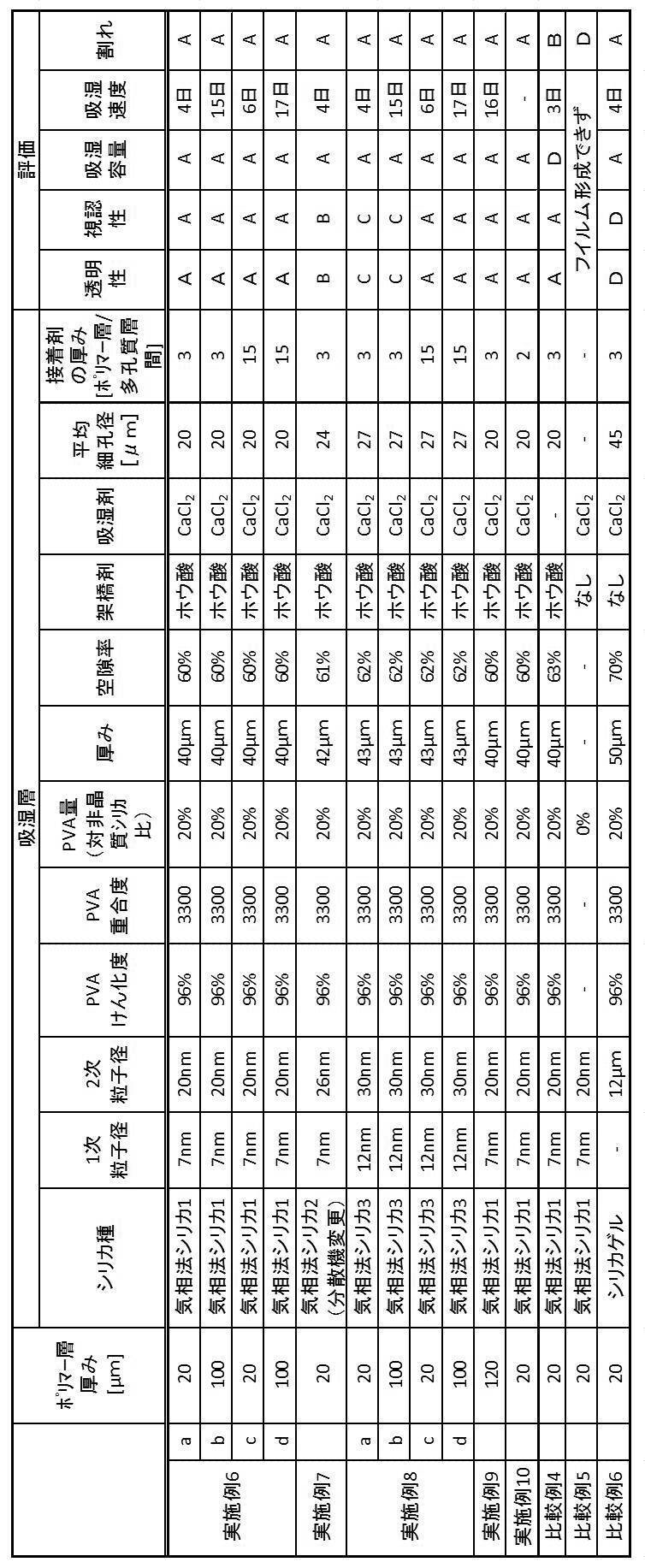
これに対し、吸湿剤を含まない比較例4は吸湿容量が小さく、透明性と吸湿容量を両立できるものではないことがわかる。また、水溶性樹脂及び架橋剤を含まない比較例5は吸湿層を形成することができず、吸湿層に粗大なシリカゲルを用いた比較例6は2次粒子径が大きいため透明性及び視認性に劣ることがわかる。
実施例1において、水溶性樹脂であるポリビニルアルコール(PVA)の種類及び量、吸湿層の厚み、空隙率を下記表3に示すように変更し、架橋剤であるホウ酸を用いなかったこと以外は、実施例1と同様にして吸湿材料を得、さらに成型品を作製した。得られた吸湿材料及び成型品について、実施例1と同様の評価を行った。評価結果は下記表3に示す。
実施例1において、非晶質シリカを湿式シリカ(ミズカシルP705、水澤化学工業社製)に代え、水溶性樹脂であるポリビニルアルコール(PVA)の種類及び量、架橋剤の有無を下記表3に記載のように変更したこと以外は、実施例1と同様にして吸湿材料を得、さらに成型品を作製した。得られた吸湿材料及び成型品について、実施例1と同様の評価を行った。評価結果は下記表3に示す。
実施例1において、水溶性樹脂であるポリビニルアルコール(PVA)の種類及び量、架橋剤の有無を下記表3に示すように変更したこと以外は、実施例1と同様にして、吸湿材料を得、さらに成型品を作製した。得られた吸湿材料及び成型品について、実施例1と同様の評価を行った。評価結果は下記表3に示す。
実施例1において、吸湿剤である塩化カルシウムを硫酸マグネシウムに代えたこと以外は、実施例1と同様にして、吸湿材料を得、さらに成型品を作製した。得られた吸湿材料及び成型品について、実施例1と同様の評価を行った。評価結果は下記表3に示す。
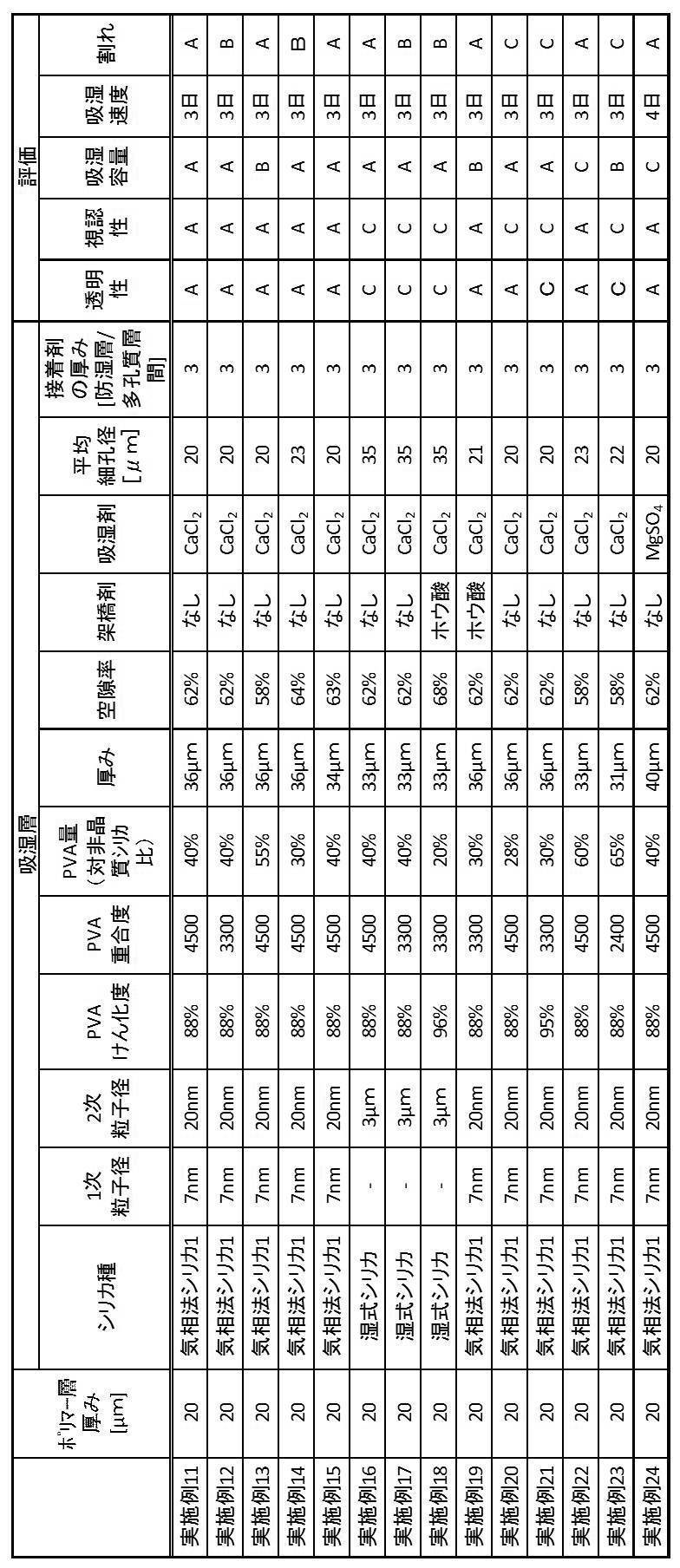
本明細書に記載された全ての文献、特許出願、及び技術規格は、個々の文献、特許出願、及び技術規格が参照により取り込まれることが具体的かつ個々に記された場合と同程度に、本明細書に参照により取り込まれる。
Claims (16)
- 透湿性を有するポリマー層、平均2次粒子径が10μm以下である非晶質シリカと水溶性樹脂と吸湿剤とを含む多孔構造を有する吸湿層、及び防湿層をこの順に有する吸湿材料。
- 前記吸湿層の厚みが20μm~50μmであり、かつ、前記吸湿層の空隙率が45%~85%である請求項1に記載の吸湿材料。
- 前記非晶質シリカが、気相法シリカ及び湿式シリカの少なくとも一方である請求項1又は請求項2に記載の吸湿材料。
- 前記吸湿層の平均細孔径が40nm以下である請求項1~請求項3のいずれか1項に記載の吸湿材料。
- 前記気相法シリカの平均1次粒子径が、10nm以下である請求項3又は請求項4に記載の吸湿材料。
- 前記気相法シリカの平均2次粒子径が、25nm以下である請求項5に記載の吸湿材料。
- 前記水溶性樹脂は、けん化度が99%以下であり、かつ重合度が3300以上であるポリビニルアルコールである請求項1~請求項6のいずれか1項に記載の吸湿材料。
- 前記吸湿層は、更に、架橋剤としてホウ酸を含有する請求項1~請求項7のいずれか1項に記載の吸湿材料。
- 前記吸湿剤が、塩化カルシウムである請求項1~請求項8のいずれか1項に記載の吸湿材料。
- 前記ポリマー層の厚みが、20μm~100μmである請求項1~請求項9のいずれか1項に記載の吸湿材料。
- 前記防湿層と前記吸湿層の間に、更に、接着剤層を有する請求項1~請求項10のいずれか1項に記載の吸湿材料。
- 前記接着剤層の接着剤の少なくとも1種が、ウレタン樹脂系接着剤であり、かつ前記接着剤層の厚みが3μm~15μmである請求項11に記載の吸湿材料。
- 請求項1~請求項12のいずれか1項に記載の吸湿材料を有する包装材料。
- 請求項1~請求項12のいずれか1項に記載の1つ又は複数の吸湿材料を含み、
前記1つの吸湿材料Aのポリマー層の一部と吸湿材料Aの他の一部とが接着された接着部位、又は複数の吸湿材料から選ばれる、第1の吸湿材料のポリマー層の一部と、前記第1の吸湿材料とは異なる第2の吸湿材料の一部と、が接着された接着部位を有する包装材料。 - 透湿性を有するポリマー層及び防湿層のいずれか一方の上に、平均2次粒子径が10μm以下である非晶質シリカと水溶性樹脂とを含む塗布液の塗布により多孔構造を有する層を形成し、多孔構造に吸湿剤を含む溶液を付与し、多孔構造内に吸湿剤を含浸させることで吸湿層を形成する工程と、
吸湿剤が含浸された前記吸湿層の上に、前記ポリマー層及び前記防湿層の他方を積層する工程と、
を有する吸湿材料の製造方法。 - 前記吸湿剤が、塩化カルシウムである請求項15に記載の吸湿材料の製造方法。
Priority Applications (3)
| Application Number | Priority Date | Filing Date | Title |
|---|---|---|---|
| CN201480025219.5A CN105188887B (zh) | 2013-05-10 | 2014-05-09 | 吸湿材料及其制造方法以及包装材料 |
| KR1020157031696A KR101831506B1 (ko) | 2013-05-10 | 2014-05-09 | 흡습 재료 및 그 제조 방법 및 포장 재료 |
| US14/882,471 US20160030918A1 (en) | 2013-05-10 | 2015-10-14 | Moisture-absorbing material, method for manufacturing same, and packaging material |
Applications Claiming Priority (4)
| Application Number | Priority Date | Filing Date | Title |
|---|---|---|---|
| JP2013-100575 | 2013-05-10 | ||
| JP2013100575 | 2013-05-10 | ||
| JP2014-083198 | 2014-04-14 | ||
| JP2014083198A JP6021851B2 (ja) | 2013-05-10 | 2014-04-14 | 吸湿材料及びその製造方法並びに包装材料 |
Related Child Applications (1)
| Application Number | Title | Priority Date | Filing Date |
|---|---|---|---|
| US14/882,471 Continuation US20160030918A1 (en) | 2013-05-10 | 2015-10-14 | Moisture-absorbing material, method for manufacturing same, and packaging material |
Publications (1)
| Publication Number | Publication Date |
|---|---|
| WO2014181880A1 true WO2014181880A1 (ja) | 2014-11-13 |
Family
ID=51867352
Family Applications (1)
| Application Number | Title | Priority Date | Filing Date |
|---|---|---|---|
| PCT/JP2014/062525 Ceased WO2014181880A1 (ja) | 2013-05-10 | 2014-05-09 | 吸湿材料及びその製造方法並びに包装材料 |
Country Status (5)
| Country | Link |
|---|---|
| US (1) | US20160030918A1 (ja) |
| JP (1) | JP6021851B2 (ja) |
| KR (1) | KR101831506B1 (ja) |
| CN (1) | CN105188887B (ja) |
| WO (1) | WO2014181880A1 (ja) |
Cited By (4)
| Publication number | Priority date | Publication date | Assignee | Title |
|---|---|---|---|---|
| CN107530617A (zh) * | 2015-05-01 | 2018-01-02 | 富士胶片株式会社 | 吸湿材料及其制造方法以及包装材料 |
| CN107949432A (zh) * | 2015-09-30 | 2018-04-20 | 富士胶片株式会社 | 吸湿材料及其制造方法以及包装材料 |
| CN108025251A (zh) * | 2015-09-30 | 2018-05-11 | 富士胶片株式会社 | 吸湿材料及其制造方法、包装材料以及包装物 |
| CN108966639A (zh) * | 2015-09-11 | 2018-12-07 | 农业调查委员会 | 用于保存农产品的膜和方法 |
Families Citing this family (29)
| Publication number | Priority date | Publication date | Assignee | Title |
|---|---|---|---|---|
| KR20160037111A (ko) * | 2014-09-26 | 2016-04-05 | 주식회사 케이티 | 비디오 신호 처리 방법 및 장치 |
| CN105150642A (zh) * | 2015-08-28 | 2015-12-16 | 广西点图包装有限公司 | 一种防水、防潮包装材料 |
| PL3356142T3 (pl) | 2015-09-29 | 2020-11-16 | Philip Morris Products S.A. | Materiały opakowaniowe kontrolujące wilgoć |
| US11912488B2 (en) * | 2015-10-09 | 2024-02-27 | General Mills, Inc. | Moisture barrier films |
| JPWO2017069175A1 (ja) * | 2015-10-23 | 2018-07-05 | 富士フイルム株式会社 | 吸湿材料 |
| US10413990B2 (en) * | 2016-12-01 | 2019-09-17 | Michael Hacikyan | Welding purge dam with apertured purge plates |
| JPWO2018131719A1 (ja) * | 2017-01-16 | 2019-11-07 | 国立大学法人北海道大学 | 全熱交換素子用シートおよび全熱交換素子用シート製造方法 |
| KR101900094B1 (ko) | 2017-02-24 | 2018-09-18 | 전현민 | 내용물을 보호하는 포장용 비닐 백 |
| JPWO2018179864A1 (ja) * | 2017-03-29 | 2019-08-08 | 富士フイルム株式会社 | ガス吸着材料及びその製造方法、並びに、包装材料 |
| US11480396B2 (en) * | 2017-08-23 | 2022-10-25 | Mitsubishi Paper Mills Limited | Total heat exchange element paper and total heat exchange element |
| WO2019151142A1 (ja) * | 2018-01-31 | 2019-08-08 | 日本ゼオン株式会社 | 樹脂組成物、樹脂フィルム及び有機エレクトロルミネッセンス装置 |
| CN110302679A (zh) * | 2018-03-20 | 2019-10-08 | 中国石油化工股份有限公司 | 一种智能控湿薄膜及其制备方法和应用 |
| WO2019203146A1 (ja) * | 2018-04-17 | 2019-10-24 | 住友化学株式会社 | 調湿部材およびその製造方法 |
| US10549258B2 (en) * | 2018-06-08 | 2020-02-04 | Tsang-Hung Hsu | Dehumidifying cake |
| CN111013402B (zh) * | 2018-10-09 | 2022-07-12 | 中国石油化工股份有限公司 | 一种智能控湿薄膜及制备方法与应用 |
| IT201900000757A1 (it) * | 2019-01-17 | 2020-07-17 | Tipitalia Srl | Elemento per il controllo dell'umidità |
| KR102139522B1 (ko) * | 2019-03-06 | 2020-07-30 | 전북대학교산학협력단 | 흡습과 방습 기능을 가지는 기능성 실내 건축 마감재 및 이의 제조방법 |
| JP7447418B2 (ja) * | 2019-09-30 | 2024-03-12 | 大日本印刷株式会社 | 透明ガスバリア性吸水積層体 |
| JP7400323B2 (ja) * | 2019-10-11 | 2023-12-19 | 大日本印刷株式会社 | タイムインジケーター用包装体 |
| CN111013342B (zh) * | 2020-01-02 | 2021-09-28 | 北京机械设备研究所 | 一种用于真空环境的除湿装置及除湿方法 |
| JP2021146296A (ja) * | 2020-03-19 | 2021-09-27 | 共同印刷株式会社 | 透明吸湿フィルム |
| EP4146382A2 (en) * | 2020-05-08 | 2023-03-15 | Philip Morris Products S.A. | Package of a tobacco or nicotine containing product comprising a moisture regulating product |
| BR112022021872A2 (pt) * | 2020-05-08 | 2023-01-17 | Philip Morris Products Sa | Composição reguladora de umidade e material de suporte contendo a referida composição reguladora de umidade |
| WO2021250849A1 (ja) * | 2020-06-11 | 2021-12-16 | 三菱電機株式会社 | 除湿素子、除湿装置及び除湿素子の製造方法 |
| JP2022019574A (ja) * | 2020-07-15 | 2022-01-27 | トップ・グローブ・インターナショナル・スンディリアン・ブルハド | 着脱可能な二層手袋およびその製造方法 |
| KR102465913B1 (ko) * | 2020-09-09 | 2022-11-10 | 한국기술교육대학교 산학협력단 | 누액방지 흡습제 조성물 및 그 제조방법 |
| KR102422971B1 (ko) * | 2020-09-16 | 2022-07-20 | 한국기술교육대학교 산학협력단 | 겔형 흡습제 조성물 및 그 제조방법 |
| CN117015507A (zh) * | 2021-03-31 | 2023-11-07 | 电化株式会社 | 包装体及其制造方法 |
| CN113385146B (zh) * | 2021-06-29 | 2023-03-21 | 浙江理工大学 | 二氧化硅-活性炭纤维毡-双盐复合干燥剂及其制备方法 |
Citations (4)
| Publication number | Priority date | Publication date | Assignee | Title |
|---|---|---|---|---|
| JPH10192385A (ja) * | 1996-12-27 | 1998-07-28 | Haishiito Kogyo Kk | 吸着性シート及びその製造方法 |
| JP2002159825A (ja) * | 2000-11-27 | 2002-06-04 | Toppan Printing Co Ltd | 吸放湿性材料及びその製造方法 |
| JP2006213393A (ja) * | 2005-02-07 | 2006-08-17 | Kyodo Printing Co Ltd | 包装袋 |
| JP2012108465A (ja) * | 2010-05-28 | 2012-06-07 | Fujifilm Corp | 立体画像印刷用印画紙、立体画像印刷物、立体画像印刷物の製造方法、及び立体画像の提供方法 |
Family Cites Families (19)
| Publication number | Priority date | Publication date | Assignee | Title |
|---|---|---|---|---|
| JPS5411087A (en) * | 1977-06-28 | 1979-01-26 | Fuji Photo Film Co Ltd | Porous support |
| JPS62286519A (ja) * | 1986-06-03 | 1987-12-12 | Nippon Synthetic Chem Ind Co Ltd:The | シ−ト状調湿材 |
| JPS63116727A (ja) * | 1986-11-05 | 1988-05-21 | Kobe Steel Ltd | 乾式除湿材 |
| JPS63185430A (ja) * | 1987-01-26 | 1988-08-01 | Nippon Synthetic Chem Ind Co Ltd:The | シ−ト状調湿材 |
| JP2564644B2 (ja) * | 1989-03-10 | 1996-12-18 | 日本製紙株式会社 | 紙容器用板紙素材、その製造法、及びその板紙素材を用いた紙容器 |
| JPH03188922A (ja) * | 1989-09-06 | 1991-08-16 | Japan Vilene Co Ltd | 高吸放湿性材料及びその製造方法 |
| CN1155250A (zh) * | 1994-08-01 | 1997-07-23 | 伦纳德·珀尔斯坦恩 | 高效超吸水剂和具有吸水剂的吸水装置 |
| JPH10216458A (ja) * | 1997-01-31 | 1998-08-18 | Sharp Corp | 調湿装置 |
| EP1120281B1 (en) * | 2000-01-28 | 2006-05-24 | Oji Paper Company Limited | Ink jet recording material |
| JP2004223366A (ja) * | 2003-01-21 | 2004-08-12 | Panahome Corp | 球状吸放湿材とその製造方法、吸放湿ボールおよび吸放湿装置 |
| US20040265515A1 (en) * | 2003-06-25 | 2004-12-30 | Agfa-Gevaert | Ink-receiving material |
| JP4619293B2 (ja) * | 2003-12-03 | 2011-01-26 | 共同印刷株式会社 | インジケータ機能付き吸湿材、湿度インジケータ及び包装袋 |
| WO2005075068A1 (ja) * | 2004-02-05 | 2005-08-18 | Taiyo Kagaku Co., Ltd. | 多孔質シリカを含有する吸着能付与剤 |
| WO2006074377A2 (en) * | 2005-01-06 | 2006-07-13 | Arkwright, Inc. | Ink-jet media having supporting intermediate coatings and microporous top coatings |
| JP2006240282A (ja) * | 2005-02-04 | 2006-09-14 | Fuji Photo Film Co Ltd | インクジェット記録媒体 |
| JP2006346888A (ja) * | 2005-06-13 | 2006-12-28 | Kyodo Printing Co Ltd | 選択吸湿フィルム及び多層フィルム |
| ITMI20051501A1 (it) * | 2005-07-29 | 2007-01-30 | Getters Spa | Sistemi getter comprendenti una fase attiva inserita in un materiale poroso distribuito in un mezzo disperdente a bassa permeabilita' |
| JP5835914B2 (ja) * | 2010-03-19 | 2015-12-24 | 大阪瓦斯株式会社 | 吸水材料組成物および吸水性シート |
| CN102698573B (zh) * | 2012-05-16 | 2013-12-25 | 陈孟伯 | 矿山井下电器设备干燥剂及其制备方法 |
-
2014
- 2014-04-14 JP JP2014083198A patent/JP6021851B2/ja active Active
- 2014-05-09 KR KR1020157031696A patent/KR101831506B1/ko not_active Expired - Fee Related
- 2014-05-09 WO PCT/JP2014/062525 patent/WO2014181880A1/ja not_active Ceased
- 2014-05-09 CN CN201480025219.5A patent/CN105188887B/zh not_active Expired - Fee Related
-
2015
- 2015-10-14 US US14/882,471 patent/US20160030918A1/en not_active Abandoned
Patent Citations (4)
| Publication number | Priority date | Publication date | Assignee | Title |
|---|---|---|---|---|
| JPH10192385A (ja) * | 1996-12-27 | 1998-07-28 | Haishiito Kogyo Kk | 吸着性シート及びその製造方法 |
| JP2002159825A (ja) * | 2000-11-27 | 2002-06-04 | Toppan Printing Co Ltd | 吸放湿性材料及びその製造方法 |
| JP2006213393A (ja) * | 2005-02-07 | 2006-08-17 | Kyodo Printing Co Ltd | 包装袋 |
| JP2012108465A (ja) * | 2010-05-28 | 2012-06-07 | Fujifilm Corp | 立体画像印刷用印画紙、立体画像印刷物、立体画像印刷物の製造方法、及び立体画像の提供方法 |
Cited By (7)
| Publication number | Priority date | Publication date | Assignee | Title |
|---|---|---|---|---|
| CN107530617A (zh) * | 2015-05-01 | 2018-01-02 | 富士胶片株式会社 | 吸湿材料及其制造方法以及包装材料 |
| CN108966639A (zh) * | 2015-09-11 | 2018-12-07 | 农业调查委员会 | 用于保存农产品的膜和方法 |
| US20190045804A1 (en) * | 2015-09-11 | 2019-02-14 | Agricultural Research Council | Membrane and method for preservation of produce |
| CN108966639B (zh) * | 2015-09-11 | 2021-03-30 | 农业调查委员会 | 用于保存农产品的膜和方法 |
| US11154067B2 (en) * | 2015-09-11 | 2021-10-26 | Council For Scientific And Industrial Research | Membrane and method for preservation of produce |
| CN107949432A (zh) * | 2015-09-30 | 2018-04-20 | 富士胶片株式会社 | 吸湿材料及其制造方法以及包装材料 |
| CN108025251A (zh) * | 2015-09-30 | 2018-05-11 | 富士胶片株式会社 | 吸湿材料及其制造方法、包装材料以及包装物 |
Also Published As
| Publication number | Publication date |
|---|---|
| JP2014237121A (ja) | 2014-12-18 |
| CN105188887B (zh) | 2017-07-28 |
| KR20150140739A (ko) | 2015-12-16 |
| US20160030918A1 (en) | 2016-02-04 |
| JP6021851B2 (ja) | 2016-11-09 |
| CN105188887A (zh) | 2015-12-23 |
| KR101831506B1 (ko) | 2018-04-04 |
Similar Documents
| Publication | Publication Date | Title |
|---|---|---|
| JP6021851B2 (ja) | 吸湿材料及びその製造方法並びに包装材料 | |
| JP6211686B2 (ja) | 吸湿材料及びその製造方法並びにブリスターパック | |
| WO2018179864A1 (ja) | ガス吸着材料及びその製造方法、並びに、包装材料 | |
| US20180161723A1 (en) | Hygroscopic material, method of producing same, packaging material, and packaging item | |
| WO2016178353A1 (ja) | 吸湿材料及びその製造方法、並びに包装材料 | |
| US8287121B2 (en) | Inkjet recording medium and method of producing same | |
| WO2017057607A1 (ja) | 吸湿材料及びその製造方法、包装材料並びに包装物 | |
| JP6421404B2 (ja) | 医薬品包装体 | |
| US11358122B2 (en) | Moisture absorbent pack for vehicle lamp | |
| JP6396872B2 (ja) | 吸湿材料及びその製造方法並びに包装材料 | |
| JP2013159376A (ja) | ラミネートフィルムロールの梱包方法および梱包体、ならびにラミネートフィルムロールを用いた積層体の製造方法 | |
| JP2013159377A (ja) | ラミネートフィルムロールの梱包方法および梱包体、ならびにラミネートフィルムロールを用いた積層体の製造方法 | |
| JP2001334742A (ja) | インクジェット記録用シートの製造方法およびインクジェット記録用シート | |
| JPWO2017069175A1 (ja) | 吸湿材料 | |
| US8236395B2 (en) | Inkjet recording medium | |
| JP2001328340A (ja) | インクジェット記録用シート | |
| JP2003136830A (ja) | 医療診断用画像の作成方法 | |
| JP2007177050A (ja) | 無機微粒子分散液及びその製造方法、インクジェット記録媒体用塗布液、並びにインクジェット記録媒体 | |
| JP2010228245A (ja) | インクジェット記録媒体及びその製造方法 |
Legal Events
| Date | Code | Title | Description |
|---|---|---|---|
| WWE | Wipo information: entry into national phase |
Ref document number: 201480025219.5 Country of ref document: CN |
|
| 121 | Ep: the epo has been informed by wipo that ep was designated in this application |
Ref document number: 14795162 Country of ref document: EP Kind code of ref document: A1 |
|
| ENP | Entry into the national phase |
Ref document number: 20157031696 Country of ref document: KR Kind code of ref document: A |
|
| NENP | Non-entry into the national phase |
Ref country code: DE |
|
| 122 | Ep: pct application non-entry in european phase |
Ref document number: 14795162 Country of ref document: EP Kind code of ref document: A1 |