WO2014119396A1 - パターン形成方法、並びに、これらを用いた電子デバイスの製造方法、及び、電子デバイス - Google Patents
パターン形成方法、並びに、これらを用いた電子デバイスの製造方法、及び、電子デバイス Download PDFInfo
- Publication number
- WO2014119396A1 WO2014119396A1 PCT/JP2014/050846 JP2014050846W WO2014119396A1 WO 2014119396 A1 WO2014119396 A1 WO 2014119396A1 JP 2014050846 W JP2014050846 W JP 2014050846W WO 2014119396 A1 WO2014119396 A1 WO 2014119396A1
- Authority
- WO
- WIPO (PCT)
- Prior art keywords
- group
- acid
- resin
- organic solvent
- protective film
- Prior art date
- Legal status (The legal status is an assumption and is not a legal conclusion. Google has not performed a legal analysis and makes no representation as to the accuracy of the status listed.)
- Ceased
Links
Classifications
-
- G—PHYSICS
- G03—PHOTOGRAPHY; CINEMATOGRAPHY; ANALOGOUS TECHNIQUES USING WAVES OTHER THAN OPTICAL WAVES; ELECTROGRAPHY; HOLOGRAPHY
- G03F—PHOTOMECHANICAL PRODUCTION OF TEXTURED OR PATTERNED SURFACES, e.g. FOR PRINTING, FOR PROCESSING OF SEMICONDUCTOR DEVICES; MATERIALS THEREFOR; ORIGINALS THEREFOR; APPARATUS SPECIALLY ADAPTED THEREFOR
- G03F7/00—Photomechanical, e.g. photolithographic, production of textured or patterned surfaces, e.g. printing surfaces; Materials therefor, e.g. comprising photoresists; Apparatus specially adapted therefor
- G03F7/26—Processing photosensitive materials; Apparatus therefor
- G03F7/30—Imagewise removal using liquid means
- G03F7/32—Liquid compositions therefor, e.g. developers
- G03F7/325—Non-aqueous compositions
-
- G—PHYSICS
- G03—PHOTOGRAPHY; CINEMATOGRAPHY; ANALOGOUS TECHNIQUES USING WAVES OTHER THAN OPTICAL WAVES; ELECTROGRAPHY; HOLOGRAPHY
- G03F—PHOTOMECHANICAL PRODUCTION OF TEXTURED OR PATTERNED SURFACES, e.g. FOR PRINTING, FOR PROCESSING OF SEMICONDUCTOR DEVICES; MATERIALS THEREFOR; ORIGINALS THEREFOR; APPARATUS SPECIALLY ADAPTED THEREFOR
- G03F7/00—Photomechanical, e.g. photolithographic, production of textured or patterned surfaces, e.g. printing surfaces; Materials therefor, e.g. comprising photoresists; Apparatus specially adapted therefor
- G03F7/004—Photosensitive materials
- G03F7/0046—Photosensitive materials with perfluoro compounds, e.g. for dry lithography
-
- G—PHYSICS
- G03—PHOTOGRAPHY; CINEMATOGRAPHY; ANALOGOUS TECHNIQUES USING WAVES OTHER THAN OPTICAL WAVES; ELECTROGRAPHY; HOLOGRAPHY
- G03F—PHOTOMECHANICAL PRODUCTION OF TEXTURED OR PATTERNED SURFACES, e.g. FOR PRINTING, FOR PROCESSING OF SEMICONDUCTOR DEVICES; MATERIALS THEREFOR; ORIGINALS THEREFOR; APPARATUS SPECIALLY ADAPTED THEREFOR
- G03F7/00—Photomechanical, e.g. photolithographic, production of textured or patterned surfaces, e.g. printing surfaces; Materials therefor, e.g. comprising photoresists; Apparatus specially adapted therefor
- G03F7/004—Photosensitive materials
- G03F7/039—Macromolecular compounds which are photodegradable, e.g. positive electron resists
- G03F7/0392—Macromolecular compounds which are photodegradable, e.g. positive electron resists the macromolecular compound being present in a chemically amplified positive photoresist composition
- G03F7/0397—Macromolecular compounds which are photodegradable, e.g. positive electron resists the macromolecular compound being present in a chemically amplified positive photoresist composition the macromolecular compound having an alicyclic moiety in a side chain
-
- G—PHYSICS
- G03—PHOTOGRAPHY; CINEMATOGRAPHY; ANALOGOUS TECHNIQUES USING WAVES OTHER THAN OPTICAL WAVES; ELECTROGRAPHY; HOLOGRAPHY
- G03F—PHOTOMECHANICAL PRODUCTION OF TEXTURED OR PATTERNED SURFACES, e.g. FOR PRINTING, FOR PROCESSING OF SEMICONDUCTOR DEVICES; MATERIALS THEREFOR; ORIGINALS THEREFOR; APPARATUS SPECIALLY ADAPTED THEREFOR
- G03F7/00—Photomechanical, e.g. photolithographic, production of textured or patterned surfaces, e.g. printing surfaces; Materials therefor, e.g. comprising photoresists; Apparatus specially adapted therefor
- G03F7/004—Photosensitive materials
- G03F7/075—Silicon-containing compounds
- G03F7/0752—Silicon-containing compounds in non photosensitive layers or as additives, e.g. for dry lithography
-
- G—PHYSICS
- G03—PHOTOGRAPHY; CINEMATOGRAPHY; ANALOGOUS TECHNIQUES USING WAVES OTHER THAN OPTICAL WAVES; ELECTROGRAPHY; HOLOGRAPHY
- G03F—PHOTOMECHANICAL PRODUCTION OF TEXTURED OR PATTERNED SURFACES, e.g. FOR PRINTING, FOR PROCESSING OF SEMICONDUCTOR DEVICES; MATERIALS THEREFOR; ORIGINALS THEREFOR; APPARATUS SPECIALLY ADAPTED THEREFOR
- G03F7/00—Photomechanical, e.g. photolithographic, production of textured or patterned surfaces, e.g. printing surfaces; Materials therefor, e.g. comprising photoresists; Apparatus specially adapted therefor
- G03F7/004—Photosensitive materials
- G03F7/09—Photosensitive materials characterised by structural details, e.g. supports, auxiliary layers
- G03F7/11—Photosensitive materials characterised by structural details, e.g. supports, auxiliary layers having cover layers or intermediate layers, e.g. subbing layers
-
- G—PHYSICS
- G03—PHOTOGRAPHY; CINEMATOGRAPHY; ANALOGOUS TECHNIQUES USING WAVES OTHER THAN OPTICAL WAVES; ELECTROGRAPHY; HOLOGRAPHY
- G03F—PHOTOMECHANICAL PRODUCTION OF TEXTURED OR PATTERNED SURFACES, e.g. FOR PRINTING, FOR PROCESSING OF SEMICONDUCTOR DEVICES; MATERIALS THEREFOR; ORIGINALS THEREFOR; APPARATUS SPECIALLY ADAPTED THEREFOR
- G03F7/00—Photomechanical, e.g. photolithographic, production of textured or patterned surfaces, e.g. printing surfaces; Materials therefor, e.g. comprising photoresists; Apparatus specially adapted therefor
- G03F7/16—Coating processes; Apparatus therefor
-
- G—PHYSICS
- G03—PHOTOGRAPHY; CINEMATOGRAPHY; ANALOGOUS TECHNIQUES USING WAVES OTHER THAN OPTICAL WAVES; ELECTROGRAPHY; HOLOGRAPHY
- G03F—PHOTOMECHANICAL PRODUCTION OF TEXTURED OR PATTERNED SURFACES, e.g. FOR PRINTING, FOR PROCESSING OF SEMICONDUCTOR DEVICES; MATERIALS THEREFOR; ORIGINALS THEREFOR; APPARATUS SPECIALLY ADAPTED THEREFOR
- G03F7/00—Photomechanical, e.g. photolithographic, production of textured or patterned surfaces, e.g. printing surfaces; Materials therefor, e.g. comprising photoresists; Apparatus specially adapted therefor
- G03F7/20—Exposure; Apparatus therefor
-
- G—PHYSICS
- G03—PHOTOGRAPHY; CINEMATOGRAPHY; ANALOGOUS TECHNIQUES USING WAVES OTHER THAN OPTICAL WAVES; ELECTROGRAPHY; HOLOGRAPHY
- G03F—PHOTOMECHANICAL PRODUCTION OF TEXTURED OR PATTERNED SURFACES, e.g. FOR PRINTING, FOR PROCESSING OF SEMICONDUCTOR DEVICES; MATERIALS THEREFOR; ORIGINALS THEREFOR; APPARATUS SPECIALLY ADAPTED THEREFOR
- G03F7/00—Photomechanical, e.g. photolithographic, production of textured or patterned surfaces, e.g. printing surfaces; Materials therefor, e.g. comprising photoresists; Apparatus specially adapted therefor
- G03F7/20—Exposure; Apparatus therefor
- G03F7/2002—Exposure; Apparatus therefor with visible light or UV light, through an original having an opaque pattern on a transparent support, e.g. film printing, projection printing; by reflection of visible or UV light from an original such as a printed image
- G03F7/2004—Exposure; Apparatus therefor with visible light or UV light, through an original having an opaque pattern on a transparent support, e.g. film printing, projection printing; by reflection of visible or UV light from an original such as a printed image characterised by the use of a particular light source, e.g. fluorescent lamps or deep UV light
-
- G—PHYSICS
- G03—PHOTOGRAPHY; CINEMATOGRAPHY; ANALOGOUS TECHNIQUES USING WAVES OTHER THAN OPTICAL WAVES; ELECTROGRAPHY; HOLOGRAPHY
- G03F—PHOTOMECHANICAL PRODUCTION OF TEXTURED OR PATTERNED SURFACES, e.g. FOR PRINTING, FOR PROCESSING OF SEMICONDUCTOR DEVICES; MATERIALS THEREFOR; ORIGINALS THEREFOR; APPARATUS SPECIALLY ADAPTED THEREFOR
- G03F7/00—Photomechanical, e.g. photolithographic, production of textured or patterned surfaces, e.g. printing surfaces; Materials therefor, e.g. comprising photoresists; Apparatus specially adapted therefor
- G03F7/20—Exposure; Apparatus therefor
- G03F7/2041—Exposure; Apparatus therefor in the presence of a fluid, e.g. immersion; using fluid cooling means
-
- G—PHYSICS
- G03—PHOTOGRAPHY; CINEMATOGRAPHY; ANALOGOUS TECHNIQUES USING WAVES OTHER THAN OPTICAL WAVES; ELECTROGRAPHY; HOLOGRAPHY
- G03F—PHOTOMECHANICAL PRODUCTION OF TEXTURED OR PATTERNED SURFACES, e.g. FOR PRINTING, FOR PROCESSING OF SEMICONDUCTOR DEVICES; MATERIALS THEREFOR; ORIGINALS THEREFOR; APPARATUS SPECIALLY ADAPTED THEREFOR
- G03F7/00—Photomechanical, e.g. photolithographic, production of textured or patterned surfaces, e.g. printing surfaces; Materials therefor, e.g. comprising photoresists; Apparatus specially adapted therefor
- G03F7/26—Processing photosensitive materials; Apparatus therefor
- G03F7/40—Treatment after imagewise removal, e.g. baking
Definitions
- the present invention relates to a method of forming a pattern using a developer containing an organic solvent, which is suitably used in an ultra-microlithography process such as the manufacture of ultra-LSI and high-capacity microchips and other photofabrication processes, and
- the present invention relates to an electronic device manufacturing method and an electronic device. More specifically, a pattern forming method using a developer containing an organic solvent, which can be suitably used for fine processing of a semiconductor element using an electron beam or EUV light (wavelength: around 13 nm), and an electron using these
- the present invention relates to a device manufacturing method and an electronic device.
- the electron beam, X-ray, or EUV light lithography is positioned as a next-generation or next-generation pattern formation technology, and a resist composition having high sensitivity and high resolution is desired.
- high sensitivity is a very important issue for shortening the wafer processing time, but when trying to achieve high sensitivity, the pattern shape and the resolution represented by the critical resolution line width decrease. Therefore, development of a resist composition which simultaneously satisfies these characteristics is strongly desired.
- a resin hardly soluble or insoluble in an alkaline developer is used, and a pattern is formed by solubilizing the exposed portion in the alkaline developer by exposure to radiation.
- a "positive type” and a "negative type” which forms a pattern by using a resin soluble in an alkali developer and making the exposed portion insoluble or insoluble in alkali developer by exposure to radiation.
- Type resist composition As an actinic ray-sensitive or radiation-sensitive resin composition suitable for a lithography process using such an electron beam, X-ray or EUV light, a chemically amplified positive film mainly utilizing an acid catalyzed reaction from the viewpoint of high sensitivity.
- Type resist composition is considered, and it is insoluble or hardly soluble in alkaline developer as main component, and phenolic resin (hereinafter referred to as phenolic acid decomposable resin) has the property of becoming soluble in alkaline developer by the action of acid
- phenolic acid decomposable resin phenolic acid decomposable resin
- an ultrafine space width for example, a space width of 30 nm or less
- an ultrafine space width for example, a space width of 30 nm or less
- An object of the present invention is to solve the above-mentioned problems, and to provide a pattern forming method excellent in resolution in forming an isolated space pattern having an ultrafine space width (for example, a space width of 30 nm or less).
- the present invention has the following constitution, thereby achieving the above object of the present invention.
- An actinic ray-sensitive or sensitizing resin containing a resin whose polarity increases by the action of an acid to reduce its solubility in a developer containing an organic solvent, and a compound which decomposes upon irradiation with an actinic ray or radiation to generate an acid.
- Forming a resist film by a radioactive resin composition Forming a protective film on the resist film with a protective film composition, Exposing the resist film having the protective film with an electron beam or extreme ultraviolet light;
- the pattern formation method including the process of developing using the developing solution containing the said organic solvent.
- the pattern forming method according to [1] or [2], wherein the protective film composition is an aqueous composition.
- a resin whose polarity increases by the action of an acid and whose solubility in a developer containing an organic solvent decreases is any one of [1] to [6], wherein the resin has a repeating unit represented by the following general formula (I)
- R 01 , R 02 and R 03 each independently represent a hydrogen atom, an alkyl group, a cycloalkyl group, a halogen atom, a cyano group or an alkoxycarbonyl group.
- R 03 represents an alkylene group, which may be bonded to Ar 1 to form a 5- or 6-membered ring.
- Ar 1 represents an aromatic ring group.
- n Y's independently represents a hydrogen atom or a group capable of leaving by the action of an acid. However, at least one of Y represents a group capable of leaving by the action of an acid. n represents an integer of 1 to 4;
- the resin in which the polarity is increased by the action of the acid and the solubility in a developer containing an organic solvent is decreased is described in any one of [1] to [7] having a repeating unit having a group having a lactone structure. Pattern formation method.
- the organic solvent contained in the developer containing the organic solvent is at least one organic solvent selected from the group consisting of ketone solvents, ester solvents and ether solvents [1] to [8] The pattern formation method as described in.
- a pattern forming method having an excellent resolution in forming an isolated space pattern having an ultrafine space width (for example, a space width of 30 nm or less).
- the notations not describing substitution and non-substitution include those having no substituent and those having a substituent.
- the "alkyl group” includes not only an alkyl group having no substituent (unsubstituted alkyl group) but also an alkyl group having a substituent (substituted alkyl group).
- light includes not only extreme ultraviolet (EUV light) but also electron beams.
- the "exposure” in the present specification includes not only exposure by extreme ultraviolet (EUV light) but also drawing by electron beam.
- the term "active light” or “radiation” means, for example, extreme ultraviolet (EUV light), X-ray, electron beam and the like.
- EUV light extreme ultraviolet
- light means actinic rays or radiation.
- the "exposure” in the present specification includes not only exposure by X-rays or EUV light but also writing by particle beams such as electron beams or ion beams.
- the pattern formation method of the present invention includes the following steps. These steps are preferably included in this order.
- a resin hereinafter also referred to as "acid-degradable resin" in which the polarity is increased by the action of an acid and the solubility in a developer containing an organic solvent is reduced, and the resin is decomposed by irradiation with actinic rays or radiation.
- a resist film with an actinic ray-sensitive or radiation-sensitive resin composition containing a compound capable of generating an acid hereinafter also referred to as "acid generator”
- Acid generator a compound capable of generating an acid
- C exposing the resist film having the protective film with an electron beam or extreme ultraviolet light
- D A pattern forming method comprising the step of developing using a developer containing the organic solvent.
- the surface layer portion of the resist film is exposed to light as compared with the inside.
- the concentration of the generated acid is high, and the reaction between the acid and the acid-degradable resin tends to further progress.
- the cross section of the region (that is, the exposed portion) defining the isolated space pattern has an inverse taper shape or a T-top shape.
- the present inventor is particularly advantageous in terms of an optical image, in the formation of an isolated space pattern having an ultrafine space width (for example, a space width of 30 nm or less), exposure with electron beam or extreme ultraviolet light is advantageous.
- an ultrafine space width for example, a space width of 30 nm or less
- exposure with electron beam or extreme ultraviolet light is advantageous.
- the space width is very fine, it has been found that the above problem is likely to be alive and the resolution is lowered.
- the present inventor has conducted intensive studies and found that in the pattern formation method in which exposure is performed with an electron beam or extreme ultraviolet light, and development is performed using an organic developer, the composition of the protective film before exposure.
- the resolution can be improved in forming an isolated space pattern having an ultrafine space width (for example, a space width of 30 nm or less) by carrying out the step of forming a protective film with a substance.
- an ultrafine space width for example, a space width of 30 nm or less
- acid in the surface layer portion of the exposed portion of the resist film can be diffused into the protective film as compared with the case where the protective layer is not formed on the resist film, and diffusion of acid into the surface layer portion of the unexposed portion It is guessed that it was because it was suppressed.
- the acid concentration distribution in the thickness direction of the exposed portion of the resist film can be made more uniform, and the acid-catalyzed insolubilization or insolubilization reaction of the resist film with the organic solvent-containing developer It is considered to be more uniform in the thickness direction of the film.
- the generation of the reverse tapered shape and T-top shape in the cross section of the region defining the isolated space pattern as described above is suppressed, and in particular, in formation of the isolated space pattern having an ultrafine space width. Is considered to improve.
- the protective film composition is required before exposure.
- the positive pattern forming method is a pattern forming method in which the exposed area is dissolved by development, the diffusion of the acid in the surface layer of the exposed area to the surface area of the unexposed area is the isolated space pattern described above. It is presumed that this is because it does not become a factor of reverse tapering or T-top shaping in the cross section of the region that defines
- the pattern formation method of the present invention includes the following steps.
- A An actinic ray containing a resin whose polarity is increased by the action of an acid to decrease its solubility in a developer containing an organic solvent, and a compound which is decomposed by irradiation with an actinic ray or radiation to generate an acid
- A forming a protective film on the resist film with a protective film composition
- C exposing the resist film having the protective film with an electron beam or extreme ultraviolet light
- D A pattern forming method comprising the step of developing using a developer containing the organic solvent.
- the pattern forming method of the present invention may further include the step of (d) developing using a positive developing solution to form a resist pattern. This makes it possible to form a pattern of resolution twice that of the spatial frequency.
- any method may be used as long as the resist composition can be coated on a substrate, and a conventionally known spin coating method, spray method, roller coating A method, an immersion method, etc. can be used, Preferably a resist composition is apply
- the temperature for prebaking is not particularly limited, but is preferably 50 ° C to 160 ° C, and more preferably 60 ° C to 140 ° C.
- the substrate on which the film is formed is not particularly limited, and silicon, an inorganic substrate such as SiN, SiO 2 or SiN, a coated inorganic substrate such as SOG, a semiconductor manufacturing process such as IC, liquid crystal, thermal head Substrates that are commonly used in circuit board manufacturing processes such as, and lithography processes for other photo applications can be used.
- an antireflective film may be coated on the substrate in advance.
- the antireflective film any of inorganic film types such as titanium, titanium dioxide, titanium nitride, chromium oxide, carbon and amorphous silicon, and organic film types made of a light absorber and a polymer material can be used.
- DUV30 series manufactured by Brewer Science, DUV-40 series, AR-2 manufactured by Shipley, AR-3, AR-5, ARC series such as ARC29A manufactured by Nissan Chemical Industries, etc. commercially available organic antireflective films can also be used.
- top coat a step of forming a step of forming a protective film (hereinafter also referred to as "top coat").
- top coat a step of forming a step of forming a protective film
- the protective film composition preferably contains a solvent which does not dissolve the resist film.
- the method of applying the protective film composition is not particularly limited, and, for example, a spin coating method can be applied.
- the film thickness of the top coat is not particularly limited, it is usually formed to have a thickness of 1 nm to 300 nm, preferably 10 nm to 150 nm, from the viewpoint of transparency to the exposure light source. After forming the top coat, the substrate is heated if necessary.
- the refractive index of the top coat is preferably close to the refractive index of the resist film from the viewpoint of resolution.
- the peeling process (the protective film formed on the resist film) is performed between the steps (c) and (d).
- the method may further comprise the step of removing the protective film by contacting with a solvent and dissolving the protective film in the solvent.
- water is preferably used as a solvent for dissolving the protective film.
- the peeling time of the protective film is preferably 5 to 300 seconds, and more preferably 10 to 180 seconds.
- the top coat may be removed using, for example, an alkaline aqueous solution or the like.
- aqueous alkaline solution that can be used include aqueous solutions of tetramethyl ammonium hydroxide.
- the exposure of the resist film can be carried out by a generally well-known method.
- the resist film is irradiated with an actinic ray or radiation through a predetermined mask.
- the exposure dose can be set as appropriate, but is usually 1 to 100 mJ / cm 2 .
- the step (c) is preferably performed without an immersion medium.
- EUV light (13.5 nm) or an electron beam may, for example, be mentioned. Among these, it is more preferable to use EUV light.
- the pattern formation method of the present invention may have a plurality of exposure steps. In that case, although the same light source may be used for multiple exposures, or different light sources may be used, it is preferable to use EUV light (13.5 nm) for the first exposure.
- a heating step also referred to as baking or PEB
- the temperature of PEB is not particularly limited as long as a good resist pattern can be obtained, and is usually 40 ° C. to 160 ° C.
- (d) Development is performed using a developer containing an organic solvent to form a resist pattern.
- an organic developer containing an organic solvent When performing negative development, it is preferable to use an organic developer containing an organic solvent.
- organic developing solution that can be used when performing negative development, polar solvents such as ketone solvents, ester solvents, alcohol solvents, amide solvents, ether solvents, and hydrocarbon solvents can be used. It is preferable to use a developing solution containing at least one organic solvent selected from the group consisting of ketone solvents, ester solvents and ether solvents.
- Examples of the organic developing solution include 1-octanone, 2-octanone, 1-nonanone, 2-nonanone, acetone, 4-heptanone, 1-hexanone, 2-hexanone, diisobutyl ketone, cyclohexanone, methylcyclohexanone, phenylacetone, Ketone solvents such as methyl ethyl ketone, methyl isobutyl ketone, acetylacetone, acetonylacetone, ionone, diacetonyl alcohol, acetyl carbinol, acetophenone, methylnaphthyl ketone, isophorone, propylene carbonate, methyl acetate, butyl acetate, ethyl acetate, acetic acid Isopropyl, amyl acetate, propylene glycol monomethyl ether acetate, ethylene glycol monoethyl ether acetate, diethylene
- alcohol solvents methyl alcohol, ethyl alcohol, n-propyl alcohol, isopropyl alcohol, n-butyl alcohol, sec-butyl alcohol, tert-butyl alcohol, isobutyl alcohol, n-hexyl alcohol, n-heptyl alcohol, n- Alcohols such as octyl alcohol, n-decanol, glycol solvents such as ethylene glycol, diethylene glycol and triethylene glycol, ethylene glycol monomethyl ether, propylene glycol monomethyl ether, ethylene glycol, propylene glycol, diethylene glycol monomethyl ether, triethylene glycol mono Examples include glycol ether solvents such as ethyl ether and methoxymethyl butanol Can.
- ether solvents examples include dioxane, tetrahydrofuran and the like in addition to the above glycol ether solvents.
- amide solvent N-methyl-2-pyrrolidone, N, N-dimethylacetamide, N, N-dimethylformamide, hexamethylphosphoric triamide, 1,3-dimethyl-2-imidazolidinone and the like can be used.
- hydrocarbon solvents include aromatic hydrocarbon solvents such as toluene and xylene, and aliphatic hydrocarbon solvents such as pentane, hexane, octane and decane. A plurality of the above solvents may be mixed, or may be used by mixing with a solvent other than the above or water.
- a development method a method in which a developer is raised on the surface of a substrate by surface tension and is allowed to stand for a certain period of time (paddle method), a method in which a developer is sprayed on the substrate surface (spray method)
- a method such as a method (Dynamic Dispense Method) in which the developer is continuously applied while scanning the developer application nozzle at a constant speed on the substrate.
- the vapor pressure of the developer containing the organic solvent is preferably 5 kPa or less at 20 ° C., more preferably 3 kPa or less, and most preferably 2 kPa or less.
- the vapor pressure of the developing solution containing the organic solvent is preferably 5 kPa or less at 20 ° C., more preferably 3 kPa or less, and most preferably 2 kPa or less.
- glycol solvents such as ethylene glycol, diethylene glycol and triethylene glycol, ethylene glycol monomethyl ether, propylene glycol monomethyl ether, ethylene glycol, propylene glycol, diethylene glycol monomethyl ether, triethylene glycol monoethyl ether, methoxymethyl butanol
- Glycol ether solvents such as ether, ether solvents such as tetrahydrofuran, N-methyl 2-pyrrolidone, N, N- dimethylacetamide, N, N-dimethylformamide amide solvents, toluene, aromatic hydrocarbon solvents such as xylene, octane, aliphatic hydrocarbon solvents decane.
- vapor pressure of 2 kPa or less at 20 ° C. which is the most preferable range include 1-octanone, 2-octanone, 1-nonanone, 2-nonanone, 4-heptanone, 2-hexanone, diisobutyl ketone, cyclohexanone Ketone solvents such as methylcyclohexanone and phenylacetone, butyl acetate, amyl acetate, propylene glycol monomethyl ether acetate, ethylene glycol monoethyl ether acetate, diethylene glycol monobutyl ether acetate, diethylene glycol monoethyl ether acetate, ethyl 3-ethoxypropionate Ester solvents such as 3-methoxybutyl acetate, 3-methyl-3-methoxybutyl acetate, ethyl lactate, butyl lactate and propyl lactate, n-butyl Alcohol solvents such as alcohol, sec-
- the surfactant is not particularly limited, but for example, ionic or nonionic fluorine-based and / or silicon-based surfactants can be used.
- fluorine and / or silicone surfactants for example, JP-A-62-36663, JP-A-61-226746, JP-A-61-226745, JP-A-62-170950, JP-A-63-34540, JP-A-7-230165, JP-A-8-62834, JP-A-9-54432, JP-A-9-5988, US Pat. No.
- the surfactants described in the specifications of 5360692, 5529881, 5296330, 5436098, 5576143, 5294511 and 5824451 can be mentioned.
- they are nonionic surfactants.
- the nonionic surfactant is not particularly limited, but it is more preferable to use a fluorine-based surfactant or a silicon-based surfactant.
- the amount of surfactant used is usually 0.001 to 5% by mass, preferably 0.005 to 2% by mass, and more preferably 0.01 to 0.5% by mass, based on the total amount of the developer.
- the organic developer can also contain a basic compound as described in, in particular, [0032] to [0063] of JP-A-2013-11833.
- a basic compound the below-mentioned basic compound (D) which the actinic-ray-sensitive or radiation-sensitive resin composition may contain can also be mentioned.
- a developing method for example, a method of immersing the substrate in a bath filled with a developer for a certain time (dip method), a method of developing by standing up the developer on the substrate surface by surface tension and standing for a certain time (paddle Method), a method of spraying a developer on the substrate surface (spray method), a method of continuously coating a developer while scanning a developer coating nozzle at a constant speed on a substrate rotating at a constant speed (dynamic dispense method Etc. can be applied.
- the rinse solution used in the rinse step after negative development is not particularly limited as long as the resist pattern is not dissolved, and a solution containing a common organic solvent can be used.
- a rinse solution it is preferable to use a rinse solution containing at least one organic solvent selected from hydrocarbon solvents, ketone solvents, ester solvents, alcohol solvents, amide solvents and ether solvents.
- hydrocarbon solvents, ketone solvents, ester solvents, alcohol solvents, amide solvents and ether solvents include hydrocarbon solvents, ketone solvents, ester solvents, alcohol solvents in organic developers, and alcohol solvents. Mention may be made of those mentioned above for solvents, amide solvents and ether solvents.
- a washing step is performed using a rinse solution containing at least one organic solvent selected from a ketone solvent, an ester solvent, an alcohol solvent, and an amide solvent. Still more preferably, the negative development is followed by a washing step using a rinse solution containing an alcohol solvent or an ester solvent. Particularly preferably, the negative development is followed by a washing step using a rinse solution containing an alcohol (preferably a monohydric alcohol).
- an alcohol preferably a monohydric alcohol.
- examples of the monohydric alcohol used in the rinse step after negative development include linear, branched, and cyclic monohydric alcohols.
- 1-butanol, 2-butanol, 3- Methyl-1-butanol, tert-butyl alcohol, 1-pentanol, 2-pentanol, 1-hexanol, 1-heptanol, 1-octanol, 2-hexanol, 2-heptanol, 2-octanol, 3-hexanol, 3 -Heptanol, 3-octanol, 4-octanol and the like can be used, preferably 1-hexanol, 2-hexanol, 1-pentanol, 4-methyl-2-pentanol (methyl isobutyl carbinol), 3- It is methyl-1-butanol.
- Each of the components may be mixed, or mixed with an organic solvent other than the above.
- the water content in the rinse solution is preferably 10% by mass or less, more preferably 5% by mass or less, and particularly preferably 3% by mass or less. By setting the water content to 10% by mass or less, good development characteristics can be obtained.
- the vapor pressure of the rinse solution used after negative development is preferably 0.05 kPa or more and 5 kPa or less at 20 ° C., more preferably 0.1 kPa or more and 5 kPa or less, and most preferably 0.12 kPa or more and 3 kPa or less.
- An appropriate amount of surfactant may be added to the rinse solution.
- the wafer subjected to negative development is washed using the above-mentioned rinse solution containing an organic solvent.
- the method of the cleaning process is not particularly limited, for example, a method of continuously applying a rinse liquid onto a substrate rotating at a constant speed (rotation coating method), and immersing the substrate in a bath filled with the rinse liquid for a predetermined time
- a method (dip method), a method of spraying a rinse solution on the substrate surface (spray method), etc. can be applied, among which the washing treatment is carried out by the spin coating method, and after washing, the substrate is rotated at a rotational speed of 2000 rpm to 4000 rpm.
- the substrate is preferably rotated to remove the rinse solution from the substrate.
- alkaline developing solution it is preferable to use an alkaline developing solution as the positive developing solution.
- alkali developer include inorganic alkalis such as sodium hydroxide, potassium hydroxide, sodium carbonate, sodium silicate, sodium metasilicate and aqueous ammonia, primary amines such as ethylamine and n-propylamine, diethylamine and di-amine.
- Secondary amines such as n-butylamine, tertiary amines such as triethylamine and methyl diethylamine, alcohol amines such as dimethylethanolamine and triethanolamine, tetramethylammonium hydroxide, tetraethylammonium hydroxide and tetra n-propylammonium Alkaline aqueous solutions such as quaternary ammonium salts such as hydroxide, tetra n-butyl ammonium hydroxide and benzyltrimethyl ammonium hydroxide, and cyclic amines such as pyrrole and It can be.
- quaternary ammonium salts such as hydroxide, tetra n-butyl ammonium hydroxide and benzyltrimethyl ammonium hydroxide
- cyclic amines such as pyrrole and It can be.
- an aqueous solution of tetraethylammonium hydroxide it is preferable to use an aqueous solution of tetraethylammonium hydroxide.
- an appropriate amount of alcohol and surfactant may be added to the above alkali developer and used.
- the alkali concentration of the alkali developer is usually 0.01 to 20% by mass.
- the pH of the alkaline developer is usually 10.0 to 15.0.
- the time for developing using an alkaline developer is usually 10 to 300 seconds.
- the alkali concentration (and pH) of the alkali developer and the development time can be appropriately adjusted according to the pattern to be formed.
- the protective film composition used in the pattern formation method of the present invention is preferably used by dissolving a resin in a solvent.
- the protective film composition of the present invention preferably contains a solvent which does not dissolve the resist film, and a solvent of a component different from the developer containing the organic solvent. It is further preferred to use From the viewpoint of volatility and coatability, the boiling point of the solvent is preferably 90.degree. C. to 200.degree.
- the solid content concentration is preferably 0.01 to 20% by mass, more preferably 0.1 to 15% by mass, and most preferably 1 to 10% by mass from the viewpoint of uniformly applying the protective film. Use a solvent.
- the protective film composition used in the pattern formation method of the present invention is typically an aqueous composition, that is, a protective film composition containing a water-soluble resin in an aqueous solution.
- the pH is preferably in the range of 1 to 10, more preferably in the range of 2 to 8, and 3 More preferably, it is within the range of -7.
- Water-soluble resins include natural polymers, semi-synthetic polymers or synthetic polymers, preferably synthetic polymers.
- Natural polymers include starch (corn starch etc.), saccharides (mannan and pectin etc.), seaweeds (agar and alginic acid etc.), plant mucilages (various gums), microbial mucilages (dextran and pullulan etc.) and proteins (gum And gelatin etc.).
- Semi-synthetic polymers include cellulosic polymers (such as carboxymethyl cellulose and hydroxyethyl cellulose) or starch-based polymers (such as oxidized starch and modified starch).
- Examples of the synthetic polymer include sodium polyacrylate, polyacrylamide, polyvinyl alcohol, polyethylene imine, polyethylene oxide and polyvinyl pyrrolidone, and the like, and polyvinyl alcohol, polyvinyl pyrrolidone or polyacrylamide is preferable.
- the content of the water-soluble resin is preferably 0.5 to 20% by mass, and 1 to 15% by mass with respect to the total amount of the protective film composition. Is more preferably 2 to 10% by mass.
- the water-soluble resin is more preferably an amphiphilic resin, that is, a resin that dissolves in water and an organic solvent.
- the amphiphilic resin any of known resins can be adopted.
- the protective film composition of the present invention may be an organic solvent-based composition, that is, a composition in which solid content in the protective film composition described later is dissolved in the organic solvent.
- the solvent which can be used is not particularly limited as long as it can dissolve the resin (preferably the resin (X) described later) and does not dissolve the resist film, but alcohol solvents, fluorine solvents and hydrocarbon solvents should be used. It is more preferable to use a non-fluorinated alcohol solvent. Thereby, the insolubility with respect to the resist film is further improved, and when the protective film composition is applied on the resist film, the protective film can be formed more uniformly without dissolving the resist film.
- the alcohol-based solvent is preferably a monohydric alcohol from the viewpoint of coatability, more preferably a monohydric alcohol having 4 to 8 carbon atoms.
- a linear, branched or cyclic alcohol can be used, but a linear or branched alcohol is preferable.
- Such alcohol solvents include, for example, 1-butanol, 2-butanol, 3-methyl-1-butanol, isobutyl alcohol, tert-butyl alcohol, 1-pentanol, 2-pentanol, 1-hexanol, 1 -Heptanol, 1-octanol, 2-hexanol, 2-heptanol, 2-octanol, 3-hexanol, 3-heptanol, 3-octanol, 4-octanol, etc.
- a fluorinated solvent for example, 2,2,3,3,4,4-hexafluoro-1-butanol, 2,2,3,3,4,4,5,5-octafluoro-1-pentanol 2,2,3,3,4,4,5,5,6,6-decafluoro-1-hexanol, 2,2,3,3,4,4-hexafluoro-1,5-pentanediol, 2,2,3,3,4,4,5,5-octafluoro-1,6-hexanediol, 2,2,3,3,4,4,5,5,6,6,7,7- Dodecafluoro-1,8-octanediol, 2-fluoroanisole, 2,3-difluoroanisole, perfluorohexane, perfluoroheptane, perfluoro-2-pentanone, perfluoro-2-
- hydrocarbon solvents examples include aromatic hydrocarbon solvents such as toluene, xylene and anisole, n-heptane, n-nonane, n-octane, n-decane, 2-methylheptane, 3-methylheptane, 3,3 And aliphatic hydrocarbon solvents such as dimethylhexane and 2,3,4-trimethylpentane. These solvents may be used alone or in combination of two or more.
- the mixing ratio is usually 0 to 30% by mass, preferably 0 to 20% by mass, more preferably 0 to 10% by mass, based on the total amount of the solvent of the protective film composition. is there.
- the organic solvent-based composition as a protective film composition typically contains a resin.
- the resin is preferably a resin (X) containing a repeating unit derived from a monomer containing at least one fluorine atom and / or at least one silicon atom, and at least one fluorine atom and / or at least one It is further preferred that the water-insoluble resin (X ') contains a repeating unit derived from a monomer containing two silicon atoms.
- the fluorine atom or silicon atom in the resin (X) may be in the main chain of the resin or may be substituted in the side chain.
- the resin (X) is preferably a resin having a fluorine atom-containing alkyl group, a fluorine atom-containing cycloalkyl group, or a fluorine atom-containing aryl group as a partial structure having a fluorine atom.
- the alkyl group having a fluorine atom (preferably having a carbon number of 1 to 10, more preferably having a carbon number of 1 to 4) is a linear or branched alkyl group in which at least one hydrogen atom is substituted with a fluorine atom. It may have a substituent.
- the cycloalkyl group having a fluorine atom is a monocyclic or polycyclic cycloalkyl group in which at least one hydrogen atom is substituted with a fluorine atom, and may further have other substituents.
- the aryl group having a fluorine atom include those in which at least one hydrogen atom of an aryl group such as a phenyl group and a naphthyl group is substituted with a fluorine atom, and may further have another substituent.
- R 57 to R 64 each independently represent a hydrogen atom, a fluorine atom or an alkyl group. However, at least one of R 57 to R 61 and R 62 to R 64 represents a fluorine atom or an alkyl group (preferably having a carbon number of 1 to 4) in which at least one hydrogen atom is substituted by a fluorine atom. It is preferable that all of R 57 to R 61 be a fluorine atom.
- Each of R 62 and R 63 is preferably an alkyl group (preferably having a carbon number of 1 to 4) in which at least one hydrogen atom is substituted with a fluorine atom, and more preferably a perfluoroalkyl group having a carbon number of 1 to 4.
- R 62 and R 63 may be linked to each other to form a ring.
- Specific examples of the group represented by formula (F2) include p-fluorophenyl group, pentafluorophenyl group, 3,5-di (trifluoromethyl) phenyl group and the like.
- Specific examples of the group represented by formula (F3) include trifluoroethyl group, pentafluoropropyl group, pentafluoroethyl group, heptafluorobutyl group, hexafluoroisopropyl group, heptafluoroisopropyl group, hexafluoro (2) -Methyl) isopropyl group, nonafluorobutyl group, octafluoroisobutyl group, nonafluorohexyl group, nonafluoro t-butyl group, perfluoroisopentyl group, perfluorooctyl group, perfluoro (trimethyl) hexyl group, 2,2 And 3,3,3-te
- Hexafluoroisopropyl group, heptafluoroisopropyl group, hexafluoro (2-methyl) isopropyl group, octafluoroisobutyl group, nonafluoro-t-butyl group and perfluoroisopentyl group are preferable, and hexafluoroisopropyl group and heptafluoroisopropyl group are preferable. More preferable.
- the resin (X) is preferably a resin having an alkylsilyl structure (preferably a trialkylsilyl group) or a cyclic siloxane structure as a partial structure having a silicon atom.
- alkylsilyl structure or cyclic siloxane structure include groups represented by general formulas (CS-1) to (CS-3) shown below.
- Each of R 12 to R 26 independently represents a linear or branched alkyl group (preferably having a carbon number of 1 to 20) or a cycloalkyl group (preferably having a carbon number of 3 to 20).
- L 3 to L 5 each represent a single bond or a divalent linking group.
- the divalent linking group is a single or two or more groups selected from the group consisting of an alkylene group, a phenyl group, an ether group, a thioether group, a carbonyl group, an ester group, an amide group, a urethane group, or a urea group. There is a combination.
- n represents an integer of 1 to 5;
- Examples of the resin (X) include resins having at least one selected from the group of repeating units represented by the following formulas (CI) to (CV).
- Each of R 1 to R 3 independently represents a hydrogen atom, a fluorine atom, a linear or branched alkyl group having 1 to 4 carbon atoms, or a linear or branched fluorinated alkyl having 1 to 4 carbon atoms Represents a group.
- W 1 to W 2 represent an organic group having at least one of a fluorine atom and a silicon atom.
- R 4 to R 7 each independently represent a hydrogen atom, a fluorine atom, a C 1 to C 4 linear or branched alkyl group, or a C 1 to 4 linear or branched fluorinated alkyl Represents a group.
- R 4 to R 7 represents a fluorine atom.
- R 4 and R 5 or R 6 and R 7 may form a ring.
- R 8 represents a hydrogen atom or a linear or branched alkyl group having 1 to 4 carbon atoms.
- R 9 represents a linear or branched alkyl group having 1 to 4 carbon atoms, or a linear or branched fluorinated alkyl group having 1 to 4 carbon atoms.
- L 1 to L 2 each represent a single bond or a divalent linking group, and are the same as L 3 to L 5 above.
- Q represents a monocyclic or polycyclic aliphatic group.
- each of R 30 and R 31 independently represents hydrogen or a fluorine atom.
- Each of R 32 and R 33 independently represents an alkyl group, a cycloalkyl group, a fluorinated alkyl group or a fluorinated cycloalkyl group.
- the repeating unit represented by the general formula (C-V) has at least one fluorine atom in at least one of R 30 , R 31 , R 32 and R 33 .
- the resin (X) preferably has a repeating unit represented by the general formula (CI), and may further have repeating units represented by the following general formulas (C-Ia) to (C-Id) preferable.
- R 10 and R 11 each represent a hydrogen atom, a fluorine atom, a linear or branched alkyl group having 1 to 4 carbon atoms, or a linear or branched fluorinated alkyl group having 1 to 4 carbon atoms.
- W 3 to W 6 represent an organic group having one or more of at least one of a fluorine atom and a silicon atom.
- W 1 to W 6 are an organic group having a fluorine atom, it is preferably a fluorinated linear, branched alkyl or cycloalkyl group having 1 to 20 carbon atoms, or a fluorinated one having 1 to 20 carbon atoms It is preferable that it is a linear, branched or cyclic alkyl ether group.
- fluorinated alkyl group of W 1 to W 6 trifluoroethyl group, pentafluoropropyl group, hexafluoroisopropyl group, hexafluoro (2-methyl) isopropyl group, heptafluorobutyl group, heptafluoroisopropyl group, octafluorobutyl group
- examples include isobutyl group, nonafluorohexyl group, nonafluoro-t-butyl group, perfluoroisopentyl group, perfluorooctyl group, perfluoro (trimethyl) hexyl group and the like.
- W 1 to W 6 are organic groups having a silicon atom, they are preferably an alkylsilyl structure or a cyclic siloxane structure. Specifically, groups represented by the general formulas (CS-1) to (CS-3) can be mentioned.
- X is a hydrogen atom, -CH 3, -F, or represents a -CF 3.
- the resin (X) may have a repeating unit represented by the following general formula (Ia) in order to adjust the solubility in a developer containing an organic solvent.
- Rf represents a fluorine atom or an alkyl group in which at least one hydrogen atom is substituted by a fluorine atom.
- R 1 represents an alkyl group.
- R 2 represents a hydrogen atom or an alkyl group.
- the alkyl group in which at least one hydrogen atom of R f in the general formula (Ia) is substituted with a fluorine atom preferably has 1 to 3 carbon atoms, and more preferably a trifluoromethyl group.
- the alkyl group of R 1 is preferably a linear or branched alkyl group having 3 to 10 carbon atoms, and more preferably a branched alkyl group having 3 to 10 carbon atoms.
- R 2 is preferably a linear or branched alkyl group having 1 to 10 carbon atoms, and more preferably a linear or branched alkyl group having 3 to 10 carbon atoms.
- the resin (X) may further have a repeating unit represented by the following general formula (CIII).
- R c31 represents a hydrogen atom, an alkyl group (which may be substituted with a fluorine atom or the like), a cyano group or a -CH 2 -O-Rac 2 group.
- Rac 2 represents a hydrogen atom, an alkyl group or an acyl group.
- R c31 is preferably a hydrogen atom, a methyl group, a hydroxymethyl group or a trifluoromethyl group, particularly preferably a hydrogen atom or a methyl group.
- R c32 represents a group having an alkyl group, a cycloalkyl group, an alkenyl group, a cycloalkenyl group or an aryl group. These groups may be substituted by a fluorine atom, a group containing a silicon atom, or the like.
- L c3 represents a single bond or a divalent linking group.
- the alkyl group of R c32 is preferably a linear or branched alkyl group having a carbon number of 3 to 20.
- the cycloalkyl group is preferably a cycloalkyl group having a carbon number of 3 to 20.
- the alkenyl group is preferably an alkenyl group having a carbon number of 3 to 20.
- the cycloalkenyl group is preferably a cycloalkenyl group having a carbon number of 3 to 20.
- the aryl group is preferably a phenyl group having 6 to 20 carbon atoms or a naphthyl group, and these may have a substituent.
- R c32 is preferably an unsubstituted alkyl group or an alkyl group substituted with a fluorine atom.
- the divalent linking group of L c3 is preferably an alkylene group (preferably having a carbon number of 1 to 5), an oxy group, a phenylene group, or an ester bond (a group represented by -COO-).
- the resin (X) may have a group similar to a lactone group, an ester group, an acid anhydride or an acid-degradable group in the resin (A).
- the resin (X) may further have a repeating unit represented by the following general formula (VIII).
- Z 2 represents -O- or -N (R 41 )-.
- R 41 represents a hydrogen atom, a hydroxyl group, an alkyl group or -OSO 2 -R 42 .
- R 42 represents an alkyl group, a cycloalkyl group or a camphor residue.
- the alkyl group of R 41 and R 42 may be substituted by a halogen atom (preferably a fluorine atom) or the like.
- the resin (X) is preferably any resin selected from the following (X-1) to (X-6).
- (X-1) A resin having a repeating unit (a) having a fluoroalkyl group (preferably having a carbon number of 1 to 4), more preferably a resin having only the repeating unit (a).
- (X-2) A resin having a repeating unit (b) having a trialkylsilyl group or a cyclic siloxane structure, more preferably a resin having only the repeating unit (b).
- (X-3) A repeating unit (a) having a fluoroalkyl group (preferably having a carbon number of 1 to 4), a branched alkyl group (preferably having a carbon number of 4 to 20), and a cycloalkyl group (preferably having a carbon number of 4) Repeating units (c) having a branched alkenyl group (preferably 4 to 20 carbon atoms), a cycloalkenyl group (preferably 4 to 20 carbon atoms) or an aryl group (preferably 4 to 20 carbon atoms) And, more preferably, a copolymer resin of repeating unit (a) and repeating unit (c).
- (X-4) a repeating unit (b) having a trialkylsilyl group or a cyclic siloxane structure, a branched alkyl group (preferably having 4 to 20 carbon atoms), a cycloalkyl group (preferably having 4 to 20 carbon atoms), Resin having a repeating unit (c) having a branched alkenyl group (preferably having 4 to 20 carbon atoms), cycloalkenyl group (preferably having 4 to 20 carbon atoms) or an aryl group (preferably having 4 to 20 carbon atoms) And more preferably a copolymer resin of repeating unit (b) and repeating unit (c).
- appropriate functional groups can be introduced in consideration of hydrophilicity, interaction, etc.
- (X-7) Repeating units having an alkali-soluble group in repeating units constituting (X-1) to (X-6) respectively (preferably, repeating units having an alkali-soluble group having a pKa of 4 or more) With resin.
- the repeating unit (a) having a fluoroalkyl group and / or a trialkylsilyl group or a cyclic siloxane structure is preferably 10 to 99 mol%, more preferably 20 to 80 mol%.
- it can be used not only for ease of peeling when using a developer containing an organic solvent, but also for other peeling liquids such as an alkaline aqueous solution as a peeling liquid. Ease of peeling is improved.
- the resin (X) is preferably solid at normal temperature (25 ° C.). Furthermore, the glass transition temperature (Tg) is preferably 50 to 200 ° C., and more preferably 80 to 160 ° C.
- the glass transition temperature (Tg) can be measured by differential scanning calorimeter, and for example, the specific volume changes when the sample is heated once and cooled again and then heated again at 5 ° C./min. It can be measured by analyzing the value.
- the resin (X) is preferably soluble in a developer containing an organic solvent (preferably a developer containing an ester solvent).
- the content of the silicon atom is preferably 2 to 50% by mass, and more preferably 2 to 30% by mass, with respect to the molecular weight of the resin (X).
- the repeating unit containing a silicon atom is preferably 10 to 100% by mass, more preferably 20 to 100% by mass, in the resin (X).
- the peelability of the protective film when a developer containing an organic solvent is used, and further, the non-phase with the resist film Both can improve the solubility.
- the content of the fluorine atom is preferably 5 to 80% by mass, and more preferably 10 to 80% by mass, with respect to the molecular weight of the resin (X).
- the repeating unit containing a fluorine atom is preferably 10 to 100% by mass, and more preferably 30 to 100% by mass, in the resin (X).
- the weight average molecular weight of the resin (X) in terms of standard polystyrene is preferably 1,000 to 100,000, more preferably 1,000 to 50,000, still more preferably 2,000 to 15,000, particularly preferably Is 3,000 to 15,000.
- the resin (X) is low in impurities such as metal, but from the viewpoint of reducing elution from the protective film to the immersion liquid, the residual monomer amount is preferably 0 to 10% by mass, more preferably Is more preferably 0 to 5% by mass, and 0 to 1% by mass.
- the molecular weight distribution (Mw / Mn, also referred to as the degree of dispersion) is preferably 1 to 5, more preferably 1 to 3, and still more preferably 1 to 1.5.
- Resin (X) can also utilize various commercial items, and can be synthesize
- a conventional method for example, radical polymerization.
- a general synthesis method a batch polymerization method in which monomer species and an initiator are dissolved in a solvent and polymerization is carried out by heating, a solution of monomer species and an initiator is dropped over a heating solvent over 1 to 10 hours.
- the dropping polymerization method etc. are mentioned, and the drop polymerization method is preferable.
- reaction solvent examples include ethers such as tetrahydrofuran, 1,4-dioxane and diisopropyl ether, ketones such as methyl ethyl ketone and methyl isobutyl ketone, ester solvents such as ethyl acetate, and amide solvents such as dimethylformamide and dimethylacetamide.
- ethers such as tetrahydrofuran, 1,4-dioxane and diisopropyl ether
- ketones such as methyl ethyl ketone and methyl isobutyl ketone
- ester solvents such as ethyl acetate
- amide solvents such as dimethylformamide and dimethylacetamide.
- the solvent which melt dissolves the composition of this invention like the below-mentioned propylene glycol monomethyl ether acetate, a propylene glycol monomethyl ether, and cyclohexanone is mentioned.
- resin (X) Although the specific example of resin (X) is shown below, this invention is not limited to this.
- the content of the resin is preferably 0.5 to 20% by mass, more preferably 1 to 15% by mass, with respect to the total amount of the organic solvent composition as a protective film composition, and 2 to 10 More preferably, it is mass%.
- the protective film composition of the present invention preferably further contains a surfactant.
- a surfactant There is no particular limitation on the surfactant, and if it is possible to form the protective film composition uniformly, and it can be dissolved in the solvent of the protective film composition, an anionic surfactant, a cationic surfactant, Any of the nonionic surfactants can be used.
- the amount of surfactant added is preferably 0.001 to 20% by mass, and more preferably 0.01 to 10% by mass.
- the surfactant may be used alone or in combination of two or more.
- surfactant examples include alkyl cationic surfactants, amide type quaternary cationic surfactants, ester type quaternary cationic surfactants, amine oxide surfactants, betaine surfactants, and alkoxy.
- a surfactant selected from surfactants, surfactants having both a fluorine atom and a silicon atom can be suitably used.
- the surfactant include polyoxyethylene alkyl ethers such as polyoxyethylene lauryl ether, polyoxyethylene stearyl ether, polyoxyethylene cetyl ether and polyoxyethylene oleyl ether, polyoxyethylene octyl phenol ether, polyoxyethylene Polyoxyethylene alkyl allyl ethers such as nonyl phenol ether, polyoxyethylene / polyoxypropylene block copolymers, sorbitan monolaurate, sorbitan monopalmitate, sorbitan monostearate, sorbitan monooleate, sorbitan trioleate, sorbitan tristearate Sorbitan fatty acid esters such as polyoxyethylene sorbitan, polyoxyethylene sorbitan monolaurate, polyoxyethylene so Surfactants such as bitan monopalmitate, polyoxyethylene sorbitan monostearate, polyoxyethylene sorbitan trioleate, polyoxyethylene sorbitan tristearate, and commercially available surfactants listed below can be
- F-top EF301, EF303 (manufactured by Shin-Akita Kasei Co., Ltd.), Florard FC430, 431, 4430 (manufactured by Sumitomo 3M Co., Ltd.), Megafac F171, F173, F176, F189 , F113, F110, F177, F120, R08 (made by DIC Corporation), Surflon S-382, SC101, 102, 103, 104, 105, 106 (made by Asahi Glass Co., Ltd.), Troysol S-366 ( Co., Ltd.), GF-300, GF-150 (manufactured by Toagosei Chemical Co., Ltd.), Surflon S-393 (manufactured by Seimi Chemical Co., Ltd.), F-top EF121, EF122A, EF122B, RF122C, EF125M, EF135M, EF351
- Pure water may be used as a rinse solution for the rinse step performed after the positive development step, and an appropriate amount of surfactant may be added and used. Further, after the development process or the rinse process, a process of removing the developing solution or the rinse solution adhering on the pattern with a supercritical fluid can be performed. Furthermore, after the rinsing process or the process with the supercritical fluid, heat treatment can be performed to remove moisture remaining in the pattern.
- the resist composition for negative development which can be used in the present invention will be described below.
- the actinic ray-sensitive or radiation-sensitive resin composition used to form a resist film in the pattern forming method of the present invention will be described.
- the actinic ray-sensitive or radiation-sensitive resin composition contains a resin whose polarity is increased by the action of an acid to decrease the solubility in a developer containing an organic solvent.
- a resin whose polarity is increased by the action of an acid and the solubility in a developer containing an organic solvent is decreased The action of an acid increases the polarity by the action of the actinic ray-sensitive or radiation-sensitive resin composition of the present invention
- the resin (hereinafter also referred to as “resin (P)”) whose solubility in a developer containing an organic solvent is reduced is a repeating unit (A) (hereinafter referred to as “decomposition” which decomposes upon irradiation with actinic rays or radiation).
- repeating unit (A) are preferred.
- the repeating unit (A) preferably has a group which is decomposed by irradiation of actinic rays or radiation to generate an acid, and as a group which is decomposed by irradiation of actinic rays or radiation to generate an acid, for example, And groups represented by -COOA0 and -O-B0 groups. Furthermore, as a group containing these, a group represented by -R0-COOA0 or -Ar-O-B0 can be mentioned.
- A0 represents a —C (R01) (R02) (R03), —Si (R01) (R02) (R03) or —C (R04) (R05) —O—R06 group.
- B0 represents an A0 or -CO-O-A0 group.
- R01, R02, R03, R04 and R05 are the same or different and each represents a hydrogen atom, an alkyl group, a cycloalkyl group, an alkenyl group or an aryl group, and R06 represents an alkyl group or an aryl group.
- at least two of R01 to R03 are groups other than a hydrogen atom, and two of R01 to R03 and R04 to R06 may combine to form a ring.
- R0 represents a divalent aliphatic or aromatic hydrocarbon group which may have a substituent
- -Ar- represents a divalent aromatic group which may have a monocyclic or polycyclic substituent. Indicates
- the repeating unit (A) is preferably a repeating unit in which a hydrogen atom of a phenolic hydroxyl group has at least one group substituted by a group capable of leaving by the action of an acid.
- repeating unit (A) for example, a repeating structural unit represented by the following general formula (I) is preferable.
- R 01 , R 02 and R 03 each independently represent a hydrogen atom, an alkyl group, a cycloalkyl group, a halogen atom, a cyano group or an alkoxycarbonyl group.
- R 03 represents an alkylene group, which may be bonded to Ar 1 to form a 5- or 6-membered ring.
- Ar 1 represents an aromatic ring group.
- n Y's independently represents a hydrogen atom or a group capable of leaving by the action of an acid. However, at least one of Y represents a group capable of leaving by the action of an acid.
- n represents an integer of 1 to 4;
- the alkyl group of R 01 to R 03 in the general formula is preferably a methyl group, an ethyl group, a propyl group, an isopropyl group, an n-butyl group, a sec-butyl group, a hexyl group, which may have a substituent.
- Examples thereof include alkyl groups having 20 or less carbon atoms such as 2-ethylhexyl group, octyl group and dodecyl group, and more preferred are alkyl groups having 8 or less carbon atoms.
- the alkyl group contained in the alkoxycarbonyl group is preferably the same as the alkyl group in R 01 to R 03 above.
- the cycloalkyl group includes cycloalkyl groups which may be monocyclic or polycyclic. Preferable examples thereof include monocyclic cycloalkyl groups having 3 to 8 carbon atoms such as optionally substituted cyclopropyl, cyclopentyl and cyclohexyl groups. As a halogen atom, a fluorine atom, a chlorine atom, a bromine atom and an iodine atom are mentioned, and a fluorine atom is more preferable.
- R 03 represents an alkylene group
- preferred examples of the alkylene group include those having 1 to 8 carbon atoms, such as methylene, ethylene, propylene, butylene, hexylene and octylene.
- the aromatic ring group of Ar 1 is preferably one having 6 to 14 carbon atoms which may have a substituent, and specific examples thereof include a benzene ring, a toluene ring and a naphthalene ring.
- n Y's independently represents a hydrogen atom or a group capable of leaving by the action of an acid. However, at least one of n groups represents a group which is eliminated by the action of an acid.
- each of R 36 to R 39 independently represents an alkyl group, a cycloalkyl group, an aryl group, an aralkyl group or an alkenyl group.
- R 36 and R 37 may combine with each other to form a ring.
- Each of R 21 to R 22 independently represents a hydrogen atom, an alkyl group, a cycloalkyl group, an aryl group, an aralkyl group or an alkenyl group.
- Ar represents an aryl group.
- Each of R 01 and R 02 independently represents a hydrogen atom, an alkyl group, a cycloalkyl group, an aryl group, an aralkyl group or an alkenyl group.
- the alkyl group of R 36 to R 39 , R 01 , R 02 , R 21 and R 22 is preferably an alkyl group having a carbon number of 1 to 8, and examples thereof include a methyl group, an ethyl group, a propyl group, an n-butyl group, sec -Butyl, hexyl, octyl and the like can be mentioned.
- the cycloalkyl group of R 36 to R 39 , R 01 and R 02 may be monocyclic or polycyclic.
- the monocyclic type is preferably a cycloalkyl group having a carbon number of 3 to 8, and examples thereof include a cyclopropyl group, a cyclobutyl group, a cyclopentyl group, a cyclohexyl group and a cyclooctyl group.
- the polycyclic type is preferably a cycloalkyl group having a carbon number of 6 to 20, and examples thereof include an adamantyl group, a norbornyl group, an isoboronyl group, a camphanyl group, a dicyclopentyl group, an ⁇ -pinel group, a tricyclodecanyl group and tetracyclododecyl. Groups, an androstanyl group etc. can be mentioned. In addition, a part of carbon atoms in the cycloalkyl group may be substituted by a hetero atom such as an oxygen atom.
- the aryl group of R 36 to R 39 , R 01 , R 02 , R 21 , R 22 and Ar is preferably an aryl group having a carbon number of 6 to 10, and examples thereof include a phenyl group, a naphthyl group and an anthryl group it can.
- the aralkyl group of R 36 to R 39 , R 01 , R 02 , R 21 and R 22 is preferably an aralkyl group having a carbon number of 7 to 12, and examples thereof include a benzyl group, a phenethyl group and a naphthylmethyl group. .
- the alkenyl group of R 36 to R 39 , R 01 and R 02 is preferably an alkenyl group having a carbon number of 2 to 8, and examples thereof include a vinyl group, an allyl group, a butenyl group and a cyclohexenyl group.
- the ring formed by combining R 36 and R 37 with each other may be monocyclic or polycyclic.
- the monocyclic type is preferably a cycloalkane structure having a carbon number of 3 to 8, and examples thereof include a cyclopropane structure, a cyclobutane structure, a cyclopentane structure, a cyclohexane structure, a cycloheptane structure, a cyclooctane structure and the like.
- the polycyclic type is preferably a cycloalkane structure having a carbon number of 6 to 20, and examples thereof include an adamantane structure, a norbornane structure, a dicyclopentane structure, a tricyclodecane structure, a tetracyclododecane structure and the like.
- a part of carbon atom in a cycloalkane structure may be substituted by hetero atoms, such as an oxygen atom.
- Each of the above groups as R 36 to R 39 , R 01 , R 02 , R 03 , R 21 , R 22 , Ar and Ar 1 may have a substituent, and examples of the substituent include alkyl and the like Group, cycloalkyl group, aryl group, amino group, amide group, ureido group, urethane group, hydroxyl group, carboxyl group, halogen atom, alkoxy group, thioether group, acyl group, acyloxy group, alkoxycarbonyl group, cyano group, nitro A group etc. can be mentioned and carbon number 8 or less of a substituent is preferable.
- group Y which is released by the action of an acid a structure represented by the following general formula (II) is more preferable.
- L 1 and L 2 each independently represent a hydrogen atom, an alkyl group, a cycloalkyl group, an aryl group or an aralkyl group.
- M represents a single bond or a divalent linking group.
- Q represents an alkyl group, a cycloalkyl group, an alicyclic group which may contain a hetero atom, an aromatic ring group which may contain a hetero atom, an amino group, an ammonium group, a mercapto group, a cyano group or an aldehyde group . Any two of Q, M and L 1 may combine to form a 5- or 6-membered ring.
- the alkyl group as L 1 and L 2 is, for example, an alkyl group having 1 to 8 carbon atoms, and specifically, methyl group, ethyl group, propyl group, n-butyl group, sec-butyl group, hexyl group And an octyl group can be mentioned preferably.
- the cycloalkyl group as L 1 and L 2 is, for example, a cycloalkyl group having a carbon number of 3 to 15, and specific examples thereof preferably include a cyclopentyl group, a cyclohexyl group, a norbornyl group and an adamantyl group.
- the aryl group as L 1 and L 2 is, for example, an aryl group having a carbon number of 6 to 15, and specific examples thereof preferably include a phenyl group, a tolyl group, a naphthyl group and an anthryl group.
- the aralkyl group as L 1 and L 2 is, for example, a carbon number of 6 to 20, and examples thereof include a benzyl group and a phenethyl group.
- the divalent linking group as M is, for example, an alkylene group (eg, methylene group, ethylene group, propylene group, butylene group, hexylene group, octylene group, etc.), a cycloalkylene group (eg, cyclopentylene group, cyclohexylene group, etc.) Groups, etc.), alkenylene group (eg, ethylene group, propenylene group, butenylene group etc.), arylene group (eg, phenylene group, tolylene group, naphthylene group etc.), -S-, -O-, -CO-, -SO 2- , -N (R0)-, and a divalent linking group combining a plurality of these.
- alkylene group eg, methylene group, ethylene group, propylene group, butylene group, hexylene group, octylene group, etc.
- R 0 represents a hydrogen atom or an alkyl group (for example, an alkyl group having 1 to 8 carbon atoms, and specifically, methyl, ethyl, propyl, n-butyl, sec-butyl, hexyl, Octyl group etc.).
- alkyl group as Q and the cycloalkyl group are the same as the respective groups as L1 and L2 described above.
- Alicyclic groups which may contain hetero atoms as Q and alicyclic groups and aromatic ring groups in the aromatic ring group which may contain hetero atoms include cycloalkyl groups as the above L 1 and L 2, Examples thereof include an aryl group and the like, preferably having 3 to 15 carbon atoms.
- the alicyclic group containing a hetero atom and the aromatic ring group containing a hetero atom include, for example, thiirane, cyclothiolane, thiophene, furan, pyrrole, benzothiophene, benzofuran, benzopyrrole, triazine, imidazole, benzoimidazole, triazole, thiadiazole, thiazole And groups having a heterocyclic structure such as pyrrolidone, etc., but is not limited thereto as long as it is a structure generally called a heterocyclic ring (a ring formed by carbon and a hetero atom or a ring formed by a hetero atom) .
- any two of Q, M and L 1 are bonded, for example, a propylene group or a butylene group Are formed to form a 5- or 6-membered ring containing an oxygen atom.
- Each group represented by L 1 , L 2 , M and Q in the general formula (II) may also have a substituent, and examples thereof include the aforementioned R 36 to R 39 , R 01 , R 02 , and the like. What was mentioned as a substituent which R ⁇ 03> , Ar and Ar ⁇ 1 > may have is mentioned, Carbon number of a substituent is eight or less preferable.
- a group having 1 to 30 carbon atoms is preferable, and a group having 5 to 20 carbon atoms is more preferable.
- Specific examples of the repeating unit represented by formula (I) are shown below, but not limited thereto.
- the content of the repeating unit (A) in the resin (P) of the present invention is preferably in the range of 3 to 90% by mole, and in the range of 5 to 80% by mole, based on all the repeating units. Is more preferable, and the content in the range of 7 to 70 mol% is particularly preferable.
- the ratio of the repeating unit (A) to the repeating unit (A) in the resin (P) is preferably 0.04 to 1.0, and 0.05 to 0.9. Is more preferable, and 0.06 to 0.8 is particularly preferable.
- Repeating unit represented by the following general formula (VI) The resin (P) in the present invention is further a repeating unit represented by the following general formula (VI) (hereinafter also referred to as “repeating unit (B)"). It is preferable to have.
- R 01 , R 02 and R 03 each independently represent a hydrogen atom, an alkyl group, a cycloalkyl group, a halogen atom, a cyano group or an alkoxycarbonyl group.
- R 03 represents an alkylene group, which may be bonded to Ar 1 to form a 5- or 6-membered ring.
- Ar 1 represents an aromatic ring group.
- n represents an integer of 1 to 4;
- R 01, R 02, R 03, and specific examples of Ar 1 are in the general formula (I), R 01, R 02, R 03, and similarly to the Ar 1 belongs to.
- Specific examples of the repeating unit represented by formula (VI) are shown below, but not limited thereto.
- the content of the repeating unit (B) in the resin of the present invention is preferably in the range of 3 to 90 mol%, more preferably in the range of 5 to 80 mol%, based on all the repeating units.
- the content is particularly preferably in the range of 7 to 70 mol%.
- the form of the resin (P) may be any form of random type, block type, comb type, and star type.
- the resin (P) according to the present invention containing the (C) and (C) can be synthesized, for example, by radical, cation or anionic polymerization of unsaturated monomers corresponding to the respective structures. It is also possible to obtain a target resin by polymer reaction after polymerization using unsaturated monomers corresponding to precursors of each structure.
- the resin (P) according to the present invention has 0.5 to 80 mol% of the repeating unit (A), 3 to 90 mol% of the repeating unit (A) and 3 to 90 mol% of the repeating unit (B) preferable.
- the molecular weight of the resin (P) according to the present invention is not particularly limited, but the weight average molecular weight is preferably in the range of 1000 to 100000, more preferably in the range of 1500 to 70000, and in the range of 2000 to 50000 Being particularly preferred.
- the weight average molecular weight of the resin indicates a polystyrene equivalent molecular weight measured by GPC (carrier: THF or N-methyl-2-pyrrolidone (NMP)).
- the degree of dispersion (Mw / Mn) is preferably 1.00 to 5.00, more preferably 1.03 to 3.50, and still more preferably 1.05 to 2.50.
- the resin may further have a repeating unit derived from another polymerizable monomer within a range that the dry etching resistance is not significantly impaired.
- the content of repeating units derived from other polymerizable monomers in the resin is generally 50 mol% or less, preferably 30 mol% or less, based on all the repeating units.
- Other polymerizable monomers that can be used include those shown below.
- a compound having one addition polymerizable unsaturated bond selected from (meth) acrylic esters, (meth) acrylamides, allyl compounds, vinyl ethers, vinyl esters, styrenes, crotonic esters and the like .
- examples of (meth) acrylic acid esters include methyl (meth) acrylate, ethyl (meth) acrylate, propyl (meth) acrylate, t-butyl (meth) acrylate, (meth) Amyl acrylate, cyclohexyl (meth) acrylate, ethylhexyl (meth) acrylate, octyl (meth) acrylate, t-octyl (meth) acrylate, 2-chloroethyl (meth) acrylate, (meth) acrylate 2 -Hydroxyethyl, glycidyl (meth) acrylate, benzyl (meth) acrylate, phenyl (meth) acrylate and the like.
- (Meth) acrylamides include, for example, (meth) acrylamide, N-alkyl (meth) acrylamide, (as the alkyl group, those having 1 to 10 carbon atoms, such as methyl group, ethyl group, propyl group, butyl group Group, t-butyl group, heptyl group, octyl group, cyclohexyl group, benzyl group, hydroxyethyl group, benzyl group etc., N-aryl (meth) acrylamide (as aryl group, for example, phenyl group, tolyl group) , Nitrophenyl group, naphthyl group, cyanophenyl group, hydroxyphenyl group, carboxyphenyl group, etc.), N, N-dialkyl (meth) acrylamides (as alkyl group, those having 1 to 10 carbon atoms, for example) , Methyl, ethyl, but
- allyl compounds include allyl esters (eg, allyl acetate, allyl caproate, allyl caprylate, allyl laurate, allyl palmitate, allyl stearate, allyl benzoate, allyl acetoacetate, allyl lactate etc.), allyl Oxyethanol etc. are mentioned.
- allyl esters eg, allyl acetate, allyl caproate, allyl caprylate, allyl laurate, allyl palmitate, allyl stearate, allyl benzoate, allyl acetoacetate, allyl lactate etc.
- vinyl ethers include alkyl vinyl ethers (eg, hexyl vinyl ether, octyl vinyl ether, decyl vinyl ether, ethyl hexyl vinyl ether, methoxyethyl vinyl ether, ethoxyethyl vinyl ether, chloroethyl vinyl ether, 1-methyl-2,2-dimethylpropyl vinyl ether, 2- Ethyl butyl vinyl ether, hydroxyethyl vinyl ether, diethylene glycol vinyl ether, dimethylaminoethyl vinyl ether, diethylaminoethyl vinyl ether, butyl aminoethyl vinyl ether, benzyl vinyl ether, tetrahydrofurfuryl vinyl ether etc., vinyl aryl ethers (eg vinyl phenyl ether, vinyl tolyl ether, vinyl Phenyl ether, vinyl 2,4-dichlorophenyl ether, vinyl naphthyl ether
- vinyl esters for example, vinyl butyrate, vinyl isobutyrate, vinyl trimethyl acetate, vinyl diethyl acetate, vinyl barate, vinyl caproate, vinyl chloroacetate, vinyl dichloro acetate, vinyl methoxy acetate, vinyl butoxy acetate,
- styrenes include styrene and alkylstyrenes (eg, methylstyrene, dimethylstyrene, trimethylstyrene, ethylstyrene, diethylstyrene, isopropylstyrene, butylstyrene, hexylstyrene, cyclohexylstyrene, decylstyrene, benzylstyrene, chloromethylstyrene) , Trifluoromethylstyrene, ethoxymethylstyrene, acetoxymethylstyrene, etc., alkoxystyrene (eg, methoxystyrene, 4-methoxy-3-methylstyrene, dimethoxystyrene etc.), alkylcarbonyloxystyrene (eg, 4-acetoxystyrene
- crotonic acid esters examples include alkyl crotonate (eg, butyl crotonate, hexyl crotonate, glycerin monocrotonate and the like).
- dialkyl itaconic acids include dimethyl itaconate, diethyl itaconate, dibutyl itaconate and the like.
- dialkyl esters of maleic acid or fumaric acid include dimethylmaleate and dibutyl fumarate.
- maleic anhydride, maleimide, acrylonitrile, methacrylonitrile, maleironitrile etc. can be mentioned.
- any addition polymerizable unsaturated compound copolymerizable with the repeating unit according to the present invention can be used without particular limitation.
- the resin (P) in the present invention preferably further has a repeating unit having a monocyclic or polycyclic alicyclic hydrocarbon structure (hereinafter, also referred to as “alicyclic hydrocarbon-based acid-degradable repeating unit”).
- alkali-soluble group contained in the alicyclic hydrocarbon-based acid-decomposable repeating unit examples include a phenolic hydroxyl group, a carboxylic acid group, a fluorinated alcohol group, a sulfonic acid group, a sulfonamide group, a sulfonylimide group, (alkylsulfonyl) (alkyl (Carbonyl) methylene group, (alkylsulfonyl) (alkylcarbonyl) imide group, bis (alkyl carbonyl) methylene group, bis (alkyl carbonyl) imide group, bis (alkyl sulfonyl) methylene group, bis (alkyl sulfonyl) imide group, tris ( Examples include an alkylcarbonyl) methylene group and a group having a tris (alkylsulfonyl) methylene group.
- Preferred alkali-soluble groups include carboxylic acid groups, fluorinated alcohol groups (preferably hexafluoroisopropanol), and sulfonic acid groups.
- a preferred group as an acid-decomposable group is a group obtained by substituting a hydrogen atom of these alkali-soluble groups with a group capable of leaving with an acid.
- the acid eliminable group there can be, for example, -C (R 36) (R 37) (R 38), - C (R 36) (R 37) (OR 39), - C (R 01) (R 02 ) (OR 39 ) and the like.
- each of R 36 to R 39 independently represents an alkyl group, a cycloalkyl group, an aryl group, an aralkyl group or an alkenyl group.
- R 36 and R 37 may combine with each other to form a ring.
- Each of R 01 to R 02 independently represents a hydrogen atom, an alkyl group, a cycloalkyl group, an aryl group, an aralkyl group or an alkenyl group.
- the acid-degradable group is preferably a cumyl ester group, an enol ester group, an acetal ester group, a tertiary alkyl ester group or the like. More preferably, it is a tertiary alkyl ester group.
- the resin is preferably a resin containing at least one selected from the group of repeating units represented by -AB).
- R 11 represents a methyl group, an ethyl group, an n-propyl group, an isopropyl group, an n-butyl group, an isobutyl group or a sec-butyl group
- Z represents an atom necessary to form a cycloalkyl group with a carbon atom
- R 12 to R 16 each independently represent a linear or branched alkyl or cycloalkyl group having 1 to 4 carbon atoms. However, at least one of R 12 to R 14 or any of R 15 and R 16 represents a cycloalkyl group.
- Each of R 17 to R 21 independently represents a hydrogen atom, a linear or branched alkyl group having 1 to 4 carbon atoms, or a cycloalkyl group. However, at least one of R 17 to R 21 represents a cycloalkyl group. In addition, any one of R 19 and R 21 represents a linear or branched alkyl group or a cycloalkyl group having 1 to 4 carbon atoms.
- Each of R 22 to R 25 independently represents a hydrogen atom, a linear or branched alkyl group having 1 to 4 carbon atoms, or a cycloalkyl group. However, at least one of R 22 to R 25 represents a cycloalkyl group. Further, R 23 and R 24 may be bonded to each other to form a ring.
- R 11 ′ and R 12 ′ each independently represent a hydrogen atom, a cyano group, a halogen atom or an alkyl group.
- Z ′ contains two bonded carbon atoms (C—C) and represents an atomic group for forming an alicyclic structure.
- R 5 represents an alkyl group, a cycloalkyl group or a group having a lactone structure.
- X represents an oxygen atom, a sulfur atom, -NH -, - NHSO 2 - or an -NHSO 2 NH-.
- a ′ represents a single bond or a divalent linking group.
- R 17 ′ represents —COOH, —COOR 5 , —CN, a hydroxyl group, an alkoxy group, —CO—NH—R 6 , —CO—NH—SO 2 —R 6 or a group having a lactone structure.
- R 6 represents an alkyl group or a cycloalkyl group.
- n represents 0 or 1;
- the alkyl group for R 12 to R 25 represents a linear or branched alkyl group having 1 to 4 carbon atoms.
- the cycloalkyl group in R 11 to R 25 or the cycloalkyl group formed by Z and a carbon atom may be monocyclic or polycyclic. Specifically, groups having a monocyclo, bicyclo, tricyclo, tetracyclo structure or the like having 5 or more carbon atoms can be mentioned. The carbon number thereof is preferably 6 to 30, particularly preferably 7 to 25. These cycloalkyl groups may have a substituent.
- cycloalkyl group examples include an adamantyl group, a noradamantyl group, a decalin residue, a tricyclodecanyl group, a tetracyclododecanyl group, a norbornyl group, a cedrol group, a cyclopentyl group, a cyclohexyl group, a cycloheptyl group, a cyclooctyl group, A cyclodecanyl group and a cyclododecanyl group can be mentioned.
- More preferable examples include an adamantyl group, a norbornyl group, a cyclohexyl group, a cyclopentyl group, a tetracyclododecanyl group and a tricyclodecanyl group.
- alkyl groups and cycloalkyl groups alkyl groups (1 to 4 carbon atoms), halogen atoms, hydroxyl groups, alkoxy groups (1 to 4 carbon atoms), carboxyl groups and alkoxycarbonyl groups (carbon atoms) 2 to 6).
- substituents which the above alkyl group, alkoxy group, alkoxycarbonyl group and the like may further have include a hydroxyl group, a halogen atom and an alkoxy group.
- Alkali-soluble groups include various groups known in the art.
- Specific examples thereof include structures in which hydrogen atoms of a carboxylic acid group, a sulfonic acid group, a phenol group, and a thiol group are substituted with structures represented by general formulas (pI) to (pV), and the like. It is a structure in which hydrogen atoms of the group and the sulfonic acid group are substituted by the structures represented by the general formulas (pI) to (pV).
- a repeating unit having an alkali-soluble group protected by a structure represented by General Formulas (pI) to (pV) a repeating unit represented by the following General Formula (pA) is preferable.
- R represents a hydrogen atom, a halogen atom or a linear or branched alkyl group having 1 to 4 carbon atoms.
- the plurality of R may be the same or different.
- A is a single bond, an alkylene group, an ether group, a thioether group, a carbonyl group, an ester group, an amido group, a sulfonamide group, a urethane group, or a combination of two or more groups selected from the group consisting of a urea group
- Rp 1 represents any of the groups of the above formulas (pI) to (pV).
- the repeating unit represented by the general formula (pA) is particularly preferably a repeating unit of 2-alkyl-2-adamantyl (meth) acrylate or dialkyl (1-adamantyl) methyl (meth) acrylate.
- R 11 ′ and R 12 ′ examples include chlorine atom, bromine atom, fluorine atom and iodine atom.
- Examples of the alkyl group in R 11 ′ and R 12 ′ include a linear or branched alkyl group having 1 to 10 carbon atoms.
- the atomic group for forming the alicyclic structure of Z ' is an atomic group forming a repeating unit of an alicyclic hydrocarbon which may have a substituent in a resin, and, among them, a resin of a bridged type
- the atomic group for forming a bridged alicyclic structure which forms a cyclic hydrocarbon repeating unit is preferred.
- Examples of the skeleton of the formed alicyclic hydrocarbon include the same as the alicyclic hydrocarbon groups of R 12 to R 25 in the general formulas (pI) to (pV).
- the skeleton of the alicyclic hydrocarbon may have a substituent.
- R 13 ′ to R 16 ′ in the general formula (II-AB1) or (II-AB2) can be mentioned.
- the group to be decomposed by the action of an acid is a partial structure containing an alicyclic hydrocarbon represented by the general formula (pI) to the general formula (pV) And at least one of the repeating units represented by the general formula (II-AB) and the repeating units of the after-mentioned copolymerization component.
- the group capable of decomposing under the action of an acid is preferably contained in a repeating unit having a partial structure containing an alicyclic hydrocarbon represented by General Formula (pI) to General Formula (pV).
- R 13 ′ to R 16 ′ in the above general formula (II-AB1) or general formula (II-AB2) are atomic groups for forming an alicyclic structure in the above general formula (II-AB) Or a substituent of atomic group Z to form a bridged alicyclic structure.
- the resin (P) of the present invention preferably has a lactone group.
- the lactone group any group may be used as long as it contains a lactone structure, but a group containing a 5- to 7-membered ring lactone structure is preferred, and a 5- to 7-membered ring lactone structure has a bicyclo structure, Those in which another ring structure is condensed in the form of forming a spiro structure are preferable.
- the resin (P) preferably has a repeating unit having a group having a lactone structure, and has a group having a lactone structure represented by any one of the following general formulas (LC1-1) to (LC1-16) It is more preferred to have a unit.
- a group having a lactone structure may be directly bonded to the main chain.
- Preferred lactone structures are groups represented by general formulas (LC1-1), (LC1-4), (LC1-5), (LC1-6), (LC1-13) and (LC1-14), By using a specific lactone structure, line edge roughness and development defects are improved.
- the lactone structure moiety may or may not have a substituent (Rb 2 ).
- Preferred examples of the substituent (Rb 2 ) include an alkyl group having 1 to 8 carbon atoms, a cycloalkyl group having 4 to 7 carbon atoms, an alkoxy group having 1 to 8 carbon atoms, an alkoxycarbonyl group having 1 to 8 carbon atoms, and a carboxyl group And halogen atoms, hydroxyl groups, cyano groups, acid-degradable groups and the like.
- n2 represents an integer of 0 to 4; When n2 is 2 or more, Rb 2 existing in plural numbers may be the same or different or may be bonded to form a ring Rb 2 between the plurality of.
- R 13 in the above-mentioned formula (II-AB1) or (II-AB2) can be used.
- R 16' ⁇ R 16' at least one general formula (LC1-1) ⁇ has a group represented by (LC1-16) (for example, R 5 of -COOR 5 is the general formula (LC1-1) ⁇ of (LC1 And a repeating unit represented by the following general formula (AI), and the like.
- R b0 represents a hydrogen atom, a halogen atom, or an alkyl group having 1 to 4 carbon atoms.
- Preferred examples of the substituent which the alkyl group of R b0 may have include a hydroxyl group and a halogen atom.
- Examples of the halogen atom of R b0 include a fluorine atom, a chlorine atom, a bromine atom and an iodine atom.
- R b0 is preferably a hydrogen atom or a methyl group.
- a b represents a single bond, an alkylene group, a divalent linking group having a monocyclic or polycyclic alicyclic hydrocarbon structure, an ether group, an ester group, a carbonyl group, or a divalent group combining these.
- it is a single bond, a linking group represented by -Ab 1 -CO 2- .
- Ab 1 is a linear or branched alkylene group or a monocyclic or polycyclic cycloalkylene group, preferably a methylene group, an ethylene group, a cyclohexylene group, an adamantylene group or a norbornylene group.
- V represents a group represented by any one of formulas (LC1-1) to (LC1-16).
- the repeating unit having a group having a lactone structure usually has an optical isomer, but any optical isomer may be used. Also, one type of optical isomer may be used alone, or a plurality of optical isomers may be mixed and used. When one type of optical isomer is mainly used, the optical purity (ee) thereof is preferably 90 or more, more preferably 95 or more.
- repeating unit having a group having a lactone structure are set forth below, but the present invention is not limited thereto.
- the resin (P) of the present invention preferably has a repeating unit containing an organic group having a polar group, particularly a repeating unit having an alicyclic hydrocarbon structure substituted with a polar group.
- a repeating unit having an alicyclic hydrocarbon structure substituted with a polar group thereby, the substrate adhesion and the developer affinity are improved.
- an adamantyl group, a diamantyl group and a norbornane group are preferable.
- the polar group is preferably a hydroxyl group or a cyano group.
- the alicyclic hydrocarbon structure substituted with a polar group partial structures represented by the following general formulas (VIIa) to (VIId) are preferable.
- Each of R 2c to R 4c independently represents a hydrogen atom, a hydroxyl group or a cyano group. However, at least one of R 2c to R 4c represents a hydroxyl group or a cyano group. Preferably, one or two of R 2c to R 4c are a hydroxyl group and the remainder is a hydrogen atom. In the general formula (VIIa), more preferably, two of R 2c to R 4c are hydroxyl groups and the remainder is a hydrogen atom.
- repeating units having a group represented by general formulas (VIIa) to (VIId) at least one of R 13 ′ to R 16 ′ in the general formula (II-AB1) or (II-AB2) is the above has a group represented by the general formula (VII) (e.g., represents a group R 5 in -COOR 5 is a represented by the general formula (VIIa) ⁇ (VIId)) , or the following general formula (AIIa) ⁇ ( The repeating unit etc. which are represented by AIId can be mentioned.
- R 1c represents a hydrogen atom, a methyl group, a trifluoromethyl group or a hydroxymethyl group.
- R 2c ⁇ R 4c have the same meanings as R 2c ⁇ R 4c in formulas (VIIa) ⁇ (VIIc).
- repeating units having the structures represented by the general formulas (AIIa) to (AIId) are shown below, but the invention is not limited thereto.
- the resin (P) of the present invention may have a repeating unit represented by the following general formula (VIII).
- Z 2 represents -O- or -N (R 41 )-.
- R 41 represents a hydrogen atom, a hydroxyl group, an alkyl group or -OSO 2 -R 42 .
- R 42 represents an alkyl group, a cycloalkyl group or a camphor residue.
- the alkyl group of R 41 and R 42 may be substituted by a halogen atom (preferably a fluorine atom) or the like.
- resin (P) of this invention has a repeating unit which has an alkali-soluble group, and it is more preferable to have a repeating unit which has a carboxyl group. By including this, the resolution in contact hole applications is increased.
- a repeating unit having a carboxyl group a repeating unit in which a carboxyl group is directly bonded to the main chain of a resin such as a repeating unit of acrylic acid or methacrylic acid, or a carboxyl group in a resin main chain via a linking group
- Any of polymerization initiators having an alkali-soluble group and a polymerization initiator having an alkali-soluble group and a chain transfer agent are used at the time of polymerization to introduce into the end of the polymer chain is preferable, and the linking group is a monocyclic or polycyclic hydrocarbon. It may have a structure. Particularly preferred are repeating units of acrylic acid and methacrylic acid.
- the resin (P) of the present invention may further have a repeating unit having 1 to 3 of groups represented by formula (F1). This improves the line edge roughness performance.
- Each of R 50 to R 55 independently represents a hydrogen atom, a fluorine atom or an alkyl group. However, at least one of R 50 to R 55 represents a fluorine atom or an alkyl group in which at least one hydrogen atom is substituted by a fluorine atom.
- Rx represents a hydrogen atom or an organic group (preferably an acid-degradable protecting group, an alkyl group, a cycloalkyl group, an acyl group, an alkoxycarbonyl group).
- the alkyl group of R 50 to R 55 may be substituted by a halogen atom such as a fluorine atom, a cyano group or the like, preferably an alkyl group having 1 to 3 carbon atoms, such as a methyl group or a trifluoromethyl group. be able to. It is preferable that all of R 50 to R 55 are a fluorine atom.
- an acid-degradable protective group an alkyl group which may have a substituent, a cycloalkyl group, an acyl group, an alkylcarbonyl group, an alkoxycarbonyl group, an alkoxycarbonylmethyl group, an alkoxymethyl group And 1-alkoxyethyl groups are preferred.
- the repeating unit having a group represented by formula (F1) is preferably a repeating unit represented by the following formula (F2).
- Rx represents a hydrogen atom, a halogen atom, or an alkyl group having 1 to 4 carbon atoms. Preferred examples of the substituent which the alkyl group of Rx may have include a hydroxyl group and a halogen atom.
- Fa represents a single bond or a linear or branched alkylene group (preferably a single bond).
- Fb represents a monocyclic or polycyclic hydrocarbon group.
- Fc represents a single bond or a linear or branched alkylene group (preferably a single bond or a methylene group).
- F 1 represents a group represented by formula (F1).
- P 1 represents 1 to 3.
- the cyclic hydrocarbon group in Fb is preferably a cyclopentylene group, a cyclohexylene group or a norbornylene group.
- the resin (P) of the present invention may further contain a repeating unit having an alicyclic hydrocarbon structure and not showing acid decomposability. This can reduce the elution of low molecular weight components from the resist film to the immersion liquid during immersion exposure.
- a repeating unit include 1-adamantyl (meth) acrylate, tricyclodecanyl (meth) acrylate, cyclohexyl (meth) acrylate and the like.
- the resin (P) of the present invention has, besides the above-mentioned repeating structural units, dry etching resistance, standard developer suitability, substrate adhesion, resist profile, resolution, heat resistance, sensitivity which are generally necessary characteristics of resist.
- Various repeating structural units can be contained for the purpose of adjusting etc.
- repeating structural units corresponding to the following monomers can be mentioned, however, it is not limited thereto.
- the performance required for the resin (P) in particular, (1) solubility in a coating solvent, (2) film formability (glass transition temperature), (3) developer containing a positive developing solution and an organic solvent It is possible to fine-tune the solubility to (4) film thinness (hydrophilicity, selection of alkali soluble group), (5) adhesion of the unexposed area to the substrate, and (6) dry etching resistance.
- a monomer for example, a compound having one addition polymerizable unsaturated bond selected from acrylic esters, methacrylic esters, acrylamides, methacrylamides, allyl compounds, vinyl ethers, vinyl esters and the like Etc. can be mentioned.
- the molar ratio of each repeating structural unit is the dry etching resistance of the resist, the standard developer suitability, the substrate adhesion, the resist profile, and the resolution, heat resistance, sensitivity which are generally necessary performance of the resist. It is set appropriately to adjust etc.
- resin (P) of this invention Those containing a repeating unit having a partial structure containing an alicyclic hydrocarbon represented by any of the above general formulas (pI) to (pV) (side chain type). Those containing a (meth) acrylate repeating unit preferably having a structure of (pI) to (pV). (2) Those containing a repeating unit represented by formula (II-AB) (main chain type). However, in (2), for example, the following may be mentioned. (3) Those having a repeating unit represented by the general formula (II-AB), a maleic anhydride derivative and a (meth) acrylate structure (hybrid type).
- the content of the repeating unit having an acid decomposable group in the resin (P) is preferably 10 to 60 mol%, more preferably 20 to 50 mol%, and still more preferably 25 to 40 mol% of all repeating structural units. is there.
- the content of the repeating unit having a partial structure containing an alicyclic hydrocarbon represented by any of the general formulas (pI) to (pV) is preferably 20 to 70 mol% in all repeating structural units, More preferably, it is 20 to 50 mol%, further preferably 25 to 40 mol%.
- the content of the repeating unit represented by the general formula (II-AB) in the resin (P) is preferably 10 to 60% by mole, more preferably 15 to 55% by mole, still more preferably 20 to 60% by mole in all repeating units. It is ⁇ 50 mol%.
- the content of the repeating unit having a lactone ring in the resin (P) is preferably 10 to 70% by mole, more preferably 20 to 60% by mole, still more preferably 25 to 40% by mole, based on all repeating units.
- the content of the repeating unit having an organic group having a polar group in the resin (P) is preferably 1 to 40% by mole, more preferably 5 to 30% by mole, still more preferably 5 to 20% by mole based on all repeating units. %.
- the content of the repeating structural unit based on the monomer of the additional copolymerization component in the resin can be appropriately set according to the desired resist performance, but in general, the above general formula (pI 99 mol% with respect to the total number of moles of the repeating structural unit having a partial structure containing an alicyclic hydrocarbon represented by () to (pV) and the repeating unit represented by the above general formula (II-AB)
- the following is preferable, More preferably, it is 90 mol% or less, More preferably, it is 80 mol% or less.
- all the repeating units are comprised by the (meth) acrylate type repeating unit.
- all repeating units may be methacrylate repeating units
- all repeating units may be acrylate repeating units
- all repeating units may be a mixture of methacrylate repeating units / acrylate repeating units. It is preferable that an acrylate repeating unit is 50 mol% or less of all repeating units.
- the resin (P) is at least a (meth) acrylate repeating unit having a lactone ring, a (meth) acrylate repeating unit having an organic group substituted with at least one of a hydroxyl group and a cyano group, and an acid decomposable group It is preferable that it is a copolymer which has three types of repeating units of the (meth) acrylate type repeating unit which has these.
- Particularly preferable resins include 20 to 50 mol% of repeating units having an acid decomposable group represented by the following general formulas (ARA-1) to (ARA-7), and the following general formulas (ARL-1) to (ARL-) 7)
- Rxy 1 represents a hydrogen atom or a methyl group
- Rxa 1 and Rxb 1 each independently represents a methyl group or an ethyl group
- Rxc 1 represents a hydrogen atom or a methyl group.
- Rxy 1 represents a hydrogen atom or a methyl group
- Rxd 1 represents a hydrogen atom or a methyl group
- Rxe 1 is a trifluoromethyl group, a hydroxyl group, a cyano group.
- Rxy 1 represents a hydrogen atom or a methyl group
- the resin (P) used in the present invention can be synthesized according to a conventional method (for example, radical polymerization).
- a conventional method for example, radical polymerization
- a general synthesis method a batch polymerization method in which monomer species and an initiator are dissolved in a solvent and polymerization is carried out by heating, a solution of monomer species and an initiator is dropped over a heating solvent over 1 to 10 hours.
- the dropping polymerization method etc. are mentioned, and the drop polymerization method is preferable.
- reaction solvent examples include ethers such as tetrahydrofuran, 1,4-dioxane and diisopropyl ether, ketones such as methyl ethyl ketone and methyl isobutyl ketone, ester solvents such as ethyl acetate, and amide solvents such as dimethylformamide and dimethylacetamide.
- the polymerization reaction is preferably carried out under an inert gas atmosphere such as nitrogen or argon.
- the polymerization is initiated using a commercially available radical initiator (azo initiator, peroxide, etc.) as the polymerization initiator.
- a radical initiator an azo initiator is preferable, and an azo initiator having an ester group, a cyano group and a carboxyl group is preferable.
- Preferred initiators include azobisisobutyronitrile, azobisdimethylvaleronitrile, dimethyl 2,2′-azobis (2-methyl propionate) and the like.
- an initiator is added additionally or in portions, and after completion of the reaction, it is put into a solvent and the desired polymer is recovered by methods such as powder or solid recovery.
- the concentration of the reaction is 5 to 50% by mass, preferably 10 to 30% by mass.
- the reaction temperature is usually 10 ° C. to 150 ° C., preferably 30 ° C. to 120 ° C., more preferably 60 to 100 ° C.
- Purification is a liquid-liquid extraction method in which residual monomers and oligomer components are removed by washing with water, a combination of appropriate solvents, and a purification method in solution state such as ultrafiltration in which only those having a specific molecular weight or less are extracted and removed
- the resin solution is dropped into a poor solvent to solidify the resin in the poor solvent to remove residual monomers etc.
- Reprecipitation method or solid state such as washing the filtered resin slurry with the poor solvent
- Conventional methods such as the purification method of can be applied.
- the weight average molecular weight of the resin according to the present invention is preferably 1,000 to 200,000, more preferably 1,000 to 20,000, and most preferably 1,000 to 15, in terms of polystyrene as measured by GPC. , 000.
- the degree of dispersion is usually 1 to 5, preferably 1 to 3, more preferably 1.2 to 3.0, and particularly preferably 1.2 to 2.0. . The smaller the degree of dispersion, the better the resolution and the resist shape, and the smoother the sidewalls of the resist pattern, the better the roughness.
- Resin (P) of this invention can be used individually by 1 type or in combination of 2 or more types.
- the content of the resin (P) is preferably 30 to 100% by mass, more preferably 50 to 100% by mass, based on the total solid content in the actinic ray-sensitive or radiation-sensitive resin composition of the present invention. -100% by weight is particularly preferred.
- the resin (P) of the present invention more preferably the actinic ray-sensitive or radiation-sensitive resin composition of the present invention does not contain a fluorine atom and a silicon atom from the viewpoint of compatibility with the protective film composition preferable.
- the actinic ray-sensitive or radiation-sensitive resin composition of the present invention is decomposed by irradiation with an actinic ray or radiation to generate an acid It contains a compound (hereinafter also referred to as "acid generator").
- the acid generator is not particularly limited as long as it is known, but when irradiated with an actinic ray or radiation, an organic acid such as sulfonic acid, bis (alkylsulfonyl) imide or tris (alkylsulfonyl) methide is used.
- an organic acid such as sulfonic acid, bis (alkylsulfonyl) imide or tris (alkylsulfonyl) methide is used.
- Preferred are compounds that generate a gum. More preferably, compounds represented by the following formulas (ZI), (ZII) and (ZIII) can be mentioned.
- Each of R 201 , R 202 and R 203 independently represents an organic group.
- the carbon number of the organic group as R 201 , R 202 and R 203 is generally 1 to 30, preferably 1 to 20.
- Two of R 201 to R 203 may be combined to form a ring structure, and the ring may contain an oxygen atom, a sulfur atom, an ester bond, an amide bond or a carbonyl group.
- Examples of the group formed by bonding of two of R 201 to R 203 include an alkylene group (eg, a butylene group and a pentylene group).
- Z ⁇ represents a non-nucleophilic anion (an anion whose ability to cause a nucleophilic reaction is extremely low).
- non-nucleophilic anion for example, sulfonic acid anion (aliphatic sulfonic acid anion, aromatic sulfonic acid anion, camphor sulfonic acid anion, etc.), carboxylic acid anion (aliphatic carboxylic acid anion, aromatic carboxylic acid anion, aralkyl Examples thereof include carboxylic acid anions, sulfonylimide anions, bis (alkylsulfonyl) imide anions and tris (alkylsulfonyl) methide anions.
- the aliphatic moiety in the aliphatic sulfonic acid anion and aliphatic carboxylic acid anion may be an alkyl group or a cycloalkyl group, preferably a linear or branched alkyl group having 1 to 30 carbon atoms and the carbon number 3-30 cycloalkyl groups can be mentioned.
- an aryl group having preferably 6 to 14 carbon atoms such as a phenyl group, a tolyl group and a naphthyl group can be mentioned.
- the alkyl group, cycloalkyl group and aryl group mentioned above may have a substituent.
- substituents include a halogen atom such as a nitro group and a fluorine atom, a carboxyl group, a hydroxyl group, an amino group, a cyano group, an alkoxy group (preferably having a carbon number of 1 to 15), and a cycloalkyl group (preferably having a carbon number of 3 to 15).
- An aryl group (preferably having a carbon number of 6 to 14), an alkoxycarbonyl group (preferably having a carbon number of 2 to 7), an acyl group (preferably having a carbon number of 2 to 12), an alkoxycarbonyloxy group (preferably having a carbon number of 2 to 7), an alkylthio group (preferably 1 to 15 carbon atoms), an alkylsulfonyl group (preferably 1 to 15 carbon atoms), an alkyliminosulfonyl group (preferably 2 to 15 carbon atoms), an aryloxysulfonyl group (preferably carbon) 6 to 20), alkyl aryloxysulfonyl group (preferably having a carbon number of 7 to 20), cycloalkyl aryl Oxysulfonyl group (preferably having 10 to 20 carbon atoms), alkyloxyalkyloxy group (preferably having 5 to 20 carbon atoms), cycloalkylalkyloxyalkyloxy group (preferably having 8 to 20 carbon —
- the aralkyl group in the aralkylcarboxylic acid anion is preferably an aralkyl group having a carbon number of 6 to 12, and examples thereof include a benzyl group, a phenethyl group, a naphthylmethyl group, a naphthylethyl group and a naphthylbutyl group.
- a saccharin anion As a sulfonyl imide anion, a saccharin anion can be mentioned, for example.
- the alkyl group in the bis (alkylsulfonyl) imide anion and tris (alkylsulfonyl) methide anion is preferably an alkyl group having 1 to 5 carbon atoms.
- substituent of these alkyl groups include halogen atoms, alkyl groups substituted with halogen atoms, alkoxy groups, alkylthio groups, alkyloxysulfonyl groups, aryloxysulfonyl groups, cycloalkyl aryloxysulfonyl groups, etc.
- a fluorine atom or an alkyl group substituted by a fluorine atom is preferred.
- the alkyl groups in the bis (alkylsulfonyl) imide anion may be bonded to each other to form a ring structure. This increases the acid strength.
- non-nucleophilic anions include, for example, fluorinated phosphorus (eg, PF 6 ⁇ ), fluorinated boron (eg, BF 4 ⁇ ), fluorinated antimony (eg, SbF 6 ⁇ ), etc. .
- an aliphatic sulfonic acid anion in which at least the ⁇ -position of sulfonic acid is substituted with a fluorine atom, a fluorine atom or an aromatic sulfonic acid anion substituted with a group having a fluorine atom, and an alkyl group is a fluorine atom
- an alkyl group is a fluorine atom
- bis (alkylsulfonyl) imide anions substituted with and tris (alkylsulfonyl) methide anions wherein the alkyl group is substituted with a fluorine atom are bis (alkylsulfonyl) imide anions substituted with and tris (alkylsulfonyl) methide anions wherein the alkyl group is substituted with a fluorine atom.
- non-nucleophilic anion more preferably a perfluoroaliphatic sulfonic acid anion (more preferably 4 to 8 carbon atoms), a benzenesulfonic acid anion having a fluorine atom, still more preferably a nonafluorobutanesulfonic acid anion, perfluorooctane It is a sulfonate anion, a pentafluorobenzene sulfonate anion, or a 3,5-bis (trifluoromethyl) benzene sulfonate anion.
- the generated acid has a pKa of -1 or less.
- anion represented by the following general formula (AN1) is also mentioned as a preferable aspect.
- Each of Xf independently represents a fluorine atom or an alkyl group substituted with at least one fluorine atom.
- R 1 and R 2 each independently represent a hydrogen atom, a fluorine atom, or an alkyl group, and when there are a plurality of R 1 's and R 2' s , they may be the same or different.
- L represents a divalent linking group, and when two or more L is present, L may be the same or different.
- A represents a cyclic organic group.
- x represents an integer of 1 to 20
- y represents an integer of 0 to 10
- z represents an integer of 0 to 10.
- the alkyl group in the alkyl group substituted by a fluorine atom of Xf preferably has 1 to 10 carbon atoms, and more preferably 1 to 4 carbon atoms.
- the alkyl group substituted with a fluorine atom of Xf is preferably a perfluoroalkyl group.
- Preferred as Xf is a fluorine atom or a perfluoroalkyl group having 1 to 4 carbon atoms.
- Xf include a fluorine atom, CF 3 , C 2 F 5 , C 3 F 7 , C 4 F 9 , CH 2 CF 3 , CH 2 CH 2 CF 3 , CH 2 C 2 F 5 , and CH 2 CH 2 C 2 F 5 , CH 2 C 3 F 7 , CH 2 CH 2 C 3 F 7 , CH 2 C 4 F 9 , CH 2 CH 2 C 4 F 9 are mentioned, and among them, a fluorine atom, CF 3 is preferable. In particular, it is preferable that both Xf be a fluorine atom.
- the alkyl group of R 1 and R 2 may have a substituent (preferably a fluorine atom) and preferably has 1 to 4 carbon atoms. More preferably, it is a C 1-4 perfluoroalkyl group.
- a substituent preferably a fluorine atom
- R 1 and R 2 include CF 3 , C 2 F 5 , C 3 F 7 , C 4 F 9 , C 5 F 11 , C 6 F 13 and C 7 F 15 , C 8 F 17, CH 2 CF 3, CH 2 CH 2 CF 3, CH 2 C 2 F 5, CH 2 CH 2 C 2 F 5, CH 2 C 3 F 7, CH 2 CH 2 C 3 F 7, include CH 2 C 4 F 9, CH 2 CH 2 C 4 F 9, inter alia CF 3 are preferred.
- Each of R 1 and R 2 is preferably a fluorine atom or CF 3 .
- x is preferably 1 to 10, more preferably 1 to 5.
- y is preferably 0 to 4, more preferably 0.
- z is preferably 0 to 5, and more preferably 0 to 3.
- the divalent linking group for L is not particularly limited, and -COO-, -OCO-, -CO-, -O-, -S-, -SO-, -SO 2- , an alkylene group, a cycloalkylene group, Examples thereof include an alkenylene group and a linking group in which a plurality of these are linked, and a linking group having 12 or less carbon atoms in total is preferred. Among these, -COO-, -OCO-, -CO- and -O- are preferable, and -COO- and -OCO- are more preferable.
- the cyclic organic group for A is not particularly limited as long as it has a cyclic structure, and an alicyclic group, an aryl group, and a heterocyclic group (not only those having aromaticity but not aromaticity. And the like).
- the alicyclic group may be monocyclic or polycyclic, and may be monocyclic cycloalkyl group such as cyclopentyl group, cyclohexyl group and cyclooctyl group, norbornyl group, tricyclodecanyl group, tetracyclodecanyl group and tetracyclododeca group
- Polycyclic cycloalkyl groups such as nyl group and adamantyl group are preferred.
- an alicyclic group having a bulky structure having 7 or more carbon atoms such as a norbornyl group, a tricyclodecanyl group, a tetracyclodecanyl group, a tetracyclododecanyl group, an adamantyl group, etc. is contained in the film in the post-exposure heating step
- the diffusibility can be suppressed, which is preferable from the viewpoint of MEEF improvement.
- the aryl group include a benzene ring, a naphthalene ring, a phenanthrene ring and an anthracene ring.
- heterocyclic group examples include those derived from furan ring, thiophene ring, benzofuran ring, benzothiophene ring, dibenzofuran ring, dibenzothiophene ring and pyridine ring. Among them, those derived from furan ring, thiophene ring and pyridine ring are preferable.
- a lactone structure can also be mentioned, and as a specific example, the general formulas (LC1-1) to (LC1-17) that may be possessed by the above-mentioned resin (A) can be used.
- the lactone structure can be mentioned.
- the cyclic organic group may have a substituent, and as the substituent, an alkyl group (which may be linear, branched or cyclic, and preferably having 1 to 12 carbon atoms), cyclo Alkyl group (which may be any of monocyclic ring, polycyclic ring and spiro ring, preferably having 3 to 20 carbon atoms), aryl group (preferably having 6 to 14 carbon atoms), hydroxy group, alkoxy group, ester group, amide Groups, urethane groups, ureido groups, thioether groups, sulfonamide groups, sulfonic acid ester groups and the like.
- the carbon constituting the cyclic organic group may be carbonyl carbon.
- aryl group in addition to a phenyl group, a naphthyl group and the like, a heteroaryl group such as an indole residue and a pyrrole residue is also possible.
- alkyl group and cycloalkyl group of R 201 to R 203 a linear or branched alkyl group having 1 to 10 carbon atoms and a cycloalkyl group having 3 to 10 carbon atoms can be preferably mentioned. More preferable examples of the alkyl group include methyl group, ethyl group, n-propyl group, i-propyl group and n-butyl group. More preferable examples of the cycloalkyl group include cyclopropyl group, cyclobutyl group, cyclopentyl group, cyclohexyl group, cycloheptyl group and the like. These groups may further have a substituent.
- substituents examples include a halogen atom such as nitro group and fluorine atom, a carboxyl group, a hydroxyl group, an amino group, a cyano group, an alkoxy group (preferably having a carbon number of 1 to 15), and a cycloalkyl group (preferably having a carbon number of 3 to 15). ), An aryl group (preferably having a carbon number of 6 to 14), an alkoxycarbonyl group (preferably having a carbon number of 2 to 7), an acyl group (preferably having a carbon number of 2 to 12), an alkoxycarbonyloxy group (preferably having a carbon number of 2 to 7) and the like, but not limited thereto.
- a halogen atom such as nitro group and fluorine atom
- carboxyl group preferably having a carbon number of 1 to 15
- amino group preferably having a carbon number of 1 to 15
- a cyano group an alkoxy group (preferably having a carbon number of 1 to 15)
- Each of R 1a to R 13a independently represents a hydrogen atom or a substituent. Among R 1a to R 13a , one to three are preferably not hydrogen atoms, and more preferably any one of R 9a to R 13a is not a hydrogen atom.
- Za is a single bond or a divalent linking group.
- X - is, Z in formula (ZI) - synonymous.
- R 1a to R 13a are not a hydrogen atom
- specific examples thereof include a halogen atom, a linear, branched and cyclic alkyl group, an alkenyl group, an alkynyl group, an aryl group, a heterocyclic group, a cyano group, a nitro group and a carboxyl group , Alkoxy, aryloxy, silyloxy, heterocyclic oxy, acyloxy, carbamoyloxy, alkoxycarbonyloxy, aryloxycarbonyloxy, amino (including anilino), ammonio, acylamino, amino Carbonylamino group, alkoxycarbonylamino group, aryloxycarbonylamino group, sulfamoylamino group, alkyl and arylsulfonylamino group, mercapto group, alkylthio group, arylthio group, heterocyclic thio group, sulfamoyl
- Examples of the divalent linking group for Za include an alkylene group, an arylene group, a carbonyl group, a sulfonyl group, a carbonyloxy group, a carbonylamino group, a sulfonylamide group, an ether bond, a thioether bond, an amino group, a disulfide group,-(CH 2 And n— CO—, — (CH 2 ) n —SO 2 —, —CH-CH—, an aminocarbonylamino group, an aminosulfonylamino group and the like (n is an integer of 1 to 3).
- Each of R 204 to R 207 independently represents an aryl group, an alkyl group or a cycloalkyl group.
- the aryl group, alkyl group and cycloalkyl group of R 204 to R 207 are the same as the aryl group, alkyl group and cycloalkyl group of R 201 to R 203 in the compound (ZI) described above.
- the aryl group, alkyl group and cycloalkyl group of R 204 to R 207 may have a substituent. As this substituent, there may be mentioned those which the aryl group, alkyl group and cycloalkyl group of R 201 to R 203 in the above-mentioned compound (ZI) may have.
- Z - represents a non-nucleophilic anion, in the general formula (ZI) Z - can be the same as the non-nucleophilic anion.
- Examples of the acid generator further include compounds represented by the following formulas (ZIV), (ZV) and (ZVI).
- Ar 3 and Ar 4 each independently represent an aryl group.
- R 208, R 209 and R 210 each independently represents an alkyl group, a cycloalkyl group or an aryl group.
- A represents an alkylene group, an alkenylene group or an arylene group.
- Specific examples of the aryl group of Ar 3 , Ar 4 , R 208 , R 209 and R 210 include the same as specific examples of the aryl group as R 201 , R 202 and R 203 in the general formula (ZI). It can be mentioned.
- alkyl group and cycloalkyl group of R 208 , R 209 and R 210 include the specific examples of the alkyl group and cycloalkyl group as R 201 , R 202 and R 203 in the general formula (ZI), respectively The same thing can be mentioned.
- alkylene group for A an alkylene group having 1 to 12 carbon atoms (eg, methylene group, ethylene group, propylene group, isopropylene group, butylene group, isobutylene group etc.) can be mentioned.
- an arylene group of A an arylene group (for example, a phenylene group, a tolylene group, a naphthylene group or the like) of A to 12 is an alkenylene group (for example, an ethenylene group, a propenylene group, a butenylene group etc.)
- an acid generator used in the present invention a compound having, as a substituent, a group which is decomposed by the action of an acid to decrease the solubility in a developer containing an organic solvent can also be preferably used.
- Specific examples and preferable examples of the group which is decomposed by the action of the acid to decrease the solubility in the developer containing the organic solvent are the same as the specific examples and the preferred examples described above as the acid decomposable group in the resin (A) Can be mentioned.
- Examples of such an acid generator include compounds described in JP-A-2005-97254, JP-A-2007-199692, and the like.
- An acid generator can be used individually by 1 type or in combination of 2 or more types.
- the content of the acid generator in the composition is preferably 0.1 to 70% by mass, more preferably 0.5 to 60% by mass, based on the total solid content of the composition, 1 More preferably, it is from 0 to 60% by mass.
- the content is too small, it becomes difficult to express high sensitivity and high LWR performance.
- the content is too high, it becomes difficult to express high resolution and high LWR performance.
- the actinic ray-sensitive or radiation-sensitive resin composition according to the present invention preferably further contains a basic compound (D).
- the basic compound (D) is preferably a compound that is more basic than phenol.
- the basic compound is preferably an organic basic compound, and more preferably a nitrogen-containing basic compound.
- the nitrogen-containing basic compound that can be used is not particularly limited, and for example, compounds classified into the following (1) to (7) can be used.
- Each R independently represents a hydrogen atom or an organic group. However, at least one of the three R's is an organic group.
- the organic group is a linear or branched alkyl group, a monocyclic or polycyclic cycloalkyl group, an aryl group or an aralkyl group.
- the carbon number of the alkyl group as R is not particularly limited, but is usually 1 to 20, preferably 1 to 12.
- the carbon number of the cycloalkyl group as R is not particularly limited, but is usually 3 to 20, preferably 5 to 15.
- the carbon number of the aryl group as R is not particularly limited, but it is usually 6 to 20, preferably 6 to 10. Specifically, a phenyl group, a naphthyl group, etc. are mentioned.
- the carbon number of the aralkyl group as R is not particularly limited, but is usually 7 to 20, and preferably 7 to 11. Specifically, a benzyl group etc. are mentioned.
- a hydrogen atom may be substituted by a substituent.
- substituents include an alkyl group, a cycloalkyl group, an aryl group, an aralkyl group, a hydroxy group, a carboxy group, an alkoxy group, an aryloxy group, an alkylcarbonyloxy group and an alkyloxycarbonyl group.
- At least two of R are preferably organic groups.
- Specific examples of the compound represented by Formula (BS-1) include tri-n-butylamine, tri-n-pentylamine, tri-n-octylamine, tri-n-decylamine, triisodecylamine and dicyclohexyl Methylamine, tetradecylamine, pentadecylamine, hexadecylamine, octadecylamine, didecylamine, methyloctadecylamine, dimethylundecylamine, N, N-dimethyldodecylamine, methyldioctadecylamine, N, N-dibutylaniline, N , N-dihexylaniline, 2,6-diisopropylaniline, and 2,4,6-tri (t-butyl) aniline.
- Preferred examples of the basic compound represented by the general formula (BS-1) include those in which at least one R is an alkyl group substituted with a hydroxy group. Specifically, for example, triethanolamine and N, N-dihydroxyethyl aniline can be mentioned.
- the alkyl group as R may have an oxygen atom in the alkyl chain. That is, an oxyalkylene chain may be formed.
- the oxyalkylene chain is preferably -CH 2 CH 2 O-.
- tris (methoxyethoxyethyl) amine and compounds exemplified in line 60 of column 3 of US6040112 and the like can be mentioned.
- BS-1 basic compounds represented by the general formula (BS-1)
- examples of those having such a hydroxyl group or an oxygen atom include the following.
- the nitrogen-containing heterocyclic ring may have aromaticity or may not have aromaticity. Moreover, you may have two or more nitrogen atoms. Furthermore, hetero atoms other than nitrogen may be contained. Specifically, for example, a compound having an imidazole structure (such as 2-phenylbenzimidazole or 2,4,5-triphenylimidazole), a compound having a piperidine structure [N-hydroxyethylpiperidine and bis (1,2,2 , 6,6-pentamethyl-4-piperidyl) sebacate etc.], compounds having a pyridine structure (eg, 4-dimethylaminopyridine), and compounds having an antipyrine structure (eg, antipyrine and hydroxyantipyrine).
- imidazole structure such as 2-phenylbenzimidazole or 2,4,5-triphenylimidazole
- a compound having a piperidine structure [N-hydroxyethylpiperidine and bis (1,2,2 , 6,6-pentamethyl-4-piperidy
- Examples of compounds having a preferred nitrogen-containing heterocyclic structure include, for example, guanidine, aminopyridine, aminoalkylpyridine, aminopyrrolidine, indazole, imidazole, pyrazole, pyrazine, pyrimidine, purine, imidazoline, pyrazoline, piperazine, aminomorpholine and And aminoalkyl morpholines. These may further have a substituent.
- Preferred examples of the substituent include an amino group, an aminoalkyl group, an alkylamino group, an aminoaryl group, an arylamino group, an alkyl group, an alkoxy group, an acyl group, an acyloxy group, an aryl group, an aryloxy group, a nitro group and a hydroxyl group. And cyano groups.
- Particularly preferable basic compounds include, for example, imidazole, 2-methylimidazole, 4-methylimidazole, N-methylimidazole, 2-phenylimidazole, 4,5-diphenylimidazole, 2,4,5-triphenylimidazole, 2 -Aminopyridine, 3-aminopyridine, 4-aminopyridine, 2-dimethylaminopyridine, 4-dimethylaminopyridine, 2-diethylaminopyridine, 2- (aminomethyl) pyridine, 2-amino-3-methylpyridine, 2- Amino-4-methylpyridine, 2-amino5-methylpyridine, 2-amino-6-methylpyridine, 3-aminoethylpyridine, 4-aminoethylpyridine, 3-aminopyrrolidine, piperazine, N- (2-aminoethyl ) Piperazine, N- (2- amino acid Le) piperidine, 4-amino-2,2,6,6 tetramethylpiper
- compounds having two or more ring structures are also suitably used. Specifically, examples thereof include 1,5-diazabicyclo [4.3.0] non-5-ene and 1,8-diazabicyclo [5.4.0] -undec-7-ene.
- the amine compound having a phenoxy group is a compound having a phenoxy group at the end opposite to the N atom of the alkyl group contained in the amine compound.
- the phenoxy group is, for example, a substituent such as an alkyl group, an alkoxy group, a halogen atom, a cyano group, a nitro group, a carboxy group, a carboxylic acid ester group, a sulfonic acid ester group, an aryl group, an aralkyl group, an acyloxy group and an aryloxy group May be included.
- This compound more preferably has at least one oxyalkylene chain between the phenoxy group and the nitrogen atom.
- the number of oxyalkylene chains in one molecule is preferably 3 to 9, and more preferably 4 to 6.
- oxyalkylene chains -CH 2 CH 2 O- is particularly preferred.
- an amine compound having a phenoxy group is reacted by heating a primary or secondary amine having a phenoxy group with a haloalkyl ether, and an aqueous solution of a strong base such as sodium hydroxide, potassium hydroxide or tetraalkylammonium is added. The reaction mixture is then extracted with an organic solvent such as ethyl acetate and chloroform.
- an amine compound having a phenoxy group is reacted by heating a primary or secondary amine and a haloalkyl ether having a phenoxy group at the end to form a strong base such as sodium hydroxide, potassium hydroxide and tetraalkylammonium. It can also be obtained by adding an aqueous solution and extracting with an organic solvent such as ethyl acetate and chloroform.
- an ammonium salt can also be used suitably.
- the cation of the ammonium salt is preferably a tetraalkyl ammonium cation substituted with an alkyl group having 1 to 18 carbon atoms, and a tetramethyl ammonium cation, a tetraethyl ammonium cation, a tetra (n-butyl) ammonium cation, a tetra (n-heptyl) ammonium
- the cation, tetra (n-octyl) ammonium cation, dimethyl hexadecyl ammonium cation, benzyltrimethyl cation and the like are more preferable, and the tetra (n-butyl) ammonium cation is most preferable.
- the anion of the ammonium salt for example, hydroxide, carboxylate, halide, sulfonate, bo
- halide chloride, bromide and iodide are particularly preferred.
- sulfonate organic sulfonates having 1 to 20 carbon atoms are particularly preferable. Examples of the organic sulfonate include alkyl sulfonate and aryl sulfonate having 1 to 20 carbon atoms.
- the alkyl group contained in the alkyl sulfonate may have a substituent.
- substituents include a fluorine atom, a chlorine atom, a bromine atom, an alkoxy group, an acyl group and an aryl group.
- alkyl sulfonate examples include methane sulfonate, ethane sulfonate, butane sulfonate, hexane sulfonate, octane sulfonate, benzyl sulfonate, trifluoromethane sulfonate, pentafluoroethane sulfonate and nonafluorobutane sulfonate.
- aryl group contained in the aryl sulfonate examples include a phenyl group, a naphthyl group and an anthryl group. These aryl groups may have a substituent.
- this substituent for example, a linear or branched alkyl group having 1 to 6 carbon atoms and a cycloalkyl group having 3 to 6 carbon atoms are preferable. Specifically, for example, methyl, ethyl, n-propyl, isopropyl, n-butyl, i-butyl, t-butyl, n-hexyl and cyclohexyl groups are preferable.
- Other substituents include alkoxy groups having 1 to 6 carbon atoms, halogen atoms, cyano, nitro, acyl groups and acyloxy groups.
- the carboxylate may be an aliphatic carboxylate or an aromatic carboxylate, and examples thereof include acetate, lactate, bilbate, trifluoroacetate, adamantane carboxylate, hydroxyadamantane carboxylate, benzoate, naphthoate, salicylate, phthalate, phenolate and the like. Particularly, benzoate, naphthoate, phenolate and the like are preferable, and benzoate is most preferable.
- ammonium salt tetra (n-butyl) ammonium benzoate, tetra (n-butyl) ammonium phenolate and the like are preferable.
- this ammonium salt is a tetraalkylammonium hydroxide such as tetraalkylammonium hydroxide having 1 to 8 carbon atoms (tetramethylammonium hydroxide and tetraethylammonium hydroxide, tetra- (n-butyl) ammonium hydroxide, etc. Is particularly preferred.
- composition according to the present invention has a proton acceptor functional group as a basic compound, and is decomposed by irradiation with an actinic ray or radiation to reduce proton acceptor property, disappearance or proton acceptor property. It may further contain a compound capable of generating a compound that has turned acidic (hereinafter also referred to as compound (PA)).
- PA acidic
- PA proton acceptor functional group having a proton acceptor functional group and decomposing by irradiation with an actinic ray or radiation to generate a compound whose proton acceptor property is reduced, eliminated or changed from proton acceptor property to acidity
- a compound (PA) having a proton acceptor functional group and decomposing by irradiation with an actinic ray or radiation to generate a compound whose proton acceptor property is reduced, eliminated or changed from proton acceptor property to acidity May refer to the description of paragraphs [0379] to [0425] of JP 2012-32762 A (corresponding to [0386] to [0435] of US Patent Application Publication No. 2012/0003590), and the contents thereof may be referred to. Are incorporated herein by reference.
- composition of the present invention may further contain a guanidine compound having a structure represented by the following formula.
- the guanidine compound exhibits strong basicity because the positive charge of the conjugate acid is dispersed and stabilized by the three nitrogens.
- the basicity of the guanidine compound (A) of the present invention the pKa of the conjugate acid is preferably 6.0 or more, and it is 7.0 to 20.0 that the neutralization reactivity with the acid is high, It is preferable because it has excellent roughness characteristics, and 8.0 to 16.0 is more preferable.
- Such strong basicity can suppress the diffusivity of an acid and contribute to the formation of an excellent pattern shape.
- pKa refers to pKa in an aqueous solution, and is described, for example, in Chemical Handbook (II) (revised 4th edition, 1993, edited by The Chemical Society of Japan, Maruzen Co., Ltd.) The lower this value is, the higher the acid strength is.
- pKa in an aqueous solution can be measured by measuring the acid dissociation constant at 25 ° C. using an infinite dilution aqueous solution, and using the following software package 1, the Hammett substituent Values based on a constant and a database of known literature values can also be determined by calculation. All the pKa values described in the present specification indicate values calculated by using this software package.
- log P is a logarithmic value of n-octanol / water partition coefficient (P) and is an effective parameter that can characterize its hydrophilicity / hydrophobicity for a wide range of compounds.
- P n-octanol / water partition coefficient
- the distribution coefficient is determined by calculation not by experiment, but in the present invention, CSChemDrawUltraVer. The value calculated by 8.0 software package (Crippen's fragmentation method) is shown.
- logP of a guanidine compound (A) is 10 or less. By being below the said value, it can be uniformly contained in a resist film.
- the log P of the guanidine compound (A) in the present invention is preferably in the range of 2 to 10, more preferably in the range of 3 to 8, and still more preferably in the range of 4 to 8.
- the guanidine compound (A) in this invention does not have a nitrogen atom other than a guanidine structure.
- the composition of the present invention has a nitrogen atom and a low molecular weight compound having a group capable of leaving by the action of an acid
- “low molecular weight compound (D)” or “compound (D)” can be contained.
- the low molecular weight compound (D) preferably has basicity after the leaving group is eliminated by the action of an acid.
- the description in paragraphs [0324] to [0337] of JP 2012-133331 A can be referred to, and the contents thereof are incorporated in the present specification.
- low molecular weight compounds (D) can be used singly or in combination of two or more.
- a photosensitive basic compound may be used as the basic compound.
- photosensitive basic compounds include, for example, JP-A-2003-524799 and J.-A. Photopolym. Sci & Tech. Vol. 8, p. The compounds described in 543-553 (1995) can be used.
- the molecular weight of the basic compound is usually 100 to 1500, preferably 150 to 1300, and more preferably 200 to 1000.
- One of these basic compounds (D) may be used alone, or two or more of them may be used in combination.
- the content of the basic compound (D) contained in the composition according to the present invention is preferably 0.01 to 8.0% by mass based on the total solid content of the composition, and 0.1 to 5.
- the content is more preferably 0% by mass, and particularly preferably 0.2 to 4.0% by mass.
- the molar ratio of the basic compound (D) to the acid generator is preferably 0.01 to 10, more preferably 0.05 to 5, and further preferably 0.1 to 3. If this molar ratio is increased excessively, sensitivity and / or resolution may be reduced. If this molar ratio is too small, thinning of the pattern may occur between exposure and heating (post bake). More preferably, it is 0.05 to 5, further preferably 0.1 to 3.
- the actinic ray-sensitive or radiation-sensitive resin composition according to the present invention preferably contains a solvent.
- This solvent comprises (S1) propylene glycol monoalkyl ether carboxylate and (S2) propylene glycol monoalkyl ether, lactic acid ester, lactic acid ester, acetic acid ester, alkoxypropionic acid ester, linear ketone, cyclic ketone, lactone, and alkylene carbonate It is preferable to include at least one of at least one selected from the group.
- this solvent may further contain components other than component (S1) and (S2).
- the present inventors have found that when such a solvent and the above-mentioned resin are used in combination, the coatability of the composition is improved, and a pattern with a small number of development defects can be formed. Although the reason is not necessarily clear, the present inventors have found that these solvents have a good balance of the solubility, the boiling point, and the viscosity of the resin described above, so that the film thickness unevenness of the composition film and the precipitation during spin coating. We believe that this is due to the fact that the generation of objects can be suppressed.
- component (S1) at least one selected from the group consisting of propylene glycol monomethyl ether acetate, propylene glycol monomethyl ether propionate, and propylene glycol monoethyl ether acetate is preferable, and propylene glycol monomethyl ether acetate is particularly preferable.
- the component (S2) the following are preferable.
- propylene glycol monoalkyl ether propylene glycol monomethyl ether or propylene glycol monoethyl ether is preferable.
- lactic acid ester ethyl lactate, butyl lactate or propyl lactate is preferable.
- acetic acid ester methyl acetate, ethyl acetate, butyl acetate, isobutyl acetate, propyl acetate, isoamyl acetate, methyl formate, ethyl formate, butyl formate, propyl formate or 3-methoxybutyl acetate is preferable.
- methyl 3-methoxypropionate MMP
- ethyl 3-ethoxypropionate EEP
- chain ketone 1-octanone, 2-octanone, 1-nonanone, 2-nonanone, acetone, 4-heptanone, 1-hexanone, 2-hexanone, 2-hexanone, diisobutyl ketone, phenylacetone, methyl ethyl ketone, methyl isobutyl ketone, acetylacetone, Acetonyl acetone, ionone, diacetonyl alcohol, acetyl carbinol, acetophenone, methyl naphthyl ketone or methyl amyl ketone is preferred.
- cyclic ketone methyl cyclohexanone, isophorone or cyclohexanone is preferable.
- lactone ⁇ -butyrolactone is preferred.
- Propylene carbonate is preferred as the alkylene carbonate.
- the component (S2) is more preferably propylene glycol monomethyl ether, ethyl lactate, ethyl 3-ethoxypropionate, methyl amyl ketone, cyclohexanone, butyl acetate, pentyl acetate, ⁇ -butyrolactone or propylene carbonate.
- component (S2) it is preferable to use one having a flash point (hereinafter also referred to as fp) of 37 ° C. or higher.
- fp flash point
- components (S2) propylene glycol monomethyl ether (fp: 47 ° C.), ethyl lactate (fp: 53 ° C.), ethyl 3-ethoxypropionate (fp: 49 ° C.), methyl amyl ketone (fp: 42) C., cyclohexanone (fp: 44 ° C.), pentyl acetate (fp: 45 ° C.), ⁇ -butyrolactone (fp: 101 ° C.) or propylene carbonate (fp: 132 ° C.) are preferred.
- propylene glycol monoethyl ether, ethyl lactate, pentyl acetate or cyclohexanone is more preferable, and propylene glycol monoethyl ether or ethyl lactate is particularly preferable.
- flash point means a value described in a reagent catalog of Tokyo Chemical Industry Co., Ltd. or Sigma-Aldrich.
- the solvent preferably contains component (S1). More preferably, the solvent consists essentially of component (S1), or a mixed solvent of component (S1) and other components. In the latter case, it is further preferred that the solvent contains both component (S1) and component (S2).
- the mass ratio of the component (S1) to the component (S2) is preferably in the range of 100: 0 to 15:85, more preferably in the range of 100: 0 to 40:60, and 100: More preferably, it is in the range of 0 to 60:40. That is, it is preferable that a solvent consists only of a component (S1), or contains both a component (S1) and a component (S2), and those mass ratios are as follows. That is, in the latter case, the mass ratio of the component (S1) to the component (S2) is preferably 15/85 or more, more preferably 40/60 or more, and further preferably 60/40 or more. preferable. Adopting such a configuration makes it possible to further reduce the number of development defects.
- the mass ratio of the component (S1) to the component (S2) is, for example, 99/1 or less.
- the solvent may further contain components other than the components (S1) and (S2).
- the content of components other than the components (S1) and (S2) is preferably in the range of 5% by mass to 30% by mass with respect to the total amount of the solvent.
- the content of the solvent in the composition is preferably determined so that the solid content concentration of all the components is 2 to 30% by mass, and more preferably 3 to 20% by mass. This can further improve the coating properties of the composition.
- the actinic ray-sensitive or radiation-sensitive resin composition of the present invention preferably further contains a surfactant, and a fluorine-based and / or silicon-based surfactant (a fluorine-based surfactant, silicon It is more preferable to contain any one or two or more of a surfactant, a surfactant having both a fluorine atom and a silicon atom).
- the actinic ray-sensitive or radiation-sensitive resin composition of the present invention contains the above surfactant, adhesion and development defects with good sensitivity and resolution when using an exposure light source of 250 nm or less, particularly 220 nm or less It is possible to provide a small resist pattern.
- fluorine type and / or silicon type surfactant for example, JP-A-62-36663, JP-A-61-226746, JP-A-61-226745, JP-A-62-170950, JP-A-63-34540, JP-A-7-230165, JP-A-8-62834, JP-A-9-54432, JP-A-9-5988, JP-A-2002-277862, US Patent No.
- a surfactant can be mentioned, and the following commercially available surfactant can also be used as it is.
- F-top EF301, EF303 (manufactured by Shin-Akita Kasei Co., Ltd.), Florard FC430, 431, 4430 (manufactured by Sumitomo 3M Co., Ltd.), Megafac F171, F173, F176, F189 , F113, F110, F177, F120, R08 (made by DIC Corporation), Surflon S-382, SC101, 102, 103, 104, 105, 106 (made by Asahi Glass Co., Ltd.), Troysol S-366 ( Co., Ltd.), GF-300, GF-150 (manufactured by Toagosei Chemical Co., Ltd.), Surflon S-393 (manufactured by Seimi Chemical Co., Ltd.), F-top EF121, EF122A, EF122B, RF122C, EF125M, EF135M, EF351 , 35
- telomer method also referred to as telomer method
- oligomerization method also referred to as an oligomer method
- a surfactant using a polymer having a fluoroaliphatic group can be used.
- the fluoroaliphatic compound can be synthesized by the method described in JP-A-2002-90991.
- a copolymer of an acrylate (or methacrylate) having a C 6 F 13 group and a (poly (oxyalkylene)) acrylate (or methacrylate), an acrylate (or methacrylate) having a C 3 F 7 group and a (poly (oxyethylene)) Copolymers of acrylate (or methacrylate) and (poly (oxypropylene)) acrylate (or methacrylate) can be mentioned.
- surfactants other than fluorine-based and / or silicon-based surfactants can also be used.
- polyoxyethylene alkyl ethers such as polyoxyethylene lauryl ether, polyoxyethylene stearyl ether, polyoxyethylene cetyl ether, polyoxyethylene oleyl ether, polyoxyethylene octyl phenol ether, polyoxyethylene nonyl phenol ether, etc.
- Sorbitan such as polyoxyethylene alkyl aryl ethers, polyoxyethylene / polyoxypropylene block copolymers, sorbitan monolaurate, sorbitan monopalmitate, sorbitan monostearate, sorbitan monooleate, sorbitan trioleate, sorbitan tristearate, etc.
- Fatty acid esters, polyoxyethylene sorbitan monolaurate, polyoxyethylene sorbitan monopa Mite - DOO, polyoxyethylene sorbitan monostearate, polyoxyethylene sorbitan trioleate may be mentioned polyoxyethylene sorbitan tristearate nonionic surfactants of polyoxyethylene sorbitan fatty acid esters such as such.
- the amount of surfactant used is preferably 0.0001 to 2% by mass, more preferably 0.001 to 1% by mass, based on the total amount (excluding the solvent) of the actinic ray-sensitive or radiation-sensitive resin composition. .
- the actinic ray sensitive or radiation sensitive resin composition of the present invention is a low molecular weight additive having a molecular weight of 3,000 or less which is decomposed by the action of an acid to increase the solubility in an alkali developer ( , Also referred to as “low molecular weight compounds”.
- the low molecular weight compound is preferably an alicyclic or aliphatic compound containing an acid degradable group such as cholic acid derivative containing an acid degradable group described in Proceeding of SPIE, 2724, 355 (1996) .
- an acid degradable group such as cholic acid derivative containing an acid degradable group described in Proceeding of SPIE, 2724, 355 (1996) .
- Examples of the acid-degradable group and the alicyclic structure include the same ones as those described for the acid-degradable resin.
- the actinic ray-sensitive or radiation-sensitive resin composition of the present invention is irradiated with an electron beam
- one having a structure in which the phenolic hydroxyl group of the phenol compound is substituted with an acid-decomposable group is preferable.
- the phenol compound preferably contains 1 to 9 phenol skeletons, more preferably 2 to 6 phenol skeletons.
- the molecular weight of the low molecular weight compound in the present invention is 3,000 or less, preferably 300 to 3,000, and more preferably 500 to 2,500.
- the addition amount of the low molecular weight compound is preferably 0 to 50% by mass, more preferably 0 to 40% by mass, with respect to the total solid content of the actinic ray-sensitive or radiation-sensitive resin composition. Although the specific example of a low molecular weight compound is shown below, this invention is not limited to these.
- the actinic ray-sensitive or radiation-sensitive composition of the present invention further comprises one or two or more compounds which are decomposed by the action of an acid to generate an acid (hereinafter also referred to as an acid-proliferating agent). It may contain more than species.
- the acid generated by the acid proliferating agent is preferably sulfonic acid, methide acid or imidic acid.
- the content of the acid proliferating agent is preferably 0.1 to 50% by mass, more preferably 0.5 to 30% by mass, and more preferably 1.0 to 50% by mass, based on the total solid content of the composition. More preferably, it is 20% by mass.
- an amount ratio of an acid proliferator to an acid generator (solid content of the acid proliferator based on total solids in the composition / solid content of the acid generator based on total solids in the composition)
- solid content of the acid proliferator based on total solids in the composition is preferably 0.01 to 50, more preferably 0.1 to 20, and particularly preferably 0.2 to 1.0.
- the composition of the present invention has a low molecular weight of 3,000 or less as described in carboxylic acid, carboxylic acid onium salt, Proceeding of SPIE, 2724, 355 (1996), etc., in addition to the components described above. Molecular compounds, dyes, plasticizers, photosensitizers, light absorbers, antioxidants and the like can be suitably contained.
- carboxylic acids are preferably used to improve the performance.
- aromatic carboxylic acids such as benzoic acid and naphthoic acid are preferable.
- the content of the carboxylic acid is preferably 0.01 to 10% by mass, more preferably 0.01 to 5% by mass, and still more preferably 0.01 to 3% by mass, in the total solid concentration of the composition.
- the actinic ray-sensitive or radiation-sensitive resin composition in the present invention is preferably used in a film thickness of 10 to 250 nm, more preferably 20 to 200 nm, from the viewpoint of improving resolution. More preferably, it is used at 30 to 100 nm.
- a film thickness can be obtained by setting the solid content concentration in the composition to an appropriate range to give an appropriate viscosity and improving the coating property and the film forming property.
- the solid content concentration of the actinic ray-sensitive or radiation-sensitive resin composition in the present invention is usually 1.0 to 10% by mass, preferably 2.0 to 5.7% by mass, more preferably 2.0 to It is 5.3% by mass.
- the resist solution can be uniformly applied on the substrate, and furthermore, it becomes possible to form a resist pattern excellent in line width roughness.
- the reason is not clear, probably, by setting the solid concentration to 10% by mass or less, preferably 5.7% by mass or less, aggregation of the material, particularly the photoacid generator in the resist solution is suppressed As a result, it is considered that a uniform resist film could be formed.
- the solid content concentration is a weight percentage of the weight of the other resist components excluding the solvent with respect to the total weight of the actinic ray-sensitive or radiation-sensitive resin composition.
- the actinic ray-sensitive or radiation-sensitive resin composition according to the present invention is prepared by dissolving the above components in a predetermined organic solvent, preferably the above mixed solvent, filtering it, and then applying it on a predetermined support (substrate) Use.
- the pore size of the filter used for filter filtration is preferably 0.1 ⁇ m or less, more preferably 0.05 ⁇ m or less, still more preferably 0.03 ⁇ m or less, and made of polytetrafluoroethylene, polyethylene, or nylon.
- filter filtration for example, as in JP-A-2002-62667, cyclic filtration may be performed, or filtration may be performed by connecting a plurality of types of filters in series or in parallel.
- the composition may also be filtered multiple times.
- the composition may be subjected to a degassing treatment and the like before and after the filter filtration.
- the pattern forming method of the present invention is suitably used for producing a semiconductor fine circuit such as the production of a VLSI or a high capacity microchip.
- the resist film in which the pattern was formed is used for circuit formation and an etching at the time of semiconductor fine circuit creation, the remaining resist film part is finally removed with a solvent etc., Therefore It uses for printed circuit boards etc.
- the resist film derived from the actinic ray-sensitive or radiation-sensitive resin composition described in the present invention does not remain in the final product such as a microchip.
- the pattern formation method of the present invention can also be used for guide pattern formation in DSA (Directed Self-Assembly) (see, for example, ACS Nano Vol. 4 No. 8 Page 4815-4823).
- the resist pattern formed by the above method can be used as a core material (core) of the spacer process disclosed in, for example, JP-A-3-270227 and JP-A-2013-164509.
- the present invention also relates to a method of manufacturing an electronic device including the above-described pattern forming method of the present invention, and an electronic device manufactured by this manufacturing method.
- the electronic device of the present invention is suitably mounted on electric and electronic devices (home appliances, OA / media related devices, optical devices, communication devices, etc.).
- Resins (P-2) to (P-8) shown below were also synthesized in the same manner as in Synthesis Example 1 above.
- the weight average molecular weight, composition ratio (molar ratio) and degree of dispersion of the obtained resin are shown below.
- the resist composition was applied onto a hexamethyldisilazane-treated silicon wafer and baked on a hot plate at 100 ° C. for 60 seconds to form a resist film having a film thickness of 50 nm.
- a resist pattern of 1: 1 line and space with a line width of 50 nm was obtained.
- T-1 1 wt% MIBC (methyl isobutyl carbinol) solution of the following polymer.
- T-2 1 wt% of polyvinylpyrrolidone K 15 (viscosity average molecular weight 10,000) (Polyvinylpyrrolidone K 15 Viscosity Average Molecular Wt. 10,000 (CAS number: 9003-39-8) manufactured by Tokyo Kasei Co., Ltd., Olfin EXP 4200 (surface activity) Agent, an aqueous solution containing 0.01 wt% of Nisshin Chemical Co., Ltd. (pH of solution T-2 is 6.7).
- Photo-acid generator As a photo-acid generator, the following compounds were suitably selected and used as a specific example.
- the compound (N-7) corresponds to the compound (PA) described above, and was synthesized based on the description of [0354] of JP-A-2006-330098.
- W-1 to W-4 were used as surfactants.
- W-1 Megafuck F 176 (made by DIC Corporation) (fluorinated)
- W-2 Megafuck R08 (made by DIC Corporation) (fluorine and silicon)
- W-3 Polysiloxane polymer KP-341 (manufactured by Shin-Etsu Chemical Co., Ltd.) (silicon based)
- W-4 PF6320 (manufactured by OMNOVA Corporation) (fluorinated)
- ⁇ Coating solvent> The following were used as a coating solvent.
- S1 Propylene glycol monomethyl ether acetate (PGMEA)
- S2 Propylene glycol monomethyl ether (PGME)
- S3 Ethyl lactate
- S4 Cyclohexanone
- S5 ⁇ -butyrolactone ⁇ Developer>
- SG-1 butyl acetate TMAH: 2.38 mass% tetramethyl ammonium hydroxide aqueous solution
- SR-1 4-Methyl-2-pentanol
- SR-2 1-Hexanol
- SR-3 methyl isobutyl carbinol water: ultrapure water
- Examples 1 and 2 in which a resist pattern was formed using the pattern forming method of the present invention have a step of forming a protective film with a protective film composition on a resist film It is apparent that the resolution in forming an isolated space pattern is superior to Comparative Examples 1 and 3 in which a resist pattern is formed using a non-pattern method. Further, in Examples 1 and 2 in which a resist pattern is formed using the pattern forming method of the present invention, the resolution in isolated space pattern formation is superior to Comparative Examples 2 and 3 in which a pattern is formed using an alkaline developer. it is obvious.
- the present invention it is possible to provide a pattern forming method excellent in resolution in forming an isolated space pattern having an ultrafine space width (for example, a space width of 30 nm or less).
Landscapes
- Physics & Mathematics (AREA)
- General Physics & Mathematics (AREA)
- Spectroscopy & Molecular Physics (AREA)
- Engineering & Computer Science (AREA)
- Architecture (AREA)
- Structural Engineering (AREA)
- Materials For Photolithography (AREA)
- Photosensitive Polymer And Photoresist Processing (AREA)
- Addition Polymer Or Copolymer, Post-Treatments, Or Chemical Modifications (AREA)
- Exposure Of Semiconductors, Excluding Electron Or Ion Beam Exposure (AREA)
- Exposure And Positioning Against Photoresist Photosensitive Materials (AREA)
Abstract
酸の作用により極性が増大して有機溶剤を含む現像液に対する溶解性が減少する樹脂、及び、活性光線又は放射線の照射により分解して酸を発生する化合物を含有する、感活性光線性又は感放射性樹脂組成物によって、レジスト膜を形成する工程、前記レジスト膜上に保護膜組成物によって保護膜を形成する工程、前記保護膜を有するレジスト膜を電子線又は極紫外線により露光する工程、及び、前記有機溶剤を含む現像液を用いて現像する工程を含むパターン形成方法により、超微細のスペース幅(例えばスペース幅30nm以下)を有する孤立スペースパターンの形成において、解像力に優れたパターン形成方法を提供する。
Description
本発明は、超LSIや高容量マイクロチップの製造などの超マイクロリソグラフィプロセスやその他のフォトファブリケーションプロセスに好適に用いられる、有機溶剤を含む現像液を用いたパターン形成方法、並びに、これらを用いた電子デバイスの製造方法、及び、電子デバイスに関するものである。更に詳しくは、電子線又はEUV光(波長:13nm付近)を用いる半導体素子の微細加工に好適に用いることができる、有機溶剤を含む現像液を用いたパターン形成方法、並びに、これらを用いた電子デバイスの製造方法、及び、電子デバイスに関するものである。
従来、ICやLSIなどの半導体デバイスの製造プロセスにおいては、フォトレジスト組成物を用いたリソグラフィーによる微細加工が行われている。近年、集積回路の高集積化に伴い、サブミクロン領域やクオーターミクロン領域の超微細パターン形成が要求されるようになってきている。それに伴い、露光波長もg線からi線に、更にKrFエキシマレーザー光に、というように短波長化の傾向が見られる。更には、現在では、エキシマレーザー光以外にも、電子線やX線、あるいはEUV光を用いたリソグラフィーも開発が進んでいる。
これら電子線やX線、あるいはEUV光リソグラフィーは、次世代若しくは次々世代のパターン形成技術として位置付けられ、高感度、高解像性のレジスト組成物が望まれている。
特にウェハー処理時間の短縮化のため、高感度化は非常に重要な課題であるが、高感度化を追求しようとすると、パターン形状や、限界解像線幅で表される解像力が低下してしまい、これらの特性を同時に満足するレジスト組成物の開発が強く望まれている。
特にウェハー処理時間の短縮化のため、高感度化は非常に重要な課題であるが、高感度化を追求しようとすると、パターン形状や、限界解像線幅で表される解像力が低下してしまい、これらの特性を同時に満足するレジスト組成物の開発が強く望まれている。
高感度と、高解像性、良好なパターン形状はトレードオフの関係にあり、これを如何にして同時に満足させるかが非常に重要である。
感活性光線性又は感放射線性樹脂組成物には、一般に、アルカリ現像液に難溶性若しくは不溶性の樹脂を用い、放射線の露光によって露光部をアルカリ現像液に対し可溶化することでパターンを形成する「ポジ型」と、アルカリ現像液に可溶性の樹脂を用い、放射線の露光によって露光部をアルカリ現像液に対して難溶化若しくは不溶化することでパターンを形成する「ネガ型」とがある。
かかる電子線、X線、あるいはEUV光を用いたリソグラフィープロセスに適した感活性光線性又は感放射線性樹脂組成物としては、高感度化の観点から主に酸触媒反応を利用した化学増幅型ポジ型レジスト組成物が検討され、主成分としてアルカリ現像液には不溶又は難溶性で、酸の作用によりアルカリ現像液に可溶となる性質を有するフェノール性樹脂(以下、フェノール性酸分解性樹脂と略す)、及び酸発生剤からなる化学増幅型ポジ型レジスト組成物が有効に使用されている。
感活性光線性又は感放射線性樹脂組成物には、一般に、アルカリ現像液に難溶性若しくは不溶性の樹脂を用い、放射線の露光によって露光部をアルカリ現像液に対し可溶化することでパターンを形成する「ポジ型」と、アルカリ現像液に可溶性の樹脂を用い、放射線の露光によって露光部をアルカリ現像液に対して難溶化若しくは不溶化することでパターンを形成する「ネガ型」とがある。
かかる電子線、X線、あるいはEUV光を用いたリソグラフィープロセスに適した感活性光線性又は感放射線性樹脂組成物としては、高感度化の観点から主に酸触媒反応を利用した化学増幅型ポジ型レジスト組成物が検討され、主成分としてアルカリ現像液には不溶又は難溶性で、酸の作用によりアルカリ現像液に可溶となる性質を有するフェノール性樹脂(以下、フェノール性酸分解性樹脂と略す)、及び酸発生剤からなる化学増幅型ポジ型レジスト組成物が有効に使用されている。
一方、半導体素子等の製造にあたってはライン、トレンチ、ホール、など種々の形状を有するパターン形成の要請がある。種々の形状を有するパターン形成の要請に応えるためにはポジ型だけではなく、ネガ型の感活性光線性又は感放射線性樹脂組成物の開発も行われている(例えば、特許文献1及び2参照)。
超微細パターンの形成においては、解像力の低下、パターン形状の更なる改良が求められている。
この課題を解決するために、酸分解性樹脂をアルカリ現像液以外の現像液を用いて現像する方法も提案されている(たとえば、特許文献3及び4参照)。
超微細パターンの形成においては、解像力の低下、パターン形状の更なる改良が求められている。
この課題を解決するために、酸分解性樹脂をアルカリ現像液以外の現像液を用いて現像する方法も提案されている(たとえば、特許文献3及び4参照)。
しかしながら、酸分解性樹脂をアルカリ現像液以外の現像液(典型的には、有機系現像液)を用いてパターン形成する方法においては、例えば、超微細のスペース幅(例えばスペース幅30nm以下)を有する孤立スペースパターンの形成において、解像性を更に向上させることが要求されている。
本発明は、上記課題を解決し、超微細のスペース幅(例えばスペース幅30nm以下)を有する孤立スペースパターンの形成において、解像力に優れたパターン形成方法を提供することを目的としている。
本発明は、下記の構成であり、これにより本発明の上記目的が達成される。
〔1〕
酸の作用により極性が増大して有機溶剤を含む現像液に対する溶解性が減少する樹脂、及び、活性光線又は放射線の照射により分解して酸を発生する化合物を含有する、感活性光線性又は感放射性樹脂組成物によって、レジスト膜を形成する工程、
前記レジスト膜上に保護膜組成物によって保護膜を形成する工程、
前記保護膜を有するレジスト膜を電子線又は極紫外線により露光する工程、及び、
前記有機溶剤を含む現像液を用いて現像する工程を含むパターン形成方法。
〔2〕
前記露光が、液浸媒体を介さない露光である〔1〕に記載のパターン形成方法。
〔3〕
前記保護膜組成物が、水系組成物である〔1〕又は〔2〕に記載のパターン形成方法。
〔4〕
前記水系組成物のpHが1~10の範囲内である〔3〕に記載のパターン形成方法。
〔5〕
前記保護膜組成物が、両親媒性樹脂を含む〔1〕~〔4〕のいずれか1項に記載のパターン形成方法。
〔6〕
前記保護膜組成物が、有機溶媒系組成物である〔1〕又は〔2〕に記載のパターン形成方法。
〔7〕
酸の作用により極性が増大して有機溶剤を含む現像液に対する溶解性が減少する樹脂が、下記一般式(I)で表される繰り返し単位を有する〔1〕~〔6〕のいずれか1項に記載のパターン形成方法。

ここで、R01、R02及びR03は、各々独立に、水素原子、アルキル基、シクロアルキル基、ハロゲン原子、シアノ基又はアルコキシカルボニル基を表す。またR03は、アルキレン基を表し、Ar1と結合して5員若しくは6員環を形成していてもよい。
Ar1は、芳香環基を表す。
n個のYは、各々独立に、水素原子又は酸の作用により脱離する基を表す。但し、Yの少なくとも1つは、酸の作用により脱離する基を表す。
nは、1~4の整数を表す。
〔8〕
前記酸の作用により極性が増大して有機溶剤を含む現像液に対する溶解性が減少する樹脂が、ラクトン構造を有する基を有する繰り返し単位を有する〔1〕~〔7〕のいずれか1項に記載のパターン形成方法。
〔9〕
前記有機溶剤を含む現像液が含有する有機溶剤が、ケトン系溶剤、エステル系溶剤及びエーテル系溶剤からなる群より選ばれる少なくとも一種の有機溶剤である〔1〕~〔8〕のいずれか1項に記載のパターン形成方法。
〔10〕
前記有機溶剤を含む現像液を用いて現像後、有機溶剤を含むリンス液を用いて洗浄することを含む〔1〕~〔9〕のいずれか1項に記載のパターン形成方法。
〔11〕
前記リンス液が含有する有機溶剤がアルコール系溶剤である〔10〕に記載のパターン形成方法。
〔12〕
〔1〕~〔11〕のいずれか1項に記載のパターン形成方法を含む、電子デバイスの製造方法。
〔13〕
〔12〕に記載の電子デバイスの製造方法により製造された電子デバイス。
酸の作用により極性が増大して有機溶剤を含む現像液に対する溶解性が減少する樹脂、及び、活性光線又は放射線の照射により分解して酸を発生する化合物を含有する、感活性光線性又は感放射性樹脂組成物によって、レジスト膜を形成する工程、
前記レジスト膜上に保護膜組成物によって保護膜を形成する工程、
前記保護膜を有するレジスト膜を電子線又は極紫外線により露光する工程、及び、
前記有機溶剤を含む現像液を用いて現像する工程を含むパターン形成方法。
〔2〕
前記露光が、液浸媒体を介さない露光である〔1〕に記載のパターン形成方法。
〔3〕
前記保護膜組成物が、水系組成物である〔1〕又は〔2〕に記載のパターン形成方法。
〔4〕
前記水系組成物のpHが1~10の範囲内である〔3〕に記載のパターン形成方法。
〔5〕
前記保護膜組成物が、両親媒性樹脂を含む〔1〕~〔4〕のいずれか1項に記載のパターン形成方法。
〔6〕
前記保護膜組成物が、有機溶媒系組成物である〔1〕又は〔2〕に記載のパターン形成方法。
〔7〕
酸の作用により極性が増大して有機溶剤を含む現像液に対する溶解性が減少する樹脂が、下記一般式(I)で表される繰り返し単位を有する〔1〕~〔6〕のいずれか1項に記載のパターン形成方法。
ここで、R01、R02及びR03は、各々独立に、水素原子、アルキル基、シクロアルキル基、ハロゲン原子、シアノ基又はアルコキシカルボニル基を表す。またR03は、アルキレン基を表し、Ar1と結合して5員若しくは6員環を形成していてもよい。
Ar1は、芳香環基を表す。
n個のYは、各々独立に、水素原子又は酸の作用により脱離する基を表す。但し、Yの少なくとも1つは、酸の作用により脱離する基を表す。
nは、1~4の整数を表す。
〔8〕
前記酸の作用により極性が増大して有機溶剤を含む現像液に対する溶解性が減少する樹脂が、ラクトン構造を有する基を有する繰り返し単位を有する〔1〕~〔7〕のいずれか1項に記載のパターン形成方法。
〔9〕
前記有機溶剤を含む現像液が含有する有機溶剤が、ケトン系溶剤、エステル系溶剤及びエーテル系溶剤からなる群より選ばれる少なくとも一種の有機溶剤である〔1〕~〔8〕のいずれか1項に記載のパターン形成方法。
〔10〕
前記有機溶剤を含む現像液を用いて現像後、有機溶剤を含むリンス液を用いて洗浄することを含む〔1〕~〔9〕のいずれか1項に記載のパターン形成方法。
〔11〕
前記リンス液が含有する有機溶剤がアルコール系溶剤である〔10〕に記載のパターン形成方法。
〔12〕
〔1〕~〔11〕のいずれか1項に記載のパターン形成方法を含む、電子デバイスの製造方法。
〔13〕
〔12〕に記載の電子デバイスの製造方法により製造された電子デバイス。
本発明により、超微細のスペース幅(例えばスペース幅30nm以下)を有する孤立スペースパターンの形成において、解像力に優れたパターン形成方法を提供することができる。
以下、本発明の実施形態について詳細に説明する。
本明細書に於ける基(原子団)の表記に於いて、置換及び無置換を記していない表記は、置換基を有さないものと共に置換基を有するものをも包含するものである。例えば、「アルキル基」とは、置換基を有さないアルキル基(無置換アルキル基)のみならず、置換基を有するアルキル基(置換アルキル基)をも包含するものである。
本明細書において光とは、極紫外線(EUV光)のみならず、電子線も含む。
また、本明細書中における「露光」とは、特に断らない限り、極紫外線(EUV光)による露光のみならず、電子線による描画も露光に含める。
本明細書中における「活性光線」又は「放射線」とは、例えば、極紫外線(EUV光)、X線、電子線等を意味する。また、本発明において光とは、活性光線又は放射線を意味する。また、本明細書中における「露光」とは、特に断らない限り、X線、EUV光などによる露光のみならず、電子線、イオンビーム等の粒子線による描画も露光に含める。
本明細書に於ける基(原子団)の表記に於いて、置換及び無置換を記していない表記は、置換基を有さないものと共に置換基を有するものをも包含するものである。例えば、「アルキル基」とは、置換基を有さないアルキル基(無置換アルキル基)のみならず、置換基を有するアルキル基(置換アルキル基)をも包含するものである。
本明細書において光とは、極紫外線(EUV光)のみならず、電子線も含む。
また、本明細書中における「露光」とは、特に断らない限り、極紫外線(EUV光)による露光のみならず、電子線による描画も露光に含める。
本明細書中における「活性光線」又は「放射線」とは、例えば、極紫外線(EUV光)、X線、電子線等を意味する。また、本発明において光とは、活性光線又は放射線を意味する。また、本明細書中における「露光」とは、特に断らない限り、X線、EUV光などによる露光のみならず、電子線、イオンビーム等の粒子線による描画も露光に含める。
本発明のパターン形成方法は、下記工程を含む。これらの工程は、この順序で含まれることが好ましい。
(ア)酸の作用により極性が増大して有機溶剤を含む現像液に対する溶解性が減少する樹脂(以下、「酸分解性樹脂」ともいう。)、及び、活性光線又は放射線の照射により分解して酸を発生する化合物(以下、「酸発生剤」ともいう。)を含有する、感活性光線性又は感放射性樹脂組成物によって、レジスト膜を形成する工程、
(イ)前記レジスト膜上に保護膜組成物によって、保護膜を形成する工程、
(ウ)前記保護膜を有するレジスト膜を電子線又は極紫外線により露光する工程、及び、
(エ)前記有機溶剤を含む現像液を用いて現像する工程を含むパターン形成方法。
(ア)酸の作用により極性が増大して有機溶剤を含む現像液に対する溶解性が減少する樹脂(以下、「酸分解性樹脂」ともいう。)、及び、活性光線又は放射線の照射により分解して酸を発生する化合物(以下、「酸発生剤」ともいう。)を含有する、感活性光線性又は感放射性樹脂組成物によって、レジスト膜を形成する工程、
(イ)前記レジスト膜上に保護膜組成物によって、保護膜を形成する工程、
(ウ)前記保護膜を有するレジスト膜を電子線又は極紫外線により露光する工程、及び、
(エ)前記有機溶剤を含む現像液を用いて現像する工程を含むパターン形成方法。
これにより、超微細のスペース幅(例えばスペース幅30nm以下)を有する孤立スペースパターンの形成において、解像力に優れたパターン形成方法を提供することができる。その理由としては定かではないが、以下のように推定される。
一般に、酸発生剤を含有する感活性光線性又は感放射線性樹脂組成物を用いて形成されたレジスト膜に露光を行うと、レジスト膜の表層部は、内部と比較して、露光される度合いが高く、発生された酸の濃度が高くなり、酸と酸分解性樹脂との反応がより進行する傾向となる。そして、このような露光膜に対して、有機溶剤を含む現像液を用いて現像を行うと、孤立スペースパターンを画成する領域(すなわち露光部)の断面が逆テーパ形状やT-top形状となる傾向にある。今般、本発明者は、特に、超微細のスペース幅(例えば、30nm以下のスペース幅)を有する孤立スペースパターンの形成において、電子線又は極紫外線による露光は光学像の観点から有利であるものの、反面、スペース幅が非常に微細であるが故に、上記問題点が健在化しやすく、解像力が低下することを見出した。
上記問題点を鑑みて本発明者は、鋭意検討したところ、電子線又は極紫外線により露光を行い、かつ、有機系現像液を用いて現像を行うパターン形成方法において、露光前に、保護膜組成物によって保護膜を形成する工程を実施することにより、驚くべきことに、超微細のスペース幅(例えば、30nm以下のスペース幅)を有する孤立スペースパターンの形成において、解像力を向上できることを見出した。これは、レジスト膜上に保護層を形成しない場合と比較してレジスト膜の露光部の表層部における酸が、保護膜に拡散できるようになり、酸の未露光部の表層部への拡散が抑制されたためと推測される。
これにより、先ず、レジスト膜の露光部の厚み方向における酸濃度分布をより均一にすることができ、酸を触媒とした、レジスト膜の有機溶剤を含む現像液に対する不溶化又は難溶化反応が、レジスト膜の厚み方向に関して、より均一に行われるようになるものと考えられる。その結果、上記したような、孤立スペースパターンを画成する領域の断面における逆テーパ形状やT-top形状の発生が抑制され、特に、超微細のスペース幅を有する孤立スペースパターンの形成において、解像力が向上するものと考えられる。
また、本発明者は、上記の超微細のスペース幅を有する孤立スペースパターンを、アルカリ現像液を用いたポジ型のパターン形成方法により形成しようとする場合においては、露光前に、保護膜組成物によって保護膜を形成する工程を実施しても、解像力の向上がほとんど見られないことを見出した。
これは、ポジ型のパターン形成方法が、現像により露光部が溶解するパターン形成方法であるため、露光部の表層部における酸の未露光部の表層部への拡散が、上記した、孤立スペースパターンを画成する領域の断面における逆テーパー化やT-top形状化の要因にはならないためであるものと推測される。
上記問題点を鑑みて本発明者は、鋭意検討したところ、電子線又は極紫外線により露光を行い、かつ、有機系現像液を用いて現像を行うパターン形成方法において、露光前に、保護膜組成物によって保護膜を形成する工程を実施することにより、驚くべきことに、超微細のスペース幅(例えば、30nm以下のスペース幅)を有する孤立スペースパターンの形成において、解像力を向上できることを見出した。これは、レジスト膜上に保護層を形成しない場合と比較してレジスト膜の露光部の表層部における酸が、保護膜に拡散できるようになり、酸の未露光部の表層部への拡散が抑制されたためと推測される。
これにより、先ず、レジスト膜の露光部の厚み方向における酸濃度分布をより均一にすることができ、酸を触媒とした、レジスト膜の有機溶剤を含む現像液に対する不溶化又は難溶化反応が、レジスト膜の厚み方向に関して、より均一に行われるようになるものと考えられる。その結果、上記したような、孤立スペースパターンを画成する領域の断面における逆テーパ形状やT-top形状の発生が抑制され、特に、超微細のスペース幅を有する孤立スペースパターンの形成において、解像力が向上するものと考えられる。
また、本発明者は、上記の超微細のスペース幅を有する孤立スペースパターンを、アルカリ現像液を用いたポジ型のパターン形成方法により形成しようとする場合においては、露光前に、保護膜組成物によって保護膜を形成する工程を実施しても、解像力の向上がほとんど見られないことを見出した。
これは、ポジ型のパターン形成方法が、現像により露光部が溶解するパターン形成方法であるため、露光部の表層部における酸の未露光部の表層部への拡散が、上記した、孤立スペースパターンを画成する領域の断面における逆テーパー化やT-top形状化の要因にはならないためであるものと推測される。
<パターン形成方法>
本発明のパターン形成方法は、下記工程を含む。
本発明のパターン形成方法は、下記工程を含む。
(ア)酸の作用により極性が増大して有機溶剤を含む現像液に対する溶解性が減少する樹脂、及び、活性光線又は放射線の照射により分解して酸を発生する化合物を含有する、感活性光線性又は感放射性樹脂組成物によって、レジスト膜を形成する工程、
(イ)前記レジスト膜上に保護膜組成物によって、保護膜を形成する工程、
(ウ)前記保護膜を有するレジスト膜を電子線又は極紫外線により露光する工程、及び、
(エ)前記有機溶剤を含む現像液を用いて現像する工程を含むパターン形成方法。
(イ)前記レジスト膜上に保護膜組成物によって、保護膜を形成する工程、
(ウ)前記保護膜を有するレジスト膜を電子線又は極紫外線により露光する工程、及び、
(エ)前記有機溶剤を含む現像液を用いて現像する工程を含むパターン形成方法。
本発明のパターン形成方法は、更に、(オ)ポジ型現像液を用いて現像を行い、レジストパターンを形成する工程、を含んでいてもよい。これにより、空間周波数の2倍の解像度のパターンを形成することができる。
(ア)酸の作用により極性が増大して有機溶剤を含む現像液に対する溶解性が減少する樹脂、及び、活性光線又は放射線の照射により分解して酸を発生する化合物を含有する、感活性光線性又は感放射性樹脂組成物によって、レジスト膜を形成する工程は、レジスト組成物を基板上に塗布することができればいずれの方法を用いても良く、従来公知のスピンコート法、スプレー法、ローラーコート法、浸漬法などを用いることができ、好ましくはスピンコート法によりレジスト組成物を塗布する。レジスト組成物を塗布後、必要に応じて基板を加熱(プリベーク)する。これにより、不溶な残留溶剤の除去された膜を均一に形成することができる。プリベークの温度は特に限定されないが、50℃~160℃が好ましく、より好ましくは、60℃~140℃である。
本発明において膜を形成する基板は特に限定されるものではなく、シリコン、SiN、SiO2やSiN等の無機基板、SOG等の塗布系無機基板等、IC等の半導体製造工程、液晶、サーマルヘッド等の回路基板の製造工程、更にはその他のフォトアプリケーションのリソグラフィー工程で一般的に用いられる基板を用いることができる。
レジスト膜を形成する前に、基板上に予め反射防止膜を塗設してもよい。
反射防止膜としては、チタン、二酸化チタン、窒化チタン、酸化クロム、カーボン、アモルファスシリコン等の無機膜型と、吸光剤とポリマー材料からなる有機膜型のいずれも用いることができる。また、有機反射防止膜として、ブリューワーサイエンス社製のDUV30シリーズや、DUV-40シリーズ、シプレー社製のAR-2、AR-3、AR-5、日産化学社製のARC29AなどのARCシリーズ等の市販の有機反射防止膜を使用することもできる。
反射防止膜としては、チタン、二酸化チタン、窒化チタン、酸化クロム、カーボン、アモルファスシリコン等の無機膜型と、吸光剤とポリマー材料からなる有機膜型のいずれも用いることができる。また、有機反射防止膜として、ブリューワーサイエンス社製のDUV30シリーズや、DUV-40シリーズ、シプレー社製のAR-2、AR-3、AR-5、日産化学社製のARC29AなどのARCシリーズ等の市販の有機反射防止膜を使用することもできる。
(ア)レジスト膜の形成工程後、かつ、(ウ)前記保護膜を有するレジスト膜を電子線又は極紫外線により露光する工程を行う前に、(イ)前記レジスト膜上に保護膜組成物によって、保護膜(以下、「トップコート」ともいう)を形成する工程を形成する工程、を行う。トップコートに必要な機能としては、レジスト膜上部への塗布適性が挙げられる。トップコートは、レジストと混合せず、更にレジスト上層に均一に塗布できることが好ましい。
レジスト膜上部へ、レジスト膜を溶解せずに保護膜を均一に塗布するために、保護膜組成物は、レジスト膜を溶解しない溶剤を含有することが好ましい。レジスト膜を溶解しない溶剤としては、後述する有機溶剤を含む現像液とは異なる成分の溶剤を用いることが更に好ましい。保護膜組成物の塗布の方法は特に制限されず、例えば、スピンコート法などを適用することができる。
トップコートの膜厚は特に制限されないが、露光光源に対する透明性の観点から、通常1nm~300nm、好ましくは10nm~150nmの厚みで形成される。
トップコートを形成後、必要に応じて基板を加熱する。
トップコートの屈折率は、解像性の観点から、レジスト膜の屈折率に近いことが好ましい。
レジスト膜上部へ、レジスト膜を溶解せずに保護膜を均一に塗布するために、保護膜組成物は、レジスト膜を溶解しない溶剤を含有することが好ましい。レジスト膜を溶解しない溶剤としては、後述する有機溶剤を含む現像液とは異なる成分の溶剤を用いることが更に好ましい。保護膜組成物の塗布の方法は特に制限されず、例えば、スピンコート法などを適用することができる。
トップコートの膜厚は特に制限されないが、露光光源に対する透明性の観点から、通常1nm~300nm、好ましくは10nm~150nmの厚みで形成される。
トップコートを形成後、必要に応じて基板を加熱する。
トップコートの屈折率は、解像性の観点から、レジスト膜の屈折率に近いことが好ましい。
本発明のパターン形成方法は、特に、保護膜組成物が後述する水系組成物の場合は、工程(ウ)と(エ)との間に、剥離工程(レジスト膜上に形成された保護膜を溶媒に接触させ、溶媒に保護膜を溶解させることにより保護膜を除去する工程)を更に有してもよい。
剥離工程においておいては、保護膜を溶解させる溶媒として水を使用することが好ましい。
保護膜の剥離時間は、5~300秒が好ましく、10~180秒がより好ましい。
剥離工程においておいては、保護膜を溶解させる溶媒として水を使用することが好ましい。
保護膜の剥離時間は、5~300秒が好ましく、10~180秒がより好ましい。
トップコートは、例えば、アルカリ水溶液などを用いて除去しても良い。使用できるアルカリ水溶液として具体的には、テトラメチルアンモニウムヒドロキシドの水溶液が挙げられる。
(ウ)保護膜を有するレジスト膜を電子線又は極紫外線により露光する工程に於いては、レジスト膜への露光を、一般的に良く知られている方法により行うことができる。好ましくは、当該レジスト膜に、所定のマスクを通して、活性光線又は放射線を照射する。露光量は適宜設定できるが、通常1~100mJ/cm2である。工程(ウ)は、液浸媒体を介さずに行うことが好ましい。
本発明における露光装置に用いられる光源としてはEUV光(13.5nm)又は電子線等が挙げられる。この中でも、EUV光を用いることが更に好ましい。
本発明のパターン形成方法は、露光工程を複数回有していてもよい。その場合の、複数回の露光は同じ光源を用いても、異なる光源を用いても良いが、1回目の露光には、EUV光(13.5nm)を用いることが好ましい。
本発明のパターン形成方法は、露光工程を複数回有していてもよい。その場合の、複数回の露光は同じ光源を用いても、異なる光源を用いても良いが、1回目の露光には、EUV光(13.5nm)を用いることが好ましい。
前記、露光工程の後、好ましくは(カ)加熱工程(ベーク、PEBともいう)を行い、現像、リンスする。これにより良好なパターンを得ることができる。PEBの温度は、良好なレジストパターンが得られる限り特に限定されるものではなく、通常40℃~160℃である。
本発明では、(エ)有機溶剤を含む現像液現像液を用いて現像を行い、レジストパターンを形成する。
(エ)有機溶剤を含む現像液を用いて現像を行う工程が、レジスト膜の可溶部分を同時に除去する工程であることが好ましい。
(エ)有機溶剤を含む現像液を用いて現像を行う工程が、レジスト膜の可溶部分を同時に除去する工程であることが好ましい。
ネガ型現像を行う際には、有機溶剤を含有する有機系現像液を使用することが好ましい。
ネガ型現像を行う際に使用し得る有機系現像液としては、ケトン系溶剤、エステル系溶剤、アルコール系溶剤、アミド系溶剤、エーテル系溶剤等の極性溶剤及び炭化水素系溶剤を用いることができ、ケトン系溶剤、エステル系溶剤及びエーテル系溶剤からなる群より選ばれる少なくとも一種の有機溶剤を含有する現像液を用いることが好ましい。有機系現像液としては、例えば、1-オクタノン、2-オクタノン、1-ノナノン、2-ノナノン、アセトン、4-ヘプタノン、1-ヘキサノン、2-ヘキサノン、ジイソブチルケトン、シクロヘキサノン、メチルシクロヘキサノン、フェニルアセトン、メチルエチルケトン、メチルイソブチルケトン、アセチルアセトン、アセトニルアセトン、イオノン、ジアセトニルアルコール、アセチルカービノール、アセトフェノン、メチルナフチルケトン、イソホロン、プロピレンカーボネート等のケトン系溶剤や、酢酸メチル、酢酸ブチル、酢酸エチル、酢酸イソプロピル、酢酸アミル、プロピレングリコールモノメチルエーテルアセテート、エチレングリコールモノエチルエーテルアセテート、ジエチレングリコールモノブチルエーテルアセテート、ジエチレングリコールモノエチルエーテルアセテート、エチルー3-エトキシプロピオネート、3-メトキシブチルアセテート、3-メチル-3-メトキシブチルアセテート、蟻酸メチル、蟻酸エチル、蟻酸ブチル、蟻酸プロピル、乳酸エチル、乳酸ブチル、乳酸プロピル等のエステル系溶剤を使用することができる。
アルコール系溶剤としては、メチルアルコール、エチルアルコール、n-プロピルアルコール、イソプロピルアルコール、n-ブチルアルコール、sec-ブチルアルコール、tert-ブチルアルコール、イソブチルアルコール、n-ヘキシルアルコール、n-ヘプチルアルコール、n-オクチルアルコール、n-デカノール等のアルコールや、エチレングリコール、ジエチレングリコール、トリエチレングリコール等のグリコール系溶剤や、エチレングリコールモノメチルエーテル、プロピレングリコールモノメチルエーテル、エチレングリコール、プロピレングリコール、ジエチレングリコールモノメチルエーテル、トリエチレングリコールモノエチルエーテル、メトキシメチルブタノール等のグリコールエーテル系溶剤等を挙げることができる。
エーテル系溶剤としては、上記グリコールエーテル系溶剤の他、ジオキサン、テトラヒドロフラン等が挙げられる。
アミド系溶剤としては、N-メチル-2-ピロリドン、N,N-ジメチルアセトアミド、N,N-ジメチルホルムアミド、ヘキサメチルホスホリックトリアミド、1,3-ジメチル-2-イミダゾリジノン等が使用できる。
炭化水素系系溶剤としては、トルエン、キシレン等の芳香族炭化水素系溶剤、ペンタン、ヘキサン、オクタン、デカン等の脂肪族炭化水素系溶剤が挙げられる。
上記の溶剤は、複数混合してもよいし、上記以外の溶剤や水と混合し使用してもよい。
ネガ型現像を行う際に使用し得る有機系現像液としては、ケトン系溶剤、エステル系溶剤、アルコール系溶剤、アミド系溶剤、エーテル系溶剤等の極性溶剤及び炭化水素系溶剤を用いることができ、ケトン系溶剤、エステル系溶剤及びエーテル系溶剤からなる群より選ばれる少なくとも一種の有機溶剤を含有する現像液を用いることが好ましい。有機系現像液としては、例えば、1-オクタノン、2-オクタノン、1-ノナノン、2-ノナノン、アセトン、4-ヘプタノン、1-ヘキサノン、2-ヘキサノン、ジイソブチルケトン、シクロヘキサノン、メチルシクロヘキサノン、フェニルアセトン、メチルエチルケトン、メチルイソブチルケトン、アセチルアセトン、アセトニルアセトン、イオノン、ジアセトニルアルコール、アセチルカービノール、アセトフェノン、メチルナフチルケトン、イソホロン、プロピレンカーボネート等のケトン系溶剤や、酢酸メチル、酢酸ブチル、酢酸エチル、酢酸イソプロピル、酢酸アミル、プロピレングリコールモノメチルエーテルアセテート、エチレングリコールモノエチルエーテルアセテート、ジエチレングリコールモノブチルエーテルアセテート、ジエチレングリコールモノエチルエーテルアセテート、エチルー3-エトキシプロピオネート、3-メトキシブチルアセテート、3-メチル-3-メトキシブチルアセテート、蟻酸メチル、蟻酸エチル、蟻酸ブチル、蟻酸プロピル、乳酸エチル、乳酸ブチル、乳酸プロピル等のエステル系溶剤を使用することができる。
アルコール系溶剤としては、メチルアルコール、エチルアルコール、n-プロピルアルコール、イソプロピルアルコール、n-ブチルアルコール、sec-ブチルアルコール、tert-ブチルアルコール、イソブチルアルコール、n-ヘキシルアルコール、n-ヘプチルアルコール、n-オクチルアルコール、n-デカノール等のアルコールや、エチレングリコール、ジエチレングリコール、トリエチレングリコール等のグリコール系溶剤や、エチレングリコールモノメチルエーテル、プロピレングリコールモノメチルエーテル、エチレングリコール、プロピレングリコール、ジエチレングリコールモノメチルエーテル、トリエチレングリコールモノエチルエーテル、メトキシメチルブタノール等のグリコールエーテル系溶剤等を挙げることができる。
エーテル系溶剤としては、上記グリコールエーテル系溶剤の他、ジオキサン、テトラヒドロフラン等が挙げられる。
アミド系溶剤としては、N-メチル-2-ピロリドン、N,N-ジメチルアセトアミド、N,N-ジメチルホルムアミド、ヘキサメチルホスホリックトリアミド、1,3-ジメチル-2-イミダゾリジノン等が使用できる。
炭化水素系系溶剤としては、トルエン、キシレン等の芳香族炭化水素系溶剤、ペンタン、ヘキサン、オクタン、デカン等の脂肪族炭化水素系溶剤が挙げられる。
上記の溶剤は、複数混合してもよいし、上記以外の溶剤や水と混合し使用してもよい。
現像方式として、基板表面に現像液を表面張力によって盛り上げて一定時間静止することで現像する方法(パドル法)、基板表面に現像液を噴霧する方法(スプレー法)、一定速度で回転している基板上に一定速度で現像液塗出ノズルをスキャンしながら現像液を塗出しつづける方法(ダイナミックディスペンス法)などの方法がある。
有機溶剤を含む現像液の蒸気圧は20℃において5kPa以下が好ましく、3kPa以下が更に好ましく、2kPa以下が最も好ましい。有機溶剤を含む現像液の蒸気圧を5kPa以下にすることにより、現像液の基板上あるいは現像カップ内での蒸発が抑制され、ウェハ面内の温度均一性が向上し、結果としてウェハ面内の寸法均一性が良化する。
20℃において5kPa以下の蒸気圧を有する具体的な例としては、1-オクタノン、2-オクタノン、1-ノナノン、2-ノナノン、4-ヘプタノン、2-ヘキサノン、ジイソブチルケトン、シクロヘキサノン、メチルシクロヘキサノン、フェニルアセトン、メチルイソブチルケトン等のケトン系溶剤、酢酸ブチル、酢酸アミル、プロピレングリコールモノメチルエーテルアセテート、エチレングリコールモノエチルエーテルアセテート、ジエチレングリコールモノブチルエーテルアセテート、ジエチレングリコールモノエチルエーテルアセテート、エチル-3-エトキシプロピオネート、3-メトキシブチルアセテート、3-メチル-3-メトキシブチルアセテート、蟻酸ブチル、蟻酸プロピル、乳酸エチル、乳酸ブチル、乳酸プロピル等のエステル系溶剤、n-プロピルアルコール、イソプロピルアルコール、n-ブチルアルコール、sec-ブチルアルコール、tert-ブチルアルコール、イソブチルアルコール、n-ヘキシルアルコール、n-ヘプチルアルコール、n-オクチルアルコール、n-デカノール等のアルコール系溶剤、エチレングリコール、ジエチレングリコール、トリエチレングリコール等のグリコール系溶剤や、エチレングリコールモノメチルエーテル、プロピレングリコールモノメチルエーテル、エチレングリコール、プロピレングリコール、ジエチレングリコールモノメチルエーテル、トリエチレングリコールモノエチルエーテル、メトキシメチルブタノール等のグリコールエーテル系溶剤、テトラヒドロフラン等のエーテル系溶剤、N-メチル-2-ピロリドン、N,N-ジメチルアセトアミド、N,N-ジメチルホルムアミドのアミド系溶剤、トルエン、キシレン等の芳香族炭化水素系溶剤、オクタン、デカン等の脂肪族炭化水素系溶剤が挙げられる。
最も好ましい範囲である20℃において2kPa以下の蒸気圧を有する具体的な例としては、1-オクタノン、2-オクタノン、1-ノナノン、2-ノナノン、4-ヘプタノン、2-ヘキサノン、ジイソブチルケトン、シクロヘキサノン、メチルシクロヘキサノン、フェニルアセトン等のケトン系溶剤、酢酸ブチル、酢酸アミル、プロピレングリコールモノメチルエーテルアセテート、エチレングリコールモノエチルエーテルアセテート、ジエチレングリコールモノブチルエーテルアセテート、ジエチレングリコールモノエチルエーテルアセテート、エチル-3-エトキシプロピオネート、3-メトキシブチルアセテート、3-メチル-3-メトキシブチルアセテート、乳酸エチル、乳酸ブチル、乳酸プロピル等のエステル系溶剤、n-ブチルアルコール、sec-ブチルアルコール、tert-ブチルアルコール、イソブチルアルコール、n-ヘキシルアルコール、n-ヘプチルアルコール、n-オクチルアルコール、n-デカノール等のアルコール系溶剤、エチレングリコール、ジエチレングリコール、トリエチレングリコール等のグリコール系溶剤や、エチレングリコールモノメチルエーテル、プロピレングリコールモノメチルエーテル、エチレングリコール、プロピレングリコール、ジエチレングリコールモノメチルエーテル、トリエチレングリコールモノエチルエーテル、メトキシメチルブタノール等のグリコールエーテル系溶剤、N-メチル-2-ピロリドン、N,N-ジメチルアセトアミド、N,N-ジメチルホルムアミドのアミド系溶剤、キシレン等の芳香族炭化水素系溶剤、オクタン、デカン等の脂肪族炭化水素系溶剤が挙げられる。
20℃において5kPa以下の蒸気圧を有する具体的な例としては、1-オクタノン、2-オクタノン、1-ノナノン、2-ノナノン、4-ヘプタノン、2-ヘキサノン、ジイソブチルケトン、シクロヘキサノン、メチルシクロヘキサノン、フェニルアセトン、メチルイソブチルケトン等のケトン系溶剤、酢酸ブチル、酢酸アミル、プロピレングリコールモノメチルエーテルアセテート、エチレングリコールモノエチルエーテルアセテート、ジエチレングリコールモノブチルエーテルアセテート、ジエチレングリコールモノエチルエーテルアセテート、エチル-3-エトキシプロピオネート、3-メトキシブチルアセテート、3-メチル-3-メトキシブチルアセテート、蟻酸ブチル、蟻酸プロピル、乳酸エチル、乳酸ブチル、乳酸プロピル等のエステル系溶剤、n-プロピルアルコール、イソプロピルアルコール、n-ブチルアルコール、sec-ブチルアルコール、tert-ブチルアルコール、イソブチルアルコール、n-ヘキシルアルコール、n-ヘプチルアルコール、n-オクチルアルコール、n-デカノール等のアルコール系溶剤、エチレングリコール、ジエチレングリコール、トリエチレングリコール等のグリコール系溶剤や、エチレングリコールモノメチルエーテル、プロピレングリコールモノメチルエーテル、エチレングリコール、プロピレングリコール、ジエチレングリコールモノメチルエーテル、トリエチレングリコールモノエチルエーテル、メトキシメチルブタノール等のグリコールエーテル系溶剤、テトラヒドロフラン等のエーテル系溶剤、N-メチル-2-ピロリドン、N,N-ジメチルアセトアミド、N,N-ジメチルホルムアミドのアミド系溶剤、トルエン、キシレン等の芳香族炭化水素系溶剤、オクタン、デカン等の脂肪族炭化水素系溶剤が挙げられる。
最も好ましい範囲である20℃において2kPa以下の蒸気圧を有する具体的な例としては、1-オクタノン、2-オクタノン、1-ノナノン、2-ノナノン、4-ヘプタノン、2-ヘキサノン、ジイソブチルケトン、シクロヘキサノン、メチルシクロヘキサノン、フェニルアセトン等のケトン系溶剤、酢酸ブチル、酢酸アミル、プロピレングリコールモノメチルエーテルアセテート、エチレングリコールモノエチルエーテルアセテート、ジエチレングリコールモノブチルエーテルアセテート、ジエチレングリコールモノエチルエーテルアセテート、エチル-3-エトキシプロピオネート、3-メトキシブチルアセテート、3-メチル-3-メトキシブチルアセテート、乳酸エチル、乳酸ブチル、乳酸プロピル等のエステル系溶剤、n-ブチルアルコール、sec-ブチルアルコール、tert-ブチルアルコール、イソブチルアルコール、n-ヘキシルアルコール、n-ヘプチルアルコール、n-オクチルアルコール、n-デカノール等のアルコール系溶剤、エチレングリコール、ジエチレングリコール、トリエチレングリコール等のグリコール系溶剤や、エチレングリコールモノメチルエーテル、プロピレングリコールモノメチルエーテル、エチレングリコール、プロピレングリコール、ジエチレングリコールモノメチルエーテル、トリエチレングリコールモノエチルエーテル、メトキシメチルブタノール等のグリコールエーテル系溶剤、N-メチル-2-ピロリドン、N,N-ジメチルアセトアミド、N,N-ジメチルホルムアミドのアミド系溶剤、キシレン等の芳香族炭化水素系溶剤、オクタン、デカン等の脂肪族炭化水素系溶剤が挙げられる。
ネガ型現像を行う際に使用しうる現像液には、必要に応じて界面活性剤を適当量添加することができる。
界面活性剤としては特に限定されないが、例えば、イオン性や非イオン性のフッ素系及び/又はシリコン系界面活性剤等を用いることができる。これらのフッ素及び/又はシリコン系界面活性剤として、例えば特開昭62-36663号公報、特開昭61-226746号公報、特開昭61-226745号公報、特開昭62-170950号公報、特開昭63-34540号公報、特開平7-230165号公報、特開平8-62834号公報、特開平9-54432号公報、特開平9-5988号公報、米国特許第5405720号明細書、同5360692号明細書、同5529881号明細書、同5296330号明細書、同5436098号明細書、同5576143号明細書、同5294511号明細書、同5824451号明細書記載の界面活性剤を挙げることができ、好ましくは、非イオン性の界面活性剤である。非イオン性の界面活性剤としては特に限定されないが、フッ素系界面活性剤又はシリコン系界面活性剤を用いることが更に好ましい。
界面活性剤の使用量は現像液の全量に対して、通常0.001~5質量%、好ましくは0.005~2質量%、更に好ましくは0.01~0.5質量%である。
界面活性剤としては特に限定されないが、例えば、イオン性や非イオン性のフッ素系及び/又はシリコン系界面活性剤等を用いることができる。これらのフッ素及び/又はシリコン系界面活性剤として、例えば特開昭62-36663号公報、特開昭61-226746号公報、特開昭61-226745号公報、特開昭62-170950号公報、特開昭63-34540号公報、特開平7-230165号公報、特開平8-62834号公報、特開平9-54432号公報、特開平9-5988号公報、米国特許第5405720号明細書、同5360692号明細書、同5529881号明細書、同5296330号明細書、同5436098号明細書、同5576143号明細書、同5294511号明細書、同5824451号明細書記載の界面活性剤を挙げることができ、好ましくは、非イオン性の界面活性剤である。非イオン性の界面活性剤としては特に限定されないが、フッ素系界面活性剤又はシリコン系界面活性剤を用いることが更に好ましい。
界面活性剤の使用量は現像液の全量に対して、通常0.001~5質量%、好ましくは0.005~2質量%、更に好ましくは0.01~0.5質量%である。
また、有機系現像液には、特開2013-11833号公報の特に[0032]~[0063]に記載されているように、塩基性化合物を含ませることもできる。また、塩基性化合物としては、感活性光線性又は感放射線性樹脂組成物が含有してもよい後述の塩基性化合物(D)を挙げることもできる。
現像方法としては、たとえば、現像液が満たされた槽中に基板を一定時間浸漬する方法(ディップ法)、基板表面に現像液を表面張力によって盛り上げて一定時間静止することで現像する方法(パドル法)、基板表面に現像液を噴霧する方法(スプレー法)、一定速度で回転している基板上に一定速度で現像液塗出ノズルをスキャンしながら現像液を塗出しつづける方法(ダイナミックディスペンス法)などを適用することができる。
また、ネガ型現像を行う工程の後に、他の溶媒に置換しながら、現像を停止する工程を実施してもよい。
ネガ型現像の後には、有機溶剤を含むネガ型現像用リンス液を用いて洗浄する工程を含むことが好ましい。
ネガ型現像後のリンス工程に用いるリンス液としては、レジストパターンを溶解しなければ特に制限はなく、一般的な有機溶剤を含む溶液を使用することができる。前記リンス液としては、炭化水素系溶剤、ケトン系溶剤、エステル系溶剤、アルコール系溶剤、アミド系溶剤及びエーテル系溶剤から選択される少なくとも1種類の有機溶剤を含有するリンス液を用いることが好ましい。
炭化水素系溶剤、ケトン系溶剤、エステル系溶剤、アルコール系溶剤、アミド系溶剤及びエーテル系溶剤の具体例としては、有機系現像液における炭化水素系溶剤、ケトン系溶剤、エステル系溶剤、アルコール系溶剤、アミド系溶剤及びエーテル系溶剤について上述したものを挙げることができる。
より好ましくは、ネガ型現像の後に、ケトン系溶剤、エステル系溶剤、アルコール系溶剤、アミド系溶剤から選択される少なくとも1種類の有機溶剤を含有するリンス液を用いて洗浄する工程を行う。更により好ましくは、ネガ型現像の後に、アルコール系溶剤又はエステル系溶剤を含有するリンス液を用いて洗浄する工程を行う。特に好ましくは、ネガ型現像の後に、アルコール(好ましくは1価アルコール)を含有するリンス液を用いて洗浄する工程を行う。ここで、ネガ型現像後のリンス工程で用いられる1価アルコールとしては、直鎖状、分岐状、環状の1価アルコールが挙げられ、具体的には、1-ブタノール、2-ブタノール、3-メチル-1-ブタノール、tert―ブチルアルコール、1-ペンタノール、2-ペンタノール、1-ヘキサノール、1-ヘプタノール、1-オクタノール、2-ヘキサノール、2-ヘプタノール、2-オクタノール、3-ヘキサノール、3-ヘプタノール、3-オクタノール、4-オクタノールなどを用いることができ、好ましくは、1-ヘキサノール、2-ヘキサノール、1-ペンタノール、4-メチル-2-ペンタノール(メチルイソブチルカルビノール)、3-メチル-1-ブタノールである。
炭化水素系溶剤、ケトン系溶剤、エステル系溶剤、アルコール系溶剤、アミド系溶剤及びエーテル系溶剤の具体例としては、有機系現像液における炭化水素系溶剤、ケトン系溶剤、エステル系溶剤、アルコール系溶剤、アミド系溶剤及びエーテル系溶剤について上述したものを挙げることができる。
より好ましくは、ネガ型現像の後に、ケトン系溶剤、エステル系溶剤、アルコール系溶剤、アミド系溶剤から選択される少なくとも1種類の有機溶剤を含有するリンス液を用いて洗浄する工程を行う。更により好ましくは、ネガ型現像の後に、アルコール系溶剤又はエステル系溶剤を含有するリンス液を用いて洗浄する工程を行う。特に好ましくは、ネガ型現像の後に、アルコール(好ましくは1価アルコール)を含有するリンス液を用いて洗浄する工程を行う。ここで、ネガ型現像後のリンス工程で用いられる1価アルコールとしては、直鎖状、分岐状、環状の1価アルコールが挙げられ、具体的には、1-ブタノール、2-ブタノール、3-メチル-1-ブタノール、tert―ブチルアルコール、1-ペンタノール、2-ペンタノール、1-ヘキサノール、1-ヘプタノール、1-オクタノール、2-ヘキサノール、2-ヘプタノール、2-オクタノール、3-ヘキサノール、3-ヘプタノール、3-オクタノール、4-オクタノールなどを用いることができ、好ましくは、1-ヘキサノール、2-ヘキサノール、1-ペンタノール、4-メチル-2-ペンタノール(メチルイソブチルカルビノール)、3-メチル-1-ブタノールである。
前記各成分は、複数混合してもよいし、上記以外の有機溶剤と混合し使用してもよい。
リンス液中の含水率は、10質量%以下が好ましく、より好ましくは5質量%以下、特に好ましくは3質量%以下である。含水率を10質量%以下にすることで、良好な現像特性を得ることができる。
ネガ型現像後に用いるリンス液の蒸気圧は20℃において0.05kPa以上、5kPa以下が好ましく、0.1kPa以上、5kPa以下が更に好ましく、0.12kPa以上、3kPa以下が最も好ましい。リンス液の蒸気圧を0.05kPa以上、5kPa以下にすることにより、ウェハ面内の温度均一性が向上し、更にはリンス液の浸透に起因した膨潤が抑制され、ウェハ面内の寸法均一性が良化する。
リンス液には、界面活性剤を適当量添加して使用することもできる。
リンス工程においては、ネガ型の現像を行ったウェハを前記の有機溶剤を含むリンス液を用いて洗浄処理する。洗浄処理の方法は特に限定されないが、たとえば、一定速度で回転している基板上にリンス液を塗出しつづける方法(回転塗布法)、リンス液が満たされた槽中に基板を一定時間浸漬する方法(ディップ法)、基板表面にリンス液を噴霧する方法(スプレー法)、などを適用することができ、この中でも回転塗布方法で洗浄処理を行い、洗浄後に基板を2000rpm~4000rpmの回転数で回転させ、リンス液を基板上から除去することが好ましい。
本発明では、更に(オ)ポジ型現像液を用いて現像を行い、レジストパターンを形成することが好ましい。
ポジ型現像液としては、アルカリ現像液を使用することが好ましい。アルカリ現像液としては、水酸化ナトリウム、水酸化カリウム、炭酸ナトリウム、ケイ酸ナトリウム、メタケイ酸ナトリウム、アンモニア水等の無機アルカリ類、エチルアミン、n-プロピルアミン等の第一アミン類、ジエチルアミン、ジ-n-ブチルアミン等の第二アミン類、トリエチルアミン、メチルジエチルアミン等の第三アミン類、ジメチルエタノールアミン、トリエタノールアミン等のアルコールアミン類、テトラメチルアンモニウムヒドロキシド、テトラエチルアンモニウムヒドロキシド、テトラn-プロピルアンモニウムヒドロキシド、テトラn-ブチルアンモニウムヒドロキシド、ベンジルトリメチルアンモニウムヒドロキシド等の第四級アンモニウム塩、ピロール、ピヘリジン等の環状アミン類等のアルカリ性水溶液を使用することができる。これらの中でもテトラエチルアンモニウムヒドロキシドの水溶液を用いることが好ましい。
更に、上記アルカリ現像液にアルコール類、界面活性剤を適当量添加して使用することもできる。
アルカリ現像液のアルカリ濃度は、通常0.01~20質量%である。
アルカリ現像液のpHは、通常10.0~15.0である。
アルカリ現像液を用いて現像を行う時間は、通常10~300秒である。
アルカリ現像液のアルカリ濃度(及びpH)及び現像時間は、形成するパターンに応じて、適宜調整することができる。
更に、上記アルカリ現像液にアルコール類、界面活性剤を適当量添加して使用することもできる。
アルカリ現像液のアルカリ濃度は、通常0.01~20質量%である。
アルカリ現像液のpHは、通常10.0~15.0である。
アルカリ現像液を用いて現像を行う時間は、通常10~300秒である。
アルカリ現像液のアルカリ濃度(及びpH)及び現像時間は、形成するパターンに応じて、適宜調整することができる。
以下、工程(イ)における保護膜組成物について、先ず、説明する。
本発明のパターン形成方法に用いられる保護膜組成物は、保護膜組成物をレジスト膜上に均一に形成するために、樹脂を溶剤に溶解させて用いることが好ましい。
レジスト膜を溶解せずに良好なパターンを形成するために、本発明の保護膜組成物は、レジスト膜を溶解しない溶剤を含有することが好ましく、有機溶剤を含む現像液とは異なる成分の溶剤を用いることが更に好ましい。揮発性及び塗布性の観点から、溶剤の沸点は90℃~200℃が好ましい。
本発明では、保護膜を均一に塗布する観点から、固形分濃度が0.01~20質量%、更に好ましくは0.1~15質量%、最も好ましくは、1~10質量%となるように溶剤を使用する。
本発明では、保護膜を均一に塗布する観点から、固形分濃度が0.01~20質量%、更に好ましくは0.1~15質量%、最も好ましくは、1~10質量%となるように溶剤を使用する。
本発明のパターン形成方法に用いられる保護膜組成物は、典型的には水系組成物、すなわち、水溶性樹脂を水溶液中に含有する保護膜組成物である。
本発明のパターン形成方法に用いられる保護膜組成物が水系組成物である場合、そのpHは1~10の範囲内であることが好ましく、2~8の範囲内であることがより好ましく、3~7の範囲内であることが更に好ましい。
水溶性樹脂としては、天然ポリマー、半合成ポリマー又は合成ポリマーが挙げられ、合成ポリマーであることが好ましい。
天然ポリマーとしては、デンプン(コーンスターチ等)、糖類(マンナン及びペクチン等)、海藻類(寒天及びアルギン酸等)、植物粘質物(各種ガム類)、微生物粘質物(デキストラン及びプルラン等)及びタンパク質(にかわ及びゼラチン等)が挙げられる。
半合成ポリマーとしては、セルロース系ポリマー(カルボキシメチルセルロース及びヒドロキシエチルセルロース等)又はデンプン系ポリマー(酸化デンプン及び変性デンプン等)が挙げられる。
合成ポリマーとしては、ポリアクリル酸ナトリウム、ポリアクリルアミド、ポリビニルアルコール、ポリエチレンイミン、ポリエチレンオキシド及びポリビニルピロリドン等が挙げられ、ポリビニルアルコール、ポリビニルピロリドン、又はポリアクリルアミドが好ましい。
本発明のパターン形成方法に用いられる保護膜組成物において、水溶性樹脂の含有量は、保護膜組成物の全量に対して0.5~20質量%であることが好ましく、1~15質量%であることがより好ましく、2~10質量%であることが更に好ましい。
また、水溶性樹脂は、両親媒性樹脂、すなわち、水及び有機溶媒に溶解する樹脂であることがより好ましい。両親媒性樹脂としては、公知のものをいずれも採用できる。
両親媒性樹脂を本発明のパターン形成方法に用いられる保護膜組成物に溶解させて使用することで、有機系現像液を用いる現像工程において、保護膜を有機溶剤を含む現像液により剥離することが可能となり、現像及び保護膜の剥離を同時に行うことが可能となり、結果として水系保護膜組成物により形成された保護膜を、水溶液を使用して剥離する工程が不要となると考えられる。
また、水溶性樹脂は、両親媒性樹脂、すなわち、水及び有機溶媒に溶解する樹脂であることがより好ましい。両親媒性樹脂としては、公知のものをいずれも採用できる。
両親媒性樹脂を本発明のパターン形成方法に用いられる保護膜組成物に溶解させて使用することで、有機系現像液を用いる現像工程において、保護膜を有機溶剤を含む現像液により剥離することが可能となり、現像及び保護膜の剥離を同時に行うことが可能となり、結果として水系保護膜組成物により形成された保護膜を、水溶液を使用して剥離する工程が不要となると考えられる。
本発明の保護膜組成物は、有機溶媒系組成物、すなわち、後述の保護膜組成物における固形分が有機溶媒に溶解した組成物であってもよい。
使用しうる溶剤としては、樹脂(好ましくは後述する樹脂(X))を溶解でき、レジスト膜を溶解しない限りは特に制限はないが、アルコール系溶剤、フッ素系溶剤、炭化水素系溶剤を用いることが好ましく、非フッ素系のアルコール系溶剤を用いることが更に好ましい。これにより、レジスト膜に対する非溶解性が更に向上し、保護膜組成物をレジスト膜上に塗布した際に、レジスト膜を溶解することなく、より均一に保護膜形成できる。
アルコール系溶剤としては、塗布性の観点から、1価のアルコールが好ましく、更に好ましくは、炭素数4~8の1価アルコールである。炭素数4~8の1価アルコールとしては、直鎖状、分岐状、環状のアルコールを用いることができるが、直鎖状又は分岐状のアルコールが好ましい。このようなアルコール系溶剤としては、例えば、1-ブタノール、2-ブタノール、3-メチル-1-ブタノール、イソブチルアルコール、tert―ブチルアルコール、1-ペンタノール、2-ペンタノール、1-ヘキサノール、1-ヘプタノール、1-オクタノール、2-ヘキサノール、2-ヘプタノール、2-オクタノール、3-ヘキサノール、3-ヘプタノール、3-オクタノール、4-オクタノール、などを用いることができ、中でも好ましくは、1-ブタノール、1-ヘキサノール、1-ペンタノール、3-メチル-1-ブタノールである。
フッ素系溶剤としては、例えば、2,2,3,3,4,4-ヘキサフルオロ-1-ブタノール、2,2,3,3,4,4,5,5-オクタフルオロ-1-ペンタノール、2,2,3,3,4,4,5,5,6,6-デカフルオロ-1-ヘキサノール、2,2,3,3,4,4-ヘキサフルオロ-1,5-ペンタンジオール、2,2,3,3,4,4,5,5-オクタフルオロ-1,6-ヘキサンジオール、2,2,3,3,4,4,5,5,6,6,7,7-ドデカフルオロ-1,8-オクタンジオール、2-フルオロアニソール、2,3-ジフルオロアニソール、パーフルオロヘキサン、パーフルオロヘプタン、パーフルオロ-2-ペンタノン、パーフルオロ-2-ブチルテトラヒドロフラン、パーフルオロテトラヒドロフラン、パーフルオロトリブチルアミン、パーフルオロテトラペンチルアミン等が挙げられ、この中でも、フッ化アルコール又はフッ化炭化水素系溶剤を好適に用いることができる。
炭化水素系溶剤としては、トルエン、キシレン、アニソール等の芳香族炭化水素系溶剤、n-ヘプタン、n-ノナン、n-オクタン、n-デカン、2-メチルヘプタン、3-メチルヘプタン、3,3-ジメチルヘキサン、2,3,4-トリメチルペンタン等の脂肪族炭化水素系溶剤が挙げられる。
これらの溶剤は一種単独で又は複数を混合して用いても良い。
上記以外の溶剤を混合する場合、その混合比は、保護膜組成物の全溶剤量に対して、通常0~30質量%、好ましくは0~20質量%、更に好ましくは0~10質量%である。上記以外の溶剤を混合することで、レジスト膜に対する溶解性、保護膜組成物中の樹脂の溶解性、レジスト膜からの溶出特性、などを適宜調整することができる。
アルコール系溶剤としては、塗布性の観点から、1価のアルコールが好ましく、更に好ましくは、炭素数4~8の1価アルコールである。炭素数4~8の1価アルコールとしては、直鎖状、分岐状、環状のアルコールを用いることができるが、直鎖状又は分岐状のアルコールが好ましい。このようなアルコール系溶剤としては、例えば、1-ブタノール、2-ブタノール、3-メチル-1-ブタノール、イソブチルアルコール、tert―ブチルアルコール、1-ペンタノール、2-ペンタノール、1-ヘキサノール、1-ヘプタノール、1-オクタノール、2-ヘキサノール、2-ヘプタノール、2-オクタノール、3-ヘキサノール、3-ヘプタノール、3-オクタノール、4-オクタノール、などを用いることができ、中でも好ましくは、1-ブタノール、1-ヘキサノール、1-ペンタノール、3-メチル-1-ブタノールである。
フッ素系溶剤としては、例えば、2,2,3,3,4,4-ヘキサフルオロ-1-ブタノール、2,2,3,3,4,4,5,5-オクタフルオロ-1-ペンタノール、2,2,3,3,4,4,5,5,6,6-デカフルオロ-1-ヘキサノール、2,2,3,3,4,4-ヘキサフルオロ-1,5-ペンタンジオール、2,2,3,3,4,4,5,5-オクタフルオロ-1,6-ヘキサンジオール、2,2,3,3,4,4,5,5,6,6,7,7-ドデカフルオロ-1,8-オクタンジオール、2-フルオロアニソール、2,3-ジフルオロアニソール、パーフルオロヘキサン、パーフルオロヘプタン、パーフルオロ-2-ペンタノン、パーフルオロ-2-ブチルテトラヒドロフラン、パーフルオロテトラヒドロフラン、パーフルオロトリブチルアミン、パーフルオロテトラペンチルアミン等が挙げられ、この中でも、フッ化アルコール又はフッ化炭化水素系溶剤を好適に用いることができる。
炭化水素系溶剤としては、トルエン、キシレン、アニソール等の芳香族炭化水素系溶剤、n-ヘプタン、n-ノナン、n-オクタン、n-デカン、2-メチルヘプタン、3-メチルヘプタン、3,3-ジメチルヘキサン、2,3,4-トリメチルペンタン等の脂肪族炭化水素系溶剤が挙げられる。
これらの溶剤は一種単独で又は複数を混合して用いても良い。
上記以外の溶剤を混合する場合、その混合比は、保護膜組成物の全溶剤量に対して、通常0~30質量%、好ましくは0~20質量%、更に好ましくは0~10質量%である。上記以外の溶剤を混合することで、レジスト膜に対する溶解性、保護膜組成物中の樹脂の溶解性、レジスト膜からの溶出特性、などを適宜調整することができる。
保護膜組成物としての有機溶媒系組成物は、典型的には、樹脂を含有している。
前記樹脂としては、少なくとも一つのフッ素原子及び/又は少なくとも一つの珪素原子を含有するモノマーに由来する繰り返し単位を含有する樹脂(X)であることが好ましく、少なくとも一つのフッ素原子及び/又は少なくとも一つの珪素原子を含有するモノマーに由来する繰り返し単位を含有する、水不溶性樹脂(X’)であることが更に好ましい。少なくとも一つのフッ素原子及び/又は少なくとも一つの珪素原子を含有するモノマーに由来する繰り返し単位を含有することで、有機溶剤を含む現像液に対する良好な溶解性が得られ、本発明の効果が十分に得られる。
前記樹脂としては、少なくとも一つのフッ素原子及び/又は少なくとも一つの珪素原子を含有するモノマーに由来する繰り返し単位を含有する樹脂(X)であることが好ましく、少なくとも一つのフッ素原子及び/又は少なくとも一つの珪素原子を含有するモノマーに由来する繰り返し単位を含有する、水不溶性樹脂(X’)であることが更に好ましい。少なくとも一つのフッ素原子及び/又は少なくとも一つの珪素原子を含有するモノマーに由来する繰り返し単位を含有することで、有機溶剤を含む現像液に対する良好な溶解性が得られ、本発明の効果が十分に得られる。
樹脂(X)におけるフッ素原子又は珪素原子は、樹脂の主鎖中に有していても、側鎖に置換していてもよい。
樹脂(X)は、フッ素原子を有する部分構造として、フッ素原子を有するアルキル基、フッ素原子を有するシクロアルキル基、又は、フッ素原子を有するアリール基を有する樹脂であることが好ましい。
フッ素原子を有するアルキル基(好ましくは炭素数1~10、より好ましくは炭素数1~4)は、少なくとも1つの水素原子がフッ素原子で置換された直鎖又は分岐アルキル基であり、更に他の置換基を有していてもよい。
フッ素原子を有するシクロアルキル基は、少なくとも1つの水素原子がフッ素原子で置換された単環又は多環のシクロアルキル基であり、更に他の置換基を有していてもよい。
フッ素原子を有するアリール基としては、フェニル基、ナフチル基などのアリール基の少なくとも1つの水素原子がフッ素原子で置換されたものが挙げられ、更に他の置換基を有していてもよい。
フッ素原子を有するアルキル基(好ましくは炭素数1~10、より好ましくは炭素数1~4)は、少なくとも1つの水素原子がフッ素原子で置換された直鎖又は分岐アルキル基であり、更に他の置換基を有していてもよい。
フッ素原子を有するシクロアルキル基は、少なくとも1つの水素原子がフッ素原子で置換された単環又は多環のシクロアルキル基であり、更に他の置換基を有していてもよい。
フッ素原子を有するアリール基としては、フェニル基、ナフチル基などのアリール基の少なくとも1つの水素原子がフッ素原子で置換されたものが挙げられ、更に他の置換基を有していてもよい。
フッ素原子を有するアルキル基、フッ素原子を有するシクロアルキル基、又は、フッ素原子を有するアリール基の具体例を以下に示すが、本発明は、これに限定されるものではない。
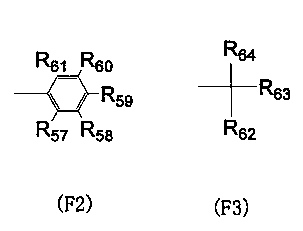
一般式(F2)~(F3)中、
R57~R64は、それぞれ独立に、水素原子、フッ素原子又はアルキル基を表す。但し、R57~R61及びR62~R64の内、少なくとも1つは、フッ素原子又は少なくとも1つの水素原子がフッ素原子で置換されたアルキル基(好ましくは炭素数1~4)を表す。R57~R61は、全てがフッ素原子であることが好ましい。R62及びR63は、少なくとも1つの水素原子がフッ素原子で置換されたアルキル基(好ましくは炭素数1~4)が好ましく、炭素数1~4のパーフルオロアルキル基であることが更に好ましい。R62とR63は、互いに連結して環を形成してもよい。
R57~R64は、それぞれ独立に、水素原子、フッ素原子又はアルキル基を表す。但し、R57~R61及びR62~R64の内、少なくとも1つは、フッ素原子又は少なくとも1つの水素原子がフッ素原子で置換されたアルキル基(好ましくは炭素数1~4)を表す。R57~R61は、全てがフッ素原子であることが好ましい。R62及びR63は、少なくとも1つの水素原子がフッ素原子で置換されたアルキル基(好ましくは炭素数1~4)が好ましく、炭素数1~4のパーフルオロアルキル基であることが更に好ましい。R62とR63は、互いに連結して環を形成してもよい。
一般式(F2)で表される基の具体例としては、例えば、p-フルオロフェニル基、ペンタフルオロフェニル基、3,5-ジ(トリフルオロメチル)フェニル基等が挙げられる。
一般式(F3)で表される基の具体例としては、トリフルオロエチル基、ペンタフルオロプロピル基、ペンタフルオロエチル基、ヘプタフルオロブチル基、ヘキサフルオロイソプロピル基、ヘプタフルオロイソプロピル基、ヘキサフルオロ(2-メチル)イソプロピル基、ノナフルオロブチル基、オクタフルオロイソブチル基、ノナフルオロヘキシル基、ノナフルオロ-t-ブチル基、パーフルオロイソペンチル基、パーフルオロオクチル基、パーフルオロ(トリメチル)ヘキシル基、2,2,3,3-テトラフルオロシクロブチル基、パーフルオロシクロヘキシル基などが挙げられる。ヘキサフルオロイソプロピル基、ヘプタフルオロイソプロピル基、ヘキサフルオロ(2-メチル)イソプロピル基、オクタフルオロイソブチル基、ノナフルオロ-t-ブチル基、パーフルオロイソペンチル基が好ましく、ヘキサフルオロイソプロピル基、ヘプタフルオロイソプロピル基が更に好ましい。
一般式(F3)で表される基の具体例としては、トリフルオロエチル基、ペンタフルオロプロピル基、ペンタフルオロエチル基、ヘプタフルオロブチル基、ヘキサフルオロイソプロピル基、ヘプタフルオロイソプロピル基、ヘキサフルオロ(2-メチル)イソプロピル基、ノナフルオロブチル基、オクタフルオロイソブチル基、ノナフルオロヘキシル基、ノナフルオロ-t-ブチル基、パーフルオロイソペンチル基、パーフルオロオクチル基、パーフルオロ(トリメチル)ヘキシル基、2,2,3,3-テトラフルオロシクロブチル基、パーフルオロシクロヘキシル基などが挙げられる。ヘキサフルオロイソプロピル基、ヘプタフルオロイソプロピル基、ヘキサフルオロ(2-メチル)イソプロピル基、オクタフルオロイソブチル基、ノナフルオロ-t-ブチル基、パーフルオロイソペンチル基が好ましく、ヘキサフルオロイソプロピル基、ヘプタフルオロイソプロピル基が更に好ましい。
樹脂(X)は、珪素原子を有する部分構造として、アルキルシリル構造(好ましくはトリアルキルシリル基)、又は環状シロキサン構造を有する樹脂であることが好ましい。
アルキルシリル構造、又は環状シロキサン構造としては、具体的には、下記一般式(CS-1)~(CS-3)で表される基などが挙げられる。
アルキルシリル構造、又は環状シロキサン構造としては、具体的には、下記一般式(CS-1)~(CS-3)で表される基などが挙げられる。

一般式(CS-1)~(CS-3)に於いて、
R12~R26は、各々独立に、直鎖若しくは分岐アルキル基(好ましくは炭素数1~20)又はシクロアルキル基(好ましくは炭素数3~20)を表す。
L3~L5は、単結合又は2価の連結基を表す。2価の連結基としては、アルキレン基、フェニル基、エーテル基、チオエーテル基、カルボニル基、エステル基、アミド基、ウレタン基、又はウレア基よりなる群から選択される単独あるいは2つ以上の基の組み合わせを挙げられる。
nは1~5の整数を表す。
R12~R26は、各々独立に、直鎖若しくは分岐アルキル基(好ましくは炭素数1~20)又はシクロアルキル基(好ましくは炭素数3~20)を表す。
L3~L5は、単結合又は2価の連結基を表す。2価の連結基としては、アルキレン基、フェニル基、エーテル基、チオエーテル基、カルボニル基、エステル基、アミド基、ウレタン基、又はウレア基よりなる群から選択される単独あるいは2つ以上の基の組み合わせを挙げられる。
nは1~5の整数を表す。
樹脂(X)とし、下記一般式(C-I)~(C-V)で示される繰り返し単位の群から選択される少なくとも1種を有する樹脂が挙げられる。

一般式(C-I)~(C-V)中、
R1~R3は、各々独立に、水素原子、フッ素原子、炭素数1~4個の、直鎖若しくは分岐のアルキル基、又は炭素数1~4個の、直鎖若しくは分岐のフッ素化アルキル基を表す。
W1~W2は、フッ素原子及び珪素原子の少なくともいずれかを有する有機基を表す。
R4~R7は、各々独立に、水素原子、フッ素原子、炭素数1~4個の、直鎖若しくは分岐のアルキル基、又は炭素数1~4個の、直鎖若しくは分岐のフッ素化アルキル基を表す。ただし、R4~R7の少なくとも1つはフッ素原子を表す。R4とR5若しくはR6とR7は環を形成していてもよい。
R8は、水素原子、又は炭素数1~4個の、直鎖若しくは分岐のアルキル基を表す。
R9は、炭素数1~4個の、直鎖若しくは分岐のアルキル基、又は炭素数1~4個の、直鎖若しくは分岐のフッ素化アルキル基を表す。
L1~L2は、単結合又は2価の連結基を表し、上記L3~L5と同様のものである。
Qは、単環又は多環の環状脂肪族基を表す。すなわち、結合した2つの炭素原子(C-C)を含み、脂環式構造を形成するための原子団を表す。
R30及びR31は、各々独立に、水素又はフッ素原子を表す。
R32及びR33は、各々独立に、アルキル基、シクロアルキル基、フッ素化アルキル基又はフッ素化シクロアルキル基を表す。
但し、一般式(C-V)で表される繰り返し単位は、R30、R31、R32及びR33の内の少なくとも1つに、少なくとも1つのフッ素原子を有する。
R1~R3は、各々独立に、水素原子、フッ素原子、炭素数1~4個の、直鎖若しくは分岐のアルキル基、又は炭素数1~4個の、直鎖若しくは分岐のフッ素化アルキル基を表す。
W1~W2は、フッ素原子及び珪素原子の少なくともいずれかを有する有機基を表す。
R4~R7は、各々独立に、水素原子、フッ素原子、炭素数1~4個の、直鎖若しくは分岐のアルキル基、又は炭素数1~4個の、直鎖若しくは分岐のフッ素化アルキル基を表す。ただし、R4~R7の少なくとも1つはフッ素原子を表す。R4とR5若しくはR6とR7は環を形成していてもよい。
R8は、水素原子、又は炭素数1~4個の、直鎖若しくは分岐のアルキル基を表す。
R9は、炭素数1~4個の、直鎖若しくは分岐のアルキル基、又は炭素数1~4個の、直鎖若しくは分岐のフッ素化アルキル基を表す。
L1~L2は、単結合又は2価の連結基を表し、上記L3~L5と同様のものである。
Qは、単環又は多環の環状脂肪族基を表す。すなわち、結合した2つの炭素原子(C-C)を含み、脂環式構造を形成するための原子団を表す。
R30及びR31は、各々独立に、水素又はフッ素原子を表す。
R32及びR33は、各々独立に、アルキル基、シクロアルキル基、フッ素化アルキル基又はフッ素化シクロアルキル基を表す。
但し、一般式(C-V)で表される繰り返し単位は、R30、R31、R32及びR33の内の少なくとも1つに、少なくとも1つのフッ素原子を有する。
樹脂(X)は、一般式(C-I)で表される繰り返し単位を有することが好ましく、下記一般式(C-Ia)~(C-Id)で表される繰り返し単位を有することが更に好ましい。
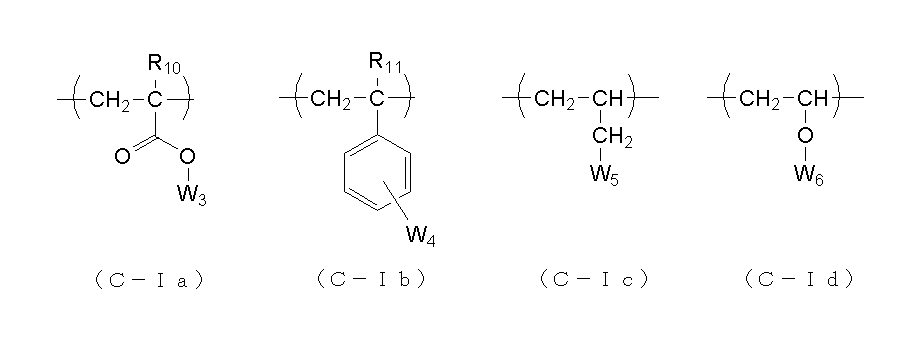
一般式(C-Ia)~(C-Id)に於いて、
R10及びR11は、水素原子、フッ素原子、炭素数1~4個の、直鎖若しくは分岐のアルキル基、又は炭素数1~4個の、直鎖若しくは分岐のフッ素化アルキル基を表す。
W3~W6は、フッ素原子及び珪素原子の少なくともいずれかを1つ以上有する有機基を表す。
R10及びR11は、水素原子、フッ素原子、炭素数1~4個の、直鎖若しくは分岐のアルキル基、又は炭素数1~4個の、直鎖若しくは分岐のフッ素化アルキル基を表す。
W3~W6は、フッ素原子及び珪素原子の少なくともいずれかを1つ以上有する有機基を表す。
W1~W6が、フッ素原子を有する有機基であるとき、炭素数1~20のフッ素化された、直鎖、分岐アルキル基若しくはシクロアルキル基、又は、炭素数1~20のフッ素化された直鎖、分岐、又は環状のアルキルエーテル基であることが好ましい。
W1~W6のフッ素化アルキル基としては、トリフルオロエチル基、ペンタフルオロプロピル基、ヘキサフルオロイソプロピル基、ヘキサフルオロ(2-メチル)イソプロピル基、ヘプタフルオロブチル基、ヘプタフルオロイソプロピル基、オクタフルオロイソブチル基、ノナフルオロヘキシル基、ノナフルオロ-t-ブチル基、パーフルオロイソペンチル基、パーフルオロオクチル基、パーフルオロ(トリメチル)ヘキシル基などが挙げられる。
W1~W6が、珪素原子を有する有機基であるとき、アルキルシリル構造、又は環状シロキサン構造であることが好ましい。具体的には、前記一般式(CS-1)~(CS-3)で表される基などが挙げられる。
以下、一般式(C-I)で表される繰り返し単位の具体例を示す。Xは、水素原子、-CH3、-F、又は、-CF3を表す。

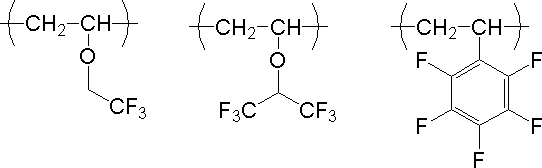
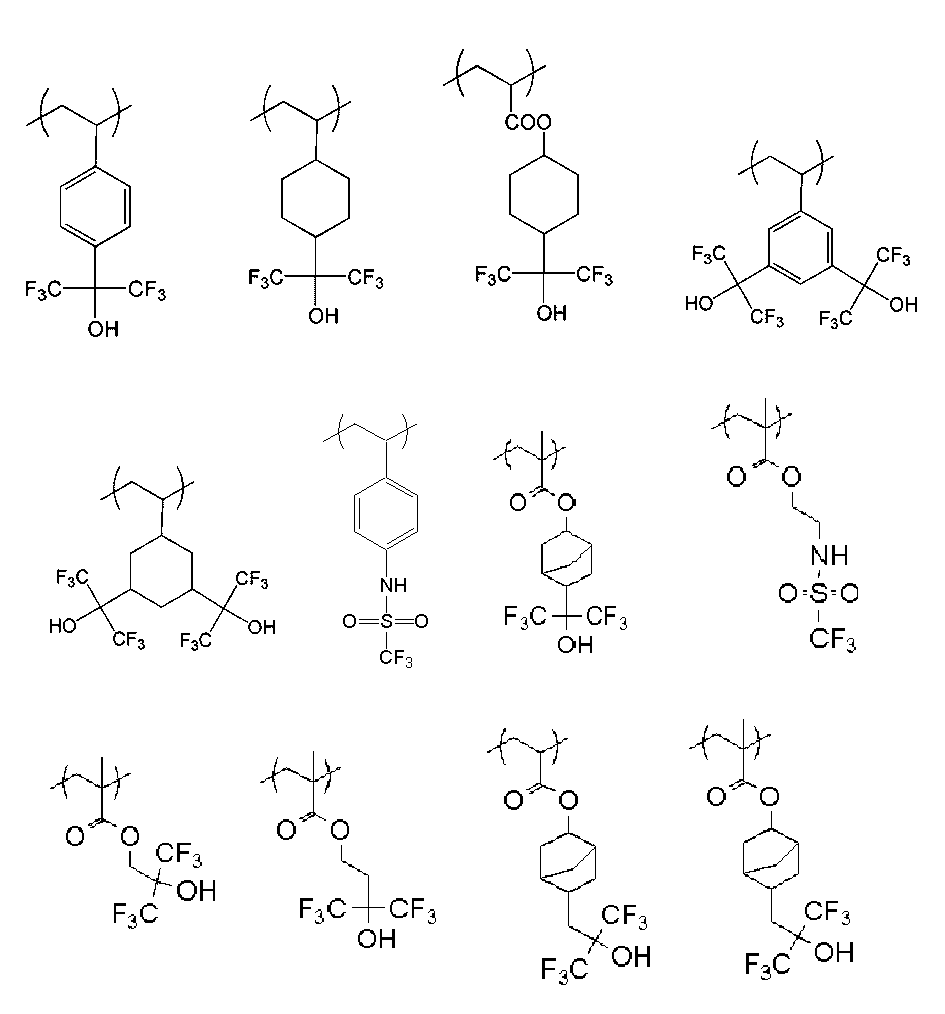

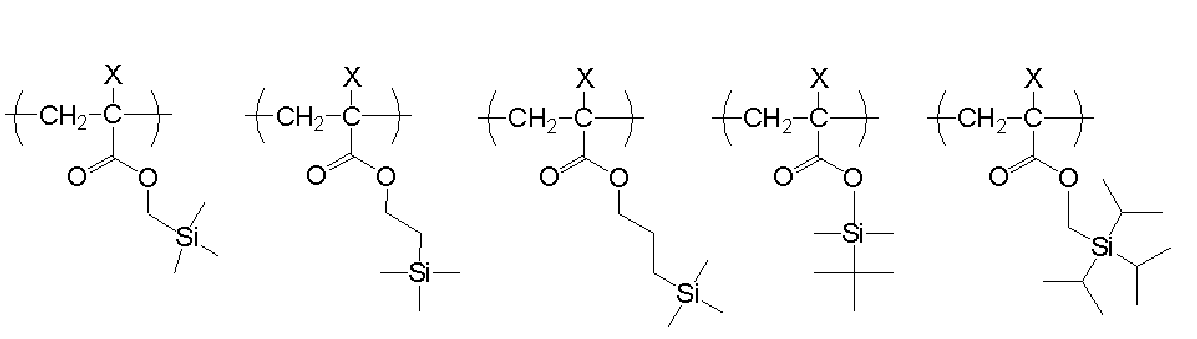


樹脂(X)は、有機溶剤を含む現像液に対する溶解性を調整するために、下記一般式(Ia)で表される繰り返し単位を有していても良い。

一般式(Ia)に於いて、
Rfは、フッ素原子又は少なくとも1つの水素原子がフッ素原子で置換されたアルキル基を表す。
R1は、アルキル基を表す。
R2は、水素原子又はアルキル基を表す。
Rfは、フッ素原子又は少なくとも1つの水素原子がフッ素原子で置換されたアルキル基を表す。
R1は、アルキル基を表す。
R2は、水素原子又はアルキル基を表す。
一般式(Ia)に於ける、Rfの少なくとも1つの水素原子がフッ素原子で置換されたアルキル基は、炭素数1~3であることが好ましく、トリフルオロメチル基がより好ましい。
R1のアルキル基は、炭素数3~10の直鎖若しくは分岐状のアルキル基が好ましく、炭素数3~10の分岐状のアルキル基がより好ましい。
R2は、炭素数1~10の直鎖若しくは分岐状のアルキル基が好ましく、炭素数3~10の直鎖若しくは分岐状のアルキル基がより好ましい。
R1のアルキル基は、炭素数3~10の直鎖若しくは分岐状のアルキル基が好ましく、炭素数3~10の分岐状のアルキル基がより好ましい。
R2は、炭素数1~10の直鎖若しくは分岐状のアルキル基が好ましく、炭素数3~10の直鎖若しくは分岐状のアルキル基がより好ましい。
以下、一般式(Ia)で表される繰り返し単位の具体例を挙げるが、本発明は、これに限定されるものではない。
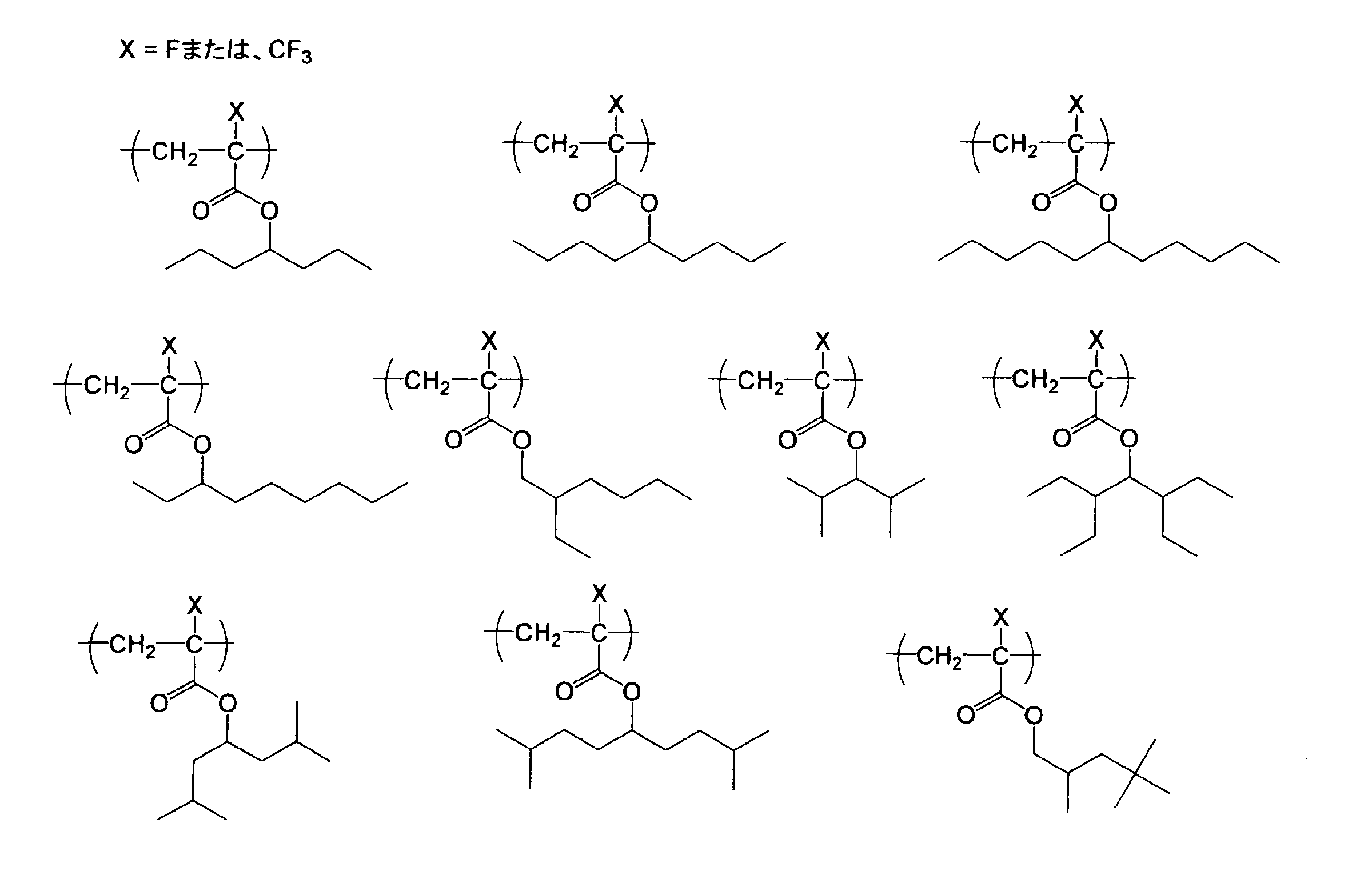
樹脂(X)は、更に、下記一般式(CIII)で表される繰り返し単位を有していても良い。

一般式(CIII)に於いて、
Rc31は、水素原子、アルキル基(フッ素原子等で置換されていても良い)、シアノ基又は-CH2-O-Rac2基を表す。式中、Rac2は、水素原子、アルキル基又はアシル基を表す。Rc31は、水素原子、メチル基、ヒドロキシメチル基、トリフルオロメチル基が好ましく、水素原子、メチル基が特に好ましい。
Rc32は、アルキル基、シクロアルキル基、アルケニル基、シクロアルケニル基又はアリール基を有する基を表す。これら基はフッ素原子、珪素原子を含む基等で置換されていても良い。
Lc3は、単結合又は2価の連結基を表す。
Rc31は、水素原子、アルキル基(フッ素原子等で置換されていても良い)、シアノ基又は-CH2-O-Rac2基を表す。式中、Rac2は、水素原子、アルキル基又はアシル基を表す。Rc31は、水素原子、メチル基、ヒドロキシメチル基、トリフルオロメチル基が好ましく、水素原子、メチル基が特に好ましい。
Rc32は、アルキル基、シクロアルキル基、アルケニル基、シクロアルケニル基又はアリール基を有する基を表す。これら基はフッ素原子、珪素原子を含む基等で置換されていても良い。
Lc3は、単結合又は2価の連結基を表す。
一般式(CIII)に於ける、Rc32のアルキル基は、炭素数3~20の直鎖若しくは分岐状アルキル基が好ましい。
シクロアルキル基は、炭素数3~20のシクロアルキル基が好ましい。
アルケニル基は、炭素数3~20のアルケニル基が好ましい。
シクロアルケニル基は、炭素数3~20のシクロアルケニル基が好ましい。
アリール基は、炭素数6~20のフェニル基、ナフチル基が好ましく、これらは置換基を有していてもよい。
シクロアルキル基は、炭素数3~20のシクロアルキル基が好ましい。
アルケニル基は、炭素数3~20のアルケニル基が好ましい。
シクロアルケニル基は、炭素数3~20のシクロアルケニル基が好ましい。
アリール基は、炭素数6~20のフェニル基、ナフチル基が好ましく、これらは置換基を有していてもよい。
Rc32は無置換のアルキル基又はフッ素原子で置換されているアルキル基が好ましい。
Lc3の2価の連結基は、アルキレン基(好ましくは炭素数1~5)、オキシ基、フェニレン基、エステル結合(-COO-で表される基)が好ましい。
樹脂(X)は、ラクトン基、エステル基、酸無水物や樹脂(A)における酸分解性基と同様の基を有していても良い。樹脂(X)は更に下記一般式(VIII)で表される繰り返し単位を有してもよい。

上記一般式(VIII)に於いて、
Z2は、-O-又は-N(R41)-を表す。R41は、水素原子、水酸基、アルキル基又は-OSO2-R42を表す。R42は、アルキル基、シクロアルキル基又は樟脳残基を表す。R41及びR42のアルキル基は、ハロゲン原子(好ましくはフッ素原子)等で置換されていてもよい。
Z2は、-O-又は-N(R41)-を表す。R41は、水素原子、水酸基、アルキル基又は-OSO2-R42を表す。R42は、アルキル基、シクロアルキル基又は樟脳残基を表す。R41及びR42のアルキル基は、ハロゲン原子(好ましくはフッ素原子)等で置換されていてもよい。
上記一般式(VIII)で表される繰り返し単位として、以下の具体例が挙げられるが、本発明はこれらに限定されない。

樹脂(X)は、下記の(X-1)~(X-6)から選ばれるいずれかの樹脂であることが好ましい。
(X-1)フルオロアルキル基(好ましくは炭素数1~4)を有する繰り返し単位(a)を有する樹脂、より好ましくは繰り返し単位(a)のみを有する樹脂。
(X-2)トリアルキルシリル基又は環状シロキサン構造を有する繰り返し単位(b)を有する樹脂、より好ましくは繰り返し単位(b)のみを有する樹脂。
(X-3)フルオロアルキル基(好ましくは炭素数1~4)を有する繰り返し単位(a)と、分岐状のアルキル基(好ましくは炭素数4~20)、シクロアルキル基(好ましくは炭素数4~20)、分岐状のアルケニル基(好ましくは炭素数4~20)、シクロアルケニル基(好ましくは炭素数4~20)又はアリール基(好ましくは炭素数4~20)を有する繰り返し単位(c)とを有する樹脂、より好ましくは繰り返し単位(a)及び繰り返し単位(c)の共重合樹脂。
(X-4)トリアルキルシリル基又は環状シロキサン構造を有する繰り返し単位(b)と、分岐状のアルキル基(好ましくは炭素数4~20)、シクロアルキル基(好ましくは炭素数4~20)、分岐状のアルケニル基(好ましくは炭素数4~20)、シクロアルケニル基(好ましくは炭素数4~20)又はアリール基(好ましくは炭素数4~20)を有する繰り返し単位(c)とを有する樹脂、より好ましくは繰り返し単位(b)及び繰り返し単位(c)の共重合樹脂。
(X-5)フルオロアルキル基(好ましくは炭素数1~4)を有する繰り返し単位(a)と、トリアルキルシリル基又は環状シロキサン構造を有する繰り返し単位(b)とを有する樹脂、より好ましくは繰り返し単位(a)及び繰り返し単位(b)の共重合樹脂。
(X-6)フルオロアルキル基(好ましくは炭素数1~4)を有する繰り返し単位(a)と、トリアルキルシリル基又は環状シロキサン構造を有する繰り返し単位(b)と、分岐状のアルキル基(好ましくは炭素数4~20)、シクロアルキル基(好ましくは炭素数4~20)、分岐状のアルケニル基(好ましくは炭素数4~20)、シクロアルケニル基(好ましくは炭素数4~20)又はアリール基(好ましくは炭素数4~20)を有する繰り返し単位(c)とを有する樹脂、より好ましくは繰り返し単位(a)、繰り返し単位(b)及び繰り返し単位(c)の共重合樹脂。
樹脂(X-3)、(X-4)、(X-6)における、分岐状のアルキル基、シクロアルキル基、分岐状のアルケニル基、シクロアルケニル基、又はアリール基を有する繰り返し単位(c)としては、親疎水性、相互作用性などを考慮し、適当な官能基を導入することができる。
(X-7)前記(X-1)~(X-6)をそれぞれ構成する繰り返し単位に、更にアルカリ可溶性基を有する繰り返し単位(好ましくは、pKaが4以上のアルカリ可溶性基を有する繰り返し単位)を有する樹脂。
(X-8)フルオロアルコール基を有するアルカリ可溶性基を有する繰り返し単位のみを有する樹脂。
樹脂(X-3)、(X-4)、(X-6)、(X-7)において、フルオロアルキル基を有する繰り返し単位(a)及び/又はトリアルキルシリル基、又は環状シロキサン構造を有する繰り返し単位(b)は、10~99モル%であることが好ましく、20~80モル%であることがより好ましい。
また、樹脂(X-7)におけるアルカリ可溶性基を有することで、有機溶剤を含む現像液を用いた際の剥離容易性のみならず、その他の剥離液、例えば、アルカリ性の水溶液を剥離液として用いた場合の剥離容易性が向上する。
(X-1)フルオロアルキル基(好ましくは炭素数1~4)を有する繰り返し単位(a)を有する樹脂、より好ましくは繰り返し単位(a)のみを有する樹脂。
(X-2)トリアルキルシリル基又は環状シロキサン構造を有する繰り返し単位(b)を有する樹脂、より好ましくは繰り返し単位(b)のみを有する樹脂。
(X-3)フルオロアルキル基(好ましくは炭素数1~4)を有する繰り返し単位(a)と、分岐状のアルキル基(好ましくは炭素数4~20)、シクロアルキル基(好ましくは炭素数4~20)、分岐状のアルケニル基(好ましくは炭素数4~20)、シクロアルケニル基(好ましくは炭素数4~20)又はアリール基(好ましくは炭素数4~20)を有する繰り返し単位(c)とを有する樹脂、より好ましくは繰り返し単位(a)及び繰り返し単位(c)の共重合樹脂。
(X-4)トリアルキルシリル基又は環状シロキサン構造を有する繰り返し単位(b)と、分岐状のアルキル基(好ましくは炭素数4~20)、シクロアルキル基(好ましくは炭素数4~20)、分岐状のアルケニル基(好ましくは炭素数4~20)、シクロアルケニル基(好ましくは炭素数4~20)又はアリール基(好ましくは炭素数4~20)を有する繰り返し単位(c)とを有する樹脂、より好ましくは繰り返し単位(b)及び繰り返し単位(c)の共重合樹脂。
(X-5)フルオロアルキル基(好ましくは炭素数1~4)を有する繰り返し単位(a)と、トリアルキルシリル基又は環状シロキサン構造を有する繰り返し単位(b)とを有する樹脂、より好ましくは繰り返し単位(a)及び繰り返し単位(b)の共重合樹脂。
(X-6)フルオロアルキル基(好ましくは炭素数1~4)を有する繰り返し単位(a)と、トリアルキルシリル基又は環状シロキサン構造を有する繰り返し単位(b)と、分岐状のアルキル基(好ましくは炭素数4~20)、シクロアルキル基(好ましくは炭素数4~20)、分岐状のアルケニル基(好ましくは炭素数4~20)、シクロアルケニル基(好ましくは炭素数4~20)又はアリール基(好ましくは炭素数4~20)を有する繰り返し単位(c)とを有する樹脂、より好ましくは繰り返し単位(a)、繰り返し単位(b)及び繰り返し単位(c)の共重合樹脂。
樹脂(X-3)、(X-4)、(X-6)における、分岐状のアルキル基、シクロアルキル基、分岐状のアルケニル基、シクロアルケニル基、又はアリール基を有する繰り返し単位(c)としては、親疎水性、相互作用性などを考慮し、適当な官能基を導入することができる。
(X-7)前記(X-1)~(X-6)をそれぞれ構成する繰り返し単位に、更にアルカリ可溶性基を有する繰り返し単位(好ましくは、pKaが4以上のアルカリ可溶性基を有する繰り返し単位)を有する樹脂。
(X-8)フルオロアルコール基を有するアルカリ可溶性基を有する繰り返し単位のみを有する樹脂。
樹脂(X-3)、(X-4)、(X-6)、(X-7)において、フルオロアルキル基を有する繰り返し単位(a)及び/又はトリアルキルシリル基、又は環状シロキサン構造を有する繰り返し単位(b)は、10~99モル%であることが好ましく、20~80モル%であることがより好ましい。
また、樹脂(X-7)におけるアルカリ可溶性基を有することで、有機溶剤を含む現像液を用いた際の剥離容易性のみならず、その他の剥離液、例えば、アルカリ性の水溶液を剥離液として用いた場合の剥離容易性が向上する。
樹脂(X)は、常温(25℃)において、固体であることが好ましい。更に、ガラス転移温度(Tg)が50~200℃であることが好ましく、80~160℃がより好ましい。
25℃において固体であるとは、融点が25℃以上であることをいう。
ガラス転移温度(Tg)は、走査カロリメトリー(Differential Scanning Calorimeter)により測定することができ、例えば、試料を一度昇温、冷却後、再度5℃/分にて昇温したときの比容積が変化した値を解析することにより測定することができる。
ガラス転移温度(Tg)は、走査カロリメトリー(Differential Scanning Calorimeter)により測定することができ、例えば、試料を一度昇温、冷却後、再度5℃/分にて昇温したときの比容積が変化した値を解析することにより測定することができる。
樹脂(X)は、有機溶剤を含む現像液(好ましくはエステル系溶剤を含む現像液)に対して可溶であることが好ましい。
樹脂(X)が珪素原子を有する場合、珪素原子の含有量は、樹脂(X)の分子量に対し、2~50質量%であることが好ましく、2~30質量%であることがより好ましい。また、珪素原子を含む繰り返し単位が、樹脂(X)中10~100質量%であることが好ましく、20~100質量%であることがより好ましい。
珪素原子の含有量及び珪素原子を含む繰り返し単位の含有量を前記範囲とすることで、有機溶剤を含む現像液を用いた際の保護膜の剥離容易性、更には、レジスト膜との非相溶性をいずれも向上させることができる。
フッ素原子の含有量及びフッ素原子を含む繰り返し単位の含有量を前記範囲とすることで、有機溶剤を含む現像液を用いた際の保護膜の剥離容易性、更には、レジスト膜との非相溶性をいずれも向上させることができる。
珪素原子の含有量及び珪素原子を含む繰り返し単位の含有量を前記範囲とすることで、有機溶剤を含む現像液を用いた際の保護膜の剥離容易性、更には、レジスト膜との非相溶性をいずれも向上させることができる。
フッ素原子の含有量及びフッ素原子を含む繰り返し単位の含有量を前記範囲とすることで、有機溶剤を含む現像液を用いた際の保護膜の剥離容易性、更には、レジスト膜との非相溶性をいずれも向上させることができる。
樹脂(X)がフッ素原子を有する場合、フッ素原子の含有量は、樹脂(X)の分子量に対し、5~80質量%であることが好ましく、10~80質量%であることがより好ましい。また、フッ素原子を含む繰り返し単位が、樹脂(X)中10~100質量%であることが好ましく、30~100質量%であることがより好ましい。
樹脂(X)の標準ポリスチレン換算の重量平均分子量は、好ましくは1,000~100,000で、より好ましくは1,000~50,000、更により好ましくは2,000~15,000、特に好ましくは3,000~15,000である。
樹脂(X)は、金属等の不純物が少ないのは当然のことながら、保護膜から液浸液への溶出低減の観点から、残存モノマー量が0~10質量%であることが好ましく、より好ましくは0~5質量%、0~1質量%が更により好ましい。また、分子量分布(Mw/Mn、分散度ともいう)は、1~5が好ましく、より好ましくは1~3、更により好ましくは1~1.5の範囲である。
樹脂(X)は、各種市販品を利用することもできるし、常法に従って(例えばラジカル重合)合成することができる。例えば、一般的合成方法としては、モノマー種及び開始剤を溶剤に溶解させ、加熱することにより重合を行う一括重合法、加熱溶剤にモノマー種と開始剤の溶液を1~10時間かけて滴下して加える滴下重合法などが挙げられ、滴下重合法が好ましい。反応溶媒としては、例えばテトラヒドロフラン、1,4-ジオキサン、ジイソプロピルエーテルなどのエーテル類やメチルエチルケトン、メチルイソブチルケトンのようなケトン類、酢酸エチルのようなエステル溶媒、ジメチルホルムアミド、ジメチルアセトアミドなどのアミド溶剤、更には後述のプロピレングリコールモノメチルエーテルアセテート、プロピレングリコールモノメチルエーテル、シクロヘキサノンのような本発明の組成物を溶解する溶媒が挙げられる。
樹脂(X)の具体例を以下に示すが、本発明はこれに限定されない。

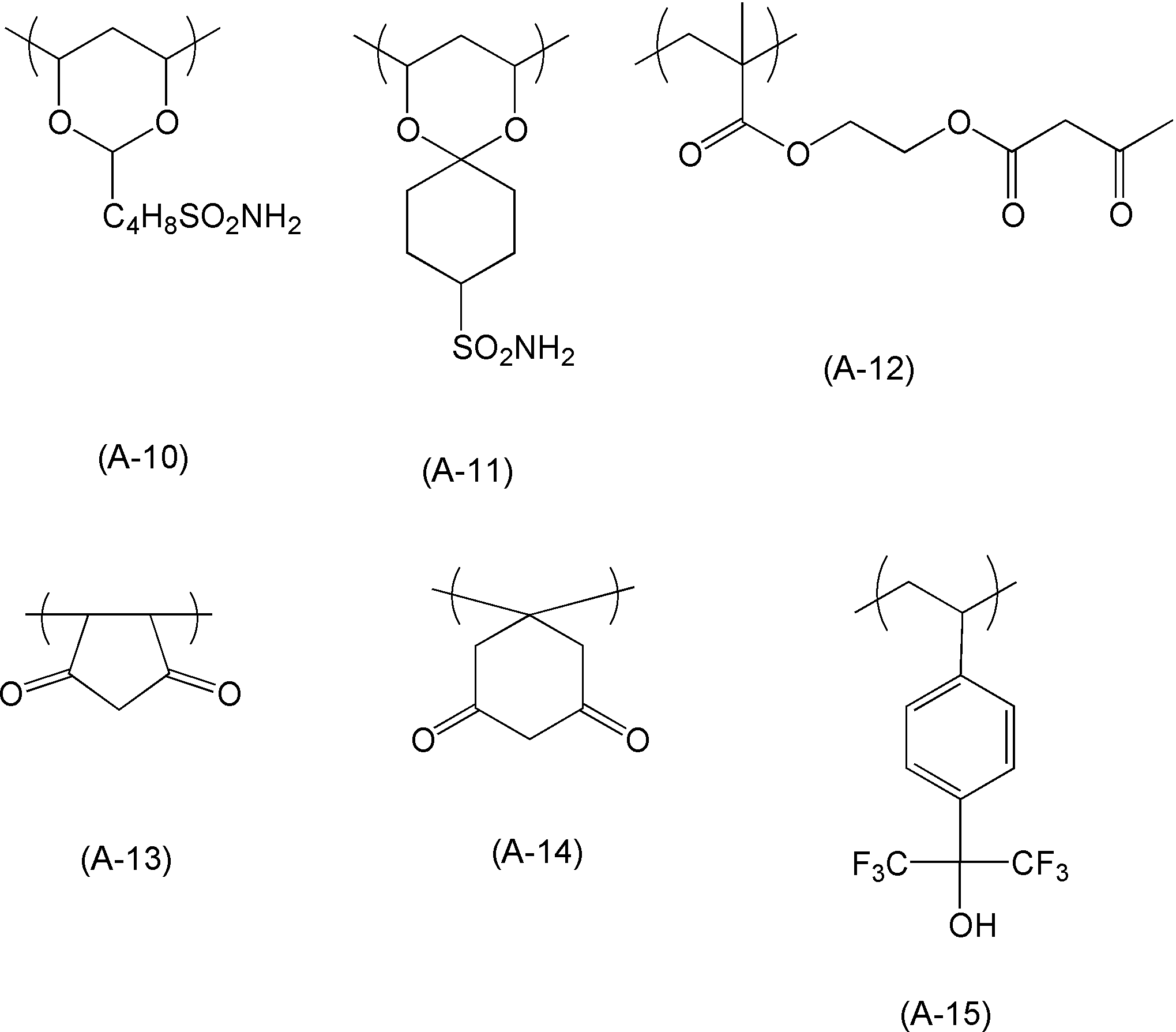

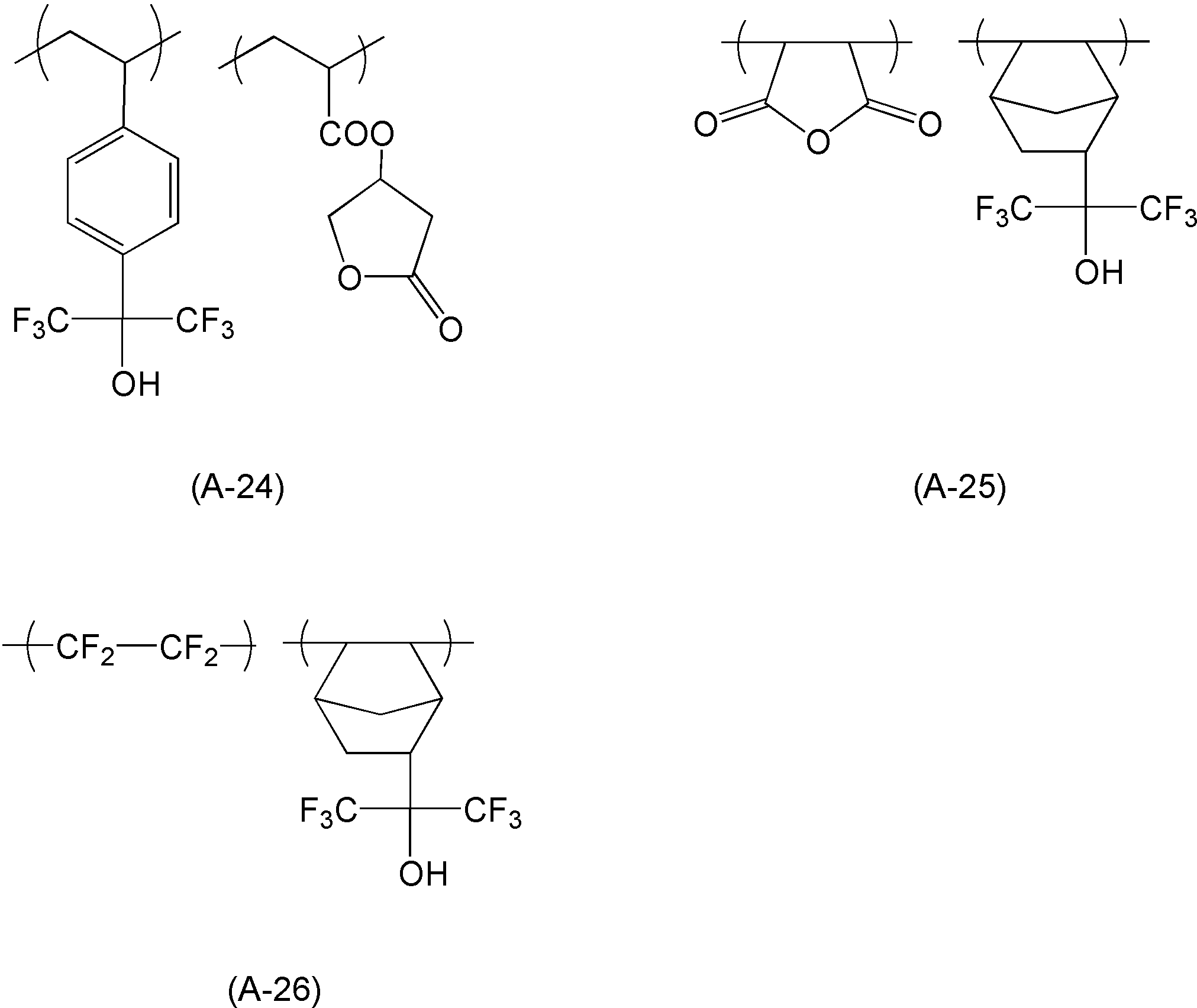
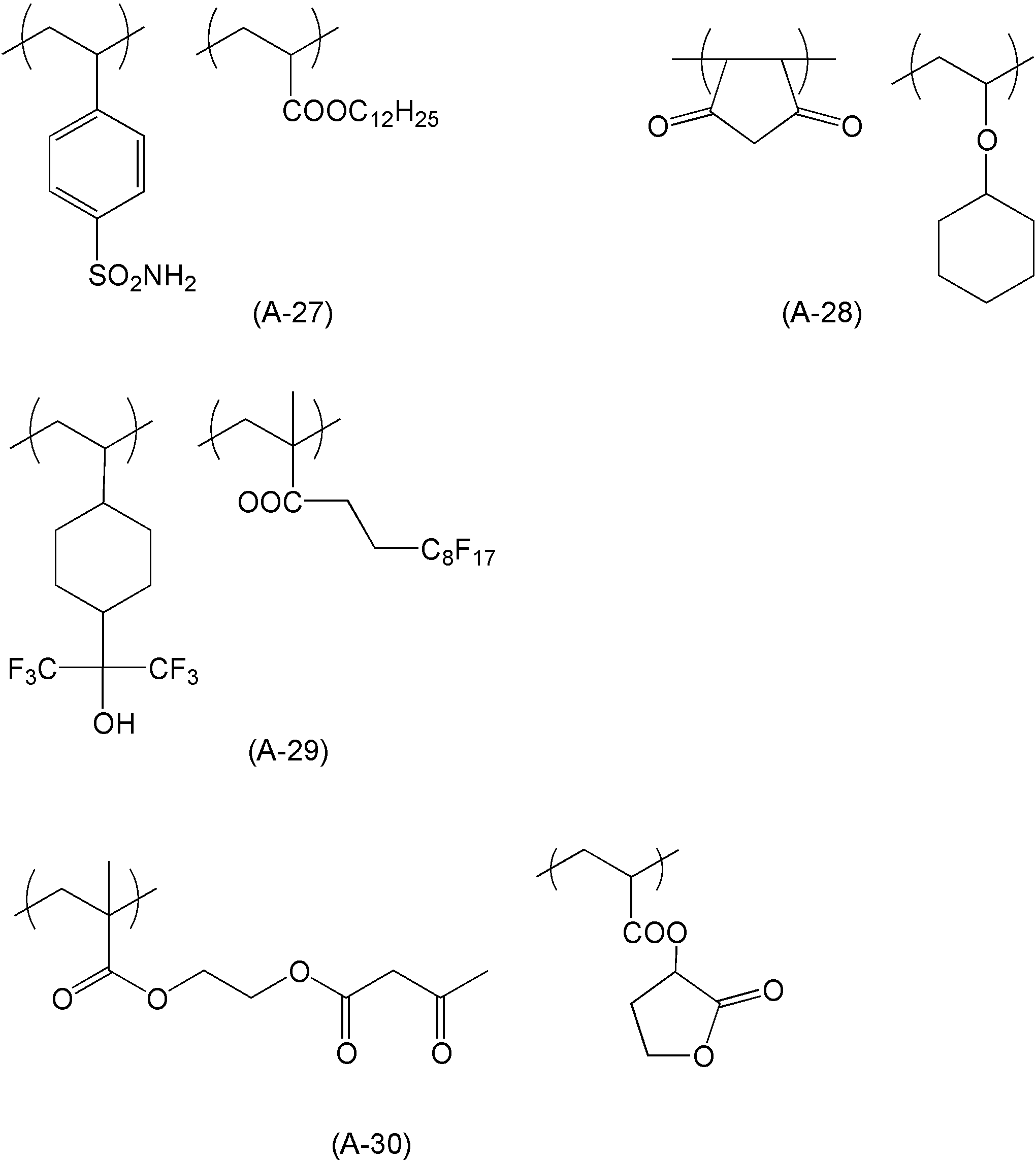

樹脂の含有量は、保護膜組成物としての有機溶媒系組成物の全量に対して0.5~20質量%であることが好ましく、1~15質量%であることがより好ましく、2~10質量%であることが更に好ましい。
本発明の保護膜組成物は、更に界面活性剤を含有することが好ましい。界面活性剤としては特に制限は無く、保護膜組成物を均一に成膜することができ、かつ保護膜組成物の溶剤に溶解することができれば、アニオン性界面活性剤、カチオン性界面活性剤、ノニオン性界面活性剤のいずれも用いることができる。
界面活性剤の添加量は、好ましくは0.001~20質量%であり、更に好ましくは、0.01~10質量%である。
界面活性剤は1種単独で用いても良いし、2種以上を併用しても良い。
界面活性剤の添加量は、好ましくは0.001~20質量%であり、更に好ましくは、0.01~10質量%である。
界面活性剤は1種単独で用いても良いし、2種以上を併用しても良い。
前記界面活性剤としては、例えば、アルキルカチオン系界面活性剤、アミド型4級カチオン系界面活性剤、エステル型4級カチオン系界面活性剤、アミンオキサイド系界面活性剤、ベタイン系界面活性剤、アルコキシレート系界面活性剤、脂肪酸エステル系界面活性剤、アミド系界面活性剤、アルコール系界面活性剤、及びエチレンジアミン系界面活性剤、フッ素系及び/又はシリコン系界面活性剤(フッ素系界面活性剤、シリコン系界面活性剤、フッ素原子と珪素原子の両方を有する界面活性剤)から選択されるものを好適に用いることができる。
界面活性剤の具体例としては、ポリオキシエチレンラウリルエーテル、ポリオキシエチレンステアリルエーテル、ポリオキシエチレンセチルエーテル、ポリオキシエチレンオレイルエーテル等のポリオキシエチレンアルキルエーテル類、ポリオキシエチレンオクチルフェノールエーテル、ポリオキシエチレンノニルフェノールエーテル等のポリオキシエチレンアルキルアリルエーテル類、ポリオキシエチレン・ポリオキシプロピレンブロックコポリマー類、ソルビタンモノラウレート、ソルビタンモノパルミテート、ソルビタンモノステアレート、ソルビタンモノオレエート、ソルビタントリオレエート、ソルビタントリステアレート等のソルビタン脂肪酸エステル類、ポリオキシエチレンソルビタンモノラウレート、ポリオキシエチレンソルビタンモノパルミテ-ト、ポリオキシエチレンソルビタンモノステアレート、ポリオキシエチレンソルビタントリオレエート、ポリオキシエチレンソルビタントリステアレート等の界面活性剤や、下記に挙げる市販の界面活性剤をそのまま用いることができる。
使用できる市販の界面活性剤として、例えばエフトップEF301、EF303、(新秋田化成(株)製)、フロラードFC430、431、4430(住友スリーエム(株)製)、メガファックF171、F173、F176、F189、F113、F110、F177、F120、R08(DIC(株)製)、サーフロンS-382、SC101、102、103、104、105、106(旭硝子(株)製)、トロイゾルS-366(トロイケミカル(株)製)、GF-300、GF-150(東亜合成化学(株)製)、サーフロンS-393(セイミケミカル(株)製)、エフトップEF121、EF122A、EF122B、RF122C、EF125M、EF135M、EF351、352、EF801、EF802、EF601((株)ジェムコ製)、PF636、PF656、PF6320、PF6520(OMNOVA社製)、FTX-204D、208G、218G、230G、204D、208D、212D、218、222D((株)ネオス製)等のフッ素系界面活性剤又はシリコン系界面活性剤を挙げることができる。またポリシロキサンポリマーKP-341(信越化学工業(株)製)もシリコン系界面活性剤として用いることができる。
界面活性剤の具体例としては、ポリオキシエチレンラウリルエーテル、ポリオキシエチレンステアリルエーテル、ポリオキシエチレンセチルエーテル、ポリオキシエチレンオレイルエーテル等のポリオキシエチレンアルキルエーテル類、ポリオキシエチレンオクチルフェノールエーテル、ポリオキシエチレンノニルフェノールエーテル等のポリオキシエチレンアルキルアリルエーテル類、ポリオキシエチレン・ポリオキシプロピレンブロックコポリマー類、ソルビタンモノラウレート、ソルビタンモノパルミテート、ソルビタンモノステアレート、ソルビタンモノオレエート、ソルビタントリオレエート、ソルビタントリステアレート等のソルビタン脂肪酸エステル類、ポリオキシエチレンソルビタンモノラウレート、ポリオキシエチレンソルビタンモノパルミテ-ト、ポリオキシエチレンソルビタンモノステアレート、ポリオキシエチレンソルビタントリオレエート、ポリオキシエチレンソルビタントリステアレート等の界面活性剤や、下記に挙げる市販の界面活性剤をそのまま用いることができる。
使用できる市販の界面活性剤として、例えばエフトップEF301、EF303、(新秋田化成(株)製)、フロラードFC430、431、4430(住友スリーエム(株)製)、メガファックF171、F173、F176、F189、F113、F110、F177、F120、R08(DIC(株)製)、サーフロンS-382、SC101、102、103、104、105、106(旭硝子(株)製)、トロイゾルS-366(トロイケミカル(株)製)、GF-300、GF-150(東亜合成化学(株)製)、サーフロンS-393(セイミケミカル(株)製)、エフトップEF121、EF122A、EF122B、RF122C、EF125M、EF135M、EF351、352、EF801、EF802、EF601((株)ジェムコ製)、PF636、PF656、PF6320、PF6520(OMNOVA社製)、FTX-204D、208G、218G、230G、204D、208D、212D、218、222D((株)ネオス製)等のフッ素系界面活性剤又はシリコン系界面活性剤を挙げることができる。またポリシロキサンポリマーKP-341(信越化学工業(株)製)もシリコン系界面活性剤として用いることができる。
ポジ型現像工程後に行うリンス工程のリンス液としては、純水を使用し、界面活性剤を適当量添加して使用することもできる。
また、現像処理又は、リンス処理の後に、パターン上に付着している現像液又はリンス液を超臨界流体により除去する処理を行うことができる。
更に、リンス処理又は超臨界流体による処理の後、パターン中に残存する水分を除去するために加熱処理を行うことができる。
また、現像処理又は、リンス処理の後に、パターン上に付着している現像液又はリンス液を超臨界流体により除去する処理を行うことができる。
更に、リンス処理又は超臨界流体による処理の後、パターン中に残存する水分を除去するために加熱処理を行うことができる。
以下、本発明で使用し得るネガ型現像用レジスト組成物について説明する。
<感活性光線性又は感放射線性樹脂組成物>
本発明のパターン形成方法において、レジスト膜の形成に用いられる感活性光線性又は感放射線性樹脂組成物について説明する。感活性光線性又は感放射線性樹脂組成物は、酸の作用により極性が増大して有機溶剤を含む現像液に対する溶解性が減少する樹脂を含有する。
本発明のパターン形成方法において、レジスト膜の形成に用いられる感活性光線性又は感放射線性樹脂組成物について説明する。感活性光線性又は感放射線性樹脂組成物は、酸の作用により極性が増大して有機溶剤を含む現像液に対する溶解性が減少する樹脂を含有する。
〔1〕酸の作用により極性が増大して有機溶剤を含む現像液に対する溶解性が減少する樹脂
本発明の感活性光線性又は感放射線性樹脂組成物が含有する、酸の作用により極性が増大して有機溶剤を含む現像液に対する溶解性が減少する樹脂(以下「樹脂(P)」ともいう。)は、活性光線又は放射線の照射により分解して酸を発生する繰り返し単位(A)(以下、「繰り返し単位(A)」ともいう。)を有することが好ましい。
本発明の感活性光線性又は感放射線性樹脂組成物が含有する、酸の作用により極性が増大して有機溶剤を含む現像液に対する溶解性が減少する樹脂(以下「樹脂(P)」ともいう。)は、活性光線又は放射線の照射により分解して酸を発生する繰り返し単位(A)(以下、「繰り返し単位(A)」ともいう。)を有することが好ましい。
繰り返し単位(A)は、活性光線又は放射線の照射により分解して酸を発生する基を有していることが好ましく、活性光線又は放射線の照射により分解して酸を発生する基としては、例えば、-COOA0、-O-B0基で表される基が挙げられる。更にこれらを含む基としては、-R0-COOA0、又は-Ar-O-B0で示される基が挙げられる。ここでA0は、-C(R01)(R02)(R03)、-Si(R01)(R02)(R03)若しくは-C(R04)(R05)-O-R06基を示す。B0は、A0又は-CO-O-A0基を示す。R01、R02、R03、R04及びR05は、同一又は異なり、水素原子、アルキル基、シクロアルキル基、アルケニル基若しくはアリール基を示し、R06はアルキル基若しくはアリール基を示す。但し、R01~R03の内少なくとも2つは水素原子以外の基であり、又、R01~R03及びR04~R06の内の2つの基が結合して環を形成してもよい。R0は置換基を有していてもよい2価の脂肪族若しくは芳香族炭化水素基を示し、-Ar-は単環若しくは多環の置換基を有していてもよい2価の芳香族基を示す。
繰り返し単位(A)として好ましくは、フェノール性水酸基の水素原子が、酸の作用により脱離する基で置換された基を少なくとも一つ有する繰り返し単位である。
前記繰り返し単位(A)としては、例えば、下記一般式(I)で表される繰り返し構造単位が好ましい。

ここで、R01、R02及びR03は、各々独立に、水素原子、アルキル基、シクロアルキル基、ハロゲン原子、シアノ基又はアルコキシカルボニル基を表す。またR03は、アルキレン基を表し、Ar1と結合して5員若しくは6員環を形成していても良い。
Ar1は、芳香環基を表す。
n個のYは、各々独立に、水素原子又は酸の作用により脱離する基を表す。但し、Yの少なくとも1つは、酸の作用により脱離する基を表す。
nは、1~4の整数を表す。
Ar1は、芳香環基を表す。
n個のYは、各々独立に、水素原子又は酸の作用により脱離する基を表す。但し、Yの少なくとも1つは、酸の作用により脱離する基を表す。
nは、1~4の整数を表す。
一般式におけるR01~R03のアルキル基としては、好ましくは置換基を有していても良いメチル基、エチル基、プロピル基、イソプロピル基、n-ブチル基、sec-ブチル基、ヘキシル基、2-エチルヘキシル基、オクチル基、ドデシル基など炭素数20以下のアルキル基が挙げられ、より好ましくは炭素数8以下のアルキル基が挙げられる。
アルコキシカルボニル基に含まれるアルキル基としては、上記R01~R03におけるアルキル基と同様のものが好ましい。
アルコキシカルボニル基に含まれるアルキル基としては、上記R01~R03におけるアルキル基と同様のものが好ましい。
シクロアルキル基としては、単環型でも、多環型でもよいシクロアルキル基が挙げられる。好ましくは置換基を有していても良いシクロプロピル基、シクロペンチル基、シクロヘキシル基のような炭素数3~8個の単環型のシクロアルキル基が挙げられる。
ハロゲン原子としては、フッ素原子、塩素原子、臭素原子及びヨウ素原子が挙げられ、フッ素原子がより好ましい。
R03がアルキレン基を表す場合、アルキレン基としては、好ましくはメチレン基、エチレン基、プロピレン基、ブチレン基、ヘキシレン基、オクチレン基等の炭素数1~8個のものが挙げられる。
ハロゲン原子としては、フッ素原子、塩素原子、臭素原子及びヨウ素原子が挙げられ、フッ素原子がより好ましい。
R03がアルキレン基を表す場合、アルキレン基としては、好ましくはメチレン基、エチレン基、プロピレン基、ブチレン基、ヘキシレン基、オクチレン基等の炭素数1~8個のものが挙げられる。
Ar1の芳香環基は、置換基を有していても良い炭素数6~14個のものが好ましく、具体的にはベンゼン環、トルエン環、ナフタレン環等が挙げられる。
n個のYは、各々独立に、水素原子又は酸の作用により脱離する基を表す。但し、n個中の少なくとも1つは、酸の作用により脱離する基を表す。
n個のYは、各々独立に、水素原子又は酸の作用により脱離する基を表す。但し、n個中の少なくとも1つは、酸の作用により脱離する基を表す。
酸の作用により脱離する基Yとしては、例えば、-C(R36)(R37)(R38)、-C(=O)-O-C(R36)(R37)(R38)、-C(R01)(R02)(OR39)、-C(R21)(R22)-C(=O)-O-C(R36)(R37)(R38)、-CH(R36)(Ar)等を挙げることができる。
式中、R36~R39は、各々独立に、アルキル基、シクロアルキル基、アリール基、アラルキル基又はアルケニル基表す。R36とR37とは、互いに結合して環を形成してもよい。
R21~R22は、各々独立に、水素原子、アルキル基、シクロアルキル基、アリール基、アラルキル基又はアルケニル基を表す。
Arは、アリール基を表す。
R01及びR02は、各々独立に、水素原子、アルキル基、シクロアルキル基、アリール基、アラルキル基又はアルケニル基を表す。
R21~R22は、各々独立に、水素原子、アルキル基、シクロアルキル基、アリール基、アラルキル基又はアルケニル基を表す。
Arは、アリール基を表す。
R01及びR02は、各々独立に、水素原子、アルキル基、シクロアルキル基、アリール基、アラルキル基又はアルケニル基を表す。
R36~R39、R01、R02、R21及びR22のアルキル基は、炭素数1~8のアルキル基が好ましく、例えば、メチル基、エチル基、プロピル基、n-ブチル基、sec-ブチル基、へキシル基、オクチル基等を挙げることができる。
R36~R39、R01及びR02のシクロアルキル基は、単環型でも、多環型でもよい。単環型としては、炭素数3~8のシクロアルキル基が好ましく、例えば、シクロプロピル基、シクロブチル基、シクロペンチル基、シクロへキシル基、シクロオクチル基等を挙げることができる。多環型としては、炭素数6~20のシクロアルキル基が好ましく、例えば、アダマンチル基、ノルボルニル基、イソボロニル基、カンファニル基、ジシクロペンチル基、α-ピネル基、トリシクロデカニル基、テトラシクロドデシル基、アンドロスタニル基等を挙げることができる。なお、シクロアルキル基中の炭素原子の一部が酸素原子等のヘテロ原子によって置換されていてもよい。
R36~R39、R01、R02、R21、R22及びArのアリール基は、炭素数6~10のアリール基が好ましく、例えば、フェニル基、ナフチル基、アントリル基等を挙げることができる。
R36~R39、R01、R02、R21及びR22のアラルキル基は、炭素数7~12のアラルキル基が好ましく、例えば、ベンジル基、フェネチル基、ナフチルメチル基等を挙げることができる。
R36~R39、R01及びR02のアルケニル基は、炭素数2~8のアルケニル基が好ましく、例えば、ビニル基、アリル基、ブテニル基、シクロへキセニル基等を挙げることができる。
R36~R39、R01、R02、R21及びR22のアラルキル基は、炭素数7~12のアラルキル基が好ましく、例えば、ベンジル基、フェネチル基、ナフチルメチル基等を挙げることができる。
R36~R39、R01及びR02のアルケニル基は、炭素数2~8のアルケニル基が好ましく、例えば、ビニル基、アリル基、ブテニル基、シクロへキセニル基等を挙げることができる。
R36とR37とが、互いに結合して形成する環は、単環型でも、多環型でもよい。単環型としては、炭素数3~8のシクロアルカン構造が好ましく、例えば、シクロプロパン構造、シクロブタン構造、シクロペンタン構造、シクロへキサン構造、シクロヘプタン構造、シクロオクタン構造等を挙げることができる。多環型としては、炭素数6~20のシクロアルカン構造が好ましく、例えば、アダマンタン構造、ノルボルナン構造、ジシクロペンタン構造、トリシクロデカン構造、テトラシクロドデカン構造等を挙げることができる。なお、シクロアルカン構造中の炭素原子の一部が酸素原子等のヘテロ原子によって置換されていてもよい。
R36~R39、R01、R02、R03、R21、R22、Ar及びAr1としての上記各基は、置換基を有していてもよく、置換基としては、例えば、アルキル基、シクロアルキル基、アリール基、アミノ基、アミド基、ウレイド基、ウレタン基、ヒドロキシル基、カルボキシル基、ハロゲン原子、アルコキシ基、チオエーテル基、アシル基、アシロキシ基、アルコキシカルボニル基、シアノ基、ニトロ基等を挙げることができ、置換基の炭素数8以下が好ましい。
酸の作用により脱離する基Yとしては、下記一般式(II)で表される構造がより好ましい。
酸の作用により脱離する基Yとしては、下記一般式(II)で表される構造がより好ましい。
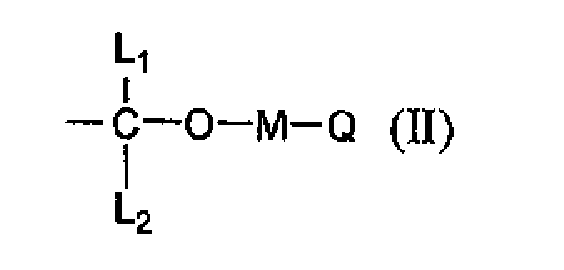
ここで、L1及びL2は、各々独立に、水素原子、アルキル基、シクロアルキル基、アリール基又はアラルキル基を表す。
Mは、単結合又は2価の連結基を表す。
Qは、アルキル基、シクロアルキル基、ヘテロ原子を含んでいてもよい脂環基、ヘテロ原子を含んでいてもよい芳香環基、アミノ基、アンモニウム基、メルカプト基、シアノ基又はアルデヒド基を表す。
Q、M、L1のいずれか2つが結合して5員若しくは6員環を形成しても良い。
Mは、単結合又は2価の連結基を表す。
Qは、アルキル基、シクロアルキル基、ヘテロ原子を含んでいてもよい脂環基、ヘテロ原子を含んでいてもよい芳香環基、アミノ基、アンモニウム基、メルカプト基、シアノ基又はアルデヒド基を表す。
Q、M、L1のいずれか2つが結合して5員若しくは6員環を形成しても良い。
L1及びL2としてアルキル基は、例えば炭素数1~8個のアルキル基であって、具体的には、メチル基、エチル基、プロピル基、n-ブチル基、sec-ブチル基、ヘキシル基、オクチル基を好ましく挙げることができる。
L1及びL2としてシクロアルキル基は、例えば炭素数3~15個のシクロアルキル基であって、具体的には、シクロペンチル基、シクロヘキシル基、ノルボルニル基、アダマンチル基を好ましく挙げることができる。
L1及びL2としてアリール基は、例えば炭素数6~15個のアリール基であって、具体的には、フェニル基、トリル基、ナフチル基、アントリル基等を好ましく挙げることができる。
L1及びL2としてアラルキル基は、例えば、炭素数6~20であって、ベンジル基、フェネチル基などが挙げられる。
L1及びL2としてシクロアルキル基は、例えば炭素数3~15個のシクロアルキル基であって、具体的には、シクロペンチル基、シクロヘキシル基、ノルボルニル基、アダマンチル基を好ましく挙げることができる。
L1及びL2としてアリール基は、例えば炭素数6~15個のアリール基であって、具体的には、フェニル基、トリル基、ナフチル基、アントリル基等を好ましく挙げることができる。
L1及びL2としてアラルキル基は、例えば、炭素数6~20であって、ベンジル基、フェネチル基などが挙げられる。
Mとしての2価の連結基は、例えば、アルキレン基(例えば、メチレン基、エチレン基、プロピレン基、ブチレン基、ヘキシレン基、オクチレン基など)、シクロアルキレン基(例えば、シクロペンチレン基、シクロヘキシレン基など)、アルケニレン基(例えば、エチレン基、プロペニレン基、ブテニレン基など)、アリーレン基(例えば、フェニレン基、トリレン基、ナフチレン基など)、-S-、-O-、-CO-、-SO2-、-N(R0)-、及びこれらの複数を組み合わせた2価の連結基である。R0は、水素原子又はアルキル基(例えば炭素数1~8個のアルキル基であって、具体的には、メチル基、エチル基、プロピル基、n-ブチル基、sec-ブチル基、ヘキシル基、オクチル基など)である。
Qとしてのアルキル基、シクロアルキル基は、上述のL1及びL2としての各基と同様である。
Qとしてのヘテロ原子を含んでいてもよい脂環基及びヘテロ原子を含んでいてもよい芳香環基に於ける脂環基及び芳香環基としては、上述のL1及びL2としてのシクロアルキル基、アリール基などが挙げられ、好ましくは、炭素数3~15である。
ヘテロ原子を含む脂環基及びヘテロ原子を含む芳香環基としては、例えば、チイラン、シクロチオラン、チオフェン、フラン、ピロール、ベンゾチオフェン、ベンゾフラン、ベンゾピロール、トリアジン、イミダゾール、ベンゾイミダゾール、トリアゾール、チアジアゾール、チアゾール、ピロリドン等のヘテロ環構造を有する基が挙げられるが、一般にヘテロ環と呼ばれる構造(炭素とヘテロ原子で形成される環、あるいはヘテロ原子にて形成される環)であれば、これらに限定されない。
Qとしてのヘテロ原子を含んでいてもよい脂環基及びヘテロ原子を含んでいてもよい芳香環基に於ける脂環基及び芳香環基としては、上述のL1及びL2としてのシクロアルキル基、アリール基などが挙げられ、好ましくは、炭素数3~15である。
ヘテロ原子を含む脂環基及びヘテロ原子を含む芳香環基としては、例えば、チイラン、シクロチオラン、チオフェン、フラン、ピロール、ベンゾチオフェン、ベンゾフラン、ベンゾピロール、トリアジン、イミダゾール、ベンゾイミダゾール、トリアゾール、チアジアゾール、チアゾール、ピロリドン等のヘテロ環構造を有する基が挙げられるが、一般にヘテロ環と呼ばれる構造(炭素とヘテロ原子で形成される環、あるいはヘテロ原子にて形成される環)であれば、これらに限定されない。
Q、M、L1のいずれか2つが結合して形成してもよい5員又は6員環としては、Q、M、L1のいずれか2つが結合して、例えば、プロピレン基、ブチレン基を形成して、酸素原子を含有する5員又は6員環を形成する場合が挙げられる。
一般式(II)におけるL1、L2、M、Qで表される各基についても、置換基を有していてもよく、例えば、前述のR36~R39、R01、R02、R03、Ar及びAr1が有してもよい置換基として挙げたものが挙げられ、置換基の炭素数は8以下が好ましい。
一般式(II)におけるL1、L2、M、Qで表される各基についても、置換基を有していてもよく、例えば、前述のR36~R39、R01、R02、R03、Ar及びAr1が有してもよい置換基として挙げたものが挙げられ、置換基の炭素数は8以下が好ましい。
-M-Qで表される基として、炭素数1~30個で構成される基が好ましく、炭素数5~20個で構成される基がより好ましい。
一般式(I)で表される繰り返し単位の具体例を以下に挙げるが、これらに限定されるものではない。
一般式(I)で表される繰り返し単位の具体例を以下に挙げるが、これらに限定されるものではない。

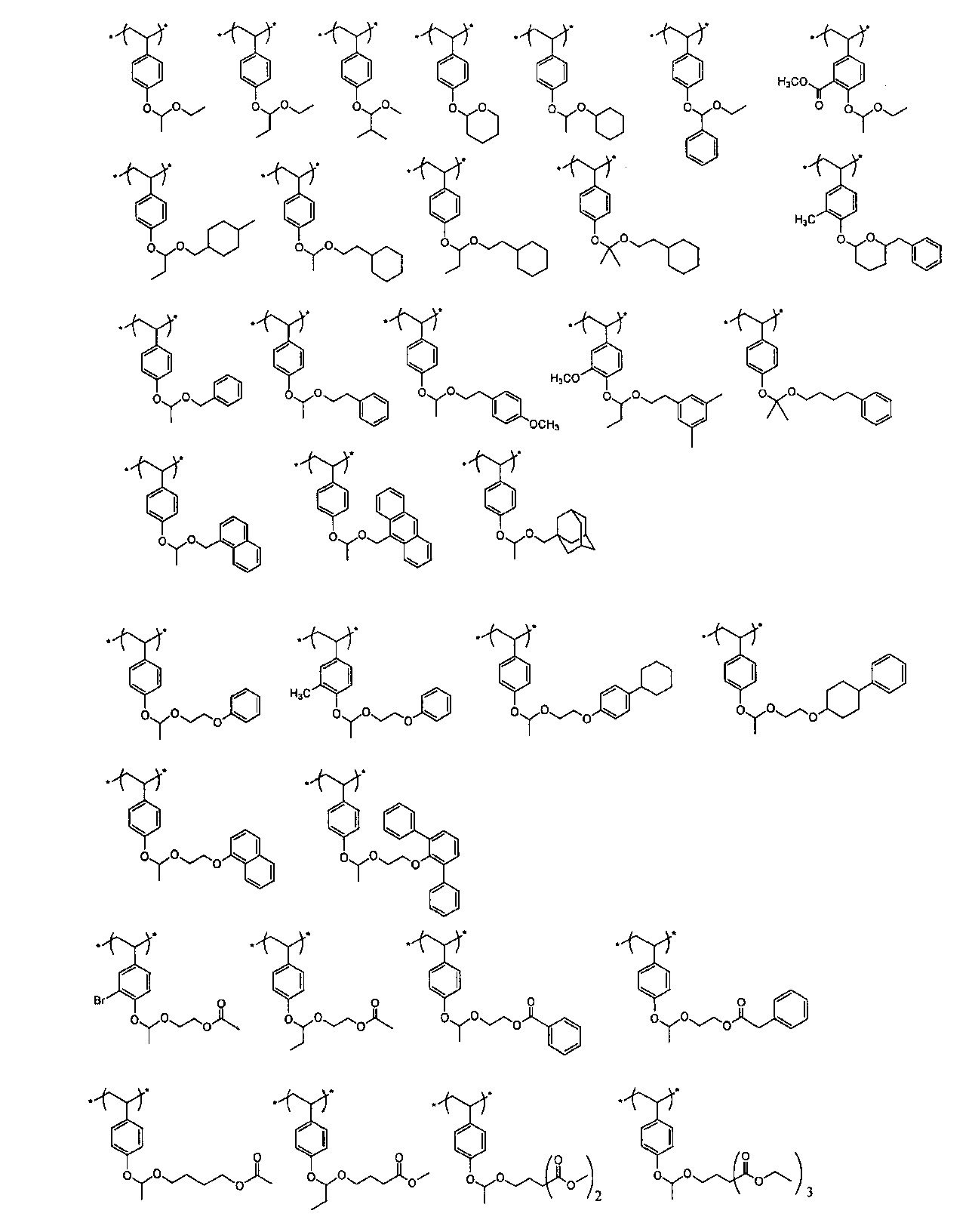
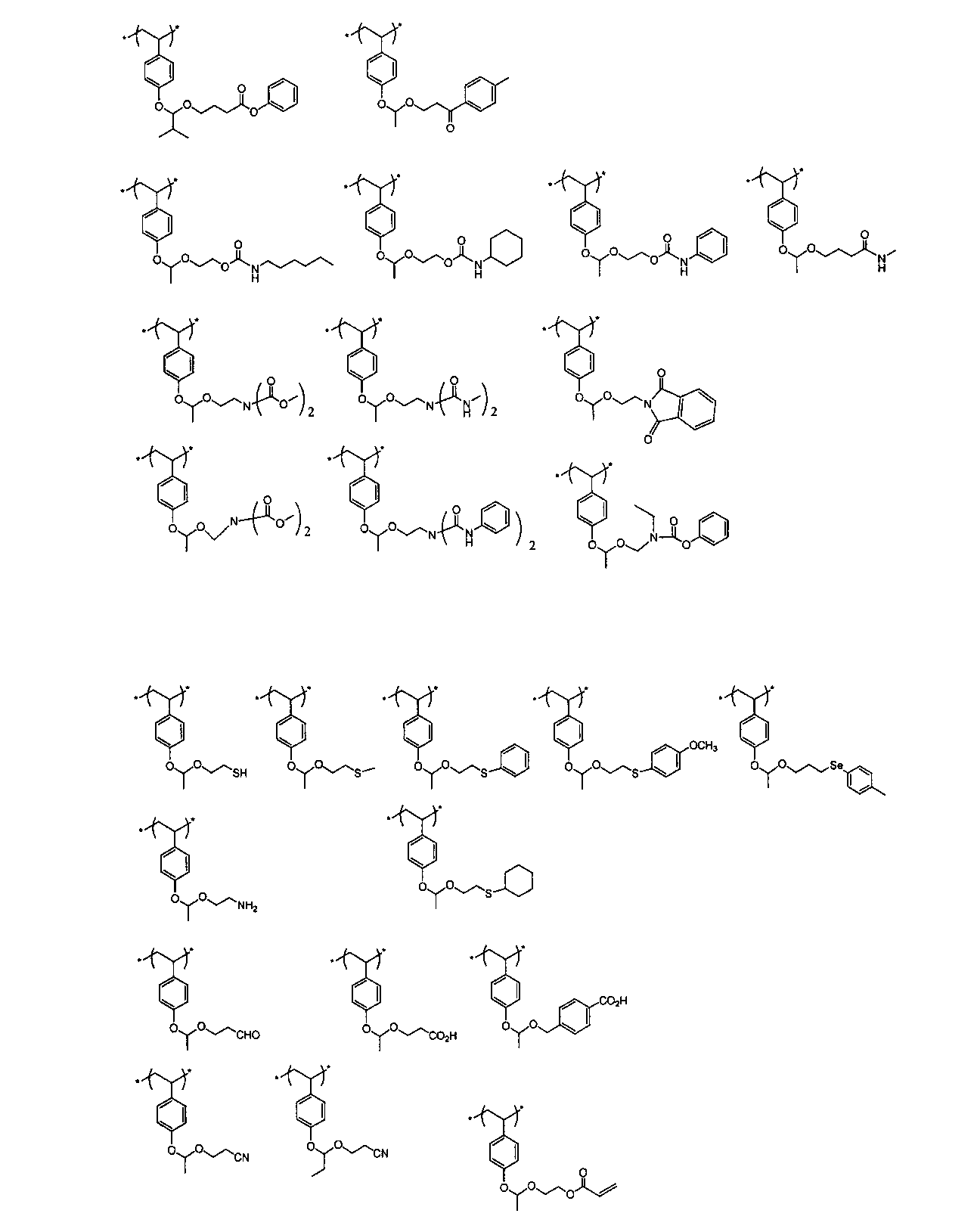
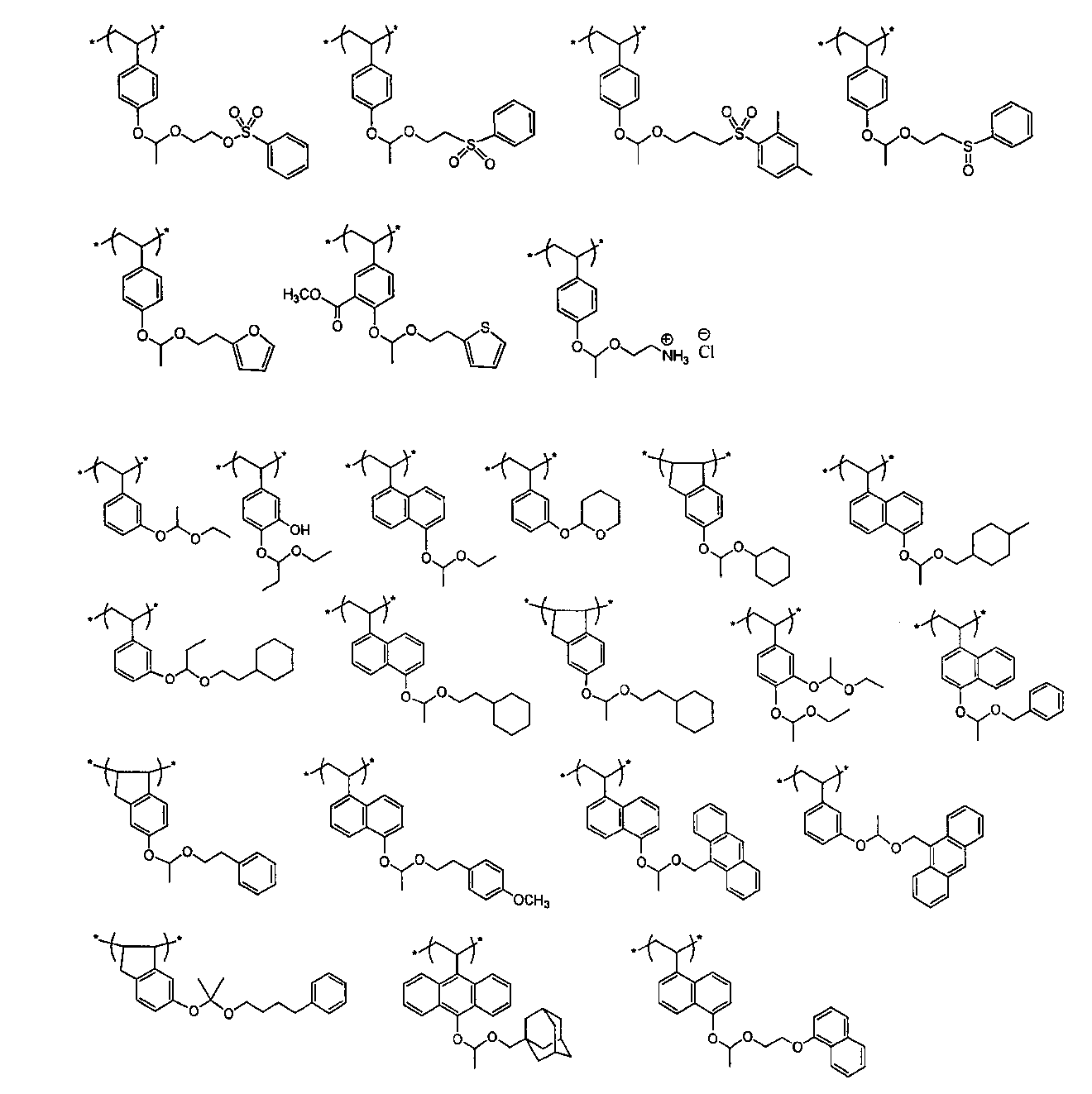

本発明の樹脂(P)中における繰り返し単位(A)の含有量は、全繰り返し単位に対して、3~90モル%の範囲で含有することが好ましく、5~80モル%の範囲で含有することがより好ましく、7~70モル%の範囲で含有することが特に好ましい。
樹脂(P)中の繰り返し単位(A)と繰り返し単位(A)との比率(Aのモル数/Bのモル数)は、0.04~1.0が好ましく、0.05~0.9がより好ましく、0.06~0.8が特に好ましい。
樹脂(P)中の繰り返し単位(A)と繰り返し単位(A)との比率(Aのモル数/Bのモル数)は、0.04~1.0が好ましく、0.05~0.9がより好ましく、0.06~0.8が特に好ましい。
(3)下記一般式(VI)で表される繰り返し単位
本発明における樹脂(P)は、更に、下記一般式(VI)で表される繰り返し単位(以下「繰り返し単位(B)ともいう。」)を有することが好ましい。
本発明における樹脂(P)は、更に、下記一般式(VI)で表される繰り返し単位(以下「繰り返し単位(B)ともいう。」)を有することが好ましい。

ここで、R01、R02及びR03は、各々独立に、水素原子、アルキル基、シクロアルキル基、ハロゲン原子、シアノ基又はアルコキシカルボニル基を表す。またR03は、アルキレン基を表し、Ar1と結合して5員若しくは6員環を形成していても良い。
Ar1は、芳香環基を表す。
nは、1~4の整数を表す。
Ar1は、芳香環基を表す。
nは、1~4の整数を表す。
一般式(VI)に於ける、R01、R02、R03、及びAr1の具体例としては、一般式(I)に於ける、R01、R02、R03、及びAr1と同様のものである。
一般式(VI)で表される繰り返し単位の具体例を以下に挙げるが、これらに限定されるものではない。
一般式(VI)で表される繰り返し単位の具体例を以下に挙げるが、これらに限定されるものではない。
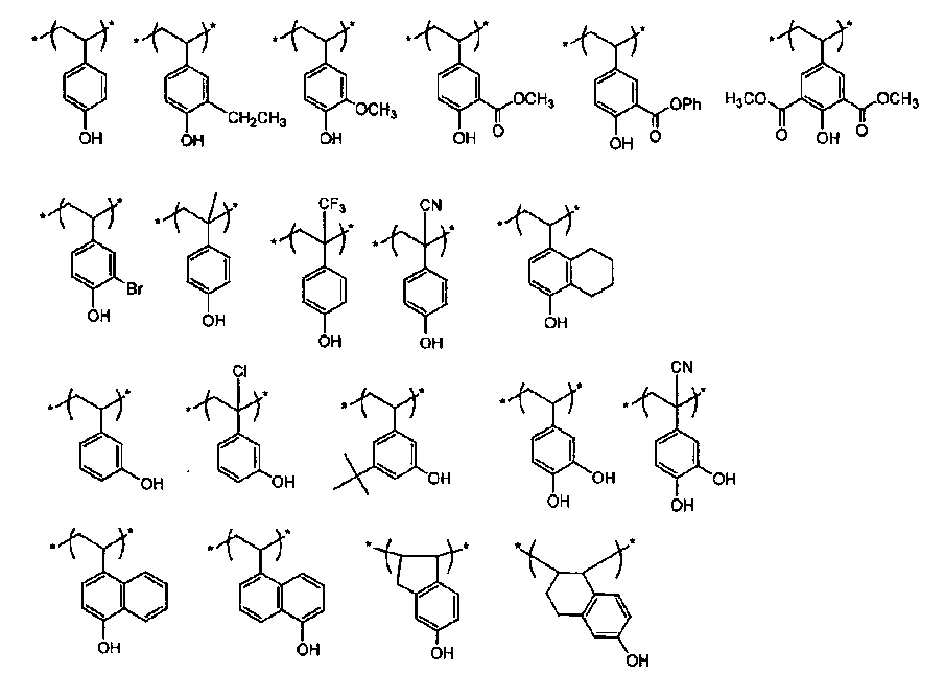
本発明の樹脂中における繰り返し単位(B)の含有量は、全繰り返し単位に対して、3~90モル%の範囲で含有することが好ましく、5~80モル%の範囲で含有することがより好ましく、7~70モル%の範囲で含有することが特に好ましい。
(4)本発明の樹脂(P)の形態、重合方法、分子量など
樹脂(P)の形態としては、ランダム型、ブロック型、クシ型、スター型のいずれの形態でもよい。
上述の繰り返し単位(A)を含有する本発明に係わる樹脂(P)、あるいは繰り返し単位(A)、(B)を含有する本発明に係わる樹脂(P)、あるいは繰り返し単位(A)、(B)、(C)を含有する本発明に係わる樹脂(P)は、例えば、各構造に対応する不飽和モノマーのラジカル、カチオン、又はアニオン重合により合成することができる。また各構造の前駆体に相当する不飽和モノマーを用いて重合した後に、高分子反応を行うことにより目的とする樹脂を得ることも可能である。
樹脂(P)の形態としては、ランダム型、ブロック型、クシ型、スター型のいずれの形態でもよい。
上述の繰り返し単位(A)を含有する本発明に係わる樹脂(P)、あるいは繰り返し単位(A)、(B)を含有する本発明に係わる樹脂(P)、あるいは繰り返し単位(A)、(B)、(C)を含有する本発明に係わる樹脂(P)は、例えば、各構造に対応する不飽和モノマーのラジカル、カチオン、又はアニオン重合により合成することができる。また各構造の前駆体に相当する不飽和モノマーを用いて重合した後に、高分子反応を行うことにより目的とする樹脂を得ることも可能である。
本発明に係る樹脂(P)は、繰り返し単位(A)を0.5~80モル%、繰り返し単位(A)を3~90モル%、繰り返し単位(B)を3~90モル%有することが好ましい。
本発明に係わる樹脂(P)の分子量は、特に制限されないが、重量平均分子量が1000~100000の範囲であることが好ましく、1500~70000の範囲であることがより好ましく、2000~50000の範囲であることが特に好ましい。ここで、樹脂の重量平均分子量は、GPC(キャリア:THFあるいはN-メチル-2-ピロリドン(NMP))によって測定したポリスチレン換算分子量を示す。
また分散度(Mw/Mn)は、好ましくは1.00~5.00、より好ましくは1.03~3.50であり、更に好ましくは、1.05~2.50である。
また分散度(Mw/Mn)は、好ましくは1.00~5.00、より好ましくは1.03~3.50であり、更に好ましくは、1.05~2.50である。
また本発明に係わる樹脂の性能を向上させる目的で、耐ドライエッチング性を著しく損なわない範囲で、更に他の重合性モノマー由来の繰り返し単位を有していてもよい。
その他の重合性モノマー由来の繰り返し単位の樹脂中の含有量としては、全繰り返し単位に対して、一般的に50モル%以下、好ましくは30モル%以下である。使用することができるその他の重合性モノマーとしては、以下に示すものが含まれる。例えば、(メタ)アクリル酸エステル類、(メタ)アクリルアミド類、アリル化合物、ビニルエーテル類、ビニルエステル類、スチレン類、クロトン酸エステル類などから選ばれる付加重合性不飽和結合を1個有する化合物である。
その他の重合性モノマー由来の繰り返し単位の樹脂中の含有量としては、全繰り返し単位に対して、一般的に50モル%以下、好ましくは30モル%以下である。使用することができるその他の重合性モノマーとしては、以下に示すものが含まれる。例えば、(メタ)アクリル酸エステル類、(メタ)アクリルアミド類、アリル化合物、ビニルエーテル類、ビニルエステル類、スチレン類、クロトン酸エステル類などから選ばれる付加重合性不飽和結合を1個有する化合物である。
具体的には、(メタ)アクリル酸エステル類としては、例えば、(メタ)アクリル酸メチル、(メタ)アクリル酸エチル、(メタ)アクリル酸プロピル、(メタ)アクリル酸t-ブチル、(メタ)アクリル酸アミル、(メタ)アクリル酸シクロヘキシル、(メタ)アクリル酸エチルヘキシル、(メタ)アクリル酸オクチル、(メタ)アクリル酸-t-オクチル、(メタ)アクリル酸2-クロロエチル、(メタ)アクリル酸2-ヒドロキシエチル、(メタ)アクリル酸グリシジル、(メタ)アクリル酸ベンジル、(メタ)アクリル酸フェニルなどが挙げられる。
(メタ)アクリルアミド類としては、例えば、(メタ)アクリルアミド、N-アルキル(メタ)アクリルアミド、(アルキル基としては、炭素原子数1~10のもの、例えば、メチル基、エチル基、プロピル基、ブチル基、t-ブチル基、ヘプチル基、オクチル基、シクロヘキシル基、ベンジル基、ヒドロキシエチル基、ベンジル基などがある。)、N-アリール(メタ)アクリルアミド(アリール基としては、例えばフェニル基、トリル基、ニトロフェニル基、ナフチル基、シアノフェニル基、ヒドロキシフェニル基、カルボキシフェニル基などがある。)、N,N-ジアルキル(メタ)アクリルアミド(アルキル基としては、炭素原子数1~10のもの、例えば、メチル基、エチル基、ブチル基、イソブチル基、エチルヘキシル基、シクロヘキシル基などがある。)、N,N-アリール(メタ)アクリルアミド(アリール基としては、例えばフェニル基などがある。)、N-メチル-N-フェニルアクリルアミド、N-ヒドロキシエチル-N-メチルアクリルアミド、N-2-アセトアミドエチル-N-アセチルアクリルアミドなどが挙げられる。
アリル化合物としては、例えば、アリルエステル類(例えば、酢酸アリル、カプロン酸アリル、カプリル酸アリル、ラウリン酸アリル、パルミチン酸アリル、ステアリン酸アリル、安息香酸アリル、アセト酢酸アリル、乳酸アリルなど)、アリルオキシエタノールなどが挙げられる。
ビニルエーテル類としては、例えば、アルキルビニルエーテル(例えば、ヘキシルビニルエーテル、オクチルビニルエーテル、デシルビニルエーテル、エチルヘキシルビニルエーテル、メトキシエチルビニルエーテル、エトキシエチルビニルエーテル、クロルエチルビニルエーテル、1-メチル-2,2-ジメチルプロピルビニルエーテル、2-エチルブチルビニルエーテル、ヒドロキシエチルビニルエーテル、ジエチレングリコールビニルエーテル、ジメチルアミノエチルビニルエーテル、ジエチルアミノエチルビニルエーテル、ブチルアミノエチルビニルエーテル、ベンジルビニルエーテル、テトラヒドロフルフリルビニルエーテルなど)、ビニルアリールエーテル(例えばビニルフェニルエーテル、ビニルトリルエーテル、ビニルクロルフェニルエーテル、ビニル-2,4-ジクロルフェニルエーテル、ビニルナフチルエーテル、ビニルアントラニルエーテルなど)が挙げられる。
ビニルエステル類としては、例えば、ビニルブチレート、ビニルイソブチレート、ビニルトリメチルアセテート、ビニルジエチルアセテート、ビニルバレート、ビニルカプロエート、ビニルクロルアセテート、ビニルジクロルアセテート、ビニルメトキシアセテート、ビニルブトキシアセテート、ビニルフェニルアセテート、ビニルアセトアセテート、ビニルラクテート、ビニル-β-フェニルブチレート、ビニルシクロヘキシルカルボキシレート、安息香酸ビニル、サルチル酸ビニル、クロル安息香酸ビニル、テトラクロル安息香酸ビニル、ナフトエ酸ビニルなどが挙げられる。
スチレン類としては、例えば、スチレン、アルキルスチレン(例えば、メチルスチレン、ジメチルスチレン、トリメチルスチレン、エチルスチレン、ジエチルスチレン、イソプロピルスチレン、ブチルスチレン、ヘキシルスチレン、シクロヘキシルスチレン、デシルスチレン、ベンジルスチレン、クロルメチルスチレン、トリフルオルメチルスチレン、エトキシメチルスチレン、アセトキシメチルスチレンなど)、アルコキシスチレン(例えば、メトキシスチレン、4-メトキシ-3-メチルスチレン、ジメトキシスチレンなど)、アルキルカルボニルオキシスチレン(例えば、4-アセトキシスチレン、4-シクロヘキシルカルボニルオキシスチレン)、アリールカルボニルオキシスチレン(例えば、4-フェニルカルボニルオキシスチレン)、ハロゲンスチレン(例えば、クロルスチレン、ジクロルスチレン、トリクロルスチレン、テトラクロルスチレン、ペンタクロルスチレン、ブロムスチレン、ジブロムスチレン、ヨードスチレン、フルオルスチレン、トリフルオルスチレン、2-ブロム-4-トリフルオルメチルスチレン、4-フルオル-3-トリフルオルメチルスチレンなど)、シアノスチレン、カルボキシスチレンなどが挙げられる。
クロトン酸エステル類としては、例えば、クロトン酸アルキル(例えば、クロトン酸ブチル、クロトン酸ヘキシル、グリセリンモノクロトネートなど)が挙げられる。
イタコン酸ジアルキル類としては、例えば、イタコン酸ジメチル、イタコン酸ジエチル、イタコン酸ジブチルなどが挙げられる。
マレイン酸あるいはフマール酸のジアルキルエステル類としては、例えば、ジメチルマレレート、ジブチルフマレートなどが挙げられる。その他にも、無水マレイン酸、マレイミド、アクリロニトリル、メタクリロニトリル、マレイロニトリル等をあげることができる。また一般に前記本発明にかかわる繰り返し単位と共重合可能である付加重合性不飽和化合物であれば、特に制限されず用いることができる。
マレイン酸あるいはフマール酸のジアルキルエステル類としては、例えば、ジメチルマレレート、ジブチルフマレートなどが挙げられる。その他にも、無水マレイン酸、マレイミド、アクリロニトリル、メタクリロニトリル、マレイロニトリル等をあげることができる。また一般に前記本発明にかかわる繰り返し単位と共重合可能である付加重合性不飽和化合物であれば、特に制限されず用いることができる。
本発明における樹脂(P)は、更に、単環又は多環の脂環炭化水素構造を有する繰り返し単位(以下、「脂環炭化水素系酸分解性繰り返し単位」ともいう)を有することも好ましい。
脂環炭化水素系酸分解性繰り返し単位に含まれるアルカリ可溶性基としては、フェノール性水酸基、カルボン酸基、フッ素化アルコール基、スルホン酸基、スルホンアミド基、スルホニルイミド基、(アルキルスルホニル)(アルキルカルボニル)メチレン基、(アルキルスルホニル)(アルキルカルボニル)イミド基、ビス(アルキルカルボニル)メチレン基、ビス(アルキルカルボニル)イミド基、ビス(アルキルスルホニル)メチレン基、ビス(アルキルスルホニル)イミド基、トリス(アルキルカルボニル)メチレン基、トリス(アルキルスルホニル)メチレン基を有する基等が挙げられる。
好ましいアルカリ可溶性基としては、カルボン酸基、フッ素化アルコール基(好ましくはヘキサフルオロイソプロパノール)、スルホン酸基が挙げられる。
酸で分解し得る基(酸分解性基)として好ましい基は、これらのアルカリ可溶性基の水素原子を酸で脱離する基で置換した基である。
酸で脱離する基としては、例えば、-C(R36)(R37)(R38)、-C(R36)(R37)(OR39)、-C(R01)(R02)(OR39)等を挙げることができる。
式中、R36~R39は、各々独立に、アルキル基、シクロアルキル基、アリール基、アラルキル基又はアルケニル基表す。R36とR37とは、互いに結合して環を形成してもよい。
R01~R02は、各々独立に、水素原子、アルキル基、シクロアルキル基、アリール基、アラルキル基又はアルケニル基を表す。
酸分解性基としては好ましくは、クミルエステル基、エノールエステル基、アセタールエステル基、第3級のアルキルエステル基等である。更に好ましくは、第3級アルキルエステル基である。
好ましいアルカリ可溶性基としては、カルボン酸基、フッ素化アルコール基(好ましくはヘキサフルオロイソプロパノール)、スルホン酸基が挙げられる。
酸で分解し得る基(酸分解性基)として好ましい基は、これらのアルカリ可溶性基の水素原子を酸で脱離する基で置換した基である。
酸で脱離する基としては、例えば、-C(R36)(R37)(R38)、-C(R36)(R37)(OR39)、-C(R01)(R02)(OR39)等を挙げることができる。
式中、R36~R39は、各々独立に、アルキル基、シクロアルキル基、アリール基、アラルキル基又はアルケニル基表す。R36とR37とは、互いに結合して環を形成してもよい。
R01~R02は、各々独立に、水素原子、アルキル基、シクロアルキル基、アリール基、アラルキル基又はアルケニル基を表す。
酸分解性基としては好ましくは、クミルエステル基、エノールエステル基、アセタールエステル基、第3級のアルキルエステル基等である。更に好ましくは、第3級アルキルエステル基である。
本発明の脂環炭化水素系酸分解性繰り返し単位としては、下記一般式(pI)~一般式(pV)で示される脂環式炭化水素を含む部分構造を有する繰り返し単位及び下記一般式(II-AB)で示される繰り返し単位の群から選択される少なくとも1種を含有する樹脂であることが好ましい。
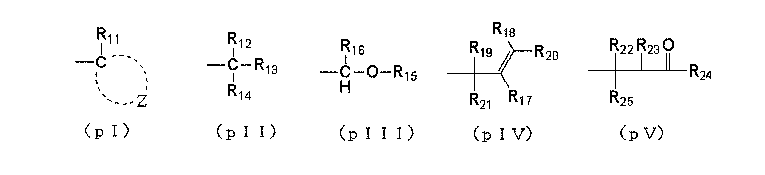
一般式(pI)~(pV)中、
R11は、メチル基、エチル基、n-プロピル基、イソプロピル基、n-ブチル基、イソブチル基又はsec-ブチル基を表し、Zは、炭素原子とともにシクロアルキル基を形成するのに必要な原子団を表す。
R12~R16は、各々独立に、炭素数1~4個の、直鎖若しくは分岐のアルキル基又はシクロアルキル基を表す。但し、R12~R14のうち少なくとも1つ、若しくはR15、R16のいずれかはシクロアルキル基を表す。
R17~R21は、各々独立に、水素原子、炭素数1~4個の、直鎖若しくは分岐のアルキル基又はシクロアルキル基を表す。但し、R17~R21のうち少なくとも1つはシクロアルキル基を表す。また、R19、R21のいずれかは炭素数1~4個の、直鎖若しくは分岐のアルキル基又はシクロアルキル基を表す。
R22~R25は、各々独立に、水素原子、炭素数1~4個の、直鎖若しくは分岐のアルキル基又はシクロアルキル基を表す。但し、R22~R25のうち少なくとも1つはシクロアルキル基を表す。また、R23とR24は、互いに結合して環を形成していてもよい。
R11は、メチル基、エチル基、n-プロピル基、イソプロピル基、n-ブチル基、イソブチル基又はsec-ブチル基を表し、Zは、炭素原子とともにシクロアルキル基を形成するのに必要な原子団を表す。
R12~R16は、各々独立に、炭素数1~4個の、直鎖若しくは分岐のアルキル基又はシクロアルキル基を表す。但し、R12~R14のうち少なくとも1つ、若しくはR15、R16のいずれかはシクロアルキル基を表す。
R17~R21は、各々独立に、水素原子、炭素数1~4個の、直鎖若しくは分岐のアルキル基又はシクロアルキル基を表す。但し、R17~R21のうち少なくとも1つはシクロアルキル基を表す。また、R19、R21のいずれかは炭素数1~4個の、直鎖若しくは分岐のアルキル基又はシクロアルキル基を表す。
R22~R25は、各々独立に、水素原子、炭素数1~4個の、直鎖若しくは分岐のアルキル基又はシクロアルキル基を表す。但し、R22~R25のうち少なくとも1つはシクロアルキル基を表す。また、R23とR24は、互いに結合して環を形成していてもよい。

一般式(II-AB)中、
R11’及びR12’は、各々独立に、水素原子、シアノ基、ハロゲン原子又はアルキル基を表す。
Z’は、結合した2つの炭素原子(C-C)を含み、脂環式構造を形成するための原子団を表す。
R11’及びR12’は、各々独立に、水素原子、シアノ基、ハロゲン原子又はアルキル基を表す。
Z’は、結合した2つの炭素原子(C-C)を含み、脂環式構造を形成するための原子団を表す。
また、上記一般式(II-AB)は、下記一般式(II-AB1)又は一般式(II-AB2)であることが更に好ましい。
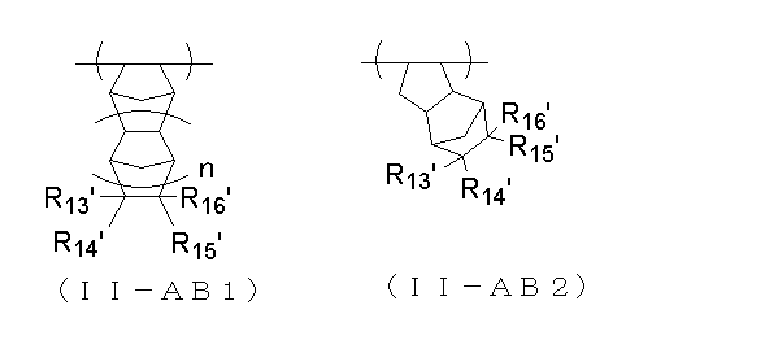
式(II-AB1)及び(II-AB2)中、
R13’~R16’は、各々独立に、水素原子、ハロゲン原子、シアノ基、-COOH、-COOR5、酸の作用により分解する基、-C(=O)-X-A’-R17’、アルキル基あるいはシクロアルキル基を表す。Rl3’~R16’のうち少なくとも2つが結合して環を形成してもよい。
ここで、R5は、アルキル基、シクロアルキル基又はラクトン構造を有する基を表す。
Xは、酸素原子、硫黄原子、-NH-、-NHSO2-又は-NHSO2NH-を表す。
A’は、単結合又は2価の連結基を表す。
R17’は、-COOH、-COOR5、-CN、水酸基、アルコキシ基、-CO-NH-R6、-CO-NH-SO2-R6又はラクトン構造を有する基を表す。
R6は、アルキル基又はシクロアルキル基を表す。
nは、0又は1を表す。
R13’~R16’は、各々独立に、水素原子、ハロゲン原子、シアノ基、-COOH、-COOR5、酸の作用により分解する基、-C(=O)-X-A’-R17’、アルキル基あるいはシクロアルキル基を表す。Rl3’~R16’のうち少なくとも2つが結合して環を形成してもよい。
ここで、R5は、アルキル基、シクロアルキル基又はラクトン構造を有する基を表す。
Xは、酸素原子、硫黄原子、-NH-、-NHSO2-又は-NHSO2NH-を表す。
A’は、単結合又は2価の連結基を表す。
R17’は、-COOH、-COOR5、-CN、水酸基、アルコキシ基、-CO-NH-R6、-CO-NH-SO2-R6又はラクトン構造を有する基を表す。
R6は、アルキル基又はシクロアルキル基を表す。
nは、0又は1を表す。
一般式(pI)~(pV)において、R12~R25におけるアルキル基としては、1~4個の炭素原子を有する直鎖若しくは分岐のアルキル基を表す。
R11~R25におけるシクロアルキル基或いはZと炭素原子が形成するシクロアルキル基は、単環式でも、多環式でもよい。具体的には、炭素数5以上のモノシクロ、ビシクロ、トリシクロ、テトラシクロ構造等を有する基を挙げることができる。その炭素数は6~30個が好ましく、特に炭素数7~25個が好ましい。これらのシクロアルキル基は置換基を有していてもよい。
好ましいシクロアルキル基としては、アダマンチル基、ノルアダマンチル基、デカリン残基、トリシクロデカニル基、テトラシクロドデカニル基、ノルボルニル基、セドロール基、シクロペンチル基、シクロヘキシル基、シクロヘプチル基、シクロオクチル基、シクロデカニル基、シクロドデカニル基を挙げることができる。より好ましくは、アダマンチル基、ノルボルニル基、シクロヘキシル基、シクロペンチル基、テトラシクロドデカニル基、トリシクロデカニル基を挙げることができる。
これらのアルキル基、シクロアルキル基の更なる置換基としては、アルキル基(炭素数1~4)、ハロゲン原子、水酸基、アルコキシ基(炭素数1~4)、カルボキシル基、アルコキシカルボニル基(炭素数2~6)が挙げられる。上記のアルキル基、アルコキシ基、アルコキシカルボニル基等が、更に有していてもよい置換基としては、水酸基、ハロゲン原子、アルコキシ基を挙げることができる。
上記樹脂における一般式(pI)~(pV)で示される構造は、アルカリ可溶性基の保護に使用することができる。アルカリ可溶性基としては、この技術分野において公知の種々の基が挙げられる。
具体的には、カルボン酸基、スルホン酸基、フェノール基、チオール基の水素原子が一般式(pI)~(pV)で表される構造で置換された構造などが挙げられ、好ましくはカルボン酸基、スルホン酸基の水素原子が一般式(pI)~(pV)で表される構造で置換された構造である。
一般式(pI)~(pV)で示される構造で保護されたアルカリ可溶性基を有する繰り返し単位としては、下記一般式(pA)で示される繰り返し単位が好ましい。

ここで、Rは、水素原子、ハロゲン原子又は1~4個の炭素原子を有する直鎖若しくは分岐のアルキル基を表す。複数のRは、各々同じでも異なっていてもよい。
Aは、単結合、アルキレン基、エーテル基、チオエーテル基、カルボニル基、エステル基、アミド基、スルホンアミド基、ウレタン基、又はウレア基よりなる群から選択される単独あるいは2つ以上の基の組み合わせを表す。好ましくは単結合である。
Rp1は、上記式(pI)~(pV)のいずれかの基を表す。
Aは、単結合、アルキレン基、エーテル基、チオエーテル基、カルボニル基、エステル基、アミド基、スルホンアミド基、ウレタン基、又はウレア基よりなる群から選択される単独あるいは2つ以上の基の組み合わせを表す。好ましくは単結合である。
Rp1は、上記式(pI)~(pV)のいずれかの基を表す。
一般式(pA)で表される繰り返し単位は、特に好ましくは、2-アルキル-2-アダマンチル(メタ)アクリレート、ジアルキル(1-アダマンチル)メチル(メタ)アクリレートによる繰り返し単位である。
以下、一般式(pA)で示される繰り返し単位の具体例を示すが、本発明は、これに限定されるものではない。


前記一般式(II-AB)、R11’、R12’におけるハロゲン原子としては、塩素原子、臭素原子、フッ素原子、沃素原子等を挙げることができる。
上記R11’、R12’におけるアルキル基としては、炭素数1~10個の直鎖状あるいは分岐状アルキル基が挙げられる。
上記Z’の脂環式構造を形成するための原子団は、置換基を有していてもよい脂環式炭化水素の繰り返し単位を樹脂に形成する原子団であり、中でも有橋式の脂環式炭化水素の繰り返し単位を形成する有橋式脂環式構造を形成するための原子団が好ましい。
形成される脂環式炭化水素の骨格としては、一般式(pI)~(pV)に於けるR12~R25の脂環式炭化水素基と同様のものが挙げられる。
上記脂環式炭化水素の骨格には置換基を有していてもよい。そのような置換基としては、前記一般式(II-AB1)あるいは(II-AB2)中のR13’~R16’を挙げることができる。
本発明に係る脂環炭化水素系酸分解性繰り返し単位においては、酸の作用により分解する基は、前記一般式(pI)~一般式(pV)で示される脂環式炭化水素を含む部分構造を有する繰り返し単位、一般式(II-AB)で表される繰り返し単位、及び後記共重合成分の繰り返し単位のうち少なくとも1種の繰り返し単位に含有することができる。酸の作用により分解する基は、一般式(pI)~一般式(pV)で示される脂環式炭化水素を含む部分構造を有する繰り返し単位に含まれることが好ましい。
上記一般式(II-AB1)あるいは一般式(II-AB2)におけるR13’~R16’の各種置換基は、上記一般式(II-AB)における脂環式構造を形成するための原子団ないし有橋式脂環式構造を形成するための原子団Zの置換基ともなり得る。
上記一般式(II-AB1)あるいは一般式(II-AB2)で表される繰り返し単位として、下記具体例が挙げられるが、本発明はこれらの具体例に限定されない。
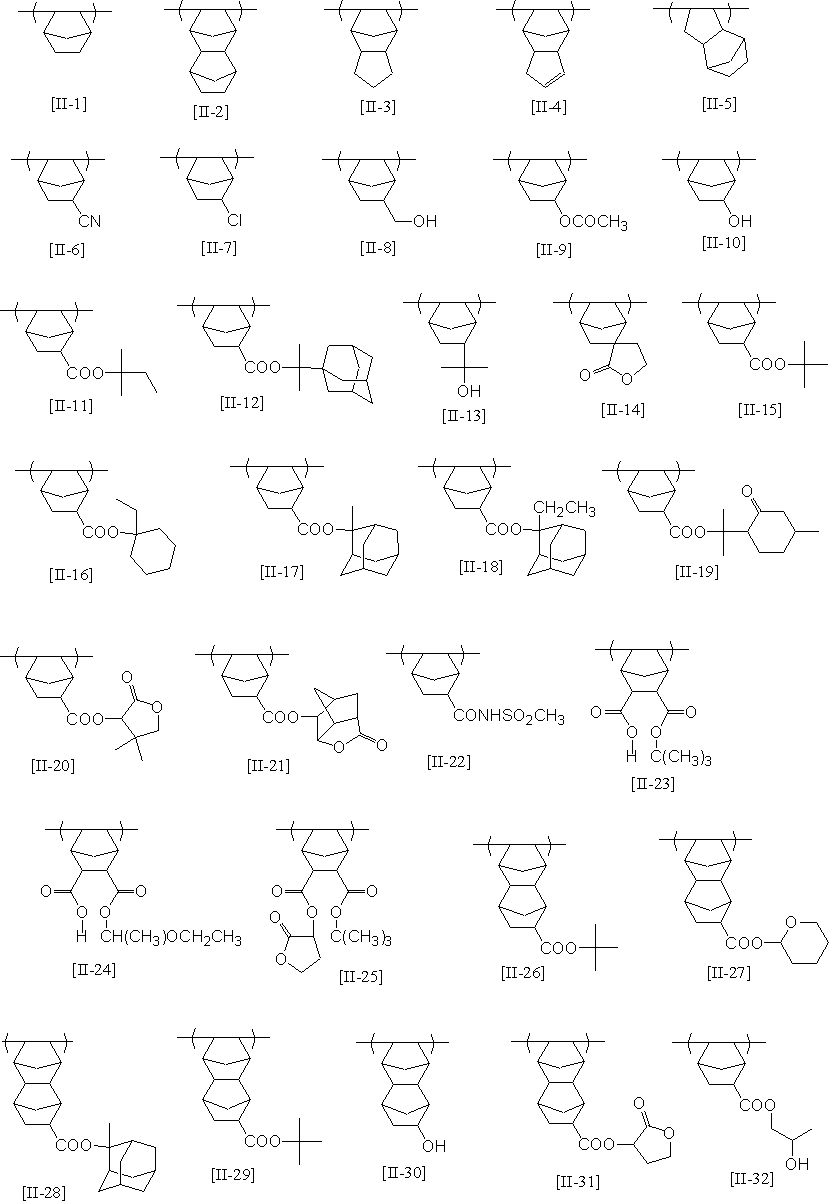
本発明の樹脂(P)は、ラクトン基を有することが好ましい。ラクトン基としては、ラクトン構造を含有していればいずれの基でも用いることができるが、好ましくは5~7員環ラクトン構造を含有する基であり、5~7員環ラクトン構造にビシクロ構造、スピロ構造を形成する形で他の環構造が縮環しているものが好ましい。樹脂(P)は、ラクトン構造を有する基を有する繰り返し単位を有することが好ましく、下記一般式(LC1-1)~(LC1-16)のいずれかで表されるラクトン構造を有する基を有する繰り返し単位を有することがより好ましい。また、ラクトン構造を有する基が主鎖に直接結合していてもよい。好ましいラクトン構造としては一般式(LC1-1)、(LC1-4)、(LC1-5)、(LC1-6)、(LC1-13)、(LC1-14)で表される基であり、特定のラクトン構造を用いることでラインエッジラフネス、現像欠陥が良好になる。
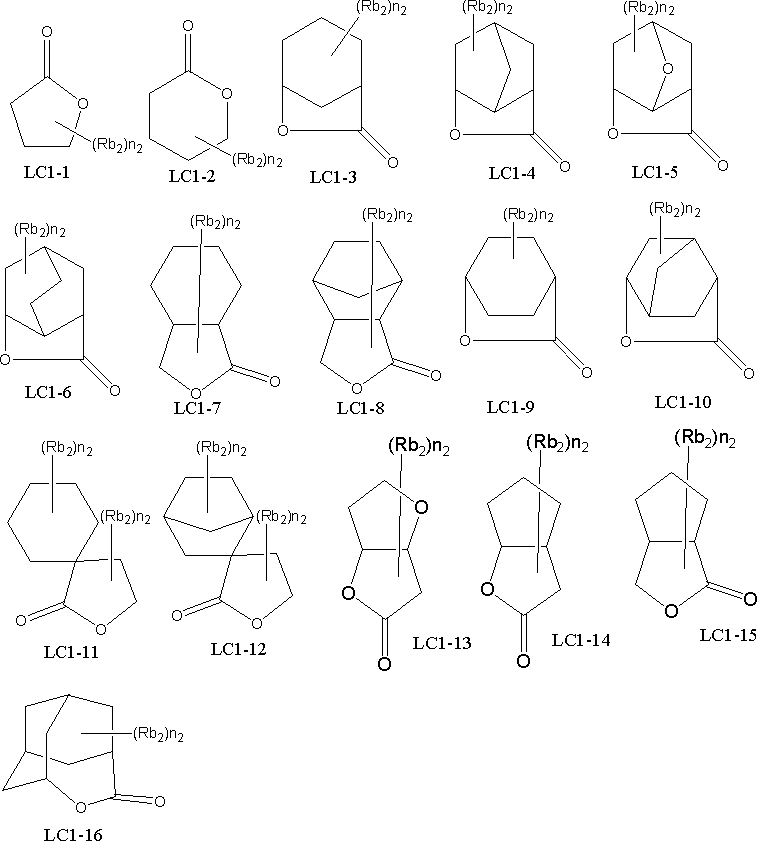
ラクトン構造部分は、置換基(Rb2)を有していても有していなくてもよい。好ましい置換基(Rb2)としては、炭素数1~8のアルキル基、炭素数4~7のシクロアルキル基、炭素数1~8のアルコキシ基、炭素数1~8のアルコキシカルボニル基、カルボキシル基、ハロゲン原子、水酸基、シアノ基、酸分解性基などが挙げられる。n2は、0~4の整数を表す。n2が2以上の時、複数存在するRb2は、同一でも異なっていてもよく、また、複数存在するRb2同士が結合して環を形成してもよい。
一般式(LC1-1)~(LC1-16)のいずれかで表されるラクトン構造を有する基を有する繰り返し単位としては、上記一般式(II-AB1)又は(II-AB2)中のR13’~R16’のうち少なくとも1つが一般式(LC1-1)~(LC1-16)で表される基を有するもの(例えば-COOR5のR5が一般式(LC1-1)~(LC1-16)で表される基を表す)、又は下記一般式(AI)で表される繰り返し単位等を挙げることができる。
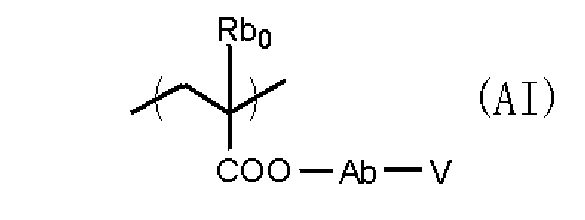
一般式(AI)中、
Rb0は、水素原子、ハロゲン原子、又は炭素数1~4のアルキル基を表す。
Rb0のアルキル基が有していてもよい好ましい置換基としては、水酸基、ハロゲン原子が挙げられる。
Rb0のハロゲン原子としては、フッ素原子、塩素原子、臭素原子、沃素原子を挙げることができる。
Rb0は、水素原子又はメチル基が好ましい。
Abは、単結合、アルキレン基、単環又は多環の脂環炭化水素構造を有する2価の連結基、エーテル基、エステル基、カルボニル基、又はこれらを組み合わせた2価の基を表す。好ましくは、単結合、-Ab1-CO2-で表される連結基である。Ab1は、直鎖、分岐アルキレン基、単環又は多環のシクロアルキレン基であり、好ましくは、メチレン基、エチレン基、シクロヘキシレン基、アダマンチレン基、ノルボルニレン基である。
Vは、一般式(LC1-1)~(LC1-16)のうちのいずれかで示される基を表す。
Rb0は、水素原子、ハロゲン原子、又は炭素数1~4のアルキル基を表す。
Rb0のアルキル基が有していてもよい好ましい置換基としては、水酸基、ハロゲン原子が挙げられる。
Rb0のハロゲン原子としては、フッ素原子、塩素原子、臭素原子、沃素原子を挙げることができる。
Rb0は、水素原子又はメチル基が好ましい。
Abは、単結合、アルキレン基、単環又は多環の脂環炭化水素構造を有する2価の連結基、エーテル基、エステル基、カルボニル基、又はこれらを組み合わせた2価の基を表す。好ましくは、単結合、-Ab1-CO2-で表される連結基である。Ab1は、直鎖、分岐アルキレン基、単環又は多環のシクロアルキレン基であり、好ましくは、メチレン基、エチレン基、シクロヘキシレン基、アダマンチレン基、ノルボルニレン基である。
Vは、一般式(LC1-1)~(LC1-16)のうちのいずれかで示される基を表す。
ラクトン構造を有する基を有する繰り返し単位は通常光学異性体が存在するが、いずれの光学異性体を用いてもよい。また、1種の光学異性体を単独で用いても、複数の光学異性体混合して用いてもよい。1種の光学異性体を主に用いる場合、その光学純度(ee)が90以上のものが好ましく、より好ましくは95以上である。
ラクトン構造を有する基を有する繰り返し単位の具体例を以下に挙げるが、本発明はこれらに限定されない。


本発明の樹脂(P)は、極性基を有する有機基を含有する繰り返し単位、特に、極性基で置換された脂環炭化水素構造を有する繰り返し単位を有していることが好ましい。これにより基板密着性、現像液親和性が向上する。極性基で置換された脂環炭化水素構造の脂環炭化水素構造としてはアダマンチル基、ジアマンチル基、ノルボルナン基が好ましい。極性基としては水酸基、シアノ基が好ましい。
極性基で置換された脂環炭化水素構造としては、下記一般式(VIIa)~(VIId)で表される部分構造が好ましい。
極性基で置換された脂環炭化水素構造としては、下記一般式(VIIa)~(VIId)で表される部分構造が好ましい。
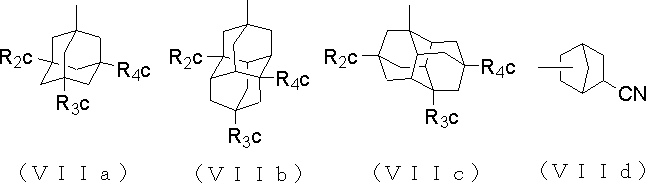
一般式(VIIa)~(VIIc)中、
R2c~R4cは、各々独立に、水素原子又は水酸基、シアノ基を表す。ただし、R2c~R4cのうち少なくとも1つは水酸基、シアノ基を表す。好ましくはR2c~R4cのうち1つ又は2つが水酸基で残りが水素原子である。
一般式(VIIa)において、更に好ましくはR2c~R4cのうち2つが水酸基で残りが水素原子である。
R2c~R4cは、各々独立に、水素原子又は水酸基、シアノ基を表す。ただし、R2c~R4cのうち少なくとも1つは水酸基、シアノ基を表す。好ましくはR2c~R4cのうち1つ又は2つが水酸基で残りが水素原子である。
一般式(VIIa)において、更に好ましくはR2c~R4cのうち2つが水酸基で残りが水素原子である。
一般式(VIIa)~(VIId)で表される基を有する繰り返し単位としては、上記一般式(II-AB1)又は(II-AB2)中のR13’~R16’のうち少なくとも1つが上記一般式(VII)で表される基を有するもの(例えば、-COOR5におけるR5が一般式(VIIa)~(VIId)で表される基を表す)、又は下記一般式(AIIa)~(AIId)で表される繰り返し単位等を挙げることができる。
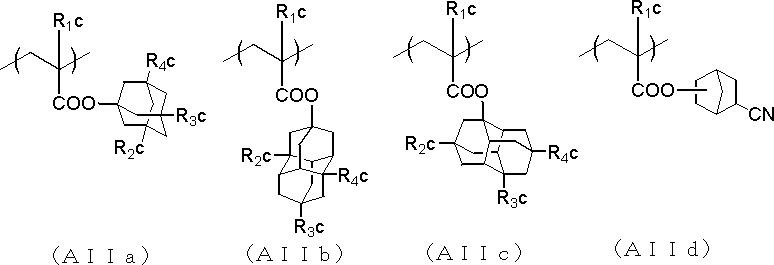
一般式(AIIa)~(AIId)中、
R1cは、水素原子、メチル基、トリフロロメチル基、ヒドロキメチル基を表す。
R2c~R4cは、一般式(VIIa)~(VIIc)におけるR2c~R4cと同義である。
R1cは、水素原子、メチル基、トリフロロメチル基、ヒドロキメチル基を表す。
R2c~R4cは、一般式(VIIa)~(VIIc)におけるR2c~R4cと同義である。
一般式(AIIa)~(AIId)で表される構造を有する繰り返し単位の具体例を以下に挙げるが、本発明はこれらに限定されない。
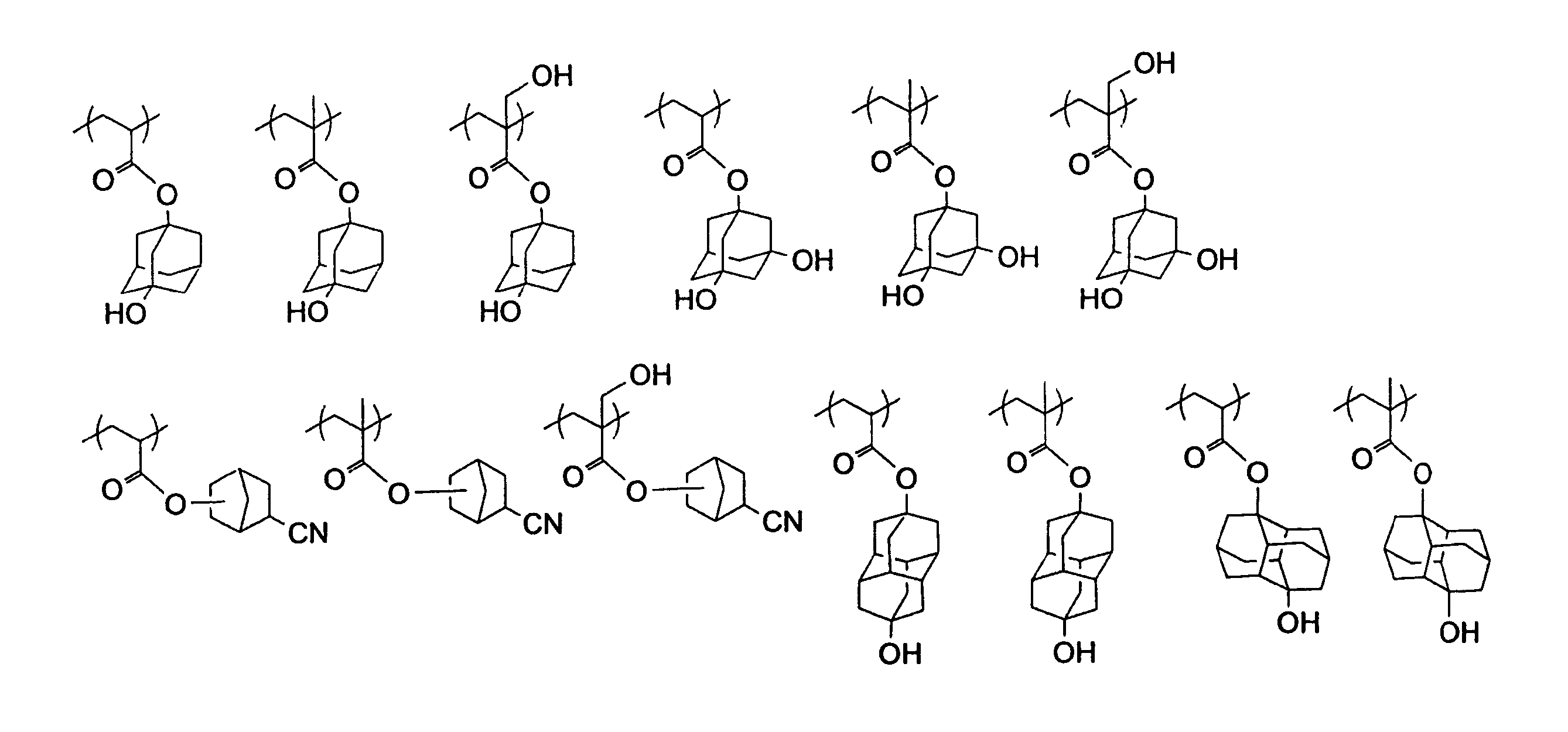
本発明の樹脂(P)は、下記一般式(VIII)で表される繰り返し単位を有してもよい。
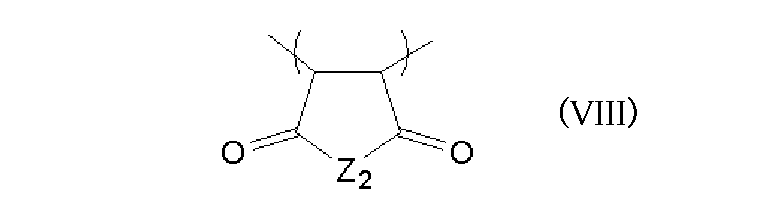
上記一般式(VIII)に於いて、
Z2は、-O-又は-N(R41)-を表す。R41は、水素原子、水酸基、アルキル基又は-OSO2-R42を表す。R42は、アルキル基、シクロアルキル基又は樟脳残基を表す。R41及びR42のアルキル基は、ハロゲン原子(好ましくはフッ素原子)等で置換されていてもよい。
Z2は、-O-又は-N(R41)-を表す。R41は、水素原子、水酸基、アルキル基又は-OSO2-R42を表す。R42は、アルキル基、シクロアルキル基又は樟脳残基を表す。R41及びR42のアルキル基は、ハロゲン原子(好ましくはフッ素原子)等で置換されていてもよい。
本発明の樹脂(P)は、アルカリ可溶性基を有する繰り返し単位を有することが好ましく、カルボキシル基を有する繰り返し単位を有することがより好ましい。これを含有することによりコンタクトホール用途での解像性が増す。カルボキシル基を有する繰り返し単位としては、アクリル酸、メタクリル酸による繰り返し単位のような樹脂の主鎖に直接カルボキシル基が結合している繰り返し単位、あるいは連結基を介して樹脂の主鎖にカルボキシル基が結合している繰り返し単位、更にはアルカリ可溶性基を有する重合開始剤や連鎖移動剤を重合時に用いてポリマー鎖の末端に導入、のいずれも好ましく、連結基は単環又は多環の環状炭化水素構造を有していてもよい。特に好ましくはアクリル酸、メタクリル酸による繰り返し単位である。
本発明の樹脂(P)は、更に一般式(F1)で表される基を1~3個有する繰り返し単位を有していてもよい。これによりラインエッジラフネス性能が向上する。

一般式(F1)中、
R50~R55は、それぞれ独立に、水素原子、フッ素原子又はアルキル基を表す。但し、R50~R55の内、少なくとも1つは、フッ素原子又は少なくとも1つの水素原子がフッ素原子で置換されたアルキル基を表す。
Rxは、水素原子又は有機基(好ましくは酸分解性保護基、アルキル基、シクロアルキル基、アシル基、アルコキシカルボニル基)を表す。
R50~R55は、それぞれ独立に、水素原子、フッ素原子又はアルキル基を表す。但し、R50~R55の内、少なくとも1つは、フッ素原子又は少なくとも1つの水素原子がフッ素原子で置換されたアルキル基を表す。
Rxは、水素原子又は有機基(好ましくは酸分解性保護基、アルキル基、シクロアルキル基、アシル基、アルコキシカルボニル基)を表す。
R50~R55のアルキル基は、フッ素原子等のハロゲン原子、シアノ基等で置換されていてもよく、好ましくは炭素数1~3のアルキル基、例えば、メチル基、トリフルオロメチル基を挙げることができる。
R50~R55は、すべてフッ素原子であることが好ましい。
R50~R55は、すべてフッ素原子であることが好ましい。
Rxが表わす有機基としては、酸分解性保護基、置換基を有していてもよい、アルキル基、シクロアルキル基、アシル基、アルキルカルボニル基、アルコキシカルボニル基、アルコキシカルボニルメチル基、アルコキシメチル基、1-アルコキシエチル基が好ましい。
一般式(F1)で表される基を有する繰り返し単位として好ましくは下記一般式(F2)で表される繰り返し単位である。
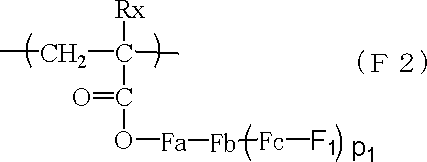
一般式(F2)中、
Rxは、水素原子、ハロゲン原子、又は炭素数1~4のアルキル基を表す。Rxのアルキル基が有していてもよい好ましい置換基としては、水酸基、ハロゲン原子が挙げられる。
Faは、単結合、直鎖又は分岐のアルキレン基(好ましくは単結合)を表す。
Fbは、単環又は多環の環状炭化水素基を表す。
Fcは、単結合、直鎖又は分岐のアルキレン基(好ましくは単結合、メチレン基)を表す。
F1は、一般式(F1)で表される基を表す。
P1は、1~3を表す。
Fbにおける環状炭化水素基としてはシクロペンチレン基、シクロヘキシレン基、ノルボルニレン基が好ましい。
Rxは、水素原子、ハロゲン原子、又は炭素数1~4のアルキル基を表す。Rxのアルキル基が有していてもよい好ましい置換基としては、水酸基、ハロゲン原子が挙げられる。
Faは、単結合、直鎖又は分岐のアルキレン基(好ましくは単結合)を表す。
Fbは、単環又は多環の環状炭化水素基を表す。
Fcは、単結合、直鎖又は分岐のアルキレン基(好ましくは単結合、メチレン基)を表す。
F1は、一般式(F1)で表される基を表す。
P1は、1~3を表す。
Fbにおける環状炭化水素基としてはシクロペンチレン基、シクロヘキシレン基、ノルボルニレン基が好ましい。
一般式(F1)で表される基を有する繰り返し単位の具体例を示すが、本発明は、これに限定されるものではない。
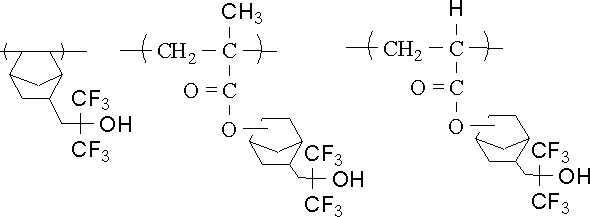
本発明の樹脂(P)は、更に脂環炭化水素構造を有し、酸分解性を示さない繰り返し単位を含有してもよい。これにより液浸露光時にレジスト膜から液浸液への低分子成分の溶出が低減できる。このような繰り返し単位として、例えば1-アダマンチル(メタ)アクリレート、トリシクロデカニル(メタ)アクリレート、シクロヘキシル(メタ)アクリレートなどが挙げられる。
本発明の樹脂(P)は、上記の繰り返し構造単位以外に、ドライエッチング耐性や標準現像液適性、基板密着性、レジストプロファイル、更にレジストの一般的な必要な特性である解像力、耐熱性、感度等を調節する目的で様々な繰り返し構造単位を含有することができる。
このような繰り返し構造単位としては、下記の単量体に相当する繰り返し構造単位を挙げることができるが、これらに限定されるものではない。
これにより、樹脂(P)に要求される性能、特に、(1)塗布溶剤に対する溶解性、(2)製膜性(ガラス転移温度)、(3)ポジ型現像液及び有機溶剤を含む現像液に対する溶解性、(4)膜べり(親疎水性、アルカリ可溶性基選択)、(5)未露光部の基板への密着性、(6)ドライエッチング耐性、等の微調整が可能となる。
このような単量体として、例えばアクリル酸エステル類、メタクリル酸エステル類、アクリルアミド類、メタクリルアミド類、アリル化合物、ビニルエーテル類、ビニルエステル類等から選ばれる付加重合性不飽和結合を1個有する化合物等を挙げることができる。
その他にも、上記種々の繰り返し構造単位に相当する単量体と共重合可能である付加重合性の不飽和化合物であれば、共重合されていてもよい。
樹脂(P)において、各繰り返し構造単位の含有モル比はレジストのドライエッチング耐性や標準現像液適性、基板密着性、レジストプロファイル、更にはレジストの一般的な必要性能である解像力、耐熱性、感度等を調節するために適宜設定される。
本発明の樹脂(P)の好ましい態様としては、以下のものが挙げられる。
(1) 上記一般式(pI)~(pV)で表される脂環式炭化水素を含む部分構造を有する繰り返し単位を含有するもの(側鎖型)。
好ましくは(pI)~(pV)の構造を有する(メタ)アクリレート繰り返し単位を含有するもの。
(2) 一般式(II-AB)で表される繰り返し単位を含有するもの(主鎖型)。
但し、(2)においては例えば、更に以下のものが挙げられる。
(3) 一般式(II-AB)で表される繰り返し単位、無水マレイン酸誘導体及び(メタ)アクリレート構造を有するもの(ハイブリッド型)。
(1) 上記一般式(pI)~(pV)で表される脂環式炭化水素を含む部分構造を有する繰り返し単位を含有するもの(側鎖型)。
好ましくは(pI)~(pV)の構造を有する(メタ)アクリレート繰り返し単位を含有するもの。
(2) 一般式(II-AB)で表される繰り返し単位を含有するもの(主鎖型)。
但し、(2)においては例えば、更に以下のものが挙げられる。
(3) 一般式(II-AB)で表される繰り返し単位、無水マレイン酸誘導体及び(メタ)アクリレート構造を有するもの(ハイブリッド型)。
樹脂(P)中、酸分解性基を有する繰り返し単位の含有量は、全繰り返し構造単位中10~60モル%が好ましく、より好ましくは20~50モル%、更に好ましくは25~40モル%である。
樹脂(P)中、一般式(pI)~(pV)で表される脂環式炭化水素を含む部分構造を有する繰り返し単位の含有量は、全繰り返し構造単位中20~70モル%が好ましく、より好ましくは20~50モル%、更に好ましくは25~40モル%である。
樹脂(P)中、一般式(II-AB)で表される繰り返し単位の含有量は、全繰り返し構造単位中10~60モル%が好ましく、より好ましくは15~55モル%、更に好ましくは20~50モル%である。
樹脂(P)中、ラクトン環を有する繰り返し単位の含有量は、全繰り返し構造単位中10~70モル%が好ましく、より好ましくは20~60モル%、更に好ましくは25~40モル%である。
樹脂(P)中、極性基を有する有機基を有する繰り返し単位の含有量は、全繰り返し構造単位中1~40モル%が好ましく、より好ましくは5~30モル%、更に好ましくは5~20モル%である。
樹脂(P)中、極性基を有する有機基を有する繰り返し単位の含有量は、全繰り返し構造単位中1~40モル%が好ましく、より好ましくは5~30モル%、更に好ましくは5~20モル%である。
また、上記更なる共重合成分の単量体に基づく繰り返し構造単位の樹脂中の含有量も、所望のレジストの性能に応じて適宜設定することができるが、一般的に、上記一般式(pI)~(pV)で表される脂環式炭化水素を含む部分構造を有する繰り返し構造単位と上記一般式(II-AB)で表される繰り返し単位の合計した総モル数に対して99モル%以下が好ましく、より好ましくは90モル%以下、更に好ましくは80モル%以下である。
本発明に用いる樹脂(P)として好ましくは、繰り返し単位のすべてが(メタ)アクリレート系繰り返し単位で構成されたものである。この場合、繰り返し単位のすべてがメタクリレート系繰り返し単位、繰り返し単位のすべてがアクリレート系繰り返し単位、繰り返し単位のすべてがメタクリレート系繰り返し単位/アクリレート系繰り返し単位の混合のいずれのものでも用いることができるが、アクリレート系繰り返し単位が全繰り返し単位の50mol%以下であることが好ましい。
樹脂(P)は、少なくとも、ラクトン環を有する(メタ)アクリレート系繰り返し単位、水酸基及びシアノ基の少なくともいずれかで置換された有機基を有する(メタ)アクリレート系繰り返し単位、並びに、酸分解性基を有する(メタ)アクリレート系繰り返し単位の3種類の繰り返し単位を有する共重合体であることが好ましい。
好ましくは一般式(pI)~(pV)で表される脂環式炭化水素を含む部分構造を有する繰り返し単位20~50モル%、ラクトン構造を有する繰り返し単位20~50モル%、極性基で置換された脂環炭化水素構造を有する繰り返し単位5~30%含有する3元共重合ポリマー、又は更にその他の繰り返し単位を0~20%含む4元共重合ポリマーである。
特に好ましい樹脂としては、下記一般式(ARA-1)~(ARA-7)で表される酸分解性基を有する繰り返し単位20~50モル%、下記一般式(ARL-1)~(ARL-7)で表されるラクトン基を有する繰り返し単位20~50モル%、下記一般式(ARH-1)~(ARH-3)で表される極性基で置換された脂環炭化水素構造を有する繰り返し単位5~30モル%含有する3元共重合ポリマー、又は更にカルボキシル基、あるいは一般式(F1)で表される構造を有する繰り返し単位、又は脂環炭化水素構造を有し酸分解性を示さない繰り返し単位を5~20モル%含む4元共重合ポリマーである。
(式中、Rxy1は、水素原子又はメチル基を表し、Rxa1及びRxb1は、各々独立に、メチル基又はエチル基を表し、Rxc1は、水素原子又はメチル基を表す。)

(式中、Rxy1は水素原子又はメチル基を、Rxd1は水素原子又はメチル基を、Rxe1はトリフルオロメチル基、水酸基、シアノ基を表す。)
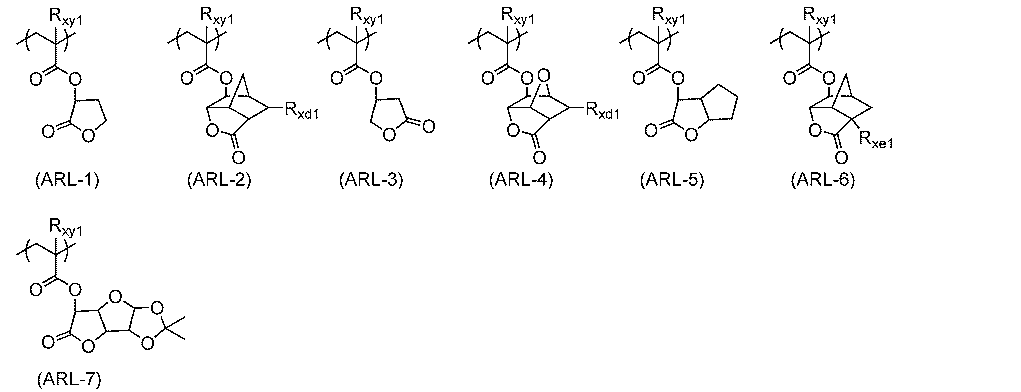
(式中、Rxy1は水素原子又はメチル基を表す。)
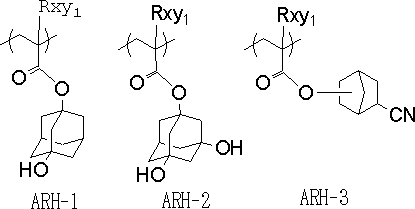
本発明に用いる樹脂(P)は、常法に従って(例えばラジカル重合)合成することができる。例えば、一般的合成方法としては、モノマー種及び開始剤を溶剤に溶解させ、加熱することにより重合を行う一括重合法、加熱溶剤にモノマー種と開始剤の溶液を1~10時間かけて滴下して加える滴下重合法などが挙げられ、滴下重合法が好ましい。反応溶媒としては、例えばテトラヒドロフラン、1,4-ジオキサン、ジイソプロピルエーテルなどのエーテル類やメチルエチルケトン、メチルイソブチルケトンのようなケトン類、酢酸エチルのようなエステル溶媒、ジメチルホルムアミド、ジメチルアセトアミドなどのアミド溶剤、更には後述のプロピレングリコールモノメチルエーテルアセテート、プロピレングリコールモノメチルエーテル、シクロヘキサノンのような本発明の組成物を溶解する溶媒が挙げられる。より好ましくは本発明のレジスト組成物に用いられる溶剤と同一の溶剤を用いて重合することが好ましい。これにより保存時のパーティクルの発生が抑制できる。
重合反応は窒素やアルゴンなど不活性ガス雰囲気下で行われることが好ましい。重合開始剤としては市販のラジカル開始剤(アゾ系開始剤、パーオキサイドなど)を用いて重合を開始させる。ラジカル開始剤としてはアゾ系開始剤が好ましく、エステル基、シアノ基、カルボキシル基を有するアゾ系開始剤が好ましい。好ましい開始剤としては、アゾビスイソブチロニトリル、アゾビスジメチルバレロニトリル、ジメチル2,2’-アゾビス(2-メチルプロピオネート)などが挙げられる。所望により開始剤を追加、あるいは分割で添加し、反応終了後、溶剤に投入して粉体あるいは固形回収等の方法で所望のポリマーを回収する。反応の濃度は5~50質量%であり、好ましくは10~30質量%である。反応温度は、通常10℃~150℃であり、好ましくは30℃~120℃、更に好ましくは60~100℃である。
精製は、水洗や適切な溶媒を組み合わせることにより残留単量体やオリゴマー成分を除去する液液抽出法、特定の分子量以下のもののみを抽出除去する限外ろ過等の溶液状態での精製方法や、樹脂溶液を貧溶媒へ滴下することで樹脂を貧溶媒中に凝固させることにより残留単量体等を除去する再沈殿法や、濾別した樹脂スラリーを貧溶媒で洗浄する等の固体状態での精製方法等の通常の方法を適用できる。
精製は、水洗や適切な溶媒を組み合わせることにより残留単量体やオリゴマー成分を除去する液液抽出法、特定の分子量以下のもののみを抽出除去する限外ろ過等の溶液状態での精製方法や、樹脂溶液を貧溶媒へ滴下することで樹脂を貧溶媒中に凝固させることにより残留単量体等を除去する再沈殿法や、濾別した樹脂スラリーを貧溶媒で洗浄する等の固体状態での精製方法等の通常の方法を適用できる。
本発明に係る樹脂の重量平均分子量は、GPC法によりポリスチレン換算値として、好ましくは1,000~200,000であり、更に好ましくは1,000~20,000、最も好ましくは1,000~15,000である。重量平均分子量を、1,000~200,000とすることにより、耐熱性やドライエッチング耐性の劣化を防ぐことができ、かつ現像性が劣化したり、粘度が高くなって製膜性が劣化することを防ぐことができる。
分散度(分子量分布)は、通常1~5であり、好ましくは1~3、更に好ましくは1.2~3.0、特に好ましくは1.2~2.0の範囲のものが使用される。分散度の小さいものほど、解像度、レジスト形状が優れ、かつレジストパターンの側壁がスムーズであり、ラフネス性に優れる。
分散度(分子量分布)は、通常1~5であり、好ましくは1~3、更に好ましくは1.2~3.0、特に好ましくは1.2~2.0の範囲のものが使用される。分散度の小さいものほど、解像度、レジスト形状が優れ、かつレジストパターンの側壁がスムーズであり、ラフネス性に優れる。
本発明の樹脂(P)は、1種類単独で、又は2種類以上を組み合わせて使用することができる。樹脂(P)の含有率は、本発明の感活性光線性又は感放射性樹脂組成物中の全固形分を基準にして、30~100質量%が好ましく、50~100質量%がより好ましく、70~100質量%が特に好ましい。
本発明の樹脂(P)、より好ましくは本発明の感活性光線性又は感放射性樹脂組成物中には、保護膜組成物との相溶性の観点から、フッ素原子及び珪素原子を含有しないことが好ましい。
〔2〕(B)活性光線又は放射線の照射により分解して酸を発生する化合物
本発明の感活性光線性又は感放射性樹脂組成物は、活性光線又は放射線の照射により分解して酸を発生する化合物(以下、「酸発生剤」ともいう)を含有する。
酸発生剤としては、公知のものであれば特に限定されないが、活性光線又は放射線の照射により、有機酸、例えば、スルホン酸、ビス(アルキルスルホニル)イミド、又はトリス(アルキルスルホニル)メチドの少なくともいずれかを発生する化合物が好ましい。
より好ましくは下記一般式(ZI)、(ZII)、(ZIII)で表される化合物を挙げることができる。
本発明の感活性光線性又は感放射性樹脂組成物は、活性光線又は放射線の照射により分解して酸を発生する化合物(以下、「酸発生剤」ともいう)を含有する。
酸発生剤としては、公知のものであれば特に限定されないが、活性光線又は放射線の照射により、有機酸、例えば、スルホン酸、ビス(アルキルスルホニル)イミド、又はトリス(アルキルスルホニル)メチドの少なくともいずれかを発生する化合物が好ましい。
より好ましくは下記一般式(ZI)、(ZII)、(ZIII)で表される化合物を挙げることができる。

上記一般式(ZI)において、
R201、R202及びR203は、各々独立に、有機基を表す。
R201、R202及びR203としての有機基の炭素数は、一般的に1~30、好ましくは1~20である。
また、R201~R203のうち2つが結合して環構造を形成してもよく、環内に酸素原子、硫黄原子、エステル結合、アミド結合、カルボニル基を含んでいてもよい。R201~R203の内の2つが結合して形成する基としては、アルキレン基(例えば、ブチレン基、ペンチレン基)を挙げることができる。
Z-は、非求核性アニオン(求核反応を起こす能力が著しく低いアニオン)を表す。
R201、R202及びR203は、各々独立に、有機基を表す。
R201、R202及びR203としての有機基の炭素数は、一般的に1~30、好ましくは1~20である。
また、R201~R203のうち2つが結合して環構造を形成してもよく、環内に酸素原子、硫黄原子、エステル結合、アミド結合、カルボニル基を含んでいてもよい。R201~R203の内の2つが結合して形成する基としては、アルキレン基(例えば、ブチレン基、ペンチレン基)を挙げることができる。
Z-は、非求核性アニオン(求核反応を起こす能力が著しく低いアニオン)を表す。
非求核性アニオンとしては、例えば、スルホン酸アニオン(脂肪族スルホン酸アニオン、芳香族スルホン酸アニオン、カンファースルホン酸アニオンなど)、カルボン酸アニオン(脂肪族カルボン酸アニオン、芳香族カルボン酸アニオン、アラルキルカルボン酸アニオンなど)、スルホニルイミドアニオン、ビス(アルキルスルホニル)イミドアニオン、トリス(アルキルスルホニル)メチドアニオン等を挙げられる。
脂肪族スルホン酸アニオン及び脂肪族カルボン酸アニオンにおける脂肪族部位は、アルキル基であってもシクロアルキル基であってもよく、好ましくは炭素数1~30の直鎖又は分岐のアルキル基及び炭素数3~30のシクロアルキル基が挙げられる。
芳香族スルホン酸アニオン及び芳香族カルボン酸アニオンにおける芳香族基としては、好ましくは炭素数6~14のアリール基、例えば、フェニル基、トリル基、ナフチル基等を挙げることができる。
上記で挙げたアルキル基、シクロアルキル基及びアリール基は、置換基を有していてもよい。この具体例としては、ニトロ基、フッ素原子などのハロゲン原子、カルボキシル基、水酸基、アミノ基、シアノ基、アルコキシ基(好ましくは炭素数1~15)、シクロアルキル基(好ましくは炭素数3~15)、アリール基(好ましくは炭素数6~14)、アルコキシカルボニル基(好ましくは炭素数2~7)、アシル基(好ましくは炭素数2~12)、アルコキシカルボニルオキシ基(好ましくは炭素数2~7)、アルキルチオ基(好ましくは炭素数1~15)、アルキルスルホニル基(好ましくは炭素数1~15)、アルキルイミノスルホニル基(好ましくは炭素数2~15)、アリールオキシスルホニル基(好ましくは炭素数6~20)、アルキルアリールオキシスルホニル基(好ましくは炭素数7~20)、シクロアルキルアリールオキシスルホニル基(好ましくは炭素数10~20)、アルキルオキシアルキルオキシ基(好ましくは炭素数5~20)、シクロアルキルアルキルオキシアルキルオキシ基(好ましくは炭素数8~20)等を挙げることができる。各基が有するアリール基及び環構造については、置換基として更にアルキル基(好ましくは炭素数1~15)を挙げることができる。
アラルキルカルボン酸アニオンにおけるアラルキル基としては、好ましくは炭素数6~12のアラルキル基、例えば、ベンジル基、フェネチル基、ナフチルメチル基、ナフチルエチル基、ナフチルブチル基等を挙げることができる。
スルホニルイミドアニオンとしては、例えば、サッカリンアニオンを挙げることができる。
ビス(アルキルスルホニル)イミドアニオン、トリス(アルキルスルホニル)メチドアニオンにおけるアルキル基は、炭素数1~5のアルキル基が好ましい。これらのアルキル基の置換基としてはハロゲン原子、ハロゲン原子で置換されたアルキル基、アルコキシ基、アルキルチオ基、アルキルオキシスルホニル基、アリールオキシスルホニル基、シクロアルキルアリールオキシスルホニル基等を挙げることができ、フッ素原子又はフッ素原子で置換されたアルキル基が好ましい。
また、ビス(アルキルスルホニル)イミドアニオンにおけるアルキル基は、互いに結合して環構造を形成してもよい。これにより、酸強度が増加する。
また、ビス(アルキルスルホニル)イミドアニオンにおけるアルキル基は、互いに結合して環構造を形成してもよい。これにより、酸強度が増加する。
その他の非求核性アニオンとしては、例えば、弗素化燐(例えば、PF6
-)、弗素化硼素(例えば、BF4
-)、弗素化アンチモン(例えば、SbF6
-)等を挙げることができる。
非求核性アニオンとしては、スルホン酸の少なくともα位がフッ素原子で置換された脂肪族スルホン酸アニオン、フッ素原子又はフッ素原子を有する基で置換された芳香族スルホン酸アニオン、アルキル基がフッ素原子で置換されたビス(アルキルスルホニル)イミドアニオン、アルキル基がフッ素原子で置換されたトリス(アルキルスルホニル)メチドアニオンが好ましい。非求核性アニオンとして、より好ましくはパーフロロ脂肪族スルホン酸アニオン(更に好ましくは炭素数4~8)、フッ素原子を有するベンゼンスルホン酸アニオン、更により好ましくはノナフロロブタンスルホン酸アニオン、パーフロロオクタンスルホン酸アニオン、ペンタフロロベンゼンスルホン酸アニオン、3,5-ビス(トリフロロメチル)ベンゼンスルホン酸アニオンである。
酸強度の観点からは、発生酸のpKaが-1以下であることが、感度向上のために好ましい。
また、非求核性アニオンとしては、以下の一般式(AN1)で表されるアニオンも好ましい態様として挙げられる。

式中、
Xfは、それぞれ独立に、フッ素原子、又は少なくとも1つのフッ素原子で置換されたアルキル基を表す。
R1、R2は、それぞれ独立に、水素原子、フッ素原子、又は、アルキル基を表し、複数存在する場合のR1、R2は、それぞれ同一でも異なっていてもよい。
Lは、二価の連結基を表し、複数存在する場合のLは同一でも異なっていてもよい。
Aは、環状の有機基を表す。
xは1~20の整数を表し、yは0~10の整数を表し、zは0~10の整数を表す。
Xfは、それぞれ独立に、フッ素原子、又は少なくとも1つのフッ素原子で置換されたアルキル基を表す。
R1、R2は、それぞれ独立に、水素原子、フッ素原子、又は、アルキル基を表し、複数存在する場合のR1、R2は、それぞれ同一でも異なっていてもよい。
Lは、二価の連結基を表し、複数存在する場合のLは同一でも異なっていてもよい。
Aは、環状の有機基を表す。
xは1~20の整数を表し、yは0~10の整数を表し、zは0~10の整数を表す。
一般式(AN1)について、更に詳細に説明する。
Xfのフッ素原子で置換されたアルキル基におけるアルキル基としては、好ましくは炭素数1~10であり、より好ましくは炭素数1~4である。また、Xfのフッ素原子で置換されたアルキル基は、パーフルオロアルキル基であることが好ましい。
Xfとして好ましくは、フッ素原子又は炭素数1~4のパーフルオロアルキル基である。Xfの具体的としては、フッ素原子、CF3、C2F5、C3F7、C4F9、CH2CF3、CH2CH2CF3、CH2C2F5、CH2CH2C2F5、CH2C3F7、CH2CH2C3F7、CH2C4F9、CH2CH2C4F9が挙げられ、中でもフッ素原子、CF3が好ましい。特に、双方のXfがフッ素原子であることが好ましい。
Xfのフッ素原子で置換されたアルキル基におけるアルキル基としては、好ましくは炭素数1~10であり、より好ましくは炭素数1~4である。また、Xfのフッ素原子で置換されたアルキル基は、パーフルオロアルキル基であることが好ましい。
Xfとして好ましくは、フッ素原子又は炭素数1~4のパーフルオロアルキル基である。Xfの具体的としては、フッ素原子、CF3、C2F5、C3F7、C4F9、CH2CF3、CH2CH2CF3、CH2C2F5、CH2CH2C2F5、CH2C3F7、CH2CH2C3F7、CH2C4F9、CH2CH2C4F9が挙げられ、中でもフッ素原子、CF3が好ましい。特に、双方のXfがフッ素原子であることが好ましい。
R1、R2のアルキル基は、置換基(好ましくはフッ素原子)を有していてもよく、炭素数1~4のものが好ましい。更に好ましくは炭素数1~4のパーフルオロアルキル基である。R1、R2の置換基を有するアルキル基の具体例としては、CF3、C2F5、C3F7、C4F9、C5F11、C6F13、C7F15、C8F17、CH2CF3、CH2CH2CF3、CH2C2F5、CH2CH2C2F5、CH2C3F7、CH2CH2C3F7、CH2C4F9、CH2CH2C4F9が挙げられ、中でもCF3が好ましい。
R1、R2としては、好ましくはフッ素原子又はCF3である。
R1、R2としては、好ましくはフッ素原子又はCF3である。
xは1~10が好ましく、1~5がより好ましい。
yは0~4が好ましく、0がより好ましい。
zは0~5が好ましく、0~3がより好ましい。
Lの2価の連結基としては特に限定されず、―COO-、-OCO-、-CO-、-O-、-S―、-SO―、―SO2-、アルキレン基、シクロアルキレン基、アルケニレン基又はこれらの複数が連結した連結基などを挙げることができ、総炭素数12以下の連結基が好ましい。このなかでも―COO-、-OCO-、-CO-、-O-が好ましく、―COO-、-OCO-がより好ましい。
yは0~4が好ましく、0がより好ましい。
zは0~5が好ましく、0~3がより好ましい。
Lの2価の連結基としては特に限定されず、―COO-、-OCO-、-CO-、-O-、-S―、-SO―、―SO2-、アルキレン基、シクロアルキレン基、アルケニレン基又はこれらの複数が連結した連結基などを挙げることができ、総炭素数12以下の連結基が好ましい。このなかでも―COO-、-OCO-、-CO-、-O-が好ましく、―COO-、-OCO-がより好ましい。
Aの環状の有機基としては、環状構造を有するものであれば特に限定されず、脂環基、アリール基、複素環基(芳香族性を有するものだけでなく、芳香族性を有さないものも含む)等が挙げられる。
脂環基としては、単環でも多環でもよく、シクロペンチル基、シクロヘキシル基、シクロオクチル基などの単環のシクロアルキル基、ノルボルニル基、トリシクロデカニル基、テトラシクロデカニル基、テトラシクロドデカニル基、アダマンチル基などの多環のシクロアルキル基が好ましい。中でも、ノルボルニル基、トリシクロデカニル基、テトラシクロデカニル基、テトラシクロドデカニル基、アダマンチル基等の炭素数7以上のかさ高い構造を有する脂環基が、露光後加熱工程での膜中拡散性を抑制でき、MEEF向上の観点から好ましい。
アリール基としては、ベンゼン環、ナフタレン環、フェナンスレン環、アントラセン環が挙げられる。
複素環基としては、フラン環、チオフェン環、ベンゾフラン環、ベンゾチオフェン環、ジベンゾフラン環、ジベンゾチオフェン環、ピリジン環由来のものが挙げられる。中でもフラン環、チオフェン環、ピリジン環由来のものが好ましい。
脂環基としては、単環でも多環でもよく、シクロペンチル基、シクロヘキシル基、シクロオクチル基などの単環のシクロアルキル基、ノルボルニル基、トリシクロデカニル基、テトラシクロデカニル基、テトラシクロドデカニル基、アダマンチル基などの多環のシクロアルキル基が好ましい。中でも、ノルボルニル基、トリシクロデカニル基、テトラシクロデカニル基、テトラシクロドデカニル基、アダマンチル基等の炭素数7以上のかさ高い構造を有する脂環基が、露光後加熱工程での膜中拡散性を抑制でき、MEEF向上の観点から好ましい。
アリール基としては、ベンゼン環、ナフタレン環、フェナンスレン環、アントラセン環が挙げられる。
複素環基としては、フラン環、チオフェン環、ベンゾフラン環、ベンゾチオフェン環、ジベンゾフラン環、ジベンゾチオフェン環、ピリジン環由来のものが挙げられる。中でもフラン環、チオフェン環、ピリジン環由来のものが好ましい。
また、環状の有機基としては、ラクトン構造も挙げることができ、具体例としては、前述の樹脂(A)が有していてもよい一般式(LC1-1)~(LC1-17)で表されるラクトン構造を挙げることができる。
上記環状の有機基は、置換基を有していてもよく、該置換基としては、アルキル基(直鎖、分岐、環状のいずれであっても良く、炭素数1~12が好ましい)、シクロアルキル基(単環、多環、スピロ環のいずれであっても良く、炭素数3~20が好ましい)、アリール基(炭素数6~14が好ましい)、ヒドロキシ基、アルコキシ基、エステル基、アミド基、ウレタン基、ウレイド基、チオエーテル基、スルホンアミド基、スルホン酸エステル基等が挙げられる。なお、環状の有機基を構成する炭素(環形成に寄与する炭素)はカルボニル炭素であっても良い。
R201、R202及びR203の有機基としては、アリール基、アルキル基、シクロアルキル基などが挙げられる。
R201、R202及びR203のうち、少なくとも1つがアリール基であることが好ましく、三つ全てがアリール基であることがより好ましい。アリール基としては、フェニル基、ナフチル基などの他に、インドール残基、ピロール残基などのヘテロアリール基も可能である。R201~R203のアルキル基及びシクロアルキル基としては、好ましくは、炭素数1~10の直鎖又は分岐アルキル基、炭素数3~10のシクロアルキル基を挙げることができる。アルキル基として、より好ましくはメチル基、エチル基、n-プロピル基、i-プロピル基、n-ブチル基等を挙げることができる。シクロアルキル基として、より好ましくは、シクロプロピル基、シクロブチル基、シクロペンチル基、シクロヘキシル基、シクロへプチル基等を挙げることができる。これらの基は更に置換基を有していてもよい。その置換基としては、ニトロ基、フッ素原子などのハロゲン原子、カルボキシル基、水酸基、アミノ基、シアノ基、アルコキシ基(好ましくは炭素数1~15)、シクロアルキル基(好ましくは炭素数3~15)、アリール基(好ましくは炭素数6~14)、アルコキシカルボニル基(好ましくは炭素数2~7)、アシル基(好ましくは炭素数2~12)、アルコキシカルボニルオキシ基(好ましくは炭素数2~7)等が挙げられるが、これらに限定されるものではない。
R201、R202及びR203のうち、少なくとも1つがアリール基であることが好ましく、三つ全てがアリール基であることがより好ましい。アリール基としては、フェニル基、ナフチル基などの他に、インドール残基、ピロール残基などのヘテロアリール基も可能である。R201~R203のアルキル基及びシクロアルキル基としては、好ましくは、炭素数1~10の直鎖又は分岐アルキル基、炭素数3~10のシクロアルキル基を挙げることができる。アルキル基として、より好ましくはメチル基、エチル基、n-プロピル基、i-プロピル基、n-ブチル基等を挙げることができる。シクロアルキル基として、より好ましくは、シクロプロピル基、シクロブチル基、シクロペンチル基、シクロヘキシル基、シクロへプチル基等を挙げることができる。これらの基は更に置換基を有していてもよい。その置換基としては、ニトロ基、フッ素原子などのハロゲン原子、カルボキシル基、水酸基、アミノ基、シアノ基、アルコキシ基(好ましくは炭素数1~15)、シクロアルキル基(好ましくは炭素数3~15)、アリール基(好ましくは炭素数6~14)、アルコキシカルボニル基(好ましくは炭素数2~7)、アシル基(好ましくは炭素数2~12)、アルコキシカルボニルオキシ基(好ましくは炭素数2~7)等が挙げられるが、これらに限定されるものではない。
また、R201~R203のうち2つが結合して環構造を形成する場合、以下の一般式(A1)で表される構造であることが好ましい。
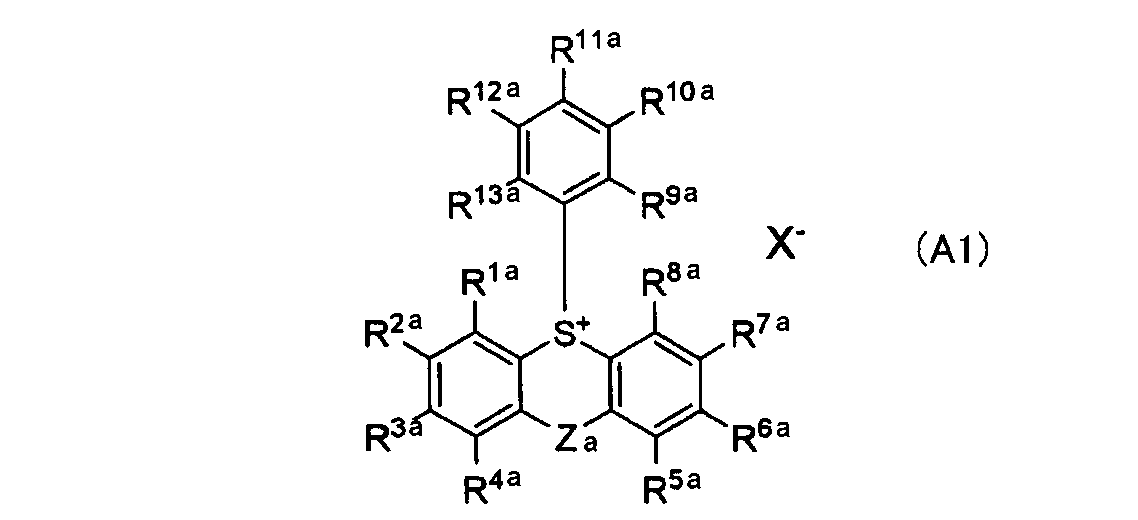
一般式(A1)中、
R1a~R13aは、各々独立に、水素原子又は置換基を表す。
R1a~R13aのうち、1~3つが水素原子でないことが好ましく、R9a~R13aのいずれか1つが水素原子でないことがより好ましい。
Zaは、単結合又は2価の連結基である。
X-は、一般式(ZI)におけるZ-と同義である。
R1a~R13aは、各々独立に、水素原子又は置換基を表す。
R1a~R13aのうち、1~3つが水素原子でないことが好ましく、R9a~R13aのいずれか1つが水素原子でないことがより好ましい。
Zaは、単結合又は2価の連結基である。
X-は、一般式(ZI)におけるZ-と同義である。
R1a~R13aが水素原子でない場合の具体例としては、ハロゲン原子、直鎖、分岐、環状のアルキル基、アルケニル基、アルキニル基、アリール基、複素環基、シアノ基、ニトロ基、カルボキシル基、アルコキシ基、アリールオキシ基、シリルオキシ基、ヘテロ環オキシ基、アシルオキシ基、カルバモイルオキシ基、アルコキシカルボニルオキシ基、アリールオキシカルボニルオキシ基、アミノ基(アニリノ基を含む)、アンモニオ基、アシルアミノ基、アミノカルボニルアミノ基、アルコキシカルボニルアミノ基、アリールオキシカルボニルアミノ基、スルファモイルアミノ基、アルキル及びアリールスルホニルアミノ基、メルカプト基、アルキルチオ基、アリールチオ基、ヘテロ環チオ基、スルファモイル基、スルホ基、アルキル及びアリールスルフィニル基、アルキル及びアリールスルホニル基、アシル基、アリールオキシカルボニル基、アルコキシカルボニル基、カルバモイル基、アリール及びヘテロ環アゾ基、イミド基、ホスフィノ基、ホスフィニル基、ホスフィニルオキシ基、ホスフィニルアミノ基、ホスホノ基、シリル基、ヒドラジノ基、ウレイド基、ボロン酸基(-B(OH)2)、ホスファト基(-OPO(OH)2)、スルファト基(-OSO3H)、その他の公知の置換基が例として挙げられる。
R1a~R13aが水素原子でない場合としては、水酸基で置換された直鎖、分岐、環状のアルキル基であることが好ましい。
R1a~R13aが水素原子でない場合としては、水酸基で置換された直鎖、分岐、環状のアルキル基であることが好ましい。
Zaの2価の連結基としては、アルキレン基、アリーレン基、カルボニル基、スルホニル基、カルボニルオキシ基、カルボニルアミノ基、スルホニルアミド基、エーテル結合、チオエーテル結合、アミノ基、ジスルフィド基、-(CH2)n-CO-、-(CH2)n-SO2-、-CH=CH-、アミノカルボニルアミノ基、アミノスルホニルアミノ基等が挙げられる(nは1~3の整数)。
なお、R201、R202及びR203のうち、少なくとも1つがアリール基でない場合の好ましい構造としては、特開2004-233661号公報の段落0047,0048、特開2003-35948号公報の段落0040~0046、米国特許出願公開第2003/0224288A1号明細書に式(I-1)~(I-70)として例示されている化合物、米国特許出願公開第2003/0077540A1号明細書に式(IA-1)~(IA-54)、式(IB-1)~(IB-24)として例示されている化合物等のカチオン構造を挙げることができる。
一般式(ZII)、(ZIII)中、
R204~R207は、各々独立に、アリール基、アルキル基又はシクロアルキル基を表す。
R204~R207は、各々独立に、アリール基、アルキル基又はシクロアルキル基を表す。
R204~R207のアリール基、アルキル基、シクロアルキル基としては、前述の化合物(ZI)におけるR201~R203のアリール基、アルキル基、シクロアルキル基として説明したアリール基と同様である。
R204~R207のアリール基、アルキル基、シクロアルキル基は、置換基を有していてもよい。この置換基としても、前述の化合物(ZI)におけるR201~R203のアリール基、アルキル基、シクロアルキル基が有していてもよいものが挙げられる。
R204~R207のアリール基、アルキル基、シクロアルキル基は、置換基を有していてもよい。この置換基としても、前述の化合物(ZI)におけるR201~R203のアリール基、アルキル基、シクロアルキル基が有していてもよいものが挙げられる。
Z-は、非求核性アニオンを表し、一般式(ZI)に於けるZ-の非求核性アニオンと同様のものを挙げることができる。
酸発生剤として、更に、下記一般式(ZIV)、(ZV)、(ZVI)で表される化合物も挙げられる。

一般式(ZIV)~(ZVI)中、
Ar3及びAr4は、各々独立に、アリール基を表す。
R208、R209及びR210は、各々独立に、アルキル基、シクロアルキル基又はアリール基を表す。
Aは、アルキレン基、アルケニレン基又はアリーレン基を表す。
Ar3、Ar4、R208、R209及びR210のアリール基の具体例としては、上記一般式(ZI)におけるR201、R202及びR203としてのアリール基の具体例と同様のものを挙げることができる。
R208、R209及びR210のアルキル基及びシクロアルキル基の具体例としては、それぞれ、上記一般式(ZI)におけるR201、R202及びR203としてのアルキル基及びシクロアルキル基の具体例と同様のものを挙げることができる。
Aのアルキレン基としては、炭素数1~12のアルキレン基(例えば、メチレン基、エチレン基、プロピレン基、イソプロピレン基、ブチレン基、イソブチレン基など)を、Aのアルケニレン基としては、炭素数2~12のアルケニレン基(例えば、エテニレン基、プロペニレン基、ブテニレン基など)を、Aのアリーレン基としては、炭素数6~10のアリーレン基(例えば、フェニレン基、トリレン基、ナフチレン基など)を、それぞれ挙げることができる。
本発明に用いられる酸発生剤として、酸の作用により分解して有機溶剤を含む現像液に対する溶解度が減少する基を置換基として有する化合物も好ましく用いることができる。
前記酸の作用により分解して有機溶剤を含む現像液に対する溶解度が減少する基の具体例及び好ましい例としては、樹脂(A)における酸分解性基として前述した具体例及び好ましい例と同様のものが挙げられる。
そのような酸発生剤の例としては、特開2005-97254号公報、特開2007-199692号公報などに記載の化合物が挙げられる。
Ar3及びAr4は、各々独立に、アリール基を表す。
R208、R209及びR210は、各々独立に、アルキル基、シクロアルキル基又はアリール基を表す。
Aは、アルキレン基、アルケニレン基又はアリーレン基を表す。
Ar3、Ar4、R208、R209及びR210のアリール基の具体例としては、上記一般式(ZI)におけるR201、R202及びR203としてのアリール基の具体例と同様のものを挙げることができる。
R208、R209及びR210のアルキル基及びシクロアルキル基の具体例としては、それぞれ、上記一般式(ZI)におけるR201、R202及びR203としてのアルキル基及びシクロアルキル基の具体例と同様のものを挙げることができる。
Aのアルキレン基としては、炭素数1~12のアルキレン基(例えば、メチレン基、エチレン基、プロピレン基、イソプロピレン基、ブチレン基、イソブチレン基など)を、Aのアルケニレン基としては、炭素数2~12のアルケニレン基(例えば、エテニレン基、プロペニレン基、ブテニレン基など)を、Aのアリーレン基としては、炭素数6~10のアリーレン基(例えば、フェニレン基、トリレン基、ナフチレン基など)を、それぞれ挙げることができる。
本発明に用いられる酸発生剤として、酸の作用により分解して有機溶剤を含む現像液に対する溶解度が減少する基を置換基として有する化合物も好ましく用いることができる。
前記酸の作用により分解して有機溶剤を含む現像液に対する溶解度が減少する基の具体例及び好ましい例としては、樹脂(A)における酸分解性基として前述した具体例及び好ましい例と同様のものが挙げられる。
そのような酸発生剤の例としては、特開2005-97254号公報、特開2007-199692号公報などに記載の化合物が挙げられる。
酸発生剤の中で、特に好ましい例を以下に挙げる。


酸発生剤は、1種類単独で又は2種類以上を組み合わせて使用することができる。
酸発生剤の組成物中の含有量は、組成物の全固形分を基準として、0.1~70質量%であることが好ましく、0.5~60質量%であることがより好ましく、1.0~60質量%であることが更に好ましい。前記含有量が少なすぎると、高感度と高LWR性能を発現することが難しくなる。前記含有量が多すぎると、高解像度と高LWR性能を発現することが難しくなる。
酸発生剤の組成物中の含有量は、組成物の全固形分を基準として、0.1~70質量%であることが好ましく、0.5~60質量%であることがより好ましく、1.0~60質量%であることが更に好ましい。前記含有量が少なすぎると、高感度と高LWR性能を発現することが難しくなる。前記含有量が多すぎると、高解像度と高LWR性能を発現することが難しくなる。
〔3〕塩基性化合物
本発明に係る感活性光線性又は感放射線性樹脂組成物は、塩基性化合物(D)を更に含むことが好ましい。塩基性化合物(D)は、好ましくは、フェノールと比較して塩基性がより強い化合物である。また、この塩基性化合物は、有機塩基性化合物であることが好ましく、含窒素塩基性化合物であることが更に好ましい。
本発明に係る感活性光線性又は感放射線性樹脂組成物は、塩基性化合物(D)を更に含むことが好ましい。塩基性化合物(D)は、好ましくは、フェノールと比較して塩基性がより強い化合物である。また、この塩基性化合物は、有機塩基性化合物であることが好ましく、含窒素塩基性化合物であることが更に好ましい。
使用可能な含窒素塩基性化合物は特に限定されないが、例えば、以下の(1)~(7)に分類される化合物を用いることができる。
(1)一般式(BS-1)により表される化合物
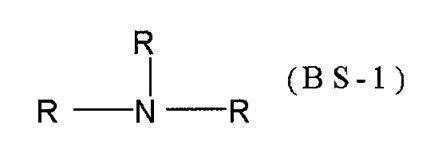
一般式(BS-1)中、
Rは、各々独立に、水素原子又は有機基を表す。但し、3つのRのうち少なくとも1つは有機基である。この有機基は、直鎖若しくは分岐鎖のアルキル基、単環若しくは多環のシクロアルキル基、アリール基又はアラルキル基である。
Rは、各々独立に、水素原子又は有機基を表す。但し、3つのRのうち少なくとも1つは有機基である。この有機基は、直鎖若しくは分岐鎖のアルキル基、単環若しくは多環のシクロアルキル基、アリール基又はアラルキル基である。
Rとしてのアルキル基の炭素数は、特に限定されないが、通常1~20であり、好ましくは1~12である。
Rとしてのシクロアルキル基の炭素数は、特に限定されないが、通常3~20であり、好ましくは5~15である。
Rとしてのシクロアルキル基の炭素数は、特に限定されないが、通常3~20であり、好ましくは5~15である。
Rとしてのアリール基の炭素数は、特に限定されないが、通常6~20であり、好ましくは6~10である。具体的には、フェニル基及びナフチル基等が挙げられる。
Rとしてのアラルキル基の炭素数は、特に限定されないが、通常7~20であり、好ましくは7~11である。具体的には、ベンジル基等が挙げられる。
Rとしてのアラルキル基の炭素数は、特に限定されないが、通常7~20であり、好ましくは7~11である。具体的には、ベンジル基等が挙げられる。
Rとしてのアルキル基、シクロアルキル基、アリール基及びアラルキル基は、水素原子が置換基により置換されていてもよい。この置換基としては、例えば、アルキル基、シクロアルキル基、アリール基、アラルキル基、ヒドロキシ基、カルボキシ基、アルコキシ基、アリールオキシ基、アルキルカルボニルオキシ基及びアルキルオキシカルボニル基等が挙げられる。
なお、一般式(BS-1)により表される化合物では、Rのうち少なくとも2つが有機基であることが好ましい。
一般式(BS-1)により表される化合物の具体例としては、トリ-n-ブチルアミン、トリ-n-ペンチルアミン、トリ-n-オクチルアミン、トリ-n-デシルアミン、トリイソデシルアミン、ジシクロヘキシルメチルアミン、テトラデシルアミン、ペンタデシルアミン、ヘキサデシルアミン、オクタデシルアミン、ジデシルアミン、メチルオクタデシルアミン、ジメチルウンデシルアミン、N,N-ジメチルドデシルアミン、メチルジオクタデシルアミン、N,N-ジブチルアニリン、N,N-ジヘキシルアニリン、2,6-ジイソプロピルアニリン、及び2,4,6-トリ(t-ブチル)アニリンが挙げられる。
また、一般式(BS-1)により表される好ましい塩基性化合物として、少なくとも1つのRがヒドロキシ基で置換されたアルキル基であるものが挙げられる。具体的には、例えば、トリエタノールアミン及びN,N-ジヒドロキシエチルアニリンが挙げられる。
なお、Rとしてのアルキル基は、アルキル鎖中に酸素原子を有していてもよい。即ち、オキシアルキレン鎖が形成されていてもよい。オキシアルキレン鎖としては、-CH2CH2O-が好ましい。具体的には、例えば、トリス(メトキシエトキシエチル)アミン、及び、US6040112号明細書のカラム3の60行目以降に例示されている化合物が挙げられる。
一般式(BS-1)で表される塩基性化合物のうち、そのようなヒドロキシル基や酸素原子等を有するものの例としては、例えば、以下のものが挙げられる。
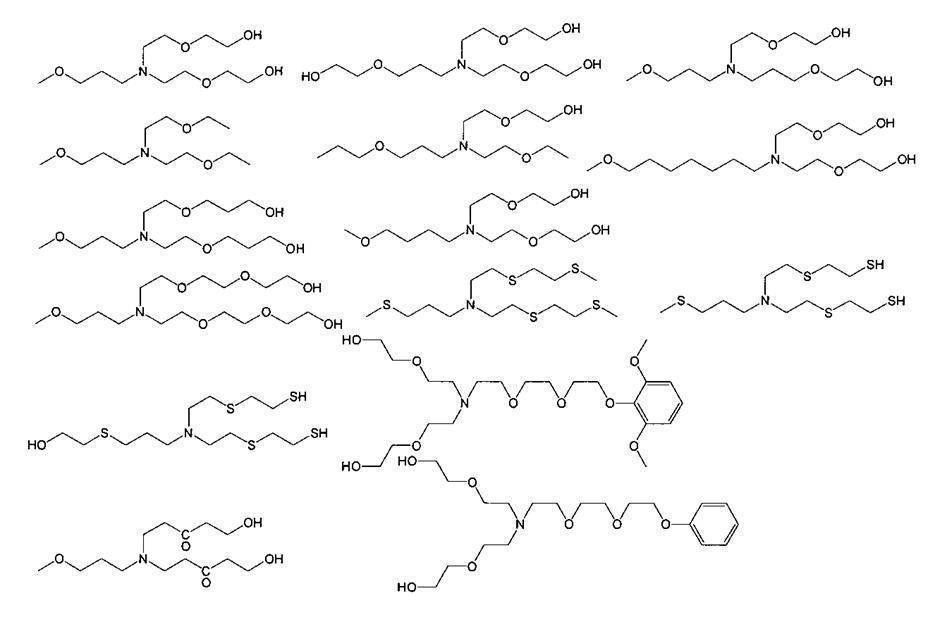
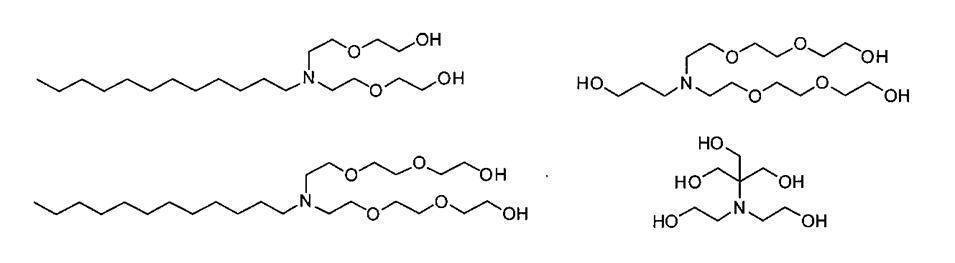
(2)含窒素複素環構造を有する化合物
この含窒素複素環は、芳香族性を有していてもよく、芳香族性を有していなくてもよい。また、窒素原子を複数有していてもよい。更に、窒素以外のヘテロ原子を含有していてもよい。具体的には、例えば、イミダゾール構造を有する化合物(2-フェニルベンゾイミダゾール、2,4,5-トリフェニルイミダゾールなど)、ピペリジン構造を有する化合物〔N-ヒドロキシエチルピペリジン及びビス(1,2,2,6,6-ペンタメチル-4-ピペリジル)セバケートなど〕、ピリジン構造を有する化合物(4-ジメチルアミノピリジンなど)、並びにアンチピリン構造を有する化合物(アンチピリン及びヒドロキシアンチピリンなど)が挙げられる。
この含窒素複素環は、芳香族性を有していてもよく、芳香族性を有していなくてもよい。また、窒素原子を複数有していてもよい。更に、窒素以外のヘテロ原子を含有していてもよい。具体的には、例えば、イミダゾール構造を有する化合物(2-フェニルベンゾイミダゾール、2,4,5-トリフェニルイミダゾールなど)、ピペリジン構造を有する化合物〔N-ヒドロキシエチルピペリジン及びビス(1,2,2,6,6-ペンタメチル-4-ピペリジル)セバケートなど〕、ピリジン構造を有する化合物(4-ジメチルアミノピリジンなど)、並びにアンチピリン構造を有する化合物(アンチピリン及びヒドロキシアンチピリンなど)が挙げられる。
好ましい含窒素複素環構造を有する化合物の例としては、例えば、グアニジン、アミノピリジン、アミノアルキルピリジン、アミノピロリジン、インダゾール、イミダゾール、ピラゾール、ピラジン、ピリミジン、プリン、イミダゾリン、ピラゾリン、ピペラジン、アミノモルフォリン及びアミノアルキルモルフォリンが挙げられる。これらは、置換基を更に有していてもよい。
好ましい置換基としては、例えば、アミノ基、アミノアルキル基、アルキルアミノ基、アミノアリール基、アリールアミノ基、アルキル基、アルコキシ基、アシル基、アシロキシ基、アリール基、アリールオキシ基、ニトロ基、水酸基及びシアノ基が挙げられる。
特に好ましい塩基性化合物としては、例えば、イミダゾール、2-メチルイミダゾール、4-メチルイミダゾール、N-メチルイミダゾール、2-フェニルイミダゾール、4,5-ジフェニルイミダゾール、2,4,5-トリフェニルイミダゾール、2-アミノピリジン、3-アミノピリジン、4-アミノピリジン、2-ジメチルアミノピリジン、4-ジメチルアミノピリジン、2-ジエチルアミノピリジン、2-(アミノメチル)ピリジン、2-アミノ-3-メチルピリジン、2-アミノ-4-メチルピリジン、2-アミノ5-メチルピリジン、2-アミノ-6-メチルピリジン、3-アミノエチルピリジン、4-アミノエチルピリジン、3-アミノピロリジン、ピペラジン、N-(2-アミノエチル)ピペラジン、N-(2-アミノエチル)ピペリジン、4-アミノ-2,2,6,6テトラメチルピペリジン、4-ピペリジノピペリジン、2-イミノピペリジン、1-(2-アミノエチル)ピロリジン、ピラゾール、3-アミノ-5-メチルピラゾール、5-アミノ-3-メチル-1-p-トリルピラゾール、ピラジン、2-(アミノメチル)-5メチルピラジン、ピリミジン、2,4-ジアミノピリミジン、4,6-ジヒドロキシピリミジン、2-ピラゾリン、3-ピラゾリン、N-アミノモルフォリン及びN-(2-アミノエチル)モルフォリンが挙げられる。
また、環構造を2つ以上有する化合物も好適に用いられる。具体的には、例えば、1,5-ジアザビシクロ[4.3.0]ノナ-5-エン及び1,8-ジアザビシクロ〔5.4.0〕-ウンデカ-7-エンが挙げられる。
(3)フェノキシ基を有するアミン化合物
フェノキシ基を有するアミン化合物とは、アミン化合物が含んでいるアルキル基のN原子と反対側の末端にフェノキシ基を備えた化合物である。フェノキシ基は、例えば、アルキル基、アルコキシ基、ハロゲン原子、シアノ基、ニトロ基、カルボキシ基、カルボン酸エステル基、スルホン酸エステル基、アリール基、アラルキル基、アシロキシ基及びアリールオキシ基等の置換基を有していてもよい。
フェノキシ基を有するアミン化合物とは、アミン化合物が含んでいるアルキル基のN原子と反対側の末端にフェノキシ基を備えた化合物である。フェノキシ基は、例えば、アルキル基、アルコキシ基、ハロゲン原子、シアノ基、ニトロ基、カルボキシ基、カルボン酸エステル基、スルホン酸エステル基、アリール基、アラルキル基、アシロキシ基及びアリールオキシ基等の置換基を有していてもよい。
この化合物は、より好ましくは、フェノキシ基と窒素原子との間に、少なくとも1つのオキシアルキレン鎖を有している。1分子中のオキシアルキレン鎖の数は、好ましくは3~9個、更に好ましくは4~6個である。オキシアルキレン鎖の中でも-CH2CH2O-が特に好ましい。
具体例としては、2-[2-{2―(2,2―ジメトキシ-フェノキシエトキシ)エチル}-ビス-(2-メトキシエチル)]-アミン、及び、US2007/0224539A1号明細書の段落[0066]に例示されている化合物(C1-1)~(C3-3)が挙げられる。
フェノキシ基を有するアミン化合物は、例えば、フェノキシ基を有する1級又は2級アミンとハロアルキルエーテルとを加熱して反応させ、水酸化ナトリウム、水酸化カリウム及びテトラアルキルアンモニウム等の強塩基の水溶液を添加した後、酢酸エチル及びクロロホルム等の有機溶剤で抽出することにより得られる。また、フェノキシ基を有するアミン化合物は、1級又は2級アミンと、末端にフェノキシ基を有するハロアルキルエーテルとを加熱して反応させ、水酸化ナトリウム、水酸化カリウム及びテトラアルキルアンモニウム等の強塩基の水溶液を添加した後、酢酸エチル及びクロロホルム等の有機溶剤で抽出することによって得ることもできる。
(4)アンモニウム塩
塩基性化合物として、アンモニウム塩も適宜用いることができる。
アンモニウム塩のカチオンとしては、炭素数1~18のアルキル基が置換したテトラアルキルアンモニウムカチオンが好ましく、テトラメチルアンモニウムカチオン、テトラエチルアンモニウムカチオン、テトラ(n-ブチル)アンモニウムカチオン、テトラ(n-ヘプチル)アンモニウムカチオン、テトラ(n-オクチル)アンモニウムカチオン、ジメチルヘキサデシルアンモニウムカチオン、ベンジルトリメチルカチオン等がより好ましく、テトラ(n-ブチル)アンモニウムカチオンがもっとも好ましい。
アンモニウム塩のアニオンとしては、例えば、ヒドロキシド、カルボキシレート、ハライド、スルホネート、ボレート及びフォスフェートが挙げられる。これらのうち、ヒドロキシド又はカルボキシレートが特に好ましい。
塩基性化合物として、アンモニウム塩も適宜用いることができる。
アンモニウム塩のカチオンとしては、炭素数1~18のアルキル基が置換したテトラアルキルアンモニウムカチオンが好ましく、テトラメチルアンモニウムカチオン、テトラエチルアンモニウムカチオン、テトラ(n-ブチル)アンモニウムカチオン、テトラ(n-ヘプチル)アンモニウムカチオン、テトラ(n-オクチル)アンモニウムカチオン、ジメチルヘキサデシルアンモニウムカチオン、ベンジルトリメチルカチオン等がより好ましく、テトラ(n-ブチル)アンモニウムカチオンがもっとも好ましい。
アンモニウム塩のアニオンとしては、例えば、ヒドロキシド、カルボキシレート、ハライド、スルホネート、ボレート及びフォスフェートが挙げられる。これらのうち、ヒドロキシド又はカルボキシレートが特に好ましい。
ハライドとしては、クロライド、ブロマイド及びアイオダイドが特に好ましい。
スルホネートとしては、炭素数1~20の有機スルホネートが特に好ましい。有機スルホネートとしては、例えば、炭素数1~20のアルキルスルホネート及びアリールスルホネートが挙げられる。
スルホネートとしては、炭素数1~20の有機スルホネートが特に好ましい。有機スルホネートとしては、例えば、炭素数1~20のアルキルスルホネート及びアリールスルホネートが挙げられる。
アルキルスルホネートに含まれるアルキル基は、置換基を有していてもよい。この置換基としては、例えば、フッ素原子、塩素原子、臭素原子、アルコキシ基、アシル基及びアリール基が挙げられる。アルキルスルホネートとして、具体的には、メタンスルホネート、エタンスルホネート、ブタンスルホネート、ヘキサンスルホネート、オクタンスルホネート、ベンジルスルホネート、トリフルオロメタンスルホネート、ペンタフルオロエタンスルホネート及びノナフルオロブタンスルホネートが挙げられる。
アリールスルホネートに含まれるアリール基としては、例えば、フェニル基、ナフチル基及びアントリル基が挙げられる。これらアリール基は、置換基を有していてもよい。この置換基としては、例えば、炭素数1~6の直鎖若しくは分岐鎖アルキル基及び炭素数3~6のシクロアルキル基が好ましい。具体的には、例えば、メチル、エチル、n-プロピル、イソプロピル、n-ブチル、i-ブチル、t-ブチル、n-ヘキシル及びシクロヘキシル基が好ましい。他の置換基としては、炭素数1~6のアルコキシ基、ハロゲン原子、シアノ、ニトロ、アシル基及びアシロキシ基が挙げられる。
カルボキシレートとしては、脂肪族カルボキシレートでも芳香族カルボキシレートでも良く、アセテート、ラクテート、ビルベート、トリフルオロアセテート、アダマンタンカルボキシレート、ヒドロキシアダマンタンカルボキシレート、ベンゾエート、ナフトエート、サリチレート、フタレート、フェノレート等が挙げられ、特にベンゾエート、ナフトエート、フェノレート等が好ましく、ベンゾエートが最も好ましい。
この場合、アンモニウム塩としては、テトラ(n-ブチル)アンモニウムベンゾエート、テトラ(n-ブチル)アンモニウムフェノレート等が好ましい。
ヒドロキシドの場合、このアンモニウム塩は、炭素数1~8のテトラアルキルアンモニウムヒドロキシド(テトラメチルアンモニウムヒドロキシド及びテトラエチルアンモニウムヒドロキシド、テトラ-(n-ブチル)アンモニウムヒドロキシド等のテトラアルキルアンモニウムヒドロキシドであることが特に好ましい。
この場合、アンモニウム塩としては、テトラ(n-ブチル)アンモニウムベンゾエート、テトラ(n-ブチル)アンモニウムフェノレート等が好ましい。
ヒドロキシドの場合、このアンモニウム塩は、炭素数1~8のテトラアルキルアンモニウムヒドロキシド(テトラメチルアンモニウムヒドロキシド及びテトラエチルアンモニウムヒドロキシド、テトラ-(n-ブチル)アンモニウムヒドロキシド等のテトラアルキルアンモニウムヒドロキシドであることが特に好ましい。
(5)プロトンアクセプター性官能基を有し、かつ、活性光線又は放射線の照射により分解してプロトンアクセプター性が低下、消失、又はプロトンアクセプター性から酸性に変化した化合物を発生する化合物(PA)
本発明に係る組成物は、塩基性化合物として、プロトンアクセプター性官能基を有し、かつ、活性光線又は放射線の照射により分解してプロトンアクセプター性が低下、消失、又はプロトンアクセプター性から酸性に変化した化合物を発生する化合物〔以下、化合物(PA)ともいう〕を更に含んでいてもよい。
プロトンアクセプター性官能基を有し、かつ、活性光線又は放射線の照射により分解してプロトンアクセプター性が低下、消失、又はプロトンアクセプター性から酸性に変化した化合物を発生する化合物(PA)としては、特開2012-32762号公報の段落[0379]~[0425](対応する米国特許出願公開第2012/0003590号明細書の[0386]~[0435])の記載を参酌でき、これらの内容は本願明細書に組み込まれる。
本発明に係る組成物は、塩基性化合物として、プロトンアクセプター性官能基を有し、かつ、活性光線又は放射線の照射により分解してプロトンアクセプター性が低下、消失、又はプロトンアクセプター性から酸性に変化した化合物を発生する化合物〔以下、化合物(PA)ともいう〕を更に含んでいてもよい。
プロトンアクセプター性官能基を有し、かつ、活性光線又は放射線の照射により分解してプロトンアクセプター性が低下、消失、又はプロトンアクセプター性から酸性に変化した化合物を発生する化合物(PA)としては、特開2012-32762号公報の段落[0379]~[0425](対応する米国特許出願公開第2012/0003590号明細書の[0386]~[0435])の記載を参酌でき、これらの内容は本願明細書に組み込まれる。
(6)グアニジン化合物
本発明の組成物は、下式で表される構造を有するグアニジン化合物を更に含有していてもよい。
本発明の組成物は、下式で表される構造を有するグアニジン化合物を更に含有していてもよい。
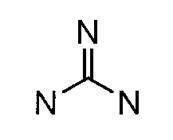
グアニジン化合物は3つの窒素によって共役酸のプラスの電荷が分散安定化されるため、強い塩基性を示す。
本発明のグアニジン化合物(A)の塩基性としては、共役酸のpKaが6.0以上であることが好ましく、7.0~20.0であることが酸との中和反応性が高く、ラフネス特性に優れるため好ましく、8.0~16.0であることがより好ましい。
本発明のグアニジン化合物(A)の塩基性としては、共役酸のpKaが6.0以上であることが好ましく、7.0~20.0であることが酸との中和反応性が高く、ラフネス特性に優れるため好ましく、8.0~16.0であることがより好ましい。
このような強い塩基性のため、酸の拡散性を抑制し、優れたパターン形状の形成に寄与することができる。
なお、ここで「pKa」とは、水溶液中でのpKaのことを表し、例えば、化学便覧(II)(改訂4版、1993年、日本化学会編、丸善株式会社)に記載のものであり、この値が低いほど酸強度が大きいことを示している。水溶液中でのpKaは、具体的には、無限希釈水溶液を用い、25℃での酸解離定数を測定することにより実測することができ、また、下記ソフトウェアパッケージ1を用いて、ハメットの置換基定数及び公知文献値のデータベースに基づいた値を、計算により求めることもできる。本明細書中に記載したpKaの値は、全て、このソフトウェアパッケージを用いて計算により求めた値を示している。
ソフトウェアパッケージ1:AdvancedChemistryDevelopment(ACD/Labs)SoftwareV8.14forSolaris(1994-2007ACD/Labs)。
本発明において、logPとは、n-オクタノール/水分配係数(P)の対数値であり、広範囲の化合物に対し、その親水性/疎水性を特徴づけることのできる有効なパラメータである。一般的には実験によらず計算によって分配係数は求められ、本発明においては、CSChemDrawUltraVer.8.0softwarepackage(Crippen’sfragmentationmethod)により計算された値を示す。
また、グアニジン化合物(A)のlogPが10以下であることが好ましい。上記値以下であることによりレジスト膜中に均一に含有させることができる。
本発明におけるグアニジン化合物(A)のlogPは2~10の範囲であることが好ましく、3~8の範囲であることがより好ましく、4~8の範囲であることが更に好ましい。
また、本発明におけるグアニジン化合物(A)はグアニジン構造以外に窒素原子を有さないことが好ましい。
以下、グアニジン化合物の具体例を示すが、これらに限定されるものではない。
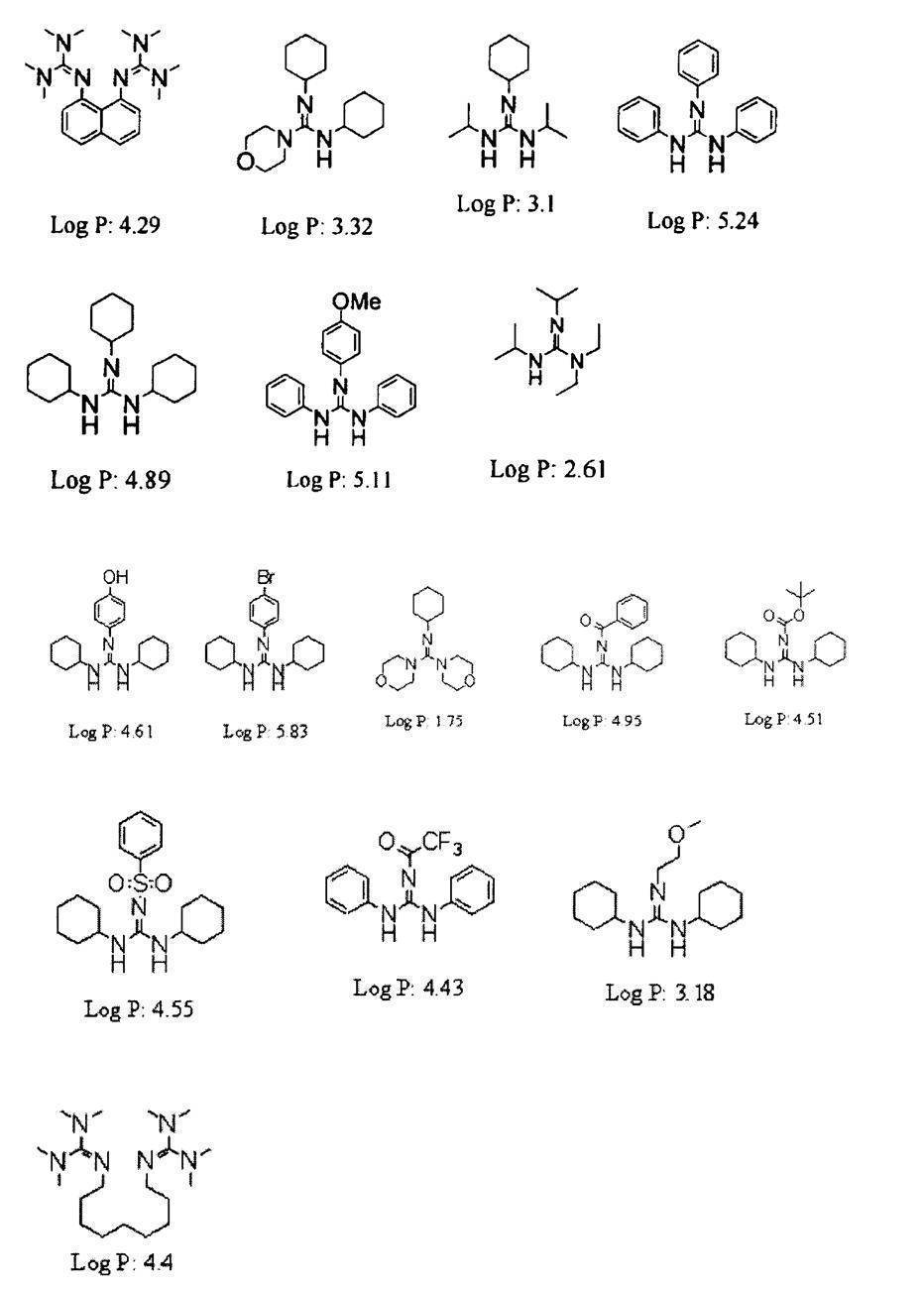
(7)窒素原子を有し、酸の作用により脱離する基を有する低分子化合物
本発明の組成物は、窒素原子を有し、酸の作用により脱離する基を有する低分子化合物(以下において、「低分子化合物(D)」又は「化合物(D)」ともいう)を含有することができる。低分子化合物(D)は、酸の作用により脱離する基が脱離した後は、塩基性を有することが好ましい。
低分子化合物(D)としては、特開2012-133331号公報の段落[0324]~[0337]の記載を参酌でき、これらの内容は本願明細書に組み込まれる。
本発明において、低分子化合物(D)は、一種単独でも又は2種以上を混合しても使用することができる。
本発明の組成物は、窒素原子を有し、酸の作用により脱離する基を有する低分子化合物(以下において、「低分子化合物(D)」又は「化合物(D)」ともいう)を含有することができる。低分子化合物(D)は、酸の作用により脱離する基が脱離した後は、塩基性を有することが好ましい。
低分子化合物(D)としては、特開2012-133331号公報の段落[0324]~[0337]の記載を参酌でき、これらの内容は本願明細書に組み込まれる。
本発明において、低分子化合物(D)は、一種単独でも又は2種以上を混合しても使用することができる。
その他、本発明に係る組成物に使用可能なものとして、特開2002-363146号公報の実施例で合成されている化合物、及び特開2007-298569号公報の段落0108に記載の化合物等が挙げられる。
塩基性化合物として、感光性の塩基性化合物を用いてもよい。感光性の塩基性化合物としては、例えば、特表2003-524799号公報、及び、J.Photopolym.Sci&Tech.Vol.8,P.543-553(1995)等に記載の化合物を用いることができる。
塩基性化合物の分子量は、通常は100~1500であり、好ましくは150~1300であり、より好ましくは200~1000である。
これらの塩基性化合物(D)は、1種類を単独で用いてもよく、2種類以上を組み合わせて用いてもよい。
本発明に係る組成物が含む塩基性化合物(D)の含有量は、組成物の全固形分を基準として、0.01~8.0質量%であることが好ましく、0.1~5.0質量%であることがより好ましく、0.2~4.0質量%であることが特に好ましい。
塩基性化合物(D)の酸発生剤に対するモル比は、好ましくは0.01~10とし、より好ましくは0.05~5とし、更に好ましくは0.1~3とする。このモル比を過度に大きくすると、感度及び/又は解像度が低下する場合がある。このモル比を過度に小さくすると、露光と加熱(ポストベーク)との間において、パターンの細りを生ずる可能性がある。より好ましくは0.05~5、更に好ましくは0.1~3である。
〔4〕溶剤
本発明に係る感活性光線性又は感放射線性樹脂組成物は、溶剤を含んでいることが好ましい。この溶剤は、(S1)プロピレングリコールモノアルキルエーテルカルボキシレートと、(S2)プロピレングリコールモノアルキルエーテル、乳酸エステル、酢酸エステル、アルコキシプロピオン酸エステル、鎖状ケトン、環状ケトン、ラクトン、及びアルキレンカーボネートからなる群より選択される少なくとも1つとの少なくとも一方を含んでいることが好ましい。なお、この溶剤は、成分(S1)及び(S2)以外の成分を更に含んでいてもよい。
本発明に係る感活性光線性又は感放射線性樹脂組成物は、溶剤を含んでいることが好ましい。この溶剤は、(S1)プロピレングリコールモノアルキルエーテルカルボキシレートと、(S2)プロピレングリコールモノアルキルエーテル、乳酸エステル、酢酸エステル、アルコキシプロピオン酸エステル、鎖状ケトン、環状ケトン、ラクトン、及びアルキレンカーボネートからなる群より選択される少なくとも1つとの少なくとも一方を含んでいることが好ましい。なお、この溶剤は、成分(S1)及び(S2)以外の成分を更に含んでいてもよい。
本発明者らは、このような溶剤と上述した樹脂とを組み合わせて用いると、組成物の塗布性が向上すると共に、現像欠陥数の少ないパターンが形成可能となることを見出している。その理由は必ずしも明らかではないが、本発明者らは、これら溶剤は、上述した樹脂の溶解性、沸点、及び粘度のバランスが良いため、組成物膜の膜厚のムラやスピンコート中の析出物の発生などを抑制できることに起因していると考えている。
成分(S1)としては、プロピレングリコールモノメチルエーテルアセテート、プロピレングリコールモノメチルエーテルプロピオネート、及び、プロピレングリコールモノエチルエーテルアセテートからなる群より選択される少なくとも1つが好ましく、プロピレングリコールモノメチルエーテルアセテートが特に好ましい。
成分(S2)としては、以下のものが好ましい。
プロピレングリコールモノアルキルエーテルとしては、プロピレングリコールモノメチルエーテル又はプロピレングリコールモノエチルエーテルが好ましい。
乳酸エステルとしては、乳酸エチル、乳酸ブチル、又は乳酸プロピルが好ましい。
酢酸エステルとしては、酢酸メチル、酢酸エチル、酢酸ブチル、酢酸イソブチル、酢酸プロピル、酢酸イソアミル、蟻酸メチル、蟻酸エチル、蟻酸ブチル、蟻酸プロピル、又は酢酸3-メトキシブチルが好ましい。
アルコキシプロピオン酸エステルとしては、3-メトキシプロピオン酸メチル(MMP)、又は、3-エトキシプロピオン酸エチル(EEP)が好ましい。
鎖状ケトンとしては、1-オクタノン、2-オクタノン、1-ノナノン、2-ノナノン、アセトン、4-ヘプタノン、1-ヘキサノン、2-ヘキサノン、ジイソブチルケトン、フェニルアセトン、メチルエチルケトン、メチルイソブチルケトン、アセチルアセトン、アセトニルアセトン、イオノン、ジアセトニルアルコール、アセチルカービノール、アセトフェノン、メチルナフチルケトン、又はメチルアミルケトンが好ましい。
環状ケトンとしては、メチルシクロヘキサノン、イソホロン、又はシクロヘキサノンが好ましい。
ラクトンとしては、γ-ブチロラクトンが好ましい。
アルキレンカーボネートとしては、プロピレンカーボネートが好ましい。
プロピレングリコールモノアルキルエーテルとしては、プロピレングリコールモノメチルエーテル又はプロピレングリコールモノエチルエーテルが好ましい。
乳酸エステルとしては、乳酸エチル、乳酸ブチル、又は乳酸プロピルが好ましい。
酢酸エステルとしては、酢酸メチル、酢酸エチル、酢酸ブチル、酢酸イソブチル、酢酸プロピル、酢酸イソアミル、蟻酸メチル、蟻酸エチル、蟻酸ブチル、蟻酸プロピル、又は酢酸3-メトキシブチルが好ましい。
アルコキシプロピオン酸エステルとしては、3-メトキシプロピオン酸メチル(MMP)、又は、3-エトキシプロピオン酸エチル(EEP)が好ましい。
鎖状ケトンとしては、1-オクタノン、2-オクタノン、1-ノナノン、2-ノナノン、アセトン、4-ヘプタノン、1-ヘキサノン、2-ヘキサノン、ジイソブチルケトン、フェニルアセトン、メチルエチルケトン、メチルイソブチルケトン、アセチルアセトン、アセトニルアセトン、イオノン、ジアセトニルアルコール、アセチルカービノール、アセトフェノン、メチルナフチルケトン、又はメチルアミルケトンが好ましい。
環状ケトンとしては、メチルシクロヘキサノン、イソホロン、又はシクロヘキサノンが好ましい。
ラクトンとしては、γ-ブチロラクトンが好ましい。
アルキレンカーボネートとしては、プロピレンカーボネートが好ましい。
成分(S2)としては、プロピレングリコールモノメチルエーテル、乳酸エチル、3-エトキシプロピオン酸エチル、メチルアミルケトン、シクロヘキサノン、酢酸ブチル、酢酸ペンチル、γ-ブチロラクトン又はプロピレンカーボネートがより好ましい。
成分(S2)としては、引火点(以下、fpともいう)が37℃以上であるものを用いることが好ましい。このような成分(S2)としては、プロピレングリコールモノメチルエーテル(fp:47℃)、乳酸エチル(fp:53℃)、3-エトキシプロピオン酸エチル(fp:49℃)、メチルアミルケトン(fp:42℃)、シクロヘキサノン(fp:44℃)、酢酸ペンチル(fp:45℃)、γ-ブチロラクトン(fp:101℃)又はプロピレンカーボネート(fp:132℃)が好ましい。これらのうち、プロピレングリコールモノエチルエーテル、乳酸エチル、酢酸ペンチル、又はシクロヘキサノンが更に好ましく、プロピレングリコールモノエチルエーテル又は乳酸エチルが特に好ましい。なお、ここで「引火点」とは、東京化成工業株式会社又はシグマアルドリッチ社の試薬カタログに記載されている値を意味している。
溶剤は、成分(S1)を含んでいることが好ましい。溶剤は、実質的に成分(S1)のみからなるか、又は、成分(S1)と他の成分との混合溶剤であることがより好ましい。後者の場合、溶剤は、成分(S1)と成分(S2)との双方を含んでいることが更に好ましい。
成分(S1)と成分(S2)との質量比は、100:0乃至15:85の範囲内にあることが好ましく、100:0乃至40:60の範囲内にあることがより好ましく、100:0乃至60:40の範囲内にあることが更に好ましい。即ち、溶剤は、成分(S1)のみからなるか、又は、成分(S1)と成分(S2)との双方を含んでおりかつそれらの質量比が以下の通りであることが好ましい。即ち、後者の場合、成分(S2)に対する成分(S1)の質量比は、15/85以上であることが好ましく、40/60以上であることよりが好ましく、60/40以上であることが更に好ましい。このような構成を採用すると、現像欠陥数を更に減少させることが可能となる。
なお、溶剤が成分(S1)と成分(S2)との双方を含んでいる場合、成分(S2)に対する成分(S1)の質量比は、例えば、99/1以下とする。
上述した通り、溶剤は、成分(S1)及び(S2)以外の成分を更に含んでいてもよい。この場合、成分(S1)及び(S2)以外の成分の含有量は、溶剤の全量に対して、5質量%乃至30質量%の範囲内にあることが好ましい。
組成物に占める溶剤の含有量は、全成分の固形分濃度が2~30質量%となるように定めることが好ましく、3~20質量%となるように定めることがより好ましい。こうすると、組成物の塗布性を更に向上させることができる。
〔5〕界面活性剤
本発明の感活性光線性又は感放射性樹脂組成物は、更に界面活性剤を含有することが好ましく、フッ素系及び/又はシリコン系界面活性剤(フッ素系界面活性剤、シリコン系界面活性剤、フッ素原子と珪素原子の両方を有する界面活性剤)のいずれか、あるいは2種以上を含有することがより好ましい。
本発明の感活性光線性又は感放射性樹脂組成物は、更に界面活性剤を含有することが好ましく、フッ素系及び/又はシリコン系界面活性剤(フッ素系界面活性剤、シリコン系界面活性剤、フッ素原子と珪素原子の両方を有する界面活性剤)のいずれか、あるいは2種以上を含有することがより好ましい。
本発明の感活性光線性又は感放射性樹脂組成物が上記界面活性剤を含有することにより、250nm以下、特に220nm以下の露光光源の使用時に、良好な感度及び解像度で、密着性及び現像欠陥の少ないレジストパターンを与えることが可能となる。
フッ素系及び/又はシリコン系界面活性剤としては、例えば特開昭62-36663号公報、特開昭61-226746号公報、特開昭61-226745号公報、特開昭62-170950号公報、特開昭63-34540号公報、特開平7-230165号公報、特開平8-62834号公報、特開平9-54432号公報、特開平9-5988号公報、特開2002-277862号公報、米国特許第5405720号明細書、同5360692号明細書、同5529881号明細書、同5296330号明細書、同5436098号明細書、同5576143号明細書、同5294511号明細書、同5824451号明細書記載の界面活性剤を挙げることができ、下記市販の界面活性剤をそのまま用いることもできる。
フッ素系及び/又はシリコン系界面活性剤としては、例えば特開昭62-36663号公報、特開昭61-226746号公報、特開昭61-226745号公報、特開昭62-170950号公報、特開昭63-34540号公報、特開平7-230165号公報、特開平8-62834号公報、特開平9-54432号公報、特開平9-5988号公報、特開2002-277862号公報、米国特許第5405720号明細書、同5360692号明細書、同5529881号明細書、同5296330号明細書、同5436098号明細書、同5576143号明細書、同5294511号明細書、同5824451号明細書記載の界面活性剤を挙げることができ、下記市販の界面活性剤をそのまま用いることもできる。
使用できる市販の界面活性剤として、例えばエフトップEF301、EF303、(新秋田化成(株)製)、フロラードFC430、431、4430(住友スリーエム(株)製)、メガファックF171、F173、F176、F189、F113、F110、F177、F120、R08(DIC(株)製)、サーフロンS-382、SC101、102、103、104、105、106(旭硝子(株)製)、トロイゾルS-366(トロイケミカル(株)製)、GF-300、GF-150(東亜合成化学(株)製)、サーフロンS-393(セイミケミカル(株)製)、エフトップEF121、EF122A、EF122B、RF122C、EF125M、EF135M、EF351、352、EF801、EF802、EF601((株)ジェムコ製)、PF636、PF656、PF6320、PF6520(OMNOVA社製)、FTX-204G、208G、218G、230G、204D、208D、212D、218D、222D((株)ネオス製)等のフッ素系界面活性剤又はシリコン系界面活性剤を挙げることができる。またポリシロキサンポリマーKP-341(信越化学工業(株)製)もシリコン系界面活性剤として用いることができる。
また、界面活性剤としては、上記に示すような公知のものの他に、テロメリゼーション法(テロマー法ともいわれる)若しくはオリゴメリゼーション法(オリゴマー法ともいわれる)により製造されたフルオロ脂肪族化合物から導かれたフルオロ脂肪族基を有する重合体を用いた界面活性剤を用いることが出来る。フルオロ脂肪族化合物は、特開2002-90991号公報に記載された方法によって合成することが出来る。
例えば、市販の界面活性剤として、メガファックF178、F-470、F-473、F-475、F-476、F-472(DIC(株)製)を挙げることができる。更に、C6F13基を有するアクリレート(又はメタクリレート)と(ポリ(オキシアルキレン))アクリレート(又はメタクリレート)との共重合体、C3F7基を有するアクリレート(又はメタクリレート)と(ポリ(オキシエチレン))アクリレート(又はメタクリレート)と(ポリ(オキシプロピレン))アクリレート(又はメタクリレート)との共重合体などを挙げることができる。
また、本発明では、フッ素系及び/又はシリコン系界面活性剤以外の他の界面活性剤を使用することもできる。具体的には、ポリオキシエチレンラウリルエーテル、ポリオキシエチレンステアリルエーテル、ポリオキシエチレンセチルエーテル、ポリオキシエチレンオレイルエーテル等のポリオキシエチレンアルキルエーテル類、ポリオキシエチレンオクチルフェノールエーテル、ポリオキシエチレンノニルフェノールエーテル等のポリオキシエチレンアルキルアリールエーテル類、ポリオキシエチレン・ポリオキシプロピレンブロックコポリマー類、ソルビタンモノラウレート、ソルビタンモノパルミテート、ソルビタンモノステアレート、ソルビタンモノオレエート、ソルビタントリオレエート、ソルビタントリステアレート等のソルビタン脂肪酸エステル類、ポリオキシエチレンソルビタンモノラウレート、ポリオキシエチレンソルビタンモノパルミテ-ト、ポリオキシエチレンソルビタンモノステアレート、ポリオキシエチレンソルビタントリオレエート、ポリオキシエチレンソルビタントリステアレート等のポリオキシエチレンソルビタン脂肪酸エステル類等のノニオン系界面活性剤等を挙げることができる。
これらの界面活性剤は単独で使用してもよいし、また、いくつかの組み合わせで使用してもよい。
界面活性剤の使用量は、感活性光線性又は感放射性樹脂組成物全量(溶剤を除く)に対して、好ましくは0.0001~2質量%、より好ましくは0.001~1質量%である。
界面活性剤の使用量は、感活性光線性又は感放射性樹脂組成物全量(溶剤を除く)に対して、好ましくは0.0001~2質量%、より好ましくは0.001~1質量%である。
〔6〕低分子添加剤
本発明の感活性光線性又は感放射性樹脂組成物は、酸の作用により分解してアルカリ現像液中での溶解度が増大する、分子量3000以下の低分子添加剤(以下、「低分子化合物」ともいう)を含有することができる。
本発明の感活性光線性又は感放射性樹脂組成物は、酸の作用により分解してアルカリ現像液中での溶解度が増大する、分子量3000以下の低分子添加剤(以下、「低分子化合物」ともいう)を含有することができる。
低分子化合物としては、Proceeding of SPIE, 2724, 355 (1996)に記載されている酸分解性基を含むコール酸誘導体の様な、酸分解性基を含有する脂環族又は脂肪族化合物が好ましい。酸分解性基、脂環式構造としては、前記酸分解性樹脂のところで説明したものと同様のものが挙げられる。
本発明の感活性光線性又は感放射性樹脂組成物を、電子線で照射する場合には、フェノール化合物のフェノール性水酸基を酸分解基で置換した構造を含有するものが好ましい。フェノール化合物としてはフェノール骨格を1~9個含有するものが好ましく、更に好ましくは2~6個含有するものである。
本発明における低分子化合物の分子量は、3000以下であり、好ましくは300~3000、更に好ましくは500~2500である。
低分子化合物の添加量は、感活性光線性又は感放射性樹脂組成物の全固形分に対し、好ましくは0~50質量%であり、より好ましくは0~40質量%である。
以下に低分子化合物の具体例を示すが、本発明はこれらに限定されない。
低分子化合物の添加量は、感活性光線性又は感放射性樹脂組成物の全固形分に対し、好ましくは0~50質量%であり、より好ましくは0~40質量%である。
以下に低分子化合物の具体例を示すが、本発明はこれらに限定されない。

〔7〕 酸増殖剤
本発明の感活性光線性又は感放射線性組成物は、更に、酸の作用により分解して酸を発生する化合物(以下、酸増殖剤とも表記する)を1種又は2種以上含んでいてもよい。酸増殖剤が発生する酸は、スルホン酸、メチド酸又はイミド酸であることが好ましい。酸増殖剤の含有量としては、組成物の全固形分を基準として、0.1~50質量%であることが好ましく、0.5~30質量%であることがより好ましく、1.0~20質量%であることが更に好ましい。
酸増殖剤と酸発生剤との量比(組成物中の全固形分を基準にした酸増殖剤の固形分量/組成物中の全固形分を基準にした酸発生剤の固形分量)としては、特に制限されないが、0.01~50が好ましく、0.1~20がより好ましく、0.2~1.0が特に好ましい。
本発明の感活性光線性又は感放射線性組成物は、更に、酸の作用により分解して酸を発生する化合物(以下、酸増殖剤とも表記する)を1種又は2種以上含んでいてもよい。酸増殖剤が発生する酸は、スルホン酸、メチド酸又はイミド酸であることが好ましい。酸増殖剤の含有量としては、組成物の全固形分を基準として、0.1~50質量%であることが好ましく、0.5~30質量%であることがより好ましく、1.0~20質量%であることが更に好ましい。
酸増殖剤と酸発生剤との量比(組成物中の全固形分を基準にした酸増殖剤の固形分量/組成物中の全固形分を基準にした酸発生剤の固形分量)としては、特に制限されないが、0.01~50が好ましく、0.1~20がより好ましく、0.2~1.0が特に好ましい。
以下に本発明に用いることができる化合物の例を示すが、これらに限定されるものではない。

〔8〕 その他の添加剤
本発明の組成物は、上記に説明した成分以外にも、カルボン酸、カルボン酸オニウム塩、Proceeding of SPIE, 2724,355 (1996)等に記載の分子量3000以下の低分子化合物、染料、可塑剤、光増感剤、光吸収剤、酸化防止剤などを適宜含有することができる。
特にカルボン酸は、性能向上のために好適に用いられる。カルボン酸としては、安息香酸、ナフトエ酸などの、芳香族カルボン酸が好ましい。
カルボン酸の含有量は、組成物の全固形分濃度中、0.01~10質量%が好ましく、より好ましくは0.01~5質量%、更に好ましくは0.01~3質量%である。
本発明の組成物は、上記に説明した成分以外にも、カルボン酸、カルボン酸オニウム塩、Proceeding of SPIE, 2724,355 (1996)等に記載の分子量3000以下の低分子化合物、染料、可塑剤、光増感剤、光吸収剤、酸化防止剤などを適宜含有することができる。
特にカルボン酸は、性能向上のために好適に用いられる。カルボン酸としては、安息香酸、ナフトエ酸などの、芳香族カルボン酸が好ましい。
カルボン酸の含有量は、組成物の全固形分濃度中、0.01~10質量%が好ましく、より好ましくは0.01~5質量%、更に好ましくは0.01~3質量%である。
本発明における感活性光線性又は感放射性樹脂組成物は、解像力向上の観点から、膜厚10~250nmで使用されることが好ましく、より好ましくは、膜厚20~200nmで使用されることが好ましく、更に好ましくは30~100nmで使用されることが好ましい。組成物中の固形分濃度を適切な範囲に設定して適度な粘度をもたせ、塗布性、製膜性を向上させることにより、このような膜厚とすることができる。
本発明における感活性光線性又は感放射性樹脂組成物の固形分濃度は、通常1.0~10質量%であり、好ましくは、2.0~5.7質量%、更に好ましくは2.0~5.3質量%である。固形分濃度を前記範囲とすることで、レジスト溶液を基板上に均一に塗布することができ、更にはラインウィズスラフネスに優れたレジストパターンを形成することが可能になる。その理由は明らかではないが、恐らく、固形分濃度を10質量%以下、好ましくは5.7質量%以下とすることで、レジスト溶液中での素材、特には光酸発生剤の凝集が抑制され、その結果として、均一なレジスト膜が形成できたものと考えられる。
固形分濃度とは、感活性光線性又は感放射性樹脂組成物の総重量に対する、溶剤を除く他のレジスト成分の重量の重量百分率である。
本発明における感活性光線性又は感放射性樹脂組成物の固形分濃度は、通常1.0~10質量%であり、好ましくは、2.0~5.7質量%、更に好ましくは2.0~5.3質量%である。固形分濃度を前記範囲とすることで、レジスト溶液を基板上に均一に塗布することができ、更にはラインウィズスラフネスに優れたレジストパターンを形成することが可能になる。その理由は明らかではないが、恐らく、固形分濃度を10質量%以下、好ましくは5.7質量%以下とすることで、レジスト溶液中での素材、特には光酸発生剤の凝集が抑制され、その結果として、均一なレジスト膜が形成できたものと考えられる。
固形分濃度とは、感活性光線性又は感放射性樹脂組成物の総重量に対する、溶剤を除く他のレジスト成分の重量の重量百分率である。
本発明における感活性光線性又は感放射性樹脂組成物は、上記の成分を所定の有機溶剤、好ましくは前記混合溶剤に溶解し、フィルター濾過した後、所定の支持体(基板)上に塗布して用いる。フィルター濾過に用いるフィルターのポアサイズは0.1μm以下、より好ましくは0.05μm以下、更に好ましくは0.03μm以下のポリテトラフロロエチレン製、ポリエチレン製、ナイロン製のものが好ましい。フィルター濾過においては、例えば特開2002-62667号公報のように、循環的な濾過を行ったり、複数種類のフィルターを直列又は並列に接続して濾過を行ったりしてもよい。また、組成物を複数回濾過してもよい。更に、フィルター濾過の前後で、組成物に対して脱気処理などを行ってもよい。
[用途]
本発明のパターン形成方法は、超LSIや高容量マイクロチップの製造などの半導体微細回路作成に好適に用いられる。なお、半導体微細回路作成時には、パターンを形成されたレジスト膜は回路形成やエッチングに供された後、残ったレジスト膜部は、最終的には溶剤等で除去されるため、プリント基板等に用いられるいわゆる永久レジストとは異なり、マイクロチップ等の最終製品には、本発明に記載の感活性光線性又は感放射性樹脂組成物に由来するレジスト膜は残存しない。
本発明のパターン形成方法は、DSA(Directed Self-Assembly)におけるガイドパターン形成(例えば、ACS Nano Vol.4 No.8 Page4815-4823参照)にも用いることができる。
また、上記の方法によって形成されたレジストパターンは、例えば特開平3-270227及び特開2013-164509に開示されたスペーサープロセスの芯材(コア)として使用できる。
本発明のパターン形成方法は、超LSIや高容量マイクロチップの製造などの半導体微細回路作成に好適に用いられる。なお、半導体微細回路作成時には、パターンを形成されたレジスト膜は回路形成やエッチングに供された後、残ったレジスト膜部は、最終的には溶剤等で除去されるため、プリント基板等に用いられるいわゆる永久レジストとは異なり、マイクロチップ等の最終製品には、本発明に記載の感活性光線性又は感放射性樹脂組成物に由来するレジスト膜は残存しない。
本発明のパターン形成方法は、DSA(Directed Self-Assembly)におけるガイドパターン形成(例えば、ACS Nano Vol.4 No.8 Page4815-4823参照)にも用いることができる。
また、上記の方法によって形成されたレジストパターンは、例えば特開平3-270227及び特開2013-164509に開示されたスペーサープロセスの芯材(コア)として使用できる。
また、本発明は、上記した本発明のパターン形成方法を含む、電子デバイスの製造方法、及び、この製造方法により製造された電子デバイスにも関する。
本発明の電子デバイスは、電気電子機器(家電、OA・メディア関連機器、光学用機器及び通信機器等)に、好適に、搭載されるものである。
本発明の電子デバイスは、電気電子機器(家電、OA・メディア関連機器、光学用機器及び通信機器等)に、好適に、搭載されるものである。
以下、実施例により本発明を説明するが、本発明は、これらに限定されるものではない。
合成例1(樹脂(P-1)の合成)
下記スキームに従って合成した。
下記スキームに従って合成した。
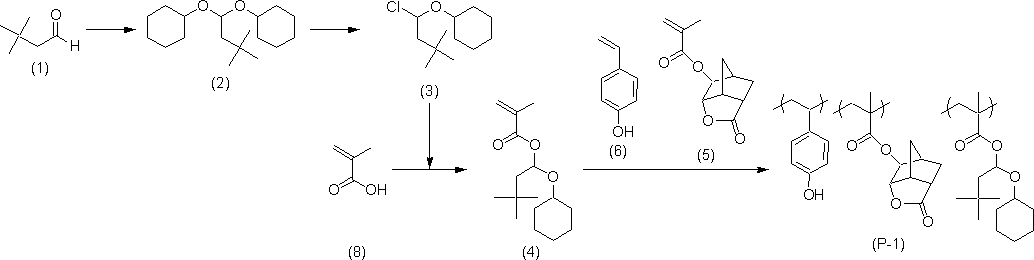
20.00gの化合物(1)を113.33gのn-ヘキサンに溶解させ、42.00gのシクロヘキサノール、20.00gの無水硫酸マグネシウム、2.32gの10-カンファースルホン酸を加えて、室温(25℃)で7.5時間攪拌した。5.05gのトリエチルアミンを加えて、10分間攪拌した後、ろ過して固体を取り除いた。400gの酢酸エチルを加えて、有機相を200gのイオン交換水で5回洗浄した後、無水硫酸マグネシウムで乾燥し、溶媒を留去して、化合物(2)含有溶液を44.86g得た。
化合物(2)含有溶液23.07gに、4.52gの塩化アセチルを加えて、室温で2時間攪拌して、化合物(3)含有溶液を27.58g得た。
3.57gの化合物(8)を26.18gの脱水テトラヒドロフランに溶解させ、3.57gの無水硫酸マグネシウム、29.37gのトリエチルアミンを加えて、窒素雰囲気下で攪拌した。0℃に冷却し、27.54gの化合物(3)含有溶液を滴下し、室温で3.5時間攪拌した後、ろ過して固体を取り除いた。400gの酢酸エチルを加えて、有機相を150gのイオン交換水で5回洗浄した後、無水硫酸マグネシウムで乾燥し、溶媒を留去した。カラムクロマトグラフィーで単離精製し、8.65gの化合物(4)を得た。
2.52gの化合物(6)のシクロヘキサノン溶液(50.00質量%)と、0.78gの化合物(5)と、5.64gの化合物(4)と、0.32gの重合開始剤V-601(和光純薬工業(株)製)とを、27.01gのシクロヘキサノンに溶解させた。反応容器中に15.22gのシクロヘキサノンを入れ、窒素ガス雰囲気下、85℃の系中に4時間かけて滴下した。反応溶液を2時間に亘って加熱撹拌した後、これを室温まで放冷した。
上記反応溶液を、400gのヘプタン中に滴下し、ポリマーを沈殿させ、ろ過した。200gのヘプタンを用いて、ろ過した固体のかけ洗いを行なった。その後、洗浄後の固体を減圧乾燥に供して、2.98gの樹脂(P-1)を得た。
化合物(2)含有溶液23.07gに、4.52gの塩化アセチルを加えて、室温で2時間攪拌して、化合物(3)含有溶液を27.58g得た。
3.57gの化合物(8)を26.18gの脱水テトラヒドロフランに溶解させ、3.57gの無水硫酸マグネシウム、29.37gのトリエチルアミンを加えて、窒素雰囲気下で攪拌した。0℃に冷却し、27.54gの化合物(3)含有溶液を滴下し、室温で3.5時間攪拌した後、ろ過して固体を取り除いた。400gの酢酸エチルを加えて、有機相を150gのイオン交換水で5回洗浄した後、無水硫酸マグネシウムで乾燥し、溶媒を留去した。カラムクロマトグラフィーで単離精製し、8.65gの化合物(4)を得た。
2.52gの化合物(6)のシクロヘキサノン溶液(50.00質量%)と、0.78gの化合物(5)と、5.64gの化合物(4)と、0.32gの重合開始剤V-601(和光純薬工業(株)製)とを、27.01gのシクロヘキサノンに溶解させた。反応容器中に15.22gのシクロヘキサノンを入れ、窒素ガス雰囲気下、85℃の系中に4時間かけて滴下した。反応溶液を2時間に亘って加熱撹拌した後、これを室温まで放冷した。
上記反応溶液を、400gのヘプタン中に滴下し、ポリマーを沈殿させ、ろ過した。200gのヘプタンを用いて、ろ過した固体のかけ洗いを行なった。その後、洗浄後の固体を減圧乾燥に供して、2.98gの樹脂(P-1)を得た。
上記合成例1と同様にして、以下に示す樹脂(P-2)~(P-8)についても合成した。
得られた樹脂の重量平均分子量、組成比(モル比)及び分散度を以下に示す。

<樹脂(R-1)の合成>
p-tert-ブトキシスチレンをアニオン重合した後、酸により脱保護することで、ポリ(p-ヒドロキシスチレン)を得た。GPC(キャリア:テトラヒドロフラン、ポリスチレン換算)から求めた重量平均分子量(Mw)は、Mw=3300、分散度(Pd)は1.2であった。
p-tert-ブトキシスチレンをアニオン重合した後、酸により脱保護することで、ポリ(p-ヒドロキシスチレン)を得た。GPC(キャリア:テトラヒドロフラン、ポリスチレン換算)から求めた重量平均分子量(Mw)は、Mw=3300、分散度(Pd)は1.2であった。
十分に脱水したポリ(p-ヒドロキシスチレン)とプロピレングリコールモノメチルエーテルアセテート(PGMEA)の混合溶液(固形分20.0質量%)50.0質量部に、シクロヘキシルエチルビニルエーテル3.21質量部を加えた。続いて、p-トルエンスルホン酸とPGMEAの混合溶液(固形分1.0質量%)1.58質量部を加え、室温、攪拌下で1時間反応させた。
ピリジン0.99質量部を加えた後、無水酢酸0.85質量部を加えて、室温、攪拌下で更に2時間反応させた。
反応終了後、水洗、濃縮を行い、多量のヘキサンで再沈、ろ過、乾燥させることで、ポリマー(R-1)の粉体11.9質量部を得た。得られたポリマーの重量平均分子量、組成比(モル比)及び分散度を以下に示す。
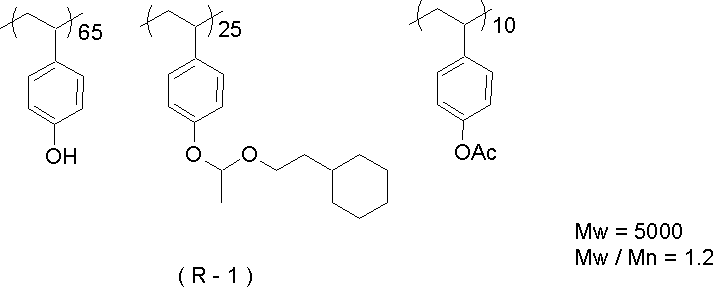
〔実施例1~10及び比較例1~3 極紫外線(EUV)露光〕
(1)感活性光線性又は感放射線性樹脂組成物の塗液調製及び塗設
下表に示した組成を有する固形分濃度2.5質量%の塗液組成物を0.05μm孔径のメンブレンフィルターで精密ろ過して、感活性光線性又は感放射線性樹脂組成物(レジスト組成物)溶液を得た。
この感活性光線性又は感放射線性樹脂組成物を、予めヘキサメチルジシラザン(HMDS)処理を施した6インチSiウェハ上に東京エレクトロン製スピンコーターMark8を用いて塗布し、100℃、60秒間ホットプレート上で乾燥して、膜厚50nmのレジスト膜を得た。
実施例1~10及び比較例2においては、続いて、同様の方法により、表1に記載の保護膜組成物により膜厚30nmの保護膜を形成した。
(1)感活性光線性又は感放射線性樹脂組成物の塗液調製及び塗設
下表に示した組成を有する固形分濃度2.5質量%の塗液組成物を0.05μm孔径のメンブレンフィルターで精密ろ過して、感活性光線性又は感放射線性樹脂組成物(レジスト組成物)溶液を得た。
この感活性光線性又は感放射線性樹脂組成物を、予めヘキサメチルジシラザン(HMDS)処理を施した6インチSiウェハ上に東京エレクトロン製スピンコーターMark8を用いて塗布し、100℃、60秒間ホットプレート上で乾燥して、膜厚50nmのレジスト膜を得た。
実施例1~10及び比較例2においては、続いて、同様の方法により、表1に記載の保護膜組成物により膜厚30nmの保護膜を形成した。
(2)EUV露光及び現像
上記(1)で得られたレジスト膜の塗布されたウェハを、EUV露光装置(Exitech社製 Micro Exposure Tool、NA0.3、X-dipole、アウターシグマ0.68、インナーシグマ0.36)を用い、露光マスク(ライン/スペース=1/4)を使用して、パターン露光を行った。照射後、ホットプレート上で、110℃で60秒間加熱した後、下表に記載の現像液をパドルして30秒間現像し、下表に記載のリンス液を用いてリンスした後、4000rpmの回転数で30秒間ウェハを回転させた後、90℃で60秒間ベークを行なうことにより、ライン/スペース=4:1の孤立スペースのレジストパターンを得た。比較例2及び3においては、露光マスクを反転させた(ライン/スペース=4/1の露光マスクを使用した。)以外は実施例1と同様にパターンを形成した。
実施例2においては、現像前に保護膜を水に90秒間接触させることにより除去した以外は実施例1と同様にパターンを形成した。
上記(1)で得られたレジスト膜の塗布されたウェハを、EUV露光装置(Exitech社製 Micro Exposure Tool、NA0.3、X-dipole、アウターシグマ0.68、インナーシグマ0.36)を用い、露光マスク(ライン/スペース=1/4)を使用して、パターン露光を行った。照射後、ホットプレート上で、110℃で60秒間加熱した後、下表に記載の現像液をパドルして30秒間現像し、下表に記載のリンス液を用いてリンスした後、4000rpmの回転数で30秒間ウェハを回転させた後、90℃で60秒間ベークを行なうことにより、ライン/スペース=4:1の孤立スペースのレジストパターンを得た。比較例2及び3においては、露光マスクを反転させた(ライン/スペース=4/1の露光マスクを使用した。)以外は実施例1と同様にパターンを形成した。
実施例2においては、現像前に保護膜を水に90秒間接触させることにより除去した以外は実施例1と同様にパターンを形成した。
(3)レジストパターンの評価
走査型電子顕微鏡((株)日立製作所製S-9380II)を用いて、得られたレジストパターンを下記の方法で、解像力について評価した。
走査型電子顕微鏡((株)日立製作所製S-9380II)を用いて、得られたレジストパターンを下記の方法で、解像力について評価した。
(3-1)ラインエッジラフネス(LER)
ヘキサメチルジシラザン処理を施したシリコンウェハ上に、レジスト組成物を塗布し、ホットプレート上で100℃で60秒間ベークを行い、膜厚50nmのレジスト膜を形成した。このレジスト膜の塗布されたウェハをEUV露光装置(Exitech社製Micro Exposure Tool、NA0.3、Quadrupole、アウターシグマ0.68、インナーシグマ0.36)を用い、露光マスク(ライン/スペース=1/1)を使用して、パターン露光を行った。照射後、ホットプレート上で、110℃で60秒間加熱した後、表に記載の現像液をパドルして30秒間現像し、4000rpmの回転数で30秒間ウェハを回転させた後、90℃で60秒間ベークを行なうことにより、線幅50nmの1:1ラインアンドスペースのレジストパターンを得た。
上記の線幅50nmの1:1ラインアンドスペースのレジストパターンを形成する際の露光量で、レジストパターンの長さ方向50μmに含まれる任意の30点について、走査型電子顕微鏡((株)日立製作所製S-9220)を用いて、エッジがあるべき基準線からの距離を測定した。そして、この距離の標準偏差を求め、3σ(nm)を算出した。値が小さいほど良好な性能であることを示す。
ヘキサメチルジシラザン処理を施したシリコンウェハ上に、レジスト組成物を塗布し、ホットプレート上で100℃で60秒間ベークを行い、膜厚50nmのレジスト膜を形成した。このレジスト膜の塗布されたウェハをEUV露光装置(Exitech社製Micro Exposure Tool、NA0.3、Quadrupole、アウターシグマ0.68、インナーシグマ0.36)を用い、露光マスク(ライン/スペース=1/1)を使用して、パターン露光を行った。照射後、ホットプレート上で、110℃で60秒間加熱した後、表に記載の現像液をパドルして30秒間現像し、4000rpmの回転数で30秒間ウェハを回転させた後、90℃で60秒間ベークを行なうことにより、線幅50nmの1:1ラインアンドスペースのレジストパターンを得た。
上記の線幅50nmの1:1ラインアンドスペースのレジストパターンを形成する際の露光量で、レジストパターンの長さ方向50μmに含まれる任意の30点について、走査型電子顕微鏡((株)日立製作所製S-9220)を用いて、エッジがあるべき基準線からの距離を測定した。そして、この距離の標準偏差を求め、3σ(nm)を算出した。値が小さいほど良好な性能であることを示す。
(3-2)孤立スペースにおける解像力
上記孤立スペース(ライン/スペース=4:1)の限界解像力(ラインとスペースが分離解像する最小のスペース幅)を求めた。そして、この値を「解像力(nm)」とした。この値が小さいほど性能が良好であることを示す。
上記孤立スペース(ライン/スペース=4:1)の限界解像力(ラインとスペースが分離解像する最小のスペース幅)を求めた。そして、この値を「解像力(nm)」とした。この値が小さいほど性能が良好であることを示す。
(3-3)トップラフネス
上記の線幅50nmの1:1ラインアンドスペースのレジストパターンの断面SEM写真を取得し、パターントップの凹凸を目視にて評価した。表面の荒れが小さい物をA、大きい物をBとした。
上記の線幅50nmの1:1ラインアンドスペースのレジストパターンの断面SEM写真を取得し、パターントップの凹凸を目視にて評価した。表面の荒れが小さい物をA、大きい物をBとした。
〔保護層組成物〕
保護層組成物としては、下記(T-1)又は(T-2)を用いた。
保護層組成物としては、下記(T-1)又は(T-2)を用いた。
T-1:下記ポリマーの1wt%MIBC(メチルイソブチルカルビノール)溶液。
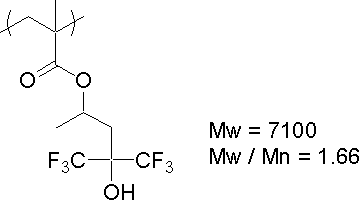
T-2:東京化成製ポリビニルピロリドン K 15 (粘度平均分子量10,000)(Polyvinylpyrrolidone K 15 Viscosity Average Molecular Wt. 10,000(CAS番号:9003-39-8)を1wt%、オルフィンEXP4200(界面活性剤、日信化学(株)製)を0.01wt%含有する水溶液(溶液T-2のpHは6.7である)。
〔光酸発生剤〕
光酸発生剤としては、具体例として下記の化合物を適宜選択して用いた。
光酸発生剤としては、具体例として下記の化合物を適宜選択して用いた。
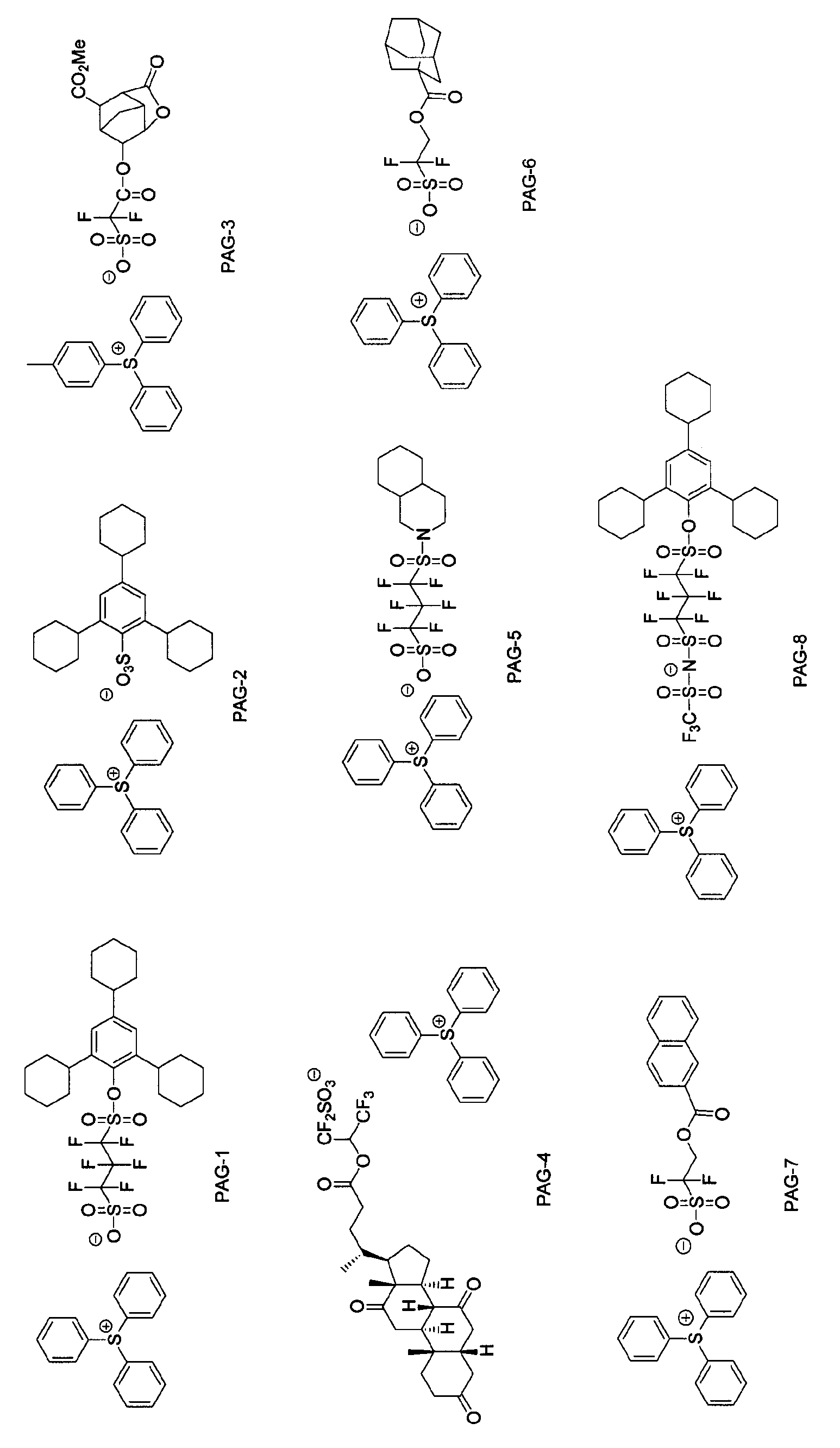
〔塩基性化合物〕
塩基性化合物としては、下記化合物(N-1)~(N-11)の何れかを用いた。
塩基性化合物としては、下記化合物(N-1)~(N-11)の何れかを用いた。

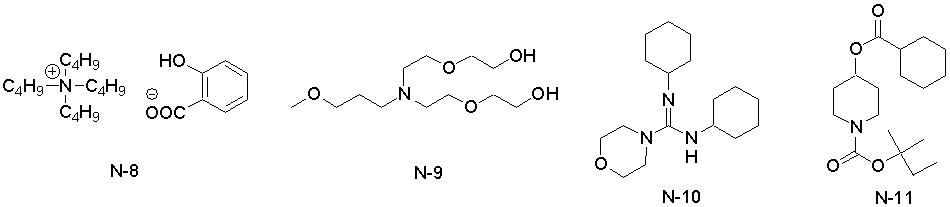
なお、上記化合物(N-7)は、上述した化合物(PA)に該当するものであり、特開2006-330098号公報の[0354]の記載に基づいて合成した。
〔界面活性剤〕
界面活性剤としては、下記W-1~W-4を用いた。
W-1: メガファックF176(DIC(株)製)(フッ素系)
W-2: メガファックR08(DIC(株)製)(フッ素及びシリコン系)
W-3: ポリシロキサンポリマーKP-341(信越化学工業(株)製)(シリコン系)
W-4: PF6320(OMNOVA(株)製)(フッ素系)
界面活性剤としては、下記W-1~W-4を用いた。
W-1: メガファックF176(DIC(株)製)(フッ素系)
W-2: メガファックR08(DIC(株)製)(フッ素及びシリコン系)
W-3: ポリシロキサンポリマーKP-341(信越化学工業(株)製)(シリコン系)
W-4: PF6320(OMNOVA(株)製)(フッ素系)
<塗布溶剤>
塗布溶剤としては、以下のものを用いた。
S1:プロピレングリコールモノメチルエーテルアセテート(PGMEA)
S2:プロピレングリコールモノメチルエーテル(PGME)
S3:乳酸エチル
S4:シクロヘキサノン
S5:γ-ブチロラクトン
<現像液>
現像液としては、以下のものを用いた。
SG-1:酢酸ブチル
TMAH:2.38質量%テトラメチルアンモニウムヒドロキシド水溶液
塗布溶剤としては、以下のものを用いた。
S1:プロピレングリコールモノメチルエーテルアセテート(PGMEA)
S2:プロピレングリコールモノメチルエーテル(PGME)
S3:乳酸エチル
S4:シクロヘキサノン
S5:γ-ブチロラクトン
<現像液>
現像液としては、以下のものを用いた。
SG-1:酢酸ブチル
TMAH:2.38質量%テトラメチルアンモニウムヒドロキシド水溶液
<リンス液>
リンス液として、以下のものを用いた。
SR-1:4-メチル-2-ペンタノール
SR-2:1-ヘキサノール
SR-3:メチルイソブチルカルビノール
水:超純水
リンス液として、以下のものを用いた。
SR-1:4-メチル-2-ペンタノール
SR-2:1-ヘキサノール
SR-3:メチルイソブチルカルビノール
水:超純水
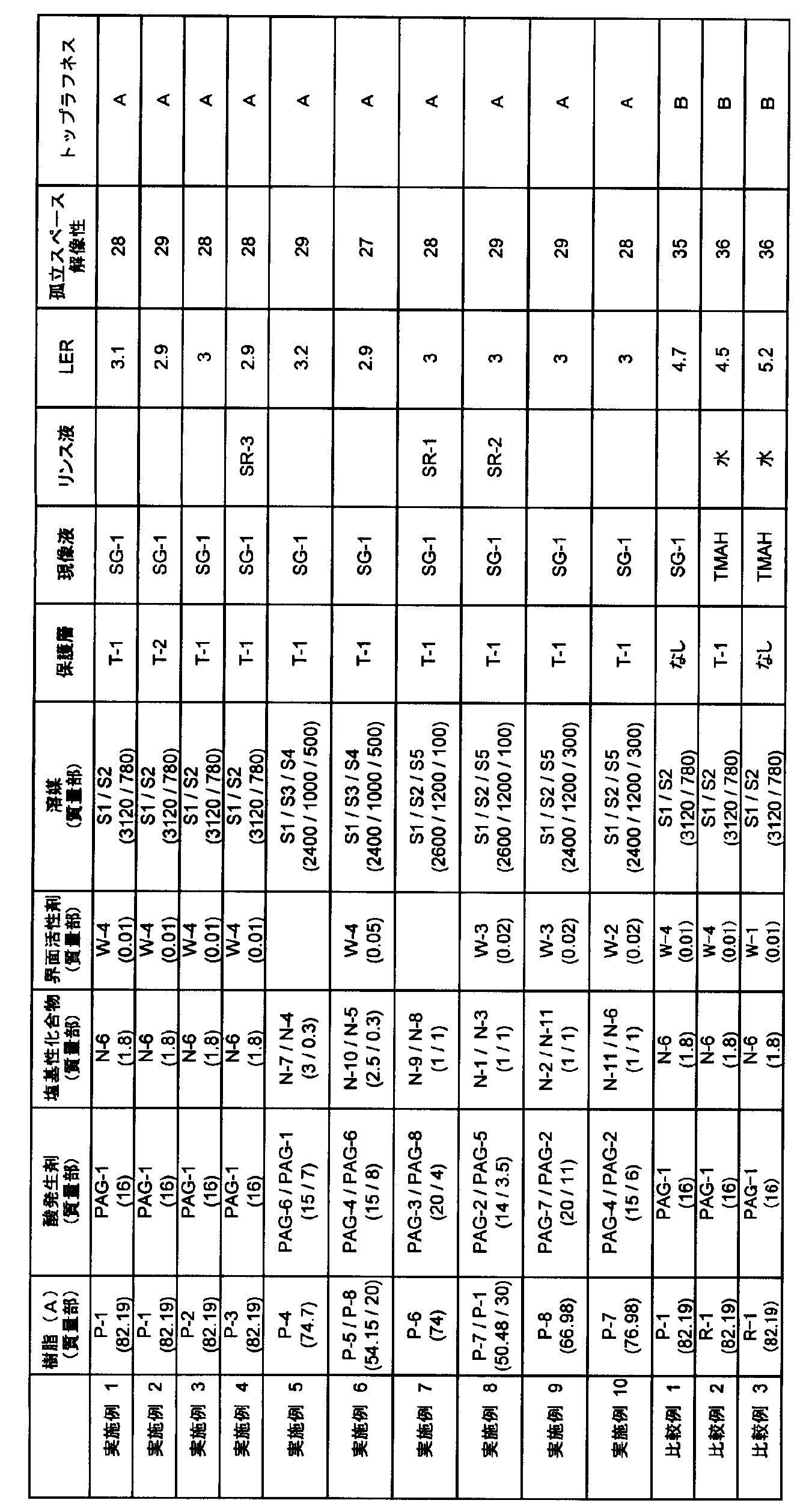
上掲の表に記載の結果から、本発明のパターン形成方法を使用し、レジストパターンを形成した実施例1及び2は、レジスト膜上に保護膜組成物によって保護膜を形成する工程を有していないパターン方法を使用し、レジストパターンを形成した比較例1及び3と比べて、孤立スペースパターン形成における解像力に優れることが明らかである。
また、本発明のパターン形成方法を使用し、レジストパターンを形成した実施例1及び2は、アルカリ現像液を用いてパターン形成した比較例2及び3よりも孤立スペースパターン形成における解像力に優れることが明らかである。
更に、保護膜をレジスト膜上に形成し、アルカリ現像を行った比較例2、及び、保護膜をレジスト膜上に形成せずにアルカリ現像を行った比較例3は、孤立スペースパターン形成における解像力に差が無いことが分かった。一方、保護膜をレジスト膜上に形成し、有機溶剤を用いた現像を行った実施例1~10は、保護膜をレジスト膜上に形成せずに有機溶剤を用いた現像を行った比較例1と比較して、孤立スペースパターン形成における解像力がより向上することが明らかである。
また、本発明のパターン形成方法を使用し、レジストパターンを形成した実施例1及び2は、アルカリ現像液を用いてパターン形成した比較例2及び3よりも孤立スペースパターン形成における解像力に優れることが明らかである。
更に、保護膜をレジスト膜上に形成し、アルカリ現像を行った比較例2、及び、保護膜をレジスト膜上に形成せずにアルカリ現像を行った比較例3は、孤立スペースパターン形成における解像力に差が無いことが分かった。一方、保護膜をレジスト膜上に形成し、有機溶剤を用いた現像を行った実施例1~10は、保護膜をレジスト膜上に形成せずに有機溶剤を用いた現像を行った比較例1と比較して、孤立スペースパターン形成における解像力がより向上することが明らかである。
本発明によれば、超微細のスペース幅(例えばスペース幅30nm以下)を有する孤立スペースパターンの形成において、解像力に優れたパターン形成方法を提供することができる。
本発明を詳細にまた特定の実施態様を参照して説明したが、本発明の精神と範囲を逸脱することなく様々な変更や修正を加えることができることは当業者にとって明らかである。
本出願は、2013年1月31日出願の日本特許出願(特願2013-017957)に基づくものであり、その内容はここに参照として取り込まれる。
本出願は、2013年1月31日出願の日本特許出願(特願2013-017957)に基づくものであり、その内容はここに参照として取り込まれる。
Claims (13)
- 酸の作用により極性が増大して有機溶剤を含む現像液に対する溶解性が減少する樹脂、及び、活性光線又は放射線の照射により分解して酸を発生する化合物を含有する、感活性光線性又は感放射性樹脂組成物によって、レジスト膜を形成する工程、
前記レジスト膜上に保護膜組成物によって保護膜を形成する工程、
前記保護膜を有するレジスト膜を電子線又は極紫外線により露光する工程、及び、
前記有機溶剤を含む現像液を用いて現像する工程を含むパターン形成方法。 - 前記露光が、液浸媒体を介さない露光である請求項1に記載のパターン形成方法。
- 前記保護膜組成物が、水系組成物である請求項1又は2に記載のパターン形成方法。
- 前記水系組成物のpHが1~10の範囲内である請求項3に記載のパターン形成方法。
- 前記保護膜組成物が、両親媒性樹脂を含む請求項1~4のいずれか1項に記載のパターン形成方法。
- 前記保護膜組成物が、有機溶媒系組成物である請求項1又は2に記載のパターン形成方法。
- 酸の作用により極性が増大して有機溶剤を含む現像液に対する溶解性が減少する樹脂が、下記一般式(I)で表される繰り返し単位を有する請求項1~6のいずれか1項に記載のパターン形成方法。

ここで、R01、R02及びR03は、各々独立に、水素原子、アルキル基、シクロアルキル基、ハロゲン原子、シアノ基又はアルコキシカルボニル基を表す。またR03は、アルキレン基を表し、Ar1と結合して5員若しくは6員環を形成していてもよい。
Ar1は、芳香環基を表す。
n個のYは、各々独立に、水素原子又は酸の作用により脱離する基を表す。但し、Yの少なくとも1つは、酸の作用により脱離する基を表す。
nは、1~4の整数を表す。 - 前記酸の作用により極性が増大して有機溶剤を含む現像液に対する溶解性が減少する樹脂が、ラクトン構造を有する基を有する繰り返し単位を有する請求項1~7のいずれか1項に記載のパターン形成方法。
- 前記有機溶剤を含む現像液が含有する有機溶剤が、ケトン系溶剤、エステル系溶剤及びエーテル系溶剤からなる群より選ばれる少なくとも一種の有機溶剤である請求項1~8のいずれか1項に記載のパターン形成方法。
- 前記有機溶剤を含む現像液を用いて現像後、有機溶剤を含むリンス液を用いて洗浄することを含む請求項1~9のいずれか1項に記載のパターン形成方法。
- 前記リンス液が含有する有機溶剤がアルコール系溶剤である請求項10に記載のパターン形成方法。
- 請求項1~11のいずれか1項に記載のパターン形成方法を含む、電子デバイスの製造方法。
- 請求項12に記載の電子デバイスの製造方法により製造された電子デバイス。
Priority Applications (2)
| Application Number | Priority Date | Filing Date | Title |
|---|---|---|---|
| KR1020157020201A KR101756253B1 (ko) | 2013-01-31 | 2014-01-17 | 패턴형성방법, 이들을 사용한 전자 디바이스의 제조방법, 및 전자 디바이스 |
| US14/814,844 US20150338743A1 (en) | 2013-01-31 | 2015-07-31 | Pattern forming method, method for manufacturing electronic device using same, and electronic device |
Applications Claiming Priority (2)
| Application Number | Priority Date | Filing Date | Title |
|---|---|---|---|
| JP2013017957 | 2013-01-31 | ||
| JP2013-017957 | 2013-01-31 |
Related Child Applications (1)
| Application Number | Title | Priority Date | Filing Date |
|---|---|---|---|
| US14/814,844 Continuation US20150338743A1 (en) | 2013-01-31 | 2015-07-31 | Pattern forming method, method for manufacturing electronic device using same, and electronic device |
Publications (1)
| Publication Number | Publication Date |
|---|---|
| WO2014119396A1 true WO2014119396A1 (ja) | 2014-08-07 |
Family
ID=51262110
Family Applications (1)
| Application Number | Title | Priority Date | Filing Date |
|---|---|---|---|
| PCT/JP2014/050846 Ceased WO2014119396A1 (ja) | 2013-01-31 | 2014-01-17 | パターン形成方法、並びに、これらを用いた電子デバイスの製造方法、及び、電子デバイス |
Country Status (5)
| Country | Link |
|---|---|
| US (1) | US20150338743A1 (ja) |
| JP (1) | JP6007199B2 (ja) |
| KR (1) | KR101756253B1 (ja) |
| TW (1) | TWI607489B (ja) |
| WO (1) | WO2014119396A1 (ja) |
Cited By (3)
| Publication number | Priority date | Publication date | Assignee | Title |
|---|---|---|---|---|
| CN106796401A (zh) * | 2014-09-30 | 2017-05-31 | 富士胶片株式会社 | 图案形成方法、上层膜形成用组合物、抗蚀剂图案及电子元件的制造方法 |
| US20180180996A1 (en) * | 2015-09-30 | 2018-06-28 | Fujifilm Corporation | Pattern forming method, method for manufacturing electronic device, and laminate |
| TWI669575B (zh) * | 2014-09-30 | 2019-08-21 | Fujifilm Corporation | 圖案形成方法、抗蝕劑圖案及電子元件的製造方法 |
Families Citing this family (14)
| Publication number | Priority date | Publication date | Assignee | Title |
|---|---|---|---|---|
| JP5618958B2 (ja) * | 2011-09-22 | 2014-11-05 | 富士フイルム株式会社 | パターン形成方法、感活性光線性又は感放射線性樹脂組成物、レジスト膜、電子デバイスの製造方法及び電子デバイス |
| JP6267533B2 (ja) * | 2014-02-14 | 2018-01-24 | 信越化学工業株式会社 | パターン形成方法 |
| JP6461179B2 (ja) * | 2014-09-30 | 2019-01-30 | 富士フイルム株式会社 | ネガ型パターン形成方法及び電子デバイスの製造方法 |
| CN106716257B (zh) | 2014-09-30 | 2019-12-24 | 富士胶片株式会社 | 图案形成方法、抗蚀剂图案及电子元件的制造方法 |
| KR101961639B1 (ko) * | 2014-09-30 | 2019-03-25 | 후지필름 가부시키가이샤 | 패턴 형성 방법, 레지스트 패턴, 및 전자 디바이스의 제조 방법 |
| JP6476207B2 (ja) * | 2014-12-17 | 2019-02-27 | 富士フイルム株式会社 | パターン形成方法及び電子デバイスの製造方法 |
| JP6603303B2 (ja) * | 2015-02-26 | 2019-11-06 | 富士フイルム株式会社 | パターン形成方法、レジストパターン、電子デバイスの製造方法、及び、電子デバイス |
| WO2016147702A1 (ja) * | 2015-03-13 | 2016-09-22 | 富士フイルム株式会社 | パターン形成方法、レジストパターン、電子デバイスの製造方法、及び、電子デバイス |
| WO2016157988A1 (ja) | 2015-03-31 | 2016-10-06 | 富士フイルム株式会社 | 上層膜形成用組成物、パターン形成方法、レジストパターン、及び、電子デバイスの製造方法 |
| KR102051340B1 (ko) | 2015-09-30 | 2019-12-03 | 후지필름 가부시키가이샤 | 패턴 형성 방법, 전자 디바이스의 제조 방법, 및 적층체 |
| JP6653330B2 (ja) * | 2015-09-30 | 2020-02-26 | 富士フイルム株式会社 | パターン形成方法、電子デバイスの製造方法、及び積層体 |
| JP6902832B2 (ja) * | 2016-06-28 | 2021-07-14 | 東京応化工業株式会社 | レジスト組成物及びレジストパターン形成方法、並びに、化合物及び酸発生剤 |
| JP6846127B2 (ja) | 2016-06-28 | 2021-03-24 | 東京応化工業株式会社 | レジスト組成物及びレジストパターン形成方法 |
| CN108950586B (zh) * | 2018-08-10 | 2020-03-31 | 绿城农科检测技术有限公司 | 一种氢气发生器 |
Citations (10)
| Publication number | Priority date | Publication date | Assignee | Title |
|---|---|---|---|---|
| JP2001022080A (ja) * | 1999-06-03 | 2001-01-26 | Hyundai Electronics Ind Co Ltd | アミン汚染防止用トップコーティング組成物、フォトレジストパターン形成方法及び半導体素子 |
| JP2001166489A (ja) * | 1999-12-02 | 2001-06-22 | Hyundai Electronics Ind Co Ltd | フォトレジストオーバーコーティング用組成物、及びこれを利用したフォトレジストパターン形成方法 |
| JP2008286924A (ja) * | 2007-05-16 | 2008-11-27 | Panasonic Corp | 化学増幅型レジスト材料、トップコート膜形成用材料及びそれらを用いたパターン形成方法 |
| JP2008309878A (ja) * | 2007-06-12 | 2008-12-25 | Fujifilm Corp | パターン形成方法 |
| JP2010016158A (ja) * | 2008-07-03 | 2010-01-21 | Mitsubishi Rayon Co Ltd | レジストパターン形成方法 |
| JP2010160283A (ja) * | 2009-01-07 | 2010-07-22 | Fujifilm Corp | リソグラフィ用基板被覆方法、及び該方法に用いられる感活性光線または感放射線性樹脂組成物 |
| JP2010217884A (ja) * | 2009-02-20 | 2010-09-30 | Fujifilm Corp | 電子線又はeuv光を用いた有機溶剤系現像又は多重現像パターン形成方法 |
| WO2013002417A1 (en) * | 2011-06-30 | 2013-01-03 | Fujifilm Corporation | Pattern forming method, multi-layered resist pattern, multi-layered film for organic solvent development, resist composition, method for manufacturing electronic device, and electronic device |
| JP2013061647A (ja) * | 2011-09-09 | 2013-04-04 | Rohm & Haas Electronic Materials Llc | フォトリソグラフィ方法 |
| JP2013061648A (ja) * | 2011-09-09 | 2013-04-04 | Rohm & Haas Electronic Materials Llc | フォトレジスト上塗り組成物および電子デバイスを形成する方法 |
Family Cites Families (19)
| Publication number | Priority date | Publication date | Assignee | Title |
|---|---|---|---|---|
| JP2003167351A (ja) * | 2001-12-03 | 2003-06-13 | Sharp Corp | レジストパターンの形成方法 |
| SG115693A1 (en) * | 2003-05-21 | 2005-10-28 | Asml Netherlands Bv | Method for coating a substrate for euv lithography and substrate with photoresist layer |
| JP2007241270A (ja) * | 2006-02-10 | 2007-09-20 | Tokyo Ohka Kogyo Co Ltd | 保護膜除去用溶剤およびこれを用いたホトレジストパターン形成方法 |
| JP4980038B2 (ja) * | 2006-09-20 | 2012-07-18 | 東京応化工業株式会社 | 保護膜形成用材料及びホトレジストパターンの形成方法 |
| US8617794B2 (en) * | 2007-06-12 | 2013-12-31 | Fujifilm Corporation | Method of forming patterns |
| JP5311331B2 (ja) * | 2008-06-25 | 2013-10-09 | ルネサスエレクトロニクス株式会社 | 液浸リソグラフィの現像処理方法および該現像処理方法を用いた電子デバイス |
| JP5387601B2 (ja) * | 2010-03-24 | 2014-01-15 | 信越化学工業株式会社 | アセタール化合物、高分子化合物、レジスト材料及びパターン形成方法 |
| JP5707281B2 (ja) * | 2010-08-27 | 2015-04-30 | 富士フイルム株式会社 | パターン形成方法及び該方法で用いられるリンス液 |
| TWI506370B (zh) * | 2011-01-14 | 2015-11-01 | Shinetsu Chemical Co | 圖案形成方法及使用於該方法之光阻組成物 |
| JP5707359B2 (ja) * | 2011-05-30 | 2015-04-30 | 富士フイルム株式会社 | パターン形成方法、感活性光線性又は感放射線性樹脂組成物、レジスト膜、電子デバイスの製造方法及び電子デバイス |
| TWI450038B (zh) * | 2011-06-22 | 2014-08-21 | Shinetsu Chemical Co | 圖案形成方法及光阻組成物 |
| JP5771570B2 (ja) * | 2011-06-30 | 2015-09-02 | 富士フイルム株式会社 | パターン形成方法、積層レジストパターン、及び、電子デバイスの製造方法 |
| JP5910361B2 (ja) * | 2011-07-14 | 2016-04-27 | 信越化学工業株式会社 | パターン形成方法及びレジスト組成物 |
| JP5835148B2 (ja) * | 2011-08-26 | 2015-12-24 | 信越化学工業株式会社 | パターン形成方法及びレジスト組成物 |
| JP6230217B2 (ja) * | 2011-09-06 | 2017-11-15 | Jsr株式会社 | レジストパターン形成方法 |
| JP5655755B2 (ja) * | 2011-10-03 | 2015-01-21 | 信越化学工業株式会社 | ポジ型レジスト材料並びにこれを用いたパターン形成方法 |
| JP5682542B2 (ja) * | 2011-11-17 | 2015-03-11 | 信越化学工業株式会社 | ネガ型パターン形成方法 |
| JP5733167B2 (ja) * | 2011-11-17 | 2015-06-10 | 信越化学工業株式会社 | ネガ型パターン形成方法及びネガ型レジスト組成物 |
| JP5846046B2 (ja) * | 2011-12-06 | 2016-01-20 | 信越化学工業株式会社 | レジスト保護膜材料及びパターン形成方法 |
-
2014
- 2014-01-17 KR KR1020157020201A patent/KR101756253B1/ko active Active
- 2014-01-17 WO PCT/JP2014/050846 patent/WO2014119396A1/ja not_active Ceased
- 2014-01-17 JP JP2014007214A patent/JP6007199B2/ja active Active
- 2014-01-28 TW TW103103035A patent/TWI607489B/zh active
-
2015
- 2015-07-31 US US14/814,844 patent/US20150338743A1/en not_active Abandoned
Patent Citations (10)
| Publication number | Priority date | Publication date | Assignee | Title |
|---|---|---|---|---|
| JP2001022080A (ja) * | 1999-06-03 | 2001-01-26 | Hyundai Electronics Ind Co Ltd | アミン汚染防止用トップコーティング組成物、フォトレジストパターン形成方法及び半導体素子 |
| JP2001166489A (ja) * | 1999-12-02 | 2001-06-22 | Hyundai Electronics Ind Co Ltd | フォトレジストオーバーコーティング用組成物、及びこれを利用したフォトレジストパターン形成方法 |
| JP2008286924A (ja) * | 2007-05-16 | 2008-11-27 | Panasonic Corp | 化学増幅型レジスト材料、トップコート膜形成用材料及びそれらを用いたパターン形成方法 |
| JP2008309878A (ja) * | 2007-06-12 | 2008-12-25 | Fujifilm Corp | パターン形成方法 |
| JP2010016158A (ja) * | 2008-07-03 | 2010-01-21 | Mitsubishi Rayon Co Ltd | レジストパターン形成方法 |
| JP2010160283A (ja) * | 2009-01-07 | 2010-07-22 | Fujifilm Corp | リソグラフィ用基板被覆方法、及び該方法に用いられる感活性光線または感放射線性樹脂組成物 |
| JP2010217884A (ja) * | 2009-02-20 | 2010-09-30 | Fujifilm Corp | 電子線又はeuv光を用いた有機溶剤系現像又は多重現像パターン形成方法 |
| WO2013002417A1 (en) * | 2011-06-30 | 2013-01-03 | Fujifilm Corporation | Pattern forming method, multi-layered resist pattern, multi-layered film for organic solvent development, resist composition, method for manufacturing electronic device, and electronic device |
| JP2013061647A (ja) * | 2011-09-09 | 2013-04-04 | Rohm & Haas Electronic Materials Llc | フォトリソグラフィ方法 |
| JP2013061648A (ja) * | 2011-09-09 | 2013-04-04 | Rohm & Haas Electronic Materials Llc | フォトレジスト上塗り組成物および電子デバイスを形成する方法 |
Cited By (5)
| Publication number | Priority date | Publication date | Assignee | Title |
|---|---|---|---|---|
| CN106796401A (zh) * | 2014-09-30 | 2017-05-31 | 富士胶片株式会社 | 图案形成方法、上层膜形成用组合物、抗蚀剂图案及电子元件的制造方法 |
| TWI669575B (zh) * | 2014-09-30 | 2019-08-21 | Fujifilm Corporation | 圖案形成方法、抗蝕劑圖案及電子元件的製造方法 |
| CN106796401B (zh) * | 2014-09-30 | 2021-06-29 | 富士胶片株式会社 | 图案形成方法、上层膜形成用组合物、抗蚀剂图案及电子元件的制造方法 |
| US20180180996A1 (en) * | 2015-09-30 | 2018-06-28 | Fujifilm Corporation | Pattern forming method, method for manufacturing electronic device, and laminate |
| US10761426B2 (en) * | 2015-09-30 | 2020-09-01 | Fujifilm Corporation | Pattern forming method, method for manufacturing electronic device, and laminate |
Also Published As
| Publication number | Publication date |
|---|---|
| JP2014167614A (ja) | 2014-09-11 |
| JP6007199B2 (ja) | 2016-10-12 |
| TWI607489B (zh) | 2017-12-01 |
| US20150338743A1 (en) | 2015-11-26 |
| TW201438058A (zh) | 2014-10-01 |
| KR20150099852A (ko) | 2015-09-01 |
| KR101756253B1 (ko) | 2017-07-10 |
Similar Documents
| Publication | Publication Date | Title |
|---|---|---|
| JP6007199B2 (ja) | パターン形成方法、及び、これを用いた電子デバイスの製造方法 | |
| JP6095231B2 (ja) | パターン形成方法、及びこれを用いた電子デバイスの製造方法 | |
| JP6163438B2 (ja) | パターン形成方法、電子デバイスの製造方法、及び、電子デバイス、並びに、感活性光線性又は感放射線性樹脂組成物、及び、レジスト膜 | |
| TWI615681B (zh) | 圖案形成方法、電子束感應性或極紫外線感應性樹脂組成物、抗蝕膜、使用上述的電子元件的製造方法以及電子元件 | |
| TWI589997B (zh) | 圖案形成方法、感光化射線性或感放射線性樹脂組成物、抗蝕劑膜、使用其的電子元件的製造方法及電子元件 | |
| JP6247858B2 (ja) | パターン形成方法、及びこれを用いた電子デバイスの製造方法 | |
| JP6185874B2 (ja) | パターン形成方法、感活性光線性又は感放射線性樹脂組成物、レジスト膜、電子デバイスの製造方法、及び、電子デバイス | |
| JP6271150B2 (ja) | パターン形成方法、組成物キット、及び電子デバイスの製造方法 | |
| CN103649833A (zh) | 图案形成方法、多层抗蚀剂图案、有机溶剂显影用多层膜、抗蚀剂组合物、用于制造电子器件的方法以及电子器件 | |
| TWI612380B (zh) | 圖案形成方法、組成物套組、抗蝕劑膜、及使用它們的電子元件的製造方法及電子元件 | |
| KR101988896B1 (ko) | 패턴 형성 방법, 전자 디바이스의 제조 방법, 전자 디바이스, 감활성광선성 또는 감방사선성 수지 조성물, 레지스트막, 및 마스크 블랭크 | |
| KR101904793B1 (ko) | 패턴 형성 방법, 전자 디바이스의 제조 방법 및 전자 디바이스 | |
| JP6476276B2 (ja) | パターン形成方法、感活性光線性又は感放射線性樹脂組成物、感活性光線性又は感放射線性膜、及び電子デバイスの製造方法 | |
| TW201643548A (zh) | 上層膜形成用組成物、以及使用其的圖案形成方法及電子元件的製造方法 | |
| WO2017169569A1 (ja) | 保護膜形成用組成物、保護膜形成用組成物の製造方法、パターン形成方法、および、電子デバイスの製造方法 | |
| JP6175226B2 (ja) | パターン形成方法、半導体製造用の感活性光線性又は感放射線性樹脂組成物、及び電子デバイスの製造方法 | |
| JPWO2016056418A1 (ja) | 感活性光線性又は感放射線性組成物、並びに、これを用いた、レジスト膜、マスクブランクス、レジストパターン形成方法、及び、電子デバイスの製造方法 | |
| WO2016147702A1 (ja) | パターン形成方法、レジストパターン、電子デバイスの製造方法、及び、電子デバイス | |
| WO2016136354A1 (ja) | パターン形成方法、レジストパターン、電子デバイスの製造方法、及び、電子デバイス | |
| JP6195523B2 (ja) | 感活性光線性又は感放射線性樹脂組成物、レジスト膜、及び、パターン形成方法、並びに、これらを用いた電子デバイスの製造方法、及び、電子デバイス | |
| TW201616238A (zh) | 圖案形成方法、抗蝕劑圖案及電子元件的製造方法 |
Legal Events
| Date | Code | Title | Description |
|---|---|---|---|
| 121 | Ep: the epo has been informed by wipo that ep was designated in this application |
Ref document number: 14745914 Country of ref document: EP Kind code of ref document: A1 |
|
| ENP | Entry into the national phase |
Ref document number: 20157020201 Country of ref document: KR Kind code of ref document: A |
|
| NENP | Non-entry into the national phase |
Ref country code: DE |
|
| 122 | Ep: pct application non-entry in european phase |
Ref document number: 14745914 Country of ref document: EP Kind code of ref document: A1 |