WO2014106939A1 - 水性樹脂分散体及びその使用 - Google Patents
水性樹脂分散体及びその使用 Download PDFInfo
- Publication number
- WO2014106939A1 WO2014106939A1 PCT/JP2013/084704 JP2013084704W WO2014106939A1 WO 2014106939 A1 WO2014106939 A1 WO 2014106939A1 JP 2013084704 W JP2013084704 W JP 2013084704W WO 2014106939 A1 WO2014106939 A1 WO 2014106939A1
- Authority
- WO
- WIPO (PCT)
- Prior art keywords
- meth
- acrylate
- aqueous
- resin dispersion
- group
- Prior art date
- Legal status (The legal status is an assumption and is not a legal conclusion. Google has not performed a legal analysis and makes no representation as to the accuracy of the status listed.)
- Ceased
Links
Classifications
-
- C—CHEMISTRY; METALLURGY
- C09—DYES; PAINTS; POLISHES; NATURAL RESINS; ADHESIVES; COMPOSITIONS NOT OTHERWISE PROVIDED FOR; APPLICATIONS OF MATERIALS NOT OTHERWISE PROVIDED FOR
- C09D—COATING COMPOSITIONS, e.g. PAINTS, VARNISHES OR LACQUERS; FILLING PASTES; CHEMICAL PAINT OR INK REMOVERS; INKS; CORRECTING FLUIDS; WOODSTAINS; PASTES OR SOLIDS FOR COLOURING OR PRINTING; USE OF MATERIALS THEREFOR
- C09D4/00—Coating compositions, e.g. paints, varnishes or lacquers, based on organic non-macromolecular compounds having at least one polymerisable carbon-to-carbon unsaturated bond ; Coating compositions, based on monomers of macromolecular compounds of groups C09D183/00 - C09D183/16
- C09D4/06—Organic non-macromolecular compounds having at least one polymerisable carbon-to-carbon unsaturated bond in combination with a macromolecular compound other than an unsaturated polymer of groups C09D159/00 - C09D187/00
-
- C—CHEMISTRY; METALLURGY
- C08—ORGANIC MACROMOLECULAR COMPOUNDS; THEIR PREPARATION OR CHEMICAL WORKING-UP; COMPOSITIONS BASED THEREON
- C08F—MACROMOLECULAR COMPOUNDS OBTAINED BY REACTIONS ONLY INVOLVING CARBON-TO-CARBON UNSATURATED BONDS
- C08F290/00—Macromolecular compounds obtained by polymerising monomers on to polymers modified by introduction of aliphatic unsaturated end or side groups
- C08F290/08—Macromolecular compounds obtained by polymerising monomers on to polymers modified by introduction of aliphatic unsaturated end or side groups on to polymers modified by introduction of unsaturated side groups
- C08F290/14—Polymers provided for in subclass C08G
- C08F290/147—Polyurethanes; Polyureas
-
- C—CHEMISTRY; METALLURGY
- C08—ORGANIC MACROMOLECULAR COMPOUNDS; THEIR PREPARATION OR CHEMICAL WORKING-UP; COMPOSITIONS BASED THEREON
- C08G—MACROMOLECULAR COMPOUNDS OBTAINED OTHERWISE THAN BY REACTIONS ONLY INVOLVING UNSATURATED CARBON-TO-CARBON BONDS
- C08G18/00—Polymeric products of isocyanates or isothiocyanates
- C08G18/06—Polymeric products of isocyanates or isothiocyanates with compounds having active hydrogen
- C08G18/08—Processes
- C08G18/0804—Manufacture of polymers containing ionic or ionogenic groups
- C08G18/0819—Manufacture of polymers containing ionic or ionogenic groups containing anionic or anionogenic groups
- C08G18/0823—Manufacture of polymers containing ionic or ionogenic groups containing anionic or anionogenic groups containing carboxylate salt groups or groups forming them
-
- C—CHEMISTRY; METALLURGY
- C08—ORGANIC MACROMOLECULAR COMPOUNDS; THEIR PREPARATION OR CHEMICAL WORKING-UP; COMPOSITIONS BASED THEREON
- C08G—MACROMOLECULAR COMPOUNDS OBTAINED OTHERWISE THAN BY REACTIONS ONLY INVOLVING UNSATURATED CARBON-TO-CARBON BONDS
- C08G18/00—Polymeric products of isocyanates or isothiocyanates
- C08G18/06—Polymeric products of isocyanates or isothiocyanates with compounds having active hydrogen
- C08G18/08—Processes
- C08G18/10—Prepolymer processes involving reaction of isocyanates or isothiocyanates with compounds having active hydrogen in a first reaction step
-
- C—CHEMISTRY; METALLURGY
- C08—ORGANIC MACROMOLECULAR COMPOUNDS; THEIR PREPARATION OR CHEMICAL WORKING-UP; COMPOSITIONS BASED THEREON
- C08G—MACROMOLECULAR COMPOUNDS OBTAINED OTHERWISE THAN BY REACTIONS ONLY INVOLVING UNSATURATED CARBON-TO-CARBON BONDS
- C08G18/00—Polymeric products of isocyanates or isothiocyanates
- C08G18/06—Polymeric products of isocyanates or isothiocyanates with compounds having active hydrogen
- C08G18/28—Polymeric products of isocyanates or isothiocyanates with compounds having active hydrogen characterised by the compounds used containing active hydrogen
- C08G18/30—Low-molecular-weight compounds
- C08G18/34—Carboxylic acids; Esters thereof with monohydroxyl compounds
- C08G18/348—Hydroxycarboxylic acids
-
- C—CHEMISTRY; METALLURGY
- C08—ORGANIC MACROMOLECULAR COMPOUNDS; THEIR PREPARATION OR CHEMICAL WORKING-UP; COMPOSITIONS BASED THEREON
- C08G—MACROMOLECULAR COMPOUNDS OBTAINED OTHERWISE THAN BY REACTIONS ONLY INVOLVING UNSATURATED CARBON-TO-CARBON BONDS
- C08G18/00—Polymeric products of isocyanates or isothiocyanates
- C08G18/06—Polymeric products of isocyanates or isothiocyanates with compounds having active hydrogen
- C08G18/28—Polymeric products of isocyanates or isothiocyanates with compounds having active hydrogen characterised by the compounds used containing active hydrogen
- C08G18/40—High-molecular-weight compounds
- C08G18/42—Polycondensates having carboxylic or carbonic ester groups in the main chain
- C08G18/44—Polycarbonates
-
- C—CHEMISTRY; METALLURGY
- C08—ORGANIC MACROMOLECULAR COMPOUNDS; THEIR PREPARATION OR CHEMICAL WORKING-UP; COMPOSITIONS BASED THEREON
- C08G—MACROMOLECULAR COMPOUNDS OBTAINED OTHERWISE THAN BY REACTIONS ONLY INVOLVING UNSATURATED CARBON-TO-CARBON BONDS
- C08G18/00—Polymeric products of isocyanates or isothiocyanates
- C08G18/06—Polymeric products of isocyanates or isothiocyanates with compounds having active hydrogen
- C08G18/28—Polymeric products of isocyanates or isothiocyanates with compounds having active hydrogen characterised by the compounds used containing active hydrogen
- C08G18/67—Unsaturated compounds having active hydrogen
- C08G18/671—Unsaturated compounds having only one group containing active hydrogen
- C08G18/672—Esters of acrylic or alkyl acrylic acid having only one group containing active hydrogen
- C08G18/673—Esters of acrylic or alkyl acrylic acid having only one group containing active hydrogen containing two or more acrylate or alkylacrylate ester groups
-
- C—CHEMISTRY; METALLURGY
- C08—ORGANIC MACROMOLECULAR COMPOUNDS; THEIR PREPARATION OR CHEMICAL WORKING-UP; COMPOSITIONS BASED THEREON
- C08G—MACROMOLECULAR COMPOUNDS OBTAINED OTHERWISE THAN BY REACTIONS ONLY INVOLVING UNSATURATED CARBON-TO-CARBON BONDS
- C08G18/00—Polymeric products of isocyanates or isothiocyanates
- C08G18/06—Polymeric products of isocyanates or isothiocyanates with compounds having active hydrogen
- C08G18/70—Polymeric products of isocyanates or isothiocyanates with compounds having active hydrogen characterised by the isocyanates or isothiocyanates used
- C08G18/72—Polyisocyanates or polyisothiocyanates
- C08G18/74—Polyisocyanates or polyisothiocyanates cyclic
- C08G18/75—Polyisocyanates or polyisothiocyanates cyclic cycloaliphatic
- C08G18/751—Polyisocyanates or polyisothiocyanates cyclic cycloaliphatic containing only one cycloaliphatic ring
- C08G18/752—Polyisocyanates or polyisothiocyanates cyclic cycloaliphatic containing only one cycloaliphatic ring containing at least one isocyanate or isothiocyanate group linked to the cycloaliphatic ring by means of an aliphatic group
- C08G18/753—Polyisocyanates or polyisothiocyanates cyclic cycloaliphatic containing only one cycloaliphatic ring containing at least one isocyanate or isothiocyanate group linked to the cycloaliphatic ring by means of an aliphatic group containing one isocyanate or isothiocyanate group linked to the cycloaliphatic ring by means of an aliphatic group having a primary carbon atom next to the isocyanate or isothiocyanate group
- C08G18/755—Polyisocyanates or polyisothiocyanates cyclic cycloaliphatic containing only one cycloaliphatic ring containing at least one isocyanate or isothiocyanate group linked to the cycloaliphatic ring by means of an aliphatic group containing one isocyanate or isothiocyanate group linked to the cycloaliphatic ring by means of an aliphatic group having a primary carbon atom next to the isocyanate or isothiocyanate group and at least one isocyanate or isothiocyanate group linked to a secondary carbon atom of the cycloaliphatic ring, e.g. isophorone diisocyanate
-
- C—CHEMISTRY; METALLURGY
- C08—ORGANIC MACROMOLECULAR COMPOUNDS; THEIR PREPARATION OR CHEMICAL WORKING-UP; COMPOSITIONS BASED THEREON
- C08J—WORKING-UP; GENERAL PROCESSES OF COMPOUNDING; AFTER-TREATMENT NOT COVERED BY SUBCLASSES C08B, C08C, C08F, C08G or C08H
- C08J3/00—Processes of treating or compounding macromolecular substances
- C08J3/02—Making solutions, dispersions, lattices or gels by other methods than by solution, emulsion or suspension polymerisation techniques
- C08J3/03—Making solutions, dispersions, lattices or gels by other methods than by solution, emulsion or suspension polymerisation techniques in aqueous media
-
- C—CHEMISTRY; METALLURGY
- C09—DYES; PAINTS; POLISHES; NATURAL RESINS; ADHESIVES; COMPOSITIONS NOT OTHERWISE PROVIDED FOR; APPLICATIONS OF MATERIALS NOT OTHERWISE PROVIDED FOR
- C09D—COATING COMPOSITIONS, e.g. PAINTS, VARNISHES OR LACQUERS; FILLING PASTES; CHEMICAL PAINT OR INK REMOVERS; INKS; CORRECTING FLUIDS; WOODSTAINS; PASTES OR SOLIDS FOR COLOURING OR PRINTING; USE OF MATERIALS THEREFOR
- C09D175/00—Coating compositions based on polyureas or polyurethanes; Coating compositions based on derivatives of such polymers
- C09D175/04—Polyurethanes
- C09D175/14—Polyurethanes having carbon-to-carbon unsaturated bonds
- C09D175/16—Polyurethanes having carbon-to-carbon unsaturated bonds having terminal carbon-to-carbon unsaturated bonds
Definitions
- the present invention relates to an active energy ray including ultraviolet rays and an aqueous resin dispersion curable by heat and use thereof.
- Polycarbonate polyol is a useful compound that is a raw material for polyurethane resin.
- Polycarbonate polyol can produce a polyurethane resin used for rigid foams, flexible foams, paints, adhesives, synthetic leather, ink binders and the like by reaction with isocyanate compounds.
- a coating film obtained by applying an aqueous polyurethane resin dispersion using polycarbonate polyol as a raw material is known to have excellent light resistance, weather resistance, heat resistance, hydrolysis resistance, and oil resistance (Patent Documents). 1).
- a coating film obtained by applying an aqueous urethane resin dispersion using an aliphatic polycarbonate polyol as a raw material can be used as an undercoat agent because adhesion to a substrate and blocking resistance are improved. It is known (see Patent Document 2).
- Patent Document 2 a coating film obtained by applying an aqueous urethane resin dispersion using an aliphatic polycarbonate polyol as a raw material
- the hardness and chemical resistance of the coating film obtained from the aqueous polyurethane resin dispersion are, for example, automotive interior materials, mobile phone housings, home appliance housings.
- an aqueous active energy ray-curable resin composition comprising (meth) acrylated polyurethane (patent document) 3), and an aqueous active energy ray-curable composition containing a (meth) acrylated polyurethane and an ethylenically unsaturated compound (see Patent Document 4).
- Such an aqueous active energy ray-curable composition gives a hard coating film excellent in chemical resistance, and is, for example, an automobile interior material, a mobile phone housing, a home appliance housing, a personal computer housing, a decorative film. It can be used as a raw material for paints, coating agents, primers and adhesives for synthetic resin moldings such as flooring materials such as optical films and flooring.
- an aqueous active energy ray-curable composition containing a combination of a low molecular weight ethylenically unsaturated polyurethane and a high molecular weight ethylenically unsaturated polyurethane (patent) Document 5) has been proposed.
- An object of the present invention is to provide an aqueous resin dispersion which gives a highly transparent coating film and is excellent in storage stability even when mixed with a high molecular weight aqueous polyurethane resin dispersion.
- a polyurethane resin (A) having a polymerizable unsaturated bond has a polyol (a), an acidic group-containing polyol (b), and , Obtained by reacting at least the polyisocyanate (c) and the hydroxyl group-containing (meth) acrylate (d), the polyurethane resin (A) and a compound (B) having a polymerizable unsaturated bond
- the neutralizing agent (C) the knowledge that the problem can be solved by using a specific tertiary amine as the neutralizing agent (C) is obtained.
- a polyurethane resin (A) having a polymerizable unsaturated bond, a compound (B) having a polymerizable unsaturated bond, and a neutralizing agent (C) are dispersed in an aqueous medium.
- An aqueous resin dispersion comprising: The polyurethane resin (A) having a polymerizable unsaturated bond reacts at least the polyol (a), the acidic group-containing polyol (b), the polyisocyanate (c), and the hydroxyl group-containing (meth) acrylate (d).
- the neutralizing agent (C) is represented by the following general formula (1): (Wherein R 1 , R 2 and R 3 each independently represents an alkyl group having 1 to 10 carbon atoms or a hydroxyalkyl group having 1 to 10 carbon atoms, provided that R 1 , R 2 and R 3 (At least one of them is a hydroxyalkyl group having 1 to 10 carbon atoms, and the total carbon number of R 1 , R 2 and R 3 is 5 to 20). It is related with the aqueous resin dispersion which is the tertiary amine represented by these.
- the present invention (2) is the aqueous resin according to the present invention (1), wherein the neutralizing agent (C) is at least one selected from the group consisting of diethylethanolamine, ethyldiethanolamine, methyldiethanolamine, and triethanolamine. Concerning the dispersion.
- the present invention (3) relates to the aqueous resin dispersion according to the present invention (1) or (2), wherein the neutralizing agent (C) is triethanolamine.
- the ratio of the number of moles of the neutralizing agent (C) to the number of moles of acidic groups in the polyurethane resin (A) is 0.65 to 0.95.
- the invention (5) is the compound (B) according to any one of the inventions (1) to (4), wherein the compound (B) having a polymerizable unsaturated bond is a (meth) acrylate not containing a polyethylene glycol structure.
- the present invention relates to an aqueous resin dispersion.
- the compound (B) having a polymerizable unsaturated bond is a mixture of dipentaerythritol hexa (meth) acrylate and dipentaerythritol penta (meth) acrylate, pentaerythritol tetra (meth) acrylate, and
- the present invention (7) relates to the aqueous resin dispersion according to any one of the present inventions (1) to (6), wherein the polyol (a) is a polycarbonate diol.
- the total amount of the hydroxyl group-containing (meth) acrylate (d) and the compound (B) having a polymerizable unsaturated bond is 65 to 75% by weight of the total resin solid content in the aqueous resin dispersion.
- the polyurethane resin (A) having a polymerizable unsaturated bond comprises a polyurethane resin (A) as a mixture of a hydroxyl group-containing (meth) acrylate (d) with a (meth) acrylate that is inert to an isocyanato group.
- the present invention relates to the aqueous resin dispersion according to any one of the present inventions (1) to (8), which is obtained by using the reaction for obtaining A).
- the mixture of the hydroxyl group-containing (meth) acrylate (d) and the (meth) acrylate inert to the isocyanato group is a dipentaerythritol penta (meth) having a hydroxyl value of 80 to 120 mgKOH / g or more.
- the present invention (11) further relates to the aqueous resin dispersion according to any one of the present inventions (1) to (10), further comprising an aqueous polyurethane resin (D) having no polymerizable unsaturated bond.
- the aqueous resin dispersion according to the invention (11), wherein the aqueous polyurethane resin (D) having no polymerizable unsaturated bond has a weight average molecular weight of 40,000 to 1,000,000.
- the present invention (13) relates to a curable composition containing the aqueous resin dispersion according to any one of the present inventions (1) to (12) and a polymerization initiator.
- the present invention (14) relates to a coating composition containing the aqueous resin dispersion according to any one of the present inventions (1) to (12).
- the present invention (15) relates to a coating agent composition containing the aqueous resin dispersion according to any one of the present inventions (1) to (12).
- an aqueous resin dispersion that provides a highly transparent coating film and is excellent in storage stability is provided.
- the present invention provides an aqueous solution obtained by dispersing at least a polyurethane resin (A) having a polymerizable unsaturated bond, a compound (B) having a polymerizable unsaturated bond, and a neutralizing agent (C) in an aqueous medium. It relates to a resin dispersion.
- the polyurethane resin (A) having a polymerizable unsaturated bond of the present invention includes a polyol (a), an acidic group-containing polyol (b), It is obtained by reacting at least the isocyanate (c) and the hydroxyl group-containing (meth) acrylate (d).
- a high molecular weight polyol or a low molecular weight polyol can be used, a high molecular weight polyol is preferably used, and a high molecular weight polyol having a number average molecular weight of 400 to 8000 is more preferably used. It is more preferable to use a high molecular weight polyol having an average molecular weight of 400 to 4000, and a polycarbonate polyol having a number average molecular weight of 400 to 4000 is particularly preferable. It is preferable to use a high molecular weight diol or a low molecular weight diol because of the ease of production of the aqueous resin dispersion.
- the high molecular weight diol is not particularly limited, but preferably has a number average molecular weight of 400 to 8000. If the number average molecular weight is in this range, an appropriate viscosity and good handleability can be easily obtained. It is easy to secure the performance as a soft segment in the polyurethane resin, and when a coating film is formed using the aqueous resin dispersion containing the obtained polyurethane resin, it is easy to suppress the occurrence of cracks. Furthermore, the reactivity with the polyisocyanate (c) is sufficient, and the polyurethane resin (A) can be produced efficiently.
- the number average molecular weight of the high molecular weight diol is more preferably 400 to 4000.
- the valence is the number of hydroxyl groups in one molecule, and the hydroxyl value is measured according to the method B of JIS K1557.
- the polyol is a diol, the valence is 2.
- high molecular weight diol examples include polycarbonate diol, polyester diol, and polyether diol. From the viewpoint of light resistance, weather resistance, heat resistance, hydrolysis resistance, and oil resistance of the aqueous resin dispersion containing the obtained polyurethane resin and the coating film obtained therefrom, polycarbonate diol is preferred.
- polycarbonate diols polycarbonate diols whose diol components are aliphatic diols and / or alicyclic diols are preferred, and the resulting polyurethane resin has low viscosity, is easy to handle, and has good dispersibility in aqueous media.
- polycarbonate diols in which the diol component is an aliphatic diol having no alicyclic structure that is, polycarbonate diols in which the diol component is a linear or branched aliphatic diol are more preferable, and the diol component is a linear fat. More preferred is a polycarbonate diol which is a group diol.
- the polycarbonate polyol is obtained by reacting one or more polyol monomers with carbonate ester and / or phosgene.
- a polycarbonate polyol obtained by reacting one or more polyol monomers with a carbonate ester is preferred because it is easy to produce and has no by-product formation of terminal chlorinated products.
- the polycarbonate polyol referred to in the present invention may contain an ether bond or an ester bond having a number equal to or less than the average number of carbonate bonds in one molecule.
- polyol monomer examples include an aliphatic polyol monomer, a polyol monomer having an alicyclic structure, an aromatic polyol monomer, a polyester polyol monomer, and a polyether polyol monomer.
- Examples of the aliphatic polyol monomer are not particularly limited, and examples thereof include 1,3-propanediol, 1,4-butanediol, 1,5-pentanediol, 1,6-hexanediol, and 1,7-heptanediol.
- Linear aliphatic diols such as 1,8-octanediol and 1,9-nonanediol; 2-methyl-1,3-propanediol, 2-methyl-1,5-pentanediol, 3-methyl-1 Branched aliphatic diols such as 1,5-pentanediol and 2-methyl-1,9-nonanediol; trifunctional or higher functional polyhydric alcohols such as trimethylolpropane and pentaerythritol.
- Examples of the polyol monomer having an alicyclic structure are not particularly limited.
- aromatic polyol monomer examples are not particularly limited.
- polyester polyol monomer examples include a polyester polyol of a hydroxycarboxylic acid and a diol such as a polyester polyol of 6-hydroxycaproic acid and hexanediol, and a polyester polyol of adipic acid and hexanediol.
- polyester polyols of dicarboxylic acid and diol examples include polyester polyols of dicarboxylic acid and diol.
- polyether polyol monomer examples include polyalkylene glycols such as polyethylene glycol, polypropylene glycol, and polytetramethylene glycol.
- the polyol is preferably a diol having 2 hydroxyl groups per molecule.
- diols linear or branched aliphatic diols are preferable, and specifically, 1,6-hexanediol, or 1,6-hexanediol and 1,3-propanediol, 1,4-butanediol.
- a combination with a diol selected from 1,5-pentanediol, 1,7-heptanediol, 1,8-octanediol, and 1,9-nonanediol is more preferable.
- Examples of the carbonate ester are not particularly limited, and examples thereof include aliphatic carbonate esters such as dimethyl carbonate and diethyl carbonate, aromatic carbonate esters such as diphenyl carbonate, and cyclic carbonate esters such as ethylene carbonate.
- aliphatic carbonates such as dimethyl carbonate and diethyl carbonate
- aromatic carbonate esters such as diphenyl carbonate
- cyclic carbonate esters such as ethylene carbonate.
- phosgene or the like capable of producing a polycarbonate polyol can be used. Of these, aliphatic carbonates are preferred and dimethyl carbonate is more preferred because of the ease of production of polycarbonate polyols.
- the method for producing the polycarbonate polyol from the polyol and the carbonate ester compound is not particularly limited.
- the carbonate ester compound and the polyol are added to the reactor, and the reaction is performed at a temperature of 160 to 200 ° C. and a normal pressure for 15 to 25 hours. Then, the reaction is further carried out at 200 to 220 ° C. for 10 to 20 hours at a pressure of about 30 mmHg.
- a catalyst such as titanium tetrabutoxide may be used.
- polyester diol examples include, but are not limited to, polyethylene adipate diol, polybutylene adipate diol, polyethylene butylene adipate diol, polyhexamethylene isophthalate adipate diol, polyethylene succinate diol, polybutylene succinate diol, polyethylene seba
- examples thereof include keto diol, polybutylene sebacate diol, poly- ⁇ -caprolactone diol, poly (3-methyl-1,5-pentylene adipate) diol, and polycondensate of 1,6-hexanediol and dimer acid.
- polyether diol examples include polyethylene glycol, polypropylene glycol, polytetramethylene glycol, ethylene oxide and propylene oxide, ethylene oxide and butylene oxide random copolymers, and block copolymers.
- polyether polyester polyol having an ether bond and an ester bond may be used.
- the low molecular weight diol is not particularly limited, and examples thereof include those having a number average molecular weight of 60 or more and less than 400.
- Aliphatic diols having 2 to 9 carbon atoms such as diethylene glycol, triethylene glycol and tetraethylene glycol; 1,4-cyclohexanedimethanol, 1,3-cyclohexanedimethanol, 1,4-cyclohexane
- Polyol (a) may be used alone or in combination of two or more.
- Acid group-containing polyol (b) contains two or more hydroxyl groups and one or more acidic groups in one molecule.
- the acidic group include a carboxy group, a sulfonic acid group, a phosphoric acid group, and a phenolic hydroxyl group.
- the acidic group-containing polyol (b) preferably contains a compound having two hydroxyl groups and one carboxy group in one molecule.
- An acidic group containing polyol (b) may be used independently and may use multiple types together.
- the acidic group-containing polyol (b) include dimethylol alkanoic acids such as 2,2-dimethylolpropionic acid and 2,2-dimethylolbutanoic acid, N, N-bishydroxyethylglycine, Examples thereof include N, N-bishydroxyethylalanine, 3,4-dihydroxybutanesulfonic acid, 3,6-dihydroxy-2-toluenesulfonic acid, and the like.
- dimethylol alkanoic acid having 4 to 12 carbon atoms containing two methylol groups is preferred.
- dimethylol alkanoic acids 2,2-dimethylolpropionic acid and / or 2,2 Dimethylolbutanoic acid is more preferred.
- the total number of hydroxyl equivalents of the polyol (a) and the acidic group-containing polyol (b) is preferably 120 to 600.
- the number of hydroxyl equivalents is within this range, the aqueous resin dispersion containing the obtained polyurethane resin can be easily produced, and a coating film excellent in hardness can be easily obtained.
- the number of hydroxyl equivalents is preferably 130 to 600, more preferably 150 to 500, and even more preferably 170 to 400. .
- the number of hydroxyl equivalents can be calculated by the following formulas (1) and (2).
- Number of hydroxyl equivalents of each polyol molecular weight of each polyol / number of hydroxyl groups of each polyol (1)
- Total number of hydroxyl equivalents of polyol M / total number of moles of polyol (2)
- M is [[polyol (a calculated in formula (1) (a ) Number of hydroxyl group equivalents ⁇ number of moles of polyol (a)] + [number of hydroxyl group equivalents of acidic group-containing polyol (b) calculated by formula (1) ⁇ number of moles of acidic group-containing polyol (b)]].
- Polyisocyanate (c) Although it does not restrict
- aromatic polyisocyanates include 1,3-phenylene diisocyanate, 1,4-phenylene diisocyanate, 2,4-tolylene diisocyanate (TDI), 2,6-tolylene diisocyanate, 4,4 '-Diphenylmethane diisocyanate (MDI), 2,4-diphenylmethane diisocyanate, 4,4'-diisocyanatobiphenyl, 3,3'-dimethyl-4,4'-diisocyanatobiphenyl, 3,3'-dimethyl-4 4,4′-diisocyanatodiphenylmethane, 1,5-naphthylene diisocyanate, 4,4 ′, 4 ′′ -triphenylmethane triisocyanate, m-isocyanatophenylsulfonyl isocyanate, p-isocyanatophenylsulfonyl isocyanate, etc. It is done.
- aliphatic polyisocyanate examples include ethylene diisocyanate, tetramethylene diisocyanate, hexamethylene diisocyanate (HDI), dodecamethylene diisocyanate, 1,6,11-undecane triisocyanate, 2,2,4-trimethylhexaisocyanate.
- alicyclic polyisocyanate examples include isophorone diisocyanate (IPDI), 4,4′-dicyclohexylmethane diisocyanate (hydrogenated MDI), cyclohexylene diisocyanate, methylcyclohexylene diisocyanate (hydrogenated TDI), bis (2-isocyanatoethyl) -4-dichlorohexene-1,2-dicarboxylate, 2,5-norbornane diisocyanate, 2,6-norbornane diisocyanate and the like.
- IPDI isophorone diisocyanate
- MDI 4,4′-dicyclohexylmethane diisocyanate
- TDI methylcyclohexylene diisocyanate
- bis (2-isocyanatoethyl) -4-dichlorohexene-1,2-dicarboxylate 2,5-norbornane diisocyanate, 2,6
- the polyisocyanate is preferably a diisocyanate having two isocyanato groups per molecule, but has three or more isocyanato groups such as triphenylmethane triisocyanate as long as the polyurethane resin in the present invention does not gel. Polyisocyanates can also be used.
- polyisocyanates alicyclic polyisocyanates having an alicyclic structure are preferable from the viewpoint of increasing the hardness after curing with active energy rays (for example, ultraviolet rays), and isophorone diisocyanate is preferable because the reaction can be easily controlled.
- active energy rays for example, ultraviolet rays
- isophorone diisocyanate is preferable because the reaction can be easily controlled.
- IPDI IPDI
- H12-MDI 4,4′-dicyclohexylmethane diisocyanate
- Polyisocyanate may be used alone or in combination of two or more.
- hydroxyl group-containing (meth) acrylate (d) a primary hydroxyl group-containing (meth) acrylate compound and a secondary hydroxyl group-containing (meth) acrylate compound can be used.
- the “primary hydroxyl group” in the present specification means a hydroxyl group in which an oxygen atom of the hydroxyl group is bonded to a methylene group.
- the “secondary hydroxyl group” in the present specification means a hydroxyl group in which an oxygen atom of the hydroxyl group is bonded to a methine group.
- (meth) acryloyl compound in the present specification are all concepts including a compound having an acryloyl group and a compound having a methacryloyl group. Yes, used interchangeably and may have both acryloyl and methacryloyl groups.
- a primary hydroxyl group-containing (meth) acrylate compound is preferred because the production time of the polyurethane resin (A) having a polymerizable unsaturated bond is shortened.
- Examples of primary hydroxyl group-containing (meth) acrylates include 2-hydroxyethyl (meth) acrylate, 3-hydroxypropyl (meth) acrylate, 4-hydroxybutyl (meth) acrylate, glycerin mono (meth) acrylate, 3-hydroxy Propane-1,2-diyl di (meth) acrylate, diglycerol tri (meth) acrylate, trimethylolpropane di (meth) acrylate, pentaerythritol tri (meth) acrylate, sorbitol penta (meth) acrylate, glycerol mono (meth) acrylate , Diglycerin mono (meth) acrylate, pentaerythritol mono (meth) acrylate, sorbitol mono (meth) acrylate diglycerin di (meth) acrylate, pentaerythritol di (meta) Acrylate, dipentaerythritol
- Examples of secondary hydroxyl group-containing (meth) acrylates include adducts of glycidyl (meth) acrylate and (meth) acrylic acid, glycerin mono (meth) acrylate, 2-hydroxypropane-1,3-diyldi (meth) acrylate, Diglycerin mono (meth) acrylate, sorbitol mono (meth) acrylate diglycerin di (meth) acrylate, sorbitol di (meth) acrylate, sorbitol tri (meth) acrylate, sorbitol tetra (meth) acrylate, 2 molecules of (meth) acrylic Reaction product of acid and 1 molecule of 1,6-hexanediol diglycidyl (eg “DA-212” manufactured by Nagase ChemteX) 2 molecules of epoxy (meth) acrylic acid and 1 molecule of neopentyl glycol diglycidyl Product of reaction with, 2
- a hydroxyl group-containing (meth) acrylate having 3 or more (meth) acryloyl groups in one molecule is preferable from the viewpoint of increasing the hardness after curing with active energy rays (for example, ultraviolet rays).
- Examples of the hydroxyl group-containing (meth) acrylate (d) having 3 or more (meth) acryloyl groups in one molecule include diglycerin tri (meth) acrylate, pentaerythritol tri (meth) acrylate, sorbitol penta (meth) ) Acrylate, dipentaerythritol tri (meth) acrylate, dipentaerythritol tetra (meth) acrylate, dipentaerythritol penta (meth) acrylate, sorbitol tri (meth) acrylate, sorbitol tetra (meth) acrylate, and the like.
- the hydroxyl group-containing (meth) acrylates (d) having 3 or more (meth) acryloyl groups in one molecule is primary hydroxyl group in that the production time of the polyurethane resin (A) can be shortened.
- a (meth) acrylate compound containing only benzene is more preferred.
- Examples of such hydroxyl group-containing (meth) acrylate (d) include pentaerythritol tri (meth) acrylate, dipentaerythritol tri (meth) acrylate, dipentaerythritol tetra (meth) acrylate, and dipentaerythritol penta (meth) acrylate. Is mentioned.
- dipentaerythritol tetra (meth) acrylate and / or dipentaerythritol penta (meth) acrylate is particularly preferable as the hydroxyl group-containing (meth) acrylate compound.
- the hydroxyl group-containing (meth) acrylate (d) may be used alone or in combination.
- hydroxyl group-containing (meth) acrylate (d) a commercially available product may be used as it is.
- the hydroxyl group-containing (meth) acrylate (d) can be used in the reaction for obtaining the polyurethane resin (A) as a mixture with (meth) acrylate that is inert to the isocyanato group.
- the (meth) acrylate inert to the isocyanato group used as a mixture with the hydroxyl group-containing (meth) acrylate (d) can be a compound (B) having a polymerizable unsaturated bond in the aqueous resin dispersion.
- the (meth) acrylate inert to the isocyanato group refers to a (meth) acrylate having no group capable of reacting with an isocyanato group such as a hydroxyl group, an amino group or a carboxylic acid in the molecule.
- Examples of the mixture of the hydroxyl group-containing (meth) acrylate (d) and the (meth) acrylate inert to the isocyanato group include dipentaerythritol tetra (meth) acrylate and / or dipenta as the hydroxyl group-containing (meth) acrylate (d).
- a mixture of erythritol penta (meth) acrylate and dipentaerythritol hexa (meth) acrylate as (meth) acrylate inert to the isocyanato group may be mentioned.
- dipentaerythritol tetra (meth) acrylate dipentaerythritol penta (meth) acrylate and dipentaerythritol hexa (meth) acrylate
- dipentaerythritol penta (meth) acrylate and dipentaerythritol Examples thereof include a mixture with hexa (meth) acrylate. Dipentaerythritol hexa (meth) acrylate corresponds to (meth) acrylate that is inert to the isocyanato group.
- the hydroxyl value of the mixture is preferably 80 mgKOH / g or more. If the hydroxyl value is within this range, it is possible to easily avoid the problem that the production of the polyurethane resin (A) takes time and the resin is colored.
- the hydroxyl value of the mixture is preferably 80 to 130 mgKOH / g, more preferably 80 to 120 mgKOH / g, and 85 to 120 mgKOH / g. g is more preferable.
- the mixture of dipentaerythritol hexa (meth) acrylate and dipentaerythritol penta (meth) acrylate having a hydroxyl value of 80 mgKOH / g or more include Aronix M403 manufactured by Toagosei Co., Ltd.
- a mixture of pentaerythritol triacrylate and pentaerythritol tetraacrylate can be used as a mixture of the hydroxyl group-containing (meth) acrylate (d) and the (meth) acrylate inert to the isocyanato group.
- the hydroxyl value of the mixture is preferably 100 to 280 mgKOH / g. If the hydroxyl value is within this range, it is possible to easily avoid the problem that the production of the polyurethane resin (A) takes time and the resin is colored.
- the hydroxyl value of the mixture is preferably 120 to 250 mgKOH / g, more preferably 140 to 220 mgKOH / g.
- the mixture of pentaerythritol triacrylate having a hydroxyl value of 100 to 280 mgKOH / g and pentaerythritol tetraacrylate include Aronix M305 and M306 manufactured by Toagosei Co., Ltd.
- the hydroxyl value of the above mixture is measured by the method described in JIS K 0070.
- the amount of the hydroxyl group-containing (meth) acrylate (d) is preferably 25 to 70% by weight in the weight of the polyurethane resin (A) having a polymerizable unsaturated bond. Within this range, the reaction time of the hydroxyl group-containing (meth) acrylate (d) and the isocyanato group is set within an appropriate time, and the hardness of the coating film after curing with active energy rays (for example, ultraviolet rays) is set within an appropriate range. And the storage stability of the aqueous resin dispersion containing the obtained polyurethane resin can be kept good.
- the amount of the hydroxyl group-containing (meth) acrylate (d) is more preferably 30 to 70% by weight based on the weight of the polyurethane resin (A).
- Hydroxyl-containing (meth) acrylate (d) and a mixture of (meth) acrylate that is inert to the isocyanato group specifically, dipentaerythritol tetra (meth) acrylate, dipentaerythritol penta (meth) acrylate and dipenta
- the addition amount of the mixture is preferably 50 to 80% by weight, more preferably 60 to 80% by weight, based on the weight of the polyurethane resin (A) having a polymerizable unsaturated bond.
- the ratio of the number of moles of isocyanate groups of polyisocyanate (c) to the number of moles of all hydroxyl groups of polyol (a), acidic group-containing polyol (b), and hydroxyl group-containing (meth) acrylate (d) is 0.1. ⁇ 0.9 is preferred.
- the ratio of the number of moles of isocyanato groups in the polyisocyanate (c) to the number of moles of all hydroxyl groups is preferably 0.15 to 0.8, more preferably 0.2 to 0.7.
- the reaction of the polyol (a), the acidic group-containing polyol (b), the polyisocyanate (c), and the hydroxyl group-containing (meth) acrylate (d) is the order of (a), (b), (d), (c) Or may be reacted with (c) by mixing a plurality of types (a), (b), and (d).
- the hydroxyl group-containing (meth) acrylate (d) may be subjected to a reaction for obtaining the polyurethane resin (A) as a mixture with (meth) acrylate that is inert to the isocyanato group.
- a catalyst When reacting the polyol (a), the acidic group-containing polyol (b), the hydroxyl group-containing (meth) acrylate (d) and the polyisocyanate (c), a catalyst may be used.
- the catalyst are not particularly limited.
- salts of metals such as tin (tin) catalysts (trimethyltin laurate, dibutyltin dilaurate, etc.) and lead catalysts (lead octylate, etc.), organic and inorganic acids, And organic metal derivatives, amine-based catalysts (triethylamine, N-ethylmorpholine, triethylenediamine, etc.), diazabicycloundecene-based catalysts, and the like.
- tin (tin) catalysts trimethyltin laurate, dibutyltin dilaurate, etc.
- lead catalysts lead catalysts (lead octylate, etc.)
- organic and inorganic acids And organic metal derivatives, amine-based catalysts (triethylamine, N-ethylmorpholine, triethylenediamine, etc.), diazabicycloundecene-based catalysts, and the like.
- the reaction temperature during the reaction is not particularly limited, but is preferably 40 to 120 ° C. If it is this range, the solubility of a raw material is also good, the viscosity of the obtained polyurethane resin (A) is appropriate, and it can fully stir. In addition, it is difficult for the (meth) acryloyl group to undergo a polymerization reaction to cause gelation or the isocyanato group to cause a side reaction.
- the reaction temperature is more preferably 60 to 100 ° C.
- oxygen is present to avoid unnecessary consumption of the (meth) acryloyl group of the hydroxyl group-containing (meth) acrylate (d).
- oxygen is carried out below.
- a polymerization inhibitor can be added to the reaction system.
- polymerization inhibitors examples include hydroquinone, hydroquinone monomethyl ether, benzoquinone, 2-tert-butylhydroquinone, p-tert-butylcatechol, 2,5-bis (1,1,3,3-tetramethylbutyl) hydroquinone, Quinone polymerization inhibitors such as 2,5-bis (1,1-dimethylbutyl) hydroquinone; 2,6-bis (1,1-dimethylethyl) -4-methylphenol, 2,6-di-tert-butylphenol 2,4-di-tert-butylphenol, 2-tert-butyl-4,6-dimethylphenol, 2,6-di-tert-butyl-4-methylphenol, 2,4,6-tri-tert-butylphenol Alkylphenol polymerization inhibitors such as phenothiazine, etc .; aromatic amine polymerization inhibitors such as phenothiazine; alkyl Diphenylamine, N, N′-
- Ammonium chloride diethylhydroxylamine, cyclic amide, nitrile compound, substituted urea, benzothiazole, bis- (1,2,2,6,6 pentamethyl-4-pipedinyl) sepacate, lactic acid, oxalic acid, citric acid, tartaric acid, benzoic acid
- Organic acids such as acids; organic phosphines, phosphites and the like. These may be single and may use multiple types together. In particular, by using a quinone polymerization inhibitor and an alkylphenol polymerization inhibitor in combination, the consumption due to polymerization of the (meth) acryloyl group can be further reduced.
- the amount of the polymerization inhibitor is 0.001 to 1 part by weight with respect to a total of 100 parts by weight of the polyol (a), the acidic group-containing polyol (b), the hydroxyl group-containing (meth) acrylate (d) and the polyisocyanate (c).
- the amount is 0.01 to 0.5 parts by weight.
- the reaction with the polyol (a), the acidic group-containing polyol (b), the hydroxyl group-containing (meth) acrylate (d) and the polyisocyanate (c) may be performed without a solvent or in the presence of an organic solvent.
- the organic solvent include acetone, methyl ethyl ketone, methyl isobutyl ketone, tetrahydrofuran, dioxane, dimethylformamide, dimethyl sulfoxide, N-methylpyrrolidone, N-ethylpyrrolidone, ethyl acetate and the like.
- acetone, methyl ethyl ketone, and ethyl acetate are preferable because the polyurethane resin (A) can be removed by heating under reduced pressure after being dispersed in water.
- N-methylpyrrolidone and N-ethylpyrrolidone are preferable because they function as a film-forming aid when a coating film is produced using the obtained aqueous resin dispersion containing a polyurethane resin.
- the amount of the organic solvent is preferably 0 to 2.0 on a weight basis with respect to the total amount of polyol (a), acidic group-containing polyol (b), hydroxyl group-containing (meth) acrylate (d) and polyisocyanate (c). And more preferably 0.05 to 0.7 times. If it is this range, the process of removing an organic solvent does not take time, and the dispersibility to the water of the obtained polyurethane resin is also favorable. Moreover, the problem that an organic solvent remains in the coating film produced using the aqueous resin dispersion and the physical properties of the coating film deteriorate can be avoided.
- the aqueous resin dispersion of the present invention contains a compound (B) having a polymerizable unsaturated bond.
- the compound (B) having a polymerizable unsaturated bond is a compound other than the polyurethane resin (A) having a polymerizable unsaturated bond.
- the compound (B) having a polymerizable unsaturated bond is preferably a radical polymerizable compound.
- the radical polymerizable compound is not particularly limited as long as it is polymerized in the presence of a photo radical generator or in the presence of a thermal radical generator, but a (meth) acrylate compound is preferable.
- radical polymerizable compounds examples include monomers (meth) acrylate compounds, polyurethane (meth) acrylate compounds, polyester (meth) acrylate compounds, polyalkylene (meth) acrylate compounds, and the like.
- Examples of monomers (meth) acrylate compounds include mono (meth) acrylate, di (meth) acrylate, tri (meth) acrylate, tetra (meth) acrylate, penta (meth) acrylate, hexa (meth) acrylate, etc. Poly (meth) acrylate is mentioned.
- Examples of mono (meth) acrylates include, for example, acryloylmorpholine, 2-ethylhexyl (meth) acrylate, styrene, methyl (meth) acrylate, tetrahydrofurfuryl (meth) acrylate, dodecyl (meth) acrylate, cyclohexyl (meth) acrylate , Dicyclopentenyl (meth) acrylate, dicyclopentenyloxyethyl (meth) acrylate, phenoxyethyl (meth) acrylate, isobornyl (meth) acrylate, N-vinyl-2-pyrrolidone, polyethylene glycol mono (meth) acrylate, polypropylene glycol Mono (meth) acrylate, polyethylene glycol-polypropylene glycol mono (meth) acrylate, poly (ethylene glycol-tetramethylene) Cole) mono (meth) acrylate, poly (prop
- di (meth) acrylates include, for example, ethylene glycol di (meth) acrylate, propylene glycol di (meth) acrylate, neopentyl glycol di (meth) acrylate, polyethylene glycol di (meth) acrylate, polypropylene glycol di (meth) ) Acrylate, 1,4-butanediol di (meth) acrylate, 1,6-hexanediol di (meth) acrylate, tricyclodecane dimethanol di (meth) acrylate, polyethylene glycol di (meth) acrylate, polypropylene glycol di ( (Meth) acrylate, polyethylene glycol-polypropylene glycol di (meth) acrylate, poly (ethylene glycol-tetramethylene glycol) di (meth) acrylate, poly ((Lopyleneglycol-tetramethyleneglycol) di (meth) acrylate, methoxypolyethylene
- tri (meth) acrylates include, for example, trimethylolpropane tri (meth) acrylate, ethylene oxide modified trimethylolpropane tri (meth) acrylate, propylene oxide modified trimethylolpropane tri (meth) acrylate, pentaerythritol tri (meth) Alkylene oxide-modified trimethylolpropane tri (meth) acrylate (BASF Lamarer (registered trademark) PO33F) such as acrylate, ethylene oxide (6 mol) modified trimethylolpropane tri (meth) acrylate (Laromer (registered trademark) LR8863 manufactured by BASF) ) And the like.
- BASF Lamarer (registered trademark) PO33F such as acrylate, ethylene oxide (6 mol) modified trimethylolpropane tri (meth) acrylate (Laromer (registered trademark) LR8863 manufactured by BASF)
- tetra (meth) acrylate examples include, for example, pentaerythritol tetra (meth) acrylate, ditrimethylolpropane tetra (meth) acrylate, ethylene oxide (4 mol) modified pentaerythritol tetra (meth) acrylate (Daicel Ornex, Ebecryl 40) And the like, and the like.
- penta (meth) acrylate examples include dipentaerythritol penta (meth) acrylate and the like.
- hexa (meth) acrylate examples include dipentaerythritol hexa (meth) acrylate and the like.
- the (meth) acrylate compounds of polymers known ones can be used.
- the (meth) acrylate compounds of polymers include poly (meth) acrylates such as mono (meth) acrylate, di (meth) acrylate, tri (meth) acrylate, and tetra (meth) acrylate.
- (meth) acrylates that are not modified with ethylene oxide, that is, do not contain a polyethylene glycol structure, are preferable from the viewpoint of the transparency of the resulting coating film. More preferred are pentaerythritol tetra (meth) acrylate, ditrimethylolpropane tetra (meth) acrylate, dipentaerythritol penta (meth) acrylate, dipentaerythritol hexa (meth) acrylate, and mixtures thereof.
- These compounds (B) having a polymerizable unsaturated bond may be used alone or in combination.
- the (meth) acrylate can be a compound (B) having a polymerizable unsaturated bond in the aqueous resin dispersion.
- the total amount of the hydroxyl group-containing (meth) acrylate (d) of the polyurethane resin (A) having a polymerizable unsaturated bond and the compound (B) having a polymerizable unsaturated bond is based on the total resin solid content of the aqueous resin dispersion. It is preferably 60 to 85% by weight. When it is less than 60% by weight, the hardness of the coating film prepared using the aqueous resin dispersion may be reduced, and when it is more than 85% by weight, the storage stability of the aqueous resin dispersion may be reduced.
- the total amount of the hydroxyl group-containing (meth) acrylate (d) of the polyurethane resin (A) and the compound (B) having a polymerizable unsaturated bond is more preferably 60 to 80% by weight, still more preferably 65 ⁇ 75% by weight.
- the amount of the compound (B) having a polymerizable unsaturated bond is: It is preferably 30 to 50% by weight.
- the polyurethane resin (A), the compound (B) having a polymerizable unsaturated bond, and the neutralizing agent (C) are dispersed in an aqueous medium.
- the aqueous medium include water and a mixed medium of water and a hydrophilic organic solvent.
- water examples include clean water, ion exchange water, distilled water, and ultrapure water. Among them, it is preferable to use ion-exchanged water in consideration of the availability and the fact that the particles become unstable due to the influence of salt.
- hydrophilic organic solvent examples include lower monohydric alcohols such as methanol, ethanol and propanol; polyhydric alcohols such as ethylene glycol and glycerin; N-methylmorpholine, dimethyl sulfoxide, dimethylformamide, N-methylpyrrolidone and the like.
- examples include aprotic hydrophilic organic solvents.
- the amount of the hydrophilic organic solvent in the aqueous medium is preferably 0 to 20% by weight.
- the acid value of the aqueous resin dispersion is preferably 10 to 80 mgKOH / g. If it is this range, it will be easy to ensure the dispersibility to an aqueous medium and the water resistance of a coating film.
- the acid value of the aqueous resin dispersion is more preferably 12 to 70 mgKOH / g, still more preferably 14 to 60 mgKOH / g.
- the proportion of the polyol (a) is 2 to 50 parts by weight, and the proportion of the acidic group-containing polyol (b) is 1 to 15 parts by weight. It is preferable to prepare the polyurethane resin (A) in such an amount.
- the ratio of a polyol (a) is the said range, the dispersibility to the aqueous medium of a polyurethane resin (A) will be favorable, and favorable film forming property can be obtained also about an aqueous resin dispersion.
- the ratio of the acidic group-containing polyol (b) is within the above range, the water resistance of the coating film is good and the dispersibility of the polyurethane resin (A) in the aqueous medium can be good.
- the proportion of polyol (a) is more preferably 3 to 40 parts by weight, still more preferably 5 to 30 parts by weight.
- the ratio of the acidic group-containing polyol (b) is more preferably 2 to 10 parts by weight, still more preferably 3 to 7 parts by weight.
- the aqueous resin dispersion of the present invention contains a neutralizing agent (C).
- a neutralizer (C) neutralizes the acidic group of a polyurethane resin (A).
- the neutralizing agent (C) is not particularly limited as long as it is a tertiary amine represented by the following general formula (1).
- R 1 , R 2 and R 3 each independently represents an alkyl group having 1 to 10 carbon atoms or a hydroxyalkyl group having 1 to 10 carbon atoms, provided that R 1 , R 2 and R 3 (At least one of them is a hydroxyalkyl group having 1 to 10 carbon atoms, and the total carbon number of R 1 , R 2 and R 3 is 5 to 20).
- R 1 , R 2 and R 3 are preferably each independently an alkyl group having 1 to 6 carbon atoms or a hydroxyalkyl group having 1 to 6 carbon atoms.
- the carbon number of R 1 , R 2 and R 3 becomes too large, the dispersibility of the polyurethane resin (A) is lowered, and an aqueous resin dispersion cannot be obtained, or the stability of the obtained aqueous resin dispersion is low. In some cases, the aqueous resin settles down.
- the total number of carbon atoms of R 1 , R 2 and R 3 is preferably 5-15.
- the tertiary amine of the general formula (1) include triethanolamine, N-methyldiethanolamine, N-ethyldiethanolamine, and diethylethanolamine.
- the acidic group of the polyurethane resin (A) refers to a carboxyl group, a sulfonic acid group, a phosphoric acid group, a phenolic hydroxyl group, and the like.
- neutralizing agents (C) may be used alone or in combination of two or more.
- an amine other than the tertiary amine represented by the general formula (1) can be used in combination as long as the effect of the present invention is not impaired.
- the aqueous resin dispersion of the present invention is mixed with a high molecular weight aqueous urethane resin dispersion different from the polyurethane resin (A) and stored at 40 ° C.
- triethanolamine is preferred. That is, by using triethanolamine as the neutralizing agent (C), the aqueous resin dispersion can be stored at room temperature for a long time.
- the ratio of the number of moles of the neutralizing agent (C) to the number of moles of acidic groups of the polyurethane resin (A) in the aqueous resin aqueous dispersion is 0.5 to 1.7. Within this range, the degree of neutralization is low, storage stability is reduced, or the aqueous resin dispersion of the present invention is mixed with an aqueous urethane resin aqueous dispersion having a high molecular weight different from that of the polyurethane resin (A). It can be avoided that the transparency of the coating film obtained from the aqueous resin dispersion after storage at 40 ° C. is lowered.
- the ratio of the number of moles of the neutralizing agent (C) to the number of moles of acidic groups in the polyurethane resin (A) is more preferably 0.65 to 1.05, and still more preferably 0.65 to 0.95. It is.
- the number of moles of acidic groups in the polyurethane resin (A) is basically the number of moles of acidic group-containing polyol (b) used for the synthesis of the polyurethane resin (A).
- the number of moles of the neutralizing agent (C) is the number of moles of the neutralizing agent added to the aqueous resin dispersion.
- the acidic group of (B) is also calculated as an acidic group of the polyurethane resin (A).
- the solid content is preferably 1 to 70% by weight, and more preferably 5 to 50% by weight of the entire aqueous resin dispersion.
- the solid content of the aqueous resin dispersion is a component that remains as a coating film after the aqueous resin dispersion is applied to a substrate, dried, and crosslinked by light irradiation or / and heating. Aqueous media and neutralizing agents are not included in the solid content.
- the aqueous resin dispersion of the present invention may be a curable composition without adding a polymerization initiator described later.
- the method for producing an aqueous resin dispersion of the present invention comprises at least reacting a polyol (a), an acidic group-containing polyol (b), a polyisocyanate (c), and a hydroxyl group-containing (meth) acrylate (d).
- the step ( ⁇ ) for obtaining the polyurethane resin (A) is preferably performed in the presence of oxygen in order to avoid unnecessary consumption of the polymerizable unsaturated bond. Moreover, it is desirable to add a polymerization inhibitor into the reaction system as necessary.
- the temperature of the step ( ⁇ ) for obtaining the polyurethane resin (A) can be 0 to 120 ° C. in order to avoid unnecessary polymerization of polymerizable unsaturated bonds.
- the temperature is preferably 0 to 100 ° C.
- the method and the operation order thereof are not particularly limited as long as the acidic group of the polyurethane resin (A) can be neutralized.
- a method of adding a neutralizing agent (C) to the reaction product of step ( ⁇ ), a method of mixing (A) and (B), an aqueous medium and a neutralizing agent (C) at a time, a neutralizing agent A method of mixing (C) with an aqueous medium or (B) in advance and mixing these with (A) can be mentioned.
- step ( ⁇ ) of dispersing the polyurethane resin (A) and the compound (B) having a polymerizable unsaturated bond in the aqueous medium as long as (A) and (B) can be dispersed in the aqueous medium.
- the method and the operation order are not particularly limited. For example, a method of mixing (B) with (A) and dispersing in an aqueous medium, a method of mixing (A) with (B) and dispersing in an aqueous medium, or (A) in an aqueous medium.
- distribute, the method of mixing (B) and dispersing it in an aqueous medium at the time of (A) manufacture, etc. are mentioned.
- the hydroxyl group-containing (meth) acrylate (d) is subjected to a reaction for obtaining the polyurethane resin (A) as a mixture with the (meth) acrylate inert to the isocyanato group.
- the (meth) acrylate inert to the isocyanato group is contained in the reaction product of the step ( ⁇ ) together with the polyurethane resin (A), and is subjected to the step ( ⁇ ) and the step ( ⁇ ) to obtain a final aqueous solution.
- the compound (B) having a polymerizable unsaturated bond is constituted.
- the neutralizing agent (C) can be added to the reaction product of the step ( ⁇ ) and can be dispersed in the aqueous dispersion medium together with the compound (B) having a further polymerizable unsaturated bond.
- an aqueous medium may optionally be added.
- a known stirring device such as a homomixer or a homogenizer can be used for the mixing, stirring, and dispersion.
- a hydrophilic organic solvent or water is added to the polyurethane resin (A) or the compound (B) having a polymerizable unsaturated bond in advance before mixing for viscosity adjustment, workability improvement, and dispersibility improvement. It can also be left.
- the step ( ⁇ ) of mixing the polyurethane resin (A) and the compound (B) having a polymerizable unsaturated bond is preferably performed in the presence of oxygen in order to avoid unnecessary consumption of the polymerizable unsaturated bond. Moreover, you may add a polymerization inhibitor as needed.
- the temperature at which the polyurethane resin (A) and the compound (B) having a polymerizable unsaturated bond are mixed is preferably 0 to 100 ° C. in order to avoid unnecessary consumption of the polymerizable unsaturated bond. More preferably, the reaction is performed at 0 to 90 ° C, more preferably 0 to 80 ° C, and particularly preferably 50 to 70 ° C.
- the step ( ⁇ ) of neutralizing the acidic group of the polyurethane resin (A) and the polyurethane resin (A) and the compound (B) having a polymerizable unsaturated bond are dispersed in an aqueous medium.
- Either step ( ⁇ ) may be performed first, or may be performed simultaneously.
- the aqueous medium and the neutralizing agent (C) may be mixed at once, or the neutralizing agent (C) is previously mixed with the aqueous medium and (B). These may be mixed with (A).
- the proportion of the polyurethane resin (A) in the aqueous resin dispersion is preferably 5 to 60% by weight, more preferably 15 to 50% by weight, and still more preferably 25 to 40% by weight.
- the number average molecular weight of the polyurethane resin (A) is preferably 1,000 to 1,000,000.
- the aqueous resin dispersion of the present invention includes a thickener, a photosensitizer, a curing catalyst, an ultraviolet absorber, a light stabilizer, an antifoaming agent, a plasticizer, a surface conditioner, an anti-settling agent, and the like. These additives can also be added. An additive may be individual and may use multiple types together.
- the aqueous resin dispersion of the present invention preferably contains substantially no protective colloid, emulsifier, or surfactant from the viewpoint of the hardness and chemical resistance of the resulting coating film.
- the aqueous resin dispersion of the present invention can be mixed with a vinyl chloride resin emulsion in order to increase the bulk.
- the vinyl chloride resin emulsion is obtained by a known method such as an emulsion polymerization method, a phase inversion emulsification method, an emulsion dispersion method, etc.
- a vinyl chloride resin emulsion obtained by an emulsion polymerization method is preferable. This is because a high molecular weight, low acid value vinyl chloride resin can be emulsified with a high solid content by using an emulsification dispersion method.
- vinyl chloride resin emulsion examples include Nivin Chemical Vinibrand 271, Vinibrand 278, Vinibrand 603, Vinibrand 690, Vinibrand 900, Vinibrand 902, Vinibrand 985, and UCAR AW-875 manufactured by Dow Chemical.
- the vinyl chloride resin emulsion is preferably contained in the aqueous resin dispersion in an amount of 0.1 to 40% by weight, more preferably 3.0 to 30% by weight.
- the vinyl chloride resin emulsion may be one obtained by polymerizing vinyl chloride alone, or may be one obtained by copolymerizing vinyl chloride-vinyl acetate or vinyl chloride and an acrylic monomer.
- Acrylic monomers include methyl acrylate, ethyl acrylate, n-butyl acrylate, isobutyl acrylate, 2-ethylhexyl acrylate, n-octyl acrylate, isononyl acrylate, lauryl acrylate, stearyl acrylate, etc.
- methyl methacrylate, ethyl methacrylate, n-butyl methacrylate, 2-ethylhexyl methacrylate, and methacrylic acid alkyl ester monomers such as stearyl methacrylate can be used alone or in combination of two or more.
- aromatic vinyl monomers such as styrene, ⁇ -methylstyrene, vinyl toluene, and ethyl vinyl benzene, saturated fatty acid vinyl monomers such as vinyl propionate and vinyl versatate, acrylonitrile, methacrylonitrile, etc.
- Vinyl cyanide monomers such as propylene and butadiene, monoalkyl esters of ethylene dicarboxylic acids such as monobutylmaleic acid, and ethylene carboxylates such as ammonium salts or alkali metal salts thereof , Acid amides of ethylene carboxylic acids such as acrylamide, methacrylamide and diacetone acrylamide, ethylene carboxylic acids such as 2-hydroxyethyl methacrylate, 2-hydroxypropyl acrylate and 2-hydroxy methacrylate Hydroxyalkyl esters, dimethylaminoethyl methacrylate, esters of an alcohol having an ethylenic carboxylic acid and an amino group such as diethylaminoethyl methacrylate, etc. may be used alone or in combination of two or more.
- the average particle diameter of the particles in the vinyl chloride resin emulsion is preferably 30 to 500 nm, and more preferably 50 to 400 nm. When the average particle size is 500 nm or more, the viscosity of the emulsion itself may increase.
- the acid value of the vinyl chloride resin is preferably 1 to 100 mgKOH / g, more preferably 1 to 50 mgKOH / g, and further preferably 1 to 10 mgKOH / g. If the acid value is 1 mgKOH / g or more, it can be emulsified and is stable over time, and if it is 100 mgKOH / g or less, the rub resistance, water resistance, and chemical resistance of the coating film are improved.
- Unsaturated group-containing vegetable oil is a vegetable oil containing unsaturated fatty acids such as palmitoleic acid, oleic acid, linoleic acid, linolenic acid, eicosenoic acid, erucic acid as constituent fatty acids, specifically linseed oil, safflower oil, Examples include sunflower oil, soybean oil, corn oil, peanut oil, cottonseed oil, sesame oil, rapeseed oil, olive oil, palm oil, palm kernel oil, coconut oil, and castor oil.
- the blending amount of the unsaturated group-containing vegetable oil is preferably 1 to 10 parts by weight with respect to 100 parts by weight of the solid content of the vinyl chloride resin emulsion.
- the amount is 1 part by weight or more, the discoloration suppressing effect is remarkably exhibited, and when the amount is 10 parts by weight or less, the influence on other physical properties such as flame retardancy can be suppressed.
- aqueous resin dispersion of the present invention and a polymerization initiator can be mixed to obtain a curable composition.
- the polymerization initiator include a photopolymerization initiator and a thermal polymerization initiator. These may use only 1 type and can also use multiple types together. A chain transfer agent can also be added.
- a photopolymerization initiator may be added to the aqueous resin dispersion of the present invention to form a photocurable composition.
- the photopolymerization initiator known ones can be used.
- a photocleavable initiator that can be easily cleaved to form two radicals by irradiation with ultraviolet light, or a hydrogen abstraction initiator is used. be able to. These may be used in combination.
- photopolymerization initiators include, for example, acetophenone, 2,2-diethoxyacetophenone, p-dimethylaminoacetophenone, benzophenone, 2-chlorobenzophenone, p, p′-bisdiethylaminobenzophenone, benzoin ethyl ether, benzoin n-propyl ether, benzoin isopropyl ether, benzoin isobutyl ether, benzoin n-butyl ether, benzoin dimethyl ketal, thioxanthone, p-isopropyl- ⁇ -hydroxyisobutylphenone, 2,2-dimethoxy-2-phenylacetophenone, 1-hydroxycyclohexyl Phenyl ketone, 2-methyl-1 [4- (methylthio) phenyl] -2-morpholinopropan-1-one, 2-hydroxy-2-methyl-1 Phenylpropan-1-one, 2,4,6, - trimethyl be
- the photopolymerization initiator When adding a photopolymerization initiator, it is preferable to add it after the step ( ⁇ ) of dispersing the polyurethane resin (A) and the compound (B) having a polymerizable unsaturated bond in an aqueous medium.
- the amount of the photopolymerization initiator is preferably 0.5 to 5% by weight based on the total solid content of the aqueous resin dispersion (including the compound (B) having a polymerizable unsaturated bond).
- thermopolymerization initiator can be added to the aqueous resin dispersion of the present invention to obtain a thermosetting composition.
- thermal polymerization initiator known ones such as organic peroxides can be used. Examples of these thermal polymerization initiators include, for example, azo compounds; diacyl peroxide compounds; peroxy ester compounds; hydroperoxide compounds; dialkyl peroxide compounds; ketone peroxide compounds; Compound, alkyl peroxy ester compound, peroxy carbonate compound and the like.
- Examples of these compounds include azonitrile compounds [2,2′-azobis (2,4-dimethylvaleronitrile), 2,2′-azobis (isobutyronitrile), 2,2′-azobis (2-methyl). Butyronitrile), 2,2′-azobis (4-methoxy-2,4-dimethylvaleronitrile)], azoamide compounds ⁇ 2,2′-azobis ⁇ 2-methyl-N- [1,1-bis ( Hydroxymethyl) -2-hydroxyethyl] propionamide ⁇ and the like ⁇ , azoamidine compounds ⁇ 2,2′-azobis (2-amidinopropane) dihydrochloride, 2,2′-azobis [2- (2-imidazoline-2- Yl) propane] dihydrochloride, etc. ⁇ , azoalkane compounds [2,2′-azobis (2,4,4-trimethylpentane), 4,4′-azobis (4-cyanopentanoic acid), etc.
- azonitrile compounds [2,2′-azobis (2,
- dialkanoyl peroxide such as lauroyl peroxide
- dialoyl peroxide benzoyl peroxide, benzoyl toluyl peroxide, toluyl peroxide
- Diacyl peroxide compounds hydroperoxide compounds
- dialkyl peroxide compounds such as di-t-butyl peroxide and dicumyl peroxide
- ketone peroxide compounds Ketal compounds
- alkyl peroxy ester compounds such as t-butyl peracetate, t-butyl peroxy octoate and t-butyl peroxybenzoate
- peroxy carbonate compounds may use only 1 type and can also use multiple types together.
- the thermal polymerization initiator When the thermal polymerization initiator is added, it is preferably added after the step ( ⁇ ) of dispersing the polyurethane resin (A) and the compound (B) having a polymerizable unsaturated bond in an aqueous medium.
- the amount of the thermal polymerization initiator is preferably 0.05 to 5% by weight with respect to the total solid content of the aqueous resin dispersion (including the compound (B) having a polymerizable unsaturated bond).
- aqueous polyurethane resin (D) having no polymerizable unsaturated bond can be added to the aqueous resin dispersion of the present invention.
- the aqueous polyurethane resin is a polyurethane resin that can be dispersed in an aqueous medium.
- the aqueous medium means not only pure water but also a mixed solvent of water and an organic solvent compatible with water.
- the aqueous polyurethane resin (D) having no polymerizable unsaturated bond may be mixed with the aqueous resin dispersion of the present invention in the state of an aqueous polyurethane resin dispersion.
- the weight average molecular weight of the water-based polyurethane resin (D) having no polymerizable unsaturated bond is good in tack-free property of the coating film before being cured with active energy rays obtained by applying the water-based resin dispersion. Therefore, it is preferably 40,000 to 1,000,0000.
- aqueous polyurethane resin (D) having no polymerizable unsaturated bond a commercially available product may be used, or in the method for producing the polyurethane resin (A), a hydroxyl group-containing (meth) acrylate (d) may be used. It can also be obtained by producing a polyurethane resin without addition.
- the present invention also relates to a coating composition and a coating agent composition containing the aqueous resin dispersion.
- other resins may be added to the coating composition and the coating composition of the present invention.
- other resins include polyester resins, acrylic resins, polyether resins, polycarbonate resins, polyurethane resins, epoxy resins, alkyd resins, and polyolefin resins. These may be single and may use multiple types together.
- the other resin preferably has one or more hydrophilic groups. Examples of the hydrophilic group include a hydroxyl group, a carboxy group, a sulfonic acid group, and a polyethylene glycol group.
- the other resin is preferably at least one selected from the group consisting of a polyester resin, an acrylic resin, and a polyolefin resin.
- the polyester resin can be usually produced by an esterification reaction or an ester exchange reaction between an acid component and an alcohol component.
- an acid component the compound normally used as an acid component at the time of manufacture of a polyester resin can be used.
- an acid component an aliphatic polybasic acid, an alicyclic polybasic acid, an aromatic polybasic acid, etc. can be used, for example.
- the hydroxyl value of the polyester resin is preferably about 10 to 300 mgKOH / g, more preferably about 50 to 250 mgKOH / g, and still more preferably about 80 to 180 mgKOH / g.
- the acid value of the polyester resin is preferably about 1 to 200 mgKOH / g, more preferably about 15 to 100 mgKOH / g, and still more preferably about 25 to 60 mgKOH / g.
- the weight average molecular weight of the polyester resin is preferably 500 to 500,000, more preferably 1,000 to 300,000, and still more preferably 1,500 to 200,000.
- a hydroxyl group-containing acrylic resin is preferable.
- Hydroxyl group-containing acrylic resin is a hydroxyl group-containing polymerizable unsaturated monomer and other polymerizable unsaturated monomer copolymerizable with the hydroxyl group-containing polymerizable unsaturated monomer, for example, in a solution polymerization method in an organic solvent, in water It can manufacture by making it copolymerize by known methods, such as an emulsion polymerization method.
- the hydroxyl group-containing polymerizable unsaturated monomer is a compound having at least one hydroxyl group and one polymerizable unsaturated bond in one molecule.
- (meth) acrylic acid such as 2-hydroxyethyl (meth) acrylate, 2-hydroxypropyl (meth) acrylate, 3-hydroxypropyl (meth) acrylate, 4-hydroxybutyl (meth) acrylate, etc., and 2 to 8 carbon atoms.
- the hydroxyl group-containing acrylic resin preferably has an anionic functional group.
- a polymerizable unsaturated monomer having an anionic functional group such as a carboxylic acid group, a sulfonic acid group, or a phosphoric acid group is used as one kind of the polymerizable unsaturated monomer. It can be manufactured by using.
- the hydroxyl value of the hydroxyl group-containing acrylic resin is preferably about 1 to 200 mgKOH / g, more preferably about 2 to 100 mgKOH / g, from the viewpoint of storage stability of the composition and water resistance of the resulting coating film, and 3 to 60 mgKOH. / G is more preferable.
- the acid value of the hydroxyl group-containing acrylic resin is preferably about 1 to 200 mgKOH / g from the viewpoint of the water resistance of the resulting coating film, etc. About 150 mgKOH / g is more preferable, and about 5 to 100 mgKOH / g is still more preferable.
- the weight average molecular weight of the hydroxyl group-containing acrylic resin is preferably 1,000 to 200,000, more preferably 2,000 to 100,000, and still more preferably within the range of 3,000 to 50,000. is there.
- polyether resin examples include polymers or copolymers having an ether bond, and examples include aromatics such as polyoxyethylene-based polyether, polyoxypropylene-based polyether, polyoxybutylene-based polyether, bisphenol A or bisphenol F. And polyethers derived from group polyhydroxy compounds.
- polycarbonate resin examples include polymers produced from bisphenol compounds, such as bisphenol A / polycarbonate.
- polyurethane resin examples include resins having a urethane bond obtained by reacting various polyol components such as acrylic, polyester, polyether, and polycarbonate with polyisocyanate.
- Examples of the epoxy resin include a resin obtained by a reaction between a bisphenol compound and epichlorohydrin.
- Examples of bisphenol include bisphenol A and bisphenol F.
- Alkyd resins include polybasic acids such as phthalic acid, terephthalic acid and succinic acid and polyhydric alcohols, as well as fats and oils and fatty acids (soybean oil, linseed oil, coconut oil, stearic acid, etc.) and natural resins (rosin, succinic acid).
- Alkyd resin obtained by reacting a modifier such as
- the polyolefin resin a polyolefin resin obtained by polymerizing or copolymerizing an olefin monomer with another monomer in accordance with a normal polymerization method is dispersed in water using an emulsifier, or the olefin monomer is appropriately replaced with another monomer. And a resin obtained by emulsion polymerization. In some cases, a so-called chlorinated polyolefin-modified resin in which the polyolefin resin is chlorinated may be used.
- olefin monomers examples include ethylene, propylene, 1-butene, 3-methyl-1-butene, 4-methyl-1-pentene, 3-methyl-1-pentene, 1-heptene, 1-hexene, 1-hexene, Examples include ⁇ -olefins such as decene and 1-dodecene; conjugated dienes such as butadiene, ethylidene norbornene, dicyclopentadiene, 1,5-hexadiene, styrenes, and the like. These monomers are used alone. It may also be used in combination.
- Examples of other monomers copolymerizable with olefinic monomers include vinyl acetate, vinyl alcohol, maleic acid, citraconic acid, itaconic acid, maleic anhydride, citraconic anhydride, itaconic anhydride, and the like. May be used alone or in combination.
- the coating composition and the coating composition of the present invention may contain a curing agent, whereby the coating film or multilayer coating film obtained by using the coating composition or the coating composition, the water resistance of the coating film Etc. can be improved.
- curing agent for example, amino resin, polyisocyanate, blocked polyisocyanate, melamine resin, carbodiimide and the like can be used.
- curing agent may be individual and may use multiple types together.
- Examples of the amino resin include a partial or completely methylolated amino resin obtained by a reaction between an amino component and an aldehyde component.
- Examples of the amino component include melamine, urea, benzoguanamine, acetoguanamine, steroguanamine, spiroguanamine, dicyandiamide and the like.
- Examples of the aldehyde component include formaldehyde, paraformaldehyde, acetaldehyde, benzaldehyde, and the like.
- polyisocyanate examples include isocyanate compounds having two or more isocyanato groups in one molecule, such as hexamethylene diisocyanate and trimethylhexamethylene diisocyanate.
- Examples of the blocked polyisocyanate include those obtained by adding a blocking agent to the isocyanate group of the aforementioned polyisocyanate.
- Examples of the blocking agent include phenols such as phenol and cresol, and fats such as methanol and ethanol.
- Alcohols active methylenes such as dimethyl malonate and acetylacetone, mercaptans such as butyl mercaptan and dodecyl mercaptan, acid amides such as acetanilide and acetate amide, lactams such as ⁇ -caprolactam and ⁇ -valerolactam, succinic acid Blocking agents such as acid imides such as imide and maleic imide, oximes such as acetoald oxime, acetone oxime and methyl ethyl ketoxime, and amines such as diphenylaniline, aniline and ethyleneimine
- active methylenes such as dimethyl malonate and acetylacetone
- mercaptans such as butyl mercaptan and dodecyl mercaptan
- acid amides such as acetanilide and acetate amide
- lactams such as ⁇ -caprolactam and ⁇ -val
- methylol melamines such as dimethylol melamine and trimethylol melamine
- alkyl etherified products or condensates of these methylol melamines condensates of alkyl etherified products of methylol melamine, and the like.
- Coloring pigments, extender pigments, and glitter pigments can be added to the coating composition and coating agent composition of the present invention.
- the color pigment include titanium oxide, zinc white, carbon black, molybdenum red, Prussian blue, cobalt blue, azo pigment, phthalocyanine pigment, quinacridone pigment, isoindoline pigment, selenium pigment, and perylene pigment. These may be single and may use multiple types together. In particular, it is preferable to use titanium oxide and / or carbon black as the color pigment.
- extender pigments include clay, kaolin, barium sulfate, barium carbonate, calcium carbonate, talc, silica, and alumina white. These may be single and may use multiple types together.
- barium sulfate and / or talc are preferably used as extender pigments, and barium sulfate is more preferably used.
- the bright pigment for example, aluminum, copper, zinc, brass, nickel, aluminum oxide, mica, aluminum oxide coated with titanium oxide or iron oxide, mica coated with titanium oxide or iron oxide, or the like may be used. it can.
- the coating composition and coating composition of the present invention include a thickener, a curing catalyst, an ultraviolet absorber, a light stabilizer, an antifoaming agent, a plasticizer, a surface conditioner, an anti-settling agent, etc., if necessary.
- Usual paint additives can be contained. These may be single and may use multiple types together.
- the manufacturing method of the coating composition and the coating agent composition of the present invention is not particularly limited, a known manufacturing method can be used.
- the coating composition and the coating composition are produced by mixing the aqueous resin dispersion and the various additives described above, adding an aqueous medium, and adjusting the viscosity according to the coating method. .
- Examples of the coating material of the coating composition or the coating material of the coating agent composition include metals, plastics, inorganic materials, and wood.
- the coating composition and the coating agent composition of the present invention have high adhesion to plastic, and particularly high adhesion to poly (meth) acrylic resin and ABS resin. For this reason, as the material to be coated and the material to be coated, poly (meth) acrylate resin and / or ABS resin are preferable.
- Examples of the coating method of the coating composition or the coating method of the coating agent composition include bell coating, spray coating, roll coating, shower coating, and immersion coating.
- the coating composition and the coating composition of the present invention are cured by irradiating active energy rays after coating or coating, evaporating at least a part of the aqueous medium under heating or non-heating. Is preferred.
- active energy ray ultraviolet rays are preferable.
- Xenon lamp low pressure mercury lamp, high pressure mercury lamp, ultra high pressure mercury lamp, metal halide lamp, carbon arc lamp, tungsten lamp, etc. can be used as the ultraviolet light source.
- the irradiation time can be appropriately changed depending on conditions such as the type of the compound having a polymerizable unsaturated bond, the type of the photopolymerization initiator, the coating thickness, and the ultraviolet ray source. From the viewpoint of workability, the irradiation is preferably performed for 1 to 60 seconds. Further, for the purpose of completing the curing reaction, heat treatment can also be performed after irradiation with ultraviolet rays.
- the irradiation amount of ultraviolet rays used for curing the composition of the present invention is preferably 300 to 3,000 mJ / cm 2 from the viewpoints of fast curability and workability.
- An electron beam or the like can be used as the active energy ray.
- an electron beam accelerator having an energy of 100 to 500 eV.
- the thickness of the cured film is not particularly limited, but a thickness of 1 to 100 ⁇ m is preferable. More preferably, a coating film having a thickness of 3 to 50 ⁇ m is formed.
- the composition of the distillate was adjusted to be the azeotropic composition of methanol and dimethyl carbonate or in the vicinity thereof. Thereafter, the pressure was gradually reduced to 30 mmHg, and a transesterification reaction was further performed at 180 ° C. for 10 hours while distilling off a mixture of methanol and dimethyl carbonate with stirring. After completion of the reaction (after completion of distillation of methanol and dimethyl carbonate), the reaction solution was cooled to room temperature to obtain 439.20 g of polycarbonate diol.
- the number average molecular weight (Mn) of the obtained polycarbonate diol is 991, the acid value is 0.05 mgKOH / g, the weight average molecular weight (Mw) is 2900, and the dispersity (Mw / Mn) is 2.2. Met.
- Example 1 In a reactor equipped with a stirrer and a heater, the polycarbonate diol obtained in Synthesis Example 1 (PCD, 41.0 g), 2,2-dimethylolpropionic acid (DMPA, 14.4 g), and isophorone diisocyanate (IPDI) , 56.7 g) in N-ethylpyrrolidone (45.9 g) in the presence of dibutyltin dilaurate (0.2 g) under nitrogen atmosphere at 80-90 ° C. for 3 hours. 2,6-Di-tert-butyl-4-methylphenol (0.4 g) and 4-methoxyphenol (0.4 g) were added, and the atmosphere was made air.
- PCD 4,2-dimethylolpropionic acid
- IPDI isophorone diisocyanate
- Example 2 In a reactor equipped with a stirrer and a heater, the polycarbonate diol obtained in Synthesis Example 1 (PCD, 41.0 g), 2,2-dimethylolpropionic acid (DMPA, 14.4 g), and isophorone diisocyanate (IPDI) , 56.7 g) in N-ethylpyrrolidone (45.9 g) in the presence of dibutyltin dilaurate (0.2 g) under nitrogen atmosphere at 80-90 ° C. for 3 hours. 2,6-Di-tert-butyl-4-methylphenol (0.4 g) and 4-methoxyphenol (0.4 g) were added, and the atmosphere was made air.
- PCD 4,2-dimethylolpropionic acid
- IPDI isophorone diisocyanate
- EO-modified PETA tetraacrylate derived from alcohol obtained by adding 4 mol of ethylene oxide to 1 mol of pentaerythritol; 2.58 g
- Example 3 In a reactor equipped with a stirrer and a heater, the polycarbonate diol obtained in Synthesis Example 1 (PCD, 41.0 g), 2,2-dimethylolpropionic acid (DMPA, 14.4 g), and isophorone diisocyanate (IPDI) , 56.7 g) in N-ethylpyrrolidone (45.9 g) in the presence of dibutyltin dilaurate (0.2 g) under nitrogen atmosphere at 80-90 ° C. for 3 hours. 2,6-Di-tert-butyl-4-methylphenol (0.4 g) and 4-methoxyphenol (0.4 g) were added, and the atmosphere was made air.
- PCD 4,2-dimethylolpropionic acid
- IPDI isophorone diisocyanate
- EO-modified PETA tetraacrylate derived from alcohol obtained by adding 4 mol of ethylene oxide to 1 mol of pentaerythritol; 2.59 g
- water 27.9 g was added and stirred vigorously to obtain an aqueous resin dispersion. It was.
- Example 4 In a reactor equipped with a stirrer and a heater, the polycarbonate diol obtained in Synthesis Example 1 (PCD, 41.0 g), 2,2-dimethylolpropionic acid (DMPA, 14.4 g), and isophorone diisocyanate (IPDI) , 56.7 g) in N-ethylpyrrolidone (45.9 g) in the presence of dibutyltin dilaurate (0.2 g) under nitrogen atmosphere at 80-90 ° C. for 3 hours. 2,6-Di-tert-butyl-4-methylphenol (0.4 g) and 4-methoxyphenol (0.4 g) were added, and the atmosphere was made air.
- PCD 4,2-dimethylolpropionic acid
- IPDI isophorone diisocyanate
- Example 5 In a reactor equipped with a stirrer and a heater, the polycarbonate diol obtained in Synthesis Example 1 (PCD, 41.0 g), 2,2-dimethylolpropionic acid (DMPA, 14.4 g), and isophorone diisocyanate (IPDI) , 56.7 g) in N-ethylpyrrolidone (45.9 g) in the presence of dibutyltin dilaurate (0.2 g) under nitrogen atmosphere at 80-90 ° C. for 3 hours. 2,6-Di-tert-butyl-4-methylphenol (0.4 g) and 4-methoxyphenol (0.4 g) were added, and the atmosphere was made air.
- PCD 4,2-dimethylolpropionic acid
- IPDI isophorone diisocyanate
- Example 6 In a reactor equipped with a stirrer and a heater, the polycarbonate diol obtained in Synthesis Example 1 (PCD, 41.0 g), 2,2-dimethylolpropionic acid (DMPA, 14.4 g), and isophorone diisocyanate (IPDI) , 56.7 g) in N-ethylpyrrolidone (45.9 g) in the presence of dibutyltin dilaurate (0.2 g) under nitrogen atmosphere at 80-90 ° C. for 3 hours. 2,6-Di-tert-butyl-4-methylphenol (0.4 g) and 4-methoxyphenol (0.4 g) were added, and the atmosphere was made air.
- PCD 4,2-dimethylolpropionic acid
- IPDI isophorone diisocyanate
- Example 7 In a reactor equipped with a stirrer and a heater, the polycarbonate diol obtained in Synthesis Example 1 (PCD, 41.0 g), 2,2-dimethylolpropionic acid (DMPA, 14.4 g), and isophorone diisocyanate (IPDI) , 56.7 g) in N-ethylpyrrolidone (45.9 g) in the presence of dibutyltin dilaurate (0.2 g) under nitrogen atmosphere at 80-90 ° C. for 3 hours. 2,6-Di-tert-butyl-4-methylphenol (0.4 g) and 4-methoxyphenol (0.4 g) were added, and the atmosphere was made air.
- PCD 4,2-dimethylolpropionic acid
- IPDI isophorone diisocyanate
- Example 8 In a reactor equipped with a stirrer and a heater, the polycarbonate diol obtained in Synthesis Example 1 (PCD, 41.0 g), 2,2-dimethylolpropionic acid (DMPA, 14.4 g), and isophorone diisocyanate (IPDI) , 56.7 g) in N-ethylpyrrolidone (45.9 g) in the presence of dibutyltin dilaurate (0.2 g) under nitrogen atmosphere at 80-90 ° C. for 3 hours. 2,6-Di-tert-butyl-4-methylphenol (0.4 g) and 4-methoxyphenol (0.4 g) were added, and the atmosphere was made air.
- PCD 4,2-dimethylolpropionic acid
- IPDI isophorone diisocyanate
- Example 9 In a reactor equipped with a stirrer and a heater, the polycarbonate diol obtained in Synthesis Example 1 (PCD, 41.0 g), 2,2-dimethylolpropionic acid (DMPA, 14.4 g), and isophorone diisocyanate (IPDI) , 56.7 g) in N-ethylpyrrolidone (45.9 g) in the presence of dibutyltin dilaurate (0.2 g) under nitrogen atmosphere at 80-90 ° C. for 3 hours. 2,6-Di-tert-butyl-4-methylphenol (0.4 g) and 4-methoxyphenol (0.4 g) were added, and the atmosphere was made air.
- PCD 4,2-dimethylolpropionic acid
- IPDI isophorone diisocyanate
- Example 10 In a reactor equipped with a stirrer and a heater, the polycarbonate diol obtained in Synthesis Example 1 (PCD, 41.0 g), 2,2-dimethylolpropionic acid (DMPA, 14.4 g), and isophorone diisocyanate (IPDI) , 56.7 g) in N-ethylpyrrolidone (45.9 g) in the presence of dibutyltin dilaurate (0.2 g) under nitrogen atmosphere at 80-90 ° C. for 3 hours. 2,6-Di-tert-butyl-4-methylphenol (0.4 g) and 4-methoxyphenol (0.4 g) were added, and the atmosphere was made air.
- PCD 4,2-dimethylolpropionic acid
- IPDI isophorone diisocyanate
- Example 11 In a reactor equipped with a stirrer and a heater, the polycarbonate diol obtained in Synthesis Example 1 (PCD, 41.0 g), 2,2-dimethylolpropionic acid (DMPA, 14.4 g), and isophorone diisocyanate (IPDI) , 56.7 g) in N-ethylpyrrolidone (45.9 g) in the presence of dibutyltin dilaurate (0.2 g) under nitrogen atmosphere at 80-90 ° C. for 3 hours. 2,6-Di-tert-butyl-4-methylphenol (0.4 g) and 4-methoxyphenol (0.4 g) were added, and the atmosphere was made air.
- PCD 4,2-dimethylolpropionic acid
- IPDI isophorone diisocyanate
- Example 12 In a reactor equipped with a stirrer and a heater, the polycarbonate diol obtained in Synthesis Example 1 (PCD, 41.0 g), 2,2-dimethylolpropionic acid (DMPA, 14.4 g), and isophorone diisocyanate (IPDI) , 56.7 g) in N-ethylpyrrolidone (45.9 g) in the presence of dibutyltin dilaurate (0.2 g) under nitrogen atmosphere at 80-90 ° C. for 3 hours. 2,6-Di-tert-butyl-4-methylphenol (0.4 g) and 4-methoxyphenol (0.4 g) were added, and the atmosphere was made air.
- PCD 4,2-dimethylolpropionic acid
- IPDI isophorone diisocyanate
- Example 13 In a reactor equipped with a stirrer and a heater, the polycarbonate diol obtained in Synthesis Example 1 (PCD, 41.0 g), 2,2-dimethylolpropionic acid (DMPA, 14.4 g), and isophorone diisocyanate (IPDI) , 56.7 g) in N-ethylpyrrolidone (45.9 g) in the presence of dibutyltin dilaurate (0.2 g) under nitrogen atmosphere at 80-90 ° C. for 3 hours. 2,6-Di-tert-butyl-4-methylphenol (0.4 g) and 4-methoxyphenol (0.4 g) were added, and the atmosphere was made air.
- PCD 4,2-dimethylolpropionic acid
- IPDI isophorone diisocyanate
- Example 14 In a reactor equipped with a stirrer and a heater, the polycarbonate diol obtained in Synthesis Example 1 (PCD, 41.0 g), 2,2-dimethylolpropionic acid (DMPA, 14.4 g), and isophorone diisocyanate (IPDI) , 56.7 g) in N-ethylpyrrolidone (45.9 g) in the presence of dibutyltin dilaurate (0.2 g) under nitrogen atmosphere at 80-90 ° C. for 3 hours. 2,6-Di-tert-butyl-4-methylphenol (0.4 g) and 4-methoxyphenol (0.4 g) were added, and the atmosphere was made air.
- PCD 4,2-dimethylolpropionic acid
- IPDI isophorone diisocyanate
- Example 15 In a reactor equipped with a stirrer and a heater, the polycarbonate diol obtained in Synthesis Example 1 (PCD, 41.0 g), 2,2-dimethylolpropionic acid (DMPA, 14.4 g), and isophorone diisocyanate (IPDI) , 56.7 g) in N-ethylpyrrolidone (45.9 g) in the presence of dibutyltin dilaurate (0.2 g) under nitrogen atmosphere at 80-90 ° C. for 3 hours. 2,6-Di-tert-butyl-4-methylphenol (0.4 g) and 4-methoxyphenol (0.4 g) were added, and the atmosphere was made air.
- PCD 4,2-dimethylolpropionic acid
- IPDI isophorone diisocyanate
- Example 16 In a reactor equipped with a stirrer and a heater, the polycarbonate diol obtained in Synthesis Example 1 (PCD, 41.0 g), 2,2-dimethylolpropionic acid (DMPA, 14.4 g), and isophorone diisocyanate (IPDI) , 56.7 g) in N-ethylpyrrolidone (45.9 g) in the presence of dibutyltin dilaurate (0.2 g) under nitrogen atmosphere at 80-90 ° C. for 3 hours. 2,6-Di-tert-butyl-4-methylphenol (0.4 g) and 4-methoxyphenol (0.4 g) were added, and the atmosphere was made air.
- PCD 4,2-dimethylolpropionic acid
- IPDI isophorone diisocyanate
- a mixture (DPHA, hydroxyl value 95 mgKOH / g, 181 g) of dipentaerythritol hexaacrylate and dipentaerythritol pentaacrylate was added and heated at 90 ° C. for 7 hours.
- the NCO group content at the end of the urethanization reaction was 0.23% by weight.
- the reaction mixture was cooled to 45 ° C., and water (27.7 g) was slowly added with stirring to obtain an aqueous resin dispersion.
- Example 17 In a reactor equipped with a stirrer and a heater, the polycarbonate diol obtained in Synthesis Example 1 (PCD, 41.0 g), 2,2-dimethylolpropionic acid (DMPA, 14.4 g), and isophorone diisocyanate (IPDI) , 56.7 g) in N-ethylpyrrolidone (45.9 g) in the presence of dibutyltin dilaurate (0.2 g) under nitrogen atmosphere at 80-90 ° C. for 3 hours. 2,6-Di-tert-butyl-4-methylphenol (0.4 g) and 4-methoxyphenol (0.4 g) were added, and the atmosphere was made air.
- PCD 4,2-dimethylolpropionic acid
- IPDI isophorone diisocyanate
- a mixture (DPHA, hydroxyl value 95 mgKOH / g, 181 g) of dipentaerythritol hexaacrylate and dipentaerythritol pentaacrylate was added and heated at 90 ° C. for 7 hours.
- the NCO group content at the end of the urethanization reaction was 0.23% by weight.
- the reaction mixture was cooled to 45 ° C., and water (27.8 g) was slowly added with stirring to obtain an aqueous resin dispersion.
- Example 18 In a reactor equipped with a stirrer and a heater, the polycarbonate diol obtained in Synthesis Example 1 (PCD, 41.0 g), 2,2-dimethylolpropionic acid (DMPA, 14.4 g), and isophorone diisocyanate (IPDI) , 56.7 g) in N-ethylpyrrolidone (45.9 g) in the presence of dibutyltin dilaurate (0.2 g) under nitrogen atmosphere at 80-90 ° C. for 3 hours. 2,6-Di-tert-butyl-4-methylphenol (0.4 g) and 4-methoxyphenol (0.4 g) were added, and the atmosphere was made air.
- PCD 4,2-dimethylolpropionic acid
- IPDI isophorone diisocyanate
- a mixture (DPHA, hydroxyl value 95 mgKOH / g, 181 g) of dipentaerythritol hexaacrylate and dipentaerythritol pentaacrylate was added and heated at 90 ° C. for 7 hours.
- the NCO group content at the end of the urethanization reaction was 0.23% by weight.
- the reaction mixture was cooled to 45 ° C., and water (27.8 g) was slowly added with stirring to obtain an aqueous resin dispersion.
- EO-modified PETA tetraacrylate derived from alcohol obtained by adding 4 mol of ethylene oxide to 1 mol of pentaerythritol; 2.58 g
- the dried coating film was obtained by heat-drying for 30 minutes at 60 degreeC.
- haze was measured by the method based on JISK7136.
- the haze of the base material was 0.2%.
- the resulting coating was applied to a polycarbonate resin panel so that the final film thickness was 20 microns. Then, the dried coating film was obtained by heat-drying for 30 minutes at 60 degreeC. About the sample on the polycarbonate obtained above, haze was measured by the method based on JISK7136. In addition, when only the polycarbonate used for the base material was measured, the haze of the base material was 0.1%. The results are shown in Tables 1 to 7. In the table, “-” means that haze measurement was impossible.
- a high molecular weight aqueous urethane resin aqueous dispersion was added to the aqueous resin dispersion (aqueous ultraviolet curable urethane dispersion composition) (7.0 g) obtained in Example 10, Examples 15 to 18 and Comparative Examples 1 to 3.
- UW-5034E weight average molecular weight of 100,000 or more, 3.0 g
- the obtained aqueous resin composition was stored at 40 ° C. for 1 month, and then 5 wt% / solid content of a polymerization initiator (IRGACURE500, manufactured by BASF) was added to obtain a coating agent.
- the obtained coating was applied to various resin panels so that the final film thickness was 20 microns. Then, the dried coating film was obtained by heat-drying for 30 minutes at 60 degreeC. A high-pressure mercury lamp was used to irradiate the dried coating film with ultraviolet rays so that the integrated light amount was 1000 mJ / cm 2 .
- adhesiveness was evaluated by the cross-cut peeling method. That is, 25 squares of 4 mm 2 were prepared on a test piece with a cutter, and peelability was examined with a cellophane tape. The peel test was repeated 10 times. ⁇ : No peeling was observed even after repeating the test 10 times. ⁇ : Peeling was observed in the 2nd to 10th tests. X: Peeling was observed in the first test.
- NR 3 / COOH represents the ratio of the number of moles of NR 3 (neutralizing agent) to the number of moles of COOH (acidic group).
- the number of moles of the acidic group the number of moles of the acidic group-containing polyol used for the synthesis of the polyurethane resin was calculated using the number of moles of the neutralizing agent added to the aqueous resin dispersion as the number of moles of the neutralizer.
- ABS represents acrylonitrile-butadiene-styrene resin
- PMMA represents polymethyl methacrylate resin
- PC represents polycarbonate resin
- PET represents polyethylene terephthalate resin.
- the degree of effect is not determined by the pKa of the tertiary amine.
- the aqueous resin dispersion of the present invention can be widely used as a raw material for paints, coating agents, primers, adhesives, and the like.
- it can be suitably used as a plastic (film) coating agent and its raw material.
Landscapes
- Chemical & Material Sciences (AREA)
- Organic Chemistry (AREA)
- Health & Medical Sciences (AREA)
- Chemical Kinetics & Catalysis (AREA)
- Medicinal Chemistry (AREA)
- Polymers & Plastics (AREA)
- Engineering & Computer Science (AREA)
- Life Sciences & Earth Sciences (AREA)
- Materials Engineering (AREA)
- Wood Science & Technology (AREA)
- Dispersion Chemistry (AREA)
- Manufacturing & Machinery (AREA)
- Polyurethanes Or Polyureas (AREA)
- Paints Or Removers (AREA)
- Macromonomer-Based Addition Polymer (AREA)
- Processes Of Treating Macromolecular Substances (AREA)
Abstract
Description
この問題は、重合性不飽和結合を有する化合物を含有しない通常の水性熱硬化性組成物に用いられる水性ポリウレタン樹脂分散体では見られず、重合性不飽和結合を有する化合物を含有する活性エネルギー線硬化性の水性樹脂分散体やその組成物に特有のものであった。
重合性不飽和結合を有するポリウレタン樹脂(A)が、ポリオール(a)と、酸性基含有ポリオール(b)と、ポリイソシアネート(c)と、水酸基含有(メタ)アクリレート(d)とを少なくとも反応させて得られるものであり、
中和剤(C)が、下記一般式(1):

で表される第3級アミンである、水性樹脂分散体に関する。
本発明(2)は、中和剤(C)が、ジエチルエタノールアミン、エチルジエタノールアミン、メチルジエタノールアミン、及びトリエタノールアミンからなる群から選ばれる1種以上である本発明(1)に記載の水性樹脂分散体に関する。
本発明(3)は、中和剤(C)が、トリエタノールアミンである、本発明(1)又は(2)に記載の水性樹脂分散体に関する。
本発明(4)は、ポリウレタン樹脂(A)中の酸性基のモル数に対する中和剤(C)のモル数の割合が、0.65~0.95である、本発明(1)~(3)のいずれか1つに記載の水性樹脂分散体に関する。
本発明(5)は、重合性不飽和結合を有する化合物(B)が、ポリエチレングリコール構造を含有しない(メタ)アクリレートである、本発明(1)~(4)のいずれか1つに記載の水性樹脂分散体に関する。
本発明(6)は、重合性不飽和結合を有する化合物(B)が、ジペンタエリスリトールヘキサ(メタ)アクリレートとジペンタエリスリトールペンタ(メタ)アクリレートとの混合物、ペンタエリスリトールテトラ(メタ)アクリレート、及びジトリメチロールプロパンテトラ(メタ)アクリレートからなる群から選ばれる1種以上である、本発明(1)~(5)のいずれか1つに記載の水性樹脂分散体。
本発明(7)は、ポリオール(a)が、ポリカーボネートジオールである、本発明(1)~(6)のいずれか1つに記載の水性樹脂分散体に関する。
本発明(8)は、水酸基含有(メタ)アクリレート(d)と重合性不飽和結合を有する化合物(B)との合計量が、水性樹脂分散体中の樹脂固形分全体の65~75重量%である、本発明(1)~(7)のいずれか1つに記載の水性樹脂分散体に関する。
本発明(9)は、重合性不飽和結合を有するポリウレタン樹脂(A)が、水酸基含有(メタ)アクリレート(d)を、イソシアナト基に不活性な(メタ)アクリレートとの混合物として、ポリウレタン樹脂(A)を得るための反応に使用して得られるものである、本発明(1)~(8)のいずれか1つに記載の水性樹脂分散体に関する。
本発明(10)は、前記水酸基含有(メタ)アクリレート(d)とイソシアナト基に不活性な(メタ)アクリレートとの混合物が、水酸基価が80~120mgKOH/g以上のジペンタエリスリトールペンタ(メタ)アクリレートとジペンタエリスリトールヘキサ(メタ)アクリレートとの混合物である、本発明(1)~(9)のいずれか1つに記載の水性樹脂分散体に関する。
本発明(11)は、さらに、重合性不飽和結合を有しない水性ポリウレタン樹脂(D)を含有する、本発明(1)~(10)のいずれか1つに記載の水性樹脂分散体に関する。
本発明(12)は、重合性不飽和結合を有しない水性ポリウレタン樹脂(D)の重量平均分子量が40,000~1,000,000である、本発明(11)に記載の水性樹脂分散体に関する。
本発明(13)は、本発明(1)~(12)のいずれか1つに記載の水性樹脂分散体と重合開始剤とを含有する、硬化性組成物に関する。
本発明(14)は、本発明(1)~(12)のいずれか1つに記載の水性樹脂分散体を含有する塗料組成物に関する。
本発明(15)は、本発明(1)~(12)のいずれか1つに記載の水性樹脂分散体を含有するコーティング剤組成物に関する。
<重合性不飽和結合を有するポリウレタン樹脂(A)>
本発明の重合性不飽和結合を有するポリウレタン樹脂(A)(以下、単に「ポリウレタン樹脂(A)」と呼ぶこともある)は、ポリオール(a)と、酸性基含有ポリオール(b)と、ポリイソシアネート(c)と、水酸基含有(メタ)アクリレート(d)とを、少なくとも反応させて得られるものである。
ポリオール(a)としては、例えば、高分子量ポリオールや低分子量ポリオールを用いることができ、高分子量ポリオールを用いることが好ましく、数平均分子量が400~8000の高分子量ポリオールを用いることがより好ましく、数平均分子量が400~4000の高分子量ポリオールを用いることがさらに好ましく、数平均分子量が400~4000のポリカーボネートポリオールであることが特に好ましい。水性樹脂分散体の製造の容易さから、高分子量ジオールや低分子量ジオールを用いることが好まし。
Mn=(56100×価数)/水酸基価
前記式中において、価数は1分子中の水酸基の数であり、水酸基価はJIS K 1557のB法に準拠して測定したものである。ポリオールがジオールの場合は価数が2となる。
本発明でいうポリカーボネートポリオールは、1分子中の平均のカーボネート結合の数と同等以下の数のエーテル結合やエステル結合を含有していてもよい。
酸性基含有ポリオール(b)は、1分子中に2個以上の水酸基と、1個以上の酸性基を含有するものである。酸性基としては、カルボキシ基、スルホン酸基、リン酸基、フェノール性水酸基等が挙げられる。酸性基含有ポリオール(b)として、1分子中に2個の水酸基と1個のカルボキシ基を有する化合物を含有するものが好ましい。酸性基含有ポリオール(b)は、単独で用いてもよいし、複数種を併用してもよい。
各ポリオールの水酸基当量数=各ポリオールの分子量/各ポリオールの水酸基の数・・・(1)
ポリオールの合計の水酸基当量数=M/ポリオールの合計モル数・・・(2)
ポリウレタン樹脂(A)のポリオール(a)と酸性基含有ポリオール(b)との水酸基当量数を算出する場合、上記式(2)において、Mは、[〔式(1)で算出したポリオール(a)の水酸基当量数×ポリオール(a)のモル数〕+〔式(1)で算出した酸性基含有ポリオール(b)の水酸基当量数×酸性基含有ポリオール(b)のモル数〕]を示す。
ポリイソシアネート(c)としては、特に制限されないが、例えば、芳香族ポリイソシアネート、脂肪族ポリイソシアネート、脂環式ポリイソシアネート等が挙げられる。
本発明において、水酸基含有(メタ)アクリレート(d)としては、1級水酸基含有(メタ)アクリレート化合物、及び2級水酸基含有(メタ)アクリレート化合物を用いることができる。本願明細書における「1級水酸基」とは、水酸基の酸素原子がメチレン基に結合している水酸基を意味する。本願明細書における「2級水酸基」とは、水酸基の酸素原子がメチン基に結合している水酸基を意味する。また、本願明細書における「(メタ)アクリロイル化合物」、「(メタ)アクリレート化合物」、「(メタ)アクリレート」とは、いずれもアクリロイル基を有する化合物とメタクリロイル基を有する化合物とを包含する概念であり、互換可能に使用され、アクリロイル基とメタクリロイル基を両方有していてもよい。重合性不飽和結合を有するポリウレタン樹脂(A)の製造時間が短くなる点から、1級水酸基含有(メタ)アクリレート化合物が好ましい。
本発明の水性樹脂分散体は、重合性不飽和結合を有する化合物(B)を含む。重合性不飽和結合を有する化合物(B)は、重合性不飽和結合を有するポリウレタン樹脂(A)以外の化合物である。重合性不飽和結合を有する化合物(B)は、ラジカル重合性化合物であることが好ましい。ラジカル重合性化合物としては、光ラジカル発生剤の共存下や、熱ラジカル発生剤の共存下で重合するものであれば特に制限されないが、(メタ)アクリレート化合物が、好ましい。
本発明の水性樹脂分散体は、ポリウレタン樹脂(A)と重合性不飽和結合を有する化合物(B)と中和剤(C)とが水系媒体中に分散されている。水系媒体としては、水や、水と親水性有機溶媒との混合媒体等が挙げられる。
本発明において、水性樹脂分散体の酸価は、10~80mgKOH/gが好ましい。この範囲であれば、良好な水系媒体への分散性及び塗膜の耐水性を確保し易い。酸価は、具体的には、下記式(3)によって導き出すことができる。
〔水性樹脂分散体の酸価(mgKOH/g)〕=〔酸性基含有ポリオール(b)の酸性基のミリモル数〕×56.1/〔ポリウレタン樹脂(A)と重合性不飽和結合を有する化合物(B)の合計の重量〕・・・(3)
水性樹脂分散体の酸価は、より好ましくは12~70mgKOH/gであり、更に好ましくは14~60mgKOH/gである。
ポリオール(a)の割合は、より好ましくは3~40重量部、さらに好ましくは5~30重量部である。酸性基含有ポリオール(b)の割合は、より好ましくは2~10重量部、さらに好ましくは3~7重量部である。
本発明の水性樹脂分散体は、中和剤(C)を含む。中和剤(C)は、ポリウレタン樹脂(A)の酸性基を中和する。中和剤(C)としては、下記一般式(1)で表される第3級アミンであれば、特に限定されない。

一般式(1)において、R1、R2及びR3は、それぞれ独立に、炭素数1~6のアルキル基又は炭素数1~6のヒドロキシアルキル基であることが好ましい。R1、R2及びR3の炭素数が大きくなりすぎると、ポリウレタン樹脂(A)の分散性が低下し、水性樹脂分散体が得られなかったり、得られた水性樹脂分散体の安定性が低下し、水性樹脂が沈降したりする場合がある。
また、一般式(1)において、R1、R2及びR3の合計の炭素数は、5~15であることが好ましい。R1、R2及びR3の合計の炭素数が大きくなりすぎると、ポリウレタン樹脂(A)の分散性が低下し、水性樹脂分散体が得られなかったり、得られた水性樹脂分散体の安定性が低下し、水性樹脂が沈降したりする場合がある。
前記一般式(1)の第3級アミンの例としては、例えば、トリエタノールアミン、N-メチルジエタノールアミン、N-エチルジエタノールアミン、ジエチルエタノールアミン、が挙げられる。ここで、ポリウレタン樹脂(A)の酸性基とは、カルボキシル基、スルホン酸基、リン酸基、フェノール性水酸基等をいう。
これらの中和剤(C)は、1種類を単独で用いてもよいし、複数種を併用してもよい。また、本発明の効果を阻害しない範囲で、一般式(1)で表される第3級アミン以外のアミンを併用することもできる。
しかし、水性樹脂分散体を用いて得られた塗膜のヘイズが低くなる点から、中和剤として一般式(1)で表される第3級アミンのみを用いることが好ましい。
すなわち、中和剤(C)として、トリエタノールアミンを用いることにより、水性樹脂分散体を常温で長期間保存することが可能となる。
なお、ポリウレタン樹脂(A)の酸性基のモル数は、基本的にはポリウレタン樹脂(A)の合成に用いた酸性基含有ポリオール(b)のモル数である。また、中和剤(C)のモル数は、水性樹脂分散体に添加した中和剤のモル数である。
本発明の水性樹脂分散体において、その固形分は、水性樹脂分散体全体の1~70重量%であることが好ましく、5~50重量%であることがより好ましい。
本発明において、水性樹脂分散体の固形分とは、水性樹脂分散体を基材に塗布して乾燥させ、光照射又は/及び加熱により架橋させた後に塗膜として残る成分である。水系媒体や中和剤は固形分に含まれない。
また、本発明の水性樹脂分散体は、後述する重合開始剤を添加せずに硬化性組成物としてもよい。
次に、水性樹脂分散体の製造方法について説明する。
本発明の水性樹脂分散体の製造方法は、ポリオール(a)と、酸性基含有ポリオール(b)と、ポリイソシアネート(c)と、水酸基含有(メタ)アクリレート(d)とを、少なくとも反応させてポリウレタン樹脂(A)を得る工程(α)と、
前記ポリウレタン樹脂(A)と中和剤(C)とを混合して前記ポリウレタン樹脂(A)の酸性基を中和する工程(β)と、
前記ポリウレタン樹脂(A)と重合性不飽和結合を有する化合物(B)とを水系媒体中に分散させる工程(γ)と、
を含むことができる。
本発明の水性樹脂分散体と重合開始剤とを混合し、硬化性組成物とすることができる。前記重合開始剤としては、光重合開始剤、熱重合開始剤、などが挙げられる。これらは1種のみを用いてもよいし、複数種を併用することもできる。また、連鎖移動剤を添加することもできる。
本発明の水性樹脂分散体には、光重合開始剤を添加して光硬化性組成物とすることもできる。光重合開始剤としては、公知のものを使用することができ、例えば、紫外線照射によって、容易に開裂して2個のラジカルができる光開裂型の開始剤、水素引き抜き型の開始剤を使用することができる。これらを併用してもよい。これらの光重合開始剤の例としては、例えば、アセトフェノン、2,2-ジエトキシアセトフェノン、p-ジメチルアミノアセトフェノン、ベンゾフェノン、2-クロロベンゾフェノン、p,p’-ビスジエチルアミノベンゾフェノン、ベンゾインエチルエーテル、ベンゾインn-プロピルエーテル、ベンゾインイソプロピルエーテル、ベンゾインイソブチルエーテル、ベンゾインn-ブチルエーテル、ベンゾインジメチルケタール、チオキサントン、p-イソプロピル-α-ヒドロキシイソブチルフェノン、2,2-ジメトキシ-2-フェニルアセトフェノン、1-ヒドロキシシクロシクロヘキシルフェニルケトン、2-メチル-1[4-(メチルチオ)フェニル]-2-モルフォリノプロパン-1-オン、2-ヒドロキシ-2-メチル-1-フェニルプロパン-1-オン、2,4,6,-トリメチルベンゾフェノン、4-メチルベンゾフェノン、2,2-ジメトキシ-1、2-ジフェニルエタノン等が挙げられる。これらは1種のみを用いてもよいし、複数種を併用することもできる。好ましくは、ヒドロキシシクロヘキシルフェニルケトンが挙げられる。
本発明の水性樹脂分散体には、熱重合開始剤を添加して熱硬化性組成物とすることもできる。熱重合開始剤としては、有機過酸化物等の公知のものを使用することができる。これらの熱重合開始剤の例としては、例えば、アゾ系化合物;ジアシルパーオキサイド系化合物;パーオキシエステル系化合物;ハイドロパーオキサイド系化合物;ジアルキルパーオキサイド系化合物;ケトンパーオキサイド系化合物;パーオキシケタール系化合物;アルキルパーオキシエステル系化合物;パーオキシカーボネート系化合物などが挙げられる。これらの化合物としては、例えば、アゾニトリル化合物[2,2’-アゾビス(2,4-ジメチルバレロニトリル)、2,2’-アゾビス(イソブチロニトリル)、2,2’-アゾビス(2-メチルブチロニトリル)、2,2’-アゾビス(4-メトキシ-2,4-ジメチルバレロニトリル)など]、アゾアミド化合物{2,2’-アゾビス{2-メチル-N-[1,1-ビス(ヒドロキシメチル)-2-ヒドロキシエチル]プロピオンアミド}など}、アゾアミジン化合物{2,2’-アゾビス(2-アミジノプロパン)二塩酸塩、2,2’-アゾビス[2-(2-イミダゾリン-2-イル)プロパン]二塩酸塩など}、アゾアルカン化合物[2,2’-アゾビス(2,4,4-トリメチルペンタン)、4,4’-アゾビス(4-シアノペンタン酸)など]、2,2’-アゾビス(2-メチルプロピオンアミドオキシム)等のアゾ系化合物;ジアルカノイルパーオキサイド(ラウロイルパーオキサイドなど)、ジアロイルパーオキサイド(ベンゾイルパーオキサイド、ベンゾイルトルイルパーオキサイド、トルイルパーオキサイドなど)等のジアシルパーオキサイド系化合物;パーオキシエステル系化合物;ハイドロパーオキサイド系化合物;ジ-t-ブチルパーオキサイド、ジクミルパーオキサイド等のジアルキルパーオキサイド系化合物;ケトンパーオキサイド系化合物;パーオキシケタール系化合物;過酢酸t-ブチル、t-ブチルパーオキシオクトエート、t-ブチルパーオキシベンゾエート等のアルキルパーオキシエステル系化合物;パーオキシカーボネート系化合物などが挙げられる。これらは1種のみを用いてもよいし、複数種を併用することもできる。
本発明の水性樹脂分散体には、重合性不飽和結合を有さない水性ポリウレタン樹脂(D)を添加することができる。水性ポリウレタン樹脂とは、水系媒体中に分散しうるポリウレタン樹脂である。また、水系媒体とは、純水だけでなく、水と相溶性のある有機溶媒と水との混合溶媒をも含む意味である。
前記重合性不飽和結合を有さない水性ポリウレタン樹脂(D)は、水性ポリウレタン樹脂分散体の状態で、本発明の水性樹脂分散体と混合することもできる。
また、重合性不飽和結合を有さない水性ポリウレタン樹脂(D)の重量平均分子量は、水性樹脂分散体を塗布して得られる活性エネルギー線で硬化する前の塗膜のタックフリー性が良い点から、40,000~1,000,0000であることが好ましい。
前記重合性不飽和結合を有さない水性ポリウレタン樹脂(D)は、市販のものを使用してもよいし、前記ポリウレタン樹脂(A)の製造方法において、水酸基含有(メタ)アクリレート(d)を添加することなくポリウレタン樹脂を製造することによっても得ることができる。
本発明は、上記水性樹脂分散体を含有する塗料組成物及びコーティング剤組成物にも関する。
本発明の塗料組成物及びコーティング剤組成物には、上記水性樹脂分散体以外にも、他の樹脂を添加することもできる。他の樹脂としては、ポリエステル樹脂、アクリル樹脂、ポリエーテル樹脂、ポリカーボネート樹脂、ポリウレタン樹脂、エポキシ樹脂、アルキド樹脂、ポリオレフィン樹脂等が挙げられる。これらは単独であってもよいし、複数種を併用してもよい。他の樹脂は、1種以上の親水性基を有することが好ましい。親水性基としては、水酸基、カルボキシ基、スルホン酸基、ポリエチレングリコール基等が挙げられる。
ポリエステル樹脂の水酸基価は、10~300mgKOH/g程度が好ましく、50~250mgKOH/g程度がより好ましく、80~180mgKOH/g程度が更に好ましい。前記ポリエステル樹脂の酸価は、1~200mgKOH/g程度が好ましく、15~100mgKOH/g程度がより好ましく、25~60mgKOH/g程度が更に好ましい。
ポリエステル樹脂の重量平均分子量は、500~500,000が好ましく、1,000~300,000がより好ましく、1,500~200,000が更に好ましい。
水酸基含有重合性不飽和モノマーは、1分子中に水酸基及び重合性不飽和結合をそれぞれ1個以上有する化合物である。例えば、2-ヒドロキシエチル(メタ)アクリレート、2-ヒドロキシプロピル(メタ)アクリレート、3-ヒドロキシプロピル(メタ)アクリレート、4-ヒドロキシブチル(メタ)アクリレート等の(メタ)アクリル酸と炭素数2~8の2価アルコールとのモノエステル化物;これらのモノエステル化物のε-カプロラクトン変性体;N-ヒドロキシメチル(メタ)アクリルアミド;アリルアルコール;分子末端が水酸基であるポリオキシエチレン鎖を有する(メタ)アクリレート等を挙げることができる。
水酸基含有アクリル樹脂の水酸基価は、組成物の貯蔵安定性や得られる塗膜の耐水性等の観点から、1~200mgKOH/g程度が好ましく、2~100mgKOH/g程度がより好ましく、3~60mgKOH/g程度が更に好ましい。
また、水酸基含有アクリル樹脂がカルボキシル基等の酸基を有する場合、該水酸基含有アクリル樹脂の酸価は、得られる塗膜の耐水性等の観点から、1~200mgKOH/g程度が好ましく、2~150mgKOH/g程度がより好ましく、5~100mgKOH/g程度が更に好ましい。
水酸基含有アクリル樹脂の重量平均分子量は、1,000~200,000が好ましく、2,000~100,000がより好ましく、更に好ましくは3,000~50,000の範囲内であることが好適である。
オレフィン系モノマーとしては、例えば、エチレン、プロピレン、1-ブテン、3-メチル-1-ブテン、4-メチル-1-ペンテン、3-メチル-1-ペンテン、1-ヘプテン、1-ヘキセン、1-デセン、1-ドデセン等のα-オレフィン;ブタジエン、エチリデンノルボルネン、ジシクロペンタジエン、1,5-ヘキサジエン、スチレン類、等の共役ジエン又は非共役ジエン等が挙げられ、これらのモノマーは、単独であってもよいし、複数種を併用してもよい。
オレフィン系モノマーと共重合可能な他のモノマーとしては、例えば、酢酸ビニル、ビニルアルコール、マレイン酸、シトラコン酸、イタコン酸、無水マレイン酸、無水シトラコン酸、無水イタコン酸等が挙げられ、これらのモノマーは、単独であってもよいし、複数種を併用してもよい。
着色顔料としては、例えば、酸化チタン、亜鉛華、カーボンブラック、モリブデンレッド、プルシアンブルー、コバルトブルー、アゾ顔料、フタロシアニン顔料、キナクリドン顔料、イソインドリン顔料、スレン系顔料、ペリレン顔料等が挙げられる。これらは、単独であってもよいし、複数種を併用してもよい。特に、着色顔料として、酸化チタン及び/又はカーボンブラックを使用することが好ましい。
体質顔料としては、例えば、クレー、カオリン、硫酸バリウム、炭酸バリウム、炭酸カルシウム、タルク、シリカ、アルミナホワイト等が挙げられる。これらは、単独であってもよいし、複数種を併用してもよい。特に、体質顔料として、硫酸バリウム及び/又はタルクを使用することが好ましく、硫酸バリウムを使用することがより好ましい。
光輝性顔料は、例えば、アルミニウム、銅、亜鉛、真ちゅう、ニッケル、酸化アルミニウム、雲母、酸化チタンや酸化鉄で被覆された酸化アルミニウム、酸化チタンや酸化鉄で被覆された雲母等を使用することができる。
本発明の塗料組成物及びコーティング剤組成物は、プラスチックに対する密着性が高く、特にポリ(メタ)アクリル樹脂やABS樹脂に対する密着性が高い。このため、被塗装材質及び被コーティング材質としては、ポリ(メタ)アクリル酸エステル樹脂及び/又はABS樹脂が好ましい。
精留塔、攪拌機、温度計、窒素導入管を備えた1000mlのガラス製丸底フラスコに、ジメチルカーボネート372.0g(4.13mol)、1,6-ヘキサンジオール195.6g(1.66mol)、1,5-ペンタンジオール186.8g(1.79mol)、チタンテトラブトキシド0.05gを仕込み、常圧、攪拌下、窒素気流中でメタノールとジメチルカーボネートの混合物を留去しながら、エステル交換反応を10時間行った。この間、反応温度は95℃から200℃まで徐々に昇温させ、留出物の組成はメタノールとジメチルカーボネートの共沸組成ないしはその近傍となるように調節した。
この後、徐々に30mmHgまで減圧し、攪拌下、メタノールとジメチルカーボネートの混合物を留去しながら、180℃でエステル交換反応をさらに10時間行った。反応終了後(メタノールとジメチルカーボネートの留去終了後)、反応液を室温まで冷却し、ポリカーボネートジオール439.20gを得た。
得られたポリカーボネートジオールの数平均分子量(Mn)は991であり、酸価は0.05mgKOH/gであり、重量平均分子量(Mw)は2900であり、分散度(Mw/Mn)は2.2であった。
攪拌機及び加熱器を備えた反応装置で、合成例1で得られたポリカーボネートジオール(PCD、41.0g)と、2,2-ジメチロールプロピオン酸(DMPA、14.4g)と、イソホロンジイソシアネート(IPDI、56.7g)とを、N-エチルピロリドン(45.9g)中、ジブチル錫ジラウリレート(0.2g)存在下、窒素雰囲気下で、80~90℃で3時間加熱した。2,6-ジ-tert-ブチル-4-メチルフェノール(0.4g)と、4-メトキシフェノール(0.4g)とを加え、雰囲気を空気とした。更に、ジペンタエリスリトールヘキサアクリレートとジペンタエリスリトールペンタアクリレートとの混合物(DPHA、水酸基価95mgKOH/g、181g)を入れ、90℃で、7時間加熱した。ウレタン化反応終了時のNCO基含量は、0.23重量%であった。反応混合物のうち、12.0gを抜き出し、エチレンオキシド変性ペンタエリスリトールテトラアクリレート(EO変性PETA、ペンタエリスリトール1モルにエチレンオキシド4モルを付加させたアルコールから誘導されるテトラアクリレート;ダイセル・オルネクス社製「Ebecryl 40」、2.58g)と、ジエチルエタノールアミン(0.56g、pKa=11.5)を添加・混合した後、水(27.9g)を加えて、強撹拌することで、水性樹脂分散体を得た。
攪拌機及び加熱器を備えた反応装置で、合成例1で得られたポリカーボネートジオール(PCD、41.0g)と、2,2-ジメチロールプロピオン酸(DMPA、14.4g)と、イソホロンジイソシアネート(IPDI、56.7g)とを、N-エチルピロリドン(45.9g)中、ジブチル錫ジラウリレート(0.2g)存在下、窒素雰囲気下で、80~90℃で3時間加熱した。2,6-ジ-tert-ブチル-4-メチルフェノール(0.4g)と、4-メトキシフェノール(0.4g)とを加え、雰囲気を空気とした。更に、ジペンタエリスリトールヘキサアクリレートとジペンタエリスリトールペンタアクリレートとの混合物(DPHA、水酸基価95mgKOH/g、181g)を入れ、90℃で、7時間加熱した。ウレタン化反応終了時のNCO基含量は、0.23重量%であった。反応混合物のうち、12.0gを抜き出し、エチレンオキシド変性ペンタエリスリトールテトラアクリレート(EO変性PETA、ペンタエリスリトール1モルにエチレンオキシド4モルを付加させたアルコールから誘導されるテトラアクリレート;ダイセル・オルネクス社製「Ebecryl 40」、2.58g)と、エチルジエタノールアミン(0.63g、pKa=10.9)を添加・混合した後、水(27.8g)を加えて、強撹拌することで、水性樹脂分散体を得た。
攪拌機及び加熱器を備えた反応装置で、合成例1で得られたポリカーボネートジオール(PCD、41.0g)と、2,2-ジメチロールプロピオン酸(DMPA、14.4g)と、イソホロンジイソシアネート(IPDI、56.7g)とを、N-エチルピロリドン(45.9g)中、ジブチル錫ジラウリレート(0.2g)存在下、窒素雰囲気下で、80~90℃で3時間加熱した。2,6-ジ-tert-ブチル-4-メチルフェノール(0.4g)と、4-メトキシフェノール(0.4g)とを加え、雰囲気を空気とした。更に、ジペンタエリスリトールヘキサアクリレートとジペンタエリスリトールペンタアクリレートとの混合物(DPHA、水酸基価95mgKOH/g、181g)を入れ、90℃で、7時間加熱した。ウレタン化反応終了時のNCO基含量は、0.23重量%であった。反応混合物のうち、12.0gを抜き出し、エチレンオキシド変性ペンタエリスリトールテトラアクリレート(EO変性PETA、ペンタエリスリトール1モルにエチレンオキシド4モルを付加させたアルコールから誘導されるテトラアクリレート;ダイセル・オルネクス社製「Ebecryl 40」、2.59g)と、メチルジエタノールアミン(0.57g、pKa=10.8)を添加・混合した後、水(27.9g)を加えて、強撹拌することで、水性樹脂分散体を得た。
攪拌機及び加熱器を備えた反応装置で、合成例1で得られたポリカーボネートジオール(PCD、41.0g)と、2,2-ジメチロールプロピオン酸(DMPA、14.4g)と、イソホロンジイソシアネート(IPDI、56.7g)とを、N-エチルピロリドン(45.9g)中、ジブチル錫ジラウリレート(0.2g)存在下、窒素雰囲気下で、80~90℃で3時間加熱した。2,6-ジ-tert-ブチル-4-メチルフェノール(0.4g)と、4-メトキシフェノール(0.4g)とを加え、雰囲気を空気とした。更に、ジペンタエリスリトールヘキサアクリレートとジペンタエリスリトールペンタアクリレートとの混合物(DPHA、水酸基価95mgKOH/g、181g)を入れ、90℃で、7時間加熱した。ウレタン化反応終了時のNCO基含量は、0.23重量%であった。反応混合物のうち、12.0gを抜き出し、エチレンオキシド変性ペンタエリスリトールテトラアクリレート(EO変性PETA、ペンタエリスリトール1モルにエチレンオキシド4モルを付加させたアルコールから誘導されるテトラアクリレート;ダイセル・オルネクス社製「Ebecryl 40」、2.60g)と、トリエタノールアミン(0.71g、pKa=7.8)を添加・混合した後、水(27.8g)を加えて、強撹拌することで、水性樹脂分散体を得た。
攪拌機及び加熱器を備えた反応装置で、合成例1で得られたポリカーボネートジオール(PCD、41.0g)と、2,2-ジメチロールプロピオン酸(DMPA、14.4g)と、イソホロンジイソシアネート(IPDI、56.7g)とを、N-エチルピロリドン(45.9g)中、ジブチル錫ジラウリレート(0.2g)存在下、窒素雰囲気下で、80~90℃で3時間加熱した。2,6-ジ-tert-ブチル-4-メチルフェノール(0.4g)と、4-メトキシフェノール(0.4g)とを加え、雰囲気を空気とした。更に、ジペンタエリスリトールヘキサアクリレートとジペンタエリスリトールペンタアクリレートとの混合物(DPHA、水酸基価95mgKOH/g、181g)を入れ、90℃で、7時間加熱した。ウレタン化反応終了時のNCO基含量は、0.23重量%であった。反応混合物のうち、12.0gを抜き出し、トリメチロールプロパントリアクリレート(TMPTA、1.3g)と、トリプロピレングリコールジアクリレート(TPGDA、1.3g)と、ジエチルエタノールアミン(0.56g、pKa=11.5)を添加・混合した。反応混合物を、45℃まで冷却し、攪拌しながら、水(28.0g)をゆっくりと加えて、水性樹脂分散体を得た。
攪拌機及び加熱器を備えた反応装置で、合成例1で得られたポリカーボネートジオール(PCD、41.0g)と、2,2-ジメチロールプロピオン酸(DMPA、14.4g)と、イソホロンジイソシアネート(IPDI、56.7g)とを、N-エチルピロリドン(45.9g)中、ジブチル錫ジラウリレート(0.2g)存在下、窒素雰囲気下で、80~90℃で3時間加熱した。2,6-ジ-tert-ブチル-4-メチルフェノール(0.4g)と、4-メトキシフェノール(0.4g)とを加え、雰囲気を空気とした。更に、ジペンタエリスリトールヘキサアクリレートとジペンタエリスリトールペンタアクリレートとの混合物(DPHA、水酸基価95mgKOH/g、181g)を入れ、90℃で、7時間加熱した。ウレタン化反応終了時のNCO基含量は、0.23重量%であった。反応混合物のうち、12.0gを抜き出し、トリメチロールプロパントリアクリレート(TMPTA、1.3g)と、トリプロピレングリコールジアクリレート(TPGDA、1.3g)と、メチルジエタノールアミン(0.57g、pKa=10.8)を添加・混合した。反応混合物に、水(27.9g)を加えて、水性樹脂分散体を得た。
攪拌機及び加熱器を備えた反応装置で、合成例1で得られたポリカーボネートジオール(PCD、41.0g)と、2,2-ジメチロールプロピオン酸(DMPA、14.4g)と、イソホロンジイソシアネート(IPDI、56.7g)とを、N-エチルピロリドン(45.9g)中、ジブチル錫ジラウリレート(0.2g)存在下、窒素雰囲気下で、80~90℃で3時間加熱した。2,6-ジ-tert-ブチル-4-メチルフェノール(0.4g)と、4-メトキシフェノール(0.4g)とを加え、雰囲気を空気とした。更に、ジペンタエリスリトールヘキサアクリレートとジペンタエリスリトールペンタアクリレートとの混合物(DPHA、水酸基価95mgKOH/g、181g)を入れ、90℃で、7時間加熱した。ウレタン化反応終了時のNCO基含量は、0.23重量%であった。反応混合物のうち、15.3gを抜き出し、トリメチロールプロパントリアクリレート(TMPTA、1.7g)と、トリプロピレングリコールジアクリレート(TPGDA、1.7g)と、トリエタノールアミン(0.90g、pKa=7.8)を添加・混合した。反応混合物に、水(34.1g)を加えて、水性樹脂分散体を得た。
攪拌機及び加熱器を備えた反応装置で、合成例1で得られたポリカーボネートジオール(PCD、41.0g)と、2,2-ジメチロールプロピオン酸(DMPA、14.4g)と、イソホロンジイソシアネート(IPDI、56.7g)とを、N-エチルピロリドン(45.9g)中、ジブチル錫ジラウリレート(0.2g)存在下、窒素雰囲気下で、80~90℃で3時間加熱した。2,6-ジ-tert-ブチル-4-メチルフェノール(0.4g)と、4-メトキシフェノール(0.4g)とを加え、雰囲気を空気とした。更に、ジペンタエリスリトールヘキサアクリレートとジペンタエリスリトールペンタアクリレートとの混合物(DPHA、水酸基価95mgKOH/g、181g)を入れ、90℃で、7時間加熱した。ウレタン化反応終了時のNCO基含量は、0.23重量%であった。反応混合物のうち、12.1gを抜き出し、トリメチロールプロパントリアクリレート(TMPTA、1.3g)と、トリプロピレングリコールジアクリレート(TPGDA、1.3g)と、トリエタノールアミン(0.85g、pKa=7.8)を添加・混合した。反応混合物を、45℃まで冷却し、攪拌しながら、水(26.9g)をゆっくりと加えて、水性樹脂分散体を得た。
攪拌機及び加熱器を備えた反応装置で、合成例1で得られたポリカーボネートジオール(PCD、41.0g)と、2,2-ジメチロールプロピオン酸(DMPA、14.4g)と、イソホロンジイソシアネート(IPDI、56.7g)とを、N-エチルピロリドン(45.9g)中、ジブチル錫ジラウリレート(0.2g)存在下、窒素雰囲気下で、80~90℃で3時間加熱した。2,6-ジ-tert-ブチル-4-メチルフェノール(0.4g)と、4-メトキシフェノール(0.4g)とを加え、雰囲気を空気とした。更に、ジペンタエリスリトールヘキサアクリレートとジペンタエリスリトールペンタアクリレートとの混合物(DPHA、水酸基価95mgKOH/g、181g)を入れ、90℃で、7時間加熱した。ウレタン化反応終了時のNCO基含量は、0.23重量%であった。反応混合物のうち、12.3gを抜き出し、トリメチロールプロパントリアクリレート(TMPTA、1.32g)と、トリプロピレングリコールジアクリレート(TPGDA、1.32g)と、トリエタノールアミン(0.63g、pKa=7.8)を添加・混合した。反応混合物を、45℃まで冷却し、攪拌しながら、水(27.4g)をゆっくりと加えて、水性樹脂分散体を得た。
攪拌機及び加熱器を備えた反応装置で、合成例1で得られたポリカーボネートジオール(PCD、41.0g)と、2,2-ジメチロールプロピオン酸(DMPA、14.4g)と、イソホロンジイソシアネート(IPDI、56.7g)とを、N-エチルピロリドン(45.9g)中、ジブチル錫ジラウリレート(0.2g)存在下、窒素雰囲気下で、80~90℃で3時間加熱した。2,6-ジ-tert-ブチル-4-メチルフェノール(0.4g)と、4-メトキシフェノール(0.4g)とを加え、雰囲気を空気とした。更に、ジペンタエリスリトールヘキサアクリレートとジペンタエリスリトールペンタアクリレートとの混合物(DPHA、水酸基価95mgKOH/g、181g)を入れ、90℃で、7時間加熱した。ウレタン化反応終了時のNCO基含量は、0.23重量%であった。反応混合物のうち、12.1gを抜き出し、トリメチロールプロパントリアクリレート(TMPTA、1.3g)と、トリプロピレングリコールジアクリレート(TPGDA、1.3g)と、トリエタノールアミン(0.57g、pKa=7.8)を添加・混合した。反応混合物を、45℃まで冷却し、攪拌しながら、水(27.8g)をゆっくりと加えて、水性樹脂分散体を得た。
攪拌機及び加熱器を備えた反応装置で、合成例1で得られたポリカーボネートジオール(PCD、41.0g)と、2,2-ジメチロールプロピオン酸(DMPA、14.4g)と、イソホロンジイソシアネート(IPDI、56.7g)とを、N-エチルピロリドン(45.9g)中、ジブチル錫ジラウリレート(0.2g)存在下、窒素雰囲気下で、80~90℃で3時間加熱した。2,6-ジ-tert-ブチル-4-メチルフェノール(0.4g)と、4-メトキシフェノール(0.4g)とを加え、雰囲気を空気とした。更に、ジペンタエリスリトールヘキサアクリレートとジペンタエリスリトールペンタアクリレートとの混合物(DPHA、水酸基価95mgKOH/g、181g)を入れ、90℃で、7時間加熱した。ウレタン化反応終了時のNCO基含量は、0.23重量%であった。反応混合物のうち、12.2gを抜き出し、トリメチロールプロパントリアクリレート(TMPTA、1.3g)と、トリプロピレングリコールジアクリレート(TPGDA、1.3g)と、トリエタノールアミン(0.52g、pKa=7.8)を添加・混合した。反応混合物を、45℃まで冷却し、攪拌しながら、水(28.5g)をゆっくりと加えて、水性樹脂分散体を得た。
攪拌機及び加熱器を備えた反応装置で、合成例1で得られたポリカーボネートジオール(PCD、41.0g)と、2,2-ジメチロールプロピオン酸(DMPA、14.4g)と、イソホロンジイソシアネート(IPDI、56.7g)とを、N-エチルピロリドン(45.9g)中、ジブチル錫ジラウリレート(0.2g)存在下、窒素雰囲気下で、80~90℃で3時間加熱した。2,6-ジ-tert-ブチル-4-メチルフェノール(0.4g)と、4-メトキシフェノール(0.4g)とを加え、雰囲気を空気とした。更に、ジペンタエリスリトールヘキサアクリレートとジペンタエリスリトールペンタアクリレートとの混合物(DPHA、水酸基価95mgKOH/g、181g)を入れ、90℃で、7時間加熱した。ウレタン化反応終了時のNCO基含量は、0.23重量%であった。反応混合物のうち、12.0gを抜き出し、トリメチロールプロパントリアクリレート(TMPTA、1.3g)と、トリプロピレングリコールジアクリレート(TPGDA、1.3g)と、トリエタノールアミン(0.46g、pKa=7.8)を添加・混合した。反応混合物を、45℃まで冷却し、攪拌しながら、水(28.2g)をゆっくりと加えて、水性樹脂分散体を得た。
攪拌機及び加熱器を備えた反応装置で、合成例1で得られたポリカーボネートジオール(PCD、41.0g)と、2,2-ジメチロールプロピオン酸(DMPA、14.4g)と、イソホロンジイソシアネート(IPDI、56.7g)とを、N-エチルピロリドン(45.9g)中、ジブチル錫ジラウリレート(0.2g)存在下、窒素雰囲気下で、80~90℃で3時間加熱した。2,6-ジ-tert-ブチル-4-メチルフェノール(0.4g)と、4-メトキシフェノール(0.4g)とを加え、雰囲気を空気とした。更に、ジペンタエリスリトールヘキサアクリレートとジペンタエリスリトールペンタアクリレートとの混合物(DPHA、水酸基価95mgKOH/g、181g)を入れ、90℃で、7時間加熱した。ウレタン化反応終了時のNCO基含量は、0.23重量%であった。反応混合物のうち、12.1gを抜き出し、トリメチロールプロパントリアクリレート(TMPTA、1.3g)と、トリプロピレングリコールジアクリレート(TPGDA、1.3g)と、トリエタノールアミン(0.40g、pKa=7.8)を添加・混合した。反応混合物を、45℃まで冷却し、攪拌しながら、水(28.6g)をゆっくりと加えて、水性樹脂分散体を得た。
攪拌機及び加熱器を備えた反応装置で、合成例1で得られたポリカーボネートジオール(PCD、41.0g)と、2,2-ジメチロールプロピオン酸(DMPA、14.4g)と、イソホロンジイソシアネート(IPDI、56.7g)とを、N-エチルピロリドン(45.9g)中、ジブチル錫ジラウリレート(0.2g)存在下、窒素雰囲気下で、80~90℃で3時間加熱した。2,6-ジ-tert-ブチル-4-メチルフェノール(0.4g)と、4-メトキシフェノール(0.4g)とを加え、雰囲気を空気とした。更に、ジペンタエリスリトールヘキサアクリレートとジペンタエリスリトールペンタアクリレートとの混合物(DPHA、水酸基価95mgKOH/g、181g)を入れ、90℃で、7時間加熱した。ウレタン化反応終了時のNCO基含量は、0.23重量%であった。反応混合物のうち、12.1gを抜き出し、トリメチロールプロパントリアクリレート(TMPTA、1.3g)と、トリプロピレングリコールジアクリレート(TPGDA、1.3g)と、トリエタノールアミン(0.35g、pKa=7.8)を添加・混合した。反応混合物を、45℃まで冷却し、攪拌しながら、水(28.5g)をゆっくりと加えて、水性樹脂分散体を得た。
攪拌機及び加熱器を備えた反応装置で、合成例1で得られたポリカーボネートジオール(PCD、41.0g)と、2,2-ジメチロールプロピオン酸(DMPA、14.4g)と、イソホロンジイソシアネート(IPDI、56.7g)とを、N-エチルピロリドン(45.9g)中、ジブチル錫ジラウリレート(0.2g)存在下、窒素雰囲気下で、80~90℃で3時間加熱した。2,6-ジ-tert-ブチル-4-メチルフェノール(0.4g)と、4-メトキシフェノール(0.4g)とを加え、雰囲気を空気とした。更に、ジペンタエリスリトールヘキサアクリレートとジペンタエリスリトールペンタアクリレートとの混合物(DPHA、水酸基価95mgKOH/g、181g)を入れ、90℃で、7時間加熱した。ウレタン化反応終了時のNCO基含量は、0.23重量%であった。反応混合物のうち、12.1gを抜き出し、ジペンタエリスリトールヘキサアクリレートとジペンタエリスリトールペンタアクリレートとの混合物(DPHA、水酸基価95mgKOH/g、2.6g)と、トリエタノールアミン(0.57g、pKa=7.8)を添加・混合した。反応混合物を、45℃まで冷却し、攪拌しながら、水(27.8g)をゆっくりと加えて、水性樹脂分散体を得た。
攪拌機及び加熱器を備えた反応装置で、合成例1で得られたポリカーボネートジオール(PCD、41.0g)と、2,2-ジメチロールプロピオン酸(DMPA、14.4g)と、イソホロンジイソシアネート(IPDI、56.7g)とを、N-エチルピロリドン(45.9g)中、ジブチル錫ジラウリレート(0.2g)存在下、窒素雰囲気下で、80~90℃で3時間加熱した。2,6-ジ-tert-ブチル-4-メチルフェノール(0.4g)と、4-メトキシフェノール(0.4g)とを加え、雰囲気を空気とした。更に、ジペンタエリスリトールヘキサアクリレートとジペンタエリスリトールペンタアクリレートとの混合物(DPHA、水酸基価95mgKOH/g、181g)を入れ、90℃で、7時間加熱した。ウレタン化反応終了時のNCO基含量は、0.23重量%であった。反応混合物のうち、12.0gを抜き出し、ジペンタエリスリトールヘキサアクリレートとジペンタエリスリトールペンタアクリレートとの混合物(DPHA、水酸基価42mgKOH/g、2.6g)と、トリエタノールアミン(0.57g、pKa=7.8)を添加・混合した。反応混合物を、45℃まで冷却し、攪拌しながら、水(27.7g)をゆっくりと加えて、水性樹脂分散体を得た。
攪拌機及び加熱器を備えた反応装置で、合成例1で得られたポリカーボネートジオール(PCD、41.0g)と、2,2-ジメチロールプロピオン酸(DMPA、14.4g)と、イソホロンジイソシアネート(IPDI、56.7g)とを、N-エチルピロリドン(45.9g)中、ジブチル錫ジラウリレート(0.2g)存在下、窒素雰囲気下で、80~90℃で3時間加熱した。2,6-ジ-tert-ブチル-4-メチルフェノール(0.4g)と、4-メトキシフェノール(0.4g)とを加え、雰囲気を空気とした。更に、ジペンタエリスリトールヘキサアクリレートとジペンタエリスリトールペンタアクリレートとの混合物(DPHA、水酸基価95mgKOH/g、181g)を入れ、90℃で、7時間加熱した。ウレタン化反応終了時のNCO基含量は、0.23重量%であった。反応混合物のうち、12.1gを抜き出し、ペンタエリスリトールテトラアクリレート(PETA、2.6g)と、トリエタノールアミン(0.57g、pKa=7.8)を添加・混合した。反応混合物を、45℃まで冷却し、攪拌しながら、水(27.8g)をゆっくりと加えて、水性樹脂分散体を得た。
攪拌機及び加熱器を備えた反応装置で、合成例1で得られたポリカーボネートジオール(PCD、41.0g)と、2,2-ジメチロールプロピオン酸(DMPA、14.4g)と、イソホロンジイソシアネート(IPDI、56.7g)とを、N-エチルピロリドン(45.9g)中、ジブチル錫ジラウリレート(0.2g)存在下、窒素雰囲気下で、80~90℃で3時間加熱した。2,6-ジ-tert-ブチル-4-メチルフェノール(0.4g)と、4-メトキシフェノール(0.4g)とを加え、雰囲気を空気とした。更に、ジペンタエリスリトールヘキサアクリレートとジペンタエリスリトールペンタアクリレートとの混合物(DPHA、水酸基価95mgKOH/g、181g)を入れ、90℃で、7時間加熱した。ウレタン化反応終了時のNCO基含量は、0.23重量%であった。反応混合物のうち、12.1gを抜き出し、ジトリメチロールプロパンテトラアクリレート(DTMPTA、2.6g)と、トリエタノールアミン(0.57g、pKa=7.8)を添加・混合した。反応混合物を、45℃まで冷却し、攪拌しながら、水(27.8g)をゆっくりと加えて、水性樹脂分散体を得た。
攪拌機及び加熱器を備えた反応装置で、合成例1で得られたポリカーボネートジオール(PCD、41.0g)と、2,2-ジメチロールプロピオン酸(DMPA、14.4g)と、イソホロンジイソシアネート(IPDI、56.7g)とを、N-エチルピロリドン(45.9g)中、ジブチル錫ジラウリレート(0.2g)存在下、窒素雰囲気下で、80~90℃で3時間加熱した。2,6-ジ-tert-ブチル-4-メチルフェノール(0.4g)と、4-メトキシフェノール(0.4g)とを加え、雰囲気を空気とした。更に、ジペンタエリスリトールヘキサアクリレートとジペンタエリスリトールペンタアクリレートとの混合物(DPHA、水酸基価95mgKOH/g、181g)を入れ、90℃で、7時間加熱した。ウレタン化反応終了時のNCO基含量は、0.23重量%であった。反応混合物のうち、12.0gを抜き出し、エチレンオキシド変性ペンタエリスリトールテトラアクリレート(EO変性PETA、ペンタエリスリトール1モルにエチレンオキシド4モルを付加させたアルコールから誘導されるテトラアクリレート;ダイセル・オルネクス社製「Ebecryl 40」、2.59g)と、トリエチルアミン(0.48g、pKa=10.9)を添加・混合した後、水(28.0g)を加えて、強撹拌することで、水性樹脂分散体を得た。
攪拌機及び加熱器を備えた反応装置で、合成例1で得られたポリカーボネートジオール(PCD、41.0g)と、2,2-ジメチロールプロピオン酸(DMPA、14.4g)と、イソホロンジイソシアネート(IPDI、56.7g)とを、N-エチルピロリドン(45.9g)中、ジブチル錫ジラウリレート(0.2g)存在下、窒素雰囲気下で、80~90℃で3時間加熱した。2,6-ジ-tert-ブチル-4-メチルフェノール(0.4g)と、4-メトキシフェノール(0.4g)とを加え、雰囲気を空気とした。更に、ジペンタエリスリトールヘキサアクリレートとジペンタエリスリトールペンタアクリレートとの混合物(DPHA、水酸基価95mgKOH/g、181g)を入れ、90℃で、7時間加熱した。ウレタン化反応終了時のNCO基含量は、0.23重量%であった。反応混合物のうち、12.0gを抜き出し、エチレンオキシド変性ペンタエリスリトールテトラアクリレート(EO変性PETA、ペンタエリスリトール1モルにエチレンオキシド4モルを付加させたアルコールから誘導されるテトラアクリレート;ダイセル・オルネクス社製「Ebecryl 40」、2.58g)と、ジメチルエタノールアミン(0.42g、pKa=9.3)を添加・混合した後、水(28.0g)を加えて、強撹拌することで、水性樹脂分散体を得た。
攪拌機及び加熱器を備えた反応装置で、合成例1で得られたポリカーボネートジオール(PCD、41.0g)と、2,2-ジメチロールプロピオン酸(DMPA、14.4g)と、イソホロンジイソシアネート(IPDI、56.7g)とを、N-エチルピロリドン(45.9g)中、ジブチル錫ジラウリレート(0.2g)存在下、窒素雰囲気下で、80~90℃で3時間加熱した。2,6-ジ-tert-ブチル-4-メチルフェノール(0.4g)と、4-メトキシフェノール(0.4g)とを加え、雰囲気を空気とした。更に、ジペンタエリスリトールヘキサアクリレートとジペンタエリスリトールペンタアクリレートとの混合物(DPHA、水酸基価95mgKOH/g、181g)を入れ、90℃で、7時間加熱した。ウレタン化反応終了時のNCO基含量は、0.23重量%であった。反応混合物のうち、12.0gを抜き出し、エチレンオキシド変性ペンタエリスリトールテトラアクリレート(EO変性PETA、ペンタエリスリトール1モルにエチレンオキシド4モルを付加させたアルコールから誘導されるテトラアクリレート;ダイセル・オルネクス社製「Ebecryl 40」、2.59g)と、N-メチルモルホリン(0.48g、pKa=7.4)を添加・混合した後、水(28.0g)を加えて、強撹拌することで、水性樹脂分散体を得た。
実施例1~18、および、比較例1~3で得られた水性樹脂分散体(水性紫外線硬化型ウレタン分散体組成物)(7.0g)に、高分子量水性ウレタン樹脂水分散体として宇部興産製UW-5034E(重量平均分子量10万以上、重合性不飽和結合非含有、3.0g)を加え、よく撹拌した。さらに、重合開始剤(IRGACURE500、BASF社製)を3重量%/固形分を添加し、よく撹拌してコーティング剤を得た。得られたコーティング剤をポリカーボネート樹脂パネルに最終膜厚が、20ミクロンになるように塗布した。その後、60℃で30分加熱乾燥することで、乾燥塗膜を得た。
前記で得られたポリカーボネート上の試料について、ヘイズを、JIS K 7136に準拠した方法で測定した。なお、基材に用いたポリカーボネートのみを測定した場合、基材のヘイズは、0.2%であった。結果を表1~表7に示す。表中、「-」は、ヘイズの測定が不可であったことを意味する。
実施例1~18、および、比較例1~3で得られた水性樹脂分散体(水性紫外線硬化型ウレタン分散体組成物)(7.0g)に、高分子量水性ウレタン樹脂水分散体として宇部興産製UW-5034E(重量平均分子量10万以上、重合性不飽和結合非含有、3.0g)を加え、よく撹拌した。得られた水性樹脂組成物を、40℃で1カ月保管した後、重合開始剤(IRGACURE500、BASF社製)を3重量%/固形分を添加し、コーティング剤を得た。得られたコーティングをポリカーボネート樹脂パネルに最終膜厚が、20ミクロンになるように塗布した。その後、60℃で30分加熱乾燥することで、乾燥塗膜を得た。
前記で得られたポリカーボネート上の試料について、ヘイズを、JIS K 7136に準拠した方法で測定した。なお、基材に用いたポリカーボネートのみを測定した場合、基材のヘイズは、0.1%であった。結果を表1~表7に示す。表中、「-」は、ヘイズの測定が不可であったことを意味する。
実施例1~18、および、比較例1~3の各水性樹脂分散体の外観を、製造後直後、および製造1週間後に観察し、貯蔵安定性を確認した。評価基準は以下の通りである。結果を表1~表7に示す。
○:凝集物が見られない。
×:凝集物が見られる。
実施例10、実施例15~18、および、比較例1~3で得られた水性樹脂分散体(水性紫外線硬化型ウレタン分散体組成物)(7.0g)に、高分子量水性ウレタン樹脂水分散体として宇部興産製UW-5034E(重量平均分子量10万以上、3.0g)を加え、よく撹拌した。得られた水性樹脂組成物を、40℃で1カ月保管した後、重合開始剤(IRGACURE500、BASF社製)を5重量%/固形分を添加し、コーティング剤を得た。得られたコーティングを各種樹脂パネルに最終膜厚が、20ミクロンになるように塗布した。その後、60℃で30分加熱乾燥することで、乾燥塗膜を得た。乾燥塗膜に、高圧水銀ランプを用い、積算光量が1000mJ/cm2となるように紫外線を照射した。
前記で得られた樹脂上の試料について、碁盤目剥離法により密着性を評価した。すなわち試験片にカッターで4mm2の桝目を25個作製し、セロハンテープにより剥離性を調べた。10回剥離試験を繰り返した。
○:10回試験を繰り返しても剥離が見られなかった。
△:2-10回目の試験で剥離が見られた。
×:1回目の試験で剥離が見られた。
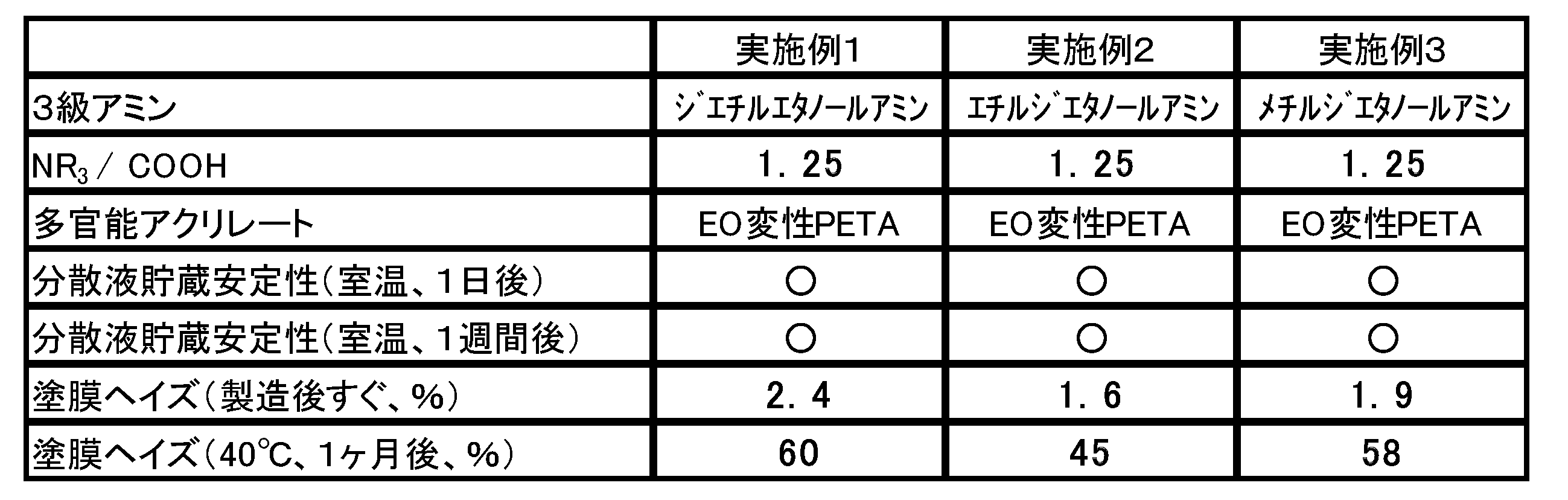
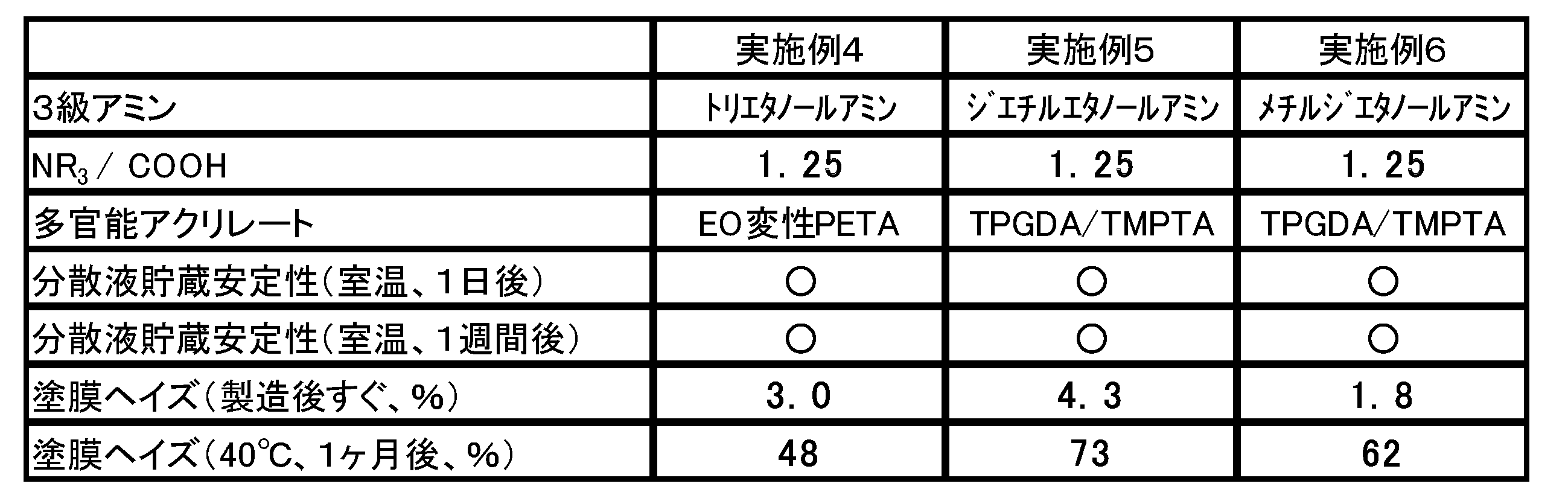
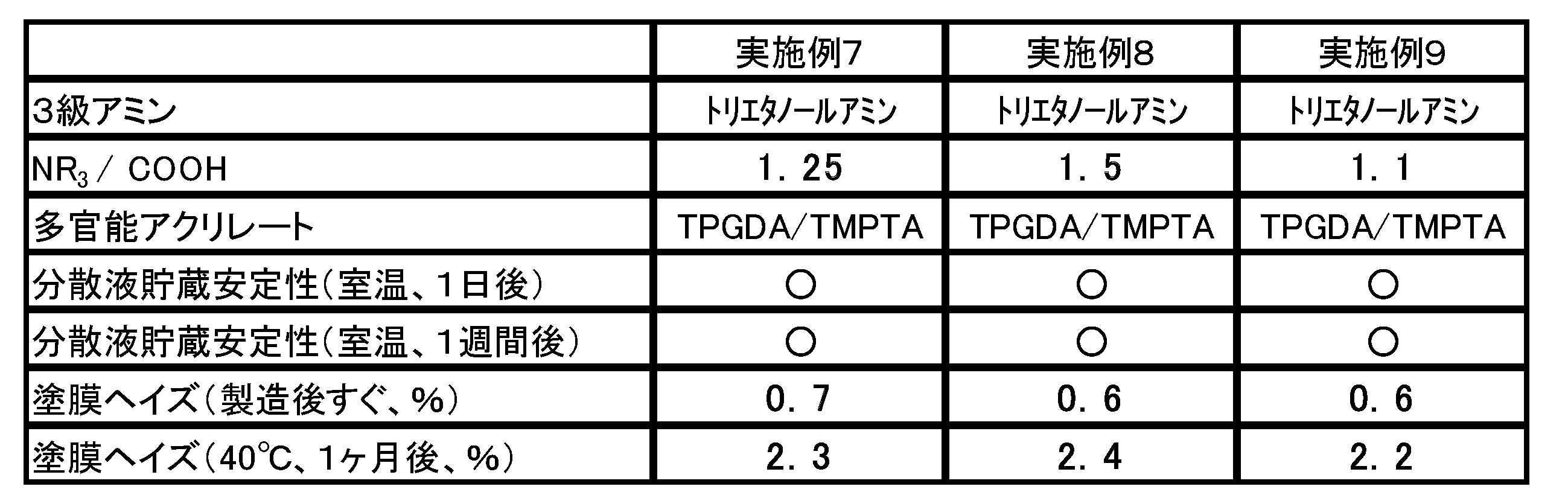
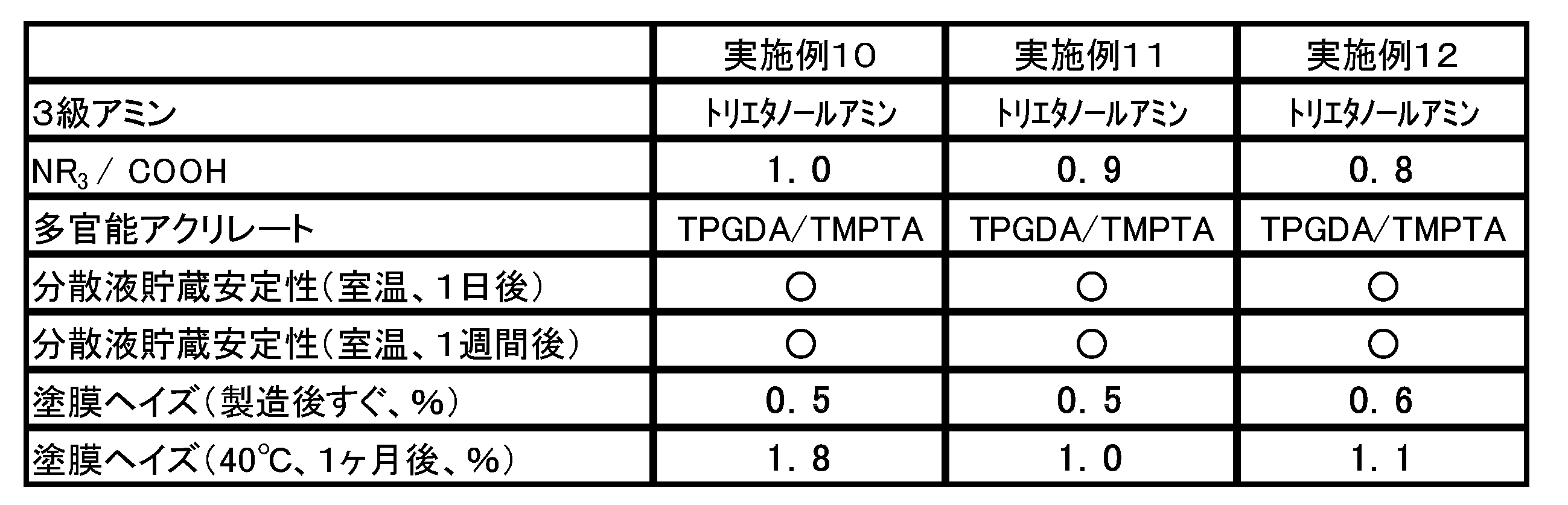
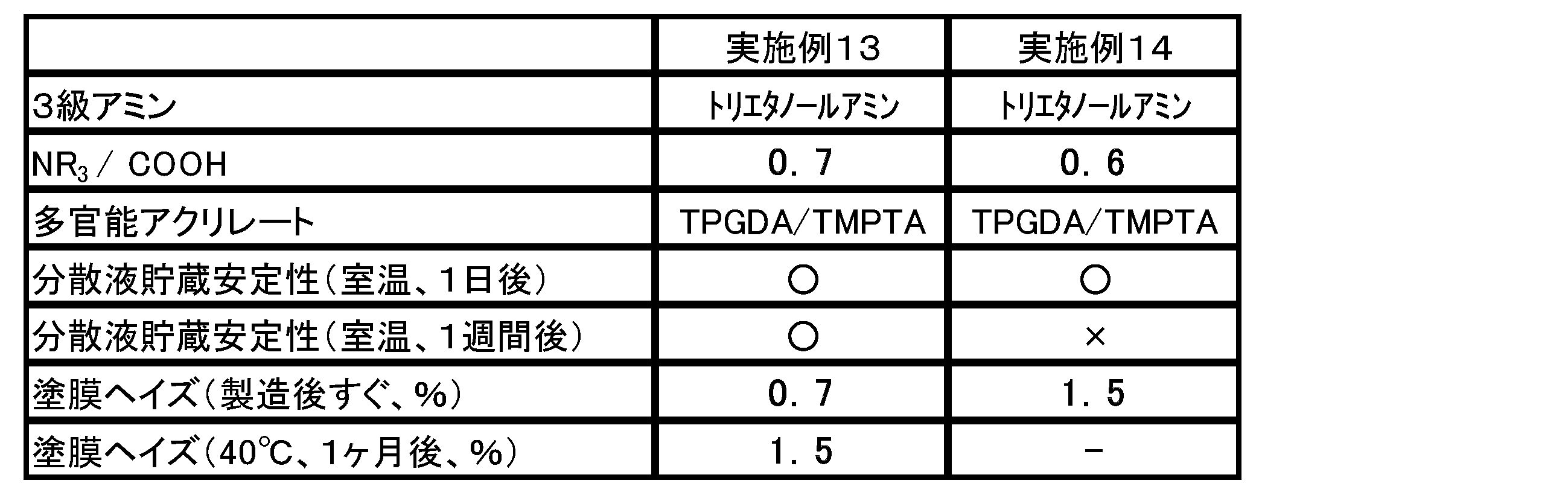

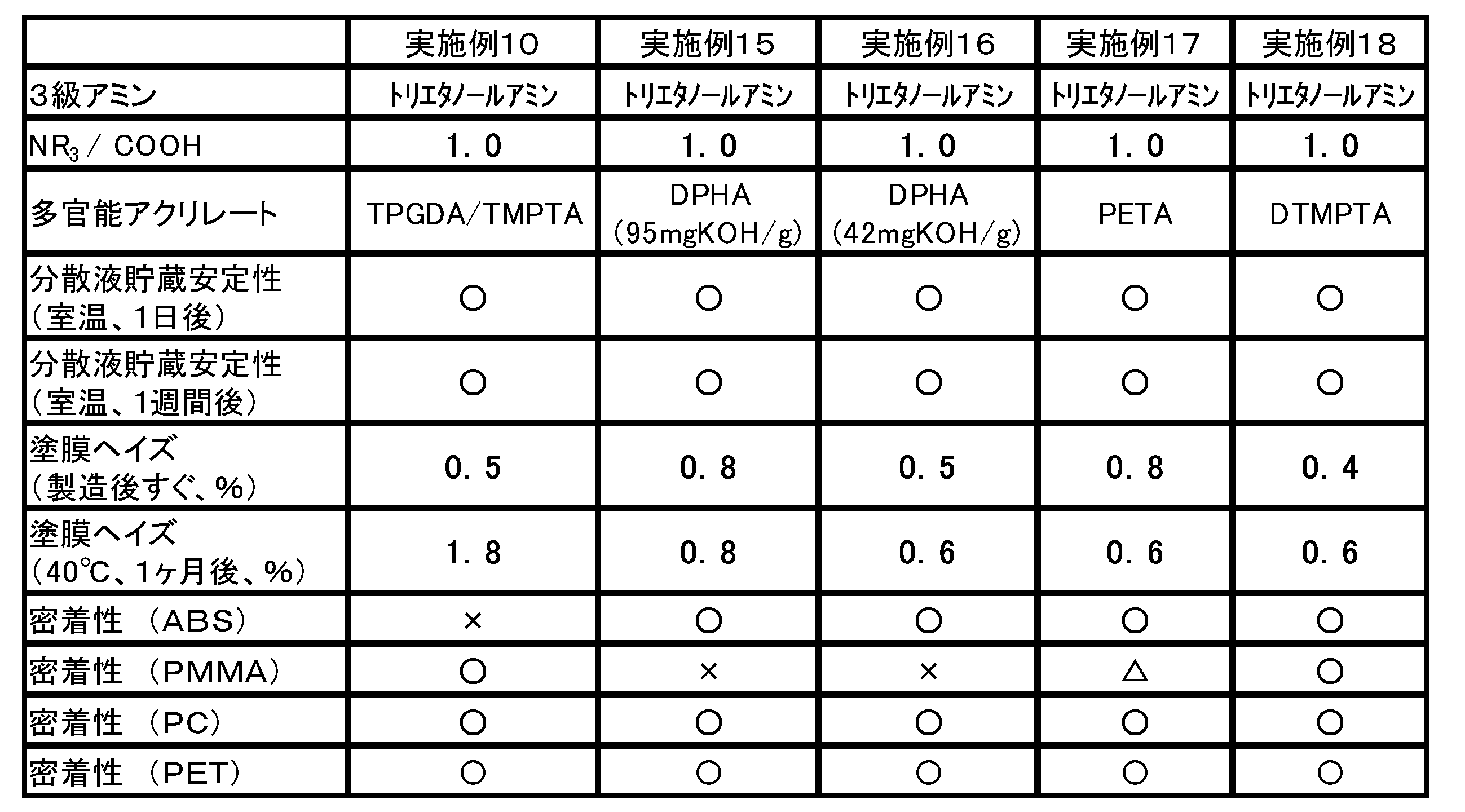
表7において、ABSはアクリロニトリル-ブタジエン-スチレン樹脂を、PMMAはポリメチルメタクリレート樹脂を、PCはポリカーボネート樹脂を、PETはポリエチレンテレフタレート樹脂を表す。
Claims (15)
- 少なくとも、重合性不飽和結合を有するポリウレタン樹脂(A)と、重合性不飽和結合を有する化合物(B)と、中和剤(C)とを水系媒体中に分散させてなる水性樹脂分散体であって、
重合性不飽和結合を有するポリウレタン樹脂(A)が、ポリオール(a)と、酸性基含有ポリオール(b)と、ポリイソシアネート(c)と、水酸基含有(メタ)アクリレート(d)とを少なくとも反応させて得られるものであり、
中和剤(C)が、下記一般式(1):

で表される第3級アミンであることを特徴とする水性樹脂分散体。 - 中和剤(C)が、ジエチルエタノールアミン、エチルジエタノールアミン、メチルジエタノールアミン、及びトリエタノールアミンからなる群から選ばれる1種以上である、請求項1に記載の水性樹脂分散体。
- 中和剤(C)が、トリエタノールアミンである、請求項1又は2に記載の水性樹脂分散体。
- ポリウレタン樹脂(A)中の酸性基のモル数に対する中和剤(C)のモル数の割合が、0.65~0.95である、請求項1~3のいずれか1項に記載の水性樹脂分散体。
- 重合性不飽和結合を有する化合物(B)が、ポリエチレングリコール構造を含有しない(メタ)アクリレートである、請求項1~4のいずれか1項に記載の水性樹脂分散体。
- 重合性不飽和結合を有する化合物(B)が、ジペンタエリスリトールヘキサ(メタ)アクリレートとジペンタエリスリトールペンタ(メタ)アクリレートとの混合物、ペンタエリスリトールテトラ(メタ)アクリレート、及びジトリメチロールプロパンテトラ(メタ)アクリレートからなる群から選ばれる1種以上である、請求項1~5のいずれか1項に記載の水性樹脂分散体。
- ポリオール(a)が、ポリカーボネートジオールである、請求項1~6のいずれか1項に記載の水性樹脂分散体。
- 水酸基含有(メタ)アクリレート(d)と重合性不飽和結合を有する化合物(B)との合計量が、水性樹脂分散体の樹脂固形分全体の65~75重量%である、請求項1~7のいずれか1項に記載の水性樹脂分散体。
- 重合性不飽和結合を有するポリウレタン樹脂(A)が、水酸基含有(メタ)アクリレート(d)を、イソシアナト基に不活性な(メタ)アクリレートとの混合物として、ポリウレタン樹脂(A)を得るための反応に使用して得られるものである、請求項1~8のいずれか1項に記載の水性樹脂分散体。
- 前記水酸基含有(メタ)アクリレート(d)とイソシアナト基に不活性な(メタ)アクリレートとの混合物が、水酸基価が80~120mgKOH/g以上のジペンタエリスリトールペンタ(メタ)アクリレートとジペンタエリスリトールヘキサ(メタ)アクリレートとの混合物である、請求項9に記載の水性樹脂分散体。
- さらに、重合性不飽和結合を有しない水性ポリウレタン樹脂(D)を含有する、請求項1~10のいずれか1項に記載の水性樹脂分散体。
- 重合性不飽和結合を有しない水性ポリウレタン樹脂(D)の重量平均分子量が40,000~1,000,000である、請求項11に記載の水性樹脂分散体。
- 請求項1~12のいずれか1項に記載の水性樹脂分散体と、重合開始剤とを含有する硬化性組成物。
- 請求項1~12のいずれか1項に記載の水性樹脂分散体を含有する塗料組成物。
- 請求項1~12のいずれか1項に記載の水性樹脂分散体を含有するコーティング剤組成物。
Priority Applications (3)
| Application Number | Priority Date | Filing Date | Title |
|---|---|---|---|
| JP2014555454A JPWO2014106939A1 (ja) | 2013-01-07 | 2013-12-25 | 水性樹脂分散体及びその使用 |
| CN201380069563.XA CN104995224B (zh) | 2013-01-07 | 2013-12-25 | 水性树脂分散体及其使用 |
| KR1020157021087A KR20150104151A (ko) | 2013-01-07 | 2013-12-25 | 수성 수지 분산체 및 그의 용도 |
Applications Claiming Priority (4)
| Application Number | Priority Date | Filing Date | Title |
|---|---|---|---|
| JP2013000411 | 2013-01-07 | ||
| JP2013-000411 | 2013-01-07 | ||
| JP2013-105492 | 2013-05-17 | ||
| JP2013105492 | 2013-05-17 |
Publications (1)
| Publication Number | Publication Date |
|---|---|
| WO2014106939A1 true WO2014106939A1 (ja) | 2014-07-10 |
Family
ID=51062259
Family Applications (1)
| Application Number | Title | Priority Date | Filing Date |
|---|---|---|---|
| PCT/JP2013/084704 Ceased WO2014106939A1 (ja) | 2013-01-07 | 2013-12-25 | 水性樹脂分散体及びその使用 |
Country Status (5)
| Country | Link |
|---|---|
| JP (2) | JPWO2014106939A1 (ja) |
| KR (1) | KR20150104151A (ja) |
| CN (1) | CN104995224B (ja) |
| TW (1) | TW201439205A (ja) |
| WO (1) | WO2014106939A1 (ja) |
Cited By (7)
| Publication number | Priority date | Publication date | Assignee | Title |
|---|---|---|---|---|
| KR20180084760A (ko) * | 2015-11-25 | 2018-07-25 | 도레이 카부시키가이샤 | 평판 인쇄용 잉크 |
| JP2018141041A (ja) * | 2017-02-27 | 2018-09-13 | 中国塗料株式会社 | 床材用活性エネルギー線硬化型樹脂組成物、被膜付き床材、床材の製造方法および汚染防止方法 |
| CN112250831A (zh) * | 2020-10-12 | 2021-01-22 | 深圳飞扬兴业科技有限公司 | 一种uv树脂及其制备方法 |
| JPWO2021024845A1 (ja) * | 2019-08-02 | 2021-02-11 | ||
| JPWO2021024842A1 (ja) * | 2019-08-02 | 2021-02-11 | ||
| CN115449290A (zh) * | 2022-10-18 | 2022-12-09 | 上海展辰涂料有限公司 | 一种木器底擦色用高附着水性uv树脂及其制备方法 |
| EP3418782B1 (en) * | 2016-12-26 | 2023-05-03 | LG Chem, Ltd. | Polarizer protection film, polarizing plate comprising the same, liquid crystal display comprising the polarizing plate, and coating composition for polarizer protecting film |
Families Citing this family (6)
| Publication number | Priority date | Publication date | Assignee | Title |
|---|---|---|---|---|
| CN105694565A (zh) * | 2016-04-27 | 2016-06-22 | 柳州申通汽车科技有限公司 | 水性汽车纳米涂料及其制备方法 |
| MX2022003503A (es) * | 2019-10-15 | 2022-04-25 | Akzo Nobel Coatings Int Bv | Composicion de recubrimiento curable por uv, a base de agua para recubrimientos faciles de limpiar. |
| CN111154060B (zh) * | 2020-01-17 | 2022-02-22 | 浙江佑谦特种材料有限公司 | 用于保险杠底漆的水性树脂分散体及其制备方法 |
| JP7511448B2 (ja) * | 2020-11-13 | 2024-07-05 | 信越化学工業株式会社 | ポリウレタン、ポリウレタンの製造方法、導電性ペースト組成物、導電配線および導電配線の製造方法 |
| WO2022114048A1 (ja) | 2020-11-27 | 2022-06-02 | 花王株式会社 | 顔料水分散体 |
| CN114058028B (zh) * | 2021-11-04 | 2023-06-16 | 万华化学集团股份有限公司 | 一种羟基丙烯酸分散体及其制备方法和应用 |
Citations (5)
| Publication number | Priority date | Publication date | Assignee | Title |
|---|---|---|---|---|
| JP2008127475A (ja) * | 2006-11-21 | 2008-06-05 | Negami Kogyo Kk | 不飽和基含有ウレタン樹脂およびこれを含有する活性エネルギー線硬化型樹脂組成物 |
| JP2009523188A (ja) * | 2006-01-13 | 2009-06-18 | エスエスシーピー・カンパニー・リミテッド | Uv硬化型水性乳剤、その製造方法及びこれを含む無溶剤塗料組成物 |
| WO2009145242A1 (ja) * | 2008-05-29 | 2009-12-03 | 宇部興産株式会社 | 水性ポリウレタン樹脂分散体、その製造方法、及びそれを含有する塗料組成物 |
| WO2012026475A1 (ja) * | 2010-08-25 | 2012-03-01 | 宇部興産株式会社 | 水性ポリウレタン樹脂分散体及びその製造方法、並びにその使用 |
| WO2012121311A1 (ja) * | 2011-03-08 | 2012-09-13 | 宇部興産株式会社 | ポリウレタン化合物、それを含む組成物、水性ポリウレタン分散体組成物及びこれらの硬化物 |
Family Cites Families (10)
| Publication number | Priority date | Publication date | Assignee | Title |
|---|---|---|---|---|
| JPH11209448A (ja) * | 1998-01-30 | 1999-08-03 | Hitachi Chem Co Ltd | 光硬化性樹脂組成物 |
| JP2005272833A (ja) * | 2004-02-26 | 2005-10-06 | Sanyo Chem Ind Ltd | ポリウレタン樹脂水性分散体 |
| EP2301982A4 (en) * | 2008-07-16 | 2011-07-20 | Ube Industries | AQUEOUS POLYURETHANE-DISPERSION AND METHOD FOR THE PRODUCTION THEREOF |
| US8912280B2 (en) * | 2009-02-26 | 2014-12-16 | Ube Industries, Ltd. | Aqueous polyurethane resin dispersion and process for preparing the same |
| TWI491634B (zh) * | 2009-07-23 | 2015-07-11 | 宇部興產股份有限公司 | 水性聚脲烷樹脂分散體及其製造方法 |
| JP5411018B2 (ja) * | 2010-02-23 | 2014-02-12 | 東栄化成株式会社 | 水性ウレタン変性(メタ)アクリル樹脂分散液の製造方法 |
| EP2674443A4 (en) * | 2011-02-10 | 2014-06-25 | Ube Industries | AQUEOUS POLYURETHANE RESIN DISPERSION AND APPLICATIONS THEREOF |
| US20130317167A1 (en) * | 2011-02-10 | 2013-11-28 | Ube Industries, Ltd. | Aqueous polyurethane resin dispersion and use thereof |
| JP2013082863A (ja) * | 2011-09-26 | 2013-05-09 | Asahi Kasei Chemicals Corp | 水分散性ウレタン(メタ)アクリレートおよび塗料組成物 |
| JP6246222B2 (ja) * | 2012-10-24 | 2017-12-13 | ビーエーエスエフ ソシエタス・ヨーロピアBasf Se | 放射線硬化性の水分散性ポリウレタン(メタ)アクリレート |
-
2013
- 2013-12-25 JP JP2014555454A patent/JPWO2014106939A1/ja active Pending
- 2013-12-25 KR KR1020157021087A patent/KR20150104151A/ko not_active Withdrawn
- 2013-12-25 WO PCT/JP2013/084704 patent/WO2014106939A1/ja not_active Ceased
- 2013-12-25 CN CN201380069563.XA patent/CN104995224B/zh active Active
-
2014
- 2014-01-06 TW TW103100351A patent/TW201439205A/zh unknown
-
2018
- 2018-09-11 JP JP2018169466A patent/JP2019031676A/ja active Pending
Patent Citations (5)
| Publication number | Priority date | Publication date | Assignee | Title |
|---|---|---|---|---|
| JP2009523188A (ja) * | 2006-01-13 | 2009-06-18 | エスエスシーピー・カンパニー・リミテッド | Uv硬化型水性乳剤、その製造方法及びこれを含む無溶剤塗料組成物 |
| JP2008127475A (ja) * | 2006-11-21 | 2008-06-05 | Negami Kogyo Kk | 不飽和基含有ウレタン樹脂およびこれを含有する活性エネルギー線硬化型樹脂組成物 |
| WO2009145242A1 (ja) * | 2008-05-29 | 2009-12-03 | 宇部興産株式会社 | 水性ポリウレタン樹脂分散体、その製造方法、及びそれを含有する塗料組成物 |
| WO2012026475A1 (ja) * | 2010-08-25 | 2012-03-01 | 宇部興産株式会社 | 水性ポリウレタン樹脂分散体及びその製造方法、並びにその使用 |
| WO2012121311A1 (ja) * | 2011-03-08 | 2012-09-13 | 宇部興産株式会社 | ポリウレタン化合物、それを含む組成物、水性ポリウレタン分散体組成物及びこれらの硬化物 |
Cited By (18)
| Publication number | Priority date | Publication date | Assignee | Title |
|---|---|---|---|---|
| US11161991B2 (en) * | 2015-11-25 | 2021-11-02 | Toray Industries, Inc. | Lithographic ink |
| KR20180084760A (ko) * | 2015-11-25 | 2018-07-25 | 도레이 카부시키가이샤 | 평판 인쇄용 잉크 |
| KR102338023B1 (ko) | 2015-11-25 | 2021-12-10 | 도레이 카부시키가이샤 | 평판 인쇄용 잉크 |
| EP3418782B1 (en) * | 2016-12-26 | 2023-05-03 | LG Chem, Ltd. | Polarizer protection film, polarizing plate comprising the same, liquid crystal display comprising the polarizing plate, and coating composition for polarizer protecting film |
| JP2018141041A (ja) * | 2017-02-27 | 2018-09-13 | 中国塗料株式会社 | 床材用活性エネルギー線硬化型樹脂組成物、被膜付き床材、床材の製造方法および汚染防止方法 |
| JP6990027B2 (ja) | 2017-02-27 | 2022-01-12 | 中国塗料株式会社 | 床材用活性エネルギー線硬化型樹脂組成物、被膜付き床材、床材の製造方法および汚染防止方法 |
| WO2021024845A1 (ja) * | 2019-08-02 | 2021-02-11 | 根上工業株式会社 | ウレタン(メタ)アクリレート、その中和物、光硬化性樹脂組成物及び液状組成物 |
| WO2021024842A1 (ja) * | 2019-08-02 | 2021-02-11 | 根上工業株式会社 | ウレタン(メタ)アクリレート、その中和物、光硬化性樹脂組成物及び液状組成物 |
| JPWO2021024842A1 (ja) * | 2019-08-02 | 2021-02-11 | ||
| CN113811555A (zh) * | 2019-08-02 | 2021-12-17 | 根上工业株式会社 | 氨基甲酸酯(甲基)丙烯酸酯、其中和物、光固化性树脂组合物及液状组合物 |
| CN113853397A (zh) * | 2019-08-02 | 2021-12-28 | 根上工业株式会社 | 氨基甲酸酯(甲基)丙烯酸酯、其中和物、光固化性树脂组合物及液状组合物 |
| JPWO2021024845A1 (ja) * | 2019-08-02 | 2021-02-11 | ||
| JP7040842B2 (ja) | 2019-08-02 | 2022-03-23 | 根上工業株式会社 | ウレタン(メタ)アクリレート、その中和物、光硬化性樹脂組成物及び液状組成物 |
| JP7040843B2 (ja) | 2019-08-02 | 2022-03-23 | 根上工業株式会社 | ウレタン(メタ)アクリレート、その中和物、光硬化性樹脂組成物及び液状組成物 |
| CN113853397B (zh) * | 2019-08-02 | 2022-10-28 | 根上工业株式会社 | 氨基甲酸酯(甲基)丙烯酸酯、其中和物、光固化性树脂组合物及液状组合物 |
| CN113811555B (zh) * | 2019-08-02 | 2023-03-10 | 根上工业株式会社 | 氨基甲酸酯(甲基)丙烯酸酯、其中和物、光固化性树脂组合物及液状组合物 |
| CN112250831A (zh) * | 2020-10-12 | 2021-01-22 | 深圳飞扬兴业科技有限公司 | 一种uv树脂及其制备方法 |
| CN115449290A (zh) * | 2022-10-18 | 2022-12-09 | 上海展辰涂料有限公司 | 一种木器底擦色用高附着水性uv树脂及其制备方法 |
Also Published As
| Publication number | Publication date |
|---|---|
| TW201439205A (zh) | 2014-10-16 |
| CN104995224A (zh) | 2015-10-21 |
| JP2019031676A (ja) | 2019-02-28 |
| CN104995224B (zh) | 2017-09-01 |
| JPWO2014106939A1 (ja) | 2017-01-19 |
| KR20150104151A (ko) | 2015-09-14 |
Similar Documents
| Publication | Publication Date | Title |
|---|---|---|
| JP6332498B2 (ja) | 水性ポリウレタン樹脂分散体及びその使用 | |
| JP2019031676A (ja) | 水性樹脂分散体及びその使用 | |
| JP5821854B2 (ja) | 水性ポリウレタン樹脂分散体及びその製造方法、並びにその使用 | |
| JP5983627B2 (ja) | 水性ポリウレタン樹脂分散体及びその使用 | |
| JP6349672B2 (ja) | 水性樹脂分散体組成物及びその使用 | |
| JP5994891B2 (ja) | 水性ポリウレタン樹脂分散体及びその製造方法 | |
| JP6524776B2 (ja) | 水性艶消し塗料及びそれを用いた積層体 | |
| JP5665613B2 (ja) | 金属基材のコーティング方法 | |
| JP2017066358A (ja) | ポリウレタン樹脂組成物及びその製造方法 | |
| JP2017014500A (ja) | 水性ポリウレタン樹脂分散体、それを含有する塗装組成物及びコーティング剤組成物 | |
| JP6123465B2 (ja) | 水性ポリウレタン樹脂分散体及びその使用 | |
| JP2013023556A (ja) | 水性ポリウレタン樹脂分散体組成物及びその製造方法 | |
| JP2014047225A (ja) | 水性樹脂分散体組成物及びその使用 | |
| JP5237610B2 (ja) | ウレタン樹脂組成物 | |
| JP2018178066A (ja) | 水性艶消し塗料及びそれを用いた積層体 | |
| JP2018087292A (ja) | ポリイミド樹脂基材被覆用水性樹脂分散体組成物、それを含むポリイミド樹脂基材被覆用コーティング剤、ポリイミド樹脂基材被覆用塗料及びポリイミド樹脂基材被覆用プライマー組成物 | |
| JP2017105901A (ja) | 水性樹脂分散体組成物 | |
| JP2018203820A (ja) | 水性ウレタン樹脂分散体及びそれを用いたフィルム及びシート |
Legal Events
| Date | Code | Title | Description |
|---|---|---|---|
| 121 | Ep: the epo has been informed by wipo that ep was designated in this application |
Ref document number: 13870071 Country of ref document: EP Kind code of ref document: A1 |
|
| ENP | Entry into the national phase |
Ref document number: 2014555454 Country of ref document: JP Kind code of ref document: A |
|
| NENP | Non-entry into the national phase |
Ref country code: DE |
|
| ENP | Entry into the national phase |
Ref document number: 20157021087 Country of ref document: KR Kind code of ref document: A |
|
| WWE | Wipo information: entry into national phase |
Ref document number: IDP00201504804 Country of ref document: ID |
|
| 122 | Ep: pct application non-entry in european phase |
Ref document number: 13870071 Country of ref document: EP Kind code of ref document: A1 |