WO2014050115A1 - 非水電解質二次電池 - Google Patents
非水電解質二次電池 Download PDFInfo
- Publication number
- WO2014050115A1 WO2014050115A1 PCT/JP2013/005720 JP2013005720W WO2014050115A1 WO 2014050115 A1 WO2014050115 A1 WO 2014050115A1 JP 2013005720 W JP2013005720 W JP 2013005720W WO 2014050115 A1 WO2014050115 A1 WO 2014050115A1
- Authority
- WO
- WIPO (PCT)
- Prior art keywords
- borate
- secondary battery
- electrolyte secondary
- positive electrode
- rare earth
- Prior art date
- Legal status (The legal status is an assumption and is not a legal conclusion. Google has not performed a legal analysis and makes no representation as to the accuracy of the status listed.)
- Ceased
Links
Images

Classifications
-
- H—ELECTRICITY
- H01—ELECTRIC ELEMENTS
- H01M—PROCESSES OR MEANS, e.g. BATTERIES, FOR THE DIRECT CONVERSION OF CHEMICAL ENERGY INTO ELECTRICAL ENERGY
- H01M4/00—Electrodes
- H01M4/02—Electrodes composed of, or comprising, active material
- H01M4/13—Electrodes for accumulators with non-aqueous electrolyte, e.g. for lithium-accumulators; Processes of manufacture thereof
- H01M4/131—Electrodes based on mixed oxides or hydroxides, or on mixtures of oxides or hydroxides, e.g. LiCoOx
-
- H—ELECTRICITY
- H01—ELECTRIC ELEMENTS
- H01M—PROCESSES OR MEANS, e.g. BATTERIES, FOR THE DIRECT CONVERSION OF CHEMICAL ENERGY INTO ELECTRICAL ENERGY
- H01M10/00—Secondary cells; Manufacture thereof
- H01M10/05—Accumulators with non-aqueous electrolyte
- H01M10/052—Li-accumulators
-
- H—ELECTRICITY
- H01—ELECTRIC ELEMENTS
- H01M—PROCESSES OR MEANS, e.g. BATTERIES, FOR THE DIRECT CONVERSION OF CHEMICAL ENERGY INTO ELECTRICAL ENERGY
- H01M4/00—Electrodes
- H01M4/02—Electrodes composed of, or comprising, active material
- H01M4/36—Selection of substances as active materials, active masses, active liquids
- H01M4/48—Selection of substances as active materials, active masses, active liquids of inorganic oxides or hydroxides
- H01M4/485—Selection of substances as active materials, active masses, active liquids of inorganic oxides or hydroxides of mixed oxides or hydroxides for inserting or intercalating light metals, e.g. LiTi2O4 or LiTi2OxFy
-
- H—ELECTRICITY
- H01—ELECTRIC ELEMENTS
- H01M—PROCESSES OR MEANS, e.g. BATTERIES, FOR THE DIRECT CONVERSION OF CHEMICAL ENERGY INTO ELECTRICAL ENERGY
- H01M10/00—Secondary cells; Manufacture thereof
- H01M10/05—Accumulators with non-aqueous electrolyte
- H01M10/056—Accumulators with non-aqueous electrolyte characterised by the materials used as electrolytes, e.g. mixed inorganic/organic electrolytes
- H01M10/0564—Accumulators with non-aqueous electrolyte characterised by the materials used as electrolytes, e.g. mixed inorganic/organic electrolytes the electrolyte being constituted of organic materials only
- H01M10/0566—Liquid materials
- H01M10/0567—Liquid materials characterised by the additives
-
- H—ELECTRICITY
- H01—ELECTRIC ELEMENTS
- H01M—PROCESSES OR MEANS, e.g. BATTERIES, FOR THE DIRECT CONVERSION OF CHEMICAL ENERGY INTO ELECTRICAL ENERGY
- H01M4/00—Electrodes
- H01M4/02—Electrodes composed of, or comprising, active material
- H01M4/36—Selection of substances as active materials, active masses, active liquids
- H01M4/48—Selection of substances as active materials, active masses, active liquids of inorganic oxides or hydroxides
- H01M4/50—Selection of substances as active materials, active masses, active liquids of inorganic oxides or hydroxides of manganese
- H01M4/505—Selection of substances as active materials, active masses, active liquids of inorganic oxides or hydroxides of manganese of mixed oxides or hydroxides containing manganese for inserting or intercalating light metals, e.g. LiMn2O4 or LiMn2OxFy
-
- H—ELECTRICITY
- H01—ELECTRIC ELEMENTS
- H01M—PROCESSES OR MEANS, e.g. BATTERIES, FOR THE DIRECT CONVERSION OF CHEMICAL ENERGY INTO ELECTRICAL ENERGY
- H01M4/00—Electrodes
- H01M4/02—Electrodes composed of, or comprising, active material
- H01M4/36—Selection of substances as active materials, active masses, active liquids
- H01M4/48—Selection of substances as active materials, active masses, active liquids of inorganic oxides or hydroxides
- H01M4/52—Selection of substances as active materials, active masses, active liquids of inorganic oxides or hydroxides of nickel, cobalt or iron
- H01M4/525—Selection of substances as active materials, active masses, active liquids of inorganic oxides or hydroxides of nickel, cobalt or iron of mixed oxides or hydroxides containing iron, cobalt or nickel for inserting or intercalating light metals, e.g. LiNiO2, LiCoO2 or LiCoOxFy
-
- H—ELECTRICITY
- H01—ELECTRIC ELEMENTS
- H01M—PROCESSES OR MEANS, e.g. BATTERIES, FOR THE DIRECT CONVERSION OF CHEMICAL ENERGY INTO ELECTRICAL ENERGY
- H01M4/00—Electrodes
- H01M4/02—Electrodes composed of, or comprising, active material
- H01M4/36—Selection of substances as active materials, active masses, active liquids
- H01M4/58—Selection of substances as active materials, active masses, active liquids of inorganic compounds other than oxides or hydroxides, e.g. sulfides, selenides, tellurides, halogenides or LiCoFy; of polyanionic structures, e.g. phosphates, silicates or borates
- H01M4/583—Carbonaceous material, e.g. graphite-intercalation compounds or CFx
- H01M4/587—Carbonaceous material, e.g. graphite-intercalation compounds or CFx for inserting or intercalating light metals
-
- H—ELECTRICITY
- H01—ELECTRIC ELEMENTS
- H01M—PROCESSES OR MEANS, e.g. BATTERIES, FOR THE DIRECT CONVERSION OF CHEMICAL ENERGY INTO ELECTRICAL ENERGY
- H01M4/00—Electrodes
- H01M4/02—Electrodes composed of, or comprising, active material
- H01M4/62—Selection of inactive substances as ingredients for active masses, e.g. binders, fillers
-
- Y—GENERAL TAGGING OF NEW TECHNOLOGICAL DEVELOPMENTS; GENERAL TAGGING OF CROSS-SECTIONAL TECHNOLOGIES SPANNING OVER SEVERAL SECTIONS OF THE IPC; TECHNICAL SUBJECTS COVERED BY FORMER USPC CROSS-REFERENCE ART COLLECTIONS [XRACs] AND DIGESTS
- Y02—TECHNOLOGIES OR APPLICATIONS FOR MITIGATION OR ADAPTATION AGAINST CLIMATE CHANGE
- Y02E—REDUCTION OF GREENHOUSE GAS [GHG] EMISSIONS, RELATED TO ENERGY GENERATION, TRANSMISSION OR DISTRIBUTION
- Y02E60/00—Enabling technologies; Technologies with a potential or indirect contribution to GHG emissions mitigation
- Y02E60/10—Energy storage using batteries
Definitions
- the present invention relates to a non-aqueous electrolyte secondary battery, and more particularly to improvement of battery performance of the non-aqueous electrolyte secondary battery.
- Non-aqueous electrolyte secondary batteries represented by lithium ion secondary batteries have high energy density and high voltage, so they are used as driving power sources for mobile information terminals such as mobile phones and laptop computers, and electric vehicles. It has been.
- Patent Document 1 discloses a technique in which a positive electrode contains at least one compound that is a hydroxide salt, a borate salt, or a silicate salt and whose aqueous solution is alkaline. Proposed. According to the technique of Patent Document 1, the storage performance and cycle performance of the nonaqueous electrolyte battery can be improved.
- non-aqueous electrolyte secondary batteries used as drive power sources are also required to have higher capacities.
- raising the end-of-charge voltage has been studied.
- Patent Document 2 proposes a technique in which a positive electrode active material that contains fluoroethylene carbonate as a solvent in a nonaqueous electrolytic solution and adheres to the surface in a state where fine particles of a rare earth element compound are dispersed is included in the positive electrode. Yes.
- a positive electrode active material that contains fluoroethylene carbonate as a solvent in a nonaqueous electrolytic solution and adheres to the surface in a state where fine particles of a rare earth element compound are dispersed is included in the positive electrode.
- Cathode active material particles adhered to the surface in a state where fine particles of rare earth element compound are dispersed usually have a rare earth element hydroxide adhered to the surface of the cathode active material particles, and the cathode active material particles are dried and heat-treated. It is produced by.
- a coprecipitation method, a wet powder method (spray coating), or the like is generally used. Through such a process, alkaline components such as LiOH and Li 2 CO 3 present on the surface of the positive electrode active material particles are washed.
- the decomposition of the non-aqueous electrolyte is accelerated starting from this, causing a significant decrease in battery performance.
- the alkali component is too small, there is no substance that neutralizes HF produced by thermal decomposition of a fluorinated nonaqueous solvent or oxidative decomposition of a Li salt, and the pH of the nonaqueous electrolyte tends to be low. Under such a low pH environment, the fluorinated non-aqueous solvent becomes unstable due to impaired oxidation resistance, and oxidative decomposition at the positive electrode is accelerated. Furthermore, the transition metal is eluted from the positive electrode active material and the polarization resistance of the positive electrode is increased, and the battery characteristics are deteriorated. In addition, such a decrease in battery characteristics becomes significant under a high temperature environment.
- an object of the present invention is to provide a high-capacity nonaqueous electrolyte secondary battery excellent in high-temperature battery characteristics such as high-temperature storage characteristics and high-temperature cycle characteristics.
- the present invention relates to a non-aqueous electrolyte secondary battery comprising a positive electrode having lithium transition metal composite oxide particles as a positive electrode active material, a negative electrode, and a non-aqueous electrolyte.
- the rare earth compound is at least one selected from the group consisting of rare earth hydroxides and rare earth oxyhydroxides, and the positive electrode contains a borate and is a nonaqueous electrolyte. Includes a fluorinated non-aqueous solvent.
- oxidative decomposition of the nonaqueous electrolyte can be suppressed even in a high temperature environment.
- decomposition of the fluorinated non-aqueous solvent or the fluorinated lithium salt having high oxidation resistance is suppressed even under a high temperature environment. Even if these two effects act synergistically to increase the end-of-charge voltage and increase the capacity, it is considered that the high-temperature battery characteristics such as high-temperature storage characteristics and high-temperature cycle characteristics can be significantly improved.
- the average particle diameter of the lithium transition metal composite oxide particles as the positive electrode active material is larger than the average particle diameter of the rare earth compound particles.
- the average particle size of the lithium transition metal composite oxide particles can be 3 to 30 ⁇ m.
- the average particle diameter of the rare earth compound particles is preferably 100 nm or less.
- the average particle diameter of the lithium transition metal composite oxide particles and the average particle diameter of the rare earth compound particles can be determined using, for example, a scanning electron microscope.
- the borate includes lithium borate, sodium borate, potassium borate, calcium borate, barium borate, manganese tetraborate, cobalt borate, nickel borate, And at least one selected from the group consisting of aluminum borate.
- the borate is selected from the group consisting of LiBO 2 , Li 2 B 4 O 7 , LiB 3 O 5 , and Li 2 B 8 O 13 because the effect of suppressing decomposition of a fluorinated non-aqueous solvent is high.
- at least one lithium borate is used.
- the borate as described above is chemically stable and can be obtained relatively easily.
- the ratio of the borate mass to the total mass of the lithium transition metal composite oxide and borate may be 0.1 to 5.0 mass%. it can. Thereby, decomposition
- the number of moles of the rare earth element of the rare earth compound may be 0.01 to 0.3 mol% with respect to the number of moles of the lithium transition metal composite oxide.
- the rare earth compound can include at least one rare earth element selected from Nd, Sm, Tb, Dy, Ho, Er, Tm, Yb, and Lu.
- the fluorinated non-aqueous solvent includes a fluorinated cyclic carbonate such as fluoroethylene carbonate and trifluoropropylene carbonate, and a fluorinated chain carbonate such as ethyl fluoromethyl carbonate and fluoroethyl ethyl carbonate. It can be set as the structure which is at least 1 sort (s) of fluorinated carbonate selected from the group which consists of. These fluorinated carbonates have high oxidation resistance and are easily available. The type and amount of the fluorinated carbonate are appropriately selected in consideration of desired oxidation resistance and the viscosity of the nonaqueous electrolyte.
- the non-aqueous electrolyte includes a non-aqueous solvent and an electrolyte salt dissolved in the non-aqueous solvent.
- the nonaqueous solvent may be composed of only a fluorinated nonaqueous solvent, or may be composed of a fluorinated nonaqueous solvent and a solvent other than the fluorinated nonaqueous solvent.
- the concentration of the fluorinated non-aqueous solvent in the non-aqueous electrolyte is 0.5% by mass or more and 20% by mass or less. Is preferable, and it is more preferable to set it as 5 mass% or less.
- the present invention it is possible to provide a high-capacity nonaqueous electrolyte secondary battery excellent in high-temperature battery characteristics such as high-temperature storage characteristics and high-temperature cycle characteristics.
- FIG. 1 is a graph showing a change in capacity retention rate when the charge / discharge cycle of the battery according to Example 1 and the battery according to Comparative Example 1 is repeated.
- Example 1 [Preparation of positive electrode active material]
- nickel, cobalt, lithium manganate, and lithium cobaltate were used as the positive electrode active material.
- Nickel, cobalt and lithium manganate were synthesized as follows. Lithium hydroxide hydrate (LiOH.H 2 O) was used as the lithium source.
- a nickel-cobalt-manganese composite hydroxide containing nickel, cobalt, and manganese in predetermined amounts was obtained by a coprecipitation method.
- the obtained composite hydroxide and lithium hydroxide were mixed so that the molar ratio of lithium to the total of nickel, cobalt, and manganese was 1.03: 1.
- This mixture was calcined at 400 ° C. for 12 hours in an oxygen atmosphere, the obtained calcined product was pulverized in a mortar, and this pulverized product was calcined at 850 ° C. for 24 hours in an oxygen atmosphere.
- Lithium acid LiNi 0.5 Co 0.2 Mn 0.3 O 2
- the obtained nickel / cobalt / lithium manganate was ground in an mortar until the average particle size became 15 ⁇ m.
- the chemical composition of nickel, cobalt, and lithium manganate was measured with an ICP (Inductively Coupled Plasma) emission analyzer.
- the solid content was suction filtered from the above suspension, washed with water, and the obtained powder was dried at 120 ° C.
- nickel, cobalt, and lithium manganate particles having erbium hydroxide uniformly adhered to the surface were obtained.
- Nickel / cobalt / lithium manganate particles with erbium hydroxide adhered were heat-treated in air at 300 ° C. for 5 hours, and at least part of the erbium hydroxide was changed to erbium oxyhydroxide, thereby erbium hydroxide.
- nickel / cobalt / lithium manganate particles having erbium oxyhydroxide particles adhering to the surface thereof were obtained, and these particles were designated as positive electrode active material particles a-1.
- erbium compound particles having an average particle diameter of 100 nm or less were found to be uniformly dispersed on the surfaces of the nickel, cobalt, and lithium manganate particles. It was confirmed that it was adhered.
- the adhesion amount of the erbium compound particles was 0.10 mol% with respect to nickel, cobalt, and lithium manganate in terms of erbium element.
- the adhesion amount of erbium compound particles was measured with an ICP emission spectrometer.
- Lithium cobaltate was synthesized as follows. Lithium carbonate (Li 2 CO 3 ) was used as the lithium source. As the cobalt source, tricobalt tetroxide (Co 3 O 4 ) obtained by calcining cobalt carbonate at 550 ° C. and thermal decomposition reaction was used.
- Lithium carbonate Li 2 CO 3
- cobalt source tricobalt tetroxide (Co 3 O 4 ) obtained by calcining cobalt carbonate at 550 ° C. and thermal decomposition reaction was used.
- Lithium carbonate and tricobalt tetroxide were weighed so that the molar ratio of lithium to cobalt was 1: 1. Thereafter, these were mixed in a mortar, and the obtained mixture was fired at 850 ° C. for 20 hours in an air atmosphere to obtain lithium cobaltate (LiCoO 2 ). The obtained lithium cobaltate was ground to an average particle size of 15 ⁇ m in a mortar.
- lithium cobaltate particles having erbium compound particles composed of at least one selected from the group consisting of erbium hydroxide and erbium oxyhydroxide attached to the surface This was designated as positive electrode active material particles a-2.
- the adhesion amount of erbium compound particles was 0.10 mol% with respect to lithium cobaltate in terms of erbium element.
- the positive electrode active material particles a-1 and the positive electrode active material particles a-2 were mixed at a mass ratio of 70:30.
- the obtained mixed active material and Li 2 B 4 O 7 were mixed at a mass ratio of 99: 1.
- 96 parts by mass of the obtained mixture, 2 parts by mass of carbon powder as a conductive agent, 2 parts by mass of polyvinylidene fluoride powder as a binder, and N-methylpyrrolidone were mixed to prepare a positive electrode slurry.
- This positive electrode slurry was applied to both surfaces of an aluminum positive electrode current collector having a thickness of 15 ⁇ m by a doctor blade method so that the coating mass was 21.2 mg / cm 2 on one side and 42.4 mg / cm 2 on both sides.
- the length of the coated portion along the positive electrode current collector length direction on one surface of the positive electrode current collector is 277 mm
- the length of the uncoated portion is 57 mm
- the length of the positive electrode current collector on the other surface is The length of the coated part along the direction was 208 mm
- the length of the uncoated part was 126 mm.
- the length of the coated portion along the length direction of the negative electrode current collector on one surface of the negative electrode current collector is 284 mm
- the length of the uncoated portion is 18 mm
- the length of the negative electrode current collector on the other surface The length of the coated part along the direction was 226 mm, and the length of the uncoated part was 73 mm.
- the negative electrode current collector coated with the negative electrode slurry was passed through a dryer and dried to obtain an electrode plate. This electrode plate was compressed using a compression roller so that the thickness of the coated part on both sides was 155 ⁇ m.
- a negative electrode having a negative electrode active material layer formed on both sides of the negative electrode current collector was obtained.
- the potential of graphite at the time of charging is about 0.1 V with respect to Li.
- the positive electrode and negative electrode active material filling amount is obtained by setting the charge capacity ratio (negative electrode charge capacity / positive electrode charge capacity) of the positive electrode and the negative electrode to 1. It adjusted so that it might be set to 1.
- LiPF 6 was dissolved in a mixed solvent in which ethylene carbonate and ethyl methyl carbonate were mixed at a volume ratio of 30:70 (25 ° C., 1 atm) to a concentration of 1 mol / L.
- vinylene carbonate (VC) was added to a concentration of 1% by mass
- fluoroethylene carbonate (FEC) was added to a concentration of 2.0% by mass. In this way, a non-aqueous electrolyte was prepared.
- Electrode body An aluminum lead wire is welded to the positive electrode, a nickel lead wire is welded to the negative electrode, and the positive electrode and the negative electrode are wound in a flat shape through a separator made of a polyethylene microporous film to form a spiral electrode body. Produced.
- Example 2 to 9 instead of erbium hydroxide and / or erbium oxyhydroxide, the types of rare earth elements contained in the rare earth hydroxide and / or rare earth oxyhydroxide present on the surfaces of the positive electrode active materials a-1 and a-2 are listed.
- the batteries of Examples 2 to 9 were produced in the same manner as in Example 1 except that the changes were made as shown in FIG.
- Examples 10 to 17 Batteries of Examples 10 to 14 were fabricated in the same manner as in Example 1, except that the type and amount of borate were changed as shown in Table 2. Further, Examples 10 to 12 except that lutetium hydroxide and / or lutetium oxyhydroxide was used as the rare earth hydroxide and / or rare earth oxyhydroxide present on the surfaces of the positive electrode active materials a-1 and a-2. Similar Examples 15 to 17 were produced.
- Example 18 was produced in the same manner as Example 9 except that the positive electrode active material particles a-1 and the positive electrode active material particles a-2 were mixed at a mass ratio of 30:70.
- Example 19 was produced in the same manner as Example 9 except that the positive electrode active material was not a mixed active material and only LiNi 0.33 Co 0.34 Mn 0.33 O 2 was used.
- Example 19 was produced in the same manner as Example 9 except that the positive electrode active material was not a mixed active material and only LiCoO 2 was used.
- Comparative Example 7 Comparative Example 7 similar to Example 19 except that borate was not used when producing the positive electrode, FEC was not added to the nonaqueous electrolyte, and the rare earth compound was not attached to the surface of the positive electrode active material particles. was made.
- Comparative Example 8 Comparative Example 8 similar to Example 20 except that borate was not used when producing the positive electrode, FEC was not added to the nonaqueous electrolyte, and the rare earth compound was not attached to the surface of the positive electrode active material particles. Was made.
- Comparative Example 9 Comparative Example 9 similar to Example 21 except that borate was not used when producing the positive electrode, FEC was not added to the nonaqueous electrolyte, and the rare earth compound was not attached to the surface of the positive electrode active material particles. Was made.
- Cycle test conditions Charging condition: Charging at a constant current of 1.0 It until the voltage reaches 4.40 V, then charging at a constant voltage of 4.40 V until the current value becomes 1/20 It Pause 10 minutes Discharging condition: 1.0 It Discharge 10 minutes until battery voltage reaches 3.0V
- the battery of Example 1 in which a rare earth compound is adhered to the surface of the positive electrode active material particles, the positive electrode active material layer contains lithium borate, and the non-aqueous electrolyte contains FEC has high temperature cycle characteristics and high temperature storage. It can be seen that the characteristic values are 80% and 75%, respectively.
- the battery of Comparative Example 1 that does not contain borate the battery of Comparative Example 2 that does not contain FEC, the battery of Comparative Example 5 that does not have the rare earth compound attached thereto, and the rare earth compound attached to the surface of the positive electrode active material particles.
- the high temperature cycle characteristic value and the high temperature storage characteristic value of the battery of Comparative Example 6 that does not contain borate and FEC are 35 to 55% and 35 to 50%, respectively, which are lower than the battery of Example 1. It can be seen that the value is shown.
- Example 9 This tendency is the same as Example 9, Comparative Examples 3 and 4 in which the rare earth compound was changed from erbium to lutetium on the surface of the positive electrode active material particles, and Comparative Examples 5 and 6 in which the rare earth compound was not attached to the surface of the positive electrode active material particles. It was the same in the comparison.
- the rare earth compound particles were adhered to the surface of the positive electrode active material particles, and the nonaqueous electrolyte contained FEC, but the positive electrode contained no borate (Comparative Example). 1, 3) Even when the rare earth compound particles were adhered to the surface of the positive electrode active material particles and the borate was included in the positive electrode, but the nonaqueous electrolyte did not include FEC (Comparative Examples 2 and 4), the high temperature cycle The effect which improves a characteristic and a high temperature storage characteristic was hardly acquired.
- FIG. 1 shows a change in capacity retention rate of the batteries of Example 1 and Comparative Example 1 when the charge / discharge cycle is repeated in the high-temperature cycle test. As shown in FIG. 1, the capacity of the battery of Comparative Example 1 suddenly decreases around 50 to 100 cycles.
- Li metal begins to deposit on the negative electrode. Such deposition of Li metal on the negative electrode is caused by the oxidative decomposition of the non-aqueous electrolyte on the positive electrode and the lithium intercalation reaction on the negative electrode side as the charge compensation reaction, or the transition dissolved from the positive electrode active material. It is considered that metal ions and non-aqueous electrolyte decomposition products (cations) are deposited on the negative electrode, and the deposits clog the active surface of the negative electrode.
- the battery of Example 1 has the effect of suppressing side reactions as described above, particularly the oxidative decomposition of the nonaqueous electrolyte, so that Li metal does not deposit on the negative electrode (that is, a rapid capacity reduction occurs). It shows good high-temperature cycle characteristics. It is considered that the high temperature storage characteristics are also improved by the same effect.
- Example 2 using Sm (samarium) as the rare earth element of the rare earth compound
- the battery of Example 3 using Yb (ytterbium)
- the battery of Example 4 using Nd (neodymium), Tb (terbium)
- the battery of Example 5 using Dy
- the battery of Example 6 using Dy (dysprosium)
- the battery of Example 7 using Ho (holmium)
- the battery of Example 8 using Tm (thulium)
- Lu The same effect as in Example 1 was confirmed for the battery of Example 9 using lutetium. Therefore, other rare earth elements are considered to have the same effect.
- Example 13 in which the addition amount of borate was changed from 1.0% by mass to 3.0% by mass and Example 14 in which the amount of borate was changed from 0.5% by mass were the same as in the battery of Example 1. The effect was confirmed.
- Example 1 the batteries of Example 1 were used for Examples 15 to 17 in which the rare earth compound was changed from erbium to lutetium on the surface of the positive electrode active material particles and LiB 3 O 5 , Na 2 B 4 O 7 or MgB 2 O 4 was used. Similar effects were confirmed.
- Example 9 using lutetium as the rare earth compound on the surface of the positive electrode active material particles was changed to use only LiNi 0.33 Co 0.34 Mn 0.33 O 2
- Example 19 In Example 20, which was changed to use only LiNi 0.5 Co 0.2 Mn 0.3 O 2 and Example 21 was changed to use only LiCoO 2 , a rare earth compound was added to the surface of the positive electrode active material particles.
- the properties were superior to those of Comparative Examples 7 to 9 which were not adhered and did not contain borate and FEC, and the same effects as in Example 9 were confirmed.
- Example 18 the same effect as in Example 9 was confirmed for Example 18 in which the ratio of the positive electrode active material particles a-1 and the positive electrode active material particles a-2 in Example 9 was changed.
- Li a (M 1-b M ′ b ) O 2 (where M is at least one of Co, Ni, and Mn, and M ′ is B, Al, Mg, Ti, It is at least one of Zr, Fe, Mn, Cr, Zn, 0.9 ⁇ a ⁇ 1.2, 0 ⁇ b ⁇ 0.1), Li a Mn 2 ⁇ x M3 x O 4 (0. 9 ⁇ a ⁇ 1.2, M3 is at least one of Al, B, Ni, Fe, Ti, Cr, V), and Li a FePO 4 (0.9 ⁇ a ⁇ 1.2)
- a lithium transition metal composite oxide that is at least one selected from the group consisting of:
- a lithium transition metal composite oxide to which an element such as Al, Mg, B, Zr, or Ti is added as the element M ′ or the element M3 in the above composition formula may be used.
- the borate is uniformly mixed with the positive electrode active material and the binder in the positive electrode active material layer.
- the effect of the present invention can be obtained. .
- the negative electrode active material is not particularly limited.
- the negative electrode active material Li, Si, SiO x , Sn, SnO x , Li [Li 1/3 Ti 5/3 ] O 4, etc. can be used in addition to the graphite used in the above examples. .
- the non-aqueous solvent contained in the non-aqueous electrolyte may be composed of a fluorinated non-aqueous solvent and a solvent other than the fluorinated non-aqueous solvent.
- Non-aqueous solvents other than fluorinated non-aqueous solvents include high dielectric constant solvents having high lithium salt solubility such as ethylene carbonate, propylene carbonate, butylene carbonate, ⁇ -butyrolactone, ⁇ -valerolactone, diethyl carbonate, dimethyl carbonate, Low viscosity solvents such as chain carbonates such as ethyl methyl carbonate, tetrahydrofuran, 1,2-dimethoxyethane, diethylene glycol dimethyl ether, 1,3-dioxolane, 2-methoxytetrahydrofuran, diethyl ether, ethyl acetate, propyl acetate, ethyl propionate , May be included.
- Examples of the electrolyte salt dissolved in the non-aqueous solvent include LiPF 6 , LiBF 4 , LiCF 3 SO 3 , LiN (CF 3 SO 2 ) 2 , LiN (C 2 F 5 SO 2 ) 2 , LiN (CF 3 SO 2) (C 4 F 9 SO 2), LiC (C 2 F 5 SO 2) 3, LiAsF 6, LiClO 4, Li 2 B 10 Cl 10, Li 2 B 12 Cl 12, LiB (C 2 O 4) F 2 , LiP (C 2 O 4 ) 2 F 2 or other lithium salts can be used.
- the total concentration of the electrolyte salt in the non-aqueous electrolyte is preferably 0.5 to 2.0 mol / liter.
- additives such as vinylene carbonate, cyclohexylbenzene, tert-amylbenzene and the like can be added to the nonaqueous electrolyte.
- a microporous film made of olefin resin such as polyethylene, polypropylene, a mixture or laminate thereof can be used.
- a high-capacity nonaqueous electrolyte secondary battery excellent in high-temperature battery characteristics such as high-temperature storage characteristics and high-temperature cycle characteristics can be provided. Therefore, industrial applicability is great.
Landscapes
- Chemical & Material Sciences (AREA)
- Chemical Kinetics & Catalysis (AREA)
- Electrochemistry (AREA)
- General Chemical & Material Sciences (AREA)
- Engineering & Computer Science (AREA)
- Manufacturing & Machinery (AREA)
- Inorganic Chemistry (AREA)
- Materials Engineering (AREA)
- Secondary Cells (AREA)
- Battery Electrode And Active Subsutance (AREA)
Description
本発明は、非水電解質二次電池に関し、詳しくは非水電解質二次電池の電池性能の向上に関する。
リチウムイオン二次電池に代表される非水電解質二次電池は、高エネルギー密度を有し、かつ高電圧であるため、携帯電話、ノートパソコン等の移動情報端末、電気自動車などの駆動電源として用いられている。
ところが、非水電解質二次電池が充電状態で保存された場合、非水電解質の酸化分解や正極活物質からの遷移金属の溶出が生じ、電池容量が低下する。このような電池容量の低下は、高温環境下で保存されたときに顕著となる。
上記問題を解決するために、例えば、特許文献1には、正極に、水酸化物塩、ホウ酸塩又はケイ酸塩であってその水溶液がアルカリ性である化合物を少なくとも1種以上含ませる技術が提案されている。特許文献1の技術によれば、非水電解質電池の保存性能・サイクル性能を向上できる。
一方で、携帯情報端末等の高機能化に伴い、その駆動電源として用いられる非水電解質二次電池には、更なる高容量化も求められている。近年、非水電解質二次電池の高容量化のために、充電終止電圧を引き上げることが検討されている。
ところが、非水電解質二次電池を高い電圧まで充電して使用する場合には、保存特性・サイクル特性の低下やガス発生による電池厚み増加というような問題が生じ易い。これは、正極活物質の結晶構造が不安定になり、酸素分子、もしくは酸素ラジカルが発生しやすくなり、この発生した酸素分子や酸素ラジカルによって、非水電解質の酸化分解が起こるためである。
そこで、充電終止電圧を高めたときに生じる不具合に対処する技術が提案されている。例えば、特許文献2には、非水電解液に、フルオロエチレンカーボネートが溶媒として含有され、希土類元素化合物の微粒子が分散した状態で表面に付着した正極活物質が正極に含ませる技術が提案されている。特許文献2の技術によれば、高電圧及び高温下での連続充電を行った際に、残存容量及び復帰容量の減少を抑制できるとともに、充電容量増加率の増加を抑制できる。
しかしながら、充電終止電圧を高めて高容量化する場合、特許文献2に開示される技術を用いたとしても、高温保存特性や高温サイクル特性のような高温電池特性を向上させる効果は十分とは言えない。
本発明者は、特許文献2の技術で、高温電池特性を向上させる効果が充分に得られない理由について、次のことを知見した。
希土類元素化合物の微粒子が分散した状態で表面に付着した正極活物質粒子は、通常、希土類元素の水酸化物を正極活物質粒子の表面に付着させ、その正極活物質粒子を乾燥及び熱処理することにより作製される。ここで、希土類元素の水酸化物を正極活物質粒子の表面に均一に付着させるため、共沈法、湿粉法(スプレーコート)などの手法が用いられることが一般的である。このような工程を経ることで、正極活物質粒子の表面に存在するLiOHやLi2CO3などのアルカリ成分が洗浄される。
希土類元素化合物の微粒子が分散した状態で表面に付着した正極活物質粒子は、通常、希土類元素の水酸化物を正極活物質粒子の表面に付着させ、その正極活物質粒子を乾燥及び熱処理することにより作製される。ここで、希土類元素の水酸化物を正極活物質粒子の表面に均一に付着させるため、共沈法、湿粉法(スプレーコート)などの手法が用いられることが一般的である。このような工程を経ることで、正極活物質粒子の表面に存在するLiOHやLi2CO3などのアルカリ成分が洗浄される。
このとき、正極活物質粒子表面に残存するアルカリ成分が多すぎると、それを起点に非水電解質の分解が加速され、電池性能の著しい低下を引き起こす。逆に、アルカリ成分が少なすぎると、フッ素化非水溶媒の熱分解やLi塩の酸化分解などによって生成されるHFを中和する物質が存在せず、非水電解質のpHが低くなりやすい。このような低pH環境下では、フッ素化非水溶媒は耐酸化性が損なわれて不安定になり、正極での酸化分解が加速される。さらには、正極活物質からの遷移金属の溶出や正極の分極抵抗の増大を引き起こし、電池特性が低下する。また、このような電池特性の低下は、高温環境下で顕著となる。
本発明は、上記問題に鑑み、高温保存特性や高温サイクル特性のような高温電池特性に優れた高容量な非水電解質二次電池を提供することを目的とする。
本発明は、正極活物質としてリチウム遷移金属複合酸化物粒子を有する正極と、負極と、非水電解質を備える非水電解質二次電池において、リチウム遷移金属複合酸化物粒子の表面には、希土類化合物が付着しており、希土類化合物は、希土類水酸化物及び希土類オキシ水酸化物よりなる群から選択される少なくとも1種であり、正極中には、ホウ酸塩が含まれており、非水電解質は、フッ素化非水溶媒を含むことを特徴とする。
正極活物質であるリチウム遷移金属複合酸化物粒子の表面に希土類化合物を付着させることにより、高温環境下でも非水電解質の酸化分解を抑制することができる。さらに、正極中にホウ酸塩を含ませることにより、高温環境下でも耐酸化性の高いフッ素化非水溶媒やフッ素化されたリチウム塩の分解が抑制される。これらの2つの効果が相乗的に作用して、充電終止電圧を高くして高容量化した場合でも、高温保存特性や高温サイクル特性のような高温電池特性を顕著に向上できると考えられる。
ここで、正極活物質であるリチウム遷移金属複合酸化物粒子の平均粒径は、希土類化合物粒子の平均粒径よりも大きい。例えば、リチウム遷移金属複合酸化物粒子の平均粒径は3~30μmとすることができる。希土類化合物粒子の平均粒径は、100nm以下であることが好ましい。
リチウム遷移金属複合酸化物粒子の平均粒径や希土類化合物粒子の平均粒径は、例えば、走査型電子顕微鏡を用いて求めることができる。
リチウム遷移金属複合酸化物粒子の平均粒径や希土類化合物粒子の平均粒径は、例えば、走査型電子顕微鏡を用いて求めることができる。
上記非水電解質二次電池において、ホウ酸塩は、ホウ酸リチウム、ホウ酸ナトリウム、ホウ酸カリウム、ホウ酸カルシウム、ホウ酸バリウム、四ホウ酸マンガン(II)、ホウ酸コバルト、ホウ酸ニッケル、及びホウ酸アルミニウムよりなる群から選択される少なくとも1種である構成とすることができる。特に、フッ素化非水溶媒等の分解を抑制する効果が高いため、ホウ酸塩は、LiBO2、Li2B4O7、LiB3O5、及びLi2B8O13よりなる群から選択される少なくとも1種のホウ酸リチウムである構成とすることが好ましい。なお、上記のようなホウ酸塩は、化学的に安定で、且つ比較的容易に入手することができる。
上記非水電解質二次電池において、リチウム遷移金属複合酸化物と、ホウ酸塩との合計質量に対するホウ酸塩の質量の割合は、0.1~5.0質量%である構成とすることができる。これにより、フッ素化非水溶媒の分解をより好適に抑制できる。また、正極の分極抵抗の増加も抑制できる。
上記非水電解質二次電池において、希土類化合物の希土類元素のモル数が、リチウム遷移金属複合酸化物のモル数に対して、0.01~0.3mol%である構成とすることができる。これにより、正極活物質による非水電解質の酸化分解をより好適に抑制できる。
上記非水電解質二次電池において、前記希土類化合物は、Nd、Sm、Tb、Dy、Ho、Er、Tm、Yb、及びLuのうち少なくとも1種の希土類元素を含む構成することができる。
上記非水電解質二次電池において、フッ素化非水溶媒は、フルオロエチレンカーボネート、トリフルオロプロピレンカーボネートのようなフッ化環状カーボネート、及びエチルフルオロメチルカーボネート、フルオロエチルエチルカーボネートのようなフッ化鎖状カーボネートよりなる群から選択される少なくとも1種のフッ化カーボネートである構成とすることができる。これらのフッ化カーボネートは、高い耐酸化性を有し、入手が容易である。なお、上記フッ化カーボネートの種類や量は、所望の耐酸化性や非水電解質の粘度を考慮して、適宜選択される。
ここで、非水電解質は、非水溶媒と、非水溶媒に溶解される電解質塩とが含まれる。本発明において、非水溶媒は、フッ素化非水溶媒のみから構成されてもよいし、フッ素化非水溶媒と、フッ素化非水溶媒以外の溶媒とから構成されていてもよい。非水溶媒が、フッ素化非水溶媒と、フッ素化非水溶媒以外の溶媒とから構成される場合、フッ素化非水溶媒の非水電解質における濃度は、0.5質量%以上20質量%以下が好ましく、5質量%以下とすることがより好ましい。
上記非水電解質二次電池において、リチウム遷移金属複合酸化物粒子は、Lia(M1-bM’b)O2(但し、MはCo、Ni、Mnのうちの少なくとも1種であり、M’はB、Al、Mg、Ti、Zr、Fe、Mn、Cr、Znのうちの少なくとも1種であり、0.9≦a≦1.2、0≦b≦0.1)、LiaMn2-xM3xO4(0.9≦a≦1.2、M3は、Al、B、Ni、Fe、Ti、Cr、Vのうちの少なくとも1種である)、及びLiaFePO4(0.9≦a≦1.2)よりなる群から選択される少なくとも1種である構成とすることができる。
本発明によれば、高温保存特性や高温サイクル特性等の高温電池特性に優れた高容量な非水電解質二次電池を提供することができる。
本発明を実施するための形態を、実施例を用いて説明する。なお、本発明は下記の形態に限定されるものではなく、その要旨を変更しない範囲において適宜変更して実施することができる。
(実施例1)
[正極活物質の作製]
正極活物質としては、ニッケル・コバルト・マンガン酸リチウムと、コバルト酸リチウムを用いた。
[正極活物質の作製]
正極活物質としては、ニッケル・コバルト・マンガン酸リチウムと、コバルト酸リチウムを用いた。
ニッケル・コバルト・マンガン酸リチウムを以下のようにして合成した。リチウム源には、水酸化リチウム水和物(LiOH・H2O)を用いた。
共沈法により、ニッケル、コバルト、マンガンを所定量ずつ含むニッケル・コバルト・マンガン複合水酸化物を得た。得られた複合水酸化物と、水酸化リチウムとを、リチウムと、ニッケル・コバルト・マンガン合計とのモル比が1.03:1になるように混合した。この混合物を、酸素雰囲気下400℃で12時間焼成し、得られた焼成物を乳鉢で砕解し、この砕解物を、酸素雰囲気下850℃で24時間焼成して、ニッケル・コバルト・マンガン酸リチウム(LiNi0.5Co0.2Mn0.3O2)を得た。得られたニッケル・コバルト・マンガン酸リチウムは、乳鉢で平均粒径15μmになるまで粉砕しておいた。なお、ニッケル・コバルト・マンガン酸リチウムの化学組成はICP(Inductively Coupled Plasma:誘導結合プラズマ)発光分析装置により測定した。
上記で得られたニッケル・コバルト・マンガン酸リチウム1000gを、3リットルの純水に添加し攪拌して、ニッケル・コバルト・マンガン酸リチウムが分散した懸濁液を調製した。この懸濁液に、硝酸エルビウム5水和物2.65gを溶解した溶液を添加した。硝酸エルビウム5水和物を溶解した溶液を懸濁液に添加する際には、ニッケル・コバルト・マンガン酸リチウムを含む懸濁液に、10質量%の水酸化物ナトリウム水溶液を添加し、この懸濁液のpHを9に保った。
次に、上記懸濁液から固形分を吸引濾過し、水洗し、得られた粉末を120℃で乾燥した。こうして、表面に水酸化エルビウムが均一に付着したニッケル・コバルト・マンガン酸リチウム粒子を得た。
水酸化エルビウムが付着したニッケル・コバルト・マンガン酸リチウム粒子を、300℃で5時間空気中にて熱処理して、水酸化エルビウムの少なくとも一部がオキシ水酸化エルビウムに変化し、これにより水酸化エルビウム及び/又はオキシ水酸化エルビウムの粒子が表面に付着したニッケル・コバルト・マンガン酸リチウム粒子を得て、この粒子を正極活物質粒子a-1とした。正極活物質粒子a-1を、走査型電子顕微鏡(SEM)にて観察したところ、ニッケル・コバルト・マンガン酸リチウム粒子表面に均一に分散された状態で、平均粒子径100nm以下のエルビウム化合物粒子が付着していることが確認された。エルビウム化合物粒子の付着量は、エルビウム元素換算で、ニッケル・コバルト・マンガン酸リチウムに対して、0.10mol%であった。なお、エルビウム化合物粒子の付着量は、ICP発光分析装置により測定した。
コバルト酸リチウムを以下のようにして合成した。リチウム源には、炭酸リチウム(Li2CO3)を用いた。コバルト源には、炭酸コバルトを550℃で焼成し、熱分解反応によって得られた四酸化三コバルト(Co3O4)を用いた。
炭酸リチウムと、四酸化三コバルトとを、リチウムとコバルトとのモル比が1:1になるように秤量した。その後、これらを乳鉢で混合し、得られた混合物を空気雰囲気下850℃で20時間焼成し、コバルト酸リチウム(LiCoO2)を得た。得られたコバルト酸リチウムは、乳鉢で平均粒径15μmまで粉砕しておいた。
次いで、上記ニッケル・コバルト・マンガン酸リチウムの場合と同様にして、水酸化エルビウム及びオキシ水酸化エルビウムよりなる群から選択される少なくとも1種からなるエルビウム化合物粒子が表面に付着したコバルト酸リチウム粒子を得、これを正極活物質粒子a-2とした。エルビウム化合物粒子の付着量は、エルビウム元素換算で、コバルト酸リチウムに対して、0.10mol%であった。
[正極の作製]
正極活物質粒子a-1と正極活物質粒子a-2とを、70:30の質量比で混合した。得られた混合活物質と、Li2B4O7とを、99:1の質量比で混合した。得られた混合物96質量部と、導電剤としての炭素粉末2質量部と、結着剤としてのポリフッ化ビニリデン粉末2質量部と、N-メチルピロリドンとを混合して、正極スラリーを調製した。この正極スラリーを、厚さ15μmのアルミニウム製正極集電体の両面にドクターブレード法により、塗布質量が片面で21.2mg/cm2、両面で42.4mg/cm2となるように塗布した。ここで、正極集電体の一方の面における、正極集電体長さ方向に沿う塗布部分の長さを277mmとし、未塗布部分の長さを57mmとし、他方の面における、正極集電体長さ方向に沿う塗布部分の長さを208mmとし、未塗布部分の長さを126mmとした。その後、正極スラリーを塗布した正極集電体を、乾燥機中を通過させて乾燥することにより、極板を得た。この極板を圧縮ローラーを用いて両面塗布部分の厚みが132μmになるように圧縮した。こうして、正極集電体の両面に正極活物質層が形成された正極を得た。
正極活物質粒子a-1と正極活物質粒子a-2とを、70:30の質量比で混合した。得られた混合活物質と、Li2B4O7とを、99:1の質量比で混合した。得られた混合物96質量部と、導電剤としての炭素粉末2質量部と、結着剤としてのポリフッ化ビニリデン粉末2質量部と、N-メチルピロリドンとを混合して、正極スラリーを調製した。この正極スラリーを、厚さ15μmのアルミニウム製正極集電体の両面にドクターブレード法により、塗布質量が片面で21.2mg/cm2、両面で42.4mg/cm2となるように塗布した。ここで、正極集電体の一方の面における、正極集電体長さ方向に沿う塗布部分の長さを277mmとし、未塗布部分の長さを57mmとし、他方の面における、正極集電体長さ方向に沿う塗布部分の長さを208mmとし、未塗布部分の長さを126mmとした。その後、正極スラリーを塗布した正極集電体を、乾燥機中を通過させて乾燥することにより、極板を得た。この極板を圧縮ローラーを用いて両面塗布部分の厚みが132μmになるように圧縮した。こうして、正極集電体の両面に正極活物質層が形成された正極を得た。
[負極の作製]
黒鉛からなる負極活物質を97.5質量部と、カルボキシメチルセルロースからなる増粘剤を1.0質量部と、スチレンブタジエンゴムからなる結着剤を1.5質量部と、適量の水とを混合して、負極スラリーを調製した。この負極スラリーを、厚さ10μmの銅製負極集電体の両面にドクターブレード法により、片面あたりの塗布質量が11.3mg/cm2となるように塗布した。ここで、負極集電体の一方の面における、負極集電体長さ方向に沿う塗布部分の長さを284mmとし、未塗布部分の長さを18mmとし、他方の面における、負極集電体長さ方向に沿う塗布部分の長さを226mmとし、未塗布部分の長さを73mmとした。その後、負極スラリーを塗布した負極集電体を、乾燥機中を通過させて乾燥することにより、極板を得た。この極板を圧縮ローラーを用いて両面塗布部分の厚みが155μmとなるように圧縮した。こうして、負極集電体の両面に負極活物質層が形成された負極を得た。
黒鉛からなる負極活物質を97.5質量部と、カルボキシメチルセルロースからなる増粘剤を1.0質量部と、スチレンブタジエンゴムからなる結着剤を1.5質量部と、適量の水とを混合して、負極スラリーを調製した。この負極スラリーを、厚さ10μmの銅製負極集電体の両面にドクターブレード法により、片面あたりの塗布質量が11.3mg/cm2となるように塗布した。ここで、負極集電体の一方の面における、負極集電体長さ方向に沿う塗布部分の長さを284mmとし、未塗布部分の長さを18mmとし、他方の面における、負極集電体長さ方向に沿う塗布部分の長さを226mmとし、未塗布部分の長さを73mmとした。その後、負極スラリーを塗布した負極集電体を、乾燥機中を通過させて乾燥することにより、極板を得た。この極板を圧縮ローラーを用いて両面塗布部分の厚みが155μmとなるように圧縮した。こうして、負極集電体の両面に負極活物質層が形成された負極を得た。
なお、充電時の黒鉛の電位はLi基準で約0.1Vである。また、正極及び負極の活物質充填量は、設計基準となる正極活物質の電位(Li基準で4.5V)において、正極と負極の充電容量比(負極充電容量/正極充電容量)を1.1となるように調整した。
[非水電解質の調製]
エチレンカーボネートとエチルメチルカーボネートとを30:70の体積比(25℃、1気圧)で混合した混合溶媒に、LiPF6を1mol/Lの濃度になるように溶解した。得られた溶液に、ビニレンカーボネート(VC)を1質量%の濃度となるように、フルオロエチレンカーボネート(FEC)を2.0質量%の濃度となるように添加した。このようにして、非水電解質を調製した。
エチレンカーボネートとエチルメチルカーボネートとを30:70の体積比(25℃、1気圧)で混合した混合溶媒に、LiPF6を1mol/Lの濃度になるように溶解した。得られた溶液に、ビニレンカーボネート(VC)を1質量%の濃度となるように、フルオロエチレンカーボネート(FEC)を2.0質量%の濃度となるように添加した。このようにして、非水電解質を調製した。
[電極体の作製]
正極にはアルミニウム製のリード線を、負極にはニッケル製のリード線を溶接し、前記正極と負極をポリエチレン製微多孔膜から成るセパレータを介して扁平型に巻回して渦巻状の電極体を作製した。
正極にはアルミニウム製のリード線を、負極にはニッケル製のリード線を溶接し、前記正極と負極をポリエチレン製微多孔膜から成るセパレータを介して扁平型に巻回して渦巻状の電極体を作製した。
[ラミネート電池の作製]
上記で作製した電極体をラミネート容器に封入し、アルゴン(Ar)ガスを満たしたグローブボックス内で、上記非水電解質を注液した。その後、注液口を塞いでラミネート電池を作製した。このようにして、設計容量が800mAhの実施例1に係る電池を作製した。
上記で作製した電極体をラミネート容器に封入し、アルゴン(Ar)ガスを満たしたグローブボックス内で、上記非水電解質を注液した。その後、注液口を塞いでラミネート電池を作製した。このようにして、設計容量が800mAhの実施例1に係る電池を作製した。
(実施例2~9)
水酸化エルビウム及び/又はオキシ水酸化エルビウムに代えて、正極活物質a-1及びa-2の表面に存在する希土類水酸化及び/又は希土類オキシ水酸化物に含まれる希土類元素の種類を、表1に示されるように変更した以外、実施例1と同様の手法で、実施例2~9の電池を作製した。
水酸化エルビウム及び/又はオキシ水酸化エルビウムに代えて、正極活物質a-1及びa-2の表面に存在する希土類水酸化及び/又は希土類オキシ水酸化物に含まれる希土類元素の種類を、表1に示されるように変更した以外、実施例1と同様の手法で、実施例2~9の電池を作製した。
(実施例10~17)
ホウ酸塩の種類および添加量を、表2に示されるように変更した以外は、実施例1と同様の手法で、実施例10~14の電池を作製した。さらに、正極活物質a-1及びa-2の表面に存在する希土類水酸化及び/又は希土類オキシ水酸化物として、水酸化ルテチウム及び/又はオキシ水酸化ルテチウムとした以外は実施例10~12と同様とした実施例15~17を作製した。
ホウ酸塩の種類および添加量を、表2に示されるように変更した以外は、実施例1と同様の手法で、実施例10~14の電池を作製した。さらに、正極活物質a-1及びa-2の表面に存在する希土類水酸化及び/又は希土類オキシ水酸化物として、水酸化ルテチウム及び/又はオキシ水酸化ルテチウムとした以外は実施例10~12と同様とした実施例15~17を作製した。
(実施例18)
正極活物質粒子a-1と正極活物質粒子a-2とを、30:70の質量比で混合した以外は実施例9と同様とした実施例18を作製した。
正極活物質粒子a-1と正極活物質粒子a-2とを、30:70の質量比で混合した以外は実施例9と同様とした実施例18を作製した。
(実施例19)
正極活物質は混合活物質とせず、LiNi0.33Co0.34Mn0.33O2のみを用いたこと以外は実施例9と同様にした実施例19を作製した。
正極活物質は混合活物質とせず、LiNi0.33Co0.34Mn0.33O2のみを用いたこと以外は実施例9と同様にした実施例19を作製した。
(実施例20)
正極活物質は混合活物質とせず、LiCoO2のみを用いたこと以外は実施例9と同様にした実施例19を作製した。
正極活物質は混合活物質とせず、LiCoO2のみを用いたこと以外は実施例9と同様にした実施例19を作製した。
(比較例1~6)
正極を作製するときにホウ酸塩を用いなかったこと以外(比較例1)、非水電解質にFECを添加しなかったこと以外(比較例2)、正極活物質粒子表面に希土類化合物を付着させなかったこと以外(比較例5)、正極を作製するときにホウ酸塩を用いず、非水電解質にFECを添加せず、かつ正極活物質粒子表面に希土類化合物を付着させなかったこと以外(比較例6)、実施例1と同様の手法で、比較例1、2、5、6の電池を作製した。また、正極活物質a-1及びa-2の表面に存在する希土類水酸化及び/又は希土類オキシ水酸化物として、水酸化ルテチウム及び/又はオキシ水酸化ルテチウムとした以外は比較例1、2同様とした比較例3、4を作製した。
正極を作製するときにホウ酸塩を用いなかったこと以外(比較例1)、非水電解質にFECを添加しなかったこと以外(比較例2)、正極活物質粒子表面に希土類化合物を付着させなかったこと以外(比較例5)、正極を作製するときにホウ酸塩を用いず、非水電解質にFECを添加せず、かつ正極活物質粒子表面に希土類化合物を付着させなかったこと以外(比較例6)、実施例1と同様の手法で、比較例1、2、5、6の電池を作製した。また、正極活物質a-1及びa-2の表面に存在する希土類水酸化及び/又は希土類オキシ水酸化物として、水酸化ルテチウム及び/又はオキシ水酸化ルテチウムとした以外は比較例1、2同様とした比較例3、4を作製した。
(比較例7)
正極を作製するときにホウ酸塩を用いず、非水電解質にFECを添加せず、かつ正極活物質粒子表面に希土類化合物を付着させなかったこと以外は実施例19と同様とした比較例7を作製した。
正極を作製するときにホウ酸塩を用いず、非水電解質にFECを添加せず、かつ正極活物質粒子表面に希土類化合物を付着させなかったこと以外は実施例19と同様とした比較例7を作製した。
(比較例8)
正極を作製するときにホウ酸塩を用いず、非水電解質にFECを添加せず、かつ正極活物質粒子表面に希土類化合物を付着させなかったこと以外は実施例20と同様とした比較例8を作製した。
正極を作製するときにホウ酸塩を用いず、非水電解質にFECを添加せず、かつ正極活物質粒子表面に希土類化合物を付着させなかったこと以外は実施例20と同様とした比較例8を作製した。
(比較例9)
正極を作製するときにホウ酸塩を用いず、非水電解質にFECを添加せず、かつ正極活物質粒子表面に希土類化合物を付着させなかったこと以外は実施例21と同様とした比較例9を作製した。
正極を作製するときにホウ酸塩を用いず、非水電解質にFECを添加せず、かつ正極活物質粒子表面に希土類化合物を付着させなかったこと以外は実施例21と同様とした比較例9を作製した。
(評価)
[高温サイクル試験]
実施例1~21及び比較例1~9の電池について、45℃の環境下、下記の充放電条件にてサイクル試験を行い、容量維持率及び電池の膨れ量を求めた。
[高温サイクル試験]
実施例1~21及び比較例1~9の電池について、45℃の環境下、下記の充放電条件にてサイクル試験を行い、容量維持率及び電池の膨れ量を求めた。
サイクル試験条件:
充電条件:1.0Itの定電流で電圧が4.40Vになるまで充電し、次いで、4.40Vの定電圧で、電流値が1/20Itになるまで充電 休止10分
放電条件:1.0Itの電流で電池電圧が3.0Vになるまで放電 休止10分
充電条件:1.0Itの定電流で電圧が4.40Vになるまで充電し、次いで、4.40Vの定電圧で、電流値が1/20Itになるまで充電 休止10分
放電条件:1.0Itの電流で電池電圧が3.0Vになるまで放電 休止10分
上記充電、休止、放電、休止を1サイクルとし、この充放電サイクルを300回繰り返した。
容量維持率は、(300サイクル目の電池容量)/(1サイクル目の電池容量)×100(%)で算出した。得られた結果を、高温サイクル特性として表1~3に示す。
容量維持率は、(300サイクル目の電池容量)/(1サイクル目の電池容量)×100(%)で算出した。得られた結果を、高温サイクル特性として表1~3に示す。
[高温保存試験]
実施例1~21及び比較例1~9の電池を、25℃の環境下で試験を行ったことを除いて上記高温サイクル試験と同じ条件で充放電し、1サイクル目の電池容量を求めた。次いで、25℃の環境下で試験を行ったことを除いて上記高温サイクル試験と同じ充電条件で充電し、充電後の電池を、80℃で2日間保存した。保存後、25℃の環境下で試験を行ったことを除いて上記高温サイクル試験と同じ放電条件で放電して、保存後の電池容量を求めた。保存後の容量維持率を、(保存後の電池容量)/(1サイクル目の電池容量)×100(%)で算出した。得られた結果を、高温保存特性として表1~3に示す。
実施例1~21及び比較例1~9の電池を、25℃の環境下で試験を行ったことを除いて上記高温サイクル試験と同じ条件で充放電し、1サイクル目の電池容量を求めた。次いで、25℃の環境下で試験を行ったことを除いて上記高温サイクル試験と同じ充電条件で充電し、充電後の電池を、80℃で2日間保存した。保存後、25℃の環境下で試験を行ったことを除いて上記高温サイクル試験と同じ放電条件で放電して、保存後の電池容量を求めた。保存後の容量維持率を、(保存後の電池容量)/(1サイクル目の電池容量)×100(%)で算出した。得られた結果を、高温保存特性として表1~3に示す。
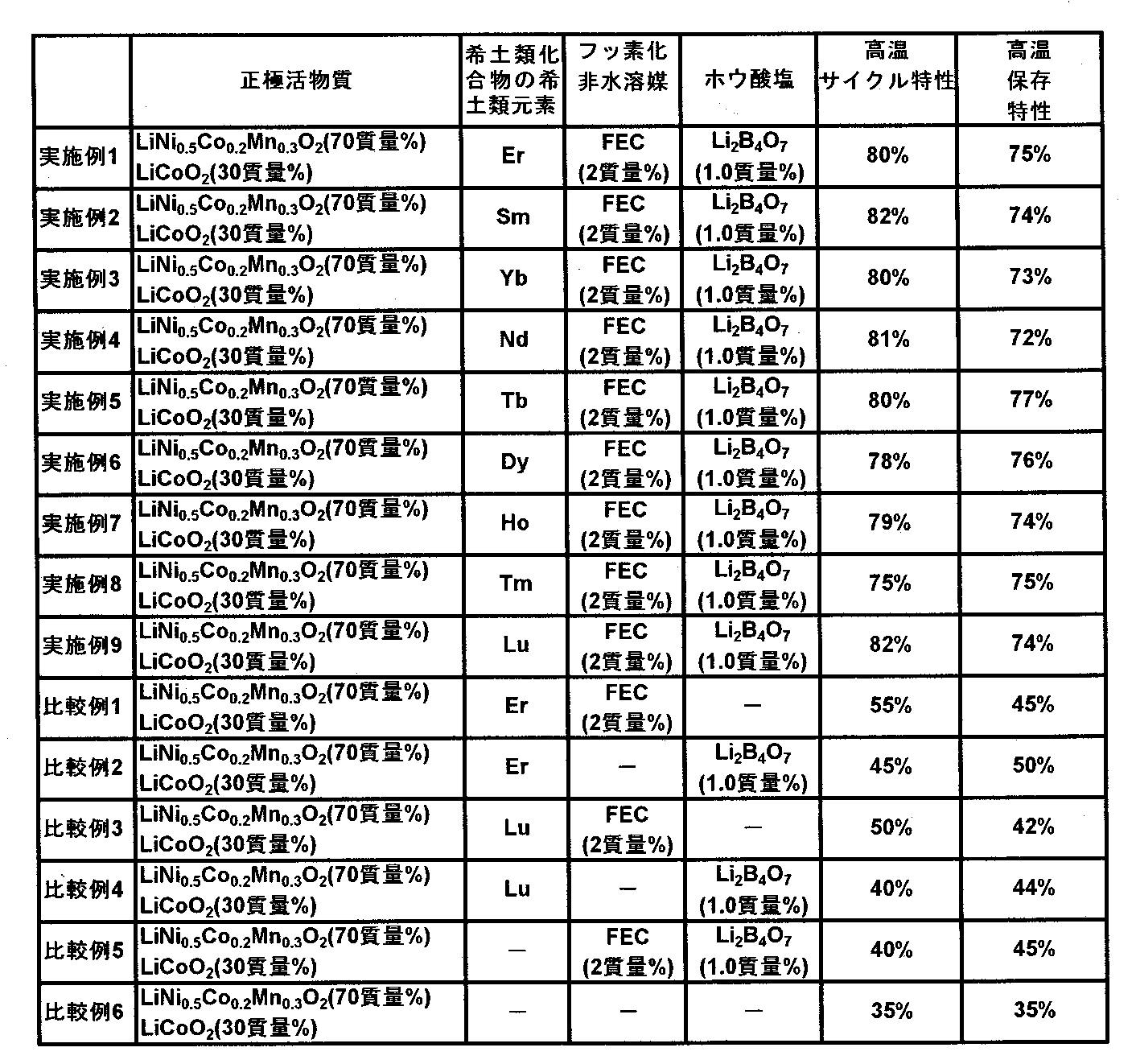
表1から、正極活物質粒子の表面に希土類化合物を付着させ、正極活物質層がホウ酸リチウムを含み、かつ非水電解質がFECを含む実施例1の電池は、高温サイクル特性値及び高温保存特性値がそれぞれ80%及び75%の値を示すことがわかる。
しかしながら、ホウ酸塩を含まない比較例1の電池、FECを含まない比較例2の電池、希土類化合物を付着させていない比較例5の電池、及び正極活物質粒子表面に希土類化合物を付着させておらず、かつホウ酸塩及びFECを含まない比較例6の電池の高温サイクル特性値及び高温保存特性値は、実施例1の電池と比べて、それぞれ35~55%及び35~50%と低い値を示すことがわかる。
この傾向は、正極活物質粒子の表面に希土類化合物をエルビウムからルテチウムに変更した実施例9、比較例3、4および正極活物質粒子の表面に希土類化合物を付着させていない比較例5、6との比較においても同様であった。
比較例5~6に示されるように、希土類化合物粒子が表面に付着していない正極活物質粒子を用いた場合には、正極活物質層にホウ酸塩を混合しても、高温サイクル特性及び高温保存特性を向上する効果は殆ど得られなかった。これは、希土類化合物粒子を付着させていない正極活物質粒子は分極劣化が激しく、またホウ酸塩を混合することで正極の分極抵抗が若干増大するためと考えられる。
また、比較例6の電池と比較して、希土類化合物粒子を正極活物質粒子表面に希土類化合物粒子を付着させ、非水電解質がFECを含むが、正極がホウ酸塩を含まない場合(比較例1、3)、正極活物質粒子表面に希土類化合物粒子を付着させ、正極にホウ酸塩を含ませたが、非水電解質がFECを含まない場合(比較例2、4)にも、高温サイクル特性及び高温保存特性を向上する効果は殆ど得られなかった。
ここで、図1に、高温サイクル試験において充放電サイクルを繰り返したときの実施例1及び比較例1の電池の容量維持率の変化を示す。図1に示されるように、比較例1の電池は、50~100サイクルあたりで急激に容量が低下している。
比較例1の電池の容量維持率変化曲線の変曲点は、正負極の容量比(=負極充電容量/正極充電容量)が1.0を切った点に対応しており、ここを境に負極上へLi金属が析出し始める。このような負極上へのLi金属の析出は、正極上で非水電解質の酸化分解が起こり、その電荷補償反応として負極側でリチウムインターカレーション反応が起きたため、または正極活物質から溶解した遷移金属イオンや非水電解質分解生成物(カチオン)が負極上へ堆積し、その堆積物が負極の活性面を閉塞することによって起こると考えられる。
一方で、実施例1の電池では、上記のような副反応、特に非水電解質の酸化分解を抑制する効果があるため、負極上へLi金属が析出することがなく(すなわち急激な容量低下を起こすことがなく)、良好な高温サイクル特性を示している。同様の効果で高温保存特性も向上しているものと考えられる。
希土類化合物の希土類元素として、Sm(サマリウム)を用いた実施例2の電池、Yb(イッテルビウム)を用いた実施例3の電池、Nd(ネオジム)を用いた実施例4の電池、Tb(テルビウム)を用いた実施例5の電池、Dy(ジスプロシウム)を用いた実施例6の電池、Ho(ホルミウム)を用いた実施例7の電池、Tm(ツリウム)を用いた実施例8の電池及びLu(ルテチウム)を用いた実施例9の電池についても、実施例1と同様の効果が確認された。よって、その他の希土類元素でも同様の効果があると考えられる。
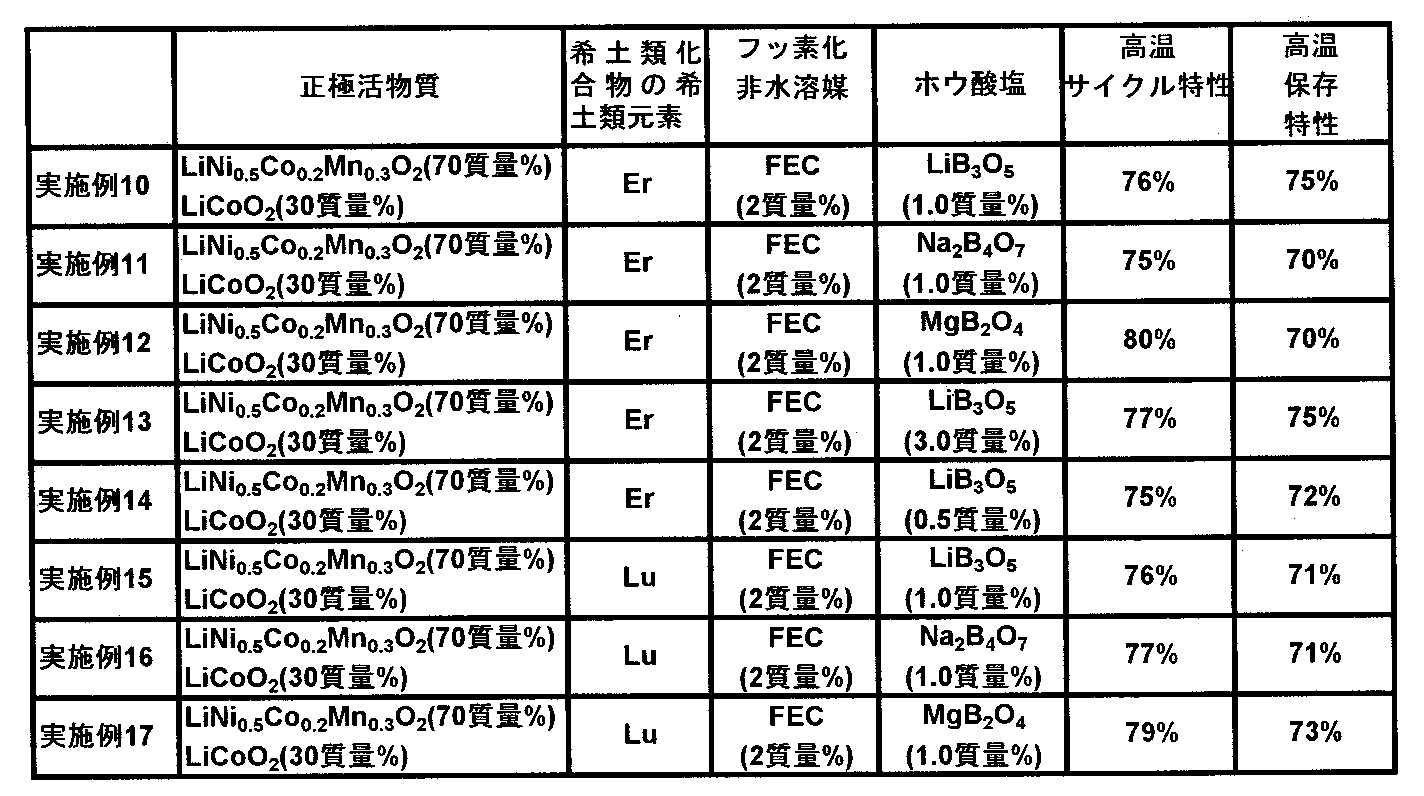
表2から、正極活物質粒子の表面に希土類化合物をエルビウムを用い、ホウ酸塩としてLiB3O5を用いた実施例10の電池、Na2B4O7を用いた実施例11の電池、及びMgB2O4を用いた実施例12の電池についても、実施例1の電池と同様の効果が確認された。
また、ホウ酸塩の添加量を1.0質量%から3.0質量%へ変更した実施例13や、0.5質量%へ変更した実施例14についても、実施例1の電池と同様の効果が確認された。
さらに正極活物質粒子の表面に希土類化合物をエルビウムからルテチウムに変更し、LiB3O5、Na2B4O7やMgB2O4を用いた実施例15~17についても実施例1の電池と同様の効果が確認された。

表3から、正極活物質粒子の表面に希土類化合物としてルテチウムを用いた実施例9の正極活物質を、LiNi0.33Co0.34Mn0.33O2のみ用いるように変更した実施例19、LiNi0.5Co0.2Mn0.3O2のみを用いるように変更した実施例20、LiCoO2のみを用いるように変更した実施例21についても、正極活物質粒子表面に希土類化合物を付着させておらず、かつホウ酸塩及びFECを含まない比較例7~9より優れた特性であり、実施例9と同様の効果が確認された。
また、実施例9の正極活物質の粒子a-1と正極活物質粒子a-2割合を変更した実施例18についても実施例9と同様の効果が確認された。
(追加事項)
上記実施例の結果から、Lia(M1-bM’b)O2(但し、MはCo、Ni、Mnのうちの少なくとも1種であり、M’はB、Al、Mg、Ti、Zr、Fe、Mn、Cr、Znのうちの少なくとも1種であり、0.9≦a≦1.2、0≦b≦0.1)、LiaMn2-xM3xO4(0.9≦a≦1.2、M3は、Al、B、Ni、Fe、Ti、Cr、Vのうちの少なくとも1種である)、及びLiaFePO4(0.9≦a≦1.2)よりなる群から選択される少なくとも1種であるリチウム遷移金属複合酸化物を用いることができる。
上記実施例の結果から、Lia(M1-bM’b)O2(但し、MはCo、Ni、Mnのうちの少なくとも1種であり、M’はB、Al、Mg、Ti、Zr、Fe、Mn、Cr、Znのうちの少なくとも1種であり、0.9≦a≦1.2、0≦b≦0.1)、LiaMn2-xM3xO4(0.9≦a≦1.2、M3は、Al、B、Ni、Fe、Ti、Cr、Vのうちの少なくとも1種である)、及びLiaFePO4(0.9≦a≦1.2)よりなる群から選択される少なくとも1種であるリチウム遷移金属複合酸化物を用いることができる。
また、耐酸化性を向上させるために、上記組成式における元素M’や元素M3として、Al、Mg、B、Zr、Tiなどの元素を添加したリチウム遷移金属複合酸化物を用いてもよい。
上記実施例では、ホウ酸塩は、正極活物質層中において正極活物質や結着剤などと均一に混合されているが、正極中に存在していれば、上記本発明の効果が得られる。
上記のように本発明の効果は主として正極側の副反応を抑制することによって得られるものであるため、負極活物質は特に限定されない。例えば、負極活物質としては、上記実施例で用いた黒鉛以外にも、Li、Si、SiOx、Sn、SnOx、Li[Li1/3Ti5/3]O4などを用いることができる。
非水電解質に含まれる非水溶媒は、上記のように、フッ素化非水溶媒とフッ素化非水溶媒以外の溶媒とから構成されてもよい。フッ素化非水溶媒以外の非水溶媒としては、エチレンカーボネート、プロピレンカーボネート、ブチレンカーボネート、γ-ブチロラクトン、γ-バレロラクトンなどのリチウム塩の溶解度が高い高誘電率溶媒と、ジエチルカーボネート、ジメチルカーボネート、エチルメチルカーボネート等の鎖状カーボネート、テトラヒドロフラン、1,2-ジメトキシエタン、ジエチレングリコールジメチルエーテル、1,3-ジオキソラン、2-メトキシテトラヒドロフラン、ジエチルエーテル、酢酸エチル、酢酸プロピル、プロピオン酸エチルなどの低粘性溶媒と、を含んでいてもよい。
非水溶媒に溶解される電解質塩としては、例えば、LiPF6、LiBF4、LiCF3SO3、LiN(CF3SO2)2、LiN(C2F5SO2)2、LiN(CF3SO2)(C4F9SO2)、LiC(C2F5SO2)3、LiAsF6、LiClO4、Li2B10Cl10、Li2B12Cl12、LiB(C2O4)F2、LiP(C2O4)2F2等のリチウム塩を一種以上用いることができる。非水電解質における電解質塩の合計濃度は、0.5~2.0モル/リットルであることが好ましい。
また、非水電解質に、ビニレンカーボネート、シクロヘキシルベンゼン、tert-アミルベンゼン等の公知の添加剤を添加することもできる。
セパレータとしては、例えばポリエチレン、ポリプロピレンやこれらの混合物ないし積層物等のオレフィン樹脂からなる微多孔膜を用いることができる。
以上説明したように、本発明によれば、高温保存特性、高温サイクル特性等の高温電池特性に優れる高容量な非水電解質二次電池を提供できる。よって、産業上の利用可能性は大きい。
Claims (8)
- 正極活物質としてリチウム遷移金属複合酸化物粒子を含む正極と、負極と、非水電解質を備える非水電解質二次電池において、
前記リチウム遷移金属複合酸化物粒子の表面には、希土類化合物が付着しており、前記希土類化合物は、希土類水酸化物及び希土類オキシ水酸化物よりなる群から選択される少なくとも1種であり、
前記正極中には、ホウ酸塩が含まれており、
前記非水電解質は、フッ素化非水溶媒を含む、
ことを特徴とする非水電解質二次電池。 - 請求項1に記載の非水電解質二次電池において、
前記ホウ酸塩が、ホウ酸リチウム、ホウ酸ナトリウム、ホウ酸カリウム、ホウ酸カルシウム、ホウ酸バリウム、四ホウ酸マンガン(II)、ホウ酸コバルト、ホウ酸ニッケル、及びホウ酸アルミニウムよりなる群から選択される少なくとも1種である、
ことを特徴とする非水電解質二次電池。 - 請求項1に記載の非水電解質二次電池において、
前記ホウ酸塩が、LiBO2、Li2B4O7、LiB3O5、及びLi2B8O13よりなる群から選択される少なくとも1種のホウ酸リチウムである、
ことを特徴とする非水電解質二次電池。 - 請求項1に記載の非水電解質二次電池において、
前記リチウム遷移金属複合酸化物粒子と前記ホウ酸塩との合計質量に対する前記ホウ酸塩の質量の割合が、0.1~5.0質量%である、
ことを特徴とする非水電解質二次電池。 - 請求項1に記載の非水電解質二次電池において、
前記希土類化合物が、Nd、Sm、Tb、Dy、Ho、Er、Tm、Yb、及びLuのうち少なくとも1種の希土類元素を含む、
ことを特徴とする非水電解質二次電池。 - 請求項1に記載の非水電解質二次電池において、
前記希土類化合物の希土類元素の量が、前記リチウム遷移金属複合酸化物に対して、0.01~0.3mol%である、
ことを特徴とする非水電解質二次電池。 - 請求項1に記載の非水電解質二次電池において、
前記フッ素化非水溶媒が、フルオロエチレンカーボネート、トリフルオロプロピレンカーボネート、エチルフルオロメチルカーボネート、及びフルオロエチルエチルカーボネートよりなる群から選択される少なくとも1種のフッ化カーボネートである、
ことを特徴とする非水電解質二次電池。 - 請求項1に記載の非水電解質二次電池において、
前記リチウム遷移金属複合酸化物粒子は、Lia(M1-bM’b)O2(但し、MはCo、Ni、Mnのうちの少なくとも1種であり、M’はB、Al、Mg、Ti、Zr、Fe、Mn、Cr、Znのうちの少なくとも1種であり、0.9≦a≦1.2、0≦b≦0.1)、LiaMn2-xM3xO4(0.9≦a≦1.2、M3は、Al、B、Ni、Fe、Ti、Cr、Vのうちの少なくとも1種である)、及びLiaFePO4(0.9≦a≦1.2)よりなる群から選択される少なくとも1種である、
ことを特徴とする非水電解質二次電池。
Applications Claiming Priority (2)
| Application Number | Priority Date | Filing Date | Title |
|---|---|---|---|
| JP2012-217419 | 2012-09-28 | ||
| JP2012217419A JP2015232923A (ja) | 2012-09-28 | 2012-09-28 | 非水電解質二次電池 |
Publications (1)
| Publication Number | Publication Date |
|---|---|
| WO2014050115A1 true WO2014050115A1 (ja) | 2014-04-03 |
Family
ID=50387548
Family Applications (1)
| Application Number | Title | Priority Date | Filing Date |
|---|---|---|---|
| PCT/JP2013/005720 Ceased WO2014050115A1 (ja) | 2012-09-28 | 2013-09-26 | 非水電解質二次電池 |
Country Status (2)
| Country | Link |
|---|---|
| JP (1) | JP2015232923A (ja) |
| WO (1) | WO2014050115A1 (ja) |
Cited By (7)
| Publication number | Priority date | Publication date | Assignee | Title |
|---|---|---|---|---|
| WO2014156165A1 (ja) * | 2013-03-29 | 2014-10-02 | 三洋電機株式会社 | 非水電解質二次電池用正極活物質及びその製造方法、当該正極活物質を用いた非水電解質二次電池用正極、及び当該正極を用いた非水電解質二次電池 |
| WO2014156094A1 (ja) * | 2013-03-29 | 2014-10-02 | 三洋電機株式会社 | 非水電解質二次電池 |
| WO2015079664A1 (ja) * | 2013-11-29 | 2015-06-04 | 三洋電機株式会社 | 非水電解質二次電池用正極 |
| WO2016017074A1 (ja) * | 2014-07-30 | 2016-02-04 | 三洋電機株式会社 | 非水電解質二次電池用正極及びそれを用いた非水電解質二次電池 |
| US10553878B2 (en) | 2015-09-30 | 2020-02-04 | Panasonic Intellectual Property Management Co., Ltd. | Positive electrode active material for non-aqueous electrolyte secondary batteries |
| CN111033865A (zh) * | 2017-08-24 | 2020-04-17 | 三井化学株式会社 | 锂二次电池及非水电解液 |
| CN114665095A (zh) * | 2022-03-29 | 2022-06-24 | 珠海冠宇电池股份有限公司 | 一种电池 |
Families Citing this family (4)
| Publication number | Priority date | Publication date | Assignee | Title |
|---|---|---|---|---|
| JP6809313B2 (ja) * | 2017-03-14 | 2021-01-06 | 株式会社村田製作所 | 正極、電池、電池パック、電子機器、電動車両、蓄電装置および電力システム |
| US11652237B2 (en) | 2017-08-24 | 2023-05-16 | Mitsui Chemicals, Inc. | Nonaqueous electrolyte solution including boron compound additive having higher reductive decomposition potential than additional additive and lithium secondary battery including the same |
| PT3771013T (pt) | 2018-03-23 | 2023-06-14 | Tomiyama Pure Chemical Industries Ltd | Eletrólito para dispositivos de armazenagem de energia e solução eletrolítica não aquosa |
| WO2024038571A1 (ja) * | 2022-08-19 | 2024-02-22 | 国立大学法人東北大学 | リチウム金属二次電池用電解液およびリチウム金属二次電池 |
Citations (7)
| Publication number | Priority date | Publication date | Assignee | Title |
|---|---|---|---|---|
| JPH09306547A (ja) * | 1996-05-16 | 1997-11-28 | Sony Corp | 非水電解質二次電池 |
| JP2002270152A (ja) * | 2001-03-09 | 2002-09-20 | Yuasa Corp | リチウム二次電池 |
| JP2008288112A (ja) * | 2007-05-18 | 2008-11-27 | Sony Corp | 非水電解質二次電池 |
| WO2010004973A1 (ja) * | 2008-07-09 | 2010-01-14 | 三洋電機株式会社 | 非水電解質二次電池用正極活物質、非水電解質二次電池用正極活物質の製造方法、非水電解質二次電池用正極及び非水電解質二次電池 |
| JP2011071046A (ja) * | 2009-09-28 | 2011-04-07 | Sanyo Electric Co Ltd | 非水電解質二次電池 |
| JP2011141989A (ja) * | 2010-01-06 | 2011-07-21 | Sanyo Electric Co Ltd | 非水電解質二次電池及び非水電解質二次電池用正極 |
| WO2012115263A1 (ja) * | 2011-02-25 | 2012-08-30 | 三洋電機株式会社 | 非水電解液二次電池 |
-
2012
- 2012-09-28 JP JP2012217419A patent/JP2015232923A/ja active Pending
-
2013
- 2013-09-26 WO PCT/JP2013/005720 patent/WO2014050115A1/ja not_active Ceased
Patent Citations (7)
| Publication number | Priority date | Publication date | Assignee | Title |
|---|---|---|---|---|
| JPH09306547A (ja) * | 1996-05-16 | 1997-11-28 | Sony Corp | 非水電解質二次電池 |
| JP2002270152A (ja) * | 2001-03-09 | 2002-09-20 | Yuasa Corp | リチウム二次電池 |
| JP2008288112A (ja) * | 2007-05-18 | 2008-11-27 | Sony Corp | 非水電解質二次電池 |
| WO2010004973A1 (ja) * | 2008-07-09 | 2010-01-14 | 三洋電機株式会社 | 非水電解質二次電池用正極活物質、非水電解質二次電池用正極活物質の製造方法、非水電解質二次電池用正極及び非水電解質二次電池 |
| JP2011071046A (ja) * | 2009-09-28 | 2011-04-07 | Sanyo Electric Co Ltd | 非水電解質二次電池 |
| JP2011141989A (ja) * | 2010-01-06 | 2011-07-21 | Sanyo Electric Co Ltd | 非水電解質二次電池及び非水電解質二次電池用正極 |
| WO2012115263A1 (ja) * | 2011-02-25 | 2012-08-30 | 三洋電機株式会社 | 非水電解液二次電池 |
Cited By (11)
| Publication number | Priority date | Publication date | Assignee | Title |
|---|---|---|---|---|
| WO2014156165A1 (ja) * | 2013-03-29 | 2014-10-02 | 三洋電機株式会社 | 非水電解質二次電池用正極活物質及びその製造方法、当該正極活物質を用いた非水電解質二次電池用正極、及び当該正極を用いた非水電解質二次電池 |
| WO2014156094A1 (ja) * | 2013-03-29 | 2014-10-02 | 三洋電機株式会社 | 非水電解質二次電池 |
| JPWO2014156094A1 (ja) * | 2013-03-29 | 2017-02-16 | 三洋電機株式会社 | 非水電解質二次電池 |
| US9960422B2 (en) | 2013-03-29 | 2018-05-01 | Sanyo Electric Co., Ltd. | Positive electrode active material for nonaqueous electrolyte secondary batteries, method for producing the same, positive electrode for nonaqueous electrolyte secondary batteries incorporating the positive electrode active material, and nonaqueous electrolyte secondary battery incorporating the positive electrode |
| WO2015079664A1 (ja) * | 2013-11-29 | 2015-06-04 | 三洋電機株式会社 | 非水電解質二次電池用正極 |
| WO2016017074A1 (ja) * | 2014-07-30 | 2016-02-04 | 三洋電機株式会社 | 非水電解質二次電池用正極及びそれを用いた非水電解質二次電池 |
| JPWO2016017074A1 (ja) * | 2014-07-30 | 2017-04-27 | 三洋電機株式会社 | 非水電解質二次電池用正極及びそれを用いた非水電解質二次電池 |
| US10283768B2 (en) | 2014-07-30 | 2019-05-07 | Sanyo Electric Co., Ltd. | Positive electrode for nonaqueous electrolyte secondary battery and nonaqueous electrolyte secondary battery using the same |
| US10553878B2 (en) | 2015-09-30 | 2020-02-04 | Panasonic Intellectual Property Management Co., Ltd. | Positive electrode active material for non-aqueous electrolyte secondary batteries |
| CN111033865A (zh) * | 2017-08-24 | 2020-04-17 | 三井化学株式会社 | 锂二次电池及非水电解液 |
| CN114665095A (zh) * | 2022-03-29 | 2022-06-24 | 珠海冠宇电池股份有限公司 | 一种电池 |
Also Published As
| Publication number | Publication date |
|---|---|
| JP2015232923A (ja) | 2015-12-24 |
Similar Documents
| Publication | Publication Date | Title |
|---|---|---|
| KR101304868B1 (ko) | 리튬 이차전지용 양극 활물질 | |
| JP4574877B2 (ja) | リチウム二次電池用正極活物質及びその製造方法 | |
| CN111033834B (zh) | 正极用添加剂、其制备方法、包含其的正极及包含其的锂二次电池 | |
| KR100807970B1 (ko) | 표면처리된 리튬 이차전지용 양극 활물질 | |
| JP2015232923A (ja) | 非水電解質二次電池 | |
| JP5399188B2 (ja) | 非水電解質二次電池 | |
| CN108352525B (zh) | 非水电解质二次电池用正极活性物质和非水电解质二次电池 | |
| JP6447620B2 (ja) | 非水電解質二次電池用正極活物質 | |
| CN104620434B (zh) | 非水电解质二次电池 | |
| CN107636869B (zh) | 二次电池用正极活性物质 | |
| KR20100105387A (ko) | 비수전해액 2차 전지 | |
| KR20130052500A (ko) | 복합체, 그 제조방법, 이를 포함하는 음극 활물질, 이를 포함하는 음극 및 이를 채용한 리튬 이차 전지 | |
| CN104620433B (zh) | 非水电解质二次电池 | |
| JP6443339B2 (ja) | 非水電解質二次電池用正極 | |
| CN104685696B (zh) | 非水电解质二次电池 | |
| JP7262998B2 (ja) | 正極活物質材料、非水電解質二次電池用正極、非水電解質二次電池及び正極活物質材料の製造方法 | |
| JP7193338B2 (ja) | 正極活物質材料、非水電解質二次電池用正極及び非水電解質二次電池 | |
| JP5623241B2 (ja) | 非水電解質二次電池 | |
| JP6627758B2 (ja) | 非水電解質二次電池用正極及びそれを用いた非水電解質二次電池 | |
| KR20240007153A (ko) | 부극 활물질 및 그 제조 방법 | |
| KR20130060008A (ko) | 복합체 질화물, 그 제조방법, 이를 포함하는 전극 활물질, 이를 포함하는 전극 및 이를 채용한 리튬 이차 전지 | |
| JP6481907B2 (ja) | リチウム鉄マンガン系複合酸化物、それを用いたリチウムイオン二次電池用正極活物質、リチウムイオン二次電池用正極、及びリチウムイオン二次電池 | |
| CN107172888A (zh) | 非水电解质二次电池用正极活性物质及非水电解质二次电池 | |
| JP6158307B2 (ja) | 非水電解質二次電池用正極、非水電解質二次電池用正極の製造方法および非水電解質二次電池 | |
| JP2012054067A (ja) | 非水電解質二次電池 |
Legal Events
| Date | Code | Title | Description |
|---|---|---|---|
| 121 | Ep: the epo has been informed by wipo that ep was designated in this application |
Ref document number: 13840728 Country of ref document: EP Kind code of ref document: A1 |
|
| NENP | Non-entry into the national phase |
Ref country code: DE |
|
| 122 | Ep: pct application non-entry in european phase |
Ref document number: 13840728 Country of ref document: EP Kind code of ref document: A1 |
|
| NENP | Non-entry into the national phase |
Ref country code: JP |