WO2014046069A1 - 樹脂粒子及びその製造方法 - Google Patents
樹脂粒子及びその製造方法 Download PDFInfo
- Publication number
- WO2014046069A1 WO2014046069A1 PCT/JP2013/074974 JP2013074974W WO2014046069A1 WO 2014046069 A1 WO2014046069 A1 WO 2014046069A1 JP 2013074974 W JP2013074974 W JP 2013074974W WO 2014046069 A1 WO2014046069 A1 WO 2014046069A1
- Authority
- WO
- WIPO (PCT)
- Prior art keywords
- resin
- weight
- crystalline
- group
- parts
- Prior art date
- Legal status (The legal status is an assumption and is not a legal conclusion. Google has not performed a legal analysis and makes no representation as to the accuracy of the status listed.)
- Ceased
Links
Classifications
-
- C—CHEMISTRY; METALLURGY
- C08—ORGANIC MACROMOLECULAR COMPOUNDS; THEIR PREPARATION OR CHEMICAL WORKING-UP; COMPOSITIONS BASED THEREON
- C08J—WORKING-UP; GENERAL PROCESSES OF COMPOUNDING; AFTER-TREATMENT NOT COVERED BY SUBCLASSES C08B, C08C, C08F, C08G or C08H
- C08J3/00—Processes of treating or compounding macromolecular substances
- C08J3/12—Powdering or granulating
- C08J3/126—Polymer particles coated by polymer, e.g. core shell structures
-
- C—CHEMISTRY; METALLURGY
- C08—ORGANIC MACROMOLECULAR COMPOUNDS; THEIR PREPARATION OR CHEMICAL WORKING-UP; COMPOSITIONS BASED THEREON
- C08J—WORKING-UP; GENERAL PROCESSES OF COMPOUNDING; AFTER-TREATMENT NOT COVERED BY SUBCLASSES C08B, C08C, C08F, C08G or C08H
- C08J7/00—Chemical treatment or coating of shaped articles made of macromolecular substances
- C08J7/04—Coating
- C08J7/0427—Coating with only one layer of a composition containing a polymer binder
-
- G—PHYSICS
- G03—PHOTOGRAPHY; CINEMATOGRAPHY; ANALOGOUS TECHNIQUES USING WAVES OTHER THAN OPTICAL WAVES; ELECTROGRAPHY; HOLOGRAPHY
- G03G—ELECTROGRAPHY; ELECTROPHOTOGRAPHY; MAGNETOGRAPHY
- G03G9/00—Developers
- G03G9/08—Developers with toner particles
- G03G9/093—Encapsulated toner particles
- G03G9/09307—Encapsulated toner particles specified by the shell material
- G03G9/09314—Macromolecular compounds
- G03G9/09328—Macromolecular compounds obtained otherwise than by reactions only involving carbon-to-carbon unsaturated bonds
-
- G—PHYSICS
- G03—PHOTOGRAPHY; CINEMATOGRAPHY; ANALOGOUS TECHNIQUES USING WAVES OTHER THAN OPTICAL WAVES; ELECTROGRAPHY; HOLOGRAPHY
- G03G—ELECTROGRAPHY; ELECTROPHOTOGRAPHY; MAGNETOGRAPHY
- G03G9/00—Developers
- G03G9/08—Developers with toner particles
- G03G9/093—Encapsulated toner particles
- G03G9/0935—Encapsulated toner particles specified by the core material
- G03G9/09357—Macromolecular compounds
-
- G—PHYSICS
- G03—PHOTOGRAPHY; CINEMATOGRAPHY; ANALOGOUS TECHNIQUES USING WAVES OTHER THAN OPTICAL WAVES; ELECTROGRAPHY; HOLOGRAPHY
- G03G—ELECTROGRAPHY; ELECTROPHOTOGRAPHY; MAGNETOGRAPHY
- G03G9/00—Developers
- G03G9/08—Developers with toner particles
- G03G9/093—Encapsulated toner particles
- G03G9/09392—Preparation thereof
-
- C—CHEMISTRY; METALLURGY
- C08—ORGANIC MACROMOLECULAR COMPOUNDS; THEIR PREPARATION OR CHEMICAL WORKING-UP; COMPOSITIONS BASED THEREON
- C08J—WORKING-UP; GENERAL PROCESSES OF COMPOUNDING; AFTER-TREATMENT NOT COVERED BY SUBCLASSES C08B, C08C, C08F, C08G or C08H
- C08J2367/00—Characterised by the use of polyesters obtained by reactions forming a carboxylic ester link in the main chain; Derivatives of such polymers
- C08J2367/02—Polyesters derived from dicarboxylic acids and dihydroxy compounds
-
- C—CHEMISTRY; METALLURGY
- C08—ORGANIC MACROMOLECULAR COMPOUNDS; THEIR PREPARATION OR CHEMICAL WORKING-UP; COMPOSITIONS BASED THEREON
- C08J—WORKING-UP; GENERAL PROCESSES OF COMPOUNDING; AFTER-TREATMENT NOT COVERED BY SUBCLASSES C08B, C08C, C08F, C08G or C08H
- C08J2475/00—Characterised by the use of polyureas or polyurethanes; Derivatives of such polymers
- C08J2475/04—Polyurethanes
-
- C—CHEMISTRY; METALLURGY
- C08—ORGANIC MACROMOLECULAR COMPOUNDS; THEIR PREPARATION OR CHEMICAL WORKING-UP; COMPOSITIONS BASED THEREON
- C08J—WORKING-UP; GENERAL PROCESSES OF COMPOUNDING; AFTER-TREATMENT NOT COVERED BY SUBCLASSES C08B, C08C, C08F, C08G or C08H
- C08J2475/00—Characterised by the use of polyureas or polyurethanes; Derivatives of such polymers
- C08J2475/04—Polyurethanes
- C08J2475/06—Polyurethanes from polyesters
-
- Y—GENERAL TAGGING OF NEW TECHNOLOGICAL DEVELOPMENTS; GENERAL TAGGING OF CROSS-SECTIONAL TECHNOLOGIES SPANNING OVER SEVERAL SECTIONS OF THE IPC; TECHNICAL SUBJECTS COVERED BY FORMER USPC CROSS-REFERENCE ART COLLECTIONS [XRACs] AND DIGESTS
- Y10—TECHNICAL SUBJECTS COVERED BY FORMER USPC
- Y10T—TECHNICAL SUBJECTS COVERED BY FORMER US CLASSIFICATION
- Y10T428/00—Stock material or miscellaneous articles
- Y10T428/29—Coated or structually defined flake, particle, cell, strand, strand portion, rod, filament, macroscopic fiber or mass thereof
- Y10T428/2982—Particulate matter [e.g., sphere, flake, etc.]
- Y10T428/2991—Coated
- Y10T428/2998—Coated including synthetic resin or polymer
Definitions
- the present invention relates to resin particles and a method for producing the same.
- a core-shell type resin particle composed of a shell layer and a core layer is known as a resin particle having a low melting energy and excellent heat-resistant storage stability (see Patent Document 1).
- Patent Document 1 when the resin particles of Patent Document 1 are used for processing and processing a resin by a heat bonding method, the entire resin particles do not melt unless heated at a high temperature for a long time, so that the heat adhesion is not sufficient. was there. Therefore, in order to improve the heat adhesiveness of the resin particles, in the core-shell type resin particles composed of a shell layer and a core layer, resin particles in which a sharp melt property is imparted to the shell layer have been proposed ( Patent Document 2). However, even the resin particles of Patent Document 2 have insufficient heat adhesiveness, and therefore development of core-shell type resin particles having excellent heat adhesiveness has been demanded.
- An object of the present invention is to provide core / shell type resin particles having excellent heat adhesion.
- the present invention provides resin particles (X) having a shell layer (S) containing a crystalline polyurethane resin (B) on the surface of a core layer (Q) containing a crystalline resin (A), Resin in which the maximum peak temperature (Ta) of heat of fusion of the crystalline resin (A) is 40 to 70 ° C. and the maximum peak temperature (Tu) of heat of fusion of the crystalline polyurethane resin (B) is 50 to 90 ° C.
- the maximum peak temperature (Ta) of the heat of fusion of the crystalline resin (A) is 40 to 70 ° C.
- the maximum peak temperature (Tu) of the heat of fusion of the crystalline polyurethane resin (B) is 50 to 90 It is a manufacturing method of resin particle (X) which is ° C.
- the resin particles of the present invention are excellent in heat adhesion, low-temperature fixability, heat-resistant storage stability, high adhesive strength, high gloss of the coating film obtained from the resin particles, and excellent water resistance of the coating film.
- the crystalline resin (A) in the present invention has a ratio (Tm / Ta) of the softening point of the resin (hereinafter abbreviated as Tm) to the maximum peak temperature of heat of fusion (hereinafter abbreviated as Ta) of 0.8 to 1.55, which means a resin having a clear endothermic peak in DSC.
- Tm and Ta can be measured by the following method.
- ⁇ Tm measurement method> The measurement is performed with a flow tester under a load of 1.96 MPa. For example, using a Koka type flow tester ⁇ for example, “CFT-500D” [manufactured by Shimadzu Corporation] ⁇ , a 1 g measurement sample is heated at a rate of temperature increase of 6 ° C./min.
- ⁇ Measurement method of maximum peak temperature of heat of fusion> It is measured using a differential scanning calorimeter ⁇ for example, “DSC210” [manufactured by Seiko Instruments Inc.] ⁇ .
- DSC210 differential scanning calorimeter
- a resin sample melted at 130 ° C., lowered from that temperature to 70 ° C. at a rate of 1.0 ° C./min, and lowered from 70 ° C. to 10 ° C. at a rate of 0.5 ° C./min.
- the temperature is measured at a rate of temperature increase of 20 ° C./min to determine the temperature corresponding to the maximum endothermic peak.
- (A) used for the measurement of Ta is a pretreatment in which after melting at 130 ° C., the temperature is lowered from 130 ° C. to 70 ° C. at a rate of 1.0 ° C./min, and then from 70 ° C. to 10 ° C. The temperature is lowered to 0 ° C. at a rate of 0.5 ° C./min.
- DSC the temperature is increased at a rate of temperature increase of 20 ° C./min to measure the endothermic change, and a graph of “endothermic amount” and “temperature” is drawn.
- the endothermic peak temperature at 0 ° C. is Ta ′.
- the peak temperature with the largest endotherm is Ta ′.
- the sample is stored at (Ta′ ⁇ 10) ° C. for 6 hours, and then stored at (Ta′ ⁇ 15) ° C. for 6 hours.
- the temperature was increased at a temperature increase rate of 20 ° C./min to measure the endothermic change.
- the graph of “endothermic heat generation amount” and “temperature” is drawn, and the temperature corresponding to the maximum peak of the endothermic amount is defined as the maximum peak temperature (Ta) of the heat of fusion.
- the measurement of Tu described later is performed in the same manner.
- the Ta of the crystalline resin (A) is 40 to 70 ° C., preferably 45 to 68 ° C., more preferably 50 to 65 ° C.
- the (A) Ta is less than 40 ° C., the heat-resistant storage stability of the resin particles (X) is lowered, and when the Ta exceeds 70 ° C., the fixing minimum temperature of the (X) is undesirably increased.
- Examples of the crystalline resin (A) in the present invention include a crystalline polyester resin (A1), a crystalline polyurethane resin (A2), and a crystalline vinyl resin (A3).
- (A) to (A3) may be used alone or in combination of two or more.
- Examples of the crystalline polyester resin (A1) include those having diol (1) and dicarboxylic acid (2) as structural units.
- diol (1) examples include alkylene glycols having 2 to 30 carbon atoms (for example, ethylene glycol, 1,2-propylene glycol, 1,3-propylene glycol, 1,4-butanediol, 1,6-hexanediol, octanediol).
- alkylene glycols having 2 to 30 carbon atoms for example, ethylene glycol, 1,2-propylene glycol, 1,3-propylene glycol, 1,4-butanediol, 1,6-hexanediol, octanediol).
- Mn 106 to 10,000 alkylene ether glycol
- alkylene ether glycol For example, diethylene glycol, triethylene glycol, dipropylene glycol, polyethylene glycol, polypropylene glycol and polytetramethylene ether glycol
- alicyclic diols having 6 to 24 carbon atoms for example, 1,4-cyclohexanedi
- AO alkylene oxide
- AO addition mole number 2 to 100
- an AO adduct of alkylene glycol and bisphenols is preferred, and an AO adduct of bisphenols and a mixture of an AO adduct of bisphenols and alkylene glycol are more preferred.
- dicarboxylic acid (2) examples include alkane dicarboxylic acids having 4 to 32 carbon atoms (such as succinic acid, adipic acid, sebacic acid, azelaic acid, dodecanedicarboxylic acid, and octadecanedicarboxylic acid); alkenedicarboxylic acids having 4 to 32 carbon atoms.
- alkene dicarboxylic acids having 8 to 40 carbon atoms [eg, dimer acid, alkenyl succinic acid (dodecenyl succinic acid, pentadecenyl succinic acid and octadecenyl succinic acid)
- Branched alkane dicarboxylic acids having 12 to 40 carbon atoms eg alkyl succinic acid (decyl succinic acid, dodecyl succinic acid and octadecyl succinic acid etc.
- aromatic dicarboxylic acids having 8 to 20 carbon atoms (eg phthalic acid, isophthalic acid, etc.) , Terephthalic acid and naphthalenedicarboxylic acid, etc.) And the like.
- alkene dicarboxylic acids and aromatic dicarboxylic acids are preferred, and aromatic
- (A1) is preferably a combination in which the total carbon number of the diol (1) and the dicarboxylic acid (2) is 10 or more, more preferably 12 or more, from the viewpoint of heat-resistant storage stability of the resin particles (X).
- the total number of carbon atoms is preferably 52 or less, more preferably 45 or less from the viewpoint of low-temperature fixability when (X) is used as a base particle of an electrophotographic toner. Particularly preferred is 40 or less, and most preferred is 30 or less.
- the crystalline polyurethane resin (A2) includes the diol (1) and / or the diamine (3), the diisocyanate (4) as a structural unit (A2-1), and the crystalline polyester resin (A1). And the diol (1) and / or diamine (3) and diisocyanate (4) as structural units (A2-2).
- Examples of the diamine (3) include aliphatic diamines having 2 to 18 carbon atoms and aromatic diamines having 6 to 20 carbon atoms.
- Examples of the aliphatic diamine having 2 to 18 carbon atoms include a chain aliphatic diamine and a cyclic aliphatic diamine.
- chain aliphatic diamines examples include alkylene diamines having 2 to 12 carbon atoms (such as ethylene diamine, trimethylene diamine, tetramethylene diamine, and hexamethylene diamine).
- Cycloaliphatic diamines include alicyclic diamines having 4 to 15 carbon atoms ⁇ 1,3-diaminocyclohexane, isophorone diamine, mensen diamine, 4,4′-methylene dicyclohexane diamine (hydrogenated methylene dianiline) and 3 , 9-bis (3-aminopropyl) -2,4,8,10-tetraoxaspiro [5,5] undecane etc. ⁇ and the like.
- aromatic diamine having 6 to 20 carbon atoms examples include 1,2-, 1,3- or 1,4-phenylenediamine, 2,4′- or 4,4′-diphenylmethanediamine, diaminodiphenylsulfone, benzidine, and thiodianiline.
- diisocyanate (4) examples include aromatic diisocyanates having 6 to 20 carbon atoms (excluding carbon in the NCO group; the same shall apply hereinafter), aliphatic diisocyanates having 2 to 18 carbon atoms, and modified products of these diisocyanates (urethane groups, Carbodiimide group, allophanate group, urea group, burette group, uretdione group, uretoimine group, isocyanurate group and oxazolidone group-containing modified product) and mixtures of two or more thereof.
- Aromatic diisocyanates include 1,3- or 1,4-phenylene diisocyanate, 2,4- or 2,6-tolylene diisocyanate (TDI), crude TDI, m- or p-xylylene diisocyanate (XDI), ⁇ , ⁇ , ⁇ ′, ⁇ ′-tetramethylxylylene diisocyanate (TMXDI), 2,4′- or 4,4′-diphenylmethane diisocyanate (MDI), crude MDI ⁇ crude diaminophenylmethane [formaldehyde and aromatic amine (aniline) ) Or a mixture thereof and a mixture thereof.
- TDI 1,3- or 1,4-phenylene diisocyanate
- XDI m- or p-xylylene diisocyanate
- TMXDI ⁇ ′, ⁇ ′-tetramethylxylylene diisocyanate
- MDI 2,4′- or 4,
- aliphatic diisocyanate examples include chain aliphatic diisocyanate and cyclic aliphatic diisocyanate.
- chain aliphatic diisocyanates examples include ethylene diisocyanate, tetramethylene diisocyanate, hexamethylene diisocyanate (HDI), dodecamethylene diisocyanate, 2,2,4-trimethylhexamethylene diisocyanate, lysine diisocyanate, and 2,6-diisocyanatomethylcaproate.
- Cycloaliphatic diisocyanates include isophorone diisocyanate (IPDI), dicyclohexylmethane-4,4′-diisocyanate (hydrogenated MDI), cyclohexylene diisocyanate, methylcyclohexylene diisocyanate (hydrogenated TDI), and bis (2-isocyanatoethyl). -4-cyclohexene-1,2-dicarboxylate, 2,5- or 2,6-norbornane diisocyanate, and mixtures thereof.
- IPDI isophorone diisocyanate
- MDI dicyclohexylmethane-4,4′-diisocyanate
- TDI methylcyclohexylene diisocyanate
- bis (2-isocyanatoethyl bis
- a modified product containing a urethane group, a carbodiimide group, an allophanate group, a urea group, a burette group, a uretdione group, a uretoimine group, an isocyanurate group and / or an oxazolidone group is used.
- diisocyanates (4) aromatic diisocyanates having 6 to 15 carbon atoms and aliphatic diisocyanates having 4 to 15 carbon atoms are preferred, and TDI, MDI, HDI, hydrogenated MDI and IPDI are more preferred. .
- the crystalline polyurethane resin (A2) is selected from the group consisting of a carboxylic acid (salt) group, a sulfonic acid (salt) group, a sulfamic acid (salt) group, and a phosphoric acid (salt) group in addition to the diol (1).
- a diol (1 ′) having at least one group may be a structural unit.
- the chargeability and heat-resistant storage stability of the resin particles (X) are improved.
- the “acid (salt)” in the present specification means an acid or an acid salt.
- Examples of the diol (1 ′) having a carboxylic acid (salt) group include tartaric acid (salt), 2,2-bis (hydroxymethyl) propanoic acid (salt), and 2,2-bis (hydroxymethyl) butanoic acid (salt). And 3- [bis (2-hydroxyethyl) amino] propanoic acid (salt) and the like.
- Examples of the diol (1 ′) having a sulfonic acid (salt) group include 2,2-bis (hydroxymethyl) ethanesulfonic acid (salt) and 2- [bis (2-hydroxyethyl) amino] ethanesulfonic acid (salt).
- 5-sulfo-isophthalic acid-1,3-bis (2-hydroxyethyl) ester (salt) and the like examples include N, N-bis (2-hydroxyethyl) sulfamic acid (salt), N, N-bis (3-hydroxypropyl) sulfamic acid (salt), Examples thereof include N, N-bis (4-hydroxybutyl) sulfamic acid (salt) and N, N-bis (2-hydroxypropyl) sulfamic acid (salt).
- Examples of the diol (1 ′) having a phosphoric acid (salt) group include bis (2-hydroxyethyl) phosphate (salt).
- the salts that make up the acid salts include ammonium salts, amine salts (methylamine salts, dimethylamine salts, trimethylamine salts, ethylamine salts, diethylamine salts, triethylamine salts, propylamine salts, dipropylamine salts, tripropylamine salts, butylamines.
- salt dibutylamine salt, tributylamine salt, monoethanolamine salt, diethanolamine salt, triethanolamine salt, N-methylethanolamine salt, N-ethylethanolamine salt, N, N-dimethylethanolamine salt, N, N- Diethylethanolamine salt, hydroxylamine salt, N, N-diethylhydroxylamine salt and morpholine salt, etc.), quaternary ammonium salt [tetramethylammonium salt, tetraethylammonium salt and trimethyl (2-hydroxyethyl) Ammonium salts, alkali metal salts (sodium salts and potassium salts, etc.).
- the resin particles (X) preferably have a diol (1 ′) having a carboxylic acid (salt) group and a sulfonic acid (salt) group from the viewpoint of chargeability and heat-resistant storage stability.
- Diol (1 ′) Diol (1 ′).
- the crystalline vinyl resin (A3) is a polymer obtained by homopolymerizing or copolymerizing a monomer having a polymerizable double bond.
- Examples of the monomer having a polymerizable double bond include the following (5) to (14).
- Hydrocarbon having a polymerizable double bond (5-1) Aliphatic hydrocarbon having a polymerizable double bond: (5-1-1) Chain hydrocarbon having a polymerizable double bond: Alkene having 2 to 30 carbon atoms (for example, ethylene, propylene, butene, isobutylene, pentene, heptene, diisobutylene, octene, dodecene, octadecene, etc.) An alkadiene having 4 to 30 carbon atoms (for example, butadiene, isoprene, 1,4-pentadiene, 1,6-hexadiene, 1,7-octadiene, etc.); (5-1-2) Cyclic hydrocarbon having a polymerizable double bond: mono- or dicycloalkene having 6 to 30 carbon atoms (for example, cyclohexene, vinylcyclohexene and ethylidenebicycloheptene) and mono
- Aromatic hydrocarbon having a polymerizable double bond Styrene; Hydrocarbyl (alkyl, cycloalkyl, aralkyl and / or alkenyl having 1 to 30 carbon atoms) substituted styrene (eg, ⁇ -methylstyrene) Vinyl toluene, 2,4-dimethyl styrene, ethyl styrene, isopropyl styrene, butyl styrene, phenyl styrene, cyclohexyl styrene, benzyl styrene, crotyl benzene, divinyl benzene, divinyl toluene, divinyl xylene, trivinyl benzene, etc.); and vinyl Naphthalene etc.
- unsaturated dicarboxylic acid having 3 to 30 carbon atoms or acid anhydride thereof eg (maleic anhydride), fumaric acid, itaconic acid, (anhydrous) citraconic acid and mesaconic acid Etc.
- Examples of the salt constituting the monomer salt having a carboxyl group and a polymerizable double bond include alkali metal salts (such as sodium salt and potassium salt), alkaline earth metal salts (such as calcium salt and magnesium salt), and ammonium. Examples thereof include salts, amine salts, and quaternary ammonium salts.
- the amine salt is not particularly limited as long as it is an amine compound. For example, primary amine salts (such as ethylamine salts, butylamine salts and octylamine salts), secondary amines (such as diethylamine salts and dibutylamine salts), tertiary amines ( Triethylamine salt and tributylamine salt).
- Examples of the quaternary ammonium salt include tetraethylammonium salt, triethyllaurylammonium salt, tetrabutylammonium salt, and tributyllaurylammonium salt.
- Examples of the salt of the monomer having a carboxyl group and a polymerizable double bond include sodium acrylate, sodium methacrylate, monosodium maleate, disodium maleate, potassium acrylate, potassium methacrylate, monopotassium maleate, acrylic Examples include lithium acid, cesium acrylate, ammonium acrylate, calcium acrylate, and aluminum acrylate.
- Monomers having a sulfo group and a polymerizable double bond and their salts Alkene sulfonic acids having 2 to 14 carbon atoms (for example, vinyl sulfonic acid, (meth) allyl sulfonic acid and methyl vinyl sulfonic acid); styrene sulfonic acid and alkyl (2 to 24 carbon) derivatives thereof (for example, ⁇ -methyl styrene sulfone) Acid etc .; C5-C18 sulfo (hydroxy) alkyl (meth) acrylate (for example, sulfopropyl (meth) acrylate, 2-hydroxy-3- (meth) acryloxypropanesulfonic acid, 2- (meth) acryloyloxyethane) Sulfonic acid and 3- (meth) acryloyloxy-2-hydroxypropanesulfonic acid, etc.); sulfo (hydroxy) alkyl (meth) acrylamide
- Oxyalkylene may be used alone or in combination.
- the format may be random addition or block addition.
- compounds represented by the general formulas (1) to (3) and salts thereof.
- a salt what was illustrated as a salt which comprises the salt of the monomer which has (6) a carboxyl group and a polymerizable double bond is mentioned.
- R 1 is an alkylene group having 2 to 4 carbon atoms
- R 1 O may be one kind or a combination of two or more kinds, and when two or more kinds are used together, the bonding type may be random or block.
- R 2 and R 3 are each independently an alkyl group having 1 to 15 carbon atoms; m and n are each independently a number of 1 to 50; Ar is a benzene ring; and R 4 is substituted with a fluorine atom. Represents an alkyl group having 1 to 15 carbon atoms.
- Monomer having phosphono group and polymerizable double bond and salt thereof (Meth) acryloyloxyalkyl phosphoric acid monoester (alkyl group having 1 to 24 carbon atoms) (for example, 2-hydroxyethyl (meth) acryloyl phosphate and phenyl-2-acryloyloxyethyl phosphate), (meth) acryloyloxyalkyl Phosphonic acid (alkyl group having 1 to 24 carbon atoms) (for example, 2-acryloyloxyethylphosphonic acid).
- a salt what was illustrated as a salt which comprises the monomer which has (6) carboxyl group and a polymerizable double bond is mentioned.
- (9) Monomer having a hydroxyl group and a polymerizable double bond: Hydroxystyrene, N-methylol (meth) acrylamide, hydroxyethyl (meth) acrylate, hydroxypropyl (meth) acrylate, polyethylene glycol mono (meth) acrylate, (meth) allyl alcohol, crotyl alcohol, isocrotyl alcohol, 1- Buten-3-ol, 2-buten-1-ol, 2-butene-1,4-diol, propargyl alcohol, 2-hydroxyethylpropenyl ether and sucrose allyl ether.
- Nitrogen-containing monomer having a polymerizable double bond (10-1) Monomer having amino group and polymerizable double bond: Aminoethyl (meth) acrylate, dimethylaminoethyl (meth) acrylate, diethylaminoethyl (meth) acrylate, t-butylaminoethyl methacrylate, N-aminoethyl (meth) acrylamide, (meth) allylamine, morpholinoethyl (meth) acrylate, 4-vinylpyridine, 2-vinylpyridine, crotylamine, N, N-dimethylaminostyrene, methyl- ⁇ -acetaminoacrylate, vinylimidazole, N-vinylpyrrole, N-vinylthiopyrrolidone, N-arylphenylenediamine, aminocarbazole Aminothiazole, aminoindole, aminopyrrole, aminoimidazo
- a monomer having 6 to 18 carbon atoms having an epoxy group and a polymerizable double bond Glycidyl (meth) acrylate and p-vinylphenylphenyl oxide.
- Monomers having 2 to 16 carbon atoms having a halogen element and a polymerizable double bond Vinyl chloride, vinyl bromide, vinylidene chloride, allyl chloride, chlorostyrene, bromostyrene, dichlorostyrene, chloromethylstyrene, tetrafluorostyrene, chloroprene and the like.
- An ester having a polymerizable double bond, an ether having a polymerizable double bond, a ketone having a polymerizable double bond, and a sulfur-containing compound having a polymerizable double bond (13-1) C4-16 ester having a polymerizable double bond: Vinyl acetate, vinyl propionate, vinyl butyrate, diallyl phthalate, diallyl adipate, isopropenyl acetate, vinyl methacrylate, methyl-4-vinyl benzoate, cyclohexyl methacrylate, benzyl methacrylate, phenyl (meth) acrylate, vinyl methoxyacetate, vinyl benzoate, ethyl - ⁇ -ethoxyacrylate, alkyl (meth) acrylate having an alkyl group having 1 to 50 carbon atoms [methyl (meth) acrylate, ethyl (meth) acrylate, propyl (meth) acrylate, but
- C3-C16 ether having a polymerizable double bond Vinyl methyl ether, vinyl ethyl ether, vinyl propyl ether, vinyl butyl ether, vinyl-2-ethylhexyl ether, vinyl phenyl ether, vinyl-2-methoxyethyl ether, methoxybutadiene, vinyl-2-butoxyethyl ether, 3,4-dihydro -1,2-pyran, 2-butoxy-2′-vinyloxydiethyl ether, acetoxystyrene, phenoxystyrene, and the like.
- a ketone having 4 to 12 carbon atoms having a polymerizable double bond examples include vinyl methyl ketone, vinyl ethyl ketone, and vinyl phenyl ketone.
- a sulfur-containing compound having 2 to 16 carbon atoms having a polymerizable double bond examples thereof include divinyl sulfide, p-vinyl diphenyl sulfide, vinyl ethyl sulfide, vinyl ethyl sulfone, divinyl sulfone, and divinyl sulfoxide.
- the crystalline polyester resin (A1) and the crystalline polyurethane resin (A2) are preferable from the viewpoint of the adhesive strength of the resin particles (X), and (A2) is more preferable.
- Particularly preferred is (A2-2), and most preferred is (A2-2) having an ester group and a urethane group in the molecule.
- the crystalline resin (A) in the present invention may be a resin composed only of the crystalline part (a) composed of the above (A), or one or more crystalline parts (a) and an amorphous part. It may be a block resin having one or more amorphous parts (a ′) made of a conductive resin (A ′).
- the amorphous resin (A ′) in the present invention is the same as the crystalline polyester resin (A1), crystalline polyurethane resin (A2) and crystalline vinyl resin (A3) exemplified as the crystalline resin (A). And a resin having a Tm / Ta ratio (Tm / Ta) of greater than 1.55.
- the crystalline resin (A) is a block resin composed of a crystalline part (a) and an amorphous part (a ′), (a) and (a ′) the reactivity of each terminal functional group
- the binder type suitable for the terminal functional group is selected, and (a) and (a ′) are combined, It can be a block resin.
- the binder is not used, the reaction between the terminal functional group of (A) that forms (a) and the terminal functional group of (A ′) that forms (a ′) proceeds while heating and reducing pressure as necessary.
- reaction temperature is preferably 180 to 230 ° C.
- various binders can be used. Examples of the binder include the diol (1), dicarboxylic acid (2), diamine (3), diisocyanate (4), and polyfunctional epoxy.
- bisphenol A type and F type epoxy compounds As the polyfunctional epoxy, bisphenol A type and F type epoxy compounds, phenol novolac type epoxy compounds, cresol novolac type epoxy compounds, hydrogenated bisphenol A type epoxy compounds, bisphenol A or F AO adduct diglycidyl ether, hydrogenated Diglycidyl ether and diol (ethylene glycol, propylene glycol, neopentyl glycol, butanediol, hexanediol, cyclohexanedimethanol, polyethylene glycol, polypropylene glycol, etc.) of AO adducts of bisphenol A, trimethylolpropane di And / or triglycidyl ether, pentaerythritol tri and / or tetraglycidyl ether, sorbitol hepta and / or hexa
- Examples include ricidyl ether, resorcin diglycidyl ether, di
- Examples of the method of combining (a) and (a ′) include dehydration reaction and addition reaction of (a) and (a ′).
- Examples of the dehydration reaction include a reaction in which both (a) and (a ′) have a hydroxyl group and these are bonded with a binder [eg, dicarboxylic acid (2)].
- the dehydration reaction can be carried out at a reaction temperature of 180 to 230 ° C. without solvent.
- both (a) and (a ′) have a hydroxyl group and these are bonded with a binder [eg, diisocyanate (4)], or one of (a) and (a ′) has a hydroxyl group.
- reaction of bonding them without using a binder can be mentioned.
- the addition reaction can be carried out at a reaction temperature of 80 ° C. to 150 ° C. by dissolving both in (a) and (a ′) in a solvent that can be dissolved and adding a binder if necessary.
- the content of (a) in (A) is preferably 50 to 99% by weight, More preferably, it is 55 to 98% by weight, particularly preferably 60 to 95% by weight, and most preferably 62 to 80% by weight.
- the content of (a) is in the above range, the crystallinity of (A) is not impaired, and the low temperature fixability, storage stability and gloss of (X) are favorable.
- the content of the crystalline part (a) based on the weight of (X) in the resin particles (X) is preferably 30 to 95% by weight, more preferably 40 to 94% by weight from the viewpoint of low-temperature fixability. Particularly preferred is 45 to 94% by weight.
- the crystalline resin (A) preferably has a total endotherm of 20 to 150 J / g, more preferably 30 to 120 J / g, and particularly preferably 40 to 100 J / g. If the total endothermic amount is 20 J / g or more, the water resistance of the resin particles (X) is improved, and if it is 150 J / g or less, the low-temperature fixability of (X) is preferable.
- the total endothermic amount of (A) can be measured by the following method.
- ⁇ Measurement method of total endothermic amount of (A)> Measurement is performed under the following conditions using a differential scanning calorimeter, for example, DSC Q1000 (manufactured by TA Instruments). Temperature increase rate: 10 ° C / min Measurement start temperature: 20 ° C Measurement end temperature: 180 ° C The temperature correction of the device detection unit uses the melting points of indium and zinc, and the correction of heat uses the heat of fusion of indium.
- the Mn of the crystalline resin (A) is preferably 1,000 to 5,000,000, more preferably 2,000 to 500,000.
- Mn and Mw of the resin and resin particles (X) in the present invention can be measured under the following conditions using gel permeation chromatography (GPC).
- GPC gel permeation chromatography
- Sample solution 0.25% by weight tetrahydrofuran solution (insoluble matter filtered off with glass filter)
- Solution injection volume 100 ⁇ l
- Detection apparatus Refractive index detector
- Reference material Standard polystyrene (TSK standard POLYSTYRENE) 12 points (Molecular weight: 500, 1,050, 2,800, 5,970, 9,100, 18,100, 37,900, 96,400) , 190,000, 355,000, 1,090,000, 2,890,000) [manufactured by Tosoh Corporation]
- the solubility parameter (hereinafter abbreviated as SP value) of the crystalline resin (A) is preferably 7 to 18 (cal / cm 3 ) 1/2 , more preferably 8 to 16 (cal / cm 3 ). 1/2 , particularly preferably 9 to 14 (cal / cm 3 ) 1/2 .
- SP value in this invention is the method by Fedors [Polym. Eng. Sci. 14 (2) 152, (1974)].
- the glass transition temperature (hereinafter abbreviated as Tg) of the crystalline resin (A) is preferably 20 to 200 ° C, more preferably 40 ° C to 150 ° C. Above 20 ° C., the storage stability of the particle (B) is good. Tg can be measured by the method (DSC) defined in ASTM D3418-82, for example, using “DSC20, SSC / 580” [manufactured by Seiko Instruments Inc.].
- Examples of the crystalline polyurethane resin (B) in the present invention include those having the same composition as those exemplified as the crystalline polyurethane resin (A2).
- the Tu of the crystalline polyurethane resin (B) is 50 to 90 ° C., preferably 53 to 83 ° C., more preferably 55 to 85 ° C.
- the Tu of (B) is less than 50 ° C., the heat resistant storage stability of the resin particles (X) decreases, and when the Tu exceeds 90 ° C., the minimum fixing temperature of (X) increases, which is not preferable.
- the crystalline polyurethane resin (B) preferably satisfies the following condition 2.
- Condition 2 the adhesive strength of the resin particles (X) is improved. 0.94 ⁇ (B: urethane) + 0.70 ⁇ (B: urea) + 0.00032 ⁇ (B: Mw) ⁇ 9.2 ⁇ 5 [Condition 2]
- (B: urethane) in condition 2 is the urethane group concentration (% by weight) of (B).
- (B: urea) in condition 2 is the urea group concentration (% by weight) of (B).
- (B: Mw) in condition 2 is Mw of (B).
- (B: urethane) and (B: urea) in (B) are the N atom content quantified by a nitrogen analyzer (for example, ANTEK 7000, manufactured by Antec) and the urethane group quantified by NMR. Calculated from the ratio of urea groups. When amine compounds are used as catalysts and / or additives during the production of (B), it is necessary to subtract them.
- the sample should be at 130 ° C.
- the method of measuring after drying under reduced pressure for 2 hours is mentioned. Further, when the boiling point of the amine compound used is 70 ° C. or higher, the sample is measured as it is, and the N atom content calculated from the charged amount of the amine compound is subtracted from the quantified N atom content as the N atom content. The method of doing is mentioned.
- the NMR measurement can be performed by the method described in “Structural study of polyurethane resin by NMR: Takeda Laboratory Report 34 (2), 224-323 (1975)”.
- the weight ratio of urea groups to urethane groups is measured from the ratio of the integral amount of hydrogen derived from urea groups near a chemical shift of 6 ppm and the integral amount of hydrogen derived from urethane groups near a chemical shift of 7 ppm. Then, the urea group content and the urethane group content are calculated from the weight ratio and the N atom content.
- the urea group content and the urethane group content may be adjusted by appropriately adjusting the composition of raw materials and the charged equivalent.
- the lower limit of the value on the left side of the condition 2 equation is preferably 5.5, more preferably 6.0, from the viewpoint of the adhesive strength of the resin particles (X).
- (B: urethane) in condition 2 is preferably 1.0 to 30% by weight, more preferably 2.0 to 20% by weight.
- (B: urea) in condition 2 is preferably 0.05 to 5% by weight, more preferably 0.1 to 2% by weight.
- (B: Mw) in Condition 2 is preferably 5,000 to 100,000, and more preferably 10,000 to 70,000.
- the acid value of the crystalline polyurethane resin (B) is preferably 5 to 200 (mgKOH / g), more preferably 10 to 150 (mgKOH / g), and most preferably 15 to 100 (mgKOH / g). . If the acid value of (B) is 5 (mgKOH / g) or more, the resin particles (E) containing (B) in the production method of resin particles (X) described later are contained in the continuous layer medium (O). Makes it easier to disperse. Moreover, if the acid value of (B) is 200 (mgKOH / g) or less, the water resistance of (X) will become favorable. In addition, the acid value of (B) can be measured by the method prescribed
- the SP value of the crystalline polyurethane resin (B) is preferably 9.0 to 14 (cal / cm 3 ) 1/2 , more preferably 9.5 to 13 (cal / cm 3 ) 1/2 , Particularly preferred is 9.8 to 12 (cal / cm 3 ) 1/2 .
- the resin particles (X) of the present invention have a shell layer (S) containing a crystalline polyurethane resin (B) on the surface of the core layer (Q) containing the crystalline resin (A).
- the weight ratio [(Q) :( S)] of the core layer (Q) and the shell layer (S) is preferably 99.9: 0.1 to 75:25, more preferably 99.5: 0. 5 to 80:20, particularly preferably 99: 1 to 90:10.
- the resin particles (X) of the present invention preferably satisfy the following condition 1. 0 ⁇ (Tu) ⁇ (Ta) ⁇ 30 [Condition 1] Under condition 1, the closer the (Tu)-(Ta) is to the upper limit, the better the heat resistant storage stability of the resin particles (X). Further, the lower the (Tu)-(Ta) is, the better the low temperature fixability of the resin particles (X) becomes.
- the lower limit of (Tu)-(Ta) in Condition 1 is preferably 5, and more preferably 10.
- the upper limit of (Tu)-(Ta) in Condition 1 is preferably 25, more preferably 20.
- the molecular weight distribution (Mw / Mn is defined as the molecular weight distribution in the present invention) of the resin particles (X) is preferably 3.5 to 100 from the viewpoint of low-temperature fixability and heat-resistant storage stability of the resin particles (X). More preferably, it is 4.0 to 80, and particularly preferably 4.5 to 50.
- the volume average particle size of the resin particles (X) is preferably 0.0005 to 30 ⁇ m, more preferably 0.01 to 20 ⁇ m, and particularly preferably 0.02 to 10 ⁇ m.
- the volume average particle size of (X) is determined by using a laser type particle size distribution measuring device “LA-920” (manufactured by Horiba, Ltd.), “Multisizer III” (manufactured by Beckman Coulter, Inc.), and an optical system. It can be measured by “ELS-800” using a laser Doppler method (manufactured by Otsuka Electronics Co., Ltd.), “LB-550” using a light scattering method (manufactured by Shimadzu Corporation), or the like.
- the resin particles (X) preferably have an average circularity of 0.96 to 1.0, more preferably 0.97 to 1.0, particularly preferably 0, from the viewpoints of fluidity and melt leveling. .98 to 1.0.
- the average circularity of (X) is a value obtained by optically detecting particles and dividing by the circumference of an equivalent circle having the same projected area. The closer the numerical value is to 1.0, the closer to a true sphere. means.
- the average circularity of (X) can be measured using a flow type particle image analyzer, for example, “FPIA-2000” [manufactured by Sysmex Corporation].
- the method for producing the resin particle (X) of the present invention comprises a solution (D) obtained by dissolving the crystalline resin (A) in an organic solvent (C), and a resin particle containing the crystalline polyurethane resin (B). It is dispersed in the dispersion medium (F) in which (E) is dispersed, and then contains the crystalline resin (A) obtained by removing the organic solvent (C) and the continuous phase medium (F).
- the crystalline resin (A), the crystalline polyurethane resin (B), the Ta of (A), and the Tu of (B) in the production method of the resin particle (X) of the present invention are the same as those described above, and a preferred range Is the same.
- a resin obtained from (A0) which is a precursor thereof may be used as the crystalline resin (A).
- the precursor (A0) is not particularly limited as long as it can be converted into the resin (A) by a chemical reaction, and (A) is a crystalline polyester resin (A1) or a crystalline polyurethane resin (A2).
- (A0) includes a combination of a prepolymer ( ⁇ ) having a reactive group and a curing agent ( ⁇ ).
- examples of (A0) include the monomers (5) to (14).
- a combination of a prepolymer ( ⁇ ) having a reactive group and a curing agent ( ⁇ ) is preferable from the viewpoint of adhesive strength.
- the “reactive group” possessed by ( ⁇ ) is a reaction with the curing agent ( ⁇ ).
- a possible group as a method for forming the precursor (A0) by reacting the precursor (A0), ( ⁇ ) and ( ⁇ ) are dispersed in a dispersion medium (W) described later, and ( ⁇ ) and (( and a method of forming (A) by reacting ⁇ ).
- Examples of the combination of the reactive group contained in the reactive group-containing prepolymer ( ⁇ ) and the curing agent ( ⁇ ) include the following [1] and [2].
- an isocyanate group ( ⁇ 1a), a blocked isocyanate group ( ⁇ 1b), an epoxy group ( ⁇ 1c), an acid anhydride group ( ⁇ 1d) and An acid halide group ( ⁇ 1e) and the like can be mentioned.
- ( ⁇ 1a), ( ⁇ 1b) and ( ⁇ 1c) are preferred, and ( ⁇ 1a) and ( ⁇ 1b) are more preferred.
- the blocked isocyanate group ( ⁇ 1b) refers to an isocyanate group blocked with a blocking agent.
- the blocking agent examples include oximes (acetoxime, methyl isobutyl ketoxime, diethyl ketoxime, cyclopentanone oxime, cyclohexanone oxime, methyl ethyl ketoxime, etc.); lactams ( ⁇ -butyrolactam, ⁇ -caprolactam and ⁇ -valerolactam) Aliphatic alcohols having 1 to 20 carbon atoms (such as ethanol, methanol and octanol); phenols (such as phenol, m-cresol, xylenol and nonylphenol); active methylene compounds (acetylacetone, ethyl malonate and ethyl acetoacetate) Etc.); basic nitrogen-containing compounds (N, N-diethylhydroxylamine, 2-hydroxypyridine, pyridine N-oxide, 2-mercaptopyridine, etc.); and mixtures of two or more thereof And the like. Of these, oximes are preferred
- Examples of the structural unit of the reactive group-containing prepolymer ( ⁇ ) include polyether ( ⁇ w), polyester ( ⁇ x), epoxy resin ( ⁇ y), and polyurethane ( ⁇ z). Of these, ( ⁇ x), ( ⁇ y) and ( ⁇ z) are preferred, and ( ⁇ x) and ( ⁇ z) are more preferred.
- Examples of the polyether ( ⁇ w) include polyethylene oxide, polypropylene oxide, and polybutylene oxide.
- Examples of polyester ( ⁇ x) include polycondensates of diol (1) and dicarboxylic acid (2), polylactones (ring-opening polymerization products of ⁇ -caprolactone), and the like.
- epoxy resin ( ⁇ y) examples include addition condensates of bisphenols (such as bisphenol A, bisphenol F and bisphenol S) and epichlorohydrin.
- polyurethane ( ⁇ z) examples include a polyaddition product of diol (1) and diisocyanate (4) and a polyaddition product of polyester ( ⁇ x) and diisocyanate (4).
- a hydroxyl group-containing polyester prepolymer, a carboxyl group-containing polyester prepolymer, an acid halide group-containing polyester prepolymer, a hydroxyl group-containing epoxy resin prepolymer, an epoxy group-containing epoxy resin prepolymer, a hydroxyl group-containing polyurethane prepolymer, and An isocyanate group-containing polyurethane prepolymer or the like is obtained.
- the ratio of the constituent components is preferably such that the ratio of the polyol component and the polycarboxylic acid component is the equivalent ratio [OH] / [COOH] of the hydroxyl group [OH] and the carboxyl group [COOH].
- the ratio is 2/1 to 1/1, more preferably 1.5 / 1 to 1/1, and particularly preferably 1.3 / 1 to 1.02 / 1.
- the ratios are the same except that the constituent components are changed.
- an isocyanate group-containing prepolymer is obtained by reacting the preprimer obtained in the method [1] with a polyisocyanate, and a blocked polyisocyanate is reacted to react with a blocked isocyanate group.
- a prepolymer is obtained, an epoxy group-containing prepolymer is obtained by reacting a polyepoxide, and an acid anhydride group-containing prepolymer is obtained by reacting a polyacid anhydride.
- the amount of the compound containing a functional group and a reactive group is, for example, when a polyisocyanate is reacted with a hydroxyl group-containing polyester to obtain an isocyanate group-containing polyester prepolymer, and the ratio of the polyisocyanate is an isocyanate group [NCO].
- the equivalent ratio [NCO] / [OH] of the hydroxyl group [OH] of the hydroxyl group-containing polyester is preferably 5/1 to 1/1, more preferably 4/1 to 1.2 / 1, and particularly preferably 2. 5/1 to 1.5 / 1.
- the ratio is the same except that the constituent components are changed.
- the number of reactive groups contained per molecule in the reactive group-containing prepolymer ( ⁇ ) is preferably 1 or more, more preferably 1.5 to 3 on average, and particularly preferably 1.8 to 2 on average. .5. By setting it in the above range, the molecular weight of the cured product obtained by reacting with the curing agent ( ⁇ ) is increased.
- the Mn of the reactive group-containing prepolymer ( ⁇ ) is preferably 500 to 30,000, more preferably 1,000 to 20,000, and particularly preferably 2,000 to 10,000.
- the Mw of the reactive group-containing prepolymer ( ⁇ ) is preferably 1,000 to 50,000, more preferably 2,000 to 40,000, particularly preferably 4,000 to 20,000.
- the viscosity of the reactive group-containing prepolymer ( ⁇ ) is preferably 200 Pa ⁇ s or less, more preferably 100 Pa ⁇ s or less, at 100 ° C. Setting it to 200 Pa ⁇ s or less is preferable in that resin particles (X) having a narrow particle size distribution can be obtained.
- Examples of the active hydrogen group-containing compound ( ⁇ 1) include diamine ( ⁇ 1a), diol ( ⁇ 1b), dimercaptan ( ⁇ 1c) and water which may be blocked with a detachable compound. Among these, ( ⁇ 1a), ( ⁇ 1b) and water are preferable, ( ⁇ 1a) and water are more preferable, and blocked polyamines and water are particularly preferable. Examples of ( ⁇ 1a) include the same as the diamine (3). Preferred as ( ⁇ 1a) is 4,4′-diaminodiphenylmethane, xylylenediamine, isophoronediamine, ethylenediamine, diethylenetriamine, triethylenetetramine, and mixtures thereof.
- Examples of the case where ( ⁇ 1a) is a polyamine blocked with a detachable compound include ketimine compounds obtained from the polyamines and ketones having 3 to 8 carbon atoms (acetone, methyl ethyl ketone, methyl isobutyl ketone, etc.) And aldimine compounds, enamine compounds and oxazolidine compounds obtained from aldehyde compounds having 2 to 8 carbon atoms (formaldehyde, acetaldehyde, etc.).
- Examples of the diol ( ⁇ 1b) include those similar to the diol (1), and preferred ones are also the same.
- Examples of dimercaptan ( ⁇ 1c) include ethanedithiol, 1,4-butanedithiol, 1,6-hexanedithiol, and the like.
- reaction terminator can be used together with the active hydrogen group-containing compound ( ⁇ 1).
- (A) can be adjusted to a predetermined molecular weight.
- monoamine diethylamine, dibutylamine, butylamine, laurylamine, monoethanolamine, diethanolamine, etc.
- monoamine blocked ketimine compound, etc.
- monool methanol, ethanol, isopropanol, butanol
- monophenols such as butyl mercaptan and lauryl mercaptan
- monoisocyanates such as lauryl isocyanate and phenyl isocyanate
- monoepoxides such as butyl glycidyl ether.
- an amino group ( ⁇ 2a), a hydroxyl group (alcoholic hydroxyl group and phenolic hydroxyl group) ( ⁇ 2b), a mercapto group ( ⁇ 2c), a carboxyl group ( ⁇ 2d), and an organic group ( ⁇ 2e) blocked with a compound from which they can be removed are preferable, and ( ⁇ 2b) is more preferable.
- Examples of the organic group blocked with the compound from which the amino group can be removed include the same groups as in the case of ( ⁇ 1a).
- Examples of the compound ( ⁇ 2) capable of reacting with the active hydrogen-containing group include diisocyanate ( ⁇ 2a), polyepoxide ( ⁇ 2b), polycarboxylic acid ( ⁇ 2c), polyacid anhydride ( ⁇ 2d), and polyacid halide ( ⁇ 2e). . Of these, ( ⁇ 2a) and ( ⁇ 2b) are preferred, and ( ⁇ 2a) is more preferred.
- diisocyanate ( ⁇ 2a) examples include those similar to the diisocyanate (4), and preferred ones are also the same.
- Examples of the diepoxide ( ⁇ 2b) include aromatic diepoxy compounds and aliphatic diepoxy compounds.
- the aromatic diepoxy compound include a glycidyl ether of polyhydric phenol, a glycidyl ester of an aromatic polyvalent carboxylic acid, a glycidyl aromatic polyamine, and a glycidylated product of aminophenol.
- glycidyl ethers of polyphenols include bisphenol F diglycidyl ether, bisphenol A diglycidyl ether, bisphenol B diglycidyl ether, bisphenol AD diglycidyl ether, bisphenol S diglycidyl ether, halogenated bisphenol A diglycidyl, and tetrachlorobisphenol A.
- Diglycidyl ether catechin diglycidyl ether, resorcinol diglycidyl ether, hydroquinone diglycidyl ether, pyrogallol triglycidyl ether, 1,5-dihydroxynaphthalene diglycidyl ether, dihydroxybiphenyl diglycidyl ether, octachloro-4,4'-dihydroxybiphenyl di Glycidyl ether, tetramethylbiphenyl diglycidyl ether Ter, dihydroxynaphthylcresol triglycidyl ether, tris (hydroxyphenyl) methane triglycidyl ether, dinaphthyltriol triglycidyl ether, tetrakis (4-hydroxyphenyl) ethanetetraglycidyl ether, p-glycidylphenyldimethyltolylbisphenol A glycidyl
- Examples of the glycidyl ester of aromatic polyvalent carboxylic acid include phthalic acid diglycidyl ester, isophthalic acid diglycidyl ester, and terephthalic acid diglycidyl ester.
- Examples of the glycidyl aromatic polyamine include N, N-diglycidylaniline, N, N, N ′, N′-tetraglycidylxylylenediamine and N, N, N ′, N′-tetraglycidyldiphenylmethanediamine.
- aromatic polyepoxy compound examples include tolylene diisocyanate or diglycidyl urethane compound obtained by addition reaction of diphenylmethane diisocyanate and glycidol, and a glycidyl group-containing polyurethane (pre) polymer obtained by reacting the two reactants with a polyol. And diglycidyl ethers of AO adducts of bisphenol A.
- Examples of the aliphatic polyepoxy compound include a chain aliphatic polyepoxy compound and a cyclic aliphatic polyepoxy compound.
- chain aliphatic polyepoxy compounds include polyglycidyl ethers of polyhydric aliphatic alcohols, polyglycidyl esters of polyhydric fatty acids, and glycidyl aliphatic amines.
- Polyglycidyl ethers of polyhydric aliphatic alcohols include ethylene glycol diglycidyl ether, propylene glycol diglycidyl ether, tetramethylene glycol diglycidyl ether, 1,6-hexanediol diglycidyl ether, polyethylene glycol diglycidyl ether, polypropylene glycol Examples include diglycidyl ether, polytetramethylene glycol diglycidyl ether, neopentyl glycol diglycidyl ether, trimethylolpropane polyglycidyl ether, glycerol polyglycidyl ether, pentaerythritol polyglycidyl ether, sorbitol polyglycidyl ether and polyglycerol polyglycidyl ether.
- Examples of the polyglycidyl ester of polyvalent fatty acid include diglycidyl oxalate, diglycidyl malate, diglycidyl succinate, diglycidyl glutarate, diglycidyl adipate and diglycidyl pimelate.
- Examples of the glycidyl aliphatic amine include N, N, N ′, N′-tetraglycidyl hexamethylenediamine.
- Examples of the aliphatic polyepoxy compound include a copolymer of diglycidyl ether and glycidyl (meth) acrylate.
- Cycloaliphatic polyepoxy compounds include triglycidyl melamine, vinylcyclohexene dioxide, limonene dioxide, dicyclopentadiene dioxide, bis (2,3-epoxycyclopentyl) ether, ethylene glycol bisepoxy dicyclopentyl ether, 3,4 -Epoxy-6-methylcyclohexylmethyl-3 ', 4'-epoxy-6'-methylcyclohexanecarboxylate, bis (3,4-epoxy-6-methylcyclohexylmethyl) adipate, bis (3,4-epoxy-6 -Methylcyclohexylmethyl) butylamine and dimer acid diglycidyl ester.
- the hydrogenated thing of the said aromatic polyepoxide compound is also mentioned.
- Examples of the dicarboxylic acid ( ⁇ 2c) include those similar to the dicarboxylic acid (2), and preferred ones are also the same.
- the ratio of the curing agent ( ⁇ ) is the ratio of the equivalent [ ⁇ ] of the reactive group in the reactive group-containing prepolymer ( ⁇ ) to the equivalent of the active hydrogen-containing group [ ⁇ ] in the curing agent ( ⁇ ) [ ⁇ . ] / [ ⁇ ] is preferably 1/2 to 2/1, more preferably 1.5 / 1 to 1 / 1.5, and particularly preferably 1.2 / 1 to 1 / 1.2. .
- curing agent ((beta)) is water, water is handled as a bivalent active hydrogen compound.
- (A) is a crystalline vinyl resin (A3) and the monomers (5) to (14) are used as (A0), the precursor (A0) is reacted to form (A).
- Examples thereof include a method in which an oil phase containing an oil-soluble initiator and a monomer is dispersed and suspended in a dispersion medium (W), and a radical polymerization reaction is performed by heating.
- oil-soluble initiator examples include an oil-soluble peroxide polymerization initiator (I) and an oil-soluble azo polymerization initiator (II).
- the redox polymerization initiator (III) may be formed by using the oil-soluble peroxide polymerization initiator (I) and a reducing agent in combination. Furthermore, two or more of (I) to (III) may be used in combination.
- Oil-soluble peroxide polymerization initiator (I) Acetyl peroxide, t-butylperoxy-2-ethylhexanoate, benzoyl peroxide, parachlorobenzoyl peroxide, cumene peroxide and the like.
- Oil-soluble peroxides such as hydroperoxides, dialkyl peroxides and diacyl peroxides
- oil-soluble reducing agents such as tertiary amines, naphthenates, mercaptans, organometallic compounds (such as triethylaluminum, triethylboron and diethylzinc) And in combination.
- the crystalline polyurethane resin (B) is selected from the group consisting of a carboxylic acid group, a sulfonic acid group, a sulfamic acid group, and a phosphate group in addition to the diol (1).
- Those having a diol (1 ′) having at least one selected group as a constituent unit are preferred. It is preferable that (B) has the diol (1 ') as a structural unit because the resin particles (E) are easily dispersed in the dispersion medium (F).
- the crystalline polyurethane resin (B) has a diol (1 ′) having at least one group selected from the group consisting of a carboxylate group, a sulfonate group, a sulfamate group and a phosphate group as a structural unit, Dispersing the solution (D) in the dispersion medium (F) in which the resin particles (E) containing the crystalline polyurethane resin (B) are dispersed in the method for producing the resin particles (X) of the present invention.
- one or more groups selected from the group consisting of a carboxylate group, a sulfonate group, a sulfamate group, and a phosphate group included in the resin particle (E) are substituted with a carboxylic acid group, a sulfonic acid group, a sulfamic acid group, and It is preferable to include a step of converting into one or more groups selected from the group consisting of phosphate groups. By including such a step, the low-temperature fixability and water resistance of the obtained resin particles (X) are improved.
- (E) one or more groups selected from the group consisting of a carboxylic acid group, a sulfonic acid group, a sulfamic acid group, and a phosphoric acid group have a carboxylic acid group, a sulfonic acid group, a sulfamic acid group, and a phosphoric acid group.
- the method for converting into one or more groups selected from the group is not particularly limited as long as it is an acidic aqueous solution, and can be appropriately selected from known compounds.
- An aqueous solution such as These may be used individually by 1 type and may use 2 or more types together. Among these, hydrochloric acid and phosphoric acid are preferable.
- organic solvent (C) in the present invention examples include aromatic hydrocarbon solvents (toluene, xylene, ethylbenzene, tetralin, etc.); aliphatic hydrocarbon solvents (n-hexane, n-heptane, n-decane, mineral spirit, cyclohexane, etc.) ); Halogen solvent (methyl chloride, methyl bromide, methyl iodide, methylene dichloride, carbon tetrachloride, trichloroethylene, perchloroethylene, etc.); ester solvent (ethyl acetate, butyl acetate, methyl 2-hydroxyisobutyrate, methyl lactate, Ethyl lactate, methoxybutyl acetate, methyl cellosolve acetate, ethyl cellosolve acetate, methyl pyruvate, ethyl pyruvate, etc.); ether solvents (diethyl a
- the solution (D) in the present invention is obtained by dissolving the crystalline resin (A) in the organic solvent (C).
- the content of (A) in (D) is preferably 5 to 50% by weight, more preferably 10 to 40% by weight.
- the content of (C) in (D) is preferably 50 to 95% by weight, more preferably 60 to 90% by weight.
- additives coloring agent, charge control agent, antioxidant, anti-blocking agent, heat stabilizer, fluidizing agent, etc.
- colorant all of dyes and pigments used as toner colorants can be used. Specifically, carbon black, iron black, Sudan black SM, first yellow G, benzidine yellow, solvent yellow (21, 77, 114, etc.), pigment yellow (12, 14, 17, 83, etc.), Indian first orange, Irgasin Red, Paranitonianiline Red, Toluidine Red, Solvent Red (17, 49, 128, 5, 13, 22 and 48.2, etc.), Disperse Red, Carmine FB, Pigment Orange R, Lake Red 2G, Rhodamine FB, Rhodamine B lake, methyl violet B lake, copper phthalocyanine blue, solvent blue (25, 94, 60 and 15.3 etc.), pigment blue, brilliant green, phthalocyanine green, oil yellow GG, Kayaset YG, Include La tetrazole brown B and oil pink OP, etc., it may be mixed alone or two or more.
- the content of the colorant is preferably 0 to 15% by weight based on the weight of (A).
- nigrosine dyes triphenylmethane dyes containing tertiary amines as side chains, quaternary ammonium salts, polyamine resins, imidazole derivatives, quaternary ammonium base-containing polymers, metal-containing azo dyes, copper phthalocyanine dyes , Salicylic acid metal salts, boron complexes of benzylic acid, sulfonic acid group-containing polymers, fluorine-containing polymers, halogen-substituted aromatic ring-containing polymers, metal complexes of salicylic acid alkyl derivatives, and cetyltrimethylammonium bromide.
- the content of the charge control agent is preferably 0 to 5% by weight based on the weight of (A).
- colloidal silica, alumina powder, titanium oxide powder, calcium carbonate powder, barium titanate, magnesium titanate, calcium titanate, strontium titanate, zinc oxide, silica sand, clay, mica, wollastonite examples include diatomaceous earth, chromium oxide, cerium oxide, bengara, antimony trioxide, magnesium oxide, zirconium oxide, barium sulfate, and barium carbonate.
- the content of the fluidizing agent is preferably 0 to 10% by weight based on the weight of (A).
- the resin particles (E) in the present invention contain the crystalline polyurethane resin (B).
- the volume average particle diameter of (E) is preferably 0.01 to 0.5 ⁇ m, more preferably 0.02 to 0.4 ⁇ m, particularly preferably 0.03 to 0.3 ⁇ m, and most preferably 0.04. ⁇ 0.2 ⁇ m.
- the resin particles (G) in the present invention contain the crystalline resin (A).
- the volume average particle diameter of (G) is preferably 0.1 to 300 ⁇ m, more preferably 0.5 to 250 ⁇ m, and particularly preferably 1 to 200 ⁇ m.
- the volume average particle size of the resin particles (E) and (G) is determined by the laser particle size distribution measuring device “LA-920” (manufactured by Horiba, Ltd.), “Multisizer III” (manufactured by Beckman Coulter, Inc.), optical system It can be measured by “ELS-800” (manufactured by Otsuka Electronics Co., Ltd.) using a laser Doppler method. If there is a difference in the measured particle size between the measuring devices, the measured value of “ELS-800” is adopted.
- the volume average particle diameter of the resin particles (E) is usually smaller than the volume average particle diameter of the resin particles (G).
- the particle diameter ratio [(E) The value of [volume average particle diameter] / [volume average particle diameter of (G)] is preferably in the range of 0.001 to 0.3.
- the lower limit of the particle size ratio is more preferably 0.003, and the upper limit is more preferably 0.25.
- (E) is not efficiently adsorbed on the surface of (G), so that the particle size distribution of the obtained resin particles (X) tends to be wide.
- Examples of the dispersion medium (F) in the present invention include liquid or supercritical carbon dioxide (F1), a non-aqueous organic solvent (F2), and an aqueous medium (F3).
- carbon dioxide in the supercritical state represents carbon dioxide which is a temperature / pressure condition higher than the critical temperature (however, the pressure represents the total pressure in the case of a mixed gas of two or more components).
- non-aqueous organic solvent (F2) examples include those in which the solubility of the crystalline resin (A) is 1% by weight or less among the organic solvent (C). If the solubility of (A) is 1% by weight or less, it is preferable that the resin particles (X) are difficult to unite with each other.
- solubility with respect to (F2) of (A) can be measured with the following method.
- aqueous medium (F3) if it is a liquid which has water as an essential component, it can be used without a restriction
- the surfactant a known surfactant (for example, a surfactant described in JP-A No. 2004-124059) can be used.
- (F3) does not contain a surfactant from the viewpoint of the cost and environmental load of the obtained resin particles (X).
- the solution (D) obtained by removing the organic solvent (C) from the dispersion (DF) is dispersed.
- distributing in a medium (F) For example, the method of disperse
- the disperser is not particularly limited as long as it is generally commercially available as an emulsifier or a disperser.
- a batch emulsifier ⁇ “homogenizer” manufactured by IKA
- polytron manufactured by Kinematica
- TK Auto Homo Mixer [manufactured by Primix Co., Ltd.] ⁇
- continuous emulsifier ⁇ Ebara Milder "[manufactured by Ebara Corporation]
- TK Filmix TK Pipeline Homo Mixer
- Examples of the step of removing the organic solvent (C) from the dispersion (DF) include a method of removing by a reduced pressure. However, when removing (C) by decompression, it is necessary to adjust the degree of decompression and temperature so that (E) is not removed at the same time. Further, when (F) is (F1), when (C) is removed by decompression, (C) is condensed in (DF), and resin particles (X) in (DF) are dissolved in (DF). Or (X) may be united.
- (F) is (F1)
- (F1) is further mixed in (DF)
- (C) present in (X) is extracted into the phase of (DF)
- the method is preferably carried out by replacing (DF) with (F1) and then reducing the pressure (0.1 to 20 MPa).
- (F1) is further mixed in (DF)
- (F1) at a pressure higher than (DE) may be added
- (DF) is added to (F1) at a pressure lower than (DF).
- the amount of (F1) to be mixed with (DF) is preferably 1 to 50 times, more preferably 1 to 40 times, particularly preferably 1 to 1 times the volume of (DF) from the viewpoint of preventing coalescence of (X). 30 times.
- (F1) As a method of replacing (DF) with (F1), once the resin particles (X) are captured by a filter or cyclone, (F1) is circulated until (C) is completely removed while maintaining the pressure. A method is mentioned.
- the amount of (F1) to be circulated is preferably 1 to 100 times, more preferably 1 to 50 times, most preferably 1 to 1 times the volume of (DE) from the viewpoint of easy removal of (C). 30 times.
- the step of removing the dispersion medium (F) is performed to obtain the resin particles (X) from (F). Can be separated.
- a method of removing (F) For example, the method of removing by reduced pressure and the method of drying by individual liquid separation using a filtration and / or centrifuge device are mentioned.
- the adsorption force of (E) with respect to (G) can be controlled by the following method. (1) When the charges (E) and (G) are made to have positive and negative charges, an attractive force is generated. In this case, the attractive force becomes stronger as the charges (E) and (G) are increased. (2) When a surfactant is used in the dispersion medium (F3), the adsorptive power becomes strong. (3) When the SP value difference between the crystalline resin (A) and the crystalline polyurethane resin (B) is reduced, the adsorptive power is increased.
- the particle shape of (X) By controlling the SP value difference between the crystalline resin (A) and the crystalline polyurethane resin (B) or the Mw of (A), the particle shape of (X) The particle surface property can be controlled. If the difference in SP value between (A) and (B) is small, an irregular shape with a smooth surface (X) is easily obtained, and if the difference in SP value is large, a spherical shape with a rough surface (X) is likely to be obtained. . Further, when the Mw of (A) is large, (X) having a rough surface is easily obtained, and when the Mw of (A) is small, (X) having a smooth surface is easily obtained.
- the SP value difference between (A) and (B) is preferably 0.01 to 5.0 (cal / cm 3 ) 1/2 , more preferably 0.1 to 3.0 (cal / Cm 3 ) 1/2 , particularly preferably 0.2 to 2.0 (cal / cm 3 ) 1/2 .
- ⁇ Production Example 1> [Production of crystalline polyurethane resin (B-1) solution]
- a polyester diol “Nippolan 4073” [hydroxyl value 56, manufactured by Nippon Polyurethane Industry Co., Ltd.] consisting of 1,6-hexanediol and adipic acid, 74 parts by weight, 1,9- 20 parts by weight of nonanediol, 47 parts by weight of 2,2-dimethylolpropionic acid, 9 parts by weight of sodium 3- (2,3-dihydroxypropoxy) -1-propanesulfonate, 100 parts by weight of hexamethylene diisocyanate, 4 parts by weight of triethylamine And 250 parts by weight of acetone was added while introducing nitrogen.
- ⁇ Production Example 9> [Production of aqueous dispersion (W-1) of fine particles (E-1)] Into a reaction vessel equipped with a stirrer, a thermometer, and a solvent removal apparatus, 1,800 parts by weight of water was charged and heated to 40 ° C. Next, 836 parts by weight of the acetone solution of (B-1) obtained in Production Example 1 brought to 40 ° C. with stirring is added, (B-1) is emulsified in water, and then acetone is distilled off. An aqueous dispersion (W-1) of fine particles (E-1) consisting of -1) was obtained.
- ⁇ Production Example 10> [Production of aqueous dispersion (W-2) of fine particles (E-2)] Into a reaction vessel equipped with a stirrer, a thermometer, and a solvent removal apparatus, 1,800 parts by weight of water was charged and heated to 40 ° C. Next, 836 parts by weight of the acetone solution of (B-2) obtained in Production Example 2 set at 40 ° C. was added with stirring, and (B-2) was emulsified in water, and acetone was distilled off. An aqueous dispersion (W-2) of fine particles (E-2) comprising 2) was obtained.
- ⁇ Production Example 12> [Production of aqueous dispersion (W-4) of fine particles (E-4)] Into a reaction vessel equipped with a stirrer, a thermometer, and a solvent removal apparatus, 1,800 parts by weight of water was charged and heated to 40 ° C. Next, 836 parts by weight of the acetone solution of (B-4) obtained in Production Example 4 at 40 ° C. was added with stirring, and (B-4) was emulsified in water, and acetone was distilled off. An aqueous dispersion (W-4) of fine particles (E-4) comprising 4) was obtained.
- ⁇ Production Example 14> [Production of aqueous dispersion (W-6) of fine particles (E-6)] Into a reaction vessel equipped with a stirrer, a thermometer, and a solvent removal apparatus, 1,800 parts by weight of water was charged and heated to 40 ° C. Next, 836 parts by weight of the acetone solution of (B-6) obtained in Production Example 6 at 40 ° C. was added with stirring, and (B-6) was emulsified in water, and acetone was distilled off. An aqueous dispersion (W-6) of fine particles (E-6) comprising 6) was obtained.
- ⁇ Production Example 15> [Production of aqueous dispersion (W-7) of fine particles (E-7)]
- a reaction vessel equipped with a stirrer, a thermometer, and a desolventizer a 48.5 wt% aqueous solution of sodium dodecyl diphenyl ether disulfonate “Eleminol MON-7” [manufactured by Sanyo Chemical Industries, Ltd.] 18 parts by weight, 800 parts by weight were added and the temperature was raised to 40 ° C.
- 836 parts by weight of the acetone solution of (B-7) obtained in Production Example 7 at 40 ° C. was added with stirring, and (B-7) was emulsified in water, and acetone was distilled off.
- An aqueous dispersion (W-7) of fine particles (E-7) comprising 7) was obtained.
- Table 1 shows the respective physical property values.
- the volume average particle diameter of the fine particles in the aqueous dispersion was measured by “ELS-800” even when not explicitly stated in the text.
- ⁇ Production Example 24> [Production of crystalline polyurethane resin (A2-2)] While introducing nitrogen, 150.0 parts by weight of crystalline polyester (A1-3), 60.0 parts by weight of hexamethylene diisocyanate, cyclohexanedimethanol while introducing nitrogen into a reaction vessel equipped with a stirrer, a thermometer, a nitrogen introduction tube and a decompression device 90.0 parts by weight and 300.0 parts by weight of THF were added. Next, the temperature was raised to 50 ° C., and urethanization reaction was carried out at the same temperature for 15 hours to obtain a THF solution of a crystalline polyurethane resin having a hydroxyl group at its terminal (A2-2). Resin (A2-2) was obtained. The NCO content of (A2-2) was 0% by weight.
- ⁇ Production Example 25> [Production of crystalline polyurethane resin (A2-3)] 285.0 parts by weight of crystalline polyester (A1-4), 15.0 parts by weight of isophorone diisocyanate, 300.0 parts by weight of THF while introducing nitrogen into a reaction vessel equipped with a stirrer, a thermometer, a nitrogen inlet tube and a decompressor. Department was put in. Next, the temperature was raised to 50 ° C., and urethanization reaction was carried out at the same temperature for 15 hours to obtain a THF solution of a crystalline polyurethane resin having a hydroxyl group at the terminal (A2-3). Resin (A2-3) was obtained. The NCO content of (A2-3) was 0% by weight.
- ⁇ Production Example 26> [Production of crystalline polyurethane resin (A2-4)] 240.0 parts by weight of crystalline polyester (A1-5), 33.0 parts by weight of diphenylmethane diisocyanate, 33.0 parts by weight of diphenylmethane diisocyanate, bisphenol A ⁇ PO 2 while introducing nitrogen into a reaction vessel equipped with a stirrer, a thermometer, a nitrogen inlet tube and a pressure reducing device Mole adduct 27.0 parts by weight and THF 300.0 parts by weight were added.
- ⁇ Production Example 27> [Production of crystalline polyurethane resin (A2-5)] While introducing nitrogen, 240.0 parts by weight of crystalline polyester (A1-6), 47.0 parts by weight of xylylene diisocyanate, 1, -27.0 parts by weight of propylene glycol and 300.0 parts by weight of THF were added. Next, the temperature was raised to 50 ° C., and urethanization reaction was carried out at the same temperature for 15 hours to obtain a THF solution of a crystalline polyurethane resin having a hydroxyl group at the terminal (A2-5). Resin (A2-5) was obtained. The NCO content of (A2-5) was 0% by weight.
- the reaction was carried out for 4 hours while distilling off the produced propylene glycol and water under a nitrogen stream, and the reaction was further carried out for 1 hour under a reduced pressure of 0.007 to 0.026 MPa.
- the recovered propylene glycol was 175 parts by weight (5.5 mole parts).
- the mixture is cooled to 180 ° C., 121 parts by weight (1.5 mol parts) of trimellitic anhydride is added, and after 2 hours of reaction under normal pressure sealing, the reaction is continued at 220 ° C. and normal pressure until the softening point is 180 ° C.
- a polyester resin (Mn 8,500) was obtained.
- compositions of the resin solutions (D-1) to (D-9) and (D′-1) obtained in Production Examples 32 to 40 and Comparative Production Example 6 are shown in Table 3.
- Example 1 In a beaker, 170.2 parts by weight of ion-exchanged water (F3), 0.3 part by weight of (W-3), 1 part by weight of sodium carboxymethylcellulose, 48.5% by weight aqueous solution of “doleminol MON-7”, sodium dodecyl diphenyl ether disulfonate [Sanyo Kasei Kogyo Co., Ltd.] 36 parts by weight and ethyl acetate 15.3 parts by weight were added and stirred to dissolve uniformly. Next, the temperature was raised to 50 ° C., and 75 parts by weight of the resin solution (D-1) was added and stirred for 2 minutes while stirring the TK auto homomixer at 10,000 rpm at the same temperature.
- F3 ion-exchanged water
- W-3 sodium carboxymethylcellulose
- this mixed liquid was transferred to a reaction vessel equipped with a stirrer and a thermometer, and ethyl acetate was distilled off at 50 ° C. until the concentration became 0.5% by weight or less, and the core layer (Q An aqueous resin dispersion of resin particles (X-1) having a shell layer (S) with (B) attached to the surface of () was obtained. Next, washing and filtration were performed, followed by drying at 40 ° C. for 18 hours to obtain resin particles (X-1) with a volatile content of 0.5% by weight or less.
- Example 2 In Example 1, 75 parts by weight of the resin solution (D-1) is 75 parts by weight of the resin solution (D-2) and 0.3 part by weight of (W-3) is 2.1 parts by weight of (W-2). Resin particles (X-2) were obtained in the same manner as in Example 1 except for changing.
- Example 3 In Example 1, 75 parts by weight of the resin solution (D-1) is 75 parts by weight of the resin solution (D-3) and 0.3 part by weight of (W-3) is 7.2 parts by weight of (W-2). Resin particles (X-3) were obtained in the same manner as in Example 1 except for changing.
- Example 4 In Example 1, 75 parts by weight of the resin solution (D-1) is 75 parts by weight of the resin solution (D-4), 0.3 parts by weight of (W-3) is 34.5 parts by weight of (W-2). Resin particles (X-4) were obtained in the same manner as in Example 1 except for changing.
- Example 5 In Example 1, 75 parts by weight of the resin solution (D-1) is 75 parts by weight of the resin solution (D-5), 0.3 parts by weight of (W-3) is 4.2 parts by weight of (W-1). Resin particles (X-5) were obtained in the same manner as in Example 1 except for changing.
- Example 6 In Example 1, 15.3 parts by weight of ethyl acetate was added to 15.3 parts by weight of tetrahydrofuran, 75 parts by weight of the resin solution (D-1) was added to 75 parts by weight of the resin solution (D-6), and (W-3) 0 Resin particles (X-6) were obtained in the same manner as in Example 1, except that .3 parts by weight was changed to (W-6) 4.2 parts by weight.
- Example 7 In Example 1, 15.3 parts by weight of ethyl acetate was added to 15.3 parts by weight of methyl ethyl ketone, 75 parts by weight of the resin solution (D-1) was added to 75 parts by weight of the resin solution (D-7), and (W-3) 0 Resin particles (X-7) were obtained in the same manner as in Example 1, except that .3 parts by weight was changed to 4.2 parts by weight of (W-5).
- Example 8 In Example 1, 15.3 parts by weight of ethyl acetate was added to 15.3 parts by weight of acetone, 75 parts by weight of the resin solution (D-1) was added to 75 parts by weight of the resin solution (D-8), and (W-3) 0 Resin particles (X-8) were obtained in the same manner as in Example 1 except for changing 3 parts by weight to (W-4) 4.2 parts by weight.
- Example 9 In a beaker, 170.2 parts by weight of ion-exchanged water (F3), 2.1 parts by weight of (W-2), 1 part by weight of sodium carboxymethylcellulose, 48.5% by weight aqueous solution of “doleminol MON-7”, sodium dodecyl diphenyl ether disulfonate 36 parts by weight [manufactured by Sanyo Chemical Industries, Ltd.] and 15.3 parts by weight of ethyl acetate were added and stirred to dissolve uniformly. Next, the temperature was raised to 50 ° C., and 75 parts by weight of the resin solution (D-9) was added and stirred for 2 minutes while stirring the TK auto homomixer at 10,000 rpm at the same temperature.
- F3 ion-exchanged water
- W-2 sodium carboxymethylcellulose
- this mixed liquid was transferred to a reaction vessel equipped with a stirrer and a thermometer, and ethyl acetate was distilled off at 50 ° C. until the concentration became 0.5% by weight or less.
- An aqueous resin dispersion of resin particles (X-9) having a shell layer (S) with (B) attached to the surface of () was obtained.
- it was acid washed with 0.1 mol / L hydrochloric acid aqueous solution until the pH of the aqueous resin dispersion (X-1) reached 2.1, filtered off, dried at 40 ° C. for 18 hours, and the volatile content was reduced to 0.
- Resin particles (X-9) were obtained at a content of 0.5 wt% or less.
- Example 10 75 parts by weight of the resin solution (D-1) is 75 parts by weight of the resin solution (D-9) and 0.3 part by weight of (W-3) is 2.1 parts by weight of (W-7). Resin particles (X-10) were obtained in the same manner as in Example 1 except for changing.
- Example 11> In a beaker, 108 parts by weight of decane and 2.1 parts by weight of (W-8) were added and stirred to dissolve uniformly. Next, the temperature was raised to 50 ° C., and 75 parts by weight of the resin solution (D-9) was added and stirred for 2 minutes while stirring the TK auto homomixer at 10,000 rpm at the same temperature. Subsequently, this mixed liquid was transferred to a reaction vessel equipped with a stirrer and a thermometer, and ethyl acetate was distilled off at 50 ° C. until the concentration reached 0.5% by weight or less. A dispersion of resin particles (X-11) having a shell layer (S) with (B) attached to the surface was obtained. Subsequently, it was washed, filtered, and dried at 40 ° C. for 18 hours to obtain resin particles (X-11) with a volatile content of 0.5% by weight or less.
- Example 1 75 parts by weight of the resin solution (D-1) is 75 parts by weight of the resin solution (D′-1), and 0.3 part by weight of (W-3) is 4.2 parts by weight of (W-2).
- Resin particles (X′-1) were obtained in the same manner as in Example 1 except for changing to
- Example 2 75 parts by weight of the resin solution (D-1) is 75 parts by weight of (D′-1) and 0.3 part by weight of (W-3) is 4.2 parts by weight of (W′-1). Resin particles (X′-2) were obtained in the same manner as in Example 1 except for changing.
- Example 3 75 parts by weight of the resin solution (D-1) is 75 parts by weight of the resin solution (D-2), and 0.3 part by weight of (W-3) is 4.2 parts by weight of (W′-2). Resin particles (X′-3) were obtained in the same manner as in Example 1 except for changing to
- the composition ratio of (Q), (Q ′), (S), (S ′) ( Wt%) are listed in Table 4.
- the resin particles (X-1) to (X-11) and (X′-1) to (X′-3) were measured for volume-average particle size and particle size distribution by the following methods, and heat resistant storage stability. The film was evaluated for low-temperature fixability, heat adhesion, adhesive strength, coating gloss, and water resistance of the coating. The results are shown in Tables 4 and 5.
- Heat-resistant storage stability Resin particles (X-1) to (X-11) and (X′-1) to (X′-3) are allowed to stand in an atmosphere of 40 ° C. for 1 day to reduce the degree of blocking. It judged visually and evaluated the heat-resistant storage stability with the following evaluation criteria. [Evaluation criteria] ⁇ : Blocking has not occurred. X: Blocking has occurred.
- the resin particles (X) of the present invention are excellent in heat adhesion, low-temperature fixability, heat-resistant storage stability, high adhesive strength, high gloss of the coating film obtained from the resin particles, and excellent water resistance of the coating film. Therefore, electrophotographic toner base particles, paint additives, cosmetic additives, paper coating additives, slush molding resins, powder coatings, electronic component manufacturing spacers, electronic measuring instrument standard particles, electronic paper It is useful as a particle for medical use, a carrier for medical diagnosis, a particle for electroviscosity, and other resin particles for molding.
Landscapes
- Chemical & Material Sciences (AREA)
- Physics & Mathematics (AREA)
- General Physics & Mathematics (AREA)
- Chemical Kinetics & Catalysis (AREA)
- Spectroscopy & Molecular Physics (AREA)
- Medicinal Chemistry (AREA)
- Polymers & Plastics (AREA)
- Organic Chemistry (AREA)
- Health & Medical Sciences (AREA)
- Crystallography & Structural Chemistry (AREA)
- Developing Agents For Electrophotography (AREA)
- Processes Of Treating Macromolecular Substances (AREA)
- Polyurethanes Or Polyureas (AREA)
Description
すなわち本発明は、結晶性樹脂(A)を含有するコア層(Q)の表面に、結晶性ポリウレタン樹脂(B)を含有するシェル層(S)を有する樹脂粒子(X)であって、結晶性樹脂(A)の融解熱の最大ピーク温度(Ta)が40~70℃であり、かつ、結晶性ポリウレタン樹脂(B)の融解熱の最大ピーク温度(Tu)が50~90℃である樹脂粒子;結晶性樹脂(A)を有機溶剤(C)に溶解してなる溶液(D)を、結晶性ポリウレタン樹脂(B)を含有してなる樹脂粒子(E)が分散してなる分散媒体(F)中に分散して分散体(DF)を得る工程の後、分散体(DF)から、有機溶剤(C)及び分散媒体(F)を除去して得られる、結晶性樹脂(A)を含有してなる樹脂粒子(G)の表面に樹脂粒子(E)が付着して得られる樹脂粒子(X)の製造方法であって、樹脂粒子(X)が結晶性樹脂(A)を含有するコア層(Q)の表面に結晶性ポリウレタン樹脂(B)を含有するシェル層(S)を有する構造であり、結晶性樹脂(A)の融解熱の最大ピーク温度(Ta)が40~70℃であり、かつ、結晶性ポリウレタン樹脂(B)の融解熱の最大ピーク温度(Tu)が50~90℃である樹脂粒子(X)の製造方法;である。
<Tmの測定方法>
測定は、フローテスターにより、荷重が1.96MPaの条件で行う。例えば、高化式フローテスター{例えば「CFT-500D」[(株)島津製作所製]}を用いて、1gの測定試料を昇温速度6℃/分で加熱しながら、プランジャーにより1.96MPaの荷重を与え、直径1mm、長さ1mmのノズルから押し出して、「プランジャー降下量(流れ値)」と「温度」とのグラフを描き、プランジャーの降下量の最大値の1/2に対応する温度をグラフから読み取り、この値(測定試料の半分が流出したときの温度)をTmとする。
示差走査熱量計{例えば「DSC210」[セイコーインスツル(株)製]}を用いて測定する。測定は、130℃にて溶融し、その温度から70℃まで1.0℃/分の速度で降温し、70℃から10℃まで0.5℃/分の速度で降温した樹脂試料を、降温速度10℃/分で0℃まで冷却した後、昇温速度20℃/分で測定し、吸熱量の最大ピークに対応する温度を求める。
具体的には、Taの測定に供する(A)は、前処理として、130℃で溶融した後、130℃から70℃まで1.0℃/分の速度で降温し、次に70℃から10℃まで0.5℃/分の速度で降温する。ここで、一度DSCにより、昇温速度20℃/分で昇温して吸発熱変化を測定して、「吸発熱量」と「温度」とのグラフを描き、このとき観測される20~100℃にある吸熱ピーク温度をTa’とする。複数ある場合は最も吸熱量が大きいピークの温度をTa’とする。最後に試料を(Ta’-10)℃で6時間保管した後、(Ta’-15)℃で6時間保管する。
次いで、上述のようにして保管した前記(A)を、DSCにより降温速度10℃/分で0℃まで冷却した後、昇温速度20℃/分で昇温して吸発熱変化を測定して「吸発熱量」と「温度」とのグラフを描き、吸熱量の最大ピークに対応する温度を、融解熱の最大ピーク温度(Ta)とする。後述するTuの測定も同様にして行う。
(A)としては、(A1)~(A3)を単独で用いても2種以上を併用してもよい。
これらのうち好ましいのは、アルキレングリコール及びビスフェノール類のAO付加物であり、更に好ましいのはビスフェノール類のAO付加物、及びビスフェノール類のAO付加物とアルキレングリコールとの混合物である。
これらのうち好ましいのは、アルケンジカルボン酸及び芳香族ジカルボン酸であり、更に好ましいのは芳香族ジカルボン酸である。
炭素数2~18の脂肪族ジアミンとしては、鎖状脂肪族ジアミン及び環状脂肪族ジアミン等が挙げられる。
環状脂肪族ジアミンとしては、炭素数4~15の脂環式ジアミン{1,3-ジアミノシクロヘキサン、イソホロンジアミン、メンセンジアミン、4,4’-メチレンジシクロヘキサンジアミン(水添メチレンジアニリン)及び3,9-ビス(3-アミノプロピル)-2,4,8,10-テトラオキサスピロ[5,5]ウンデカン等}等が挙げられる。
なお、本明細書における「酸(塩)」は、酸又は酸塩を意味する。
スルホン酸(塩)基を有するジオール(1’)としては、2,2-ビス(ヒドロキシメチル)エタンスルホン酸(塩)、2-[ビス(2-ヒドロキシエチル)アミノ]エタンスルホン酸(塩)及び5-スルホ-イソフタル酸-1,3‐ビス(2‐ヒドロキシエチル)エステル(塩)等が挙げられる。
スルファミン酸(塩)基を有するジオール(1’)としては、N,N-ビス(2-ヒドロキシエチル)スルファミン酸(塩)、N,N-ビス(3-ヒドロキシプロピル)スルファミン酸(塩)、N,N-ビス(4-ヒドロキシブチル)スルファミン酸(塩)及びN,N-ビス(2-ヒドロキシプロピル)スルファミン酸(塩)等が挙げられる。
リン酸(塩)基を有するジオール(1’)としては、ビス(2-ヒドロキシエチル)ホスフェート(塩)等が挙げられる。
酸塩を構成する塩としては、アンモニウム塩、アミン塩(メチルアミン塩、ジメチルアミン塩、トリメチルアミン塩、エチルアミン塩、ジエチルアミン塩、トリエチルアミン塩、プロピルアミン塩、ジプロピルアミン塩、トリプロピルアミン塩、ブチルアミン塩、ジブチルアミン塩、トリブチルアミン塩、モノエタノールアミン塩、ジエタノールアミン塩、トリエタノールアミン塩、N-メチルエタノールアミン塩、N-エチルエタノールアミン塩、N,N-ジメチルエタノールアミン塩、N,N-ジエチルエタノールアミン塩、ヒドロキシルアミン塩、N,N-ジエチルヒドロキシルアミン塩及びモルホリン塩等)、4級アンモニウム塩[テトラメチルアンモニウム塩、テトラエチルアンモニウム塩及びトリメチル(2-ヒドロキシエチル)アンモニウム塩等]、アルカリ金属塩(ナトリウム塩及びカリウム塩等)が挙げられる。
ジオール(1’)のうち、樹脂粒子(X)の帯電性及び耐熱保存安定性の観点から好ましいのは、カルボン酸(塩)基を有するジオール(1’)及びスルホン酸(塩)基を有するジオール(1’)である。
(5-1)重合性二重結合を有する脂肪族炭化水素:
(5-1-1)重合性二重結合を有する鎖状炭化水素:炭素数2~30のアルケン(例えばエチレン、プロピレン、ブテン、イソブチレン、ペンテン、ヘプテン、ジイソブチレン、オクテン、ドデセン及びオクタデセン等);炭素数4~30のアルカジエン(例えばブタジエン、イソプレン、1,4-ペンタジエン、1,6-ヘキサジエン及び1,7-オクタジエン等)。
(5-1-2)重合性二重結合を有する環状炭化水素:炭素数6~30のモノ又はジシクロアルケン(例えばシクロヘキセン、ビニルシクロヘキセン及びエチリデンビシクロヘプテン等)及び炭素数5~30のモノ又はジシクロアルカジエン[例えば(ジ)シクロペンタジエン等]等。
(5-2)重合性二重結合を有する芳香族炭化水素:スチレン;スチレンのハイドロカルビル(炭素数1~30のアルキル、シクロアルキル、アラルキル及び/又はアルケニル)置換体(例えばα-メチルスチレン、ビニルトルエン、2,4-ジメチルスチレン、エチルスチレン、イソプロピルスチレン、ブチルスチレン、フェニルスチレン、シクロヘキシルスチレン、ベンジルスチレン、クロチルベンゼン、ジビニルベンゼン、ジビニルトルエン、ジビニルキシレン及びトリビニルベンゼン等);及びビニルナフタレン等。
炭素数3~15の不飽和モノカルボン酸{例えば(メタ)アクリル酸[「(メタ)アクリル」は、アクリル又はメタクリルを意味する。]、クロトン酸、イソクロトン酸及び桂皮酸等};炭素数3~30の不飽和ジカルボン酸又はその酸無水物[例えば(無水)マレイン酸、フマル酸、イタコン酸、(無水)シトラコン酸及びメサコン酸等];及び炭素数3~10の不飽和ジカルボン酸のモノアルキル(炭素数1~10)エステル(例えばマレイン酸モノメチルエステル、マレイン酸モノデシルエステル、フマル酸モノエチルエステル、イタコン酸モノブチルエステル及びシトラコン酸モノデシルエステル等)等。
カルボキシル基と重合性二重結合を有する単量体の塩を構成する塩としては、例えばアルカリ金属塩(ナトリウム塩及びカリウム塩等)、アルカリ土類金属塩(カルシウム塩及びマグネシウム塩等)、アンモニウム塩、アミン塩及び4級アンモニウム塩等が挙げられる。
アミン塩としては、アミン化合物であれば特に限定されないが、例えば1級アミン塩(エチルアミン塩、ブチルアミン塩及びオクチルアミン塩等)、2級アミン(ジエチルアミン塩及びジブチルアミン塩等)、3級アミン(トリエチルアミン塩及びトリブチルアミン塩等)が挙げられる。4級アンモニウム塩としては、テトラエチルアンモニウム塩、トリエチルラウリルアンモニウム塩、テトラブチルアンモニウム塩及びトリブチルラウリルアンモニウム塩等が挙げられる。
カルボキシル基と重合性二重結合を有する単量体の塩としては、アクリル酸ナトリウム、メタクリル酸ナトリウム、マレイン酸モノナトリウム、マレイン酸ジナトリウム、アクリル酸カリウム、メタクリル酸カリウム、マレイン酸モノカリウム、アクリル酸リチウム、アクリル酸セシウム、アクリル酸アンモニウム、アクリル酸カルシウム及びアクリル酸アルミニウム等が挙げられる。
炭素数2~14のアルケンスルホン酸(例えばビニルスルホン酸、(メタ)アリルスルホン酸及びメチルビニルスルホン酸等);スチレンスルホン酸及びこのアルキル(炭素数2~24)誘導体(例えばα-メチルスチレンスルホン酸等;炭素数5~18のスルホ(ヒドロキシ)アルキル(メタ)アクリレート(例えばスルホプロピル(メタ)アクリレート、2-ヒドロキシ-3-(メタ)アクリロキシプロパンスルホン酸、2-(メタ)アクリロイルオキシエタンスルホン酸及び3-(メタ)アクリロイルオキシ-2-ヒドロキシプロパンスルホン酸等);炭素数5~18のスルホ(ヒドロキシ)アルキル(メタ)アクリルアミド[例えば2-(メタ)アクリロイルアミノ-2,2-ジメチルエタンスルホン酸、2-(メタ)アクリルアミド-2-メチルプロパンスルホン酸及び3-(メタ)アクリルアミド-2-ヒドロキシプロパンスルホン酸等];アルキル(炭素数3~18)アリルスルホコハク酸(例えばプロピルアリルスルホコハク酸、ブチルアリルスルホコハク酸、2-エチルヘキシル-アリルスルホコハク酸等);ポリ[n(重合度。以下同様。)=2~30]オキシアルキレン(オキシエチレン、オキシプロピレン及びオキシブチレン等。オキシアルキレンは単独又は併用でもよく、併用する場合、付加形式はランダム付加でもブロック付加でもよい。)モノ(メタ)アクリレートの硫酸エステル[例えばポリ(n=5~15)オキシエチレンモノメタクリレート硫酸エステル及びポリ(n=5~15)オキシプロピレンモノメタクリレート硫酸エステル等];下記一般式(1)~(3)で表される化合物;及びこれらの塩等が挙げられる。
なお、塩としては、(6)カルボキシル基と重合性二重結合を有する単量体の塩を構成する塩として例示したものが挙げられる。

(メタ)アクリロイルオキシアルキルリン酸モノエステル(アルキル基の炭素数1~24)(例えば2-ヒドロキシエチル(メタ)アクリロイルホスフェート及びフェニル-2-アクリロイロキシエチルホスフェート等)、(メタ)アクリロイルオキシアルキルホスホン酸(アルキル基の炭素数1~24)(例えば2-アクリロイルオキシエチルホスホン酸等)。
なお、塩としては、(6)カルボキシル基と重合性二重結合を有する単量体を構成する塩として例示したもの挙げられる。
ヒドロキシスチレン、N-メチロール(メタ)アクリルアミド、ヒドロキシエチル(メタ)アクリレート、ヒドロキシプロピル(メタ)アクリレート、ポリエチレングリコールモノ(メタ)アクリレート、(メタ)アリルアルコール、クロチルアルコール、イソクロチルアルコール、1-ブテン-3-オール、2-ブテン-1-オール、2-ブテン-1,4-ジオール、プロパルギルアルコール、2-ヒドロキシエチルプロペニルエーテル及び庶糖アリルエーテル等。
(10-1)アミノ基と重合性二重結合を有する単量体:
アミノエチル(メタ)アクリレート、ジメチルアミノエチル(メタ)アクリレート、ジエチルアミノエチル(メタ)アクリレート、t-ブチルアミノエチルメタクリレート、N-アミノエチル(メタ)アクリルアミド、(メタ)アリルアミン、モルホリノエチル(メタ)アクリレート、4-ビニルピリジン、2-ビニルピリジン、クロチルアミン、N,N-ジメチルアミノスチレン、メチル-α-アセトアミノアクリレート、ビニルイミダゾール、N-ビニルピロール、N-ビニルチオピロリドン、N-アリールフェニレンジアミン、アミノカルバゾール、アミノチアゾール、アミノインドール、アミノピロール、アミノイミダゾール、アミノメルカプトチアゾール及びこれらの塩等。
(10-2)アミド基と重合性二重結合を有する単量体:
(メタ)アクリルアミド、N-メチル(メタ)アクリルアミド、N-ブチルアクリルアミド、ジアセトンアクリルアミド、N-メチロール(メタ)アクリルアミド、N,N’-メチレン-ビス(メタ)アクリルアミド、桂皮酸アミド、N,N-ジメチルアクリルアミド、N,N-ジベンジルアクリルアミド、メタクリルホルムアミド、N-メチル-N-ビニルアセトアミド及びN-ビニルピロリドン等。
(10-3)ニトリル基と重合性二重結合を有する炭素数3~10の単量体:
(メタ)アクリロニトリル、シアノスチレン及びシアノアクリレート等。
(10-4)ニトロ基と重合性二重結合を有する炭素数8~12の単量体:
ニトロスチレン等。
グリシジル(メタ)アクリレート及びp-ビニルフェニルフェニルオキサイド等。
塩化ビニル、臭化ビニル、塩化ビニリデン、アリルクロライド、クロロスチレン、ブロムスチレン、ジクロロスチレン、クロロメチルスチレン、テトラフルオロスチレン及びクロロプレン等。
(13-1)重合性二重結合を有する炭素数4~16のエステル:
酢酸ビニル、プロピオン酸ビニル、酪酸ビニル、ジアリルフタレート、ジアリルアジペート、イソプロペニルアセテート、ビニルメタクリレート、メチル-4-ビニルベンゾエート、シクロヘキシルメタクリレート、ベンジルメタクリレート、フェニル(メタ)アクリレート、ビニルメトキシアセテート、ビニルベンゾエート、エチル-α-エトキシアクリレート、炭素数1~50のアルキル基を有するアルキル(メタ)アクリレート[メチル(メタ)アクリレート、エチル(メタ)アクリレート、プロピル(メタ)アクリレート、ブチル(メタ)アクリレート、2-エチルヘキシル(メタ)アクリレート、ドデシル(メタ)アクリレート、ヘキサデシル(メタ)アクリレート、ヘプタデシル(メタ)アクリレート及びエイコシル(メタ)アクリレート等]、ジアルキルフマレート(2個のアルキル基は、炭素数2~8の直鎖、分枝鎖又は脂環式の基である)、ジアルキルマレエート(2個のアルキル基は、炭素数2~8の直鎖、分枝鎖又は脂環式の基である)、ポリ(メタ)アリロキシアルカン類(ジアリロキシエタン、トリアリロキシエタン、テトラアリロキシエタン、テトラアリロキシプロパン、テトラアリロキシブタン及びテトラメタアリロキシエタン等)等、ポリアルキレングリコール鎖と重合性二重結合を有する単量体[ポリエチレングリコール[Mn=300]モノ(メタ)アクリレート、ポリプロピレングリコール(Mn=500)モノアクリレート、メチルアルコールEO10モル付加物(メタ)アクリレート及びラウリルアルコールEO30モル付加物(メタ)アクリレート等]、ポリ(メタ)アクリレート類[多価アルコール類のポリ(メタ)アクリレート:エチレングリコールジ(メタ)アクリレート、プロピレングリコールジ(メタ)アクリレート、ネオペンチルグリコールジ(メタ)アクリレート、トリメチロールプロパントリ(メタ)アクリレート及びポリエチレングリコールジ(メタ)アクリレート等]等が挙げられる。
(13-2)重合性二重結合を有する炭素数3~16のエーテル:
ビニルメチルエーテル、ビニルエチルエーテル、ビニルプロピルエーテル、ビニルブチルエーテル、ビニル-2-エチルヘキシルエーテル、ビニルフェニルエーテル、ビニル-2-メトキシエチルエーテル、メトキシブタジエン、ビニル-2-ブトキシエチルエーテル、3,4-ジヒドロ-1,2-ピラン、2-ブトキシ-2’-ビニロキシジエチルエーテル、アセトキシスチレン及びフェノキシスチレン等が挙げられる。
(13-3)重合性二重結合を有する炭素数4~12のケトン:
ビニルメチルケトン、ビニルエチルケトン及びビニルフェニルケトン等が挙げられる。
(13-4)重合性二重結合を有する炭素数2~16の含硫黄化合物:
ジビニルサルファイド、p-ビニルジフェニルサルファイド、ビニルエチルサルファイド、ビニルエチルスルホン、ジビニルスルホン及びジビニルスルホキサイド等が挙げられる。
本発明における非結晶性樹脂(A’)としては、前記の結晶性樹脂(A)として例示した結晶性ポリエステル樹脂(A1)、結晶性ポリウレタン樹脂(A2)及び結晶性ビニル樹脂(A3)と同様の組成であって、TmとTaとの比(Tm/Ta)が1.55より大きい樹脂が挙げられる。
結合剤を使用しない場合、必要により加熱減圧しつつ、(a)を形成する(A)の末端官能基と、(a’)を形成する(A’)の末端官能基の反応を進める。特に酸とアルコールとの反応や酸とアミンとの反応の場合、一方の樹脂の酸価が高く、もう一方の樹脂の水酸基価やアミン価が高い場合、反応がスムーズに進行する。反応温度は180℃~230℃で行うのが好ましい。
結合剤を使用する場合は、種々の結合剤が使用できる。結合剤としては、前記のジオール(1)、ジカルボン酸(2)、ジアミン(3)、ジイソシアネート(4)及び多官能エポキシ等が挙げられる。
脱水反応としては、(a)と(a’)が共に水酸基を有し、これらを結合剤[例えばジカルボン酸(2)]で結合する反応が挙げられる。脱水反応は、無溶剤下、反応温度180~230℃で行うことができる。
付加反応としては、(a)と(a’)が共に水酸基を有し、これらを結合剤[例えばジイソシアネート(4)]で結合する反応や、(a)と(a’)の一方が水酸基を有する樹脂であり、もう一方がイソシアネート基を有する樹脂の場合、結合剤を用いずにこれらを結合する反応が挙げられる。付加反応は、(a)と(a’)共に溶解可能な溶剤に溶解させ、必要により結合剤を投入し、反応温度80℃~150℃で行うことができる。
(A)の全吸熱量は、以下の方法で測定することができる。
示差走査熱量計、例えば、DSC Q1000(TA Instruments社製)を使用して以下の条件にて測定を行う。
昇温速度:10℃/min
測定開始温度:20℃
測定終了温度:180℃
装置検出部の温度補正はインジウムと亜鉛の融点を用い、熱量の補正についてはインジウムの融解熱を用いる。
本発明における樹脂、樹脂粒子(X)のMn、Mwは、ゲルパーミエーションクロマトグラフィー(GPC)を用いて、以下の条件で測定することができる。
装置(一例):「HLC-8120」[東ソー(株)製]
カラム(一例):「TSK GEL GMH6」[東ソー(株)製]2本
測定温度 :40℃
試料溶液 :0.25重量%のテトラヒドロフラン溶液(不溶解分をグラスフィルターでろ別したもの)
溶液注入量 :100μl
検出装置 :屈折率検出器
基準物質 :標準ポリスチレン(TSKstandard POLYSTYRENE)12点(分子量:500、1,050、2,800、5,970、9,100、18,100、37,900、96,400、190,000、355,000、1,090,000、2,890,000)[東ソー(株)製]
なお、本発明におけるSP値は、Fedorsによる方法[Polym.Eng.Sci.14(2)152,(1974)]により計算することができる。
0.94×(B:urethane)+0.70×(B:urea)+0.00032×(B:Mw)-9.2≧5 [条件2]
条件2における(B:urea)は、(B)のウレア基濃度(重量%)である。
条件2における(B:Mw)は、(B)のMwである。
本発明において、(B)中の(B:urethane)及び(B:urea)は、窒素分析計(例えば、ANTEK7000、アンテック社製)によって定量されるN原子含量とNMRによって定量されるウレタン基とウレア基の比率から算出される。
なお、(B)の製造時に、触媒及び/又は添加物としてアミン化合物を使用した場合は、それらを差し引く必要があり、使用したアミン化合物の沸点が70℃未満の場合は、試料を130℃で2時間、減圧乾燥した後、測定する方法が挙げられる。また、使用したアミン化合物の沸点が70℃以上の場合は、試料をそのまま測定し、アミン化合物の仕込量から計算されるN原子含量を、定量したN原子含量から引いたものをN原子含量とする方法が挙げられる。
NMR測定については、「NMRによるポリウレタン樹脂の構造研究:武田研究所報34(2)、224-323(1975)」に記載の方法で行うことができる。すなわち1H-NMRを測定して、化学シフト6ppm付近のウレア基由来の水素の積分量と化学シフト7ppm付近のウレタン基由来の水素の積分量の比率からウレア基とウレタン基の重量比を測定し、該重量比と上記のN原子含量からウレア基の含有量及びウレタン基の含有量を算出する。
ウレア基の含有量、ウレタン基の含有量の調整は、原料の組成や仕込み当量を、適宜調整すればよい。
条件2における(B:urethane)は、好ましくは1.0~30重量%であり、更に好ましくは2.0~20重量%である。
条件2における(B:urea)は、好ましくは0.05~5重量%であり、更に好ましくは0.1~2重量%である。
条件2における(B:Mw)は、好ましくは5,000~100,000であり、更に好ましくは10,000~70,000である。
なお、(B)の酸価は、JIS K0070に規定の方法で測定することができる。
コア層(Q)とシェル層(S)の重量比[(Q):(S)]は、好ましくは99.9:0.1~75:25であり、更に好ましくは99.5:0.5~80:20、特に好ましくは99:1~90:10である。
0≦(Tu)-(Ta)≦30 [条件1]
条件1において、(Tu)-(Ta)が上限に近くなるほど、樹脂粒子(X)の耐熱保存安定性が良好となる。また、(Tu)-(Ta)が下限に近くなるほど、樹脂粒子(X)の低温定着性が良好となる。
条件1の(Tu)-(Ta)の下限は、好ましくは5であり、更に好ましくは10である。
条件1の(Tu)-(Ta)の上限は、好ましくは25であり、更に好ましくは20である。
なお、(X)の体積平均粒径は、レーザー式粒度分布測定装置「LA-920」[(株)堀場製作所製]や「マルチサイザーIII」[ベックマン・コールター(株)製]、光学系としてレーザードップラー法を用いる「ELS-800」[大塚電子(株)製]、光散乱法を用いる「LB-550」[(株)島津製作所製]等で測定することができる。
前駆体(A0)としては、化学反応により樹脂(A)になり得るものであれば特に限定されず、(A)が、結晶性ポリエステル樹脂(A1)又は結晶性ポリウレタン樹脂(A2)である場合、(A0)としては、反応性基を有するプレポリマー(α)と硬化剤(β)の組み合わせが挙げられる。
(A)が結晶性ビニル樹脂(A3)である場合、(A0)としては、前記の単量体(5)~(14)が挙げられる。
(A0)のうち、接着強度の観点から好ましいのは、反応性基を有するプレポリマー(α)と硬化剤(β)の組み合わせである。
〔1〕(α)が有する反応性基が、活性水素化合物と反応可能な官能基(α1)であり、(β)が活性水素基含有化合物(β1)である組み合わせ。
〔2〕(α)が有する反応性基が活性水素含有基(α2)であり、(β)が活性水素含有基と反応可能な化合物(β2)である組み合わせ。
前記組合せ〔1〕において、活性水素化合物と反応可能な官能基(α1)としては、イソシアネート基(α1a)、ブロック化イソシアネート基(α1b)、エポキシ基(α1c)、酸無水物基(α1d)及び酸ハライド基(α1e)等が挙げられる。これらのうち好ましいのは、(α1a)、(α1b)及び(α1c)であり、更に好ましいのは(α1a)及び(α1b)である。
ブロック化イソシアネート基(α1b)は、ブロック化剤によりブロックされたイソシアネート基のことをいう。
前記ブロック化剤としては、オキシム類(アセトオキシム、メチルイソブチルケトオキシム、ジエチルケトオキシム、シクロペンタノンオキシム、シクロヘキサノンオキシム及びメチルエチルケトオキシム等);ラクタム類(γ-ブチロラクタム、ε-カプロラクタム及びγ-バレロラクタム等);炭素数1~20の脂肪族アルコール類(エタノール、メタノール及びオクタノール等);フェノール類(フェノール、m-クレゾール、キシレノール及びノニルフェノール等);活性メチレン化合物(アセチルアセトン、マロン酸エチル及びアセト酢酸エチル等);塩基性窒素含有化合物(N,N-ジエチルヒドロキシルアミン、2-ヒドロキシピリジン、ピリジンN-オキサイド及び2-メルカプトピリジン等);及びこれらの2種以上の混合物が挙げられる。
これらのうち好ましいのはオキシム類であり、更に好ましいのはメチルエチルケトオキシムである。
ポリエーテル(αw)としては、ポリエチレンオキサイド、ポリプロピレンオキサイド及びポリブチレンオキサイド等が挙げられる。
ポリエステル(αx)としては、ジオール(1)とジカルボン酸(2)の重縮合物、ポリラクトン(ε-カプロラクトンの開環重合物)等が挙げられる。
エポキシ樹脂(αy)としては、ビスフェノール類(ビスフェノールA、ビスフェノールF及びビスフェノールS等)とエピクロルヒドリンとの付加縮合物等が挙げられる。
ポリウレタン(αz)としては、ジオール(1)とジイソシアネート(4)の重付加物及びポリエステル(αx)とジイソシアネート(4)の重付加物等が挙げられる。
〔1〕二以上の構成成分のうちの一つを過剰に用いることで構成成分の官能基を末端に残存させる方法。
〔2〕二以上の構成成分のうちの一つを過剰に用いることで構成成分の官能基を末端に残存させ、更に残存した前記官能基と反応可能な官能基及び反応性基を含有する化合物を反応させる方法、等が挙げられる。
前記〔1〕の方法では、水酸基含有ポリエステルプレポリマー、カルボキシル基含有ポリエステルプレポリマー、酸ハライド基含有ポリエステルプレポリマー、水酸基含有エポキシ樹脂プレポリマー、エポキシ基含有エポキシ樹脂プレポリマー、水酸基含有ポリウレタンプレポリマー及びイソシアネート基含有ポリウレタンプレポリマー等が得られる。
構成成分の比率は、例えば水酸基含有ポリエステルプレポリマーの場合、ポリオール成分とポリカルボン酸成分の比率が、水酸基[OH]とカルボキシル基[COOH]の当量比[OH]/[COOH]として、好ましくは2/1~1/1であり、更に好ましくは1.5/1~1/1、特に好ましくは1.3/1~1.02/1である。他の骨格、末端基のプレポリマーの場合も、構成成分が変わるだけで比率は同様である。
前記〔2〕の方法では、前記方法〔1〕で得られたプレプリマーに、ポリイソシアネートを反応させることでイソシアネート基含有プレポリマーが得られ、ブロック化ポリイソシアネートを反応させることでブロック化イソシアネート基含有プレポリマーが得られ、ポリエポキシドを反応させることでエポキシ基含有プレポリマーが得られ、ポリ酸無水物を反応させることで酸無水物基含有プレポリマーが得られる。
官能基及び反応性基を含有する化合物の使用量は、例えば、水酸基含有ポリエステルにポリイソシアネートを反応させてイソシアネート基含有ポリエステルプレポリマーを得る場合、ポリイソシアネートの比率が、イソシアネート基[NCO]と、水酸基含有ポリエステルの水酸基[OH]の当量比[NCO]/[OH]として、好ましくは5/1~1/1であり、更に好ましくは4/1~1.2/1、特に好ましくは2.5/1~1.5/1である。他の骨格、末端基を有するプレポリマーの場合も、構成成分が変わるだけで比率は同様である。
反応性基含有プレポリマー(α)のMnは、好ましくは500~30,000であり、更に好ましくは1,000~20,000、特に好ましくは2,000~10,000である。
反応性基含有プレポリマー(α)のMwは、好ましくは1,000~50,000であり、更に好ましくは2,000~40,000、特に好ましくは4,000~20,000である。
反応性基含有プレポリマー(α)の粘度は、100℃において、好ましくは200Pa・s以下であり、更に好ましくは100Pa・s以下である。200Pa・s以下にすることで、粒度分布の狭い樹脂粒子(X)が得られる点で好ましい。
(β1a)としては、前記ジアミン(3)と同様のものが挙げられる。(β1a)として好ましいのは、4,4’-ジアミノジフェニルメタン、キシリレンジアミン、イソホロンジアミン、エチレンジアミン、ジエチレントリアミン、トリエチレンテトラミン及びこれらの混合物である。
ジメルカプタン(β1c)としては、エタンジチオール、1,4-ブタンジチオール及び1,6-ヘキサンジチオール等が挙げられる。
反応停止剤(βs)としては、モノアミン(ジエチルアミン、ジブチルアミン、ブチルアミン、ラウリルアミン、モノエタノールアミン及びジエタノールアミン等);モノアミンをブロックしたもの(ケチミン化合物等);モノオール(メタノール、エタノール、イソプロパノール、ブタノール及びフェノール等);モノメルカプタン(ブチルメルカプタン及びラウリルメルカプタン等);モノイソシアネート(ラウリルイソシアネート及びフェニルイソシアネート等);及びモノエポキシド(ブチルグリシジルエーテル等)等が挙げられる。
アミノ基が脱離可能な化合物でブロック化された有機基としては、前記(β1a)の場合と同様のものが挙げられる。
芳香族ジエポキシ化合物としては、多価フェノールのグリシジルエーテル体、芳香族多価カルボン酸のグリシジルエステル体、グリシジル芳香族ポリアミン並びにアミノフェノールのグリシジル化物等が挙げられる。
芳香族多価カルボン酸のグリシジルエステル体としては、フタル酸ジグリシジルエステル、イソフタル酸ジグリシジルエステル及びテレフタル酸ジグリシジルエステル等が挙げられる。
グリシジル芳香族ポリアミンとしては、N,N-ジグリシジルアニリン、N,N,N’,N’-テトラグリシジルキシリレンジアミン及びN,N,N’,N’-テトラグリシジルジフェニルメタンジアミン等が挙げられる。
また、前記芳香族ポリエポキシ化合物としては、トリレンジイソシアネート又はジフェニルメタンジイソシアネートとグリシドールの付加反応により得られるジグリシジルウレタン化合物、前記2反応物にポリオールも反応させて得られるグリシジル基含有ポリウレタン(プレ)ポリマー及びビスフェノールAのAO付加物のジグリシジルエーテル体が挙げられる。
多価脂肪族アルコールのポリグリシジルエーテル体としては、エチレングリコールジグリシジルエーテル、プロピレングリコールジグリシジルエーテル、テトラメチレングリコールジグリシジルエーテル、1,6-ヘキサンジオールジグリシジルエーテル、ポリエチレングリコールジグリシジルエーテル、ポリプロピレングリコールジグリシジルエーテル、ポリテトラメチレングリコールジグリシジルエーテル、ネオペンチルグリコールジグリシジルエーテル、トリメチロールプロパンポリグリシジルエーテル、グリセロールポリグリシジルエーテル、ペンタエリスリトールポリグリシジルエーテル、ソルビトールポリグリシジルエーテル及びポリグリセロールポリグリシジルエーテル等が挙げられる。
多価脂肪酸のポリグリシジルエステル体としては、ジグリシジルオキサレート、ジグリシジルマレート、ジグリシジルスクシネート、ジグリシジルグルタレート、ジグリシジルアジペート及びジグリシジルピメレート等が挙げられる。
グリシジル脂肪族アミンとしては、N,N,N’,N’-テトラグリシジルヘキサメチレンジアミン等が挙げられる。
また、脂肪族ポリエポキシ化合物としては、ジグリシジルエーテル及びグリシジル(メタ)アクリレートの共重合体等も挙げられる。
また、環状脂肪族ポリエポキシ化合物としては、前記芳香族ポリエポキシド化合物の水添化物も挙げられる。
アセチルパーオキサイド、t-ブチルパーオキシ-2-エチルヘキサノエート、ベンゾイルパーオキサイド、パラクロロベンゾイルパーオキサイド及びクメンパーオキサイド等。
2,2’-アゾビスイソブチロニトリル、2,2’-アゾビス-2,4-ジメチルバレロニトリル、ジメチル-2,2’-アゾビス(2-メチルプロピオネート)及び2,2’-アゾビス(4-メトキシ-2,4-ジメチルバレロニトリル)等。
ヒドロペルオキシド、過酸化ジアルキル及び過酸化ジアシル等の油溶性過酸化物と、3級アミン、ナフテン酸塩、メルカプタン類、有機金属化合物(トリエチルアルミニウム、トリエチルホウ素及びジエチル亜鉛等)等の油溶性還元剤とを併用したもの。
(E)が有するカルボン酸塩基、スルホン酸塩基、スルファミン酸塩基及びリン酸塩基からなる群から選ばれる1種類以上の基を、カルボン酸基、スルホン酸基、スルファミン酸基及びリン酸基からなる群から選ばれる1種類以上の基に変換する方法としては、酸性の水溶液であれば特に制限はなく、公知の化合物の中から適宜選択することができ、例えば、塩酸、酢酸、リン酸、硝酸などの水溶液が挙げられる。これらは、1種単独で使用してもよいし、2種以上を併用してもよい。これらの中でも、塩酸、リン酸が好ましい。
(D)中の(A)の含有率は、好ましくは5~50重量%であり、更に好ましくは10~40重量%である。
(D)中の(C)の含有率は、好ましくは50~95重量%であり、更に好ましくは60~90重量%である。
着色剤の含有率は、(A)の重量に基づいて、好ましくは0~15重量%である。
荷電制御剤の含有率は、(A)の重量に基づいて、好ましくは0~5重量%である。
流動化剤の含有率は、(A)の重量に基づいて、好ましくは0~10重量%である。
(E)の体積平均粒径は、好ましくは0.01~0.5μmであり、更に好ましくは0.02~0.4μm、特に好ましくは0.03~0.3μm、最も好ましくは0.04~0.2μmである。
(G)の体積平均粒径は、好ましくは0.1~300μmであり、更に好ましくは0.5~250μm、特に好ましくは1~200μmである。
(F1)のうち、液体状態の二酸化炭素とは、二酸化炭素の温度軸と圧力軸とで表す相図上において、二酸化炭素の三重点(温度=-57℃、圧力=0.5MPa)と二酸化炭素の臨界点(温度=31℃、圧力=7.4MPa)を通る気液境界線、臨界温度の等温線及び固液境界線に囲まれた部分の温度・圧力条件である二酸化炭素を表す。
(F1)のうち、超臨界状態の二酸化炭素とは、臨界温度以上の温度・圧力条件である二酸化炭素を表す(ただし、圧力は、2成分以上の混合ガスの場合、全圧を表す)。
(A)10gを(F2)90g中に分散した非水性分散液を、3,000rpmの条件で10分間遠心分離し、上澄み液約2g(wg)をアルミ容器に採取する。更にこの上澄み液を、減圧乾燥機で、(C)の沸点の温度条件で1時間乾燥を行い、残渣の質量を秤量する。このときの残渣質量をWgとすると、(A)の(F2)に対する溶解度は、以下の式から算出することができる。
溶解度(重量%)=[(W/w)/10]×100
また、(F2)の沸点は、本発明の樹脂粒子(X)の製造方法で使用する有機溶剤(C)の沸点よりも20℃以上高いものが好ましい。そのような(F2)を使用することにより、(C)を減圧により除去する工程において、(F2)が除去されることを防ぐことができる。
界面活性剤としては、公知の界面活性剤(例えば特開2004-124059号公報に記載の界面活性剤)等を使用することができる。
一方、(F3)は、得られた樹脂粒子(X)のコストと環境負荷の観点から、界面活性剤を含有しないものであることが好ましい場合もある。
分散機としては、一般に乳化機や分散機として市販されているものであれば特に限定されず、例えばバッチ式乳化機{「ホモジナイザー」(IKA社製)、「ポリトロン」(キネマティカ社製)及び「TKオートホモミキサー」[プライミクス(株)製]等}、連続式乳化機{「エバラマイルダー」[(株)荏原製作所製]、「TKフィルミックス」、「TKパイプラインホモミキサー」[プライミクス(株)製]、「コロイドミル」[神鋼パンテック(株)製]、「スラッシャー」、「トリゴナル湿式微粉砕機」[サンテック(株)製]、「キャピトロン」(ユーロテック社製)及び「ファインフローミル」[太平洋機工(株)製]等}、高圧乳化機{「マイクロフルイダイザー」[みずほ工業(株)製]、「ナノマイザー」[エス・ジーエンジニアリング(株)製]及び「APVガウリン」(ガウリン社製)等}、膜乳化機{「膜乳化機」[冷化工業(株)製]等}、振動式乳化機{「バイブロミキサー」[冷化工業(株)製]等}、超音波乳化機{「超音波ホモジナイザー」(ブランソン社製)等}等が挙げられる。
また、(F)が(F1)の場合、(C)を減圧により除去すると、(C)が(DF)中で凝縮し、(DF)中の樹脂粒子(X)が(DF)中に溶解したり、(X)同士が合一してしまう等の問題が生じる場合がある。
そこで、(F)が(F1)の場合には、(DF)中に、更に(F1)を混合して、(X)中に存在する(C)を(DF)の相に抽出し、次いで(DF)を(F1)で置換し、その後に減圧(0.1~20MPa)する方法により行うのが好ましい。
(DF)中に、更に(F1)を混合する場合、(DE)より高い圧力の(F1)を加えてもよく、また(DF)を(DF)より低い圧力の(F1)中に加えてもよいが、連続操作の容易性の観点から好ましいのは後者である。(DF)と混合する(F1)の量は、(X)の合一防止の観点から、(DF)の体積の1~50倍が好ましく、更に好ましくは1~40倍、特に好ましくは1~30倍である。
(F)を除去する方法としては特に限定しないが、例えば、減圧により除去する方法や、濾過及び/又は遠心分離装置を用いて個液分離を行い乾燥させる方法が挙げられる。
(E)の(G)に対する吸着力は、以下のような方法で制御することができる。
(1)(E)と(G)が正負逆の電荷を持つようにすると吸着力が発生し、この場合、(E)、(G)各々の電荷を大きくするほど、吸着力が強くなる。
(2)分散媒体(F3)中で界面活性剤を使用すると吸着力が強くなる。
(3)結晶性樹脂(A)と結晶性ポリウレタン樹脂(B)のSP値差を小さくすると吸着力が強くなる。
また、(A)のMwが大きいと、表面にザラつきのある(X)が得られやすく、(A)のMwが小さいと表面が平滑な(X)が得られやすい。
ただし、(A)と(B)のSP値差は小さすぎても大きすぎても造粒困難になる。また(A)のMwが小さすぎると造粒困難になる。
このことから、(A)と(B)のSP値差は、好ましくは0.01~5.0(cal/cm3)1/2であり、更に好ましくは0.1~3.0(cal/cm3)1/2、特に好ましくは0.2~2.0(cal/cm3)1/2である。
撹拌機及び温度計を備えた反応容器に、1,6-ヘキサンジオールとアジピン酸からなるポリエステルジオール「ニッポラン 4073」[水酸基価56、日本ポリウレタン工業(株)製]74重量部、1,9-ノナンジオール20重量部、2,2-ジメチロールプロピオン酸47重量部、3-(2,3-ジヒドロキシプロポキシ)-1-プロパンスルホン酸ナトリウム9重量部、ヘキサメチレンジイソシアネート100重量部、トリエチルアミン4重量部及びアセトン250重量部を、窒素を導入しながら投入した。その後50℃に昇温し、10時間かけてウレタン化反応を行い、イソシアネート基を末端に有するウレタン樹脂溶液を製造した。次いで、n-ブチルアミンを8重量部及びトリエチルアミンを31重量部加え、50℃で3時間反応させ、結晶性ポリウレタン樹脂(B-1)のアセトン溶液を得た。(B-1)のNCO含有率は0重量%であった。
撹拌機及び温度計を備えた反応容器に、エチレングリコールとセバシン酸からなるポリエステルジオール(水酸基価44)379.7重量部、2,2-ジメチロールプロピオン酸26.9重量部、N,N-ビス(2-ヒドロキシエチル)スルファミン酸2.4重量部、イソホロンジイソシアネート76重量部及びアセトン500重量部を、窒素を導入しながら投入した。その後90℃に加熱し、40時間かけてウレタン化反応を行い、ヒドロキシル基を末端に有する結晶性ウレタン樹脂(B-2)のアセトン溶液を製造した。(B-2)のNCO含有率は0重量%であった。
撹拌機及び温度計を備えた反応容器に、1,6-ヘキサンジオールとドデカンジカルボン酸からなるポリエステルジオール(水酸基価31)377.3重量部、2,2-ジメチロールプロピオン酸30.3重量部、ビス(2-ヒドロキシエチル)ホスフェート2.4重量部、イソホロンジイソシアネート95.0重量部及びアセトン487.2重量部を、窒素を導入しながら投入した。その後90℃に加熱し、40時間かけてウレタン化反応を行い、ヒドロキシル基を末端に有する結晶性ウレタン樹脂(B-3)のアセトン溶液を得た。(B-3)のNCO含有率は0重量%であった。
撹拌機及び温度計を備えた反応容器に、1,12-ドデカンジオールとフマル酸とテレフタル酸からなるポリエステルジオール(水酸基価51)447重量部、2,2-ジメチロールプロピオン酸を6.3重量部、3-(2,3-ジヒドロキシプロポキシ)-1-プロパンスルホン酸ナトリウムを2.5重量部、ヘキサメチレンジイソシアネートを44重量部及びアセトンを500重量部を、窒素を導入しながら投入した。その後90℃に加熱し、40時間かけてウレタン化反応を行い、ヒドロキシル基を末端に有する結晶性ウレタン樹脂(B-4)のアセトン溶液を得た。(B-4)のNCO含有率は0重量%であった。
撹拌機及び温度計を備えた反応容器に、1,4-ブタンジオールとアジピン酸からなるポリエステルジオール「サンエスター4620」[水酸基価56、三洋化成工業(株)製]99重量部、1,4-ブタンジオールとアジピン酸からなるポリエステルジオール「サンエスター4610」[水酸基価112、三洋化成工業(株)製]50重量部、2,2-ジメチロールプロピオン酸50重量部、N,N-ビス(2-ヒドロキシエチル)スルファミン酸17重量部、ジフェニルメタンジイソシアネート67重量部、トリエチルアミン3重量部及びアセトン250重量部を、窒素を導入しながら投入した。その後50℃に加熱し、10時間かけてウレタン化反応を行い、結晶性ウレタン樹脂(B-5)のプレポリマー(B0-5)のアセトン溶液を得た。(B0-5)のNCO含有率は1.7重量%であった。
撹拌機及び温度計を備えた反応容器に、ノナメチレンジオール111重量部、2,2-ジメチロールプロピオン酸21重量部、3-(2,3-ジヒドロキシプロポキシ)-1-プロパンスルホン酸ナトリウム1重量部、ヘキサメチレンジイソシアネート117重量部、トリエチルアミン15重量部及びアセトン250重量部を、窒素を導入しながら投入した。その後50℃に加熱し、15時間かけてウレタン化反応を行い、ヒドロキシル基を末端に有する結晶性ウレタン樹脂溶液を得た。ウレタン化反応終了時のNCO含有率は0重量%であった。
撹拌機及び温度計を備えた反応容器に、エチレングリコールとセバシン酸からなるポリエステルジオール(水酸基価44)379.7重量部、2,2-ジメチロールプロピオン酸26.9重量部、N,N-ビス(2-ヒドロキシエチル)スルファミン酸2.4重量部、イソホロンジイソシアネート76重量部及びアセトン500重量部を、窒素を導入しながら投入した。その後90℃に加熱し、40時間かけてウレタン化反応を行い、ヒドロキシル基を末端に有する結晶性ウレタン樹脂(B-7)のアセトン溶液を得た。(B-7)のNCO含有率は0重量%であった。
撹拌機及び温度計を備えた反応容器に、エチレングリコールとセバシン酸からなるポリエステルジオール(水酸基価44)379.7重量部、2,2-ジメチロールプロピオン酸26.9重量部、N,N-ビス(2-ヒドロキシエチル)スルファミン酸2.4重量部、イソホロンジイソシアネート76重量部及びアセトン500重量部を、窒素を導入しながら投入した。その後90℃に加熱し、40時間かけてウレタン化反応を行い、ヒドロキシル基を末端に有する結晶性ウレタン樹脂(B-8)のアセトン溶液を製造した。(B-8)のNCO含有率は0重量%であった。
撹拌機、温度計、脱溶剤装置を備えた反応容器に、水1,800重量部を投入し、40℃に昇温した。次いで撹拌下、40℃にした製造例1で得られた(B-1)のアセトン溶液836重量部を投入し、(B-1)を水中で乳化させ、次いでアセトンを留去し、(B-1)からなる微粒子(E-1)の水分散液(W-1)を得た。
撹拌機、温度計、脱溶剤装置を備えた反応容器に、水1,800重量部を投入し、40℃に昇温した。次いで撹拌下、40℃にした製造例2で得られた(B-2)のアセトン溶液836重量部を投入し、(B-2)を水中で乳化させ、アセトンを留去し、(B-2)からなる微粒子(E-2)の水分散液(W-2)を得た。
撹拌機、温度計、脱溶剤装置を備えた反応容器に、水1,800重量部を投入し、40℃に昇温した。次いで撹拌下、40℃にした製造例3で得られた(B-3)のアセトン溶液836重量部を投入し、(B-3)を水中で乳化させ、アセトンを留去し、(B-3)からなる微粒子(E-3)の水分散液(W-3)を得た。
撹拌機、温度計、脱溶剤装置を備えた反応容器に、水1,800重量部を投入し、40℃に昇温した。次いで撹拌下、40℃にした製造例4で得られた(B-4)のアセトン溶液836重量部を投入し、(B-4)を水中で乳化させ、アセトンを留去し、(B-4)からなる微粒子(E-4)の水分散液(W-4)を得た。
撹拌機、温度計、脱溶剤装置を備えた反応容器に、水1,800重量部を投入し、40℃に昇温した。次いで撹拌下、40℃にした製造例5で得られた(B-5)のアセトン溶液836重量部を投入し、(B-5)を水中で乳化させ、更に、n-ブチルアミン4.5重量部、ヘキサメチレンジアミン9.5重量部及びトリエチルアミン10重量部を加え、撹拌しながら5時間反応させた後、アセトンを留去し、(B-5)をアミン伸長した樹脂からなる微粒子(E-5)の水分散液(W-5)を得た。
撹拌機、温度計、脱溶剤装置を備えた反応容器に、水1,800重量部を投入し、40℃に昇温した。次いで撹拌下、40℃にした製造例6で得られた(B-6)のアセトン溶液836重量部を投入し、(B-6)を水中で乳化させ、アセトンを留去し、(B-6)からなる微粒子(E-6)の水分散液(W-6)を得た。
撹拌機、温度計、脱溶剤装置を備えた反応容器に、ドデシルジフェニルエーテルジスルホン酸ナトリウムの48.5重量%水溶液「エレミノールMON-7」[三洋化成工業(株)製]18重量部、水1,800重量部を投入し、40℃に昇温した。次いで撹拌下、40℃にした製造例7で得られた(B-7)のアセトン溶液836重量部を投入し、(B-7)を水中で乳化させ、アセトンを留去し、(B-7)からなる微粒子(E-7)の水分散液(W-7)を得た。
撹拌機、温度計、脱溶剤装置を備えた反応容器に、デカン1,800重量部を投入し、40℃に昇温した。次いで撹拌下、40℃にした製造例8で得られた(B-8)のアセトン溶液836重量部を投入し、(B-8)を水中で乳化させ、アセトンを留去し、(B-8)からなる微粒子(E-8)のデカン分散液(W-8)を得た。
撹拌機及び温度計を備えた反応容器に、1,2-プロピレングリコールとイソフタル酸からなるポリエステルジオール(水酸基価56)を197.5重量部、2,2-ジメチロールプロピオン酸を10重量部、3-(2,3-ジヒドロキシプロポキシ)-1-プロパンスルホン酸ナトリウムを2.5重量部、イソホロンジイソシアネートを40重量部、トリエチルアミンを8重量部及びアセトンを250重量部、窒素を導入しながら投入した。その後50℃に加熱し、15時間かけてウレタン化反応を行い、ヒドロキシル基を末端に有するウレタン樹脂(B’-1)のアセトン溶液を得た。(B’-1)のNCO含有率は0重量%であった。
撹拌機及び温度計を備えた反応容器に、ポリエチレングリコール「PEG-400」[水酸基価278、三洋化成工業(株)製]92重量部、2,2-ジメチロールプロピオン酸38重量部、3-(2,3-ジヒドロキシプロポキシ)-1-プロパンスルホン酸ナトリウム3重量部、イソホロンジイソシアネート122重量部、トリエチルアミン3重量部及びアセトン250重量部を、窒素を導入しながら投入した。その後50℃に加熱し、15時間かけてウレタン化反応を行い、次いで、トリエチルアミン29重量部を添加・混合し、ウレタン樹脂(B’-2)のアセトン溶液を得た。(B’-2)のNCO含量は0重量%であった。
撹拌機、温度計、脱溶剤装置を備えた反応容器に、水1,800重量部を投入し、40℃に昇温した。次いで撹拌下、40℃にした比較製造例1で得られた(B’-1)のアセトン溶液836重量部を投入し、(B’-1)を水中で乳化させ、アセトンを留去し、(B’-1)からなる微粒子(E’-1)の水分散液(W’-1)を得た。(W’-1)中の(E’-1)の体積平均粒径を「ELS-800」で測定したところ、0.30μmであった。
撹拌機、温度計、脱溶剤装置を備えた反応容器に、水1,800重量部を投入し、40℃に昇温した。次いで撹拌下、40℃にした比較製造例2で得られた(B’-2)のアセトン溶液836重量部を投入し、(B’-2)を水中で乳化させ、アセトンを留去し、(B’-2)からなる微粒子(E’-2)の水分散液(W’-2)を得た。(W’-2)中の(E’-2)の体積平均粒径を「ELS-800」で測定したところ、0.30μmであった。
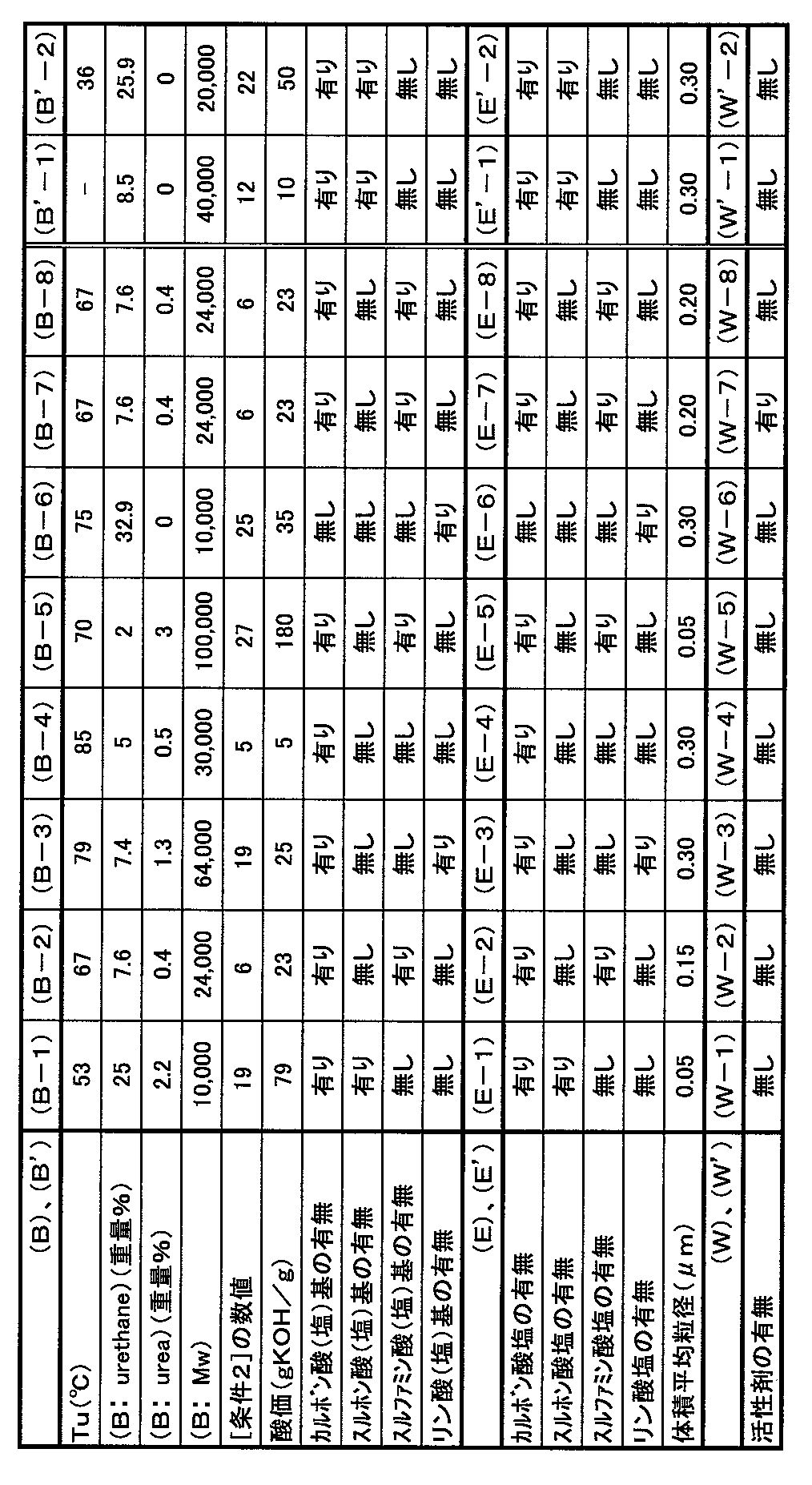
撹拌機、温度計、窒素導入管及び減圧装置を備えた反応容器に、窒素を導入しながらセバシン酸683重量部、1,6-ヘキサンジオール436重量部、酸化ジブチルスズ0.1重量部を投入し、減圧操作により系内を窒素置換した後、180℃に昇温し、同温度で6時間撹拌した。その後、撹拌を続けながら減圧下(0.007~0.026MPa)にて230℃まで徐々に昇温し、更に同温度で2時間保持する。粘稠な状態となったところで150℃まで冷却し、反応を停止させることで、結晶性ポリエステル樹脂(A1-1)を得た。
製造例13において、セバシン酸683重量部を、セバンシン酸703重量部とアジピン酸56重量部を混合したもの、1,6-ヘキサンジオール436重量部を1,4-ブタンジオール379重量部に変更した以外は製造例13と同様にして、結晶性ポリエステル樹脂(A1-2)を得た。
製造例13において、セバシン酸683重量部を、アジピン酸713量部に、1,6-ヘキサンジオール436重量部を1,4-ブタンジオール462重量部に変更した以外は製造例13と同様にして、結晶性ポリエステル樹脂(A1-3)を得た。
製造例13において、セバシン酸の部数683重量部を848重量部に、1,6-ヘキサンジオール436重量部をエチレングリコール226重量部と1,4-ブタンジオール75重量部を混合したものに変更した以外は製造例13と同様にして、結晶性ポリエステル樹脂(A1-4)を得た。
製造例13において、セバシン酸683重量部をイソフタル酸627重量部に、1,6-ヘキサンジオールの部数436重量部を508重量部に変更した以外は製造例13と同様にして、結晶性ポリエステル樹脂(A1-5)を得た。
製造例13において、セバシン酸の部数683重量部を787重量部に、1,6-ヘキサンジオール436重量部をエチレングリコール382重量部に変更した以外は製造例13と同様にして、結晶性ポリエステル樹脂(A1-6)を得た。
撹拌機、温度計、窒素導入管及び減圧装置を備えた反応容器に、窒素を導入しながら結晶性ポリエステル(A1-2)216.0重量部、ジフェニルメタンジイソシアネート64.0重量部、1,2-プロピレングリコール20.0重量部、テトラヒドロフラン(THF)300.0重量部を投入した。次いで50℃に昇温し、同温度で15時間かけてウレタン化反応をし、ヒドロキシル基を末端に有する結晶性ポリウレタン樹脂(A2-1)のTHF溶液を得た後THFを留去し、結晶性樹脂(A2-1)を得た。(A2-1)のNCO含有率は0重量%であった。
撹拌機、温度計、窒素導入管及び減圧装置を備えた反応容器に、窒素を導入しながら結晶性ポリエステル(A1-3)150.0重量部、ヘキサメチレンジイソシアネート60.0重量部、シクロヘキサンジメタノール90.0重量部、THF300.0重量部を投入した。次いで50℃に昇温し、同温度で15時間かけてウレタン化反応をし、ヒドロキシル基を末端に有する結晶性ポリウレタン樹脂(A2-2)のTHF溶液を得た後THFを留去し、結晶性樹脂(A2-2)を得た。(A2-2)のNCO含有率は0重量%であった。
撹拌機、温度計、窒素導入管及び減圧装置を備えた反応容器に、窒素を導入しながら結晶性ポリエステル(A1-4)285.0重量部、イソホロンジイソシアネート15.0重量部、THF300.0重量部を投入した。次いで50℃に昇温し、同温度で15時間かけてウレタン化反応をし、ヒドロキシル基を末端に有する結晶性ポリウレタン樹脂(A2-3)のTHF溶液を得た後THFを留去し、結晶性樹脂(A2-3)を得た。(A2-3)のNCO含有率は0重量%であった。
撹拌機、温度計、窒素導入管及び減圧装置を備えた反応容器に、窒素を導入しながら結晶性ポリエステル(A1-5)240.0重量部、ジフェニルメタンジイソシアネート33.0重量部、ビスフェノールA・PO2モル付加物27.0重量部、THF300.0重量部を投入した。次いで50℃に昇温し、同温度で15時間かけてウレタン化反応をし、ヒドロキシル基を末端に有する結晶性ポリウレタン樹脂(A2-4)のTHF溶液を得た後THFを留去し、結晶性樹脂(A2-4)を得た。(A2-4)のNCO含有率は0重量%であった。
撹拌機、温度計、窒素導入管及び減圧装置を備えた反応容器に、窒素を導入しながら結晶性ポリエステル(A1-6)240.0重量部、キシリレンジイソシアネート47.0重量部、1,2-プロピレングリコール27.0重量部、THF300.0重量部を投入した。次いで50℃に昇温し、同温度で15時間かけてウレタン化反応をし、ヒドロキシル基を末端に有する結晶性ポリウレタン樹脂(A2-5)のTHF溶液を得た後THFを留去し、結晶性樹脂(A2-5)を得た。(A2-5)のNCO含有率は0重量%であった。
撹拌装置、加熱冷却装置、冷却管及び温度計を備えた反応容器に、(A1-1)452重量部、酢酸エチル500重量部を投入し、60℃まで昇温し、同温度で2時間撹拌し、溶解させた後、この溶液中の水分量が0.06重量%になるように水を加えた。溶解を確認した後、トリレンジイソシアネート48重量部を加え、80℃まで昇温し、同温度で1時間反応させ、末端にイソシアネート基を有する前駆体(A0-1)の酢酸エチル溶液を得た。(A0-1)のMwは14,000、融解熱の最大ピーク温度は60℃、イソシアネート含有率は1.0重量%であった。
撹拌機、温度計、窒素導入管及び減圧装置を備えた反応容器に、ビスフェノールA・PO2モル付加物67重量部、ビスフェノールA・PO3モル付加物700重量部、テレフタル酸260重量部及び縮合触媒としてジブチルチンオキサイド1重量部を投入し、常圧で230℃まで昇温し、同温度で5時間反応し、さらに0.013~0.020MPaの減圧下で2時間反応した。次いで180℃まで冷却し、無水トリメリット酸24重量部を加え、常圧密閉下で2時間反応後室温まで冷却しポリエステル樹脂(A’1-1)を得た。

撹拌装置、加熱冷却装置、温度計、冷却管及び窒素導入管を備えた反応容器に、プロピレングリコール557重量部(17.5モル部)、テレフタル酸ジメチルエステル569重量部(7.0モル部)、アジピン酸184重量部(3.0モル部)及び縮合触媒としてテトラブトキシチタネート3重量部を投入し、180℃で窒素気流下に、生成するメタノールを留去しながら8時間反応させた。次いで230℃まで徐々に昇温しながら、窒素気流下に、生成するプロピレングリコール及び水を留去しながら4時間反応させ、更に0.007~0.026MPaの減圧下に1時間反応させた。回収されたプロピレングリコールは175重量部(5.5モル部)であった。次いで180℃まで冷却し、無水トリメリット酸121重量部(1.5モル部)を加え、常圧密閉下で2時間反応後、220℃、常圧で軟化点が180℃になるまで反応させ、ポリエステル樹脂(Mn=8,500)を得た。
ビーカーに、銅フタロシアニンブルー20重量部と着色剤分散剤「ソルスパーズ28000」[アビシア(株)製]4重量部、得られたポリエステル樹脂20重量部及び酢酸エチル56重量部を投入し、撹拌して均一分散させた後、ビーズミルによって銅フタロシアニンブルーを微分散して、着色剤分散液を得た。着色剤分散液の「LA-920」で測定した体積平均粒径は0.2μmであった。
撹拌装置、加熱冷却装置、温度計及び滴下ボンベを備えた耐圧反応容器に、キシレン454重量部、低分子量ポリエチレン
「サンワックスLEL-400」[軟化点:128℃、三洋化成工業(株)製]150重量部を投入し、窒素置換後撹拌下170℃に昇温し、同温度でスチレン595重量部、メタクリル酸メチル255重量部、ジ-t-ブチルパーオキシヘキサヒドロテレフタレート34重量部及びキシレン119重量部の混合溶液を3時間かけて滴下し、更に同温度で30分間保持した。次いで0.039MPaの減圧下でキシレンを留去し、変性ワックスを得た。変性ワックスのグラフト鎖のSP値は10.35(cal/cm3)1/2、Mnは1,900、Mwは5,200、Tgは56.9℃であった。
撹拌装置、加熱冷却装置、冷却管及び温度計を備えた反応容器に、パラフィンワックス「HNP-9」[融解熱最大ピーク温度:73℃、日本精鑞(株)製]10重量部、製造例30で得られた変性ワックス1重量部及び酢酸エチル33重量部を投入し、撹拌下78℃に昇温し、同温度で30分間撹拌後、1時間かけて30℃まで冷却してパラフィンワックスを微粒子状に晶析させ、更にウルトラビスコミル(アイメックス製)で湿式粉砕し、離型剤分散液を得た。体積平均粒径は0.25μmであった。
撹拌機及び温度計を備えた反応容器に、着色剤分散液30重量部、離型剤分散液140重量部、結晶性樹脂(A1-1)100重量部及び酢酸エチル153重量部を投入し、撹拌して(A1-1)を均一に溶解させ、樹脂溶液(D-1)を得た。
撹拌機及び温度計を備えた反応容器に、着色剤分散液30重量部、離型剤分散液140重量部、結晶性樹脂(A2-1)100重量部及び酢酸エチル153重量部を投入し、撹拌して(A2-1)を均一に溶解させ、樹脂溶液(D-2)を得た。
撹拌機及び温度計を備えた反応容器に、着色剤分散液30重量部、離型剤分散液140重量部、結晶性樹脂(A2-2)100重量部及び酢酸エチル153重量部を投入し、撹拌して(A2-2)を均一に溶解させ、樹脂溶液(D-3)を得た。
撹拌機及び温度計を備えた反応容器に、着色剤分散液30重量部、離型剤分散液140重量部、結晶性樹脂(A2-3)100重量部及び酢酸エチル153重量部を投入し、撹拌して(A2-3)を均一に溶解させ、樹脂溶液(D-4)を得た。
撹拌機及び温度計を備えた反応容器に、着色剤分散液30重量部、離型剤分散液140重量部、結晶性樹脂(A2-4)100重量部及び酢酸エチル153重量部を投入し、撹拌して(A2-4)を均一に溶解させ、樹脂溶液(D-5)を得た。
撹拌機及び温度計を備えた反応容器に、着色剤分散液30重量部、離型剤分散液140重量部、結晶性樹脂(A1-1)100重量部及びテトラヒドロフラン153重量部を投入し、撹拌して(A1-1)を均一に溶解させ、樹脂溶液(D-6)を得た。
撹拌機及び温度計を備えた反応容器に、着色剤分散液30重量部、離型剤分散液140重量部、結晶性樹脂(A1-1)50重量部、結晶性樹脂(A2-4)50重量部及びメチルエチルケトン153重量部を投入し、撹拌して(A2-1)、(A2-4)を均一に溶解させ、樹脂溶液(D-7)を得た。
撹拌機及び温度計を備えた反応容器に、着色剤分散液30重量部、離型剤分散液140重量部、結晶性樹脂(A2-1)50重量部、結晶性樹脂(A2-5)50重量部及びアセトン153重量部を投入し、撹拌して(A2-1)、(A2-5)を均一に溶解させ、樹脂溶液(D-8)を得た。
撹拌機及び温度計を備えた反応容器に、着色剤分散液30重量部、離型剤分散液140重量部、結晶性樹脂(A2-1)80重量部、前駆体(A0-1)40重量部及び酢酸エチル133重量部を投入し、撹拌して(A2-1)、(A0-1)を均一に溶解させ、樹脂溶液(D-9)を得た。
撹拌機及び温度計を備えた反応容器に、着色剤分散液30重量部、離型剤分散液140重量部、ポリエステル樹脂(A’1-1)100重量部及び酢酸エチル153重量部を投入し、撹拌して(A’1-1)を均一に溶解させ、樹脂溶液(D’-1)を得た。
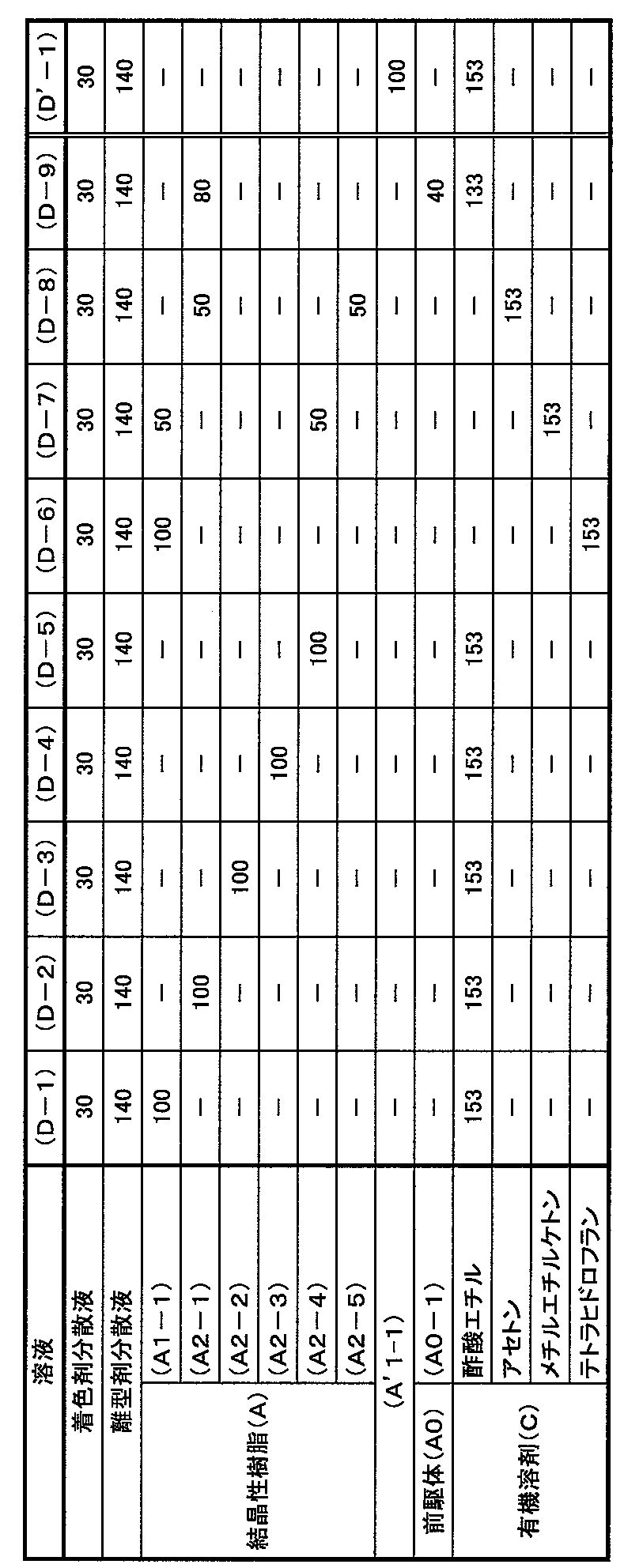
ビーカーに、イオン交換水(F3)170.2重量部、(W-3)0.3重量部、カルボキシメチルセルロースナトリウム1重量部、ドデシルジフェニルエーテルジスルホン酸ナトリウムの48.5重量%水溶液「エレミノールMON-7」[三洋化成工業(株)製]36重量部及び酢酸エチル15.3重量部を投入し、撹拌して均一に溶解した。次いで50℃に昇温し、同温度でTKオートホモミキサーを10,000rpmに撹拌しながら、樹脂溶液(D-1)75重量部を投入し2分間撹拌した。次いでこの混合液を撹拌機及び温度計を備えた反応容器に移し、50℃で濃度が0.5重量%以下となるまで酢酸エチルを留去し、(A)で構成されたコア層(Q)の表面に(B)が付着されたシェル層(S)が形成された樹脂粒子(X-1)の水性樹脂分散体を得た。次いで洗浄、濾別し、40℃で18時間乾燥を行い、揮発分を0.5重量%以下として、樹脂粒子(X-1)を得た。
実施例1において、樹脂溶液(D-1)75重量部を樹脂溶液(D-2)75重量部に、(W-3)0.3重量部を(W-2)2.1重量部に変更する以外は実施例1と同様にして、樹脂粒子(X-2)を得た。
実施例1において、樹脂溶液(D-1)75重量部を樹脂溶液(D-3)75重量部に、(W-3)0.3重量部を(W-2)7.2重量部に変更する以外は実施例1と同様にして、樹脂粒子(X-3)を得た。
実施例1において、樹脂溶液(D-1)75重量部を樹脂溶液(D-4)75重量部に、(W-3)0.3重量部を(W-2)34.5重量部に変更する以外は実施例1と同様にして、樹脂粒子(X-4)を得た。
実施例1において、樹脂溶液(D-1)75重量部を樹脂溶液(D-5)75重量部に、(W-3)0.3重量部を(W-1)4.2重量部に変更する以外は実施例1と同様にして、樹脂粒子(X-5)を得た。
実施例1において、酢酸エチル15.3重量部をテトラヒドロフラン15.3重量部に、樹脂溶液(D-1)75重量部を樹脂溶液(D-6)75重量部に、(W-3)0.3重量部を(W-6)4.2重量部に変更する以外は実施例1と同様にして、樹脂粒子(X-6)を得た。
実施例1において、酢酸エチル15.3重量部をメチルエチルケトン15.3重量部に、樹脂溶液(D-1)75重量部を樹脂溶液(D-7)75重量部に、(W-3)0.3重量部を(W-5)4.2重量部に変更する以外は実施例1と同様にして、樹脂粒子(X-7)を得た。
実施例1において、酢酸エチル15.3重量部をアセトン15.3重量部に、樹脂溶液(D-1)75重量部を樹脂溶液(D-8)75重量部に、(W-3)0.3重量部を(W-4)4.2重量部に変更する以外は実施例1と同様にして、樹脂粒子(X-8)を得た。
ビーカーに、イオン交換水(F3)170.2重量部、(W-2)2.1重量部、カルボキシメチルセルロースナトリウム1重量部、ドデシルジフェニルエーテルジスルホン酸ナトリウムの48.5重量%水溶液「エレミノールMON-7」[三洋化成工業(株)製]36重量部及び酢酸エチル15.3重量部を投入し、撹拌して均一に溶解した。次いで50℃に昇温し、同温度でTKオートホモミキサーを10,000rpmに撹拌しながら、樹脂溶液(D-9)75重量部を投入し2分間撹拌した。次いでこの混合液を撹拌機及び温度計を備えた反応容器に移し、50℃で濃度が0.5重量%以下となるまで酢酸エチルを留去し、(A)で構成されたコア層(Q)の表面に(B)が付着されたシェル層(S)が形成された樹脂粒子(X-9)の水性樹脂分散体を得た。次いで0.1mol/Lの塩酸水溶液で(X-1)の水性樹脂分散体のpHが2.1となるまで酸洗浄し、濾別し、40℃で18時間乾燥を行い、揮発分を0.5重量%以下として、樹脂粒子(X-9)を得た。
実施例1において、樹脂溶液(D-1)75重量部を樹脂溶液(D-9)75重量部に、(W-3)0.3重量部を(W-7)2.1重量部に変更する以外は実施例1と同様にして、樹脂粒子(X-10)を得た。
ビーカーに、デカン108重量部、(W-8)2.1重量部を投入し、撹拌して均一に溶解した。次いで50℃に昇温し、同温度でTKオートホモミキサーを10,000rpmに撹拌しながら、樹脂溶液(D-9)75重量部を投入し2分間撹拌した。次いでこの混合液を撹拌機及び温度計を備えた反応容器に移し、50℃で濃度が0.5重量%以下となるまで酢酸エチルを留去し、(A)で構成されたコア層(Q)の表面に(B)が付着されたシェル層(S)が形成された樹脂粒子(X-11)の分散体を得た。次いで洗浄し、濾別し、40℃で18時間乾燥を行い、揮発分を0.5重量%以下として、樹脂粒子(X-11)を得た。
実施例1において、樹脂溶液(D-1)75重量部を樹脂溶液(D’-1)75重量部に、(W-3)0.3重量部を(W-2)4.2重量部に変更する以外は実施例1と同様にして、樹脂粒子(X’-1)を得た。
実施例1において、樹脂溶液(D-1)75重量部を(D’-1)75重量部に、(W-3)0.3重量部を(W‘-1)4.2重量部に変更する以外は実施例1と同様にして、樹脂粒子(X’-2)を得た。
実施例1において、樹脂溶液(D-1)75重量部を樹脂溶液(D-2)75重量部に、(W-3)0.3重量部を(W’-2)4.2重量部に変更する以外は実施例1と同様にして、樹脂粒子(X’-3)を得た。
また、樹脂粒子(X-1)~(X-11)、(X’-1)~(X’-3)について、下記の方法で体積平均粒径、粒度分布を測定し、耐熱保存安定性、低温定着性、加熱接着性、接着強度、塗膜の光沢、塗膜の耐水性を評価した。結果を表4、5に示す。
樹脂粒子(X-1)~(X-11)、(X’-1)~(X’-3)を水に分散してコールターカウンター「マルチサイザーIII」(ベックマンコールター社製)で体積平均粒径、粒度分布を測定した。
樹脂粒子(X-1)~(X-11)、(X’-1)~(X’-3)を40℃の雰囲気で1日間静置し、ブロッキングの程度を目視で判断し、下記の評価基準で耐熱保存安定性を評価した。
[評価基準]
○:ブロッキングが発生していない。
×:ブロッキングが発生している。
樹脂粒子(X-1)~(X-11)、(X’-1)~(X’-3)に、「アエロジルR972」[日本アエロジル(株)製]を1.0重量%添加し、よく混ぜて均一にした後、この粉体を紙面上に0.6mg/cm2となるよう均一に載せる(このとき粉体を紙面に載せる方法は、熱定着機を外したプリンターを用いる。上記の重量密度で粉体を均一に載せることができるのであれば他の方法を用いてもよい)。この紙を加圧ローラーに定着速度(加熱ローラ周速)213mm/sec、定着圧力(加圧ローラ圧)10kg/cm2の条件で通した時のコールドオフセットの発生温度を測定した。コールドオフセットの発生温度が低いほど、低温定着性に優れることを意味する。
リン酸亜鉛処理鋼板標準板[日本テストパネル(株)製]に、市販のコロナ帯電方式スプレーガンを用いて、膜圧が40~60μmになるように樹脂粒子(X-1)~(X-11)、(X’-1)~(X’-3)を静電塗装し、100℃で20分間焼き付けた後、JIS K6830に規定する方法に従い剪断接着試験を行い、下記の基準で加熱接着性を評価した。
[評価基準]
○:凝集破壊
×:界面破壊
上記の低温定着性の評価サンプルの中から、160℃で定着させた画像を使用し、JIS K5600-5-4に規定する方法に従って鉛筆硬度試験を行い、下記の基準で接着強度を評価した。
[評価基準]
◎:HB以上
○:4B~B
△:5B以下
上記の低温定着性の評価サンプルの中から、160℃で定着させた画像の光沢を目視で判断し、下記の基準で塗膜の光沢を評価した。
[評価基準]
○:光沢が十分備わっている
△:光沢が備わっている
×:光沢が不十分である
上記の低温定着性の評価サンプルの中から、160℃で定着させた画像を4cm×4cmに裁断し、赤インク液「パイロットインキ/レッド」[(株)パイロット製]を水で100倍に希釈したものに1時間浸漬し、端面からのインクの浸み込み幅を測定し、最大値(mm)を耐水性とした。数値が小さいほど耐水性に優れることを表す。


Claims (22)
- 結晶性樹脂(A)を含有するコア層(Q)の表面に、結晶性ポリウレタン樹脂(B)を含有するシェル層(S)を有する樹脂粒子であって、結晶性樹脂(A)の融解熱の最大ピーク温度(Ta)が40~70℃であり、かつ、結晶性ポリウレタン樹脂(B)の融解熱の最大ピーク温度(Tu)が50~90℃である樹脂粒子。
- 下記条件1を満たす請求項1に記載の樹脂粒子。
0≦(Tu)-(Ta)≦30 [条件1] - 結晶性ポリウレタン樹脂(B)が、下記条件2を満たす請求項1又は2に記載の樹脂粒子。
0.94×(B:urethane)+0.70×(B:urea)+0.00032×(B:Mw)-9.2≧5 [条件2]
[式中、(B:urethane);(B)のウレタン基濃度(重量%)、(B:urea);(B)のウレア基濃度(重量%)、(B:Mw);(B)のMwである。] - 結晶性ポリウレタン樹脂(B)の酸価が5~200mgKOH/gである請求項1~3のいずれかに記載の樹脂粒子。
- 結晶性ポリウレタン樹脂(B)が、カルボン酸基、スルホン酸基、スルファミン酸基、リン酸基、カルボン酸塩基、スルホン酸塩基、スルファミン酸塩基及びリン酸塩基からなる群から選ばれる1種類以上の基を有する請求項1~4のいずれかに記載の樹脂粒子。
- コア層(Q)とシェル層(S)の重量比が99.9:0.1~75:25である請求項1~5のいずれかに記載の樹脂粒子。
- 結晶性樹脂(A)の全吸熱量が20~150J/gである請求項1~6のいずれかに記載の樹脂粒子。
- 結晶性樹脂(A)が、エステル基及びウレタン基を有する請求項1~7のいずれかに記載の樹脂粒子。
- 結晶性樹脂(A)が、結晶性部(a)のみから構成される樹脂である請求項1~7のいずれかに記載の樹脂粒子。
- 結晶性樹脂(A)が、結晶性部(a)と非結晶部(a’)とで構成されるブロック樹脂である請求項1~7のいずれかに記載の樹脂粒子。
- 樹脂粒子に含有される結晶性部(a)の含有率が、結晶性樹脂(A)の重量に基づいて50~99重量%である請求項10に記載の樹脂粒子。
- 樹脂粒子に含有される結晶性部(a)の含有率が、該樹脂粒子の重量に基づいて30~95重量%である請求項9~11のいずれかに記載の樹脂粒子。
- 2種以上の結晶性樹脂(A)を含有してなる請求項1~12のいずれかに記載の樹脂粒子。
- 樹脂粒子の分子量分布が3.5~100である請求項1~13のいずれかに記載の樹脂粒子。
- 結晶性樹脂(A)を有機溶剤(C)に溶解してなる溶液(D)を、結晶性ポリウレタン樹脂(B)を含有してなる樹脂粒子(E)を含有する分散媒体(F)中に分散して分散体(DF)を得る工程の後、分散体(DF)から、有機溶剤(C)及び分散媒体(F)を除去して得られる、結晶性樹脂(A)を含有してなる樹脂粒子(G)の表面に樹脂粒子(E)が付着して得られる樹脂粒子(X)の製造方法であって、樹脂粒子(X)が結晶性樹脂(A)を含有するコア層(Q)の表面に結晶性ポリウレタン樹脂(B)を含有するシェル層(S)を有する構造であり、結晶性樹脂(A)の融解熱の最大ピーク温度(Ta)が40~70℃であり、かつ、結晶性ポリウレタン樹脂(B)の融解熱の最大ピーク温度(Tu)が50~90℃である樹脂粒子(X)の製造方法。
- 結晶性樹脂(A)が、その前駆体(A0)から得られる請求項15に記載の樹脂粒子(X)の製造方法。
- 前駆体(A0)が、反応性基を有するプレポリマー(α)と硬化剤(β)の組み合わせである請求項16に記載の樹脂粒子(X)の製造方法。
- 樹脂粒子(E)の体積平均粒径が0.01~0.5μmである請求項15~17のいずれかに記載の樹脂粒子(X)の製造方法。
- 樹脂粒子(E)が、カルボン酸塩基、スルホン酸塩基、スルファミン酸塩基及びリン酸塩基からなる群から選ばれる1種類以上の基を有する請求項15~19のいずれかに記載の樹脂粒子(X)の製造方法。
- 溶液(D)を、結晶性ポリウレタン樹脂(B)を含有してなる樹脂粒子(E)が分散してなる分散媒体(F)中に分散する工程の後に、樹脂粒子(E)が有するカルボン酸塩基、スルホン酸塩基、スルファミン酸塩基及びリン酸塩基からなる群から選ばれる1種類以上の基を、カルボン酸基、スルホン酸基、スルファミン酸基及びリン酸基からなる群から選ばれる1種類以上の基に変換する工程を含む請求項19に記載の樹脂粒子(X)の製造方法。
- 分散媒体(F)が、非水系有機溶剤(F2)である請求項15~20のいずれかに記載の樹脂粒子(X)の製造方法。
- 分散媒体(F)が、水性媒体(F3)である請求項15~20のいずれかに記載の樹脂粒子(X)の製造方法。
Priority Applications (3)
| Application Number | Priority Date | Filing Date | Title |
|---|---|---|---|
| JP2014536847A JP6203184B2 (ja) | 2012-09-18 | 2013-09-17 | 樹脂粒子及びその製造方法 |
| US14/428,741 US20150274914A1 (en) | 2012-09-18 | 2013-09-17 | Resin particles and method for producing same |
| US17/029,456 US20210002441A1 (en) | 2012-09-18 | 2020-09-23 | Resin particles and method for producing same |
Applications Claiming Priority (2)
| Application Number | Priority Date | Filing Date | Title |
|---|---|---|---|
| JP2012-203796 | 2012-09-18 | ||
| JP2012203796 | 2012-09-18 |
Related Child Applications (2)
| Application Number | Title | Priority Date | Filing Date |
|---|---|---|---|
| US14/428,741 A-371-Of-International US20150274914A1 (en) | 2012-09-18 | 2013-09-17 | Resin particles and method for producing same |
| US17/029,456 Division US20210002441A1 (en) | 2012-09-18 | 2020-09-23 | Resin particles and method for producing same |
Publications (1)
| Publication Number | Publication Date |
|---|---|
| WO2014046069A1 true WO2014046069A1 (ja) | 2014-03-27 |
Family
ID=50341380
Family Applications (1)
| Application Number | Title | Priority Date | Filing Date |
|---|---|---|---|
| PCT/JP2013/074974 Ceased WO2014046069A1 (ja) | 2012-09-18 | 2013-09-17 | 樹脂粒子及びその製造方法 |
Country Status (3)
| Country | Link |
|---|---|
| US (2) | US20150274914A1 (ja) |
| JP (1) | JP6203184B2 (ja) |
| WO (1) | WO2014046069A1 (ja) |
Cited By (2)
| Publication number | Priority date | Publication date | Assignee | Title |
|---|---|---|---|---|
| JP2015148731A (ja) * | 2014-02-07 | 2015-08-20 | 株式会社リコー | 電子写真用トナー |
| JP2017134398A (ja) * | 2016-01-26 | 2017-08-03 | キヤノン株式会社 | トナー及びトナー用外添剤 |
Families Citing this family (2)
| Publication number | Priority date | Publication date | Assignee | Title |
|---|---|---|---|---|
| EP3659797A1 (en) * | 2018-11-29 | 2020-06-03 | Henkel AG & Co. KGaA | Polyurethane adhesive having high chemical resistance |
| JP6775714B1 (ja) * | 2019-02-08 | 2020-10-28 | 関西ペイント株式会社 | 水性塗料組成物 |
Citations (4)
| Publication number | Priority date | Publication date | Assignee | Title |
|---|---|---|---|---|
| JP2005274964A (ja) * | 2004-03-24 | 2005-10-06 | Fuji Xerox Co Ltd | 電子写真用トナー及びその製造方法、並びに電子写真用現像剤 |
| JP2006235028A (ja) * | 2005-02-23 | 2006-09-07 | Konica Minolta Business Technologies Inc | 静電荷像現像用トナー及びその製造方法 |
| JP2010077419A (ja) * | 2008-08-26 | 2010-04-08 | Sanyo Chem Ind Ltd | 結晶性樹脂粒子 |
| JP2010090355A (ja) * | 2008-02-07 | 2010-04-22 | Sanyo Chem Ind Ltd | 樹脂粒子 |
Family Cites Families (9)
| Publication number | Priority date | Publication date | Assignee | Title |
|---|---|---|---|---|
| DE60206669T2 (de) * | 2001-02-06 | 2006-07-06 | Dainippon Ink And Chemicals, Inc. | Harzzusammensetzung für Pulverbeschichtung, Pulverbeschichtung und beschichtete Gegenstände |
| JP4016243B2 (ja) * | 2001-03-21 | 2007-12-05 | コニカミノルタホールディングス株式会社 | トナー、トナーの製造方法、及び画像形成方法 |
| JP3717161B2 (ja) * | 2002-07-29 | 2005-11-16 | 花王株式会社 | 結晶性ポリエステル |
| US7316880B2 (en) * | 2003-08-26 | 2008-01-08 | Konica Minolta Holdings, Inc. | Toner for developing a latent image and an image forming method employing the same |
| WO2005073288A1 (ja) * | 2004-01-30 | 2005-08-11 | Sanyo Chemical Industries, Ltd. | 樹脂分散体および樹脂粒子 |
| JP4544095B2 (ja) * | 2005-08-24 | 2010-09-15 | 富士ゼロックス株式会社 | 電子写真用トナー、電子写真用トナーの製造方法、電子写真用現像剤並びに画像形成方法 |
| WO2009119055A1 (ja) * | 2008-03-24 | 2009-10-01 | 三洋化成工業株式会社 | 樹脂粒子及びその製造方法 |
| JP5214564B2 (ja) * | 2008-09-02 | 2013-06-19 | 三洋化成工業株式会社 | 樹脂粒子およびその製造方法 |
| US8912281B2 (en) * | 2009-12-10 | 2014-12-16 | Sanyo Chemical Industries, Ltd. | Urethane resin particles for slush molding |
-
2013
- 2013-09-17 JP JP2014536847A patent/JP6203184B2/ja active Active
- 2013-09-17 WO PCT/JP2013/074974 patent/WO2014046069A1/ja not_active Ceased
- 2013-09-17 US US14/428,741 patent/US20150274914A1/en not_active Abandoned
-
2020
- 2020-09-23 US US17/029,456 patent/US20210002441A1/en not_active Abandoned
Patent Citations (4)
| Publication number | Priority date | Publication date | Assignee | Title |
|---|---|---|---|---|
| JP2005274964A (ja) * | 2004-03-24 | 2005-10-06 | Fuji Xerox Co Ltd | 電子写真用トナー及びその製造方法、並びに電子写真用現像剤 |
| JP2006235028A (ja) * | 2005-02-23 | 2006-09-07 | Konica Minolta Business Technologies Inc | 静電荷像現像用トナー及びその製造方法 |
| JP2010090355A (ja) * | 2008-02-07 | 2010-04-22 | Sanyo Chem Ind Ltd | 樹脂粒子 |
| JP2010077419A (ja) * | 2008-08-26 | 2010-04-08 | Sanyo Chem Ind Ltd | 結晶性樹脂粒子 |
Cited By (2)
| Publication number | Priority date | Publication date | Assignee | Title |
|---|---|---|---|---|
| JP2015148731A (ja) * | 2014-02-07 | 2015-08-20 | 株式会社リコー | 電子写真用トナー |
| JP2017134398A (ja) * | 2016-01-26 | 2017-08-03 | キヤノン株式会社 | トナー及びトナー用外添剤 |
Also Published As
| Publication number | Publication date |
|---|---|
| JP6203184B2 (ja) | 2017-09-27 |
| US20210002441A1 (en) | 2021-01-07 |
| US20150274914A1 (en) | 2015-10-01 |
| JPWO2014046069A1 (ja) | 2016-08-18 |
Similar Documents
| Publication | Publication Date | Title |
|---|---|---|
| JP6089524B2 (ja) | トナー及びトナーの製造方法 | |
| JP6338863B2 (ja) | トナーバインダー及び樹脂粒子 | |
| JP6323015B2 (ja) | 静電荷像現像用トナー | |
| JP5856634B2 (ja) | トナーバインダー及びトナー | |
| JP6121855B2 (ja) | 樹脂粒子の製造方法 | |
| US20210002441A1 (en) | Resin particles and method for producing same | |
| US9581925B2 (en) | Liquid developer and method for manufacturing the same | |
| JP2012107229A (ja) | 樹脂粒子分散液の製造方法 | |
| JP6121712B2 (ja) | 樹脂粒子及び樹脂粒子の製造方法 | |
| JP6435224B2 (ja) | 樹脂水性分散体、樹脂粒子、着色樹脂粒子及びトナー | |
| JP2016190916A (ja) | 樹脂水性分散体、樹脂粒子、着色樹脂粒子及びトナー | |
| JP2015083668A (ja) | 樹脂粒子、樹脂粒子の製造方法及びトナー | |
| US10007207B2 (en) | Liquid developer and method for manufacturing the same | |
| JP6441173B2 (ja) | トナーバインダー及びトナー | |
| US9152068B2 (en) | Liquid developer and method for manufacturing the same | |
| US20140234769A1 (en) | Liquid developer | |
| JP2014047304A (ja) | 樹脂粒子の製造方法 | |
| JP2013155210A (ja) | コアシェル型樹脂粒子及びその製造方法 | |
| JP2014038169A (ja) | トナーの製造方法及びトナー | |
| JP6328719B2 (ja) | トナー及びその製造方法 | |
| JP6276605B2 (ja) | トナー | |
| JP6296478B2 (ja) | トナーバインダー及びトナー | |
| JP6276608B2 (ja) | トナーの製造方法 | |
| JP2013151588A (ja) | 樹脂粒子の製造方法 | |
| JP6211265B2 (ja) | トナーバインダー |
Legal Events
| Date | Code | Title | Description |
|---|---|---|---|
| 121 | Ep: the epo has been informed by wipo that ep was designated in this application |
Ref document number: 13839882 Country of ref document: EP Kind code of ref document: A1 |
|
| ENP | Entry into the national phase |
Ref document number: 2014536847 Country of ref document: JP Kind code of ref document: A |
|
| WWE | Wipo information: entry into national phase |
Ref document number: 14428741 Country of ref document: US |
|
| NENP | Non-entry into the national phase |
Ref country code: DE |
|
| 122 | Ep: pct application non-entry in european phase |
Ref document number: 13839882 Country of ref document: EP Kind code of ref document: A1 |