WO2014007120A1 - アデノ随伴ウイルスベクターの産生細胞 - Google Patents
アデノ随伴ウイルスベクターの産生細胞 Download PDFInfo
- Publication number
- WO2014007120A1 WO2014007120A1 PCT/JP2013/067488 JP2013067488W WO2014007120A1 WO 2014007120 A1 WO2014007120 A1 WO 2014007120A1 JP 2013067488 W JP2013067488 W JP 2013067488W WO 2014007120 A1 WO2014007120 A1 WO 2014007120A1
- Authority
- WO
- WIPO (PCT)
- Prior art keywords
- aav vector
- aav
- mirna
- cells
- cell
- Prior art date
- Legal status (The legal status is an assumption and is not a legal conclusion. Google has not performed a legal analysis and makes no representation as to the accuracy of the status listed.)
- Ceased
Links
Classifications
-
- C—CHEMISTRY; METALLURGY
- C12—BIOCHEMISTRY; BEER; SPIRITS; WINE; VINEGAR; MICROBIOLOGY; ENZYMOLOGY; MUTATION OR GENETIC ENGINEERING
- C12N—MICROORGANISMS OR ENZYMES; COMPOSITIONS THEREOF; PROPAGATING, PRESERVING, OR MAINTAINING MICROORGANISMS; MUTATION OR GENETIC ENGINEERING; CULTURE MEDIA
- C12N15/00—Mutation or genetic engineering; DNA or RNA concerning genetic engineering, vectors, e.g. plasmids, or their isolation, preparation or purification; Use of hosts therefor
- C12N15/09—Recombinant DNA-technology
- C12N15/63—Introduction of foreign genetic material using vectors; Vectors; Use of hosts therefor; Regulation of expression
- C12N15/79—Vectors or expression systems specially adapted for eukaryotic hosts
- C12N15/85—Vectors or expression systems specially adapted for eukaryotic hosts for animal cells
- C12N15/86—Viral vectors
-
- C—CHEMISTRY; METALLURGY
- C12—BIOCHEMISTRY; BEER; SPIRITS; WINE; VINEGAR; MICROBIOLOGY; ENZYMOLOGY; MUTATION OR GENETIC ENGINEERING
- C12N—MICROORGANISMS OR ENZYMES; COMPOSITIONS THEREOF; PROPAGATING, PRESERVING, OR MAINTAINING MICROORGANISMS; MUTATION OR GENETIC ENGINEERING; CULTURE MEDIA
- C12N15/00—Mutation or genetic engineering; DNA or RNA concerning genetic engineering, vectors, e.g. plasmids, or their isolation, preparation or purification; Use of hosts therefor
- C12N15/09—Recombinant DNA-technology
-
- C—CHEMISTRY; METALLURGY
- C12—BIOCHEMISTRY; BEER; SPIRITS; WINE; VINEGAR; MICROBIOLOGY; ENZYMOLOGY; MUTATION OR GENETIC ENGINEERING
- C12N—MICROORGANISMS OR ENZYMES; COMPOSITIONS THEREOF; PROPAGATING, PRESERVING, OR MAINTAINING MICROORGANISMS; MUTATION OR GENETIC ENGINEERING; CULTURE MEDIA
- C12N15/00—Mutation or genetic engineering; DNA or RNA concerning genetic engineering, vectors, e.g. plasmids, or their isolation, preparation or purification; Use of hosts therefor
- C12N15/09—Recombinant DNA-technology
- C12N15/11—DNA or RNA fragments; Modified forms thereof; Non-coding nucleic acids having a biological activity
- C12N15/111—General methods applicable to biologically active non-coding nucleic acids
-
- C—CHEMISTRY; METALLURGY
- C12—BIOCHEMISTRY; BEER; SPIRITS; WINE; VINEGAR; MICROBIOLOGY; ENZYMOLOGY; MUTATION OR GENETIC ENGINEERING
- C12N—MICROORGANISMS OR ENZYMES; COMPOSITIONS THEREOF; PROPAGATING, PRESERVING, OR MAINTAINING MICROORGANISMS; MUTATION OR GENETIC ENGINEERING; CULTURE MEDIA
- C12N15/00—Mutation or genetic engineering; DNA or RNA concerning genetic engineering, vectors, e.g. plasmids, or their isolation, preparation or purification; Use of hosts therefor
- C12N15/09—Recombinant DNA-technology
- C12N15/11—DNA or RNA fragments; Modified forms thereof; Non-coding nucleic acids having a biological activity
- C12N15/113—Non-coding nucleic acids modulating the expression of genes, e.g. antisense oligonucleotides; Antisense DNA or RNA; Triplex- forming oligonucleotides; Catalytic nucleic acids, e.g. ribozymes; Nucleic acids used in co-suppression or gene silencing
-
- C—CHEMISTRY; METALLURGY
- C12—BIOCHEMISTRY; BEER; SPIRITS; WINE; VINEGAR; MICROBIOLOGY; ENZYMOLOGY; MUTATION OR GENETIC ENGINEERING
- C12N—MICROORGANISMS OR ENZYMES; COMPOSITIONS THEREOF; PROPAGATING, PRESERVING, OR MAINTAINING MICROORGANISMS; MUTATION OR GENETIC ENGINEERING; CULTURE MEDIA
- C12N15/00—Mutation or genetic engineering; DNA or RNA concerning genetic engineering, vectors, e.g. plasmids, or their isolation, preparation or purification; Use of hosts therefor
- C12N15/09—Recombinant DNA-technology
- C12N15/63—Introduction of foreign genetic material using vectors; Vectors; Use of hosts therefor; Regulation of expression
- C12N15/64—General methods for preparing the vector, for introducing it into the cell or for selecting the vector-containing host
-
- C—CHEMISTRY; METALLURGY
- C12—BIOCHEMISTRY; BEER; SPIRITS; WINE; VINEGAR; MICROBIOLOGY; ENZYMOLOGY; MUTATION OR GENETIC ENGINEERING
- C12N—MICROORGANISMS OR ENZYMES; COMPOSITIONS THEREOF; PROPAGATING, PRESERVING, OR MAINTAINING MICROORGANISMS; MUTATION OR GENETIC ENGINEERING; CULTURE MEDIA
- C12N5/00—Undifferentiated human, animal or plant cells, e.g. cell lines; Tissues; Cultivation or maintenance thereof; Culture media therefor
- C12N5/10—Cells modified by introduction of foreign genetic material
-
- C—CHEMISTRY; METALLURGY
- C12—BIOCHEMISTRY; BEER; SPIRITS; WINE; VINEGAR; MICROBIOLOGY; ENZYMOLOGY; MUTATION OR GENETIC ENGINEERING
- C12N—MICROORGANISMS OR ENZYMES; COMPOSITIONS THEREOF; PROPAGATING, PRESERVING, OR MAINTAINING MICROORGANISMS; MUTATION OR GENETIC ENGINEERING; CULTURE MEDIA
- C12N7/00—Viruses; Bacteriophages; Compositions thereof; Preparation or purification thereof
-
- C—CHEMISTRY; METALLURGY
- C12—BIOCHEMISTRY; BEER; SPIRITS; WINE; VINEGAR; MICROBIOLOGY; ENZYMOLOGY; MUTATION OR GENETIC ENGINEERING
- C12P—FERMENTATION OR ENZYME-USING PROCESSES TO SYNTHESISE A DESIRED CHEMICAL COMPOUND OR COMPOSITION OR TO SEPARATE OPTICAL ISOMERS FROM A RACEMIC MIXTURE
- C12P19/00—Preparation of compounds containing saccharide radicals
- C12P19/26—Preparation of nitrogen-containing carbohydrates
- C12P19/28—N-glycosides
- C12P19/30—Nucleotides
- C12P19/34—Polynucleotides, e.g. nucleic acids, oligoribonucleotides
-
- C—CHEMISTRY; METALLURGY
- C12—BIOCHEMISTRY; BEER; SPIRITS; WINE; VINEGAR; MICROBIOLOGY; ENZYMOLOGY; MUTATION OR GENETIC ENGINEERING
- C12N—MICROORGANISMS OR ENZYMES; COMPOSITIONS THEREOF; PROPAGATING, PRESERVING, OR MAINTAINING MICROORGANISMS; MUTATION OR GENETIC ENGINEERING; CULTURE MEDIA
- C12N2310/00—Structure or type of the nucleic acid
- C12N2310/10—Type of nucleic acid
- C12N2310/14—Type of nucleic acid interfering nucleic acids [NA]
- C12N2310/141—MicroRNAs, miRNAs
-
- C—CHEMISTRY; METALLURGY
- C12—BIOCHEMISTRY; BEER; SPIRITS; WINE; VINEGAR; MICROBIOLOGY; ENZYMOLOGY; MUTATION OR GENETIC ENGINEERING
- C12N—MICROORGANISMS OR ENZYMES; COMPOSITIONS THEREOF; PROPAGATING, PRESERVING, OR MAINTAINING MICROORGANISMS; MUTATION OR GENETIC ENGINEERING; CULTURE MEDIA
- C12N2330/00—Production
- C12N2330/50—Biochemical production, i.e. in a transformed host cell
- C12N2330/51—Specially adapted vectors
-
- C—CHEMISTRY; METALLURGY
- C12—BIOCHEMISTRY; BEER; SPIRITS; WINE; VINEGAR; MICROBIOLOGY; ENZYMOLOGY; MUTATION OR GENETIC ENGINEERING
- C12N—MICROORGANISMS OR ENZYMES; COMPOSITIONS THEREOF; PROPAGATING, PRESERVING, OR MAINTAINING MICROORGANISMS; MUTATION OR GENETIC ENGINEERING; CULTURE MEDIA
- C12N2501/00—Active agents used in cell culture processes, e.g. differentation
- C12N2501/65—MicroRNA
-
- C—CHEMISTRY; METALLURGY
- C12—BIOCHEMISTRY; BEER; SPIRITS; WINE; VINEGAR; MICROBIOLOGY; ENZYMOLOGY; MUTATION OR GENETIC ENGINEERING
- C12N—MICROORGANISMS OR ENZYMES; COMPOSITIONS THEREOF; PROPAGATING, PRESERVING, OR MAINTAINING MICROORGANISMS; MUTATION OR GENETIC ENGINEERING; CULTURE MEDIA
- C12N2750/00—MICROORGANISMS OR ENZYMES; COMPOSITIONS THEREOF; PROPAGATING, PRESERVING, OR MAINTAINING MICROORGANISMS; MUTATION OR GENETIC ENGINEERING; CULTURE MEDIA ssDNA viruses
- C12N2750/00011—Details
- C12N2750/14011—Parvoviridae
- C12N2750/14111—Dependovirus, e.g. adenoassociated viruses
- C12N2750/14141—Use of virus, viral particle or viral elements as a vector
- C12N2750/14143—Use of virus, viral particle or viral elements as a vector viral genome or elements thereof as genetic vector
-
- C—CHEMISTRY; METALLURGY
- C12—BIOCHEMISTRY; BEER; SPIRITS; WINE; VINEGAR; MICROBIOLOGY; ENZYMOLOGY; MUTATION OR GENETIC ENGINEERING
- C12N—MICROORGANISMS OR ENZYMES; COMPOSITIONS THEREOF; PROPAGATING, PRESERVING, OR MAINTAINING MICROORGANISMS; MUTATION OR GENETIC ENGINEERING; CULTURE MEDIA
- C12N2750/00—MICROORGANISMS OR ENZYMES; COMPOSITIONS THEREOF; PROPAGATING, PRESERVING, OR MAINTAINING MICROORGANISMS; MUTATION OR GENETIC ENGINEERING; CULTURE MEDIA ssDNA viruses
- C12N2750/00011—Details
- C12N2750/14011—Parvoviridae
- C12N2750/14111—Dependovirus, e.g. adenoassociated viruses
- C12N2750/14151—Methods of production or purification of viral material
Definitions
- the present invention relates to a cell that produces an adeno-associated virus vector particularly useful for gene transfer into humans at high titers in gene therapy research or clinical fields.
- Adeno-associated virus is a linear single-stranded DNA virus that can infect a wide variety of cells, including humans, and infects non-dividing cells such as blood cells, muscles, and nerve cells that have completed differentiation.
- AAV Adeno-associated virus
- AAV vectors for gene transfer virus is isolated from the elements essential for virus particle formation on the wild-type AAV genome in the same manner as other viral vectors by separating those that require cis supply and those that can be supplied in trans.
- a method for preventing wild-type AAV production and self-sustained replication at the infection destination of an AAV vector by introducing and expressing in production cells Patent Document 1.
- Conventional AAV vector production methods include 1) introduction of an AAV vector plasmid excluding rep and cap genes, leaving ITRs at both ends of the wild type AAV genome, and 2) supplying Rep and Cap proteins to trans.
- AAV requires the supply of accessory elements from any of adenoviruses, herpesviruses, vaccinia viruses, etc., called helper viruses, for its infectious viral particle formation 3)
- a method using adenovirus infection has been established (Patent Document 2).
- the AAV vector obtained by the above method is theoretically contaminated with adenovirus. This requires removal and inactivation of contaminating adenovirus, which causes a reduction in AAV vector titer.
- helper-free system using 3 ′) introduction of a helper plasmid that expresses only the elements essential for AAV virus particle formation among adenovirus-derived elements was developed instead of 3) above (patent) Reference 3). According to this method, since no adenovirus is mixed into the produced AAV vector, safety is excellent.
- AAV vectors intended for use in gene therapy research or clinical fields it is necessary to obtain a high-titer viral vector solution, which is derived from human-derived HeLa cells and A549 cells.
- a constitutive expression strain of rep and cap genes is prepared, and a device for adjusting the expression level of the gene has been devised.
- the titer of the obtained AAV vector is not sufficient, and a method for producing a higher titer AAV vector is required.
- An object of the present invention is to provide a cell for obtaining a high-titer AAV vector solution without complicated operations, and an AAV vector production method and kit using the cell.
- the present invention provides [1] a cell capable of producing an AAV vector and expressing an artificially introduced miRNA, [2] The cell according to [1], wherein the artificially introduced miRNA is at least one selected from the group consisting of hsa-miR-196a1, hsa-miR-324, hsa-miR-342, [3] An AAV vector-producing cell in which a nucleic acid encapsulated in a virus is introduced into the cell according to [1] or [2], [4] A method for producing an AAV vector comprising the step of culturing the cell according to [3], [5] A kit for producing an AAV vector comprising a nucleic acid that supplies miRNA and a nucleic acid that supplies elements essential for virus particle formation of the AAV vector, [6] AAV vector obtained using the method according to [4], [7] A method for selecting miRNA that can improve the AAV vector production ability of an AAV vector-producing cell by expressing it in an AAV vector-
- the present invention provides a cell having an ability to produce an AAV vector. By using the cells, it is possible to produce an AAV vector having a higher titer than the conventional one without complicated operations. Furthermore, a method and kit for producing an AAV vector using the cells are provided.
- a cell capable of producing the AAV vector of the present invention (hereinafter referred to as the cell of the present invention) is a cell that expresses elements necessary for AAV vector production and artificially introduced miRNA.
- the AAV vector-producing cell of the present invention is a cell in which a nucleic acid encapsulated in a virus particle is introduced into the cell of the present invention.
- the cell used as a material is not particularly limited.
- the cells include mammalian cells such as humans, monkeys, and rodents, preferably 293 cells (ATCC CRL-1573) and 293T cells (ATCC) that have high transformation efficiency and constitutively express the adenovirus E1 gene. CRL-11268), 293F cells, 293FT cells (all manufactured by Life Technologies), G3T-hi cells (WO 06/035829 pamphlet), commercially available cell lines for AAV vector production, AAV293 cells (manufactured by Stratagene) Is exemplified.
- cells modified to transiently or constitutively express some of the proteins required for AAV vector production can be used.
- Examples of elements necessary for the production of the AAV vector include (A) AAV-derived Rep protein, Cap protein, and (B) adenovirus-derived elements such as E1a, E1b, E2, E4, and VARNA genes.
- AAV-derived Rep protein AAV-derived Rep protein
- Cap protein adenovirus-derived elements
- adenovirus-derived elements such as E1a, E1b, E2, E4, and VARNA genes.
- nucleic acids for supplying the cells essential for virus particle formation of the AAV vector to the cells of the present invention (a) a nucleic acid encoding a Rep protein, a nucleic acid encoding a Cap protein, and (b) a nucleic acid encoding an adenovirus-derived element. Illustrated.
- nucleic acid can be introduced into a cell by mounting it on a plasmid or virus vector as one or a plurality of nucleic acid constructs that can supply each element in the cell to be used.
- plasmids pAAV-RC1 plasmid and pHelper plasmid manufactured by Cell Biolabs
- the nucleic acid encoding the Cap protein encodes Assembly-Activating Protein (AAP) necessary for the formation of AAV particles in a different reading frame from that encoding the Cap protein [Procedure of the National Academy of Sciences of USA (Proc. Natl. Acad. Sci.
- nucleic acid encoding a Cap protein refers to a nucleic acid that also encodes AAP.
- a nucleic acid encoding AAP may be further introduced into the cell of the present invention.
- the nucleic acids encoding the E1a and E1b proteins are inserted into the genome and constitutively expressed in 293 cells and the like as described above, and therefore do not need to be separately introduced. Nucleic acids encoding E1a and E1b proteins may be introduced if necessary depending on the cells used.
- Examples of the method for introducing a nucleic acid construct include a transient or permanent introduction method.
- the method of transient introduction is not particularly limited, and a known transient introduction method such as calcium phosphate method, lipofection method, DEAE dextran method, polyethyleneimine method, electroporation method and the like can be used.
- Commercially available reagents such as TransIT (registered trademark) -293 Reagent, TransIT (registered trademark) -2020 (manufactured by Mirus), Lipofectamine 2000 Reagent, Lipofectamine 2000 CD Reagent (manufactured by Life Technologies), FuGene (registered trademark) Transfect Reagent (manufactured by Promega) may be used.
- the method for constitutive introduction of nucleic acid into a cell there is no particular limitation on the method for constitutive introduction of nucleic acid into a cell, and the constitutive introduction method known in the art, for example, a method using a retrovirus vector or a method for transient introduction of a plasmid, is introduced and integrated into a chromosome.
- a method for selecting the selected cells can be used.
- a commercially available reagent for example, Retrovirus Constructive System (manufactured by Takara Bio Inc.) may be used.
- miRNA capable of improving the AAV vector production ability of the AAV vector producing cell by being expressed in the AAV vector producing cell is preferably exemplified.
- the selection method of the present invention comprises the steps of preparing a library (mixture) of AAV vectors that express different miRNAs (eg, human miRNAs) in cells and selecting AAV vectors that are highly produced in the cells from the library. .
- a nucleic acid construct in which a nucleic acid encoding a miRNA library is linked to a nucleic acid encapsulated in a virus particle is prepared, and a known method is applied to the nucleic acid construct to mount the miRNA library.
- a method for obtaining an AAV vector is exemplified.
- a commercially available AAV vector plasmid, pAAV-MCS Expression Vector (manufactured by Cell Biolabs) or the like can be used.
- cells suitable for the production of AAV vector-producing cells for example, AAV293 cells
- AAV293 cells are infected with the AAV vector loaded with the miRNA library.
- a nucleic acid construct encoding an element necessary for AAV vector production is transiently introduced into the cells and cultured, and an AAV vector mixture produced by the cells is obtained.
- the above-described steps infection, culture, vector acquisition) are performed for one cycle or more.
- the AAV vector carrying the nucleic acid expressing miRNA that improves AAV vector production is concentrated in the AAV vector mixture.
- the base sequence of the loaded miRNA is decoded.
- MiRNAs that are obtained by repeating the above cycle are identified, and these are regarded as miRNAs that improve AAV vector production.
- the miRNA thus selected can be suitably used as a miRNA in the cell of the present invention, and examples thereof include hsa-miR-196a1, hsa-miR-324, and hsa-miR-342.
- RNAs constituting the hsa-miR-196a1, hsa-miR-324 and hsa-miR-342 are known, and the DNA sequences encoding them are registered as NCBI GENE ID: 406972, 442898, 442909. Yes.
- the miRNA expression plasmid vector carrying the sequence is commercially available and is available from Takara Bio Inc.
- the cell of the present invention is prepared by artificially introducing a nucleic acid expressing miRNA as described above.
- a nucleic acid expressing miRNA there are no particular limitations on the method of artificial introduction, and for example, it may be introduced transiently or permanently in the form of a nucleic acid construct such as a plasmid.
- a nucleic acid construct such as a plasmid.
- mounting on the nucleic acid construct and it may be mounted alone or on the same nucleic acid construct as the nucleic acid that supplies the elements necessary for AAV vector production or the nucleic acid encapsulated in the virus particle. good.
- the nucleic acid encapsulated in the virus particle is introduced into a cell having the ability to produce the AAV vector of the present invention, thereby producing the AAV vector-producing cell of the present invention.
- An AAV vector-producing cell thus produced is also one aspect of the present invention.
- the nucleic acid encapsulated in the virus particle is composed of an AAV-derived ITR sequence and a nucleic acid that is desired to be mounted on an AAV vector.
- the nucleic acid desired to be mounted on the AAV vector includes any foreign gene such as a polypeptide (enzyme, growth factor, cytokine, receptor, structural protein, etc.), antisense RNA, ribozyme, decoy, and RNA interference. Examples include nucleic acids encoding RNA and the like.
- an appropriate promoter, enhancer, terminator or other transcription regulatory element may be inserted into the nucleic acid.
- the nucleic acid encapsulated in the viral particle can be introduced into the cell in the form of a plasmid.
- the plasmid can be constructed using, for example, a commercially available AAV vector plasmid, pAAV-MCS Expression vector (manufactured by Cell Biolabs).
- Production of the AAV vector of the present invention is carried out by culturing AAV vector-producing cells obtained by a method comprising a step of transiently or permanently introducing nucleic acids encapsulated in virus particles into the cells of the present invention. Is done.
- the method for transiently or permanently introducing the nucleic acid There is no particular limitation on the method for transiently or permanently introducing the nucleic acid.
- the above-described known transient or permanent introduction method described above may be used as the method for introducing the nucleic acid construct.
- the nucleic acid expressing miRNA is preferably introduced alone or transiently by mounting it on the same expression plasmid as the nucleic acid encoding Rep protein and / or Cap protein. Demonstrate.
- AAV vector-producing cells can be cultured under known culture conditions.
- the culture is performed at a temperature of 30 to 37 ° C., a humidity of 95%, and a CO 2 concentration of 5 to 10%, but the present invention is not limited to such conditions.
- the desired cell growth and AAV vector production it may be carried out at a temperature, humidity, and CO 2 concentration other than the above ranges.
- the culture medium is not particularly limited as long as the AAV vector-producing cells of the present invention are cultured and AAV vector production is achieved.
- a known medium or a serum-free medium such as DMEM, IMDM, Ham F12, RPMI- 1640 or the like may be used, and these can be obtained as commercial products from Lonza, Life Technologies, Sigma-Aldrich. You may add fetal bovine serum (FBS), human serum-derived albumin, etc. to a culture medium.
- FBS fetal bovine serum
- human serum-derived albumin etc.
- the culture period is not particularly limited, and is preferably 12 to 72 hours, preferably 48 to 72 hours.
- the AAV vector solution can be obtained from the supernatant of the culture supernatant or the collected cells resuspended in an appropriate buffer and crushed (cell lysate).
- the thus obtained culture supernatant or centrifugal supernatant is used as it is, or further, for example, by filtration, or concentrated or purified by a known method to obtain an AAV vector solution. Until it is used for the desired application.
- the AAV vector produced using the AAV vector-producing cell of the present invention is not particularly limited, and examples thereof include an existing serotype or a recombinant AAV vector derived from wild-type AAV newly obtained from nature.
- a recombinant AAV vector based on the serotype of AAV to be used can be prepared by selecting an appropriate material for producing the cell of the present invention, for example, a nucleic acid encoding a Rep protein or a nucleic acid encoding a Cap protein. it can.
- an appropriate material for producing the cell of the present invention for example, a nucleic acid encoding a Rep protein or a nucleic acid encoding a Cap protein. it can.
- deleting the nucleic acid encoding the Rep protein from the nucleic acid encapsulated in the virus particle insertion of DNA encapsulated in the virus particle into the target cell genome was prevented, and the insertion region of any foreign gene was increased.
- AAV vectors are also exemplified.
- the degree of AAV vector production is indicated using the titer of the AAV vector.
- the titer of the AAV vector is a) the number of genomes obtained from normally formed AAV vector particles (genome titer) in a certain amount of sample, or b) the cells of the AAV vector measured experimentally. Of infectivity (infectious titer) and is clearly indicated as necessary.
- Examples of the method for measuring the genome titer include a method of assaying the number of copies of the viral genome in the AAV vector-containing sample in which nucleic acid impurities have been degraded by nucleolytic enzyme treatment and subsequent protease treatment.
- the as a method for measuring the infectious titer for example, a serial dilution of an AAV vector-containing sample is infected with an appropriate target cell, expression of a transgene, detection of cell shape change (cytopathy), provirus introduced into a cell
- An example is a method of measuring the copy number.
- the present invention also provides a pharmaceutical composition containing an AAV vector obtained using the AAV vector-producing cells of the present invention as an active ingredient.
- the said pharmaceutical composition can be suitably prepared according to the manufacturing technique of the AAV vector formulation for gene therapy.
- an AAV vector obtained by concentrating and purifying an AAV vector obtained by the production method of the present invention by a known method can be used as a pharmaceutical composition.
- the pharmaceutical composition can be used ex vivo on patient-derived cells or can be administered directly to the patient. Therefore, the present invention also provides a therapeutic method comprising administering a pharmaceutical composition containing an AAV vector obtained using the AAV vector-producing cells of the present invention as an active ingredient.
- the present invention provides the use of an AAV vector obtained using the AAV vector-producing cell of the present invention in the manufacture of a medicament.
- the present invention also provides an AAV vector obtained using the AAV vector-producing cell of the present invention for use in therapy.
- a nucleic acid that expresses miRNA used for the production of the cell of the present invention and a nucleic acid that supplies essential elements for virus particle formation of AAV vector (nucleic acid encoding Rep protein, nucleic acid encoding Cap protein, adenovirus-derived protein)
- AAV vector nucleic acid encoding Rep protein, nucleic acid encoding Cap protein, adenovirus-derived protein
- the above-mentioned nucleic acids can be contained in the kit as a nucleic acid construct capable of supplying a desired RNA or protein in the cell, respectively, or in an appropriate combination.
- the kit may further contain a vector for preparing a nucleic acid encapsulated in a virus particle and appropriate cells.
- the vector fragment and the insert fragment were ligated using DNA Ligation Kit ⁇ Mighty Mix> (manufactured by Takara Bio Inc.).
- E. coli HST08 Premium Competent Cells manufactured by Takara Bio Inc., hereinafter referred to as E. coli
- E. coli E. coli
- the plasmid DNA extracted from the obtained transformant the one inserted from the upstream in the order of CMV promoter, AsRed2 coding region, multicloning site (MCS), and polyA signal was selected as pAAV-AsRed2 Vector.
- the pAAV-AsRed2 Vector was treated with BglII (Takara Bio) and HindIII (Takara Bio).
- a human miRNA library (manufactured by Takara Bio Inc.) cloned into pBApo-CMV DNA was treated with BamHI (manufactured by Takara Bio Inc.) and Hind III, and the resulting miRNA coding region fragment was DNA ligation kit (Takara Bio Inc.).
- BamHI manufactured by Takara Bio Inc.
- Hind III DNA ligation kit
- miRNA having an internal BamHI or HindIII recognition site was ligated to pAAV-AsRed2 Vector by directional cloning using In-Fusion (registered trademark) Advantage PCR cloning kit (Clontech).
- In-Fusion registered trademark
- Advantage PCR cloning kit Advantage PCR cloning kit
- Example 2 Production of AAV-miRNA Library Vector (1) Seeding of AAV293 cells AAV293 cells (Stratagene) were used in DMEM (Sigma Aldrich) containing 10% FBS (Thermo Scientific) and 2 mM sodium L-glutamate. And suspended at 2.5 ⁇ 10 5 cells / mL. 4 mL of this suspension was added to a 60 mm dish for cell culture (manufactured by IWAKI), and cultured overnight in a 37 ° C. incubator (hereinafter, 37 ° C. CO 2 incubator) in the presence of 5% CO 2 .
- DMEM Sigma Aldrich
- FBS Thermo Scientific
- 2 mM sodium L-glutamate 2 mM sodium L-glutamate
- Example 2 (2) Introduction of plasmid into AAV293 cells 4 ⁇ g each of the pAAV2-AsRed2-miRNA library plasmid obtained in Example 1 and pHelper plasmid and pAAV-RC1 plasmid (both manufactured by Cell Biolabs) were used, and the calcium phosphate method was used.
- the AAV293 cells of Example 2- (1) were transfected. After 6 hours, the medium was completely removed, 4 mL of DMEM containing 2% FBS and 2 mM sodium L-glutamate was added, and the cells were further cultured in a CO 2 incubator at 37 ° C. for 48 hours.
- AAV-miRNA library vector The medium was removed from the AAV293 cells cultured in Example 2- (2), and 1 mL of PBS (Nacalai Tesque) was added. AAV293 cells were collected in a 1.5 mL tube by pipetting, centrifuged at 4 ° C., 700 ⁇ g for 5 minutes, and the supernatant was removed. After resuspending AAV293 cells in 0.1 mL of PBS, the AAV-miRNA library was repeated 3 times with ethanol / dry ice for 2 minutes, with a 37 ° C water bath for 2 minutes, and with a vortex mixer for 1 minute. The cell lysate containing the vector was collected. The cell lysate was centrifuged at 10,000 ⁇ g for 10 minutes at 4 ° C., and the supernatant was collected to obtain an AAV-miRNA library vector solution.
- PBS Nacalai Tesque
- Example 3 Genomic titration of AAV vector
- DNase treatment 2 ⁇ L of AAV-miRNA library vector solution, 2 ⁇ L of 10 ⁇ DNaseI buffer, 15.2 ⁇ L of water for injection (Otsuka Pharmaceutical Co., Ltd.), DNaseI (manufactured by Takara Bio Inc.)
- a reaction solution to which 8 ⁇ L was added was prepared.
- TaKaRa PCR Thermal Cycler Dice (registered trademark) Standard manufactured by Takara Bio Inc.
- heat treatment was performed at 99 ° C. for 10 minutes in order to inactivate DNase I, and then stored at 4 ° C. or ⁇ 20 ° C. until the treatment of Example 3- (2).
- Real-time PCR reaction was performed using Thermal Cycler Dice (registered trademark) Real Time System Single (manufactured by Takara Bio Inc.) under the conditions recommended by the apparatus. Thereafter, the AAV vector genome was quantified according to the instructions attached to the device, and the genome titer was expressed as the number of AAV vector genomes per one AAV vector-producing cell (virtual genome / cell, hereinafter referred to as VG / cell).
- Example 4 Screening of AAV-miRNA Library (1) Seeding of AAV293 cells AAV293 cells AAV293 cells were suspended in DMEM containing 10% FBS and 2 mM sodium L-glutamate at 2.5 ⁇ 10 5 cells / mL. 4 mL of this suspension was added to a 60 mm dish for cell culture and cultured overnight in a 37 ° C. CO 2 incubator.
- Example 4 (2) Infection of AAV-miRNA library vector to AAV293 cells After completely removing the medium from the AAV293 cells cultured in Example 4- (1), the AAV-miRNA library vector solution prepared in Example 2 was used. 2 mL of diluted DMEM containing 2% FBS was added so that the moi (multiplicity of infection) was about 850 in terms of genome titer, and the cells were cultured in a CO 2 incubator at 37 ° C. for 2 hours. Thereafter, 2 mL of DMEM containing 2% FBS was added and cultured overnight in a CO 2 incubator at 37 ° C.
- AAV-miRNA library vector The medium was removed from the AAV293 cells cultured in Example 4- (3), and 1 mL of PBS was added. AAV293 cells were collected in a 1.5 mL tube by pipetting, centrifuged at 4 ° C., 700 ⁇ g for 5 minutes, and the supernatant was removed. After resuspending the cells in 0.1 mL of PBS, repeat the treatment for 3 minutes with ethanol / dry ice for 2 minutes, with a 37 ° C water bath for 2 minutes, and with a vortex mixer for 1 minute to obtain an AAV-miRNA library vector. The cell lysate containing was collected. The cell lysate was centrifuged at 10,000 ⁇ g for 10 minutes at 4 ° C., and the supernatant was collected to obtain an AAV-miRNA library vector solution.
- Example 5 Selection of miRNA to improve AAV vector production (1) Preparation of AAV-miRNA vector genome Example 3- (1) using 2 ⁇ L of the AAV-miRNA library vector solution collected in each round of Example 4. AAV-miRNA library vector genome solution was obtained by the same method as in (2).
- Example 6 Evaluation of Acquired miRNA (1) Preparation of miRNA Expression Plasmid hsa-miR-196a1, hsa-miR-324, hsa-miR-342 were inserted from the human miRNA library cloned into pBApo-CMV DNA. Plasmids were selected, and each was used to transform E. coli. Nucleobond Xtra Midi EF (manufactured by Mach liner gel) was used for plasmid preparation. The obtained plasmids were named pBapo-miR196a1, pBapo-miR324, and pBapo-miR342, respectively.
- Example 6- (1) Production of AAV vector
- the plasmid obtained in Example 6- (1) was transfected into AAV293 cells simultaneously with pAAV-AsRed2-C1 vector, pAAV-RC1 plasmid, and pHelper plasmid.
- a group transfected with pBApo-CMV instead of the plasmid obtained in Example 6- (1) was also set.
- the operations up to transfection and AAV vector recovery were performed in the same manner as in Example 2- (1) to (3).
- Example 7 Evaluation of pRC-miR342 Plasmid (1) Preparation of pRC-miR342 Plasmid Using pBApo-miR342 as a template, primers described in SEQ ID NO: 5 (Forward primer 3) and SEQ ID NO: 6 (Reverse primer 3) were used. A region including the CMV promoter to the miR342 coding region was amplified by the PCR method used. The obtained fragment was ligated to pAAV-RC1 plasmid treated with SnaBI (manufactured by Takara Bio Inc.) using In-Fusion (registered trademark) Advantage PCR cloning kit. After decoding the base sequence of the obtained recombinant plasmid and confirming that the CMV-miR342 fragment was inserted, a plasmid was prepared. The obtained plasmid was designated as pRC-miR342.
- Example 7- (1) Evaluation of pRC-miR342 pRC-miR342 obtained in Example 7- (1) was transfected into AAV293 simultaneously with pAAV-AsRed2 vector and pHeler plasmid. As a control, a group transfected with pAAV-RC1 plasmid instead of pRC-miR342 was also set.
- the AAV vector-producing cells thus obtained were named 293-RC-miR342 cells and 293-RC cells. The transfection method and the operation up to the recovery of the AAV vector were performed in the same manner as in Example 2- (1) to (3).
- Example 8 Evaluation of the obtained AAV vector (1) Inoculation of target cells AAV293 cells were suspended in DMEM containing 10% FBS, 2 mM sodium L-glutamate at 4 ⁇ 10 4 cells / mL. 1 mL of this suspension was added to a 24-well plate for cell culture (manufactured by Corning) and cultured overnight in a CO 2 incubator at 37 ° C.
- Example 8- (1) Virus infection After removing the medium from the AAV293 cells of Example 8- (1), 500 ⁇ L of DMEM containing 10% FBS and 2 mM sodium L-glutamate was added, and obtained in Example 7- (2). 1 ⁇ L of AAV vector solution was added. After culturing in a CO 2 incubator at 37 ° C. for 6 hours, the medium was removed, 500 ⁇ L of DMEM containing 10% FBS and 2 mM sodium L-glutamate was added, and cultured overnight.
- Example 8- (2) Flow cytometer analysis and calculation of infectious titer
- the medium was removed from the AAV293 cells cultured in Example 8- (2), and 500 ⁇ L of PBS was added. After trypsin treatment, 500 ⁇ L of medium was added, and AAV293 cells were collected in a 1.5 mL tube by pipetting.
- the AsRed2 positive rate of the obtained cell suspension was measured with a flow cytometer Cytoics FC500 (manufactured by Beckman Coulter). Based on the obtained value, the infectious titer was calculated and indicated by the number of infectious AAV vectors per mL of AAV vector solution (Infectious viral particles / mL, hereinafter referred to as ivp / mL). The results are shown in Table 5.
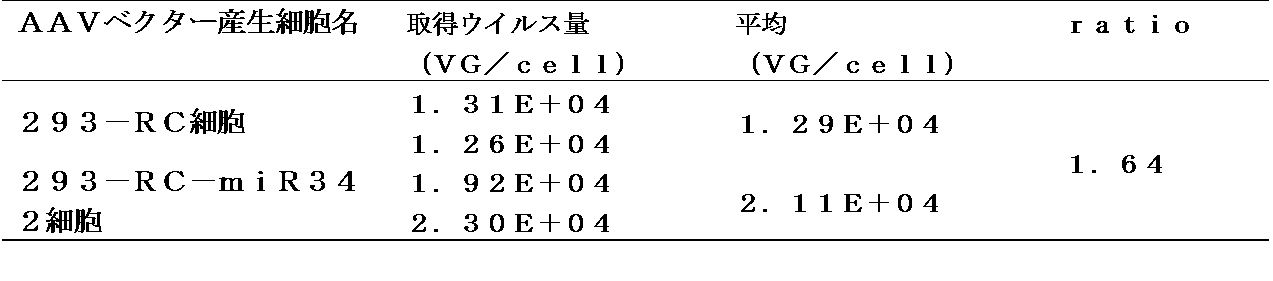
- the AAV vector produced using pRC-miR342 has not only a genome titer but also a high infectious titer. Since pRC-miR342 was introduced into AAV vector-producing cells, It was revealed that the ability to produce infectious AAV vectors was improved.
- Example 9 Evaluation of pRC6-miR342 and pRC9-miR342 plasmids (1) Preparation of pRC-miRNA plasmid pAAV-RC1 was treated with SmiI and SnaBI, and the same site of the cap gene of type 9 AAV was ligated after artificial synthesis. PRC9 was constructed. A fragment containing the CMV promoter to miR342 coding region amplified in Example 7- (1) was ligated to pRC9 treated with SnaBI by the same method as in Example 7- (1) to obtain pRC9-miR342.
- pRC9-miR342 is a helper plasmid containing the type 9 AAV Cap gene and the CMV-miR342 fragment.
- pBapo-miR342 as a template, a region including the region from the CMV promoter to the miR342 coding region by PCR using the primers described in SEQ ID NO: 7 (Forward primer 4) and SEQ ID NO: 8 (Reverse primer 4) in the sequence listing Amplified separately.
- This fragment was ligated to pRep-Cap AAV6 plasmid (Applied Viromics) treated with SmaI (Takara Bio) using In-Fusion® Advantage PCR cloning kit to obtain pRC6-miR342.
- pRC6-miR342 is a helper plasmid containing the type 6 AAV Cap gene and the CMV-miR342 fragment.
- Example 9- (1) Evaluation of pRC-miRNA
- the plasmid or control plasmid obtained in Example 9- (1) was transfected into AAV293 at the same time as pAAV-AsRed2 and pHeler plasmid.
- the transfection method and the operation up to the recovery of the AAV vector were performed in the same manner as in Example 2- (1) to (3).
- an AAV vector having a higher titer than conventional can be produced.
- the AAV vector produced using the cells of the present invention and a composition comprising the AAV vector as an active ingredient are very useful as gene transfer methods in gene therapy research or clinical fields.
- SEQ ID NO: 1 Forward primer 1 SEQ ID NO: 2: Reverse primer 1 SEQ ID NO: 3: Forward primer 2 SEQ ID NO: 4: Reverse primer 2 SEQ ID NO: 5: Forward primer 3 SEQ ID NO: 6: Reverse primer 3 SEQ ID NO: 7: Forward primer 4 SEQ ID NO: 8: Reverse primer 4
Landscapes
- Health & Medical Sciences (AREA)
- Life Sciences & Earth Sciences (AREA)
- Engineering & Computer Science (AREA)
- Genetics & Genomics (AREA)
- Chemical & Material Sciences (AREA)
- Organic Chemistry (AREA)
- Biomedical Technology (AREA)
- Zoology (AREA)
- Wood Science & Technology (AREA)
- Bioinformatics & Cheminformatics (AREA)
- Biotechnology (AREA)
- General Engineering & Computer Science (AREA)
- Molecular Biology (AREA)
- General Health & Medical Sciences (AREA)
- Microbiology (AREA)
- Biochemistry (AREA)
- Biophysics (AREA)
- Plant Pathology (AREA)
- Physics & Mathematics (AREA)
- Cell Biology (AREA)
- Virology (AREA)
- Chemical Kinetics & Catalysis (AREA)
- General Chemical & Material Sciences (AREA)
- Immunology (AREA)
- Medicinal Chemistry (AREA)
- Micro-Organisms Or Cultivation Processes Thereof (AREA)
- Medicines That Contain Protein Lipid Enzymes And Other Medicines (AREA)
- Measuring Or Testing Involving Enzymes Or Micro-Organisms (AREA)
- Medicines Containing Material From Animals Or Micro-Organisms (AREA)
Description
従来のAAVベクターの製造方法としては、1)野生型AAVゲノムの両端のITRを残して、rep、cap遺伝子を除いたAAVベクタープラスミドの導入、2)Rep、Capタンパク質をトランスに供給するためのrep、cap遺伝子発現プラスミドの導入、加えてAAVはその感染性ウイルス粒子形成にヘルパーウイルスと呼ばれる、アデノウイルス、ヘルペスウイルス、又はワクシニアウイルスなどのいずれかからの補助要素の供給を要するため、3)アデノウイルス感染、を用いる方法が確立している(特許文献2)。
しかし上記方法によって得られるAAVベクターは、理論上アデノウイルスが混入する。このことは、混入アデノウイルスの除去・不活性化の作業を要するため、AAVベクター力価の低減の要因となる。更に、ヒトに投与した場合にアデノウイルス感染症、炎症などの副作用の発生の懸念が残る。そこで、上記3)に代わって3’)アデノウイルス由来要素のうち、AAVウイルス粒子形成に必須な要素のみを発現するヘルパープラスミドの導入、を用いる製造方法(ヘルパーフリー系)が開発された(特許文献3)。この方法によれば、製造されたAAVベクターへのアデノウイルスの混入がないため、安全性に優れる。
[1]AAVベクターを産生する能力を有する細胞であって、人為的に導入されたmiRNAを発現している細胞、
[2]人為的に導入されたmiRNAが、hsa-miR-196a1、hsa-miR-324、hsa-miR-342からなる群より選択された少なくとも1種である、[1]に記載の細胞、
[3][1]又は[2]に記載の細胞にウイルスに封入される核酸を導入したAAVベクター産生細胞、
[4]AAVベクターの製造方法であって、[3]に記載の細胞を培養する工程を含む方法、
[5]miRNAを供給する核酸と、AAVベクターのウイルス粒子形成に必須な要素を供給する核酸を含むAAVベクター製造用のキット、
[6][4]に記載の方法を用いて得られるAAVベクター、
[7]AAVベクター産生細胞内で発現することによってAAVベクター産生細胞のAAVベクター産生能力を向上させることが可能なmiRNAの選択方法であって、miRNAを発現するAAVベクターの混合物を作製し、細胞において高産生されるAAVベクターを選抜する工程を包含する選択方法、
[8]下記工程(a)~(e)を包含する[7]に記載の選択方法であって、
(a)miRNAを発現するAAVベクター混合物を得る工程、
(b)miRNAを発現するAAVベクター混合物を細胞へ感染させる工程、
(c)工程(b)により得られた細胞を培養し、当該細胞より産生されたAAVベクター混合物を取得する工程、
(d)工程(c)で得られたAAVベクター混合物を使用した上記(b)、(c)の工程を1回以上繰り返す工程、及び
(e)工程(d)により得られたAAVベクター混合物中のmiRNAをコードする核酸を得る工程、
に関する。
また核酸を細胞に恒常的に導入する方法は特に限定はなく、公知の恒常的導入方法、例えばレトロウイルスベクターを用いる方法、プラスミドの一過性導入方法と同様の方法で導入し、染色体に組み込まれた細胞を選択する方法などが使用可能である。レトロウイルスベクターを用いる方法においては、市販の試薬、例えばRetorovirus Constructive System(タカラバイオ社製)を用いてもよい。
前記AAVベクターライブラリーの作製方法としては、miRNAライブラリーをコードする核酸をウイルス粒子に封入される核酸に連結した核酸構築物を作製し、この核酸構築物に公知の方法を適用してmiRNAライブラリー搭載AAVベクターを取得する方法が例示される。前記の核酸構築物の作製は、例えば市販のAAVベクタープラスミドであるpAAV-MCS Expression Vector(Cell Biolabs社製)等を利用することができる。次に上記miRNAライブラリー搭載AAVベクターをAAVベクター産生細胞の作製に適した細胞(例えばAAV293細胞)に感染させる。ついでこの細胞にAAVベクター産生に必要な要素をコードする核酸構築物を一過性に導入して培養し、当該細胞が産生するAAVベクター混合物を取得する。ここで得られたAAVベクターを用いて上述の工程(感染、培養、ベクター取得)を1サイクル以上行う。このサイクルを繰り返すことで、AAVベクター混合物中にAAVベクター産生を向上させるmiRNAを発現する核酸を搭載するAAVベクターが濃縮されていく。こうして得られたAAVベクター混合物中のAAVベクターについて、搭載されたmiRNAの塩基配列の解読を行う。上記サイクルを繰り返すことにより得られる頻度が高くなるmiRNAを同定し、それらをAAVベクター産生を向上させるmiRNAとみなす。このようにして選択されるmiRNAは、本発明の細胞におけるmiRNAとして好適に利用でき、例えばhsa-miR-196a1、hsa-miR-324、及びhsa-miR-342が例示される。
好適にはmiRNAを発現する核酸は、単独で、もしくはRepタンパク質及び/又はCapタンパク質をコードする核酸と同一の発現プラスミドに搭載して一過性に導入することにより、本発明はより高い効果を発揮する。
感染力価の測定方法としては、例えばAAVベクター含有試料の系列希釈液を適当な標的細胞に感染させ、導入遺伝子の発現、細胞の形状変化(細胞変性)の検出、細胞に導入されたプロウイルスのコピー数の測定、といった方法が例示される。
したがって、本発明は、本発明のAAVベクター産生細胞を用いて取得したAAVベクターを有効成分として含有する医薬組成物を投与することを特徴とする治療方法も提供する。さらに、本発明は、医薬の製造における、本発明のAAVベクター産生細胞を用いて取得したAAVベクターの使用を提供する。また、本発明は、治療において使用するための、本発明のAAVベクター産生細胞を用いて取得したAAVベクターを提供する。
pAsRed2-C1 Vector(クロンテック社製)の、CMVプロモーターからpolyAシグナルにわたる約1.6kbの断片をPCR法によって得た。この際、NotIの認識部位を有する増幅用プライマーを使用し、PCR産物の両端にNotIの認識部位を付加した。この断片をNotI(タカラバイオ社製)で処理して、インサート断片とした。一方pAAV-MCS Vector(Cell Biolabs社製)をNotIで処理して約2.9kbの断片を得、これをベクター断片とした。このベクター断片とインサート断片をDNA Ligation Kit<Mighty Mix>(タカラバイオ社製)を用いて連結し、得られた組換えプラスミドでE.coli HST08 Premium Compitent Cells(タカラバイオ社製、以下大腸菌と記載する)を形質転換した。得られた形質転換体から抽出したプラスミドDNAのうち、上流からCMVプロモーター、AsRed2コード領域、マルチクローニングサイト(MCS)、polyAシグナルの順に挿入されたものを選んでpAAV-AsRed2 Vectorとした。
pAAV-AsRed2 VectorをBglII(タカラバイオ社製)とHindIII(タカラバイオ社製)で処理した。一方、pBApo-CMV DNAにクローニングされたヒトmiRNAライブラリー(タカラバイオ社製)をBamHI(タカラバイオ社製)とHindIIIで処理し、得られたmiRNAコード領域の断片をDNA ligation kit (タカラバイオ社製)を用いて前記のpAAV-AsRed2 Vectorに連結した。ただし、内部にBamHI又はHindIII認識部位を持つmiRNAに関しては、In-Fusion(登録商標) Advantage PCRクローニングキット(クロンテック社製)を用いたディレクショナルクローニングによりpAAV-AsRed2 Vectorに連結した。こうして得られた組換えプラスミドをpAAV-AsRed2-miRNAライブラリープラスミドとして以下の実験に使用した。
(1)AAV293細胞の播種
AAV293細胞(Stratagene社製)を10%FBS(サーモサイエンティフィック社製)、2mM L-グルタミン酸ナトリウムを含むDMEM(シグマ・アルドリッチ社製)に2.5x10⁵細胞/mLとなるように懸濁した。この懸濁液4mLを細胞培養用60mmディッシュ(IWAKI社製)に添加し、5%CO2存在下、37℃のインキュベーター(以下37℃のCO2インキュベーター)で一夜培養した。
(2)AAV293細胞へのプラスミド導入
実施例1で得たpAAV2-AsRed2-miRNAライブラリープラスミド及びpHelper plasmidとpAAV-RC1 plasmid(いずれもCell Biolabs社製)をそれぞれ4μgずつ使用し、リン酸カルシウム法を用いて実施例2-(1)のAAV293細胞にトランスフェクションした。6時間後、培地を完全に除去し、2%FBS及び2mM L-グルタミン酸ナトリウムを含むDMEM 4mLを添加し、37℃のCO2インキュベーターで更に48時間培養した。
実施例2-(2)で培養したAAV293細胞より培地を除去し、PBS(ナカライテスク社製)を1mL添加した。ピペッティングでAAV293細胞を1.5mLチューブに回収し、4℃、700×g、5分間遠心後、上清を除去した。PBS 0.1mLにAAV293細胞を再懸濁後、エタノール/ドライアイスで2分間、37℃のウォーターバスで2分間、ボルテックス・ミキサーでの撹拌1分間の処理を3回繰り返し、AAV-miRNAライブラリーベクターを含む細胞破砕液を回収した。この細胞破砕液を4℃、10,000×g、10分間遠心後、上清を回収しAAV-miRNAライブラリーベクター液とした。
(1)DNase処理
AAV-miRNAライブラリーベクター液2μLに、10xDNaseIバッファー2μL、注射用水(大塚製薬社製)15.2μL、DNaseI(タカラバイオ社製)0.8μLを添加した反応液を調製した。TaKaRa PCR Thermal Cycler Dice(登録商標) Standard(タカラバイオ社製)を用いて37℃で一時間インキュベートし、遊離のゲノムやプラスミドを分解した。その後、DNaseIを不活化するために99℃、10分間の熱処理した後、実施例3-(2)の処理まで4℃あるいは-20℃にて保存した。
実施例3-(1)で得られた反応液20μLに、注射用水15μL、10×Proteinase Kバッファー(0.1M Tris-HCl (pH7.8)、0.1M EDTA、5% SDS)4μL、Proteinase K(タカラバイオ社製)1μLを加え、TaKaRa PCR Thermal Cycler Dice(登録商標) Standardを用いて55℃で一時間インキュベートし、AAVベクターのゲノムを遊離させた。その後、Proteinase Kを不活化するためにこの溶液を95℃で10分間処理した。こうして調製した溶液をAAV-miRNAライブラリーベクターゲノム液として、リアルタイムPCRに供するまで4℃又は-20℃にて保存した。
実施例3-(2)で調製したAAVベクターゲノム液を注射用水で50倍希釈したもの2μLを鋳型とし、配列表の配列番号1(Forward primer 1)及び配列番号2(Reverse primer 1)に記載のプライマー、SYBR(登録商標) Premix ExTaqII (Perfect Real Time)(タカラバイオ社製)を用いてリアルタイムPCRを行った。反応液調製はキットに添付の説明書に従った。標準品として、AAVベクターゲノム液に替えて、pAAV-AsRed2をEcoRIで処理して線状化したDNA液を用いた。リアルタイムPCR反応はThermal Cycler Dice(登録商標) Real Time System Single(タカラバイオ社製)を用い、装置推奨の条件で行った。その後、装置添付の説明書に従ってAAVベクターゲノムの定量を行い、ゲノム力価をAAVベクター産生細胞1個当たりのAAVベクターゲノム数(viral genome/cell、以下VG/cell)で表した。
(1)AAV293細胞の播種
AAV293細胞を10%FBS、2mM L-グルタミン酸ナトリウムを含むDMEMに2.5x10⁵細胞/mLとなるように懸濁した。この懸濁液4mLを細胞培養用60mmディッシュに添加し、37℃のCO2インキュベーターで一夜培養した。
実施例4-(1)で培養したAAV293細胞より培地を完全に除去した後、実施例2で調製したAAV-miRNAライブラリーベクター溶液をゲノム力価換算値でmoi(multiplicity of infection)約850になるように2%FBSを含むDMEMに希釈して2mL添加し、37℃のCO2インキュベーターで2時間培養した。その後、2%FBSを含むDMEMを2mL添加し、37℃のCO2インキュベーターで一夜培養した。
実施例4-(2)で培養したAAV293細胞に、リン酸カルシウム法を用いて、pAAV-RC1 plasmid及びpHelper plasmidを4μgずつトランスフェクションした。6時間後、培地を完全に除去した後に2%FBS及び2mM L-グルタミン酸ナトリウムを含むDMEM 4mLを添加した細胞を、37℃のCO2インキュベーターで更に48時間培養した。
実施例4-(3)で培養したAAV293細胞より培地を除去し、PBSを1mL添加した。ピペッティングでAAV293細胞を1.5mLチューブに回収し、4℃、700×g、5分間遠心後、上清を除去した。PBS 0.1mLに細胞を再懸濁後、エタノール/ドライアイスで2分間、37℃のウォーターバスで2分間、ボルテックス・ミキサーでの撹拌1分間の処理を3回繰り返し、AAV-miRNAライブラリーベクターを含む細胞破砕液を回収した。この細胞破砕液を4℃、10,000×g、10分間遠心後、上清を回収しAAV-miRNAライブラリーベクター液とした。
上記実施例4-(1)~(4)を計8回繰り返し、AAV-miRNAライブラリーベクターを濃縮した。各ラウンドにおける感染時ウイルス量(moi)及び回収ウイルス量をゲノム力価換算値を用いて表1に示す。

(1)AAV-miRNAベクターゲノムの調製
実施例4の各ラウンドで回収したAAV-miRNAライブラリーベクター液2μLを用いて実施例3-(1)、(2)と同様の方法でAAV-miRNAライブラリーベクターゲノム液を得た。
実施例5-(1)で得たAAV-miRNAライブラリーベクターゲノム液を鋳型とし、配列表の配列番号3(Forward primer 2)及び配列番号4(Reverse primer 2)に記載のプライマー、PrimeSTAR(登録商標) GXL DNA polymerase(タカラバイオ社製)を用いてmiRNAコード領域周辺をPCR法により増幅させた。反応は、98℃10秒、55℃15秒、68℃30秒を30サイクル繰り返した後、更に同じ条件を1回繰り返した。得られた断片を、In-Fusion(登録商標) Advantage PCRクローニングキットを用いてHincII(タカラバイオ社製)及びBAP(タカラバイオ社製)処理済のpUC118(タカラバイオ社製)に連結した。
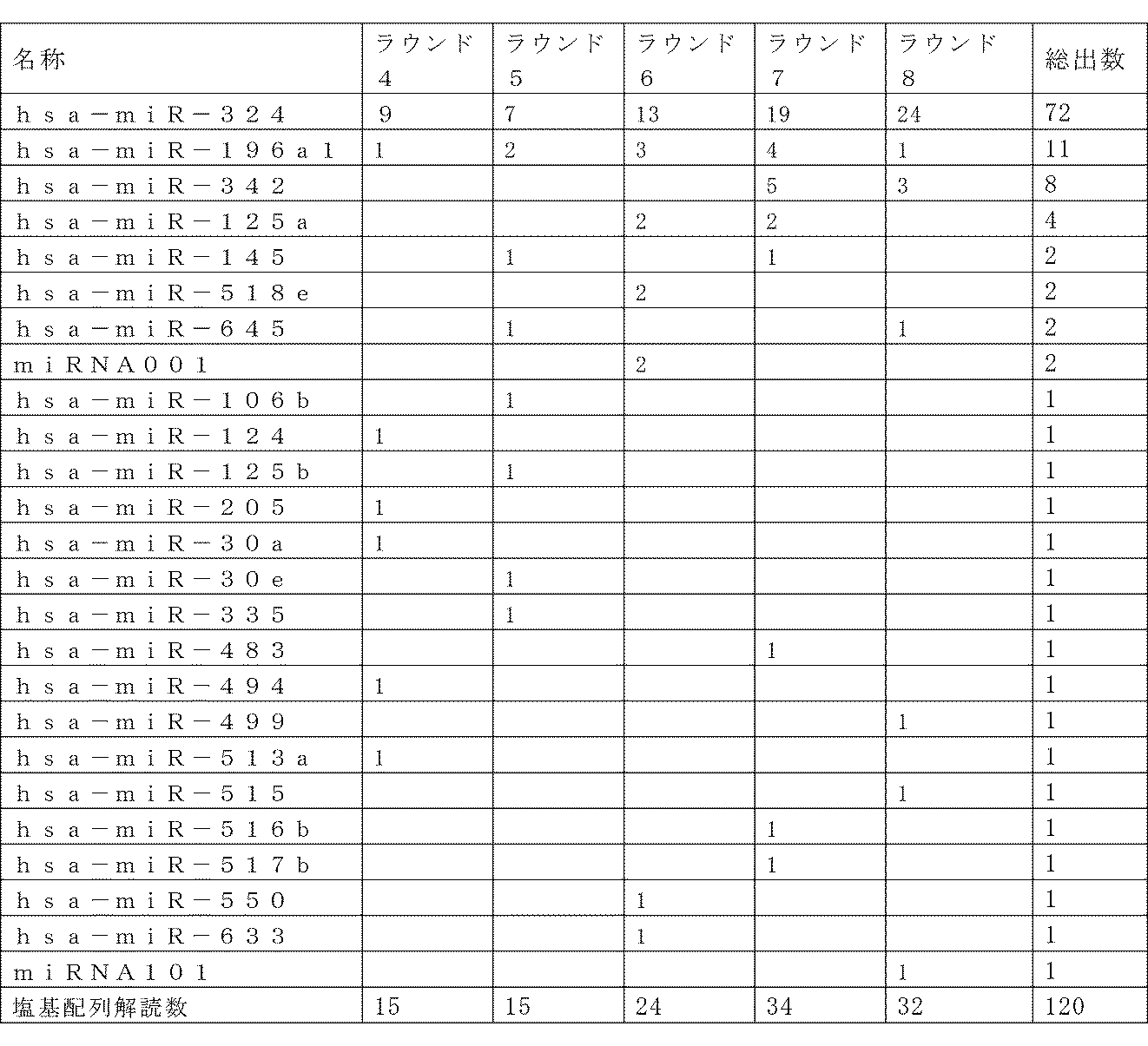
実施例5-(2)で得られた組換えプラスミドで大腸菌を形質転換後、アンピシリンを含むLBプレートに播種して37℃で一夜培養し、コロニーを多数得た。コロニーをいくつか選び、それぞれをアンピシリンを含むLB液体培地で一夜培養し、Miniprep DNA Purification Kit(タカラバイオ社製)を用いてプラスミドを抽出した。得られたプラスミドについて塩基配列の解読を行い、プラスミド上にコードされているmiRNA名を同定した。その結果を表2に示す。
(1)miRNA発現プラスミドの調製
pBApo-CMV DNAにクローニングされたヒトmiRNAライブラリーからhsa-miR-196a1、hsa-miR-324、hsa-miR-342が挿入されたプラスミドを選択し、それぞれを用いて大腸菌を形質転後、プラスミドを大量調製した。プラスミド調製にはNucleobond Xtra Midi EF(マッハライナーゲル社製)を用いた。得られたプラスミドをそれぞれpBapo-miR196a1、pBapo-miR324、pBapo-miR342と名付けた。
実施例6-(1)で得られたプラスミドを、pAAV-AsRed2-C1 vector、pAAV-RC1 plasmid、pHelper plasmidと同時にAAV293細胞にトランスフェクションした。コントロールとして、実施例6-(1)で得られたプラスミドに替えてpBApo-CMVをトランスフェクションした群も設定した。トランスフェクション及びAAVベクター回収までの操作は、実施例2-(1)~(3)と同様の方法で行った。
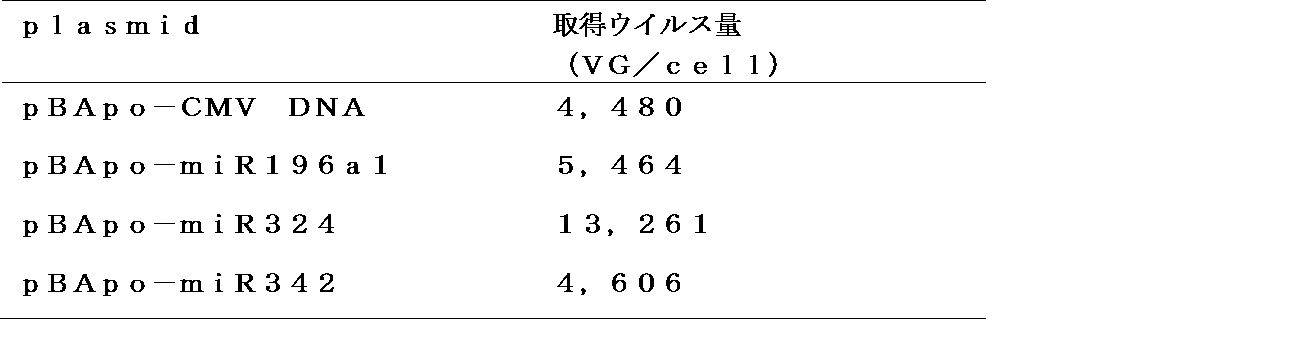
得られたAAVベクターのゲノム力価を実施例3と同様の方法で測定した。その結果を表3に示す。
(1)pRC-miR342プラスミドの調製
pBApo-miR342を鋳型として、配列表の配列番号5(Forward primer 3)及び配列番号6(Reverse primer 3)に記載のプライマーを用いたPCR法によりCMVプロモーターからmiR342コード領域までを含む領域を増幅した。得られた断片を、SnaBI(タカラバイオ社製)処理したpAAV-RC1 plasmidにIn-Fusion(登録商標) Advantage PCRクローニングキットを用いて連結した。得られた組換えプラスミドの塩基配列を解読しCMV-miR342断片が挿入されていることを確認後、プラスミドを調製した。得られたプラスミドをpRC-miR342とした。
実施例7-(1)で得られたpRC-miR342を、pAAV-AsRed2 vector、pHelper plasmidと同時にAAV293にトランスフェクションした。コントロールとして、pRC-miR342に替えてpAAV-RC1 plasmidをトランスフェクションクションした群も設定した。こうして得られたAAVベクター産生細胞を293-RC-miR342細胞、293-RC細胞と名付けた。トランスフェクションの方法及びAAVベクター回収までの操作は、実施例2-(1)~(3)と同様の方法で行った。
実施例7-(2)で得られた各AAVベクター産生細胞から得られたAAVベクターのゲノム力価を実施例3と同様の方法で測定した。その結果を表4に示す。
(1)標的細胞の播種
AAV293細胞を10%FBS、2mM L-グルタミン酸ナトリウムを含むDMEMに4x10⁴細胞/mLとなるように懸濁した。この懸濁液1mLを細胞培養用24ウェルプレート(コーニング社製)に添加し、37℃のCO2インキュベーターで一夜培養した。
実施例8-(1)のAAV293細胞より培地を除去した後、10%FBS及び2mM L-グルタミン酸ナトリウムを含むDMEMを500μL添加し、実施例7-(2)で得られたAAVベクター溶液を1μL添加した。37℃のCO2インキュベーターで6時間培養後、培地を除去し、10%FBS及び2mM L-グルタミン酸ナトリウムを含むDMEMを500μL添加し、一夜培養した。
実施例8-(2)で培養したAAV293細胞より培地を除去し、PBSを500μL添加した。トリプシン処理後、培地を500μL添加しピペッティングでAAV293細胞を1.5mLチューブに回収した。得られた細胞懸濁液をフローサイトメーターCytomics FC500(ベックマン・コールター社製)でAsRed2陽性率を測定した。得られた値をもとに感染力価を算出し、AAVベクター液1mL当たりの感染性AAVベクター数(Infectious viral particle/mL、以下ivp/mL)で示した。その結果を表5に示す。

(1)pRC-miRNAプラスミドの作製
pAAV―RC1をSmiIとSnaBIで処理し、9型AAVのCap遺伝子の同部位を人工合成の上、連結して、pRC9を構築した。実施例7-(1)で増幅したCMVプロモーターからmiR342コード領域まで含む断片を、SnaBI処理したpRC9に実施例7-(1)と同様の方法により連結し、pRC9-miR342を得た。即ち、pRC9-miR342は9型AAVのCap遺伝子及びCMV-miR342断片を含むヘルパープラスミドである。また、pBapo-miR342を鋳型として、配列表の配列番号7(Forward primer 4)及び配列番号8(Reverse primer 4)に記載のプライマーを用いたPCR法によりCMVプロモーターからmiR342コード領域までを含む領域を別途増幅した。この断片を、SmaI(タカラバイオ社製)処理したpRep-Cap AAV6プラスミド(Applied Viromics社製)にIn-Fusion(登録商標) Advantage PCRクローニングキットを用いて連結し、pRC6-miR342を得た。即ち、pRC6-miR342は6型AAVのCap遺伝子及びCMV-miR342断片を含むヘルパープラスミドである。
実施例9-(1)で得られたプラスミドまたはコントロールプラスミドを、pAAV-AsRed2、pHelper plasmidと同時にAAV293へトランスフェクションした。トランスフェクションの方法及びAAVベクター回収までの操作は、実施例2-(1)~(3)と同様の方法で行った。
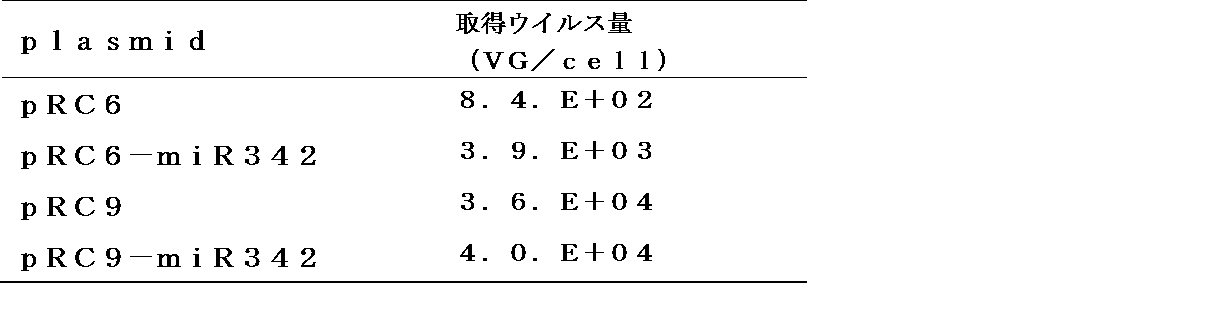
実施例3と同様の方法で、製造したAAVベクターのゲノム力価を定量した。その結果を表6に示す。
SEQ ID NO:2: Reverse primer 1
SEQ ID NO:3: Forward primer 2
SEQ ID NO:4: Reverse primer 2
SEQ ID NO:5: Forward primer 3
SEQ ID NO:6: Reverse primer 3
SEQ ID NO:7: Forward primer 4
SEQ ID NO:8: Reverse primer 4
Claims (8)
- AAVベクターを産生する能力を有する細胞であって、人為的に導入されたmiRNAを発現している細胞。
- 人為的に導入されたmiRNAが、hsa-miR-196a1、hsa-miR-324、hsa-miR-342からなる群より選択された少なくとも1種である、請求項1に記載の細胞。
- 請求項1又は2に記載の細胞にウイルスに封入される核酸を導入したAAVベクター産生細胞。
- AAVベクターの製造方法であって、請求項3に記載の細胞を培養する工程を含む方法。
- miRNAを供給する核酸と、AAVベクターのウイルス粒子形成に必須な要素を供給する核酸を含むAAVベクター製造用のキット。
- 請求項4に記載の方法を用いて得られるAAVベクター。
- AAVベクター産生細胞内で発現することによってAAVベクター産生細胞のAAVベクター産生能力を向上させることが可能なmiRNAの選択方法であって、miRNAを発現するAAVベクターの混合物を作製し、細胞において高産生されるAAVベクターを選抜する工程を包含する選択方法。
- 下記工程(a)~(e)を包含する請求項7に記載の選択方法:
(a)miRNAを発現するAAVベクター混合物を得る工程;
(b)miRNAを発現するAAVベクター混合物を細胞へ感染させる工程;
(c)工程(b)により得られた細胞を培養し、当該細胞より産生されたAAVベクター混合物を取得する工程;
(d)工程(c)で得られたAAVベクター混合物を使用した上記(b)、(c)の工程を1回以上繰り返す工程;及び
(e)工程(d)により得られたAAVベクター混合物中のmiRNAをコードする核酸を得る工程。
Priority Applications (5)
| Application Number | Priority Date | Filing Date | Title |
|---|---|---|---|
| EP13813664.3A EP2871239B1 (en) | 2012-07-06 | 2013-06-26 | Cell capable of producing adeno-associated virus vector |
| US14/409,134 US9422576B2 (en) | 2012-07-06 | 2013-06-26 | Cell capable of producing adeno-associated virus vector |
| JP2014523690A JP6093358B2 (ja) | 2012-07-06 | 2013-06-26 | アデノ随伴ウイルスベクターの産生細胞 |
| CN201380046350.5A CN104603272B (zh) | 2012-07-06 | 2013-06-26 | 能够产生腺伴随病毒载体的细胞 |
| KR1020157001155A KR101738438B1 (ko) | 2012-07-06 | 2013-06-26 | 아데노-관련 바이러스 벡터의 생산세포 |
Applications Claiming Priority (2)
| Application Number | Priority Date | Filing Date | Title |
|---|---|---|---|
| JP2012-152124 | 2012-07-06 | ||
| JP2012152124 | 2012-07-06 |
Publications (1)
| Publication Number | Publication Date |
|---|---|
| WO2014007120A1 true WO2014007120A1 (ja) | 2014-01-09 |
Family
ID=49881877
Family Applications (1)
| Application Number | Title | Priority Date | Filing Date |
|---|---|---|---|
| PCT/JP2013/067488 Ceased WO2014007120A1 (ja) | 2012-07-06 | 2013-06-26 | アデノ随伴ウイルスベクターの産生細胞 |
Country Status (6)
| Country | Link |
|---|---|
| US (1) | US9422576B2 (ja) |
| EP (1) | EP2871239B1 (ja) |
| JP (1) | JP6093358B2 (ja) |
| KR (1) | KR101738438B1 (ja) |
| CN (1) | CN104603272B (ja) |
| WO (1) | WO2014007120A1 (ja) |
Cited By (8)
| Publication number | Priority date | Publication date | Assignee | Title |
|---|---|---|---|---|
| WO2015005430A1 (ja) * | 2013-07-11 | 2015-01-15 | タカラバイオ株式会社 | 非エンベロープウイルスの製造方法 |
| CN107208142A (zh) * | 2014-11-28 | 2017-09-26 | 优尼科Ip有限公司 | 包含细小病毒病毒体的组合物中的dna杂质 |
| US10023846B2 (en) | 2014-07-10 | 2018-07-17 | Takara Bio Inc. | Production method for non-enveloped virus particles |
| US10415020B2 (en) | 2015-01-09 | 2019-09-17 | Takara Bio Inc. | Method for producing non-enveloped viral particles |
| JP2020507331A (ja) * | 2017-02-17 | 2020-03-12 | ロンザ リミテッドLonza Limited | アデノ随伴ウイルスを生産するための哺乳動物細胞 |
| JPWO2022138869A1 (ja) * | 2020-12-25 | 2022-06-30 | ||
| JP2023512688A (ja) * | 2020-02-03 | 2023-03-28 | ラトガース,ザ ステート ユニバーシティ オブ ニュー ジャージー | 脊髄損傷後の機能回復を促進するためのマイクロrna-7組成物およびその使用方法 |
| WO2024147331A1 (ja) * | 2023-01-06 | 2024-07-11 | 株式会社カネカ | タンパク質発現増強用核酸 |
Families Citing this family (26)
| Publication number | Priority date | Publication date | Assignee | Title |
|---|---|---|---|---|
| US10577627B2 (en) | 2014-06-09 | 2020-03-03 | Voyager Therapeutics, Inc. | Chimeric capsids |
| CN107106689A (zh) | 2014-11-05 | 2017-08-29 | 沃雅戈治疗公司 | 用于治疗帕金森病的aadc多核苷酸 |
| CN112410338A (zh) | 2014-11-14 | 2021-02-26 | 沃雅戈治疗公司 | 调节性多核苷酸 |
| IL292999A (en) | 2014-11-14 | 2022-07-01 | Voyager Therapeutics Inc | Compositions and methods of treating amyotrophic lateral sclerosis (als) |
| WO2016094783A1 (en) | 2014-12-12 | 2016-06-16 | Voyager Therapeutics, Inc. | Compositions and methods for the production of scaav |
| US11326182B2 (en) | 2016-04-29 | 2022-05-10 | Voyager Therapeutics, Inc. | Compositions for the treatment of disease |
| WO2017189964A2 (en) | 2016-04-29 | 2017-11-02 | Voyager Therapeutics, Inc. | Compositions for the treatment of disease |
| KR20220108216A (ko) | 2016-05-18 | 2022-08-02 | 보이저 테라퓨틱스, 인크. | 헌팅톤 질환을 치료하기 위한 조성물 및 방법 |
| SG11201809699XA (en) | 2016-05-18 | 2018-12-28 | Voyager Therapeutics Inc | Modulatory polynucleotides |
| CN110650673B (zh) | 2016-08-30 | 2024-04-09 | 加利福尼亚大学董事会 | 用于生物医学靶向和递送的方法以及用于实践该方法的装置和系统 |
| JP2020518259A (ja) | 2017-05-05 | 2020-06-25 | ボイジャー セラピューティクス インコーポレイテッドVoyager Therapeutics,Inc. | ハンチントン病治療組成物および方法 |
| SG11201909870SA (en) | 2017-05-05 | 2019-11-28 | Voyager Therapeutics Inc | Compositions and methods of treating amyotrophic lateral sclerosis (als) |
| JOP20190269A1 (ar) | 2017-06-15 | 2019-11-20 | Voyager Therapeutics Inc | بولي نوكليوتيدات aadc لعلاج مرض باركنسون |
| JP7229989B2 (ja) | 2017-07-17 | 2023-02-28 | ボイジャー セラピューティクス インコーポレイテッド | 軌道アレイガイドシステム |
| TWI832036B (zh) | 2017-08-03 | 2024-02-11 | 美商航海家醫療公司 | 用於aav之遞送之組合物及方法 |
| MX2020003042A (es) | 2017-09-29 | 2020-11-18 | Voyager Therapeutics Inc | Rescate del fenotipo neurológico central y periférico de la ataxia de friedreich mediante administración intravenosa. |
| US11434502B2 (en) | 2017-10-16 | 2022-09-06 | Voyager Therapeutics, Inc. | Treatment of amyotrophic lateral sclerosis (ALS) |
| EP4454654A3 (en) | 2017-10-16 | 2025-02-19 | Voyager Therapeutics, Inc. | Treatment of amyotrophic lateral sclerosis (als) |
| EP3794126A1 (en) | 2018-05-15 | 2021-03-24 | Voyager Therapeutics, Inc. | Compositions and methods for the treatment of parkinson's disease |
| CN113383010B (zh) | 2018-09-28 | 2025-09-09 | 沃雅戈治疗公司 | 具有经工程化改造的启动子的共济蛋白表达构建体及其使用方法 |
| CN111647625A (zh) * | 2019-12-25 | 2020-09-11 | 深圳三智医学科技有限公司 | 一种提高人凝血因子ix表达水平的方法 |
| CN114075609B (zh) * | 2020-08-10 | 2024-08-02 | 北京荷塘生华医疗科技有限公司 | 测定重组腺病毒感染滴度的方法 |
| JPWO2023157976A1 (ja) | 2022-02-21 | 2023-08-24 | ||
| EP4484552A4 (en) | 2022-02-21 | 2026-05-06 | Nippon Medical School Foundation | VIRAL VECTOR PRODUCTIVITY ACTIVATOR AND VIRAL VECTOR PRODUCTION PROCESS |
| CN114657153A (zh) * | 2022-05-24 | 2022-06-24 | 上海健士拜生物科技有限公司 | rAAV重组包装质粒、用于rAAV包装的质粒系统和rAAV的制备方法 |
| EP4628576A1 (en) * | 2024-04-07 | 2025-10-08 | Ascend Advanced Therapies GmbH | Microrna molecules for use in methods for improving recombinant aav production |
Citations (7)
| Publication number | Priority date | Publication date | Assignee | Title |
|---|---|---|---|---|
| WO1997006272A2 (en) | 1995-08-03 | 1997-02-20 | Avigen, Inc. | High efficiency helper system for aav vector production |
| US6093570A (en) | 1995-06-07 | 2000-07-25 | The University Of North Carolina At Chapel Hill | Helper virus-free AAV production |
| WO2001032899A1 (en) * | 1999-10-29 | 2001-05-10 | Takara Shuzo Co., Ltd. | Gene transfer method |
| JP2001517454A (ja) * | 1997-09-19 | 2001-10-09 | ザ・トラステイーズ・オブ・ザ・ユニバーシテイ・オブ・ペンシルベニア | 組換えアデノ随伴ウイルスの産生に有用な方法および細胞株 |
| JP2001520051A (ja) * | 1997-10-21 | 2001-10-30 | ターゲテッド ジェネティックス コーポレイション | 組換えaavベクターの産生のための増幅可能アデノ随伴ウイルス(aav)パッケージングカセット |
| WO2006035829A1 (ja) | 2004-09-29 | 2006-04-06 | Takara Bio Inc. | レトロウイルスベクター産生用細胞 |
| WO2009148137A1 (ja) * | 2008-06-04 | 2009-12-10 | 協和発酵キリン株式会社 | 肥満細胞の脱顆粒を制御する核酸 |
Family Cites Families (12)
| Publication number | Priority date | Publication date | Assignee | Title |
|---|---|---|---|---|
| US5622856A (en) | 1995-08-03 | 1997-04-22 | Avigen | High efficiency helper system for AAV vector production |
| US6004797A (en) | 1995-11-09 | 1999-12-21 | Avigen, Inc. | Adenovirus helper-free recombinant AAV Virion production |
| US6642051B1 (en) | 1997-10-21 | 2003-11-04 | Targeted Genetics Corporation | Amplifiable adeno-associated virus(AAV) packaging cassettes for the production of recombinant AAV vectors |
| CA2857878A1 (en) * | 2004-11-12 | 2006-12-28 | Asuragen, Inc. | Methods and compositions involving mirna and mirna inhibitor molecules |
| WO2010065630A2 (en) | 2008-12-03 | 2010-06-10 | The Johns Hopkins University | Compositions and methods for treating hepatic neoplasia |
| CN101787373B (zh) * | 2009-01-23 | 2013-06-19 | 中国人民解放军第二军医大学东方肝胆外科医院 | 一种携带外源基因在包装细胞中高效生产的重组病毒载体、其构建方法及其用途 |
| CN101967496A (zh) | 2009-02-16 | 2011-02-09 | 中国疾病预防控制中心病毒病预防控制所 | Aav病毒反向感染技术及aav病毒阵列 |
| CN101532024A (zh) * | 2009-04-30 | 2009-09-16 | 许瑞安 | 一种用于基因治疗的新型细胞特异性内含microRNA结合序列的基因HAAVmir |
| WO2011101869A1 (en) * | 2010-02-22 | 2011-08-25 | Transgene Biotek Ltd. | Adeno-associated virus 2/8 - micro rna-101 therapy for liver cancer |
| CN101906417B (zh) * | 2010-04-19 | 2012-09-05 | 北京三元基因工程有限公司 | 针对乙肝病毒的shRNA及携带其的重组腺相关病毒基因治疗载体 |
| CN102311973A (zh) | 2010-07-05 | 2012-01-11 | 北京五加和分子医学研究所有限公司 | 一种新型miRNA和编码蛋白基因共表达载体 |
| US9290759B2 (en) * | 2010-08-25 | 2016-03-22 | The Trustees Of Columbia University In The City Of New York | Optimized miRNA constructs |
-
2013
- 2013-06-26 JP JP2014523690A patent/JP6093358B2/ja active Active
- 2013-06-26 WO PCT/JP2013/067488 patent/WO2014007120A1/ja not_active Ceased
- 2013-06-26 CN CN201380046350.5A patent/CN104603272B/zh active Active
- 2013-06-26 KR KR1020157001155A patent/KR101738438B1/ko active Active
- 2013-06-26 US US14/409,134 patent/US9422576B2/en active Active
- 2013-06-26 EP EP13813664.3A patent/EP2871239B1/en active Active
Patent Citations (7)
| Publication number | Priority date | Publication date | Assignee | Title |
|---|---|---|---|---|
| US6093570A (en) | 1995-06-07 | 2000-07-25 | The University Of North Carolina At Chapel Hill | Helper virus-free AAV production |
| WO1997006272A2 (en) | 1995-08-03 | 1997-02-20 | Avigen, Inc. | High efficiency helper system for aav vector production |
| JP2001517454A (ja) * | 1997-09-19 | 2001-10-09 | ザ・トラステイーズ・オブ・ザ・ユニバーシテイ・オブ・ペンシルベニア | 組換えアデノ随伴ウイルスの産生に有用な方法および細胞株 |
| JP2001520051A (ja) * | 1997-10-21 | 2001-10-30 | ターゲテッド ジェネティックス コーポレイション | 組換えaavベクターの産生のための増幅可能アデノ随伴ウイルス(aav)パッケージングカセット |
| WO2001032899A1 (en) * | 1999-10-29 | 2001-05-10 | Takara Shuzo Co., Ltd. | Gene transfer method |
| WO2006035829A1 (ja) | 2004-09-29 | 2006-04-06 | Takara Bio Inc. | レトロウイルスベクター産生用細胞 |
| WO2009148137A1 (ja) * | 2008-06-04 | 2009-12-10 | 協和発酵キリン株式会社 | 肥満細胞の脱顆粒を制御する核酸 |
Non-Patent Citations (8)
| Title |
|---|
| APARICIO, O. ET AL.: "Adenovirus virus- associated RNA is processed to functional interfering RNAs involved in virus production", J. VIROL., vol. 80, no. 3, 2006, pages 1376 - 1384, XP055181585 * |
| HUSSAIN, M. ET AL.: "West Nile virus encodes a microRNA-like small RNA in the 3' untranslated region which up-regulates GATA4 mRNA and facilitates virus replication in mosquito cells", NUCLEIC ACIDS RES., vol. 40, no. 5, 2011, pages 2210 - 2223, XP055181588 * |
| KAMBARA, H. ET AL.: "Establishment of a novel permissive cell line for the propagation of hepatitis C virus by expression of microRNA miR122", J. VIROL., vol. 86, no. 3, 2011, pages 1382 - 1393, XP055181583 * |
| MUNSON, D. J. ET AL.: "A novel miRNA produced during lytic HSV-1 infection is important for efficient replication in tissue culture", ARCH. VIROL., vol. 157, June 2012 (2012-06-01), pages 1677 - 1688, XP035105657 * |
| OZAWA, K.: "Gene therapy using AAV (adeno- associated virus) vectors", VIRUS, vol. 53, no. 2, 2003, pages 163 - 170, XP055181594 * |
| PROC. NATL. ACAD. SCI. USA, vol. 107, 2010, pages 10220 - 10225 |
| RANDALL, G. ET AL.: "Cellular cofactors affecting hepatitis C virus infection and replication", PROC. NATL. ACAD. SCI. U S A., vol. 104, no. 31, 2007, pages 12884 - 12889, XP002532652 * |
| See also references of EP2871239A4 |
Cited By (13)
| Publication number | Priority date | Publication date | Assignee | Title |
|---|---|---|---|---|
| US10072250B2 (en) | 2013-07-11 | 2018-09-11 | Takara Bio Inc. | Method for manufacturing non-enveloped virus |
| WO2015005430A1 (ja) * | 2013-07-11 | 2015-01-15 | タカラバイオ株式会社 | 非エンベロープウイルスの製造方法 |
| US10023846B2 (en) | 2014-07-10 | 2018-07-17 | Takara Bio Inc. | Production method for non-enveloped virus particles |
| CN107208142B (zh) * | 2014-11-28 | 2024-03-26 | 优尼科Ip有限公司 | 包含细小病毒病毒体的组合物中的dna杂质 |
| CN107208142A (zh) * | 2014-11-28 | 2017-09-26 | 优尼科Ip有限公司 | 包含细小病毒病毒体的组合物中的dna杂质 |
| US10415020B2 (en) | 2015-01-09 | 2019-09-17 | Takara Bio Inc. | Method for producing non-enveloped viral particles |
| JP2020507331A (ja) * | 2017-02-17 | 2020-03-12 | ロンザ リミテッドLonza Limited | アデノ随伴ウイルスを生産するための哺乳動物細胞 |
| JP2023081927A (ja) * | 2017-02-17 | 2023-06-13 | ロンザ リミテッド | アデノ随伴ウイルスを生産するための哺乳動物細胞 |
| JP7637470B2 (ja) | 2017-02-17 | 2025-02-28 | ロンザ リミテッド | アデノ随伴ウイルスを生産するための哺乳動物細胞 |
| JP7731388B2 (ja) | 2017-02-17 | 2025-08-29 | ロンザ リミテッド | アデノ随伴ウイルスを生産するための哺乳動物細胞 |
| JP2023512688A (ja) * | 2020-02-03 | 2023-03-28 | ラトガース,ザ ステート ユニバーシティ オブ ニュー ジャージー | 脊髄損傷後の機能回復を促進するためのマイクロrna-7組成物およびその使用方法 |
| JPWO2022138869A1 (ja) * | 2020-12-25 | 2022-06-30 | ||
| WO2024147331A1 (ja) * | 2023-01-06 | 2024-07-11 | 株式会社カネカ | タンパク質発現増強用核酸 |
Also Published As
| Publication number | Publication date |
|---|---|
| EP2871239A1 (en) | 2015-05-13 |
| KR101738438B1 (ko) | 2017-05-22 |
| EP2871239A9 (en) | 2015-06-24 |
| JP6093358B2 (ja) | 2017-03-08 |
| US20150291980A1 (en) | 2015-10-15 |
| EP2871239A4 (en) | 2016-02-24 |
| US9422576B2 (en) | 2016-08-23 |
| KR20150027803A (ko) | 2015-03-12 |
| JPWO2014007120A1 (ja) | 2016-06-02 |
| CN104603272B (zh) | 2017-11-07 |
| EP2871239B1 (en) | 2018-08-29 |
| CN104603272A (zh) | 2015-05-06 |
Similar Documents
| Publication | Publication Date | Title |
|---|---|---|
| JP6093358B2 (ja) | アデノ随伴ウイルスベクターの産生細胞 | |
| JP7561788B2 (ja) | 臨床使用に適した無血清懸濁細胞培養システムにおいて組換えアデノ随伴ウイルス(aav)ベクターを産生するスケーラブルな方法 | |
| US9249425B2 (en) | Proviral plasmids and production of recombinant adeno-associated virus | |
| BR112019025792A2 (pt) | agentes de aperfeiçoamento para transfecção de células melhoradas e/ou produção de vetor raav | |
| US10072250B2 (en) | Method for manufacturing non-enveloped virus | |
| EP4100537A1 (en) | Process for making adenoassociated viral vectors | |
| JP2002528087A (ja) | 改良aavベクター産生 | |
| JPWO2016006658A1 (ja) | 非エンベロープウイルス粒子の製造方法 | |
| JP7530431B2 (ja) | Dna増幅方法 | |
| KR20240025507A (ko) | 미성숙 종결 코돈-매개 장애를 치료하기 위한 방법 및 조성물 | |
| JP2024133073A (ja) | 肝臓特異的誘導性プロモーター及びそれらの使用方法 | |
| EP4326881A1 (en) | Dna amplification method using care elements | |
| JP2024504365A (ja) | 組換えウイルスベクター力価を増加させる微小管不安定化剤添加剤 | |
| JP2024501223A (ja) | 低レベルのva-rnaを有する産生細胞 | |
| CN105358690B (zh) | 启动子组合物 | |
| BR122025021657A2 (pt) | Métodos escalonáveis para produzir vetor viral adeno-associado (aav) recombinante em sistema de cultura celular em suspensão isento de soro adequado para uso clínico | |
| BR112018011193B1 (pt) | Métodos escalonáveis para produzir vetor viral adeno-associado (aav) recombinante em sistema de cultura celular em suspensão isento de soro adequado para uso clínico |
Legal Events
| Date | Code | Title | Description |
|---|---|---|---|
| 121 | Ep: the epo has been informed by wipo that ep was designated in this application |
Ref document number: 13813664 Country of ref document: EP Kind code of ref document: A1 |
|
| ENP | Entry into the national phase |
Ref document number: 2014523690 Country of ref document: JP Kind code of ref document: A |
|
| WWE | Wipo information: entry into national phase |
Ref document number: 14409134 Country of ref document: US |
|
| NENP | Non-entry into the national phase |
Ref country code: DE |
|
| WWE | Wipo information: entry into national phase |
Ref document number: 2013813664 Country of ref document: EP |
|
| ENP | Entry into the national phase |
Ref document number: 20157001155 Country of ref document: KR Kind code of ref document: A |