WO2012086341A1 - 液体口腔用組成物 - Google Patents
液体口腔用組成物 Download PDFInfo
- Publication number
- WO2012086341A1 WO2012086341A1 PCT/JP2011/076349 JP2011076349W WO2012086341A1 WO 2012086341 A1 WO2012086341 A1 WO 2012086341A1 JP 2011076349 W JP2011076349 W JP 2011076349W WO 2012086341 A1 WO2012086341 A1 WO 2012086341A1
- Authority
- WO
- WIPO (PCT)
- Prior art keywords
- liquid oral
- ascorbic acid
- salt
- component
- composition
- Prior art date
- Legal status (The legal status is an assumption and is not a legal conclusion. Google has not performed a legal analysis and makes no representation as to the accuracy of the status listed.)
- Ceased
Links
Classifications
-
- A—HUMAN NECESSITIES
- A61—MEDICAL OR VETERINARY SCIENCE; HYGIENE
- A61K—PREPARATIONS FOR MEDICAL, DENTAL OR TOILETRY PURPOSES
- A61K8/00—Cosmetics or similar toiletry preparations
- A61K8/18—Cosmetics or similar toiletry preparations characterised by the composition
- A61K8/19—Cosmetics or similar toiletry preparations characterised by the composition containing inorganic ingredients
- A61K8/24—Phosphorous; Compounds thereof
-
- A—HUMAN NECESSITIES
- A61—MEDICAL OR VETERINARY SCIENCE; HYGIENE
- A61K—PREPARATIONS FOR MEDICAL, DENTAL OR TOILETRY PURPOSES
- A61K8/00—Cosmetics or similar toiletry preparations
- A61K8/18—Cosmetics or similar toiletry preparations characterised by the composition
- A61K8/30—Cosmetics or similar toiletry preparations characterised by the composition containing organic compounds
- A61K8/33—Cosmetics or similar toiletry preparations characterised by the composition containing organic compounds containing oxygen
- A61K8/36—Carboxylic acids; Salts or anhydrides thereof
- A61K8/362—Polycarboxylic acids
-
- A—HUMAN NECESSITIES
- A61—MEDICAL OR VETERINARY SCIENCE; HYGIENE
- A61K—PREPARATIONS FOR MEDICAL, DENTAL OR TOILETRY PURPOSES
- A61K8/00—Cosmetics or similar toiletry preparations
- A61K8/18—Cosmetics or similar toiletry preparations characterised by the composition
- A61K8/30—Cosmetics or similar toiletry preparations characterised by the composition containing organic compounds
- A61K8/33—Cosmetics or similar toiletry preparations characterised by the composition containing organic compounds containing oxygen
- A61K8/36—Carboxylic acids; Salts or anhydrides thereof
- A61K8/365—Hydroxycarboxylic acids; Ketocarboxylic acids
-
- A—HUMAN NECESSITIES
- A61—MEDICAL OR VETERINARY SCIENCE; HYGIENE
- A61K—PREPARATIONS FOR MEDICAL, DENTAL OR TOILETRY PURPOSES
- A61K8/00—Cosmetics or similar toiletry preparations
- A61K8/18—Cosmetics or similar toiletry preparations characterised by the composition
- A61K8/30—Cosmetics or similar toiletry preparations characterised by the composition containing organic compounds
- A61K8/67—Vitamins
-
- A—HUMAN NECESSITIES
- A61—MEDICAL OR VETERINARY SCIENCE; HYGIENE
- A61K—PREPARATIONS FOR MEDICAL, DENTAL OR TOILETRY PURPOSES
- A61K8/00—Cosmetics or similar toiletry preparations
- A61K8/18—Cosmetics or similar toiletry preparations characterised by the composition
- A61K8/30—Cosmetics or similar toiletry preparations characterised by the composition containing organic compounds
- A61K8/67—Vitamins
- A61K8/676—Ascorbic acid, i.e. vitamin C
-
- A—HUMAN NECESSITIES
- A61—MEDICAL OR VETERINARY SCIENCE; HYGIENE
- A61Q—SPECIFIC USE OF COSMETICS OR SIMILAR TOILETRY PREPARATIONS
- A61Q11/00—Preparations for care of the teeth, of the oral cavity or of dentures; Dentifrices, e.g. toothpastes; Mouth rinses
Definitions
- the present invention relates to a liquid oral composition containing an ascorbic acid phosphate or a salt thereof and not containing an abrasive. More specifically, the ascorbic acid phosphate or a salt thereof is excellent in stability over time. Furthermore, the present invention relates to a liquid oral composition that can suppress the occurrence of orientation of the preparation and has a good feeling of use and good usability, and a method for stabilizing an ascorbic acid phosphate ester or a salt thereof in the liquid oral composition.
- Ascorbic acid plays an important role in the expression of various enzyme activities in the living body and is known to have various physiological activities. In particular, it acts as a coenzyme for prolyl and lysyl hydroxylase, and is essential for collagen synthesis. For this reason, it is useful for the prevention and treatment of gingivitis and periodontitis accompanied by collagen destruction, and various ascorbic acid derivatives have been developed in the past. In particular, ascorbic acid phosphates and their salts have attracted attention.
- ascorbic acid phosphates are stable on the alkali side, and maintaining the pH of the composition in the alkaline region is effective in suppressing the decrease in the residual rate, but on the other hand, the pH of the liquid oral composition is When it exceeded 8, there was a problem that problems occurred in formulation, such as when it was put in the mouth, a feeling of discomfort such as a null taste or an unpleasant taste was felt, and it was easy to generate orientation.
- Patent Document 1 Japanese Patent Laid-Open No. 2000-256153 discloses a chelating agent having a carboxyl group and a phosphate group such as condensed phosphoric acid and phytic acid.
- chelating agents having a phosphate group such as condensed phosphoric acid and phytic acid are different from orthophosphates, and may cause oliability over time, impairing the uniform appearance of the liquid oral composition. It was an issue.
- Patent Document 2 Japanese Patent Laid-Open No. 4-173727
- coloring is performed by blending an abrasive with ascorbic acid phosphates and blending citric acid, phosphate, carbonate, bicarbonate, and the like.
- suppressed oral compositions have been proposed, the intensity of coloring does not necessarily match the degree of decrease in the residual rate of ascorbic acid phosphates.
- a water-insoluble compound such as an abrasive is difficult to be blended into a liquid oral composition, and this technique has been insufficient in inhibiting decomposition over time.
- Patent Document 3 Japanese Patent Laid-Open Publication No.
- Sho 62-63597 discloses a method for suppressing the occurrence of orientation in a composition containing ascorbic acid phosphates, in which organic carboxylic acid (salt), organic phosphoric acid (salt), organic
- Patent Document 4 Japanese Patent Laid-Open No. 2002-255981
- a method of blending a sulfate is L-ascorbic acid-2-phosphate magnesium having a reduced calcium compound content that is presumed to be a cause of the occurrence of sediment. Salts and methods for their production have been proposed.
- the effect of suppressing the decomposition of ascorbic acid phosphates is low, and it has been difficult to simultaneously solve the occurrence of sediment and the suppression of decomposition.
- the present invention has been made in view of the above circumstances, and in a liquid oral composition containing ascorbic acid phosphates, the stability of the ascorbic acid phosphates is improved, and the ascorbic acid phosphates over time.
- the present invention provides a liquid oral composition having a good residual feeling and a reduced feeling of residual rate and occurrence of sediment in the liquid, and a method for stabilizing an ascorbic acid phosphate or a salt thereof in the liquid oral composition. For the purpose.
- the present inventors have (A) a liquid oral composition containing an ascorbic acid phosphate ester or a salt thereof and not containing an abrasive.
- Ascorbic acid is prepared by blending an acid or a salt thereof and (C) orthophosphate, adjusting the pH at 25 ° C. to 6.5 to 8.0, and the water content in the composition to 60% by mass or more. It has been found that the stability of phosphoric acid ester or a salt thereof and the effect of suppressing the orientation are well maintained.
- ascorbic acid in a liquid oral composition containing an ascorbic acid phosphate or a salt thereof and not containing an abrasive, ascorbic acid can be stored at 60 ° C.
- Ascorbic acid phosphates are combined with citrate, disodium phosphate and other phosphates to reduce coloration, and ascorbic acid phosphates are combined with citrate and pyrophosphate or tripolyphosphate. It is known that the residual rate can be prevented from decreasing by doing so.
- this invention provides the stabilization method of the ascorbic acid phosphate ester or its salt in the following liquid oral composition and liquid oral composition.
- A An ascorbic acid phosphate ester or a salt thereof, and a liquid oral composition containing no abrasive
- B an organic acid or a salt thereof and
- C an orthophosphate
- the ascorbic acid phosphate or a salt thereof in a liquid oral composition containing an ascorbic acid phosphate or a salt thereof and not containing an abrasive, the ascorbic acid phosphate or a salt thereof can be stabilized even at a pH of 8 or lower.
- the liquid oral composition of the present invention is a liquid oral composition that does not contain an abrasive, and (A) ascorbic acid phosphate ester or salt thereof, (B) organic acid or salt thereof, and (C) ortholine.
- An acid salt is contained, the water content in the composition is 60% by mass or more, and the pH at 25 ° C. is 6.5 to 8.0.
- Ascorbic acid phosphate or a salt thereof ascorbic acid, one or more of the hydroxyl groups at positions 2, 3, 5, and 6 is an ester of a compound such as phosphoric acid or polyphosphoric acid.
- examples thereof include ascorbic acid-2-phosphate, ascorbic acid-3-phosphate, ascorbic acid-6-phosphate, ascorbic acid-2-polyphosphate, and salts thereof.
- alkali metal salts and alkaline earth metal salts such as sodium salt, potassium salt, calcium salt and magnesium salt.
- a derivative in which the hydroxyl group at the 2-position or 3-position of ascorbic acid is converted to a phosphate ester is preferable, and a magnesium salt or sodium salt of ascorbyl 2-phosphate ester is more preferable.
- the blending amount of ascorbic acid phosphate or a salt thereof is preferably 0.1 to 5% (mass%, the same shall apply hereinafter), particularly 0.2 to 2% of the entire composition. If the blending amount is less than 0.1%, the preventive effect on periodontal disease may not be fully exerted. If the amount exceeds 5%, further improvement in the preventive effect on periodontal disease cannot be expected, and a strange taste occurs. There are cases where the user feels uncomfortable when the product is contained in the mouth and is inferior in use.
- the (B) component organic acid or salt thereof is blended as a stabilizer for the (A) component.
- Component (B) is not particularly limited as long as it is an organic acid that is usually blended in oral compositions, but di- or tricarboxylic such as tartaric acid, malic acid, succinic acid, glutamic acid, adipic acid, aspartic acid, citric acid and the like. Acid is preferred.
- a sodium salt, potassium salt, etc. are preferable.
- tartaric acid, malic acid, succinic acid, citric acid or a salt thereof are particularly preferable, more preferable from the viewpoint of the decomposition suppressing effect of the component (A), the effect of suppressing the orientation, and the discomfort when contained in the mouth.
- citric acid or its sodium salt is particularly preferable, more preferable from the viewpoint of the decomposition suppressing effect of the component (A), the effect of suppressing the orientation, and the discomfort when contained in the mouth.
- the organic acid or salt thereof may be blended alone or in combination of two or more, but the blending amount is 0.01 to 1%, particularly 0.03 to 0.5% of the total composition. preferable. If the blending amount is less than 0.01%, the effect of suppressing the decomposition of the component (A) and the effect of suppressing the orientation may be inferior. If the amount exceeds 1%, the effect of suppressing the decomposition of the component (A) is reduced, and further taste is generated. There may be a greater sense of discomfort when put in the mouth.
- the orthophosphate salt of the component (C) is blended as a stabilizer for the component (A).
- the effect of inhibiting the decomposition of the component (A) and the occurrence of orientation of the preparation Demonstrates the effect of suppressing the appearance of discomfort.
- Orthophosphates include orthophosphates such as sodium phosphate, potassium phosphate and ammonium phosphate, monosodium dihydrogen phosphate, disodium monohydrogen phosphate, monopotassium dihydrogen phosphate, dipotassium hydrogen phosphate, etc.
- a hydrogen salt is mentioned.
- a hydrogen salt is preferable, More preferably, it is disodium monohydrogen phosphate.
- the object of the present invention cannot be achieved by using a chelating agent having a phosphate group such as pyrophosphate or polyphosphate instead of orthophosphate.
- the blending amount of orthophosphate is preferably 0.01 to 1%, particularly 0.03 to 0.5% of the whole composition. If the blending amount is less than 0.01%, the decomposition inhibitory effect of the component (A) may be inferior. If it exceeds 1%, the decomposition inhibitory effect and the orientation inhibitory effect of the component (A) are reduced, and further off-flavors are generated. There may be a greater sense of discomfort when put in the mouth.
- the blending ratio of component (B) to component (C) is such that (B) component / (C) component is 0.1 to 5, particularly 0.2 to 3 in terms of mass ratio. It is preferable from the viewpoint of the decomposition suppressing effect and the orientation suppressing effect. When the blending ratio is less than 0.1, or when it exceeds 5, the (A) component decomposition inhibiting effect and the orientation inhibiting effect may not be sufficiently exhibited. In particular, the above blending ratio is more effective for satisfactorily exhibiting the restraining effect.
- the ratio of ((B) component + (C) component) / (A) component is preferably 0.05 to 5, particularly 0.1 to 1 in terms of mass ratio, and such a ratio. However, it is more preferable from the viewpoint of improving the decomposition suppressing effect of the component (A). When the ratio is less than 0.05 or exceeds 5, the effect of inhibiting the decomposition of component (A) may not be sufficiently exhibited.
- purified water is generally blended as a solvent.
- the amount of water is 60% or more of the whole composition, preferably 75% or more, and desirably less than 99.8%. If the amount of water is less than 60%, you may feel nulliness or stickiness in the oral cavity, and the irritation in the oral cavity by other solvents such as alcohol may increase, resulting in a greater sense of discomfort when contained in the mouth. There is sex.
- the pH of the composition is 6.5 to 8.0 (25 ° C.), more preferably 7.0 to 7.8. If the pH is less than 6.5, the effect of inhibiting the decomposition of the component (A) is reduced, and if it exceeds 8.0, the orientation cannot be satisfactorily suppressed, and when it is contained in the mouth, a sense of incongruity such as a stickiness or a nasty taste increases. there is a possibility.
- the pH of the composition may be 6.5 to 8.0 in some cases, but may be adjusted within the above range using a pH adjuster as necessary.
- a pH adjusting agent such as sodium hydroxide, hydrochloric acid, sodium carbonate, sodium hydrogen carbonate, boric acid or a salt thereof can be used, and among them, sodium hydroxide, potassium hydroxide and hydrochloric acid are preferably used.
- the blending amount of these pH adjusters only needs to be able to adjust the pH to the above range.
- the liquid oral composition of the present invention can further contain a solvent, a wetting agent, or the like, if necessary.
- a solvent a polyhydric alcohol such as propylene glycol and a lower alcohol such as ethanol can be blended.
- the amount of these solvents is usually from 0 to 30% of the whole composition, and preferably from 2 to 20%.
- the liquid oral composition of the present invention is a composition that substantially does not contain ethanol (that is, the ethanol content in the composition is 0.01% or less, particularly 0 to 0.0001%). Also, the effects of the present invention can be obtained.
- wetting agent examples include polyhydric alcohols and sugar alcohols such as sorbitol, glycerin, ethylene glycol, polyethylene glycol, xylitol, and erythritol.
- the amount is usually 0 to 20% of the entire composition.
- the liquid oral composition of the present invention is a liquid oral composition that does not contain an abrasive, and is a dosage form such as a mouthwash, a liquid toothpaste, a dentifrice gel, a mouth freshener, a concentrated mouthwash, and particularly a mouthwash. It can be suitably prepared and applied as an agent.
- the mouthwash may be transparent or opaque, but is preferably a uniform liquid containing no precipitate or suspended matter.
- an appropriate well-known component can be mix
- thickeners, surfactants, preservatives, sweeteners, colorants, fragrances, active ingredients and the like can be blended.
- the thickener examples include sodium carboxymethyl cellulose, hydroxyethyl cellulose and the like.
- the blending amount of the thickener is usually 0 to 5%, particularly 0.1 to 3%.
- the surfactant a surfactant that is widely used in oral compositions can be used, and the amount of the surfactant is usually in the range of 0.1 to 10%.
- preservatives include parabens.
- sweetening agent include saccharin sodium.
- colorant include water-soluble pigments.
- perfumes natural perfumes such as spearmint oil and peppermint oil, and single perfumes such as carvone and anethole, as well as well-known perfumes used in oral hygiene products such as single perfumes and / or blended perfumes including natural perfumes are used. It is not limited to the fragrances described in the examples. Usually, the blending amount is in the range of 0.00001 to 1%.
- an effective amount of, for example, an anti-inflammatory agent, an enzyme, a fluoride, a bactericidal agent, etc. is included within a range not impeding the effects of the present invention. May be.
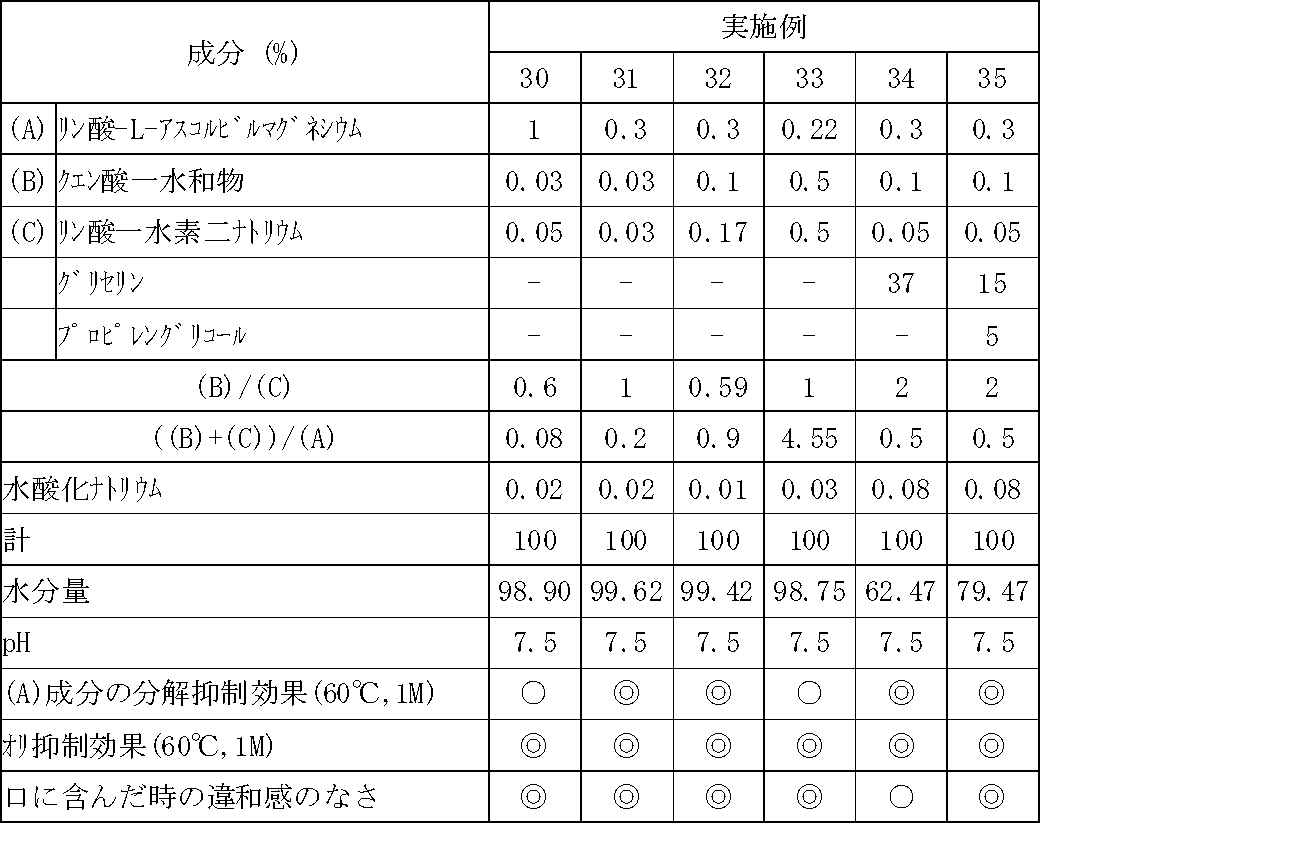
- Examples and comparative examples Liquid oral compositions having the compositions shown in Tables 1 to 3 were prepared by the following method to obtain uniform liquid oral compositions. The liquid oral composition obtained was transparent. These liquid oral compositions were evaluated by the following methods. The results are also shown in Tables 1 to 3.
- the column is a stainless steel tube having a diameter of about 4.6 mm and a length of about 150 mm, and a 5 ⁇ m liquid chromatograph.
- octadecylsilylated silica gel for graphs (example: TSK-gel ODS-80Ts (manufactured by Tosoh Corporation)
- column temperature of about 50 ° C.
- detection wavelength of 240 nm detection wavelength of 240 nm
- flow rate 0.8 mL / min.
Landscapes
- Health & Medical Sciences (AREA)
- Life Sciences & Earth Sciences (AREA)
- General Health & Medical Sciences (AREA)
- Veterinary Medicine (AREA)
- Public Health (AREA)
- Animal Behavior & Ethology (AREA)
- Birds (AREA)
- Epidemiology (AREA)
- Emergency Medicine (AREA)
- Oral & Maxillofacial Surgery (AREA)
- Chemical & Material Sciences (AREA)
- Inorganic Chemistry (AREA)
- Cosmetics (AREA)
- Medicinal Preparation (AREA)
Abstract
アスコルビン酸リン酸エステル類を配合した液体口腔用組成物において、アスコルビン酸リン酸エステル類の安定性を改善し、その経時での残存率低下とオリ発生とが同時に抑制され、かつ違和感がなく使用感の良好な液体口腔用組成物及び液体口腔用組成物におけるアスコルビン酸リン酸エステル又はその塩の安定化方法を提供する。 (A)アスコルビン酸リン酸エステル又はその塩を含有し、研磨剤を含まない液体口腔用組成物に、(B)有機酸又はその塩と(C)オルトリン酸塩とを配合し、pHを6.5~8.0とし、水分量を60質量%以上とする液体口腔用組成物。上記(A)成分を含有し、研磨剤を含まない液体口腔用組成物に、(B)成分と(C)成分とを配合し、pHを6.5~8.0とし、水分量を60質量%以上とする、前記液体口腔用組成物におけるアスコルビン酸リン酸エステル又はその塩の安定化方法。
Description
本発明は、アスコルビン酸リン酸エステル又はその塩を含有し、研磨剤を含まない液体口腔用組成物に関し、更に詳述すると、アスコルビン酸リン酸エステル又はその塩の経時での安定性に優れる上、製剤のオリ発生を抑制でき、違和感がなく使用感も良好な液体口腔用組成物、及び液体口腔用組成物におけるアスコルビン酸リン酸エステル又はその塩の安定化方法に関する。
アスコルビン酸は生体中で種々の酵素活性発現に重要な役割を演じ、多様な生理活性を持つことが知られている。特に、プロリル及びリジルヒドロキシラーゼの補酵素として作用し、コラーゲン合成に必須であるとされている。このため、コラーゲンの破壊を伴う歯肉炎、歯周炎の予防、治療に有用で、従来よりアスコルビン酸誘導体が種々開発され、特にアスコルビン酸リン酸エステル及びそれらの塩が注目されている。
しかし、アスコルビン酸リン酸エステル類を口腔用組成物に配合した場合、経時でアスコルビン酸リン酸エステル類の残存率が低下するという問題があった。特に洗口液や液体歯磨等の液体口腔用組成物では、組成物中の水分量が多い為に残存率の低下が著しく、高温で長期間保存した後も残存率の低下を抑制することは非常に困難であった。
また、アスコルビン酸リン酸エステル類はアルカリ側で安定とされ、組成物のpHをアルカリ領域に維持することが残存率の低下抑制に有効であるが、一方で、液体口腔用組成物のpHが8を超えると、口に含んだ時にヌルつきや異味などの違和感を感じたり、オリが発生し易くなるなど、製剤化に問題が生じるという課題があった。
これまで、アスコルビン酸リン酸エステル類を安定に配合する技術として、特許文献1(特開2000-256153号公報)にカルボキシル基を有するキレート剤と、縮合リン酸、フィチン酸等のリン酸基を有するキレート剤とを配合することで、アスコルビン酸又はその誘導体の経時での残存率低下を防止した口腔用組成物が提案されている。しかし、縮合リン酸やフィチン酸等のリン酸基を有するキレート剤は、オルトリン酸塩とは相違し、また、経時でオリを発生する場合があり、液体口腔用組成物の均一な外観を損なうことが課題となっていた。特許文献2(特開平4-173727号公報)には、アスコルビン酸リン酸エステル類に研磨剤を配合すると共に、クエン酸、リン酸塩、炭酸塩、重炭酸塩等を配合することで着色を抑制した口腔用組成物が提案されているが、この着色の強弱は、アスコルビン酸リン酸エステル類の残存率の低下度合いと必ずしも一致しない。研磨剤のような水不溶性の化合物は、液体口腔用組成物には配合が困難であり、また、この技術では経時での分解抑制効果は不十分であった。
アスコルビン酸リン酸エステル類を配合した組成物のオリ発生を抑制する方法として、特許文献3(特開昭62-63597号公報)では、有機カルボン酸(塩)、有機リン酸(塩)、有機硫酸塩を配合する方法が、特許文献4(特開2002-255981号公報)では、オリ発生の一因として推察されるカルシウム化合物の含量を低減させたL-アスコルビン酸-2-リン酸エステルマグネシウム塩及びその製造方法が提案されている。しかし、これらの技術では、アスコルビン酸リン酸エステル類の分解を抑制する効果は低く、オリ発生と分解抑制とを同時に解決することは困難であった。
アスコルビン酸リン酸エステル類を配合した組成物のオリ発生を抑制する方法として、特許文献3(特開昭62-63597号公報)では、有機カルボン酸(塩)、有機リン酸(塩)、有機硫酸塩を配合する方法が、特許文献4(特開2002-255981号公報)では、オリ発生の一因として推察されるカルシウム化合物の含量を低減させたL-アスコルビン酸-2-リン酸エステルマグネシウム塩及びその製造方法が提案されている。しかし、これらの技術では、アスコルビン酸リン酸エステル類の分解を抑制する効果は低く、オリ発生と分解抑制とを同時に解決することは困難であった。
かかる点から、液体口腔用組成物において、アスコルビン酸リン酸エステル類を安定に維持し、その残存率低下とオリ発生とを同時に解決し、使用感の良好な製剤を提供できる新たな技術が望まれる。
本発明は、上記事情に鑑みなされたもので、アスコルビン酸リン酸エステル類を配合した液体口腔用組成物において、アスコルビン酸リン酸エステル類の安定性を改善し、アスコルビン酸リン酸エステル類の経時での残存率低下とオリ発生とが同時に抑制され、かつ違和感がなく使用感の良好な液体口腔用組成物及び液体口腔用組成物におけるアスコルビン酸リン酸エステル又はその塩の安定化方法を提供することを目的とする。
本発明は、上記事情に鑑みなされたもので、アスコルビン酸リン酸エステル類を配合した液体口腔用組成物において、アスコルビン酸リン酸エステル類の安定性を改善し、アスコルビン酸リン酸エステル類の経時での残存率低下とオリ発生とが同時に抑制され、かつ違和感がなく使用感の良好な液体口腔用組成物及び液体口腔用組成物におけるアスコルビン酸リン酸エステル又はその塩の安定化方法を提供することを目的とする。
本発明者らは、上記目的を達成するため鋭意検討を行った結果、(A)アスコルビン酸リン酸エステル又はその塩を含有し、研磨剤を含まない液体口腔用組成物に、(B)有機酸又はその塩と(C)オルトリン酸塩とを配合し、25℃の時のpHを6.5~8.0とし、組成物中の水分量を60質量%以上とすることにより、アスコルビン酸リン酸エステル又はその塩の安定性及びオリの抑制効果が良好に維持されることを見出した。
本発明によれば、アスコルビン酸リン酸エステル又はその塩を含有し、研磨剤を含まない液体口腔用組成物において、pHが8以下の領域付近で、60℃で1ヶ月保存してもアスコルビン酸リン酸エステル又はその塩を安定化でき、これにより、アスコルビン酸リン酸エステル又はその塩の経時での安定性に優れる上、オリ発生が効果的に抑制され、かつ口に含んだ時の違和感もない良好な使用感を有する液体口腔用組成物を提供できることを知見し、本発明をなすに至った。
本発明によれば、アスコルビン酸リン酸エステル又はその塩を含有し、研磨剤を含まない液体口腔用組成物において、pHが8以下の領域付近で、60℃で1ヶ月保存してもアスコルビン酸リン酸エステル又はその塩を安定化でき、これにより、アスコルビン酸リン酸エステル又はその塩の経時での安定性に優れる上、オリ発生が効果的に抑制され、かつ口に含んだ時の違和感もない良好な使用感を有する液体口腔用組成物を提供できることを知見し、本発明をなすに至った。
即ち、従来の技術では、研磨剤を含まない液体口腔用組成物において、pH8以下の領域でアスコルビン酸リン酸エステル類を満足に安定化し難く、また、クエン酸塩等の有機カルボン酸塩のオリ抑制効果も十分ではなかった。アスコルビン酸リン酸エステル類にクエン酸塩、リン酸2ナトリウム等のリン酸塩を配合することによる着色抑制効果、アスコルビン酸リン酸エステル類にクエン酸塩と、ピロリン酸塩又はトリポリリン酸塩を併用することで残存率低下を防止し得ることは知られている。しかし、(B)有機酸又はその塩と(C)オルトリン酸塩とを併用し、かつ組成物のpHを6.5~8.0とし、組成物中の水分量を60質量%以上とすることによって、pH8以下の液体口腔用組成物であってもアスコルビン酸リン酸エステル又はその塩を有効に安定化し得ること、これによりアスコルビン酸リン酸エステル又はその塩の残存率低下とオリ発生とを同時に抑制し、且つ、良好な使用感を提供できることは、本発明者らの新知見である。
なお、本発明においては、その作用機序は明確ではないが、(A)アスコルビン酸リン酸エステル又はその塩に、(B)有機酸又はその塩と(C)オルトリン酸塩とを併用することによって、これら成分が相乗的に作用して、アスコルビン酸リン酸エステル又はその塩の残存率低下とオリ発生とを同時に抑制できるものと推測される。
なお、本発明においては、その作用機序は明確ではないが、(A)アスコルビン酸リン酸エステル又はその塩に、(B)有機酸又はその塩と(C)オルトリン酸塩とを併用することによって、これら成分が相乗的に作用して、アスコルビン酸リン酸エステル又はその塩の残存率低下とオリ発生とを同時に抑制できるものと推測される。
従って、本発明は下記の液体口腔用組成物及び液体口腔用組成物におけるアスコルビン酸リン酸エステル又はその塩の安定化方法を提供する。
〔1〕
(A)アスコルビン酸リン酸エステル又はその塩を含有し、研磨剤を含まない液体口腔用組成物に、(B)有機酸又はその塩と(C)オルトリン酸塩とを配合し、25℃の時のpHを6.5~8.0としてなり、組成物中の水分量を60質量%以上とすることを特徴とする液体口腔用組成物。
〔2〕
(B)成分と(C)成分との配合比率が、(B)/(C)の質量比として0.1~5である〔1〕記載の液体口腔用組成物。
〔3〕
(B)成分を0.01~1質量%、(C)成分を0.01~1質量%含有する〔1〕又は〔2〕記載の液体口腔用組成物。
〔4〕
(B)成分が、クエン酸、リンゴ酸、酒石酸、コハク酸及びその塩から選ばれる1種以上である〔1〕、〔2〕又は〔3〕記載の液体口腔用組成物。
〔5〕
(A)アスコルビン酸リン酸エステル又はその塩を含有し、研磨剤を含まない液体口腔用組成物に、(B)有機酸又はその塩と(C)オルトリン酸塩とを配合し、25℃の時のpHを6.5~8.0とし、組成物中の水分量を60質量%以上とすることを特徴とする、前記液体口腔用組成物におけるアスコルビン酸リン酸エステル又はその塩の安定化方法。
〔6〕
(B)成分と(C)成分との配合比率が、(B)/(C)の質量比として0.1~5である〔5〕記載の安定化方法。
〔1〕
(A)アスコルビン酸リン酸エステル又はその塩を含有し、研磨剤を含まない液体口腔用組成物に、(B)有機酸又はその塩と(C)オルトリン酸塩とを配合し、25℃の時のpHを6.5~8.0としてなり、組成物中の水分量を60質量%以上とすることを特徴とする液体口腔用組成物。
〔2〕
(B)成分と(C)成分との配合比率が、(B)/(C)の質量比として0.1~5である〔1〕記載の液体口腔用組成物。
〔3〕
(B)成分を0.01~1質量%、(C)成分を0.01~1質量%含有する〔1〕又は〔2〕記載の液体口腔用組成物。
〔4〕
(B)成分が、クエン酸、リンゴ酸、酒石酸、コハク酸及びその塩から選ばれる1種以上である〔1〕、〔2〕又は〔3〕記載の液体口腔用組成物。
〔5〕
(A)アスコルビン酸リン酸エステル又はその塩を含有し、研磨剤を含まない液体口腔用組成物に、(B)有機酸又はその塩と(C)オルトリン酸塩とを配合し、25℃の時のpHを6.5~8.0とし、組成物中の水分量を60質量%以上とすることを特徴とする、前記液体口腔用組成物におけるアスコルビン酸リン酸エステル又はその塩の安定化方法。
〔6〕
(B)成分と(C)成分との配合比率が、(B)/(C)の質量比として0.1~5である〔5〕記載の安定化方法。
本発明によれば、アスコルビン酸リン酸エステル又はその塩を含有し、研磨剤を含まない液体口腔用組成物において、pH8以下の領域であってもアスコルビン酸リン酸エステル又はその塩を安定化でき、アスコルビン酸リン酸エステル又はその塩の経時での残存率低下とオリ発生とが同時に抑制され、かつ違和感がなく使用感の良好な液体口腔用組成物を提供できる。
以下、本発明につき更に詳細に説明する。
本発明の液体口腔用組成物は、研磨剤を含まない液体口腔用組成物であって、(A)アスコルビン酸リン酸エステル又はその塩、(B)有機酸又はその塩、及び(C)オルトリン酸塩を含有し、組成物中の水分量が60質量%以上であり、25℃の時のpHが6.5~8.0であることを特徴とする。
本発明の液体口腔用組成物は、研磨剤を含まない液体口腔用組成物であって、(A)アスコルビン酸リン酸エステル又はその塩、(B)有機酸又はその塩、及び(C)オルトリン酸塩を含有し、組成物中の水分量が60質量%以上であり、25℃の時のpHが6.5~8.0であることを特徴とする。
(A)アスコルビン酸リン酸エステル又はその塩としては、アスコルビン酸の2,3,5,6位のいずれかの水酸基の1つ又は2つ以上がリン酸、ポリリン酸等の化合物のエステルとなったものであり、例えば、アスコルビン酸-2-リン酸エステル、アスコルビン酸-3-リン酸エステル、アスコルビン酸-6-リン酸エステル、アスコルビン酸-2-ポリリン酸エステル等が挙げられ、その塩類としては、ナトリウム塩、カリウム塩、カルシウム塩、マグネシウム塩等のアルカリ金属塩、アルカリ土類金属塩が挙げられる。特に組成物の安定性の点から、アスコルビン酸の2位又は3位の水酸基がリン酸エステル化された誘導体が好ましく、より好ましくはアスコルビン酸-2-リン酸エステルのマグネシウム塩やナトリウム塩である。
(A)アスコルビン酸リン酸エステル又はその塩の配合量は、組成物全体の0.1~5%(質量%、以下同様。)、特に0.2~2%が好ましい。配合量が0.1%未満では、歯周疾患の予防効果が十分に発揮されない場合があり、5%を超えるものは歯周疾患の予防効果の向上がそれ以上望めず、また、異味が発生するなど口に含んだ時の違和感が大きくなり使用感に劣る場合がある。
(B)成分の有機酸又はその塩は、(A)成分の安定化剤として配合されるもので、(C)成分と併用することで(A)成分の分解抑制効果と共に、製剤のオリ発生及び違和感発現を抑制する効果を発揮する。
(B)成分としては、通常口腔用組成物に配合される有機酸であれば特に限定はされないが、酒石酸、リンゴ酸、コハク酸、グルタミン酸、アジピン酸、アスパラギン酸、クエン酸等のジ又はトリカルボン酸が好ましい。また、それらの塩類としては、ナトリウム塩、カリウム塩等が好ましい。これらの中で、(A)成分の分解抑制効果、オリ抑制効果、口に含んだ時の違和感のなさの点から、特に酒石酸、リンゴ酸、コハク酸、クエン酸又はその塩が好ましく、より好ましくはクエン酸又はそのナトリウム塩である。
(B)成分としては、通常口腔用組成物に配合される有機酸であれば特に限定はされないが、酒石酸、リンゴ酸、コハク酸、グルタミン酸、アジピン酸、アスパラギン酸、クエン酸等のジ又はトリカルボン酸が好ましい。また、それらの塩類としては、ナトリウム塩、カリウム塩等が好ましい。これらの中で、(A)成分の分解抑制効果、オリ抑制効果、口に含んだ時の違和感のなさの点から、特に酒石酸、リンゴ酸、コハク酸、クエン酸又はその塩が好ましく、より好ましくはクエン酸又はそのナトリウム塩である。
有機酸又はその塩は、1種単独でも2種以上を組み合わせて配合してもよいが、その配合量は、組成物全体の0.01~1%、特に0.03~0.5%が好ましい。配合量が0.01%未満では、(A)成分の分解抑制効果及びオリ抑制効果に劣ることがあり、1%を超えると、(A)成分の分解抑制効果が低下し、更に異味が発生するなど口に含んだ時の違和感が大きくなる場合がある。
(C)成分のオルトリン酸塩は、(A)成分の安定化剤として配合されるもので、(B)成分と併用することで、(A)成分の分解抑制効果と共に、製剤のオリ発生及び違和感発現を抑制する効果を発揮する。
オルトリン酸塩としては、リン酸ナトリウム、リン酸カリウム、リン酸アンモニウム等の正塩、リン酸二水素一ナトリウム、リン酸一水素二ナトリウム、リン酸二水素一カリウム、リン酸水素二カリウム等の水素塩が挙げられる。中でも、(A)成分の分解抑制効果、オリ抑制効果の点から、水素塩が好ましく、より好ましくはリン酸一水素二ナトリウムである。なお、オルトリン酸塩の代わりに、例えばピロリン酸塩、ポリリン酸塩等のリン酸基を有するキレート剤を用いても本発明の目的は達成できない。
オルトリン酸塩としては、リン酸ナトリウム、リン酸カリウム、リン酸アンモニウム等の正塩、リン酸二水素一ナトリウム、リン酸一水素二ナトリウム、リン酸二水素一カリウム、リン酸水素二カリウム等の水素塩が挙げられる。中でも、(A)成分の分解抑制効果、オリ抑制効果の点から、水素塩が好ましく、より好ましくはリン酸一水素二ナトリウムである。なお、オルトリン酸塩の代わりに、例えばピロリン酸塩、ポリリン酸塩等のリン酸基を有するキレート剤を用いても本発明の目的は達成できない。
オルトリン酸塩の配合量は、組成物全体の0.01~1%、特に0.03~0.5%が好ましい。配合量が0.01%未満では、(A)成分の分解抑制効果に劣る場合があり、1%を超えると、(A)成分の分解抑制効果及びオリ抑制効果が低下し、更に異味が発生するなど口に含んだ時の違和感が大きくなる場合がある。
(B)成分と(C)成分との配合比率は、(B)成分/(C)成分が質量比として0.1~5、特に0.2~3であることが、(A)成分の分解抑制効果、オリ抑制効果の点から好ましい。配合比率が0.1未満である場合、あるいは5を超える場合は、(A)成分の分解抑制効果及びオリ抑制効果が十分に発揮されない場合がある。特に上記配合比とすることが、オリ抑制効果を満足に発揮させるのにより有効である。
更に、((B)成分+(C)成分)/(A)成分の比率は、質量比で0.05~5、特に0.1~1であることが好ましく、このような比率であることが、(A)成分の分解抑制効果向上の点からより好適である。比率が0.05未満である場合、あるいは5を超えた場合は、(A)成分の分解抑制効果が十分に発揮されない場合がある。
本発明組成物は、溶剤として精製水が一般的に配合される。水分量は組成物全体の60%以上であり、好ましくは75%以上であり、99.8%未満が望ましい。水分量が60%未満では、口腔内でヌルつきやべたつきを感じるようになり、また、アルコール等のその他溶剤による口腔内への刺激が大きくなるなど、口に含んだ時の違和感が大きくなる可能性がある。
組成物のpHは6.5~8.0(25℃)であり、より好ましくは7.0~7.8である。pHが6.5未満では、(A)成分の分解抑制効果が低下し、8.0を超えると、オリを満足に抑制できず、更に口に含んだ時にヌルつきや異味など違和感が大きくなる可能性がある。
なお、組成物のpHは、なりゆきで6.5~8.0になるときもあるが、必要に応じてpH調整剤を用いて上記範囲内に調整してもよい。pH調整剤としては、水酸化ナトリウム、塩酸、炭酸ナトリウム、炭酸水素ナトリウム、ホウ酸又はその塩等のpH調整剤を使用でき、中でも水酸化ナトリウム、水酸化カリウム、塩酸が好適に用いられる。これらpH調整剤の配合量は、pHを上記範囲に調整できれば良い。
本発明の液体口腔用組成物には、更に、必要に応じて溶剤や湿潤剤等を配合することができる。溶剤としては、プロピレングリコール等の多価アルコール、エタノール等の低級アルコールを配合することができる。これら溶剤の配合量は通常、組成物全体の0~30%であり、特に2~20%が好ましい。
なお、本発明の液体口腔用組成物では、エタノールを実質的に含有しない(即ち、組成物中のエタノール含有量が0.01%以下、特に0~0.0001%である)組成であっても、本発明の効果を得ることができる。
なお、本発明の液体口腔用組成物では、エタノールを実質的に含有しない(即ち、組成物中のエタノール含有量が0.01%以下、特に0~0.0001%である)組成であっても、本発明の効果を得ることができる。
湿潤剤としては、ソルビトール、グリセリン、エチレングリコール、ポリエチレングリコール、キシリトール、エリスリトール等の多価アルコールや糖アルコールが挙げられる。配合量は通常、組成物全体の0~20%である。
本発明の液体口腔用組成物は、研磨剤を含まない液体口腔用組成物であり、洗口剤、液体歯磨、歯磨ジェル、口中清涼剤、濃縮タイプ洗口剤などの剤型、特に洗口剤として好適に調製し、適用することができる。洗口剤としては、透明でも不透明でもよいが、沈殿物や浮遊物を含まない均一な液体であることが好ましい。また、その剤型に応じ、上記成分以外に適宜な公知成分を必要に応じて配合できる。例えば、上記溶剤及び湿潤剤に加え、増粘剤、界面活性剤、防腐剤、甘味剤、着色剤、香料、有効成分等を配合できる。
増粘剤としては、カルボキシメチルセルロースナトリウム、ヒドロキシエチルセルロース等が挙げられる。増粘剤の配合量は、通常0~5%、特に0.1~3%である。
界面活性剤は、口腔用組成物に汎用されている界面活性剤を用いることができ、界面活性剤の配合量は、通常0.1~10%の範囲である。
防腐剤としては、パラベン類等が挙げられる。甘味剤としては、サッカリンナトリウム等が挙げられる。着色剤としては水溶性の色素が挙げられる。
香料としては、スペアミント油、ハッカ油等の天然香料、及びカルボン、アネトール等の単品香料、更に単品香料及び/又は天然香料も含む調合香料等の口腔衛生品に用いられる周知の香料を使用することができ、実施例記載の香料に限定されるものではない。通常その配合量は0.00001~1%の範囲である。
有効成分としては、(A)成分のアスコルビン酸リン酸エステル又はその塩に加えて、例えば抗炎症剤、酵素、フッ化物、殺菌剤などを本発明の効果を妨げない範囲で、有効量配合してもよい。
以下、実施例及び比較例を示し、本発明を具体的に説明するが、本発明は下記の実施例に制限されるものではない。下記の例において、%は特に断らない限りいずれも質量%を示す。また、表中のpHは、組成物を調整直後に東亜電波工業製のpHメーター(型番Hm-30S)を用いて測定し、25℃、3分後の値を示した。
〔実施例、比較例〕
表1~3に示す組成の液体口腔用組成物を下記方法で調製し、均一な液体口腔用組成物を得た。得られた液体口腔用組成物は透明であった。これらの液体口腔用組成物について、下記方法で評価した。結果を表1~3に併記する。
表1~3に示す組成の液体口腔用組成物を下記方法で調製し、均一な液体口腔用組成物を得た。得られた液体口腔用組成物は透明であった。これらの液体口腔用組成物について、下記方法で評価した。結果を表1~3に併記する。
(1)液体口腔用組成物の調製方法
精製水850gにアスコルビン酸リン酸エステル類及びその他の成分を常温で混合し、アスコルビン酸リン酸エステル類が完全に溶解するまで1時間攪拌した。pHがなりゆきで6.5~8.0の範囲内におさまらない場合には、水酸化ナトリウム、塩酸等でpHを調整した後、組成物の総量が1,000gとなるように精製水で調整した。なお、水酸化ナトリウム及び塩酸は10%水溶液を調製し、pHが上記範囲内となるように加えた。
精製水850gにアスコルビン酸リン酸エステル類及びその他の成分を常温で混合し、アスコルビン酸リン酸エステル類が完全に溶解するまで1時間攪拌した。pHがなりゆきで6.5~8.0の範囲内におさまらない場合には、水酸化ナトリウム、塩酸等でpHを調整した後、組成物の総量が1,000gとなるように精製水で調整した。なお、水酸化ナトリウム及び塩酸は10%水溶液を調製し、pHが上記範囲内となるように加えた。
(2)(A)成分の分解抑制効果の評価
組成物を満注量250mLのPET容器に250mL充填し、60℃及び-5℃に1ヶ月保存した後、10mmol/Lのリン酸緩衝液(1.5mmol/L リン酸二水素カリウム、23.5mmol/L リン酸水素二カリウム、pH8)で希釈・フィルタリングし、高速液体クロマトグラフィー(ポンプ:日本分光社製 PU1580、オートサンプラー:(株)島津製作所製 SIL-10A、UV検出器:(株)島津製作所製 SPD-6A、記録装置:(株)島津製作所製 C-R4A)を用い、絶対検量線法にて定量を行った。移動相は25mmol/Lリン酸二水素カリウム+5mmol/L硫酸テトラブチルアンモニウム/アセトニトリル=91/9混液(容量比)、カラムは直径約4.6mm、長さ約150mmのステンレス管に5μmの液体クロマトグラフ用オクタデシルシリル化シリカゲルを充填したもの(例:TSK-gel ODS-80Ts(東ソー(株)製))、カラム温度約50℃、検出波長240nm、流速は0.8mL/minとした。60℃保存品中のアスコルビン酸リン酸エステル類の濃度を算出し、-5℃保存品中の含有量を100%とした場合の残存率を求めた。
アスコルビン酸リン酸エステル類の分解抑制評価基準
◎:組成物中の残存率が90%以上
○:組成物中の残存率が80%以上90%未満
△:組成物中の残存率が70%以上80%未満
×:組成物中の残存率が70%未満
組成物を満注量250mLのPET容器に250mL充填し、60℃及び-5℃に1ヶ月保存した後、10mmol/Lのリン酸緩衝液(1.5mmol/L リン酸二水素カリウム、23.5mmol/L リン酸水素二カリウム、pH8)で希釈・フィルタリングし、高速液体クロマトグラフィー(ポンプ:日本分光社製 PU1580、オートサンプラー:(株)島津製作所製 SIL-10A、UV検出器:(株)島津製作所製 SPD-6A、記録装置:(株)島津製作所製 C-R4A)を用い、絶対検量線法にて定量を行った。移動相は25mmol/Lリン酸二水素カリウム+5mmol/L硫酸テトラブチルアンモニウム/アセトニトリル=91/9混液(容量比)、カラムは直径約4.6mm、長さ約150mmのステンレス管に5μmの液体クロマトグラフ用オクタデシルシリル化シリカゲルを充填したもの(例:TSK-gel ODS-80Ts(東ソー(株)製))、カラム温度約50℃、検出波長240nm、流速は0.8mL/minとした。60℃保存品中のアスコルビン酸リン酸エステル類の濃度を算出し、-5℃保存品中の含有量を100%とした場合の残存率を求めた。
アスコルビン酸リン酸エステル類の分解抑制評価基準
◎:組成物中の残存率が90%以上
○:組成物中の残存率が80%以上90%未満
△:組成物中の残存率が70%以上80%未満
×:組成物中の残存率が70%未満
(3)オリ抑制効果の評価
組成物を満注量250mLのPET容器に250mL充填し、60℃に1ヶ月保存後に、PET容器を緩やかに転置した際のオリを、精製水を充填したPET容器(対照品)と比較して下記基準に従い目視判定した。
オリ抑制効果の評価基準
◎:沈降するオリが全くない
○:沈降するオリが僅かに認められるが問題ない
△:沈降するオリが明らかに認められる
×:PET容器を転置させずともオリが認められる
組成物を満注量250mLのPET容器に250mL充填し、60℃に1ヶ月保存後に、PET容器を緩やかに転置した際のオリを、精製水を充填したPET容器(対照品)と比較して下記基準に従い目視判定した。
オリ抑制効果の評価基準
◎:沈降するオリが全くない
○:沈降するオリが僅かに認められるが問題ない
△:沈降するオリが明らかに認められる
×:PET容器を転置させずともオリが認められる
(4)口に含んだ時の違和感のなさの評価
口腔粘膜が過敏な10名の被験者により、組成物を約10mL口に含み、20秒間程すすいでいる間に口腔内で感じる違和感について、対照品(実施例1と同組成で、pH調整剤の水酸化ナトリウムでpH9に調整した組成)と比較して以下の基準に従って官能評価し、平均値を求めて下記基準で判定した。
口に含んだ時の違和感のなさの評価基準
4:顕著に違和感が低かった
3:違和感が低く問題のないレベルであった
2:同等な違和感があった
1:顕著な違和感を感じた
判定基準
◎:3.5点以上
○:3.0点以上3.5点未満
△:2.0点以上3.0点未満
×:2.0点未満
口腔粘膜が過敏な10名の被験者により、組成物を約10mL口に含み、20秒間程すすいでいる間に口腔内で感じる違和感について、対照品(実施例1と同組成で、pH調整剤の水酸化ナトリウムでpH9に調整した組成)と比較して以下の基準に従って官能評価し、平均値を求めて下記基準で判定した。
口に含んだ時の違和感のなさの評価基準
4:顕著に違和感が低かった
3:違和感が低く問題のないレベルであった
2:同等な違和感があった
1:顕著な違和感を感じた
判定基準
◎:3.5点以上
○:3.0点以上3.5点未満
△:2.0点以上3.0点未満
×:2.0点未満
使用原料の詳細は下記のとおりである。
リン酸-L-アスコルビルマグネシウム:和光純薬工業社製 生化学用
リン酸-L-アスコルビルナトリウム:DSMニュートリションジャパン社製 商品名 ステイC50
クエン酸一水和物:扶桑化学工業社製、クエン酸、外原規グレード(医薬部外品原料規格規格品)
クエン酸三ナトリウム二水和物:扶桑化学工業社製、クエン酸ナトリウム、外原規グレード
リンゴ酸二ナトリウム・0.5水和物:関東化学社製、特級
こはく酸二ナトリウム:関東化学社製、特級
L-酒石酸:関東化学社製、特級
リン酸一水素二ナトリウム:太平化学産業社製、リン酸一水素ナトリウム、外原規グレード
ホウ酸:関東化学社製、特級(比較品)
炭酸:関東化学社製、特級(比較品)
ピロリン酸ナトリウム:太平化学産業社製、外原規グレード(比較品)
ポリリン酸:太平化学産業社製、ポリリン酸ナトリウム、外原規グレード(比較品)
グリセリン:ライオンケミカル社製
プロピレングリコール:旭硝子社製
水酸化ナトリウム:関東化学社製、水酸化ナトリウム、特級を10%に希釈して配合
塩酸:関東化学社製、塩酸、特級を10%に希釈して配合
リン酸-L-アスコルビルマグネシウム:和光純薬工業社製 生化学用
リン酸-L-アスコルビルナトリウム:DSMニュートリションジャパン社製 商品名 ステイC50
クエン酸一水和物:扶桑化学工業社製、クエン酸、外原規グレード(医薬部外品原料規格規格品)
クエン酸三ナトリウム二水和物:扶桑化学工業社製、クエン酸ナトリウム、外原規グレード
リンゴ酸二ナトリウム・0.5水和物:関東化学社製、特級
こはく酸二ナトリウム:関東化学社製、特級
L-酒石酸:関東化学社製、特級
リン酸一水素二ナトリウム:太平化学産業社製、リン酸一水素ナトリウム、外原規グレード
ホウ酸:関東化学社製、特級(比較品)
炭酸:関東化学社製、特級(比較品)
ピロリン酸ナトリウム:太平化学産業社製、外原規グレード(比較品)
ポリリン酸:太平化学産業社製、ポリリン酸ナトリウム、外原規グレード(比較品)
グリセリン:ライオンケミカル社製
プロピレングリコール:旭硝子社製
水酸化ナトリウム:関東化学社製、水酸化ナトリウム、特級を10%に希釈して配合
塩酸:関東化学社製、塩酸、特級を10%に希釈して配合



Claims (6)
- (A)アスコルビン酸リン酸エステル又はその塩を含有し、研磨剤を含まない液体口腔用組成物に、(B)有機酸又はその塩と(C)オルトリン酸塩とを配合し、25℃の時のpHを6.5~8.0としてなり、組成物中の水分量を60質量%以上とすることを特徴とする液体口腔用組成物。
- (B)成分と(C)成分との配合比率が、(B)/(C)の質量比として0.1~5である請求項1記載の液体口腔用組成物。
- (B)成分を0.01~1質量%、(C)成分を0.01~1質量%含有する請求項1又は2記載の液体口腔用組成物。
- (B)成分が、クエン酸、リンゴ酸、酒石酸、コハク酸及びその塩から選ばれる1種以上である請求項1、2又は3記載の液体口腔用組成物。
- (A)アスコルビン酸リン酸エステル又はその塩を含有し、研磨剤を含まない液体口腔用組成物に、(B)有機酸又はその塩と(C)オルトリン酸塩とを配合し、25℃の時のpHを6.5~8.0とし、組成物中の水分量を60質量%以上とすることを特徴とする、前記液体口腔用組成物におけるアスコルビン酸リン酸エステル又はその塩の安定化方法。
- (B)成分と(C)成分との配合比率が、(B)/(C)の質量比として0.1~5である請求項5記載の安定化方法。
Priority Applications (2)
| Application Number | Priority Date | Filing Date | Title |
|---|---|---|---|
| CN201180062456.5A CN103269676B (zh) | 2010-12-24 | 2011-11-16 | 液体口腔用组合物 |
| KR1020137015362A KR101807905B1 (ko) | 2010-12-24 | 2011-11-16 | 액체 구강용 조성물 |
Applications Claiming Priority (2)
| Application Number | Priority Date | Filing Date | Title |
|---|---|---|---|
| JP2010-287028 | 2010-12-24 | ||
| JP2010287028A JP5691494B2 (ja) | 2010-12-24 | 2010-12-24 | 液体口腔用組成物及び液体口腔用組成物におけるアスコルビン酸リン酸エステル又はその塩の安定化方法 |
Publications (1)
| Publication Number | Publication Date |
|---|---|
| WO2012086341A1 true WO2012086341A1 (ja) | 2012-06-28 |
Family
ID=46313623
Family Applications (1)
| Application Number | Title | Priority Date | Filing Date |
|---|---|---|---|
| PCT/JP2011/076349 Ceased WO2012086341A1 (ja) | 2010-12-24 | 2011-11-16 | 液体口腔用組成物 |
Country Status (5)
| Country | Link |
|---|---|
| JP (1) | JP5691494B2 (ja) |
| KR (1) | KR101807905B1 (ja) |
| CN (1) | CN103269676B (ja) |
| MY (1) | MY162993A (ja) |
| WO (1) | WO2012086341A1 (ja) |
Cited By (3)
| Publication number | Priority date | Publication date | Assignee | Title |
|---|---|---|---|---|
| WO2014183973A1 (de) * | 2013-05-14 | 2014-11-20 | Beiersdorf Ag | Stabilisierte zubereitungen mit einem gehalt an ascorbinsäure und phosphationen |
| WO2016078854A1 (de) * | 2014-11-19 | 2016-05-26 | Beiersdorf Ag | Zubereitungen mit einem gehalt an ascorbinsäure, ubidecarenon und phosphationen zur verbesserten hautkonturierung bzw. gegen cellulite |
| WO2016078853A1 (de) * | 2014-11-19 | 2016-05-26 | Beiersdorf Ag | Zubereitungen mit einem gehalt an ascorbinsäure, ubidecarenon und einem emulgatorgemisch |
Families Citing this family (4)
| Publication number | Priority date | Publication date | Assignee | Title |
|---|---|---|---|---|
| KR20140143136A (ko) * | 2012-03-07 | 2014-12-15 | 라이온 가부시키가이샤 | 구강용 조성물 |
| JP5880298B2 (ja) * | 2012-06-13 | 2016-03-08 | ライオン株式会社 | 液体口腔用組成物 |
| JP6118547B2 (ja) * | 2012-12-10 | 2017-04-19 | 花王株式会社 | 口腔用組成物 |
| JP6435852B2 (ja) * | 2014-12-24 | 2018-12-12 | ライオン株式会社 | 口腔用組成物及び口腔用組成物の変色防止方法 |
Citations (4)
| Publication number | Priority date | Publication date | Assignee | Title |
|---|---|---|---|---|
| JPS6263597A (ja) * | 1985-09-13 | 1987-03-20 | Nippon Saafuakutanto Kogyo Kk | アスコルビン酸リン酸エステルマグネシウム水溶液のおり防止法 |
| JP2004026658A (ja) * | 2002-06-21 | 2004-01-29 | Lion Corp | 口腔用組成物 |
| JP2005075825A (ja) * | 2003-08-29 | 2005-03-24 | Lion Corp | 歯牙美白用口腔用組成物 |
| JP2006206581A (ja) * | 2004-12-27 | 2006-08-10 | Lion Corp | 液状口腔用組成物 |
Family Cites Families (2)
| Publication number | Priority date | Publication date | Assignee | Title |
|---|---|---|---|---|
| JP2000198723A (ja) * | 1999-01-07 | 2000-07-18 | Lion Corp | アスコルビン酸類配合製剤 |
| JP3978605B2 (ja) | 2003-04-30 | 2007-09-19 | ライオン株式会社 | 口腔用製品及び口腔用製品中におけるビタミンe又はその誘導体の安定配合方法 |
-
2010
- 2010-12-24 JP JP2010287028A patent/JP5691494B2/ja active Active
-
2011
- 2011-11-16 CN CN201180062456.5A patent/CN103269676B/zh not_active Expired - Fee Related
- 2011-11-16 KR KR1020137015362A patent/KR101807905B1/ko not_active Expired - Fee Related
- 2011-11-16 MY MYPI2013002191A patent/MY162993A/en unknown
- 2011-11-16 WO PCT/JP2011/076349 patent/WO2012086341A1/ja not_active Ceased
Patent Citations (4)
| Publication number | Priority date | Publication date | Assignee | Title |
|---|---|---|---|---|
| JPS6263597A (ja) * | 1985-09-13 | 1987-03-20 | Nippon Saafuakutanto Kogyo Kk | アスコルビン酸リン酸エステルマグネシウム水溶液のおり防止法 |
| JP2004026658A (ja) * | 2002-06-21 | 2004-01-29 | Lion Corp | 口腔用組成物 |
| JP2005075825A (ja) * | 2003-08-29 | 2005-03-24 | Lion Corp | 歯牙美白用口腔用組成物 |
| JP2006206581A (ja) * | 2004-12-27 | 2006-08-10 | Lion Corp | 液状口腔用組成物 |
Cited By (3)
| Publication number | Priority date | Publication date | Assignee | Title |
|---|---|---|---|---|
| WO2014183973A1 (de) * | 2013-05-14 | 2014-11-20 | Beiersdorf Ag | Stabilisierte zubereitungen mit einem gehalt an ascorbinsäure und phosphationen |
| WO2016078854A1 (de) * | 2014-11-19 | 2016-05-26 | Beiersdorf Ag | Zubereitungen mit einem gehalt an ascorbinsäure, ubidecarenon und phosphationen zur verbesserten hautkonturierung bzw. gegen cellulite |
| WO2016078853A1 (de) * | 2014-11-19 | 2016-05-26 | Beiersdorf Ag | Zubereitungen mit einem gehalt an ascorbinsäure, ubidecarenon und einem emulgatorgemisch |
Also Published As
| Publication number | Publication date |
|---|---|
| KR101807905B1 (ko) | 2017-12-11 |
| JP5691494B2 (ja) | 2015-04-01 |
| CN103269676B (zh) | 2015-07-01 |
| MY162993A (en) | 2017-07-31 |
| JP2012131755A (ja) | 2012-07-12 |
| KR20130132858A (ko) | 2013-12-05 |
| CN103269676A (zh) | 2013-08-28 |
Similar Documents
| Publication | Publication Date | Title |
|---|---|---|
| JP5691494B2 (ja) | 液体口腔用組成物及び液体口腔用組成物におけるアスコルビン酸リン酸エステル又はその塩の安定化方法 | |
| JP5874383B2 (ja) | 口腔用組成物 | |
| JP6471667B2 (ja) | 液体口腔用組成物 | |
| WO2013094312A1 (ja) | 歯磨剤組成物 | |
| JP2013129600A (ja) | 歯磨剤組成物 | |
| WO2016006647A1 (ja) | 口腔用組成物 | |
| JP5397204B2 (ja) | 口腔用組成物 | |
| JP2011168557A (ja) | 液体口腔用組成物 | |
| JP5729291B2 (ja) | 口腔用組成物 | |
| CN113226256A (zh) | 含有碳酸氢钠和氟化亚锡的洁齿剂 | |
| WO2012086342A1 (ja) | 歯磨剤組成物 | |
| JP5999173B2 (ja) | 口腔用組成物 | |
| JP6825339B2 (ja) | 口腔用組成物 | |
| JP2814549B2 (ja) | 口腔用組成物 | |
| JPWO2019194068A1 (ja) | 口腔用組成物及びα−オレフィンスルホン酸塩の苦味改善剤 | |
| JPH10182383A (ja) | 口腔用組成物 | |
| JP7625843B2 (ja) | 口腔用組成物 | |
| JP5880298B2 (ja) | 液体口腔用組成物 | |
| JP7779029B2 (ja) | 口腔用組成物 | |
| JP6435852B2 (ja) | 口腔用組成物及び口腔用組成物の変色防止方法 | |
| JP7838275B2 (ja) | 液体口腔用組成物 | |
| JP7790913B2 (ja) | 口腔用組成物、及び金属味と基剤臭とを抑制する方法 | |
| JP2005104911A (ja) | 口腔用組成物 | |
| JP2014005212A (ja) | 液体口腔用組成物 | |
| JP6439425B2 (ja) | 液体口腔用組成物 |
Legal Events
| Date | Code | Title | Description |
|---|---|---|---|
| 121 | Ep: the epo has been informed by wipo that ep was designated in this application |
Ref document number: 11850931 Country of ref document: EP Kind code of ref document: A1 |
|
| ENP | Entry into the national phase |
Ref document number: 20137015362 Country of ref document: KR Kind code of ref document: A |
|
| NENP | Non-entry into the national phase |
Ref country code: DE |
|
| 122 | Ep: pct application non-entry in european phase |
Ref document number: 11850931 Country of ref document: EP Kind code of ref document: A1 |