WO2012081495A1 - 積層シート及びその製造方法 - Google Patents
積層シート及びその製造方法 Download PDFInfo
- Publication number
- WO2012081495A1 WO2012081495A1 PCT/JP2011/078430 JP2011078430W WO2012081495A1 WO 2012081495 A1 WO2012081495 A1 WO 2012081495A1 JP 2011078430 W JP2011078430 W JP 2011078430W WO 2012081495 A1 WO2012081495 A1 WO 2012081495A1
- Authority
- WO
- WIPO (PCT)
- Prior art keywords
- resin
- layer
- laminated sheet
- sheet
- mass
- Prior art date
- Legal status (The legal status is an assumption and is not a legal conclusion. Google has not performed a legal analysis and makes no representation as to the accuracy of the status listed.)
- Ceased
Links
Classifications
-
- C—CHEMISTRY; METALLURGY
- C08—ORGANIC MACROMOLECULAR COMPOUNDS; THEIR PREPARATION OR CHEMICAL WORKING-UP; COMPOSITIONS BASED THEREON
- C08L—COMPOSITIONS OF MACROMOLECULAR COMPOUNDS
- C08L77/00—Compositions of polyamides obtained by reactions forming a carboxylic amide link in the main chain; Compositions of derivatives of such polymers
-
- B—PERFORMING OPERATIONS; TRANSPORTING
- B32—LAYERED PRODUCTS
- B32B—LAYERED PRODUCTS, i.e. PRODUCTS BUILT-UP OF STRATA OF FLAT OR NON-FLAT, e.g. CELLULAR OR HONEYCOMB, FORM
- B32B27/00—Layered products comprising a layer of synthetic resin
- B32B27/06—Layered products comprising a layer of synthetic resin as the main or only constituent of a layer, which is next to another layer of the same or of a different material
- B32B27/08—Layered products comprising a layer of synthetic resin as the main or only constituent of a layer, which is next to another layer of the same or of a different material of synthetic resin
-
- B—PERFORMING OPERATIONS; TRANSPORTING
- B32—LAYERED PRODUCTS
- B32B—LAYERED PRODUCTS, i.e. PRODUCTS BUILT-UP OF STRATA OF FLAT OR NON-FLAT, e.g. CELLULAR OR HONEYCOMB, FORM
- B32B27/00—Layered products comprising a layer of synthetic resin
- B32B27/28—Layered products comprising a layer of synthetic resin comprising synthetic resins not wholly covered by any one of the sub-groups B32B27/30 - B32B27/42
-
- B—PERFORMING OPERATIONS; TRANSPORTING
- B32—LAYERED PRODUCTS
- B32B—LAYERED PRODUCTS, i.e. PRODUCTS BUILT-UP OF STRATA OF FLAT OR NON-FLAT, e.g. CELLULAR OR HONEYCOMB, FORM
- B32B27/00—Layered products comprising a layer of synthetic resin
- B32B27/28—Layered products comprising a layer of synthetic resin comprising synthetic resins not wholly covered by any one of the sub-groups B32B27/30 - B32B27/42
- B32B27/281—Layered products comprising a layer of synthetic resin comprising synthetic resins not wholly covered by any one of the sub-groups B32B27/30 - B32B27/42 comprising polyimides
-
- B—PERFORMING OPERATIONS; TRANSPORTING
- B32—LAYERED PRODUCTS
- B32B—LAYERED PRODUCTS, i.e. PRODUCTS BUILT-UP OF STRATA OF FLAT OR NON-FLAT, e.g. CELLULAR OR HONEYCOMB, FORM
- B32B27/00—Layered products comprising a layer of synthetic resin
- B32B27/28—Layered products comprising a layer of synthetic resin comprising synthetic resins not wholly covered by any one of the sub-groups B32B27/30 - B32B27/42
- B32B27/285—Layered products comprising a layer of synthetic resin comprising synthetic resins not wholly covered by any one of the sub-groups B32B27/30 - B32B27/42 comprising polyethers
-
- B—PERFORMING OPERATIONS; TRANSPORTING
- B32—LAYERED PRODUCTS
- B32B—LAYERED PRODUCTS, i.e. PRODUCTS BUILT-UP OF STRATA OF FLAT OR NON-FLAT, e.g. CELLULAR OR HONEYCOMB, FORM
- B32B27/00—Layered products comprising a layer of synthetic resin
- B32B27/28—Layered products comprising a layer of synthetic resin comprising synthetic resins not wholly covered by any one of the sub-groups B32B27/30 - B32B27/42
- B32B27/286—Layered products comprising a layer of synthetic resin comprising synthetic resins not wholly covered by any one of the sub-groups B32B27/30 - B32B27/42 comprising polysulphones; polysulfides
-
- B—PERFORMING OPERATIONS; TRANSPORTING
- B32—LAYERED PRODUCTS
- B32B—LAYERED PRODUCTS, i.e. PRODUCTS BUILT-UP OF STRATA OF FLAT OR NON-FLAT, e.g. CELLULAR OR HONEYCOMB, FORM
- B32B27/00—Layered products comprising a layer of synthetic resin
- B32B27/34—Layered products comprising a layer of synthetic resin comprising polyamides
-
- B—PERFORMING OPERATIONS; TRANSPORTING
- B32—LAYERED PRODUCTS
- B32B—LAYERED PRODUCTS, i.e. PRODUCTS BUILT-UP OF STRATA OF FLAT OR NON-FLAT, e.g. CELLULAR OR HONEYCOMB, FORM
- B32B37/00—Methods or apparatus for laminating, e.g. by curing or by ultrasonic bonding
-
- C—CHEMISTRY; METALLURGY
- C08—ORGANIC MACROMOLECULAR COMPOUNDS; THEIR PREPARATION OR CHEMICAL WORKING-UP; COMPOSITIONS BASED THEREON
- C08L—COMPOSITIONS OF MACROMOLECULAR COMPOUNDS
- C08L71/00—Compositions of polyethers obtained by reactions forming an ether link in the main chain; Compositions of derivatives of such polymers
- C08L71/08—Polyethers derived from hydroxy compounds or from their metallic derivatives
- C08L71/10—Polyethers derived from hydroxy compounds or from their metallic derivatives from phenols
- C08L71/12—Polyphenylene oxides
-
- C—CHEMISTRY; METALLURGY
- C08—ORGANIC MACROMOLECULAR COMPOUNDS; THEIR PREPARATION OR CHEMICAL WORKING-UP; COMPOSITIONS BASED THEREON
- C08L—COMPOSITIONS OF MACROMOLECULAR COMPOUNDS
- C08L81/00—Compositions of macromolecular compounds obtained by reactions forming in the main chain of the macromolecule a linkage containing sulfur with or without nitrogen, oxygen or carbon only; Compositions of polysulfones; Compositions of derivatives of such polymers
- C08L81/02—Polythioethers; Polythioether-ethers
-
- C—CHEMISTRY; METALLURGY
- C08—ORGANIC MACROMOLECULAR COMPOUNDS; THEIR PREPARATION OR CHEMICAL WORKING-UP; COMPOSITIONS BASED THEREON
- C08L—COMPOSITIONS OF MACROMOLECULAR COMPOUNDS
- C08L81/00—Compositions of macromolecular compounds obtained by reactions forming in the main chain of the macromolecule a linkage containing sulfur with or without nitrogen, oxygen or carbon only; Compositions of polysulfones; Compositions of derivatives of such polymers
- C08L81/06—Polysulfones; Polyethersulfones
-
- B—PERFORMING OPERATIONS; TRANSPORTING
- B32—LAYERED PRODUCTS
- B32B—LAYERED PRODUCTS, i.e. PRODUCTS BUILT-UP OF STRATA OF FLAT OR NON-FLAT, e.g. CELLULAR OR HONEYCOMB, FORM
- B32B2270/00—Resin or rubber layer containing a blend of at least two different polymers
-
- B—PERFORMING OPERATIONS; TRANSPORTING
- B32—LAYERED PRODUCTS
- B32B—LAYERED PRODUCTS, i.e. PRODUCTS BUILT-UP OF STRATA OF FLAT OR NON-FLAT, e.g. CELLULAR OR HONEYCOMB, FORM
- B32B2307/00—Properties of the layers or laminate
- B32B2307/20—Properties of the layers or laminate having particular electrical or magnetic properties, e.g. piezoelectric
- B32B2307/206—Insulating
-
- B—PERFORMING OPERATIONS; TRANSPORTING
- B32—LAYERED PRODUCTS
- B32B—LAYERED PRODUCTS, i.e. PRODUCTS BUILT-UP OF STRATA OF FLAT OR NON-FLAT, e.g. CELLULAR OR HONEYCOMB, FORM
- B32B2307/00—Properties of the layers or laminate
- B32B2307/30—Properties of the layers or laminate having particular thermal properties
- B32B2307/306—Resistant to heat
- B32B2307/3065—Flame resistant or retardant, fire resistant or retardant
-
- B—PERFORMING OPERATIONS; TRANSPORTING
- B32—LAYERED PRODUCTS
- B32B—LAYERED PRODUCTS, i.e. PRODUCTS BUILT-UP OF STRATA OF FLAT OR NON-FLAT, e.g. CELLULAR OR HONEYCOMB, FORM
- B32B2307/00—Properties of the layers or laminate
- B32B2307/70—Other properties
- B32B2307/704—Crystalline
-
- B—PERFORMING OPERATIONS; TRANSPORTING
- B32—LAYERED PRODUCTS
- B32B—LAYERED PRODUCTS, i.e. PRODUCTS BUILT-UP OF STRATA OF FLAT OR NON-FLAT, e.g. CELLULAR OR HONEYCOMB, FORM
- B32B2307/00—Properties of the layers or laminate
- B32B2307/70—Other properties
- B32B2307/71—Resistive to light or to UV
-
- B—PERFORMING OPERATIONS; TRANSPORTING
- B32—LAYERED PRODUCTS
- B32B—LAYERED PRODUCTS, i.e. PRODUCTS BUILT-UP OF STRATA OF FLAT OR NON-FLAT, e.g. CELLULAR OR HONEYCOMB, FORM
- B32B2307/00—Properties of the layers or laminate
- B32B2307/70—Other properties
- B32B2307/712—Weather resistant
-
- B—PERFORMING OPERATIONS; TRANSPORTING
- B32—LAYERED PRODUCTS
- B32B—LAYERED PRODUCTS, i.e. PRODUCTS BUILT-UP OF STRATA OF FLAT OR NON-FLAT, e.g. CELLULAR OR HONEYCOMB, FORM
- B32B2405/00—Adhesive articles, e.g. adhesive tapes
-
- B—PERFORMING OPERATIONS; TRANSPORTING
- B32—LAYERED PRODUCTS
- B32B—LAYERED PRODUCTS, i.e. PRODUCTS BUILT-UP OF STRATA OF FLAT OR NON-FLAT, e.g. CELLULAR OR HONEYCOMB, FORM
- B32B2419/00—Buildings or parts thereof
-
- B—PERFORMING OPERATIONS; TRANSPORTING
- B32—LAYERED PRODUCTS
- B32B—LAYERED PRODUCTS, i.e. PRODUCTS BUILT-UP OF STRATA OF FLAT OR NON-FLAT, e.g. CELLULAR OR HONEYCOMB, FORM
- B32B2457/00—Electrical equipment
-
- B—PERFORMING OPERATIONS; TRANSPORTING
- B32—LAYERED PRODUCTS
- B32B—LAYERED PRODUCTS, i.e. PRODUCTS BUILT-UP OF STRATA OF FLAT OR NON-FLAT, e.g. CELLULAR OR HONEYCOMB, FORM
- B32B2605/00—Vehicles
- B32B2605/08—Cars
Definitions
- the present invention is a polyamide that can be suitably used in applications where the deterioration of physical properties due to moisture absorption is small, flame retardancy is required, such as solar battery backsheets, and exposure to ultraviolet rays and high-temperature environments for a long period of time.
- the present invention relates to a laminated sheet containing a resin.
- sheets containing polyamide resin have excellent mechanical properties such as rigidity, impact resistance, and wear resistance, and good heat and humidity resistance, molding processability, and chemical resistance. It is used for various purposes.
- the polyamide resin has disadvantages such as a large dimensional change of the sheet due to moisture absorption, low electrical insulation, and low mechanical strength.
- Patent Documents 1 and 2 improvement of moisture absorption by adding polypropylene
- Patent Document 3 improvement of hygroscopicity by addition of polyphenylene ether resin and improvement of heat resistance required during molding at high temperature
- the present invention has a small decrease in physical properties (especially electrical insulation) due to moisture absorption, and suppresses a decrease in mechanical strength (especially elongation at break) due to ultraviolet rays (hereinafter referred to as “UV resistance (inhibition of elongation deterioration)”. It is an object to provide a sheet excellent in flame retardancy.
- a resin (A 1 ) which is a crystalline polyamide resin and a resin (B) consisting of at least one selected from the group consisting of a polyphenylene ether resin, a polyetherimide resin, a polysulfone resin, a polyethersulfone resin and a polyarylate resin, weight ratio W of the resin (a 1) and resin (B) A1: the W B 95: 5 ⁇ 45: comprises in the range of 55, and, P1 resin (a 1) has a phase separation structure is a continuous phase
- the purpose of the present invention is that a layer and a P2 layer containing a resin (A 2 ) which is a crystalline polyamide resin in a range of 98% by mass to 100% by mass in the resin are laminated.
- a laminated sheet excellent in electrical insulation, ultraviolet resistance (inhibition of elongation deterioration) and flame retardancy makes use of the above characteristics, such as an electrical insulating material such as a flat cable, or an application that is exposed to ultraviolet rays for a long time outdoors (for example, for a solar battery back sheet or an exterior material such as an automobile or a building).
- an electrical insulating material such as a flat cable
- an application that is exposed to ultraviolet rays for a long time outdoors for example, for a solar battery back sheet or an exterior material such as an automobile or a building.
- the laminated sheet of the present invention comprises at least one selected from the group consisting of a resin (A 1 ) that is a crystalline polyamide resin and a polyphenylene ether resin, a polyetherimide resin, a polysulfone resin, a polyethersulfone resin, and a polyarylate resin.
- resin (B) and a mass ratio of W A1: W B is 95: 5 to 45: wherein in the range of 55, and a P1 layer resin (a 1) is having a phase separation structure is a continuous phase, a crystalline polyamide A P2 layer containing a resin (A 2 ) that is a resin in a range of 98% by mass or more and 100% by mass or less is laminated.
- a resin (A 1 ) that is a crystalline polyamide resin and a polyphenylene ether resin
- resin (B) and a mass ratio of W A1: W B is 95: 5 to 45: wherein in the range of 55, and a P1 layer resin (
- crystalline polyamide resins have drawbacks such as large dimensional change of the sheet due to moisture absorption, low electrical insulation, and low mechanical strength.
- the resin easily deteriorates the mechanical strength of the sheet due to ultraviolet rays.
- the resin (B) dispersed in the resin (A 1 ), which is a crystalline polyamide resin, is deteriorated by the ultraviolet rays, and the mechanical strength by the ultraviolet rays is suppressed by suppressing the incidence of the ultraviolet rays into the resin (A 1 ). (Especially, it has an effect of suppressing a decrease in elongation at break).
- the laminated sheet of the present invention can have high electrical insulation, ultraviolet resistance (inhibition of elongation deterioration) and flame retardancy compared to a sheet made of a conventional polyamide resin. it is conceivable that.
- the resin (A 1 ) used for the P1 layer of the laminated sheet of the present invention is a crystalline polyamide resin.
- the crystalline referred is specifically in accordance with JIS K7122 (1987), the melting point TmA of heating rate 20 ° C. / min with a resin (A 1) the resin from 25 °C (A 1) (°C ) After heating to + 40 ° C. at a temperature increase rate of 20 ° C./min, hold in that state for 5 minutes, then rapidly cool to 25 ° C. or less, and again from 25 ° C. at a temperature increase rate of 20 ° C./min, the resin (A 1 ) Heating to melting point TmA (° C.) + 40 ° C.
- (2ndRUN) means that the peak area of the melting peak in the obtained differential scanning calorimetry chart of 2ndRUN is 5 J / g or more.
- the peak area of the melting peak obtained by such a method corresponds to the degree of crystallinity, and as the resin (A 1 ) which is a crystalline polyamide resin used in the present invention, the area of the melting peak is 8 J / g or more. Are preferable, and those of 10 J / g or more are more preferable.
- the crystalline polyamide resin used as the resin (A 1 ) contained in the P1 layer of the laminated sheet of the present invention is 1) ring-opening polymerization of a compound having a lactam skeleton, and 2) an amino group and a carboxyl in one molecule. And those obtained by polycondensation of amino acid components having a group, 3) those obtained by polycondensation of a diamine component and a dicarboxylic acid component, and those obtained by copolymerization and / or mixing of 1) to 3).
- Examples of the compound having a lactam skeleton used in 1) include ⁇ -caprolactam (nylon 6 is obtained by ring-opening polymerization), ⁇ -undecanlactam (nylon 11 is obtained by ring-opening polymerization), ⁇ -laurolactam ( And lactam compounds such as nylon 12 can be obtained by ring-opening polymerization.
- Examples of the amino acid component used in 2) include amino acids such as ⁇ -aminocaproic acid, 11-aminoundecanoic acid, and 12-aminododecanoic acid.
- Examples of the diamine component and dicarboxylic acid component used in 3) include tetramethylene diamine, hexamethylene diamine, undecamethylene diamine, dodecamethylene diamine, 1,2,2,4-tetramethylhexane as diamine components.
- examples include cyclohexane, bis-p-aminocyclohexylmethane, 2,2-bis-p-aminocyclohexylpropane, and isophoronediamine.
- dicarboxylic acid components include adipic acid, superic acid, azelaic acid, and sepacic acid.
- These components are subjected to polymerization in the form of 1) a compound having a lactam skeleton, 2) an amino acid component alone or as a mixture, or 3) a mixture of diamine and dicarboxylic acid, and the polyamide resin thus obtained is used alone. Any of these polymers and copolymers can be used in the present invention.
- polycaproamide (nylon 6), polyhexamethylene adipamide (nylon 66), polyhexamethylene sebamide (nylon 610), polyhexamethylene dodecamide (nylon 612), polyhexamethylene terephthalate Amide (nylon 6T), polyhexamethylene isophthalamide (nylon 6I), polyundecanamide (nylon 11), and polydodecanamide (nylon 12) are preferably the main components.
- nylon 6, nylon 66, nylon 610, nylon 11 and nylon 12 are more preferred components in terms of crystallinity, strength, heat resistance and rigidity.
- the resin (B) contained in the P1 layer of the laminated sheet of the present invention is at least one selected from the group consisting of a polyphenylene ether resin, a polyetherimide resin, a polysulfone resin, a polyethersulfone resin, and a polyarylate resin. Resin containing is used. By including such a resin in the P1 layer, a laminated sheet excellent in ultraviolet resistance (inhibition of elongation deterioration) can be obtained.
- the polyphenylene ether resin used in the present invention is a polymer or copolymer having a structural unit of the following chemical formula 1.
- R 1, R 2, R 3 and R 4 are each independently hydrogen, halogen, primary or secondary alkyl having 1 to 10 carbon atoms, phenyl, halogenated alkyl, amino Alkyl, hydrocarbonoxy, or halohydrocarbonoxy, provided that at least two carbon atoms separate the halogen and oxygen atoms.
- Specific examples of the polyphenylene ether resin used in the present invention include poly (2,6-dimethyl-1,4-phenylene ether), poly (2-methyl-6-ethyl-1,4-phenylene ether), Examples include poly (2-methyl-6-phenyl-1,4-phenylene ether), poly (2,6-dichloro-1,4-phenylene ether), and the copolymer includes 2,6-dimethylphenol.
- phenols such as 2,3,6-trimethylphenol.
- the ratio of each monomer unit is 2,60 mol% or more and 90 mol% or less of 2,6.
- -Dimethylphenol and 2,3,6-trimethylphenol of 10 mol% to 40 mol% are preferred.
- the proportion of 2,3,6-trimethylphenol is preferably 10 mol% or more from the viewpoint of heat resistance, and preferably 40 mol% or less from the viewpoint of the degree of polymerization.
- the copolymer be composed of 60 mol% or more and 85 mol% or less 2,6-dimethylphenol and 15 mol% or more and 40 mol% or less 2,3,6-trimethylphenol, More preferably, the copolymer is composed of 70 mol% to 85 mol% of 2,6-dimethylphenol and 15 mol% to 30 mol% of 2,3,6-trimethylphenol.
- the polyphenylene ether resin used in the present invention may be a polyphenylene ether resin modified in whole or in part (hereinafter sometimes abbreviated as a modified polyphenylene ether resin).
- the modified polyphenylene ether resin here has at least one carbon-carbon double bond or triple bond in the molecule, and also has a carboxylic acid group, an acid anhydride group, an amino group, a hydroxyl group, and a glycidyl group. It refers to a polyphenylene ether resin modified with one or more compounds having at least one functional group selected from the group consisting of:
- the modified polyphenylene ether resins may be used alone or in combination of two or more.
- the polyetherimide resin used in the present invention is a polymer or copolymer having a structural unit of the following chemical formula 2.
- R5 is phenylene or alkylene having 6 to 30 carbon atoms
- R6 is phenylene having 6 to 30 carbon atoms, alkylene having 2 to 20 carbon atoms, having 2 to 20 carbon atoms.
- It is a divalent organic group selected from the group consisting of cycloalkylene and polydiorganosiloxane having an alkylene having 2 to 8 carbon atoms at its end.
- the polysulfone resin used in the present invention is a polymer or copolymer having a structural unit of the following chemical formula 3.
- the polyethersulfone resin used in the present invention is a polymer having a structural unit in which an aromatic ring is bonded with one sulfonyl group and one or two ether groups, as exemplified in the following chemical formula 4. Or it is a copolymer.
- the polyarylate resin used in the present invention is a polymer or copolymer having a structural unit obtained from an aromatic dicarboxylic acid or a derivative thereof and a dihydric phenol component or a derivative thereof as shown in the following chemical formula (5).
- aromatic dicarboxylic acid components include terephthalic acid, isophthalic acid, and naphthalenedicarboxylic acid. A mixture thereof may also be used.
- dihydric phenol component examples include 2,2-bis (4-hydroxyphenyl) propane, 2,2-bis (4-hydroxy-3,5-dibromophenyl) propane, and 2,2-bis (4- Hydroxy-3,5-dichlorophenyl) propane, 4,4'-dihydroxydiphenyl sulfone, 4,4'-dihydroxydiphenyl ether, 4,4'-dihydroxydiphenyl sulfide, 4,4'-dihydroxydiphenyl ketone, 4,4'- Dihydroxydiphenylmethane, 2,2′-bis (4hydroxy-3,5-dimethylphenyl) propane, 1,1-bis (4-hydroxyphenyl) ethane, 1,1-bis (4-hydroxyphenyl) cyclohexane, 4, 4'-dihydroxybiphenyl, hydroquinone, 2,2-bis ⁇ (4-hydride Xyl-3-methyl) phenyl ⁇ propane, 2,2-bis (4-hydroxyphenyl) butane,
- dihydric phenol components are para-substituted products, but other isomers may be used, and ethylene glycol, propylene glycol, neopentyl glycol and the like may be copolymerized in addition to the dihydric phenol component.
- the polyarylate resin used in the present invention may contain an aromatic hydroxycarboxylic acid as a copolymerization component together with the aromatic dicarboxylic acid and dihydric phenol, and the aromatic hydroxycarboxylic acid as a main component and an aromatic component as a subcomponent. It may contain a dicarboxylic acid and a dihydric phenol.
- the P1 layer of the laminated sheet of the present invention, the weight ratio W of the resin (A 1) and Resin (B) A1: W B is 95: 5 to 45: in the range of 55, the resin (A 1) is a continuous phase It is necessary to provide a sheet having both excellent electrical insulation and ultraviolet resistance (inhibition of elongation deterioration).
- Resin (A 1) and the mass ratio W of the resin (B) A1: W B is more preferably 90:10 to 48: 52 range, more preferably 70: 30 to 50: in the range of 50.
- stacking interface with the said P2 layer may peel.
- the P1 layer does not have a phase separation structure in which the resin (A 1 ) is a continuous phase, the effect of improving the ultraviolet resistance (suppression of elongation deterioration) by the resin (B) cannot be obtained.
- a form of the phase separation structure a form in which the resin (A 1 ) forms a continuous phase and the resin (B) becomes a dispersed phase is more preferable.
- the P1 layer takes the form of a phase separation structure in which the resin (A 1 ) is a continuous phase and the resin (B) is a dispersed phase. ).
- the continuous phase and the disperse phase mentioned here are the phases that exist continuously like the sea of the general sea-island structure and exist independently without being continuous like the island of the sea-island structure.
- the dispersed phase is called a dispersed phase.
- the glass transition point TgB (° C.) of the resin (B) contained in the P1 layer is preferably 160 ° C. or higher and 250 ° C. or lower.
- the glass transition temperature TgB (° C.) here refers to the state in which the resin (B) is heated from 25 ° C. to 350 ° C. (1st RUN) at a rate of temperature increase of 20 ° C./min according to JIS K7122 (1987). For 5 minutes, then rapidly cooled to 25 ° C. or lower, and again heated from 25 ° C. to 350 ° C.
- the 2ndRUN glass of the obtained differential scanning calorimetry chart This is the temperature at the intersection of the tangent and the baseline at the inflection point at the transition point. More preferably, the glass transition temperature TgB (° C.) is 190 ° C. or higher and 240 ° C. or lower, more preferably 210 ° C. or higher and 230 ° C. or lower. If the glass transition temperature TgB (° C.) of the resin (B) is less than 160 ° C., the thermal dimensional stability of the sheet may be lowered.
- TgB (° C.) exceeds 250 ° C.
- the melt viscosity of the resin (B) becomes too large, and the dispersibility of the resin (B) in the resin (A 1 ) decreases, or the load on the extruder is reduced. It may be added.
- TgB (° C.) of the resin (B) By setting the glass transition temperature TgB (° C.) of the resin (B) to 160 ° C. or more and 250 ° C. or less, a sheet having both excellent thermal dimensional stability and ultraviolet resistance (inhibition of elongation deterioration) is obtained. Can do.
- the mass ratio of the resin (A 1 ) and the resin (B) contained in the P1 layer of the laminated sheet of the present invention satisfies the above range
- other components ( C) may be included.
- both an organic component and an inorganic component can be preferably used, or these can be used in combination.
- the organic component include linear polyolefins such as polypropylene, polyethylene, high density polyethylene, low density polyethylene, ethylene-propylene copolymer, ethylene-propylene-butene copolymer, polymethylpentene, cycloolefin polymer, cycloolefin copolymer, etc. Cyclic polyolefin is mentioned, and by adding these polyolefin resins, the moisture absorption rate of the sheet can be further reduced and the electrical insulation can be further improved.
- the inorganic component examples include metal oxides such as zinc oxide, titanium oxide, and aluminum oxide soot, metal phosphates such as calcium phosphate, carbonates such as calcium carbonate, sulfates such as barium sulfate, and other talc and kaolin. This makes it possible to achieve both excellent reflectance, concealability and flame retardancy.
- the component (C) contained in the P1 layer of the laminated sheet of the present invention is an organic component
- polypropylene, polyethylene, and ethylene-propylene copolymer are preferably used because they are inexpensive and easy to process. From the viewpoint of superiority, polypropylene is most preferably used.
- the content M C of the polyolefin resin is preferably contained 30 mass% or more 5% by weight based on the total weight of P1 layer, more preferably 25 to 10 mass%, more preferably Is 15 mass% or more and 20 mass% or less.
- the content M C of the polyolefin resin contained as the component (C) to P1 layers of less than 5% by weight based on the total weight of P1 layer, comprising a polyolefin resin as component (C)
- the effect of improving the electrical insulation due to this cannot be obtained sufficiently.
- the content M C of the polyolefin resin contained as the component (C) to P1 layers when the total weight of P1 layer more than 30 wt%, the effect of improving the electrical insulation of the laminated sheet of the present invention While sufficiently obtained, ultraviolet resistance (inhibition of elongation deterioration), flame retardancy, and mechanical strength may decrease.
- the content of the polyolefin resin contained as the component (C) in the P1 layer is 5% by mass or more and 30% by mass or less with respect to the total mass of the P1 layer. Electrical insulation can be further improved.
- the P1 layer of the laminated sheet of the present invention comprises a polyolefin resin as component (C)
- component (C) when the content of the resin (B) was M B wt%, the content of the component (C) M C the following formula It is preferable that the relationship satisfies (X), and it is more preferable to satisfy the following formula (Y).
- the content M C of the resin content M B and components (B) (C) is a relationship which satisfies the formula (X)
- ultraviolet resistance inhibition of elongation deterioration
- flame retardancy flame retardancy
- the dispersion diameter of the resin (B) contained in the P1 layer is preferably 1.2 ⁇ m or less.
- the dispersion diameter here refers to the observation of a thin film section without smashing the P1 layer cross section in the thickness direction using a microtome after dyeing the resin (A 1 ) with the phosphotungstic acid of the laminated sheet of the present invention.
- the obtained cross-sectional thin film sections were dispersed in the resin (A 1 ) from an image obtained by magnifying the inside of the P1 layer 5000 times using a field emission scanning electron microscope (SEM) (
- the area equivalent diameter is calculated from the area of B), and the particle diameter distribution of the area equivalent diameter is a number average value obtained for five randomly determined locations in the P1 layer.
- the dispersion diameter of the resin (B) is 1 ⁇ m or less, and more preferably 0.7 ⁇ m or less.
- the resin (B) contained in the P1 layer has a dispersion diameter of 1.2 ⁇ m or less, thereby achieving both excellent mechanical strength and ultraviolet resistance (inhibition of elongation deterioration). It can be a sheet.
- the dispersion diameter of the resin (B) is the melting point TmA (° C.) of the resin (A 1 ), the glass transition temperature TgB (° C.) of the resin (B), and the extrusion temperature Tp in the method for producing a laminated sheet of the present invention. It can be controlled by the relationship of (°C). Details will be described later.
- the P2 layer which is the resin layer containing 98% by mass or more and 100% by mass or less of the resin (A 2 ) is not laminated on the P1 layer of the laminated sheet of the present invention, the P1 is obtained when the ignition source approaches the sheet. The ignition of the layer cannot be prevented, and the continuation of combustion of the P1 layer cannot be suppressed, and the flame retardancy of the sheet is lowered.
- the laminated sheet of the present invention excellent flame retardancy is achieved by laminating the P1 layer and the P2 layer which is a resin layer containing 98% by mass or more and 100% by mass or less of the resin (A 2 ) which is a crystalline polyamide resin.
- the sheet can be made to have both properties, electrical insulation and ultraviolet resistance (inhibition of elongation deterioration).
- the a main component is crystalline polyamide resin of the P2 layer (A 2) and 99% by mass or less than 100 mass%.
- the content of the resin (B) is larger than 2% by mass. If it becomes, the flame retardance and ultraviolet-ray resistance (inhibition of a color tone change) obtained by providing the said P2 layer will fall.
- the content of the resin (A 2 ) is 98% by mass or more and 100% by mass or less.
- the P2 layer does not contain the resin (B) as a resin other than the crystalline polyamide resin (A 2 ).
- the resin (A 2 ) which is the main component of the P2 layer can be selected from the resins described in the resin (A 1 ). Further by the same as the above resin is a main component of the P2 layer (A 2) of the P1 layer of the resin (A 1), it can be a sheet having an excellent interlayer adhesion.
- the P2 layer preferably contains particles. These particles are used for imparting necessary functions to the sheet depending on the purpose. Examples of the particles that can be suitably used in the present invention include particles having an ultraviolet absorbing ability, particles having a large refractive index difference from the resin (A 2 ), conductive particles, pigments, and the like. Reflectivity, optical characteristics, antistatic properties, color tone, and the like can be improved.
- the particles mean particles having an average primary particle size of 5 nm or more. Unless otherwise specified, in the present invention, the particle means a primary particle, and the particle diameter is a number average value of area equivalent diameters as an average primary particle diameter.
- inorganic particles include gold, silver, copper, platinum, palladium, rhenium, vanadium, osmium, cobalt, iron, zinc, ruthenium, praseodymium, chromium, nickel, aluminum, tin, zinc, titanium, tantalum, zirconium, and antimony.
- Metals such as zinc oxide, titanium oxide, cesium oxide, antimony oxide, tin oxide, indium tin oxide, yttrium oxide, lanthanum oxide, zirconium oxide, aluminum oxide, silicon oxide, etc.
- Metal fluorides such as lithium fluoride, magnesium fluoride, aluminum fluoride, cryolite, metal phosphates such as calcium phosphate, carbonates such as calcium carbonate, sulfates such as barium sulfate, talc and kaolin To mention Can.
- the organic particles include, for example, silicone compounds, crosslinked particles such as crosslinked styrene, crosslinked acryl, and crosslinked melamine, as well as carbon-based materials such as carbon black, fullerene, chopped or milled carbon fiber, and carbon nanotube.
- a resin that is incompatible with the resin (A 2 ) and dispersed in islands in these resins can also be regarded as particles.
- the effect of the invention is particularly remarkable when inorganic particles are used.
- particles having ultraviolet absorbing ability such as metal oxides such as titanium oxide, zinc oxide and cerium oxide for inorganic particles, and carbon black, fullerene, chopped or milled carbon for organic particles
- the effect of the present invention of maintaining the mechanical strength over a long period of time can be remarkably achieved by utilizing the ability of absorbing ultraviolet rays by particles. It is possible to obtain a sheet that suppresses the color tone change after irradiation and also has excellent ultraviolet resistance (suppression of color tone change).
- the content is preferably 1% by mass or more and 25% by mass or less with respect to the total mass of the P2 layer. More preferably, they are 5 mass% or more and 23 mass% or less, More preferably, they are 8 mass% or more and 20 mass% or less, Especially preferably, they are 10 mass% or more and 15 mass% or less.
- the ultraviolet resistance suppression of change in color tone
- the content of the inorganic particles exceeds 25% by mass, it is preferable in terms of ultraviolet resistance (inhibition of change in color tone) and reflectivity, but the mechanical strength of the sheet is lowered, or the laminated sheet of the present invention. May be used in combination with other sheet materials, cleavage may occur in the P2 layer, and adhesion with other sheet materials may be reduced.
- the P2 layer contains inorganic particles in the range of 1% by mass or more and 25% by mass or less with respect to the total mass of the P2 layer, so that excellent ultraviolet resistance (suppression of color change). And a sheet having both good reflectivity, mechanical strength and adhesion to other sheet materials.
- the particles contained in the P2 layer are inorganic particles
- a configuration in which the P2 layers are laminated on both surface sides of the laminated sheet is preferable.
- excellent ultraviolet resistance (inhibition of color change) and reflection which are the effects of containing inorganic particles in the P2 layer It is possible to improve both the surface properties on both surfaces.
- both the UV resistance (inhibition of color change) and reflectivity, such as a solar battery back sheet are required on both surfaces of the sheet. It can be suitably used for various applications.
- a plurality of P1 layers and P2 layers may be laminated.
- the ratio T1: T2 of the sum T1 of the P1 layer thickness and the sum T2 of the P2 layer thickness is 3: 2. It is preferably in the range of ⁇ 6: 1, more preferably T1: T2 is in the range of 3: 1 to 4: 1.
- the thickness of the P2 layer is smaller than 6: 1 in the ratio T1: T2 of the sum T1 of the thickness of the P1 layer and the sum T2 of the thickness of the P2 layer, excellent obtained by providing the P2 layer
- flame retardancy and ultraviolet resistance may be reduced.
- the thickness of the P2 layer in the present invention when the thickness of the P2 layer in the present invention is larger than 3: 2 in the ratio T1: T2 of the sum T1 of the P1 layer thickness and the sum T2 of the P2 layer thickness, electrical insulation properties and ultraviolet resistance ( (Suppression of elongation deterioration) and thermal dimensional stability may decrease.
- the ratio T1: T2 of the sum T1 of the P1 layer thickness and the sum T2 of the P2 layer thicknesses is in the range of 3: 2 to 6: 1, so that excellent electrical insulation properties are obtained.
- a sheet having both ultraviolet resistance (inhibition of deterioration of elongation and suppression of change in color tone) and flame retardancy can be obtained.
- a heat resistant stabilizer In the P2 layer of the laminated sheet of the present invention, as long as the effect of the present invention is not impaired, a heat resistant stabilizer, an oxidation resistant stabilizer, an antistatic agent, a lubricant, a filler, a nucleating agent, and a dye are necessary.
- Various functions can be imparted by blending additives such as a dispersant and a coupling agent, and bubbles.
- the thickness of the laminated sheet of the present invention is not particularly limited, and an appropriate thickness can be selected depending on the application, but generally it is preferably 50 ⁇ m or more and 2000 ⁇ m or less.
- the thickness of the laminated sheet is preferably from 50 ⁇ m to 500 ⁇ m, more preferably from 100 ⁇ m to 300 ⁇ m.
- the thickness of the laminated sheet is less than 50 ⁇ m, it may be difficult to ensure the flatness of the back sheet.
- it is thicker than 500 ⁇ m when it is mounted on a solar cell, the thickness of the entire solar cell may become too large.
- the thickness of the laminated sheet is preferably 500 ⁇ m or more and 2000 ⁇ m or less, more preferably 1000 ⁇ m or more and 1500 ⁇ m or less.
- the thickness of the laminated sheet is less than 500 ⁇ m, the electrical insulation and flame retardancy may be insufficient.
- it is thicker than 2000 ⁇ m, the processability and winding property of the sheet may be lowered.
- the partial discharge voltage per 300 ⁇ m thickness is preferably 700 V or more.
- the partial discharge voltage here refers to the occurrence of partial discharge, which is a micro discharge phenomenon that occurs due to surface defects and internal defects such as voids before the sheet breaks down when a voltage is applied to the sheet. Alternatively, it is a voltage that disappears and is a value that serves as an index of electrical insulation of the sheet. More preferably, the partial discharge voltage per 300 ⁇ m thickness is 800 V or more, and more preferably 900 V or more.
- the laminated sheet of the present invention if the partial discharge voltage per 300 ⁇ m in thickness is less than 700 V, when the laminated sheet of the present invention is used for an electrically insulating material such as a flat cable or a solar battery back sheet, the electric insulation is There may be a shortage.
- the laminated sheet of the present invention when the partial discharge voltage per 300 ⁇ m thickness is 700 V or more, the laminated sheet of the present invention is required to have an electrical insulation material such as a flat cable or a solar battery back sheet. It can be suitably used in applications.
- the breaking elongation after UV irradiation is preferably 20% or more, more preferably the breaking elongation is 30% or more, and particularly preferably 40% or more.
- the elongation at break after ultraviolet irradiation as used herein refers to a metal halide lamp (wavelength range: 295 to 450 nm, peak wavelength: 100 mW / cm 2) in an atmosphere having a temperature of 60 ° C. and a relative humidity of 60%.
- the laminated sheet of the present invention if the elongation retention after irradiation with ultraviolet rays is less than 20%, the laminated sheet of the present invention was used for an application such as a solar battery back sheet that is exposed to ultraviolet rays for a long period of time. At this time, since the deterioration of the sheet is likely to proceed, the back sheet may be broken due to a decrease in mechanical strength.
- the laminated sheet of the present invention by setting the elongation retention after ultraviolet irradiation to 20% or more, it becomes possible to obtain a sheet with a small decrease in mechanical strength due to ultraviolet rays. It can also be suitably used in applications that are exposed to a long period of time.
- the change in color tone ( ⁇ b value) after irradiation with ultraviolet rays is preferably 5 or less, more preferably 1 or less, still more preferably 0.5 or less.
- the color tone change ( ⁇ b) after ultraviolet irradiation here is a metal halide lamp (wavelength range: 295 to 450 nm, peak at an intensity of 100 mW / cm 2 in an atmosphere of a temperature of 60 ° C. and a relative humidity of 60% on the laminated sheet of the present invention.
- the color tone (b value) of the sheet before and after the ultraviolet irradiation test in which the wavelength: 365 nm) was irradiated for 96 hours was based on JIS-Z-8722 (2000).
- ⁇ the value obtained by the following equation ( ⁇ ).
- the sheet of the present invention when the change in color tone ( ⁇ b value) after ultraviolet irradiation exceeds 5, for example, the sheet of the present invention is used for an application such as a solar battery back sheet that is exposed to ultraviolet rays for a long period of time. In this case, the sheet may be discolored due to deterioration and the appearance may be impaired.
- the laminated sheet of the present invention by changing the color tone ( ⁇ b value) after ultraviolet irradiation to 5 or less, the color tone change due to ultraviolet rays is small, and for applications such as solar cell backsheets that are exposed to ultraviolet rays for a long period of time. It can be preferably used.
- the absolute value of the thermal contraction rate in the longitudinal and width directions of each sheet after being left for 30 minutes in an atmosphere at a temperature of 150 ° C. is preferably 1.2% or less, more preferably 0. 0.8% or less, more preferably 0.4% or less.
- the absolute value of the heat shrinkage referred to here is a sheet cut into a width of 10 mm and a gap of about 100 mm in accordance with the method defined in JIS-C2318 (1966) for 30 minutes at a temperature of 150 ° C. and a load of 0.5 g. This is a value obtained by the following equation ( ⁇ ) when the length of the sheet after heat treatment is L0 and the length after standing for 30 minutes in an atmosphere at a temperature of 150 ° C. is L1.
- the absolute value of the thermal contraction rate after being left for 30 minutes in an atmosphere at a temperature of 150 ° C. is 1.
- the absolute value of the thermal contraction rate in the longitudinal and width directions of the sheet after being left for 30 minutes in an atmosphere at a temperature of 150 ° C. is 1.2% or less, such as a solar battery back sheet. It can be suitably used in applications where it is exposed to a high temperature environment for a long period of time.
- the burning rate at a thickness of 300 ⁇ m is 200 mm / min or less. More preferably, it is 150 mm / min or less, More preferably, it is 75 mm / min or less.
- the burning rate at a thickness of 300 ⁇ m exceeds 200 mm / min, there is a concern that a problem may occur due to circuit leakage or the like when the laminated sheet of the present invention is used for, for example, a solar battery backsheet.
- the laminated sheet of the present invention by setting the burning rate at a thickness of 300 ⁇ m to 200 mm / min or less, it can be suitably used in applications requiring flame retardancy such as a solar battery backsheet.
- a metal halide lamp (wavelength range: 295 to 450 nm, peak wavelength) having an intensity of 100 mW / cm 2 in an atmosphere having a partial discharge voltage of 700 V or more per 300 ⁇ m thickness and a temperature of 60 ° C. and a relative humidity of 50%. : 365 nm) after 96 hours of irradiation, the elongation at break is 20% or more, and the burning rate at a thickness of 300 ⁇ m is more preferably 200 mm / min or less.
- seat which was excellent in electrical insulation, ultraviolet resistance (inhibition of elongation deterioration), and a flame retardance, for example, electrical insulation materials, such as a flat cable, and a solar cell backsheet Therefore, it can be suitably used for applications where electrical insulation and flame retardancy are important and exposed to ultraviolet rays for a long period of time.
- the average spectral reflectance in the wavelength range of 450 to 700 nm is preferably 80% or more, more preferably 90% or more, and further preferably 99% or more.
- the average spectral reflectance in the wavelength range of 450 to 700 nm refers to the spectral reflectance in the wavelength range of 450 to 700 nm using a spectrophotometer U-3410 (manufactured by Hitachi, Ltd.). It is the average value measured by.
- the average spectral reflectance is less than 80%, for example, when the laminated sheet of the present invention is used for a solar battery back sheet, when the solar cell hits the power generation cell, the reflectivity of the back sheet.
- the laminated sheet of the present invention when the average spectral reflectance in the wavelength range of 450 to 700 nm is 80% or more, a sheet having excellent reflectivity can be obtained. When used for a sheet, the power generation efficiency of a solar battery cell to be mounted can be increased.
- the crystalline polyamide resin used as the resin (A 1 ) can be obtained by a known method. That is, 1) ring-opening polymerization of a compound having a lactam skeleton, 2) polycondensation of an amino acid component having an amino group and a carboxyl group in one molecule, and 3) polycondensation of a diamine component and a dicarboxylic acid component. And those obtained by copolymerizing 1) to 3) and / or a mixture thereof. A commercially available polyamide resin may also be used.
- the polyphenylene ether resin used as the resin (B) can be obtained by an oxidative polymerization reaction of a phenolic compound by a known method.
- the modified polyphenylene ether resin can be obtained by reacting with a modified compound with a radical initiator by a known method.
- Commercially available polyphenylene ether resins and modified polyphenylene ether resins may also be used.
- the polyetherimide resin used as the resin (B) can be obtained by reacting aromatic bis (ether anhydride) with an organic diamine by a known method. Moreover, you may use commercially available polyetherimide resin.
- the polysulfone resin used as the resin (B) can be obtained by a polycondensation reaction of an alkali metal salt of dihydric phenol and dihalogenodiphenylsulfone by a known method. Moreover, you may use a commercially available polysulfone resin.
- the polyethersulfone resin used as the resin (B) can be obtained by a polycondensation reaction of an alkali metal salt of dihydric phenol and dihalogenodiphenylsulfone by a known method. Commercially available polyethersulfone resins may also be used.
- the polyarylate resin used as the resin (B) can be obtained by a polymerization reaction of a dihydric phenol compound and an aromatic dicarboxylic acid by a known method. Commercially available polyarylate resin may also be used.
- 1) a method of mixing the resin (A 1 ) and the resin (B) during film formation of the sheet, 2 ) A method in which the resin (B) is used as a raw material (master chip) mixed with the resin (A 1 ) in advance.
- the content of the resin (B) with respect to pre-sum of the resin (A 1) and Resin (B) with the resin when allowed to master chips (A 1) and Resin (B) is not particularly limited, the molten From the standpoint of extrudability during kneading and handling of pellets, the content is preferably 5% by mass or more and 70% by mass or less. Needless to say, the ratio of the resin (A 1 ) to the resin (B) when the sheet is formed is such that the final P1 content becomes the aforementioned ratio even when such a master is used. .
- a resin (A 1 ) which is a crystalline polyamide resin used for the P1 layer by two extruders, a polyphenylene ether resin, a polyetherimide A resin (B) consisting of at least one selected from the group consisting of a resin, a polysulfone resin, a polyethersulfone resin and a polyarylate resin, or a P1 layer obtained by drying and melt-extruding a raw material that has been previously made into a master chip as necessary
- the composition for forming and the P2 layer forming composition obtained by drying and melt-extruding the resin (A 2 ) used for the P2 layer as necessary in the melting flow path are combined with the P1 layer forming composition and the P2 A method of producing a laminated sheet by melt coextrusion (melting coextrusion) by guiding the molten sheet to a T-die through an apparatus capable of laminating the layer forming composition (merging apparatus) Method
- a method of producing a laminated sheet by a melt coextrusion method is more preferably used, and the P1 layer and the P2 layer are produced by producing the laminated sheet of the present invention by a melt coextrusion method. It is possible to increase the interlayer adhesion and shorten the manufacturing process.
- the melting point of the resin (A 1 ) is TmA (° C.)
- the glass transition temperature of the resin (B) is TgB (° C.).
- the resin (B), the resin (A 1 ) at the extrusion temperature Tp (° C.) and the resin (A 1 ) at the extrusion temperature Tp (° C.) are formed by melt extrusion at an extrusion temperature Tp (° C.) satisfying the relationship of the following formulas (II) and (III).
- the melt viscosity ratio of the resin (B) becomes smaller, and the laminated sheet of the present invention It is possible to reduce the dispersion diameter of the resin (A 1) resin dispersed in (B) contained in Oite the P1 layer.
- the laminate sheet of the present invention can be obtained by extruding the laminate sheet discharged from the die by the above method onto a cooling body such as a casting drum and cooling and solidifying it. At this time, it is preferable to use a wire-like, tape-like, needle-like, or knife-like electrode, which is brought into close contact with a cooling body such as a casting drum by an electrostatic force and rapidly solidified.
- the laminated sheet of the present invention obtained by the above-described production method may be subjected to a processing treatment such as heat treatment as necessary within the range where the effects of the present invention are not impaired.
- a processing treatment such as heat treatment as necessary within the range where the effects of the present invention are not impaired.
- the heat treatment method the crystallization temperature TccA (° C.) of the resin (A 1 ) + 30 ° C. or higher, more preferably + 50 ° C. or higher, more preferably + 70 ° C. or higher, and the melting point TmA (° C.) of the resin (A 1 ).
- the laminated sheet of the present invention is fixed to a metal frame or a part is fixed to a metal frame and heat-treated for about 0.5 to 30 minutes in a hot air oven set at a temperature of ⁇ 40 ° C. or lower. preferable.
- the thermal dimensional stability of the sheet can be improved.
- the laminated sheet of the present invention can be manufactured by the above manufacturing method.
- the obtained laminated sheet has excellent electrical insulation properties, ultraviolet resistance (inhibition of elongation deterioration), and flame retardancy.
- the laminated sheet of the present invention takes advantage of its features, such as copper-clad laminate, solar battery backsheet, adhesive tape, flexible printed circuit board, membrane switch, sheet heating element, flat cable, and other electrically insulating materials, capacitor materials, and automobiles. Electrical insulation and flame retardancy, including materials for construction and building materials, are emphasized, and can be suitably used for applications that are exposed to ultraviolet rays for a long period of time.
- the glass transition temperature TgA (TgB) is the temperature at the intersection of the tangent line and the base line, the peak top temperature at the crystallization peak is the crystallization temperature TccA, and the peak top temperature at the crystal melting peak is the melting point TmA (TmB). .
- partial discharge voltage When partial discharge voltage is 900V or more: S When the partial discharge voltage is 850 V or more and less than 900 V: A When partial discharge voltage is 800V or more and less than 850V: B When the partial discharge voltage is 750 V or more and less than 800 V: C When partial discharge voltage is 700V or more and less than 750V: D When partial discharge voltage is less than 700V: E As for electrical insulation, S to D are good, and S is the best among them.
- UV resistance (inhibition of color change)
- Color tone change after UV irradiation ( ⁇ b) The sheet was measured with an i-super ultraviolet tester S-W131 manufactured by Iwasaki Electric Co., Ltd.
- Color tone change after UV irradiation ( ⁇ b) b1 ⁇ b0 ( ⁇ )
- Formula b0 Color tone before UV irradiation (b value)
- b1 Color tone after UV irradiation (b value)
- Determination of UV resistance (inhibition of color tone change) The obtained color tone change ( ⁇ b) after UV irradiation was determined as follows.
- the measurement unit used an integrating sphere (model number 130-0632) with a diameter of 60 mm, and a 10 ° inclined spacer was attached. In addition, aluminum oxide (model number 210-0740) was used for the standard white plate.
- the obtained average spectral reflectance was determined as follows. When the average spectral reflectance is 90% or more: A When the average spectral reflectance is 80% or more and less than 90%: B When the average spectral reflectance is less than 80%: E As for reflectivity, A and B are good, and A is the best among them.
- Example 1 Nylon 6 resin “Amilan” (registered trademark) CM1041-LO (manufactured by Toray Industries, Inc., TmA 225 ° C.) as resin (A 1 ), and polyphenylene ether resin “Noryl” (registered trademark) PPO640 (SABIC Innovative Plastic) as resin (B) Manufactured, TgB 215 ° C.), 100 parts by mass of the resin (A 1 ) and 100 parts by mass of the resin (B) are melt-kneaded in a 280 ° C.
- the obtained mixed raw material A was dried under reduced pressure at 90 ° C. for 5 hours as a composition for forming a P1 layer, and 100 parts by mass of the resin (A) as a resin composition for forming a P2 layer with an extruder 1 at 280 ° C. 1 ) are each melt-kneaded by an extruder 2 at 260 ° C., and have a laminated structure of P2 layer / P1 layer / P2 layer by a melt coextrusion method so that the thickness ratio is 1/6/1.
- the molten sheet with the adjusted discharge amount of 1 and 2 was extruded from a T-die, and was cast by applying electrostatic force to a cooling drum maintained at 25 ° C.
- the resin (A 1 ) has a phase separation structure which is a continuous phase.
- Example 2 A laminated sheet was obtained in the same manner as in Example 1 except that nylon 610 resin “Amilan” (registered trademark) CM2021 (manufactured by Toray Industries, Inc., TmA 220 ° C.) was used as the main component resin (A 2 ) of the P2 layer. .
- CM2021 manufactured by Toray Industries, Inc., TmA 220 ° C.
- the obtained laminated sheet was evaluated in the same manner as in Example 1. As a result, as shown in Table 1, it was found to have very excellent electrical insulation (partial discharge voltage), excellent ultraviolet resistance (inhibition of elongation deterioration), and good flame retardancy.
- Example 3 As P1 layer forming composition, the weight ratio W A1 of the mixed raw material A used in Example 1 Resin (A 1) and Resin (B): As W B is shown in Table 1, the resin (A 1 The laminated sheet was obtained in the same manner as in Example 1 except that the diluted sheet was used.
- the resin (A 1 ) has a phase separation structure that is a continuous phase.
- Example 3 which has the smallest resin (B) mass ratio, is inferior in electrical insulation (partial discharge voltage) to Examples 4-6, but has no problem and has good flame retardancy. I understood.
- the resin (A 1 ) has a phase separation structure that is a continuous phase.
- the obtained laminated sheet was evaluated in the same manner as in Example 1. As a result, as shown in Table 1, it was found that the film had excellent electrical insulation (partial discharge voltage), good ultraviolet resistance (suppression of elongation deterioration), and flame retardancy.
- Example 8 As shown in Table 1, a laminated sheet was obtained in the same manner as in Example 1 except that the temperature (° C.) of the extruder 1 was changed.
- the resin (A 1 ) has a phase separation structure that is a continuous phase.
- Example 8 and 9 in which the temperature (° C.) of the extruder 1 was 275 ° C. and 265 ° C., respectively, were extremely superior to Example 1 in terms of UV resistance (extensive deterioration). It was found to have an inhibitory property.
- Example 11 Implemented except that the component (C) in the P1 layer is a resin layer containing 5% by mass of polypropylene resin “Prime Polypro” (registered trademark) F-300SP (manufactured by Prime Polymer Co., Ltd.) with respect to the total mass of the P1 layer.
- a laminated sheet was obtained in the same manner as in Example 1.
- the content M C content M B and component of the resin (B) contained in the P1 layer (C) is a relationship that satisfies the following formula (X).
- the obtained laminated sheet was evaluated in the same manner as in Example 1. As a result, as shown in Table 2, it was found that the film had excellent electrical insulation (partial discharge voltage), excellent ultraviolet resistance (suppression of elongation deterioration), and good flame retardancy.
- Example 12 to 14 A laminated sheet was obtained in the same manner as in Example 11 except that the content of the component (C) contained in the P1 layer was adjusted as shown in Table 1. Note that the Examples 12 and 13, the content M C content M B and component of the resin (B) contained in the P1 layer (C) is a relationship that satisfies the following formula (X). M C ⁇ ⁇ 0.14 M B +30.5 (X) As a result of observing the cross section of the obtained laminated sheet in the same manner as in Example 1, it was found that the resin (A 1 ) has a phase separation structure that is a continuous phase.
- Example 13 The obtained laminated sheet was evaluated in the same manner as in Example 1. As a result, as shown in Table 2, it was found that the film had further superior electrical insulation properties as compared with Example 11. In addition, Examples 13 and 14 were inferior in ultraviolet resistance (inhibition of elongation deterioration) as compared with Example 12, but were in a range where there was no problem.
- Example 15 100 parts by mass of the resin (A 1 ) resin used for the P1 layer and 43 parts by mass of rutile-type titanium dioxide particles having an average particle diameter of 200 nm are melt-kneaded in a vented twin-screw extruder at 260 ° C. under reduced pressure to obtain a titanium oxide raw material (MB-TiO 2 (30% by mass)) was prepared, and 100 parts by mass of the titanium oxide raw material (MB-TiO 2 (30% by mass)) and 114 parts by mass of the resin (A 1 ) as a P2 layer forming resin composition.
- a laminated sheet was obtained in the same manner as in Example 1 except that the P2 layer was a resin layer containing 14% by mass of titanium dioxide particles based on the total mass of the P2 layer.
- Example 2 Evaluation similar to Example 1 was performed about the obtained lamination sheet. As a result, as shown in Table 2, it was found that the film had excellent electrical insulation (partial discharge voltage), excellent ultraviolet resistance (suppression of elongation deterioration), and good flame retardancy.
- Example 16 A laminated sheet was obtained in the same manner as in Example 15 except that the thickness ratio of P2 layer / P1 layer / P2 layer was set to 1/12/1.
- Example 2 Evaluation similar to Example 1 was performed about the obtained lamination sheet. As a result, it was found that as shown in Table 2, it had excellent electrical insulation (partial discharge voltage) and excellent ultraviolet resistance (inhibition of elongation deterioration). Moreover, although it was inferior in flame retardance compared with Example 15, it was the range which is satisfactory.
- Example 15 when the same evaluation as Example 15 was performed about the obtained lamination sheet, it was very excellent in thermal dimensional stability (thermal contraction rate), excellent ultraviolet resistance (suppression of color change), reflectivity ( Spectral reflectance).
- Example 17 A laminated sheet was obtained in the same manner as in Example 15 except that the laminated structure was changed to P1 layer / P2 layer.
- Example 2 Evaluation similar to Example 1 was performed about the obtained lamination sheet. As a result, it was found that as shown in Table 2, it had excellent electrical insulation (partial discharge voltage) and excellent ultraviolet resistance (inhibition of elongation deterioration). Moreover, although it was inferior in flame retardance compared with Example 15, it was the range which is satisfactory.
- Example 15 when the same evaluation as Example 15 was performed about the obtained lamination sheet, it was very excellent in ultraviolet-ray resistance (inhibition of a color tone change), thermal dimensional stability (thermal contraction rate), reflectivity (spectral reflection). Rate).
- Example 18 A laminated sheet was obtained in the same manner as in Example 15 except that the concentration of titanium dioxide particles contained in the P2 layer was 4% by mass with respect to the P2 layer.
- Example 2 Evaluation similar to Example 1 was performed about the obtained lamination sheet. As a result, it was found that as shown in Table 2, it has excellent electrical insulation (partial discharge voltage), excellent ultraviolet resistance (suppression of elongation deterioration), and good flame retardancy.
- Example 15 when the same evaluation as Example 15 was performed about the obtained lamination sheet, it was very excellent in thermal dimensional stability (thermal contraction rate), excellent reflectivity (spectral reflectance), and good UV resistance ( It was found that the color tone change was suppressed.
- Example 19 A laminated sheet was obtained in the same manner as in Example 15 except that barium sulfate particles were used as the particles contained in the P2 layer.
- Example 2 Evaluation similar to Example 1 was performed about the obtained lamination sheet. As a result, it was found that as shown in Table 2, it has excellent electrical insulation (partial discharge voltage), excellent ultraviolet resistance (suppression of elongation deterioration), and good flame retardancy.
- Example 15 when the same evaluation as Example 15 was performed about the obtained lamination sheet, it was very excellent in thermal dimensional stability (thermal contraction rate), reflectivity (spectral reflectance), and excellent ultraviolet resistance (color tone change). It was found that it has an inhibitory property.
- Example 20 100 parts by mass of the resin (A 1 ) resin used for the P1 layer and 25 parts by mass of carbon black particles were melt-kneaded in a vented twin-screw extruder at 260 ° C. under reduced pressure to obtain a carbon black raw material (MB-CB (20 mass). Table 2 using 100 parts by mass of the carbon black raw material (MB-CB (20% by mass)) and 900 parts by mass of the resin (A 1 ) as a resin composition for forming the P2 layer. A laminated sheet was obtained in the same manner as in Example 15 except that the P2 layer was a resin layer containing 2% by mass of carbon black particles with respect to the total mass of the P2 layer.
- Example 2 Evaluation similar to Example 1 was performed about the obtained lamination sheet. As a result, it was found that as shown in Table 2, it has excellent electrical insulation (partial discharge voltage), excellent ultraviolet resistance (suppression of elongation deterioration), and good flame retardancy.
- Example 15 when the same evaluation as Example 15 was performed about the obtained lamination sheet, it turned out that it has the very outstanding ultraviolet-ray resistance (inhibition of a color tone change), and thermal dimensional stability (thermal contraction rate). .
- Example 21 As in Table 2, the component (C) in the P1 layer as in Example 11 was a resin layer containing 15% by mass of polypropylene resin with respect to the total mass of the P1 layer, and the temperature of the extruder 1 was changed to 270 ° C. Except for the above, a laminated sheet was obtained in the same manner as in Example 15.
- the content M C content M B and component of the resin (B) contained in the P1 layer (C) is a relationship that satisfies the following formula (X).
- the obtained laminated sheet was evaluated in the same manner as in Example 1. As a result, as shown in Table 2, it was found that the film had further excellent electrical insulation (partial discharge voltage), extremely excellent ultraviolet resistance (suppression of elongation deterioration), and good flame retardancy.
- Example 15 when the same evaluation as Example 15 was performed about the obtained lamination sheet, it was very excellent in thermal dimensional stability (heat shrinkage rate), ultraviolet resistance (inhibition of color change), and reflectivity (spectral reflection). Rate).
- Example 22 As shown in Table 3, the nylon 66 resin “Amilan” (registered trademark) CM3001 (manufactured by Toray Industries, Inc., TmA255 ° C.) is used as the resin (A 1 ), and the composition for forming the P1 layer is used in the extruder 1 at 300 ° C. A laminated sheet was obtained in the same manner as in Example 1 except that the resin (A 1 ) was melt-kneaded with the extruder 2 at 280 ° C. as the P2 layer forming resin composition.
- CM3001 manufactured by Toray Industries, Inc., TmA255 ° C.
- the resin (A 1 ) has a phase separation structure that is a continuous phase.
- the obtained laminated sheet was evaluated in the same manner as in Example 1. As a result, as shown in Table 3, it was found to have very excellent electrical insulation (partial discharge voltage), excellent ultraviolet resistance (inhibition of elongation deterioration), and good flame retardancy.
- Example 23 As shown in Table 3, nylon 610 resin “Amilan” (registered trademark) CM2021 (manufactured by Toray Industries, Inc., TmA 220 ° C.) was used as the resin (A 1 ), and the composition for forming the P1 layer was used in the extruder 1 at 270 ° C. A laminated sheet was obtained in the same manner as in Example 1 except that the resin (A 1 ) was melt-kneaded with the extruder 2 at 260 ° C. as the P2 layer forming resin composition.
- CM2021 manufactured by Toray Industries, Inc., TmA 220 ° C.
- the resin (A 1 ) has a phase separation structure that is a continuous phase.
- the obtained laminated sheet was evaluated in the same manner as in Example 1. As a result, as shown in Table 3, it was found that the film had very excellent electrical insulation (partial discharge voltage), excellent ultraviolet resistance (inhibition of elongation deterioration), and flame retardancy.
- Nylon 11 resin “Rilsan” (registered trademark) PA11 (manufactured by Arkema, TmA 187 ° C.) as the resin (A 1 ), and modified polyphenylene ether resin “Noryl” (registered trademark) PPO SA120 (SABIC Innovative Plastic, TgB165, as resin (B) ) And melt-kneaded in a 235 ° C. bent-type twin screw extruder having a reduced pressure of 100 parts by mass of the resin (A 1 ) and 100 parts by mass of the resin (B), melt-extruded, and discharged into a strand. After cooling with water at a temperature of 25 ° C., it was immediately cut to prepare mixed raw material C (nylon 11 / modified polyphenylene ether 50/50 (mass ratio)).
- the obtained mixed raw material C was dried under reduced pressure at 90 ° C. for 5 hours as a P1 layer forming composition, and 100 parts by mass of the resin (A A laminated sheet was obtained in the same manner as in Example 1 except that 1 ) was melt-kneaded with the extruder 2 at 230 ° C.
- the resin (A 1 ) has a phase separation structure that is a continuous phase.
- the obtained laminated sheet was evaluated in the same manner as in Example 1. As a result, as shown in Table 3, compared with Example 1, it has further excellent electrical insulation (partial discharge voltage), good ultraviolet resistance (inhibition of elongation deterioration), and flame retardancy. I understood.
- Example 25 As a P1 layer forming composition, the mixed raw material C used in Example 24 was diluted with the resin (A 1 ) so that the mass ratio of the resin (A 1 ) and the resin (B) was as shown in Table 3. A laminated sheet was obtained in the same manner as in Example 19 except that it was used.
- the resin (A 1 ) has a phase separation structure that is a continuous phase.
- Example 20 having the smallest mass ratio of the resin (B) was found to have superior flame retardancy compared to Example 24.
- Examples 25 and 26 were inferior in ultraviolet resistance (inhibition of elongation deterioration) as compared with Example 24, but were in the range of no problem.
- Example 27 A nylon 12 resin “UBESTA” (registered trademark) 3030XA (manufactured by Ube Industries, TmA 176 ° C.) is used as the resin (A 1 ), and the composition for forming the P1 layer is used for forming the P2 layer with the extruder 1 at 230 ° C.
- a laminated sheet was obtained in the same manner as in Example 1, except that the resin (A 1 ) was melt-kneaded with the extruder 2 at 220 ° C. as the resin composition.
- the resin (A 1 ) has a phase separation structure that is a continuous phase.
- the obtained laminated sheet was evaluated in the same manner as in Example 1. As a result, as shown in Table 3, compared with Example 1, it has further excellent electrical insulation (partial discharge voltage), good ultraviolet resistance (inhibition of elongation deterioration), and flame retardancy. I understood.
- Example 28 A laminated sheet was obtained in the same manner as in Example 1 except that the modified polyphenylene ether resin “Noryl” (registered trademark) PPO SA120 (manufactured by SABIC Innovative Plastics, TgB165 ° C.) was used as the resin (B).
- Noryl registered trademark
- PPO SA120 manufactured by SABIC Innovative Plastics, TgB165 ° C.
- the resin (A 1 ) has a phase separation structure that is a continuous phase.
- the obtained laminated sheet was evaluated in the same manner as in Example 1 in the partial discharge voltage test, the elongation at break after ultraviolet irradiation, and the flame retardancy test. As a result, as shown in Table 3, it was found that they had very excellent electrical insulation (partial discharge voltage) and good ultraviolet resistance (suppression of elongation deterioration). Moreover, although it was inferior in flame retardance compared with Example 1, it was the range which is satisfactory.
- Example 29 A laminated sheet was obtained in the same manner as in Example 1 except that the polyetherimide resin “Ultem” (registered trademark) 1000 (made by SABIC Innovative Plastics, TgB217 ° C.) was used as the resin (B).
- the polyetherimide resin “Ultem” registered trademark 1000 (made by SABIC Innovative Plastics, TgB217 ° C.) was used as the resin (B).
- the resin (A 1 ) has a phase separation structure that is a continuous phase.
- the obtained laminated sheet was evaluated in the same manner as in Example 1. As a result, as shown in Table 3, it was found that it had very excellent electrical insulation (partial discharge voltage), flame retardancy, and good ultraviolet resistance (suppression of elongation deterioration).
- Example 30 A laminated sheet was obtained in the same manner as in Example 1 except that the polyarylate resin “U polymer” (registered trademark) U-100 (manufactured by Unitika Ltd., TgB 193 ° C.) was used as the resin (B).
- the polyarylate resin “U polymer” registered trademark
- U-100 manufactured by Unitika Ltd., TgB 193 ° C.
- the resin (A 1 ) has a phase separation structure that is a continuous phase.
- the obtained laminated sheet was evaluated in the same manner as in Example 1. As a result, as shown in Table 3, it was found that the film had very excellent electrical insulation (partial discharge voltage), flame retardancy, and excellent ultraviolet resistance (inhibition of elongation deterioration).
- Example 31 A laminated sheet was obtained in the same manner as in Example 1 except that the polysulfone resin “Udel” (registered trademark) P1700 (manufactured by Solvay Advanced Polymers, TgB 185 ° C.) was used as the resin (B).
- the polysulfone resin “Udel” registered trademark
- P1700 manufactured by Solvay Advanced Polymers, TgB 185 ° C.
- the resin (A 1 ) has a phase separation structure that is a continuous phase.
- the obtained laminated sheet was evaluated in the same manner as in Example 1. As a result, as shown in Table 3, it was found that the film had excellent electrical insulation (partial discharge voltage), good ultraviolet resistance (suppression of elongation deterioration), and flame retardancy.
- Example 32 A laminated sheet was obtained in the same manner as in Example 1 except that the polyethersulfone resin “Radel A” (registered trademark) A300 (manufactured by Solvay Advanced Polymers, TgB 220 ° C.) was used as the resin (B).
- Radel A registered trademark
- A300 manufactured by Solvay Advanced Polymers, TgB 220 ° C.
- the resin (A 1 ) has a phase separation structure that is a continuous phase.
- the obtained laminated sheet was evaluated in the same manner as in Example 1. As a result, as shown in Table 3, it was found that the film had excellent electrical insulation (partial discharge voltage), good ultraviolet resistance (suppression of elongation deterioration), and flame retardancy.
- the resin (A 1 ) has a phase separation structure that is a continuous phase.
- the obtained laminated sheet was evaluated in the same manner as in Example 1. As a result, as shown in Table 3, it was found that the film had very excellent electrical insulation (partial discharge voltage) and good ultraviolet resistance (inhibition of elongation deterioration). Moreover, although it was inferior in flame retardance compared with Example 7, it was the range which is satisfactory.
- Example 4 The same evaluation as in Example 1 was performed on the obtained sheet. As a result, as shown in Table 4, it was found that the ultraviolet resistance (inhibition of elongation deterioration) was inferior.
- the obtained sheet was evaluated in the same manner as in Example 1 in the partial discharge voltage test, the elongation at break after ultraviolet irradiation, and the flame retardancy test. As a result, as shown in Table 4, it was found that although it had excellent electrical insulation (partial discharge voltage) and ultraviolet resistance (inhibition of elongation deterioration), it was poor in flame retardancy.
- Example 4 The same evaluation as in Example 1 was performed on the obtained sheet. As a result, as shown in Table 4, it was found that although it had very excellent ultraviolet resistance (inhibition of elongation deterioration) and excellent electrical insulation (partial discharge voltage), it was poor in flame retardancy.
- Example 4 As the P1 layer forming composition, the mixed raw material A used in Example 1 was diluted with the resin (A 1 ) so that the mass ratio of the resin (A 1 ) and the resin (B) was 96: 4. A laminated sheet was obtained in the same manner as in Example 1 except that.
- Example 4 The same evaluation as in Example 1 was performed on the obtained sheet. As a result, as shown in Table 4, it has excellent flame retardancy but is inferior in electrical insulation (partial discharge voltage).
- the resin (B) has a phase separation structure that is a continuous phase.
- Example 4 The same evaluation as in Example 1 was performed on the obtained sheet. As a result, as shown in Table 4, it was found that although it had excellent electrical insulation (partial discharge voltage) and good flame retardancy, it was inferior in ultraviolet resistance (inhibition of elongation deterioration).
- the laminated sheet of the present invention is a copper-clad laminate, a solar battery backsheet, an adhesive tape, a flexible printed circuit board, a membrane switch, a planar heating element, or a flat cable, an electrical insulating material, a capacitor material, an automotive material, a building material.
- electrical insulation and flame retardancy are emphasized, and it can be suitably used for applications that are exposed to ultraviolet rays for a long time.
Landscapes
- Chemical & Material Sciences (AREA)
- Health & Medical Sciences (AREA)
- Chemical Kinetics & Catalysis (AREA)
- Medicinal Chemistry (AREA)
- Polymers & Plastics (AREA)
- Organic Chemistry (AREA)
- Laminated Bodies (AREA)
- Extrusion Moulding Of Plastics Or The Like (AREA)
- Compositions Of Macromolecular Compounds (AREA)
Abstract
Description
結晶性ポリアミド樹脂である樹脂(A1)とポリフェニレンエーテル樹脂、ポリエーテルイミド樹脂、ポリスルホン樹脂、ポリエーテルスルホン樹脂およびポリアリレート樹脂からなる群より選ばれる少なくとも1種類からなる樹脂(B)とを、樹脂(A1)と樹脂(B)との質量比WA1:WBを95:5~45:55の範囲で含み、かつ、樹脂(A1)が連続相である相分離構造を有するP1層と、結晶性ポリアミド樹脂である樹脂(A2)を樹脂中に98質量%以上100質量%以下の範囲で含むP2層とが積層されてなることを本旨とする。
1)に用いられるラクタム骨格を有する化合物の例としてはε-カプロラクタム(開環重合によりナイロン6が得られる)、ω-ウンデカンラクタム(開環重合によりナイロン11が得られる)、ω-ラウロラクタム(開環重合によりナイロン12が得られる)などのラクタム化合物が挙げられる。また2)に用いられるアミノ酸成分の例としては、ε-アミノカプロン酸、11-アミノウンデカン酸、12-アミノドデカン酸などのアミノ酸が挙げられる。また3)に用いられるジアミン成分、ジカルボン酸成分の例としては、ジアミン成分としてはテトラメチレンジアミン、ヘキサメチレンジアミン、ウンデカメチレンジアミン、ドデカメチレンジアミン、1,2,2,4-テトラメチルへキサメチレンジアミン、2,4,4-トリメチルへキサメチレンジアミン、5-メチルノナメチレンジアミン、m-キシリレンジアミン、p-キシリレンジアミン、1,3-ビスアミノメチルシクロヘキサン、1,4-ビスアミノメチルシクロヘキサン、ビス-p-アミノシクロヘキシルメタン、2,2-ビス-p-アミノシクロへキシルプロパン、イソホロンジアミンなどが挙げられ、また、ジカルボン酸成分としては、アジピン酸、スペリン酸、アゼライン酸、セパシン酸、ドデカン二酸、1,4-シクロヘキサンジカルボン酸、1,3-シクロヘキサンジカルボン酸、テレフタル酸、イソフタル酸、ナフタレンジカルボン酸、ダイマー酸などのジカルボン酸が挙げられる。これらの成分について1)ラクタム骨格を有する化合物、2)アミノ酸成分、について単独または混合物、あるいは3)ジアミンとジカルボン酸の混合物、等の形で重合に供され、そうして得られるポリアミド樹脂は単独の重合体、共重合体いずれも本発明で用いることができる。これらの中でも、ポリカプロアミド(ナイロン6)、ポリヘキサメチレンアジパミド(ナイロン66)、ポリへキサメチレンセバカミド(ナイロン610)、ポリヘキサメチレンドデカミド(ナイロン612)、ポリへキサメチレンテレフタルアミド(ナイロン6T)、ポリヘキサメチレンイソフタルアミド(ナイロン6I)、ポリウンデカンアミド(ナイロン11)、ポリドデカンアミド(ナイロン12)、が主たる成分であることが好ましい。さらには、結晶性の高さや強度、耐熱性、剛性面で、ナイロン6、ナイロン66、ナイロン610、ナイロン11及びナイロン12が主たる成分であることがより好ましい。(なお、「主たる成分」の「主たる」は特にことわらない限り50質量%超をいう。)
また、本発明の積層シートの前記P1層に含まれる樹脂(B)は、ポリフェニレンエーテル樹脂、ポリエーテルイミド樹脂、ポリスルホン樹脂、ポリエーテルスルホン樹脂およびポリアリレート樹脂からなる群より選ばれる少なくとも1種類を含む樹脂が用いられる。かかる樹脂をP1層に含ませることによって、耐紫外線性(伸度劣化の抑制性)に優れた積層シートとすることができる。

本発明に用いられるポリフェニレンエーテル樹脂の具体的な例としては、ポリ(2,6-ジメチル-1,4-フェニレンエーテル)、ポリ(2-メチル-6-エチル-1,4-フェニレンエーテル)、ポリ(2-メチル-6-フェニル-1,4-フェニレンエーテル)、ポリ(2,6-ジクロロ-1,4-フェニレンエーテル)等が挙げられ、共重合体としては、2,6-ジメチルフェノールと2,3,6-トリメチルフェノール等の他のフェノール類との共重合体が挙げられる。ポリフェニレンエーテル樹脂として2,6-ジメチルフェノールと2,3,6-トリメチルフェノールとの共重合体を使用する場合の各単量体ユニットの比率は、60モル%以上90モル%以下の2,6-ジメチルフェノールと、10モル%以上40モル%以下の2,3,6-トリメチルフェノールであることが好ましい。2,3,6-トリメチルフェノールの割合は耐熱性の観点から10モル%以上が好ましく、重合度の観点から40モル%以下が好ましい。かかる観点から、60モル%以上85モル%以下の2,6-ジメチルフェノールと、15モル%以上40モル%以下の2,3,6-トリメチルフェノールからなる共重合体であることがより好ましく、70モル%以上85モル%以下の2,6-ジメチルフェノールと、15モル%以上30モル%以下の2,3,6-トリメチルフェノールからなる共重合体であることがさらに好ましい。

本発明に用いられるポリスルホン樹脂とは、下記化3の構造単位を有する、重合体あるいは共重合体である。
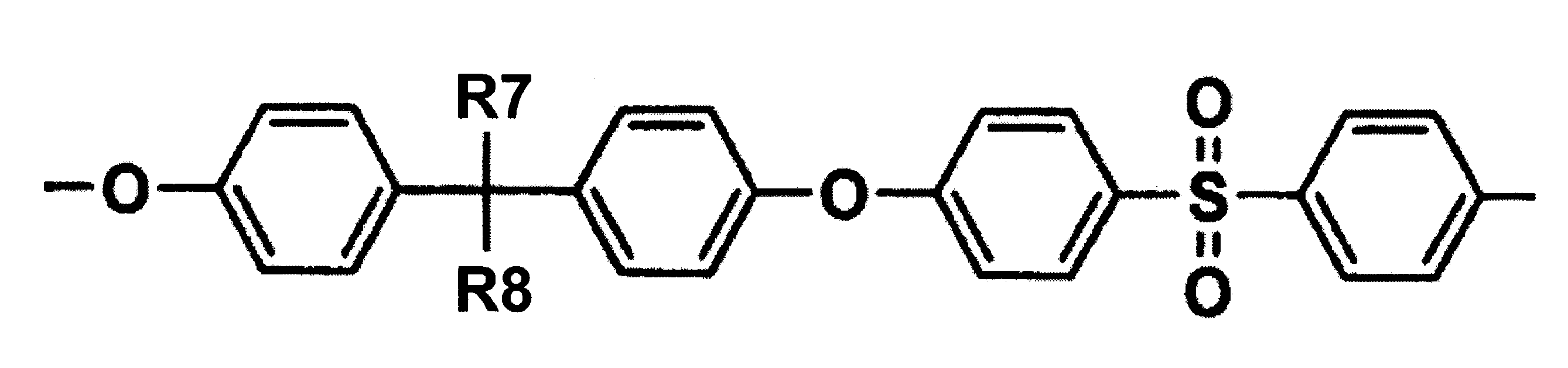
本発明に用いられるポリエーテルスルホン樹脂とは、下記化4で例示するような、芳香族環が1つのスルホニル基と、1つまたは2つのエーテル基とで結合された構造単位を有する、重合体あるいは共重合体である。
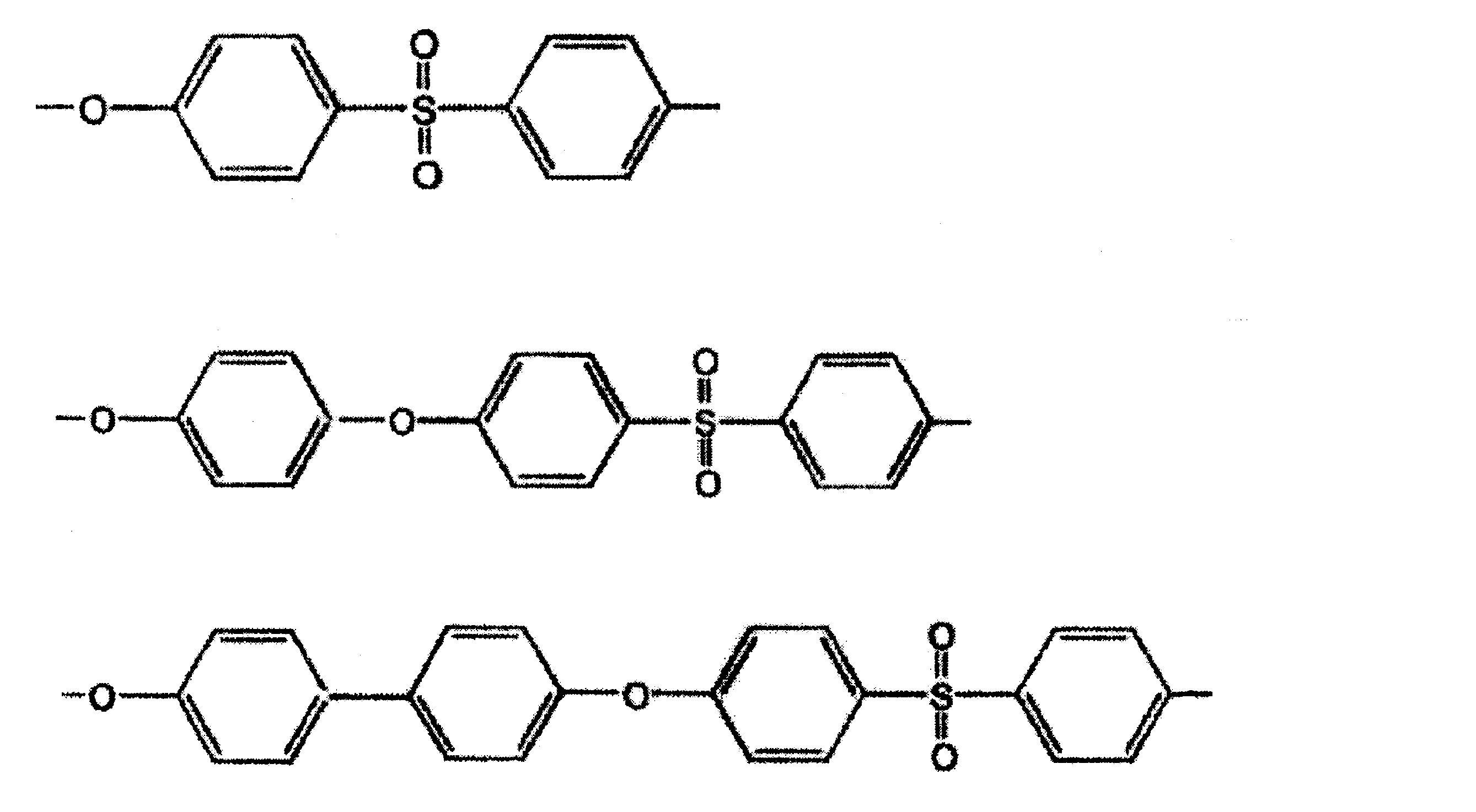
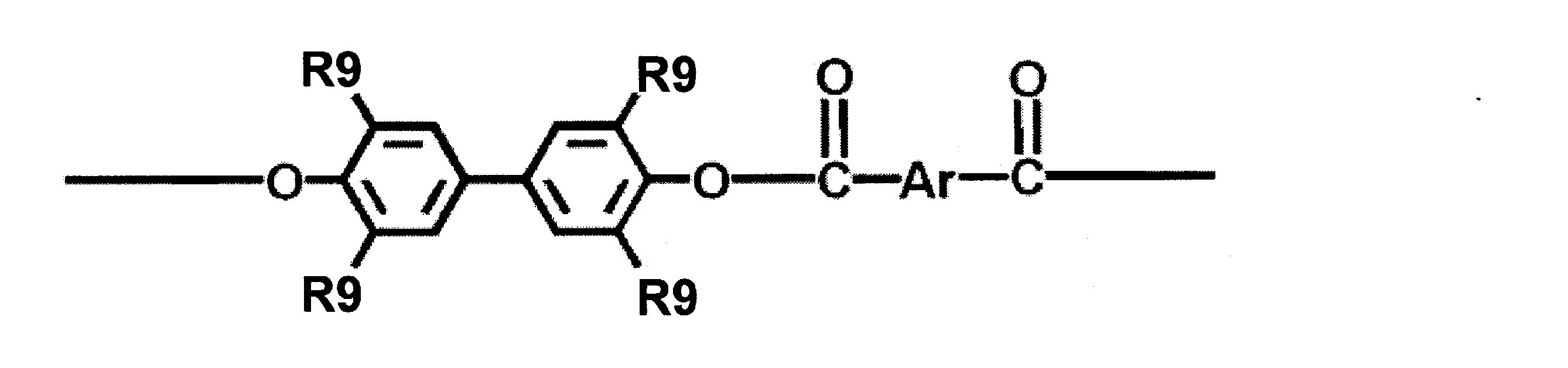
好ましい芳香族ジカルボン酸成分として、テレフタル酸、イソフタル酸、ナフタレンジカルボン酸が挙げられる。またこれらの混合物であってもよい。
MC≦-0.14MB+30.5 ・・・(X)
MC≦-0.34MB+31 ・・・(Y)
本発明の積層シートにおいて、P1層に成分(C)としてポリオレフィン樹脂を含む場合、樹脂(B)の含有量MBと成分(C)の含有量MCが式(X)を満たさない場合、樹脂(B)による耐紫外線性(伸度劣化の抑制性)の向上効果が不十分になることや、連続相を形成する樹脂(A)の割合が小さくなり、シートの難燃性や機械的強度が低下する場合がある。本発明の積層シートにおいて、P1層に成分(C)としてポリオレフィン樹脂を含む場合、樹脂(B)の含有量MBと成分(C)の含有量MCが式(X)を満たす関係とすることで、本発明の積層シートの電気絶縁性の向上効果に加えて、耐紫外線性(伸度劣化の抑制性)や難燃性、機械的強度を両立させることができる。
尚、本発明の積層シートの前記P2層が前記P1層の片側にのみ設けられている場合、紫外線照射は前記P2層が設けられている側の面に行う。
本発明の積層シートにおいて、温度150℃の雰囲気下で30分放置した後の熱収縮率の絶対値が1.2%を超えると、本発明の積層シートを例えば太陽電池バックシートのような、高温環境下に長期間曝されるような用途で使用した場合、熱によるシートの寸法変化が進行し、例えば太陽電池バックシートと封止材との接着部分で剥離が起こる場合がある。本発明の積層シートにおいて、温度150℃雰囲気下で30分放置した後のシート長手及び幅方向の熱収縮率の絶対値を1.2%以下とすることで、例えば太陽電池バックシートのような、高温環境下に長期間曝されるような用途で好適に使用することができる。
40≦Tp-TmA≦50 ・・・(II)
50≦Tp-TgB≦60 ・・・(III)
前記の方法によってダイから吐出した積層シートを、キャスティングドラム等の冷却体上に押出、冷却固化することにより、本発明の積層シートを得ることができる。この際、ワイヤー状、テープ状、針状あるいはナイフ状等の電極を用いて、静電気力によりキャスティングドラム等の冷却体に密着させ、急冷固化させることが好ましい。
(1)ガラス転移点温度TgA(TgB)、融点TmA(TmB)、結晶化温度TccA
JIS K7122(1987)に準じて、セイコー電子工業(株)製示差走査熱量測定装置”ロボットDSC-RDC220”を、データ解析にはディスクセッション”SSC/5200”を用い、樹脂(A1)及び樹脂(B)のガラス転移点温度TgA(TgB)、融点TmA(TmB)、結晶化温度TccAを測定した。測定は、樹脂(A1)あるいは樹脂(B)をサンプルパンに5mg秤量し、20℃/分の昇温速度で樹脂を25℃から350℃まで加熱(1stRUN)し、その状態で5分間保持し、次いで25℃以下まで急冷し、再度25℃から20℃/分の昇温速度で350℃まで加熱(2ndRUN)を行い得られた示差走査熱量測定チャートの2ndRunのガラス転移点における変曲点での接線とベースラインの交点の温度をガラス転移点温度TgA(TgB)、結晶化ピークにおけるピークトップの温度を結晶化温度TccA、結晶融解ピークにおけるピークトップの温度を融点TmA(TmB)とした。
試料を必要に応じて染色した後、ミクロトームを用いて、シート断面を厚み方向に潰すことなく、薄膜切片状の観察サンプルを作製した。次に、得られた断面薄膜切片を、電界放射走査型電子顕微鏡(SEM)(日本電子(株)電界放射走査型電子顕微鏡“JSM-6700F”)を用いて拡大観察を行った。
菊水電子(株)製部分放電電圧試験装置“KPD2050”を用いて、下記の条件で50mm×50mmの大きさに切り出した、シートの部分放電電圧試験をn=5で行った。尚、前記試験で求められた消滅電圧(V)を部分放電電圧(V)とした。
最大電圧:1.6KV
周波数:50Hz
試験時間:22.0s
テストパターン:Ramp(昇圧10.0s、最大電圧保持2.0s、降圧10.0s)
パルス検出方法・レベル:+50%
消滅電圧測定電荷:50pC
得られた部分放電電圧について以下のように判定を行った。
部分放電電圧が900V以上の場合:S
部分放電電圧が850V以上900V未満の場合:A
部分放電電圧が800V以上850V未満の場合:B
部分放電電圧が750V以上800V未満の場合:C
部分放電電圧が700V以上750V未満の場合:D
部分放電電圧が700V未満の場合:E
電気絶縁性はS~Dが良好であり、その中でSが最も優れている。
(4-1)紫外線照射前の破断伸度
ASTM-D882(1999)に基づいて、シートを1cm×20cmの大きさに切り出し、チャック間1cm、引っ張り速度300mm/minにて引っ張ったときの破断伸度を測定した。なお、サンプル数はn=5とし、また、フィルムの縦方向、横方向のそれぞれについて測定した後、それらの平均値として求めた。
(4-2)紫外線照射後の破断伸度
シートを岩崎電気(株)製アイスーパー紫外線テスターS-W131にて、温度60℃、相対湿度60%、照度100mW/cm2(光源:メタルハライドランプ、波長範囲:295~450nm、ピーク波長:365nm)の条件下で96時間照射し、その後前記(4)項に従って破断伸度を測定した。なお、測定はn=5とし、フィルムの縦方向、横方向のそれぞれについて測定した後、その平均値を紫外線照射後の破断伸度とした。
(4-3)耐紫外線性(伸度劣化の抑制性)の判定
得られた結果について以下のように判定を行った。
紫外線照射後の破断伸度が照射前の150%以上の場合:A
紫外線照射後の破断伸度が照射前の100%以上150%未満の場合:B
紫外線照射後の破断伸度が照射前の50%以上100%未満の場合:C
紫外線照射後の破断伸度が照射前の10%以上50%未満の場合:D
紫外線照射後の破断伸度が照射前の10%未満の場合:E
耐紫外線性(伸度劣化の抑制性)はA~Dが良好であり、その中で最もAが優れている。
(5-1)紫外線照射前の色調(b値)
JIS-Z-8722(2000)に基づき、分光式色差計(日本電色工業製SE-2000、光源 ハロゲンランプ 12V4A、0°~-45°後分光方式)を用いて反射法によりシートの色調(b値)をn=3で測定した。
(5-2)紫外線照射後の色調変化(Δb)
シートを岩崎電気(株)製アイスーパー紫外線テスターS-W131にて、温度60℃、相対湿度60%、照度100mW/cm2(光源:メタルハライドランプ、波長範囲:295~450nm、ピーク波長:365nm)の条件下で96時間照射した前後の色調(b値)を前記(5-1)項に従い測定し、次の(α)式より紫外線照射後の色調変化(Δb)を算出した。
紫外線照射後の色調変化(Δb)=b1-b0 (α)式
b0:紫外線照射前の色調(b値)
b1:紫外線照射後の色調(b値)
(5-3)耐紫外線性(色調変化の抑制性)の判定
得られた紫外線照射後の色調変化(Δb)について、以下のように判定を行った。
紫外線照射後の色調変化(Δb)が0.5未満の場合:A
紫外線照射後の色調変化(Δb)が0.5以上1未満の場合:B
紫外線照射後の色調変化(Δb)が1以上5未満の場合:C
紫外線照射後の色調変化(Δb)が5以上の場合:E
耐紫外線性(色調変化の抑制性)はA~Cが良好であり、その中で最もAが優れている。
JIS-C2318(1966)に規定された方法に従って、幅10mm、標線間隙約100mmに切り出したシートを、温度150℃、荷重0.5gで30分間熱処理した。その熱処理前後の標線間隙をn=3で測定し、次の(β)式より熱収縮率の絶対値を算出した。
熱収縮率の絶対値(%)=|(L0―L1)/L0×100| (β)式
L0:加熱処理前の標線間隙
L1:加熱処理後の標線間隙
得られた熱収縮率について、長手方向、幅方向の平均値を算出し以下のように判定を行った。
熱収縮率の絶対値が0.5%未満の場合:A
熱収縮率の絶対値が0.5%以上0.8%未満の場合:B
熱収縮率の絶対値が0.8%以上1.0%未満の場合:C
熱収縮率の絶対値が1.0%以上1.5%未満の場合:D
熱収縮率の絶対値1.5%以上の場合:E
熱寸法安定性はA~Dが良好であり、その中でもAが最も優れている。
UL94HB試験に基づいて、シートを0.5インチ×6インチ(12.7mm×152.4mm)の大きさに切り出し、水平に保持して燃焼試験をn=3で行った時の4インチ(101.6mm)の標線間での燃焼速度で以下のように判定を行った。
燃焼速度が75mm/分未満の場合:A
燃焼速度が75mm/分以上100mm/分未満の場合:B
燃焼速度が100mm/分以上150mm/分未満の場合:C
燃焼速度が150mm/分以上200mm/分未満の場合:D
燃焼速度が200mm/分以上の場合:E
難燃性はA~Dが良好であり、その中でAが最も優れている。
分光光度計U-3410(日立製作所(株)製)を用いて、波長450~700nmの範囲の分光反射率を10nm間隔で測定し、その平均値を平均分光反射率とした。サンプル数はn=5とし、それぞれの平均分光反射率を測定して、その平均値を算出した。測定ユニットはφ60mmの積分球(型番130-0632)を使用し、10°傾斜スペーサーを取り付けた。また、標準白色板には酸化アルミニウム(型番210-0740)を使用した。
平均分光反射率が90%以上の場合:A
平均分光反射率が80%以上90%未満の場合:B
平均分光反射率が80%未満の場合:E
反射性はA、Bが良好であり、その中でもAが最も優れている。
樹脂(A1)としてナイロン6樹脂“アミラン”(登録商標)CM1041-LO(東レ(株)製、TmA225℃)、樹脂(B)としてポリフェニレンエーテル樹脂“ノリル”(登録商標)PPO640(SABICイノベーティブプラスチック製、TgB215℃)を用いて、前記樹脂(A1)100質量部と前記樹脂(B)100質量部を減圧した280℃のベント式二軸押出機内で溶融混練し、溶融押出してストランド状に吐出し、温度25℃の水で冷却した後、直ちにカッティングして混合原料A(ナイロン6/ポリフェニレンエーテル=50/50(質量比))を作製した。
得られた積層シートについて、電界放射走査型電子顕微鏡(SEM)による断面観察を行った結果、樹脂(A1)が連続相である相分離構造を有することがわかった。
P2層の主たる成分の樹脂(A2)としてナイロン610樹脂“アミラン”(登録商標)CM2021(東レ(株)製、TmA220℃)を用いたこと以外は実施例1と同様に積層シートを得た。
得られた積層シートについて、実施例1と同様に断面観察を行った結果、樹脂(A1)が連続相である相分離構造を有することがわかった。
P1層形成用組成物として、実施例1で用いた混合原料Aを樹脂(A1)と樹脂(B)の質量比WA1:WBが表1の通りとなるように、樹脂(A1)で希釈して用いた以外は、実施例1と同様に積層シートを得た。
樹脂(A1)100質量部と樹脂(B)122質量部を減圧した280℃のベント式二軸押出機内で溶融混練し、溶融押出してストランド状に吐出し、温度25℃の水で冷却した後、直ちにカッティングして混合原料B(N6/ポリフェニレンエーテル樹脂=45/55(質量比))を作製した以外は、実施例1と同様に積層シートを得た。
表1の通り、押出機1の温度(℃)を変更した以外は実施例1と同様に積層シートを得た。
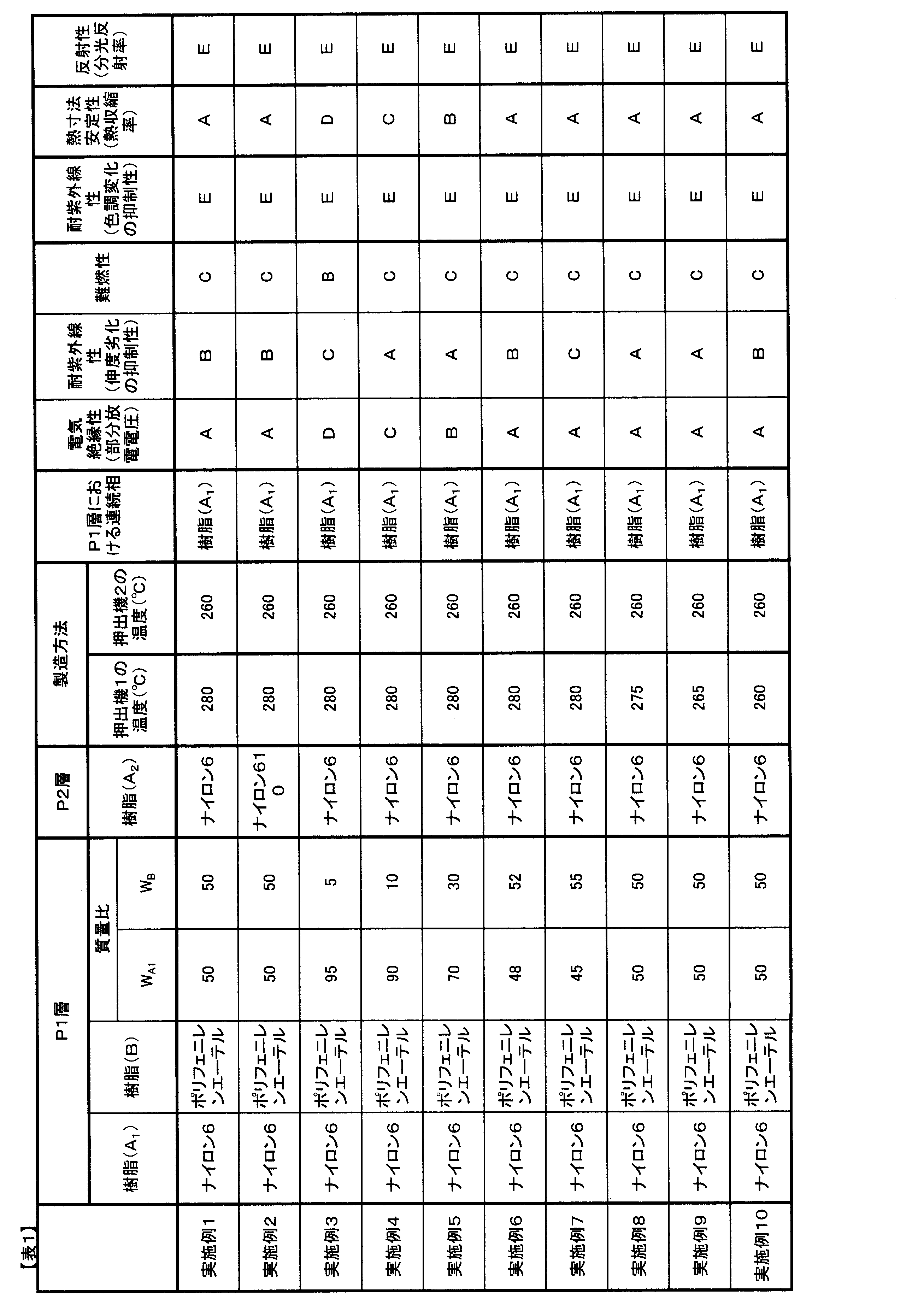
P1層に成分(C)として、ポリプロピレン樹脂“プライムポリプロ”(登録商標)F-300SP((株)プライムポリマー製)をP1層の総質量に対して5質量%含む樹脂層とした以外は実施例1と同様に積層シートを得た。尚、P1層に含まれる樹脂(B)の含有量MBと成分(C)の含有量MCは下記式(X)を満たす関係である。
MC≦-0.14MB+30.5 ・・・(X)
得られた積層シートについて、実施例1と同様に断面観察を行った結果、樹脂(A1)が連続相である相分離構造を有することがわかった。
P1層に含まれる成分(C)の含有量を表1の通りとなるように調整した以外は、実施例11と同様に積層シートを得た。尚、実施例12、13については、P1層に含まれる樹脂(B)の含有量MBと成分(C)の含有量MCは下記式(X)を満たす関係である。
MC≦-0.14MB+30.5 ・・・(X)
得られた積層シートについて、実施例1と同様に断面観察を行った結果、樹脂(A1)が連続相である相分離構造を有することがわかった。
P1層に用いた樹脂(A1)樹脂100質量部と、平均粒子径200nmのルチル型二酸化チタン粒子43質量部を、減圧した260℃のベント式二軸押出機内で溶融混練し、酸化チタン原料(MB-TiO2(30質量%))を作製し、P2層形成用樹脂組成物として該酸化チタン原料(MB-TiO2(30質量%))100質量部と前記樹脂(A1)114質量部を用いて、表2の通り、P2層に二酸化チタン粒子をP2層の総質量に対して14質量%含む樹脂層とした以外は実施例1と同様に積層シートを得た。
P2層/P1層/P2層の厚み比を1/12/1とした以外は実施例15と同様に積層シート得た。
積層構成をP1層/P2層とした以外は実施例15と同様に積層シートを得た。
P2層に含まれる二酸化チタン粒子濃度をP2層に対して4質量%とした以外は実施例15と同様に積層シートを得た。
P2層に含まれる粒子として硫酸バリウム粒子を用いた以外は実施例15と同様に積層シートを得た。
P1層に用いた樹脂(A1)樹脂100質量部と、カーボンブラック粒子25質量部を、減圧した260℃のベント式二軸押出機内で溶融混練し、カーボンブラック原料(MB-CB(20質量%))を作製し、P2層形成用樹脂組成物として該カーボンブラック原料(MB-CB(20質量%))100質量部と前記樹脂(A1)900質量部を用いて、表2の通り、P2層にカーボンブラック粒子をP2層の総質量に対して2質量%含む樹脂層とした以外は実施例15と同様に積層シートを得た。
表2の通り、実施例11と同様にP1層に成分(C)として、ポリプロピレン樹脂をP1層の総質量に対して15質量%含む樹脂層とし、押出機1の温度を270℃に変更した以外は、実施例15と同様に積層シートを得た。尚、P1層に含まれる樹脂(B)の含有量MBと成分(C)の含有量MCは下記式(X)を満たす関係である。
MC≦-0.14MB+30.5 ・・・(X)
得られた積層シートについて、実施例1と同様に断面観察を行った結果、樹脂(A1)が連続相である相分離構造を有することがわかった。
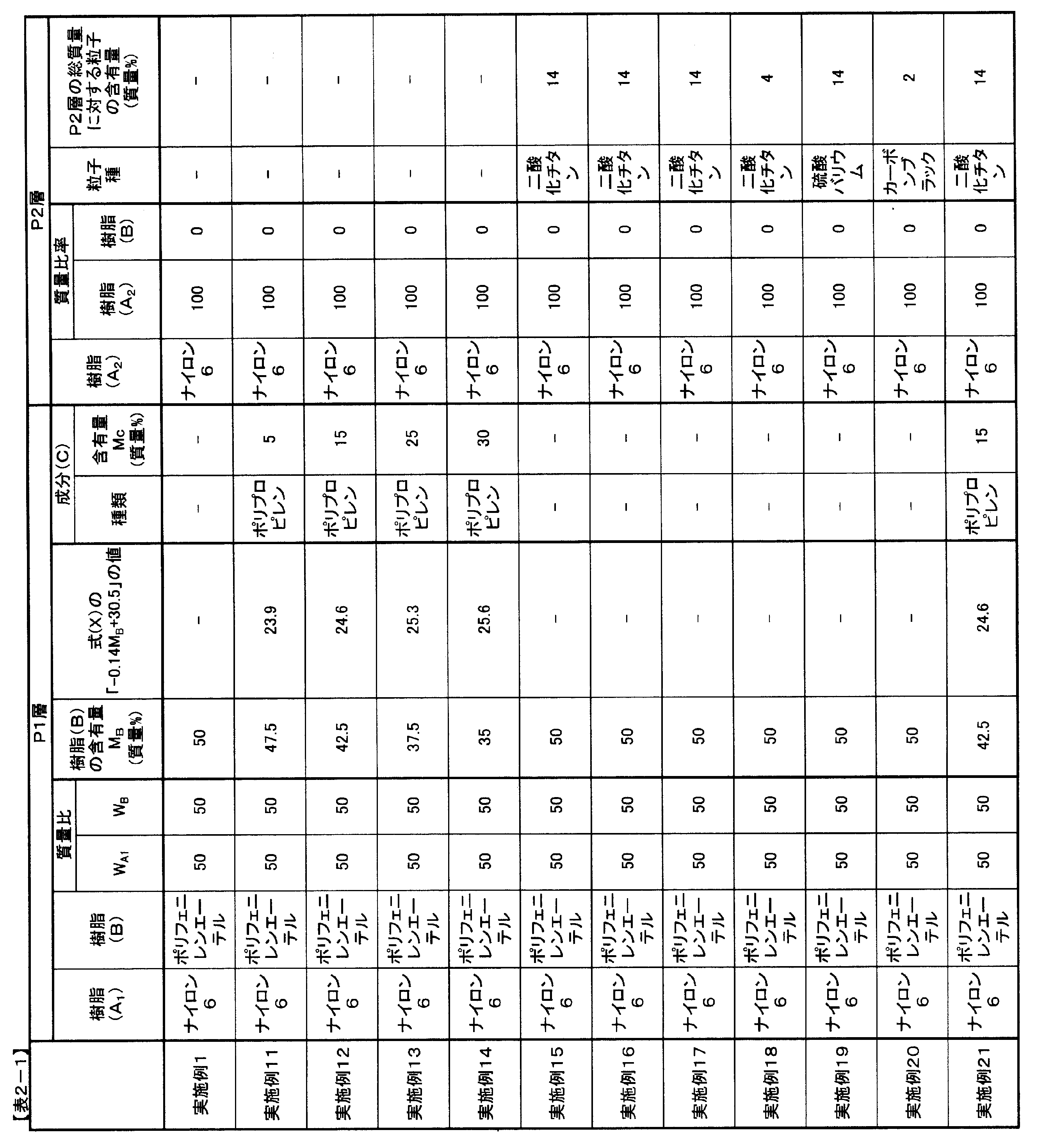

表3の通り、樹脂(A1)としてナイロン66樹脂“アミラン”(登録商標)CM3001(東レ(株)製、TmA255℃)を用い、P1層形成用組成物を300℃の押出機1で、P2層形成用樹脂組成物として前記樹脂(A1)を280℃の押出機2でそれぞれ溶融混練して製造した以外は、実施例1と同様に積層シートを得た。
表3の通り、樹脂(A1)としてナイロン610樹脂“アミラン”(登録商標)CM2021(東レ(株)製、TmA220℃)を用い、P1層形成用組成物を270℃の押出機1で、P2層形成用樹脂組成物として前記樹脂(A1)を260℃の押出機2でそれぞれ溶融混練した以外は、実施例1と同様に積層シートを得た。
樹脂(A1)としてナイロン11樹脂“リルサン”(登録商標)PA11(アルケマ製、TmA187℃)、樹脂(B)として変性ポリフェニレンエーテル樹脂“ノリル”(登録商標)PPO SA120(SABICイノベーティブプラスチック製、TgB165℃)を用いて、前記樹脂(A1)100質量部と前記樹脂(B)100質量部を減圧した235℃のベント式二軸押出機内で溶融混練し、溶融押出してストランド状に吐出し、温度25℃の水で冷却した後、直ちにカッティングして混合原料C(ナイロン11/変性ポリフェニレンエーテル=50/50(質量比))を作製した。
P1層形成用組成物として、実施例24で用いた混合原料Cを樹脂(A1)と樹脂(B)の質量比が表3の通りとなるように、樹脂(A1)で希釈して用いた以外は、実施例19と同様に積層シートを得た。
樹脂(A1)としてナイロン12樹脂“UBESTA”(登録商標)3030XA(宇部興産(株)製、TmA176℃)を用い、P1層形成用組成物を230℃の押出機1で、P2層形成用樹脂組成物として前記樹脂(A1)を220℃の押出機2でそれぞれ溶融混練した以外は、実施例1と同様に積層シートを得た。
樹脂(B)として変性ポリフェニレンエーテル樹脂“ノリル”(登録商標)PPO SA120(SABICイノベーティブプラスチック製、TgB165℃)を用いた以外は、実施例1と同様に積層シートを得た。
樹脂(B)としてポリエーテルイミド樹脂“ウルテム”(登録商標)1000(SABICイノベーティブプラスチック製、TgB217℃)を用いた以外は、実施例1と同様に積層シートを得た。
樹脂(B)としてポリアリレート樹脂“Uポリマー”(登録商標)U-100(ユニチカ(株)製、TgB193℃)を用いた以外は、実施例1と同様に積層シートを得た。
樹脂(B)としてポリスルホン樹脂“ユーデル”(登録商標)P1700(ソルベイアドバンストポリマーズ製、TgB185℃)を用いた以外は、実施例1と同様に積層シートを得た。
樹脂(B)としてポリエーテルスルホン樹脂“レーデルA”(登録商標)A300(ソルベイアドバンストポリマーズ製、TgB220℃)を用いた以外は、実施例1と同様に積層シートを得た。
P2層形成用樹脂組成物として実施例1で作製した混合原料A(ナイロン6/ポリフェニレンエーテル=50/50(質量比))2質量部と同様に実施例1で用いた樹脂(A1)100質量部を用いて、表3の通り、P2層に含まれる樹脂(A2)と樹脂(B)の質量比を98:2とした以外は実施例7と同様に積層シートを得た。
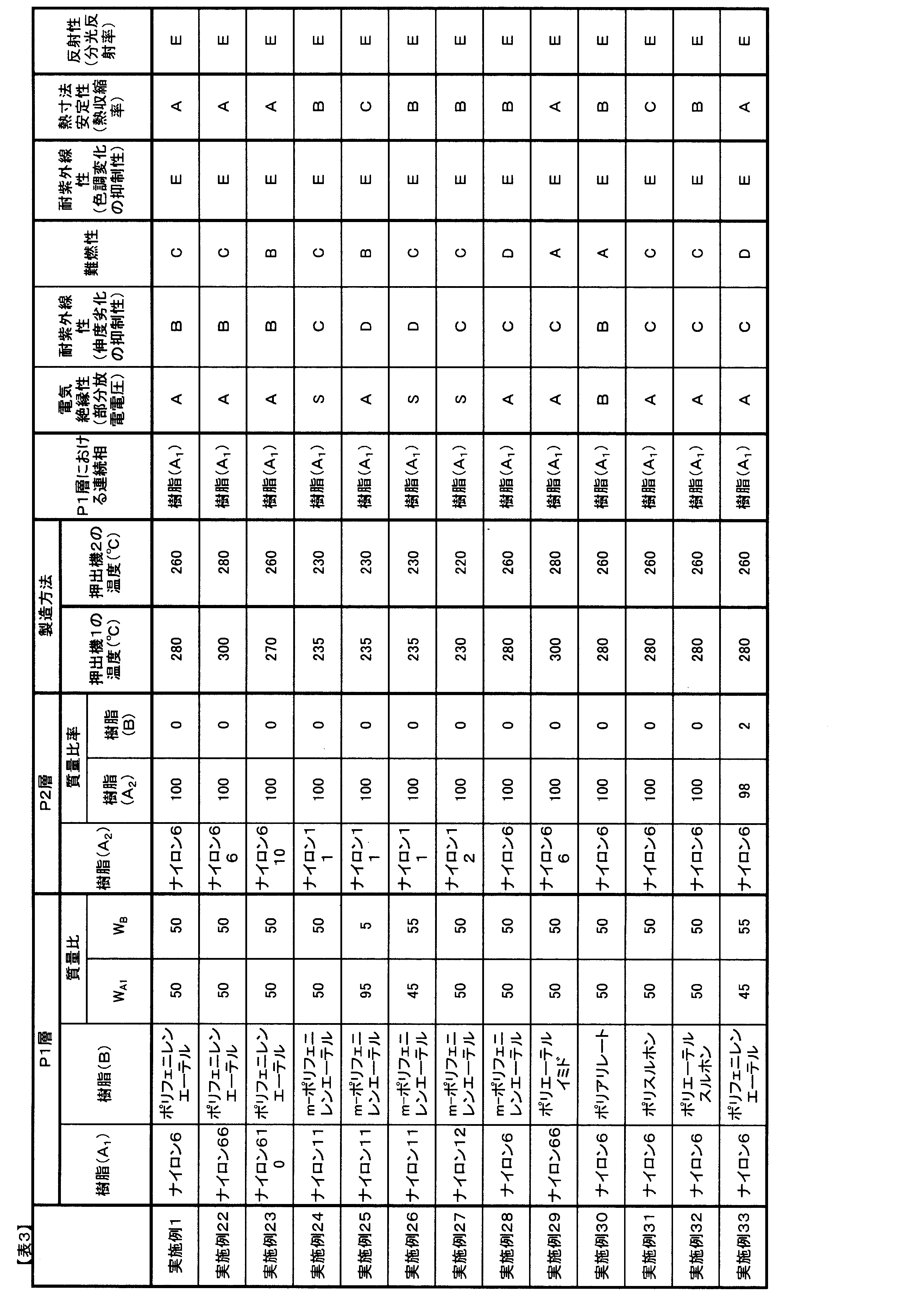
P2層が設けられていないこと以外は、実施例3と同様にシートを得た。
P2層が設けられていないこと以外は、実施例1と同様にシートを得た。
P2層が設けられていないこと以外は、実施例7と同様にシートを得た。
P1層形成用組成物として、実施例1で用いた混合原料Aを樹脂(A1)と樹脂(B)の質量比が96:4となるように、樹脂(A1)で希釈して用いた以外は、実施例1と同様に積層シートを得た。
樹脂(A1)100質量部と樹脂(B)127質量部を減圧した280℃のベント式二軸押出機内で溶融混練し、溶融押出してストランド状に吐出し、温度25℃の水で冷却した後、直ちにカッティングして混合原料D(N6/ポリフェニレンエーテル樹脂=44/56(質量比))を作製した以外は、実施例1と同様に積層シートを得た。
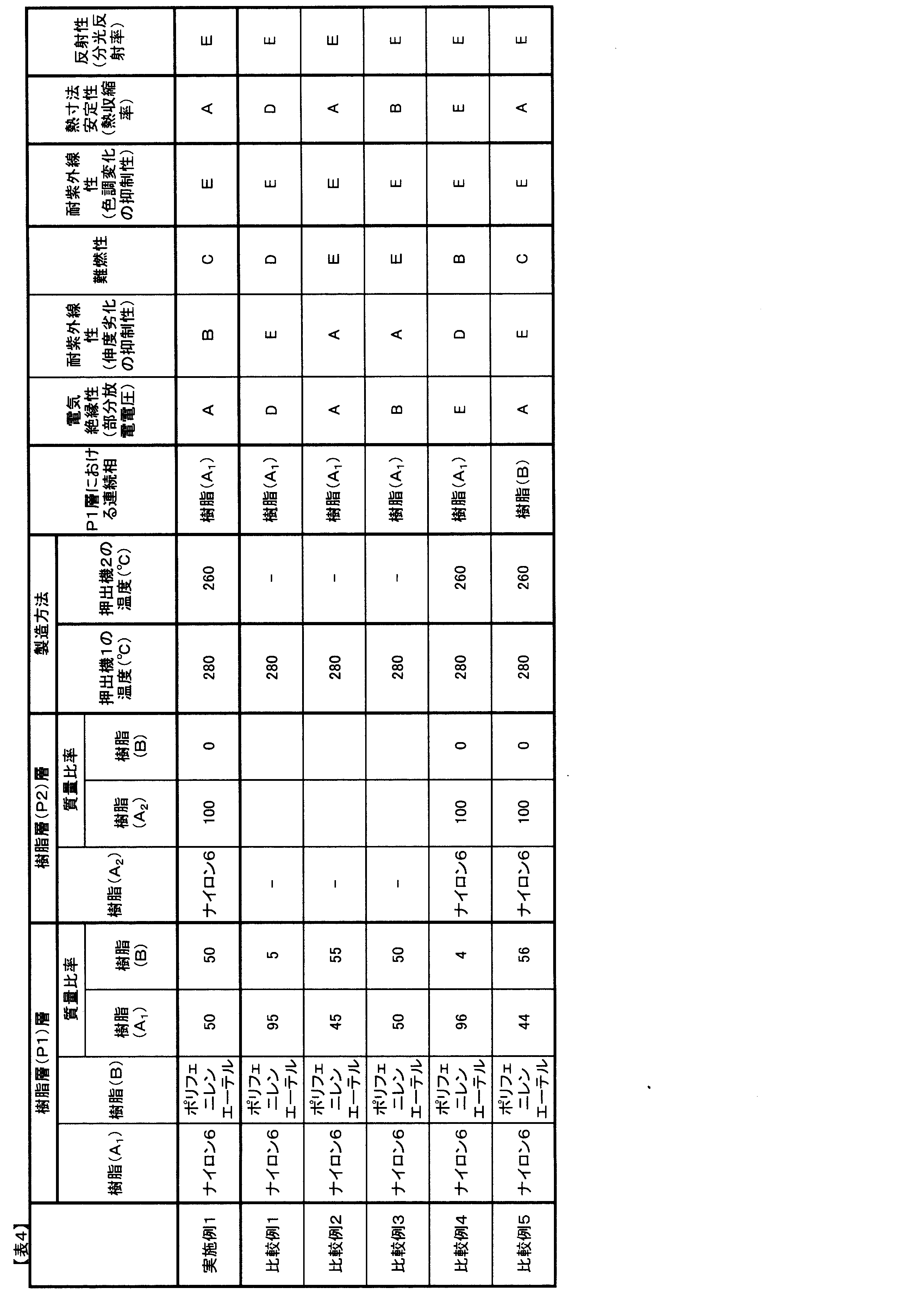
Claims (8)
- 結晶性ポリアミド樹脂である樹脂(A1)とポリフェニレンエーテル樹脂、ポリエーテルイミド樹脂、ポリスルホン樹脂、ポリエーテルスルホン樹脂およびポリアリレート樹脂からなる群より選ばれる少なくとも1種類からなる樹脂(B)とを、樹脂(A1)と樹脂(B)との質量比WA1:WBを95:5~45:55の範囲で含み、かつ、樹脂(A1)が連続相である相分離構造を有するP1層と、結晶性ポリアミド樹脂である樹脂(A2)を樹脂中に98質量%以上100質量%以下の範囲で含むP2層とが積層されてなることを特徴とする積層シート。
- 前記P1層において樹脂(B)が分散相である請求項1に記載の積層シート。
- 前記P1層に成分(C)としてポリオレフィン樹脂をP1層の総質量に対して5質量%以上30質量%以下含む請求項1または2のいずれかに記載の積層シート。
- 前記P1層に含まれる樹脂(B)の含有量をMB質量%、成分(C)の含有量をMC質量%としたとき、MBおよびMCの関係が下記式(X)を満たす請求項3に記載の積層シート。
MC≦-0.14MB+30.5 ・・・(X) - 前記P2層に含まれる樹脂(A2)が樹脂(A1)と同一である請求項1~4いずれかに記載の積層シート。
- 前記P2層が粒子を含有する請求項1~5いずれかに記載の積層シート。
- 結晶性ポリアミド樹脂である樹脂(A1)と、ポリフェニレンエーテル樹脂、ポリエーテルイミド樹脂、ポリスルホン樹脂、ポリエーテルスルホン樹脂およびポリアリレート樹脂からなる群より選ばれる少なくとも1種類からなる樹脂(B)とを質量比95:5~45:55の範囲で含む樹脂混合物を溶融混練したP1層形成用組成物と、結晶性ポリアミド樹脂である樹脂(A2)を樹脂中に98質量%以上100質量%以下の範囲で含む樹脂混合物を溶融混練したP2層形成用組成物とを溶融共押出して成形することを特徴とする請求項1~6のいずれかに記載の積層シートを製造する製造方法。
- 前記樹脂(A1)の融点をTmA(℃)、前記樹脂(B)のガラス転移点温度をTgB(℃)としたとき、TmAとTgBの関係が下記式(1)の関係を満たす樹脂(A1)と樹脂(B)を用い、下記式(2)(3)の関係を満たす押出温度Tp(℃)で前記P1層形成用組成物を溶融押出して成形することを特徴とする請求項7に記載の積層シートを製造する製造方法。
0≦TmA-TgB≦20 ・・・(1)
40≦Tp-TmA≦50 ・・・(2)
50≦Tp-TgB≦60 ・・・(3)
Priority Applications (3)
| Application Number | Priority Date | Filing Date | Title |
|---|---|---|---|
| KR1020137006277A KR20140001835A (ko) | 2010-12-13 | 2011-12-08 | 적층 시트 및 그 제조 방법 |
| CN2011800598575A CN103249563A (zh) | 2010-12-13 | 2011-12-08 | 层叠片及其制造方法 |
| JP2012504941A JP5904118B2 (ja) | 2010-12-13 | 2011-12-08 | 積層シート及びその製造方法 |
Applications Claiming Priority (2)
| Application Number | Priority Date | Filing Date | Title |
|---|---|---|---|
| JP2010-276743 | 2010-12-13 | ||
| JP2010276743 | 2010-12-13 |
Publications (1)
| Publication Number | Publication Date |
|---|---|
| WO2012081495A1 true WO2012081495A1 (ja) | 2012-06-21 |
Family
ID=46244600
Family Applications (1)
| Application Number | Title | Priority Date | Filing Date |
|---|---|---|---|
| PCT/JP2011/078430 Ceased WO2012081495A1 (ja) | 2010-12-13 | 2011-12-08 | 積層シート及びその製造方法 |
Country Status (5)
| Country | Link |
|---|---|
| JP (1) | JP5904118B2 (ja) |
| KR (1) | KR20140001835A (ja) |
| CN (1) | CN103249563A (ja) |
| TW (1) | TW201231278A (ja) |
| WO (1) | WO2012081495A1 (ja) |
Cited By (2)
| Publication number | Priority date | Publication date | Assignee | Title |
|---|---|---|---|---|
| JP2015537105A (ja) * | 2012-12-05 | 2015-12-24 | サビック グローバル テクノロジーズ ベスローテン フェンノートシャップ | ポリアミド組成物、方法、及び物品 |
| JP2016003270A (ja) * | 2014-06-16 | 2016-01-12 | 東京応化工業株式会社 | 接着剤組成物及びその利用 |
Families Citing this family (3)
| Publication number | Priority date | Publication date | Assignee | Title |
|---|---|---|---|---|
| CN103304988B (zh) * | 2013-06-24 | 2015-08-19 | 苏州新区佳合塑胶有限公司 | 一种含有聚芳砜的抗冲击耐高温塑胶 |
| TW201821534A (zh) * | 2016-07-29 | 2018-06-16 | 巴斯夫歐洲公司 | 用於雷射燒結粉末之包含聚芳醚的聚醯胺摻合物 |
| US20210130653A1 (en) * | 2017-04-03 | 2021-05-06 | Denka Company Limited | Multilayer film and heat-resistant adhesive tape |
Citations (3)
| Publication number | Priority date | Publication date | Assignee | Title |
|---|---|---|---|---|
| JPH08132553A (ja) * | 1994-09-13 | 1996-05-28 | Gunze Ltd | 積層体 |
| JPH0959511A (ja) * | 1995-08-18 | 1997-03-04 | Tokai Rubber Ind Ltd | 熱伝導性樹脂組成物 |
| JP2001302918A (ja) * | 1999-10-12 | 2001-10-31 | Toray Ind Inc | 樹脂構造体およびその用途 |
Family Cites Families (5)
| Publication number | Priority date | Publication date | Assignee | Title |
|---|---|---|---|---|
| JPH0764914B2 (ja) * | 1992-03-26 | 1995-07-12 | 旭化成工業株式会社 | 新規な硬化性ポリフェニレンエーテル・エポキシ樹脂組成物 |
| DE69518481T2 (de) * | 1994-09-13 | 2001-04-19 | Gunze Ltd., Ayabe | Gasundurchlässiger Schichtstoff aus Gummi und Kunststoff |
| FR2724939B1 (fr) * | 1994-09-28 | 1996-12-13 | Atochem Elf Sa | Compositions thermoplastiques ignifugees a base de polyamide et leur application au revetement de cables electriques |
| JP5228568B2 (ja) * | 2008-03-27 | 2013-07-03 | 東レ株式会社 | 熱可塑性樹脂組成物およびその製造方法 |
| JP5199838B2 (ja) * | 2008-11-10 | 2013-05-15 | 三菱樹脂株式会社 | 二軸延伸ポリアミド積層フィルム及びその製造方法 |
-
2011
- 2011-12-08 KR KR1020137006277A patent/KR20140001835A/ko not_active Withdrawn
- 2011-12-08 CN CN2011800598575A patent/CN103249563A/zh active Pending
- 2011-12-08 JP JP2012504941A patent/JP5904118B2/ja active Active
- 2011-12-08 WO PCT/JP2011/078430 patent/WO2012081495A1/ja not_active Ceased
- 2011-12-12 TW TW100145738A patent/TW201231278A/zh unknown
Patent Citations (3)
| Publication number | Priority date | Publication date | Assignee | Title |
|---|---|---|---|---|
| JPH08132553A (ja) * | 1994-09-13 | 1996-05-28 | Gunze Ltd | 積層体 |
| JPH0959511A (ja) * | 1995-08-18 | 1997-03-04 | Tokai Rubber Ind Ltd | 熱伝導性樹脂組成物 |
| JP2001302918A (ja) * | 1999-10-12 | 2001-10-31 | Toray Ind Inc | 樹脂構造体およびその用途 |
Cited By (2)
| Publication number | Priority date | Publication date | Assignee | Title |
|---|---|---|---|---|
| JP2015537105A (ja) * | 2012-12-05 | 2015-12-24 | サビック グローバル テクノロジーズ ベスローテン フェンノートシャップ | ポリアミド組成物、方法、及び物品 |
| JP2016003270A (ja) * | 2014-06-16 | 2016-01-12 | 東京応化工業株式会社 | 接着剤組成物及びその利用 |
Also Published As
| Publication number | Publication date |
|---|---|
| KR20140001835A (ko) | 2014-01-07 |
| JP5904118B2 (ja) | 2016-04-13 |
| TW201231278A (en) | 2012-08-01 |
| JPWO2012081495A1 (ja) | 2014-05-22 |
| CN103249563A (zh) | 2013-08-14 |
Similar Documents
| Publication | Publication Date | Title |
|---|---|---|
| KR101393837B1 (ko) | 태양 전지 이면 보호막용 적층 폴리에스테르 필름 | |
| CN102449040B (zh) | 聚酯膜、层合膜及使用其的太阳能电池背板、太阳能电池 | |
| JP5904118B2 (ja) | 積層シート及びその製造方法 | |
| CN101056920B (zh) | 双轴取向聚亚芳基硫醚薄膜以及含有该薄膜的层合聚亚芳基硫醚片材 | |
| JP7188617B2 (ja) | 二軸延伸積層フィルム、積層体およびそれらの製造方法 | |
| TWI602862B (zh) | Release film | |
| CN107073916A (zh) | 双轴取向聚酯膜 | |
| US10699827B2 (en) | Film, and electrical insulation sheet, adhesive tape, rotating machine using same | |
| JP2008280508A (ja) | 二軸配向ポリアリーレンスルフィドフィルム、金属化フィルムおよびコンデンサー | |
| WO2022113964A1 (ja) | フィルム及び積層体 | |
| JP5594005B2 (ja) | 二軸配向ポリアリーレンスルフィドフィルム | |
| JP5423464B2 (ja) | 二軸配向積層フィルム | |
| CN106463558B (zh) | 太阳能电池背板用聚酯膜 | |
| JP2011178908A (ja) | 非ハロゲン難燃剤含有ポリエステルフィルム | |
| JP2014043065A (ja) | 積層シートおよびその製造方法 | |
| JP5151914B2 (ja) | 熱ラミネート積層フィルムおよびその製造方法 | |
| JP2017066391A (ja) | ポリエステルフィルムおよびそれを用いた電気絶縁シート、風力発電機、粘着テープ | |
| JP2008280507A (ja) | 二軸配向ポリアリーレンスルフィドフィルム、金属化フィルムおよびコンデンサー | |
| WO2014021003A1 (ja) | 積層シートおよびその製造方法 | |
| KR20230114928A (ko) | 전자파 차폐 플라스틱 다층 시트, 이의 제조방법 및 이를 포함하는 전자파 차폐 플라스틱 성형품 | |
| JP2019163450A (ja) | フィルム | |
| JP5639798B2 (ja) | 太陽電池モジュール | |
| WO2023145784A1 (ja) | 配線基板及びその製造方法、フィルム、並びに、積層体 | |
| JP2011178907A (ja) | 発泡難燃ポリエステルシート | |
| WO2023145345A1 (ja) | 積層体 |
Legal Events
| Date | Code | Title | Description |
|---|---|---|---|
| WWE | Wipo information: entry into national phase |
Ref document number: 2012504941 Country of ref document: JP |
|
| 121 | Ep: the epo has been informed by wipo that ep was designated in this application |
Ref document number: 11849514 Country of ref document: EP Kind code of ref document: A1 |
|
| ENP | Entry into the national phase |
Ref document number: 20137006277 Country of ref document: KR Kind code of ref document: A |
|
| NENP | Non-entry into the national phase |
Ref country code: DE |
|
| 122 | Ep: pct application non-entry in european phase |
Ref document number: 11849514 Country of ref document: EP Kind code of ref document: A1 |