WO2012043418A1 - 表面処理組成物及びそれを用いた表面処理方法 - Google Patents
表面処理組成物及びそれを用いた表面処理方法 Download PDFInfo
- Publication number
- WO2012043418A1 WO2012043418A1 PCT/JP2011/071741 JP2011071741W WO2012043418A1 WO 2012043418 A1 WO2012043418 A1 WO 2012043418A1 JP 2011071741 W JP2011071741 W JP 2011071741W WO 2012043418 A1 WO2012043418 A1 WO 2012043418A1
- Authority
- WO
- WIPO (PCT)
- Prior art keywords
- surfactant
- surface treatment
- treatment composition
- substrate
- polishing
- Prior art date
- Legal status (The legal status is an assumption and is not a legal conclusion. Google has not performed a legal analysis and makes no representation as to the accuracy of the status listed.)
- Ceased
Links
Classifications
-
- C—CHEMISTRY; METALLURGY
- C11—ANIMAL OR VEGETABLE OILS, FATS, FATTY SUBSTANCES OR WAXES; FATTY ACIDS THEREFROM; DETERGENTS; CANDLES
- C11D—DETERGENT COMPOSITIONS; USE OF SINGLE SUBSTANCES AS DETERGENTS; SOAP OR SOAP-MAKING; RESIN SOAPS; RECOVERY OF GLYCEROL
- C11D1/00—Detergent compositions based essentially on surface-active compounds; Use of these compounds as a detergent
- C11D1/66—Non-ionic compounds
- C11D1/825—Mixtures of compounds all of which are non-ionic
-
- C—CHEMISTRY; METALLURGY
- C09—DYES; PAINTS; POLISHES; NATURAL RESINS; ADHESIVES; COMPOSITIONS NOT OTHERWISE PROVIDED FOR; APPLICATIONS OF MATERIALS NOT OTHERWISE PROVIDED FOR
- C09K—MATERIALS FOR MISCELLANEOUS APPLICATIONS, NOT PROVIDED FOR ELSEWHERE
- C09K13/00—Etching, surface-brightening or pickling compositions
-
- C—CHEMISTRY; METALLURGY
- C09—DYES; PAINTS; POLISHES; NATURAL RESINS; ADHESIVES; COMPOSITIONS NOT OTHERWISE PROVIDED FOR; APPLICATIONS OF MATERIALS NOT OTHERWISE PROVIDED FOR
- C09G—POLISHING COMPOSITIONS; SKI WAXES
- C09G1/00—Polishing compositions
- C09G1/02—Polishing compositions containing abrasives or grinding agents
-
- C—CHEMISTRY; METALLURGY
- C09—DYES; PAINTS; POLISHES; NATURAL RESINS; ADHESIVES; COMPOSITIONS NOT OTHERWISE PROVIDED FOR; APPLICATIONS OF MATERIALS NOT OTHERWISE PROVIDED FOR
- C09G—POLISHING COMPOSITIONS; SKI WAXES
- C09G1/00—Polishing compositions
- C09G1/04—Aqueous dispersions
-
- C—CHEMISTRY; METALLURGY
- C09—DYES; PAINTS; POLISHES; NATURAL RESINS; ADHESIVES; COMPOSITIONS NOT OTHERWISE PROVIDED FOR; APPLICATIONS OF MATERIALS NOT OTHERWISE PROVIDED FOR
- C09K—MATERIALS FOR MISCELLANEOUS APPLICATIONS, NOT PROVIDED FOR ELSEWHERE
- C09K3/00—Materials not provided for elsewhere
- C09K3/14—Anti-slip materials; Abrasives
- C09K3/1454—Abrasive powders, suspensions and pastes for polishing
- C09K3/1463—Aqueous liquid suspensions
-
- H—ELECTRICITY
- H10—SEMICONDUCTOR DEVICES; ELECTRIC SOLID-STATE DEVICES NOT OTHERWISE PROVIDED FOR
- H10P—GENERIC PROCESSES OR APPARATUS FOR THE MANUFACTURE OR TREATMENT OF DEVICES COVERED BY CLASS H10
- H10P70/00—Cleaning of wafers, substrates or parts of devices
- H10P70/10—Cleaning before device manufacture, i.e. Begin-Of-Line process
- H10P70/15—Cleaning before device manufacture, i.e. Begin-Of-Line process by wet cleaning only
-
- H—ELECTRICITY
- H10—SEMICONDUCTOR DEVICES; ELECTRIC SOLID-STATE DEVICES NOT OTHERWISE PROVIDED FOR
- H10P—GENERIC PROCESSES OR APPARATUS FOR THE MANUFACTURE OR TREATMENT OF DEVICES COVERED BY CLASS H10
- H10P90/00—Preparation of wafers not covered by a single main group of this subclass, e.g. wafer reinforcement
- H10P90/12—Preparing bulk and homogeneous wafers
- H10P90/129—Preparing bulk and homogeneous wafers by polishing
-
- C—CHEMISTRY; METALLURGY
- C11—ANIMAL OR VEGETABLE OILS, FATS, FATTY SUBSTANCES OR WAXES; FATTY ACIDS THEREFROM; DETERGENTS; CANDLES
- C11D—DETERGENT COMPOSITIONS; USE OF SINGLE SUBSTANCES AS DETERGENTS; SOAP OR SOAP-MAKING; RESIN SOAPS; RECOVERY OF GLYCEROL
- C11D1/00—Detergent compositions based essentially on surface-active compounds; Use of these compounds as a detergent
- C11D1/66—Non-ionic compounds
- C11D1/72—Ethers of polyoxyalkylene glycols
-
- C—CHEMISTRY; METALLURGY
- C11—ANIMAL OR VEGETABLE OILS, FATS, FATTY SUBSTANCES OR WAXES; FATTY ACIDS THEREFROM; DETERGENTS; CANDLES
- C11D—DETERGENT COMPOSITIONS; USE OF SINGLE SUBSTANCES AS DETERGENTS; SOAP OR SOAP-MAKING; RESIN SOAPS; RECOVERY OF GLYCEROL
- C11D1/00—Detergent compositions based essentially on surface-active compounds; Use of these compounds as a detergent
- C11D1/66—Non-ionic compounds
- C11D1/722—Ethers of polyoxyalkylene glycols having mixed oxyalkylene groups; Polyalkoxylated fatty alcohols or polyalkoxylated alkylaryl alcohols with mixed oxyalkylele groups
-
- C—CHEMISTRY; METALLURGY
- C11—ANIMAL OR VEGETABLE OILS, FATS, FATTY SUBSTANCES OR WAXES; FATTY ACIDS THEREFROM; DETERGENTS; CANDLES
- C11D—DETERGENT COMPOSITIONS; USE OF SINGLE SUBSTANCES AS DETERGENTS; SOAP OR SOAP-MAKING; RESIN SOAPS; RECOVERY OF GLYCEROL
- C11D2111/00—Cleaning compositions characterised by the objects to be cleaned; Cleaning compositions characterised by non-standard cleaning or washing processes
- C11D2111/10—Objects to be cleaned
- C11D2111/14—Hard surfaces
- C11D2111/22—Electronic devices, e.g. PCBs or semiconductors
Definitions
- the present invention relates to a surface treatment composition mainly used in applications for performing surface treatment such as polishing, etching, rinsing and cleaning of a substrate.
- the present invention also relates to a kit for preparing the surface treatment composition, and a method for surface treating a substrate using the surface treatment composition.
- a surface defect inspection device is used for managing defects on the surface of a semiconductor substrate. Defects detected by the surface defect inspection apparatus include foreign matters and residues on the semiconductor substrate that could not be removed by the polishing process, the rinsing process, and the cleaning process.
- a general surface defect inspection apparatus irradiates the surface of a semiconductor substrate with light such as laser light, receives the reflected light as a signal, and analyzes it to detect the presence and size of a defect.
- haze When the surface of the polished semiconductor substrate having a mirror finish is irradiated with strong light, clouding may be observed due to irregular reflection caused by roughness on the surface of the semiconductor substrate.
- This haze is called haze, and haze can be used as a measure of the roughness of the semiconductor substrate surface. If there is haze on the surface of the semiconductor substrate, irregularly reflected light generated by the haze may become noise and hinder the detection of defects by the surface defect inspection apparatus. Therefore, as the size of the defect to be detected, that is, the size of the defect to be managed becomes smaller, the necessity for improving the haze level increases. It is also known that the haze level on the surface of the semiconductor substrate is strongly influenced by etching.
- the surface treatment composition used for polishing or etching the substrate generally contains a basic compound for etching the substrate surface.
- the surface treatment composition used for rinsing or cleaning the substrate may also contain a basic compound in order to enhance the rinsing or cleaning effect.
- the pH of the surface treatment composition becomes 8 or more by blending the basic compound, there is a problem that the substrate surface is easily roughened by the etching action of the basic compound. Therefore, when the surface treatment of the substrate is performed using a composition containing a basic compound and having a pH of 8 or more, the haze of the substrate surface after the surface treatment is reduced by controlling the etching action of the basic compound. Is required.
- Patent Document 1 discloses a polishing composition containing a surfactant composed of a copolymer of polyoxyethylene and polyoxypropylene, mainly for the purpose of reducing haze on the surface of a semiconductor substrate after polishing. is there.
- the haze reduction effect of the polishing composition described in Patent Document 1 is not sufficient for managing nano-order defects.
- the present invention can suppress the roughness of the substrate surface caused by non-uniform or excessive etching that can occur due to the action of the basic compound contained in the surface treatment composition, that is, can further reduce the haze of the substrate surface. It is a main subject to provide a surface treatment composition that can be used.
- the inventor of the present invention blends at least two surfactants having different molecular weights into a surface treatment composition containing a basic compound and having a pH of 8 or more, more specifically, 1 surfactant and a second surfactant having a weight average molecular weight of 1 ⁇ 2 times or less of the weight average molecular weight of the first surfactant are combined and blended, whereby the surface of the substrate by the basic compound is mixed. It was found that the etching action can be controlled. The present invention has been made based on this finding.
- the surface treatment includes a first surfactant, a second surfactant, a basic compound, and water, and has a pH of 8 or more. It is a composition, The weight average molecular weight of the said 2nd surfactant is below 1/2 times the weight average molecular weight of the said 1st surfactant, And content of the said 1st surfactant And a surface treatment composition in which the total content of the second surfactant is 0.00001 to 0.1% by mass.
- kits for preparing the surface treatment composition of the first aspect are provided.
- the surface treatment composition and the surface treatment method capable of suitably controlling the etching action of the substrate surface by the basic compound and, as a result, suppressing the roughness of the substrate surface and reducing the haze.
- the kit which can prepare such a surface treatment composition simply is also provided.
- the surface treatment composition of the present invention contains a first surfactant, a second surfactant, a basic compound, and water, and has a pH of 8 or more.
- the first surfactant and the second surfactant contained in the surface treatment composition of the present invention have different molecular weights.
- the second surfactant has a weight average molecular weight that is not more than 1/2 times the weight average molecular weight of the first surfactant.
- the weight average molecular weight of the second surfactant is more than 1 ⁇ 2 times the weight average molecular weight of the first surfactant, it is not possible to obtain a sufficient effect of suppressing the surface roughness of the substrate.
- the total of the content of the first surfactant and the content of the second surfactant in the surface treatment composition needs to be 0.00001% by mass or more, preferably 0.0001% by mass or more. is there.
- the total content of the first surfactant and the second surfactant is less than 0.00001% by mass, it is not possible to obtain a sufficient effect of suppressing the surface roughness of the substrate.
- the total of the content of the first surfactant and the content of the second surfactant in the surface treatment composition needs to be 0.1% by mass or less, preferably 0.05% by mass. It is as follows. When the total content of the first surfactant and the second surfactant exceeds 0.1% by mass, not only a sufficient effect of suppressing the roughness of the substrate surface can be obtained, but also the surface There also arises a disadvantage that the treatment composition tends to foam.
- the detailed mechanism by which the roughness of the substrate surface is suppressed by using a combination of the first surfactant and the second surfactant is not clear, but is presumed as follows. That is, the first surfactant and the second surfactant are both adsorbed on the substrate surface and serve to protect the substrate surface from non-uniform or excessive etching that may occur due to the action of the basic compound. Since the first surfactant has a relatively large molecular weight, it has a larger effect of protecting the substrate surface than the second surfactant, but cannot be adsorbed on the substrate surface without a gap.
- the second surfactant having a relatively small molecular weight can be adsorbed on the substrate surface so as to fill a gap where the first surfactant cannot be adsorbed. Therefore, it is considered that the substrate surface can be closely protected by using a combination of the first surfactant and the second surfactant, and the roughness of the substrate surface is suppressed.
- the ratio of the total number of carbon atoms of the second surfactant to the total number of carbon atoms of the first surfactant and the second surfactant is preferably 1% or more, more preferably 5% or more, more preferably 15% or more, and most preferably 30% or more.
- this ratio is 1% or more, more specifically, when the ratio is 5% or more, 15% or more, or 30% or more, the surface roughness of the substrate can be further suppressed.
- carbon atoms in the second surfactant act as adsorption points when the second surfactant is adsorbed on the substrate surface. By increasing the number of carbon atoms, it is presumed that the effect of the second surfactant that is adsorbed on the substrate surface so as to fill the gap where the first surfactant cannot be adsorbed is likely to be exerted.
- the ratio of the total number of carbon atoms of the second surfactant to the total number of carbon atoms of the first surfactant and the second surfactant is preferably 90% or less, more Preferably it is 85% or less, More preferably, it is 75% or less, Most preferably, it is 65% or less.
- this ratio is 90% or less, more specifically, when the ratio is 85% or less, 75% or less, or 65% or less, the surface roughness of the substrate can be further suppressed. The reason is not clear, but it is presumed that the contribution of the first surfactant having a large effect of protecting the substrate surface is increased.
- the total carbon number of the first surfactant and the total carbon number of the second surfactant can be obtained as follows. Calculate the number of moles of surfactant from the content of each surfactant in the surface treatment composition and the weight average molecular weight of the surfactant, and multiply this by the Avogadro constant to calculate the number of molecular chains of the surfactant. To do. Subsequently, the average number of carbon atoms per molecular chain of the surfactant is calculated from the weight average molecular weight of the surfactant and the structural formula, and this is multiplied by the previously calculated number of molecular chains of the surfactant. That is, the total carbon number of each surfactant can be calculated by the following formula.
- Total number of carbons of each surfactant (average number of carbons per molecular chain of surfactant) ⁇ (mass of surfactant / weight average molecular weight of surfactant) ⁇ (Avocado constant)
- the weight average molecular weight of the first surfactant is not particularly limited, but is preferably 500 to 20,000, more preferably 1,000 to 20,000 in order to further improve the effect of suppressing surface roughness of the substrate. 10,000.
- the weight average molecular weight of the second surfactant is not particularly limited as long as it is not more than 1/2 times the weight average molecular weight of the first surfactant, but in order to further improve the effect of suppressing the roughness of the substrate surface. Is preferably 200 to 10,000, more preferably 200 to 5,000, still more preferably 300 to 1,000.
- the first surfactant and the second surfactant may be ionic surfactants or nonionic surfactants, respectively, but preferably both are nonionic surfactants. .
- foaming of the surface treatment composition is suppressed as compared with the case of using a cationic surfactant or an anionic surfactant. Easy handling.
- nonionic surfactant does not change the pH of the surface treatment composition, the pH of the surface treatment composition can be easily controlled during production and use.
- nonionic surfactants are excellent in biodegradability and weak in toxicity to living organisms, so that they have little environmental impact and little handling concerns.
- the types of the first surfactant and the second surfactant used in the surface treatment composition of the present invention are not particularly limited, but specific examples include polyoxyethylene alkyl ether, polyoxyethylene Polyoxyalkylene adducts such as ethylene alkyl phenyl ether, polyoxyethylene alkyl amine, polyoxyethylene fatty acid ester, polyoxyethylene glyceryl ether fatty acid ester, polyoxyethylene sorbitan fatty acid ester, and oxyalkylene polymers such as polyethylene glycol and polypropylene glycol Examples thereof include a single type, a polyoxyethylene polyoxypropylene diblock type, a triblock type, a random type, and an alternating type of oxyalkylene copolymer.
- Polyoxyethylene polyoxyalkylene copolymer, polyoxyethylene alkyl ether, and polyoxyethylene sorbitan fatty acid ester can be suitably used as the first surfactant, and in particular, triblock polyoxyethylene polyoxyalkylene A copolymer is most preferred.
- a 1st surfactant may be used individually by 1 type, or may be used in combination of 2 or more type.
- Polyoxyethylene alkyl ether, polyoxyethylene sorbitan fatty acid ester, and polyethylene glycol can be suitably used as the second surfactant.
- a 2nd surfactant may be used individually by 1 type, or may be used in combination of 2 or more type.
- the HLB (Hydrophile-Lipophile Balance) value of the first surfactant and the HLB value of the second surfactant are not particularly limited, but are preferably 12 or more from the viewpoint of obtaining good water solubility.
- the HLB value here is defined by the Griffin method. In the Griffin method, the HLB value is calculated by the sum of the molecular weight of 20 ⁇ the hydrophilic part / the sum of the molecular weights of the hydrophilic part and the hydrophobic part.
- hydrophilic part examples include an oxyethylene group, a hydroxyl group, a carboxyl group, and an ester
- hydrophobic part examples include an oxypropylene group, an oxybutylene group, and an alkyl group.
- the surface treatment composition of the present invention contains a basic compound, and the pH of the surface treatment composition is adjusted to 8 or more by the addition of the basic compound. As described above, when the pH of the surface treatment composition is 8 or higher, more specifically 9 or higher, the etching action by the basic compound is strengthened, and the surface of the substrate is likely to be roughened. However, the roughening of the substrate surface is suppressed by the action of the first surfactant and the second surfactant described above.
- the basic compound used in the surface treatment composition of the present invention is not particularly limited, and specific examples include ammonia, potassium hydroxide, sodium hydroxide, tetramethylammonium hydroxide, tetraethylammonium hydroxide, ammonium bicarbonate, Ammonium carbonate, potassium bicarbonate, potassium carbonate, sodium bicarbonate, sodium carbonate, methylamine, dimethylamine, trimethylamine, ethylamine, diethylamine, triethylamine, ethylenediamine, monoethanolamine, N- ( ⁇ -aminoethyl) ethanolamine, hexamethylene
- Examples include diamine, diethylenetriamine, triethylenetetramine, anhydrous piperazine, piperazine hexahydrate, 1- (2-aminoethyl) piperazine, and N-methylpiperazine.
- a basic compound may be used individually by 1 type, or may be used in combination of 2 or more type.
- the basic compound is ammonia, ammonium salt, alkali metal hydroxide, alkali metal for the purpose of suppressing metal contamination of the substrate after the surface treatment. It is preferably a salt or a quaternary ammonium hydroxide, more preferably ammonia, potassium hydroxide, sodium hydroxide, tetramethylammonium hydroxide, tetraethylammonium hydroxide, ammonium hydrogen carbonate, ammonium carbonate, potassium hydrogen carbonate, It is potassium carbonate, sodium hydrogen carbonate or sodium carbonate, more preferably ammonia, potassium hydroxide, sodium hydroxide, tetramethylammonium hydroxide or tetraethylammonium hydroxide, most preferably ammonia.
- the content of the basic compound in the surface treatment composition is not particularly limited as long as the pH of the surface treatment composition is 8 or more, but is generally 0.0001% by mass to 0.5% by mass. %.
- the content of the basic compound in the surface treatment composition is 0.0001% by mass to 0.5% by mass. It is preferably 0.001% by mass to 0.25% by mass.
- Water in the surface treatment composition serves to dissolve or disperse other components in the surface treatment composition. It is preferable that water does not contain impurities that inhibit the action of other components as much as possible. Specifically, ion-exchanged water obtained by removing foreign ions through a filter after removing impurity ions using an ion-exchange resin, or pure water, ultrapure water, or distilled water is preferable.
- the surface treatment composition may contain a particle component.
- the particle component serves to physically polish the surface of the substrate.
- the particle component used include, but are not limited to, silicon carbide, silicon dioxide, alumina, ceria, zirconia, and diamond.
- silicon dioxide such as colloidal silica, fumed silica, or sol-gel silica is used, it is preferable because the surface roughness of the substrate is further reduced.
- the particle component contained in the surface treatment composition is preferably colloidal silica or fumed silica, more preferably colloidal silica.
- colloidal silica or fumed silica particularly colloidal silica is used, scratches generated on the surface of the substrate due to polishing are reduced.
- a particle component may be used individually by 1 type, or may be used in combination of 2 or more type.
- the particle component in the surface treatment composition is determined from the specific surface area measured by the specific surface area measurement method (BET method) of the powder by gas adsorption.
- the required average primary particle diameter is preferably 5 to 100 nm, more preferably 10 to 40 nm.
- the content of the particle component in the surface treatment composition is preferably 0.01% by mass or more, more preferably 0.05. It is at least mass%.
- the polishing rate of the substrate is improved.
- the content of the particle component in the surface treatment composition is preferably 5% by mass or less, more preferably 1% by mass or less.
- the content of the particle component is 5% by mass or less, more specifically 1% by mass or less, the dispersion stability of the surface treatment composition is improved.
- the surface treatment composition may further contain a wetting agent.
- the wetting agent is effective for keeping the surface of the substrate hydrophilic. When the wettability of the substrate surface is reduced, the foreign matter attached on the substrate is likely to remain without being removed by cleaning. If foreign matter remains on the substrate, the surface accuracy of the substrate may decrease.
- wetting agents used include cellulose derivatives such as hydroxyethyl cellulose, hydroxypropyl cellulose, carboxymethyl cellulose; vinyl polymers such as polyvinyl alcohol, polyvinyl pyrrolidone, poly-N-vinylformamide; starch, cyclodextrin, trehalose, pullulan, etc. Polysaccharides; polyacrylamide; polymethyl methacrylate.
- a cellulose derivative is preferable because it has a high ability to give wettability to the surface of the substrate, and it can be easily washed off and does not remain on the substrate. Of these, hydroxyethyl cellulose is particularly preferable.
- the weight average molecular weight of the wetting agent used is generally 30,000 to 2,000,000. However, when the surface treatment composition is used for polishing a semiconductor substrate, particularly a silicon wafer, the weight average molecular weight of the wetting agent is preferably 50,000 to 1,000,000. When the weight average molecular weight of the wetting agent is 1,000,000 or less, the dispersion stability of the surface treatment composition is improved. When the weight average molecular weight of the wetting agent is 50,000 or more, the function of giving wettability to the substrate surface is sufficiently exhibited.
- the content of the wetting agent in the surface treatment composition is generally 0.001 to 1% by mass.
- the content of the wetting agent is preferably 0.001 to 0.5 mass%.
- the content of the wetting agent is 0.5% by mass or less, the dispersion stability of the surface treatment composition is improved.
- the content of the wetting agent is 0.001% by mass or more, the function of imparting wettability to the substrate surface is sufficiently exhibited.
- the surface treatment composition of the present invention is used for performing surface treatment such as polishing, rinsing, cleaning, and etching on a substrate, and in particular, a final polishing step, a rinsing step, or a cleaning step in which roughness of the substrate surface is particularly problematic.
- surface treatment such as polishing, rinsing, cleaning, and etching
- a final polishing step such as polishing, rinsing, cleaning, and etching
- a cleaning step such as cleaning, cleaning, and etching on a substrate.
- the substrate to be surface-treated with the surface treatment composition of the present invention is not particularly limited, but a semiconductor substrate or a magnetic substrate that is prone to surface roughness caused by etching with a basic compound, more specifically, a silicon substrate, SiO 2 A substrate, an SOI (silicon on insulator) substrate, a plastic substrate, a glass substrate, or a quartz substrate is preferable.
- the surface treatment composition of the present invention can be preferably used in the surface treatment of a silicon wafer that requires a smooth and highly accurate surface.
- the surface treatment composition of the present invention can be produced by dissolving or dispersing each component other than the above-described water in water by a conventional method.
- the surface treatment composition of the present invention has the following advantages.
- the surface treatment composition of the present invention contains a first surfactant and a second surfactant, and the weight average molecular weight of the second surfactant is 1/2 of the weight average molecular weight of the first surfactant.
- the total of the content of the first surfactant and the content of the second surfactant in the surface treatment composition is 0.00001 to 0.1% by mass. Therefore, according to the surface treatment composition of the present invention, the roughness of the substrate surface after the surface treatment can be suppressed. Therefore, the surface treatment composition of the present invention is used for polishing, rinsing, cleaning, or etching the surface of a substrate, especially for final polishing of a silicon wafer surface that requires particularly high surface accuracy, and rinsing the substrate surface after polishing. It can be used suitably for the purpose to do.
- the surface treatment composition of the present invention may be embodied as the following embodiment.
- the surface treatment composition of the present invention may further contain a chelating agent.
- a chelating agent When the chelating agent is contained, metal contamination of the substrate by the surface treatment composition can be suppressed.
- usable chelating agents include aminocarboxylic acid chelating agents and organic phosphonic acid chelating agents.
- Aminocarboxylic acid chelating agents include ethylenediaminetetraacetic acid, ethylenediaminetetraacetic acid sodium, nitrilotriacetic acid, nitrilotriacetic acid sodium, nitrilotriacetic acid ammonium, hydroxyethylethylenediaminetriacetic acid, hydroxyethylethylenediaminetriacetic acid sodium salt, diethylenetriaminepentaacetic acid, diethylenetriamine Sodium pentaacetate, triethylenetetramine hexaacetic acid and sodium triethylenetetramine hexaacetate are included.
- Organic phosphonic acid chelating agents include 2-aminoethylphosphonic acid, 1-hydroxyethylidene-1,1-diphosphonic acid, aminotri (methylenephosphonic acid), ethylenediaminetetrakis (methylenephosphonic acid), diethylenetriaminepenta (methylenephosphonic acid) Ethane-1,1, -diphosphonic acid, ethane-1,1,2-triphosphonic acid, ethane-1-hydroxy-1,1-diphosphonic acid, ethane-1-hydroxy-1,1,2-triphosphonic acid, Ethane-1,2-dicarboxy-1,2-diphosphonic acid, methanehydroxyphosphonic acid, 2-phosphonobutane-1,2-dicarboxylic acid, 1-phosphonobutane-2,3,4-tricarboxylic acid and ⁇ -methylphosphono Contains succinic acid.
- the surface treatment composition of the present invention may further contain a known additive such as a preservative, if necessary.
- Kit of the present invention The kit of the present invention is for preparing the surface treatment composition of the present invention.
- the kit of the present invention includes a first surfactant, a second surfactant having a weight average molecular weight of 1/2 or less of the weight average molecular weight of the first surfactant, and a basic compound. .
- kit there is a form of a stock solution of a surface treatment composition that can be prepared by dilution with water. If it is the form of such a stock solution, it is excellent in the handleability at the time of distribution as a product. It is also advantageous that the surface treatment composition can be prepared by a simple method of dilution with water.
- kits there is a multi-drug kit in which each component in the surface treatment composition is divided into several packages.
- the multi-drug type kit may be one in which each component in the surface treatment composition is individually packaged, or some components may be packaged in a state of being mixed with another component.
- the surface treatment method of the present invention is a method of surface treating a substrate using the surface treatment composition of the present invention, more specifically, a method of polishing, rinsing, cleaning or etching a substrate. It is.
- the surface treatment composition of the present invention can be used in the same apparatus and conditions as those used in normal substrate surface treatment.
- the surface treatment method of the present invention may be embodied as the following embodiment.
- the surface treatment method of the present invention may be a method of polishing a substrate using a surface treatment composition containing a particle component.
- a polishing pad may be used together.
- the polishing pad used is not particularly limited, but may be a non-woven fabric type or a suede type, or may include a particle component or a particle component.
- the temperature during use of the surface treatment composition is not particularly limited, but is preferably 5 to 60 ° C.
- the polishing of the substrate by the surface treatment method of the present invention may be polishing for improving the damaged layer of the substrate or final polishing for finishing the surface layer of the substrate.
- the polishing time for improving the damaged layer of the substrate is generally 0.1 to 10 hours, although it depends on the depth of the damaged layer.
- the polishing time of the final polishing for finishing the surface layer of the substrate is usually 30 minutes or less.
- a brush, a diamond dresser or ultrasonic waves may be used in combination.
- the temperature when using the surface treatment composition is not particularly limited, but is preferably 10 to 90 ° C.
- the washing time is usually 1 hour or less.
- each of the surface treatment compositions of Examples 1 to 15 and Comparative Examples 1 to 10 0.18% by mass of colloidal silica having an average primary particle diameter of 25 nm as a particle component
- the basic compound contained 0.005% by mass of ammonia, 0.01% by mass of hydroxyethyl cellulose having a weight average molecular weight of 250,000 as a wetting agent, and the pH was 10.2.
- the value of the average primary particle diameter of colloidal silica is measured using a surface area measuring device Flowsorb II 2300 manufactured by Micromeritics.
- the total content of the first surfactant and the second surfactant in each surface treatment composition, and the total number of carbon atoms of the first surfactant and the second surfactant Table 1 also shows the ratio of the total number of carbon atoms of the second surfactant to the total number of carbon atoms.
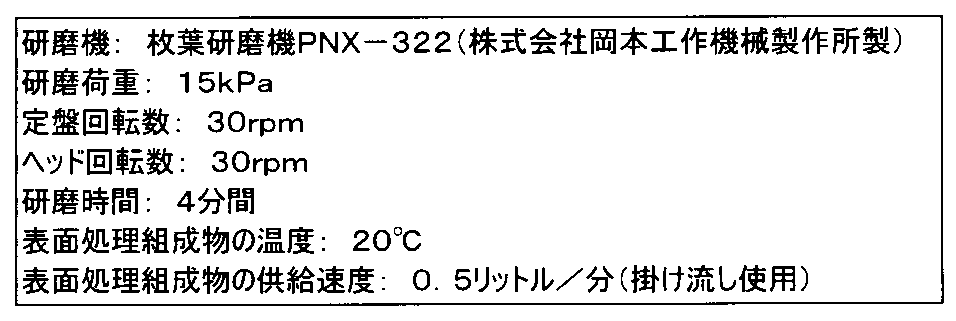
- the surface of the silicon wafer was polished under the conditions described in Table 2.
- the silicon wafer used has a disk shape with a diameter of 200 mm, the conductivity type is P-type, the crystal orientation is ⁇ 100>, the resistivity is 0.1 ⁇ ⁇ cm or more and less than 100 ⁇ ⁇ cm, and Fujimi Incorporated Co., Ltd. It was used after pre-polishing using a polishing slurry (trade name GLANZOX 1104).
- the surface of the silicon wafer after polishing using each of the surface treatment compositions of Examples 1 to 15 and Comparative Examples 1 to 10 was measured in the DWO mode of the wafer inspection device “Surfscan SP2” manufactured by KLA-Tencor Corporation.
- the results of evaluating the haze level on the surface of the silicon wafer after polishing are shown in the “Haze” column of Table 1.
- “A” indicates that the haze level was reduced by 10% or more compared to Comparative Example 2
- “B” indicates that it was 5% or more and less than 10%
- “C” indicates 5 “D” indicates that a reduction in haze level was not confirmed as compared with Comparative Example 2.
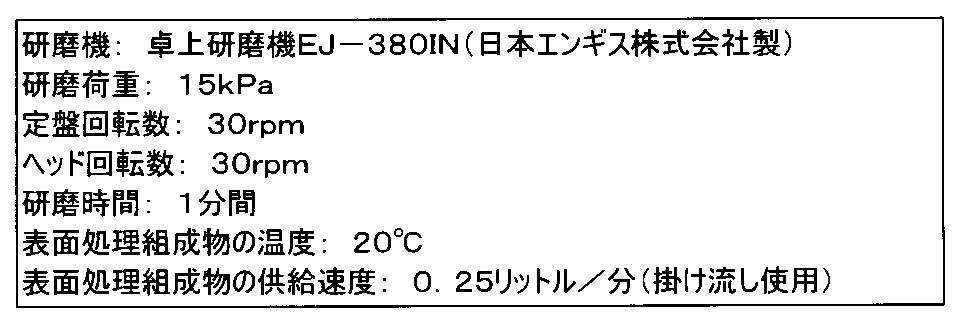
- the surface of a silicon wafer having a conductivity type of P-type, a crystal orientation of ⁇ 100>, a resistivity of 0.1 ⁇ ⁇ cm to less than 100 ⁇ ⁇ cm and a square of 60 mm is polished with a polishing slurry (trade name GLANZOX 1104, manufactured by Fujimi Incorporated). ) was then used for polishing under the conditions described in Table 3 using the surface treatment compositions of Examples 1 to 15 and Comparative Examples 1 to 10.
- the surface of the polished silicon wafer was rinsed with flowing water at a flow rate of 7 L / min for 10 seconds, and then the silicon wafer was placed vertically and allowed to stand.
Landscapes
- Chemical & Material Sciences (AREA)
- Organic Chemistry (AREA)
- Engineering & Computer Science (AREA)
- Life Sciences & Earth Sciences (AREA)
- Chemical Kinetics & Catalysis (AREA)
- Oil, Petroleum & Natural Gas (AREA)
- Wood Science & Technology (AREA)
- Materials Engineering (AREA)
- Dispersion Chemistry (AREA)
- Cleaning Or Drying Semiconductors (AREA)
- Mechanical Treatment Of Semiconductor (AREA)
- Detergent Compositions (AREA)
Abstract
Description
本発明の表面処理組成物は、第1の界面活性剤、第2の界面活性剤、塩基性化合物、及び水を含み、pHが8以上である。
本発明の表面処理組成物中に含まれる第1の界面活性剤と第2の界面活性剤は分子量が相異なる。具体的には、第2の界面活性剤は、第1の界面活性剤の重量平均分子量の1/2倍以下の重量平均分子量を有する。第2の界面活性剤の重量平均分子量が第1の界面活性剤の重量平均分子量の1/2倍を上回る場合には、基板表面の荒れを抑制する十分な効果を得ることができない。
第1の界面活性剤の重量平均分子量は特に限定されないが、基板表面の荒れを抑制する効果をより向上させるためには、500~20,000であることが好ましく、より好ましくは1,000~10,000である。
本発明の表面処理組成物は塩基性化合物を含み、塩基性化合物の添加により表面処理組成物のpHは8以上に調整されている。先にも説明したとおり、表面処理組成物のpHが8以上の場合、さらに言えば9以上の場合には、塩基性化合物によるエッチング作用が強まる結果、基板表面に荒れが生じやすくなる。しかし、上述した第1の界面活性剤及び第2の界面活性剤の作用により基板表面の荒れは抑制される。
表面処理組成物中の水は、表面処理組成物中の他の成分を溶解又は分散させる働きをする。水は、他の成分の作用を阻害する不純物をできるだけ含有しないことが好ましい。具体的には、イオン交換樹脂を使って不純物イオンを除去した後にフィルタを通して異物を除去したイオン交換水、あるいは純水、超純水又は蒸留水が好ましい。
表面処理組成物は粒子成分を含んでも良い。粒子成分は基板の表面を物理的に研磨する働きをする。
表面処理組成物は濡れ剤をさらに含んでも良い。濡れ剤は、基板の表面を親水性に保つのに効果的である。基板表面の濡れ性が低下すると、基板上に付着した異物が洗浄によって除去されずに残留をしやすい。基板上に異物が残留すると、基板の表面精度が低下する場合がある。
本発明のキットは、本発明の表面処理組成物を調製するためのものである。本発明のキットは、第1の界面活性剤と、第1の界面活性剤の重量平均分子量の1/2倍以下の重量平均分子量を有する第2の界面活性剤と、塩基性化合物とを含む。
本発明の表面処理方法は、本発明の表面処理組成物を用いて基板を表面処理する方法、より具体的には基板を研磨、リンス、洗浄又はエッチングする方法である。本発明の表面処理組成物は、通常の基板の表面処理で用いられるのと同じ装置及び条件で使用することができる。

Claims (13)
- 第1の界面活性剤、第2の界面活性剤、塩基性化合物及び水を含み、pHが8以上である表面処理組成物であって、
前記第2の界面活性剤の重量平均分子量が前記第1の界面活性剤の重量平均分子量の1/2倍以下であり、かつ、前記第1の界面活性剤の含有量と前記第2の界面活性剤の含有量の合計が0.00001~0.1質量%であることを特徴とする表面処理組成物。 - 前記第1の界面活性剤の総炭素数と前記第2の界面活性剤の総炭素数の合計に対する前記第2の界面活性剤の総炭素数の割合が1~90%であることを特徴とする請求項1に記載の表面処理組成物。
- 前記第1の界面活性剤の重量平均分子量が500~20,000であることを特徴とする請求項1又は2に記載の表面処理組成物。
- 前記第1の界面活性剤及び前記第2の界面活性剤がいずれもノニオン性界面活性剤であることを特徴とする請求項1~3のいずれか一項に記載の表面処理組成物。
- さらに、粒子成分を含むことを特徴とする請求項1~4のいずれか一項に記載の表面処理組成物。
- 前記粒子成分が二酸化ケイ素であることを特徴とする請求項5に記載の表面処理組成物。
- さらに、濡れ剤を含むことを特徴とする請求項1~6のいずれか一項に記載の表面処理組成物。
- シリコンウェーハを表面処理する用途で用いられることを特徴とする請求項1~7のいずれか一項に記載の表面処理組成物。
- 基板の表面を研磨又はリンスする用途で用いられることを特徴とする請求項1~7のいずれか一項に記載の表面処理組成物。
- 請求項1~9のいずれか一項に記載の表面処理組成物を調製するためのキットであって、
第1の界面活性剤と、前記第1の界面活性剤の重量平均分子量の1/2倍以下の重量平均分子量を有する第2の界面活性剤と、塩基性化合物とを含むことを特徴とするキット。 - 請求項1~7のいずれか一項に記載の表面処理組成物を用いて基板の表面を研磨、洗浄、リンス又はエッチングすることを特徴とする表面処理方法。
- 請求項1~7のいずれか一項に記載の表面処理組成物を用いて基板の表面を研磨又はリンスすることを特徴とする表面処理方法。
- 前記基板がシリコンウェーハであることを特徴とする請求項11又は12に記載の表面処理方法。
Priority Applications (5)
| Application Number | Priority Date | Filing Date | Title |
|---|---|---|---|
| JP2012536416A JP5891174B2 (ja) | 2010-09-27 | 2011-09-23 | シリコンウェーハ研磨用組成物及びそれを用いた研磨方法 |
| US13/824,778 US9028709B2 (en) | 2010-09-27 | 2011-09-23 | Surface treatment composition and surface treatment method using same |
| DE112011103232.3T DE112011103232B4 (de) | 2010-09-27 | 2011-09-23 | Oberflächenbehandlungszusammensetzung, Oberflächenbehandlungsverfahren unter Verwendung derselben und Set zur Herstellung einer Oberflächenbehandlungszusammensetzung |
| SG2013020854A SG188620A1 (en) | 2010-09-27 | 2011-09-23 | Surface treatment composition and surface treatment method using same |
| KR1020137010314A KR101728200B1 (ko) | 2010-09-27 | 2011-09-23 | 표면 처리 조성물 및 그것을 사용한 표면 처리 방법 |
Applications Claiming Priority (2)
| Application Number | Priority Date | Filing Date | Title |
|---|---|---|---|
| JP2010214812 | 2010-09-27 | ||
| JP2010-214812 | 2010-09-27 |
Publications (1)
| Publication Number | Publication Date |
|---|---|
| WO2012043418A1 true WO2012043418A1 (ja) | 2012-04-05 |
Family
ID=45892868
Family Applications (1)
| Application Number | Title | Priority Date | Filing Date |
|---|---|---|---|
| PCT/JP2011/071741 Ceased WO2012043418A1 (ja) | 2010-09-27 | 2011-09-23 | 表面処理組成物及びそれを用いた表面処理方法 |
Country Status (7)
| Country | Link |
|---|---|
| US (1) | US9028709B2 (ja) |
| JP (1) | JP5891174B2 (ja) |
| KR (1) | KR101728200B1 (ja) |
| DE (1) | DE112011103232B4 (ja) |
| SG (1) | SG188620A1 (ja) |
| TW (1) | TWI541342B (ja) |
| WO (1) | WO2012043418A1 (ja) |
Cited By (13)
| Publication number | Priority date | Publication date | Assignee | Title |
|---|---|---|---|---|
| WO2014041991A1 (ja) * | 2012-09-14 | 2014-03-20 | 株式会社フジミインコーポレーテッド | 研磨用組成物 |
| WO2014129408A1 (ja) | 2013-02-21 | 2014-08-28 | 株式会社フジミインコーポレーテッド | 研磨用組成物および研磨物製造方法 |
| JP2014199688A (ja) * | 2013-03-29 | 2014-10-23 | 東邦化学工業株式会社 | 磁気ディスク基板用洗浄剤 |
| JP2015155139A (ja) * | 2014-01-20 | 2015-08-27 | 信越化学工業株式会社 | 合成石英ガラス基板の製造方法 |
| JP2015534725A (ja) * | 2012-09-07 | 2015-12-03 | キャボット マイクロエレクトロニクス コーポレイション | ポリピロリドン研磨組成物および研磨方法 |
| JPWO2013176122A1 (ja) * | 2012-05-25 | 2016-01-14 | 日産化学工業株式会社 | ウェーハ用研磨液組成物 |
| US9510592B2 (en) | 2012-12-19 | 2016-12-06 | Dow Agrosciences Llc | Pesticidal compositions and processes related thereto |
| US9538756B2 (en) | 2012-12-19 | 2017-01-10 | Dow Agrosciences Llc | Pesticidal compositions and processes related thereto |
| US9615576B2 (en) | 2011-06-24 | 2017-04-11 | Dow Agrosciences Llc | Pesticidal compositions and processes related thereto |
| US9630910B2 (en) | 2012-12-19 | 2017-04-25 | Dow Agrosciences Llc | Pesticidal compositions and processes related thereto |
| US9629369B2 (en) | 2012-12-19 | 2017-04-25 | Dow Agrosciences Llc | Pesticidal compositions and processes related thereto |
| US9676704B2 (en) | 2014-06-09 | 2017-06-13 | Dow Agrosciences Llc | Pesticidal compositions and processes related thereto |
| JP2024120164A (ja) * | 2023-02-23 | 2024-09-04 | 東友ファインケム株式会社 | シリコンエッチング液組成物及びそれを用いたパターン形成方法 |
Families Citing this family (7)
| Publication number | Priority date | Publication date | Assignee | Title |
|---|---|---|---|---|
| JP6513454B2 (ja) * | 2015-03-31 | 2019-05-15 | 株式会社フジミインコーポレーテッド | 研磨物の製造方法 |
| TWI673357B (zh) | 2016-12-14 | 2019-10-01 | Cabot Microelectronics Corporation | 自化學機械平坦化基板移除殘留物之組合物及方法 |
| KR102358817B1 (ko) * | 2017-07-04 | 2022-02-09 | 한국전자통신연구원 | 광소자의 제조 방법 |
| KR102588218B1 (ko) * | 2017-09-22 | 2023-10-13 | 가부시키가이샤 후지미인코퍼레이티드 | 표면 처리 조성물, 표면 처리 조성물의 제조 방법, 표면 처리 방법 및 반도체 기판의 제조 방법 |
| JP7534283B2 (ja) | 2019-03-28 | 2024-08-14 | 株式会社フジミインコーポレーテッド | 研磨用組成物 |
| JP7340969B2 (ja) * | 2019-06-28 | 2023-09-08 | 東京応化工業株式会社 | シリコンエッチング液、シリコンエッチング方法、及びシリコンフィン構造体の製造方法 |
| US12534686B2 (en) | 2023-08-25 | 2026-01-27 | Reckitt & Colman (Overseas) Hygiene Home Limited | Cooktop cleaning formulations |
Citations (4)
| Publication number | Priority date | Publication date | Assignee | Title |
|---|---|---|---|---|
| JP2001240850A (ja) * | 2000-02-29 | 2001-09-04 | Sanyo Chem Ind Ltd | 研磨用砥粒分散剤および研磨用スラリー |
| JP2005085858A (ja) * | 2003-09-05 | 2005-03-31 | Fujimi Inc | 研磨用組成物 |
| JP2005175498A (ja) * | 2003-12-12 | 2005-06-30 | Samsung Electronics Co Ltd | スラリー組成物及びそれを用いる化学機械的研磨工程を含む半導体素子の製造方法 |
| JP2006049709A (ja) * | 2004-08-06 | 2006-02-16 | Toshiba Corp | Cmp用スラリー、研磨方法、および半導体装置の製造方法 |
Family Cites Families (5)
| Publication number | Priority date | Publication date | Assignee | Title |
|---|---|---|---|---|
| JP4212861B2 (ja) * | 2002-09-30 | 2009-01-21 | 株式会社フジミインコーポレーテッド | 研磨用組成物及びそれを用いたシリコンウエハの研磨方法、並びにリンス用組成物及びそれを用いたシリコンウエハのリンス方法 |
| EP1477538B1 (en) * | 2003-05-12 | 2007-07-25 | JSR Corporation | Chemical mechanical polishing agent kit and chemical mechanical polishing method using the same |
| US7314578B2 (en) | 2003-12-12 | 2008-01-01 | Samsung Electronics Co., Ltd. | Slurry compositions and CMP methods using the same |
| JPWO2007026862A1 (ja) * | 2005-09-02 | 2009-03-12 | 株式会社フジミインコーポレーテッド | 研磨用組成物 |
| US7198680B1 (en) * | 2006-07-26 | 2007-04-03 | Innovation Services, Inc. | Process for cleaning surfaces of medical equipment |
-
2011
- 2011-09-23 US US13/824,778 patent/US9028709B2/en active Active
- 2011-09-23 WO PCT/JP2011/071741 patent/WO2012043418A1/ja not_active Ceased
- 2011-09-23 DE DE112011103232.3T patent/DE112011103232B4/de active Active
- 2011-09-23 SG SG2013020854A patent/SG188620A1/en unknown
- 2011-09-23 KR KR1020137010314A patent/KR101728200B1/ko active Active
- 2011-09-23 JP JP2012536416A patent/JP5891174B2/ja active Active
- 2011-09-26 TW TW100134511A patent/TWI541342B/zh active
Patent Citations (4)
| Publication number | Priority date | Publication date | Assignee | Title |
|---|---|---|---|---|
| JP2001240850A (ja) * | 2000-02-29 | 2001-09-04 | Sanyo Chem Ind Ltd | 研磨用砥粒分散剤および研磨用スラリー |
| JP2005085858A (ja) * | 2003-09-05 | 2005-03-31 | Fujimi Inc | 研磨用組成物 |
| JP2005175498A (ja) * | 2003-12-12 | 2005-06-30 | Samsung Electronics Co Ltd | スラリー組成物及びそれを用いる化学機械的研磨工程を含む半導体素子の製造方法 |
| JP2006049709A (ja) * | 2004-08-06 | 2006-02-16 | Toshiba Corp | Cmp用スラリー、研磨方法、および半導体装置の製造方法 |
Cited By (21)
| Publication number | Priority date | Publication date | Assignee | Title |
|---|---|---|---|---|
| US9615576B2 (en) | 2011-06-24 | 2017-04-11 | Dow Agrosciences Llc | Pesticidal compositions and processes related thereto |
| JPWO2013176122A1 (ja) * | 2012-05-25 | 2016-01-14 | 日産化学工業株式会社 | ウェーハ用研磨液組成物 |
| JP2015534725A (ja) * | 2012-09-07 | 2015-12-03 | キャボット マイクロエレクトロニクス コーポレイション | ポリピロリドン研磨組成物および研磨方法 |
| WO2014041991A1 (ja) * | 2012-09-14 | 2014-03-20 | 株式会社フジミインコーポレーテッド | 研磨用組成物 |
| JP2014060205A (ja) * | 2012-09-14 | 2014-04-03 | Fujimi Inc | 研磨用組成物 |
| US9635859B2 (en) | 2012-12-19 | 2017-05-02 | Dow Agrosciences Llc | Pesticidal compositions and processes related thereto |
| US9629369B2 (en) | 2012-12-19 | 2017-04-25 | Dow Agrosciences Llc | Pesticidal compositions and processes related thereto |
| US9630910B2 (en) | 2012-12-19 | 2017-04-25 | Dow Agrosciences Llc | Pesticidal compositions and processes related thereto |
| US9510592B2 (en) | 2012-12-19 | 2016-12-06 | Dow Agrosciences Llc | Pesticidal compositions and processes related thereto |
| US9538756B2 (en) | 2012-12-19 | 2017-01-10 | Dow Agrosciences Llc | Pesticidal compositions and processes related thereto |
| US9629363B2 (en) | 2012-12-19 | 2017-04-25 | Dow Agrosciences Llc | Pesticidal compositions and processes related thereto |
| US9701620B2 (en) | 2012-12-19 | 2017-07-11 | Dow Agrosciences Llc | Pesticidal compositions and processes related thereto |
| US9622477B2 (en) | 2012-12-19 | 2017-04-18 | Dow Agrosciences Llc | Pesticidal compositions and processes related thereto |
| KR20150123265A (ko) | 2013-02-21 | 2015-11-03 | 가부시키가이샤 후지미인코퍼레이티드 | 연마용 조성물 및 연마물 제조 방법 |
| US9566685B2 (en) | 2013-02-21 | 2017-02-14 | Fujimi Incorporated | Polishing composition and method for producing polished article |
| WO2014129408A1 (ja) | 2013-02-21 | 2014-08-28 | 株式会社フジミインコーポレーテッド | 研磨用組成物および研磨物製造方法 |
| JP2014199688A (ja) * | 2013-03-29 | 2014-10-23 | 東邦化学工業株式会社 | 磁気ディスク基板用洗浄剤 |
| JP2015155139A (ja) * | 2014-01-20 | 2015-08-27 | 信越化学工業株式会社 | 合成石英ガラス基板の製造方法 |
| US9676704B2 (en) | 2014-06-09 | 2017-06-13 | Dow Agrosciences Llc | Pesticidal compositions and processes related thereto |
| JP2024120164A (ja) * | 2023-02-23 | 2024-09-04 | 東友ファインケム株式会社 | シリコンエッチング液組成物及びそれを用いたパターン形成方法 |
| JP7725636B2 (ja) | 2023-02-23 | 2025-08-19 | 東友ファインケム株式会社 | シリコンエッチング液組成物及びそれを用いたパターン形成方法 |
Also Published As
| Publication number | Publication date |
|---|---|
| US20130181159A1 (en) | 2013-07-18 |
| KR101728200B1 (ko) | 2017-04-18 |
| KR20130140686A (ko) | 2013-12-24 |
| TW201217516A (en) | 2012-05-01 |
| JP5891174B2 (ja) | 2016-03-22 |
| US9028709B2 (en) | 2015-05-12 |
| JPWO2012043418A1 (ja) | 2014-02-06 |
| DE112011103232T5 (de) | 2013-06-27 |
| SG188620A1 (en) | 2013-04-30 |
| DE112011103232B4 (de) | 2025-09-25 |
| TWI541342B (zh) | 2016-07-11 |
Similar Documents
| Publication | Publication Date | Title |
|---|---|---|
| JP5891174B2 (ja) | シリコンウェーハ研磨用組成物及びそれを用いた研磨方法 | |
| JP6193959B2 (ja) | リンス用組成物及びリンス方法 | |
| JP6185432B2 (ja) | シリコンウェーハ研磨用組成物 | |
| JP5492603B2 (ja) | 研磨用組成物及びそれを用いた研磨方法 | |
| JP6348927B2 (ja) | シリコンウェーハ研磨用組成物 | |
| JP6649828B2 (ja) | シリコン基板の研磨方法および研磨用組成物セット | |
| TW201908458A (zh) | 基板之研磨方法及研磨用組成物套組 | |
| JP6377656B2 (ja) | シリコン基板の研磨方法および研磨用組成物セット | |
| JP6122783B2 (ja) | 研磨用組成物及び半導体基板の製造方法 | |
| JP6562605B2 (ja) | 研磨用組成物の製造方法 | |
| JP5859054B2 (ja) | シリコンウェーハ研磨用組成物 | |
| JP6305674B2 (ja) | 研磨用組成物及び半導体基板の製造方法 |
Legal Events
| Date | Code | Title | Description |
|---|---|---|---|
| 121 | Ep: the epo has been informed by wipo that ep was designated in this application |
Ref document number: 11828974 Country of ref document: EP Kind code of ref document: A1 |
|
| WWE | Wipo information: entry into national phase |
Ref document number: 13824778 Country of ref document: US |
|
| ENP | Entry into the national phase |
Ref document number: 2012536416 Country of ref document: JP Kind code of ref document: A |
|
| WWE | Wipo information: entry into national phase |
Ref document number: 1120111032323 Country of ref document: DE Ref document number: 112011103232 Country of ref document: DE |
|
| ENP | Entry into the national phase |
Ref document number: 20137010314 Country of ref document: KR Kind code of ref document: A |
|
| 122 | Ep: pct application non-entry in european phase |
Ref document number: 11828974 Country of ref document: EP Kind code of ref document: A1 |
|
| WWG | Wipo information: grant in national office |
Ref document number: 112011103232 Country of ref document: DE |