WO2012008442A1 - 金属加工油基油 - Google Patents
金属加工油基油 Download PDFInfo
- Publication number
- WO2012008442A1 WO2012008442A1 PCT/JP2011/065873 JP2011065873W WO2012008442A1 WO 2012008442 A1 WO2012008442 A1 WO 2012008442A1 JP 2011065873 W JP2011065873 W JP 2011065873W WO 2012008442 A1 WO2012008442 A1 WO 2012008442A1
- Authority
- WO
- WIPO (PCT)
- Prior art keywords
- oil
- base oil
- fatty acid
- formula
- oil base
- Prior art date
- Legal status (The legal status is an assumption and is not a legal conclusion. Google has not performed a legal analysis and makes no representation as to the accuracy of the status listed.)
- Ceased
Links
Classifications
-
- C—CHEMISTRY; METALLURGY
- C07—ORGANIC CHEMISTRY
- C07C—ACYCLIC OR CARBOCYCLIC COMPOUNDS
- C07C69/00—Esters of carboxylic acids; Esters of carbonic or haloformic acids
- C07C69/66—Esters of carboxylic acids having esterified carboxylic groups bound to acyclic carbon atoms and having any of the groups OH, O—metal, —CHO, keto, ether, acyloxy, groups, groups, or in the acid moiety
- C07C69/73—Esters of carboxylic acids having esterified carboxylic groups bound to acyclic carbon atoms and having any of the groups OH, O—metal, —CHO, keto, ether, acyloxy, groups, groups, or in the acid moiety of unsaturated acids
- C07C69/734—Ethers
-
- B—PERFORMING OPERATIONS; TRANSPORTING
- B24—GRINDING; POLISHING
- B24B—MACHINES, DEVICES, OR PROCESSES FOR GRINDING OR POLISHING; DRESSING OR CONDITIONING OF ABRADING SURFACES; FEEDING OF GRINDING, POLISHING, OR LAPPING AGENTS
- B24B1/00—Processes of grinding or polishing; Use of auxiliary equipment in connection with such processes
-
- B—PERFORMING OPERATIONS; TRANSPORTING
- B26—HAND CUTTING TOOLS; CUTTING; SEVERING
- B26D—CUTTING; DETAILS COMMON TO MACHINES FOR PERFORATING, PUNCHING, CUTTING-OUT, STAMPING-OUT OR SEVERING
- B26D1/00—Cutting through work characterised by the nature or movement of the cutting member or particular materials not otherwise provided for; Apparatus or machines therefor; Cutting members therefor
-
- C—CHEMISTRY; METALLURGY
- C07—ORGANIC CHEMISTRY
- C07C—ACYCLIC OR CARBOCYCLIC COMPOUNDS
- C07C69/00—Esters of carboxylic acids; Esters of carbonic or haloformic acids
- C07C69/66—Esters of carboxylic acids having esterified carboxylic groups bound to acyclic carbon atoms and having any of the groups OH, O—metal, —CHO, keto, ether, acyloxy, groups, groups, or in the acid moiety
- C07C69/67—Esters of carboxylic acids having esterified carboxylic groups bound to acyclic carbon atoms and having any of the groups OH, O—metal, —CHO, keto, ether, acyloxy, groups, groups, or in the acid moiety of saturated acids
- C07C69/708—Ethers
-
- C—CHEMISTRY; METALLURGY
- C10—PETROLEUM, GAS OR COKE INDUSTRIES; TECHNICAL GASES CONTAINING CARBON MONOXIDE; FUELS; LUBRICANTS; PEAT
- C10M—LUBRICATING COMPOSITIONS; USE OF CHEMICAL SUBSTANCES EITHER ALONE OR AS LUBRICATING INGREDIENTS IN A LUBRICATING COMPOSITION
- C10M107/00—Lubricating compositions characterised by the base-material being a macromolecular compound
- C10M107/20—Lubricating compositions characterised by the base-material being a macromolecular compound containing oxygen
- C10M107/30—Macromolecular compounds obtained otherwise than by reactions only involving carbon-to-carbon unsaturated bonds
- C10M107/32—Condensation polymers of aldehydes or ketones; Polyesters; Polyethers
- C10M107/34—Polyoxyalkylenes
-
- C—CHEMISTRY; METALLURGY
- C10—PETROLEUM, GAS OR COKE INDUSTRIES; TECHNICAL GASES CONTAINING CARBON MONOXIDE; FUELS; LUBRICANTS; PEAT
- C10M—LUBRICATING COMPOSITIONS; USE OF CHEMICAL SUBSTANCES EITHER ALONE OR AS LUBRICATING INGREDIENTS IN A LUBRICATING COMPOSITION
- C10M2207/00—Organic non-macromolecular hydrocarbon compounds containing hydrogen, carbon and oxygen as ingredients in lubricant compositions
- C10M2207/28—Esters
- C10M2207/281—Esters of (cyclo)aliphatic monocarboxylic acids
- C10M2207/2815—Esters of (cyclo)aliphatic monocarboxylic acids used as base material
-
- C—CHEMISTRY; METALLURGY
- C10—PETROLEUM, GAS OR COKE INDUSTRIES; TECHNICAL GASES CONTAINING CARBON MONOXIDE; FUELS; LUBRICANTS; PEAT
- C10M—LUBRICATING COMPOSITIONS; USE OF CHEMICAL SUBSTANCES EITHER ALONE OR AS LUBRICATING INGREDIENTS IN A LUBRICATING COMPOSITION
- C10M2209/00—Organic macromolecular compounds containing oxygen as ingredients in lubricant compositions
- C10M2209/10—Macromolecular compoundss obtained otherwise than by reactions only involving carbon-to-carbon unsaturated bonds
- C10M2209/103—Polyethers, i.e. containing di- or higher polyoxyalkylene groups
- C10M2209/1033—Polyethers, i.e. containing di- or higher polyoxyalkylene groups used as base material
-
- C—CHEMISTRY; METALLURGY
- C10—PETROLEUM, GAS OR COKE INDUSTRIES; TECHNICAL GASES CONTAINING CARBON MONOXIDE; FUELS; LUBRICANTS; PEAT
- C10M—LUBRICATING COMPOSITIONS; USE OF CHEMICAL SUBSTANCES EITHER ALONE OR AS LUBRICATING INGREDIENTS IN A LUBRICATING COMPOSITION
- C10M2209/00—Organic macromolecular compounds containing oxygen as ingredients in lubricant compositions
- C10M2209/10—Macromolecular compoundss obtained otherwise than by reactions only involving carbon-to-carbon unsaturated bonds
- C10M2209/103—Polyethers, i.e. containing di- or higher polyoxyalkylene groups
- C10M2209/104—Polyethers, i.e. containing di- or higher polyoxyalkylene groups of alkylene oxides containing two carbon atoms only
- C10M2209/1045—Polyethers, i.e. containing di- or higher polyoxyalkylene groups of alkylene oxides containing two carbon atoms only used as base material
-
- C—CHEMISTRY; METALLURGY
- C10—PETROLEUM, GAS OR COKE INDUSTRIES; TECHNICAL GASES CONTAINING CARBON MONOXIDE; FUELS; LUBRICANTS; PEAT
- C10M—LUBRICATING COMPOSITIONS; USE OF CHEMICAL SUBSTANCES EITHER ALONE OR AS LUBRICATING INGREDIENTS IN A LUBRICATING COMPOSITION
- C10M2209/00—Organic macromolecular compounds containing oxygen as ingredients in lubricant compositions
- C10M2209/10—Macromolecular compoundss obtained otherwise than by reactions only involving carbon-to-carbon unsaturated bonds
- C10M2209/103—Polyethers, i.e. containing di- or higher polyoxyalkylene groups
- C10M2209/105—Polyethers, i.e. containing di- or higher polyoxyalkylene groups of alkylene oxides containing three carbon atoms only
- C10M2209/1055—Polyethers, i.e. containing di- or higher polyoxyalkylene groups of alkylene oxides containing three carbon atoms only used as base material
-
- C—CHEMISTRY; METALLURGY
- C10—PETROLEUM, GAS OR COKE INDUSTRIES; TECHNICAL GASES CONTAINING CARBON MONOXIDE; FUELS; LUBRICANTS; PEAT
- C10M—LUBRICATING COMPOSITIONS; USE OF CHEMICAL SUBSTANCES EITHER ALONE OR AS LUBRICATING INGREDIENTS IN A LUBRICATING COMPOSITION
- C10M2209/00—Organic macromolecular compounds containing oxygen as ingredients in lubricant compositions
- C10M2209/10—Macromolecular compoundss obtained otherwise than by reactions only involving carbon-to-carbon unsaturated bonds
- C10M2209/103—Polyethers, i.e. containing di- or higher polyoxyalkylene groups
- C10M2209/106—Polyethers, i.e. containing di- or higher polyoxyalkylene groups of alkylene oxides containing four carbon atoms only
- C10M2209/1065—Polyethers, i.e. containing di- or higher polyoxyalkylene groups of alkylene oxides containing four carbon atoms only used as base material
-
- C—CHEMISTRY; METALLURGY
- C10—PETROLEUM, GAS OR COKE INDUSTRIES; TECHNICAL GASES CONTAINING CARBON MONOXIDE; FUELS; LUBRICANTS; PEAT
- C10M—LUBRICATING COMPOSITIONS; USE OF CHEMICAL SUBSTANCES EITHER ALONE OR AS LUBRICATING INGREDIENTS IN A LUBRICATING COMPOSITION
- C10M2209/00—Organic macromolecular compounds containing oxygen as ingredients in lubricant compositions
- C10M2209/10—Macromolecular compoundss obtained otherwise than by reactions only involving carbon-to-carbon unsaturated bonds
- C10M2209/103—Polyethers, i.e. containing di- or higher polyoxyalkylene groups
- C10M2209/108—Polyethers, i.e. containing di- or higher polyoxyalkylene groups etherified
- C10M2209/1085—Polyethers, i.e. containing di- or higher polyoxyalkylene groups etherified used as base material
-
- C—CHEMISTRY; METALLURGY
- C10—PETROLEUM, GAS OR COKE INDUSTRIES; TECHNICAL GASES CONTAINING CARBON MONOXIDE; FUELS; LUBRICANTS; PEAT
- C10M—LUBRICATING COMPOSITIONS; USE OF CHEMICAL SUBSTANCES EITHER ALONE OR AS LUBRICATING INGREDIENTS IN A LUBRICATING COMPOSITION
- C10M2209/00—Organic macromolecular compounds containing oxygen as ingredients in lubricant compositions
- C10M2209/10—Macromolecular compoundss obtained otherwise than by reactions only involving carbon-to-carbon unsaturated bonds
- C10M2209/103—Polyethers, i.e. containing di- or higher polyoxyalkylene groups
- C10M2209/109—Polyethers, i.e. containing di- or higher polyoxyalkylene groups esterified
- C10M2209/1095—Polyethers, i.e. containing di- or higher polyoxyalkylene groups esterified used as base material
-
- C—CHEMISTRY; METALLURGY
- C10—PETROLEUM, GAS OR COKE INDUSTRIES; TECHNICAL GASES CONTAINING CARBON MONOXIDE; FUELS; LUBRICANTS; PEAT
- C10N—INDEXING SCHEME ASSOCIATED WITH SUBCLASS C10M RELATING TO LUBRICATING COMPOSITIONS
- C10N2020/00—Specified physical or chemical properties or characteristics, i.e. function, of component of lubricating compositions
- C10N2020/01—Physico-chemical properties
- C10N2020/02—Viscosity; Viscosity index
-
- C—CHEMISTRY; METALLURGY
- C10—PETROLEUM, GAS OR COKE INDUSTRIES; TECHNICAL GASES CONTAINING CARBON MONOXIDE; FUELS; LUBRICANTS; PEAT
- C10N—INDEXING SCHEME ASSOCIATED WITH SUBCLASS C10M RELATING TO LUBRICATING COMPOSITIONS
- C10N2020/00—Specified physical or chemical properties or characteristics, i.e. function, of component of lubricating compositions
- C10N2020/09—Characteristics associated with water
- C10N2020/093—Insolubility in water
-
- C—CHEMISTRY; METALLURGY
- C10—PETROLEUM, GAS OR COKE INDUSTRIES; TECHNICAL GASES CONTAINING CARBON MONOXIDE; FUELS; LUBRICANTS; PEAT
- C10N—INDEXING SCHEME ASSOCIATED WITH SUBCLASS C10M RELATING TO LUBRICATING COMPOSITIONS
- C10N2030/00—Specified physical or chemical properties which is improved by the additive characterising the lubricating composition, e.g. multifunctional additives
- C10N2030/02—Pour-point; Viscosity index
-
- C—CHEMISTRY; METALLURGY
- C10—PETROLEUM, GAS OR COKE INDUSTRIES; TECHNICAL GASES CONTAINING CARBON MONOXIDE; FUELS; LUBRICANTS; PEAT
- C10N—INDEXING SCHEME ASSOCIATED WITH SUBCLASS C10M RELATING TO LUBRICATING COMPOSITIONS
- C10N2030/00—Specified physical or chemical properties which is improved by the additive characterising the lubricating composition, e.g. multifunctional additives
- C10N2030/12—Inhibition of corrosion, e.g. anti-rust agents or anti-corrosives
-
- C—CHEMISTRY; METALLURGY
- C10—PETROLEUM, GAS OR COKE INDUSTRIES; TECHNICAL GASES CONTAINING CARBON MONOXIDE; FUELS; LUBRICANTS; PEAT
- C10N—INDEXING SCHEME ASSOCIATED WITH SUBCLASS C10M RELATING TO LUBRICATING COMPOSITIONS
- C10N2040/00—Specified use or application for which the lubricating composition is intended
- C10N2040/02—Bearings
-
- C—CHEMISTRY; METALLURGY
- C10—PETROLEUM, GAS OR COKE INDUSTRIES; TECHNICAL GASES CONTAINING CARBON MONOXIDE; FUELS; LUBRICANTS; PEAT
- C10N—INDEXING SCHEME ASSOCIATED WITH SUBCLASS C10M RELATING TO LUBRICATING COMPOSITIONS
- C10N2040/00—Specified use or application for which the lubricating composition is intended
- C10N2040/08—Hydraulic fluids, e.g. brake-fluids
-
- C—CHEMISTRY; METALLURGY
- C10—PETROLEUM, GAS OR COKE INDUSTRIES; TECHNICAL GASES CONTAINING CARBON MONOXIDE; FUELS; LUBRICANTS; PEAT
- C10N—INDEXING SCHEME ASSOCIATED WITH SUBCLASS C10M RELATING TO LUBRICATING COMPOSITIONS
- C10N2040/00—Specified use or application for which the lubricating composition is intended
- C10N2040/20—Metal working
- C10N2040/22—Metal working with essential removal of material, e.g. cutting, grinding or drilling
-
- C—CHEMISTRY; METALLURGY
- C10—PETROLEUM, GAS OR COKE INDUSTRIES; TECHNICAL GASES CONTAINING CARBON MONOXIDE; FUELS; LUBRICANTS; PEAT
- C10N—INDEXING SCHEME ASSOCIATED WITH SUBCLASS C10M RELATING TO LUBRICATING COMPOSITIONS
- C10N2040/00—Specified use or application for which the lubricating composition is intended
- C10N2040/20—Metal working
- C10N2040/24—Metal working without essential removal of material, e.g. forming, gorging, drawing, pressing, stamping, rolling or extruding; Punching metal
-
- Y—GENERAL TAGGING OF NEW TECHNOLOGICAL DEVELOPMENTS; GENERAL TAGGING OF CROSS-SECTIONAL TECHNOLOGIES SPANNING OVER SEVERAL SECTIONS OF THE IPC; TECHNICAL SUBJECTS COVERED BY FORMER USPC CROSS-REFERENCE ART COLLECTIONS [XRACs] AND DIGESTS
- Y10—TECHNICAL SUBJECTS COVERED BY FORMER USPC
- Y10T—TECHNICAL SUBJECTS COVERED BY FORMER US CLASSIFICATION
- Y10T83/00—Cutting
- Y10T83/04—Processes
Definitions
- the present invention relates to a water-insoluble cutting oil base oil for metal working and / or a grinding oil base oil used in metal cutting and grinding.
- This application claims priority on July 12, 2010 based on Japanese Patent Application No. 2010-158075 for which it applied to Japan, and uses the content here.
- cutting oil is usually used for the purpose of extending tool life, improving workability, and improving productivity.
- the types of cutting oil for metal working include water-soluble cutting oil and water-insoluble cutting oil, which are properly used depending on the metal to be processed, processing conditions, and required performance.
- water-soluble cutting oil is used mainly for the purpose of cooling heat generated in high-speed machining and avoiding the risk of ignition, but the ratio of base oil such as mineral oil contained in the composition is small and the lubricity is poor. There is a problem.
- Water-insoluble cutting oil has excellent lubricity due to the base oil occupying most of it, and is applied to difficult-to-cut materials such as titanium, heat-resistant steel, ceramics, and aluminum alloys, and performs precise processing. Therefore, it is selected when lubricity is required.
- commercially available water-insoluble cutting oil falls under Class 4 petroleum under the Fire Service Act of Japan and does not fall under Class 4 petroleum under the Fire Service Act, but at 40 ° C
- the kinematic viscosity is as high as 20 mm 2 / s or more, and it is one of inferior cooling properties. Accordingly, the present situation is that there is no water-insoluble cutting oil that has a low kinematic viscosity, a high cooling property, and a high flash point and satisfies all these three conditions.
- Patent Document 1 in order to obtain a water-insoluble cutting oil base oil and a grinding oil base oil having low kinematic viscosity and high flash point, oxygen-containing synthetic oil such as ester, mineral oil, and hydrocarbon oil are included.
- a metalworking oil composition containing an extreme pressure agent has been proposed, and the kinematic viscosity at 40 ° C. is 37 mm 2 / s or less and the flash point is 250 ° C. or more.
- the kinematic viscosity at 40 ° C. of the metalworking oil composition described in Patent Document 1 is 37 mm 2 / s, it is not practical. This is because the kinematic viscosity at 40 ° C.
- Patent Document 2 discloses a lubricating base oil that is excellent in biodegradability and lubricity and at the same time has little exhaust smoke. However, since the lubricating base oil described in Patent Document 2 is for a two-cycle engine, it must be burned with fuel after lubrication, which is clearly different from the object of the present invention. Furthermore, Patent Document 2 does not describe what kinematic viscosity, surface tension, and hydroxyl value of the lubricating base oil for a two-cycle engine.
- Patent Document 3 discloses a base oil composed of one or more of mineral oil, fats and oils, and synthetic esters as one of the components constituting the hot rolling oil composition.
- the invention described in Patent Document 3 relates to a hot rolling oil composition, and is clearly different from the water-insoluble cutting oil base oil or grinding oil base oil according to the present invention.
- Patent Document 3 has a description of kinematic viscosity as the mineral oil used, there is no description of kinematic viscosity as an ester, and there is no description of surface tension and flash point.
- the present invention has been made in view of such circumstances.
- a water-insoluble cutting oil base oil or grinding oil base oil for metal working containing a fatty acid polyoxyalkylene alkyl ether represented by the following formula (IA), wherein the fatty acid polyoxyalkylene alkyl ether
- a water-insoluble cutting oil base oil or grinding oil base oil for metal working wherein the hydroxyl value is 2.0 mgKOH / g or less.
- R 1 —CO— (OA) n —OR 3 (IA) (In the formula (IA), R 1 is a linear or branched, saturated or unsaturated monovalent hydrocarbon group having 15 to 21 carbon atoms, R 3 is a linear chain having 1 to 8 carbon atoms, A branched or cyclic monovalent hydrocarbon group, A is an alkylene group having 2 to 4 carbon atoms, OA represents an alkylene oxide (hereinafter referred to as “AO”), and n is an average of the alkylene oxide Indicates the number of moles added and is 1-6) [2]
- the fatty acid polyoxyalkylene alkyl ether represented by the formula (IA) reacts the compound (A) represented by the formula (I) with the compound (B) represented by the formula (II).
- a cutting oil base oil or a grinding oil base oil for metal working as described in [1] obtained by causing the above to occur.
- Fatty acid corresponding to the fatty acid part (R 1 CO part) of the compound in formula (IA) or formula (I) is oleic acid, palm-derived C18 mixed fatty acid, soybean-derived C18 mixed fatty acid, rapeseed-derived C18 mixed
- R 2 in formula (I) is a methyl group.
- R 3 in the formulas (IA) and (II) is at least one selected from the group consisting of a methyl group, an isobutyl group, an n-butyl group, a t-butyl group, and a 2-ethylhexyl group.
- the present invention comprises a fatty acid polyoxyalkylene alkyl ether represented by (IA), thereby having a low kinematic viscosity and a water-insoluble cutting oil base oil for metal working excellent in wettability to a metal surface or A grinding oil base oil can be obtained. Therefore, it is excellent in the cooling property of a metal surface and a processing point. Furthermore, since it has a high flash point, the risk of ignition is also reduced compared to conventional products. Moreover, since the kinematic viscosity is low, it has the merit of reducing the amount of oil attached to the processed metal and discharged, which is also economical. Therefore, it can be suitably used for applications requiring low kinematic viscosity and high flash point such as rolling oil and bearing oil as well as cutting oil and grinding oil for metal working.
- IA fatty acid polyoxyalkylene alkyl ether represented by (IA)
- the present invention is a water-insoluble cutting oil base oil or grinding oil base oil for metal working containing a fatty acid polyoxyalkylene alkyl ether represented by the following formula (IA),
- the fatty acid polyoxyalkylene alkyl ether is a water-insoluble cutting oil base oil or grinding oil base oil for metal working in which the hydroxyl value is 2.0 mgKOH / g or less.
- R 1 —CO— (OA) n —OR 3 (IA)
- R 1 is a linear or branched, saturated or unsaturated monovalent hydrocarbon group having 15 to 21 carbon atoms
- R 3 is a linear chain having 1 to 8 carbon atoms
- A represents an alkylene group having 2 to 4 carbon atoms
- n represents an average number of moles of alkylene oxide (AO) added and is 1 to 6.
- the method for producing the fatty acid polyoxyalkylene alkyl ether is represented by the following formula (I): More preferably, the compound (A) represented by the following formula (II) is reacted to remove the by-products and unreacted raw materials.
- a method for removing by-products and unreacted raw materials include, for example, a washing method, a method using an adsorbent, a method using a filter aid, a method using pressure filtration, a method using distillation, and a vacuum distillation. The method by etc. is mentioned, However, Any method may be sufficient and they may be combined.
- R 3 O— (AO) n—H (II)
- R 1 is a linear or branched, saturated or unsaturated monovalent hydrocarbon group having 15 to 21 carbon atoms
- R 2 is a monovalent carbon group having 1 to 18 carbon atoms
- R 3 is a linear, branched or cyclic monovalent hydrocarbon group having 1 to 8 carbon atoms
- A is an alkylene group having 2 to 4 carbon atoms.
- N represents the average number of moles of alkylene oxide added and is 1-6.
- the hydrocarbon group of R 1 may be a saturated hydrocarbon group or an unsaturated hydrocarbon group, but has an oxidation stability as a water-insoluble cutting oil base oil or grinding oil base oil for metal working. From the viewpoint of being good, the iodine value of the compound (A) represented by (I) is preferably 120 or less.
- the hydrocarbon group of R 1 is more preferably a straight chain from the viewpoint of high flash point and easy availability of raw materials.
- the carbon number of R 1 is 15 to 21, and if the carbon number of R 1 is 15 or more, a high flash point is obtained, and if the carbon number of R 1 is 21 or less, the kinematic viscosity and the surface tension are It can be prevented from becoming too large. Further, from the viewpoint of obtaining a high flash point, the carbon number of R 1 is more preferably 17 to 21, and from the viewpoint of obtaining low kinematic viscosity and low surface tension, it is more preferably 15 to 17. From the viewpoint of highly satisfying kinematic viscosity, surface tension, and flash point, the number of carbon atoms is particularly preferably 17.
- fatty acid corresponding to the fatty acid part (R 1 CO part) of the compound (A) include palmitic acid, palmitoleic acid, stearic acid, isostearic acid, oleic acid, linoleic acid, linolenic acid, and palm-derived C18 mixture.
- C18 mixed fatty acid derived from rapeseed C16-18 mixed fatty acid derived from soybean C16-C18 mixed fatty acid derived from palm kernel, C18 mixed fatty acid derived from rice bran, C18 mixed fatty acid derived from beef tallow, corn Derived mixed fatty acids, safflower derived mixed fatty acids, arachidic acid, eicosadienoic acid, eicosatrienoic acid, arachidonic acid, behenic acid, and the like erucic acid and the like.
- oleic acid and palm-derived C18 mixed fatty acids are obtained from the point that a base oil highly satisfying a low kinematic viscosity, a low surface tension, and a high flash point can be obtained, and a base oil having a good fluidity at a low temperature can be obtained.
- Soybean-derived C18 mixed fatty acid, rapeseed-derived C18 mixed fatty acid, rice bran-derived C18 mixed fatty acid, and beef tallow-derived C18 mixed fatty acid are more preferable, and oleic acid and palm-derived C18 mixed fatty acid are particularly preferable.
- R 2 is a monovalent hydrocarbon group having 1 to 18 carbon atoms, but since R 2 is removed as an alcohol by a transesterification reaction, the carbon chain length is not particularly limited, and linear, branched, cyclic Any hydrocarbon may be used. From the viewpoint of easy availability of raw materials and good reactivity, a methyl group is preferable.
- the hydrocarbon group for R 3 may be a saturated hydrocarbon group or an unsaturated hydrocarbon group, but is more preferably a saturated hydrocarbon group because of excellent oxidation stability.
- R 3 has 1 to 8 carbon atoms, and if R 3 has 8 or less carbon atoms, it is possible to prevent kinematic viscosity and surface tension from becoming too large while maintaining a high flash point.
- R 3 has 0 carbon atoms, that is, the terminal is an OH group, it is not preferable because not only the kinematic viscosity is increased but also the flash point is decreased. The absence of an OH group at the end can be confirmed by analyzing the hydroxyl value of the compound.
- the water-insoluble cutting oil base oil or grinding oil base oil for metal working according to the present invention is a fatty acid polyoxy wherein R 3 in the formula (IA) is a monovalent hydrocarbon group having 1 to 8 carbon atoms. It is necessary to contain the alkylene alkyl ether with high purity.
- hydroxyl value of fatty acid polyoxyalkylene alkyl ether or “hydroxyl value of fatty acid polyoxyalkylene alkyl ether” means fatty acid polyoxyalkylene alkyl ether represented by the formula (IA).
- hydroxyl value of fatty acid polyoxyalkylene alkyl ether or “hydroxyl value of fatty acid polyoxyalkylene alkyl ether” means fatty acid polyoxyalkylene alkyl ether represented by the formula (IA).
- the hydroxyl value of the fatty acid polyoxyalkylene alkyl ether according to the present invention is preferably 2.0 mgKOH / g or less, more preferably 1.0 mgKOH / g or less, and 0.6 mgKOH. / G or less is particularly preferable.
- hydrocarbon group for R 3 examples include methyl group, ethyl group, isopropyl group, n-propyl group, isobutyl group, n-butyl group, tert-butyl group, pentyl group, hexyl group, heptyl group, Examples include an octyl group and a 2-ethylhexyl group.
- a base oil with good fluidity at low temperatures can be obtained, so that methyl group, isobutyl group, n-butyl group, tert-butyl group 2-ethylhexyl group is more preferable.
- R 3 includes methyl group, ethyl group, isopropyl group, n-propyl group, isobutyl group, n-butyl group, tert-butyl group, pentyl group, hexyl group, heptyl group, octyl group, 2-ethylhexyl group, etc. However, it is preferably one type.
- AO is an oxyalkylene group formed by adding an alkylene oxide having 2 to 4 carbon atoms, and examples thereof include an oxyethylene group, an oxypropylene group, and an oxybutylene group. Among these, an oxyethylene group and an oxypropylene group are more preferable because a high flash point is easily achieved while maintaining a low kinematic viscosity and a low surface tension.
- AO may be only one kind of oxyalkylene group, or two or more kinds of oxyalkylene groups may be contained. When two or more oxyalkylene groups are present, they may be added randomly or in a block form.
- the average added mole number n of AO is 1 to 6, and 2 to 5 is more preferable from the viewpoint that a low kinematic viscosity, a low surface tension, and a high flash point can be highly compatible. If n is 1 or more, a high flash point can be achieved while maintaining a low kinematic viscosity and a low surface tension. When n exceeds 6, kinematic viscosity and surface tension become too large, and it is disadvantageous in terms of productivity.
- Nippon Emulsifier MFG (monopropylene glycol monomethyl ether), MFDG (dipropylene glycol monomethyl ether), MFTG (tripropylene glycol monomethyl ether), MG (monoethylene glycol monomethyl ether), MDG (diethylene glycol monomethyl ether) , MTG (triethylene glycol monomethyl ether), MPG (polyethylene glycol monomethyl ether), BG (monoethylene glycol monobutyl ether), BDG (diethylene glycol monobutyl ether), BTG (triethylene glycol monobutyl ether), EHG (monoethylene glycol mono2) -Ethylhexyl ether), EHDG (diethylene glycol mono 2-ethylhexyl ether), Examples include Dowanol PM (monopropylene glycol monomethyl ether), Dowanol DPM (dipropylene glycol monomethyl ether), Dowanol TPM (tripropylene glycol monomethyl ether), and
- the compound represented by the above formula (IA) of the present invention is obtained by adding a alkylene oxide to a corresponding monohydric alcohol and esterifying the resulting alkylene oxide adduct with a fatty acid, It can be produced by a method of directly adding an alkylene oxide to a corresponding fatty acid alkyl ester using a method by transesterification of an oxide adduct and a fatty acid alkyl ester, a method described in JP-A-8-169661, etc.
- the added mole number of AO may have a distribution. The narrower the added mole number distribution is, the more preferable physical properties such as low kinematic viscosity and high flash point are compatible.
- the said formula ( Components other than the compound represented by IA) may be contained.
- hydrocarbon oils such as mineral oil, polyalphaolefin, and isobutene
- diesters such as dioctyl sebacate (DOS), dioctyl adipate (DOA), and neopentyl glycol dioleate
- Triesters such as trimethylolpropane triolate
- medium chain triglycerides having 6 to 12 carbon atoms polyol esters such as pentaerythritol tetracaprylate, complex esters, fatty acid alkyl esters, vegetable oils such as rapeseed oil, rice bran oil, soybean oil, silicon
- base oils such as oils, fluoroethers, phenyl ethers, polyglycols, alkylnaphthalenes, phenylxylylethanes and the like can be mentioned.
- the content of other components is to achieve a high flash point while maintaining low kinematic viscosity and low surface tension. 50 mass% or less is preferable, 30 mass% or less is more preferable, and 15 mass% or less is especially preferable.
- Kinematic viscosity at 40 ° C. for metal working water-insoluble cutting oil base oil or grinding oil base oil of the present invention is preferably 7 ⁇ 14mm 2 / s, more preferably 7 ⁇ 12mm 2 / s, 9 ⁇ 12mm 2 / s is more preferable.
- the kinematic viscosity at 40 ° C. is less than 7 mm 2 / s, not only the flash point is lowered, but also the oil film becomes thin and the oil film is cut off, and the lubricity may be lowered.
- the kinematic viscosity at 40 ° C. exceeds 14 mm 2 / s, the wettability to metal processing points and the cooling effect are reduced.
- the kinematic viscosity is high, the amount of oil that adheres to the processed metal scrap and is discharged increases, which is not economical.
- the kinematic viscosity at 40 ° C. means the kinematic viscosity measured at 40 ° C., and the kinematic viscosity measured at a temperature different from 40 ° C. does not fall within the range of 7 to 14 mm 2 / s. However, if it has a kinematic viscosity included in the above range when converted to a kinematic viscosity at 40 ° C. and measured at 40 ° C., it is included in the scope of the present invention.
- the kinematic viscosity at 40 ° C. is measured according to JIS K2283. For example, the time when the sample is collected in a Cannon Fenceke type kinematic viscosity tube, kept in a constant temperature bath maintained at 40 ° C. for 30 minutes or more, and the sample is allowed to flow down from a certain height in the Cannon Fenceke type kinematic viscosity tube. It is calculated by measuring.
- a method for evaluating the surface tension various methods such as a capillary rise method, a drop volume method, a ring method, a vertical plate method (plate method), a hanging drop method and a maximum bubble pressure method are known, and any evaluation method may be used.
- the vertical plate method is preferable because it can be evaluated by relatively easy experimental operation.
- the surface tension of the water-insoluble cutting oil base oil or grinding oil base oil for metal working of the present invention is required to be 34 mN / m or less from the viewpoint of permeability to metal working points and formation of a lubricating film. Yes, it is preferably 33 mN / m or less, more preferably 32 mN / m or less, and particularly preferably 31 mN / m or less. Since both the surface tension and the kinematic viscosity are low, the wettability to metal is improved and the diffusion of heat is accelerated, so that the temperature rise of oil, tools, and workpieces at the cutting work site can be suppressed. Suppressing the rise in oil temperature is useful because it suppresses oxidation of cutting oil and prolongs tool life.
- the flash point of the water-insoluble cutting oil base oil or grinding oil base oil for metal processing of the present invention is 250 ° C. or higher from the viewpoint of avoiding dangers such as fire and legal requirements. If the flash point is less than 250 ° C, it is classified as a dangerous goods category 4 under the Japanese Fire Service Act. On the other hand, if the flash point is 250 ° C. or higher, it is excluded from hazardous materials and is handled as flammable liquids or designated combustible materials, which is preferable from the viewpoint of reduction of equipment necessary for handling and the amount of possession. In addition, various additives are blended into cutting oil base oil or grinding oil base oil to make a product, but the flash point may be lowered at that time, so cutting oil base oil or grinding oil base oil More preferably, the flash point is 260 ° C. or higher.
- the flash point is measured by a method in accordance with JIS K2265 Cleveland open type.
- the alkylene oxide addition type fatty acid ester represented by the above formula (IA) of the present invention can be produced by a conventionally known method according to the purpose without any particular limitation.
- the unreacted remaining amount of the fatty acid alkyl ester as a raw material is small in order to obtain a high flash point. Specifically, it is preferably 1% or less, more preferably 0.8% or less, and particularly preferably 0.5% or less.
- the remaining amount can be determined by a general analysis method such as a gas chromatography method.
- the end of the compound of the present invention represented by the formula (IA), that is, the fatty acid polyoxyalkylene alkyl ether, is important for obtaining a high flash point and a low kinematic viscosity.
- a hydroxyl value is used as an index indicating the degree of terminal blocking. Specifically, the hydroxyl value is preferably 2.0 mgKOH / g or less, more preferably 1.0 mgKOH / g or less, and particularly preferably 0.6 mgKOH / g or less.
- the base oil of the present invention is suitably used as a metal processing oil, particularly a water-insoluble cutting oil and a grinding oil by blending various additives as necessary.
- the water-insoluble cutting oil base oil and grinding oil base oil for metal working of the present invention are extremely useful as metal working oil from the viewpoint of improving machining efficiency and prolonging tool life.
- it contains a pressure agent.
- Preferred extreme pressure agents include sulfur compounds and phosphorus compounds.
- the sulfur compound is not particularly limited as long as it does not impair the properties of the metal processing oil, but dihydrocarbyl polysulfide (such as polysulfide or sulfurized olefin), sulfurized fatty acid (such as sulfurized oleic acid), sulfurized olefin (olefin having 2 to 15 carbon atoms).
- dihydrocarbyl polysulfide such as polysulfide or sulfurized olefin
- sulfurized fatty acid such as sulfurized oleic acid
- sulfurized olefin olefin having 2 to 15 carbon atoms
- a sulfurizing agent such as sulfur or sulfur chloride
- sulfurized ester for example, beef tallow, pork tallow, fish tallow, rapeseed oil, soybean oil or other animal or vegetable oil or fat; unsaturated Sulfurizing unsaturated fatty acid esters obtained by reacting fatty acids (including oleic acid, linoleic acid, or fatty acids extracted from the above-mentioned animal and vegetable oils and fats) and various alcohols; and mixtures thereof by any method More specifically, it can be obtained from methyl sulfide oleate or sulfur.
- Rice bran fatty acid octyl and their mixtures sulfurized fats and oils (sulfur and sulfur-containing compounds and fats and oils (lard oil, whale oil, vegetable oil, fish oil, etc.), for example, sulfurized lard, sulfurized rapeseed oil, sulfide castor oil , Sulfurized soybean oil, sulfurized rice bran oil, etc.), sulfide mineral oil (referred to mineral oil dissolved in mineral oil.
- Mineral oil used in sulfide mineral oil is not particularly limited
- zinc dithiophosphate dithiocarbamic acid Zinc compound, molybdenum dithiophosphate compound, molybdenum dithiocarbamate compound, thiadiazole compound (for example, 1,3,4-thiadiazole compound, 1,2,4-thiadiazole compound and 1,4,5-thiadiazole compound)
- thiadiazole compound for example, 1,3,4-thiadiazole compound, 1,2,4-thiadiazole compound and 1,4,5-thiadiazole compound
- Alkylthiocarbamoyl compounds, thiocarbamates Compound, thioterpene compounds, dialkyl thiodipropionate compounds are preferably used.
- phosphorus compounds include phosphate esters, acidic phosphate esters, amine salts of acidic phosphate esters, chlorinated phosphate esters, phosphite esters and phosphorothioates, metal salts of phosphorus compounds, and the like. Is mentioned. Examples of these phosphorus compounds include esters of phosphoric acid, phosphorous acid or thiophosphoric acid and alkanols, polyether type alcohols, or derivatives thereof.
- the phosphate ester includes tributyl phosphate, tripentyl phosphate, trihexyl phosphate, triheptyl phosphate, trioctyl phosphate, trinonyl phosphate, tridecyl phosphate, triundecyl phosphate, tridodecyl phosphate, tritridecyl Phosphate, tritetradecyl phosphate, tripentadecyl phosphate, trihexadecyl phosphate, triheptadecyl phosphate, trioctadecyl phosphate, trioleyl phosphate, triphenyl phosphate, tricresyl phosphate, trixylenyl phosphate, cresyl diphenyl phosphate, xyl Renyl diphenyl phosphate, etc .; As the acidic phosphate ester, monobutyl acrylate Phosphate, monopen
- Phosphite esters include dibutyl phosphite, dipentyl phosphate. Phyto, dihexyl phosphite, diheptyl phosphite, dioctyl phosphite, dinonyl phosphite, didecyl phosphite, diundecyl phosphite, Dodecyl phosphite, dioleyl phosphite, diphenyl phosphite, dicresyl phosphite, tributyl phosphite, tripentyl phosphite, trihexyl phosphite, triheptyl phosphite, trioctyl phosphite, trinonyl phosphite, tridecyl phosphite Phyto, triundecyl phosphite, tridode
- metal salts of phosphorus compounds include phosphorous acid, monothiophosphorous acid, phosphorous acid monoester, monothiophosphorous acid monoester, phosphorous acid diester, monothiophosphorous acid diester, phosphorous acid triester, monothio Part of the acidic hydrogen of phosphorus compounds such as phosphorous acid triester, phosphoric acid, monothiophosphoric acid, phosphoric acid monoester, monothiophosphoric acid monoester, phosphoric acid diester, monothiophosphoric acid diester, phosphoric acid triester, monothiophosphoric acid triester Or the salt which neutralized all with the metal base is mentioned.
- metal bases include metal oxides, metal hydroxides, metal carbonates, metal chlorides and the like.
- Specific examples of the metal include alkali metals such as lithium, sodium, potassium, cesium, and calcium. And alkaline earth metals such as magnesium and barium, and heavy metals such as zinc, copper, iron, lead, nickel, silver and manganese.
- the cutting oil base oil and the grinding oil base oil of the present invention can further contain an oiliness agent as a metal working oil from the viewpoint of improving processing efficiency and extending the tool life.
- an oiliness agent include (a) alcohol, (b) carboxylic acid, (c) sulfide of unsaturated carboxylic acid, (d) p-tert-butylcatechol, (e) 2,2-dihydroxynaphthalene, 2,3 -Dihydroxynaphthalene, (f) polyoxyalkylene compounds, (g) esters, (h) hydrocarbyl ethers of polyhydric alcohols, (i) amines, and the like.
- the extreme pressure agent can be achieved from preventing welding and increase in machining resistance and achieving excellent machining efficiency and tool life.
- an oily agent may be used in combination.
- the cutting oil base oil and the grinding oil base oil of the present invention may contain an organic acid salt as a metal working oil from the viewpoint of obtaining better machining efficiency and tool life.
- an organic acid salt as a metal working oil from the viewpoint of obtaining better machining efficiency and tool life.
- the organic acid salt sulfonate, phenate, salicylate, and a mixture thereof are preferably used.
- organic acid salts include alkali metals such as sodium and potassium; alkaline earth metals such as magnesium, calcium and barium; ammonia, alkylamines having 1 to 3 carbon atoms (monomethylamine, dimethyl) Amines, trimethylamines, monoethylamines, diethylamines, triethylamines, monopropylamines, dipropylamines, tripropylamines, etc.), alkanolamines having 1 to 3 carbon atoms (monomethanolamine, dimethanolamine, trimethanolamine, Monoethanolamine, diethanolamine, triethanolamine, monopropanolamine, dipropanolamine, tripropanolamine and the like, and zinc.
- alkali metals such as sodium and potassium
- alkaline earth metals such as magnesium, calcium and barium
- ammonia alkylamines having 1 to 3 carbon atoms (monomethylamine, dimethyl) Amines, trimethylamines, monoethylamines, diethy
- the cutting oil base oil and the grinding oil base oil of the present invention preferably further contain an antioxidant as a metal working oil.
- an antioxidant By adding an antioxidant, it is possible to prevent stickiness due to alteration of the constituent components, and to improve thermal and oxidation stability.
- Antioxidants that can be used include phenolic antioxidants, amine-based antioxidants, zinc dithiophosphate antioxidants, and those used as food additives.
- the cutting oil base oil and the grinding oil base oil of the present invention can contain conventionally known additives other than those described above as the metal working oil.
- additives include extreme pressure agents other than the above-described phosphorus compounds and sulfur compounds (including chlorine extreme pressure agents); wetting agents such as diethylene glycol monoalkyl ether; acrylic polymers, paraffin wax, microwax, slack wax Film forming agents such as polyolefin waxes; water displacement agents such as fatty acid amine salts; solid lubricants such as graphite, graphite fluoride, molybdenum disulfide, boron nitride, polyethylene powder; amines, alkanolamines, amides, carboxylic acids, carboxylic acids Corrosion inhibitors such as acid salts, sulfonates, phosphoric acid, phosphates, partial esters of polyhydric alcohols; metal deactivators such as benzotriazoles and thiadiazoles
- the metal processing oil using the water-insoluble cutting oil base oil and grinding oil base oil of the present invention is improved in processing performance such as processing speed, processing efficiency and surface roughness, as well as handleability and tool life. Since it is excellent, it can be suitably used in a wide range of applications in the metal processing field.
- the metal processing here is not limited to cutting / grinding, but broadly means general metal processing.
- the method for supplying the oil is not particularly limited, and it can be used for an extremely small amount lubrication (MQL) method of spraying in a mist form in addition to a normal supply method.
- MQL extremely small amount lubrication
- metal processing examples include cutting, grinding, rolling, forging, pressing, drawing, rolling, and the like.
- metal processing oil based on the base oil of the present invention is very useful for applications such as cutting and grinding.
- the metal processing oil based on the base oil of the present invention has excellent processing performance, it can be suitably used for heavy processing, difficult processing or difficult processing material processing.
- the metal processing oil based on the water-insoluble cutting oil base oil and grinding oil base oil of the present invention is other than the machined part of the machine tool, such as a sliding surface oil, a bearing part oil, and a hydraulic equipment oil. Therefore, it is very useful in that it can save space and energy in a machine tool.
- the sliding surface oil referred to in the present invention refers to a lubricating oil used in a sliding mechanism guide mechanism of two abutting surfaces among components provided in a machine tool used for cutting and grinding.
- a machine tool in which a workpiece is arranged on a table movable on a bed and the table is moved to convey the workpiece to a cutting / grinding tool, The sliding surface is lubricated by the sliding surface oil.
- a slide between the bed and the bed is used.
- the moving surface is lubricated by the sliding surface oil.
- lubrication methods such as oil bearing lubrication and mist bearing lubrication for the lubrication of the bearing portion, and the metal working oil based on the base oil of the present invention can be used for both.
- Lubricant bearing lubrication means a lubrication system in which lubricating oil is supplied to a bearing portion in a liquid state to smoothly slide the portion, and cooling of the bearing portion with lubricating oil can be expected.
- a lubricant for lubricating a bearing is required to be resistant to thermal deterioration because it is used in a higher temperature part, that is, to have excellent heat resistance, but based on the base oil of the present invention.
- the metal working oil to be used can also be used for such lubricant bearing lubrication.
- Mist bearing lubrication means a lubrication system in which lubricating oil is atomized by a mist generator, and the oil is supplied to the bearing portion with a gas such as air to smoothly slide the portion. Since a cooling effect by air or the like can be expected in a high-temperature part such as a part, recent machine tools often employ this lubrication method.
- a lubricant for mist lubrication is required to be resistant to thermal deterioration because it is used at higher temperatures, that is, excellent in heat resistance, but based on the base oil of the present invention.
- the metal working oil to be used can be used for such mist bearing lubrication.
- Hydraulic equipment performs machine operation and control with hydraulic pressure, and hydraulic hydraulic fluid that is expected to provide lubrication, sealing, and cooling effects is used in the hydraulic control section that controls the operation of machinery. Since hydraulic oil is compressed to high pressure with a pump to generate hydraulic pressure and move equipment, the lubricating oil is required to have high lubricity, high oxidation stability, and thermal stability. Can be used for such hydraulic fluids.
- B′-8 Polypropylene glycol monomethyl ether (intermediate produced in Production Example 18) Specific Examples of Working Compounds I-1 Polyoxypropylene C18 mixed fatty acid butyl ether (M182-3PO-Bu, produced in Production Example 1 described later) I-2 Polyoxyethylene C18 mixed fatty acid methyl ether (M182-3EO-Me, produced in Production Example 2 described later) I-3 Polyoxyethylene stearic acid methyl ether (C18: 0-4.2EO-Me, produced in Production Example 3 described later) I-4 Polyoxyethylene oleic acid methyl ether (C18: 1-4.2EO-Me, produced in Production Example 4 described later) I-5 Polyoxyethylene C18 mixed fatty acid methyl ether (M182-4.2EO-Me, produced in Production Example 5 described later) I-6 Polyoxyethylene C18 mixed fatty acid butyl ether (M182-3EO-Bu, produced in Production Example 6 described later) I-7 Polyoxyethylene palmitic acid 2-ethylhexyl ether (C16
- the surface tension was measured using a surface tension measuring device (Kyowa CBVP SURFACE TENSIOMETER A3, manufactured by Kyowa Kagaku Co., Ltd.). After preparing a clean glass plate and performing calibration, a sample was collected in a petri dish (diameter 65 mm) to a liquid depth of 8 mm. Then, the surface tension value when the liquid level of the sample and the glass plate contacted was read, and the average value measured three times was recorded.
- Flash point The flash point was measured according to JIS K2265 Cleveland open type. A flash point of 260 ° C. or higher was AA, 250 ° C. or higher and lower than 260 ° C. was A, B was lower than 250 ° C., and “A and AA” were accepted.
- the metal surface temperature after processing was less than 50 ° C. as “A”, 50 ° C. or more as “B”, and “A” as acceptable.
- Equipment used Vertical machining center MC-510VF (Matsuura Machinery Co., Ltd.)
- Work material JIS A2017 (aluminum alloy)
- Tool material High speed tool steel (JIS SKH4)
- Cutting speed: V 200 m / min
- Feeding speed: f 0.1 / rev
- Initial oil temperature 25 ⁇ 1 ° C
- Cutting oil amount 3L / min [Comprehensive evaluation] When the kinematic viscosity, flash point, and cooling evaluation are all “A”, the overall evaluation is “A”, the kinematic viscosity is “AA”, the flash point is “A” or “AA”, and the cooling property is “A”.
- the average addition mole number of EO (ethylene oxide) and PO (propylene oxide) in the compound (B) was determined by calculation from the mass balance of the raw materials and the charge of alkylene oxide. However, when distillation was performed after the addition reaction of EO and PO, the average number of added moles was determined by the following 1 H-NMR analysis. 30 mg of the compound was dissolved in 4 mL of deuterated chloroform and measured with 1 H-NMR (300 MHz, FT NMR SYSTEM JNM-LA300 manufactured by JEOL Ltd.).
- a compound having an OH group is reacted with an excess of phthalic anhydride, and the amount of the remaining phthalic anhydride is titrated with an N / 2 sodium hydroxide solution to obtain the amount of OH groups.
- a 30 g sample was weighed into a flask, 25 ml of a pyridine solution of phthalic anhydride was accurately added with a whole pipette, an air condenser was attached to the reaction flask, and it was heated for 2 hours while gently shaking in a constant temperature bath of 98 ⁇ 2 ° C. .
- the liquid temperature was raised to 160 ° C. to conduct a transesterification reaction, and methanol produced by the reaction was removed by distillation. After removing methanol, the temperature was further increased to 280 ° C. while gradually reducing the pressure to 0.6 kPa, and the crude product (F1) was reduced to 1% or less in total with unreacted methyl oleate and tripropylene glycol monobutyl ether. Obtained.
- (Production Example 8) Preparation of I-8 As in Production Example 1, except that 873 g of diethylene glycol mono-2-ethylhexyl ether and 1132 g of C18 mixed fatty acid methyl ester derived from palm oil were used instead of tripropylene glycol monobutyl ether.
- B ′ (MeO-7PO-H, distilled product) was obtained.
- the hydroxyl value is 0.3 mg KOH / g in the same manner as in Production Example 1 except that 1228 g of the tertiary intermediate B ′ and 792 g of C18 mixed fatty acid methyl ester derived from palm oil are used instead of tripropylene glycol monobutyl ether.
- Table 2 shows the results of evaluation of kinematic viscosity (40 ° C.), surface tension, flash point, pour point, oil take-out amount, and cooling performance of the obtained comparative compound.
- the kinematic viscosity at 40 ° C. was as low as 13.9 mm 2 / s or less, and the surface tension was as low as 33.9 mN / m or less.
- the flash points of Examples 1 to 10 were as high as 250 ° C. or higher.
- Examples 1, 2, 5, 6, 7, and 8 had a kinematic viscosity as low as 12 mm 2 / s, so that both the kinematic viscosity evaluation and the comprehensive evaluation were “AA”.
- the water-insoluble cutting oil base oil or grinding oil base oil for metal working of the present invention has a low kinematic viscosity, a high flash point, and a low surface tension, it is suitably used in metal cutting and grinding.
Landscapes
- Chemical & Material Sciences (AREA)
- Organic Chemistry (AREA)
- Engineering & Computer Science (AREA)
- Mechanical Engineering (AREA)
- Health & Medical Sciences (AREA)
- Emergency Medicine (AREA)
- Chemical Kinetics & Catalysis (AREA)
- General Chemical & Material Sciences (AREA)
- Oil, Petroleum & Natural Gas (AREA)
- Life Sciences & Earth Sciences (AREA)
- Forests & Forestry (AREA)
- Lubricants (AREA)
Abstract
Description
しかしながら、特許文献1に記載された金属加工油組成物の40℃における動粘度は、37mm2/sであるため、実用的ではない。40℃における動粘度は、実用的には14mm2/s以下が求められているからである。また、特許文献1では、冷却性の問題も未解決のままである。また、特許文献2には、生分解性、潤滑性に優れると同時に、排気煙の少ない潤滑油基油が開示されている。しかしながら、特許文献2に記載された潤滑油基油は、2サイクルエンジン用であるため、潤滑を行った後に、燃料とともに燃焼する必要があり、本願発明に係る目的とは明らかに相違する。さらに、特許文献2には、2サイクルエンジン用潤滑油基油について、いかなる動粘度、表面張力、水酸基価を有しているかについての記載もない。
また、特許文献3には、熱間圧延油組成物を構成する成分の1つとして、鉱油、油脂、合成エステルのうち1種または2種以上からなる基油が開示されている。特許文献3に記載の発明は、熱間圧延油組成物に関するものであって、本願発明に係る不水溶性切削油基油または研削油基油とは明らかに相違する。さらに、特許文献3には、使用される鉱油としての動粘度の記載はあるものの、エステルとしての動粘度の記載はないし、さらに、表面張力や引火点に関する記載もない。
[1]下記式(I-A)で表される脂肪酸ポリオキシアルキレンアルキルエーテルを含有する金属加工用不水溶性切削油基油または研削油基油であって、前記脂肪酸ポリオキシアルキレンアルキルエーテルの水酸基価が2.0mgKOH/g以下であることを特徴とする金属加工用不水溶性切削油基油または研削油基油。
R1-CO-(OA)n-OR3 (I-A)
(式(I-A)中、R1は炭素数15~21の直鎖もしくは分岐鎖の飽和または不飽和の一価の炭化水素基であり、R3は炭素数1~8の直鎖、分岐または環状の一価の炭化水素基である。また、Aは炭素数2~4のアルキレン基であり、OAはアルキレンオキシドを表し(以下、「AO」という。)、nはアルキレンオキシドの平均付加モル数を示し、1~6である)
[2]前記式(I-A)で表される脂肪酸ポリオキシアルキレンアルキルエーテルが、式(I)で表される化合物(A)と式(II)で表される化合物(B)とを反応させて得られる[1]に記載の金属加工用切削油基油または研削油基油。
R1-CO-OR2 (I)
R3O-(AO)n-H (II)
(ただし、式(I)中、R2は炭素数1~18の一価の炭化水素基であり、他の記号は前記に同じ。)
[3]R1が炭素数17の一価の炭化水素基である、[1]または[2]に記載の金属加工用切削油基油または研削油基油。
[4]式(I-A)または式(I)における化合物の脂肪酸部(R1CO部)に対応する脂肪酸が、オレイン酸、パーム由来C18混合脂肪酸、大豆由来C18混合脂肪酸、ナタネ由来C18混合脂肪酸、米糠由来C18混合脂肪酸および牛脂由来C18混合脂肪酸からなる群より選択される少なくとも1種以上である[1]または[2]記載の金属加工用切削油基油または研削油基油。
[5]式(I)におけるR2がメチル基である[2]に記載の金属加工用切削油基油または研削油基油。
[6]式(I-A)および(II)におけるR3がメチル基、イソブチル基、n-ブチル基、t-ブチル基および2-エチルヘキシル基からなる群より選択される少なくとも1種以上である[1]~[5]のいずれか一項に記載の金属加工用切削油基油または研削油基油。
[7]40℃における動粘度が、7~14mm2/sである請求項[1]~[6]のいずれか一項に記載の金属加工用切削油基油または研削油基油。
[8]表面張力が、34mN/m以下である[1]~[7]のいずれか一項に記載の金属加工用切削油基油または研削油基油。
[9][1]~[8]のいずれか一項に記載の式(I-A)で表される脂肪酸ポリオキシアルキレンアルキルエーテルを含有する組成物を用いて、金属を切削または研削する方法。
そのため、金属表面および加工点の冷却性に優れる。更に、高い引火点を有することから引火危険性も従来品よりも低減される。また、動粘度が低いため、加工した金属に付着して排出される油の量が減少するメリットを有し、経済的でもある。
したがって、金属加工用切削油、研削油はもちろん、圧延油、軸受油など、低動粘度と高引火点を要求される用途にも好適に使用できる。
前記脂肪酸ポリオキシアルキレンアルキルエーテルの水酸基価が2.0mgKOH/g以下である金属加工用不水溶性切削油基油または研削油基油である。
R1-CO-(OA)n-OR3 (I-A)
(式(I-A)中、R1は炭素数15~21の直鎖もしくは分岐鎖の飽和または不飽和の一価の炭化水素基であり、R3は炭素数1~8の直鎖、分岐または環状の一価の炭化水素基である。また、Aは炭素数2~4のアルキレン基であり、nはアルキレンオキシド(AO)の平均付加モル数を示し、1~6である。)
R1-CO-OR2 (I)
R3O-(AO)n-H (II)
ただし、式(I)中、R1は炭素数15~21の直鎖または分岐鎖の飽和または不飽和の一価の炭化水素基であり、R2は炭素数1~18の一価の炭化水素基であり、式(II)中、R3は炭素数1~8の直鎖、分岐鎖または環状の一価の炭化水素基であり、Aは炭素数2~4のアルキレン基である。また、nはアルキレンオキシドの平均付加モル数を示し、1~6である。
R3の炭素数が0、すなわち末端がOH基となる場合、動粘度が高くなるだけでなく、引火点が低くなるため好ましくない。末端にOH基がないことは化合物の水酸基価を分析することで確認できる。本発明に係る金属加工用不水溶性切削油基油または研削油基油は、前記式(I-A)中のR3が炭素数1~8の一価の炭化水素基である脂肪酸ポリオキシアルキレンアルキルエーテルを高純度に含んでいることが必要である。
表面張力および動粘度が共に低いことにより、金属への濡れ性が向上するとともに熱の拡散が早くなるため、切削加工現場における油、工具、被加工材の温度上昇が抑制できる。油温度の上昇抑制によって、切削油の酸化抑制、工具の長寿命化などにつながり有用である。
本発明の上記式(I-A)で表されるアルキレンオキシド付加型の脂肪酸エステルは、特に限定なく目的に応じて従来公知の方法で製造することができ、例えば、脂肪酸をポリアルキレングリコールアルキルエーテル(n=1~6)でエステル化する方法、脂肪酸アルキルエステルとポリアルキレングリコールアルキルエーテル(n=1~6)とのエステル交換による方法、脂肪酸アルキルエステルに直接アルキレンオキシドを付加した方法、さらに低引火点成分を蒸留などにより除去する方法、これに準じた方法又はこれらと常法とを組み合わせることにより製造することができる。
2-1)極圧剤
本発明の金属加工用不水溶性切削油基油および研削油基油は、金属加工油として加工効率向上および工具の長寿命化の点から、極圧剤を含有するのが好ましい。好ましい極圧剤としては、硫黄化合物およびリン化合物が挙げられる。
本発明の切削油基油および研削油基油は、金属加工油として加工効率向上および工具の長寿命化の点から、油性剤を更に含有することができる。油性剤としては、(a)アルコール、(b)カルボン酸、(c)不飽和カルボン酸の硫化物、(d)p-tert-ブチルカテコール、(e)2,2-ジヒドロキシナフタレン、2,3-ジヒドロキシナフタレン、(f)ポリオキシアルキレン化合物、(g)エステル、(h)多価アルコールのヒドロカルビルエーテル、(i)アミンなどを挙げることができる。
また、本発明の切削油基油および研削油基油は、金属加工油として、より優れた加工効率および工具寿命が得られる点から、有機酸塩を含有することが好ましい。有機酸塩としては、スルフォネート、フェネート、サリシレート、並びにこれらの混合物が好ましく用いられる。これらの有機酸塩の陽性成分としては、ナトリウム、カリウムなどのアルカリ金属;マグネシウム、カルシウム、バリウムなどのアルカリ土類金属;アンモニア、炭素数1~3のアルキル基を有するアルキルアミン(モノメチルアミン、ジメチルアミン、トリメチルアミン、モノエチルアミン、ジエチルアミン、トリエチルアミン、モノプロピルアミン、ジプロピルアミン、トリプロピルアミンなど)、炭素数1~3のアルカノール基を有するアルカノールアミン(モノメタノールアミン、ジメタノールアミン、トリメタノールアミン、モノエタノールアミン、ジエタノールアミン、トリエタノールアミン、モノプロパノールアミン、ジプロパノールアミン、トリプロパノールアミンなど)などのアミン、亜鉛などが挙げられる。
また、本発明の切削油基油および研削油基油は、金属加工油として、酸化防止剤を更に含有していることが好ましい。酸化防止剤の添加により、構成成分の変質によるべたつきを防止することができ、また、熱・酸化安定性を向上させることができる。使用できる酸化防止剤としては、フェノール系酸化防止剤、アミン系酸化防止剤、ジチオリン酸亜鉛系酸化防止剤、その他食品添加剤として使用されているものなどが挙げられる。
また、本発明の切削油基油および研削油基油は、金属加工油として上記した以外の従来公知の添加剤を含有することができる。かかる添加剤としては、例えば、上記したリン化合物、硫黄化合物以外の極圧剤(塩素系極圧剤を含む);ジエチレングリコールモノアルキルエーテル等の湿潤剤;アクリルポリマー、パラフィンワックス、マイクロワックス、スラ
ックワックス、ポリオレフィンワックス等の造膜剤;脂肪酸アミン塩等の水置換剤;グラファイト、フッ化黒鉛、二硫化モリブデン、窒化ホウ素、ポリエチレン粉末等の固体潤滑剤;アミン、アルカノールアミン、アミド、カルボン酸、カルボン酸塩、スルホン酸塩、リン酸、リン酸塩、多価アルコールの部分エステル等の腐食防止剤;ベンゾトリアゾール、チアジアゾール等の金属不活性化剤;メチルシリコーン、フルオロシリコーン、ポリアクリレート等の消泡剤;アルケニルコハク酸イミド、ベンジルアミン、ポリアルケニルアミンアミノアミド等の無灰分散剤;メタクリレート系ポリマー等の流動点降下剤、分子修復剤、乳化剤等が挙げられる。
また、本発明の不水溶性切削油基油および研削油基油を用いる金属加工油は、加工速度、加工効率、表面粗さなどの加工性能、更には取扱性および工具寿命に優れるものであるため、金属加工分野の広範な用途において好適に使用することができる。ここでいう金属加工とは、切削・研削加工に限定されず、広く金属加工全般を意味する。油の供給方法も特に限定されず、通常の供給方式に加え、ミスト状に噴霧する極微量潤滑(MQL)方式にも利用可能である。
(1)使用化合物
本実施例及び比較例において用いた化合物(A)および化合物(B)、反応により得られる本発明の上記式(I-A)で表される化合物を以下に示す。
化合物(A)
実施例に用いた脂肪酸、または脂肪酸メチルエステル
A-1:パルミチン酸メチル:ライオン社製、商品名「パステルM-16」
A-2:オレイン酸メチルを主成分とするC18混合脂肪酸メチル:ライオン社製、商品名「パステルM-182」
A-3:オレイン酸:NAT OLEO社製、商品名「Oleic acid、NOSB176/0169」
A-4:ステアリン酸メチル:ライオン社製、商品名「パステルM-180」
A-5:アラキドン酸メチル:和光純薬社製、試薬
A-6:ベヘン酸メチル:和光純薬社製、試薬
比較例に用いた脂肪酸、または脂肪酸メチルエステル
A´-7:ラウリン酸メチル:ライオン社製、商品名「パステルM-12」
A´-8:リグノセリン酸:和光純薬社製、試薬
化合物(B)
実施例に用いたポリアルキレングリコールアルキルエーテル
B-1:トリプロピレングリコールモノブチルエーテル:ダウ・ケミカル日本株式会社製、商品名「ダワノールTPnB」
B-2:トリエチレングリコールモノメチルエーテル:日本乳化剤社製、商品名「メチルトリグリコール(MTG)」
B-3:ポリエチレングリコールモノメチルエーテル:日本乳化剤社製、商品名「メチルポリグリコール(MPG)」
B-4:トリエチレングリコールモノブチルエーテル:日本乳化剤製、製品名「ブチルトリグリコール(BTG)」
B-5:ジエチレングリコールモノ2-エチルヘキシルエーテル:日本乳化剤製、製品名「2エチルヘキシルジグリコール(EHDG)」
比較例に用いたポリアルキレングリコールアルキルエーテル
B´-7:トリプロピレングリコールモノメチルエーテル:日本乳化剤株式会社製、商品名「メチルプロピレントリグリコール(MFTG)」
B´-8:ポリプロピレングリコールモノメチルエーテル(製造例18で製造した中間体)
実施化合物の具体例
I-1 ポリオキシプロピレンC18混合脂肪酸ブチルエーテル(M182-3PO-Bu、後述する製造例1で製造したもの)
I-2 ポリオキシエチレンC18混合脂肪酸メチルエーテル(M182-3EO-Me、後述する製造例2で製造したもの)
I-3 ポリオキシエチレンステアリン酸メチルエーテル(C18:0-4.2EO-Me、後述する製造例3で製造したもの)
I-4 ポリオキシエチレンオレイン酸メチルエーテル(C18:1-4.2EO-Me、後述する製造例4で製造したもの)
I-5 ポリオキシエチレンC18混合脂肪酸メチルエーテル(M182-4.2EO-Me、後述する製造例5で製造したもの)
I-6 ポリオキシエチレンC18混合脂肪酸ブチルエーテル(M182-3EO-Bu、後述する製造例6で製造したもの)
I-7 ポリオキシエチレンパルミチン酸2エチルヘキシルエーテル(C16:0-2EO-2EH、後述する製造例7で製造したもの)
I-8 ポリオキシエチレンC18混合脂肪酸2エチルヘキシルエーテル(M182-2EO-2EH、後述する製造例8で製造したもの)
I-9 ポリオキシエチレンアラキドン酸2エチルヘキシルエーテル(C20:4-2EO-2EH、後述する製造例9で製造したもの)
I-10 ポリオキシエチレンベヘン酸2エチルヘキシルエーテル(C22:0-2EO-2EH、後述する製造例10で製造したもの)
比較例化合物
I´-1 ポリオキシエチレンラウリン酸メチルエーテル(C12-3EO-Me、後述する製造例11で製造したもの)
I´-2 ポリオキシプロピレンラウリン酸メチルエーテル(C12-3PO-Me、後述する製造例12で製造したもの)
I´-3 ポリオキシプロピレンリグノセリン酸メチルエーテル(C24:0-3PO-Me、後述する製造例13で製造したもの)
I´-4 ポリオキシエチレンオレイン酸(C18:1-2EO-OH、和光純薬株式会社製試薬、ポリオキシエチレンモノオレート、EO=2)
I´-5 ポリオキシエチレンオレイン酸(C18:1-6EO-OH、和光純薬株式会社製試薬、ポリオキシエチレンモノオレート、EO=6)
I´-6 ポリオキシエチレンC18混合脂肪酸2エチルヘキシルエーテル(M182-2EO-2EH、後述する製造例14で製造したもの)
I´-7 ポリオキシプロピレンC18混合脂肪酸メチルエーテル(M182-3PO-Me、後述する製造例15で製造したもの)
I´-8 ポリオキシエチレンC18混合脂肪酸アルキルエーテル(M182-3EO-secC12~14、後述する製造例16で製造したもの)
I´-9 オレイン酸2エチルヘキシル(C18:1-2EH、日油株式会社製、ユニスターMB-881)
I´-10 ポリオキシエチレンC18混合脂肪酸メチルエーテル(M182-7EO-Me、後述する製造例17で製造したもの)
I´-11 ポリオキシプロピレンC18混合脂肪酸メチルエーテル(M182-7PO-Me、後述する製造例18で製造したもの)
本実施例における切削油基油および研削油基油の動粘度、表面張力、引火点評価などの測定方法、ならびに切削油性能として、油の持ち出し量および冷却性の評価方法を以下に示す。
[動粘度]
動粘度(単位:mm2/s)は、JIS K2283に準拠して測定した。具体的には、試料をキャノンフェンスケ型動粘度管に採取し、40℃に保持した恒温槽で30分以上保温した。その後、該キャノンフェンスケ型動粘度管において一定高さから試料を流下させた際の時間を計測し、各温度における動粘度(単位:mm2/s)を求めた。求めた動粘度を下記評価基準に分類し、「AおよびAA」を合格とした。
<評価基準>
AA:12mm2/s以下
A :12mm2/s超~14mm2/s以下
B :14mm2/s超
[表面張力]
表面張力は、表面張力測定器(協和科学株式会社製、KYOWA CBVP SURFACE TENSIOMETER A3)を用いて測定した。清浄なガラスプレートを準備し、校正を行った後、試料をシャーレ(直径65mm)に液深8mmまで採取した。その後、試料の液面とガラスプレートが接触した際の表面張力値を読み取り、3回測定した平均値を記録した。
34mN/m未満をA、34mN/m以上をBとし、「A」を合格とした。
[引火点]
引火点は、JIS K2265 クリーブランド開放式に準拠して測定した。
引火点260℃以上をAA、250℃以上260℃未満をA、250℃未満をBとし、「AおよびAA」を合格とした。
[油持ち出し量評価]
JISK2246(さび止め油) 6.19に準拠し、縦80mm、横60mm、厚さ1~2mmの試験片を試料油中に1分間浸漬し、引き上げ、24時間垂直に吊るした後、試験片の質量を測定し、単位面積当たりの付着量に換算した。
付着量が5mg/cm2未満を「A」、5mg/cm2以上を「B」とし、「A」を合格とした。
[冷却性]
JIS A2017材を以下条件にて10分間エンドミル加工し、加工後の被削材の表面温度(℃)を測定し、冷却性を評価した。加工初期の表面温度25±1℃に対し、加工後の金属表面温度が50℃未満を「A」、50℃以上を「B」とし、「A」を合格とした。
使用装置:立形マシニングセンター MC-510VF(松浦機械製作所製)
被加工材 :JIS A2017(アルミ合金)
工具材料:高速度工具鋼(JIS SKH4)
切削速度:V=200m/min
送り速度:f=0.1/rev
切り込み:3mm
初期油温:25±1℃
切削油量:3L/min
[総合評価]
動粘度、引火点、冷却性評価がいずれも「A」である場合を総合評価「A」とし、動粘度が「AA」、引火点が「A」または「AA」、冷却性が「A」である場合を、総合評価「AA」とした。
[平均付加モル数の算出方法]
化合物(B)におけるEO(エチレンオキシド)、PO(プロピレンオキシド)の平均付加モル数は、原料及びアルキレンオキシドの仕込みの質量の収支から計算で求めた。ただし、EO、POの付加反応後に蒸留を行った場合には、以下の1H-NMR分析により平均付加モル数を求めた。
化合物30mgを4mLの重クロロホルムに溶解し、1H-NMR(300MHz、日本電子株式会社製 FT NMR SYSTEM JNM-LA300)にて測定した。重クロロホルムのケミカルシフトの7.30ppm基準として、ケミカルシフト0.87ppm(アルコール由来の末端メチル)、1.13~1.15ppm(POの側鎖メチル)、3.32~3.66ppm(POのメチンとメチレン)、3.52~3.71ppm(EOのメチレン)の各ピークの積分値比率から計算で求めた。
[末端OHの定量方法]
得られた化合物について、JIS K1557「ポリウレタン用ポリエーテル試験方法」に記載の無水フタル化法に準拠し、試料の水酸基価を定量した。本試験は、OH基を有する化合物を過剰の無水フタル酸と反応させ、残った無水フタル酸の量をN/2水酸化ナトリウム溶液で滴定してOH基の量を求める試験法である。
試料30gをフラスコにはかりとり、無水フタル酸のピリジン溶液25mlをホールピペットで正確に加え、反応フラスコにエアーコンデンサーを付け、98±2℃の定温浴中でときどき穏やかに振り動かしながら2時間加熱した。その後、反応混合液の温度が、室温になるまで放置し、エアーコンデンサーをピリジンで洗浄した後でN/2水酸化ナトリウム溶液50mlをホールピペットで正確に加えた。次いで指示薬としてフェノールフタレインのピリジン溶液を5滴加え、さらにN/2水酸化ナトリウム溶液で滴定し、少なくとも15秒間紅色を保つ点を終点とした。なお、同一条件で空試験も実施した。得られた結果から、以下の式にて水酸基価を算出した。
水酸基価=28.05×(B-A)×f/S
A:試料の滴定に要したN/2水酸化ナトリウム溶液の量(ml)
B:空試験の滴定に要したN/2水酸化ナトリウム溶液の量(ml)
f:N/2水酸化ナトリウム溶液のファクター
S:試料の重さ(g)
(製造例1)I-1の調製
5Lの四つ口フラスコに、オレイン酸メチル(パーム油由来の炭素数18留分を主成分とするC18混合脂肪酸メチルエステル(R1-COの炭素数:C16/C18:0/C18:1/C18:2=3/10/70/17)、商品名:パステルM-182、ライオン株式会社製)1075gと、トリプロピレングリコールモノブチルエーテル:ダウ・ケミカル日本株式会社製、商品名「ダワノールTPnB」を944g(オレイン酸メチル1モルに対し、1.05モル相当)と、エステル交換触媒であるテトライソプロポキシチタネート(TPT)2.0gとを仕込み、窒素置換を行った。その後、窒素を1mL/分の流量で流通させながら、液温が160℃になるまで昇温してエステル交換反応を行い、反応により生成したメタノールを蒸留により除去した。メタノールを除去した後、さらに0.6kPaまで徐々に減圧しながら280℃になるまで昇温し、未反応のオレイン酸メチルとトリプロピレングリコールモノブチルエーテルを合計で1%以下として粗製物(F1)を得た。次いで、粗製物(F1)1500gに対し、キョーワード500SHを30g(粗製物(F1)に対して2質量%に相当)添加し、液温を100℃に維持しつつ1時間攪拌し、触媒の吸着処理を行った。その後、ろ過助剤としてハイフロスーパーセルを7.5g(粗製物(F1)に対し0.5質量%に相当)添加し、10分攪拌して均一に分散させた後、80℃で加圧ろ過を行い、水酸基価が0.5mgKOH/gである化合物I-1(M182-3PO-Bu、R1=C17H33、R3=C4H9)を得た。
(製造例2)I-2の調製
トリプロピレングリコールモノブチルエーテルに換えて、トリエチレングリコールモノメチルエーテル:日本乳化剤社製、商品名「メチルトリグリコール(MTG)」を739g、パーム油由来のC18混合脂肪酸メチルエステルを1273g用いた以外は製造例1と同様にして、水酸基価が0.3mgKOH/gであるI-2(M182-3EO-Me、R1=C17H33、R3=CH3)を得た。
(製造例3)I-3の調製
パーム油由来のC18混合脂肪酸メチルエステルに換えて、ステアリン酸メチル(R1-COの炭素数:C18:0、商品名:パステルM-180、ライオン株式会社製)を1139g、トリプロピレングリコールモノブチルエーテルに換えて、ポリエチレングリコールモノメチルエーテル:日本乳化剤社製、商品名「メチルポリグリコール(MPG)」を868g用いた以外は、製造例1と同様にして、水酸基価が0.8mgKOH/gであるI-3(C18:0-4.2EO-Me、R1=C17H35、R3=CH3)を得た。
(製造例4)I-4の調製
パーム油由来のC18混合脂肪酸メチルエステルに換えて、オレイン酸(R1-COの炭素数:C18:1、NAT OLEO株式会社製、Oleic acid、NOSB176/0169)を1091g、ポリエチレングリコールモノメチルエーテルを890g、エステル化触媒としてPTSを4.95g仕込んだ。次いで、攪拌しながら180℃まで昇温し、副生物である水を除去した後、210℃まで昇温しながら段階的に0.6kPaまで減圧した。得られた粗製物に対し、キョーワード500SHを30g(粗製物に対して2質量%に相当)添加し、液温を100℃に維持しつつ1時間攪拌し、触媒の吸着処理を行った。その後、さらにろ過助剤としてハイフロスーパーセルを7.5g(粗製物に対し0.5質量%に相当)添加し、10分攪拌して均一に分散させた後、80℃で加圧ろ過を行い、水酸基価が1.3mgKOH/gであるI-4(C18:1-4.2EO-Me、R1=C17H33、R3=CH3)を得た。
(製造例5)I-5の調製
トリプロピレングリコールモノブチルエーテルに換えて、ポリエチレングリコールモノメチルエーテルを868g、パーム油由来のC18混合脂肪酸メチルエステルを1132g用いた以外は、製造例1と同様にして、水酸基価が0.5mgKOH/gであるI-5(M182-4.2EO-Me、R1=C17H33、R3=CH3)を得た。
(製造例6)I-6の調製
トリプロピレングリコールモノブチルエーテルに換えて、トリエチレングリコールモノブチルエーテル:日本乳化剤製、製品名「ブチルトリグリコール(BTG)」を846g、パーム油由来のC18混合脂肪酸メチルエステルを1160g用いた以外は、製造例1と同様にして、水酸基価が0.7mgKOH/gであるI-6(M182-3EO-Bu、R1=C17H33、R3=C4H9)を得た。
(製造例7)I-7の調製
パーム油由来のC18混合脂肪酸メチルエステルに換えて、パルミチン酸メチル(R1-COの炭素数:C16:0のメチルエステル、商品名:パステルM-16、ライオン株式会社製)を1080g、トリプロピレングリコールモノブチルエーテルに換えて、ジエチレングリコールモノ2-エチルヘキシルエーテル:日本乳化剤製、製品名「2エチルヘキシルジグリコール(EHDG)」を917g用いた以外は、製造例1と同様にして、水酸基価が0.1mgKOH/gであるI-7(C16:0-2EO-2EH、R1=C15H31、R3=C8H17)を得た。
(製造例8)I-8の調製
トリプロピレングリコールモノブチルエーテルに換えて、ジエチレングリコールモノ2-エチルヘキシルエーテルを873g、パーム油由来のC18混合脂肪酸メチルエステルを1132g用いた以外は、製造例1と同様にして、水酸基価が0.3mgKOH/gであるI-8(M182-2EO-2EH、R1=C17H33、R3=C8H17)を得た。
(製造例9)I-9の調製
パーム油由来のC18混合脂肪酸メチルエステルに換えて、アラキドン酸メチルエステル(R1-COの炭素数:C20:4のメチルエステル、和光純薬株式会社製)を1183g、ジエチレングリコールモノ2-エチルヘキシルエーテルを851g用い、300℃まで昇温した以外は、製造例1と同様にして、水酸基価が0.9mgKOH/gであるI-9(C20:4-2EO-2EH、R1=C19H31、R3=C8H17)を得た。
(製造例10)I-10の調製
パーム油由来のC18混合脂肪酸メチルエステルに換えて、ベヘン酸メチルエステル(R1-COの炭素数:C22:0のメチルエステル、和光純薬株式会社製)を1215g、ジエチレングリコールモノ2-エチルヘキシルエーテルを786g用い、320℃まで昇温した以外は、製造例1と同様にして、水酸基価が1.8mgKOH/gであるI-10(C22:0-2EO-2EH、R1=C21H43、R3=C8H17)を得た。
得られた実施化合物の動粘度(40℃)、表面張力、引火点、流動点の評価結果ならびに油持ち出し量および冷却性評価の結果を表1に示す。

(製造例11)I´-1の調製
パーム油由来のC18混合脂肪酸メチルエステルに換えて、ラウリン酸メチル(R1-COの炭素数:C12のメチルエステル、商品名:パステルM-12、ライオン株式会社製)を1123g、トリエチレングリコールモノブチルエーテルに換えて、トリエチレングリコールモノメチルエーテルを903g使用し、230℃まで昇温した以外は、製造例1と同様にして、水酸基価が0.1mgKOH/gであるI´-1(C12-3EO-Me、R1=C11H23、R3=CH3)を得た。
(製造例12)I´-2の調製
トリエチレングリコールモノブチルエーテルに換えて、トリプロピレングリコールモノメチルエーテルを1032g、ラウリン酸メチルを1021g使用し、230℃まで昇温した以外は製造例1と同様にして、水酸基価が0.3mgKOH/gであるI´-2(C12-3PO-Me、R1=C11H23、R3=CH3)を得た。
(製造例13)I´-3の調製
オレイン酸に換えて、リグノセリン酸(R1の-COの炭素数:C24:0、和光純薬株式会社製)を1228g、トリプロピレングリコールモノメチルエーテルを722g用いた以外は製造例4と同様にして、水酸基価が0.9mgKOH/gであるI´-3(C24:0-3PO-Me、R1=C23H47、R3=CH3)を得た。
(製造例14)I´-6の調製
ジエチレングリコールモノ2-エチルヘキシルエーテルを873g、パーム油由来のC18混合脂肪酸メチルエステルを1132g用い、副生するメタノールを除去した後の原料除去時の減圧度を1.2kPaとした以外は、製造例1と同様にして、水酸基価が3.6mgKOH/gであるI´-6(M182-2EO-2EH、R1=C17H33、R3=C8H17)を得た。
(製造例15)I´-7の調製
ジエチレングリコールモノ2-エチルヘキシルエーテルに換えて、トリプロピレングリコールモノメチルエーテル:日本乳化剤株式会社製、商品名「メチルプロピレントリグリコール(MFTG)」825g、パーム油由来のC18混合脂肪酸メチルエステルを1132g用いた以外は、製造例14と同様にして、水酸基価が2.5mgKOH/gであるI´-7(M182-3PO-Me、R1=C17H33、R3=CH3)を得た。
(製造例16)I´-8の調製
トリプロピレングリコールモノブチルエーテルに換えて、ソフタノール30(R3の炭素数が12~14である、C12~14-3EO、日本触媒株式会社製)を1102g、パーム油由来のC18混合脂肪酸メチルエステルを934g用いた以外は、製造例1と同様にして、水酸基価が1.0mgKOH/gであるI´-8(M182-3EO-C12~14、R1=C17H33、R3=C12H25~C14H29)を得た。
(製造例17)I´-10の調製
4Lオートクレーブ内の窒素置換を2度行った後、トリエチレングリコールモノメチルエーテル:日本乳化剤製、製品名「メチルトリグリコール(MTG)」)を1478gと、触媒として28質量%ナトリウムメトキシド8.9gを仕込んだ。その後、90℃まで昇温し、EOを991g(MTG1モルに対して2.5モルに相当)を徐々に導入してEO付加反応を行った。EO導入時の圧力は0.48MPaであった。反応進行と共に圧力が低下し、1時間後に0.29MPaで一定となるまでEO付加反応を継続して行った。冷却後、キョーワード600S及びキョーワード700SL(以上、無機合成吸着剤、協和化学工業株式会社製)を各20g(粗製物に対して1質量%)添加し、95℃で30分間攪拌して触媒の吸着処理を行い、80℃で加圧ろ過による固液分離を行うことで一次中間体A´(MeO-5.5EO-H)を得た。さらに、常圧から5Torr(0.7kPa)まで段階的に減圧しながら常温から180℃まで昇温することで、EOの付加モル数が0~4の低沸点留分を除去した二次中間体A´(MeO-7EO-H、蒸留品)を得た。
次いで、トリプロピレングリコールモノブチルエーテルに換えて、二次中間体A´を1089g、パーム油由来のC18混合脂肪酸メチルエステルを905g用いた以外は、製造例1と同様にして、水酸基価が0.5mgKOH/gであるI´-10(M182-7EO-Me、R1=C17H33、R3=CH3)を得た。
(製造例18)I´-11の調製
4Lオートクレーブ内の窒素置換を2度行った後、メタノール(純正化学株式会社製)388gと、触媒として28質量%ナトリウムメトキシド8.9gを仕込んだ。その後、90℃まで昇温し、POを2112g(メタノール1モルに対して3.0モル相当)を徐々に導入してPO付加反応を行った。PO導入時の圧力は0.48MPaであった。反応進行と共に圧力が低下し、2時間後に0.39MPaで一定となるまでPO付加反応を継続して行い、一次中間体B´(MeO-3PO-H)を得た。一次中間体B´1223gを4Lオートクレーブに仕込み、90℃まで昇温した後、さらにPO861g(一時中間体B´1モルに対して2.5モルに相当)を徐々に導入してPO付加反応を行った。PO導入時の圧力は0.49MPaあった。その後圧力が反応進行と共に低下し、2時間後に0.38MPaで一定となるまでPO付加反応を継続して行った。冷却後、キョーワード600S及びキョーワード700SL(以上、無機合成吸着剤、協和化学工業株式会社製)を各20g(粗製物に対して1質量%)添加し、95℃で30分間攪拌して触媒の吸着処理を行い、80℃で加圧ろ過を行うことで二次中間体B´(MeO-5.5PO-H)を得た。さらに、常圧から5Torr(0.7kPa)まで段階的に減圧しながら、常温から200℃まで昇温することで、POの付加モル数が0~4の低沸点留分を除去した三次中間体B´(MeO-7PO-H、蒸留品)を得た。
トリプロピレングリコールモノブチルエーテルに換えて、三次中間体B´を1228g、パーム油由来のC18混合脂肪酸メチルエステルを792g用いた以外は製造例1と同様にして、水酸基価が0.3mgKOH/gであるI´-11(M182-7PO-Me、R1=C17H33、R3=CH3)を得た。
なお、比較品I´-4、I´-5は試薬、I´-9は市販品を入手して用いた。
I´-4について
末端がOHとなる比較構造のI´-4(C18:1-2EO-OH、R1=C17H33、R3=H)について、製造例1と同様の方法で水酸基価を測定した結果、152.4mgKOH/gであった。
I´-5について
同様に、末端がOHとなる比較構造のI´-5(C18:1-6EO-OH、R1=C17H33、R3=H)について、製造例1と同様の方法で水酸基価を測定した結果、103.1mgKOH/gであった。
I´-9について
アルキレンオキシド構造を有さない比較構造であるI´-9(C18:1-2EH、R1=C17H33、R3=C8H17)について、製造例1と同様の方法で水酸基価を測定した結果、0.1mgKOH/gであった。
得られた比較化合物の動粘度(40℃)、表面張力、引火点、流動点の評価結果ならびに油持ち出し量および冷却性評価の結果を表2に示す。
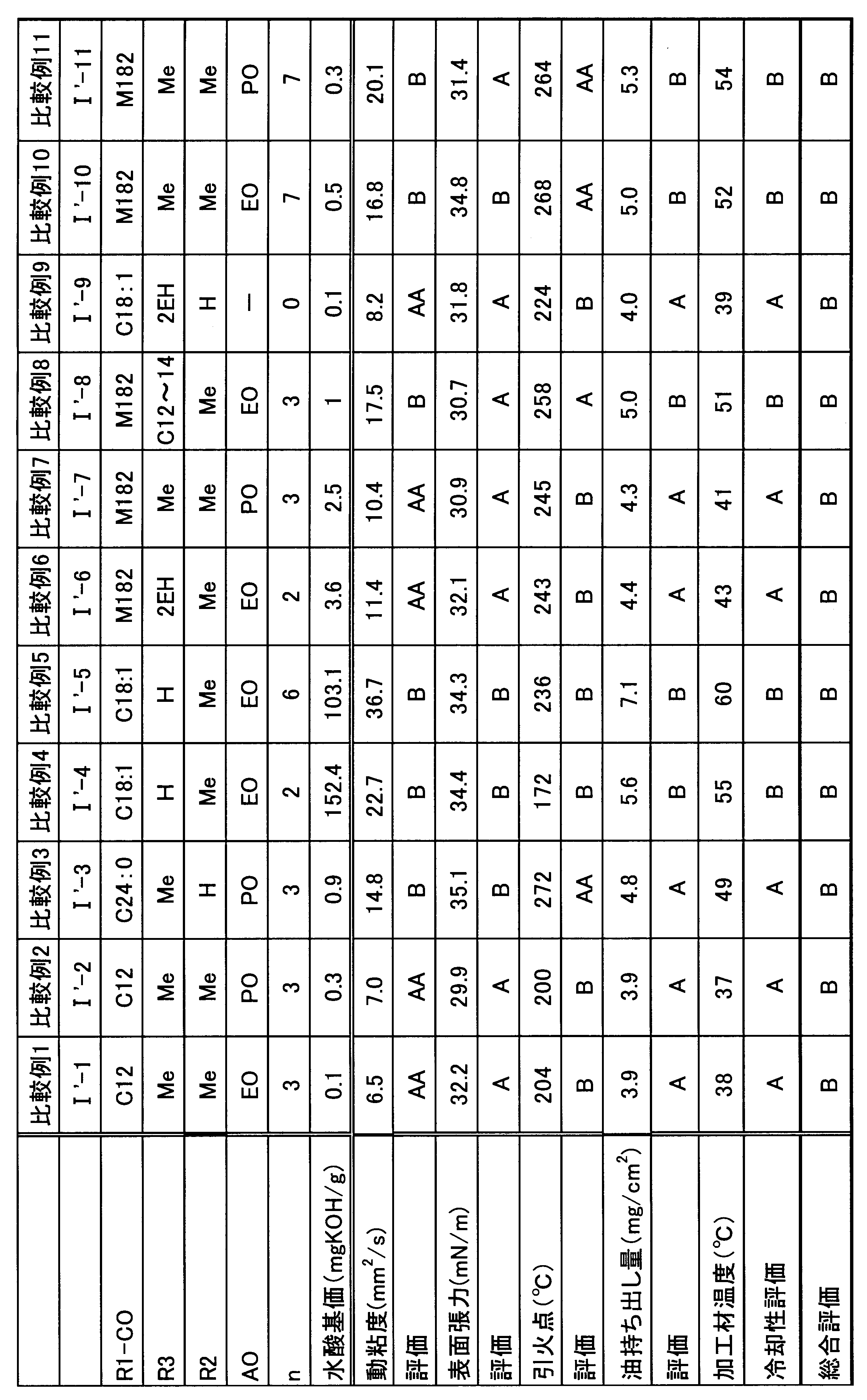
一方で表2に示すように、R1-COの炭素数が12と少ない比較例1、2では動粘度は「AA」、表面張力は「A」であったが引火点が200℃前後で「B」であり、R1-COの炭素数がC24:0と多い比較例3では引火点は「AA」だが40℃動粘度および表面張力が「B」であった。R3の炭素数が0、すなわち末端がOH基である比較例4、5では、実施例よりも分子量が少ないにも関わらず、40℃動粘度は22.7および36.7mm2/sと高いため「B」であり、さらに表面張力も34.3、34.4mN/mと高いため「B」であった。加えて、引火点も250℃未満で「B」であり、実施化合物よりいずれの性能も劣っていた。水酸基価が3.6mgKOH/g以上である比較例6は、実施例8と同じ構造であるにも関わらず、引火点が低下し、「B」であった。R3の炭素数が12以上である比較例8では、表面張力および引火点は「A」であるが、40℃動粘度が「B」であった。AO構造を含まない比較例9では、動粘度および表面張力は「A」であるが、引火点が「B」であった。AOの付加モル数が7と大きい比較例10、11では、引火点は「AA」であるものの、動粘度および表面張力は「B」であった。
また、動粘度が低い実施例1~10の油持ち出し量は最大でも4.7mg/cm2であり、動粘度が高い比較例4、5、8、10、11よりも油持ち出し量が6~34%以上減少した。金属表面の冷却性も、比較例4、5、8、10、11に比べ、いずれの実施例でも向上した。なお、油持ち出し量および冷却性に優れる比較例1、2、3、6、7、9は引火点が低く、引火危険性が十分に回避できないため、実用上では不十分である。
これらの結果から、本発明に係る金属加工用不水溶性切削油基油または研削油基油は、高い引火点を維持したまま、低い動粘度と低い表面張力を満足することができ、金属表面および加工点の冷却性と引火危険性の低減が可能となることが判明した。
Claims (9)
- 下記式(I-A)で表される脂肪酸ポリオキシアルキレンアルキルエーテルを含有する金属加工用不水溶性切削油基油または研削油基油であって、前記脂肪酸ポリオキシアルキレンアルキルエーテルの水酸基価が2.0mgKOH/g以下である金属加工用不水溶性切削油基油または研削油基油。
[化1]
R1-CO-(OA)n-OR3 (I-A)
(式(I-A)中、R1は炭素数15~21の直鎖もしくは分岐鎖の飽和または不飽和の一価の炭化水素基であり、R3は炭素数1~8の直鎖、分岐または環状の一価の炭化水素基である。また、Aは炭素数2~4のアルキレン基であり、OAはアルキレンオキシドを表し、nはアルキレンオキシドの平均付加モル数を示し、1~6である。) - 前記式(I-A)で表される脂肪酸ポリオキシアルキレンアルキルエーテルが、式(I)で表される化合物(A)と式(II)で表される化合物(B)とを反応させて得られる請求項1に記載の金属加工用切削油基油または研削油基油。
[化2]
R1-CO-OR2 (I)
[化3]
R3O-(AO)n-H (II)
(ただし、式(I)中、R2は炭素数1~18の一価の炭化水素基であり、他の記号は前記に同じ。) - R1が炭素数17の一価の炭化水素基である、請求項1または2に記載の金属加工用切削油基油または研削油基油。
- 式(I-A)または式(I)における化合物の脂肪酸部(R1CO部)に対応する脂肪酸が、オレイン酸、パーム由来C18混合脂肪酸、大豆由来C18混合脂肪酸、ナタネ由来C18混合脂肪酸、米糠由来C18混合脂肪酸および牛脂由来C18混合脂肪酸からなる群より選択される少なくとも1種以上である請求項1または2記載の金属加工用切削油基油または研削油基油。
- 式(I)におけるR2がメチル基である請求項2に記載の金属加工用切削油基油または研削油基油。
- 式(I-A)又は(II)におけるR3がメチル基、イソブチル基、n-ブチル基、t-ブチル基および2-エチルヘキシル基からなる群より選択される少なくとも1種以上である請求項1~5のいずれか一項に記載の金属加工用切削油基油または研削油基油。
- 40℃における動粘度が、7~14mm2/sである請求項1~6のいずれか一項に記載の金属加工用切削油基油または研削油基油。
- 表面張力が、34mN/m以下である請求項1~7のいずれか一項に記載の金属加工用切削油基油または研削油基油
- 請求項1~8のいずれか一項に記載の式(I-A)で表される脂肪酸ポリオキシアルキレンアルキルエーテルを含有する組成物を用いて、金属を切削または研削する方法。
Priority Applications (3)
| Application Number | Priority Date | Filing Date | Title |
|---|---|---|---|
| JP2012524556A JP5879263B2 (ja) | 2010-07-12 | 2011-07-12 | 金属加工油基油 |
| CN201180038590.1A CN103052701B (zh) | 2010-07-12 | 2011-07-12 | 金属加工油基础油 |
| US13/809,547 US8742149B2 (en) | 2010-07-12 | 2011-07-12 | Metalworking fluid base oil |
Applications Claiming Priority (2)
| Application Number | Priority Date | Filing Date | Title |
|---|---|---|---|
| JP2010158075 | 2010-07-12 | ||
| JP2010-158075 | 2010-07-12 |
Publications (1)
| Publication Number | Publication Date |
|---|---|
| WO2012008442A1 true WO2012008442A1 (ja) | 2012-01-19 |
Family
ID=45469440
Family Applications (1)
| Application Number | Title | Priority Date | Filing Date |
|---|---|---|---|
| PCT/JP2011/065873 Ceased WO2012008442A1 (ja) | 2010-07-12 | 2011-07-12 | 金属加工油基油 |
Country Status (4)
| Country | Link |
|---|---|
| US (1) | US8742149B2 (ja) |
| JP (1) | JP5879263B2 (ja) |
| CN (1) | CN103052701B (ja) |
| WO (1) | WO2012008442A1 (ja) |
Cited By (9)
| Publication number | Priority date | Publication date | Assignee | Title |
|---|---|---|---|---|
| JP2015199934A (ja) * | 2014-03-31 | 2015-11-12 | ウシオケミックス株式会社 | 潤滑性化合物及びそれを含む潤滑剤組成物 |
| US20160186085A1 (en) * | 2013-08-21 | 2016-06-30 | Sanyo Chemical Industries, Ltd. | Water-soluble lubricant oil |
| JP2016190830A (ja) * | 2015-03-31 | 2016-11-10 | 日本乳化剤株式会社 | ポリアルキレングリコールモノアルキルエーテルおよびその製造方法 |
| JP2017101148A (ja) * | 2015-12-01 | 2017-06-08 | 日油株式会社 | 潤滑剤用基油 |
| JP2017101149A (ja) * | 2015-12-01 | 2017-06-08 | 日油株式会社 | 潤滑剤用基油 |
| JP2018172717A (ja) * | 2017-03-31 | 2018-11-08 | Jx金属株式会社 | 銅又は銅合金の板条並びにトラバースコイル及びその製造方法 |
| JP2019123942A (ja) * | 2019-02-06 | 2019-07-25 | Jx金属株式会社 | 銅又は銅合金の板条並びにトラバースコイル及びその製造方法 |
| JP2019194186A (ja) * | 2019-04-25 | 2019-11-07 | 築野食品工業株式会社 | 潤滑油用エステル基油 |
| WO2020017319A1 (ja) * | 2018-07-20 | 2020-01-23 | パナソニック アプライアンシズ リフリジレーション デヴァイシズ シンガポール | 密閉型冷媒圧縮機およびそれを用いた冷凍・冷蔵装置 |
Families Citing this family (5)
| Publication number | Priority date | Publication date | Assignee | Title |
|---|---|---|---|---|
| WO2014089766A1 (en) * | 2012-12-12 | 2014-06-19 | Dow Global Technologies Llc | A concentrated metalworking fluid and metalworking process |
| CN103254983B (zh) * | 2013-05-19 | 2014-10-22 | 广西大学 | 工程机械用油压作动油 |
| JP6392713B2 (ja) * | 2015-07-29 | 2018-09-19 | ファナック株式会社 | 切削液の付着を報知可能なモータ駆動装置 |
| SG11201801166TA (en) * | 2015-08-13 | 2018-03-28 | Fuchs Petrolub Se | Composition for minimum quantity lubrication, and use of same |
| CN116042298B (zh) * | 2023-01-30 | 2024-09-27 | 宁波金田铜业(集团)股份有限公司 | 一种棒材剥皮方法及其冷却液与模具 |
Citations (6)
| Publication number | Priority date | Publication date | Assignee | Title |
|---|---|---|---|---|
| JPH0379697A (ja) * | 1989-08-22 | 1991-04-04 | Asahi Glass Co Ltd | 鋼用冷間圧延油 |
| JPH05117683A (ja) * | 1991-10-31 | 1993-05-14 | Lion Corp | エマルジヨン型潤滑剤 |
| JPH08302381A (ja) * | 1995-05-10 | 1996-11-19 | Nippon Oil Co Ltd | 金属加工油剤原液組成物および金属加工油剤組成物 |
| JPH1072589A (ja) * | 1996-08-30 | 1998-03-17 | Mitsubishi Alum Co Ltd | 機械加工用潤滑剤、及びこれが塗布された金属材料、並 びに機械加工方法 |
| WO1999064386A1 (en) * | 1998-06-05 | 1999-12-16 | Nippon Shokubai Co., Ltd. | (poly)alkylene glycol higher-alkyl ether derivative composition, and detergent, lubricant, and external-use skin preparation each containing the same |
| JP2011132470A (ja) * | 2009-12-25 | 2011-07-07 | Lion Corp | 潤滑油基油およびその製造方法 |
Family Cites Families (15)
| Publication number | Priority date | Publication date | Assignee | Title |
|---|---|---|---|---|
| JPS4839205B1 (ja) * | 1967-04-05 | 1973-11-22 | ||
| JPS61215699A (ja) * | 1985-02-27 | 1986-09-25 | Nippon Steel Corp | 鋼板の冷間圧延油 |
| JP2940852B2 (ja) | 1993-12-24 | 1999-08-25 | ライオン株式会社 | 脂肪酸ポリオキシアルキレンアルキルエーテルの製造方法 |
| JPH07316573A (ja) | 1994-05-25 | 1995-12-05 | Lion Corp | 2サイクルエンジン用潤滑油基油 |
| JPH09235577A (ja) * | 1995-12-26 | 1997-09-09 | Kao Corp | 潤滑油組成物 |
| CN1212378C (zh) * | 2003-05-24 | 2005-07-27 | 启东尤希路化学工业有限公司 | 水溶性切削液 |
| JP4540651B2 (ja) * | 2005-09-22 | 2010-09-08 | 昭雄 小林 | 油脂に由来する各種脂肪酸の2−アルコキシエチルエステル混合物、その製造方法、その使用、及びそれを含有する混合物 |
| JP5117683B2 (ja) * | 2006-04-12 | 2013-01-16 | 株式会社間組 | 堤体の補強構造 |
| JP2008163115A (ja) | 2006-12-27 | 2008-07-17 | Nippon Oil Corp | 金属加工油組成物 |
| JP5292773B2 (ja) * | 2006-12-27 | 2013-09-18 | 新日本理化株式会社 | 軸受用潤滑油 |
| KR101445160B1 (ko) * | 2007-02-09 | 2014-09-29 | 고큐 아르코르 고교 가부시키가이샤 | 유제, 및 이를 함유하는 윤활제, 보습제 및 외용제 |
| JP5078068B2 (ja) * | 2007-02-28 | 2012-11-21 | 花王株式会社 | 潤滑油基油 |
| CN100523154C (zh) | 2007-03-05 | 2009-08-05 | 中国石油化工集团公司 | 一种冷轧薄板轧制油的组合物 |
| JP5250282B2 (ja) * | 2008-03-17 | 2013-07-31 | ライオン株式会社 | 衛生害虫駆除剤組成物 |
| JP2009275137A (ja) | 2008-05-15 | 2009-11-26 | Jfe Steel Corp | 熱間圧延油組成物、および、フェライト系ステンレス鋼の熱間圧延方法 |
-
2011
- 2011-07-12 CN CN201180038590.1A patent/CN103052701B/zh not_active Expired - Fee Related
- 2011-07-12 JP JP2012524556A patent/JP5879263B2/ja not_active Expired - Fee Related
- 2011-07-12 WO PCT/JP2011/065873 patent/WO2012008442A1/ja not_active Ceased
- 2011-07-12 US US13/809,547 patent/US8742149B2/en not_active Expired - Fee Related
Patent Citations (6)
| Publication number | Priority date | Publication date | Assignee | Title |
|---|---|---|---|---|
| JPH0379697A (ja) * | 1989-08-22 | 1991-04-04 | Asahi Glass Co Ltd | 鋼用冷間圧延油 |
| JPH05117683A (ja) * | 1991-10-31 | 1993-05-14 | Lion Corp | エマルジヨン型潤滑剤 |
| JPH08302381A (ja) * | 1995-05-10 | 1996-11-19 | Nippon Oil Co Ltd | 金属加工油剤原液組成物および金属加工油剤組成物 |
| JPH1072589A (ja) * | 1996-08-30 | 1998-03-17 | Mitsubishi Alum Co Ltd | 機械加工用潤滑剤、及びこれが塗布された金属材料、並 びに機械加工方法 |
| WO1999064386A1 (en) * | 1998-06-05 | 1999-12-16 | Nippon Shokubai Co., Ltd. | (poly)alkylene glycol higher-alkyl ether derivative composition, and detergent, lubricant, and external-use skin preparation each containing the same |
| JP2011132470A (ja) * | 2009-12-25 | 2011-07-07 | Lion Corp | 潤滑油基油およびその製造方法 |
Cited By (11)
| Publication number | Priority date | Publication date | Assignee | Title |
|---|---|---|---|---|
| US20160186085A1 (en) * | 2013-08-21 | 2016-06-30 | Sanyo Chemical Industries, Ltd. | Water-soluble lubricant oil |
| JP2015199934A (ja) * | 2014-03-31 | 2015-11-12 | ウシオケミックス株式会社 | 潤滑性化合物及びそれを含む潤滑剤組成物 |
| JP2016130316A (ja) * | 2014-03-31 | 2016-07-21 | ウシオケミックス株式会社 | 潤滑性化合物及びそれを含む潤滑剤組成物 |
| JP2016190830A (ja) * | 2015-03-31 | 2016-11-10 | 日本乳化剤株式会社 | ポリアルキレングリコールモノアルキルエーテルおよびその製造方法 |
| JP2017101148A (ja) * | 2015-12-01 | 2017-06-08 | 日油株式会社 | 潤滑剤用基油 |
| JP2017101149A (ja) * | 2015-12-01 | 2017-06-08 | 日油株式会社 | 潤滑剤用基油 |
| JP2018172717A (ja) * | 2017-03-31 | 2018-11-08 | Jx金属株式会社 | 銅又は銅合金の板条並びにトラバースコイル及びその製造方法 |
| WO2020017319A1 (ja) * | 2018-07-20 | 2020-01-23 | パナソニック アプライアンシズ リフリジレーション デヴァイシズ シンガポール | 密閉型冷媒圧縮機およびそれを用いた冷凍・冷蔵装置 |
| JP2019123942A (ja) * | 2019-02-06 | 2019-07-25 | Jx金属株式会社 | 銅又は銅合金の板条並びにトラバースコイル及びその製造方法 |
| JP7093317B2 (ja) | 2019-02-06 | 2022-06-29 | Jx金属株式会社 | トラバースコイル及びその製造方法 |
| JP2019194186A (ja) * | 2019-04-25 | 2019-11-07 | 築野食品工業株式会社 | 潤滑油用エステル基油 |
Also Published As
| Publication number | Publication date |
|---|---|
| US8742149B2 (en) | 2014-06-03 |
| CN103052701A (zh) | 2013-04-17 |
| JP5879263B2 (ja) | 2016-03-08 |
| US20130116460A1 (en) | 2013-05-09 |
| CN103052701B (zh) | 2014-10-22 |
| JPWO2012008442A1 (ja) | 2013-09-09 |
Similar Documents
| Publication | Publication Date | Title |
|---|---|---|
| JP5879263B2 (ja) | 金属加工油基油 | |
| US7838472B2 (en) | Oil composition for cutting and grinding by minimal quantity lubrication system | |
| WO2005095556A1 (ja) | 金属加工油 | |
| JP4371658B2 (ja) | 極微量油剤供給式切削・研削加工用兼摺動面用油剤及びそれを用いた極微量油剤供給式切削・研削加工方法 | |
| WO2008032504A1 (en) | Minimal quantity lubrication cutting/grinding method, and oil composition for minimal quantity lubrication cutting/grinding | |
| JP2008163115A (ja) | 金属加工油組成物 | |
| WO2005063947A1 (ja) | 金属加工用油剤 | |
| CN101486942B (zh) | 金属加工油 | |
| JP4599078B2 (ja) | 金属加工油組成物 | |
| CN100523149C (zh) | 金属加工用油剂 | |
| JP5945486B2 (ja) | 金属加工油組成物 | |
| JP5462993B2 (ja) | 金属加工油組成物 | |
| WO2023190158A1 (ja) | 潤滑油組成物 | |
| JP5380408B2 (ja) | 金属加工油及び金属加工方法 | |
| JP5173329B2 (ja) | 金属加工用潤滑油組成物 | |
| JP2009286823A (ja) | 切り屑吸引式切削・研削加工用油剤組成物 | |
| JP2005187647A (ja) | 工作機械用潤滑油及び工作機械の潤滑方法 | |
| JP4993984B2 (ja) | 温間プレス加工用油剤組成物および温間プレス加工方法 | |
| JP6892784B2 (ja) | 金属加工用潤滑油組成物 | |
| JP5004481B2 (ja) | 金属加工油組成物 | |
| JP7430072B2 (ja) | 潤滑油基剤と、これを含む摩擦低減剤および金属加工油 | |
| JP2006249370A (ja) | 金属加工油組成物 | |
| JP2005290225A (ja) | 抄紙機用潤滑油組成物 |
Legal Events
| Date | Code | Title | Description |
|---|---|---|---|
| WWE | Wipo information: entry into national phase |
Ref document number: 201180038590.1 Country of ref document: CN |
|
| 121 | Ep: the epo has been informed by wipo that ep was designated in this application |
Ref document number: 11806772 Country of ref document: EP Kind code of ref document: A1 |
|
| WWE | Wipo information: entry into national phase |
Ref document number: 2012524556 Country of ref document: JP |
|
| WWE | Wipo information: entry into national phase |
Ref document number: 13809547 Country of ref document: US |
|
| NENP | Non-entry into the national phase |
Ref country code: DE |
|
| 122 | Ep: pct application non-entry in european phase |
Ref document number: 11806772 Country of ref document: EP Kind code of ref document: A1 |