WO2011125451A1 - ホワイトチョコレート含浸食品及びその製造方法 - Google Patents
ホワイトチョコレート含浸食品及びその製造方法 Download PDFInfo
- Publication number
- WO2011125451A1 WO2011125451A1 PCT/JP2011/056404 JP2011056404W WO2011125451A1 WO 2011125451 A1 WO2011125451 A1 WO 2011125451A1 JP 2011056404 W JP2011056404 W JP 2011056404W WO 2011125451 A1 WO2011125451 A1 WO 2011125451A1
- Authority
- WO
- WIPO (PCT)
- Prior art keywords
- white chocolate
- chocolate dough
- impregnated
- dough
- food
- Prior art date
- Legal status (The legal status is an assumption and is not a legal conclusion. Google has not performed a legal analysis and makes no representation as to the accuracy of the status listed.)
- Ceased
Links
Images

Classifications
-
- A—HUMAN NECESSITIES
- A23—FOODS OR FOODSTUFFS; TREATMENT THEREOF, NOT COVERED BY OTHER CLASSES
- A23G—COCOA; COCOA PRODUCTS, e.g. CHOCOLATE; SUBSTITUTES FOR COCOA OR COCOA PRODUCTS; CONFECTIONERY; CHEWING GUM; ICE-CREAM; PREPARATION THEREOF
- A23G1/00—Cocoa; Cocoa products, e.g. chocolate; Substitutes therefor
- A23G1/30—Cocoa products, e.g. chocolate; Substitutes therefor
- A23G1/305—Products for covering, coating, finishing or decorating
-
- A—HUMAN NECESSITIES
- A21—BAKING; EDIBLE DOUGHS
- A21D—TREATMENT OF FLOUR OR DOUGH FOR BAKING, e.g. BY ADDITION OF MATERIALS; BAKING; BAKERY PRODUCTS
- A21D13/00—Finished or partly finished bakery products
- A21D13/20—Partially or completely coated products
- A21D13/24—Partially or completely coated products coated after baking
-
- A—HUMAN NECESSITIES
- A21—BAKING; EDIBLE DOUGHS
- A21D—TREATMENT OF FLOUR OR DOUGH FOR BAKING, e.g. BY ADDITION OF MATERIALS; BAKING; BAKERY PRODUCTS
- A21D13/00—Finished or partly finished bakery products
- A21D13/20—Partially or completely coated products
- A21D13/28—Partially or completely coated products characterised by the coating composition
-
- A—HUMAN NECESSITIES
- A23—FOODS OR FOODSTUFFS; TREATMENT THEREOF, NOT COVERED BY OTHER CLASSES
- A23G—COCOA; COCOA PRODUCTS, e.g. CHOCOLATE; SUBSTITUTES FOR COCOA OR COCOA PRODUCTS; CONFECTIONERY; CHEWING GUM; ICE-CREAM; PREPARATION THEREOF
- A23G1/00—Cocoa; Cocoa products, e.g. chocolate; Substitutes therefor
- A23G1/30—Cocoa products, e.g. chocolate; Substitutes therefor
- A23G1/32—Cocoa products, e.g. chocolate; Substitutes therefor characterised by the composition containing organic or inorganic compounds
- A23G1/46—Cocoa products, e.g. chocolate; Substitutes therefor characterised by the composition containing organic or inorganic compounds containing dairy products
-
- A—HUMAN NECESSITIES
- A23—FOODS OR FOODSTUFFS; TREATMENT THEREOF, NOT COVERED BY OTHER CLASSES
- A23G—COCOA; COCOA PRODUCTS, e.g. CHOCOLATE; SUBSTITUTES FOR COCOA OR COCOA PRODUCTS; CONFECTIONERY; CHEWING GUM; ICE-CREAM; PREPARATION THEREOF
- A23G1/00—Cocoa; Cocoa products, e.g. chocolate; Substitutes therefor
- A23G1/30—Cocoa products, e.g. chocolate; Substitutes therefor
- A23G1/50—Cocoa products, e.g. chocolate; Substitutes therefor characterised by shape, structure or physical form, e.g. products with an inedible support
- A23G1/54—Composite products, e.g. layered, laminated, coated or filled
Definitions
- the present invention relates to an impregnated food obtained by impregnating a porous food with white chocolate dough and a method for producing the same.
- Patent Document 1 baked rice crackers
- Patent Document 2 croutons
- Patent Document 3 bubble-containing foods excluding croutons
- Patent Document 4 freeze-dried products
- Patent Documents 5 to 6 An impregnation method in which a food is brought into contact with a liquid component, subjected to reduced pressure treatment, and then pressurized to impregnate the food with the liquid component.
- Patent Documents 5 to 6 An impregnation method in which a liquid is impregnated into the food by applying centrifugal force to the food in a state where the liquid having a viscosity of 1 to 7,000 cps at room temperature is in contact with the food (Patent Document 7) ).
- JP-A-9-98719 JP-A-9-308431 WO97 / 4207 JP 2002-291415 A JP 2001-238612 A Japanese Patent Laid-Open No. 2002-354988 JP 2002-209530 A
- An object of the present invention is to provide a white chocolate-impregnated food in which white chocolate dough is sufficiently impregnated into a porous food without being separated into oil and milk solids, and a method for producing the same.
- the white chocolate-impregnated food according to (1) wherein the white chocolate dough has an oil content of 40 wt% or more and 75 wt% or less.
- the non-fat milk solid content of the white chocolate dough is derived from at least one dairy product selected from the group consisting of whole milk powder, skim milk powder and cheese powder, (1) to ( The white chocolate-impregnated food according to any one of 3).
- an impregnated food in which a white chocolate dough having a high content of non-fat milk solids is sufficiently permeated deeply into the porous food without being separated into oil and milk solids can be obtained.
- the flavor of white chocolate is not too strong, and an impregnated food excellent in flavor and texture can be obtained.
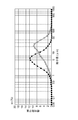
- the particle size distribution of primary white chocolate dough 1 (white circle) and secondary white chocolate dough 1 (black circle) is shown.
- the particle size distribution of primary white chocolate dough 3 (white circle) and secondary white chocolate dough 3 (black circle) is shown.
- the porous food may be a food having a porous void inside, for example, fruits, vegetables, seafood, livestock meat, eggs, molded food (mixed various ingredients).
- Various types of puffed foods such as fried snacks produced by freeze-dried products such as fried oil, pellets heated with hot air, and raw materials cooked and expanded using an extruder.
- Baked confectionery such as garlic, wafers, croutons, meringues, biscuits, pies, cookies and sponge cakes.
- Other examples include breads such as bread and French bread, donuts, waffles, and frozen tofu.
- white chocolate is defined as chocolate containing 21% by weight or more of cocoa butter, 14% by weight or more of milk solids, and 3% by weight or less of moisture.
- cocoa butter includes cocoa butter substitute fats and oils.
- the median diameter refers to a particle diameter at which the integrated value in the particle size distribution measured with a laser diffraction particle size distribution analyzer SALD-2200 (Shimadzu Corporation) is 50%.
- the mode diameter refers to the particle diameter at which the relative particle amount becomes the maximum value.
- the viscosity is a B-type viscometer at 40 ° C. and rotor No. 6 and measured at a rotational speed of 4 rpm.
- the viscosity of the primary white chocolate dough is, for example, 2,000 cps to 4,500 cps
- the viscosity of the secondary white chocolate dough is, for example, 5,000 cps to 15,000 cps.
- white chocolate dough is prepared by a conventional method, for example, by the following method.
- dairy products for example, dairy products, sugar, cocoa butter, emulsifiers and the like are mixed.
- examples of the dairy product include whole milk powder, skim milk powder, and cheese powder.
- the non-fat milk solid content refers to a milk solid content obtained by removing the fat content from the milk solid content, and the non-fat milk solid content derived from the dairy product is preferably contained at 15% by weight or more of the whole dough.
- examples of the sugar content include sucrose (sugar, powdered sugar), glucose, fructose, maltose, invert sugar, lactose, and other monosaccharides and disaccharides.
- High sweetness sweeteners such as stevia, aspartate, acesulfame K, saccharin, sugar alcohols such as xylitol, maltitol, erythritol, sorbitol, lactitol, palatinose, mannitol, reduced starch syrup, etc.
- a cocoa butter substitute oil or fat or a mixture of cocoa butter and cocoa butter substitute oil may be used.
- cocoa butter substitute fats and oils include animal or plant-derived tempering fats or non-tempering fats.
- the emulsifier include lecithin, glycerin fatty acid ester, and sucrose fatty acid ester.
- a fragrance or a colorant may be added to the white chocolate dough.
- the oil content of the white chocolate dough is preferably 35% by weight to 85% by weight, and more preferably 40% by weight to 75% by weight of the total formulation. If the oil content is less than 35% by weight, the viscosity becomes high and impregnation is difficult and unsuitable. Further, when the oil content exceeds 85% by weight, the ratio of the non-fat milk solid content is less than 15% by weight, and the oil content and the milk solid content are impregnated without being separated by a known method. By the way. Moreover, the non-fat milk solid content of white chocolate dough is 15 weight% or more. If the non-fat milk solid content is less than 15% by weight, the oil content and the milk solid content are impregnated without being separated, which is not the subject of the present invention.
- the upper limit of the non-fat milk solid content of the white chocolate dough is not particularly limited, but it is generally preferably 65% by weight or less in order to keep the white chocolate dough in a liquid state.
- the mixed raw material is finely pulverized with a refiner or attritor type ball mill (ball diameter: 5 to 10 mm).
- this pulverization treatment is called primary pulverization treatment
- the resulting white chocolate dough is called primary white chocolate dough.
- the median diameter of the particles of the primary white chocolate dough is, for example, 7 to 20 ⁇ m.
- the primary white chocolate dough is subjected to secondary pulverization with a wet pulverizer to obtain a dough having a particle median diameter of 6 ⁇ m or less.
- the white chocolate dough obtained by the secondary pulverization treatment is referred to as a secondary white chocolate dough.
- the wet pulverizer include a bead mill.
- the liquid primary white chocolate dough is pumped into a container called a grinding chamber.
- the crushing chamber is filled with about 85% beads.
- the bead particle size is determined by what is pulverized.
- the particle diameter of the beads used in the present invention is, for example, 0.1 mm to 3.0 mm, preferably 0.8 mm to 2.0 mm. If it is less than 0.1 mm, it is difficult to separate the beads and the white chocolate dough after the treatment. Moreover, since the bead is too heavy when it exceeds 3.0 mm, the grinding
- ⁇ Filled beads move by rotating the rotating shaft at the center of the grinding chamber.
- the primary white chocolate dough fed into the grinding chamber is made fine particles and dispersed by colliding with the beads.
- the pulverized product may pass through the pulverization chamber a plurality of times after passing through the pulverization chamber once.
- the rotation speed of the rotating shaft is preferably 1,000 to 2,800 rpm, for example.
- the material of the beads examples include glass, quartz, titania, silicon nitride, alumina, ceramics (zirconia / zirconia reinforced alumina), steel, and stainless steel.
- OB mill trade name
- Mighty mill trade name manufactured by Inoue Seisakusho Co., Ltd., and the like are used.
- a characteristic of the pulverized product obtained by the secondary pulverization process by the wet pulverizer is that the width of the particle size distribution is narrow, that is, the particle size distribution is monodisperse.
- the particle size distribution of the particles of the primary white chocolate dough is polydispersed and the difference between the mode diameter and the median diameter is large. The distribution is monodispersed, and the difference between the mode diameter and the median diameter is small. Not only the particle diameter is reduced but also the particles are less likely to aggregate, so that the secondary chocolate dough is more easily impregnated into the porous food.
- the primary or secondary chocolate dough may be conched by a conche.
- tempering when the tempering treatment is necessary when the white chocolate dough is brought into contact with the porous food in the molten state, tempering is performed at an appropriate temperature, for example, 30 to 35 ° C.
- a seed agent such as BOB (1,3-dibehenoyl-2-oleoyl-sn-glycerol), which is a high melting point oil or fat, may be added during tempering.
- BOB 1,3-dibehenoyl-2-oleoyl-sn-glycerol
- examples of commercially available seed agents include Bobster (trade name: manufactured by Fuji Oil Co., Ltd., a mixture of 50% by weight of BOB powder and 50% by weight of powdered sugar).
- An impregnated food is obtained by bringing a porous food into contact with or immersing the molten white chocolate dough under a reduced pressure and returning to normal pressure.
- B after the porous food is subjected to reduced pressure treatment, and then the food is contacted or immersed in the white chocolate dough,
- C the porous food is melted into the white chocolate dough under reduced pressure.
- the inside of the vacuum-pressure impregnation tank is purged with air, and then compressed air or nitrogen gas is introduced, for example, the maximum pressure reached is 200 kPa to 1,000 kPa. To do. After impregnation, excess white chocolate dough can be removed from the surface with an air blower or the like.
- the centrifugal force is not particularly limited, but in most cases, the rotational speed may be a centrifugal force generated by a normal centrifuge of 100 to 4,000 rpm.
- the centrifugation time can be set in consideration of the properties of the food to be impregnated and the white chocolate dough, the degree of impregnation, and the multiplication.
- the secondary white chocolate dough impregnated at 15 ° C. or lower is cooled and solidified to obtain a white chocolate impregnated food.
- Production Example 1 Manufacture of baked goods 140 parts by weight of chicken egg, 100 parts by weight of sugar, 25 parts by weight of emulsifier and 85 parts by weight of water were mixed and stirred well, and 150 parts by weight of flour was added and mixed to obtain a dough of water. This was poured into a metal mold, baked at 180 ° C. for 30 minutes in an oven, and further dried at 100 ° C. for 30 minutes to obtain a baked confectionery of 55 mm ⁇ 15 mm ⁇ 15 mm.
- Example 1 (Preparation of primary white chocolate dough 1) Whole fat powdered milk, powdered sugar, cocoa butter, lecithin, glycerin fatty acid ester are mixed according to a conventional method with the composition shown in Table 1, pulverized with a refiner, solid content of nonfat milk is 18% by weight, and oil content is 50% by weight. A primary white chocolate dough 1 was prepared. The median diameter and viscosity of the dough particles were 8.1 ⁇ m and 3,750 cps, respectively.
- the primary white chocolate dough 1 is pumped to a bead mill (OB mill; trade name, manufactured by Turbo Industry Co., Ltd., bead particle size: 0.5 mm), the product temperature is 62.2 to 63.2 ° C., and the rotation speed However, it was passed through the grinding chamber under the condition of 1,000 rpm. This operation was repeated three times in succession to obtain a secondary white chocolate dough 1.
- the median diameter and viscosity of the dough particles were 3.1 ⁇ m and 10,000 cps, respectively.
- the baked confectionery is taken out from the white chocolate dough, the white chocolate dough adhering to the surface of the baked confectionery is removed by a blower (noiseless air blower Nishimura Electric Co., Ltd.), and then cooled at 13 ° C.
- the white chocolate dough was solidified to obtain impregnated food 1 in which white chocolate was sufficiently impregnated deep inside.
- the impregnated food 1 was a baked confectionery excellent in flavor and texture without the white chocolate flavor being too strong.
- Example 2 (Preparation of primary white chocolate dough 2)
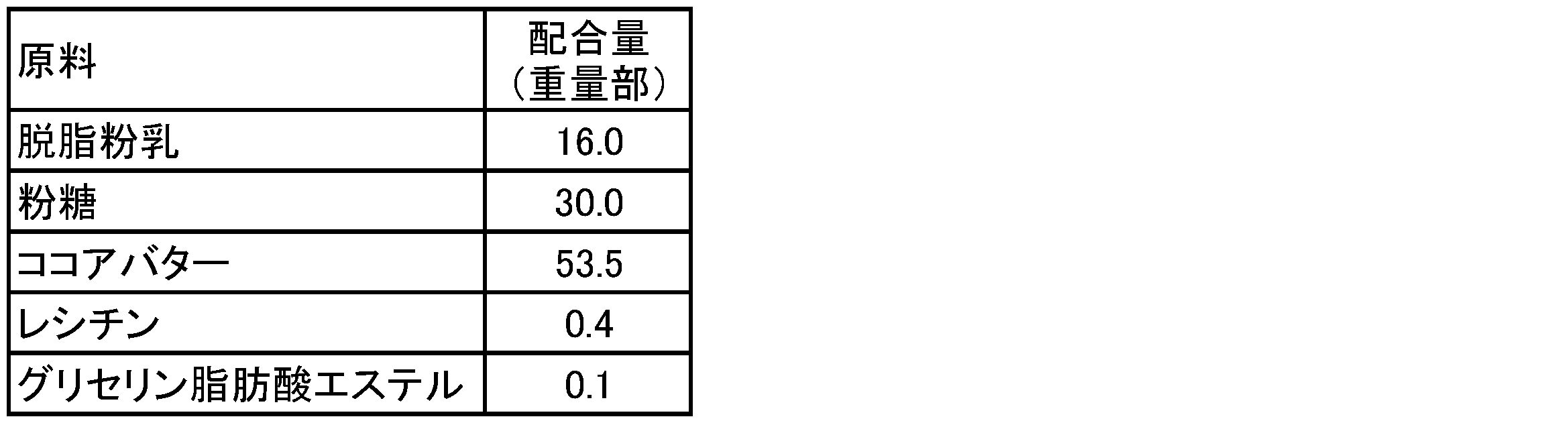
- Non-fat dry milk, powdered sugar, cocoa butter, lecithin, glycerin fatty acid ester are mixed according to a conventional method with the formulation shown in Table 2, pulverized with a refiner, 15% by weight of non-fat solid components, and 54% by weight of oil.
- a primary white chocolate dough 2 was prepared.
- the median diameter and viscosity of the dough particles were 9.2 ⁇ m and 3,900 cps, respectively.
- the secondary white chocolate dough 2 was obtained by subjecting the primary white chocolate dough 2 to secondary pulverization using a bead mill in the same manner as in Example 1.
- the median diameter and viscosity of the dough particles were 4.2 ⁇ m and 12,000 cps, respectively.
- Example 3 (Preparation of primary white chocolate dough 3)
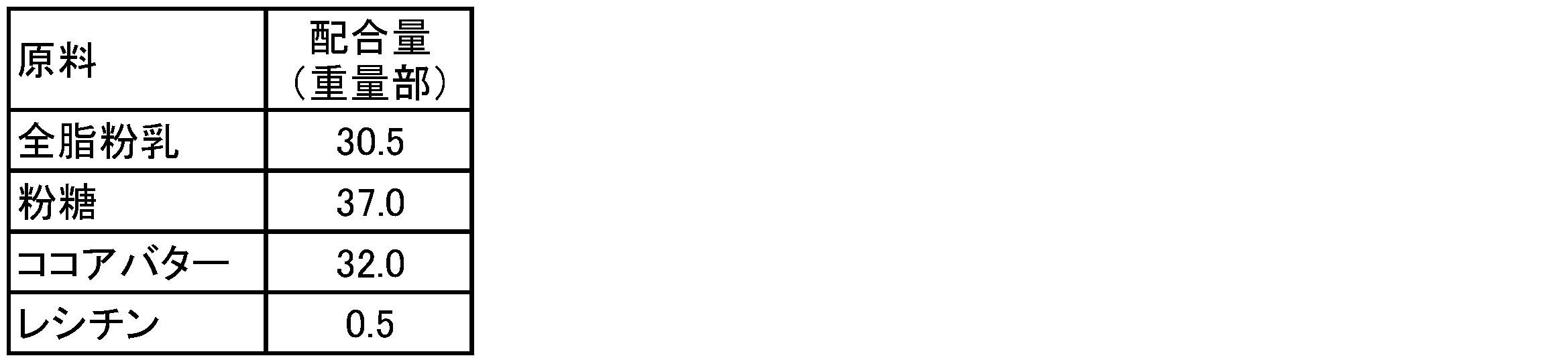
- Cheese powder, cocoa butter, and lecithin were mixed according to a conventional method with the composition shown in Table 3, and pulverized with an attritor-type ball mill (Mitsui Miike Seisakusho, ball diameter: 9.5 mm) for 40 minutes.
- a primary white chocolate dough 3 having a weight% and an oil content of 74% by weight was prepared.
- the median diameter and viscosity of the dough particles were 15.5 ⁇ m and 2,500 cps, respectively.
- the primary white chocolate dough 3 is pumped to a bead mill (OB mill; trade name, manufactured by Turbo Industry Co., Ltd., bead diameter: 0.5 mm), the product temperature is 44.4 to 49.2 ° C., and the rotation speed is 1. , 500 rpm, and passed once to obtain a secondary white chocolate dough 3.
- the median diameter and viscosity of the dough particles were 5.2 ⁇ m and 5,000 cps, respectively.
- Comparative Example 1 (Production of Comparative Impregnated Food 1) 3 parts by weight of Bobster (trade name: a mixture of 50% by weight of BOB powder and 50% by weight of powdered sugar) manufactured by Fuji Oil Co., Ltd. was added to and mixed with primary white chocolate dough 1 (100 parts by weight) tempered at 30 to 35 ° C. Then, while maintaining the temperature at 30 to 35 ° C., the baked confectionery of Production Example 1 was buried in the primary white chocolate dough 1 containing BOB, put in a sealed container, and subjected to a decompression process until it reached 10.7 kPa. After that, the pressure was immediately returned to normal pressure. A comparatively impregnated food 1 in which white solids aggregated on the surface of the baked confectionery and only the oil was impregnated was obtained. Therefore, an impregnated food impregnated with white chocolate could not be obtained.
- Comparative Example 2 (Production of Comparative Impregnated Food 2) Using the primary white chocolate dough 2 obtained in Example 2, the same impregnation treatment as in Comparative Example 1 was performed, but the white solids aggregated on the surface of the baked confectionery, and the comparatively impregnated food 2 in which only the oil was impregnated. Got. Therefore, an impregnated food impregnated with white chocolate could not be obtained.
- Comparative Example 3 (Production of Comparative Impregnated Food 3) The same impregnation treatment as in Comparative Example 1 was performed using the primary white chocolate dough 3 obtained in Example 3, but the solid content aggregated on the surface of the baked confectionery, and the comparative impregnated food 3 in which only the oil was impregnated. Got. Therefore, an impregnated food impregnated with white chocolate could not be obtained.
- Test example 1 In order to examine the influence on the impregnation by the quantitative change of the oil content, the following test was conducted. (Preparation of primary and secondary white chocolate dough with 40% oil content) Whole white powdered milk, powdered sugar, cocoa butter and lecithin are mixed in the formulation shown in Table 4 and pulverized with a refiner. The primary white chocolate dough has a nonfat milk solid content of 22% by weight and an oil content of 40% by weight. 4 (hereinafter referred to as primary dough 4) was prepared. The median diameter of the dough was 10.3 ⁇ m.
- the primary dough 4 is sent to a bead mill (OB mill; trade name, manufactured by Turbo Kogyo Co., Ltd., bead particle size: 2.0 mm) by a pump, the product temperature is 60 to 62 ° C., the rotation speed is 1, Under the condition of 000 rpm, it passed through the grinding chamber once to obtain a secondary white chocolate dough 4 (hereinafter referred to as secondary dough 4).
- the median diameter of the dough was 4.6 ⁇ m.
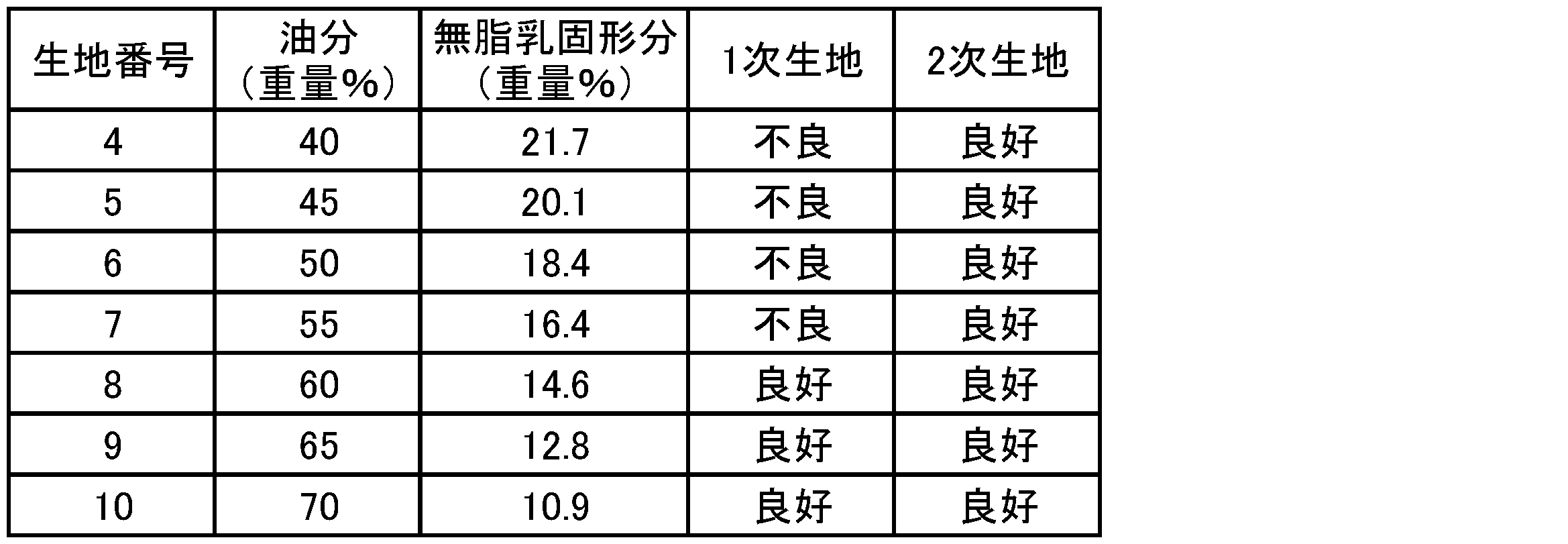
- Example 1 (Test to examine the effect of the quantitative ratio of oil on impregnation) Using the primary white chocolate dough and the secondary white chocolate dough in place of the secondary white chocolate dough 1, the baked confectionery of Production Example 1 was impregnated by the same impregnation method as in Example 1. The results are shown in Table 5. “Good” indicates that an impregnated food product that has been sufficiently impregnated with white chocolate deep inside is obtained, and “Poor” indicates that only the oil component is impregnated, and the white milk solids aggregate on the surface of the baked confectionery and cannot be impregnated. Indicates no.
- the oil content of the white chocolate dough is from 40% to 55% by weight, the white chocolate dough cannot be impregnated unless the refiner treatment is followed by a secondary grinding treatment with a bead mill.
- the solid content of non-fat milk was less than 15% by weight, and it was possible to impregnate even with refiner treatment alone.
- the weight of the baked confectionery was measured before and after the primary dough 4 and the secondary dough 4 were impregnated to examine how much the white chocolate dough was impregnated.
- the impregnated baked confectionery was weighed after wiping the white chocolate dough adhering to the surface with tissue paper. The results are shown in Table 6.
- the primary dough 4 impregnated only 1.5 g, whereas the secondary dough 4 impregnated 10.4 g (about 7 times).
- Example 4 Preparation of primary white chocolate dough 11
- Whole milk powder, powdered sugar, cocoa butter, lecithin, glycerin fatty acid ester are mixed according to the conventional method with the composition shown in Table 7, and pulverized for 40 minutes with an attritor type ball mill (Mitsui Miike Seisakusho, ball diameter: 9.5 mm).
- a primary white chocolate dough 11 having a non-fat milk solid content of 18% by weight and an oil content of 50% by weight was prepared.
- the median diameter and viscosity of the dough particles were 15.5 ⁇ m and 2,500 cps, respectively.
- the primary white chocolate dough 11 is pumped to a bead mill (OB mill; trade name, manufactured by Turbo Industry Co., Ltd., bead diameter: 0.5 mm), the product temperature is 60.5 to 62.3 ° C., and the rotation speed is 1. , 500 rpm, and passed once to obtain a secondary white chocolate dough 11.
- OB mill trade name, manufactured by Turbo Industry Co., Ltd., bead diameter: 0.5 mm
- the product temperature is 60.5 to 62.3 ° C.
- the rotation speed is 1.
- 500 rpm passed once to obtain a secondary white chocolate dough 11.
- the median diameter and viscosity of the dough particles were 5.2 ⁇ m and 5,000 cps, respectively.
- Test Example 2 Comparison of particle size distribution
- SALD-2200 Laser diffraction particle size distribution analyzer SALD-2200 (Shimadzu Corporation).
- the particle size distribution is shown in FIGS.
- the vertical axis of the drawing indicates the relative particle amount in% indicating the ratio of the volume distribution of each particle size to the total volume, and the horizontal axis indicates the particle size in ⁇ m.
- the primary white chocolate dough 1 has two peaks around 3 ⁇ m and 14 ⁇ m
- the secondary white chocolate dough 1 prepared by passing three times with a bead mill has one sharp peak around 3 ⁇ m. The resulting monodispersion was obtained.
- the median diameter and mode diameter of the primary white chocolate dough 1 are 8.1 ⁇ m and 14.0 ⁇ m, respectively, whereas the median diameter and mode diameter of the secondary white chocolate dough 1 are 3.1 ⁇ m and 3 respectively. .3 ⁇ m.
- the primary white chocolate dough 3 has a peak of 20 ⁇ m and shoulders in the vicinity of 3 ⁇ m and 9 ⁇ m, but the secondary white chocolate dough 3 has a monodisperse that shows one sharp peak near 5.5 ⁇ m. It became.
- the median diameter and mode diameter of the primary white chocolate dough 3 are 15.5 ⁇ m and 21.2 ⁇ m, respectively, whereas the median diameter and mode diameter of the secondary white chocolate dough 3 are 5.2 ⁇ m and 6 respectively. .1 ⁇ m.
Landscapes
- Life Sciences & Earth Sciences (AREA)
- Engineering & Computer Science (AREA)
- Food Science & Technology (AREA)
- Chemical & Material Sciences (AREA)
- Polymers & Plastics (AREA)
- Inorganic Chemistry (AREA)
- Confectionery (AREA)
Abstract
Description
また、前記のような含浸食品を製造するための含浸方法としては、次のような方法が知られている。すなわち、(1)クルトンとチョコレートを混合し、減圧装置内にいれ、減圧装置内を減圧し気泡を排出した後、常圧に戻しチョコレートを含浸させる含浸方法(特許文献2)。(2)食品を液体成分と接触し減圧処理し、次いで昇圧することにより食品中に液体成分を含浸させる含浸方法(特許文献5~6)。(3)室温での粘度が1~7,000cpsである液体を食品に接触させた状態で、遠心力を該食品に作用させることにより、液体を該食品中に含浸させる含浸方法(特許文献7)。
本発明の課題は、ホワイトチョコレート生地が油分と乳固形分とに分離せずに多孔質の食品の内部まで十分に含浸したホワイトチョコレート含浸食品とその製造方法を提供することである。
(1)ホワイトチョコレート生地が多孔質の食品に含浸したホワイトチョコレート含浸食品であって、ホワイトチョコレート生地の無脂乳固形分が15重量%以上であり、かつ、ホワイトチョコレート生地の粒子のメディアン径が6μm以下であることを特徴とする、ホワイトチョコレート含浸食品。
(2)ホワイトチョコレート生地の油分が35重量%以上85重量%以下であることを特徴とする、(1)に記載のホワイトチョコレート含浸食品。
(3)ホワイトチョコレート生地の油分が40重量%以上75重量%以下であることを特徴とする、(1)に記載のホワイトチョコレート含浸食品。
(4)ホワイトチョコレート生地の無脂乳固形分が、全脂粉乳、脱脂粉乳及びチーズパウダーからなる群から選択される少なくとも1種の乳製品に由来することを特徴とする、(1)乃至(3)のいずれか一項に記載のホワイトチョコレート含浸食品。
(5)多孔質の食品が焼き菓子であることを特徴とする、(1)乃至(4)のいずれか一項に記載のホワイトチョコレート含浸食品。
(6)ホワイトチョコレート生地が湿式粉砕装置で粉砕されたものであることを特徴とする、(1)乃至(5)のいずれか一項に記載のホワイトチョコレート含浸食品。
(7)湿式粉砕装置がビーズミルであることを特徴とする、(6)に記載のホワイトチョコレート含浸食品。
(8)ホワイトチョコレート生地の粒子の粒度分布が単分散であることを特徴とする、(1)乃至(5)のいずれか一項に記載のホワイトチョコレート含浸食品。
(9)ホワイトチョコレート生地が多孔質の食品に含浸したホワイトチョコレート含浸食品の製造方法であって、無脂乳固形分を15重量%以上含有するホワイトチョコレート生地を1次粉砕処理して1次ホワイトチョコレート生地を得る工程、1次ホワイトチョコレート生地を湿式粉砕装置により2次粉砕処理して粒子のメディアン径が6μm以下である2次ホワイトチョコレート生地を得る工程、及び2次ホワイトチョコレート生地を多孔質の食品に含浸させる工程を備えることを特徴とする、ホワイトチョコレート含浸食品の製造方法。
(10)1次又は2次ホワイトチョコレート生地の油分が35重量%以上85重量%以下であることを特徴とする、(9)に記載のホワイトチョコレート含浸食品の製造方法。
(11)1次又は2次ホワイトチョコレート生地の油分が40重量%以上75重量%以下であることを特徴とする、(9)に記載のホワイトチョコレート含浸食品の製造方法。
(12)1次又は2次ホワイトチョコレート生地の無脂乳固形分が、全脂粉乳、脱脂粉乳及びチーズパウダーからなる群から選択される少なくとも1種の乳製品に由来することを特徴とする、(9)乃至(11)のいずれか一項に記載のホワイトチョコレート含浸食品の製造方法。
(13)湿式粉砕装置がビーズミルであることを特徴とする、(9)乃至(12)のいずれか一項に記載のホワイトチョコレート含浸食品の製造方法。
(14)多孔質の食品が焼き菓子である(9)乃至(13)のいずれか一項に記載のホワイトチョコレート含浸食品の製造方法。
(15)得られる2次ホワイトチョコレート生地の粒子の粒度分布が単分散であることを特徴とする、(8)乃至(13)のいずれか一項に記載のホワイトチョコレート含浸食品の製造方法。
1次ホワイトチョコレート生地の粘度は、例えば2,000cps~4,500cpsであり、2次ホワイトチョコレート生地の粘度は、例えば、5,000cps~15,000cpsである。
本発明において、圧力差を利用した含浸方法の例を示すと、(A)減圧下で多孔質の食品を前記の溶融状態のホワイトチョコレート生地に接触又は浸漬させ、常圧に戻すことにより含浸食品を製造する方法、(B)多孔質の食品を減圧処理した後、該食品をホワイトチョコレート生地に接触又は浸漬させる方法、(C)減圧下で多孔質の食品を溶融状態の前記ホワイトチョコレート生地に接触又は浸漬させた後、常圧よりも高く昇圧しホワイトチョコレート生地を含浸させる方法、(D)上記(A)の方法で製造したホワイトチョコレート生地が含浸した多孔質食品をホワイトチョコレート生地に接触又は浸漬させることなく、再度密閉系内を減圧状態とし、その後常圧に戻すことを繰り返すことにより製造する方法、が挙げられる。前記で減圧する場合には、真空ポンプで減圧し、密閉系内において到達する最低圧力を、例えば5kPa~70kPaとする。また、常圧より高く昇圧する場合には、真空―加圧含浸タンク内をエアパージした後、続いて圧縮空気や窒素ガスなどを導入して、例えば、到達する最大圧力を200kPa~1,000kPaとする。含浸後、エアブローアーなどで余分なホワイトチョコレート生地を表面から落とすこともできる。
加温して液状のホワイトチョコレート生地を多孔質の食品の表面に塗布するか、多孔質の食品を液状のホワイトチョコレート生地中に浸漬する。次に、ホワイトチョコレート生地が接触した多孔質の食品を遠心分離機に収容して、通常は30~35℃にテンパリングしながら常圧で遠心分離をおこなう。例えば、特開2002―209530に記載の方法に準じて行うが、はじめから、ホワイトチョコレート生地と多孔質の食品と接触しておいてもよいし、また、遠心分離をスタートしたのち、ホワイトチョコレート生地と多孔質の食品を接触させてもよい。食品の種類に応じて冷却下で遠心分離を行ってもよい。遠心力は特に限定されないが、大抵の場合、回転速度は、100~4,000rpmの通常の遠心機により生じる遠心力であればよい。遠心時間は、含浸する食品及びホワイトチョコレート生地の性状、含浸程度、掛け割を考慮して設定できる。
鶏卵140重量部、砂糖100重量部、乳化剤25重量部、水85重量部をよく混合攪拌し、これに薄力粉150重量部を加えて混合し、水ダネ生地を得た。これを金属製の型に流し込み、オーブンで180℃、30分焼成後、さらに100℃で30分乾燥して、55mm×15mm×15mmの焼き菓子を得た。
(1次ホワイトチョコレート生地1の調製)
全脂粉乳、粉糖、ココアバター、レシチン、グリセリン脂肪酸エステルを表1に示す配合で常法に従って混合し、レファイナーで粉砕し、無脂乳固形分が18重量%であり、油分が50重量%である1次ホワイトチョコレート生地1を調製した。該生地粒子のメディアン径及び粘度は、それぞれ8.1μm及び3,750cpsであった。

1次ホワイトチョコレート生地1をビーズミル(OBミル;商品名、ターボ工業株式会社製、ビーズの粒径;0.5mm)にポンプで送り、品温が62.2~63.2℃で、回転速度が、1,000rpmの条件下で、粉砕室の中を通過させた。この操作を連続して3回繰り返し、2次ホワイトチョコレート生地1を得た。該生地粒子のメディアン径及び粘度はそれぞれ3.1μm及び10,000cpsであった。
30~35℃にテンパリングした2次ホワイトチョコレート生地1(100重量部)に、ボブスター(商品名:不二製油社製、BOB粉末50重量%と粉糖50重量%の混合物)3重量部を添加混合して、品温を30~35℃に保持した状態で、製造例1の焼き菓子を前記BOB入り2次ホワイトチョコレート生地1に埋没させ、これを密閉容器内にいれ、10.7kPaになるまで減圧処理を施した後、直ちに常圧に戻した。その後、該ホワイトチョコレート生地から該焼き菓子を取り出し、該焼き菓子の表面に付着したホワイトチョコレート生地をブロアー(無騒音形送排風機 西村電機株式会社)により除去した後、13℃で冷却することでホワイトチョコレート生地を固化させ、ホワイトチョコレートが内部深くまで十分に含浸した含浸食品1を得た。また、含浸食品1は、ホワイトチョコレートの風味が強すぎず、風味・食感に優れた焼き菓子であった。
(1次ホワイトチョコレート生地2の調製)
脱脂粉乳、粉糖、ココアバター、レシチン、グリセリン脂肪酸エステルを表2に示す配合で常法に従って混合し、レファイナーで粉砕し、無脂固形成分が15重量%であり、油分が54重量%である1次ホワイトチョコレート生地2を調製した。該生地粒子のメディアン径及び粘度はそれぞれ、9.2μm及び3,900cpsであった。
1次ホワイトチョコレート生地2を実施例1と同様にビーズミルで2次粉砕処理することにより、2次ホワイトチョコレート生地2を得た。該生地粒子のメディアン径及び粘度はそれぞれ、4.2μm及び12,000cpsであった。
2次ホワイトチョコレート生地1の代わりに2次ホワイトチョコレート生地2を用いて、実施例1と同様の含浸方法により、製造例1の焼き菓子に含浸させたところ、ホワイトチョコレートが内部深くまで十分に含浸した含浸食品2を得ることができた。
(1次ホワイトチョコレート生地3の調製)
チーズパウダー、ココアバター、レシチンを表3に示す配合で常法に従って混合し、アトライタ型ボールミル(三井三池製作所製、ボール径;9.5mm)で40分粉砕処理し、無脂乳固形分が25重量%であり、油分が74重量%である1次ホワイトチョコレート生地3を調製した。該生地粒子のメディアン径及び粘度はそれぞれ、15.5μm及び2,500cpsであった。

1次ホワイトチョコレート生地3をビーズミル(OBミル;商品名、ターボ工業株式会社製、ビーズ径;0.5mm)にポンプで送り、品温が、44.4~49.2℃、回転速度が1,500rpmの条件で、1回通過させ、2次ホワイトチョコレート生地3を得た。該生地粒子のメディアン径及び粘度はそれぞれ、5.2μm及び5,000cpsであった。
2次ホワイトチョコレート生地1の代わりに2次ホワイトチョコレート生地3を用いて、実施例1と同様の含浸方法により、製造例1の焼き菓子に含浸させたところ、油分と固形分とは分離せずに、チーズペーストが内部深くまで十分に含浸した含浸食品3を得ることができた。
30~35℃にテンパリングした1次ホワイトチョコレート生地1(100重量部)にボブスター(商品名:不二製油社製、BOB粉末50重量%と粉糖50重量%の混合物)3重量部を添加混合して、30~35℃を保持した状態で、製造例1の焼き菓子をBOB入り1次ホワイトチョコレート生地1に埋没させ、これを密閉容器内にいれ、10.7kPaになるまで減圧処理を施した後、直ちに常圧に戻した。白色固形分が焼き菓子の表面に凝集し、油分のみが含浸した比較含浸食品1を得た。従って、ホワイトチョコレートが含浸した含浸食品を得ることはできなかった。
実施例2で得られた1次ホワイトチョコレート生地2を用いて比較例1と同様な含浸処理を施したが、白色固形分が焼き菓子の表面に凝集し、油分のみが含浸した比較含浸食品2を得た。従って、ホワイトチョコレートが含浸した含浸食品を得ることはできなかった。
実施例3で得られた1次ホワイトチョコレート生地3を用いて比較例1と同様な含浸処理を施したが、焼き菓子の表面には固形分が凝集し、油分のみが含浸した比較含浸食品3を得た。従って、ホワイトチョコレートが含浸した含浸食品を得ることはできなかった。
油分の量的な変化による含浸への影響を調べるために以下の試験をした。
(油分40重量%の1次ホワイトチョコレート生地と2次ホワイトチョコレート生地の調製)
全脂粉乳、粉糖、ココアバター、レシチンを表4に示す配合で混合し、レファイナーで粉砕し、無脂乳固形分が22重量%であり、油分が40重量%である1次ホワイトチョコレート生地4(以下1次生地4と表す)を調製した。該生地のメディアン径は10.3μmであった。
更に、ビーズミル(OBミル;商品名、ターボ工業株式会社製、ビーズの粒径;2.0mm)にポンプで1次生地4を送り、品温が60~62℃で、回転速度が、1,000rpmの条件下で、粉砕室の中を1回通過させ、2次ホワイトチョコレート生地4(以下2次生地4と表す)を得た。該生地のメディアン径は4.6μmであった。
レファイナー処理のみで得られた油分40重量%の1次生地4(100重量部)に、8、18、32、48、70、99重量部のココアバターをそれぞれ追加混合して、それぞれの油分が45重量%、50重量%、55重量%、60重量%、65重量%、70重量%の1次ホワイトチョコレート生地を調製した。得られた1次ホワイトチョコレート生地をそれぞれ、1次生地5、6、7、8、9、10とする。これらの1次ホワイトチョコレート生地のメディアン径は全て10.3μmであった。
油分40重量%でビーズの粒径が2mmのビーズミルを用いて処理して得られた2次生地4(100重量部)に、8、18、32、48、70、99重量部のココアバターをそれぞれ追加混合して、それぞれの油分が、45重量%、50重量%、55重量%、60重量%、65重量%、70重量%の2次ホワイトチョコレート生地を調製した。得られた2次ホワイトチョコレート生地をそれぞれ、2次生地5、6、7、8、9、10とする。これらの2次ホワイトチョコレート生地のメディアン径は全て4.6μmであった。
上記1次ホワイトチョコレート生地と2次ホワイトチョコレート生地を2次ホワイトチョコレート生地1の代わりに用いて、実施例1と同様の含浸方法で製造例1の焼き菓子に含浸を試みた。その結果を表5に示した。「良好」はホワイトチョコレートが内部深くまで、十分に含浸した含浸食品が得られたことを示し、「不良」は油分のみが含浸し、焼き菓子の表面に白い乳固形分が凝集し、含浸できなかったことを示す。表5から、ホワイトチョコレート生地の油分が40重量%から55重量%までではレファイナー処理後、更なるビーズミルによる2次粉砕処理をしないとホワイトチョコレート生地を含浸させることはできないが、該生地の油分が60重量%以上では無脂乳固形分が15重量%未満となり、レファイナー処理のみのでも含浸させることができた。

(1次ホワイトチョコレート生地11の調製)
全脂粉乳、粉糖、ココアバター、レシチン、グリセリン脂肪酸エステルを表7に示す配合で常法に従って混合し、アトライタ型ボールミル(三井三池製作所製、ボール径;9.5mm)で40分粉砕処理し、無脂乳固形分が18重量%であり、油分が50重量%である1次ホワイトチョコレート生地11を調製した。該生地粒子のメディアン径及び粘度はそれぞれ、15.5μm及び2,500cpsであった。

1次ホワイトチョコレート生地11をビーズミル(OBミル;商品名、ターボ工業株式会社製、ビーズ径;0.5mm)にポンプで送り、品温が、60.5~62.3℃、回転速度が1,500rpmの条件で、1回通過させ、2次ホワイトチョコレート生地11を得た。該生地粒子のメディアン径及び粘度はそれぞれ、5.2μm及び5,000cpsであった。
2次ホワイトチョコレート生地1の代わりに2次ホワイトチョコレート生地11を用いて、実施例1と同様の含浸方法により、製造例1の焼き菓子に含浸させたところ、油分と固形分とが分離せずに、ホワイトチョコレートが内部深くまで十分に含浸した含浸食品4を得ることができた。
1次ホワイトチョコレート生地と2次ホワイトチョコレート生地について、実施例1と実施例3についての各生地の粒度分布を、レーザー回折式粒度分布測定装置SALD-2200(株式会社島津製作所)で測定した。粒度分布を図1及び図2に示した。図面の縦軸は、各粒子径の体積分布が全体の体積に占める割合を示す相対粒子量を%で示し、横軸は粒子径をμmで示した。図1では、1次ホワイトチョコレート生地1では3μmと14μm付近の2つのピークが見られるのに対し、ビーズミルで3回通して調製された2次ホワイトチョコレート生地1では3μm付近の1つの鋭いピークを示す単分散となった。なお、1次ホワイトチョコレート生地1のメディアン径とモード径はそれぞれ、8.1μmと14.0μmであるのに対し、2次ホワイトチョコレート生地1のメディアン径とモード径はそれぞれ、3.1μmと3.3μmである。また、図2では、1次ホワイトチョコレート生地3においては20μmのピークと3μm及び9μm付近に肩が認められるが、2次ホワイトチョコレート生地3においては5.5μm付近の1つの鋭いピークを示す単分散となった。なお、1次ホワイトチョコレート生地3のメディアン径とモード径はそれぞれ、15.5μmと21.2μmであるのに対し、2次ホワイトチョコレート生地3のメディアン径とモード径はそれぞれ、5.2μmと6.1μmである。
Claims (15)
- ホワイトチョコレート生地が多孔質の食品に含浸したホワイトチョコレート含浸食品であって、ホワイトチョコレート生地の無脂乳固形分が15重量%以上であり、かつ、ホワイトチョコレート生地の粒子のメディアン径が6μm以下であることを特徴とする、ホワイトチョコレート含浸食品。
- ホワイトチョコレート生地の油分が35重量%以上85重量%以下であることを特徴とする、請求項1に記載のホワイトチョコレート含浸食品。
- ホワイトチョコレート生地の油分が40重量%以上75重量%以下であることを特徴とする、請求項1に記載のホワイトチョコレート含浸食品。
- ホワイトチョコレート生地の無脂乳固形分が、全脂粉乳、脱脂粉乳及びチーズパウダーからなる群から選択される少なくとも1種の乳製品に由来することを特徴とする、請求項1乃至3のいずれか一項に記載のホワイトチョコレート含浸食品。
- 多孔質の食品が焼き菓子であることを特徴とする、請求項1乃至4のいずれか一項に記載のホワイトチョコレート含浸食品。
- ホワイトチョコレート生地が湿式粉砕装置で粉砕されたものであることを特徴とする、請求項1乃至5のいずれか一項に記載のホワイトチョコレート含浸食品。
- 湿式粉砕装置がビーズミルであることを特徴とする、請求項6に記載のホワイトチョコレート含浸食品。
- ホワイトチョコレート生地の粒子の粒度分布が単分散であることを特徴とする、請求項1乃至5のいずれか一項に記載のホワイトチョコレート含浸食品。
- ホワイトチョコレート生地が多孔質の食品に含浸したホワイトチョコレート含浸食品の製造方法であって、
無脂乳固形分を15重量%以上含有するホワイトチョコレート生地を1次粉砕処理して1次ホワイトチョコレート生地を得る工程、
1次ホワイトチョコレート生地を湿式粉砕装置により2次粉砕処理して粒子のメディアン径が6μm以下である2次ホワイトチョコレート生地を得る工程、及び
2次ホワイトチョコレート生地を多孔質の食品に含浸させる工程
を備えることを特徴とする、ホワイトチョコレート含浸食品の製造方法。 - 1次又は2次ホワイトチョコレート生地の油分が35重量%以上85重量%以下であることを特徴とする、請求項9に記載のホワイトチョコレート含浸食品の製造方法。
- 1次又は2次ホワイトチョコレート生地の油分が40重量%以上75重量%以下であることを特徴とする、請求項9に記載のホワイトチョコレート含浸食品の製造方法。
- 1次又は2次ホワイトチョコレート生地の無脂乳固形分が、全脂粉乳、脱脂粉乳及びチーズパウダーからなる群から選択される少なくとも1種の乳製品に由来することを特徴とする、請求項9乃至11のいずれか一項に記載のホワイトチョコレート含浸食品の製造方法。
- 湿式粉砕装置がビーズミルであることを特徴とする、請求項9乃至12のいずれか一項に記載のホワイトチョコレート含浸食品の製造方法。
- 多孔質の食品が焼き菓子である請求項9乃至13のいずれか一項に記載のホワイトチョコレート含浸食品の製造方法。
- 得られる2次ホワイトチョコレート生地の粒子の粒度分布が単分散であることを特徴とする、請求項8乃至13のいずれか一項に記載のホワイトチョコレート含浸食品の製造方法。
Priority Applications (5)
| Application Number | Priority Date | Filing Date | Title |
|---|---|---|---|
| SG2012051553A SG183792A1 (en) | 2010-03-31 | 2011-03-17 | White chocolate-impregnated food and method for producing same |
| JP2012509385A JP5812984B2 (ja) | 2010-03-31 | 2011-03-17 | ホワイトチョコレート含浸食品及びその製造方法 |
| KR1020127027733A KR101689423B1 (ko) | 2010-03-31 | 2011-03-17 | 화이트 초콜릿 함침 식품 및 그의 제조 방법 |
| CN201180016314.5A CN102883618B (zh) | 2010-03-31 | 2011-03-17 | 白巧克力浸渗食品及其制造方法 |
| US13/579,457 US20130011524A1 (en) | 2010-03-31 | 2011-03-17 | White chocolate-impregnated food and method for producing same |
Applications Claiming Priority (2)
| Application Number | Priority Date | Filing Date | Title |
|---|---|---|---|
| JP2010080307 | 2010-03-31 | ||
| JP2010-080307 | 2010-03-31 |
Publications (1)
| Publication Number | Publication Date |
|---|---|
| WO2011125451A1 true WO2011125451A1 (ja) | 2011-10-13 |
Family
ID=44762411
Family Applications (1)
| Application Number | Title | Priority Date | Filing Date |
|---|---|---|---|
| PCT/JP2011/056404 Ceased WO2011125451A1 (ja) | 2010-03-31 | 2011-03-17 | ホワイトチョコレート含浸食品及びその製造方法 |
Country Status (8)
| Country | Link |
|---|---|
| US (1) | US20130011524A1 (ja) |
| JP (1) | JP5812984B2 (ja) |
| KR (1) | KR101689423B1 (ja) |
| CN (1) | CN102883618B (ja) |
| MY (1) | MY159981A (ja) |
| SG (2) | SG183792A1 (ja) |
| TW (1) | TWI532437B (ja) |
| WO (1) | WO2011125451A1 (ja) |
Cited By (5)
| Publication number | Priority date | Publication date | Assignee | Title |
|---|---|---|---|---|
| WO2013099933A1 (ja) * | 2011-12-27 | 2013-07-04 | 株式会社明治 | 植物粉末含有ホワイトチョコレート含浸食品およびその製造方法 |
| WO2013129458A1 (ja) * | 2012-02-29 | 2013-09-06 | 株式会社明治 | 焼成菓子およびその製造方法 |
| EP2878205A4 (en) * | 2012-07-27 | 2016-04-20 | Lotte Co Ltd | IMPRESENTED CHOCOLATE CONFECTION |
| JP2017175928A (ja) * | 2016-03-28 | 2017-10-05 | 日清オイリオグループ株式会社 | 食材に含侵させて使用するチョコレート及び該チョコレートを含侵させた複合食品 |
| JP2017175929A (ja) * | 2016-03-28 | 2017-10-05 | 日清オイリオグループ株式会社 | チョコレート菓子 |
Families Citing this family (9)
| Publication number | Priority date | Publication date | Assignee | Title |
|---|---|---|---|---|
| CN104146030A (zh) * | 2013-11-14 | 2014-11-19 | 广源食品集团股份有限公司 | 巧克力含浸饼干的加工方法 |
| CN107047902B (zh) * | 2017-04-24 | 2020-06-02 | 江苏派乐滋农业科技有限公司 | 一种巧克力渗透脱水果蔬设备及其制作方法 |
| CN107125405A (zh) * | 2017-06-01 | 2017-09-05 | 莱阳鲁花食品有限公司 | 一种利用负压渗透制备巧克力口味冻干水果的方法 |
| FR3093404B1 (fr) * | 2019-03-08 | 2023-04-14 | Jean Marc Tachet Creation | Procédé d’enrichissement d’aliments en protéines et/ou en compléments alimentaires |
| JP7254914B2 (ja) * | 2019-05-31 | 2023-04-10 | 株式会社明治 | 油性菓子及びその製造方法 |
| US20230112660A1 (en) * | 2020-02-26 | 2023-04-13 | Lodaat, Llc | Sweetener and manufacturing process therefor |
| CN112568308B (zh) * | 2020-12-11 | 2023-03-10 | 可可琳纳食品海门有限公司 | 一种专用于负压渗透制备巧克力渗透冻干果蔬的巧克力酱 |
| KR102697488B1 (ko) * | 2022-06-17 | 2024-08-22 | 박혜진 | 다공질 표면을 갖는 쿠키 제조방법 |
| CN115211483A (zh) * | 2022-08-29 | 2022-10-21 | 洛阳师范学院 | 一种牡丹籽油巧克力及其制备方法 |
Citations (8)
| Publication number | Priority date | Publication date | Assignee | Title |
|---|---|---|---|---|
| JPH05184298A (ja) * | 1992-01-10 | 1993-07-27 | Mitsubishi Heavy Ind Ltd | カカオマスの処理方法 |
| JPH11169079A (ja) * | 1997-12-15 | 1999-06-29 | Morinaga & Co Ltd | カカオマス、ココアパウダー懸濁液及びそれらの処理方法 |
| JP2004154043A (ja) * | 2002-11-06 | 2004-06-03 | Asahi Denka Kogyo Kk | 油脂性菓子 |
| JP2004254529A (ja) * | 2003-02-24 | 2004-09-16 | F Com:Kk | チョコレート含有食品の製造方法 |
| JP2005192467A (ja) * | 2004-01-06 | 2005-07-21 | Meiji Seika Kaisha Ltd | 袋入りチョコレート類の製造方法及び袋入りチョコレート類製造装置 |
| JP2007222103A (ja) * | 2006-02-24 | 2007-09-06 | Murata:Kk | チョコレートの改良剤およびチョコレート |
| JP2008237102A (ja) * | 2007-03-27 | 2008-10-09 | Meiji Seika Kaisha Ltd | 機能性複合食品およびその製造方法 |
| JP2009240246A (ja) * | 2008-03-31 | 2009-10-22 | Fuji Oil Co Ltd | チョコレート様食品 |
Family Cites Families (20)
| Publication number | Priority date | Publication date | Assignee | Title |
|---|---|---|---|---|
| US4925695A (en) * | 1988-08-04 | 1990-05-15 | Hershey Foods Corporation | Process of refining saccharide crystals during food processing |
| JPH0475556A (ja) * | 1989-07-13 | 1992-03-10 | Fuji Oil Co Ltd | 含水食品用チョコレート類の製造法 |
| US5185175A (en) * | 1991-08-20 | 1993-02-09 | Kraft General Foods, Inc. | Process for making a micromilled cocoa composition and a micromilled cocoa composition |
| WO1993000156A1 (fr) * | 1991-06-29 | 1993-01-07 | Miyazaki-Ken | Emulsions monodispersees simples et doubles et procede de production |
| US5460847A (en) * | 1992-04-15 | 1995-10-24 | Fuji Oil Co., Ltd. | Chocolate component-containing food and method for preparing same |
| GB2282952A (en) * | 1993-10-20 | 1995-04-26 | Albert Zumbe | Process for manufacture of reduced fat and reduced calorie chocolate |
| GB9426078D0 (en) * | 1994-12-23 | 1995-02-22 | Cadbury Schweppes Plc | Process for manufacture of reduced fat chocolate |
| DE19629237C2 (de) | 1995-07-21 | 2001-07-19 | Fraunhofer Ges Forschung | Einrichtung zur temperaturabhängigen Verschattung von Bauelementen |
| JP3209666B2 (ja) | 1995-10-04 | 2001-09-17 | 株式会社ブルボン | 中生米菓の製造法 |
| JP3008261B2 (ja) | 1996-05-22 | 2000-02-14 | 東京フード株式会社 | チョコレート浸透クルトン |
| JPH11113495A (ja) * | 1997-10-21 | 1999-04-27 | Pony Seika:Kk | ホワイトチョコレート |
| DE69932038T2 (de) * | 1998-03-12 | 2007-01-18 | Mars Inc. | Rheologisch modifizierte suesswaren hergestellt durch verwendung von teilchen mit besonderer groessenverteiung |
| FR2793653B1 (fr) * | 1999-05-21 | 2003-05-16 | Lu | Produit alimentaire comprenant une masse solide a base de chocolat ou analogue de chocolat presentant une faible reprise en eau en contact avec une phase aqueuse |
| JP2001238612A (ja) | 2000-02-29 | 2001-09-04 | Puraseramu:Kk | 食品の含浸処理方法 |
| GB0014570D0 (en) * | 2000-06-14 | 2000-08-09 | Nestle Sa | Milk chocolate containing water |
| JP2002209530A (ja) * | 2001-01-16 | 2002-07-30 | Bourbon Corp | 遠心力による食品の含浸処理方法 |
| JP3796128B2 (ja) | 2001-04-02 | 2006-07-12 | 株式会社上野忠 | 新規な菓子の製造方法 |
| DE60228570D1 (de) * | 2001-05-30 | 2008-10-09 | Meiji Seika Kaisha | Getränkter, schichtartig aufgebauter ölhaltiger kuchen und seine herstellung |
| JP4837186B2 (ja) | 2001-06-01 | 2011-12-14 | 株式会社明治 | 食品の含浸処理方法 |
| JPWO2004062384A1 (ja) * | 2003-01-16 | 2006-05-18 | 不二製油株式会社 | O/w型乳化物及びこれを用いた食品の製造法 |
-
2011
- 2011-03-17 MY MYPI2012003036A patent/MY159981A/en unknown
- 2011-03-17 SG SG2012051553A patent/SG183792A1/en unknown
- 2011-03-17 WO PCT/JP2011/056404 patent/WO2011125451A1/ja not_active Ceased
- 2011-03-17 SG SG10201502019YA patent/SG10201502019YA/en unknown
- 2011-03-17 KR KR1020127027733A patent/KR101689423B1/ko not_active Expired - Fee Related
- 2011-03-17 JP JP2012509385A patent/JP5812984B2/ja active Active
- 2011-03-17 US US13/579,457 patent/US20130011524A1/en not_active Abandoned
- 2011-03-17 CN CN201180016314.5A patent/CN102883618B/zh active Active
- 2011-03-22 TW TW100109711A patent/TWI532437B/zh active
Patent Citations (8)
| Publication number | Priority date | Publication date | Assignee | Title |
|---|---|---|---|---|
| JPH05184298A (ja) * | 1992-01-10 | 1993-07-27 | Mitsubishi Heavy Ind Ltd | カカオマスの処理方法 |
| JPH11169079A (ja) * | 1997-12-15 | 1999-06-29 | Morinaga & Co Ltd | カカオマス、ココアパウダー懸濁液及びそれらの処理方法 |
| JP2004154043A (ja) * | 2002-11-06 | 2004-06-03 | Asahi Denka Kogyo Kk | 油脂性菓子 |
| JP2004254529A (ja) * | 2003-02-24 | 2004-09-16 | F Com:Kk | チョコレート含有食品の製造方法 |
| JP2005192467A (ja) * | 2004-01-06 | 2005-07-21 | Meiji Seika Kaisha Ltd | 袋入りチョコレート類の製造方法及び袋入りチョコレート類製造装置 |
| JP2007222103A (ja) * | 2006-02-24 | 2007-09-06 | Murata:Kk | チョコレートの改良剤およびチョコレート |
| JP2008237102A (ja) * | 2007-03-27 | 2008-10-09 | Meiji Seika Kaisha Ltd | 機能性複合食品およびその製造方法 |
| JP2009240246A (ja) * | 2008-03-31 | 2009-10-22 | Fuji Oil Co Ltd | チョコレート様食品 |
Cited By (12)
| Publication number | Priority date | Publication date | Assignee | Title |
|---|---|---|---|---|
| WO2013099933A1 (ja) * | 2011-12-27 | 2013-07-04 | 株式会社明治 | 植物粉末含有ホワイトチョコレート含浸食品およびその製造方法 |
| KR20140107514A (ko) | 2011-12-27 | 2014-09-04 | 가부시키가이샤 메이지 | 식물 분말 함유 화이트초코렛 함침 식품 및 그의 제조 방법 |
| JPWO2013099933A1 (ja) * | 2011-12-27 | 2015-05-11 | 株式会社明治 | 植物粉末含有ホワイトチョコレート含浸食品およびその製造方法 |
| KR101598741B1 (ko) | 2011-12-27 | 2016-02-29 | 가부시키가이샤 메이지 | 식물 분말 함유 화이트초코렛 함침 식품 및 그의 제조 방법 |
| US10194677B2 (en) | 2011-12-27 | 2019-02-05 | Meiji Co., Ltd. | Plant powder-containing white chocolate-impregnated food and method for producing same |
| WO2013129458A1 (ja) * | 2012-02-29 | 2013-09-06 | 株式会社明治 | 焼成菓子およびその製造方法 |
| CN104023549A (zh) * | 2012-02-29 | 2014-09-03 | 株式会社明治 | 烘焙点心及其制造方法 |
| JPWO2013129458A1 (ja) * | 2012-02-29 | 2015-07-30 | 株式会社明治 | 焼成菓子およびその製造方法 |
| CN104023549B (zh) * | 2012-02-29 | 2016-03-30 | 株式会社明治 | 烘焙点心及其制造方法 |
| EP2878205A4 (en) * | 2012-07-27 | 2016-04-20 | Lotte Co Ltd | IMPRESENTED CHOCOLATE CONFECTION |
| JP2017175928A (ja) * | 2016-03-28 | 2017-10-05 | 日清オイリオグループ株式会社 | 食材に含侵させて使用するチョコレート及び該チョコレートを含侵させた複合食品 |
| JP2017175929A (ja) * | 2016-03-28 | 2017-10-05 | 日清オイリオグループ株式会社 | チョコレート菓子 |
Also Published As
| Publication number | Publication date |
|---|---|
| JP5812984B2 (ja) | 2015-11-17 |
| US20130011524A1 (en) | 2013-01-10 |
| TWI532437B (zh) | 2016-05-11 |
| MY159981A (en) | 2017-02-15 |
| SG183792A1 (en) | 2012-10-30 |
| CN102883618A (zh) | 2013-01-16 |
| SG10201502019YA (en) | 2015-05-28 |
| KR101689423B1 (ko) | 2016-12-23 |
| KR20130081210A (ko) | 2013-07-16 |
| TW201201708A (en) | 2012-01-16 |
| JPWO2011125451A1 (ja) | 2013-07-08 |
| CN102883618B (zh) | 2017-11-14 |
Similar Documents
| Publication | Publication Date | Title |
|---|---|---|
| JP5812984B2 (ja) | ホワイトチョコレート含浸食品及びその製造方法 | |
| JP5750516B2 (ja) | 植物粉末含有ホワイトチョコレート含浸食品およびその製造方法 | |
| CN102378579B (zh) | 含浸食品 | |
| JP5897294B2 (ja) | 含気チョコレート | |
| KR20140030263A (ko) | 함침 팽화 식품 및 그의 제조 방법 | |
| US20120237661A1 (en) | Impregnated food | |
| JP6210878B2 (ja) | 含浸複合油性菓子 | |
| CN112654255A (zh) | 冷点 | |
| JP6063717B2 (ja) | チョコレート複合食品の製造方法 | |
| JP7265335B2 (ja) | チョコレート様食品の製造方法 | |
| HK1180189B (en) | White chocolate-impregnated food and method for producing same | |
| HK1180189A (en) | White chocolate-impregnated food and method for producing same | |
| JP6689652B2 (ja) | 焼成チョコレート菓子及び焼成チョコレート菓子の製造方法 | |
| JP6415216B2 (ja) | 全脂大豆粉及び全脂大豆粉使用ケーキ類 | |
| JP6604742B2 (ja) | 具材入り焼成菓子とその製造方法 | |
| HK1201418B (en) | Plant powder-containing white chocolate-impregnated food and method for producing same | |
| JP2024142653A (ja) | チョコレート風味菓子の製造方法 | |
| JP2022163887A (ja) | チョコレート及びチョコレート菓子の製造方法 | |
| JP2020000262A (ja) | 具材入り焼成菓子とその製造方法 | |
| JP2008125475A (ja) | パン | |
| HK1230878A1 (en) | Method for manufacturing baked confectionery |
Legal Events
| Date | Code | Title | Description |
|---|---|---|---|
| WWE | Wipo information: entry into national phase |
Ref document number: 201180016314.5 Country of ref document: CN |
|
| 121 | Ep: the epo has been informed by wipo that ep was designated in this application |
Ref document number: 11765353 Country of ref document: EP Kind code of ref document: A1 |
|
| WWE | Wipo information: entry into national phase |
Ref document number: 2012509385 Country of ref document: JP |
|
| WWE | Wipo information: entry into national phase |
Ref document number: 13579457 Country of ref document: US |
|
| WWE | Wipo information: entry into national phase |
Ref document number: 1201005025 Country of ref document: TH |
|
| NENP | Non-entry into the national phase |
Ref country code: DE |
|
| WWE | Wipo information: entry into national phase |
Ref document number: 8999/CHENP/2012 Country of ref document: IN |
|
| ENP | Entry into the national phase |
Ref document number: 20127027733 Country of ref document: KR Kind code of ref document: A |
|
| 122 | Ep: pct application non-entry in european phase |
Ref document number: 11765353 Country of ref document: EP Kind code of ref document: A1 |