WO2011122326A1 - 黒色金属板 - Google Patents
黒色金属板 Download PDFInfo
- Publication number
- WO2011122326A1 WO2011122326A1 PCT/JP2011/056001 JP2011056001W WO2011122326A1 WO 2011122326 A1 WO2011122326 A1 WO 2011122326A1 JP 2011056001 W JP2011056001 W JP 2011056001W WO 2011122326 A1 WO2011122326 A1 WO 2011122326A1
- Authority
- WO
- WIPO (PCT)
- Prior art keywords
- black
- mass
- metal plate
- parts
- resin
- Prior art date
- Legal status (The legal status is an assumption and is not a legal conclusion. Google has not performed a legal analysis and makes no representation as to the accuracy of the status listed.)
- Ceased
Links
Images


Classifications
-
- C—CHEMISTRY; METALLURGY
- C09—DYES; PAINTS; POLISHES; NATURAL RESINS; ADHESIVES; COMPOSITIONS NOT OTHERWISE PROVIDED FOR; APPLICATIONS OF MATERIALS NOT OTHERWISE PROVIDED FOR
- C09D—COATING COMPOSITIONS, e.g. PAINTS, VARNISHES OR LACQUERS; FILLING PASTES; CHEMICAL PAINT OR INK REMOVERS; INKS; CORRECTING FLUIDS; WOODSTAINS; PASTES OR SOLIDS FOR COLOURING OR PRINTING; USE OF MATERIALS THEREFOR
- C09D7/00—Features of coating compositions, not provided for in group C09D5/00; Processes for incorporating ingredients in coating compositions
- C09D7/40—Additives
- C09D7/60—Additives non-macromolecular
- C09D7/61—Additives non-macromolecular inorganic
-
- B—PERFORMING OPERATIONS; TRANSPORTING
- B32—LAYERED PRODUCTS
- B32B—LAYERED PRODUCTS, i.e. PRODUCTS BUILT-UP OF STRATA OF FLAT OR NON-FLAT, e.g. CELLULAR OR HONEYCOMB, FORM
- B32B27/00—Layered products comprising a layer of synthetic resin
- B32B27/18—Layered products comprising a layer of synthetic resin characterised by the use of special additives
- B32B27/20—Layered products comprising a layer of synthetic resin characterised by the use of special additives using fillers, pigments, thixotroping agents
-
- B—PERFORMING OPERATIONS; TRANSPORTING
- B32—LAYERED PRODUCTS
- B32B—LAYERED PRODUCTS, i.e. PRODUCTS BUILT-UP OF STRATA OF FLAT OR NON-FLAT, e.g. CELLULAR OR HONEYCOMB, FORM
- B32B15/00—Layered products comprising a layer of metal
- B32B15/04—Layered products comprising a layer of metal comprising metal as the main or only constituent of a layer, which is next to another layer of the same or of a different material
- B32B15/08—Layered products comprising a layer of metal comprising metal as the main or only constituent of a layer, which is next to another layer of the same or of a different material of synthetic resin
-
- C—CHEMISTRY; METALLURGY
- C08—ORGANIC MACROMOLECULAR COMPOUNDS; THEIR PREPARATION OR CHEMICAL WORKING-UP; COMPOSITIONS BASED THEREON
- C08K—Use of inorganic or non-macromolecular organic substances as compounding ingredients
- C08K3/00—Use of inorganic substances as compounding ingredients
- C08K3/02—Elements
- C08K3/04—Carbon
Definitions
- the present invention relates to a black metal plate having excellent blackness.
- Patent Document 1 So far, various PCMs having a thin film thickness of a black coating film (black layer) have been disclosed.
- the applicant has disclosed a film thickness on an original plate having a blackness (L value) of 56 or less.
- a black metal plate characterized by forming a black coating film of 0.4 to 3 ⁇ m is disclosed.
- the blackness (L value) is at least 30.1, and there are cases where sufficient blackness cannot be exhibited.
- the present invention has been made in view of the circumstances as described above, and the object of the present invention is specifically black even if the thickness of the black coating (black layer) covering the surface of the metal plate is thin. High blackness that masks the color tone and luster of the metal plate even when the coating amount (black layer) is 0.28 to 1.5 g / m 2 (film thickness: about 0.26 to 1.42 ⁇ m) And providing a black metal plate having excellent adhesion between the metal plate and the black coating film (black layer).
- the black metal plate of the present invention capable of solving the above problems has a metal plate and a black layer formed on at least one surface of the metal plate, and the black layer is coated with a water-soluble resin on the surface.
- the black layer was composed of 100 parts by mass of a black composition containing 22 to 60 parts by mass of surface-treated carbon black and 20 to 73 parts by mass of a binder resin, and the dry mass of the black layer was 0.28 to 1.5 g / m 2 , and the blackness (L * value) of the surface of the black layer is 24 or less.
- surface-treated carbon black whose surface is coated with a water-soluble resin means not only a mode in which the entire surface of carbon black is coated with a water-soluble resin, but also a mode in which a part thereof is coated. Is also included.
- the L * value is a value converted from the lightness index L value measured by the method defined in JIS Z8722 according to Equation 1 described later.
- the binder resin is preferably a polyethylene resin and / or a polyurethane resin.
- the polyethylene resin is composed of an olefin- ⁇ , ⁇ -unsaturated carboxylic acid copolymer, an ⁇ , ⁇ -unsaturated carboxylic acid polymer, and an oxazoline group-containing polymer.
- the blend is preferably contained in an amount of 2 to 8 parts by mass with respect to a total of 100 parts by mass of the olefin- ⁇ , ⁇ -unsaturated carboxylic acid copolymer and ⁇ , ⁇ -unsaturated carboxylic acid polymer.
- the polyurethane resin is a carboxyl group-containing polyurethane resin, and at least one polyisocyanate component selected from the group consisting of tolylene diisocyanate, diphenylmethane diisocyanate and dicyclohexylmethane diisocyanate, and 1,4-cyclohexanedimethanol
- a urethane prepolymer composed of a polyether polyol and a polyol component containing a polyol having a carboxyl group is preferably obtained by chain extension reaction with a chain extender.
- the black composition is prepared by adding the binder resin to an aqueous solution containing carbon black and the water-soluble resin, or further contains 5 to 20 colloidal silica in 100 parts by mass of the black composition. Inclusion of parts by mass is also a preferred embodiment.
- the metal plate has a base layer formed on at least one surface in advance by a base treatment, and the base layer has a dry mass of 12 by a base treatment composition containing aluminum biphosphate, colloidal silica, and polyacrylic acid. It is also a preferred embodiment that it is formed to be ⁇ 117 mg / m 2 .
- the base treatment composition further contains 3 to 15 parts by mass of a silane coupling agent with respect to a total of 100 parts by mass of aluminum biphosphate and colloidal silica.
- the clear layer has a dry mass of 1 to 4 g / m 2 on the black layer, and the blackness (L * value) of the clear layer surface is 24 or less.
- the clear resin composition forming the clear layer includes i) a high molecular weight polyester resin having a weight average molecular weight of 10,000 to 25,000, Tg of 35 to 75 ° C., and a hydroxyl value of 5 mgKOH / g or more, ii) a weight average A high molecular weight polyester resin having a molecular weight of 10,000 to 25,000 and a Tg of 35 to 75 ° C.
- polyester resin low molecular weight
- a low molecular weight polyester resin (mass ratio) 8: 2 to 6: 4 mixed resin having an average hydroxyl value of 25 mgKOH / g or more, iii) a weight average molecular weight of 30,000 to 40,000 Or a polyester urethane resin having a hydroxyl value of 10 mg KOH / g or less, or iv) a weight average molecule
- Polyester urethane resin having a weight average molecular weight of 1,500 to 2,500 and Tg of 10 to 45 ° C., polyester urethane resin: low molecular weight
- It is preferable to include a mixed resin having an average hydroxyl value of 25 mgKOH / g or more formed by mixing polyester resin (mass ratio) 2: 8 to 4: 6. Further, it is also preferable that 100 parts by mass of the clear resin composition further includes 2 to 10 parts by mass of
- the surface-treated carbon black whose surface is coated with a water-soluble resin is used as a black pigment, compared with the case where carbon black whose surface is not coated with a water-soluble resin is used as a black pigment,
- the black pigment is mixed with the binder resin, it exhibits excellent dispersibility and is difficult to secondary agglomerate.
- the black layer formed using the black composition comprising the surface-treated carbon black and the binder resin can exhibit high blackness, and as a result, the black composition on the metal plate. Even if the coating amount of the product is kept low (even if the film thickness of the black layer is reduced), a black metal plate having excellent blackness can be obtained. As a result, it is possible to rationalize painting work and save resources.
- the black metal plate of the present invention has a metal plate and a black layer formed on at least one side of the metal plate, and the black layer has a surface-treated carbon black 22 to 22 whose surface is coated with a water-soluble resin. It is composed of 100 parts by weight of a black composition containing 60 parts by weight and 20 to 73 parts by weight of a binder resin, and the dry weight of the black layer is 0.28 to 1.5 g / m 2.
- the blackness (L * value) of the layer surface is 24 or less.
- Metal plate The metal plate used in the present invention is not particularly limited as long as it is used as a pre-coated metal original plate.
- steel sheets such as non-plated cold-rolled steel sheets, hot-dip galvanized steel sheets (GI), alloyed hot-dip galvanized steel sheets (GA), and electrogalvanized steel sheets (EG), aluminum plates and titanium plates can be used.
- GI hot dip galvanized steel sheet
- EG electrogalvanized steel sheet
- aluminum plate aluminum plate
- titanium plate a titanium plate are preferable.
- the metal plate has a base layer formed beforehand by base processing on at least one side.
- a chemical conversion film layer formed by the base treatment
- the adhesion between the metal plate and the black layer is improved.
- a chemical conversion film layer include a chromate film layer, an organic film layer, an inorganic film layer, and a phosphate film layer.
- a reactive chromate film or a coated chromate film can be mentioned.
- phosphoric acid, colloidal silica, or an organic resin is added to further improve the corrosion resistance. Also good.
- organic film layer for example, polyethylene resin, epoxy resin, acrylic resin, urethane resin, polyester resin, fluorine resin, and mixtures, copolymers, modified resins, and the like are appropriately selected. Use it. Furthermore, for the purpose of improving the corrosion resistance, silica gel, colloidal silica or the like is added to the organic film, or a small amount of various wax components are added, or the adhesion of the coating film is improved for the purpose of improving the workability after application of the coating film. For the purpose, a silane coupling agent may be added. Examples of the inorganic coating layer include a silicate coating layer. Further, phosphoric acid or fluoride may be added to the silicate film layer.
- the adhesion amount of the chromate film layer is not particularly defined, but is preferably 5 mg / m 2 or more from the viewpoint of corrosion resistance. However, if it exceeds 300 mg / m 2 , the effect of improving the corrosion resistance is saturated and the manufacturing cost increases.
- the adhesion amounts of the organic coating layer and the inorganic coating layer are also preferably 0.5 g / m 2 or more and 20 g / m 2 or less for the same reason as the chromate coating layer.
- the underlying layer is aluminum biphosphate, a surface treatment composition comprising a colloidal silica and polyacrylic acid by dry weight 12 ⁇ 117mg / m 2 (more preferably 20 mg / m 2 or more, 80 mg / m 2 or less, further Preferably, it is formed so as to be 40 mg / m 2 or more and 80 mg / m 2 or less.
- a specific surface treatment composition is applied to a galvanized metal plate, the surface of the metal plate is etched by hydrogen ions derived from aluminum deuterium phosphate, and the interaction between aluminum ions derived from aluminum deuterium phosphate and colloidal silica.
- the corrosion resistance and tape peel resistance can be greatly improved. If the amount of the base layer formed with a specific base treatment composition is less than 12 mg / m 2 in terms of dry mass, it becomes difficult to uniformly cover the surface of the metal plate with a poorly soluble film. The amount of residual aluminum phosphate that does not react (etch) with the surface of the metal plate is observed, but if it exceeds 117 mg / m 2 , the effect of improving corrosion resistance is recognized.
- the film thickness of the underlayer is usually about 0.007 to 0.07 ⁇ m.
- the ratio of aluminum diphosphate increases, so that the ratio of residual aluminum phosphate that does not react (etch) with the metal plate increases in water. Corrosion may occur under the film and corrosion resistance may decrease.
- the polyacrylic acid is 0.2 to 1.0 parts by mass (more preferably 0.4 parts by mass or more, 0 parts by mass) with respect to 100 parts by mass of the total of aluminum phosphate and colloidal silica. .8 parts by mass or less) is preferably included.
- Polyacrylic acid is considered to have a function of appropriately controlling the reaction (etching) between the surface of the metal plate (zinc plating) subjected to galvanization and the like and aluminum biphosphate, and is less than 0.2 parts by mass. Since etching occurs excessively, corrosion resistance may decrease as a result. When the amount exceeds 1.0 part by mass, etching becomes insufficient, and a poorly soluble film formed by aluminum biphosphate and colloidal silica is sufficient. It is not formed, and it becomes difficult to obtain an effect of improving adhesion and corrosion resistance.
- a silane coupling agent is further added in an amount of 3 to 15 parts by mass (more preferably 5 parts by mass or more and 12.5 parts by mass) with respect to 100 parts by mass in total of aluminum biphosphate and colloidal silica. Part or less). If the silane coupling agent is less than 3 parts by mass, the effect of improving adhesion and corrosion resistance to the top coat and the metal plate tends to be insufficient, and the film may be peeled off under more severe processing conditions. Even if it exceeds 15 parts by mass, the corrosion resistance and adhesiveness may also decrease.
- untreated carbon black carbon black whose surface is not coated with a water-soluble resin
- surface-treated carbon black Carbon black whose surface is coated with a water-soluble resin
- untreated carbon black the black layer is made thicker (to increase the amount of adhesion) in order to fully exhibit the blackness of the resulting black metal plate (to achieve an L * value of 24 or less).
- a black metal plate having excellent blackness can be obtained even if the film thickness of the black layer is reduced (even if the amount of adhesion is reduced). (FIG. 1).
- untreated carbon black when mixed with a binder resin to prepare a black composition, tends to cause secondary aggregation due to changes in pH, compatibility with the binder resin, and the like, and the coloring power of the black composition is low. Become. For this reason, in order to obtain a black metal plate having sufficient blackness, it is necessary to increase the thickness of the black layer (increase the amount of adhesion).
- the surface-treated carbon black hardly causes secondary aggregation even when mixed with the binder resin, and the black composition can maintain high coloring power. For this reason, even if the film thickness of a black layer is made thin (the amount of adhesion is small), the black metal plate excellent in blackness can be obtained.
- the carbon black constituting the surface-treated carbon black is not particularly limited, and examples thereof include oil smoke, pine smoke, commercially available carbon black for coloring, carbon black for rubber, and the like. These carbon blacks can be produced by a direct-fire method, a core method, a channel method, a furnace method, an acetylene method, or the like.
- MA-7 MA-7, MA-100, # 970, # 2200, # 2600 (Mitsubishi Kasei Corporation), Special Black-5, Special Black-100, Color Black S-170, Printex 140V (Above, Degussa Japan Co., Ltd.), Neo Spectra Mark 1, Neo Spectra Mark 5 (above, Colombian Carbon Japan Co., Ltd.) and other acidic carbon blacks; # 5, # 40, # 960, # 2300 (above, Mitsubishi Chemical Co., Ltd.), Printex 90, Printex G, Printex 45, Printex L (above, manufactured by Degussa Japan Co., Ltd.), RAVEN420, RAVEN H20 POWDER (above, produced by Colombian Carbon Japan Co., Ltd.), etc. Examples thereof include basic carbon black. These carbon blacks may be used alone or in combination of two or more.
- the water-soluble resin that coats the surface of the carbon black is not particularly limited as long as it is difficult to secondary aggregate the carbon black in the binder resin.
- gelatin polyvinyl alcohol, polyvinyl pyrrolidone, water-soluble acrylic, acrylamide, vinyl pyridine And polyacrylic acid.
- These water-soluble resins may be used alone or in combination of two or more. 5 mass parts or more are preferable with respect to 100 mass parts of carbon black, and, as for content of water-soluble resin, 380 mass parts or less are preferable.
- content of the water-soluble resin is less than 5 parts by mass, secondary aggregation of the surface-treated carbon black in the binder resin may not be sufficiently suppressed.
- content of water-soluble resin exceeds 380 mass parts, the viscosity of the black composition comprised using surface-treated carbon black may increase, and handleability may worsen.
- the surface-treated carbon black used in the present invention may further have a surfactant attached thereto. Thereby, the secondary aggregation of the surface-treated carbon black in the binder resin can be further suppressed.
- surfactants include known anionic, nonionic, and cationic surfactants.
- the content of the surfactant may be 0.5 to 130 parts by mass with respect to 100 parts by mass of carbon black.
- the surface-treated carbon black is contained in 22 parts by mass (preferably 25 parts by mass or more, more preferably 30 parts by mass or more) and 60 parts by mass or less (preferably 50 parts by mass or less) in 100 parts by mass of the black composition. Since the surface-treated carbon black used in the present invention is difficult to secondary agglomerate even when mixed with a binder resin, it can have a high dispersion stability even if its content is 22 parts by mass or more, and has a higher coloring power. A black composition can be obtained. As a result, a black metal plate with excellent blackness can be obtained even if the amount of the black composition attached is small (the film thickness of the black layer is thin).
- the b value of the resulting black metal plate becomes high (exceeds 1) (FIG. 3), exhibits a black brown color, and has a blackness (L * value). ) May not be 24 or less (FIG. 4). Further, when the content exceeds 60 parts by mass, the b value becomes low (below 1 or less) (FIG. 3), and a black layer having a blackness (L * value) of 24 or less can be formed (FIG. 3). 4) Since the content of the binder resin in the black composition is reduced, it may be difficult to retain the surface-treated carbon black in the black layer. Moreover, it becomes easy to gelatinize a black composition and the liquid stability of a black composition may fall.
- the binder resin used in the present invention fixes the surface-treated carbon black in the black layer, and is contained in 20 parts by mass (more preferably 35 parts by mass or more) in 100 parts by mass of the black composition, and 73 parts by mass. Or less (more preferably 70 parts by mass or less, more preferably 60 parts by mass or less).
- the content of the binder resin is less than 20 parts by mass, the film forming property of the black layer is deteriorated, and the surface-treated carbon black may not be sufficiently fixed. Further, the black metal plate has poor scratch resistance, and the wrinkles are easily noticeable, which may cause problems in appearance.
- the content of the binder resin exceeds 73 parts by mass, the content of the surface-treated carbon black is decreased, so that a black metal plate having a target blackness (L * value of 24 or less) may not be obtained.
- the binder resin used in the present invention is not particularly limited as long as the surface-treated carbon black can be fixed in the black layer.
- the binder resin is preferably composed mainly of a polyethylene resin and / or a polyurethane resin. According to the study by the present inventors, it was found that the black composition obtained using such a binder resin can effectively suppress the secondary aggregation of the surface-treated carbon black and is excellent in liquid stability. .
- black compositions 45 parts by mass of surface-treated carbon black, 45 parts by mass of polyethylene resin, polyurethane resin, epoxy resin, or acrylic resin as a binder resin, and 10 parts by mass of colloidal silica are mixed to prepare black compositions.
- surface-treated carbon black 45 parts by mass of polyethylene resin, polyurethane resin, epoxy resin, or acrylic resin as a binder resin
- 10 parts by mass of colloidal silica are mixed to prepare black compositions.
- a black metal plate having a blackness L * value of 24 or less. I was able to.
- the black composition using an acrylic resin or an epoxy resin as the binder resin a tendency to increase the viscosity was observed with time.
- the black composition obtained using a polyurethane resin or a polyethylene resin did not show a tendency to increase in viscosity and exhibited good liquid stability.
- the volume average particle diameter is 13.05 ⁇ m and 14.35 ⁇ m, respectively, when the acrylic resin or epoxy resin is used as the binder resin. Increased significantly.
- the volume average particle diameters were 2.82 ⁇ m and 4.46 ⁇ m, respectively, and no significant increase in the secondary particle diameter was observed. Therefore, it is considered that the stability over time of the black composition is greatly influenced by the type of the binder resin.
- polyethylene resin used as the binder resin examples include olefin- ⁇ , ⁇ -unsaturated carboxylic acid copolymers (hereinafter sometimes referred to as “olefin-acid copolymers”), ⁇ , ⁇ -unsaturated carboxylic acid heavy resins. It is preferably composed of a polymer (hereinafter sometimes referred to as “carboxylic acid polymer”) and an oxazoline group-containing polymer.
- the olefin-acid copolymer and carboxylic acid polymer do not impair the dispersion stability of the surface-treated carbon black in the black composition, and are excellent in compatibility with the carbon black.
- the oxazoline group-containing polymer is crosslinked with the olefin-acid copolymer and carboxylic acid polymer to form a dense and very hard black layer. It is possible to suppress the treated carbon black from being eluted (color loss), and to improve the scratching property of the black metal plate surface.
- the “olefin-acid copolymer” in the present invention is a copolymer of an olefin and an ⁇ , ⁇ -unsaturated carboxylic acid, and the structural unit derived from the olefin is 50% by mass in the copolymer. This means the above (ie, the structural unit derived from ⁇ , ⁇ -unsaturated carboxylic acid is 50% by mass or less).
- Carboxylic acid polymer means a polymer (including a copolymer) obtained by polymerization using ⁇ , ⁇ -unsaturated carboxylic acid as a monomer, and is an ⁇ , ⁇ -unsaturated carboxylic acid. It means that the derived structural unit is 90% by mass or more in the polymer.
- the olefin-acid copolymer used in the present invention can be produced by copolymerizing an olefin and an ⁇ , ⁇ -unsaturated carboxylic acid by a known method, and is commercially available. In the present invention, one or more olefin-acid copolymers can be used.
- the olefin that can be used for the production of the olefin-acid copolymer is not particularly limited, but ethylene, propylene and the like are preferable, and ethylene is more preferable.
- ethylene is more preferable.
- the olefin-acid copolymer either an olefin structural unit derived from only one olefin, or one derived from two or more olefins can be used.
- the ⁇ , ⁇ -unsaturated carboxylic acid that can be used for the production of the olefin-acid copolymer is not particularly limited, and examples thereof include monocarboxylic acids such as acrylic acid, methacrylic acid, crotonic acid, and isocrotonic acid; maleic acid, fumaric acid, And dicarboxylic acids such as itaconic acid. Among these, acrylic acid is preferable.
- the constituent unit of ⁇ , ⁇ -unsaturated carboxylic acid is derived from only one kind of ⁇ , ⁇ -unsaturated carboxylic acid, or two or more kinds of ⁇ , ⁇ -unsaturated carboxylic acid. Any of those derived from acids can be used.
- the olefin-acid copolymer used in the present invention may have a constitutional unit derived from another monomer as long as it does not adversely affect secondary aggregation suppression of the surface-treated carbon black.
- the amount of structural units derived from other monomers is preferably 10% by mass or less, more preferably 5% by mass or less, and the most preferred olefin-acid copolymer is an olefin. And is composed only of ⁇ , ⁇ -unsaturated carboxylic acid.
- a preferred olefin-acid copolymer is an ethylene-acrylic acid copolymer.
- the ⁇ , ⁇ -unsaturated carboxylic acid in the olefin-acid copolymer is used to improve the adhesion between the black layer and the metal plate, and the ⁇ , ⁇ -unsaturated carboxylic acid in the copolymer is used.
- the acid amount is preferably 5% by mass or more, more preferably 10% by mass or more.
- the amount of ⁇ , ⁇ -unsaturated carboxylic acid in the copolymer is preferably 30% by mass or less, more preferably 25%. It is below mass%.
- the weight average molecular weight (Mw) of the olefin-acid copolymer used in the present invention is preferably 1,000 to 100,000, more preferably 3,000 to 70,000, and still more preferably 5,000 to 3 in terms of polystyrene. Ten thousand. This Mw can be measured by GPC using polystyrene as a standard.
- the carboxylic acid polymer used in the present invention is a homopolymer or copolymer of one or more ⁇ , ⁇ -unsaturated carboxylic acids, or a copolymer obtained by copolymerizing another monomer. Is mentioned. Such carboxylic acid polymers can be produced by known methods and are commercially available. In the present invention, one or more carboxylic acid polymers can be used.
- Examples of the ⁇ , ⁇ -unsaturated carboxylic acid that can be used for the production of the carboxylic acid polymer include any of the ⁇ , ⁇ -unsaturated carboxylic acids exemplified as those that can be used for the synthesis of the olefin-acid copolymer. It can be used. Among these, acrylic acid and maleic acid are preferable, and maleic acid is more preferable.
- the carboxylic acid polymer may contain a constitutional unit derived from a monomer other than the ⁇ , ⁇ -unsaturated carboxylic acid, but the amount of the constitutional unit derived from the other monomer is contained in the polymer.
- a carboxylic acid polymer composed of only an ⁇ , ⁇ -unsaturated carboxylic acid is more preferably 10% by mass or less, and preferably 5% by mass or less.
- carboxylic acid polymer examples include polyacrylic acid, polymethacrylic acid, acrylic acid-maleic acid copolymer, polymaleic acid and the like.
- polymaleic acid is more preferable from the viewpoint of black layer adhesion. preferable. Since polymaleic acid has a large amount of carboxyl groups, the adhesion between the black layer and the metal plate is improved.
- the Mw of the carboxylic acid polymer used in the present invention is preferably 500 to 30,000, more preferably 800 to 10,000, still more preferably 900 to 3,000, and most preferably 1,000 to 2,000 in terms of polystyrene. It is. This Mw can be measured by GPC using polystyrene as a standard.
- the content ratio (mass ratio) of the olefin-acid copolymer and the carboxylic acid polymer in the polyethylene resin is 1,000: 1 to 10: 1, preferably 200: 1 to 20: 1, more preferably 100: 1 to 25: 1. If the content ratio of the carboxylic acid polymer is too low, the effect of combining the olefin-acid copolymer and the carboxylic acid polymer is not sufficiently exhibited. Conversely, if the content ratio of the carboxylic acid polymer is excessive, In the black composition, the olefin-acid copolymer and the carboxylic acid polymer may be phase-separated and a uniform black layer may not be formed.
- the oxazoline group of the oxazoline group-containing polymer undergoes a crosslinking reaction with the carboxyl group of the olefin-acid copolymer or carboxylic acid polymer. Form a structure. This improves the toughness of the black layer.
- Epocross (registered trademark) manufactured by Nippon Shokubai Co., Ltd. whose main chain is styrene / acryl is suitable. This is because a very hard black layer is formed and the fragility of the black layer is improved.
- the emulsion type “Epocross (registered trademark) K” series is preferable, and the grades are K-2010E (Tg: ⁇ 50 ° C.), K-2020E (Tg: 0 ° C.) and K-2030E (Tg: 50 ° C.). ) Epocros K-2030E is most preferable for obtaining a hard film.
- the oxazoline group-containing polymer is preferably contained in an amount of 2 parts by mass or more (more preferably 4 parts by mass or more) with respect to a total of 100 parts by mass (solid content) of the olefin-acid copolymer and the carboxylic acid polymer. 8 parts by mass or less (more preferably 6 parts by mass or less). If the content of the oxazoline group-containing polymer is less than 2 parts by mass, the crosslinking reaction becomes insufficient, the black layer is not dense, the corrosion resistance is deteriorated, and the surface-treated carbon black cannot be fixed in the black layer. There is a case. Further, the hardness of the black layer cannot be sufficiently obtained, and the scratch resistance may be inferior.
- the amount of the oxazoline group-containing polymer exceeds 8 parts by mass, the functional group (carboxyl group) of the black layer decreases due to excessive crosslinking reaction, so that the surface-treated carbon black cannot be fixed in the black layer.
- the adhesion between the black layer and the metal plate may be reduced.
- the polyurethane resin that can be suitably used as the binder resin is a carboxyl group-containing polyurethane resin, and at least one selected from the group consisting of tolylene diisocyanate, diphenylmethane diisocyanate, and dicyclohexylmethane diisocyanate.
- a urethane prepolymer composed of a polyisocyanate component and a polyol component containing 1,4-cyclohexanedimethanol, polyether polyol and a polyol having a carboxyl group with a chain extender. can be mentioned.
- Such a polyurethane resin can be produced by a known method (for example, JP-A-2005-200777).
- the polyisocyanate component used in the polyurethane resin essentially contains at least one polyisocyanate selected from the group consisting of tolylene diisocyanate (TDI), diphenylmethane diisocyanate (MDI), and dicyclohexylmethane diisocyanate (hydrogenated MDI). .
- TDI tolylene diisocyanate
- MDI diphenylmethane diisocyanate
- hydrochlorated MDI dicyclohexylmethane diisocyanate
- an essential polyisocyanate component is less than 70 mass%.
- the polyisocyanate other than the essential polyisocyanate component include tetramethylene diisocyanate, hexamethylene diisocyanate, dodecane methylene diisocyanate, isophorone diisocyanate, xylene diisocyanate, and phenylene diisocyanate.
- the said polyisocyanate component may be used independently or may be used in combination of 2 or more type.
- the polyol component used in the polyurethane resin preferably contains all three types of polyols, preferably 1,4-cyclohexanedimethanol, polyether polyol, and polyol having a carboxyl group, and all three types are diols. More preferably. Thereby, the black metal plate excellent in corrosion resistance and slidability can be obtained. In particular, by using 1,4-cyclohexanedimethanol as a polyol component, the antirust effect of the polyurethane resin can be enhanced.
- the polyether polyol is not particularly limited as long as it has at least two hydroxyl groups in the molecular chain and the main skeleton is composed of alkylene oxide units.
- polyoxyethylene glycol (simply “ Sometimes referred to as “polyethylene glycol”)
- polyoxypropylene glycol (sometimes simply referred to as “polypropylene glycol)
- polyoxytetramethylene glycol (simply “polytetramethylene glycol” or “polytetramethylene ether”)
- Glycol polyoxytetramethylene glycol
- polyoxypropylene glycol or polytetramethylene ether glycol is preferable.
- a commercially available polyether polyol having an average molecular weight of about 400 to about 4000 is preferably used.
- the average molecular weight is less than about 400, the black layer is hard, and when it exceeds 4000, the black layer becomes too soft.
- the average molecular weight can be determined by measuring the OH value (hydroxyl value).
- the polyol having a carboxyl group used in the present invention is not particularly limited as long as it has at least one carboxyl group and at least two hydroxyl groups.
- dimethylolpropionic acid, dimethylolbutanoic acid, dihydroxypropion Examples include acids and dihydroxysuccinic acid.
- the content of the essential polyol component is preferably 70% by mass or more of the total polyol component. There exists a tendency for corrosion resistance to fall that the content rate of an essential polyol component is less than 70 mass%.
- the polyol other than the essential polyol component described above is not particularly limited as long as it has a plurality of hydroxyl groups, and examples thereof include a low molecular weight polyol and a high molecular weight polyol.
- the low molecular weight polyol is a polyol having an average molecular weight of about 500 or less
- the high molecular weight polyol is a polyol having an average molecular weight exceeding about 500.
- Urethane prepolymers (specifically, relatively low molecular weight carboxyl group-containing isocyanate group-terminated urethane prepolymers) use the above-mentioned polyisocyanate component and polyol component, resulting in an excess of isocyanate groups in the NCO / OH ratio. It can be obtained by mixing.
- the temperature for synthesizing the urethane prepolymer is not particularly limited, but is preferably 50 to 200 ° C.
- a solvent from the viewpoint of adjusting the viscosity and improving the emulsifying dispersibility of the prepolymer.
- a solvent that is inert to the isocyanate group and has a relatively high hydrophilicity, such as N-methylpyrrolidone, acetone, ethyl acetate, methyl ethyl ketone, N, N-dimethylformamide, and the like.
- N-methylpyrrolidone is preferably used.
- the obtained urethane prepolymer is preferably neutralized with a base and emulsified and dispersed in water.
- the neutralizing agent is not particularly limited, but ammonia; tertiary amines such as triethylamine and triethanolamine; alkali metal hydroxides such as sodium hydroxide and potassium hydroxide can be used; Preference is given to using triethylamine.
- the carboxyl group-containing polyurethane resin used in the present invention can be obtained by emulsifying and dispersing the urethane prepolymer and then performing a chain extension reaction in water using a chain extender.
- the chain extension reaction can be appropriately carried out before emulsification dispersion, simultaneously with emulsification dispersion, or after emulsification dispersion, depending on the reactivity of the chain extender used.
- the chain extender used in the present invention is not particularly limited.
- aliphatic polyamines such as ethylenediamine, propylenediamine and hexamethylenediamine; aromatic polyamines such as tolylenediamine, xylylenediamine and diaminodiphenylmethane; diaminocyclohexylmethane And alicyclic polyamines such as piperazine and isophoronediamine; hydrazines such as hydrazine, succinic dihydrazide, adipic dihydrazide, and phthalic dihydrazide.
- ethylenediamine and / or hydrazine are preferable.
- the acid value of the carboxyl group-containing polyurethane resin used in the present invention is preferably 10 mgKOH / g or more and 60 mgKOH / g or less.
- the acid value is less than 10 mgKOH / g, the stability of the aqueous polyurethane resin dispersion may be lowered.
- the acid value exceeds 60 mgKOH / g, the corrosion resistance of the resulting black metal plate tends to decrease.
- the acid value is measured according to JIS-K0070.
- the black composition used in the present invention can be obtained by mixing the surface-treated carbon black and the binder resin at the predetermined ratio.
- it can be prepared by mixing an aqueous solution of surface-treated carbon black (an aqueous solution containing carbon black and a water-soluble resin) and a binder resin.
- the aqueous solution of the surface-treated carbon black can be prepared by a known method (for example, JP-A-7-188597 and JP-A-6-234946), and is commercially available as ink (for example, a corporation) Kuretake “Super-Dark Ink Drop BA-8”).
- an aqueous solution having a volume average particle diameter (secondary aggregated particle diameter) of the surface-treated carbon black in the aqueous solution of 1000 nm or less it is preferable to use an aqueous solution having a volume average particle diameter (secondary aggregated particle diameter) of the surface-treated carbon black in the aqueous solution of 1000 nm or less.
- a black composition using such an aqueous solution it is possible to form a black layer capable of concealing the gloss and color tone of the surface of the metal plate even in a thin film and exhibiting deep blackness.
- an aqueous solution having a volume average particle diameter of 700 nm or less and more preferably an aqueous solution having a volume average particle diameter of 500 nm or less.
- the conventionally known untreated carbon black aqueous solution may have a volume average particle diameter of 4400 nm.
- Black metal plate of the present invention on one side or both sides of the metal plate, by using the black composition, dry weight 0.28 g / m 2 or more, the black layer is formed at 1.5 g / m 2 or less.
- a black layer may be formed only on one side (surface arranged on the outside) of the metal plate.
- the blackness (L * value) of the black metal plate becomes more than 24 and may exhibit dark brown.
- the adhesion amount of the black layer exceeds 1.5 g / m 2 , the blackness (L * value) of the black metal plate is 24 or less, but the electrical conductivity required in the home appliance field such as a flat-screen television cannot be achieved. There is a case. In addition, the effect of improving the blackness is lost and stabilized, but there is also a problem that it takes a lot of time for painting and baking and the manufacturing cost increases.
- the adhesion amount of the black layer is preferably 0.35 g / m 2 or more (more preferably 0.5 g / m 2 or more), and 1.0 g / m 2. Or less (more preferably 0.75 g / m 2 or less).
- the method and conditions for forming the black layer using the black composition are not particularly limited, and the black composition may be applied to one or both surfaces of the metal plate surface by a known application method and dried by heating.
- the black composition coating method include a bar coater method, a curtain flow coater method, a roll coater method, a spray method, a spray ringer method, and the like. Among these, a bar coater method, a roll coater from the viewpoint of cost and the like.
- the spray ringer method is preferable.
- Examples of the heat drying conditions include a heat drying temperature of about 50 to 160 ° C., preferably about 70 to 140 ° C. An excessively high heat drying temperature is not preferable because the black layer deteriorates.
- the black composition used in the present invention preferably further contains colloidal silica.
- the surface-treated carbon black can be fixed favorably to the black layer, and the corrosion resistance and hardness of the black metal plate can be improved.
- silica is dissolved and eluted in a corrosive environment to cause a pH buffering action and an unmoving body film forming action.
- an effect is recognized also in prevention of the repelling at the time of application
- colloidal silica to be used is not particularly limited, but colloidal silica having a surface area average particle diameter of 4 to 20 nm is preferable from the viewpoint of dispersibility in the black composition and an effect of improving corrosion resistance.
- the content of colloidal silica is preferably 5 parts by mass or more (more preferably 7 parts by mass or more) in 100 parts by mass of the black composition, and preferably 20 parts by mass or less (more preferably 15 parts by mass or less).
- the content of colloidal silica is less than 5 parts by mass, the surface-treated carbon black may not be satisfactorily fixed to the black layer.
- the improvement effect of corrosion resistance or film hardness is not recognized.
- the content of colloidal silica exceeds 20 parts by mass, the corrosion resistance may be lowered, and the stability of the black composition may be deteriorated and the viscosity may increase with the elapsed time.
- the surface-treated carbon black may not be fixed well in the black layer.
- a silane coupling agent may be added to the black composition.
- a silane coupling agent By adding a silane coupling agent, the corrosion resistance of the black metal plate can be improved. Moreover, the adhesiveness of the black layer and metal plate which are obtained or the clear layer mentioned later can be improved.
- a silane coupling agent having a glycidoxy group at the terminal is preferable. For example, ⁇ -glycidoxypropyltrimethoxysilane, ⁇ -glycidoxypropylmethyldiethoxysilane, vinyltris ( ⁇ -methoxyethoxy) Silane etc. are mentioned.
- the addition amount of the silane coupling agent is preferably 1 part by mass or more (more preferably 2 parts by mass or more) with respect to 100 parts by mass of the black composition, and 17 parts by mass or less (more preferably 15 parts by mass or less). ) Is preferable.
- the addition amount is less than 1 part by mass, the effect obtained by adding the silane coupling agent may not be sufficiently obtained.
- content of a silane coupling agent exceeds 17 mass parts, the quantity of the silane coupling agent which does not contribute to reaction will increase, and there exists a tendency for corrosion resistance to fall on the contrary.
- Wax may be further added to the black composition used in the present invention.
- the black composition used in the present invention.
- complex press processing is often performed on black metal plates.
- workability is required as required performance for the back surface of the black metal plate in addition to the conductivity and corrosion resistance as described above.
- the water-based wax include polyethylene waxes such as “Chemical Pearl W700”, “Chemical Pearl W950”, and “Chemical Pearl W900” manufactured by Mitsui Chemicals.
- the amount of the wax added is preferably 1 to 10 parts by mass (more preferably 3 to 7 parts by mass) with respect to 100 parts by mass of the black composition.
- the addition amount of the wax is less than 1 part by mass, the effect of addition is not observed. Even if the wax is added in excess of 10 parts by mass, the effect of reducing the dynamic friction coefficient is saturated.
- the black metal plate of the present invention may have a clear layer on the black layer.
- the black metal plate of the present invention can improve the scratch resistance, workability, and corrosion resistance, and also tends to improve the blackness (L * value) (FIGS. 4 and 6).
- L * value the blackness
- a black metal plate having a jet black appearance can be obtained (FIG. 7).
- the adhesion amount of the clear layer is preferably 1 g / m 2 or more (more preferably 1.5 g / m 2 or more, more preferably 2 g / m 2 or more) in terms of dry mass, and preferably 4 g / m 2 or less (more preferably 3. 5 g / m 2 or less, more preferably 3 g / m 2 or less).
- the adhesion amount of the clear layer is less than 1 g / m 2 , the effect of improving the scratch resistance, workability and corrosion resistance cannot be obtained.
- the adhesion amount exceeds 4 g / m 2 , the effect of improving the corrosion resistance and the scratch resistance is recognized, but the workability is lowered, and for example, black layer peeling easily occurs during press molding. .
- the adhesion amount of the clear layer is 3 g / m 2 or more, the blackness (L * value) and the glossiness (G60) change significantly (FIG. 7).
- the clear resin composition constituting the clear layer has a weight average molecular weight of 10,000 to 25,000 (more preferably 15,000 to 25,000), a Tg of 35 to 75 ° C., and a hydroxyl value of 5 mgKOH / g or more. It is preferable that a high-molecular polyester-based resin (more preferably 6 mgKOH / g or more) is included. By forming a clear layer using such a high molecular polyester resin, a black metal plate having excellent processability and scratch resistance can be obtained.
- the clear layer has insufficient flexibility and toughness, so that the corrosion resistance, workability, and scratch resistance of the black metal plate are lowered. Further, when the weight average molecular weight exceeds 25,000, the flexibility and toughness are excellent, but the densification of the clear layer becomes insufficient and the corrosion resistance may deteriorate as the functional group reacting with the crosslinking agent decreases. .
- Tg of the polymer polyester resin is less than 35 ° C., sufficient clear layer hardness cannot be obtained, and the scratch resistance may be lowered, or the clear layer may be peeled off during press working.
- Tg exceeds 75 ° C., the clear layer becomes too hard, and cracks may occur in the clear layer when the clear layer is formed, which may reduce the corrosion resistance.
- the clear layer becomes brittle, the clear layer may be peeled off by impact during processing.
- High molecular polyester resins include “Arachid 7021”, “KA-2112”, “KA-2049E” (above, manufactured by Arakawa Chemical Industries), “Byron 28SS”, “Byron 29XS” (above, Toyobo Co., Ltd.) "Super Beckolite M-6805-40", “Super Beckolite M-6801-30”, “Beckolite M-620140-IM” (above, manufactured by DIC), etc.
- a cross-linking agent may be added to the clear resin composition.
- crosslinking agent examples include “Cymel 303”, “Cymel 370”, “Cymel 325” (manufactured by Nippon Cytec Industries, Inc.), “Sumimar M-40WT” (manufactured by Sumitomo Chemical Co., Ltd.), “Super Becamine L-105”. -60 ”(manufactured by DIC); methylated melamine resins such as“ Super Becamine L-145-60 ”,“ Super Becamine L-117-60 ”,“ Super Becamine L-125-60 ”(above, DIC) Butylated melamine resins such as “Super Becamine TD-126” and “Super Becamine 15-594” (above, manufactured by DIC).
- crosslinking agents may be used alone or in combination of two or more.
- acid curing catalyst for the crosslinking agent include “NACURE-5325” and “NACURE-3525” manufactured by Enomoto Kasei Co., Ltd. (manufacturer: KING INDUSTRIES, INC), “Beccamin P-198” manufactured by DIC, and the like.
- a high molecular weight polyester having a weight average molecular weight of 10,000 to 25,000 (more preferably 15,000 to 25,000) and Tg of 35 to 75 ° C.
- the clear resin composition may be constituted by mixing at a mixing ratio of High molecular polyester resins often have a hydroxyl value of 10 mgKOH / g or less, and the crosslinking point (functional group) is small when a crosslinking agent is added, so that the crosslinking reaction is insufficient and the clear layer cannot be densified. Therefore, by adding a low-molecular polyester resin having a large hydroxyl value and promoting the crosslinking reaction with the crosslinking agent, a dense clear layer is formed, and the corrosion resistance and chemical resistance can be remarkably improved.
- the high molecular polyester resin exhibits processability and scratch resistance, and the corrosion resistance and chemical resistance are low. It is expressed by densification of the clear layer by a crosslinking reaction between the molecular polyester resin and the crosslinking agent.
- the average hydroxyl value of the mixed polyester resin is preferably 25 mgKOH / g or more.
- Preferred examples of the low molecular weight polyester resin include “Beckolite 46-118”, “Beckolite M-6405-50”, “Beckolite M-6402-50”, and the like.
- the molecular weight (weight average molecular weight) of the polyester resin is as follows: tetrahydrofuran is used as an eluent, two columns (“KF-804L” manufactured by Shodex) are connected in series, and the column temperature is 40 ° C. and the flow rate is 1.0 ml / min. , Measured by gel permeation chromatography (GPC) “manufactured by JASCO, Intelligent HPLC” and converted into polystyrene. The hydroxyl value can be determined according to JIS K0070. In addition, when using a commercially available polyester resin, you may select the thing whose nominal value is the said range.
- the clear resin composition constituting the clear layer preferably contains a polyester urethane resin having a weight average molecular weight of 30,000 to 40,000, Tg-3 to 23 ° C., and a hydroxyl value of 10 mgKOH / g or less. Since such a polyester urethane resin has an aromatic polyester as a basic skeleton, it has excellent hydrolysis resistance (water resistance). Furthermore, since it has a urethane bond, the hydroxyl value and the acid value are increased. As a result, the adhesion with the black layer is improved, the reactivity with the crosslinking agent (curing agent) is increased, and a tough film is formed. Can do.
- the weight average molecular weight of the polyester urethane resin is less than 30,000, the flexibility, toughness and water resistance of the clear layer may not be obtained. On the other hand, when the weight average molecular weight exceeds 40,000, the fluidity of the resin is deteriorated, and a uniform and smooth film may not be obtained.
- Tg of the polyester urethane resin is less than ⁇ 3 ° C., the hardness of the clear film is lowered, and the workability and the scratch resistance may be deteriorated.
- Tg exceeds 23 ° C., the hardness of the clear film increases and the flexibility decreases, so that the workability may deteriorate.
- the hydroxyl value exceeds 10 mgKOH / g, the functional group of the resin increases, leading to an increase in cross-linking points, and the flexibility of the clear film may be reduced, resulting in deterioration of workability.
- polyester urethane resin examples include “Byron UR-8300: weight average molecular weight 30,000, Tg 23 ° C., hydroxyl value 3 to 4 mgKOH / g”, “Byron UR-2300: weight average molecular weight 32,000, Tg 18 ° C., hydroxyl value 2 ⁇ 4 mg KOH / g ”,“ Byron UR-3210: weight average molecular weight 40,000, Tg-3 ° C., hydroxyl value 2-3 mg KOH / g ”,“ Byron UR-3500: weight average molecular weight 40,000, Tg 10 ° C., hydroxyl group ”
- the value is 10 mg KOH / g "(manufactured by Toyobo Co., Ltd.).
- the clear resin composition constituting the clear layer includes a polyester urethane resin having a weight average molecular weight of 30,000 to 40,000 and Tg-3 to 23 ° C., a weight average molecular weight of 1,500 to 2,500, and Tg of 10 to 45.
- a mixed resin having an average hydroxyl value of 25 mgKOH / g or more obtained by mixing a low molecular weight polyester resin at 0 ° C. with a mixing ratio of polyester urethane resin: low molecular polyester resin (mass ratio) 2: 8 to 4: 6 Is also preferably included.
- the effects resulting from the polyester urethane resin are fully exhibited, and are more expensive than ordinary polyester resins.
- the amount of polyester urethane resin used can be reduced, which is advantageous in terms of cost. If the polyester urethane resin is less than the above mixing ratio, the water resistance is remarkably deteriorated, and when immersed in boiling water for about 1 hour, water penetrates the interface between the black layer and the clear coating layer, and the adhesion at the interface decreases. In addition, after immersion and drying, there is a possibility that peeling occurs at the interface portion, resulting in spotted white unevenness. When there are more polyester urethane resins than the said mixture ratio, it becomes difficult to obtain the performance improvement effect (water resistance etc.) suitable for cost.
- polyethylene wax In the present invention, it is preferable that 2 to 10 parts by mass of polyethylene wax is contained in 100 parts by mass of the clear resin composition (solid content). With this configuration, the polyethylene wax functions as a lubricant, and it is possible to impart scratch resistance and workability to the resulting black metal plate. When the content of the polyethylene wax is less than 2 parts by mass, the effect of adding the wax cannot be obtained. Even if the content of the polyethylene wax exceeds 10 parts by mass, the effect of reducing the friction coefficient due to the addition of the wax is not improved, and the corrosion resistance may be lowered. More preferably, it is 4 to 6 parts by mass. Examples of the polyethylene wax include solvent-dispersed wax. Specifically, HIGH FLAT X-20P-2 manufactured by Gifu Shellac Co., Ltd. dispersed in xylene, and HIGH FLAT T-20P- dispersed in toluene. 2 is mentioned.
- ⁇ Rust preventive> it is preferable that 5 parts by mass or more (more preferably 7 parts by mass or more) of the rust preventive agent is contained in 100 parts by mass of the clear resin composition (solid content), and 20 parts by mass or less (more preferably 15 parts by mass). Part or less).
- the addition amount of the rust inhibitor is less than 5 parts by mass, the rust preventive effect such as corrosion resistance cannot be obtained. Further, if the addition amount of the rust inhibitor exceeds 20 parts by mass, the clear resin composition may be aggregated or segregated, or the appearance may be deteriorated due to a decrease in glossiness (increased gloss). .
- the stability may be lowered, for example, a precipitate is generated in the solvent-based clear resin composition.
- the glossiness of the black metal plate can be controlled depending on the type and addition concentration of the rust inhibitor, and by increasing the addition concentration, a matte appearance can be obtained while maintaining the blackness.
- the rust preventive include at least one selected from the group consisting of calcium ion exchange silica, solvent-based colloidal silica, and aluminum dihydrogen tripolyphosphate.
- the calcium ion exchange silica include “Silo Mask 52”, “Silo Mask 55”, “Silisia 530”, and “Silisia 710” manufactured by Fuji Silysia Chemical Co., Ltd.
- the solvent-based colloidal silica include “XBAST” and “MIBK-ST” manufactured by Nissan Chemical Co., Ltd.
- Examples of the aluminum dihydrogen tripolyphosphate include “K-WHITE® G105”, “K-WHITE® G-110”, “K-WHITE® # 105”, and “K-WHITE® G730” manufactured by Teika Co., Ltd.
- the method and conditions for forming the clear layer using the above clear resin composition are not particularly limited, and the clear resin composition may be applied to the surface of the black layer and / or the metal plate by a known method and dried by heating.
- the method of applying the clear resin composition may be the same as the method used when forming the black layer.
- Examples of the heat drying conditions include a heat drying temperature of about 200 to 230 ° C. (heat drying time: about 1 to 2 minutes).
- a clear layer may also be provided on the metal plate on the back side (that is, the side having no black layer).
- the clear layer provided on the back surface is particularly referred to as a “back surface clear layer” and is distinguished from the above-described clear layer provided on the black layer.
- the adhesion amount of the back surface clear layer is preferably 0.2 g / m 2 or more (more preferably 0.5 g / m 2 or more) in terms of dry mass, and 2.5 g / m 2 or less (more preferably 2.0 g / m 2).
- the following is preferable.
- the adhesion amount of the back surface clear layer is less than 0.2 g / m 2 , uniform coating on the metal plate becomes difficult, and the effect of improving the corrosion resistance becomes difficult to obtain.
- the adhesion amount of the back surface clear layer exceeds 2.5 g / m 2 , the conductivity decreases or the amount of the resin film peels off during press working, and the adhesion film accumulates on the mold. May cause problems such as hindering press forming.
- the back surface clear layer is formed, for example, by applying an emulsion composition mainly composed of an ethylene-unsaturated carboxylic acid copolymer (including a neutralized state) as disclosed in JP-A-2005-246953. Can be formed.
- This emulsion composition comprises an amine having a boiling point of 100 ° C.
- a cross-linking agent having two or more functional groups capable of reacting is contained in an amount of 0.5 to 20% by mass with respect to 100% by mass of the solid content of the resin composition, and substantially free of amine and ammonia having a boiling point of over 100 ° C. It is.
- Such emulsion compositions include silica particles (such as colloidal silica), waxes, diluent solvents, anti-skinning agents, leveling agents, antifoaming agents, penetrating agents, emulsifying agents, film-forming aids, color pigments, thickeners.
- silica particles such as colloidal silica
- waxes such as colloidal silica
- diluent solvents such as colloidal silica
- anti-skinning agents such as waxe.g., waxemulstylene glycol dimethacrylate, diluent solvents, anti-skinning agents, leveling agents, antifoaming agents, penetrating agents, emulsifying agents, film-forming aids, color pigments, thickeners.
- a silane coupling agent, other resin such as a carboxylic acid polymer
- Black metal plate In the present invention, since the surface-treated carbon black is used as the black pigment, a black metal plate having a blackness (L * value) of 24 or less can be easily obtained. In an embodiment in which the black metal plate of the present invention does not have a clear layer, the blackness (L * value) is preferably 23 or less, and more preferably 22 or less.
- the black depth (black) of a black metal plate and a black metal plate with a clear layer was determined by visual determination, and evaluated according to the following criteria.
- Brown black Brown black
- Black layer peeling test According to JIS K5600-5-6 (1999), the surface of a black metal plate was cut into a goblet shape (1 mm ⁇ 1 mm, 100 squares) with a cutter knife and extruded 6 mm with an Erichsen tester (Ericsen value: 6 mm) Then, an adhesive tape (“CT405AP-24” manufactured by Nichiban Co., Ltd.) was applied, and then a tape peeling test was conducted to peel off the tape. The peeled state of carbon black was observed and evaluated according to the following criteria. A: Black layer remaining rate of 100% ⁇ : Remaining rate of black layer less than 100% 90% or more ⁇ : Remaining rate of black layer less than 90% 80% or more ⁇ : Remaining rate of black layer less than 80%
- the black layer or clear layer surface has a pencil hardness (surface scratch resistance) that does not cause wrinkles with a pencil scratch tester. Asked.
- T bending workability A black metal plate with a clear layer cut to a size of 50 ⁇ 50 mm is lightly bent with a vise at the room temperature (20 ° C.) with the surface (clear layer forming surface) on the outside, and a similar metal plate is formed at the bent part. Bending to the pinch limit, the presence or absence of cracks in the bent part after processing was observed visually or with a 10-fold magnifier.
- the evaluation method is that when the number of black metal plates with clear layers to be sandwiched is 0T, 1T is 1T, and the number of cracks on the surface is one rank below the crack limit (for example, when cracking occurs at 1T) 2T is the crack limit).
- a black metal plate with a clear layer cut to a size of 50 ⁇ 50 mm was cooled to 0 ° C. and bent at 0 ° C. with the surface (clear layer forming surface) on the outside. And evaluated.
- the black appearance change (whitening resistance) due to the peeling of the black layer or clear layer due to elongation or impact is visually observed, and the black metal plate or clear layer is attached according to the following criteria.
- the deep drawing workability of the black metal plate was evaluated. ⁇ : Extremely good ⁇ : Good ⁇ : Bad ⁇ : Extremely bad
- volume average particle diameter of surface-treated carbon black and untreated carbon black in aqueous solution The volume-average particle diameters of the surface-treated carbon black aqueous solution (BA-8) and untreated carbon black (Aqua-Black 162) used in the experimental examples were measured and were about 430 nm and about 4400 nm, respectively.
- the surface-treated carbon black and the untreated carbon black have substantially the same single particle diameter, but the volume average particle diameter of the surface-treated carbon black in the aqueous solution is much larger than that of the untreated carbon black. From this fact, it can be seen that the surface-treated carbon black is unlikely to agglomerate in water.
- Ink ink (BA-8) 45 parts by mass (in terms of surface-treated carbon black), binder resin, polyethylene resin ("Chemical S100” manufactured by Mitsui Chemicals), polyurethane resin ("ADEKA BONTITER HUX541” manufactured by ADEKA), epoxy Resin (“KA-1826YA” manufactured by Arakawa Chemical Industry Co., Ltd.) or acrylic resin (“Rikabond ES-21” manufactured by Chuo Rika Kogyo Co., Ltd.) in 45 parts by mass (resin solids conversion), colloidal silica (manufactured by Nissan Chemical Co., Ltd. “ 10 parts by weight of Snowtex XS ”) was added to prepare a black composition having a solid content of 10%.
- the volume average particle diameters are 13.05 ⁇ m and 14.35 ⁇ m, respectively, when acrylic resin or epoxy resin is used as the binder resin.
- the secondary particle size was significantly increased.
- the volume average particle diameters were 2.82 ⁇ m and 4.46 ⁇ m, respectively.
- binder resin polyethylene resin
- an ethylene-acrylic acid copolymer (“Primacol (registered trademark) 5990I” manufactured by Dow Chemical Co., Ltd.), acrylic acid as an olefin-acid copolymer Origin structural unit: 20% by mass, mass average molecular weight (Mw): 20,000, melt index: 1300, acid value: 150) 200.0 parts by mass, polymaleic acid aqueous solution (manufactured by NOF Corporation) as a carboxylic acid polymer Nonpole (registered trademark) PMA-50W ”, Mw: about 1100 (polystyrene conversion), 50% by mass) 8.0 parts by mass, 35.5 parts by mass of triethylamine (based on the carboxyl group of the ethylene-acrylic acid copolymer) 0.63 equivalent), 6.9 parts by mass of 48% NaOH
- binder resin (a) precursor an aqueous dispersion (emulsion) of a binder resin (polyethylene resin) precursor was prepared (solid content concentration of about 20% by mass, measured according to JIS K6833).
- binder resin (a) precursor solid content concentration of about 20% by mass, measured according to JIS K6833.
- urethane prepolymer had an NCO content of 8.9%.
- 16 parts by mass of triethylamine was added for neutralization, a mixed aqueous solution of 16 parts by mass of ethylenediamine and 480 parts by mass of water was added, emulsified at 50 ° C. for 4 hours, and subjected to chain extension reaction to obtain an aqueous dispersion of polyurethane resin (emulsion).
- emulsion Solid content concentration 29.1%, acid value 41.4.
- the emulsion may be referred to as “binder resin (b)”.
- Epocross (registered trademark) K-2030E manufactured by Nippon Shokubai Co., Ltd.
- a black composition solid content concentration: 10% by mass
- the oxazoline group-containing polymer was added so as to be contained in an amount of 5 parts by mass with respect to 100 parts by mass in total of the ethylene-acrylic acid copolymer and polymaleic acid.
- An electrogalvanized steel sheet having a thickness of 0.5 mm (EG; Zn deposition amount of 20 g / m 2 ), hot-dip galvanized steel sheet (GI; Zn deposition amount of 60 g / m 2 ), titanium plate (Ti) Then, it was applied to one surface of an aluminum plate (Al) with a bar coater so as to have a dry mass of 0.5 g / m 2 , and dried at a drying temperature of 120 ° C. for 60 seconds to produce a black metal plate.
- Al aluminum plate
- the obtained solvent-based clear resin composition 1 was composed of 68% by mass of a high-molecular polyester resin, 17% by mass of a cross-linking agent, 5% by mass of aluminum dihydrogen tripolyphosphate as a rust inhibitor, 5% by mass of calcium ion exchanged silica, and polyethylene. It consists of 5% by weight of wax and uses 2.6% by weight of an acid curing catalyst on the outer frame.
- Table 1 shows the evaluation results of the black metal plate and the black metal plate with the clear layer.
- the prepared black composition was applied to both sides of an electrogalvanized steel sheet (EG; Zn deposition amount 20 g / m 2 ) having a thickness of 0.5 mm on a dry roll weight of 0.25 to 1.7 g / m 2 using a manual roll coater. Then, it was applied and dried at a drying temperature of 120 ° C. for 60 seconds to prepare a black metal plate.
- EG electrogalvanized steel sheet
- Experimental Examples 2-11 to 2-15 Preparation of black metal plate (Preparation of black composition)
- self-dispersing carbon black Aqua-Black 162, manufactured by Tokai Carbon Co., Ltd.
- ink BA-8
- 100 parts by mass of the black composition 1000 parts by mass of a black composition (solid content concentration: 10% by mass) containing 35 parts by mass of self-dispersing carbon black, 55 parts by mass of a binder resin, and 10 parts by mass of colloidal silica was prepared.
- a solvent-based clear resin composition 2 containing 6% by mass, 10% by mass of a rust inhibitor, and 5% by mass of polyethylene wax was prepared.
- Table 2 shows the evaluation results of the black metal plate and the black metal plate with the clear layer.
- the black layer adhesion amount and the black metal plate 1 and 2 show the relationship of L * values. From FIG. 1, when surface-treated carbon black was used, a black metal plate having a black layer adhesion amount of about 0.3 g / m 2 and a blackness (L * value) of 24 or less was obtained. It can be seen that the L * value decreases with the increase, and the L * value becomes almost stable at an adhesion amount of about 0.5 g / m 2 or more. On the other hand, when untreated carbon black is used from FIG.
- a black metal plate having a blackness (L * value) of 24 or less is obtained when the adhesion amount of the black layer is 0.3 g / m 2.
- L * value blackness
- the prepared black composition was applied to both sides of an electrogalvanized steel sheet (EG; Zn deposition amount 20 g / m 2 ) having a thickness of 0.5 mm with a manual roll coater so that the dry mass was 0.5 g / m 2. And dried at a drying temperature of 120 ° C. for 60 seconds to produce a black metal plate.
- Table 3 shows the evaluation results of the obtained black metal plate.
- Experimental Examples 4-1 to 4-11 Preparation of black metal plate (Preparation of black composition)
- colloidal silica SNOWTEX XS (A; surface area average particle diameter 4 to 6 nm), SNOWTEX 40 (B; surface area average particle diameter 10 to 20 nm), SNOWTEX S (C; surface area average particle diameter 8 to 11 nm)
- a black composition was prepared in the same manner as in Experimental Example 1-1, except that the amount was changed to parts by mass.
- the surface area average particle size of colloidal silica is a value measured by the Sears method when the surface area average particle size is about 1 to 10 nm, or the value measured by the BET method when about 10 to 100 nm, or described in the manufacturer's pamphlet. Means the nominal value of.
- the prepared black composition was applied to both sides of an electrogalvanized steel sheet (EG; Zn deposition amount 20 g / m 2 ) having a thickness of 0.5 mm with a manual roll coater so that the dry mass was 0.5 g / m 2. And dried at a drying temperature of 120 ° C. for 60 seconds to produce a black metal plate.
- Table 4 shows the evaluation results of the obtained black metal plate.
- Experimental Examples 5-1 to 5-7 Preparation of black metal plate (Preparation of black composition)
- the binder resin (b) was used instead of the binder resin (a) precursor, 35 parts by mass of surface-treated carbon black, b)
- a black composition containing 55 parts by mass and 10 parts by mass of colloidal silica was prepared. Further, 0 to 17 parts by mass of a silane coupling agent (“KBM403” manufactured by Shin-Etsu Chemical Co., Ltd.) was added to 100 parts by mass of the black composition.
- KBM403 silane coupling agent manufactured by Shin-Etsu Chemical Co., Ltd.
- the prepared black composition (containing a silane coupling agent) was dried on an electrogalvanized steel sheet (EG; Zn deposition amount 20 g / m 2 ) having a thickness of 0.5 mm on both sides with a manual roll coater. was applied so that the m 2, 60 seconds and dried at a drying temperature of 120 ° C., to produce a black metal plate.
- EG electrogalvanized steel sheet
- a rust inhibitor (“XBA-ST” manufactured by Nissan Chemical Industries, Ltd .: solvent-based colloidal silica) are added with stirring, and then polyethylene wax After adding 5 parts by mass of (X-20P-2), dilute and stir with 10 parts by mass of diluted thinner (N thinner 450), 68% by mass of polymer polyester resin, 17% by mass of crosslinking agent, rust inhibitor A solvent-based clear resin composition 3 (solid content concentration 10 mass%) containing 10 mass% and polyethylene wax 5 mass% was prepared.
- XBA-ST manufactured by Nissan Chemical Industries, Ltd .: solvent-based colloidal silica
- binder resin (b) polyurethane resin
- binder resin (a) polyethylene resin
- the corrosion resistance of the black metal plate is improved by adding a silane coupling agent to the black composition.
- Experimental Examples 6-1 to 6-9 Preparation of a black metal plate with a clear layer (Preparation of a black composition) A black composition was prepared in the same manner as in Experimental Example 2-1.
- the prepared black composition was applied to both sides of an electrogalvanized steel sheet (EG; Zn deposition amount 20 g / m 2 ) having a thickness of 0.5 mm with a manual roll coater so that the dry mass was 0.5 g / m 2. And dried at a drying temperature of 120 ° C. for 60 seconds to produce a black metal plate.
- EG electrogalvanized steel sheet
- the adhesion amount of the clear layer is set to 1 to 4 g / m 2 , so that the corrosion resistance, the scratch resistance, and the processing are performed. It turns out that the black metal plate excellent in property is obtained.
- FIG. 7 shows the effect of the clear layer adhesion amount on the blackness (L * value) and glossiness of the black metal plate. It can be seen that the blackness and glossiness fluctuate greatly when the adhesion amount is around 3 g / m 2 .
- Experimental Examples 7-1 to 7-33 Production of black metal plate with clear layer (production of black metal plate) A black metal plate was produced in the same manner as in Experimental Example 5-1, except that 7 parts by mass of a silane coupling agent (“KBM403” manufactured by Shin-Etsu Chemical Co., Ltd.) was added to 100 parts by mass of the black composition.
- KBM403 a silane coupling agent manufactured by Shin-Etsu Chemical Co., Ltd.
- Experimental Examples 8-1 to 8-8 Production of black metal plate with clear layer (production of black metal plate) A black metal plate was produced in the same manner as in Experimental Example 6-1.
- Experimental Examples 9-1 to 9-12 Production of black metal plate with clear layer (production of black metal plate) A black metal plate was produced in the same manner as in Experimental Example 6-1.
- A Aluminum dihydrogen triphosphate K-WHITE G105, particle size 2.3 ⁇ m
- B Aluminum dihydrogen triphosphate K-WHITE G730, particle size 2.3 ⁇ m
- C Calcium ion exchanged silica silo mask 62-Ca 6%, particle size 2.8 ⁇ m
- D Calcium ion exchanged silica Silicia 530, particle size 2.7 ⁇ m
- E Calcium ion exchange silica Silicia 710, particle size 2.8 ⁇ m
- F Colloidal silica XBA-ST, particle size 10-20 nm
- the prepared ground treatment composition was applied on the front and back surfaces of an electrogalvanized steel sheet (EG; Zn deposition amount 20 g / m 2 ) with a manual roll coater so as to adhere 0 to 120 mg / m 2 in dry mass.
- the substrate was dried at a drying temperature of 120 ° C. for 60 seconds to prepare a ground metal plate.
- the prepared black composition was applied to one side (surface) of the ground metal plate with a bar coat coating device so that the dry mass was 1 g / m 2 and dried at a drying temperature of 160 ° C. for 60 seconds to form a black layer. .
- an emulsion (emulsion) of an ethylene-unsaturated carboxylic acid copolymer and a carboxylic acid polymer was prepared. That is, an ethylene-acrylic acid copolymer (“Primacol (registered trademark) 5990I” manufactured by Dow Chemical Co., Ltd.) as an olefin-acid copolymer was added to an autoclave having an emulsification facility equipped with a stirrer, a thermometer and a temperature controller.
- colloidal silica (b) having a surface area average particle diameter of 10 to 20 nm (nominal value) (“Snowtex (registered trademark) 40” manufactured by Nissan Chemical Industries, Ltd .; solid content concentration 40% by mass) were added in succession.
- a glycidoxy group-containing silane coupling agent (“KBM403” manufactured by Shin-Etsu Chemical Co., Ltd .; solid content concentration: 100% by mass) was added, and then sodium metavanadate as metavanadate (“Sodium Metavanadate” manufactured by Shinsei Chemical Industry Co., Ltd.) "; Solid content concentration of about 66% by mass).
- An acrylic modified epoxy resin (“MODEPICS (registered trademark) 302” manufactured by Arakawa Chemical Industry Co., Ltd .; solid content concentration: 33.5% by mass) was further added to this mixture to prepare an aqueous clear resin composition for the back surface.
- Polyester urethane resin (“Byron UR-3500” manufactured by Toyobo Co., Ltd .; weight average molecular weight 40,000, Tg 10 ° C., hydroxyl value 10 mg KOH / g, solid content concentration 40% by mass) in 76 parts by mass, diluted thinner (manufactured by Nippon Paint Co., Ltd.) After adding 200 parts by mass of “N thinner 450”), stirring and dissolving, a crosslinking agent (“Super Becamine TD-126” manufactured by DIC: Butylated benzoguanamine resin; weight average molecular weight 600, solid content concentration 60%) 12 .7 parts by mass was added and stirring was continued to dissolve.
- a crosslinking agent (“Super Becamine TD-126” manufactured by DIC: Butylated benzoguanamine resin; weight average molecular weight 600, solid content concentration 60%) 12 .7 parts by mass was added and stirring was continued to dissolve.
- a solution prepared by adding 4.6 parts by weight of an acid curing catalyst (“NACURE 5225” manufactured by Enomoto Kasei Co., Ltd.) in advance to 86.6 parts by weight of diluted thinner is added, and a matting agent (manufactured by Fuji Silysia “ “MIBK silica slurry”: 10 parts by mass of solid content concentration of 8% by mass) and 10.2 parts by mass of polyethylene wax (“X-20P-2” manufactured by Gifu Shellac Co., Ltd.) were obtained. It consists of 76% by mass of the base resin, 19% by mass of the cross-linking agent, and 5% by mass of the wax. is there.
- NACURE 5225 manufactured by Enomoto Kasei Co., Ltd.
- a surface-based solvent-based clear resin composition 5 is applied to the surface of the black metal plate with the back surface clear layer (the surface having the black layer) using a bar coat coating apparatus so that the dry mass becomes 3 g / m 2 and dried. It was dried at a temperature of 230 ° C. for 60 seconds to prepare a black metal plate with a clear layer on the front and back surfaces (metal plate having a clear layer on both the front and back surfaces).
- Table 10 shows the evaluation results of the black metal plate with the back surface clear layer and the black metal plate with the front and back surface clear layers.
- Experimental Examples 11-1 to 11-9 Preparation of a black metal plate with a back surface clear layer and a black metal plate with a front and back surface clear layer (preparation of a base treatment composition) A base treatment composition was prepared in the same manner as in Experimental Example 10-1.
- the prepared ground treatment composition was applied on the front and back surfaces of a hot-dip galvanized steel sheet (GI; Zn deposition amount 45 g / m 2 ) with a manual roll coater so as to adhere 0 to 120 mg / m 2 in dry mass.
- the substrate was dried at a drying temperature of 120 ° C. for 60 seconds to prepare a ground metal plate.
- a black metal plate with a back surface clear layer was produced in the same manner as in Experimental Example 10-1, except that the base-treated metal plate obtained above was used.
- a black metal plate with a front and back surface clear layer was produced in the same manner as in Experimental Example 10-1, except that the base-treated metal plate obtained above was used.
- Table 11 shows the evaluation results of the black metal plate with the back surface clear layer and the black metal plate with the front and back surface clear layers.
- the prepared ground treatment composition was applied on the front and back surfaces of an electrogalvanized steel sheet (EG; Zn deposition amount 20 g / m 2 ) with a manual roll coater so as to adhere to 60 mg / m 2 by dry mass, and the drying temperature
- the substrate was dried at 120 ° C. for 60 seconds to prepare a ground metal plate.
- a black metal plate with a back surface clear layer was produced in the same manner as in Experimental Example 10-1, except that the base-treated metal plate obtained above was used.
- a black metal plate with a front and back surface clear layer was produced in the same manner as in Experimental Example 10-1, except that the base-treated metal plate obtained above was used.
- Table 12 shows the evaluation results of the black metal plate with the back surface clear layer and the black metal plate with the front and back surface clear layers.
- Experimental Examples 13-1 to 13-8 Preparation of black metal plate with back surface clear layer and black metal plate with front and back surface clear layer (preparation of base treatment composition) To 55 parts by mass of acidic colloidal silica ("Snowtex (registered trademark) O” manufactured by Nissan Chemical Co., Ltd.), 45 parts by mass of aluminum deuterated phosphate (manufactured by Yoneyama Chemical Co., Ltd.) and pure water are added, and acidic colloidal silica and heavy phosphorus are added.
- acidic colloidal silica "Snowtex (registered trademark) O” manufactured by Nissan Chemical Co., Ltd.
- aluminum deuterated phosphate manufactured by Yoneyama Chemical Co., Ltd.
- the prepared ground treatment composition was applied on the front and back surfaces of an electrogalvanized steel sheet (EG; Zn deposition amount 20 g / m 2 ) with a manual roll coater so as to adhere to 60 mg / m 2 by dry mass, and the drying temperature
- the substrate was dried at 120 ° C. for 60 seconds to prepare a ground metal plate.
- a black metal plate with a back surface clear layer was produced in the same manner as in Experimental Example 10-1, except that the base-treated metal plate obtained above was used.
- a black metal plate with a front and back surface clear layer was produced in the same manner as in Experimental Example 10-1, except that the base-treated metal plate obtained above was used.
- Table 13 shows the evaluation results of the black metal plate with the back surface clear layer and the black metal plate with the front and back surface clear layers.
- Experimental Examples 14-1 to 14-8 Preparation of black metal plate with back surface clear layer and black metal plate with front and back surface clear layer (preparation of base treatment composition) To 55 parts by mass of acidic colloidal silica ("Snowtex (registered trademark) O” manufactured by Nissan Chemical Co., Ltd.), 45 parts by mass of aluminum heavy phosphate (manufactured by Yoneyama Chemical Co., Ltd.) and pure water are added.
- acidic colloidal silica "Snowtex (registered trademark) O” manufactured by Nissan Chemical Co., Ltd.
- aluminum heavy phosphate manufactured by Yoneyama Chemical Co., Ltd.
- the prepared ground treatment composition was applied on the front and back surfaces of an electrogalvanized steel sheet (EG; Zn deposition amount 20 g / m 2 ) with a manual roll coater so as to adhere to 60 mg / m 2 by dry mass, and the drying temperature
- the substrate was dried at 120 ° C. for 60 seconds to prepare a ground metal plate.
- a black metal plate with a back surface clear layer was produced in the same manner as in Experimental Example 10-1, except that the base-treated metal plate obtained above was used.
- Table 14 shows the evaluation results of the black metal plate with the back surface clear layer and the black metal plate with the front and back surface clear layers.
- the prepared ground treatment composition was applied on the front and back surfaces of an electrogalvanized steel sheet (EG; Zn deposition amount 20 g / m 2 ) with a manual roll coater so as to adhere to 60 mg / m 2 by dry mass, and the drying temperature
- the substrate was dried at 120 ° C. for 60 seconds to prepare a ground metal plate.
- a solvent-based clear resin composition 5 was prepared in the same manner as in Example 10-1 (Preparation of surface-use solvent-based clear resin composition 5).
- G Byron 28SS, weight average molecular weight 15,000 to 20,000, Tg 68 ° C., hydroxyl value 6.5 J: Super Beckolite M-6801-30, weight average molecular weight 15,000, Tg 72 ° C., hydroxyl value 10.0 K: Beckolite 46-118, weight average molecular weight 1,500, Tg 20 ° C., hydroxyl value 120 L: Beckolite M-6405-50, weight average molecular weight 2,500, Tg 42 ° C., hydroxyl value 120 M: beccolite M-6402-50, weight average molecular weight 2,500, Tg 10 ° C., hydroxyl value 120 O: Byron UR-3500, weight average molecular weight 40,000, Tg 10 ° C., hydroxyl value 10 P: Super Beckolite M-6805-40, weight average molecular weight 15,000, Tg 35 ° C., hydroxyl value 10 Q: Super Beckolite M-6801-30, weight average molecular weight 15,000, Tg
Landscapes
- Chemical & Material Sciences (AREA)
- Inorganic Chemistry (AREA)
- Life Sciences & Earth Sciences (AREA)
- Engineering & Computer Science (AREA)
- Materials Engineering (AREA)
- Wood Science & Technology (AREA)
- Organic Chemistry (AREA)
- Laminated Bodies (AREA)
- Paints Or Removers (AREA)
- Other Surface Treatments For Metallic Materials (AREA)
Abstract
Description
よって、本発明によれば、金属板表面を被覆する黒色塗膜(黒色層)の膜厚が薄くても、金属板の色調や光沢を隠蔽する高い黒色度を発揮し、また金属板と黒色塗膜(黒色層)との密着性に優れる黒色金属板を提供することができる。
本発明で用いる金属板としては、プレコートメタルの原板として用いられるものであれば特に限定されるものではない。例えば、非めっき冷延鋼板、溶融亜鉛めっき鋼板(GI)、合金化溶融亜鉛めっき鋼板(GA)、電気亜鉛めっき鋼板(EG)等の鋼板の他、アルミ板およびチタン板等を挙げることができる。これらの中でも、溶融亜鉛めっき鋼板(GI)、電気亜鉛めっき鋼板(EG)、アルミ板およびチタン板が好ましい。
本発明では、黒色組成物を構成する黒色顔料として、従来から用いられてきたカーボンブラック(表面が水溶性樹脂で被覆されていないカーボンブラック、以下、単に「未処理カーボンブラック」と称する場合がある。)に代えて、水溶性樹脂で表面が被覆されたカーボンブラック(表面処理カーボンブラック)を用いた点に特徴を有する。未処理カーボンブラックを用いた場合には、得られる黒色金属板の黒色度を十分に発揮させる(L*値24以下を実現する)ために黒色層の膜厚を厚くする(付着量を多くする)必要があるのに対し(図2)、表面処理カーボンブラックを用いると、黒色層の膜厚を薄くしても(付着量を少なくしても)優れた黒色度を有する黒色金属板を得ることができる(図1)。
本発明で用いるバインダー樹脂は、表面処理カーボンブラックを黒色層中に固定するものであり、黒色組成物100質量部中、20質量部以上(より好ましくは35質量部以上)含まれ、73質量部以下(より好ましくは70質量部以下、さらに好ましくは60質量部以下)含まれる。バインダー樹脂の含有量が20質量部未満では、黒色層の造膜性が悪くなり、表面処理カーボンブラックの固定が不十分になる場合がある。また、黒色金属板の耐疵付き性が劣り、疵が目立ちやすくなって、外観上問題が生じる場合がある。バインダー樹脂の含有量が73質量部を超えると、表面処理カーボンブラックの含有量が減少するため、目的とする黒色度(L*値24以下)を有する黒色金属板が得られない場合がある。
バインダー樹脂として用いるポリエチレン樹脂としては、オレフィン-α,β-不飽和カルボン酸共重合体(以下、「オレフィン-酸共重合体」と称することがある。)、α,β-不飽和カルボン酸重合体(以下、「カルボン酸重合体」と称することがある。)、及びオキサゾリン基含有重合体から構成されることが好ましい。オレフィン-酸共重合体とカルボン酸重合体は、黒色組成物中の表面処理カーボンブラックの分散安定性を損なわず、かつ、当該カーボンブラックとの相溶性に優れる。また、オキサゾリン基含有重合体は、オレフィン-酸共重合体及びカルボン酸重合体と架橋して、緻密で非常に硬い黒色層を形成するため、黒色層表面の水濡れなどによって黒色層中の表面処理カーボンブラックが溶出(色抜け)することを抑制でき、また、黒色金属板表面の疵付き性も向上できる。
本発明で用いるオレフィン-酸共重合体は、オレフィンとα,β-不飽和カルボン酸とを既知の方法で共重合させることにより製造でき、また市販されている。本発明において、1種または2種以上のオレフィン-酸共重合体を使用することができる。
本発明で用いるカルボン酸重合体としては、1種または2種以上のα,β-不飽和カルボン酸の単独重合体若しくは共重合体、またはさらに他の単量体を共重合させた共重合体が挙げられる。このようなカルボン酸重合体は、既知の方法で製造でき、また市販されている。本発明において、1種または2種以上のカルボン酸重合体を使用できる。
本発明で用いるポリエチレン樹脂は、オキサゾリン基含有重合体のオキサゾリン基が、上記オレフィン-酸共重合体やカルボン酸重合体の有するカルボキシル基と架橋反応するので、樹脂同士が架橋して、緻密な網目構造を形成する。これにより黒色層の強靱さが向上する。
上記ポリエチレン樹脂の他に、バインダー樹脂として好適に用い得るポリウレタン樹脂としては、カルボキシル基含有ポリウレタン樹脂であり、トリレンジイソシアネート、ジフェニルメタンジイソシアネートおよびジシクロへキシルメタンジイソシアネートよりなる群から選択される少なくとも1種のポリイソシアネート成分と、1,4-シクロヘキサンジメタノール、ポリエーテルポリオールおよびカルボキシル基を有するポリオールを含有するポリオール成分とから構成されるウレタンプレポリマーを、鎖延長剤で鎖延長反応して得られるものが挙げられる。かかる構成によれば、黒色層の形成に架橋剤を添加しなくとも耐食性および耐疵付き性等に優れた黒色金属板を得ることができる。なお、かかるポリウレタン樹脂は、既知の方法(例えば、特開2005-200757号公報)で製造できる。
ポリウレタン樹脂に用いられるポリイソシアネート成分は、トリレンジイソシアネート(TDI)、ジフェニルメタンジイソシアネート(MDI)およびジシクロヘキシルメタンジイソシアネート(水素添加MDI)よりなる群から選択される少なくとも1種のポリイソシアネートを必須的に含有する。かかるポリイソシアネート成分を使用することにより、耐食性に優れた黒色金属板を得ることができる。前記必須のポリイソシアネート成分の他にも、耐食性を低下させない範囲で他のポリイソシアネートを使用することができるが、必須ポリイソシアネート成分の含有率は、全ポリイソシアネート成分の70質量%以上としておくことが望ましい。必須ポリイソシアネート成分の含有率が70質量%未満であると、耐食性が低下する傾向がある。前記必須のポリイソシアネート成分以外のポリイソシアネートとしては、例えば、テトラメチレンジイソシアネート、ヘキサメチレンジイソシアネート、ドデカンメチレンジイソシアネート、イソホロンジイソシアネート、キシレンジイソシアネート、フェニレンジイソシアネートなどが挙げられる。上記ポリイソシアネート成分は、単独で用いても、2種以上を組み合わせ用いてもよい。
ポリウレタン樹脂に用いられるポリオール成分は、1,4-シクロヘキサンジメタノール、ポリエーテルポリオール、及び、カルボキシル基を有するポリオールの3種類の全てのポリオールを必須的に含有することが好ましく、3種類全てをジオールとすることがさらに好ましい。これにより、耐食性や摺動性に優れる黒色金属板を得ることができる。特にポリオール成分として1,4-シクロヘキサンジメタノールを使用することによって、ポリウレタン樹脂の防錆効果を高めることができる。
ウレタンプレポリマー(詳細には、比較的低分子量のカルボキシル基含有イソシアネート基末端ウレタンプレポリマー)は、上述したポリイソシアネート成分とポリオール成分とを使用して、NCO/OH比でイソシアネート基が過剰になるように混合して得ることができる。ウレタンプレポリマーを合成する温度は、特に限定されないが、50~200℃であることが好ましい。
本発明で用いるカルボキシル基含有ポリウレタン樹脂は、上記ウレタンプレポリマーを乳化分散させた後、水中で鎖延長剤を使用して鎖延長反応を行うことによって得ることができる。なお、鎖延長反応は、使用する鎖長延長剤の反応性に応じて、乳化分散前、乳化分散と同時、或いは、乳化分散後に適宜行うことができる。
本発明で用いる黒色組成物は、上記表面処理カーボンブラックとバインダー樹脂とを、上記所定の割合で混合して得ることができる。例えば、表面処理カーボンブラックの水溶液(カーボンブラックと水溶性樹脂とを含む水溶液)とバインダー樹脂とを混合して調製することができる。表面処理カーボンブラックの水溶液は、既知の方法(例えば、特開平7-188597号公報や特開平6-234946号公報)で調製することができ、また、墨汁として市販されている(例えば、株式会社呉竹製「超濃墨墨滴BA-8」)。
本発明で用いる黒色組成物は、さらにコロイダルシリカを含有することが好ましい。かかる構成により、表面処理カーボンブラックを黒色層に良好に固定でき、また黒色金属板の耐食性や硬度を向上させることができる。このメカニズムの詳細は不明であるが、腐食環境下においてシリカが溶解、溶出して、pHの緩衝作用や不動体皮膜形成作用が生じることに起因すると推測される。さらに、黒色組成物の塗布・乾燥時のはじき防止などにも効果が認められる。なお、使用するコロイダルシリカとしては、特に限定されるものではないが、黒色組成物中での分散性や耐食性向上効果等の観点から、表面積平均粒子径が4~20nmのコロイダルシリカが好ましく、具体的には、表面積平均粒子径4~6nmのコロイダルシリカ(スノーテックスXS)、表面積平均粒子径8~11nmのコロイダルシリカ(スノーテックスS)、表面積平均粒子径10~20nmのコロイダルシリカ(スノーテックス40)(いずれも日産化学社製)等が挙げられる。
本発明では、黒色組成物にシランカップリング剤を添加してもよい。シランカップリング剤を添加することによって、黒色金属板の耐食性を向上させることができる。また、得られる黒色層と金属板、あるいは後述するクリヤー層との密着性を高めることができる。シランカップリング剤としては、末端にグリシドキシ基を有するシランカップリング剤が好ましく、例えば、γ-グリシドキシプロピルトリメトキシシラン、γ-グリシドキシプロピルメチルジエトキシシラン、ビニルトリス(β-メトキシエトキシ)シランなどが挙げられる。
本発明で用いる黒色組成物には、さらにワックスが添加されてもよい。薄型テレビなどの家電分野では、黒色金属板に複雑なプレス加工などが実施される場合が多い。その場合、黒色金属板の裏面への要求性能として、前述したような導電性や耐食性に加えて加工性が要求される。黒色組成物に水系のワックスを添加することにより、黒色層へ潤滑性を付与して加工性の向上を図ることができる。水系のワックスとしては、三井化学社製の「ケミパールW700」「ケミパールW950」「ケミパールW900」などのポリエチレン系ワックスが挙げられる。ワックスの添加量は、黒色組成物100質量部に対して、1~10質量部(より好ましくは、3~7質量部)とすることが好ましい。ワックスの添加量が1質量部未満の場合には添加効果が見られない。ワックスを10質量部を超えて添加しても、動摩擦係数の低下効果が飽和する。
本発明の黒色金属板は、黒色層上にクリヤー層を有してもよい。かかる構成により、本発明の黒色金属板は、耐疵付き性、加工性、および耐食性を向上できるとともに、黒色度(L*値)も向上する傾向がある(図4と図6)。また、クリヤー層の付着量の増加に伴い光沢度が上がるため、漆黒の黒色外観を有する黒色金属板を得ることができる(図7)。
本発明では、クリヤー樹脂組成物(固形分)100質量部中、ポリエチレンワックスが2~10質量部含まれることが好ましい。かかる構成により、ポリエチレンワックスが潤滑剤として機能して、得られる黒色金属板に耐疵付き性や加工性付与することができる。ポリエチレンワックスの含有量が2質量部未満では、ワックス添加の効果が得られない。ポリエチレンワックスの含有量が10質量部を超えても、ワックス添加による摩擦係数低減効果が向上せず、かえって耐食性が低下する場合がある。より好ましくは4~6質量部である。ポリエチレンワックスとしては、例えば溶剤分散のワックスが挙げられ、具体的には、キシレンに分散させた株式会社岐阜セラック製のHIGH FLAT X-20P-2や、トルエンに分散させたHIGH FLAT T-20P-2が挙げられる。
本発明では、クリヤー樹脂組成物(固形分)100質量部中、防錆剤が5質量部以上(より好ましくは7質量部以上)含まれることが好ましく、20質量部以下(より好ましくは15質量部以下)含まれることが好ましい。防錆剤の添加量が5質量部未満の場合には、耐食性などの防錆効果が得られない。また、防錆剤の添加量が20質量部を超えると、クリヤー樹脂組成物中で凝集や偏析が発生したり、光沢度の減少(艶びけ発生)などによる外観不良が発生する場合がある。さらに、溶剤系クリヤー樹脂組成物に沈殿物が発生するなど安定性が低下する場合がある。なお、防錆剤の種類および添加濃度によっては黒色金属板の光沢度の制御も可能であり、添加濃度を増やすことで黒色度を保持しながら艶消し外観も得ることができる。
本発明では、黒色顔料として表面処理カーボンブラックを用いたことから、黒色度(L*値)が24以下の黒色金属板を容易に得ることができる。本発明の黒色金属板は、クリヤー層を有さない態様においては、黒色度(L*値)が23以下であることが好ましく、22以下であることがより好ましい。
カーボンブラックの水溶液を0.2μmのフィルターで吸引ろ過し、ろ過残渣を段階放出型走査電子顕微鏡FE-SEM(日立製作所製「SU-70」)で観察した。
カーボンブラックの水溶液を、マイクロトラックFRA9220(Leeds&Northrup社製)を用いて、レーザー回折/散乱式で測定した。
上記水溶液中のカーボンブラックの体積平均粒子径の測定方法と同様にして測定した。
分光光度計(日本電色工業株式会社製「Spectro Color Meter SQ2000」)を用いて、黒色金属板およびクリヤー層付き黒色金属板のL値、a値、b値を測定し、下記式1に基づいてL*値に変換した。本発明では、L*値が24以下(L値:20以下)のものを合格とした。
L*=1.3632L-3.5904・・・式1
◎:深みのある黒色
○:黒色
△:茶黒色
×:茶色
日本電色工業株式会社製「Gloss Meter VG2000」を用いて、黒色金属板およびクリヤー層付き黒色金属板の光沢度(G値)を、60°の角度(G60)で測定して求めた。
JIS K5600-5-6(1999)に準じて、黒色金属板の表面にカッターナイフでゴバン目状(1mm×1mm、100マス)に切り、エリクセン試験機で6mm押し出した(エリクセン値:6mm)後、粘着テープ(ニチバン社製「CT405AP-24」)を貼り付け、その後該テープを剥離するテープ剥離試験を実施して、カーボンブラックの剥離状態を観察し、下記基準で評価した。
◎:黒色層の残存率100%
○:黒色層の残存率100%未満90%以上
△:黒色層の残存率90%未満80%以上
×:黒色層の残存率80%未満
黒色金属板またはクリヤー層付き黒色金属板を沸騰水に1時間浸漬した後、黒色金属板またはクリヤー層付き黒色金属板からのカーボンブラックの溶出による外観変化(耐水性)を目視で観察し、下記基準で評価した。
◎:外観に変化無し
○:極わずかに変化あり
△:黒色度の低下あり(光沢低下)
×:色抜けによる外観むら発生
黒色金属板またはクリヤー層付き黒色金属板について、JIS Z2371に基づいて塩水噴霧試験を実施して、白錆が5%発生するまでの時間(耐食性)を測定した。本発明では、黒色金属板の場合、上記時間が48時間、クリヤー層付き黒色金属板の場合、上記時間が120時間のものを合格とした。
クリヤー層付き黒色金属板について、JIS Z2371に基づく塩水噴霧(噴霧時間8時間)、休止16時間を1サイクルとする塩水噴試験を実施して、白錆が5%発生するまでのサイクル数(耐食性)をカウントした。本発明では、4サイクル以上を合格とした。
◎:6サイクル以上
○:4サイクル以上、6サイクル未満
△:2サイクル以上、4サイクル未満
×:2サイクル未満
テスターの端子により、クリヤー層付き黒色金属板の裏面(クリヤー層が形成されていない側の黒色金属板)を軽く摺動させた時の抵抗値を測定して、下記基準により、クリヤー層付き黒色金属板の裏面の導電性を評価した。
◎:100Ω未満
○:100Ω以上~200Ω未満
△:200Ω以上~500Ω未満
×:500Ω以上
黒色金属板またはクリヤー層付き黒色金属板について、JIS K-5400(1990)に基づいて、黒色層またはクリヤー層表面に鉛筆引っかき試験機で疵の発生しない鉛筆硬度(表面の耐疵付き性)を求めた。
50×50mmの大きさにカットしたクリヤー層付き黒色金属板を、室温(20℃)で、表面(クリヤー層形成面)を外側にして万力で軽く折り曲げ、その曲げ部に同様の金属板を挟み限界まで曲げ、加工後の折り曲げ部におけるクラックの有無を、目視もしくは10倍のルーペで観察した。評価方法は、挟みこむクリヤー層付き黒色金属板の枚数が0枚を0Tとし、1枚を1Tとして表面にクラックが発生した枚数の1ランク下をクラック限界(例えば、1Tでクラック発生した場合には、2Tがクラック限界)とした。
50×50mmの大きさにカットしたクリヤー層付き黒色金属板を0℃に冷却し、0℃で表面(クリヤー層形成面)を外側にして折り曲げたこと以外は、上記T曲げ加工性と同様にして評価した。
80トンのクランクプレス装置(アイダエンジニアリング社製「NCL-80TS」)を用いて、下記条件で、黒色金属板またはクリヤー層付き黒色金属板の単発のプレス試験を実施した。
金型:円筒型
金型寸法:ブランク径110mmφ、パンチ外径:50.64mmφ、ダイ内径:51.
64mm、パンチR:5mm、ダイR:3mm、クリアランス:±0mm
加工速度:40spm
しわ押さえ圧力:1kg/cm2
◎:極めて良好
○:良い
△:悪い
×:極めて悪い
上記耐白化性と同様にしてクリヤー層付き黒色金属板の単発のプレス試験を実施した。得られた成形品の摺動部(円筒の側面部)に、粘着テープ(スリオンテック社製「♯9510」)を貼り付け、その後該テープを剥離するテープ剥離試験を実施したときの皮膜の剥離状態を目視にて観察し、下記の基準により耐テープ剥離性を評価した。
◎:極めて良好(皮膜剥離無し)
○:良好(極わずかに剥離)
△:悪い(剥離あり)
×:極めて悪い(殆ど全てが剥離)
新東科学社製HEIDON表面性測定試験機(TYPE;14DR)を用いて、下記条件で、クリヤー層付き黒色金属板の表面(クリヤー層形成面)上に、SUSボールを一定荷重で加圧しながら摺動させて動摩擦係数を算出した。
試験荷重:500g
摺動速度:100mm/分
摺動距離:40mm
試験回数:室温で3回(3回の平均値で評価)
摺動冶具:SUSボール 10mmφ
目視で観察するとともに、指で軽く触って「ざらつき感」の有無を確かめて、下記基準により評価した。
◎:平滑で、ざらつき感なし
○:平滑だが、極わずかにざらつき感あり
△:艶がなく、ざらつき感あり
×:ざらつき感大
クリヤー層付き黒色金属板について、JIS K 5400 に準じ下記の条件でサンシャインカーボンウェザーメーター試験を実施した。
環境条件:63±3℃
照射時間:150時間
18分/120分間の連続シャワー(降雨)
◎:外観に変化無し
○:極わずかに変化あり
△:色調・光沢に変化あり
×:色調・光沢に変化ムラ発生
(表面処理カーボンブラック、未処理カーボンブラックの単一粒子径)
実験例で用いる表面処理カーボンブラック水溶液(株式会社呉竹製「超濃墨墨滴BA-8」)、および未処理カーボンブラック(東海カーボン株式会社製「自己分散型カーボンブラックAqua-Black 162」)の単一粒子径を測定したところ、それぞれ、約150nm、約100nmであった。
実験例で用いる表面処理カーボンブラック水溶液(BA-8)、および未処理カーボンブラック(Aqua-Black 162)の体積平均粒子径を測定したところ、それぞれ、約430nm、約4400nmであった。
墨汁(BA-8)45質量部(表面処理カーボンブラック換算)に、バインダー樹脂として、ポリエチレン樹脂(三井化学社製「ケミパールS100」)、ポリウレタン樹脂(ADEKA社製「アデカボンタイターHUX541」)、エポキシ樹脂(荒川化学工業社製「KA-1826YA」)、またはアクリル樹脂(中央理化工業社製「リカボンドES-21」)を45質量部(樹脂固形分換算)と、コロイダルシリカ(日産化学社製「スノーテックスXS」)を10質量部添加して、固形分濃度10%の黒色組成物を作製した。
撹拌機、温度計、温度コントローラーを備えた乳化設備を有するオートクレイブに、オレフィン-酸共重合体としてエチレン-アクリル酸共重合体(ダウケミカル社製「プリマコール(登録商標)5990I」、アクリル酸由来の構成単位:20質量%、質量平均分子量(Mw):20,000、メルトインデックス:1300、酸価:150)200.0質量部、カルボン酸重合体としてポリマレイン酸水溶液(日油社製「ノンポール(登録商標)PMA-50W」、Mw:約1100(ポリスチレン換算)、50質量%品)8.0質量部、トリエチルアミン35.5質量部(エチレン-アクリル酸共重合体のカルボキシル基に対して0.63当量)、48%NaOH水溶液6.9質量部(エチレン-アクリル酸共重合体のカルボキシル基に対して0.15当量)、トール油脂肪酸(ハリマ化成社製「ハートールFA3」)3.5質量部、イオン交換水792.6質量部を加えて密封し、150℃および5気圧で3時間高速撹拌してから、30℃まで冷却した。次いでグリシドキシ基含有シランカップリング剤(モメンティブ・パフォーマンス・マテリアルズ(旧社名:GE東芝シリコーン)社製「TSL8350」、γ-グリシドキシプロピルトリメトキシシラン)10.4質量部、カルボジイミド基含有化合物(日清紡社製「カルボジライト(登録商標)SV-02」、ポリカルボジイミド、Mw:2,700、固形分40質量%)31.2質量部、イオン交換水72.8質量部を添加し、10分間撹拌して、バインダー樹脂(ポリエチレン系樹脂)前駆体の水性分散体(エマルジョン)を調製した(固形分濃度約20質量%、JIS K6833に準じて測定)。以下、当該エマルジョンを「バインダー樹脂(a)前駆体」と称する場合がある。
撹拌機、温度計、温度コントローラーを備えた合成装置に、ポリオール成分としてポリテトラメチレンエーテルグリコール(保土ヶ谷化学工業株式会社製、平均分子量1000)を60質量部、1,4-シクロヘキサンジメタノール14質量部、ジメチロールプロピオン酸20質量部を仕込み、さらに反応溶媒としてN-メチルピロリドン30.0質量部を加えた。イソシアネート成分としてトリレンジイソシアネート(以下、単に「TDI」という場合がある)を104質量部仕込み、80~85℃に昇温し5時間反応させてウレタンプレポリマーを得た。得られたプレポリマーのNCO含有量は、8.9%であった。さらにトリエチルアミン16質量部を加えて中和を行い、エチレンジアミン16質量部と水480質量部の混合水溶液を加えて、50℃で4時間乳化し、鎖延長反応させてポリウレタン樹脂の水性分散体(エマルジョン)を調製した(固形分濃度29.1%、酸価41.4)。以下、当該エマルジョンを「バインダー樹脂(b)」と称する場合がある。
(黒色組成物の調製)
表面処理カーボンブラックとして墨汁(株式会社呉竹製「超濃墨墨滴、BA-8」)44.4~133.3質量部に、純水138.2~107.8質量部を撹拌しながら加え、次に、バインダー樹脂(a)前駆体99.8~42.8質量部を加えた後、コロイダルシリカ(日産化学工業社製「スノーテックス(登録商標)XS」、固形分濃度20%)を15質量部添加し、最後に、オキサゾリン基含有重合体としてエポクロス(登録商標)K-2030E(株式会社日本触媒製)を2.6~1.1質量部添加して、黒色組成物100質量部中、表面処理カーボンブラック20~60質量部、バインダー樹脂(a)30~70質量部、コロイダルシリカ10質量部を含む黒色組成物(固形分濃度10質量%)をそれぞれ300質量部調製した。なお、オキサゾリン基含有重合体は、エチレン-アクリル酸共重合体とポリマレイン酸との合計100質量部に対し5質量部含まれるように添加した。
調製した黒色組成物を、板厚0.5mmの電気亜鉛めっき鋼板(EG;Zn付着量20g/m2)、溶融亜鉛めっき鋼板(GI;Zn付着量60g/m2)、チタン板(Ti)、アルミ板(Al)の片面に、バーコーターで乾燥質量0.5g/m2になるように塗布し、乾燥温度120℃で60秒乾燥させ、黒色金属板を作製した。
(クリヤー樹脂組成物1の調製)
高分子ポリエステル系樹脂(荒川化学工業社製「KA-2112」、重量平均分子量23,000、Tg70℃)45.3質量部に、架橋剤(日本サイテックインダストリーズ社製「サイメル303」)3.4質量部と酸硬化触媒(楠本化成社製「NACURE 5225」)2.5質量部とを撹拌しながら添加し、次に、ポリエチレンワックス(岐阜セラック社製「X-20P-2」)5.1質量部を添加した後、防錆剤としてトリポリリン酸二水素アルミニウム(テイカ社製「K-WHITE G105」)1.0質量部、およびカルシウムイオン交換シリカ(富士シリシア化学社製「サイロマスク52」)1.0質量部を添加し、希釈シンナー(日本ペイント社製「Nシンナー450」)144.2質量部で希釈・撹拌した。得られた溶剤系クリヤー樹脂組成物1は、高分子ポリエステル系樹脂68質量%、架橋剤17質量%、防錆剤としてトリポリリン酸二水素アルミニウム5質量%、カルシウムイオン交換シリカ5質量%、及びポリエチレンワックス5質量%からなり、外枠で酸硬化触媒を2.6質量%用いたものである。
実験例1-1~1-10で得た黒色金属板の黒色層表面に、乾燥質量が2g/m2になるように溶剤系クリヤー樹脂組成物1をバーコート塗装して、クリヤー層付き黒色金属板を作製した。
黒色金属板とクリヤー層付き黒色金属板の評価結果を表1に示す。

(黒色組成物の調製)
墨汁(BA-8)259.3質量部に、純水422.6質量部を撹拌しながら加え、次に、バインダー樹脂(a)前駆体261.3質量部を加えた後、コロイダルシリカ(スノーテックス(登録商標)XS)を50質量部添加し、最後に、エポクロス(登録商標)K-2030Eを6.9質量部添加した以外は実験例1-1と同様にして、黒色組成物100質量部中、表面処理カーボンブラック35質量部、バインダー樹脂(a)55質量部、コロイダルシリカ10質量部を含む黒色組成物(固形分濃度10質量%)を1000質量部調製した。
調製した黒色組成物を、板厚0.5mmの電気亜鉛めっき鋼板(EG;Zn付着量20g/m2)の両面に、手動ロールコート装置で乾燥質量0.25~1.7g/m2になるように塗布し、乾燥温度120℃で60秒乾燥させ、黒色金属板を作製した。
(黒色組成物の調製)
墨汁(BA-8)に代えて、自己分散型カーボンブラック(東海カーボン株式会社製、Aqua-Black 162)を用いた以外は実験例2-1と同様にして、黒色組成物100質量部中、自己分散型カーボンブラック35質量部、バインダー樹脂55質量部、コロイダルシリカ10質量部を含む黒色組成物(固形分濃度10質量%)を1000質量部調製した。
実験例2-1で調製した黒色組成物に代えて、実験例2-11で調製した黒色組成物を用い、当該黒色組成物の乾燥質量を0.30~1.80g/m2になるように塗布した以外は実験例2-1と同様にして、黒色金属板を作製した。
(クリヤー樹脂組成物2の調製)
高分子ポリエステル系樹脂(荒川化学工業社製「アラキード7012」;重量平均分子量25,000、Tg50℃)38.9質量部に、架橋剤(サイメル303)3.4質量部と酸硬化触媒(NACURE 5225)2.0質量部とを撹拌しながら添加し、次に、ポリエチレンワックス(X-20P-2)5.1質量部を添加した後、防錆剤としてトリポリリン酸二水素アルミニウム(K-WHITE G105)2.0質量部を添加し、希釈シンナー(Nシンナー450)150.7質量部で希釈・撹拌して、高分子ポリエステル系樹脂68質量%、架橋剤17質量%、酸硬化触媒2.6質量%、防錆剤10質量%、及びポリエチレンワックス5質量%を含む、溶剤系クリヤー樹脂組成物2を調製した。
実験例2-1~2-15で得た黒色金属板の片面に、乾燥質量が2g/m2になるように溶剤系クリヤー樹脂組成物2をバーコート塗装してクリヤー層付き黒色金属板を作製した。
黒色金属板とクリヤー層付き黒色金属板の評価結果を表2に示す。

(黒色組成物の調製)
バインダー樹脂(a)組成物であるオキサゾリン基含有重合体として、エポクロス(登録商標)K-2030E(A)、エポクロス(登録商標)K-2020E(B)、エポクロス(登録商標)K-2010E(C)(いずれも、日本触媒社製、スチレン/アクリル系樹脂)のいずれかを用い、かつ、オキサゾリン基含有重合体を、エチレン-アクリル酸共重合体とポリマレイン酸との合計100質量部に対し1~10質量部含まれるように添加した以外は実験例1-1と同様にして、黒色組成物100質量部中、表面処理カーボンブラック35質量部、バインダー樹脂(a)55質量部、コロイダルシリカ10質量部を含む黒色組成物を調製した。
調製した黒色組成物を、板厚0.5mmの電気亜鉛めっき鋼板(EG;Zn付着量20g/m2)の両面に、手動ロールコート装置で乾燥質量0.5g/m2になるように塗布し、乾燥温度120℃で60秒乾燥させ、黒色金属板を作製した。得られた黒色金属板の評価結果を表3に示す。
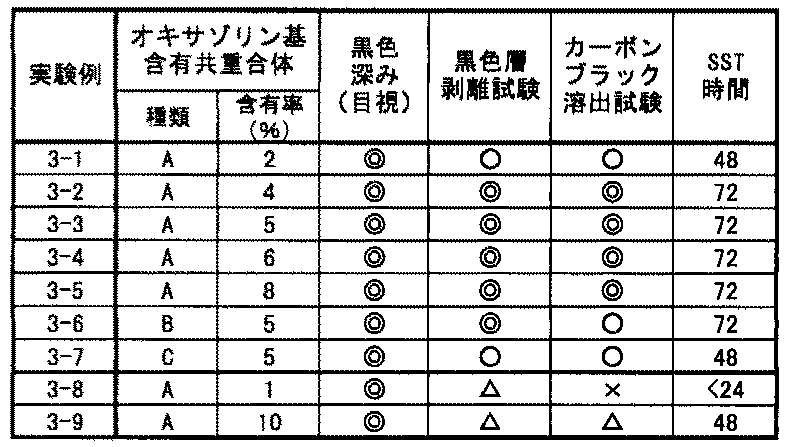
(黒色組成物の調製)
コロイダルシリカとして、スノーテックスXS(A;表面積平均粒子径4~6nm)、スノーテックス40(B;表面積平均粒子径10~20nm)、スノーテックスS(C;表面積平均粒子径8~11nm)(いずれも日産化学社製)のいずれかを用い、かつ、黒色組成物100質量部中の含有量を、表面処理カーボンブラック35質量部、バインダー樹脂(a)50~75質量部、コロイダルシリカ0~25質量部とした以外は実験例1-1と同様にして黒色組成物を調製した。なお、コロイダルシリカの表面積平均粒子径は、表面積平均粒子径が1~10nm程度の場合にはシアーズ法、10~100nm程度の場合にはBET法により測定される値、あるいは製造者のパンフレットに記載の公称値を意味するものである。
調製した黒色組成物を、板厚0.5mmの電気亜鉛めっき鋼板(EG;Zn付着量20g/m2)の両面に、手動ロールコート装置で乾燥質量0.5g/m2になるように塗布し、乾燥温度120℃で60秒乾燥させ、黒色金属板を作製した。得られた黒色金属板の評価結果を表4に示す。

(黒色組成物の調製)
バインダー樹脂(a)前駆体に代えて、バインダー樹脂(b)を用いた以外は実験例2-1と同様にして、黒色組成物100質量部中、表面処理カーボンブラック35質量部、バインダー樹脂(b)55質量部、コロイダルシリカ10質量部を含む黒色組成物を調製した。また、黒色組成物100質量部に対して、シランカップリング剤(信越化学工業社製「KBM403」)を0~17質量部添加した。
(クリヤー樹脂組成物3の調製)
高分子ポリエステル系樹脂(東洋紡績株式社製「バイロン29XS」;重量平均分子量20,000~25,000、Tg=72℃、水酸基価6.5mgKOH/g)60質量部に、架橋剤(住友化学工業社製「スミマールM-40WT」)15質量部と、防錆剤(日産化学工業社製「XBA-ST」:溶剤系コロイダルシリカ)10質量部とを撹拌しながら添加し、次にポリエチレンワックス(X-20P-2)5質量部を添加した後、希釈シンナー(Nシンナー450)10質量部で希釈・撹拌して、高分子ポリエステル系樹脂68質量%、架橋剤17質量%、防錆剤10質量%、及びポリエチレンワックス5質量%を含む、溶剤系クリヤー樹脂組成物3(固形分濃度10質量%)を調製した。
実験例5-1~5-7で得た黒色金属板の片面に、乾燥質量が2g/m2になるように、溶剤系クリヤー樹脂組成物3をバーコート塗装してクリヤー層付き黒色金属板を作製した。得られたクリヤー層付き黒色金属板の評価結果を表5に示す。
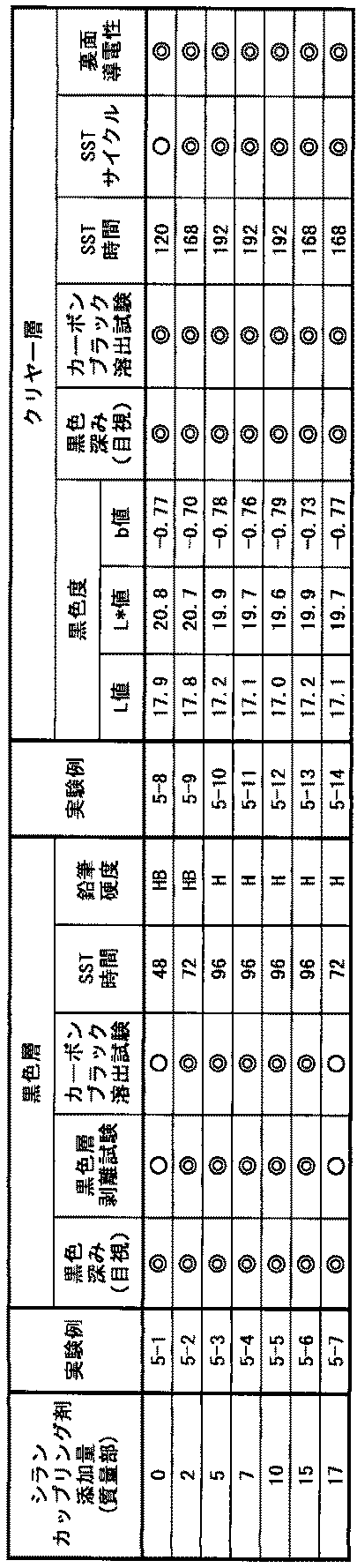
(黒色組成物の調製)
実験例2-1と同様にして、黒色組成物を調製した。
調製した黒色組成物を、板厚0.5mmの電気亜鉛めっき鋼板(EG;Zn付着量20g/m2)の両面に、手動ロールコート装置で乾燥質量0.5g/m2になるように塗布し、乾燥温度120℃で60秒乾燥させ、黒色金属板を作製した。
実験例6-1~6-9で得た黒色金属板の片面に、乾燥質量が0.5~5g/m2になるように、実験例2-16で調製した溶剤系クリヤー樹脂組成物2をバーコート塗装してクリヤー層付き黒色金属板を作製した。得られたクリヤー層付き黒色金属板の評価結果を表6に示す。
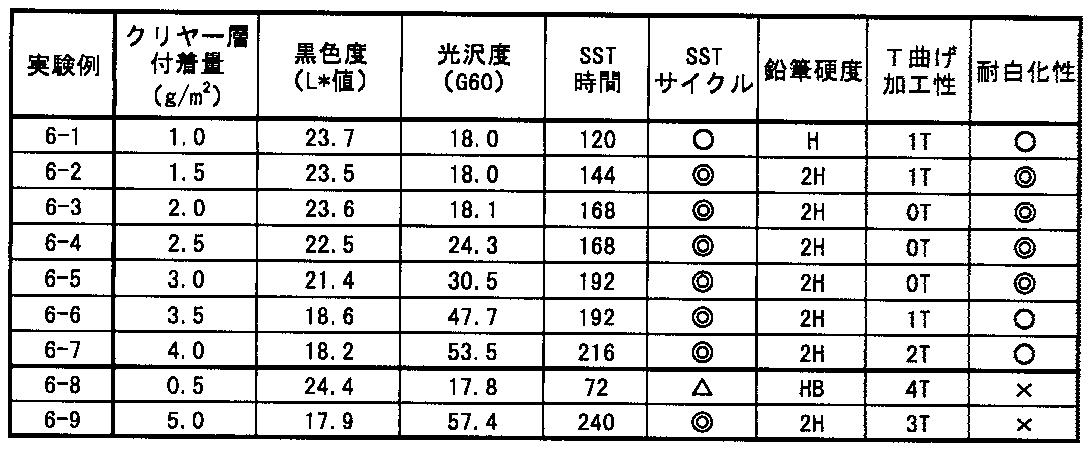
(黒色金属板の作製)
黒色組成物100質量部に対して、シランカップリング剤(信越化学工業社製「KBM403」)を7質量部添加した以外は実験例5-1と同様にして、黒色金属板を作製した。
下記の高分子ポリエステル系樹脂、ポリエステルウレタン樹脂、あるいは低分子ポリエステル系樹脂(A~E;荒川化学工業社製、F~I、O;東洋紡績株式会社製、J~M、P~Q;DIC株式会社製)を用いた以外は実験例5-8と同様にして、ポリエステル系樹脂68質量%、架橋剤17質量%、防錆剤10質量%、及びポリエチレンワックス5質量%を含む、溶剤系クリヤー樹脂組成物4を調製した。
A:アラキード7012、重量平均分子量25,000、Tg50℃、水酸基価7.5
B:KA-2112、重量平均分子量23,000、Tg70℃、水酸基価7.0
C:KA-2049E、重量平均分子量22,000、Tg70℃、水酸基価7.0
D:KA-2059S、重量平均分子量22,000、Tg70℃、水酸基価4.0
E:アラキード7036、重量平均分子量26,000、Tg20℃、水酸基価12.5
F:バイロン29XS、重量平均分子量20,000~25,000、Tg72℃、水酸基価6.5
G:バイロン28SS、重量平均分子量15,000~20,000、Tg68℃、水酸基価6.5
H:バイロンGK59CS、重量平均分子量5,000~8,000、Tg15℃、水酸基価17.0
I:バイロンGK13CS、重量平均分子量5,000~8,000、Tg15℃、水酸基価20.5
J:スーパーベッコライトM-6801-30、重量平均分子量15,000、Tg72℃、水酸基価10.0
K:ベッコライト46-118、重量平均分子量1,500、Tg20℃、水酸基価120
L:ベッコライトM-6405-50、重量平均分子量2,500、Tg42℃、水酸基価120
M:ベッコライトM-6402-50、重量平均分子量2,500、Tg10℃、水酸基価120
O:バイロンUR-3500、重量平均分子量40,000、Tg10℃、水酸基価10
P:スーパーベッコライトM-6805-40、重量平均分子量15,000、Tg35℃、水酸基価10
Q:ベッコライトM-6201-40-IM、重量平均分子量10,000、Tg41℃、水酸基価30
上記黒色金属板の片面に、乾燥質量が2g/m2になるように上記溶剤系クリヤー樹脂組成物4をバーコート塗装してクリヤー層付き黒色金属板を作製した。得られたクリヤー層付き黒色金属板の評価結果を表7に示す。
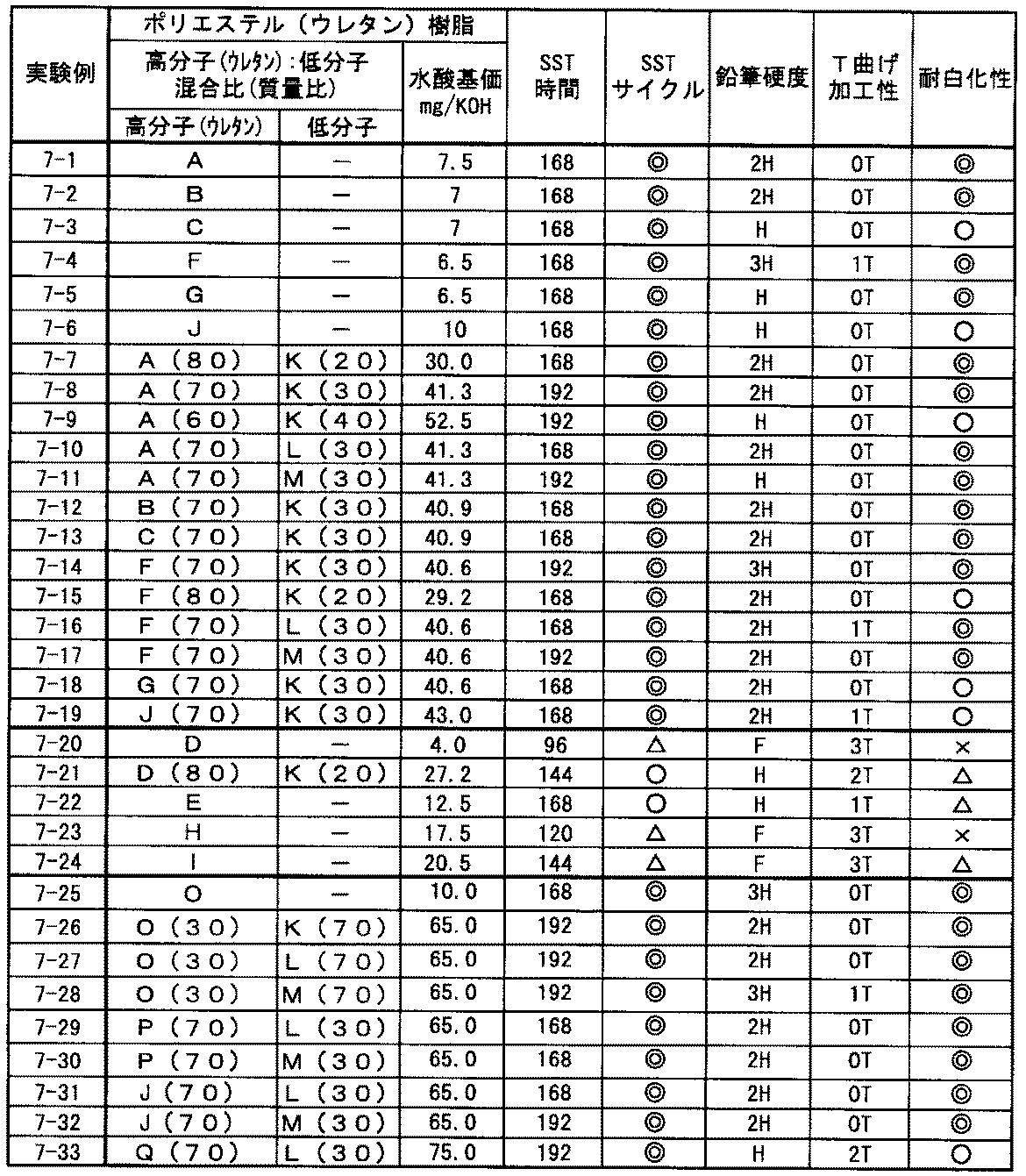
(黒色金属板の作製)
実験例6-1と同様にして、黒色金属板を作製した。
ポリエチレンワックスの含有率を1~12質量%とし、高分子ポリエステル系樹脂と架橋剤を80:20で混合した樹脂物を75.4~86.4質量%にした以外は実験例2-16と同様にして、溶剤系クリヤー樹脂組成物2(a)を調製した。
上記黒色金属板の片面に、乾燥質量が2g/m2になるように上記溶剤系クリヤー樹脂組成物2(a)をバーコート塗装してクリヤー層付き黒色金属板を作製した。得られたクリヤー層付き黒色金属板の評価結果を表8に示す。
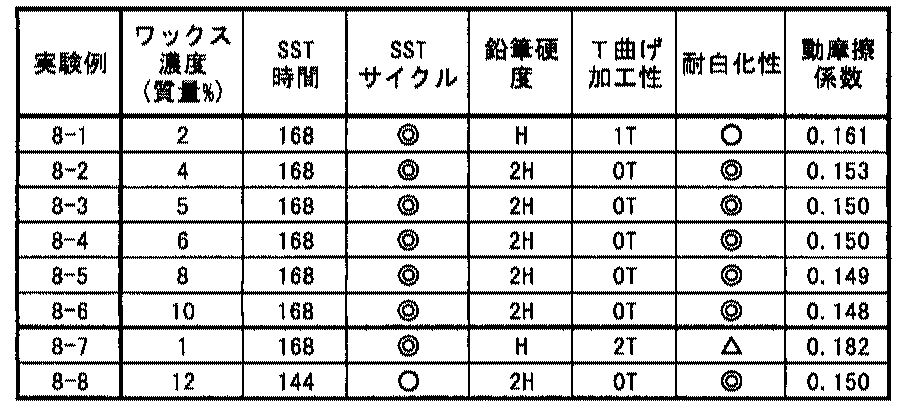
(黒色金属板の作製)
実験例6-1と同様にして、黒色金属板を作製した。
下記の防錆剤(A~B;テイカ株式会社製、C~E;富士シリシア化学株式会社製、F;日産化学工業株式会社製)を用い、その含有率を3~22質量%とし、高分子ポリエステル系樹脂と架橋剤を80:20で混合した樹脂物を70.4~89.4質量%にした以外は実験例2-16と同様にして、溶剤系クリヤー樹脂組成物2(b)を調製した。
A:トリポリリン酸二水素アルミニウム K-WHITE G105、粒子径2.3μm
B:トリポリリン酸二水素アルミニウム K-WHITE G730、粒子径2.3μm
C:カルシウムイオン交換シリカ サイロマスク62-Ca6%、粒子径2.8μm
D:カルシウムイオン交換シリカ サイリシア530、粒子径2.7μm
E:カルシウムイオン交換シリカ サイリシア710、粒子径2.8μm
F:コロイダルシリカ XBA-ST、粒子径10~20nm
上記黒色金属板の片面に、乾燥質量が2g/m2になるように上記溶剤系クリヤー樹脂組成物2(b)をバーコート塗装してクリヤー層付き黒色金属板を作製した。得られたクリヤー層付き黒色金属板の評価結果を表9に示す。

(下地処理組成物の調製)
酸性コロイダルシリカ(日産化学社製「スノーテックス(登録商標)O」)55質量部に対して、重リン酸アルミニウム(米山化学社製)45質量部と純水を加え、酸性コロイダルシリカと重リン酸アルミニウムの合計100質量部に対して、ポリアクリル酸(日本純薬社製「ジュリマーAC-10-LP」)0.5質量部を添加し、さらに、シランカップリング剤(信越化学社製「KBM403」)7.5質量部を添加して下地処理組成物を調製した。
調製した下地処理組成物を手動ロールコート装置にて、電気亜鉛めっき鋼板(EG;Zn付着量20g/m2)の表裏面に、乾燥質量で0~120mg/m2付着するように塗布し、乾燥温度120℃で60秒乾燥させて、下地処理金属板を作製した。
表面処理カーボンブラックとして墨汁(株式会社呉竹製「超濃墨墨滴、BA-8」)55.6質量部に、純水357.4質量部を攪拌しながら加え、次に、バインダー樹脂(a)前駆体71.3質量部を加えた後、コロイダルシリカ(スノーテックス(登録商標)XS)を12.5質量部添加し、さらに、シランカップリング剤1.3質量部と、オキサゾリン基含有重合体としてエポクロス(登録商標)K-2030E1.9質量部とを加えて、黒色組成物100質量部中、表面処理カーボンブラック30質量部、バインダー樹脂(a)60質量部、コロイダルシリカ10質量部、シランカップリング剤5質量部(外枠)を含む黒色組成物(固形分濃度5質量%)を500質量部調製した。
調製した黒色組成物を下地処理金属板の片面(表面)に、バーコート塗装装置で乾燥質量1g/m2になるように塗布し、乾燥温度160℃で60秒乾燥させ、黒色層を形成した。
まず、エチレン-不飽和カルボン酸共重合体とカルボン酸重合体との乳化物(エマルション)を調製した。すなわち、攪拌機、温度計、温度コントローラーを備えた乳化設備を有するオートクレイブに、オレフィン-酸共重合体としてエチレン-アクリル酸共重合体(ダウケミカル社製「プリマコール(登録商標)5990I」;アクリル酸由来の構成単位:20質量%、質量平均分子量(Mw):20,000、メルトインデックス:1300、酸価:150)200.0質量部、カルボン酸重合体としてポリマレイン酸水溶液(日油社製「ノンポール(登録商標)PMA-50W」;Mw:約1100(ポリスチレン換算)、50質量%品)8.0質量部、トリエチルアミン35.5質量部(エチレン-アクリル酸共重合体のカルボキシル基に対して0.63当量)、48%NaOH水溶液6.9質量部(エチレン-アクリル酸共重合体のカルボキシル基に対して0.15当量)、トール油脂肪酸(ハリマ化成社製「ハートールFA3」)3.5質量部、イオン交換水792.6質量部を加えて密封し、150℃、5気圧で3時間高速攪拌した後、30℃まで冷却した。次いで、グリシドキシ基含有シランカップリング剤(モメンティブ・パフォーマンス・マテリアルズ(旧社名:GE東芝シリコーン)社製「TSL8350」:γ-グリシドキシプロピルトリメトキシシラン)10.4質量部、カルボジイミド(Mw:2,700、固形分40質量%)31.2質量部、イオン交換水72.8質量部を添加し、10分間攪拌して、エチレン-不飽和カルボン酸共重合体とカルボン酸重合体の乳化物(エマルション)を調製した(固形分濃度約20質量%、JIS K6833に準じて測定)。
黒色層を形成した下地処理金属板の裏面(黒色層を有さない下地処理面)に、バーコート塗装装置で乾燥質量0.5g/m2になるように裏面用水系クリヤー樹脂組成物を塗布し、乾燥温度170℃で60秒乾燥させて、裏面用水系クリヤー層を形成し、裏面クリヤー層付き黒色金属板(表面には黒色層を有し、裏面にはクリヤー層を有する金属板)を作製した。
ポリエステルウレタン樹脂(東洋紡績社製「バイロンUR-3500」;重量平均分子量40,000、Tg10℃、水酸基価10mgKOH/g、固形分濃度40質量%)76質量部に、希釈シンナー(日本ペイント社製「Nシンナー450」)200質量部を加えて攪拌し、溶解後に、架橋剤(DIC社製「スーパーベッカミンTD-126」:ブチル化ベンゾグアミン樹脂;重量平均分子量600、固形分濃度60%)12.7質量部を加え、攪拌を継続して溶解させた。次に、予め希釈シンナー86.6質量部に酸硬化触媒(楠本化成社製「NACURE 5225」)4.6質量部を加えて溶解させた溶液を加え、順次、つや消し剤(富士シリシア社製「MIBKシリカスラリー」;固形分濃度8質量%)10質量部、ポリエチレンワックス(岐阜セラック社製「X-20P-2)10.2質量部を加えた。得られた溶剤系クリヤー樹脂組成物5は、ベース樹脂76質量%、架橋剤19質量%、及びワックス5質量%からなり、外枠で、酸硬化触媒を4.6質量%と、つや消し剤(シリカ)2質量%とを用いたものである。
上記裏面クリヤー層付き黒色金属板の表面(黒色層を有する面)にバーコート塗装装置を用いて乾燥質量が3g/m2になるように表面用溶剤系クリヤー樹脂組成物5を塗布し、乾燥温度230℃で60秒乾燥させて、表裏面クリヤー層付き黒色金属板(表裏面ともにクリヤー層を有する金属板)を作製した。
裏面クリヤー層付き黒色金属板と表裏面クリヤー層付き黒色金属板の評価結果を表10に示す。
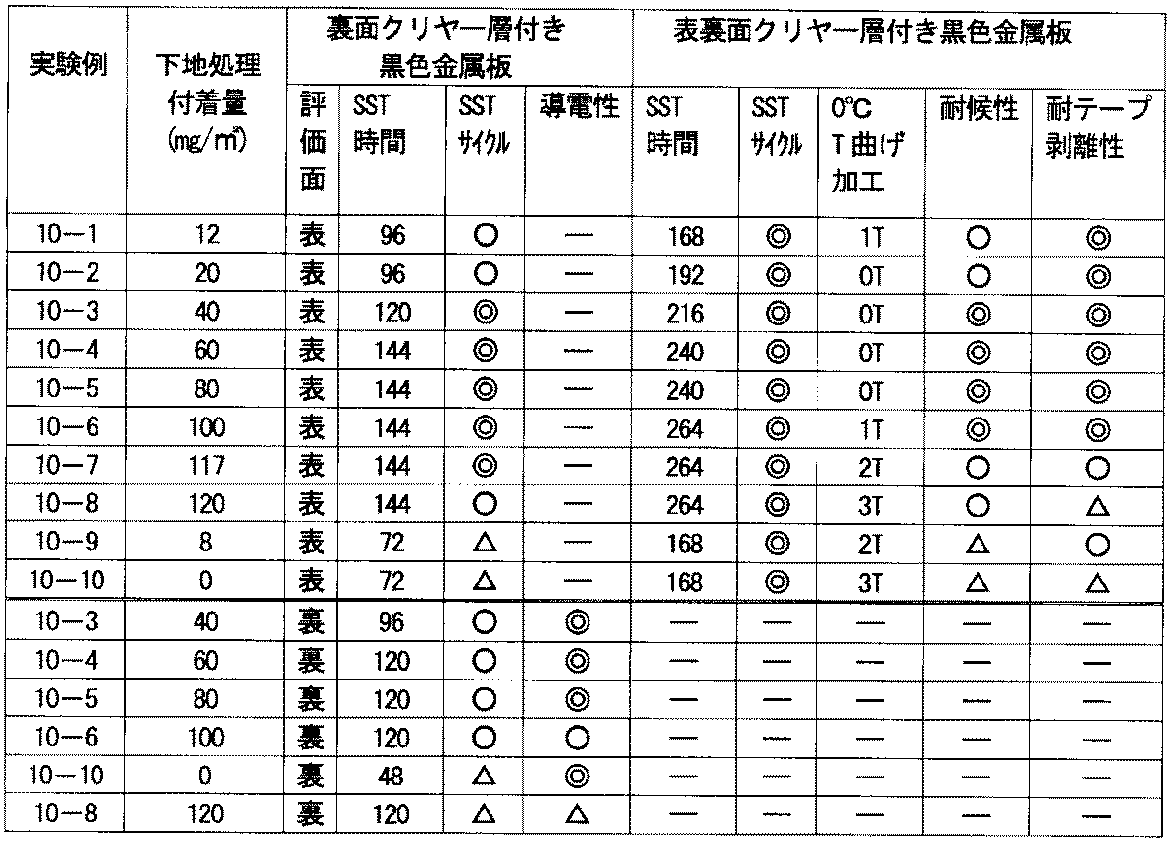
(下地処理組成物の調製)
実験例10-1と同様にして、下地処理組成物を調製した。
調製した下地処理組成物を手動ロールコート装置にて、溶融亜鉛めっき鋼板(GI;Zn付着量45g/m2)の表裏面に、乾燥質量で0~120mg/m2付着するように塗布し、乾燥温度120℃で60秒乾燥させて、下地処理金属板を作製した。
上記で得られた下地処理金属板を用いたこと以外は、実験例10-1と同様にして、裏面クリヤー層付き黒色金属板を作製した。
上記で得られた下地処理金属板を用いたこと以外は、実験例10-1と同様にして、表裏面クリヤー層付き黒色金属板を作製した。
裏面クリヤー層付き黒色金属板と表裏面クリヤー層付き黒色金属板の評価結果を表11に示す。

(下地処理組成物の調製)
酸性コロイダルシリカ(日産化学社製「スノーテックス(登録商標)O」)0~70質量部に対して、重リン酸アルミニウム(米山化学社製)0~70質量部と純水を加え、酸性コロイダルシリカと重リン酸アルミニウムの合計100質量部に対して、ポリアクリル酸(日本純薬社製「ジュリマーAC-10-LP」)0.5質量部を添加し、さらに、シランカップリング剤(信越化学社製「KBM403」)7.5質量部を添加して下地処理組成物を調製した。
調製した下地処理組成物を手動ロールコート装置にて、電気亜鉛めっき鋼板(EG;Zn付着量20g/m2)の表裏面に、乾燥質量で60mg/m2付着するように塗布し、乾燥温度120℃で60秒乾燥させて、下地処理金属板を作製した。
上記で得られた下地処理金属板を用いたこと以外は、実験例10-1と同様にして、裏面クリヤー層付き黒色金属板を作製した。
上記で得られた下地処理金属板を用いたこと以外は、実験例10-1と同様にして、表裏面クリヤー層付き黒色金属板を作製した。
裏面クリヤー層付き黒色金属板と表裏面クリヤー層付き黒色金属板の評価結果を表12に示す。
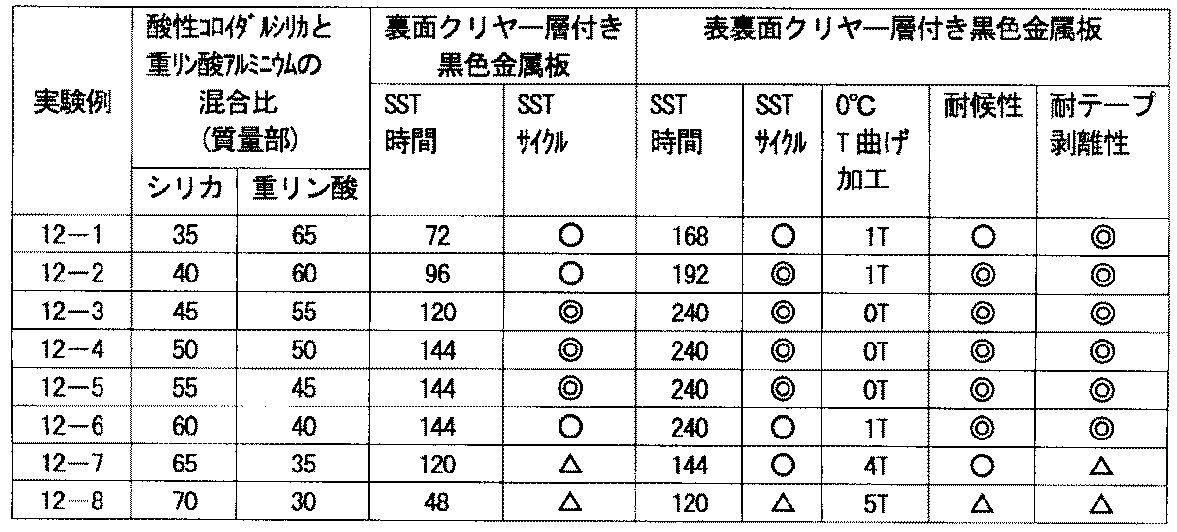
(下地処理組成物の調製)
酸性コロイダルシリカ(日産化学社製「スノーテックス(登録商標)O」)55質量部に対して、重リン酸アルミニウム(米山化学社製)45質量部と純水を加え、酸性コロイダルシリカと重リン酸アルミニウムの合計100質量部に対して、ポリアクリル酸(日本純薬社製「ジュリマーAC-10-LP」)0~1.2質量部を添加し、さらに、シランカップリング剤(信越化学社製「KBM403」)7.5質量部を添加して下地処理組成物を調製した。
調製した下地処理組成物を手動ロールコート装置にて、電気亜鉛めっき鋼板(EG;Zn付着量20g/m2)の表裏面に、乾燥質量で60mg/m2付着するように塗布し、乾燥温度120℃で60秒乾燥させて、下地処理金属板を作製した。
上記で得られた下地処理金属板を用いたこと以外は、実験例10-1と同様にして、裏面クリヤー層付き黒色金属板を作製した。
上記で得られた下地処理金属板を用いたこと以外は、実験例10-1と同様にして、表裏面クリヤー層付き黒色金属板を作製した。
裏面クリヤー層付き黒色金属板と表裏面クリヤー層付き黒色金属板の評価結果を表13に示す。
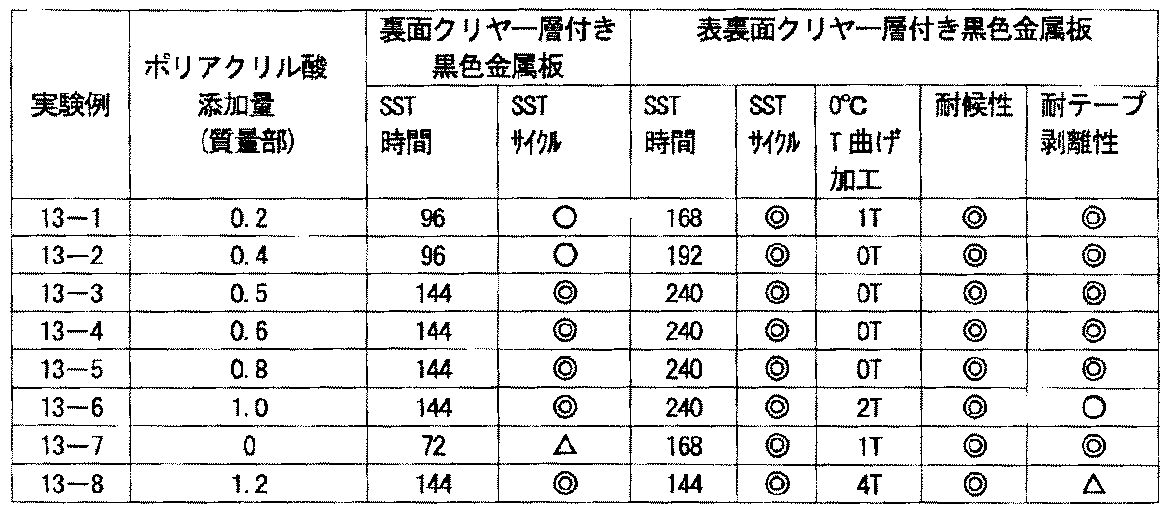
(下地処理組成物の調製)
酸性コロイダルシリカ(日産化学社製「スノーテックス(登録商標)O」)55質量部に対して、重リン酸アルミニウム(米山化学社製)45質量部と純水を加え、酸性コロイダルシリカと重リン酸アルミニウムの合計100質量部に対して、ポリアクリル酸(日本純薬社製「ジュリマーAC-10-LP」)0.5質量部を添加し、さらに、シランカップリング剤(信越化学社製「KBM403」)0~17質量部を添加して下地処理組成物を調製した。
調製した下地処理組成物を手動ロールコート装置にて、電気亜鉛めっき鋼板(EG;Zn付着量20g/m2)の表裏面に、乾燥質量で60mg/m2付着するように塗布し、乾燥温度120℃で60秒乾燥させて、下地処理金属板を作製した。
上記で得られた下地処理金属板を用いたこと以外は、実験例10-1と同様にして、裏面クリヤー層付き黒色金属板を作製した。
上記で得られた下地処理金属板を用いたこと以外は、実験例10-1と同様にして、表裏面クリヤー層付き黒色金属板を作製した。
裏面クリヤー層付き黒色金属板と表裏面クリヤー層付き黒色金属板の評価結果を表14に示す。

(下地処理組成物の調製)
酸性コロイダルシリカ(日産化学社製「スノーテックス(登録商標)O」)55質量部に対して、重リン酸アルミニウム(米山化学社製)45質量部と純水を加え、酸性コロイダルシリカと重リン酸アルミニウムの合計100質量部に対して、ポリアクリル酸(日本純薬社製「ジュリマーAC-10-LP」)0.5質量部を添加し、さらに、シランカップリング剤(信越化学社製「KBM403」)7.5質量部を添加して下地処理組成物を調製した。
調製した下地処理組成物を手動ロールコート装置にて、電気亜鉛めっき鋼板(EG;Zn付着量20g/m2)の表裏面に、乾燥質量で60mg/m2付着するように塗布し、乾燥温度120℃で60秒乾燥させて、下地処理金属板を作製した。
ポリエステルウレタン樹脂(バイロンUR-3500)に代えて、下記の高分子ポリエステル系樹脂、ポリエステルウレタン樹脂、あるいは低分子ポリエステル系樹脂(いずれもクリヤー樹脂組成物4の調製で用いた樹脂である)を用いた以外は、実験例10-1の(表面用溶剤系クリヤー樹脂組成物5の作製)と同様にして、溶剤系クリヤー樹脂組成物5を調製した。
G:バイロン28SS、重量平均分子量15,000~20,000、Tg68℃、水酸基価6.5
J:スーパーベッコライトM-6801-30、重量平均分子量15,000、Tg72℃、水酸基価10.0
K:ベッコライト46-118、重量平均分子量1,500、Tg20℃、水酸基価120
L:ベッコライトM-6405-50、重量平均分子量2,500、Tg42℃、水酸基価120
M:ベッコライトM-6402-50、重量平均分子量2,500、Tg10℃、水酸基価120
O:バイロンUR-3500、重量平均分子量40,000、Tg10℃、水酸基価10
P:スーパーベッコライトM-6805-40、重量平均分子量15,000、Tg35℃、水酸基価10
Q:スーパーベッコライトM-6801-30、重量平均分子量15,000、Tg72℃、水酸基価10
上記で得られた下地処理金属板を用い、かつ上記で得られたクリヤー樹脂組成物6を用いたこと以外は、実験例10-1と同様にして、クリヤー層付き黒色金属板を作製した。このクリヤー層付き黒色金属板の評価結果を表15に示す。

Claims (16)
- 金属板と、
該金属板の少なくとも片面に形成された黒色層と、を有し、
前記黒色層は、水溶性樹脂で表面が被覆された表面処理カーボンブラック22~60質量部と、バインダー樹脂20~73質量部と、を含む100質量部の黒色組成物から構成され、
前記黒色層の乾燥質量は、0.28~1.5g/m2であり、
前記黒色層表面の黒色度(L*値)が24以下である黒色金属板。 - 前記バインダー樹脂が、ポリエチレン樹脂および/またはポリウレタン樹脂である請求項1に記載の黒色金属板。
- 前記ポリエチレン樹脂が、オレフィン-α,β-不飽和カルボン酸共重合体、α,β-不飽和カルボン酸重合体、およびオキサゾリン基含有重合体から構成され、
前記オキサゾリン基含有重合体を、オレフィン-α,β-不飽和カルボン酸共重合体とα,β-不飽和カルボン酸重合体との合計100質量部に対し、2~8質量部含有する請求項2に記載の黒色金属板。 - 前記ポリウレタン樹脂が、カルボキシル基含有ポリウレタン樹脂であり、トリレンジイソシアネート、ジフェニルメタンジイソシアネートおよびジシクロへキシルメタンジイソシアネートからなる群から選択された少なくとも1種のポリイソシアネート成分と、1,4-シクロヘキサンジメタノール、ポリエーテルポリオールおよびカルボキシル基を有するポリオールを含有するポリオール成分と、から構成されるウレタンプレポリマーを鎖延長剤で鎖延長反応させてなる請求項3に記載の黒色金属板。
- 前記黒色組成物が、カーボンブラックと前記水溶性樹脂とを含む水溶液に、前記バインダー樹脂を添加して調製される請求項1に記載の黒色金属板。
- 前記黒色組成物100質量部中、さらにコロイダルシリカを5~20質量部含む請求項1に記載の黒色金属板。
- 前記金属板は、少なくとも片面に、予め下地処理により形成された下地層をさらに有してなり、前記下地層は、重リン酸アルミニウム、コロイダルシリカおよびポリアクリル酸を含む下地処理組成物により乾燥質量12~117mg/m2となるように形成されたものである請求項1に記載の黒色金属板。
- 前記下地処理組成物中、重リン酸アルミニウムとコロイダルシリカの含有割合は、重リン酸アルミニウム:コロイダルシリカ(質量比)=35:65~65:35であり、ポリアクリル酸は、重リン酸アルミニウムとコロイダルシリカの合計100質量部に対して0.2~1.0質量部含まれる請求項7に記載の黒色金属板。
- 前記下地処理組成物中、さらにシランカップリング剤を、重リン酸アルミニウムとコロイダルシリカの合計100質量部に対して3~15質量部含有する請求項7記載の黒色金属板。
- 前記黒色層上に、さらにクリヤー層を有し、該クリヤー層の乾燥質量は、1~4g/m2であり、前記クリヤー層表面の黒色度(L*値)が24以下である請求項1に記載の黒色金属板。
- 前記クリヤー層を形成するクリヤー樹脂組成物が、重量平均分子量10,000~25,000、Tg35~75℃、水酸基価5mgKOH/g以上の高分子ポリエステル系樹脂を含む請求項10に記載の黒色金属板。
- 前記クリヤー層を形成するクリヤー樹脂組成物が、重量平均分子量10,000~25,000、Tg35~75℃の高分子ポリエステル系樹脂と、重量平均分子量1,500~2,500、Tg10~45℃の低分子ポリエステル系樹脂とを、高分子ポリエステル系樹脂:低分子ポリエステル系樹脂(質量比)=8:2~6:4で混合してなる平均水酸基価が25mgKOH/g以上の混合樹脂を含む請求項10に記載の黒色金属板。
- 前記クリヤー層を形成するクリヤー樹脂組成物が、重量平均分子量30,000~40,000、Tg-3~23℃、水酸基価10mgKOH/g以下のポリエステルウレタン樹脂を含む請求項10に記載の黒色金属板。
- 前記クリヤー層を形成するクリヤー樹脂組成物が、重量平均分子量30,000~40,000、Tg-3~23℃のポリエステルウレタン樹脂と、重量平均分子量1,500~2,500、Tg10~45℃の低分子ポリエステル系樹脂とを、ポリエステルウレタン樹脂:低分子ポリエステル系樹脂(質量比)=2:8~4:6で混合してなる平均水酸基価が25mgKOH/g以上の混合樹脂を含む請求項10に記載の黒色金属板。
- 前記クリヤー樹脂組成物100質量部中、さらにポリエチレンワックスを2~10質量部含む請求項11に記載の黒色金属板。
- 前記クリヤー樹脂組成物100質量部中、さらに防錆剤を5~20質量部含む請求項11から15のいずれかに記載の黒色金属板。
Priority Applications (2)
| Application Number | Priority Date | Filing Date | Title |
|---|---|---|---|
| KR1020127025395A KR101419630B1 (ko) | 2010-03-31 | 2011-03-15 | 흑색 금속판 |
| CN201180013242.9A CN102791478B (zh) | 2010-03-31 | 2011-03-15 | 黑色金属板 |
Applications Claiming Priority (2)
| Application Number | Priority Date | Filing Date | Title |
|---|---|---|---|
| JP2010-083983 | 2010-03-31 | ||
| JP2010083983 | 2010-03-31 |
Publications (1)
| Publication Number | Publication Date |
|---|---|
| WO2011122326A1 true WO2011122326A1 (ja) | 2011-10-06 |
Family
ID=44712047
Family Applications (1)
| Application Number | Title | Priority Date | Filing Date |
|---|---|---|---|
| PCT/JP2011/056001 Ceased WO2011122326A1 (ja) | 2010-03-31 | 2011-03-15 | 黒色金属板 |
Country Status (5)
| Country | Link |
|---|---|
| JP (1) | JP5695430B2 (ja) |
| KR (1) | KR101419630B1 (ja) |
| CN (1) | CN102791478B (ja) |
| TW (1) | TWI447019B (ja) |
| WO (1) | WO2011122326A1 (ja) |
Cited By (5)
| Publication number | Priority date | Publication date | Assignee | Title |
|---|---|---|---|---|
| WO2014129475A1 (ja) * | 2013-02-22 | 2014-08-28 | 株式会社神戸製鋼所 | 水系樹脂塗膜積層金属板 |
| JP2015085561A (ja) * | 2013-10-29 | 2015-05-07 | 株式会社神戸製鋼所 | 黒色塗装金属板 |
| WO2017159224A1 (ja) * | 2016-03-17 | 2017-09-21 | 株式会社神戸製鋼所 | 水系樹脂塗装金属板 |
| CN112724668A (zh) * | 2020-12-16 | 2021-04-30 | 金发科技股份有限公司 | 一种聚酰胺树脂组合物及其制备方法和应用 |
| CN119136977A (zh) * | 2022-06-07 | 2024-12-13 | 杰富意钢铁株式会社 | 被覆钢板及其制造方法 |
Families Citing this family (9)
| Publication number | Priority date | Publication date | Assignee | Title |
|---|---|---|---|---|
| JP5949656B2 (ja) * | 2012-05-22 | 2016-07-13 | Jfeスチール株式会社 | 黒色塗装鋼板、加工品及び薄型テレビ用パネル |
| JP6073155B2 (ja) * | 2012-06-11 | 2017-02-01 | 株式会社神戸製鋼所 | 薄膜黒色塗装金属板 |
| CN103481584B (zh) * | 2012-06-11 | 2016-08-10 | 株式会社神户制钢所 | 薄膜黑色涂装金属板 |
| JP6049504B2 (ja) * | 2013-03-14 | 2016-12-21 | 日新製鋼株式会社 | 塗装鋼板およびその製造方法 |
| KR101480156B1 (ko) | 2013-05-14 | 2015-01-07 | 주식회사 유니코정밀화학 | 평면표시장치의 백 커버용 친환경 수용성 수지 조성물, 이를 이용한 평면표시장치의 백 커버 |
| JP5613349B1 (ja) * | 2014-07-16 | 2014-10-22 | 日新製鋼株式会社 | 着色塗装金属板および外装建材 |
| JP6468103B2 (ja) * | 2015-07-15 | 2019-02-13 | 東洋インキScホールディングス株式会社 | 積層体 |
| WO2017163699A1 (ja) * | 2016-03-22 | 2017-09-28 | 株式会社神戸製鋼所 | 樹脂塗装亜鉛めっき鋼板 |
| KR102402639B1 (ko) | 2017-11-24 | 2022-05-26 | 삼성전자주식회사 | 전자 장치 및 그의 통신 방법 |
Citations (11)
| Publication number | Priority date | Publication date | Assignee | Title |
|---|---|---|---|---|
| JPH0278540A (ja) * | 1988-06-27 | 1990-03-19 | Nippon Steel Corp | 黒色表面処理鋼板 |
| JPH03111468A (ja) * | 1989-09-27 | 1991-05-13 | Dainippon Toryo Co Ltd | 耐食性塗料組成物 |
| JPH03210373A (ja) * | 1989-10-19 | 1991-09-13 | Canon Inc | インクジェット用インク、かかるインクを用いたインクジェット記録方法及び記録機器 |
| JPH10130571A (ja) * | 1996-10-25 | 1998-05-19 | Kansai Paint Co Ltd | 塗料組成物 |
| JP2001009966A (ja) * | 1999-06-30 | 2001-01-16 | Kobe Steel Ltd | 溶接可能な黒色金属板 |
| JP2001348672A (ja) * | 2000-06-06 | 2001-12-18 | Nippon Steel Corp | 耐熱性、耐加熱変色性および耐食性に優れた亜鉛系メッキ鋼板 |
| JP2005288963A (ja) * | 2004-04-02 | 2005-10-20 | Kobe Steel Ltd | 樹脂塗装金属板 |
| JP2006272765A (ja) * | 2005-03-29 | 2006-10-12 | Kobe Steel Ltd | 樹脂塗装金属板 |
| JP2006272768A (ja) * | 2005-03-29 | 2006-10-12 | Kobe Steel Ltd | 表面処理金属板 |
| JP2008031453A (ja) * | 2006-06-30 | 2008-02-14 | Kansai Paint Co Ltd | 水性塗料組成物、及びこの組成物を使用するプラスチック成型品の塗装方法 |
| JP2008285632A (ja) * | 2007-05-21 | 2008-11-27 | Mikuni Color Ltd | 高漆黒性カーボンブラック分散体及びその製造方法、並びに高漆黒性カーボンブラック分散体を用いた塗料組成物 |
Family Cites Families (7)
| Publication number | Priority date | Publication date | Assignee | Title |
|---|---|---|---|---|
| US4968391A (en) * | 1988-01-29 | 1990-11-06 | Nippon Steel Corporation | Process for the preparation of a black surface-treated steel sheet |
| JP2785026B2 (ja) * | 1989-01-10 | 1998-08-13 | 石原産業株式会社 | 着色金属板及びその製造方法 |
| US5213846A (en) * | 1989-09-27 | 1993-05-25 | Dai Nippon Toryo Co., Ltd. | Corrison resistant coating composition |
| JP2759620B2 (ja) * | 1995-01-31 | 1998-05-28 | 株式会社神戸製鋼所 | 樹脂塗装金属板及びその製造方法 |
| JP2002079175A (ja) | 2000-09-04 | 2002-03-19 | Sumitomo Metal Ind Ltd | 塗装金属板 |
| JP5076276B2 (ja) * | 2005-01-17 | 2012-11-21 | オイレス工業株式会社 | 複層摺動部材 |
| CN101659799B (zh) * | 2009-09-11 | 2012-08-22 | 艾宝魁 | 一种电工钢绝缘涂料,其制备方法及涂覆方法 |
-
2011
- 2011-01-25 JP JP2011013393A patent/JP5695430B2/ja not_active Expired - Fee Related
- 2011-03-15 WO PCT/JP2011/056001 patent/WO2011122326A1/ja not_active Ceased
- 2011-03-15 CN CN201180013242.9A patent/CN102791478B/zh not_active Expired - Fee Related
- 2011-03-15 KR KR1020127025395A patent/KR101419630B1/ko not_active Expired - Fee Related
- 2011-03-22 TW TW100109713A patent/TWI447019B/zh not_active IP Right Cessation
Patent Citations (11)
| Publication number | Priority date | Publication date | Assignee | Title |
|---|---|---|---|---|
| JPH0278540A (ja) * | 1988-06-27 | 1990-03-19 | Nippon Steel Corp | 黒色表面処理鋼板 |
| JPH03111468A (ja) * | 1989-09-27 | 1991-05-13 | Dainippon Toryo Co Ltd | 耐食性塗料組成物 |
| JPH03210373A (ja) * | 1989-10-19 | 1991-09-13 | Canon Inc | インクジェット用インク、かかるインクを用いたインクジェット記録方法及び記録機器 |
| JPH10130571A (ja) * | 1996-10-25 | 1998-05-19 | Kansai Paint Co Ltd | 塗料組成物 |
| JP2001009966A (ja) * | 1999-06-30 | 2001-01-16 | Kobe Steel Ltd | 溶接可能な黒色金属板 |
| JP2001348672A (ja) * | 2000-06-06 | 2001-12-18 | Nippon Steel Corp | 耐熱性、耐加熱変色性および耐食性に優れた亜鉛系メッキ鋼板 |
| JP2005288963A (ja) * | 2004-04-02 | 2005-10-20 | Kobe Steel Ltd | 樹脂塗装金属板 |
| JP2006272765A (ja) * | 2005-03-29 | 2006-10-12 | Kobe Steel Ltd | 樹脂塗装金属板 |
| JP2006272768A (ja) * | 2005-03-29 | 2006-10-12 | Kobe Steel Ltd | 表面処理金属板 |
| JP2008031453A (ja) * | 2006-06-30 | 2008-02-14 | Kansai Paint Co Ltd | 水性塗料組成物、及びこの組成物を使用するプラスチック成型品の塗装方法 |
| JP2008285632A (ja) * | 2007-05-21 | 2008-11-27 | Mikuni Color Ltd | 高漆黒性カーボンブラック分散体及びその製造方法、並びに高漆黒性カーボンブラック分散体を用いた塗料組成物 |
Cited By (8)
| Publication number | Priority date | Publication date | Assignee | Title |
|---|---|---|---|---|
| WO2014129475A1 (ja) * | 2013-02-22 | 2014-08-28 | 株式会社神戸製鋼所 | 水系樹脂塗膜積層金属板 |
| JP2014184709A (ja) * | 2013-02-22 | 2014-10-02 | Kobe Steel Ltd | 水系樹脂塗膜積層金属板 |
| JP2015085561A (ja) * | 2013-10-29 | 2015-05-07 | 株式会社神戸製鋼所 | 黒色塗装金属板 |
| WO2015064218A1 (ja) * | 2013-10-29 | 2015-05-07 | 株式会社神戸製鋼所 | 黒色塗装金属板 |
| WO2017159224A1 (ja) * | 2016-03-17 | 2017-09-21 | 株式会社神戸製鋼所 | 水系樹脂塗装金属板 |
| CN112724668A (zh) * | 2020-12-16 | 2021-04-30 | 金发科技股份有限公司 | 一种聚酰胺树脂组合物及其制备方法和应用 |
| CN112724668B (zh) * | 2020-12-16 | 2022-10-21 | 金发科技股份有限公司 | 一种聚酰胺树脂组合物及其制备方法和应用 |
| CN119136977A (zh) * | 2022-06-07 | 2024-12-13 | 杰富意钢铁株式会社 | 被覆钢板及其制造方法 |
Also Published As
| Publication number | Publication date |
|---|---|
| KR101419630B1 (ko) | 2014-07-15 |
| CN102791478A (zh) | 2012-11-21 |
| KR20120135417A (ko) | 2012-12-13 |
| TW201206694A (en) | 2012-02-16 |
| JP2011224972A (ja) | 2011-11-10 |
| TWI447019B (zh) | 2014-08-01 |
| CN102791478B (zh) | 2015-04-01 |
| JP5695430B2 (ja) | 2015-04-08 |
Similar Documents
| Publication | Publication Date | Title |
|---|---|---|
| JP5695430B2 (ja) | 黒色金属板 | |
| AU2012330587B2 (en) | Chromate-free coated metal sheet having metallic appearance and water-based coating composition used in the same | |
| KR101424410B1 (ko) | 크로메이트 프리 도장 금속판 | |
| JP6140586B2 (ja) | 水系樹脂塗膜積層金属板 | |
| TW201016801A (en) | Aqueous surface-treating agent also useful as primer, surface-treated metallic material and pre-coated metallic material | |
| JP6073155B2 (ja) | 薄膜黒色塗装金属板 | |
| JP5418479B2 (ja) | 塗装亜鉛系めっき鋼板 | |
| KR101709025B1 (ko) | 수계 수지 도막 적층 금속판 | |
| JP5799770B2 (ja) | クロメートフリー塗装めっき鋼板 | |
| JP5418478B2 (ja) | 塗装亜鉛系めっき鋼板 | |
| JP6123868B2 (ja) | クロメートフリー着色塗装金属板の製造方法 | |
| KR20130138684A (ko) | 박막 흑색 도장 금속판 | |
| KR101445758B1 (ko) | 절연 수지 조성물 및 이를 이용한 절연품 | |
| JP7235556B2 (ja) | 塗装亜鉛めっき鋼板 | |
| JP7166955B2 (ja) | 塗装亜鉛めっき鋼板 | |
| JP2025149343A (ja) | 水性塗料組成物、複層膜の形成方法及び複層膜 | |
| JP2025151083A (ja) | 水系塗料組成物及び複層塗膜形成方法 | |
| JP2012131223A (ja) | クロメートフリー着色塗装金属板 |
Legal Events
| Date | Code | Title | Description |
|---|---|---|---|
| WWE | Wipo information: entry into national phase |
Ref document number: 201180013242.9 Country of ref document: CN |
|
| 121 | Ep: the epo has been informed by wipo that ep was designated in this application |
Ref document number: 11762566 Country of ref document: EP Kind code of ref document: A1 |
|
| WWE | Wipo information: entry into national phase |
Ref document number: 8225/CHENP/2012 Country of ref document: IN |
|
| ENP | Entry into the national phase |
Ref document number: 20127025395 Country of ref document: KR Kind code of ref document: A |
|
| WWE | Wipo information: entry into national phase |
Ref document number: 1201005213 Country of ref document: TH |
|
| NENP | Non-entry into the national phase |
Ref country code: DE |
|
| 122 | Ep: pct application non-entry in european phase |
Ref document number: 11762566 Country of ref document: EP Kind code of ref document: A1 |