WO2011105535A1 - 両親媒性物質処理扁平セルロース粉体およびこれを含有する化粧料 - Google Patents
両親媒性物質処理扁平セルロース粉体およびこれを含有する化粧料 Download PDFInfo
- Publication number
- WO2011105535A1 WO2011105535A1 PCT/JP2011/054252 JP2011054252W WO2011105535A1 WO 2011105535 A1 WO2011105535 A1 WO 2011105535A1 JP 2011054252 W JP2011054252 W JP 2011054252W WO 2011105535 A1 WO2011105535 A1 WO 2011105535A1
- Authority
- WO
- WIPO (PCT)
- Prior art keywords
- cellulose powder
- powder
- treated flat
- flat cellulose
- treated
- Prior art date
- Legal status (The legal status is an assumption and is not a legal conclusion. Google has not performed a legal analysis and makes no representation as to the accuracy of the status listed.)
- Ceased
Links
Classifications
-
- A—HUMAN NECESSITIES
- A61—MEDICAL OR VETERINARY SCIENCE; HYGIENE
- A61Q—SPECIFIC USE OF COSMETICS OR SIMILAR TOILETRY PREPARATIONS
- A61Q1/00—Make-up preparations; Body powders; Preparations for removing make-up
- A61Q1/02—Preparations containing skin colorants, e.g. pigments
- A61Q1/08—Preparations containing skin colorants, e.g. pigments for cheeks, e.g. rouge
-
- A—HUMAN NECESSITIES
- A61—MEDICAL OR VETERINARY SCIENCE; HYGIENE
- A61K—PREPARATIONS FOR MEDICAL, DENTAL OR TOILETRY PURPOSES
- A61K8/00—Cosmetics or similar toiletry preparations
- A61K8/02—Cosmetics or similar toiletry preparations characterised by special physical form
- A61K8/0241—Containing particulates characterized by their shape and/or structure
-
- A—HUMAN NECESSITIES
- A61—MEDICAL OR VETERINARY SCIENCE; HYGIENE
- A61K—PREPARATIONS FOR MEDICAL, DENTAL OR TOILETRY PURPOSES
- A61K8/00—Cosmetics or similar toiletry preparations
- A61K8/18—Cosmetics or similar toiletry preparations characterised by the composition
- A61K8/30—Cosmetics or similar toiletry preparations characterised by the composition containing organic compounds
- A61K8/55—Phosphorus compounds
- A61K8/553—Phospholipids, e.g. lecithin
-
- A—HUMAN NECESSITIES
- A61—MEDICAL OR VETERINARY SCIENCE; HYGIENE
- A61K—PREPARATIONS FOR MEDICAL, DENTAL OR TOILETRY PURPOSES
- A61K8/00—Cosmetics or similar toiletry preparations
- A61K8/18—Cosmetics or similar toiletry preparations characterised by the composition
- A61K8/30—Cosmetics or similar toiletry preparations characterised by the composition containing organic compounds
- A61K8/63—Steroids; Derivatives thereof
-
- A—HUMAN NECESSITIES
- A61—MEDICAL OR VETERINARY SCIENCE; HYGIENE
- A61K—PREPARATIONS FOR MEDICAL, DENTAL OR TOILETRY PURPOSES
- A61K8/00—Cosmetics or similar toiletry preparations
- A61K8/18—Cosmetics or similar toiletry preparations characterised by the composition
- A61K8/30—Cosmetics or similar toiletry preparations characterised by the composition containing organic compounds
- A61K8/68—Sphingolipids, e.g. ceramides, cerebrosides, gangliosides
-
- A—HUMAN NECESSITIES
- A61—MEDICAL OR VETERINARY SCIENCE; HYGIENE
- A61K—PREPARATIONS FOR MEDICAL, DENTAL OR TOILETRY PURPOSES
- A61K8/00—Cosmetics or similar toiletry preparations
- A61K8/18—Cosmetics or similar toiletry preparations characterised by the composition
- A61K8/72—Cosmetics or similar toiletry preparations characterised by the composition containing organic macromolecular compounds
- A61K8/73—Polysaccharides
- A61K8/731—Cellulose; Quaternized cellulose derivatives
-
- A—HUMAN NECESSITIES
- A61—MEDICAL OR VETERINARY SCIENCE; HYGIENE
- A61Q—SPECIFIC USE OF COSMETICS OR SIMILAR TOILETRY PREPARATIONS
- A61Q19/00—Preparations for care of the skin
-
- A—HUMAN NECESSITIES
- A61—MEDICAL OR VETERINARY SCIENCE; HYGIENE
- A61K—PREPARATIONS FOR MEDICAL, DENTAL OR TOILETRY PURPOSES
- A61K2800/00—Properties of cosmetic compositions or active ingredients thereof or formulation aids used therein and process related aspects
- A61K2800/40—Chemical, physico-chemical or functional or structural properties of particular ingredients
- A61K2800/41—Particular ingredients further characterized by their size
- A61K2800/412—Microsized, i.e. having sizes between 0.1 and 100 microns
Definitions
- the present invention relates to an amphiphilic substance-treated flat cellulose powder and a powder cosmetic containing the same, and more specifically, an amphiphile having a flat shape and having a surface treated with an amphiphilic substance.
- the present invention relates to a functional substance-treated flat cellulose powder and a cosmetic containing the same.
- Powder cosmetics containing a powder component, an oily component, and the like are widely used in the field of cosmetics, and examples thereof include powder foundation, eye shadow, powdered white powder, blusher, and the like.
- This powder cosmetic is generally produced by filling a powder container of powder components such as extender pigments and pigments and an oil component into a dish-like container and press-molding.
- inorganic powders such as mica, sericite, and talc are widely used as flakes, but these are all aluminosilicate minerals and have properties depending on the production area. Are slightly different from each other, for example, there is a problem that the oil absorbability is low or the desired physical properties cannot be obtained.
- flat organic powders have not been reported so much, for example, to the extent that flat cellulose particles obtained by mixing cellulose-based substances and fatty acids and then mechanically pulverizing them are known. Yes (Patent Document 1).
- Patent Document 2 a technique for treating the surface of crystalline cellulose with hydrogenated lecithin is also known (Patent Document 2).
- this crystalline cellulose has a major axis / minor axis ratio (L / D) of 3 or less, which is not flat.
- L / D major axis / minor axis ratio
- An object of the present invention is to provide a powder and a cosmetic using the powder.
- the inventors of the present invention have paid attention to a flat-shaped flat cellulose and have been researching on a flat cellulose having more excellent physical properties and a method for producing the same, and using a specific amphiphile, the specific method for flat cellulose It is possible to obtain a surface-treated cellulose powder having unprecedented physical properties by preparing the product, and to make it possible to extremely increase the commercial value of cosmetics such as powder cosmetics by using this surface-treated cellulose powder.
- the headline and the present invention were completed.
- the present invention provides an amphiphilic substance obtained by mechanically pulverizing a cellulosic substance and one or more amphiphilic substances selected from the group consisting of phospholipid, ceramide, cholesterol and phytosterol.
- Substance-treated flat cellulose powder obtained by mechanically pulverizing a cellulosic substance and one or more amphiphilic substances selected from the group consisting of phospholipid, ceramide, cholesterol and phytosterol.
- the present invention is also a cosmetic comprising the amphiphile-treated flat cellulose powder.
- the present invention mechanically pulverizes a cellulosic material and one or more amphiphilic materials selected from the group consisting of phospholipid, ceramide, cholesterol and phytosterol. This is a method for producing a functional substance-treated flat cellulose powder.
- the amphiphile-treated flat cellulose powder of the present invention has good adhesion to the skin, and a cosmetic containing the same has smoothness when applied, excellent uniformity of the cosmetic film, and good makeup. Is.
- the cosmetics using the amphiphilic substance-treated flat cellulose powder of the present invention can be suitably used as powder foundation, eye shadow, powdered white powder, cheek red, and the like.
- powders using phospholipids for treatment are particularly excellent in dispersibility in general-purpose oils and water. Therefore, it can be suitably used as a makeup cosmetic such as a liquid foundation.
- this powder has good adhesion and a long lasting makeup. Therefore, it can be suitably used as a makeup cosmetic such as a powder foundation.
- a powder using ceramide for the treatment is particularly excellent in moisture retention such as moisture retention and moisture transpiration suppression. Therefore, it can be suitably used as a skin care cosmetic or a makeup cosmetic.
- the amphiphile-treated flat cellulose powder of the present invention is one or more amphiphiles selected from the group consisting of a cellulosic material, phospholipid, ceramide, cholesterol or a derivative thereof, phytosterol or a derivative thereof. Are mechanically pulverized.
- the amphiphile-treated flat cellulose powder is one type of amphiphile selected from the group consisting of phospholipids, ceramides, cholesterol or derivatives thereof, phytosterols or derivatives thereof, or cellulose-based substances. Two or more kinds may be added and mixed, if necessary, and then manufactured by a mechanical pulverization method. This method can be basically performed according to the method described in [0020] to [0041] of Patent Document 1 except that the grinding aid is changed to an amphiphilic substance.
- the cellulosic material used as a starting material for the amphiphile-treated flat cellulose powder is not particularly limited, but for example, fibrous or powdery wood powder or wood pulp originating from wood, or originating from cotton It is preferable to use a fibrous or powdery cotton or linter fiber, a fibrous or powdery cellulosic material obtained by purifying them, and these cellulosic materials may be acid-hydrolyzed.
- a cellulosic substance originating in cotton the thing originating in the cotton which received the organic certification
- the cellulose-based material as a raw material easily adsorbs or absorbs moisture, it has an adsorbed moisture content of about 3 to 10% by mass (hereinafter simply referred to as “%”) in a normal state.
- % an adsorbed moisture content of about 3 to 10% by mass (hereinafter simply referred to as “%”) in a normal state.
- Phospholipids, ceramides, cholesterol and phytosterols that process the above-mentioned cellulosic substances are amphipathic substances having a common property of being lipids in the living body or a structure close thereto, that is, having a long chain alkyl structure and a hydrophilic group. .
- phospholipid is a generic term for lipids having a phosphate ester moiety in the structure.
- Specific phospholipids include those derived from natural products hydrogenated to natural lecithin such as egg yolk lecithin and soybean lecithin, hydrogenated lysolecithin, phosphatidylcholine, phosphatidylethanolamine, phosphatidylserine, phosphatidylglycerol, phosphatidylinositol, sphingomyelin, etc. And the like.
- hydrogenated lecithin, phosphatidylcholine, phosphatidylethanolamine, and hydrogenated phosphatidylglycerol are preferable.
- the ceramide has a non-linear group having one or more long-chain linear and / or branched alkyl or alkenyl groups, at least two hydroxyl groups, and one or more amide groups (and / or amino groups) in the molecule.
- Specific examples of ceramide include natural ceramides such as ceramide 1, ceramide 2, ceramide 3, ceramide 3B, ceramide 4, ceramide 5, ceramide 6, ceramide 6I, ceramide 6II and the like, which are long-chain fatty acid amides of sphingosine and phytosphingosine. Is mentioned.
- ceramide 2 and ceramide 3 are preferable. These ceramides may be derived from natural products or synthesized.
- cholesterol is a white to slightly yellow solid purified by extracting, crystallizing and drying a fraction obtained from saponified animal oils and fats and fish oil, and its molecular formula is C 27 H 46 O.
- cholesterose derivatives include cholesteryl hydroxystearate, polyoxyethylene cholesteryl ether, and the like. Among these cholesterol or derivatives thereof, cholesterol is preferable.
- phytosterol is a general term for sterol compounds obtained from plants.
- specific examples of phytosterols include sitosterol, stigmasterol, fucostosterol, spinasterol, and brush castrol.
- Examples of phytosterol derivatives include phytosteryl hydroxystearate, polyoxyethylene phytosterol, polyoxyethylene phytostanol, and the like. Among these phytosterols or derivatives thereof, phytosterol is preferable.
- the above-mentioned treatment for mechanically pulverizing the amphiphilic substance and the cellulosic substance requires that the pressure and shear force by pulverization be continuously applied for a certain period of time. Therefore, it is preferable to use a pulverizing apparatus such as a vibration ball mill, a rotating ball mill, a planetary ball mill, a roll mill, a media mill, a disk mill, a high-speed mixer using high-speed rotating blades, and a homomixer, and a planetary ball mill is particularly preferable.
- the pulverization method is preferably dry pulverization without using a solvent.
- the pulverization energy applied when the pulverization process is performed is 3 to 20 G, preferably 5 to 15 G.
- the amphiphilic substance may be added in an amount of about 0.1 to 12 parts by mass, preferably about 1 to 4 parts by mass with respect to 100 parts by mass of the cellulosic substance.
- an amphiphilic substance can be used 1 type or in combination of 2 or more types.
- the timing of adding the amphiphilic substance may be any time before the pulverization treatment.
- the amphiphilic substance may be added to the cellulosic substance as it is, or the amphiphilic substance may be added. May be dissolved in a suitable solvent and then added to the cellulosic material.
- Examples of the solvent used for dissolving the amphiphile include alkanes such as hexane, alcohols such as ethanol, ketones such as acetone, ethers such as tetrahydrofuran, aromatic hydrocarbons such as toluene, and the like.
- the purified cellulose pulp-derived cellulose powder is dried under reduced pressure at 30 to 50 ° C. to sufficiently remove the adsorbed moisture to 0.1% or less.
- the cellulose powder is put into a sealable alumina or zirconia pulverization container together with alumina or zirconia pulverization balls, and an amphiphilic substance is added so as to have the above amount with respect to the cellulose powder.
- the pulverization container is placed in a planetary ball mill, and pulverization is performed at a rotational speed of 100 to 250 rpm.
- the pulverization treatment may be repeated for about 2 to 72 cycles continuously, with 5 to 15 minutes of pulverization-5 to 15 minutes of rest, or for about 5 to 120 minutes without interruption. May be.
- moisture adhering to the amphiphile-treated flat cellulose powder may be further removed by a known drying means such as air drying, hot air drying, vacuum drying, and reduced pressure drying.
- the amphiphile-treated flat cellulose powder obtained as described above has, for example, an average particle diameter of 1 to 100 ⁇ m, preferably 1 to 50 ⁇ m, and an average thickness of 0.1 to 10 ⁇ m, preferably 0.5. It has a flake shape of 1 to 2 ⁇ m and a flatness of 4 to 200, preferably 6 to 150, and more preferably 10 to 100.
- the average particle diameter is an average value on the apparatus of the width and length of the flat cellulose particles measured in a dispersed state in water using a particle size distribution measuring apparatus such as a laser diffraction / scattering particle size distribution measuring apparatus ( (Particle diameter value of 50% cumulative volume).
- the average thickness means that a plurality of particles having the same size as the average particle size obtained above are selected with an electron microscope such as a scanning electron microscope, the thickness is measured, and an average value of them is obtained.
- the flatness is the average particle diameter / average thickness determined as described above.
- the amphiphilic substance-treated flat cellulose powder thus obtained can be used for various cosmetics such as powder cosmetics, basic (skin care) cosmetics, makeup cosmetics, and hair cosmetics.
- this amphiphile-treated flat cellulose powder is a thin flake, compared to talc and sericite of conventional extender pigments, In addition to having excellent properties such as transparency, softness, elongation, natural gloss, etc., as well as excellent compatibility with the oil used, especially cosmetics containing conventional powder components, especially powder foundation, Examples thereof include powder cosmetics such as eye shadow, cheek red, and white powder.
- the blending amount is 1 to 90%, preferably 5 to 90%, particularly preferably 5 to 70%.
- the powder cosmetic it is preferable to further contain an oil component.
- an oil component there are no particular restrictions on the oily ingredients blended in the powder cosmetic, but for example, paraffin wax, ceresin wax, ozokerite, microcrystalline wax, montan wax, fisher trops wax, polyethylene wax, liquid paraffin, squalane, petrolatum.
- Hydrocarbons such as polyisobutylene and polybutene, natural waxes such as carnauba wax, beeswax, lanolin wax, and candelilla, glyceryl tribehenate, rosin acid pentaerythritol ester, jojoba oil, cetyl isooctanoate, isopropyl myristate, trioctane Esters such as glyceryl acid, diglyceryl triisostearate, dipentaerythritol fatty acid ester, fatty acids such as stearic acid, behenic acid, 12-hydroxystearic acid Higher alcohols such as cetanol, stearyl alcohol and behenyl alcohol, oils and fats such as olive oil, castor oil, mink oil and owl, lanolin derivatives such as lanolin fatty acid isopropyl and lanolin alcohol, N-lauroyl L-glutamate di (cholesteryl and behenyl)
- the above powder cosmetic can be produced in the same manner as a conventional powder cosmetic.
- an amphiphilic substance-treated flat cellulose powder may be used in place of part or all of the conventional powder.
- inorganic powders such as talc and organic powders such as nylon
- inorganic powders such as talc and organic powders such as nylon are used together with the amphiphile-treated flat cellulose powder of the present invention. May be added and dispersed at the same time, and oil may be added if necessary.
- the powder cosmetics include components usually used in cosmetic amounts, such as surfactants, oil gelling agents, polyhydric alcohols, and the like.
- Water-soluble components such as humectants, powders, ultraviolet absorbers, preservatives, cosmetic ingredients, fragrances, and the like can be appropriately blended within a range that does not impair the effects of the present invention.
- the amphiphilic substance-treated flat cellulose powder is a cosmetic that can be used for the amphiphile-treated flat cellulose powder because the amphiphilic substance-treated flat cellulose powder has high adhesion to the skin.
- Examples include cosmetics.
- the amphiphile-treated flat cellulose powder is a ceramide-treated flat cellulose powder
- the basic cosmetics especially cosmetics and milky lotions, are particularly good because of their excellent moisture retention such as moisture retention and moisture transpiration suppression. It can be suitably used for skin care cosmetics such as cream.
- amphiphile-treated flat cellulose powder is a phospholipid-treated flat cellulose powder
- it is excellent in dispersibility in general-purpose oils and water, so make-up cosmetics such as liquid foundation Can be suitably used.
- this powder has good adhesion and excellent makeup, it can be suitably used as a makeup cosmetic such as a powder foundation.
- the blending amount is 0.1 to 10%.
- the blending amount is 0.5. ⁇ 50%.
- the above basic cosmetics can be produced in the same manner as conventional basic cosmetics. Specifically, after solubilizing, dispersing, or emulsifying the oil with water, oil, glycol, surfactant, or the like at room temperature or room temperature, the amphiphile-treated flat cellulose powder of the present invention is dispersed. Can be manufactured.
- the above makeup cosmetics can be produced in the same manner as conventional makeup cosmetics. Specifically, after solubilizing, dispersing, or emulsifying the oil with water, oil, glycol, surfactant, or the like at room temperature or room temperature, the amphiphile-treated flat cellulose powder of the present invention is dispersed. In contrast, after the amphiphilic substance-treated flat cellulose powder of the present invention is dispersed in the oil, an aqueous component or a surfactant is added and emulsified.
- Example 1 Production of phospholipid-treated flat cellulose powder (1): As a raw material, purified cellulose pulp-derived cellulose powder (W-400G / manufactured by Nippon Paper Chemicals Co., Ltd.) was used. First, cellulose powder (48.5 g) from which adsorbed moisture has been sufficiently removed by drying under reduced pressure at 40 ° C. to 0.1% or less is placed in a zirconia crushing container (capacity 500 ml) in a sealable zirconia grinding ball (diameter 20 mm), and 1.5 g of hydrogenated lecithin (Lecinol S-10 / Nikko Chemicals) was added to prepare 3% hydrogenated lecithin with respect to the cellulose powder.
- a zirconia crushing container capacity 500 ml
- a sealable zirconia grinding ball diameter 20 mm
- LMS-24 type / manufactured by Seishin laser diffraction / scattering particle size distribution analyzer
- the particle size distribution measurement is performed after a suspension in which 50 mg of the obtained powder is dispersed in 10 ml of distilled water is dropped into a sample circulation tank using water as a medium of the particle size distribution measurement device and the concentration is adjusted to an appropriate concentration. did. As a result, the average particle size of the powder was 17 ⁇ m.
- the average thickness of the obtained particles was determined by directly observing the particles using a scanning electron microscope (S-2450 / manufactured by Hitachi, Ltd.), and obtaining particles having a size equivalent to the average particle size obtained above. A plurality of samples were selected, thicknesses were measured, and averaged.
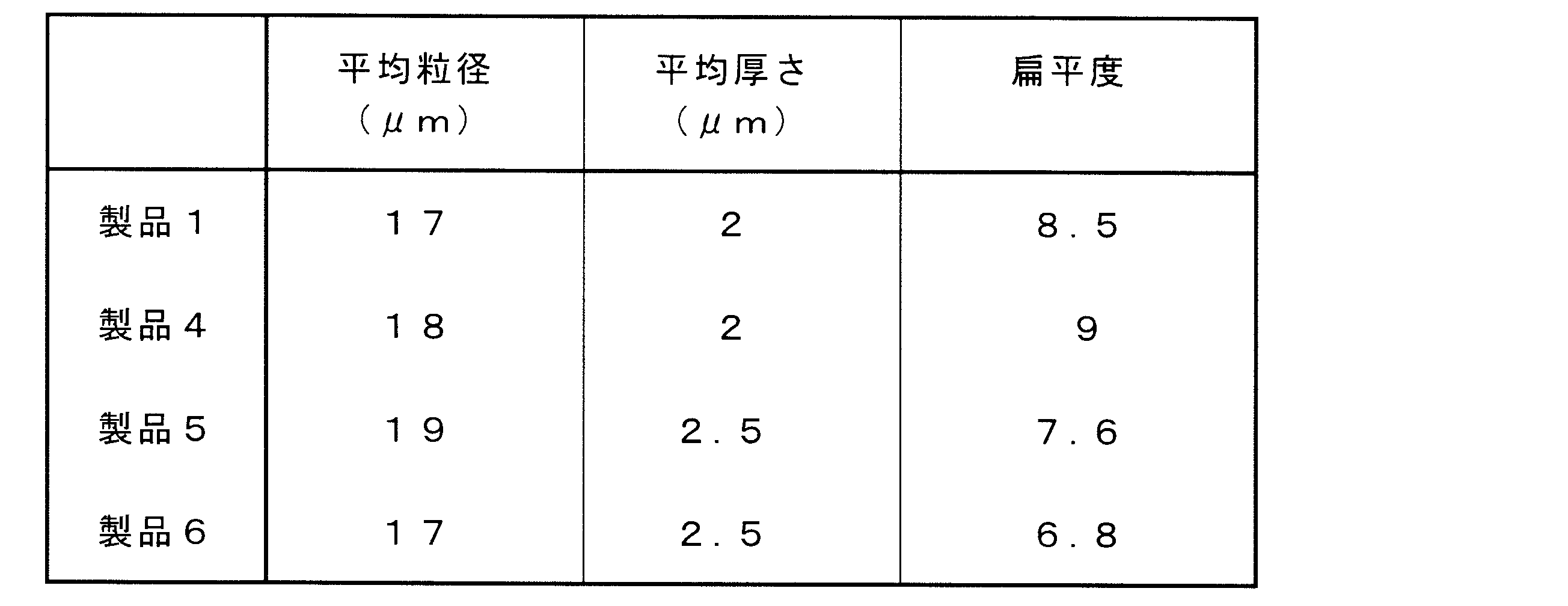
- the product 1 thus obtained has an average particle diameter of 17 ⁇ m, an average thickness of 2 ⁇ m, and flat cellulose particles (phospholipid-treated flat cellulose having a flatness (average particle diameter / average thickness) of 8.5). Powder).
- cellulose powder a purified cellulose pulp-derived cellulose powder (W-400G / manufactured by Nippon Paper Chemicals Co., Ltd. (hereinafter simply referred to as “cellulose powder”)) and hemp cellulose powder (Tosco hemp cellulose), which are raw materials for flat cellulose powder
- the average particle size and average thickness of the powder / manufactured by Tosco Corporation were measured, and the flatness (average particle size / average thickness) was determined.
- the shape of the cellulose powder was not a flat shape but a bowl shape, the average particle size was 28 ⁇ m, the average thickness was 10 ⁇ m, and the flatness was determined to be 2.8.
- hemp cellulose powder was neither flat nor wrinkled but granular, and the average particle size was measured to be 7.7 ⁇ m, but the average thickness and flatness were not determined.
- Example 2 Production of phospholipid-treated flat cellulose powder (2): Phospholipid-treated flat cellulose powders (Product 2 and Product 3) were obtained in the same manner as in Example 1 except that the amount of hydrogenated lecithin was 0.1% and 10%. These average particle diameter, average thickness, and flatness were as follows.
- Example 3 Production of phospholipid-treated flat cellulose powder (3): As phospholipids, hydrogenated lysolecithin (manufactured by Nippon Seika Co., Ltd .: LP-70H), phosphatidylethanolamine (manufactured by Wako Pure Chemical Industries) and sphingomyelin (manufactured by Wako Pure Chemical Industries, Ltd.) instead of the hydrogenated lecithin of Example 1 were used. In the same manner as in Example 1 below, phospholipid-treated flat cellulose powders (Product 4 to Product 6) were obtained. These average particle diameter, average thickness, and flatness were as follows.
- Example 4 Production of phospholipid-treated flat cellulose powder (4): As a raw material, purified cellulose pulp-derived cellulose powder (W-400G / manufactured by Nippon Paper Chemicals Co., Ltd.) was used. This was put into a sealable alumina grinding container together with alumina grinding balls, and hydrogenated lecithin (Resinol S-10 / manufactured by Nikko Chemicals) was added to this so as to be 5% based on cotton. Thereafter, pulverization was continuously performed for 60 minutes using a planetary ball mill (P-5 type / manufactured by Fritsch, Germany) at a rotation speed of 200 rpm (pulverization energy of about 10 G (gravity acceleration)). The obtained phospholipid-treated flat cellulose powder had an average particle size of 20 ⁇ m, an average thickness of 1.2 ⁇ m, and a flatness of 16.7 (Product 7).
- Example 5 Production of phospholipid-treated flat cellulose powder (5): As the raw material, organic cotton (No. 7 card yarn production / manufactured by Avanti Co., Ltd.) was used. This is finely chopped with a pulverizer (manufactured by Hadano Sangyo Co., Ltd .: RC100 type) and then put into an alumina pulverized container together with an alumina pulverized ball, and hydrogenated lecithin (Resinol S-10 / Nikko Chemicals) ) was added to 1% of cotton.
- a pulverizer manufactured by Hadano Sangyo Co., Ltd .: RC100 type
- hydrogenated lecithin Resinol S-10 / Nikko Chemicals
- the obtained phospholipid-treated flat cellulose powder had an average particle size of 20 ⁇ m, an average thickness of 1.6 ⁇ m, and a flatness of 12.5 (Product 8).
- Example 6 Production of phospholipid-treated flat cellulose powder (6): As a raw material, refined wood pulp-derived cellulose powder (W-400G / manufactured by Nippon Paper Chemicals Co., Ltd.) This is put into a sealable alumina grinding container together with alumina grinding balls, and hydrogenated lecithin (Resinol S-) 10 / Nikko Chemicals) was added to 2% of cotton. Then, using a planetary ball mill (P-5 type / manufactured by Fritsch, Germany), grinding was continuously performed for 50 minutes at a rotational speed of 200 rpm (about 10 G (gravity acceleration)). The obtained phospholipid-treated flat cellulose powder had an average particle diameter of 17.8 ⁇ m, an average thickness of 0.2 ⁇ m, and a flatness of 89.0 (Product 9).
- the obtained stearic acid-treated flat cellulose powder was subjected to particle size distribution measurement in the same manner as in Example 1. As a result, the average particle size was 16 ⁇ m.
- a phospholipid-treated sericite (Comparative Product 2) was obtained by coating 99% of sericite (Eight Pearl 300S / manufactured by Kakuhachi Phosphor Foil Co., Ltd.) with 1% soybean phospholipid (lecithin / Ajinomoto Co.).
- Example 7 Dispersibility test: The dispersibility of the phospholipid-treated flat cellulose powder (Product 1) obtained in Example 1 in various solvents was examined by the following dispersibility test method. For comparison and control, the stearic acid-treated flat cellulose of Comparative Example 1 (Comparative product 1) and the raw material cellulose powder (control product) were used. As the dispersion medium (solvent), liquid paraffin (KLEAROL), tri- (2-ethylhexanoic acid) glyceride (TIO), silicone oil (10 cs) (KF-96) and water were used. . The results are shown in Table 3.
- solvent liquid paraffin
- TIO tri- (2-ethylhexanoic acid) glyceride
- silicone oil (10 cs) KF-96
- Dispersion rate (%) dispersion volume (ml) / total volume (ml) ⁇ 100
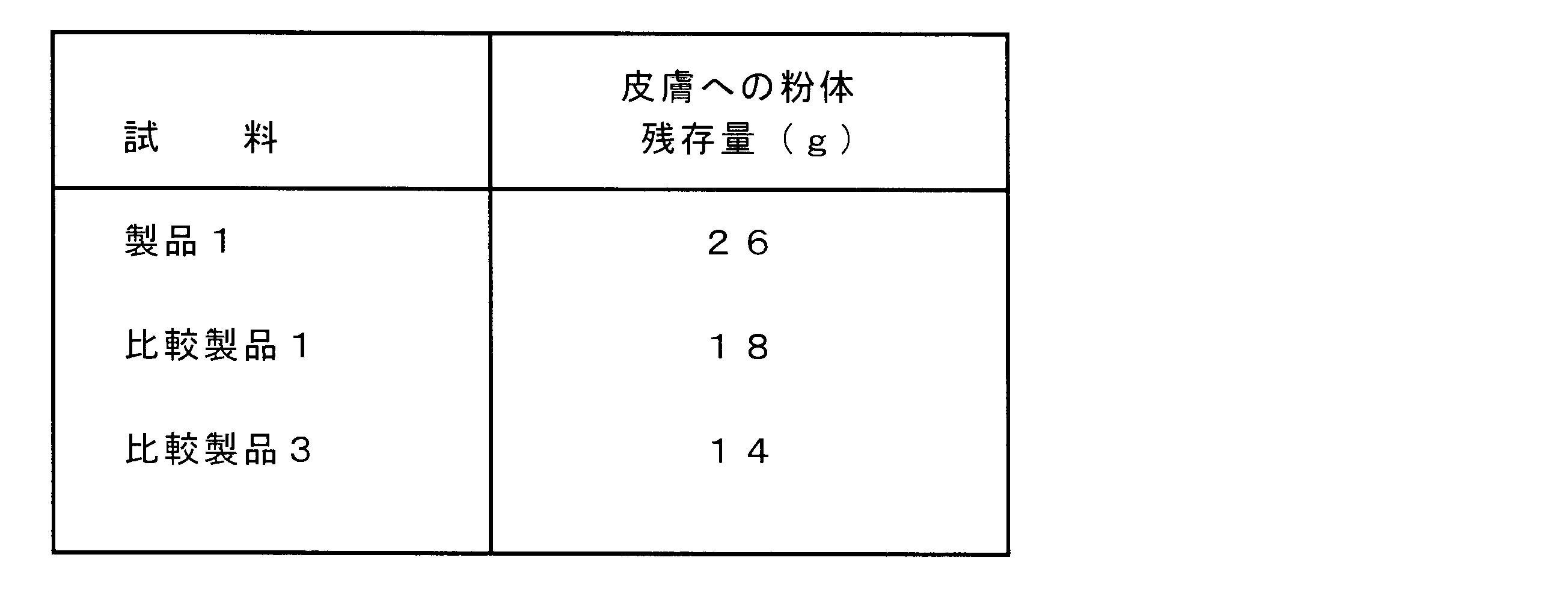
- Example 8 Adhesion test: The adhesion of the phospholipid-treated flat cellulose powder (Product 1) obtained in Example 1 to the skin was examined by the following adhesion test method using artificial skin. For comparison, the stearic acid-treated flat cellulose of Reference Example 1 (Comparative Product 1) and the cellulose powder of Reference Example 3 treated with phospholipid (Comparative Product 3) were used. The results are shown in Table 4.
- Test method After 60 mg of each sample was applied to polyurethane artificial skin (25 cm 2 ), Alenco paper was placed on the applied surface, and a load of 100 kg was applied for 10 seconds from the top using a hydraulic press machine. Thereafter, the amount of powder adhered to the paper was weighed, and the amount of powder adhered to the artificial skin was calculated.
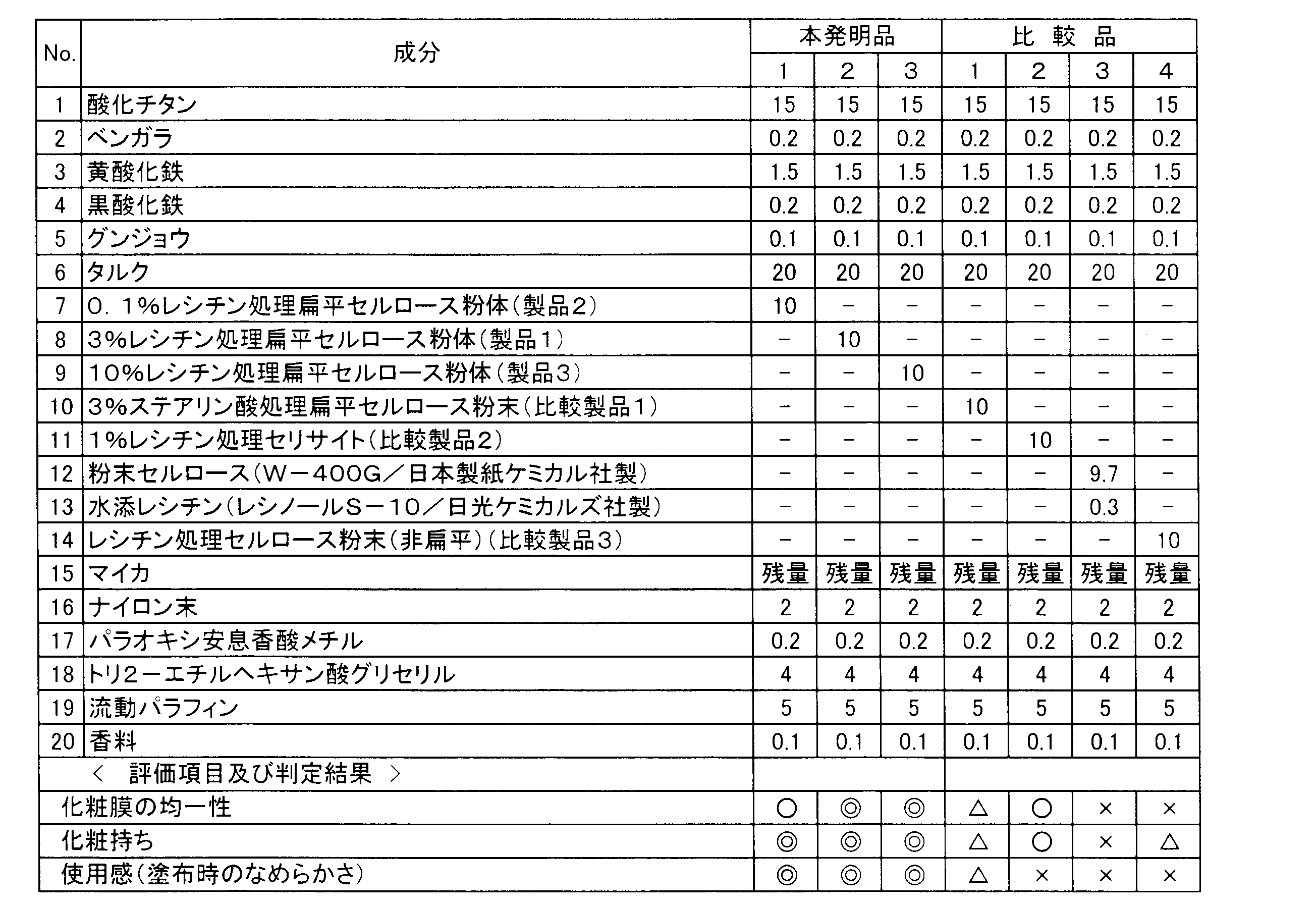
- Example 9 Solid powder foundation A solid powder foundation was prepared by a conventional method with the composition shown in Table 5 below. With respect to the obtained solid powder foundation, its “uniformity of the cosmetic film”, “long-lasting makeup”, and “feel of use (smoothness during application)” were evaluated by the following evaluation methods. The results are also shown in Table 5.
- Judgment criteria (Average score): (Judgment) 5.0 or more: ⁇ (very good) 3.5 or more and less than 5.0: ⁇ (good) 1.5 or more and less than 3.5: ⁇ (somewhat poor) Less than 1.5: ⁇ (defect)
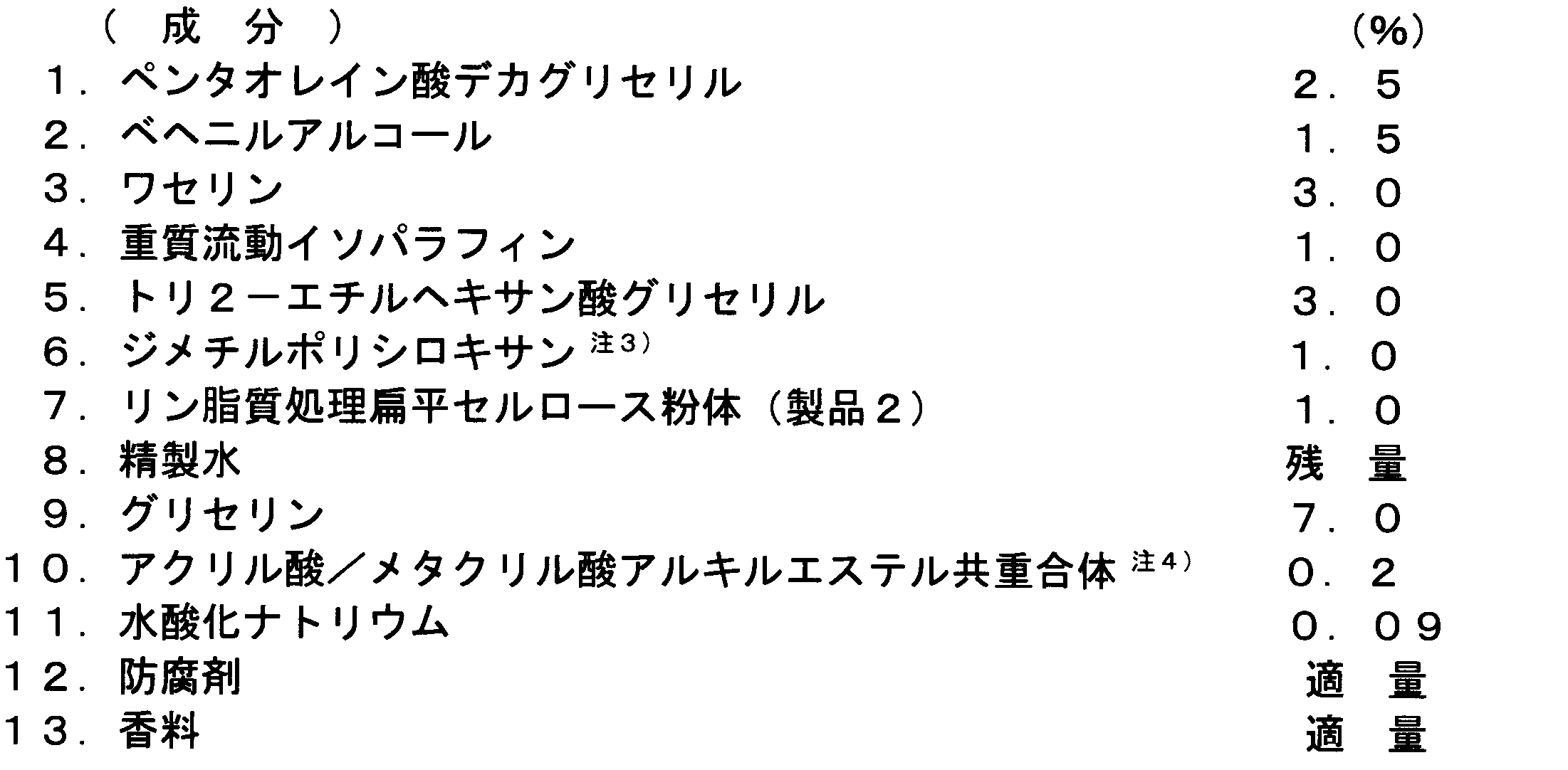
- Example 10 Double layer lotion A two-layer lotion having the following composition was produced by the following method.
- the obtained two-layer lotion was excellent in powder dispersibility, and was a two-layer lotion excellent in smooth use feeling and long-lasting makeup effect.
- Example 11 Milk liquid: An emulsion having the composition shown below was produced by the following method.
- the obtained emulsion was excellent in emulsification stability, smooth feeling in use, and excellent makeup lasting effect.
- Example 12 cream A cream having the following composition was produced by the following method.
- the obtained cream was excellent in emulsification stability, smooth use feeling and excellent makeup lasting effect.
- Example 13 Beauty liquid A serum having the following composition was produced by the following method.
- the obtained essence was excellent in stability, smooth sensation of use, and essence with excellent makeup lasting effect.
- Example 14 Pack A pack having the composition shown below was produced by the following method.
- the obtained pack was excellent in emulsification stability, smooth in feeling of use, and excellent in makeup lasting effect.
- Example 15 Facial wash A face wash having the composition shown below was produced by the following method.
- the obtained facial cleanser was an excellent facial cleanser.
- Example 16 Cleansing cream A cleansing cream having the following composition was produced by the following method.
- the obtained cleansing cream was excellent in emulsification stability and excellent in smooth use feeling.
- Example 17 Hair wax A hair wax having the following composition was produced by the following method.
- the obtained hair wax was excellent in hair styling properties and was excellent in smooth use feeling.
- Example 18 Oily eyeliner An oily eyeliner having the following composition was produced by the following method.
- the obtained oily eyeliner was an oily eyeliner excellent in smooth use feeling and makeup lasting effect.
- Example 19 Aqueous eyeliner: An aqueous eyeliner having the composition shown below was produced by the following method.
- the obtained water-based eyeliner was a water-based eyeliner with a smooth feeling of use and excellent makeup lasting effect.
- Example 20 Eyebrow An eyebrow having the following composition was produced by the following method.
- the obtained eyebrow was an eyebrow excellent in smooth use feeling and makeup sustaining effect.
- Example 21 O / W type mascara: An O / W type mascara having the following composition was produced by the following method.
- the obtained O / W type mascara was an O / W type mascara having excellent powder dispersibility, a smooth feeling of use, and an excellent makeup sustaining effect.
- Example 22 Non-aqueous mascara: A non-aqueous mascara having the following composition was produced by the following method.
- the obtained non-aqueous mascara was a non-aqueous mascara excellent in smooth use feeling and makeup sustaining effect.
- Example 23 Stick-shaped lipstick: A stick-shaped lipstick having the following composition was produced by the following method.
- the obtained stick-shaped lipstick was a lipstick with a smooth feeling of use and excellent makeup lasting effect.
- Example 24 Liquid Rouge A liquid rouge having the following composition was produced by the following method.
- the obtained liquid rouge was a liquid rouge with a smooth use feeling and excellent makeup lasting effect.
- Example 25 O / W type foundation: An O / W type foundation having the following composition was produced by the following method.
- the obtained O / W type foundation was excellent in powder dispersibility, and was an O / W type foundation excellent in smooth feeling of use and makeup sustaining effect.
- Example 26 W / O type foundation: A W / O type foundation having the following composition was produced by the following method.
- the obtained W / O type foundation was excellent in powder dispersibility, and was a W / O type foundation excellent in smooth use feeling and makeup sustaining effect.
- Example 27 O / W eye color: An O / W eye color having the following composition was produced by the following method.
- the obtained O / W type eye color was an O / W type eye color having excellent powder dispersibility, a smooth feeling of use, and an excellent makeup sustaining effect.
- Example 28 Oil solid foundation An oily solid foundation having the following composition was produced by the following method.
- the obtained oil-based solid foundation was an oil-based solid foundation having excellent powder dispersibility, a smooth feeling of use, and an excellent makeup sustaining effect.
- Example 29 Stick concealer A stick concealer having the following composition was produced by the following method.
- the obtained stick concealer was a stick concealer having excellent powder dispersibility, a smooth feeling of use, and an excellent makeup sustaining effect.
- Example 30 Body milk having the following composition was produced by the following method.
- the obtained body milk was excellent in emulsification stability, smooth use feeling and excellent makeup lasting effect.
- Example 31 conditioner A conditioner having the following composition was produced by the following method.
- the obtained conditioner was excellent in emulsification stability and excellent in smooth use feeling.
- Example 32 Hair pack A hair pack having the composition shown below was produced by the following method.
- the obtained hair pack was excellent in emulsification stability and was excellent in smooth usability.
- Example 33 W / O sunscreen A sunscreen with the composition shown below was produced by the following method.
- the obtained W / O type sunscreen was an excellent sunscreen with excellent powder dispersibility, a smooth feeling of use and a long-lasting cosmetic effect.
- Example 34 A nail polish having the following composition was produced by the following method.
- the obtained nail polish was excellent in powder dispersibility, smooth use feeling and excellent makeup lasting effect.
- Example 35 Makeup base: A makeup base having the following composition was produced by the following method.
- the obtained makeup base was excellent in emulsification stability, smooth use feeling and excellent makeup lasting effect.
- Example 36 White powder having the following composition was produced by the following method.
- the obtained white powder was excellent in powder dispersibility, smooth in feeling of use, and in excellent makeup lasting effect.
- Example 37 Solid powder foundation: A solid powder type foundation having the following composition was produced by the following method.
- the obtained solid powder type foundation was excellent in powder dispersibility, smooth in feeling of use, and excellent in makeup lasting effect.
- Example 38 Solid powder type teak: A solid powder type cheek having the composition shown below was produced by the following method.
- the obtained solid powder type teak was excellent in powder dispersibility, smooth feeling in use, and excellent makeup lasting effect.
- Example 39 Solid powder eyeshadow: A solid powder eye shadow having the following composition was produced by the following method.
- the obtained solid powder type eye shadow was excellent in powder dispersibility, smooth in feeling of use, and excellent in makeup lasting effect.
- Example 40 Production of ceramide-treated flat cellulose powder (1): As a raw material, purified cellulose pulp-derived cellulose powder (W-400G / manufactured by Nippon Paper Chemicals Co., Ltd.) was used. First, the cellulose powder (48 g) from which the adsorbed moisture has been sufficiently removed by drying under reduced pressure at 40 ° C. to 0.1% or less is placed in an alumina crushing container (capacity 500 ml) that can be sealed, and an alumina crushing ball (diameter 20 mm). Further, Ceramide 2 (TIC-001 / manufactured by Takasago Fragrance Co., Ltd.) was added so as to be 2% with respect to the cellulose powder.
- alumina crushing container capacity 500 ml
- Ceramide 2 TIC-001 / manufactured by Takasago Fragrance Co., Ltd.
- the average particle diameter, average thickness and flatness of the ceramide-treated flat cellulose powder were measured in the same manner as in Example 1, the average particle diameter, average thickness and flatness were 18 ⁇ m and average thickness, respectively.
- the thickness was 0.6 ⁇ m and the flatness was 30.
- Example 41 Production of ceramide-treated flat cellulose powder (2): As a raw material, purified cellulose pulp-derived cellulose powder (W-400G / manufactured by Nippon Paper Chemicals Co., Ltd.) was used. First, the cellulose powder (48 g) from which the adsorbed moisture has been sufficiently removed by drying under reduced pressure at 40 ° C. to 0.1% or less is placed in an alumina crushing container (capacity 500 ml) that can be sealed, and an alumina crushing ball (diameter 20 mm). In addition, Ceramide 6 (Ceramide VI / manufactured by Cosmo Farm) was added to 2% of the cellulose powder.
- the average particle diameter, average thickness and flatness of the ceramide-treated flat cellulose powder were measured in the same manner as in Example 1, the average particle diameter, average thickness and flatness were 20 ⁇ m and average thickness, respectively. The thickness was 1.5 ⁇ m and the flatness was 13.3.
- Example 42 Production of ceramide-treated flat cellulose powder (3): As a raw material, purified cellulose pulp-derived cellulose powder (W-400G / manufactured by Nippon Paper Chemicals Co., Ltd.) was used. First, the cellulose powder (48 g) from which the adsorbed moisture has been sufficiently removed by drying under reduced pressure at 40 ° C. to 0.1% or less is placed in an alumina crushing container (capacity 500 ml) that can be sealed, and an alumina crushing ball (diameter 20 mm).
- alumina crushing container capacity 500 ml
- Ceramide 1 (ceramide I / Evonik Goldschmidt GmbH) was added to 1% of the cellulose powder, and octyltriethoxysilane (octyltriethoxysilane / Tokyo Kasei Kogyo) was added to 1% of the cellulose powder.
- the average particle diameter, average thickness and flatness of the ceramide-treated flat cellulose powder were measured in the same manner as in Example 1, the average particle diameter, average thickness and flatness were 30 ⁇ m and average thickness, respectively. The thickness was 1.5 ⁇ m and the flatness was 20.0.
- Example 43 Production of ceramide-treated flat cellulose powder (4): As a raw material, purified cellulose pulp-derived cellulose powder (W-400G / manufactured by Nippon Paper Chemicals Co., Ltd.) was used. First, the cellulose powder (48 g) from which the adsorbed moisture has been sufficiently removed by drying under reduced pressure at 40 ° C. to 0.1% or less is placed in an alumina crushing container (capacity 500 ml) that can be sealed, and an alumina crushing ball (diameter 20 mm).
- alumina crushing container capacity 500 ml
- Ceramide 3 (ceramide III / Evonik Goldschmidt GmbH) was added to 1% of the cellulose powder and one-end carboxyl-modified silicone (X-22-3710 / Shin-Etsu Chemical Co., Ltd.) was added to 1% of the cellulose powder.
- Example 44 Production of cholesterol-treated flat cellulose powder (1): As a raw material, purified cellulose pulp-derived cellulose powder (W-400G / manufactured by Nippon Paper Chemicals Co., Ltd.) was used. First, the cellulose powder (48 g) from which the adsorbed moisture has been sufficiently removed by drying under reduced pressure at 40 ° C. to 0.1% or less is placed in an alumina crushing container (capacity 500 ml) that can be sealed, and an alumina crushing ball (diameter 20 mm). In addition, cholesterol (cholesterol / manufactured by Nippon Seika Co., Ltd.) was added to 2% of the cellulose powder.
- the average particle diameter, average thickness, and flatness of the cholesterol-treated flat cellulose powder were measured in the same manner as in Example 1, the average particle diameter, average thickness, and flatness were 22 ⁇ m and average thickness, respectively.
- the thickness was 0.8 ⁇ m and the flatness was 27.5.
- Example 45 Production of cholesterol-treated flat cellulose powder (2): As a raw material, purified cellulose pulp-derived cellulose powder (W-400G / manufactured by Nippon Paper Chemicals Co., Ltd.) was used. First, the cellulose powder (48 g) from which the adsorbed moisture has been sufficiently removed by drying under reduced pressure at 40 ° C. to 0.1% or less is placed in an alumina crushing container (capacity 500 ml) that can be sealed, and an alumina crushing ball (diameter 20 mm). Further, cholesterol (cholesterol / manufactured by Nippon Seika Co., Ltd.) was added to 3% of the cellulose powder and perfluoroalkyl phosphate ester was added to 2% of the cellulose powder.
- the average particle size, average thickness and flatness of the cholesterol-treated flat cellulose powder were measured in the same manner as in Example 1, the average particle size, average thickness and flatness were 27 ⁇ m and the average thickness, respectively.
- the thickness was 1.8 ⁇ m and the flatness was 15.0.
- Example 46 Production of phytosterol-treated flat cellulose powder: As a raw material, purified cellulose pulp-derived cellulose powder (W-400G / manufactured by Nippon Paper Chemicals Co., Ltd.) was used. First, the cellulose powder (48 g) from which the adsorbed moisture has been sufficiently removed by drying under reduced pressure at 40 ° C. to 0.1% or less is placed in an alumina crushing container (capacity 500 ml) that can be sealed, and an alumina crushing ball (diameter 20 mm). In addition, phytosterol (phytosterol / Eisai Food Chemical) was added to 2% of the cellulose powder.
- the average particle size, average thickness and flatness of the phytosterol-treated flat cellulose powder were measured in the same manner as in Example 1, the average particle size, average thickness and flatness were 24 ⁇ m and the average thickness, respectively.
- the thickness was 1.0 ⁇ m and the flatness was 24.0.
- Reference example 4 Production of ceramide-treated sericite: 98% of sericite (Eight Pearl 300S / Kakuhachi Rinfoil Co., Ltd.) is coated with 2% of ceramide 2 (TIC-001 / Takasago Fragrance Co., Ltd.) using Mircer (Iwatani Corp.) A site (Comparative Product 4) was obtained.
- ceramide-treated cellulose powder (non-flat): As a raw material, cellulose pulp derived from wood pulp (W-100G / manufactured by Nippon Paper Chemicals Co., Ltd.) is charged into a stirrer, and ceramide 2 (TIC-001 / manufactured by Takasago Fragrance Co., Ltd.) is 2% of the cellulose powder. After dissolution, it was added. Thereafter, the mixture was stirred for 5 minutes at a rotational speed of 40 rpm, dried under reduced pressure, and pulverized to obtain a ceramide-treated cellulose powder (non-flat) (Comparative Product 5).
- Example 47 Adhesion test: The adhesion of the ceramide-treated flat cellulose powder, cholesterol-treated flat cellulose powder, and phytosterol-treated flat cellulose powder (Products 10 to 12) obtained in Examples 40, 44 and 46 to the skin was examined in the same manner as in Example 8. It was. For comparison, the stearic acid-treated flat cellulose of Comparative Example 1 (Comparative Product 1) was used. These results are shown in Table 6.
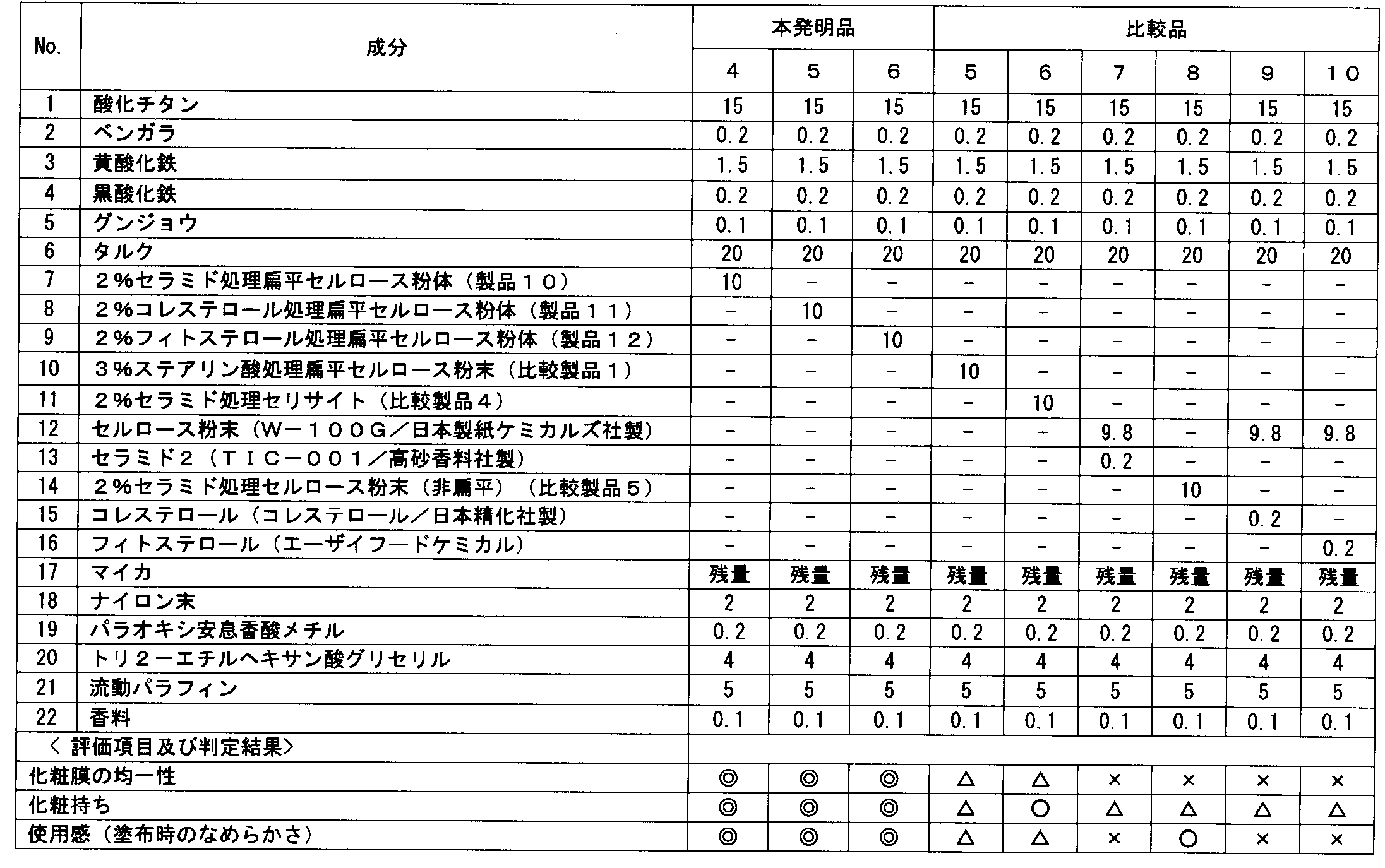
- Example 48 Solid powder foundation: A solid powder foundation was prepared by a conventional method with the composition shown in Table 7 below. The obtained solid powder foundation was evaluated in the same manner as in Example 9 in terms of “uniformity of the cosmetic film”, “make-up”, and “use feeling (smoothness during application)”. The results are also shown in Table 7.
- the foundations using the ceramide-treated flat cellulose powder, cholesterol-treated flat cellulose powder, and phytosterol-treated flat cellulose powder are comparative products 5 in place of the stearic acid-treated flat cellulose powder, Comparative product 6 instead of ceramide-treated sericite, comparative product 7 containing cellulose and ceramide separately, Comparative product 8 instead of ceramide-treated cellulose powder, comparative product 9 containing cellulose and cholesterol separately, cellulose and phytosterol
- the decorative film was maintained over time as compared with the comparative product 10 that was blended separately, which was excellent in terms of long-lasting makeup.
- the foundation of the product 4 of the present invention maintains the fineness of the cosmetic film over time compared to the foundation (the products 1 to 3 of the present invention) using the phospholipid-treated flat cellulose powder of Example 9. It was superior in terms of long-lasting makeup over time.
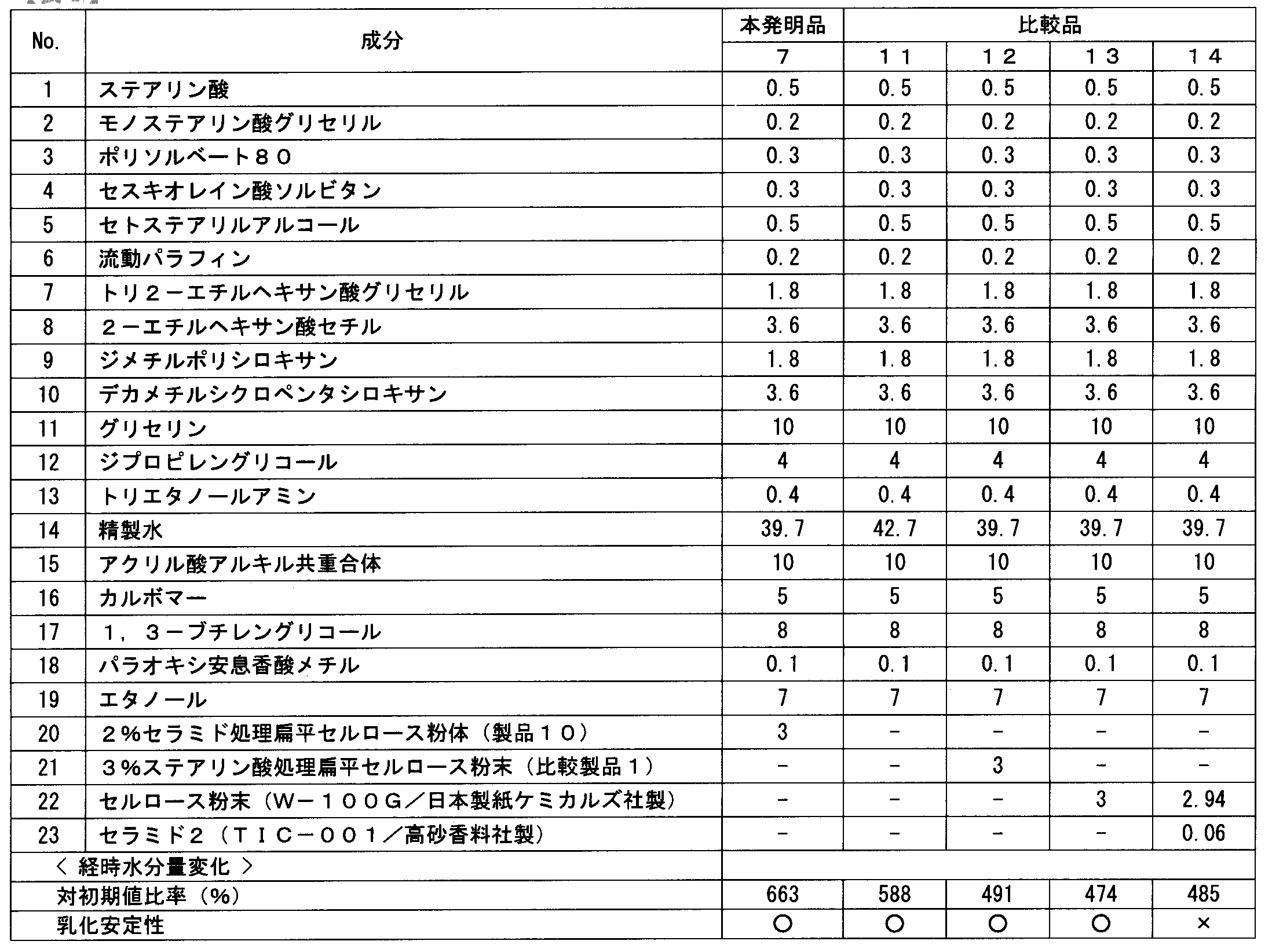
- Example 49 Latex An emulsion with the composition shown in Table 8 below was produced by the following method. Changes in water content with time after application of the obtained emulsion to the skin (after 5 hours of application) were examined by the following method. The results are also shown in Table 8.
- Test method ⁇ Change in moisture content over time> First, the application site is cleaned with a predetermined cleaning material, and then 20 minutes or more have passed after entering the environmental test chamber (temperature 22 ° C., relative humidity 50%) under certain conditions, and then using “SKICON200EX” manufactured by IBS. Four measurements were taken and the average value was used. A 2 cm square frame is marked on the inner side of the upper arm of each subject, and 200 ml of each sample is applied thereto. The moisture content before application and 5 hours after application in each part was measured, and the ratio to the initial value was calculated. ⁇ Emulsification stability> After each sample was stored at 50 ° C. for 1 month, the presence or absence of the generated crystal precipitates was confirmed.
- the emulsion using the ceramide-treated flat cellulose powder of the product 7 of the present invention has been treated with a comparative product 11 that does not contain the ceramide-treated flat cellulose powder, and a comparative product 12 that replaces the stearic acid-treated flat cellulose powder.
- a comparative product 11 that does not contain the ceramide-treated flat cellulose powder
- a comparative product 12 that replaces the stearic acid-treated flat cellulose powder.
- the moisture content of the skin is maintained over time, which is superior in terms of the moisturizing effect over time. It was.
- Example 50 Gel serum: A gel serum with the composition shown in Table 9 below was produced by the following method. Changes in the amount of water transpiration over time after the obtained gel serum was applied to the skin (5 hours after application) were examined by the following method. The results are also shown in Table 9.
- Test method First, the application site is cleaned with a predetermined cleaning material, and then 20 minutes or more have passed after entering the environmental test chamber (temperature 22 ° C, relative humidity 50%) under certain conditions, and Delfin Technologies, Inc. Water vapor transpiration (TEWL) was measured four times using a Vapometer SWL2 type, and the average value was used. A 2 cm square frame is marked on the inner side of the upper arm of each subject, and 200 ml of each sample is applied thereto. The amount of moisture transpiration before application and 5 hours after application at each site was measured, and the ratio of the initial value was calculated.
- TEWL Water vapor transpiration
- the beauty liquid using the ceramide-treated flat cellulose powder of the product 8 of the present invention is a comparative product 15 that does not contain a ceramide-treated flat cellulose powder, a comparative product 16 that uses an untreated cellulose powder, and stearic acid.
- the comparative product 17 replaced with the treated flat cellulose powder the amount of moisture transpiration on the skin was suppressed over time, and the moisturizing effect over time was superior.
- the dosage form is a cosmetic liquid that has few oil agents and it is difficult to suppress ceramide crystal precipitation
- the cosmetic liquid using the ceramide-treated flat cellulose powder of the product 8 of the present invention suppresses ceramide crystal precipitation. It was also excellent in that ceramide could be easily blended.
- Example 51 Double layer lotion A bilayer lotion was produced in the same manner as in the bilayer lotion of Example 10, except that the phospholipid-treated flat cellulose powder (Product 1) was replaced with the ceramide-treated flat cellulose powder produced in Example 40.
- the obtained two-layer lotion was excellent in smooth use feeling, and was a two-layer lotion superior in moisture transpiration suppression effect than that of Example 10.
- Example 52 Milk liquid: In the emulsion of Example 11, the phospholipid-treated flat cellulose powder (Product 1) was 1.0% of the ceramide-treated flat cellulose powder produced in Example 41 and the cholesterol-treated cellulose powder 1.0 produced in Example 42. A milky lotion was produced in the same manner except that the percentage was changed to%.
- the obtained emulsion was excellent in emulsification stability, smooth use feeling, and excellent in water retention / transpiration suppression effect than that of Example 11.
- Example 53 cream A cream was produced in the same manner as in the cream of Example 12 except that the phospholipid-treated flat cellulose powder (Product 2) was replaced with the ceramide-treated flat cellulose powder produced in Example 42.
- the obtained cream was excellent in emulsification stability, smooth use feeling, and excellent in water retention / transpiration suppression effect than that of Example 12.
- Example 54 Beauty liquid A cosmetic liquid was produced in the same manner as in the cosmetic liquid of Example 13, except that the phospholipid-treated flat cellulose powder (Product 3) was replaced with the phytosterol-treated flat cellulose powder produced in Example 46.
- the obtained serum was excellent in stability, and was a serum having a smooth use feeling and excellent makeup lasting effect as in Example 13.
- Example 55 Pack A pack was produced in the same manner as in the pack of Example 14, except that the phospholipid-treated flat cellulose powder (Product 5) was replaced with the ceramide-treated flat cellulose powder produced in Example 43.
- the obtained pack was excellent in emulsification stability, a smooth feeling in use, and a pack excellent in moisture retention and transpiration suppression effect than that of Example 14.
- Example 56 Facial wash A face wash was prepared in the same manner as in Example 15 except that the phospholipid-treated flat cellulose powder (Product 6) was replaced with the cholesterol-treated flat cellulose powder produced in Example 45.
- the obtained facial cleanser was a facial cleanser having an excellent smooth usability like that of Example 15.
- Example 57 Cleansing cream A cleansing cream was produced in the same manner as in the cleansing cream of Example 16, except that the phospholipid-treated flat cellulose powder (Product 1) was replaced with the ceramide-treated flat cellulose powder produced in Example 42.
- the obtained cleansing cream was excellent in emulsification stability and was a cleansing cream excellent in smooth usability like that of Example 16.
- Example 58 Hair wax A hair wax was produced in the same manner as in Example 17 except that the phospholipid-treated flat cellulose powder (Product 4) was replaced with the ceramide-treated flat cellulose powder produced in Example 40.
- the obtained hair wax was excellent in hair styling properties, and was a hair wax excellent in smooth usability like that of Example 17.
- Example 59 Oily eyeliner An oily eyeliner was produced in the same manner as in the oily eyeliner of Example 18 except that the phospholipid-treated flat cellulose powder (Product 2) was replaced with the ceramide-treated flat cellulose powder produced in Example 43.
- the obtained oily eyeliner was an oily eyeliner excellent in smooth use feeling and makeup sustaining effect as in Example 18.
- Example 60 Aqueous eyeliner: An aqueous eyeliner was produced in the same manner as in the aqueous eyeliner of Example 19 except that the phospholipid-treated flat cellulose powder (Product 1) was replaced with the phytosterol-treated flat cellulose powder produced in Example 46.
- the obtained water-based eyeliner was a water-based eyeliner excellent in smooth use feeling and makeup sustaining effect as in Example 19.
- Example 61 Eyebrow An eyebrow was produced in the same manner as in the eyebrow of Example 20, except that the phospholipid-treated flat cellulose powder (Product 3) was replaced with the cholesterol-treated flat cellulose powder produced in Example 44.
- the obtained eyebrow was an eyebrow excellent in smooth use feeling and makeup lasting effect as in Example 20.
- Example 62 O / W type mascara In the O / W type mascara of Example 21, an O / W type mascara was produced in the same manner except that the phospholipid-treated flat cellulose powder (Product 1) was replaced with the ceramide-treated flat cellulose powder produced in Example 42. .
- the obtained O / W type mascara was an O / W type mascara which was excellent in adhesion as in Example 21 and had a smooth feeling of use and a long-lasting makeup effect.
- Example 63 Non-aqueous mascara: A non-aqueous mascara was produced in the same manner as in the non-aqueous mascara of Example 22, except that the phospholipid-treated flat cellulose powder (Product 2) was replaced with the ceramide-treated flat cellulose powder produced in Example 42.
- the obtained non-aqueous mascara was a non-aqueous mascara excellent in smooth use feeling and makeup sustaining effect as in Example 22.
- Example 64 Stick-shaped lipstick: A stick-shaped lipstick was produced in the same manner as in Example 23 except that the phospholipid-treated flat cellulose powder (Product 3) was replaced with the ceramide-treated flat cellulose powder produced in Example 41.
- the obtained stick-like lipstick was a lipstick with a smooth use feeling and a makeup lasting effect similar to that of Example 23.
- Example 65 Liquid Rouge A liquid rouge was produced in the same manner as in the liquid rouge of Example 24 except that the phospholipid-treated flat cellulose powder (Product 4) was replaced with 0.5% of the phytosterol-treated flat cellulose powder produced in Example 46.
- the obtained liquid rouge was a liquid rouge excellent in smooth use feeling and makeup sustaining effect as in the case of Example 24.
- Example 66 O / W type foundation In the O / W type foundation of Example 25, an O / W type foundation was produced in the same manner except that the phospholipid-treated flat cellulose powder (Product 5) was replaced with the ceramide-treated flat cellulose powder produced in Example 43. .
- the obtained O / W type foundation was an O / W type foundation excellent in smooth use feeling and makeup sustaining effect as in Example 25.
- Example 67 W / O type foundation In the W / O type foundation of Example 26, except that the phospholipid-treated flat cellulose powder (Product 6) is replaced with 3.0% of the cholesterol-treated flat cellulose powder produced in Example 45, the W / O type is the same. A foundation was produced.
- the obtained W / O-type foundation was a W / O-type foundation excellent in smooth use feeling and makeup sustaining effect as in Example 26.
- Example 68 O / W eye color In the O / W type eye color of Example 27, an O / W type eye color was similarly obtained except that the phospholipid-treated flat cellulose powder (Product 5) was replaced with the cholesterol-treated flat cellulose powder produced in Example 44. Manufactured.
- the obtained O / W type eye color was an O / W type eye color having a smooth use feeling and an excellent makeup sustaining effect as in Example 27.
- Example 69 Oil solid foundation An oily solid foundation was produced in the same manner as in the oily solid foundation of Example 28, except that the phospholipid-treated flat cellulose powder (Product 4) was replaced with the ceramide-treated flat cellulose powder produced in Example 42.
- the obtained oily solid foundation was a smooth oily feel similar to that of Example 28, and was an oily solid foundation having an excellent makeup-sustaining effect.
- Example 70 Stick concealer A stick concealer was produced in the same manner as in Example 29 except that the phospholipid-treated flat cellulose powder (Product 3) was replaced with the ceramide-treated flat cellulose powder produced in Example 40.
- the obtained stick-like concealer was a stick-like concealer having a smooth use feeling and an excellent makeup lasting effect as in Example 29.
- Example 71 Body milk was produced in the same manner as in Example 30 except that the phospholipid-treated flat cellulose powder (Product 2) was replaced with the cholesterol-treated flat cellulose powder produced in Example 45.
- the obtained body milk was excellent in emulsification stability, and it was a body milk excellent in smooth use feeling and makeup sustaining effect as in Example 30.
- Example 72 conditioner A conditioner was produced in the same manner as in the conditioner of Example 31, except that the phospholipid-treated flat cellulose powder (Product 1) was replaced with the ceramide-treated flat cellulose powder produced in Example 41.
- the obtained conditioner was excellent in emulsification stability, and was a conditioner excellent in smooth usability like that of Example 31.
- Example 73 Hair pack A hair pack was produced in the same manner as in the hair pack of Example 32, except that the phospholipid-treated flat cellulose powder (Product 1) was replaced with the cholesterol-treated flat cellulose powder produced in Example 44.
- the obtained hair pack was excellent in emulsification stability, and was a hair pack excellent in smooth usability like that of Example 32.
- Example 74 W / O sunscreen In the same manner as in the W / O sunscreen of Example 33, except that the phospholipid-treated flat cellulose powder (Product 2) is replaced with the ceramide-treated flat cellulose powder produced in Example 43, W / O-type sunscreen. The material was manufactured.
- the obtained W / O-type sunscreen was a sunscreen with a smooth use feeling and an excellent makeup-sustaining effect similar to that of Example 33.
- Example 75 Manicure: A nail polish was produced in the same manner as in the nail polish of Example 34 except that the phospholipid-treated flat cellulose powder (Product 3) was replaced with the cholesterol-treated flat cellulose powder produced in Example 45.
- the obtained nail polish was a nail polish excellent in smooth use feeling and makeup lasting effect as in Example 34.
- Example 76 Makeup base: A makeup base was prepared in the same manner as in Example 35 except that the phospholipid-treated flat cellulose powder (Product 4) was replaced with the phytosterol-treated flat cellulose powder produced in Example 46.
- the obtained makeup base was excellent in emulsification stability, and was the same base as in Example 35 with a smooth feeling of use and a makeup lasting effect.
- Example 77 White powder: A white powder was produced in the same manner as in the white powder of Example 36, except that the phospholipid-treated flat cellulose powder (Product 8) was replaced with the ceramide-treated flat cellulose powder produced in Example 40.
- the obtained white powder was excellent in adhesiveness as in Example 36, and was a white powder excellent in smooth feeling of use and makeup sustaining effect.
- Example 78 Solid powder foundation: A solid powder type foundation was produced in the same manner as in the solid powder type foundation of Example 37, except that the phospholipid-treated flat cellulose powder (Product 9) was replaced with the ceramide-treated flat cellulose powder produced in Example 41.
- the obtained solid powder type foundation was excellent in adhesion and smooth use feeling as in Example 37, and was a foundation excellent in makeup lasting effect than Example 35.
- Example 79 Solid powder type teak: A solid powder type cheek was produced in the same manner as in Example 38 except that the phospholipid-treated flat cellulose powder (Product 3) was replaced with the phytosterol-treated flat cellulose powder produced in Example 46.
- the obtained solid powder type cheek was excellent in adhesion as in Example 38, and was a cheek excellent in smooth use feeling and makeup sustaining effect.
- Example 80 Solid powder eyeshadow: A solid powder eye shadow was produced in the same manner as in Example 39 except that the phospholipid-treated flat cellulose powder (Product 2) was replaced with the cholesterol-treated flat cellulose powder produced in Example 44. .
- the obtained solid powder type eye shadow was an eye shadow excellent in smooth use feeling and makeup sustaining effect similar to that of Example 39.
- the amphiphile-treated flat cellulose powder of the present invention has excellent adhesion and high adhesion compared to talc and sericite, which are conventional flat inorganic substances, because the base cellulose itself is an organic substance and is flat. There is a feeling of use. Furthermore, since the surface of the amphiphilic substance-treated flat cellulose powder is treated with an amphiphilic substance, it is excellent in adhesion and smoothness of the coating film and uniformity of the cosmetic film when blended into cosmetics. In addition, makeup sustainability and the like are improved.
- the amphiphile-treated flat cellulose powder of the present invention can be used in many cosmetics, but especially as a cosmetic that easily exhibits its effect, it has excellent moisture retention such as moisture retention and moisture transpiration suppression.
- makeup such as liquid foundation can be used. It can be suitably used as a cosmetic.
- these powders have good adhesion and excellent makeup, they can be suitably used as makeup cosmetics such as powder foundations.
Landscapes
- Health & Medical Sciences (AREA)
- Life Sciences & Earth Sciences (AREA)
- Animal Behavior & Ethology (AREA)
- General Health & Medical Sciences (AREA)
- Public Health (AREA)
- Veterinary Medicine (AREA)
- Birds (AREA)
- Epidemiology (AREA)
- Biophysics (AREA)
- Molecular Biology (AREA)
- Dermatology (AREA)
- Cosmetics (AREA)
Abstract
Description
リン脂質処理扁平セルロース粉体の製造(1):
原料としては精製した木材パルプ由来のセルロース粉末(W-400G/日本製紙ケミカル社製)を用いた。まず、40℃での減圧乾燥により吸着水分を0.1%以下まで十分に除去したセルロース粉末(48.5g)を、密閉可能なジルコニア製粉砕容器(容積500ml)に、ジルコニア製粉砕ボール(直径20mm)とともに投入し、更に、水添レシチン(レシノールS-10/日光ケミカルズ社製)を1.5g添加し、セルロース粉末に対して水添レシチンが3%になるように調製した。
リン脂質処理扁平セルロース粉体の製造(2):
水添レシチンの量を、0.1%および10%とする以外は実施例1と同様にして、それぞれリン脂質処理扁平セルロース粉体(製品2および製品3)を得た。これらの平均粒径、平均厚さおよび扁平度は、以下の通りであった。

リン脂質処理扁平セルロース粉体の製造(3):
リン脂質として、実施例1の水添レシチンに代えて、水添リゾレシチン(日本精化社製:LP-70H)、ホスファチジルエタノールアミン(和光純薬社製)およびスフィンゴミエリン(和光純薬社製)を用い、以下実施例1と同様にして、それぞれリン脂質処理扁平セルロース粉体(製品4~製品6)を得た。これらの平均粒径、平均厚さおよび扁平度は、以下の通りであった。
リン脂質処理扁平セルロース粉体の製造(4):
原料としては精製した木材パルプ由来のセルロース粉末(W-400G/日本製紙ケミカル社製)を用いた。これを密閉可能なアルミナ製粉砕容器に、アルミナ製粉砕ボールとともに投入し、これに水添レシチン(レシノールS-10/日光ケミカルズ社製)をコットンに対して5%になるように添加した。その後、遊星型ボールミル(P-5型/ドイツ・フリッチュ社製)を用い、回転数200rpm(約10G(重力加速度)の粉砕エネルギー)にて、連続して60分間粉砕を行った。得られたリン脂質処理扁平セルロース粉体は、平均粒径20μm、平均厚さ1.2μm、扁平度16.7であった(製品7)。
リン脂質処理扁平セルロース粉体の製造(5):
原料としてはオーガニックコットン(7番カード糸 生成り/アバンティー社製)を用いた。これを粉砕機(槇野産業製:RC100型)で細かく細断後、密閉可能なアルミナ製粉砕容器に、アルミナ製粉砕ボールとともに投入し、これに水添レシチン(レシノールS-10/日光ケミカルズ社製)をコットンに対して1%になるように添加した。その後、遊星型ボールミル(P-5型/ドイツ・フリッチュ社製)を用い、回転数200rpm(約10G(重力加速度)の粉砕エネルギー)にて、連続して60分間粉砕を行った。得られたリン脂質処理扁平セルロース粉体は、平均粒径20μm、平均厚さ1.6μm、扁平度12.5であった(製品8)。
リン脂質処理扁平セルロース粉体の製造(6):
原料としては精製した木材パルプ由来のセルロース粉末(W-400G/日本製紙ケミカル社製)これを密閉可能なアルミナ製粉砕容器に、アルミナ製粉砕ボールとともに投入し、これに水添レシチン(レシノールS-10/日光ケミカルズ社製)をコットンに対して2%になるように添加した。その後、遊星型ボールミル(P-5型/ドイツ・フリッチュ社製)を用い、回転数200rpm(約10G(重力加速度)の粉砕エネルギー)にて、連続して50分間粉砕を行った。得られたリン脂質処理扁平セルロース粉体は、平均粒径17.8μm、平均厚さ0.2μm、扁平度89.0であった(製品9)。
ステアリン酸処理扁平セルロース粉末の製造:
水添レシチンに代えてステアリン酸を使用する以外は、実施例1と同様に処理して、ステアリン酸処理扁平セルロース粉末(比較製品1)を得た。
リン脂質処理セリサイトの製造:
セリサイト(エイトパール300S/角八魚燐箔社製)99%を大豆リン脂質(レシチン/味の素社製)1%で被覆処理し、リン脂質処理セリサイト(比較製品2)を得た。
リン脂質処理セルロース粉末(非扁平)の製造:
木材パルプ由来のセルロース粉末(W-100G/日本製紙ケミカル社製)を、攪拌機に投入し、セルロース粉末に対して3%となる水添レシチン(レシノールS-10/日光ケミカルズ製)をヘキサンに溶解後添加した。この後、回転数40rpmにて5分間攪拌し、減圧乾燥後、粉砕を行って、リン脂質処理セルロース粉末(非扁平)(比較製品3)を得た。
分散性試験:
実施例1で得たリン脂質処理扁平セルロース粉体(製品1)の種々の溶媒に対する分散性を下記の分散性試験方法により調べた。比較および対照としては、参考例1のステアリン酸処理扁平セルロース(比較製品1)および原料のセルロース粉末(対照品)を用いた。また、分散媒(溶媒)としては、流動パラフィン(KLEAROL)、トリ-(2-エチルヘキサン酸)グリセリド(T.I.O)、シリコ-ンオイル(10cs)(KF-96)および水を用いた。この結果を表3に示す。
6号規格瓶に、各試料0.5gと分散媒24.5gを混合し(2wt%)、超音波にて1時間分散後、沈降管へ移し分散状態を観察する。そして所定時間後の分散体積(粉体がまだ懸濁している部分の体積)を評価し、下式から分散率(%)を求めた。

付着性試験:
実施例1で得たリン脂質処理扁平セルロース粉体(製品1)の皮膚に対する付着性を、人工皮膚を用いる下記の付着性試験方法により調べた。比較としては、参考例1のステアリン酸処理扁平セルロース(比較製品1)および参考例3のセルロース粉末をリン脂質処理したもの(比較製品3)を用いた。この結果を表4に示す。
各試料の60mgをポリウレタン製人工皮膚(25cm2)に塗布した後、この塗布した面にアレンコ紙を載せ、油圧プレス機を用いて上から100kgの荷重を10秒間かけた。その後、紙に付着した粉体量を秤量し、粉体の人工皮膚への付着量を算出した。
固形粉末型ファンデーション:
常法により、下記表5に示す組成で固形粉末ファンデーションを調製した。得られた固形粉末ファンデーションについて、下記評価方法により、その「化粧膜の均一性」、「化粧持ち」および「使用感(塗布時のなめらかさ)」を評価した。この結果も表5に併せて示す。
化粧品評価専門パネル20名に本発明品1~3及び比較品1~4の固形粉末型ファンデーションを使用してもらい、「化粧膜の均一性」 「化粧持ち」 「使用感(塗布時のなめらかさ)」について各自が以下の評価基準に従って7段階評価し、サンプル毎に評点を付した。次いで、全パネルの評点の平均点から、以下の判定基準に従って各製品を判定した。
(評価) : (内容)
6 : 非常に良い
5 : 良い
4 : やや良い
3 : 普通
2 : やや悪い
1 : 悪い
0 : 非常に悪い
(評点の平均点) : (判定)
5.0以上 : ◎(非常に良好)
3.5以上5.0未満 : ○(良好)
1.5以上3.5未満 : △(やや不良)
1.5未満 : ×(不良)
二層ローション:
以下に示す組成の二層ローションを下記の方法により製造した。

(1)成分1~3を混合する。
(2)(1)に成分4~9を添加、均一に攪拌し、二層ローションを得た。
乳 液 :
以下に示す組成の乳液を下記の方法により製造した。

(1)成分1~7を80℃にて均一に混合する。
(2)成分8~14を80℃にて均一に混合する。
(3)(1)に(2)を添加し、乳化する。
(4)(3)を攪拌しながら冷却し、成分15を添加後均一混合し、乳液 を得た。
クリーム:
以下に示す組成のクリームを下記の方法により製造した。
(1)成分1~7を80℃にて均一に混合する。
(2)成分8~13を80℃にて均一に混合する。
(3)(1)に(2)を添加し、乳化する。
(4)(3)を攪拌しながら冷却し、クリームを得た。
美 容 液 :
以下に示す組成の美容液を下記の方法により製造した。
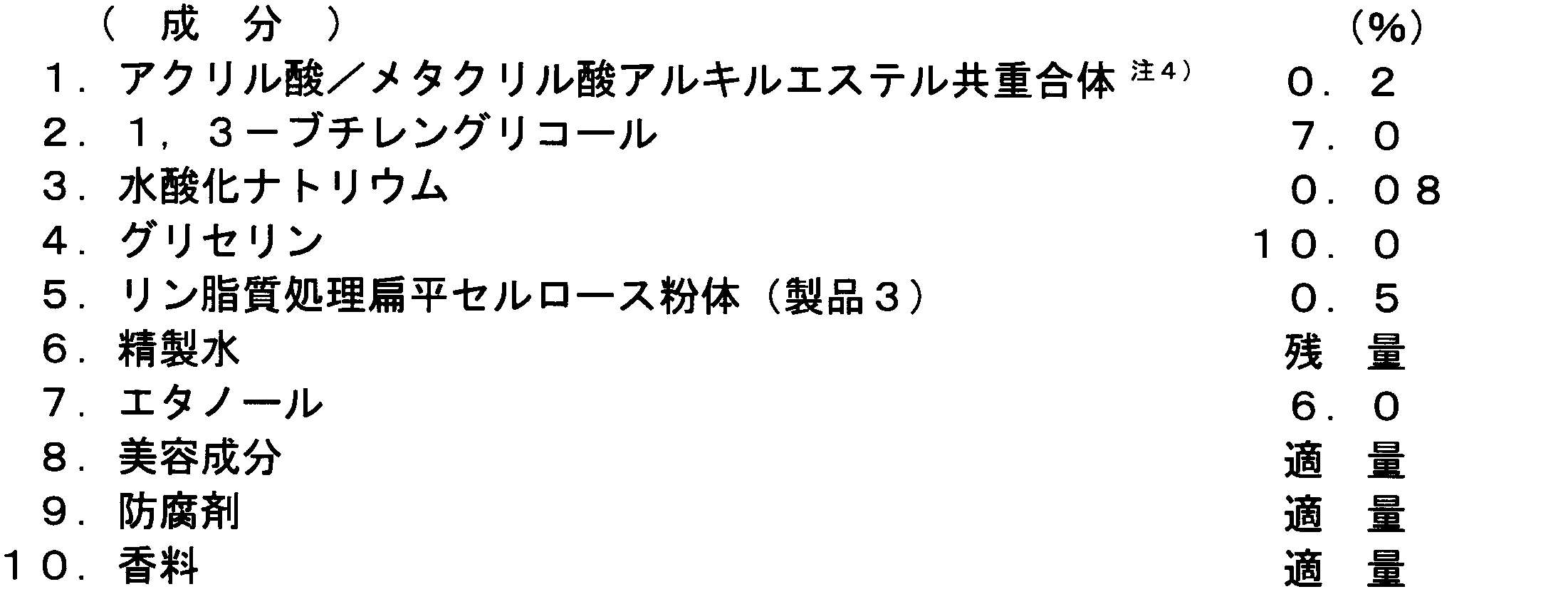
(1)成分1~10を常温にて混合溶解し、攪拌しながら美容液を得た。
パ ッ ク :
以下に示す組成のパックを下記の方法により製造した。

(1)成分1~4を80℃にて均一に混合する。
(2)成分5~12を80℃にて均一に混合する。
(3)(1)に(2)を添加し、乳化する。
(4)(3)を攪拌しながら冷却し、パックを得た。
洗 顔 料 :
以下に示す組成の洗顔料を下記の方法により製造した。

(1)成分1~7を80℃にて均一に混合する。
(2)成分8~11を80℃にて均一に混合する。
(3)(1)に(2)を添加し、中和する。
(4)(3)に成分12を添加し、均一に混合する。
(5)(4)を攪拌しながら冷却し、洗顔料を得た。
クレンジングクリーム:
以下に示す組成のクレンジングクリームを下記の方法により製造した。

(1)成分1~8を80℃にて均一に混合する。
(2)成分9~14を80℃にて均一に混合する。
(3)(2)に(1)を添加し、乳化する。
(4)(3)を攪拌しながら冷却し、クレンジングクリームを得た。
ヘアワックス:
以下に示す組成のヘアワックスを下記の方法により製造した。
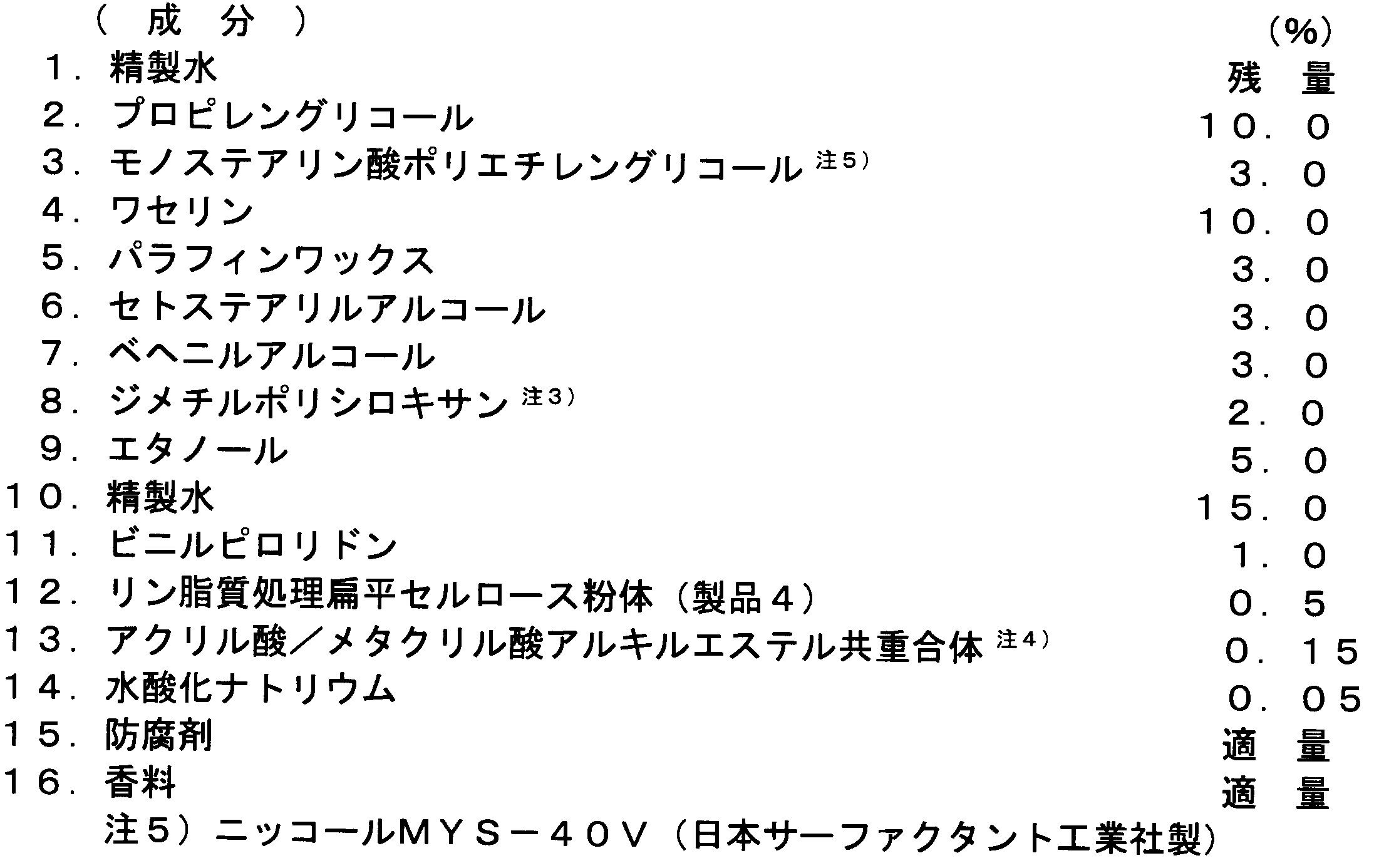
(1)成分1~3を80℃にて均一に混合する。
(2)成分4~8を80℃にて均一に混合する。
(3)(1)に(2)を添加し、乳化する。
(4)(3)に成分9~16を添加後、攪拌しながら冷却し、ヘアワック スを得た。
油性アイライナー:
以下に示す組成の油性アイライナーを下記の方法により製造した。
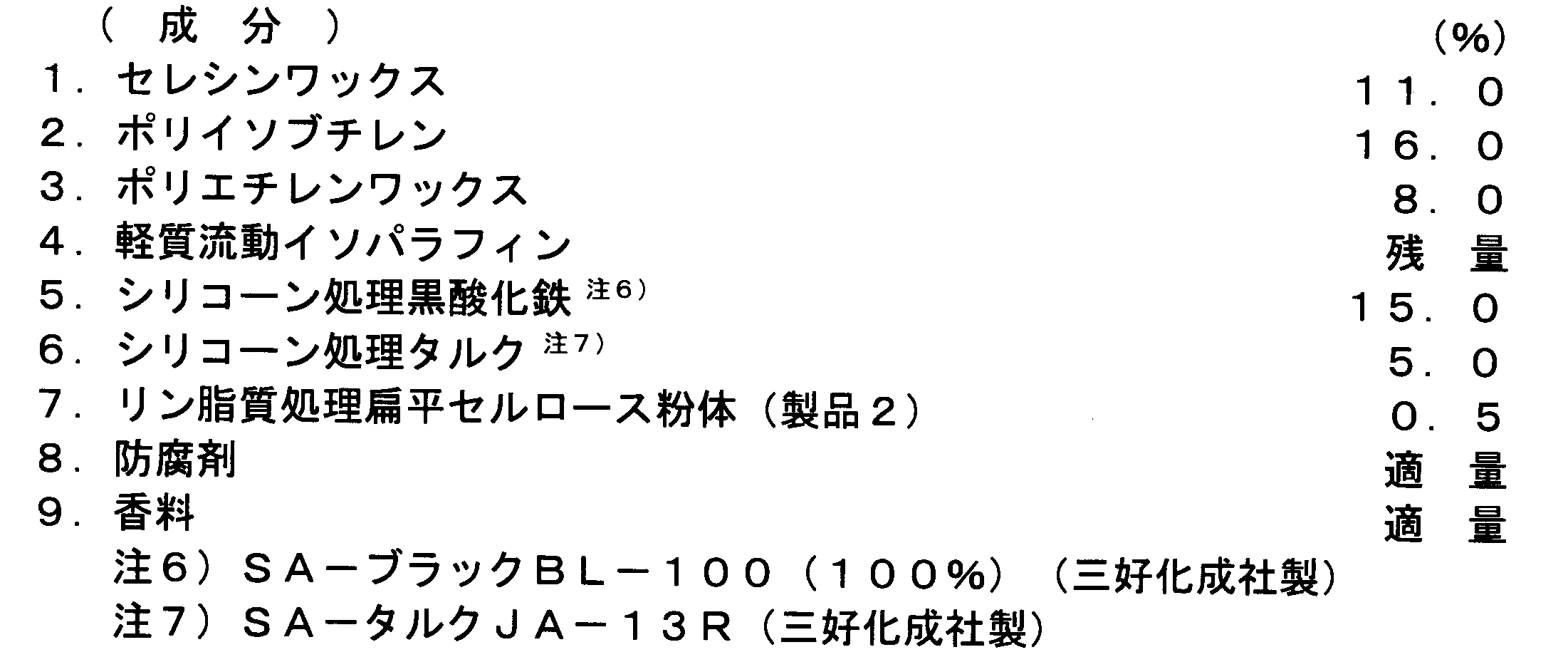
(1)成分1~4を100℃に加温し、均一混合する。
(2)成分5~9を80℃に加温し、均一混合する。
(3)(1)に(2)を添加し、均一に混合する。
(4)(3)をローラーにて処理し、油性アイライナーを得た。
水性アイライナー:
以下に示す組成の水性アイライナーを下記の方法により製造した。

(1)成分1~6をローラーにて均一に分散する。
(2)成分6~10を均一に混合する。
(3)(2)に(1)を添加、均一に混合し、水性アイライナーを得た。
アイブロウ:
以下に示す組成のアイブロウを下記の方法により製造した。

(1)成分1~4を均一に混合する。
(2)成分5~10をローラーにて処理する。
(3)(1)に(2)、成分11、12を添加後、均一に混合し、アイブ ロウを得た。
O/W型マスカラ:
以下に示す組成のO/W型マスカラを下記の方法により製造した。
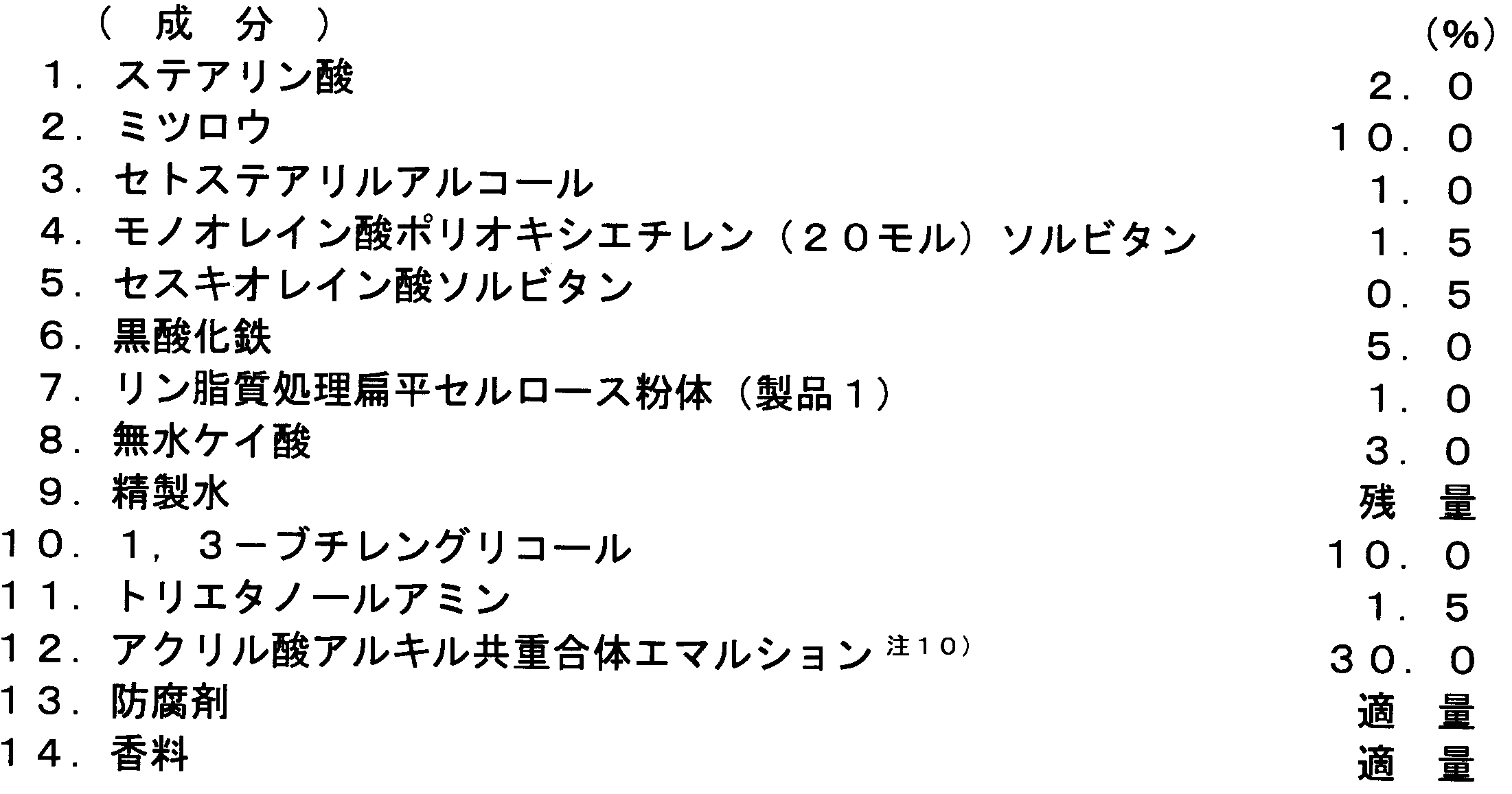
(1)成分1~8を80℃にて均一に混合し、ローラー処理する。
(2)成分9~14を80℃にて均一に混合する。
(3)(1)に(2)を添加し、乳化する。
(4)(3)を冷却し、マスカラ(O/W)を得た。
非水系マスカラ:
以下に示す組成の非水系マスカラを下記の方法により製造した。
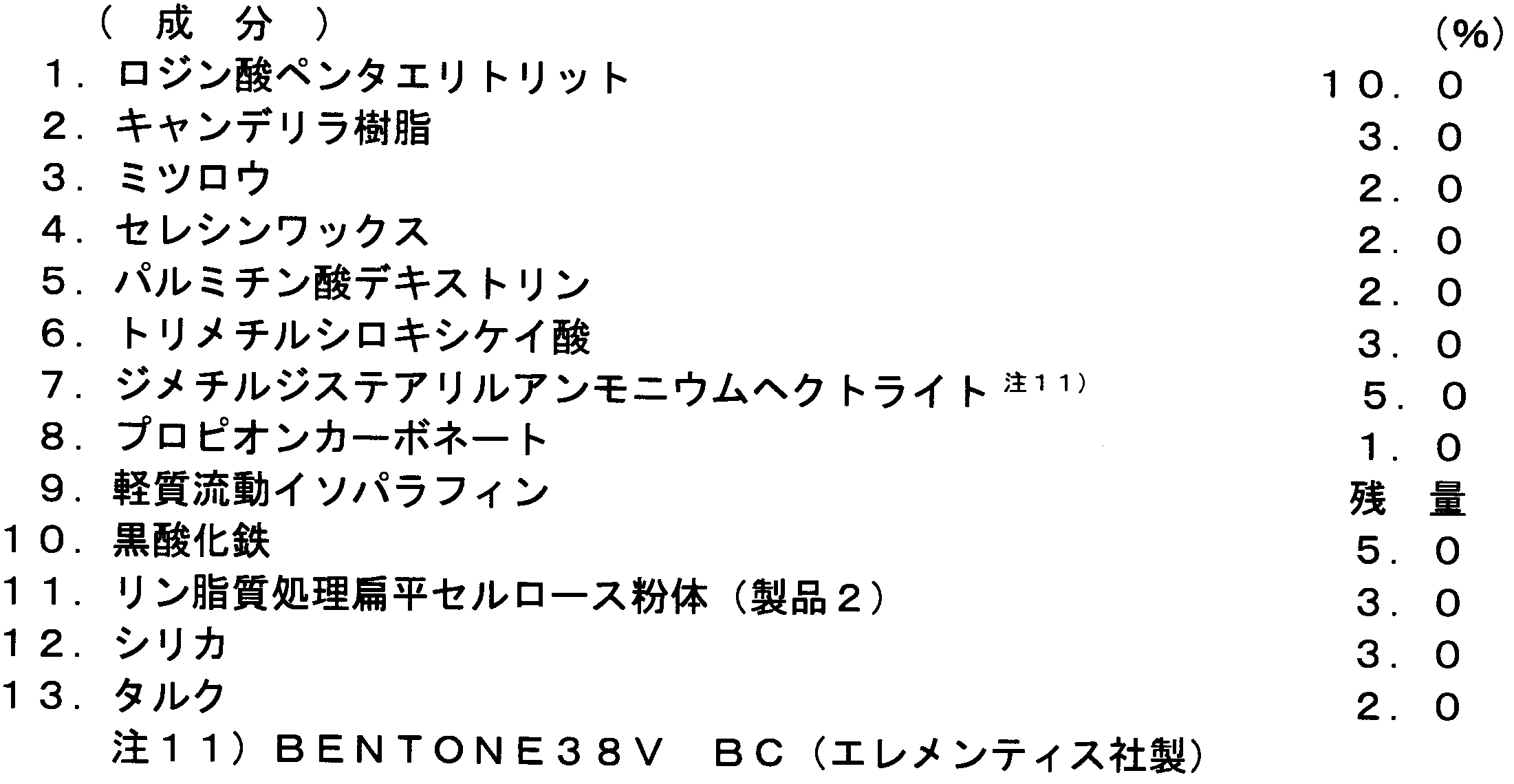
(1)成分1~5を110℃に加温する。
(2)(1)に成分6~9を添加混合する。
(3)(2)に成分10~13を添加混合する。
(4)(3)をローラーにて処理し、非水系マスカラを得た。
スティック状口紅:
以下に示す組成のスティック状口紅を下記の方法により製造した。

(1)成分1~7を100℃にて均一に溶解混合する。
(2)(1)に成分8~14を添加し、均一に混合する。
(3)(2)を容器に流し込み、冷却してスティック状口紅を得た。
リキッドルージュ:
以下に示す組成のリキッドルージュを下記の方法により製造した。
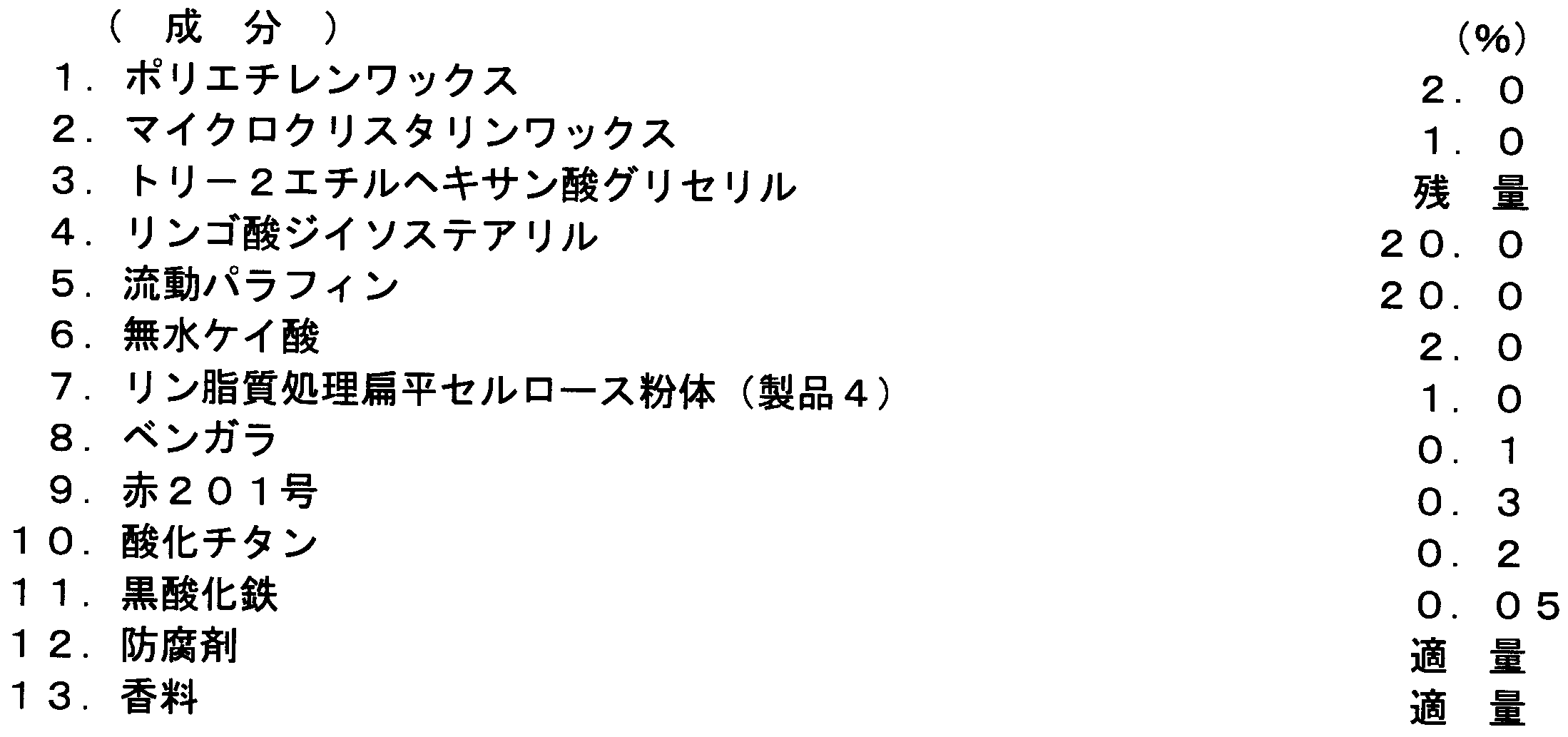
(1)成分1~5を100℃にて均一に溶解混合する。
(2)(1)に成分6~13を添加し、均一に混合する。
(3)(2)を容器に流し込み、冷却してリキッドルージュを得た。
O/W型ファンデーション:
以下に示す組成のO/W型ファンデーションを下記の方法により製造した。
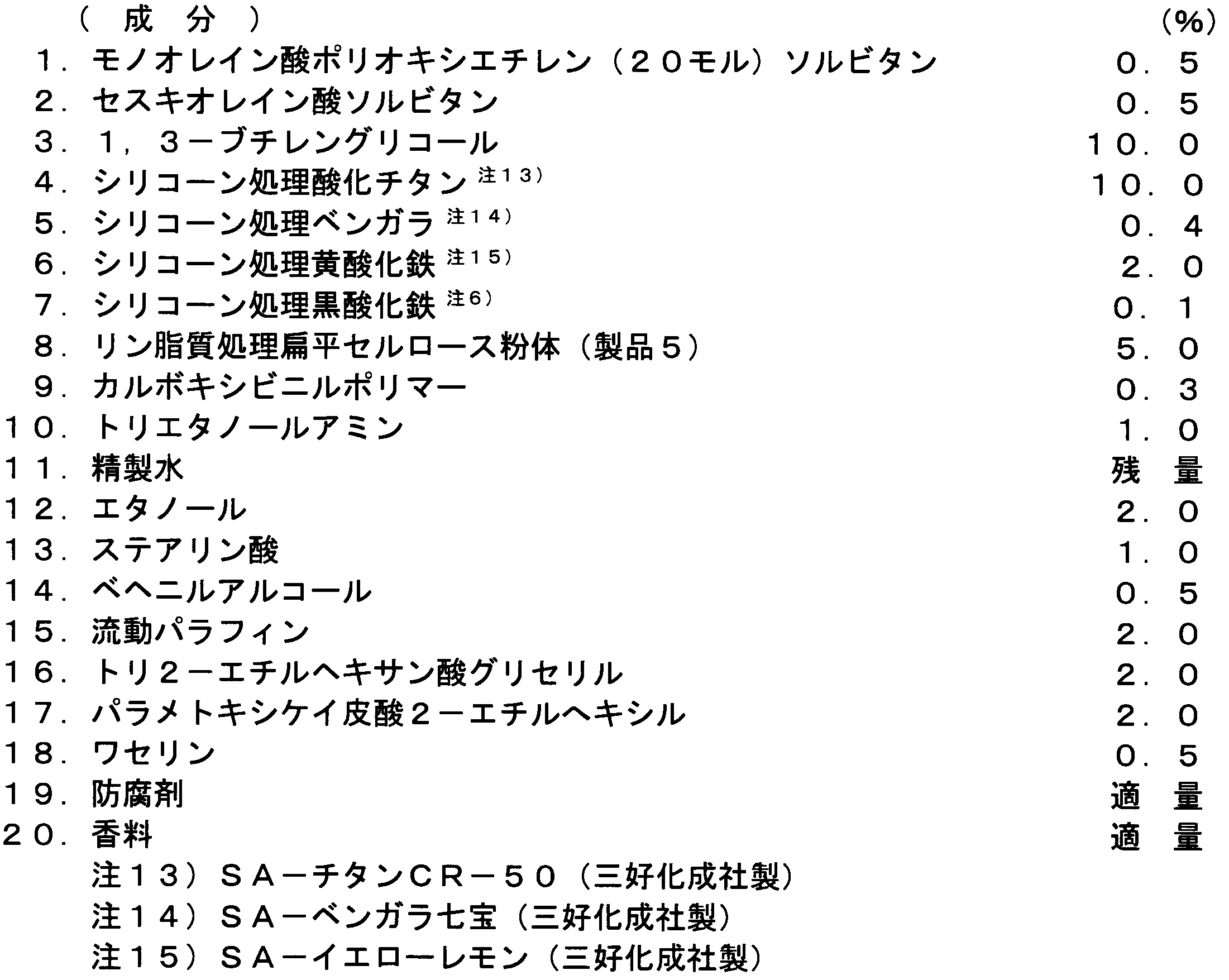
(1)成分1~8をローラーにて均一に分散する。
(2)成分9~12を均一に混合する。
(3)(2)に(1)を添加し、均一に混合する。
(4)成分13~19を80℃にて混合溶解する。
(5)(3)に(4)を80℃にて添加し、乳化する。
(6)(5)を冷却し、成分20を添加し、O/W型ファンデーションを 得た。
W/O型ファンデーション:
以下に示す組成のW/O型ファンデーションを下記の方法により製造した。

(1)成分1~3を均一に混合する。
(2)成分4~11をローラーにて均一に分散する。
(3)(1)に(2)を添加し、均一混合する。
(4)(3)に成分12~15を添加、乳化し、W/O型ファンデーショ ンを得た。
O/W型アイカラー:
以下に示す組成のO/W型アイカラーを下記の方法により製造した。
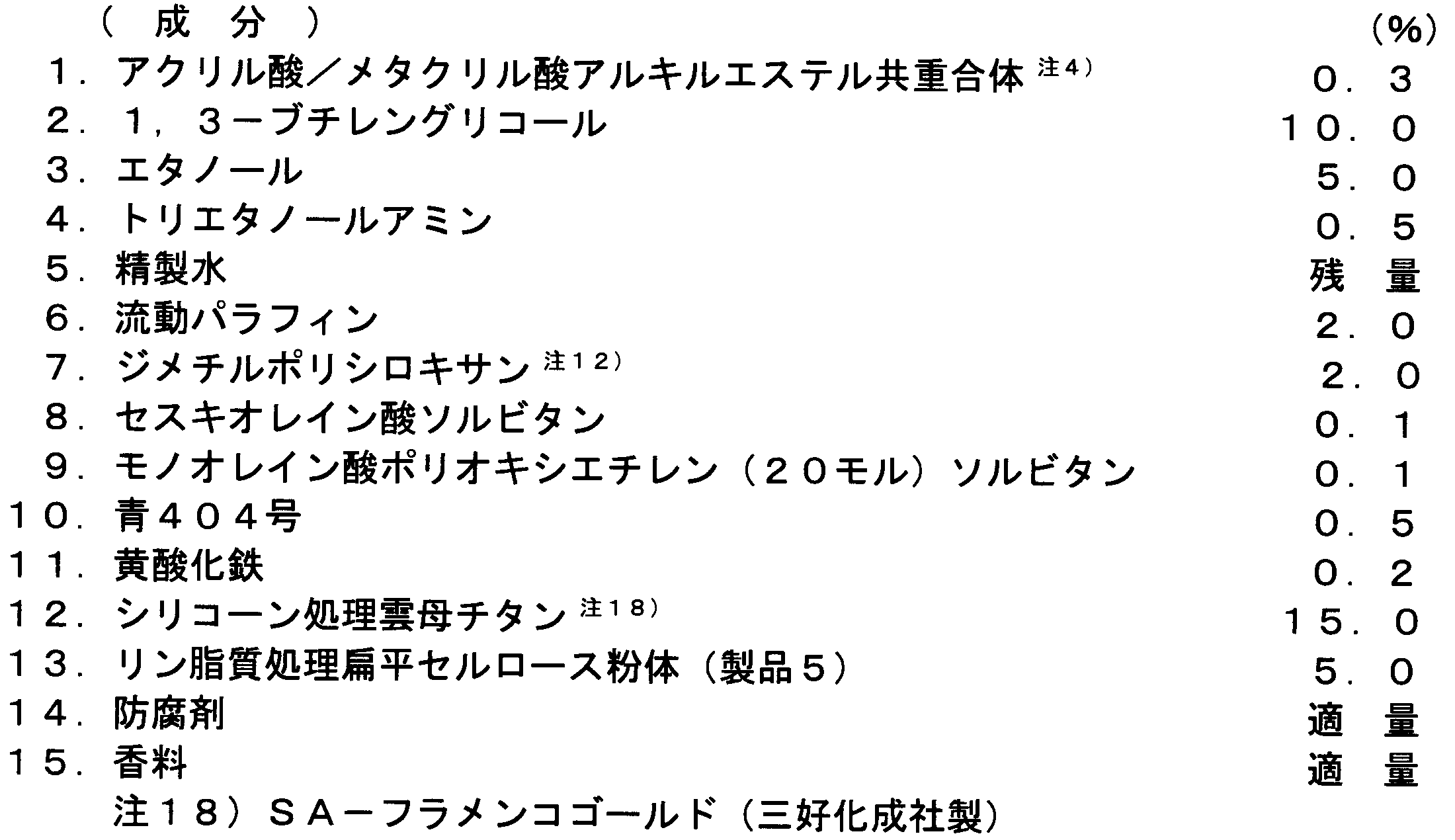
(1)成分1~5を80℃にて均一に混合する。
(2)(1)に成分6、7を添加し、乳化する。
(3)成分8~14をローラーにて均一に分散する。
(4)(2)に(3)、成分15を添加し、O/W型アイカラーを得た。
油性固型ファンデーション:
以下に示す組成の油性固型ファンデーションを下記の方法により製造した。

(1)成分7~13を90℃にて加熱溶解する。
(2)(1)に成分1~6を添加し、ローラーにて均一に分散する。
(3)(2)に成分14を添加し、80℃にて溶解後、金皿に充填し、油 性固型ファンデーションを得た。
スティック状コンシーラー:
以下に示す組成のスティック状コンシーラーを下記の方法により製造した。
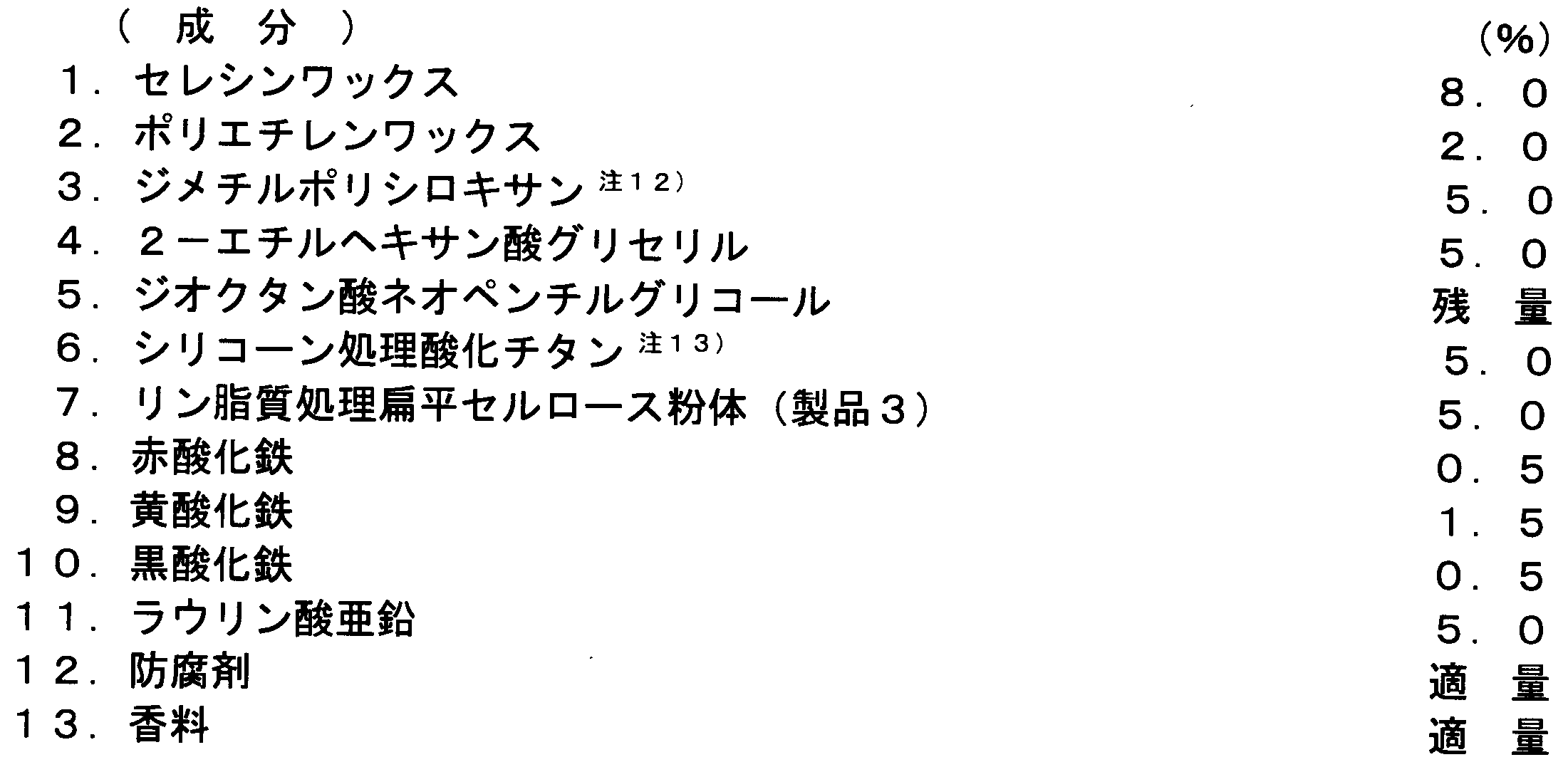
(1)成分1~5を90℃にて加熱溶解する。
(2)(1)に成分6~12を添加し、ローラーにて均一に分散する。
(3)(2)に成分13を添加し、80℃にて溶解後、容器に充填し、ス ティック状コンシーラーを得た。
ボディミルク:
以下に示す組成のボディミルクを下記の方法により製造した。

(1)成分1~7を80℃にて均一に溶解する。
(2)成分8~16を80℃にて均一に溶解する。
(3)(2)に(1)を添加し、乳化する。
(4)(3)に成分17を添加、均一混合後、攪拌冷却し、ボディミルク を得た。
コンディショナー:
以下に示す組成のコンディショナーを下記の方法により製造した。
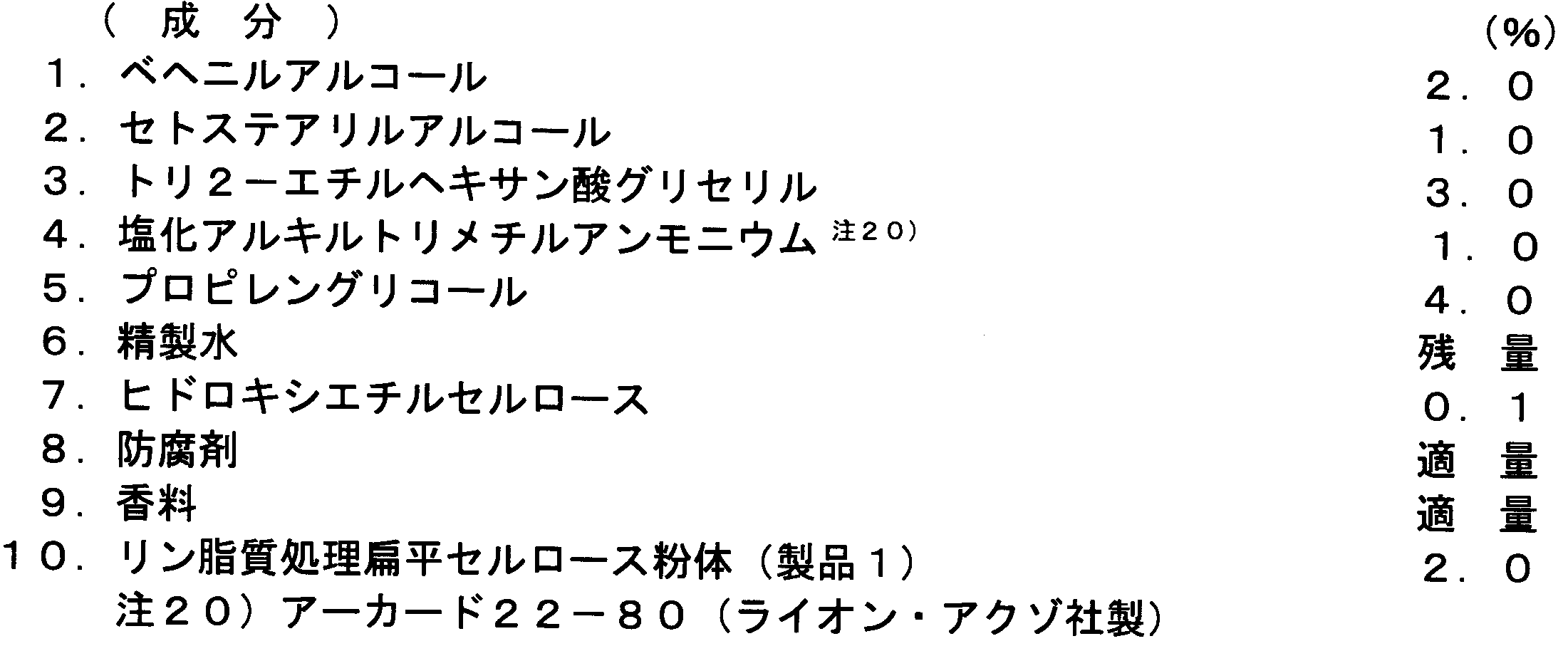
(1)成分1~5を80℃にて均一に混合する。
(2)成分6~9を80℃にて均一に混合する。
(3)(1)に(2)を添加し、乳化する。
(4)(3)に成分10を添加、均一混合後、攪拌冷却し、コンディショ ナーを得た。
ヘアパック:
以下に示す組成のヘアパックを下記の方法により製造した。
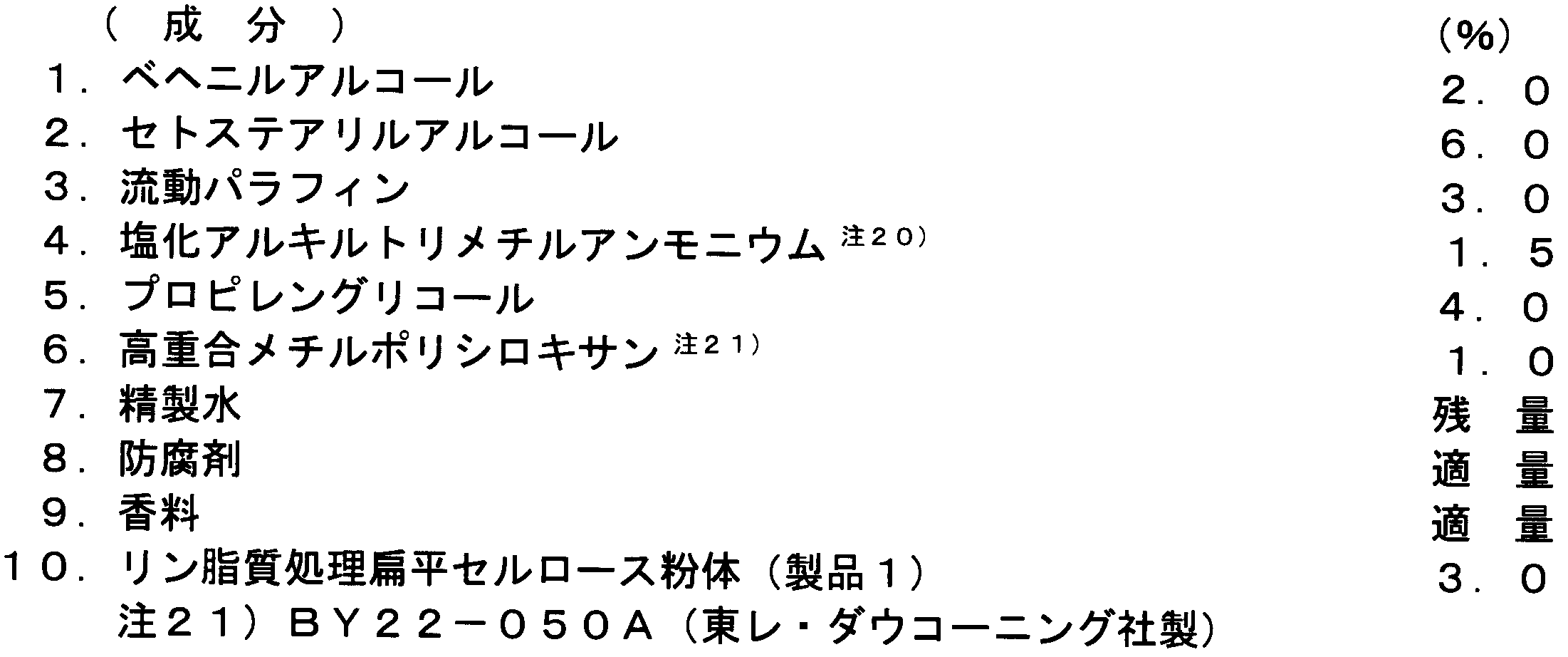
(1)成分1~6を80℃にて均一に混合する。
(2)成分7~9を80℃に均一に混合する。
(3)(1)に(2)を添加し、乳化する。
(4)(3)に成分10を添加、均一混合後、攪拌冷却し、ヘアパックを 得た。
W/O型日焼け止め料:
以下に示す組成の日焼け止め料を下記の方法により製造した。

(1)成分1~5をローラーにて均一に分散する。
(2)(1)に成分6~9を添加し、均一に混合する。
(3)(2)に成分10~14を添加、乳化し、W/O型日焼け止め料を 得た。
マニキュア:
以下に示す組成のマニキュアを下記の方法により製造した。
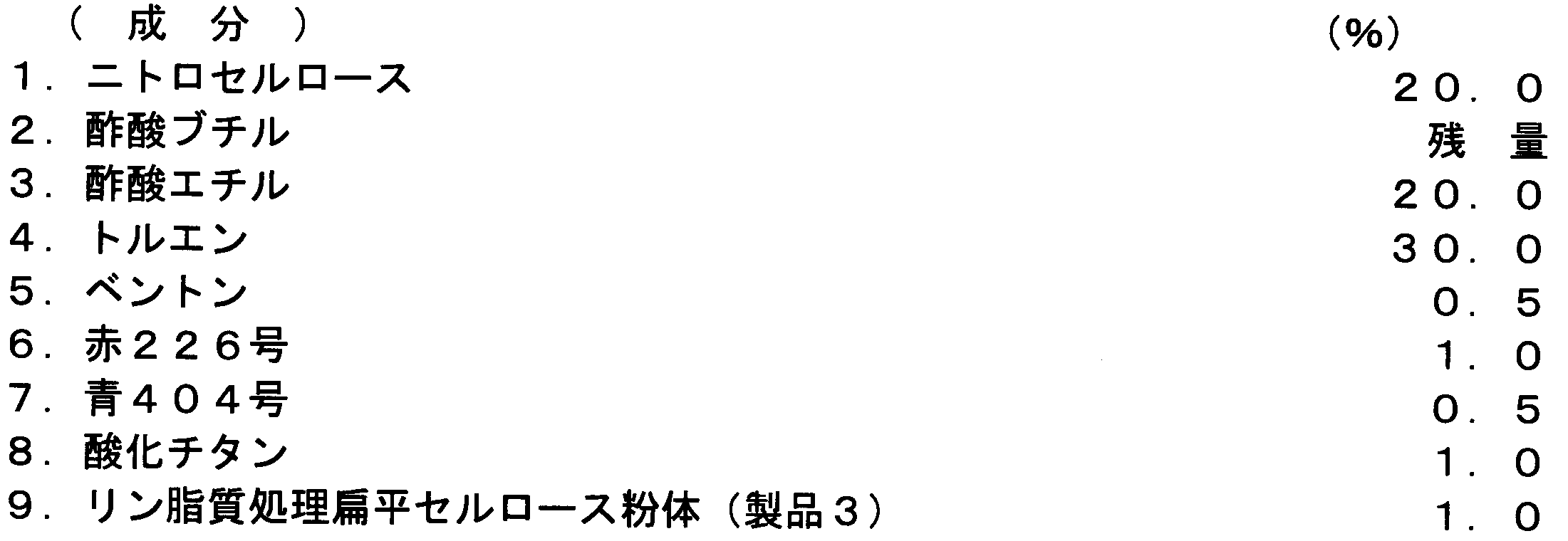
(1)成分1~9を均一に混合し、マニキュアを得た。
化粧下地:
以下に示す組成の化粧下地を下記の方法により製造した。

(1)成分1~4を80℃にて均一に溶解する。
(2)成分5~12を80℃にて均一に溶解する。
(3)(2)に(1)を添加し、乳化する。
(4)(3)に成分13~14を添加混合、冷却し、化粧下地を得た。
白 粉 :
以下に示す組成の白粉を下記の方法により製造した。
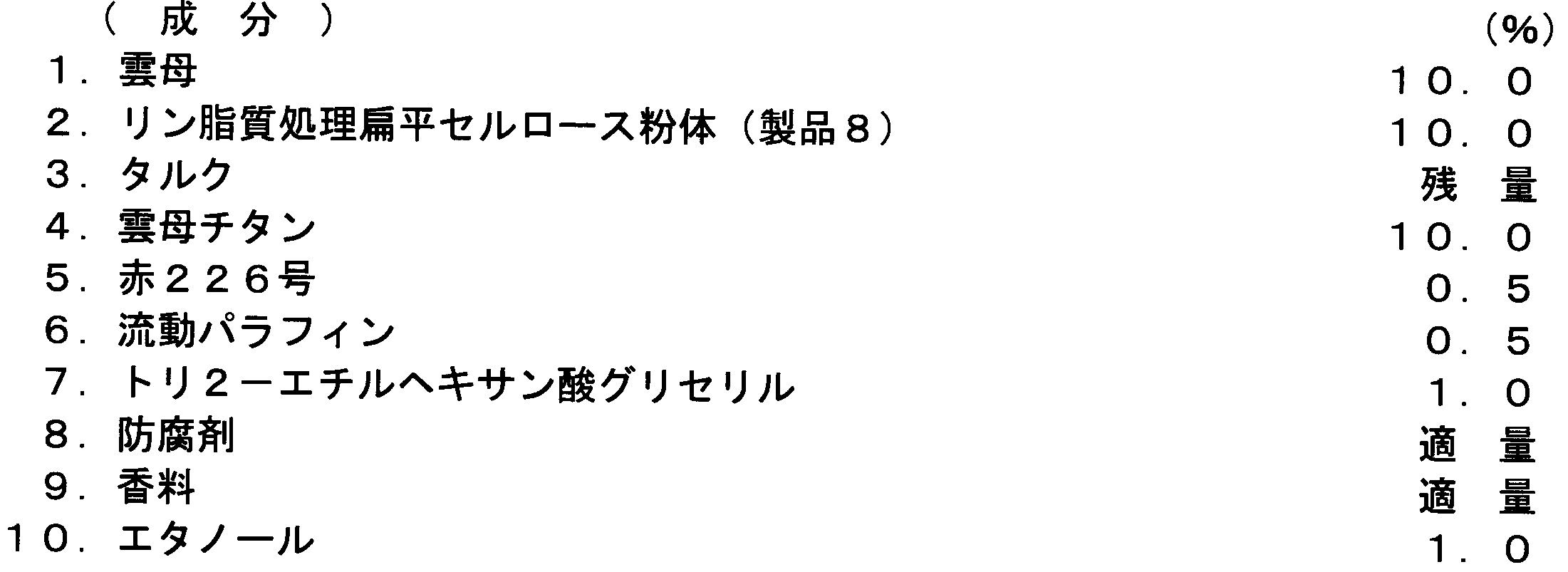
(1)成分1~5、成分8~10を均一に混合する。
(2)(1)に成分6、7を添加し、均一に混合する。
(3)(2)をパルベライザーで粉砕し、白粉を得た。
固形粉末型ファンデーション:
以下に示す組成の固形粉末型ファンデーションを下記の方法により製造した。

(1)成分1~7、成分11~13を均一に混合する。
(2)(1)に成分8~10を添加し、均一に混合する。
(3)(2)をパルベライザーで粉砕する。
(4)(3)を金皿に充填し、固形粉末型ファンデーションを得た。
固形粉末型チーク:
以下に示す組成の固形粉末型チークを下記の方法により製造した。

(1)成分1~4、成分7~9を均一に混合する。
(2)(1)に成分5、6を添加し、均一に混合する。
(3)(2)をパルベライザーで粉砕する。
(4)(3)を金皿に充填し、固形粉末型チークを得た。
固形粉末型アイシャドウ:
以下に示す組成の固形粉末型アイシャドウを下記の方法により製造した。
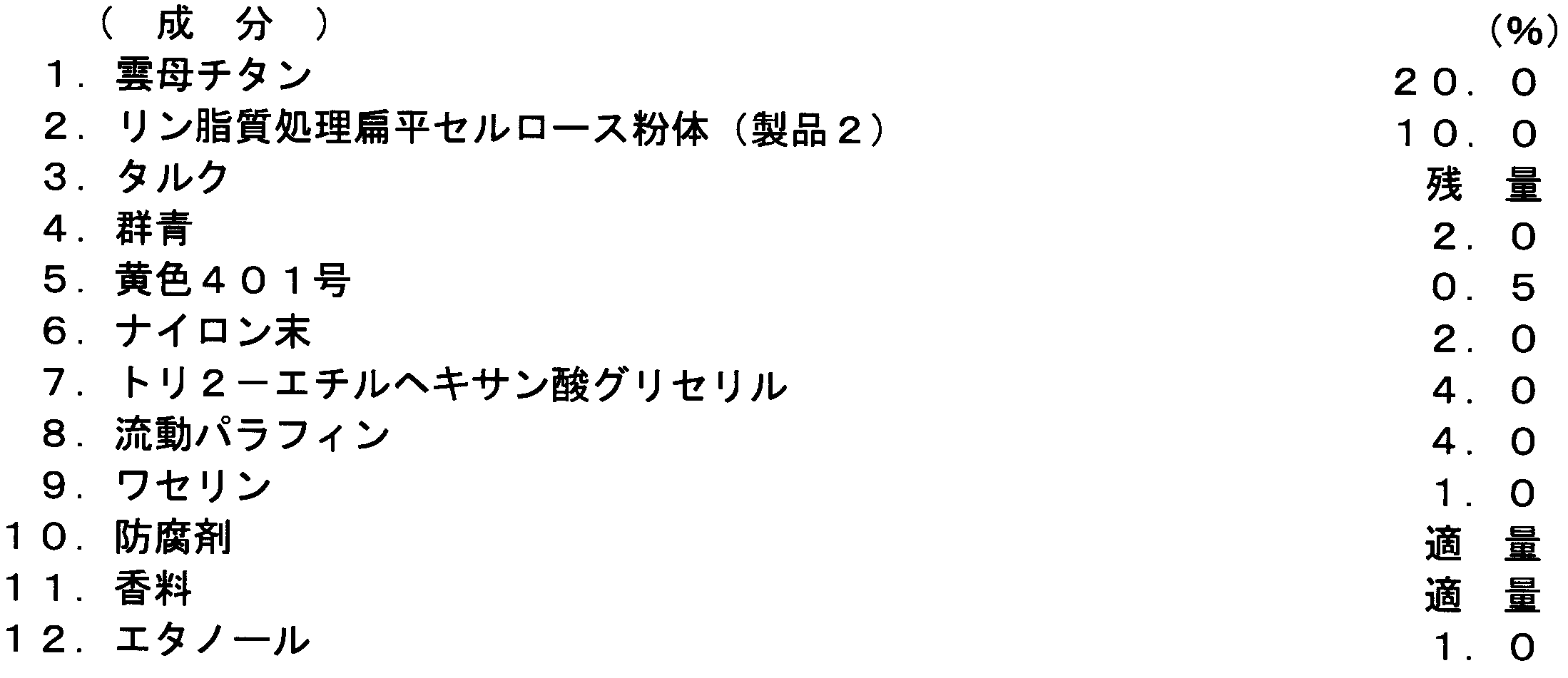
(1)成分1~6、成分10~12を均一に混合する。
(2)(1)に成分7~9を添加し、均一に混合する。
(3)(2)をパルベライザーで粉砕する。
(4)(3)を金皿に充填し、固形粉末型アイシャドウを得た。
セラミド処理扁平セルロース粉体の製造(1):
原料としては精製した木材パルプ由来のセルロース粉末(W-400G/日本製紙ケミカル社製)を用いた。まず、40℃での減圧乾燥により吸着水分を0.1%以下まで十分に除去したセルロース粉末(48g)を、密閉可能なアルミナ製粉砕容器(容積500ml)に、アルミナ製粉砕ボール(直径20mm)とともに投入し、更に、セラミド2(TIC-001/高砂香料社製)をセルロース粉末に対して2%になるように添加した。
セラミド処理扁平セルロース粉体の製造(2):
原料としては精製した木材パルプ由来のセルロース粉末(W-400G/日本製紙ケミカル社製)を用いた。まず、40℃での減圧乾燥により吸着水分を0.1%以下まで十分に除去したセルロース粉末(48g)を、密閉可能なアルミナ製粉砕容器(容積500ml)に、アルミナ製粉砕ボール(直径20mm)とともに投入し、更に、セラミド6(セラミドVI/コスモファーム社製)をセルロース粉末に対して2%になるように添加した。
セラミド処理扁平セルロース粉体の製造(3):
原料としては精製した木材パルプ由来のセルロース粉末(W-400G/日本製紙ケミカル社製)を用いた。まず、40℃での減圧乾燥により吸着水分を0.1%以下まで十分に除去したセルロース粉末(48g)を、密閉可能なアルミナ製粉砕容器(容積500ml)に、アルミナ製粉砕ボール(直径20mm)とともに投入し、更に、セラミド1(セラミドI/
Evonik Goldschmidt GmbH社製)をセルロース粉末に対して1%およびオクチルトリエトキシシラン(オクチルトリエトキシシラン/東京化成工業社製)をセルロース粉末に対して1%になるように添加した。
セラミド処理扁平セルロース粉体の製造(4):
原料としては精製した木材パルプ由来のセルロース粉末(W-400G/日本製紙ケミカル社製)を用いた。まず、40℃での減圧乾燥により吸着水分を0.1%以下まで十分に除去したセルロース粉末(48g)を、密閉可能なアルミナ製粉砕容器(容積500ml)に、アルミナ製粉砕ボール(直径20mm)とともに投入し、更に、セラミド3(セラミドIII
/Evonik Goldschmidt GmbH社製)をセルロース粉末に対して1%および片末端カルボキシル変性シリコーン(X-22-3710/信越化学社製)をセルロース粉末に対して1%になるように添加した。
コレステロール処理扁平セルロース粉体の製造(1):
原料としては精製した木材パルプ由来のセルロース粉末(W-400G/日本製紙ケミカル社製)を用いた。まず、40℃での減圧乾燥により吸着水分を0.1%以下まで十分に除去したセルロース粉末(48g)を、密閉可能なアルミナ製粉砕容器(容積500ml)に、アルミナ製粉砕ボール(直径20mm)とともに投入し、更に、コレステロール(コレステロール/日本精化社製)をセルロース粉末に対して2%になるように添加した。
コレステロール処理扁平セルロース粉体の製造(2):
原料としては精製した木材パルプ由来のセルロース粉末(W-400G/日本製紙ケミカル社製)を用いた。まず、40℃での減圧乾燥により吸着水分を0.1%以下まで十分に除去したセルロース粉末(48g)を、密閉可能なアルミナ製粉砕容器(容積500ml)に、アルミナ製粉砕ボール(直径20mm)とともに投入し、更に、コレステロール(コレステロール/日本精化社製)をセルロース粉末に対して3%およびパーフルオロアルキルリン酸エステルをセルロース粉末に対して2%になるように添加した。
フィトステロール処理扁平セルロース粉体の製造:
原料としては精製した木材パルプ由来のセルロース粉末(W-400G/日本製紙ケミカル社製)を用いた。まず、40℃での減圧乾燥により吸着水分を0.1%以下まで十分に除去したセルロース粉末(48g)を、密閉可能なアルミナ製粉砕容器(容積500ml)に、アルミナ製粉砕ボール(直径20mm)とともに投入し、更に、フィトステロール(フィトステロール/エーザイフードケミカル)をセルロース粉末に対して2%になるように添加した。
セラミド処理セリサイトの製造:
セリサイト(エイトパール300S/角八魚燐箔社製)98%をセラミド2(TIC-001/高砂香料社製)2%でミルサー(岩谷産業社製)を用いて被覆処理し、セラミド処理セリサイト(比較製品4)を得た。
セラミド処理セルロース粉末(非扁平)の調製:
原料としては木材パルプ由来のセルロース粉末(W-100G/日本製紙ケミカル社製)を、攪拌機に投入し、セルロース粉末に対して2%となるセラミド2(TIC-001/高砂香料社製)をヘキサンに溶解後添加した。この後、回転数40rpmにて5分間攪拌し、減圧乾燥後、粉砕を行って、セラミド処理セルロース粉末(非扁平)(比較製品5)を得た。
付着性試験:
実施例40、44および46で得たセラミド処理扁平セルロース粉体、コレステロール処理扁平セルロース粉体、フィトステロール処理扁平セルロース粉体(製品10~12)の皮膚に対する付着性を実施例8と同様にして調べた。比較としては、参考例1のステアリン酸処理扁平セルロース(比較製品1)を用いた。これらの結果を表6に示す。

固形粉末型ファンデーション:
常法により、下記表7に示す組成で固形粉末ファンデーションを調製した。得られた固形粉末ファンデーションについて、その「化粧膜の均一性」、「化粧持ち」および「使用感(塗布時のなめらかさ)」を実施例9と同様にして評価した。この結果も表7に併せて示す。
乳液:
下記表8に示す組成で乳液を、下記方法により製造した。得られた乳液を肌に塗布後の経時水分量変化(塗布5時間後)を下記方法により調べた。この結果も表8に併せて示す。
下記成分(1)~(10)、(23)を70℃に加熱溶解した後、(11)~(14)を同様に加熱した後添加し、攪拌する。室温にて放冷後、(14)の一部で膨潤した(15)、(16)を添加混合。更に(17)~(22)を分散した後、添加混合した。
<経時水分量変化>
まず、塗布部位を所定の洗浄料で洗浄し、その後一定条件の環境試験室(温度22℃、相対湿度50%)に入室後20分以上経過してから、IBS社製「SKICON200EX」を用いて4回測定し、その平均値を使用した。各被験者の上腕内側部に2cm四方の枠をマークし、そこに各サンプルを200mlずつ塗布する。その各部位における塗布前および塗布5時間後の水分量を測定し、その対初期値比率を算出した。
<乳化安定性>
各サンプルを50℃で1ヶ月保存した後、発生する結晶析出物の有無を確認し、結晶析出物がない場合を○、ある場合を×として判定した。
ジェル美容液:
下記表9に示す組成でジェル美容液を、下記の方法により製造した。得られたジェル美容液を肌に塗布後の経時水分蒸散量変化(塗布5時間後)を下記方法により調べた。この結果も表9に併せて示す。
下記成分(1)~(4)を均一に溶解した後、(5)~(10)を同様に均一溶解した後添加し、攪拌する。(18)で膨潤した(16)、(17)を添加混合。更に(11)~(15)を分散した後、添加混合した。
まず、塗布部位を所定の洗浄料で洗浄し、その後一定条件の環境試験室(温度22℃、相対湿度50%)に入室後20分以上経過してから、デルフィン・テクノロジイズ(Delfin Technologies)社製バポメーター(Vapometer)SWL2 タイプを用いて水分蒸散量(TEWL)を4回測定し、その平均値を使用した。各被験者の上腕内側部に2cm四方の枠をマークし、そこに各サンプルを200mlずつ塗布する。各部位における塗布前および塗布5時間後の水分蒸散量を測定し、その対初期値比を算出した。

二層ローション:
実施例10の二層ローションにおいて、リン脂質処理扁平セルロース粉体(製品1)を実施例40で製造したセラミド処理扁平セルロース粉体に代える以外は同様にして二層ローションを製造した。
乳 液 :
実施例11の乳液において、リン脂質処理扁平セルロース粉体(製品1)を実施例41で製造したセラミド処理扁平セルロース粉体1.0%および実施例42で製造したコレステロール処理セルロース粉体1.0%に代える以外は同様にして乳液を製造した。
クリーム:
実施例12のクリームにおいて、リン脂質処理扁平セルロース粉体(製品2)を実施例42で製造したセラミド処理扁平セルロース粉体に代える以外は同様にしてクリームを製造した。
美 容 液 :
実施例13の美容液において、リン脂質処理扁平セルロース粉体(製品3)を実施例46で製造したフィトステロール処理扁平セルロース粉体に代える以外は同様にして美容液を製造した。
パ ッ ク :
実施例14のパックにおいて、リン脂質処理扁平セルロース粉体(製品5)を実施例43で製造したセラミド処理扁平セルロース粉体に代える以外は同様にしてパックを製造した。
洗 顔 料 :
実施例15の洗顔料において、リン脂質処理扁平セルロース粉体(製品6)を実施例45で製造したコレステロール処理扁平セルロース粉体に代える以外は同様にして洗顔料を製造した。
クレンジングクリーム:
実施例16のクレンジングクリームにおいて、リン脂質処理扁平セルロース粉体(製品1)を実施例42で製造したセラミド処理扁平セルロース粉体に代える以外は同様にしてクレンジングクリームを製造した。
ヘアワックス:
実施例17のヘアワックスにおいて、リン脂質処理扁平セルロース粉体(製品4)を実施例40で製造したセラミド処理扁平セルロース粉体に代える以外は同様にしてヘアワックスを製造した。
油性アイライナー:
実施例18の油性アイライナーにおいて、リン脂質処理扁平セルロース粉体(製品2)を実施例43で製造したセラミド処理扁平セルロース粉体に代える以外は同様にして油性アイライナーを製造した。
水性アイライナー:
実施例19の水性アイライナーにおいて、リン脂質処理扁平セルロース粉体(製品1)を実施例46で製造したフィトステロール処理扁平セルロース粉体に代える以外は同様にして水性アイライナーを製造した。
アイブロウ:
実施例20のアイブロウにおいて、リン脂質処理扁平セルロース粉体(製品3)を実施例44で製造したコレステロール処理扁平セルロース粉体に代える以外は同様にしてアイブロウを製造した。
O/W型マスカラ:
実施例21のO/W型マスカラにおいて、リン脂質処理扁平セルロース粉体(製品1)を実施例42で製造したセラミド処理扁平セルロース粉体に代える以外は同様にしてO/W型マスカラを製造した。
非水系マスカラ:
実施例22の非水系マスカラにおいて、リン脂質処理扁平セルロース粉体(製品2)を実施例42で製造したセラミド処理扁平セルロース粉体に代える以外は同様にして非水系マスカラを製造した。
スティック状口紅:
実施例23のスティック状口紅において、リン脂質処理扁平セルロース粉体(製品3)を実施例41で製造したセラミド処理扁平セルロース粉体に代える以外は同様にしてスティック状口紅を製造した。
リキッドルージュ:
実施例24のリキッドルージュにおいて、リン脂質処理扁平セルロース粉体(製品4)を実施例46で製造したフィトステロール処理扁平セルロース粉体0.5%に代える以外は同様にしてリキッドルージュを製造した。
O/W型ファンデーション:
実施例25のO/W型ファンデーションにおいて、リン脂質処理扁平セルロース粉体(製品5)を実施例43で製造したセラミド処理扁平セルロース粉体に代える以外は同様にしてO/W型ファンデーションを製造した。
W/O型ファンデーション:
実施例26のW/O型ファンデーションにおいて、リン脂質処理扁平セルロース粉体(製品6)を実施例45で製造したコレステロール処理扁平セルロース粉体3.0%に代える以外は同様にしてW/O型ファンデーションを製造した。
O/W型アイカラー:
実施例27のO/W型アイカラーにおいて、リン脂質処理扁平セルロース粉体(製品5)を実施例44で製造したコレステロール処理扁平セルロース粉体に代える以外は同様にしてO/W型アイカラーを製造した。
油性固型ファンデーション:
実施例28の油性固型ファンデーションにおいて、リン脂質処理扁平セルロース粉体(製品4)を実施例42で製造したセラミド処理扁平セルロース粉体に代える以外は同様にして油性固型ファンデーションを製造した。
スティック状コンシーラー:
実施例29のスティック状コンシーラーにおいて、リン脂質処理扁平セルロース粉体(製品3)を実施例40で製造したセラミド処理扁平セルロース粉体に代える以外は同様にしてスティック状コンシーラーを製造した。
ボディミルク:
実施例30のボディミルクにおいて、リン脂質処理扁平セルロース粉体(製品2)を実施例45で製造したコレステロール処理扁平セルロース粉体に代える以外は同様にしてボディミルクを製造した。
コンディショナー:
実施例31のコンディショナーにおいて、リン脂質処理扁平セルロース粉体(製品1)を実施例41で製造したセラミド処理扁平セルロース粉体に代える以外は同様にしてコンディショナーを製造した。
ヘアパック:
実施例32のヘアパックにおいて、リン脂質処理扁平セルロース粉体(製品1)を実施例44で製造したコレステロール処理扁平セルロース粉体に代える以外は同様にしてヘアパックを製造した。
W/O型日焼け止め料:
実施例33のW/O型日焼け止め料において、リン脂質処理扁平セルロース粉体(製品2)を実施例43で製造したセラミド処理扁平セルロース粉体に代える以外は同様にしてW/O型日焼け止め料を製造した。
マニキュア:
実施例34のマニキュアにおいて、リン脂質処理扁平セルロース粉体(製品3)を実施例45で製造したコレステロール処理扁平セルロース粉体に代える以外は同様にしてマニキュアを製造した。
化粧下地:
実施例35の化粧下地において、リン脂質処理扁平セルロース粉体(製品4)を実施例46で製造したフィトステロール処理扁平セルロース粉体に代える以外は同様にして化粧下地を製造した。
白 粉 :
実施例36の白粉において、リン脂質処理扁平セルロース粉体(製品8)を実施例40で製造したセラミド処理扁平セルロース粉体に代える以外は同様にして白粉を製造した。
固形粉末型ファンデーション:
実施例37の固形粉末型ファンデーションにおいて、リン脂質処理扁平セルロース粉体(製品9)を実施例41で製造したセラミド処理扁平セルロース粉体に代える以外は同様にして固形粉末型ファンデーションを製造した。
固形粉末型チーク:
実施例38の固形粉末型チークにおいて、リン脂質処理扁平セルロース粉体(製品3)を実施例46で製造したフィトステロール処理扁平セルロース粉体に代える以外は同様にして固形粉末型チークを製造した。
固形粉末型アイシャドウ:
実施例39の固形粉末型アイシャドウにおいて、リン脂質処理扁平セルロース粉体(製品2)を実施例44で製造したコレステロール処理扁平セルロース粉体に代える以外は同様にして固形粉末型アイシャドウを製造した。
Claims (10)
- セルロース系物質と、リン脂質、セラミド、コレステロールまたはその誘導体、フィトステロールまたはその誘導体からなる群から選ばれる両親媒性物質の1種または2種以上とを機械的に粉砕処理することにより得られる両親媒性物質処理扁平セルロース粉体。
- 平均粒径が1~50μm、平均厚さが0.1~10μm、かつ扁平度が4~200である請求項1記載の両親媒性物質処理扁平セルロース粉体。
- セルロース系物質100質量部に対し、両親媒性物質を0.1~12質量部使用する請求項1または2記載の両親媒性物質処理扁平セルロース粉体。
- 機械的な粉砕処理を遊星型ボールミルで行う請求項1ないし3のいずれかに記載の両親媒性物質処理扁平セルロース粉体。
- セルロース系物質が、木材を起源とする繊維状または粉末状の木粉または木材パルプ、綿花を起源とする繊維状または粉末状の木綿またはリンター繊維、それらを精製した繊維状または粉末状のものである請求項1ないし4のいずれかに記載の両親媒性物質処理扁平セルロース粉体。
- 請求項1ないし5のいずれかに記載の両親媒性物質処理扁平セルロース粉体を含有する化粧料。
- パウダーファンデーション、アイシャドウ、ほほ紅、粉白粉である請求項第6項記載の化粧料。
- セルロース系物質と、リン脂質、セラミド、コレステロールまたはその誘導体、フィトステロールまたはその誘導体からなる群から選ばれる両親媒性物質の1種または2種以上とを機械的に粉砕処理することを特徴とする両親媒性物質処理扁平セルロース粉体の製造方法。
- セルロース系物質100質量部に対し、両親媒性物質を0.1~12質量部添加する請求項8記載の両親媒性物質処理扁平セルロース粉体の製造方法。
- 機械的な粉砕処理を遊星型ボールミルで行う請求項8または9記載の両親媒性物質処理扁平セルロース粉体の製造方法。
Priority Applications (4)
| Application Number | Priority Date | Filing Date | Title |
|---|---|---|---|
| HK13103755.4A HK1176304B (en) | 2010-02-25 | 2011-02-25 | Flat cellulose powder processed with amphiphilic substance, and cosmetic preparation containing same |
| CN201180005292.2A CN102762190B (zh) | 2010-02-25 | 2011-02-25 | 两亲剂处理扁平纤维素粉体和含有其的化妆料 |
| KR1020127024848A KR101626582B1 (ko) | 2010-02-25 | 2011-02-25 | 양친매성 물질 처리된 편평 셀룰로스 분체 및 이것을 함유하는 화장료 |
| JP2012501875A JP5932633B2 (ja) | 2010-02-25 | 2011-02-25 | 両親媒性物質処理扁平セルロース粉体およびこれを含有する化粧料 |
Applications Claiming Priority (4)
| Application Number | Priority Date | Filing Date | Title |
|---|---|---|---|
| JP2010040308 | 2010-02-25 | ||
| JP2010-040308 | 2010-02-25 | ||
| JP2010054066 | 2010-03-11 | ||
| JP2010-054066 | 2010-03-11 |
Publications (1)
| Publication Number | Publication Date |
|---|---|
| WO2011105535A1 true WO2011105535A1 (ja) | 2011-09-01 |
Family
ID=44506932
Family Applications (1)
| Application Number | Title | Priority Date | Filing Date |
|---|---|---|---|
| PCT/JP2011/054252 Ceased WO2011105535A1 (ja) | 2010-02-25 | 2011-02-25 | 両親媒性物質処理扁平セルロース粉体およびこれを含有する化粧料 |
Country Status (5)
| Country | Link |
|---|---|
| JP (1) | JP5932633B2 (ja) |
| KR (1) | KR101626582B1 (ja) |
| CN (1) | CN102762190B (ja) |
| TW (1) | TWI495484B (ja) |
| WO (1) | WO2011105535A1 (ja) |
Cited By (13)
| Publication number | Priority date | Publication date | Assignee | Title |
|---|---|---|---|---|
| JP2014028785A (ja) * | 2012-07-05 | 2014-02-13 | Kose Corp | 粉体化粧料 |
| WO2014074583A1 (en) * | 2012-11-09 | 2014-05-15 | Johnson & Johnson Consumer Companies, Inc. | Skin care compositions containing cotton and citrus-derived materials |
| JP2014198672A (ja) * | 2013-03-29 | 2014-10-23 | 株式会社コーセー | 油中水型化粧料 |
| JP2015086173A (ja) * | 2013-10-31 | 2015-05-07 | 大東化成工業株式会社 | 着色セルロース板状粉体および化粧料 |
| JP2015113326A (ja) * | 2013-12-13 | 2015-06-22 | 株式会社コーセー | セラミド含有組成物を担持した表面処理粉体 |
| JP2017519890A (ja) * | 2014-04-10 | 2017-07-20 | テクニカル インスティテュート オブ フィジックス アンド ケミストリー オブ ザ チャイニーズ アカデミー オブ サイエンスィズTechnical Institute of Physics and Chemistry of the Chinese Academy of Sciences | 紫外線カット機能を持つフレーク状セルロース材料およびその調製方法と利用 |
| US9737473B2 (en) | 2012-11-09 | 2017-08-22 | Johnson & Johnson Consumer Inc. | Leave-on compositions containing cellulose materials |
| EP3546639A4 (en) * | 2016-11-25 | 2020-07-08 | Teijin Frontier Co., Ltd. | FIBER POWDER AND AQUEOUS DISPERSION THEREOF |
| WO2022220069A1 (ja) | 2021-04-15 | 2022-10-20 | 株式会社インターアクション | 瞳モジュール及び検査装置 |
| JP2023002552A (ja) * | 2018-11-07 | 2023-01-10 | 松本油脂製薬株式会社 | セルロース複合粉体 |
| WO2023149065A1 (ja) | 2022-02-01 | 2023-08-10 | 大日精化工業株式会社 | 撥水性セルロースビーズ及びその製造方法、並びに化粧料 |
| US12194117B2 (en) | 2020-12-23 | 2025-01-14 | Dainichiseika Color & Chemicals Mfg. Co., Ltd. | Resin beads, method for producing resin beads, and product using resin beads |
| WO2025258442A1 (ja) * | 2024-06-10 | 2025-12-18 | 三洋化成工業株式会社 | 化粧料用被覆粒子 |
Families Citing this family (4)
| Publication number | Priority date | Publication date | Assignee | Title |
|---|---|---|---|---|
| FR3006157B1 (fr) * | 2013-05-28 | 2016-08-05 | Chanel Parfums Beaute | Dispositif de produit cosmetique comprenant un flacon et un produit transparents |
| CN104997653B (zh) * | 2015-07-31 | 2017-12-08 | 广东龙湖科技股份有限公司 | 一种适合油性皮肤使用的润肤霜及其制备方法 |
| CN105232374A (zh) * | 2015-10-21 | 2016-01-13 | 广东龙湖科技股份有限公司 | 一种高效温和滋润型卸妆霜 |
| KR102080035B1 (ko) * | 2015-11-27 | 2020-02-24 | (주)아모레퍼시픽 | 피그먼트 분체를 포함하는 유화 화장료 조성물 및 그 제조방법 |
Citations (7)
| Publication number | Priority date | Publication date | Assignee | Title |
|---|---|---|---|---|
| JPS62104706A (ja) * | 1985-10-31 | 1987-05-15 | Pentel Kk | 扁平状微小樹脂粉の製造方法 |
| JPS62190112A (ja) * | 1986-02-13 | 1987-08-20 | Seitetsu Kagaku Co Ltd | 化粧料 |
| JPH08143422A (ja) * | 1994-11-18 | 1996-06-04 | Kao Corp | 複合粉体及び複合粉体含有化粧料 |
| JPH1149634A (ja) * | 1997-08-05 | 1999-02-23 | Kao Corp | 撥水処理粉体及びそれを含有する粉体化粧料 |
| JP2003146829A (ja) * | 2001-11-12 | 2003-05-21 | Asahi Kasei Corp | 改質粉体および化粧料 |
| JP2004230719A (ja) * | 2003-01-30 | 2004-08-19 | National Institute Of Advanced Industrial & Technology | 新規セルロース粒子及びその製造方法 |
| WO2010026925A1 (ja) * | 2008-09-03 | 2010-03-11 | 株式会社オーケン | 粉体化粧料 |
Family Cites Families (1)
| Publication number | Priority date | Publication date | Assignee | Title |
|---|---|---|---|---|
| NZ211547A (en) * | 1984-06-29 | 1988-05-30 | Chesebrough Ponds | Nail polish and applicator |
-
2011
- 2011-02-25 TW TW100106396A patent/TWI495484B/zh active
- 2011-02-25 KR KR1020127024848A patent/KR101626582B1/ko active Active
- 2011-02-25 JP JP2012501875A patent/JP5932633B2/ja active Active
- 2011-02-25 CN CN201180005292.2A patent/CN102762190B/zh active Active
- 2011-02-25 WO PCT/JP2011/054252 patent/WO2011105535A1/ja not_active Ceased
Patent Citations (7)
| Publication number | Priority date | Publication date | Assignee | Title |
|---|---|---|---|---|
| JPS62104706A (ja) * | 1985-10-31 | 1987-05-15 | Pentel Kk | 扁平状微小樹脂粉の製造方法 |
| JPS62190112A (ja) * | 1986-02-13 | 1987-08-20 | Seitetsu Kagaku Co Ltd | 化粧料 |
| JPH08143422A (ja) * | 1994-11-18 | 1996-06-04 | Kao Corp | 複合粉体及び複合粉体含有化粧料 |
| JPH1149634A (ja) * | 1997-08-05 | 1999-02-23 | Kao Corp | 撥水処理粉体及びそれを含有する粉体化粧料 |
| JP2003146829A (ja) * | 2001-11-12 | 2003-05-21 | Asahi Kasei Corp | 改質粉体および化粧料 |
| JP2004230719A (ja) * | 2003-01-30 | 2004-08-19 | National Institute Of Advanced Industrial & Technology | 新規セルロース粒子及びその製造方法 |
| WO2010026925A1 (ja) * | 2008-09-03 | 2010-03-11 | 株式会社オーケン | 粉体化粧料 |
Cited By (18)
| Publication number | Priority date | Publication date | Assignee | Title |
|---|---|---|---|---|
| JP2014028785A (ja) * | 2012-07-05 | 2014-02-13 | Kose Corp | 粉体化粧料 |
| CN104780903B (zh) * | 2012-11-09 | 2017-08-08 | 强生消费者公司 | 包含棉花和源自柑橘的材料的护肤组合物 |
| WO2014074583A1 (en) * | 2012-11-09 | 2014-05-15 | Johnson & Johnson Consumer Companies, Inc. | Skin care compositions containing cotton and citrus-derived materials |
| CN104780903A (zh) * | 2012-11-09 | 2015-07-15 | 强生消费者公司 | 包含棉花和源自柑橘的材料的护肤组合物 |
| US9737473B2 (en) | 2012-11-09 | 2017-08-22 | Johnson & Johnson Consumer Inc. | Leave-on compositions containing cellulose materials |
| JP2014198672A (ja) * | 2013-03-29 | 2014-10-23 | 株式会社コーセー | 油中水型化粧料 |
| JP2015086173A (ja) * | 2013-10-31 | 2015-05-07 | 大東化成工業株式会社 | 着色セルロース板状粉体および化粧料 |
| JP2015113326A (ja) * | 2013-12-13 | 2015-06-22 | 株式会社コーセー | セラミド含有組成物を担持した表面処理粉体 |
| JP2017519890A (ja) * | 2014-04-10 | 2017-07-20 | テクニカル インスティテュート オブ フィジックス アンド ケミストリー オブ ザ チャイニーズ アカデミー オブ サイエンスィズTechnical Institute of Physics and Chemistry of the Chinese Academy of Sciences | 紫外線カット機能を持つフレーク状セルロース材料およびその調製方法と利用 |
| EP3546639A4 (en) * | 2016-11-25 | 2020-07-08 | Teijin Frontier Co., Ltd. | FIBER POWDER AND AQUEOUS DISPERSION THEREOF |
| US11186677B2 (en) | 2016-11-25 | 2021-11-30 | Teijin Frontier Co., Ltd. | Fiber powder and aqueous dispersion thereof |
| JP2023002552A (ja) * | 2018-11-07 | 2023-01-10 | 松本油脂製薬株式会社 | セルロース複合粉体 |
| JP7478204B2 (ja) | 2018-11-07 | 2024-05-02 | 松本油脂製薬株式会社 | セルロース複合粉体 |
| US12194117B2 (en) | 2020-12-23 | 2025-01-14 | Dainichiseika Color & Chemicals Mfg. Co., Ltd. | Resin beads, method for producing resin beads, and product using resin beads |
| WO2022220069A1 (ja) | 2021-04-15 | 2022-10-20 | 株式会社インターアクション | 瞳モジュール及び検査装置 |
| WO2023149065A1 (ja) | 2022-02-01 | 2023-08-10 | 大日精化工業株式会社 | 撥水性セルロースビーズ及びその製造方法、並びに化粧料 |
| KR20240118183A (ko) | 2022-02-01 | 2024-08-02 | 다이니치 세이카 고교 가부시키가이샤 | 발수성 셀룰로스 비즈 및 그 제조 방법, 그리고 화장료 |
| WO2025258442A1 (ja) * | 2024-06-10 | 2025-12-18 | 三洋化成工業株式会社 | 化粧料用被覆粒子 |
Also Published As
| Publication number | Publication date |
|---|---|
| JPWO2011105535A1 (ja) | 2013-06-20 |
| CN102762190A (zh) | 2012-10-31 |
| KR20120135277A (ko) | 2012-12-12 |
| TW201143808A (en) | 2011-12-16 |
| HK1176304A1 (en) | 2013-07-26 |
| CN102762190B (zh) | 2014-09-10 |
| KR101626582B1 (ko) | 2016-06-01 |
| TWI495484B (zh) | 2015-08-11 |
| JP5932633B2 (ja) | 2016-06-08 |
Similar Documents
| Publication | Publication Date | Title |
|---|---|---|
| JP5932633B2 (ja) | 両親媒性物質処理扁平セルロース粉体およびこれを含有する化粧料 | |
| JP6069189B2 (ja) | 金属酸化物複合化高扁平セルロース粉体およびこれを含有する化粧料 | |
| CN101014316B (zh) | 美容粉、其制备方法及包含该美容粉的美容化妆品组合物 | |
| JP6050061B2 (ja) | 粉体化粧料 | |
| JP5270207B2 (ja) | 油性化粧料 | |
| JP5483401B2 (ja) | 表面処理粉体 | |
| US20250127705A1 (en) | Cosmetic compositions comprising a cyclodextrin having a particle size distribution | |
| JP6396708B2 (ja) | 粉体化粧料 | |
| JP6346730B2 (ja) | 油中水型化粧料 | |
| JP4376696B2 (ja) | 粉体固形化粧料 | |
| JP7840158B2 (ja) | 皮膚外用組成物 | |
| JP5009547B2 (ja) | 顔料とリポソームを含む化粧料 | |
| JP2013231010A (ja) | 固体化粧料 | |
| HK1176304B (en) | Flat cellulose powder processed with amphiphilic substance, and cosmetic preparation containing same | |
| JP2012214420A (ja) | 粉体固形化粧料 | |
| HK1186687B (en) | Metal oxide conjugated highly-flat cellulose powder and cosmetic containing same | |
| JP2006176453A (ja) | 非固形状油性化粧料 | |
| JP2006257038A (ja) | 油中水型メーキャップ化粧料 | |
| JP2025098823A (ja) | 粉末固形化粧料 | |
| JP2006232681A (ja) | アイメーキャップ化粧料 | |
| WO2025258442A1 (ja) | 化粧料用被覆粒子 | |
| JP2010090095A (ja) | 化粧料 |
Legal Events
| Date | Code | Title | Description |
|---|---|---|---|
| WWE | Wipo information: entry into national phase |
Ref document number: 201180005292.2 Country of ref document: CN |
|
| 121 | Ep: the epo has been informed by wipo that ep was designated in this application |
Ref document number: 11747491 Country of ref document: EP Kind code of ref document: A1 |
|
| DPE1 | Request for preliminary examination filed after expiration of 19th month from priority date (pct application filed from 20040101) | ||
| WWE | Wipo information: entry into national phase |
Ref document number: 2012501875 Country of ref document: JP |
|
| NENP | Non-entry into the national phase |
Ref country code: DE |
|
| ENP | Entry into the national phase |
Ref document number: 20127024848 Country of ref document: KR Kind code of ref document: A |
|
| 122 | Ep: pct application non-entry in european phase |
Ref document number: 11747491 Country of ref document: EP Kind code of ref document: A1 |