WO2011062152A1 - オーステナイト系ステンレス鋼板およびその製造方法 - Google Patents
オーステナイト系ステンレス鋼板およびその製造方法 Download PDFInfo
- Publication number
- WO2011062152A1 WO2011062152A1 PCT/JP2010/070350 JP2010070350W WO2011062152A1 WO 2011062152 A1 WO2011062152 A1 WO 2011062152A1 JP 2010070350 W JP2010070350 W JP 2010070350W WO 2011062152 A1 WO2011062152 A1 WO 2011062152A1
- Authority
- WO
- WIPO (PCT)
- Prior art keywords
- less
- steel sheet
- austenite
- stainless steel
- rolling
- Prior art date
- Legal status (The legal status is an assumption and is not a legal conclusion. Google has not performed a legal analysis and makes no representation as to the accuracy of the status listed.)
- Ceased
Links
Images

Classifications
-
- C—CHEMISTRY; METALLURGY
- C22—METALLURGY; FERROUS OR NON-FERROUS ALLOYS; TREATMENT OF ALLOYS OR NON-FERROUS METALS
- C22C—ALLOYS
- C22C38/00—Ferrous alloys, e.g. steel alloys
- C22C38/18—Ferrous alloys, e.g. steel alloys containing chromium
- C22C38/40—Ferrous alloys, e.g. steel alloys containing chromium with nickel
- C22C38/58—Ferrous alloys, e.g. steel alloys containing chromium with nickel with more than 1.5% by weight of manganese
-
- C—CHEMISTRY; METALLURGY
- C22—METALLURGY; FERROUS OR NON-FERROUS ALLOYS; TREATMENT OF ALLOYS OR NON-FERROUS METALS
- C22C—ALLOYS
- C22C38/00—Ferrous alloys, e.g. steel alloys
- C22C38/18—Ferrous alloys, e.g. steel alloys containing chromium
- C22C38/40—Ferrous alloys, e.g. steel alloys containing chromium with nickel
-
- C—CHEMISTRY; METALLURGY
- C21—METALLURGY OF IRON
- C21D—MODIFYING THE PHYSICAL STRUCTURE OF FERROUS METALS; GENERAL DEVICES FOR HEAT TREATMENT OF FERROUS OR NON-FERROUS METALS OR ALLOYS; MAKING METAL MALLEABLE, e.g. BY DECARBURISATION OR TEMPERING
- C21D6/00—Heat treatment of ferrous alloys
- C21D6/004—Heat treatment of ferrous alloys containing Cr and Ni
-
- C—CHEMISTRY; METALLURGY
- C21—METALLURGY OF IRON
- C21D—MODIFYING THE PHYSICAL STRUCTURE OF FERROUS METALS; GENERAL DEVICES FOR HEAT TREATMENT OF FERROUS OR NON-FERROUS METALS OR ALLOYS; MAKING METAL MALLEABLE, e.g. BY DECARBURISATION OR TEMPERING
- C21D9/00—Heat treatment, e.g. annealing, hardening, quenching or tempering, adapted for particular articles; Furnaces therefor
- C21D9/46—Heat treatment, e.g. annealing, hardening, quenching or tempering, adapted for particular articles; Furnaces therefor for sheet metals
-
- C—CHEMISTRY; METALLURGY
- C22—METALLURGY; FERROUS OR NON-FERROUS ALLOYS; TREATMENT OF ALLOYS OR NON-FERROUS METALS
- C22C—ALLOYS
- C22C38/00—Ferrous alloys, e.g. steel alloys
- C22C38/001—Ferrous alloys, e.g. steel alloys containing N
-
- C—CHEMISTRY; METALLURGY
- C22—METALLURGY; FERROUS OR NON-FERROUS ALLOYS; TREATMENT OF ALLOYS OR NON-FERROUS METALS
- C22C—ALLOYS
- C22C38/00—Ferrous alloys, e.g. steel alloys
- C22C38/02—Ferrous alloys, e.g. steel alloys containing silicon
-
- C—CHEMISTRY; METALLURGY
- C22—METALLURGY; FERROUS OR NON-FERROUS ALLOYS; TREATMENT OF ALLOYS OR NON-FERROUS METALS
- C22C—ALLOYS
- C22C38/00—Ferrous alloys, e.g. steel alloys
- C22C38/04—Ferrous alloys, e.g. steel alloys containing manganese
-
- C—CHEMISTRY; METALLURGY
- C22—METALLURGY; FERROUS OR NON-FERROUS ALLOYS; TREATMENT OF ALLOYS OR NON-FERROUS METALS
- C22C—ALLOYS
- C22C38/00—Ferrous alloys, e.g. steel alloys
- C22C38/18—Ferrous alloys, e.g. steel alloys containing chromium
- C22C38/40—Ferrous alloys, e.g. steel alloys containing chromium with nickel
- C22C38/42—Ferrous alloys, e.g. steel alloys containing chromium with nickel with copper
-
- C—CHEMISTRY; METALLURGY
- C22—METALLURGY; FERROUS OR NON-FERROUS ALLOYS; TREATMENT OF ALLOYS OR NON-FERROUS METALS
- C22C—ALLOYS
- C22C38/00—Ferrous alloys, e.g. steel alloys
- C22C38/18—Ferrous alloys, e.g. steel alloys containing chromium
- C22C38/40—Ferrous alloys, e.g. steel alloys containing chromium with nickel
- C22C38/44—Ferrous alloys, e.g. steel alloys containing chromium with nickel with molybdenum or tungsten
-
- C—CHEMISTRY; METALLURGY
- C21—METALLURGY OF IRON
- C21D—MODIFYING THE PHYSICAL STRUCTURE OF FERROUS METALS; GENERAL DEVICES FOR HEAT TREATMENT OF FERROUS OR NON-FERROUS METALS OR ALLOYS; MAKING METAL MALLEABLE, e.g. BY DECARBURISATION OR TEMPERING
- C21D2211/00—Microstructure comprising significant phases
- C21D2211/001—Austenite
-
- C—CHEMISTRY; METALLURGY
- C21—METALLURGY OF IRON
- C21D—MODIFYING THE PHYSICAL STRUCTURE OF FERROUS METALS; GENERAL DEVICES FOR HEAT TREATMENT OF FERROUS OR NON-FERROUS METALS OR ALLOYS; MAKING METAL MALLEABLE, e.g. BY DECARBURISATION OR TEMPERING
- C21D2211/00—Microstructure comprising significant phases
- C21D2211/008—Martensite
Definitions
- the present invention relates to an austenitic stainless steel sheet and a method for producing the same, and more specifically to an austenitic stainless steel sheet for a spring having both high strength and excellent formability and a method for producing the same.
- SUS301 AISI301
- TRIP transformation-induced plasticity
- Patent Document 2 C: 0.08% or less, Si: 3.0% or less, Mn: 4.0% or less, Ni: 4.0 to 10.0%, Cr: 13.0 to 20.0 %, N: 0.06 to 0.30%, O: 0.007% or less, and the M value is 40 or more, and stainless steel excellent in spring characteristics and fatigue characteristics of the processed part is disclosed. .
- Patent Document 3 C: 0.03% or less, Si: more than 1.0%, 3.0% or less, Mn: 4.0% or less, Ni: 4.0 to 10.0%, Cr: 13. Molding workability, including 0 to 20.0%, N: not more than 0.30%, S: not more than 0.01%, O: not more than 0.007%, and the M value is in the range of 30 to 100 Stainless steel with excellent fatigue properties is disclosed.
- Patent Document 4 discloses a high-strength spring material based on SUS301L having a low C and a high N, specifically, C: 0.03% or less, Si: 1.0% or less, Mn: 2.0% And having a chemical composition including Cr: 16.0 to 18.0%, Ni: 6.0 to 8.0%, N: 0.25% or less, Nb: 0 to 0.30%, and Refining with a reduction ratio of 30% or more to stainless steel having a structure consisting of 50% or more and less than 100% recrystallized grains with an average grain size of 5 ⁇ m or less, and an unrecrystallized portion exceeding 0% and 50% or less.
- a stainless steel having a double phase structure of martensite and the remaining austenite or a martensite single phase structure with an area ratio of 40% or more obtained by rolling is disclosed.
- the stainless steel disclosed in Patent Document 4 is formed into a metal structure including a work-induced martensite structure by temper rolling, and then formed into a predetermined shape and further subjected to an aging treatment, whereby fine chromium-based martensite is formed. Nitride is deposited. By utilizing the precipitation strengthening at that time, the strength can be increased without adding a new process.
- the present invention provides C: 0.01 to 0.15%, Si: 3.0% or less, Mn: 3.0% or less, Cr: 10.0 to 30.0%, Ni: 4. It contains 0 to 20.0%, N: 0.40% or less, has a chemical composition consisting of the balance Fe and impurities, and has an austenite amount ⁇ s (%) in the steel plate surface portion and an austenite amount in the center portion of the steel plate thickness.
- Austenitic stainless steel characterized in that ⁇ c (%) satisfies ( ⁇ s + ⁇ c) / 2 ⁇ 55 and ⁇ s / ⁇ c ⁇ 0.10, and the balance mainly has a metal structure which is a work-induced martensite structure. It is a steel plate.
- the austenite amount ⁇ s (%) of the steel plate surface portion means the volume ratio (%) of austenite contained in the region (referred to as the steel plate surface portion) from the outermost surface of the steel plate to a depth position of 10 ⁇ m in the plate thickness direction.
- the austenite amount ⁇ c (%) at the center of the plate thickness is an area (plate) from the surface of one side of the steel plate cut to half the original plate thickness by mechanical polishing and chemical polishing to a depth position of 10 ⁇ m in the plate thickness direction. It means the volume ratio (%) of austenite contained in the thickness center portion).
- the chemical composition is replaced with a part of Fe, 1) At least one of Mo: 3.0% or less and Cu: 3.0% or less, and / or 2) Ti: 0.50% or less, Nb: 0.50% or less, and V: 1.0% or less
- At least one of Mo: 3.0% or less and Cu: 3.0% or less and / or 2) Ti: 0.50% or less
- Nb 0.50% or less
- V 1.0% or less
- One or more selected from the group consisting of Can further be included.
- the present invention provides a cold rolled annealed material by cold rolling and annealing the obtained hot rolled steel sheet after hot rolling the steel material having the above chemical composition.
- a method for producing an austenitic stainless steel sheet characterized by subjecting an annealed material to temper rolling at a rolling reduction (%) / 10 pass or more.
- the cold rolled annealed material before temper rolling has an average austenite grain size of 5 ⁇ m or less.
- the present invention provides an austenitic stainless steel plate having both high strength and excellent formability and a method for producing the same.
- Explanatory drawing which shows an example of the process which the austenitic stainless steel plate which concerns on this invention receives after temper rolling.
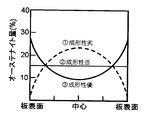
- Explanatory drawing which shows an example of the relationship of the distribution of the thickness direction of the austenite amount after temper rolling, and a moldability.
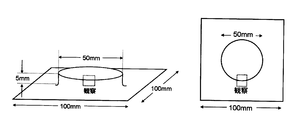
- Explanatory drawing which shows a moldability evaluation method.
- the austenitic stainless steel sheet according to the present invention is a cold-rolled steel sheet subjected to temper rolling. As shown in FIG. 1, this austenitic stainless steel sheet is subjected to a forming process after temper rolling, and then subjected to an aging treatment as necessary to obtain products (eg, various springs) and Is done.
- products eg, various springs
- the above-described problem of insufficient strength can be solved by superimposing the strengthening of the martensite phase by increasing the C content and further the precipitation strengthening utilizing Cr 2 N.
- the average value of the austenite amount ⁇ s (%) of the steel plate surface portion and the austenite amount ⁇ c (%) of the center portion of the plate thickness that is, the value of ( ⁇ s + ⁇ c) / 2 (hereinafter, this value is referred to as the average austenite amount). 55 or less.
- ⁇ s and ⁇ c are as defined above.
- FIG. 2 is an explanatory diagram showing an example of the relationship between the distribution in the thickness direction of the austenite amount after temper rolling and the formability.
- the formability can be greatly improved by changing the distribution of the austenite amount after temper rolling in the thickness direction. Specifically, by increasing the amount of austenite remaining on the steel sheet surface after temper rolling, a work-induced martensitic transformation occurs in the steel sheet surface part that undergoes the greatest deformation during the subsequent forming process, and a sufficient TRIP effect is exhibited. Thereby, excellent moldability is obtained.
- the austenitic stainless steel according to the present invention can have both high strength and excellent formability.
- the processing heat generation of the steel sheet in temper rolling increases as the rolling reduction per pass increases, so the surface temperature of the steel sheet cooled by rolling oil is significantly lower than the temperature at the center of the plate thickness.
- the amount of martensite generated on the steel sheet surface during rolling in the next pass is significantly increased, the amount of austenite on the steel sheet surface portion is greatly reduced.
- the amount of austenite remaining on the steel sheet surface after temper rolling can be increased by increasing the number of passes of temper rolling and reducing the reduction amount per pass to suppress heat generation. Thereby, distribution of the thickness direction of the austenite amount desirable for the subsequent forming process can be achieved.
- the austenite amount ⁇ s (%) at the surface portion of the steel sheet after temper rolling and the austenite amount ⁇ c (%) at the center portion of the plate thickness satisfy the condition of ⁇ s / ⁇ c ⁇ 0.10.
- a sufficient TRIP effect is exhibited in the steel plate surface portion that is most greatly deformed during the subsequent forming process, and the formability is improved.
- the present invention is based on the fact that “the martensite phase is strengthened by increasing the C content and the precipitation strength strengthening by Cr 2 N is superposed and the distribution of the austenite content in the thickness direction is optimized. Based on the technical idea that an austenitic stainless steel sheet that satisfies the requirements as a material for spring parts that are reduced in size and weight can be obtained.
- Chemical composition C 0.01 to 0.15% C is a solid solution strengthening element and is extremely effective for strengthening the martensite phase generated by cold working, so the C content is set to 0.01% or more. However, if the amount of C is excessive, coarse carbides are produced in the production process and formability and corrosion resistance deteriorate, so the C content is set to 0.15% or less. The C content is desirably 0.03% or more.
- Si 3.0% or less
- Si is a solid solution strengthening element and contributes to increasing the strength of steel and is also used as a deoxidizing material during melting.
- Si content is 3.0% or less, Preferably it is 2.8% or less.
- Mn 3.0% or less Mn is used as a deoxidizer during melting. Further, Mn is an austenite stabilizing element and is contained in an appropriate amount in consideration of balance with other elements. However, if the Mn content is excessive, a coarse Mn compound is produced in the production process, and the coarse Mn compound becomes a starting point of destruction, and the moldability deteriorates. Therefore, the Mn content is 3.0% or less, and desirably 2.8% or less.
- Cr 10.0 to 30.0%
- Cr is a basic element of stainless steel, and by containing 10.0% or more, Cr has an effect of forming a passive film on the surface of the steel material to enhance corrosion resistance. Further, when the steel is aged, it precipitates as fine Cr 2 N, thereby contributing to improvement of the strength of the steel.
- Cr is a ferrite-forming element, if the Cr content is excessive, ⁇ -ferrite is generated at a high temperature, and the hot workability of the steel is significantly deteriorated. Therefore, the Cr content is 10.0% or more and 30.0% or less, and desirably 12.0% or more and 25.0% or less.
- Ni 4.0 to 20.0%
- Ni is a basic element of austenitic stainless steel, and in order to stably obtain an austenitic phase having an excellent strength-ductility balance at room temperature, 4.0% or more of Ni is contained. However, if the Ni content is excessive, the austenite phase becomes too stable and the processing-induced martensitic transformation is suppressed, so that high strength cannot be obtained. Therefore, the Ni content is 4.0% or more and 20.0% or less, and preferably 4.5% or more and 18.0% or less.
- N 0.40% or less
- N is a solid solution strengthening element and contributes to improving the strength of steel. Also, upon aging of the steel, even by precipitation as fine Cr 2 N, which contributes to increasing the strength of steel. However, if the N content is excessive, it becomes easy to induce ear cracks during hot working. Therefore, the N content is 0.40% or less, preferably 0.05% or more and 0.30% or less.
- the austenitic stainless steel according to the present invention may further contain the following optional additive elements as necessary.
- One or both of Mo: 3.0% or less and Cu: 3.0% or less Mo and Cu are elements that contribute to increasing the strength of the steel sheet by precipitating fine intermetallic compounds during aging treatment. , May be included as necessary.
- Mo 3.0% or less
- Cu 3.0% or less
- Mo and Cu are elements that contribute to increasing the strength of the steel sheet by precipitating fine intermetallic compounds during aging treatment. , May be included as necessary.
- both the Mo content and the Cu content are 3.0% or less, and desirably both are 2.8% or less.
- Ti, Nb and V are fine carbides or nitrides in the manufacturing process. Since it contributes to the increase in strength of the steel sheet by precipitation strengthening, it may be contained as necessary. However, if the content of these elements is excessive, coarse carbides and nitrides are formed, which become the starting points of fracture during deformation and significantly deteriorate the moldability. Therefore, Ti content and Nb content shall be 0.5% or less, and V content shall be 1.0% or less. Desirably, the Ti content and the Nb content are 0.4% or less, and the V content is 0.8% or less.
- the balance other than those described above is Fe and impurities. Typical impurities include P: 0.05% or less, S: 0.03% or less, and the like.
- the average austenite amount which is the average value of the austenite amount ⁇ s at the surface portion of the steel sheet and the austenite amount ⁇ c at the central portion of the plate thickness, is 55% or less, and the balance is mainly high-strength work-induced martensite. High strength steel can be obtained by sighting.
- the average austenite amount is desirably 50% or less, more desirably 45% or less, still more desirably 40% or less, and most desirably 35% or less.
- the lower limit of the average austenite amount is not particularly specified, but if the austenite is extremely small, a sufficient TRIP effect may not be obtained on the surface of the steel sheet during the forming process, so it is preferably 5% or more, more preferably 7 More than 5%.
- the ratio of the austenite amount ⁇ s of the steel sheet surface portion to the austenite amount ⁇ c at the center portion of the plate thickness ( ⁇ s / ⁇ c ratio) is set to 0.10 or more, thereby forming the plate. Even on the steel sheet surface that is sometimes subjected to the greatest deformation, the TRIP effect accompanying the work-induced martensitic transformation of austenite is sufficiently exhibited, and excellent formability is obtained.
- the ⁇ s / ⁇ c ratio is desirably 0.2 or more, more desirably 0.3 or more, still more desirably 0.5 or more, and most desirably 0.6 or more.
- the balance other than austenite of the metal structure mainly consists of a processing-induced martensite phase.
- This work-induced martensite is generated by temper rolling a steel sheet annealed after cold rolling. Therefore, the austenitic stainless steel sheet of the present invention is a temper rolled material.
- “Consisting of mainly processing-induced martensite phase” means that processing-induced martensite accounts for 50% by volume or more of the balance other than austenite.
- the metal structure is substantially austenite and work-induced martensite, and the other phases are fine precipitates (carbide, nitride, carbonitride). Etc., but the amount is slight.
- Crystal grain size of austenite grains before temper rolling 5 ⁇ m or less Refinement of crystal grains is known as a strengthening method in which the deterioration of the ductility of the steel is small, and is also an effective strengthening method in the stainless steel targeted by the present invention It is.
- the crystal grain size of the austenite grains of the steel sheet (cold-rolled annealed material) before temper rolling be 5 ⁇ m or less.
- the obtained hot-rolled steel sheet is cold-rolled and annealed to obtain a cold-rolled annealed material.
- the austenitic stainless steel sheet according to the present invention described above can be manufactured by subjecting the cold-rolled annealed material to temper rolling at a rolling reduction (%) / 10 or more passes.
- Hot rolling, cold rolling and annealing may all be performed according to conventional methods.
- the cold rolling is preferably performed about 1 to 3 times so that the total rolling reduction is about 30 to 90%, and annealing is performed when a predetermined total rolling reduction is obtained. Multiple passes of cold rolling and annealing can be repeated. It does not specifically limit regarding the frequency
- the austenite grain average grain size of the cold rolled annealed material used for the next temper rolling is made a fine metal structure of 5 ⁇ m or less, the formability becomes particularly good. Therefore, it is preferable.
- the temper rolling is strengthened in order to make maximum use of the strengthening caused by work-induced martensite.
- the total rolling reduction is preferably 40% or more, more preferably 50% or more, and most preferably 60% or more.
- the upper limit of the total rolling reduction is not particularly specified, but is usually less than 100%, preferably 90% or less.
- the present inventor has obtained a number of passes that gives a total reduction ratio (%) / 10 or more, as shown in Equation (3). It was confirmed that the ⁇ c / ⁇ s ratio was 0.10 or more by performing temper rolling. Therefore, temper rolling is performed with the total number of reductions (%) in temper rolling / 10 passes. For example, when the total rolling reduction of temper rolling is 65%, the number of passes is 7 or more.
- Formula (3) Number of temper rolling passes ⁇ Total temper rolling reduction ratio (%) / 10
- the rolling reduction in each pass of temper rolling is substantially the same. Therefore, it is desirable that the rolling reduction in each temper rolling pass is 10% or less. Increasing the number of passes unnecessarily deteriorates work efficiency, so the number of passes should be within the range from the smallest number of passes to satisfy the total reduction ratio (%) / 10 to the number of passes that is two passes more than that. Is preferred.
- Table 1 shows the chemical components of the stainless steel used in this example.
- Steels A to F are invention steels that satisfy the components specified in the present invention, and steels G to M are comparative steels that do not satisfy the components specified in the present invention.
- Table 2 shows the manufacturing conditions and test results of steel sheets manufactured using steels A to M.
- Steel plates 1 to 8 are steel plates that satisfy the provisions of the present invention, and steel plates 9 to 18 are comparative steel plates that do not satisfy the prescriptions of the present invention.
- a steel material having the chemical composition shown in Table 1 was melted in a normal atmospheric melting furnace to obtain a 17 kg steel ingot.
- the steel ingot is hot rolled and annealed to form a hot rolled steel sheet having a thickness of 6.0 mm, and then cold rolled and annealed on the hot rolled steel sheet 1 to 3 times to obtain a thickness of 0.8 to A 4.0 mm cold-rolled annealed material was obtained.
- the cold-rolled annealed material was subjected to temper rolling with a plurality of passes, and finally a thin plate having a thickness of 0.4 mm was obtained.
- the temper rolling was performed under the condition that the rolling reduction rate of each pass was equal.
- the crystal grain size of the austenite grain was calculated from the nominal grain size of the austenite grain from the scanning micrograph after corrosion of the cross section of the specimen taken from the cold rolled annealed material before temper rolling.
- the amount of austenite was calculated from the steel plate surface portion of the test piece collected from the temper-rolled steel plate and the plate thickness center portion surface cut by mechanical polishing and chemical polishing. For the calculation, an integrated intensity ratio obtained by X-ray diffraction measurement and a scanning micrograph after etching were used. In Table 2, the amount of austenite at the surface portion of the steel sheet is denoted by ⁇ s, and the amount of austenite at the center surface of the plate thickness is denoted by ⁇ c.
- FIG. 3 is an explanatory view showing a formability evaluation method.
- a shallow drawing process as shown in FIG. 3 was applied to a 100 mm square test piece taken from the temper rolled steel sheet. After that, the corners were observed with an optical microscope, ⁇ if no crack was confirmed, ⁇ if no continuous crack was confirmed, or if a continuous crack was confirmed, or fractured was marked with x.
- the tensile strength was measured based on JISZ 2241 using a JIS-13B tensile test specimen taken from a steel sheet after temper rolling or after aging treatment. Along with the measured value, a case where the tensile strength exceeds 1500 N / mm 2 is indicated as ⁇ , and a case where the tensile strength is not reached is indicated as ⁇ .
- Steel plates 1 to 8 in Table 2 are steel plates of the present invention and have excellent formability and high strength. Moreover, by comparing the steel plates 1 and 2, it was confirmed that particularly high strength was obtained by the precipitation of fine Cr 2 N during the aging treatment. In addition, it was confirmed that the steel plates 3 and 4 having a crystal grain size after annealing of 5 ⁇ m or less obtained particularly high strength and excellent formability.
- Steel plates 9 to 18 are comparative examples in which the chemical composition or production conditions are outside the range defined in the present invention.
- Steel sheets 9 to 11 have a ⁇ s / ⁇ c of less than 0.1 and high strength is obtained, but the formability is poor.
- the steel plate 7 and the steel plate 10 or the steel plate 8 and the steel plate 11 are compared, the steel plates 7 and 8 have both high strength and formability, but the steel plates 10 and 11 have high strength but have poor formability.
- the steel plate 12 has a C content and an N content exceeding the range of the present invention, and coarse carbonitrides are produced, so that the formability is extremely poor.
- the steel plate 13 has a C content below the range of the present invention, and has a low strength even after aging treatment. Moreover, since ⁇ s / ⁇ c is less than 0.1, the moldability is also poor.
- the steel sheet 14 has a Cr content and a Ni content exceeding the range of the present invention, and the average value of ⁇ s and ⁇ c exceeds 55, so that the strength is low even after aging treatment.
- the steel sheet 15 has poor formability because the Cr content and Ni content are below the range of the present invention and ⁇ s / ⁇ c is less than 0.1.
- the steel plate 16 has a Si content and a Mn content exceeding the range of the present invention, and the average value of ⁇ s and ⁇ c exceeds 55, so that the strength is low even after aging treatment. In addition, coarse Si compounds and Mn compounds are produced, and the moldability is poor.
- the steel plate 17 has a Mo content and a Cu content exceeding the range of the present invention, and the average value of ⁇ s and ⁇ c exceeds 55, so that the strength is small even after aging treatment. In addition, coarse intermetallic compounds are produced and formability is also poor.
- the steel plate 18 has a Ti content exceeding the range of the present invention, and coarse TiN is produced, resulting in poor formability.
Landscapes
- Chemical & Material Sciences (AREA)
- Engineering & Computer Science (AREA)
- Materials Engineering (AREA)
- Mechanical Engineering (AREA)
- Metallurgy (AREA)
- Organic Chemistry (AREA)
- Physics & Mathematics (AREA)
- Thermal Sciences (AREA)
- Crystallography & Structural Chemistry (AREA)
- Heat Treatment Of Sheet Steel (AREA)
- Heat Treatment Of Steel (AREA)
Abstract
Description
1)Mo:3.0%以下およびCu:3.0%以下の少なくとも1種、ならびに/または
2)Ti:0.50%以下、Nb:0.50%以下およびV:1.0%以下からなる群から選ばれた1種もしくは2種以上、
をさらに含むことができる。
本発明により、高強度と優れた成形性とを兼備するオーステナイト系ステンレス鋼板とその製造方法が提供される。
本発明に係るオーステナイト系ステンレス鋼板は、調質圧延を施された冷延鋼板である。図1に示すように、このオーステナイト系ステンレス鋼板は、調質圧延後に、成形加工を施して所望の形状とし、その後、必要に応じて時効処理を施して、製品(例、各種のばね)とされる。
(1)化学組成
C:0.01~0.15%
Cは、固溶強化元素であり、冷間加工で生成するマルテンサイト相の強化に極めて有効であるので、C含有量は0.01%以上とする。しかし、C量が過剰であると、製造過程において粗大な炭化物を生成して成形性や耐食性が劣化するので、C含有量は0.15%以下とする。C含有量は望ましくは0.03%以上である。
Siは、固溶強化元素であり、鋼の高強度化に寄与するとともに、溶製時の脱酸材としても用いられる。しかし、Si含有量が過剰であると、製造過程で粗大なSi化合物が生成され、これらの粗大なSi化合物が熱間加工性及び冷間加工性の劣化を招く。このため、Si含有量は3.0%以下であり、望ましくは2.8%以下である。
Mnは、溶製時の脱酸材として用いられる。また、Mnは,オーステナイト安定化元素であり、他の元素とのバランスを考慮して適量を含有させる。しかし、Mn含有量が過剰であると、製造過程で粗大なMn化合物が生成され、粗大なMn化合物が破壊の起点となって、成形性が劣化する。そのため、Mn含有量は3.0%以下であり、望ましくは2.8%以下である。
Crは、ステンレス鋼の基本元素であり、10.0%以上含有させることにより鋼材の表面に不動態皮膜を形成して耐食性を高める作用を奏する。また、鋼を時効処理した際には、微細なCr2Nとして析出することにより、鋼の強度向上に寄与する。しかし、Crはフェライト生成元素であるのでCr含有量が過剰であると、高温でδフェライトが生成し、鋼の熱間加工性が著しく劣化する。そのため、Cr含有量は10.0%以上、30.0%以下であり、望ましくは12.0%以上、25.0%以下である。
Niは、オーステナイト系ステンレス鋼の基本元素であり、室温で優れた強度‐延性バランスを有するオーステナイト相を安定して得るために、Niを4.0%以上含有させる。しかし、Ni含有量が過剰であると、オーステナイト相が安定になり過ぎて加工誘起マルテンサイト変態が抑制されるため、高強度を得ることができない。そのために、Ni含有量は4.0%以上、20.0%以下であり、望ましくは4.5%以上、18.0%以下である。
Nは、Cと同様に固溶強化元素であり、鋼の強度向上に寄与する。また、鋼を時効処理した際に、微細なCr2Nとして析出することによっても、鋼の高強度化に寄与する。しかし、N含有量が過剰であると、熱間加工時に耳割れを誘発し易くなる。そのために、N含有量は0.40%以下であり、望ましくは0.05%以上0.30%以下である。
Mo:3.0%以下およびCu:3.0%以下の一方または両方
MoとCuはいずれも、時効処理時に微細な金属間化合物を析出させて、鋼板の強度上昇に寄与する元素であるので、必要に応じて含有させてもよい。しかし、Mo含有量またはCu含有量が過剰であると、高温でδフェライトが生成し易く、また粒界に析出するため熱間加工性を著しく劣化させることがある。そのために、Mo含有量、Cu含有量はいずれも3.0%以下であり、望ましくはいずれも2.8%以下である。
Ti、NbおよびVは、製造過程において、微細な炭化物あるいは窒化物として析出し、ピン止め効果により結晶の粒成長を抑制し、また、析出強化により鋼板の強度上昇に寄与するので、必要に応じて含有させてもよい。ただし、これらの元素の含有量が過剰になると、粗大な炭化物や窒化物が生成し、これらが変形時の破壊起点となって成形性を著しく劣化させる。そのために、Ti含有量およびNb含有量は0.5%以下とし、V含有量は1.0%以下とする。望ましくは、Ti含有量とNb含有量は0.4%以下、V含有量は0.8%以下である。
(2)金属組織
[板厚方向でのオーステナイト分布]
本発明者は、多様な試験を実施した結果、鋼板表面部のオーステナイト量γs(%)と板厚中心部のオーステナイト量γc(%)が下記の式(1)と式(2)を満たし、残部が主に加工誘起マルテンサイト組織である場合に、高強度と成形性を兼備したオーステナイト系ステンレス鋼板が得られることを見出した。
式(2): γs/γc≧0.10
まず、式(1)に示すように、鋼板表面部のオーステナイト量γsと板厚中心部のオーステナイト量γcの平均値である平均オーステナイト量を55%以下とし、残部を主として高強度な加工誘起マルテンサイトすることによって、高強度な鋼が得られる。平均オーステナイト量は、望ましくは50%以下であり、より望ましくは45%以下、さらに望ましくは40%以下、最も望ましくは35%以下である。平均オーステナイト量の下限は特に規定されないが、オーステナイトが極端に少ないと、成形加工時に鋼板表面で十分なTRIP効果が得られないことがあるので、5%以上であることが好ましく、より好ましくは7.5%以上である。
結晶粒の微細化は、鋼の延性の劣化が小さい強化法として知られており、本発明で対象とするステンレス鋼においても有効な強化手法である。また、結晶粒径を小さくし、結晶粒界の密度を上げることで、成形加工時に粒界に集中する歪を分散させ、き裂の発生を抑制する効果もある。そこで、本発明では、調質圧延前の鋼板(冷延焼鈍材)のオーステナイト粒の結晶粒径を5μm以下とすることが望ましい。
本発明によれば、前述した化学組成を有する鋼素材に熱間圧延を行った後、得られた熱延鋼板に冷間圧延および焼鈍を行って冷延焼鈍材とし、この冷延焼鈍材に圧下率(%)/10以上のパス回数で調質圧延を施すことによって、上述した本発明に係るオーステナイト系ステンレス鋼板を製造することができる。
本発明では、加工誘起マルテンサイトによる強化を最大限に利用するために調質圧延を強めに行う。総圧下率は好ましくは40%以上、より好ましくは50%以上、最も好ましくは60%以上である。総圧下率の上限は特に規定されないが、通常は100%未満であり、好ましくは90%以下である。
好ましくは、調質圧延の各パスでの圧下率をほぼ同じにする。従って、調質圧延の各パスでの圧下率は10%以下となるようにすることが望ましい。パス回数をむやみに増やすことは作業効率を悪化させるので、パス回数は総圧下率(%)/10を満たすための最も少ないパス回数から、それより2パス多いパス回数までの範囲内とすることが好ましい。
表2に鋼A~Mを用いて製造した鋼板の製造条件と試験結果を示す。鋼板1~8が本発明での規定を満たす鋼板であり、鋼板9~18が本発明での規定を満たさない比較鋼板である。
オーステナイト粒の結晶粒径は、調質圧延前の冷延焼鈍材より採取した試験片断面の腐食後の走査型顕微鏡写真よりオーステナイト粒の公称粒径で算出した。
オーステナイト量は、調質圧延後の鋼板より採取した試験片の鋼板表面部と機械研磨と化学研磨により削った板厚中心部面で算出した。算出には、X線回折測定による積分強度比とエッチング後の走査型顕微鏡写真を用いた。表2において、鋼板表面部のオーステナイト量をγs、板厚中心部面のオーステナイト量をγcと記す。
図3は、成形性評価法を示す説明図である。調質圧延後の鋼板より採取した100mm角の試験片に、図3に示すような浅絞り加工を施した。その後、角部を光学顕微鏡で観察し、き裂が全く確認されなかったものを◎、連続したき裂が確認されなかったものを○、連続したき裂が確認されたもの、あるいは破断したものを×とした。
引張強さは、調質圧延後、または時効処理後の鋼板から採取したJIS-13B号引張試験片を用いて、JISZ 2241に基づいて測定した。測定値とともに、引張強さが1500N/mm2を超えるものを○、未達のものを×と表示した。

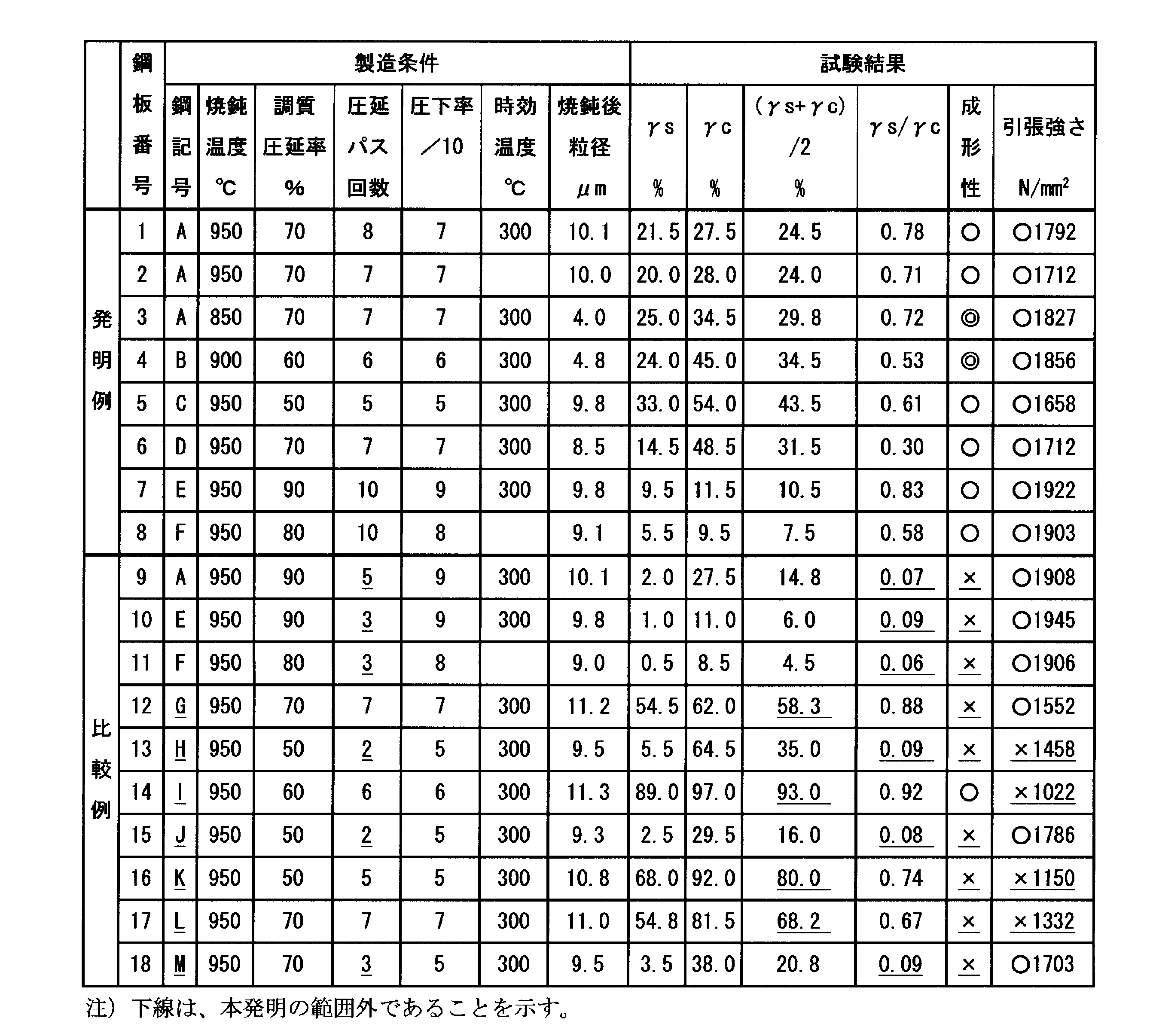
鋼板9~11は、γs/γcが0.1未満であり、高強度は得られるものの、成形性が不芳である。また、鋼板7と鋼板10、あるいは鋼板8と鋼板11を比較すると、鋼板7、8は高強度と成形性を両立するものの、鋼板10、11は高強度ではあるが成形性が不芳であることにより、同じ成分の鋼を同じ調質圧延率で製造しても、圧延パス回数によりオーステナイト量の分布が変わり、特性が大きく変わることが確認された。
鋼板13は、C含有量が本発明の範囲を下回り、時効処理後においても強度が小さい。また、γs/γcが0.1未満であるため、成形性も不芳である。
鋼板15は、Cr含有量、Ni含有量が本発明の範囲を下回り、γs/γcが0.1未満であるために成形性が不芳である。
Claims (5)
- 質量%で、C:0.01~0.15%、Si:3.0%以下、Mn:3.0%以下、Cr:10.0~30.0%、Ni:4.0~20.0%、N:0.40%以下を含有し、残部Feおよび不純物からなる化学組成を有するとともに、鋼板表面部のオーステナイト量γs(%)および板厚中心部のオーステナイト量γc(%)が、(γs+γc)/2≦55、かつγs/γc≧0.10を満足し、かつ残部が主に加工誘起マルテンサイト組織である金属組織を有することを特徴とする、オーステナイト系ステンレス鋼板。
- 前記化学組成が、Feの一部に代えて、質量%で、Mo:3.0%以下またはCu:3.0%以下の少なくとも1種を有する請求項1に記載されたオーステナイト系ステンレス鋼板。
- 前記化学組成が、Feの一部に代えて、質量%で、Ti:0.50%以下、Nb:0.50%以下およびV:1.0%以下からなる群から選ばれた1種または2種以上を有する請求項1または請求項2に記載されたオーステナイト系ステンレス鋼板。
- 前記化学組成を有する鋼素材に熱間圧延を行った後、得られた熱延鋼板に冷間圧延および焼鈍を行って冷延焼鈍材とし、この冷延焼鈍材に圧下率(%)/10以上のパス回数で調質圧延を施すことを特徴とする、請求項1~3のいずれか1項記載のオーステナイト系ステンレス鋼板の製造方法。
- 調質圧延前の冷延焼鈍材のオーステナイト粒の平均結晶粒径が5μm以下である、請求項4に記載の方法。
Priority Applications (4)
| Application Number | Priority Date | Filing Date | Title |
|---|---|---|---|
| CN201080052368.2A CN102639742B (zh) | 2009-11-18 | 2010-11-16 | 奥氏体系不锈钢板及其制造方法 |
| JP2011541919A JP5056985B2 (ja) | 2009-11-18 | 2010-11-16 | オーステナイト系ステンレス鋼板およびその製造方法 |
| KR1020127015348A KR101289518B1 (ko) | 2009-11-18 | 2010-11-16 | 오스테나이트계 스테인리스 강판 및 그 제조 방법 |
| US13/468,255 US20120237388A1 (en) | 2009-11-18 | 2012-05-10 | Austenitic stainless steel sheet and a method for its manufacture |
Applications Claiming Priority (2)
| Application Number | Priority Date | Filing Date | Title |
|---|---|---|---|
| JP2009263066 | 2009-11-18 | ||
| JP2009-263066 | 2009-11-18 |
Related Child Applications (1)
| Application Number | Title | Priority Date | Filing Date |
|---|---|---|---|
| US13/468,255 Continuation US20120237388A1 (en) | 2009-11-18 | 2012-05-10 | Austenitic stainless steel sheet and a method for its manufacture |
Publications (1)
| Publication Number | Publication Date |
|---|---|
| WO2011062152A1 true WO2011062152A1 (ja) | 2011-05-26 |
Family
ID=44059630
Family Applications (1)
| Application Number | Title | Priority Date | Filing Date |
|---|---|---|---|
| PCT/JP2010/070350 Ceased WO2011062152A1 (ja) | 2009-11-18 | 2010-11-16 | オーステナイト系ステンレス鋼板およびその製造方法 |
Country Status (5)
| Country | Link |
|---|---|
| US (1) | US20120237388A1 (ja) |
| JP (1) | JP5056985B2 (ja) |
| KR (1) | KR101289518B1 (ja) |
| CN (1) | CN102639742B (ja) |
| WO (1) | WO2011062152A1 (ja) |
Cited By (10)
| Publication number | Priority date | Publication date | Assignee | Title |
|---|---|---|---|---|
| CN102618802A (zh) * | 2012-03-20 | 2012-08-01 | 东北大学 | 一种超细晶粒双相钢材料及其制备方法 |
| WO2014133058A1 (ja) * | 2013-02-28 | 2014-09-04 | 日新製鋼株式会社 | オーステナイト系ステンレス鋼板およびそれを用いた高弾性限非磁性鋼材の製造方法 |
| US20140294659A1 (en) * | 2011-07-29 | 2014-10-02 | Nippon Steel & Sumitomo Metal Corporation | Method for manufacturing high-si austenitic stainless steel |
| JP2015021155A (ja) * | 2013-07-18 | 2015-02-02 | 株式会社特殊金属エクセル | バネ用ステンレス鋼帯及びその製造方法 |
| JP2015086405A (ja) * | 2013-10-28 | 2015-05-07 | 日新製鋼株式会社 | 高強度複相組織ステンレス鋼板およびその製造法 |
| JP2018003099A (ja) * | 2016-07-01 | 2018-01-11 | 日新製鋼株式会社 | ステンレス鋼板およびその製造方法 |
| JP2018003139A (ja) * | 2016-07-08 | 2018-01-11 | 日新製鋼株式会社 | ステンレス鋼 |
| KR101833404B1 (ko) | 2017-08-04 | 2018-02-28 | 한국과학기술원 | 고강도 Fe―Cr―Ni―Al 멀티플렉스 스테인리스강 및 이의 제조방법 |
| JP2022181634A (ja) * | 2021-05-26 | 2022-12-08 | 日鉄ステンレス株式会社 | オーステナイト系ステンレス鋼材及びその製造方法、並びに加工製品 |
| JP2024524982A (ja) * | 2021-07-06 | 2024-07-09 | ポスコ カンパニー リミテッド | オーステナイト系ステンレス鋼及びその製造方法 |
Families Citing this family (25)
| Publication number | Priority date | Publication date | Assignee | Title |
|---|---|---|---|---|
| CN105200340B (zh) * | 2015-09-23 | 2020-11-17 | 宝钢德盛不锈钢有限公司 | 800~1600MPa级高强度奥氏体不锈钢及制造方法和温成型方法 |
| CN108138281B (zh) * | 2015-09-30 | 2020-05-01 | 日本制铁株式会社 | 奥氏体系不锈钢 |
| EP3365473B1 (en) * | 2015-10-19 | 2020-07-29 | AB Sandvik Materials Technology | New austenitic stainless alloy |
| CN105441824A (zh) * | 2015-11-25 | 2016-03-30 | 铜陵市经纬流体科技有限公司 | 一种耐海水腐蚀的高弹不锈钢泵阀铸件及其制备方法 |
| CN106086711A (zh) * | 2016-08-27 | 2016-11-09 | 郭云琴 | 一种高强度、高塑性trip钢板及其制备方法 |
| DE102016117508B4 (de) * | 2016-09-16 | 2019-10-10 | Salzgitter Flachstahl Gmbh | Verfahren zur Herstellung eines Stahlflachprodukts aus einem mittelmanganhaltigen Stahl und ein derartiges Stahlflachprodukt |
| KR20180054031A (ko) * | 2016-11-14 | 2018-05-24 | 주식회사 포스코 | 내수소취성이 개선된 오스테나이트계 스테인리스강 및 이를 포함하는 고압 수소 가스용 용기 |
| CN107083519A (zh) * | 2017-02-22 | 2017-08-22 | 广东鑫发精密金属科技有限公司 | 一种不锈钢冷轧精密弹簧钢带及其制备方法 |
| KR101991000B1 (ko) * | 2017-12-15 | 2019-06-20 | 주식회사 포스코 | 고내식 오스테나이트계 스테인리스강 및 그 제조방법 |
| KR102020506B1 (ko) * | 2017-12-22 | 2019-09-10 | 주식회사 포스코 | 내크립 특성이 우수한 오스테나이트계 스테인리스강 및 그 제조방법 |
| DE102018133255A1 (de) * | 2018-12-20 | 2020-06-25 | Voestalpine Böhler Edelstahl Gmbh & Co Kg | Superaustenitischer Werkstoff |
| US12221665B2 (en) * | 2019-05-31 | 2025-02-11 | Nippon Steel Corporation | Austenitic stainless steel material |
| CN111613379B (zh) * | 2020-04-24 | 2022-07-22 | 周民主 | 一种用于传输电缆的酸洗设备 |
| KR102448735B1 (ko) * | 2020-09-03 | 2022-09-30 | 주식회사 포스코 | 오스테나이트계 스테인리스강 및 그 제조 방법 |
| KR102463025B1 (ko) * | 2020-11-24 | 2022-11-03 | 주식회사 포스코 | 고강도, 비자성 오스테나이트계 스테인리스강 및 그 제조방법 |
| KR102537950B1 (ko) * | 2020-12-14 | 2023-05-31 | 주식회사 포스코 | 고온 연화저항성이 향상된 오스테나이트계 스테인리스강 |
| CN113549820B (zh) * | 2021-06-29 | 2022-05-17 | 鞍钢股份有限公司 | 一种高碳低铁素体含量奥氏体不锈钢板及其生产方法 |
| CN113957322A (zh) * | 2021-10-29 | 2022-01-21 | 烟台汽车工程职业学院 | 一种提高301不锈钢变形过程中马氏体形核能力及含量的方法 |
| JPWO2023105947A1 (ja) * | 2021-12-06 | 2023-06-15 | ||
| CN115261731A (zh) * | 2022-08-16 | 2022-11-01 | 安徽尚德科技有限公司 | 一种连续梁桥用支座中大尺寸铸造奥氏体不锈钢球冠衬板 |
| CN115821172A (zh) * | 2022-11-29 | 2023-03-21 | 山东泰山钢铁集团有限公司 | 一种奥氏体不锈钢及其冶炼方法 |
| CN116219134B (zh) * | 2023-02-01 | 2025-11-21 | 山西太钢不锈钢股份有限公司 | 一种提高奥氏体不锈钢极低温组织稳定性的方法 |
| CN116695024B (zh) * | 2023-05-30 | 2024-10-22 | 鞍钢股份有限公司 | 一种耐高温腐蚀核电用奥氏体不锈钢及其制造方法 |
| CN116676529B (zh) * | 2023-06-02 | 2026-01-30 | 安徽工业大学 | 一种高强度高塑性奥氏体不锈钢及其生产方法 |
| CN117026080B (zh) * | 2023-08-04 | 2025-12-26 | 北京科技大学 | 一种高强度中氮奥氏体不锈钢板及制备方法 |
Citations (4)
| Publication number | Priority date | Publication date | Assignee | Title |
|---|---|---|---|---|
| JPS63317628A (ja) * | 1987-06-22 | 1988-12-26 | Nisshin Steel Co Ltd | 張り出し強度および靭性に優れた高強度ステンレス鋼の製造方法 |
| JPH04202643A (ja) * | 1990-11-30 | 1992-07-23 | Nkk Corp | 高強度、高靭性ステンレス鋼およびその製造方法 |
| JPH07316662A (ja) * | 1994-05-25 | 1995-12-05 | Nisshin Steel Co Ltd | 高強度高靱性ステンレス鋼帯の製造方法 |
| JPH0995757A (ja) * | 1995-10-03 | 1997-04-08 | Nkk Corp | Idブレード基板用準安定オーステナイト系ステンレス鋼薄板およびその製造方法 |
Family Cites Families (16)
| Publication number | Priority date | Publication date | Assignee | Title |
|---|---|---|---|---|
| JPS5871336A (ja) * | 1981-10-21 | 1983-04-28 | Nisshin Steel Co Ltd | 疲労特性に優れた高強度オ−ステナイト系ステンレス鋼板の製造方法 |
| JPH0295757A (ja) * | 1988-09-30 | 1990-04-06 | Hitachi Ltd | エネルギ供給システム |
| US5496514A (en) * | 1993-03-08 | 1996-03-05 | Nkk Corporation | Stainless steel sheet and method for producing thereof |
| KR950009223B1 (ko) * | 1993-08-25 | 1995-08-18 | 포항종합제철주식회사 | 프레스 성형성, 열간가공성 및 고온내산화성이 우수한 오스테나이트계 스테인레스강 |
| DE4406052A1 (de) * | 1993-11-30 | 1995-06-01 | Nippon Kokan Kk | Rostfreies Stahlblech und Verfahren zu dessen Herstellung |
| MY118759A (en) * | 1995-12-15 | 2005-01-31 | Nisshin Steel Co Ltd | Use of a stainless steel as an anti-microbial member in a sanitary environment |
| JP2001131713A (ja) * | 1999-11-05 | 2001-05-15 | Nisshin Steel Co Ltd | Ti含有超高強度準安定オーステナイト系ステンレス鋼材および製造法 |
| JP4518645B2 (ja) * | 2000-01-21 | 2010-08-04 | 日新製鋼株式会社 | 高強度高靱性マルテンサイト系ステンレス鋼板並びに冷延耳切れ抑止方法および鋼板製造法 |
| EP1394280A4 (en) * | 2001-04-27 | 2004-07-14 | Sumitomo Metal Ind | METAL GASKET AND RAW MATERIAL THEREFOR AND MANUFACTURING METHOD THEREFOR |
| JP2004323882A (ja) * | 2003-04-22 | 2004-11-18 | Nikko Metal Manufacturing Co Ltd | 準安定オーステナイト系ステンレス鋼 |
| JP4859356B2 (ja) * | 2004-08-24 | 2012-01-25 | 日本リークレス工業株式会社 | メタルガスケットの製造方法 |
| US20090038718A1 (en) * | 2004-10-26 | 2009-02-12 | Hille & Müller GMBH | Process for the manufacture of a containment device and a containment device manufactured thereby |
| US7985372B2 (en) * | 2005-06-09 | 2011-07-26 | Jfe Steel Corporation | Ferritic stainless steel sheet for use in raw material pipe for forming bellows pipe |
| JP5071384B2 (ja) * | 2006-05-30 | 2012-11-14 | 住友金属工業株式会社 | オーステナイト系ステンレス鋼 |
| JP5165236B2 (ja) * | 2006-12-27 | 2013-03-21 | 新日鐵住金ステンレス株式会社 | 衝撃吸収特性に優れた構造部材用ステンレス鋼板 |
| CN101668596B (zh) * | 2007-04-24 | 2012-09-26 | 新日本制铁株式会社 | 单向性电磁钢板的制造方法 |
-
2010
- 2010-11-16 JP JP2011541919A patent/JP5056985B2/ja active Active
- 2010-11-16 WO PCT/JP2010/070350 patent/WO2011062152A1/ja not_active Ceased
- 2010-11-16 KR KR1020127015348A patent/KR101289518B1/ko active Active
- 2010-11-16 CN CN201080052368.2A patent/CN102639742B/zh active Active
-
2012
- 2012-05-10 US US13/468,255 patent/US20120237388A1/en not_active Abandoned
Patent Citations (4)
| Publication number | Priority date | Publication date | Assignee | Title |
|---|---|---|---|---|
| JPS63317628A (ja) * | 1987-06-22 | 1988-12-26 | Nisshin Steel Co Ltd | 張り出し強度および靭性に優れた高強度ステンレス鋼の製造方法 |
| JPH04202643A (ja) * | 1990-11-30 | 1992-07-23 | Nkk Corp | 高強度、高靭性ステンレス鋼およびその製造方法 |
| JPH07316662A (ja) * | 1994-05-25 | 1995-12-05 | Nisshin Steel Co Ltd | 高強度高靱性ステンレス鋼帯の製造方法 |
| JPH0995757A (ja) * | 1995-10-03 | 1997-04-08 | Nkk Corp | Idブレード基板用準安定オーステナイト系ステンレス鋼薄板およびその製造方法 |
Cited By (20)
| Publication number | Priority date | Publication date | Assignee | Title |
|---|---|---|---|---|
| US20140294659A1 (en) * | 2011-07-29 | 2014-10-02 | Nippon Steel & Sumitomo Metal Corporation | Method for manufacturing high-si austenitic stainless steel |
| US9243314B2 (en) * | 2011-07-29 | 2016-01-26 | Nippon Steel & Sumitomo Metal Corporation | Method for manufacturing high-Si austenitic stainless steel |
| CN102618802B (zh) * | 2012-03-20 | 2013-08-21 | 东北大学 | 一种超细晶粒双相钢材料及其制备方法 |
| CN102618802A (zh) * | 2012-03-20 | 2012-08-01 | 东北大学 | 一种超细晶粒双相钢材料及其制备方法 |
| CN108754333A (zh) * | 2013-02-28 | 2018-11-06 | 日新制钢株式会社 | 奥氏体系不锈钢板及使用其的高弹性极限非磁性钢材的制造方法 |
| WO2014133058A1 (ja) * | 2013-02-28 | 2014-09-04 | 日新製鋼株式会社 | オーステナイト系ステンレス鋼板およびそれを用いた高弾性限非磁性鋼材の製造方法 |
| CN105026594A (zh) * | 2013-02-28 | 2015-11-04 | 日新制钢株式会社 | 奥氏体系不锈钢板及使用其的高弹性极限非磁性钢材的制造方法 |
| JP2015206124A (ja) * | 2013-02-28 | 2015-11-19 | 日新製鋼株式会社 | オーステナイト系ステンレス鋼板およびそれを用いた高弾性限非磁性鋼材 |
| JPWO2014133058A1 (ja) * | 2013-02-28 | 2017-02-02 | 日新製鋼株式会社 | 高弾性限非磁性鋼材の製造方法 |
| CN108754333B (zh) * | 2013-02-28 | 2021-02-09 | 日铁不锈钢株式会社 | 奥氏体系不锈钢板及使用其的高弹性极限非磁性钢材的制造方法 |
| US10125404B2 (en) | 2013-02-28 | 2018-11-13 | Nisshin Steel Co., Ltd. | Method for producing high elastic limit nonmagnetic steel material using an austenitic stainless steel sheet |
| JP2015021155A (ja) * | 2013-07-18 | 2015-02-02 | 株式会社特殊金属エクセル | バネ用ステンレス鋼帯及びその製造方法 |
| JP2015086405A (ja) * | 2013-10-28 | 2015-05-07 | 日新製鋼株式会社 | 高強度複相組織ステンレス鋼板およびその製造法 |
| JP2018003099A (ja) * | 2016-07-01 | 2018-01-11 | 日新製鋼株式会社 | ステンレス鋼板およびその製造方法 |
| JP2018003139A (ja) * | 2016-07-08 | 2018-01-11 | 日新製鋼株式会社 | ステンレス鋼 |
| KR101833404B1 (ko) | 2017-08-04 | 2018-02-28 | 한국과학기술원 | 고강도 Fe―Cr―Ni―Al 멀티플렉스 스테인리스강 및 이의 제조방법 |
| JP2022181634A (ja) * | 2021-05-26 | 2022-12-08 | 日鉄ステンレス株式会社 | オーステナイト系ステンレス鋼材及びその製造方法、並びに加工製品 |
| JP7738229B2 (ja) | 2021-05-26 | 2025-09-12 | 日本製鉄株式会社 | オーステナイト系ステンレス鋼板及びその製造方法、並びに加工製品 |
| JP2024524982A (ja) * | 2021-07-06 | 2024-07-09 | ポスコ カンパニー リミテッド | オーステナイト系ステンレス鋼及びその製造方法 |
| JP7787209B2 (ja) | 2021-07-06 | 2025-12-16 | ポスコ カンパニー リミテッド | オーステナイト系ステンレス鋼板及びその製造方法 |
Also Published As
| Publication number | Publication date |
|---|---|
| JPWO2011062152A1 (ja) | 2013-04-04 |
| CN102639742A (zh) | 2012-08-15 |
| KR20120083930A (ko) | 2012-07-26 |
| CN102639742B (zh) | 2016-03-30 |
| KR101289518B1 (ko) | 2013-07-24 |
| JP5056985B2 (ja) | 2012-10-24 |
| US20120237388A1 (en) | 2012-09-20 |
Similar Documents
| Publication | Publication Date | Title |
|---|---|---|
| JP5056985B2 (ja) | オーステナイト系ステンレス鋼板およびその製造方法 | |
| JP6017341B2 (ja) | 曲げ性に優れた高強度冷延鋼板 | |
| JP3886933B2 (ja) | プレス成形性,二次加工性に優れたフェライト系ステンレス鋼板及びその製造方法 | |
| EP2410068B1 (en) | Duplex stainless steel plate having excellent press moldability | |
| CN101490298B (zh) | 部件用不锈钢钢板及其制造方法 | |
| JP5308726B2 (ja) | 微細粒組織を有するプレス成形用オーステナイト系ステンレス鋼板およびその製造方法 | |
| JP5347600B2 (ja) | オーステナイト系ステンレス鋼およびオーステナイト系ステンレス鋼板の製造方法 | |
| JP2019014933A (ja) | 鋼板およびその製造方法 | |
| JP7817571B2 (ja) | マルテンサイト系ステンレス鋼材及びその製造方法 | |
| JP2019039037A (ja) | 鋼板およびその製造方法 | |
| JP4408386B2 (ja) | 結晶粒の微細な複合組織高張力鋼 | |
| JP6811112B2 (ja) | フェライト・オーステナイト2相ステンレス鋼板およびその製造方法 | |
| KR101120355B1 (ko) | 후육 강판 및 그 제조 방법 | |
| JP6738928B1 (ja) | フェライト系ステンレス鋼板およびその製造方法 | |
| JP5100144B2 (ja) | バネ用鋼板およびそれを用いたバネ材並びにそれらの製造法 | |
| CN117999375A (zh) | 奥氏体系不锈钢板及其制造方法以及板簧 | |
| KR101618489B1 (ko) | 열연 강판 및 그 제조 방법 | |
| JP3886864B2 (ja) | 二次加工性に優れるフェライト系ステンレス鋼冷延焼鈍材及びその製造方法 | |
| JP5073966B2 (ja) | 時効硬化型フェライト系ステンレス鋼板およびそれを用いた時効処理鋼材 | |
| KR20110075408A (ko) | 페라이트계 스테인레스강 및 그 제조방법 | |
| JP4841308B2 (ja) | 高強度非磁性ステンレス鋼板及びその製造方法 | |
| EP4079888A1 (en) | High strength steel sheet having excellent workability and method for manufacturing same | |
| JP2012201924A (ja) | ステンレス鋼板及びその製造方法 | |
| JP3606135B2 (ja) | ばね用フェライト系ステンレス鋼板とその製造方法 | |
| JP4498912B2 (ja) | 張り出し成型性に優れたオーステナイト系ステンレス鋼板およびその製造方法 |
Legal Events
| Date | Code | Title | Description |
|---|---|---|---|
| WWE | Wipo information: entry into national phase |
Ref document number: 201080052368.2 Country of ref document: CN |
|
| 121 | Ep: the epo has been informed by wipo that ep was designated in this application |
Ref document number: 10831546 Country of ref document: EP Kind code of ref document: A1 |
|
| WWE | Wipo information: entry into national phase |
Ref document number: 2011541919 Country of ref document: JP |
|
| NENP | Non-entry into the national phase |
Ref country code: DE |
|
| WWE | Wipo information: entry into national phase |
Ref document number: 1201002261 Country of ref document: TH |
|
| ENP | Entry into the national phase |
Ref document number: 20127015348 Country of ref document: KR Kind code of ref document: A |
|
| 122 | Ep: pct application non-entry in european phase |
Ref document number: 10831546 Country of ref document: EP Kind code of ref document: A1 |