WO2011024270A1 - フツリン酸ガラス、プレス成形用ガラス素材、光学素子ブランク、光学素子およびそれらの製造方法ならびにガラス成形体の製造方法 - Google Patents
フツリン酸ガラス、プレス成形用ガラス素材、光学素子ブランク、光学素子およびそれらの製造方法ならびにガラス成形体の製造方法 Download PDFInfo
- Publication number
- WO2011024270A1 WO2011024270A1 PCT/JP2009/064885 JP2009064885W WO2011024270A1 WO 2011024270 A1 WO2011024270 A1 WO 2011024270A1 JP 2009064885 W JP2009064885 W JP 2009064885W WO 2011024270 A1 WO2011024270 A1 WO 2011024270A1
- Authority
- WO
- WIPO (PCT)
- Prior art keywords
- glass
- optical element
- press
- fluorophosphate
- press molding
- Prior art date
- Legal status (The legal status is an assumption and is not a legal conclusion. Google has not performed a legal analysis and makes no representation as to the accuracy of the status listed.)
- Ceased
Links
Classifications
-
- C—CHEMISTRY; METALLURGY
- C03—GLASS; MINERAL OR SLAG WOOL
- C03C—CHEMICAL COMPOSITION OF GLASSES, GLAZES OR VITREOUS ENAMELS; SURFACE TREATMENT OF GLASS; SURFACE TREATMENT OF FIBRES OR FILAMENTS MADE FROM GLASS, MINERALS OR SLAGS; JOINING GLASS TO GLASS OR OTHER MATERIALS
- C03C3/00—Glass compositions
- C03C3/12—Silica-free oxide glass compositions
- C03C3/23—Silica-free oxide glass compositions containing halogen and at least one oxide, e.g. oxide of boron
- C03C3/247—Silica-free oxide glass compositions containing halogen and at least one oxide, e.g. oxide of boron containing fluorine and phosphorus
Definitions
- the present invention relates to a fluorophosphate glass suitable for optical element materials such as lenses, prisms, and optical filters. Moreover, this invention relates to the glass raw material for press molding which consists of the said fluorophosphate glass, an optical element blank, an optical element, those manufacturing methods, and the manufacturing method of a glass molded object.
- Patent Document 1 An example of such a fluorophosphate glass is disclosed in Patent Document 1.
- the glass disclosed in claim 1 of Patent Document 1 can provide a viscosity suitable for molding even when the temperature of the glass is lowered in order to reduce or prevent striae when molding molten glass.
- the amount of aluminum (Al) component is limited to 30 cation% or less.
- the present invention it is possible to provide a fluorophosphate glass having ultra-low dispersibility and excellent stability. Moreover, the glass raw material for press molding which consists of the said glass, an optical element blank, an optical element, and those manufacturing methods can be provided, and the manufacturing method of the glass molded object which consists of the said glass can be provided.
- the fluorophosphate glass of the present invention as a glass component, 3-5 cation% P 5+ , Al 3+ exceeds 30 cation% and 40 cation% or less, Li + 0.5 to 20 cation%, It is characterized in that it contains at least 65 anions of F ⁇ and a liquidus temperature of 700 ° C. or less.
- cation component content and the total content are expressed as cation%
- anion component content and the total content are expressed as anion%.
- containing 0% of a certain component X represents that the content of the component X is 0%, that is, not containing the component X.
- the fluorophosphate glass of the present invention further comprises Mg 2+ 0-15 %, 5 to 35% Ca 2+ 5-25% Sr2 + , Ba 2+ 0-20 %, Na + 0-10%, K + 0-10%, Y 3+ 0-5% Can be included.
- P 5+ is an essential component and functions as a glass network former. If the P 5+ content is less than 3%, the stability of the glass is significantly reduced. If the P 5+ content exceeds 25%, the volatilization of the glass components becomes violent, resulting in an optically homogeneous glass or a glass with stable optical properties. Is difficult to mass-produce. Therefore, the content of P 5+ is set to 3 to 25%.
- a preferable range of the content of P 5+ is 5 to 20%, a more preferable range is 5 to 15%, and a further preferable range is 10 to 15%.
- F ⁇ is an essential component for imparting low dispersibility and anomalous dispersibility to the glass.
- the content of F ⁇ is set to 65% or more.
- the upper limit of the content may be 95%.
- a preferred range for the content of F ⁇ is 75 to 92%, and a more preferred range is 80 to 85%.
- the liquidus temperature of the fluorophosphate glass of the present invention is 700 ° C. or lower.
- the preferable range of the liquidus temperature in the present invention is 680 ° C. or less, and the more preferable range is 650 ° C. or less.
- Ca 2+ has an effect of increasing the stability of the glass, and it is a component that is desired to increase as the F ⁇ content increases. If the Ca 2+ content is less than 5%, it is difficult to obtain the above effect. If the Ca 2+ content exceeds 35%, the stability is lowered. Therefore, the Ca 2+ content is preferably 5 to 35%. More preferred range of the content of Ca 2+ is 10 to 30%, more preferred lower limit is 20% of the content of Ca 2+, more preferably the upper limit of the content of Ca 2+ is 25%.
- the stability of glass can be improved more by making Ca ⁇ 2+> and Sr ⁇ 2+> coexist.
- K + also works to lower the glass transition temperature, but if introduced excessively, the stability of the glass is lowered. Moreover, water resistance is also lowered. Therefore, the K + content is preferably 0 to 10%. A more preferable range of the content of K + is 0 to 5%, and a more preferable range is 0 to 2%.
- the stability of the glass can be improved by allowing a plurality of types to coexist.
- P 5+ , Al 3+ , Li + , Mg 2+ , Ca 2+ , Sr 2+ , Ba 2+ , Na + , K + and Y 3+ The total content is preferably 95% or more, more preferably 97% or more, still more preferably 98% or more, and even more preferably 99% or more.
- Pb, As, Cd, Tl, Te, Cr, Se, U, and Th are not only necessary substances in the fluorophosphate glass of the present invention, but are also substances that have a large environmental load, so it is preferable not to introduce them into the glass. .
- the fluorophosphate glass of the present invention does not require components such as Lu, Sc, Hf, and Ge. Since Lu, Sc, Hf, and Ge are expensive components, it is preferable not to introduce them.
- the fluorophosphate glass of the present invention exhibits excellent light transmittance over a wide wavelength range in the visible range. From the viewpoint of taking advantage of these properties, it is preferable not to introduce substances that cause coloring such as Cu, Cr, V, Fe, Ni, Co, and Nd.
- the fluorophosphate glass of the present invention has a low glass transition temperature. Therefore, the fluorophosphate glass is suitable for precision press molding, and is excellent in moldability when the glass is reheated and softened. Since the glass transition temperature is low as described above, the heating temperature during molding can be kept relatively low. Therefore, since a chemical reaction between the glass and a mold such as a press mold hardly occurs, a glass molded body having a clean and smooth surface can be molded. Moreover, deterioration of the mold can be suppressed.
- the preferred range of the Abbe number ⁇ d is 85 or more, the more preferred range is 88 to 96, and the further preferred range is 88 to 92.
- volatile fluorophosphate glass from suppressing the erosive, it is desirable that the molar ratio (O 2- / P 5+) of O 2- content to the content of P 5+ in 3.5 above.
- Phosphate is generally used as a raw material for fluorophosphate glass, but in order to increase the amount of fluorine (F ⁇ ) introduced as an anion component as much as possible, as a phosphate, phosphorus (P 5+ ) 1
- the phosphoric acid present in the molten glass is more phosphorous (P 5 ) than metaphosphoric acid in which the ratio of oxygen (O 2 ⁇ ) atoms to oxygen (O 2 ⁇ ) atoms (oxygen atoms / phosphorus atoms) is 3. 5+ )
- Diphosphoric acid having a ratio of oxygen (O 2 ⁇ ) atoms to one atom (oxygen atom / phosphorus atom) of 3.5 is considered to be more stable. Therefore, if the molar ratio O 2 ⁇ / P 5+ of the content of O 2 ⁇ to the content of P 5+ in the fluorophosphate glass is set to 3.5 or more, the glass does not contain metaphosphoric acid and is a volatile component.
- the molar ratio O 2 ⁇ / P 5+ can be increased while maintaining the liquidus temperature at 700 ° C. or lower.
- the preferred range of the molar ratio O 2 ⁇ / P 5+ is 3.4 or more, more preferred is 3.5 or more, and even more preferred is 3.55 or more.
- the glass material for press molding of the present invention is a glass material made of the fluorophosphate glass of the present invention.
- the glass material means a glass lump used for press molding.
- Examples of the glass material include a glass lump corresponding to the mass of the press-molded product, such as a precision press-molding preform and an optical element blank press-molding glass gob.
- Preform for precision press molding means a glass preform that is heated and used for precision press molding.
- precision press molding is a well-known material.
- mold optics molding is a method of forming the optical functional surface of the optical element by transferring the molding surface of the press mold.
- the optical function surface means a surface that refracts, reflects, diffracts, or enters and exits the light to be controlled in the optical element, and the lens surface of the lens corresponds to the optical function surface.
- a carbon-containing film to prevent the glass from reacting and fusing with the press-molding surface during precision press-molding, while ensuring that the glass stretches along the molding surface.
- a carbon-containing film a film containing carbon as a main component (when the element content in the film is expressed in atomic%, the carbon content is higher than the content of other elements) is desirable.
- a carbon film, a hydrocarbon film, etc. can be illustrated.
- a method for forming a carbon-containing film a known method such as a vacuum deposition method using a carbon raw material, a sputtering method, an ion plating method, or a thermal decomposition using a material gas such as a hydrocarbon is used. Use it.
- the glass material for press molding of the present invention is made of fluorophosphate glass having excellent stability, a high-quality press molded product can be obtained without devitrification even when the glass material is heated during press molding. .
- the method for producing a glass molded body of the present invention is a method for producing a glass molded body, in which a glass raw material is melted and the obtained molten glass is poured into a mold to form a glass molded body. A glass raw material is prepared and melted so that the fluorophosphate glass of the present invention is obtained.
- the present invention since a fluorophosphate glass having excellent stability is used, generation of striae due to volatilization from a high-temperature glass surface is reduced and prevented while preventing devitrification, and high-quality glass molding
- the body can be manufactured.
- a known mold may be applied as appropriate according to the shape of the mold.
- a mold having a flat bottom surface and three side walls surrounding the bottom surface from three directions and having one side opened is arranged below the pipe through which the molten glass flows out so that the bottom surface is horizontal.
- the molten glass which flows out continuously from a pipe is poured on the bottom face of a casting_mold
- the molded glass is pulled out from the opening in the horizontal direction at a constant speed to obtain a glass plate having a constant width and a constant thickness.
- the drawn glass plate is annealed by passing through the annealing furnace at a slow speed. The annealed glass plate is cut perpendicular to the pulling direction to form a glass plate having a desired length.
- a mold having a through hole is arranged below the outflow pipe so that the through hole is oriented in the vertical direction, and molten glass is continuously poured into the through hole.
- the poured glass is rapidly cooled and formed into a rod shape, and is drawn downward at a constant speed from the lower end opening of the through hole.
- the glass rod pulled out from the mold passes through the atmosphere heated near the glass transition temperature, and after the operation of bringing the surface of the glass rod closer to the inside temperature, the glass rod is cut in the horizontal direction and has a desired length. It becomes.
- the first method for producing a glass material for press molding according to the present invention is characterized in that the glass molded body produced by the method for producing a glass molded body according to the present invention is processed.
- the above-mentioned glass plate or glass rod is divided into glass pieces by cutting or cleaving, and the glass pieces are barrel-polished to adjust the mass so as to be the mass of one target optical element blank.
- the edge of the glass piece can be rounded to remove the edge causing breakage or folding during press molding.
- the surface of the glass material is roughened and a powder release agent applied to the surface at the time of press molding is easily adhered uniformly.
- Another example is a method of grinding and polishing the glass piece to obtain a precision press-molding preform, and another method is polishing and smoothing the surface of the barrel-polished product to obtain a precision press-molding preform. It is a method to make.
- the glass raw material is melted, the obtained molten glass is discharged, the molten glass lump is separated from the molten glass stream, and the molten glass lump is cooled.
- a method of manufacturing a glass material for press molding that is molded into a preform to be subjected to precision press molding in the process A glass raw material is prepared and melted so that the fluorophosphate glass of the present invention is obtained.
- a molten glass lump having a predetermined mass is separated from the molten glass, cooled, and a preform having a mass equal to the molten glass lump is formed.
- a homogeneous molten glass obtained by melting, clarifying, and homogenizing a glass raw material is discharged from a temperature-adjusted platinum or platinum alloy outflow nozzle.
- molten glass is dropped as a molten glass droplet of a desired mass from an outflow nozzle, and it is received by a preform mold and molded into a preform.
- wind pressure is applied to the molten glass block on a preform mold. It is preferable to form a preform while floating and adding a molten glass drop into a liquid medium by cooling a gaseous substance at room temperature and normal pressure such as liquid nitrogen. .
- the preform thus prepared can be used by coating the surface of the preform with a carbon-containing film.
- a glass material for press molding according to the present invention since the glass material is produced with glass having excellent stability, a glass material that is not devitrified during press molding can be produced. .
- the method for producing the first optical element blank of the present invention is also called a reheat press method.
- the press-molding glass material of the present invention or the press-molding glass material produced by the method of the present invention is heated and softened to perform press molding. It is a method to do.
- Both of the above examples can be performed in the atmosphere.
- well-known conditions and things can be used for the molding conditions, the material of the press mold, the heating softening furnace, and the dish on which the glass gob is placed when heating and softening.
- an optical element blank capable of producing an optical element free from defects such as devitrification and striae and a method for manufacturing the same.
- the optical element of the present invention is made of glass having low dispersion characteristics and positive anomalous dispersion characteristics, high-order chromatic aberration correction can be performed by combining with an optical element made of other glass. Moreover, since it consists of glass which shows a high light transmittance over the whole visible region, the color balance of transmitted light is not reduced. Moreover, it can be suitably used for a lens that guides or collects light having a short wavelength.
- optical elements that guide light rays for writing and reading data on optical recording media such as DVDs and CDs, such as optical pickup lenses and collimator lenses. It is also suitable as an optical element for optical communication.
- the first method for producing an optical element of the present invention is characterized in that the optical element blank produced by the method of the present invention is ground and polished.
- a known method may be used for grinding and polishing.
- the press-molding glass material of the present invention or the press-molding glass material prepared by the method of the present invention is heated and precision press-molded using a press mold. It is characterized by that.
- the glass material is a preform.
- the heating and pressing process of the press mold and the preform is performed in order to prevent oxidation of the molding surface of the press mold or the release film provided on the molding surface, nitrogen gas or a mixed gas of nitrogen gas and hydrogen gas, etc. It is preferable to carry out in a non-oxidizing gas atmosphere.
- the carbon-containing film covering the preform surface is not oxidized, and the film remains on the surface of the precision press-molded product.
- This film should be finally removed, but in order to remove the carbon-containing film relatively easily and completely, the precision press-molded product may be heated in an oxidizing atmosphere, for example, air.
- the oxidation and removal of the carbon-containing film should be performed at a temperature at which the precision press-molded product is not deformed by heating. Specifically, it is preferably performed in a temperature range below the glass transition temperature.
- Both the mold and the preform are heated to soften the preform, and this is pressure-molded to precisely transfer the molding surface of the mold to glass. Also, a preform whose temperature has been raised to a temperature corresponding to 10 4 to 10 8 dPa ⁇ s in advance is supplied between a pair of opposed upper and lower molds whose molding surfaces are precisely shaped. And by pressing this, the shaping
- the pressure and time at the time of pressurization can be appropriately determined in consideration of the viscosity of the glass.
- the press pressure can be about 5 to 15 MPa, and the press time can be 10 to 300 seconds.
- the pressing conditions such as pressing time and pressing pressure may be appropriately set within a known range in accordance with the shape and dimensions of the molded product.
- the mold and the precision press-molded product are cooled, and when the temperature is preferably below the strain point, the mold is released and the precision press-molded product is taken out.
- the annealing conditions of the molded product during cooling for example, the annealing rate may be adjusted as appropriate.
- the manufacturing method of the second optical element can be roughly divided into the following two methods.
- the first method is an optical element manufacturing method in which a glass material for press molding is introduced into a press mold, the glass material and the press mold are heated together, and precision press molding is performed.
- This method is recommended when emphasizing the improvement of molding accuracy, such as the second method, where the glass material for press molding is heated, the glass material is introduced into a preheated press mold, and precision press molding is performed.
- This is a method for manufacturing an optical element, and is recommended when productivity improvement is emphasized.
- the manufacturing method of the second optical element includes various aspherical lenses such as a concave meniscus lens, a convex meniscus lens, a biconcave lens, a biconvex lens, a planoconvex lens, and a planoconcave lens, and small optical elements such as an optical pickup lens and an optical communication lens. Suitable for manufacturing.
- fluorophosphate glass having excellent stability since fluorophosphate glass having excellent stability is used, it is possible to provide a high-quality ultra-low dispersion glass optical element and a method for stably manufacturing the optical element. .
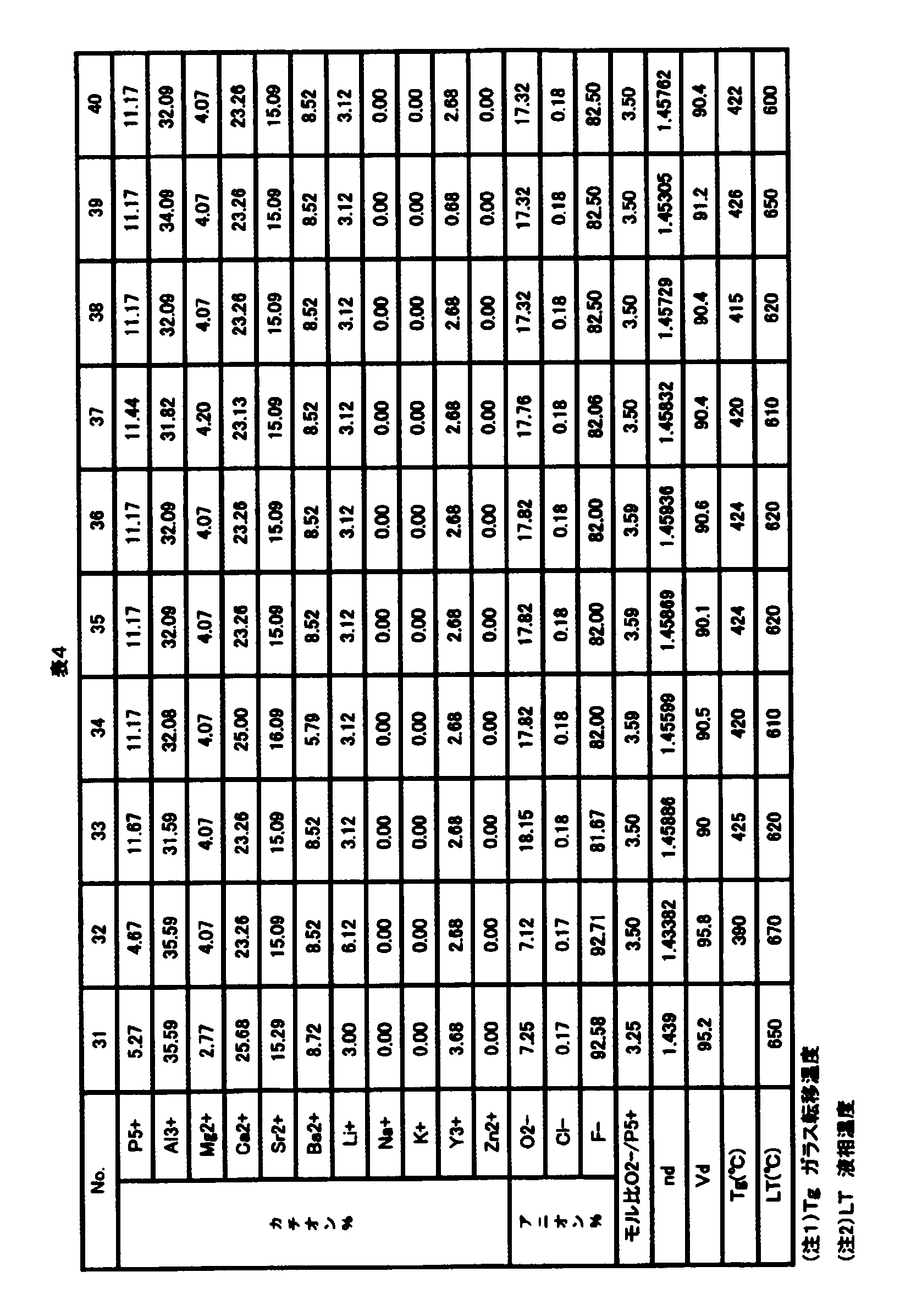
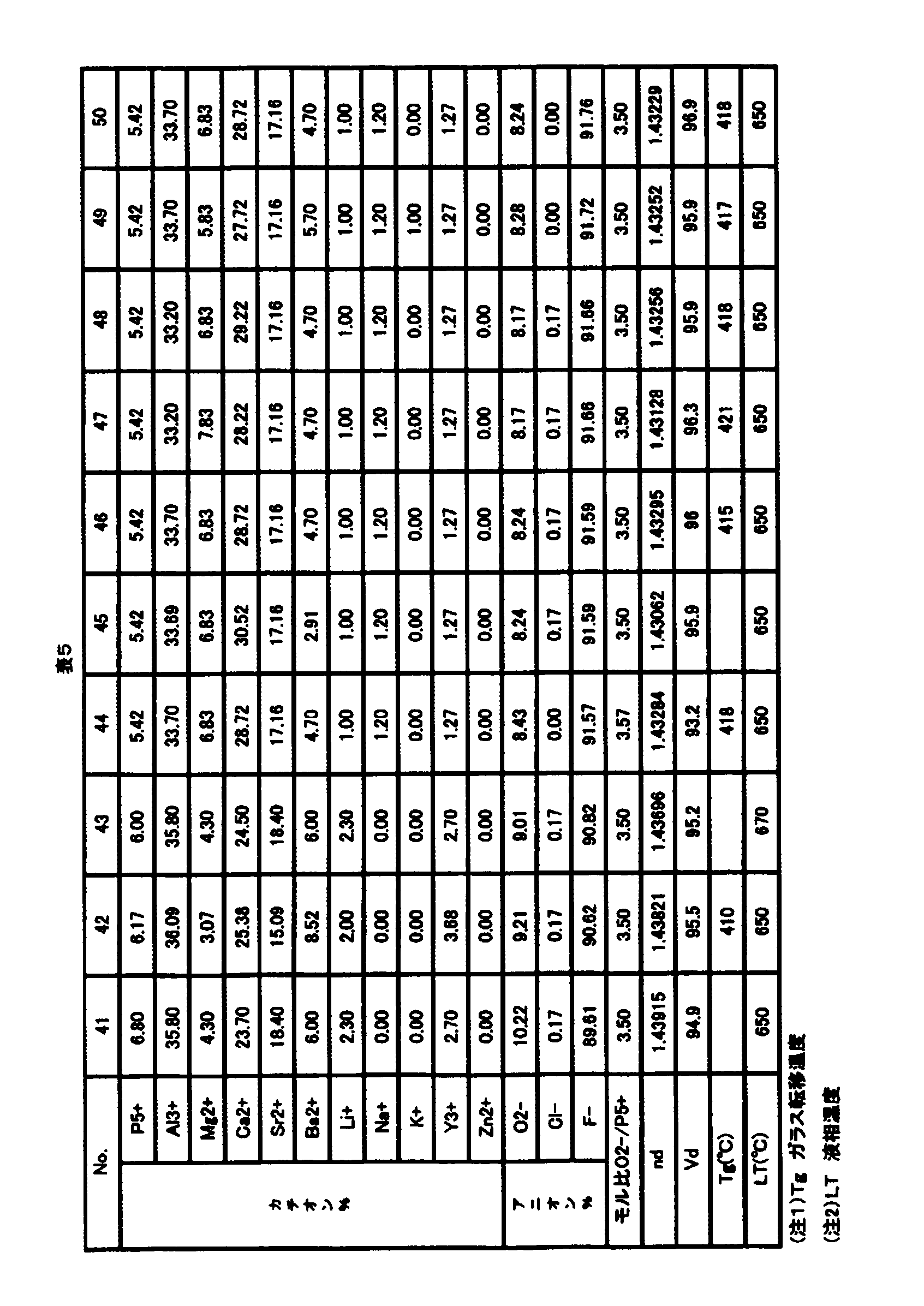
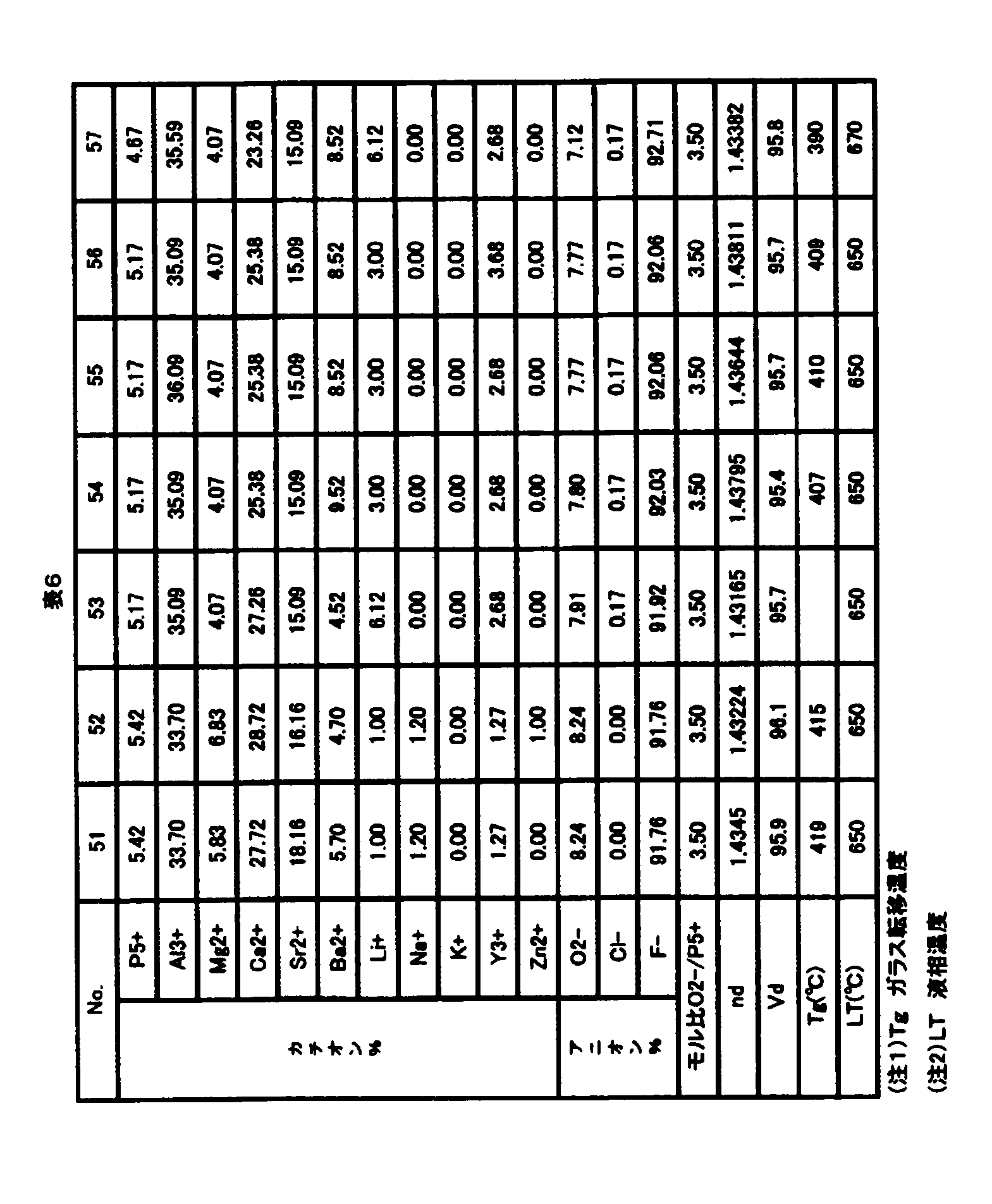
- Example 1 Use the corresponding phosphate, fluoride, oxide, etc. as raw materials for introducing each component so that the glass composition shown in Table 1 to Table 6 is obtained, weigh the raw materials, mix thoroughly and prepare The raw material was placed in a platinum crucible, heated and melted. After melting, the molten glass is poured into a mold, allowed to cool to near the glass transition temperature, immediately put into an annealing furnace, annealed for about 1 hour in the glass transition temperature range, and then allowed to cool to room temperature in the furnace. No. 1-57 were obtained. In the obtained optical glass, crystals that could be observed with a microscope did not precipitate. The properties of the optical glass thus obtained are shown in Tables 1 to 6.
- Refractive index nd, Abbe number ⁇ d With respect to the glass obtained by lowering the temperature at a temperature reduction rate of ⁇ 30 ° C./hour, the refractive index nd and Abbe number ⁇ d were measured by the refractive index measurement method of the Japan Optical Glass Industry Association standard.
- Liquidus temperature LT 100 g of glass cullet is put into a platinum crucible with a lid and held at 950 ° C. for 30 minutes in a nitrogen atmosphere. Thereafter, the glass melt is moved to a furnace set at a predetermined temperature in an air atmosphere so as not to lower the temperature, and is kept for 2 hours.
- Example 2 Melting, clarifying and homogenizing the glass raw material prepared so that each optical glass produced in Example 1 is obtained, making a molten glass, dropping a molten glass drop from a platinum nozzle, and receiving with a preform mold, It was formed into a spherical preform made of the above-mentioned various glasses while being floated by applying wind pressure.
- the molten glass is continuously discharged from the platinum pipe, the lower end of the molten glass is received by a preform mold, a constricted portion is formed in the molten glass flow, and then the preform mold is rapidly lowered directly below the molten glass.
- the flow was cut at the constricted portion, the molten glass lump separated on the preform mold was received, and molded into preforms made of the above-mentioned various glasses while being floated by applying wind pressure.
- the resulting preform was optically homogeneous and no devitrification was observed.
- Example 3 The molten glass prepared in Example 2 was continuously flowed out, cast into a mold, formed into a glass block, annealed, and cut to obtain a plurality of glass pieces. These glass pieces were ground and polished to prepare preforms made of the various glasses. The resulting preform was optically homogeneous and no devitrification was observed.
- Example 6 A powder mold release agent composed of boron nitride is uniformly applied to the surface of the glass gob produced in Example 4, then heated and softened in the atmosphere, and press-molded with a press mold to form a spherical convex meniscus lens and a spherical concave meniscus. Blanks of various lenses such as a lens, a spherical biconvex lens, and a spherical biconcave lens were prepared. Thus, the lens blank which consists of said various glass was produced.
- Example 8 The lens blanks produced in Example 6 and Example 7 are annealed to remove distortion and adjust the refractive index to a desired value, and then ground and polished to be spherical convex meniscus lens, spherical concave meniscus lens, spherical biconvex lens, spherical surface Various lenses of a biconcave lens were produced. In this way, lenses made of the above various glasses were produced.
- Example 9 The molten glass prepared in Example 2 was flown out and cast into a mold to produce a glass block.
- the block was cut, ground, and polished to produce various spherical lenses and prisms.
- the obtained lens and prism were optically homogeneous and no devitrification was observed.
Landscapes
- Chemical & Material Sciences (AREA)
- Life Sciences & Earth Sciences (AREA)
- Engineering & Computer Science (AREA)
- Chemical Kinetics & Catalysis (AREA)
- General Chemical & Material Sciences (AREA)
- Geochemistry & Mineralogy (AREA)
- Materials Engineering (AREA)
- Organic Chemistry (AREA)
- Glass Compositions (AREA)
Abstract
Description
本発明は、超低分散性と優れた安定性を有するフツリン酸ガラスを提供すること、前記該ガラスからなるプレス成形用ガラス素材、光学素子ブランク、光学素子とそれらの製造方法を提供すること、ならびに前記ガラスからなるガラス成形体の製造方法を提供することを目的とする。
(1)ガラス成分として、
P5+を3~25カチオン%、
Al3+を30カチオン%を超え40カチオン%以下、
Li+を0.5~20カチオン%、
F-を65アニオン%以上
含み、液相温度が700℃以下であることを特徴とするフツリン酸ガラス、
(2)カチオン%表示にて、
Mg2+を0~15%、
Ca2+を5~35%、
Sr2+を5~25%、
Ba2+を0~20%、
Na+を0~10%、
K+を0~10%、
Y3+を0~5%
含む上記(1)に記載のフツリン酸ガラス、
(3)アッベ数νdが85~98である上記(1)または(2)に記載のフツリン酸ガラス、
(4)上記(1)~(3)のいずれかに記載のフツリン酸ガラスからなることを特徴とするプレス成形用ガラス素材、
(5)上記(1)~(3)のいずれかに記載のフツリン酸ガラスからなることを特徴とする光学素子ブランク、
(6)上記(1)~(3)のいずれかに記載のフツリン酸ガラスからなることを特徴とする光学素子、
(7)ガラス原料を熔融し、得られた熔融ガラスを鋳型に流し込んでガラス成形体を成形するガラス成形体の製造方法において、
上記(1)~(3)のいずれかに記載のフツリン酸ガラスが得られるようにガラス原料を調合し、熔融することを特徴とするガラス成形体の製造方法、
(8)上記(7)に記載の方法で作製したガラス成形体を加工することを特徴とするプレス成形用ガラス素材の製造方法、
(9)ガラス原料を熔融し、得られた熔融ガラスを流出し、熔融ガラス流から熔融ガラス塊を分離して、該熔融ガラス塊を冷却する過程で精密プレス成形に供するプリフォームに成形するプレス成形用ガラス素材の製造方法において、
上記(1)~(3)のいずれかに記載のフツリン酸ガラスが得られるようにガラス原料を調合し、熔融することを特徴とするプレス成形ガラス素材の製造方法、
(10)上記(4)に記載のプレス成形用ガラス素材または上記(8)に記載の方法で作製したプレス成形用ガラス素材を加熱、軟化し、プレス成形することを特徴とする光学素子ブランクの製造方法、
(11)ガラス原料を熔融し、得られた熔融ガラスを流出し、熔融ガラス流から熔融ガラス塊を分離して、該熔融ガラス塊をプレス成形する光学素子ブランクの製造方法において、
上記(1)~(3)のいずれかに記載のフツリン酸ガラスが得られるようにガラス原料を調合し、熔融することを特徴とする光学素子ブランクの製造方法、
(12)上記(10)または(11)に記載の方法により作製した光学素子ブランクを研削、研磨することを特徴とする光学素子の製造方法、
(13)上記(4)に記載のプレス成形用ガラス素材または上記(9)に記載の方法で作製したプレス成形用ガラス素材を加熱し、プレス成形型を用いて精密プレス成形することを特徴とする光学素子の製造方法、
(14)プレス成形用ガラス素材をプレス成形型内に導入し、前記ガラス素材とプレス成形型を一緒に加熱し、精密プレス成形する上記(13)に記載の光学素子の製造方法、
(15)プレス成形用ガラス素材を加熱し、前記ガラス素材を予熱したプレス成形型内に導入し、精密プレス成形する上記(13)に記載の光学素子の製造方法、
を提供するものである。
また、前記ガラスからなるプレス成形用ガラス素材、光学素子ブランク、光学素子とそれらの製造方法を提供すること、ならびに前記ガラスからなるガラス成形体の製造方法を提供することができる。
以下、本発明のフツリン酸ガラスについて詳説する。
本発明のフツリン酸ガラスは、ガラス成分として、
P5+を3~25カチオン%、
Al3+を30カチオン%を超え40カチオン%以下、
Li+を0.5~20カチオン%、
F-を65アニオン%以上
含み、液相温度が700℃以下であることを特徴とする。
Mg2+を0~15%、
Ca2+を5~35%、
Sr2+を5~25%、
Ba2+を0~20%、
Na+を0~10%、
K+を0~10%、
Y3+を0~5%
を含むことができる。
P5+は、必須成分であり、ガラスのネットワークフォーマーとして機能する。P5+の含有量が3%未満であるとガラスの安定性が著しく低下し、25%を超えるとガラス成分の揮発が激しくなり、光学的に均質なガラスを得たり、光学特性の安定したガラスを量産することが困難になる。したがって、P5+の含有量を3~25%とする。P5+の含有量の好ましい範囲は5~20%、より好ましい範囲は5~15%、さらに好ましい範囲は10~15%である。
Pb、As、Cd、Tl、Te、Cr、Se、U、Thは、本発明のフツリン酸ガラスにおいて必要な物質でないばかりでなく、環境負荷が大きい物質であるので、ガラスに導入しないことが好ましい。
本発明のフツリン酸ガラスは、熔融法にて製造することができる。以下、その一例について説明する。ガラス原料として、ガラス成分に相当するリン酸塩、フッ化物などを使用し、これら原料を秤量し、十分混合して調合原料とし、調合原料を白金製坩堝に入れて850~950℃の温度範囲で1~3時間程度、加熱、熔融する。こうして得られる熔融ガラスを清澄、均質化して得られた熔融ガラスを鋳型に鋳込んで急冷することによりフツリン酸ガラスを作ることができる。
次に本発明のプレス成形用ガラス素材について説明する。
本発明のプレス成形用ガラス素材は、上記本発明のフツリン酸ガラスからなるガラス素材である。
精密プレス成形用プリフォーム(以下、単にプリフォームをいうことがある。)は、加熱して精密プレス成形に供されるガラス予備成形体を意味するが、ここで精密プレス成形とは、周知のようにモールドオプティクス成形とも呼ばれ、光学素子の光学機能面をプレス成形型の成形面を転写することにより形成する方法である。なお、光学機能面とは光学素子において、制御対象の光を屈折したり、反射したり、回折したり、入出射させる面を意味し、レンズにおけるレンズ面などがこの光学機能面に相当する。
次に本発明のガラス成形体の製造方法について説明する。
本発明のガラス成形体の製造方法は、ガラス原料を熔融し、得られた熔融ガラスを鋳型に流し込んでガラス成形体を成形するガラス成形体の製造方法であって、
上記本発明のフツリン酸ガラスが得られるようにガラス原料を調合し、熔融することを特徴とする。
アニールしたガラス板は引き出し方向に対して垂直に切断し、所望長さのガラス板となる。
本発明の第1のプレス成形用ガラス素材の製造方法は、上記本発明のガラス成形体の製造方法で作製したガラス成形体を加工することを特徴とする。
例えば、前述のガラス板やガラス棒を切断または割断によりガラス片に分割し、これらガラス片をバレル研磨して目的の光学素子ブランク1個分の質量になるように質量調整を行う。バレル研磨によって、ガラス片のエッジを丸め、破損原因やプレス成形時の折れ込み原因になるエッジを除去することができる。また、ガラス素材表面を粗面化してプレス成形時に表面に塗布する粉末状離型剤を均一に付着させやすくする。
上記本発明のフツリン酸ガラスが得られるようにガラス原料を調合、熔融することを特徴とする。
本発明の第1および第2のプレス成形用ガラス素材の製造方法によれば、優れた安定性を有するガラスによりガラス素材を作製するので、プレス成形時に失透しないガラス素材を生産することができる。
次に本発明の光学素子ブランクについて説明する。
本発明の光学素子ブランクは、上記本発明のフツリン酸ガラスからなることを特徴とする。
本発明の第1の光学素子ブランクの製造方法はリヒートプレス法とも呼ばれ、上記本発明のプレス成形用ガラス素材または本発明の方法により作製したプレス成形用ガラス素材を加熱、軟化してプレス成形する方法である。
次に本発明の光学素子について説明する。
本発明の光学素子は、上記本発明のフツリン酸ガラスからなる光学素子である。具体例としては、非球面レンズ、球面レンズ、あるいは平凹レンズ、平凸レンズ、両凹レンズ、両凸レンズ、凸メニスカスレンズ、凹メニスカスレンズなどのレンズ、マイクロレンズ、レンズアレイ、回折格子付きレンズ、プリズム、レンズ機能付きプリズムなどを例示することができる。表面には必要に応じて反射防止膜や波長選択性のある部分反射膜などを設けてもよい。
本発明の第1の光学素子の製造方法は、上記本発明の方法により作製した光学素子ブランクを研削、研磨することを特徴とする。研削、研磨は公知の方法を用いればよい。
また、成形面が精密に形状加工された対向した一対の上型と下型との間に、予めガラスの粘度で104~108dPa・sに相当する温度に昇温したプリフォームを供給し、これを加圧成形することによって、成形型の成形面をガラスに精密に転写することができる。
(実施例1)
表1~表6に示すガラス組成になるように、各成分を導入するための原料としてそれぞれ相当するリン酸塩、フッ化物、酸化物などを用い、原料を秤量し、十分に混合して調合原料とし、これを白金坩堝に入れ、加熱、熔融した。熔融後、熔融ガラスを鋳型に流し込み、ガラス転移温度付近まで放冷してから直ちにアニール炉に入れ、ガラスの転移温度範囲で約1時間アニール処理した後、炉内で室温まで放冷し光学ガラスNo.1~57を得た。得られた光学ガラス中には、顕微鏡で観察できる結晶は析出しなかった。
このようにして得られた光学ガラスの特性を表1~表6に示す。
(1)屈折率nd、アッベ数νd
降温速度-30℃/時間で降温して得られたガラスについて、日本光学硝子工業会規格の屈折率測定法により、屈折率nd、アッベ数νdを測定した。
(2)液相温度LT
ガラスカレット100gを蓋付き白金坩堝に投入し、窒素雰囲気で950℃、30分間保持する。その後ガラス融液の温度を下げないように大気雰囲気で所定温度に設定された炉に移動させ、2時間保持する。2時間保持後炉内より取り出し放冷したのちに、ガラスを光学顕微鏡で拡大観察する。この作業を様々な保持温度で繰り返し、結晶が残存しない最低保持温度を液相温度とする。
(3)ガラス転移温度Tg
株式会社リガク製の熱機械分析装置(TMA)を使用し、昇温速度を10℃/分にして測定した。


実施例1で作製した各光学ガラスが得られるように調合したガラス原料を熔融、清澄、均質化して熔融ガラスを作り、白金製のノズルから熔融ガラス滴を滴下してプリフォーム成形型で受け、風圧を加えて浮上させながら上記各種ガラスからなる球状のプリフォームに成形した。
また、上記熔融ガラスを白金製パイプから連続的に流出し、その下端部をプリフォーム成形型で受け、熔融ガラス流にくびれ部を作った後、プリフォーム成形型を真下に急降下して熔融ガラス流をくびれ部で切断し、プリフォーム成形型上に分離した熔融ガラス塊を受け、風圧を加えて浮上させながら上記各種ガラスからなるプリフォームに成形した。
得られたプリフォームは光学的に均質であり、失透も認められなかった。
実施例2で用意した熔融ガラスを連続的に流出して鋳型に鋳込み、ガラスブロックに成形した後、アニールし、切断して複数個のガラス片を得た。これらガラス片を研削、研磨して上記各種ガラスからなるプリフォームを作製した。得られたプリフォームは光学的に均質であり、失透も認められなかった。
実施例2で用意した熔融ガラスを連続的に流出して鋳型に鋳込み、ガラスブロックに成形した後、アニールし、切断して複数個のガラス片を得た。これらガラス片をバレル研磨して上記各種ガラスからなるプレス成形用ガラスゴブを作製した。得られたガラスゴブの内部は光学的に均質であり、失透も認められなかった。
実施例2、3で作製したプリフォームの表面に炭素含有膜をコートし、成形面に炭素系離型膜を設けたSiC製の上下型および胴型を含むプレス成形型内に導入し、窒素雰囲気中で成形型とプリフォームを一緒に加熱してプリフォームを軟化し、精密プレス成形して上記各種ガラスからなる非球面凸メニスカスレンズ、非球面凹メニスカスレンズ、非球面両凸レンズ、非球面両凹レンズ、光ピックアップレンズといった各種レンズを作製した。
実施例4で作製したガラスゴブの表面に窒化ホウ素からなる粉末状離型剤を均一に塗布してから大気中で加熱、軟化し、プレス成形型でプレス成形し、球面凸メニスカスレンズ、球面凹メニスカスレンズ、球面両凸レンズ、球面両凹レンズの各種レンズのブランクを作製した。このようにして上記各種ガラスからなるレンズブランクを作製した。
実施例2で用意した熔融ガラスを流出し、シアを用いて熔融ガラス流を切断して熔融ガラス塊を分離し、プレス成形型を用いてプレス成形し、球面凸メニスカスレンズ、球面凹メニスカスレンズ、球面両凸レンズ、球面両凹レンズの各種レンズのブランクを作製した。このようにして上記各種ガラスからなるレンズブランクを作製した。得られたレンズブランクの内部は光学的に均質であり、失透も認められなかった。
実施例6、実施例7で作製したレンズブランクをアニールして歪を除くとともに屈折率を所望値に合わせた後、研削、研磨して球面凸メニスカスレンズ、球面凹メニスカスレンズ、球面両凸レンズ、球面両凹レンズの各種レンズを作製した。このようにして上記各種ガラスからなるレンズを作製した。
実施例2で用意した熔融ガラスを流出し、鋳型に鋳込んでガラスブロックを作製し、このブロックを切断、研削、研磨して各種球面レンズ、プリズムを作製した。得られたレンズ、プリズムは光学的に均質であり、失透も認められなかった。
なお、本出願は、2008年2月28日付で出願された日本特許出願(特願2008-047135)に基づいており、その全体が引用により援用される。
Claims (15)
- ガラス成分として、
P5+を3~25カチオン%、
Al3+を30カチオン%を超え40カチオン%以下、
Li+を0.5~20カチオン%、
F-を65アニオン%以上
含み、液相温度が700℃以下であることを特徴とするフツリン酸ガラス。 - カチオン%表示にて、
Mg2+を0~15%、
Ca2+を5~35%、
Sr2+を5~25%、
Ba2+を0~20%、
Na+を0~10%、
K+を0~10%、
Y3+を0~5%
含む請求項1に記載のフツリン酸ガラス。 - アッベ数νdが85~98である請求項1または2に記載のフツリン酸ガラス。
- 請求項1~3のいずれかに記載のフツリン酸ガラスからなることを特徴とするプレス成形用ガラス素材。
- 請求項1~3のいずれかに記載のフツリン酸ガラスからなることを特徴とする光学素子ブランク。
- 請求項1~3のいずれかに記載のフツリン酸ガラスからなることを特徴とする光学素子。
- ガラス原料を熔融し、得られた熔融ガラスを鋳型に流し込んでガラス成形体を成形するガラス成形体の製造方法において、
請求項1~3のいずれかに記載のフツリン酸ガラスが得られるようにガラス原料を調合し、熔融することを特徴とするガラス成形体の製造方法。 - 請求項7に記載の方法で作製したガラス成形体を加工することを特徴とするプレス成形用ガラス素材の製造方法。
- ガラス原料を熔融し、得られた熔融ガラスを流出し、熔融ガラス流から熔融ガラス塊を分離して、該熔融ガラス塊を冷却する過程で精密プレス成形に供するプリフォームに成形するプレス成形用ガラス素材の製造方法において、
請求項1~3のいずれかに記載のフツリン酸ガラスが得られるようにガラス原料を調合し、熔融することを特徴とするプレス成形ガラス素材の製造方法。 - 請求項4に記載のプレス成形用ガラス素材または請求項8に記載の方法で作製したプレス成形用ガラス素材を加熱、軟化し、プレス成形することを特徴とする光学素子ブランクの製造方法。
- ガラス原料を熔融し、得られた熔融ガラスを流出し、熔融ガラス流から熔融ガラス塊を分離して、該熔融ガラス塊をプレス成形する光学素子ブランクの製造方法において、
請求項1~3のいずれかに記載のフツリン酸ガラスが得られるようにガラス原料を調合し、熔融することを特徴とする光学素子ブランクの製造方法。 - 請求項10または11に記載の方法により作製した光学素子ブランクを研削、研磨することを特徴とする光学素子の製造方法。
- 請求項4に記載のプレス成形用ガラス素材または請求項9に記載の方法で作製したプレス成形用ガラス素材を加熱し、プレス成形型を用いて精密プレス成形することを特徴とする光学素子の製造方法。
- プレス成形用ガラス素材をプレス成形型内に導入し、前記ガラス素材とプレス成形型を一緒に加熱し、精密プレス成形する請求項13に記載の光学素子の製造方法。
- プレス成形用ガラス素材を加熱し、前記ガラス素材を予熱したプレス成形型内に導入し、精密プレス成形する請求項13に記載の光学素子の製造方法。
Priority Applications (3)
| Application Number | Priority Date | Filing Date | Title |
|---|---|---|---|
| CN200980155631.8A CN102300823B (zh) | 2009-08-26 | 2009-08-26 | 氟磷酸盐玻璃、模压成型用玻璃材料、光学元件坯料、光学元件及其制造方法和玻璃成型体的制造方法 |
| PCT/JP2009/064885 WO2011024270A1 (ja) | 2009-08-26 | 2009-08-26 | フツリン酸ガラス、プレス成形用ガラス素材、光学素子ブランク、光学素子およびそれらの製造方法ならびにガラス成形体の製造方法 |
| US13/146,431 US8633121B2 (en) | 2009-08-26 | 2009-08-26 | Fluorophosphate glass, glass material for press molding, optical element blank, optical element, processes for production of same, and process for production of glass moldings |
Applications Claiming Priority (1)
| Application Number | Priority Date | Filing Date | Title |
|---|---|---|---|
| PCT/JP2009/064885 WO2011024270A1 (ja) | 2009-08-26 | 2009-08-26 | フツリン酸ガラス、プレス成形用ガラス素材、光学素子ブランク、光学素子およびそれらの製造方法ならびにガラス成形体の製造方法 |
Publications (1)
| Publication Number | Publication Date |
|---|---|
| WO2011024270A1 true WO2011024270A1 (ja) | 2011-03-03 |
Family
ID=43627397
Family Applications (1)
| Application Number | Title | Priority Date | Filing Date |
|---|---|---|---|
| PCT/JP2009/064885 Ceased WO2011024270A1 (ja) | 2009-08-26 | 2009-08-26 | フツリン酸ガラス、プレス成形用ガラス素材、光学素子ブランク、光学素子およびそれらの製造方法ならびにガラス成形体の製造方法 |
Country Status (3)
| Country | Link |
|---|---|
| US (1) | US8633121B2 (ja) |
| CN (1) | CN102300823B (ja) |
| WO (1) | WO2011024270A1 (ja) |
Cited By (1)
| Publication number | Priority date | Publication date | Assignee | Title |
|---|---|---|---|---|
| JP2022502333A (ja) * | 2018-09-28 | 2022-01-11 | シーディージーエム グラス カンパニー リミテッド | フルオロリン酸光学ガラス、並びに光学プリフォーム、素子、及び機器 |
Families Citing this family (6)
| Publication number | Priority date | Publication date | Assignee | Title |
|---|---|---|---|---|
| CN101514079B (zh) * | 2009-03-27 | 2012-05-02 | 成都光明光电股份有限公司 | 氟磷酸盐光学玻璃 |
| CN105016610A (zh) * | 2012-08-30 | 2015-11-04 | 朱保生 | 路灯光学玻璃透镜生产用双工位压床 |
| US8852745B2 (en) * | 2012-10-12 | 2014-10-07 | Hoya Corporation | Optical glass, press-molding glass material, optical element and method of manufacturing the same, and bonded optical element |
| US10056363B2 (en) * | 2015-11-10 | 2018-08-21 | Marvell World Trade Ltd. | Methods and systems to improve yield in multiple chips integration processes |
| JP6825939B2 (ja) * | 2017-03-02 | 2021-02-03 | Hoya株式会社 | 光学ガラスおよび光学素子 |
| JP6964050B2 (ja) * | 2018-07-20 | 2021-11-10 | オリンパス株式会社 | 光学素子の製造方法 |
Citations (10)
| Publication number | Priority date | Publication date | Assignee | Title |
|---|---|---|---|---|
| JPS53105517A (en) * | 1977-02-28 | 1978-09-13 | Hoya Glass Works Ltd | Fluorophosphate laser glass |
| JPS53132014A (en) * | 1977-04-22 | 1978-11-17 | Jenaer Glaswerk Schott & Gen | Glass for laser having low nonnlinear refractivf index |
| JPS55144448A (en) * | 1979-04-24 | 1980-11-11 | Nippon Kogaku Kk <Nikon> | Fluorophosphate optical glass |
| JPH07157330A (ja) * | 1993-12-02 | 1995-06-20 | Hoya Corp | 塩素含有フツ燐酸塩ガラス |
| JPH08104538A (ja) * | 1994-10-03 | 1996-04-23 | Hoya Corp | 高紫外線透過性弗燐酸塩ガラス及びその製造方法 |
| JP2003026424A (ja) * | 2001-07-12 | 2003-01-29 | Hoya Corp | ガラス成形体の製造方法、プレス成形用プリフォームの製造方法、プレス成形品の製造方法、及び光学素子の製造方法 |
| JP2005075687A (ja) * | 2003-09-01 | 2005-03-24 | Hoya Corp | 精密プレス成形用プリフォームの製造方法、精密プレス成形用プリフォーム、光学素子およびその製造方法 |
| JP2005247658A (ja) * | 2004-03-05 | 2005-09-15 | Hoya Corp | 精密プレス成形用プリフォームの製造方法および光学素子の製造方法 |
| JP2007076958A (ja) * | 2005-09-14 | 2007-03-29 | Hoya Corp | 光学ガラス、精密プレス成形用プリフォームおよび光学素子 |
| JP2009203114A (ja) * | 2008-02-28 | 2009-09-10 | Hoya Corp | フツリン酸ガラス、プレス成形用ガラス素材、光学素子ブランク、光学素子およびそれらの製造方法ならびにガラス成形体の製造方法 |
Family Cites Families (36)
| Publication number | Priority date | Publication date | Assignee | Title |
|---|---|---|---|---|
| FR2011703A6 (ja) | 1968-06-27 | 1970-03-06 | Leitz Ernst Gmbh | |
| JPS5434768B2 (ja) | 1973-04-03 | 1979-10-29 | ||
| JPS61251537A (ja) | 1985-03-26 | 1986-11-08 | Ohara Inc | 異常部分分散性光学ガラス |
| DE3634674A1 (de) | 1985-10-19 | 1987-04-23 | Leitz Ernst Gmbh | Optisches fluorphosphatglas mit anomaler positiver teildispersion und verfahren zu seiner herstellung |
| JPH02124740A (ja) | 1988-10-06 | 1990-05-14 | Sumita Kogaku Glass Seizosho:Kk | フツリン酸塩光学ガラス |
| JP2616983B2 (ja) | 1988-12-01 | 1997-06-04 | 株式会社住田光学ガラス | フツリン酸塩光学ガラス |
| JP3154575B2 (ja) | 1992-11-20 | 2001-04-09 | 株式会社オハラ | 弗燐酸塩光学ガラス |
| JP4179641B2 (ja) | 1994-10-31 | 2008-11-12 | 株式会社住田光学ガラス | Tb又はEuを含有するフツ燐酸塩蛍光ガラス |
| JP3961585B2 (ja) | 1995-11-21 | 2007-08-22 | 株式会社住田光学ガラス | 可視蛍光を呈するフツ燐酸塩蛍光ガラス |
| JP3823402B2 (ja) | 1996-11-13 | 2006-09-20 | フジノン株式会社 | 弗燐酸系光学ガラスの射出成形方法 |
| JPH1160267A (ja) | 1997-08-14 | 1999-03-02 | Ohara Inc | 弗燐酸塩光学ガラス |
| US6645228B2 (en) | 2001-11-13 | 2003-11-11 | Playtex Products, Inc. | Nipple |
| JP2000290025A (ja) | 1999-04-01 | 2000-10-17 | Sumita Optical Glass Inc | 希土類元素を含有したリン酸塩系光学材料及びゾル−ゲル法によるその製造方法 |
| JP2001278636A (ja) | 2000-03-29 | 2001-10-10 | Koa Glass Kk | 紫外線蛍光ガラス、紫外線蛍光ガラス製品、および紫外線蛍光ガラスの製造方法 |
| JP5349721B2 (ja) | 2000-06-05 | 2013-11-20 | 株式会社オハラ | 光照射による屈折率変化の小さい光学ガラス |
| US7192897B2 (en) | 2002-07-05 | 2007-03-20 | Hoya Corporation | Near-infrared light-absorbing glass, near-infrared light-absorbing element, near-infrared light-absorbing filter, and method of manufacturing near-infrared light-absorbing formed glass article, and copper-containing glass |
| US7088903B2 (en) | 2003-09-16 | 2006-08-08 | Kabushiki Kaisha Ohara | Optical glass having a small photoelastic constant |
| JP3890418B2 (ja) | 2003-11-07 | 2007-03-07 | 独立行政法人産業技術総合研究所 | 発光器具 |
| US20050188724A1 (en) * | 2004-03-01 | 2005-09-01 | Hoya Corporation | Process for the production of precision press-molding preform and process for the production of optical element |
| DE102004038727A1 (de) | 2004-08-10 | 2006-02-23 | Schott Ag | Verfahren und Vorrichtung zum Herstellen von Hybridlinsen |
| JP4570576B2 (ja) | 2005-03-30 | 2010-10-27 | Hoya株式会社 | 光学ガラス、プレス成形用プリフォームとその製造方法、および光学素子とその製造方法 |
| JP4498315B2 (ja) | 2005-07-28 | 2010-07-07 | Hoya株式会社 | 光学ガラスおよび光学素子とその製造方法 |
| JP4652941B2 (ja) | 2005-09-30 | 2011-03-16 | Hoya株式会社 | レンズおよびその製造方法 |
| US20070096067A1 (en) | 2005-09-29 | 2007-05-03 | Hoya Corporation | Lens, near-infrared ray absorption glass lot and manufacturing method therefore |
| JP2007099525A (ja) | 2005-09-30 | 2007-04-19 | Hoya Corp | 精密プレス成形用プリフォーム、レンズ、プリズムとそれら製造方法 |
| JP2007161944A (ja) | 2005-12-16 | 2007-06-28 | Nippon Electric Glass Co Ltd | 蛍光体 |
| JP5081385B2 (ja) | 2005-12-28 | 2012-11-28 | Hoya株式会社 | ガラス光学レンズの製造方法 |
| JP5160043B2 (ja) * | 2006-03-31 | 2013-03-13 | Hoya株式会社 | モールドプレス用ガラス素材、及びガラス光学素子の製造方法 |
| JP5079273B2 (ja) | 2006-07-03 | 2012-11-21 | Hoya株式会社 | リン酸塩ガラス、フツリン酸塩ガラス、精密プレス成形用プリフォーム、光学素子およびそれぞれの製造方法 |
| JP2008137877A (ja) | 2006-12-05 | 2008-06-19 | Hoya Corp | 光学ガラスおよび光学素子 |
| WO2008111439A1 (ja) * | 2007-03-06 | 2008-09-18 | Hoya Corporation | 光学ガラス、プレス成形用プリフォーム、光学素子およびそれらの製造方法 |
| JP5115984B2 (ja) | 2008-03-28 | 2013-01-09 | Hoya株式会社 | フツリン酸ガラス、プレス成形用ガラス素材、光学素子ブランク、光学素子とそれぞれの製造方法 |
| JP5069649B2 (ja) | 2008-03-28 | 2012-11-07 | Hoya株式会社 | フツリン酸ガラス、精密プレス成形用プリフォーム、光学素子ブランクおよび光学素子とそれら製造方法 |
| JP5063537B2 (ja) | 2008-03-28 | 2012-10-31 | Hoya株式会社 | フツリン酸ガラス、精密プレス成形用プリフォーム、光学素子ブランクおよび光学素子とそれら製造方法 |
| JP5188269B2 (ja) | 2008-05-30 | 2013-04-24 | Hoya株式会社 | 光学ガラス、プレス成形用ガラス素材、光学素子ブランク、光学素子およびそれらの製造方法 |
| JP5709301B2 (ja) * | 2010-10-26 | 2015-04-30 | Hoya株式会社 | フツリン酸塩光学ガラスの製造方法および光学素子の製造方法 |
-
2009
- 2009-08-26 WO PCT/JP2009/064885 patent/WO2011024270A1/ja not_active Ceased
- 2009-08-26 US US13/146,431 patent/US8633121B2/en not_active Expired - Fee Related
- 2009-08-26 CN CN200980155631.8A patent/CN102300823B/zh active Active
Patent Citations (10)
| Publication number | Priority date | Publication date | Assignee | Title |
|---|---|---|---|---|
| JPS53105517A (en) * | 1977-02-28 | 1978-09-13 | Hoya Glass Works Ltd | Fluorophosphate laser glass |
| JPS53132014A (en) * | 1977-04-22 | 1978-11-17 | Jenaer Glaswerk Schott & Gen | Glass for laser having low nonnlinear refractivf index |
| JPS55144448A (en) * | 1979-04-24 | 1980-11-11 | Nippon Kogaku Kk <Nikon> | Fluorophosphate optical glass |
| JPH07157330A (ja) * | 1993-12-02 | 1995-06-20 | Hoya Corp | 塩素含有フツ燐酸塩ガラス |
| JPH08104538A (ja) * | 1994-10-03 | 1996-04-23 | Hoya Corp | 高紫外線透過性弗燐酸塩ガラス及びその製造方法 |
| JP2003026424A (ja) * | 2001-07-12 | 2003-01-29 | Hoya Corp | ガラス成形体の製造方法、プレス成形用プリフォームの製造方法、プレス成形品の製造方法、及び光学素子の製造方法 |
| JP2005075687A (ja) * | 2003-09-01 | 2005-03-24 | Hoya Corp | 精密プレス成形用プリフォームの製造方法、精密プレス成形用プリフォーム、光学素子およびその製造方法 |
| JP2005247658A (ja) * | 2004-03-05 | 2005-09-15 | Hoya Corp | 精密プレス成形用プリフォームの製造方法および光学素子の製造方法 |
| JP2007076958A (ja) * | 2005-09-14 | 2007-03-29 | Hoya Corp | 光学ガラス、精密プレス成形用プリフォームおよび光学素子 |
| JP2009203114A (ja) * | 2008-02-28 | 2009-09-10 | Hoya Corp | フツリン酸ガラス、プレス成形用ガラス素材、光学素子ブランク、光学素子およびそれらの製造方法ならびにガラス成形体の製造方法 |
Cited By (2)
| Publication number | Priority date | Publication date | Assignee | Title |
|---|---|---|---|---|
| JP2022502333A (ja) * | 2018-09-28 | 2022-01-11 | シーディージーエム グラス カンパニー リミテッド | フルオロリン酸光学ガラス、並びに光学プリフォーム、素子、及び機器 |
| JP7581189B2 (ja) | 2018-09-28 | 2024-11-12 | シーディージーエム グラス カンパニー リミテッド | フルオロリン酸光学ガラス、並びに光学プリフォーム、素子、及び機器 |
Also Published As
| Publication number | Publication date |
|---|---|
| CN102300823A (zh) | 2011-12-28 |
| US8633121B2 (en) | 2014-01-21 |
| CN102300823B (zh) | 2014-09-03 |
| US20110287922A1 (en) | 2011-11-24 |
Similar Documents
| Publication | Publication Date | Title |
|---|---|---|
| JP5115984B2 (ja) | フツリン酸ガラス、プレス成形用ガラス素材、光学素子ブランク、光学素子とそれぞれの製造方法 | |
| JP5188269B2 (ja) | 光学ガラス、プレス成形用ガラス素材、光学素子ブランク、光学素子およびそれらの製造方法 | |
| JP5695336B2 (ja) | 光学ガラス、精密プレス成形用プリフォーム、光学素子とその製造方法 | |
| JP5410270B2 (ja) | 光学ガラス、プレス成形用プリフォーム、光学素子およびそれらの製造方法 | |
| TWI477471B (zh) | 光學玻璃,精密加壓成型用預塑物,光學元件及其製造方法 | |
| JP5813926B2 (ja) | 光学ガラス、精密プレス成形用プリフォーム、光学素子、それらの製造方法、及び撮像装置 | |
| JP5723542B2 (ja) | 光学ガラス、精密プレス成形用プリフォーム、光学素子とその製造方法 | |
| KR102265764B1 (ko) | 광학 유리, 광학 소자 블랭크, 프레스 성형용 유리 소재, 광학 소자, 및 그것들의 제조 방법 | |
| JP5116616B2 (ja) | フツリン酸ガラス、プレス成形用ガラス素材、光学素子ブランク、光学素子およびそれらの製造方法 | |
| JP5922228B2 (ja) | 光学ガラス、精密プレス成形用プリフォーム、および光学素子とその製造方法 | |
| CN101932532A (zh) | 光学玻璃 | |
| JP5734587B2 (ja) | 光学ガラス、精密プレス成形用プリフォーム、光学素子とそれら製造方法、ならびに撮像装置 | |
| JP2009256168A (ja) | フツリン酸ガラス、精密プレス成形用プリフォーム、光学素子ブランクおよび光学素子とそれら製造方法 | |
| US20080084613A1 (en) | Lens and process for the production thereof | |
| US8633121B2 (en) | Fluorophosphate glass, glass material for press molding, optical element blank, optical element, processes for production of same, and process for production of glass moldings | |
| JP5442952B2 (ja) | フツリン酸ガラス、プレス成形用ガラス素材、光学素子ブランク、光学素子およびそれらの製造方法ならびにガラス成形体の製造方法 | |
| JP5916934B1 (ja) | 光学ガラス、精密プレス成形用プリフォーム、及び光学素子 | |
| JP2010059018A (ja) | プリフォームロットならびに光学素子の製造方法 | |
| JP5805161B2 (ja) | フツリン酸ガラス、プレス成形用ガラス素材、光学素子ブランク、光学素子およびそれらの製造方法ならびにガラス成形体の製造方法 | |
| JP5443415B2 (ja) | フツリン酸ガラス、プレス成形用ガラス素材、光学素子ブランク、光学素子およびそれらの製造方法 | |
| JP2011116649A (ja) | プリフォームロットならびに光学素子の製造方法 | |
| JP5658599B2 (ja) | フツリン酸ガラス、プレス成形用ガラス素材、光学素子ブランク、光学素子とそれぞれの製造方法 | |
| CN104193167B (zh) | 氟磷酸盐玻璃、模压成型用玻璃材料、光学元件坯料、光学元件和玻璃成型体及制造方法 |
Legal Events
| Date | Code | Title | Description |
|---|---|---|---|
| WWE | Wipo information: entry into national phase |
Ref document number: 200980155631.8 Country of ref document: CN |
|
| 121 | Ep: the epo has been informed by wipo that ep was designated in this application |
Ref document number: 09848718 Country of ref document: EP Kind code of ref document: A1 |
|
| WWE | Wipo information: entry into national phase |
Ref document number: 13146431 Country of ref document: US |
|
| NENP | Non-entry into the national phase |
Ref country code: DE |
|
| 122 | Ep: pct application non-entry in european phase |
Ref document number: 09848718 Country of ref document: EP Kind code of ref document: A1 |
|
| NENP | Non-entry into the national phase |
Ref country code: JP |