WO2011004750A1 - 高屈折率粉末、その製造方法及び用途 - Google Patents
高屈折率粉末、その製造方法及び用途 Download PDFInfo
- Publication number
- WO2011004750A1 WO2011004750A1 PCT/JP2010/061173 JP2010061173W WO2011004750A1 WO 2011004750 A1 WO2011004750 A1 WO 2011004750A1 JP 2010061173 W JP2010061173 W JP 2010061173W WO 2011004750 A1 WO2011004750 A1 WO 2011004750A1
- Authority
- WO
- WIPO (PCT)
- Prior art keywords
- earth metal
- alkaline earth
- powder
- coating
- refractive index
- Prior art date
- Legal status (The legal status is an assumption and is not a legal conclusion. Google has not performed a legal analysis and makes no representation as to the accuracy of the status listed.)
- Ceased
Links
Classifications
-
- C—CHEMISTRY; METALLURGY
- C01—INORGANIC CHEMISTRY
- C01G—COMPOUNDS CONTAINING METALS NOT COVERED BY SUBCLASSES C01D OR C01F
- C01G23/00—Compounds of titanium
- C01G23/04—Oxides; Hydroxides
-
- C—CHEMISTRY; METALLURGY
- C01—INORGANIC CHEMISTRY
- C01G—COMPOUNDS CONTAINING METALS NOT COVERED BY SUBCLASSES C01D OR C01F
- C01G23/00—Compounds of titanium
- C01G23/003—Titanates
- C01G23/006—Alkaline earth titanates
-
- B—PERFORMING OPERATIONS; TRANSPORTING
- B82—NANOTECHNOLOGY
- B82Y—SPECIFIC USES OR APPLICATIONS OF NANOSTRUCTURES; MEASUREMENT OR ANALYSIS OF NANOSTRUCTURES; MANUFACTURE OR TREATMENT OF NANOSTRUCTURES
- B82Y30/00—Nanotechnology for materials or surface science, e.g. nanocomposites
-
- C—CHEMISTRY; METALLURGY
- C08—ORGANIC MACROMOLECULAR COMPOUNDS; THEIR PREPARATION OR CHEMICAL WORKING-UP; COMPOSITIONS BASED THEREON
- C08J—WORKING-UP; GENERAL PROCESSES OF COMPOUNDING; AFTER-TREATMENT NOT COVERED BY SUBCLASSES C08B, C08C, C08F, C08G or C08H
- C08J7/00—Chemical treatment or coating of shaped articles made of macromolecular substances
- C08J7/04—Coating
- C08J7/0427—Coating with only one layer of a composition containing a polymer binder
-
- C—CHEMISTRY; METALLURGY
- C08—ORGANIC MACROMOLECULAR COMPOUNDS; THEIR PREPARATION OR CHEMICAL WORKING-UP; COMPOSITIONS BASED THEREON
- C08L—COMPOSITIONS OF MACROMOLECULAR COMPOUNDS
- C08L33/00—Compositions of homopolymers or copolymers of compounds having one or more unsaturated aliphatic radicals, each having only one carbon-to-carbon double bond, and only one being terminated by only one carboxyl radical, or of salts, anhydrides, esters, amides, imides or nitriles thereof; Compositions of derivatives of such polymers
- C08L33/04—Homopolymers or copolymers of esters
- C08L33/06—Homopolymers or copolymers of esters of esters containing only carbon, hydrogen and oxygen, which oxygen atoms are present only as part of the carboxyl radical
- C08L33/10—Homopolymers or copolymers of methacrylic acid esters
- C08L33/12—Homopolymers or copolymers of methyl methacrylate
-
- C—CHEMISTRY; METALLURGY
- C09—DYES; PAINTS; POLISHES; NATURAL RESINS; ADHESIVES; COMPOSITIONS NOT OTHERWISE PROVIDED FOR; APPLICATIONS OF MATERIALS NOT OTHERWISE PROVIDED FOR
- C09C—TREATMENT OF INORGANIC MATERIALS, OTHER THAN FIBROUS FILLERS, TO ENHANCE THEIR PIGMENTING OR FILLING PROPERTIES ; PREPARATION OF CARBON BLACK ; PREPARATION OF INORGANIC MATERIALS WHICH ARE NO SINGLE CHEMICAL COMPOUNDS AND WHICH ARE MAINLY USED AS PIGMENTS OR FILLERS
- C09C1/00—Treatment of specific inorganic materials other than fibrous fillers; Preparation of carbon black
- C09C1/36—Compounds of titanium
- C09C1/3607—Titanium dioxide
- C09C1/3676—Treatment with macro-molecular organic compounds
-
- C—CHEMISTRY; METALLURGY
- C09—DYES; PAINTS; POLISHES; NATURAL RESINS; ADHESIVES; COMPOSITIONS NOT OTHERWISE PROVIDED FOR; APPLICATIONS OF MATERIALS NOT OTHERWISE PROVIDED FOR
- C09D—COATING COMPOSITIONS, e.g. PAINTS, VARNISHES OR LACQUERS; FILLING PASTES; CHEMICAL PAINT OR INK REMOVERS; INKS; CORRECTING FLUIDS; WOODSTAINS; PASTES OR SOLIDS FOR COLOURING OR PRINTING; USE OF MATERIALS THEREFOR
- C09D133/00—Coating compositions based on homopolymers or copolymers of compounds having one or more unsaturated aliphatic radicals, each having only one carbon-to-carbon double bond, and at least one being terminated by only one carboxyl radical, or of salts, anhydrides, esters, amides, imides, or nitriles thereof; Coating compositions based on derivatives of such polymers
-
- C—CHEMISTRY; METALLURGY
- C09—DYES; PAINTS; POLISHES; NATURAL RESINS; ADHESIVES; COMPOSITIONS NOT OTHERWISE PROVIDED FOR; APPLICATIONS OF MATERIALS NOT OTHERWISE PROVIDED FOR
- C09D—COATING COMPOSITIONS, e.g. PAINTS, VARNISHES OR LACQUERS; FILLING PASTES; CHEMICAL PAINT OR INK REMOVERS; INKS; CORRECTING FLUIDS; WOODSTAINS; PASTES OR SOLIDS FOR COLOURING OR PRINTING; USE OF MATERIALS THEREFOR
- C09D133/00—Coating compositions based on homopolymers or copolymers of compounds having one or more unsaturated aliphatic radicals, each having only one carbon-to-carbon double bond, and at least one being terminated by only one carboxyl radical, or of salts, anhydrides, esters, amides, imides, or nitriles thereof; Coating compositions based on derivatives of such polymers
- C09D133/04—Homopolymers or copolymers of esters
- C09D133/06—Homopolymers or copolymers of esters of esters containing only carbon, hydrogen and oxygen, the oxygen atom being present only as part of the carboxyl radical
- C09D133/10—Homopolymers or copolymers of methacrylic acid esters
- C09D133/12—Homopolymers or copolymers of methyl methacrylate
-
- C—CHEMISTRY; METALLURGY
- C09—DYES; PAINTS; POLISHES; NATURAL RESINS; ADHESIVES; COMPOSITIONS NOT OTHERWISE PROVIDED FOR; APPLICATIONS OF MATERIALS NOT OTHERWISE PROVIDED FOR
- C09D—COATING COMPOSITIONS, e.g. PAINTS, VARNISHES OR LACQUERS; FILLING PASTES; CHEMICAL PAINT OR INK REMOVERS; INKS; CORRECTING FLUIDS; WOODSTAINS; PASTES OR SOLIDS FOR COLOURING OR PRINTING; USE OF MATERIALS THEREFOR
- C09D4/00—Coating compositions, e.g. paints, varnishes or lacquers, based on organic non-macromolecular compounds having at least one polymerisable carbon-to-carbon unsaturated bond ; Coating compositions, based on monomers of macromolecular compounds of groups C09D183/00 - C09D183/16
-
- C—CHEMISTRY; METALLURGY
- C09—DYES; PAINTS; POLISHES; NATURAL RESINS; ADHESIVES; COMPOSITIONS NOT OTHERWISE PROVIDED FOR; APPLICATIONS OF MATERIALS NOT OTHERWISE PROVIDED FOR
- C09D—COATING COMPOSITIONS, e.g. PAINTS, VARNISHES OR LACQUERS; FILLING PASTES; CHEMICAL PAINT OR INK REMOVERS; INKS; CORRECTING FLUIDS; WOODSTAINS; PASTES OR SOLIDS FOR COLOURING OR PRINTING; USE OF MATERIALS THEREFOR
- C09D5/00—Coating compositions, e.g. paints, varnishes or lacquers, characterised by their physical nature or the effects produced; Filling pastes
-
- C—CHEMISTRY; METALLURGY
- C09—DYES; PAINTS; POLISHES; NATURAL RESINS; ADHESIVES; COMPOSITIONS NOT OTHERWISE PROVIDED FOR; APPLICATIONS OF MATERIALS NOT OTHERWISE PROVIDED FOR
- C09D—COATING COMPOSITIONS, e.g. PAINTS, VARNISHES OR LACQUERS; FILLING PASTES; CHEMICAL PAINT OR INK REMOVERS; INKS; CORRECTING FLUIDS; WOODSTAINS; PASTES OR SOLIDS FOR COLOURING OR PRINTING; USE OF MATERIALS THEREFOR
- C09D7/00—Features of coating compositions, not provided for in group C09D5/00; Processes for incorporating ingredients in coating compositions
- C09D7/40—Additives
- C09D7/42—Gloss-reducing agents
-
- C—CHEMISTRY; METALLURGY
- C09—DYES; PAINTS; POLISHES; NATURAL RESINS; ADHESIVES; COMPOSITIONS NOT OTHERWISE PROVIDED FOR; APPLICATIONS OF MATERIALS NOT OTHERWISE PROVIDED FOR
- C09D—COATING COMPOSITIONS, e.g. PAINTS, VARNISHES OR LACQUERS; FILLING PASTES; CHEMICAL PAINT OR INK REMOVERS; INKS; CORRECTING FLUIDS; WOODSTAINS; PASTES OR SOLIDS FOR COLOURING OR PRINTING; USE OF MATERIALS THEREFOR
- C09D7/00—Features of coating compositions, not provided for in group C09D5/00; Processes for incorporating ingredients in coating compositions
- C09D7/40—Additives
- C09D7/60—Additives non-macromolecular
- C09D7/61—Additives non-macromolecular inorganic
-
- C—CHEMISTRY; METALLURGY
- C09—DYES; PAINTS; POLISHES; NATURAL RESINS; ADHESIVES; COMPOSITIONS NOT OTHERWISE PROVIDED FOR; APPLICATIONS OF MATERIALS NOT OTHERWISE PROVIDED FOR
- C09D—COATING COMPOSITIONS, e.g. PAINTS, VARNISHES OR LACQUERS; FILLING PASTES; CHEMICAL PAINT OR INK REMOVERS; INKS; CORRECTING FLUIDS; WOODSTAINS; PASTES OR SOLIDS FOR COLOURING OR PRINTING; USE OF MATERIALS THEREFOR
- C09D7/00—Features of coating compositions, not provided for in group C09D5/00; Processes for incorporating ingredients in coating compositions
- C09D7/40—Additives
- C09D7/66—Additives characterised by particle size
- C09D7/67—Particle size smaller than 100 nm
-
- C—CHEMISTRY; METALLURGY
- C01—INORGANIC CHEMISTRY
- C01P—INDEXING SCHEME RELATING TO STRUCTURAL AND PHYSICAL ASPECTS OF SOLID INORGANIC COMPOUNDS
- C01P2004/00—Particle morphology
- C01P2004/54—Particles characterised by their aspect ratio, i.e. the ratio of sizes in the longest to the shortest dimension
-
- C—CHEMISTRY; METALLURGY
- C01—INORGANIC CHEMISTRY
- C01P—INDEXING SCHEME RELATING TO STRUCTURAL AND PHYSICAL ASPECTS OF SOLID INORGANIC COMPOUNDS
- C01P2004/00—Particle morphology
- C01P2004/60—Particles characterised by their size
- C01P2004/64—Nanometer sized, i.e. from 1-100 nanometer
-
- C—CHEMISTRY; METALLURGY
- C01—INORGANIC CHEMISTRY
- C01P—INDEXING SCHEME RELATING TO STRUCTURAL AND PHYSICAL ASPECTS OF SOLID INORGANIC COMPOUNDS
- C01P2006/00—Physical properties of inorganic compounds
- C01P2006/60—Optical properties, e.g. expressed in CIELAB-values
-
- C—CHEMISTRY; METALLURGY
- C08—ORGANIC MACROMOLECULAR COMPOUNDS; THEIR PREPARATION OR CHEMICAL WORKING-UP; COMPOSITIONS BASED THEREON
- C08J—WORKING-UP; GENERAL PROCESSES OF COMPOUNDING; AFTER-TREATMENT NOT COVERED BY SUBCLASSES C08B, C08C, C08F, C08G or C08H
- C08J2383/00—Characterised by the use of macromolecular compounds obtained by reactions forming in the main chain of the macromolecule a linkage containing silicon with or without sulfur, nitrogen, oxygen, or carbon only; Derivatives of such polymers
- C08J2383/04—Polysiloxanes
-
- C—CHEMISTRY; METALLURGY
- C08—ORGANIC MACROMOLECULAR COMPOUNDS; THEIR PREPARATION OR CHEMICAL WORKING-UP; COMPOSITIONS BASED THEREON
- C08J—WORKING-UP; GENERAL PROCESSES OF COMPOUNDING; AFTER-TREATMENT NOT COVERED BY SUBCLASSES C08B, C08C, C08F, C08G or C08H
- C08J2433/00—Characterised by the use of homopolymers or copolymers of compounds having one or more unsaturated aliphatic radicals, each having only one carbon-to-carbon double bond, and only one being terminated by only one carboxyl radical, or of salts, anhydrides, esters, amides, imides, or nitriles thereof; Derivatives of such polymers
- C08J2433/04—Characterised by the use of homopolymers or copolymers of compounds having one or more unsaturated aliphatic radicals, each having only one carbon-to-carbon double bond, and only one being terminated by only one carboxyl radical, or of salts, anhydrides, esters, amides, imides, or nitriles thereof; Derivatives of such polymers esters
- C08J2433/06—Characterised by the use of homopolymers or copolymers of compounds having one or more unsaturated aliphatic radicals, each having only one carbon-to-carbon double bond, and only one being terminated by only one carboxyl radical, or of salts, anhydrides, esters, amides, imides, or nitriles thereof; Derivatives of such polymers esters of esters containing only carbon, hydrogen, and oxygen, the oxygen atom being present only as part of the carboxyl radical
- C08J2433/10—Homopolymers or copolymers of methacrylic acid esters
- C08J2433/12—Homopolymers or copolymers of methyl methacrylate
-
- C—CHEMISTRY; METALLURGY
- C08—ORGANIC MACROMOLECULAR COMPOUNDS; THEIR PREPARATION OR CHEMICAL WORKING-UP; COMPOSITIONS BASED THEREON
- C08K—Use of inorganic or non-macromolecular organic substances as compounding ingredients
- C08K2201/00—Specific properties of additives
- C08K2201/016—Additives defined by their aspect ratio
-
- C—CHEMISTRY; METALLURGY
- C08—ORGANIC MACROMOLECULAR COMPOUNDS; THEIR PREPARATION OR CHEMICAL WORKING-UP; COMPOSITIONS BASED THEREON
- C08K—Use of inorganic or non-macromolecular organic substances as compounding ingredients
- C08K3/00—Use of inorganic substances as compounding ingredients
- C08K3/02—Elements
- C08K3/08—Metals
-
- C—CHEMISTRY; METALLURGY
- C08—ORGANIC MACROMOLECULAR COMPOUNDS; THEIR PREPARATION OR CHEMICAL WORKING-UP; COMPOSITIONS BASED THEREON
- C08K—Use of inorganic or non-macromolecular organic substances as compounding ingredients
- C08K9/00—Use of pretreated ingredients
- C08K9/04—Ingredients treated with organic substances
- C08K9/06—Ingredients treated with organic substances with silicon-containing compounds
-
- Y—GENERAL TAGGING OF NEW TECHNOLOGICAL DEVELOPMENTS; GENERAL TAGGING OF CROSS-SECTIONAL TECHNOLOGIES SPANNING OVER SEVERAL SECTIONS OF THE IPC; TECHNICAL SUBJECTS COVERED BY FORMER USPC CROSS-REFERENCE ART COLLECTIONS [XRACs] AND DIGESTS
- Y10—TECHNICAL SUBJECTS COVERED BY FORMER USPC
- Y10T—TECHNICAL SUBJECTS COVERED BY FORMER US CLASSIFICATION
- Y10T428/00—Stock material or miscellaneous articles
- Y10T428/25—Web or sheet containing structurally defined element or component and including a second component containing structurally defined particles
- Y10T428/256—Heavy metal or aluminum or compound thereof
-
- Y—GENERAL TAGGING OF NEW TECHNOLOGICAL DEVELOPMENTS; GENERAL TAGGING OF CROSS-SECTIONAL TECHNOLOGIES SPANNING OVER SEVERAL SECTIONS OF THE IPC; TECHNICAL SUBJECTS COVERED BY FORMER USPC CROSS-REFERENCE ART COLLECTIONS [XRACs] AND DIGESTS
- Y10—TECHNICAL SUBJECTS COVERED BY FORMER USPC
- Y10T—TECHNICAL SUBJECTS COVERED BY FORMER US CLASSIFICATION
- Y10T428/00—Stock material or miscellaneous articles
- Y10T428/29—Coated or structually defined flake, particle, cell, strand, strand portion, rod, filament, macroscopic fiber or mass thereof
- Y10T428/2982—Particulate matter [e.g., sphere, flake, etc.]
-
- Y—GENERAL TAGGING OF NEW TECHNOLOGICAL DEVELOPMENTS; GENERAL TAGGING OF CROSS-SECTIONAL TECHNOLOGIES SPANNING OVER SEVERAL SECTIONS OF THE IPC; TECHNICAL SUBJECTS COVERED BY FORMER USPC CROSS-REFERENCE ART COLLECTIONS [XRACs] AND DIGESTS
- Y10—TECHNICAL SUBJECTS COVERED BY FORMER USPC
- Y10T—TECHNICAL SUBJECTS COVERED BY FORMER US CLASSIFICATION
- Y10T428/00—Stock material or miscellaneous articles
- Y10T428/29—Coated or structually defined flake, particle, cell, strand, strand portion, rod, filament, macroscopic fiber or mass thereof
- Y10T428/2982—Particulate matter [e.g., sphere, flake, etc.]
- Y10T428/2991—Coated
Definitions
- the present invention relates to a high refractive index powder.
- high refractive index powders have been studied as fillers such as antireflection materials, light collecting materials, lens materials, and high dielectric materials.
- a high refractive index powder having a particle size of several to several tens of nanometers is frequently used because of its excellent transparency.
- Patent Documents 1 and 2 As a material for high refractive index powder having a particle size of several to several tens of nanometers, titanium oxide that is transparent and has a high refractive index has been studied (Patent Documents 1 and 2).
- the titanium oxide powder is used as a filler added to the matrix material for forming a transparent film, there is a problem that the matrix material is oxidized and the deterioration is accelerated by the action of the photocatalytic activity of titanium oxide.
- Patent Document 3 a method of forming a coating made of a material having no photocatalytic activity around the titanium oxide particles has been studied.
- an alkaline earth metal titanate compound (MTiO 3 : M is one or more selected from the group consisting of Ba, Sr, Ca and Mg), particularly Barium titanate (BaTiO 3 ) or strontium titanate (SrTiO 3 ) is known (Patent Documents 4 to 9).
- Non-Patent Document 1 a method of filling an acrylic (methyl methacrylate) resin with a barium titanate powder of 50 nm or less is disclosed.
- JP 2006-273209 A Republished WO2006 / 022130 JP 2004-018311 A JP-A 64-18904 JP-A-8-239216 JP 2002-275390 A Japanese Patent Laying-Open No. 2005-075714 JP 2005-306691 A Japanese Patent Laid-Open No. 2008-230872
- Patent Document 3 there are cases in which productivity increases due to an increase in extra steps for coating formation. In addition, if the coating is not complete, a sufficient suppression effect may not be obtained. Further, in the barium titanate powder of Non-Patent Document 1, the aggregation of particles is remarkable, and the light transmittance of a coating film formed using the barium titanate powder may be significantly reduced.
- the present invention has been made in view of the problems of the conventional high refractive index powder, and according to the present invention, the photocatalyst that can be produced without going through complicated steps and promotes deterioration of the matrix. It has no activity, can be highly filled into the matrix, has good dispersibility when filled, and the paint obtained by filling the powder and the transparent film coated with this have both high transmittance and high refractive index An excellent high refractive index powder can be provided.
- Patent Documents 4 to 9 particles as a raw material powder for a sintered body or a high dielectric material and a method for producing the same are defined.
- the particle size is 50 nm or less necessary for obtaining transparency.
- Non-Patent Document 1 describes that the dielectric constant is improved by filling with barium titanate powder.
- Patent Documents 4 to 9 there is no disclosure or suggestion.
- the present invention employs the following means in order to solve the above problems.
- the average particle size is 50 nm or less, the average aspect ratio is 1.0 to 1.2, the refractive index is 1.8 to 2.6, and MTiO 3 (M is composed of Ba, Sr, Ca, and Mg).
- An alkaline earth metal titanate compound powder (average particle size of 50 nm or less, average aspect ratio of 1.0 to 1.2, refractive index) comprising a compound represented by one or more selected from the group
- An alkaline earth metal titanate compound having an Mn of 1.8 to 2.6 (MTiO 3 : M is one or more selected from the group consisting of Ba, Sr, Ca and Mg) powder).
- a method for producing an alkaline earth metal titanate compound powder comprising adding an alkaline earth metal and an alkoxytitanium to an alcohol having an alkoxy group, and further adding water, wherein (A) an alkaline earth metal The metal atom and the titanium atom contained in the alkoxytitanium are equimolar, and (B) the concentration of each component based on the total capacity of alcohol and water having an alkoxy group after adding water is as follows ( i) to (iii), (i) alkaline earth metal: 0.05 to 0.15 (mol / liter) (ii) alkoxy titanium: 0.05 to 0.15 (mol / liter) (iii) Water: 10 to 30 (mol / liter)
- the production method for producing an alkaline earth metal titanate compound powder according to any one of (1) to (3) above.
- the paint for forming a transparent film according to the above (5), wherein the matrix for forming the transparent film comprises a (meth) acrylic polymer and / or a (meth) acrylic monomer.
- (meth) acryl means methacryl or acryl.
- ⁇ ⁇ 2.303 ⁇ (1 / L) ⁇ log 10 (I / I o )
- L thickness ( ⁇ m) of the coating film
- I o incident light intensity perpendicular to the coating film
- I transmitted light intensity perpendicular to the coating film
- I / I o transmittance.
- the powder is composed of particles having a low aggregation, fineness, good filling properties, and a high refractive index, a coating-forming coating material containing the powder, a high refractive index, and a high light transmittance.
- a transparent film and a substrate with a transparent film are obtained.
- the material of the powder suitable for the present invention is an alkaline earth metal titanate compound (MTiO 3 : M is one or more alkaline earth metal atoms selected from the group consisting of Ba, Sr, Ca and Mg). It is. Note that M in MTiO 3 may contain a plurality of alkaline earth metal atoms (denoted as M1, M2, M3, etc.), and when two types of alkaline earth metal atoms are contained, (M1 x M2 1-x ) TiO 3, and when three kinds of alkaline earth metal atoms are contained, (M1 y M2 z M3 1-yz ) TiO 3 can be represented.
- x, y, and z are numbers greater than 0 and less than 1, respectively, and y + z is greater than 0 and less than 1.
- a value can be changed with the preparation amount at the time of a synthesis
- alkaline earth metal titanate compound barium titanate [BaTiO 3 ], strontium titanate [SrTiO 3 ] and barium strontium titanate [(Ba x Sr 1-x ) TiO 3
- x is 0 At least one of a number exceeding 1 and less than 1.
- these compounds are generally known to be highly dielectric materials, in the present invention, these materials are transparent and have a high refractive index, and do not have the photocatalytic activity of titanium oxide. Focusing on this point, it was newly applied as a high transmittance and high refractive index filler for optics.
- the powder of the present invention has an average particle size of 50 nm or less, preferably 5 to 45 nm.
- the average particle size is related to the light transmittance. The smaller the particle size, the better the transmittance. When the average particle diameter exceeds 50 nm, the light transmittance decreases, and the extinction coefficient of the transparent film formed by applying a transparent film forming coating material in which such particles are filled in a matrix is 0.10 ( ⁇ m ⁇ 1 ). It may exceed.
- the average particle size can be measured by a transmission electron microscope or a particle size measuring device using a dynamic light scattering method, but the particle size by the dynamic light scattering method is the value of a slurry (liquid in which powder is dispersed in a solvent) used for measurement.
- the maximum length of a particle image obtained using a transmission electron microscope (Dmax: the maximum at two points on the contour of the particle image) is easily affected by the influence of particle concentration, viscosity, or solvent composition.
- Length and maximum vertical length (DV-max: the shortest length connecting two straight lines when the image is sandwiched between two straight lines parallel to the maximum length)
- the value (Dmax ⁇ DV-max) 1/2 was defined as the particle diameter.
- the particle diameter of 100 or more particles was measured by this method, and the arithmetic average value was defined as the average particle diameter.
- the aspect ratio is measured for 100 or more particles whose particle diameters are measured and the ratio of the maximum length to the maximum length vertical length (Dmax / DV-max) is used as the aspect ratio.
- the average aspect ratio of the powder of the present invention is 1.0 to 1.2. When the average aspect ratio exceeds 1.2, the anisotropy of the particle shape increases, and the particle filling rate may not be improved when the particles are filled in the film forming matrix.
- the refractive index of the powder of the present invention is measured by the following method.
- the powder of the present invention is in a state of being dispersed in a solvent (alcohol having an alkoxy group) at the time of production.
- the solvent is a solvent capable of dissolving a polymethyl methacrylate resin, which is a kind of matrix for forming a transparent film (for example, N— After replacing with methylpyrrolidone), add polymethyl methacrylate resin weighed so that the powder has a predetermined volume fraction with respect to the resin and mix, disperse the powder, dissolve the resin, and form a film A paint is prepared.
- this paint is applied onto a substrate using a spin coater to form a coating film, and the refractive index of the coating film is measured using a refractive index measuring device for a thin film.
- a refractive index measuring device for a thin film.
- Several refractive index values obtained by changing several kinds of powder volume fractions are plotted on a graph in which the horizontal axis represents the powder volume fraction and the vertical axis represents the refractive index of the coating film.
- Each plotted measurement point is approximated by a straight line, and this straight line is extrapolated to a point where the volume fraction of the powder becomes 100%, and the refractive index value at that point is taken as the refractive index of the powder.
- the refractive index of the powder of the present invention is 1.8 to 2.6, preferably 1.9 to 2.6. If the refractive index is less than 1.8, no particular effect as a high refractive index powder is obtained, and a refractive index exceeding 2.6 is considered to be difficult to achieve with an
- Non-patent document 1 discloses a method for subjecting particles such as barium titanate to silane coupling treatment.
- the particles of Non-Patent Document 1 differ from the present invention in that in addition to the silane coupling agent treatment, the particle surface is further coated with a methyl methacrylate resin. Even if such a treatment is performed, the light transmittance of the coating film filled with the particles of Non-Patent Document 1 is lowered unlike the coating film of the present invention.
- the difference between the powder of the present invention and the powder of Non-Patent Document 1 is considered to be due to the difference in the particle production method. That is, the powder of the present invention uses an alcohol having an alkoxy group as a solvent during synthesis, whereas the powder of Non-Patent Document 1 is different in that ethanol is used. Unlike the powder of Non-Patent Document 1, the powder of the present invention is only subjected to a silane coupling treatment, and then maintains high dispersibility in the coating film formation matrix and in the coated film after coating.
- the reason why the light transmittance of the film is improved is that the powder of the present invention is produced by a novel method, that is, by adding an alkaline earth metal and an alkoxy titanium to an alcohol having an alkoxy group and then adding water. .
- the production method of the present invention is novel in that an alcohol having an alkoxy group and an alkaline earth metal are used simultaneously.
- the alcohol having an alkoxy group include 2-methoxyethanol, 2-butoxyethanol, 2-t-butoxyethanol, 1-methoxy-2-propanol, 3-ethoxy-1-propanol, and 3-methoxy-3-methyl-1.
- 2-methoxyethanol is preferably used.
- the method for producing the powder of the present invention will be described taking the case of barium titanate powder as an example.
- metal barium manufactured by Kanto Chemical Co., Ltd., purity 99% or more
- tetraethoxy titanium manufactured by Tokyo Chemical Industry Co., Ltd., purity 97%) are weighed so that barium and titanium are equimolar, and 30
- 2-methoxyethanol manufactured by Wako Pure Chemicals, purity 99% or more
- 30-100 Water distilled water heated to 0 ° C., preferably 50 to 90 ° C. is added.
- the concentrations of metal barium and tetraethoxytitanium are 0.05 to 0.15 (mol / liter), respectively, based on the total volume of 2-methoxyethanol and water.
- the concentration of water based on the total volume is set to 10 to 30 (mol / liter).
- the mixture is kept at 30 to 100 ° C., preferably 50 to 90 ° C. for several to 10 hours to cause hydrolysis and dehydration condensation reaction of dissolved barium and tetraethoxytitanium.
- Barium titanate powder having an aspect ratio of 1.0 to 1.2 is formed in the solvent.
- reaction solvent in addition to alcohol having an alkoxy group such as 2-methoxyethanol and water, other solvents can be used, but other solvents are preferably not used.
- the alkaline earth metal metal barium, etc.
- alkoxy titanium tetraethoxy titanium, etc.
- water concentrations are the capacities of alcohols with alkoxy groups and water only, excluding the other solvents.
- this powder is replaced with a solvent after the silane coupling agent treatment (replacement of an alcohol solvent having an alkoxy group with a solvent capable of dissolving the film forming matrix) or a film forming matrix.
- a coating material for forming a coating film is prepared by addition of the above, a high dispersibility is maintained without agglomeration even in a coating film obtained by applying this coating material. For this reason, a coating film can have a high refractive index and high transparency.
- the silane coupling agent treatment is performed by a method in which a barium titanate powder is formed in a solvent, and then a predetermined amount of the silane coupling agent is added to the solvent while the temperature is maintained and mixed for a predetermined time. In addition, it is preferable to strengthen the dispersion of the powder by adding ultrasonic vibration to the liquid for several minutes immediately before adding the silane coupling agent.
- a silane coupling agent to be used What has a functional group which is easy to react with the matrix for film formation is preferable.
- the matrix is an acrylic resin
- a methacryloxy-based, acryloxy-based, or epoxy-based silane coupling agent is preferable.
- 3-methacryloxypropyltrimethoxysilane (MPTMS), 3-acryloxypropyltrimethoxysilane, 3 -Glycidoxypropyltrimethoxysilane and the like are preferred.
- the solution containing the powder after the coupling treatment is subjected to solvent substitution from a 2-methoxyethanol solvent to a solvent capable of dissolving the resin that is the film forming matrix.
- the solvent capable of dissolving the resin include N-methyl-2-pyrrolidone (NMP), methyl ethyl ketone, methyl isobutyl ketone, cyclohexanone, ethyl acetate, butyl acetate, toluene, xylene and the like. Of these, NMP is preferably used.
- As a solvent replacement method centrifugal sedimentation, fractional distillation, ultrafiltration, or the like is used.
- a predetermined amount of a matrix for forming a transparent film is added to the liquid containing the powder after solvent replacement.
- the added amount of the matrix for forming the transparent coating is such that the volume fraction of the barium titanate powder with respect to the total volume of the barium titanate powder and the transparent coating forming matrix is 5 to 60% by volume, preferably 8 to 55% by volume. is there. If the amount of the powder is less than this, the effect of adding the powder may not be obtained, and if the amount is more than this, the particles may be aggregated and a highly transparent coating film may not be obtained. Therefore, none is suitable for the present invention.
- a highly transparent resin is preferable, and examples thereof include low molecular weight polyester resins, polyether resins, (meth) acrylic resins, epoxy resins, urethane resins, and silicone resins. Of these, (meth) acrylic resins are particularly preferable.
- the monomer constituting the (meth) acrylic resin include methyl methacrylate, butyl methacrylate, methyl acrylate, ethyl acrylate, butyl acrylate, pentaerythritol triacrylate, and dipentaerythritol hexaacrylate. In particular, methyl methacrylate is preferably used.
- These transparent film-forming matrix materials may be added as a polymer or as a monomer constituting the polymer. However, in the case of a monomer, polymerization may start before coating and the properties of the paint may change. Therefore, it is preferable to add a polymer. After the addition of the polymer, it is preferable that the polymer is heated to 50 to 100 ° C. while being mixed and held for a predetermined time to completely dissolve the polymer in the solvent. Thereafter, the liquid containing the powder, the transparent film forming matrix and the solvent is cooled to obtain the transparent film forming paint of the present invention.
- the amount of the solvent relative to the total amount of the barium titanate powder and the transparent film-forming matrix is preferably adjusted as appropriate so that the viscosity of the coating material is a value suitable for coating (tens to tens of thousands mPa ⁇ s).
- a transparent film and a substrate with a transparent film can be obtained by coating the paint of the present invention on a resin or glass substrate. It is preferable to enhance the dispersion of the powder by applying ultrasonic vibration to the liquid for several minutes immediately before coating.
- a coating method a spin coating method, a bar coating method, a dip coating method, a gravure coating method, a doctor blade method, or the like is used.
- the feature of the transparent film of the present invention is that it has a high refractive index and a high light transmittance.
- the refractive index of the transparent coating of the present invention is 1.6 to 2.2, preferably 1.7 to 2.2. If the refractive index is smaller than 1.6, it cannot be said that the effect of adding high refractive index particles is obtained, and a remarkably high refractive index exceeding 2.2 can be obtained by adding powder to the matrix. Is considered difficult.
- the coating film of the present invention has a light absorption amount (absorption coefficient) of a predetermined value or less, and exhibits high light transmittance.
- the transmission and absorption of light by a medium is expressed by Equation (2).
- Io is the intensity of light before incidence
- I is the intensity of light after incidence
- ⁇ is the extinction coefficient
- L is the optical path length in the medium, and in the case of a coating film, the film thickness corresponds.
- the transparent film of the present invention is formed on the surface of a substrate made of resin, glass or the like alone or together with other films.
- the substrate on which the transparent film is formed has the transparent film of the present invention. Due to the effects of high refractive index and high light transmittance, it has excellent optical characteristics and is suitably used as an antireflection material, a light collecting material, a lens material, and the like.
- Example 1 A separable flask having a capacity of 300 mL was placed in a glove box replaced with nitrogen gas. About 50 mL of 2-methoxyethanol (manufactured by Wako Pure Chemicals, purity 99% or more) is added thereto, and further 1.32 g (0.0096 mol) of metal barium (manufactured by Kanto Chemical Co., purity 99% or more), tetraethoxy titanium 2.19 g (0.0096 mol) of Tokyo Chemical Industry, purity 97% was added.
- 2-methoxyethanol manufactured by Wako Pure Chemicals, purity 99% or more
- metal barium manufactured by Kanto Chemical Co., purity 99% or more
- tetraethoxy titanium 2.19 g (0.0096 mol) of Tokyo Chemical Industry, purity 97% was added.
- a part of the precipitate is dispersed in isopropyl alcohol (manufactured by Wako Pure Chemical Industries, Ltd., purity 99.9%), dropped onto a film for collecting a fine sample (collodion film), dried, and then transmission electron microscope (TEM). It was used for observation.
- the TEM observation was performed using a JEOL transmission electron microscope, 2000FX, under conditions of an acceleration voltage of 200 kV and an observation magnification of 200,000 times.
- powder X-ray diffraction measurement was performed using powder obtained by drying a part of the precipitate.
- the obtained diffraction pattern coincided with the diffraction pattern of barium titanate, and it was confirmed that the reaction product (precipitate) was barium titanate powder.
- the powder X-ray diffraction measurement was performed using an X-ray diffractometer RU-200A manufactured by Rigaku under the conditions of X-ray: Cu-K ⁇ , voltage: 40 kV, current: 30 mA.
- the barium titanate powder and a powdered polymethyl methacrylate resin (PMMA, manufactured by Wako Pure Chemical Industries, average molecular weight: 75000) are mixed with a solvent (N-methyl-2-pyrrolidone [NMP]) at a predetermined ratio shown in Table 1.
- NMP N-methyl-2-pyrrolidone
- the obtained paint was dropped on a silicon wafer substrate, applied by spin coating at a rotational speed of 1500 to 2000 rpm for 30 seconds, and then dried at 100 ° C. for 30 minutes to prepare a coating film.
- the refractive index of the obtained coating film was measured using a helium-neon laser beam having a wavelength of 632.8 nm as a light source with a thin-film refractive index measuring device (Metricon prism coupler, model 2010).
- the measured refractive index value is plotted on a graph with the horizontal axis representing the volume fraction of barium titanate powder and the vertical axis representing the refractive index value, and approximated by a straight line.
- the refractive index of the barium titanate powder calculated by extrapolation was 2.0.
- formulation number 1-1 is the coating data of a blank consisting only of a matrix.
- Example 2 A reaction was carried out in the same manner as in Example 1 except that 0.841 g (0.0096 mol) of metal strontium (manufactured by Aldrich, purity 99%) was used in place of the metal barium of Example 1. Things were obtained. A part of the precipitate was dispersed in isopropyl alcohol, and TEM observation was performed in the same manner as in Example 1. As a result, formation of particles having a particle diameter of 50 nm or less and a polygonal isotropic TEM image was confirmed. . When the average particle diameter and the average aspect ratio were determined for 100 particle images in the same manner as in Example 1, they were 10.2 nm and 1.02. Subsequently, powder X-ray diffraction measurement was performed in the same manner as in Example 1, and it was confirmed that the reaction product (precipitate) was strontium titanate powder.
- metal strontium manufactured by Aldrich, purity 99%
- Example 3 A reaction was carried out in the same manner as in Example 2 except that the water concentration was 20 (mol / liter). As a result, a precipitate was obtained. A part of the precipitate was dispersed in isopropyl alcohol, and TEM observation was performed in the same manner as in Example 2. As a result, formation of particles having a particle diameter of 50 nm or less and a polygonal isotropic TEM image was confirmed. . When the average particle diameter and average aspect ratio were determined for 100 particle images in the same manner as in Example 1, they were 43.2 nm and 1.12. Subsequently, powder X-ray diffraction measurement was performed in the same manner as in Example 2 to confirm that the reaction product (precipitate) was strontium titanate powder.
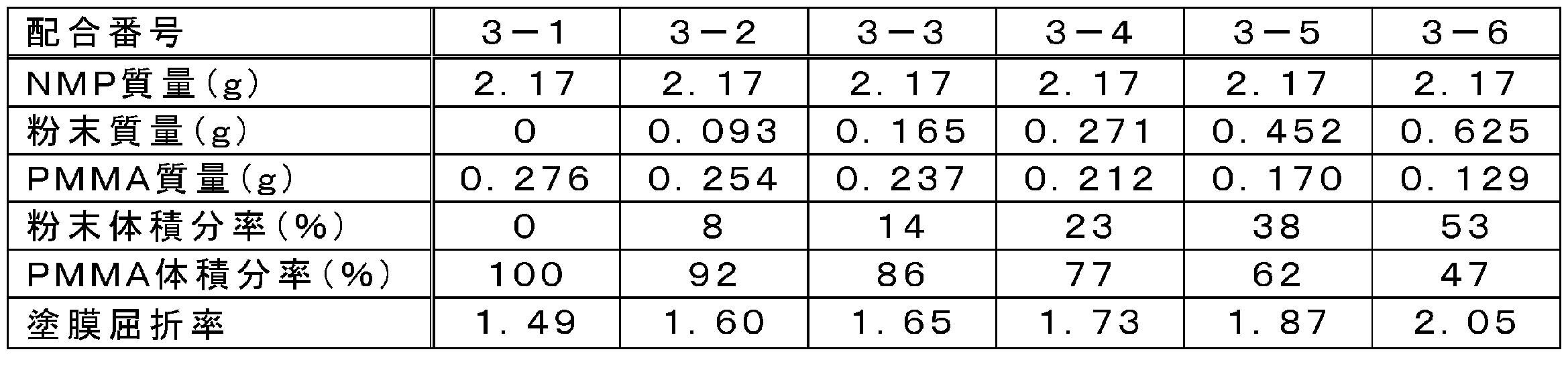
- the refractive index was measured and the refractive index of the strontium titanate powder was calculated to be 2.5.
- formulation number 3-1 is the coating data of a blank consisting only of a matrix.
- Example 4 A flask with a capacity of 200 mL was placed in a glove box replaced with nitrogen gas. About 60 mL of 2-methoxyethanol (manufactured by Wako Pure Chemicals, purity 99% or more) was added to this, and 0.66 g (0.0048 mol) of metal barium (manufactured by Nacalai Tesque, purity 99% or more), metal strontium 0.42 g (0.0048 mol) (manufactured by Kanto Chemical Co., Ltd., purity of 95% or more) and 2.19 g (0.0096 mol) of tetraethoxytitanium (manufactured by Tokyo Chemical Industry, purity 97%) were added.
- 2-methoxyethanol manufactured by Wako Pure Chemicals, purity 99% or more
- metal barium manufactured by Nacalai Tesque, purity 99% or more
- metal strontium 0.42 g (0.0048 mol) manufactured by Kanto Chemical Co., Ltd., purity of 95% or more
- a liquid prepared by adding this barium strontium titanate powder and powdered PMMA to N-methylpyrrolidone at a predetermined ratio shown in Table 4 was prepared, coated, dried and coated in the same manner as in Example 1. Was measured, and the refractive index of the barium strontium titanate powder was calculated to be 2.4.
- the formulation number 4-1 is the coating film data of the plank consisting only of the matrix.
- Example 5 In the same manner as in Example 1, after reacting barium metal, tetraethoxytitanium and water in 2-methoxyethanol with stirring at 70 ° C. for 5 hours, ultrasonic vibration was applied to the liquid for 30 minutes. Thereafter, 0.466 g (0.449 mL) of methacryloxypropyltrimethoxysilane (MPTMS [manufactured by Shin-Etsu Chemical Co., Ltd., KBM-503]), which is a silane coupling agent, was added, and further stirred at 70 ° C. for 1 hour, and barium titanate. The powder was silane coupled.
- MPTMS methacryloxypropyltrimethoxysilane
- Example 4 A liquid in which silane-coupled barium titanate powder and powdered PMMA were added to N-methylpyrrolidone (NMP) at a predetermined ratio shown in Table 4 was used, and then a paint was prepared in the same manner as in Example 1. . It was 2.2, when this was dripped and coated on the silicon wafer base material, and the refractive index of the powder was computed from the refractive index of the measured coating film. The film thickness of the coating film was measured with the same apparatus (Metricon prism coupler, model 2010), and the results are shown in Table 5.
- NMP N-methylpyrrolidone
- the light transmittance of the coating film obtained by coating and drying in the same manner as in Example 1 was measured using a spectrophotometer (manufactured by JASCO Corporation, V-650).
- the absorption coefficient of the coating film was calculated from the measured values of the light transmittance and the film thickness using the formula (1), and the results are shown in Table 5.
- the formulation number 5-1 is the coating data of the blank consisting only of the matrix.
- Comparative Example 1 A separable flask having a capacity of 300 mL was placed in a glove box replaced with nitrogen gas. About 40 mL of ethanol was added thereto, and 1.10 g (0.008 mol) of metal barium and 1.82 g (0.008 mol) of tetraethoxytitanium were added. After the metal barium and tetraethoxytitanium were completely dissolved, the solution was refluxed at 73 ° C. for 2 hours. A mixed solution of 14.2 g (11.2 mL) of ethanol and 28.8 g of water was added to this solution, and the mixture was further reacted by stirring at 70 ° C. for 5 hours.
- the concentration of each component was 0.1 (mol / liter) for barium and tetraethoxytitanium and 20 (mol / liter) for water.
- TEM observation was performed on the precipitate obtained by cooling the liquid after the reaction and centrifuging in the same manner as in Example 1. As a result, the particles were agglomerated and the average particle diameter and the average aspect ratio were measured. It was difficult. Moreover, it was confirmed by powder X-ray diffraction measurement that the precipitate was barium titanate.
- Comparative Example 2 In the same manner as in Comparative Example 1, metal barium, tetraethoxytitanium and water were reacted by stirring in ethanol for 5 hours at 70 ° C., and then ultrasonic vibration was applied to the liquid for 30 minutes, methacryloxypropyltrimethoxy. Silane (MPTMS) 0.558 g (0.561 mL) was added, and the mixture was further stirred at 70 ° C. for 1 hour to subject the reaction product to silane coupling treatment. The liquid after the treatment was cooled and collected, and TEM observation was performed on the precipitate obtained by centrifuging in the same manner as in Example 1. As a result, the particles were aggregated, and the average particle diameter and average It was difficult to measure the aspect ratio.
- MTMS methacryloxypropyltrimethoxy.
- Silane (MPTMS) 0.558 g (0.561 mL) was added, and the mixture was further stirred at 70 ° C. for 1 hour to subject the reaction product to silane
- the high refractive index powder of the present invention and the coating material obtained by dispersing this, the transparent film and the substrate with the transparent film have both high refractive index and high light transmittance, and therefore have excellent optical properties, antireflection materials, It is suitably used as a light collecting material, a lens material, or the like.
Landscapes
- Chemical & Material Sciences (AREA)
- Organic Chemistry (AREA)
- Engineering & Computer Science (AREA)
- Life Sciences & Earth Sciences (AREA)
- Materials Engineering (AREA)
- Wood Science & Technology (AREA)
- Nanotechnology (AREA)
- Inorganic Chemistry (AREA)
- Polymers & Plastics (AREA)
- Medicinal Chemistry (AREA)
- Chemical Kinetics & Catalysis (AREA)
- Health & Medical Sciences (AREA)
- Environmental & Geological Engineering (AREA)
- General Life Sciences & Earth Sciences (AREA)
- Geology (AREA)
- Physics & Mathematics (AREA)
- Condensed Matter Physics & Semiconductors (AREA)
- General Physics & Mathematics (AREA)
- Crystallography & Structural Chemistry (AREA)
- Composite Materials (AREA)
- Inorganic Compounds Of Heavy Metals (AREA)
- Paints Or Removers (AREA)
Abstract
Description
(1)平均粒子径が50nm以下、平均アスペクト比が1.0~1.2、屈折率が1.8~2.6であり、MTiO3(Mは、Ba、Sr、Ca及びMgからなる群より選ばれる1種又は2種以上)で表される化合物からなる、アルカリ土類金属のチタン酸化合物粉末(平均粒子径が50nm以下、平均アスペクト比が1.0~1.2、屈折率が1.8~2.6であるアルカリ土類金属のチタン酸化合物(MTiO3:MはBa、Sr、Ca及びMgからなる群より選ばれた1種又は2種以上)粉末)。
(2)アルカリ土類金属のチタン酸化合物がチタン酸バリウム(BaTiO3)及び/又はチタン酸ストロンチウム(SrTiO3)である前記(1)に記載のアルカリ土類金属のチタン酸化合物粉末。
(3)シランカップリング剤で処理してなる前記(1)又は前記(2)に記載のアルカリ土類金属のチタン酸化合物粉末。
(4)アルコキシ基を有するアルコールに、アルカリ土類金属とアルコキシチタンを添加した後、さらに水を添加する、アルカリ土類金属のチタン酸化合物粉末の製造方法であって、(A)アルカリ土類金属原子と、アルコキシチタンに含まれるチタン原子が等モルであり、(B)水を添加した後における、アルコキシ基を有するアルコール及び水の合計容量を基準とした、各成分の濃度が以下の(i)~(iii)である、(i)アルカリ土類金属:0.05~0.15(モル/リットル)(ii)アルコキシチタン:0.05~0.15(モル/リットル)(iii)水:10~30(モル/リットル)前記(1)~(3)のいずれか1項に記載のアルカリ土類金属のチタン酸化合物粉末を製造する製造方法。
(5)前記(1)~(3)のいずれか1項に記載のアルカリ土類金属のチタン酸化合物粉末と透明被膜形成用マトリックスと溶媒を含有し、アルカリ土類金属のチタン酸化合物粉末と透明被膜形成用マトリックスの合計の体積に対するアルカリ土類金属のチタン酸化合物粉末の体積分率が5~60体積%である透明被膜形成用塗料。
(6)透明被膜形成用マトリックスが、(メタ)アクリル系ポリマー及び/又は(メタ)アクリル系モノマーからなることを特徴とする前記(5)に記載の透明被膜形成用塗料。なお、(メタ)アクリルとは、メタクリル又はアクリルを意味する。
(7)前記(5)又は前記(6)に記載の透明被膜形成用塗料から形成される透明被膜であって、屈折率が1.6~2.2であり、かつ下式(1)で表される吸光係数(α)が0.10(μm-1)以下であることを特徴とする、透明被膜。
α=-2.303×(1/L)×log10(I/Io) 式(1)
ここで、L:塗膜の厚さ(μm)、Io:塗膜に垂直方向の入射光強度、I:塗膜に垂直方向の透過光強度、I/Io:透過率である。
(8)前記(7)に記載の透明被膜が単独で又は他の被膜とともに基材表面上に形成された透明被膜付き基材。
I=Io×exp(-αL) 式(2)
ここで、Ioは入射する前の光の強度、Iは入射後の光の強度、αは吸光係数、Lは媒質内における光路長であり、塗膜の場合は膜厚が該当する。式(2)の両辺をIoで除した後に両辺の対数を取り、さらにその後、両辺を(-L)で除して自然対数から常用対数に変換すると、式(1)が得られる。
α=-2.303×(1/L)×log10(I/Io) 式(1)
式(1)を本発明の被膜に当てはめると、L:被膜の厚さ(μm)、Io:被膜に垂直方向の入射光強度、I:被膜に垂直方向の透過光強度、I/Io:光透過率である。
式(1)から解る通り、塗膜の厚さ(L)が一定の場合は、吸光係数(α)が小さいほど、光透過率(I/Io)が大きくなり、被膜の透明性が向上する。本発明の被膜の吸光係数は、0.10(μm-1)以下(0~0.10(μm-1))であり、例えば厚さ0.1μmの被膜の場合は99%以上、1μmでは90%以上の高い光透過率を有する。
実施例1
窒素ガスで置換したグローブボックス中に、容量300mLのセパラブルフラスコを配した。これに2-メトキシエタノール(和光純薬製、純度99%以上)を約50mLを入れ、さらに金属バリウム(関東化学製、純度99%以上)を1.32g(0.0096モル)、テトラエトキシチタン(東京化成工業製、純度97%)を2.19g(0.0096モル)加えた。金属バリウムとテトラエトキシチタンが完全に溶解した後、この液を2時間還流し、70℃に保った恒温槽内で撹拌しながら、水(蒸留水)32.4g(1.8モル)を2-メトキシエタノールで希釈した液を、全液量が120mLになるよう、2-メトキシエタノールの量を調整して加えた。この時の各成分の濃度は、バリウム及びテトラエトキシチタンが各々0.08(モル/リットル)、水が15(モル/リットル)であった。撹拌を5時間継続して反応させた後、この液を冷却して38,000Gの遠心加速度を加えて30分間遠心分離を行ったところ、沈殿物が得られた。沈殿物の一部をイソプロピルアルコール(和光純薬製、純度99.9%)中に分散させて微細試料捕集用の膜(コロジオン膜)上に滴下、乾燥後、透過型電子顕微鏡(TEM)観察に供した。TEM観察は日本電子製の透過型電子顕微鏡、2000FXを用い、加速電圧200kV、観察倍率20万倍の条件にて実施した。
なお、表1の配合番号1-1は、マトリックスのみからなるブランクの塗膜データである。

実施例1の金属バリウムに代えて、金属ストロンチウム(Aldrich社製、純度99%)0.841g(0.0096モル)を用いた他は、実施例1と同様にして反応を行ったところ、沈殿物が得られた。沈殿物の一部をイソプロピルアルコール中に分散させ、実施例1と同様にTEM観察を実施したところ、粒子径50nm以下で、多角形状で等方的なTEM像を有する粒子の生成が確認された。100個の粒子像に対し、実施例1と同様に平均粒子径及び平均アスペクト比を求めたところ、10.2nm及び1.02であった。次いで実施例1と同様に粉末X線回折測定を行い、反応生成物(沈殿物)がチタン酸ストロンチウム粉末であることを確認した。
なお、表2の配合番号2-1は、マトリックスのみからなるブランクの塗膜データである。
水の濃度を20(モル/リットル)とした他は、実施例2と同様にして、実施例2と同様にして反応を行ったところ、沈殿物が得られた。沈殿物の一部をイソプロピルアルコール中に分散させ、実施例2と同様にTEM観察を実施したところ、粒子径50nm以下で、多角形状で等方的なTEM像を有する粒子の生成が確認された。100個の粒子像に対し、実施例1と同様に平均粒子径及び平均アスペクト比を求めたところ、43.2nm及び1.12であった。次いで実施例2と同様に粉末X線回折測定を行い、反応生成物(沈殿物)がチタン酸ストロンチウム粉末であることを確認した。
なお、表3の配合番号3-1は、マトリックスのみからなるブランクの塗膜データである。
窒素ガスで置換したグローブボックス中に、容量200mLのフラスコを配した。これに2-メトキシエタノール(和光純薬製、純度99%以上)を約60mLを入れ、さらに金属バリウム(ナカライテスク社製、純度99%以上)を0.66g(0.0048モル)、金属ストロンチウム(関東化学製、純度95%以上)を0.42g(0.0048モル)、テトラエトキシチタン(東京化成工業製、純度97%)を2.19g(0.0096モル)加えた。金属バリウム、金属ストロンチウム及びテトラエトキシチタンが完全に溶解した後、この液を2時間還流し、70℃に保った恒温槽内で撹拌しながら、水(蒸留水)32.4g(1.8モル)を2-メトキシエタノールで希釈した液を、全液量が120mLになるよう、2-メトキシエタノールの量を調整して加えた。この時の各成分の濃度は、バリウム及びストロンチウムがそれぞれ0.04(モル/リットル)、テトラエトキシチタンが0.08(モル/リットル)、水が15(モル/リットル)であった。
その後は実施例1と同様にして撹拌を継続して反応させた後、冷却して遠心分離を行い、沈殿物を得た。この一部を実施例1と同様にして透過型電子顕微鏡(TEM)観察に供した。
なお、表4の配合番号4-1は、マトリックスのみからなるプランクの塗膜データである。

実施例1と同様にして、2-メトキシエタノール中で金属バリウムとテトラエトキシチタン及び水を、70℃で撹拌を5時間継続して反応させた後、液に超音波振動を30分間印加した。その後シランカップリング剤であるメタクリロキシプロピルトリメトキシシラン(MPTMS[信越化学製、KBM-503])0.466g(0.449mL)を加えて、さらに70℃で撹拌を1時間行い、チタン酸バリウム粉末をシランカップリング処理した。シランカップリング処理したチタン酸バリウム粉末と、粉末状のPMMAを表4に示す所定の割合でN-メチルピロリドン(NMP)に添加した液を、その後は実施例1と同様にして塗料を作製した。これをシリコンウェハー基材上に滴下して塗工し、測定した塗膜の屈折率から粉末の屈折率を算出したところ、2.2であった。塗膜の膜厚を同じ装置(Metricon社製プリズムカプラー、モデル2010)で測定し、結果を表5に示した。また、塗料をガラス基板上に滴下した後、実施例1と同様にして塗工、乾燥して得た塗膜の光透過率を、分光光度計(日本分光製、V-650)を用いて測定し、光透過率と膜厚の測定値から、式(1)を用いて塗膜の吸光係数を算出し、表5に示した。
なお、表5の配合番号5-1は、マトリックスのみからなるブランクの塗膜データである。

窒素ガスで置換したグローブボックスに、容量300mLのセパラブルフラスコを配した。これにエタノールを約40mL入れ、さらに金属バリウム1.10g(0.008モル)、テトラエトキシチタンを1.82g(0.008モル)加えた。金属バリウムとテトラエトキシチタンが完全に溶解した後、この液を73℃で2時間還流した。この液にエタノール14.2g(11.2mL)と、水28.8gの混合溶液を加え、さらに70℃で5時間、撹拌して反応させた。各成分の濃度は、バリウム及びテトラエトキシチタンが0.1(モル/リットル)、水が20(モル/リットル)であった。
反応後の液を冷却して実施例1と同様にして遠心分離を行って得た沈殿物に対し、TEM観察を行ったところ、粒子が凝集しており、平均粒子径および平均アスペクト比の測定が困難であった。また粉末X線回折測定によって沈殿物がチタン酸バリウムであることを確認した。
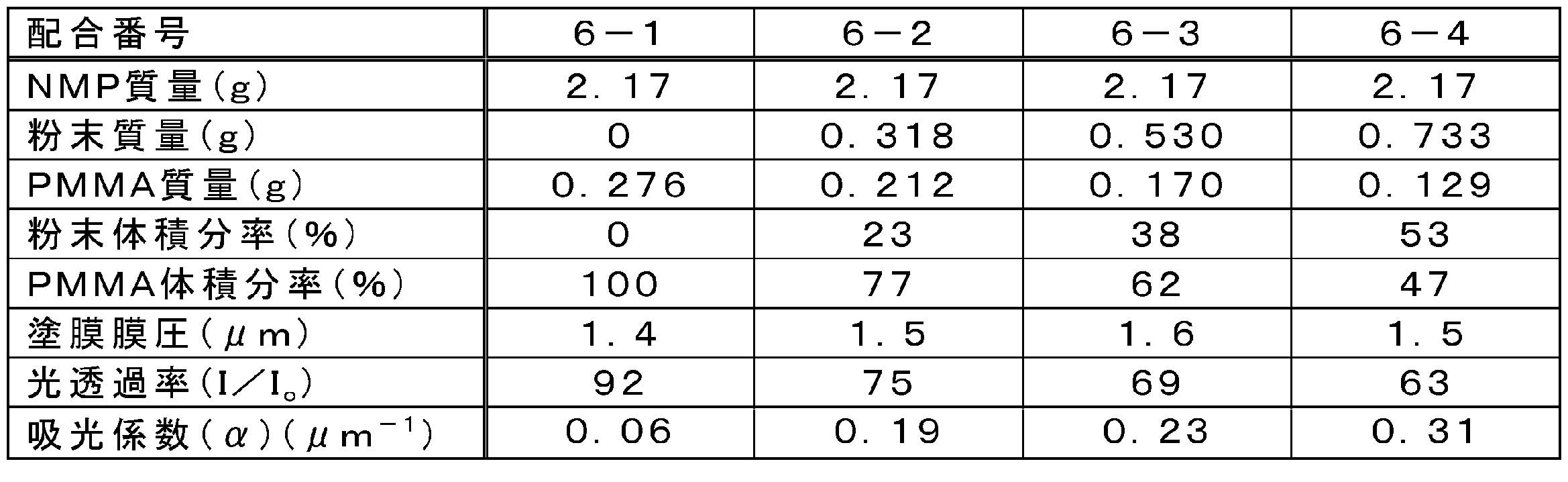
比較例1と同様にして金属バリウム、テトラエトキシチタン及び水を、70℃で5時間、エタノール中で撹拌して反応させた後、液に超音波振動を30分間印加し、メタクリロキシプロピルトリメトキシシラン(MPTMS)0.558g(0.561mL)を加えて、さらに70℃で撹拌を1時間行い、反応物をシランカップリング処理した。処理後の液を冷却して分取し、実施例1と同様にして遠心分離を行って得た沈殿物に対し、TEM観察を行ったところ、粒子が凝集しており、平均粒子径および平均アスペクト比の測定が困難であった。また粉末X線回折測定によって沈殿物がチタン酸バリウムであることを確認した。残りの処理後チタン酸バリウム粉末と、粉末状のPMMAを表5に示す所定の割合でNMPに添加した液を用い、その後は実施例1と同様にして塗料を作製した。これをガラス基板上に滴下した後、実施例4と同様にして塗工、乾燥して得た塗膜の光透過率を、分光光度計(日本分光製、V-650)を用いて測定し、光透過率と膜厚の測定値から、式(1)を用いて塗膜の吸光係数を算出し、表6に示した。
なお、表6の配合番号6-1は、マトリックスのみからなるブランクの塗膜データである。
Claims (8)
- 平均粒子径が50nm以下、平均アスペクト比が1.0~1.2、屈折率が1.8~2.6であり、MTiO3(Mは、Ba、Sr、Ca及びMgからなる群より選ばれる1種又は2種以上)で表される化合物からなる、アルカリ土類金属のチタン酸化合物粉末。
- MTiO3で表される化合物は、チタン酸バリウム[BaTiO3]、チタン酸ストロンチウム[SrTiO3]及びチタン酸バリウムストロンチウム[(BaxSr1-x)TiO3、xは0を超え1未満の数]の少なくとも1種である請求項1に記載のアルカリ土類金属のチタン酸化合物粉末。
- シランカップリング剤で表面処理してなる請求項1又は2に記載のアルカリ土類金属のチタン酸化合物粉末。
- アルコキシ基を有するアルコールに、アルカリ土類金属とアルコキシチタンを添加した後、さらに水を添加する、アルカリ土類金属のチタン酸化合物粉末の製造方法であって、(A)アルカリ土類金属原子と、アルコキシチタンに含まれるチタン原子が等モルであり、(B)水を添加した後における、アルコキシ基を有するアルコール及び水の合計容量を基準とした、各成分の濃度が以下の(i)~(iii)である、
(i)アルカリ土類金属:0.05~0.15(モル/リットル)
(ii)アルコキシチタン:0.05~0.15(モル/リットル)
(iii)水:10~30(モル/リットル)
請求項1~3のいずれか1項に記載のアルカリ土類金属のチタン酸化合物粉末を製造する製造方法。 - 請求項1~3のいずれか1項に記載のアルカリ土類金属のチタン酸化合物粉末と透明被膜形成用マトリックスと溶媒を含有し、アルカリ土類金属のチタン酸化合物粉末と透明被膜形成用マトリックスの合計の体積に対するアルカリ土類金属のチタン酸化合物粉末の体積分率が5~60体積%である透明被膜形成用塗料。
- 透明被膜形成用マトリックスが、(メタ)アクリル系ポリマー及び/又は(メタ)アクリル系モノマーからなる請求項5に記載の透明被膜形成用塗料。
- 請求項5又は請求項6に記載の透明被膜形成用塗料から形成される透明被膜であって、屈折率が1.6~2.2であり、かつ下式(1)で表される吸光係数(α)が0.10(μm-1)以下であることを特徴とする透明被膜。
α=-2.303×(1/L)×log10(I/Io) 式(1)
[ここで、L:塗膜の厚さ(μm)、Io:塗膜に垂直方向の入射光強度、I:塗膜に垂直方向の透過光強度、I/Io:透過率である。] - 請求項7に記載の透明被膜が、単独で又は他の被膜とともに基材表面上に形成された透明被膜付き基材。
Priority Applications (3)
| Application Number | Priority Date | Filing Date | Title |
|---|---|---|---|
| CN201080030742.9A CN102471085B (zh) | 2009-07-09 | 2010-06-30 | 高折射率粉末、其制造方法及用途 |
| US13/382,256 US20120141780A1 (en) | 2009-07-09 | 2010-06-30 | High-Refractive Index Powder and Production Method and Application of Same |
| JP2011521894A JP5717252B2 (ja) | 2009-07-09 | 2010-06-30 | 高屈折率粉末、その製造方法及び用途 |
Applications Claiming Priority (4)
| Application Number | Priority Date | Filing Date | Title |
|---|---|---|---|
| JP2009-162278 | 2009-07-09 | ||
| JP2009162278 | 2009-07-09 | ||
| JP2010029133 | 2010-02-12 | ||
| JP2010-029133 | 2010-02-12 |
Publications (1)
| Publication Number | Publication Date |
|---|---|
| WO2011004750A1 true WO2011004750A1 (ja) | 2011-01-13 |
Family
ID=43429172
Family Applications (1)
| Application Number | Title | Priority Date | Filing Date |
|---|---|---|---|
| PCT/JP2010/061173 Ceased WO2011004750A1 (ja) | 2009-07-09 | 2010-06-30 | 高屈折率粉末、その製造方法及び用途 |
Country Status (6)
| Country | Link |
|---|---|
| US (1) | US20120141780A1 (ja) |
| JP (1) | JP5717252B2 (ja) |
| KR (1) | KR101587933B1 (ja) |
| CN (1) | CN102471085B (ja) |
| TW (1) | TW201114690A (ja) |
| WO (1) | WO2011004750A1 (ja) |
Cited By (7)
| Publication number | Priority date | Publication date | Assignee | Title |
|---|---|---|---|---|
| JP2014058417A (ja) * | 2012-09-14 | 2014-04-03 | Asahi Kasei E-Materials Corp | アルカリ土類金属原子チタン酸化物分散液の製造方法 |
| WO2015019758A1 (ja) * | 2013-08-09 | 2015-02-12 | 横浜ゴム株式会社 | 屈折率調整用コート材組成物及びその積層体 |
| JP2016040348A (ja) * | 2014-08-12 | 2016-03-24 | Jsr株式会社 | 樹脂組成物、および発光素子 |
| GB2566975A (en) * | 2017-09-29 | 2019-04-03 | De La Rue Int Ltd | Security Device And Method Of Manufacture Thereof |
| KR20230075394A (ko) | 2020-09-30 | 2023-05-31 | 사카타 인쿠스 가부시키가이샤 | 티탄산스트론튬 미립자 |
| KR20230075395A (ko) | 2020-09-30 | 2023-05-31 | 사카타 인쿠스 가부시키가이샤 | 티탄산 스트론튬 미립자의 제조 방법 |
| EP4660143A1 (en) | 2023-01-30 | 2025-12-10 | Toda Kogyo Corp. | Powder of fine barium strontium titanate particles, production method therefor, dispersion, and resin composition |
Families Citing this family (6)
| Publication number | Priority date | Publication date | Assignee | Title |
|---|---|---|---|---|
| WO2015190556A1 (ja) * | 2014-06-13 | 2015-12-17 | 戸田工業株式会社 | チタン酸バリウム微粒子粉末、分散体及び塗膜 |
| CN107236346A (zh) * | 2017-06-16 | 2017-10-10 | 凤台精兴生物科技有限公司 | 一种防辐射保温涂料的制备方法 |
| CA3075792C (en) | 2017-09-15 | 2022-10-04 | Asahi Kasei Kabushiki Kaisha | Metal particle annular structure, insulator-coated metal particle annular structure, and composition |
| CN110082313B (zh) * | 2019-04-22 | 2021-08-20 | 天津大学 | 一种基于棱镜耦合仪的微纳材料折射率测量方法 |
| GB201911133D0 (en) * | 2019-08-05 | 2019-09-18 | Qinetiq Ltd | Materials and methods |
| CN110643129A (zh) * | 2019-09-20 | 2020-01-03 | 西安理工大学 | 一种聚合物-陶瓷复合电介质储能材料及其制备方法 |
Citations (3)
| Publication number | Priority date | Publication date | Assignee | Title |
|---|---|---|---|---|
| JP2001139847A (ja) * | 1999-11-12 | 2001-05-22 | Dainippon Toryo Co Ltd | 活性エネルギー線硬化性塗料組成物 |
| JP2003049092A (ja) * | 2001-08-03 | 2003-02-21 | Hitachi Chem Co Ltd | 充填剤、樹脂組成物およびその利用 |
| JP2006327889A (ja) * | 2005-05-27 | 2006-12-07 | Kyocera Corp | チタン酸バリウム粉末の製法およびチタン酸バリウム粉末 |
Family Cites Families (12)
| Publication number | Priority date | Publication date | Assignee | Title |
|---|---|---|---|---|
| FR2617151B1 (fr) | 1987-06-29 | 1990-10-12 | Solvay | Procede pour la fabrication d'une poudre d'oxydes metalliques mixtes, et poudres d'oxydes metalliques mixtes |
| JPH08239216A (ja) | 1995-03-02 | 1996-09-17 | Makoto Kuwabara | チタン酸バリウム前駆体組成物及び微小粒径焼結体の 製造方法 |
| JP2002275390A (ja) | 2001-03-15 | 2002-09-25 | Fukuoka Prefecture | 結晶性ゲル分散コーティング溶液及び結晶性ゲル分散コーティング溶液を用いた薄膜形成方法 |
| JP2004018311A (ja) | 2002-06-17 | 2004-01-22 | Mitsui Chemicals Inc | アモルファス酸化ジルコニウムで被覆された酸化チタン超微粒子およびその製造方法 |
| JP2005075714A (ja) | 2003-09-03 | 2005-03-24 | Jsr Corp | ペロブスカイト型結晶粒子の製造方法 |
| US20070202036A1 (en) * | 2004-04-07 | 2007-08-30 | Nathalie Jongen | Production Of Barium Titanate Compounds |
| JP4411483B2 (ja) | 2004-04-23 | 2010-02-10 | 福岡県 | チタン酸バリウム粉末の製造方法 |
| CN101006016A (zh) | 2004-08-26 | 2007-07-25 | 三井化学株式会社 | 金红石型氧化钛超微粒子 |
| JP2006273209A (ja) | 2005-03-30 | 2006-10-12 | Daihatsu Motor Co Ltd | 自動車における芳香装置 |
| JP5604735B2 (ja) | 2007-03-19 | 2014-10-15 | 国立大学法人山梨大学 | 立方体形状ナノ粒子およびその製造方法 |
| CN101348938A (zh) * | 2008-09-02 | 2009-01-21 | 济南大学 | 纳米钛酸钡粉体的制备方法 |
| WO2013047786A1 (ja) * | 2011-09-30 | 2013-04-04 | 日本化成株式会社 | 重合性無機粒子分散剤、該重合性無機粒子分散剤を含む無機有機複合粒子、および無機有機樹脂複合材 |
-
2010
- 2010-06-30 JP JP2011521894A patent/JP5717252B2/ja not_active Expired - Fee Related
- 2010-06-30 CN CN201080030742.9A patent/CN102471085B/zh active Active
- 2010-06-30 WO PCT/JP2010/061173 patent/WO2011004750A1/ja not_active Ceased
- 2010-06-30 KR KR1020127001369A patent/KR101587933B1/ko not_active Expired - Fee Related
- 2010-06-30 US US13/382,256 patent/US20120141780A1/en not_active Abandoned
- 2010-07-07 TW TW099122274A patent/TW201114690A/zh unknown
Patent Citations (3)
| Publication number | Priority date | Publication date | Assignee | Title |
|---|---|---|---|---|
| JP2001139847A (ja) * | 1999-11-12 | 2001-05-22 | Dainippon Toryo Co Ltd | 活性エネルギー線硬化性塗料組成物 |
| JP2003049092A (ja) * | 2001-08-03 | 2003-02-21 | Hitachi Chem Co Ltd | 充填剤、樹脂組成物およびその利用 |
| JP2006327889A (ja) * | 2005-05-27 | 2006-12-07 | Kyocera Corp | チタン酸バリウム粉末の製法およびチタン酸バリウム粉末 |
Non-Patent Citations (1)
| Title |
|---|
| Y.KOBAYASHI ET AL.: "Fabrication of Barium Titanate Nanoparticles-Polymethylmethancrylate Composite Films and Their Dielectric Properties", POLYMER ENGINEERING AND SCIENCE, vol. 49, June 2009 (2009-06-01), pages 1069 - 1075 * |
Cited By (9)
| Publication number | Priority date | Publication date | Assignee | Title |
|---|---|---|---|---|
| JP2014058417A (ja) * | 2012-09-14 | 2014-04-03 | Asahi Kasei E-Materials Corp | アルカリ土類金属原子チタン酸化物分散液の製造方法 |
| WO2015019758A1 (ja) * | 2013-08-09 | 2015-02-12 | 横浜ゴム株式会社 | 屈折率調整用コート材組成物及びその積層体 |
| JP2016040348A (ja) * | 2014-08-12 | 2016-03-24 | Jsr株式会社 | 樹脂組成物、および発光素子 |
| GB2566975A (en) * | 2017-09-29 | 2019-04-03 | De La Rue Int Ltd | Security Device And Method Of Manufacture Thereof |
| GB2566975B (en) * | 2017-09-29 | 2020-03-25 | De La Rue Int Ltd | Security Device And Method Of Manufacture Thereof |
| US11207910B2 (en) | 2017-09-29 | 2021-12-28 | De La Rue International Limited | Security device and method of manufacture thereof |
| KR20230075394A (ko) | 2020-09-30 | 2023-05-31 | 사카타 인쿠스 가부시키가이샤 | 티탄산스트론튬 미립자 |
| KR20230075395A (ko) | 2020-09-30 | 2023-05-31 | 사카타 인쿠스 가부시키가이샤 | 티탄산 스트론튬 미립자의 제조 방법 |
| EP4660143A1 (en) | 2023-01-30 | 2025-12-10 | Toda Kogyo Corp. | Powder of fine barium strontium titanate particles, production method therefor, dispersion, and resin composition |
Also Published As
| Publication number | Publication date |
|---|---|
| KR20120084707A (ko) | 2012-07-30 |
| CN102471085B (zh) | 2014-04-16 |
| KR101587933B1 (ko) | 2016-01-22 |
| JPWO2011004750A1 (ja) | 2012-12-20 |
| CN102471085A (zh) | 2012-05-23 |
| TW201114690A (en) | 2011-05-01 |
| JP5717252B2 (ja) | 2015-05-13 |
| US20120141780A1 (en) | 2012-06-07 |
Similar Documents
| Publication | Publication Date | Title |
|---|---|---|
| JP5717252B2 (ja) | 高屈折率粉末、その製造方法及び用途 | |
| JP4279465B2 (ja) | 透明な金属酸化物のコロイド及びセラマーを製造するためのナノサイズ金属酸化物の粒子 | |
| TWI439419B (zh) | 球狀核殼型氧化鈰/高分子混合奈米粒子的聚積體及其製造方法 | |
| EP3725855B1 (en) | Coating composition containing silane compound containing nitrogen-containing ring | |
| CN113166343B (zh) | 反应性有机硅组合物及其固化物 | |
| CN109071258A (zh) | 结合有两亲性有机硅烷化合物的无机氧化物微粒、其有机溶剂分散液以及被膜形成用组合物 | |
| JP6959290B2 (ja) | 単斜晶ジルコニア系ナノ粒子及びその製造方法 | |
| Chang et al. | Preparation and characterization of TiO2 hybrid sol for UV-curable high-refractive-index organic–inorganic hybrid thin films | |
| JP2010077280A (ja) | 有機無機複合材料とその成形体、光学部品およびレンズ | |
| WO2022210973A1 (ja) | ルチル型の結晶構造を有する粒子およびその製造方法、並びに粒子の分散液、塗布液、膜付基材の製造方法 | |
| JP4655614B2 (ja) | フッ化マグネシウム粒子のオルガノゾルとその製造方法、およびそれを用いた塗料 | |
| JP2019172526A (ja) | チタニアナノ粒子及びそれを用いた紫外線遮蔽材 | |
| JP7637536B2 (ja) | 表面処理金属酸化物粒子の分散液及びその製造方法 | |
| JP7827859B2 (ja) | 高分子化合物とその応用 | |
| JP7429137B2 (ja) | シリカ-チタニア複合酸化物粒子の製造方法及びシリカ-チタニア複合酸化物粒子 | |
| TW202003724A (zh) | 無機氧化物分散體、塗料、塗膜及膜 | |
| JP6961775B2 (ja) | 光学膜 | |
| Chang et al. | TiO2 nanoparticles synthesized in an aprotic solvent and applied to prepare high-refractive-index TiO2-polyimide hybrid thin films | |
| JP6818433B2 (ja) | トリフルオロ酢酸マグネシウムゾル溶液 | |
| JP6768346B2 (ja) | 光学膜 | |
| JP2023074970A (ja) | 官能基と珪素を含む外殻と、その内側に空洞を有する粒子の分散液及びその製造方法 | |
| EP4660142A1 (en) | Surface-treated spherical strontium titanate particulate powder, dispersion, and resin composition | |
| WO2024161873A1 (ja) | 球状チタン酸ストロンチウム微粒子粉末を含む分散体及びその製造方法 | |
| JP2025150472A (ja) | 酸化チタン粒子、分散液、塗料組成物、塗膜および塗膜付基材 | |
| JP2024052629A (ja) | ルチル型の結晶構造を有する粒子およびその製造方法、並びに粒子の分散液、塗布液、膜付基材の製造方法 |
Legal Events
| Date | Code | Title | Description |
|---|---|---|---|
| WWE | Wipo information: entry into national phase |
Ref document number: 201080030742.9 Country of ref document: CN |
|
| 121 | Ep: the epo has been informed by wipo that ep was designated in this application |
Ref document number: 10797061 Country of ref document: EP Kind code of ref document: A1 |
|
| WWE | Wipo information: entry into national phase |
Ref document number: 2011521894 Country of ref document: JP |
|
| NENP | Non-entry into the national phase |
Ref country code: DE |
|
| ENP | Entry into the national phase |
Ref document number: 20127001369 Country of ref document: KR Kind code of ref document: A |
|
| WWE | Wipo information: entry into national phase |
Ref document number: 13382256 Country of ref document: US |
|
| 122 | Ep: pct application non-entry in european phase |
Ref document number: 10797061 Country of ref document: EP Kind code of ref document: A1 |