WO2010131456A1 - 米飯改良剤、それを用いた米飯食品および米飯食品の製造方法 - Google Patents
米飯改良剤、それを用いた米飯食品および米飯食品の製造方法 Download PDFInfo
- Publication number
- WO2010131456A1 WO2010131456A1 PCT/JP2010/003184 JP2010003184W WO2010131456A1 WO 2010131456 A1 WO2010131456 A1 WO 2010131456A1 JP 2010003184 W JP2010003184 W JP 2010003184W WO 2010131456 A1 WO2010131456 A1 WO 2010131456A1
- Authority
- WO
- WIPO (PCT)
- Prior art keywords
- cooked rice
- rice
- starch
- acid
- treated
- Prior art date
- Legal status (The legal status is an assumption and is not a legal conclusion. Google has not performed a legal analysis and makes no representation as to the accuracy of the status listed.)
- Ceased
Links
Classifications
-
- A—HUMAN NECESSITIES
- A23—FOODS OR FOODSTUFFS; TREATMENT THEREOF, NOT COVERED BY OTHER CLASSES
- A23L—FOODS, FOODSTUFFS OR NON-ALCOHOLIC BEVERAGES, NOT OTHERWISE PROVIDED FOR; PREPARATION OR TREATMENT THEREOF
- A23L7/00—Cereal-derived products; Malt products; Preparation or treatment thereof
- A23L7/10—Cereal-derived products
- A23L7/196—Products in which the original granular shape is maintained, e.g. parboiled rice
-
- A—HUMAN NECESSITIES
- A23—FOODS OR FOODSTUFFS; TREATMENT THEREOF, NOT COVERED BY OTHER CLASSES
- A23L—FOODS, FOODSTUFFS OR NON-ALCOHOLIC BEVERAGES, NOT OTHERWISE PROVIDED FOR; PREPARATION OR TREATMENT THEREOF
- A23L29/00—Foods or foodstuffs containing additives; Preparation or treatment thereof
- A23L29/20—Foods or foodstuffs containing additives; Preparation or treatment thereof containing gelling or thickening agents
- A23L29/206—Foods or foodstuffs containing additives; Preparation or treatment thereof containing gelling or thickening agents of vegetable origin
- A23L29/212—Starch; Modified starch; Starch derivatives, e.g. esters or ethers
- A23L29/219—Chemically modified starch; Reaction or complexation products of starch with other chemicals
Definitions
- the present invention relates to a cooked rice improving agent, cooked rice food using the cooked rice, and a method for producing cooked rice food.
- rice suitable for Japanese taste rice typified by japonica varieties with moderate gloss and stickiness is used. This gloss and stickiness are mainly caused by the amylopectin content in rice, and Koshihikari and Sasanishiki, which have a relatively high amylopectin content, are suitable for Japanese taste.
- the cooked rice blended with fats and oils sometimes felt oily when the amount of fats and oils added was too large. Furthermore, when the fats and oils which mix
- Patent Documents 1 to 4 Japanese Patent Laid-Open Nos. 2000-41598, 09-75022, and Heihei
- Japanese Patent Laid-Open No. 2000-236825 disclose that a starch-decomposed product that is soluble in cold water at room temperature represented by dextrin and cyclic starch is added before cooking rice.
- Patent Document 5 Japanese Patent Application Laid-Open No. 2004-201617 describes a rice cooker using a starch decomposition product having a DE (Dextrose® Equivalent) smaller than 2 and an oligosaccharide in combination.
- Patent Document 6 Japanese Patent Application Laid-Open No. 2008-92945 discloses a modified rice cooker that has an effect of improving the taste and flavor by processing starch into a granular shape to uniformly disperse it, improve the gloss and stickiness of rice. A quality agent is described.
- Patent Document 7 Japanese Patent Application Laid-Open No. 2002-65184 describes that processed starch that has been subjected to an ether reaction and / or oxidation treatment is added during rice cooking to improve mechanical properties such as separation of the cooked rice and loosening. Has been.
- JP 2000-41598 A Japanese Patent Application Laid-Open No. 09-75022 Japanese Patent Application Laid-Open No. 07-135914 JP 2000-236825 A JP 2004-201617 A JP 2008-92945 A JP 2002-65184 A
- the dextrin used in Patent Documents 1 to 4 is a normal temperature in which starch is hydrolyzed with acid or enzyme, decolorized and purified, and dried by various drying means such as spray drying, drum dry drying, freeze drying and the like. It is a cold water soluble starch degradation product. Addition of such a low molecular weight starch decomposition product to cooked rice shows a certain degree of loosening improvement effect, but the loosening effect is still not sufficient. In addition, there was room for improvement in terms of the effect of improving the glossiness and stickiness, which is the original taste of cooked rice.
- the present invention provides a cooked rice improving agent that can provide high quality cooked rice that is easily loosened while maintaining the gloss and stickiness of cooked rice.
- a cooked rice improver comprising a gelatinized processed product of acid-treated waxy seed starch or a gelatinized treated product of oxidized waxy seed starch, the cold water solubility of the cooked rice improver in pure water at 25 ° C. being 50 %, And the content of the granular material on the sieve having an opening of 0.5 mm (32 mesh) in the cooked rice improver is less than 5% by weight, and the acid-treated waxy seed starch for the cooked rice improver as a whole And the rice content improving agent whose sum total of content of the said oxidation treatment waxy seed starch is 50 weight% or more.
- the acid-treated or oxidized waxy seed starch is included in a specific ratio, and has a specific cold water solubility, The looseness can be improved while maintaining gloss and stickiness.
- the present invention also provides: A cooked rice improving agent comprising acid-treated waxy seed starch or oxidized waxy seed starch, wherein the content of the granular material on the sieve having an opening of 0.5 mm (32 mesh) in the cooked rice improving agent is 5% by weight or more.
- the total amount of the acid-treated waxy seed starch and the oxidized waxy seed starch in the whole cooked rice improver is more than 80% by weight.
- this invention was cooked with the manufacturing method of the cooked rice food, and the said manufacturing method including the process of adding 0.5 to 10weight% or less of the cooked rice improving agent in the said invention with respect to rice. It is a cooked rice food.
- the present invention includes a method for improving cooked rice, in which the rice cooker according to the present invention is added in an amount of 0.5 wt% to 10 wt% with respect to rice.
- the looseness of the cooked rice can be improved while maintaining the gloss and stickiness of the cooked rice.
- the rice cooker in the present invention is solubilized or granulated in cold water so that it can easily disperse the acid-treated or oxidized waxy seed starch having both an excellent loosening effect and glossiness-modifying effect in rice cooking. By forming into a product, a remarkable effect of improving cooked rice is realized.
- the technical significance of the above configuration will be described below.
- the starch used in the cooked rice improving agent of the present invention is waxy seed starch that has been acid-treated or oxidized.
- Waxy seed starch refers to substantially 100% amylopectin starch, and specific examples include waxy corn starch, glutinous rice starch, waxy potato starch and other waxy seed starches.
- the waxy seed starch referred to here may be unprocessed or processed, and for example, etherification, esterification, crosslinking, and combinations of these processes can be used.
- the acid-treated waxy seed starch or the oxidized waxy seed starch is obtained by acid treatment or oxidation treatment using the waxy seed starch as a raw material. In the present specification, these are collectively referred to as “acid-treated or oxidized-treated waxy seed starch”.
- the method for producing acid-treated starch in the present invention is not particularly limited as long as it is a generally known method, but specifically, it is a dilute solution such as hydrochloric acid or sulfuric acid having a concentration of 0.5 to 10% with respect to starch (in terms of dry matter).
- a dilute solution such as hydrochloric acid or sulfuric acid having a concentration of 0.5 to 10% with respect to starch (in terms of dry matter).
- the non-crystalline part of the starch particles is decomposed by the acid and is easily gelatinized, but the viscosity of the paste liquid is low.
- oxidation-treated starch is specifically processed starch obtained by reacting starch and sodium hypochlorite in an alkaline solution. Introduction of a carboxyl group or carbonyl group into the starch molecule occurs, and the starch chain is further broken. As a result, the viscosity of the paste liquid decreases.
- the oxidation treatment conditions are not particularly limited as long as they are generally known. Specifically, sodium hypochlorite having an effective chlorine concentration of about 10% is adjusted to pH 8-11 and the temperature is adjusted to 40-60 ° C. It is dropped into the starch suspension and reacted for 30 minutes to 4 hours.
- the viscosity measured by a B-type viscometer of a 30% by weight aqueous solution of the gelatinized processed product of acid-treated waxy seed starch and oxidized waxy seed starch is set to, for example, 35 cps or more and 15000 cps or less at 40 ° C. and 30 rpm.
- the starch paste viscosity decreases as the reaction proceeds. From the viewpoint of the balance between the improvement of stickiness and looseness of cooked rice, a 30% suspension of starch is held in a 95 ° C water bath with stirring for 30 minutes, fully gelatinized, and then at 40 ° C for 1 hour.
- the viscosity of the acid-treated or oxidized starch (B-type viscosity of a 30% by weight aqueous solution at 40 ° C.) measured by a B-type viscometer (for example, manufactured by Tokyo Keiki Co., Ltd.) is 35 cps or more, for example. 1,000 cps or less, preferably 35 cps or more and 10,000 cps or less, more preferably 35 cps or more and 5,000 cps or less, and even more preferably 200 cps or more and 5,000 cps or less. If the starch has a too high viscosity, the rice will be excessively sticky, and the loosening effect may not be sufficiently obtained.
- the viscosity measured by a B-type viscometer is also referred to as “B-type viscosity”.
- the acid-treated or oxidized waxy seed starch maintains the crystal structure as starch and is insoluble in cold water as it is.
- a dextrin or starch decomposition product is a product obtained by hydrolyzing starch with acid or enzyme until it is soluble in cold water. Therefore, acid-treated and oxidized waxy seed starch and starch hydrolyzed with acid or enzyme are clearly different in terms of solubility in cold water.
- the acid-treated or oxidized-treated waxy seed starch is pregelatinized and blended in the cooked rice improver.
- a raw material containing acid-treated or oxidized waxy seed starch is processed into granules of a specific size to obtain a cooked rice improver.
- the non-gelatinized starch is not processed into a granular form and is added as it is just before cooking, only the starch precipitates on the bottom of the rice during cooking, gelatinizes, increases the viscosity, and generates uniform heat. Prevent convection. As a result, the rice located in the upper part of the rice cooker becomes a cooked rice with a core. On the other hand, the rice located in the lower part of the rice cooker becomes sticky rice with the rice grains being crushed. In addition, many so-called oblate layers are generated at the bottom of the pot, resulting in a decrease in the yield of cooked rice, the cause of kogation, and the trouble of cleaning.
- the acid-treated or oxidized-treated waxy seed starch is preliminarily gelatinized and blended, or the cooked rice improving agent is processed into granules of a specific size.
- the dispersibility at the time of rice cooking can be improved.
- the rice cooker of each form is demonstrated.
- the cooked rice improving agent in the present embodiment includes a gelatinized processed product of acid-treated waxy seed starch or a gelatinized processed product of oxidized waxy seed starch, and the acid-treated waxy seed starch or oxidized waxy seed starch of the whole cooked rice improving agent.
- the total content is 50% by weight or more.
- the cold-water solubility of the cooked rice improving agent in 25 degreeC pure water is 50% or more, and the content of the granular material on the sieve of 0.5 mm (32 mesh) openings in the cooked rice improving agent is 5 Less than% by weight.
- the gelatinization treatment refers to a treatment that substantially completely collapses the granular structure of starch by heating or alkali treatment.
- Starch that has been gelatinized is different from ungelatinized starch that is insoluble in cold water. It has the feature of almost dissolving.
- a specific method of the gelatinization treatment a starch suspension is prepared, heated to a temperature equal to or higher than the gelatinization temperature, completely disintegrates the granular structure of the starch, and then dried and pulverized by an appropriate method.
- a drying method a conventionally known method may be used. For example, a drum drying method, an extruder method, a spray drying method, or the like can be used.
- the cooked rice improving agent of this embodiment may contain the starch obtained by processing the acid-treated waxy seed starch or the oxidation-treated waxy seed starch to have a cold water solubility of 50% or more.
- cold water solubility is used as an index representing the gelatinization state.
- the cold water solubility of the cooked rice improving agent in pure water at 25 ° C. is 50% or more, preferably 60% or more, more preferably 80% or more.
- the upper limit of the cold water solubility of the cooked rice improving agent is not particularly limited and is 100% or less, but may be 95% or less from the viewpoint of preventing moisture absorption, for example.
- the cold water solubility in 25 ° C. pure water of the gelatinized treated product of the acid-treated or oxidized waxy seed starch used in this embodiment is, for example, 50% or more and 100% or less, preferably 60% or more and 100 % Or less, more preferably 80% or more and 100% or less. If the cold water solubility is too low, the starch in the cooked rice improver precipitates in the cooked rice and the dispersion becomes non-uniform, which may cause variations in the quality of the cooked rice.
- Starch with high solubility in cold water that is, the amount of the gelatinized processed product of the acid-treated or oxidized waxy seed starch is the sum of the amount of the starch to the rice (in terms of dry matter) is, for example, 0.5 It can prepare so that it may become 10 weight% or less weight% or more. This is because if the amount of the gelatinized processed product of acid-treated or oxidized waxy seed starch is too much, excess starch paste will adhere to the surface of the rice, resulting in watery rice, which may cause a sense of discomfort to the texture. Because there is.
- the blending amount of the starch to the cooked rice improver is increased, the effect can be expressed with a smaller addition amount as a cooked rice improver, and if the blended amount of the starch to the cooked rice improver is lowered, Increase the amount of improver added. From the viewpoint of cost and influence on the quality of cooked rice, it is preferable that the amount of cooked rice improver is smaller. From this point of view, it is preferable to increase the blending amount of starch having high cold water solubility in the cooked rice improving agent as much as possible. Moreover, when the compounding quantity of the said starch with respect to rice (dry matter conversion) is too low, the loosening effect may not fully be acquired.
- the total content of the acid-treated waxy seed starch and the oxidized waxy seed starch for the whole cooked rice improving agent is 50% by weight to 100% by weight, preferably 75% by weight to 100% by weight, more preferably 80 wt% or more and 100 wt% or less.
- the cooked rice improving agent in this embodiment may contain a gelatinization processed material and an ungelatinized processed material as an acid-processed or oxidation-processed waxy seed starch.
- the compounding amount of the acid-treated or oxidized waxy seed starch for the whole cooked rice improving agent is the total of the gelatinized product and the non-gelatinized product, and is, for example, 0. It can be prepared to be 5 wt% or more and 10 wt% or less.
- the form of the cooked rice improving agent in this embodiment is mainly composed of powder, and the content of the granular material on the sieve having a mesh size of 0.5 mm (32 mesh) according to JIS standard is less than 5% by weight.
- distribution in the kettle at the time of rice cooking becomes favorable, and the dispersion
- the acid-treated or oxidized-treated waxy seed starch is pregelatinized and blended in the cooked rice improving agent. For this reason, it can be made easy to loosen, maintaining the original gloss and stickiness of cooked rice. In addition, for example, even in a large-scale rice cooking line, it is possible to stably obtain cooked rice that is less crushed and broken and has a non-sticky graininess.
- the raw material containing acid-treated or oxidized waxy seed starch is processed into a granular shape and used.
- the cooked rice improving agent in the present embodiment is mainly composed of acid-treated or oxidized treated waxy seed starch processed into granules.
- the granular form in the present embodiment specifically refers to a granular material having a mesh size of 5% by weight to 100% by weight on a 0.5 mm (32 mesh) sieve according to JIS standard, and its shape is not limited. From the viewpoint of dispersion and stability of the rice improvement effect, it is preferable that the content of the granular material on the sieve having a mesh size of 0.5 mm (32 mesh) is 80% by weight or more.
- the cooked rice improving agent in the present embodiment is a raw material containing acid-treated or oxidized waxy seed starch so that the size of the raw material is 5% by weight or more and 100% by weight or less on a 0.5 mm (32 mesh) sieve. Obtained by granulation.
- the apparatus for processing the cooked rice improver into granules and vibration, rolling, stirring and mixing, fluidization, pulverization granulator, compression molding, wet, dry extrusion, such as a bread granulator Commonly used granulators and granulators such as granulators can be used.
- a method using an extrusion granulator such as a twin screw extruder is preferable from the viewpoints of production efficiency and grain binding properties.
- this method since the cooked rice improving agent in which at least the vicinity of the surface of the particles is gelatinized is obtained, the dispersibility of the cooked rice improving agent during cooking can be further improved.
- an extruder treatment it is usually added to a raw material containing starch to adjust the water content to about 10 to 50% by weight, and then at a temperature of about 20 to 200 ° C., for example, a screw rotation speed of 100 to 1,000 rpm, heat treatment Extrusion granulation under conditions of time 5 to 60 seconds.
- the shape of the cooked rice improving agent in the present embodiment is not particularly limited as long as it is easy to add to cooked rice and dissolves quickly during cooking.
- various shapes such as a spherical shape, a cylindrical shape, and a rice grain shape can be obtained.
- the compounding amount of the acid-treated or oxidized waxy seed starch is such that the compounding amount of the starch with respect to the rice (in terms of dry matter) is, for example, 0.5 wt% or more and 10 wt% or less.
- the amount of the starch added to the cooked rice improver is increased, the effect can be exhibited with a smaller amount of addition as a cooked rice improver, and if the blended amount of the starch is reduced in the cooked rice improver, Increase the amount of agent added.
- the amount of cooked rice improver is smaller.
- the total content of acid-treated or oxidized waxy seed starch for the cooked rice improver is more than 80% by weight and 100% by weight.
- it is preferably 90% by weight or more and 100% by weight or less. If the acid-treated or oxidized-treated waxy seed starch is too little, a sufficient loosening effect may not be exhibited.
- the cold water solubility in 25 degreeC of the cooked rice improving agent in this embodiment may be 1% or more, for example, Preferably it is 5% or more, More preferably May be 50% or more.
- the raw material containing acid-treated or oxidized waxy seed starch is processed into a granule of a specific size and added to the cooked rice. Dispersibility can also be improved when the starch having low solubility is used.
- any of the cooked rice improving agents described in the above embodiments may contain various foods and additives other than starch.
- the cooked rice improving agent according to the present invention may contain a saccharide.
- aging of the starch which is an improving agent can be suppressed and moderate glossiness and stickiness can be maintained.
- the saccharide used in the present invention is not particularly limited as long as it is used for food.
- Glucose sucrose, fructose, maltose, lactose, trehalose, sugar alcohols such as xylitol, sorbitol, maltitol, erythritol, saccharide invert sugar
- water candy, powdered water candy, etc. which are substances or mixtures having a reducing sugar having the above components as constituents, can also be used.
- These saccharides can be used singly or in combination of two or more, but are preferably trehalose or a combination of trehalose and the above saccharides.
- the amount of these saccharides added to the cooked rice improving agent is preferably 0.1 to 60 parts by weight, more preferably 10 to 50 parts by weight with respect to 100 parts by weight of the cooked rice improving agent.
- the cooked rice improving agent described in the above embodiment may contain fats and oils. By adding oils and fats inside the improver, the cooking of rice is improved and workability is improved.
- the fats and oils used in the present invention are not particularly limited as long as they are usually used for foods, and there are sesame oil, safflower oil, pod oil, walnut oil, poppy oil, sunflower oil, cottonseed oil, rapeseed oil, soybean oil, and mustard.
- Vegetable oils such as oil, kapok oil, rice bran oil, sesame oil, corn oil, peanut oil, olive oil, camellia oil, tea oil, castor oil, palm oil, palm oil, beef fat, fish oil, whale oil, pork fat, sheep oil Animal fats and oils such as In addition to those obtained by transesterification of these raw materials, hardened oil, fractionated oil, fats obtained by chemically or enzymatically treating MCT (medium chain fatty acid triglyceride), diglyceride, etc. may be used. Is possible. It is also possible to use a so-called rice cooking oil that is an oil and fat blended with an emulsifier so as to be easily dispersed during cooking. The amount of these fats and oils added to the cooked rice improver is 0.1 to 10 parts by weight, preferably 0.1 to 8 parts by weight, per 100 parts by weight of cooked rice improver.
- emulsifiers such as sucrose fatty acid esters and fatty acid esters generally used as excipients, crystalline cellulose, enzymatically degraded dextrin, indigestible dextrin, cluster dextrin, cyclodextrin, malto-oligo Sugar, isomaltooligosaccharide, galactooligosaccharide and the like can be used.
- nutritional reinforcement can be easily performed by kneading together nutritional functional ingredients such as minerals such as calcium and iron, vitamins and dietary fiber. Function cooked rice can be adjusted.
- the cooked rice improver of the present invention may be added before or simultaneously with soaking the rice, or may be added to the soaked rice, but in any case, the modified ingredients of the cooked rice improver are more uniformly dispersed. In order to make this happen, it is advisable to stir the rice lightly after adding the improver.
- the addition amount of the cooked rice improving agent is preferably 0.5 to 10% by weight, more preferably 1 to 5% by weight, based on the whole cooked rice. If the amount added is too small, a sufficient cooked rice improvement effect may not be obtained. Moreover, when there is too much addition amount, the loosening effect of cooked rice is too strong, and when supplying rice, workability
- the cooked rice improving agent of the present invention can be applied to non-normal rice, millet such as rice bran and wheat, and rice analogs that are kneaded with nutritional functional ingredients such as glucomannan, calcium and iron. It can be used as well.
- the cooked rice food according to the present invention is cooked by adding a cooked rice improving agent to the rice in an amount of 0.5 wt% to 10 wt%.
- a cooked rice improving agent to the rice in an amount of 0.5 wt% to 10 wt%.
- the cooked rice improving agent By using the cooked rice improving agent according to the present invention, for example, the following effects can be obtained. (1) Disperse uniformly in cooked rice to obtain stable quality rice. (2) Oneva component is uniformly coated on the surface of the rice grain to improve the looseness of the rice. (3) Reduce rice cracking and cracking by improving the looseness of rice. (4) By reducing the amount of crushed and cracked rice, the rice has a grainy feel, and it becomes possible to provide delicious rice balls and chopsticks. (5) The amount of cooking oil that affects the taste of rice can be reduced. (6) By adding the improver, the viscosity of rice cooking water is reduced, dispersion and convection are improved, crab holes are formed, and the gloss, shine and taste of rice are improved.
- Example of this invention is shown below, the meaning of this invention is not limited to these.
- a Biscometer BM manufactured by Tokyo Keiki Co., Ltd. was used for measuring the B-type viscosity and measured at a rotation speed of 30 rpm.
- Test Example 1 Production of acid-treated waxy corn starch 170 parts of water was added to 150 parts of waxy corn starch “AP-Y” (manufactured by J-Oil Mills, moisture 14.2%) to obtain a suspension. To this was added 80 parts of a 6% aqueous hydrochloric acid solution (hydrochloric acid concentration with respect to dry starch; 3.73%) with stirring, and the mixture was allowed to react with stirring at 40 ° C. for 24 hours. After the reaction, the starch was washed and collected by filtration under reduced pressure, and then dried to obtain an acid-treated waxy corn starch (Sample 1).
- Test Example 2 (Oxidized Waxy Corn Starch Production Method) A suspension was obtained by adding 314 parts of water to 150 parts of waxy corn starch “AP-Y” (manufactured by J-Oil Mills). To this, 62 parts of sodium hypochlorite having an effective chlorine content of 12.1% was added with stirring and reacted at pH 8, 40 ° C., with stirring for 2 hours. After the reaction, the starch was washed and collected by filtration under reduced pressure, and then dried to obtain an oxidized waxy corn starch. The B type viscosity of the obtained oxidized waxy corn starch was measured according to the method of Test Example 1. As a result, it was 120 cps. The cold water solubility was 0%.
- Test Example 3 (Preparation Method of Acid-treated or Oxidized Waxy Corn Starch with Different Solubility in Cold Water)
- a gelatinized acid-treated waxy corn starch (sample 2) and a gelatinized oxidized waxy corn starch (sample 3) were obtained.
- the B-type viscosity of the obtained gelatinized starch was measured according to the method of Test Example 1.
- the gelatinized acid-treated waxy corn starch was 220 cps and the gelatinized oxidized waxy corn starch was 120 cps.
- the cold water solubility of both gelatinized acid-treated waxy corn starch and gelatinized oxidized waxy corn starch was 100%.
- Examples 1 to 5 Comparative Example 1 (Evaluation of dispersibility) Samples 1 to 3 were mixed according to the formulation shown in Table 1, and the sieved sieve with an opening of 0.5 mm (32 mesh) was collected to prepare cooked rice improving agents having different cold water solubilities. Rice cooking was performed using the obtained cooked rice improving agent. First, 196 g of rice was put into a rice cooker, and subsequently 260 mL of water was added and immersed for 1 hour. Thereafter, 4 g (2% added to fresh rice) of the cooked rice improving agent described in Table 1 was added and stirred. The rice was then cooked under normal conditions. The obtained cooked rice was transferred from a rice cooker to a vat without stirring, and the dispersibility of the improver component was visually evaluated.
- Gelatinized acid-treated waxy corn starch (sample 2) was added to the raw rice with the formulation shown in Table 2 and cooked.
- the obtained cooked rice was cooled with a vacuum cooler and subjected to sensory evaluation by 10 panelists regarding the looseness of the cooked rice immediately after cooling and the stickiness of the cooked rice.
- cooked cooked rice was used without adding a cooked rice improver.
- the results are shown in Table 2.
- the evaluation criteria in Table 2 are as follows.
- Disentangling A Clearly preferable compared to the control example.
- ⁇ Preferred compared to the control example.
- ⁇ No significant difference from the control example.
- the looseness was stably improved by adding 0.5% by weight or more of the cooked rice improving agent to the raw rice.
- the addition amount of the cooked rice improving agent with respect to the raw rice 10% by weight or less the fluidity of the rice cracker on the surface of the rice was set to an appropriate size, and the uncomfortable feeling due to the sticky texture was stably suppressed.
- Example 12 to 16, Comparative Examples 2 and 3 Rice cooker containing gelatinized acid-treated waxy corn starch (sample 2) listed in Table 1 and cold water soluble dextrin FZ-100 (manufactured by J-Oil Mills) in the proportion of Table 3 ("Sample” in Table 3) )
- Example 2 Example 3
- Table 3 Example 3
- the evaluation criteria in Table 3 are as follows.
- Disentangling A Clearly preferable compared to the control example.
- ⁇ Preferred compared to the control example.
- X Rice is sticky. Shiny A: Clearly preferable compared to the control example. ⁇ : Preferred compared to the control example. (Triangle
- Test Example 4 (Difference in looseness due to viscosity of acid-treated starch) As shown in Table 4, acid-treated starches having various viscosities according to the method of Test Example 1 were prepared by changing each reaction condition in the acid treatment. Table 4 also shows the measurement results of the B-type viscosity of the obtained starch.
- Examples 17 to 23, Comparative Example 4 The gelatinized acid-treated starch obtained in Test Example 5 was added during rice cooking according to the method of Example 1 and cooked.
- cooked cooked rice was used without adding a cooked rice improver.
- cold water soluble dextrin FZ-100 (manufactured by J-Oil Mills) was used in place of acid-treated waxy corn starch.
- the obtained cooked rice was cooled with a vacuum cooler and subjected to sensory evaluation by 10 panelists regarding the looseness and taste of the cooked rice immediately after cooling. The results are shown in Table 5.
- Disentangling A Clearly preferable compared to the control example.
- ⁇ Preferred compared to the control example.
- Table 5 shows that a starch degradation product such as dextrin having a large degree of degradation and a small B-type viscosity did not provide an effect of improving the looseness (Comparative Example 4).
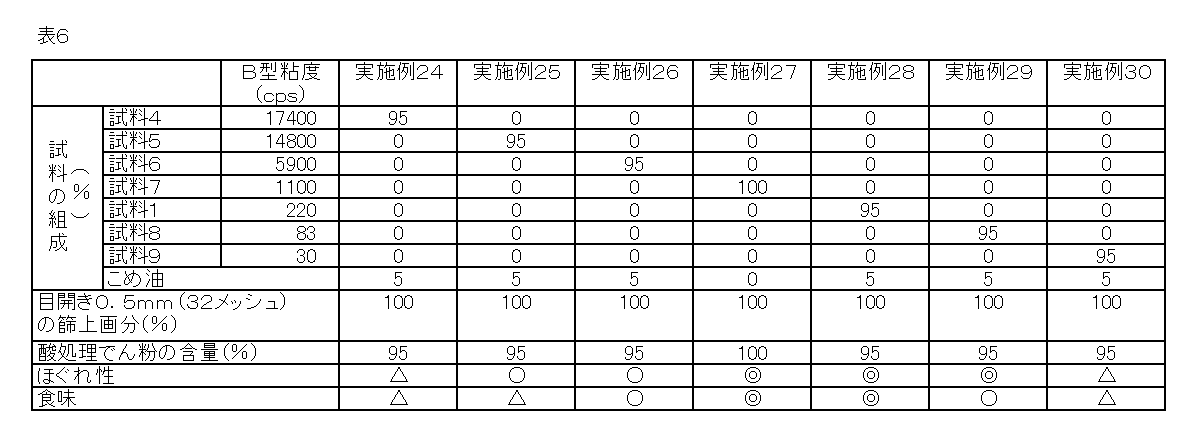
- Example 24 to 30 Samples 4 to 9 and Sample 1 listed in Table 4 were used, and the raw materials were mixed as shown in Table 6, and a biaxial extruder (KEI-45 manufactured by Kowa Industry Co., Ltd.) was used. Extruder treatment was performed under the conditions of ° C., 33% water addition, and 200 rpm screw rotation. The obtained granular material is dried with a dryer so that the final moisture becomes 10% or less (40 ° C. for 24 hours), passed through a sieve having an opening of 0.5 mm (32 mesh), and the sieve top is collected and granulated. Rice cooker was obtained. The cooked rice improving agent thus obtained was added at the time of rice cooking under the same conditions as in Example 1 and cooked.
- a biaxial extruder KI-45 manufactured by Kowa Industry Co., Ltd.
- cooked cooked rice was used without adding a cooked rice improver.
- the obtained cooked rice was cooled with a vacuum cooler, and sensory evaluation was performed by 10 panelists according to Example 17 on the looseness and taste of the cooked rice immediately after cooling. The results are shown in Table 6.
- Examples 31 to 34 Comparative Examples 5 to 7
- a granular cooked rice improver was obtained using a biaxial extruder according to the formulation in Table 7 according to Example 24.
- the cooked rice improving agent thus obtained was added during cooking under the same conditions as in Example 1 and cooked.
- cooked cooked rice was used without adding a cooked rice improver.
- the obtained cooked rice was cooled with a vacuum cooler and subjected to sensory evaluation by 10 panelists regarding the looseness, gloss, and stickiness of the cooked rice immediately after cooling. The results are shown in Table 7.
- Disentangling A Clearly preferable compared to the control example.
- ⁇ Preferred compared to the control example.
- Example 35 Comparative Example 8
- an etherified waxy corn starch to which a hydroxypropyl group was added was immersed in an acidic aqueous solution and subjected to an acid treatment to obtain a processed starch (acid Treated etherified waxy corn starch).
- the cold starch solubility of the obtained processed starch was 0%.
- 500 g of 5% aqueous solution of the processed starch obtained was stirred at 95 ° C. for 30 minutes, allowed to cool for 30 minutes, and then the viscosity was measured with a B-type viscometer. As a result, the viscosity was 100 cps.
- the B-type viscosity of the 30% aqueous solution of the processed starch obtained according to Test Example 1 it was 18500 cps.
- the processed starch thus obtained had a granular content of less than 5% by weight on a sieve having an opening of 0.5 mm (32 mesh).
- the obtained processed starch was added at the time of rice cooking according to the method of Example 2 to prepare cooked rice, and the dispersibility, looseness and taste were evaluated (Comparative Example 8). The results are shown in Table 8. Further, the processed starch was gelatinized in accordance with Test Example 3 to make the cold water solubility 100%, and then added to cooked rice, cooked, and evaluated for dispersibility, looseness and taste (Example 35). The results are shown in Table 8.
- Example 36 and 37 gelatinized acid-treated waxy corn starch (sample 2) described in Table 1 or acid-treated waxy corn starch granules (Example 28) listed in Table 6 were granulated with glucomannan.
- 2% of the rice analog-containing cooked rice blended with a rice analogue (commercial name: Mannan Hikari, manufactured by Otsuka Foods Co., Ltd.) was added and cooked.
- cooked rice analog-containing cooked rice was used without adding a cooked rice improver.
- the obtained cooked rice was cooled with a vacuum cooler, and the stickiness and taste of the cooked rice immediately after cooling were subjected to sensory evaluation by 10 panelists. The results are shown in Table 9.
- Stickiness A Clearly preferable as compared with the control example. ⁇ : Preferred compared to the control example. (Triangle
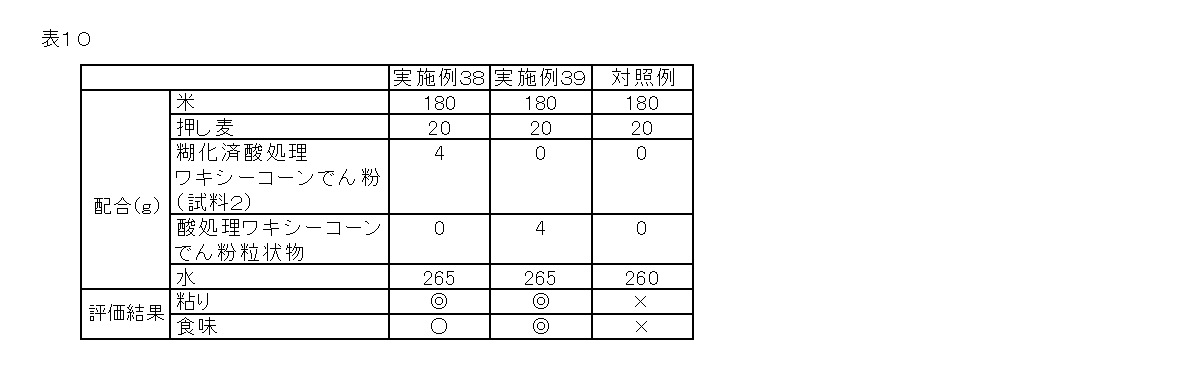
- Example 38 and 39 In the formulation shown in Table 10, gelatinized acid-treated waxy corn starch (sample 2) shown in Table 1 or acid-treated waxy corn starch granules (Example 28) shown in Table 6 were mixed with commercially available pressed oats. 2% was added to the dry weight of the pressed barley-containing cooked rice to cook rice. As a control example, cooked oat-containing cooked rice was used without adding a cooked rice improver. The obtained cooked rice was cooled with a vacuum cooler, and the stickiness and taste of the cooked rice immediately after cooling were subjected to sensory evaluation by 10 panelists according to Examples 36 and 37. The results are shown in Table 10.
Landscapes
- Chemical & Material Sciences (AREA)
- Health & Medical Sciences (AREA)
- Nutrition Science (AREA)
- Life Sciences & Earth Sciences (AREA)
- Engineering & Computer Science (AREA)
- Food Science & Technology (AREA)
- Polymers & Plastics (AREA)
- Chemical Kinetics & Catalysis (AREA)
- Dispersion Chemistry (AREA)
- Cereal-Derived Products (AREA)
Abstract
Description
まず、特許文献1~4で用いられているデキストリンとは、でん粉を酸や酵素で加水分解した後、脱色精製し、噴霧乾燥、ドラムドライ乾燥、凍結乾燥などの各種乾燥手段によって乾燥した常温で冷水可溶性のでん粉分解物である。このような低分子のでん粉分解物の米飯への添加により、ある程度のほぐれ改善効果は見られるが、そのほぐれ効果は未だ充分ではなかった。また、米飯本来の美味しさであるつやや粘りの改善効果の点で、改善の余地があった。その理由として、このようなデキストリンはでん粉を酸や酵素で大幅に加水分解することにより、でん粉中のアミロペクチン成分が低分子に分解されてしまう。このため、炊飯時にこれらのアミロペクチン成分のもつつやや粘りの向上効果がほとんど失われ、ひいては、米飯に用いた場合に米飯に好ましいつや、粘りを付与できなくなっていることが推察された。
炊飯において、好ましい粘りとほぐれの改善は相反する事象であり、これまでの技術においても、米飯本来の粘りと粒感を維持しながら、大量炊飯ラインに適したほぐれ性も兼ね備えている米飯改良剤に関する技術は未だ実現に至っていないのが実情である。
酸処理ワキシー種でん粉の糊化処理物または酸化処理ワキシー種でん粉の糊化処理物を含む米飯改良剤であって、25℃の純水中での当該米飯改良剤の冷水可溶度が、50%以上であり、当該米飯改良剤中の目開き0.5mm(32メッシュ)の篩上の粒状物の含有量が5重量%未満であって、当該米飯改良剤全体に対する前記酸処理ワキシー種でん粉および前記酸化処理ワキシー種でん粉の含有量の合計が、50重量%以上である、米飯改良剤である。
酸処理ワキシー種でん粉または酸化処理ワキシー種でん粉を含む米飯改良剤であって、当該米飯改良剤中の目開き0.5mm(32メッシュ)の篩上の粒状物の含有量が5重量%以上であって、当該米飯改良剤全体に対する前記酸処理ワキシー種でん粉および前記酸化処理ワキシー種でん粉の含有量の合計が、80重量%より多い、米飯改良剤である。
たとえば、本発明には、前記本発明における米飯改良剤を米に対して0.5重量%以上10重量%以下添加する、米飯改良方法も包含される。
酸化処理条件としては、一般に知られる方法であれば、特に問わないが、具体的には、有効塩素濃度約10%程度の次亜塩素酸ナトリウムをpH8~11、温度を40~60℃に調製したでん粉懸濁液に滴下して、30分~4時間反応をおこなう。
酸処理、酸化処理ともに、反応の進行とともにでん粉糊液粘度が低下する。米飯のつや、粘りとほぐれの改良効果のバランスの観点からは、でん粉の30%懸濁液を95℃水浴中で30分間攪拌しながら保持し、完全に糊化させた後40℃で1時間保持したときの粘度をB型粘度計(たとえば、東京計器社製)で測定したときの酸処理または酸化処理でん粉の粘度(40℃、30重量%水溶液のB型粘度)が、たとえば35cps以上15,000cps以下であり、好ましくは35cps以上10,000cps以下、さらに好ましくは35cps以上5,000cps以下、より一層好ましくは200cps以上5,000cps以下である。でん粉の粘度が高すぎると、米飯に過度の粘りが付与され、ほぐれ効果が充分に得られない場合がある。一方、でん粉の粘度が低すぎると、米飯のつや、粘りが充分でない場合があり、ほぐれ性についても効果的に改良されない場合がある。
なお、本明細書において、B型粘度計により測定される粘度を「B型粘度」とも呼ぶ。
(i)酸処理もしくは酸化処理ワキシー種でん粉を予め糊化処理して米飯改良剤中に配合する。
(ii)酸処理もしくは酸化処理ワキシー種でん粉を含む原料を特定の大きさの粒状に加工して米飯改良剤とする。
そこで、本発明においては、酸処理もしくは酸化処理ワキシー種でん粉を予め糊化処理して配合するか、または、米飯改良剤を特定の大きさの粒状に加工する。こうすることにより、炊飯時の分散性を向上することができる。
以下、それぞれの形態の米飯改良剤を説明する。
本実施形態における米飯改良剤は、酸処理ワキシー種でん粉の糊化処理物または酸化処理ワキシー種でん粉の糊化処理物を含み、米飯改良剤全体に対する酸処理ワキシー種でん粉または酸化処理ワキシー種でん粉の含有量の合計が50重量%以上である。そして、25℃の純水中での米飯改良剤の冷水可溶度が50%以上であり、米飯改良剤中の目開き0.5mm(32メッシュ)の篩上の粒状物の含有量が5重量%未満である。
糊化処理の具体的な方法としては、でん粉の懸濁液を調製し、糊化温度以上に加熱し、でん粉の粒状構造を完全に崩壊させたのち、適当な方法で乾燥、粉砕する。乾燥の方法としては、従来より知られている方法を用いればよく、たとえば、ドラムドライ法、エクストルーダー法、噴霧乾燥法などによる方法が使用できる。
また、本実施形態の米飯改良剤は、酸処理ワキシー種でん粉または酸化処理ワキシー種でん粉を冷水可溶度が50%以上となる処理をして得られるでん粉を含んでもよい。
(1)試験管に100mgの試料を測り取る。
(2)上記(1)に10mLの25℃の蒸留水(純水)を加えて攪拌し、よく分散させる。
(3)試験管内容物をふたつき遠沈管に移し変える。
(4)遠心分離(3,000rpm、10分)し、上澄み液中の可溶性糖分(全糖量)をフェノール硫酸法で定量する。
(5)冷水可溶度(%)=上澄み中の全糖量(mg)/100(mg)×100
また、米(乾物換算)に対する当該でん粉の配合量が低すぎると、ほぐれ効果が充分に得られない場合がある。こうした観点から、米飯改良剤全体に対する酸処理ワキシー種でん粉および酸化処理ワキシー種でん粉の含有量の合計は、50重量%以上100重量%以下、好ましくは75重量%以上100重量%以下、より好ましくは80重量%以上100重量%以下とする。
なお、本実施形態において、酸処理もしくは酸化処理ワキシー種でん粉の少なくとも一部が糊化していればよい。また、本実施形態における米飯改良剤が、酸処理もしくは酸化処理ワキシー種でん粉として、糊化処理物と未糊化処理物とを含んでもよい。このとき、米飯改良剤全体に対する酸処理もしくは酸化処理ワキシー種でん粉の配合量は、糊化処理物と未糊化処理物との合計であり、米(乾物換算)に対してたとえば上記同様0.5重量%以上10重量%以下になるように調製できる。
本実施形態では、酸処理もしくは酸化処理ワキシー種でん粉を含む原料を粒状に加工して用いる。たとえば、本実施形態における米飯改良剤は、粒状に加工した酸処理もしくは酸化処理ワキシー種でん粉から主として構成される。
本実施形態における粒状とは、具体的にはJIS規格における目開き0.5mm(32メッシュ)篩上5重量%以上100重量%以下の粒状物を指し、その形状は問わない。分散や米飯改良効果の安定性の観点からは、目開き0.5mm(32メッシュ)篩上の粒状物の含有量が80重量%以上とすることが好ましい。
また、本実施形態においては、酸処理もしくは酸化処理ワキシー種でん粉を含む原料を、特定の大きさの粒状に加工し炊飯中に添加することにより、炊飯中の分散性が向上するため、冷水可溶度の低い当該でん粉を使用した場合にも、分散性を向上することができる。
たとえば、本発明に係る米飯改良剤は糖類を含んでいてもよい。こうすることにより、改良剤であるでん粉の老化を抑え適度なつやと粘りを維持することができる。本発明に用いられる糖類としては食品に供するのであれば特に限定されず、グルコース、スクロース、フルクトース、マルトース、ラクトース、トレハロース、またキシリトール、ソルビトール、マルチトール、エリスリトール等の糖アルコール類、糖類の転化糖、さらには以上を構成成分とする還元糖を有する物質や混合物である水あめ、粉末水あめなども同様に使用できる。これら糖類は1種、または2種以上を組み合わせて使用できるが、好ましくはトレハロース、またはトレハロースと上記の糖類の組み合わせである。これら糖類の米飯改良剤への添加量は、米飯改良剤100重量部に対して好ましくは0.1~60重量部、より好ましくは10~50重量部とする。
(1)炊飯中に均一に分散し、安定した品質のご飯が得られる。
(2)米粒の表面をオネバ成分が均一にコーティングし、米のほぐれ性を改善する。
(3)米のほぐれ性を改善することにより、機械による米のつぶれ、割れを少なくする。
(4)米のつぶれ、割れが減ることにより、ご飯に粒感がでて、美味しいおにぎりや箸どおりのよいご飯を提供することが可能となる。
(5)ご飯の味に影響を与える炊飯油の添加量を減らすことができる。
(6)改良剤を添加することにより、炊飯水の粘度が減少、分散、対流が向上し、カニ穴ができ、ご飯のつや、照り、食味も向上する。
なお、以下の例では、B型粘度の測定に、東京計器社製ビスコメーターBMを用い、回転数30rpmで測定した。
ワキシーコーンでん粉「AP-Y」(J-オイルミルズ社製、水分14.2%)150部に水170部を加えて懸濁液とした。これに6%塩酸水溶液80部(乾燥でん粉に対する塩酸濃度;3.73%)を攪拌しながら加えて、24時間40℃攪拌しながら反応させた。反応後、でん粉を洗浄、減圧ろ過により回収した後、乾燥し酸処理ワキシーコーンでん粉(試料1)を得た。
得られた酸処理ワキシーコーンでん粉の30%スラリーを調製し、95℃で30分間撹拌保持後、40℃で1時間保持した後のB型粘度を測定した。その結果、220cpsであった。また、試料1の冷水可溶度は0%であった。
ワキシーコーンでん粉「AP-Y」(J-オイルミルズ社製)150部に水314部を加えて懸濁液とした。これに有効塩素量12.1%次亜塩素酸ナトリウムを62部攪拌しながら加えてpH8、40℃、2時間攪拌しながら反応させた。反応後、でん粉を洗浄、減圧ろ過により回収した後、乾燥し酸化処理ワキシーコーンでん粉を得た。得られた酸化処理ワキシーコーンでん粉のB型粘度は、試験例1の方法に準じて測定した。その結果120cpsであった。また冷水可溶度は0%であった。
試験例1、2記載の酸処理もしくは酸化処理ワキシーコーンでん粉の20重量%スラリーを調製した。これらのスラリーをオンレーター(出口温度100℃)で糊化させた後、ドラムドライヤー(表面温度130℃)で乾燥し、粉砕して、目開き0.5mm(32メッシュ)の篩下を回収し、糊化済酸処理ワキシーコーンでん粉(試料2)、糊化済酸化処理ワキシーコーンでん粉(試料3)を得た。得られた糊化済でん粉のB型粘度は、試験例1の方法に準じて測定した。その結果、糊化済酸処理ワキシーコーンでん粉が220cps、糊化済酸化処理ワキシーコーンでん粉が120cpsであった。また、糊化済酸処理ワキシーコーンでん粉および糊化済酸化処理ワキシーコーンでん粉の冷水可溶度は、ともに100%であった。
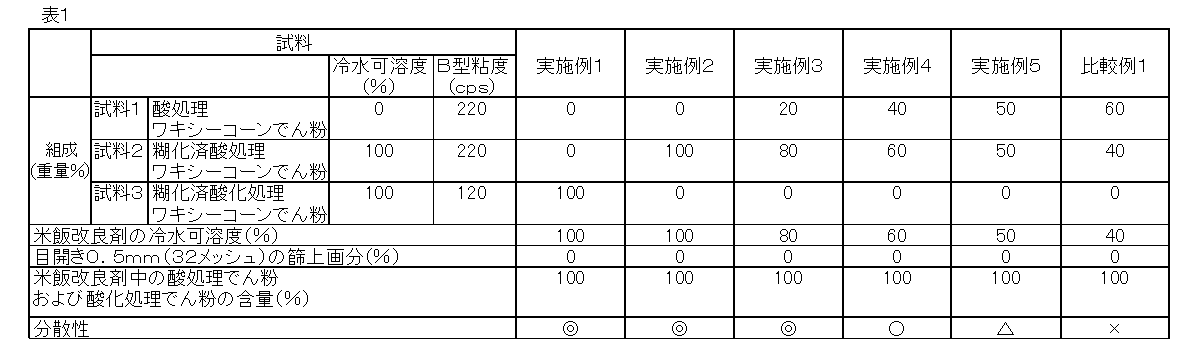
試料1~3を表1に示す配合どおりに混合し、目開き0.5mm(32メッシュ)の篩下を回収し、冷水可溶度の異なる米飯改良剤を調製した。
得られた米飯改良剤を用いて炊飯をおこなった。まず、炊飯釜に196gの米を投入し、続いて水260mLを加え、1時間浸漬した。その後、表1に記載の米飯改良剤を4g(生米に対して2%添加)ずつ投入し、攪拌した。その後通常の条件において、炊飯をおこなった。得られた米飯は攪拌することなく、炊飯器からバットに移し、改良剤成分の分散性を目視で評価した。改良剤が均一に分散しており、全く違和感がない場合は◎、殆ど違和感がない場合は○、改良剤が一部炊飯米中に溶解せずに残っており、若干の違和感を覚える場合は△、改良剤が局在化しており、違和感を覚える場合は×とし、その結果を表1に示す。
糊化済酸処理ワキシーコーンでん粉(試料2)を生米に対し、表2に示す配合で添加、炊飯した。得られた米飯は、真空冷却機で冷却し、冷却直後の米飯のほぐれ性、ご飯のべたつきについて10名のパネラーにより官能評価をおこなった。対照例としては、米飯改良剤を添加せず、炊飯した米飯を用いた。その結果を表2に示す。表2における評価基準は以下の通りである。
◎:対照例と比較して明らかに好ましい。
○:対照例と比較して好ましい。
△:対照例と比較してやや好ましい。
×:対照例と有意差なし。
ご飯のべたつき
◎:ご飯にべたつきはなく、違和感がない。
○:ご飯にべたつきはほとんどなく、違和感がない。
△:ややご飯がべたついている。
×:ご飯がべたついている。

表1記載の糊化済酸処理ワキシーコーンでん粉(試料2)と冷水溶解性デキストリンFZ-100(J-オイルミルズ社製)を表3の割合で配合した米飯改良剤(表3中「試料」)を調製し、それぞれを生米に対し、表3の配合で添加、炊飯した。得られた米飯は、真空冷却機で冷却し、冷却直後の米飯のほぐれ性、ご飯のべたつき、つや、粘りについて10名のパネラーにより官能評価をおこなった。対照例としては、米飯改良剤を添加せず、炊飯した米飯を用いた。その結果を表3に示す。表3における評価基準は以下の通りである。
◎:対照例と比較して明らかに好ましい。
○:対照例と比較して好ましい。
△:対照例と比較してやや好ましい。
×:対照例と有意差なし。
ご飯のべたつき
◎:ご飯にべたつきはなく、違和感がない。
○:ご飯にべたつきはほとんどなく、違和感がない。
△:ややご飯がべたついている。
×:ご飯がべたついている。
つや
◎:対照例と比較して明らかに好ましい。
○:対照例と比較して好ましい。
△:対照例と比較してやや好ましい。
×:対照例と有意差なし。
粘り
◎:対照例と比較して明らかに好ましい。
○:対照例と比較して好ましい。
△:対照例と比較してやや好ましい。
×:対照例と有意差なし。
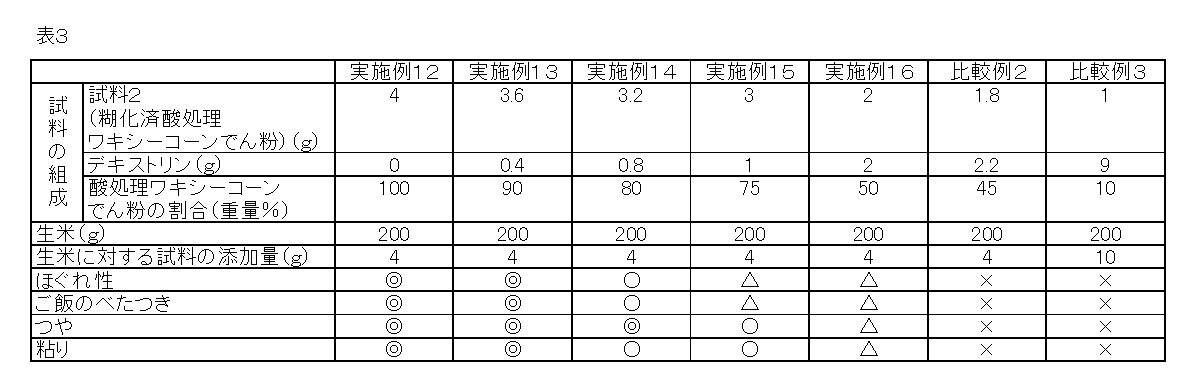
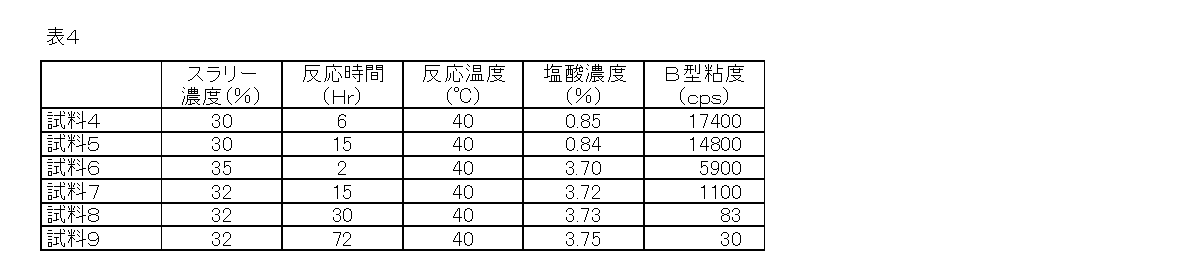
表4に示すように、酸処理における各反応条件を変化させて、試験例1の方法に準じて様々な粘度を示す酸処理でん粉を作成した。表4に、得られたでん粉のB型粘度の測定結果をあわせて示した。
試料4~9の酸処理でん粉(表4)および試料1を試験例3の方法に準じて糊化させ冷水可溶度を高めた糊化済酸処理でん粉を調製した。
試験例5で得られた糊化済酸処理でん粉について、実施例1の方法に準じて炊飯時に添加し、炊飯をおこなった。対照例としては、米飯改良剤を添加せず、炊飯した米飯を用いた。また、比較例として、酸処理ワキシーコーンでん粉の代わりに、冷水溶解性デキストリンFZ-100(J-オイルミルズ社製)を用いた。
得られた米飯は、真空冷却機で冷却し、冷却直後の米飯のほぐれ性、食味について10名のパネラーにより官能評価をおこなった。その結果を表5に示す。
ほぐれ性
◎:対照例と比較して明らかに好ましい。
○:対照例と比較して好ましい。
△:対照例と比較してやや好ましい。
×:対照例と有意差なし。
食味
◎:対照例と比較して明らかに好ましい。
○:対照例と比較して好ましい。
△:対照例と比較してやや好ましい。
×:対照例と有意差なし。
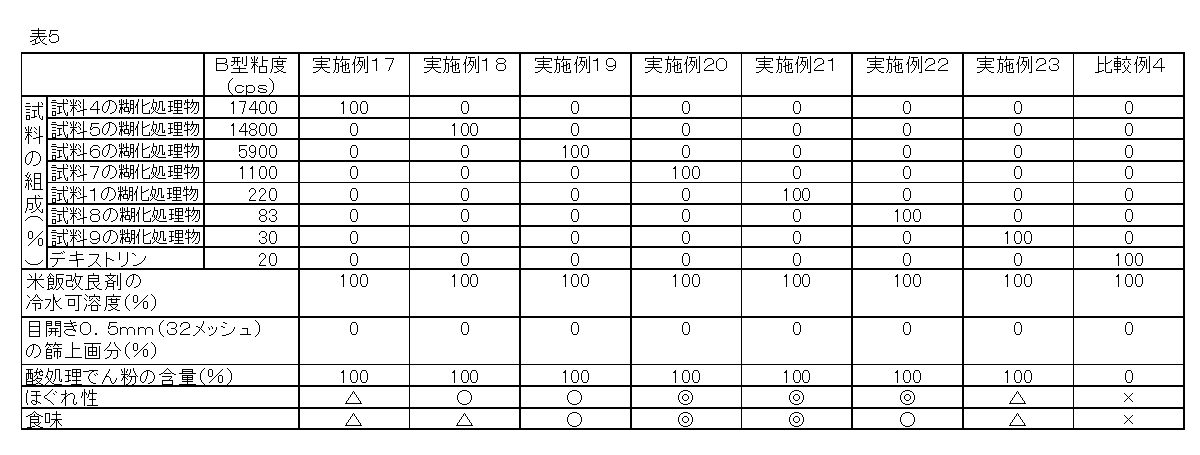
表4記載の試料4~9および試料1を使用し、表6の配合どおりに原材料を混合し、2軸エクストルーダー(幸和工業製KEI-45)を用いてバレル温度100℃、出口温度60℃、加水33%、スクリュー回転200rpmの条件でエクストルーダー処理した。得られた粒状物を、乾燥機で最終水分が10%以下になるように乾燥(40℃24時間)し、目開き0.5mm(32メッシュ)の篩いを通し、篩上を回収し、粒状の米飯改良剤を得た。
こうして得られた米飯改良剤を実施例1と同様の条件で炊飯時に添加し、炊飯をおこなった。対照例としては、米飯改良剤を添加せず、炊飯した米飯を用いた。得られた米飯は、真空冷却機で冷却し、冷却直後の米飯のほぐれ性、食味について、実施例17に準じて10名のパネラーにより官能評価をおこなった。その結果を表6に示す。
試料1および冷水溶解性デキストリンFZ-100(J-オイルミルズ社製)を用いて、表7の配合により、実施例24に準じて、2軸エクストルーダーを用いて粒状の米飯改良剤を得た。
こうして得られた米飯改良剤を実施例1と同様の条件で炊飯時に添加し、炊飯をおこなった。対照例としては、米飯改良剤を添加せず、炊飯した米飯を用いた。得られた米飯は、真空冷却機で冷却し、冷却直後の米飯のほぐれ性、つや、粘りについて10名のパネラーにより官能評価をおこなった。その結果を表7に示す。
ほぐれ性
◎:対照例と比較して明らかに好ましい。
○:対照例と比較して好ましい。
△:対照例と比較してやや好ましい。
×:対照例と有意差なし。
つや
◎:対照例と比較して明らかに好ましい。
○:対照例と比較して好ましい。
△:対照例と比較してやや好ましい。
×:対照例と有意差なし。
粘り
◎:対照例と比較して明らかに好ましい。
○:対照例と比較して好ましい。
△:対照例と比較してやや好ましい。
×:対照例と有意差なし。

特開2002-65184号公報(特許文献7)記載の方法に準じて、ヒドロキシプロピル基を付加させたエーテル化ワキシーコーンでん粉を酸性水溶液に浸漬させて酸処理を行い、加工でん粉を得た(酸処理エーテル化ワキシーコーンでん粉)。
また、得られた加工でん粉の5%水溶液500gを95℃で攪拌しながら、30分加熱し、30分放冷した後、B型粘度計で粘度を測定した結果、粘度は100cpsであった。
さらに、得られた加工でん粉の30%水溶液について、試験例1に準じてB型粘度を測定した結果、18500cpsであった。
なお、得られた加工でん粉は、目開き0.5mm(32メッシュ)の篩上の粒状物の含有量が5重量%未満であった。
さらに当該加工でん粉を、試験例3に準じて、糊化処理し、冷水可溶性を100%とした後、米飯に添加、炊飯し、分散性、ほぐれ性および食味を評価した(実施例35)。結果を表8に示す。

表9に示す配合で、表1記載の糊化済酸処理ワキシーコーンでん粉(試料2)、または表6記載の酸処理ワキシーコーンでん粉の粒状物(実施例28)を、グルコマンナンを粒状化した米類似物(市販名:マンナンヒカリ、大塚食品社製)を配合した米類似物含有米飯の乾燥重量に対して、2%添加して炊飯をおこなった。対照例としては、米飯改良剤を添加せず、炊飯した米類似物含有米飯を用いた。得られた米飯は真空冷却機で冷却し、冷却直後の米飯の粘り、食味について10名のパネラーにより官能評価をおこなった。その結果を表9に示す。
粘り
◎:対照例と比較して明らかに好ましい。
○:対照例と比較して好ましい。
△:対照例と比較してやや好ましい。
×:対照例と有意差なし。
食味
◎:対照例と比較して明らかに好ましい。
○:対照例と比較して好ましい。
△:対照例と比較してやや好ましい。
×:対照例と有意差なし。
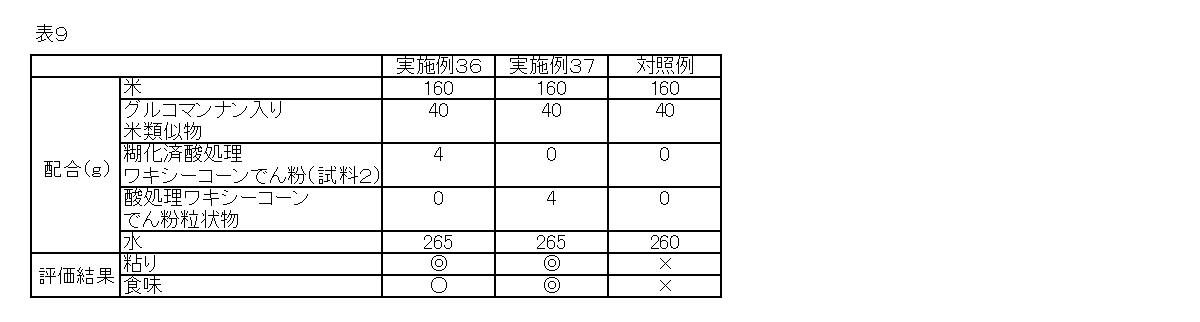
表10に示す配合で、表1記載の糊化済酸処理ワキシーコーンでん粉(試料2)、または表6記載の酸処理ワキシーコーンでん粉の粒状物(実施例28)を、市販の押し麦を配合した押し麦含有米飯の乾燥重量に対して、2%添加して炊飯をおこなった。対照例としては、米飯改良剤を添加せず、炊飯した押し麦含有米飯を用いた。得られた米飯は真空冷却機で冷却し、冷却直後の米飯の粘り、食味について、実施例36および37に準じて10名のパネラーにより官能評価をおこなった。その結果を表10に示す。
Claims (7)
- 酸処理ワキシー種でん粉の糊化処理物または酸化処理ワキシー種でん粉の糊化処理物を含む米飯改良剤であって、
25℃の純水中での当該米飯改良剤の冷水可溶度が、50%以上であり、
当該米飯改良剤中の目開き0.5mm(32メッシュ)の篩上の粒状物の含有量が5重量%未満であって、
当該米飯改良剤全体に対する前記酸処理ワキシー種でん粉および前記酸化処理ワキシー種でん粉の含有量の合計が、50重量%以上である、米飯改良剤。 - 当該米飯改良剤全体に対する前記酸処理ワキシー種でん粉および前記酸化処理ワキシー種でん粉の含有量の合計が、75重量%以上である、請求項1に記載の米飯改良剤。
- 前記酸処理ワキシー種でん粉および前記酸化処理ワキシー種でん粉の糊化処理物の30重量%水溶液のB型粘度計により測定される粘度が、40℃、30rpmにて35cps以上15000cps以下である、請求項1または2に記載の米飯改良剤。
- 酸処理ワキシー種でん粉または酸化処理ワキシー種でん粉を含む米飯改良剤であって、
当該米飯改良剤中の目開き0.5mm(32メッシュ)の篩上の粒状物の含有量が5重量%以上であって、
当該米飯改良剤全体に対する前記酸処理ワキシー種でん粉および前記酸化処理ワキシー種でん粉の含有量の合計が、80重量%より多い、米飯改良剤。 - 前記酸処理ワキシー種でん粉および前記酸化処理ワキシー種でん粉の糊化処理物の30重量%水溶液のB型粘度計により測定される粘度が、40℃、30rpmにて35cps以上15000cps以下である、請求項4に記載の米飯改良剤。
- 請求項1乃至5いずれか1項に記載の米飯改良剤を米に対して0.5重量%以上10重量%以下添加して炊飯する工程を含む、米飯食品の製造方法。
- 請求項6に記載の製造方法により炊飯された、米飯食品。
Priority Applications (5)
| Application Number | Priority Date | Filing Date | Title |
|---|---|---|---|
| CN2010800210601A CN102427735B (zh) | 2009-05-15 | 2010-05-11 | 米饭改良剂、使用该改良剂的米饭食品和米饭食品的制造方法 |
| KR1020117029654A KR101178023B1 (ko) | 2009-05-15 | 2010-05-11 | 미반 개량제, 그것을 사용한 미반 식품 및 미반 식품의 제조방법 |
| JP2010533372A JP4659143B2 (ja) | 2009-05-15 | 2010-05-11 | 米飯改良剤、それを用いた米飯食品および米飯食品の製造方法 |
| US13/318,445 US20120045562A1 (en) | 2009-05-15 | 2010-05-11 | Rice improver, cooked rice using same, and processes for preparing cooked rice |
| US13/904,656 US20130260010A1 (en) | 2009-05-15 | 2013-05-29 | Rice improver, cooked rice using same, and processes for preparing cooked rice |
Applications Claiming Priority (2)
| Application Number | Priority Date | Filing Date | Title |
|---|---|---|---|
| JP2009-118168 | 2009-05-15 | ||
| JP2009118168 | 2009-05-15 |
Related Child Applications (2)
| Application Number | Title | Priority Date | Filing Date |
|---|---|---|---|
| US13/318,445 A-371-Of-International US20120045562A1 (en) | 2009-05-15 | 2010-05-11 | Rice improver, cooked rice using same, and processes for preparing cooked rice |
| US13/904,656 Division US20130260010A1 (en) | 2009-05-15 | 2013-05-29 | Rice improver, cooked rice using same, and processes for preparing cooked rice |
Publications (1)
| Publication Number | Publication Date |
|---|---|
| WO2010131456A1 true WO2010131456A1 (ja) | 2010-11-18 |
Family
ID=43084841
Family Applications (1)
| Application Number | Title | Priority Date | Filing Date |
|---|---|---|---|
| PCT/JP2010/003184 Ceased WO2010131456A1 (ja) | 2009-05-15 | 2010-05-11 | 米飯改良剤、それを用いた米飯食品および米飯食品の製造方法 |
Country Status (5)
| Country | Link |
|---|---|
| US (2) | US20120045562A1 (ja) |
| JP (1) | JP4659143B2 (ja) |
| CN (1) | CN102427735B (ja) |
| TW (1) | TW201043147A (ja) |
| WO (1) | WO2010131456A1 (ja) |
Cited By (8)
| Publication number | Priority date | Publication date | Assignee | Title |
|---|---|---|---|---|
| JP2012065645A (ja) * | 2010-08-23 | 2012-04-05 | Matsutani Chem Ind Ltd | 米飯改良剤 |
| JP2012100613A (ja) * | 2010-11-12 | 2012-05-31 | J-Oil Mills Inc | 米飯改良剤およびそれを用いた米飯食品、ならびにそれらの製造方法 |
| WO2013054460A1 (ja) * | 2011-10-14 | 2013-04-18 | 株式会社J-オイルミルズ | 米飯改良剤、それを用いた米飯食品および米飯改良剤の製造方法 |
| WO2013054461A1 (ja) * | 2011-10-14 | 2013-04-18 | 株式会社J-オイルミルズ | 粒状物、それを用いた飲食品および粒状物の製造方法 |
| JP6026619B1 (ja) * | 2015-10-22 | 2016-11-16 | 株式会社Mizkan Holdings | 風味の改善作用を有する米飯改良剤 |
| JP2017012070A (ja) * | 2015-06-30 | 2017-01-19 | 味の素株式会社 | 炊飯用液体調味料 |
| JP2019213476A (ja) * | 2018-06-12 | 2019-12-19 | 株式会社J−オイルミルズ | ふりかけ付着低減剤 |
| JPWO2022039038A1 (ja) * | 2020-08-21 | 2022-02-24 |
Families Citing this family (3)
| Publication number | Priority date | Publication date | Assignee | Title |
|---|---|---|---|---|
| CN107819812B (zh) * | 2016-09-14 | 2022-10-04 | 佛山市顺德区美的电热电器制造有限公司 | 烹饪质量的评价方法及装置 |
| JP6957118B2 (ja) * | 2018-08-15 | 2021-11-02 | 日本食品化工株式会社 | 変性澱粉、その用途、及び変性澱粉の製造方法 |
| KR102546286B1 (ko) * | 2019-11-08 | 2023-06-22 | 씨제이제일제당 (주) | 눌은 식감을 갖는 전자레인지 조리용 냉동 포장밥 |
Citations (5)
| Publication number | Priority date | Publication date | Assignee | Title |
|---|---|---|---|---|
| JPH07274865A (ja) * | 1994-04-11 | 1995-10-24 | Okuno Chem Ind Co Ltd | 米飯の品質改良剤及び品質改良方法 |
| JPH07289180A (ja) * | 1994-04-26 | 1995-11-07 | Nippon Suisan Kaisha Ltd | ごはんをおいしく炊く方法 |
| JPH07327615A (ja) * | 1994-06-10 | 1995-12-19 | Nippon Suisan Kaisha Ltd | 米飯類の製造方法 |
| JP2000041598A (ja) * | 1998-07-29 | 2000-02-15 | Nippon Starch Chemical Co Ltd | 米飯食品およびその製造方法 |
| JP2008092945A (ja) * | 2006-09-13 | 2008-04-24 | J-Oil Mills Inc | 米飯改質剤およびそれを用いた米飯食品、ならびにそれらの製造方法 |
Family Cites Families (7)
| Publication number | Priority date | Publication date | Assignee | Title |
|---|---|---|---|---|
| US2427328A (en) * | 1942-07-03 | 1947-09-09 | American Maize Prod Co | Pregelatinized waxy starch |
| US3563798A (en) * | 1967-09-18 | 1971-02-16 | Cpc International Inc | Pregelatinized starch products and process of making same |
| US3912531A (en) * | 1972-06-21 | 1975-10-14 | Anheuser Busch | Corrugating adhesive composition |
| US3912530A (en) * | 1972-06-21 | 1975-10-14 | Anheuser Busch | Water resistant corrugating adhesive composition |
| US4116740A (en) * | 1974-06-07 | 1978-09-26 | Anheuser-Busch, Incorporated | Water resistant corrugating adhesive composition |
| CN101188946B (zh) * | 2005-06-03 | 2013-08-07 | 不二制油株式会社 | 米饭用品质改良剂及使用该改良剂的米饭类及其制造方法 |
| WO2008032433A1 (fr) * | 2006-09-13 | 2008-03-20 | J-Oil Mills, Inc. | Modificateur de riz, aliment à base de riz utilisant le modificateur de riz, et procédés de production |
-
2010
- 2010-05-11 US US13/318,445 patent/US20120045562A1/en not_active Abandoned
- 2010-05-11 WO PCT/JP2010/003184 patent/WO2010131456A1/ja not_active Ceased
- 2010-05-11 CN CN2010800210601A patent/CN102427735B/zh active Active
- 2010-05-11 JP JP2010533372A patent/JP4659143B2/ja active Active
- 2010-05-14 TW TW099115422A patent/TW201043147A/zh unknown
-
2013
- 2013-05-29 US US13/904,656 patent/US20130260010A1/en not_active Abandoned
Patent Citations (5)
| Publication number | Priority date | Publication date | Assignee | Title |
|---|---|---|---|---|
| JPH07274865A (ja) * | 1994-04-11 | 1995-10-24 | Okuno Chem Ind Co Ltd | 米飯の品質改良剤及び品質改良方法 |
| JPH07289180A (ja) * | 1994-04-26 | 1995-11-07 | Nippon Suisan Kaisha Ltd | ごはんをおいしく炊く方法 |
| JPH07327615A (ja) * | 1994-06-10 | 1995-12-19 | Nippon Suisan Kaisha Ltd | 米飯類の製造方法 |
| JP2000041598A (ja) * | 1998-07-29 | 2000-02-15 | Nippon Starch Chemical Co Ltd | 米飯食品およびその製造方法 |
| JP2008092945A (ja) * | 2006-09-13 | 2008-04-24 | J-Oil Mills Inc | 米飯改質剤およびそれを用いた米飯食品、ならびにそれらの製造方法 |
Cited By (18)
| Publication number | Priority date | Publication date | Assignee | Title |
|---|---|---|---|---|
| JP2012065645A (ja) * | 2010-08-23 | 2012-04-05 | Matsutani Chem Ind Ltd | 米飯改良剤 |
| JP2012100613A (ja) * | 2010-11-12 | 2012-05-31 | J-Oil Mills Inc | 米飯改良剤およびそれを用いた米飯食品、ならびにそれらの製造方法 |
| WO2013054460A1 (ja) * | 2011-10-14 | 2013-04-18 | 株式会社J-オイルミルズ | 米飯改良剤、それを用いた米飯食品および米飯改良剤の製造方法 |
| WO2013054461A1 (ja) * | 2011-10-14 | 2013-04-18 | 株式会社J-オイルミルズ | 粒状物、それを用いた飲食品および粒状物の製造方法 |
| JP5198692B1 (ja) * | 2011-10-14 | 2013-05-15 | 株式会社J−オイルミルズ | 粒状物、それを用いた飲食品および粒状物の製造方法 |
| JP5203543B1 (ja) * | 2011-10-14 | 2013-06-05 | 株式会社J−オイルミルズ | 米飯改良剤、それを用いた米飯食品および米飯改良剤の製造方法 |
| JP2017012070A (ja) * | 2015-06-30 | 2017-01-19 | 味の素株式会社 | 炊飯用液体調味料 |
| WO2017068818A1 (ja) * | 2015-10-22 | 2017-04-27 | 株式会社Mizkan Holdings | 風味の改善作用を有する米飯改良剤 |
| JP6026619B1 (ja) * | 2015-10-22 | 2016-11-16 | 株式会社Mizkan Holdings | 風味の改善作用を有する米飯改良剤 |
| KR20180071262A (ko) * | 2015-10-22 | 2018-06-27 | 미쯔칸 홀딩즈 씨오., 엘티디. | 풍미의 개선작용을 가지는 쌀밥 개량제 |
| EP3360427B1 (en) * | 2015-10-22 | 2021-01-06 | Mizkan Holdings Co., Ltd. | Cooked-rice improver having flavor improving action |
| KR102358476B1 (ko) * | 2015-10-22 | 2022-02-04 | 미쯔칸 홀딩즈 씨오., 엘티디. | 풍미의 개선작용을 가지는 쌀밥 개량제 |
| US12171250B2 (en) | 2015-10-22 | 2024-12-24 | Mizkan Holdings Co., Ltd. | Cooked-rice improver having flavor improving action |
| JP2019213476A (ja) * | 2018-06-12 | 2019-12-19 | 株式会社J−オイルミルズ | ふりかけ付着低減剤 |
| JP7146465B2 (ja) | 2018-06-12 | 2022-10-04 | 株式会社J-オイルミルズ | ふりかけ付着低減剤 |
| JPWO2022039038A1 (ja) * | 2020-08-21 | 2022-02-24 | ||
| WO2022039038A1 (ja) * | 2020-08-21 | 2022-02-24 | 株式会社J-オイルミルズ | 米飯改良剤 |
| KR20230051192A (ko) | 2020-08-21 | 2023-04-17 | 제이-오일 밀스, 인코포레이티드 | 미반 개량제 |
Also Published As
| Publication number | Publication date |
|---|---|
| CN102427735B (zh) | 2013-10-30 |
| US20130260010A1 (en) | 2013-10-03 |
| CN102427735A (zh) | 2012-04-25 |
| JP4659143B2 (ja) | 2011-03-30 |
| US20120045562A1 (en) | 2012-02-23 |
| TW201043147A (en) | 2010-12-16 |
| JPWO2010131456A1 (ja) | 2012-11-01 |
Similar Documents
| Publication | Publication Date | Title |
|---|---|---|
| JP4659143B2 (ja) | 米飯改良剤、それを用いた米飯食品および米飯食品の製造方法 | |
| JP4137982B2 (ja) | 米飯改質剤、それを用いた米飯食品およびその製造方法 | |
| JP5203543B1 (ja) | 米飯改良剤、それを用いた米飯食品および米飯改良剤の製造方法 | |
| CN102170793B (zh) | 挤出的有良好的纤维源的谷物的膨化 | |
| TWI424817B (zh) | 米飯改質劑及使用其之米飯食品,暨其等之製造方法 | |
| CN106572665A (zh) | 泡芙及其制造方法 | |
| JP2000316507A (ja) | 食物繊維強化麺類 | |
| JP5198692B1 (ja) | 粒状物、それを用いた飲食品および粒状物の製造方法 | |
| JP3415078B2 (ja) | 吸油抑制剤 | |
| JP2003310187A (ja) | 低カロリー食品素材 | |
| JP7432302B2 (ja) | 低糖質乾パスタ | |
| JP3803796B2 (ja) | 成形スナックの製造法 | |
| JP5873240B2 (ja) | 米飯改良剤ならびに米飯改良剤および米飯食品の製造方法 | |
| JP6936069B2 (ja) | 米飯改良剤及び米飯又は米飯加工食品の製造方法 | |
| JPH0923835A (ja) | フライバッター用粉 | |
| WO2022039038A1 (ja) | 米飯改良剤 | |
| KR101178023B1 (ko) | 미반 개량제, 그것을 사용한 미반 식품 및 미반 식품의 제조방법 | |
| JP7569327B2 (ja) | 麺用ほぐれ向上剤 | |
| JP2003230351A (ja) | ベーカリー製品用ミックス及びそれを用いたベーカリー製品 | |
| JP2004073140A (ja) | ドーナツ類及びその製造方法 | |
| WO2019049860A1 (ja) | 麺類及びその製造方法 | |
| JPH089907A (ja) | 保水性および保油性をあわせ有する澱粉由来の食品用素材およびこれを用いた食品 | |
| JP2004121016A (ja) | 春巻きの皮及びその製造方法 | |
| JP7382676B1 (ja) | 穀類由来または芋類由来の澱粉生地における焼成時のパンクまたは焼成後の伸びの防止剤 | |
| HK1165682A (en) | Rice improver, cooked rice using same, and processes for preparing cooked rice |
Legal Events
| Date | Code | Title | Description |
|---|---|---|---|
| WWE | Wipo information: entry into national phase |
Ref document number: 201080021060.1 Country of ref document: CN |
|
| ENP | Entry into the national phase |
Ref document number: 2010533372 Country of ref document: JP Kind code of ref document: A |
|
| 121 | Ep: the epo has been informed by wipo that ep was designated in this application |
Ref document number: 10774715 Country of ref document: EP Kind code of ref document: A1 |
|
| WWE | Wipo information: entry into national phase |
Ref document number: 13318445 Country of ref document: US |
|
| NENP | Non-entry into the national phase |
Ref country code: DE |
|
| ENP | Entry into the national phase |
Ref document number: 20117029654 Country of ref document: KR Kind code of ref document: A |
|
| 122 | Ep: pct application non-entry in european phase |
Ref document number: 10774715 Country of ref document: EP Kind code of ref document: A1 |