WO2010119795A1 - 超硬合金 - Google Patents
超硬合金 Download PDFInfo
- Publication number
- WO2010119795A1 WO2010119795A1 PCT/JP2010/056291 JP2010056291W WO2010119795A1 WO 2010119795 A1 WO2010119795 A1 WO 2010119795A1 JP 2010056291 W JP2010056291 W JP 2010056291W WO 2010119795 A1 WO2010119795 A1 WO 2010119795A1
- Authority
- WO
- WIPO (PCT)
- Prior art keywords
- cemented carbide
- carbide
- particle size
- present
- mass
- Prior art date
- Legal status (The legal status is an assumption and is not a legal conclusion. Google has not performed a legal analysis and makes no representation as to the accuracy of the status listed.)
- Ceased
Links
Images


Classifications
-
- C—CHEMISTRY; METALLURGY
- C22—METALLURGY; FERROUS OR NON-FERROUS ALLOYS; TREATMENT OF ALLOYS OR NON-FERROUS METALS
- C22C—ALLOYS
- C22C29/00—Alloys based on carbides, oxides, nitrides, borides, or silicides, e.g. cermets, or other metal compounds, e.g. oxynitrides, sulfides
- C22C29/02—Alloys based on carbides, oxides, nitrides, borides, or silicides, e.g. cermets, or other metal compounds, e.g. oxynitrides, sulfides based on carbides or carbonitrides
- C22C29/06—Alloys based on carbides, oxides, nitrides, borides, or silicides, e.g. cermets, or other metal compounds, e.g. oxynitrides, sulfides based on carbides or carbonitrides based on carbides, but not containing other metal compounds
- C22C29/08—Alloys based on carbides, oxides, nitrides, borides, or silicides, e.g. cermets, or other metal compounds, e.g. oxynitrides, sulfides based on carbides or carbonitrides based on carbides, but not containing other metal compounds based on tungsten carbide
-
- C—CHEMISTRY; METALLURGY
- C22—METALLURGY; FERROUS OR NON-FERROUS ALLOYS; TREATMENT OF ALLOYS OR NON-FERROUS METALS
- C22C—ALLOYS
- C22C1/00—Making non-ferrous alloys
- C22C1/04—Making non-ferrous alloys by powder metallurgy
- C22C1/05—Mixtures of metal powder with non-metallic powder
- C22C1/051—Making hard metals based on borides, carbides, nitrides, oxides or silicides; Preparation of the powder mixture used as the starting material therefor
-
- C—CHEMISTRY; METALLURGY
- C22—METALLURGY; FERROUS OR NON-FERROUS ALLOYS; TREATMENT OF ALLOYS OR NON-FERROUS METALS
- C22C—ALLOYS
- C22C29/00—Alloys based on carbides, oxides, nitrides, borides, or silicides, e.g. cermets, or other metal compounds, e.g. oxynitrides, sulfides
- C22C29/005—Alloys based on carbides, oxides, nitrides, borides, or silicides, e.g. cermets, or other metal compounds, e.g. oxynitrides, sulfides comprising a particular metallic binder
Definitions
- the present invention relates to a cemented carbide.
- the present invention relates to a cemented carbide excellent in toughness and strength while having high hardness.
- WC tungsten carbide
- Co cobalt
- the member such as the nozzle for high pressure water flow processing
- it is particularly desired that the member has excellent wear resistance.
- Methods for increasing the hardness include reducing the Co content, which is lower than that of WC, or making WC fine.
- Cr (chromium) carbides such as VC (vanadium carbide), Mo 2 C (molybdenum carbide), Cr 3 C 2 And adding a metal carbide having an inhibitory effect.
- Patent Documents 1 to 3 when a metal carbide having an effect of suppressing grain growth is added as a raw material for the refinement of WC in the cemented carbide, the metal carbide is added to the obtained cemented carbide. Remains or reprecipitates, leading to a decrease in strength.
- the metal carbide itself of the raw material is coarse, it is difficult to uniformly mix it with the WC powder of the raw material, resulting in variations in the effect of suppressing WC grain growth. As a result, there is a possibility that WC grown and coarsened in the cemented carbide alloy or coarse metal carbide tends to exist in the cemented carbide alloy.
- the WC powder of the raw material and the metal carbide In order to sufficiently mix the WC powder of the raw material and the metal carbide, if the mixing time of the raw material is lengthened, the WC powder is excessively pulverized, and WC grows easily due to Ostwald growth during sintering. There is a risk of becoming a cemented carbide with WC present. The presence of locally coarse WC causes a decrease in strength.
- the lens mold has a high surface quality only by forming with a mold in addition to being excellent in wear resistance. That is, there is a demand for a mold that can form a lens that is excellent in surface properties to such an extent that it can be used as it is without being subjected to a separate polishing process or the like. In order to meet such a demand, it is desired that WC in the cemented carbide constituting the mold is fine and homogeneous.
- W 2 C is present. Since W 2 C grows more easily than WC, coarse W 2 C may be present in the cemented carbide. If coarse particles are present in the cemented carbide, the strength and toughness are lowered, and the surface quality is lowered.
- the sintered hard material described in Patent Document 2 has low strength and toughness because it adds very low amount of Co for the purpose of increasing hardness.
- W 2 C since there is too little Co, W 2 C is likely to be precipitated and it is difficult to sinter, so it is necessary to sinter at a very high temperature of 1700 ° C. or higher for densification. Since sintering is performed at such a high temperature, the precipitated W 2 C tends to grow. Therefore, even if metal carbide is added as described above, there is a limit to the effect of suppressing grain growth. If coarse W 2 C is present in the cemented carbide, strength, toughness and surface quality are deteriorated. Therefore, this sintered hard material cannot achieve both high hardness, high toughness, and high strength.
- Patent Document 3 The sintered body described in Patent Document 3 is intended to improve abrasive wear resistance, and has high hardness but low strength and toughness. In particular, the bending strength is low in a sintered body with little Co addition.
- Patent Document 3 only proposes to reduce the average particle size of WC, and does not discuss control of the particle size distribution. If the WC particle size variation in the sintered body is large, the Co thickness in the sintered body becomes non-uniform (locally thickens or thins), causing uneven wear and fractures. .
- double carbides dissimilar metal carbides
- the double carbides have poor wettability with a binder phase such as Co, leading to a decrease in strength.
- the deposited double carbide falls off, so that the wear easily proceeds. Therefore, this sintered body cannot achieve both high hardness, high toughness, and high strength.
- an object of the present invention is to provide a cemented carbide having a good balance of high hardness, high toughness, and high strength.
- the inventors of the present invention have a specific composition and devise a raw material adjustment and manufacturing method, so that it has high hardness and excellent wear resistance, and has high toughness, high strength and excellent fracture resistance. I got the knowledge that The present invention is based on the above findings.
- the cemented carbide of the present invention contains Co and Cr, and the balance is composed of a binary compound of W and C and impurities.
- the Co is contained in an amount of 0.2% by mass to 0.9% by mass with respect to the cemented carbide. Co exists in the state of Co x W y C z .
- the Cr is contained in an amount of 0.2% by mass to 1.5% by mass with respect to the cemented carbide.
- the binary compound of W and C is mainly WC, the average grain size of WC in the cemented carbide is 0.2 ⁇ m or more and 0.7 ⁇ m or less, and the standard deviation ⁇ of the grain size of WC satisfies ⁇ ⁇ 0.25. .
- the cemented carbide of the present invention has a high hardness compared to metal Co (Co x W y C z ) as the main binder phase and fine WC, so that it has high hardness and excellent wear resistance.
- the cemented carbide according to the present invention can effectively reduce the grain growth of WC to contain fine WC by containing Cr, thereby improving the hardness and improving the strength due to the presence of coarse WC. Reduction can be suppressed.
- the cemented carbide of the present invention is easily sintered because it contains a Co component to such an extent that the periphery of WC can be sufficiently covered by the binder phase (mainly Co x W y C z ).
- the sintering temperature can be lowered, so that local grain growth such as WC is suppressed, and the cemented carbide is incorporated in the cemented carbide.
- Coarse WC is difficult to exist.
- Cr in the cemented carbide of the present invention is present mainly as a metal component and hardly exists in the state of a compound such as carbide. For this reason, in the cemented carbide of the present invention, the strength of the metal carbide may be substantially reduced due to the metal carbide remaining or reprecipitating as in the case of using the metal carbide as a raw material in order to suppress grain growth. Absent.
- the cemented carbide of the present invention contains a Co component in the above specific range, so that an extreme decrease in toughness and strength like a cemented carbide with too little Co can be reduced, and the strength and toughness are also high.
- the binder phase mainly Co x W y C z
- the thickness of the binder phase is also uniform. Alloys are less prone to uneven wear and chipping, and are excellent in wear resistance and chipping resistance.
- the cemented carbide of the present invention has a high balance of high hardness, high toughness, and high strength, and is excellent in both wear resistance and fracture resistance.
- the cemented carbide of the present invention which has a low Co composition and Co exists in the state of Co x W y C z , has a low decrease in hardness not only at room temperature but also at a high temperature, for example, 500 ° C. to 800 ° C. High hardness and excellent wear resistance in a wide range from room temperature to high temperature. Therefore, the cemented carbide of the present invention can be suitably used as a constituent material of, for example, a member that is desired to have excellent wear resistance, for example, a nozzle for high pressure water flow processing.
- the cemented carbide of the present invention has a fine and uniform WC and a uniform thickness of the binder phase (mainly Co x W y C z ). That is, the cemented carbide of the present invention has a uniform structure and a relatively small amount of Co component. Therefore, in addition to wear resistance, a member that requires good finished surface quality such as mirror finish, such as a glass lens mold It can utilize suitably also for these constituent materials. And since the cemented carbide of the present invention has high toughness and high strength, even if grinding, wire machining, electric discharge machining, or the like is performed when manufacturing the nozzle or mold, etc., it accompanies these machining. Processing cracks and chipping can be reduced. Therefore, members such as the nozzle can be manufactured with high productivity. In addition, since the cemented carbide of the present invention has high strength and high toughness as described above, cracks and chipping hardly occur during use of the above-mentioned various members, and excellent fracture resistance. Hereinafter, the present invention will be described in detail.
- the hard phase is mainly composed of WC particles. Further, it is a WC—Co x W y C z based cemented carbide whose binder phase is mainly composed of a Co compound (Co x W y C z ).
- the balance excluding Co x W y C z and Cr described later is composed of a binary compound of W and C and unavoidable impurities. Further, when V described later is included, the remainder excluding Co x W y C z , Cr and V is composed of a binary compound of W and C and unavoidable impurities. Examples of binary compounds of W and C include WC and W 2 C.
- [Co] Co in the cemented carbide of the present invention exists in a state of a compound of Co and W called Co x W y C z .
- the peak waveform of the component containing Co is obtained as a peak waveform of Co x W y C z
- the peak waveform of metal Co depends on the detection limit. It was not obtained.
- Co x W y C z Cr and V in is dissolved, Co x W y C z peak waveform peak position is slightly deviated from the peak waveform of can be obtained.
- the cemented carbide of the present invention can sufficiently generate Co x W y C z by containing Co in an amount of 0.2% by mass or more with respect to the cemented carbide, can cover the periphery of WC, and is easily sintered. . Therefore, in producing the cemented carbide of the present invention, even if the sintering temperature is the same as that of ordinary cemented carbide, for example, under the same sintering conditions as that of ordinary reduced pressure sintering, a dense cemented carbide is obtained. It can be an alloy. When Co is less than 0.2% by mass, Co x W y C z does not sufficiently cover the periphery of WC and is difficult to sinter, so the sintering temperature needs to be increased.
- the cemented carbide of the present invention has a fine structure and thus has excellent surface properties.
- Co content is more preferably 0.2% by mass or more and 0.6% by mass or less.
- the cemented carbide of the present invention has a Cr content of 0.2 mass% or more and 1.5 mass% or less. A more preferable Cr content is 0.2 mass% or more and 0.9 mass% or less.
- the cemented carbide of the present invention may further contain V.
- V like Cr, has a high inhibitory effect on WC grain growth. By containing both Cr and V, the grain growth of WC can be more effectively suppressed. If the content of V is too large, the wettability between WC and W 2 C and Co x W y C z is deteriorated and it is difficult to sinter. For this reason, the strength of the cemented carbide decreases, or it becomes easy to precipitate as V carbide, which causes a decrease in strength due to the presence of V carbide. Therefore, the content of V is preferably 0.2% by mass or less (including 0% by mass) with respect to the cemented carbide.
- the Cr and the V are dissolved as a metal component in Co x W y Cz or WC.
- the peak waveform of Cr carbide and the peak waveform of V carbide are in a range that cannot be obtained due to the detection limit. From this, it is considered that Cr and V in the cemented carbide are dissolved in Co x W y C z and WC.
- a cemented carbide having a peak waveform deviated from the peak waveform of pure Co x W y C z is interpreted as being included in the scope of the present invention.
- substantially all of Cr and V in the cemented carbide exist as a metal component dissolved in Co x W y C z or WC, Cr and V simple metal, and It is possible to manufacture a cemented carbide that does not contain Cr carbide or V carbide (the peak waveform of X-ray diffraction of Cr carbide or V carbide cannot be obtained due to the detection limit).
- the balance excluding Co x W y C z , Cr, (V) is composed of a binary compound of W and C and inevitable impurities.
- the binary compounds of W and C in particular, the content of WC is 97% by mass or more with respect to the cemented carbide.
- This WC exists in a granular form in the cemented carbide and functions as a hard phase.
- WC is fine and has a uniform size.
- the average particle size of WC is 0.2 ⁇ m or more and 0.7 ⁇ m or less, and the standard deviation ⁇ of the particle size is 0.25 or less.
- the hardness can be increased by fine WC, and the decrease in strength can be reduced by reducing the amount of coarse WC. If the average particle size is too small, such as less than 0.2 ⁇ m, cracks are likely to develop and the toughness is reduced, and if the average particle size is more than 0.7 ⁇ m, the hardness is reduced. A more preferable average particle size is 0.2 ⁇ m or more and 0.4 ⁇ m or less.
- the standard deviation ⁇ is preferably small, and no lower limit is particularly set.
- the area ratio of WC having a particle size (particle diameter) of 1.0 ⁇ m or more is 5% or less with respect to the cemented carbide, the strength is reduced due to the presence of coarse WC as described above. Suppressing, it can become a high strength cemented carbide.
- the area ratio of the coarse WC is preferably smaller, and more preferably 4% or less.
- W 2 C is small.
- W 2 C grows more easily than WC, it can be a cemented carbide containing coarse particles.
- the volume ratio preferably satisfies W 2 C / (WC + W 2 C) ⁇ 0.005 or less.
- the volume ratio of W 2 C is preferably small and is not present, that is, it is desirable that the binary compound of W and C is only WC.
- the average particle size of WC, the standard deviation of the particle size, and the area ratio of coarse WC can be obtained by using, for example, the EBSD method.
- the volume ratio of W 2 C can be obtained by using X-ray diffraction. Details of these measurement methods will be described later.
- the cemented carbide of the present invention has high hardness, high toughness, and high strength. Specifically, it is preferable that the HRA hardness is 94 to 96, the fracture toughness is 4 MPa ⁇ m 1/2 or more, and the bending strength is 1 GPa or more. With HRA hardness of 94 or more, it has excellent wear resistance. When the HRA hardness is 96 or less, a decrease in toughness due to excessively high hardness can be reduced. In addition, since fracture toughness is 4 MPa ⁇ m 1/2 or more and bending strength is 1 GPa or more, cracks and chipping during processing can be effectively suppressed and high hardness can be achieved in the production of various parts. In addition, it is possible to provide a member having excellent performance inherent in cemented carbide having high toughness and high strength.
- Cemented carbide is generally manufactured by the process of raw material preparation-mixing and grinding of raw materials-drying-forming-sintering.
- the cemented carbide of the present invention is further subjected to HIP (hot isostatic pressing) after the above-mentioned sintering, as well as using specific raw materials and mixing / pulverizing under specific conditions.
- HIP hot isostatic pressing
- WC powder As the raw material WC powder, it is preferable to use a fine one so that the WC in the cemented carbide is likely to be in a fine state. Specifically, WC powder having an average particle size of 0.1 ⁇ m to 0.5 ⁇ m is preferable. Even if it is less than 0.1 ⁇ m or more than 0.5 ⁇ m, a cemented carbide having grain growth and coarse WC is easily formed.
- the raw material WC powder contains Cr, it is difficult to produce Cr carbide in the cemented carbide.
- Cr carbide and V carbide are hardly generated in the cemented carbide.
- the present inventors use Cr carbide or V carbide powder, metal Cr or metal V powder as a raw material, Cr carbide or V carbide remains, precipitates, or reprecipitates, resulting in a decrease in strength. , And got the knowledge.
- the WC powder itself contains Cr and V, Cr carbide and V carbide are hardly precipitated or are not substantially formed, and Cr and V are uniformly present throughout the raw material (dispersion).
- Co powder As the raw material Co powder, it is preferable to use a fine powder of the same level as the WC powder so that it can be uniformly mixed with the fine WC powder. Specifically, Co powder having an average particle size of 0.2 ⁇ m or more and 0.6 ⁇ m or less is preferable. If it is less than 0.2 ⁇ m, Co will be re-agglomerated because it is too small, and Co will not be uniformly dispersed, making it difficult to sinter and increasing the sintering temperature due to difficulty in sintering. This promotes WC grain growth and makes it difficult to obtain a uniform particle size distribution. If it exceeds 0.6 ⁇ m, it is difficult to uniformly mix with the fine WC powder, and as described above, it becomes difficult to sinter due to the non-uniform presence of Co and causes a non-uniform particle size distribution.
- the total amount of carbon (C) in the cemented carbide is adjusted by adding carbon powder as appropriate.
- substantially all of the Co powder can be made Co x W y C z and the obtained cemented carbide Carbon in the alloy tends to exist as WC, Co x W y C z .
- metal Co tends to exist.
- the strength is lowered due to the presence of free carbon in the cemented carbide or precipitation of Cr carbide.
- the above-mentioned raw material powder is prepared, and mixed and pulverized by a pulverizing / dispersing machine having rotating blades such as an attritor, a ball mill, and a bead mill.
- the mixing and grinding time is preferably 10 hours or more and 20 hours or less.
- the initial process from the start of mixing / pulverization to 5 hours is performed at high speed rotation (25 rpm or more), and the subsequent mixing / pulverization (hereinafter referred to as post-process) is performed at low speed (less than 25 rpm). It is preferable.
- the mixing and pulverization is generally completed, and in the subsequent step, dispersion is mainly performed.
- the sintering conditions include sintering at a sintering temperature of 1450 to 1550 ° C. (vacuum sintering, Ar atmosphere sintering, CO atmosphere sintering, etc.).
- the cemented carbide of the present invention is blended in the above composition using fine WC powder and Co powder as raw materials as described above, and further mixed and pulverized under specific conditions as described above and dispersed appropriately. Yes. Therefore, since Co x W y C z can sufficiently cover the WC, the sintering temperature can be made relatively low as described above. Since the sintering temperature is low, the grain growth of WC (W 2 C) can be suppressed.
- HIP is performed after the sintering.
- a cemented carbide with a relatively small amount of Co does not sufficiently wrap around Co, so it is sintered at a high temperature to facilitate sintering (Patent Document 2: 1700 ° C or higher, patent (Reference 3: 1600 ° C or higher).
- Patent Document 2 1700 ° C or higher
- Patent (Reference 3: 1600 ° C or higher) the cemented carbide can be sufficiently sintered even at a low temperature, and a cemented carbide having a uniform structure can be obtained.
- the fine nests (pores) remaining in the sintered cemented carbide can be eliminated, and a dense cemented carbide can be obtained.
- the sintering temperature relatively low as described above, it is easy to manufacture a cemented carbide alloy having a uniform structure.
- WC in a cemented carbide alloy can be made into fine and uniform particle size distribution, and the fall of the intensity
- Co in the cemented carbide can be present as Co x W y C z .
- cemented carbide of the present invention has a balance of high hardness, high toughness, and high strength, it is possible to achieve both excellent wear resistance and excellent fracture resistance.
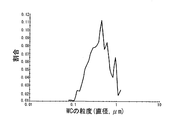
- 4 is a graph showing the particle size distribution of WC in a cemented carbide of sample No. 2.
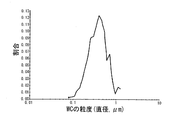
- It is a mapping image of sample No. 106 observed using the EBSD method. 4 is a graph showing the particle size distribution of WC in a cemented carbide of Sample No. 106.
- WC powder having an average particle size of 0.5 ⁇ m, Co powder having an average particle size of 0.2 ⁇ m and 0.6 ⁇ m, and carbon powder were prepared.
- a WC powder containing 0.2 to 1.5 mass% Cr or 0.2 to 1.5 mass% Cr and 0.2 mass% V was prepared as the WC powder.
- the amount of Co powder added was adjusted so that the Co content was 0.2 to 0.9 mass% with respect to the total mass of the WC powder, Co powder, and carbon powder containing Cr and V.
- the amount of carbon powder added is adjusted so that the carbon content is plus 0.05% by mass or more and less than 0.1% by mass with respect to the theoretical carbon content of the cemented carbide of each composition to be manufactured, and the balance is WC powder. It was. Any of these raw material powders can be used commercially. Sample Nos. 1 and 2 used Co powder with an average particle size of 0.2 ⁇ m, and Samples Nos. 3 to 5 used Co powder with an average particle size of 0.6 ⁇ m.
- the powdery paraffin (1% by mass with respect to the raw material powder) was added to the raw material powder, and mixing and pulverization were performed using an attritor or a ball mill as a pulverizing and dispersing machine. Both the attritor and the ball mill used cemented carbide balls with a diameter of 5 mm for the media.
- Table 1 shows the types of pulverizing and dispersing machines used, and the mixing and pulverizing time. In particular, in Sample Nos. 1 to 5, 5 hours from the start of mixing and pulverization were performed at high speed (25 r.p.m. or more), and the remaining time after 5 hours was performed at low speed (5 r.p.m.).
- the raw material powder was granulated into granules using a granulation dryer and then dried.
- a predetermined amount of the obtained granulated powder is put into a rubber mold and subjected to isostatic pressing, and then the outer periphery of the obtained press body is machined to obtain a round bar having a diameter of 8 mm ⁇ length L: 80 mm.
- a material was prepared.
- the obtained round bar was placed in a sintering furnace, sintered by holding it in a vacuum at 1450 ° C. to 1550 ° C. for 1 hour, cooled from the above heating temperature, and then taken out from the sintering furnace.
- the obtained sintered body was subjected to HIP in an Ar atmosphere at 1320 ° C. and 1000 atmospheres (about 101 MPa) to obtain a cemented carbide.
- the obtained cemented carbide is subjected to grinding and electric discharge machining, forming an outer peripheral shape, forming a tapered portion where water is introduced, and a through-hole extending in the longitudinal direction in the center of the cemented carbide ( A nozzle for high-pressure water flow processing was manufactured.
- Example Nos. 101-106 For comparison, samples using Cr 3 C 2 , VC, and Mo 2 C as raw materials and samples not using Cr 3 C 2 , VC, and Mo 2 C were prepared. Specifically, as a raw material, WC powder having an average particle size of 0.7 ⁇ m (containing no Cr or V), Co powder, Mo 2 C powder, VC powder, Cr 3 C 2 powder (all average particle size: 0.7 ⁇ 1.5 ⁇ m), and carbon powder were prepared. Adjust the amount of these raw material powders as appropriate, and go through the steps of mixing, crushing, granulation, drying, isostatic pressing, round bar material production, sintering, and HIP, as with sample Nos. 1-5. A cemented carbide was obtained. Samples Nos.
- composition and structure Each cemented carbide obtained was subjected to ICP (inductively-coupled plasma) spectroscopic analysis and X-ray diffraction to examine the composition and structure. The results are shown in Table 1. The Co content of all the samples, the Cr and V contents in the sample Nos. 1 to 5, and the Cr, V, and Mo contents in the sample Nos. 101 to 106 are mass ratios relative to the cemented carbide.
- the peak waveform of Co x W y C z (including the case where the peak waveform is slightly shifted from the peak waveform of pure Co x W y C z due to solid solution such as Cr) is obtained by X-ray diffraction, If the peak waveform of metal Co cannot be obtained due to the detection limit, it is determined that Co exists as Co x W y C z .
- the analysis of the composition of the cemented carbide can utilize Co titration in addition to the above ICP spectroscopic analysis. Moreover, the composition of the compounding raw material is substantially equal to the composition of the cemented carbide.
- sample Nos. 1 to 5 made using WC powder containing Cr and V as raw materials Cr carbide and V carbide are X-ray diffracted in the cemented carbide except sample No. 4 as shown in Table 1. It can be said that Cr carbide and V carbide are not present.
- Cr 3 C 2 was only slightly detected.
- One of the reasons why Cr 3 C 2 was slightly detected in Sample No. 4 is considered to be that it was precipitated without being completely dissolved in the binder phase or the like by containing V in addition to Cr.
- Sample Nos. 102 to 104,106 produced using carbide powder such as Cr 3 C 2 powder as raw materials were detected as Cr carbide (Cr 3 C 2 ), V carbide (VC), and Mo carbide (Mo 2 C).
- the average grain size of all WC is the average grain size of the cemented carbide.
- a commercially available EBSD apparatus can be used for the measurement of the particle size.
- the standard deviation of the grain size is obtained for all WCs present in the three fields of view, and this standard deviation is defined as the standard deviation ⁇ of the cemented carbide.
- FIGS. 1 to 4 show mapping images observed using the EBSD method and sample size distributions of WC for sample No. 2 and sample No. 106.
- FIG. 1 is a mapping image of sample No. 2
- FIG. 2 is a particle size distribution of sample No. 2
- FIG. 3 is a mapping image of sample No. 106
- FIG. 4 is a particle size distribution of sample No. 106.
- each WC is actually provided with red to blue to green. 1 and 3
- each of the white to gray blocks is WC
- the black block in FIG. 1 is Co x W y C z
- the black block in FIG. 3 is metallic Co.
- the WC has a mean particle size of 0.2 to 0.7 ⁇ m, and the standard deviation ⁇ of the WC particle size is 0.25 or less. Variation is small and uniform. In particular, all of sample Nos. 1 to 5 have few coarse WC of 1.0 ⁇ m or more. Also from FIG. 1, it can be seen that all the WC in the cemented carbide has a fine and uniform size. Furthermore, in the cemented carbide shown in FIG. 1, it can be seen that fine Co x W y C z is uniformly dispersed in the cemented carbide.
- sample No. 106 has coarse WC particles locally even when Cr 3 C 2 is used as a raw material. This is supported by the graph in FIG. Further, in Sample No. 106, Co is locally solidified as shown in FIG. 3, and the thickness of Co in the cemented carbide is not uniform.
- sample Nos. 1-5 have a better balance of hardness (HRA hardness), toughness (fracture toughness), and strength (bending strength) than sample Nos. 101-106. Yes.
- sample Nos. 1 to 3 all have high hardness of 94-96 HRA, high toughness with fracture toughness of 4 MPa ⁇ m 1/2 or higher, and high strength with a bending strength of 1 GPa or higher. It is.
- Sample No. 4 in which Cr 3 C 2 was slightly detected had slightly smaller toughness and strength than Sample Nos. 1 to 3, but WC was fine and relatively high in hardness.
- Samples Nos. 1 and 2 have less Co than Samples Nos. 3 to 5, so that dissolution of W into Co and reprecipitation of WC during sintering were suppressed. High hardness.
- Sample No. 101 which did not use Cr 3 C 2 or the like, has particularly low hardness due to the presence of large WC having a particle size of 1.0 ⁇ m or more.
- Sample No. 102 in which Cr 3 C 2 was present in the cemented carbide has particularly low toughness and strength.
- Samples Nos. 103 and 104 have many WCs having a particle size of 1.0 ⁇ m or more, but they have high hardness due to the presence of VC or Mo 2 C having a hardness higher than WC, but have low toughness and strength.
- Sample No. 106 has low toughness and strength as a whole alloy although the amount of Co is too small, so that dissolution of W into Co during sintering and reprecipitation of WC are suppressed and WC is fine.
- Sample No. 106 has particularly low hardness due to too much Co.
- Vickers hardness Hv (GPa) of the cemented carbide of sample No. 2 was measured in the temperature range from room temperature (20 ° C.) to 800 ° C. As a result, it was 24.6 GPa at room temperature, the degree of hardness decrease was small even at 600 ° C. or higher, and it was about 15 GPa even at 800 ° C. Further, when the surface of the cemented carbide exposed to the temperature range of 600 ° C. or higher was observed, no Co elution was observed and the surface properties were excellent. Therefore, the cemented carbides of Sample Nos. 1 to 5 can maintain high hardness even at high temperatures and have excellent surface properties. It is expected that the material can be suitably used as a constituent material of a member for which quality is desired, for example, a glass lens mold.
- sample Nos. 1 to 5 have a very long life compared to sample Nos. 101 to 106.
- Sample Nos. 1 to 3 in which Cr carbide and W 2 C were not detected have a very long life.
- Samples Nos. 101, 105, and 106 having low hardness were inferior in wear resistance.
- chipping occurred during the life test.
- the above-described embodiment can be appropriately changed without departing from the gist of the present invention, and is not limited to the above-described configuration.
- the composition of the cemented carbide, the average particle diameter of the raw material powder, and the like can be changed as appropriate.
- the cemented carbide of the present invention can be suitably used as a constituent material for various wear-resistant parts that are desired to have excellent wear resistance, such as high-pressure water-flow nozzles and dies (punches and dies). Further, the cemented carbide of the present invention can be suitably used as a constituent material of a glass lens mold for a camera or the like, which is excellent in surface properties and requires formation of a high-quality member.
Landscapes
- Chemical & Material Sciences (AREA)
- Engineering & Computer Science (AREA)
- Materials Engineering (AREA)
- Mechanical Engineering (AREA)
- Metallurgy (AREA)
- Organic Chemistry (AREA)
- Powder Metallurgy (AREA)
- Perforating, Stamping-Out Or Severing By Means Other Than Cutting (AREA)
- Ceramic Products (AREA)
Abstract
Description
《組成》
本発明超硬合金は、硬質相が主としてWCの粒子から構成される。また、結合相が主としてCo化合物(CoxWyCz)から構成されるWC- CoxWyCz系超硬合金である。そして、CoxWyCz及び後述するCrを除く残部がWとCとの二元化合物と不可避的な不純物とにより構成される。更に後述するVを含む場合は、CoxWyCz、Cr及びVを除く残部がWとCとの二元化合物と不可避的な不純物とにより構成される。WとCとの二元化合物には、WC、W2Cが挙げられる。
本発明超硬合金中におけるCoは、CoxWyCzというCoとWとの化合物の状態で存在する。後述する実施例において本発明超硬合金をX線回折により分析した結果、Coを含む成分のピーク波形は、CoxWyCzのピーク波形が得られ、金属Coのピーク波形は検出限界により得られなかった。また、CoxWyCz中にCrやVが固溶されている場合、CoxWyCzのピーク波形からピーク位置がややずれたピーク波形が得られると考えられる。従って、超硬合金をX線回折により分析した場合にCrやVを固溶することによりCoxWyCzのピーク波形がややずれた場合も、金属Coのピーク波形が得られない超硬合金は、本発明の範囲に含有されると解釈する。後述する製造方法によれば、超硬合金中のCoの実質的に全てがCoxWyCzとして存在し、金属Coが存在しない(金属CoのX線回折によるピーク波形が検出限界により得られない)超硬合金を製造することができる。x,y,zは、いずれも正の値をとり、x+y>zを満たす。
Crを超硬合金に対して0.2質量%以上含有することで、WCの粒成長を効果的に抑えて粗大なWCの発生を低減し、微細で均一的な大きさのWCが均一的に存在する超硬合金を安定して製造することができる。また、Crを含有することで、超硬合金の耐酸化性を向上させることができる。Crが多いほど、粒成長の抑制効果が高められる。しかし、Crが多過ぎると、Cr炭化物として析出し易くなり、Cr炭化物の存在による強度の低下の要因となる。そこで、本発明超硬合金は、Crの含有量を0.2質量%以上1.5質量%以下とする。より好ましいCrの含有量は、0.2質量%以上0.9質量%以下である。
本発明超硬合金は、CoxWyCz,Cr,(V)を除く残部がWとCとの二元化合物及び不可避的な不純物により構成される。WとCとの二元化合物のうち、特に、WCの含有量が当該超硬合金に対して97質量%以上である。このWCは、超硬合金中に粒状で存在して、硬質相として機能する。特に、WCは、微粒である上に均一な大きさである。具体的には、WCの平均粒度が0.2μm以上0.7μm以下であり、粒度の標準偏差σが0.25以下である。平均粒度が上記範囲を満たし、かつ標準偏差が上記範囲を満たすことで、微細なWCにより硬度を高められると共に、粗大なWCが少ないことにより強度の低下を低減することができる。平均粒度が0.2μm未満と小さ過ぎると、亀裂が進展し易く、靭性の低下を招き、平均粒度が0.7μm超であると、硬度の低下を招く。より好ましい平均粒度は、0.2μm以上0.4μm以下である。標準偏差σは小さい方が好ましく、特に下限を設けない。
本発明超硬合金は、高硬度、高靭性、及び高強度である。具体的には、HRA硬度が94以上96以下、破壊靱性が4 MPa・m1/2以上、抗折力が1GPa以上であることが好ましい。HRA硬度が94以上であることで、耐摩耗性に優れる。HRA硬度が96以下であることで、過度な高硬度化による靭性の低下を低減できる。また、破壊靱性が4 MPa・m1/2以上及び抗折力が1GPa以上であることで、各種の部材の製造において、加工時の亀裂やチッピングを効果的に抑えられ、かつ高硬度な上に、高靭性及び高強度である超硬合金本来の優れた性能を具える部材を提供することができる。
超硬合金は、一般に、原料の準備―原料の混合・粉砕―乾燥―成形―焼結という工程で製造される。本発明超硬合金は、上記焼結後に、更にHIP(熱間静水圧焼結)を行うと共に、特定の原料の利用、及び特定の条件での混合・粉砕を行う。
原料のWC粉末は、超硬合金中のWCが微細な状態になり易いように、微細なものを利用することが好ましい。具体的には、平均粒度が0.1μm以上0.5μm以下のWC粉末が好ましい。0.1μm未満でも0.5μm超でも粒成長して粗大なWCが存在する超硬合金が形成され易い。
原料のCo粉末には、微細なWC粉末と均一的に混合され易いように、WC粉末と同程度の微細なものを利用することが好ましい。具体的には、平均粒度が0.2μm以上0.6μm以下のCo粉末が好ましい。0.2μm未満であると、Coが小さ過ぎることで再凝集し易くなってCoが均一的に分散されず、焼結されにくくなることや、焼結されにくくなることに伴う焼結温度の高温化によりWCの粒成長を促して、均一な粒度分布が得られ難くなる。0.6μm超であると、微細なWC粉末と均一に混合され難くなり、上述のようにCoが不均一に存在することによる焼結されにくくなることや粒度分布の不均一を招く。
上述したCrやV含有のWC粉末及びCo粉末に加えて、適宜カーボン粉末を添加することなどにより、超硬合金中における炭素(C)の総量を調整する。超硬合金中の炭素の総量を調整すると共に、後述する製造条件で製造することで、Co粉末の実質的に全てをCoxWyCzとすることができる上に、得られた超硬合金中の炭素はWC, CoxWyCzとして存在し易い。超硬合金中の炭素の総量が多過ぎると、金属Coが存在し易くなる。また、超硬合金中の炭素の総量が多過ぎると、フリーカーボンとして超硬合金中に存在したり、Cr炭化物などが析出したりすることで強度の低下を招く。
上述した原料となる粉末を用意し、アトライター、ボールミル、ビーズミルといった回転翼を有する粉砕分散機により、混合・粉砕を行う。混合・粉砕の時間は10時間以上20時間以下が好ましい。特に、混合・粉砕の開始から5時間までの初期工程を高速回転(25r.p.m.以上)で行い、以降の混合・粉砕(以下、後工程と呼ぶ)を低速回転(25r.p.m.未満)で行うことが好ましい。初期工程で概ねの混合・粉砕を完了し、後工程では、主として分散を行う。このように混合・粉砕工程を多段にすることで、均一な混合、分散を実現し易い。混合・粉砕工程の全体に亘って高速回転で行うと、Coの凝集が生じて分散状態が悪くなり、WCが成長し易くなるなど、組織の不均一化を招く。一方、混合・粉砕工程の全体に亘って低速回転で行うと、粉砕や混合が不十分で組織の不均一化を招く。
種々の原料粉末を用意して超硬合金を作製し、得られた超硬合金の組成、組織、機械的特性を調べた。また、この超硬合金から高圧水流加工用ノズルを作製し、ノズルの寿命を調べた。
原料として、平均粒度が0.5μmのWC粉末、平均粒度が0.2μm及び0.6μmのCo粉末、及びカーボン粉末を用意した。当該WC粉末に対して、Crを0.2~1.5質量%含有するものまたは、Crを0.2~1.5質量%及びVを0.2質量%含有するものを上記WC粉末として用意した。上記CrやVを含有するWC粉末、Co粉末、及びカーボン粉末の合計質量に対して、Coの含有量が0.2~0.9質量%となるようにCo粉末の添加量を調整した。さらに、炭素の含有量が、製造される各組成の超硬合金の理論炭素量に対してプラス0.05質量%以上0.1質量%未満となるようにカーボン粉末の添加量を調整し、残部をWC粉末とした。これらの原料粉末は、いずれも市販のものが利用できる。なお、試料No.1,2には、平均粒径が0.2μmのCo粉末、試料No.3~5には、平均粒径が0.6μmのCo粉末を用いた。
比較として、原料にCr3C2,VC,Mo2C を用いた試料、Cr3C2,VC,Mo2Cを用いていない試料を作製した。具体的には、原料として、平均粒度が0.7μmのWC粉末(CrやVを含有しないもの)、及びCo粉末、Mo2C粉末、VC粉末、Cr3C2粉末(いずれも平均粒度:0.7~1.5μm)、並びにカーボン粉末を用意した。これらの原料粉末の添加量を適宜調整して、試料No.1~5と同様に、混合・粉砕―造粒―乾燥―静水圧プレス―丸棒材の作製―焼結―HIPという工程を経て、超硬合金を得た。試料No.101~106では、混合・粉砕の全時間に亘って、高速回転(25r.p.m.以上)で混合・粉砕を行い、焼結条件やHIP条件は、試料No.1~5と同様とした。得られた超硬合金に試料No.1~5と同様の加工を施して、高圧水流加工用ノズルを製作した。
得られた各超硬合金について、ICP(inductively-coupled plasma)分光分析及びX線回折を行い、組成及び組織を調べた。その結果を表1に示す。全ての試料のCoの含有量、試料No.1~5におけるCr及びVの含有量、及び試料No.101~106におけるCr,V,Moの含有量は、超硬合金に対する質量割合である。X線回折により、WC,W2C,及びCoxWyCzのピーク波形のみが得られ、かつCr炭化物、V炭化物のピーク波形が検出限界により得られない場合、Cr,VはWC,W2C,CoxWyCz中に固溶した状態で存在すると判断する。また、X線回折により、WCのピーク波形が得られ、かつW2Cのピーク波形が検出限界により得られない場合、WとCとの二元化合物は全てWCとして存在すると判断する。更に、X線回折により、CoxWyCzのピーク波形(Crなどの固溶により純粋なCoxWyCzのピーク波形から若干ずれたピーク波形である場合を含む)が得られ、かつ金属Coのピーク波形が検出限界により得られない場合、CoはCoxWyCzとして存在すると判断する。なお、超硬合金の組成の分析は、上記ICP分光分析の他、Co滴定などを利用することができる。また、配合原料の組成は、超硬合金の組成に実質的に等しい。

得られた各超硬合金について、組織観察を行い、WCの平均粒度、粒度の標準偏差σ、粒度(粒径)が1.0μm以上であるWCの面積割合を求めた。その結果を表2に示す。組織観察は、以下のように行った。各超硬合金を任意に切断して断面をとり、この断面を研削した後、#3000までのバフ研磨を施した。研磨した面を約5000倍の倍率で、FESEM(Field Emission Scanning Electron Microscope)によるEBSD(Electron Back-Scatter Diffraction)法を用いて観察した。観察は、研磨した面に対して任意の複数の視野(ここでは、1視野:180μm2で3視野)を選択して、視野ごとに行った。各視野中に存在する全てのWCの結晶粒について、結晶方位毎に色別(マッピング)を行い、結晶粒径を視覚的に把握できるようにした。得られたマッピング像に画像解析を行い、3つの視野に存在する全てのWCについてそれぞれの面積の円相当径を求め、この円相当径をWCの粒度(直径)とし、3つの視野に存在する全てのWCの粒度の平均を超硬合金の平均粒度とする。上記粒度の測定には、市販のEBSD装置を用いることができる。また、3つの視野に存在する全てのWCについて粒度の標準偏差を求め、この標準偏差を超硬合金の標準偏差σとする。更に、3つの視野に存在する全てのWCについて、粒度が1.0μm以上であるWCの合計面積S1.0WCを求め、3つの視野の合計面積Sfに対する面積割合R(%)=(S1.0WC/Sf)×100を求め、この割合Rを超硬合金におけるWCの面積割合Rとする。
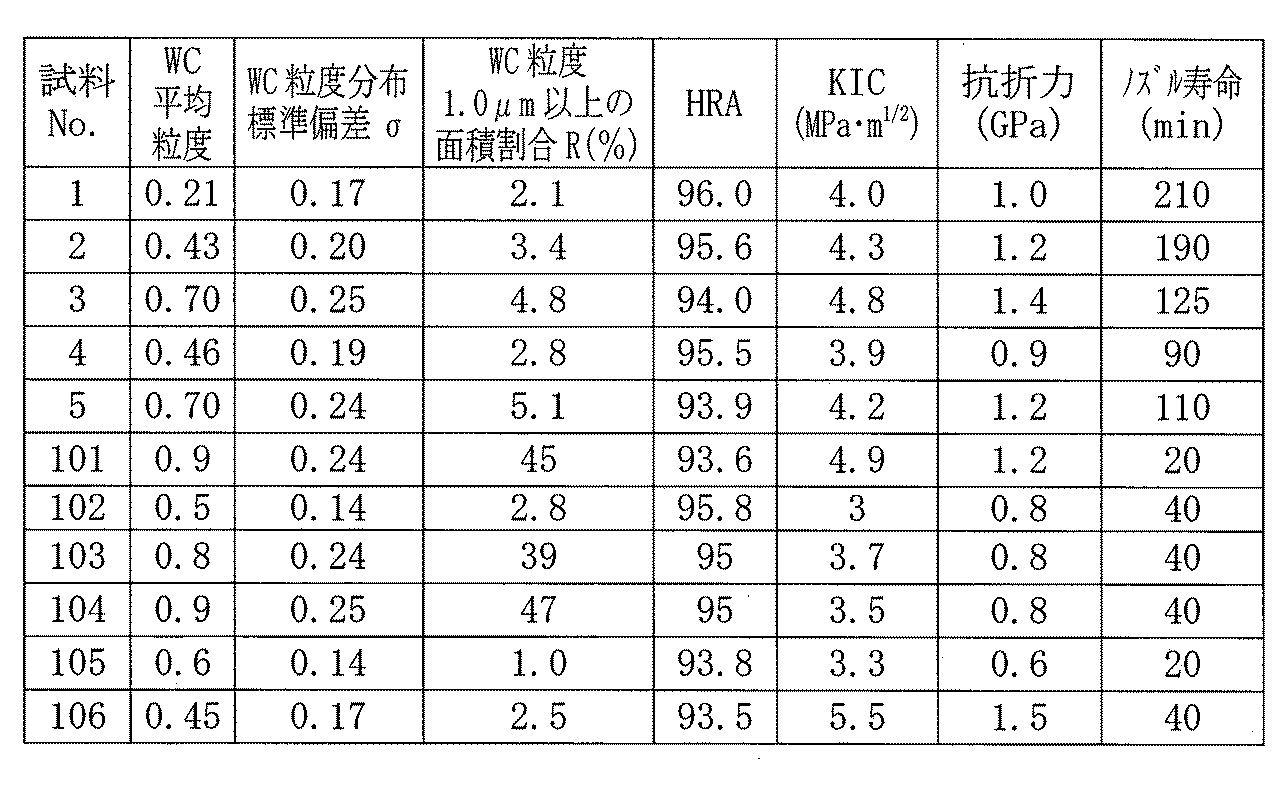
得られた各超硬合金について、HRA硬度、破壊靭性(KIC)、抗折力を測定した。その結果を表2に示す。HRA硬度及び抗折力は、室温で市販の装置を用いて測定した。破壊靱性(KIC)は、ビッカース法に基づく測定が可能な市販の装置を用いて測定した。
作製したノズルを用いて、以下のようにして寿命を調べた。その結果を表2に示す。砥粒に#120のガーネットを用い、水圧:300MPaで鉄板を切断する。一定時間ごとにノズルの貫通孔の直径を測定し、摩耗による上記直径の変化を調べる。初期の貫通孔の直径φ0.5mmに対して0.1mm増加するまで、即ち、貫通孔の直径が0.6mmになるまで鉄板を切断し、直径φが0.6mmになった時点の時間を寿命として評価した。
Claims (6)
- Coを0.2質量%以上0.9質量%以下、Crを0.2質量%以上1.5質量%以下含有し、残部がWとCとの二元化合物及び不純物からなり、
前記Coは、CoxWyCzの状態で存在しており、
前記WとCとの二元化合物のうち、WCの平均粒度が0.2μm以上0.7μm以下であり、
前記WCの粒度の標準偏差σがσ≦0.25であることを特徴とする超硬合金。 - 粒度が1.0μm以上であるWCの面積割合が当該超硬合金に対して5%以下であることを特徴とする請求項1に記載の超硬合金。
- 前記WとCとの二元化合物は、主としてWCであり、
W2Cを含む場合、体積割合で、W2C /(WC+ W2C)≦0.005以下であることを特徴とする請求項1又は2に記載の超硬合金。 - 前記超硬合金のHRA硬度が94以上96以下、破壊靱性(KIC)が4MPa・m1/2以上、抗折力が1GPa以上であることを特徴とする請求項1~3のいずれか1項に記載の超硬合金。
- 更に、Vを0.2質量%以下含有することを特徴とする請求項1~4のいずれか1項に記載の超硬合金。
- Cr炭化物及びV炭化物が、X線回折により検出されないことを特徴とする請求項1~5のいずれか1項に記載の超硬合金。
Priority Applications (2)
| Application Number | Priority Date | Filing Date | Title |
|---|---|---|---|
| CN201080001804.3A CN102057069B (zh) | 2009-04-14 | 2010-04-07 | 超硬合金 |
| KR1020107026230A KR101245499B1 (ko) | 2009-04-14 | 2010-04-07 | 초경합금 |
Applications Claiming Priority (2)
| Application Number | Priority Date | Filing Date | Title |
|---|---|---|---|
| JP2009098421A JP5309394B2 (ja) | 2009-04-14 | 2009-04-14 | 超硬合金 |
| JP2009-098421 | 2009-04-14 |
Publications (1)
| Publication Number | Publication Date |
|---|---|
| WO2010119795A1 true WO2010119795A1 (ja) | 2010-10-21 |
Family
ID=42982457
Family Applications (1)
| Application Number | Title | Priority Date | Filing Date |
|---|---|---|---|
| PCT/JP2010/056291 Ceased WO2010119795A1 (ja) | 2009-04-14 | 2010-04-07 | 超硬合金 |
Country Status (5)
| Country | Link |
|---|---|
| JP (1) | JP5309394B2 (ja) |
| KR (1) | KR101245499B1 (ja) |
| CN (1) | CN102057069B (ja) |
| TW (1) | TWI506144B (ja) |
| WO (1) | WO2010119795A1 (ja) |
Cited By (5)
| Publication number | Priority date | Publication date | Assignee | Title |
|---|---|---|---|---|
| JP2012117100A (ja) * | 2010-11-30 | 2012-06-21 | Sumitomo Electric Ind Ltd | 超硬合金 |
| JP2015145533A (ja) * | 2015-02-04 | 2015-08-13 | 住友電気工業株式会社 | 超硬合金、および加工工具 |
| WO2018003877A1 (ja) * | 2016-06-30 | 2018-01-04 | 三菱マテリアル株式会社 | 超硬質焼結体 |
| CN113560582A (zh) * | 2021-07-26 | 2021-10-29 | 河源帝诺新材料有限公司 | 一种碳化钨硬质合金研磨微珠及其滴定成型制备方法 |
| JP6957828B1 (ja) * | 2020-10-30 | 2021-11-02 | 住友電工ハードメタル株式会社 | 超硬合金及びそれを備える切削工具 |
Families Citing this family (7)
| Publication number | Priority date | Publication date | Assignee | Title |
|---|---|---|---|---|
| JP2009035810A (ja) * | 2007-07-11 | 2009-02-19 | Sumitomo Electric Hardmetal Corp | 超硬合金 |
| JP5348537B2 (ja) * | 2009-04-14 | 2013-11-20 | 住友電工ハードメタル株式会社 | 超硬合金 |
| JP2012166220A (ja) * | 2011-02-14 | 2012-09-06 | Sumitomo Electric Ind Ltd | 回転ツール |
| KR101425952B1 (ko) * | 2012-04-03 | 2014-08-05 | (주)하이엠시 | 초경합금 및 초경합금의 제조방법 |
| EP3442728B1 (en) * | 2016-04-15 | 2021-05-19 | Sandvik Intellectual Property AB | Cermet or cemented carbide powder and three dimensional printing thereof |
| AU2017333850B2 (en) * | 2016-09-28 | 2021-05-20 | Sandvik Intellectual Property Ab | A rock drill insert |
| CN120035686A (zh) * | 2023-05-30 | 2025-05-23 | 住友电工硬质合金株式会社 | 硬质合金以及切削工具 |
Citations (5)
| Publication number | Priority date | Publication date | Assignee | Title |
|---|---|---|---|---|
| JP2002275508A (ja) * | 2001-03-15 | 2002-09-25 | Sumitomo Electric Ind Ltd | 半導体製品加工用切断刃およびその製造方法 |
| JP2004076049A (ja) * | 2002-08-13 | 2004-03-11 | Hitachi Tool Engineering Ltd | 超微粒超硬合金 |
| JP2005519018A (ja) * | 2001-11-06 | 2005-06-30 | サーバイド | 高密度炭化タングステンのセラミック体を作製する方法 |
| JP2006037160A (ja) * | 2004-07-27 | 2006-02-09 | Tungaloy Corp | 焼結体 |
| WO2009001929A1 (ja) * | 2007-06-27 | 2008-12-31 | Kyocera Corporation | 超硬合金、切削工具ならびに切削加工装置 |
Family Cites Families (2)
| Publication number | Priority date | Publication date | Assignee | Title |
|---|---|---|---|---|
| CN1207416C (zh) * | 2003-07-22 | 2005-06-22 | 株洲硬质合金集团有限公司 | 超细硬质合金的制备方法 |
| CN100575515C (zh) * | 2007-08-14 | 2009-12-30 | 北京科技大学 | 一种超细晶WC-Co硬质合金制备方法 |
-
2009
- 2009-04-14 JP JP2009098421A patent/JP5309394B2/ja active Active
-
2010
- 2010-04-07 KR KR1020107026230A patent/KR101245499B1/ko active Active
- 2010-04-07 CN CN201080001804.3A patent/CN102057069B/zh active Active
- 2010-04-07 WO PCT/JP2010/056291 patent/WO2010119795A1/ja not_active Ceased
- 2010-04-14 TW TW099111665A patent/TWI506144B/zh not_active IP Right Cessation
Patent Citations (5)
| Publication number | Priority date | Publication date | Assignee | Title |
|---|---|---|---|---|
| JP2002275508A (ja) * | 2001-03-15 | 2002-09-25 | Sumitomo Electric Ind Ltd | 半導体製品加工用切断刃およびその製造方法 |
| JP2005519018A (ja) * | 2001-11-06 | 2005-06-30 | サーバイド | 高密度炭化タングステンのセラミック体を作製する方法 |
| JP2004076049A (ja) * | 2002-08-13 | 2004-03-11 | Hitachi Tool Engineering Ltd | 超微粒超硬合金 |
| JP2006037160A (ja) * | 2004-07-27 | 2006-02-09 | Tungaloy Corp | 焼結体 |
| WO2009001929A1 (ja) * | 2007-06-27 | 2008-12-31 | Kyocera Corporation | 超硬合金、切削工具ならびに切削加工装置 |
Cited By (9)
| Publication number | Priority date | Publication date | Assignee | Title |
|---|---|---|---|---|
| JP2012117100A (ja) * | 2010-11-30 | 2012-06-21 | Sumitomo Electric Ind Ltd | 超硬合金 |
| JP2015145533A (ja) * | 2015-02-04 | 2015-08-13 | 住友電気工業株式会社 | 超硬合金、および加工工具 |
| WO2018003877A1 (ja) * | 2016-06-30 | 2018-01-04 | 三菱マテリアル株式会社 | 超硬質焼結体 |
| JPWO2018003877A1 (ja) * | 2016-06-30 | 2019-08-08 | 三菱マテリアル株式会社 | 超硬質焼結体 |
| JP6957828B1 (ja) * | 2020-10-30 | 2021-11-02 | 住友電工ハードメタル株式会社 | 超硬合金及びそれを備える切削工具 |
| WO2022091343A1 (ja) * | 2020-10-30 | 2022-05-05 | 住友電工ハードメタル株式会社 | 超硬合金及びそれを備える切削工具 |
| CN114698373A (zh) * | 2020-10-30 | 2022-07-01 | 住友电工硬质合金株式会社 | 硬质合金及具备该硬质合金的切削工具 |
| CN114698373B (zh) * | 2020-10-30 | 2024-11-15 | 住友电工硬质合金株式会社 | 硬质合金及具备该硬质合金的切削工具 |
| CN113560582A (zh) * | 2021-07-26 | 2021-10-29 | 河源帝诺新材料有限公司 | 一种碳化钨硬质合金研磨微珠及其滴定成型制备方法 |
Also Published As
| Publication number | Publication date |
|---|---|
| TWI506144B (zh) | 2015-11-01 |
| JP5309394B2 (ja) | 2013-10-09 |
| KR20100134781A (ko) | 2010-12-23 |
| TW201042055A (en) | 2010-12-01 |
| KR101245499B1 (ko) | 2013-03-25 |
| CN102057069A (zh) | 2011-05-11 |
| JP2010248560A (ja) | 2010-11-04 |
| CN102057069B (zh) | 2013-04-10 |
Similar Documents
| Publication | Publication Date | Title |
|---|---|---|
| JP5309394B2 (ja) | 超硬合金 | |
| JP5348537B2 (ja) | 超硬合金 | |
| JP6796266B2 (ja) | 超硬合金、及び切削工具 | |
| JP5198121B2 (ja) | 炭化タングステン粉末、炭化タングステン粉末の製造方法 | |
| EP4091739A1 (en) | Ultrafine cemented carbide, and shearing tool, cutting tool, or abrasion-resistant tool using ultrafine cemented carbide | |
| CN106636834B (zh) | 抑制硬质合金晶粒长大的方法及超细晶硬质合金制备工艺 | |
| CN109642277B (zh) | 硬质材料和切削工具 | |
| JP2017014084A (ja) | 立方晶窒化硼素焼結体、立方晶窒化硼素焼結体の製造方法、工具、および切削工具 | |
| KR20240062321A (ko) | 고엔트로피 초경소재 및 이의 제조방법 | |
| TW202346615A (zh) | 超硬合金 | |
| KR101425952B1 (ko) | 초경합금 및 초경합금의 제조방법 | |
| JP5740763B2 (ja) | 超硬合金 | |
| CN110392743B (zh) | 硬质烧结体 | |
| CN109641806B (zh) | 碳氮化钛粉末和碳氮化钛粉末的制造方法 | |
| JP2006111947A (ja) | 超微粒子サーメット | |
| JP2004256863A (ja) | 超硬合金およびその製造方法、並びにそれを用いた回転工具 | |
| EP3480328B1 (en) | Super hard sintered body | |
| JP2011208268A (ja) | 超微粒超硬合金 | |
| JP2010207954A (ja) | 高速切削加工ですぐれた耐欠損性を発揮する超硬合金製エンドミル | |
| WO2025158938A1 (ja) | 炭化タングステンを含む粉末 | |
| JPH1121119A (ja) | 複合炭化物及びそれを用いた超硬合金の製造方法 |
Legal Events
| Date | Code | Title | Description |
|---|---|---|---|
| WWE | Wipo information: entry into national phase |
Ref document number: 201080001804.3 Country of ref document: CN |
|
| ENP | Entry into the national phase |
Ref document number: 20107026230 Country of ref document: KR Kind code of ref document: A |
|
| 121 | Ep: the epo has been informed by wipo that ep was designated in this application |
Ref document number: 10764379 Country of ref document: EP Kind code of ref document: A1 |
|
| NENP | Non-entry into the national phase |
Ref country code: DE |
|
| 122 | Ep: pct application non-entry in european phase |
Ref document number: 10764379 Country of ref document: EP Kind code of ref document: A1 |