WO2010047271A1 - ポリイミド樹脂及びその組成物 - Google Patents
ポリイミド樹脂及びその組成物 Download PDFInfo
- Publication number
- WO2010047271A1 WO2010047271A1 PCT/JP2009/067867 JP2009067867W WO2010047271A1 WO 2010047271 A1 WO2010047271 A1 WO 2010047271A1 JP 2009067867 W JP2009067867 W JP 2009067867W WO 2010047271 A1 WO2010047271 A1 WO 2010047271A1
- Authority
- WO
- WIPO (PCT)
- Prior art keywords
- polyimide resin
- hydroxyl group
- phenolic hydroxyl
- dianhydride
- film
- Prior art date
- Legal status (The legal status is an assumption and is not a legal conclusion. Google has not performed a legal analysis and makes no representation as to the accuracy of the status listed.)
- Ceased
Links
Classifications
-
- C—CHEMISTRY; METALLURGY
- C08—ORGANIC MACROMOLECULAR COMPOUNDS; THEIR PREPARATION OR CHEMICAL WORKING-UP; COMPOSITIONS BASED THEREON
- C08G—MACROMOLECULAR COMPOUNDS OBTAINED OTHERWISE THAN BY REACTIONS ONLY INVOLVING UNSATURATED CARBON-TO-CARBON BONDS
- C08G73/00—Macromolecular compounds obtained by reactions forming a linkage containing nitrogen with or without oxygen or carbon in the main chain of the macromolecule, not provided for in groups C08G12/00 - C08G71/00
- C08G73/06—Polycondensates having nitrogen-containing heterocyclic rings in the main chain of the macromolecule
- C08G73/10—Polyimides; Polyester-imides; Polyamide-imides; Polyamide acids or similar polyimide precursors
-
- C—CHEMISTRY; METALLURGY
- C08—ORGANIC MACROMOLECULAR COMPOUNDS; THEIR PREPARATION OR CHEMICAL WORKING-UP; COMPOSITIONS BASED THEREON
- C08G—MACROMOLECULAR COMPOUNDS OBTAINED OTHERWISE THAN BY REACTIONS ONLY INVOLVING UNSATURATED CARBON-TO-CARBON BONDS
- C08G73/00—Macromolecular compounds obtained by reactions forming a linkage containing nitrogen with or without oxygen or carbon in the main chain of the macromolecule, not provided for in groups C08G12/00 - C08G71/00
- C08G73/06—Polycondensates having nitrogen-containing heterocyclic rings in the main chain of the macromolecule
- C08G73/10—Polyimides; Polyester-imides; Polyamide-imides; Polyamide acids or similar polyimide precursors
- C08G73/1042—Copolyimides derived from at least two different tetracarboxylic compounds or two different diamino compounds
-
- C—CHEMISTRY; METALLURGY
- C08—ORGANIC MACROMOLECULAR COMPOUNDS; THEIR PREPARATION OR CHEMICAL WORKING-UP; COMPOSITIONS BASED THEREON
- C08G—MACROMOLECULAR COMPOUNDS OBTAINED OTHERWISE THAN BY REACTIONS ONLY INVOLVING UNSATURATED CARBON-TO-CARBON BONDS
- C08G59/00—Polycondensates containing more than one epoxy group per molecule; Macromolecules obtained by polymerising compounds containing more than one epoxy group per molecule using curing agents or catalysts which react with the epoxy groups
- C08G59/18—Macromolecules obtained by polymerising compounds containing more than one epoxy group per molecule using curing agents or catalysts which react with the epoxy groups ; e.g. general methods of curing
- C08G59/40—Macromolecules obtained by polymerising compounds containing more than one epoxy group per molecule using curing agents or catalysts which react with the epoxy groups ; e.g. general methods of curing characterised by the curing agents used
- C08G59/62—Alcohols or phenols
-
- C—CHEMISTRY; METALLURGY
- C08—ORGANIC MACROMOLECULAR COMPOUNDS; THEIR PREPARATION OR CHEMICAL WORKING-UP; COMPOSITIONS BASED THEREON
- C08G—MACROMOLECULAR COMPOUNDS OBTAINED OTHERWISE THAN BY REACTIONS ONLY INVOLVING UNSATURATED CARBON-TO-CARBON BONDS
- C08G73/00—Macromolecular compounds obtained by reactions forming a linkage containing nitrogen with or without oxygen or carbon in the main chain of the macromolecule, not provided for in groups C08G12/00 - C08G71/00
- C08G73/06—Polycondensates having nitrogen-containing heterocyclic rings in the main chain of the macromolecule
- C08G73/10—Polyimides; Polyester-imides; Polyamide-imides; Polyamide acids or similar polyimide precursors
- C08G73/1046—Polyimides containing oxygen in the form of ether bonds in the main chain
-
- C—CHEMISTRY; METALLURGY
- C08—ORGANIC MACROMOLECULAR COMPOUNDS; THEIR PREPARATION OR CHEMICAL WORKING-UP; COMPOSITIONS BASED THEREON
- C08G—MACROMOLECULAR COMPOUNDS OBTAINED OTHERWISE THAN BY REACTIONS ONLY INVOLVING UNSATURATED CARBON-TO-CARBON BONDS
- C08G73/00—Macromolecular compounds obtained by reactions forming a linkage containing nitrogen with or without oxygen or carbon in the main chain of the macromolecule, not provided for in groups C08G12/00 - C08G71/00
- C08G73/06—Polycondensates having nitrogen-containing heterocyclic rings in the main chain of the macromolecule
- C08G73/10—Polyimides; Polyester-imides; Polyamide-imides; Polyamide acids or similar polyimide precursors
- C08G73/1046—Polyimides containing oxygen in the form of ether bonds in the main chain
- C08G73/105—Polyimides containing oxygen in the form of ether bonds in the main chain with oxygen only in the diamino moiety
-
- C—CHEMISTRY; METALLURGY
- C08—ORGANIC MACROMOLECULAR COMPOUNDS; THEIR PREPARATION OR CHEMICAL WORKING-UP; COMPOSITIONS BASED THEREON
- C08G—MACROMOLECULAR COMPOUNDS OBTAINED OTHERWISE THAN BY REACTIONS ONLY INVOLVING UNSATURATED CARBON-TO-CARBON BONDS
- C08G73/00—Macromolecular compounds obtained by reactions forming a linkage containing nitrogen with or without oxygen or carbon in the main chain of the macromolecule, not provided for in groups C08G12/00 - C08G71/00
- C08G73/06—Polycondensates having nitrogen-containing heterocyclic rings in the main chain of the macromolecule
- C08G73/10—Polyimides; Polyester-imides; Polyamide-imides; Polyamide acids or similar polyimide precursors
- C08G73/1067—Wholly aromatic polyimides, i.e. having both tetracarboxylic and diamino moieties aromatically bound
-
- C—CHEMISTRY; METALLURGY
- C08—ORGANIC MACROMOLECULAR COMPOUNDS; THEIR PREPARATION OR CHEMICAL WORKING-UP; COMPOSITIONS BASED THEREON
- C08G—MACROMOLECULAR COMPOUNDS OBTAINED OTHERWISE THAN BY REACTIONS ONLY INVOLVING UNSATURATED CARBON-TO-CARBON BONDS
- C08G73/00—Macromolecular compounds obtained by reactions forming a linkage containing nitrogen with or without oxygen or carbon in the main chain of the macromolecule, not provided for in groups C08G12/00 - C08G71/00
- C08G73/06—Polycondensates having nitrogen-containing heterocyclic rings in the main chain of the macromolecule
- C08G73/10—Polyimides; Polyester-imides; Polyamide-imides; Polyamide acids or similar polyimide precursors
- C08G73/1067—Wholly aromatic polyimides, i.e. having both tetracarboxylic and diamino moieties aromatically bound
- C08G73/1071—Wholly aromatic polyimides containing oxygen in the form of ether bonds in the main chain
-
- C—CHEMISTRY; METALLURGY
- C08—ORGANIC MACROMOLECULAR COMPOUNDS; THEIR PREPARATION OR CHEMICAL WORKING-UP; COMPOSITIONS BASED THEREON
- C08G—MACROMOLECULAR COMPOUNDS OBTAINED OTHERWISE THAN BY REACTIONS ONLY INVOLVING UNSATURATED CARBON-TO-CARBON BONDS
- C08G73/00—Macromolecular compounds obtained by reactions forming a linkage containing nitrogen with or without oxygen or carbon in the main chain of the macromolecule, not provided for in groups C08G12/00 - C08G71/00
- C08G73/06—Polycondensates having nitrogen-containing heterocyclic rings in the main chain of the macromolecule
- C08G73/10—Polyimides; Polyester-imides; Polyamide-imides; Polyamide acids or similar polyimide precursors
- C08G73/1075—Partially aromatic polyimides
-
- C—CHEMISTRY; METALLURGY
- C08—ORGANIC MACROMOLECULAR COMPOUNDS; THEIR PREPARATION OR CHEMICAL WORKING-UP; COMPOSITIONS BASED THEREON
- C08G—MACROMOLECULAR COMPOUNDS OBTAINED OTHERWISE THAN BY REACTIONS ONLY INVOLVING UNSATURATED CARBON-TO-CARBON BONDS
- C08G73/00—Macromolecular compounds obtained by reactions forming a linkage containing nitrogen with or without oxygen or carbon in the main chain of the macromolecule, not provided for in groups C08G12/00 - C08G71/00
- C08G73/06—Polycondensates having nitrogen-containing heterocyclic rings in the main chain of the macromolecule
- C08G73/10—Polyimides; Polyester-imides; Polyamide-imides; Polyamide acids or similar polyimide precursors
- C08G73/1075—Partially aromatic polyimides
- C08G73/1078—Partially aromatic polyimides wholly aromatic in the diamino moiety
-
- C—CHEMISTRY; METALLURGY
- C08—ORGANIC MACROMOLECULAR COMPOUNDS; THEIR PREPARATION OR CHEMICAL WORKING-UP; COMPOSITIONS BASED THEREON
- C08L—COMPOSITIONS OF MACROMOLECULAR COMPOUNDS
- C08L63/00—Compositions of epoxy resins; Compositions of derivatives of epoxy resins
-
- C—CHEMISTRY; METALLURGY
- C08—ORGANIC MACROMOLECULAR COMPOUNDS; THEIR PREPARATION OR CHEMICAL WORKING-UP; COMPOSITIONS BASED THEREON
- C08L—COMPOSITIONS OF MACROMOLECULAR COMPOUNDS
- C08L79/00—Compositions of macromolecular compounds obtained by reactions forming in the main chain of the macromolecule a linkage containing nitrogen with or without oxygen or carbon only, not provided for in groups C08L61/00 - C08L77/00
- C08L79/04—Polycondensates having nitrogen-containing heterocyclic rings in the main chain; Polyhydrazides; Polyamide acids or similar polyimide precursors
- C08L79/08—Polyimides; Polyester-imides; Polyamide-imides; Polyamide acids or similar polyimide precursors
-
- G—PHYSICS
- G03—PHOTOGRAPHY; CINEMATOGRAPHY; ANALOGOUS TECHNIQUES USING WAVES OTHER THAN OPTICAL WAVES; ELECTROGRAPHY; HOLOGRAPHY
- G03F—PHOTOMECHANICAL PRODUCTION OF TEXTURED OR PATTERNED SURFACES, e.g. FOR PRINTING, FOR PROCESSING OF SEMICONDUCTOR DEVICES; MATERIALS THEREFOR; ORIGINALS THEREFOR; APPARATUS SPECIALLY ADAPTED THEREFOR
- G03F7/00—Photomechanical, e.g. photolithographic, production of textured or patterned surfaces, e.g. printing surfaces; Materials therefor, e.g. comprising photoresists; Apparatus specially adapted therefor
- G03F7/004—Photosensitive materials
- G03F7/022—Quinonediazides
- G03F7/023—Macromolecular quinonediazides; Macromolecular additives, e.g. binders
-
- G—PHYSICS
- G03—PHOTOGRAPHY; CINEMATOGRAPHY; ANALOGOUS TECHNIQUES USING WAVES OTHER THAN OPTICAL WAVES; ELECTROGRAPHY; HOLOGRAPHY
- G03F—PHOTOMECHANICAL PRODUCTION OF TEXTURED OR PATTERNED SURFACES, e.g. FOR PRINTING, FOR PROCESSING OF SEMICONDUCTOR DEVICES; MATERIALS THEREFOR; ORIGINALS THEREFOR; APPARATUS SPECIALLY ADAPTED THEREFOR
- G03F7/00—Photomechanical, e.g. photolithographic, production of textured or patterned surfaces, e.g. printing surfaces; Materials therefor, e.g. comprising photoresists; Apparatus specially adapted therefor
- G03F7/004—Photosensitive materials
- G03F7/022—Quinonediazides
- G03F7/023—Macromolecular quinonediazides; Macromolecular additives, e.g. binders
- G03F7/0233—Macromolecular quinonediazides; Macromolecular additives, e.g. binders characterised by the polymeric binders or the macromolecular additives other than the macromolecular quinonediazides
-
- G—PHYSICS
- G03—PHOTOGRAPHY; CINEMATOGRAPHY; ANALOGOUS TECHNIQUES USING WAVES OTHER THAN OPTICAL WAVES; ELECTROGRAPHY; HOLOGRAPHY
- G03F—PHOTOMECHANICAL PRODUCTION OF TEXTURED OR PATTERNED SURFACES, e.g. FOR PRINTING, FOR PROCESSING OF SEMICONDUCTOR DEVICES; MATERIALS THEREFOR; ORIGINALS THEREFOR; APPARATUS SPECIALLY ADAPTED THEREFOR
- G03F7/00—Photomechanical, e.g. photolithographic, production of textured or patterned surfaces, e.g. printing surfaces; Materials therefor, e.g. comprising photoresists; Apparatus specially adapted therefor
- G03F7/26—Processing photosensitive materials; Apparatus therefor
- G03F7/40—Treatment after imagewise removal, e.g. baking
Definitions
- the present invention relates to a phenolic hydroxyl group-containing polyimide resin and a composition thereof.
- Epoxy resins are cured with various curing agents, and generally become cured products with excellent mechanical properties, water resistance, chemical resistance, heat resistance, electrical properties, etc., and adhesives, paints, laminates, molding materials It is used in a wide range of fields such as casting materials.
- the most commonly used epoxy resin includes bisphenol A type epoxy resin.
- bisphenol A type epoxy resin As other flame retardants, compounds obtained by reacting tetrabromobisphenol A with bisphenol A type epoxy resins are generally known.
- acid anhydrides and amine compounds are known as curing agents for epoxy resins, but phenol novolac is often used in the electrical / electronic field from the viewpoint of reliability such as heat resistance.
- aromatic polyamides having phenolic hydroxyl groups have been used as curing agents for the purpose of improving heat resistance and flexibility (Patent Document 1).
- Polyimide resin on the other hand, has excellent heat resistance, flame retardancy, flexibility, mechanical properties, electrical properties, and chemical resistance, and is used in electrical and electronic parts, semiconductors, communication equipment and its circuit parts, and peripheral equipment. Widely used. However, since polyimide resin is hardly soluble in an organic solvent, it is necessary to apply polyamic acid as a precursor to a substrate, and then to heat and dehydrate. At that time, curling and water generation due to curing shrinkage have been problems. In recent years, a solvent-soluble polyimide resin has been developed, and a polyimide resin composition that can be patterned is prepared by mixing a photosensitive agent with the polyimide resin and used as a coating application, an alignment film, and an insulating film (Patent Document 2).
- An object of the present invention is to provide a resin composition satisfying various properties such as flame retardancy, heat resistance, mechanical properties, and flexibility, and a cured product thereof, which can cope with the high functionality of various electronic devices today. There is to do.
- the present inventors have completed the present invention as a result of intensive studies. That is, the present invention
- a phenolic hydroxyl group-containing polyimide resin obtained by polycondensation reaction of an aminophenol compound (a), a tetrabasic acid dianhydride (b) and a diamino compound (c) as an optional component, the aminophenol compound (A) is the formula (1)
- thermosetting polyimide resin composition containing the phenolic hydroxyl group-containing polyimide resin (A) and the epoxy resin (B) according to any one of (1) to (5) above, (7) The phenolic hydroxyl group-containing polyimide resin (A) described in any one of (1) to (5) above, a diazo positive photosensitive agent (C), and an epoxy resin (B) as an optional component.
- Positive photosensitive polyimide resin composition (8)
- the phenolic hydroxyl group-containing polyimide resin of the present invention has high solvent solubility, and when the polyimide resin is combined with an epoxy resin to form a thermosetting composition, the cured product has excellent heat resistance and flame retardancy, and Sufficient flexibility.
- the photosensitive resin composition in which the polyimide resin is combined with a photosensitive agent is excellent in developability and resolution, and the cured product has adhesion, solvent resistance, acid resistance, heat resistance, PCT resistance, Excellent impact resistance, excellent flame resistance without halogen, phosphorus, antimony and other flame retardants, low warpage when coated and cured on a film-like substrate, and sufficient flexibility
- the polyimide resin composition of the present invention containing the polyimide resin of the present invention and the cured product thereof are a solder mask for thin package substrates, a coverlay for flexible printed wiring boards, an interlayer insulating film for multilayer printed wiring boards, a semiconductor passivation film, etc. Useful for a wide range of applications.
- the phenolic hydroxyl group-containing polyimide resin (A) of the present invention is obtained by reacting a specific aminophenol compound (a), a tetrabasic acid dianhydride (b), and a diamino compound (c) as an optional component.
- Tetrabasic dianhydride (b) used in the reaction represents the number of acid anhydrides in one molecule and the number of moles of tetrabasic dianhydride (b) as X and x, respectively, and the amino group in one molecule of aminophenol compound (a) And the number of moles of the aminophenol compound (a) are Y and y, respectively, and the number of moles of the diamino compound (c) is z, if Xx> Yy + 2z, the end is an acid anhydride, and if Xx ⁇ Yy + 2z The terminal is an amine.
- the value of Xx / (Yy + 2z) is preferably in the range of 0.5 to 2, and more preferably in the range of 0.7 to 1.5. More preferably, the value is 0.8 or more and less than 1, and most preferably 0.9 or more and less than 1.
- both ends of the resulting polyimide resin (A) are amino groups. .
- the molecular weight is small and unreacted raw materials remain, and various properties such as heat resistance and flexibility after curing cannot be obtained.
- the aminophenol compound (a) has a phenolic hydroxyl group equivalent of the phenolic hydroxyl group-containing polyimide resin (A) obtained by the reaction of 200 to 5,000 g / eq.
- the phenolic hydroxyl group-containing polyimide resin (A) of the present invention is synthesized by a simple dehydration condensation reaction between an acid anhydride structure and an amino group. Therefore, the aminophenol compound (a), tetrabasic acid dianhydride (a) necessary for synthesizing a phenolic hydroxyl group-containing polyimide resin (A) having an intended terminal structure (an acid anhydride group or amino group) and a hydroxyl group equivalent ( The charged amounts of b) and diamino compound (c) are easily calculated from the molecular weights of (a) to (c), the number of acid anhydride structures in one molecule, the number of amino groups, and the number of phenolic hydroxyl groups. be able to.
- an aminophenol compound having two amino groups and two phenolic hydroxyl groups in one molecule used as a raw material for the phenolic hydroxyl group-containing polyimide resin (A) in Example 2 of the present invention (aHPB (1,3-bis (4-amino-3-hydroxyphenoxy) benzene, molecular weight 324.33) which is a), ODPA (3,3 ′, 4,4) which is tetrabasic acid dianhydride (b) '-Diphenyl ether tetracarboxylic dianhydride, molecular weight 310.22), and diamino compound (c) APB-N (1,3-bis- (3-aminophenoxy) benzene, molecular weight 292.33) If the terminal of the phenolic hydroxyl group-containing polyimide resin (A) is to be amine, AHPB and APB-N total 1 per 1 mol of ODPA.
- the phenolic hydroxyl group equivalent of the phenolic hydroxyl group-containing polyimide resin (A) is 200 to 5,000 g / eq.
- AHPB is approximately 0.06 mol or more (less than 1 mol)
- ABPS and APB with respect to 1 mol of ODPA.
- ABPS When using a total of 1.5 mol of -N, ABPS is generally 0.07 mol or more (less than 1.5 mol), and when using a total of 2 mol of ABPS and APB-N per mol of ODPA, ABPS is used. What is necessary is just to use about 0.09 mol or more (less than 2.0 mol).
- the aminophenol compound (a) used for producing the phenolic hydroxyl group-containing polyimide resin (A) is represented by the following formula (1):
- aminophenol compound represented by the formula (AHPB (1,3-bis (4-amino-3-hydroxyphenoxy) benzene)). Can also be used together.
- the aminophenol compound that can be used in combination is not particularly limited as long as it is a compound having at least two amino groups and at least one phenolic hydroxyl group in one molecule.
- aminophenol compounds that can be used in combination include 3,3′-diamino-4,4′-dihydroxydiphenyl sulfone, 3,3′-diamino-4,4′-dihydroxydiphenyl ether, and 3,3′-diamino- 4,4'-dihydroxybiphenyl, 3,3'-dihydroxy-4,4'-diaminobiphenyl, 2,2-bis (3-amino-4-hydroxyphenyl) propane, 1,3-hexafluoro-2,2 -Bis (3-amino-4-hydroxyphenyl) propane, 9,9'-bis (3-amino-4-hydroxyphenyl) fluorene, and the like, but are not limited thereto.
- the content of the aminophenol compound represented by the formula (1) in the aminophenol compound (a) is preferably at least 3 mol%, more preferably at least 10 mol%, still more preferably 50%, based on the total amount of the aminophenol compound. More than mol%, most preferably 100 mol%. If the content of the aminophenol compound represented by the formula (1) is extremely reduced, various properties may be hardly expressed.
- the tetrabasic acid dianhydride (b) used for producing the phenolic hydroxyl group-containing polyimide resin (A) is not particularly limited as long as it has at least two acid anhydride structures in one molecule. Can do.
- Specific examples of the tetrabasic acid dianhydride (b) include pyromellitic anhydride, ethylene glycol-bis (anhydrotrimellitate), glycerin-bis (anhydrotrimellitate) monoacetate, 1,2,3 , 4, -butanetetracarboxylic dianhydride, 3,3 ′, 4,4′-diphenylsulfone tetracarboxylic dianhydride, 3,3 ′, 4,4′-benzophenone tetracarboxylic dianhydride, 3 , 3 ′, 4,4′-biphenyltetracarboxylic dianhydride, hydrogenated product of 3,3 ′, 4,4′-biphenyltetracar
- 3,3 ′, 4,4′-diphenylsulfonetetracarboxylic dianhydride, 3,3 ′, 4,4′-benzophenone is preferred in view of solvent solubility, adhesion to a substrate, and photosensitivity.
- These tetrabasic acid dianhydrides (b) may be used alone or in combination of two or more.
- diamino compound (c) used as an optional component for producing the phenolic hydroxyl group-containing polyimide resin (A) include m-phenylenediamine, p-phenylenediamine, m-tolylenediamine, 4,4′- Diaminodiphenyl ether, 3,3'-dimethyl-4,4'-diaminodiphenyl ether, 3,4'-diaminodiphenyl ether, 4,4'-diaminodiphenyl thioether, 3,3'-dimethyl-4,4'-diaminodiphenyl thioether 3,3′-diethoxy-4,4′-diaminodiphenyl thioether, 3,3′-diaminodiphenyl thioether, 4,4′-diaminobenzophenone, 3,3′-dimethyl-4,4′-diaminobenzophenone, 3, , 3'-Diaminodiphen
- 3,4′-diaminodiphenyl ether, 4,4′-diaminodiphenyl ether, and 1,3-bis- (3-aminophenoxy) exhibit excellent effects in adhesion to substrates, developability, and flexibility.
- Benzene, silicone diamine and 1- (4-aminophenyl) -1,3,3-trimethyl-1H-indene-5-amine are preferred, 1,3-bis- (3-aminophenoxy) benzene and 1- (4 -Aminophenyl) -1,3,3-trimethyl-1H-indene-5-amine is more preferred, and 1,3-bis- (3-aminophenoxy) benzene is particularly preferred.
- These diamino compounds (c) may be used alone or in combination of two or more.
- the phenolic hydroxyl group-containing polyimide resin (A) of the present invention includes an aminophenol compound (a) containing the aminophenol compound represented by the formula (1) and the aminophenol compound that can be used in combination, and the preferred tetrabasic acid diacid.
- an anhydride (b) the aminophenol compound (a) containing the aminophenol compound shown by Formula (1) and the aminophenol compound which can be used together, said preferable tetrabasic acid dianhydride What is obtained by the combination of a product (b) and the said preferable diamino compound (c) is more preferable,
- the aminophenol compound (a) which consists only of an aminophenol compound shown by Formula (1), and the said preferable tetrabasic acid dianhydride What is obtained by the combination of (b) is still more preferable, Formula (1)
- Aminophenol compound consisting of aminophenol compound represented (a), the preferred tetracarboxylic acid dianhydride (b) and those obtained by the combination of the preferred diamino compound (c) is particularly preferred.
- the preferred phenolic hydroxyl group-containing polyimide resin (A) of the present invention includes an aminophenol compound represented by the formula (1) as the aminophenol compound (a) and the aminophenol compound that can be used in combination.
- an aminophenol compound represented by the formula (1) and an aminophenol compound that can be used in combination as the aminophenol compound (a) are used.
- anhydride (b) 3,3 ′, 4,4′-diphenylsulfonetetracarboxylic dianhydride, 3,3 ′, 4,4′-benzophenonetetracarboxylic dianhydride, 3,3 ′, 4 , 4'-biphenyltetracarboxylic dianhydride, 3,3 ', 4,4'-biphenyltetracarboxylic dianhydride, 3,3', 4,4'-diphenyl ether tetracarboxylic dianhydride Or 1,2,4,5-cyclohexanetetracarboxylic dianhydride, preferably 1,2,4,5-cyclohexanetetracarboxylic dianhydride or 3,3 ′, 4 '-Diphen
- phenolic hydroxyl group-containing polyimide resin (A) of the present invention only the aminophenol compound represented by the formula (1) is used as the aminophenol compound (a), and as the tetrabasic acid dianhydride (b), 3,3 ′, 4,4′-diphenylsulfonetetracarboxylic dianhydride, 3,3 ′, 4,4′-benzophenonetetracarboxylic dianhydride, 3,3 ′, 4,4′-biphenyltetracarboxylic Acid dianhydride, hydrogenated 3,3 ′, 4,4′-biphenyltetracarboxylic dianhydride, 3,3 ′, 4,4′-diphenyl ether tetracarboxylic dianhydride, or 1,2,4 , 5-cyclohexanetetracarboxylic dianhydride, preferably 1,2,4,5-cyclohexanetetracarboxylic dianhydride or 3,3 ′, 4,4′
- the aminophenol compound represented by the formula (1) is used as the aminophenol compound (a), and as the tetrabasic acid dianhydride (b), 3,3 ′, 4,4′-diphenylsulfonetetracarboxylic dianhydride, 3,3 ′, 4,4′-benzophenonetetracarboxylic dianhydride, 3,3 ′, 4,4′-biphenyltetracarboxylic Acid dianhydride, hydrogenated 3,3 ′, 4,4′-biphenyltetracarboxylic dianhydride, 3,3 ′, 4,4′-diphenyl ether tetracarboxylic dianhydride, or 1,2,4 , 5-cyclohexanetetracarboxylic dianhydride, preferably 1,2,4,5-cyclohexanetetracarboxylic dianhydride or 3,3 ′, 4,4′-
- the phenolic hydroxyl group-containing polyimide resin (A) of the present invention comprises an aminophenol compound (a), a tetrabasic acid dianhydride (b) and a basic catalyst or a catalyst produced by an equilibrium reaction between a lactone and a base. If necessary, it can be obtained by polycondensation reaction of the diamino compound (c). At this time, using toluene, xylene or the like as a dehydrating agent is more effective because the reaction proceeds.
- the aromatic polyimide copolymer can be easily produced.
- the ratio of the tetrabasic dianhydride (b) and the diamine component (aminophenol compound (a) and diamine compound (c) as an optional component) is preferably in the above-described range.
- the phenolic hydroxyl group-containing polyimide resin of the present invention any of those synthesized as described above can be used, but preferably both of the diamine components obtained in a small excess (excess of about 0.1 to 5 mol%).
- a polyimide resin having a terminal amino group is preferred.
- the use ratio (molar ratio) of both the aminophenol compound (a) and the diamino compound (c) is preferably a diamino compound relative to 1 mol of the aminophenol compound (a).
- (C) is 0.1 to 10 mol, more preferably 0.1 to 6.0 mol, still more preferably 0.5 to 3.0 mol, and particularly preferably about 1.0 to 2.0 mol. When used in such a proportion, the proportion of each component in the polyimide resin is determined according to the proportion of these compounds used.
- the lactone used as the catalyst is preferably ⁇ -valerolactone, and the base used as the catalyst is preferably pyridine or N-methylmorpholine.
- Solvents used in the synthesis of the phenolic hydroxyl group-containing polyimide resin (A) include methyl ethyl ketone, methyl propyl ketone, methyl isopropyl ketone, methyl butyl ketone, methyl isobutyl ketone, methyl n-hexyl ketone, diethyl ketone, diisopropyl ketone, diisobutyl ketone.
- solvents may be used alone or in combination of two or more.
- a solvent that dissolves the phenolic hydroxyl group-containing polyimide resin (A) produced by the reaction is preferable, and a ketone solvent such as ⁇ -butyrolactone, more preferably a cyclic ketone having a 4- to 5-membered ring. preferable.
- a diamine component (aminophenol compound (a) and, if necessary, a diamino compound) in a solvent according to any one of the above, wherein a basic catalyst or a mixed catalyst of a lactone and a base is mixed under an inert atmosphere such as nitrogen.
- C) tetrabasic acid dianhydride
- a dehydrating agent for removing water generated by the reaction and then water generated when an imide ring is formed under heating and stirring.
- a phenolic hydroxyl group-containing polyimide resin (A) solution is obtained by sufficiently performing the reaction while distilling off.
- the dehydrating agent at this time examples include toluene and xylene.
- the reaction temperature is usually preferably 120 to 230 ° C.
- the reaction time is greatly affected by the degree of polymerization of the target polyimide and the reaction temperature. Usually, under conditions set according to the degree of polymerization of the target polyimide (for example, the ratio of use of tetrabasic acid dianhydride (b) and diamine component and reaction temperature, etc.), the viscosity increases as the reaction proceeds.
- the reaction is preferably continued until equilibrium is reached and the maximum molecular weight is obtained, and is usually about several minutes to 20 hours.
- a contained polyimide resin (A) can also be obtained.
- the number average molecular weight of the phenolic hydroxyl group-containing polyimide resin (A) of the present invention obtained as described above is preferably about 5,000 to 50,000, more preferably about 10,000 to 40,000, and the weight average molecular weight is preferably about 30,000 to 300,000. More preferably, it is about 30,000 to 200,000, and the hydroxyl group equivalent of the solid content is 100 to 3000 g / eq.
- the number average molecular weight and the weight average molecular weight are values converted to polystyrene by gel permeation chromatography (the same applies hereinafter).
- the polyimide resin composition of the present invention includes a thermosetting polyimide resin composition containing the phenolic hydroxyl group-containing polyimide resin (A) and epoxy resin (B) of the present invention as essential components, and the phenolic hydroxyl group-containing polyimide of the present invention.
- a positive photosensitive polyimide resin composition having a resin (A) and a diazo positive photosensitive agent (C) as essential components and an epoxy resin (B) as optional components.
- polyimide resin composition these are collectively referred to as “polyimide resin composition”.
- the epoxy resin (B) which is an essential component of the thermosetting polyimide resin composition, is not particularly limited as long as it has an average of two or more epoxy groups in one molecule, but it has aspects such as mechanical strength and flame retardancy.
- epoxy resins having an aromatic ring such as a benzene ring, a biphenyl ring and a naphthalene ring.
- epoxy resin (B) examples include novolak type epoxy resins, xylylene skeleton-containing epoxy resins, biphenyl skeleton-containing epoxy resins, naphthalene skeleton-containing epoxy resins, tricyclodecane skeleton-containing epoxy resins, bisphenol A type epoxy resins, bisphenol F.
- the addition amount of the epoxy resin (B) is such that the epoxy group in the epoxy resin (B) is 0 with respect to the total of the phenolic hydroxyl group and the terminal acid anhydride group or terminal amino group of the phenolic hydroxyl group-containing polyimide resin (A).
- the amount of the phenolic hydroxyl group and the acid anhydride group or amino group in the phenolic hydroxyl group-containing polyimide resin (A) is the aminophenol compound (a) used when synthesizing the phenolic hydroxyl group-containing polyimide resin (A). It can be calculated from the number of moles of tetrabasic acid dianhydride (b) and diamino compound (c), the number of acid anhydride structures in one molecule, the number of amino groups and the number of phenolic hydroxyl groups.
- the epoxy resin (B) is added for the purpose of reacting with the phenolic hydroxyl group and the terminal acid anhydride group or terminal amino group in the phenolic hydroxyl group-containing polyimide resin (A).
- the crosslink density of the polyimide resin of the present invention is increased, and resistance to polar solvents is improved. , Adhesion to the substrate and heat resistance are improved.
- the reaction temperature at that time is preferably 150 to 250 ° C.
- thermosetting catalyst can be added to the thermosetting polyimide resin composition of the present invention for the purpose of promoting the thermosetting reaction between the phenol hydroxyl group-containing polyimide resin (A) and the epoxy resin (B).
- thermosetting catalysts 2-methylimidazole, 2-ethylimidazole, 2-ethyl-4-methylimidazole, 2-phenyl-4,5-dihydroxymethylimidazole, 2-phenyl-4-methyl-5-hydroxymethylimidazole Imidazoles such as 2-amine, 2- (dimethylaminomethyl) phenol, tertiary amines such as 1,8-diaza-bicyclo (5,4,0) undecene-7, phosphines such as triphenylphosphine and octyl Examples thereof include metal compounds such as tin oxide, and preferred are imidazoles.
- thermosetting catalyst is 0 to 10% by weight, preferably 0.1 to 10% by weight, more preferably 0.2 to 5% by weight, still more preferably, with respect to the addition amount of the epoxy resin (B). Is 0.2 to 3% by weight.
- the diazo positive photosensitive agent (C) which is an essential component of the positive photosensitive polyimide resin composition, has a diazido group such as an ester of a diazoquinonesulfonic acid compound (quinonediazidesulfonic acid compound).
- the photosensitizer is not particularly limited as long as it is a photosensitizer that can generate acid with light and can be used for positive development.
- an ester of a sulfonic acid-substituted diazide quinone compound and a hydroxy compound preferably an ester of a diazoquinone sulfonic acid compound and a hydroxy compound (preferably a phenol compound) can be mentioned.
- ester examples include diazobenzoquinonesulfonyl ester and diazonaphthoquinonesulfonyl ester, and diazonaphthoquinonesulfonyl ester is more preferable.
- ester of diazoquinone sulfonic acid examples include 1,2-benzoquinone diazide-4-sulfonic acid ester, 1,2-naphthoquinone-2-diazide-5-sulfonic acid ester, 1,2-naphthoquinone-2-diazide-4- Examples thereof include sulfonic acid esters, 1,2-naphthoquinone-2-diazide-5-sulfonic acid ester-orthocresol ester, and 1,2-naphthoquinone-2-diazide-5-sulfonic acid ester-paracresol ester.
- the esterification component (hydroxy compound) for the ester is preferably a phenol compound, such as 2,4-dihydroxybenzophenone, 2,3,4-trihydroxybenzophenone, 2,3,4,4′-tetrahydroxy.
- the addition amount of the diazo positive photosensitive agent (C) is usually 5 to 30% by weight, preferably 10 to 20% by weight, based on the phenolic hydroxyl group-containing polyimide resin (A).
- the positive photosensitive polyimide resin composition of the present invention may contain an epoxy resin (B) in order to improve the alkali resistance and solvent resistance after patterning. Thereafter, a curing treatment (post-curing) by heating can also be performed.
- the epoxy resin that can be used include epoxy resins that can be used in the thermosetting polyimide resin composition, including preferred ones, and the amount used is the same as that in the thermosetting polyimide resin composition. At that time, the same kind and amount of thermosetting catalyst as can be used for the thermosetting polyimide resin composition may be used in combination.
- the polyimide resin composition of the present invention includes talc, barium sulfate, calcium carbonate, magnesium carbonate, barium titanate, a filler such as aluminum hydroxide, aluminum oxide, silica, clay, a thixotropic agent such as aerosil, a phthalocyanine.
- Coloring agents such as blue, phthalocyanine green and titanium oxide, silicone, fluorine leveling agents and antifoaming agents can be added. These are used in an amount of 0 to 50% by weight in the polyimide resin composition (solid content) of the present invention.
- the polyimide resin composition of the present invention can also be used as a dry film resist having a structure in which a resin composition is sandwiched between a support film and a protective film.
- the liquid or film-like polyimide resin composition of the present invention is useful as a resist material such as an insulating material between electronic components, an optical waveguide connecting optical components, a solder resist for printed circuit boards, a coverlay, etc. It can also be used as a semiconductor passivation film, buffer coat film, color filter, printing ink, alignment film, sealant, paint, coating agent, adhesive and the like.
- the cured product of the polyimide resin composition of the present invention is used for electrical and electronic parts such as resist films and interlayer insulation materials for buildup methods. Specific examples of these applications include computers, home appliances, and portable devices.
- the thickness of the cured product layer is about 1 to 160 ⁇ m, preferably about 5 to 100 ⁇ m.
- cured material layer of the polyimide resin composition of this invention can be obtained as follows, for example. That is, when using a liquid resin composition, the film thickness after drying is 1 to 160 ⁇ m on the substrate by methods such as screen printing, spraying, roll coating, electrostatic coating, curtain coating, applicator, bar coater, etc.
- a coating film can be formed by applying the composition of the present invention and drying the coating film at a temperature of usually 50 to 150 ° C., preferably 70 to 130 ° C. Thereafter, in the case of a thermosetting polyimide resin composition, heat treatment is performed at 140 to 250 ° C., preferably 150 to 220 ° C.
- a positive photosensitive polyimide resin composition it is applied to the coating film through a photomask on which an exposure pattern is formed.
- the active energy ray is usually irradiated at an intensity of 10 to 2,000 mJ / cm 2 , and development is performed by using, for example, spraying, rocking immersion, brushing, scrubbing, etc.
- Heat treatment is usually performed at a temperature of 100 to 250 ° C., preferably 140 to 220 ° C., so that it has excellent flame retardancy and satisfies various properties such as heat resistance, solvent resistance, acid resistance, adhesion, and flexibility.
- a substrate having a cured film of the polyimide resin composition is obtained.
- Examples of the active energy rays include ultraviolet rays, visible rays, infrared rays, electron beams, radiations, etc. In consideration of the intended use, ultraviolet rays or electron beams are most preferable.
- alkaline aqueous solution used for development examples include potassium hydroxide, sodium hydroxide, sodium carbonate, potassium carbonate, sodium bicarbonate, potassium bicarbonate, sodium phosphate, potassium phosphate, and other inorganic alkaline solutions and tetramethylammonium.
- Organic alkaline aqueous solutions such as hydroxide, tetraethylammonium hydroxide, tetrabutylammonium hydroxide, monoethanolamine, diethanolamine, and triethanolamine can be used.
- Example 1 A 500 mL flask equipped with a stirrer, a reflux tube, a moisture trap and a thermometer was purged with nitrogen gas, and then 106.80 g of ⁇ -butyrolactone as a solvent, 0.72 g of ⁇ -valerolactone as a catalyst, and pyridine 1 .13 g, 23.62 g of AHPB (1,3-bis (4-amino-3-hydroxyphenoxy) benzene, manufactured by Nippon Pure Chemicals Co., Ltd., molecular weight 324.33) as the aminophenol compound (a), dibasic acid dibasic acid 22.15 g of ODPA (3,3 ′, 4,4′-diphenyl ether tetracarboxylic dianhydride, manufactured by Manac Co., Ltd., molecular weight 310.22) as anhydride (b) was charged with 23.90 g of toluene as a dehydrating agent, Stirring while removing water produced by the reaction at
- the obtained polyimide resin had a hydroxyl group equivalent (solid content) of 290.9 g / eq.
- the number average molecular weight in terms of styrene was 35,500, and the weight average molecular weight was 161,500.
- Example 2 A 500 mL flask equipped with a stirrer, reflux tube, moisture trap and thermometer was purged with nitrogen gas, and then 127.66 g of ⁇ -butyrolactone as a solvent, 1.71 g of pyridine as a catalyst, and AHPB ( 16.684 g of 1,3-bis (4-amino-3-hydroxyphenoxy) benzene, manufactured by Nippon Pure Chemicals Co., Ltd., molecular weight 324.33), ODPA (3,3 ′) as tetrabasic acid dianhydride (b) , 4,4′-diphenyl ether tetracarboxylic dianhydride, manufactured by Manac Co., Ltd., 33.57 g of molecular weight 310.22), APB-N (1,3-bis (3-aminophenoxy) benzene as diamino compound (c) , Made by Mitsui Chemicals, Inc., molecular weight 292.33) 18.49g, tol
- polyimide resin had a hydroxyl equivalent (solid content) of 630.3 g / eq.
- the number average molecular weight in terms of styrene was 14,800, and the weight average molecular weight was 57,400.
- Example 3 A 500 mL flask equipped with a stirrer, a reflux tube, a moisture trap and a thermometer was purged with nitrogen gas. Then, 133.31 g of N-methylpyrrolidone as a solvent, 1.42 g of pyridine as a catalyst, an aminophenol compound ( a) as AHPB (1,3-bis (4-amino-3-hydroxyphenoxy) benzene, manufactured by Nippon Pure Chemicals Co., Ltd., molecular weight 324.33), PMDA as tetrabasic acid dianhydride (b) 31.70 g of HS (1,2,4,5-cyclohexanetetracarboxylic dianhydride, manufactured by Iwatani Gas Co., Ltd., molecular weight 224.17), TMDA (1- (4-aminophenyl) as the diamino compound (c) ) -1,3,3-trimethyl-1H-indene-5-amine, manufactured by Nippon Pure Chemicals Co.
- the obtained polyimide resin had a hydroxyl equivalent (solid content) of 1500 g / eq.
- the number average molecular weight in terms of styrene was 26,500, and the weight average molecular weight was 107,400.
- the resin solution was obtained (the solution to R-1) containing 33.6% by weight polyimide resin having a phenolic hydroxyl group.
- the obtained polyimide resin had a hydroxyl equivalent (solid content) of 630.3 g / eq.
- the number average molecular weight in terms of styrene was 10,100, and the weight average molecular weight was 40,300.
- Comparative Examples 2-3 Table 1 shows the resin solution (R-1) obtained in Comparative Example 1 as a comparative polyimide resin, DTEP-350 as a diazo positive photosensitive agent, NC-3000 as an epoxy resin, and 2PHZ as a curing accelerator.
- a comparative thermosetting polyimide resin composition Comparative Example 2
- a comparative positive photosensitive polyimide resin composition Comparative Example 3
- thermosetting polyimide resin composition Glass transition temperature, flexibility and flame retardancy of cured product of thermosetting polyimide resin composition
- the film thickness upon drying of the thermosetting polyimide resin composition (Example 5, Comparative Example 2) It apply
- the glass transition temperature, flexibility, and flame retardancy of the obtained cured resin film were evaluated by the methods described below, and the results are shown in Table 2.
- test method and evaluation method for the above (I) are as follows.
- TMA7 Three Mechanical Analyzer
- Test methods and evaluation methods for the above (II) to (IV) are as follows.
- ⁇ Absorbent cotton does not stick.
- ⁇ ⁇ Absorbent cotton lint sticks to the membrane.
- (V) Solvent resistance The cured resin film on the printed board was immersed in N-methylpyrrolidone for 30 minutes at room temperature. After taking out and confirming that there was no abnormality in the appearance, a peeling test with a cellophane tape was performed, and the solvent resistance was evaluated according to the following criteria. ⁇ ⁇ No abnormality on the surface, no swelling or peeling. ⁇ : The surface is rough, but there is no swelling or peeling. X ⁇ There are swelling and peeling.
- PCT resistance The cured resin film on the printed board was immersed in 121 ° C., 2 atm hot water for 96 hours. After taking out and confirming that there was no abnormality in the appearance, a peeling test using a cellophane tape was performed, and the PCT resistance was evaluated according to the following criteria. (PCT: Pressure Cooker Test) ⁇ ⁇ No abnormality on the surface, no swelling or peeling. X ⁇ There are swelling and peeling.
- the phenolic hydroxyl group-containing polyimide resin of the present invention is easy to synthesize, and the thermosetting polyimide resin composition and the positive photosensitive polyimide resin composition using the same are heat resistant and It is clear that it is excellent in flexibility, easy to pattern, and has adhesion to the substrate and flame retardancy.
- the phenolic hydroxyl group-containing polyimide resin of the present invention has high solvent solubility, and when the polyimide resin is combined with an epoxy resin to form a thermosetting composition, the cured product has excellent heat resistance and flame retardancy, and Sufficient flexibility.
- the photosensitive resin composition in which the polyimide resin is combined with a photosensitive agent is excellent in developability and resolution, and the cured product has adhesion, solvent resistance, acid resistance, heat resistance, PCT resistance, Excellent impact resistance, excellent flame resistance without halogen, phosphorus, antimony and other flame retardants, low warpage when coated and cured on a film-like substrate, and sufficient flexibility
- the polyimide resin composition of the present invention containing the polyimide resin of the present invention and the cured product thereof are a solder mask for thin package substrates, a coverlay for flexible printed wiring boards, an interlayer insulating film for multilayer printed wiring boards, a semiconductor passivation film, etc. Useful for a wide range of applications.
Landscapes
- Chemical & Material Sciences (AREA)
- Health & Medical Sciences (AREA)
- Chemical Kinetics & Catalysis (AREA)
- Medicinal Chemistry (AREA)
- Polymers & Plastics (AREA)
- Organic Chemistry (AREA)
- Physics & Mathematics (AREA)
- General Physics & Mathematics (AREA)
- Spectroscopy & Molecular Physics (AREA)
- Macromolecular Compounds Obtained By Forming Nitrogen-Containing Linkages In General (AREA)
- Epoxy Resins (AREA)
Abstract
Description
また、特許文献2で開示されている溶媒可溶なブロック共重合ポリイミド組成物は、現像性が悪く、明確なコントラストを得ることが困難である。
本発明の目的は、今日の様々な電子機器の高機能化に対応し得る、難燃性、耐熱性、機械特性、フレキシビリティー等の諸特性を満足する樹脂組成物及びその硬化物を提供することにある。
即ち、本発明は、

(2)アミノフェノール化合物(a)が、式(1)で表されるアミノフェノール化合物を3モル%以上含有する上記(1)に記載のフェノール性水酸基含有ポリイミド樹脂(A)、
(3)四塩基酸二無水物(b)が、3,3’,4,4’-ジフェニルスルホンテトラカルボン酸二無水物、3,3’,4,4’-ベンゾフェノンテトラカルボン酸二無水物、3,3’,4,4’-ビフェニルテトラカルボン酸二無水物、3,3’,4,4’-ビフェニルテトラカルボン酸二無水物の水添化物、3,3’,4,4’-ジフェニルエーテルテトラカルボン酸二無水物及び1,2,4,5-シクロヘキサンテトラカルボン酸二無水物からなる群より選ばれる1種以上である上記(1)または(2)に記載のフェノール性水酸基含有ポリイミド樹脂(A)、
(4)3,4’-ジアミノジフェニルエーテル、4,4’-ジアミノジフェニルエーテル、1,3-ビス(3-アミノフェノキシ)ベンゼン、シリコーンジアミン及び1-(4-アミノフェニル)-1,3,3-トリメチル-1H-インデン-5-アミンからなる群より選ばれる1種以上のジアミノ化合物(c)を必須成分とする上記(1)~(3)のいずれか1項に記載のフェノール性水酸基含有ポリイミド樹脂(A)、
(5)水酸基当量が200~5,000g/eq.である上記(1)~(4)のいずれか1項に記載のフェノール性水酸基含有ポリイミド樹脂(A)、
(6)上記(1)~(5)のいずれか1項に記載のフェノール性水酸基含有ポリイミド樹脂(A)及びエポキシ樹脂(B)を含有する熱硬化型ポリイミド樹脂組成物、
(7)上記(1)~(5)のいずれか1項に記載のフェノール性水酸基含有ポリイミド樹脂(A)、ジアゾ系ポジ型感光剤(C)及び任意成分としてエポキシ樹脂(B)を含有するポジ型感光性ポリイミド樹脂組成物、
(8)ビフェニル骨格、ナフタレン骨格及びトリシクロデカン骨格のいずれか1種以上を有するエポキシ樹脂(B)を必須成分とする上記(6)または(7)に記載のポリイミド樹脂組成物、
(9)上記(6)~(8)のいずれか1項に記載のポリイミド樹脂組成物を硬化してなる硬化物、
(10)上記(9)に記載の硬化物の層を有する基材、
に関する。

アミノフェノール化合物(a)中における式(1)で示されるアミノフェノール化合物の含有量は、アミノフェノール化合物の総量に対して好ましくは3モル%以上、より好ましくは10モル%以上、更に好ましくは50モル%以上、最も好ましくは100モル%である。式(1)で示されるアミノフェノール化合物の含有量が極端に低下すると、諸特性が発現し難くなる恐れがある。
即ち、より具体的には、本発明の好ましいフェノール性水酸基含有ポリイミド樹脂(A)としては、アミノフェノール化合物(a)として式(1)で示されるアミノフェノール化合物及び上記併用し得るアミノフェノール化合物を使用し、四塩基酸二無水物(b)として3,3’,4,4’-ジフェニルスルホンテトラカルボン酸二無水物、3,3’,4,4’-ベンゾフェノンテトラカルボン酸二無水物、3,3’,4,4’-ビフェニルテトラカルボン酸二無水物、3,3’,4,4’-ビフェニルテトラカルボン酸二無水物の水添化物、3,3’,4,4’-ジフェニルエーテルテトラカルボン酸二無水物または1,2,4,5-シクロヘキサンテトラカルボン酸二無水物、好ましくは1,2,4,5-シクロヘキサンテトラカルボン酸二無水物または3,3’,4,4’-ジフェニルエーテルテトラカルボン酸二無水物、より好ましくは3,3’,4,4’-ジフェニルエーテルテトラカルボン酸二無水物を使用して製造されたものである。
本発明のより好ましいフェノール性水酸基含有ポリイミド樹脂(A)としては、アミノフェノール化合物(a)として式(1)で示されるアミノフェノール化合物及び上記併用し得るアミノフェノール化合物を使用し、四塩基酸二無水物(b)として、3,3’,4,4’-ジフェニルスルホンテトラカルボン酸二無水物、3,3’,4,4’-ベンゾフェノンテトラカルボン酸二無水物、3,3’,4,4’-ビフェニルテトラカルボン酸二無水物、3,3’,4,4’-ビフェニルテトラカルボン酸二無水物の水添化物、3,3’,4,4’-ジフェニルエーテルテトラカルボン酸二無水物または1,2,4,5-シクロヘキサンテトラカルボン酸二無水物、好ましくは1,2,4,5-シクロヘキサンテトラカルボン酸二無水物または3,3’,4,4’-ジフェニルエーテルテトラカルボン酸二無水物、より好ましくは3,3’,4,4’-ジフェニルエーテルテトラカルボン酸二無水物を使用し、ジアミノ化合物(c)として3,4’-ジアミノジフェニルエーテル、4,4’-ジアミノジフェニルエーテル、1,3-ビス-(3-アミノフェノキシ)ベンゼン、シリコーンジアミンまたは1-(4-アミノフェニル)-1,3,3-トリメチル-1H-インデン-5-アミン、好ましくは1,3-ビス-(3-アミノフェノキシ)ベンゼンまたは1-(4-アミノフェニル)-1,3,3-トリメチル-1H-インデン-5-アミン、より好ましくは1,3-ビス-(3-アミノフェノキシ)ベンゼンを使用して製造されたものである。
本発明の更に好ましいフェノール性水酸基含有ポリイミド樹脂(A)としては、アミノフェノール化合物(a)として式(1)で示されるアミノフェノール化合物のみを使用し、四塩基酸二無水物(b)として、3,3’,4,4’-ジフェニルスルホンテトラカルボン酸二無水物、3,3’,4,4’-ベンゾフェノンテトラカルボン酸二無水物、3,3’,4,4’-ビフェニルテトラカルボン酸二無水物、3,3’,4,4’-ビフェニルテトラカルボン酸二無水物の水添化物、3,3’,4,4’-ジフェニルエーテルテトラカルボン酸二無水物または1,2,4,5-シクロヘキサンテトラカルボン酸二無水物、好ましくは1,2,4,5-シクロヘキサンテトラカルボン酸二無水物または3,3’,4,4’-ジフェニルエーテルテトラカルボン酸二無水物、より好ましくは3,3’,4,4’-ジフェニルエーテルテトラカルボン酸二無水物を使用して製造されたものである。
本発明の特に好ましいフェノール性水酸基含有ポリイミド樹脂(A)としては、アミノフェノール化合物(a)として式(1)で示されるアミノフェノール化合物のみを使用し、四塩基酸二無水物(b)として、3,3’,4,4’-ジフェニルスルホンテトラカルボン酸二無水物、3,3’,4,4’-ベンゾフェノンテトラカルボン酸二無水物、3,3’,4,4’-ビフェニルテトラカルボン酸二無水物、3,3’,4,4’-ビフェニルテトラカルボン酸二無水物の水添化物、3,3’,4,4’-ジフェニルエーテルテトラカルボン酸二無水物または1,2,4,5-シクロヘキサンテトラカルボン酸二無水物、好ましくは1,2,4,5-シクロヘキサンテトラカルボン酸二無水物または3,3’,4,4’-ジフェニルエーテルテトラカルボン酸二無水物、より好ましくは3,3’,4,4’-ジフェニルエーテルテトラカルボン酸二無水物を使用し、ジアミノ化合物(c)として3,4’-ジアミノジフェニルエーテル、4,4’-ジアミノジフェニルエーテル、1,3-ビス-(3-アミノフェノキシ)ベンゼン、シリコーンジアミンまたは1-(4-アミノフェニル)-1,3,3-トリメチル-1H-インデン-5-アミン、好ましくは1,3-ビス-(3-アミノフェノキシ)ベンゼンまたは1-(4-アミノフェニル)-1,3,3-トリメチル-1H-インデン-5-アミン、より好ましくは1,3-ビス-(3-アミノフェノキシ)ベンゼンを使用して製造されたものである。
該反応において、四塩基酸二無水物(b)とジアミン成分(アミノフェノール化合物(a)及び任意成分としてのジアミン化合物(c))の使用割合は、前記した範囲であることが好ましい。高分子量のものを得るには理論当量若しくは何れか一方を、10モル%以下、好ましくは5モル%以下の小過剰に用いるのが好ましい。本発明のフェノール性水酸基含有ポリイミド樹脂としては、前記のようにして合成されたものは何れも使用できるが、好ましくはジアミン成分小過剰(0.1~5モル%程度の過剰)で得られる両末端がアミノ基のポリイミド樹脂が好ましい。またジアミノ化合物(c)を使用する場合、アミノフェノール化合物(a)とジアミノ化合物(c)の両者の使用割合(モル割合)は、好ましくはアミノフェノール化合物(a)1モルに対して、ジアミノ化合物(c)を0.1~10モル、より好ましくは0.1~6.0モル、更に好ましくは0.5~3.0モル、特に好ましくは1.0~2.0モル程度である。
この様な割合で使用したとき、これら化合物の使用割合に応じて、ポリイミド樹脂中における各成分割合が決定される。
上記のようにして得られる本発明のフェノール性水酸基含有ポリイミド樹脂(A)の数平均分子量は5000~50000程度が好ましく、より好ましくは10000~40000程度、重量平均分子量は30000~300000程度が好ましく、より好ましくは30000~200000程度であり、固形分の水酸基当量は100~3000g/eq.、好ましくは150~2000g/eq.、より好ましくは200~1800g/eq.である。尚、数平均分子量及び重量平均分子量はゲルパーミエーションクロマトグラフィーによるポリスチレン換算した数値である(以下同様)。
本発明のポリイミド樹脂組成物には、本発明のフェノール性水酸基含有ポリイミド樹脂(A)及びエポキシ樹脂(B)を必須成分とする熱硬化型ポリイミド樹脂組成物と、本発明のフェノール性水酸基含有ポリイミド樹脂(A)とジアゾ系ポジ感光剤(C)を必須成分とし、エポキシ樹脂(B)を任意成分とするポジ型感光性ポリイミド樹脂組成物がある。以下、これらをあわせて「ポリイミド樹脂組成物」という。
熱硬化型ポリイミド樹脂組成物の必須成分であるエポキシ樹脂(B)としては、一分子中にエポキシ基を平均2個以上有するものであれば特に限定されないが、機械強度、難燃性等の面からベンゼン環、ビフェニル環及びナフタレン環のような芳香族環を有するエポキシ樹脂が好ましい。エポキシ樹脂(B)の具体例としては、ノボラック型エポキシ樹脂、キシリレン骨格含有エポキシ樹脂、ビフェニル骨格含有エポキシ樹脂、ナフタレン骨格含有エポキシ樹脂、トリシクロデカン骨格含有エポキシ樹脂、ビスフェノールA型エポキシ樹脂、ビスフェノールF型エポキシ樹脂、トリフェニルメタン型エポキシ樹脂及びグリオキザール型エポキシ樹脂等が挙げられるが、フェノール性水酸基含有ポリイミド樹脂(A)との相溶性の点からビフェニル骨格含有エポキシ樹脂、ナフタレン骨格含有エポキシ樹脂及びトリシクロデカン骨格含有エポキシ樹脂が好ましく、ビフェニル骨格含有エポキシ樹脂が特に好ましい。エポキシ樹脂(B)の添加量は、フェノール性水酸基含有ポリイミド樹脂(A)のフェノール性水酸基と、末端酸無水物基又は末端アミノ基との合計に対し、エポキシ樹脂(B)におけるエポキシ基が0.1~1.5当量の範囲となる量が好ましい。尚、フェノール性水酸基含有ポリイミド樹脂(A)中のフェノール性水酸基及び酸無水物基又はアミノ基の量は、フェノール性水酸基含有ポリイミド樹脂(A)を合成する際に用いたアミノフェノール化合物(a)、四塩基酸二無水物(b)及びジアミノ化合物(c)のモル数、一分子中の酸無水物構造の数、アミノ基の数及びフェノール性水酸基の数から算出することが出来る。
ポジ型感光性ポリイミド樹脂組成物の必須成分であるジアゾ系ポジ型感光剤(C)としては、ジアゾキノンスルホン酸化合物(キノンジアジドスルホン酸化合物)のエステル等のように、ジアジド(diazido)基を有し、光で酸を発生させ、ポジ型現像に使用し得る感光剤であれば特に限定されない。例えばスルホン酸置換ジアジドキノン化合物とヒドロキシ化合物とのエステル、好ましくはジアゾキノンスルホン酸化合物とヒドロキシ化合物(好ましくはフェノール化合物)とのエステルを挙げることができる。該エステルとしてはジアゾベンゾキノンスルホニルエステル、ジアゾナフトキノンスルホニルエステル等を挙げることができ、ジアゾナフトキノンスルホニルエステルがより好ましい。
ジアゾキノンスルホン酸のエステルとしては、1,2-ベンゾキノンジアジド-4-スルホン酸エステル、1,2-ナフトキノン-2-ジアジド-5-スルホン酸エステル、1,2-ナフトキノン-2-ジアジド-4-スルホン酸エステル、1,2-ナフトキノン-2-ジアジド-5-スルホン酸エステル-オルソクレゾールエステル及び1,2-ナフトキノン-2-ジアジド-5-スルホン酸エステル-パラクレゾールエステル等が挙げられる。上記エステルのためのエステル化成分(ヒドロキシ化合物)としては、フェノール化合物が好ましく、例えば、2,4-ジヒドロキシベンゾフェノン、2,3,4-トリヒドロキシベンゾフェノン、2,3,4,4'-テトラヒドロキシベンゾフェノン、2,2',3,4,4'-ペンタヒドロキシベンゾフェノン、フェノール、1,3-ジヒドロキシベンゼン、1,3,5-トリヒドロキシベンゼン、ビスフェノールA、ビスフェノールF、ビスフェノールS、ノボラック樹脂、没食子酸メチル、没食子酸エチル及び没食子酸フェニル等を挙げることができる。ジアゾ系ポジ型感光剤(C)の添加量は、フェノール系水酸基含有ポリイミド樹脂(A)に対し、通常5~30重量%、好ましくは10~20重量%である。
撹拌装置、還流管、水分トラップ及び温度計をつけた500mLフラスコ中を窒素ガスでパージした後、その中に、溶剤としてγ-ブチロラクトン106.80g、触媒としてγ-バレロラクトン0.72g及びピリジン1.13g、アミノフェノール化合物(a)としてAHPB(1,3-ビス(4-アミノ-3-ヒドロキシフェノキシ)ベンゼン、日本純良薬品株式会社製、分子量324.33)を23.62g、四塩基酸二無水物(b)としてODPA(3,3’,4,4’-ジフェニルエーテルテトラカルボン酸二無水物、マナック社製、分子量310.22)を22.15g、脱水剤としてトルエン23.90gを仕込み、180℃で8時間、反応で生成する水を除去しながら撹拌を行い、フェノール性水酸基を有するポリイミド樹脂28.8重量%を含む樹脂溶液を得た(この溶液をA-1とする)。得られたポリイミド樹脂の水酸基当量(固形分)は、290.9g/eq.であり、スチレン換算の数平均分子量は35,500、重量平均分子量は161,500であった。
撹拌装置、還流管、水分トラップ及び温度計をつけた500mLフラスコ中を窒素ガスでパージした後、溶剤としてγ-ブチロラクトン127.66g、触媒としてピリジン1.71g、アミノフェノール化合物(a)としてAHPB(1,3-ビス(4-アミノ-3-ヒドロキシフェノキシ)ベンゼン、日本純良薬品株式会社製、分子量324.33)を16.684g、四塩基酸二無水物(b)としてODPA(3,3’,4,4’-ジフェニルエーテルテトラカルボン酸二無水物、マナック社製、分子量310.22)を33.57g、ジアミノ化合物(c)としてAPB-N(1,3-ビス(3-アミノフェノキシ)ベンゼン、三井化学株式会社製、分子量292.33)を18.49g、脱水剤としてトルエン27.93gを仕込み、180℃で8時間、反応で生成する水を除去しながら撹拌を行い、フェノール性水酸基を有するポリイミド樹脂33.7重量%を含む樹脂溶液を得た(この溶液をA-2とする)。得られたポリイミド樹脂の水酸基当量(固形分)は、630.3g/eq.であり、スチレン換算の数平均分子量は14,800、重量平均分子量は57,400であった。
撹拌装置、還流管、水分トラップ及び温度計をつけた500mLフラスコ中を窒素ガスでパージした後、その中に、溶剤としてN-メチルピロリドン133.31g、触媒としてピリジン1.42g、アミノフェノール化合物(a)としてAHPB(1,3-ビス(4-アミノ-3-ヒドロキシフェノキシ)ベンゼン、日本純良薬品株式会社製、分子量324.33)を7.21g、四塩基酸二無水物(b)としてPMDA-HS(1,2,4,5-シクロヘキサンテトラカルボン酸二無水物、岩谷瓦斯株式会社製、分子量224.17)を31.70g、ジアミノ化合物(c)としてTMDA(1-(4-アミノフェニル)-1,3,3-トリメチル-1H-インデン-5-アミン、日本純良薬品株式会社製、分子量266.38)を32.87g、脱水剤としてトルエン28.79gを仕込み、180℃で8時間、反応で生成する水を除去しながら撹拌を行い、フェノール性水酸基を有するポリイミド樹脂33.4重量%を含む樹脂溶液を得た(この溶液をA-3とする)。得られたポリイミド樹脂の水酸基当量(固形分)は、1500g/eq.であり、スチレン換算の数平均分子量は26,500、重量平均分子量は107,400であった。
撹拌装置、還流管、水分トラップ及び温度計をつけた500mLフラスコ中を窒素ガスでパージした後、その中に、溶剤としてγ-ブチロラクトン119.26g、触媒としてピリジン1.71g、アミノフェノール化合物(a)としてADPE(3,3’-ジアミノ-4,4’-ジヒドロキシジフェニルエーテル、日本化薬株式会社製、分子量232.24)を11.11g、四塩基酸二無水物(b)としてODPA(3,3’,4,4’-ジフェニルエーテルテトラカルボン酸二無水物、マナック社製、分子量310.22)を33.57g、ジアミノ化合物(c)としてAPB-N(1,3-ビス(3-アミノフェノキシ)ベンゼン、三井化学株式会社製、分子量292.33)を19.54g、脱水剤としてトルエン26.77gを仕込み、180℃で8時間、反応で生成する水を除去しながら撹拌を行い、フェノール性水酸基を有するポリイミド樹脂33.6重量%を含む樹脂溶液を得た(この溶液をR-1とする)。得られたポリイミド樹脂の水酸基当量(固形分)は、630.3g/eq.であり、スチレン換算の数平均分子量は10,100、重量平均分子量は40,300であった。
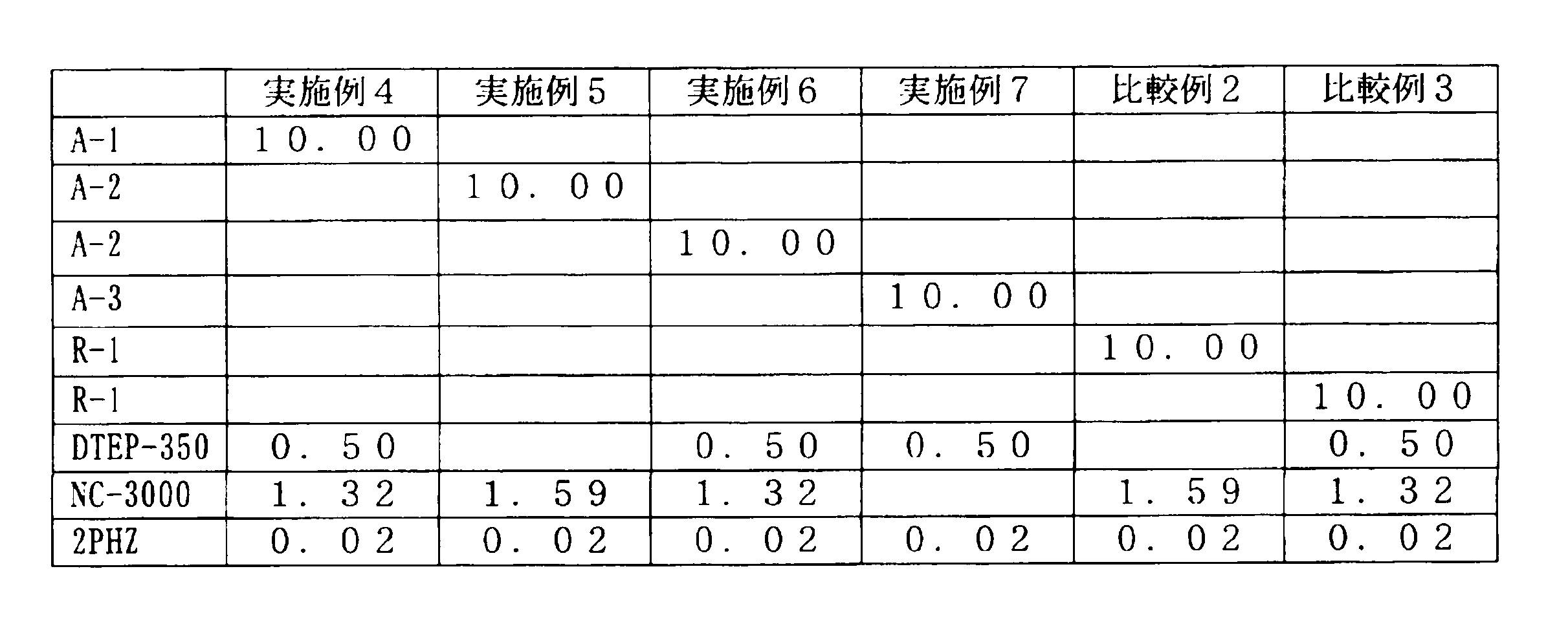
フェノール性水酸基含有ポリイミド樹脂として実施例1、2及び3で得られた樹脂溶液(A-1)、(A-2)及び(A-3)、エポキシ樹脂としてNC-3000(ビフェニル骨格含有エポキシ樹脂、日本化薬株式会社製、エポキシ当量280g/eq.、軟化点60℃)、ジアゾ系ポジ型感光剤としてDTEP-350(2,3,4,4’-テトラヒドロキシベンゾフェノンの1,2-ナフトキノン-2-ジアジド-5-スルホン酸エステル化物、ダイトーケミックス株式会社製)、硬化促進剤として2-フェニル-4,5-ジヒドロキシメチルイミダゾール(2PHZ)を、表1に示す配合割合(単位は「重量部」;以下特に断りのない限り同じ)で混合して本発明の熱硬化型ポリイミド樹脂組成物(実施例5)及び本発明のポジ型感光性ポリイミド樹脂組成物(実施例4、6及び7)を得た。
比較用のポリイミド樹脂として比較例1で得られた樹脂溶液(R-1)、ジアゾ系ポジ型感光剤としてDTEP-350、エポキシ樹脂としてNC-3000及び硬化促進剤として2PHZを、表1に示す配合割合で混合して比較用の熱硬化型ポリイミド樹脂組成物(比較例2)及び比較用のポジ型感光性ポリイミド樹脂組成物(比較例3)を得た。
前記の熱硬化型ポリイミド樹脂組成物(実施例5、比較例2)を、乾燥時の膜厚が20μmになるようにアプリケーターによりPETフィルムに塗布し、塗膜を100℃の熱風乾燥器で30分間乾燥させた。乾燥後、PETフィルムから剥離し、型枠に乾燥樹脂膜を固定して180℃の熱風乾燥機で1時間硬化させ、厚さが20μmの樹脂硬化膜を得た。得られた樹脂硬化膜のガラス転移温度、屈曲性及び難燃性を後述の方法で評価し、結果を表2に示した。
(1)ガラス転移温度
パーキンエルマー社製TMA7(Thrmomechanical Analyzer)を用いて、4mm幅に切った樹脂硬化膜を200mNの加重で引っ張りながら50℃から350℃まで加熱し、線膨張係数の変移温度を測定した。
安田精機製作所製MIT試験機を用いて、1cm幅に切った樹脂硬化膜に加重500g、折り曲げ角135°で屈曲性試験を行い、フィルムが破断するまでの屈曲回数を5回計測し、平均値を以下の基準で評価した。
○・・・・200回以上
△・・・・100回以上
×・・・・99回以下
1cm幅に切った樹脂硬化膜をバーナーの火を近づけた際の挙動を観察し、以下基準で難燃性を評価した。
○・・・・燃焼しない、或いはバーナーから離すと瞬時に消化する。
×・・・・バーナーから離してもしばらく燃焼している。

前記のポジ型感光性ポリイミド樹脂組成物(実施例4、6、7、比較例3)を、乾燥時の膜厚が20μmになるようにスクリーン印刷法によりプリント基板に塗布し、塗膜を100℃の熱風乾燥器で30分間乾燥させ、基板上に膜厚が20μmの乾燥樹脂膜を得た。該乾燥樹脂膜を用いて、下記についての評価を行った。
(1)タック性
得られた乾燥樹脂膜のタック性について、後述の方法で評価し、評価結果を表3に示した。
次に、上記で得られた基板上の乾燥樹脂膜にL/S=25μm/25μmのパターンの描かれたフォトマスクを密着させ、紫外線露光装置(株式会社オーク製作所、型式HMW-680GW)を用いて積算光量1000mJ/cm2の紫外線を照射した。照射後、3重量%水酸化ナトリウム水溶液で180秒間、2.0kg/cm2のスプレー圧でスプレー現像を行い、更に水洗を施すことで紫外線照射部の樹脂を除去した。得られた現像後の樹脂膜の転写パターンについて、現像性及び解像性を後述の方法で評価し、評価結果を表3に示した。
上記現像後の樹脂膜を、180℃の熱風乾燥器で60分間加熱し、硬化させ、得られた樹脂硬化膜を用いて、上記の各項目について、後述の方法で評価し、評価結果を表3に示した。
上記(II)において、プリント基板を厚さ25μmのポリイミドフィルムに変更したこと以外は、上記(II)と同じ方法でポリイミドフィルム上に樹脂硬化膜を作製し、得られたフィルムの反り(基板反り)及び屈曲性を後述の方法で評価し、評価結果を表3に示した。
上記(II)において、プリント基板をPETフィルムに変更したこと以外は上記(II)と同じ方法で樹脂硬化膜を作成し、基材のPETフィルムから樹脂硬化膜のみを剥がし取った。得られた樹脂硬化膜の難燃性を後述の方法で評価し、評価結果を表3に示した。
(i)タック性
プリント基板に塗布した乾燥後の樹脂膜に脱脂綿をこすりつけ、下記基準でタック性を評価した。
○・・・・脱脂綿は張り付かない。
×・・・・脱脂綿の糸くずが膜に張り付く。
現像中の樹脂膜の外観を目視で観察し、露光部の樹脂組成物が完全に除去されるまでの時間を評価した。
現像・水洗後の樹脂膜の転写パターンの外観を顕微鏡で観察し、下記基準で解像性を評価した。
○・・・・未露光部の剥離がなく、直線的なパターンエッジが再現されていた。
×・・・・未露光部に剥離が発生、或いはパターンエッジが波打っていた。
JIS K5400に準じて、基板上の樹脂硬化膜に1mm角のごばん目を100個作った後にセロハンテープによるピーリング試験を行い、下記基準で密着性を評価した。
〇・・・・剥離なし。
△・・・・剥離は無いがごばん目のエッジがギザギザになる。
×・・・・1/100個以上が剥離。
プリント基板上の樹脂硬化膜をN-メチルピロリドンに室温で30分間浸漬した。取り出して外観に異常がないか確認した後、セロハンテープによるピーリング試験を行い、下記基準で耐溶剤性を評価した。
○・・・・表面に異常がなく、フクレや剥離もない。
△・・・・表面が荒れるが、フクレや剥離はない。
×・・・・フクレや剥離がある。
プリント基板上の樹脂硬化膜を3.5%塩酸水溶液に室温で30分間浸漬した。取り出して外観に異常がないか確認した後、セロハンテープによるピーリング試験を行い、下記基準で耐酸性を評価した。
○・・・・表面に異常がなく、フクレや剥離もない。
△・・・・表面が荒れるが、フクレや剥離はない。
×・・・・フクレや剥離がある。
プリント基板上の樹脂硬化膜にロジン系フラックスを塗布し270℃の半田槽に10秒間×3回浸漬した。室温まで放冷した後、セロハンテープによるピーリング試験を行い、下記基準で耐熱性を評価した。
○・・・・表面に異常がなく、フクレや剥離もない。
△・・・・表面が荒れるが、フクレや剥離はない。
×・・・・フクレや剥離がある。
プリント基板上の樹脂硬化膜を121℃、2気圧の温水中に96時間浸漬した。取り出して外観に異常がないか確認した後、セロハンテープによるピーリング試験を行い、下記基準で耐PCT性を評価した。(PCT:Pressure Cooker Test)
○・・・・表面に異常がなく、フクレや剥離もない。
×・・・・フクレや剥離がある。
プリント基板上の樹脂硬化膜に-55℃×30分間及び125℃×30分間を1サイクルとする熱履歴を1000サイクル与えた後、表面外観を顕微鏡観察して下記基準で耐熱衝撃性を評価した。
○・・・・表面にクラックの発生のないもの。
×・・・・表面にクラックが発生したもの。
樹脂硬化膜を有するポリイミドフィルムの外観を目視で観察し、下記基準で基板反りを評価した。
○・・・・フィルムに反りは見られない。
△・・・・ごくわずかフィルムに反りが見られた。
×・・・・フィルムに反りが見られた。
樹脂硬化膜を有するポリイミドフィルムを180度に折り曲げて外観を目視で観察し、下記基準で屈曲性を評価した。
○・・・・樹脂硬化膜にひび割れは見られない。
×・・・・樹脂硬化膜にひび割れが発生した。
PETフィルムから剥離した樹脂硬化膜を1cm幅の短冊状にカット後、バーナーの火を近づけた際の挙動を観察し、以下基準で難燃性を評価した。
○・・・・燃焼しない、或いはバーナーから離すと瞬時に消化する。
×・・・・バーナーから離してもしばらく燃焼している。

なお、本出願は、2008年10月20日付けで出願された日本特許出願(特願2008-269727)に基づいており、その全体が引用により援用される。また、ここに引用されるすべての参照は全体として取り込まれる。
Claims (10)
- アミノフェノール化合物(a)、四塩基酸二無水物(b)及び任意成分としてのジアミノ化合物(c)を重縮合反応させて得られるフェノール性水酸基含有ポリイミド樹脂であって、アミノフェノール化合物(a)が、式(1)

- アミノフェノール化合物(a)が、式(1)で表されるアミノフェノール化合物を3モル%以上含有する請求項1に記載のフェノール性水酸基含有ポリイミド樹脂(A)。
- 四塩基酸二無水物(b)が、3,3’,4,4’-ジフェニルスルホンテトラカルボン酸二無水物、3,3’,4,4’-ベンゾフェノンテトラカルボン酸二無水物、3,3’,4,4’-ビフェニルテトラカルボン酸二無水物、3,3’,4,4’-ビフェニルテトラカルボン酸二無水物の水添化物、3,3’,4,4’-ジフェニルエーテルテトラカルボン酸二無水物及び1,2,4,5-シクロヘキサンテトラカルボン酸二無水物からなる群より選ばれる1種以上である請求項1または2に記載のフェノール性水酸基含有ポリイミド樹脂(A)。
- 3,4’-ジアミノジフェニルエーテル、4,4’-ジアミノジフェニルエーテル、1,3-ビス(3-アミノフェノキシ)ベンゼン、シリコーンジアミン及び1-(4-アミノフェニル)-1,3,3-トリメチル-1H-インデン-5-アミンからなる群より選ばれる1種以上のジアミノ化合物(c)を必須成分とする請求項1~3のいずれか1項に記載のフェノール性水酸基含有ポリイミド樹脂(A)。
- 水酸基当量が200~5,000g/eq.である請求項1~4のいずれか1項に記載のフェノール性水酸基含有ポリイミド樹脂(A)。
- 請求項1~5のいずれか1項に記載のフェノール性水酸基含有ポリイミド樹脂(A)及びエポキシ樹脂(B)を含有する熱硬化型ポリイミド樹脂組成物。
- 請求項1~5のいずれか1項に記載のフェノール性水酸基含有ポリイミド樹脂(A)、ジアゾ系ポジ型感光剤(C)及び任意成分としてエポキシ樹脂(B)を含有するポジ型感光性ポリイミド樹脂組成物。
- ビフェニル骨格、ナフタレン骨格及びトリシクロデカン骨格のいずれか1種以上を有するエポキシ樹脂(B)を必須成分とする請求項6または7に記載のポリイミド樹脂組成物。
- 請求項6~8のいずれか1項に記載のポリイミド樹脂組成物を硬化してなる硬化物。
- 請求項9に記載の硬化物の層を有する基材。
Priority Applications (2)
| Application Number | Priority Date | Filing Date | Title |
|---|---|---|---|
| JP2010534783A JP5649118B2 (ja) | 2008-10-20 | 2009-10-15 | ポリイミド樹脂及びその組成物 |
| CN2009801417673A CN102186904A (zh) | 2008-10-20 | 2009-10-15 | 聚酰亚胺树脂及其组合物 |
Applications Claiming Priority (2)
| Application Number | Priority Date | Filing Date | Title |
|---|---|---|---|
| JP2008269727 | 2008-10-20 | ||
| JP2008-269727 | 2008-10-20 |
Publications (1)
| Publication Number | Publication Date |
|---|---|
| WO2010047271A1 true WO2010047271A1 (ja) | 2010-04-29 |
Family
ID=42119311
Family Applications (1)
| Application Number | Title | Priority Date | Filing Date |
|---|---|---|---|
| PCT/JP2009/067867 Ceased WO2010047271A1 (ja) | 2008-10-20 | 2009-10-15 | ポリイミド樹脂及びその組成物 |
Country Status (5)
| Country | Link |
|---|---|
| JP (1) | JP5649118B2 (ja) |
| KR (1) | KR20110073513A (ja) |
| CN (1) | CN102186904A (ja) |
| TW (1) | TW201031686A (ja) |
| WO (1) | WO2010047271A1 (ja) |
Cited By (9)
| Publication number | Priority date | Publication date | Assignee | Title |
|---|---|---|---|---|
| WO2012002134A1 (ja) * | 2010-07-02 | 2012-01-05 | 東レ株式会社 | 感光性樹脂組成物、感光性樹脂組成物フィルムおよびこれらを用いた半導体装置 |
| JP2012208360A (ja) * | 2011-03-30 | 2012-10-25 | Toray Ind Inc | ポジ型感光性樹脂組成物 |
| WO2014045434A1 (ja) * | 2012-09-24 | 2014-03-27 | 東レ株式会社 | ポジ型感光性樹脂組成物 |
| WO2015170432A1 (ja) * | 2014-05-09 | 2015-11-12 | 日立化成株式会社 | ポジ型感光性接着剤組成物、接着剤パターン、接着剤層付半導体ウェハ、半導体装置及び半導体装置の製造方法 |
| KR20220072786A (ko) | 2020-11-25 | 2022-06-02 | 아지노모토 가부시키가이샤 | 포지티브형 감광성 수지 조성물 |
| JP2023001636A (ja) * | 2021-06-21 | 2023-01-06 | 株式会社ピーアイ技術研究所 | 感光性ポリイミド樹脂組成物 |
| US12247104B2 (en) | 2019-03-15 | 2025-03-11 | Nippon Kayaku Kabushiki Kaisha | Polyamic acid resin, polyimide resin, and resin composition including these |
| WO2025148605A1 (zh) * | 2024-01-10 | 2025-07-17 | 上海八亿时空先进材料有限公司 | 一种碱溶性树脂及其应用 |
| KR20250134035A (ko) | 2024-03-01 | 2025-09-09 | 아지노모토 가부시키가이샤 | 감광성 수지 조성물 |
Families Citing this family (7)
| Publication number | Priority date | Publication date | Assignee | Title |
|---|---|---|---|---|
| TWI483968B (zh) * | 2013-09-17 | 2015-05-11 | Daxin Materials Corp | 聚合物、液晶配向劑、液晶配向膜以及液晶顯示元件 |
| CN105001421A (zh) * | 2015-07-03 | 2015-10-28 | 中科院广州化学有限公司南雄材料生产基地 | 一种含酚羟基聚酰亚胺固体粉末的制备及其应用 |
| CN110062784B (zh) * | 2016-12-08 | 2023-01-10 | 日产化学株式会社 | 剥离层的制造方法 |
| CN111624854A (zh) * | 2020-04-13 | 2020-09-04 | 南京鑫达泰科技有限公司 | 一种感光半导体器件 |
| TWI789796B (zh) * | 2021-06-23 | 2023-01-11 | 律勝科技股份有限公司 | 聚合物及其應用 |
| CN114437522A (zh) * | 2022-02-25 | 2022-05-06 | 苏州世华新材料科技股份有限公司 | 一种耐高温pet-pi复合膜及其胶带 |
| CN118027405B (zh) * | 2023-03-07 | 2025-02-11 | 江汉大学 | 一种光引发产酸固化型聚酰亚胺及其制备方法和光引发产酸固化型光刻胶 |
Citations (6)
| Publication number | Priority date | Publication date | Assignee | Title |
|---|---|---|---|---|
| JPH0978031A (ja) * | 1995-09-11 | 1997-03-25 | Shin Etsu Chem Co Ltd | 反射防止膜材料 |
| JP2002116541A (ja) * | 2000-10-04 | 2002-04-19 | Nissan Chem Ind Ltd | ポジ型感光性ポリイミド樹脂組成物 |
| JP2004333672A (ja) * | 2003-05-02 | 2004-11-25 | Kanegafuchi Chem Ind Co Ltd | 貯蔵安定性の良い感光性樹脂組成物及び感光性ドライフィルムレジスト、並びにその利用 |
| JP2007246440A (ja) * | 2006-03-16 | 2007-09-27 | Toray Ind Inc | ジアミン化合物およびそれを用いたアルカリ可溶性樹脂、感光性樹脂組成物 |
| WO2007125817A1 (ja) * | 2006-04-24 | 2007-11-08 | Jsr Corporation | 感光性樹脂組成物 |
| WO2009081950A1 (ja) * | 2007-12-26 | 2009-07-02 | Asahi Kasei E-Materials Corporation | 耐熱性樹脂前駆体及びそれを用いた感光性樹脂組成物 |
-
2009
- 2009-10-15 CN CN2009801417673A patent/CN102186904A/zh active Pending
- 2009-10-15 WO PCT/JP2009/067867 patent/WO2010047271A1/ja not_active Ceased
- 2009-10-15 KR KR1020117008353A patent/KR20110073513A/ko not_active Ceased
- 2009-10-15 JP JP2010534783A patent/JP5649118B2/ja not_active Expired - Fee Related
- 2009-10-20 TW TW98135327A patent/TW201031686A/zh unknown
Patent Citations (6)
| Publication number | Priority date | Publication date | Assignee | Title |
|---|---|---|---|---|
| JPH0978031A (ja) * | 1995-09-11 | 1997-03-25 | Shin Etsu Chem Co Ltd | 反射防止膜材料 |
| JP2002116541A (ja) * | 2000-10-04 | 2002-04-19 | Nissan Chem Ind Ltd | ポジ型感光性ポリイミド樹脂組成物 |
| JP2004333672A (ja) * | 2003-05-02 | 2004-11-25 | Kanegafuchi Chem Ind Co Ltd | 貯蔵安定性の良い感光性樹脂組成物及び感光性ドライフィルムレジスト、並びにその利用 |
| JP2007246440A (ja) * | 2006-03-16 | 2007-09-27 | Toray Ind Inc | ジアミン化合物およびそれを用いたアルカリ可溶性樹脂、感光性樹脂組成物 |
| WO2007125817A1 (ja) * | 2006-04-24 | 2007-11-08 | Jsr Corporation | 感光性樹脂組成物 |
| WO2009081950A1 (ja) * | 2007-12-26 | 2009-07-02 | Asahi Kasei E-Materials Corporation | 耐熱性樹脂前駆体及びそれを用いた感光性樹脂組成物 |
Cited By (13)
| Publication number | Priority date | Publication date | Assignee | Title |
|---|---|---|---|---|
| US8946852B2 (en) | 2010-07-02 | 2015-02-03 | Toray Industries, Inc. | Photosensitive resin composition, photosensitive resin composition film, and semiconductor device using the photosensitive resin composition or photosensitive resin composition film |
| JP5240363B2 (ja) * | 2010-07-02 | 2013-07-17 | 東レ株式会社 | 感光性樹脂組成物、感光性樹脂組成物フィルムおよびこれらを用いた半導体装置 |
| WO2012002134A1 (ja) * | 2010-07-02 | 2012-01-05 | 東レ株式会社 | 感光性樹脂組成物、感光性樹脂組成物フィルムおよびこれらを用いた半導体装置 |
| JP2012208360A (ja) * | 2011-03-30 | 2012-10-25 | Toray Ind Inc | ポジ型感光性樹脂組成物 |
| JPWO2014045434A1 (ja) * | 2012-09-24 | 2016-08-18 | 東レ株式会社 | ポジ型感光性樹脂組成物 |
| WO2014045434A1 (ja) * | 2012-09-24 | 2014-03-27 | 東レ株式会社 | ポジ型感光性樹脂組成物 |
| WO2015170432A1 (ja) * | 2014-05-09 | 2015-11-12 | 日立化成株式会社 | ポジ型感光性接着剤組成物、接着剤パターン、接着剤層付半導体ウェハ、半導体装置及び半導体装置の製造方法 |
| US12247104B2 (en) | 2019-03-15 | 2025-03-11 | Nippon Kayaku Kabushiki Kaisha | Polyamic acid resin, polyimide resin, and resin composition including these |
| KR20220072786A (ko) | 2020-11-25 | 2022-06-02 | 아지노모토 가부시키가이샤 | 포지티브형 감광성 수지 조성물 |
| JP2023001636A (ja) * | 2021-06-21 | 2023-01-06 | 株式会社ピーアイ技術研究所 | 感光性ポリイミド樹脂組成物 |
| JP7633666B2 (ja) | 2021-06-21 | 2025-02-20 | 株式会社ピーアイ技術研究所 | 感光性ポリイミド樹脂組成物 |
| WO2025148605A1 (zh) * | 2024-01-10 | 2025-07-17 | 上海八亿时空先进材料有限公司 | 一种碱溶性树脂及其应用 |
| KR20250134035A (ko) | 2024-03-01 | 2025-09-09 | 아지노모토 가부시키가이샤 | 감광성 수지 조성물 |
Also Published As
| Publication number | Publication date |
|---|---|
| KR20110073513A (ko) | 2011-06-29 |
| TW201031686A (en) | 2010-09-01 |
| CN102186904A (zh) | 2011-09-14 |
| JPWO2010047271A1 (ja) | 2012-03-22 |
| JP5649118B2 (ja) | 2015-01-07 |
Similar Documents
| Publication | Publication Date | Title |
|---|---|---|
| JP5649118B2 (ja) | ポリイミド樹脂及びその組成物 | |
| JP5530363B2 (ja) | フェノール性水酸基含有ポリイミド樹脂及びそれを用いた感光性樹脂組成物 | |
| JPWO2008126818A1 (ja) | 感光性樹脂組成物 | |
| EP2011842B1 (en) | Photosensitive ink composition for screen printing and method of forming positive relief pattern with use thereof | |
| CN102460299B (zh) | 感光性改性聚酰亚胺树脂组合物及其用途 | |
| JP4969751B2 (ja) | イミド−ベンゾオキサゾール系重縮合物及びその製造方法 | |
| KR101969197B1 (ko) | 포지티브형 감광성 수지 조성물 | |
| TW201122074A (en) | Photosensitive adhesive composition, photosensitive adhesive sheet and semiconductor device using the same | |
| JP2009235311A (ja) | ポリイミド樹脂およびそれを用いた耐熱性樹脂組成物 | |
| JP2020094194A (ja) | 樹脂組成物、樹脂シート、硬化膜、硬化膜のレリーフパターンの製造方法、保護膜、絶縁膜、電子部品および表示装置 | |
| CN114989433B (zh) | 一种树脂、正型感光性树脂组合物及应用 | |
| KR102893259B1 (ko) | 감광성 폴리이미드 수지 조성물 | |
| CN1978529A (zh) | 光敏性聚酰亚胺树脂和组合物与制备方法 | |
| CN107407875B (zh) | 正型感光性树脂组合物、干膜、固化物和印刷电路板 | |
| JP2005250161A (ja) | ネガ型感光性樹脂組成物及びその硬化物 | |
| KR102827425B1 (ko) | 감광성 폴리이미드 수지 조성물 | |
| JP5196148B2 (ja) | 感光性樹脂組成物およびそれを用いたポリイミド樹脂膜、フレキシブルプリント配線板 | |
| JP7370145B2 (ja) | 感光性樹脂組成物 | |
| TWI862692B (zh) | 感光性樹脂組成物、乾薄膜、硬化物及電子零件 | |
| WO2022175169A1 (en) | Polyimides having low dielectric loss | |
| JP2010139931A (ja) | ポジ型感光性樹脂組成物およびパターン形成方法 | |
| JP6065495B2 (ja) | 電子部品およびパワー半導体装置 | |
| WO2010071100A1 (ja) | ポジ型感光性ポリイミド樹脂組成物 | |
| TW200907578A (en) | Photosensitive resin composition | |
| JP2009025725A (ja) | ポジ型感光性樹脂組成物及び前記ポジ型感光性樹脂組成物より得られる樹脂フィルム、並びに、fpcの製造方法及びfpc |
Legal Events
| Date | Code | Title | Description |
|---|---|---|---|
| WWE | Wipo information: entry into national phase |
Ref document number: 200980141767.3 Country of ref document: CN |
|
| 121 | Ep: the epo has been informed by wipo that ep was designated in this application |
Ref document number: 09821968 Country of ref document: EP Kind code of ref document: A1 |
|
| WWE | Wipo information: entry into national phase |
Ref document number: 2010534783 Country of ref document: JP |
|
| ENP | Entry into the national phase |
Ref document number: 20117008353 Country of ref document: KR Kind code of ref document: A |
|
| NENP | Non-entry into the national phase |
Ref country code: DE |
|
| 122 | Ep: pct application non-entry in european phase |
Ref document number: 09821968 Country of ref document: EP Kind code of ref document: A1 |