WO2010024353A1 - 耐蝕性部材およびその製造方法 - Google Patents
耐蝕性部材およびその製造方法 Download PDFInfo
- Publication number
- WO2010024353A1 WO2010024353A1 PCT/JP2009/065001 JP2009065001W WO2010024353A1 WO 2010024353 A1 WO2010024353 A1 WO 2010024353A1 JP 2009065001 W JP2009065001 W JP 2009065001W WO 2010024353 A1 WO2010024353 A1 WO 2010024353A1
- Authority
- WO
- WIPO (PCT)
- Prior art keywords
- oxide
- corrosion
- oxidizing atmosphere
- cerium
- yttrium oxide
- Prior art date
- Legal status (The legal status is an assumption and is not a legal conclusion. Google has not performed a legal analysis and makes no representation as to the accuracy of the status listed.)
- Ceased
Links
Images

Classifications
-
- C—CHEMISTRY; METALLURGY
- C04—CEMENTS; CONCRETE; ARTIFICIAL STONE; CERAMICS; REFRACTORIES
- C04B—LIME, MAGNESIA; SLAG; CEMENTS; COMPOSITIONS THEREOF, e.g. MORTARS, CONCRETE OR LIKE BUILDING MATERIALS; ARTIFICIAL STONE; CERAMICS; REFRACTORIES; TREATMENT OF NATURAL STONE
- C04B35/00—Shaped ceramic products characterised by their composition; Ceramics compositions; Processing powders of inorganic compounds preparatory to the manufacturing of ceramic products
- C04B35/622—Forming processes; Processing powders of inorganic compounds preparatory to the manufacturing of ceramic products
- C04B35/64—Burning or sintering processes
- C04B35/645—Pressure sintering
- C04B35/6455—Hot isostatic pressing
-
- C—CHEMISTRY; METALLURGY
- C04—CEMENTS; CONCRETE; ARTIFICIAL STONE; CERAMICS; REFRACTORIES
- C04B—LIME, MAGNESIA; SLAG; CEMENTS; COMPOSITIONS THEREOF, e.g. MORTARS, CONCRETE OR LIKE BUILDING MATERIALS; ARTIFICIAL STONE; CERAMICS; REFRACTORIES; TREATMENT OF NATURAL STONE
- C04B35/00—Shaped ceramic products characterised by their composition; Ceramics compositions; Processing powders of inorganic compounds preparatory to the manufacturing of ceramic products
- C04B35/50—Shaped ceramic products characterised by their composition; Ceramics compositions; Processing powders of inorganic compounds preparatory to the manufacturing of ceramic products based on rare-earth compounds
-
- C—CHEMISTRY; METALLURGY
- C04—CEMENTS; CONCRETE; ARTIFICIAL STONE; CERAMICS; REFRACTORIES
- C04B—LIME, MAGNESIA; SLAG; CEMENTS; COMPOSITIONS THEREOF, e.g. MORTARS, CONCRETE OR LIKE BUILDING MATERIALS; ARTIFICIAL STONE; CERAMICS; REFRACTORIES; TREATMENT OF NATURAL STONE
- C04B35/00—Shaped ceramic products characterised by their composition; Ceramics compositions; Processing powders of inorganic compounds preparatory to the manufacturing of ceramic products
- C04B35/50—Shaped ceramic products characterised by their composition; Ceramics compositions; Processing powders of inorganic compounds preparatory to the manufacturing of ceramic products based on rare-earth compounds
- C04B35/505—Shaped ceramic products characterised by their composition; Ceramics compositions; Processing powders of inorganic compounds preparatory to the manufacturing of ceramic products based on rare-earth compounds based on yttrium oxide
-
- C—CHEMISTRY; METALLURGY
- C04—CEMENTS; CONCRETE; ARTIFICIAL STONE; CERAMICS; REFRACTORIES
- C04B—LIME, MAGNESIA; SLAG; CEMENTS; COMPOSITIONS THEREOF, e.g. MORTARS, CONCRETE OR LIKE BUILDING MATERIALS; ARTIFICIAL STONE; CERAMICS; REFRACTORIES; TREATMENT OF NATURAL STONE
- C04B2235/00—Aspects relating to ceramic starting mixtures or sintered ceramic products
- C04B2235/02—Composition of constituents of the starting material or of secondary phases of the final product
- C04B2235/30—Constituents and secondary phases not being of a fibrous nature
- C04B2235/32—Metal oxides, mixed metal oxides, or oxide-forming salts thereof, e.g. carbonates, nitrates, (oxy)hydroxides, chlorides
- C04B2235/3224—Rare earth oxide or oxide forming salts thereof, e.g. scandium oxide
- C04B2235/3225—Yttrium oxide or oxide-forming salts thereof
-
- C—CHEMISTRY; METALLURGY
- C04—CEMENTS; CONCRETE; ARTIFICIAL STONE; CERAMICS; REFRACTORIES
- C04B—LIME, MAGNESIA; SLAG; CEMENTS; COMPOSITIONS THEREOF, e.g. MORTARS, CONCRETE OR LIKE BUILDING MATERIALS; ARTIFICIAL STONE; CERAMICS; REFRACTORIES; TREATMENT OF NATURAL STONE
- C04B2235/00—Aspects relating to ceramic starting mixtures or sintered ceramic products
- C04B2235/02—Composition of constituents of the starting material or of secondary phases of the final product
- C04B2235/30—Constituents and secondary phases not being of a fibrous nature
- C04B2235/32—Metal oxides, mixed metal oxides, or oxide-forming salts thereof, e.g. carbonates, nitrates, (oxy)hydroxides, chlorides
- C04B2235/3224—Rare earth oxide or oxide forming salts thereof, e.g. scandium oxide
- C04B2235/3229—Cerium oxides or oxide-forming salts thereof
-
- C—CHEMISTRY; METALLURGY
- C04—CEMENTS; CONCRETE; ARTIFICIAL STONE; CERAMICS; REFRACTORIES
- C04B—LIME, MAGNESIA; SLAG; CEMENTS; COMPOSITIONS THEREOF, e.g. MORTARS, CONCRETE OR LIKE BUILDING MATERIALS; ARTIFICIAL STONE; CERAMICS; REFRACTORIES; TREATMENT OF NATURAL STONE
- C04B2235/00—Aspects relating to ceramic starting mixtures or sintered ceramic products
- C04B2235/02—Composition of constituents of the starting material or of secondary phases of the final product
- C04B2235/30—Constituents and secondary phases not being of a fibrous nature
- C04B2235/34—Non-metal oxides, non-metal mixed oxides, or salts thereof that form the non-metal oxides upon heating, e.g. carbonates, nitrates, (oxy)hydroxides, chlorides
- C04B2235/3409—Boron oxide, borates, boric acids, or oxide forming salts thereof, e.g. borax
-
- C—CHEMISTRY; METALLURGY
- C04—CEMENTS; CONCRETE; ARTIFICIAL STONE; CERAMICS; REFRACTORIES
- C04B—LIME, MAGNESIA; SLAG; CEMENTS; COMPOSITIONS THEREOF, e.g. MORTARS, CONCRETE OR LIKE BUILDING MATERIALS; ARTIFICIAL STONE; CERAMICS; REFRACTORIES; TREATMENT OF NATURAL STONE
- C04B2235/00—Aspects relating to ceramic starting mixtures or sintered ceramic products
- C04B2235/02—Composition of constituents of the starting material or of secondary phases of the final product
- C04B2235/50—Constituents or additives of the starting mixture chosen for their shape or used because of their shape or their physical appearance
- C04B2235/54—Particle size related information
- C04B2235/5409—Particle size related information expressed by specific surface values
-
- C—CHEMISTRY; METALLURGY
- C04—CEMENTS; CONCRETE; ARTIFICIAL STONE; CERAMICS; REFRACTORIES
- C04B—LIME, MAGNESIA; SLAG; CEMENTS; COMPOSITIONS THEREOF, e.g. MORTARS, CONCRETE OR LIKE BUILDING MATERIALS; ARTIFICIAL STONE; CERAMICS; REFRACTORIES; TREATMENT OF NATURAL STONE
- C04B2235/00—Aspects relating to ceramic starting mixtures or sintered ceramic products
- C04B2235/02—Composition of constituents of the starting material or of secondary phases of the final product
- C04B2235/50—Constituents or additives of the starting mixture chosen for their shape or used because of their shape or their physical appearance
- C04B2235/54—Particle size related information
- C04B2235/5418—Particle size related information expressed by the size of the particles or aggregates thereof
- C04B2235/5436—Particle size related information expressed by the size of the particles or aggregates thereof micrometer sized, i.e. from 1 to 100 micron
-
- C—CHEMISTRY; METALLURGY
- C04—CEMENTS; CONCRETE; ARTIFICIAL STONE; CERAMICS; REFRACTORIES
- C04B—LIME, MAGNESIA; SLAG; CEMENTS; COMPOSITIONS THEREOF, e.g. MORTARS, CONCRETE OR LIKE BUILDING MATERIALS; ARTIFICIAL STONE; CERAMICS; REFRACTORIES; TREATMENT OF NATURAL STONE
- C04B2235/00—Aspects relating to ceramic starting mixtures or sintered ceramic products
- C04B2235/02—Composition of constituents of the starting material or of secondary phases of the final product
- C04B2235/50—Constituents or additives of the starting mixture chosen for their shape or used because of their shape or their physical appearance
- C04B2235/54—Particle size related information
- C04B2235/5418—Particle size related information expressed by the size of the particles or aggregates thereof
- C04B2235/5445—Particle size related information expressed by the size of the particles or aggregates thereof submicron sized, i.e. from 0,1 to 1 micron
-
- C—CHEMISTRY; METALLURGY
- C04—CEMENTS; CONCRETE; ARTIFICIAL STONE; CERAMICS; REFRACTORIES
- C04B—LIME, MAGNESIA; SLAG; CEMENTS; COMPOSITIONS THEREOF, e.g. MORTARS, CONCRETE OR LIKE BUILDING MATERIALS; ARTIFICIAL STONE; CERAMICS; REFRACTORIES; TREATMENT OF NATURAL STONE
- C04B2235/00—Aspects relating to ceramic starting mixtures or sintered ceramic products
- C04B2235/65—Aspects relating to heat treatments of ceramic bodies such as green ceramics or pre-sintered ceramics, e.g. burning, sintering or melting processes
- C04B2235/652—Reduction treatment
-
- C—CHEMISTRY; METALLURGY
- C04—CEMENTS; CONCRETE; ARTIFICIAL STONE; CERAMICS; REFRACTORIES
- C04B—LIME, MAGNESIA; SLAG; CEMENTS; COMPOSITIONS THEREOF, e.g. MORTARS, CONCRETE OR LIKE BUILDING MATERIALS; ARTIFICIAL STONE; CERAMICS; REFRACTORIES; TREATMENT OF NATURAL STONE
- C04B2235/00—Aspects relating to ceramic starting mixtures or sintered ceramic products
- C04B2235/65—Aspects relating to heat treatments of ceramic bodies such as green ceramics or pre-sintered ceramics, e.g. burning, sintering or melting processes
- C04B2235/656—Aspects relating to heat treatments of ceramic bodies such as green ceramics or pre-sintered ceramics, e.g. burning, sintering or melting processes characterised by specific heating conditions during heat treatment
-
- C—CHEMISTRY; METALLURGY
- C04—CEMENTS; CONCRETE; ARTIFICIAL STONE; CERAMICS; REFRACTORIES
- C04B—LIME, MAGNESIA; SLAG; CEMENTS; COMPOSITIONS THEREOF, e.g. MORTARS, CONCRETE OR LIKE BUILDING MATERIALS; ARTIFICIAL STONE; CERAMICS; REFRACTORIES; TREATMENT OF NATURAL STONE
- C04B2235/00—Aspects relating to ceramic starting mixtures or sintered ceramic products
- C04B2235/65—Aspects relating to heat treatments of ceramic bodies such as green ceramics or pre-sintered ceramics, e.g. burning, sintering or melting processes
- C04B2235/658—Atmosphere during thermal treatment
-
- C—CHEMISTRY; METALLURGY
- C04—CEMENTS; CONCRETE; ARTIFICIAL STONE; CERAMICS; REFRACTORIES
- C04B—LIME, MAGNESIA; SLAG; CEMENTS; COMPOSITIONS THEREOF, e.g. MORTARS, CONCRETE OR LIKE BUILDING MATERIALS; ARTIFICIAL STONE; CERAMICS; REFRACTORIES; TREATMENT OF NATURAL STONE
- C04B2235/00—Aspects relating to ceramic starting mixtures or sintered ceramic products
- C04B2235/70—Aspects relating to sintered or melt-casted ceramic products
- C04B2235/74—Physical characteristics
- C04B2235/77—Density
-
- C—CHEMISTRY; METALLURGY
- C04—CEMENTS; CONCRETE; ARTIFICIAL STONE; CERAMICS; REFRACTORIES
- C04B—LIME, MAGNESIA; SLAG; CEMENTS; COMPOSITIONS THEREOF, e.g. MORTARS, CONCRETE OR LIKE BUILDING MATERIALS; ARTIFICIAL STONE; CERAMICS; REFRACTORIES; TREATMENT OF NATURAL STONE
- C04B2235/00—Aspects relating to ceramic starting mixtures or sintered ceramic products
- C04B2235/70—Aspects relating to sintered or melt-casted ceramic products
- C04B2235/96—Properties of ceramic products, e.g. mechanical properties such as strength, toughness, wear resistance
- C04B2235/9669—Resistance against chemicals, e.g. against molten glass or molten salts
-
- Y—GENERAL TAGGING OF NEW TECHNOLOGICAL DEVELOPMENTS; GENERAL TAGGING OF CROSS-SECTIONAL TECHNOLOGIES SPANNING OVER SEVERAL SECTIONS OF THE IPC; TECHNICAL SUBJECTS COVERED BY FORMER USPC CROSS-REFERENCE ART COLLECTIONS [XRACs] AND DIGESTS
- Y10—TECHNICAL SUBJECTS COVERED BY FORMER USPC
- Y10T—TECHNICAL SUBJECTS COVERED BY FORMER US CLASSIFICATION
- Y10T279/00—Chucks or sockets
- Y10T279/23—Chucks or sockets with magnetic or electrostatic means
Definitions
- An aspect of the present invention generally relates to a corrosion-resistant member and a manufacturing method thereof, and relates to a corrosion-resistant member made of a ceramic member having high corrosion resistance and low volume resistivity.
- a ceramic member using yttrium oxide having high plasma resistance has been studied as a material having both corrosion resistance and conductivity used for a semiconductor manufacturing apparatus member or the like.
- Yttrium oxide is an insulator. It is known that when a substance exhibiting conductivity is added to this yttrium oxide, its volume resistivity decreases.
- Patent Document 1 describes that by adding 2 to 30 wt% of SiC to yttrium oxide and sintering it using a hot press, it becomes 1 ⁇ 10 9 ⁇ ⁇ cm or less.
- Patent Document 2 describes that TiO 2-x (0 ⁇ x ⁇ 2) is added to yttrium oxide in an amount of 1 to 15 wt%, and a material containing carbon as a main component is brought into contact after firing in an oxidizing atmosphere, so that an inert gas or a reducing gas is brought into contact. It is described that it becomes 10 5 to 10 14 ⁇ ⁇ cm by performing atmospheric firing or HIP treatment.
- Patent Document 3 0.5 to 10 wt% of any one of metal yttrium, carbon, yttrium nitride, and yttrium carbide is added to yttrium oxide, followed by firing in an inert pressure atmosphere and 10 ⁇ 2 to 10 10 ⁇ ⁇ cm. It is described that it becomes.
- Patent Document 4 describes a method for producing a corrosion-resistant member obtained by adding 5% by mass or less of a lanthanoid oxide to yttrium oxide.
- a dense body can be obtained by firing at 1400-1500 ° C. by adding a boron compound as a sintering aid to yttrium oxide powder (for example, Patent Documents). 5).
- Patent Documents 1 to 3 are low-resistance yttrium oxides, but are metals, carbon materials, SiC, and TiO 2-x (0 ⁇ x ⁇ 2).
- a hard-to-sinter material such as carbon
- heat treatment under high temperature or high pressure is required, resulting in an increase in production time and cost.
- a conductive substance such as metal
- the added metal component is oxidized, and in order not to lose the conductivity, a complicated preparation process and a firing process in a special atmosphere are required. Increase in production time and cost.
- the microstructure of low-resistance ceramics obtained by the addition of conductive materials is a structure in which a low-resistance conductive phase or conductive conductive phase is interspersed in a high-resistance insulating phase, or a structure that forms a network.
- a corrosive environment due to plasma irradiation there is a concern that plasma concentration occurs locally on the member, and erosion selectively proceeds.
- An aspect of the present invention relates to a corrosion-resistant member and a method for producing the same, and is to provide a corrosion-resistant member made of a ceramic member having high corrosion resistance and low volume resistivity.
- a corrosion-resistant member comprising a ceramic member containing yttrium oxide as a main component, containing a cerium element, and obtained by firing in a non-oxidizing atmosphere.
- the ceramic member can be a corrosion-resistant member in which the cerium element contained in the yttrium oxide is 5% by weight or more and 60% by weight or less in terms of oxide.
- the ceramic member may be a corrosion-resistant member having a volume resistivity of 1 ⁇ 10 7 ⁇ ⁇ cm or more and less than 1 ⁇ 10 14 ⁇ ⁇ cm at room temperature.
- the strongest peak position (2 ⁇ ) obtained by X-ray diffraction on the surface of the fired body is lower than the strongest peak position (2 ⁇ ) obtained by powder X-ray diffraction of the reference below. It can be set as the corrosion-resistant member shifted to the side.
- the reference is a powder obtained by pulverizing a solid solution of cubic cerium oxide in cubic yttrium oxide by firing in an oxidizing atmosphere.
- cerium oxide is added to yttrium oxide at a ratio of 5 wt% or more and 60 wt% or less, and after molding this mixture, the temperature is 1300 ° C. or more and 1800 ° C. or less in a non-oxidizing atmosphere. Corrosion-resistant members can be produced by firing.
- a cerium compound is added to yttrium oxide at a ratio of 5 wt% or more and 60 wt% or less in terms of cerium oxide, and after molding this mixture, it is 1300 ° C. in an oxidizing atmosphere.
- the corrosion resistant member can be manufactured by heat treatment at a temperature of 1300 ° C. or higher and 1800 ° C. or lower in a non-oxidizing atmosphere.
- cerium oxide is added to yttrium oxide at a ratio of 5 wt% or more and 60 wt% or less, and a boron compound is added at a ratio of 0.02 wt% or more and 10 wt% or less in terms of boron oxide.
- a corrosion-resistant member can be manufactured by baking at 1300 degreeC or more and 1600 degrees C or less in non-oxidizing atmosphere.
- the cerium compound in yttrium oxide is 5 wt% or more and 60 wt% or less in terms of cerium oxide
- the boron compound is 0.02 wt% or more in terms of boron oxide and 10 wt%. %
- the density in the present invention refers to the apparent density. Specifically, it is a value obtained by dividing the mass of the sample by the volume obtained by removing the open pores from the external volume, and was measured by the Archimedes method.
- the Archimedes method in the present invention is a density measuring method shown in the JIS standard (JIS R1634).
- JIS R1634 The water saturation method was measured using a vacuum method, and the medium was measured using distilled water.
- the calculation method of the porosity was also carried out according to JIS R 1634.
- the volume resistivity of the yttrium oxide fired body is 1 ⁇ 10 14 ⁇ ⁇ cm or more at room temperature (25 ° C.).
- the low resistance in the present invention is defined as low resistance because it is less than 1 ⁇ 10 14 ⁇ ⁇ cm, which can intentionally change the volume resistivity of yttrium oxide, which is an insulating material.
- the volume resistivity in the present invention is a value obtained by converting the electrical resistance of a test material shown in JIS standard (JIS C2141) per unit volume.
- the volume resistivity at room temperature (25 ° C.) was measured by a three-terminal method.
- the oxidizing atmosphere in the present invention is an atmosphere containing oxygen, and is an air atmosphere or an atmosphere in which the oxygen concentration is controlled.
- the non-oxidizing atmosphere in the present invention means a reducing atmosphere and an inert atmosphere.
- the reducing atmosphere is an atmosphere containing a reducing gas species such as CO or H 2
- the inert atmosphere is an atmosphere in which an inert gas such as N 2 or Ar is introduced and heated. It is.
- the X-ray diffraction profile in the present invention refers to the angle (2 ⁇ ) at which a sample was irradiated with Cu K ⁇ rays using a Cu tube and the diffracted X-rays were detected, and the diffraction intensity was plotted on the vertical axis. This is a chart taken from the chart.
- the detected angle (2 ⁇ ) is set as a peak position, and the strongest peak is a peak having the highest detected intensity of diffracted X-rays.
- the shift to the lower angle side of the X-ray diffraction peak position in the present invention is that 2 ⁇ of X-ray diffraction on the surface of a ceramic member mainly composed of yttrium oxide and obtained by firing is 2 ⁇ of powder X-ray diffraction of the reference below. It means that it is also shifted to the low angle side.
- the above reference is a powder obtained by pulverizing a solid solution in which cubic cerium oxide: JCPDF card 01-071-4807 is dissolved in cubic yttrium oxide: JCPDF card 00-041-1105 by firing in an oxidizing atmosphere. .
- the particle diameter of the yttrium oxide raw material powder is not limited, but is preferably 10 ⁇ m or less on average, and more preferably 2 ⁇ m or less. Although there is no restriction
- the particle size of the cerium oxide raw material powder is not limited, but is preferably 10 ⁇ m or less on average, more preferably 2 ⁇ m or less.
- a mixing method involving a pulverizing step such as a ball mill has an effect of not only reducing the particle diameter but also pulverizing coarse particles, and is preferable for obtaining a ceramic member composed of uniform and fine particles.
- a water-soluble compound such as cerium nitrate is used as a raw material powder that becomes an oxide of cerium in an oxidizing atmosphere
- the yttrium oxide raw material is put into an aqueous solution of the cerium compound, and the wet-mixed slurry is fired in an oxidizing atmosphere and necessary.
- an yttrium oxide-cerium oxide raw material powder in which cerium oxide is uniformly dispersed can be obtained, and this can be used as the raw material powder.
- a granulated powder can be obtained by a dry molding method such as press molding or CIP.
- the molding is not limited to dry molding, and a molded body can be obtained using a molding method such as extrusion molding, injection molding, sheet molding, cast molding, gel cast molding, and the like. In the case of dry molding, it can be used as a granule by adding a binder and using a spray dryer.
- the baking can be performed at 1300 ° C. or higher and 1800 ° C. or lower in an oxidizing atmosphere, and can be performed in an electric furnace having a SiC heating element or a Kanthal heating element.
- a ceramic member is obtained by performing heat treatment in a non-oxidizing atmosphere at a temperature of 1300 ° C. or higher and 1800 ° C. or lower.
- the obtained ceramic member can be subjected to HIP treatment as necessary. Thereby, the open porosity becomes 0% or more and less than 0.1%, more preferably less than 0.05%, and a dense ceramic member can be obtained.
- the ceramic member of the present invention can be obtained by performing a non-oxidizing atmosphere firing step after firing in an oxidizing atmosphere by HIP treatment. Even if non-oxidizing atmosphere firing is omitted and the HIP treatment is performed, a ceramic member equivalent to the fired body can be obtained.
- the ceramic member after the HIP treatment has an open porosity of 0% or more and less than 0.1%, more preferably less than 0.05%, and a dense ceramic member can be obtained.
- baking can be performed at 1300 ° C. or higher and 1800 ° C. or lower in a non-oxidizing atmosphere.
- the ceramic member of one embodiment of the present invention is obtained by firing in a non-oxidizing atmosphere.
- the obtained ceramic member can be subjected to HIP treatment as necessary. Thereby, the open porosity becomes 0% or more and less than 0.1%, more preferably less than 0.05%, and a dense ceramic member can be obtained.
- Cerium compounds added to yttrium oxide include dicerium trioxide (Ce 2 O 3 ), cerium oxide (CeO 2 ), cerium chloride, ammonium salt of cerium nitrate, hydrate of cerium trinitrate, cerium hydroxide, carbonic acid Cerium compounds that become oxides in the course of firing in an oxidizing atmosphere, such as cerium, cerium boride, cerium oxalate, and cerium acetate, can be used, and cerium oxide can be suitably used.
- the boron compound In order to enhance the sinterability, when a boron compound is added to the raw ceramic, the boron compound is likely to evaporate during firing.
- the boron compound forms Y 3 BO 6 in the firing process, forms a liquid phase at a temperature of 1100 to 1600 ° C., and promotes sintering.
- the firing temperature is 1300 ° C to 1600 ° C, preferably 1400 ° C to 1550 ° C. Is preferred.
- the firing time can be selected between 0.5 and 8 hours.
- a heat treatment in a non-oxidizing atmosphere such as N 2 , Ar, CO, or H 2 is performed to obtain a desired A ceramic member can be obtained. Further, after molding, a desired ceramic member can be obtained by firing in an atmosphere of nitrogen, argon, hydrogen or the like or firing in a vacuum.
- the obtained ceramic sintered body can be subjected to HIP treatment. Thereby, the open porosity becomes 0% or more and less than 0.1%, more preferably less than 0.05%, and a dense ceramic member can be obtained.
- the boron compound that forms the Y 3 BO 6 crystal is not limited to boron oxide, and boron compounds such as boric acid, boron nitride, boron carbide, YBO 3 , and Y 3 BO 6 can be used. Of these, boron oxide, boric acid, and YBO 3 can be suitably used.
- the lattice constant was calculated from the peak position of the crystal phase obtained by atmospheric firing, it was confirmed that the lattice constant was in accordance with the ratio of the lattice constant of yttrium oxide and cerium oxide.
- the lattice constant of the sample fired in a non-oxidizing atmosphere was calculated to be larger than the lattice constant obtained by atmospheric firing. It is presumed that this lattice change was confirmed as a peak shift. Since the peak shift is caused by the change of the lattice, the proposed peak shift phenomenon is not limited to the strongest peak.
- the corrosion-resistant member obtained by the present invention includes a chamber, a bell jar, a susceptor, a clamp ring, a focus ring, a capture ring, a shadow ring, an insulating ring, a liner, a dummy wafer, a tube for generating high-frequency plasma, and a high-frequency plasma.
- Semiconductors exposed to plasma atmosphere such as dome, lift pins to support semiconductor wafer, shower plate, baffle plate, bellows cover, upper electrode, lower electrode, screws for fixing members inside chamber, screw cap, robot arm, etc. Or it can utilize for the member for liquid crystal manufacturing apparatuses.
- a chamber or bell jar can be used for an inner wall surface where plasma irradiation is performed, and a focus ring or capture ring can be used for a surface in contact with a plasma atmosphere.
- Other members can also be used for surfaces exposed to the plasma atmosphere.
- the corrosion-resistant member of the present invention has a volume resistivity of 1 ⁇ 10 7 ⁇ ⁇ cm or more and less than 1 ⁇ 10 14 ⁇ ⁇ cm, it can be used in an etching apparatus such as an etching apparatus that performs fine processing on a semiconductor wafer or a quartz wafer. It can be used for the Senlerbeck type electrostatic chuck.
- the corrosion-resistant member of the present invention is used when a corrosion preventing member such as a transport pipe for transporting a corrosive solution such as hydrogen fluoride or corrosive gas, or a chemical treatment using the corrosive solution. It can be used for crucibles.
- a corrosion preventing member such as a transport pipe for transporting a corrosive solution such as hydrogen fluoride or corrosive gas, or a chemical treatment using the corrosive solution. It can be used for crucibles.
- the corrosion-resistant member according to one embodiment of the present invention is a ceramic member composed of yttrium oxide and a cerium element, and the added cerium element does not exist alone at the grain boundary or triple point of yttrium oxide.
- a ceramic member having high plasma resistance can be obtained without impairing the corrosion resistance of yttrium oxide.
- Example 1 Prepared as raw materials are yttrium oxide powder (Y 2 O 3 : average particle diameter 1 ⁇ m, specific surface area 11-15 g / cm 2 ) and cerium oxide (CeO 2 : average particle diameter 0.6 ⁇ m, specific surface area about 20 g / cm 2 ).
- the addition amount of cerium oxide was 5% by weight
- the addition amount of boron oxide powder (reagent) was 1% by weight
- a dispersant, a binder, and a release agent were added, and the mixture was pulverized and stirred by a ball mill. After mixing, granulation was performed with a spray dryer. The obtained granulated powder was press-molded and then CIP-molded.
- a fired body When the density of the molded body is improved by granulation with a spray dryer and CIP treatment, a fired body can be obtained stably.
- the obtained molded body was degreased and then fired at 1480 ° C. in an oxidizing atmosphere.
- the obtained fired body was subjected to HIP treatment at 1500 ° C. for 2 hours in an argon atmosphere of 100 MPa.
- Example 2 Prepared as raw materials are yttrium oxide powder (Y 2 O 3 : average particle diameter 1 ⁇ m, specific surface area 11-15 g / cm 2 ) and cerium oxide (CeO 2 : average particle diameter 0.6 ⁇ m, specific surface area about 20 g / cm 2 ).
- the addition amount of cerium oxide was 10% by weight
- the addition amount of boron oxide powder (reagent) was 1% by weight
- a dispersant, a binder, and a release agent were added, and the mixture was pulverized and stirred by a ball mill. After mixing, granulation was performed with a spray dryer. The obtained granulated powder was press-molded and then CIP-molded.
- a fired body When the density of the molded body is improved by granulation with a spray dryer and CIP treatment, a fired body can be obtained stably.
- the obtained molded body was degreased and then fired at 1480 ° C. in an oxidizing atmosphere.
- the obtained fired body was subjected to HIP treatment at 1500 ° C. for 2 hours in an argon atmosphere of 100 MPa.
- Example 3 Prepared as raw materials are yttrium oxide powder (Y 2 O 3 : average particle diameter 1 ⁇ m, specific surface area 11-15 g / cm 2 ) and cerium oxide (CeO 2 : average particle diameter 0.6 ⁇ m, specific surface area about 20 g / cm 2 ).
- the addition amount of cerium oxide was 20% by weight, a dispersant, a binder, and a release agent were added, and pulverized, stirred and mixed by a ball mill. After mixing, granulation was performed with a spray dryer. The obtained granulated powder was press-molded and then CIP-molded.
- a fired body When the density of the molded body is improved by granulation with a spray dryer and CIP treatment, a fired body can be obtained stably.
- the obtained molded body was degreased and then fired at 1650 ° C. in an oxidizing atmosphere.
- the obtained fired body was subjected to HIP treatment at 1500 ° C. for 2 hours in an argon atmosphere of 100 MPa.
- Example 4 Prepared as raw materials are yttrium oxide powder (Y 2 O 3 : average particle diameter 1 ⁇ m, specific surface area 11-15 g / cm 2 ) and cerium oxide (CeO 2 : average particle diameter 0.6 ⁇ m, specific surface area about 20 g / cm 2 ).
- the addition amount of cerium oxide was 40% by weight, and a dispersant, a binder, and a release agent were added, followed by pulverization, stirring and mixing with a ball mill. After mixing, granulation was performed with a spray dryer. The obtained granulated powder was press-molded and then CIP-molded. When the density of the molded body is improved by granulation with a spray dryer and CIP treatment, a fired body can be obtained stably.
- the obtained molded body was degreased and then fired at 1650 ° C. in an oxidizing atmosphere.
- the obtained fired body was subjected to HIP treatment at 1500 ° C. for 2 hours in an argon atmosphere of 100 MP
- Example 5 Prepared as raw materials are yttrium oxide powder (Y 2 O 3 : average particle diameter 1 ⁇ m, specific surface area 11-15 g / cm 2 ) and cerium oxide (CeO 2 : average particle diameter 0.6 ⁇ m, specific surface area about 20 g / cm 2 ).
- the amount of cerium oxide added was 60% by weight, a dispersant, a binder, and a release agent were added, and pulverized, stirred and mixed by a ball mill. After mixing, granulation was performed with a spray dryer. The obtained granulated powder was press-molded and then CIP-molded.
- a fired body When the density of the molded body is improved by granulation with a spray dryer and CIP treatment, a fired body can be obtained stably.
- the obtained molded body was degreased and then fired at 1650 ° C. in an oxidizing atmosphere.
- the obtained fired body was subjected to HIP treatment at 1500 ° C. for 2 hours in an argon atmosphere of 100 MPa.
- Example 6 Prepared as raw materials are yttrium oxide powder (Y 2 O 3 : average particle diameter 1 ⁇ m, specific surface area 11-15 g / cm 2 ) and cerium oxide (CeO 2 : average particle diameter 0.6 ⁇ m, specific surface area about 20 g / cm 2 ).
- the addition amount of cerium oxide was 5% by weight, a dispersant, a binder, and a release agent were added, and pulverized, stirred and mixed by a ball mill. After mixing, granulation was performed with a spray dryer. The obtained granulated powder was press-molded and then CIP-molded.
- a fired body When the density of the molded body is improved by granulation with a spray dryer and CIP treatment, a fired body can be obtained stably.
- the obtained molded body was degreased and then fired at 1650 ° C. in an oxidizing atmosphere.
- the obtained fired body was subjected to HIP treatment at 1500 ° C. for 2 hours in an argon atmosphere of 100 MPa.
- Example 7 Prepared as raw materials are yttrium oxide powder (Y 2 O 3 : average particle diameter 1 ⁇ m, specific surface area 11-15 g / cm 2 ) and cerium oxide (CeO 2 : average particle diameter 0.6 ⁇ m, specific surface area about 20 g / cm 2 ).
- the addition amount of cerium oxide was 15% by weight, and a dispersant, a binder, and a release agent were added, followed by pulverization, stirring and mixing with a ball mill. After mixing, granulation was performed with a spray dryer. The obtained granulated powder was press-molded and then CIP-molded.
- a fired body When the density of the molded body is improved by granulation with a spray dryer and CIP treatment, a fired body can be obtained stably.
- the obtained molded body was degreased and then fired at 1650 ° C. in an oxidizing atmosphere.
- the obtained fired body was subjected to HIP treatment at 1500 ° C. for 2 hours in an argon atmosphere of 100 MPa.
- Example 8 Prepared as raw materials are yttrium oxide powder (Y 2 O 3 : average particle diameter 1 ⁇ m, specific surface area 11-15 g / cm 2 ) and cerium oxide (CeO 2 : average particle diameter 0.6 ⁇ m, specific surface area about 20 g / cm 2 ).
- the addition amount of cerium oxide was 20% by weight
- the addition amount of boron oxide powder (reagent) was 1% by weight
- a dispersing agent, a binder, and a release agent were added, and pulverization, stirring and mixing were performed by a ball mill. After mixing, granulation was performed with a spray dryer. The obtained granulated powder was press-molded and then CIP-molded.
- a fired body When the density of the molded body is improved by granulation with a spray dryer and CIP treatment, a fired body can be obtained stably.
- the obtained molded body was degreased and then fired at 1480 ° C. in an oxidizing atmosphere.
- the obtained fired body was subjected to HIP treatment at 1500 ° C. for 2 hours in an argon atmosphere of 100 MPa.
- yttrium oxide powder (Y 2 O 3 : average particle diameter 1 ⁇ m, specific surface area 11-15 g / cm 2 ) and cerium oxide (CeO 2 : average particle diameter 0.6 ⁇ m, specific surface area about 20 g / cm 2 ).
- the addition amount of cerium oxide was 80% by weight, a dispersant, a binder, and a release agent were added, and the mixture was pulverized and stirred by a ball mill. After mixing, granulation was performed with a spray dryer. The obtained granulated powder was press-molded and then CIP-molded. The obtained molded body was degreased and then fired at 1650 ° C. in an oxidizing atmosphere. The sample to which 80% by weight of cerium oxide was added was cracked by heat treatment by degreasing, was difficult to fire, and the volume resistance was not measured from the obtained fired body.
- Comparative Example 2 is a high-purity yttrium oxide fired body.
- Comparative Example 3 is a high-purity aluminum oxide fired body having a purity of 99.7%.
- yttrium oxide powder (Y 2 O 3 : average particle diameter 1 ⁇ m, specific surface area 11-15 g / cm 2 ) and cerium oxide (CeO 2 : average particle diameter 0.6 ⁇ m, specific surface area about 20 g / cm 2 ).
- the addition amount of cerium oxide was 20% by weight, and a dispersant, a binder, and a release agent were added, followed by pulverization, stirring and mixing with a ball mill. After mixing, granulation was performed with a spray dryer. The obtained granulated powder was press-molded and then CIP-molded. When the density of the molded body is improved by granulation with a spray dryer and CIP treatment, a fired body can be obtained stably. The obtained molded body was degreased and then fired at 1650 ° C. in an oxidizing atmosphere.
- yttrium oxide powder (Y 2 O 3 : average particle diameter 1 ⁇ m, specific surface area 11-15 g / cm 2 ) and cerium oxide (CeO 2 : average particle diameter 0.6 ⁇ m, specific surface area about 20 g / cm 2 ).
- the addition amount of cerium oxide was 40% by weight, and a dispersant, a binder, and a release agent were added, followed by pulverization, stirring and mixing with a ball mill. After mixing, granulation was performed with a spray dryer. The obtained granulated powder was press-molded and then CIP-molded. When the density of the molded body is improved by granulation with a spray dryer and CIP treatment, a fired body can be obtained stably. The obtained molded body was degreased and then fired at 1650 ° C. in an oxidizing atmosphere.
- yttrium oxide powder (Y 2 O 3 : average particle diameter 1 ⁇ m, specific surface area 11-15 g / cm 2 ) and cerium oxide (CeO 2 : average particle diameter 0.6 ⁇ m, specific surface area about 20 g / cm 2 ).
- the amount of cerium oxide added was 60% by weight, a dispersant, a binder, and a release agent were added, and pulverized, stirred and mixed by a ball mill. After mixing, granulation was performed with a spray dryer. The obtained granulated powder was press-molded and then CIP-molded. When the density of the molded body is improved by granulation with a spray dryer and CIP treatment, a fired body can be obtained stably. The obtained molded body was degreased and then fired at 1650 ° C. in an oxidizing atmosphere.
- yttrium oxide powder (Y 2 O 3 : average particle diameter 1 ⁇ m, specific surface area 11-15 g / cm 2 ) and cerium oxide (CeO 2 : average particle diameter 0.6 ⁇ m, specific surface area about 20 g / cm 2 ).
- the addition amount of cerium oxide was 5% by weight, a dispersant, a binder, and a release agent were added, and pulverized, stirred and mixed by a ball mill. After mixing, granulation was performed with a spray dryer. The obtained granulated powder was press-molded and then CIP-molded. When the density of the molded body is improved by granulation with a spray dryer and CIP treatment, a fired body can be obtained stably. The obtained molded body was degreased and then fired at 1650 ° C. in an oxidizing atmosphere.
- yttrium oxide powder (Y 2 O 3 : average particle diameter 1 ⁇ m, specific surface area 11-15 g / cm 2 ) and cerium oxide (CeO 2 : average particle diameter 0.6 ⁇ m, specific surface area about 20 g / cm 2 ).
- the addition amount of cerium oxide was 15% by weight, and a dispersant, a binder, and a release agent were added, followed by pulverization, stirring and mixing with a ball mill. After mixing, granulation was performed with a spray dryer. The obtained granulated powder was press-molded and then CIP-molded. When the density of the molded body is improved by granulation with a spray dryer and CIP treatment, a fired body can be obtained stably. The obtained molded body was degreased and then fired at 1650 ° C. in an oxidizing atmosphere.
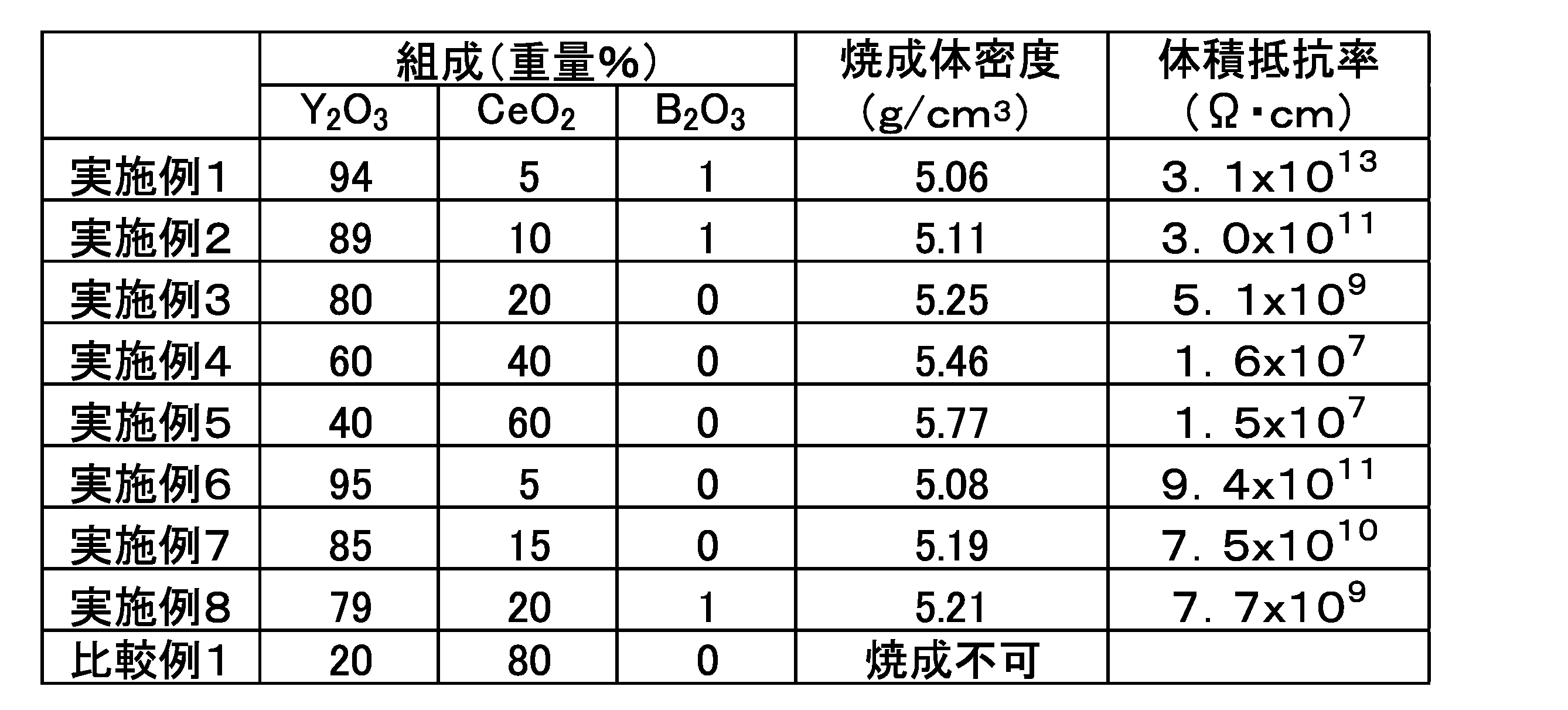
- Table 1 shows the density and volume resistivity of the ceramic members obtained in Examples 1 to 8 and Comparative Example 1.
- the volume resistivity of the ceramic members of Examples 1 to 8 was 1 ⁇ 10 7 ⁇ ⁇ cm or more and less than 1 ⁇ 10 14 ⁇ ⁇ cm.
- the ceramic members of Examples 1 to 8 were dense.
- an electron micrograph of a cross section of the ceramic member of Example 4 is shown in FIG.
- the ceramic member had a homogeneous structure and a dense structure with no pores.
- the volume resistivity is 1 ⁇ 10 7 ⁇ ⁇ cm or more at room temperature and 1 ⁇ 10 14 by adding cerium element to yttrium oxide in an oxide conversion of 5 wt% or more and 60 wt% or less.
- a ceramic member of less than ⁇ ⁇ cm could be obtained.
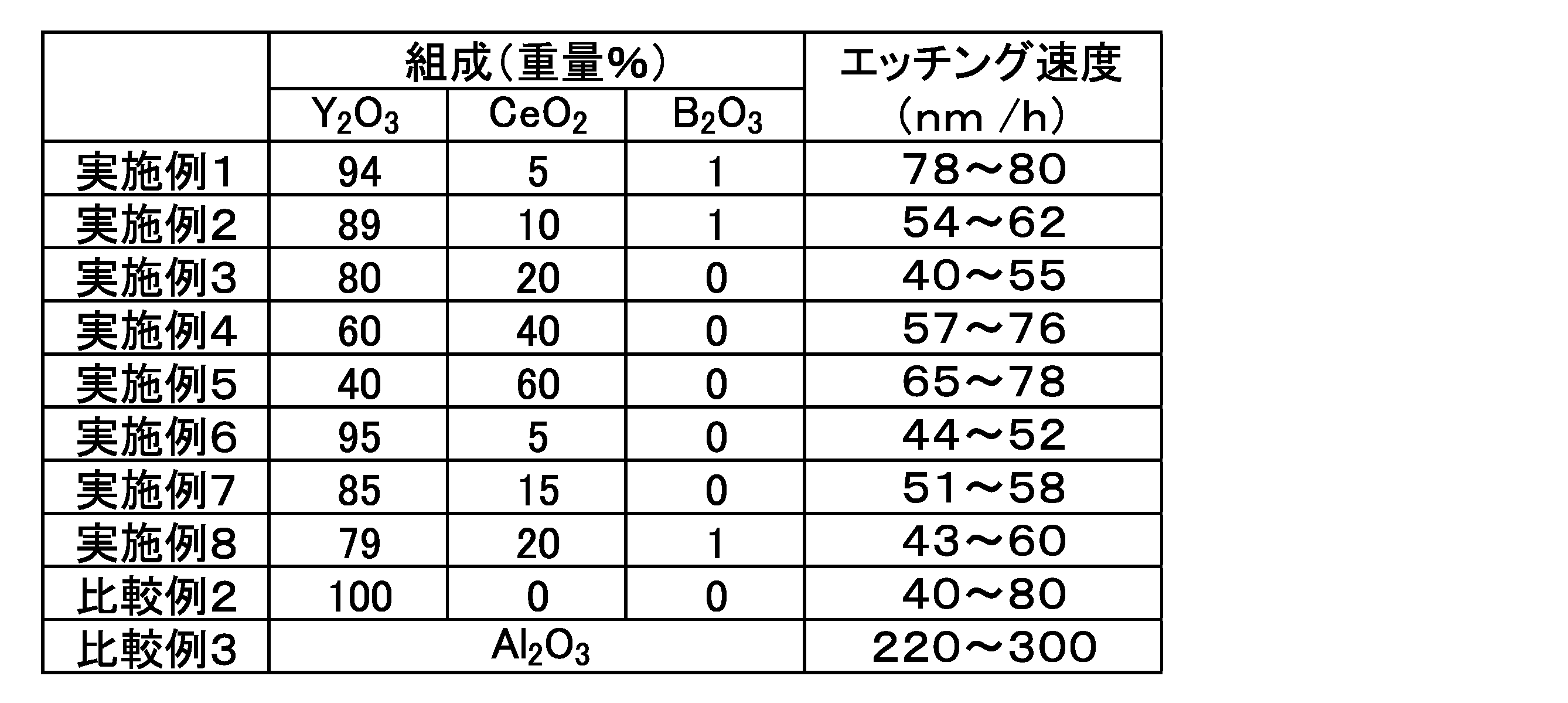
- Examples 1 to 8 and Comparative Examples 2 and 3 were used with a reactive ion etching apparatus (Anelva Corporation DEA-506), and the etching gas was A plasma irradiation treatment of 1000 W for 30 hours was performed with CF 4 (40 sccm) + O 2 (10 sccm). The results are shown in Table 2.
- Examples 1 to 8 have a plasma resistance equal to or higher than that of the high-purity yttrium oxide of Comparative Example 2, and have extremely excellent plasma resistance compared to the high-purity alumina of Comparative Example 3. I understand that.
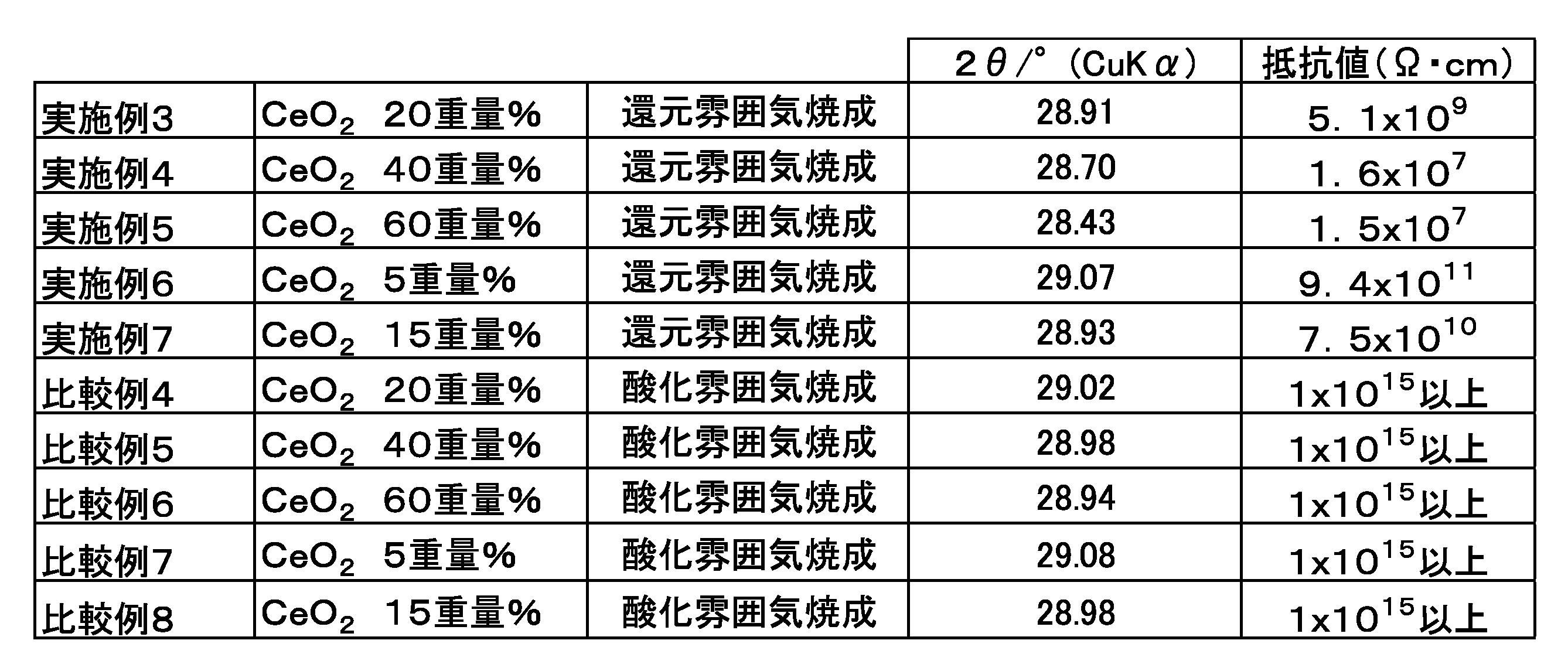
- Table 3 shows the relationship between the cerium oxide addition amount, the firing atmosphere, and the strongest peak position (2 ⁇ / CuK ⁇ ) in Examples 3 to 7 and Comparative Examples 4 to 8.
- the peak shift after firing in a non-oxidizing atmosphere varies depending on the amount of cerium oxide added, and the amount of shift tends to increase as the amount of cerium oxide added increases. It was also confirmed that the resistance value tends to decrease as the shift amount increases.
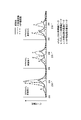
- FIG. 2 shows a summary of changes in the strongest peak positions in the X-ray diffraction profiles of the molded body, the air-fired product, and the HIP product in the samples of Examples 3 to 5.
- the (222) attribution peak (a in the figure) of yttrium oxide and the (111) attribution peak (b in the figure) of cerium oxide are separated. Due to atmospheric firing, two peaks become one (c in the figure), and the peak position is located between the two peaks. After HIP, a state of shifting from the position c to the low angle side (d in the figure) was observed. Regardless of the amount of cerium added, this phenomenon confirmed the behavior of a low angle shift by HIP treatment.
- a corrosion resistant member made of a ceramic member having high corrosion resistance and low volume resistivity, in connection with the corrosion resistant member and the manufacturing method thereof.
Landscapes
- Engineering & Computer Science (AREA)
- Chemical & Material Sciences (AREA)
- Ceramic Engineering (AREA)
- Manufacturing & Machinery (AREA)
- Materials Engineering (AREA)
- Structural Engineering (AREA)
- Organic Chemistry (AREA)
- Inorganic Chemistry (AREA)
- Drying Of Semiconductors (AREA)
- Compositions Of Oxide Ceramics (AREA)
Abstract
Description
本発明の他の実施形態においては、酸化イットリウムに酸化セリウムを5重量%以上、60重量%以下の割合で添加し、この混合物を成形した後、非酸化雰囲気下において1300℃以上1800℃以下で焼成することによって耐蝕性部材を製造することができる。
本件で使用する語句の説明を以下に行う。
本発明における密度とは、見かけ密度をさす。具体的には、試料の質量を外容積から開気孔を除いた容積で除した値であり、アルキメデス法により測定を行った。
本発明におけるアルキメデス法とは、JIS規格(JIS R1634)に示される密度測定方法である。飽水方法は真空法、媒液には蒸留水を用いて測定を行った。気孔率の算出方法もJIS R 1634に従って行った。
酸化イットリウム焼成体の体積抵抗率は、室温(25℃)において1×10¹⁴Ω・cm以上である。本発明における低抵抗とは、絶縁材料である酸化イットリウムの体積抵抗率を意図的に変化できる1×10¹⁴Ω・cm未満となった性質を低抵抗と定義した。
本発明における体積抵抗率とは、JIS規格(JIS C2141)に示される試験材料の電気抵抗を単位体積当りに換算した値である。室温(25℃)における体積抵抗率を三端子法により測定した。
本発明における酸化雰囲気とは、酸素を含む雰囲気であり、大気雰囲気や酸素濃度を制御した雰囲気のことである。
本発明における非酸化雰囲気とは、還元雰囲気および不活性雰囲気をいう。具体的には、還元雰囲気とは、COやH2のような還元ガス種を含む雰囲気であり、不活性雰囲気とは、N2やArなどの不活性ガスを導入して加熱する場合の雰囲気である。
本発明におけるX線回折プロファイルとは、試料にCu管球を用いてCuKα線のX線を照射し、回折された回折X線を検知した角度(2θ)を横軸に、回折強度を縦軸にとったチャート図をさす。本発明では、この検知した角度(2θ)をピーク位置とし、最強ピークを、回折したX線の検知強度が最も高いピークとした。
本発明におけるX線回折ピーク位置の低角度側へのシフトとは、酸化イットリウムを主成分とし、焼成により得られるセラミック部材の表面におけるX線回折の2θが下記リファレンスの粉末X線回折の2θよりも低角度側にシフトしていることさす。(ただし、上記リファレンスは酸化雰囲気焼成により立方晶酸化イットリウム:JCPDFカード00-041-1105に立方晶酸化セリウム:JCPDFカード01-071-4807が固溶した固溶体を粉砕して得られた粉末である。)
次に本発明の一実施形態について記載する。
原料に酸化物を用いる場合には、ボールミルのようなセラミックスの製造工程で利用される混合方法を用いて原料を混合する。酸化イットリウム原料粉末の粒子径に制限はないが、平均10μm以下が好ましく、より好ましくは2μm以下が好ましい。下限値の制限はないが、成形性の低下があることから、0.1μm以上が好ましい。酸化セリウム原料粉末の粒子径においても制限はないが、平均10μm以下が好ましく、より好ましくは2μm以下が好ましい。下限値の制限はないが、成形性の低下があることから、0.1μm以上が好ましい。ボールミルのような粉砕工程を伴う混合方法は、粒子径を細かくするだけでなく粗大粒子を粉砕する効果があり、均質で微細な粒子からなるセラミック部材を得るには好ましい。
本発明の実施形態における成形方法は、造粒した粉末をプレス成形やCIPなどの乾式成形方法により成形体を得ることができる。成形は乾式成形に限らず、押し出し成形、射出成形、シート成形、鋳込み成形、ゲルキャスト成形などの成形方法を利用して成形体を得ることができる。乾式成形の場合、バインダーを加えてスプレードライヤーなどを利用し、顆粒にし利用できる。
本発明の一実施形態において、焼成は酸化雰囲気で1300℃以上1800℃以下の焼成が可能であり、SiC発熱体やカンタル発熱体を有する電気炉での焼成が可能である。酸化雰囲気焼成後は、1300℃以上1800℃以下の温度で非酸化雰囲気下の熱処理を施すことにより、セラミック部材が得られる。得られたセラミック部材は必要に応じてHIP処理を施すことができる。これにより、開気孔率が0%以上、0.1%未満、より好ましくは0.05%未満となり、緻密質セラミック部材を得ることができる。
原料として酸化イットリウム粉末(Y2O3:平均粒子径1μm、比表面積11~15g/cm2)と酸化セリウム(CeO2:平均粒子径0.6μm、比表面積約20g/cm2)を用意し、酸化セリウム添加量を5重量%とし、酸化ほう素粉末(試薬)添加量を1重量%とし、分散剤・バインダー・離型剤を加えてボールミルによる粉砕攪拌混合を行った。混合後スプレードライヤーによる造粒を行った。得られた造粒粉末はプレス成形を行った後、CIP成形を行った。スプレードライヤーによる造粒とCIP処理により、成形体密度を向上させると安定して焼成体が得られる。得られた成形体は、脱脂した後、酸化雰囲気中1480℃で焼成した。得られた焼成体は、100MPaのアルゴン雰囲気中で1500℃2時間のHIP処理を施した。
原料として酸化イットリウム粉末(Y2O3:平均粒子径1μm、比表面積11~15g/cm2)と酸化セリウム(CeO2:平均粒子径0.6μm、比表面積約20g/cm2)を用意し、酸化セリウム添加量を10重量%とし、酸化ほう素粉末(試薬)添加量を1重量%とし、分散剤・バインダー・離型剤を加えてボールミルによる粉砕攪拌混合を行った。混合後スプレードライヤーによる造粒を行った。得られた造粒粉末はプレス成形を行った後、CIP成形を行った。スプレードライヤーによる造粒とCIP処理により、成形体密度を向上させると安定して焼成体が得られる。得られた成形体は、脱脂した後、酸化雰囲気中1480℃で焼成した。得られた焼成体は、100MPaのアルゴン雰囲気中で1500℃2時間のHIP処理を施した。
原料として酸化イットリウム粉末(Y2O3:平均粒子径1μm、比表面積11~15g/cm2)と酸化セリウム(CeO2:平均粒子径0.6μm、比表面積約20g/cm2)を用意し、酸化セリウム添加量を20重量%とし、分散剤・バインダー・離型剤を加えてボールミルによる粉砕攪拌混合を行った。混合後スプレードライヤーによる造粒を行った。得られた造粒粉末はプレス成形を行った後、CIP成形を行った。スプレードライヤーによる造粒とCIP処理により、成形体密度を向上させると安定して焼成体が得られる。得られた成形体は、脱脂した後、酸化雰囲気中1650℃で焼成した。得られた焼成体は、100MPaのアルゴン雰囲気中で1500℃2時間のHIP処理を施した。
原料として酸化イットリウム粉末(Y2O3:平均粒子径1μm、比表面積11~15g/cm2)と酸化セリウム(CeO2:平均粒子径0.6μm、比表面積約20g/cm2)を用意し、酸化セリウム添加量を40重量%とし、分散剤・バインダー・離型剤を加えてボールミルによる粉砕攪拌混合を行った。混合後スプレードライヤーによる造粒を行った。得られた造粒粉末はプレス成形を行った後、CIP成形を行った。スプレードライヤーによる造粒とCIP処理により、成形体密度を向上させると安定して焼成体が得られる。得られた成形体は、脱脂した後、酸化雰囲気中1650℃で焼成した。得られた焼成体は、100MPaのアルゴン雰囲気中で1500℃2時間のHIP処理を施した。
原料として酸化イットリウム粉末(Y2O3:平均粒子径1μm、比表面積11~15g/cm2)と酸化セリウム(CeO2:平均粒子径0.6μm、比表面積約20g/cm2)を用意し、酸化セリウム添加量を60重量%とし、分散剤・バインダー・離型剤を加えてボールミルによる粉砕攪拌混合を行った。混合後スプレードライヤーによる造粒を行った。得られた造粒粉末はプレス成形を行った後、CIP成形を行った。スプレードライヤーによる造粒とCIP処理により、成形体密度を向上させると安定して焼成体が得られる。得られた成形体は、脱脂した後、酸化雰囲気中1650℃で焼成した。得られた焼成体は、100MPaのアルゴン雰囲気中で1500℃2時間のHIP処理を施した。
原料として酸化イットリウム粉末(Y2O3:平均粒子径1μm、比表面積11~15g/cm2)と酸化セリウム(CeO2:平均粒子径0.6μm、比表面積約20g/cm2)を用意し、酸化セリウム添加量を5重量%とし、分散剤・バインダー・離型剤を加えてボールミルによる粉砕攪拌混合を行った。混合後スプレードライヤーによる造粒を行った。得られた造粒粉末はプレス成形を行った後、CIP成形を行った。スプレードライヤーによる造粒とCIP処理により、成形体密度を向上させると安定して焼成体が得られる。得られた成形体は、脱脂した後、酸化雰囲気中1650℃で焼成した。得られた焼成体は、100MPaのアルゴン雰囲気中で1500℃2時間のHIP処理を施した。
原料として酸化イットリウム粉末(Y2O3:平均粒子径1μm、比表面積11~15g/cm2)と酸化セリウム(CeO2:平均粒子径0.6μm、比表面積約20g/cm2)を用意し、酸化セリウム添加量を15重量%とし、分散剤・バインダー・離型剤を加えてボールミルによる粉砕攪拌混合を行った。混合後スプレードライヤーによる造粒を行った。得られた造粒粉末はプレス成形を行った後、CIP成形を行った。スプレードライヤーによる造粒とCIP処理により、成形体密度を向上させると安定して焼成体が得られる。得られた成形体は、脱脂した後、酸化雰囲気中1650℃で焼成した。得られた焼成体は、100MPaのアルゴン雰囲気中で1500℃2時間のHIP処理を施した。
原料として酸化イットリウム粉末(Y2O3:平均粒子径1μm、比表面積11~15g/cm2)と酸化セリウム(CeO2:平均粒子径0.6μm、比表面積約20g/cm2)を用意し、酸化セリウム添加量を20重量%とし、酸化ほう素粉末(試薬)添加量を1重量%とし、分散剤・バインダー・離型剤を加えてボールミルによる粉砕攪拌混合を行った。混合後スプレードライヤーによる造粒を行った。得られた造粒粉末はプレス成形を行った後、CIP成形を行った。スプレードライヤーによる造粒とCIP処理により、成形体密度を向上させると安定して焼成体が得られる。得られた成形体は、脱脂した後、酸化雰囲気中1480℃で焼成した。得られた焼成体は、100MPaのアルゴン雰囲気中で1500℃2時間のHIP処理を施した。
原料として酸化イットリウム粉末(Y2O3:平均粒子径1μm、比表面積11~15g/cm2)と酸化セリウム(CeO2:平均粒子径0.6μm、比表面積約20g/cm2)を用意し、酸化セリウム添加量を80重量%とし、分散剤・バインダー・離型剤を加えてボールミルによる粉砕攪拌混合を行った。混合後スプレードライヤーによる造粒を行った。得られた造粒粉末はプレス成形を行った後、CIP成形を行った。得られた成形体は、脱脂した後、酸化雰囲気中1650℃で焼成した。酸化セリウムを80重量%添加した試料は脱脂による熱処理でワレが発生し、焼成することが困難であり、得られる焼成体から体積抵抗を測定するにいたらなかった。
比較例2は高純度の酸化イットリウム焼成体である。
比較例3は純度99.7%の高純度酸化アルミニウム焼成体である。
原料として酸化イットリウム粉末(Y2O3:平均粒子径1μm、比表面積11~15g/cm2)と酸化セリウム(CeO2:平均粒子径0.6μm、比表面積約20g/cm2)を用意し、酸化セリウム添加量を20重量%とし、分散剤・バインダー・離型剤を加えてボールミルによる粉砕攪拌混合を行った。混合後スプレードライヤーによる造粒を行った。得られた造粒粉末はプレス成形を行った後、CIP成形を行った。スプレードライヤーによる造粒とCIP処理により、成形体密度を向上させると安定して焼成体が得られる。得られた成形体は、脱脂した後、酸化雰囲気中1650℃で焼成した。
原料として酸化イットリウム粉末(Y2O3:平均粒子径1μm、比表面積11~15g/cm2)と酸化セリウム(CeO2:平均粒子径0.6μm、比表面積約20g/cm2)を用意し、酸化セリウム添加量を40重量%とし、分散剤・バインダー・離型剤を加えてボールミルによる粉砕攪拌混合を行った。混合後スプレードライヤーによる造粒を行った。得られた造粒粉末はプレス成形を行った後、CIP成形を行った。スプレードライヤーによる造粒とCIP処理により、成形体密度を向上させると安定して焼成体が得られる。得られた成形体は、脱脂した後、酸化雰囲気中1650℃で焼成した。
原料として酸化イットリウム粉末(Y2O3:平均粒子径1μm、比表面積11~15g/cm2)と酸化セリウム(CeO2:平均粒子径0.6μm、比表面積約20g/cm2)を用意し、酸化セリウム添加量を60重量%とし、分散剤・バインダー・離型剤を加えてボールミルによる粉砕攪拌混合を行った。混合後スプレードライヤーによる造粒を行った。得られた造粒粉末はプレス成形を行った後、CIP成形を行った。スプレードライヤーによる造粒とCIP処理により、成形体密度を向上させると安定して焼成体が得られる。得られた成形体は、脱脂した後、酸化雰囲気中1650℃で焼成した。
原料として酸化イットリウム粉末(Y2O3:平均粒子径1μm、比表面積11~15g/cm2)と酸化セリウム(CeO2:平均粒子径0.6μm、比表面積約20g/cm2)を用意し、酸化セリウム添加量を5重量%とし、分散剤・バインダー・離型剤を加えてボールミルによる粉砕攪拌混合を行った。混合後スプレードライヤーによる造粒を行った。得られた造粒粉末はプレス成形を行った後、CIP成形を行った。スプレードライヤーによる造粒とCIP処理により、成形体密度を向上させると安定して焼成体が得られる。得られた成形体は、脱脂した後、酸化雰囲気中1650℃で焼成した。
原料として酸化イットリウム粉末(Y2O3:平均粒子径1μm、比表面積11~15g/cm2)と酸化セリウム(CeO2:平均粒子径0.6μm、比表面積約20g/cm2)を用意し、酸化セリウム添加量を15重量%とし、分散剤・バインダー・離型剤を加えてボールミルによる粉砕攪拌混合を行った。混合後スプレードライヤーによる造粒を行った。得られた造粒粉末はプレス成形を行った後、CIP成形を行った。スプレードライヤーによる造粒とCIP処理により、成形体密度を向上させると安定して焼成体が得られる。得られた成形体は、脱脂した後、酸化雰囲気中1650℃で焼成した。
Claims (8)
- 酸化イットリウムを主成分とし、セリウムの元素を含有し、非酸化雰囲気での焼成により得られるセラミック部材からなることを特徴とする耐蝕性部材。
- 前記セラミック部材において、イットリウム酸化物中に含まれるセリウム元素が酸化物換算で5重量%以上、60重量%以下であることを特徴とする請求項1に記載の耐蝕性部材。
- 前記セラミック部材において、体積抵抗率が室温において1×10⁷Ω・cm以上、1×10¹⁴Ω・cm未満であることを特徴とする請求項1または2に記載の耐蝕性部材。
- 請求項1乃至3のいずれかに記載の前記セラミック部材にあって、その焼成体表面におけるX線回折により得られる最強ピーク位置(2θ)は、リファレンスとして酸化雰囲気焼成により立方晶酸化イットリウムに立方晶酸化セリウムを固溶した固溶体を粉砕して得られた粉末の粉末X線回折により得られる最強ピーク位置(2θ)よりも低角度側にシフトしていることを特徴とする耐蝕性部材。
- 酸化イットリウムに酸化セリウムを5重量%以上、60重量%以下の割合で添加し、この混合物を成形した後、非酸化雰囲気下において1300℃以上1800℃以下で焼成することを特徴とする耐蝕性部材の製造方法。
- 酸化イットリウムにセリウム化合物をセリウムの酸化物換算で5重量%以上、60重量%以下の割合で添加し、この混合物を成形した後、酸化雰囲気下において1300℃以上1800℃以下で焼成した後、非酸化雰囲気下で1300℃以上1800℃以下の温度で熱処理することを特徴とする耐蝕性部材の製造方法。
- 酸化イットリウムに酸化セリウムを5重量%以上、60重量%以下、ほう素化合物を酸化ほう素換算で0.02重量%以上、10重量%以下の割合で添加し、この混合物を成形した後、非酸化雰囲気下において1300℃以上1600℃以下で焼成することを特徴とする耐蝕性部材の製造方法。
- 酸化イットリウムにセリウム化合物をセリウムの酸化物換算で5重量%以上、60重量%以下、ほう素化合物を酸化ほう素換算で0.02重量%以上、10重量%以下の割合で添加し、この混合物を成形した後、酸化雰囲気下において1300℃以上1600℃以下で焼成した後、非酸化雰囲気下で1300℃以上1600℃以下の温度で熱処理することを特徴とする耐蝕性部材の製造方法。
Priority Applications (2)
| Application Number | Priority Date | Filing Date | Title |
|---|---|---|---|
| KR1020117000549A KR101232699B1 (ko) | 2008-08-28 | 2009-08-27 | 내식성 부재 및 정전 척 |
| CN200980121500.8A CN102056860B (zh) | 2008-08-28 | 2009-08-27 | 耐腐蚀性部件及其制造方法 |
Applications Claiming Priority (4)
| Application Number | Priority Date | Filing Date | Title |
|---|---|---|---|
| JP2008219314 | 2008-08-28 | ||
| JP2008-219314 | 2008-08-28 | ||
| JP2009197028A JP5190809B2 (ja) | 2008-08-28 | 2009-08-27 | 耐蝕性部材およびその製造方法 |
| JP2009-197028 | 2009-08-27 |
Publications (1)
| Publication Number | Publication Date |
|---|---|
| WO2010024353A1 true WO2010024353A1 (ja) | 2010-03-04 |
Family
ID=41721518
Family Applications (1)
| Application Number | Title | Priority Date | Filing Date |
|---|---|---|---|
| PCT/JP2009/065001 Ceased WO2010024353A1 (ja) | 2008-08-28 | 2009-08-27 | 耐蝕性部材およびその製造方法 |
Country Status (2)
| Country | Link |
|---|---|
| US (1) | US8178459B2 (ja) |
| WO (1) | WO2010024353A1 (ja) |
Families Citing this family (3)
| Publication number | Priority date | Publication date | Assignee | Title |
|---|---|---|---|---|
| JP2010064937A (ja) * | 2008-09-12 | 2010-03-25 | Covalent Materials Corp | プラズマ処理装置用セラミックス |
| EP2400680A1 (en) * | 2010-06-28 | 2011-12-28 | Lantiq Deutschland GmbH | Optical network power consumption mitigation |
| TWI709653B (zh) | 2018-02-15 | 2020-11-11 | 日商京瓷股份有限公司 | 電漿處理裝置用構件及具備其之電漿處理裝置 |
Citations (2)
| Publication number | Priority date | Publication date | Assignee | Title |
|---|---|---|---|---|
| JP2006512737A (ja) * | 2002-12-27 | 2006-04-13 | プラクスエア・テクノロジー・インコーポレイテッド | 酸素イオン伝導度を改善する製造方法 |
| JP2009104990A (ja) * | 2007-10-25 | 2009-05-14 | Nippon Shokubai Co Ltd | 固体酸化物形燃料電池用電解質シートの製造方法および電解質シート |
Family Cites Families (12)
| Publication number | Priority date | Publication date | Assignee | Title |
|---|---|---|---|---|
| JP3287996B2 (ja) | 1996-12-26 | 2002-06-04 | 京セラ株式会社 | 静電チャック装置 |
| JP3046288B1 (ja) * | 1998-12-28 | 2000-05-29 | 京セラ株式会社 | 半導体・液晶製造装置用部材 |
| JP3241350B2 (ja) | 1999-09-28 | 2001-12-25 | 太平洋セメント株式会社 | 導電性セラミックスおよびその製造方法 |
| JP4548887B2 (ja) * | 1999-12-27 | 2010-09-22 | 京セラ株式会社 | 耐食性セラミック部材およびその製造方法 |
| JP4243943B2 (ja) * | 2002-04-22 | 2009-03-25 | 日本碍子株式会社 | 窒化アルミニウム材料および半導体製造用部材 |
| JP4429742B2 (ja) | 2004-01-21 | 2010-03-10 | 住友大阪セメント株式会社 | 焼結体及びその製造方法 |
| JP2005239826A (ja) * | 2004-02-25 | 2005-09-08 | Stanley Electric Co Ltd | 蛍光体とその製造方法 |
| JP4780932B2 (ja) | 2004-05-25 | 2011-09-28 | 京セラ株式会社 | 耐食性部材とその製造方法および半導体・液晶製造装置用部材 |
| JP2006069843A (ja) | 2004-09-02 | 2006-03-16 | Ibiden Co Ltd | 半導体製造装置用セラミック部材 |
| JP5228293B2 (ja) | 2005-07-15 | 2013-07-03 | Toto株式会社 | イットリア焼結体ならびに耐食性部材、その製造方法 |
| KR20090093819A (ko) * | 2008-02-28 | 2009-09-02 | 코바렌트 마테리얼 가부시키가이샤 | 플라즈마 처리 장치에 이용되는 소결체 및 부재 |
| WO2010024354A1 (ja) * | 2008-08-29 | 2010-03-04 | Toto株式会社 | 静電チャックおよびその製造方法 |
-
2009
- 2009-08-27 WO PCT/JP2009/065001 patent/WO2010024353A1/ja not_active Ceased
- 2009-08-28 US US12/584,063 patent/US8178459B2/en not_active Expired - Fee Related
Patent Citations (2)
| Publication number | Priority date | Publication date | Assignee | Title |
|---|---|---|---|---|
| JP2006512737A (ja) * | 2002-12-27 | 2006-04-13 | プラクスエア・テクノロジー・インコーポレイテッド | 酸素イオン伝導度を改善する製造方法 |
| JP2009104990A (ja) * | 2007-10-25 | 2009-05-14 | Nippon Shokubai Co Ltd | 固体酸化物形燃料電池用電解質シートの製造方法および電解質シート |
Also Published As
| Publication number | Publication date |
|---|---|
| US20100081557A1 (en) | 2010-04-01 |
| US8178459B2 (en) | 2012-05-15 |
Similar Documents
| Publication | Publication Date | Title |
|---|---|---|
| JP5121268B2 (ja) | 窒化アルミニウム焼結体及び半導体製造装置用部材 | |
| KR102879377B1 (ko) | 마그네슘 알루미네이트 스피넬을 포함하는 세라믹 소결체 | |
| JP2000001362A (ja) | 耐食性セラミックス材料 | |
| JP5190809B2 (ja) | 耐蝕性部材およびその製造方法 | |
| TWI820786B (zh) | 用於耐電漿材料之氧化釔-氧化鋯燒結陶瓷及其製造方法 | |
| JP5117891B2 (ja) | 酸化イットリウム材料、半導体製造装置用部材及び酸化イットリウム材料の製造方法 | |
| JP4987238B2 (ja) | 窒化アルミニウム焼結体、半導体製造用部材及び窒化アルミニウム焼結体の製造方法 | |
| KR100500495B1 (ko) | 질화알루미늄질 세라믹스, 반도체 제조용 부재 및 내식성 부재 | |
| JP2006069843A (ja) | 半導体製造装置用セラミック部材 | |
| WO2010024353A1 (ja) | 耐蝕性部材およびその製造方法 | |
| TWI385138B (zh) | Ceramic components and corrosion resistance components | |
| KR20100031463A (ko) | 플라즈마 처리 장치용 세라믹스 | |
| JP4798693B2 (ja) | プラズマ処理装置用イットリアセラミックス部品及びその製造方法 | |
| JPWO2019163710A1 (ja) | 複合焼結体、半導体製造装置部材および複合焼結体の製造方法 | |
| JP2011136876A (ja) | 金属ホウ化物焼結体の製造方法、ホウ化ランタン焼結体及びそれを用いたターゲット | |
| WO2010024354A1 (ja) | 静電チャックおよびその製造方法 | |
| JP2010083751A (ja) | 導電セラミック材料およびその作製方法 | |
| JP2010080951A (ja) | 静電チャックおよびその製造方法 | |
| JP2002037660A (ja) | 耐プラズマ性アルミナセラミックスおよびその製造方法 | |
| JP5305228B2 (ja) | 耐蝕性部材 | |
| JP5188085B2 (ja) | 窒化アルミニウム耐食性部材及び半導体製造装置用部材 | |
| CN100396647C (zh) | 氧化钇烧结体及其制造方法 | |
| JP2004131298A (ja) | 低誘電正接材料および炭化珪素焼結体の誘電正接を制御する方法 | |
| JP2009149496A (ja) | 導電性セラミック材料 | |
| KR20250020621A (ko) | 반응되지 않은 산화이트륨 및 이트륨 풍부 상이 실질적으로 없는 큰 직경의 yag 층을 소결하기 위한 방법 |
Legal Events
| Date | Code | Title | Description |
|---|---|---|---|
| WWE | Wipo information: entry into national phase |
Ref document number: 200980121500.8 Country of ref document: CN |
|
| 121 | Ep: the epo has been informed by wipo that ep was designated in this application |
Ref document number: 09810003 Country of ref document: EP Kind code of ref document: A1 |
|
| ENP | Entry into the national phase |
Ref document number: 20117000549 Country of ref document: KR Kind code of ref document: A |
|
| NENP | Non-entry into the national phase |
Ref country code: DE |
|
| 122 | Ep: pct application non-entry in european phase |
Ref document number: 09810003 Country of ref document: EP Kind code of ref document: A1 |