WO2009135808A2 - Verfahren zur herstellung von 1,3,4-substituierten pyrazolverbindungen - Google Patents

Verfahren zur herstellung von 1,3,4-substituierten pyrazolverbindungen Download PDF

Info

Publication number
WO2009135808A2
WO2009135808A2 PCT/EP2009/055328 EP2009055328W WO2009135808A2 WO 2009135808 A2 WO2009135808 A2 WO 2009135808A2 EP 2009055328 W EP2009055328 W EP 2009055328W WO 2009135808 A2 WO2009135808 A2 WO 2009135808A2
Authority
WO
WIPO (PCT)
Prior art keywords
formula
alkyl
compound
optionally substituted
hydrogen
Prior art date
Legal status (The legal status is an assumption and is not a legal conclusion. Google has not performed a legal analysis and makes no representation as to the accuracy of the status listed.)
Ceased
Application number
PCT/EP2009/055328
Other languages
English (en)
French (fr)
Other versions
WO2009135808A3 (de
Inventor
Bernd Wolf
Volker Maywald
Michael Keil
Christopher Koradin
Michael Rack
Thomas Zierke
Martin Sukopp
Current Assignee (The listed assignees may be inaccurate. Google has not performed a legal analysis and makes no representation or warranty as to the accuracy of the list.)
BASF SE
Original Assignee
BASF SE
Priority date (The priority date is an assumption and is not a legal conclusion. Google has not performed a legal analysis and makes no representation as to the accuracy of the date listed.)
Filing date
Publication date
Priority to MX2010011433A priority Critical patent/MX2010011433A/es
Priority to BRPI0911767-9A priority patent/BRPI0911767A2/pt
Priority to CN200980116288.6A priority patent/CN102015654B/zh
Priority to DK09742026.9T priority patent/DK2288597T3/en
Priority to ES09742026.9T priority patent/ES2525807T3/es
Priority to US12/990,340 priority patent/US8598222B2/en
Priority to CA2725446A priority patent/CA2725446A1/en
Priority to JP2011507880A priority patent/JP5587293B2/ja
Priority to UAA201014232A priority patent/UA106470C2/uk
Application filed by BASF SE filed Critical BASF SE
Priority to EP09742026.9A priority patent/EP2288597B1/de
Priority to EA201001736A priority patent/EA019312B1/ru
Priority to AU2009243550A priority patent/AU2009243550B2/en
Publication of WO2009135808A2 publication Critical patent/WO2009135808A2/de
Publication of WO2009135808A3 publication Critical patent/WO2009135808A3/de
Priority to IL208541A priority patent/IL208541A/en
Anticipated expiration legal-status Critical
Priority to ZA2010/08637A priority patent/ZA201008637B/en
Ceased legal-status Critical Current

Links

Classifications

    • CCHEMISTRY; METALLURGY
    • C07ORGANIC CHEMISTRY
    • C07DHETEROCYCLIC COMPOUNDS
    • C07D409/00Heterocyclic compounds containing two or more hetero rings, at least one ring having sulfur atoms as the only ring hetero atoms
    • C07D409/02Heterocyclic compounds containing two or more hetero rings, at least one ring having sulfur atoms as the only ring hetero atoms containing two hetero rings
    • C07D409/12Heterocyclic compounds containing two or more hetero rings, at least one ring having sulfur atoms as the only ring hetero atoms containing two hetero rings linked by a chain containing hetero atoms as chain links
    • CCHEMISTRY; METALLURGY
    • C07ORGANIC CHEMISTRY
    • C07CACYCLIC OR CARBOCYCLIC COMPOUNDS
    • C07C251/00Compounds containing nitrogen atoms doubly-bound to a carbon skeleton
    • C07C251/72Hydrazones
    • C07C251/74Hydrazones having doubly-bound carbon atoms of hydrazone groups bound to hydrogen atoms or to acyclic carbon atoms
    • C07C251/76Hydrazones having doubly-bound carbon atoms of hydrazone groups bound to hydrogen atoms or to acyclic carbon atoms to carbon atoms of a saturated carbon skeleton
    • CCHEMISTRY; METALLURGY
    • C07ORGANIC CHEMISTRY
    • C07CACYCLIC OR CARBOCYCLIC COMPOUNDS
    • C07C251/00Compounds containing nitrogen atoms doubly-bound to a carbon skeleton
    • C07C251/72Hydrazones
    • C07C251/84Hydrazones having doubly-bound carbon atoms of hydrazone groups being part of rings other than six-membered aromatic rings
    • CCHEMISTRY; METALLURGY
    • C07ORGANIC CHEMISTRY
    • C07CACYCLIC OR CARBOCYCLIC COMPOUNDS
    • C07C251/00Compounds containing nitrogen atoms doubly-bound to a carbon skeleton
    • C07C251/72Hydrazones
    • C07C251/86Hydrazones having doubly-bound carbon atoms of hydrazone groups bound to carbon atoms of six-membered aromatic rings
    • CCHEMISTRY; METALLURGY
    • C07ORGANIC CHEMISTRY
    • C07DHETEROCYCLIC COMPOUNDS
    • C07D231/00Heterocyclic compounds containing 1,2-diazole or hydrogenated 1,2-diazole rings
    • C07D231/02Heterocyclic compounds containing 1,2-diazole or hydrogenated 1,2-diazole rings not condensed with other rings
    • C07D231/10Heterocyclic compounds containing 1,2-diazole or hydrogenated 1,2-diazole rings not condensed with other rings having two or three double bonds between ring members or between ring members and non-ring members
    • C07D231/14Heterocyclic compounds containing 1,2-diazole or hydrogenated 1,2-diazole rings not condensed with other rings having two or three double bonds between ring members or between ring members and non-ring members with hetero atoms or with carbon atoms having three bonds to hetero atoms with at the most one bond to halogen, e.g. ester or nitrile radicals, directly attached to ring carbon atoms

Definitions

  • the present invention relates to a process for the preparation of 1, 3,4-substituted pyrazole compounds of the formula I,
  • X is a group CX 1 X 2 X 3 , wherein
  • X 1 , X 2 and X 3 independently of one another are hydrogen, fluorine or chlorine, where X 1 can also be C 1 -C 6 -alkyl or C 1 -C 4 -haloalkyl and where at least one of the radicals X 1 , X 2 is different from hydrogen , R 1 stands for Ci-C4-alkyl or cyclopropyl, and R 2 is CN or a group CÜ2R 2a, wherein
  • R 2a is C 5 -C 6 -cycloalkyl, optionally substituted phenyl or C 1 -C 6 -alkyl, which may optionally be substituted by C 1 -C 4 -alkoxy, phenyl or C 1 -C 6 -cycloalkyl.
  • Pyrazoles of general formula I are important starting materials for a number of pharmaceutical active ingredients and crop protection active ingredients, in particular of 1,3-substituted pyrazol-4-ylcarboxylic anilides, as described, for example, in US Pat. No. 5,498,624, EP 545099 A1, EP 589301 A1, WO 92/12970, US Pat. WO 03/066610, WO 2006/024389, WO 2007/003603, WO 2007/006806.
  • 1, 3,4-substituted pyrazole compounds of the formula I is typically carried out by cyclization of suitable 1,3-difunctional compounds with substituted hydrazine compounds or by reaction of 1, 3-difunctional compounds with hydrazine, followed by alkylation to introduce the substituent on the nitrogen ( 1 position).
  • a principal disadvantage of this approach is the lack of regioselectivity of the cyclization of 1, 3-difunctional compounds with substituted hydrazine compounds as well as the lack of regioselectivity of N-alkylation of pyrazoles, so that in both cases in addition to the desired 1, 3,4-substituted pyrazole compound of Formula I (1, 3-isomer) is also the 1, 4,5-substituted isomer of the formula I '(1, 5-isomer) is formed.
  • WO 2003/051820 and WO 2005/042468 describe the cyclization of 2-haloacyl-3-aminoacrylic acid esters with alkylhydrazines to give 1-alkyl-3-haloalkylpyrazole-4-carboxylic acid esters.
  • the selectivity to the desired isomer is unsatisfactory.
  • WO 2008/022777 describes a process for preparing 1-substituted-3- (dihalomethyl) pyrazole-4-carboxylic acid esters in which vinylogous amidinium salts which are prepared by reacting ⁇ - (halomethyl) -difluoromethylamines with acrylates in the presence of a Lewis Acid, are reacted with substituted hydrazines.
  • the selectivity to the desired isomer is unsatisfactory.
  • the invention is therefore based on the object to provide a process for the preparation of 1, 3,4-substituted pyrazole compounds of the formula I cited above, which provides the desired 1, 3-isomer of the formula I with high yields and good selectivity. It has surprisingly been found that 1, 3,4-substituted pyrazole compounds of the formula I defined in the introduction can be prepared in a simple manner with high yields and high regioselectivity with respect to the desired 1,3-isomer, if suitable 1,3-difunctional compounds are used Compounds of formula II described below first with a hydrazone of the formula III described below and the resulting intermediate is treated with an acid in the presence of water.
  • the present invention relates to a process for preparing 1, 3-substituted pyrazole compounds of the formula I defined at the outset, which comprises the following steps:
  • Y is oxygen, a group NR ⁇ 1 or a group [NR y2 R y3 J + Z ", where R y1 , R y2 and R y3 independently of one another are C 1 -C 6 -alkyl, C 5 -C 6 -cycloalkyl, optionally substituted phenyl or optionally substituted phenyl-Ci-C4-alkyl, or
  • R y2 and R y3 together with the nitrogen atom to which they are attached represent an N-bonded 5- to 8-membered, saturated, optionally substituted heterocycle which, in addition to the nitrogen atom, has 1 or 2 further heteroatoms selected from N , O and S may be ring atoms, and Z "is an anion;
  • R 3 is OR 3a or a group NR 3b R 3c wherein R 3a , R 3b and R 3c independently of one another are C 1 -C 6 -alkyl, C 5 -C 6 -cycloalkyl, optionally substituted phenyl or optionally substituted phenyl-Ci -C4-alkyl, stand, or
  • R 3b and R 3c together with the nitrogen atom to which they are attached, represent an N-linked 5- to 8-membered, saturated, optionally substituted heterocycle which, in addition to the nitrogen atom 1 or 2 further heteroatoms selected from among N, O and S as ring atoms,
  • variable R 1 has the meanings given for formula I,
  • R 4 and R 5 are independently hydrogen, Ci-C ⁇ -alkyl, which may be optionally substituted by Ci-C 4 -alkoxy, phenyl or Cs-C ⁇ -cycloalkyl, Cs-C ⁇ -cycloalkyl or optionally substituted phenyl, wherein at least one of R 4 or R 5 is other than hydrogen, and wherein
  • R 4 and R 5 together with the carbon atom to which they are attached may also stand for a 5- to 10-membered saturated carbocycle which is optionally mono- or polysubstituted by C 1 -C 4 -alkyl groups and / or optionally substituted phenyl and / or one or two fused phenyl rings;
  • the process according to the invention has a number of advantages.
  • low temperatures are not required to achieve the desired selectivity and step i) and step ii ) can be carried out at moderate temperatures, for example in the range from 10 to 180 ° C., in particular in the range from 20 to 150 ° C.
  • the reaction in steps i) and ii) may be carried out at temperatures up to -20 0 C and at lower temperatures, for example, which is not required to achieve the desired regioselectivity.
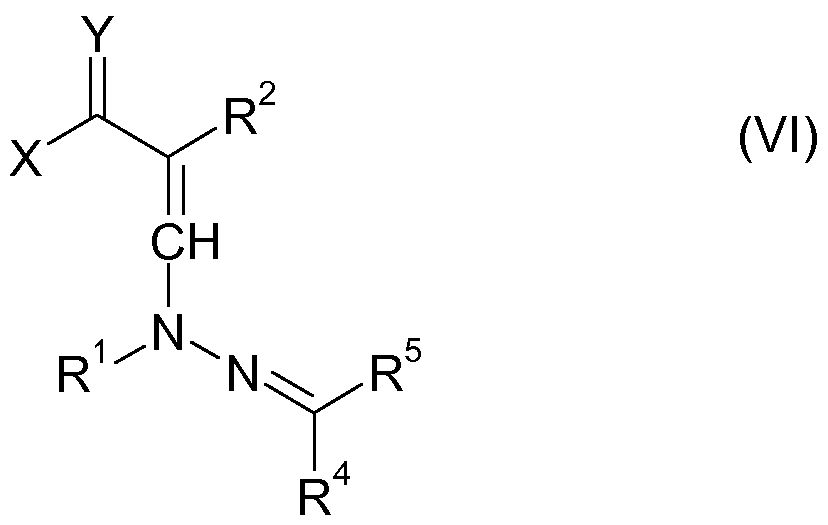
  • step i) of the process according to the invention the compound of the formula VI shown below is formed, which can usually be isolated:
  • halogen refers to each of fluorine, bromine, chlorine or iodine, especially fluorine, chlorine or bromine.
  • C 1 -C 6 -alkyl denotes a saturated, straight-chain or branched hydrocarbon group comprising 1 to 6 carbon atoms, especially 1 to 4 carbon atoms, for example methyl, ethyl, propyl, 1-methylethyl, butyl tyl, 1-methylpropyl, 2-methylpropyl, 1, 1-dimethylethyl, pentyl, 1-methylbutyl, 2-methylbutyl, 3-methylbutyl, 2,2-dimethylpropyl, 1-ethylpropyl, hexyl, 1, 1-dimethylpropyl, 1, 2-dimethylpropyl, 1-methylpentyl, 2-methylpentyl, 3-methylpentyl, 4-methylpentyl, 1, 1-dimethylbutyl, 1, 2-dimethylbutyl, 1, 3-dimethylbutyl, 2,2-dimethylbutyl, 2,3-dimethylbutyl, 3,3-dimethylbutyl
  • C 1 -C 6 -alkyl which may optionally be substituted by C 1 -C 4 -alkoxy, phenyl or C 3 -C 6 -cycloalkyl, stands for unsubstituted C 1 -C 6 -alkyl, as defined above, or for C 1 -C 4 -alkyl -C ⁇ -alkyl, wherein one of the hydrogen atoms is replaced by a Ci-C 4 alkoxy, phenyl or Cs-C ⁇ -cycloalkyl group.
  • C 1 -C 4 -haloalkyl as used herein describes straight-chain or branched alkyl groups having 1 to 4 carbon atoms, in which the hydrogen atoms of these groups are partially or completely replaced by halogen atoms, in particular by fluorine and / or chlorine, for example chloromethyl, Dichloromethyl, trichloromethyl, fluoromethyl, difluoromethyl, trifluoromethyl, chlorofluoromethyl, dichlorofluoromethyl, chloro difluoromethyl, 1-chloroethyl, 1-fluoroethyl, 2-fluoroethyl, 2,2-difluoroethyl, 2,2,2-trifluoroethyl, 2-chloro-2-fluoroethyl, 2-chloro-2,2-difluoroethyl, 2,2- Dichloro-2-fluoroethyl, 2,2,2-trichloroethyl, pentafluoroethyl,
  • C 1 -C 6 alkoxy describes straight-chain or branched saturated alkyl groups comprising 1 to 6 carbon atoms which are bonded via an oxygen atom.
  • Examples include Ci-C ⁇ -alkoxy such as methoxy, ethoxy, OCH 2 -C 2 H 5, OCH (CHs) 2, n-butoxy, OCH (CHs) -C 2 H 5, OCH 2 -CH (CHs) 2, OC (CH 3 ) 3 , n-pentoxy, 1-methylbutoxy, 2-methylbutoxy, 3-methylbutoxy, 1, 1-dimethylpropoxy, 1, 2-dimethylpropoxy, 2,2-dimethylpropoxy, 1-ethylpropoxy, n-hexoxy, 1 - Methylpentoxy, 2-methylpentoxy, 3-methylpentoxy, 4-methylpentoxy, 1, 1-dimethylbutoxy, 1, 2-dimethylbutoxy, 1, 3-dimethylbutoxy, 2,2-dimethylbutoxy, 2,3-dimethylbutoxy
  • C 1 -C 4 -alkoxy-C 1 -C 6 -alkyl refers to C 1 -C 6 -alkyl in which one of the hydrogen atoms is replaced by a C 1 -C 4 -alkoxy group.
  • Examples of these are CH 2 -OCH 3 , CH 2 -OC 2 H 5 , n-propoxymethyl, CH 2 -OCH (CH 2 ) 2 , n-butoxymethyl, (1-methylpropoxy) methyl, (2-methylpropoxy) methyl, CH 2 -OC (CH 3 ) 3 , 2- (methoxy) ethyl, 2- (ethoxy) ethyl, 2- (n-propoxy) ethyl, 2- (1-methylethoxy) ethyl, 2- (n-butoxy) ethyl, 2- (1-methylpropoxy) ethyl, 2- (2-methylpropoxy) ethyl, 2- (1, 1-dimethylethoxy) ethyl, 2- (methoxy) propyl, 2- (ethoxy) propyl, 2- (n- Propoxy) propyl, 2- (1-methylethoxy) propyl, 2- (n-butoxy) propyl, 2- (1-methylpropoxy) propyl,
  • Ca-C ⁇ -cycloalkyl as used herein describes monocyclic saturated hydrocarbon radicals comprising from 3 to 6 carbon atoms. Examples of monocyclic radicals include cyclopropyl, cyclobutyl, cyclopentyl and cyclohexyl.
  • optionally substituted phenyl as used herein means unsubstituted phenyl or phenyl which carries 1, 2, 3, 4, or 5, especially 1, 2 or 3, substituents which are inert under the conditions of the reaction are.
  • inert substituents are halogen, especially fluorine, chlorine or bromine, CN, NO2, d-Ce-alkyl, Ci-C 6 alkylthio, d-Ce-alkylsulfonyl, Ci-C4-haloalkyl, Ci-C 6 - Alkoxy, Cs-Ce-cycloalkyl, and Ci-C 4 alkoxy-Ci-C 6 -alkyl.
  • phenyl-C 1 -C 6 -alkyl refers to C 1 -C 6 -alkyl wherein one of the hydrogen atoms is replaced by an optionally substituted phenyl group. Examples are benzyl, 4-methylbenzyl, phenylethyl, etc.
  • N-bonded 5- to 8-membered, saturated, optionally substituted heterocycle means a saturated heterocycle bonded via a ring nitrogen atom which has 5, 6, 7 or 8 ring atoms, the ring atoms also being further apart from the nitrogen atom Heteroatoms include, and is unsubstituted or 1, 2, 3, 4, or 5, in particular 1, 2 or 3 substituents which are inert under the conditions of the reaction.
  • inert substituents are CN, -C 6 - alkyl, d-Ce-alkylthio, Ci-C6-Al kylsu If onyl, Ci-C 4 haloalkyl, Ci-C 6 alkoxy, C 3 -C 6 - cycloalkyl, and C 1 -C 4 -alkoxy-C 1 -C 6 -alkyl.
  • the heterocycle may also contain 1 or 2 further heteroatoms selected from among N, O and S as ring atoms.
  • N-linked 5- to 8-membered, saturated, optionally substituted heterocycles are pyrrolidin-1-yl, piperdin-1-yl, morpholin-4-yl, piperazin-1-yl and N-methylpiperazin-1-yl.
  • a preferred embodiment of the invention relates to the preparation of pyrazole compounds of the formula I in which R 2 is a COOR 2a group in which R 2a has the abovementioned meanings and in particular C 1 -C 6 -alkyl or C 1 -C 4 -alkoxy Ci-C 6 alkyl and especially Ci-C 4 alkyl.
  • the group R 2 stands for a group COOR 2a in which R 2a has the abovementioned meanings and in particular for C 1 -C 6 -alkyl or C 1 -C 4 -alkoxy-C 1 -C 6 alkyl and especially Ci-C 4 alkyl.
  • R 2 is CN. Accordingly, R 2 is also in the compounds of the formulas II and VI CN.
  • the inventive method is particularly suitable for the preparation of compounds of general formula I, wherein X is a group CX 1 X 2 X 3 , wherein X 1 , X 2 and X 3 have the abovementioned meanings, wherein at least one of the radicals X 1 and X 2 is different from hydrogen.
  • X 1 and X 2 are fluorine.
  • X 3 is preferably hydrogen, fluorine or chlorine.
  • Examples of preferred radicals CX 1 X 2 X 3 are dichloromethyl, chlorofluoromethyl, difluoromethyl, chlorodifluoromethyl and trifluoromethyl. According to a specific embodiment, X stands for a group CHF2.
  • R 1 in the formula I and, accordingly, in formula III is C 1 -C 4 -alkyl and in particular methyl.
  • the preparation of the pyrazole compounds of the formula I is carried out using a compound of the formula II in which Y is oxygen.
  • a compound of the formula II in which Y is oxygen Such compounds are also referred to below as compounds IIa.
  • Compounds of the formula IIa in which R 2 is a COOR 2a group in which R 2a has the abovementioned meanings and in particular C 1 -C 6 -alkyl or C 1 -C 4 -alkoxy-C 1 -C 6 -alkyl and especially C 1 -C 4 - AIkVl stands, are referred to below as compounds I Ia.1.
  • R 2 , R 2a , R 3 and X have the meanings given above.
  • X in the formulas IIa and Iaa.1 stands for a group CX 1 X 2 X 3 , in which X 1 , X 2 and X 3 have the meanings given above.
  • at least one of X 1 and X 2 is different from hydrogen.
  • X 1 and X 2 are fluorine.
  • X 3 is preferably hydrogen, fluorine or chlorine. Examples of particularly preferred group CX 1 X 2 X 3 are dichloromethyl, trifluoromethyl, chlorodifluoromethyl, fluorochloromethyl and difluoromethyl.
  • X stands for a group CHF2.
  • the preparation of the pyrazole compounds of the formula I is carried out using a compound of the formula II in which Y is a group [NR y2 R y3 J + Z. Such compounds are also referred to below as bonds IIb.
  • R 2 is a COOR 2a group in which R 2a has the abovementioned meanings and is in particular C 1 -C 6 -alkyl or C 1 -C 4 -alkoxy-C 1 -C 6 -alkyl, are also referred to below as Compounds I Ib.1 called.
  • R 2 , R 2a , R ⁇ 2 , R ⁇ 3 , Z, R 3 and X have the meanings given above.
  • X in the formulas IIb and IIb.1 is a group CX 1 X 2 X 3 in which X 1 , X 2 and X 3 have the meanings given above.
  • at least one of X 1 and X 2 is different from hydrogen.
  • X 1 and X 2 are fluorine.
  • X 3 is preferably hydrogen, fluorine or chlorine. Examples of particularly preferred group CX 1 X 2 X 3 are trifluoromethyl, chlorodifluoromethyl, fluorochloromethyl and difluoromethyl.
  • the group CX 1 X 2 X 3 in the formulas IIb, IIb.1 and IIb.2 stands for CHCIF or CHF 2 .
  • R y2 and R y3 are in particular CrC 4 -AlkVl and especially methyl.
  • Z stands for an anion or an anion equivalent which preferably consists of a Lewis acid such as MgF 2 , BF 3 , BCI 3 , AICI 3 , AIF 3 , ZnCl 2 , PF 5 , SbF 5 , BiCl 3 , GaCl 3 , SnCl 4 , or SiCl 4 , eg for fluoride, [MgF 3 ] -, [BF 4 ] -, [BCI 3 F] -, [AIF 4 ] -, [AICI 3 F] -, [ZnCl 2 F] -, [ PF6], [SbF 6 ], [BiCl 3 F], [GaCl 3 F], [SnCl 4 F] or [SiCl 4 F] -.
  • a Lewis acid such as MgF 2 , BF 3 , BCI 3 , AICI 3 , AIF 3 , ZnCl 2 , PF 5 , SbF
  • R 3 in the formulas II, IIa and IIa.1, IIb and IIb.1 is a group OR 3a .
  • R 3a has the abovementioned meanings and is in particular C 1 -C 4 -alkyl and especially methyl or ethyl.
  • R 3 in the formulas II, IIa and I Ia.1, IIb and IIb.1 is a group NR 3b R 3c .
  • R 3b and R 3c have the meanings mentioned above and are in particular C 1 -C 4 -alkyl and especially for methyl or ethyl, or R 3b and R 3c form, together with the nitrogen atom to which they are bonded, an N-linked 5- to 8-membered, saturated heterocycle which, in addition to the nitrogen atom, has 1 or 2 further hetero roatome selected from N, O and S may have as ring atoms and may optionally carry 1 or 2 Ci-C4-alkyl groups.
  • Examples of the latter cyclic group NR 3b R 3c are pyrrolidin-1-yl, morpholin-4-yl, piperidin-1-yl and 4-methylpiperazin-1-yl.
  • hydrazone of the formula III used in the reaction is basically of minor importance. Basically, such hydrazones of formula III
  • R 4 is hydrogen or C 1 -C 6 -alkyl
  • R 5 is C 1 -C 6 -alkyl, C 3 -C 6 -cycloalkyl or optionally substituted phenyl, or R 4 and R 5, together with the carbon atom to which they are attached, may represent a 5- to 10-membered saturated carbocycle, which is optionally substituted one or more times, for example 1-, 2-, 3- or 4-fold, by C 1 -C 4 -alkyl groups and / or has a fused phenyl ring.
  • a hydrazone of the formula III is used, in which
  • R 4 is hydrogen or C 1 -C 4 -alkyl, in particular hydrogen, and R 5 is optionally substituted phenyl.
  • a hydrazone of the formula III in which R 4 and R 5 are C 1 -C 4 -alkyl or together with the carbon atom to which they are attached form a 5 to 8-membered, saturated carbocycle which is optionally substituted in the manner described above.
  • unsubstituted or substituted phenyl here has the abovementioned meanings and is in particular unsubstituted phenyl or phenyl which has 1, 2 or 3 substituents selected from halogen, in particular fluorine, chlorine or bromine, nitro, cyano, Ci-C 4 -alkyl, in particular methyl or ethyl, and C 1 -C 4 -alkoxy, in particular methoxy or ethoxy, for example as in 2-, 3- or 4-fluorophenyl, 2-, 3- or 4-chlorophenyl, 4-bromophenyl, 2 -, 3- or 4-methylphenyl, 2-, 3- or 4-methoxyphenyl, 4-cyanophenyl, 4-nitrophenyl.
  • halogen in particular fluorine, chlorine or bromine
  • nitro, cyano Ci-C 4 -alkyl
  • Ci-C 4 -alkyl in particular methyl or ethyl
  • the term "optionally substituted phenyl” has the abovementioned meanings and particularly preferably represents unsubstituted phenyl or phenyl which has 1 or 2 substituents selected from halogen, in particular chlorine, C 1 -C 4 -alkyl, in particular methyl or ethyl, and C 1 -C 4 -alkoxy, in particular methoxy or ethoxy, for example, as in 2-, 3- or 4-chlorophenyl, 2-, 3- or 4-methylphenyl, 2-, 3- or 4-methoxyphenyl.
  • halogen in particular chlorine
  • C 1 -C 4 -alkyl in particular methyl or ethyl
  • C 1 -C 4 -alkoxy in particular methoxy or ethoxy
  • R 5 is optionally substituted phenyl, in particular unsubstituted phenyl or phenyl which has 1 or 2 substituents, wherein the substituents are as mentioned above and are preferably selected from halogen, in particular chlorine, Ci-C 4 -AlkVl, in particular methyl or ethyl, and C 1 -C 4 -alkoxy, in particular methoxy or ethoxy.
  • R 4 and R 5 together with the carbon atom to which they are bonded, represent a 5- to 10-membered, in particular 5 to 8-membered, saturated carbocycle which optionally has one or more than one, eg 1, 2, 3 or 4-fold, is substituted by C 1 -C 4 -alkyl groups.
  • reaction of the compounds of the formula II with the hydrazone of the formula III in step i) of the process according to the invention is usually carried out at temperatures in the range from 0 to 180 ° C., in particular in the range from 10 to 150 ° C.
  • the compounds II and III are preferably used in a ratio which corresponds to the stoichiometry of the reaction, it also being possible to deviate from the stoichiometry.
  • the molar ratio of compound II to compound III is in the range of 1.5: 1 to 1: 1.5, often in the range of 1.2: 1 to 1: 1, 2, and most preferably in the range of 1.1: 1 to 1: 1, 1.
  • the reaction in step i) takes place in an inert organic solvent.
  • inert organic solvents are, in particular, aprotic organic solvents, such as aromatic hydrocarbons and halogenated hydrocarbons, for example benzene, toluene, xylene, cumene, chlorobenzene and tert-butylbenzene, cyclic or acyclic ethers, such as diethyl ether, diisopropyl ether, tert-butyl methyl ether (MTBE).
  • the reaction is essentially anhydrous, ie the water content in the solution is below 1%, in particular below 0.1%, based on the total weight of the solvent.
  • the procedure is generally such that the compound of the formula II, preferably in the form of a solution in one of the abovementioned inert organic solvents, with the hydrazone III, which is also preferably as Solution is used in one of the aforementioned inert organic solvents, together.
  • the hydrazone III as a solution in an organic solvent and the compound II, preferably as a solution.
  • the compound II can be initially introduced as a solution in an organic solvent and the hydrazone, preferably as a solution, added.
  • the combination of the hydrazone III and the compound II can take place in the abovementioned temperature ranges.
  • the procedure is such that the combination of the compounds II and III at temperatures ranging from 0 to 50 0 C, in particular 10 to 50 0 C is carried out and then the reaction mixture is heated to the desired temperature.
  • the reaction time is typically in the range of 1 h to 15 h.
  • the reaction mixture can also be fed without isolation of the compound VI to the reaction in step ii) of the process according to the invention.
  • a procedure without isolation of the intermediate compound VI is advantageous since in this way yield losses such as occur in the separation of solids from the intermediate compound by filtration (eg losses in the mother liquor) can be reduced or avoided. In these cases, it is optionally possible to remove a partial amount of the organic solvent used in step i) and optionally replace it with another solvent.
  • a mode of operation without isolation of the intermediate compound VI is particularly advantageous if, in the compound II used, the group Y stands for [NR y2 R y3 J + Z-.
  • the reaction takes place in the presence of an acid, in particular a Bronsted acid.
  • Preferred acids have a pKa of not more than 4, in particular not more than 3 or not more than 2 (in dilute (eg 0.01 M) aqueous solution at 25 ° C).
  • Preferred acids are hydrohalic acids such as HF, HCl and HBr, in particular in the form of their aqueous solutions, sulfuric acid, phosphoric acid, HBF 4 , and organic sulfonic acids, for example aromatic sulfonic acids of the formula Ar-SOsH in which Ar represents optionally substituted phenyl, such as benzenesulfonic acid and p-toluenesulfonic acid, and aliphatic sulfonic acids such as methanesulfonic acid, ethanesulfonic acid and trifluoromethanesulfonic acid.
  • aromatic sulfonic acids of the formula Ar-SOsH in which Ar represents optionally substituted phenyl, such as benzenesulfonic acid and p-toluenesulfonic acid
  • aliphatic sulfonic acids such as methanesulfonic acid, ethanesulfonic acid and trifluoromethanesulf
  • Chlorobenzoic Of course, mixtures of the aforementioned acids are also suitable.
  • the acid can also be used in stoichiometric or superstoichiometric amount.
  • the acid is used in an amount of from 0.01 to 10 mol and in particular in an amount of from 0.02 to 5 mol per mol of compound VI, or in the case of in situ preparation of compound VI, in an amount from 0.01 to 10 moles and especially in an amount of 0.02 to 2 moles per mole of compound II.
  • water can also be used in a stoichiometric or superstoichiometric amount. In general, water is added in an amount of 0.001 to 50 mol and in particular in an amount of 0.01 to 20 moles per mole of compound VI, or in the case of in situ preparation of compound VI, in an amount of 0.001 to 50 mol and in particular in an amount of 0.01 to 20 moles per mole of compound II.
  • Y O
  • at least stoichiometric amounts of water are required for complete conversion in the cyclization.
  • the water is typically added in an amount of from 1 to 50 moles and more particularly in an amount of from 1.1 to 20 moles per mole of Compound VI or, in the case of in situ preparation of Compound VI, in an amount from 1 to 50 moles and especially in an amount of 1.1 to 20 moles per mole of Compound II.
  • Suitable organic solvents for the reaction in step ii) are protic polar solvents, e.g. aliphatic alcohols having preferably 1 to 4 carbon atoms, such as methanol, ethanol, n-propanol, isopropanol, n-butanol, isobutanol or tert-butanol, or carboxylic acids, such as acetic acid, aromatic hydrocarbons, such as benzene, toluene, xylene, cumene, chlorobenzene , Nitrobenzene or tert-butylbenzene, aprotic polar solvents, eg cyclic or acyclic ethers such as diethyl ether, diisopropyl ether, tert-butyl methyl ether (MTBE), tert-butyl ethyl ether, tetrahydr
  • protic polar solvents e.g. aliphatic alcohols having preferably 1
  • step ii) is generally carried out in such a way that the compound of the formula VI prepared in step i) of the process according to the invention or in
  • Step i) obtained reaction mixture, optionally after a partial or complete replacement of the solvent used in step i), in a suitable organic solvent and to this acid and water. It is possible to introduce the water required for the reaction over the organic solvent. It is also possible to introduce the water required for the reaction via acid, e.g. in the form of an aqueous solution of the acid or in the form of a hydrate of the acid.
  • the reaction in step ii) of the process according to the invention is usually carried out at temperatures in the range from 0 to 150 ° C., in particular in the range from 20 to 110 ° C.
  • the reaction time is typically in the range from 0.1 h to 15 h.
  • step ii) the desired 1,3-pyrazole compound I is obtained in high yield and high selectivity, ie with a very low or undetectable amount of undesired 1,5-isomer I '.
  • the molar ratio of 1,3-isomer of the formula I to 1,5-isomer of the formula I ' is generally at least 20: 1, frequently at least 50: 1, in particular at least 80: 1 and especially at least 100: 1.
  • the desired 1,3-pyrazole compound I can be isolated from the reaction mixture by customary methods by precipitation, crystallization or distillation or further processed in the form of the reaction mixture to give by-products.
  • Y is a group [NR y1 R y2 ] Z-, typically by reacting ⁇ , ⁇ -difluoroamines of the formula XIV with an olefinic compound of the formula XV in the presence of a Lewis acid such as MgF2, BF3, BCb, AICb, AIF3, ZnCb, PF5, SbFs, BiCb, GaCb, SnCU, or SiCU according to the procedure outlined in Scheme 4.
  • a Lewis acid such as MgF2, BF3, BCb, AICb, AIF3, ZnCb, PF5, SbFs, BiCb, GaCb, SnCU, or SiCU according to the procedure outlined in Scheme 4.
  • hydrazone compounds of the formula III used in the process according to the invention are known or can be prepared in a manner known per se by reacting a carbonyl compound of the formula IV with a substituted hydrazine compound of the formula V.
  • R 1 , R 4 and R 5 have the meanings given for formula III or VI.
  • the reaction of the compounds IV and V to give the hydrazone III can be carried out in a manner known per se.
  • reaction of the carbonyl compound IV with the hydrazine compound V is usually carried out at temperatures in the range from 10 to 180 ° C., in particular in the range from 20 to 150 ° C.
  • the compounds IV and V are preferably used in a ratio which corresponds to the stoichiometry of the reaction, it also being possible to deviate from the stoichiometry.
  • the molar ratio of compound IV to compound V is in the range of 1.5: 1 to 1: 1.5, often in the range of 1.2: 1 to 1: 1.2, and more preferably in the range of 1.1: 1 to 1: 1, 1.
  • inert organic solvents are in particular aprotic organic solvents such as aromatic hydrocarbons and halogenated hydrocarbons, e.g. Benzene, toluene, xylene, cumene, chlorobenzene and tert-butylbenzene, cyclic or acyclic ethers, such as diethyl ether, diisopropyl ether, tert.
  • aprotic organic solvents such as aromatic hydrocarbons and halogenated hydrocarbons, e.g. Benzene, toluene, xylene, cumene, chlorobenzene and tert-butylbenzene, cyclic or acyclic ethers, such as diethyl ether, diisopropyl ether, tert.
  • Butyl methyl ether MTBE
  • tert-butyl ethyl ether tetrahydrofuran (THF) or dioxane
  • nitriles such as acetonitrile and propionitrile
  • aliphatic halogenated hydrocarbons such as dichloromethane, dichloroethane, trichloromethane and mixtures thereof.
  • the procedure is generally such that the compound of the formula IV preferably in the form of a solution in one of the aforementioned inert organic solvents with which hydrazine compound V, preferably as a solution in water, together.
  • the compounding of the compounds IV and V can take place in the above-mentioned temperature ranges.
  • the procedure is such that the combining of the compounds IV and V takes place at temperatures in the range from 0 to 50 ° C., in particular from 10 to 50 ° C., and then the reaction mixture is heated to the desired temperature.
  • the reaction time is typically in the range of 0.5 h to 8 h.
  • the hydrazone can be isolated from the reaction mixture obtained by reaction of IV with V or as the reaction mixture in the subsequent stage, i. used in step I of the process according to the invention.
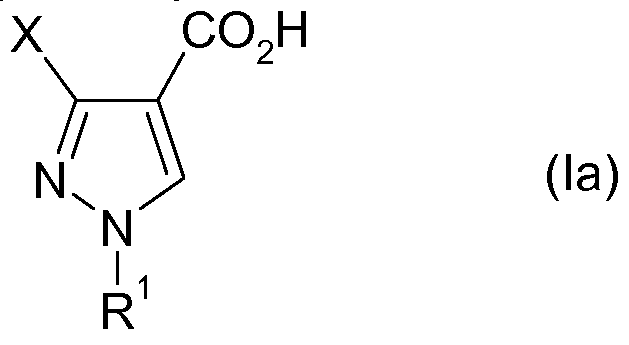
  • Another object of the present invention relates to a process for the preparation of a compound of general formula Ia
  • a preferred embodiment of the invention relates to a method comprising the following steps: a) the provision of a compound of the formula I by the process according to the invention as described and b) a hydrolysis of the compound I to give a 1, 3-substituted pyrazole-4-ylcarboxylic acid of the formula Ia.
  • the hydrolysis can be carried out under acid catalysis or basic or otherwise.
  • the compound I as such, d. H. be used after isolation.
  • compound I For the basic hydrolysis of compound I, typically the compound of formula I with an alkali metal hydroxide such as sodium hydroxide, potassium hydroxide or lithium thiumhydroxid, preferably with an aqueous alkali metal hydroxide solution, especially an aqueous NaOH solution or an aqueous KOH solution, until complete Treat hydrolysis of the ester, preferably with heating.
  • an alkali metal hydroxide such as sodium hydroxide, potassium hydroxide or lithium thiumhydroxid
  • an aqueous alkali metal hydroxide solution especially an aqueous NaOH solution or an aqueous KOH solution
  • the molar ratio of compound of formula I to base is typically in the range of 1.2: 1 to 1:10, and more preferably about equimolar (ie, in the range of 1.1: 1 to 1: 1) , 5), but also a larger base excess, z. B. up to 5 moles per mole of compound I, be of advantage.
  • the basic hydrolysis is carried out in a diluent or solvent.
  • Suitable diluents or solvents are not only water but also organic solvents which are stable to alkali, and mixtures thereof with water.
  • alkali-stable organic solvents are, in particular, the abovementioned C 1 -C 4 -alkanols and the abovementioned acyclic and cyclic ethers.
  • the hydrolysis is carried out in the aqueous phase, i. H. in water or a mixture of water with one of the aforementioned organic solvents, wherein the content of organic solvent in the aqueous phase typically typically does not exceed 30 vol .-%, based on the total amount of water and organic solvent.
  • the basic hydrolysis is carried out at temperatures of 20 to 100 0 C.
  • the upper temperature limit is the boiling point of the solvent used in pressure-free reaction.
  • a reaction temperature of 100 0 C and in particular 90 0 C will not be exceeded.
  • the basic hydrolysis is carried out at a temperature below the boiling point of the alcohol component, for example at temperatures in the range of 40 to ⁇ 80 0 C, in particular in the range of 50 to 75 ° C, especially when starting from a compound of general formula I, wherein R 1 is methyl or ethyl. Higher temperatures are also possible.
  • the basic hydrolysis is carried out at a temperature above the boiling point of the alcohol component of the ester.
  • the hydrolysis is preferably carried out at a temperature of at least 80 0 C, z. B. in the range of 80 to 100 0 C perform, for example, when starting from a compound of general formula I, wherein R 1 is ethyl.
  • the reaction time is dependent on the reaction temperature, the concentration and the stability of the respective ester bond. In general, the reaction conditions are chosen so that the reaction time is in the range of 1 to 12 hours, in particular in the range of 2 to 8 hours.
  • the pyrazole compound I obtained in substep a) is, in the event that R 2 is CÜ 2 R 2a or CN, without intermediate isolation, advantageously together with the organic solvent , reacted with the aqueous alkali metal hydroxide solution.
  • the alkali metal salt of the pyrazolecarboxylic acid Ia thus formed is obtained as an aqueous phase in addition to the organic phase, which can be separated off by phase separation.
  • the resulting in the phase separation aqueous phase containing the alkali metal salt of the 1, 3-substituted acid Ia usually in dissolved form and. The salt can then be converted into the free acid Ia by acidifying the solution as described above.
  • the acid Ia precipitates out as a solid and can be isolated by filtration and optionally dried.
  • the 1,3-substituted pyrazolecarboxylic acid is obtained in high purity and in very good yield.
  • the yield, based on the compound II used, is generally at least 80% and in particular at least 85%.
  • the acidic hydrolysis of Compound I may be carried out in analogy to known acidic ester hydrolyses, ie in the presence of catalytic or stoichiometric amounts of an acid and water (see, for example, J. March, Advanced Organic Chemistry, 2nd Ed., 334-338, McGraw-Hill, 1977 and cited literature). Frequently, the reaction is carried out in a mixture of water and an aprotic organic solvent. agent, for example an ether as mentioned above, perform.
  • acids are hydrohalic acids, sulfuric acid, organic sulfonic acids such as p-toluenesulfonic acid, methanesulfonic acid, phosphoric acid and acidic ion exchanger resins and the like.
  • Suitable hydrolysis catalysts are furthermore alkali metal iodides, such as lithium iodide, trimethyliodosilane or mixtures of trimethylchlorosilane with alkali metal iodides, such as lithium, sodium or potassium iodide.
  • alkali metal iodides such as lithium iodide, trimethyliodosilane or mixtures of trimethylchlorosilane with alkali metal iodides, such as lithium, sodium or potassium iodide.
  • the isolation of the acid Ia is then carried out by conventional separation methods, such as precipitation by adjusting the pH or extraction.
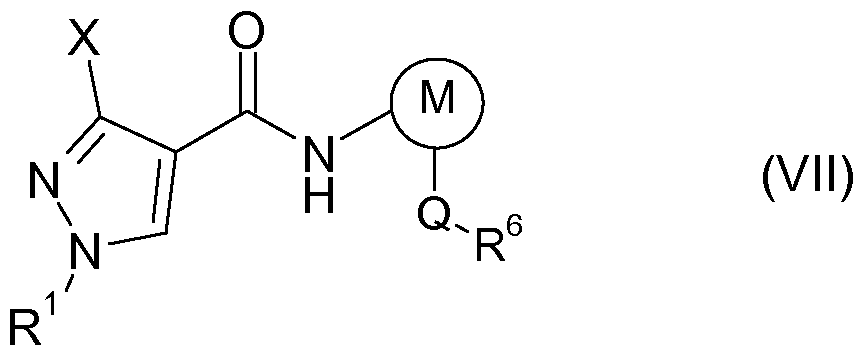
  • pyrazole compounds of the formula I in particular the pyrazolecarboxylic acids of the formula Ia, are valuable intermediates in the preparation of active compounds which have a 1, 3-substituted pyrazole radical, in particular in the preparation of the fungicidal active compounds of the formula VII described below:
  • R 1 and X have one of the meanings given in claim 1;
  • M is thienyl or phenyl which may carry a halogen substituent
  • Q is a direct bond, cyclopropylene, a fused bicyclo [2.2.1] heptane or bicyclo [2.2.1] heptene ring;
  • R 6 represents hydrogen, halogen, C 1 -C 4 -alkyl, C 1 -C 4 -haloalkoxy, monosubstituted to trisubstituted phenyl, where the substituents independently of one another are selected from halogen and trifluoromethylthio, or cyclopropyl.
  • the present invention also relates to a process for preparing a compound of the formula VII, comprising the following steps: a) providing a pyrazole compound of the formula I by the process according to the invention; b) conversion of the compound I into a 1,3-substituted pyrazolecarboxylic acid of
  • Suitable methods for the preparation of carboxylic acids and reaction of carboxylic acids or carboxylic acid halides with aromatic amines are known in the art, for. B. from the cited prior art (see US 5,498,624, EP 545099 A1, DE 19531813 A1, EP 589301 A1, DE 19840322 A1, WO 92/12970, WO 03/066610, WO 2006/024389, WO 2007/003603, WO 2007/006806) as well as J. March, Advanced Organic Chemistry, 3rd ed. J. Wiley and Sons, New York 1985, pp. 370-386 and literature cited there as well as Organikum, 21st edition Wiley-VCH, Weinheim 2001, Pp. 481-484 and references cited therein, and can be applied to the preparation according to the invention of the compounds VII by reacting the pyrazolecarboxylic acid Ia or its acid halide with the aniline compound VIII in an analogous manner.
  • the procedure is such that the pyrazolecarboxylic acid of the formula Ia first in its acid halide, z. B. converted their acid chloride and then reacting the acid halide with the amine compound of formula VIII.
  • the conversion of the pyrazolecarboxylic acid into its acid chloride succeeds in analogy to standard methods of organic chemistry, for example by reaction with thionyl chloride.
  • the subsequent reaction of the acid halide with the amine compound VIII is typically carried out in the presence of an auxiliary base, for example a tertiary amine.
  • the pyrazolecarboxylic acid of the formula Ia can also be reacted directly with the amine compound VIII, preferably in the presence of a dehydrating agent such as 1, 1'-carbonyldiimidazole, bis (2-oxo-3-oxazolidinyl) phosphoryl chloride, N, N'-dicyclohexyl-carbodiimide or N - (3- Dimethylaminopropyl) -N'-ethylcarbodiimide in the presence of an auxiliary base, for example a tertiary amine, to convert compound VII as described, for example, in the earlier patent application PCT / EP2007 / 064390, the disclosure of which is hereby expressly incorporated by reference.
  • a dehydrating agent such as 1, 1'-carbonyldiimidazole, bis (2-oxo-3-oxazolidinyl) phosphoryl chloride, N, N'-dicyclohexyl-carbodiimide or N
  • 13 C-NMR 190.1, 181, 4, 166.6, 164.7, 148.9, 146.1, 145.5, 133.9, 130.3, 128.8, 127.7, 110 , 4, 108.5, 107.0, 99.23, 60.46, 59.66, 39.43, 13.81.
  • Benzaldehyde The lower aqueous phase contained as the main component the sodium salt of the desired 3-difluoromethyl-1-methyl-1H-pyrazole-4-carboxylic acid.
  • the separated aqueous phase was acidified (pH ⁇ 2) with 29.7 g (0.26 mol) of concentrated hydrochloric acid to give the title compound. After filtration, 18.2 g of the moist 3-difluoromethyl-1-methyl-1H-pyrazole-4-carboxylic acid were obtained.
  • the solution contained 14.9 wt .-% of the desired 3-difluoromethyl-1-methyl-1 H-pyrazole-4-carboxylic acid ethyl ester (HPLC- Analysis, quantification with external standard)
  • the proportion of the isomeric ethyl 5-difluoromethyl-1-methyl-1H-pyrazole-4-carboxylate is only 0.069% by weight (corresponding to an isomer ratio of> 200: 1).
  • the reaction mixture was stirred at 60 0 C for 3 hours. After cooling to 25 0 C, the phases were separated.
  • the toluene upper phase contained mainly the released benzaldehyde.
  • the lower aqueous phase contained as the main component the potassium salt of the desired 3-difluoromethyl-1-methyl-1H-pyrazole-4-carboxylic acid.
  • the toluene phase was washed twice with 50 g of water.
  • the combined water phases were at 55 0 C with 66 g (0.579 mol) of concentrated hydrochloric acid (32%) acidified (pH ⁇ 2) to give the desired title compound precipitated.
  • the toluene upper phase contained mainly the released benzaldehyde.
  • the lower aqueous phase contained as the major component the potassium salt of the title compound.
  • the toluene phase was washed twice with 50 g of water.
  • the combined aqueous phases were acidified (pH ⁇ 2) at 55 ° C. with 80 g (0.7 mol) of concentrated hydrochloric acid (32%) to precipitate the desired pyrazolecarboxylic acid.
  • the solid was filtered at 3 0 C and washed with 160 g of cold water.
  • the toluene upper phase contained mainly the released benzaldehyde.
  • the lower aqueous phase contained as the main component the potassium salt of the desired 3-difluoromethyl-1-methyl-1H-pyrazole-4-carboxylic acid.
  • the toluene phase was washed twice with 200 g of water. The combined water phases were concentrated at 55 0 C with 265 g (2.32 mol) of conc. Hydrochloric acid (32%) acidified (pH ⁇ 2), wherein the desired pyrazolecarboxylic acid precipitated.
  • Example 7 Preparation of S-difluoromethyl-i-methyl-1H-pyrazolemcarboxylic acid from benzaldehyde, aqueous methylhydrazine solution and ethoxymethylene-4,4-difluoro-3-oxobutyric acid ethyl ester without isolation / purification of the intermediates (one-pot - wise).
  • the solution were metered in at 60 0 C 1620 g (4.05 mol) of 10 wt .-% sodium hydroxide solution and the mixture was stirred for 3 hours at 60 0 C. After cooling to 25 ° C the phases were separated.
  • the toluene upper phase contained mainly the released benzaldehyde.
  • the lower aqueous phase contained as the main component the sodium salt of the desired 3-difluoromethyl-1-methyl-1H-pyrazole-4-carboxylic acid.
  • the toluene phase was washed with 540 g of water. To the combined water phases was added another 1125 g of water.
  • the yield based on the molar amount of 2-ethoxymethylene-4,4-difluoro-3-oxo-butyric acid ethyl ester was 84.2%.
  • the undesired carboxylic acid isomer was no longer detectable.
  • 13 C-NMR 190.3, 181, 8, 164.4, 148.1, 143.5, 142.9, 140.0, 139.8, 128.4, 124.0, 110.3, 108 , 2, 108, 1, 100, 8, 60, 67, 59, 89, 39, 65, 14, 15.
  • Example 15 to 20 The compounds of Examples 15 to 20 were reacted in analogy to Example 1, step 1.2 to 3-difluoromethyl-1-methyl-1 H-pyrazole-4-carboxylic acid ethyl ester, which then to 3-difluoromethyl-1-methyl-1 H-pyrazole 4-carboxylic acid was saponified.

Landscapes

  • Chemical & Material Sciences (AREA)
  • Organic Chemistry (AREA)
  • Plural Heterocyclic Compounds (AREA)
  • Low-Molecular Organic Synthesis Reactions Using Catalysts (AREA)
  • Pharmaceuticals Containing Other Organic And Inorganic Compounds (AREA)
  • Nitrogen Condensed Heterocyclic Rings (AREA)

Abstract

Die vorliegende Erfindung betrifft ein Verfahren zur Herstellung von 1,3-substituierten Pyrazolverbindungen der Formel (I), worin X insbesondere für eine Gruppe CX1X2X3 steht, worin X1, X2 und X3 unabhängig voneinander insbesondere für Wasserstoff, Fluor oder Chlor stehen, R1 für C1-C4-Alkyl oder Cyclopropyl steht, und R2 für Wasserstoff, CN oder eine Gruppe CO2R2a steht, worin R2a für insbesondere für C1-C6-Alkyl steht, umfassend die folgenden Schritte: i) Umsetzung eine Verbindung der Formel Il mit einem Hydrazon der Formel (III), wobei in Formel (Il) die Variablen X und R2 die für Formel (I) angegebenen Bedeutungen aufweisen, Y für Sauerstoff, eine Gruppe NRy1 oder eine Gruppe [NRy2Ry3]+Z- steht, R3 für OR3a oder eine Gruppe NR3bR3c steht, und wobei in Formel (III) die Variable R1 die für Formel (I) angegebenen Bedeutungen aufweist, R4 und R5 unabhängig voneinander für Wasserstoff, C1-C6-Alkyl, gegebenenfalls substituiertes Phenyl stehen, wobei wenigstens einer der Reste R4 oder R5 von Wasserstoff verschieden ist und wobei R4 und R5 gemeinsam mit dem Kohlenstoffatom, an das sie gebunden sind, auch für einen 5 bis 10-gliedrigen gesättigten Carbocyclus stehen können; Behandlung des dabei erhaltenen Reaktionsprodukts mit einer Säure in Gegenwart von Wasser.

Description

Verfahren zur Herstellung von 1 ,3,4-substituierten Pyrazolverbindungen
Beschreibung
Die vorliegende Erfindung betrifft ein Verfahren zur Herstellung von 1 ,3,4-substituierten Pyrazolverbindungen der Formel I,
Figure imgf000003_0001
worin X für eine Gruppe CX1X2X3 steht, worin
X1, X2 und X3 unabhängig voneinander für Wasserstoff, Fluor oder Chlor stehen, wobei X1 auch für Ci-Cβ-Alkyl oder Ci-C4-Haloalkyl stehen kann und wobei wenigstens einer der Reste X1, X2 von Wasserstoff verschieden ist, R1 für Ci-C4-Alkyl oder Cyclopropyl steht, und R2 für CN oder eine Gruppe CÜ2R2a steht, worin
R2a für C5-C6-Cycloalkyl, gegebenenfalls substituiertes Phenyl oder Ci-Cβ-Alkyl steht, das gegebenenfalls durch CrC4-AIkOXy, Phenyl oder Cs-Cβ-Cycloalkyl substituiert sein kann.
Pyrazole der allgemeinen Formel I sind wichtige Ausgangsprodukte für eine Reihe von pharmazeutischen Wirkstoffen und Pflanzenschutzwirkstoffen, insbesondere von 1 ,3- substituierten Pyrazol-4-ylcarbonsäureaniliden, wie sie beispielsweise in US 5,498,624, EP 545099 A1 , EP 589301 A1 , WO 92/12970, WO 03/066610, WO 2006/024389, WO 2007/003603, WO 2007/006806 beschrieben werden.
Die Herstellung 1 ,3,4-substituierter Pyrazolverbindungen der Formel I erfolgt typischerweise durch Cyclisierung geeigneter 1 ,3-difunktioneller Verbindungen mit substituierten Hydrazinverbindungen oder durch Umsetzung 1 ,3-difunktioneller Verbindungen mit Hydrazin, gefolgt von einer Alkylierung zur Einführung des Substituenten am Stickstoff (1 -Position). Ein prinzipieller Nachteil bei dieser Vorgehensweise ist die mangelnde Regioselektivität der Cyclisierung 1 ,3-difunktioneller Verbindungen mit substituierten Hydrazinverbindungen wie auch die mangelnde Regioselektivität der N- Alkylierung von Pyrazolen, so dass in beiden Fällen neben der gewünschten 1 ,3,4- substituierten Pyrazolverbindung der Formel I (1 ,3-lsomer) auch das 1 ,4,5-substituierte Isomer der Formel I' (1 ,5-lsomer) gebildet wird.
Figure imgf000004_0001
1 ,3-lsomer (l) 1 ,5-lsomer (I1)
Abgesehen davon, dass die mangelnde Selektivität zu Ausbeuteverlusten führt, lassen sich 1 ,3-lsomer der Formel I und 1 ,5-lsomer der Formel I' häufig nur schlecht trennen. Um akzeptable Selektivitäten zu erzielen, müssen die Reaktionen daher bei tiefen Temperaturen durchgeführt werden, wodurch sich der apparative Aufwand beträchtlich erhöht. Zudem ist auch in der Kälte die Regioselektivität nicht vollständig zufriedenstellend.
Die US 5,498,624 u. A. beschreiben ein Verfahren zur Herstellung von (3-Difluor- methyl-1-methylpyrazol-4-yl)carbonsäureestern, bei dem man α-Ethoxymethylen-4,4- difluor-3-oxobuttersäureester mit Methylhydrazin zur Pyrazolverbindung cyclisiert. Aus WO 92/12970 ist ein vergleichbares Verfahren bekannt, bei dem 4,4-Difluor-3-oxo- buttersäurester sukzessive mit Triethylorthoformiat und mit Methylhydrazin umsetzt, wobei intermediär Ethoxymethylen-4,4-difluor-3-oxobuttersäureester entsteht. Die Selektivität bezüglich des gewünschten Isomers ist nicht zufriedenstellend.
Die WO 2003/051820 und WO 2005/042468 beschreiben die Cyclisierung von 2- Halogenacyl-3-aminoacrylsäureestern mit Alkylhydrazinen zu 1-Alkyl-3-halogen- alkylpyrazol-4-carbonsäureestern. Die Selektivität bezüglich des gewünschten Isomers ist nicht zufriedenstellend.
Die WO 2008/022777 beschreibt ein Verfahren zur Herstellung von 1 -substituierten 3- (Dihalogenmethyl)pyrazol-4-carbonsäureestern, bei dem man vinyloge Amidiniumsal- ze, die durch Umsetzung von α-(Halogenmethyl)-difluormethylaminen mit Acrylaten in Gegenwart einer Lewis-Säure erhältlich sind, mit substituierten Hydrazinen umsetzt. Die Selektivität bezüglich des gewünschten Isomers ist nicht zufriedenstellend.
Der Erfindung liegt daher die Aufgabe zugrunde, ein Verfahren zur Herstellung von 1 ,3,4-substituierten Pyrazolverbindungen der eingangs zitierten Formel I bereitzustellen, das das gewünschte 1 ,3-lsomer der Formel I mit hohen Ausbeuten und guter Selektivität liefert. Es wurde überraschenderweise gefunden, dass man 1 ,3,4-substituierte Pyrazolverbin- dungen der eingangs definierten Formel I in einfacher Weise mit hohen Ausbeuten und hoher Regioselektivität bezüglich des gewünschten 1 ,3-lsomers herstellen kann, wenn man geeignete 1 ,3-difunktionelle Verbindungen der im folgenden beschriebenen For- mel Il zunächst mit einem Hydrazon der im folgenden beschriebenen Formel III umsetzt und das dabei gebildete Zwischenprodukt mit einer Säure in Gegenwart von Wasser behandelt.
Dementsprechend betrifft die vorliegende Erfindung ein Verfahren zur Herstellung von 1 ,3-substituierten Pyrazolverbindungen der eingangs definierten Formel I, welches die folgenden Schritte umfasst:
i) Umsetzung eine Verbindung der Formel Il mit einem Hydrazon der Formel III,
Figure imgf000005_0001
wobei in Formel Il die Variablen X und R2 die für Formel I angegebenen Bedeutungen aufweisen,
Y für Sauerstoff, eine Gruppe NR^1 oder eine Gruppe [NRy2Ry3J+Z" steht, worin Ry1, Ry2 und Ry3 unabhängig voneinander für Ci-C6-Alkyl, C5-C6-Cycloalkyl, gegebenenfalls substituiertes Phenyl oder gegebenenfalls substituiertes Phenyl-Ci-C4-alkyl stehen, oder
Ry2 und Ry3 zusammen mit dem Stickstoffatom, an das diese gebunden sind, für einen N-gebundenen 5- bis 8-gliedrigen, gesättigten, gegebenen- falls substituierten Heterocyclus stehen, der neben dem Stickstoffatom noch 1 oder 2 weitere Heteroatome ausgewählt unter N, O und S als Ringatome aufweisen kann, und Z" für einen Anion steht;
R3 für OR3a oder eine Gruppe NR3bR3c steht, worin R3a, R3b und R3c unabhängig voneinander für Ci-C6-Alkyl, C5-C6-Cycloalkyl, gegebenenfalls substituiertes Phenyl oder gegebenenfalls substituiertes Phenyl-Ci-C4-alkyl stehen, stehen, oder
R3b und R3c zusammen mit dem Stickstoffatom, an das diese gebunden sind, für einen N-gebundenen 5- bis 8-gliedrigen, gesättigten, gegebenen- falls substituierten Heterocyclus stehen, der neben dem Stickstoffatom noch 1 oder 2 weitere Heteroatome ausgewählt unter N, O und S als Ringatome aufweisen kann,
und wobei in Formel III die Variable R1 die für Formel I angegebenen Bedeutun- gen aufweist,
R4 und R5 unabhängig voneinander für Wasserstoff, Ci-Cβ-Alkyl, das gegebenenfalls durch Ci-C4-AIkOXy, Phenyl oder Cs-Cβ-Cycloalkyl substituiert sein kann, Cs-Cβ-Cycloalkyl oder gegebenenfalls substituiertes Phenyl stehen, wobei wenigstens einer der Reste R4 oder R5 von Wasserstoff verschieden ist, und wobei
R4 und R5 gemeinsam mit dem Kohlenstoffatom, an das sie gebunden sind, auch für einen 5- bis 10-gliedrigen gesättigten Carbocyclus stehen können, der gegebenenfalls ein- oder mehrfach durch Ci-C4-Alkylgruppen und/oder gegebenenfalls substituiertes Phenyl substituiert ist und/oder einen oder 2 kondensierte Phenylringe aufweist;
ii) Behandlung des dabei erhaltenen Reaktionsprodukts mit einer Säure in Gegenwart von Wasser.
Das erfindungsgemäße Verfahren ist mit einer Reihe von Vorteilen verbunden. Zum einen liefert es die gewünschten 1 ,3,4-substituierten Pyrazole mit hoher Ausbeute und hoher Regioselektivität bezüglich des gewünschten 1 ,3-lsomers der Formel I. Zudem sind zur Erreichung der gewünschten Selektivität keine tiefen Temperaturen erforderlich und Schritt i) sowie Schritt ii) können bei moderaten Temperaturen, z.B. im Bereich von 10 bis 1800C, insbesondere im Bereich von 20 bis 1500C durchgeführt werden. Selbstverständlich kann die Umsetzung in den Schritten i) und ii) auch bei geringeren Temperaturen z.B. bei Temperaturen bis -200C durchgeführt werden, was zur Erzielung der gewünschten Regioselektivität jedoch nicht erforderlich ist.
In Schritt i) des erfindungsgemäßen Verfahrens wird die Verbindung der im Folgenden gezeigten Formel VI gebildet, die sich üblicherweise isolieren lässt:
Figure imgf000006_0001
In Formel VI haben X, Y, R1, R2, R4 und R5 die hier und im Folgenden angegebenen Bedeutungen. Die Verbindungen der Formel VI sind neu, ausgenommen Verbindungen der Formel VI, worin R4 und R5 jeweils für gegebenenfalls substituiertes Phenyl stehen und Y Sauerstoff bedeutet. Letztere sind aus der EP 581725 bekannt. Die neuen Verbindungen der Formel VI sind ebenfalls Gegenstand der vorliegenden Erfindung.
Die bei der Definition der Variablen verwendeten Begriffe für organische Gruppen sind, wie beispielsweise der Ausdruck "Halogen", Sammelbegriffe, die stellvertretend für die einzelnen Mitglieder dieser Gruppen organischer Einheiten stehen. Das Präfix Cx-Cy bezeichnet im jeweiligen Fall die Anzahl möglicher Kohlenstoffatome.
Der Begriff "Halogen" bezeichnet jeweils Fluor, Brom, Chlor oder lod, speziell Fluor, Chlor oder Brom.
Beispiele anderer Bedeutungen sind:
Der Begriff "Ci-Cβ-Alkyl", wie hierin verwendet, bezeichnet eine gesättigte, geradkettige oder verzweigte Kohlenwasserstoffgruppe, umfassend 1 bis 6 Kohlenstoffatome, spe- ziell 1 bis 4 Kohlenstoffatome, beispielsweise Methyl, Ethyl, Propyl, 1-Methylethyl, Bu- tyl, 1-Methylpropyl, 2-Methylpropyl, 1 ,1-Dimethylethyl, Pentyl, 1-Methylbutyl, 2- Methylbutyl, 3-Methylbutyl, 2,2-Dimethylpropyl, 1-Ethylpropyl, Hexyl, 1 ,1- Dimethylpropyl, 1 ,2-Dimethylpropyl, 1-Methylpentyl, 2-Methylpentyl, 3-Methylpentyl, 4- Methylpentyl, 1 ,1-Dimethylbutyl, 1 ,2-Dimethylbutyl, 1 ,3-Dimethylbutyl, 2,2- Dimethylbutyl, 2,3-Dimethylbutyl, 3,3-Dimethylbutyl, 1-Ethylbutyl, 2-Ethylbutyl, 1 ,1 ,2- Trimethylpropyl, 1 ,2,2-Trimethylpropyl, 1-Ethyl-1-methylpropyl, 1-Ethyl-2-methylpropyl und deren Isomere. CrC4-AIkVl umfasst beispielsweise Methyl, Ethyl, Propyl, 1- Methylethyl, Butyl, 1-Methylpropyl, 2-Methylpropyl oder 1 ,1-Dimethylethyl.
Der Begriff "Ci-C6-Alkyl", das gegebenenfalls durch Ci-C4-Alkoxy, Phenyl oder C3-C6- Cycloalkyl substituiert sein kann, steht für unsubstituiertes Ci-Cβ-Alkyl, wie zuvor definiert, oder für Ci-Cβ-Alkyl, worin eines der Wasserstoffatome durch eine Ci-C4-Alkoxy-, Phenyl- oder Cs-Cβ-Cycloalkylgruppe ersetzt ist.
Der Begriff "Ci-C4-Haloalkyl", wie hierin verwendet, beschreibt geradkettige oder verzweigte Alkylgruppen mit 1 bis 4 Kohlenstoffatomen, worin die Wasserstoffatome dieser Gruppen teilweise oder vollständig durch Halogenatome, insbesondere durch Fluor und/oder Chlor ersetzt sind, beispielsweise Chlormethyl, Dichlormethyl, Trichlormethyl, Fluormethyl, Difluormethyl, Trifluormethyl, Chlorofluormethyl, Dichlorfluormethyl, Chlor- difluormethyl, 1-Chlorethyl, 1-Fluorethyl, 2-Fluorethyl, 2,2-Difluorethyl, 2,2,2-Trifluorethyl, 2-Chlor-2-fluorethyl, 2-Chlor-2,2-difluorethyl, 2,2-Dichlor-2-fluorethyl, 2,2,2-Trichlorethyl, Pentafluorethyl etc.
Der Begriff "Ci-Cβ-Alkoxy", wie hierin verwendet, beschreibt geradkettige oder verzweigte gesättigte Alkylgruppen, umfassend 1 bis 6 Kohlenstoffatome, die über ein Sauerstoffatom gebunden sind. Beispiele umfassen Ci-Cβ-Alkoxy wie beispielsweise Methoxy, Ethoxy, OCH2-C2H5, OCH(CHs)2, n-Butoxy, OCH(CHs)-C2H5, OCH2-CH(CHs)2, OC(CHs)3, n-Pentoxy, 1-Methylbutoxy, 2-Methylbutoxy, 3-Methylbutoxy, 1 ,1-Dimethylpropoxy, 1 ,2-Dimethylpropoxy, 2,2-Dimethylpropoxy, 1-Ethylpropoxy, n-Hexoxy, 1 -Methylpentoxy, 2-Methylpentoxy, 3-Methylpentoxy, 4-Methylpentoxy, 1 ,1-Dimethylbutoxy, 1 ,2-Dimethylbutoxy, 1 ,3-Dimethylbutoxy, 2,2-Dimethylbutoxy, 2,3-Dimethylbutoxy, 3,3-Dimethylbutoxy, 1-Ethylbutoxy, 2-Ethylbutoxy, 1 ,1 ,2-Trimethylpropoxy, 1 ,2,2-Trimethylpropoxy, 1-Ethyl-1-methylpropoxy, 1-Ethyl-2-methylpropoxy, etc.
Der Begriff "Ci -C4-AIkOXy-Ci -Cβ-alkyl", wie hierin verwendet, beschreibt Ci-Cβ-Alkyl, worin eines der Wasserstoffatome durch eine Ci-C4-Alkoxygruppe ersetzt ist. Beispiele hierfür sind CH2-OCH3, CH2-OC2H5, n-Propoxymethyl, CH2-OCH(CHs)2, n-Buto- xymethyl, (I-Methylpropoxy)methyl, (2-Methylpropoxy)methyl, CH2-OC(CHs)3, 2-(Methoxy)ethyl, 2-(Ethoxy)ethyl, 2-(n-Propoxy)ethyl, 2-(1-Methylethoxy)ethyl, 2-(n-Butoxy)ethyl, 2-(1-Methylpropoxy)ethyl, 2-(2-Methylpropoxy)ethyl, 2-(1 ,1-Dimethyl- ethoxy)ethyl, 2-(Methoxy)propyl, 2-(Ethoxy)propyl, 2-(n-Propoxy)propyl, 2-(1-Methyl- ethoxy)propyl, 2-(n-Butoxy)propyl, 2-(1-Methylpropoxy)propyl, 2-(2-Methylpropoxy)- propyl, 2-(1 ,1-Dimethylethoxy)propyl, 3-(Methoxy)propyl, 3-(Ethoxy)propyl, 3-(n-Prop- oxy)propyl, 3-(1-Methylethoxy)propyl, 3-(n-Butoxy)propyl, 3-(1-Methylpropoxy)propyl, 3-(2-Methylpropoxy)propyl, 3-(1 ,1-Dimethylethoxy)propyl, 2-(Methoxy)butyl, 2-(Ethoxy)- butyl, 2-(n-Propoxy)butyl, 2-(1-Methylethoxy)butyl, 2-(n-Butoxy)butyl, 2-(1-Methylprop- oxy)butyl, 2-(2-Methylpropoxy)butyl, 2-(1 ,1-Dimethylethoxy)butyl, 3-(Methoxy)butyl, 3-(Ethoxy)butyl, 3-(n-Propoxy)butyl, 3-(1-Methylethoxy)butyl, 3-(n-Butoxy)butyl, 3-(1-Methylpropoxy)butyl, 3-(2-Methylpropoxy)butyl, 3-(1 ,1-Dimethylethoxy)butyl, 4-(Methoxy)butyl, 4-(Ethoxy)butyl, 4-(n-Propoxy)butyl, 4-(1-Methylethoxy)butyl, 4-(n-Butoxy)butyl, 4-(1-Methylpropoxy)butyl, 4-(2-Methylpropoxy)butyl, 4-(1 ,1-Dimethyl- ethoxy)butyl, etc.
Der Begriff "Ca-Cβ-Cycloalkyl" wie hierin verwendet, beschreibt monocyclische, gesättigte Kohlenwasserstoffradikale, umfassend 3 bis 6 Kohlenstoffatome. Beispiele mono- cyclischer Radikale umfassen Cyclopropyl, Cyclobutyl, Cyclopentyl und Cyclohexyl. Der Begriff "gegebenenfalls substituiertes Phenyl", wie hierin verwendet, steht für un- substituiertes Phenyl oder beschreibt Phenyl, das 1 , 2, 3, 4, oder 5, insbesondere 1 , 2 oder 3 Substituenten trägt, die unter den Bedingungen der Reaktion inert sind. Beispiele für inerte Substituenten sind Halogen, insbesondere Fluor, Chlor oder Brom, CN, NO2, d-Ce-Alkyl, Ci-C6-Alkylthio, d-Ce-Alkylsulfonyl, Ci-C4-Halogenalkyl, Ci-C6- Alkoxy, Cs-Ce-Cycloalkyl, und Ci-C4-Alkoxy-Ci-C6-alkyl.
Der Begriff "gegebenenfalls substituiertes Phenyl-Ci-Cβ-alkyl", wie hierin verwendet, beschreibt Ci-C6-Alkyl, worin eines der Wasserstoffatome durch eine gegebenenfalls substituierte Phenylgruppe ersetzt ist. Beispiele sind Benzyl, 4-Methylbenzyl, Pheny- lethyl etc.
Der Begriff "N-gebundener 5- bis 8-gliedriger, gesättigter, gegebenenfalls substituierter Heterocyclus" steht für einen über ein Ringstickstoffatom gebundenen gesättigten He- terocyclus, der 5, 6, 7 oder 8 Ringatome aufweist, wobei neben dem Stickstoffatom die Ringatome auch weitere Heteroatome umfassen können, und der unsubstituiert ist oder 1 , 2, 3, 4, oder 5, insbesondere 1 , 2 oder 3 Substituenten trägt, die unter den Bedingungen der Reaktion inert sind. Beispiele für inerte Substituenten sind CN, CrC6- Alkyl, d-Ce-Alkylthio, Ci -C6-Al kylsu If onyl, Ci-C4-Halogenalkyl, Ci-C6-Alkoxy, C3-C6- Cycloalkyl, und Ci-C4-Alkoxy-Ci-C6-alkyl. Der Heterocyclus kann neben dem Stickstoffatom in Position 1 und den Ringkohlenstoffatomen noch 1 oder 2 weitere Heteroatome ausgewählt unter N, O und S als Ringatome aufweisen. Beispiele für N- gebundene 5- bis 8-gliedrige, gesättigte, gegebenenfalls substituierte Heterocyclen sind Pyrrolidin-1-yl, Piperdin-1-yl, Morpholin-4-yl, Piperazin-1-yl und N-Methylpiperazin- 1-yl.
Eine bevorzugte Ausführungsform der Erfindung betrifft die Herstellung von Pyrazol- verbindungen der Formel I, worin R2 für eine Gruppe COOR2a steht, worin R2a die zuvor genannten Bedeutungen aufweist und insbesondere für Ci-C6-Alkyl oder Ci-C4- Alkoxy-Ci-C6-alkyl und speziell für Ci-C4-Alkyl steht. Dementsprechend steht in dieser Ausführungsform auch in den Formeln Il und VI die Gruppe R2 für eine Gruppe COOR2a, worin R2a die zuvor genannten Bedeutungen aufweist und insbesondere für d-Ce-Alkyl oder Ci-C4-Alkoxy-Ci-C6-alkyl und speziell für Ci-C4-Alkyl steht.
Eine andere Ausführungsform der Erfindung betrifft die Herstellung von Pyrazolverbin- dungen der Formel I, worin R2 für CN steht. Dementsprechend bedeutet R2 auch in den Verbindungen der Formeln Il und VI CN. Das erfindungsgemäße Verfahren eignet sich insbesondere zur Herstellung von Verbindungen der allgemeinen Formel I, worin X für eine Gruppe CX1X2X3 steht, worin X1, X2 und X3 die zuvor genannten Bedeutungen haben, wobei wenigstens einer der Reste X1 und X2 von Wasserstoff verschieden ist. Insbesondere steht X1 und X2 für Fluor. X3 steht vorzugsweise für Wasserstoff, Fluor oder Chlor. Beispiele für bevorzugte Reste CX1X2X3 sind Dichlormethyl, Chlorfluormethyl, Difluormethyl, Chlordifluormethyl und Trifluormethyl. Gemäß einer speziellen Ausführungsform steht X für eine Gruppe CHF2.
Weiterhin hat es sich als vorteilhaft erwiesen, wenn R1 in den Formel I und dement- sprechend in Formel III für CrC4-AIkVl und insbesondere für Methyl steht.
Gemäß einer ersten Ausführungsform der Erfindung setzt man zur Herstellung der Py- razolverbindungen der Formel I eine Verbindung der Formel Il ein, worin Y für Sauerstoff steht. Derartige Verbindungen werden im Folgenden auch als Verbindungen IIa bezeichnet. Verbindungen der Formel IIa, worin R2 für eine Gruppe COOR2a steht, worin R2a die zuvor genannten Bedeutungen aufweist und insbesondere für Ci-Cβ-Alkyl oder Ci-C4-Alkoxy-Ci-C6-alkyl und speziell für CrC4-AIkVl steht, werden im Folgenden auch als Verbindungen I Ia.1 bezeichnet.
Figure imgf000010_0001
(Ha) (Ha.1 )
In den Formeln IIa und I Ia.1 haben R2, R2a, R3 und X die zuvor genannten Bedeutungen.
Insbesondere steht X in den Formeln IIa und I Ia.1 für eine Gruppe CX1X2X3, worin X1, X2 und X3 die zuvor genannten Bedeutungen haben. Insbesondere ist wenigstens einer der Reste X1 und X2 von Wasserstoff verschieden. Insbesondere stehen X1 und X2 für Fluor. X3 steht vorzugsweise für Wasserstoff, Fluor oder Chlor. Beispiele für besonders bevorzugte Gruppe CX1X2X3 sind Dichlormethyl, Trifluormethyl, Chlordifluormethyl, Fluorchlormethyl und Difluormethyl. Gemäß einer speziellen Ausführungsform steht X für eine Gruppe CHF2.
Gemäß einer zweiten Ausführungsform der Erfindung setzt man zur Herstellung der Pyrazolverbindungen der Formel I eine Verbindung der Formel Il ein, worin Y für eine Gruppe [NRy2Ry3J+Z steht. Derartige Verbindungen werden im Folgenden auch als Ver- bindungen IIb bezeichnet. Verbindungen der Formel IIb, worin R2 für eine Gruppe COOR2a steht, worin R2a die zuvor genannten Bedeutungen aufweist und insbesondere für Ci-Cβ-Alkyl oder Ci-C4-Alkoxy-Ci-C6-alkyl steht, werden im Folgenden auch als Verbindungen I Ib.1 bezeichnet.
Figure imgf000011_0001
(Mb) (llb.1 )
In den Formeln IIb und llb.1 haben R2, R2a, R^2, R^3, Z, R3 und X die zuvor genannten Bedeutungen.
Insbesondere steht X in den Formeln IIb und llb.1 für eine Gruppe CX1X2X3, worin X1, X2 und X3 die zuvor genannten Bedeutungen haben. Insbesondere ist wenigstens einer der Reste X1 und X2 von Wasserstoff verschieden. Insbesondere steht X1 und X2 für Fluor. X3 steht vorzugsweise für Wasserstoff, Fluor oder Chlor. Beispiele für besonders bevorzugte Gruppe CX1X2X3 sind Trifluormethyl, Chlordifluormethyl, Fluorchlormethyl und Difluormethyl. Insbesondere steht die Gruppe CX1X2X3 in den Formeln IIb, llb.1 und llb.2 für CHCIF oder CHF2.
Ry2 und Ry3 stehen insbesondere für CrC4-AIkVl und speziell für Methyl.
Z" steht für ein Anion bzw. ein Anionenäquivalent, das vorzugsweise von einer Lewissäure wie MgF2, BF3, BCI3, AICI3, AIF3, ZnCI2, PF5, SbF5, BiCI3, GaCI3, SnCI4, oder SiCI4 abgeleitet ist, z.B. für Fluorid, [MgF3]-, [BF4]-, [BCI3F]-, [AIF4]-, [AICI3F]-, [ZnCI2F]-, [PF6]-, [SbF6]-, [BiCI3F]-, [GaCI3F]-, [SnCI4F]- oder [SiCI4F]-.
Gemäß einer ersten Variante des erfindungsgemäßen Verfahrens steht R3 in den Formeln II, IIa und lla.1 , IIb und llb.1 für eine Gruppe OR3a. Hierbei hat R3a die zuvor genannten Bedeutungen und steht insbesondere für Ci-C4-Alkyl und speziell für Methyl oder Ethyl.
Gemäß einer zweiten Variante des erfindungsgemäßen Verfahrens steht R3 in den Formeln II, IIa und I Ia.1 , IIb und llb.1 für eine Gruppe NR3bR3c. Hierbei haben R3b und R3c die zuvor genannten Bedeutungen und stehen insbesondere für Ci-C4-Alkyl und speziell für Methyl oder Ethyl, oder R3b und R3c bilden zusammen mit dem Stickstoffatom, an das diese gebunden sind für einen N-gebundenen 5- bis 8-gliedrigen, gesättigten Heterocyclus stehen, der neben dem Stickstoffatom noch 1 oder 2 weitere Hete- roatome ausgewählt unter N, O und S als Ringatome aufweisen kann und der gegebe- nenfalls 1 oder 2 Ci-C4-Alkylgruppen tragen kann. Beispiele für die letztgenannte cycli- sche Gruppe NR3bR3c sind Pyrrolidin-1-yl, Morpholin-4-yl, Piperidin-1-yl und 4- Methylpiperazin-1 -yl.
Die Art des in der Umsetzung eingesetzten Hydrazons der Formel III ist grundsätzlich von untergeordneter Bedeutung. Grundsätzlich sind solche Hydrazone der Formel III
(und dementsprechend auch Verbindungen der Formel VI) bevorzugt, worin
R4 für Wasserstoff oder Ci-C6-Alkyl steht und
R5 für Ci-Cβ-Alkyl, Cs-Cβ-Cycloalkyl oder gegebenenfalls substituiertes Phenyl steht, oder R4 und R5 gemeinsam mit dem Kohlenstoffatom, an das sie gebunden sind, für einen 5- bis 10-gliedrigen gesättigten Carbocyclus stehen können, der gegebenenfalls ein oder mehrfach, z.B. 1-, 2-, 3- oder 4-fach, durch Ci-C4-Alkylgruppen substituiert ist und/oder einen kondensierten Phenylring aufweist.
Gemäß einer besonders bevorzugten Ausgestaltung des erfindungsgemäßen Verfahrens setzt man ein Hydrazon der Formel III ein, worin
R4 für Wasserstoff oder Ci-C4-AIkVl, insbesondere für Wasserstoff, steht und R5 für gegebenenfalls substituiertes Phenyl steht.
Gemäß einer anderen besonders bevorzugten Ausgestaltung des erfindungsgemäßen Verfahrens setzt man ein Hydrazon der Formel III ein, worin R4 und R5 für CrC4-AIkVl stehen oder gemeinsam mit dem Kohlenstoffatom, an das sie gebunden sind einen 5 bis 8 gliedrigen, gesättigten Carbocyclus bilden, der gegebenenfalls in der oben beschriebenen Weise substituiert ist.
Der Ausdruck "gegebenenfalls substituiertes Phenyl" hat hierbei die zuvor genannten Bedeutungen und steht insbesondere für unsubstituiertes Phenyl oder für Phenyl, das 1 , 2 oder 3 Substituenten aufweist, ausgewählt unter Halogen, insbesondere Fluor, Chlor oder Brom, Nitro, Cyano, Ci-C4-Alkyl, insbesondere Methyl oder Ethyl, und d- C4-Alkoxy, insbesondere Methoxy oder Ethoxy, z.B. wie in 2-, 3- oder 4-Fluorphenyl, 2- , 3- oder 4-Chlorphenyl, 4-Bromphenyl, 2-, 3- oder 4-Methylphenyl, 2-, 3- oder 4- Methoxyphenyl, 4-Cyanophenyl, 4-Nitrophenyl. Im Hinblick auf R5 hat der Ausdruck "gegebenenfalls substituiertes Phenyl" die zuvor genannten Bedeutungen und steht besonders bevorzugt für unsubstituiertes Phenyl oder für Phenyl, das 1 oder 2 Substituenten aufweist, ausgewählt unter Halogen, insbesondere Chlor, Ci-C4-Alkyl, insbesondere Methyl oder Ethyl, und CrC4-AIkOXy, ins- besondere Methoxy oder Ethoxy z.B. wie in 2-, 3- oder 4-Chlorphenyl, 2-, 3- oder 4- Methylphenyl, 2-, 3- oder 4-Methoxyphenyl.
Gemäß einer ganz besonders bevorzugten Ausgestaltung des erfindungsgemäßen Verfahrens setzt man ein Hydrazon der Formel III ein, worin R4 für Wasserstoff steht und
R5 für gegebenenfalls substituiertes Phenyl, insbesondere für unsubstituiertes Phenyl oder für Phenyl, das 1 oder 2 Substituenten aufweist, steht, wobei die Substituenten wie zuvor genannt sind und vorzugsweise ausgewählt sind unter Halogen, insbesondere Chlor, Ci-C4-AIkVl, insbesondere Methyl oder Ethyl, und d- C4-AIkOXy, insbesondere Methoxy oder Ethoxy.
Gemäß einer ganz besonders bevorzugten Ausgestaltung des erfindungsgemäßen
Verfahrens setzt man ein Hydrazon der Formel III ein, worin
R4 und R5 gemeinsam mit dem Kohlenstoffatom, an das sie gebunden sind, für einen 5- bis 10-gliedrigen, insbesondere 5 bis 8-gliedrigen gesättigten Carbocyclus stehen, der gegebenenfalls ein oder mehrfach, z.B. 1-, 2-, 3- oder 4-fach, durch d- C4-Alkylgruppen substituiert ist.
Die Umsetzung der Verbindungen der Formel Il mit dem Hydrazon der Formel III in Schritt i) des erfindungsgemäßen Verfahrens erfolgt üblicherweise bei Temperaturen im Bereich von 0 bis 1800C, insbesondere im Bereich von 10 bis 1500C.
Zur Umsetzung werden die Verbindungen Il und III vorzugsweise in einem der Stöchi- ometrie der Reaktion entsprechenden Verhältnis eingesetzt, wobei von der Stöchio- metrie auch abgewichen werden kann. Typischerweise liegt das Molverhältnis von Verbindung Il zu Verbindung III im Bereich von 1 ,5:1 bis 1 :1 ,5, häufig im Bereich von 1 ,2:1 bis 1 :1 ,2 und insbesondere im Bereich von 1 ,1 :1 bis 1 :1 ,1.
Typischerweise erfolgt die Umsetzung in Schritt i) in einem inerten organischen Lö- sungsmittel. Beispiele für inerte organische Lösungsmittel sind insbesondere aproti- sche organische Lösungsmittel wie aromatische Kohlenwasserstoffe und Halogenkohlenwasserstoffe, z.B. Benzol, Toluol, XyIoIe, Cumol, Chlorbenzol und tert.-Butylbenzol, cyclische oder acyclische Ether wie Diethylether, Diisopropylether, tert.- Butylmethylether (MTBE), tert.-Butylethylether, Tetra hydrofu ran (THF) oder Dioxan, Nitrile wie Acetonitril und Propionitril, aliphatische Halogenkohlenwasserstoffe wie Dichlormethan, Dichlorethan, Trichlormethan und deren Gemische. Vorzugsweise arbeitet man in Schritt i) im Wesentlichen wasserfrei, d.h. der Wassergehalt in der Lösung liegt unterhalb 1 %, insbesondere unterhalb 0,1 %, bezogen auf das Gesamtge- wicht des Lösungsmittels.
Zur Umsetzung der Verbindungen der Formel Il mit Hydrazonen der Formel III wird man in der Regel so vorgehen, dass man die Verbindung der Formel II, vorzugsweise in Form einer Lösung in einem der vorgenannten inerten organischen Lösungsmittel, mit dem Hydrazon III, das ebenfalls vorzugsweise als Lösung in einem der vorgenannten inerten organischen Lösungsmittel eingesetzt wird, zusammengibt. Hierbei kann man das Hydrazon III als Lösung in einem organischen Lösungsmittel vorlegen und die Verbindung II, vorzugsweise als Lösung zugeben. Alternativ kann man die Verbindung Il als Lösung in einem organischen Lösungsmittel vorlegen und das Hydrazon, vor- zugsweise als Lösung zugeben. Das Zusammengeben des Hydrazons III und der Verbindung Il kann in den oben genannten Temperaturbereichen erfolgen. Häufig wird man so vorgehen, dass das Zusammengeben der Verbindungen Il und III bei Temperaturen im Bereich von 0 bis 500C, insbesondere 10 bis 500C erfolgt und anschließend die Reaktionsmischung auf die gewünschte Temperatur erwärmt wird. Die Umset- zungsdauer liegt typischerweise im Bereich von 1 h bis 15 h.
Auf diese Weise erhält man die Verbindung der Formel VI, die aus dem Reaktionsgemisch isoliert werden kann. Alternativ kann man das Reaktionsgemisch auch ohne Isolierung der Verbindung VI der Umsetzung in Schritt ii) des erfindungsgemäßen Ver- fahrens zuführen. Eine Fahrweise ohne Isolierung der Zwischenverbindung VI ist von Vorteil, da auf diese Weise Ausbeuteverluste wie sie z.B. bei der Feststoffabtrennung der Zwischenverbindung durch Filtration auftreten (z.B. Verluste in der Mutterlauge) verringert oder vermieden werden. In diesen Fällen kann man gegebenenfalls eine Teilmenge des in Schritt i) eingesetzten organischen Lösungsmittels entfernen und gegebenenfalls durch ein anderes Lösungsmittel ersetzen. Eine Fahrweise ohne Isolierung der Zwischenverbindung VI ist insbesondere auch von Vorteil, wenn in der eingesetzten Verbindung Il die Gruppe Y für [NRy2Ry3J+Z- steht.
Erfindungsgemäß erfolgt die Umsetzung in Gegenwart einer Säure, insbesondere einer Brönstedt-Säure. Bevorzugte Säuren weisen einen pKs-Wert von nicht mehr als 4, insbesondere nicht mehr als 3 oder nicht mehr als 2 auf (in verdünnter (z.B. 0.01 M) wässriger Lösung bei 25°C). Bevorzugte Säuren sind Halogenwasserstoffsäuren wie HF, HCl und HBr, insbesondere in Form ihrer wässrigen Lösungen, Schwefelsäure, Phosphorsäure, HBF4, und organische Sulfonsäuren, z.B. aromatische Sulfonsäuren der Formel Ar-SOsH, worin Ar für gegebenenfalls substituiertes Phenyl steht, wie Ben- zolsulfonsäure und p-Toluolsulfonsäure, sowie aliphatische Sulfonsäuren wie Methan- sulfonsäure, Ethansulfonsäure und Trifluormethansulfonsäure. Ebenfalls geeignet sind aliphatische und aromatische Carbonsäuren wie Ameisensäure, Chloressigsäure, Dichloressigsäure, Trichloressigsäure, Trifluoressigsäure, Salicylsäure und 2-
Chlorbenzoesäure. Geeignet sind selbstverständlich auch Gemische der vorgenannten Säuren.
Für die Umsetzung in Schritt ii) reichen in der Regel katalytische Säuremengen aus. Die Säure kann jedoch auch in stöchiometrischer oder überstöchiometrischer Menge eingesetzt werden. In der Regel setzt man die Säure in einer Menge von 0,01 bis 10 Mol und insbesondere in einer Menge von 0,02 bis 5 Mol pro Mol Verbindung VI, bzw. im Falle einer in-situ Herstellung der Verbindung VI, in einer Menge von 0,01 bis 10 Mol und insbesondere in einer Menge von 0,02 bis 2 Mol pro Mol Verbindung Il ein.
Die Umsetzung in Schritt ii) des erfindungsgemäßen Verfahrens erfolgt erfindungsgemäß in Gegenwart von Wasser. Man nimmt an, dass das Wasser zur Spaltung der Hydrazongruppe in der in Schritt I gebildeten Verbindung der Formel VI unter Bildung der Verbindung VIa (dargestellt für Y = O) führt, welche dann zum Pyrazol cyclisiert. Das erfindungsgemäße Verfahren lässt sich für Y = O anhand des folgenden Schemas 1 darstellen:
Schema 1 :
Figure imgf000015_0001
Wie aus dem Schema ersichtlich, reicht im Falle von Y = O bereits die Anwesenheit katalytischer Mengen an Wasser zur Umsetzung aus, da bei der Reaktion Wasser gebildet wird. Wasser kann auch in stöchiometrischer oder überstöchiometrischer Menge eingesetzt werden. In der Regel setzt man Wasser in einer Menge von 0,001 bis 50 Mol und insbesondere in einer Menge von 0,01 bis 20 Mol pro Mol Verbindung VI, bzw. im Falle einer in-situ Herstellung der Verbindung VI, in einer Menge von 0,001 bis 50 Mol und insbesondere in einer Menge von 0,01 bis 20 Mol pro Mol Verbindung Il ein. Man nimmt an, dass die Umsetzung von Verbindung II, worin Y für NRy1 oder [NRy2Ry3J+Z- steht, mit dem Hydrazon III, und die anschließende Cyclisierung zur Pyra- zolverbindung I in analoger Weise verläuft, wobei jedoch im Unterschied zu der Variante mit Y = O wenigstens stöchiometrische Mengen an Wasser für einen vollständigen Umsatz bei der Cyclisierung benötigt werden. Dementsprechend setzt man in diesem Fall das Wasser typischerweise in einer Menge von 1 bis 50 Mol und insbesondere in einer Menge von 1 ,1 bis 20 Mol pro Mol Verbindung VI, bzw. im Falle einer in-situ Herstellung der Verbindung VI, in einer Menge von 1 bis 50 Mol und insbesondere in einer Menge von 1 ,1 bis 20 Mol pro Mol Verbindung Il ein.
Typischerweise erfolgt die Umsetzung in Schritt ii) in Gegenwart eines organischen Lösungsmittels oder Lösungsmittelgemischs. Geeignete organische Lösungsmittel für die Umsetzung in Schritt ii) sind protisch polare Lösungsmittel, z.B. aliphatische Alkohole mit vorzugsweise 1 bis 4 Kohlenstoffatomen, wie Methanol, Ethanol, n-Propanol, Isopropanol, n-Butanol, Isobutanol oder tert.-Butanol, oder Carbonsäuren, wie Essigsäure, aromatische Kohlenwasserstoffe, wie Benzol, Toluol, XyIoIe, Cumol, Chlorbenzol, Nitrobenzol oder tert.-Butylbenzol, aprotische polare Lösungsmittel, z.B. cyclische oder acyclische Ether wie Diethylether, Diisopropylether, tert.-Butylmethylether (MTBE), tert.-Butylethylether, Tetrahydrofuran (THF) oder Dioxan, cyclische oder acyc- lische Amide, wie Dimethylformamid, Dimethylacetamid, N-Methylpyrrolidon oder Tetramethylharnstoff, oder aliphatische Nitrile wie Acetonitril oder Propionitril, sowie Mischungen der zuvor genannten Lösungsmittel.
Zur Umsetzung in Schritt ii) geht man in der Regel so vor, dass man die in Schritt i) des erfindungsgemäßen Verfahrens hergestellte Verbindung der Formel VI bzw. das in
Schritt i) erhaltene Reaktionsgemisch, gegebenenfalls nach einem teilweisen oder vollständigen Austausch des in Schritt i) eingesetzten Lösungsmittel, in einem geeigneten organischen Lösungsmittel vorlegt und hierzu Säure und Wasser gibt. Es ist möglich, das für die Umsetzung benötigte Wasser über das organische Lösungsmittel einzu- bringen. Es ist ebenso möglich, das für die Umsetzung benötigte Wasser über Säure einzubringen, z.B. in Form einer wässrigen Lösung der Säure oder in Form eines Hydrats der Säure.
Die Umsetzung in Schritt ii) des erfindungsgemäßen Verfahrens erfolgt üblicherweise bei Temperaturen im Bereich von 0 bis 1500C, insbesondere im Bereich von 20 bis 1 100C. Die Umsetzungsdauer liegt typischerweise im Bereich von 0,1 h bis 15 h.
In Schritt ii) fällt die gewünschte 1 ,3-Pyrazolverbindung I in hoher Ausbeute und hoher Selektivität, d.h. mit sehr geringen oder nicht nachweisbaren Anteil an unerwünschtem 1 ,5-lsomer I' an. So beträgt das Molverhältnis von 1 ,3-lsomer der Formel I zu 1 ,5- Isomer der Formel I' in der Regel wenigstens 20:1 , häufig wenigstens 50:1 , insbesondere wenigstens 80 : 1 und speziell wenigstens 100 : 1.
Die gewünschte 1 ,3-Pyrazolverbindung I kann aus dem Reaktionsgemisch nach üblichen Methoden durch Fällung, Kristallisation oder Destillation isoliert werden oder in Form des Reaktionsgemischs zu Folgeprodukten weiterverarbeitet werden.
Die im erfindungsgemäßen Verfahren eingesetzten Verbindungen der Formel Il sind bekannt, z.B. aus dem eingangs zitierten Stand der Technik oder können in Analogie zu den dort beschriebenen Methoden hergestellt werden.
Verbindungen der Formel II, worin Y für Sauerstoff steht und R3 für eine Gruppe OR3a steht, sind beispielsweise aus US 5,498,624, JACS, 73, 3684, WO 92/12970, Chem. Ber. 1982, 115, 2766, Journal of Medicinal Chemistry, 2000, Vol. 43, No. 21 und den älteren Anmeldungen PCT/EP2007/061833 und EP 07109463.5 bekannt oder können in Analogie zu den dort beschriebenen Verfahren hergestellt werden, z.B. durch Umsetzung von von Acrylverbindungen der Formel IX (R2 = CN oder CÜ2R2a) mit Acylha- logeniden (Q = Halogen) oder Acylanhydriden (Q = OC(O)X) der Formel X gemäß dem folgenden Schema 2a oder durch Umsetzung von ß-Ketoestern der Formel Xl (R2 =
CÜ2R2a) oder ß-Ketonitrilen Xl (R2 = CN) mit ortho-Ameisensäureestern der Formel XII gemäß dem folgenden Schema 2b.
Schema 2a
Figure imgf000017_0001
Schema 2b
Figure imgf000017_0002
(Xl) (XU) In den Schemata 2a und 2b haben die Variablen R2, R3a und X die zuvor genannten Bedeutungen. Q steht insbesondere für Fluor, Chlor oder einen Rest OC(O)X, worin X eine der zuvor genannten Bedeutungen aufweist.
Verbindungen der Formel II, worin Y für Sauerstoff steht und R3 für eine Gruppe NR3bR3c steht, sind beispielsweise aus WO 03/051820, WO 2005/042468 und den älteren Anmeldungen PCT/EP2007/064390, EP 08155612.8 und EP 0815561 1.0 bekannt oder können in Analogie zu den dort beschriebenen Verfahren hergestellt werden. Verbindungen der Formel Il mit R2 = CN oder CÜ2R2a kann man beispielsweise durch Umsetzung entsprechender 3-Aminoacrylverbindungen XIII mit den in Schema 2 beschriebenen Acylverbindungen der Formel X gemäß der in Schema 3 gezeigten Umsetzung herstellen.
Schema 3
Figure imgf000018_0001
Verbindungen der Formel II, worin Y für eine Gruppe [NRy1Ry2JZ- steht (Verbindungen IIb), können beispielsweise nach den in WO 2008/022777 und der älteren Anmeldung EP 071 10397.2 beschriebenen Verfahren hergestellt werden. Danach erfolgt die Herstellung von II, worin Y für eine Gruppe [NRy1Ry2]Z- steht, typischerweise durch Umsetzung von α,α-Difluoraminen der Formel XIV mit einer olefinischen Verbindung der Formel XV in Gegenwart einer Lewissäure wie MgF2, BF3, BCb, AICb, AIF3, ZnCb, PF5, SbFs, BiCb, GaCb, SnCU, oder SiCU nach dem in Schema 4 dargestellt Verfahren.
Figure imgf000018_0002
Hierbei hat es sich bewährt, die durch Umsetzung von XIV mit XV erhaltenen Iminium- verbindung IIb nicht zu isolieren sondern die erhaltene Reaktionsmischung, ggf. nach Entfernen einer Teilmenge des Lösungsmittels, in der Umsetzung mit dem Hydrazon der Formel III einzusetzen. Wegen Details zur Herstellung der Verbindungen IIb wird insbesondere auf die Offenbarung der WO 2008/022777 und der älteren Anmeldung WO 2008/152138 (vormals EP 07110397.2) verwiesen, auf die hiermit Bezug genommen wird.
Die im erfindungsgemäßen Verfahren eingesetzten Hydrazonverbindungen der Formel III sind bekannt oder können in an sich bekannter Weise durch Umsetzung einer Car- bonylverbindung der Formel IV mit einer substituierten Hydrazinverbindung der Formel V hergestellt werden.
Figure imgf000019_0001
(IV) (V)
In den Formeln IV und V haben R1, R4 und R5 die für Formel III bzw. VI angegebenen Bedeutungen. Die Umsetzung der Verbindungen IV und V zum Hydrazon III kann in an sich bekannter Weise erfolgen.
Die Umsetzung der Carbonylverbindung IV mit der Hydrazinverbindung V erfolgt üblicherweise bei Temperaturen im Bereich von 10 bis 1800C, insbesondere im Bereich von 20 bis 1500C.
Zur Umsetzung werden die Verbindungen IV und V vorzugsweise in einem der Stöchi- ometrie der Reaktion entsprechenden Verhältnis eingesetzt, wobei von der Stöchio- metrie auch abgewichen werden kann. Typischerweise liegt das Molverhältnis von Verbindung IV zu Verbindung V im Bereich von 1 ,5:1 bis 1 :1 ,5, häufig im Bereich von 1 ,2:1 zu 1 :1 ,2 und insbesondere im Bereich von 1 ,1 :1 bis 1 :1 ,1.
Typischerweise erfolgt die Umsetzung von IV mit V in einem inerten organischen Lösungsmittel. Beispiele für inerte organische Lösungsmittel sind insbesondere aproti- sche organische Lösungsmittel wie aromatische Kohlenwasserstoffe und Halogenkohlenwasserstoffe, z.B. Benzol, Toluol, XyIoIe, Cumol, Chlorbenzol und tert.-Butylbenzol, cyclische oder acyclische Ether wie Diethylether, Diisopropylether, tert-
Butylmethylether (MTBE), tert.-Butylethylether, Tetra hydrofu ran (THF) oder Dioxan, Nitrile wie Acetonitril und Propionitril, aliphatische Halogenkohlenwasserstoffe wie Dichlormethan, Dichlorethan, Trichlormethan und deren Gemische.
Zur Umsetzung der Verbindungen der Formel IV mit der Hydrazinverbindung der Formel V wird man in der Regel so vorgehen, dass man die Verbindung der Formel IV, vorzugsweise in Form einer Lösung in einem der vorgenannten inerten organischen Lösungsmittel, mit der Hydrazinverbindung V, vorzugsweise als Lösung in Wasser, zusammengibt. Das Zusammengeben der Verbindungen IV und V kann in den oben genannten Temperaturbereichen erfolgen. Häufig wird man so vorgehen, dass das Zusammengeben der Verbindungen IV und V bei Temperaturen im Bereich von 0 bis 500C, insbesondere 10 bis 500C erfolgt und anschließend die Reaktionsmischung auf die gewünschte Temperatur erwärmt wird. Die Umsetzungsdauer liegt typischerweise im Bereich von 0,5 h bis 8 h.
In der Regel hat es sich als vorteilhaft erwiesen, das bei der Reaktion gebildete Wasser oder das durch Verwendung einer wässrigen Lösung des Hydrazins V eingebrachte Wasser zu entfernen, z.B. durch Destillation, Wasserauskreisung, mittels eines Schleppmittels, durch Phasentrennung, sonstige Trocknung oder ein Kombination dieser Maßnahmen.
Das Hydrazon kann aus dem durch Umsetzung von IV mit V erhaltenen Reaktionsgemisch isoliert werden oder als Reaktionsgemisch in der Folgestufe, d.h. in Schritt I des erfindungsgemäßen Verfahrens eingesetzt werden.
Ein weiterer Gegenstand der vorliegenden Erfindung betrifft ein Verfahren zur Herstellung einer Verbindung der allgemeinen Formel Ia
Figure imgf000020_0001
worin X und R1 die zuvor angegebenen Bedeutungen aufweisen, umfassend die fol- genden Schritte
a) Bereitstellung einer Pyrazolverbindung der Formel I nach einem Verfahren gemäß dem hier beschriebenen Verfahren, b) Umwandlung der Verbindung I in eine 1 ,3-substituierte Pyrazolcarbonsäure der Formel Ia.
Die Umwandlung erfolgt typischerweise durch Hydrolyse. Dementsprechend betrifft eine bevorzugte Ausführungsform der Erfindung ein Verfahren mit den folgenden Schritten: a) die Bereitstellung einer Verbindung der Formel I nach dem erfindungsgemäßen Verfahren wie beschrieben und b) eine Hydrolyse der Verbindung I unter Bildung einer 1 ,3-substituierten Pyrazol-4- ylcarbonsäure der Formel Ia.
Die Hydrolyse kann unter Säurekatalyse oder basisch oder in sonstiger Weise durchgeführt werden. Die Verbindung I kann als solche, d. h. nach Isolierung eingesetzt werden. Es ist jedoch auch möglich das in Schritt a) erhaltene Reaktionsgemisch, gegebenenfalls nach Abtrennung flüchtiger Bestandteile wie Lösungsmittel, ohne weitere Rei- nigung zur Hydrolyse einzusetzen.
Zur basischen Hydrolyse der Verbindung I wird man typischerweise die Verbindung der Formel I mit einem Alkalimetallhydroxid wie Natriumhydroxid, Kaliumhydroxid oder Li- thiumhydroxid, bevorzugt mit einer wässrigen Alkalimetallhydroxid-Lösung, speziell einer wässrigen NaOH-Lösung oder einer wässrigen KOH-Lösung, bis zur vollständigen Hydrolyse des Esters behandeln, vorzugsweise unter Erwärmen.
Bei der basischen Hydrolyse liegt das Molverhältnis von Verbindung der Formel I zu Base typischerweise im Bereich von 1 ,2 : 1 bis 1 : 10 und ist insbesondere etwa äqui- molar (d. h. es liegt im Bereich von 1 ,1 : 1 bis 1 : 1 ,5), jedoch kann auch ein größerer Basenüberschuss, z. B. bis zu 5 Mol je Mol Verbindung I, von Vorteil sein.
Üblicherweise erfolgt die basische Hydrolyse in einem Verdünnungs- bzw. Lösungsmittel. Geeignete Verdünnungs- bzw. Lösungsmittel sind neben Wasser auch organische Lösungsmittel, die gegenüber Alkali stabil sind, sowie deren Mischungen mit Wasser. Beispiele für Alkali-stabile organische Lösungsmittel sind insbesondere die vorgenannten Ci-C4-Alkanole sowie die vorgenannten acyclischen und die cyclischen Ether. Vorzugsweise führt man die Hydrolyse in wässriger Phase, d. h. in Wasser oder einer Mischung aus Wasser mit einem der vorgenannten organischen Lösungsmittel durch, wobei der Gehalt an organischem Lösungsmittel in der wässrigen Phase in der Regel 30 Vol.-%, bezogen auf die Gesamtmenge an Wasser und organischem Lösungsmittel typischerweise nicht überschreitet.
Vorzugsweise führt man die basische Hydrolyse bei Temperaturen von 20 bis 100 0C durch. In der Regel ist die obere Temperaturgrenze der Siedepunkt des verwendeten Lösungsmittels bei druckloser Reaktionsführung. Vorzugsweise wird man eine Reaktionstemperatur von 100 0C und insbesondere 90 0C nicht überschreiten. In einer bevorzugten Ausführungsform führt man jedoch die Basische Hydrolyse bei einer Temperatur unterhalb des Siedepunkts der Alkoholkomponente durch, z.B. bei Temperaturen im Bereich von 40 bis < 800C, insbesondere im Bereich von 50 bis 75°C, insbesondere wenn von einer Verbindung der allgemeinen Formel I ausgeht, worin R1 für Methyl oder Ethyl steht. Höhere Temperaturen sind jedoch ebenfalls möglich. So arbeitet man in einer anderen Ausführungsform der basischen Hydrolyse bei einer Temperatur ober- halb des Siedepunkts der Alkoholkomponente des Esters. Beispielsweise wird man dann die Hydrolyse bevorzugt bei einer Temperatur von wenigstens 80 0C, z. B. im Bereich von 80 bis 100 0C durchführen, z.B. wenn von einer Verbindung der allgemeinen Formel I ausgeht, worin R1 für Ethyl steht. Die Reaktionsdauer ist hierbei von der Reaktionstemperatur, der Konzentration und der Stabilität der jeweiligen Esterbindung abhängig. Im Allgemeinen werden die Reaktionsbedingungen so gewählt, dass die Reaktionszeit im Bereich von 1 bis 12 h, insbesondere im Bereich von 2 bis 8 h, liegt.
In einer besonders bevorzugten Ausführungsform der Erfindung zur Herstellung einer Verbindung der allgemeinen Formel Ia wird die im Teilschritt a) erhaltene Pyrazolver- bindung I in dem Fall dass R2 für CÜ2R2a oder CN steht, ohne Zwischenisolierung, vorteilhaft zusammen mit dem organischen Lösungsmittel, mit der wässrigen Alkalimetall- hydroxid-Lösung umgesetzt. Das dabei gebildete Alkalimetallsalz der Pyrazolcarbon- säure Ia fällt dabei als wässrige Phase neben der organischen Phase an, die durch Phasentrennung abgetrennt werden kann. Auf diese Weise kann die bei der Umset- zung der Verbindungen Il und III im Teilschritt ii) wieder freigesetzte Carbonylverbin- dung IV (R4R5C=O), insbesondere wenn R4 für gegebenenfalls substituiertes Phenyl steht, mit der organischen Phase abgetrennt werden. Eine Rückführung der Carbonyl- verbindung IV in den Reaktionsprozess zur Hydrazonbildung (gegebenenfalls nach vorheriger weiterer Aufarbeitung z. B. durch Destillation) ist somit möglich. Auch ein Recycling des verwendeten organischen Lösungsmittels kann dabei vorgenommen werden. Die bei der Phasentrennung anfallende wässrige Phase enthält das Alkalimetallsalz der 1 ,3-substituierten Säure Ia in der Regel in gelöster Form und. Das Salz kann dann wie oben beschrieben durch Sauerstellen der Lösung in die freie Säure Ia überführt werden. In der Regel fällt die Säure Ia dabei als Feststoff aus und kann durch Filtration isoliert und ggf. getrocknet werden. Bei dieser Verfahrensweise fällt die 1 ,3- substituierte Pyrazolcarbonsäure in hoher Reinheit und mit sehr guter Ausbeute an. Die Ausbeute, bezogen auf die eingesetzte Verbindung Il beträgt in der Regel wenigstens 80 % und insbesondere wenigstens 85 %.
Die saure Hydrolyse der Verbindung I kann in Analogie zu bekannten sauren Esterhydrolysen durchgeführt werden, d. h. in Gegenwart katalytischer oder stöchiometrischer Mengen einer Säure und Wasser (siehe z. B. J. March, Advanced Organic Chemistry, 2nd Ed., 334-338, McGraw-Hill, 1977 und dort zitierte Literatur). Häufig wird man die Umsetzung in einer Mischung aus Wasser und einem aprotischen organischen Lö- sungsmittel, beispielsweise einem Ether wie zuvor genannt, durchführen. Beispiele für Säuren sind Halogenwasserstoffsäuren, Schwefelsäure, organische Sulfonsäuren wie p-Toluolsulfonsäure, Methansulfonsäure, Phosphorsäure sowie saure lonentauscher- harze und dergleichen.
Geeignete Hydrolysekatalysatoren sind weiterhin Alkalimetalliodide, wie Lithiumiodid, Trimethyliodsilan oder Mischungen von Trimethylchlorsilan mit Alkalimetalliodiden wie Lithium-, Natrium- oder Kaliumiodid.
Die Isolierung der Säure Ia erfolgt dann durch übliche Trennverfahren, wie beispielsweise Fällung durch Einstellen des pH-Werts oder Extraktion.
Die Pyrazolverbindungen der Formel I, insbesondere die Pyrazolcarbonsäuren der Formel Ia, stellen wertvolle Zwischenprodukte bei der Herstellung von Wirkstoffen, die einen 1 ,3-substituierten Pyrazolrest aufweisen, insbesondere bei der Herstellung der fungiziden Wirkstoffe der im Folgenden beschriebenen Formel VII:
Figure imgf000023_0001
worin R1 und X eine der in Anspruch 1 angegebenen Bedeutungen aufweisen;
M für Thienyl oder Phenyl, das einen Halogensubstituenten tragen kann, steht;
Q für eine direkte Bindung, Cyclopropylen, ein annellierter Bicyclo[2.2.1]heptan- oder Bicyclo[2.2.1]hepten-Ring steht; und
R6 für Wasserstoff, Halogen, Ci-C4-AIkVl, Ci-C4-Halogenalkoxy, ein- bis dreifach substituiertes Phenyl, wobei die Substituenten unabhängig voneinander ausge- wählt sind aus Halogen und Trifluormethylthio, oder Cyclopropyl steht.
Dementsprechend betrifft die vorliegende Erfindung auch ein Verfahren zur Herstellung einer Verbindung der Formel VII, umfassend die folgenden Schritte: a) Bereitstellung einer Pyrazolverbindung der Formel I nach dem erfindungsgemä- ßen Verfahren; b) Umwandlung der Verbindung I in eine 1 ,3-substituierte Pyrazolcarbonsäure der
Formel Ia,
Figure imgf000024_0001
worin X und R1 die zuvor angegebenen Bedeutungen aufweisen; c) gegebenenfalls Überführung der Verbindung Ia in ihr Säurehalogenid; und d) Umsetzung der Verbindung der Formel Ia oder ihres Säurehalogenids mit einer Aminverbindung der Formel VIII,
Figure imgf000024_0002
worin M, Q und R6 die für Formel VII angegebenen Bedeutungen aufweisen.
Geeignete Methoden zur Herstellung von Carbonsäuren und Umsetzung von Carbonsäuren oder Carbonsäurehalogeniden mit aromatischen Aminen sind dem Fachmann bekannt, z. B. aus dem eingangs zitierten Stand der Technik (siehe US 5,498,624, EP 545099 A1 , DE 19531813 A1 , EP 589301 A1 , DE 19840322 A1 , WO 92/12970, WO 03/066610, WO 2006/024389, WO 2007/003603, WO 2007/006806) sowie aus J. March, Advanced Organic Chemistry, 3rd ed. J. Wiley and Sons, New York 1985, S. 370-386 und dort zitierte Literatur sowie Organikum, 21. Auflage Wiley-VCH, Weinheim 2001 , S. 481-484 und dort zitierte Literatur, und können auf die erfindungsgemäße Herstellung der Verbindungen VII durch Umsetzung der Pyrazolcarbonsäure Ia oder ihres Säurehalogenids mit der Anilinverbindung VIII in analoger Weise übertragen werden.
Häufig wird man so vorgehen, dass man die Pyrazolcarbonsäure der Formel Ia zu- nächst in ihr Säurehalogenid, z. B. ihr Säurechlorid überführt und anschließend das Säurehalogenid mit der Aminverbindung der Formel VIII umsetzt. Die Überführung der Pyrazolcarbonsäure in ihr Säurechlorid gelingt in Analogie zu Standardverfahren der organischen Chemie, beispielsweise durch Umsetzung mit Thionylchlorid. Die Anschließende Umsetzung des Säurehalogenids mit der Aminverbindung VIII erfolgt typi- scherweise in Gegenwart einer Hilfsbase, z.B. ein tertiäres Amin. Alternativ kann man die Pyrazolcarbonsäure der Formel Ia auch direkt mit der Aminverbindung VIII, vorzugsweise in Gegenwart eine Dehydratisierungsmittels wie 1 ,1 '-Carbonyldiimidazol, Bis(2-oxo-3-oxazolidinyl)phosphorylchlorid, N,N'-Dicyclohexyl-carbodiimid oder N-(3- Dimethylaminopropyl)-N'-ethylcarbodiimid in Gegenwart einer Hilfsbase, z.B. ein tertiäres Amin, zur Verbindung VII umsetzen wie beispielsweise beschrieben in der älteren Patentanmeldung PCT/EP2007/064390, auf deren Offenbarung hier ausdrücklich Bezug genommen wird.
Beispiele für Verbindungen der Formel VII, die sich nach hier beschriebenen Verfahren herstellen lassen sind:
N-(2-Bicyclopropyl-2-yl-phenyl)-3-difluormethyl-1-methylpyrazol-4-yl-carboxamid, N-(3',4',5'-Trifluorbiphenyl-2-yl)-1 ,3-dimethylpyrazol-4-yl-carboxamid, N-(3',4',5'-Trifluorbiphenyl-2-yl)-3-fluormethyl-1 -methylpyrazol-4-yl-carboxamid,
N-(3',4',5'-Trifluorbiphenyl-2-yl)-3-(chlorfluormethyl)-1-methylpyrazol-4-ylcarboxamid, N-(3',4',5'-Trifluorbiphenyl-2-yl)-3-difluormethyl-1-methylpyrazol-4-yl-carboxamid, N-(3',4',5'-Trifluorbiphenyl-2-yl)-3-(chlordifluormethyl)-1-methylpyrazol-4-yl-carboxamid, N-(3',4',5'-Trifluorbiphenyl-2-yl)-1-methyl-3-trifluormethyl-pyrazol-4-yl-carboxamid, N-(2',4',5'-Trifluorbiphenyl-2-yl)-1 ,3-dimethylpyrazol-4-yl-carboxamid,
N-(2',4',5'-Trifluorbiphenyl-2-yl)-3-fluormethyl-1-methylpyrazol-4-yl-carboxamid, N-(2',4',5'-Trifluorbiphenyl-2-yl)-3-(chlorfluormethyl)-1-methylpyrazol-4-yl-carboxamid, N-(2',4',5'-Trifluorbiphenyl-2-yl)-3-difluormethyl-1-methylpyrazol-4-yl-carboxamid, N-(2',4',5'-Trifluorbiphenyl-2-yl)-3-(chlordifluormethyl)-1-methylpyrazol-4-yl-carboxamid, N-(2',4',5'-Trifluorbiphenyl-2-yl)-1-methyl-3-trifluormethyl-pyrazol-4-yl-carboxamid, N-(3',4'-Dichlor-3-fluorbiphenyl-2-yl)-1-methyl-3-trifluormethyl-1 H-pyrazol-4-yl- carboxamid,
N-(3',4'-Dichlor-3-fluorbiphenyl-2-yl)-1-methyl-3-difluormethyl-1 H-pyrazol-4-yl- carboxamid, N-(3',4'-Difluor-3-fluorbiphenyl-2-yl)-1-methyl-3-trifluormethyl-1 H-pyrazol-4-carboxamid, N-(3',4'-Difluor-3-fluorbiphenyl-2-yl)-1-methyl-3-difluormethyl-1 H-pyrazol-4-yl- carboxamid,
N-(3'-Chlor-4'-fluor-3-fluorbiphenyl-2-yl)-1-methyl-3-difluormethyl-1 H-pyrazol-4-yl- carboxamid, N-(3',4'-Dichlor-4-fluorbiphenyl-2-yl)-1 -methyl-3-trifluormethyl-1 H-pyrazol-4-yl- carboxamid,
N-(3',4'-Difluor-4-fluorbiphenyl-2-yl)-1-methyl-3-trifluormethyl-1 H-pyrazol-4-yl- carboxamid, N-(3',4'-Dichlor-4-fluorbiphenyl-2-yl)-1-methyl-3-difluormethyl-1 H-pyrazol-4-yl- carboxamid,
N-(3',4'-Difluor-4-fluorbiphenyl-2-yl)-1-methyl-3-difluormethyl-1 H-pyrazol-4-yl- carboxamid,
N-(3'-Chlor-4'-fluor-4-fluorbiphenyl-2-yl)-1-methyl-3-difluormethyl-1 H-pyrazol-4-yl- carboxamid, N-(3',4'-Dichlor-5-fluorbiphenyl-2-yl)-1-methyl-3-trifluormethyl-1 H-pyrazol-4-yl- carboxamid,
N-(3',4'-Difluor-5-fluorbiphenyl-2-yl)-1-methyl-3-trifluormethyl-1 H-pyrazol-4-yl- carboxamid, N-(3',4'-Dichlor-5-fluorbiphenyl-2-yl)-1 -methyl-3-difluormethyl-1 H-pyrazol-4-yl- carboxamid,
N-(3',4'-Difluor-5-fluorbiphenyl-2-yl)-1-methyl-3-difluormethyl-1 H-pyrazol-4-yl- carboxamid, N-(3',4'-Dichlor-5-fluorbiphenyl-2-yl)-1 ,3-dimethyl-1 H-pyrazol-4-yl-carboxamid, N-(3'-Chlor-4'-fluor-5-fluorbiphenyl-2-yl)-1 -methyl-3-difluormethyl-1 H-pyrazole-4-yl- carboxamid,
N-(4'-Fluor-4-fluorbiphenyl-2-yl)-1-methyl-3-trifluormethyl-1 H-pyrazol-4-yl-carboxamid, N-(4'-Fluor-5-fluorbiphenyl-2-yl)-1-methyl-3-trifluormethyl-1 H-pyrazole-4-yl-carboxamid, N-(4'-Chlor-5-fluorbiphenyl-2-yl)-1-methyl-3-trifluormethyl-1 H-pyrazol-4-yl-carboxamid, N-(4'-Methyl-5-fluorbiphenyl-2-yl)-1-methyl-3-trifluormethyl-1 H-pyrazol-4-yl-carboxamid, N-(4'-Fluor-5-fluorbiphenyl-2-yl)-1 ,3-dimethyl-1 H-pyrazol-4-yl-carboxamid, N-(4'-Chlor-5-fluorbiphenyl-2-yl)-1 ,3-dimethyl-1 H-pyrazol-4-yl-carboxamid, N-(4'-Methyl-5-fluorbiphenyl-2-yl)-1 ,3-dimethyl-1 H-pyrazol-4-yl-carboxamid, N-(4'-Fluor-6-fluorbiphenyl-2-yl)-1-methyl-3-trifluormethyl-1 H-pyrazol-4-yl-carboxamid, N-[2-(1 ,1 ,2,3,3,3-Hexafluorpropoxy)-phenyl]-3-difluormethyl-1-methyl- 1 H-pyrazol-4-yl-carboxamid,
N-[4" -(Trifluormethylthio)-biphenyl-2-yl]-3-difluormethyl-1 -methyl-1 H-pyrazol- 4-yl-carboxamid, N-[4'-(Trifluormethylthio)-biphenyl-2-yl]-1 -methyl-3-trifluormethyl-1 -methyl-1 H-pyrazol- 4-yl-carboxamid,
3-(Difluormethyl)-1 -methyl-N-[1 ,2,3,4-tetrahydro-9-(1 -methylethyl)-1 ,4- methanonaphthalin-5-yl]-1 H-pyrazol-4-yl-carboxamid,
N-(3'-Chlor-5-fluorbiphenyl-2-yl)- 3-(difluormethyl)-1-methylpyrazol-4-yl-carboxamid, N-(4'-Chlor-5-fluorbiphenyl-2-yl)- 3-(difluormethyl)-1-methylpyrazol-4-yl-carboxamid, N-(4'-Chlorbiphenyl-2-yl)-3-(difluormethyl)-1-methylpyrazol-4-yl-carboxamid, N-(4'-Brombiphenyl-2-yl)-3-(difluormethyl)-1-methylpyrazol-4-yl-carboxamid, N-(4'-Jodbiphenyl-2-yl)-3-(difluormethyl)-1-methylpyrazol-4-yl-carboxamid, N-(3',5'-difluorbiphenyl-2-yl)-3-(difluormethyl)-1-methylpyrazol-4-yl-carboxamid, N-(2-Chlor-4-fluorphenyl)- 3-(difluormethyl)-1-methylpyrazol-4-yl-carboxamid, N-(2-Brom-4-fluorphenyl)- 3-(difluormethyl)-1-methylpyrazol-4-yl-carboxamid, N-(2-Jod-4-fluorphenyl)- 3-(difluormethyl)-1 -methylpyrazol-4-yl-carboxamid und N-[2-(1 ,3-Dimethylbutyl)-phenyl]-1 ,3-dimethyl-5-fluor-1 H-pyrazol-4-yl-carboxamid.
Die folgenden Beispiele dienen der weiteren Erläuterung der Erfindung. Herstellungsbeispiel 1 : Benzaldehydmethylhydrazon
18,4 g (0,4 mol) Methylhydrazin wurden in 248,7 g Diethylether vorgelegt. Bei 22 - 26°C wurden innerhalb von 1 ,75 Stunden 42,4 g (0,4 mol) Benzaldehyd zugetropft. Die Reaktionsmischung wurde dann 5 Stunden bei Rückflusstemperatur gerührt. Der nach dem Abdestillieren des Lösungsmittels erhaltene Rückstand wurde in Diethylether aufgenommen und die Lösung wurde über Natriumsulfat getrocknet. Nach der Trocknung engte man die Lösung unter vermindertem Druck ein und destillierte den erhaltenen Rückstand bei 78°C/0,5-1 mbar.
1H-NMR (500 MHz, CDCI3): δ (ppm) = 2,85 (s,3H), 5,55 (br., 1 H), 7,2 (1 H), 7,3 (2H), 7,45 (1 H), 7,55 (2H)
In Analogie zur Vorschrift des Herstellungsbeispiels 1 wurden die folgenden Hydrazone hergestellt:
Figure imgf000027_0001
Beispiel 1 : Herstellung von 3-Difluormethyl-1-methyl-1 H-pyrazol-4-carbonsäure- ethylester und anschließende Verseifung zur 3-Difluormethyl-1 -methyl-1 H-pyrazol-4- carbonsäure
1.1. 4,4-Difluor-2-[1-{N-methyl-N'-[1-phenyl-methyliden]-hydrazino}-methyliden]-3- oxo-buttersäure-ethylester
13,8 g (0,1 mol) Benzaldehyd-methylhydrazon und 62,2 g Toluol wurden mit 23,7 g (0,1 mol) 2-Ethoxymethylen-4,4-difluor-3-oxo-buttersäureethylester versetzt, wodurch die Innentemperatur auf 35 0C anstieg. Die Reaktionsmischung wurde 1 ,25 Stunden bei Rückflusstemperatur und anschließend 15 Stunden bei 25 0C gerührt. Der ausgefallene Feststoff wurde mit einer Nutsche abgesaugt und 2- mal mit je 25 ml Toluol gewaschen. Nach dem Trocknen bei 40 - 50 0C und vermindertem Druck fielen 23 g Produkt an. Reinheit laut HPLC: 99,2 Fl%
MS: Monoisotopische relative Molekülmasse m/z = 310 1H-NMR (500 MHz, DMSO-d6): E/Z-Isomerengemisch (ca. 2:1 ) bezüglich der C=C-Doppelbindung: δ (ppm) = 1 ,07 und 2,2 ( 3H), 3,55 und 3,62 (3H), 4, 08 -
4,2 (2H), 6,15 und 6,7 (t, 1 H1-CHF2-), 7,4 - 7,75 (5H), 7,93 (1 H), 8,05 und 8,13 (1 H)
13C-NMR: 190,1 , 181 ,4, 166,6, 164,7, 148,9, 146,1 , 145,5, 133,9, 130,3, 128,8, 127,7, 110,4, 108,5, 107,0, 99,23, 60,46, 59,66, 39,43, 13,81.
1.2. 3-Difluormethyl-1 -methyl-1 H-pyrazol-4-carbonsäure
20 g (0,065 mol) 4,4-Difluor-2-[1-{N-methyl-N'-[1-phenyl-methyliden]-hydrazino}- methyliden]-3-oxo-buttersäure-ethylester aus Schritt 1.1. wurden zusammen mit 252,7 g Ethanol unter Stickstoffatmosphäre bei 25 0C vorgelegt. Innerhalb von 5
Minuten wurden 14,8 g (0,13 mol) Salzsäure (32 %ig) zugetropft. Die Suspension wurde auf 45 0C erwärmt und 30 Minuten bei Umgebungstemperatur weitergerührt. Danach lag eine gelbe klare Lösung vor. Die Lösung (285 g) enthielt 4,12 Gew.-% des gewünschten 3-Difluormethyl-1 -methyl-1 H-pyrazol-4-carbonsäure- ethylesters (HPLC-Analytik, Quantifizierung mit externem Standard), entsprechend einer Ausbeute von 89,2 %. Der Anteil an dem isomeren 5-Difluormethyl- 1 -methyl-1 H-pyrazol-4-carbonsäure-ethylester betrug lediglich 0,05 Gew.-% (I- somerenverhältnis ca. 82: 1 ).
Bei 25 - 27 0C wurden nun 104g (0,26 mol) 10 %ige Natronlauge innerhalb von 5
Minuten zudosiert und es wurde mit 50 ml Wasser nachgespült. Die Reaktionsmischung wurde 2,5 Stunden bei 60 0C gerührt. Bei 58 °C/370 mbar destilliert man 320 g Lösungsmittel (Ethanol/Wasser) ab, wobei ein zweiphasiger Destillationssumpf zurückblieb. Nach Verdünnung mit 100 ml Toluol wurden die Phasen getrennt. Die toluolische Oberphase enthielt hauptsächlich den freigesetzten
Benzaldehyd. Die untere wässrige Phase enthielt als Hauptkomponente das Natriumsalz der gewünschten 3-Difluormethyl-1 -methyl-1 H-pyrazol-4-carbonsäure. Die abgetrennte wässrige Phase wurde mit 29,7 g (0,26 mol) konzentrierter Salzsäure angesäuert (pH < 2), wobei die Titelverbindung ausfiel. Nach Filtration er- hielt man 18,2 g der feuchten 3-Difluormethyl-1 -methyl-1 H-pyrazol-4- carbonsäure. Die HPLC-Analytik (Quantifizierung mit externem Standard) ergab einen Gehalt von 52,6 Gew.-%, entsprechend einer Ausbeute von 83%, bezogen auf den zur Reaktion eingesetzten 4,4-Difluor-2-[1-{N-methyl-N'-[1-phenyl- methyliden]-hydrazino}-methyliden]-3-oxo-buttersäure-ethylester. Beispiel 2: Herstellung von 3-Difluormethyl-1-methyl-1 H-pyrazol-4-carbonsäure- ethylester mit einer katalytischen Menge an p-Toluolsulfonsäure und anschließende Verseifung zur 3-Difluormethyl-1-methyl-1 H-pyrazol-4-carbonsäure
62 g (0,2 mol) 4,4-Difluor-2-[1-{N-methyl-N'-[1-phenyl-methyliden]-hydrazino}- methyliden]-3-oxo-buttersäure-ethylester (analog zu Beispiel"! , Schritt 1.1. hergestellt, Reinheit 99,1 Fl%) wurden zusammen mit 150 g Ethanol unter Stickstoffatmosphäre bei 15 0C vorgelegt. Man gab 1 ,6 g (0,0083 mol) p-Toluolsulfonsäure-Monohydrat hin- zu und rührte 15 Stunden bei 25 0C und 1 Stunde bei 50 0C. Die Lösung enthielt 14,9 Gew.-% des gewünschten 3-Difluormethyl-1-methyl-1 H-pyrazol-4-carbonsäure- ethylesters (HPLC-Analytik, Quantifizierung mit externem Standard). Der Anteil an dem isomeren 5-Difluormethyl-1-methyl-1 H-pyrazol-4-carbonsäure-ethylester beträgt nur 0,069 Gew.-% (entsprechend einem Isomerenverhältnis von > 200: 1 ).
Es wurden nun 168,3 g (0,3 mol) 10 %ige Kalilauge zudosiert und die Reaktionsmischung wurde 3 Stunden bei 60 0C gerührt. Nach Abkühlen auf 25 0C wurden die Phasen getrennt. Die toluolische Oberphase enthielt hauptsächlich den freigesetzten Benzaldehyd. Die untere wässrige Phase enthielt als Hauptkomponente das Kaliumsalz der gewünschten 3-Difluormethyl-1-methyl-1 H-pyrazol-4-carbonsäure. Die Toluolphase wurde noch zweimal mit jeweils 50 g Wasser gewaschen. Die vereinigten Wasserphasen wurden bei 55 0C mit 66 g (0,579 mol) konzentrierter Salzsäure (32 %ig) angesäuert (pH < 2), wobei die gewünschte Titelverbindung ausfiel. Der Feststoff wurde bei 3 0C abfiltriert und mit 132 g kaltem Wasser gewaschen. Nach der Trocknung (60 0C, 20 mbar) erhielt man 32,1 g 3-Difluormethyl-1-methyl-1 H-pyrazol-4-carbonsäure in einer Reinheit von 99 Gew.-% an. Die Ausbeute bezogen auf die eingesetzte Molmenge Methylhydrazin bzw. 2-Ethoxymethylen-4,4-difluor-3-oxo-buttersäure-ethylester betrug 90,3 %. Das unerwünschte 1 ,5-lsomer ist nicht mehr nachweisbar.
Beispiel 3: Herstellung von 3-Difluormethyl-1-methyl-1 H-pyrazol-4-carbonsäure aus Benzaldehyd, Methylhydrazin und Ethoxymethylen-4,4-difluor-3-oxo-buttersäure- ethylester ohne Isolierung/Reinigung der Zwischenprodukte (Eintopffahrweise)
9,4 g (0,2 mol) Methylhydrazin (98 %ig) wurden in 150,2 g Toluol vorgelegt. Bei 22 - 26 0C wurden innerhalb von 10 Minuten 21 ,4 g (0,2 mol) Benzaldehyd zugetropft. Anschließend wurde auf 40 0C aufgeheizt und der Fortgang der Umsetzung mittels GC- Analytik verfolgt. Nach 8 Stunden war kein Benzaldehyd mehr nachweisbar. Die Wasserphase wurde abgetrennt. Von der Toluolphase, enthaltend das Hydrazon, wurde bei 40 0C und reduziertem Druck soviel Lösungsmittel abdestilliert, bis die Lösung klar wurde (Entfernung von restlichem Wasser).
Die verbleibende Lösung (91 ,1g) wurde auf 3 0C abgekühlt. Bei dieser Temperatur tropfte man 45,7 g (0,2 mol) 2-Ethoxymethylen-4,4-difluor-3-oxo-buttersäure-ethylester (97,1 %ig) als Lösung in 60 g Toluol zu. Nach dem Aufheizen auf 25 0C rührte man 15 Stunden bei dieser Temperatur nach. Es entstand eine hellgelbe Suspension (ausgefallener 4,4-Difluor-2-[1 -{N-methyl-N'-[1 -phenyl-methyliden]-hydrazino}-methyliden]-3- oxo-buttersäure-ethylester).
Zu der Suspension gab man 1 ,7 g p-Toluolsulfonsäure-Monohydrat (0,009 mol) und rührte 1 Stunde bei 700C, wobei eine klare Lösung entsteht. Nach HPLC-Analytik (Quantifizierung mit externem Standard) lagen 15,2 Gew.-% des gewünschten 3- Difluormethyl-1-methyl-1 H-pyrazol-4-carbonsäure-ethylester und nur 0,164 Gew.-% des unerwünschten 5-Difluormethyl-1 -methyl-1 H-pyrazol-4-carbonsäure-ethylester vor (entsprechend einem Isomerenverhältnis von > 92: 1 ).
Zu der Lösung gab man 168,3 g 10 %ige Kalilauge (0,3 mol) und rührte die Mischung 3 Stunden bei 60 0C. Nach Abkühlen auf 25°C wurden die Phasen getrennt. Die toluoli- sehe Oberphase enthielt hauptsächlich den freigesetzten Benzaldehyd. Die untere wässrige Phase enthielt als Hauptkomponente das Kaliumsalz der gewünschten 3- Difluormethyl-1 -methyl-1 H-pyrazol-4-carbonsäure. Die Toluolphase wurde noch zweimal mit jeweils 50 g Wasser gewaschen. Die vereinigten Wasserphasen wurden bei 55 0C mit 66 g (0,579 mol) konz. Salzsäure (32%ig) angesäuert (pH < 2), wobei die gewünschte Carbonsäure ausfällt. Der Feststoff wurde bei 3°C abfiltriert und mit 132 g kaltem Wasser gewaschen. Nach der Trocknung (60 0C, 20 mbar) fallen 30,6 g 3- Difluormethyl-1 -methyl-1 H-pyrazol-4-carbonsäure in einer Reinheit von 98,6 Gew% an. Die Ausbeute bezogen auf die eingesetzte Molmenge Methylhydrazin bzw. 2- Ethoxymethylen-4,4-difluor-3-oxo-buttersäure-ethylester beträgt 85,7%. Das uner- wünschte Carbonsäure-Isomer ist nicht mehr enthalten.
Beispiel 4: Herstellung von 3-Difluormethyl-1 -methyl-1 H-pyrazol-4-carbonsäure aus Aceton, Methylhydrazin und Ethoxymethylen-4,4-difluor-3-oxo-buttersäure-ethylester ohne Isolierung/Reinigung der Zwischenprodukte (Eintopffahrweise)
1 1 ,5 g (0,245 mol) Methylhydrazin (98%ig) wurden in 150 g Toluol vorgelegt. Bei 0 - 5 0C wurden innerhalb von 10 Minuten 15,1 g (0,258 mol) Aceton zugetropft. Man rührt 1 Stunde bei 5 0C nach. Bis zu einer Innentemperatur von 100 0C wurde nun ToIu- ol/Wasser abdestilliert. Man erhielt auf diese Weise 163,1 g einer Lösung von Aceton- methylhydrazon in Toluol.
Zu 163,1 g Aceton-methylhydrazon-Lösung wurde bei 2 3 0C eine Lösung aus 56,9 g (0,24 mol) 2-Ethoxymethylen-4,4-difluor-3-oxo-buttersäure-ethylester (93,7 %ig) und 60 g Toluol innerhalb von 10 Minuten zudosiert. Man rührte 1 Stunde bei 3 0C nach. Bei 40 0C und reduziertem Druck wurden 100 g Lösungsmittel abdestilliert und wieder 100 g frisches Toluol zudosiert. Bei 15 0C gab man 2 g (0,01 mol) p-Toluolsulfonsäure- Monohydrat hinzu, wobei die Innentemperatur bis auf 35 0C anstieg. Nach Abkühlen auf 25 0C wurde noch 1 Stunde bei dieser Temperatur gerührt. Nach HPLC-Analytik (Quantifizierung mit externem Standard) liegen 11 ,3 Gew.-% des gewünschten 3- Difluormethyl-1-methyl-1 H-pyrazol-4-carbonsäure-ethylester und nur 0,064 Gew.-% des unerwünschten 5-Difluormethyl-1-methyl-1 H-pyrazol-4-carbonsäure-ethylester vor. (entsprechend einem Isomerenverhältnis von > 175: 1 )
Zu der Lösung gab man 202 g 10 %ige Kalilauge (0,361 mol) und rührte die Mischung 3 Stunden bei 60 0C. Nach Abkühlen auf 25 0C wurden die Phasen getrennt. Die toluoli- sche Oberphase enthielt hauptsächlich den freigesetzten Benzaldehyd. Die untere wässrige Phase enthielt als Hauptkomponente das Kaliumsalz der Titelverbindung. Die Toluolphase wurde noch zweimal mit jeweils 50 g Wasser gewaschen. Die vereinigten Wasserphasen wurden bei 55 0C mit 80 g (0,7 mol) konzentrierter Salzsäure (32 %ig) angesäuert (pH < 2), wobei die gewünschte Pyrazolcarbonsäure ausfiel. Der Feststoff wurde bei 3 0C abfiltriert und mit 160 g kaltem Wasser gewaschen. Nach der Trocknung (60 0C, 20 mbar) erhielt man 34,6 g 3-Difluormethyl-1-methyl-1 H-pyrazol-4- carbonsäure in einer Reinheit von 99 Gew.-% an. Die Ausbeute bezogen auf die eingesetzte Molmenge 2-Ethoxymethylen-4,4-difluor-3-oxo-buttersäure-ethylester betrug 81 %. Das unerwünschte 1 ,5-lsomer war nicht mehr nachweisbar.
Beispiel 5: Herstellung von 3-Difluormethyl-1-methylpyrazol-4-carbonsäuremethylester aus 1 ,1 ,2,2-Tetrafluorethyldimethylamin, 3-Methoxyacrylsäuremethylester und N- Methylbenzaldehydhydrazon
Zu einer Lösung von 96 %igem 1 ,1 ,2,2-Tetrafluorethyldimethylamin (48,1 g, 318 mmol) in Acetonitril (97 g) unter Argon tropfte man bei 25 0C 38,4 g (270 mmol) BF3-Etherat. Nach beendeter Zugabe erhitzte man zum Rückfluss (70 0C). Bei dieser Temperatur tropfte man zu dem Reaktionsgemisch innerhalb von 1 h eine Lösung von 95%igem 3- Methoxyacrylsäuremethylester (33,1 g, 271 mmol) in Acetonitril (61 g). Nach 20 h Rühren unter Rückfluss kühlte man das Reaktionsgemisch auf 25 0C und gab 99,8 g einer 38 %igen Lösung von N-Methyl-benzaldehydhydrazon in Toluol (287 mmol) bei 25 0C innerhalb von 15 min zu. Nach einer Nachrührphase von 0,5 h gab man 10,4 g einer 50 gew.-%igen Lösung von Wasser in Acetonitril (289 mmol). Dann gab man 32,7 g (287 mmol) 32 %ige Salzsäure zu und erhitzte die Mischung unter Rühren 3h zum Rückfluss. Anschließend wurde auf 25° C abgekühlt und 100 ml Wasser zugegeben. Die organische Phase wurde abgetrennt, die Wasserphase wurde einmal mit 100 ml Methylenchlorid extrahiert. Die vereinigten organischen Phasen wurden einmal mit 100 ml Wasser gewaschen. Es wurden 391 g organische Phase erhalten. Gaschromatographische Analyse zeigte, dass das unerwünschte 1 ,5-lsomer (5-Difluormethyl-1- methylpyrazol-4-carbonsäuremethylester) neben dem 3-Difluormethyl-1-methylpyrazol- 4-carbonsäuremethylester nur in Spuren gebildet wurde. Das Isomerenverhältnis lag bei 141 : 1. Die organische Phase wurde aufkonzentriert. Man erhielt 63,6 g Rückstand, der neben Benzaldehyd It. quantitativer HPLC-Analytik zu 71 ,7 Gew.-% 3- Difluormethyl-1-methylpyrazol-4-carbonsäuremethylester enthielt. Dies entspricht 89% Ausbeute bezogen auf 3-Methoxyacrylsäuremethylester. Der Benzaldehyd kann leicht durch fraktionierte Destillation oder nach Verseifung der Titelverbindung wie in den Beispielen 1 bis 4 beschrieben, abgetrennt werden.
Beispiel 6: Herstellung von 3-Difluormethyl-1-methyl-1 H-pyrazol-4-carbonsäure aus Benzaldehyd, wässriger Methylhydrazin-Lösung und Ethoxymethylen-4,4-difluor-3-oxo- buttersäure-ethylester ohne Isolierung/Reinigung der Zwischenprodukte (Eintopffahr- weise)
108,2 g (0,816 mol) Methylhydrazin-Lösung (34,7 Gew.-% Methylhydrazin in Wasser) und 560 g Toluol wurden im Rührbehälter unter Stickstoffatmosphäre vorgelegt. Bei 25-400C tropfte man innerhalb von 10 Minuten 85,7 g (0,8 mol) Benzaldehyd (99%ig) hinzu. Die Reaktionsmischung wurde 3 Stunden bei 400C und 3 Stunden bei 600C gerührt. Anschließend wurde bei 70°C/150mbar Toluol/Wasser abdestilliert, wobei das Wasser des kondensierten Destillats in einem Phasenscheider abgetrennt und die To- luolphase in den Reaktor zurückgeführt wurde. Nach der Wasserauskreisung verblie- ben 656 g einer klaren Lösung von Benzaldehyd-methylhydrazon in Toluol.
Zu dieser Lösung tropfte man innerhalb von 1 Stunde bei 20 - 30 °C 189,5 g (0,8 mol) 2-Ethoxymethylen-4,4-difluor-3-oxo-buttersäure-ethylester (93,7%ig) als Lösung in 189,5 g Toluol. Man rührte 18 Stunden bei 25 °C nach. Es bildete sich eine Suspension (ausgefallener 4,4-Difluor-2-[1 -{N-methyl-N'-[1 -phenyl-methyliden]-hydrazino}- methyliden]-3-oxo-buttersäure-ethylester). Zu der Suspension gab man bei 10 0C 6,2 g p-Toluolsulfonsäure-Monohydrat (0,032 mol) und rührte 1 Stunde bei 50 0C, wobei eine klare Lösung entstand. Nach HPLC- Analytik (Quantifizierung mit externem Standard) betrug die Konzentration des gewünschten 3-Difluormethyl-1-methyl-1 H-pyrazol-4-carbonsäure-ethylester 1 1 ,4 Gew.- %.
Zu der Lösung gab man 672 g 10 %ige Kalilauge (1 ,2 mol) und rührte die Mischung 3 Stunden bei 60 0C. Nach Abkühlen auf 25 0C wurden die Phasen getrennt. Die toluoli- sche Oberphase enthielt hauptsächlich den freigesetzten Benzaldehyd. Die untere wässrige Phase enthielt als Hauptkomponente das Kaliumsalz der gewünschten 3- Difluormethyl-1-methyl-1 H-pyrazol-4-carbonsäure. Die Toluolphase wurde noch zweimal mit jeweils 200 g Wasser gewaschen. Die vereinigten Wasserphasen wurden bei 55 0C mit 265 g (2,32 mol) konz. Salzsäure (32 %ig) angesäuert (pH < 2), wobei die gewünschte Pyrazolcarbonsäure ausfiel. Der Feststoff wurde bei 3 0C abfiltriert und zweimal mit jeweils 265 g kaltem Wasser gewaschen. Nach der Trocknung (60 0C, 20 mbar) erhielt man 121 ,8 g 3-Difluormethyl-1-methyl-1 H-pyrazol-4-carbonsäure in einer Reinheit von 99,5 Gew.-% an. Die Ausbeute, bezogen auf die eingesetzte Molmenge Benzaldehyd bzw. 2-Ethoxymethylen-4,4-difluor-3-oxo-buttersäure-ethylester, betrug 86,1 %. Das unerwünschte Carbonsäure-Isomer war nicht mehr nachweisbar.
Beispiel 7: Herstellung von S-Difluormethyl-i-methyl-I H-pyrazoM-carbonsäure aus Benzaldehyd, wässriger Methylhydrazin-Lösung und Ethoxymethylen-4,4-difluor-3-oxo- buttersäure-ethylester ohne Isolierung/Reinigung der Zwischenprodukte (Eintopffahr- weise).
368,3 g (2,78 mol) Methylhydrazin-Lösung (34,7 Gew.-% Methylhydrazin in Wasser) und 1888 g Toluol wurden im Rührbehälter unter Stickstoffatmosphäre vorgelegt. Die Reaktionsmischung wurde auf 400C erhitzt. Bei 400C bis 600C gab man innerhalb von 30 Minuten 300,9 g (2,81 mol) Benzaldehyd (99%ig) hinzu. Die Reaktionsmischung wurde 4 Stunden bei 60°C gerührt. Nach Abkühlen auf 25°C wurde die untere wässrige Phase abgetrennt. Von der im Reaktor verbliebenen organische Phase wurden bei 25 bis 45°C und einem Druck von 100 mbar ca. 99 g Toluol/Wasser abdestilliert (aze- otrope Trocknung). Nach der Destillation ergänzte man wieder 99 g frisches Toluol. Es verblieben ca. 2282 g einer klaren Lösung von Benzaldehydmethylhydrazon in Toluol.
Zu dieser Lösung gab man innerhalb von 2 Stunden bei 25 bis 300C 635,6 g (2,70 mol) 2-Ethoxymethylen-4,4-difluor-3-oxo-buttersäureethylester (94,2 gew.-%ig) und rührte 1 Stunde bei 300C nach. Die erhaltene Lösung enthielt 27,8 Gew.-% des ge- wünschten 4,4-Difluor-2-[1 -{N-methyl-N'-[1 -phenyl-methyliden]-hydrazino}-methyliden]- 3-oxo-buttersäure-ethylesters (HPLC-Analytik).
Zu dieser Lösung gab man bei 400C 17,6 g (0,054 mol) Schwefelsäure (30%ig in Stunden bei 2 hrte ÜC und r°60Minuten auf 30 , erhitzte danach innerhalb von ) Wasser -1-Difluormethyl-3nschten üwedes g% -.Gew,4 16sung enthielt öDie erhaltene L. C° 60 x-Quantifizierung mit eAnalytik, -HPLC(S ethylester-ureäcarbons-4-pyrazol-H1-methyl- D)ternem Standardx
Zu der Lösung dosierte man bei 600C 1620 g (4,05 mol) 10 gew.-%ige Natronlauge und rührte die Mischung 3 Stunden bei 600C. Nach Abkühlen auf 25°C wurden die Phasen getrennt. Die toluolische Oberphase enthielt hauptsächlich den freigesetzten Benzaldehyd. Die untere wässrige Phase enthielt als Hauptkomponente das Natriumsalz der gewünschten 3-Difluormethyl-1-methyl-1 H-pyrazol-4-carbonsäure. Die Toluol- phase wurde noch mit 540 g Wasser gewaschen. Zu den vereinigten Wasserphasen gab man weitere 1125 g Wasser. Zu der wässrigen Carboxylat-Lösung wurden dann bei 53 bis 56°C innerhalb von 30 Minuten 1277,5 g (3,91 mol) Schwefelsäure (30%ig in Wasser) gegeben, wobei die gewünschte Pyrazolcarbonsäure ausfiel. Nach dem Abkühlen auf 3°C wurde der Feststoff abfiltriert und portionsweise mit insgesamt 1880 g Wasser (25°C) gewaschen. Nach der Trocknung (600C, 20 mbar) erhielt man 402,2 g 3-Difluormethyl-1-methyl-1 H-pyrazol-4-carbonsäure in einer Reinheit von 99,4 Gew% an. Die Ausbeute bezogen auf die eingesetzte Molmenge 2-Ethoxymethylen-4,4- difluor-3-oxo-buttersäure-ethylester betrug 84,2%. Das unerwünschte Carbonsäure- Isomer war nicht mehr nachweisbar.
Beispiel 8: Herstellung von 3-Difluormethyl-1-methyl-1 H-pyrazol-4-carbonsäure aus p- Chlorbenzaldehyd, Methylhydrazin und Ethoxymethylen-4,4-difluor-3-oxo-buttersäure- ethylester ohne Isolierung/Reinigung der Zwischenprodukte (Eintopffahrweise)
9,4 g (0,2 mol) Methylhydrazin (98%ig) wurden in 150,2 g Toluol vorgelegt. Bei Raumtemperatur wurden innerhalb von 10 Minuten 28,11 g (0,2 mol) p-Chlorbenzaldehyd zugegeben, so dass die Temperatur auf 45 bis 50 0C anstieg. Anschließend wurde 1 Stunde bei 600C nachgerührt. Die Wasserphase wurde abgetrennt. Von der Toluol- phase, enthaltend das Hydrazon, wurde bei 400C und reduziertem Druck soviel Lö- sungsmittel abdestilliert, bis die Lösung klar wurde (Entfernung von restlichem Wasser).
Die verbleibende Lösung wurde auf die ursprüngliche Gesamtmasse mit Toluol aufgefüllt und auf 3°C abgekühlt. Bei 3 bis 6 0C gab man hierzu innerhalb von 45 min. 47,4 g (0,2 mol) 2-Ethoxymethylen-4,4-difluor-3-oxo-buttersäure-ethylester (93,8 %ig). Man erwärmte auf 25°C und rührte 15 Stunden bei dieser Temperatur nach. Es entstand eine hellgelbe Suspension (ausgefallener 4,4-Difluor-2-[1-{N-methyl-N'-[1 -(4- Chlorphenyl)-methyliden]-hydrazino}-methyliden]-3-oxo-buttersäure-ethylester.
Zu der Suspension gab man 1 ,8 g p-Toluolsulfonsäure-Monohydrat (0,009 mol) und rührte 1 Stunde bei 700C, wobei eine klare Lösung entsteht. Zu der Lösung gab man 250 g 10%ige Kalilauge (0,45 mol) und rührte die Mischung 3 Stunden bei 600C. Nach Abkühlen auf 25°C wurden die Phasen getrennt. Die Toluolphase wurde noch zweimal mit jeweils 50 g Wasser gewaschen. Die vereinigten Wasserphasen wurden bei 500C mit 60 g (0,52 mol) konzentrierter Salzsäure (32 gew.-%ig) angesäuert (pH < 2), wobei die gewünschte Carbonsäure ausfiel. Der Feststoff wurde bei 100C abfiltriert und mit kaltem Wasser gewaschen. Nach der Trocknung (600C, 20 mbar) fielen 26,3 g 3- Difluormethyl-1-methyl-1 H-pyrazol-4-carbonsäure in einer Reinheit von 93,3 Gew% an. Die Ausbeute bezogen auf die eingesetzte Molmenge Methylhydrazin bzw. 2- Ethoxymethylen-4,4-difluor-3-oxo-buttersäure-ethylester beträgt 75,5 %.
Analog zu Beispiel 8 wurde die Synthese von 3-Difluormethyl-1-methyl-1 H-pyrazol-4- carbonsäure mittels entsprechend substituierter Benzaldehyde und Ketone durchge- führt:
Figure imgf000035_0001
1 Die Umsetzung des Nitrobenzaldehys mit Methylhydrazin zum entsprechenden Hydrazon wurde nicht bis zum vollständigen Umsatz geführt. Daher ist das Endprodukt durch Nitrobenzaldehyd verunreinigt, der aus wässrigen Lösungen zusammen mit 3- Difluormethyl-1-methyl-1 H-pyrazol-4-carbonsäure als Feststoff ausfiel.
In Analogie zur Herstellung von 4,4-Difluor-2-[1-{N-methyl-N'-[1-phenyl-methyliden]- hydrazino}-methyliden]-3-oxo-buttersäureethylester (Beispiel 1 , Schritt 1.1 ) wurden die folgenden Verbindungen der Formel VI hergestellt: Beispiel 15: 4,4-Difluor-2-[1 -{N-methyl-N'-[1 -(4-chlorphenyl)methyliden]-hydrazino}- methyliden]-3-oxo-buttersäureethylester
13C-NMR: 190,2, 181 ,5, 166,6, 164,6, 148,8, 144,8, 144,2, 135,2, 132,8, 128,9, 128,6, 1 10,4, 108,4, 107,2, 99,60, 60,51 , 59,71 , 40,08, 13,86.
Beispiel 16: 4,4-Difluor-2-[1 -{N-methyl-N'-[1 -(2-chlorphenyl)methyliden]-hydrazino}- methyliden]-3-oxo-buttersäureethylester
13C-NMR: 190,3, 181 ,6, 166,4, 164,5, 148,6, 140,9, 140,2, 133,5, 132,1 , 131 ,0, 130,0,
127.5, 127,4, 1 10,2, 108,3, 107,7, 100,3, 60,46, 59,77, 39,94, 13,74.
Beispiel 17: 4,4-Difluor-2-[1 -{N-methyl-N'-[1 -(4-methoxyphenyl)methyliden]-hydrazino}- methyliden]-3-oxo-buttersäureethylester
13C-NMR: 190,8, 181 ,1 , 166,8, 164,8, 161 ,3, 148,7, 146,1 , 145,5, 129,5, 126,4, 114,3, 1 10,4, 108,5, 106,4, 98,46, 60,36, 59,54, 55,30, 39,36, 13,86.
Beispiel 18: 4,4-Difluor-2-[1 -{N-methyl-N'-[1 -(4-methylphenyl)methyliden]-hydrazino}- methyliden]-3-oxo-buttersäureethylester
13C-NMR: 189,9, 181 ,2, 166,6, 164,6, 148,8, 146,1 , 145,5, 140,7, 131 ,1 , 129,4, 109,3, 108,4, 106,7, 98,82, 60,34, 59,54, 39,43, 21 ,00, 13,81.
Beispiel 19: 4,4-Difluor-2-[1-{N-methyl-N'-[1-(2-nitrophenyl)methyliden]-hydrazino}- methyliden]-3-oxo-buttersäureethylester
13C-NMR: 190,8, 181 ,8, 164,5, 164,4, 148,6, 148,3, 141 ,5, 140,6, 133,7, 132,8, 131 ,2,
128.6, 124,9, 1 10,2, 108,3, 108,1 , 100,8, 60,51 , 59,66, 39,33, 13,69.
Beispiel 20: 4,4-Difluor-2-[1 -{N-methyl-N'-[1 -(4-nitrophenyl)methyliden]-hydrazino}- methyliden]-3-oxo-buttersäureethylester
13C-NMR: 190,3, 181 ,8, 164,4, 148,1 , 143,5, 142,9, 140,0, 139,8, 128,4, 124,0, 110,3, 108,2, 108,1 , 100,8, 60,67, 59,89, 39,65, 14,15.
Die Verbindungen der Beispiele 15 bis 20 wurden in Analogie zu Beispiel 1 , Schritt 1.2 zum 3-Difluormethyl-1-methyl-1 H-pyrazol-4-carbonsäureethylester umgesetzt, welcher anschließend zur 3-Difluormethyl-1-methyl-1 H-pyrazol-4-carbonsäure verseift wurde.

Claims

Patentansprüche:
1. Verfahren zur Herstellung von 1 ,3,4-substituierten Pyrazolverbindungen der Formel I,
Figure imgf000037_0001
worin
X für eine Gruppe CX1X2X3 steht, worin
X1, X2 und X3 unabhängig voneinander für Wasserstoff, Fluor oder Chlor stehen, wobei X1 auch für Ci-Cβ-Alkyl oder Ci-C4-Haloalkyl stehen kann und wobei wenigstens einer der Reste X1, X2 von Wasserstoff verschieden ist,
R1 für Ci-C4-Alkyl oder Cyclopropyl steht, und R2 für CN oder eine Gruppe CC"2R2a steht, worin R2a für C5-C6-Cycloalkyl, gegebenenfalls substituiertes Phenyl oder C-i-Cβ-
Alkyl steht, das gegebenenfalls durch CrC4-AIkOXy, Phenyl oder C3-C6- Cycloalkyl substituiert sein kann,
umfassend die folgenden Schritte:
i) Umsetzung einer Verbindung der Formel Il mit einem Hydrazon der Formel
(I
Figure imgf000037_0002
wobei in Formel Il die Variablen X und R2 die für Formel I angegebenen Bedeutungen aufweisen,
Y für Sauerstoff, eine Gruppe NRy1 oder eine Gruppe [NRy2Ry3J+Z- steht, worin Ry"1, Ry2 und Ry3 unabhängig voneinander für Ci-C6-Alkyl, C5-C6- Cycloalkyl, gegebenenfalls substituiertes Phenyl oder gegebenenfalls substituiertes Phenyl-Ci-C4-alkyl stehen, oder Ry2 und Ry3 zusammen mit dem Stickstoffatom, an das diese gebun- den sind, für einen N-gebundenen 5- bis 8-gliedrigen, gesättigten, gegebenenfalls substituierten Heterocyclus stehen, der neben dem Stickstoffatom noch 1 oder 2 weitere Heteroatome ausgewählt unter N, O und S als Ringatome aufweisen kann, und Z" für einen Anion steht; R3 für OR3a oder eine Gruppe NR3bR3c steht, worin
R3a, R3b und R3c unabhängig voneinander für Ci-Cβ-Alkyl, Cs-Cβ- Cycloalkyl, gegebenenfalls substituiertes Phenyl oder gegebenenfalls substituiertes Phenyl-Ci-C4-alkyl stehen, stehen, oder R3b und R3c zusammen mit dem Stickstoffatom, an das diese gebun- den sind, für einen N-gebundenen 5- bis 8-gliedrigen, gesättigten, gegebenenfalls substituierten Heterocyclus stehen, der neben dem Stickstoffatom noch 1 oder 2 weitere Heteroatome ausgewählt unter N, O und S als Ringatome aufweisen kann,
und wobei in Formel III die Variable R1 die für Formel I angegebenen Bedeutungen aufweist,
R4 und R5 unabhängig voneinander für Wasserstoff, Ci-Cβ-Alkyl, das gegebenenfalls durch Ci-C4-AIkOXy, Phenyl oder Cs-Cβ-Cycloalkyl substituiert sein kann, Cs-Cβ-Cycloalkyl oder gegebenenfalls substituiertes Phenyl stehen, wobei wenigstens einer der Reste R4 oder R5 von
Wasserstoff verschieden ist, und wobei
R4 und R5 gemeinsam mit dem Kohlenstoffatom, an das sie gebunden sind, auch für einen 5- bis 10-gliedrigen gesättigten Carbocyclus stehen können, der gegebenenfalls ein- oder mehrfach durch C1-C4- Alkylgruppen und/oder gegebenenfalls substituiertes Phenyl substituiert ist und/oder einen oder 2 kondensierte Phenylringe aufweist;
ii) Behandlung des dabei erhaltenen Reaktionsprodukts mit einer Säure in
Gegenwart von Wasser.
2. Verfahren nach Anspruch 1 , umfassend zusätzlich die Herstellung der Verbindung III durch Umsetzung einer Carbonylverbindung der Formel IV mit einer substituierten Hydrazinverbindung der Formel V
Figure imgf000039_0001
(IV) (V) wobei R1, R4 und R5 in den Formeln IV und V die für Formel III angegebenen Bedeutungen aufweisen.
3. Verfahren nach einem der vorhergehenden Ansprüche, worin R3 in Formel Il für O-R3a steht, worin R3a die zuvor genannten Bedeutungen aufweist und insbesondere für Ci-C4-Alkyl steht.
4. Verfahren nach einem der vorhergehenden Ansprüche, worin Y in Formel Il für Sauerstoff steht.
5. Verfahren nach einem der vorhergehenden Ansprüche, wobei X in den Formeln I und Il für eine Gruppe CX1X2X3 steht, worin X1 und X2 für Fluor stehen und X3 für Wasserstoff, Fluor oder Chlor steht.
6. Verfahren nach einem der vorhergehenden Ansprüche, wobei R2 in den Formeln I und Il für eine Gruppe COOR2a steht, worin R2a die zuvor genannten Bedeutungen aufweist und insbesondere für Ci-Cβ-Alkyl oder Ci-C4-Alkoxy-Ci-C6-alkyl steht.
7. Verfahren nach einem der vorhergehenden Ansprüche, worin R1 in den Formeln I, III und V für CrC4-AIkVl und insbesondere für Methyl steht.
8. Verfahren nach einem der vorhergehenden Ansprüche, worin R4 für Wasserstoff oder Ci-C6-Alkyl steht und
R5 für Ci-Cβ-Alkyl, Cs-Cβ-Cycloalkyl oder gegebenenfalls substituiertes Phenyl steht, oder R4 und R5 gemeinsam mit dem Kohlenstoffatom, an das sie gebunden sind, für einen 5- bis 10-gliedrigen gesättigten Carbocyclus stehen können, der ge- gebenenfalls ein- oder mehrfach durch Ci-C4-Alkylgruppen substituiert ist und/oder einen kondensierten Phenylring aufweist.
9. Verfahren nach einem der vorhergehenden Ansprüche, worin R4 für Wasserstoff steht und R5 für gegebenenfalls substituiertes Phenyl steht.
10. Verbindung der allgemeinen Formel VI
Figure imgf000040_0001
worin X, Y, R1, R2, R4 und R5 die in Anspruch 1 angegebenen Bedeutungen aufweisen, ausgenommen Verbindungen der Formel VI, worin R4 und R5 jeweils für gegebenenfalls substituiertes Phenyl stehen und Y für Sauerstoff steht.
1 1. Verbindung nach Anspruch 10, worin Y für Sauerstoff steht.
12. Verbindung nach einem der Ansprüche 10 oder 11 , worin X für eine Gruppe CX1X2X3 steht, worin X1 und X2 für Fluor stehen und X3 für Wasserstoff, Fluor o- der Chlor steht.
13. Verbindung nach einem der Ansprüche 10 bis 12, worin R2 für eine Gruppe
COOR2a steht, worin R2a die in Anspruch 1 genannten Bedeutungen aufweist und insbesondere für Ci-Cβ-Alkyl oder Ci-C4-Alkoxy-Ci-C6-alkyl steht.
14. Verbindung nach einem der Ansprüche 10 bis 13, worin R1 für Ci-C4-Alkyl und insbesondere für Methyl steht.
15. Verbindung nach einem der Ansprüche 10 bis 14, worin R4 für Wasserstoff oder Ci-C6-Alkyl steht und
R5 für Ci-Cβ-Alkyl, Cs-Cβ-Cycloalkyl oder gegebenenfalls substituiertes Phenyl steht, oder
R4 und R5 gemeinsam mit dem Kohlenstoffatom, an das sie gebunden sind, für einen 5- bis 10-gliedrigen gesättigten Carbocyclus stehen können, der gegebenenfalls ein- oder mehrfach durch Ci-C4-Alkylgruppen substituiert ist und/oder einen kondensierten Phenylring aufweist.
16. Verbindung nach einem der Ansprüche 10 bis 15, worin R4 für Wasserstoff steht und
R5 für gegebenenfalls substituiertes Phenyl steht.
17. Verbindung nach einem der Ansprüche 10 bis 15, worin
R4 und R5 gemeinsam mit dem Kohlenstoffatom, an das sie gebunden sind, für einen 5- bis 10-gliedrigen gesättigten Carbocyclus stehen, der gegebenenfalls ein- oder mehrfach durch Ci-C4-Alkylgruppen substituiert ist.
18. Verfahren zur Herstellung einer Pyrazolcarbonsäure der Formel Ia
Figure imgf000041_0001
worin X und R1 die in einem der Ansprüche 1 , 5 oder 7 angegebenen Bedeutungen aufweisen, umfassend die folgenden Schritte:
a) Bereitstellung einer Pyrazolverbindung der Formel I nach einem Verfahren gemäß einem der Ansprüche 1 bis 9, b) Umwandlung der Verbindung I in eine 1 ,3-substituierte Pyrazolcarbonsäure der Formel Ia.
19. Verfahren zur Herstellung einer Verbindung der Formel VII
Figure imgf000041_0002
worin X und R1 die in einem der Ansprüche 1 , 5 oder 7 angegebenen Bedeutungen aufweisen
M Thienyl oder Phenyl, das einen Halogensubstituenten tragen kann;
Q eine direkte Bindung, Cyclopropylen, ein annellierter Bicyclo[2.2.1]heptan- oder Bicyclo[2.2.1]hepten-Ring;
R6 Wasserstoff, Halogen, Ci-C4-Alkyl, Ci-C4-Halogenalkoxy, ein- bis dreifach substituiertes Phenyl, wobei die Substituenten unabhängig voneinander ausgewählt sind aus Halogen und Trifluormethylthio, oder Cyclopropyl; umfassend die folgenden Schritte: a) Bereitstellung einer Pyrazolverbindung der Formel I nach einem Verfahren gemäß einem der Ansprüche 1 bis 9, b) Umwandlung der Verbindung I in eine 1 ,3-substituierte Pyrazolcarbonsäure der Formel Ia,
Figure imgf000042_0001
worin X und R1 die zuvor angegebenen Bedeutungen aufweisen; c) gegebenenfalls Überführung der Verbindung Ia in ihr Säurehalogenid, und d) Umsetzung der Verbindung der Formel Ia oder ihres Säurehalogenids mit einer Aminverbindung der Formel VIII,
Figure imgf000042_0002
worin M, Q und R6 die für Formel VII angegebenen Bedeutungen aufwei- sen.
PCT/EP2009/055328 2008-05-05 2009-05-04 Verfahren zur herstellung von 1,3,4-substituierten pyrazolverbindungen Ceased WO2009135808A2 (de)

Priority Applications (14)

Application Number Priority Date Filing Date Title
UAA201014232A UA106470C2 (uk) 2008-05-05 2009-05-04 Спосіб одержання 1,3,4-заміщених піразольних сполук
CN200980116288.6A CN102015654B (zh) 2008-05-05 2009-05-04 制备1,3,4-取代的吡唑化合物的方法
EP09742026.9A EP2288597B1 (de) 2008-05-05 2009-05-04 Verfahren zur herstellung von 1,3,4-substituierten pyrazolverbindungen
ES09742026.9T ES2525807T3 (es) 2008-05-05 2009-05-04 Procedimiento de preparación de compuestos de pirazol sustituidos en las posiciones 1, 3, 4
US12/990,340 US8598222B2 (en) 2008-05-05 2009-05-04 Method for preparing 1,3,4-substituted pyrazol compounds
CA2725446A CA2725446A1 (en) 2008-05-05 2009-05-04 Method for preparing 1,3,4-substituted pyrazol compounds
JP2011507880A JP5587293B2 (ja) 2008-05-05 2009-05-04 1,3,4−置換ピラゾール化合物の調製方法
MX2010011433A MX2010011433A (es) 2008-05-05 2009-05-04 Procedimiento para la preparacion de compuestos pirazolicos sustituidos en posiciones 1,3,4.
DK09742026.9T DK2288597T3 (en) 2008-05-05 2009-05-04 PROCESS FOR THE PREPARATION OF 1,3,4-SUBSTITUTED pyrazole
BRPI0911767-9A BRPI0911767A2 (pt) 2008-05-05 2009-05-04 Processo, e, composto.
EA201001736A EA019312B1 (ru) 2008-05-05 2009-05-04 Способ получения 1,3,4-замещённых пиразольных соединений
AU2009243550A AU2009243550B2 (en) 2008-05-05 2009-05-04 Method for preparing 1,3,4-substituted pyrazol compounds
IL208541A IL208541A (en) 2008-05-05 2010-10-07 Method for making 4,3,1-pyrazole compounds
ZA2010/08637A ZA201008637B (en) 2008-05-05 2010-12-01 Method for preparing 1,3,4-substituted pyrazol compounds

Applications Claiming Priority (2)

Application Number Priority Date Filing Date Title
EP08155657 2008-05-05
EP08155657.3 2008-05-05

Publications (2)

Publication Number Publication Date
WO2009135808A2 true WO2009135808A2 (de) 2009-11-12
WO2009135808A3 WO2009135808A3 (de) 2010-01-21

Family

ID=39831714

Family Applications (1)

Application Number Title Priority Date Filing Date
PCT/EP2009/055328 Ceased WO2009135808A2 (de) 2008-05-05 2009-05-04 Verfahren zur herstellung von 1,3,4-substituierten pyrazolverbindungen

Country Status (17)

Country Link
US (1) US8598222B2 (de)
EP (1) EP2288597B1 (de)
JP (1) JP5587293B2 (de)
KR (1) KR20110011652A (de)
CN (1) CN102015654B (de)
AR (1) AR071673A1 (de)
AU (1) AU2009243550B2 (de)
BR (1) BRPI0911767A2 (de)
CA (1) CA2725446A1 (de)
DK (1) DK2288597T3 (de)
EA (1) EA019312B1 (de)
ES (1) ES2525807T3 (de)
IL (1) IL208541A (de)
MX (1) MX2010011433A (de)
UA (1) UA106470C2 (de)
WO (1) WO2009135808A2 (de)
ZA (1) ZA201008637B (de)

Cited By (12)

* Cited by examiner, † Cited by third party
Publication number Priority date Publication date Assignee Title
US8288563B2 (en) 2009-03-16 2012-10-16 Basf Se Process for the preparation of pyrazole derivatives
US8314233B2 (en) 2008-05-02 2012-11-20 Basf Se Process for preparing 2-(aminomethylidene)-4,4-difluoro-3-oxobutyric esters
US8344157B2 (en) 2008-07-21 2013-01-01 Basf Se Process for preparing 1,3-disubstituted pyrazolecarboxylic esters
EP2644593A1 (de) * 2012-03-30 2013-10-02 Solvay Sa Dialkoxymethyloxobuttersäureester, ihre Herstellung und Verwendung
US8586750B2 (en) 2008-05-02 2013-11-19 Basf Se Method for the production of halogen-substituted 2-(aminomethylidene)-3-oxobutyric acid esters
WO2014038224A1 (ja) * 2012-09-05 2014-03-13 タマ化学工業株式会社 1-置換-3-フルオロアルキルピラゾール-4-カルボン酸エステルの製造方法
CN104016920A (zh) * 2014-06-16 2014-09-03 联化科技(上海)有限公司 一种含氟甲基吡唑类化合物的联产方法
JP2015071615A (ja) * 2008-02-25 2015-04-16 バイエル・クロップサイエンス・アーゲーBayer Cropscience Ag 1−アルキル−3−ハロアルキル−ピラゾール−4−カルボン酸誘導体を位置選択的に合成する方法
EP3178813A1 (de) 2015-12-09 2017-06-14 Basf Se Verfahren zur herstellung halogenierter 3-oxocarboxylate mit einer 2-alkoxymethyliden- oder 2-dialkylaminomethyliden-gruppe
WO2019122194A1 (en) * 2017-12-22 2019-06-27 Solvay Sa Process for the manufacture of iminium compounds and their application in the manufacture of pyrazole derivatives
WO2019122164A1 (en) * 2017-12-22 2019-06-27 Solvay Sa Process for the manufacture of pyrazole carboxylic derivatives and precursors thereof
EP3650443A1 (de) 2018-11-07 2020-05-13 Fujian Yongjing Technology Co., Ltd. Kontinuierliche flusssynthese von fluorierten oder nicht fluorierten pyrazolen

Families Citing this family (17)

* Cited by examiner, † Cited by third party
Publication number Priority date Publication date Assignee Title
CN102015654B (zh) 2008-05-05 2014-03-12 巴斯夫欧洲公司 制备1,3,4-取代的吡唑化合物的方法
EP2671873A1 (de) * 2012-06-06 2013-12-11 Solvay Sa Verfahren zur Zyklisierung von Hydrazinacrylsäurederivaten
CN102702104B (zh) * 2012-06-08 2015-02-25 巨化集团公司 一种3-二氟甲基-1-甲基吡唑-4-甲酸乙酯的连续化合成方法
JP5232335B1 (ja) * 2013-01-29 2013-07-10 タマ化学工業株式会社 1−置換−3−フルオロアルキルピラゾール−4−カルボン酸エステルの製造方法
US8871947B2 (en) 2013-02-04 2014-10-28 KingChem LLC Preparation of alkyl 3-difluoromethyl-1-methyl-1H-pyrazole-4-carboxylic acid ester
CN103351339A (zh) * 2013-07-12 2013-10-16 雅本化学股份有限公司 3-氟代烷基-1-取代吡唑-4-羧酸及其制备方法
WO2015085464A1 (en) 2013-12-09 2015-06-18 King Chem, Llc Process for preparing alkyl 3-difluoromethyl-1-methyl-1h-pyrazole-4-carboxylate and its analogs
CN103880749B (zh) * 2014-02-26 2019-01-01 南通大学 一种3-甲基-5-吡唑甲酸甲酯的化学合成方法
US9701640B2 (en) * 2014-03-24 2017-07-11 Bayer Cropscience Aktiengesellschaft Process for preparing 3,5-bis(haloalkyl)pyrazole derivatives from α,α-dihaloamines and ketimines
RU2712192C2 (ru) * 2014-07-31 2020-01-24 Басф Се Способ получения пиразолов
CN104262256B (zh) * 2014-08-01 2016-08-17 江苏大学 利用α,β-不饱和羰基化合物制备多取代吡唑类化合物的方法
CN104496902A (zh) * 2014-12-19 2015-04-08 浙江泰达作物科技有限公司 高区域选择性制备1,3,4-取代的吡唑化合物的方法
AU2015401326B2 (en) * 2015-07-03 2018-07-26 China Agricultural University Benzylhydrazone compounds and preparation method and application thereof
PE20181539A1 (es) * 2016-02-02 2018-09-26 Basf Se Proceso de hidrogenacion catalitico para preparar pirazoles
CN107663172B (zh) * 2016-07-27 2021-04-16 宿迁市科莱博生物化学有限公司 一种吡唑衍生物的制备方法
JP2019524765A (ja) * 2016-08-02 2019-09-05 ソルヴェイ(ソシエテ アノニム) ピラゾールカルボン酸および誘導体の製造に有用なヒドラジニル化合物の製造、ヒドラジニル化合物ならびにその使用
CN114195678A (zh) * 2021-12-24 2022-03-18 江苏七洲绿色科技研究院有限公司 一种中间体、其制备方法及用其制备3-二氟甲基-1-甲基吡唑-4-甲酸乙酯的方法

Citations (11)

* Cited by examiner, † Cited by third party
Publication number Priority date Publication date Assignee Title
WO1992012970A1 (en) 1991-01-28 1992-08-06 Monsanto Company 3-difluoromethylpyrazolecarboxamide fungicides
EP0545099A2 (de) 1991-11-22 1993-06-09 BASF Aktiengesellschaft Säureanilid-Derivate und ihre Verwendung zur Bekämpfung von Botrytis
EP0589301A1 (de) 1992-09-21 1994-03-30 BASF Aktiengesellschaft Carbonsäureanilide, Verfahren zu ihrer Herstellung und sie enthaltende Mittel zur Bekämpfung von Schadpilzen
US5498624A (en) 1995-05-03 1996-03-12 Monsanto Company Selected pyrazolyl derivatives
WO2003051820A1 (de) 2001-12-17 2003-06-26 Bayer Chemicals Ag Verfahren zur herstellung von 2-halogenacyl-3-amino-acrylsäure- derivaten
WO2003066610A1 (de) 2002-02-04 2003-08-14 Bayer Cropscience Aktiengesellschaft Difluormethyl thiazolyl carboxanilide
WO2005042468A1 (de) 2003-10-23 2005-05-12 Bayer Cropscience Aktiengesellschaft Verfahren zum herstellen von 2-dihalogenacyl-3-amino-acrylsäureestern und 3-dihalogenmethyl-pyrazol-4-carbonsäureestern
WO2006024389A2 (de) 2004-08-27 2006-03-09 Bayer Cropscience Ag Biphenylthiazolcarboxamide
WO2007003603A2 (de) 2005-07-05 2007-01-11 Basf Aktiengesellschaft Fungizide mischungen auf der basis von 3-monosubstituierten pyrazolcarbonsäurebiphenylamiden
WO2007006806A2 (de) 2005-07-14 2007-01-18 Basf Aktiengesellschaft Fungizide mischungen auf der basis von 1-methyl-pyrazol-4-yl-carbonsäureaniliden
WO2008022777A2 (de) 2006-08-25 2008-02-28 Bayer Cropscience Ag Verfahren zum herstellen von 3-dihalomethyl-pyrazol-4-carbonsäurederivaten

Family Cites Families (27)

* Cited by examiner, † Cited by third party
Publication number Priority date Publication date Assignee Title
JPH0822853B2 (ja) 1987-10-23 1996-03-06 三井東圧化学株式会社 ピラゾール−4−カルボン酸類およびその製造方法
JPH0266612A (ja) 1988-08-31 1990-03-06 Toshiba Corp 冷蔵庫の温度制御回路
US5223526A (en) 1991-12-06 1993-06-29 Monsanto Company Pyrazole carboxanilide fungicides and use
TW268881B (de) 1992-07-07 1996-01-21 Ciba Geigy Ag
IL111793A (en) 1993-11-30 1998-12-06 Lilly Co Eli Process for preparing 2,2-Difluoroketene silyl acetals and alpha,alpha-difluoro-beta-silyloxy-1,3-dioxolane-4-propanoic acid esters
JP2000212166A (ja) 1999-01-26 2000-08-02 Mitsui Chemicals Inc 1,3―ジアルキルピラゾ―ル―4―カルボン酸エステルの製造法
DE10215292A1 (de) 2002-02-19 2003-08-28 Bayer Cropscience Ag Disubstitutierte Pyrazolylcarbocanilide
RU2006101337A (ru) 2003-06-18 2006-06-10 Е.И.Дюпон де Немур энд Компани (US) Способы применения фторкетонов для пожаротушения, предотвращения возгарания и снижения или ликвидации воспламеняемости легковоспламеняющейся рабочей жидкости
WO2005003077A1 (de) 2003-07-01 2005-01-13 Bayer Cropscience Aktiengesellschaft Verfahren zum herstellen von difluoracetessigsäurealkylestern
DE10351088A1 (de) 2003-10-31 2005-06-02 Bayer Cropscience Gmbh Verfahren zum Herstellen von fluormethyl-substituierten Heterocyclen
US20050234244A1 (en) 2004-04-20 2005-10-20 Wilmin Bartolini Synthesis of COX-2 and FAAH inhibitors
JP2008502636A (ja) 2004-06-18 2008-01-31 ビーエーエスエフ アクチェンゲゼルシャフト N−(オルト−フェニル)−1−メチル−3−ジフルオロメチルピラゾール−4−カルボキシアニリドおよびそれらの殺菌剤としての使用
JP4114754B2 (ja) 2005-02-25 2008-07-09 財団法人相模中央化学研究所 1−置換−3−フルオロアルキルピラゾール−4−カルボン酸エステルの製造方法
BRPI0616238B1 (pt) 2005-09-16 2016-01-19 Syngenta Ltd processo para a produção de amidas
KR101440162B1 (ko) 2006-06-22 2014-09-12 바스프 에스이 말로노니트릴 화합물
WO2008053043A1 (de) 2006-11-03 2008-05-08 Basf Se Verfahren zur herstellung von difluormethylpyrazolylcarboxylaten
BRPI0720410A2 (pt) 2006-12-21 2013-12-31 Basf Se Processos para a preparação de composto, para a preparação de amidas, e, compostos.
CN101631767A (zh) 2007-03-16 2010-01-20 巴斯夫欧洲公司 使用二氯-氟-三氟甲基苯的混合物制备2,6-二氯-4-(三氟甲基)苯基肼的方法
WO2008145740A1 (de) 2007-06-01 2008-12-04 Basf Se Verfahren zur herstellung n-substituierter (3-dihalomethyl-1-methyl-pyrazol-4-yl)carboxamide
WO2008152138A2 (de) 2007-06-15 2008-12-18 Basf Se Verfahren zur herstellung difluormethylsubstituierter pyrazolverbindungen
EP2042482A1 (de) 2007-09-26 2009-04-01 Bayer CropScience AG Verfahren zur Herstellung von 2-Dihalogenacyl-3-amino-acrylsäure-Derivaten
EP2072497A1 (de) 2007-12-21 2009-06-24 Bayer CropScience AG Verfahren zum Herstellen von 2-Fluoracyl-3-amino-acrylsäure-Derivaten
EP2133341A1 (de) * 2008-02-25 2009-12-16 Bayer CropScience AG Verfahren zur regioselektiven Synthese von 1-Alkyl-3-haloalkyl-pyrazol-4-carbonsäure-Derivaten
JP5602131B2 (ja) 2008-05-02 2014-10-08 ビーエーエスエフ ソシエタス・ヨーロピア ハロゲン置換2−(アミノメチリデン)−3−オキソ酪酸エステルの製造方法
AR073932A1 (es) 2008-05-02 2010-12-15 Basf Se Compuestos de esteres de acido 2-(aminometiliden)-4,4-difluoro-3- oxobutirico y procedimiento para su preparacion
CN102015654B (zh) 2008-05-05 2014-03-12 巴斯夫欧洲公司 制备1,3,4-取代的吡唑化合物的方法
ATE555098T1 (de) 2008-07-21 2012-05-15 Basf Se Verfahren zur herstellung 1,3-disubstituierter pyrazolcarbonsäureester

Patent Citations (11)

* Cited by examiner, † Cited by third party
Publication number Priority date Publication date Assignee Title
WO1992012970A1 (en) 1991-01-28 1992-08-06 Monsanto Company 3-difluoromethylpyrazolecarboxamide fungicides
EP0545099A2 (de) 1991-11-22 1993-06-09 BASF Aktiengesellschaft Säureanilid-Derivate und ihre Verwendung zur Bekämpfung von Botrytis
EP0589301A1 (de) 1992-09-21 1994-03-30 BASF Aktiengesellschaft Carbonsäureanilide, Verfahren zu ihrer Herstellung und sie enthaltende Mittel zur Bekämpfung von Schadpilzen
US5498624A (en) 1995-05-03 1996-03-12 Monsanto Company Selected pyrazolyl derivatives
WO2003051820A1 (de) 2001-12-17 2003-06-26 Bayer Chemicals Ag Verfahren zur herstellung von 2-halogenacyl-3-amino-acrylsäure- derivaten
WO2003066610A1 (de) 2002-02-04 2003-08-14 Bayer Cropscience Aktiengesellschaft Difluormethyl thiazolyl carboxanilide
WO2005042468A1 (de) 2003-10-23 2005-05-12 Bayer Cropscience Aktiengesellschaft Verfahren zum herstellen von 2-dihalogenacyl-3-amino-acrylsäureestern und 3-dihalogenmethyl-pyrazol-4-carbonsäureestern
WO2006024389A2 (de) 2004-08-27 2006-03-09 Bayer Cropscience Ag Biphenylthiazolcarboxamide
WO2007003603A2 (de) 2005-07-05 2007-01-11 Basf Aktiengesellschaft Fungizide mischungen auf der basis von 3-monosubstituierten pyrazolcarbonsäurebiphenylamiden
WO2007006806A2 (de) 2005-07-14 2007-01-18 Basf Aktiengesellschaft Fungizide mischungen auf der basis von 1-methyl-pyrazol-4-yl-carbonsäureaniliden
WO2008022777A2 (de) 2006-08-25 2008-02-28 Bayer Cropscience Ag Verfahren zum herstellen von 3-dihalomethyl-pyrazol-4-carbonsäurederivaten

Non-Patent Citations (4)

* Cited by examiner, † Cited by third party
Title
CHEM. BER., vol. 115, 1982, pages 2766
J. MARCH: "Advanced Organic Chemistry, 2nd Ed.,", 1977, MCGRAW-HILL, pages: 334 - 338
JACS, vol. 73, pages 3684
JOURNAL OF MEDICINAL CHEMISTRY, vol. 43, no. 21, 2000

Cited By (14)

* Cited by examiner, † Cited by third party
Publication number Priority date Publication date Assignee Title
JP2015071615A (ja) * 2008-02-25 2015-04-16 バイエル・クロップサイエンス・アーゲーBayer Cropscience Ag 1−アルキル−3−ハロアルキル−ピラゾール−4−カルボン酸誘導体を位置選択的に合成する方法
US8314233B2 (en) 2008-05-02 2012-11-20 Basf Se Process for preparing 2-(aminomethylidene)-4,4-difluoro-3-oxobutyric esters
US8586750B2 (en) 2008-05-02 2013-11-19 Basf Se Method for the production of halogen-substituted 2-(aminomethylidene)-3-oxobutyric acid esters
US8592578B2 (en) 2008-05-02 2013-11-26 Basf Se Process for preparing 2-(aminomethylidene)-4,4-difluoro-3-oxobutyric esters
US8344157B2 (en) 2008-07-21 2013-01-01 Basf Se Process for preparing 1,3-disubstituted pyrazolecarboxylic esters
US8288563B2 (en) 2009-03-16 2012-10-16 Basf Se Process for the preparation of pyrazole derivatives
EP2644593A1 (de) * 2012-03-30 2013-10-02 Solvay Sa Dialkoxymethyloxobuttersäureester, ihre Herstellung und Verwendung
WO2014038224A1 (ja) * 2012-09-05 2014-03-13 タマ化学工業株式会社 1-置換-3-フルオロアルキルピラゾール-4-カルボン酸エステルの製造方法
CN104016920A (zh) * 2014-06-16 2014-09-03 联化科技(上海)有限公司 一种含氟甲基吡唑类化合物的联产方法
EP3178813A1 (de) 2015-12-09 2017-06-14 Basf Se Verfahren zur herstellung halogenierter 3-oxocarboxylate mit einer 2-alkoxymethyliden- oder 2-dialkylaminomethyliden-gruppe
WO2019122194A1 (en) * 2017-12-22 2019-06-27 Solvay Sa Process for the manufacture of iminium compounds and their application in the manufacture of pyrazole derivatives
WO2019122164A1 (en) * 2017-12-22 2019-06-27 Solvay Sa Process for the manufacture of pyrazole carboxylic derivatives and precursors thereof
EP3650443A1 (de) 2018-11-07 2020-05-13 Fujian Yongjing Technology Co., Ltd. Kontinuierliche flusssynthese von fluorierten oder nicht fluorierten pyrazolen
US11299463B2 (en) 2018-11-07 2022-04-12 Fujian Yongjing Technology Co., Ltd. Process for the manufacture of pyrazoles or pyrimidones

Also Published As

Publication number Publication date
WO2009135808A3 (de) 2010-01-21
IL208541A (en) 2014-05-28
CN102015654B (zh) 2014-03-12
US8598222B2 (en) 2013-12-03
EP2288597A2 (de) 2011-03-02
UA106470C2 (uk) 2014-09-10
ES2525807T3 (es) 2014-12-30
EA019312B1 (ru) 2014-02-28
CN102015654A (zh) 2011-04-13
ZA201008637B (en) 2014-08-27
EP2288597B1 (de) 2014-10-29
EA201001736A1 (ru) 2011-06-30
BRPI0911767A2 (pt) 2015-07-28
DK2288597T3 (en) 2015-01-26
JP5587293B2 (ja) 2014-09-10
US20110172436A1 (en) 2011-07-14
AR071673A1 (es) 2010-07-07
JP2011519889A (ja) 2011-07-14
MX2010011433A (es) 2010-11-12
KR20110011652A (ko) 2011-02-08
AU2009243550A1 (en) 2009-11-12
AU2009243550B2 (en) 2014-06-26
CA2725446A1 (en) 2009-11-12
IL208541A0 (en) 2010-12-30

Similar Documents

Publication Publication Date Title
EP2288597B1 (de) Verfahren zur herstellung von 1,3,4-substituierten pyrazolverbindungen
EP2086944B1 (de) Verfahren zur herstellung von difluormethylpyrazolylcarboxylaten
EP2247577B2 (de) Verfahren zur regioselektiven synthese von 1-alkyl-3-haloalkyl-pyrazol-4-carbonsäur e-derivaten
EP2285779B1 (de) Verfahren zur Herstellung von Arylcarboxamiden
EP2164831B1 (de) Verfahren zur herstellung n-substituierter (3-dihalomethyl-1-methyl-pyrazol-4-yl)carboxamide
EP2257532B1 (de) Verfahren zur regioselektiven synthese von l-alkvl-3-haloalkyl-pvrazol-4-carbonsäure-derivaten
EP0595130B1 (de) N-Phenylacetaminonitrile und ihre Verwendung als Zwischenprodukte zur Synthese von Insektiziden und Herbiziden 3-Aryl-pyrrolidin-2,4-dionen
EP2300417B1 (de) Verfahren zur herstellung von 2-(aminomethyliden)-4,4-difluor-3-oxobuttersäureestern
EP2297111B1 (de) Verfahren zur herstellung halogensubstituierter 2-(aminomethyliden)-3-oxobuttersäureester
EP2623496A1 (de) Verfahren zur Herstellung von 3,5-bis (fluoralkyl)-pyrazol-4-carbonsäure-Derivaten und 3,5-bis(fluoralkyl)-pyrazolen
EP1644314B1 (de) Verfahren zum herstellen von difluoracetessigs urealkylestern
EP1858858A2 (de) Verfahren zum herstellen von alkylaniliden
DE2708189C2 (de) Verfahren zur Herstellung von Phenylglyoxylsäureestern
EP1517906B1 (de) Verfahren zur herstellung von 1,2,4-triazolylmethyl-oxiranen
WO2014187774A1 (de) Verfahren zur herstellung von 3,5-bis(fluoralkyl)-pyrazol-derivaten
DE10331496A1 (de) Verfahren zum Herstellen von Difluoracetessigsäurealkylestern
DE60029245T2 (de) Verfahren zur Herstellung von Aryltriazolinonen
EP0365913B1 (de) Substituierte 2-Aminothiazole
DE3612939A1 (de) Verfahren zur herstellung von 1-aryl-5-amino-pyrazolen
DE19507915A1 (de) Verfahren zur Herstellung von Pyrazolen
DE10005572A1 (de) Verfahren zur Herstellung von 2-(1,2,4-Triazolyl-1-yl)-ethanolen
WO1996012707A1 (de) 2-chlor-n-[1-(2,6-dichlor-4-difluormethyl-phenyl)-1h-pyrazol-5-yl]-propanamid und ein verfahren zu seiner herstellung

Legal Events

Date Code Title Description
WWE Wipo information: entry into national phase

Ref document number: 200980116288.6

Country of ref document: CN

121 Ep: the epo has been informed by wipo that ep was designated in this application

Ref document number: 09742026

Country of ref document: EP

Kind code of ref document: A2

WWE Wipo information: entry into national phase

Ref document number: 2725446

Country of ref document: CA

Ref document number: 3769/KOLNP/2010

Country of ref document: IN

WWE Wipo information: entry into national phase

Ref document number: MX/A/2010/011433

Country of ref document: MX

WWE Wipo information: entry into national phase

Ref document number: 2009243550

Country of ref document: AU

WWE Wipo information: entry into national phase

Ref document number: 2011507880

Country of ref document: JP

NENP Non-entry into the national phase

Ref country code: DE

ENP Entry into the national phase

Ref document number: 2009243550

Country of ref document: AU

Date of ref document: 20090504

Kind code of ref document: A

WWE Wipo information: entry into national phase

Ref document number: 2009742026

Country of ref document: EP

WWE Wipo information: entry into national phase

Ref document number: 201001736

Country of ref document: EA

ENP Entry into the national phase

Ref document number: 20107027189

Country of ref document: KR

Kind code of ref document: A

WWE Wipo information: entry into national phase

Ref document number: 12990340

Country of ref document: US

ENP Entry into the national phase

Ref document number: PI0911767

Country of ref document: BR

Kind code of ref document: A2

Effective date: 20101027