EP2247577B2 - Verfahren zur regioselektiven synthese von 1-alkyl-3-haloalkyl-pyrazol-4-carbonsäur e-derivaten - Google Patents
Verfahren zur regioselektiven synthese von 1-alkyl-3-haloalkyl-pyrazol-4-carbonsäur e-derivaten Download PDFInfo
- Publication number
- EP2247577B2 EP2247577B2 EP09715350.6A EP09715350A EP2247577B2 EP 2247577 B2 EP2247577 B2 EP 2247577B2 EP 09715350 A EP09715350 A EP 09715350A EP 2247577 B2 EP2247577 B2 EP 2247577B2
- Authority
- EP
- European Patent Office
- Prior art keywords
- group
- methyl
- formula
- prop
- alkyl
- Prior art date
- Legal status (The legal status is an assumption and is not a legal conclusion. Google has not performed a legal analysis and makes no representation as to the accuracy of the status listed.)
- Active
Links
Classifications
-
- C—CHEMISTRY; METALLURGY
- C07—ORGANIC CHEMISTRY
- C07C—ACYCLIC OR CARBOCYCLIC COMPOUNDS
- C07C251/00—Compounds containing nitrogen atoms doubly-bound to a carbon skeleton
- C07C251/72—Hydrazones
- C07C251/86—Hydrazones having doubly-bound carbon atoms of hydrazone groups bound to carbon atoms of six-membered aromatic rings
-
- C—CHEMISTRY; METALLURGY
- C07—ORGANIC CHEMISTRY
- C07C—ACYCLIC OR CARBOCYCLIC COMPOUNDS
- C07C251/00—Compounds containing nitrogen atoms doubly-bound to a carbon skeleton
- C07C251/72—Hydrazones
- C07C251/74—Hydrazones having doubly-bound carbon atoms of hydrazone groups bound to hydrogen atoms or to acyclic carbon atoms
- C07C251/76—Hydrazones having doubly-bound carbon atoms of hydrazone groups bound to hydrogen atoms or to acyclic carbon atoms to carbon atoms of a saturated carbon skeleton
-
- C—CHEMISTRY; METALLURGY
- C07—ORGANIC CHEMISTRY
- C07C—ACYCLIC OR CARBOCYCLIC COMPOUNDS
- C07C243/00—Compounds containing chains of nitrogen atoms singly-bound to each other, e.g. hydrazines, triazanes
- C07C243/10—Hydrazines
- C07C243/12—Hydrazines having nitrogen atoms of hydrazine groups bound to acyclic carbon atoms
- C07C243/16—Hydrazines having nitrogen atoms of hydrazine groups bound to acyclic carbon atoms of an unsaturated carbon skeleton
- C07C243/18—Hydrazines having nitrogen atoms of hydrazine groups bound to acyclic carbon atoms of an unsaturated carbon skeleton containing rings
-
- C—CHEMISTRY; METALLURGY
- C07—ORGANIC CHEMISTRY
- C07C—ACYCLIC OR CARBOCYCLIC COMPOUNDS
- C07C251/00—Compounds containing nitrogen atoms doubly-bound to a carbon skeleton
- C07C251/72—Hydrazones
- C07C251/74—Hydrazones having doubly-bound carbon atoms of hydrazone groups bound to hydrogen atoms or to acyclic carbon atoms
- C07C251/78—Hydrazones having doubly-bound carbon atoms of hydrazone groups bound to hydrogen atoms or to acyclic carbon atoms to carbon atoms of an unsaturated carbon skeleton
- C07C251/80—Hydrazones having doubly-bound carbon atoms of hydrazone groups bound to hydrogen atoms or to acyclic carbon atoms to carbon atoms of an unsaturated carbon skeleton the carbon skeleton containing rings
-
- C—CHEMISTRY; METALLURGY
- C07—ORGANIC CHEMISTRY
- C07D—HETEROCYCLIC COMPOUNDS
- C07D231/00—Heterocyclic compounds containing 1,2-diazole or hydrogenated 1,2-diazole rings
- C07D231/02—Heterocyclic compounds containing 1,2-diazole or hydrogenated 1,2-diazole rings not condensed with other rings
- C07D231/10—Heterocyclic compounds containing 1,2-diazole or hydrogenated 1,2-diazole rings not condensed with other rings having two or three double bonds between ring members or between ring members and non-ring members
- C07D231/12—Heterocyclic compounds containing 1,2-diazole or hydrogenated 1,2-diazole rings not condensed with other rings having two or three double bonds between ring members or between ring members and non-ring members with only hydrogen atoms, hydrocarbon or substituted hydrocarbon radicals, directly attached to ring carbon atoms
-
- C—CHEMISTRY; METALLURGY
- C07—ORGANIC CHEMISTRY
- C07D—HETEROCYCLIC COMPOUNDS
- C07D231/00—Heterocyclic compounds containing 1,2-diazole or hydrogenated 1,2-diazole rings
- C07D231/02—Heterocyclic compounds containing 1,2-diazole or hydrogenated 1,2-diazole rings not condensed with other rings
- C07D231/10—Heterocyclic compounds containing 1,2-diazole or hydrogenated 1,2-diazole rings not condensed with other rings having two or three double bonds between ring members or between ring members and non-ring members
- C07D231/14—Heterocyclic compounds containing 1,2-diazole or hydrogenated 1,2-diazole rings not condensed with other rings having two or three double bonds between ring members or between ring members and non-ring members with hetero atoms or with carbon atoms having three bonds to hetero atoms with at the most one bond to halogen, e.g. ester or nitrile radicals, directly attached to ring carbon atoms
Definitions
- the present invention relates to a process for the regioselective synthesis of 1-alkyl-3-haloalkylpyrazole-4-carboxylic acid derivatives by cyclization of 2,3-disubstituted acrylic acid derivatives, and to the hydrazones formed as intermediates in the process.
- Pyrazolecarboxylic acid derivatives are usually prepared by reacting acrylic acid derivatives which have two leaving groups (Z and A) with hydrazines.
- fluorohaloalkylpyrazolenecarboxylic acids An alternative way to prepare fluorohaloalkylpyrazolenecarboxylic acids is the cyclization of e.g. B 4,4-Dichloro-2-[(dimethylamino)methylidene]-3-oxobutanoate with alkyl hydrazines followed by halogen exchange.
- WO 2005/042468 discloses a process for preparing 2-dihaloacyl-3-aminoacrylic esters by reacting acid halides with dialkylaminoacrylic esters and then cyclizing them with alkylhydrazines
- WO 2008/092583 describes a process for preparing 3-dihalomethylpyrazole-4-carboxylic acid derivatives by reacting ⁇ , ⁇ -fluoroamines in the presence of Lewis acids with acrylic acid derivatives and then reacting them with alkylhydrazines.
- WO 2006/090778 discloses a process for preparing 1-methyl-3-difluoromethylpyrazole carboxylic acid esters by cyclizing 2-alkoxymethylene fluoroacyl acetate with methylhydrazine in the presence of water and a base.
- EP1854788 describes a regioselective process for preparing alkyl 1-alkyl-3-fluoroalkyl-1H-pyrazole-4-carboxylates by cyclization of 2-alkoxymethylenefluoroacyl acetates with alkylhydrazines in the presence of water and a base.
- WO 2005/042468 describes processes for preparing 2-dihaloacyl-3-aminoacrylic esters by reacting acid halides with dialkylaminoacrylic esters and then cyclizing them with alkylhydrazines to form 1-alkyl-3-dihalomethyl-1H-pyrazolecarboxylic esters.
- the object of the present invention is to provide a process which does not have the disadvantages mentioned above and thus provides regioselective access to 1-alkyl-3-haloalkyl-pyrazole-4-carboxylic acid -Derivatives granted in high yields.
- the 1-alkyl-3-haloalkyl-pyrazole-4-carboxylic acid derivatives of the formula (I) can be prepared under the conditions according to the invention with good yields, regioselectivities and in high purity, which means that the process according to the invention overcomes the disadvantages mentioned above the manufacturing processes prescribed in the art.
- halogens includes such elements selected from the group consisting of fluorine, chlorine, bromine and iodine, with fluorine, chlorine and bromine being preferred and fluorine and chlorine being particularly preferred are preferably used.
- Optionally substituted groups can be substituted once or several times, where in the case of multiple substitutions the substituents can be identical or different.
- Alkyl groups substituted with one or more halogen atoms are selected, for example, from trifluoromethyl (CF 3 ), difluoromethyl (CHF 2 ), CF 3 CH 2 , ClCH 2 , CF 3 CCl 2 .
- alkyl groups are linear or branched hydrocarbon groups which can optionally have one, two or more heteroatoms selected from O, N, P and S.
- cycloalkyl groups in connection with the present invention are monocyclic, saturated hydrocarbon groups having 3 to 8 carbon ring members, which can optionally have one, two or more heteroatoms selected from O, N, P and S.
- this definition includes, for example, the meanings cyclopropyl, cyclobutyl, cyclopentyl and cyclohexyl.
- C 1 -C 12 alkyl encompasses the widest range defined herein for an alkyl group. Specifically, this definition includes, for example, the meanings methyl, ethyl, n-, iso-propyl, n-, iso-, sec- and t-butyl, n-pentyl, n-hexyl, 1,3-dimethylbutyl, 3,3- dimethylbutyl, n-heptyl, n-nonyl, n-decyl, n-undecyl, n-dodecyl.
- alkenyl groups are linear or branched hydrocarbon groups which contain at least one single unsaturation (double bond) and optionally one, two or more single or double unsaturations or one, two or more heteroatoms , which are selected from O, N, P and S may have.
- R' is hydrogen or a C 1-12 alkyl group, preferably C 2-10 alkyl group, more preferably C 3-8 alkyl group containing one or more heteroatoms selected from N , O, P and S.
- C 1 -C 12 alkenyl encompasses the widest range defined herein for an alkenyl group. Specifically, this definition includes, for example, vinyl; allyl (2-propenyl), isopropenyl (1-methylethenyl); but-1-enyl (crotyl), but-2-enyl, but-3-enyl; hex-1-enyl, hex-2-enyl, hex-3-enyl, hex-4-enyl, hex-5-enyl; hept-1-enyl, hept-2-enyl, hept-3-enyl, hept-4-enyl, hept-5-enyl, hept-6-enyl; Oct-1-enyl, Oct-2-enyl, Oct-3-enyl, Oct-4-enyl, Oct-5-enyl, Oct-6-enyl, Oct-7-enyl; non-1-enyl, non-2-enyl,
- cycloalkenyl groups are monocyclic, non-aromatic hydrocarbon groups having 3 to 8 carbon ring members with at least one double bond, which optionally contain one, two or more heteroatoms selected from O, N, P and S may have.
- R' is hydrogen or a C 1-12 alkyl group, preferably C 2-10 alkyl group, more preferably C 3-8 alkyl group containing one or more heteroatoms selected from N , O, P and S.
- this definition includes, for example, the meanings cyclopenten-1-yl, cyclohexen-1-yl, cyclohepta-1,3-dien-1-yl.
- alkynyl groups are linear, branched or cyclic hydrocarbon groups containing at least one double unsaturation (triple bond) and optionally one, two or more single or double unsaturations or one, two or multiple heteroatoms selected from O, N, P and S may have.
- R' is hydrogen or a linear, branched or cyclic C 1-12 alkyl group which may have one or more heteroatoms selected from N, O, P and S.
- C 2 -C 12 alkynyl encompasses the widest range defined herein for an alkynyl group. Specifically, this definition includes, for example, the meanings ethynyl (acetylenyl); prop-1-ynyl and prop-2-ynyl.
- R' is hydrogen or a C 1- C 12 -alkyl group, preferably C 2-10 -alkyl group, more preferably C 3-8 -alkyl
- C 5-18 -aryl covers the largest range defined herein for an aryl group with 5 to 18 skeletal atoms, where the C atoms can be replaced by heteroatoms.
- this definition includes, for example, the meanings cyclopentadienyl, phenyl, cycloheptatrienyl, cyclooctatetraenyl, naphthyl and anthracenyl; 2-furyl, 3-furyl, 2-thienyl, 3-thienyl, 2-pyrrolyl, 3-pyrrolyl, 3-isoxazolyl, 4-isoxazolyl, 5-isoxazolyl, 3-isothiazolyl, 4-isothiazolyl, 5-isothiazolyl, 3- pyrazolyl, 4-pyrazolyl, 5-pyrazolyl, 2-oxazolyl, 4-oxazolyl, 5-oxazolyl, 2-thiazolyl, 4-thiazolyl, 5-thiazolyl, 2-imidazolyl
- C 7-19 aralkyl group includes the largest range defined herein for an arylalkyl group having a total of 7 to 19 atoms in the skeleton and alkylene chain. Specifically, this definition includes, for example, the meanings benzyl and phenylethyl.
- R' is hydrogen or a C 1-12 alkyl group, preferably C 2-10 alkyl
- C 7-19 -alkylaryl group includes the largest range defined herein for an alkylaryl group with a total of 7 to 19 atoms in the skeleton and alkylene chain. Specifically, this definition includes, for example, the meanings tolyl-, 2,3-, 2,4-, 2,5-, 2,6-, 3,4- or 3,5-dimethylphenyl.
- alkyl, alkenyl, alkynyl, aryl, alkaryl and aralkyl groups can also have one or more heteroatoms which—unless otherwise defined—are selected from N, O, P and S.
- the heteroatoms here replace the numbered carbon atoms .
- the compounds according to the invention can optionally be present as mixtures of different possible isomeric forms, in particular of stereoisomers, such as E and Z, threo and erythro, and optical isomers, but also optionally of tautomers. Both the E and the Z isomers, as well as the threo and erythro and the optical isomers, any mixtures of these isomers, and the possible tautomeric forms are disclosed and claimed.
- the 1-alkyl-3-haloalkyl-pyrazole-4-carboxylic acid derivatives obtainable by the process according to the invention are compounds of the formula (I)
- radicals in formula (I) have the meanings given above.
- This formula includes in particular the 2-acylhydrazinoprop-2-enoates of the formula (VIIa) and the hydrazinoaminium salts of the formula (VIIb)
- radicals R 1 , R 2 , R 8 to R 11 and Y have the meanings described above and which optionally have a counterion (anion - ) selected from the group consisting of Cl - , BF 4 - , PF 6 - , SbF 6 - and AlCl 4 - .
- Process step (A) according to the invention is preferably carried out within a temperature range from -20.degree. C. to +150.degree. C., particularly preferably at temperatures from -10.degree. C. to +70.degree.
- Process step (A) according to the invention is generally carried out under normal pressure. Alternatively, however, it is also possible to work under reduced pressure in order to remove the highly volatile dialkylamines.
- the reaction time is not critical and can be selected in a range from a few minutes to several hours, depending on the batch size and temperature.
- the hydrazone of the formula (III) dissolved in the solvent is preferably initially taken and the acrylic acid derivative of the formula (II) is added.
- the reverse order is also possible.
- the reaction can be accelerated by adding catalysts such as CH 3 COOH, H 2 SO 4 , KHSO 4 , NaH 2 PO 4 , HCl, CF 3 COOH, CH 3 COONa.
- catalysts such as CH 3 COOH, H 2 SO 4 , KHSO 4 , NaH 2 PO 4 , HCl, CF 3 COOH, CH 3 COONa.
- reaction mixture obtainable from step (A) can be used in the cyclization step (D) immediately or after intermediate storage has taken place.
- the acrylic acid derivatives of the formula (II) can be obtained by the processes described above in connection with the prior art.
- the N-alkyl hydrazones of the formula (III) are preferably selected from the group consisting of 1-methyl-2-(1-methylethylidene)hydrazine, 1-methyl-2-(1,2,2 -trimethylpropylidene)hydrazine, 1-Methyl-2-(1-methylpropylidene)hydrazine, 1-Cyclohexylidene-2-methylhydrazine, 1-Methyl-2-(phenylmethylidene)hydrazine, 1-Methyl-2-(1-phenylethylidene)hydrazine, 1-(Diphenylmethylidene)-2-methylhydrazine, Ethyl 2-[(dimethylamino)methylidene]-4,4,4-trifluoro-3-oxo-butanoate.
- N-alkyl hydrazones of the formula (III) have been previously described in the literature ( Zhurnal Organicheskoi Khimii (1968), 4(6), 986-92 .) and accessible by reacting commercially available hydrazines of the formula (VIII) with carbonyl compounds of the formula (IX) (see Scheme 5).
- R 8 and R 9 together with the carbon atom to which they are attached can form a 5- or 6-membered ring.
- ketones of the formula (IX) which are selected from the group consisting of acetone, benzophenone, pinacolone, cyclohexanone and benzaldehyde, particular preference being given to using acetone and benzaldehyde.
- a further advantage of the process according to the invention is the fact that aqueous methylhydrazine solutions can be used to prepare the N-methylhydrazones of the formula (III) and the explosive concentrated methylhydrazine also used as rocket fuel does not necessarily have to be used.
- acrylic acid derivatives of the formula (VI) are acylated (step (B)) or iminoalkylated (Step (C)) and finally cyclized to the 3-haloalkyl-pyrazole-4-carboxylic acid derivatives of the formula (I) (Step D).
- the acrylic acid hydrazones of the formula (VI) are acylated with haloalkylcarboxylic acid halides of the formula (X) according to Scheme 6 below to give the 2-acylacrylic acid hydrazones of the formula (VIIa).
- R 2 has the above meanings, X is a halogen atom selected from F, Cl or Br, preferably from F and Cl, most preferably F.
- a haloalkyl carboxylic acid halide of the formula (X) is preferably used as the acylating agent, which is selected from the group consisting of difluoroacetic acid chloride, difluoroacetic acid anhydride, difluoroacetic acid fluoride, trifluoroacetic acid chloride and trifluoroacetic acid fluoride.
- the acrylic acid hydrazones of the formula (VI) used in step (B) are preferably selected from the group consisting of ethyl (2E)-3-[1-methyl-2-(propan-2-ylidene)hydrazinyl]prop-2-enoate , Ethyl (2Z)-3-[1-methyl-2-(propan-2-ylidene)hydrazinyl]prop-2-enoate, Methyl -3-[1-methyl-2-(propan-2-ylidene)hydrazinyl]prop-2-enoate, Propyl -3-[1-methyl-2-(propan-2-ylidene)hydrazinyl]prop-2- enoate, ethyl (2E)-3-[1-methyl-2-(3,3-dimethylbutan-2-ylidene)hydrazinyl]prop-2-enoate, methyl 3-[1-methyl-2-(3,3- dimethylbutan-2-ylidene)hydrazinyl
- the acylation takes place at temperatures from -20° C. to +150° C., preferably at temperatures from -20° C. to +100° C., particularly preferably at -10 to 50° C., and under atmospheric pressure.
- the reaction time is not critical and can be selected in a range from a few minutes to several hours, depending on the batch size and temperature.
- 1 mol of the acrylic acid hydrazone of the formula (VI) is reacted with 0.5 mol to 3 mol, preferably 1.2 mol to 1.5 mol, particularly preferably with equimolar amounts of the haloalkylcarboxylic acid halide of the formula (X).
- the hydrazinoacrylic acid derivative of the formula (VI) dissolved in the solvent is preferably initially taken and the haloalkylcarboxylic acid halide of the formula (X) is added.
- the reverse order is also possible.
- the acylation preferably takes place in the presence of a base.
- organic bases such as trialkylamines, alkylpyridines, phosphazenes and 1,8-diazabicyclo[5.4.0]undecene (DBU); Alkali metal hydroxides such as lithium, sodium or potassium hydroxide, alkali metal carbonates (Na 2 CO 3 , K 2 CO 3 ) and alcoholates such as NaOMe, NaOEt, NaOt-Bu, KOt-Bu.
- Suitable solvents are, for example, aliphatic, alicyclic or aromatic hydrocarbons such as petroleum ether, n-hexane, n-heptane, cyclohexane, methylcyclohexane, benzene, toluene, xylene or decalin, and halogenated hydrocarbons such as chlorobenzene, dichlorobenzene, dichloromethane, chloroform, carbon tetrachloride , dichloroethane or trichloroethane, ethers such as diethyl ether, diisopropyl ether, methyl tert-butyl ether, methyl tert-amyl ether, dioxane, tetrahydrofuran, 1,2-dimethoxyethane, 1,2-diethoxyethane or anisole; nitriles such as acetonitrile, propionitrile, n- or iso-butyronitrile
- Possible intermediates which can result from reaction step (B) according to the present invention are usually the 2-acylhydrazinoacrylic acid derivatives of the formula (VIIa).
- the intermediates formed can be used in the cyclization step (step D) without prior work-up.
- the intermediates can be isolated by suitable work-up steps and, if necessary, further purification and used in the cyclization (step D) at a later point in time.
- the acrylic acid hydrazones of the formula (VI) are iminoalkylated with at least one ⁇ , ⁇ -dihaloamine of the formula (XI) according to Scheme 9 below to give the hydrazinoaminium salts of the formula (VIIb).
- X and R 2 have the above meanings.
- 1,1,2,2-Tetrafluoroethyl-N,N-dimethylamine and 1,1,2,2-Tetrafluoroethyl-N,N-diethylamine are preferred and 1,1,2,2-Tetrafluoroethyl-N,N-dimethylamine particularly preferred.
- the acrylic acid hydrazones of the formula (VI) used in step (C) are preferably selected from the group consisting of ethyl (2E)-3-[1-methyl-2-(propan-2-ylidene)hydrazinyl]prop-2-enoate , Ethyl (2Z)-3-[1-methyl-2-(propan-2-ylidene)hydrazinyl]prop-2-enoate, Methyl -3-[1-methyl-2-(propan-2-ylidene)hydrazinyl] prop-2-enoate, propyl -3-[1-methyl-2-(propan-2-ylidene)hydrazinyl]prop-2-enoate, ethyl (2E)-3-[1-methyl-2-(3,3 -dimethylbutan-2-ylidene)hydrazinyl]prop-2-enoate, Methyl 3-[1-methyl-2-(3,3-dimethylbutan-2-ylidene)hydra
- the ⁇ , ⁇ -dihaloamine is first reacted with Lewis acid [L], such as BF 3 , AlCl 3 , SbCl 5 , SbF 5 , ZnCl 2 , PF 5 and then the mixture of hydrazinoacrylic acid esters of the formula (VI) and a base, neat or dissolved in a suitable solvent.
- Lewis acid [L] such as BF 3 , AlCl 3 , SbCl 5 , SbF 5 , ZnCl 2 , PF 5
- organic bases such as trialkylamines, alkylpyridines, phosphazenes and 1,8-diazabicyclo[5.4.0]undecene (DBU), alkali metal hydroxides such as lithium, sodium or potassium hydroxide, alkali metal carbonates (Na 2 CO 3 , K 2 CO 3 ) and Alcoholates, such as NaOMe, NaOEt, NaOt-Bu, KOt-Bu.
- organic bases such as trialkylamines, alkylpyridines, phosphazenes and 1,8-diazabicyclo[5.4.0]undecene (DBU)
- alkali metal hydroxides such as lithium, sodium or potassium hydroxide
- alkali metal carbonates Na 2 CO 3 , K 2 CO 3
- Alcoholates such as NaOMe, NaOEt, NaOt-Bu, KOt-Bu.
- reaction of the ⁇ , ⁇ -dihaloamines of the formula (XI) with the acrylic acid hydrazones of the formula (VI) is usually carried out at temperatures from -50 to 70°C, preferably from -20 to 60°C, particularly preferably from -10 to 50° C
- the reaction can be carried out under reduced pressure, under normal pressure or under high pressure, preferably under normal pressure.
- the reaction can be carried out neat or in a solvent.
- a solvent Preferably the reaction is carried out in a solvent.
- Suitable solvents are selected, for example, from the group consisting of aliphatic and aromatic hydrocarbons, such as n-hexane, benzene or toluene, which can be substituted by fluorine and chlorine atoms, such as methylene chloride, dichloroethane, fluorobenzene, chlorobenzene or dichlorobenzene; Ethers such as diethyl ether, diphenyl ether, methyl tert-butyl ether, isopropyl ethyl ether, dioxane, diglyme, dimethyl glycol, dimethoxyethane (DME) or THF; nitriles such as methyl nitrile, butyl nitrile or phenyl nitrile; Amides such as dimethylformamide (DMF) or N-methylpyrroli
- the base and the acrylic acid hydrazone of the formula (VI) are preferably used in equimolar amounts based on ⁇ , ⁇ -dihaloamines of the formula (XI).
- the base can also be used in excess.
- the ratio of base: hydrazinoacrylic acid derivative is between 1.5:1 and 0.9:1, preferably between 1.4:1 and 0.95:1, particularly preferably between 1.3:1 and 1.05: 1.
- the reaction should be carried out in anhydrous apparatus under an inert gas atmosphere.
- Possible intermediates which may result from reaction step (C) according to the present invention are usually the hydrazinoaminium salts of formula (VIIb).
- the intermediates formed can be used in the cyclization step (step D) without prior work-up.
- the intermediates can be isolated by suitable work-up steps and, if necessary, further purification and used in the cyclization (step D) at a later point in time.
- steps (A), (B) or (C) takes place according to the invention at temperatures from -20°C to +150°C, preferably at temperatures from -10°C to +100°C, particularly preferably at -10 to 50°C and under normal pressure.
- reaction time is not critical and can be selected within a relatively wide range depending on the batch size.
- the ring closure to give the pyrazole is carried out in the presence of an acid.
- the carbonyl compound R 8 R 9 C ⁇ O is thereby split off.
- the carbonyl compounds can be separated off and used again for the preparation of hydrazones of the formula (III).
- Step (D) usually takes place after steps (A), (B) or (C) without changing the solvent.
- Suitable solvents are, for example, aliphatic, alicyclic or aromatic hydrocarbons such as petroleum ether, n-hexane, n-heptane, cyclohexane, methylcyclohexane, benzene, toluene, xylene or decalin, and halogenated hydrocarbons such as chlorobenzene, dichlorobenzene, dichloromethane, chloroform, carbon tetrachloride , dichloroethane or trichloroethane, ethers such as diethyl ether, diisopropyl ether, methyl tert-butyl ether, methyl tert-amyl ether, dioxane, tetrahydrofuran, 1,2-dimethoxyethane, 1,2-diethoxyethane or anisole; nitriles such as acetonitrile, propionitrile, n- or iso-butyronitrile
- Suitable acids are selected from the group consisting of HCl, H 2 SO 4 , CF 3 COOH, CF 3 SO 3 H, CH 3 COOH, with HCl and H 2 SO 4 being particularly preferred.
- the solvents are removed and the product is isolated by filtration or first extracted with water, the organic phase is separated off and the solvent is removed by distillation.
Landscapes
- Chemical & Material Sciences (AREA)
- Organic Chemistry (AREA)
- Plural Heterocyclic Compounds (AREA)
- Organic Low-Molecular-Weight Compounds And Preparation Thereof (AREA)
- Pharmaceuticals Containing Other Organic And Inorganic Compounds (AREA)
- Low-Molecular Organic Synthesis Reactions Using Catalysts (AREA)
- Agricultural Chemicals And Associated Chemicals (AREA)
Description
- Die vorliegende Erfindung betrifft ein Verfahren zur regioselektiven Synthese von 1-Alkyl-3-haloalkyl-pyrazol-4-carbonsäure-Derivaten durch Cyclisierung von 2,3-disubstituierten Acrylsäure-Derivaten, sowie die bei dem Verfahren als Zwischenprodukte entstehenden Hydrazone.
- 2-Dihalogenacyl-3-dialkylamino-acrylsäureester der Formel II (Y=COOAlk, Z=O) sind wertvolle Zwischenprodukte für die Herstellung von dihalogenmethyl-substituierten Pyrazolylcarbonsäure-Derivaten, welche wiederum Vorstufen von fungiziden Wirkstoffen darstellen (vgl.
WO 03/070705 - Pyrazolcarbonsäure-Derivate werden üblicherweise hergestellt, indem man Acrylsäure-Derivate, die zwei Abgangsgruppen (Z und A) aufweisen, mit Hydrazinen umsetzt.
- Bei der Umsetzung mit den Monoalkylhydrazinen erhält man vorwiegend 1-Alkylpyrazole. Allerdings erfolgt die Cyclisierung oftmals nicht regioselektiv. Folglich werden, in Abhängigkeit von Substrat und Reaktionsbedingungen, die unerwünschten 5-Alkylpyrazole in Anteilen zwischen 10 und 80 % gebildet (siehe Schema 1).

- Auch die Synthese von 1-Alkylpyrazolcarbonsäure-Derivaten durch Alkylierung von in 1-Position unsubstituerten Pyrazolderivaten verläuft oftmals unter Bildung beider Regioisomere (siehe Schema 2).

- Ein alternativer Weg zur Herstellung von Fluorhaloalkylpyrazolencarbonsäuren ist die Cyclisierung von z. B 4,4-Dichloro-2-[(dimethylamino)methylidene]-3-oxobutanoat mit Alkylhydrazinen, gefolgt von einem Halogenaustausch.
-
WO 2005/042468 offenbart ein Verfahren zum Herstellen von 2-Dihalogenacyl-3-aminoacrylsäureestern durch Umsetzung von Säurehalogeniden mit Dialkylaminoacrylsäureestern und deren anschließende Cyclisierung mit Alkylhydrazinen - Die bislang unveröffentlichte Europäische Patentanmeldung Nr.
07117232.4 -
WO 2008/092583 beschreibt ein Verfahren zum Herstellen von 3-Dihalomethyl-pyrazol-4-carbonsäure-Derivaten durch Umsetzung von α,α-Fluoraminen in Gegenwart von Lewissäuren mit Acrylsäure-Derivaten und deren anschließender Umsetzung mit Alkylhydrazinen. -
WO 2006/090778 offenbart ein Verfahren zur Herstellung von 1-Methyl-3-difluormethylpyrazolcarbonsäureestern durch Cyclisierung von 2-Alkoxymethylenfluoracylacetat mit Methylhydrazin in Anwesenheit von Wasser und einer Base. -
EP 1854788 beschreibt ein regioselektives Verfahren zur Herstellung von 1-Alkyl-3- fluoralkyl-1H-pyrazol-4-carbonsäurealkylestern durch Cyclisierung von 2-Alkoxymethylenfluoracylacetaten mit Alkylhydrazinen in Anwesenheit von Wasser und einer Base. - R.J. ALTENBACH ET AL: JOURNAL OF MEDICINAL CHEMISTRY, AMERICAN CHEMICAL SOCIETY, WASHINGTON, US, Bd. 50, Nr. 22, 1. November 2007 (2007-11-01), Seiten 5439-5448 beschreibt ein Verfahren zur Herstellung von 1-(1,3-Dimethyl-1 H-pyrazol-4-yl)ethanons, worin in einer ersten Stufe 3- Ethoxymethylenpentan-2,4-dion mit 1-Methyl-2-(propan-2-yliden)hydrazon zu 3-((1-Methyl-2-(propan-2-yliden)hydrazinyl) methylen) pentan-2,4-dion umgesetzt wird, das in einer zweiten Stufe cyclisiert wird.
- E. OKADA ET AL: HETEROCYCLES, ELSEVIER SCIENCE PUBLISHERS B.V. AMSTERDAM, NL, Bd. 34, Nr. 4, 1. Januar 1992 (1992-01-01), Seiten 791-798 beschreibt ein Verfahren zur Herstellung von 4-Trifluoracetyl-3-trifluormethyl-1-methyl-1H-pyrazol und 4-Trifluoracetyl-3-trifluormethyl-1-phenyl-1H-pyrazol durch Umsetzung von ß,ß-Bis(trifluoracetyl)vinyl-i-butylether mit Benzaldehydmethylhydrazon bzw. Benzaldehydphenylhydrazon zu Benzaldehyd-N-[ß,ß-bis(trifluoracetyl)vinyl]methylhydrazon bzw. Benzaldehyd-N-[ß,ß-bis(trifluoracetyl)vinyl]phenylhydrazon und deren anschließende Cyclisierung.
-
WO 2005/042468 beschreibt Verfahren zur Herstellung von 2-Dihalogenacyl-3-aminoacrylsäureestern durch Umsetzung von Säurehalogeniden mit Dialkylaminoacrylsäureestern und deren anschließende Cyclisierung mit Alkylhydrazinen zu 1-Alkyl-3-Dihalogenmethyl-1H-pyrazolcarbonsäureestern. - C. WAKSELMAN ET AL: JOURNAL OF THE CHEMICAL SOCIETY, CHEMICAL COMMUNICATIONS, Nr. 23, 1975, offenbart ein Verfahren zur Iminoalkylierung/ Acylierung von elektronenreichen aromatischen Verbindungen mit Hilfe von fluorierten Immonium-Salzen, welche erhältlich sind durch Umsetzung von α,α-Difluoraminen mit BF3.
- Die zuvor beschriebenen Verfahren weisen jedoch alle den Nachteil auf, dass die Cyclisierung, selbst bei niedrigen Temperaturen, nur mit unbefriedigender Regioselektivität erfolgt.
- Im Lichte des zuvor beschrieben Standes der Technik, liegt der vorliegenden Erfindung die Aufgabe zugrunde, ein Verfahren zur Verfügung zu stellen, dass die zuvor genannten Nachteile nicht aufweist und somit einen regioselektiven Zugang zu 1-Alkyl-3-haloalkyl-pyrazol-4-carbonsäure-Derivaten in hohen Ausbeuten gewährt.
- Die zuvor beschriebene Aufgabe wurde gelöst durch ein Verfahren zum Herstellen von 1-Alkyl-3-haloalkyl-pyrazol-4-carbonsäure-Derivaten der Formel (I)

- R1
- ausgewählt ist aus Methyl, Ethyl, n-Propyl, iso-Propyl, n-Butyl, sec-Butyl oder tert-Butyl;
- R2
- ausgewählt ist aus C1-C4-Alkylgruppen, die mit einem, zwei oder drei Halogenatomen, ausgewählt aus F, Cl und Br oder einer CF3-Gruppe substituiert sein können;
- Y
- ausgewählt ist aus der Gruppe bestehend aus (C=O)OR3, CN und (C=O)NR4R5, wobei R3, R4 und R5 unabhängig voneinander ausgewählt sind aus C1-12-Alkyl-, C3--8-Cycloalkyl-, C2-12-Alkenyl-, C2-12-Alkinyl-, C6-8-Aryl-, C7-19-Arylalkyl- oder C7-19-Alkylaryl-Gruppen, die jeweils mit einer oder mehreren Gruppen, die ausgewählt sind aus der Gruppe bestehend aus -R', -X, -OR', -SR', -NR'2, -SiR'3, -COOR', -(C=O)R', -CN and -CONR2', wobei R' Wasserstoff oder eine C1-12-Alkyl-Gruppe ist, substituiert sein können und R4 und R5 zusammen mit dem Stickstoffatom, an das sie gebunden sind, einen 5- bis 6-gliedrigen Ring bilden können, der gegebenenfalls ein oder zwei weitere Hetero-Atome, ausgewählt aus O, S und einer SO2-Gruppe, enthalten kann und der mit einer oder mehreren Gruppen, die ausgewählt sind aus der Gruppe bestehend aus -R', -X, -OR', -SR', -NR'2, -SiR'3, -COOR', -(C=O)R', -CN and -CONR2', wobei R' Wasserstoff oder eine C1-12-Alkyl-Gruppe ist, substituiert sein kann;
- (A) Umsetzung eines 2-acylierten oder 2-iminoalkylierten Acrylsäure-Derivats der Formel (II),
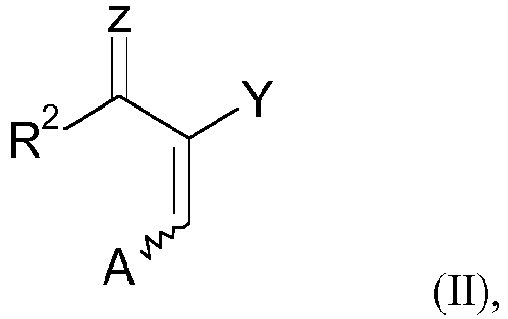
- Z
- ausgewählt ist aus O, S und N+R10R11, wobei R10 und R11 unabhängig voneinander ausgewählt sind aus C1-12-Alkyl-, C3--8-Cycloalkyl-, C2-12-Alkenyl-, C2-12-Alkinyl-, C6-8-Aryl-, C7-19-Arylalkyl- oder C7-19-Alkylaryl-Gruppen, die jeweils mit einer oder mehreren Gruppen, die ausgewählt sind aus der Gruppe bestehend aus -R', -X, -OR', -SR', -NR'2, -SiR'3, -COOR', -(C=O)R', -CN and -CONR2', wobei R' Wasserstoff oder eine C1-12-Alkyl-Gruppe ist, substituiert sein können und R10 und R11 zusammen mit dem Stickstoffatom, an das sie gebunden sind, einen 5- bis 6-gliedrigen Ring bilden können, der gegebenenfalls ein oder zwei weitere Hetero-Atome, ausgewählt aus O, S und einer SO2-Gruppe, enthalten kann und der mit einer oder mehreren Gruppen, die ausgewählt sind aus der Gruppe bestehend aus -R', -X, -OR', -SR', -NR'2, -SiR'3, -COOR', - (C=O)R', -CN and -CONR2', wobei R' Wasserstoff oder eine C1-12-Alkyl-Gruppe ist, substituiert sein kann;
- A
- eine AustrittsgruppeNR12R13 ist, wobei R12 und R13 unabhängig voneinander ausgewählt sind aus C1-12-Alkyl-, C3--8-Cycloalkyl-, C2-12-Alkenyl-, C2-12-Alkinyl-, C6-8-Aryl-, C7-19-Arylalkyl- oder C7-19-Alkylaryl-Gruppen, die jeweils mit einer oder mehreren Gruppen, die ausgewählt sind aus der Gruppe bestehend aus -R', -X, -OR', -SR', -NR'2, -SiR'3, -COOR', -(C=O)R', -CN and -CONR2', wobei R' Wasserstoff oder eine C1-12-Alkyl-Gruppe ist, substituiert sein können und R12 und R13 zusammen mit dem Stickstoffatom, an das sie gebunden sind, einen 5- bis 6-gliedrigen Ring bilden können, der gegebenenfalls ein oder zwei weitere Hetero-Atome, ausgewählt aus O, S und einer SO2-Gruppe, enthalten kann und der mit einer oder mehreren Gruppen, die ausgewählt sind aus der Gruppe bestehend aus -R', -X, -OR', -SR', -NR'2, -SiR'3, -COOR', -(C=O)R', -CN and -CONR2', wobei R' Wasserstoff oder eine C1-12-Alkyl-Gruppe ist, substituiert sein kann;
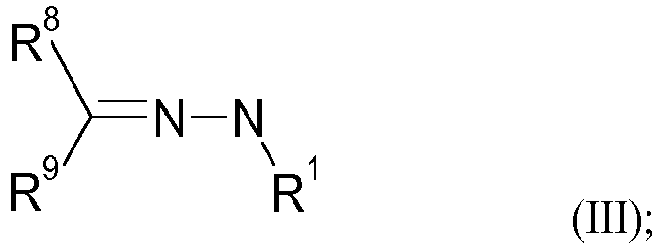
- R8 ausgewählt ist aus H, Methyl, Ethyl, n-Propyl, iso-Propyl, n-Butyl, sec-Butyl, tert-Butyl, Phenyl, Tolyl, Cyclohexyl;
- R9 ausgewählt ist aus H, Methyl, Ethyl, n-Propyl, iso-Propyl, n-Butyl, sec-Butyl, tert-Butyl, Phenyl, Tolyl, Cyclohexyl;
- wobei R8 und R9 gemeinsam mit dem C-Atom, an das sie geknüpft sind, einen 5- oder 6-gliedrigen Ring bilden können;
- (B) Acylierung eines Acrylsäurehydrazons der Formel (VI);


- (C) Iminoalkylierung eines Acrylsäurehydrazons der obigen Formel (VI) mit einem α,α-Dihalogenamin der Formel (XI), wobei X ausgewählt ist aus F, Cl, Br oder I,

- (D) Cyclisierung der in Schritt (A), (B) oder (C) erhaltenen Zwischenprodukte zum 3-Haloalkyl-pyrazol-4-carbonsäure-Derivat der Formel (I).
- Überraschenderweise lassen sich die 1-Alkyl-3-haloalkyl-pyrazol-4-carbonsäure-Derivate der Formel (I) unter den erfindungsgemäßen Bedingungen mit guten Ausbeuten, Regioselektivitäten und in hoher Reinheit herstellen, womit das erfindungsgemäße Verfahren die oben genannten Nachteile der im Stand der Technik vorbeschriebenen Herstellungsverfahren überwindet.
- Im Zusammenhang mit der vorliegenden Erfindung umfasst der Begriff Halogene (X), soweit nicht anders definiert, solche Elemente, die ausgewählt sind aus der Gruppe bestehend aus Fluor, Chlor, Brom und Iod, wobei Fluor, Chlor und Brom bevorzugt und Fluor und Chlor besonders bevorzugt verwendet werden.
- Gegebenenfalls substituierte Gruppen können einfach oder mehrfach substituiert sein, wobei bei Mehrfachsubstitutionen die Substituenten gleich oder verschieden sein können.
- Mit einem oder mehreren Halogenatomen (-X) substituierte Alkyl-Gruppen sind beispielsweise ausgewählt aus Trifluormethyl (CF3), Difluormethyl (CHF2), CF3CH2, ClCH2, CF3CCl2.
- Alkyl-Gruppen sind im Zusammenhang mit der vorliegenden Erfindung, soweit nicht abweichend definiert, lineare oder verzweigte Kohlenwasserstoff-Gruppen, die optional ein, zwei oder mehrere Heteroatome, die ausgewählt sind aus O, N, P und S aufweisen können. Außerdem können die erfindungsgemäßen Alkyl-Gruppen optional durch weitere Gruppen substituiert sein, die ausgewählt sind aus -R', Halogen- (-X), Alkoxy- (-OR'), Thioether- oder Mercapto-(-SR'), Amino-(-NR'2), Silyl- (-SiR'3), Carboxyl- (-COOR'), Cyan- (-CN), Acyl- (-(C=O)R') und Amid-Gruppen (-CONR2'), wobei R' Wasserstoff oder eine C1-12-Alkyl-Gruppe, vorzugsweise C2-10-Alkyl-Gruppe, besonders bevorzugt C3-8-Alkyl-Gruppe ist, die ein oder mehrere Heteroatome, ausgewählt aus N, O, P und S, aufweisen kann.
- Cycloalkyl-Gruppen sind im Zusammenhang mit der vorliegenden Erfindung, soweit nicht abweichend definiert, monocyclische, gesättigte Kohlenwasserstoffgruppen mit 3 bis 8 Kohlenstoffringgliedern, die optional ein, zwei oder mehrere Heteroatome, die ausgewählt sind aus O, N, P und S aufweisen können. Außerdem können die erfindungsgemäßen Cycloalkyl-Gruppen optional durch weitere Gruppen substituiert sein, die ausgewählt sind aus -R', Halogen-(-X), Alkoxy- (-OR'), Thioether- oder Mercapto- (-SR'), Amino- (-NR'2), Silyl- (-SiR'3), Carboxyl- (-COOR'), Cyan- (-CN), Acyl- (-(C=O)R') und Amid-Gruppen (-CONR2'), wobei R' Wasserstoff oder eine C1-12-Alkyl-Gruppe, vorzugsweise C2-10-Alkyl-Gruppe, besonders bevorzugt C3-8-Alkyl-Gruppe ist, die ein oder mehrere Heteroatome, ausgewählt aus N, O, P und S, aufweisen kann.
- Im Einzelnen umfasst diese Definition beispielsweise die Bedeutungen Cyclopropyl, Cyclobutyl, Cyclopentyl und Cyclohexyl.
- Die Definition C1-C12-Alkyl umfasst den größten hierin definierten Bereich für einen Alkyl-Gruppe. Im Einzelnen umfasst diese Definition beispielsweise die Bedeutungen Methyl, Ethyl, n-, iso-Propyl, n-, iso-, sec- und t-Butyl, n-Pentyl, n-Hexyl, 1,3-Dimethylbutyl, 3,3-Dimethylbutyl, n-Heptyl, n-Nonyl, n-Decyl, n-Undecyl, n-Dodecyl.
- Alkenyl-Gruppen sind im Zusammenhang mit der vorliegenden Erfindung, soweit nicht abweichend definiert, lineare oder verzweigte Kohlenwasserstoff-Gruppen, die wenigstens eine einfache Unsättigung (Doppelbindung) enthalten und optional eine, zwei oder mehrere einfache oder zweifache Unsättigungen oder ein, zwei oder mehrere Heteroatome, die ausgewählt sind aus O, N, P und S aufweisen können. Außerdem können die erfindungsgemäßen Alkenyl-Gruppen optional durch weitere Gruppen substituiert sein, die ausgewählt sind aus -R', Halogen- (-X), Alkoxy- (-OR'), Thioether- oder Mercapto- (-SR'), Amino- (-NR'2), Silyl- (-SiR'3), Carboxyl-(-COOR'), Cyan- (-CN), Acyl- (-(C=O)R') und Amid-Gruppen (-CONR2'), wobei R' Wasserstoff oder eine C1-12-Alkyl-Gruppe, vorzugsweise C2-10-Alkyl-Gruppe, besonders bevorzugt C3-8-Alkyl-Gruppe ist, die ein oder mehrere Heteroatome, ausgewählt aus N, O, P und S, aufweisen kann.
- Die Definition C1-C12-Alkenyl umfasst den größten hierin definierten Bereich für einen AlkenylGruppe. Im Einzelnen umfasst diese Definition beispielsweise die Bedeutungen Vinyl; Allyl (2-Propenyl), Isopropenyl (1-Methylethenyl); But-1-enyl (Crotyl), But-2-enyl, But-3-enyl; Hex-1-enyl, Hex-2-enyl, Hex-3-enyl, Hex-4-enyl, Hex-5-enyl; Hept-1-enyl, Hept-2-enyl, Hept-3-enyl, Hept-4-enyl, Hept-5-enyl, Hept-6-enyl; Oct-1-enyl, Oct-2-enyl, Oct-3-enyl, Oct-4-enyl, Oct-5-enyl, Oct-6-enyl, Oct-7-enyl; Non-1-enyl, Non-2-enyl, Non-3-enyl, Non-4-enyl, Non-5-enyl, Non-6-enyl, Non-7-enyl, Non-8-enyl; Dec-1-enyl, Dec-2-enyl, Dec-3-enyl, Dec-4-enyl, Dec-5-enyl, Dec-6-enyl, Dec-7-enyl, Dec-8-enyl, Dec-9-enyl; Undec-1-enyl, Undec-2-enyl, Undec-3-enyl, Undec-4-enyl, Undec-5-enyl, Undec-6-enyl, Undec-7-enyl, Undec-8-enyl, Undec-9-enyl, Undec-10-enyl; Dodec-1-enyl, Dodec-2-enyl, Dodec-3-enyl, Dodec-4-enyl, Dodec-5-enyl, Dodec-6-enyl, Dodec-7-enyl, Dodec-8-enyl, Dodec-9-enyl, Dodec-10-enyl, Dodec-11-enyl; Buta-1,3-dienyl, Penta-1,3-dienyl.
- Cycloalkenyl-Gruppen sind im Zusammenhang mit der vorliegenden Erfindung, soweit nicht abweichend definiert, monocyclische, nicht aromatische Kohlenwasserstoffgruppen mit 3 bis 8 Kohlenstoffringgliedern mit mindestens einer Doppelbindung, die optional ein, zwei oder mehrere Heteroatome, die ausgewählt sind aus O, N, P und S aufweisen können. Außerdem können die erfindungsgemäßen Cycloalkenyl-Gruppen optional durch weitere Gruppen substituiert sein, die ausgewählt sind aus -R', Halogen- (-X), Alkoxy- (-OR'), Thioether- oder Mercapto- (-SR'), Amino- (-NR'2), Silyl- (-SiR'3), Carboxyl- (-COOR'), Cyan- (-CN), Acyl- (-(C=O)R') und Amid-Gruppen (-CONR2'), wobei R' Wasserstoff oder eine C1-12-Alkyl-Gruppe, vorzugsweise C2-10-Alkyl-Gruppe, besonders bevorzugt C3-8-Alkyl-Gruppe ist, die ein oder mehrere Heteroatome, ausgewählt aus N, O, P und S, aufweisen kann.
- Im Einzelnen umfasst diese Definition beispielsweise die Bedeutungen Cyclopenten-1-yl, Cyclohexen-1-yl, Cyclohepta-1,3-dien-1-yl.
- Alkinyl-Gruppen sind im Zusammenhang mit der vorliegenden Erfindung, soweit nicht abweichend definiert, lineare, verzweigte oder ringförmige Kohlenwasserstoff-Gruppen, die wenigstens eine zweifache Unsättigung (Dreifachbindung) enthalten und optional eine, zwei oder mehrere einfache oder zweifache Unsättigungen oder ein, zwei oder mehrere Heteroatome, die ausgewählt sind aus O, N, P und S aufweisen können. Außerdem können die erfindungsgemäßen Alkinyl-Gruppen optional durch weitere Gruppen substituiert sein, die ausgewählt sind aus -R', Halogen- (-X), Alkoxy- (-OR'), Thioether- oder Mercapto- (-SR'), Amino- (-NR'2), Silyl-(-SiR'3), Carboxyl- (-COOR'), Cyan- (-CN), Acyl- (-(C=O)R') und Amid-Gruppen (-CONR2'), wobei R' Wasserstoff oder eine lineare, verzweigte oder cyclische C1-12-Alkyl-Gruppe ist, die ein oder mehrere Heteroatome, ausgewählt aus N, O, P und S, aufweisen kann.
- Die Definition C2-C12-Alkinyl umfasst den größten hierin definierten Bereich für einen Alkinyl-Gruppe. Im Einzelnen umfasst diese Definition beispielsweise die Bedeutungen Ethinyl (Acetylenyl); Prop-1-inyl und Prop-2-inyl.
- Aryl-Gruppen sind im Zusammenhang mit der vorliegenden Erfindung, soweit nicht abweichend definiert, aromatische Kohlenwasserstoff-Gruppen, die ein, zwei oder mehrere Heteroatome, die ausgewählt sind aus O, N, P und S aufweisen können und optional durch weitere Gruppen substituiert sein können, die ausgewählt sind aus -R', Halogen- (-X), Alkoxy- (-OR'), Thioether- oder Mercapto- (-SR'), Amino- (-NR'2), Silyl- (-SiR'3), Carboxyl- (-COOR'), Cyan- (-CN), Acyl- (-(C=O)R') und Amid-Gruppen (-CONR2'), wobei R' Wasserstoff oder eine C1-12-Alkyl-Gruppe, vorzugsweise C2-10-Alkyl-Gruppe, besonders bevorzugt C3-8-Alkyl-Gruppe ist, die ein oder mehrere Heteroatome, ausgewählt aus N, O, P und S, aufweisen kann.
- Die Definition C5-18-Aryl umfasst den größten hierin definierten Bereich für eine Aryl-Gruppe mit 5 bis 18 Gerüst-Atomen, wobei die C-Atome gegen Heteroatome ausgetauscht sein können. Im Einzelnen umfasst diese Definition beispielsweise die Bedeutungen Cyclopentadienyl, Phenyl, Cycloheptatrienyl, Cyclooctatetraenyl, Naphthyl und Anthracenyl; 2-Furyl, 3-Furyl, 2-Thienyl, 3-Thienyl, 2-Pyrrolyl, 3-Pyrrolyl, 3-Isoxazolyl, 4-Isoxazolyl, 5-Isoxazolyl, 3-Isothiazolyl, 4-Isothiazolyl, 5-Isothiazolyl, 3-Pyrazolyl, 4-Pyrazolyl, 5-Pyrazolyl, 2-Oxazolyl, 4-Oxazolyl, 5-Oxazolyl, 2-Thiazolyl, 4-Thiazolyl, 5-Thiazolyl, 2-Imidazolyl, 4-Imidazolyl, 1,2,4-Oxadiazol-3-yl, 1,2,4-Oxadiazol-5-yl, 1,2,4-Thiadiazol-3-yl, 1,2,4-Thiadiazol-5-yl, 1,2,4-Triazol-3-yl, 1,3,4-Oxadiazol-2-yl, 1,3,4-Thiadiazol-2-yl und 1,3,4-Triazol-2-yl; 1-Pyrrolyl, 1-Pyrazolyl, 1,2,4-Triazol-1-yl, 1-Imidazolyl, 1,2,3-Triazol-1-yl, 1,3,4-Triazol-1-yl; 3-Pyridazinyl, 4-Pyridazinyl, 2-Pyrimidinyl, 4-Pyrimidinyl, 5-Pyrimidinyl, 2-Pyrazinyl, 1,3,5-Triazin-2-yl und 1,2,4-Triazin-3-yl.
- Arylalkyl-Gruppen (Aralkyl-Gruppen) sind im Zusammenhang mit der vorliegenden Erfindung, soweit nicht abweichend definiert, durch Aryl-Gruppen substituierte Alkyl-Gruppen, die eine C1-8-Alkylenkette aufweisen können und im Arylgerüst oder der Alkylenkette durch eines oder mehrere Heteroatome, die ausgewählt sind aus O, N, P und S und optional durch weitere Gruppen substituiert sein können, die ausgewählt sind aus -R', Halogen- (-X), Alkoxy- (-OR'), Thioether- oder Mercapto- (-SR'), Amino- (-NR'2), Silyl- (-SiR'3), Carboxyl- (-COOR'), Cyan-(-CN), Acyl- (-(C=O)R') und Amid-Gruppen (-CONR2'), wobei R' Wasserstoff oder eine C1-12-Alkyl-Gruppe, vorzugsweise C2-10-Alkyl-Gruppe, besonders bevorzugt C3-8-Alkyl-Gruppe ist, die ein oder mehrere Heteroatome, ausgewählt aus N, O, P und S, aufweisen kann.
- Die Definition C7-19-Aralkyl-Gruppe umfasst den größten hierin definierten Bereich für einen Arylalkyl-Gruppe mit insgesamt 7 bis 19 Atomen in Gerüst und Alkylenkette. Im Einzelnen umfasst diese Definition beispielsweise die Bedeutungen Benzyl- und Phenylethyl-.
- Alkylaryl-Gruppen (Alkaryl-Gruppen) sind im Zusammenhang mit der vorliegenden Erfindung, soweit nicht abweichend definiert, durch Alkyl-Gruppen substituierte Aryl-Gruppen, die eine C1-8-Alkylenkette aufweisen können und im Arylgerüst oder der Alkylenkette durch eines oder mehrere Heteroatome, die ausgewählt sind aus O, N, P und S und optional durch weitere Gruppen substituiert sein können, die ausgewählt sind aus -R', Halogen- (-X), Alkoxy- (-OR'), Thioether- oder Mercapto- (-SR'), Amino- (-NR'2), Silyl- (-SiR'3), Carboxyl- (-COOR'), Cyan-(-CN), Acyl- (-(C=O)R') und Amid-Gruppen (-CONR2'), wobei R' Wasserstoff oder eine C1-12-Alkyl-Gruppe, vorzugsweise C2-10-Alkyl-Gruppe, besonders bevorzugt C3-8-Alkyl-Gruppe ist, die ein oder mehrere Heteroatome, ausgewählt aus N, O, P und S, aufweisen kann.
- Die Definition C7-19-Alkylaryl-Gruppe umfasst den größten hierin definierten Bereich für einen Alkylaryl-Gruppe mit insgesamt 7 bis 19 Atomen in Gerüst und Alkylenkette. Im Einzelnen umfasst diese Definition beispielsweise die Bedeutungen Tolyl-, 2,3-, 2,4-, 2,5-, 2,6-, 3,4- oder 3,5-Dimethylphenyl.
- Die Alkyl-, Alkenyl-, Alkinyl-, Aryl,- Alkaryl- und Aralkylgruppen können zudem ein oder mehrere Heteroatome aufweisen, die - soweit nicht abweichend definiert - ausgewählt sind aus N, O, P und S. Die Heteroatome ersetzen dabei die bezifferten Kohlenstoffatome.
- Die erfindungsgemäßen Verbindungen können gegebenenfalls als Mischungen verschiedener möglicher isomerer Formen, insbesondere von Stereoisomeren, wie z.B. E- und Z-, threo- und erythro-, sowie optischen Isomeren, gegebenenfalls aber auch von Tautomeren vorliegen. Es werden sowohl die E- als auch die Z-Isomeren, wie auch die threo- und erythro-, sowie die optischen Isomeren, beliebige Mischungen dieser Isomeren, sowie die möglichen tautomeren Formen offenbart und beansprucht.
- Über die einzelnen Varianten des erfindungsgemäßen Verfahrens, soll das folgende Schema 3 einen Überblick geben:

- Die gemäß dem erfindungsgemäßen Verfahren erhältlichen 1-Alkyl-3-haloalkyl-pyrazol-4-carbonsäure-Derivaten sind Verbindungen der Formel (I)

- Die Reste in Formel (I) haben erfindungsgemäß die oben genannten Bedeutungen.
- In einer bevorzugten Ausführungsform der vorliegenden Erfindung haben die Reste in Formel (I) die folgenden Bedeutungen:
- R1
- ist ausgewählt aus Methyl, Ethyl, n-Propyl oder Isopropyl,
- R2
- ist ausgewählt aus Chlormethyl, Brommethyl, Dichlormethyl, Trichlormethyl, Fluormethyl, Difluormethyl, Trifluormethyl, Chlorfluormethyl, Dichlorfluormethyl, Chlordifluormethyl, 1-Chlorethyl, 1-Bromethyl, 1-Fluorethyl, 2-Fluorethyl, 2,2-Difluorethyl, 2,2,2-Trifluorethyl, 2-Chlor-2-fluorethyl, 2-Chlor-2,2-difluorethyl, 2,2-Dichlor-2-fluorethyl, 2,2,2-Trichlorethyl, Pentafluorethyl und 1,1,1-Trifluorprop-2-yl; 1,2,2,2-Tetrafluorethyl,
- Y
- ist ausgewählt aus der Gruppe bestehend aus (C=O)OR3, CN und (C=O)NR4R5, wobei R3, R4 und R5 unabhängig voneinander ausgewählt sind aus Methyl, Ethyl, n-Propyl oder Isopropyl.
- In einer besonders bevorzugten Ausführungsform der vorliegenden Erfindung haben die Reste in Formel (I) die folgenden Bedeutungen:
- R1
- ist Methyl,
- R2
- ist ausgewählt aus Trifluormethyl oder Difluormethyl
- Y
- ist ausgewählt aus der Gruppe bestehend aus (C=O)OR3, wobei R3 Methyl oder Ethyl ist.
- In einer ersten Ausführungsform des vorliegenden Verfahrens, welche sich durch die Kombination der Reaktionsschritte (A) und (D) ergibt, werden zunächst 2-acylierte oder 2-iminoalkylierte Acrylsäure-Derivate der Formel (II) mit N-Alkylhydrazonen der Formel (III) umgesetzt (Schema 4). Im Anschluss daran werden die in Schritt (A) gebildeten Zwischenprodukte zu den 3-Haloalkyl-pyrazol-4-carbonsäure-Derivaten der Formel (I) cyclisiert (Schritt D).

- Mögliche Zwischenprodukte, die sich gemäß der vorliegenden Erfindung aus dem Reaktionsschritt (A) ergeben können, sind die Acrylhydrazone gemäß Formel (VII)

- Unter diese Formel fallen insbesondere die 2-Acylhydrazinoprop-2-enoate der Formel (VIIa) und die Hydrazinoaminium Salze der Formel (VIIb)


- in denen die Reste R1, R2, R8 bis R11 und Y die zuvor beschriebenen Bedeutungen haben und die ggf. ein Gegenion (Anion-) aufweisen, das ausgewählt ist aus der Gruppe bestehend aus Cl-, BF4 -, PF6 -, SbF6 - und AlCl4 -.
- Die Durchführung des erfindungsgemäßen Verfahrensschritts (A) erfolgt vorzugsweise innerhalb eines Temperaturbereichs von -20°C bis +150°C, besonders bevorzugt bei Temperaturen von - 10°C bis +70 °C.
- Der erfindungsgemäße Verfahrensschritt (A) wird im Allgemeinen unter Normaldruck durchgeführt. Alternativ ist es jedoch auch möglich, im Vakuum zu arbeiten, um die leicht flüchtigen Dialkylamine zu entfernen.
- Die Reaktionszeit ist nicht kritisch und kann, in Abhängigkeit von der Ansatzgröße und Temperatur, in einem Bereich zwischen wenigen Minuten und mehreren Stunden gewählt werden.
- Bei der Durchführung des erfindungsgemäßen Verfahrensschritts (A) setzt man 1 Mol des Acrylsäure-Derivats der Formel (II) mit 0.5 Mol bis 3 Mol, vorzugsweise 0.5 Mol bis 1.5 Mol, besonders bevorzugt mit der äquimolaren Menge des Hydrazons der Formel (III) um.
- Vorzugsweise wird das im Lösungsmittel gelöste Hydrazon der Formel (III) vorgelegt und das Acrylsäure-Derivat der Formel (II) zugegeben. Die umgekehrte Reihenfolge ist jedoch auch möglich.
- Die Reaktion kann durch der Zusatz von Katalysatoren wie beispielsweise CH3COOH, H2SO4, KHSO4, NaH2PO4, HCl, CF3COOH, CH3COONa beschleunigt werden.
- Eine Aufarbeitung und Isolierung der Zwischenprodukte ist im Allgemeinen nicht erforderlich, so dass die aus Schritt (A) erhältliche Reaktionsmischung sofort oder nach erfolgter Zwischenlagerung in den Cyclisierungsschritt (D) eingesetzt werden kann.
- Die Acrylsäure-Derivate der Formel (II) sind erhältlich nach den zuvor, im Zusammenhang mit dem Stand der Technik, beschriebenen Verfahren.
- Im Zusammenhang mit der vorliegenden Erfindung werden vorzugsweise 2-acylierte oder 2-iminoalkylierte Acrylsäure-Derivate der Formel (II) verwendet, die ausgewählt sind aus der Gruppe bestehend aus, N-1-(Trifluormethyl)-3-(dimethylamino)-2-(ethoxycarbonyl)prop-2-en-1-ylidene]-N-methylmethanaminiumchlorid, 2-(, N-1-(Difluormethyl)-3-(dimethylamino)-2-(ethoxycarbonyl)prop-2-en-1-ylidene]-N-methylmethanaminium tetrafluorborat und N-[3-(Dimethylamino)-2-(ethoxycarbonyl)-1-(1,1,2,2-tetrafluoroethyl)prop-2-en-1-ylidene]-N-methylmethanaminiumchlorid.
- Die N-Alkyl-Hydrazone der Formel (III) sind im Zusammenhang mit der vorliegenden Erfindung vorzugsweise ausgewählt aus der Gruppe bestehend aus 1-Methyl-2-(1-methylethylidene)hydrazin, 1-Methyl-2-(1,2,2-trimethylpropylidene)hydrazin, 1-Methyl-2-(1-methylpropylidene)hydrazin, 1-Cyclohexylidene-2-methylhydrazin, 1-Methyl-2-(phenylmethylidene)hydrazin, 1-Methyl-2-(1-phenylethylidene)hydrazin, 1-(Diphenylmethylidene)-2-methylhydrazin, Ethyl-2-[(dimethylamino)methylidene]-4,4,4-trifluoro-3-oxo-butanoat. Die N-Alkyl-Hydrazone der Formel (III) sind in der Literatur vorbeschrieben (Zhurnal Organicheskoi Khimii (1968), 4(6), 986-92.) und durch Umsetzung von kommerziell erhältlichen Hydrazinen der Formel (VIII) mit Carbonylverbindungen der Formel (IX) zugänglich (siehe Schema 5).

- Die Reste in Formeln (III), (VIII) und (IX) haben erfindungsgemäß die folgenden Bedeutungen:
- R1
- ist Methyl, Ethyl, n-Propyl, iso-Propyl, n-Butyl, sec-Butyl, tert-Butyl;
- R8
- ist ausgewählt aus H, Methyl, Ethyl, n-Propyl, iso-Propyl, n-Butyl, sec-Butyl, tert-Butyl, Phenyl, Tolyl, Cyclohexyl;
- R9
- ist ausgewählt aus H, Methyl, Ethyl, n-Propyl, iso-Propyl, n-Butyl, sec-Butyl, tert-Butyl, Phenyl, Tolyl, Cyclohexyl.
- Alternativ können R8 und R9 gemeinsam mit dem C-Atom, an das sie geknüpft sind, einen 5- oder 6-gliedrigen Ring bilden.
- Die Reste in Formeln (III), (VIII) und (IX) haben erfindungsgemäß die folgenden besonders bevorzugten Bedeutungen:
- R1
- ist Methyl;
- R8
- ist ausgewählt aus H, Methyl, tert-Butyl, Phenyl;
- R9
- ist ausgewählt aus H, Methyl, tert-Butyl, Phenyl.
- Erfindungsgemäß werden bevorzugt Ketone der Formel (IX) verwendet, die ausgewählt sind aus der Gruppe bestehend aus Aceton, Benzophenon, Pinakolon, Cyclohexanon, Benzaldehyd, wobei Aceton und Benzaldehyd besonders bevorzugt verwendet werden.
- Ein weiterer Vorteil des erfindungsgemäßen Verfahrens, ist die Tatsache, dass zur Herstellung der N-Methylhydrazone der Formel (III) wässrige Methylhydrazinlösungen verwendet werden können und nicht zwangsläufig das explosive, auch als Raketentreibstoff verwendete, konzentrierte Methylhydrazin eingesetzt werden muss.
- In zwei weiteren Ausführungsformen des vorliegenden Verfahrens, welche sich durch die Kombination der Reaktionsschritte (B) und (D) oder (C) und (D) ergibt, werden Acrylsäure-Derivate der Formel (VI) acyliert (Schritt (B)) oder iminoalkyliert (Schritt (C)) und abschließend zu den 3-Haloalkyl-pyrazol-4-carbonsäure-Derivaten der Formel (I) cyclisiert (Schritt D).
- In einer Ausführungsform des erfindungsgemäßen Verfahrens werden die Acrylsäurehydrazone der Formel (VI) mit Haloalkylcarbonsäurehalogeniden der Formel (X), gemäß dem nachfolgenden Schema 6, zu den 2-Acylacrylsäurehydrazonen der Formel (VIIa) acyliert. In Formel (X) hat R2 die obigen Bedeutungen, X ist ein Halogenatom, ausgewählt aus F, Cl oder Br, vorzugsweise aus F und Cl, besonders bevorzugt F.
- Im Zusammenhang mit der vorliegenden Erfindung wird vorzugsweise ein Haloalkylcarbonsäurehalogenid der Formel (X) als Acylierungsmittel eingesetzt, welches ausgewählt ist aus der Gruppe bestehend aus Difluoressigsäurechlorid, Difluoressigsäureanhydrid, Difluoressigsäurefluorid, Trifluoressigsäurechlorid und Trifluoressigsäurefluorid.
- Die in Schritt (B) verwendeten Acrylsäurehydrazone der Formel (VI) sind vorzugsweise ausgewählt aus der Gruppe bestehend aus Ethyl (2E)-3-[1-methyl-2-(propan-2-ylidene)-hydrazinyl]prop-2-enoate, Ethyl (2Z)-3-[1-methyl-2-(propan-2-ylidene)hydrazinyl]prop-2-enoate, Methyl -3-[1-methyl-2-(propan-2-ylidene)hydrazinyl]prop-2-enoate, Propyl -3-[1-methyl-2-(propan-2-ylidene)hydrazinyl]prop-2-enoate, Ethyl (2E)-3-[1-methyl-2-(3,3-dimethylbutan-2-ylidene)hydrazinyl]prop-2-enoate, Methyl 3-[1-methyl-2-(3,3-dimethylbutan-2-ylidene)hydrazinyl]prop-2-enoate, Methy-3-[1-methyl-2-(phenylmethylidene)hydrazinyl]prop-2-enoate, (2E)-3-[1-methyl-2-(phenylmethylidene)hydrazinyl]prop-2-enenitrile und Methyl -3-[1-ethyl-2-(propan-2-ylidene)hydrazinyl]prop-2-enoate.

- Die Acylierung erfolgt erfindungsgemäß bei Temperaturen von -20°C bis +150°C, bevorzugt bei Temperaturen von -20°C bis +100 °C, besonders bevorzugt bei -10 bis 50°C und unter Normaldruck.
- Die Reaktionszeit ist nicht kritisch und kann, in Abhängigkeit von der Ansatzgröße und Temperatur, in einem Bereich zwischen wenigen Minuten und mehreren Stunden gewählt werden.
- Erfindungsgemäß setzt man 1 Mol des Acrylsäurehydrazons der Formel (VI) mit 0.5 Mol bis 3 Mol, vorzugsweise 1.2 Mol bis 1.5 Mol, besonders bevorzugt mit äquimolaren Mengen des Haloalkylcarbonsäurehalogenids der Formel (X) um.
- Vorzugsweise wird das im Lösungsmittel gelöste Hydrazinoacrylsäure-Derivat der Formel (VI) vorgelegt und das Haloalkylcarbonsäurehalogenid der Formel (X) zugegeben. Die umgekehrte Reihenfolge ist jedoch auch möglich.
- Die Acylierung erfolgt vorzugsweise in Gegenwart von einer Base. Bevorzugt sind dazu organische Basen wie Trialkylamine, Alkylpyridine, Phosphazene und 1,8-Diazabicyclo[5.4.0]undecen (DBU); Alkalimetallhydroxide wie z.B. Lithium-, Natrium- oder Kaliumhydroxid, Alkalimetallcarbonate (Na2CO3, K2CO3) und Alkoholate, wie z.B. NaOMe, NaOEt, NaOt-Bu, KOt-Bu.
- Geeignete Lösungsmittel sind beispielsweise aliphatische, alicyclische oder aromatische Kohlenwasserstoffe, wie z.B. Petrolether, n-Hexan, n-Heptan, Cyclohexan, Methylcyclohexan, Benzol, Toluol, Xylol oder Decalin, und halogenierte Kohlenwasserstoffe, wie z.B. Chlorbenzol, Dichlorbenzol, Dichlormethan, Chloroform, Tetrachlormethan, Dichlorethan oder Trichlorethan, Ether, wie Diethylether, Diisopropylether, Methyl-tert-butylether, Methyl-tert-amylether, Dioxan, Tetrahydrofuran, 1,2-Dimethoxyethan, 1,2-Diethoxyethan oder Anisol; Nitrile, wie Acetonitril, Propionitril, n- oder iso-Butyronitril oder Benzonitril; Ketone, wie Aceton, Methylethylketon, Methylisobutylketon oder Cyclohexanon; Amide, wie N,N-Dimethylformamid, N,N-Dimethylacetamid, N-Methylformanilid, N-Methylpyrrolidon oder Hexamethylphosphorsäuretriamid; Sulfoxide, wie Dimethylsulfoxid oder Sulfone, wie Sulfolan. Besonders bevorzugt verwendet man Toluol, Xylol, Chlorbenzol, n-Hexan, Cyclohexan oder Methylcyclohexan, ganz besonders bevorzugt Toluol oder Xylol.
- Mögliche Zwischenprodukte, die sich gemäß der vorliegenden Erfindung aus dem Reaktionsschritt (B) ergeben können, sind üblicherweise die 2-Acylhydrazinoacrylsäure-Derivate der Formel (VIIa).
- Die gebildeten Zwischenprodukte können ohne vorherige Aufarbeitung in den Cyclisierungsschritt (Schritt D) eingesetzt werden.
- Alternativ können die Zwischenprodukte durch geeignete Aufarbeitungsschritte und ggf. weitere Aufreinigung isoliert und zu einem späteren Zeitpunkt in die Cyclisierung (Schritt D) eingesetzt werden.
- Die Acrylsäurehydrazone der Formel (VI) sind in der Literatur vorbeschrieben (siehe Chem. Ber. 1975, 108 (7), 2161-2170; Bulletin de la Societe Chimique de France (1976), (1-2, Pt. 2), 260-4; und können gemäß den nachfolgenden Schemata 7 oder 8 hergestellt werden.


- In einer weiteren Ausführungsform des erfindungsgemäßen Verfahrens werden die Acrylsäurehydrazone der Formel (VI) mit wenigstens einem α,α-Dihalogenamin der Formel (XI), gemäß dem nachfolgenden Schema 9, zu den Hydrazinoaminiumsalzen der Formel (VIIb) iminoalkyliert. In Formel (XI) haben X und R2 die obigen Bedeutungen.

- In Schema 9 ist [L] eine Lewissäure.
- Im Zusammenhang mit der vorliegenden Erfindung kann 1,1,2,2-Tetrafluorethyl-N,N-dimethylamin, 1,1,2,2-Tetrafluorethyl-N,N-diethylamin, 1,1,2-Trifluor-2-(trifluormethyl)ethyl-N,N-dimethylamin, 1,1,2-Trifluor-2-(trifluormethyl)ethyl-N,N-diethylamin (Ishikawa-Reagenz), 1,1,2-Trifluor-2-chlor-ethyl-N,N-dimethylamin und 1,1,2-Trifluor-2-chlor-ethyl-N,N-diethylamin (Yarovenko-Reagenz), als Iminoalkylierungsmittel der Formel (XI) eingesetzt werden. Dabei sind 1,1,2,2-Tetrafluorethyl-N,N-dimethylamin und 1,1,2,2-Tetrafluorethyl-N,N-diethylamin bevorzugt und 1,1,2,2-Tetrafluorethyl-N,N-dimethylamin besonders bevorzugt.
- Die in Schritt (C) verwendeten Acrylsäurehydrazone der Formel (VI) sind vorzugsweise ausgewählt aus der Gruppe bestehend aus Ethyl (2E)-3-[1-methyl-2-(propan-2-ylidene)-hydrazinyl]prop-2-enoate, Ethyl (2Z)-3-[1-methyl-2-(propan-2-ylidene)hydrazinyl]prop-2-enoate, Methyl -3-[1-methyl-2-(propan-2-ylidene)hydrazinyl]prop-2-enoate, Propyl -3-[1-methyl-2-(propan-2-ylidene)hydrazinyl]prop-2-enoate, Ethyl (2E)-3-[1-methyl-2-(3,3-dimethylbutan-2-ylidene)hydrazinyl]prop-2-enoate, Methyl-3-[1-methyl-2-(3,3-dimethylbutan-2-ylidene)hydrazinyl]prop-2-enoate, Methyl-3-[1-methyl-2-(phenylmethylidene)hydrazinyl]prop-2-enoate, (2E)-3-[1-methyl-2-(phenylmethylidene)hydrazinyl]prop-2-enenitrile und Methyl -3-[1-ethyl-2-(propan-2-ylidene)hydrazinyl]prop-2-enoate.
- In einer bevorzugten Ausführungsform des erfindungsgemäßen Verfahrens wird das α,α-Dihalogenamin zuerst mit Lewis Säure [L], wie z.B. BF3, AlCl3, SbCl5, SbF5, ZnCl2, PF5 umgesetzt und dann das Gemisch aus Hydrazinoacrylsäureester der Formel (VI) und einer Base, in Substanz oder gelöst in einem geeigneten Lösungsmittel, zugegeben.
- Bevorzugt sind organische Basen wie Trialkylamine, Alkylpyridine, Phosphazene und 1,8-Diazabicyclo[5.4.0]undecen (DBU), Alkalimetallhydroxide wie z.B. Lithium-, Natrium- oder Kaliumhydroxid, Alkalimetallcarbonate (Na2CO3, K2CO3) und Alkoholate, wie z.B. NaOMe, NaOEt, NaOt-Bu, KOt-Bu.
- Die Umsetzung der α,α-Dihalogenamine der Formel (XI) mit den Acrylsäurehydrazonen der Formel (VI) erfolgt üblicherweise bei Temperaturen von -50 bis 70°C, vorzugsweise von -20 bis 60°C, besonders bevorzugt von -10 bis 50°C.
- Die Reaktion kann unter vermindertem Druck, unter Normal- oder unter Hochdruck, vorzugsweise unter Normaldruck erfolgen.
- Die Reaktion kann in Substanz oder in einem Lösungsmittel durchgeführt werden. Vorzugsweise wird die Reaktion in einem Lösungsmittel durchgeführt. Geeignete Lösungsmittel sind beispielsweise ausgewählt aus der Gruppe bestehend aus aliphatischen und aromatischen Kohlenwasserstoffen, wie z.B. n-Hexan, Benzol oder Toluol, die durch Fluor- und Chloratome substituiert sein können, wie Methylenchlorid, Dichlorethan, Fluorbenzol, Chlorbenzol oder Dichlorbenzol; Ethern, wie z.B. Diethylether, Diphenylether, Methyl-tert-butylether, Isopropylethylether, Dioxan, Diglym, Dimethylglycol, Dimethoxyethane (DME) oder THF; Nitrilen wie Methylnitril, Butylnitril oder Phenylnitril; Amide wie Dimethylformamid (DMF) oder N-Methylpyrrolidon (NMP) oder Mischungen solcher Lösungsmittel geeignet, wobei Acetonitril, Dichlormethan, THF, DME und Ethylacetate besonders bevorzugt sind.
- Die Base und das Acrylsäurehydrazon der Formel (VI) werden vorzugsweise in äquimolaren Mengen bezogen auf α,α-Dihalogenamine der Formel (XI) eingesetzt. Die Base kann auch im Überschuss eingesetzt werden. Das Verhältnis von Base : Hydrazinoacrylsäure-Derivat liegt erfindungsgemäß zwischen 1,5:1 und 0,9:1, vorzugsweise zwischen 1,4:1 und 0,95:1, besonders bevorzugt zwischen 1,3:1 und 1,05:1.
- Aufgrund der Hydrolyseempfindlichkeit der α,α-Dihalogenamine, ist die Umsetzung in wasserfreien Apparaturen unter Inertgasatmosphäre durchzuführen.
- Mögliche Zwischenprodukte, die sich gemäß der vorliegenden Erfindung aus dem Reaktionsschritt (C) ergeben können, sind üblicherweise die Hydrazinoaminiumsalze der Formel (VIIb).
- Die gebildeten Zwischenprodukte können ohne vorherige Aufarbeitung in den Cyclisierungsschritt (Schritt D) eingesetzt werden.
- Alternativ können die Zwischenprodukte durch geeignete Aufarbeitungsschritte und ggf. weitere Aufreinigung isoliert und zu einem späteren Zeitpunkt in die Cyclisierung (Schritt D) eingesetzt werden.
- Die Cyclisierung der aus den Schritten (A), (B) oder (C) erhältlichen Zwischenprodukte erfolgt erfindungsgemäß bei Temperaturen von -20°C bis +150°C, bevorzugt bei Temperaturen von - 10°C bis +100 °C, besonders bevorzugt bei -10 bis 50°C und unter Normaldruck.
- Die Reaktionszeit ist nicht kritisch und kann in Abhängigkeit von der Ansatzgröße in einem größeren Bereich gewählt werden.
- Erfindungsgemäß wird der Ringschluss zum Pyrazol in Anwesenheit einer Säure durchgeführt. Dabei wird die Carbonylverbindung R8R9C=O abgespalten. Die Carbonylverbindungen können abgetrennt und wieder für die Herstellung von Hydrazonen der Formel (III) verwendet werden.
- Üblicherweise erfolg der Schritt (D) nach den Schritten (A), (B) oder (C) ohne Lösemittelwechsel.
- Idealerweise werden alle Reaktionsschritte des erfindungsgemäßen Verfahrens im selben Lösungsmittel durchgeführt.
- Geeignete Lösungsmittel sind beispielsweise aliphatische, alicyclische oder aromatische Kohlenwasserstoffe, wie z.B. Petrolether, n-Hexan, n-Heptan, Cyclohexan, Methylcyclohexan, Benzol, Toluol, Xylol oder Decalin, und halogenierte Kohlenwasserstoffe, wie z.B. Chlorbenzol, Dichlorbenzol, Dichlormethan, Chloroform, Tetrachlormethan, Dichlorethan oder Trichlorethan, Ether, wie Diethylether, Diisopropylether, Methyl-tert-butylether, Methyl-tert-amylether, Dioxan, Tetrahydrofuran, 1,2-Dimethoxyethan, 1,2-Diethoxyethan oder Anisol; Nitrile, wie Acetonitril, Propionitril, n- oder iso-Butyronitril oder Benzonitril; Ketone, wie Aceton, Methylethylketon, Methylisobutylketon oder Cyclohexanon; Amide, wie N,N-Dimethylformamid, N,N-Dimethylacetamid, N-Methylformanilid, N-Methylpyrrolidon oder Hexamethylphosphorsäuretriamid; Sulfoxide, wie Dimethylsulfoxid oder Sulfone, wie Sulfolan; Alkohole, wie Methanol, Ethanol, n-oder iso-Propanol, Butanol. Besonders bevorzugt verwendet man Toluol, Xylol, Chlorbenzol, n-Hexan, Cyclohexan oder Methylcyclohexan, Ethanol, ganz besonders bevorzugt Ethanol, Toluol, Xylol und Wasser.
- Geeignete Säuren sind ausgewählt aus der Gruppe bestehend aus HCl, H2SO4, CF3COOH, CF3SO3H, CH3COOH, besonders bevorzugt sind HCl und H2SO4.
- Nach beendeter Reaktion wird beispielsweise die Lösemitteln entfernt und das Produkt durch Filtration isoliert oder zunächst mit Wasser extrahiert, die organische Phase abgetrennt und das Lösungsmittel durch Destillation entfernt.
- Das erfindungsgemäße Verfahren soll in den nachstehenden Beispielen weiter beschrieben werden. Die Beispiele sind jedoch nicht in einschränkender Weise zu interpretieren.
-

- 6,2 g 2-Methyl-1-phenylhydrazon und 9,3 g 2-(Difluoracetyl)-3-(dimethylamino)-acrylsäureethyl-ester werden in 100 ml Toluol vorgelegt und mit 5,7 g Kaliumhydrogensulfat versetzt. Anschließend wird die Reaktionsmischung auf 35 - 40 °C erhitzt und 8 h bei gleicher Temperatur gerührt. Nach Abtrennung der Salze wird das Lösungsmittel im Vakuum entfernt. Man erhält Ethyl-4,4-difluor-2-{[1-methyl-2-(phenylmethyliden) hydrazino]methyliden}-3-oxobutanoat als Feststoff (91 % Ausbeute). Das Isomerenverhältnis ist beträgt gemäß NMR 53 / 39 %.
- 1H-NMR (278 K, CDCN3): δ= 1,08 (t, 3H); 1,23 (t, 3H); 3,44 (s, 3H); 3,52 (s, 3H); 4,14 (m, 2H); 6,0 (t, 1H); 6,37 (t, 1H); 7,4 - 7,98 (m, 7H) ppm.
Claims (13)
- Verfahren zum Herstellen von 1-Alkyl-3-haloalkyl-pyrazol-4-carbonsäure-Derivaten der Formel (I)
 R1 ausgewählt ist aus Methyl, Ethyl, n-Propyl, iso-Propyl, n-Butyl, sec-Butyl oder tert-Butyl;R2 ausgewählt ist aus C1-C4-Alkylgruppen, die mit einem, zwei oder drei Halogenatomen, ausgewählt aus F, Cl und Br oder einer CF3-Gruppe substituiert sein können;Y ausgewählt ist aus der Gruppe bestehend aus (C=O)OR3, CN und (C=O)NR4R5, wobei R3, R4 und R5 unabhängig voneinander ausgewählt sind aus C1-12-Alkyl-, C3--8-Cycloalkyl-, C2-12-Alkenyl-, C2-12-Alkinyl-, C6-8-Aryl-, C7-19-Arylalkyl- oder C7-19-Alkylaryl-Gruppen, die jeweils mit einer oder mehreren Gruppen, die ausgewählt sind aus der Gruppe bestehend aus -R', -X, -OR', -SR', -NR'2, -SiR'3, -COOR', -(C=O)R', -CN and -CONR2', wobei R' Wasserstoff oder eine C1-12-Alkyl-Gruppe ist, substituiert sein können und R4 und R5 zusammen mit dem Stickstoffatom, an das sie gebunden sind, einen 5- bis 6-gliedrigen Ring bilden können, der gegebenenfalls ein oder zwei weitere Hetero-Atome, ausgewählt aus O, S und einer SO2-Gruppe, enthalten kann und der mit einer oder mehreren Gruppen, die ausgewählt sind aus der Gruppe bestehend aus -R', -X, -OR', -SR', -NR'2, -SiR'3, -COOR', -(C=O)R', -CN and -CONR2', wobei R' Wasserstoff oder eine C1-12-Alkyl-Gruppe ist, substituiert sein kann; umfassend wenigstens eine der Reaktionssequenzen, die sich aus den folgenden Schritten (A) und (D), (B) und (D) oder (C) und (D) zusammensetzen:(A) Umsetzung eines 2-acylierten oder 2-iminoalkylierten Acrylsäure-Derivats der Formel (II),
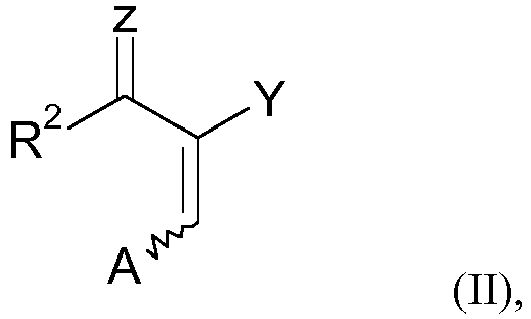 Z ausgewählt ist aus O, S und N+R10R11, wobei R10 und R11 unabhängig voneinander ausgewählt sind aus C1-12-Alkyl-, C3--8-Cycloalkyl-, C2-12-Alkenyl-, C2-12-Alkinyl-, C6-8-Aryl-, C7-19-Arylalkyl- oder C7-19-Alkylaryl-Gruppen, die jeweils mit einer oder mehreren Gruppen, die ausgewählt sind aus der Gruppe bestehend aus -R', -X, -OR', -SR', -NR'2, -SiR'3, -COOR', -(C=O)R', -CN and -CONR2', wobei R' Wasserstoff oder eine C1-12-Alkyl-Gruppe ist, substituiert sein können und R10 und R11 zusammen mit dem Stickstoffatom, an das sie gebunden sind, einen 5-bis 6-gliedrigen Ring bilden können, der gegebenenfalls ein oder zwei weitere Hetero-Atome, ausgewählt aus O, S und einer SO2-Gruppe, enthalten kann und der mit einer oder mehreren Gruppen, die ausgewählt sind aus der Gruppe bestehend aus -R', -X, -OR', -SR', -NR'2, -SiR'3, -COOR', -(C=O)R', -CN and -CONR2', wobei R' Wasserstoff oder eine C1-12-Alkyl-Gruppe ist, substituiert sein kann;A eine Austrittsgruppe NR12R13 ist, wobei R12 und R13 unabhängig voneinander ausgewählt sind aus C1-12-Alkyl-, C3--8-Cycloalkyl-, C2-12-Alkenyl-, C2-12-Alkinyl-, C6-8-Aryl-, C7-19-Arylalkyl- oder C7-19-Alkylaryl-Gruppen, die jeweils mit einer oder mehreren Gruppen, die ausgewählt sind aus der Gruppe bestehend aus -R', -X, -OR', -SR', -NR'2, -SiR'3, -COOR', -(C=O)R', -CN and -CONR2', wobei R' Wasserstoff oder eine C1-12-Alkyl-Gruppe ist, substituiert sein können und R12 und R13 zusammen mit dem Stickstoffatom, an das sie gebunden sind, einen 5-bis 6-gliedrigen Ring bilden können, der gegebenenfalls ein oder zwei weitere Hetero-Atome, ausgewählt aus O, S und einer SO2-Gruppe, enthalten kann und der mit einer oder mehreren Gruppen, die ausgewählt sind aus der Gruppe bestehend aus -R', -X, -OR', -SR', -NR'2, -SiR'3, -COOR', -(C=O)R', -CN and -CONR2', wobei R' Wasserstoff oder eine C1-12-Alkyl-Gruppe ist, substituiert sein kann;wobei R8 und R9 gemeinsam mit dem C-Atom, an das sie geknüpft sind, einen 5- oder 6-gliedrigen Ring bilden können;
mit einem N-Alkyl-Hydrazon der Formel (III) R8 ausgewählt ist aus H, Methyl, Ethyl, n-Propyl, iso-Propyl, n-Butyl, sec-Butyl, tert-Butyl, Phenyl, Tolyl, Cyclohexyl;R9 ausgewählt ist aus H, Methyl, Ethyl, n-Propyl, iso-Propyl, n-Butyl, sec-Butyl, tert-Butyl, Phenyl, Tolyl, Cyclohexyl;(B) Acylierung eines Acrylsäurehydrazons der Formel (VI);
 (C) Iminoalkylierung eines Acrylsäurehydrazons der obigen Formel (VI) mit einem α,α-Dihaiogenamin der Formel (XI) , wobei X ausgewählt ist aus F, Cl, Br oder I,
 (D) Cyclisierung der in Schritt (A), (B) oder (C) erhaltenen Zwischenprodukte zum 3-Haloalkyl-pyrazol-4-carbonsäure-Derivat der Formel (I).
 - Verfahren gemäß Anspruch 1, dadurch gekennzeichnet, dass als Zwischenprodukt der Schritte (A), (B) oder (C) ein 2-acyliertes oder ein 2-iminoalkyliertes Hydrazinoacrylsäure-Derivat der Formel (VII) gebildet wird,

- Verfahren gemäß einem der Ansprüche 1 oder 2, dadurch gekennzeichnet, dass sich die Reaktionssequenz aus den Schritten (A) und (D) zusammensetzt.
- Verfahren gemäß einem der Ansprüche 1 oder 2, dadurch gekennzeichnet, dass sich die Reaktionssequenz aus den Schritten (B) und (D) zusammensetzt.
- Verfahren gemäß einem der Ansprüche 1 oder 2, dadurch gekennzeichnet, dass sich die Reaktionssequenz aus den Schritten (C) und (D) zusammensetzt.
- Verfahren gemäß einem der Ansprüche 1 bis 2 oder 4, dadurch gekennzeichnet, dass das Acylhalogenid der Formel (X) in Schritt (B) ausgewählt ist aus der Gruppe bestehend aus Difluoressigsäurefluorid oder Difluoressigsäurechlorid.
- Verfahren gemäß einem der Ansprüche 1 bis 2 oder 5, dadurch gekennzeichnet, dass das α,α-Dihalogenamin der Formel (XI) in Schritt (C) 1,1,2,2-Tetrafluorethyl-N,N-dimethylamin ist.
- Verfahren gemäß einem der Ansprüche 1 bis 3, dadurch gekennzeichnet, dass das 2-acylierte oder 2-iminoalkylierte Acrylsäure-Derivat der Formel (II) ausgewählt ist aus der Gruppe bestehend aus N-1-(Trifluormethyl)-3-(dimethylamino)-2-(ethoxycarbonyl)prop-2-en-1-ylidene]-N-methylmethanaminiumchlorid, N-1-(Difluormethyl)-3-(dimethyl-amino)-2-(ethoxycarbonyl)prop-2-en-1-ylidene]-N-methylmethanaminium tetrafluorborat und N-[3-(Dimethylamino)-2-(ethoxycarbonyl)-1-(1,1,2,2-tetrafluoroethyl)prop-2-en-1-ylidene]-N-methylmethanaminiumchlorid.
- Verfahren gemäß einem der Ansprüche 1 bis 3 oder 8, dadurch gekennzeichnet, dass das N-Alkyl-Hydrazon der Formel (III) ausgewählt ist aus der Gruppe bestehend aus 1-Methyl-2-(1-methylethylidene)hydrazin, 1-Methyl-2-(1-phenylethylidene)hydrazin, 1-Methyl-2-(1,2,2-trimethylpropylidene)hydrazin, 1-Methyl-2-(1-methylpropylidene)hydrazin, 1-Cyclohexylidene-2-methylhydrazin, 1-Methyl-2-(phenyl-methylidene)hydrazin, 1-(Diphenylmethylidene)-2-methylhydrazin, Ethyl-2-[(dimethyl-amino)methylidene] -4,4,4-trifluoro-3 -oxobutanoat.
- Verfahren gemäß einem der Ansprüche 1 bis 2 oder 4 bis 7, dadurch gekennzeichnet, dass das Acrylsäurehydrazon der Formel (VI) in den Schritten (B) und (C) ausgewählt ist aus der Gruppe bestehend aus Ethyl (2E)-3-[1-methyl-2-(propan-2-ylidene)hydrazinyl]-prop-2-enoate, Ethyl (2Z)-3-[1-methyl-2-(propan-2-ylidene)hydrazinyl]prop-2-enoate, Methyl -3-[1-methyl-2-(propan-2-ylidene)hydrazinyl]prop-2-enoate, Propyl-3-[1-methyl-2-(propan-2-ylidene)hydrazinyl]prop-2-enoate, Ethyl (2E)-3-[1-methyl-2-(3,3-dimethylbutan-2-ylidene)hydrazinyl]prop-2-enoate, Methyl 3-[1-methyl-2-(3,3-dimethylbutan-2-ylidene)hydrazinyl]prop-2-enoate, Methyl-3-[1-methyl-2-(phenylmethylidene)-hydrazinyl]prop-2-enoate, (2E)-3-[1-methyl-2-(phenylmethylidene)hydrazinyl]prop-2-enenitrile und Methyl -3-[1-ethyl-2-(propan-2-ylidene)hydrazinyl]prop-2-enoate.
- 2-Acyliertes oder 2-iminoalkyliertes Acrylsäurehydrazon der Formel (VII)

- 2-Acylacrylhydrazon der Formel (VIIa)

- Salze der Formel (VIIb)

Applications Claiming Priority (2)
| Application Number | Priority Date | Filing Date | Title |
|---|---|---|---|
| EP08151891A EP2133341A1 (de) | 2008-02-25 | 2008-02-25 | Verfahren zur regioselektiven Synthese von 1-Alkyl-3-haloalkyl-pyrazol-4-carbonsäure-Derivaten |
| PCT/EP2009/000958 WO2009106230A2 (de) | 2008-02-25 | 2009-02-12 | Verfahren zur regioselektiven synthese von 1-alkyl-3-haloalkyl-pyrazol-4-carbonsäur e-derivaten |
Publications (3)
| Publication Number | Publication Date |
|---|---|
| EP2247577A2 EP2247577A2 (de) | 2010-11-10 |
| EP2247577B1 EP2247577B1 (de) | 2015-12-23 |
| EP2247577B2 true EP2247577B2 (de) | 2022-04-27 |
Family
ID=39590527
Family Applications (2)
| Application Number | Title | Priority Date | Filing Date |
|---|---|---|---|
| EP08151891A Ceased EP2133341A1 (de) | 2008-02-25 | 2008-02-25 | Verfahren zur regioselektiven Synthese von 1-Alkyl-3-haloalkyl-pyrazol-4-carbonsäure-Derivaten |
| EP09715350.6A Active EP2247577B2 (de) | 2008-02-25 | 2009-02-12 | Verfahren zur regioselektiven synthese von 1-alkyl-3-haloalkyl-pyrazol-4-carbonsäur e-derivaten |
Family Applications Before (1)
| Application Number | Title | Priority Date | Filing Date |
|---|---|---|---|
| EP08151891A Ceased EP2133341A1 (de) | 2008-02-25 | 2008-02-25 | Verfahren zur regioselektiven Synthese von 1-Alkyl-3-haloalkyl-pyrazol-4-carbonsäure-Derivaten |
Country Status (15)
| Country | Link |
|---|---|
| US (2) | US8629288B2 (de) |
| EP (2) | EP2133341A1 (de) |
| JP (2) | JP5756293B2 (de) |
| KR (1) | KR101656690B1 (de) |
| CN (2) | CN102026981B (de) |
| BR (2) | BRPI0908891A2 (de) |
| CA (1) | CA2716381C (de) |
| DK (1) | DK2247577T4 (de) |
| ES (1) | ES2561038T5 (de) |
| IL (1) | IL207151A0 (de) |
| MX (2) | MX344084B (de) |
| MY (2) | MY170036A (de) |
| RU (2) | RU2498977C9 (de) |
| TW (1) | TWI458712B (de) |
| WO (1) | WO2009106230A2 (de) |
Families Citing this family (36)
| Publication number | Priority date | Publication date | Assignee | Title |
|---|---|---|---|---|
| EP2181087B1 (de) | 2007-08-16 | 2015-10-14 | Solvay Sa | Verfahren zur herstellung von estern von 4-fluor-substituierten 3-oxoalkansäuren |
| EP2133341A1 (de) * | 2008-02-25 | 2009-12-16 | Bayer CropScience AG | Verfahren zur regioselektiven Synthese von 1-Alkyl-3-haloalkyl-pyrazol-4-carbonsäure-Derivaten |
| EP2100883A1 (de) * | 2008-03-10 | 2009-09-16 | Bayer CropScience AG | Verfahren zur regioselektiven Synthese von 1-Alkyl-3-haloalkyl-pyrazol-4carbonsäure-Derivaten |
| EP2288597B1 (de) * | 2008-05-05 | 2014-10-29 | Basf Se | Verfahren zur herstellung von 1,3,4-substituierten pyrazolverbindungen |
| EP2723720A1 (de) | 2011-06-21 | 2014-04-30 | Bayer Intellectual Property GmbH | Verfahren zur herstellung von pyrazolylcarboxaniliden |
| WO2012176717A1 (ja) * | 2011-06-22 | 2012-12-27 | セントラル硝子株式会社 | ピラゾール化合物の製造方法 |
| EP2623496A1 (de) | 2012-02-01 | 2013-08-07 | Bayer CropScience AG | Verfahren zur Herstellung von 3,5-bis (fluoralkyl)-pyrazol-4-carbonsäure-Derivaten und 3,5-bis(fluoralkyl)-pyrazolen |
| EP2644593A1 (de) * | 2012-03-30 | 2013-10-02 | Solvay Sa | Dialkoxymethyloxobuttersäureester, ihre Herstellung und Verwendung |
| EP2644598A1 (de) | 2012-03-30 | 2013-10-02 | Solvay Sa | Verfahren zur Herstellung von Heterozyklen |
| US9458084B2 (en) | 2012-05-16 | 2016-10-04 | Solvay Sa | Manufacture of 1-substituted methylidene compounds |
| EP2671874B1 (de) | 2012-06-06 | 2016-01-13 | Solvay Sa | Herstellung von 1-substitutierten 3-Fluoralkyl-pyrazol-4-carboxylsäure-Estern |
| EP2671873A1 (de) | 2012-06-06 | 2013-12-11 | Solvay Sa | Verfahren zur Zyklisierung von Hydrazinacrylsäurederivaten |
| US8871947B2 (en) | 2013-02-04 | 2014-10-28 | KingChem LLC | Preparation of alkyl 3-difluoromethyl-1-methyl-1H-pyrazole-4-carboxylic acid ester |
| MX377647B (es) | 2013-05-22 | 2025-03-10 | Bayer Cropscience Ag | Metodo para preparar derivados de 3,5-bis(fluoroalquil)pirazol. |
| MX361995B (es) * | 2013-05-22 | 2018-12-19 | Bayer Cropscience Ag | Proceso para preparar derivados de 3, 5-bis (fluoroalquil) pirazol a partir de a, a-dihaloaminas. |
| CN103360313A (zh) * | 2013-07-12 | 2013-10-23 | 雅本化学股份有限公司 | 3-氟代烷基-1-取代吡唑-4-羧酸及其制备方法 |
| TWI647215B (zh) * | 2013-11-11 | 2019-01-11 | 德商拜耳作物科學股份有限公司 | 自α,α-二鹵胺製備3,5-雙鹵烷基吡唑衍生物之方法 |
| US9139507B2 (en) | 2013-12-09 | 2015-09-22 | KingChem LLC. | Process for the preparation of alkyl 3-difluoromethyl-1-methyl-1H-pyrazole-4-carboxylate and its analogs |
| JP6431088B2 (ja) * | 2014-03-24 | 2018-11-28 | バイエル・クロップサイエンス・アクチェンゲゼルシャフト | α,α−ジハロアミン類およびケチミン類からの3,5−ビス(ハロアルキル)ピラゾール誘導体の製造方法 |
| EP3015458A1 (de) | 2014-11-03 | 2016-05-04 | Bayer CropScience AG | Verfahren zur Herstellung von 3,5-bis(haloalkyl)pyrazolderivaten aus alpha,alpha-Dihaloaminen und Ketiminen |
| KR102430611B1 (ko) | 2014-06-11 | 2022-08-08 | 바이엘 크롭사이언스 악티엔게젤샤프트 | 히드라존의 아실화를 통한 3,5-비스(할로알킬)피라졸 유도체의 제조 방법 |
| EP3154947B1 (de) | 2014-06-11 | 2018-03-28 | Bayer CropScience Aktiengesellschaft | Verfahren zur herstellung von 3,5-bis(fluoralkyl)pyrazolen über acylierung von ketiminen |
| CN105541716B (zh) | 2015-03-26 | 2024-02-23 | Agc株式会社 | 吡唑衍生物的制造方法 |
| JP2018520142A (ja) | 2015-06-26 | 2018-07-26 | バイエル・クロップサイエンス・アクチェンゲゼルシャフト | α,α−ジハロアルキルアミンとケチミンからハロアルコキシ基及びハロアルキルチオ基を含んでいる置換ピラゾール類を調製する方法 |
| CN106467492B (zh) * | 2015-08-14 | 2019-12-17 | 联化科技(盐城)有限公司 | 多氟甲基吡唑类化合物的制备方法、中间体及制备方法 |
| JP2019507136A (ja) * | 2016-02-18 | 2019-03-14 | ソルヴェイ(ソシエテ アノニム) | カルボキサミドの製造方法 |
| CN109790126A (zh) | 2016-08-02 | 2019-05-21 | 索尔维公司 | 用于制造吡唑甲酸及衍生物的肼基化合物的制造、肼基化合物及其用途 |
| WO2018054807A1 (en) | 2016-09-21 | 2018-03-29 | Bayer Cropscience Aktiengesellschaft | Process for preparing 3-fluoroalkyl-5-pyrazolecarboxylates and 3-fluoroalkyl-5-pyrazolecarboxylic acids |
| JP2021506872A (ja) * | 2017-12-22 | 2021-02-22 | ソルヴェイ(ソシエテ アノニム) | イミニウム化合物の製造のための方法、及びピラゾール誘導体の製造におけるそれらの適用 |
| WO2019122164A1 (en) | 2017-12-22 | 2019-06-27 | Solvay Sa | Process for the manufacture of pyrazole carboxylic derivatives and precursors thereof |
| WO2019243178A1 (en) | 2018-06-18 | 2019-12-26 | Bayer Aktiengesellschaft | Disubstituted 3-pyrazole carboxylates and a process for their preparation via acylation of enolates |
| JP6911143B2 (ja) | 2018-11-07 | 2021-07-28 | 福建永晶科技股▲ふん▼有限公司Fujian Yongjing Technology Co., Ltd | ピラゾール又はピリミジノンの新しい製造方法 |
| CN112480007B (zh) * | 2020-12-08 | 2022-11-18 | 宿迁市科莱博生物化学有限公司 | 一种1,3-二甲基-1h-吡唑-4-羧酸的合成方法 |
| CN114195678A (zh) * | 2021-12-24 | 2022-03-18 | 江苏七洲绿色科技研究院有限公司 | 一种中间体、其制备方法及用其制备3-二氟甲基-1-甲基吡唑-4-甲酸乙酯的方法 |
| CN114195715B (zh) * | 2021-12-31 | 2024-05-10 | 福建永晶科技股份有限公司 | 1-甲基-3-二氟甲基-4-吡唑酸和1-甲基-3-三氟甲基-4-吡唑酸的制备方法 |
| CN117447401B (zh) * | 2023-12-26 | 2024-04-19 | 山东国邦药业有限公司 | 一种二氟吡唑酸的合成方法 |
Family Cites Families (11)
| Publication number | Priority date | Publication date | Assignee | Title |
|---|---|---|---|---|
| KR20000035081A (ko) | 1998-11-10 | 2000-06-26 | 마크 에스. 아들러 | 2-(트리할로아세틸)-3-(치환된 아미노)-2-프로페노에이트 제조방법 |
| DE10215292A1 (de) | 2002-02-19 | 2003-08-28 | Bayer Cropscience Ag | Disubstitutierte Pyrazolylcarbocanilide |
| DE10349500A1 (de) * | 2003-10-23 | 2005-06-02 | Bayer Cropscience Ag | Verfahren zum Herstellen von 2-Dihalogenacyl-3-amino-acrylsäureestern und 3-Dihalogenmethyl-pyrazol-4-carbonsäureestern |
| WO2006045504A1 (en) * | 2004-10-21 | 2006-05-04 | Syngenta Participations Ag | Process for the preparation of pyrazoles |
| JP4114754B2 (ja) | 2005-02-25 | 2008-07-09 | 財団法人相模中央化学研究所 | 1−置換−3−フルオロアルキルピラゾール−4−カルボン酸エステルの製造方法 |
| DE102006039909A1 (de) | 2006-08-25 | 2008-03-13 | Bayer Cropscience Ag | Verfahren zum Herstellen von 3-Dihalomethyl-pyrazol-4-carbonsäurederivaten |
| DE102007005296A1 (de) | 2007-02-02 | 2008-08-07 | Bayer Cropscience Ag | Verfahren zum Herstellen von Dihaloacetessigsäurealkylestern |
| EP2008996A1 (de) * | 2007-06-27 | 2008-12-31 | Syngeta Participations AG | Verfahren zur Herstellung von Pyrazolen |
| EP2133341A1 (de) * | 2008-02-25 | 2009-12-16 | Bayer CropScience AG | Verfahren zur regioselektiven Synthese von 1-Alkyl-3-haloalkyl-pyrazol-4-carbonsäure-Derivaten |
| EP2100883A1 (de) * | 2008-03-10 | 2009-09-16 | Bayer CropScience AG | Verfahren zur regioselektiven Synthese von 1-Alkyl-3-haloalkyl-pyrazol-4carbonsäure-Derivaten |
| EP2288597B1 (de) * | 2008-05-05 | 2014-10-29 | Basf Se | Verfahren zur herstellung von 1,3,4-substituierten pyrazolverbindungen |
-
2008
- 2008-02-25 EP EP08151891A patent/EP2133341A1/de not_active Ceased
-
2009
- 2009-02-12 CA CA2716381A patent/CA2716381C/en active Active
- 2009-02-12 RU RU2010139278/04A patent/RU2498977C9/ru active
- 2009-02-12 BR BRPI0908891-1A patent/BRPI0908891A2/pt not_active Application Discontinuation
- 2009-02-12 ES ES09715350T patent/ES2561038T5/es active Active
- 2009-02-12 MY MYPI2015000498A patent/MY170036A/en unknown
- 2009-02-12 JP JP2010547083A patent/JP5756293B2/ja active Active
- 2009-02-12 WO PCT/EP2009/000958 patent/WO2009106230A2/de not_active Ceased
- 2009-02-12 CN CN200980106024.2A patent/CN102026981B/zh active Active
- 2009-02-12 MY MYPI2010003885A patent/MY156546A/en unknown
- 2009-02-12 CN CN201410483954.2A patent/CN104277001A/zh active Pending
- 2009-02-12 MX MX2015009067A patent/MX344084B/es unknown
- 2009-02-12 US US12/919,365 patent/US8629288B2/en active Active
- 2009-02-12 DK DK09715350.6T patent/DK2247577T4/da active
- 2009-02-12 MX MX2010008553A patent/MX2010008553A/es active IP Right Grant
- 2009-02-12 BR BR122016027233-8A patent/BR122016027233B1/pt active IP Right Grant
- 2009-02-12 KR KR1020107020058A patent/KR101656690B1/ko active Active
- 2009-02-12 EP EP09715350.6A patent/EP2247577B2/de active Active
- 2009-02-24 TW TW098105720A patent/TWI458712B/zh active
-
2010
- 2010-07-22 IL IL207151A patent/IL207151A0/en active IP Right Grant
-
2013
- 2013-03-14 US US13/803,622 patent/US8592605B2/en active Active
- 2013-07-24 RU RU2013134651A patent/RU2661192C2/ru active
-
2014
- 2014-11-07 JP JP2014227243A patent/JP2015071615A/ja active Pending
Also Published As
Similar Documents
| Publication | Publication Date | Title |
|---|---|---|
| EP2247577B1 (de) | Verfahren zur regioselektiven synthese von 1-alkyl-3-haloalkyl-pyrazol-4-carbonsäur e-derivaten | |
| EP2257532B1 (de) | Verfahren zur regioselektiven synthese von l-alkvl-3-haloalkyl-pvrazol-4-carbonsäure-derivaten | |
| EP2809653B1 (de) | Verfahren zur herstellung von 3,5-bis(fluoralkyl)-pyrazol-4-carbonsäure-derivaten und 3,5-bis(fluoralkyl)-pyrazolen | |
| EP2288597B1 (de) | Verfahren zur herstellung von 1,3,4-substituierten pyrazolverbindungen | |
| EP3122727B1 (de) | Verfahren zur herstellung von 3,5-bis(haloalkyl)pyrazol-derivaten aus alpha,alpha-dihaloaminen und ketiminen | |
| EP3068769B1 (de) | Verfahren zur herstellung von 3,5-bis(fluoralkyl)pyrazolderivaten aus alpha,alpha-dihaloaminen | |
| WO2014187774A1 (de) | Verfahren zur herstellung von 3,5-bis(fluoralkyl)-pyrazol-derivaten | |
| EP3015458A1 (de) | Verfahren zur Herstellung von 3,5-bis(haloalkyl)pyrazolderivaten aus alpha,alpha-Dihaloaminen und Ketiminen | |
| US10273215B2 (en) | Process for preparing substituted pyrazoles containing haloalkoxy- and haloalkylthio groups from alpha,alpha -dihaloalkylamines and ketimines | |
| WO1996012707A1 (de) | 2-chlor-n-[1-(2,6-dichlor-4-difluormethyl-phenyl)-1h-pyrazol-5-yl]-propanamid und ein verfahren zu seiner herstellung |
Legal Events
| Date | Code | Title | Description |
|---|---|---|---|
| PUAI | Public reference made under article 153(3) epc to a published international application that has entered the european phase |
Free format text: ORIGINAL CODE: 0009012 |
|
| AK | Designated contracting states |
Kind code of ref document: A2 Designated state(s): AT BE BG CH CY CZ DE DK EE ES FI FR GB GR HR HU IE IS IT LI LT LU LV MC MK MT NL NO PL PT RO SE SI SK TR |
|
| AX | Request for extension of the european patent |
Extension state: AL BA RS |
|
| R17D | Deferred search report published (corrected) |
Effective date: 20110310 |
|
| 17P | Request for examination filed |
Effective date: 20110912 |
|
| RBV | Designated contracting states (corrected) |
Designated state(s): AT BE BG CH CY CZ DE DK EE ES FI FR GB GR HR HU IE IS IT LI LT LU LV MC MK MT NL NO PL PT RO SE SI SK TR |
|
| DAX | Request for extension of the european patent (deleted) | ||
| 17Q | First examination report despatched |
Effective date: 20140919 |
|
| RAP1 | Party data changed (applicant data changed or rights of an application transferred) |
Owner name: BAYER INTELLECTUAL PROPERTY GMBH |
|
| GRAP | Despatch of communication of intention to grant a patent |
Free format text: ORIGINAL CODE: EPIDOSNIGR1 |
|
| INTG | Intention to grant announced |
Effective date: 20150902 |
|
| GRAS | Grant fee paid |
Free format text: ORIGINAL CODE: EPIDOSNIGR3 |
|
| GRAA | (expected) grant |
Free format text: ORIGINAL CODE: 0009210 |
|
| AK | Designated contracting states |
Kind code of ref document: B1 Designated state(s): AT BE BG CH CY CZ DE DK EE ES FI FR GB GR HR HU IE IS IT LI LT LU LV MC MK MT NL NO PL PT RO SE SI SK TR |
|
| REG | Reference to a national code |
Ref country code: GB Ref legal event code: FG4D Free format text: NOT ENGLISH |
|
| REG | Reference to a national code |
Ref country code: CH Ref legal event code: EP |
|
| REG | Reference to a national code |
Ref country code: IE Ref legal event code: FG4D Free format text: LANGUAGE OF EP DOCUMENT: GERMAN |
|
| REG | Reference to a national code |
Ref country code: AT Ref legal event code: REF Ref document number: 766499 Country of ref document: AT Kind code of ref document: T Effective date: 20160115 |
|
| REG | Reference to a national code |
Ref country code: FR Ref legal event code: PLFP Year of fee payment: 8 |
|
| REG | Reference to a national code |
Ref country code: DE Ref legal event code: R096 Ref document number: 502009011954 Country of ref document: DE |
|
| REG | Reference to a national code |
Ref country code: DK Ref legal event code: T3 Effective date: 20160212 |
|
| REG | Reference to a national code |
Ref country code: ES Ref legal event code: FG2A Ref document number: 2561038 Country of ref document: ES Kind code of ref document: T3 Effective date: 20160224 |
|
| REG | Reference to a national code |
Ref country code: NL Ref legal event code: FP |
|
| REG | Reference to a national code |
Ref country code: LT Ref legal event code: MG4D |
|
| PG25 | Lapsed in a contracting state [announced via postgrant information from national office to epo] |
Ref country code: HR Free format text: LAPSE BECAUSE OF FAILURE TO SUBMIT A TRANSLATION OF THE DESCRIPTION OR TO PAY THE FEE WITHIN THE PRESCRIBED TIME-LIMIT Effective date: 20151223 Ref country code: LT Free format text: LAPSE BECAUSE OF FAILURE TO SUBMIT A TRANSLATION OF THE DESCRIPTION OR TO PAY THE FEE WITHIN THE PRESCRIBED TIME-LIMIT Effective date: 20151223 Ref country code: NO Free format text: LAPSE BECAUSE OF FAILURE TO SUBMIT A TRANSLATION OF THE DESCRIPTION OR TO PAY THE FEE WITHIN THE PRESCRIBED TIME-LIMIT Effective date: 20160323 |
|
| PG25 | Lapsed in a contracting state [announced via postgrant information from national office to epo] |
Ref country code: LV Free format text: LAPSE BECAUSE OF FAILURE TO SUBMIT A TRANSLATION OF THE DESCRIPTION OR TO PAY THE FEE WITHIN THE PRESCRIBED TIME-LIMIT Effective date: 20151223 Ref country code: SE Free format text: LAPSE BECAUSE OF FAILURE TO SUBMIT A TRANSLATION OF THE DESCRIPTION OR TO PAY THE FEE WITHIN THE PRESCRIBED TIME-LIMIT Effective date: 20151223 Ref country code: GR Free format text: LAPSE BECAUSE OF FAILURE TO SUBMIT A TRANSLATION OF THE DESCRIPTION OR TO PAY THE FEE WITHIN THE PRESCRIBED TIME-LIMIT Effective date: 20160324 |
|
| PG25 | Lapsed in a contracting state [announced via postgrant information from national office to epo] |
Ref country code: CZ Free format text: LAPSE BECAUSE OF FAILURE TO SUBMIT A TRANSLATION OF THE DESCRIPTION OR TO PAY THE FEE WITHIN THE PRESCRIBED TIME-LIMIT Effective date: 20151223 |
|
| PG25 | Lapsed in a contracting state [announced via postgrant information from national office to epo] |
Ref country code: IS Free format text: LAPSE BECAUSE OF FAILURE TO SUBMIT A TRANSLATION OF THE DESCRIPTION OR TO PAY THE FEE WITHIN THE PRESCRIBED TIME-LIMIT Effective date: 20160423 Ref country code: EE Free format text: LAPSE BECAUSE OF FAILURE TO SUBMIT A TRANSLATION OF THE DESCRIPTION OR TO PAY THE FEE WITHIN THE PRESCRIBED TIME-LIMIT Effective date: 20151223 Ref country code: PT Free format text: LAPSE BECAUSE OF FAILURE TO SUBMIT A TRANSLATION OF THE DESCRIPTION OR TO PAY THE FEE WITHIN THE PRESCRIBED TIME-LIMIT Effective date: 20160426 Ref country code: SK Free format text: LAPSE BECAUSE OF FAILURE TO SUBMIT A TRANSLATION OF THE DESCRIPTION OR TO PAY THE FEE WITHIN THE PRESCRIBED TIME-LIMIT Effective date: 20151223 Ref country code: PL Free format text: LAPSE BECAUSE OF FAILURE TO SUBMIT A TRANSLATION OF THE DESCRIPTION OR TO PAY THE FEE WITHIN THE PRESCRIBED TIME-LIMIT Effective date: 20151223 Ref country code: RO Free format text: LAPSE BECAUSE OF FAILURE TO SUBMIT A TRANSLATION OF THE DESCRIPTION OR TO PAY THE FEE WITHIN THE PRESCRIBED TIME-LIMIT Effective date: 20151223 |
|
| REG | Reference to a national code |
Ref country code: DE Ref legal event code: R026 Ref document number: 502009011954 Country of ref document: DE |
|
| PG25 | Lapsed in a contracting state [announced via postgrant information from national office to epo] |
Ref country code: MC Free format text: LAPSE BECAUSE OF FAILURE TO SUBMIT A TRANSLATION OF THE DESCRIPTION OR TO PAY THE FEE WITHIN THE PRESCRIBED TIME-LIMIT Effective date: 20151223 Ref country code: LU Free format text: LAPSE BECAUSE OF FAILURE TO SUBMIT A TRANSLATION OF THE DESCRIPTION OR TO PAY THE FEE WITHIN THE PRESCRIBED TIME-LIMIT Effective date: 20160212 |
|
| PLBI | Opposition filed |
Free format text: ORIGINAL CODE: 0009260 |
|
| PLAX | Notice of opposition and request to file observation + time limit sent |
Free format text: ORIGINAL CODE: EPIDOSNOBS2 |
|
| 26 | Opposition filed |
Opponent name: STILKENBOEHMER, UWE Effective date: 20160923 |
|
| REG | Reference to a national code |
Ref country code: IE Ref legal event code: MM4A |
|
| REG | Reference to a national code |
Ref country code: FR Ref legal event code: PLFP Year of fee payment: 9 |
|
| PG25 | Lapsed in a contracting state [announced via postgrant information from national office to epo] |
Ref country code: IE Free format text: LAPSE BECAUSE OF NON-PAYMENT OF DUE FEES Effective date: 20160212 |
|
| PG25 | Lapsed in a contracting state [announced via postgrant information from national office to epo] |
Ref country code: SI Free format text: LAPSE BECAUSE OF FAILURE TO SUBMIT A TRANSLATION OF THE DESCRIPTION OR TO PAY THE FEE WITHIN THE PRESCRIBED TIME-LIMIT Effective date: 20151223 |
|
| PLBB | Reply of patent proprietor to notice(s) of opposition received |
Free format text: ORIGINAL CODE: EPIDOSNOBS3 |
|
| PG25 | Lapsed in a contracting state [announced via postgrant information from national office to epo] |
Ref country code: MT Free format text: LAPSE BECAUSE OF FAILURE TO SUBMIT A TRANSLATION OF THE DESCRIPTION OR TO PAY THE FEE WITHIN THE PRESCRIBED TIME-LIMIT Effective date: 20151223 |
|
| RDAF | Communication despatched that patent is revoked |
Free format text: ORIGINAL CODE: EPIDOSNREV1 |
|
| STAA | Information on the status of an ep patent application or granted ep patent |
Free format text: STATUS: THE PATENT HAS BEEN GRANTED |
|
| APBM | Appeal reference recorded |
Free format text: ORIGINAL CODE: EPIDOSNREFNO |
|
| APBP | Date of receipt of notice of appeal recorded |
Free format text: ORIGINAL CODE: EPIDOSNNOA2O |
|
| APAH | Appeal reference modified |
Free format text: ORIGINAL CODE: EPIDOSCREFNO |
|
| REG | Reference to a national code |
Ref country code: FR Ref legal event code: PLFP Year of fee payment: 10 |
|
| APBQ | Date of receipt of statement of grounds of appeal recorded |
Free format text: ORIGINAL CODE: EPIDOSNNOA3O |
|
| APAH | Appeal reference modified |
Free format text: ORIGINAL CODE: EPIDOSCREFNO |
|
| PG25 | Lapsed in a contracting state [announced via postgrant information from national office to epo] |
Ref country code: CY Free format text: LAPSE BECAUSE OF FAILURE TO SUBMIT A TRANSLATION OF THE DESCRIPTION OR TO PAY THE FEE WITHIN THE PRESCRIBED TIME-LIMIT Effective date: 20151223 Ref country code: HU Free format text: LAPSE BECAUSE OF FAILURE TO SUBMIT A TRANSLATION OF THE DESCRIPTION OR TO PAY THE FEE WITHIN THE PRESCRIBED TIME-LIMIT; INVALID AB INITIO Effective date: 20090212 |
|
| PG25 | Lapsed in a contracting state [announced via postgrant information from national office to epo] |
Ref country code: MK Free format text: LAPSE BECAUSE OF FAILURE TO SUBMIT A TRANSLATION OF THE DESCRIPTION OR TO PAY THE FEE WITHIN THE PRESCRIBED TIME-LIMIT Effective date: 20151223 Ref country code: TR Free format text: LAPSE BECAUSE OF FAILURE TO SUBMIT A TRANSLATION OF THE DESCRIPTION OR TO PAY THE FEE WITHIN THE PRESCRIBED TIME-LIMIT Effective date: 20151223 |
|
| PG25 | Lapsed in a contracting state [announced via postgrant information from national office to epo] |
Ref country code: BG Free format text: LAPSE BECAUSE OF FAILURE TO SUBMIT A TRANSLATION OF THE DESCRIPTION OR TO PAY THE FEE WITHIN THE PRESCRIBED TIME-LIMIT Effective date: 20151223 |
|
| APBU | Appeal procedure closed |
Free format text: ORIGINAL CODE: EPIDOSNNOA9O |
|
| PLAY | Examination report in opposition despatched + time limit |
Free format text: ORIGINAL CODE: EPIDOSNORE2 |
|
| PLBC | Reply to examination report in opposition received |
Free format text: ORIGINAL CODE: EPIDOSNORE3 |
|
| PLAY | Examination report in opposition despatched + time limit |
Free format text: ORIGINAL CODE: EPIDOSNORE2 |
|
| PLBC | Reply to examination report in opposition received |
Free format text: ORIGINAL CODE: EPIDOSNORE3 |
|
| PUAH | Patent maintained in amended form |
Free format text: ORIGINAL CODE: 0009272 |
|
| STAA | Information on the status of an ep patent application or granted ep patent |
Free format text: STATUS: PATENT MAINTAINED AS AMENDED |
|
| 27A | Patent maintained in amended form |
Effective date: 20220427 |
|
| AK | Designated contracting states |
Kind code of ref document: B2 Designated state(s): AT BE BG CH CY CZ DE DK EE ES FI FR GB GR HR HU IE IS IT LI LT LU LV MC MK MT NL NO PL PT RO SE SI SK TR |
|
| REG | Reference to a national code |
Ref country code: DE Ref legal event code: R102 Ref document number: 502009011954 Country of ref document: DE |
|
| REG | Reference to a national code |
Ref country code: DK Ref legal event code: T4 Effective date: 20220714 |
|
| REG | Reference to a national code |
Ref country code: NL Ref legal event code: FP |
|
| REG | Reference to a national code |
Ref country code: ES Ref legal event code: DC2A Ref document number: 2561038 Country of ref document: ES Kind code of ref document: T5 Effective date: 20220914 |
|
| P01 | Opt-out of the competence of the unified patent court (upc) registered |
Effective date: 20230507 |
|
| REG | Reference to a national code |
Ref country code: NL Ref legal event code: PD Owner name: BAYER CROPSCIENCE AKTIENGESELLSCHAFT; DE Free format text: DETAILS ASSIGNMENT: CHANGE OF OWNER(S), ASSIGNMENT; FORMER OWNER NAME: BAYER INTELLECTUAL PROPERTY GMBH Effective date: 20230630 |
|
| REG | Reference to a national code |
Ref country code: DE Ref legal event code: R081 Ref document number: 502009011954 Country of ref document: DE Owner name: BAYER CROPSCIENCE AKTIENGESELLSCHAFT, DE Free format text: FORMER OWNER: BAYER INTELLECTUAL PROPERTY GMBH, 40789 MONHEIM, DE |
|
| REG | Reference to a national code |
Ref country code: GB Ref legal event code: 732E Free format text: REGISTERED BETWEEN 20230907 AND 20230913 |
|
| REG | Reference to a national code |
Ref country code: BE Ref legal event code: PD Owner name: BAYER CROPSCIENCE AKTIENGESELLSCHAFT; DE Free format text: DETAILS ASSIGNMENT: CHANGE OF OWNER(S), OTHER; FORMER OWNER NAME: BAYER INTELLECTUAL PROPERTY GMBH Effective date: 20230810 |
|
| REG | Reference to a national code |
Ref country code: AT Ref legal event code: PC Ref document number: 766499 Country of ref document: AT Kind code of ref document: T Owner name: BAYER CROPSCIENCE AKTIENGESELLSCHAFT, DE Effective date: 20230911 |
|
| REG | Reference to a national code |
Ref country code: FI Ref legal event code: PCE Owner name: BAYER CROPSCIENCE AKTIENGESELLSCHAFT |
|
| REG | Reference to a national code |
Ref country code: ES Ref legal event code: PC2A Owner name: BAYER CROPSCIENCE AKTIENGESELLSCHAFT Effective date: 20240606 |
|
| PGFP | Annual fee paid to national office [announced via postgrant information from national office to epo] |
Ref country code: NL Payment date: 20260128 Year of fee payment: 18 |
|
| REG | Reference to a national code |
Ref country code: CH Ref legal event code: U11 Free format text: ST27 STATUS EVENT CODE: U-0-0-U10-U11 (AS PROVIDED BY THE NATIONAL OFFICE) Effective date: 20260301 |
|
| PGFP | Annual fee paid to national office [announced via postgrant information from national office to epo] |
Ref country code: GB Payment date: 20260128 Year of fee payment: 18 |
|
| PGFP | Annual fee paid to national office [announced via postgrant information from national office to epo] |
Ref country code: ES Payment date: 20260311 Year of fee payment: 18 |
|
| PGFP | Annual fee paid to national office [announced via postgrant information from national office to epo] |
Ref country code: DE Payment date: 20260121 Year of fee payment: 18 Ref country code: DK Payment date: 20260213 Year of fee payment: 18 |
|
| PGFP | Annual fee paid to national office [announced via postgrant information from national office to epo] |
Ref country code: AT Payment date: 20260127 Year of fee payment: 18 |
|
| PGFP | Annual fee paid to national office [announced via postgrant information from national office to epo] |
Ref country code: FI Payment date: 20260213 Year of fee payment: 18 Ref country code: BE Payment date: 20260122 Year of fee payment: 18 Ref country code: IT Payment date: 20260128 Year of fee payment: 18 |
|
| PGFP | Annual fee paid to national office [announced via postgrant information from national office to epo] |
Ref country code: FR Payment date: 20260121 Year of fee payment: 18 |
|
| PGFP | Annual fee paid to national office [announced via postgrant information from national office to epo] |
Ref country code: CH Payment date: 20260301 Year of fee payment: 18 |