WO2005075554A1 - 繊維強化ポリオレフィン系樹脂組成物及びその成形品 - Google Patents
繊維強化ポリオレフィン系樹脂組成物及びその成形品 Download PDFInfo
- Publication number
- WO2005075554A1 WO2005075554A1 PCT/JP2005/001461 JP2005001461W WO2005075554A1 WO 2005075554 A1 WO2005075554 A1 WO 2005075554A1 JP 2005001461 W JP2005001461 W JP 2005001461W WO 2005075554 A1 WO2005075554 A1 WO 2005075554A1
- Authority
- WO
- WIPO (PCT)
- Prior art keywords
- fiber
- resin
- resin composition
- polyolefin resin
- polyolefin
- Prior art date
- Legal status (The legal status is an assumption and is not a legal conclusion. Google has not performed a legal analysis and makes no representation as to the accuracy of the status listed.)
- Ceased
Links
Classifications
-
- C—CHEMISTRY; METALLURGY
- C08—ORGANIC MACROMOLECULAR COMPOUNDS; THEIR PREPARATION OR CHEMICAL WORKING-UP; COMPOSITIONS BASED THEREON
- C08K—Use of inorganic or non-macromolecular organic substances as compounding ingredients
- C08K7/00—Use of ingredients characterised by shape
- C08K7/02—Fibres or whiskers
- C08K7/04—Fibres or whiskers inorganic
- C08K7/14—Glass
-
- C—CHEMISTRY; METALLURGY
- C08—ORGANIC MACROMOLECULAR COMPOUNDS; THEIR PREPARATION OR CHEMICAL WORKING-UP; COMPOSITIONS BASED THEREON
- C08J—WORKING-UP; GENERAL PROCESSES OF COMPOUNDING; AFTER-TREATMENT NOT COVERED BY SUBCLASSES C08B, C08C, C08F, C08G or C08H
- C08J5/00—Manufacture of articles or shaped materials containing macromolecular substances
-
- C—CHEMISTRY; METALLURGY
- C08—ORGANIC MACROMOLECULAR COMPOUNDS; THEIR PREPARATION OR CHEMICAL WORKING-UP; COMPOSITIONS BASED THEREON
- C08L—COMPOSITIONS OF MACROMOLECULAR COMPOUNDS
- C08L23/00—Compositions of homopolymers or copolymers of unsaturated aliphatic hydrocarbons having only one carbon-to-carbon double bond; Compositions of derivatives of such polymers
-
- C—CHEMISTRY; METALLURGY
- C08—ORGANIC MACROMOLECULAR COMPOUNDS; THEIR PREPARATION OR CHEMICAL WORKING-UP; COMPOSITIONS BASED THEREON
- C08L—COMPOSITIONS OF MACROMOLECULAR COMPOUNDS
- C08L2201/00—Properties
-
- C—CHEMISTRY; METALLURGY
- C08—ORGANIC MACROMOLECULAR COMPOUNDS; THEIR PREPARATION OR CHEMICAL WORKING-UP; COMPOSITIONS BASED THEREON
- C08L—COMPOSITIONS OF MACROMOLECULAR COMPOUNDS
- C08L2201/00—Properties
- C08L2201/02—Flame or fire retardant/resistant
Definitions
- the present invention relates to a fiber-reinforced polyolefin-based resin composition and a molded product thereof.
- polypropylene has excellent rigidity and heat resistance due to its high crystallinity, high tensile strength, and favorable electrical properties based on the structure of the resin, as well as stable stability. It is widely and widely used in various fields as a molding material that is easy to mold.
- the polypropylene has the disadvantage of poor dimensional stability due to its crystallinity, and has a higher stiffness in recent years in mechanical parts, structural materials and applications exposed to high temperatures. And heat resistance has been required.
- polypropylene and also polyolefin-based resin and reinforcing products are generally blended with polyolefin-based resin to improve the polyolefin-based resin composition and its molded product.
- the rigidity, strength, heat resistance and other properties of the original polyolefin resin composition and its molded product can be improved.
- a small amount of reinforcing fiber is often added to develop molded products that take advantage of the lightness (low specific gravity) of polyolefin resins and have improved rigidity, strength, and heat resistance. In such a case, if the amount of the reinforcing fiber added is small, the warpage increases. Therefore, a method of reducing the warpage of the molded article when the fiber content in the resin composition is low is being studied.
- Resin compositions and molded articles that reduce the warpage include crystalline propylene polymers, specific low-crystalline ethylene-propylene random copolymers, glass fibers, carboxylic acid-modified polypropylene, and specific inorganic fillers. A specific range of compositions is disclosed. (See Patent Document 1).
- this composition has a drawback in that the addition of a specific low-crystalline ethylene-propylene random copolymer reduces the rigidity and strength-improving effects, which are the original purposes of adding reinforcing fibers. Further, this document does not disclose a method for reducing warpage when the content of reinforcing fibers is small.
- compositions have problems such that the specific gravity becomes large (heavy) by adding a large amount of reinforcing fiber filler, physical properties such as strength are reduced, and heat resistance is easily reduced.
- Patent Documents 4 and 5 See Patent Documents 4 and 5.
- the addition of fibers causes a decrease in the MFR of the resin composition, thereby increasing the temperature and pressure during the production of the fiber-reinforced product. It is disclosed that the high pressure in the manufacturing process causes warpage. Also, these documents do not disclose a method for reducing warpage when the fiber content is small.
- Patent Document 1 JP-A-3-223356
- Patent Document 2 JP-A-2-238038
- Patent Document 3 JP-A-4-25541
- Patent Document 4 Japanese Patent Application Laid-Open No. 2-77459
- Patent Document 5 JP-A-10-230517
- the present invention has been made in view of the above circumstances, and even when the content of reinforcing fibers is small,
- the present inventors have conducted intensive studies to achieve the above object, and as a result, it has been found that it is effective to control the melt viscoelastic properties of the resin portion of the fiber-reinforced polyolefm-based resin composition. And completed the present invention.
- the following fiber-reinforced polyolefin-based resin composition and molded article are provided.
- a fiber-reinforced polyolefin resin composition containing the following components (A) and (B).
- the polyolefin resin (A) has a weight average molecular weight (Mw) of 90,000-300,000 and a Z average molecular weight (Mz) of 100,000 as measured by gel permeation chromatography (GPC).
- Mw weight average molecular weight
- Mz Z average molecular weight
- the polyolefin resin (A) further contains 0.1 to 50 parts of a polyolefin resin modified with an unsaturated carboxylic acid or a derivative thereof per 100 parts of the polyolefin resin (A). Fiber-reinforced polyolefin-based resin composition.
- the present invention it is possible to provide a fiber-reinforced polyolefin-based resin composition from which the content of the reinforcing fiber is small, even if the content is small, and the molded product is obtained, and a molded product thereof. If the melt viscoelasticity of the resin part is controlled as in the present invention, the content of the reinforcing fiber is small V, not only the fiber reinforced resin composition, but also the width, the warpage is small in the case of the fiber content! /, It is also possible to provide a composition from which a molded article can be obtained.
- FIG. 1 is a view of molded articles produced in Examples and Comparative Examples.
- FIG. 2 is a development view of molded articles produced in Examples and Comparative Examples.
- ⁇ G ′ ⁇ (G "X ⁇ ), that is, G, ⁇ G, ⁇ O.2 (sec) or less. This value is preferably 0.15 (sec) or less, and more preferably 0 or less.
- G ' is the storage elastic modulus, which indicates the lipotropic properties of the polyolefin resin
- G' is the loss elastic modulus, which indicates the viscous properties of the polyolefin resin
- the relaxation time is long, when injection molding is performed, the molecular chains that are oriented at the time of filling are hardened during solidification. It is considered that the skin layer thickness (skin layer fraction) increases without returning to a random state. As the skin layer becomes thicker, the anisotropy of the shrinkage of the resin increases, and a direction in which the shrinkage increases is generated. Also, from the difference in relaxation time, it is considered that the fiber orientation itself has changed in the skin layer. On the other hand, it is considered that the fibers oriented by the flow suppress the shrinkage of the resin, so that the difference in the shrinkage ratio in the direction and the portion becomes large, and the warpage and the deformation are deteriorated.
- the molecular weight distribution is changed by being decomposed with a peroxidic acid or the like (especially small V by decomposing at a high V factor from a high molecular weight, resin is easily obtained V).
- the content of the polyolefin-based ⁇ in the compositions of the present invention is 99 one 80 vol 0/0, preferably from 99 one 88 vol%, more preferably 98. 5 93 vol%. If the content exceeds 99% by volume, the amount of reinforcing fibers will decrease, and the reinforcing effect will not be obtained. On the other hand, when the content is less than 80% by volume, the difference in warp 'deformation due to the resin portion is reduced.
- polyethylene-based resin eg, low-density polyethylene (LDPE), ethylene ⁇ -olefin copolymer), polypropylene-based resin, and the like are used. it can. Preferably, it is a polypropylene resin.
- Propylene resin includes propylene homopolymer, propylene Dam copolymers and propylene-a-olefin block copolymers are included.
- the melt flow rate (MFR) of the polyolefin-based resin (A) is usually from 1 to 600 gZlO, preferably from 10 to 200 gZlO, more preferably from 20 to 140 gZlO, still more preferably from 40 to 120 gZlO. Minutes.
- the MFR is less than lgZlO, the dispersibility of the reinforcing fibers in the molded article may be reduced, and the appearance of the molded article may be poor. If the MFR force is larger than S600gZlO, the impact strength may be poor. Not preferred.
- the weight-average molecular weight (Mw) of the polyolefin resin (A) measured by gel permeation chromatography (GPC) is 90,000-300,000 force.
- the Z-average molecular weight (Mz) of the polyolefin resin (A) measured by GPC is 100,000-6
- % Or less is preferable. It is more preferably at most 1.5%, and even more preferably at most 1.2%. If it exceeds 2%, warpage tends to occur.
- ZMw is preferably 1.23. More preferably, it is 1.5-2.5, and even more preferably, it is 1.7-2.3. If it is less than 2, molding (plasticization) tends to be unstable, and if it exceeds 3, warpage tends to occur.
- the crystallization temperature (Tc) of the polyolefin resin (A) measured by a differential scanning calorimeter (DSC) is preferably 90 to 130 ° C. More preferably, it is 105-120 ° C. If it is less than 90 ⁇ , the rigidity is insufficient, and if it exceeds 130 ° C, warpage tends to occur.
- the polyolefin-based resin (A) can be produced by the method described in JP-A-5-32723, JP-A-11-71431, JP-A-2002-249624, or the like.
- a polypropylene-based resin can be produced by slurry polymerization, gas phase polymerization, or liquid phase bulk polymerization of propylene or the like using a polymerization catalyst.
- a polymerization method for producing such a propylene polymer includes: Either batch polymerization or continuous polymerization can be used.
- the molecular weight of the polyolefin resin (A) at the time of polymerization can be adjusted by the amount of hydrogen and the like as described in JP-A-2002-226510.
- the polyolefin-based resin (A) may be decomposed using an organic peroxide described later to adjust the relaxation time ⁇ . Decomposition can be performed at any time, such as during kneading with an implant or an extruder, or during pellet production.
- Reinforcing fibers ( ⁇ ) include inorganic fibers such as glass fibers and carbon fibers, metal fibers such as silicon fibers, silicon 'titanium' carbon fibers, boron fibers, iron and titanium, aramide fibers, polyester fibers, and the like.
- inorganic fibers such as glass fibers and carbon fibers
- metal fibers such as silicon fibers, silicon 'titanium' carbon fibers, boron fibers, iron and titanium, aramide fibers, polyester fibers, and the like.
- Known materials such as polyamide fibers, organic synthetic fibers such as vinylon, and natural fibers such as silk, cotton, and hemp can be widely used. These may be used alone or in combination of two or more.
- the fiber diameter of the reinforcing fiber ( ⁇ ) is preferably 330 ⁇ , and more preferably 4-120 m. If the fiber diameter is too small, the fiber is liable to be broken, and the productivity of the reinforcing fiber bundle may decrease. In addition, when continuously producing pellets, a large number of fibers must be bundled, which makes it troublesome to connect the fiber bundles and reduces productivity, which is not preferable. In addition, when the pellet length is fixed, if the fiber diameter is too large, the fiber's aspect ratio (fiber length Z fiber diameter) decreases, and the reinforcing effect may not be sufficiently exhibited. Power Not preferred.
- the aspect ratio of the reinforcing fiber (B) is preferably 5 to 10,000 force. More preferably, it is 10-60,000, and even more preferably, it is 100-3,000. If the aspect ratio is less than 5, sufficient reinforcement may not be obtained, and if it exceeds 10,000, molding may be difficult.Reinforcing fiber (B) is disclosed in JP-A-61-187137. JP, JP-A-61-219732, JP-A-61-219734, JP-A-7-291649, JP-A-7-10591, etc.Deformed cross sections (oval, cocoon, flat) May be used.
- the cross section The ratio of the major axis D2 to the minor axis Dl of D2ZD1 is 1.3 to 10 and the minor axis D1 is 3 to 30 ⁇ is preferred.
- the D2ZD1 is 2 to 5 and the minor axis D1 is 4 to 20 ⁇ . m is particularly preferred.
- the content of the reinforcing fiber (B) in the composition of the present invention is 120 volumes. / 0 , more preferably 1 to 12% by volume, particularly preferably 1.5 to 7% by volume.
- the reinforcing fiber (B) is less than 1% by volume, the reinforcing effect is insufficient, and it is difficult to uniformly disperse the fiber.
- it exceeds 20% by volume the influence on the warpage of the resin part is reduced.
- the surface of the reinforcing fiber (B) can be provided with a functional group by various surface treatment methods such as electrolytic treatment and sizing agent treatment.
- various surface treatment methods such as electrolytic treatment and sizing agent treatment.
- As the surface treatment it is preferable to use a sizing agent, and it is particularly preferable to use a sizing agent containing a coupling agent.
- the use of the surface-treated reinforcing fiber (B) imparts adhesion to the polyolefin-based resin (A), and provides a molded article having good strength and appearance.
- Examples of the sizing agent include, for example, those containing a coupling agent as described in JP-A-2003-253563.
- a coupling agent which is conventionally known as a so-called silane coupling agent or a titanium coupling agent can be appropriately selected.
- silane compound for example, .gamma. ⁇ amino propyl triethoxysilane, ⁇ - / 3- ( ⁇ Minoechiru) - gamma chromatography ⁇ amino propyl trimethoxy silane, gamma - glycidoxypropyltrimethoxysilane, JS-(3 , 4-epoxycyclohexyl) ethyltrimethoxysilane, butyltriethoxysilane, vinyltris (-methoxyethoxy) silane, ⁇ -methacryloxypropyltrimethoxysilane, / 3- (2,4-epoxycyclohexynole) ethoxymethoxysilane
- aminosilanes such as ⁇ - (2-aminoethyl) aminopropyltrimethoxysilane, and epoxysilanes.
- the sizing agent in addition to the coupling agent, those containing a resin emulsion for easy handling are also preferable.
- the resin emulsion contained in the sizing agent urethane-based, olefin-based, acrylic-based, nylon-based, butadiene-based, epoxy-based and the like can be used, and among these, urethane-based or olefin-based is preferable.
- the urethane sizing agent is usually One-component types such as oil-modified, moisture-curable and block types can be used as long as they contain 50% by weight or more of polyisocyanate obtained by the polyaddition reaction of the cyanate ligated product and the polyhydric alcohol.
- Two-pack type such as catalyst curing type and polyol curing type! /, Deviation can also be used. Representative examples include the Bondik series and the Hydran series (both manufactured by Dainippon Ink and Chemicals).
- an aqueous urethane for example, a modified polyolefin resin modified with an unsaturated carboxylic acid or a derivative thereof can be used.
- the reinforcing fiber (B) preferably has a tensile strength of 1, OOOMPa or more, and 3, and more preferably has an OOOMPa or more. Also, the tensile modulus is particularly preferably at least 200 GPa, preferably at least 50 GPa. If these properties are out of the above ranges, sufficient reinforcement and reinforcement may not be obtained.
- reinforcing fibers (B) used in the present invention glass fibers and carbon fibers are preferable from the viewpoint of the reinforcing effect and the availability.
- Glass fibers such as E glass (Electrical glass), C glass (Chemical glass), A glass (Alkali glass), S glass (High strength glass) and alkali resistant glass are melt-spun into filament fibers. Can be mentioned.
- a continuous glass fiber bundle is used as a raw material of glass long fibers, and this is commercially available as glass roving.
- the average fiber diameter is 3-30 ⁇
- the number of filament bundles is 400- 10,000
- the tex count is 300-20,000 gZkm.
- Preferred ⁇ is the average fiber diameter of 13-20 1 ⁇ number of bundles 1,000- 6,000. More preferably, the average fiber diameter is 16-18, and the number of converged fibers is 3,000-5,000.
- JP-A-6-114830 a plurality of fiber bundles can be bundled and used.
- glass chopped strands can be used as glass fibers.
- the length of the chopped strand is usually 1 to 20 mm, and the fiber diameter is about 3 to 25 ⁇ m, preferably 814 to 14 ⁇ m.
- the fiber length of the glass fiber in the resin composition is usually 0.05 to 60 mm, preferably 0.1 to 2 Omm, and the fiber diameter is preferably 3 to 30 ⁇ m, more preferably 820 ⁇ m. It is.
- As the carbon fiber various conventionally known carbon fibers can be used.
- Specific examples include polyacryl-tolyl-based, rayon-based, pitch-based, polybutyl alcohol-based, regenerated cellulose, mesophase pitch force-produced pitch-based carbon fibers, and the like.
- the fiber diameter of the carbon fibers in the resin composition is preferably 330 ⁇ m, and more preferably 41-Oim. If the fiber diameter is too small, the fiber is liable to break, and the productivity of the reinforcing fiber bundle may decrease. In addition, when continuously producing pellets, a large number of fibers must be bundled, and the work of connecting the fiber bundles becomes complicated, which is not preferable because productivity is reduced. Further, when the pellet length is fixed, if the fiber diameter is excessively large, the aspect ratio of the fiber is decreased, and the reinforcing effect may not be sufficiently exhibited, which is not preferable.
- the aspect ratio of the carbon fiber is preferably 5 to 6,000 force S. If the aspect ratio decreases, the strength may decrease, and if it is too large, the moldability may decrease.
- a continuous fiber bundle is used, which is commercially available as a filament.
- the average fiber diameter is 3-30 ⁇ and the number of filament bundles is 500 24,000.
- the preferred ⁇ is the average fiber diameter of 410 to 10 ⁇ m and the number of bundles is 6,000 to 15,000.
- chopped strands can be used as carbon fibers.
- the length of the chopped strand is usually about 11 to 20 mm, and the fiber diameter is about 3 to 30 m, and preferably about 4 to 10 / z m.
- the fiber length of the carbon fibers in the resin composition is usually 0.05 to 200 mm, preferably 0.1 to 5 Omm, more preferably 5 to 20 mm.
- the average aspect ratio (fiber length Z fiber diameter) is 5 to 6,000, preferably 10 to 3,000, more preferably 15 to 2,000.
- the surface of the carbon fiber is preferably subjected to a surface treatment such as oxidation etching or coating.
- Oxidation etching treatment includes air oxidation treatment, oxygen treatment, treatment with oxidizing gas, treatment with ozone, corona treatment, flame treatment, (atmospheric pressure) plasma treatment, and oxidizing liquid (nitric acid, alkali metal hypochlorite).
- the coating method include carbon, silicon carbide, silicon dioxide, silicon, a plasma monomer, fuecopene, and iron trichloride.
- a sizing agent such as a urethane type, an olefin type, an acrylic type, a butadiene type, and an epoxy type may be used.
- composition of the present invention may further include a polyolefin-based resin (modified polyolefin-based resin) modified with an unsaturated carboxylic acid or a derivative thereof.
- the modified polyolefin resin has a functional group such as a carboxyl group or a carboxylic anhydride group in the polyolefin resin.
- a functional group such as a carboxyl group or a carboxylic anhydride group in the polyolefin resin.
- examples of the polyolefin resin to be modified include the above-mentioned polyethylene resin and polypropylene resin.
- a polypropylene resin or a mixture thereof is used as the polyolefin resin
- the modified polypropylene resin includes modified propylene homopolymer, propylene propylene one-year-old olefin random copolymer, and propylene propylene one-year-old olefin block similarly to the above-mentioned polypropylene resin. Including copolymers and the like.
- graft modification or copolymerization can be used as a method for modifying the polyolefin-based resin.
- Unsaturated carboxylic acids used for the modification include, for example, acrylic acid, methacrylic acid, maleic acid, nadic acid, fumaric acid, itaconic acid, crotonic acid, citraconic acid, sorbic acid, mesaconic acid, angelic acid, phthalic acid And the like.
- the derivatives include acid anhydrides, esters, amides, imides, and metal salts. Examples thereof include maleic anhydride, itaconic anhydride, citraconic anhydride, nadic anhydride, phthalic anhydride, methyl acrylate, and methyl methacrylate.
- unsaturated dicarboxylic acids and derivatives thereof are preferred, and maleic anhydride or phthalic anhydride is particularly preferred.
- the crystallization temperature (Tc) of the modified polyolefin-based resin is usually 90 125 ° C., preferably 110-120 ° C.
- the limiting viscosity is usually 0.1 to 2.4 dlZg, preferably 0.2 to 1.6 dl / g.
- the suitable carboxylic acid addition amount of the modified polyolefin-based resin is 0.114% by weight, more preferably 0.8-8% by weight. The amount of acid addition was determined by measuring the IR
- the modification of the polyolefin-based resin may be performed in advance prior to the production of the resin composition, or may be performed during the melt-kneading process in the production of the resin composition! ,.
- the fiber reinforced resin pellets are to be prepared in advance before the production of the resin composition, an appropriate amount of polyolefin resin modified with acid is added to the polyolefin resin. At this time, it is preferable to add 0.1 to 50% by weight, more preferably, 125 to 25% by weight of a polyolefin resin having a reactive functional group.
- the polyolefin resin and the unsaturated carboxylic acid or its derivative are kneaded in an extruder using an organic peroxide to obtain an unsaturated carboxylic acid or a derivative thereof. Is graft-copolymerized and modified.
- organic peroxides examples include benzoyl peroxide, lauroyl baroxide, azobisisobutyronitrile, dicumyl peroxide, t-butyl hydroperoxide, a, ⁇ ′-bis ( t-butylperoxydiisopropyl) benzene, 2,5-dimethyl-2,5-di (t-butylperoxy) hexane, 2,5-dimethyl-2,5-di (t-butylperoxy) hexine-3, g t-butyl peroxide, cumene hydroperoxide and the like.
- composition of the present invention may further contain various additives depending on the application, for example, a dispersant, a lubricant, a plasticizer, a flame retardant, an antioxidant (a phenol-based antioxidant, , Antioxidants, light stabilizers, ultraviolet absorbers, crystallization accelerators (nucleating agents), foaming agents, crosslinking agents, modifying additives such as antibacterial agents, pigments, Coloring agents such as dyes, carbon black, titanium oxide, red iron oxide, azo pigments, anthraquinone pigments, phthalocyanine, talc, calcium carbonate, myriki, clay and other particulate fillers, wollastonite and other short fibrous fillers, Whisker such as potassium titanate can be added.
- a dispersant a lubricant, a plasticizer, a flame retardant, an antioxidant (a phenol-based antioxidant, , Antioxidants, light stabilizers, ultraviolet absorbers, crystallization accelerators (nucleating agents), foaming agents, crosslinking
- additives may be added at the time of producing pellets, and may be added when producing a molded article from pellets.
- the fiber reinforced resin composition of the present invention may be an extruder or the like.
- it can be manufactured by a known method such as a drawing method. A part of the components may be separately kneaded and then mixed (blended).
- the aspect ratio of the fiber in the composition is large, the strength is high, and the composition is easily obtained, so that a more remarkable effect can be obtained.
- the shape of the fiber-reinforced resin pellets may be a powder-like, flake-like, pellet-like, column-like V, or any other shape. Preferably it is columnar.
- the pellet length of the long fiber reinforced resin pellet is usually 2 to 200 mm. If the pellet length is too short, the effect of improving rigidity, heat resistance and impact strength is low, and warpage may increase. On the other hand, if the pellet length is too long, molding may be difficult.
- the pellet length is 2 to 100 mm, more preferably 3 to 50 mm, and particularly preferably 6 to 12 mm.
- reinforcing fibers of approximately the same length with a fiber length of 2 to 200 mm are arranged almost in parallel with each other!
- the long fiber reinforced resin pellets are obtained by introducing a roving of thousands of reinforcing fibers into an impregnating die and uniformly impregnating the molten polyolefin resin between the filaments. ) Can be easily obtained.
- the continuous glass fiber bundle is passed through, the glass fiber bundle is impregnated with the molten resin, and then drawn through the nozzle. Pelletized to a length of 2-50 mm.
- a method in which a polyolefin-based resin, an unsaturated carboxylic acid or its anhydride, an organic peroxide, and the like are dry-blended and charged into a hopper of an extruder, and supplied while simultaneously performing modification is also possible.
- a method for impregnation there is no particular limitation, in which a roving is passed through a fluidized bed of resin powder and then heated to a temperature higher than the melting point of the resin (Japanese Patent Application Laid-Open No. 46-4545).
- a method of impregnating a roving of reinforcing fibers with a molten thermoplastic resin by using a method Japanese Patent Application Laid-Open Nos.
- an extruder having two or more feed sections is used, and from the top feed, a resin-resin decomposing agent (in the case of polypropylene resin, an organic peroxide is preferable), Another resin may be introduced from the side feed.
- a resin-resin decomposing agent in the case of polypropylene resin, an organic peroxide is preferable
- Another resin may be introduced from the side feed.
- extruders two or more extruders (extruders) are used, and one or more of the extruders use a resin and resin decomposing agent (in the case of polypropylene resin, organic peroxides are preferred). May be inserted.
- a resin and resin decomposing agent in the case of polypropylene resin, organic peroxides are preferred. May be inserted.
- a resin, unsaturated carboxylic acid and its derivative, and a disintegrant in the case of polypropylene resin, an organic peroxide is preferred) may be added to at least one portion of the extruder.
- the short fiber reinforced resin pellets can be produced by kneading and dispersing each component at a predetermined ratio using a roll mill, a bumper mixer, an eder or the like. Dry blending may be performed using a tumbler set blender, Henschel mixer, ribbon mixer, or the like. Then, the mixture is kneaded by a single-screw extruder, a twin-screw extruder or the like to obtain a pellet-shaped molding material. Alternatively, chopped strands of fibers or the like may be supplied from a side feed.
- the fiber-reinforced resin composition of the present invention can be molded to produce various molded products.
- a known molding method such as an injection molding method, an extrusion molding method, a hollow molding method, a compression molding method, an injection compression molding method, a gas injection injection molding, or a foam injection molding can be applied without any limitation.
- injection molding, compression molding and injection compression molding are preferred.
- the fiber-reinforced resin composition of the present invention may be a single pellet or a blend of pellets and a diluent.
- the blending of fiber-reinforced resin pellets with diluents such as thermoplastic resin does not require a dry blend method. Rather, in order to maintain the fiber length in the composition and obtain higher rigidity, impact resistance, and durability improvement effects, do not use an extruder after dry blending, but directly use a molding machine such as an injection molding machine. It is preferable to provide.
- the diluent is the same as the resin of the fiber reinforced pellet. Or different. Further, a resin containing a pigment, an additive, a foaming agent and the like may be blended together as a master batch.
- the mixing ratio of the diluent is preferably 5 to 95% by weight from the viewpoint of dispersion of the force fibers determined by the reinforcing fiber content of the fiber-reinforced resin pellets and the reinforcing fiber content required for the final molded product.
- the weight average fiber length of the reinforcing fibers remaining after molding is usually 0.1 mm or more, preferably 1 mm or more. Those having a length of 2 mm or more have particularly high strength.
- the molded article preferably has a (standing wall area) Z (projected area of gate side force) of 0.3-4.8.
- the average thickness is preferably 0.25 mm. It is more preferably 114 mm. The smaller the wall thickness, the greater the warpage and the strength of the molded product is not obtained. On the other hand, if the wall thickness is too large, shrinkage voids are likely to occur.
- the molecular weight distribution curve power based on polystyrene was also determined by gel permeation chromatography (GPC).
- the measurement conditions are as follows.
- Measuring device PerkinElmer, DSC7 (trade name)
- V (volume%) (W X P) ⁇ ⁇ F X (100-W) + P X W ⁇ X 100
- V Volume content of reinforcing fiber (volume%)
- a raw material resin (PP-A-PP-F) having the properties shown in Table 2 was produced using polypropylene resin having the properties shown in Table 1.
- PP-A-PP-C and PP-F were prepared by adding a peroxide (Parikidox 14 (trade name), manufactured by Idakuyaku Axo Co., Ltd.) to 100 parts by weight of the polypropylene resin shown in Table 1. The indicated amount (parts by weight) was added, and the mixture was melt-kneaded with a twin-screw extruder (manufactured by Toshiba Machine Co., Ltd., TEM-35B (trade name), barrel temperature: 200 ° C) to produce.
- PP-E was prepared by mixing PP-A and PP-C at a ratio of 50:50.
- polypropylene resin (3003GV) was used as it was.
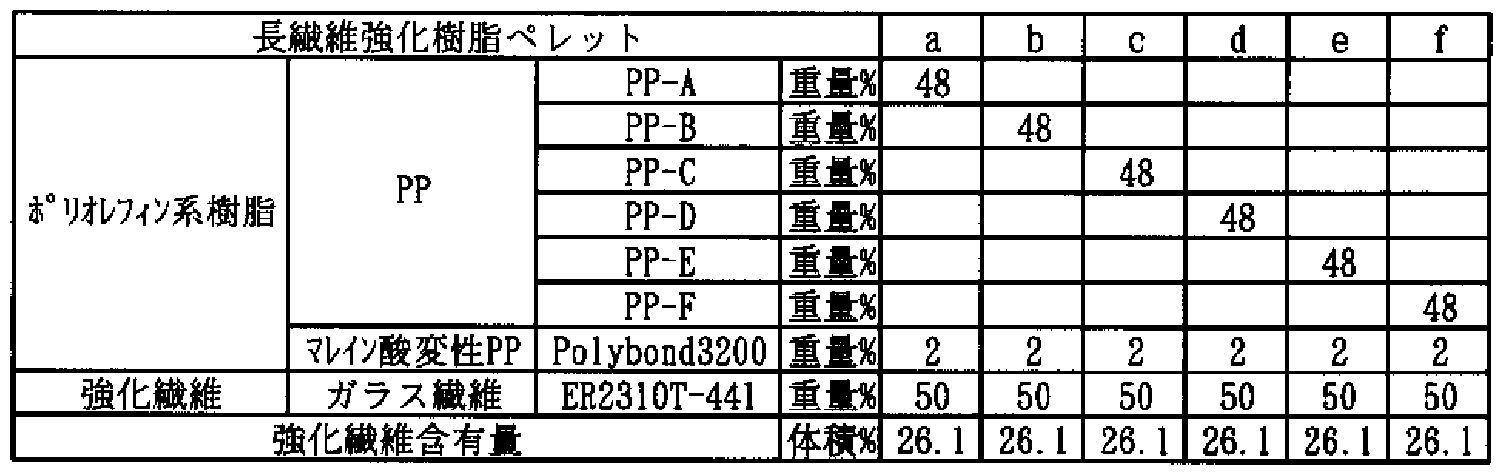
- the raw material resin (PP-A-PP-F) and maleic acid-modified polypropylene resin (UNIROY AL CHEMICAL, Polybond3200 (trade name), specific gravity: 0.9 g / cm 3 ) are shown in Table 3 below.
- the mixture was melted at 280 ° C and supplied to an impregnation tank in a 50 m ⁇ extruder cara die.
- the glass roving preheated at 200 ° C was fed into the impregnation tank while the supply speed was adjusted to 20 mZ, and opened with a rod in the tank, impregnated with the molten resin, pulled out of the impregnation tank and cooled. It was cut with a pelletizer to obtain a long fiber reinforced resin pellet (af) having a pellet length of 8 mm.
- the raw material resin PP-A-PP-F
- the maleic acid-modified polypropylene resin and carbon fiber Toho Tenax, HTA-C6-SRS (trade name), fiber diameter: 7 ⁇ m, specific gravity: 1 8g / cm 3 , treated with an epoxy sizing agent
- Table 5 below
- a twin screw extruder Toshiba Machine, TEM-35B (trade name), barrel temperature) : 200 ° C, screw rotation speed: 300 rpm
- a resin composition obtained in the above Examples and Comparative Examples was molded using a molding machine (AZZ resin, AZ 7000 (trade name)) into a 200 (w) x 100 (L) x 40 (h) box (thickness 3 mm (-constant), pin gate Z ⁇ 1.5 mm (1 point, cold)) It was molded and evaluated for warpage.
- Figures 1 and 2 show a diagram of this molded product and its development, respectively.
- the molding conditions are as follows.
- Injection hold time 15 seconds (primary filling time: 2 seconds)
- the (standing wall area) Z (projected area from the gate side) of this molded product is ⁇ (200 X 2+ 100 X
- the molded product is cured at room temperature (23 ° C) for 48 hours or more. The end of the plate was pressed, and the diagonal flat plate force was measured. The highest value was used as the warpage value by pressing the four end portions. The results are shown in Tables 4 and 5.
- the molded article obtained by molding the resin composition of the present invention may be used for automobile parts (front end, fan shroud, cooling fan, engine under cover, engine cover, radiator box, side door, back door inner, pack door outer. , Outer panels, roof rails, door handles, luggage boxes, wheel force pars, handles, cooling modules, air cleaners, lock nuts), motorcycles, bicycle parts (luggage boxes, handles, wheels), housing-related parts (hot water cleaning) Valve seat parts, bathroom parts, bathtub parts, chair legs, valves, meter boxes), washing machine parts (water tank's parlancering, etc.), fans for wind power generators, power tool parts, mower handles, hose joints, resin Can be used for applications such as port and concrete formwork
- the molded article of the present invention is particularly effective for bathtub parts (bath pans, bathroom pans), luggage boxes, air cleaner cases, engine power pars, personal computer housings, IC trays, etc., having standing walls or ribs.
Landscapes
- Chemical & Material Sciences (AREA)
- Health & Medical Sciences (AREA)
- Chemical Kinetics & Catalysis (AREA)
- Medicinal Chemistry (AREA)
- Polymers & Plastics (AREA)
- Organic Chemistry (AREA)
- Engineering & Computer Science (AREA)
- Manufacturing & Machinery (AREA)
- Materials Engineering (AREA)
- Compositions Of Macromolecular Compounds (AREA)
- Reinforced Plastic Materials (AREA)
Abstract
Description



Claims
Priority Applications (2)
| Application Number | Priority Date | Filing Date | Title |
|---|---|---|---|
| CN2005800019863A CN1906245B (zh) | 2004-02-03 | 2005-02-02 | 纤维强化聚烯烃系树脂组合物及其成形品 |
| KR1020067015647A KR101154651B1 (ko) | 2004-02-03 | 2006-08-02 | 섬유 강화 폴리올레핀계 수지 조성물 및 그의 성형품 |
Applications Claiming Priority (2)
| Application Number | Priority Date | Filing Date | Title |
|---|---|---|---|
| JP2004-027105 | 2004-02-03 | ||
| JP2004027105A JP4606034B2 (ja) | 2004-02-03 | 2004-02-03 | 繊維強化ポリオレフィン系樹脂組成物及びその成形品 |
Publications (1)
| Publication Number | Publication Date |
|---|---|
| WO2005075554A1 true WO2005075554A1 (ja) | 2005-08-18 |
Family
ID=34835882
Family Applications (1)
| Application Number | Title | Priority Date | Filing Date |
|---|---|---|---|
| PCT/JP2005/001461 Ceased WO2005075554A1 (ja) | 2004-02-03 | 2005-02-02 | 繊維強化ポリオレフィン系樹脂組成物及びその成形品 |
Country Status (4)
| Country | Link |
|---|---|
| JP (1) | JP4606034B2 (ja) |
| KR (1) | KR101154651B1 (ja) |
| CN (1) | CN1906245B (ja) |
| WO (1) | WO2005075554A1 (ja) |
Cited By (14)
| Publication number | Priority date | Publication date | Assignee | Title |
|---|---|---|---|---|
| GB2450196A (en) * | 2008-03-27 | 2008-12-17 | Gurit | Prepregs and manufacturing structural members of fibre-reinforced composite materials |
| WO2009116608A1 (ja) * | 2008-03-21 | 2009-09-24 | 株式会社プライムポリマー | 長繊維強化樹脂組成物及びその成形体 |
| US8664322B2 (en) | 2006-09-29 | 2014-03-04 | Cheil Industries Inc. | Thermoplastic resin composition and plastic article |
| JP5580303B2 (ja) * | 2009-05-29 | 2014-08-27 | 株式会社プライムポリマー | 長繊維強化樹脂組成物及びその成形体 |
| US9150704B2 (en) | 2011-06-21 | 2015-10-06 | Cheil Industries Inc. | Polyester resin composition |
| US9359500B2 (en) | 2012-12-28 | 2016-06-07 | Cheil Industries Inc. | Resin compositions and articles including the same |
| US9437790B2 (en) | 2011-12-28 | 2016-09-06 | Cheil Industries Inc. | Polyester resin composition having good yellowing resistance and impact resistance |
| US9493648B2 (en) | 2012-12-28 | 2016-11-15 | Samsung Sdi Co., Ltd. | Thermoplastic resin compositions and molded products including the same |
| US10131785B2 (en) | 2015-06-30 | 2018-11-20 | Lotte Advanced Materials Co., Ltd. | Polyester resin composition with excellent impact resistance and light reliability and molded article using the same |
| US10301449B2 (en) | 2013-11-29 | 2019-05-28 | Lotte Advanced Materials Co., Ltd. | Thermoplastic resin composition having excellent light stability at high temperature |
| US10508190B2 (en) | 2014-12-17 | 2019-12-17 | Lotte Advanced Materials Co., Ltd. | Polyester resin composition and molded article manufactured therefrom |
| US10636951B2 (en) | 2014-06-27 | 2020-04-28 | Lotte Advanced Materials Co., Ltd. | Thermoplastic resin composition having excellent reflectivity |
| US10822490B2 (en) | 2013-12-30 | 2020-11-03 | Lotte Advanced Materials Co., Ltd. | Thermoplastic resin composition having excellent shock resistance and light resistance |
| EP4180568A4 (en) * | 2020-07-07 | 2024-02-14 | Teijin Limited | Carbon fiber bundle with adhered sizing agent |
Families Citing this family (11)
| Publication number | Priority date | Publication date | Assignee | Title |
|---|---|---|---|---|
| JP4872352B2 (ja) * | 2006-01-13 | 2012-02-08 | 凸版印刷株式会社 | 床材 |
| JP2009167318A (ja) * | 2008-01-17 | 2009-07-30 | Toyoda Gosei Co Ltd | 成形体、その塗装製品及びその塗膜のボイド防止方法 |
| KR101665737B1 (ko) * | 2008-12-25 | 2016-10-12 | 도레이 카부시키가이샤 | 성형재료 및 수지 부착 강화 섬유 다발 |
| CN102604232A (zh) * | 2011-01-20 | 2012-07-25 | 合肥杰事杰新材料股份有限公司 | 一种抗静电聚丙烯材料及其制备方法 |
| CN103370353B (zh) * | 2011-02-16 | 2016-03-23 | 三菱丽阳株式会社 | 环氧树脂组合物、预浸料及纤维强化复合材料 |
| US20150315365A1 (en) * | 2012-12-07 | 2015-11-05 | Japan Polypropylene Corporation | Fiber-reinforced polypropylene resin composition and molded article of same |
| ES2733836T3 (es) | 2015-05-22 | 2019-12-03 | Borealis Ag | Composición polimérica reforzada con fibra |
| CN106496787A (zh) * | 2016-11-02 | 2017-03-15 | 无锡艾科瑞思产品设计与研究有限公司 | 一种聚丙烯复合材料拉杆箱的制备工艺 |
| KR101893353B1 (ko) * | 2017-10-13 | 2018-09-03 | 이국성 | 카본섬유와 열가소성 중합체가 혼합되어 제조되는 수지 조성물 및 그의 제조방법 |
| KR20240130725A (ko) * | 2021-12-28 | 2024-08-29 | 미쯔비시 가스 케미칼 컴파니, 인코포레이티드 | 펠릿, 성형품 및 펠릿의 제조 방법 |
| CN120603893A (zh) * | 2023-02-17 | 2025-09-05 | 普瑞曼聚合物株式会社 | 增强聚丙烯树脂组合物 |
Citations (8)
| Publication number | Priority date | Publication date | Assignee | Title |
|---|---|---|---|---|
| JPS6274942A (ja) * | 1985-09-30 | 1987-04-06 | Idemitsu Petrochem Co Ltd | ポリプロピレン樹脂組成物 |
| JPH04154817A (ja) * | 1990-10-19 | 1992-05-27 | Tokuyama Soda Co Ltd | ポリプロピレンの製造方法 |
| JPH0532723A (ja) * | 1991-06-28 | 1993-02-09 | Idemitsu Petrochem Co Ltd | ポリプロピレン樹脂及びその組成物 |
| JPH0753836A (ja) * | 1993-08-12 | 1995-02-28 | Mitsubishi Chem Corp | プロピレン系樹脂組成物及びその製造方法 |
| JPH0812825A (ja) * | 1994-06-28 | 1996-01-16 | Idemitsu Petrochem Co Ltd | 異形押出成形用ポリオレフィン系樹脂組成物及びそれを用いた異形押出成形体 |
| JP2000290444A (ja) * | 1999-04-07 | 2000-10-17 | Idemitsu Petrochem Co Ltd | 無機繊維含有ポリプロピレン系樹脂成形材料、成形方法および成形品 |
| JP2003138028A (ja) * | 2001-10-30 | 2003-05-14 | Japan Polychem Corp | 異型押出し成形品 |
| JP2003238749A (ja) * | 2002-02-20 | 2003-08-27 | Idemitsu Petrochem Co Ltd | 押出成形用プロピレン系重合体組成物 |
-
2004
- 2004-02-03 JP JP2004027105A patent/JP4606034B2/ja not_active Expired - Lifetime
-
2005
- 2005-02-02 WO PCT/JP2005/001461 patent/WO2005075554A1/ja not_active Ceased
- 2005-02-02 CN CN2005800019863A patent/CN1906245B/zh not_active Expired - Lifetime
-
2006
- 2006-08-02 KR KR1020067015647A patent/KR101154651B1/ko not_active Expired - Lifetime
Patent Citations (8)
| Publication number | Priority date | Publication date | Assignee | Title |
|---|---|---|---|---|
| JPS6274942A (ja) * | 1985-09-30 | 1987-04-06 | Idemitsu Petrochem Co Ltd | ポリプロピレン樹脂組成物 |
| JPH04154817A (ja) * | 1990-10-19 | 1992-05-27 | Tokuyama Soda Co Ltd | ポリプロピレンの製造方法 |
| JPH0532723A (ja) * | 1991-06-28 | 1993-02-09 | Idemitsu Petrochem Co Ltd | ポリプロピレン樹脂及びその組成物 |
| JPH0753836A (ja) * | 1993-08-12 | 1995-02-28 | Mitsubishi Chem Corp | プロピレン系樹脂組成物及びその製造方法 |
| JPH0812825A (ja) * | 1994-06-28 | 1996-01-16 | Idemitsu Petrochem Co Ltd | 異形押出成形用ポリオレフィン系樹脂組成物及びそれを用いた異形押出成形体 |
| JP2000290444A (ja) * | 1999-04-07 | 2000-10-17 | Idemitsu Petrochem Co Ltd | 無機繊維含有ポリプロピレン系樹脂成形材料、成形方法および成形品 |
| JP2003138028A (ja) * | 2001-10-30 | 2003-05-14 | Japan Polychem Corp | 異型押出し成形品 |
| JP2003238749A (ja) * | 2002-02-20 | 2003-08-27 | Idemitsu Petrochem Co Ltd | 押出成形用プロピレン系重合体組成物 |
Cited By (22)
| Publication number | Priority date | Publication date | Assignee | Title |
|---|---|---|---|---|
| US8664322B2 (en) | 2006-09-29 | 2014-03-04 | Cheil Industries Inc. | Thermoplastic resin composition and plastic article |
| WO2009116608A1 (ja) * | 2008-03-21 | 2009-09-24 | 株式会社プライムポリマー | 長繊維強化樹脂組成物及びその成形体 |
| US20110040022A1 (en) * | 2008-03-21 | 2011-02-17 | Prime Polymer Co., Ltd. | Long-fiber-reinforced resin composition and molded article thereof |
| JPWO2009116608A1 (ja) * | 2008-03-21 | 2011-07-21 | 株式会社プライムポリマー | 長繊維強化樹脂組成物及びその成形体 |
| US9359492B2 (en) | 2008-03-21 | 2016-06-07 | Prime Polymer Co., Ltd. | Long-fiber-reinforced resin composition and molded article thereof |
| GB2450196B (en) * | 2008-03-27 | 2009-08-26 | Gurit | Composite materials |
| WO2009118536A2 (en) | 2008-03-27 | 2009-10-01 | Gurit (Uk) Ltd. | Composite materials |
| GB2450196A (en) * | 2008-03-27 | 2008-12-17 | Gurit | Prepregs and manufacturing structural members of fibre-reinforced composite materials |
| JP5580303B2 (ja) * | 2009-05-29 | 2014-08-27 | 株式会社プライムポリマー | 長繊維強化樹脂組成物及びその成形体 |
| US9150704B2 (en) | 2011-06-21 | 2015-10-06 | Cheil Industries Inc. | Polyester resin composition |
| US9437790B2 (en) | 2011-12-28 | 2016-09-06 | Cheil Industries Inc. | Polyester resin composition having good yellowing resistance and impact resistance |
| US9359500B2 (en) | 2012-12-28 | 2016-06-07 | Cheil Industries Inc. | Resin compositions and articles including the same |
| US9493648B2 (en) | 2012-12-28 | 2016-11-15 | Samsung Sdi Co., Ltd. | Thermoplastic resin compositions and molded products including the same |
| US10301449B2 (en) | 2013-11-29 | 2019-05-28 | Lotte Advanced Materials Co., Ltd. | Thermoplastic resin composition having excellent light stability at high temperature |
| US10822490B2 (en) | 2013-12-30 | 2020-11-03 | Lotte Advanced Materials Co., Ltd. | Thermoplastic resin composition having excellent shock resistance and light resistance |
| US10636951B2 (en) | 2014-06-27 | 2020-04-28 | Lotte Advanced Materials Co., Ltd. | Thermoplastic resin composition having excellent reflectivity |
| US11355683B2 (en) | 2014-06-27 | 2022-06-07 | Lotte Chemical Corporation | Thermoplastic resin composition having excellent reflectivity |
| US10508190B2 (en) | 2014-12-17 | 2019-12-17 | Lotte Advanced Materials Co., Ltd. | Polyester resin composition and molded article manufactured therefrom |
| US10131785B2 (en) | 2015-06-30 | 2018-11-20 | Lotte Advanced Materials Co., Ltd. | Polyester resin composition with excellent impact resistance and light reliability and molded article using the same |
| US10538661B2 (en) | 2015-06-30 | 2020-01-21 | Lotte Advanced Materials Co., Ltd. | Polyester resin composition with excellent impact resistance and light reliability and molded article using the same |
| EP4180568A4 (en) * | 2020-07-07 | 2024-02-14 | Teijin Limited | Carbon fiber bundle with adhered sizing agent |
| US12428778B2 (en) | 2020-07-07 | 2025-09-30 | Teijin Limited | Carbon fiber bundle with adhered sizing agent |
Also Published As
| Publication number | Publication date |
|---|---|
| CN1906245A (zh) | 2007-01-31 |
| KR20070001944A (ko) | 2007-01-04 |
| JP2005220173A (ja) | 2005-08-18 |
| JP4606034B2 (ja) | 2011-01-05 |
| KR101154651B1 (ko) | 2012-06-08 |
| CN1906245B (zh) | 2011-05-25 |
Similar Documents
| Publication | Publication Date | Title |
|---|---|---|
| JP4606034B2 (ja) | 繊維強化ポリオレフィン系樹脂組成物及びその成形品 | |
| CN102159627B (zh) | 长纤维增强树脂组合物及其成型体 | |
| EP3081591B1 (en) | Carbon fiber-reinforced resin composition and molded article produced from same | |
| EP0333518A2 (en) | Fiber-reinforced polyamide composition and method of producing same | |
| JPS60203654A (ja) | ガラス繊維強化ポリプロピレン組成物 | |
| JP5580303B2 (ja) | 長繊維強化樹脂組成物及びその成形体 | |
| KR101526742B1 (ko) | 성형성이 우수한 탄소섬유 보강 폴리프로필렌 수지 조성물 | |
| CN101193953A (zh) | 制备纤维增强的聚丙烯复合物的方法 | |
| JP7126532B2 (ja) | 繊維強化ポリプロピレン系樹脂組成物およびその成形体 | |
| WO2008078838A1 (ja) | プロピレン系樹脂組成物及びそれからなる成形体 | |
| JP4606719B2 (ja) | 黒系着色した繊維強化樹脂組成物 | |
| JP2005213478A (ja) | ポリオレフィン系炭素繊維強化樹脂組成物及びそれからなる成形品 | |
| Wang et al. | Mechanical properties of polypropylene by diversely compatibilizing with titanate whiskers in composites | |
| JP4586372B2 (ja) | ポリオレフィン系炭素繊維強化樹脂組成物及びそれからなる成形品 | |
| JPWO2010073998A1 (ja) | 発泡成形体及び発泡成形体の製造方法 | |
| JP2005002202A (ja) | 繊維強化樹脂組成物及びその成形品 | |
| CN1702108B (zh) | 纤维-聚烯烃树脂复合材料 | |
| JP2024518642A (ja) | ポリプロピレン樹脂組成物、その製造方法及びそれを含む成形品 | |
| JP4779300B2 (ja) | 繊維−ポリプロピレン樹脂複合体とそのペレット、および繊維強化樹脂成形品 | |
| WO2005001276A1 (ja) | 内燃機関の吸気系部品用繊維強化樹脂組成物 | |
| JP2005298758A (ja) | 繊維強化樹脂組成物及びその成形品 | |
| JP2025101379A (ja) | ガラス長繊維強化プロピレン系樹脂組成物ペレット、射出成形体、およびそれらの製造方法 | |
| JP2022174644A (ja) | 繊維強化ポリプロピレン系樹脂組成物 | |
| JPWO2009072615A1 (ja) | 全芳香族ポリエステル繊維含有ポリオレフィン樹脂組成物およびその成形体 |
Legal Events
| Date | Code | Title | Description |
|---|---|---|---|
| AK | Designated states |
Kind code of ref document: A1 Designated state(s): AE AG AL AM AT AU AZ BA BB BG BR BW BY BZ CA CH CN CO CR CU CZ DE DK DM DZ EC EE EG ES FI GB GD GE GH GM HR HU ID IL IN IS KE KG KP KR KZ LC LK LR LS LT LU LV MA MD MG MK MN MW MX MZ NA NI NO NZ OM PG PH PL PT RO RU SC SD SE SG SK SL SY TJ TM TN TR TT TZ UA UG US UZ VC VN YU ZA ZM ZW |
|
| AL | Designated countries for regional patents |
Kind code of ref document: A1 Designated state(s): GM KE LS MW MZ NA SD SL SZ TZ UG ZM ZW AM AZ BY KG KZ MD RU TJ TM AT BE BG CH CY CZ DE DK EE ES FI FR GB GR HU IE IS IT LT LU MC NL PL PT RO SE SI SK TR BF BJ CF CG CI CM GA GN GQ GW ML MR NE SN TD TG |
|
| 121 | Ep: the epo has been informed by wipo that ep was designated in this application | ||
| WWE | Wipo information: entry into national phase |
Ref document number: 200580001986.3 Country of ref document: CN |
|
| WWE | Wipo information: entry into national phase |
Ref document number: 1020067015647 Country of ref document: KR |
|
| NENP | Non-entry into the national phase |
Ref country code: DE |
|
| WWW | Wipo information: withdrawn in national office |
Country of ref document: DE |
|
| WWP | Wipo information: published in national office |
Ref document number: 1020067015647 Country of ref document: KR |
|
| 122 | Ep: pct application non-entry in european phase |