US9217780B2 - Compensation technique for amplifiers in a current sensing circuit for a battery - Google Patents
Compensation technique for amplifiers in a current sensing circuit for a battery Download PDFInfo
- Publication number
- US9217780B2 US9217780B2 US14/149,739 US201414149739A US9217780B2 US 9217780 B2 US9217780 B2 US 9217780B2 US 201414149739 A US201414149739 A US 201414149739A US 9217780 B2 US9217780 B2 US 9217780B2
- Authority
- US
- United States
- Prior art keywords
- amplifier
- offset error
- phase
- during
- output
- Prior art date
- Legal status (The legal status is an assumption and is not a legal conclusion. Google has not performed a legal analysis and makes no representation as to the accuracy of the status listed.)
- Active, expires
Links
- 238000000034 method Methods 0.000 title claims description 11
- 230000008878 coupling Effects 0.000 claims abstract description 10
- 238000010168 coupling process Methods 0.000 claims abstract description 10
- 238000005859 coupling reaction Methods 0.000 claims abstract description 10
- 239000003990 capacitor Substances 0.000 description 28
- 238000012544 monitoring process Methods 0.000 description 13
- 238000004364 calculation method Methods 0.000 description 6
- 238000005259 measurement Methods 0.000 description 4
- 101710170230 Antimicrobial peptide 1 Proteins 0.000 description 3
- 101710170231 Antimicrobial peptide 2 Proteins 0.000 description 3
- 101000650775 Boana raniceps Raniseptin-1 Proteins 0.000 description 3
- 238000007599 discharging Methods 0.000 description 3
- 239000000446 fuel Substances 0.000 description 3
- 238000012937 correction Methods 0.000 description 2
- 101000650776 Boana raniceps Raniseptin-2 Proteins 0.000 description 1
- 101000650777 Boana raniceps Raniseptin-3 Proteins 0.000 description 1
- 238000013459 approach Methods 0.000 description 1
- 238000006243 chemical reaction Methods 0.000 description 1
- 230000000694 effects Effects 0.000 description 1
- 238000012986 modification Methods 0.000 description 1
- 230000004048 modification Effects 0.000 description 1
Images




Classifications
-
- G—PHYSICS
- G01—MEASURING; TESTING
- G01R—MEASURING ELECTRIC VARIABLES; MEASURING MAGNETIC VARIABLES
- G01R31/00—Arrangements for testing electric properties; Arrangements for locating electric faults; Arrangements for electrical testing characterised by what is being tested not provided for elsewhere
- G01R31/36—Arrangements for testing, measuring or monitoring the electrical condition of accumulators or electric batteries, e.g. capacity or state of charge [SoC]
- G01R31/374—Arrangements for testing, measuring or monitoring the electrical condition of accumulators or electric batteries, e.g. capacity or state of charge [SoC] with means for correcting the measurement for temperature or ageing
-
- G01R31/3624—
-
- G—PHYSICS
- G01—MEASURING; TESTING
- G01R—MEASURING ELECTRIC VARIABLES; MEASURING MAGNETIC VARIABLES
- G01R31/00—Arrangements for testing electric properties; Arrangements for locating electric faults; Arrangements for electrical testing characterised by what is being tested not provided for elsewhere
- G01R31/36—Arrangements for testing, measuring or monitoring the electrical condition of accumulators or electric batteries, e.g. capacity or state of charge [SoC]
- G01R31/382—Arrangements for monitoring battery or accumulator variables, e.g. SoC
- G01R31/3842—Arrangements for monitoring battery or accumulator variables, e.g. SoC combining voltage and current measurements
-
- G—PHYSICS
- G01—MEASURING; TESTING
- G01R—MEASURING ELECTRIC VARIABLES; MEASURING MAGNETIC VARIABLES
- G01R19/00—Arrangements for measuring currents or voltages or for indicating presence or sign thereof
- G01R19/0046—Arrangements for measuring currents or voltages or for indicating presence or sign thereof characterised by a specific application or detail not covered by any other subgroup of G01R19/00
-
- G—PHYSICS
- G01—MEASURING; TESTING
- G01R—MEASURING ELECTRIC VARIABLES; MEASURING MAGNETIC VARIABLES
- G01R19/00—Arrangements for measuring currents or voltages or for indicating presence or sign thereof
- G01R19/32—Compensating for temperature change
-
- G01R31/3655—
-
- H—ELECTRICITY
- H01—ELECTRIC ELEMENTS
- H01M—PROCESSES OR MEANS, e.g. BATTERIES, FOR THE DIRECT CONVERSION OF CHEMICAL ENERGY INTO ELECTRICAL ENERGY
- H01M10/00—Secondary cells; Manufacture thereof
- H01M10/42—Methods or arrangements for servicing or maintenance of secondary cells or secondary half-cells
- H01M10/48—Accumulators combined with arrangements for measuring, testing or indicating the condition of cells, e.g. the level or density of the electrolyte
-
- H—ELECTRICITY
- H03—ELECTRONIC CIRCUITRY
- H03F—AMPLIFIERS
- H03F3/00—Amplifiers with only discharge tubes or only semiconductor devices as amplifying elements
- H03F3/45—Differential amplifiers
- H03F3/45071—Differential amplifiers with semiconductor devices only
- H03F3/45076—Differential amplifiers with semiconductor devices only characterised by the way of implementation of the active amplifying circuit in the differential amplifier
- H03F3/45179—Differential amplifiers with semiconductor devices only characterised by the way of implementation of the active amplifying circuit in the differential amplifier using MOSFET transistors as the active amplifying circuit
-
- H—ELECTRICITY
- H03—ELECTRONIC CIRCUITRY
- H03F—AMPLIFIERS
- H03F3/00—Amplifiers with only discharge tubes or only semiconductor devices as amplifying elements
- H03F3/45—Differential amplifiers
- H03F3/45071—Differential amplifiers with semiconductor devices only
- H03F3/45076—Differential amplifiers with semiconductor devices only characterised by the way of implementation of the active amplifying circuit in the differential amplifier
- H03F3/45475—Differential amplifiers with semiconductor devices only characterised by the way of implementation of the active amplifying circuit in the differential amplifier using IC blocks as the active amplifying circuit
-
- H—ELECTRICITY
- H03—ELECTRONIC CIRCUITRY
- H03F—AMPLIFIERS
- H03F2203/00—Indexing scheme relating to amplifiers with only discharge tubes or only semiconductor devices as amplifying elements covered by H03F3/00
- H03F2203/45—Indexing scheme relating to differential amplifiers
- H03F2203/45048—Calibrating and standardising a dif amp
-
- H—ELECTRICITY
- H03—ELECTRONIC CIRCUITRY
- H03F—AMPLIFIERS
- H03F2203/00—Indexing scheme relating to amplifiers with only discharge tubes or only semiconductor devices as amplifying elements covered by H03F3/00
- H03F2203/45—Indexing scheme relating to differential amplifiers
- H03F2203/45138—Two or more differential amplifiers in IC-block form are combined, e.g. measuring amplifiers
-
- Y—GENERAL TAGGING OF NEW TECHNOLOGICAL DEVELOPMENTS; GENERAL TAGGING OF CROSS-SECTIONAL TECHNOLOGIES SPANNING OVER SEVERAL SECTIONS OF THE IPC; TECHNICAL SUBJECTS COVERED BY FORMER USPC CROSS-REFERENCE ART COLLECTIONS [XRACs] AND DIGESTS
- Y02—TECHNOLOGIES OR APPLICATIONS FOR MITIGATION OR ADAPTATION AGAINST CLIMATE CHANGE
- Y02E—REDUCTION OF GREENHOUSE GAS [GHG] EMISSIONS, RELATED TO ENERGY GENERATION, TRANSMISSION OR DISTRIBUTION
- Y02E60/00—Enabling technologies; Technologies with a potential or indirect contribution to GHG emissions mitigation
- Y02E60/10—Energy storage using batteries
Definitions
- FIG. 1 shows an example of a battery monitoring system or fuel gauge system.
- Battery current flows between a system node VSYS and a battery terminal VBATT through a main transistor (e.g., a transistor BATFET).
- a main transistor e.g., a transistor BATFET
- replica devices e.g., replica transistors Replica 1 and Replica 2
- the replica transistors Replica 1 and Replica 2 produce replica currents (e.g., a charging current I CHARGE and a discharge current I DISCHARGE ) that are a scaled down version of the battery current.
- the charging current I CHARGE and the discharge current I DISCHARGE flow through sensing resistors R 1 and R 2 , respectively.
- An analog to digital converter (ADC) samples the voltage across resistors R 1 and R 2 to determine the charge across the battery.
- the battery monitoring system uses the output of the ADC to monitor the battery.
- the system may use a feedback loop to control the voltage.
- amplifiers AMP 1 and AMP 2 control the voltage across control transistors M 1 and M 2 , respectively.
- the inputs of amplifier AMP 1 are coupled to the system node VSYS and the gate and source of replica transistor Replica 2 and the output is coupled to a control transistor M 1 .
- the inputs of amplifier AMP 2 are coupled to the system node VBATT and the drain of replica transistor Replica 1 and the output is coupled to a control transistor M 2 .
- Amplifiers AMP 1 and AMP 2 control the voltage at the gate of control transistors M 1 and M 2 , respectively, to produce the replica currents.
- offset error within each amplifier may cause errors in the replica currents.
- the resistor used to measure the voltage can cause errors across process and temperature variations.
- a circuit in one embodiment, includes a first amplifier having a first differential input, a second differential input, and an output.
- the first differential input is coupled to a replica device and a voltage of a battery and the output is coupled to a control device.
- the replica device is configured to generate a replica current of a current flowing through the battery where the first amplifier controls the control device to control the replica current.
- the circuit also includes a second amplifier having a third differential input, a fourth differential input, and an output.
- the second amplifier is configured to compensate for a first offset error of the first amplifier and a second offset error of the second amplifier based on selectively coupling the third differential input to the output of the first amplifier during a first phase, selectively coupling the output of the second amplifier to the second differential input during the first phase, and selectively coupling the output of the second amplifier to the fourth differential input during a second phase.
- the second amplifier stores the second offset error of the second amplifier on a first set of storage elements coupled to the fourth differential input of the second amplifier for use in compensating for the second offset error of the second amplifier during the first phase.
- the second amplifier stores the first offset error of the first amplifier on a second set of storage elements coupled to the second differential input of the first amplifier for use in compensating for the first offset error of the first amplifier during a subsequent second phase.
- a gain of the second amplifier is used to compensate for the first offset error during the first phase.
- the output of the second amplifier is a differential output
- the circuit further includes a common mode feedback circuit coupled to the differential output and configured to maintain a common mode portion of the differential output at a fixed value different from the voltage of the battery.
- the circuit further includes a resistor configured to receive the replica current, wherein a voltage across the resistor is sensed to monitor the voltage across the battery.
- a method includes: during a first phase, storing, by a second amplifier, a first offset error of a first amplifier on a first set of storage elements coupled to a differential input of the first amplifier for use in compensating for the first offset error of the first amplifier during a second phase; during the second phase, storing, by the second amplifier, a second offset error of the second amplifier on a second set of storage elements coupled to a differential input of the second amplifier for use in compensating for the second offset error of the second amplifier during a subsequent first phase; during the second phase, controlling, by the first amplifier, a control device to control a replica current generated by the replica device, the replica current being a replica of a current flowing through the battery, wherein the first offset error is compensated for using the first offset error stored during the first phase; and during the subsequent first phase, controlling, by the first amplifier, the control device to control the replica current, wherein a gain of the second amplifier is used to compensate for the first offset error and the second offset error is compensated for using the second offset error stored during
- FIG. 1 shows an example of a battery monitoring system or fuel gauge system.
- FIG. 2 depicts an example of a battery monitoring system according to one embodiment.
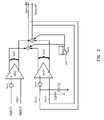
- FIG. 3 depicts an example of amplifier ErrAmp 2 during clock phase ⁇ 2 according to one embodiment.
- FIG. 4 depicts an example of amplifiers ErrAmp 1 (amplifiers A 1 and A 2 ) and ErrAmp 2 (amplifiers An 1 and An 2 ) during clock phase ⁇ 1 according to one embodiment.
- FIG. 5 depicts an example of amplifier ErrAmp 1 in clock phase ⁇ 2 according to one embodiment.
- FIGS. 6 and 7 show examples of implementations of ErrAmp 1 and ErrAmp 2 , respectively.
- FIG. 8 shows an example of a battery monitoring system using a single output of amplifier ErrAmp 2 according to one embodiment.
- FIG. 9 depicts a simplified flowchart of a method for compensating for offset error according to one embodiment.
- FIG. 10 shows an example implementation of resistor R 1 to compensate for temperature variations according to one embodiment.
- FIG. 11 depicts an example of the temperature correction using resistor rsp 1 according to one embodiment.
- FIG. 2 depicts an example of a battery monitoring system 200 according to one embodiment.
- Battery monitoring system 200 may monitor battery currents (e.g., discharging and charging currents) for a battery (BATT) 202 flowing through a transistor BATFET from a node VSYS to a node VBATT.
- BATT battery
- FIG. 2 only the charging current is shown, but a person skilled in the art will appreciate how to implement the battery monitoring system to monitor the discharging current.
- Battery monitoring system 200 may monitor the battery current using an internal (e.g., on chip) current-sensing resistor R 1 . Although an internal resistor is discussed, external (e.g., off chip) resistors may be used.
- System 200 uses a replica transistor Replica 1 to generate a replica current of a battery current I B that flows through battery transistor BATFET and battery 202 through a node VBATT.
- transistors BATFET and replica 1 may be N-channel MOSFET devices with their gate and sources coupled together. As shown, the replica current I CHARGE flows through transistor Replica 1 and may be a scaled-down version of the battery current I B .
- Amplifiers ErrAmp 1 and ErrAmp 2 form a feedback loop that controls the voltage across a replica device, such as a control transistor M, which operates in different operating regions (saturation or linear) depending on the mode of operation of a linear charger for battery 202 .
- amplifier ErrAmp 1 controls a gate voltage of control transistor M c to control the replica current I CHARGE through sensing resistor R 1 .
- the control of control transistor M c may regulate the replica current I CHARGE to be proportional to the battery current I B .
- an ADC (not shown) may measure the voltage across sensing resistor R 1 , where the output of the ADC is used by a battery management system or fuel gauge measurement algorithm.
- the offset error of the amplifiers may affect the performance of battery monitoring system 200 .
- the replica current I CHARGE may be small and the voltage across sensing resistor R 1 may be as low as hundreds of microvolts.
- the offset error of amplifiers ErrAmp 1 and ErrAmp 2 may affect the measured voltage.
- Particular embodiments compensate for the amplifier offset error and also employ a technique to reduce the effect of temperature variations on resistor R 1 .
- amplifier ErrAmp 1 may include a first differential input and a second differential input along with an output coupled to transistor M c .
- Amplifier ErrAmp 2 may include a first differential input, a second differential input, and a differential output. Accordingly, amplifier ErrAmp 1 and amplifier ErrAmp 2 have two gain stages as will be described in more detail below. Although amplifier ErrAmp 2 is described as having a differential output, amplifier ErrAmp 2 may have a single output. As will be discussed in more detail below, the differential output allows system 200 the compensation to be performed at a different voltage than VBATT or a rail voltage of the system.
- Amplifier ErrAmp 2 may be a nulling amplifier that is used to compensate for the offset error in the main amplifier ErrAmp 1 . Further, Amplifier ErrAmp 2 also compensates for its own offset error. As will be discussed in more detail below, the technique may be used continuously to track changes in the offset error and effectively compensate for the changes in the offset error. Thus, amplifiers ErrAmp 2 and ErrAmp 1 can track any shift in the offset errors due to operating conditions and compensate for the errors (e.g., null or zero the errors). Thus, the compensation may be better than a one-time compensation.
- Battery monitoring system 200 may use multiple clock phases, such as a clock phase ⁇ 1 and a clock phase ⁇ 2 , to compensate for the offset errors of amplifier ErrAmp 1 and amplifier ErrAmp 2 .
- clock phase ⁇ 1 amplifier ErrAmp 2 stores the offset error of amplifier ErrAmp 1 on capacitors C 1 . This value will be used to compensate for the offset error of amplifier ErrAmp 1 in a subsequent clock phase ⁇ 2 .
- system 200 stores the offset error of amplifier ErrAmp 2 on capacitors C 2 .
- switches S 1 and S 2 may be open or closed based on the clock phase. For example, switches S 1 are closed during clock phase ⁇ 1 and open during clock phase ⁇ 2 , and switches S 2 are closed during clock phase ⁇ 2 , and open during clock phase ⁇ 1 .
- the use of switches S 1 and S 2 couples the inputs and outputs of amplifiers ErrAmp 1 and ErrAmp 2 differently depending on the clock phase.
- FIG. 3 depicts an example of amplifier ErrAmp 2 during clock phase ⁇ 2 according to one embodiment.
- switches S 2 are closed and switches S 1 are open, which isolate the input and output of amplifier ErrAmp 2 from the input and output of amplifier ErrAmp 1 .
- amplifier ErrAmp 2 may be in an open loop gain configuration.
- amplifier ErrAmp 2 stores the offset error of amplifier ErrAmp 2 on capacitors C 2 during this clock phase.
- Amplifier ErrAmp 2 includes a first amplifier An 1 and a second amplifier An 2 that receive a first differential input and a second differential input, respectively. Both inputs of the differential input of amplifier An 1 are coupled to battery 102 .
- the offset error of amplifier An 1 is shown as an offset error voltage Von 1 at the input of one of the differential inputs.
- a feedback path from the output of amplifier ErrAmp 2 to the differential input of amplifier An 2 is used.
- the output of amplifier ErrAmp 2 (e.g., differential output VonullN and VonullP) is coupled to capacitors C 2 , which can store the offset error during clock phase ⁇ 2 .
- the offset error stored on capacitors C 2 includes an inferred offset error voltage Von 2 on one input of the differential input of amplifier An 2 and the offset error voltage Von 1 .
- CMFB common mode feedback circuit
- the differential output may be the combination of vn 1 +vn 2 , which reflect the offset errors Von 1 and Von 2 .
- the outputs VonullN and VonullP are then stored on capacitors C 2 during clock phase ⁇ 2 .
- V ocm A CMFB 1 + A CMFB ⁇ V ref
- V onullP V ocm + 1 2 ⁇ ( v n ⁇ ⁇ 1 + v n ⁇ ⁇ 2 ) ( 1 )
- V onullN V ocm - 1 2 ⁇ ( v n ⁇ ⁇ 1 + v n ⁇ ⁇ 2 ) ( 2 )
- v n ⁇ ⁇ 2 A n ⁇ ⁇ 2 ⁇ ( v on ⁇ ⁇ 2 - ⁇ ⁇ ⁇ V onull ) ( 4 )
- v n ⁇ ⁇ 1 A n ⁇ ⁇ 1 ⁇ ( VBATT - VBATT + v on ⁇ ⁇ 1 ) ( 5 ) ⁇ ⁇
- the voltage of the common mode amplifier Acm is based on the gain of amplifier Acm and a voltage Vref. Voltage Vref may be different from the voltage of the battery or rail, such as Vdd/2.
- Equation 1 shows the calculation for output VonullP and equation 2 shows the calculation for output VonullN.
- output VonullP is the common mode output voltage Vocm plus half of the differential output of vn 1 and vn 2 .
- Output VonullN is equal to the common mode voltage Vocm minus half of the differential output of vn 1 and vn 2 .
- Equation 3 shows the calculation of the differential between outputs VonullN and VonullP and equations 4 and 5 show the calculation of the amplifier outputs of vn 2 and vn 1 .
- equation 3 shows that the differential output ⁇ Vonull is equal to the amplifier outputs vn 1 and vn 2 as the common mode voltage Vocm cancels.
- Output vn 2 is equal to the gain of amplifier An 2 and the offset error of amplifier An 2 minus the differential output.
- Output vn 1 is equal to the gain of amplifier An 1 and the offset error of amplifier An 1 .
- the differential output voltage ⁇ Vonull may be determined based on equations 3, 4, and 5. Equation 6 shows that the differential output of amplifier ErrAmp 2 is based on the offset errors Von 1 and Von 2 of amplifiers An 1 and An 2 and the gain of error amplifiers An 1 and An 2 . These values are stored on capacitors C 2 during clock phase ⁇ 2 . As will be discussed in the next figure, the values stored on capacitors C 2 are used to cancel the offset errors Von 1 and Von 2 during the next clock phase ⁇ 1 .
- FIG. 4 depicts an example of amplifiers ErrAmp 1 (amplifiers A 1 and A 2 ) and ErrAmp 2 (amplifiers An 1 and An 2 ) during clock phase ⁇ 1 according to one embodiment.
- switches S 1 are closed and switches S 2 are open.
- This couples the differential output of ErrAmp 2 to a differential input of ErrAmp 1 .
- This stores the offset error for amplifier ErrAmp 1 on capacitors C 1 via amplifier ErrAmp 2 .
- the offset error of amplifier ErrAmp 2 is canceled via the previous stored values on capacitors C 2 in clock phase ⁇ 2 so that the amplifier ErrAmp 2 offset error does not affect the storing of the values on capacitors C 1 .
- the following will now discuss the offset compensation in more detail.
- amplifier ErrAmp 1 the inputs of amplifier A 1 are coupled to the output Vout of amplifier ErrAmp 1 and the voltage of battery 102 .
- the offset error of amplifier A 1 is shown as an offset error voltage Vo 1 on one of the inputs of amplifier A 1 .
- the differential input of amplifier A 2 is coupled to the differential output of amplifier ErrAmp 2 .
- the offset error of amplifier A 2 is shown as an offset error voltage Vo 2 on one of the inputs of amplifier A 2 .
- Equation 7 shows the differential voltage across capacitors C 1 :
- the differential output voltage of amplifier ErrAmp 2 is equal to the gain of amplifier An 1 times the difference between the battery voltage VBATT and the output voltage of amplifier ErrAmp 1 .
- the offset errors Von 1 and Von 2 of amplifiers An 1 and An 2 have been canceled in this case via the values stored on capacitors C 2 . That is, amplifier An 2 cancels offset error Von 2 and outputs offset error Von 1 (e.g., Von 1 times the gain of An 2 ). This outputted offset error Von 1 cancels the offset error from amplifier An 1 .
- Equation 8 shows the output of amplifier ErrAmp 1 as follows:
- equation 8 can be approximated to:
- FIG. 5 depicts an example of amplifier ErrAmp 1 in clock phase ⁇ 2 according to one embodiment.
- the inputs of amplifier A 1 are coupled to the output Vout of amplifier ErrAmp 1 and to the battery voltage VBATT.
- the offset error voltage Vo 1 is also shown at an input of amplifier A 1 .
- the inputs of amplifier A 2 are coupled to capacitors C 1 .
- the offset error voltage Vo 2 is also shown at an input of amplifier A 2 .
- capacitors C 1 hold the differential voltage ⁇ Vonull 1 , which is based on the gain of amplifiers A 1 and A 2 and the offset errors of amplifiers A 1 and A 2 of Vo 1 and Vo 2 .
- the differential output voltage of amplifier ErrAmp 2 is equal to the gain of Amplifier An 1 times the difference of VBATT and Vout.
- the values stored on capacitors C 1 are a function of the gain of amplifiers A 1 and A 2 and the offset errors Vo 1 and Vo 2 . Equation 10 summarizes these values:
- Equation 11 represents the determination of the output voltage Vout of ErrAmp 1 , which shows the cancellation of offset errors Vo 1 and Vo 2 as follows:
- the offset errors Vo 1 and Vo 2 are cancelled and the output voltage Vout of amplifier ErrAmp 1 approximately equals the battery voltage VBATT, Vout ⁇ VBATT.
- the values stored on capacitors C 1 include offset errors Vo 1 and Vo 2 .
- the offset error Vo 2 stored on capacitor C 1 cancels the offset error Vo 2 of amplifier A 2 .
- amplifier A 2 outputs offset error Vo 1 amplified by the gain A 2 of amplifier A 2 .
- amplifier A 1 outputs offset error Vo 1 amplified by the gain A 1 of amplifier A 1 .
- the outputs of amplifiers A 1 and A 2 are of the opposite polarity and thus cancel offset error Vo 1 when combined. Accordingly, the offset errors of Vo 1 and Vo 2 are cancelled in clock phase ⁇ 2 and output voltage Vout substantially equals the battery voltage VBATT.
- FIGS. 6 and 7 show examples of implementations of ErrAmp 1 and ErrAmp 2 , respectively. However, it will be understood that other implementations may be appreciated.
- differential amplifiers A 1 and A 2 are shown as a differential pair of transistors M A1 and a differential pair of transistors M A2 .
- Amplifiers A 1 and A 2 are coupled to a shared output stage 602 .
- Shared output stage 602 provides a resistor gain that converts a current output of differential amplifiers A 1 and A 2 into a voltage output. Different variations of shared output stage 602 may be appreciated.
- differential amplifiers An 1 and An 2 are shown as a differential pair of transistors M AN2 and a differential pair of transistors M AN1 , respectively.
- the output of amplifiers An 1 and An 2 are coupled to a shared output stage 702 .
- Shared output stage 702 also converts a current output of amplifiers An 1 and An 2 to a voltage, but the output of shared output stage 702 is a differential output Out ⁇ and Out+.
- a common mode feedback circuit 704 is coupled to the differential output and maintains an average value of the differential output at a fixed level based on a voltage Vref, which may be at a different level than the rail voltage, such as 1 ⁇ 2(Vdd).
- common mode feedback circuit 704 the differential voltage measurement is moved away from the rail voltage or battery voltage VBATT. For example, if the differential voltage measurement is close to the rail, then it might be hard to measure the differential voltage accurately. Thus, setting the common mode differential output voltage to a value, such as 1 ⁇ 2 of the rail voltage, makes calculating the offset at the average value more accurate. That is, outputs Out+ and Out ⁇ are both set at a common mode voltage. Then, the differential of outputs Out+ and Out ⁇ can be calculated based on that common mode value that is different from the rail voltage. The common mode voltage drops out while the differential voltage is output on outputs Out+ and Out ⁇ . Using the common mode voltage at around half the battery voltage VBATT may simplify the output stage 702 .
- FIG. 8 shows an example of a battery monitoring system 800 using a single output of amplifier ErrAmp 2 according to one embodiment. As shown, a single output of amplifier ErrAmp 2 is coupled to amplifier ErrAmp 1 . Also, the single output of amplifier ErrAmp 2 is coupled to an input of amplifier ErrAmp 2 in a feedback configuration. Another input of amplifier ErrAmp 2 and another input of amplifier ErrAmp 1 are coupled to a voltage Vref, which may be a voltage different from the rail voltage.
- the voltage stored across capacitors C 2 includes the offset errors Von 1 and Von 2 .
- these stored offset errors compensate for the offset errors of amplifier ErrAmp 2 .
- Vout VBATT due to the gain of amplifier An 2 (not shown) of amplifier ErrAmp 2 substantially canceling the offset errors of amplifier ErrAmp 1 .
- the offset error stored on capacitors C 1 cancels the error of amplifier ErrAmp 1 .
- FIG. 9 depicts a simplified flowchart 900 of a method for compensating for offset error according to one embodiment.
- amplifier ErrAm 2 stores a first offset error of amplifier ErrAmp 1 on capacitors C 1 for use in compensating for the offset error of amplifier ErrAmp 1 during a second phase.
- amplifier ErrAmp 2 stores an offset error of amplifier ErrAmp 2 on capacitors C 2 for use in compensating for the offset error of amplifier ErrAmp 2 during a subsequent first phase.
- amplifier ErrAmp 1 controls control transistor M C to control a replica current generated by the replica device.
- the first offset error is compensated for using the first offset error stored during the first phase.
- amplifier ErrAmp 1 controls control transistor M C to control the replica current where a gain of the second amplifier is used to compensate for the offset error of amplifier ErrAmp 1 and the offset error of amplifier ErrAmp 2 is compensated for using the offset error of amplifier ErrAmp 2 stored on capacitors C 2 during the second phase.
- sensing resistor R 1 may be located on chip and thus may be sensitive to temperature variations of the chip.
- FIG. 10 shows an example implementation of resistor R 1 to compensate for temperature variations according to one embodiment. The temperature variations may be compensated for during the current voltage conversion using two types of resistors.
- the first type of resistor R is a poly resistor with P+ doping having a negative temperature coefficient.
- the second type of resistors rsp are silicided and having a positive temperature coefficient. The opposite temperature coefficients can be used to compensate for temperature variations.
- the size of resistor rsp (e.g., rsp 1 , rsp 2 , rsp 3 , . . . rsp N) can be adjusted via taps 1002 . Different tap settings may be used to adjust for the temperature variation by opening or closing different taps to couple various resistors rsp to the replica current. The size of resistors rsp may then compensate for the temperature variation. For example, the size of resistors rsp will determine the final slope of the resistance with respect to temperatures.
- FIG. 11 depicts an example of the temperature correction using resistor rsp 1 according to one embodiment.
- Resistor RSP in FIG. 10 represents the combination of resistors rsp 1 -rspN that are coupled to the replica current based on the tap settings.
- Vout may be determined as follows: V out ⁇ 1 ⁇ 2( R+ 1 ⁇ 2 rsp ).
- the output voltage Vout across sensing resistor R 1 is equal to the resistance of R that is compensated by the resistance of resistor rsp.
- internal resistors are discussed as being used, particular embodiments may also use external resistors that are off-chip and thus do not need temperature compensation.
Landscapes
- Physics & Mathematics (AREA)
- General Physics & Mathematics (AREA)
- Engineering & Computer Science (AREA)
- Power Engineering (AREA)
- Manufacturing & Machinery (AREA)
- Chemical & Material Sciences (AREA)
- Chemical Kinetics & Catalysis (AREA)
- Electrochemistry (AREA)
- General Chemical & Material Sciences (AREA)
- Amplifiers (AREA)
- Measurement Of Current Or Voltage (AREA)
Priority Applications (6)
| Application Number | Priority Date | Filing Date | Title |
|---|---|---|---|
| US14/149,739 US9217780B2 (en) | 2014-01-07 | 2014-01-07 | Compensation technique for amplifiers in a current sensing circuit for a battery |
| KR1020167021298A KR101740581B1 (ko) | 2014-01-07 | 2015-01-07 | 배터리에 대한 전류 감지 회로에서 증폭기들에 대한 보상 기술 |
| CN201580003828.5A CN105899958B (zh) | 2014-01-07 | 2015-01-07 | 用于针对电池的电流感测电路中的放大器的补偿技术 |
| JP2016542735A JP6602766B2 (ja) | 2014-01-07 | 2015-01-07 | バッテリ用電流感知回路内の増幅器のための補償技術 |
| EP15701441.6A EP3092501B1 (en) | 2014-01-07 | 2015-01-07 | Compensation technique for amplifiers in a current sensing circuit for a battery |
| PCT/US2015/010529 WO2015105915A1 (en) | 2014-01-07 | 2015-01-07 | Compensation technique for amplifiers in a current sensing circuit for a battery |
Applications Claiming Priority (1)
| Application Number | Priority Date | Filing Date | Title |
|---|---|---|---|
| US14/149,739 US9217780B2 (en) | 2014-01-07 | 2014-01-07 | Compensation technique for amplifiers in a current sensing circuit for a battery |
Publications (2)
| Publication Number | Publication Date |
|---|---|
| US20150192642A1 US20150192642A1 (en) | 2015-07-09 |
| US9217780B2 true US9217780B2 (en) | 2015-12-22 |
Family
ID=52424124
Family Applications (1)
| Application Number | Title | Priority Date | Filing Date |
|---|---|---|---|
| US14/149,739 Active 2034-08-09 US9217780B2 (en) | 2014-01-07 | 2014-01-07 | Compensation technique for amplifiers in a current sensing circuit for a battery |
Country Status (6)
| Country | Link |
|---|---|
| US (1) | US9217780B2 (enExample) |
| EP (1) | EP3092501B1 (enExample) |
| JP (1) | JP6602766B2 (enExample) |
| KR (1) | KR101740581B1 (enExample) |
| CN (1) | CN105899958B (enExample) |
| WO (1) | WO2015105915A1 (enExample) |
Cited By (2)
| Publication number | Priority date | Publication date | Assignee | Title |
|---|---|---|---|---|
| US11422168B2 (en) | 2020-09-16 | 2022-08-23 | Nxp Usa, Inc. | On-chip, low-voltage, current sensing circuit |
| US12068743B2 (en) * | 2022-02-21 | 2024-08-20 | Fuji Electric Co., Ltd. | Semiconductor device |
Families Citing this family (4)
| Publication number | Priority date | Publication date | Assignee | Title |
|---|---|---|---|---|
| JP6338807B1 (ja) * | 2017-11-13 | 2018-06-06 | 三菱電機株式会社 | Ab級アンプおよびオペアンプ |
| KR102717913B1 (ko) * | 2020-07-08 | 2024-10-18 | 한국전력공사 | 축전지 성능 진단장치 및 방법 |
| CN116848781A (zh) * | 2021-02-04 | 2023-10-03 | 半导体元件工业有限责任公司 | 具有浮置输入级的精密运算放大器 |
| EP4170906B1 (en) * | 2021-10-20 | 2024-06-19 | STMicroelectronics S.r.l. | Current sensing in switched electronic devices |
Citations (15)
| Publication number | Priority date | Publication date | Assignee | Title |
|---|---|---|---|---|
| US5498984A (en) | 1994-09-30 | 1996-03-12 | Maxim Integrated Products | High side, current sense amplifier using a symmetric amplifier |
| US5945853A (en) | 1997-04-24 | 1999-08-31 | Sanyo Electric Co., Ltd. | Current sensing circuit with automatic offset compensation |
| US20020180418A1 (en) | 2001-05-30 | 2002-12-05 | Texas Instruments Incorporated | Current sense amplifier and method |
| US20090137211A1 (en) * | 2007-11-28 | 2009-05-28 | Motorola, Inc. | Method and apparatus for reconfigurable frequency generation |
| WO2012117275A2 (en) | 2011-03-01 | 2012-09-07 | Sendyne Corp. | Current sensor |
| US20120249243A1 (en) | 2011-03-30 | 2012-10-04 | Microchip Technology Incorporated | Low switching error, small capacitors, auto-zero offset buffer amplifier |
| US20130033309A1 (en) | 2011-08-01 | 2013-02-07 | Jung-Hyun Choi | Poly silicon resistor, reference voltage circuit comprising the same, and manufacturing method of poly silicon resistor |
| US20130120027A1 (en) * | 2010-09-15 | 2013-05-16 | Fumihiro Inoue | Differential circuit |
| US20130134988A1 (en) * | 2011-11-30 | 2013-05-30 | Standard Microsystems Corporation | Method and system for high gain auto-zeroing arrangement for electronic circuits |
| US8476890B2 (en) | 2008-02-05 | 2013-07-02 | Qualcomm Incorporated | Circuits and methods for controlling a switching regulator based on a derived input current |
| US8525497B2 (en) | 2010-02-04 | 2013-09-03 | Rickhtek Tecnology Corp. | Using offset cancellation circuit to mitigate beat-frequency oscillation of phase currents in a multiphase interleaved voltage regulator |
| US8901891B2 (en) * | 2009-02-25 | 2014-12-02 | Panasonic Corporation | Voltage polarity determination circuit and charge amount measurement circuit |
| US20150022241A1 (en) * | 2012-03-22 | 2015-01-22 | Seiko Instruments Inc. | Sensor device |
| US20150040687A1 (en) * | 2012-04-27 | 2015-02-12 | Seiko Instruments Inc. | Sensor device |
| US20150145588A1 (en) * | 2013-11-22 | 2015-05-28 | Analog Devices, Inc. | Bi-directional current sensor |
Family Cites Families (12)
| Publication number | Priority date | Publication date | Assignee | Title |
|---|---|---|---|---|
| NL8503394A (nl) * | 1985-12-10 | 1987-07-01 | Philips Nv | Stroomaftastschakeling voor een vermogenshalfgeleiderinrichting, in het bijzonder geintegreerde intelligente vermogenshalfgeleiderschakelaar voor met name automobieltoepassingen. |
| JP3102020B2 (ja) * | 1990-08-15 | 2000-10-23 | 日本電気株式会社 | 演算増幅回路 |
| US5495154A (en) * | 1993-04-29 | 1996-02-27 | Sgs-Thomson Microelectronics, Inc. | Method and apparatus for Kelvin current sensing in a multi-phase driver for a polyphase DC motor |
| DE19706946C2 (de) * | 1997-02-21 | 2000-06-21 | Daimler Chrysler Ag | Battierüberwachungseinheit |
| JP2000004129A (ja) * | 1998-06-17 | 2000-01-07 | Toshiba Ave Co Ltd | Cmosアナログ回路 |
| US6914425B2 (en) * | 2003-04-29 | 2005-07-05 | Teradyne, Inc. | Measurement circuit with improved accuracy |
| US7382183B2 (en) * | 2006-07-18 | 2008-06-03 | Microchip Technology Incorporated | Minimizing switching noise and its effects in auto-zeroed amplifiers |
| JP2009081749A (ja) * | 2007-09-27 | 2009-04-16 | Hitachi Ltd | 低オフセット入力回路 |
| JP4976323B2 (ja) * | 2008-03-06 | 2012-07-18 | 株式会社リコー | 充電制御回路 |
| DE102008032556B3 (de) * | 2008-07-10 | 2009-09-10 | Infineon Technologies Austria Ag | Leistungsschalter mit einer Überstromschutzvorrichtung |
| US8350597B2 (en) * | 2008-10-15 | 2013-01-08 | Nxp B.V. | Low voltage self calibrated CMOS peak detector |
| EP2572452B1 (en) * | 2010-05-21 | 2014-07-16 | Freescale Semiconductor, Inc. | Power switching apparatus and method for improving current sense accuracy |
-
2014
- 2014-01-07 US US14/149,739 patent/US9217780B2/en active Active
-
2015
- 2015-01-07 KR KR1020167021298A patent/KR101740581B1/ko active Active
- 2015-01-07 WO PCT/US2015/010529 patent/WO2015105915A1/en not_active Ceased
- 2015-01-07 JP JP2016542735A patent/JP6602766B2/ja active Active
- 2015-01-07 CN CN201580003828.5A patent/CN105899958B/zh not_active Expired - Fee Related
- 2015-01-07 EP EP15701441.6A patent/EP3092501B1/en not_active Not-in-force
Patent Citations (16)
| Publication number | Priority date | Publication date | Assignee | Title |
|---|---|---|---|---|
| US5498984A (en) | 1994-09-30 | 1996-03-12 | Maxim Integrated Products | High side, current sense amplifier using a symmetric amplifier |
| US5945853A (en) | 1997-04-24 | 1999-08-31 | Sanyo Electric Co., Ltd. | Current sensing circuit with automatic offset compensation |
| US20020180418A1 (en) | 2001-05-30 | 2002-12-05 | Texas Instruments Incorporated | Current sense amplifier and method |
| US20090137211A1 (en) * | 2007-11-28 | 2009-05-28 | Motorola, Inc. | Method and apparatus for reconfigurable frequency generation |
| US8476890B2 (en) | 2008-02-05 | 2013-07-02 | Qualcomm Incorporated | Circuits and methods for controlling a switching regulator based on a derived input current |
| US8901891B2 (en) * | 2009-02-25 | 2014-12-02 | Panasonic Corporation | Voltage polarity determination circuit and charge amount measurement circuit |
| US8525497B2 (en) | 2010-02-04 | 2013-09-03 | Rickhtek Tecnology Corp. | Using offset cancellation circuit to mitigate beat-frequency oscillation of phase currents in a multiphase interleaved voltage regulator |
| US20130120027A1 (en) * | 2010-09-15 | 2013-05-16 | Fumihiro Inoue | Differential circuit |
| US20130009655A1 (en) * | 2011-03-01 | 2013-01-10 | Sendyne Corporation | Current sensor |
| WO2012117275A2 (en) | 2011-03-01 | 2012-09-07 | Sendyne Corp. | Current sensor |
| US20120249243A1 (en) | 2011-03-30 | 2012-10-04 | Microchip Technology Incorporated | Low switching error, small capacitors, auto-zero offset buffer amplifier |
| US20130033309A1 (en) | 2011-08-01 | 2013-02-07 | Jung-Hyun Choi | Poly silicon resistor, reference voltage circuit comprising the same, and manufacturing method of poly silicon resistor |
| US20130134988A1 (en) * | 2011-11-30 | 2013-05-30 | Standard Microsystems Corporation | Method and system for high gain auto-zeroing arrangement for electronic circuits |
| US20150022241A1 (en) * | 2012-03-22 | 2015-01-22 | Seiko Instruments Inc. | Sensor device |
| US20150040687A1 (en) * | 2012-04-27 | 2015-02-12 | Seiko Instruments Inc. | Sensor device |
| US20150145588A1 (en) * | 2013-11-22 | 2015-05-28 | Analog Devices, Inc. | Bi-directional current sensor |
Non-Patent Citations (1)
| Title |
|---|
| International Search Report and Written Opinion-PCT/US2015/010529-ISA/EPO-Apr. 2, 2015. |
Cited By (2)
| Publication number | Priority date | Publication date | Assignee | Title |
|---|---|---|---|---|
| US11422168B2 (en) | 2020-09-16 | 2022-08-23 | Nxp Usa, Inc. | On-chip, low-voltage, current sensing circuit |
| US12068743B2 (en) * | 2022-02-21 | 2024-08-20 | Fuji Electric Co., Ltd. | Semiconductor device |
Also Published As
| Publication number | Publication date |
|---|---|
| WO2015105915A1 (en) | 2015-07-16 |
| JP2017503416A (ja) | 2017-01-26 |
| JP6602766B2 (ja) | 2019-11-06 |
| EP3092501B1 (en) | 2017-09-13 |
| KR101740581B1 (ko) | 2017-05-26 |
| KR20160098518A (ko) | 2016-08-18 |
| US20150192642A1 (en) | 2015-07-09 |
| CN105899958B (zh) | 2018-11-23 |
| CN105899958A (zh) | 2016-08-24 |
| EP3092501A1 (en) | 2016-11-16 |
Similar Documents
| Publication | Publication Date | Title |
|---|---|---|
| US20150192642A1 (en) | Compensation technique for amplifiers in a current sensing circuit for a battery | |
| US9444414B2 (en) | Current sense circuit using a single opamp having DC offset auto-zeroing | |
| US8796998B2 (en) | Bidirectional current sense | |
| US9671438B2 (en) | High-current sensing scheme using drain-source voltage | |
| US7656233B2 (en) | Apparatus for high power amplifier in wireless communication system | |
| US9217777B2 (en) | Current sense circuit for measuring a charge level of a battery | |
| US8242770B2 (en) | Voltage sensing device | |
| CN110366820A (zh) | 功率放大器自发热补偿电路 | |
| US8717033B2 (en) | Integrated MOSFET current sensing for fuel-gauging | |
| CN104571242B (zh) | 电压调节器 | |
| US20120274360A1 (en) | Switched capacitance voltage differential sensing circuit with near infinite input impedance | |
| JPH1169635A (ja) | 充放電電流検出機能付き充放電制御回路及び充電式電源装置 | |
| WO2007007765A1 (ja) | 電流電圧変換回路、それを用いた消費電力検出回路および電子機器 | |
| CN104458034A (zh) | 温度检测方法和温度检测装置 | |
| US6400225B1 (en) | Differential difference amplifier for amplifying small signals close to zero volts | |
| IT9068063A1 (it) | Circuito per il trattamento del segnale fornito da un sensore di ossigeno del tipo allo zirconio. | |
| US9733276B2 (en) | Precise current measurement with chopping technique for high power driver | |
| US7126423B1 (en) | Differential difference amplifier for amplifying small signals close to zero volts | |
| CN114152797A (zh) | 自动调节偏移电压的电流传感器 | |
| JPS62211563A (ja) | 電流検出装置 | |
| US20200043849A1 (en) | Power transistor coupled to multiple sense transistors | |
| CN103970170A (zh) | 一种恒流环路 | |
| Galliana et al. | High accuracy transportable selectable-Value High Dc Voltage Standard |
Legal Events
| Date | Code | Title | Description |
|---|---|---|---|
| AS | Assignment |
Owner name: QUALCOMM INCORPORATED, CALIFORNIA Free format text: ASSIGNMENT OF ASSIGNORS INTEREST;ASSIGNOR:BASHAR, ANIRUDDHA;REEL/FRAME:033590/0458 Effective date: 20140121 |
|
| FEPP | Fee payment procedure |
Free format text: PAYOR NUMBER ASSIGNED (ORIGINAL EVENT CODE: ASPN); ENTITY STATUS OF PATENT OWNER: LARGE ENTITY |
|
| STCF | Information on status: patent grant |
Free format text: PATENTED CASE |
|
| MAFP | Maintenance fee payment |
Free format text: PAYMENT OF MAINTENANCE FEE, 4TH YEAR, LARGE ENTITY (ORIGINAL EVENT CODE: M1551); ENTITY STATUS OF PATENT OWNER: LARGE ENTITY Year of fee payment: 4 |
|
| MAFP | Maintenance fee payment |
Free format text: PAYMENT OF MAINTENANCE FEE, 8TH YEAR, LARGE ENTITY (ORIGINAL EVENT CODE: M1552); ENTITY STATUS OF PATENT OWNER: LARGE ENTITY Year of fee payment: 8 |