US10172885B2 - Cell - Google Patents
Cell Download PDFInfo
- Publication number
- US10172885B2 US10172885B2 US15/037,405 US201415037405A US10172885B2 US 10172885 B2 US10172885 B2 US 10172885B2 US 201415037405 A US201415037405 A US 201415037405A US 10172885 B2 US10172885 B2 US 10172885B2
- Authority
- US
- United States
- Prior art keywords
- car
- nucleic acid
- acid sequence
- cell
- endodomain
- Prior art date
- Legal status (The legal status is an assumption and is not a legal conclusion. Google has not performed a legal analysis and makes no representation as to the accuracy of the status listed.)
- Active
Links
Images






Classifications
-
- A—HUMAN NECESSITIES
- A61—MEDICAL OR VETERINARY SCIENCE; HYGIENE
- A61K—PREPARATIONS FOR MEDICAL, DENTAL OR TOILETRY PURPOSES
- A61K35/00—Medicinal preparations containing materials or reaction products thereof with undetermined constitution
- A61K35/12—Materials from mammals; Compositions comprising non-specified tissues or cells; Compositions comprising non-embryonic stem cells; Genetically modified cells
- A61K35/14—Blood; Artificial blood
- A61K35/17—Lymphocytes; B-cells; T-cells; Natural killer cells; Interferon-activated or cytokine-activated lymphocytes
-
- A—HUMAN NECESSITIES
- A61—MEDICAL OR VETERINARY SCIENCE; HYGIENE
- A61K—PREPARATIONS FOR MEDICAL, DENTAL OR TOILETRY PURPOSES
- A61K39/00—Medicinal preparations containing antigens or antibodies
- A61K39/0005—Vertebrate antigens
- A61K39/0011—Cancer antigens
-
- A—HUMAN NECESSITIES
- A61—MEDICAL OR VETERINARY SCIENCE; HYGIENE
- A61K—PREPARATIONS FOR MEDICAL, DENTAL OR TOILETRY PURPOSES
- A61K40/00—Cellular immunotherapy
- A61K40/10—Cellular immunotherapy characterised by the cell type used
- A61K40/11—T-cells, e.g. tumour infiltrating lymphocytes [TIL] or regulatory T [Treg] cells; Lymphokine-activated killer [LAK] cells
-
- A—HUMAN NECESSITIES
- A61—MEDICAL OR VETERINARY SCIENCE; HYGIENE
- A61K—PREPARATIONS FOR MEDICAL, DENTAL OR TOILETRY PURPOSES
- A61K40/00—Cellular immunotherapy
- A61K40/30—Cellular immunotherapy characterised by the recombinant expression of specific molecules in the cells of the immune system
- A61K40/31—Chimeric antigen receptors [CAR]
-
- A—HUMAN NECESSITIES
- A61—MEDICAL OR VETERINARY SCIENCE; HYGIENE
- A61K—PREPARATIONS FOR MEDICAL, DENTAL OR TOILETRY PURPOSES
- A61K40/00—Cellular immunotherapy
- A61K40/40—Cellular immunotherapy characterised by antigens that are targeted or presented by cells of the immune system
- A61K40/41—Vertebrate antigens
- A61K40/42—Cancer antigens
- A61K40/4202—Receptors, cell surface antigens or cell surface determinants
-
- A—HUMAN NECESSITIES
- A61—MEDICAL OR VETERINARY SCIENCE; HYGIENE
- A61K—PREPARATIONS FOR MEDICAL, DENTAL OR TOILETRY PURPOSES
- A61K40/00—Cellular immunotherapy
- A61K40/40—Cellular immunotherapy characterised by antigens that are targeted or presented by cells of the immune system
- A61K40/41—Vertebrate antigens
- A61K40/42—Cancer antigens
- A61K40/4202—Receptors, cell surface antigens or cell surface determinants
- A61K40/421—Immunoglobulin superfamily
- A61K40/4211—CD19 or B4
-
- A—HUMAN NECESSITIES
- A61—MEDICAL OR VETERINARY SCIENCE; HYGIENE
- A61K—PREPARATIONS FOR MEDICAL, DENTAL OR TOILETRY PURPOSES
- A61K40/00—Cellular immunotherapy
- A61K40/40—Cellular immunotherapy characterised by antigens that are targeted or presented by cells of the immune system
- A61K40/41—Vertebrate antigens
- A61K40/42—Cancer antigens
- A61K40/4202—Receptors, cell surface antigens or cell surface determinants
- A61K40/4221—CD20
-
- A—HUMAN NECESSITIES
- A61—MEDICAL OR VETERINARY SCIENCE; HYGIENE
- A61K—PREPARATIONS FOR MEDICAL, DENTAL OR TOILETRY PURPOSES
- A61K40/00—Cellular immunotherapy
- A61K40/40—Cellular immunotherapy characterised by antigens that are targeted or presented by cells of the immune system
- A61K40/41—Vertebrate antigens
- A61K40/42—Cancer antigens
- A61K40/4202—Receptors, cell surface antigens or cell surface determinants
- A61K40/4224—Molecules with a "CD" designation not provided for elsewhere
-
- A—HUMAN NECESSITIES
- A61—MEDICAL OR VETERINARY SCIENCE; HYGIENE
- A61P—SPECIFIC THERAPEUTIC ACTIVITY OF CHEMICAL COMPOUNDS OR MEDICINAL PREPARATIONS
- A61P31/00—Antiinfectives, i.e. antibiotics, antiseptics, chemotherapeutics
- A61P31/12—Antivirals
-
- A—HUMAN NECESSITIES
- A61—MEDICAL OR VETERINARY SCIENCE; HYGIENE
- A61P—SPECIFIC THERAPEUTIC ACTIVITY OF CHEMICAL COMPOUNDS OR MEDICINAL PREPARATIONS
- A61P35/00—Antineoplastic agents
-
- A—HUMAN NECESSITIES
- A61—MEDICAL OR VETERINARY SCIENCE; HYGIENE
- A61P—SPECIFIC THERAPEUTIC ACTIVITY OF CHEMICAL COMPOUNDS OR MEDICINAL PREPARATIONS
- A61P35/00—Antineoplastic agents
- A61P35/02—Antineoplastic agents specific for leukemia
-
- A—HUMAN NECESSITIES
- A61—MEDICAL OR VETERINARY SCIENCE; HYGIENE
- A61P—SPECIFIC THERAPEUTIC ACTIVITY OF CHEMICAL COMPOUNDS OR MEDICINAL PREPARATIONS
- A61P37/00—Drugs for immunological or allergic disorders
- A61P37/02—Immunomodulators
-
- A—HUMAN NECESSITIES
- A61—MEDICAL OR VETERINARY SCIENCE; HYGIENE
- A61P—SPECIFIC THERAPEUTIC ACTIVITY OF CHEMICAL COMPOUNDS OR MEDICINAL PREPARATIONS
- A61P37/00—Drugs for immunological or allergic disorders
- A61P37/02—Immunomodulators
- A61P37/06—Immunosuppressants, e.g. drugs for graft rejection
-
- A—HUMAN NECESSITIES
- A61—MEDICAL OR VETERINARY SCIENCE; HYGIENE
- A61P—SPECIFIC THERAPEUTIC ACTIVITY OF CHEMICAL COMPOUNDS OR MEDICINAL PREPARATIONS
- A61P37/00—Drugs for immunological or allergic disorders
- A61P37/08—Antiallergic agents
-
- C—CHEMISTRY; METALLURGY
- C07—ORGANIC CHEMISTRY
- C07K—PEPTIDES
- C07K14/00—Peptides having more than 20 amino acids; Gastrins; Somatostatins; Melanotropins; Derivatives thereof
- C07K14/435—Peptides having more than 20 amino acids; Gastrins; Somatostatins; Melanotropins; Derivatives thereof from animals; from humans
- C07K14/705—Receptors; Cell surface antigens; Cell surface determinants
- C07K14/70503—Immunoglobulin superfamily
-
- C—CHEMISTRY; METALLURGY
- C07—ORGANIC CHEMISTRY
- C07K—PEPTIDES
- C07K14/00—Peptides having more than 20 amino acids; Gastrins; Somatostatins; Melanotropins; Derivatives thereof
- C07K14/435—Peptides having more than 20 amino acids; Gastrins; Somatostatins; Melanotropins; Derivatives thereof from animals; from humans
- C07K14/705—Receptors; Cell surface antigens; Cell surface determinants
- C07K14/70503—Immunoglobulin superfamily
- C07K14/7051—T-cell receptor (TcR)-CD3 complex
-
- C—CHEMISTRY; METALLURGY
- C07—ORGANIC CHEMISTRY
- C07K—PEPTIDES
- C07K14/00—Peptides having more than 20 amino acids; Gastrins; Somatostatins; Melanotropins; Derivatives thereof
- C07K14/435—Peptides having more than 20 amino acids; Gastrins; Somatostatins; Melanotropins; Derivatives thereof from animals; from humans
- C07K14/705—Receptors; Cell surface antigens; Cell surface determinants
- C07K14/70503—Immunoglobulin superfamily
- C07K14/70517—CD8
-
- C—CHEMISTRY; METALLURGY
- C07—ORGANIC CHEMISTRY
- C07K—PEPTIDES
- C07K14/00—Peptides having more than 20 amino acids; Gastrins; Somatostatins; Melanotropins; Derivatives thereof
- C07K14/435—Peptides having more than 20 amino acids; Gastrins; Somatostatins; Melanotropins; Derivatives thereof from animals; from humans
- C07K14/705—Receptors; Cell surface antigens; Cell surface determinants
- C07K14/70503—Immunoglobulin superfamily
- C07K14/70521—CD28, CD152
-
- C—CHEMISTRY; METALLURGY
- C07—ORGANIC CHEMISTRY
- C07K—PEPTIDES
- C07K14/00—Peptides having more than 20 amino acids; Gastrins; Somatostatins; Melanotropins; Derivatives thereof
- C07K14/435—Peptides having more than 20 amino acids; Gastrins; Somatostatins; Melanotropins; Derivatives thereof from animals; from humans
- C07K14/705—Receptors; Cell surface antigens; Cell surface determinants
- C07K14/70589—CD45
-
- C—CHEMISTRY; METALLURGY
- C07—ORGANIC CHEMISTRY
- C07K—PEPTIDES
- C07K16/00—Immunoglobulins [IG], e.g. monoclonal or polyclonal antibodies
- C07K16/18—Immunoglobulins [IG], e.g. monoclonal or polyclonal antibodies against material from animals or humans
- C07K16/28—Immunoglobulins [IG], e.g. monoclonal or polyclonal antibodies against material from animals or humans against receptors, cell surface antigens or cell surface determinants
- C07K16/2803—Immunoglobulins [IG], e.g. monoclonal or polyclonal antibodies against material from animals or humans against receptors, cell surface antigens or cell surface determinants against the immunoglobulin superfamily
-
- C—CHEMISTRY; METALLURGY
- C12—BIOCHEMISTRY; BEER; SPIRITS; WINE; VINEGAR; MICROBIOLOGY; ENZYMOLOGY; MUTATION OR GENETIC ENGINEERING
- C12N—MICROORGANISMS OR ENZYMES; COMPOSITIONS THEREOF; PROPAGATING, PRESERVING, OR MAINTAINING MICROORGANISMS; MUTATION OR GENETIC ENGINEERING; CULTURE MEDIA
- C12N15/00—Mutation or genetic engineering; DNA or RNA concerning genetic engineering, vectors, e.g. plasmids, or their isolation, preparation or purification; Use of hosts therefor
- C12N15/09—Recombinant DNA-technology
- C12N15/63—Introduction of foreign genetic material using vectors; Vectors; Use of hosts therefor; Regulation of expression
- C12N15/79—Vectors or expression systems specially adapted for eukaryotic hosts
- C12N15/85—Vectors or expression systems specially adapted for eukaryotic hosts for animal cells
-
- C—CHEMISTRY; METALLURGY
- C12—BIOCHEMISTRY; BEER; SPIRITS; WINE; VINEGAR; MICROBIOLOGY; ENZYMOLOGY; MUTATION OR GENETIC ENGINEERING
- C12N—MICROORGANISMS OR ENZYMES; COMPOSITIONS THEREOF; PROPAGATING, PRESERVING, OR MAINTAINING MICROORGANISMS; MUTATION OR GENETIC ENGINEERING; CULTURE MEDIA
- C12N15/00—Mutation or genetic engineering; DNA or RNA concerning genetic engineering, vectors, e.g. plasmids, or their isolation, preparation or purification; Use of hosts therefor
- C12N15/09—Recombinant DNA-technology
- C12N15/63—Introduction of foreign genetic material using vectors; Vectors; Use of hosts therefor; Regulation of expression
- C12N15/79—Vectors or expression systems specially adapted for eukaryotic hosts
- C12N15/85—Vectors or expression systems specially adapted for eukaryotic hosts for animal cells
- C12N15/86—Viral vectors
-
- C—CHEMISTRY; METALLURGY
- C12—BIOCHEMISTRY; BEER; SPIRITS; WINE; VINEGAR; MICROBIOLOGY; ENZYMOLOGY; MUTATION OR GENETIC ENGINEERING
- C12N—MICROORGANISMS OR ENZYMES; COMPOSITIONS THEREOF; PROPAGATING, PRESERVING, OR MAINTAINING MICROORGANISMS; MUTATION OR GENETIC ENGINEERING; CULTURE MEDIA
- C12N5/00—Undifferentiated human, animal or plant cells, e.g. cell lines; Tissues; Cultivation or maintenance thereof; Culture media therefor
- C12N5/06—Animal cells or tissues; Human cells or tissues
- C12N5/0602—Vertebrate cells
- C12N5/0634—Cells from the blood or the immune system
- C12N5/0636—T lymphocytes
-
- C—CHEMISTRY; METALLURGY
- C12—BIOCHEMISTRY; BEER; SPIRITS; WINE; VINEGAR; MICROBIOLOGY; ENZYMOLOGY; MUTATION OR GENETIC ENGINEERING
- C12N—MICROORGANISMS OR ENZYMES; COMPOSITIONS THEREOF; PROPAGATING, PRESERVING, OR MAINTAINING MICROORGANISMS; MUTATION OR GENETIC ENGINEERING; CULTURE MEDIA
- C12N5/00—Undifferentiated human, animal or plant cells, e.g. cell lines; Tissues; Cultivation or maintenance thereof; Culture media therefor
- C12N5/06—Animal cells or tissues; Human cells or tissues
- C12N5/0602—Vertebrate cells
- C12N5/0634—Cells from the blood or the immune system
- C12N5/0636—T lymphocytes
- C12N5/0637—Immunosuppressive T lymphocytes, e.g. regulatory T cells or Treg
-
- C—CHEMISTRY; METALLURGY
- C12—BIOCHEMISTRY; BEER; SPIRITS; WINE; VINEGAR; MICROBIOLOGY; ENZYMOLOGY; MUTATION OR GENETIC ENGINEERING
- C12N—MICROORGANISMS OR ENZYMES; COMPOSITIONS THEREOF; PROPAGATING, PRESERVING, OR MAINTAINING MICROORGANISMS; MUTATION OR GENETIC ENGINEERING; CULTURE MEDIA
- C12N5/00—Undifferentiated human, animal or plant cells, e.g. cell lines; Tissues; Cultivation or maintenance thereof; Culture media therefor
- C12N5/06—Animal cells or tissues; Human cells or tissues
- C12N5/0602—Vertebrate cells
- C12N5/0634—Cells from the blood or the immune system
- C12N5/0636—T lymphocytes
- C12N5/0638—Cytotoxic T lymphocytes [CTL] or lymphokine activated killer cells [LAK]
-
- C—CHEMISTRY; METALLURGY
- C12—BIOCHEMISTRY; BEER; SPIRITS; WINE; VINEGAR; MICROBIOLOGY; ENZYMOLOGY; MUTATION OR GENETIC ENGINEERING
- C12N—MICROORGANISMS OR ENZYMES; COMPOSITIONS THEREOF; PROPAGATING, PRESERVING, OR MAINTAINING MICROORGANISMS; MUTATION OR GENETIC ENGINEERING; CULTURE MEDIA
- C12N5/00—Undifferentiated human, animal or plant cells, e.g. cell lines; Tissues; Cultivation or maintenance thereof; Culture media therefor
- C12N5/06—Animal cells or tissues; Human cells or tissues
- C12N5/0602—Vertebrate cells
- C12N5/0634—Cells from the blood or the immune system
- C12N5/0646—Natural killers cells [NK], NKT cells
-
- C—CHEMISTRY; METALLURGY
- C12—BIOCHEMISTRY; BEER; SPIRITS; WINE; VINEGAR; MICROBIOLOGY; ENZYMOLOGY; MUTATION OR GENETIC ENGINEERING
- C12N—MICROORGANISMS OR ENZYMES; COMPOSITIONS THEREOF; PROPAGATING, PRESERVING, OR MAINTAINING MICROORGANISMS; MUTATION OR GENETIC ENGINEERING; CULTURE MEDIA
- C12N9/00—Enzymes; Proenzymes; Compositions thereof; Processes for preparing, activating, inhibiting, separating or purifying enzymes
- C12N9/14—Hydrolases (3)
- C12N9/16—Hydrolases (3) acting on ester bonds (3.1)
-
- C—CHEMISTRY; METALLURGY
- C12—BIOCHEMISTRY; BEER; SPIRITS; WINE; VINEGAR; MICROBIOLOGY; ENZYMOLOGY; MUTATION OR GENETIC ENGINEERING
- C12Y—ENZYMES
- C12Y301/00—Hydrolases acting on ester bonds (3.1)
- C12Y301/03—Phosphoric monoester hydrolases (3.1.3)
- C12Y301/03048—Protein-tyrosine-phosphatase (3.1.3.48)
-
- A—HUMAN NECESSITIES
- A61—MEDICAL OR VETERINARY SCIENCE; HYGIENE
- A61K—PREPARATIONS FOR MEDICAL, DENTAL OR TOILETRY PURPOSES
- A61K39/00—Medicinal preparations containing antigens or antibodies
- A61K2039/51—Medicinal preparations containing antigens or antibodies comprising whole cells, viruses or DNA/RNA
- A61K2039/515—Animal cells
- A61K2039/5158—Antigen-pulsed cells, e.g. T-cells
-
- A—HUMAN NECESSITIES
- A61—MEDICAL OR VETERINARY SCIENCE; HYGIENE
- A61K—PREPARATIONS FOR MEDICAL, DENTAL OR TOILETRY PURPOSES
- A61K2239/00—Indexing codes associated with cellular immunotherapy of group A61K40/00
- A61K2239/10—Indexing codes associated with cellular immunotherapy of group A61K40/00 characterized by the structure of the chimeric antigen receptor [CAR]
- A61K2239/11—Antigen recognition domain
- A61K2239/13—Antibody-based
-
- A—HUMAN NECESSITIES
- A61—MEDICAL OR VETERINARY SCIENCE; HYGIENE
- A61K—PREPARATIONS FOR MEDICAL, DENTAL OR TOILETRY PURPOSES
- A61K2239/00—Indexing codes associated with cellular immunotherapy of group A61K40/00
- A61K2239/10—Indexing codes associated with cellular immunotherapy of group A61K40/00 characterized by the structure of the chimeric antigen receptor [CAR]
- A61K2239/17—Hinge-spacer domain
-
- A—HUMAN NECESSITIES
- A61—MEDICAL OR VETERINARY SCIENCE; HYGIENE
- A61K—PREPARATIONS FOR MEDICAL, DENTAL OR TOILETRY PURPOSES
- A61K2239/00—Indexing codes associated with cellular immunotherapy of group A61K40/00
- A61K2239/27—Indexing codes associated with cellular immunotherapy of group A61K40/00 characterized by targeting or presenting multiple antigens
- A61K2239/28—Expressing multiple CARs, TCRs or antigens
-
- A—HUMAN NECESSITIES
- A61—MEDICAL OR VETERINARY SCIENCE; HYGIENE
- A61K—PREPARATIONS FOR MEDICAL, DENTAL OR TOILETRY PURPOSES
- A61K38/00—Medicinal preparations containing peptides
-
- C—CHEMISTRY; METALLURGY
- C07—ORGANIC CHEMISTRY
- C07K—PEPTIDES
- C07K2317/00—Immunoglobulins specific features
- C07K2317/50—Immunoglobulins specific features characterized by immunoglobulin fragments
- C07K2317/52—Constant or Fc region; Isotype
-
- C—CHEMISTRY; METALLURGY
- C07—ORGANIC CHEMISTRY
- C07K—PEPTIDES
- C07K2317/00—Immunoglobulins specific features
- C07K2317/60—Immunoglobulins specific features characterized by non-natural combinations of immunoglobulin fragments
- C07K2317/62—Immunoglobulins specific features characterized by non-natural combinations of immunoglobulin fragments comprising only variable region components
- C07K2317/622—Single chain antibody (scFv)
-
- C—CHEMISTRY; METALLURGY
- C07—ORGANIC CHEMISTRY
- C07K—PEPTIDES
- C07K2319/00—Fusion polypeptide
- C07K2319/01—Fusion polypeptide containing a localisation/targetting motif
-
- C—CHEMISTRY; METALLURGY
- C07—ORGANIC CHEMISTRY
- C07K—PEPTIDES
- C07K2319/00—Fusion polypeptide
- C07K2319/01—Fusion polypeptide containing a localisation/targetting motif
- C07K2319/02—Fusion polypeptide containing a localisation/targetting motif containing a signal sequence
-
- C—CHEMISTRY; METALLURGY
- C07—ORGANIC CHEMISTRY
- C07K—PEPTIDES
- C07K2319/00—Fusion polypeptide
- C07K2319/01—Fusion polypeptide containing a localisation/targetting motif
- C07K2319/03—Fusion polypeptide containing a localisation/targetting motif containing a transmembrane segment
-
- C—CHEMISTRY; METALLURGY
- C07—ORGANIC CHEMISTRY
- C07K—PEPTIDES
- C07K2319/00—Fusion polypeptide
- C07K2319/70—Fusion polypeptide containing domain for protein-protein interaction
- C07K2319/74—Fusion polypeptide containing domain for protein-protein interaction containing a fusion for binding to a cell surface receptor
-
- C—CHEMISTRY; METALLURGY
- C12—BIOCHEMISTRY; BEER; SPIRITS; WINE; VINEGAR; MICROBIOLOGY; ENZYMOLOGY; MUTATION OR GENETIC ENGINEERING
- C12N—MICROORGANISMS OR ENZYMES; COMPOSITIONS THEREOF; PROPAGATING, PRESERVING, OR MAINTAINING MICROORGANISMS; MUTATION OR GENETIC ENGINEERING; CULTURE MEDIA
- C12N2510/00—Genetically modified cells
-
- C—CHEMISTRY; METALLURGY
- C12—BIOCHEMISTRY; BEER; SPIRITS; WINE; VINEGAR; MICROBIOLOGY; ENZYMOLOGY; MUTATION OR GENETIC ENGINEERING
- C12N—MICROORGANISMS OR ENZYMES; COMPOSITIONS THEREOF; PROPAGATING, PRESERVING, OR MAINTAINING MICROORGANISMS; MUTATION OR GENETIC ENGINEERING; CULTURE MEDIA
- C12N2740/00—Reverse transcribing RNA viruses
- C12N2740/00011—Details
- C12N2740/10011—Retroviridae
- C12N2740/10041—Use of virus, viral particle or viral elements as a vector
- C12N2740/10043—Use of virus, viral particle or viral elements as a vector viral genome or elements thereof as genetic vector
-
- C—CHEMISTRY; METALLURGY
- C12—BIOCHEMISTRY; BEER; SPIRITS; WINE; VINEGAR; MICROBIOLOGY; ENZYMOLOGY; MUTATION OR GENETIC ENGINEERING
- C12N—MICROORGANISMS OR ENZYMES; COMPOSITIONS THEREOF; PROPAGATING, PRESERVING, OR MAINTAINING MICROORGANISMS; MUTATION OR GENETIC ENGINEERING; CULTURE MEDIA
- C12N2740/00—Reverse transcribing RNA viruses
- C12N2740/00011—Details
- C12N2740/10011—Retroviridae
- C12N2740/15011—Lentivirus, not HIV, e.g. FIV, SIV
- C12N2740/15041—Use of virus, viral particle or viral elements as a vector
- C12N2740/15043—Use of virus, viral particle or viral elements as a vector viral genome or elements thereof as genetic vector
Definitions
- the present invention relates to a cell which comprises more than one chimeric antigen receptor (CAR).
- the cell may be capable of specifically recognising a target cell, due to a differential pattern of expression (or non-expression) of two or more antigens by the target cell.
- immunotherapeutic agents have been described for use in cancer treatment, including therapeutic monoclonal antibodies (mAbs), immunoconjugated mAbs, radioconjugated mAbs and bi-specific T-cell engagers.
- these immunotherapeutic agents target a single antigen: for instance, Rituximab targets CD20; Myelotarg targets CD33; and Alemtuzumab targets CD52.
- ERBB2 On-target off-tumour toxicity has been bourne out by clinical trials. For example, an approach targeting ERBB2 caused death to a patient with colon cancer metastatic to the lungs and liver. ERBB2 is over-expressed in colon cancer in some patients, but it is also expressed on several normal tissues, including heart and normal vasculature.
- a tumour is best defined by presence of one antigen (typically a tissue-specific antigen) and the absence of another antigen which is present on normal cells.
- one antigen typically a tissue-specific antigen
- AML acute myeloid leukaemia
- Normal stem cells express CD33 but also express CD34, while AML cells are typically CD34 negative.
- Targeting CD33 alone to treat AML is associated with significant toxicity as it depletes normal stem cells.
- specifically targeting cells which are CD33 positive but not CD34 positive would avoid this considerable off-target toxicity.
- Chimeric antigen receptors are proteins which graft the specificity of a monoclonal antibody (mAb) to the effector function of a T-cell. Their usual form is that of a type I transmembrane domain protein with an antigen recognizing amino terminus, a spacer, a transmembrane domain all connected to a compound endodomain which transmits T-cell survival and activation signals (see FIG. 1A ).
- scFv single-chain variable fragments
- CAR-expressing T cells is also associated with on-target, off tumour toxicity.
- CAIX carboxy anyhydrase-IX
- a CAR-based approach targeting carboxy anyhydrase-IX (CAIX) to treat renal cell carcinoma resulted in liver toxicity which is thought to be caused by the specific attack on bile duct epithelial cells (Lamers et al (2013) Mol. Ther. 21:904-912.
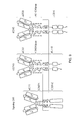
- FIG. 1 (a) Generalized architecture of a CAR: A binding domain recognizes antigen; the spacer elevates the binding domain from the cell surface; the trans-membrane domain anchors the protein to the membrane and the endodomain transmits signals. (b) to (d): Different generations and permutations of CAR endodomains: (b) initial designs transmitted ITAM signals alone through Fc ⁇ R1- ⁇ or CD3 ⁇ endodomain, while later designs transmitted additional (c) one or (d) two co-stimulatory signals in cis.
- FIG. 2 Schematic diagram illustrating the invention
- the invention relates to engineering T-cells to respond to logical rules of target cell antigen expression. This is best illustrated with an imaginary FACS scatter-plot.
- Target cell populations express both, either or neither of antigens “A” and “B”.
- Different target populations (marked in red) are killed by T-cells transduced with a pair of CARs connected by different gates.
- OR gated receptors both single-positive and double-positive cells will be killed.
- AND gated receptors only double-positive target cells are killed. With AND NOT gating, double-positive targets are preserved while single-positive targets
- FIG. 3 Creation of target cell populations
- SupT1 cells were used as target cells. These cells were transduced to express either CD19, CD33 or both CD19 and CD33. Target cells were stained with appropriate antibodies and analysed by flow cytometry.
- FIG. 4 Cassette design for an OR gate
- a single open reading frame provides both CARs with an in-frame FMD-2A sequence resulting in two proteins.
- Signal1 is a signal peptide derived from IgG1 (but can be any effective signal peptide).
- scFv1 is the single-chain variable segment which recognizes CD19 (but can be a scFv or peptide loop or ligand or in fact any domain which recognizes any desired arbitrary target).
- STK is the CD8 stalk but may be any suitable extracellular domain.
- CD28tm is the CD28 trans-membrane domain but can by any stable type I protein transmembrane domain and CD3Z is the CD3 Zeta endodomain but can be any endodomain which contains ITAMs.
- Signal2 is a signal peptide derived from CD8 but can be any effective signal peptide which is different in DNA sequence from signal1.
- scFv recognizes CD33 but as for scFv1 is arbitrary.
- HC2CH3 is the hinge-CH2-CH3 of human IgG1 but can be any extracellular domain which does not cross-pair with the spacer used in the first CAR.
- CD28tm′ and CD3Z′ code for the same protein sequence as CD28tm and CD3Z but are codon-wobbled to prevent homologous recombination.
- FIG. 5 Schematic representation of the chimeric antigen receptors (CARs) for an OR gate Stimulatory CARs were constructed consisting of either an N-terminal A) anti-CD19 scFv domain followed by the extracellular hinge region of human CD8 or B) anti-CD33 scFv domain followed by the extracellular hinge, CH2 and CH3 (containing a pvaa mutation to reduce FcR binding) region of human IgG1. Both receptors contain a human CD28 transmembrane domain and a human CD3 Zeta (CD247) intracellular domain. “S” depicts the presence of disulphide bonds.
- FIG. 6 Expression data showing co-expression of both CARs on the surface of one T-cell.
- FIG. 7 Functional analysis of the OR gate Effector cells (5 ⁇ 10 ⁇ 4 cells) expressing the OR gate construct were co-incubated with a varying number of target cells and IL-2 was analysed after 16 hours by ELISA.
- the graph displays the average maximum IL-2 secretion from a chemical stimulation (PMA and lonomycin) of the effector cells alone and the average background IL-2 from effector cells without any stimulus from three replicates.
- FIG. 8 Cartoon showing both versions of the cassette used to express both AND gates Activating and inhibiting CARs were co-expressed once again using a FMD-2A sequence.
- Signal1 is a signal peptide derived from IgG1 (but can be any effective signal peptide).
- scFv1 is the single-chain variable segment which recognizes CD19 (but can be a scFv or peptide loop or ligand or in fact any domain which recognizes any desired arbitrary target).
- STK is the CD8 stalk but may be any non-bulky extracellular domain.
- CD28tm is the CD28 trans-membrane domain but can by any stable type I protein transmembrane domain and CD3Z is the CD3 Zeta endodomain but can be any endodomain which contains ITAMs.
- Signal2 is a signal peptide derived from CD8 but can be any effective signal peptide which is different in DNA sequence from signal1.
- scFv recognizes CD33 but as for scFv1 is arbitrary.
- HC2CH3 is the hinge-CH2-CH3 of human IgG1 but can be any bulky extracellular domain.
- CD45 and CD148 are the transmembrane and endodomains of CD45 and CD148 respectively but can be derived from any of this class of protein.
- FIG. 9 Schematic representation of the protein structure of chimeric antigen receptors (CARs) for the AND gates
- the stimulatory CAR consisting of an N-terminal anti-CD19 scFv domain followed by the extracellular stalk region of human CD8, human CD28 transmembrane domain and human CD3 Zeta (CD247) intracellular domain.
- Two inhibitory CARs were tested. These consist of an N-terminal anti-CD33 scFv domain followed by the extracellular hinge, CH2 and CH3 (containing a pvaa mutation to reduce FcR binding) region of human IgG1 followed by the transmembrane and intracellular domain of either human CD148 or CD45.
- “S” depicts the presence of disulphide bonds.
- FIG. 10 Co-expression of activation and inhibitory CARs
- BW5147 cells were used as effector cells and were transduced to express both the activation anti-CD19 CAR and one of the inhibitory anti-CD33 CARs. Effector cells were stained with CD19-mouse-Fc and CD33-rabbit-Fc and with appropriate secondary antibodies and analysed by flow cytometry.
- FIG. 11 Functional analysis of the AND gates
- Effector cells (5 ⁇ 10 ⁇ 4 cells) expressing activation anti-CD19 CAR and the inhibitory anti-CD33 CAR with the A) CD148 or B) CXD45 intracellular domain were co-incubated with a varying number of target cells and IL-2 was analysed after 16 hours by ELISA.
- the graph displays the maximum IL-2 secretion from a chemical stimulation (PMA and lonomycin) of the effector cells alone and the background IL-2 from effector cells without any stimulus from three replicates.
- FIG. 12 Cartoon showing three versions of the cassette used to generate the AND NOT gate
- Signal1 is a signal peptide derived from IgG1 (but can be any effective signal peptide).
- scFv1 is the single-chain variable segment which recognizes CD19 (but can be a scFv or peptide loop or ligand or in fact any domain which recognizes any desired arbitrary target).
- STK is the human CD8 stalk but may be any non-bulky extracellular domain.
- CD28tm is the CD28 trans-membrane domain but can by any stable type I protein transmembrane domain and CD3Z is the CD3 Zeta endodomain but can be any endodomain which contains ITAMs.
- Signal2 is a signal peptide derived from CD8 but can be any effective signal peptide which is different in DNA sequence from signal1.
- scFv recognizes CD33 but as for scFv1 is arbitrary.
- muSTK is the mouse CD8 stalk but can be any spacer which co-localises but does not cross-pair with that of the activating CAR.
- dPTPN6 is the phosphatase domain of PTPN6.
- LAIR1 is the transmembrane and endodomain of LAIR1.
- 2Aw is a codon-wobbled version of the FMD-2A sequence.
- SH2-CD148 is the SH2 domain of PTPN6 fused with the phosphatase domain of CD148.
- FIG. 13 Schematic representation of the chimeric antigen receptors (CARs) for the NOT AND gates
- a stimulatory CAR consisting of an N-terminal anti-CD19 scFv domain followed by the stalk region of human CD8, human CD28 transmembrane domain and human CD247 intracellular domain.
- FIG. 14 Functional analysis of the NOT AND gate
- Effector cells (5 ⁇ 10 ⁇ 4 cells) expressing the A) full length SHP-1 or B) truncated form of SHP-1 were co-incubated with a varying number of target cells and IL-2 was analysed after 16 hours by ELISA.
- the graph displays the average maximum IL-2 secretion from a chemical stimulation (PMA and lonomycin) of the effector cells alone and the average background IL-2 from effector cells without any stimulus from three replicates.
- FIG. 15 Amino acid sequence of an OR gate
- FIG. 16 Amino acid sequence of a CD148 and a CD145 based AND gate
- FIG. 17 Amino acid sequence of two AND NOT gates
- FIG. 18 Dissection of AND gate function
- FIG. 19 Expression of target antigens on artificial target cells
- FIG. 20 Generalizability of the AND gate
- CD19 AND EGFRvIII AND gate Left: expression of AND gate is shown recombinant CD19-Fc staining (x-axis) for the CD19 CAR, versus anti-human-Fc staining (Y-axis) for the EGFRvIII CAR. Right: function in response to single positive and double positive targets.
- D. CD19 AND CD5 AND gate: Left: expression of AND gate is shown recombinant CD19-Fc staining (x-axis) for the CD19 CAR, versus anti-human-Fc staining (Y-axis) for the CD5 CAR. Right: function in response to single positive and double positive targets.
- FIG. 21 Function of the AND NOT gates
- a cartoon of the gates tested is shown to the right, and function in response to single positive and double positive targets is shown to the left.
- A. PTPN6 based AND NOT gate whereby the first CAR recognizes CD19, has a human CD8 stalk spacer and an ITAM containing activating endodomain; is co-expressed with a second CAR that recognizes CD33, has a mouse CD8 stalk spacer and has an endodomain comprising of a PTPN6 phosphatase domain.
- B. ITIM based AND NOT gate is identical to the PTPN6 gate, except the endodomain is replaced by the endodomain from LAIR1.
- CD148 boosted AND NOT gate is identical to the ITIM based gate except an additional fusion between the PTPN6 SH2 and the endodomain of CD148 is expressed. All three gates work as expected with activation in response to CD19 but not in response to CD19 and CD33 together.
- FIG. 22 Dissection of PTPN6 based AND NOT gate function
- the original PTPN6 based AND NOT gate is compared with several controls to demonstrate the model.
- a cartoon of the gates tested is shown to the right, and function in response to single positive and double positive targets is shown to the left.
- A. Original AND NOT gate whereby the first CAR recognizes CD19, has a human CD8 stalk spacer and an ITAM containing activating endodomain; is co-expressed with a second CAR recognizes CD33, has a mouse CD8 stalk spacer and has an endodomain comprising of a PTPN6 phosphatase domain.
- Original AND NOT gate functions as expected triggering in response to CD19, but not in response to both CD19 and CD33.
- the gate in B. triggers both in response to CD19 along or CD19 and CD33 together.
- the gate in C. does not trigger in response to one or both targets.
- FIG. 23 Dissection of LAIR1 based AND NOT gate
- This gate is composed of two CARs: the first recognizes CD19, has a human CD8 stalk spacer and an ITAM containing endodomain; the second CAR recognizes CD33, has an Fc spacer and an ITIM containing endodomain. Both gates respond to CD19 single positive targets, while only the original gate is inactive in response to CD19 and CD33 double positive targets.
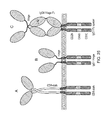
- FIG. 24 Kinetic segregation model of CAR logic gates
- CARs recognize either CD19 or CD33.
- the immunological synapse can be imagined between the blue line, which represents the target cell membrane and the red line, which represents the T-cell membrane.
- ‘45’ is the native CD45 protein present on T-cells.
- ‘H8’ is a CAR ectodomain with human CD8 stalk as the spacer.
- ‘Fc’ is a CAR ectodomain with human HCH2CH3 as the spacer.
- M8’ is a CAR ectodomain with murine CD8 stalk as the spacer.
- ‘19’ represents CD19 on the target cell surface.
- ‘33’ represents CD33 on the target cell surface.
- the symbol ‘ ⁇ ’ represents an activating endodomain containing ITAMS.
- the symbol ‘ ⁇ ’ represents a phosphatase with slow kinetics—a ‘ligation on’ endodomain such as one comprising of the catalytic domain of PTPN6 or an ITIM.
- the symbol ‘ ⁇ ’ represents a phosphatase with fast kinetics—a ‘ligation off’ endodomain such as the endodomain of CD45 or CD148. This symbol is enlarged in the figure to emphasize its potent activity.
- target cells are both CD19 and CD33 negative.
- targets are CD19 negative and CD33 positive.
- target cells are CD19 positive and CD33 negative.
- target cells are positive for both CD19 and CD33.
- FIG. 25 Design of APRIL-based CARs.
- APRIL A proliferation-inducing ligand
- BCMA BCMA
- TACI proteoglycan binding ligand
- proteoglycan binding amino-terminus A signal peptide was then attached to truncated APRIL amino-terminus to direct the protein to the cell surface.
- Three CARs were generated with this APRIL based binding domain: A. In the first CAR, the human CD8 stalk domain was used as a spacer domain. B. In the second CAR, the hinge from IgG1 was used as a spacer domain. C.
- the hinge, CH2 and CH3 domains of human IgG1 modified with the pva/a mutations described by Hombach et al (2010 Gene Ther. 17:1206-1213) to reduce Fc Receptor binding was used as a spacer (henceforth referred as Fc-pvaa).
- Fc-pvaa spacer
- these spacers were connected to the CD28 transmembrane domain and then to a tripartite endodomain containing a fusion of the CD28, OX40 and the CD3-Zeta endodomain (Pule et al, Molecular therapy, 2005: Volume 12; Issue 5; Pages 933-41).
- FIG. 26 Annotated Amino acid sequence of the above three APRIL-CARS
- A Shows the annotated amino acid sequence of the CD8 stalk APRIL CAR
- B Shows the annotated amino acid sequence of the APRIL IgG1 hinge based CAR
- C Shows the annotated amino acid sequence of the APRIL Fc-pvaa based CAR.
- FIG. 27 Expression and ligand binding of different APRIL based CARs
- the transduced T-cells were stained with either recombinant BCMA or TACI fused to mouse IgG2a Fc fusion along with an anti-mouse secondary and anti-CD34. All three receptor formats showed binding to both BCMA and TACI. A surprising finding was that binding to BCMA seemed greater than to TACI. A further surprising finding was that although all three CARs were equally expressed, the CD8 stalk and IgG1 hinge CARs appeared better at recognizing BCMA and TACI than that with the Fc spacer.
- FIG. 28 Function of the different CAR constructs.
- Functional assays were performed with the three different APRIL based CARs.
- Normal donor peripheral blood T-cells either non-transduced (NT), or transduced to express the different CARs. Transduction was performed using equal titer supernatant. These T-cells were then CD56 depleted to remove non-specific NK activity and used as effectors.
- SupT1 cells either non-transduced (NT), or transduced to express BCMA or TACI were used as targets. Data shown is mean and standard deviation from 5 independent experiments.
- A. Specific killing of BCMA and TACI expressing T-cells was determined using Chromium release.
- B. Interferon- ⁇ release was also determined. Targets and effectors were co-cultured at a ratio of 1:1.
- C Proliferation/survival of CAR T-cells were also determined by counting number of CAR T-cells in the same co-culture incubated for a further 6 days. All 3 CARs direct responses against BCMA and TACI expressing targets. The responses to BCMA were greater than for TACI.
- FIG. 29 AND gate functionality in primary cells
- PBMCs peripheral blood mononuclear cells
- PBMCs peripheral blood mononuclear cells
- FIG. 30 IgM and IgG in ANDNOT gate
- both the activating CAR (anti-CD19) and the inhibiting CAR (anti-CD33) spacers were substituted for longer spacers.
- the Fc region of human IgM and IgG were used to extend the spacer length.
- the Fc of IgM contains and additional Ig domain compared to IgG, for this reason the IgM spacer was placed on the anti-CD19 CAR which is known to have a membrane proximal binding epitope.
- the anti-CD33 binding epitope is located on a distal end of the molecule, thus the relatively shorter IgG spacer was used on this CAR.
- the extended spacer ANDNOT gate construct was transduced into a mouse T-cell line. Then a fixed number of transduced T-cells were co-cultured with a varying number of target cells for 16-24 hours, after which the amount of IL-2 secreted in the supernatant was analysed via ELISA.
- FIG. 31 Anti-CD19/anti-GD2 ANDNOT gate:
- the binding domain from the inhibitory CAR (anti-CD33) was substituted with two other unrelated binders (anti-GD2 and anti-EGFRvIII).
- the scFv fragment for anti-GD2 or anti-EGFRvIII was substituted for anti-CD33 on the inhibitory CAR in the ANDNOT gate platform with either a truncated SHP-1 or LAIR cytosolic domain.
- These constructs were transduced into a mouse T-cell line and a fixed number of T-cells were co-cultured with a varying number of target cells. After 16-24 hours of co-culture the amount of IL-2 secreted in the supernatant was analysed via ELISA.
- FIG. 32 Design rules for building logic gated CAR T-cells. OR, AND NOT and AND gated CARs are shown in cartoon format with the target cell on top, and the T-cell at the bottom with the synapse in the middle.
- Target cells express arbitrary target antigens A, and B.
- T-cells express two CARs which comprise of anti-A and anti-B recognition domains, spacers and endodomains.
- An OR gate requires (1) spacers simply which allow antigen recognition and CAR activation, and (2) both CARs to have activatory endodomains;
- An AND NOT gate requires (1) spacers which result in co-segregation of both CARs upon recognition of both antigens and (2) one CAR with an activatory endodomain, and the other whose endodomain comprises or recruits a weak phosphatase;
- An AND gate requires (1) spacers which result in segregation of both CARs into different parts of the immunological synapse upon recognition of both antigens and (2) one CAR with an activatory endodomain, and the other whose endodomain comprises of a potent phosphatase.
- the present inventors have developed a panel of “logic-gated” chimeric antigen receptor pairs which, when expressed by a cell, such as a T cell, are capable of detecting a particular pattern of expression of at least two target antigens. If the at least two target antigens are arbitrarily denoted as antigen A and antigen B, the three possible options are as follows:
- Engineered T cells expressing these CAR combinations can be tailored to be extremely specific for cancer cells, based on their particular expression (or lack of expression) of two or more markers.
- the present invention provides a cell which co-expresses a first chimeric antigen receptor (CAR) and second CAR at the cell surface, each CAR comprising:
- the cell may be an immune effector cell, such as a T-cell or natural killer (NK) cell.
- an immune effector cell such as a T-cell or natural killer (NK) cell.
- NK natural killer
- the spacer of the first CAR may be different to the spacer of the second CAR.
- the spacers of the first and second CARs may be sufficiently different as to prevent cross-pairing, but to be sufficiently similar to cause the CARs to co-localise at the T cell membrane.
- the spacers of the first and second CARs may be orthologous, such as mouse and human CD8 stalks.
- one of the first or second CARs is an activating CAR comprising an activating endodomain
- the other CAR is an inhibitory CAR comprising a “ligation-on” inhibitory endodomain.
- the inhibitory CAR does not significantly inhibit T-cell activation by the activating CAR in the absence of inhibitory CAR ligation, but inhibits T-cell activation by the activating CAR when the inhibitory CAR is ligated.
- the first and second spacers are sufficiently different so as to prevent cross-pairing of the first and second CARs but are sufficiently similar to result in co-localisation of the first and second CARs following ligation.
- the inhibitory endodomain may comprise at least part of a protein-tyrosine phosphatase.
- the inhibitory endodomain may comprise all or part of PTPN6.
- the inhibitory endodomain may comprise an ITIM domain.
- the inhibitory endodomain may comprise an ITIM domain in conjunction with co-expression of a fusion between at least part of a protein-tyrosine phosphatase and at least part of a receptor-like tyrosine phosphatase.
- the fusion may comprise one or more SH2 domains from the protein-tyrosine phosphatase.
- the fusion may be between a PTPN6 SH2 domain and CD45 endodomain or between a PTPN6 SH2 domain and CD148 endodomain.
- the CAR comprising the activating endodomain may comprise an antigen-binding domain which binds CD33 and the CAR which comprises the ligation-on inhibitory endodomain may comprise an antigen-binding domain which binds CD34.
- the present invention provides a nucleic acid sequence encoding both the first and second chimeric antigen receptors (CARs) as defined in the first aspect of the invention.
- CARs chimeric antigen receptors
- the nucleic acid sequence according may have the following structure: AgB1-spacer1-TM1-endo1-coexpr-AgB2-spacer2-TM2-endo2
- the nucleic acid sequence allowing co-expression of two CARs may encode a self-cleaving peptide or a sequence which allows alternative means of co-expressing two CARs such as an internal ribosome entry sequence or a 2 nd promoter or other such means whereby one skilled in the art can express two proteins from the same vector.
- Alternative codons may be used in regions of sequence encoding the same or similar amino acid sequences, in order to avoid homologous recombination.
- the present invention provides a kit which comprises
- the present invention provides a kit comprising: a first vector which comprises the first nucleic acid sequence as defined above; and a second vector which comprises the first nucleic acid sequence as defined above.
- the vectors may be plasmid vectors, retroviral vectors or transposon vectors.
- the vectors may be lentiviral vectors.
- the present invention provides a vector comprising a nucleic acid sequence according to the second aspect of the invention.
- the vector may be a lentiviral vector.
- the vector may be a plasmid vector, a retroviral vector or a transposon vector.
- the present invention involves co-expressing more than two CARs in such a fashion that a complex pattern of more than two antigens can be recognized on the target cell.
- the present invention provides a method for making a T cell according to the first aspect of the invention, which comprises the step of introducing one or more nucleic acid sequence (s) encoding the first and second CARs; or one or more vector(s) as defined above into a T cell.
- the T cell may be from a sample isolated from a patient, a related or unrelated haematopoietic transplant donor, a completely unconnected donor, from cord blood, differentiated from an embryonic cell line, differentiated from an inducible progenitor cell line, or derived from a transformed T cell line.
- the present invention provides a pharmaceutical composition comprising a plurality of T cells according to the first aspect of the invention.
- the present invention provides a method for treating and/or preventing a disease, which comprises the step of administering a pharmaceutical composition according to the eighth aspect of the invention to a subject.
- the method may comprise the following steps:
- the disease may be a cancer.
- the present invention provides a pharmaceutical composition according to the eighth aspect of the invention for use in treating and/or preventing a disease.
- the disease may be a cancer.
- the present invention provides use of a T cell according to the first aspect of the invention in the manufacture of a medicament for treating and/or preventing a disease.
- the disease may be a cancer.
- the present invention also provides a nucleic acid sequence which comprises:
- Alternative codons may be used in one or more portion(s) of the first and second nucleotide sequences in regions which encode the same or similar amino acid sequence(s).
- the present invention also provides a vector and a cell comprising such a nucleic acid.
- the “AND NOT gate” of the present invention offers a significant advantage over the CAR approaches described to date which involve targeting a single tumour-associated antigen.
- a tumour cell is characterized by the presence of one (or more) antigen(s) and the absence of another antigen, this can be specifically targeted using the CAR based AND NOT approach of the present invention.
- a normal cell, which expressed both antigens will not be targeted, leading to greater selectivity and reduced on target, off tumour toxicity.
- a CAR approach directed to a single antigen would target both tumour cells and normal cells in this situation.
- the present invention also relates to the aspects listed in the following numbered paragraphs:
- CARs which are shown schematically in FIG. 1 , are chimeric type I trans-membrane proteins which connect an extracellular antigen-recognizing domain (binder) to an intracellular signalling domain (endodomain).
- the binder is typically a single-chain variable fragment (scFv) derived from a monoclonal antibody (mAb), but it can be based on other formats which comprise an antibody-like antigen binding site.
- scFv single-chain variable fragment
- mAb monoclonal antibody
- a spacer domain is usually necessary to isolate the binder from the membrane and to allow it a suitable orientation.
- a common spacer domain used is the Fc of IgG1. More compact spacers can suffice e.g. the stalk from CD8a and even just the IgG1 hinge alone, depending on the antigen.
- a trans-membrane domain anchors the protein in the cell membrane and connects the spacer to the endodomain.
- TNF receptor family endodomains such as the closely related OX40 and 41BB which transmit survival signals.
- OX40 and 41BB which transmit survival signals.
- CARs have now been described which have endodomains capable of transmitting activation, proliferation and survival signals.
- CAR-encoding nucleic acids may be transferred to T cells using, for example, retroviral vectors. Lentiviral vectors may be employed. In this way, a large number of cancer-specific T cells can be generated for adoptive cell transfer. When the CAR binds the target-antigen, this results in the transmission of an activating signal to the T-cell it is expressed on. Thus the CAR directs the specificity and cytotoxicity of the T cell towards tumour cells expressing the targeted antigen.
- the first aspect of the invention relates to a T-cell which co-expresses a first CAR and a second CAR such that a T-cell can recognize a desired pattern of expression on target cells in the manner of a logic gate as detailed in the truth tables: table 1, 2 and 3.
- Both the first and second (and optionally subsequent) CARs comprise:
- the first and second CAR of the T cell of the present invention may be produced as a polypeptide comprising both CARs, together with a cleavage site.
- SEQ ID No. 1 to 5 give examples of such polypeptides, which each comprise two CARs.
- the CAR may therefore comprise one or other part of the following amino acid sequences, which corresponds to a single CAR.
- SEQ ID No 1 is a CAR OR gate which recognizes CD19 OR CD33
- SEQ ID No 2 Is a CAR AND gate which recognizes CD19 AND CD33 using a CD148 phosphatase
- SEQ ID No 3 Is an alternative implementation of the CAR AND GATE which recognizes CD19 AND CD33 which uses a CD45 phosphatase
- SEQ ID No 4 Is a CAR AND NOT GATE which recognizes CD19 AND NOT CD33 based on PTPN6 phosphatase
- SEQ ID No 5 Is an alternative implementation of the CAR AND NOT gate which recognizes CD19 AND NOT CD33 and is based on an ITIM containing endodomain from LAIR1
- the CAR may comprise a variant of the CAR-encoding part of the sequence shown as SEQ ID No. 1, 2, 3, 4, 5 or 6 having at least 80, 85, 90, 95, 98 or 99% sequence identity, provided that the variant sequence is a CAR having the required properties.
- % sequence identity refers to the percentage of amino acid or nucleotide residues that are identical in the two sequences when they are optimally aligned. Nucleotide and protein sequence homology or identity may be determined using standard algorithms such as a BLAST program (Basic Local Alignment Search Tool at the National Center for Biotechnology Information) using default parameters, which is publicly available at http://blast.ncbi.nlm.nih.gov.
- sequence identity or homology includes: LALIGN (http://www.ebi.ac.uk/Tools/psa/lalign/ and http://vvww.ebi.ac.uk/Tools/psa/lalign/nucleotide.html), AMAS (Analysis of Multiply Aligned Sequences, at http://www.compbio.dundee.ac.uk/Software/Amas/amas.html), FASTA (http://www.ebi.ac.uk/Tools/ss/fasta/) Clustal Omega (http://www.ebi.ac.uk/Tools/msa/clustalo/), SIM (http://web.expasy.org/sim/), and EMBOSS Needle (http://www.ebi.ac.uk/Tools/psa/emboss needle/nucleotide.html).
- the antigen binding domains of the first and second CARs of the present invention bind to different antigens and both CARs comprise an activating endodomain. Both CARs have different spacer domains to prevent cross-pairing of the two different receptors.
- a T cell can hence be engineered to activate upon recognition of either or both antigens. This is useful in the field of oncology as indicated by the Goldie-Coldman hypothesis: sole targeting of a single antigen may result in tumour escape by modulation of said antigen due to the high mutation rate inherent in most cancers. By simultaneously targeting two antigens, the probably of such escape is exponentially reduced.
- tumour associated antigens are known as shown in the following Table 4.
- the first CAR and second CAR may bind to two different TAAs associated with that disease.
- tumour escape by modulating a single antigen is prevented, since a second antigen is also targeted.
- both CD19 and CD20 can be simultaneously targeted.
- KS kinetic segregation model
- T-cell receptor or CAR
- CAR T-cell receptor
- ZAP70 recognizes a threshold of phosphorylated ITAMs and propagates a T-cell activation signal.
- This advanced understanding of T-cell activation is exploited by the present invention.
- the invention is based on this understanding of how ectodomains of different length and/or bulk and/or charge and/or configuration and/or glycosylation result in differential segregation upon synapse formation.
- one CAR comprises an activating endodomain and one CAR comprises an inhibitory endodomain whereby the inhibitory CAR constitutively inhibits the first activating CAR, but upon recognition of its cognate antigen releases its inhibition of the activating CAR.
- a T-cell can be engineered to trigger only if a target cell expresses both cognate antigens.
- This behaviour is achieved by the activating CAR comprising an activating endodomain containing ITAM domains for example the endodomain of CD3 Zeta, and the inhibitory CAR comprising the endodomain from a phosphatase able to dephosphorylate an ITAM (e.g. CD45 or CD148).
- ITAM e.g. CD45 or CD148
- the spacer domains of both CARs are significantly different in size and/or shape and/or charge etc.
- the inhibitory CAR is in solution on the T-cell surface and can diffuse in and out of the synapse inhibiting the activating CAR.
- the activating and inhibiting CAR are differentially segregated allowing the activating CAR to trigger T-cell activation unhindered by the inhibiting CAR.
- the design of the present invention is a considerable improvement on previous implementation as described by Wilkie et al. ((2012). J. Clin. Immunol. 32, 1059-1070) and then tested in vivo (Kloss et al (2013) Nat. Biotechnol. 31, 71-75).
- the first CAR comprises of an activating endodomain, and the second a co-stimulatory domain.
- a T-cell only receives an activating and co-stimulatory signal when both antigens are present.
- the T-cell still will activate in the sole presence of the first antigen resulting in the potential for off-target toxicity.
- the implementation of the present invention allows for multiple compound linked gates whereby a cell can interpret a complex pattern of antigens.
- one CAR comprises an activating endodomain and one CAR comprises an inhibitory endodomain such that this inhibitory CAR is only active when it recognizes its cognate antigen.
- a T-cell engineered in this manner is activated in response to the sole presence of the first antigen but is not activated when both antigens are present.
- This invention is implemented by inhibitory CARs with a spacer that co-localise with the first CAR but either the phosphatase activity of the inhibitory CAR should not be so potent that it inhibits in solution, or the inhibitory endodomain in fact recruits a phosphatase solely when the inhibitory CAR recognizes its cognate target.
- Such endodomains are termed “ligation-on” or semi-inhibitory herein.
- This invention is of use in refining targeting when a tumour can be distinguished from normal tissue by the presence of tumour associated antigen and the loss of an antigen expressed on normal tissue.
- the AND NOT gate is of considerable utility in the field of oncology as it allows targeting of an antigen which is expressed by a normal cell, which normal cell also expresses the antigen recognised by the CAR comprising the activating endodomain.
- An example of such an antigen is CD33 which is expressed by normal stem cells and acute myeloid leukaemia (AML) cells.
- CD34 is expressed on stem cells but not typically expressed on AML cells.
- a T-cell recognizing CD33 AND NOT CD34 would result in destruction of leukaemia cells but sparing of normal stem cells.
- the kinetic segregation model with the above components allows compound gates to be made e.g. a T-cell which triggers in response to patterns of more than two target antigens.
- a T cell which only triggers when three antigens are present (A AND B AND C).
- a cell expresses three CARs, each recognizing antigens A, B and C.
- One CAR is excitatory and two are inhibitory, which each CAR having spacer domains which result in differential segregation. Only when all three are ligated, will the T-cell activate.
- ever more complex boolean logic can be programmed with these simple components of the invention with any number of CARs and spacers.
- the CARs of the T cell of the present invention may comprise a signal peptide so that when the CAR is expressed inside a cell, such as a T-cell, the nascent protein is directed to the endoplasmic reticulum and subsequently to the cell surface, where it is expressed.
- the core of the signal peptide may contain a long stretch of hydrophobic amino acids that has a tendency to form a single alpha-helix.
- the signal peptide may begin with a short positively charged stretch of amino acids, which helps to enforce proper topology of the polypeptide during translocation.
- At the end of the signal peptide there is typically a stretch of amino acids that is recognized and cleaved by signal peptidase.
- Signal peptidase may cleave either during or after completion of translocation to generate a free signal peptide and a mature protein.
- the free signal peptides are then digested by specific proteases.
- the signal peptide may be at the amino terminus of the molecule.
- the signal peptide may comprise the SEQ ID No. 7, 8 or 9 or a variant thereof having 5, 4, 3, 2 or 1 amino acid mutations (insertions, substitutions or additions) provided that the signal peptide still functions to cause cell surface expression of the CAR.
- the signal peptide of SEQ ID No. 7 is compact and highly efficient. It is predicted to give about 95% cleavage after the terminal glycine, giving efficient removal by signal peptidase.
- the signal peptide of SEQ ID No. 8 is derived from IgG1.
- the signal peptide of SEQ ID No. 9 is derived from CD8.
- the signal peptide for the first CAR may have a different sequence from the signal peptide of the second CAR (and from the 3 rd CAR and 4 th CAR etc).
- the antigen binding domain is the portion of the CAR which recognizes antigen.
- Numerous antigen-binding domains are known in the art, including those based on the antigen binding site of an antibody, antibody mimetics, and T-cell receptors.
- the antigen-binding domain may comprise: a single-chain variable fragment (scFv) derived from a monoclonal antibody; a natural ligand of the target antigen; a peptide with sufficient affinity for the target; a single domain antibody; an artificial single binder such as a Darpin (designed ankyrin repeat protein); or a single-chain derived from a T-cell receptor.
- scFv single-chain variable fragment
- the antigen binding domain may comprise a domain which is not based on the antigen binding site of an antibody.
- the antigen binding domain may comprise a domain based on a protein/peptide which is a soluble ligand for a tumour cell surface receptor (e.g. a soluble peptide such as a cytokine or a chemokine); or an extracellular domain of a membrane anchored ligand or a receptor for which the binding pair counterpart is expressed on the tumour cell.
- Examples 11 to 13 relate to a CAR which binds BCMA, in which the antigen binding doaimn comprises APRIL, a ligand for BCMA.
- the antigen binding domain may be based on a natural ligand of the antigen.
- the antigen binding domain may comprise an affinity peptide from a combinatorial library or a de novo designed affinity protein/peptide.
- CARs comprise a spacer sequence to connect the antigen-binding domain with the transmembrane domain and spatially separate the antigen-binding domain from the endodomain.
- a flexible spacer allows the antigen-binding domain to orient in different directions to facilitate binding.
- the first and second CARs may comprise different spacer molecules.
- the spacer sequence may, for example, comprise an IgG1 Fc region, an IgG1 hinge or a human CD8 stalk or the mouse CD8 stalk.
- the spacer may alternatively comprise an alternative linker sequence which has similar length and/or domain spacing properties as an IgG1 Fc region, an IgG1 hinge or a CD8 stalk.
- a human IgG1 spacer may be altered to remove Fc binding motifs.
- amino acid sequences for these spacers are given below:
- CARs are typically homodimers (see FIG. 1 a ), cross-pairing may result in a heterodimeric chimeric antigen receptor. This is undesirable for various reasons, for example: (1) the epitope may not be at the same “level” on the target cell so that a cross-paired CAR may only be able to bind to one antigen; (2) the VH and VL from the two different scFv could swap over and either fail to recognize target or worse recognize an unexpected and unpredicted antigen.
- the spacer of the first CAR may be sufficiently different from the spacer of the second CAR in order to avoid cross-pairing.
- the amino acid sequence of the first spacer may share less that 50%, 40%, 30% or 20% identity at the amino acid level with the second spacer.
- the spacer of the first CAR has a different length, and/or charge and/or shape and/or configuration and/or glycosylation, such that when both first and second CARs bind their target antigen, the difference in spacer charge or dimensions results in spatial separation of the two types of CAR to different parts of the membrane to result in activation as predicted by the kinetic separation model.
- the different length, shape and/or configuration of the spacers is carefully chosen bearing in mind the size and binding epitope on the target antigen to allow differential segregation upon cognate target recognition.
- the IgG1 Hinge, CD8 stalk, IgG1 Fc, ectodomain of CD34, ectodomain of CD45 are expected to differentially segregate.
- the spacer be sufficiently different as to prevent cross-pairing, but to be sufficiently similar to co-localise.
- Pairs of orthologous spacer sequences may be employed. Examples are murine and human CD8 stalks, or alternatively spacer domains which are monomeric—for instance the ectodomain of CD2.
- spacer domains mentioned above form homodimers.
- the mechanism is not limited to using homodimeric receptors and should work with monomeric receptors as long as the spacer is sufficiently rigid.
- An example of such a spacer is CD2 or truncated CD22.
- the transmembrane domain is the sequence of the CAR that spans the membrane.
- a transmembrane domain may be any protein structure which is thermodynamically stable in a membrane. This is typically an alpha helix comprising of several hydrophobic residues.
- the transmembrane domain of any transmembrane protein can be used to supply the transmembrane portion of the invention.
- the presence and span of a transmembrane domain of a protein can be determined by those skilled in the art using the TMHMM algorithm (http://vvww.cbs.dtu.dk/services/TMHMM-2.0/).
- transmembrane domain of a protein is a relatively simple structure, i.e a polypeptide sequence predicted to form a hydrophobic alpha helix of sufficient length to span the membrane
- an artificially designed TM domain may also be used (U.S. Pat. No. 7,052,906 B1 describes synthetic transmembrane components).
- the transmembrane domain may be derived from CD28, which gives good receptor stability.
- the endodomain is the signal-transmission portion of the CAR. After antigen recognition, receptors cluster, native CD45 and CD148 are excluded from the synapse and a signal is transmitted to the cell.
- the most commonly used endodomain component is that of CD3-zeta which contains 3 ITAMs. This transmits an activation signal to the T cell after antigen is bound.
- CD3-zeta may not provide a fully competent activation signal and additional co-stimulatory signaling may be needed.
- chimeric CD28 and OX40 can be used with CD3-Zeta to transmit a proliferative/survival signal, or all three can be used together.
- the T cell of the present invention comprises a CAR with an activating endodomain
- it may comprise the CD3-Zeta endodomain alone, the CD3-Zeta endodomain with that of either CD28 or OX40 or the CD28 endodomain and OX40 and CD3-Zeta endodomain.
- any endodomain which contains an ITAM motif can act as an activation endodomain in this invention.
- proteins are known to contain endodomains with one or more ITAM motifs. Examples of such proteins include the CD3 epsilon chain, the CD3 gamma chain and the CD3 delta chain to name a few.
- the ITAM motif can be easily recognized as a tyrosine separated from a leucine or isoleucine by any two other amino acids, giving the signature YxxL/I. Typically, but not always, two of these motifs are separated by between 6 and 8 amino acids in the tail of the molecule (YxxL/Ix(6-8)YxxL/I).
- the transmembrane and intracellular T-cell signalling domain (endodomain) of a CAR with an activating endodomain may comprise the sequence shown as SEQ ID No. 15, 16 or 17 or a variant thereof having at least 80% sequence identity.
- CD28 transmembrane domain and CD3 Z endodomain SEQ ID No. 15 FWVLVVVGGVLACYSLLVTVAFIIFWVRRVKFSRSADAPAYQQGQNQLYN ELNLGRREEYDVLDKRRGRDPEMGGKPRRKNPQEGLYNELQKDKMAEAYS EIGMKGERRRGKGHDGLYQGLSTATKDTYDALHMQALPPR comprising CD28 transmembrane domain and CD28 and CD3 Zeta endodomains SEQ ID No.
- a variant sequence may have at least 80%, 85%, 90%, 95%, 98% or 99% sequence identity to SEQ ID No. 15, 16 or 17, provided that the sequence provides an effective trans-membrane domain and an effective intracellular T cell signaling domain.
- one of the CARs comprises an inhibitory endodomain such that the inhibitory CAR inhibits T-cell activation by the activating CAR in the absence of inhibitory CAR ligation, but does not significantly inhibit T-cell activation by the activating CAR when the inhibitory CAR is ligated. This is termed a “ligation-off” inhibitory endodomain.
- the spacer of the inhibitory CAR is of a different length, charge, shape and/or configuration and/or glycosylation from the spacer of the activating CAR, such that when both receptors are ligated, the difference in spacer dimensions results in isolation of the activating CARs and the inhibitory CARs in different membrane compartments of the immunological synapse, so that the activating endodomain is released from inhibition by the inhibitory endodomain.
- the inhibitory endodomains for use in a ligation-off inhibitory CAR may therefore comprise any sequence which inhibits T-cell signaling by the activating CAR when it is in the same membrane compartment (i.e. in the absence of the antigen for the inhibitory CAR) but which does not significantly inhibit T cell signaling when it is isolated in a separate part of the membrane from the inhibitory CAR.
- the ligation-off inhibitory endodomain may be or comprise a tyrosine phosphatase, such as a receptor-like tyrosine phosphatase.
- An inhibitory endodomain may be or comprise any tyrosine phosphatase that is capable of inhibiting the TCR signalling when only the stimulatory receptor is ligated.
- An inhibitory endodomain may be or comprise any tyrosine phosphatase with a sufficiently fast catalytic rate for phosphorylated ITAMs that is capable of inhibiting the TCR signalling when only the stimulatory receptor is ligated.
- the inhibitory endodomain of an AND gate may comprise the endodomain of CD148 or CD45.
- CD148 and CD45 have been shown to act naturally on the phosphorylated tyrosines up-stream of TCR signalling.
- CD148 is a receptor-like protein tyrosine phosphatase which negatively regulates TCR signaling by interfering with the phosphorylation and function of PLC ⁇ 1 and LAT.
- CD45 present on all hematopoetic cells is a protein tyrosine phosphatase which is capable of regulating signal transduction and functional responses, again by phosphorylating PLC ⁇ 1.
- An inhibitory endodomain may comprise all of part of a receptor-like tyrosine phosphatase.
- the phospatase may interfere with the phosphorylation and/or function of elements involved in T-cell signalling, such as PLC ⁇ 1 and/or LAT.
- the transmembrane and endodomain of CD45 and CD148 is shown as SEQ ID No. 18 and No. 19 respectively.
- CD45 trans-membrane and endodomain sequence SEQ ID 18 ALIAFLAFLIIVTSIALLVVLYKIYDLHKKRSCNLDEQQELVERDDEKQL MNVEPIHADILLETYKRKIADEGRLFLAEFQSIPRVFSKFPIKEARKPFN QNKNRYVDILPYDYNRVELSEINGDAGSNYINASYIDGFKEPRKYIAAQG PRDETVDDFWRMIWEQKATVIVMVTRCEEGNRNKCAEYWPSMEEGTRAFG DVVVKINQHKRCPDYIIQKLNIVNKKEKATGREVTHIQFTSWPDHGVPED PHLLLKLRRRVNAFSNFFSGPIVVHCSAGVGRTGTYIGIDAMLEGLEAEN KVDVYGYVVKLRRQRCLMVQVEAQYILIHQALVEYNQFGETEVNLSELHP YLHNMKKRDPPSEPSPLEAEFQRLPSYRSWRTQHIGNQEENKSKNRNSNV IP
- An inhibitory CAR may comprise all or part of SEQ ID No 18 or 19 (for example, it may comprise the phosphatase function of the endodomain). It may comprise a variant of the sequence or part thereof having at least 80% sequence identity, as long as the variant retains the capacity to basally inhibit T cell signalling by the activating CAR.
- Target cell populations can be created by transducing a suitable cell line such as a SupT1 cell line either singly or doubly to establish cells negative for both antigens (the wild-type), positive for either and positive for both (e.g. CD19-CD33-, CD19+CD33-, CD19-CD33+ and CD19+CD33+).
- T cells such as the mouse T cell line BW5147 which releases IL-2 upon activation may be transduced with pairs of CARs and their ability to function in a logic gate measured through measurement of IL-2 release (for example by ELISA).
- both CD148 and CD45 endodomains can function as inhibitory CARs in combination with an activating CAR containing a CD3 Zeta endodomain.
- These CARs rely upon a short/non-bulky CD8 stalk spacer on one CAR and a bulky Fc spacer on the other CAR to achieve AND gating.
- both receptors are ligated, the difference in spacer dimensions results in isolation of the different receptors in different membrane compartments, releasing the CD3 Zeta receptor from inhibition by the CD148 or CD45 endodomains. In this way, activation only occurs once both receptors are activated. It can be readily seen that this modular system can be used to test alternative spacer pairs and inhibitory endodomains.
- one of the CARs comprises a “ligation-on” inhibitory endodomain such that the inhibitory CAR does not significantly inhibit T-cell activation by the activating CAR in the absence of inhibitory CAR ligation, but inhibits T-cell activation by the activating CAR when the inhibitory CAR is ligated.
- the “ligation-on” inhibitory endodomain may be or comprise a tyrosine phosphatase that is incapable of inhibiting the TCR signalling when only the stimulatory receptor is ligated.
- the “ligation-on” inhibitory endodomain may be or comprise a tyrosine phosphatase with a sufficiently slow catalytic rate for phosphorylated ITAMs that is incapable of inhibiting the TCR signalling when only the stimulatory receptor is ligated but it is capable of inhibiting the TCR signalling response when concentrated at the synapse. Concentration at the synapse is achieved through inhibitory receptor ligation.
- a tyrosine phosphatase has a catalytic rate which is too fast for a “ligation-on” inhibitory endodomain, then it is possible to tune-down the catalytic rates of phosphatase through modification such as point mutations and short linkers (which cause steric hindrance) to make it suitable for a “ligation-on” inhibitory endodomain.
- the endodomain may be or comprise a phosphatase which is considerably less active than CD45 or CD148, such that significant dephosphorylation of ITAMS only occurs when activating and inhibitory endodomains are co-localised.
- the inhibitory endodomain of a NOT AND gate may comprise all or part of a protein-tyrosine phosphatase such as PTPN6.
- PTPs Protein tyrosine phosphatases
- SH2 Src homolog
- the inhibitor domain may comprise all of PTPN6 (SEQ ID No. 20) or just the phosphatase domain (SEQ ID No. 21).
- a second embodiment of a ligation-on inhibitory endodomain is an ITIM (Immunoreceptor Tyrosine-based Inhibition motif) containing endodomain such as that from CD22, LAIR-1, the Killer inhibitory receptor family (KIR), LILRB1, CTLA4, PD-1, BTLA etc.
- ITIMs When phosphorylated, ITIMs recruits endogenous PTPN6 through its SH2 domain. If co-localised with an ITAM containing endodomain, dephosphorylation occurs and the activating CAR is inhibited.
- ITIM is a conserved sequence of amino acids (S/I/V/LxYxxI/V/L) that is found in the cytoplasmic tails of many inhibitory receptors of the immune system.
- One skilled in the art can easily find protein domains containing an ITIM.
- a list of human candidate ITIM-containing proteins has been generated by proteome-wide scans (Staub, et al (2004) Cell. Signal. 16, 435-456). Further, since the consensus sequence is well known and little secondary structure appears to be required, one skilled in the art could generate an artificial ITIM.
- ITIM endodomains from PDCD1, BTLA4, LILRB1, LAIR1, CTLA4, KIR2DL1, KIR2DL4, KIR2DL5, KIR3DL1 and KIR3DL3 are shown in SEQ ID 22 to 31 respectively
- PDCD1 endodomain SEQ ID 22 CSRAARGTIGARRTGQPLKEDPSAVPVFSVDYGELDFQWREKTPEPPVPC VPEQTEYATIVFPSGMGTSSPARRGSADGPRSAQPLRPEDGHCSWPL BTLA4 SEQ ID 23 KLQRRWKRTQSQQGLQENSSGQSFFVRNKKVRRAPLSEGPHSLGCYNPMM EDGISYTTLRFPEMNIPRTGDAESSEMQRPPPDCDDTVTYSALHKRQVGD YENVIPDFPEDEGIHYSELIQFGVGERPQAQENVDYVILKH LILRB1 SEQ ID 24 LRHRRQGKHWTSTQRKADFQHPAGAVGPEPTDRGLQWRSSPAADAQEENL YAAVKHTQPEDGVEMDTRSPHDEDPQAVTYAEVKHSRPRREMASPPSPLS GEFLDTKDRQAEEDRQMDTEAAASEAPQDVTYAQLHSLTLRREATEPPPS QEGPSPAVPS
- a third embodiment of a ligation-on inhibitory endodomain is an ITIM containing endodomain co-expressed with a fusion protein.
- the fusion protein may comprise at least part of a protein-tyrosine phosphatase and at least part of a receptor-like tyrosine phosphatase.
- the fusion may comprise one or more SH2 domains from the protein-tyrosine phosphatase.
- the fusion may be between a PTPN6 SH2 domain and CD45 endodomain or between a PTPN6 SH2 domain and CD148 endodomain.
- the ITIM domains recruit the fusion protein bring the highly potent CD45 or CD148 phosphatase to proximity to the activating endodomain blocking activation.
- PTPN6-CD45 fusion protein SEQ ID 32 WYHGHMSGGQAETLLQAKGEPWTFLVRESLSQPGDFVLSVLSDQPKAGPG SPLRVTHIKVMCEGGRYTVGGLETFDSLTDLVEHFKKTGIEEASGAFVYL RQPYKIYDLHKKRSCNLDEQQELVERDDEKQLMNVEPIHADILLETYKRK IADEGRLFLAEFQSIPRVFSKFPIKEARKPFNQNKNRYVDILPYDYNRVE LSEINGDAGSNYINASYIDGFKEPRKYIAAQGPRDETVDDFWRMIWEQKA TVIVMVTRCEEGNRNKCAEYWPSMEEGTRAFGDVVVKINQHKRCPDYIIQ KLNIVNKKEKATGREVTHIQFTSWPDHGVPEDPHLLLKLRRRVNAFSNFF SGPIWHCSAGVGRTGTYIGIDAMLEGLEAENKVDVYGYVVKLRRQRCLMV QVEAQYIL
- a ligation-on inhibitory CAR may comprise all or part of SEQ ID No 20 or 21. It may comprise all or part of SEQ ID 22 to 31. It may comprise all or part of SEQ ID 22 to 31 co-expressed with either SEQ ID 32 or 33. It may comprise a variant of the sequence or part thereof having at least 80% sequence identity, as long as the variant retains the capacity to inhibit T cell signaling by the activating CAR upon ligation of the inhibitory CAR.
- PTPN6 endodomain can function as a semi-inhibitory CAR in combination with an activating CAR containing a CD3 Zeta endodomain.
- CARs rely upon a human CD8 stalk spacer on one CAR and a mouse CD8 stalk spacer on the other CAR.
- the orthologous sequences prevent cross pairing.
- both receptors are ligated, the similarity between the spacers results in co-segregation of the different receptors in the same membrane compartments.
- the second aspect of the invention relates to a nucleic acid which encodes the first and second CARs.
- the nucleic acid may produce a polypeptide which comprises the two CAR molecules joined by a cleavage site.
- the cleavage site may be self-cleaving, such that when the polypeptide is produced, it is immediately cleaved into the first and second CARs without the need for any external cleavage activity.
- FMDV Foot-and-Mouth disease virus
- the co-expressing sequence may be an internal ribosome entry sequence (IRES).
- the co-expressing sequence may be an internal promoter.
- the first aspect of the invention relates to a cell. which co-expresses a first CAR and a second CAR at the cell surface.
- the cell may be any eukaryotic cell capable of expressing a CAR at the cell surface, such a an immunological cell.
- the cell may be an immune effector cell such as a T cell or a natural killer (NK) cell
- an immune effector cell such as a T cell or a natural killer (NK) cell
- T cells or T lymphocytes are a type of lymphocyte that play a central role in cell-mediated immunity. They can be distinguished from other lymphocytes, such as B cells and natural killer cells (NK cells), by the presence of a T-cell receptor (TCR) on the cell surface.
- TCR T-cell receptor
- Helper T helper cells assist other white blood cells in immunologic processes, including maturation of B cells into plasma cells and memory B cells, and activation of cytotoxic T cells and macrophages.
- TH cells express CD4 on their surface.
- TH cells become activated when they are presented with peptide antigens by MHC class II molecules on the surface of antigen presenting cells (APCs).
- APCs antigen presenting cells
- These cells can differentiate into one of several subtypes, including TH1, TH2, TH3, TH17, Th9, or TFH, which secrete different cytokines to facilitate different types of immune responses.
- Cytotoxic T cells destroy virally infected cells and tumor cells, and are also implicated in transplant rejection.
- CTLs express the CD8 at their surface. These cells recognize their targets by binding to antigen associated with MHC class I, which is present on the surface of all nucleated cells.
- MHC class I MHC class I
- IL-10 adenosine and other molecules secreted by regulatory T cells, the CD8+ cells can be inactivated to an anergic state, which prevent autoimmune diseases such as experimental autoimmune encephalomyelitis.
- Memory T cells are a subset of antigen-specific T cells that persist long-term after an infection has resolved. They quickly expand to large numbers of effector T cells upon re-exposure to their cognate antigen, thus providing the immune system with “memory” against past infections.
- Memory T cells comprise three subtypes: central memory T cells (TCM cells) and two types of effector memory T cells (TEM cells and TEMRA cells). Memory cells may be either CD4+ or CD8+. Memory T cells typically express the cell surface protein CD45RO.
- Treg cells Regulatory T cells
- suppressor T cells are crucial for the maintenance of immunological tolerance. Their major role is to shut down T cell-mediated immunity toward the end of an immune reaction and to suppress auto-reactive T cells that escaped the process of negative selection in the thymus.
- CD4+Treg cells Two major classes of CD4+Treg cells have been described—naturally occurring Treg cells and adaptive Treg cells.
- Naturally occurring Treg cells arise in the thymus and have been linked to interactions between developing T cells with both myeloid (CD11c+) and plasmacytoid (CD123+) dendritic cells that have been activated with TSLP.
- Naturally occurring Treg cells can be distinguished from other T cells by the presence of an intracellular molecule called FoxP3. Mutations of the FOXP3 gene can prevent regulatory T cell development, causing the fatal autoimmune disease IPEX.
- Adaptive Treg cells may originate during a normal immune response.
- the T cell of the invention may be any of the T cell types mentioned above, in particular a CTL.
- NK cells are a type of cytolytic cell which forms part of the innate immune system. NK cells provide rapid responses to innate signals from virally infected cells in an MHC independent manner
- NK cells (belonging to the group of innate lymphoid cells) are defined as large granular lymphocytes (LGL) and constitute the third kind of cells differentiated from the common lymphoid progenitor generating B and T lymphocytes. NK cells are known to differentiate and mature in the bone marrow, lymph node, spleen, tonsils and thymus where they then enter into the circulation.
- LGL large granular lymphocytes
- the CAR cells of the invention may be any of the cell types mentioned above.
- CAR-expressing cells such as CAR-expressing T or NK cells
- CAR-expressing T or NK cells may either be created ex vivo either from a patient's own peripheral blood (1 st party), or in the setting of a haematopoietic stem cell transplant from donor peripheral blood (2 nd party), or peripheral blood from an unconnected donor (3 rd party).
- the present invention also provide a cell composition comprising CAR expressing T cells and/or CAR expressing NK cells according to the present invention.
- the cell composition may be made by tranducing or transfecting a blood-sample ex vivo with a nucleic acid according to the present invention.
- CAR-expressing cells may be derived from ex vivo differentiation of inducible progenitor cells or embryonic progenitor cells to the relevant cell type, such as T cells.
- an immortalized cell line such as a T-cell line which retains its lytic function and could act as a therapeutic may be used.
- CAR cells are generated by introducing DNA or RNA coding for the CARs by one of many means including transduction with a viral vector, transfection with DNA or RNA.
- a CAR T cell of the invention may be an ex vivo T cell from a subject.
- the T cell may be from a peripheral blood mononuclear cell (PBMC) sample.
- T cells may be activated and/or expanded prior to being transduced with CAR-encoding nucleic acid, for example by treatment with an anti-CD3 monoclonal antibody.
- PBMC peripheral blood mononuclear cell
- a CAR T Cell of the Invention May be Made by:
- the T cells may then by purified, for example, selected on the basis of co-expression of the first and second CAR.
- the second aspect of the invention relates to one or more nucleic acid sequence(s) which codes for a first CAR and a second CAR as defined in the first aspect of the invention.
- the nucleic acid sequence may comprise one of the following sequences, or a variant thereof
- the nucleic acid sequence may encode the same amino acid sequence as that encoded by SEQ ID No. 35, 36, 37, 38, 39 or 40, but may have a different nucleic acid sequence, due to the degeneracy of the genetic code.
- the nucleic acid sequence may have at least 80, 85, 90, 95, 98 or 99% identity to the sequence shown as SEQ ID No. 35, 36, 37, 38, 39 or 40, provided that it encodes a first CAR and a second CAR as defined in the first aspect of the invention.
- the present invention also provides a vector, or kit of vectors which comprises one or more
- Such a vector may be used to introduce the nucleic acid sequence(s) into a host cell so that it expresses the first and second CARs.
- the vector may, for example, be a plasmid or a viral vector, such as a retroviral vector or a lentiviral vector, or a transposon based vector or synthetic mRNA.
- the vector may be capable of transfecting or transducing a T cell.
- the present invention also relates to a pharmaceutical composition containing a plurality of CAR-expressing cells, such as T cells or NK cells, according to the first aspect of the invention.
- the pharmaceutical composition may additionally comprise a pharmaceutically acceptable carrier, diluent or excipient.
- the pharmaceutical composition may optionally comprise one or more further pharmaceutically active polypeptides and/or compounds.
- Such a formulation may, for example, be in a form suitable for intravenous infusion.
- the T cells of the present invention may be capable of killing target cells, such as cancer cells.
- the target cell may be recognisable by a defined pattern of antigen expression, for example the expression of antigen A AND antigen B; the expression of antigen A OR antigen B; or the expression of antigen A AND NOT antigen B or complex iterations of these gates.
- T cells of the present invention may be used for the treatment of an infection, such as a viral infection.
- T cells of the invention may also be used for the control of pathogenic immune responses, for example in autoimmune diseases, allergies and graft-vs-host rejection.
- T cells of the invention may be used for the treatment of a cancerous disease, such as bladder cancer, breast cancer, colon cancer, endometrial cancer, kidney cancer (renal cell), leukemia, lung cancer, melanoma, non-Hodgkin lymphoma, pancreatic cancer, prostate cancer and thyroid cancer.
- a cancerous disease such as bladder cancer, breast cancer, colon cancer, endometrial cancer, kidney cancer (renal cell), leukemia, lung cancer, melanoma, non-Hodgkin lymphoma, pancreatic cancer, prostate cancer and thyroid cancer.
- T cells of the invention may be used to treat: cancers of the oral cavity and pharynx which includes cancer of the tongue, mouth and pharynx; cancers of the digestive system which includes oesophageal, gastric and colorectal cancers; cancers of the liver and biliary tree which includes hepatocellular carcinomas and cholangiocarcinomas; cancers of the respiratory system which includes bronchogenic cancers and cancers of the larynx; cancers of bone and joints which includes osteosarcoma; cancers of the skin which includes melanoma; breast cancer; cancers of the genital tract which include uterine, ovarian and cervical cancer in women, prostate and testicular cancer in men; cancers of the renal tract which include renal cell carcinoma and transitional cell carcinomas of the utterers or bladder; brain cancers including gliomas, glioblastoma multiforme and medullobastomas; cancers of the endocrine system including thyroid cancer, adrenal carcinoma and cancers associated with multiple
- Treatment with the T cells of the invention may help prevent the escape or release of tumour cells which often occurs with standard approaches.
- receptors based on anti-CD19 and anti-CD33 were arbitrarily chosen.
- CD19 and CD33 were cloned. These proteins were truncated so that they do not signal and could be stably expressed for prolonged periods.
- these vectors were used to transduce the SupT1 cell line either singly or doubly to establish cells negative for both antigen (the wild-type), positive for either and positive for both. The expression data are shown in FIG. 3 .
- the retroviral vector cassette used to co-express the sequences utilizes a foot-and-mouth 2A self-cleaving peptide to allow co-expression 1:1 of both receptors.
- the cassette design is shown in FIG. 4 , and the protein structures in FIG. 5 .
- the nucleotide sequence of homologous regions was codon-wobbled to prevent recombination during retroviral vector reverse transcription.
- T-cell line BW5147 This cell line releases IL2 upon activation allowing a simple quantitative readout.
- T-cells were co-cultured with increasing amounts of the artificial target cells described above.
- T-cells responded to target cells expressing either antigen, as shown by IL2 release measured by ELISA. Both CARs were shown to be expressed on the cell surfaces and the T-cells were shown to respond to either or both antigens. These data are show in FIG. 7 .
- the AND gate combines a simple activating receptor with a receptor which basally inhibits activity, but whose inhibition is turned off once the receptor is ligated. This was achieved by combining a standard 1 st generation CAR with a short/non-bulky CD8 stalk spacer and a CD3 Zeta endodomain with a second receptor with a bulky Fc spacer whose endodomain contained either CD148 or CD45 endodomains. When both receptors are ligated, the difference in spacer dimensions results in isolation of the different receptors in different membrane compartments, releasing the CD3 Zeta receptor from inhibition by the CD148 or CD45 endodomains. In this way, activation only occurs once both receptors are activated.
- CD148 and CD45 were chosen for this as they function in this manner natively: for instance, the very bulky CD45 ectodomain excludes the entire receptor from the immunological synapse.
- the expression cassette is depicted in FIG. 8 and the subsequent proteins in FIG. 9 .
- the AND gate should be generalizable across different targets. While there may be lesser or greater fidelity of the gate given relative antigen density, cognate scFv binding kinetics and precise distance of the scFv binding epitope, one would expect to see some AND gate manifestations with a wide set of targets and binders. To test this, three additional AND gates were generated. Once again, experimentation was restricted to the CD148 version of the AND gate.
- the second scFv from the original CD148 AND gate was replaced with the anti-GD2 scFv huK666 (SEQ ID 41 and SEQ ID 42), or with the anti-CD5 scFv (SEQ ID 43 and SEQ ID 44), or the anti-EGFRvIII scFv MR1.1 (SEQ ID 45 AND SEQ ID 46) to generate the following CAR AND gates: CD19 AND GD2; CD19 AND CD5; CD19 AND EGFRvIII.
- the following artificial antigen expressing cell lines were also generated: by transducing SupT1, and our SupT1.CD19 with GM3 and GD2 synthases SupT1.GD2 and SupT1.CD19.GD2 were generated.
- SupT1.EGFRvIII and SupT1.CD19.EGFRvIII were generated. Since CD5 is expressed on SupT1 cells, a different cell line was used to generate the target cells: 293T cells were generated which express CD19 alone, CD5 alone and both CD5 and CD19 together. Expression was confirmed by flow-cytometry ( FIG. 19 ). T-cells expressing the three new CAR AND gates were challenged with SupT1.CD19 and respective cognate double positive and single positive target cells. All three AND gates demonstrated reduced activation by the double positive cell lines in comparison with the single positive targets ( FIG. 20 ). This demonstrates generalizability of the AND gate design to arbitrary targets and cognate binders.
- the model is that if only the activating CAR is ligated, the potent inhibiting ‘ligation off’ type CAR is in solution in the membrane and can inhibit the activating CAR. Once both CARs are ligated, if both CAR spacers are sufficiently different, they will segregate within the synapse and not co-localize. Hence, a key requirement is that the spacers are sufficiently different. If the model is correct, if both spacers are sufficiently similar so they co-localize when both receptors are ligated, the gate will fail to function.
- the “bulky” Fc spacer in the original CAR we replaced with a murine CD8 spacer. It was predicted that this has the similar length, bulk and charge as human CD8 but so should not cross-pair with it.
- the new gate had a first CAR which recognizes CD19, a human CD8 stalk spacer and an activatory endodomain; while the second CAR recognizes CD33, has a mouse CD8 stalk spacer and a CD148 endodomain ( FIG. 18C ).
- T-cells were transduced to express this new CAR gate. These T-cells were then challenged with SupT1 cells expressing CD19 alone, CD33 alone or CD19 and CD33 together.
- Phosphatases such as CD45 and CD148 are so potent that even a small amount entering an immunological synapse can inhibit ITAM activation. This is the basis of inhibition of the logical AND gate.
- Other classes of phosphatases are not as potent e.g. PTPN6 and related phosphatases. It was predicted that a small amount of PTPN6 entering a synapse by diffusion would not inhibit activation.
- an inhibitory CAR had a sufficiently similar spacer to an activating CAR, it could co-localize within a synapse if both CARs were ligated. In this case, large amounts of the inhibitory endodomain would be sufficient to stop the ITAMS from activating when both antigens were present. In this way, an AND NOT gate could be created.
- the second signal needs to “veto” activation. This is done by bringing an inhibitory signal into the immunological synapse, for example by bringing in the phosphatase of an enzyme such as PTPN6.
- an initial AND NOT gate as follows: two CARs co-expressed whereby the first recognizes CD19, has a human CD8 stalk spacer and an activating endodomain; co-expressed with an anti-CD33 CAR with a mouse CD8 stalk spacer and an endodomain comprising of the catalytic domain of PTPN6 (SEQ ID 38, FIG. 13 A with B).
- a suitable cassette is shown in FIG. 12 and preliminary functional data are shown in FIG. 14 .
- ITIMs Immune Tyrosinase Inhibitory Motifs
- ITAMS Immune Tyrosinase Inhibitory Motifs
- phosphorylated ITIMs recruit phosphatases like PTPN6 through their cognate SH2 domains.
- An ITIM can function as an inhibitory endodomain, as long as the spacers on the activating and inhibiting CARs can co-localize.
- an AND NOT gate was generated as follows: two CARs co-expressed—the first recognizes CD19, has a human CD8 stalk spacer and an activating endodomain; co-expressed with an anti-CD33 CAR with a mouse CD8 stalk spacer and an ITIM containing endodomain derived from that of LAIR1 (SEQ ID 39, FIG. 13 A with C).
- a further, more complex AND NOT gate was also developed, whereby an ITIM is enhanced by the presence of an additional chimeric protein: an intracellular fusion of the SH2 domain of PTPN6 and the endodomain of CD148.
- an additional chimeric protein an intracellular fusion of the SH2 domain of PTPN6 and the endodomain of CD148.
- three proteins are expressed—the first recognizes CD19, has a human CD8 stalk spacer and an activating endodomain; co-expressed with an anti-CD33 CAR with a mouse CD8 stalk spacer and an ITIM containing endodomain derived from that of LAIR1.
- a further 2A peptide allows co-expression of the PTPN6-CD148 fusion (SEQ ID 40, FIGS. 13 A and D). It was predicted that these AND NOT gates would have a different range of inhibition: PTPN6-CD148>PTPN6>>ITIM.
- T-cells were transduced with these gates and challenged with targets expressing either CD19 or CD33 alone, or both CD19 and CD33 together. All three gates responded to targets expressing only CD19, but not targets expressing both CD19 and CD33 together ( FIG. 21 ), confirming that all three of the AND NOT gates were functional.
- the test gate consisted of two CARs, the first recognizes CD19, has a human CD8 stalk spacer and an ITAM endodomain; while the second CAR recognizes CD33, has an Fc spacer and an endodomain comprising of the phosphatase from PTPN6.
- This gate activates in response to CD19, but also activates in response to CD19 and CD33 together ( FIG. 22B , where function of this gate is compared with that of the original AND NOT, and the control AND gate variant described in Example 6).
- This experimental data proves the model that for a functional AND NOT gate with PTPN6, co-localizing spacers are needed.
- the ITIM based gate Similar to the PTPN6 based AND NOT gate, the ITIM based gate also requires co-localization in an immunological synapse to function as an AND NOT gate.
- a control ITIM based gate was generated as follows: two CARs co-expressed—the first recognizes CD19, has a human CD8 stalk spacer and an activating endodomain; co-expressed with an anti-CD33 CAR with an Fc spacer and an ITIM containing endodomain derived from that of LAIR1. The activity of this gate was compared with that of the original ITIM based AND NOT gate. In this case, the modified gate activated in response to targets expressing CD19, but also activated in response to cells expressing both CD19 and CD33.
- FIG. 24 a summary of the model for a two-CAR gate is presented in FIG. 24 .
- the Figure shows a cell expressing two CARs, each recognizing a different antigen.
- CARs recognize a target antigen on a cell
- a synapse forms and native CD45 and CD148 are excluded from the synapse due to the bulk of their ectodomain. This sets the stage for T-cell activation.
- the cognate CAR is ligated and the cognate CAR segregates into the synapse.
- the unligated CAR remains in solution on the T-cell membrane and can diffuse in and out of the synapse so that an area of high local concentration of ligated CAR with low concentration of unligated CAR forms.
- the ligated CAR has an ITAM and the non-ligated CAR has ‘ligation off’ type inhibitory endodomain such as that of CD148, the amount of non-ligated CAR is sufficient to inhibit activation and the gate is off.
- the ligated CAR has an ITAM and the non-ligated CAR has a ‘ligation on’ type inhibitory endodomain such as PTPN6, the amount of non-ligated CAR is insufficient to inhibit and the gate is on.
- both cognate CARs When challenged by a target cell bearing both cognate antigens, both cognate CARs are ligated and form part of an immunological synapse.
- the CAR spacers are sufficiently similar, the CARs co-localize in the synapse but if the CAR spacers are sufficiently different the CARs segregate within the synapse. In this latter case, areas of membrane form whereby high concentrations of one CAR are present but the other CAR is absent.
- the gate since segregation is complete, even if the inhibitory endodomain is a ‘ligation off’ type, the gate is on. In the former case, areas of membrane form with high concentrations of both CARs mixed together. In this case, since both endodomains are concentrated, even if the inhibitory endodomain is ‘ligation on’ type, the gate is off.
- anti-A and anti-B CARs must be generated such that (1) each CAR has a spacer which simply allows antigen access and synapse formation such that the CAR functions, and (2) Each CAR has an activating endodomain;
- anti-A and anti-B CARs must be generated such that (1) both CARs have spacers which do not cross-pair, but which will allow the CARs to co-segregate upon recognition of both cognate antigens on the target cell, (2) and one CAR has an activating endodomain, while the other CAR has an endodomain which comprises or recruits a weak phosphatase (e.g.
- anti-A and anti-B CARs must be generated such that (1) one CAR has a spacer sufficiently different from the other CAR such that both CARs will not co-segregate upon recognition of both cognate antigens on the target cell, (2) one CAR has an activating endodomain, while the other car has an endodomain which comprises of a potent phosphatase (e.g. that of CD45 or CD148).
- the correct spacers to achieve the desired effect can be selected from a set of spacers with known size/shape etc as well as taking into consideration size/shape etc of the target antigen and the location of the cognate epitope on the target antigen.
- SEQ ID No 41 SFG.aCD19-CD8STK-CD28tmZ-2A-aGD2-HCH2CH3pvaa-dCD148 MSLPVTALLLPLALLLHAARPDIQMTQTTSSLSASLGDRVTISCRASQDISKYLNWYQQKPDGTVKLL IYHTSRLHSGVPSRFSGSGSGTDYSLTISNLEQEDIATYFCQQGNTLPYTFGGGTKLEITKAGGGGSG GGGSGGGGSGGGGSEVKLQESGPGLVAPSQSLSVTCTVSGVSLPDYGVSWIRQPPRKGLEWLGVIWGS ETTYYNSALKSRLTIIKDNSKSQVFLKMNSLQTDDTAIYYCAKHYYYGGSYAMDYWGQGTSVTVSSDP TTTPAPRPPTPAPTIASQPLSLRPEACRPAAGGAVHTRGLDFACDIFWVLVVVGGVLACYSLLVTVAF IIFWVRRVKFSRSADAPAYQQGQNQ
- APRIL in its natural form is a secreted type II protein.
- the use of APRIL as a BCMA binding domain for a CAR requires conversion of this type II secreted protein to a type I membrane bound protein and for this protein to be stable and to retain binding to BCMA in this form.
- the extreme amino-terminus of APRIL was deleted to remove binding to proteoglycans.
- a signal peptide was added to direct the nascent protein to the endoplasmic reticulum and hence the cell surface.
- an APRIL based CAR was generated comprising (i) a human IgG1 spacer altered to remove Fc binding motifs; (ii) a CD8 stalk; and (iii) the IgG1 hinge alone (cartoon in FIG. 25 and amino acid sequences in FIG. 26 ).
- These CARs were expressed in a bicistronic retroviral vector ( FIG. 27A ) so that a marker protein—truncated CD34 could be co-expressed as a convenient marker gene.
- the aim of this study was to test whether the APRIL based CARs which had been constructed were expressed on the cell surface and whether APRIL had folded to form the native protein.
- T-cells were transduced with these different CAR constructs and stained using a commercially available anti-APRIL mAb, along with staining for the marker gene and analysed by flow-cytometry.
- FIG. 27B where APRIL binding is plotting against marker gene fluorescence.
- BCMA and TACI were generated as fusions with mouse IgG2a-Fc. These recombinant proteins were incubated with the transduced T-cells. After this, the cells were washed and stained with an anti-mouse fluorophore conjugated antibody and an antibody to detect the marker gene conjugated to a different fluorophore. The cells were analysed by flow cytometry and the results are presented in FIG. 27C .
- the different CARs were able to bind both BCMA and TACI. Surprisingly, the CARs were better able to bind BCMA than TACI. Also, surprisingly CARs with a CD8 stalk or IgG1 hinge spacer were better able to bind BCMA and TACI than CAR with an Fc spacer.
- T-cells from normal donors were transduced with the different APRIL CARs and tested against SupT1 cells either wild-type, or engineered to express BCMA and TACI.
- Assays were used to determine function.
- a classical chromium release assay was performed.
- the target cells (the SupT1 cells) were labelled with 51Cr and mixed with effectors (the transduced T-cells) at different ratio. Lysis of target cells was determined by counting 51Cr in the co-culture supernatant ( FIG. 28A shows the cumulative data).
- FIG. 28B shows cumulative data
- FIG. 28C T-cells were counted by flow-cytometry calibrated with counting beads.
- PBMCs peripheral blood mononuclear cells
- PBMCs peripheral blood mononuclear cells
- both the activating CAR (anti-CD19) and the inhibiting CAR (anti-CD33) spacers were substituted for longer spacers.
- the Fc region of human IgM and IgG were used to extend the spacer length.
- the Fc of IgM contains and additional Ig domain compared to IgG, for this reason the IgM spacer was placed on the anti-CD19 CAR which is known to have a membrane proximal binding epitope.
- the anti-CD33 binding epitope is located on a distal end of the molecule, thus the relatively shorter IgG spacer was used on this CAR (see FIG. 30 ).
- the extended spacer ANDNOT gate construct was transduced into a mouse T-cell line. Then a fixed number of transduced T-cells were co-cultured with a varying number of target cells for 16-24 hours, after which the amount of IL-2 secreted in the supernatant was analysed via ELISA.
- the binding domain from the inhibitory CAR (anti-CD33) was substituted with two other unrelated binders (anti-GD2 and anti-EGFRvIII).
- the scFv fragment for anti-GD2 or anti-EGFRvIII was substituted for anti-CD33 on the inhibitory CAR in the ANDNOT gate platform with either a truncated SHP-1 or LAIR cytosolic domain.
- the results are shown in FIG. 31 .
- the AND NOT gate worked well with the anti-CD19/anti-GD2 binders and the anti-CD19/anti-EGFRvIII binders with either the truncated SHP-1 or LAIR cytosolic domains.
Landscapes
- Health & Medical Sciences (AREA)
- Life Sciences & Earth Sciences (AREA)
- Chemical & Material Sciences (AREA)
- Organic Chemistry (AREA)
- Immunology (AREA)
- Engineering & Computer Science (AREA)
- General Health & Medical Sciences (AREA)
- Genetics & Genomics (AREA)
- Zoology (AREA)
- Biomedical Technology (AREA)
- Bioinformatics & Cheminformatics (AREA)
- Biochemistry (AREA)
- Wood Science & Technology (AREA)
- Biotechnology (AREA)
- Medicinal Chemistry (AREA)
- Cell Biology (AREA)
- Animal Behavior & Ethology (AREA)
- Public Health (AREA)
- Veterinary Medicine (AREA)
- General Engineering & Computer Science (AREA)
- Molecular Biology (AREA)
- Biophysics (AREA)
- Microbiology (AREA)
- Proteomics, Peptides & Aminoacids (AREA)
- Epidemiology (AREA)
- Hematology (AREA)
- Toxicology (AREA)
- Gastroenterology & Hepatology (AREA)
- Pharmacology & Pharmacy (AREA)
- Nuclear Medicine, Radiotherapy & Molecular Imaging (AREA)
- General Chemical & Material Sciences (AREA)
- Chemical Kinetics & Catalysis (AREA)
- Oncology (AREA)
- Virology (AREA)
- Plant Pathology (AREA)
- Physics & Mathematics (AREA)
- Pulmonology (AREA)
- Transplantation (AREA)
- Mycology (AREA)
- Developmental Biology & Embryology (AREA)
Applications Claiming Priority (5)
| Application Number | Priority Date | Filing Date | Title |
|---|---|---|---|
| GB1320573.7 | 2013-11-21 | ||
| GB201320573A GB201320573D0 (en) | 2013-11-21 | 2013-11-21 | T Cell |
| GB1410934.2 | 2014-06-19 | ||
| GB201410934A GB201410934D0 (en) | 2014-06-19 | 2014-06-19 | T cell |
| PCT/GB2014/053453 WO2015075470A1 (en) | 2013-11-21 | 2014-11-21 | Cell |
Related Parent Applications (1)
| Application Number | Title | Priority Date | Filing Date |
|---|---|---|---|
| PCT/GB2014/053453 A-371-Of-International WO2015075470A1 (en) | 2013-11-21 | 2014-11-21 | Cell |
Related Child Applications (1)
| Application Number | Title | Priority Date | Filing Date |
|---|---|---|---|
| US201816183369A Continuation | 2013-11-21 | 2018-11-07 |
Publications (2)
| Publication Number | Publication Date |
|---|---|
| US20160289293A1 US20160289293A1 (en) | 2016-10-06 |
| US10172885B2 true US10172885B2 (en) | 2019-01-08 |
Family
ID=52003983
Family Applications (10)
| Application Number | Title | Priority Date | Filing Date |
|---|---|---|---|
| US15/037,405 Active US10172885B2 (en) | 2013-11-21 | 2014-11-21 | Cell |
| US15/037,414 Active 2035-08-15 US10172886B2 (en) | 2013-11-21 | 2014-11-21 | Cell |
| US15/037,391 Abandoned US20160296562A1 (en) | 2013-11-21 | 2014-11-21 | Cell |
| US16/100,832 Abandoned US20190038672A1 (en) | 2013-11-21 | 2018-08-10 | Cell |
| US16/392,250 Abandoned US20200016203A1 (en) | 2013-11-21 | 2019-04-23 | Cell |
| US16/395,754 Abandoned US20200016204A1 (en) | 2013-11-21 | 2019-04-26 | Cell |
| US17/012,806 Abandoned US20210154229A1 (en) | 2013-11-21 | 2020-09-04 | Cell |
| US17/084,535 Abandoned US20210187026A1 (en) | 2013-11-21 | 2020-10-29 | Cell |
| US18/158,310 Pending US20240033289A1 (en) | 2013-11-21 | 2023-01-23 | Cell |
| US18/321,517 Pending US20240033292A1 (en) | 2013-11-21 | 2023-05-22 | Cell |
Family Applications After (9)
| Application Number | Title | Priority Date | Filing Date |
|---|---|---|---|
| US15/037,414 Active 2035-08-15 US10172886B2 (en) | 2013-11-21 | 2014-11-21 | Cell |
| US15/037,391 Abandoned US20160296562A1 (en) | 2013-11-21 | 2014-11-21 | Cell |
| US16/100,832 Abandoned US20190038672A1 (en) | 2013-11-21 | 2018-08-10 | Cell |
| US16/392,250 Abandoned US20200016203A1 (en) | 2013-11-21 | 2019-04-23 | Cell |
| US16/395,754 Abandoned US20200016204A1 (en) | 2013-11-21 | 2019-04-26 | Cell |
| US17/012,806 Abandoned US20210154229A1 (en) | 2013-11-21 | 2020-09-04 | Cell |
| US17/084,535 Abandoned US20210187026A1 (en) | 2013-11-21 | 2020-10-29 | Cell |
| US18/158,310 Pending US20240033289A1 (en) | 2013-11-21 | 2023-01-23 | Cell |
| US18/321,517 Pending US20240033292A1 (en) | 2013-11-21 | 2023-05-22 | Cell |
Country Status (19)
| Country | Link |
|---|---|
| US (10) | US10172885B2 (enExample) |
| EP (6) | EP3858378A1 (enExample) |
| JP (4) | JP6433498B2 (enExample) |
| KR (2) | KR101962524B1 (enExample) |
| CN (2) | CN105848673B (enExample) |
| AU (2) | AU2014351558B2 (enExample) |
| BR (2) | BR112016011459A2 (enExample) |
| CA (2) | CA2929984C (enExample) |
| CL (2) | CL2016001135A1 (enExample) |
| DK (2) | DK3071223T3 (enExample) |
| ES (2) | ES2832586T3 (enExample) |
| HU (1) | HUE051523T2 (enExample) |
| IL (2) | IL245572B (enExample) |
| MX (2) | MX373687B (enExample) |
| PL (2) | PL3071223T3 (enExample) |
| PT (2) | PT3071223T (enExample) |
| RU (2) | RU2717984C2 (enExample) |
| SG (2) | SG11201603484PA (enExample) |
| WO (3) | WO2015075468A1 (enExample) |
Cited By (15)
| Publication number | Priority date | Publication date | Assignee | Title |
|---|---|---|---|---|
| US20160311915A1 (en) * | 2013-10-10 | 2016-10-27 | Ucl Business Plc | Molecule |
| US10654927B2 (en) * | 2014-08-29 | 2020-05-19 | Ucl Business Ltd | Signalling system |
| US20210130775A1 (en) * | 2017-08-02 | 2021-05-06 | Autolus Limited | Cells expressing a chimeric antigen receptor or engineered tcr and comprising a nucleotide sequence which is selectively expressed |
| US11123369B2 (en) | 2015-08-07 | 2021-09-21 | Seattle Children's Hospital | Bispecific CAR T-cells for solid tumor targeting |
| US11254726B2 (en) | 2019-12-11 | 2022-02-22 | A2 Biotherapeutics, Inc. | LILRB1-based chimeric antigen receptor |
| WO2022081975A1 (en) * | 2020-10-15 | 2022-04-21 | The Board Of Trustees Of The Leland Stanford Junior University | Compositions and methods for inhibition of natural killer cell receptors |
| US11408005B2 (en) | 2016-12-12 | 2022-08-09 | Seattle Children's Hospital | Chimeric transcription factor variants with augmented sensitivity to drug ligand induction of transgene expression in mammalian cells |
| US11433100B2 (en) | 2020-08-20 | 2022-09-06 | A2 Biotherapeutics, Inc. | Compositions and methods for treating ceacam positive cancers |
| US20220289842A1 (en) * | 2019-08-20 | 2022-09-15 | Senti Biosciences, Inc. | Chimeric inhibitory receptor |
| US11602544B2 (en) | 2020-08-20 | 2023-03-14 | A2 Biotherapeutics, Inc. | Compositions and methods for treating EGFR positive cancers |
| US11602543B2 (en) | 2020-08-20 | 2023-03-14 | A2 Biotherapeutics, Inc. | Compositions and methods for treating mesothelin positive cancers |
| US20240016839A1 (en) * | 2020-09-04 | 2024-01-18 | ImmPACT Bio USA Inc. | Bicistronic inhibitory chimeric antigen receptor (icar)/activating chimeric antigen receptor (acar) constructs for use in cancer therapies |
| US12005081B2 (en) | 2019-04-30 | 2024-06-11 | Senti Biosciences, Inc. | Chimeric receptors and methods of use thereof |
| US12144827B2 (en) | 2021-02-25 | 2024-11-19 | Lyell Immunopharma, Inc. | ROR1 targeting chimeric antigen receptor |
| US12202897B2 (en) | 2014-04-10 | 2025-01-21 | Seattle Children's Hospital | Drug regulated transgene expression |
Families Citing this family (121)
| Publication number | Priority date | Publication date | Assignee | Title |
|---|---|---|---|---|
| CN102481378A (zh) | 2009-04-13 | 2012-05-30 | 法国健康和医学研究院 | Hpv颗粒及其用途 |
| WO2014117121A1 (en) | 2013-01-28 | 2014-07-31 | St. Jude Children's Research Hospital, Inc. | A chimeric receptor with nkg2d specificity for use in cell therapy against cancer and infectious disease |
| JP6444417B2 (ja) | 2013-09-18 | 2018-12-26 | オーラ バイオサイエンシーズ, インコーポレイテッド | 腫瘍を診断および処置するためのウイルス様粒子結合体 |
| SG11201603484PA (en) | 2013-11-21 | 2016-05-30 | Ucl Business Plc | Cell |
| SG11201604565WA (en) * | 2013-12-06 | 2016-07-28 | Us Health | Thymic stromal lymphopoietin receptor-specific chimeric antigen receptors and methods using same |
| SG11201605046YA (en) | 2013-12-20 | 2016-07-28 | Hutchinson Fred Cancer Res | Tagged chimeric effector molecules and receptors thereof |
| US20230027993A1 (en) | 2014-03-05 | 2023-01-26 | Autolus Limited | Methods |
| US11385233B2 (en) | 2015-03-05 | 2022-07-12 | Autolus Limited | Methods of depleting malignant T-cells |
| GB201403972D0 (en) | 2014-03-06 | 2014-04-23 | Ucl Business Plc | Chimeric antigen receptor |
| KR20210014210A (ko) | 2014-05-15 | 2021-02-08 | 내셔널 유니버시티 오브 싱가포르 | 변형된 천연 살해 세포 및 그의 용도 |
| GB201506423D0 (en) | 2015-04-15 | 2015-05-27 | Tc Biopharm Ltd | Gamma delta T cells and uses thereof |
| WO2016011210A2 (en) | 2014-07-15 | 2016-01-21 | Juno Therapeutics, Inc. | Engineered cells for adoptive cell therapy |
| EP3233095A2 (en) * | 2014-12-17 | 2017-10-25 | Cellectis | INHIBITORY CHIMERIC ANTIGEN RECEPTOR (iCAR OR N-CAR) EXPRESSING NON-T CELL TRANSDUCTION DOMAIN |
| PT3560953T (pt) | 2014-12-24 | 2024-03-26 | Autolus Ltd | Célula |
| WO2016123143A1 (en) * | 2015-01-26 | 2016-08-04 | The University Of Chicago | CAR T-CELLS RECOGNIZING CANCER-SPECIFIC IL 13Rα2 |
| US20180002435A1 (en) | 2015-01-26 | 2018-01-04 | Cellectis | mAb-DRIVEN CHIMERIC ANTIGEN RECEPTOR SYSTEMS FOR SORTING/DEPLETING ENGINEERED IMMUNE CELLS |
| CN113713091A (zh) | 2015-02-06 | 2021-11-30 | 新加坡国立大学 | 工程免疫细胞及其用途和生产方法 |
| KR102632082B1 (ko) * | 2015-02-27 | 2024-02-02 | 아이셀 진 테라퓨틱스 엘엘씨 | 혈액 악성종양을 표적으로 하는 키메라 항원 수용체(car), 조성물 및 이의 용도 |
| IL303972A (en) | 2015-04-08 | 2023-08-01 | Novartis Ag | CD20 treatments, CD22 treatments and combined treatments with CD19 chimeric antigen receptor expressing cell |
| WO2016172606A1 (en) | 2015-04-23 | 2016-10-27 | Baylor College Of Medicine | Cd5 chimeric antigen receptor for adoptive t cell therapy |
| GB201507108D0 (en) * | 2015-04-27 | 2015-06-10 | Ucl Business Plc | Nucleic acid construct |
| GB201507119D0 (en) * | 2015-04-27 | 2015-06-10 | Ucl Business Plc | Nucleic Acid Construct |
| GB201507115D0 (en) * | 2015-04-27 | 2015-06-10 | Ucl Business Plc | Nucleic Acid Construct |
| GB201507111D0 (en) * | 2015-04-27 | 2015-06-10 | Ucl Business Plc | Nucleic acid construct |
| WO2016176652A2 (en) * | 2015-04-29 | 2016-11-03 | Fred Hutchinson Cancer Research Center | Modified stem cells and uses thereof |
| GB201507368D0 (en) | 2015-04-30 | 2015-06-17 | Ucl Business Plc | Cell |
| CA2986030A1 (en) * | 2015-05-15 | 2016-11-24 | City Of Hope | Chimeric antigen receptor compositions |
| MX2017015239A (es) * | 2015-05-29 | 2018-02-19 | Juno Therapeutics Inc | Composicion y metodos para regular interacciones inhibitorias en celulas geneticamente modificadas. |
| GB201509413D0 (en) * | 2015-06-01 | 2015-07-15 | Ucl Business Plc | Fusion protein |
| EP4272757A3 (en) * | 2015-06-10 | 2023-12-27 | ImmunityBio, Inc. | Modified nk-92 cells for treating cancer |
| US11173179B2 (en) | 2015-06-25 | 2021-11-16 | Icell Gene Therapeutics Llc | Chimeric antigen receptor (CAR) targeting multiple antigens, compositions and methods of use thereof |
| JP6961497B2 (ja) * | 2015-06-25 | 2021-11-05 | アイセル・ジーン・セラピューティクス・エルエルシー | キメラ抗体受容体(CARs)の構成およびその使用方法 |
| JP7245647B2 (ja) * | 2015-07-15 | 2023-03-24 | ジュノー セラピューティクス インコーポレイテッド | 養子細胞療法用の操作された細胞 |
| GB201513540D0 (en) | 2015-07-31 | 2015-09-16 | King S College London | Therapeutic agents |
| GB201514874D0 (en) | 2015-08-20 | 2015-10-07 | Autolus Ltd | Cell |
| EP3355937A4 (en) | 2015-09-28 | 2019-04-17 | Regents of the University of Minnesota | CHIMERIC ANTIGEN RECEPTOR (CAR) T CELLS AS THERAPEUTIC INTERVENTIONS AT AUTO AND ALLO IMMUNITY |
| GB201518817D0 (en) * | 2015-10-23 | 2015-12-09 | Autolus Ltd | Cell |
| CN108473950A (zh) * | 2015-10-30 | 2018-08-31 | 美国政府卫生与公众服务部 | 靶向癌症治疗 |
| GB201519900D0 (en) * | 2015-11-11 | 2015-12-23 | Ucl Business Plc | Chimeric antigen receptor |
| WO2017149515A1 (en) * | 2016-03-04 | 2017-09-08 | Novartis Ag | Cells expressing multiple chimeric antigen receptor (car) molecules and uses therefore |
| US11400116B2 (en) | 2016-05-06 | 2022-08-02 | The Regents Of The University Of California | Systems and methods for targeting cancer cells |
| WO2017201019A1 (en) * | 2016-05-17 | 2017-11-23 | Chimera Bioengineering, Inc. | Methods for making novel antigen binding domains |
| JP7114490B2 (ja) | 2016-06-24 | 2022-08-08 | アイセル・ジーン・セラピューティクス・エルエルシー | キメラ抗体受容体(CARs)の構成およびその使用方法 |
| CN109843922B (zh) | 2016-09-02 | 2023-10-03 | 莱蒂恩技术公司 | 用DuoCAR治疗癌症的组合物和方法 |
| GB2570063B (en) * | 2016-09-09 | 2022-11-02 | Crage Medical Co Ltd | Fusion protein and applications thereof |
| EP3519443A4 (en) * | 2016-09-30 | 2020-06-10 | Baylor College of Medicine | CHIMERIC ANTIGEN RECEPTOR THERAPY WITH REDUCED CYTOTOXICITY FOR VIRAL DISEASE |
| MY200337A (en) | 2016-10-07 | 2023-12-20 | Novartis Ag | Nucleic acid molecules encoding chimeric antigen receptors comprising a cd20 binding domain |
| CN110114371A (zh) * | 2016-11-11 | 2019-08-09 | 奥托路斯有限公司 | 嵌合抗原受体 |
| CN118581046A (zh) | 2016-11-22 | 2024-09-03 | 新加坡国立大学 | 用于t细胞恶性肿瘤免疫疗法的cd7表达阻滞剂和嵌合抗原受体 |
| CA3048648A1 (en) * | 2017-01-10 | 2018-07-19 | The General Hospital Corporation | T cells expressing a chimeric antigen receptor |
| EP3577134A1 (en) * | 2017-01-31 | 2019-12-11 | Novartis AG | Treatment of cancer using chimeric t cell receptor proteins having multiple specificities |
| AU2018245749A1 (en) | 2017-03-27 | 2019-10-03 | National University Of Singapore | Stimulatory cell lines for ex vivo expansion and activation of natural killer cells |
| CA3056439A1 (en) | 2017-03-27 | 2018-10-04 | National University Of Singapore | Truncated nkg2d chimeric receptors and uses thereof in natural killer cell immunotherapy |
| IL270415B2 (en) * | 2017-05-12 | 2024-08-01 | Crispr Therapeutics Ag | Materials and methods for cell engineering and their uses in immuno-oncology |
| JP7132249B2 (ja) * | 2017-05-15 | 2022-09-06 | オートラス リミテッド | キメラ抗原受容体(car)を含む細胞 |
| GB201707783D0 (en) * | 2017-05-15 | 2017-06-28 | Autolus Ltd | Cell |
| GB201707779D0 (en) | 2017-05-15 | 2017-06-28 | Autolus Ltd | Cell |
| EP3641768B1 (en) | 2017-06-21 | 2025-12-31 | iCell Gene Therapeutics LLC | Chimeric Antigen Receptors (CARs), Compositions and Associated Methods |
| US11648269B2 (en) | 2017-08-10 | 2023-05-16 | National University Of Singapore | T cell receptor-deficient chimeric antigen receptor T-cells and methods of use thereof |
| HUE061502T2 (hu) | 2017-09-28 | 2023-07-28 | Immpact Bio Ltd | Univerzális platform gátló kiméra antigén receptor (ICAR) elõállítására |
| JP7710644B2 (ja) * | 2017-10-12 | 2025-07-22 | アイセル・ジーン・セラピューティクス・インコーポレイテッド | 複数の抗原を標的とするcompoundキメラ抗原受容体(cCAR)の組成物およびその使用方法 |
| GB201717524D0 (en) | 2017-10-25 | 2017-12-06 | Autolus Ltd | Vectors |
| CA3078963A1 (en) | 2017-10-25 | 2019-05-02 | Actinium Pharmaceuticals, Inc. | Anti-cd45-based conditioning methods and uses thereof in conjunction with gene-edited cell-based therapies |
| KR102845789B1 (ko) | 2017-11-01 | 2025-08-14 | 주노 쎄러퓨티크스 인코퍼레이티드 | B 세포 성숙 항원에 특이적인 키메라 항원 수용체 및 암호화 폴리뉴클레오타이드 |
| SG11202007156QA (en) | 2018-02-09 | 2020-08-28 | Nat Univ Singapore | Activating chimeric receptors and uses thereof in natural killer cell immunotherapy |
| GB201803079D0 (en) * | 2018-02-26 | 2018-04-11 | Autolus Ltd | Cell |
| US11813292B2 (en) | 2018-03-12 | 2023-11-14 | Immunity Bio, Inc. | Use of CD33CAR modified high affinity NK cells (t-haNK) to reduce myeloid-derived suppressor cells suppressor activity (or reduce negative impact on NK cell activity) |
| SG11202008976YA (en) | 2018-04-02 | 2020-10-29 | Nat Univ Singapore | Neutralization of human cytokines with membrane-bound anti-cytokine non-signaling binders expressed in immune cells |
| WO2019215500A1 (en) | 2018-05-11 | 2019-11-14 | Crispr Therapeutics Ag | Methods and compositions for treating cancer |
| GB201807870D0 (en) | 2018-05-15 | 2018-06-27 | Autolus Ltd | A CD79-specific chimeric antigen receptor |
| WO2019220109A1 (en) | 2018-05-15 | 2019-11-21 | Autolus Limited | Chimeric antigen receptor |
| SG11202010996QA (en) | 2018-05-23 | 2020-12-30 | Nat Univ Singapore | Blockade of cd2 surface expression and expression of chimeric antigen receptors for immunotherapy of t-cell malignancies |
| CN110615842B (zh) * | 2018-06-20 | 2023-05-09 | 上海隆耀生物科技有限公司 | 一种包含共刺激受体的嵌合抗原受体及应用 |
| GB201813178D0 (en) | 2018-08-13 | 2018-09-26 | Autolus Ltd | Cell |
| US12486514B2 (en) | 2018-08-29 | 2025-12-02 | National University Of Singapore | Method to specifically stimulate survival and expansion of genetically-modified immune cells |
| PL3856775T3 (pl) | 2018-09-27 | 2025-06-09 | Autolus Limited | Chimeryczny receptor antygenowy |
| JP2022504191A (ja) * | 2018-10-05 | 2022-01-13 | ザンクト アンナ キンダークレプスフォルシュング | キメラ抗原受容体(car)群 |
| JP2022512594A (ja) * | 2018-10-05 | 2022-02-07 | ザンクト アンナ キンダークレプスフォルシュング | キメラ抗原受容体(car)の群 |
| EP3632461A1 (en) * | 2018-10-05 | 2020-04-08 | St. Anna Kinderkrebsforschung | A group of chimeric antigen receptors (cars) |
| EP3632460A1 (en) * | 2018-10-05 | 2020-04-08 | St. Anna Kinderkrebsforschung | A group of chimeric antigen receptors (cars) |
| GB201816522D0 (en) | 2018-10-10 | 2018-11-28 | Autolus Ltd | Methods and reagents for analysing nucleic acids from single cells |
| MX2021005024A (es) | 2018-11-01 | 2021-07-21 | Juno Therapeutics Inc | Metodos de tratamiento que utilizan receptores de antigenos quimericos especificos para antigeno de maduracion de celulas b. |
| CN120005921A (zh) | 2018-12-12 | 2025-05-16 | 凯德药业股份有限公司 | 嵌合抗原和t细胞受体及使用的方法 |
| WO2020152197A1 (en) | 2019-01-23 | 2020-07-30 | Miltenyi Biotec B.V. & Co. KG | A combination of compositions for elimination and enhanced engraftment of hematopoietic stem cells in the bone marrow of a subject |
| KR20210137085A (ko) | 2019-03-05 | 2021-11-17 | 엔카르타, 인크. | Cd19 유도된 키메라 항원 수용체 및 면역 요법에서 이의 용도 |
| GB201903237D0 (en) | 2019-03-08 | 2019-04-24 | Autolus Ltd | Method |
| US20220145325A1 (en) | 2019-03-08 | 2022-05-12 | Autolus Limited | Compositions and methods comprising engineered chimeric antigen receptor and modulator of car |
| JP7717619B2 (ja) | 2019-05-01 | 2025-08-04 | パクト ファーマ インコーポレイテッド | Cd8改変t細胞療法を使用するがんの治療のための組成物及び方法 |
| CA3140064A1 (en) * | 2019-05-16 | 2020-11-19 | University Of Washington | Lockr-mediated recruitment of car t cells |
| GB201909144D0 (en) | 2019-06-25 | 2019-08-07 | Autolus Ltd | Culture medium |
| GB201910185D0 (en) | 2019-07-16 | 2019-08-28 | Autolus Ltd | Method |
| US20220257757A1 (en) | 2019-07-16 | 2022-08-18 | Autolus Limited | Method for preconditioning a subject who is about to receive a t-cell therapy |
| WO2021044213A2 (en) * | 2019-09-05 | 2021-03-11 | Migal-galilee Research Institute Ltd. | Blocking chimeric antigen receptors for prevention of undesired activation of effector and regulatory immune cells |
| US20220401537A1 (en) * | 2019-09-16 | 2022-12-22 | Fred Hutchinson Cancer Research Center | Chimeric receptor proteins and uses thereof |
| WO2021068068A1 (en) * | 2019-10-08 | 2021-04-15 | Provincial Health Services Authority | Chimeric cytokine receptors |
| IL292924A (en) | 2019-11-26 | 2022-07-01 | Novartis Ag | Chimeric antigen receptors cd19 and cd22 and their uses |
| US20220411535A1 (en) * | 2019-11-26 | 2022-12-29 | University Of Utah Research Foundation | Compositions and methods for upregulating hla class i on tumor cells |
| CN115066249A (zh) | 2020-02-04 | 2022-09-16 | 美天施生物科技有限两合公司 | 表达用于感测可溶性抗原的适体嵌合抗原受体的免疫细胞 |
| CN115298209A (zh) * | 2020-02-20 | 2022-11-04 | 森迪生物科学公司 | 抑制性嵌合受体构造体 |
| TW202144396A (zh) * | 2020-02-20 | 2021-12-01 | 美商聖堤生物科技股份有限公司 | 抑制性嵌合受體架構 |
| GB202007044D0 (en) | 2020-05-13 | 2020-06-24 | Autolus Ltd | Method |
| EP3915578A1 (en) | 2020-05-28 | 2021-12-01 | Miltenyi Biotec B.V. & Co. KG | Chimeric antigen receptor with a spacer comprising c2-set ig-like domains |
| GB202008957D0 (en) | 2020-06-12 | 2020-07-29 | Autolus Ltd | Culture medium |
| CA3188656A1 (en) | 2020-07-17 | 2022-01-20 | Simurx, Inc. | Chimeric myd88 receptors for redirecting immunosuppressive signaling and related compositions and methods |
| US20220090016A1 (en) * | 2020-09-21 | 2022-03-24 | A2 Biotherapeutics, Inc. | Engineered immune cells with micro-clusters |
| WO2022096664A1 (en) | 2020-11-09 | 2022-05-12 | Miltenyi Biotec B.V. & Co. KG | Methods and compositions for eliminating engineered immune cells |
| WO2022113056A1 (en) | 2020-11-30 | 2022-06-02 | Crispr Therapeutics Ag | Gene-edited natural killer cells |
| CN116635064A (zh) | 2020-12-18 | 2023-08-22 | 世纪治疗股份有限公司 | 具有适应性受体特异性的嵌合抗原受体系统 |
| EP4271798A1 (en) | 2020-12-30 | 2023-11-08 | CRISPR Therapeutics AG | Compositions and methods for differentiating stem cells into nk cells |
| AU2022221606A1 (en) | 2021-02-16 | 2023-08-24 | A2 Biotherapeutics, Inc. | Compositions and methods for treating her2 positive cancers |
| JP2024520430A (ja) * | 2021-05-26 | 2024-05-24 | ボード オブ リージェンツ,ザ ユニバーシティ オブ テキサス システム | 阻害性キメラ抗原受容体は養子細胞治療のオンターゲット・オフ腫瘍効果を防止する |
| WO2023023602A1 (en) * | 2021-08-19 | 2023-02-23 | Boan Boston Llc | Fusion proteins for dephosphorylating proteins that regulate t cell activation through the tcr signaling pathway |
| GB202112923D0 (en) | 2021-09-10 | 2021-10-27 | Ucl Business Ltd | Binding domain |
| EP4413031A1 (en) | 2021-10-06 | 2024-08-14 | Miltenyi Biotec B.V. & Co. KG | Method for targeted gene insertion into immune cells |
| WO2023218381A1 (en) | 2022-05-11 | 2023-11-16 | Autolus Limited | Cd19/22 car t-cell treatment of high risk or relapsed pediatric acute lymphoblastic leukemia |
| GB202209920D0 (en) | 2022-07-06 | 2022-08-17 | Autolus Ltd | Cell |
| EP4602171A1 (en) | 2022-10-15 | 2025-08-20 | Miltenyi Biotec B.V. & Co. KG | Transduction of gammadelta t cells with pseudotyped retroviral vectors |
| EP4520346A1 (en) | 2023-09-06 | 2025-03-12 | Gyncentrum Sp. z o.o. | Cells, methods and systems for use in the treatment of a cancer with dual-car-t |
| GB202403564D0 (en) | 2024-03-12 | 2024-04-24 | Autolus Ltd | Method |
| NL2037811B1 (en) | 2024-05-29 | 2025-12-12 | Univ Oslo | Treatment for Cancer |
| NL2037929B1 (en) | 2024-06-11 | 2026-01-12 | Prinses Maxima Centrum Voor Kinderoncologie B V | Brain Organoid |
Citations (6)
| Publication number | Priority date | Publication date | Assignee | Title |
|---|---|---|---|---|
| WO2000063372A1 (en) | 1999-04-16 | 2000-10-26 | Celltech Therapeutics Limited | Synthetic signalling molecules |
| US7052906B1 (en) | 1999-04-16 | 2006-05-30 | Celltech R & D Limited | Synthetic transmembrane components |
| WO2013126726A1 (en) | 2012-02-22 | 2013-08-29 | The Trustees Of The University Of Pennsylvania | Double transgenic t cells comprising a car and a tcr and their methods of use |
| WO2015075469A1 (en) | 2013-11-21 | 2015-05-28 | Ucl Business Plc | Cell |
| WO2015142314A8 (en) | 2013-03-15 | 2015-10-29 | Memorial Sloan-Kettering Cancer Center | Compositions and methods for immunotherapy |
| US20180111993A1 (en) | 2015-04-27 | 2018-04-26 | Ucl Business Plc | Nucleic acid construct for expressing more than one chimeric antigen receptor |
Family Cites Families (8)
| Publication number | Priority date | Publication date | Assignee | Title |
|---|---|---|---|---|
| CA2425862C (en) * | 2000-11-07 | 2013-01-22 | City Of Hope | Cd19-specific redirected immune cells |
| MXPA04005010A (es) * | 2001-11-26 | 2005-04-08 | Advanced Cell Tech Inc | METODO PARA HACER Y USAR NUCLEOS CELULARES SOMáTICOS METODOS PARA HACER Y USAR NUCLEOS CELULARES SOMáTICOS HUMANOS REPROGRAMADOS Y CELULAS DEL TALLO HUMANAS AUTOLOGAS E ISOGENICAS. |
| WO2010085660A2 (en) * | 2009-01-23 | 2010-07-29 | Roger Williams Hospital | Viral vectors encoding multiple highly homologous non-viral polypeptides and the use of same |
| ES2602743T3 (es) * | 2010-09-08 | 2017-02-22 | Chemotherapeutisches Forschungsinstitut Georg-Speyer-Haus | Receptores de antígenos quiméricos con una región bisagra optimizada |
| EP2814846B1 (en) * | 2012-02-13 | 2020-01-08 | Seattle Children's Hospital d/b/a Seattle Children's Research Institute | Bispecific chimeric antigen receptors and therapeutic uses thereof |
| CN112877291A (zh) * | 2014-04-10 | 2021-06-01 | 西雅图儿童医院 (Dba西雅图儿童研究所) | 基因修饰的t细胞产品、其制备方法和用途 |
| GB201507115D0 (en) | 2015-04-27 | 2015-06-10 | Ucl Business Plc | Nucleic Acid Construct |
| GB201518817D0 (en) | 2015-10-23 | 2015-12-09 | Autolus Ltd | Cell |
-
2014
- 2014-11-21 SG SG11201603484PA patent/SG11201603484PA/en unknown
- 2014-11-21 WO PCT/GB2014/053451 patent/WO2015075468A1/en not_active Ceased
- 2014-11-21 RU RU2016124280A patent/RU2717984C2/ru active
- 2014-11-21 SG SG11201603479TA patent/SG11201603479TA/en unknown
- 2014-11-21 EP EP20209028.8A patent/EP3858378A1/en active Pending
- 2014-11-21 CA CA2929984A patent/CA2929984C/en active Active
- 2014-11-21 AU AU2014351558A patent/AU2014351558B2/en active Active
- 2014-11-21 PT PT148063563T patent/PT3071223T/pt unknown
- 2014-11-21 EP EP19203534.3A patent/EP3626261A1/en not_active Withdrawn
- 2014-11-21 JP JP2016532581A patent/JP6433498B2/ja active Active
- 2014-11-21 EP EP14806356.3A patent/EP3071223B1/en active Active
- 2014-11-21 PT PT148063555T patent/PT3071222T/pt unknown
- 2014-11-21 BR BR112016011459A patent/BR112016011459A2/pt not_active IP Right Cessation
- 2014-11-21 US US15/037,405 patent/US10172885B2/en active Active
- 2014-11-21 PL PL14806356T patent/PL3071223T3/pl unknown
- 2014-11-21 HU HUE14806355A patent/HUE051523T2/hu unknown
- 2014-11-21 ES ES14806355T patent/ES2832586T3/es active Active
- 2014-11-21 EP EP14806354.8A patent/EP3071221A1/en not_active Withdrawn
- 2014-11-21 MX MX2016006303A patent/MX373687B/es active IP Right Grant
- 2014-11-21 EP EP21150742.1A patent/EP3858379A1/en not_active Withdrawn
- 2014-11-21 ES ES14806356T patent/ES2861501T3/es active Active
- 2014-11-21 US US15/037,414 patent/US10172886B2/en active Active
- 2014-11-21 BR BR112016011460A patent/BR112016011460A2/pt not_active IP Right Cessation
- 2014-11-21 EP EP14806355.5A patent/EP3071222B1/en active Active
- 2014-11-21 KR KR1020167016454A patent/KR101962524B1/ko not_active Expired - Fee Related
- 2014-11-21 MX MX2016006057A patent/MX377283B/es active IP Right Grant
- 2014-11-21 WO PCT/GB2014/053452 patent/WO2015075469A1/en not_active Ceased
- 2014-11-21 CA CA2930215A patent/CA2930215C/en active Active
- 2014-11-21 RU RU2016124278A patent/RU2732236C2/ru active
- 2014-11-21 US US15/037,391 patent/US20160296562A1/en not_active Abandoned
- 2014-11-21 KR KR1020167016452A patent/KR101991555B1/ko not_active Expired - Fee Related
- 2014-11-21 DK DK14806356.3T patent/DK3071223T3/da active
- 2014-11-21 CN CN201480063899.XA patent/CN105848673B/zh active Active
- 2014-11-21 PL PL14806355T patent/PL3071222T3/pl unknown
- 2014-11-21 DK DK14806355.5T patent/DK3071222T3/da active
- 2014-11-21 JP JP2016532594A patent/JP6538684B2/ja not_active Expired - Fee Related
- 2014-11-21 AU AU2014351557A patent/AU2014351557B2/en active Active
- 2014-11-21 CN CN201480063900.9A patent/CN105792840B/zh active Active
- 2014-11-21 WO PCT/GB2014/053453 patent/WO2015075470A1/en not_active Ceased
-
2016
- 2016-05-10 IL IL245572A patent/IL245572B/en active IP Right Grant
- 2016-05-10 IL IL245573A patent/IL245573B/en active IP Right Grant
- 2016-05-12 CL CL2016001135A patent/CL2016001135A1/es unknown
- 2016-05-12 CL CL2016001134A patent/CL2016001134A1/es unknown
-
2018
- 2018-08-10 US US16/100,832 patent/US20190038672A1/en not_active Abandoned
- 2018-12-25 JP JP2018240817A patent/JP2019041775A/ja not_active Withdrawn
-
2019
- 2019-04-23 US US16/392,250 patent/US20200016203A1/en not_active Abandoned
- 2019-04-26 US US16/395,754 patent/US20200016204A1/en not_active Abandoned
-
2020
- 2020-09-04 US US17/012,806 patent/US20210154229A1/en not_active Abandoned
- 2020-10-29 US US17/084,535 patent/US20210187026A1/en not_active Abandoned
- 2020-12-23 JP JP2020213272A patent/JP2021045172A/ja active Pending
-
2023
- 2023-01-23 US US18/158,310 patent/US20240033289A1/en active Pending
- 2023-05-22 US US18/321,517 patent/US20240033292A1/en active Pending
Patent Citations (9)
| Publication number | Priority date | Publication date | Assignee | Title |
|---|---|---|---|---|
| WO2000063372A1 (en) | 1999-04-16 | 2000-10-26 | Celltech Therapeutics Limited | Synthetic signalling molecules |
| US7052906B1 (en) | 1999-04-16 | 2006-05-30 | Celltech R & D Limited | Synthetic transmembrane components |
| WO2013126726A1 (en) | 2012-02-22 | 2013-08-29 | The Trustees Of The University Of Pennsylvania | Double transgenic t cells comprising a car and a tcr and their methods of use |
| WO2015142314A8 (en) | 2013-03-15 | 2015-10-29 | Memorial Sloan-Kettering Cancer Center | Compositions and methods for immunotherapy |
| US20150376296A1 (en) * | 2013-03-15 | 2015-12-31 | Memorial Sloan-Kettering Cancer Center | Compositions and methods for immunotherapy |
| WO2015075469A1 (en) | 2013-11-21 | 2015-05-28 | Ucl Business Plc | Cell |
| US20160289294A1 (en) | 2013-11-21 | 2016-10-06 | Ucl Business Plc | Cell |
| US20160296562A1 (en) | 2013-11-21 | 2016-10-13 | Ucl Business Plc | Cell |
| US20180111993A1 (en) | 2015-04-27 | 2018-04-26 | Ucl Business Plc | Nucleic acid construct for expressing more than one chimeric antigen receptor |
Non-Patent Citations (28)
| Title |
|---|
| Bipulendu Jena et al., "Redirecting T-cell specificity by introducing a tumor-specific chimeric antigen receptor." Blood, 2010, 116(7): 1035-1044. |
| Chen et al., "Molecular mechanisms of T cell co-stimulation and co-inhibition", Nat. Rev. Immunol., Apr 2013, 13(4):227-42. |
| Chicaybam et al., A conditional system for the activation of lymphocytes expressing activating and inhibitory CARs. Hum. Gene Ther. 21(10): 1418 (2010). |
| Chicaybam et al., Chimeric antigen receptor in cancer immuno-gene therapy: Current status and future directions. Intl. Rev. Immunol. 30(5-6): 294-311 (2011). |
| Cordoba et al., "The large ectodomains of CD45 and CD148 regulate their segregation from inhibition of ligated T-Cell receptor", Blood, May 23, 2013, vol. 121. |
| Curran et al., "Chimeric antigen receptors for T cell immunotherapy: current understanding and future directions", J Gene Med., 2012:14:405-15. |
| Fedorov et al., Inhibitory chimeric antigen receptors (iCARs) limit undesirable side effects of T-cell therapies. Exp. Hematol. 41(8): S75 (2013). Abstract. |
| Fedorov et al., PD-1-and CTLA-4-based inhibitory chimeric antigen receptors (iCARs) divert off-target immunotherapy responses. Sci. Translational Med. 5(215): 78-89 (2013). |
| Hombach et al., Adoptive immunotherapy with genetically engineered T cells: modification of the IgG1 Fc ‘spacer’ domain in the extracellular moiety of chimeric antigen receptors avoids ‘off-target’ activation and unintended initiation of an innate immune response. Gene Ther. 17(10): 1206-13 (2010). |
| Hombach et al., Adoptive immunotherapy with genetically engineered T cells: modification of the IgG1 Fc 'spacer' domain in the extracellular moiety of chimeric antigen receptors avoids 'off-target' activation and unintended initiation of an innate immune response. Gene Ther. 17(10): 1206-13 (2010). |
| Jena et al., (2014) "Driving CAR-Based T-Cell Therapy to Success". Current Science Inc., vol. 9, No. 1, p. 51. |
| Kloss et al., Conbinatorial antigen recognition with balanced signaling promotes selective tumor eradication by engineered T cells. Nat. Biotechnol. 31(1): 71-5 (2013). |
| Lamers et al., Treatment of metastatic renal cell carcinoma with CAIX CAR-engineered T cells: Clinical evaluation and management of on-target toxicity. Mol. Ther. 21(4): 904-12 (2013). |
| Lanitis et al., "Chimeric Antigen Receptor T Cells with Disassociated Signaling Domains Exhibit Focused Antitumor Activity with Reduced Potential for Toxicity In Vivo", Cancer Immunol. Research; 1(1) Jul. 2013. |
| Lorenz (2009) Immunol. Rev., vol. 228(1), 342-359. * |
| Ono et al. (1997) Cell, vol. 90, 293-301. * |
| Pule et al., A chimeric T cell antigen receptor that augments cytokine release and supports clonal expansion of primary human T cells. Mole. Ther. 12(5): 933-41 (2005). |
| Riley, James L. "Pd-1 signalling in primary T cells", Immunological reviews, 229.1 (2009):1 14-125. |
| Schagen F. et al., "Insertion vectors for gene therapy" Gene Therapy, Feb. 1, 2000, vol. 7, No. 4, pp. 271-272. |
| Stanford et al., "Regulation of TCR signalling by tyrosine Phosphatases: from immune Homesostatis to autoimmunity", 2012 Immunology, 137, 1-19. |
| Staub et al., Systematic identification of immunoreceptor tyrosine-based inhibitory motifs in the human proteome. Cell Signal, 16(14): 435-56 (2004). |
| Szymczak et al. (2004) Nature, vol. 22(5) 589-594. * |
| U.S. Appl. No. 15/037,391 (US 2016-0296562 A1), filed May 18, 2016. |
| U.S. Appl. No. 15/037,414 (US 2016-0289294 A1), filed May 18, 2016. |
| U.S. Appl. No. 15/568,881 (US 2018-0111993 A1), filed Oct. 24, 2017. |
| U.S. Appl. No. 15/753,505, filed Feb. 19, 2018. |
| U.S. Appl. No. 16/100,832, filed Aug. 10, 2018. |
| Wilkie et al., Dual targeting of ErbB2 and MUC1 in breast cancer using chimeric antigen receptors engineered to provide complementary signaling. J. Clin. Immunol. 32(5): 1059-70 (2012). |
Cited By (24)
| Publication number | Priority date | Publication date | Assignee | Title |
|---|---|---|---|---|
| US20160311915A1 (en) * | 2013-10-10 | 2016-10-27 | Ucl Business Plc | Molecule |
| US11492408B2 (en) * | 2013-10-10 | 2022-11-08 | Ucl Business Ltd | Bi-specific T-cell engager specific for BCMA |
| US12258397B2 (en) | 2014-04-10 | 2025-03-25 | Seattle Children's Hospital | Production of engineered T-cells by sleeping beauty transposon coupled with methotrexate selection |
| US12202897B2 (en) | 2014-04-10 | 2025-01-21 | Seattle Children's Hospital | Drug regulated transgene expression |
| US12503507B2 (en) | 2014-04-10 | 2025-12-23 | Seattle Children's Hospital | Defined composition gene modified T-cell products |
| US12448445B2 (en) | 2014-04-10 | 2025-10-21 | Seattle Children's Hospital | Transgene genetic tags and methods of use |
| US10654927B2 (en) * | 2014-08-29 | 2020-05-19 | Ucl Business Ltd | Signalling system |
| US11458167B2 (en) * | 2015-08-07 | 2022-10-04 | Seattle Children's Hospital | Bispecific CAR T-cells for solid tumor targeting |
| US11123369B2 (en) | 2015-08-07 | 2021-09-21 | Seattle Children's Hospital | Bispecific CAR T-cells for solid tumor targeting |
| US11408005B2 (en) | 2016-12-12 | 2022-08-09 | Seattle Children's Hospital | Chimeric transcription factor variants with augmented sensitivity to drug ligand induction of transgene expression in mammalian cells |
| US20210130775A1 (en) * | 2017-08-02 | 2021-05-06 | Autolus Limited | Cells expressing a chimeric antigen receptor or engineered tcr and comprising a nucleotide sequence which is selectively expressed |
| US12005081B2 (en) | 2019-04-30 | 2024-06-11 | Senti Biosciences, Inc. | Chimeric receptors and methods of use thereof |
| US20220289842A1 (en) * | 2019-08-20 | 2022-09-15 | Senti Biosciences, Inc. | Chimeric inhibitory receptor |
| US12195513B2 (en) | 2019-12-11 | 2025-01-14 | A2 Biotherapeutics, Inc. | LILRB1-based chimeric antigen receptor |
| US12037377B2 (en) | 2019-12-11 | 2024-07-16 | A2 Biotherapeutics, Inc. | LILRB1-based chimeric antigen receptor |
| US12187775B2 (en) | 2019-12-11 | 2025-01-07 | A2 Biotherapeutics, Inc. | LILRB1-based chimeric antigen receptor |
| US11254726B2 (en) | 2019-12-11 | 2022-02-22 | A2 Biotherapeutics, Inc. | LILRB1-based chimeric antigen receptor |
| US11602543B2 (en) | 2020-08-20 | 2023-03-14 | A2 Biotherapeutics, Inc. | Compositions and methods for treating mesothelin positive cancers |
| US11602544B2 (en) | 2020-08-20 | 2023-03-14 | A2 Biotherapeutics, Inc. | Compositions and methods for treating EGFR positive cancers |
| US11433100B2 (en) | 2020-08-20 | 2022-09-06 | A2 Biotherapeutics, Inc. | Compositions and methods for treating ceacam positive cancers |
| US12435124B2 (en) | 2020-08-20 | 2025-10-07 | A2 Biotherapeutics, Inc. | Compositions and methods for treating CEACAM positive cancers |
| US20240016839A1 (en) * | 2020-09-04 | 2024-01-18 | ImmPACT Bio USA Inc. | Bicistronic inhibitory chimeric antigen receptor (icar)/activating chimeric antigen receptor (acar) constructs for use in cancer therapies |
| WO2022081975A1 (en) * | 2020-10-15 | 2022-04-21 | The Board Of Trustees Of The Leland Stanford Junior University | Compositions and methods for inhibition of natural killer cell receptors |
| US12144827B2 (en) | 2021-02-25 | 2024-11-19 | Lyell Immunopharma, Inc. | ROR1 targeting chimeric antigen receptor |
Also Published As
Similar Documents
| Publication | Publication Date | Title |
|---|---|---|
| US20240033292A1 (en) | Cell | |
| US20180305433A1 (en) | Cell | |
| US20200338124A1 (en) | Cell | |
| HK40048699A (en) | Cell | |
| HK1223554B (en) | Cell | |
| NZ719859B2 (en) | Cell co-expressing first and second chimeric antigen receptors. | |
| HK1223553B (en) | Cell |
Legal Events
| Date | Code | Title | Description |
|---|---|---|---|
| AS | Assignment |
Owner name: UCL BUSINESS PLC, UNITED KINGDOM Free format text: ASSIGNMENT OF ASSIGNORS INTEREST;ASSIGNORS:PULE, MARTIN;KONG, KHAI;CORDOBA, SHAUN;SIGNING DATES FROM 20170926 TO 20171005;REEL/FRAME:044570/0991 |
|
| STCF | Information on status: patent grant |
Free format text: PATENTED CASE |
|
| AS | Assignment |
Owner name: UCL BUSINESS LTD, UNITED KINGDOM Free format text: CHANGE OF NAME;ASSIGNOR:UCL BUSINESS PLC;REEL/FRAME:050677/0190 Effective date: 20190828 |
|
| AS | Assignment |
Owner name: AUTOLUS LIMITED, UNITED KINGDOM Free format text: ASSIGNMENT OF ASSIGNORS INTEREST;ASSIGNOR:UCL BUSINESS LTD;REEL/FRAME:054546/0758 Effective date: 20201015 |
|
| MAFP | Maintenance fee payment |
Free format text: PAYMENT OF MAINTENANCE FEE, 4TH YEAR, LARGE ENTITY (ORIGINAL EVENT CODE: M1551); ENTITY STATUS OF PATENT OWNER: LARGE ENTITY Year of fee payment: 4 |