EP4244422B1 - Öl-/fettbeständige papierprodukte - Google Patents
Öl-/fettbeständige papierprodukte Download PDFInfo
- Publication number
- EP4244422B1 EP4244422B1 EP21763477.3A EP21763477A EP4244422B1 EP 4244422 B1 EP4244422 B1 EP 4244422B1 EP 21763477 A EP21763477 A EP 21763477A EP 4244422 B1 EP4244422 B1 EP 4244422B1
- Authority
- EP
- European Patent Office
- Prior art keywords
- pigment
- topcoat
- barrier coating
- paper product
- substrate
- Prior art date
- Legal status (The legal status is an assumption and is not a legal conclusion. Google has not performed a legal analysis and makes no representation as to the accuracy of the status listed.)
- Active
Links
Images


Classifications
-
- D—TEXTILES; PAPER
- D21—PAPER-MAKING; PRODUCTION OF CELLULOSE
- D21H—PULP COMPOSITIONS; PREPARATION THEREOF NOT COVERED BY SUBCLASSES D21C OR D21D; IMPREGNATING OR COATING OF PAPER; TREATMENT OF FINISHED PAPER NOT COVERED BY CLASS B31 OR SUBCLASS D21G; PAPER NOT OTHERWISE PROVIDED FOR
- D21H17/00—Non-fibrous material added to the pulp, characterised by its constitution; Paper-impregnating material characterised by its constitution
- D21H17/63—Inorganic compounds
- D21H17/67—Water-insoluble compounds, e.g. fillers, pigments
- D21H17/68—Water-insoluble compounds, e.g. fillers, pigments siliceous, e.g. clays
-
- D—TEXTILES; PAPER
- D21—PAPER-MAKING; PRODUCTION OF CELLULOSE
- D21H—PULP COMPOSITIONS; PREPARATION THEREOF NOT COVERED BY SUBCLASSES D21C OR D21D; IMPREGNATING OR COATING OF PAPER; TREATMENT OF FINISHED PAPER NOT COVERED BY CLASS B31 OR SUBCLASS D21G; PAPER NOT OTHERWISE PROVIDED FOR
- D21H19/00—Coated paper; Coating material
- D21H19/36—Coatings with pigments
- D21H19/44—Coatings with pigments characterised by the other ingredients, e.g. the binder or dispersing agent
- D21H19/56—Macromolecular organic compounds or oligomers thereof obtained by reactions only involving carbon-to-carbon unsaturated bonds
- D21H19/60—Polyalkenylalcohols; Polyalkenylethers; Polyalkenylesters
-
- D—TEXTILES; PAPER
- D21—PAPER-MAKING; PRODUCTION OF CELLULOSE
- D21H—PULP COMPOSITIONS; PREPARATION THEREOF NOT COVERED BY SUBCLASSES D21C OR D21D; IMPREGNATING OR COATING OF PAPER; TREATMENT OF FINISHED PAPER NOT COVERED BY CLASS B31 OR SUBCLASS D21G; PAPER NOT OTHERWISE PROVIDED FOR
- D21H19/00—Coated paper; Coating material
- D21H19/36—Coatings with pigments
- D21H19/44—Coatings with pigments characterised by the other ingredients, e.g. the binder or dispersing agent
- D21H19/64—Inorganic compounds
-
- D—TEXTILES; PAPER
- D21—PAPER-MAKING; PRODUCTION OF CELLULOSE
- D21H—PULP COMPOSITIONS; PREPARATION THEREOF NOT COVERED BY SUBCLASSES D21C OR D21D; IMPREGNATING OR COATING OF PAPER; TREATMENT OF FINISHED PAPER NOT COVERED BY CLASS B31 OR SUBCLASS D21G; PAPER NOT OTHERWISE PROVIDED FOR
- D21H19/00—Coated paper; Coating material
- D21H19/80—Paper comprising more than one coating
- D21H19/82—Paper comprising more than one coating superposed
-
- D—TEXTILES; PAPER
- D21—PAPER-MAKING; PRODUCTION OF CELLULOSE
- D21H—PULP COMPOSITIONS; PREPARATION THEREOF NOT COVERED BY SUBCLASSES D21C OR D21D; IMPREGNATING OR COATING OF PAPER; TREATMENT OF FINISHED PAPER NOT COVERED BY CLASS B31 OR SUBCLASS D21G; PAPER NOT OTHERWISE PROVIDED FOR
- D21H19/00—Coated paper; Coating material
- D21H19/80—Paper comprising more than one coating
- D21H19/82—Paper comprising more than one coating superposed
- D21H19/822—Paper comprising more than one coating superposed two superposed coatings, both being pigmented
-
- D—TEXTILES; PAPER
- D21—PAPER-MAKING; PRODUCTION OF CELLULOSE
- D21H—PULP COMPOSITIONS; PREPARATION THEREOF NOT COVERED BY SUBCLASSES D21C OR D21D; IMPREGNATING OR COATING OF PAPER; TREATMENT OF FINISHED PAPER NOT COVERED BY CLASS B31 OR SUBCLASS D21G; PAPER NOT OTHERWISE PROVIDED FOR
- D21H19/00—Coated paper; Coating material
- D21H19/80—Paper comprising more than one coating
- D21H19/82—Paper comprising more than one coating superposed
- D21H19/826—Paper comprising more than one coating superposed two superposed coatings, the first applied being pigmented and the second applied being non-pigmented
-
- D—TEXTILES; PAPER
- D21—PAPER-MAKING; PRODUCTION OF CELLULOSE
- D21H—PULP COMPOSITIONS; PREPARATION THEREOF NOT COVERED BY SUBCLASSES D21C OR D21D; IMPREGNATING OR COATING OF PAPER; TREATMENT OF FINISHED PAPER NOT COVERED BY CLASS B31 OR SUBCLASS D21G; PAPER NOT OTHERWISE PROVIDED FOR
- D21H21/00—Non-fibrous material added to the pulp, characterised by its function, form or properties; Paper-impregnating or coating material, characterised by its function, form or properties
- D21H21/14—Non-fibrous material added to the pulp, characterised by its function, form or properties; Paper-impregnating or coating material, characterised by its function, form or properties characterised by function or properties in or on the paper
- D21H21/16—Sizing or water-repelling agents
-
- D—TEXTILES; PAPER
- D21—PAPER-MAKING; PRODUCTION OF CELLULOSE
- D21H—PULP COMPOSITIONS; PREPARATION THEREOF NOT COVERED BY SUBCLASSES D21C OR D21D; IMPREGNATING OR COATING OF PAPER; TREATMENT OF FINISHED PAPER NOT COVERED BY CLASS B31 OR SUBCLASS D21G; PAPER NOT OTHERWISE PROVIDED FOR
- D21H27/00—Special paper not otherwise provided for, e.g. made by multi-step processes
- D21H27/10—Packing paper
Definitions
- the first group consists of barrier coatings which have very high levels of polymers, with or without crosslinking, which generally cannot be applied using conventional paper coating equipment without creating processing and converting issues.
- the second group consists of coatings which are formulated to mitigate the processing issues associated with the first group by utilizing appreciable levels of filler materials, at the detriment of oil and grease resistance performance.
- Another approach that is currently used is to provide polyethylene extruded coatings as a post-processing step to impart barrier properties. This, however, creates downstream problems including non-repulpability.
- EP2402167A1 concerns a print medium for inkjet printing and a method of producing such a print medium.
- the disclosure is directed to a print medium comprising a base layer having a first side and a reverse side, an absorptive layer being in contact with the first side of the base layer, and a topcoat being in contact with the absorptive layer.
- WO 2018/200790 A1 describes a coated paperboard having a natural appearance which includes a barrier coating containing substantially no fluorochemical or wax, exhibiting good resistance to oil, grease, and moisture and having no tendency toward blocking.
- EP 3186442 A1 relates to a paper comprising: a fibrous substrate; a precoat including a binder and a mixture of lamellar filler(s), and at least one coating layer applied to the precoat.
- the present disclosure features paper products, e.g., papers and paperboards, that exhibit grease and oil resistance while still being suitable for production on conventional paper coating equipment and having excellent printability and other characteristics that are desirable for paper products such as foldability and glueability.
- the paper products exhibit excellent resistance to blocking during manufacture (adhesion of the paper to itself when spooled) and high repulpability during and after manufacture, minimizing waste and allowing the paper products to be manufactured in an economically viable manner.
- the paper product includes a topcoat comprising a latex and pigment blend. This can be disposed on the surface of the barrier layer.
- the paper product includes one or more of the following features.
- the topcoat may have a PVC that is above a CPVC of the topcoat.
- the barrier coating may include from about 40 to 750 parts of the binder system per 100 parts pigment by weight.
- the paper product may exhibit >99% repulpability.
- the topcoat may include a pigment blend comprising an ultrafine clay and a ground calcium carbonate.
- the paper product may further include a precoat disposed between the substrate and the barrier layer.
- the precoat may include a pigment blend comprising a platy pigment and a coarse pigment with an average particle size of at least about 2 ⁇ m.
- the paper product may be free of fluorocarbon-containing materials.
- the product may exhibit substantially no blocking during manufacture.
- the paper product includes one or more of the following features.
- the topcoat may include a pigment blend comprising ultrafine clay and/or ultrafine ground calcium carbonate.
- the topcoat may further include coarser pigment.
- the ratio of the finer pigment to the coarser pigment may be from about 1: 10 to 10: 1.
- the ground calcium carbonate may have a particle size distribution in which 90% of the particles are finer, or smaller, than 2 ⁇ m.
- the topcoat may include a natural binder, e.g., starch.
- the invention also features methods of making the paper products disclosed herein.
- the invention features a method of making a paper product as defined in the appended claims.
- the method includes one or more of the following features.
- the topcoat is a graphical topcoat, e.g., a topcoat designed for graphical printing applications.
- the method further comprises calendering the topcoat.
- the method further comprises applying a precoat to the substrate prior to applying the barrier coating, on the same side of the substrate. In any of the steps above, applying is performed using a non-contact coater.
- the present disclosure features paper products that include at least one barrier coating, which is configured to provide oil and grease resistance without the need for the paper product to include any fluorocarbon-containing materials.
- the barrier coating includes a relatively high level of binders, which causes the barrier coating to have a relatively low Pigment Volume Concentration (PVC) (the volume percentage of pigment in the composition, i.e., (Pigment volume) / (Pigment volume + Binder volume)) that is below the Critical Pigment Volume Concentration (CPVC).
- PVC Pigment Volume Concentration
- CPVC Critical Pigment Volume Concentration
- the CPVC is normally defined as the PVC where there is just sufficient binder to provide a completely adsorbed layer of binder on the pigment surfaces and to fill all the interstices between the particles in a close-packed system.
- the paper products typically exhibit at least 95% repulpability, and in some cases 99% or higher repulpability, measured by the Fiber Box Association Repulpability Test Procedure, Appendix A.
- a paper is repulpable if it can be recycled by reasonable means common to the paper industry through the pulp stage and be reformed into paper that is comparable to paper made from virgin wood pulp (i.e., wood pulp that has not previously been in the form of paper).
- a very high level of repulpability is generally necessary for a papermaking process to be commercially viable; however, coating formulations having a high level of latex tend to reduce the repulpability of the paper product to which they are applied.
- the barrier coating formulation In the barrier coatings described herein this issue is addressed by the barrier coating formulation.
- the materials in the barrier coating formulation and their relative concentrations in the coating will be discussed further below.
- the paper product also includes a topcoat layer, preferably applied to the surface of the barrier coating.
- the topcoat is formulated to prevent blocking during manufacturing and provide good printability as well as convertability into a packaging product.
- the paper products may optionally also include other coating layers, for example one or more precoat layers between the substrate and the barrier coating, additional topcoat layers, additional layers of barrier coating, and/or coatings on the opposite side of the substrate. Examples of such arrangements will now be discussed, but it will be apparent to the person of ordinary skill in the art that many other combinations may be used, including arrangements with more or fewer layers.
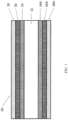
- a paper product 10 includes a substrate 12 (e.g., a paper base sheet) that is coated on a first side with a precoat 14, a barrier coating 16, and a topcoat designed for printing 18, and on a second, opposite side with a precoat 14A, a barrier coating 16A, and a topcoat designed for printing 18A.
- a substrate 12 e.g., a paper base sheet
- a barrier coating 16 e.g., a barrier coating
- topcoat designed for printing 18A
- Any or all of the coatings on the second side can be of a different formulation and/or a different coating weight from those on the first side.
- barrier coating 16 and barrier coating 16A can be advantageous, for example, in applications in which grease/oil resistance is required on one side of the paper product and moisture resistance or other barrier properties are required on the opposite side and printability and/or an aesthetically pleasing surface finish (provided by the topcoat) is desired on both sides.
- different formulations could be used for barrier coating 16 and barrier coating 16A to provide the desired barrier properties.
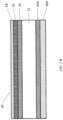
- the three coatings 14, 16 and 18 are provided on a first side of the substrate 12, but on the second, opposite side the topcoat 18A is omitted.
- This arrangement would be useful, for example, in an application where barrier properties are required on both sides, but only one side will be visible to the end user (or will be printed on).
- the three coatings 14, 16 and 18 are provided on a first side of the substrate 12, but on the second, opposite side the barrier coating 16A is omitted.
- This arrangement would be useful, for example, in an application where barrier properties are required on only one side, but printable surfaces are desirable on both sides.
- the precoat layer(s) can be omitted, for example if the substrate itself provides a suitable surface for application of the barrier coating, as will be discussed in more detail below, or the barrier layer is applied at a higher coat weight than would be used if a precoat is included.
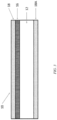
- An example of such an arrangement is shown in FIG. 3 , in which a first side of the substrate 12 includes a barrier coating 16 and a topcoat 18, and the second, opposite side includes only a topcoat 18A.
- the two topcoats may be the same or different. This arrangement would be used, for example, in applications in which only one type of barrier layer (with a given set of barrier properties) is required in the paper product, but printability is required on both sides.
- FIG. 4 Another example of a paper product with a barrier layer on only one side is shown in FIG. 4 .
- a first side of the substrate 12 includes all three layers (precoat 14, barrier coating 16, and topcoat 18), while a second side of the substrate includes only a precoat 14A.
- the precoat 14A provides a relatively smooth surface, protects the fibers of the substrate 12, and prevents curl for proper printing and converting.
- the topcoat be dryable without creating printing mottle, e.g., backtrap mottle, taking into account that, due to the presence of the barrier coating, water in the topcoat will not be able to migrate into the substrate.
- the topcoat should be substantially free of streaks, drags and scratches after drying, which is partly determined by process parameters and/or coating application methods - as will be discussed below in the Process section - but is also a factor of the coating formulation. How these objectives are achieved will be discussed below in the context of each coating formulation. It is noted that the term "parts,” as used herein, means parts on a dry solids weight basis, and, as is well known in the art, parts are based on 100 parts of pigment.
- the precoat is optional, and can be omitted if other techniques are used to obtain the desired continuity of the barrier coating layer (for example starting with a very smooth substrate, as will be discussed below, using a high coating weight of barrier coating, or using a continuous non-contact coating method, for example curtain coating or an air knife).
- a precoat When a precoat is used, its main purpose is to fill voids and roughness in the substrate, providing a smooth layer for application of the barrier coating. This improves the holdout of the barrier coating and allows a thinner layer of the generally more expensive barrier coating to be used.
- the precoat generally includes a binder system (a latex and/or a natural binder), and a pigment or pigment blend.
- a binder system a latex and/or a natural binder
- a pigment or pigment blend a pigment or pigment blend.
- the latex preferably has sufficient flexibility to provide a desired degree of foldability to the product.
- the latex used in the precoat preferably has the same degree of flexibility as that used in the barrier coating, and may in some cases be the same latex.
- the precoat contains a higher ratio of pigment to binder, the effect of the latex on the properties of the precoat is not as pronounced and it is not as important that the latex be flexible.
- latexes imparting lesser degrees of flexibility may be used without unduly affecting foldability. Foldability is typically measured by creasing the paper product (a 180-degree bend) and observing whether there is any cracking of the coating layers that is visible to the naked eye.
- Suitable latexes include, for example, styrene butadiene, styrene butadiene acrylonitrile, styrene acrylic, styrene acrylate, styrene acrylate acrylonitrile, styrene butadiene acrylate, polyvinyl acetate, vinyl acetate ethylene, and mixtures thereof. Latexes can be tested and their performance evaluated based on the desired flexibility and foldability characteristics for a particular application.
- the latex used in the precoat may be the same as or different from the latex used in the barrier coating, as long as the latexes are sufficiently chemically compatible for the barrier coating to be runnable on the precoat and so that the layers do not delaminate from each other upon drying.
- the natural binder may be, for example, starches and modified starches, proteins (e.g., soy protein, casein), carboxymethyl cellulose, hydroxymethyl cellulose, alginates, and mixtures thereof.
- the natural binder helps to avoid premature drying of the precoat due to the water in the coating sinking into the pores of the substrate. Too little of the natural binder may result in premature drying, while too much may cause cracking in the paper product. If latex is omitted, or a high level of natural binder is used, the natural binder should be selected to provide flexibility to the precoat layer.
- starches that provide this degree of flexibility include highly modified starches like hydroxyethyl starch, hydroxypropyl starch, acetylated starch, octenyl succinic anhydride starch and the like.
- Starch systems may also be used, for example blends of starches with plasticizers such as humectants (e.g., polyols, glycerin, urea and the like).
- the binder system for the precoat may also include polyvinyl alcohol (either synthetically or naturally derived) to provide flexibility and repulpability.
- the pigment blend may include one or more pigments, such as clays, including platy clays, talc, and calcium carbonate, that will provide holdout and improve runnability.
- a platy clay can be used to bridge and fill large pores in the substrate (if the substrate includes large pores), which improves the smoothness and holdout of the substrate and thus contributes to runnability of the barrier coating on the precoat. If a platy clay is used, it is generally preferred that the platy clay has an aspect ratio of from about 10 to 80, e.g., about 15 to 40.
- platy clays examples include Capim TM NP (commercially available from Imerys Kaolin), Astra-Plate TM (commercially available from Imerys), Kaowhite C (commercially available from Thiele), and Hydramatte ® (commercially available from KaMin LLC). It is noted that if the substrate is relatively smooth and dense, as will be discussed in the Substrate section below, a platy clay may not be necessary. The purpose of the platy clay is simply to provide a relatively smooth surface to facilitate formation of a continuous film of the barrier coating without the need to apply a high coat weight of the barrier coating.
- the pigment blend may also include calcium carbonate, for example a coarse calcium carbonate such as Hydrocarb ® 60, commercially available from Omya North America, or Carbital TM 60, commercially available from Imerys.
- the coarse calcium carbonate provides tooth, to aid in cleaning of the metering blade during application of the barrier coating, which helps to prevent scratches in the barrier layer.
- the remainder of the pigment used can be an additional pigment having a finer particle size.
- the additional pigment may be, for example, any of the many pigments conventionally used in paper coatings (e.g., TiO 2 , PCC, clays, plastic pigments, aluminum trihydrate, barium sulfate, fine calcium carbonate, talc, etc.).
- suitable filler pigment are fine calcium carbonates such as Hydrocarb ® 90, commercially available from Omya North America, or Carbital TM 90, commercially available from Imerys.
- the main objective in selecting pigments is to obtain a smooth surface with some degree of tooth to which the barrier coating can be applied, to help facilitate formation of a continuous, void-free film of the barrier coating.
- the pigment blends described above are helpful in providing an advantageous surface for application of the barrier layer if the uncoated substrate is rough and/or porous (e.g., a high caliper paperboard base sheet), in some cases a single pigment may be used.
- a pigment blend is generally not necessary.
- the pigment may be, for example, any of the pigments typically used in paper precoats.
- the precoat contains from about 10 to 30 parts of the binder system, e.g., from 5 to 20 parts latex and from 0 to 30 parts natural binder preferably modified for flexibility, per 100 parts of the pigment blend.
- Typical additives included in paper coatings may be added, e.g., dispersing agents and additives for viscosity control, pH control, microbiological control, foam control, water retention and shade control.
- the barrier coating which is essential as it provides the required oil/grease resistance, contains latex, a natural binder selected from the list of starches and modified starches, proteins, carboxymethyl cellulose, hydroxymethyl cellulose, alginates, and mixtures thereof, and pigment.
- the Pigment Volume Concentration and the ratio of latex to starch are both important to obtaining the desired balance of properties, as are the properties of the latex and the starch.
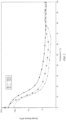
- the storage modulus on the TMA curve of the latex is less than 50 MPa and preferably less than 30 MPa, e.g., about 10 MPa to 30 MPa, at room temperature (25°C).
- the glass transition temperature (T g ) is generally below 20°C.
- the TMA curves shown in FIG. 5 were obtained as follows: The latexes were poured onto shallow aluminum weigh boats and allowed to dry at room temperature conditions. Once fully dry, the films were peeled off the weigh boats and small disks approximately 5 mm in diameter were randomly punched out of the films with a punching tool, avoiding voids. Testing to obtain storage modulus values was carried out on a Thermal Analysis (TA) Q400 thermomechanical analyzer (TMA). Each test is performed on a single disk. A quartz penetration probe was used to analyze the dry latex samples. The experimental procedure was based on the dynamic penetration experiment template that was pre-loaded on the TMA's software.
- TA Thermal Analysis
- TMA thermomechanical analyzer
- Latex samples were loaded into the machine at room temperature, cooled to -10°C, and then heated at 3 deg/min to 180°C.
- the oscillation frequency and force of the penetration probe varied among the latexes in order to get the best resolution of data.
- the sample chamber was continuously purged with helium gas during testing.
- the natural binder e.g. starch
- the starch also enhances the water-holding capacity of the coating during metering.
- Suitable starches include, for example, ethylated starches, propylated starches, acetylated starches, octenyl succinic anhydride (OSA) starches, thermally-modified starches, enzyme-converted starches and other starches typically used in paper coatings.
- the starches described in U.S. Patent Application Nos. 16/221,108 and 16/220,578 may be used. Starches with relatively high levels of modification and water plasticization would generally be preferred.
- Suitable starches for a particular application can be determined empirically by evaluating various modified starches in a given barrier coating formulation and testing the resulting coated paper products, e.g., for foldability, barrier properties and repulpability.
- the ratio of latex to starch is from 5:1 to 1:1. If too little starch is used, the repulpability of the paper product will tend to be reduced, while if too much starch is used the barrier properties of the barrier coating may be deleteriously affected.
- the barrier coating may also include polyvinyl alcohol (either synthetically or naturally derived) as a binder component to provide flexibility and repulpability, e.g., from 2 to 250 parts, preferably 10 to 100 parts.
- Polyvinyl alcohol may be used in addition to the latex and starch and/or it may replace a portion of the starch.
- the pigment is selected to provide runnability of the barrier coating without scratching and repulpability of the barrier layer (and thus of the paper product).
- the pigment is also selected to provide runnability of the topcoat over the barrier layer with minimal scratching when using contact metering systems. It is also important that the pigment not have a negative effect on barrier properties, e.g., by allowing grease or oil to penetrate through the layer.
- Hydrocarb ® 90, Carbital TM 90, or other calcium carbonate having a particle size distribution with at least 90% of the particles less than 2 ⁇ m would be suitable for this purpose.
- Fine and ultrafine clays, such as Hydragloss ® 90 and Kaofine 90 would also be suitable.
- the particle size of the pigment should be sufficiently small such that pigment particles do not protrude above the surface of the barrier layer when the barrier layer is applied at a desired coating weight.
- the barrier coating may include from about 40 to 750 parts of the binder system per 100 parts pigment by weight.
- the dried film CPVC of the barrier coating will generally be about 50-70%, e.g., about 55-65%, by volume, depending on the pigment and binder system used.
- the barrier coating is formulated so that the PVC in the wet film of the barrier coating will be significantly below the CPVC (e.g., from about 5 to 55%, by volume, in some cases from about 15 to 30%). This allows some of the binder to be absorbed into the substrate, and causes the resulting dried PVC to still be below the CPVC so that the binder will form a continuous film.
- the degree to which the PVC needs to be below the CPVC will depend on the porosity of the substrate, with more porous substrates requiring a lower PVC to account for absorption of the binder into the substrate.
- the barrier coating contains from about 40 to 500 parts latex and from 25 to 250 parts starch, based on 100 parts pigment.
- Optional additives that may be included in the barrier coating include lubricants, dispersing agents and agents for viscosity control, pH control, microbiological control, water retention, foam control, and shade and brightness control.
- the barrier coating may also include calcium stearate at an additive level, e.g., from 0.01 to 2 parts, preferably 0.05 to 1 parts. Calcium stearate may enhance runnability of the barrier coating on the underlying precoat or substrate by altering the rheology of the barrier coating. Calcium stearate may also improve the grease resistance of the barrier coating.
- the topcoat is provided over the barrier coating to avoid blocking while the coated sheet is being wound on the reel on the machine. (It is optional on the non-barrier side, since it is the barrier layer that can cause blocking).
- the topcoat also provides printability and glueability and tends to enhance the grease/oil resistance of the paper product.
- the topcoat that is to be used over the barrier coating needs to be runnable over and compatible with that layer, which is a challenge due to the difficulty inherent in adhering to the barrier coating - essentially a very smooth polymeric film with only a low level of pigment. If contact metering is used, the topcoat must be designed to minimize scratches, drags and streaks. Non-contact metering generally does not have these issues. Both types of metering have compatibility issues, such that if the topcoat does not adequately adhere to the barrier coating the result may be skip coat and/or reticulation of the topcoat during application, and/or cracking/flaking when the paper product is rolled up or folded.
- topcoat that is applied to the opposite side of the substrate does not need to meet this stringent runnability and compatibility requirements, and thus can have a different formulation if desired.
- any conventional topcoat may be used.
- the remainder of this section will refer to the characteristics and formulation of the topcoat that is applied to the barrier layer.
- the topcoat includes a latex and a pigment blend.
- the topcoat may include a natural binder, and/or small amounts of graphic and board coating additives to enhance printability and runnability.
- the topcoat in addition to good runnability over the barrier coating the topcoat exhibits good glueability, foldability, convertability, fiber tear, and lack of curling.
- Some preferred coatings exhibit "self-healing" properties, such that streaks, drags and scratches that are present after application of the coating will fill in during or before drying of the coating, and/or are easy to calender to remove any remaining flaws.
- the latex may be the same as or different from the latex(es) used in the precoat and barrier coatings.
- the latex provides offset printability, e.g., strength and ink setting, and good convertability.
- the latex is also selected to have sufficient flexibility to provide the paper product with good foldability. While the same latex may be used as is used in the barrier coating, in some cases it may be desirable to select a different latex in order to provide enhanced printability. Such latexes may in some cases have a higher T g and/or storage modulus than those used in the barrier coating.
- Suitable latexes include styrene acrylics, styrene acrylates, styrene butadienes, styrene butadiene acrylonitriles, styrene butadiene acrylates, styrene acrylate acrylonitriles, polyvinyl acetates, vinyl acetate ethylenes, and mixtures thereof.
- the natural binder if included, provides water holding, runnability, and printability.
- Suitable natural binders include starch, proteins, carboxymethyl cellulose, carboxymethyl starch, alginates, and mixtures thereof. Having too much natural binder can impact foldability, ink set time, and water holdability; too little can compromise the properties that the natural binder is used to impart.
- the topcoat may also include polyvinyl alcohol (either synthetically or naturally derived) to provide flexibility and repulpability.
- Polyvinyl alcohol may be used in addition to the latex and starch or it may replace the latex and/or the starch.
- the pigment blend is formulated to provide coater runnability of the topcoat over the barrier layer, by providing rheology control and water holding and enhancing the adhesion of the topcoat to the barrier coating.
- the pigment blend also contributes to good offset printability, including providing good ink gloss by helping to control ink setting and drying.
- the pigment blend has a relatively wide particle size distribution with relatively finer pores to retain water for runnability, with blockier pigments (lower aspect ratio) generally enhancing runnability.
- the pigment blend may include 0 to 50 parts of ultrafine clay and/or an ultrafine ground calcium carbonate.
- Hydragloss ® 90 commercially available from KaMin LLC, and Kaofine 90, commercially available from Thiele, are examples of ultrafine clays.
- Hydrocarb ® HG commercially available from Omya
- Carbital TM 95 commercially available from Imerys, are examples of ultrafine ground calcium carbonates.
- the pigment blend can also include 5 to 100 parts of coarser pigments such as ground calcium carbonate, platy clay or precipitated calcium carbonate (PCC).
- coarser pigments such as ground calcium carbonate, platy clay or precipitated calcium carbonate (PCC).
- PCC precipitated calcium carbonate
- Suitable rhombohedral and aragonite forms of PCCs typically used in coating formulations are commercially available from Specialty Minerals Industries, Imerys and Omya.
- Hydrocarb ® 90 and Carbital TM 90, ground calcium carbonates each have a particle size distribution in which 90% of the particles are finer, or smaller, than 2 ⁇ m.
- the ratio of the finer pigment to the coarser pigment may be, for example, from about 1:10 to 10:1, with the ratio depending on the particle sizes and particle size distributions of the pigments used.
- the topcoat contains from about 5 to 20 parts latex and from 0 to 10 parts starch or other natural binder per 100 parts pigment. If all natural binder is used, the topcoat can contain up to 20 parts natural binder per 100 parts pigment.
- the PVC of the topcoat is generally above the CPVC, e.g., by at least 10%, e.g., the PVC is from about 75% to 90%, to achieve non-blocking during manufacturing. In most formulations having the PVC above the CPVC contributes to providing the surface of the paper product with good printability and glueability and preventing blocking during manufacturing.
- Additives may be included in the topcoat to enhance calenderability, printability, and runnability of the topcoat.
- the topcoat may include calcium stearate at an additive level.
- Such additives are well known to those of skill in the art.
- the substrate may be any desired type of substrate used in paper products. In some cases, the substrate has a caliper of from about 4 to 30 points.
- the substrate used will depend on the characteristics desired in the end product.
- the barrier systems described herein can be adapted for use with a wide range of substrates, including both heavy weight paperboards and papers such as those used in food wraps.
- the substrate can be a web composed of a fiber-based material known to those skilled in the art of manufacturing coated paper and paperboard products.
- the basis weight of suitable substrates before application of the coating layers typically ranges from about 60 to 460 g/m 2 for paper and paperboard products.
- the ash content of the substrate i.e., the amount of inorganic material incorporated within the substrate, including virgin pigment material and pigment material derived from a recycled fiber component of the substrate, is about 2 to 20 % by weight, more preferably about 12 to 15 % by weight.
- the substrate needs to be smooth enough and have sufficiently low enough porosity for the barrier layer to be retained on the paper surface so that the barrier layer will form a continuous film.
- a standard paper substrate usually has a high degree of surface roughness and is quite open, i.e. very porous.
- Addition of a precoat layer over the paper substrate provides some degree of smoothness and density to the paper surface. Precalendering of the precoat layer with a temperature and pressure selected to augment the paper surface smoothness and porosity enhances the ability of the barrier layer to form a continuous film. This added smoothness and density may also help in reducing the thickness of barrier layer needed to attain desired barrier properties. Additionally, the precoat layer may not be needed if the paper substrate itself is made smooth and dense enough by precalendering.
- the surface roughness of the substrate is not overly important, as the precoat will provide a sufficiently smooth surface to allow the barrier layer to form a continuous film.
- the substrate should have a relatively smooth surface (sufficiently smooth to allow a continuous film of the barrier coating to be formed at a desired coating weight of barrier coating).
- suitable substrates for direct application of the barrier coating would include supercalendered, highly filled substrates having a Parker Print Surf S 10 roughness of ⁇ 5.0 ⁇ m, preferably ⁇ 2.5 ⁇ m.
- the coatings described above can be applied by a variety of coating technologies. Examples of coating applications include bent blade, bevel blade, rod, short dwell, curtain coating, air knife, metered size press, etc. In some implementations the coatings are applied using bent blade or curtain coating equipment.
- contour coating e.g., air knife or curtain coating
- Bent blade is most useful for high speed applications while still giving a contour-like application. Practitioners skilled in the art will know that the invention is not limited to these techniques. In addition, those skilled in the art know that modifications to the rheology of the coating compositions of the invention will be necessary depending on the coating technique employed.
- Suitable coating weights will depend on a variety of factors, as would be understood by those of skill in the art. However, in some implementations the following coating weights (per side) may be used: precoat: about 3 to 21 grams per square meter (g/m 2 ); barrier coating: needs to be thick enough to provide a continuous film and to act as a grease and oil barrier, e.g., a minimum of 2 to 3 ⁇ m thickness in the thinnest part of the barrier layer; topcoat: enough to provide a continuous layer that is thick enough to prevent blocking and print well, but thin enough not to crack, e.g., about 4.5 to 15 g/m 2 . It is noted that the coating weights of the precoat and the barrier layer will depend on the characteristics of the underlying substrate or layer, with more of the coating being required if the underlying layer is rougher.
- Process parameters should be adjusted so that the barrier coating does not film over before it has dried, and so that print mottle and fines and/or soluble binder migration are minimized in the topcoat. Fines that may migrate to the surface of a coating layer are materials typically less than about 0.2 ⁇ m in size. Calendering may be used to eliminate or minimize streaks/drags/scratches that are present after contact metering.
- the paper products may be manufactured using a continuous in-line process on one machine, or manufactured on multiple machines.
- the latter processing may be used, for example, to apply more layers of coating than can be accomplished on a single machine.
- the paper products disclosed herein exhibit the following properties: Property Value (Range or min/max) Test procedure Curl ⁇ 8 mm See below RP2 Test, creased (barrier properties) ⁇ 10%, preferably ⁇ 5% stained See below Canola Test, creased (barrier properties) ⁇ 10%, preferably ⁇ 5% stained See below Blocking (during manufacture) ⁇ 2 See below Glueability ⁇ 5 minutes See below Repulpability ⁇ 95%, preferably ⁇ 99% Fiber Box Association Repulpability Test, Appendix A
- Curl Test The curl test is performed on 25" x 38" sheets of paper or paperboard that are (1) printed on an eight color press printed with the standard 4 colors in standard sequence (Black-Cyan-Magenta-Yellow), (2) overcoat printed in the sixth unit using a typical amount of aqueous overcoat of choice, and (3) heat dried on press. Approximately 10 sheets are pulled during the press run when the press is in steady state. The sheets are allowed rest in a pile for 30 minutes, printed side facing up, in standard press room conditions. One sheet is randomly removed from the pile and placed, printed side up, on a flat surface. Curl is measured at each corner and the four measurements (mm) are averaged. The test is repeated on a second randomly selected sheet. The average of the measurements for the two sheets are recorded.
- the RP2 Test is based on the RALSTON-PURINA test developed by Ralston-Purina Company for testing pet food packaging materials.
- a 4" x 4" sample of paper is creased in the machine direction and then in the cross-machine direction using a weighted roller.
- the creased sample is placed on grid paper that is in turn placed on blotter paper in a metal tray.
- the intersection of the creases should line up with the center of the grid paper.
- a metal ring 2.5" in diameter and 0.5" high is centered over the center of the creases. Five grams of sand are poured in the center of the creases, ensuring that the sand is evenly distributed.
- Red dyed synthetic oil (1.1 ml, supplied from Ralston Purina Company) is applied evenly to sand.
- the sample is placed in an oven at 140°F (60°C) for 24 hours.
- After the grid paper is evaluated for staining.
- Each square of the grid paper represents 1% of the tested surface area of the sample.
- the RP2 test result is the total amount of staining based on the number of stained grid squares (e.g., 2 stained squares means a RP2 test result of 2%).
- the Canola test is based on the TAPPI T-454 om-15 Turpentine test and is very similar to the RP2 test but uses an oil widely used in the food industry. The test follows the procedure described above for the RP2 test with the following deviations.
- the oil used in the test is 1.3 ml of canola oil.
- the sample is placed in an oven at 60°C for hour.
- the Canola test result is the total amount of staining based on the number of stained grid squares (e.g., 2 stained squares is a Canola test result of 2%).
- Blocking Test The following procedure is used to evaluate the tendency of paperboard to 'block' coated surface to uncoated surface. Coated boards are conditioned in the standard TAPPI lab conditions (73°F, 50% RH) for at least 24 hours. Then pairs of 2" x 2" pieces of board are stacked coated side-to-uncoated side and clamped at 100 psi in the Koehler jig and placed in a dry oven at 50°C (122°F). After 24 hours the test pairs are released from the clamp, evaluated by the rating scale below for the degree of ease with which they separate, and observed for any damage to the surfaces after separating.
- Glueability Test Two strips, each approximately 60 mm x 250 mm, are taken from a paper or paperboard sample. A water-based glue is applied to the more porous side of one of the strips using a 19 ⁇ m applicator bar (e.g. 0.75 mil Bird bar from BYK Instruments).
- the glue can be, for example, SwiftTak 48695 available from H.B. Fuller, or Adhesive 8272R available from Cattie Adhesives.
- the less porous side of the second strip is placed against the glued side of the first strip.
- This sandwich construct is rolled lightly with a Brayer roller, and then placed under a 2 Kg weight. At 30 second intervals, a short section of the sandwich is quickly pulled apart and evaluated for failure.
- the glue has not set. If there is substantial tearing of fiber from one or both of the strips, e.g., more than 50% of a strip, the glue has set, indicating that the two strips have bonded together sufficiently for further use. Results are reported as time to set; any set times less than or equal to 5 minutes are considered "passing" for most applications.
- a paper machine trial was conducted to manufacture fluorochemical-free grease resistant paperboard product, as depicted in Fig. 2B .
- the paperboard substrate had a caliper of 14 points.
- a precoat was applied to both sides with approximately 9.6 g/m 2 on the barrier coating side and 5.4 g/m 2 on the opposite side.
- the coat weights in this example were measured by the paper machine online measurement gauge and therefore are estimated weights.
- the precoated substrate was dried and precalendered online to provide a smooth surface for the barrier coating.
- a barrier coating was applied at various coat weights, detailed below, on the side with the heavier precoat layer.
- a topcoat was applied to both sides with approximately 6.0 g/m 2 on the barrier coating side to minimize blocking of the barrier coating layer in the reel and 13.3 g/m 2 on the opposite non-barrier side to provide desirable printing properties.
- the non-barrier side of the coated paperboard was calendered.
- Coating Formulations dry parts by weight based on 100 parts of pigment: Coating Material Precoat Barrier Coat Topcoat Platy Clay 60 0 20 Fine Ground Calcium Carbonate 20 100 5 Coarse Ground Calcium Carbonate 20 0 5 Precipitated Calcium Carbonate 0 0 50 Ultrafine Ground Calcium Carbonate 0 0 20 Latex A ( Fig. 5 ) 0 148 0 Styrene Acrylic Latex 15 0 12.5 Starch 6 74 2 Calcium Stearate 0 0.11 0.20 Polyvinyl Alcohol 0 0 0 0 0 0
- TAPPI T-480 om-15 2.
- TAPPI T-555 om-15 3. Lodcel test as described in TAGA 1992 Proceedings: Concannon, Paul W., Wilson, Larry A. (1992). A method for measuring tack build of offset printing inks on coated paper. In TAGA (Ed.) Technical Association of the Graphic Arts TAGA 1992 Proceedings (pp.282-301). Rochester, NY: TAGA . 4. TAPPI T-653 om-07
- Lodcel Test The lodcel test was developed by S.D. Warren Company in 1974, refined over the years and published at TAGA proceedings in 1992. The lodcel test measures the force to split an ink film between a printing blanket and paper (g/cm 2 /sec). The process is designed to give an indication of how a given paper and ink combination may react when subjected to the stresses of multiple printing impressions.
- a Vandercook proofing press is used to perform the lodcel test. A measured layer of ink is applied to the block (length 12", depth 0.003") by a scraper, and the blanket is run over the block to split the ink film. The paper sample (2 1 ⁇ 2" x 10") is placed in clamps and then printed using the blanket.
- the press passes over the sample (speed 100 ft./min) and the force is recorded until failure occurs (ink force at failure point) or 10 passes have passed, whichever comes first. Failure is when coating is picked from the paper surface by the force of the ink tack.
- the ink forces for the first and last passes are omitted and the slope (rate of ink tack build-up) is calculated based on the ink forces for the other passes.
- Backtrap Mottle Test In multi-color offset printing, tack build-up of inks is important both to ink-setting and to the transfer of additional ink film to the fresh ink layers already on the paper. Part of the fresh ink already on the paper may retransfer or "backtrap" to subsequent printing blankets. If the tack build-up is not uniform over the paper surface, the local transfer/retransfer balance is upset and the resulting print will not be uniform and may appear mottled. This partial or uneven setting of the ink on a microscale is referred to as "backtrap mottle" (BTM), and can result in an unacceptable blotchy or mottled printed surface with alternating light and dark printed areas.
- BTM backtrap mottle
- the size of the light and dark areas varying in print density are a distinguishing characteristic of a given printed substrate.
- BTM is more noticeable and objectionable for larger printed areas, smaller halftones, coarser BTM patterns, and larger spacings of the light and dark areas.
- BTM can be measured by commercially available instruments or by subjective expert evaluation.
Landscapes
- Chemical & Material Sciences (AREA)
- Inorganic Chemistry (AREA)
- Chemical Kinetics & Catalysis (AREA)
- Dispersion Chemistry (AREA)
- Paper (AREA)
- Lubricants (AREA)
Claims (15)
- Ein Papierprodukt, das Folgendes beinhaltet:ein Substrat; undauf mindestens einer Seite des Substrats:eine kontinuierliche Lage einer Barriereschicht, wobei die Barriereschicht ein Bindemittelsystem, wobei das Bindemittelsystem einen Latex und ein natürliches Bindemittel beinhaltet, und ein Pigment beinhaltet, wobei das natürliche Bindemittel aus der Liste von Stärken und modifizierten Stärken, Proteinen, Carboxymethylcellulose, Hydroxymethylcellulose, Alginaten und Mischungen davon ausgewählt ist und die Mengen von Latex : natürlichem Bindemittel in einem Verhältnis von 5 : 1 bis 1 : 1 vorliegen, undeine Deckbeschichtung, die einen Latex und eine Pigmentmischung beinhaltet;wobei die Barriereschicht, wenn auf das Substrat aufgebracht und getrocknet, um eine Barriereschicht zu bilden, eine Pigmentvolumenkonzentration (PVC) aufweist, die unter einer kritischen Pigmentvolumenkonzentration (CPVC) der Barriereschicht liegt, was einen kontinuierlichen dreidimensionalen Film des Bindemittelsystems bereitstellt;wobei die Pigmentvolumenkonzentration (PVC) der Volumenanteil von Pigment in der Zusammensetzung, definiert durch die folgende Formel, ist:

- Papierprodukt gemäß Anspruch 1, wobei die Deckbeschichtung auf der Oberfläche der Barrierelage angeordnet ist.
- Papierprodukt gemäß Anspruch 2, wobei die Deckbeschichtung:(i) eine PVC aufweist, die über einer CPVC der Deckbeschichtung liegt; oder(ii) eine Pigmentmischung umfasst, die einen ultrafeinen Ton und/oder ultrafeines gemahlenes Calciumcarbonat beinhaltet, wobei optional die Deckbeschichtung ferner ein grobes Pigment beinhaltet, wobei optional das Verhältnis von feinem Pigment zu grobem Pigment von etwa 1 : 10 bis 10 : 1 beträgt.
- Papierprodukt gemäß Anspruch 1, wobei die Barriereschicht von etwa 40 bis 750 Teile des Bindemittelsystems pro 100 Teile Gewichtsprozente Pigment umfasst.
- Papierprodukt gemäß Anspruch 1, wobei das Papierprodukt > 99 % Repulpierbarkeit vorweist, wie gemessen durch das Faserbox-Assoziation-Repulpierbarkeit-Testverfahren, Anhang A.
- Papierprodukt gemäß Anspruch 1, das ferner eine Vorbeschichtung beinhaltet, die zwischen dem Substrat und der Barrierelage angeordnet ist, wobei optional die Vorbeschichtung eine Pigmentmischung umfasst, die ein plättchenförmiges Pigment und ein grobes Pigment mit einer durchschnittlichen Partikelgröße von mindestens etwa 2 µm beinhaltet.
- Papierprodukt gemäß Anspruch 1, wobei das Papierprodukt frei von Fluorkohlenstoff enthaltenden Materialien ist.
- Papierprodukt gemäß Anspruch 1, wobei das Bindemittelsystem Folgendes umfasst:(i) von etwa 2 bis 250 Teilen Polyvinylalkohol; oder(ii) von etwa 0,01 bis 2 Teilen Calciumstearat.
- Papierprodukt gemäß Anspruch 2, wobei die Deckbeschichtung ein natürliches Bindemittel, optional Stärke, beinhaltet.
- Papierprodukt gemäß Anspruch 1, wobei das Speichermodul auf der TMA-Kurve des Latex weniger als 50 MPa, optional weniger als 30 MPa bei Raumtemperatur (25 °C) ist.
- Papierprodukt gemäß Anspruch 6, wobei die Vorbeschichtung kalandert ist.
- Ein Verfahren zum Herstellen eines Papierprodukts gemäß Anspruch 1, das Folgendes beinhaltet:Aufbringen, auf mindestens eine Seite eines Substrats, der kontinuierlichen Lage einer Barriereschicht,Trocknen der Barriereschicht, um eine Barrierelage zu bilden, wobei die getrocknete Barrierelage eine Pigmentvolumenkonzentration (PVC) aufweist, die unter einer kritischen Pigmentvolumenkonzentration (CPVC) der Barriereschicht liegt, was einen kontinuierlichen dreidimensionalen Film des Bindemittelsystems bereitstellt, und Aufbringen der Deckbeschichtung auf die Barriereschicht.
- Verfahren gemäß Anspruch 12, wobei die Deckbeschichtung eine graphische Deckbeschichtung ist, optional ferner beinhaltend das Kalendrieren der Deckbeschichtung.
- Verfahren gemäß Anspruch 12, das ferner das Aufbringen einer Vorbeschichtung auf das Substrat vor dem Aufbringen der Barriereschicht auf der gleichen Seite des Substrats beinhaltet, optional ferner beinhaltend das Kalendrieren des Substrats nach dem Aufbringen der Vorbeschichtung und vor dem Aufbringen der Barriereschicht.
- Verfahren gemäß Anspruch 12, das ferner das Kalendrieren des Substrats vor dem Aufbringen der Barriereschicht beinhaltet.
Applications Claiming Priority (2)
| Application Number | Priority Date | Filing Date | Title |
|---|---|---|---|
| US16/949,693 US11549216B2 (en) | 2020-11-11 | 2020-11-11 | Oil/grease resistant paper products |
| PCT/US2021/045562 WO2022103458A1 (en) | 2020-11-11 | 2021-08-11 | Oil/grease resistant paper products |
Publications (3)
| Publication Number | Publication Date |
|---|---|
| EP4244422A1 EP4244422A1 (de) | 2023-09-20 |
| EP4244422B1 true EP4244422B1 (de) | 2024-12-04 |
| EP4244422C0 EP4244422C0 (de) | 2024-12-04 |
Family
ID=77595658
Family Applications (1)
| Application Number | Title | Priority Date | Filing Date |
|---|---|---|---|
| EP21763477.3A Active EP4244422B1 (de) | 2020-11-11 | 2021-08-11 | Öl-/fettbeständige papierprodukte |
Country Status (8)
| Country | Link |
|---|---|
| US (2) | US11549216B2 (de) |
| EP (1) | EP4244422B1 (de) |
| KR (1) | KR20230098216A (de) |
| AU (1) | AU2021380580A1 (de) |
| ES (1) | ES3000386T3 (de) |
| MX (1) | MX2023005558A (de) |
| PL (1) | PL4244422T3 (de) |
| WO (1) | WO2022103458A1 (de) |
Cited By (1)
| Publication number | Priority date | Publication date | Assignee | Title |
|---|---|---|---|---|
| US20230091321A1 (en) * | 2020-11-11 | 2023-03-23 | Sappi North America, Inc. | Oil/grease resistant paper products |
Families Citing this family (7)
| Publication number | Priority date | Publication date | Assignee | Title |
|---|---|---|---|---|
| MX2023014650A (es) | 2021-06-09 | 2024-05-07 | Soane Mat Llc | Articulos de fabricacion que comprenden elementos de nanocelulosa. |
| AT526258B1 (de) * | 2022-06-24 | 2025-10-15 | Mondi Ag | Fettabweisendes papier |
| US20240052152A1 (en) * | 2022-08-12 | 2024-02-15 | Johns Manville | Pvc formulations with low water vapor permeability |
| EP4339360A1 (de) * | 2022-09-13 | 2024-03-20 | Wihuri Packaging OY | Verpackungsmaterial für fettverpackungen und verfahren zu seiner herstellung |
| CN121311418A (zh) | 2023-06-15 | 2026-01-09 | 科勒创新科技有限公司 | 环保包装材料 |
| KR102675730B1 (ko) * | 2023-12-27 | 2024-06-17 | 고려대학교 산학협력단 | 일회용 식품 용기용 친환경 코팅 종이 |
| US20250215647A1 (en) * | 2023-12-29 | 2025-07-03 | Billerud Aktiebolag (Publ) | Coated paper |
Citations (11)
| Publication number | Priority date | Publication date | Assignee | Title |
|---|---|---|---|---|
| WO2005044469A1 (en) | 2003-10-31 | 2005-05-19 | Appleton Papers Inc. | Recyclable repulpable coated paper stock |
| WO2012000609A1 (en) | 2010-06-16 | 2012-01-05 | Cargill, Incorporated | Starch-based compositions for latex replacement |
| JP2012241304A (ja) | 2011-05-24 | 2012-12-10 | Oji Holdings Corp | 印刷用塗工紙およびその製造方法 |
| JP2014141750A (ja) | 2013-01-22 | 2014-08-07 | Oji Holdings Corp | 耐油紙およびその製造方法 |
| WO2017001857A1 (en) | 2015-06-30 | 2017-01-05 | Imerys Minerals Limited | Mineral compositions |
| WO2018031387A1 (en) | 2016-08-08 | 2018-02-15 | Westrock Mwv, Llc | Compostable paperboard with oil, grease, and moisture resistance |
| WO2018116118A1 (en) | 2016-12-22 | 2018-06-28 | Stora Enso Oyj | Method for manufacturing a packaging material and a packaging material made by the method |
| US20180245291A1 (en) | 2017-02-27 | 2018-08-30 | Westrock Mwv, Llc | Heat sealable barrier paperboard |
| EP3561178A1 (de) | 2018-04-27 | 2019-10-30 | Fiskeby Board AB | Cellulosebasiertes substrat für lebensmittelverpackungsmaterial |
| WO2020121162A1 (en) | 2018-12-10 | 2020-06-18 | Stora Enso Oyj | Repulpable packaging material |
| EP3186442B1 (de) * | 2014-07-30 | 2021-05-26 | Ahlstrom-Munksjö OYJ | Heisssiegelbarrierepapier |
Family Cites Families (112)
| Publication number | Priority date | Publication date | Assignee | Title |
|---|---|---|---|---|
| US3097989A (en) | 1959-12-28 | 1963-07-16 | Lawrence Paper Co | Manufacture of slip-resistant paper |
| SE7407219L (de) | 1973-06-01 | 1974-12-02 | Kemmerer Gmbh | |
| US4391833A (en) | 1975-09-04 | 1983-07-05 | International Paper Company | Method of making and using heat resistant resin coated paperboard product and product thereof |
| IT1131836B (it) | 1980-06-20 | 1986-06-25 | Montedison Spa | Procedimento per preparare strutture multistrato da fogli contenenti fibre sintetiche |
| CH657311A5 (de) | 1981-10-22 | 1986-08-29 | Ecoboard Ltd | Verfahren und vorrichtung zur herstellung eines zwei- oder dreischichtigen, insbesondere aus karton bestehenden nicht-textilen flaechengebildes. |
| US4909901A (en) | 1987-09-28 | 1990-03-20 | James River Corporation | EMI and RFI shielding and antistatic materials and processes for producing the same |
| US5244541A (en) | 1988-04-28 | 1993-09-14 | Potlatch Corporation | Pulp treatment methods |
| US5147505A (en) | 1991-05-24 | 1992-09-15 | Union Camp Corporation | Multilayer paper and method for the manufacturing thereof |
| NZ244494A (en) | 1991-10-08 | 1994-10-26 | Tetra Alfa Holdings | Recyclable single- or multi-layer paper or cardboard barrier material characterised by being coated or impregnated with a gel-forming hydrocolloid such as a polysaccharide |
| DE4303834A1 (de) | 1993-02-10 | 1994-08-11 | Wolff Walsrode Ag | Mehrschichtlackierungen von Papier durch einmaligen Materialauftrag |
| US5607551A (en) | 1993-06-24 | 1997-03-04 | Kimberly-Clark Corporation | Soft tissue |
| US5660898A (en) | 1995-08-28 | 1997-08-26 | Westvaco Corporation | Heat sealed, ovenable food cartons |
| US5728224A (en) | 1995-09-13 | 1998-03-17 | Tetra Laval Holdings & Finance S.A. | Apparatus and method for manufacturing a packaging material using gaseous phase atmospheric photo chemical vapor deposition to apply a barrier layer to a moving web substrate |
| WO1997015402A1 (en) | 1995-10-24 | 1997-05-01 | Tetra Laval Holdings & Finance S.A. | Apparatus and method for manufacturing a packaging material |
| US5776619A (en) | 1996-07-31 | 1998-07-07 | Fort James Corporation | Plate stock |
| US5928472A (en) | 1997-09-03 | 1999-07-27 | Watkins; Kenneth S. | Paper web and process for making the same |
| US5897411A (en) | 1997-10-01 | 1999-04-27 | Reichhold Chemicals, Inc. | Repulpable moisture vapor barrier |
| US6680084B1 (en) | 1999-06-10 | 2004-01-20 | Simex Technologies Inc. | Formation of oriented multilayer polymeric films |
| WO2001045941A2 (en) | 1999-12-20 | 2001-06-28 | Advanced Plastics Technologies, Ltd. | Laminates and coated materials comprising hydroxy-phenoxyether polymers |
| ATE260160T1 (de) | 2000-07-03 | 2004-03-15 | Fraunhofer Ges Forschung | Mehrschichtige verpackung für fettende güter |
| EP1249533A1 (de) | 2001-04-14 | 2002-10-16 | The Dow Chemical Company | Verfahren zur Herstellung von mehrschichtig beschichtetem Papier oder Pappe |
| US7833915B2 (en) | 2001-06-29 | 2010-11-16 | Spectra-Kote Corporation | Grease, oil and wax resistant paper composition |
| FI110443B (fi) | 2001-07-03 | 2003-01-31 | Metso Paper Inc | Liimakäsitellyn paperin tai kartongin valmistamiseen tarkoitettu menetelmä ja sovitelma |
| EP1434716B1 (de) | 2001-08-15 | 2006-04-12 | Cellresin Technologies, LLC | Verpackungsmaterialien mit verbesserten sperreigenschaften |
| US7255918B2 (en) * | 2002-06-10 | 2007-08-14 | Oji Paper Co., Ltd. | Coated paper sheet |
| WO2004035930A1 (en) | 2002-10-15 | 2004-04-29 | Dow Global Technologies Inc. | A method of producing a coated substrate |
| WO2004035931A1 (en) | 2002-10-15 | 2004-04-29 | Dow Global Technologies Inc. | Process for making coated paper or paperboard |
| AU2002335033A1 (en) | 2002-10-15 | 2004-05-04 | Dow Global Technologies Inc. | Method of producing a multilayer coated substrate having improved barrier properties |
| US7320825B2 (en) | 2003-05-27 | 2008-01-22 | International Paper Company | Barrier coatings for oil and grease resistance |
| US7144632B2 (en) | 2003-06-11 | 2006-12-05 | E. I. Du Pont De Nemours And Company | Aliphatic-aromatic polyetherester compositions, articles, films, coating and laminates and processes for producing same |
| US20120251597A1 (en) | 2003-06-19 | 2012-10-04 | Eastman Chemical Company | End products incorporating short-cut microfibers |
| BRPI0509311A (pt) | 2004-03-31 | 2007-09-04 | Basf Plant Science Gmbh | embalagem de camada múltipla para produtos gordurosos ou parte de uma tal embalagem, e, uso de um amido com alto teor de amilose |
| US7358325B2 (en) | 2004-07-09 | 2008-04-15 | E. I. Du Pont De Nemours And Company | Sulfonated aromatic copolyesters containing hydroxyalkanoic acid groups and shaped articles produced therefrom |
| GB0421685D0 (en) | 2004-09-30 | 2004-11-03 | Arjo Wiggins Fine Papers Ltd | Multi-layer coating products and curtain coating process for same |
| US7641764B2 (en) | 2004-12-03 | 2010-01-05 | Mitsubishi Paper Mills Limited | Non-woven fabric for gypsum board and process for producing the same |
| FI121086B (fi) | 2004-12-31 | 2010-06-30 | Metso Paper Inc | Menetelmä paperi- tai kartonkirainojen päällystämiseksi |
| DE102005023608A1 (de) | 2005-05-18 | 2006-11-23 | Basf Ag | Verfahren zur Herstellung von Papier, Pappe und Karton in Gegenwart von wasserquellbaren Polymeren |
| EP1940561A4 (de) | 2005-10-26 | 2009-09-23 | Polymer Ventures Inc | Fett und wasserbeständiger artikel |
| WO2007053597A2 (en) | 2005-10-31 | 2007-05-10 | International Paper Company | An anticorrosive paper or paperboard material |
| US8637126B2 (en) * | 2006-02-06 | 2014-01-28 | International Paper Co. | Biodegradable paper-based laminate with oxygen and moisture barrier properties and method for making biodegradable paper-based laminate |
| FI118809B (fi) | 2006-09-11 | 2008-03-31 | M Real Oyj | Menetelmä kuitutuotteen valmistamiseksi |
| FI123420B (fi) * | 2006-09-25 | 2013-04-30 | Teknologian Tutkimuskeskus Vtt | Päällystetty paperi- tai kartonkituote ja menetelmä sen valmistamiseksi |
| EP1914345A1 (de) * | 2006-10-17 | 2008-04-23 | Kuraray Europe GmbH | Verfahren zur Beschichtung von Substraten mit Polyvinylacetalen durch Curtain-Coating |
| US20090098303A1 (en) | 2007-10-15 | 2009-04-16 | Polymer Ventures, Inc. | Coatings to increase water and grease resistance of porous materials and materials having such protection |
| US8021517B2 (en) | 2008-02-28 | 2011-09-20 | Honeywell Asca Inc. | Use of fluorescent nanoparticles to make on-line measurements of cross-web and machine-direction component and property variations in paper and continuous web products |
| AU2008201776A1 (en) | 2008-04-22 | 2009-11-05 | Amcor Limited | Corrugated paperboard |
| US20110027601A1 (en) | 2008-04-30 | 2011-02-03 | Meadwestvaco Corporation | Water based barrier coating compositions |
| US20090286090A1 (en) | 2008-05-19 | 2009-11-19 | Ting Yuan-Ping R | Enhance performance on current renewable film using functional polymer coatings |
| WO2009142739A1 (en) * | 2008-05-23 | 2009-11-26 | Dow Global Technologies Inc. | Paper coating composition having nanofiller |
| WO2010039442A1 (en) | 2008-10-03 | 2010-04-08 | Georgia-Pacific Corrugated Llc | Corrugating linerboard, corrugated board, and methods of making the same |
| KR101621575B1 (ko) | 2008-10-10 | 2016-05-16 | 다우 글로벌 테크놀로지스 엘엘씨 | 종이계 기재용 다층 코팅 |
| JP5571093B2 (ja) | 2008-11-07 | 2014-08-13 | プレミアム ボード フィンランド オーワイ | リサイクル可能な塗工紙または塗工板紙の製造方法 |
| SE534151C2 (sv) | 2009-02-16 | 2011-05-10 | Stora Enso Ab | Process för tillverkning av papper eller kartong |
| CN102427939B (zh) | 2009-03-20 | 2016-04-06 | 陶氏环球技术有限责任公司 | 多层结构体及其制造方法 |
| US20110088931A1 (en) | 2009-04-06 | 2011-04-21 | Vorbeck Materials Corp. | Multilayer Coatings and Coated Articles |
| WO2010123689A1 (en) | 2009-04-21 | 2010-10-28 | Meadwestvaco Corporation | A method of making multilayer paper-based packaging materials having enhanced barrier performance |
| FI126350B (fi) * | 2009-09-18 | 2016-10-14 | Upm Kymmene Corp | Menetelmä paperituotteen valmistamiseksi, paperituote ja hybridipäällyste |
| PL2402167T3 (pl) * | 2010-07-02 | 2014-04-30 | Omya Int Ag | Papier do zapisu atramentowego |
| US9657200B2 (en) | 2012-09-27 | 2017-05-23 | Henkel IP & Holding GmbH | Waterborne adhesives for reduced basis weight multilayer substrates and use thereof |
| UA110221C2 (uk) * | 2010-09-28 | 2015-12-10 | Tetra Laval Holdings & Finance | Спосіб одержання пакувального матеріалу для упаковки, що стерилізується, пакувальний матеріал та упаковка |
| US9358576B2 (en) * | 2010-11-05 | 2016-06-07 | International Paper Company | Packaging material having moisture barrier and methods for preparing same |
| US9365980B2 (en) * | 2010-11-05 | 2016-06-14 | International Paper Company | Packaging material having moisture barrier and methods for preparing same |
| GB201019288D0 (en) * | 2010-11-15 | 2010-12-29 | Imerys Minerals Ltd | Compositions |
| RU2618470C2 (ru) | 2010-12-16 | 2017-05-03 | Реййо К. САЛМИНЕН | Способ и устройство для расщепления целлюлозных волокон, способ обработки волокнистой массы при производстве бумаги, способ высушивания бумаги и бумажный продукт, содержащий расщепленные волокна |
| KR101083194B1 (ko) * | 2011-01-07 | 2011-11-11 | 주식회사 엘지화학 | 라텍스 분포가 조절된 코팅 구조를 갖는 코팅지 및 제조방법 |
| FI126885B (fi) | 2011-05-31 | 2017-07-14 | Stora Enso Oyj | Terpeenifenolihartsin käyttö ekstruusiopinnoituksessa |
| US20140251563A1 (en) * | 2011-11-09 | 2014-09-11 | Basf Se | Use in paper coatings of a mixture of a secondary polymeric dispersion and of a primary dispersion of an emulsion polymer |
| FI124235B (en) | 2012-04-26 | 2014-05-15 | Stora Enso Oyj | Fiber-based paper or paperboard web and a process for its manufacture |
| FI124556B (en) | 2012-04-26 | 2014-10-15 | Stora Enso Oyj | A hydrophobic bonded fibrous web and a method of making a bonded web |
| FI125255B (fi) | 2012-06-08 | 2015-08-14 | Upm Kymmene Corp | Menetelmä ja järjestelmä pakkausmateriaalin valmistamiseksi sekä pakkausmateriaali ja pakkaus |
| EP2864543B1 (de) | 2012-06-22 | 2017-10-11 | Trinseo Europe GmbH | Beschichtetes substrat und system und verfahren zur herstellung davon |
| EP2892718A4 (de) * | 2012-09-10 | 2016-06-08 | Funktionalisierte vinylacetat-ethylenbinder für papier- und pappbeschichtungen | |
| FI124410B (en) | 2012-10-26 | 2014-08-15 | Stora Enso Oyj | Method for the production of biodegradable packaging material, biodegradable packaging material and packaging or container thereof |
| FI124772B (fi) | 2012-10-26 | 2015-01-30 | Stora Enso Oyj | Menetelmä biohajoavan pakkausmateriaalin valmistamiseksi, biohajoava pakkausmateriaali ja siitä valmistettu pakkaus tai astia |
| WO2015003275A1 (en) | 2013-07-12 | 2015-01-15 | Converdis Inc. | Foldable paper-based substrates coated with water-based coatings and process for coating foldable paper-based substrates |
| AT514862B1 (de) | 2013-09-27 | 2015-06-15 | Tannpapier Gmbh | Beschichtungsverfahren |
| DE202013105317U1 (de) | 2013-11-22 | 2014-11-24 | Mayr-Melnhof Karton Ag | Schichtstoff und Vorrichtung zur Herstellung eines Schichtstoffs |
| ES2720513T3 (es) | 2013-11-27 | 2019-07-22 | Henkel IP & Holding GmbH | Adhesivo para artículos aislantes |
| ITTO20131036A1 (it) | 2013-12-18 | 2015-06-19 | Fond Istituto Italiano Di Tecnologia | Materiale di confezionamento con proprieta' barriera alla migrazione di oli minerali e procedimento per la loro preparazione |
| HUE030487T2 (en) * | 2014-07-04 | 2017-05-29 | Billerudkorsnaes Ab | Coated sack paper |
| ES2644773T1 (es) * | 2014-11-04 | 2017-11-30 | Sca Forest Products Ab | Producto laminado intermedio, estructura laminada expandida y procedimiento de fabricación de los mismos |
| US20170356135A1 (en) | 2014-12-03 | 2017-12-14 | Imerys Minerales Limited | Coated substrate |
| US9771688B2 (en) | 2015-02-11 | 2017-09-26 | Westrock Mwv, Llc | Oil, grease, and moisture resistant paperboard |
| US9920485B2 (en) | 2015-02-11 | 2018-03-20 | Westrock Mwv, Llc | Printable compostable paperboard |
| US11220788B2 (en) | 2015-04-20 | 2022-01-11 | Kotkamills Group Oyj | Method and system for manufacturing a coated paperboard and a coated paperboard |
| US9732474B2 (en) * | 2015-05-29 | 2017-08-15 | International Paper Company | Hydrophobic coated paper substrate for polymer emulsion topcoats and method for making same |
| EP3314058B1 (de) | 2015-06-29 | 2019-11-27 | Stora Enso Oyj | Verfahren zur hydrophobierung eines cellulosesubstrats |
| SE1550985A1 (sv) | 2015-07-07 | 2016-09-06 | Stora Enso Oyj | Shaped tray or plate of fibrous material and a method of manufacturing the same |
| CN108350666B (zh) | 2015-11-25 | 2021-10-08 | 维实洛克Mwv有限责任公司 | 用于可堆肥纸板包装的生物聚合物涂层 |
| CN106917324B (zh) | 2015-12-25 | 2019-11-08 | 艺康美国股份有限公司 | 一种造纸施胶方法及其制备的纸张 |
| US10415188B1 (en) | 2016-06-28 | 2019-09-17 | Gpcp Ip Holdings Llc | Disposable cups made form recycled fiber |
| US10704200B2 (en) | 2016-11-17 | 2020-07-07 | Westrock Mwv, Llc | Oil and grease resistant paperboard |
| US10640925B2 (en) | 2017-02-15 | 2020-05-05 | Flex R&D Inc. | Lightweight paper board |
| FI20175144A7 (fi) | 2017-02-17 | 2018-08-18 | Valmet Technologies Oy | Valmistuslinjan käsittelyosa barrier-päällystetyn kuiturainan valmistamiseksi ja käsittelymenetelmä barrier-päällystetyn kuiturainan valmistamiseksi |
| US11390438B2 (en) | 2017-02-21 | 2022-07-19 | Evergreen Packaging, Llc | High barrier coated paperboard |
| SE540870C2 (en) | 2017-04-12 | 2018-12-11 | Stora Enso Oyj | A gas barrier film comprising a mixture of microfibrillated cellulose and microfibrillated dialdehyde cellulose and a method for manufacturing the gas barrier film |
| CN110573674A (zh) | 2017-04-27 | 2019-12-13 | 维实洛克Mwv有限责任公司 | 具有自然外观的防油、防脂和防潮的纸板 |
| JP6785713B2 (ja) * | 2017-05-02 | 2020-11-18 | 三菱製紙株式会社 | 印刷用塗工紙 |
| CN110730842B (zh) | 2017-06-14 | 2022-05-10 | 凯米拉公司 | 提高纸或纸板产品的强度性能的方法 |
| SE542193C2 (en) | 2017-10-20 | 2020-03-10 | Stora Enso Oyj | A method for producing a film having good barrier properties and a film having good barrier properties |
| EP3704303B1 (de) | 2017-11-01 | 2023-03-29 | Kemira Oyj | Polymerprodukt zur verbesserung der retention von hydrophoben inneren leimungsmitteln bei der herstellung von papier oder pappe |
| US20190177920A1 (en) * | 2017-12-11 | 2019-06-13 | Graphic Packaging International, Llc | Pigmented size press and surface size for coated paper and paperboard |
| SE542093C2 (en) | 2018-02-27 | 2020-02-25 | Stora Enso Oyj | Method for production of a paper, board or non-woven product comprising a first ply |
| US11618054B2 (en) | 2018-02-28 | 2023-04-04 | Cascades Groupe Produits Spécialisés | Water-, oil- and grease-resistant multilayer coating for paper-based substrate and uses thereof |
| SE541631C2 (en) | 2018-03-08 | 2019-11-19 | Stora Enso Oyj | A method for producing an oxygen barrier film comprising dialdehyde cellulose fibers |
| US11578462B2 (en) | 2018-04-27 | 2023-02-14 | Westrock Mwv, Llc | Anti-blocking high barrier paperboard structures |
| JP7176922B2 (ja) * | 2018-10-19 | 2022-11-22 | 大王製紙株式会社 | 耐油紙 |
| JP7476210B2 (ja) | 2019-01-17 | 2024-04-30 | ウエストロック・エム・ダブリュー・ヴイ・エルエルシー | 水性バリアコーティングを有するコーティングされた板紙容器 |
| EP3825368A1 (de) * | 2019-11-20 | 2021-05-26 | Coöperatie Koninklijke Avebe U.A. | Weichmacherfreie barrierezusammensetzung |
| US11613108B2 (en) * | 2020-07-20 | 2023-03-28 | Gpcp Ip Holdings Llc | Packaging material |
| US11549216B2 (en) * | 2020-11-11 | 2023-01-10 | Sappi North America, Inc. | Oil/grease resistant paper products |
| WO2025095019A1 (ja) * | 2023-11-02 | 2025-05-08 | ザ・パック株式会社 | 耐油性コーティング剤、耐油性コーティング方法、耐油性包装材、及び耐油性食器 |
-
2020
- 2020-11-11 US US16/949,693 patent/US11549216B2/en active Active
-
2021
- 2021-08-11 WO PCT/US2021/045562 patent/WO2022103458A1/en not_active Ceased
- 2021-08-11 MX MX2023005558A patent/MX2023005558A/es unknown
- 2021-08-11 AU AU2021380580A patent/AU2021380580A1/en active Pending
- 2021-08-11 EP EP21763477.3A patent/EP4244422B1/de active Active
- 2021-08-11 PL PL21763477.3T patent/PL4244422T3/pl unknown
- 2021-08-11 ES ES21763477T patent/ES3000386T3/es active Active
- 2021-08-11 KR KR1020237016679A patent/KR20230098216A/ko active Pending
-
2022
- 2022-11-30 US US18/060,415 patent/US12460353B2/en active Active
Patent Citations (11)
| Publication number | Priority date | Publication date | Assignee | Title |
|---|---|---|---|---|
| WO2005044469A1 (en) | 2003-10-31 | 2005-05-19 | Appleton Papers Inc. | Recyclable repulpable coated paper stock |
| WO2012000609A1 (en) | 2010-06-16 | 2012-01-05 | Cargill, Incorporated | Starch-based compositions for latex replacement |
| JP2012241304A (ja) | 2011-05-24 | 2012-12-10 | Oji Holdings Corp | 印刷用塗工紙およびその製造方法 |
| JP2014141750A (ja) | 2013-01-22 | 2014-08-07 | Oji Holdings Corp | 耐油紙およびその製造方法 |
| EP3186442B1 (de) * | 2014-07-30 | 2021-05-26 | Ahlstrom-Munksjö OYJ | Heisssiegelbarrierepapier |
| WO2017001857A1 (en) | 2015-06-30 | 2017-01-05 | Imerys Minerals Limited | Mineral compositions |
| WO2018031387A1 (en) | 2016-08-08 | 2018-02-15 | Westrock Mwv, Llc | Compostable paperboard with oil, grease, and moisture resistance |
| WO2018116118A1 (en) | 2016-12-22 | 2018-06-28 | Stora Enso Oyj | Method for manufacturing a packaging material and a packaging material made by the method |
| US20180245291A1 (en) | 2017-02-27 | 2018-08-30 | Westrock Mwv, Llc | Heat sealable barrier paperboard |
| EP3561178A1 (de) | 2018-04-27 | 2019-10-30 | Fiskeby Board AB | Cellulosebasiertes substrat für lebensmittelverpackungsmaterial |
| WO2020121162A1 (en) | 2018-12-10 | 2020-06-18 | Stora Enso Oyj | Repulpable packaging material |
Non-Patent Citations (11)
| Title |
|---|
| "Doctoral Dissertation, The University of Maine", 1 May 2019, article NAJAFI SEYYED MOHAMMAD HASHEMI: "Influence of Mechanical Properties of Paper Coating on the Crack at the Fold Problem ", pages: 1 - 21, XP093313182 |
| "Pigment Coating and Surface Sizing of Paper", 1 January 2000, PAPERI JA PUU OY, article PALTAKARI JOUNI : "Chap.1 pg16-17; Chap.6 pg96; Chap.13 pg190, 193 ; Chap.29 pg595", pages: 1 - 602, XP093308315 |
| AKAMANUWATR S., WANAKHACHORNKRAI P.: "New generation coating additives as total binder reduction in coating formula and renewable coating binders", IPPTA - THE OFFICIAL INTERNATIONAL JOURNAL, vol. 28, no. 1, 1 March 2016 (2016-03-01), pages 19 - 25, XP093308297 |
| ANONNMOUS: "FINNTALC M15", A GLOBAL SPECIALTY CHEMICALS COMPANY, XP055779176, [retrieved on 20210224] |
| CAISA ANDERSSON: "New ways to enhance the functionality of paperboard by surface treatment - a review", PACKAGING TECHNOLOGY AND SCIENCE, vol. 21, no. 6, 1 October 2008 (2008-10-01), GB, pages 339 - 373, XP055370601, ISSN: 0894-3214, DOI: 10.1002/pts.823 |
| JOUNI PATTAKARI: "Pigment Coating and Surface Sizing of Paper, 2nd Edition", 1 January 2009, PAPER ENGINEERS' ASSOCIATION/PAPERI JA PUU OY, ISBN: 978-952-5216-27-1, article PALTAKARI, JOUNI : "Chapter 16 Process control and automation in coating machine", pages: 588 - 596, XP009563452 |
| P. TANNINEN, ET AL.: "Thermal and mechanical durability of starch-based dual polymer coatings in the press forming of paperboard", PACKAGING TECHNOLOGY AND SCIENCE, JOHN WILEY & SONS LTD, UK, vol. 27, no. 5, 1 May 2014 (2014-05-01), UK , pages 353 - 363, XP055595548, ISSN: 0894-3214, DOI: 10.1002/pts.2036 |
| ROGER BOLLSTRÖM, ROGER NYQVIST, JANET PRESTON, PEKKA SALMINEN, MARTTI TOIVAKKA: "Barrier properties created by dispersion coating", TAPPI JOURNAL, vol. 12, no. 4, 1 April 2013 (2013-04-01), pages 45 - 51, XP055683276, DOI: 10.32964/TJ12.4.45 |
| SAMI-SEPPO OVASKA: "Oil and grease barrier properties of converted dispersion-coated paperboards", THESIS, 1 January 2016 (2016-01-01), pages 1 - 101, XP093153618 |
| SIISKONEN OLLI: "Towards 100% natural binder concepts for paper and board", WORLD PULP & PAPER - THE INTERNATIONAL REVIEW FOR THE PULP AND PAPER INDUSTRY, 1 January 2014 (2014-01-01), pages 66 - 68, XP093211503 |
| WANG JINHAI, XU HONG, BATTOCCHI DANTE, BIERWAGEN GORDON: "The determination of critical pigment volume concentration (CPVC) in organic coatings with fluorescence microscopy", PROCESS IN ORGANIC COATINGS, ELSEVIER BV, NL, vol. 77, no. 12, 1 December 2014 (2014-12-01), NL , pages 2147 - 2154, XP093313186, ISSN: 0300-9440, DOI: 10.1016/j.porgcoat.2013.12.010 |
Cited By (2)
| Publication number | Priority date | Publication date | Assignee | Title |
|---|---|---|---|---|
| US20230091321A1 (en) * | 2020-11-11 | 2023-03-23 | Sappi North America, Inc. | Oil/grease resistant paper products |
| US12460353B2 (en) * | 2020-11-11 | 2025-11-04 | Sappi North America, Inc. | Oil/grease resistant paper products |
Also Published As
| Publication number | Publication date |
|---|---|
| WO2022103458A1 (en) | 2022-05-19 |
| US11549216B2 (en) | 2023-01-10 |
| CA3172964A1 (en) | 2022-05-19 |
| ES3000386T3 (en) | 2025-02-28 |
| KR20230098216A (ko) | 2023-07-03 |
| US20230091321A1 (en) | 2023-03-23 |
| EP4244422C0 (de) | 2024-12-04 |
| AU2021380580A1 (en) | 2023-05-18 |
| MX2023005558A (es) | 2023-10-13 |
| EP4244422A1 (de) | 2023-09-20 |
| US12460353B2 (en) | 2025-11-04 |
| PL4244422T3 (pl) | 2025-03-31 |
| US20220145543A1 (en) | 2022-05-12 |
| AU2021380580A9 (en) | 2024-06-13 |
Similar Documents
| Publication | Publication Date | Title |
|---|---|---|
| EP4244422B1 (de) | Öl-/fettbeständige papierprodukte | |
| US4154899A (en) | Production of porous, smooth, coated paper using high solids water-based coating compositions in blade coating apparatus | |
| EP1416087B1 (de) | Verfahren zur Herstellung eines Mehrschicht beschichtete Substrat mit verbesserten Barriereeigenschaften | |
| CN100341713C (zh) | 耐磨光的印刷纸及其制造方法 | |
| CN102046881B (zh) | 低密度纸板 | |
| US7364774B2 (en) | Method of producing a multilayer coated substrate having improved barrier properties | |
| EP3615731B1 (de) | Öl-, fett- und feuchtigkeitsbeständige pappe mit natürlichem aussehen | |
| US20130157021A1 (en) | Coated fine paper having a soft touch | |
| EP1794365B1 (de) | Mehrlagenbeschichtete produkte und vorhangsbeschichtungsverfahren dafür | |
| JP2023509377A (ja) | コート紙及び板紙構造体 | |
| AU2002364844B2 (en) | Coated paper with silky feel | |
| CA3172964C (en) | Oil/grease resistant paper products | |
| JP2868100B2 (ja) | 艶消し塗被紙の製造方法及び艶消し塗被紙 | |
| FI119946B (fi) | Päällystetty painopaperi | |
| JP2005330609A (ja) | 艶消し塗工紙 | |
| JP2005330609A5 (de) | ||
| JP6507539B2 (ja) | 塗工白板紙 | |
| BR112023007004B1 (pt) | Produto de papel e método de fabricação de um produto de papel | |
| Özden et al. | Pigments Influence on Coated Paper Surface and Print Quality | |
| JP2003268695A (ja) | オフセット印刷用塗工紙およびその製造方法 | |
| JP2005146457A (ja) | 艶消し軽塗工量印刷用塗工紙 | |
| JP2516067B2 (ja) | ライナ―塗工用組成物及び塗工ライナ― | |
| JP2006028681A (ja) | グラビア印刷用塗工紙及びその製造方法 | |
| Yadav Sanjay et al. | Effect of Increased Proportion of Ultra Fine Ground Calcium Carbonate in Coating Pigments on Surface, Optical and Printing Properties | |
| EP3538709A1 (de) | Pappe mit geringem beschichtungsgewicht und hoher glätte beschichtung |
Legal Events
| Date | Code | Title | Description |
|---|---|---|---|
| STAA | Information on the status of an ep patent application or granted ep patent |
Free format text: STATUS: UNKNOWN |
|
| STAA | Information on the status of an ep patent application or granted ep patent |
Free format text: STATUS: THE INTERNATIONAL PUBLICATION HAS BEEN MADE |
|
| PUAI | Public reference made under article 153(3) epc to a published international application that has entered the european phase |
Free format text: ORIGINAL CODE: 0009012 |
|
| STAA | Information on the status of an ep patent application or granted ep patent |
Free format text: STATUS: REQUEST FOR EXAMINATION WAS MADE |
|
| 17P | Request for examination filed |
Effective date: 20230515 |
|
| AK | Designated contracting states |
Kind code of ref document: A1 Designated state(s): AL AT BE BG CH CY CZ DE DK EE ES FI FR GB GR HR HU IE IS IT LI LT LU LV MC MK MT NL NO PL PT RO RS SE SI SK SM TR |
|
| STAA | Information on the status of an ep patent application or granted ep patent |
Free format text: STATUS: EXAMINATION IS IN PROGRESS |
|
| 17Q | First examination report despatched |
Effective date: 20231024 |
|
| DAV | Request for validation of the european patent (deleted) | ||
| DAX | Request for extension of the european patent (deleted) | ||
| GRAP | Despatch of communication of intention to grant a patent |
Free format text: ORIGINAL CODE: EPIDOSNIGR1 |
|
| STAA | Information on the status of an ep patent application or granted ep patent |
Free format text: STATUS: GRANT OF PATENT IS INTENDED |
|
| INTG | Intention to grant announced |
Effective date: 20240703 |
|
| GRAS | Grant fee paid |
Free format text: ORIGINAL CODE: EPIDOSNIGR3 |
|
| GRAA | (expected) grant |
Free format text: ORIGINAL CODE: 0009210 |
|
| STAA | Information on the status of an ep patent application or granted ep patent |
Free format text: STATUS: THE PATENT HAS BEEN GRANTED |
|
| AK | Designated contracting states |
Kind code of ref document: B1 Designated state(s): AL AT BE BG CH CY CZ DE DK EE ES FI FR GB GR HR HU IE IS IT LI LT LU LV MC MK MT NL NO PL PT RO RS SE SI SK SM TR |
|
| REG | Reference to a national code |
Ref country code: CH Ref legal event code: EP |
|
| REG | Reference to a national code |
Ref country code: DE Ref legal event code: R096 Ref document number: 602021022917 Country of ref document: DE |
|
| REG | Reference to a national code |
Ref country code: IE Ref legal event code: FG4D |
|
| U01 | Request for unitary effect filed |
Effective date: 20241220 |
|
| U07 | Unitary effect registered |
Designated state(s): AT BE BG DE DK EE FI FR IT LT LU LV MT NL PT RO SE SI Effective date: 20250113 |
|
| REG | Reference to a national code |
Ref country code: ES Ref legal event code: FG2A Ref document number: 3000386 Country of ref document: ES Kind code of ref document: T3 Effective date: 20250228 |
|
| PG25 | Lapsed in a contracting state [announced via postgrant information from national office to epo] |
Ref country code: HR Free format text: LAPSE BECAUSE OF FAILURE TO SUBMIT A TRANSLATION OF THE DESCRIPTION OR TO PAY THE FEE WITHIN THE PRESCRIBED TIME-LIMIT Effective date: 20241204 |
|
| PG25 | Lapsed in a contracting state [announced via postgrant information from national office to epo] |
Ref country code: NO Free format text: LAPSE BECAUSE OF FAILURE TO SUBMIT A TRANSLATION OF THE DESCRIPTION OR TO PAY THE FEE WITHIN THE PRESCRIBED TIME-LIMIT Effective date: 20250304 |
|
| PG25 | Lapsed in a contracting state [announced via postgrant information from national office to epo] |
Ref country code: GR Free format text: LAPSE BECAUSE OF FAILURE TO SUBMIT A TRANSLATION OF THE DESCRIPTION OR TO PAY THE FEE WITHIN THE PRESCRIBED TIME-LIMIT Effective date: 20250305 |
|
| PG25 | Lapsed in a contracting state [announced via postgrant information from national office to epo] |
Ref country code: RS Free format text: LAPSE BECAUSE OF FAILURE TO SUBMIT A TRANSLATION OF THE DESCRIPTION OR TO PAY THE FEE WITHIN THE PRESCRIBED TIME-LIMIT Effective date: 20250304 |
|
| PG25 | Lapsed in a contracting state [announced via postgrant information from national office to epo] |
Ref country code: SM Free format text: LAPSE BECAUSE OF FAILURE TO SUBMIT A TRANSLATION OF THE DESCRIPTION OR TO PAY THE FEE WITHIN THE PRESCRIBED TIME-LIMIT Effective date: 20241204 |
|
| PG25 | Lapsed in a contracting state [announced via postgrant information from national office to epo] |
Ref country code: IS Free format text: LAPSE BECAUSE OF FAILURE TO SUBMIT A TRANSLATION OF THE DESCRIPTION OR TO PAY THE FEE WITHIN THE PRESCRIBED TIME-LIMIT Effective date: 20250404 |
|
| PG25 | Lapsed in a contracting state [announced via postgrant information from national office to epo] |
Ref country code: SK Free format text: LAPSE BECAUSE OF FAILURE TO SUBMIT A TRANSLATION OF THE DESCRIPTION OR TO PAY THE FEE WITHIN THE PRESCRIBED TIME-LIMIT Effective date: 20241204 |
|
| PG25 | Lapsed in a contracting state [announced via postgrant information from national office to epo] |
Ref country code: CZ Free format text: LAPSE BECAUSE OF FAILURE TO SUBMIT A TRANSLATION OF THE DESCRIPTION OR TO PAY THE FEE WITHIN THE PRESCRIBED TIME-LIMIT Effective date: 20241204 |
|
| PLBI | Opposition filed |
Free format text: ORIGINAL CODE: 0009260 |
|
| PLBI | Opposition filed |
Free format text: ORIGINAL CODE: 0009260 |
|
| PLAX | Notice of opposition and request to file observation + time limit sent |
Free format text: ORIGINAL CODE: EPIDOSNOBS2 |
|
| PLAB | Opposition data, opponent's data or that of the opponent's representative modified |
Free format text: ORIGINAL CODE: 0009299OPPO |
|
| 26 | Opposition filed |
Opponent name: BILLERUD AKTIEBOLAG (PUBL) Effective date: 20250821 |
|
| U20 | Renewal fee for the european patent with unitary effect paid |
Year of fee payment: 5 Effective date: 20250825 |
|
| 26 | Opposition filed |
Opponent name: UPM SPECIALTY PAPERS OY Effective date: 20250903 Opponent name: KOEHLER INNOVATION & TECHNOLOGY GMBH Effective date: 20250903 |
|
| PGFP | Annual fee paid to national office [announced via postgrant information from national office to epo] |
Ref country code: ES Payment date: 20250909 Year of fee payment: 5 |
|
| PGFP | Annual fee paid to national office [announced via postgrant information from national office to epo] |
Ref country code: PL Payment date: 20250716 Year of fee payment: 5 |
|
| PGFP | Annual fee paid to national office [announced via postgrant information from national office to epo] |
Ref country code: GB Payment date: 20250826 Year of fee payment: 5 |
|
| R26 | Opposition filed (corrected) |
Opponent name: UPM SPECIALTY PAPERS OY Effective date: 20250903 |
|
| PLAF | Information modified related to communication of a notice of opposition and request to file observations + time limit |
Free format text: ORIGINAL CODE: EPIDOSCOBS2 |