EP4173834B1 - Drying device and printing system - Google Patents
Drying device and printing system Download PDFInfo
- Publication number
- EP4173834B1 EP4173834B1 EP22203356.5A EP22203356A EP4173834B1 EP 4173834 B1 EP4173834 B1 EP 4173834B1 EP 22203356 A EP22203356 A EP 22203356A EP 4173834 B1 EP4173834 B1 EP 4173834B1
- Authority
- EP
- European Patent Office
- Prior art keywords
- fabric
- unit
- blowing
- suctioning
- gas
- Prior art date
- Legal status (The legal status is an assumption and is not a legal conclusion. Google has not performed a legal analysis and makes no representation as to the accuracy of the status listed.)
- Active
Links
Images

Classifications
-
- B—PERFORMING OPERATIONS; TRANSPORTING
- B41—PRINTING; LINING MACHINES; TYPEWRITERS; STAMPS
- B41J—TYPEWRITERS; SELECTIVE PRINTING MECHANISMS, i.e. MECHANISMS PRINTING OTHERWISE THAN FROM A FORME; CORRECTION OF TYPOGRAPHICAL ERRORS
- B41J3/00—Typewriters or selective printing or marking mechanisms characterised by the purpose for which they are constructed
- B41J3/407—Typewriters or selective printing or marking mechanisms characterised by the purpose for which they are constructed for marking on special material
- B41J3/4078—Printing on textile
-
- B—PERFORMING OPERATIONS; TRANSPORTING
- B41—PRINTING; LINING MACHINES; TYPEWRITERS; STAMPS
- B41J—TYPEWRITERS; SELECTIVE PRINTING MECHANISMS, i.e. MECHANISMS PRINTING OTHERWISE THAN FROM A FORME; CORRECTION OF TYPOGRAPHICAL ERRORS
- B41J11/00—Devices or arrangements of selective printing mechanisms, e.g. ink-jet printers or thermal printers, for supporting or handling copy material in sheet or web form
- B41J11/0015—Devices or arrangements of selective printing mechanisms, e.g. ink-jet printers or thermal printers, for supporting or handling copy material in sheet or web form for treating before, during or after printing or for uniform coating or laminating the copy material before or after printing
- B41J11/002—Curing or drying the ink on the copy materials, e.g. by heating or irradiating
- B41J11/0022—Curing or drying the ink on the copy materials, e.g. by heating or irradiating using convection means, e.g. by using a fan for blowing or sucking air
-
- B—PERFORMING OPERATIONS; TRANSPORTING
- B41—PRINTING; LINING MACHINES; TYPEWRITERS; STAMPS
- B41J—TYPEWRITERS; SELECTIVE PRINTING MECHANISMS, i.e. MECHANISMS PRINTING OTHERWISE THAN FROM A FORME; CORRECTION OF TYPOGRAPHICAL ERRORS
- B41J11/00—Devices or arrangements of selective printing mechanisms, e.g. ink-jet printers or thermal printers, for supporting or handling copy material in sheet or web form
- B41J11/0015—Devices or arrangements of selective printing mechanisms, e.g. ink-jet printers or thermal printers, for supporting or handling copy material in sheet or web form for treating before, during or after printing or for uniform coating or laminating the copy material before or after printing
- B41J11/002—Curing or drying the ink on the copy materials, e.g. by heating or irradiating
- B41J11/0022—Curing or drying the ink on the copy materials, e.g. by heating or irradiating using convection means, e.g. by using a fan for blowing or sucking air
- B41J11/00222—Controlling the convection means
-
- B—PERFORMING OPERATIONS; TRANSPORTING
- B41—PRINTING; LINING MACHINES; TYPEWRITERS; STAMPS
- B41J—TYPEWRITERS; SELECTIVE PRINTING MECHANISMS, i.e. MECHANISMS PRINTING OTHERWISE THAN FROM A FORME; CORRECTION OF TYPOGRAPHICAL ERRORS
- B41J11/00—Devices or arrangements of selective printing mechanisms, e.g. ink-jet printers or thermal printers, for supporting or handling copy material in sheet or web form
- B41J11/0095—Detecting means for copy material, e.g. for detecting or sensing presence of copy material or its leading or trailing end
Definitions
- the present disclosure relates to a drying device that is positioned between a printing apparatus printing on fabric being transported, and a receiving device receiving the fabric after the fabric has passed through the printing apparatus, and that dries the fabric, and to a printing system.
- a printer such as an ink jet printing apparatus having such type of a drying device
- a printer described in JP 2006-192780 A can be cited.
- JP 2006-192780 A discloses a printer P that prints on a sheet-shaped recording medium M with ink containing a sublimation dye, to form an image.
- the printer P is provided with a loop forming unit L that forms a loop by the recording medium M, between a printing unit 4 and a winding unit R1, and a dryer H1 that causes ink on the recording medium M to dry, between the printing unit 4 and the loop forming unit L.
- the loop forming unit L includes a pair of transport rollers 5 that nip and support the recording medium M.
- the pair of transport rollers 5 are configured to form a slack part in the recording medium M. After nipping the recording medium M with the slack part formed, the transport rollers 5 are rotationally driven so as to have a transport speed synchronized with a transport mechanism 3, by a transmission mechanism (not illustrated) coupled to the transport mechanism 3.
- the recording medium is fabric, depending on a type of the fabric or a type of ink, it is not desirable to transport, by nipping with the pair of transport rollers, the fabric that is not yet subjected to drying treatment and onto which the ink is discharged and printing is performed, that is, an image is formed from a viewpoint of preventing deterioration in image quality, in some cases.
- US 2017/057257 A1 discloses a printing apparatus including a printing head that discharges a liquid onto a paper sheet, a drying section into which it is possible to the paper sheet, a transport roller that is provided further on an upstream side than the drying section, a nip roller that is provided further on a downstream side than the drying section, and a control section that regulates movement of the paper sheet by controlling the nip roller, in which the control section performs a first transport control that transports paper sheet in the transport direction by driving the transport roller, and stops driving of the nip roller, and a second transport control that stops driving of the transport roller, and transports the paper sheet in the transport direction by driving the nip roller.
- JP 2019 069844 A discloses a carrier device and printing device.
- the carrier device comprises a suction carrying mechanism unit for carrying a sheet material in a suctioned state.
- a suction mechanism unit of the suction carrying mechanism unit includes: a suction chamber disposed in a space in a belt surrounded by a carrying belt; and suction means for sucking the inside of the suction chamber.
- US 2018/229512 A1 discloses a printing apparatus which includes a drying unit.
- EP 2 623 328 A1 discloses a drying device and image forming apparatus.
- a drying device that dries fabric between a printing apparatus printing on a first surface of the fabric and a receiving device receiving the fabric after passing through the printing apparatus, the drying device including a blowing unit capable of blowing gas (hot blast) to the first surface, and a suctioning unit positioned on a second surface side of the fabric in a blowing direction in which the gas is blown from the blowing unit, and capable of suctioning the gas, wherein the blowing unit blows the gas to the fabric in a state where the second surface is supported by a support member in at least one of an upstream position and a downstream position, the upstream position being a position upstream of the blowing unit and the suctioning unit in a transport direction in which the fabric is transported and the downstream position being a position downstream of the blowing unit and the suctioning unit in the transport direction, and the blowing direction of the gas faces downstream in the transport direction.
- a blowing unit capable of blowing gas (hot blast) to the first surface
- a suctioning unit positioned on
- the downstream side in the transport direction in “the blowing direction of the gas faces downstream in the transport direction” is used in the present specification in a sense that the blowing direction of the gas has a component heading downstream in the transport direction, that is, the gas is blown diagonally to the first surface of the fabric to apply transport force.
- the blowing unit blows the gas to the first surface of the transported fabric, and the suctioning unit positioned on the second surface side of the fabric in the blowing direction of the blowing unit suctions the gas.
- the first surface thereof receives blowing force due to the blowing of the gas from the blowing unit, and the second surface thereof receives suctioning force from the suctioning unit.
- a part of the fabric that is present in the region is supported such that the second surface can be transported by respective support members at an upstream position and a downstream position in the transport direction of the blowing unit and the suctioning unit.
- the fabric is supported only at the two points of the region on the upstream side and the downstream side by the respective support members, and the part of the fabric present in the region is transported in a state of floating in a non-contact manner with surrounding members. Therefore, the part of the fabric present in the region has a curved shape in which the first surface is a concave surface and the second surface is a convex surface due to the blowing force and the suctioning force.
- the first surface receives the blown gas in a state of flowing in a non-contact manner with the surrounding members, and further the second face receives the suctioning force, and thus the fabric has the curved shape.
- This allows the gas blown to easily flow through grain from the first surface side to the second surface side of the fabric.
- the gas that is blown and in contact with the fabric but does not pass through the fabric also receives suctioning force of the suctioning unit positioned on the second surface side and is suctioned. Accordingly, the fabric is subjected to the blowing and the suctioning of the gas and is effectively subjected to drying treatment.
- the blowing direction of the air faces downstream in the transport direction. That is, since the gas is obliquely blown to the first surface of the fabric, transport force is applied to the fabric.
- the gas is blown obliquely to the first surface of the fabric, and the gas is suctioned from the second surface side of the fabric, and thus the fabric can be effectively subjected to the drying treatment in the state of flowing in a non-contact manner, and the transport force can be applied to the fabric at the same time.
- This makes it possible to suppress deterioration of image quality due to deformation during the transport of the fabric.
- a drying device is the first aspect that includes a displacement detector 21 capable of detecting displacement of the fabric generated by at least one of blowing of the gas from the blowing unit and suctioning of the gas by the suctioning unit, and output of the blowing unit and output of the suctioning unit are controllable based on a detection result of the displacement detector.
- output of the blowing unit refers to the number of rotations of the fan, a blowing amount per unit time, or the like.
- output of the suctioning unit refers to the number of rotations of the fan, a suctioning amount per unit time, or the like.
- the change in the curved shape can be suppressed and a predetermined curved shape can be maintained by controlling the output of the blowing unit and the output of the suctioning unit, based on a detection result of the displacement detector.
- fluttering may occur in a part of the curved shape when the balance does not match a type of the fabric. For example, when grain of fabric is fine and the fabric is cloth difficult for gas to pass through, and when output of the blowing unit is excessive, a large part of the blown gas does not pass through the grain, and flows to both side end portions in a width direction of the fabric. Thus, fluttering may occur in both the side end portions.
- the balance between the output of the blowing unit and the output of the suctioning unit can be adjusted to match the type of fabric, and the fabric can be brought into a state in which the fluttering does not occur.
- a drying device is the first aspect or the second aspect, wherein at least one of output of the blowing unit and output of the suctioning unit is controllable based on information related to a type of the fabric.
- At least one of the output of the blowing unit and the output of the suctioning unit is controllable based on the information related to the type of the fabric. This makes it possible to appropriately set the curved shape of the fabric depending on the type of fabric, for example, a thickness of the fabric, roughness of texture, and the like.
- a drying device is the second aspect or the third aspect, wherein the blowing unit and the suctioning unit are controllable such that, based on information of a width dimension of the fabric, a blowing range of the gas blown from the blowing unit in the width direction, and a suctioning range of the gas suctioned by the suctioning unit in the width direction are smaller than the width dimension.
- the blowing range and the suctioning range are larger than a dimension of the fabric in the width direction, the gas from the blowing unit goes around from an end portion of the fabric in the width direction to the second surface side, causing fluttering in the end portion of the fabric, which is not desirable in some cases.
- the blowing unit and the suctioning unit are controllable such that the blowing range and the suctioning range of the gas are smaller than the width dimension of the fabric in the width direction.
- a drying device is any one of the first to fourth aspects, that includes a first drying chamber in which the blowing unit and the suctioning unit are accommodated, and a second drying chamber that communicates with the first drying chamber and in which the fabric after passing through the first drying chamber is introduced, and the second drying chamber is provided with a heating unit that heats the fabric.
- the drying device includes the first drying chamber in which the blowing unit and the suctioning unit are accommodated, and the second drying chamber that further includes the heating unit, and to which the fabric after passing through the first drying chamber is introduced.
- the drying at the two stage facilitates drying of the fabric.
- a drying device is the fifth aspect, wherein a part 291 of heated gases 29 that are created by the heating unit and heat a first surface 5 inside the second drying chamber is introduced into a region 31 on the blowing unit 13 side in the first drying chamber, and blown from the blowing unit 13.
- the part 291 of the heated gases 29 that are created by the heating unit and heat the first surface 5 inside the second drying chamber is introduced into the region 31 on the blowing unit 13 side in the first drying chamber.
- the gas blown from the blowing unit is brought into a hot blast state, and thus drying performance in the first drying chamber can be improved.
- a drying device is the sixth aspect, wherein in the second drying chamber, the fabric is transported in a state of being inclined from upstream to downstream in the transport direction, and the second drying chamber communicates with the first drying chamber upstream in the transport direction.
- a part of the heated gas with which the heating unit heats the first surface inside the second drying chamber becomes a rising flow along the inclined surface of the fabric transported in the inclined state.
- the rising flow flows automatically into the first drying chamber, and thus the hot blast state of the gas blown from the blowing unit can be realized with simple structure.
- a printing system includes a printing apparatus printing on a first surface of fabric transported in a transport direction, a drying device drying the fabric after passing through the printing apparatus, and a receiving device receiving the fabric after passing through the drying device, wherein the drying device is the drying device according to any one of the first to seventh aspects.
- a printing system is the eighth aspect, wherein the printing apparatus prints on a first surface of the fabric using a composition containing pigment.
- transport force is applied to the fabric before drying treatment, by the blowing force and the suctioning force of the gas, and thus, the fabric can be transported without nipping by a pair of transport rollers as in the related art. In this way, even when ink is of a type containing pigment, the problem of image quality deterioration is not likely to occur.
- the Z-axis direction corresponds to a vertical direction (a direction in which gravity acts).
- the X-axis direction and the Y-axis direction correspond to horizontal directions.
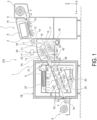
- a printing system 100 of the present exemplary embodiment includes a printing apparatus 7 printing on the first surface 5 of fabric 3 transported in a transport direction F, a drying device 1 drying the fabric on which printing is performed through the printing apparatus 7, and a receiving device 9 receiving the fabric 3 after passing through the drying device 1.
- the printing apparatus 7 is an ink jet printer that can print on fabric.
- the printing apparatus 7 includes a printing head 8 and a platen 10. In a region between the printing head 8 and the platen 10, in a state where a second surface 15 of the fabric 3 is supported by the platen 10, a composition 19 such as ink is discharged from the printing head 8 onto the first surface 5 of the fabric 3, and printing is performed.
- ink containing pigment is used as the composition 19.
- the composition 19 is not limited to ink containing pigment, and may be ink containing dye.
- the fabric 3 is transported by receiving transport force by transport rollers including a pair of a driving roller 4 and a driven roller 6 positioned upstream the printing head 8.
- the platen 10 here has structure in which the second surface 15 of the fabric 3 is suctioned to be in contact with a support surface facing the printing head 8 of the platen 10 for supporting by using suctioning force of a suction unit.
- the suctioning force is set to an extent that transport in the transport direction F of the fabric 3 is not hindered.
- the fabric 3 wound in a roll shape is set in a feeding unit 2.
- the feeding unit 2 is controlled to feed the roll-shaped fabric 3 at the same speed as a feed speed of the driving roller 4.
- the feeding unit 2 may feed the fabric 3 so that a slack part of the fabric 3 is created upstream the driving roller 4.
- the receiving device 9 here is configured by a winding unit that winds, in a roll shape, fabric on which printing is performed and that is subjected to drying treatment.
- the receiving device 9 is controlled to wind the fabric 3 at the same speed as the feed speed of the driving roller 4.
- the receiving device 9 includes a guide roller 34 that is positioned immediately before a winding start position and supports the second surface 15 of the fabric 3 so as to be transportable.
- the receiving device 9 may wind the fabric 3 such that a slack part is created between the receiving device 9 and the guide roller 34.
- the guide roller 34 here is a rotatable driven roller, but may be a smooth guide or the like having small transport resistance.
- the drying device 1 is positioned between the printing apparatus 7 that prints on the first surface 5 of the fabric 3 transported in the transport direction F, and the receiving device 9 that receives the fabric after passing through the printing apparatus.
- the transport direction F of the fabric 3 in the printing apparatus 7, the transport direction F of the fabric 3 in the drying device 1, and the transport direction F of the fabric 3 in the receiving device 9 may be different from each other, or may be the same.
- the drying device 1 includes the blowing unit 13 capable of blowing a gas 11 to the first surface 5, and a suctioning unit 17 that is positioned on the second surface 15 side of the fabric 3 in a blowing direction B in which the gas 11 is blown from the blowing unit 13, and capable of suctioning the gas 11.
- the blowing unit 13 is configured to blow the gas 11 to the fabric 3 in a state of being supported by a support member 14 at an upstream position and by a support member 20 at a downstream position of the blowing unit 13 and the suctioning unit 17 in the transport direction F in which the fabric 3 is transported in the drying device 1. Note that, one of the support member 14 and the support member 20 may be omitted.
- the fabric 3 may be supported by the support member 14 in at least one of the upstream position and the downstream position.
- the upstream position is a position upstream of the blowing unit 13 and the suctioning unit 13 in the transport direction F.
- the downstream position is a position downstream of the blowing unit 13 and the suctioning unit 13 in the transport direction F.
- the support member 14 supports the second surface 15 so as to be transportable, at the position upstream the blowing unit 13 and the suctioning unit 17 in the transport direction F.
- the support member 20 supports the second surface 15 so as to be transportable, at the position downstream the blowing unit 13 and the suctioning unit 17 in the transport direction F. Then, the blowing direction B of the gas 11 faces downstream in the transport direction F.
- the downstream side in the transport direction F in "the blowing direction B of the gas 11 faces downstream in the transport direction F” is used in the present specification in a sense that the blowing direction B of the gas 11 has a component heading downstream in the transport direction F, that is, the gas 11 is blown diagonally to the first surface 5 of the fabric 3 to apply transport force.
- a degree of the obliquity is set such that the transport force is appropriately applied depending on a type of the fabric 3.
- the blowing unit 13 is configured by a fan capable of blowing the gas 11 as wind.
- the suctioning unit 17 is positioned on the second surface 15 side of the fabric 3 at a predetermined interval from the blowing unit 13 in the blowing direction B of the gas 11. That is, the blowing unit 13 and the suctioning unit 17 are disposed so as to sandwich the fabric 3.
- the suctioning unit 17 is also configured by a fan capable of suctioning the gas 11.
- the first surface 5 thereof receives blowing force due to the gas 11 blown from the blowing unit 13, and the second surface 15 thereof receives suctioning force from the suctioning unit 17.
- a part of the fabric 3 that is present in the region 18 is supported by the support member 14 at an upstream position and the support member 20 at a downstream position in the transport direction F of the blowing unit 13 and the suctioning unit 17, such that the second surface 15 can be transported.
- the fabric 3 is supported only at the two points on the upstream side and the downstream side of the region 18 by the respective support members 14 and 20, and the part of the fabric 3 present in the region 18 is transported in a state of floating in a non-contact manner with surrounding members.
- the part of the fabric 3 present in the region 18 has a curved shape in which the first surface 5 is a concave surface and the second surface 15 is a convex surface due to the blowing force and the suctioning force.
- the blowing unit 13 and the suctioning unit 17 are configured such that output thereof can be adjusted to increase or decrease. That is, the output of the blowing unit 13 can be adjusted by changing the number of rotations of the fan, a blowing amount per unit time, and the like. Further, the output of the suctioning unit 17 can also be adjusted by changing the number of rotations of the fan and a suctioning amount per unit time, and the like.
- the blowing unit 13 may be configured such that the blowing direction B of the gas 11 is variable.
- the blowing unit 13 is configured such that the blowing direction B is variable, appropriate "obliquity" can be easily set depending on the type of the fabric 3.
- the blowing direction B may be modified by, for example, a louver window provided at a position where the gas 11 from the blowing unit 13 can pass, a mechanism capable of changing an orientation of the blowing unit 13 itself, or the like.
- the suctioning unit 17 is also configured such that a suctioning direction is variable, it is possible to easily accommodate to a change in the blowing direction B of the blowing unit 13.
- each of the support members 14 and 20 includes a driven roller, but may include a smooth guide or the like having small transport resistance.
- the support member 14 at the upstream position here is provided outside the printing apparatus 7, and is provided at a discharge port 12 for the fabric 3. Also, the support member 20 at the downstream position is disposed inside the drying device 1. It is sufficient that the support members 14 and 20 can support the fabric 3 at the two points as described above, and thus the installation positions thereof are not limited to the positions described above.
- the drying device 1 includes the displacement detector 21 capable of detecting displacement of the fabric 3 generated by at least one of the gas 11 blown from the blowing unit 13 and the gas 11 suctioned by the suctioning unit 17.
- the displacement detector 21 detects the displacement. Then, a configuration is adopted in which output of the blowing unit 13 and output of the suctioning unit 17 can be controlled to increase or decrease based on a detection result of the displacement detector 21.
- the displacement detector 21 a typical optical detector including a light emitting unit and a light receiving unit is used.
- the drying device 1 includes a control unit 23, and the control unit 23 is configured to control output of the blowing unit 13 and output of the suctioning unit 17 based on a detection result of the displacement detector 21.
- a control unit included in the printing apparatus 7 may be used without providing the control unit 23 in the drying device 1.
- an external terminal such as a personal computer may be coupled, and the external terminal may be used as a control unit.
- At least one of output of the blowing unit 13 and output of the suctioning unit 17 is configured to be controllable based on information 25 related to the type of the fabric 3.
- control unit 23 is configured to receive the information 25 related to a type of the fabric 3, and control at least one of the output of the blowing unit 13 and the output of the suctioning unit 17 based on the received information 25 of the type of the fabric 3.
- a reference numeral 16 denotes an introduction port for the fabric 3 after printing by the printing apparatus 7
- a reference numeral 400 denotes an exhausting unit that exhausts the gas 11 suctioned by the suctioning unit 17 to an outside
- a reference numeral 42 denotes a thermo-hygrometer.
- the drying device 1 includes a first drying chamber 1A in which the blowing unit 13 and the suctioning unit 17 are accommodated, and a second drying chamber 1B that communicates with the first drying chamber 1A via a communication port 22, and to which the fabric 3 after passing through the first drying chamber 1A is introduced.
- a heating unit 27 that heats the fabric 3 is provided in the second drying chamber 1B. The fabric 3 is sent through the communication port 22 from an inside of the first drying chamber 1A to an inside of the second drying chamber 1B.
- the drying device 1 may be configured only by the first drying chamber 1A, but from a viewpoint of promoting drying of the fabric 3, the configuration that also includes the second drying chamber 1B is desirable.
- the heated gases 29 generated by heating air by the heating unit 27 are blown to the first surface 5 of the fabric 3 being transported.
- the fabric 3 receives the blown heated gases 29 from the openings 26 with the second surface 15 supported by a plurality of support rollers 28.
- At least one of the plurality of support rollers 28 is a rotatable driven roller.
- the plurality of support rollers 28 are disposed slightly shifted with respect to the plurality of openings 26 in the transport direction F.
- the disposition of the plurality of support rollers 28 is not limited to the present exemplary embodiment.
- the plurality of support rollers 28 may face the plurality of openings 26 with the fabric 3 interposed therebetween. According to such disposition, a part of the heated gases 29 from the plurality of openings 26 passes through the grain of the fabric 3 and is blown to the plurality of support rollers 28. This makes it possible to further suppress fluttering of the fabric 3, as compared to a case where the heated gases 29 are blown to parts of the fabric 3 between the plurality of support rollers 28. Furthermore, the plurality of support rollers 28 are efficiently heated by heat contained in the heated gases 29 after passing through the grain of the fabric 3, and the second surface 15 of the fabric 3 can be heated.
- a fan 30 for suctioning is provided on the second surface 15 side of the fabric 3, and suctioning force by the fan 30 acts on the second surface 15 of the fabric 3, and suctions the heated gases 29 used for drying treatment.
- the fan 30 is configured to discharge a part of the suctioned heated gases 29 into the second heating chamber 1B for cyclic usage, and the rest is released out of the chamber.
- the part 291 of the heated gases 29 that are created by the heating unit 27 and heat the first surface 5 inside the second drying chamber 1B is introduced into the region 31 on the blowing unit 13 side in the first drying chamber 1A, and is blown from the blowing unit 13.
- the plurality of support rollers 28 and the plurality of openings 26 are disposed in the second drying chamber 1B so as to transport the fabric 3 in an inclined state descending from upstream to downstream in the transport direction F. Then, the second drying chamber 1B communicates with the first drying chamber 1A at the communicating port 22 upstream in the transport direction F. the part 291 of the heated gases 29 becomes an ascending flow along the first surface 5 of the fabric 3 in the inclined state, and automatically flows into the region 31 on the blowing unit 13 side of the first drying chamber 1A from the communicating port 22.
- a reference numeral 24 denotes a discharge port for the fabric 3, the second surface 15 of the fabric 3 after exiting the discharge port 24 is supported by the guide roller 34, and is wound in a roll shape by the receiving device 9.
- a reference numeral 32 denotes a thermo-hygrometer.
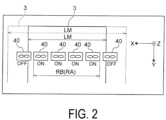
- the blowing unit 13 and the suctioning unit 17 are configured to be controllable such that, based on the information 25 of a width dimension LM of the fabric 3, a blowing range RB of the gas 11 blown from the blowing unit 13 in the width direction, and a suctioning range RA of the gas 11 suctioned by the suctioning unit 17 in the width direction are smaller than the width dimension LM.
- the information 25 of the width dimension LM by providing a width detection sensor, and the width dimension LM detected by the width detection sensor may be used, or a user may use the width dimension LM previously input.
- the blowing unit 13 includes a plurality of fans 40, and the plurality of fans 40 are disposed at intervals in the width direction of the fabric 3.
- the corresponding suctioning unit 17 includes a plurality of fans similarly, and the plurality of fans are disposed at intervals in the width direction of the fabric 3.
- FIG. 2 illustrates a case where the fabric 3 is transported while a center position in the width direction of a transport path constituted by the platen 10 and the like is set to be aligned with a reference position. Since the fabric 3 is set to be aligned with the center position, a position of the fabric 3 can be recognized as long as information of the width dimension LM of the fabric 3 is obtained.
- control unit 23 controls all the six fans 40 to be ON.
- the control unit 23 controls the two fans 40 on both sides among the six fans 40 to be OFF, and the remaining four fans 40 to be ON. This allows the blowing range RB and the suctioning range RA to be smaller than the width dimension LM of the fabric 3.
- the position of the fabric 3 can be recognized as long as the information of the width dimension LM of the fabric 3 is obtained, and thus control can be performed as in the case of the center position alignment.
- FIG. 3 illustrates a case where the fabric 3 is transported while a position thereof is freely set in a width direction of a transport path constituted by the platen 10 and the like.
- information related to the position is also required.
- the information 25 related to the position by providing a position sensor, the information 25 of the position detected by the position sensor may be used, or a user may be allowed to enter position information in advance.
- the control unit 23 controls the two fans 40 on a right side among the five fans 40 to be OFF, and the remaining three fans 40 to be ON. This allows the blowing range RB and the suctioning range RA to be smaller than the width dimension LM of the fabric 3.
- a part of the fabric 3 that is present in the region 18 is supported by the support member 14 at an upstream position and the support member 20 at a downstream position in the transport direction F of the blowing unit 13 and the suctioning unit 17, such that the second surface 15 can be transported.
- the fabric 3 is supported only at the two points on the upstream side and the downstream side of the region 18 by the respective support members 14 and 20, and the part of the fabric 3 present in the region 18 is transported in a state of floating in a non-contact manner with surrounding members. Therefore, the part of the fabric 3 present in the region 18 has a curved shape in which the first surface 5 is a concave surface and the second surface 15 is a convex surface due to the blowing force and the suctioning force.
- the first surface 5 receives the blown gas 11 in a state of flowing in a non-contact manner with surrounding members, and further the second face 15 is subjected to suctioning force, and thus the fabric 3 has the curved shape.
- This allows the gas 11 blown to easily flow through the grain, from the first surface 5 side to the second surface 15 side of the fabric 3.
- the gas 11 that is blown and in contact with the fabric 3 but does not pass through the fabric 3 also receives suctioning force of the suctioning unit 17 positioned on the second surface 15 side and is suctioned. Accordingly, the fabric 3 is subjected to the blowing and the suctioning of the gas 11 and is effectively subjected to drying treatment.
- the blowing direction B of the gas 11 faces downstream in the transport direction F. That is, since the gas 11 is obliquely blown to the first surface 5 of the fabric 3, transport force is applied to the fabric 3. As describe above, the gas 11 is blown obliquely to the first surface of the fabric 3, and the gas 11 is suctioned from the second surface 15 side of the fabric 3, and thus the fabric 3 can be effectively subjected to the drying treatment in a state where the fabric 3 is flowing in a non-contact manner, and the transport force can be applied to the fabric 3 at the same time. This makes it possible to suppress deterioration of image quality due to deformation during the transport of the fabric 3.
- ink is of a type containing pigment
- ink containing dye unlike ink containing dye, a large amount of the pigment adheres to the first surface 5 of the fabric 3. Therefore, when printing is performed with the ink containing the pigment, a problem of image quality deterioration is likely to occur when, for example, the fabric before drying treatment is nipped by a pair of transport rollers and transported, as compared to a case where printing is performed with ink containing dye.
- the blowing direction B of the gas 11 faces downstream in the transport direction F.
- transport force can be appropriately applied to the fabric 3.
- fluttering may occur in a part of the curved shape when the balance does not match the type of the fabric 3. For example, when the grain of the fabric 3 is fine and the fabric 3 is cloth difficult for gas 11 to pass through, and when the output of the blowing unit 13 is excessive, a large part of the blown gas 11 does not pass through the grain of the fabric 3, and flows to both side end portions in a width direction of the fabric 3. Thus, fluttering may occur in both the side end portions.
- the balance between the output of the blowing unit 13 and the output of the suctioning unit 17 can be adjusted to match the type of fabric 3, and the fabric 3 can be brought into a state in which the fluttering does not occur.
- At least one of output of the blowing unit 13 and output of the suctioning unit 17 is controllable based on the information 25 related to the type of the fabric 3. This makes it possible to appropriately set the curved shape of the fabric 3 depending on the type of fabric 3, for example a thickness of the fabric 3, roughness of texture, and the like.
- blowing range RB and the suctioning range RA are larger than a dimension of the fabric 3 in a width direction, the gas 11 from the blowing unit 13 goes around from an end portion of the fabric 3 in the width direction to the second surface 15 side, causing fluttering in the end portion of the fabric 3, which is not desirable in some cases.
- the blowing unit 13 and the suctioning unit 17 are controllable such that the blowing range RB and the suctioning range RA of the gas 11 are smaller than the width dimension LM of the fabric 3 in the width direction.
- the blowing unit 13 and the suctioning unit 17 are controllable such that the blowing range RB and the suctioning range RA of the gas 11 are smaller than the width dimension LM of the fabric 3 in the width direction.
- the drying device 1 includes the first drying chamber 1A in which the blowing unit 13 and the suctioning unit 17 are accommodated, and the second drying chamber 1B that further includes the heating unit 27 and to which the fabric 3 after passing through the first drying chamber 1A is introduced.
- the drying at the two stage facilitates drying of the fabric 3.
- the part 291 of the heated gases 29 that are created by the heating unit 27 and heat the first surface 5 inside the second drying chamber 1B is introduced into the region 31 on the blowing unit 13 side in the first drying chamber 1A.
- the gas 11 blown from the blowing unit 13 is brought into a hot blast state, and thus drying performance in the first drying chamber 1A can be improved.
- the part 291 of the heated gases 29 with which the heating unit 27 heats the first surface 5 inside the second drying chamber 1B becomes a rising flow along an inclined surface of the fabric 3 transported in an inclined state.
- the rising flow flows automatically into the first drying chamber 1A, and thus the hot blast state of the gas 11 blown from the blowing unit 13 can be realized with simple structure.
- the printing system 100 of the present exemplary embodiment includes the drying device 1, and thus each of the effects described above can be obtained.
- the printing apparatus 7 prints on the first surface 5 of the fabric 3 with the composition 19 containing pigment.
- the composition 19 such as ink for printing is of a type containing pigment, unlike ink containing dye, the pigment adheres to a surface of the fabric. Therefore, when printing is performed with the ink containing the pigment, a problem of image quality deterioration is likely to occur when the fabric 3 before drying treatment is nipped by a pair of transport rollers and transported, as compared to a case where printing is performed with ink containing dye.
- transport force is applied to the fabric 3 before drying treatment, by the blowing force and the suctioning force of the gas 11, and thus, the fabric can be transported without nipping by a pair of transport rollers as in the related art. In this way, even when ink is of a type containing pigment, the problem of image quality deterioration is not likely to occur.
- the drying device 1 and the printing system 100 according to the present disclosure are based on the configurations of the exemplary embodiment described above.
- the above drying device 1 is not limited to a combination with the ink jet printer of the above-described exemplary embodiment, and can be combined with, for example, a cloth cleaning device. Alternatively, a combination with a coating material application device is possible.
- FIG. 2 the structure has been described in which the blowing unit 13 and the suctioning unit 17 are controlled such that the blowing range RB and the suctioning section RA are smaller than the width dimension LM of the fabric 3 by switching ON and OFF of the plurality of fans 40, but the blowing range RB and the suctioning range RA may be adjusted using shutters.
Landscapes
- Engineering & Computer Science (AREA)
- Textile Engineering (AREA)
- Treatment Of Fiber Materials (AREA)
- Drying Of Solid Materials (AREA)
- Ink Jet (AREA)
- Controlling Sheets Or Webs (AREA)
Applications Claiming Priority (1)
| Application Number | Priority Date | Filing Date | Title |
|---|---|---|---|
| JP2021174699A JP7776803B2 (ja) | 2021-10-26 | 2021-10-26 | 乾燥装置及び印刷システム |
Publications (2)
| Publication Number | Publication Date |
|---|---|
| EP4173834A1 EP4173834A1 (en) | 2023-05-03 |
| EP4173834B1 true EP4173834B1 (en) | 2025-02-19 |
Family
ID=83995207
Family Applications (1)
| Application Number | Title | Priority Date | Filing Date |
|---|---|---|---|
| EP22203356.5A Active EP4173834B1 (en) | 2021-10-26 | 2022-10-24 | Drying device and printing system |
Country Status (4)
| Country | Link |
|---|---|
| US (1) | US12128670B2 (enExample) |
| EP (1) | EP4173834B1 (enExample) |
| JP (1) | JP7776803B2 (enExample) |
| CN (1) | CN116021894A (enExample) |
Families Citing this family (2)
| Publication number | Priority date | Publication date | Assignee | Title |
|---|---|---|---|---|
| CN117139101A (zh) * | 2023-09-11 | 2023-12-01 | 三一技术装备有限公司 | 烘干系统及涂布系统 |
| JP2025111263A (ja) * | 2024-01-17 | 2025-07-30 | 京セラドキュメントソリューションズ株式会社 | シート乾燥装置およびそれを備えた画像形成システム |
Family Cites Families (14)
| Publication number | Priority date | Publication date | Assignee | Title |
|---|---|---|---|---|
| JP2004106346A (ja) | 2002-09-18 | 2004-04-08 | Mutoh Ind Ltd | 記録装置における用紙乾燥方法及び装置 |
| JP2006192780A (ja) | 2005-01-14 | 2006-07-27 | Noritsu Koki Co Ltd | プリンタ |
| JP5778473B2 (ja) | 2011-05-06 | 2015-09-16 | 株式会社ミマキエンジニアリング | インクジェット記録装置 |
| JP5631908B2 (ja) | 2012-01-31 | 2014-11-26 | 富士フイルム株式会社 | 乾燥装置及び画像形成装置 |
| JP2013216064A (ja) | 2012-04-12 | 2013-10-24 | Sharp Corp | 印刷装置 |
| JP6249157B2 (ja) * | 2013-10-11 | 2017-12-20 | セイコーエプソン株式会社 | 液体噴射装置 |
| JP2016037682A (ja) * | 2014-08-08 | 2016-03-22 | 株式会社ミマキエンジニアリング | テキスタイルプリント装置 |
| JP6705136B2 (ja) | 2015-08-28 | 2020-06-03 | セイコーエプソン株式会社 | 印刷装置、及び印刷装置の制御方法 |
| JP6790505B2 (ja) * | 2016-06-29 | 2020-11-25 | セイコーエプソン株式会社 | 印刷装置 |
| JP2018130901A (ja) | 2017-02-16 | 2018-08-23 | セイコーエプソン株式会社 | 印刷装置、及び印刷装置の印刷方法 |
| JP7006113B2 (ja) | 2017-10-10 | 2022-01-24 | 株式会社リコー | 搬送装置、印刷装置 |
| JP7087473B2 (ja) * | 2018-03-09 | 2022-06-21 | セイコーエプソン株式会社 | 加熱装置、及び、乾燥方法 |
| JP7143644B2 (ja) * | 2018-06-25 | 2022-09-29 | コニカミノルタ株式会社 | 乾燥装置、画像形成装置、乾燥方法及びインクジェット捺染方法 |
| JP6782436B1 (ja) | 2020-04-27 | 2020-11-11 | パナソニックIpマネジメント株式会社 | 照明器具 |
-
2021
- 2021-10-26 JP JP2021174699A patent/JP7776803B2/ja active Active
-
2022
- 2022-10-24 US US18/048,950 patent/US12128670B2/en active Active
- 2022-10-24 EP EP22203356.5A patent/EP4173834B1/en active Active
- 2022-10-24 CN CN202211303285.7A patent/CN116021894A/zh active Pending
Also Published As
| Publication number | Publication date |
|---|---|
| US20230127666A1 (en) | 2023-04-27 |
| US12128670B2 (en) | 2024-10-29 |
| JP7776803B2 (ja) | 2025-11-27 |
| JP2023064423A (ja) | 2023-05-11 |
| EP4173834A1 (en) | 2023-05-03 |
| CN116021894A (zh) | 2023-04-28 |
Similar Documents
| Publication | Publication Date | Title |
|---|---|---|
| JP6254821B2 (ja) | 記録媒体加熱装置、及びそれを有するシステム | |
| EP4173834B1 (en) | Drying device and printing system | |
| JP4979719B2 (ja) | インクジェット記録装置 | |
| US9994047B2 (en) | Drying apparatus and conveying system | |
| JP2010214802A (ja) | 画像形成装置 | |
| JP5191337B2 (ja) | 画像形成装置 | |
| US20110048263A1 (en) | Sheet transfer system and duplex printer using same | |
| JP2010083036A (ja) | 画像形成装置 | |
| JP2015227043A (ja) | 画像記録装置、ニス付与装置及びニス付与方法 | |
| JP3213687U (ja) | デジタル印刷機 | |
| JP2013086477A (ja) | プリント装置 | |
| JP2010083035A (ja) | 画像形成装置 | |
| WO2018142757A1 (ja) | 搬送装置及び画像形成装置 | |
| JP5065073B2 (ja) | 用紙排出装置 | |
| JP2017106704A (ja) | 乾燥装置、搬送システム | |
| JP6985194B2 (ja) | 印刷装置および印刷装置における長尺印刷用紙搬送方法 | |
| JP2005246734A (ja) | インクジェット捺染装置および捺染方法 | |
| JP2025144350A (ja) | インクジェット記録装置 | |
| JP2013086457A (ja) | プリント装置及びシートの乾燥装置 | |
| US9789717B2 (en) | Image forming apparatus | |
| US9527309B2 (en) | Liquid discharging apparatus | |
| JP2023116266A (ja) | 基材乾燥装置および印刷装置 | |
| US20240424810A1 (en) | Drying device | |
| JP6300461B2 (ja) | 印刷システム | |
| JP2020146886A (ja) | 搬送制御装置及び画像形成装置 |
Legal Events
| Date | Code | Title | Description |
|---|---|---|---|
| PUAI | Public reference made under article 153(3) epc to a published international application that has entered the european phase |
Free format text: ORIGINAL CODE: 0009012 |
|
| STAA | Information on the status of an ep patent application or granted ep patent |
Free format text: STATUS: THE APPLICATION HAS BEEN PUBLISHED |
|
| AK | Designated contracting states |
Kind code of ref document: A1 Designated state(s): AL AT BE BG CH CY CZ DE DK EE ES FI FR GB GR HR HU IE IS IT LI LT LU LV MC ME MK MT NL NO PL PT RO RS SE SI SK SM TR |
|
| STAA | Information on the status of an ep patent application or granted ep patent |
Free format text: STATUS: REQUEST FOR EXAMINATION WAS MADE |
|
| 17P | Request for examination filed |
Effective date: 20231002 |
|
| RBV | Designated contracting states (corrected) |
Designated state(s): AL AT BE BG CH CY CZ DE DK EE ES FI FR GB GR HR HU IE IS IT LI LT LU LV MC ME MK MT NL NO PL PT RO RS SE SI SK SM TR |
|
| GRAP | Despatch of communication of intention to grant a patent |
Free format text: ORIGINAL CODE: EPIDOSNIGR1 |
|
| STAA | Information on the status of an ep patent application or granted ep patent |
Free format text: STATUS: GRANT OF PATENT IS INTENDED |
|
| INTG | Intention to grant announced |
Effective date: 20241008 |
|
| GRAS | Grant fee paid |
Free format text: ORIGINAL CODE: EPIDOSNIGR3 |
|
| GRAA | (expected) grant |
Free format text: ORIGINAL CODE: 0009210 |
|
| STAA | Information on the status of an ep patent application or granted ep patent |
Free format text: STATUS: THE PATENT HAS BEEN GRANTED |
|
| AK | Designated contracting states |
Kind code of ref document: B1 Designated state(s): AL AT BE BG CH CY CZ DE DK EE ES FI FR GB GR HR HU IE IS IT LI LT LU LV MC ME MK MT NL NO PL PT RO RS SE SI SK SM TR |
|
| REG | Reference to a national code |
Ref country code: GB Ref legal event code: FG4D |
|
| REG | Reference to a national code |
Ref country code: CH Ref legal event code: EP |
|
| REG | Reference to a national code |
Ref country code: DE Ref legal event code: R096 Ref document number: 602022010773 Country of ref document: DE |
|
| REG | Reference to a national code |
Ref country code: IE Ref legal event code: FG4D |
|
| REG | Reference to a national code |
Ref country code: NL Ref legal event code: MP Effective date: 20250219 |
|
| PG25 | Lapsed in a contracting state [announced via postgrant information from national office to epo] |
Ref country code: RS Free format text: LAPSE BECAUSE OF FAILURE TO SUBMIT A TRANSLATION OF THE DESCRIPTION OR TO PAY THE FEE WITHIN THE PRESCRIBED TIME-LIMIT Effective date: 20250519 |
|
| PG25 | Lapsed in a contracting state [announced via postgrant information from national office to epo] |
Ref country code: FI Free format text: LAPSE BECAUSE OF FAILURE TO SUBMIT A TRANSLATION OF THE DESCRIPTION OR TO PAY THE FEE WITHIN THE PRESCRIBED TIME-LIMIT Effective date: 20250219 |
|
| PG25 | Lapsed in a contracting state [announced via postgrant information from national office to epo] |
Ref country code: PL Free format text: LAPSE BECAUSE OF FAILURE TO SUBMIT A TRANSLATION OF THE DESCRIPTION OR TO PAY THE FEE WITHIN THE PRESCRIBED TIME-LIMIT Effective date: 20250219 |
|
| PG25 | Lapsed in a contracting state [announced via postgrant information from national office to epo] |
Ref country code: ES Free format text: LAPSE BECAUSE OF FAILURE TO SUBMIT A TRANSLATION OF THE DESCRIPTION OR TO PAY THE FEE WITHIN THE PRESCRIBED TIME-LIMIT Effective date: 20250219 |
|
| REG | Reference to a national code |
Ref country code: LT Ref legal event code: MG9D |
|
| PG25 | Lapsed in a contracting state [announced via postgrant information from national office to epo] |
Ref country code: NO Free format text: LAPSE BECAUSE OF FAILURE TO SUBMIT A TRANSLATION OF THE DESCRIPTION OR TO PAY THE FEE WITHIN THE PRESCRIBED TIME-LIMIT Effective date: 20250519 Ref country code: IS Free format text: LAPSE BECAUSE OF FAILURE TO SUBMIT A TRANSLATION OF THE DESCRIPTION OR TO PAY THE FEE WITHIN THE PRESCRIBED TIME-LIMIT Effective date: 20250619 |
|
| PG25 | Lapsed in a contracting state [announced via postgrant information from national office to epo] |
Ref country code: NL Free format text: LAPSE BECAUSE OF FAILURE TO SUBMIT A TRANSLATION OF THE DESCRIPTION OR TO PAY THE FEE WITHIN THE PRESCRIBED TIME-LIMIT Effective date: 20250219 |
|
| PG25 | Lapsed in a contracting state [announced via postgrant information from national office to epo] |
Ref country code: HR Free format text: LAPSE BECAUSE OF FAILURE TO SUBMIT A TRANSLATION OF THE DESCRIPTION OR TO PAY THE FEE WITHIN THE PRESCRIBED TIME-LIMIT Effective date: 20250219 |
|
| PG25 | Lapsed in a contracting state [announced via postgrant information from national office to epo] |
Ref country code: PT Free format text: LAPSE BECAUSE OF FAILURE TO SUBMIT A TRANSLATION OF THE DESCRIPTION OR TO PAY THE FEE WITHIN THE PRESCRIBED TIME-LIMIT Effective date: 20250620 Ref country code: LV Free format text: LAPSE BECAUSE OF FAILURE TO SUBMIT A TRANSLATION OF THE DESCRIPTION OR TO PAY THE FEE WITHIN THE PRESCRIBED TIME-LIMIT Effective date: 20250219 |
|
| PG25 | Lapsed in a contracting state [announced via postgrant information from national office to epo] |
Ref country code: BG Free format text: LAPSE BECAUSE OF FAILURE TO SUBMIT A TRANSLATION OF THE DESCRIPTION OR TO PAY THE FEE WITHIN THE PRESCRIBED TIME-LIMIT Effective date: 20250219 Ref country code: GR Free format text: LAPSE BECAUSE OF FAILURE TO SUBMIT A TRANSLATION OF THE DESCRIPTION OR TO PAY THE FEE WITHIN THE PRESCRIBED TIME-LIMIT Effective date: 20250520 |
|
| REG | Reference to a national code |
Ref country code: AT Ref legal event code: MK05 Ref document number: 1767949 Country of ref document: AT Kind code of ref document: T Effective date: 20250219 |
|
| PG25 | Lapsed in a contracting state [announced via postgrant information from national office to epo] |
Ref country code: SE Free format text: LAPSE BECAUSE OF FAILURE TO SUBMIT A TRANSLATION OF THE DESCRIPTION OR TO PAY THE FEE WITHIN THE PRESCRIBED TIME-LIMIT Effective date: 20250219 |
|
| PG25 | Lapsed in a contracting state [announced via postgrant information from national office to epo] |
Ref country code: SM Free format text: LAPSE BECAUSE OF FAILURE TO SUBMIT A TRANSLATION OF THE DESCRIPTION OR TO PAY THE FEE WITHIN THE PRESCRIBED TIME-LIMIT Effective date: 20250219 |
|
| PG25 | Lapsed in a contracting state [announced via postgrant information from national office to epo] |
Ref country code: DK Free format text: LAPSE BECAUSE OF FAILURE TO SUBMIT A TRANSLATION OF THE DESCRIPTION OR TO PAY THE FEE WITHIN THE PRESCRIBED TIME-LIMIT Effective date: 20250219 |
|
| PG25 | Lapsed in a contracting state [announced via postgrant information from national office to epo] |
Ref country code: AT Free format text: LAPSE BECAUSE OF FAILURE TO SUBMIT A TRANSLATION OF THE DESCRIPTION OR TO PAY THE FEE WITHIN THE PRESCRIBED TIME-LIMIT Effective date: 20250219 |
|
| PG25 | Lapsed in a contracting state [announced via postgrant information from national office to epo] |
Ref country code: EE Free format text: LAPSE BECAUSE OF FAILURE TO SUBMIT A TRANSLATION OF THE DESCRIPTION OR TO PAY THE FEE WITHIN THE PRESCRIBED TIME-LIMIT Effective date: 20250219 Ref country code: CZ Free format text: LAPSE BECAUSE OF FAILURE TO SUBMIT A TRANSLATION OF THE DESCRIPTION OR TO PAY THE FEE WITHIN THE PRESCRIBED TIME-LIMIT Effective date: 20250219 |
|
| PG25 | Lapsed in a contracting state [announced via postgrant information from national office to epo] |
Ref country code: RO Free format text: LAPSE BECAUSE OF FAILURE TO SUBMIT A TRANSLATION OF THE DESCRIPTION OR TO PAY THE FEE WITHIN THE PRESCRIBED TIME-LIMIT Effective date: 20250219 |
|
| PG25 | Lapsed in a contracting state [announced via postgrant information from national office to epo] |
Ref country code: SK Free format text: LAPSE BECAUSE OF FAILURE TO SUBMIT A TRANSLATION OF THE DESCRIPTION OR TO PAY THE FEE WITHIN THE PRESCRIBED TIME-LIMIT Effective date: 20250219 |