EP4053969A1 - Sekundärbatterie mit gasfängerelement - Google Patents
Sekundärbatterie mit gasfängerelement Download PDFInfo
- Publication number
- EP4053969A1 EP4053969A1 EP21892222.7A EP21892222A EP4053969A1 EP 4053969 A1 EP4053969 A1 EP 4053969A1 EP 21892222 A EP21892222 A EP 21892222A EP 4053969 A1 EP4053969 A1 EP 4053969A1
- Authority
- EP
- European Patent Office
- Prior art keywords
- secondary battery
- gas scavenging
- mixed solution
- scavenging member
- gas
- Prior art date
- Legal status (The legal status is an assumption and is not a legal conclusion. Google has not performed a legal analysis and makes no representation as to the accuracy of the status listed.)
- Granted
Links
Images


Classifications
-
- H—ELECTRICITY
- H01—ELECTRIC ELEMENTS
- H01M—PROCESSES OR MEANS, e.g. BATTERIES, FOR THE DIRECT CONVERSION OF CHEMICAL ENERGY INTO ELECTRICAL ENERGY
- H01M10/00—Secondary cells; Manufacture thereof
- H01M10/42—Methods or arrangements for servicing or maintenance of secondary cells or secondary half-cells
- H01M10/52—Removing gases inside the secondary cell, e.g. by absorption
-
- H—ELECTRICITY
- H01—ELECTRIC ELEMENTS
- H01M—PROCESSES OR MEANS, e.g. BATTERIES, FOR THE DIRECT CONVERSION OF CHEMICAL ENERGY INTO ELECTRICAL ENERGY
- H01M10/00—Secondary cells; Manufacture thereof
- H01M10/05—Accumulators with non-aqueous electrolyte
- H01M10/052—Li-accumulators
-
- H—ELECTRICITY
- H01—ELECTRIC ELEMENTS
- H01M—PROCESSES OR MEANS, e.g. BATTERIES, FOR THE DIRECT CONVERSION OF CHEMICAL ENERGY INTO ELECTRICAL ENERGY
- H01M10/00—Secondary cells; Manufacture thereof
- H01M10/05—Accumulators with non-aqueous electrolyte
- H01M10/058—Construction or manufacture
-
- H—ELECTRICITY
- H01—ELECTRIC ELEMENTS
- H01M—PROCESSES OR MEANS, e.g. BATTERIES, FOR THE DIRECT CONVERSION OF CHEMICAL ENERGY INTO ELECTRICAL ENERGY
- H01M4/00—Electrodes
- H01M4/02—Electrodes composed of, or comprising, active material
- H01M4/36—Selection of substances as active materials, active masses, active liquids
- H01M4/48—Selection of substances as active materials, active masses, active liquids of inorganic oxides or hydroxides
- H01M4/50—Selection of substances as active materials, active masses, active liquids of inorganic oxides or hydroxides of manganese
- H01M4/505—Selection of substances as active materials, active masses, active liquids of inorganic oxides or hydroxides of manganese of mixed oxides or hydroxides containing manganese for inserting or intercalating light metals, e.g. LiMn2O4 or LiMn2OxFy
-
- H—ELECTRICITY
- H01—ELECTRIC ELEMENTS
- H01M—PROCESSES OR MEANS, e.g. BATTERIES, FOR THE DIRECT CONVERSION OF CHEMICAL ENERGY INTO ELECTRICAL ENERGY
- H01M4/00—Electrodes
- H01M4/02—Electrodes composed of, or comprising, active material
- H01M4/36—Selection of substances as active materials, active masses, active liquids
- H01M4/48—Selection of substances as active materials, active masses, active liquids of inorganic oxides or hydroxides
- H01M4/52—Selection of substances as active materials, active masses, active liquids of inorganic oxides or hydroxides of nickel, cobalt or iron
- H01M4/525—Selection of substances as active materials, active masses, active liquids of inorganic oxides or hydroxides of nickel, cobalt or iron of mixed oxides or hydroxides containing iron, cobalt or nickel for inserting or intercalating light metals, e.g. LiNiO2, LiCoO2 or LiCoOxFy
-
- H—ELECTRICITY
- H01—ELECTRIC ELEMENTS
- H01M—PROCESSES OR MEANS, e.g. BATTERIES, FOR THE DIRECT CONVERSION OF CHEMICAL ENERGY INTO ELECTRICAL ENERGY
- H01M50/00—Constructional details or processes of manufacture of the non-active parts of electrochemical cells other than fuel cells, e.g. hybrid cells
- H01M50/10—Primary casings; Jackets or wrappings
- H01M50/102—Primary casings; Jackets or wrappings characterised by their shape or physical structure
- H01M50/105—Pouches or flexible bags
-
- H—ELECTRICITY
- H01—ELECTRIC ELEMENTS
- H01M—PROCESSES OR MEANS, e.g. BATTERIES, FOR THE DIRECT CONVERSION OF CHEMICAL ENERGY INTO ELECTRICAL ENERGY
- H01M50/00—Constructional details or processes of manufacture of the non-active parts of electrochemical cells other than fuel cells, e.g. hybrid cells
- H01M50/10—Primary casings; Jackets or wrappings
- H01M50/131—Primary casings; Jackets or wrappings characterised by physical properties, e.g. gas permeability, size or heat resistance
-
- Y—GENERAL TAGGING OF NEW TECHNOLOGICAL DEVELOPMENTS; GENERAL TAGGING OF CROSS-SECTIONAL TECHNOLOGIES SPANNING OVER SEVERAL SECTIONS OF THE IPC; TECHNICAL SUBJECTS COVERED BY FORMER USPC CROSS-REFERENCE ART COLLECTIONS [XRACs] AND DIGESTS
- Y02—TECHNOLOGIES OR APPLICATIONS FOR MITIGATION OR ADAPTATION AGAINST CLIMATE CHANGE
- Y02E—REDUCTION OF GREENHOUSE GAS [GHG] EMISSIONS, RELATED TO ENERGY GENERATION, TRANSMISSION OR DISTRIBUTION
- Y02E60/00—Enabling technologies; Technologies with a potential or indirect contribution to GHG emissions mitigation
- Y02E60/10—Energy storage using batteries
Definitions
- the present disclosure relates to a secondary battery comprising a gas scavenging member.
- a secondary battery is a representative example of an electrochemical device that utilizes such electrochemical energy, and the range of use thereof tends to be gradually expanding.
- the secondary battery has a structure in which an electrode assembly comprising a positive electrode, a negative electrode, and a porous separator is built into a battery case in a state of being impregnated with a non-aqueous electrolyte.
- the positive electrode is generally prepared by coating a positive electrode mixture including a positive electrode active material onto aluminum foil
- the negative electrode is prepared by coating a negative electrode mixture including a negative electrode active material onto a copper foil.
- a pouch type battery having a structure in which the stack type or stack-folding type electrode assembly is built into a pouch type battery case of an aluminum laminate sheet attracts considerable attention with reasons of low manufacturing cost, small weight, and easy shape modification, and further, utilization thereof gradually increases.
- a secondary battery in which an electrode assembly is sealed together with an electrolyte solution within a pouch type battery case,
- the pouch may be composed of a gas permeable polymer, and the gas permeable polymer may be a poly[4,5-difluoro-2,2-bis(trifluoromethyl)-1,3-dioxole-co-tetrafluoroethylene] -based material.
- the gas permeable polymer may be Teflon AF 2400.
- the amine-based compound may be an alkanol amine.
- the mixed solution may be contained in an amount of 50 ml to 200 ml.
- the amine-based compound may be contained in an amount of 5% to 30% by weight based on the total weight of the mixed solution.
- the ionic liquid may be a combination of one or more selected from the group consisting of bis(trifluoromethane)sulfoneimide (Tf 2 N - ), [CF 3 SO 2 ] - , and [CF 3 CO 2 ] - [PF 6 ] - as anions, and one or more selected from the group consisting of 1-butyl-3-methylimidazolium (bmim), 1-butyl-1-methyl pyrrolidinium (bmpyr), and butyltrimethylammonium (btmamm) as cations.
- Tf 2 N - bis(trifluoromethane)sulfoneimide
- bmim 1-butyl-3-methylimidazolium
- bmpyr 1-butyl-1-methyl pyrrolidinium
- btmamm butyltrimethylammonium
- the gas scavenging member has a pouch structure, which may have a form in which a mixed solution injection hole is formed on one side of the gas scavenging member, and the mixed solution injection hole is sealed in a state where the mixed solution is injected.
- the gas scavenging member may be arranged on the inner surface of the upper end of the battery case on the basis of a stacking direction of the electrode assembly.
- the gas scavenging member may be formed to have a size smaller than an area of an upper end of the electrode assembly on the basis of a stacking direction of the electrode assembly.
- the electrode assembly comprises a positive electrode, a negative electrode, and a separator interposed between the positive electrode and the negative electrode,
- the lithium nickel-based-transition metal oxide may be represented by the following Chemical Formula 1: Li 1+x Ni a Co b M c O 2 (2) wherein, 0 ⁇ x ⁇ 0.5, 0.8 ⁇ a ⁇ 1, 0 ⁇ b ⁇ 0.2, 0 ⁇ c ⁇ 0.2, and the M is at least one selected from the group consisting of Mn, Al, Ti, Mg, Zr, W, Y, Sr, F, Si, Na, Cu, Fe, Ca, S and B.
- the lithium nickel-based-transition metal oxide is LiNi 0.8 Co 0.1 Mn 0.1 O 2 , LiNi a Co b (Mn y A z ) c O 2 , LiNi a Co b A c O 2 , wherein a, b and c are as defined above, and the A may be at least one selected from the group consisting of Al, Ti, Mg, Zr, W, Y, Sr, F, Si, Na, Cu, Fe, Ca, S and B.
- the secondary battery according to an embodiment of the present disclosure may have a form in which an electrode assembly is sealed together with an electrolyte solution within a pouch type battery case.
- a gas scavenging member is disposed on at least one surface of the inner surface of the battery case, and the gas scavenging member has a form in which a mixed solution of an ionic liquid and an amine-based compound is contained inside the pouch.
- the pouch may be composed of a gas permeable polymer, and the mixed solution may be a mixture of an ionic liquid and an amine-based compound.
- the gas permeable polymer may be, specifically, a poly[4,5-difluoro-2,2-bis(trifluoromethyl)-1,3-dioxole-co-tetrafluoroethylene]-based material, and the gas permeable polymer may be Teflon AF 2400.
- the amine-based compound contained in the pouch made of the gas permeable polymer may be, specifically, an alkanol amine, and more specifically, it may be at least one selected from the group consisting of monoethanol amine, diethanol amine, triethanol amine, methyl diethanol amine, and 2-amino 2-methyl 1-propanol.
- the ionic liquid may be a combination of one or more selected from the group consisting of bis(trifluoromethane)sulfoneimide (Tf 2 N - ), [CF 3 SO 2 ] - , and [CF 3 CO 2 ] - [PF 6 ] - as anions, and one or more selected from the group consisting of 1-butyl-3-methylimidazolium (bmim), 1-butyl-1-methyl pyrrolidinium (bmpyr), and butyltrimethylammonium (btmamm) as cations.
- Tf 2 N - bis(trifluoromethane)sulfoneimide
- bmim 1-butyl-3-methylimidazolium
- bmpyr 1-butyl-1-methyl pyrrolidinium
- btmamm butyltrimethylammonium
- the mixed solution containing the amine-based compound and the ionic liquid included in the gas scavenging member varies depending on the size of the pouch in detail, but for example, the mixed solution may be contained in an amount of 50% to 95% of the total volume inside the pouch, and more specifically, it may be contained in an amount of 60% to 80%.
- the absolute amount of the mixed solution may vary accordingly. Since it is possible to scavenge enough gas to contain at least 50ml or more, it is preferable that the mixed solution is contained in an amount of 50ml or more. On the other hand, if the content of the mixed solution is too large, the volume occupied by the gas scavenging member in the secondary battery becomes too large, and thus, specifically, it is preferably contained in an amount of 200 ml or less.
- the amine-based compound contained in the mixed solution may be contained in an amount of 5% to 30% by weight based on the total weight of the mixed solution, and specifically, it may be contained in an amount of 10% by weight to 20% by weight, and more specifically, it may be contained in an amount of 10% to 15% by weight.
- the amine-based compound is not enough and so the gas scavenging effect is poor. If the content of the amine-based compound is too large, hydrogen carbonate and free amine, which are carbon dioxide absorption products, may precipitate in an ionic liquid, which is thus not preferable.
- the gas scavenging member may be disposed on at least one surface of the inner surface of the battery case, specifically, on the inner surface of the upper end of the battery case on the basis of the stacking direction of the electrode assembly.
- the gas scavenging member may be attached to the inner surface of the battery case, and subsequently, may be attached to the built-in electrode assembly, and may be formed in a form that is not attached as a separate member. However, it is preferably attached to the inner surface of the battery case or the electrode assembly so that the pouch can be fixed onto the inner surface of the battery case. More specifically, it may be attached to the inner surface of the battery case so as not to interfere with the electrolyte impregnation of the electrode assembly.
- the gas scavenging member may be formed to have a size smaller than the area of the upper end of the electrode assembly on the basis of the stacking direction of the electrode assembly as described above, and specifically, it may be 0.2% to 15% smaller than the area of the upper end of the electrode assembly.
- FIG. 1 a schematic diagram of a secondary battery according to an embodiment of the present disclosure is shown in Fig. 1 .
- the secondary battery 100 has a structure in which the electrode assembly 110 is sealed together with the electrolyte solution 120 within a pouch type battery case 130, and a gas scavenging member 140 is disposed on the upper surface of the electrode assembly 110 and the upper inner surface of the battery case 130, that is, between the upper surface of the electrode assembly 110 and the upper end of the battery case 130.
- the electrode assembly 100 may be in the form of being attached to the upper surface of the electrode assembly 100, and may be in the form of being attached to the inner surface of the upper end of the battery case 130, and as a separate member, it may be simply interposed between the upper surface of the electrode assembly 100 and the inner surface of the upper end of the battery case 130.
- the size of the prepared gas scavenging member 140 may be designed to be smaller than the horizontal and vertical lengths of the upper surface of the electrode assembly 100.
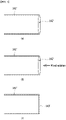
- the gas scavenging member 140 may be prepared, for example, by the method as shown in Figs. 2 and 3 .
- the gas scavenging member can be prepared by high-temperature sealing three surfaces as so to make the film made of two gas-permeable polymers as a pouch shape, so as to include a three-sided sealing part 141 and a one-sided mixed solution injection port 142 (process (a)), injecting the mixed solution according to the present disclosure through the mixed solution injection port 142 (process (b)), and then high-temperature sealing the mixed solution injection port 142 (process (c)).
- the gas scavenging member can be prepared by folding a film made of a gas permeable polymer in half so as to include the two-sided sealing part 141' and the one-sided mixed solution injection port 142', and high-temperature sealing the two side surfaces of the folded part (process (a)); injecting the mixed solution according to the present disclosure through the mixed solution injection port 142 (process (b)), and then high-temperature sealing the mixed solution inlet 142 (process (c))
- the gas scavenging member according to the present disclosure has a pouch structure, which has a form in which a mixed solution injection hole is formed on one side of the gas scavenging member, and the mixed solution injection hole is sealed in a state where the mixed solution is injected.
- the electrode assembly includes a positive electrode, a negative electrode, and a separator interposed between the positive electrode and the negative electrode.
- the positive electrode has a positive electrode mixture containing a positive electrode active material formed on at least one surface of a positive electrode current collector, and the positive active material may include a lithium nickel-based-transition metal oxide containing 80 mol% or more of Ni in the total moles of transition metals excluding lithium.
- the lithium nickel-based-transition metal oxide may be represented by the following Chemical Formula 1.
- the lithium nickel-based-transition metal oxide may be LiNi 0.8 Co 0.1 Mn 0.1 O 2 , LiNi a Co b (Mn y A z ) c O 2 , LiNi a Co b A c O 2 , wherein a, b and c are as defined above, and the A is at least one selected from the group consisting of Al, Ti, Mg, Zr, W, Y, Sr, F, Si, Na, Cu, Fe, Ca, S and B.
- the lithium nickel-based transition metal oxide that is, an oxide having 80 mol% or more of a nickel content in the total moles of transition metals excluding lithium
- the lithium nickel-based transition metal oxide is included as a positive electrode active material, it is suitable for high energy and high output requirements, but a large amount of CO2 is generated at high temperature, performance deteriorates due to gas traps and the incidence of venting issues is high. Thereby, since the gas control requirement is higher, the secondary battery including the gas scavenging member according to the present disclosure can operate efficiently.
- lithium manganese oxides such as chemical formulae
- the positive electrode mixture may further include a conductive material and a binder together with the positive electrode active material described above.
- the negative electrode may be prepared in a form in which a negative electrode mixture including a negative electrode active material is coated onto a negative electrode current collector, and the negative electrode mixture may further include the conductive material and binder as described above together with the negative electrode active material.
- the positive electrode current collector, the negative electrode active material, the negative electrode current collector, the conductive material, the binder, and the like are well known in the art, a detailed description thereof is omitted herein.
- Teflon AF 2400 films Two Teflon AF 2400 films were prepared, and three surfaces of them were sealed to prepare a pouch equipped with a liquid injection port.
- Monoethanolamine(MEA) as an amine-based compound was dissolved in bis(trifluoromethane)sulfoneimide(Tf2N) as an ionic liquid so as to contain 10% by weight based on the total weight of the mixed solution, thereby preparing a mixed solution.
- a gas scavenging member 2 was prepared in the same manner as in Preparation Example 1, except that diethanolamine (DEA) was used as an amine-based compound.
- DEA diethanolamine
- a gas scavenging member 3 was prepared in the same manner as in Preparation Example 1, except that monoethanolamine was dissolved as the amine-based compound, so as to contain 30% by weight based on the total weight of the mixed solution.
- a gas scavenging member 4 was prepared in the same manner as in Preparation Example 1, except that monoethanolamine was dissolved as the amine-based compound, so as to contain 5% by weight based on the total weight of the mixed solution.
- a gas scavenging member 5 was prepared in the same manner as in Preparation Example 1, except that only 30ml of the mixed solution was injected into the pouch.
- a gas scavenging member 6 was prepared in the same manner as in Preparation Example 1, except that 50 ml of a liquid electrolyte in which LiPF6 was dissolved at 1M in a mixed solvent of ethylene carbonate and ethylmethyl carbonate in a ratio of 3:7 (volume ratio) was injected instead of the mixed solution into the pouch.
- LiNi 0.8 Co 0.1 Mn 0.1 O 2 was used as a positive electrode active material.
- 96 wt.% of the positive electrode active material, 2.0 wt.% of Super-P (conductive material), and 2.0 wt.% of PVdF (binder) were added to NMP (N-methyl-2-pyrrolidone) as a solvent to prepare a positive electrode active material slurry.
- the positive electrode mixture slurry was coated to a thickness of 50 ⁇ m onto aluminum foil.
- NMP drying it was dried and rolled at a speed of 0.2 m/min (about 5 minutes) in a dryer at 130°C to prepare a positive electrode.
- Artificial graphite was used as a negative electrode active material. 96.3 wt.% of artificial graphite, 1.0 wt.% of Super-P (conductive agent), and 2.7 wt.% of PVdF (binder) were added to NMP as a solvent to prepare a negative electrode active material slurry, and then, the resulting slurry was coated to 70 ⁇ m onto a copper foil, dried at a speed of 0.2 m/min (about 5 minutes) in a dryer at 130°C, and rolled to prepare a negative electrode.
- NMP conductive agent
- PVdF binder
- An electrode assembly was prepared using the above-prepared positive electrode and negative electrode, and a polyethylene film (Celgard, thickness: 20 ⁇ m) as a separator.
- the gas scavenging member 1 of Preparation Example 1 was disposed on the upper end of the electrode assembly, which was built into a battery case, and injected and sealed using a liquid electrolyte in which LiPF6 was dissolved at 1M in a mixed solvent of ethylene carbonate, dimethylene carbonate and diethyl carbonate in a ratio of 1: 2: 1 (volume ratio), thereby preparing the secondary battery.
- a secondary battery was prepared in the same manner as in Example 1, except that as the gas scavenging member, the gas scavenging member 2 was used instead of the gas scavenging member 1.
- a secondary battery was prepared in the same manner as in Example 1, except that as the gas scavenging member, the gas scavenging member 3 was used instead of the gas scavenging member 1.
- a secondary battery was prepared in the same manner as in Example 1, except that as the gas scavenging member, the gas scavenging member 4 was used instead of the gas scavenging member 1.
- a secondary battery was prepared in the same manner as in Example 1, except that as the gas scavenging member, the gas scavenging member 5 was used instead of the gas scavenging member 1.
- a secondary battery was prepared in the same manner as in Example 1, except that the gas scavenging member was not used.
- a secondary battery was prepared in the same manner as in Example 1, except that the gas scavenging member 6 was disposed instead of the gas scavenging member 1.
- Example 5 to Comparative Example 2 The secondary batteries prepared in Example 5 to Comparative Example 2 were charged up to 4.2V at 0.1C and 5mA, stored in a convection oven at 60°C for 2 weeks, and then the amount of gas generated in the secondary battery was measured by GC-mass analysis, and the results are shown in Table 1 below. [Table 1] Amount of gas generated (CO 2 content, ⁇ l) Example 1 267 Example 2 375 Example 3 106 Example 4 1032 Example 5 633 Comparative Example 1 1619 Comparative Example 2 1465
- the secondary battery according to an embodiment of the present disclosure includes a gas scavenging member containing a mixed solution of an ionic liquid and an amine-based compound, and therefore, can effectively scavenge the gas generated during the operation of the secondary battery, improve the lifetime characteristics, do not cause issues such as packaging venting, and secure the safety.
Landscapes
- Chemical & Material Sciences (AREA)
- Chemical Kinetics & Catalysis (AREA)
- Electrochemistry (AREA)
- General Chemical & Material Sciences (AREA)
- Engineering & Computer Science (AREA)
- Manufacturing & Machinery (AREA)
- Inorganic Chemistry (AREA)
- Secondary Cells (AREA)
- Inorganic Compounds Of Heavy Metals (AREA)
- Sealing Battery Cases Or Jackets (AREA)
- Battery Electrode And Active Subsutance (AREA)
Applications Claiming Priority (2)
| Application Number | Priority Date | Filing Date | Title |
|---|---|---|---|
| KR1020200149185A KR20220063393A (ko) | 2020-11-10 | 2020-11-10 | 가스 포집용 부재를 포함하는 이차 전지 |
| PCT/KR2021/015756 WO2022103054A1 (ko) | 2020-11-10 | 2021-11-03 | 가스 포집용 부재를 포함하는 이차 전지 |
Publications (3)
| Publication Number | Publication Date |
|---|---|
| EP4053969A1 true EP4053969A1 (de) | 2022-09-07 |
| EP4053969A4 EP4053969A4 (de) | 2023-08-16 |
| EP4053969B1 EP4053969B1 (de) | 2026-02-11 |
Family
ID=81602508
Family Applications (1)
| Application Number | Title | Priority Date | Filing Date |
|---|---|---|---|
| EP21892222.7A Active EP4053969B1 (de) | 2020-11-10 | 2021-11-03 | Sekundärbatterie mit gasfängerelement |
Country Status (7)
| Country | Link |
|---|---|
| US (1) | US12525661B2 (de) |
| EP (1) | EP4053969B1 (de) |
| JP (1) | JP7418901B2 (de) |
| KR (1) | KR20220063393A (de) |
| CN (1) | CN114830407A (de) |
| ES (1) | ES3064351T3 (de) |
| WO (1) | WO2022103054A1 (de) |
Families Citing this family (1)
| Publication number | Priority date | Publication date | Assignee | Title |
|---|---|---|---|---|
| WO2024136199A1 (ko) * | 2022-12-23 | 2024-06-27 | 주식회사 엘지에너지솔루션 | 이차 전지 |
Family Cites Families (31)
| Publication number | Priority date | Publication date | Assignee | Title |
|---|---|---|---|---|
| JP4682388B2 (ja) | 1999-11-05 | 2011-05-11 | 三菱化学株式会社 | リチウム二次電池用正極材料並びにこれを用いた正極及びリチウム二次電池 |
| US7615104B2 (en) | 2005-11-03 | 2009-11-10 | United Technologies Corporation | Fuel deoxygenation system with multi-layer oxygen permeable membrane |
| KR100668353B1 (ko) * | 2006-02-07 | 2007-01-12 | 삼성에스디아이 주식회사 | 금속 촉매 및 이를 포함한 전극을 채용한 연료전지 |
| JP4880330B2 (ja) | 2006-03-09 | 2012-02-22 | パナソニック株式会社 | 非水電解液二次電池 |
| JP5225708B2 (ja) * | 2008-02-27 | 2013-07-03 | 日本化学工業株式会社 | リチウム二次電池正極活物質用リチウムニッケルマンガンコバルト複合酸化物、その製造方法及びリチウム二次電池 |
| US20110014100A1 (en) | 2008-05-21 | 2011-01-20 | Bara Jason E | Carbon Sequestration Using Ionic Liquids |
| EP2288424A2 (de) | 2008-05-21 | 2011-03-02 | The Regents of the University of Colorado | Ionische flüssigkeiten und verfahren zu ihrer verwendung |
| WO2009142663A1 (en) | 2008-05-21 | 2009-11-26 | The Regents Of The University Of Colorado | Ionic liquids and methods for using same |
| JP5900869B2 (ja) * | 2010-04-27 | 2016-04-06 | 国立研究開発法人産業技術総合研究所 | 酸性ガス分離用吸収液ならびにガス分離精製方法およびその装置 |
| JP5862979B2 (ja) | 2010-07-22 | 2016-02-16 | ユニバーシティ オブ サザン カリフォルニア | 鉄空気再充電可能電池 |
| JP5331856B2 (ja) * | 2010-08-30 | 2013-10-30 | 日本乳化剤株式会社 | 処理剤 |
| JP5813336B2 (ja) * | 2011-02-18 | 2015-11-17 | 株式会社東芝 | 非水電解質二次電池 |
| JP2012190639A (ja) * | 2011-03-10 | 2012-10-04 | Sony Corp | 非水電解質電池、電池パック及び電子機器 |
| JP5574045B2 (ja) | 2011-05-25 | 2014-08-20 | 新神戸電機株式会社 | リチウムイオン二次電池 |
| KR101271920B1 (ko) | 2011-06-17 | 2013-06-05 | 삼성에스디아이 주식회사 | 이차 전지 |
| JP5897271B2 (ja) * | 2011-06-30 | 2016-03-30 | 株式会社東芝 | 非水電解質二次電池 |
| DE102011107185B3 (de) * | 2011-07-13 | 2012-08-16 | Fraunhofer-Gesellschaft zur Förderung der angewandten Forschung e.V. | Luftatmende Brennstoffzelle und Zellstapel für die Oxidation von Ionen mit Sauerstoff |
| KR101741030B1 (ko) | 2012-03-08 | 2017-05-29 | 삼성에스디아이 주식회사 | 이차전지 |
| JP2014127531A (ja) * | 2012-12-25 | 2014-07-07 | Taiyo Yuden Co Ltd | 電気化学デバイス |
| KR20150014668A (ko) * | 2013-07-30 | 2015-02-09 | 주식회사 엘지화학 | 가스 스캐빈저를 포함하는 이차전지 |
| US10522830B2 (en) | 2013-11-22 | 2019-12-31 | Sumitomo Metal Mining Co., Ltd. | Positive electrode active material for nonaqueous electrolyte secondary batteries and production method thereof, and nonaqueous electrolyte secondary battery |
| KR20160074844A (ko) | 2014-12-18 | 2016-06-29 | 명지대학교 산학협력단 | 아미노산 기반 아민 작용기가 도입된 이산화탄소 흡착제 및 그 제조방법 |
| US9764290B2 (en) | 2015-04-10 | 2017-09-19 | Idex Health & Science Llc | Degassing and de-bubbling pulse dampener |
| KR20170058047A (ko) | 2015-11-18 | 2017-05-26 | 주식회사 엘지화학 | 일회용 가스 포집부를 포함하고 있는 파우치형 전지케이스 및 이를 포함하는 이차전지의 제조방법 |
| KR101956334B1 (ko) * | 2016-01-06 | 2019-03-08 | 주식회사 엘지화학 | 가스 흡착성 고분자를 포함하고 있는 이차전지 |
| KR102250898B1 (ko) * | 2016-05-27 | 2021-05-10 | 주식회사 엘지화학 | 전지용 파우치 외장재 및 이를 포함하는 전지 |
| CN207217599U (zh) | 2017-05-15 | 2018-04-10 | 东莞超霸电池有限公司 | 一种高抗腐蚀性的镍氢电池 |
| US11491447B2 (en) * | 2017-05-18 | 2022-11-08 | Daicel Corporation | Ionic liquid-containing laminate and method for producing same |
| KR102282411B1 (ko) * | 2017-08-25 | 2021-07-26 | 주식회사 엘지에너지솔루션 | 이차전지 및 그 제조방법 |
| CN107706446A (zh) * | 2017-09-21 | 2018-02-16 | 南开大学 | 一种全固态锂‑二氧化碳二次电池 |
| TW201919759A (zh) * | 2017-09-25 | 2019-06-01 | 日商可樂麗股份有限公司 | 二氧化碳氣體吸收物及包含其之非水電解質蓄電池、以及二氧化碳氣體之分離回收方法 |
-
2020
- 2020-11-10 KR KR1020200149185A patent/KR20220063393A/ko active Pending
-
2021
- 2021-11-03 EP EP21892222.7A patent/EP4053969B1/de active Active
- 2021-11-03 WO PCT/KR2021/015756 patent/WO2022103054A1/ko not_active Ceased
- 2021-11-03 ES ES21892222T patent/ES3064351T3/es active Active
- 2021-11-03 CN CN202180007098.1A patent/CN114830407A/zh active Pending
- 2021-11-03 US US17/783,425 patent/US12525661B2/en active Active
- 2021-11-03 JP JP2022539714A patent/JP7418901B2/ja active Active
Also Published As
| Publication number | Publication date |
|---|---|
| US12525661B2 (en) | 2026-01-13 |
| CN114830407A (zh) | 2022-07-29 |
| US20230026380A1 (en) | 2023-01-26 |
| JP7418901B2 (ja) | 2024-01-22 |
| EP4053969A4 (de) | 2023-08-16 |
| ES3064351T3 (en) | 2026-04-24 |
| WO2022103054A1 (ko) | 2022-05-19 |
| KR20220063393A (ko) | 2022-05-17 |
| EP4053969B1 (de) | 2026-02-11 |
| JP2023508217A (ja) | 2023-03-01 |
Similar Documents
| Publication | Publication Date | Title |
|---|---|---|
| KR102751882B1 (ko) | 이차 전지용 전해질 및 이를 포함하는 리튬 이차 전지 | |
| CN105633467B (zh) | 一种电解液及采用该电解液的锂离子电池 | |
| KR100866764B1 (ko) | 비수 전해액 및 이를 포함하는 전기화학소자 | |
| JP7038965B2 (ja) | 非水性電解液及びこれを含むリチウム二次電池 | |
| JP5455975B2 (ja) | 正極活物質、並びにこれを用いたリチウムイオン二次電池用正極及びリチウムイオン二次電池 | |
| CN108987680A (zh) | 锂离子电池 | |
| JP4319536B2 (ja) | リチウム二次電池 | |
| WO2008029899A1 (en) | Nonaqueous electrolytic cell and its manufacturing method | |
| CN107394258A (zh) | 一种高电压锂离子电池电解液及高电压锂离子电池 | |
| CN102138246A (zh) | 蓄电装置用非水溶剂和非水电解液、以及使用它们制成的蓄电装置、锂二次电池和双电层电容器 | |
| CN102593508B (zh) | 锂离子电池 | |
| WO2018179883A1 (ja) | 非水電解質二次電池 | |
| CN110372736B (zh) | 一种高压电解液添加剂、包含其的高压电解液及锂离子电池 | |
| US20200194835A1 (en) | Electrolyte solution for lithium secondary batteries, and lithium secondary battery | |
| JP4765629B2 (ja) | 非水電解液およびリチウム二次電池 | |
| JP7689636B2 (ja) | 非水系電解液及び非水系二次電池 | |
| KR102447199B1 (ko) | 리튬 이차 전지용 전해질 및 이를 포함하는 리튬 이차 전지 | |
| EP4053969B1 (de) | Sekundärbatterie mit gasfängerelement | |
| KR101584850B1 (ko) | 리튬 이차 전지용 비수 전해액 및 이를 포함하는 리튬 이차 전지 | |
| KR102740009B1 (ko) | 수도 커패시터용 전해질 및 이를 포함하는 수도 커패시터 | |
| JP7245355B2 (ja) | 非水電解液及びリチウムイオン二次電池 | |
| EP2212965B1 (de) | Lithiumsekundärbatterie mit zusatzstoffen für verbesserte hochtemperatur-eigenschaften | |
| ES2978259T3 (es) | Electrolito no acuoso para batería secundaria de litio y batería secundaria de litio que comprende el mismo | |
| KR101179397B1 (ko) | 비수 전해액 및 이를 포함하는 전기화학소자 | |
| JP7514150B2 (ja) | 非水系電解液及び非水系二次電池 |
Legal Events
| Date | Code | Title | Description |
|---|---|---|---|
| STAA | Information on the status of an ep patent application or granted ep patent |
Free format text: STATUS: THE INTERNATIONAL PUBLICATION HAS BEEN MADE |
|
| PUAI | Public reference made under article 153(3) epc to a published international application that has entered the european phase |
Free format text: ORIGINAL CODE: 0009012 |
|
| STAA | Information on the status of an ep patent application or granted ep patent |
Free format text: STATUS: REQUEST FOR EXAMINATION WAS MADE |
|
| 17P | Request for examination filed |
Effective date: 20220602 |
|
| AK | Designated contracting states |
Kind code of ref document: A1 Designated state(s): AL AT BE BG CH CY CZ DE DK EE ES FI FR GB GR HR HU IE IS IT LI LT LU LV MC MK MT NL NO PL PT RO RS SE SI SK SM TR |
|
| A4 | Supplementary search report drawn up and despatched |
Effective date: 20230717 |
|
| RIC1 | Information provided on ipc code assigned before grant |
Ipc: H01M 50/105 20210101ALI20230711BHEP Ipc: H01M 50/131 20210101ALI20230711BHEP Ipc: H01M 10/52 20060101AFI20230711BHEP |
|
| DAV | Request for validation of the european patent (deleted) | ||
| DAX | Request for extension of the european patent (deleted) | ||
| STAA | Information on the status of an ep patent application or granted ep patent |
Free format text: STATUS: EXAMINATION IS IN PROGRESS |
|
| 17Q | First examination report despatched |
Effective date: 20241118 |
|
| GRAP | Despatch of communication of intention to grant a patent |
Free format text: ORIGINAL CODE: EPIDOSNIGR1 |
|
| STAA | Information on the status of an ep patent application or granted ep patent |
Free format text: STATUS: GRANT OF PATENT IS INTENDED |
|
| INTG | Intention to grant announced |
Effective date: 20251111 |
|
| GRAS | Grant fee paid |
Free format text: ORIGINAL CODE: EPIDOSNIGR3 |
|
| GRAA | (expected) grant |
Free format text: ORIGINAL CODE: 0009210 |
|
| STAA | Information on the status of an ep patent application or granted ep patent |
Free format text: STATUS: THE PATENT HAS BEEN GRANTED |
|
| P01 | Opt-out of the competence of the unified patent court (upc) registered |
Free format text: CASE NUMBER: UPC_APP_0015341_4053969/2025 Effective date: 20251201 |
|
| AK | Designated contracting states |
Kind code of ref document: B1 Designated state(s): AL AT BE BG CH CY CZ DE DK EE ES FI FR GB GR HR HU IE IS IT LI LT LU LV MC MK MT NL NO PL PT RO RS SE SI SK SM TR |
|
| REG | Reference to a national code |
Ref country code: CH Ref legal event code: F10 Free format text: ST27 STATUS EVENT CODE: U-0-0-F10-F00 (AS PROVIDED BY THE NATIONAL OFFICE) Effective date: 20260211 Ref country code: GB Ref legal event code: FG4D |
|
| REG | Reference to a national code |
Ref country code: DE Ref legal event code: R096 Ref document number: 602021047937 Country of ref document: DE |
|
| REG | Reference to a national code |
Ref country code: IE Ref legal event code: FG4D |
|
| REG | Reference to a national code |
Ref country code: ES Ref legal event code: FG2A Ref document number: 3064351 Country of ref document: ES Kind code of ref document: T3 Effective date: 20260424 |