EP4053145B1 - Epha2 spezifische bicyclische peptidliganden - Google Patents
Epha2 spezifische bicyclische peptidliganden Download PDFInfo
- Publication number
- EP4053145B1 EP4053145B1 EP22161978.6A EP22161978A EP4053145B1 EP 4053145 B1 EP4053145 B1 EP 4053145B1 EP 22161978 A EP22161978 A EP 22161978A EP 4053145 B1 EP4053145 B1 EP 4053145B1
- Authority
- EP
- European Patent Office
- Prior art keywords
- peptide
- cancer
- epha2
- peptides
- ligands
- Prior art date
- Legal status (The legal status is an assumption and is not a legal conclusion. Google has not performed a legal analysis and makes no representation as to the accuracy of the status listed.)
- Active
Links
Images
Classifications
-
- A—HUMAN NECESSITIES
- A61—MEDICAL OR VETERINARY SCIENCE; HYGIENE
- A61K—PREPARATIONS FOR MEDICAL, DENTAL OR TOILETRY PURPOSES
- A61K47/00—Medicinal preparations characterised by the non-active ingredients used, e.g. carriers or inert additives; Targeting or modifying agents chemically bound to the active ingredient
- A61K47/50—Medicinal preparations characterised by the non-active ingredients used, e.g. carriers or inert additives; Targeting or modifying agents chemically bound to the active ingredient the non-active ingredient being chemically bound to the active ingredient, e.g. polymer-drug conjugates
- A61K47/51—Medicinal preparations characterised by the non-active ingredients used, e.g. carriers or inert additives; Targeting or modifying agents chemically bound to the active ingredient the non-active ingredient being chemically bound to the active ingredient, e.g. polymer-drug conjugates the non-active ingredient being a modifying agent
- A61K47/62—Medicinal preparations characterised by the non-active ingredients used, e.g. carriers or inert additives; Targeting or modifying agents chemically bound to the active ingredient the non-active ingredient being chemically bound to the active ingredient, e.g. polymer-drug conjugates the non-active ingredient being a modifying agent the modifying agent being a protein, peptide or polyamino acid
- A61K47/64—Drug-peptide, drug-protein or drug-polyamino acid conjugates, i.e. the modifying agent being a peptide, protein or polyamino acid which is covalently bonded or complexed to a therapeutically active agent
-
- C—CHEMISTRY; METALLURGY
- C07—ORGANIC CHEMISTRY
- C07K—PEPTIDES
- C07K7/00—Peptides having 5 to 20 amino acids in a fully defined sequence; Derivatives thereof
- C07K7/04—Linear peptides containing only normal peptide links
- C07K7/08—Linear peptides containing only normal peptide links having 12 to 20 amino acids
-
- A—HUMAN NECESSITIES
- A61—MEDICAL OR VETERINARY SCIENCE; HYGIENE
- A61K—PREPARATIONS FOR MEDICAL, DENTAL OR TOILETRY PURPOSES
- A61K31/00—Medicinal preparations containing organic active ingredients
- A61K31/33—Heterocyclic compounds
- A61K31/395—Heterocyclic compounds having nitrogen as a ring hetero atom, e.g. guanethidine or rifamycins
- A61K31/535—Heterocyclic compounds having nitrogen as a ring hetero atom, e.g. guanethidine or rifamycins having six-membered rings with at least one nitrogen and one oxygen as the ring hetero atoms, e.g. 1,2-oxazines
- A61K31/5365—Heterocyclic compounds having nitrogen as a ring hetero atom, e.g. guanethidine or rifamycins having six-membered rings with at least one nitrogen and one oxygen as the ring hetero atoms, e.g. 1,2-oxazines ortho- or peri-condensed with heterocyclic ring systems
-
- A—HUMAN NECESSITIES
- A61—MEDICAL OR VETERINARY SCIENCE; HYGIENE
- A61K—PREPARATIONS FOR MEDICAL, DENTAL OR TOILETRY PURPOSES
- A61K38/00—Medicinal preparations containing peptides
- A61K38/04—Peptides having up to 20 amino acids in a fully defined sequence; Derivatives thereof
- A61K38/05—Dipeptides
-
- A—HUMAN NECESSITIES
- A61—MEDICAL OR VETERINARY SCIENCE; HYGIENE
- A61K—PREPARATIONS FOR MEDICAL, DENTAL OR TOILETRY PURPOSES
- A61K38/00—Medicinal preparations containing peptides
- A61K38/04—Peptides having up to 20 amino acids in a fully defined sequence; Derivatives thereof
- A61K38/07—Tetrapeptides
-
- A—HUMAN NECESSITIES
- A61—MEDICAL OR VETERINARY SCIENCE; HYGIENE
- A61K—PREPARATIONS FOR MEDICAL, DENTAL OR TOILETRY PURPOSES
- A61K38/00—Medicinal preparations containing peptides
- A61K38/04—Peptides having up to 20 amino acids in a fully defined sequence; Derivatives thereof
- A61K38/10—Peptides having 12 to 20 amino acids
-
- A—HUMAN NECESSITIES
- A61—MEDICAL OR VETERINARY SCIENCE; HYGIENE
- A61K—PREPARATIONS FOR MEDICAL, DENTAL OR TOILETRY PURPOSES
- A61K47/00—Medicinal preparations characterised by the non-active ingredients used, e.g. carriers or inert additives; Targeting or modifying agents chemically bound to the active ingredient
- A61K47/50—Medicinal preparations characterised by the non-active ingredients used, e.g. carriers or inert additives; Targeting or modifying agents chemically bound to the active ingredient the non-active ingredient being chemically bound to the active ingredient, e.g. polymer-drug conjugates
- A61K47/51—Medicinal preparations characterised by the non-active ingredients used, e.g. carriers or inert additives; Targeting or modifying agents chemically bound to the active ingredient the non-active ingredient being chemically bound to the active ingredient, e.g. polymer-drug conjugates the non-active ingredient being a modifying agent
- A61K47/62—Medicinal preparations characterised by the non-active ingredients used, e.g. carriers or inert additives; Targeting or modifying agents chemically bound to the active ingredient the non-active ingredient being chemically bound to the active ingredient, e.g. polymer-drug conjugates the non-active ingredient being a modifying agent the modifying agent being a protein, peptide or polyamino acid
-
- A—HUMAN NECESSITIES
- A61—MEDICAL OR VETERINARY SCIENCE; HYGIENE
- A61K—PREPARATIONS FOR MEDICAL, DENTAL OR TOILETRY PURPOSES
- A61K47/00—Medicinal preparations characterised by the non-active ingredients used, e.g. carriers or inert additives; Targeting or modifying agents chemically bound to the active ingredient
- A61K47/50—Medicinal preparations characterised by the non-active ingredients used, e.g. carriers or inert additives; Targeting or modifying agents chemically bound to the active ingredient the non-active ingredient being chemically bound to the active ingredient, e.g. polymer-drug conjugates
- A61K47/51—Medicinal preparations characterised by the non-active ingredients used, e.g. carriers or inert additives; Targeting or modifying agents chemically bound to the active ingredient the non-active ingredient being chemically bound to the active ingredient, e.g. polymer-drug conjugates the non-active ingredient being a modifying agent
- A61K47/62—Medicinal preparations characterised by the non-active ingredients used, e.g. carriers or inert additives; Targeting or modifying agents chemically bound to the active ingredient the non-active ingredient being chemically bound to the active ingredient, e.g. polymer-drug conjugates the non-active ingredient being a modifying agent the modifying agent being a protein, peptide or polyamino acid
- A61K47/64—Drug-peptide, drug-protein or drug-polyamino acid conjugates, i.e. the modifying agent being a peptide, protein or polyamino acid which is covalently bonded or complexed to a therapeutically active agent
- A61K47/6415—Toxins or lectins, e.g. clostridial toxins or Pseudomonas exotoxins
-
- A—HUMAN NECESSITIES
- A61—MEDICAL OR VETERINARY SCIENCE; HYGIENE
- A61K—PREPARATIONS FOR MEDICAL, DENTAL OR TOILETRY PURPOSES
- A61K47/00—Medicinal preparations characterised by the non-active ingredients used, e.g. carriers or inert additives; Targeting or modifying agents chemically bound to the active ingredient
- A61K47/50—Medicinal preparations characterised by the non-active ingredients used, e.g. carriers or inert additives; Targeting or modifying agents chemically bound to the active ingredient the non-active ingredient being chemically bound to the active ingredient, e.g. polymer-drug conjugates
- A61K47/51—Medicinal preparations characterised by the non-active ingredients used, e.g. carriers or inert additives; Targeting or modifying agents chemically bound to the active ingredient the non-active ingredient being chemically bound to the active ingredient, e.g. polymer-drug conjugates the non-active ingredient being a modifying agent
- A61K47/62—Medicinal preparations characterised by the non-active ingredients used, e.g. carriers or inert additives; Targeting or modifying agents chemically bound to the active ingredient the non-active ingredient being chemically bound to the active ingredient, e.g. polymer-drug conjugates the non-active ingredient being a modifying agent the modifying agent being a protein, peptide or polyamino acid
- A61K47/65—Peptidic linkers, binders or spacers, e.g. peptidic enzyme-labile linkers
-
- A—HUMAN NECESSITIES
- A61—MEDICAL OR VETERINARY SCIENCE; HYGIENE
- A61P—SPECIFIC THERAPEUTIC ACTIVITY OF CHEMICAL COMPOUNDS OR MEDICINAL PREPARATIONS
- A61P35/00—Antineoplastic agents
Definitions
- the present invention relates to polypeptides which are covalently bound to non-aromatic molecular scaffolds such that two or more peptide loops are subtended between attachment points to the scaffold.
- the invention describes peptides which are high affinity binders of the Eph receptor tyrosine kinase A2 (EphA2).
- EphA2 Eph receptor tyrosine kinase A2
- the invention also includes drug conjugates comprising said peptides, conjugated to one or more effector and/or functional groups, to pharmaceutical compositions comprising said peptide ligands and drug conjugates and to the use of said peptide ligands and drug conjugates in preventing, suppressing or treating a disease or disorder characterised by overexpression of EphA2 in diseased tissue (such as a tumour).
- Cyclic peptides are able to bind with high affinity and target specificity to protein targets and hence are an attractive molecule class for the development of therapeutics.
- several cyclic peptides are already successfully used in the clinic, as for example the antibacterial peptide vancomycin, the immunosuppressant drug cyclosporine or the anti-cancer drug octreotide ( Driggers et al. (2008), Nat Rev Drug Discov 7 (7), 608-24 ).
- Good binding properties result from a relatively large interaction surface formed between the peptide and the target as well as the reduced conformational flexibility of the cyclic structures.
- macrocycles bind to surfaces of several hundred square angstrom, as for example the cyclic peptide CXCR4 antagonist CVX15 (400 ⁇ 2 ; Wu et al. (2007), Science 330, 1066-71 ), a cyclic peptide with the Arg-Gly-Asp motif binding to integrin ⁇ Vb3 (355 ⁇ 2 ) ( Xiong et al. (2002), Science 296 (5565), 151-5 ) or the cyclic peptide inhibitor upain-1 binding to urokinase-type plasminogen activator (603 ⁇ 2 ; Zhao et al. (2007), J Struct Biol 160 (1), 1-10 ).
- CVX15 400 ⁇ 2 ; Wu et al. (2007), Science 330, 1066-71
- a cyclic peptide with the Arg-Gly-Asp motif binding to integrin ⁇ Vb3 355 ⁇ 2
- peptide macrocycles are less flexible than linear peptides, leading to a smaller loss of entropy upon binding to targets and resulting in a higher binding affinity.
- the reduced flexibility also leads to locking target-specific conformations, increasing binding specificity compared to linear peptides.
- MMP-8 matrix metalloproteinase 8
- Phage display-based combinatorial approaches have been developed to generate and screen large libraries of bicyclic peptides to targets of interest ( Heinis et al. (2009), Nat Chem Biol 5 (7), 502-7 and WO 2009/098450 ). Briefly, combinatorial libraries of linear peptides containing three cysteine residues and two regions of six random amino acids (Cys-(Xaa) 6 -Cys-(Xaa) 6 -Cys) were displayed on phage and cyclised by covalently linking the cysteine side chains to a small molecule scaffold.
- a process for preparing BCY6136 which comprises reacting compound 8: with compound BCY6099: wherein Sar is sarcosine, HArg is homoarginine and HyP is hydroxyproline.
- said reaction is conducted in the presence of DIEA and DMA.
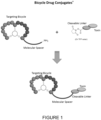
- FIG. 1 General schematic demonstrating the concept of preparing Bicycle drug conjugates (BDCs).
- the present invention relates to a process for preparing BCY6136 as defined in the claims.
- a peptide ligand specific for EphA2 comprising a polypeptide comprising at least three cysteine residues, separated by at least two loop sequences, and a non-aromatic molecular scaffold which forms covalent bonds with the cysteine residues of the polypeptide such that at least two polypeptide loops are formed on the molecular scaffold, wherein the peptide ligand comprises the amino acid sequence: C i (HyP)LVNPLC ii LHP(D-Asp)W(HArg)C iii (SEQ ID NO: 1); wherein HyP is hydroxyproline, HArg is homoarginine and C i , C ii and C iii represent first, second and third cysteine residues, respectively or a pharmaceutically acceptable salt thereof.
- a drug conjugate comprising a peptide ligand as defined herein conjugated to one or more effector and/or functional groups.
- composition comprising a peptide ligand or a drug conjugate as defined herein in combination with one or more pharmaceutically acceptable excipients.
- a peptide ligand or drug conjugate as defined herein for use in preventing, suppressing or treating a disease or disorder characterised by overexpression of EphA2 in diseased tissue (such as a tumour).
- Peptide ligand BCY6099 comprises the amino acid sequence: ( ⁇ -Ala)-Sar 10 -A(HArg)D-C i (HyP)LVNPLC ii LHP(D-Asp)W(HArg)C iii (SEQ ID NO: 2) (BCY6099); wherein Sar is sarcosine, HArg is homoarginine and HyP is hydroxyproline and wherein the molecular scaffold is 1,1',1"-(1,3,5-triazinane-1,3,5-triyl)triprop-2-en-1-one (TATA).
- cysteine residues (C i , C ii and C iii ) are omitted from the numbering as they are invariant, therefore, the numbering of amino acid residues within the peptides of the invention is referred to as below: -C i -HyP 1 -L 2 -V 3 -N 4 -P 5 -L 6 -C ii -L 7 -H 8 -P 9 -(D-Asp) 10 -W 11 -(HArg) 12 -C iii - (SEQ ID NO: 1).
- N- or C-terminal extensions to the bicycle core sequence are added to the left or right side of the sequence, separated by a hyphen.
- an N-terminal ( ⁇ -Ala)-Sar 10 -Ala tail would be denoted as: ( ⁇ -Ala)-Sar 10 -A-(SEQ ID NO: X).
- a peptide ligand refers to a peptide, peptidic or peptidomimetic covalently bound to a molecular scaffold.
- such peptides, peptidics or peptidomimetics comprise a peptide having natural or non-natural amino acids, two or more reactive groups (i.e. cysteine residues) which are capable of forming covalent bonds to the scaffold, and a sequence subtended between said reactive groups which is referred to as the loop sequence, since it forms a loop when the peptide, peptidic or peptidomimetic is bound to the scaffold.
- the peptides, peptidics or peptidomimetics comprise at least three cysteine residues (referred to herein as C i , C ii and C iii ), and form at least two loops on the scaffold.
- Certain bicyclic peptides of the present invention have a number of advantageous properties which enable them to be considered as suitable drug-like molecules for injection, inhalation, nasal, ocular, oral or topical administration.
- Such advantageous properties include:
- references herein to peptide ligands include the salt forms of said ligands.
- the salts of the present invention can be synthesized from the parent compound that contains a basic or acidic moiety by conventional chemical methods such as methods described in Pharmaceutical Salts: Properties, Selection, and Use, P. Heinrich Stahl (Editor), Camille G. Wermuth (Editor), ISBN: 3-90639-026-8, Hardcover, 388 pages, August 2002 .
- such salts can be prepared by reacting the free acid or base forms of these compounds with the appropriate base or acid in water or in an organic solvent, or in a mixture of the two.
- Acid addition salts may be formed with a wide variety of acids, both inorganic and organic.
- acid addition salts include mono- or di-salts formed with an acid selected from the group consisting of acetic, 2,2-dichloroacetic, adipic, alginic, ascorbic (e.g.
- D-glucuronic D-glucuronic
- glutamic e.g. L-glutamic
- a-oxoglutaric glycolic, hippuric
- hydrohalic acids e.g. hydrobromic, hydrochloric, hydriodic
- isethionic lactic (e.g.
- salts consist of salts formed from acetic, hydrochloric, hydriodic, phosphoric, nitric, sulfuric, citric, lactic, succinic, maleic, malic, isethionic, fumaric, benzenesulfonic, toluenesulfonic, sulfuric, methanesulfonic (mesylate), ethanesulfonic, naphthalenesulfonic, valeric, propanoic, butanoic, malonic, glucuronic and lactobionic acids.
- One particular salt is the hydrochloride salt.
- Another particular salt is the acetate salt.
- a salt may be formed with an organic or inorganic base, generating a suitable cation.
- suitable inorganic cations include, but are not limited to, alkali metal ions such as Li + , Na + and K + , alkaline earth metal cations such as Ca 2+ and Mg 2+ , and other cations such as Al 3+ or Zn + .
- Suitable organic cations include, but are not limited to, ammonium ion (i.e., NH 4 + ) and substituted ammonium ions (e.g., NH 3 R + , NH 2 R 2 + , NHR 3 + , NR 4 + ).
- Examples of some suitable substituted ammonium ions are those derived from: methylamine, ethylamine, diethylamine, propylamine, dicyclohexylamine, triethylamine, butylamine, ethylenediamine, ethanolamine, diethanolamine, piperazine, benzylamine, phenylbenzylamine, choline, meglumine, and tromethamine, as well as amino acids, such as lysine and arginine.
- An example of a common quaternary ammonium ion is N(CH 3 ) 4 + .
- peptides of the invention contain an amine function
- these may form quaternary ammonium salts, for example by reaction with an alkylating agent according to methods well known to the skilled person.
- Such quaternary ammonium compounds are within the scope of the peptides of the invention.
- the present invention includes all pharmaceutically acceptable (radio)isotope-labeled peptide ligands of the invention, wherein one or more atoms are replaced by atoms having the same atomic number, but an atomic mass or mass number different from the atomic mass or mass number usually found in nature, and peptide ligands of the invention, wherein metal chelating groups are attached (termed "effector") that are capable of holding relevant (radio)isotopes, and peptide ligands of the invention, wherein certain functional groups are covalently replaced with relevant (radio)isotopes or isotopically labelled functional groups.
- isotopes suitable for inclusion in the peptide ligands of the invention comprise isotopes of hydrogen, such as 2 H (D) and 3 H (T), carbon, such as 11 C, 13 C and 14 C, chlorine, such as 36 Cl, fluorine, such as 18 F, iodine, such as 123 I, 125 I and 131 I, nitrogen, such as 13 N and 15 N, oxygen, such as 15 O, 17 O and 18 O, phosphorus, such as 32 P, sulfur, such as 35 S, copper, such as 64 Cu, gallium, such as 67 Ga or 68 Ga, yttrium, such as 90 Y and lutetium, such as 177 Lu, and Bismuth, such as 213 Bi.
- hydrogen such as 2 H (D) and 3 H (T)
- carbon such as 11 C, 13 C and 14 C
- chlorine such as 36 Cl
- fluorine such as 18 F
- iodine such as 123 I, 125 I and 131 I
- nitrogen such as
- Certain isotopically-labelled peptide ligands of the invention are useful in drug and/or substrate tissue distribution studies, and to clinically assess the presence and/or absence of the EphA2 target on diseased tissues.
- the peptide ligands of the invention can further have valuable diagnostic properties in that they can be used for detecting or identifying the formation of a complex between a labelled compound and other molecules, peptides, proteins, enzymes or receptors.
- the detecting or identifying methods can use compounds that are labelled with labelling agents such as radioisotopes, enzymes, fluorescent substances, luminous substances (for example, luminol, luminol derivatives, luciferin, aequorin and luciferase), etc.
- labelling agents such as radioisotopes, enzymes, fluorescent substances, luminous substances (for example, luminol, luminol derivatives, luciferin, aequorin and luciferase), etc.
- the radioactive isotopes tritium, i.e. 3 H (T), and carbon-14, i.e. 14 C, are particularly useful for this purpose in view of their ease of incorporation and ready means of detection.
- Substitution with heavier isotopes such as deuterium, i.e. 2 H (D), may afford certain therapeutic advantages resulting from greater metabolic stability, for example, increased in vivo half-life or reduced dosage requirements, and hence may be preferred in some circumstances.
- Isotopically-labeled compounds of peptide ligands of the invention can generally be prepared by conventional techniques known to those skilled in the art or by processes analogous to those described in the accompanying Examples using an appropriate isotopically-labeled reagent in place of the non-labeled reagent previously employed.
- non-aromatic molecular scaffold refers to any molecular scaffold as defined herein which does not contain an aromatic (i.e. unsaturated) carbocyclic or heterocyclic ring system.
- non-aromatic molecular scaffolds are described in Heinis et al (2014) Angewandte Chemie, International Edition 53(6) 1602-1606 .
- the molecular scaffold may be a small molecule, such as a small organic molecule.
- the molecular scaffold may be a macromolecule. In one embodiment the molecular scaffold is a macromolecule composed of amino acids, nucleotides or carbohydrates.
- the molecular scaffold comprises reactive groups that are capable of reacting with functional group(s) of the polypeptide to form covalent bonds.
- the molecular scaffold may comprise chemical groups which form the linkage with a peptide, such as amines, thiols, alcohols, ketones, aldehydes, nitriles, carboxylic acids, esters, alkenes, alkynes, azides, anhydrides, succinimides, maleimides, alkyl halides and acyl halides.
- chemical groups which form the linkage with a peptide such as amines, thiols, alcohols, ketones, aldehydes, nitriles, carboxylic acids, esters, alkenes, alkynes, azides, anhydrides, succinimides, maleimides, alkyl halides and acyl halides.
- An example of an ⁇ unsaturated carbonyl containing compound is 1,1',1"-(1,3,5-triazinane-1,3,5-triyl)triprop-2-en-1-one (TATA) ( Angewandte Chemie, International Edition (2014), 53(6), 1602-1606 ).
- a drug conjugate comprising a peptide ligand as defined herein conjugated to one or more effector and/or functional groups.
- Effector and/or functional groups can be attached, for example, to the N and/or C termini of the polypeptide, to an amino acid within the polypeptide, or to the molecular scaffold.
- an effector group can include an antibody light chain constant region (CL), an antibody CH1 heavy chain domain, an antibody CH2 heavy chain domain, an antibody CH3 heavy chain domain, or any combination thereof, in addition to the one or more constant region domains.
- An effector group may also comprise a hinge region of an antibody (such a region normally being found between the CH1 and CH2 domains of an IgG molecule).
- an effector group disclosed herein is an Fc region of an IgG molecule.
- a peptide ligand-effector group according to the present disclosure comprises or consists of a peptide ligand Fc fusion having a t ⁇ half-life of a day or more, two days or more, 3 days or more, 4 days or more, 5 days or more, 6 days or more or 7 days or more.
- the peptide ligand disclosed herein comprises or consists of a peptide ligand Fc fusion having a t ⁇ half-life of a day or more.
- Functional groups include, in general, binding groups, drugs, reactive groups for the attachment of other entities, functional groups which aid uptake of the macrocyclic peptides into cells, and the like.
- peptides to penetrate into cells will allow peptides against intracellular targets to be effective.
- Targets that can be accessed by peptides with the ability to penetrate into cells include transcription factors, intracellular signalling molecules such as tyrosine kinases and molecules involved in the apoptotic pathway.
- Functional groups which enable the penetration of cells include peptides or chemical groups which have been added either to the peptide or the molecular scaffold. Peptides such as those derived from such as VP22, HIV-Tat, a homeobox protein of Drosophila (Antennapedia), e.g. as described in Chen and Harrison, Biochemical Society Transactions (2007) Volume 35, part 4, p821 ; Gupta et al.
- Examples of short peptides which have been shown to be efficient at translocation through plasma membranes include the 16 amino acid penetratin peptide from Drosophila Antennapedia protein ( Derossi et al (1994) J Biol. Chem. Volume 269 p10444 ), the 18 amino acid 'model amphipathic peptide' ( Oehlke et al (1998) Biochim Biophys Acts Volume 1414 p127 ) and arginine rich regions of the HIV TAT protein.
- Non peptidic approaches include the use of small molecule mimics or SMOCs that can be easily attached to biomolecules ( Okuyama et al (2007) Nature Methods Volume 4 p153 ).
- One class of functional groups which may be attached to peptide ligands includes antibodies and binding fragments thereof, such as Fab, Fv or single domain fragments.
- antibodies which bind to proteins capable of increasing the half-life of the peptide ligand in vivo may be used.
- a peptide ligand-effector group disclosed herein has a t ⁇ half-life selected from the group consisting of: 12 hours or more, 24 hours or more, 2 days or more, 3 days or more, 4 days or more, 5 days or more, 6 days or more, 7 days or more, 8 days or more, 9 days or more, 10 days or more, 11 days or more, 12 days or more, 13 days or more, 14 days or more, 15 days or more or 20 days or more.
- a peptide ligand-effector group or composition disclosed herein will have a t ⁇ range 12 to 60 hours. For example, it will have a t ⁇ half-life of a day or more or it will be in the range 12 to 26 hours.
- the functional group of the disclosure is selected from a metal chelator, which is suitable for complexing metal radioisotopes of medicinal relevance.
- Possible effector groups also include enzymes, for instance such as carboxypeptidase G2 for use in enzyme/prodrug therapy, where the peptide ligand replaces antibodies in ADEPT.
- the functional group may be selected from a drug, such as a cytotoxic agent for cancer therapy.
- a drug such as a cytotoxic agent for cancer therapy.
- Suitable examples include: alkylating agents such as cisplatin and carboplatin, as well as oxaliplatin, mechlorethamine, cyclophosphamide, chlorambucil, ifosfamide; Antimetabolites including purine analogs azathioprine and mercaptopurine or pyrimidine analogs; plant alkaloids and terpenoids including vinca alkaloids such as Vincristine, Vinblastine, Vinorelbine and Vindesine; Podophyllotoxin and its derivatives etoposide and teniposide; Taxanes, including paclitaxel, originally known as Taxol; topoisomerase inhibitors including camptothecins: irinotecan and topotecan, and type II inhibitors including amsacrine, etopo
- the cytotoxic agent may be selected from maytansinoids (such as DM1) or monomethyl auristatins (such as MMAE).
- DM1 is a cytotoxic agent which is a thiol-containing derivative of maytansine and has the following structure:
- MMAE Monomethyl auristatin E
- the cytotoxic agent may be linked to the bicyclic peptide by a cleavable bond, such as a disulphide bond or a protease sensitive bond.
- a cleavable bond such as a disulphide bond or a protease sensitive bond.
- the groups adjacent to the disulphide bond may be modified to control the hindrance of the disulphide bond, and by this the rate of cleavage and concomitant release of cytotoxic agent.
- the hindrance on either side of the disulphide bond is modulated through introducing one or more methyl groups on either the targeting entity (here, the bicyclic peptide) or toxin side of the molecular construct.
- the drug conjugate may additionally comprise a linker between said peptide ligand and said cytotoxic agents.
- the cytotoxic agent and linker may be selected from any combinations of those described in WO 2016/067035 .
- the cytotoxic agent may be MMAE.
- the linker between said cytotoxic agent and said bicyclic peptide may comprise one or more amino acid residues.
- the cytotoxic agent may be MMAE and the linker is selected from: -Val-Cit-, -Trp-Cit-, -Val-Lys-, -D-Trp-Cit-, -Ala-Ala-Asn-, D-Ala-Phe-Lys- or -Glu-Pro-Cit-Gly-hPhe-Tyr-Leu- (SEQ ID NO: 3).
- the cytotoxic agent may be MMAE and the linker is selected from: -Val-Cit-, -Trp-Cit-, -Val-Lys- or -D-Trp-Cit-.
- the cytotoxic agent may be MMAE and the linker is -Val-Cit- or -Val-Lys-.
- the cytotoxic agent may be MMAE and the linker is -Val-Cit-.
- the linker between said cytoxic agent may comprise a disulfide bond, such as a cleavable disulfide bond.
- the cytotoxic agent may be DM1 and the linker is selected from: -S-S-, -SS(SO 3 H)-, -SS-(Me)-, -(Me)-SS-(Me)-, -SS-(Me 2 )- or -SS-(Me)-SO 3 H-.
- the cytotoxic agent may be DM1 and the linker comprises an -S-S- moiety, such as (N-succinimidyl 3-(2-pyridyldithio)propionate (SPDB), or an -SS(SO 3 H)- moiety, such as SO 3 H-SPDB.
- the cytotoxic agent may be DM1 and the linker comprises an -S-S- moiety, such as -S-S- or -S-S-(SO 3 H)-.
- the cytotoxic agent may be DM1 and the drug conjugate comprises a compound of formula (A): wherein said bicycle is BCY6099 as defined herein.
- the cytotoxic agent may be DM1 and the drug conjugate comprises a compound of formula (B): wherein said bicycle is BCY6099 as defined herein.
- the cytotoxic agent is MMAE and the drug conjugate is BCY6136:
- the peptides of the present invention may be manufactured synthetically by standard techniques followed by reaction with a molecular scaffold in vitro. When this is performed, standard chemistry may be used. This enables the rapid large scale preparation of soluble material for further downstream experiments or validation. Such methods could be accomplished using conventional chemistry such as that disclosed in Timmerman et al ( supra ).
- the invention also relates to manufacture of polypeptides or conjugates selected as set out herein, wherein the manufacture comprises optional further steps as explained below. In one embodiment, these steps are carried out on the end product polypeptide/conjugate made by chemical synthesis.
- amino acid residues in the polypeptide of interest may be substituted when manufacturing a conjugate or complex.
- Peptides can also be extended, to incorporate for example another loop and therefore introduce multiple specificities.
- the peptide may simply be extended chemically at its N-terminus or C-terminus or within the loops using orthogonally protected lysines (and analogues) using standard solid phase or solution phase chemistry.
- Standard (bio)conjugation techniques may be used to introduce an activated or activatable N- or C-terminus.
- additions may be made by fragment condensation or native chemical ligation e.g. as described in ( Dawson et al. 1994. Synthesis of Proteins by Native Chemical Ligation. Science 266:776-779 ), or by enzymes, for example using subtiligase as described in ( Chang et al Proc Natl Acad Sci U S A. 1994 Dec 20; 91(26):12544-8 or in Hikari et al Bioorganic & Medicinal Chemistry Letters Volume 18, Issue 22, 15 November 2008, Pages 6000-6003 ).
- the peptides may be extended or modified by further conjugation through disulphide bonds.
- This has the additional advantage of allowing the first and second peptide to dissociate from each other once within the reducing environment of the cell.
- the molecular scaffold could be added during the chemical synthesis of the first peptide so as to react with the three cysteine groups; a further cysteine or thiol could then be appended to the N or C-terminus of the first peptide, so that this cysteine or thiol only reacted with a free cysteine or thiol of the second peptide, forming a disulfide-linked bicyclic peptide-peptide conjugate.
- a pharmaceutical composition comprising a peptide ligand or a drug conjugate as defined herein in combination with one or more pharmaceutically acceptable excipients.
- the present peptide ligands will be utilised in purified form together with pharmacologically appropriate excipients or carriers.
- these excipients or carriers include aqueous or alcoholic/aqueous solutions, emulsions or suspensions, including saline and/or buffered media.
- Parenteral vehicles include sodium chloride solution, Ringer's dextrose, dextrose and sodium chloride and lactated Ringer's.
- Suitable physiologically-acceptable adjuvants if necessary to keep a polypeptide complex in suspension, may be chosen from thickeners such as carboxymethylcellulose, polyvinylpyrrolidone, gelatin and alginates.
- Intravenous vehicles include fluid and nutrient replenishers and electrolyte replenishers, such as those based on Ringer's dextrose. Preservatives and other additives, such as antimicrobials, antioxidants, chelating agents and inert gases, may also be present ( Mack (1982) Remington's Pharmaceutical Sciences, 16th Editi on).
- the peptide ligands of the present invention may be used as separately administered compositions or in conjunction with other agents. These can include antibodies, antibody fragments and various immunotherapeutic drugs, such as cylcosporine, methotrexate, adriamycin or cisplatinum and immunotoxins. Pharmaceutical compositions can include "cocktails" of various cytotoxic or other agents in conjunction with the protein ligands of the present invention, or even combinations of selected polypeptides according to the present invention having different specificities, such as polypeptides selected using different target ligands, whether or not they are pooled prior to administration.
- immunotherapeutic drugs such as cylcosporine, methotrexate, adriamycin or cisplatinum and immunotoxins.
- Pharmaceutical compositions can include "cocktails" of various cytotoxic or other agents in conjunction with the protein ligands of the present invention, or even combinations of selected polypeptides according to the present invention having different specificities, such as polypeptides selected
- the route of administration of pharmaceutical compositions according to the disclosure may be any of those commonly known to those of ordinary skill in the art.
- the peptide ligands of the invention can be administered to any patient in accordance with standard techniques.
- the administration can be by any appropriate mode, including parenterally, intravenously, intramuscularly, intraperitoneally, transdermally, via the pulmonary route, or also, appropriately, by direct infusion with a catheter.
- the pharmaceutical compositions according to the disclosure will be administered by inhalation.
- the dosage and frequency of administration will depend on the age, sex and condition of the patient, concurrent administration of other drugs, counterindications and other parameters to be taken into account by the clinician.
- the peptide ligands of this invention can be lyophilised for storage and reconstituted in a suitable carrier prior to use. This technique has been shown to be effective and art-known lyophilisation and reconstitution techniques can be employed. It will be appreciated by those skilled in the art that lyophilisation and reconstitution can lead to varying degrees of activity loss and that levels may have to be adjusted upward to compensate.
- compositions containing the present peptide ligands or a cocktail thereof can be administered for prophylactic and/or therapeutic treatments.
- an adequate amount to accomplish at least partial inhibition, suppression, modulation, killing, or some other measurable parameter, of a population of selected cells is defined as a "therapeutically-effective dose”. Amounts needed to achieve this dosage will depend upon the severity of the disease and the general state of the patient's own immune system, but generally range from 0.005 to 5.0 mg of selected peptide ligand per kilogram of body weight, with doses of 0.05 to 2.0 mg/kg/dose being more commonly used.
- compositions containing the present peptide ligands or cocktails thereof may also be administered in similar or slightly lower dosages.
- a composition containing a peptide ligand according to the present invention may be utilised in prophylactic and therapeutic settings to aid in the alteration, inactivation, killing or removal of a select target cell population in a mammal.
- the peptide ligands described herein may be used extracorporeally or in vitro selectively to kill, deplete or otherwise effectively remove a target cell population from a heterogeneous collection of cells.
- Blood from a mammal may be combined extracorporeally with the selected peptide ligands whereby the undesired cells are killed or otherwise removed from the blood for return to the mammal in accordance with standard techniques.
- bicyclic peptides of the invention have specific utility as EphA2 binding agents.
- Eph receptor tyrosine kinases belong to a large group of receptor tyrosine kinases (RTKs), kinases that phosphorylate proteins on tyrosine residues.
- RTKs receptor tyrosine kinases
- Ephs and their membrane bound ephrin ligands ephrins
- ephrins control cell positioning and tissue organization
- Functional and biochemical Eph responses occur at higher ligand oligomerization states ( Stein et al. (1998) Genes Dev 12, 667-678 ).
- Ephs and ephrins have been shown to play a role in vascular development. Knockout of EphB4 and ephrin-B2 results in a lack of the ability to remodel capillary beds into blood vessels (Poliakov et al., supra ) and embryonic lethality. Persistent expression of some Eph receptors and ephrins has also been observed in newly-formed, adult micro-vessels ( Brantley-Sieders et al. (2004) Curr Pharm Des 10, 3431-42 ; Adams (2003) J Anat 202, 105-12 ).
- EPH receptor A2 (ephrin type-A receptor 2) is a protein that in humans is encoded by the EPHA2 gene.
- EphA2 is upregulated in multiple cancers in man, often correlating with disease progression, metastasis and poor prognosis e.g.: breast ( Zelinski et al (2001) Cancer Res. 61, 2301-2306 ; Zhuang et al (2010) Cancer Res. 70, 299-308 ; Brantley-Sieders et al (2011) PLoS One 6, e24426 ), lung ( Brannan et al (2009) Cancer Prev Res (Phila) 2, 1039-1049 ; Kinch et al (2003) Clin Cancer Res. 9, 613-618 ; Guo et al (2013) J Thorac Oncol. 8, 301-308 ), gastric ( Nakamura et al (2005) Cancer Sci.
- EphA2 in cancer progression is still not defined although there is evidence for interaction at numerous stages of cancer progression including tumour cell growth, survival, invasion and angiogenesis.
- Downregulation of EphA2 expression suppresses tumour cancer cell propagation ( Binda et al (2012) Cancer Cell 22, 765-780 ), whilst EphA2 blockade inhibits VEGF induced cell migration ( Hess et al (2001) Cancer Res. 61, 3250-3255 ), sprouting and angiogenesis ( Cheng et al (2002) Mol Cancer Res. 1, 2-11 ; Lin et al (2007) Cancer 109, 332-40 ) and metastatic progression ( Brantley-Sieders et al (2005) FASEB J. 19, 1884-1886 ).
- EphA2 An antibody drug conjugate to EphA2 has been shown to significantly diminish tumour growth in rat and mouse xenograft models ( Jackson et al (2008) Cancer Research 68, 9367-9374 ) and a similar approach has been tried in man although treatment had to be discontinued for treatment related adverse events ( Annunziata et al (2013) Invest New drugs 31, 77-84 ).
- Polypeptide ligands selected according to the method of the present invention may be employed in in vivo therapeutic and prophylactic applications, in vitro and in vivo diagnostic applications, in vitro assay and reagent applications, and the like.
- Ligands having selected levels of specificity are useful in applications which involve testing in non-human animals, where cross-reactivity is desirable, or in diagnostic applications, where cross-reactivity with homologues or paralogues needs to be carefully controlled.
- the ability to elicit an immune response to predetermined ranges of antigens can be exploited to tailor a vaccine to specific diseases and pathogens.
- Substantially pure peptide ligands of at least 90 to 95% homogeneity are preferred for administration to a mammal, and 98 to 99% or more homogeneity is most preferred for pharmaceutical uses, especially when the mammal is a human.
- the selected polypeptides may be used diagnostically or therapeutically (including extracorporeally) or in developing and performing assay procedures, immunofluorescent stainings and the like ( Lefkovite and Pernis, (1979 and 1981) Immunological Methods, Volumes I and II, Academic Press, NY ).
- a peptide ligand or a drug conjugate as defined herein for use in preventing, suppressing or treating a disease or disorder characterised by overexpression of EphA2 in diseased tissue (such as a tumour).
- a method of preventing, suppressing or treating a disease or disorder characterised by overexpression of EphA2 in diseased tissue which comprises administering to a patient in need thereof an effector group and drug conjugate of the peptide ligand as defined herein.
- the EphA2 is mammalian EphA2. In a further embodiment, the mammalian EphA2 is human EphA2.
- the disease or disorder characterised by overexpression of EphA2 in diseased tissue is selected from cancer.
- cancers and their benign counterparts which may be treated (or inhibited) include, but are not limited to tumours of epithelial origin (adenomas and carcinomas of various types including adenocarcinomas, squamous carcinomas, transitional cell carcinomas and other carcinomas) such as carcinomas of the bladder and urinary tract, breast, gastrointestinal tract (including the esophagus, stomach (gastric), small intestine, colon, rectum and anus), liver (hepatocellular carcinoma), gall bladder and biliary system, exocrine pancreas, kidney, lung (for example adenocarcinomas, small cell lung carcinomas, non-small cell lung carcinomas, bronchioalveolar carcinomas and mesotheliomas), head and neck (for example cancers of the tongue, buccal cavity, larynx, pharynx, nasopharynx, tonsil, salivary glands, nasal cavity and paranasal sinuses), ovary, fallopian
- lymphoid lineage for example acute lymphocytic leukemia [ALL], chronic lymphocytic leukemia [CLL], B-cell lymphomas such as diffuse large B-cell lymphoma [DLBCL], follicular lymphoma, Burkitt's lymphoma, mantle cell lymphoma, T-cell lymphomas and leukaemias, natural killer [NK] cell lymphomas, Hodgkin's lymphomas, hairy cell leukaemia, monoclonal gammopathy of uncertain significance, plasmacytoma, multiple myeloma, and post-transplant lymphoproliferative disorders), and haematological malignancies and related conditions of myeloid lineage (for example acute myelogenousleukemia [AML], chronic myelogenousleukemia [CML], chronic myelomonoc
- the cancer is selected from: breast cancer, lung cancer, gastric cancer, pancreatic cancer, prostate cancer, liver cancer, glioblastoma and angiogenesis.
- the cancer is selected from: prostate cancer, lung cancer (such as non-small cell lung carcinomas (NSCLC)), breast cancer (such as triple negative breast cancer), gastric cancer, ovarian cancer, oesophageal cancer, multiple myeloma and fibrosarcoma.
- the cancer is prostate cancer.
- the drug conjugate is useful for preventing, suppressing or treating solid tumours such as fibrosarcomas and breast, and non-small cell lung carcinomas.
- the cancer is selected from lung cancer, such as non-small cell lung carcinomas (NSCLC).
- the cancer is gastric cancer.
- the cancer is ovarian cancer.
- the cancer is oesophageal cancer.
- the cancer is multiple myeloma.
- the cancer is fibrosarcoma.
- prevention involves administration of the protective composition prior to the induction of the disease.
- suppression refers to administration of the composition after an inductive event, but prior to the clinical appearance of the disease.
- Treatment involves administration of the protective composition after disease symptoms become manifest.
- Animal model systems which can be used to screen the effectiveness of the peptide ligands in protecting against or treating the disease are available.
- the use of animal model systems is facilitated by the present invention, which allows the development of polypeptide ligands which can cross react with human and animal targets, to allow the use of animal models.
- the cancer is selected from those identified herein as having increased CNV of EphA2. In a further embodiment, the cancer is breast cancer.
- Precursor Name Precursor Name Precursor CAS Supplier ⁇ -Ala ⁇ -Alanine Fmoc- ⁇ -alanine 35737-10-1 Fluorochem D-Asp D-Aspartic acid Fmoc-D-aspartic acid 4-tert-butyl ester 112883-39-3 Sigma aldrich FI 5(6)-carboxyfluorescein Sigma HArg HomoArginine Fmoc-L-HomoArg(Pbf)-OH 401915-53-5 Fluorochem HyP Hydroxyproline Fmoc-Hydroxyproline(tBu)-OH 122996-47-8 Sigma Sar Sarcosine, such that Sar x represents x Sar residues Fmoc-Sarcosine-OH 77128-70-2 Sigma
- Rink Amide MBHA Resin was used. To a mixture containing Rink Amide MBHA (0.4-0.45 mmol/g) and Fmoc-Cys(Trt)-OH (3.0 eq) was added DMF, then DIC (3 eq) and HOAt (3 eq) were added and mixed for 1 hour. 20% piperidine in DMF was used for deblocking. Each subsequent amino acid was coupled with 3 eq using activator reagents, DIC (3.0 eq) and HOAT (3.0 eq) in DMF. The reaction was monitored by ninhydrin color reaction or tetrachlor color reaction.
- the peptide resin was washed with DMF x 3, MeOH x 3, and then dried under N 2 bubbling overnight. The peptide resin was then treated with 92.5% TFA/2.5% TIS/2.5% EDT/2.5% H 2 O for 3h. The peptide was precipitated with cold isopropyl ether and centrifuged (3 min at 3000 rpm). The pellet was washed twice with isopropyl ether and the crude peptide was dried under vacuum for 2 hours and then lyophilised.
- the lyophilised powder was dissolved in of ACN/H 2 O (50:50), and a solution of 100 mM TATA in ACN was added, followed by ammonium bicarbonate in H 2 O (1M) and the solution mixed for 1 h. Once the cyclisation was complete, the reaction was quenched with 1M aq. Cysteine hydrochloride (10 eq relative to TATA), then mixed and left to stand for an hour. The solution was lyophilised to afford crude product. The crude peptide was purified by Preparative HPLC and lyophilized to give the product
- BCY6099 Analytical Data Mobile Phase: A: 0.1% TFA in H 2 O B: 0.1%TFA in ACN Flow: 1.0ml/min Column: Gemini-NX C18 5 ⁇ m 110A 150*4.6mm Instrument: Agilent 1200 HPLC-BE(1-614) Method: 15-45% B over 20 minutes, then 3 min 95% B Retention Time: 11.31 min LCMS (ESI): m/z 1061.8 [M+3H] 3+ , 796.5 [M+4H] 4+ Peptide mw 3183.68
- BDCs Bicycle drug conjugates
- BCY6099 (71.5 mg, 22.48 ⁇ mol) was used as the bicycle reagent.
- Compound BCY6136 (40.9 mg, 9.05 ⁇ mol, 40.27% yield, 97.42% purity) was obtained as a white solid.
Landscapes
- Health & Medical Sciences (AREA)
- Life Sciences & Earth Sciences (AREA)
- Chemical & Material Sciences (AREA)
- General Health & Medical Sciences (AREA)
- Medicinal Chemistry (AREA)
- Proteomics, Peptides & Aminoacids (AREA)
- Veterinary Medicine (AREA)
- Pharmacology & Pharmacy (AREA)
- Animal Behavior & Ethology (AREA)
- Public Health (AREA)
- Bioinformatics & Cheminformatics (AREA)
- Engineering & Computer Science (AREA)
- Epidemiology (AREA)
- Organic Chemistry (AREA)
- Molecular Biology (AREA)
- Gastroenterology & Hepatology (AREA)
- Immunology (AREA)
- Chemical Kinetics & Catalysis (AREA)
- General Chemical & Material Sciences (AREA)
- Nuclear Medicine, Radiotherapy & Molecular Imaging (AREA)
- Genetics & Genomics (AREA)
- Biochemistry (AREA)
- Biophysics (AREA)
- Toxicology (AREA)
- Peptides Or Proteins (AREA)
- Medicines That Contain Protein Lipid Enzymes And Other Medicines (AREA)
- Medicinal Preparation (AREA)
- Pharmaceuticals Containing Other Organic And Inorganic Compounds (AREA)
- Nitrogen And Oxygen Or Sulfur-Condensed Heterocyclic Ring Systems (AREA)
Claims (2)
- Prozess zum Herstellen von BCY6136:
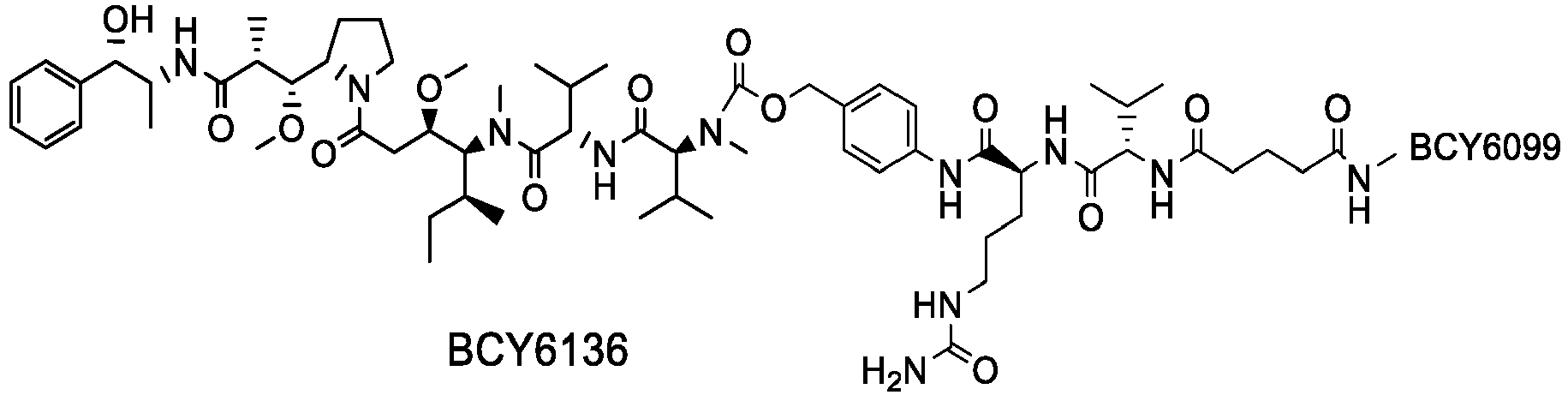


wobei Sar Sarcosin ist, HArg Homoarginin ist und HyP Hydroxyprolin ist. - Prozess nach Anspruch 1, wobei die Umsetzung in Gegenwart von DIEA und DMA durchgeführt wird.
Applications Claiming Priority (5)
| Application Number | Priority Date | Filing Date | Title |
|---|---|---|---|
| GBGB1721259.8A GB201721259D0 (en) | 2017-12-19 | 2017-12-19 | Bicyclic peptide ligands specific for EphA2 |
| GBGB1804102.0A GB201804102D0 (en) | 2018-03-14 | 2018-03-14 | Bicycle peptide ligands specific for EphA2 |
| GBGB1818603.1A GB201818603D0 (en) | 2018-11-14 | 2018-11-14 | Bicyclic peptide ligands specific for epha2 |
| PCT/GB2018/053675 WO2019122860A1 (en) | 2017-12-19 | 2018-12-19 | Bicyclic peptide ligands specific for epha2 |
| EP18829437.5A EP3727460B1 (de) | 2017-12-19 | 2018-12-19 | Epha2-spezifische bicyclische peptidliganden |
Related Parent Applications (1)
| Application Number | Title | Priority Date | Filing Date |
|---|---|---|---|
| EP18829437.5A Division EP3727460B1 (de) | 2017-12-19 | 2018-12-19 | Epha2-spezifische bicyclische peptidliganden |
Publications (2)
| Publication Number | Publication Date |
|---|---|
| EP4053145A1 EP4053145A1 (de) | 2022-09-07 |
| EP4053145B1 true EP4053145B1 (de) | 2024-06-12 |
Family
ID=64902125
Family Applications (4)
| Application Number | Title | Priority Date | Filing Date |
|---|---|---|---|
| EP18829926.7A Active EP3727461B1 (de) | 2017-12-19 | 2018-12-19 | Epha2-spezifische bicyclische peptidliganden |
| EP25169487.3A Pending EP4582436A3 (de) | 2017-12-19 | 2018-12-19 | Epha2-spezifische bicyclische peptidliganden |
| EP18829437.5A Active EP3727460B1 (de) | 2017-12-19 | 2018-12-19 | Epha2-spezifische bicyclische peptidliganden |
| EP22161978.6A Active EP4053145B1 (de) | 2017-12-19 | 2018-12-19 | Epha2 spezifische bicyclische peptidliganden |
Family Applications Before (3)
| Application Number | Title | Priority Date | Filing Date |
|---|---|---|---|
| EP18829926.7A Active EP3727461B1 (de) | 2017-12-19 | 2018-12-19 | Epha2-spezifische bicyclische peptidliganden |
| EP25169487.3A Pending EP4582436A3 (de) | 2017-12-19 | 2018-12-19 | Epha2-spezifische bicyclische peptidliganden |
| EP18829437.5A Active EP3727460B1 (de) | 2017-12-19 | 2018-12-19 | Epha2-spezifische bicyclische peptidliganden |
Country Status (27)
| Country | Link |
|---|---|
| US (6) | US11484602B2 (de) |
| EP (4) | EP3727461B1 (de) |
| JP (4) | JP7293231B2 (de) |
| KR (2) | KR102791088B1 (de) |
| CN (4) | CN111741771B (de) |
| AU (3) | AU2018387417C9 (de) |
| BR (2) | BR112020012349A2 (de) |
| CA (2) | CA3085253A1 (de) |
| CY (1) | CY1125367T1 (de) |
| DK (3) | DK3727461T3 (de) |
| ES (3) | ES3037964T3 (de) |
| FI (2) | FI4053145T3 (de) |
| HR (2) | HRP20251070T1 (de) |
| HU (2) | HUE073547T2 (de) |
| IL (3) | IL275440B2 (de) |
| LT (2) | LT3727461T (de) |
| MX (2) | MX2020006482A (de) |
| PH (1) | PH12020550929A1 (de) |
| PL (3) | PL3727460T3 (de) |
| PT (3) | PT4053145T (de) |
| RS (1) | RS67248B1 (de) |
| SA (1) | SA520412268B1 (de) |
| SG (2) | SG11202005494QA (de) |
| SI (2) | SI3727460T1 (de) |
| SM (1) | SMT202500312T1 (de) |
| TW (1) | TWI825046B (de) |
| WO (2) | WO2019122863A1 (de) |
Families Citing this family (38)
| Publication number | Priority date | Publication date | Assignee | Title |
|---|---|---|---|---|
| JP6882978B2 (ja) | 2014-10-29 | 2021-06-02 | バイスクルアールディー・リミテッド | Mt1−mmpに特異的な二環性ペプチドリガンド |
| GB201607827D0 (en) | 2016-05-04 | 2016-06-15 | Bicycle Therapeutics Ltd | Bicyclic peptide-toxin conjugates specific for MT1-MMP |
| WO2018115203A1 (en) | 2016-12-23 | 2018-06-28 | Bicyclerd Limited | Peptide derivatives having novel linkage structures |
| JP7301757B2 (ja) | 2017-06-26 | 2023-07-03 | バイスクルアールディー・リミテッド | 検出可能部分を持つ二環式ペプチドリガンドおよびその使用 |
| CN111183147B (zh) | 2017-08-04 | 2024-07-05 | 拜斯科技术开发有限公司 | Cd137特异性的双环肽配体 |
| GB201721265D0 (en) | 2017-12-19 | 2018-01-31 | Bicyclerd Ltd | Bicyclic peptide ligands specific for EphA2 |
| TWI825046B (zh) | 2017-12-19 | 2023-12-11 | 英商拜西可泰克斯有限公司 | Epha2特用之雙環胜肽配位基 |
| JP2021514953A (ja) | 2018-02-23 | 2021-06-17 | バイスクルテクス・リミテッド | 多量体二環式ペプチドリガンド |
| JP7551500B2 (ja) | 2018-04-04 | 2024-09-17 | バイスクルテクス・リミテッド | ヘテロタンデム二環式ペプチド複合体 |
| IL279489B2 (en) | 2018-06-22 | 2025-10-01 | Bicycletx Ltd | Bicyclic peptide ligands specific for nectin-4, a drug conjugate containing the peptide ligands and a pharmaceutical composition containing the drug conjugate |
| GB201810316D0 (en) | 2018-06-22 | 2018-08-08 | Bicyclerd Ltd | Peptide ligands for binding to EphA2 |
| GB201820288D0 (en) | 2018-12-13 | 2019-01-30 | Bicycle Tx Ltd | Bicycle peptide ligaands specific for MT1-MMP |
| GB201820295D0 (en) | 2018-12-13 | 2019-01-30 | Bicyclerd Ltd | Bicyclic peptide ligands specific for MT1-MMP |
| GB201820325D0 (en) | 2018-12-13 | 2019-01-30 | Bicyclerd Ltd | Bicyclic peptide ligands specific for psma |
| US12551567B2 (en) | 2018-12-21 | 2026-02-17 | Bicyclerd Limited | Bicyclic peptide ligands specific for PD-L1 |
| JP2022514618A (ja) | 2018-12-21 | 2022-02-14 | バイスクルテクス・リミテッド | Pd-l1に特異的な二環式ペプチドリガンド |
| GB201900529D0 (en) | 2019-01-15 | 2019-03-06 | Bicycletx Ltd | Bicyclic peptide ligands specific for CD38 |
| US20220184222A1 (en) * | 2019-04-02 | 2022-06-16 | Bicycletx Limited | Bicycle toxin conjugates and uses thereof |
| KR20220007098A (ko) | 2019-05-09 | 2022-01-18 | 바이사이클티엑스 리미티드 | Ox40에 특이적인 이환식 펩티드 리간드 |
| TWI860386B (zh) | 2019-07-30 | 2024-11-01 | 英商拜西可泰克斯有限公司 | 異質雙環肽複合物 |
| WO2021028686A1 (en) * | 2019-08-13 | 2021-02-18 | Bicycletx Limited | Modified multimeric bicyclic peptide ligands |
| ES3033517T3 (en) * | 2019-10-03 | 2025-08-05 | Bicycletx Ltd | Heterotandem bicyclic peptide complexes |
| CN114760988A (zh) * | 2019-11-27 | 2022-07-15 | 拜斯科技术开发有限公司 | 对EphA2具有特异性的双环肽配体和其用途 |
| KR20230037502A (ko) * | 2020-05-20 | 2023-03-16 | 바이사이클티엑스 리미티드 | 넥틴-4에 특이적인 바이사이클릭 펩티드 리간드 및 이의 용도 |
| EP4165414A1 (de) | 2020-06-12 | 2023-04-19 | BicycleTX Limited | Behandlung von krankheiten, die durch überexpression des erythropoietinproduzierenden hepatozellulären rezeptors a2 (epha2) gekennzeichnet sind |
| IL300248A (en) | 2020-08-03 | 2023-03-01 | Bicycletx Ltd | peptide-based linkers |
| KR20230141794A (ko) | 2021-01-08 | 2023-10-10 | 바이사이클티엑스 리미티드 | 헤테로탠덤 바이사이클릭 펩티드 복합체 |
| US20250186539A2 (en) | 2021-01-11 | 2025-06-12 | Bicycletx Limited | Methods for treating cancer |
| WO2022250431A1 (ko) | 2021-05-25 | 2022-12-01 | 주식회사 박셀바이오 | 모노바디 기반 키메라 항원 수용체 및 이를 포함하는 면역 세포 |
| US20250121076A1 (en) * | 2021-08-17 | 2025-04-17 | Medshine Discovery Inc. | Polypeptide drug conjugate having novel structure and application thereof |
| MX2024003876A (es) | 2021-09-29 | 2024-04-19 | Conjustar Zhuhai Biologics Co Ltd | Conjugado farmaco-polipeptido triciclico y sus aplicaciones. |
| AU2022365991A1 (en) * | 2021-10-14 | 2024-05-30 | Xizang Haisco Pharmaceutical Co., Ltd. | Epha2 bicyclic peptide ligand and conjugate thereof |
| KR20230140746A (ko) * | 2022-03-30 | 2023-10-10 | 연세대학교 산학협력단 | 암전이의 검출용 신규 바이오마커 |
| CN116063379B (zh) * | 2022-08-23 | 2025-05-02 | 中国药科大学 | EphA2靶向多肽及其应用 |
| WO2024184661A1 (en) | 2023-03-09 | 2024-09-12 | Bicycletx Limited | Synthesis of bicycle toxin conjugates, and intermediates thereof |
| CN121532408A (zh) | 2023-06-23 | 2026-02-13 | 拜斯科技术开发有限公司 | 对nk细胞具有特异性的双环肽配体 |
| WO2025191096A1 (en) * | 2024-03-14 | 2025-09-18 | Bicycletx Limited | Bicyclic peptide |
| CN119874840B (zh) * | 2025-03-31 | 2025-08-08 | 晶核生物医药科技(上海)有限公司 | 一种双环肽及其应用 |
Family Cites Families (90)
| Publication number | Priority date | Publication date | Assignee | Title |
|---|---|---|---|---|
| US4650750A (en) | 1982-02-01 | 1987-03-17 | Giese Roger W | Method of chemical analysis employing molecular release tag compounds |
| US4709016A (en) | 1982-02-01 | 1987-11-24 | Northeastern University | Molecular analytical release tags and their use in chemical analysis |
| US5650270A (en) | 1982-02-01 | 1997-07-22 | Northeastern University | Molecular analytical release tags and their use in chemical analysis |
| US5516931A (en) | 1982-02-01 | 1996-05-14 | Northeastern University | Release tag compounds producing ketone signal groups |
| US20020164788A1 (en) | 1994-12-02 | 2002-11-07 | The Wellcome Foundation Limited | Humanized antibodies to CD38 |
| US6326144B1 (en) | 1998-09-18 | 2001-12-04 | Massachusetts Institute Of Technology | Biological applications of quantum dots |
| CA2345376C (en) | 1998-09-24 | 2010-03-16 | Advanced Research And Technology Institute, Inc. | Water-soluble luminescent quantum dots and bioconjugates thereof |
| US6927203B1 (en) | 1999-08-17 | 2005-08-09 | Purdue Research Foundation | Treatment of metastatic disease |
| EP1382339B1 (de) | 1999-12-10 | 2007-12-05 | Pfizer Products Inc. | Pyrrolo¬2,3-d pyrimidinderivate enthaltende Zusammensetzungen |
| TWI329105B (en) | 2002-02-01 | 2010-08-21 | Rigel Pharmaceuticals Inc | 2,4-pyrimidinediamine compounds and their uses |
| DK3031910T3 (en) | 2002-02-21 | 2017-10-23 | Inst Virology | MN / CA IX-SPECIFIC MONOCLONAL ANTIBODIES GENERATED BY MN / CA IX-DEFICIENT MOUSE AND METHODS OF USE |
| WO2004019973A1 (en) | 2002-08-14 | 2004-03-11 | Atugen Ag | Use of protein kinase n beta |
| EP1852441B1 (de) * | 2002-09-24 | 2012-03-28 | The Burnham Institute | Mittel zur Modulierung der EPH-Rezeptor-Aktivität |
| EP1452868A2 (de) | 2003-02-27 | 2004-09-01 | Pepscan Systems B.V. | Verfahren zur Selektion eines potenziellen Arzneimittels |
| KR20070087266A (ko) | 2003-04-03 | 2007-08-28 | 세마포르 파머슈티컬즈, 아이엔씨. | 피아이-3 키나아제 억제제 프로드러그 |
| US7173015B2 (en) | 2003-07-03 | 2007-02-06 | The Trustees Of The University Of Pennsylvania | Inhibition of Syk kinase expression |
| DK2511297T3 (en) | 2004-02-06 | 2015-06-15 | Morphosys Ag | Human anti-CD38 antibodies and their applications |
| US7151047B2 (en) | 2004-04-28 | 2006-12-19 | Warren Chan | Stable, water-soluble quantum dot, method of preparation and conjugates thereof |
| SI2612862T1 (sl) | 2004-05-13 | 2017-04-26 | Icos Corporation | Kinazolini kot inhibitorji humane fosfatidilinozitol 3-kinaze delta |
| DE602006010979D1 (de) | 2005-01-19 | 2010-01-21 | Rigel Pharmaceuticals Inc | Prodrugs aus 2,4-pyrimidindiamin-verbindungen und ihre verwendungen |
| DK1844337T3 (da) | 2005-01-24 | 2013-09-30 | Pepscan Systems Bv | Bindingsforbindelser, immunogene forbindelser og peptidmimetika |
| GB0510390D0 (en) | 2005-05-20 | 2005-06-29 | Novartis Ag | Organic compounds |
| US7402325B2 (en) | 2005-07-28 | 2008-07-22 | Phoenix Biotechnology, Inc. | Supercritical carbon dioxide extract of pharmacologically active components from Nerium oleander |
| BRPI0617162B8 (pt) | 2005-10-07 | 2021-05-25 | Exelixis Inc | compostos inibidores de fosfatidilinositol 3-quinase composições farmacêuticas que os contem e métodos de uso dos mesmos |
| CN103626742B (zh) | 2005-11-01 | 2017-04-26 | 塔格根公司 | 激酶的联-芳基间-嘧啶抑制剂 |
| EP2455382B1 (de) | 2005-12-13 | 2016-10-26 | Incyte Holdings Corporation | Heteroarylsubstituierte Pyrrolo[2,3-b]pyridine sowie Pyrrolo[2,3-b]pyrimidine als Januskinaseinhibitoren |
| JO2660B1 (en) | 2006-01-20 | 2012-06-17 | نوفارتيس ايه جي | Pi-3 inhibitors and methods of use |
| MX2008013578A (es) | 2006-04-26 | 2009-03-23 | Hoffmann La Roche | Derivados de tieno [3,2-d]pirimidina utiles como inhibidores de fosfatidilinositol 3-cinasa(p13k). |
| ES2673822T3 (es) * | 2006-07-18 | 2018-06-25 | Sanofi | Anticuerpo antagonista contra EphA2 para el tratamiento de cáncer |
| EP2061519B1 (de) | 2006-09-15 | 2016-03-30 | Siemens Medical Solutions USA, Inc. | Cyclopeptidderivate aus click-chemie als bildgebungsmittel für integrine |
| BRPI0622054B8 (pt) | 2006-09-22 | 2021-05-25 | Oxford Amherst Llc | composto e composição farmacêutica |
| HRP20151386T1 (hr) | 2007-03-12 | 2016-02-26 | Ym Biosciences Australia Pty Ltd | Fenil aminopirimidinski spojevi i njihova primjena |
| PE20090717A1 (es) | 2007-05-18 | 2009-07-18 | Smithkline Beecham Corp | Derivados de quinolina como inhibidores de la pi3 quinasa |
| US20100254996A1 (en) | 2007-06-18 | 2010-10-07 | Medimmune, Llc | Synergistic treatment of cells that express epha2 and erbb2 |
| AU2009211253B2 (en) | 2008-02-05 | 2014-11-06 | Bicyclerd Limited | Methods and compositions |
| US8158616B2 (en) | 2008-03-11 | 2012-04-17 | Incyte Corporation | Azetidine and cyclobutane derivatives as JAK inhibitors |
| US8338439B2 (en) | 2008-06-27 | 2012-12-25 | Celgene Avilomics Research, Inc. | 2,4-disubstituted pyrimidines useful as kinase inhibitors |
| GB0913775D0 (en) | 2009-08-06 | 2009-09-16 | Medical Res Council | Multispecific peptides |
| GB0914110D0 (en) | 2009-08-12 | 2009-09-16 | Medical Res Council | Peptide libraries |
| WO2012057624A1 (en) | 2010-10-25 | 2012-05-03 | Pepscan Systems B.V. | Novel bicyclic peptide mimetics |
| GB201117428D0 (en) | 2011-10-07 | 2011-11-23 | Bicycle Therapeutics Ltd | Structured polypeptides with sarcosine linkers |
| AU2012320407B2 (en) | 2011-10-07 | 2017-04-20 | Bicyclerd Limited | Modulation of structured polypeptide specificity |
| RS60280B1 (sr) | 2013-03-12 | 2020-06-30 | Molecular Templates Inc | Citotoksični proteini koji sadrže ciljane vezujuće regione za ćelije i regioni shiga toksina a podjedinice za selektivno ubijanje određenih vrsta ćelija |
| US20140274759A1 (en) * | 2013-03-15 | 2014-09-18 | Bicycle Therapeutics Limited | Modification of polypeptides |
| GB201306623D0 (en) | 2013-04-11 | 2013-05-29 | Bicycle Therapeutics Ltd | Modulation of structured polypeptide specificity |
| ES2705068T3 (es) | 2013-05-23 | 2019-03-21 | Ohio State Innovation Foundation | Síntesis química y cribado de bibliotecas de péptidos bicíclicos |
| CN105683211B (zh) | 2013-10-28 | 2020-10-20 | 拜斯科阿迪有限公司 | 新型多肽 |
| DK3140653T3 (da) | 2014-05-08 | 2022-06-20 | Novodiax Inc | Direkte immunhistokemianalyse |
| EP3613426A1 (de) | 2014-05-21 | 2020-02-26 | Entrada Therapeutics, Inc. | Zellpenetrierende peptide und verfahren zu ihrer herstellung und ihre verwendung |
| JP6882978B2 (ja) | 2014-10-29 | 2021-06-02 | バイスクルアールディー・リミテッド | Mt1−mmpに特異的な二環性ペプチドリガンド |
| WO2016171242A1 (ja) | 2015-04-24 | 2016-10-27 | 第一三共株式会社 | Epha2の検出 |
| JP2018521960A (ja) * | 2015-04-28 | 2018-08-09 | エコール・ポリテクニーク・フェデラル・ドゥ・ローザンヌ(ウペエフエル)Ecole Polytechnique Federale de Lausanne (EPFL) | 酵素で活性化された第XII因子(FXIIa)の新規阻害剤 |
| US20190298681A1 (en) | 2016-03-16 | 2019-10-03 | Merrimack Pharmaceuticals, Inc. | Nanoliposomal Targeting of Ephrin Receptor A2 (Epha2) and Related Diagnostics |
| JP2019513371A (ja) | 2016-04-01 | 2019-05-30 | アビディティー バイオサイエンシーズ エルエルシー | 核酸ポリペプチド組成物とその使用 |
| AU2017252233A1 (en) | 2016-04-22 | 2018-11-15 | Alligator Bioscience Ab | Novel bispecific polypeptides against CD137 |
| GB201607827D0 (en) | 2016-05-04 | 2016-06-15 | Bicycle Therapeutics Ltd | Bicyclic peptide-toxin conjugates specific for MT1-MMP |
| US10441663B2 (en) | 2016-11-27 | 2019-10-15 | Bicyclerd Limited | Methods for treating cancer |
| JP7387440B2 (ja) | 2016-12-23 | 2023-11-28 | バイスクルテクス・リミテッド | Mt1-mmpに結合するためのペプチドリガンド |
| WO2018115203A1 (en) | 2016-12-23 | 2018-06-28 | Bicyclerd Limited | Peptide derivatives having novel linkage structures |
| EP3565638B8 (de) | 2017-01-06 | 2024-04-10 | BicycleRD Limited | Bizyklische konjugat zur behandlung von krebs |
| IL268836B2 (en) | 2017-02-24 | 2024-04-01 | Macrogenics Inc | Bispecific binding molecules that are capable of binding cd137 and tumor antigens, and uses thereof |
| GB201706477D0 (en) | 2017-04-24 | 2017-06-07 | Bicycle Therapeutics Ltd | Modification of polypeptides |
| WO2018197893A1 (en) | 2017-04-27 | 2018-11-01 | Bicycletx Limited | Bicyclic peptide ligands and uses thereof |
| JP7301757B2 (ja) | 2017-06-26 | 2023-07-03 | バイスクルアールディー・リミテッド | 検出可能部分を持つ二環式ペプチドリガンドおよびその使用 |
| CN111183147B (zh) | 2017-08-04 | 2024-07-05 | 拜斯科技术开发有限公司 | Cd137特异性的双环肽配体 |
| WO2019034868A1 (en) | 2017-08-14 | 2019-02-21 | Bicyclerd Limited | CONJUGATES PEPTIDE BICYCLIC-LIGAND PPR-A AND USES THEREOF |
| WO2019034866A1 (en) | 2017-08-14 | 2019-02-21 | Bicyclerd Limited | BICYCLIC PEPTIDE LIGANDS CONJUGATES AND USES THEREOF |
| WO2019060645A1 (en) * | 2017-09-20 | 2019-03-28 | Look Dynamics, Inc. | PHOTONIC NEURONAL NETWORK SYSTEM |
| TWI825046B (zh) | 2017-12-19 | 2023-12-11 | 英商拜西可泰克斯有限公司 | Epha2特用之雙環胜肽配位基 |
| GB201721265D0 (en) | 2017-12-19 | 2018-01-31 | Bicyclerd Ltd | Bicyclic peptide ligands specific for EphA2 |
| US11572370B2 (en) | 2018-01-08 | 2023-02-07 | Biohaven Therapeutics Ltd. | CD16A binding agents and uses thereof |
| JP2021514953A (ja) | 2018-02-23 | 2021-06-17 | バイスクルテクス・リミテッド | 多量体二環式ペプチドリガンド |
| JP7551500B2 (ja) | 2018-04-04 | 2024-09-17 | バイスクルテクス・リミテッド | ヘテロタンデム二環式ペプチド複合体 |
| CA3099308A1 (en) | 2018-05-21 | 2019-11-28 | Compass Therapeutics Llc | Compositions and methods for enhancing the killing of target cells by nk cells |
| GB201810316D0 (en) | 2018-06-22 | 2018-08-08 | Bicyclerd Ltd | Peptide ligands for binding to EphA2 |
| IL279489B2 (en) | 2018-06-22 | 2025-10-01 | Bicycletx Ltd | Bicyclic peptide ligands specific for nectin-4, a drug conjugate containing the peptide ligands and a pharmaceutical composition containing the drug conjugate |
| WO2020084305A1 (en) | 2018-10-23 | 2020-04-30 | Bicycletx Limited | Bicyclic peptide ligands and uses thereof |
| CA3122669A1 (en) | 2018-12-13 | 2020-06-18 | Bicycletx Limited | Bicyclic peptide ligands specific for mt1-mmp |
| CA3120800A1 (en) | 2018-12-17 | 2020-06-25 | Revitope Limited | Twin immune cell engager |
| JP2022514618A (ja) | 2018-12-21 | 2022-02-14 | バイスクルテクス・リミテッド | Pd-l1に特異的な二環式ペプチドリガンド |
| US20220184222A1 (en) | 2019-04-02 | 2022-06-16 | Bicycletx Limited | Bicycle toxin conjugates and uses thereof |
| KR20220007098A (ko) | 2019-05-09 | 2022-01-18 | 바이사이클티엑스 리미티드 | Ox40에 특이적인 이환식 펩티드 리간드 |
| TWI860386B (zh) | 2019-07-30 | 2024-11-01 | 英商拜西可泰克斯有限公司 | 異質雙環肽複合物 |
| WO2021028686A1 (en) | 2019-08-13 | 2021-02-18 | Bicycletx Limited | Modified multimeric bicyclic peptide ligands |
| ES3033517T3 (en) | 2019-10-03 | 2025-08-05 | Bicycletx Ltd | Heterotandem bicyclic peptide complexes |
| CN114760988A (zh) | 2019-11-27 | 2022-07-15 | 拜斯科技术开发有限公司 | 对EphA2具有特异性的双环肽配体和其用途 |
| EP4165414A1 (de) | 2020-06-12 | 2023-04-19 | BicycleTX Limited | Behandlung von krankheiten, die durch überexpression des erythropoietinproduzierenden hepatozellulären rezeptors a2 (epha2) gekennzeichnet sind |
| WO2022038158A1 (en) | 2020-08-17 | 2022-02-24 | Bicycletx Limited | Bicycle conjugates specific for nectin-4 and uses thereof |
| KR20230141794A (ko) | 2021-01-08 | 2023-10-10 | 바이사이클티엑스 리미티드 | 헤테로탠덤 바이사이클릭 펩티드 복합체 |
| US20250186539A2 (en) | 2021-01-11 | 2025-06-12 | Bicycletx Limited | Methods for treating cancer |
-
2018
- 2018-12-11 TW TW107144453A patent/TWI825046B/zh active
- 2018-12-14 US US16/220,685 patent/US11484602B2/en active Active
- 2018-12-19 EP EP18829926.7A patent/EP3727461B1/de active Active
- 2018-12-19 IL IL275440A patent/IL275440B2/en unknown
- 2018-12-19 SI SI201830718T patent/SI3727460T1/sl unknown
- 2018-12-19 PL PL18829437.5T patent/PL3727460T3/pl unknown
- 2018-12-19 WO PCT/GB2018/053678 patent/WO2019122863A1/en not_active Ceased
- 2018-12-19 KR KR1020207019676A patent/KR102791088B1/ko active Active
- 2018-12-19 CN CN201880089757.9A patent/CN111741771B/zh active Active
- 2018-12-19 CN CN202410970988.8A patent/CN118909043A/zh active Pending
- 2018-12-19 EP EP25169487.3A patent/EP4582436A3/de active Pending
- 2018-12-19 DK DK18829926.7T patent/DK3727461T3/da active
- 2018-12-19 MX MX2020006482A patent/MX2020006482A/es unknown
- 2018-12-19 PT PT221619786T patent/PT4053145T/pt unknown
- 2018-12-19 BR BR112020012349-8A patent/BR112020012349A2/pt unknown
- 2018-12-19 SM SM20250312T patent/SMT202500312T1/it unknown
- 2018-12-19 MX MX2020006474A patent/MX2020006474A/es unknown
- 2018-12-19 PL PL22161978.6T patent/PL4053145T3/pl unknown
- 2018-12-19 KR KR1020207019675A patent/KR102890185B1/ko active Active
- 2018-12-19 PT PT188294375T patent/PT3727460T/pt unknown
- 2018-12-19 ES ES18829926T patent/ES3037964T3/es active Active
- 2018-12-19 ES ES18829437T patent/ES2922632T3/es active Active
- 2018-12-19 DK DK18829437.5T patent/DK3727460T3/da active
- 2018-12-19 AU AU2018387417A patent/AU2018387417C9/en active Active
- 2018-12-19 HU HUE18829926A patent/HUE073547T2/hu unknown
- 2018-12-19 ES ES22161978T patent/ES2987839T3/es active Active
- 2018-12-19 HR HRP20251070TT patent/HRP20251070T1/hr unknown
- 2018-12-19 SI SI201831253T patent/SI3727461T1/sl unknown
- 2018-12-19 CA CA3085253A patent/CA3085253A1/en active Pending
- 2018-12-19 BR BR112020012246-7A patent/BR112020012246A2/pt unknown
- 2018-12-19 JP JP2020534623A patent/JP7293231B2/ja active Active
- 2018-12-19 SG SG11202005494QA patent/SG11202005494QA/en unknown
- 2018-12-19 HU HUE18829437A patent/HUE059126T2/hu unknown
- 2018-12-19 JP JP2020534361A patent/JP7404241B2/ja active Active
- 2018-12-19 CN CN201880089662.7A patent/CN111787955B/zh active Active
- 2018-12-19 IL IL275437A patent/IL275437B2/en unknown
- 2018-12-19 RS RS20250881A patent/RS67248B1/sr unknown
- 2018-12-19 US US16/771,186 patent/US11696956B2/en active Active
- 2018-12-19 AU AU2018387418A patent/AU2018387418B2/en active Active
- 2018-12-19 HR HRP20220871TT patent/HRP20220871T1/hr unknown
- 2018-12-19 EP EP18829437.5A patent/EP3727460B1/de active Active
- 2018-12-19 LT LTEPPCT/GB2018/053678T patent/LT3727461T/lt unknown
- 2018-12-19 FI FIEP22161978.6T patent/FI4053145T3/fi active
- 2018-12-19 DK DK22161978.6T patent/DK4053145T3/da active
- 2018-12-19 WO PCT/GB2018/053675 patent/WO2019122860A1/en not_active Ceased
- 2018-12-19 EP EP22161978.6A patent/EP4053145B1/de active Active
- 2018-12-19 FI FIEP18829926.7T patent/FI3727461T3/fi active
- 2018-12-19 CA CA3086257A patent/CA3086257A1/en active Pending
- 2018-12-19 LT LTEPPCT/GB2018/053675T patent/LT3727460T/lt unknown
- 2018-12-19 CN CN202410627078.XA patent/CN118598945A/zh active Pending
- 2018-12-19 PT PT188299267T patent/PT3727461T/pt unknown
- 2018-12-19 IL IL321490A patent/IL321490A/en unknown
- 2018-12-19 PL PL18829926.7T patent/PL3727461T3/pl unknown
- 2018-12-19 SG SG11202005495UA patent/SG11202005495UA/en unknown
-
2020
- 2020-06-17 PH PH12020550929A patent/PH12020550929A1/en unknown
- 2020-06-18 SA SA520412268A patent/SA520412268B1/ar unknown
-
2022
- 2022-07-12 CY CY20221100481T patent/CY1125367T1/el unknown
- 2022-09-23 US US17/934,896 patent/US11833211B2/en active Active
-
2023
- 2023-05-08 US US18/313,983 patent/US20240000957A1/en active Pending
- 2023-06-07 JP JP2023093890A patent/JP7503689B2/ja active Active
- 2023-11-01 US US18/499,739 patent/US20240189436A1/en active Pending
-
2024
- 2024-04-22 AU AU2024202618A patent/AU2024202618A1/en active Pending
- 2024-06-10 JP JP2024093609A patent/JP2024138253A/ja active Pending
-
2025
- 2025-08-25 US US19/308,931 patent/US20260000773A1/en active Pending
Also Published As
Similar Documents
| Publication | Publication Date | Title |
|---|---|---|
| EP4053145B1 (de) | Epha2 spezifische bicyclische peptidliganden | |
| US11623012B2 (en) | Bicyclic peptide ligands specific for EphA2 | |
| US12377155B2 (en) | Bicyclic peptide ligands specific for PSMA | |
| US20220088118A1 (en) | Bicyclic peptide ligands specific for caix | |
| US20220133732A1 (en) | Bicyclic peptide ligands specific for caix | |
| US20220008545A1 (en) | BICYCLIC PEPTIDE LIGANDS SPECIFIC FOR FAPa | |
| HK40080423B (en) | Bicyclic peptide ligands specific for epha2 | |
| HK40080423A (en) | Bicyclic peptide ligands specific for epha2 | |
| WO2023057759A1 (en) | Bicyclic peptide ligand drug conjugates |
Legal Events
| Date | Code | Title | Description |
|---|---|---|---|
| PUAI | Public reference made under article 153(3) epc to a published international application that has entered the european phase |
Free format text: ORIGINAL CODE: 0009012 |
|
| STAA | Information on the status of an ep patent application or granted ep patent |
Free format text: STATUS: THE APPLICATION HAS BEEN PUBLISHED |
|
| AC | Divisional application: reference to earlier application |
Ref document number: 3727460 Country of ref document: EP Kind code of ref document: P |
|
| AK | Designated contracting states |
Kind code of ref document: A1 Designated state(s): AL AT BE BG CH CY CZ DE DK EE ES FI FR GB GR HR HU IE IS IT LI LT LU LV MC MK MT NL NO PL PT RO RS SE SI SK SM TR |
|
| STAA | Information on the status of an ep patent application or granted ep patent |
Free format text: STATUS: REQUEST FOR EXAMINATION WAS MADE |
|
| 17P | Request for examination filed |
Effective date: 20230306 |
|
| RBV | Designated contracting states (corrected) |
Designated state(s): AL AT BE BG CH CY CZ DE DK EE ES FI FR GB GR HR HU IE IS IT LI LT LU LV MC MK MT NL NO PL PT RO RS SE SI SK SM TR |
|
| REG | Reference to a national code |
Ref country code: HK Ref legal event code: DE Ref document number: 40080423 Country of ref document: HK |
|
| P01 | Opt-out of the competence of the unified patent court (upc) registered |
Effective date: 20230505 |
|
| REG | Reference to a national code |
Ref country code: DE Ref legal event code: R079 Free format text: PREVIOUS MAIN CLASS: C07K0007080000 Ipc: A61K0047640000 Ref country code: DE Ref legal event code: R079 Ref document number: 602018070706 Country of ref document: DE Free format text: PREVIOUS MAIN CLASS: C07K0007080000 Ipc: A61K0047640000 |
|
| RIC1 | Information provided on ipc code assigned before grant |
Ipc: A61K 38/10 20060101ALI20230703BHEP Ipc: A61K 38/05 20060101ALI20230703BHEP Ipc: A61P 35/00 20060101ALI20230703BHEP Ipc: C07K 7/08 20060101ALI20230703BHEP Ipc: A61K 47/62 20170101ALI20230703BHEP Ipc: A61K 47/64 20170101AFI20230703BHEP |
|
| GRAP | Despatch of communication of intention to grant a patent |
Free format text: ORIGINAL CODE: EPIDOSNIGR1 |
|
| STAA | Information on the status of an ep patent application or granted ep patent |
Free format text: STATUS: GRANT OF PATENT IS INTENDED |
|
| INTG | Intention to grant announced |
Effective date: 20230904 |
|
| GRAJ | Information related to disapproval of communication of intention to grant by the applicant or resumption of examination proceedings by the epo deleted |
Free format text: ORIGINAL CODE: EPIDOSDIGR1 |
|
| STAA | Information on the status of an ep patent application or granted ep patent |
Free format text: STATUS: REQUEST FOR EXAMINATION WAS MADE |
|
| GRAP | Despatch of communication of intention to grant a patent |
Free format text: ORIGINAL CODE: EPIDOSNIGR1 |
|
| STAA | Information on the status of an ep patent application or granted ep patent |
Free format text: STATUS: GRANT OF PATENT IS INTENDED |
|
| INTC | Intention to grant announced (deleted) | ||
| INTG | Intention to grant announced |
Effective date: 20240124 |
|
| GRAS | Grant fee paid |
Free format text: ORIGINAL CODE: EPIDOSNIGR3 |
|
| GRAA | (expected) grant |
Free format text: ORIGINAL CODE: 0009210 |
|
| STAA | Information on the status of an ep patent application or granted ep patent |
Free format text: STATUS: THE PATENT HAS BEEN GRANTED |
|
| AC | Divisional application: reference to earlier application |
Ref document number: 3727460 Country of ref document: EP Kind code of ref document: P |
|
| AK | Designated contracting states |
Kind code of ref document: B1 Designated state(s): AL AT BE BG CH CY CZ DE DK EE ES FI FR GB GR HR HU IE IS IT LI LT LU LV MC MK MT NL NO PL PT RO RS SE SI SK SM TR |
|
| REG | Reference to a national code |
Ref country code: GB Ref legal event code: FG4D |
|
| REG | Reference to a national code |
Ref country code: CH Ref legal event code: EP |
|
| REG | Reference to a national code |
Ref country code: IE Ref legal event code: FG4D |
|
| REG | Reference to a national code |
Ref country code: DE Ref legal event code: R096 Ref document number: 602018070706 Country of ref document: DE |
|
| REG | Reference to a national code |
Ref country code: FI Ref legal event code: FGE Ref country code: DK Ref legal event code: T3 Effective date: 20240906 |
|
| REG | Reference to a national code |
Ref country code: PT Ref legal event code: SC4A Ref document number: 4053145 Country of ref document: PT Date of ref document: 20240910 Kind code of ref document: T Free format text: AVAILABILITY OF NATIONAL TRANSLATION Effective date: 20240905 |
|
| REG | Reference to a national code |
Ref country code: NL Ref legal event code: FP |
|
| REG | Reference to a national code |
Ref country code: SE Ref legal event code: TRGR |
|
| PG25 | Lapsed in a contracting state [announced via postgrant information from national office to epo] |
Ref country code: BG Free format text: LAPSE BECAUSE OF FAILURE TO SUBMIT A TRANSLATION OF THE DESCRIPTION OR TO PAY THE FEE WITHIN THE PRESCRIBED TIME-LIMIT Effective date: 20240612 |
|
| PG25 | Lapsed in a contracting state [announced via postgrant information from national office to epo] |
Ref country code: HR Free format text: LAPSE BECAUSE OF FAILURE TO SUBMIT A TRANSLATION OF THE DESCRIPTION OR TO PAY THE FEE WITHIN THE PRESCRIBED TIME-LIMIT Effective date: 20240612 |
|
| REG | Reference to a national code |
Ref country code: LT Ref legal event code: MG9D |
|
| PG25 | Lapsed in a contracting state [announced via postgrant information from national office to epo] |
Ref country code: LV Free format text: LAPSE BECAUSE OF FAILURE TO SUBMIT A TRANSLATION OF THE DESCRIPTION OR TO PAY THE FEE WITHIN THE PRESCRIBED TIME-LIMIT Effective date: 20240612 |
|
| PG25 | Lapsed in a contracting state [announced via postgrant information from national office to epo] |
Ref country code: LV Free format text: LAPSE BECAUSE OF FAILURE TO SUBMIT A TRANSLATION OF THE DESCRIPTION OR TO PAY THE FEE WITHIN THE PRESCRIBED TIME-LIMIT Effective date: 20240612 Ref country code: HR Free format text: LAPSE BECAUSE OF FAILURE TO SUBMIT A TRANSLATION OF THE DESCRIPTION OR TO PAY THE FEE WITHIN THE PRESCRIBED TIME-LIMIT Effective date: 20240612 Ref country code: BG Free format text: LAPSE BECAUSE OF FAILURE TO SUBMIT A TRANSLATION OF THE DESCRIPTION OR TO PAY THE FEE WITHIN THE PRESCRIBED TIME-LIMIT Effective date: 20240612 Ref country code: RS Free format text: LAPSE BECAUSE OF FAILURE TO SUBMIT A TRANSLATION OF THE DESCRIPTION OR TO PAY THE FEE WITHIN THE PRESCRIBED TIME-LIMIT Effective date: 20240912 |
|
| REG | Reference to a national code |
Ref country code: ES Ref legal event code: FG2A Ref document number: 2987839 Country of ref document: ES Kind code of ref document: T3 Effective date: 20241118 |
|
| REG | Reference to a national code |
Ref country code: GR Ref legal event code: EP Ref document number: 20240402063 Country of ref document: GR Effective date: 20241111 |
|
| PG25 | Lapsed in a contracting state [announced via postgrant information from national office to epo] |
Ref country code: EE Free format text: LAPSE BECAUSE OF FAILURE TO SUBMIT A TRANSLATION OF THE DESCRIPTION OR TO PAY THE FEE WITHIN THE PRESCRIBED TIME-LIMIT Effective date: 20240612 |
|
| PG25 | Lapsed in a contracting state [announced via postgrant information from national office to epo] |
Ref country code: IS Free format text: LAPSE BECAUSE OF FAILURE TO SUBMIT A TRANSLATION OF THE DESCRIPTION OR TO PAY THE FEE WITHIN THE PRESCRIBED TIME-LIMIT Effective date: 20241012 |
|
| PG25 | Lapsed in a contracting state [announced via postgrant information from national office to epo] |
Ref country code: CZ Free format text: LAPSE BECAUSE OF FAILURE TO SUBMIT A TRANSLATION OF THE DESCRIPTION OR TO PAY THE FEE WITHIN THE PRESCRIBED TIME-LIMIT Effective date: 20240612 |
|
| PG25 | Lapsed in a contracting state [announced via postgrant information from national office to epo] |
Ref country code: SK Free format text: LAPSE BECAUSE OF FAILURE TO SUBMIT A TRANSLATION OF THE DESCRIPTION OR TO PAY THE FEE WITHIN THE PRESCRIBED TIME-LIMIT Effective date: 20240612 Ref country code: RO Free format text: LAPSE BECAUSE OF FAILURE TO SUBMIT A TRANSLATION OF THE DESCRIPTION OR TO PAY THE FEE WITHIN THE PRESCRIBED TIME-LIMIT Effective date: 20240612 |
|
| PG25 | Lapsed in a contracting state [announced via postgrant information from national office to epo] |
Ref country code: SM Free format text: LAPSE BECAUSE OF FAILURE TO SUBMIT A TRANSLATION OF THE DESCRIPTION OR TO PAY THE FEE WITHIN THE PRESCRIBED TIME-LIMIT Effective date: 20240612 |
|
| PG25 | Lapsed in a contracting state [announced via postgrant information from national office to epo] |
Ref country code: SM Free format text: LAPSE BECAUSE OF FAILURE TO SUBMIT A TRANSLATION OF THE DESCRIPTION OR TO PAY THE FEE WITHIN THE PRESCRIBED TIME-LIMIT Effective date: 20240612 Ref country code: SK Free format text: LAPSE BECAUSE OF FAILURE TO SUBMIT A TRANSLATION OF THE DESCRIPTION OR TO PAY THE FEE WITHIN THE PRESCRIBED TIME-LIMIT Effective date: 20240612 Ref country code: RO Free format text: LAPSE BECAUSE OF FAILURE TO SUBMIT A TRANSLATION OF THE DESCRIPTION OR TO PAY THE FEE WITHIN THE PRESCRIBED TIME-LIMIT Effective date: 20240612 Ref country code: IS Free format text: LAPSE BECAUSE OF FAILURE TO SUBMIT A TRANSLATION OF THE DESCRIPTION OR TO PAY THE FEE WITHIN THE PRESCRIBED TIME-LIMIT Effective date: 20241012 Ref country code: EE Free format text: LAPSE BECAUSE OF FAILURE TO SUBMIT A TRANSLATION OF THE DESCRIPTION OR TO PAY THE FEE WITHIN THE PRESCRIBED TIME-LIMIT Effective date: 20240612 Ref country code: CZ Free format text: LAPSE BECAUSE OF FAILURE TO SUBMIT A TRANSLATION OF THE DESCRIPTION OR TO PAY THE FEE WITHIN THE PRESCRIBED TIME-LIMIT Effective date: 20240612 |
|
| REG | Reference to a national code |
Ref country code: DE Ref legal event code: R097 Ref document number: 602018070706 Country of ref document: DE |
|
| PLBE | No opposition filed within time limit |
Free format text: ORIGINAL CODE: 0009261 |
|
| STAA | Information on the status of an ep patent application or granted ep patent |
Free format text: STATUS: NO OPPOSITION FILED WITHIN TIME LIMIT |
|
| PGFP | Annual fee paid to national office [announced via postgrant information from national office to epo] |
Ref country code: CH Payment date: 20250306 Year of fee payment: 7 |
|
| 26N | No opposition filed |
Effective date: 20250313 |
|
| PG25 | Lapsed in a contracting state [announced via postgrant information from national office to epo] |
Ref country code: MC Free format text: LAPSE BECAUSE OF FAILURE TO SUBMIT A TRANSLATION OF THE DESCRIPTION OR TO PAY THE FEE WITHIN THE PRESCRIBED TIME-LIMIT Effective date: 20240612 |
|
| REG | Reference to a national code |
Ref country code: AT Ref legal event code: UEP Ref document number: 1693670 Country of ref document: AT Kind code of ref document: T Effective date: 20240612 |
|
| PGFP | Annual fee paid to national office [announced via postgrant information from national office to epo] |
Ref country code: PT Payment date: 20251119 Year of fee payment: 8 |
|
| PGFP | Annual fee paid to national office [announced via postgrant information from national office to epo] |
Ref country code: LU Payment date: 20251119 Year of fee payment: 8 Ref country code: NL Payment date: 20251119 Year of fee payment: 8 |
|
| REG | Reference to a national code |
Ref country code: CH Ref legal event code: U11 Free format text: ST27 STATUS EVENT CODE: U-0-0-U10-U11 (AS PROVIDED BY THE NATIONAL OFFICE) Effective date: 20260101 |
|
| PGFP | Annual fee paid to national office [announced via postgrant information from national office to epo] |
Ref country code: DE Payment date: 20251119 Year of fee payment: 8 |
|
| PGFP | Annual fee paid to national office [announced via postgrant information from national office to epo] |
Ref country code: GB Payment date: 20251119 Year of fee payment: 8 |
|
| PGFP | Annual fee paid to national office [announced via postgrant information from national office to epo] |
Ref country code: NO Payment date: 20251121 Year of fee payment: 8 |
|
| PGFP | Annual fee paid to national office [announced via postgrant information from national office to epo] |
Ref country code: AT Payment date: 20251121 Year of fee payment: 8 |
|
| PGFP | Annual fee paid to national office [announced via postgrant information from national office to epo] |
Ref country code: IT Payment date: 20251119 Year of fee payment: 8 Ref country code: FI Payment date: 20251119 Year of fee payment: 8 Ref country code: DK Payment date: 20251119 Year of fee payment: 8 |
|
| PGFP | Annual fee paid to national office [announced via postgrant information from national office to epo] |
Ref country code: FR Payment date: 20251119 Year of fee payment: 8 |
|
| PGFP | Annual fee paid to national office [announced via postgrant information from national office to epo] |
Ref country code: TR Payment date: 20251119 Year of fee payment: 8 Ref country code: GR Payment date: 20251121 Year of fee payment: 8 Ref country code: BE Payment date: 20251119 Year of fee payment: 8 |
|
| PGFP | Annual fee paid to national office [announced via postgrant information from national office to epo] |
Ref country code: SE Payment date: 20251119 Year of fee payment: 8 |
|
| PGFP | Annual fee paid to national office [announced via postgrant information from national office to epo] |
Ref country code: IE Payment date: 20251121 Year of fee payment: 8 |
|
| PGFP | Annual fee paid to national office [announced via postgrant information from national office to epo] |
Ref country code: PL Payment date: 20251120 Year of fee payment: 8 |
|
| PGFP | Annual fee paid to national office [announced via postgrant information from national office to epo] |
Ref country code: ES Payment date: 20260105 Year of fee payment: 8 |