EP3962996B1 - Composition de caoutchouc pour applications dynamiques ou statiques, son procédé de préparation et produits l'incorporant - Google Patents
Composition de caoutchouc pour applications dynamiques ou statiques, son procédé de préparation et produits l'incorporant Download PDFInfo
- Publication number
- EP3962996B1 EP3962996B1 EP20754307.5A EP20754307A EP3962996B1 EP 3962996 B1 EP3962996 B1 EP 3962996B1 EP 20754307 A EP20754307 A EP 20754307A EP 3962996 B1 EP3962996 B1 EP 3962996B1
- Authority
- EP
- European Patent Office
- Prior art keywords
- composition
- elastomer
- shore
- crosslinked
- hardness
- Prior art date
- Legal status (The legal status is an assumption and is not a legal conclusion. Google has not performed a legal analysis and makes no representation as to the accuracy of the status listed.)
- Active
Links
Images









Classifications
-
- C—CHEMISTRY; METALLURGY
- C08—ORGANIC MACROMOLECULAR COMPOUNDS; THEIR PREPARATION OR CHEMICAL WORKING-UP; COMPOSITIONS BASED THEREON
- C08L—COMPOSITIONS OF MACROMOLECULAR COMPOUNDS
- C08L23/00—Compositions of homopolymers or copolymers of unsaturated aliphatic hydrocarbons having only one carbon-to-carbon double bond; Compositions of derivatives of such polymers
- C08L23/26—Compositions of homopolymers or copolymers of unsaturated aliphatic hydrocarbons having only one carbon-to-carbon double bond; Compositions of derivatives of such polymers modified by chemical after-treatment
- C08L23/32—Compositions of homopolymers or copolymers of unsaturated aliphatic hydrocarbons having only one carbon-to-carbon double bond; Compositions of derivatives of such polymers modified by chemical after-treatment by reaction with compounds containing phosphorus or sulfur
-
- C—CHEMISTRY; METALLURGY
- C08—ORGANIC MACROMOLECULAR COMPOUNDS; THEIR PREPARATION OR CHEMICAL WORKING-UP; COMPOSITIONS BASED THEREON
- C08L—COMPOSITIONS OF MACROMOLECULAR COMPOUNDS
- C08L23/00—Compositions of homopolymers or copolymers of unsaturated aliphatic hydrocarbons having only one carbon-to-carbon double bond; Compositions of derivatives of such polymers
- C08L23/02—Compositions of homopolymers or copolymers of unsaturated aliphatic hydrocarbons having only one carbon-to-carbon double bond; Compositions of derivatives of such polymers not modified by chemical after-treatment
- C08L23/16—Ethylene-propylene or ethylene-propylene-diene copolymers
-
- C—CHEMISTRY; METALLURGY
- C08—ORGANIC MACROMOLECULAR COMPOUNDS; THEIR PREPARATION OR CHEMICAL WORKING-UP; COMPOSITIONS BASED THEREON
- C08L—COMPOSITIONS OF MACROMOLECULAR COMPOUNDS
- C08L21/00—Compositions of unspecified rubbers
-
- B—PERFORMING OPERATIONS; TRANSPORTING
- B60—VEHICLES IN GENERAL
- B60R—VEHICLES, VEHICLE FITTINGS, OR VEHICLE PARTS, NOT OTHERWISE PROVIDED FOR
- B60R13/00—Elements for body-finishing, identifying, or decorating; Arrangements or adaptations for advertising purposes
- B60R13/06—Sealing strips
-
- C—CHEMISTRY; METALLURGY
- C08—ORGANIC MACROMOLECULAR COMPOUNDS; THEIR PREPARATION OR CHEMICAL WORKING-UP; COMPOSITIONS BASED THEREON
- C08K—Use of inorganic or non-macromolecular organic substances as compounding ingredients
- C08K3/00—Use of inorganic substances as compounding ingredients
- C08K3/01—Use of inorganic substances as compounding ingredients characterized by their specific function
- C08K3/013—Fillers, pigments or reinforcing additives
-
- C—CHEMISTRY; METALLURGY
- C08—ORGANIC MACROMOLECULAR COMPOUNDS; THEIR PREPARATION OR CHEMICAL WORKING-UP; COMPOSITIONS BASED THEREON
- C08K—Use of inorganic or non-macromolecular organic substances as compounding ingredients
- C08K3/00—Use of inorganic substances as compounding ingredients
- C08K3/02—Elements
- C08K3/04—Carbon
-
- C—CHEMISTRY; METALLURGY
- C08—ORGANIC MACROMOLECULAR COMPOUNDS; THEIR PREPARATION OR CHEMICAL WORKING-UP; COMPOSITIONS BASED THEREON
- C08K—Use of inorganic or non-macromolecular organic substances as compounding ingredients
- C08K3/00—Use of inorganic substances as compounding ingredients
- C08K3/02—Elements
- C08K3/06—Sulfur
-
- C—CHEMISTRY; METALLURGY
- C08—ORGANIC MACROMOLECULAR COMPOUNDS; THEIR PREPARATION OR CHEMICAL WORKING-UP; COMPOSITIONS BASED THEREON
- C08K—Use of inorganic or non-macromolecular organic substances as compounding ingredients
- C08K5/00—Use of organic ingredients
- C08K5/04—Oxygen-containing compounds
- C08K5/14—Peroxides
-
- C—CHEMISTRY; METALLURGY
- C08—ORGANIC MACROMOLECULAR COMPOUNDS; THEIR PREPARATION OR CHEMICAL WORKING-UP; COMPOSITIONS BASED THEREON
- C08L—COMPOSITIONS OF MACROMOLECULAR COMPOUNDS
- C08L7/00—Compositions of natural rubber
-
- C—CHEMISTRY; METALLURGY
- C08—ORGANIC MACROMOLECULAR COMPOUNDS; THEIR PREPARATION OR CHEMICAL WORKING-UP; COMPOSITIONS BASED THEREON
- C08L—COMPOSITIONS OF MACROMOLECULAR COMPOUNDS
- C08L83/00—Compositions of macromolecular compounds obtained by reactions forming in the main chain of the macromolecule a linkage containing silicon with or without sulfur, nitrogen, oxygen or carbon only; Compositions of derivatives of such polymers
- C08L83/04—Polysiloxanes
-
- C—CHEMISTRY; METALLURGY
- C08—ORGANIC MACROMOLECULAR COMPOUNDS; THEIR PREPARATION OR CHEMICAL WORKING-UP; COMPOSITIONS BASED THEREON
- C08L—COMPOSITIONS OF MACROMOLECULAR COMPOUNDS
- C08L9/00—Compositions of homopolymers or copolymers of conjugated diene hydrocarbons
-
- C—CHEMISTRY; METALLURGY
- C09—DYES; PAINTS; POLISHES; NATURAL RESINS; ADHESIVES; COMPOSITIONS NOT OTHERWISE PROVIDED FOR; APPLICATIONS OF MATERIALS NOT OTHERWISE PROVIDED FOR
- C09K—MATERIALS FOR MISCELLANEOUS APPLICATIONS, NOT PROVIDED FOR ELSEWHERE
- C09K3/00—Materials not provided for elsewhere
- C09K3/10—Materials in mouldable or extrudable form for sealing or packing joints or covers
-
- E—FIXED CONSTRUCTIONS
- E04—BUILDING
- E04B—GENERAL BUILDING CONSTRUCTIONS; WALLS, e.g. PARTITIONS; ROOFS; FLOORS; CEILINGS; INSULATION OR OTHER PROTECTION OF BUILDINGS
- E04B1/00—Constructions in general; Structures which are not restricted either to walls, e.g. partitions, or floors or ceilings or roofs
- E04B1/62—Insulation or other protection; Elements or use of specified material therefor
- E04B1/66—Sealings
-
- C—CHEMISTRY; METALLURGY
- C08—ORGANIC MACROMOLECULAR COMPOUNDS; THEIR PREPARATION OR CHEMICAL WORKING-UP; COMPOSITIONS BASED THEREON
- C08K—Use of inorganic or non-macromolecular organic substances as compounding ingredients
- C08K3/00—Use of inorganic substances as compounding ingredients
- C08K3/18—Oxygen-containing compounds, e.g. metal carbonyls
- C08K3/20—Oxides; Hydroxides
- C08K3/22—Oxides; Hydroxides of metals
- C08K2003/2296—Oxides; Hydroxides of metals of zinc
-
- C—CHEMISTRY; METALLURGY
- C08—ORGANIC MACROMOLECULAR COMPOUNDS; THEIR PREPARATION OR CHEMICAL WORKING-UP; COMPOSITIONS BASED THEREON
- C08L—COMPOSITIONS OF MACROMOLECULAR COMPOUNDS
- C08L2312/00—Crosslinking
-
- C—CHEMISTRY; METALLURGY
- C09—DYES; PAINTS; POLISHES; NATURAL RESINS; ADHESIVES; COMPOSITIONS NOT OTHERWISE PROVIDED FOR; APPLICATIONS OF MATERIALS NOT OTHERWISE PROVIDED FOR
- C09K—MATERIALS FOR MISCELLANEOUS APPLICATIONS, NOT PROVIDED FOR ELSEWHERE
- C09K2200/00—Chemical nature of materials in mouldable or extrudable form for sealing or packing joints or covers
- C09K2200/06—Macromolecular organic compounds, e.g. prepolymers
- C09K2200/0642—Copolymers containing at least three different monomers
Definitions
- the invention relates to a crosslinkable rubber composition, its preparation process, a crosslinked rubber composition, a mechanical member with dynamic function and a sealing element of which at least a part comprises this crosslinked rubber composition.
- the invention applies in particular to all industrial applications using crosslinked rubber compositions, including said mechanical member with dynamic function, in particular chosen from anti-vibration supports and elastic joints for motor vehicles or industrial devices, and said sealing element in particular chosen from seals for vehicle bodywork and sealing profiles for buildings, without limitation.
- the reinforcement of elastomers within rubber compositions is carried out by adding fillers such as carbon black or silica, in order to improve the mechanical properties of the compositions thanks to the hydrodynamic effect and the interactions between the elastomer and the fillers, on the one hand, and between the fillers themselves, on the other hand.
- fillers in powder form are dispersed in the rubber by thermomechanical work during the mixing of the ingredients of the composition, except for the crosslinking system, by heating the mixture to a maximum temperature usually below 150° C., typically between 100 and 130 °C for an ethylene-propylene-diene terpolymer (EPDM) type rubber filled with carbon black.
- EPDM ethylene-propylene-diene terpolymer
- This ratio typically corresponds to G', measured at a low amplitude of dynamic strain, compared to G' measured at a high amplitude of dynamic strain, with the two modules G' which are measured at the same frequency and at the same temperature (e.g. G′ 0.5% / G′ 20%).
- G′ 0.5%/G′ 20% is usually between 1.80 and 2.00 for a rubber composition based on a polyisoprene (IR) and reinforced with 40 phr of a black of grade N330 carbon in order to be usable in dynamic applications (phr: parts by weight per 100 parts of elastomer).
- IR polyisoprene
- phr parts by weight per 100 parts of elastomer
- US 8,247,494 B2 discloses, to overcome the aforementioned drawback of high hysteretic losses of conventionally filled compositions, a rubber composition which may be devoid of carbon black and silica which is reinforced by a thermoplastic resin dispersed in the form of discrete domains in a continuous phase of a cross-linked olefinic rubber. This document teaches to crosslink the rubber exclusively by hydrosilylation, for the formation of silicon crosslinking bridges.
- JP 2002-155 148 A2 discloses a process for preparing a rubber composition comprising a polyolefin resin micro-dispersed in an olefin rubber, by mixing the ingredients at a temperature below the melting point of the polyolefin resin. These ingredients thus mixed comprise at least 20 phr of carbon black as reinforcing filler, in addition to the rubber and the resin, and the mixture obtained is crosslinked by a sulfur or peroxide system.
- EP 3 243 874 A1 discloses a rubber composition for tires intended to exhibit improved ozone resistance, comprising a matrix of an apolar polymer derived from a conjugated diene (unsaturated rubber, such as polybutadiene), in which matrix are dispersed domains of an olefinic polymer so that the interface between the matrix and these domains comprises covalent bonds.
- This document teaches using a peroxide crosslinking system to crosslink unsaturated rubber and saturated domains (eg consisting of an ethylene-propylene copolymer), and a sulfur crosslinking system to co-crosslink this unsaturated rubber and saturated domains. also unsaturated (eg consisting of an ethylene-propylene-diene terpolymer (EPDM)).
- An object of the present invention is to provide a rubber composition which not only overcomes the aforementioned drawback of high hysteresis of the compositions filled with carbon black or silica, but which also has reinforcement properties that are substantially preserved and properties mechanical properties compared with those of a control composition based on the same elastomer matrix and on the same crosslinking system but loaded with carbon black.
- composition or the ingredient considered comprises mainly by weight the constituent concerned, i.e. according to a mass fraction greater than 50%, preferably greater than 75% and possibly go up to 100%.
- unsaturated and “saturated” is meant in a known manner in the present description a thermoplastic elastomer/polymer which comprises at least one unsaturation (i.e. double or triple bond) and which is devoid of unsaturation (i.e. without double or triple bond ), respectively.
- a crosslinkable composition according to the invention thus unexpectedly allows, by this reaction product in the melt obtained with said heating maintained at a high temperature (compared to the mixing of said control composition based on the same ingredients, at except for the thermoplastic phase replaced by carbon black), combined with the selection of a crosslinking system suitable for the elastomer and the thermoplastic phase, to obtain a dispersion of the latter in the form of said nodules in the elastomer with an optimized interface between the elastomer matrix and the thermoplastic nodules, conferring improved or at least preserved properties both on the crosslinkable composition (in particular the resistance to scorching) and on the crosslinked composition (in particular the mechanical properties under static stresses and dynamics and reinforcement).
- thermoplastic elastomer composition this composition of the invention being in fact characterized by a dispersion of said thermoplastic polymeric phase in said at least one elastomer and being therefore structurally very different from a thermoplastic vulcanizate, in which the thermoplastic base contains a dispersion of rubber nodules.
- said largest weight-average transverse dimension of the nodules of the thermoplastic polymeric phase is measured in particular by scanning electron microscopy (SEM) coupled to an X-ray photon detector (SEM/EDX), with gold/palladium metallization.
- SEM scanning electron microscopy
- SEM/EDX X-ray photon detector
- the nodules can have a greater weight-average transverse dimension of between 100 nm and 10 ⁇ m, and the duration of maintaining said maximum mixing temperature Ta is at least 10 seconds.
- the crosslinkable composition may comprise, as powder filler dispersed in said at least one elastomer, from 0 to 100 phr (preferably from 0 to 50 phr and even more preferably from 0 to 10 phr, or even from 0 to 5 phr) of an organic filler such as carbon black and from 0 to 70 phr (for example from 10 to 60 phr) of a non-reinforcing inorganic filler other than a silica (phr: parts by weight per 100 parts of elastomer(s)), and advantageously the crosslinkable composition can be completely devoid of organic or inorganic powder filler.
- filler in the present description one or more individual filler(s) of reinforcing grade(s) or not for the elastomer concerned which is/are dispersed homogeneously under powder form in the composition (unlike the nodules of the present invention), and by “inorganic filler” is meant a clear filler (sometimes referred to as a “white filler”), as opposed to organic fillers such as carbon blacks and graphite , For example.
- composition according to the invention is thus devoid of carbon black or else contains at most 100 phr thereof (preferably at most 50 phr, or even at most 10 phr or even at most 5 phr), and that this composition of the invention may be devoid of silica and may optionally comprise at most 70 phr of a non-reinforcing inorganic filler, such as chalk or an aluminosilicate such as kaolin, without limitation.
- a non-reinforcing inorganic filler such as chalk or an aluminosilicate such as kaolin
- the crosslinkable composition can have a scorch resistance measured according to standard ISO 289-2 by times t5 and t35 without premature crosslinking of the composition, which are both greater than 17 min. and even more advantageously greater than 20 min., t5 and t35 being relative to Mooney viscosity increments ML(1+4) at 125° C. relative to the initial Mooney viscosity of +5 and +35 points respectively.
- this sulfur crosslinking system comprises in a known manner, in addition to sulfur, all or part of the usual vulcanization accelerators and activators.
- ethylene-alpha olefin(s) copolymers for olefinic rubbers mention may generally be made of those derived from ethylene and an alpha-olefin having from 3 to 20 carbon atoms and preferably from 3 with 12 carbon atoms, such as propylene, butene-1, pentene-1, hexene-1, 4-methylpentene-1, heptene-1, octene-1, nonene-1, decene-1, undecene-1 and dodecene -1.
- Alpha-olefins chosen from propylene, butene-1, hexene-1, 4-methylpentene-1 and octene-1 are preferred.
- copolymers of isoprene and butadiene for diene rubbers mention may be made, for example, of isoprene-butadiene copolymers (BIR), copolymers of isoprene and/or butadiene with a vinylaromatic comonomer such as styrene (SIR , SBR, SBIR).
- BIR isoprene-butadiene copolymers
- SIR , SBR, SBIR vinylaromatic comonomer
- said at least one elastomer is an EPDM whose mass content of units derived from ethylene is between 15% and 80% and said thermoplastic polymeric phase comprises at least one said aliphatic polyolefin chosen from ethylene homopolymers, propylene homopolymers and polypropylene-ethylene-diene terpolymers having a mass content of units derived from ethylene of between 1% and 15%.
- the EPDM which can be used as elastomer in the composition of the invention can thus have a relatively high mass content of units derived from ethylene of between 60 and 80%, or on the contrary of between 15 and 20%.
- the aliphatic polyolefin forming the thermoplastic phase of the invention may be a “PEDM” mainly derived from polypropylene, according to a mass content of at least 80% (with for example between 5 and 15% of ethylene and between 2.5 and 5% diene).
- the crosslinking system comprises a peroxide and optionally also sulfur, said at least one elastomer being saturated and said thermoplastic polymeric phase comprising saturated or unsaturated polymer chains, and preferably said at least one at least one elastomer is a silicone rubber, for example chosen from polydimethylsiloxanes (PDMS), and said thermoplastic polymeric phase comprises at least one saturated polymer, for example chosen from phenyl silicone or alkyl silicone resins.
- PDMS polydimethylsiloxanes
- this peroxide crosslinking system can advantageously comprise an organic peroxide as crosslinking agent and a crosslinking coagent comprising, for example, triallyl cyanurate (TAC) or triallyl isocyanurate (TAlC).
- TAC triallyl cyanurate
- TlC triallyl isocyanurate
- silicone rubber it is generally possible to use any polyorganosiloxane, and as saturated polymer any thermoplastic silicone resin, for example of the alkyl (e.g. methyl) silicone or phenyl silicone type.
- the crosslinkable composition of the invention may comprise said thermoplastic polymeric phase in an amount of between 1 and 150 phr (phr: parts by weight per 100 parts of elastomer(s)) and preferably between 5 and 70 phr (even more preferably between 15 and 50 phr), and said nodules formed by said thermoplastic polymer phase have said largest weight-average transverse dimension of between 150 nm and 3 ⁇ m, preferably between 300 nm and 2 ⁇ m.
- said nodules can advantageously be spherical or ellipsoidal, for example.
- a crosslinked rubber composition according to the invention is the product of thermal crosslinking of the crosslinkable composition as defined above by chemical reaction with said crosslinking system.
- this crosslinking of the crosslinkable composition can be obtained via a temperature setting, for example between 140 and 220° C., preferably between 160 and 200° C.
- the crosslinked composition may comprise, as powder filler dispersed in said at least one elastomer, from 0 to 100 phr (preferably from 0 to 50 phr and even more preferably from 0 to 10 phr, or even from 0 to 5 phr) of an organic filler such as carbon black and from 0 to 70 phr (for example from 10 to 60 phr) of an inorganic filler other than a silica (such as chalk or an aluminosilicate such as kaolin for example), and preferably the crosslinked composition is completely devoid of said organic or inorganic powder filler.
- an organic filler such as carbon black
- silica such as chalk or an aluminosilicate such as kaolin for example
- the density of a crosslinked composition according to the invention is thus significantly reduced (advantageously by more than 10%, or even more than 15%) in comparison with a control composition at base of the same ingredients (e.g. same elastomer matrix and crosslinking system) but loaded with carbon black in replacement of said thermoplastic phase.
- the crosslinked composition may be completely devoid of said powder filler such as silica.
- a mechanical member with a dynamic function according to the invention is in particular chosen from anti-vibration supports and elastic joints for motor vehicles or industrial devices, said member comprising at least one elastic part which consists of a crosslinked rubber composition and which is suitable for being subjected to dynamic stresses, and according to the invention said crosslinked composition is as defined above.
- a sealing element according to the invention is in particular chosen from sealing gaskets for vehicle bodywork and sealing profiles for buildings, said sealing element comprising an elastic part which consists of a rubber composition crosslinked, and according to the invention the crosslinked rubber composition is as defined above.
- composition of the invention for example in a seal ensuring the sealing of a motor vehicle body, it is possible to incorporate into the composition of the invention at most 100 phr of carbon black and between 10 and 60 pce of an inorganic filler other than silica, for example chalk or an aluminosilicate such as kaolin, combined with a metal oxide such as calcium oxide.
- an inorganic filler other than silica for example chalk or an aluminosilicate such as kaolin, combined with a metal oxide such as calcium oxide.
- the Ta-Tf difference is between 5 and 30° C., even more preferably between 10 and 20° C.
- Ta thus depends on that of Tf which characterizes the thermoplastic polymeric phase used, and that in the case where the latter is based on an aliphatic polyolefin such as a polypropylene, Ta can for example be comprised between 160 and 220° C., preferably between 170 and 200° C., whereas in the case where this thermoplastic phase is an alkyl or phenyl silicone resin, Ta may for example be between 70 and 150° C., preferably between 80 and 120°C.
- Ta is maintained for a period of between 30 seconds and 8 min., even more preferentially between 1 min. and 5 mins.
- such a shear rate (for example comprised between 100 and 200 s ⁇ 1 ) can be used in a tangential internal mixer (eg of the Banbury type) or meshing (of the Haake type).
- a tangential internal mixer eg of the Banbury type
- meshing of the Haake type
- a speed of rotation of 200 revolutions/min. is in particular usable for a Haake mixer, whereas a speed of rotation of the order of 100 revolutions/min. is more usable for a Shaw 3.6L blender.
- steps a) and b) in a screw extruder can be such that a maximum temperature Ta of mixing of at least 200° C during the heating of a mixture based on an EPDM and an aliphatic polyolefin (e.g. a polypropylene), via electric heating elements with which the extruder is provided, and that the this temperature Ta is maintained for a duration for example greater than 30 seconds.
- a maximum temperature Ta of mixing of at least 200° C during the heating of a mixture based on an EPDM and an aliphatic polyolefin (e.g. a polypropylene), via electric heating elements with which the extruder is provided, and that the this temperature Ta is maintained for a duration for example greater than 30 seconds.
- control crosslinkable compositions based on EPDM loaded with carbon black were prepared by carrying out the following successive steps on a Polylab Haake® meshing internal mixer.
- crosslinkable compositions according to the invention based on EPDM loaded with polypropylene (PP) nodules were prepared by implementing the following successive steps on an internal Polylab Haake® meshing mixer.
- this process according to the invention following the regulation temperature of 80° C., uses in the example of an EPDM matrix and of a dispersed phase in PP a self-heating temperature of 175° C. , maintained for the stabilization time of 2 min. and 30 seconds.
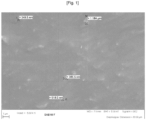
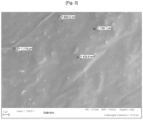
- SEM Zeiss scanning electron microscopy coupled to an X-ray photon detector (SEM/EDX), with Gold/Palladium metallization. On each picture are mentioned the settings of the microscope (WD for “working distance”, working distance; EHT for "Electron High Voltage”; Secondary Electron Detector Type 2 ES2; and the size of the diaphragm).
- EPDMs of variable molar masses and variable Mooney viscosities (ML(1+4) varying for example from 20 to 85) were used with mass ratios of ethylene (C2), propylene (C3), diene and d also variable.
- Table 1 below lists the formulation common to compositions I1, I2, I3, I4, I5, I6 of the invention.
- Vistalon 3666 0.86 33 PPH 3060 0.90
- SpheronSOA (carbon black) 1.82 Torilis 7200 0.90
- PEG 1.12 1.72 stearic acid 0.85 0.76 ZnO 3.70 3.10
- Table 2 below lists the essential conditions of the process for preparing the crosslinkable compositions which distinguish the compositions I1 to I6 (self-heating temperature and its holding time).
- the crosslinked compositions I1 to I6 all have a PP phase dispersed homogeneously in the EPDM matrix.
- the particle sizes measured with SEM are shown in Table 3 below. [Table 3] Particle size I1 From 350 nm to 1.2 ⁇ m I2 From 500 to 800 nm I3 From 400 nm to 1.1 ⁇ m I4 From 350 nm to 1.0 ⁇ m I5 From 500 nm to 1.1 ⁇ m I6 From 600nm to 950nm
- Table 4 details the formulation common to compositions I7, I8, I9, I10, I11 according to the invention and to control composition C1.
- ingredients Density compositions I7-I11 and C1 EPDM (variable) 0.86 100 PPH 3060 0.90 25 Torilis 7200 0.90 40 PEG 1.12 1.72 stearic acid 0.85 0.76 ZnO 3.70 3.10 Accelerators 3.08 sulfur 1.89 TOTAL (pc) 175.60
- compositions I7-I11 and C1 Compositions I7 I8 I9 C1 I10 I11 Grade EPDM (Commercial data) NORDEL 4520 NORDEL IP 4570 NORDEL 4725P NORDEL 4820 Keltan 5470 NORDEL IP 4785 Viscosity ML(1+4) MU 20 70 25 25 55 85 C2% % 50 50 70 85 66 68 Tg °C -45 -43 -37 -16 -37 -41
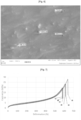
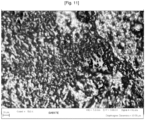
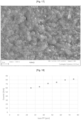
- compositions The morphologies of the cross-linked compositions I7 to I11 visible in figure 8 , 9 , 10 , 12 , 13 and control composition C1 visible at figure 11 are discussed in Table 6 below.
- Table 6 Compositions Comments PP particle size I7 Homogeneous distribution of PP particles 150nm to 900nm I8 Homogeneous distribution of PP particles 200nm to 600nm I9 Homogeneous distribution of PP particles 200nm to 750nm C1 Heterogeneous distribution PP maybe melted, no particles I10 Homogeneous distribution of PP particles 300nm to 900nm I11 Homogeneous distribution of PP particles 250nm to 550nm
- composition C1 with a very high ethylene content (85%) in the EPDM Except for composition C1 with a very high ethylene content (85%) in the EPDM, the desired morphology is obtained for the dispersed nodules.
- composition C1 It was not possible to accelerate composition C1 on cylinders, it being specified that this very high level of ethylene in the EPDM of composition C1 seems to induce a bi-continuous morphology. The elastomeric character is lost in composition C1.
- compositions I7 to I11 of the invention In the case of the modular morphologies obtained for compositions I7 to I11 of the invention, the crosslinking system was added on a roller mixer and then these compositions I7-I11 were crosslinked. As seen at figure 14 , these compositions I7-I11 have good mechanical properties, in particular a reinforcement suitable for an industrial application.
- compositions I7 I8 I9 C1 I10 I11 Properties in the initial state Shore A hardness (Point) 55 60 68 63 62 Modulus 25% (MPa) 1.2 1.3 1.9 1.5 1.5 Modulus 50% (MPa) 1.7 1.7 2.4 2.0 2.0 Modulus 100% (MPa) 2.3 2.4 3.0 2.6 2.6 Modulus 300% (MPa) 4.9 4.8 5.3 4.7 5.0 M300/M100 2.1 2.0 1.8 1.8 1.9 Break stress (MPa) 5.1 4.9 12.7 8.9 7.8 Breaking elongation (%) 313 294 517 489 425 Tearing DELFT NOT 20.0 24.0 31.0 27.0 27.0 AIR aging 168 h at 70° C Shore A hardness (Point) 56 60 67 63 63 Hardness variation 1.0 0.0 -1.0 0.0 1.0 Modulus 25% (MPa) 1.4 1.4 2.0 1.6 1.6 Modul
- Table 9 details a formulation common to composition I8 and to other compositions I12, I13, I14, I15, and I15' according to the invention.
- PPH 3060 polypropylene tested was according to Table 10 below.
- Table 10 PPH 3060 Density (ISO 1183) 0.905 Melting point (ISO 3146) 165°C Melt index (2.16 kg-230°C)g/10 min. 1.8 Flexural modulus (MPa) 1300 Izod 23°C (kJ/ m2 ) 6
- compositions I8, I12 to I15' were according to Table 11 below. [Table 11] I8 I12 I13 I14 I15 I15' PP rate (pc) 25 35 45 55 65 75
- the morphology obtained is similar for all compositions I8 and I12 to I15', with the PP dispersed in the form of nodules of the order of a ⁇ m in the EPDM matrix.
- Table 12 below details the mechanical and effective reinforcement properties obtained for these crosslinked compositions I8 and I12-I15'.
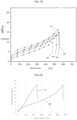
- the figure 18 illustrates the variation in Shore A hardness of these compositions with the PP content in phr.
- Table 13 details the formulation of a control composition C3 (with an EPDM matrix) by comparing it with that of the aforementioned composition I13 according to the invention, these two compositions having the same Shore A hardness.
- composition I13 As shown in Table 14 below of properties in the crosslinkable and crosslinked state, there is observed for composition I13 compared to control composition C3, a decrease in density of 18%, an extension of the scorch time, a improvement of fracture properties and reduction of mechanical non-linearities in deformation scanning (Payne effect) as well as in frequency.
- Table 15 below compares the dynamic properties of this same composition I13 with those of another control composition C5, still based on an EPDM matrix.
- C5 I13 NORDEL IP 4570 100 100 N550 95 PPH 3060 45 Torilis 7200 40 40 PEG 1.72 1.72 stearic acid 0.76 0.76 ZnO 3.10 3.10 Accelerators 3.08 3.08 sulfur 1.89 1.89 TOTAL (pc) 235.60 195.60
- composition I13 (see in particular tan D and ratio M155/M15Hz), measured on Metravib.
- Table 17 below details the formulations of another composition I16 according to the invention in comparison with a control composition C4, still based on an EPDM matrix. These formulations are more particularly suitable for automotive vehicle body seals, and compositions I16 and C4 have similar hardnesses.
- ingredients C4 I16 Keltan 5470 80.76 80.76 Vistalon 3666 33.68 33.68 SpheronSOA 129.21 5 PPH 3060 30 Torilis 7200 74.57 40 BSH chalk 57.04 57.04 kezadol gr 10.31 10.31 PEG 4000 1.72 stearic acid 0.76 0.76 ZnO 3.10 3.10 Accelerators 3.08 3.08 S 1.89 1.89 Vulkalent E80 0.15 0.15 TOTAL (pc) 396.30 265.80
- Composition I16 contains 5 phr of carbon black to guarantee the black color and to be representative during UV resistance tests. The morphology was not observable because of the very high rate of fillers (especially clear fillers).
- Table 20 details the formulations of two compositions according to the invention I17 and I18 compared with a control composition C6, all based on natural rubber as elastomer matrix.
- compositions I17-I18 have, in comparison with composition C6, greater reinforcement, of very high modulus with low deformation and improved resistance to ageing.
- Table 22 below details a formulation common to three other compositions according to the invention I19, I20, I21 based on NR, in comparison with another control composition C7 also based on NR.
- This table 23 shows that it is possible to adjust the level of reinforcement for compositions I19-I21 by modifying the level of PP dispersed in the NR, and the figure 23 shows the evolution of the Shore A hardness of these compositions 119-121 compared to composition C7.
- compositions I22 to I27 consisted of a PDMS matrix containing nodules of this resin of the order of a micrometer (see the photograph of the figure 24 relating to composition I26 with 50 phr of resin).
Landscapes
- Chemical & Material Sciences (AREA)
- Organic Chemistry (AREA)
- Chemical Kinetics & Catalysis (AREA)
- Medicinal Chemistry (AREA)
- Polymers & Plastics (AREA)
- Health & Medical Sciences (AREA)
- Engineering & Computer Science (AREA)
- Architecture (AREA)
- Physics & Mathematics (AREA)
- Electromagnetism (AREA)
- Civil Engineering (AREA)
- Structural Engineering (AREA)
- Mechanical Engineering (AREA)
- Materials Engineering (AREA)
- General Chemical & Material Sciences (AREA)
- Compositions Of Macromolecular Compounds (AREA)
- Processes Of Treating Macromolecular Substances (AREA)
- Heating, Cooling, Or Curing Plastics Or The Like In General (AREA)
Applications Claiming Priority (2)
| Application Number | Priority Date | Filing Date | Title |
|---|---|---|---|
| FR1904690A FR3095648B1 (fr) | 2019-05-03 | 2019-05-03 | Composition de caoutchouc pour applications dynamiques ou statiques, son procédé de préparation et produits l’incorporant. |
| PCT/FR2020/050684 WO2020225498A1 (fr) | 2019-05-03 | 2020-04-22 | Composition de caoutchouc pour applications dynamiques ou statiques, son procédé de préparation et produits l'incorporant. |
Publications (2)
| Publication Number | Publication Date |
|---|---|
| EP3962996A1 EP3962996A1 (fr) | 2022-03-09 |
| EP3962996B1 true EP3962996B1 (fr) | 2023-06-14 |
Family
ID=68501661
Family Applications (1)
| Application Number | Title | Priority Date | Filing Date |
|---|---|---|---|
| EP20754307.5A Active EP3962996B1 (fr) | 2019-05-03 | 2020-04-22 | Composition de caoutchouc pour applications dynamiques ou statiques, son procédé de préparation et produits l'incorporant |
Country Status (9)
| Country | Link |
|---|---|
| US (1) | US20220204743A1 (pl) |
| EP (1) | EP3962996B1 (pl) |
| JP (1) | JP7831994B2 (pl) |
| KR (1) | KR102871079B1 (pl) |
| CN (1) | CN113966362A (pl) |
| ES (1) | ES2953844T3 (pl) |
| FR (1) | FR3095648B1 (pl) |
| PL (1) | PL3962996T3 (pl) |
| WO (1) | WO2020225498A1 (pl) |
Families Citing this family (1)
| Publication number | Priority date | Publication date | Assignee | Title |
|---|---|---|---|---|
| FR3130811B1 (fr) | 2021-12-17 | 2025-09-05 | Hutchinson | Composition de caoutchouc pour applications dynamiques ou statiques, son procédé de préparation et produits l’incorporant. |
Family Cites Families (19)
| Publication number | Priority date | Publication date | Assignee | Title |
|---|---|---|---|---|
| JPH0741605A (ja) * | 1993-07-23 | 1995-02-10 | Polytec Design:Kk | 接着性ゴム製品 |
| JP2893103B2 (ja) * | 1993-09-13 | 1999-05-17 | 株式会社ブリヂストン | 空気入りタイヤ |
| US6036800A (en) * | 1996-08-28 | 2000-03-14 | The Goodyear Tire & Rubber Company | Method of preparing tire with tread of cap/base construction |
| JPH10330547A (ja) * | 1997-05-29 | 1998-12-15 | Bridgestone Corp | タイヤトレッド用ゴム組成物及びそのゴム組成物を使用した空気入りタイヤ |
| JP2001002865A (ja) * | 1999-06-18 | 2001-01-09 | Mitsui Chemicals Inc | 超低硬度ゴム組成物及びその製造法 |
| US6809157B2 (en) * | 2000-06-29 | 2004-10-26 | The Yokohama Rubber Co., Ltd. | Thermoplastic polymer and thermoplastic elastomer composition |
| JP2002155148A (ja) | 2000-11-20 | 2002-05-28 | Mitsui Chemicals Inc | 配合ゴム組成物の製造方法、配合ゴム組成物およびゴム製品 |
| JP3967958B2 (ja) * | 2001-05-30 | 2007-08-29 | ダイセル・デグサ株式会社 | 複合分散体及びその製造方法 |
| JP3999117B2 (ja) * | 2001-12-20 | 2007-10-31 | 株式会社クラレ | ゴム組成物、架橋性ゴム組成物および架橋物 |
| US8247494B2 (en) | 2009-11-23 | 2012-08-21 | Exxonmobil Chemical Patents Inc. | Thermoset compositions with dispersed thermoplastic resin therein and process for making them |
| FR2963624B1 (fr) * | 2010-08-04 | 2014-02-21 | Hutchinson | Procede de preparation d'une composition thermoplastique renforcee et reactive, cette composition et son utilisation |
| CN102751459B (zh) * | 2011-04-22 | 2016-03-23 | 天津东皋膜技术有限公司 | 后交联橡胶、聚烯烃复合材料纳米微多孔隔膜及其制造方法 |
| WO2013180693A1 (en) * | 2012-05-30 | 2013-12-05 | Empire Technology Development Llc | Holographic imaging device and method |
| WO2014142959A1 (en) * | 2013-03-15 | 2014-09-18 | Tempur-Pedic Management, Llc | Foam composite and methods of making the same |
| JP2016128551A (ja) | 2015-01-09 | 2016-07-14 | 株式会社ブリヂストン | 共役ジエン系重合体とオレフィン系重合体とを含むゴム組成物及びそれを用いたタイヤ |
| FR3036115B1 (fr) * | 2015-05-11 | 2017-05-19 | Michelin & Cie | Composition de caoutchouc |
| JP6350509B2 (ja) * | 2015-12-24 | 2018-07-04 | 横浜ゴム株式会社 | ゴム組成物、その製造方法及び空気入りタイヤ |
| CN106589618A (zh) * | 2016-11-28 | 2017-04-26 | 广东省石油与精细化工研究院 | 一种无卤阻燃动态硫化epdm/pp热塑性弹性体及其制备方法 |
| JP6880816B2 (ja) * | 2017-02-22 | 2021-06-02 | 横浜ゴム株式会社 | スタッドレスタイヤ |
-
2019
- 2019-05-03 FR FR1904690A patent/FR3095648B1/fr active Active
-
2020
- 2020-04-22 US US17/606,991 patent/US20220204743A1/en active Pending
- 2020-04-22 KR KR1020217038976A patent/KR102871079B1/ko active Active
- 2020-04-22 ES ES20754307T patent/ES2953844T3/es active Active
- 2020-04-22 CN CN202080041633.0A patent/CN113966362A/zh active Pending
- 2020-04-22 EP EP20754307.5A patent/EP3962996B1/fr active Active
- 2020-04-22 PL PL20754307.5T patent/PL3962996T3/pl unknown
- 2020-04-22 WO PCT/FR2020/050684 patent/WO2020225498A1/fr not_active Ceased
- 2020-04-22 JP JP2021565017A patent/JP7831994B2/ja active Active
Also Published As
| Publication number | Publication date |
|---|---|
| JP2022530990A (ja) | 2022-07-05 |
| EP3962996A1 (fr) | 2022-03-09 |
| BR112021021970A2 (pt) | 2021-12-21 |
| KR20220004151A (ko) | 2022-01-11 |
| PL3962996T3 (pl) | 2023-10-09 |
| JP7831994B2 (ja) | 2026-03-17 |
| FR3095648A1 (fr) | 2020-11-06 |
| CN113966362A (zh) | 2022-01-21 |
| ES2953844T3 (es) | 2023-11-16 |
| FR3095648B1 (fr) | 2021-04-16 |
| US20220204743A1 (en) | 2022-06-30 |
| KR102871079B1 (ko) | 2025-10-15 |
| WO2020225498A1 (fr) | 2020-11-12 |
Similar Documents
| Publication | Publication Date | Title |
|---|---|---|
| EP0890607B1 (fr) | Composition de caoutchouc à base de noir de carbone ayant de la silice fixée à sa surface et de polymère diénique fonctionnalisé alcoxysilane | |
| Arayapranee et al. | A comparative study of the cure characteristics, processability, mechanical properties, ageing, and morphology of rice husk ash, silica and carbon black filled 75: 25 NR/EPDM blends | |
| FR2969165A1 (fr) | Composition a base de caoutchouc naturel et de noir de carbone comprenant un hydrazide, un hydrazone ou une poly-amine | |
| EP0915132A1 (fr) | Composition de caoutchouc destinée à la fabrication d'articles à base d'élastomère comportant des fonctions oxygénées et de charge de type silice | |
| FR2763074A1 (fr) | Composition de caoutchouc a base de noir de carbone ayant de la silice fixee a sa surface et de polymere dyenique fonctionalise ou modifie par des fonctions silanols | |
| EP2652015A1 (fr) | Composition elastomerique presentant une bonne dispersion de la charge dans la matrice elastomerique | |
| FR2931160A1 (fr) | Nouvel elastomere thermoplastique, adapte a la fabrication de conduits flexibles pour le transport de liquides | |
| EP2451657B1 (fr) | Composition a base de caoutchouc naturel et d'un compose poly-amine | |
| EP3083769A1 (fr) | Composition de caoutchouc a base majoritairement de caoutchouc naturel | |
| EP3962996B1 (fr) | Composition de caoutchouc pour applications dynamiques ou statiques, son procédé de préparation et produits l'incorporant | |
| CH510702A (fr) | Procédé de préparation d'une composition comprenant un polymère de l'éthylène | |
| EP3390499A1 (fr) | Procédé de préparation d'un mélange maître, comprenant un élastomère diénique, une charge organique renforçante, et éventuellement un agent antioxydant | |
| Munusamy et al. | Ethylenevinyl acetate/natural rubber/organoclay nanocomposites: effect of sulfur and peroxide vulcanization | |
| EP3896129B1 (fr) | Composition activatrice de vulcanisation | |
| CA2969049C (fr) | Flanc pour pneumatique | |
| EP4405415B1 (fr) | Procédé d'obtention par extrusion d'une composition élastomérique renforcée | |
| WO2023111441A1 (fr) | Composition de caoutchouc pour applications dynamiques ou statiques, son procédé de préparation et produits l'incorporant | |
| FR3110860A1 (fr) | Zéolithes à compatibilité améliorée | |
| EP2097473B1 (fr) | Melanges-maitres ayant pour support un copolymere d'ethylene et d'alpha-olefine et contenant des agents de vulcanisation | |
| Bazgir et al. | Microstructure-properties correlation in silica-reinforced dynamically vulcanized EPDM/PP thermoplastic elastomers | |
| WO2024068922A1 (fr) | Lame d'essuyage renforcée pour balai d'essuie-glace | |
| BR112021021970B1 (pt) | Composição de borracha reticulável com base em um elastômero, composição de borracha reticulada, membro mecânico tendo função dinâmica, elemento de selagem e processo para preparar a composição reticulável | |
| JPS6377952A (ja) | カプセル化シリカ系充填剤及びそれを含むポリイソプレン系ゴム組成物 | |
| FR3000079A1 (fr) | Composition de caoutchouc comprenant un inhibiteur de corrosion | |
| BE578906A (pl) |
Legal Events
| Date | Code | Title | Description |
|---|---|---|---|
| STAA | Information on the status of an ep patent application or granted ep patent |
Free format text: STATUS: UNKNOWN |
|
| STAA | Information on the status of an ep patent application or granted ep patent |
Free format text: STATUS: THE INTERNATIONAL PUBLICATION HAS BEEN MADE |
|
| PUAI | Public reference made under article 153(3) epc to a published international application that has entered the european phase |
Free format text: ORIGINAL CODE: 0009012 |
|
| STAA | Information on the status of an ep patent application or granted ep patent |
Free format text: STATUS: REQUEST FOR EXAMINATION WAS MADE |
|
| 17P | Request for examination filed |
Effective date: 20211108 |
|
| AK | Designated contracting states |
Kind code of ref document: A1 Designated state(s): AL AT BE BG CH CY CZ DE DK EE ES FI FR GB GR HR HU IE IS IT LI LT LU LV MC MK MT NL NO PL PT RO RS SE SI SK SM TR |
|
| DAV | Request for validation of the european patent (deleted) | ||
| DAX | Request for extension of the european patent (deleted) | ||
| GRAP | Despatch of communication of intention to grant a patent |
Free format text: ORIGINAL CODE: EPIDOSNIGR1 |
|
| STAA | Information on the status of an ep patent application or granted ep patent |
Free format text: STATUS: GRANT OF PATENT IS INTENDED |
|
| INTG | Intention to grant announced |
Effective date: 20230110 |
|
| GRAS | Grant fee paid |
Free format text: ORIGINAL CODE: EPIDOSNIGR3 |
|
| GRAA | (expected) grant |
Free format text: ORIGINAL CODE: 0009210 |
|
| STAA | Information on the status of an ep patent application or granted ep patent |
Free format text: STATUS: THE PATENT HAS BEEN GRANTED |
|
| AK | Designated contracting states |
Kind code of ref document: B1 Designated state(s): AL AT BE BG CH CY CZ DE DK EE ES FI FR GB GR HR HU IE IS IT LI LT LU LV MC MK MT NL NO PL PT RO RS SE SI SK SM TR |
|
| REG | Reference to a national code |
Ref country code: CH Ref legal event code: EP |
|
| P01 | Opt-out of the competence of the unified patent court (upc) registered |
Effective date: 20230526 |
|
| REG | Reference to a national code |
Ref country code: DE Ref legal event code: R096 Ref document number: 602020012564 Country of ref document: DE |
|
| REG | Reference to a national code |
Ref country code: AT Ref legal event code: REF Ref document number: 1579219 Country of ref document: AT Kind code of ref document: T Effective date: 20230715 |
|
| REG | Reference to a national code |
Ref country code: LT Ref legal event code: MG9D |
|
| REG | Reference to a national code |
Ref country code: NL Ref legal event code: MP Effective date: 20230614 |
|
| PG25 | Lapsed in a contracting state [announced via postgrant information from national office to epo] |
Ref country code: SE Free format text: LAPSE BECAUSE OF FAILURE TO SUBMIT A TRANSLATION OF THE DESCRIPTION OR TO PAY THE FEE WITHIN THE PRESCRIBED TIME-LIMIT Effective date: 20230614 Ref country code: NO Free format text: LAPSE BECAUSE OF FAILURE TO SUBMIT A TRANSLATION OF THE DESCRIPTION OR TO PAY THE FEE WITHIN THE PRESCRIBED TIME-LIMIT Effective date: 20230914 |
|
| REG | Reference to a national code |
Ref country code: AT Ref legal event code: MK05 Ref document number: 1579219 Country of ref document: AT Kind code of ref document: T Effective date: 20230614 |
|
| REG | Reference to a national code |
Ref country code: ES Ref legal event code: FG2A Ref document number: 2953844 Country of ref document: ES Kind code of ref document: T3 Effective date: 20231116 |
|
| PG25 | Lapsed in a contracting state [announced via postgrant information from national office to epo] |
Ref country code: RS Free format text: LAPSE BECAUSE OF FAILURE TO SUBMIT A TRANSLATION OF THE DESCRIPTION OR TO PAY THE FEE WITHIN THE PRESCRIBED TIME-LIMIT Effective date: 20230614 Ref country code: NL Free format text: LAPSE BECAUSE OF FAILURE TO SUBMIT A TRANSLATION OF THE DESCRIPTION OR TO PAY THE FEE WITHIN THE PRESCRIBED TIME-LIMIT Effective date: 20230614 Ref country code: LV Free format text: LAPSE BECAUSE OF FAILURE TO SUBMIT A TRANSLATION OF THE DESCRIPTION OR TO PAY THE FEE WITHIN THE PRESCRIBED TIME-LIMIT Effective date: 20230614 Ref country code: LT Free format text: LAPSE BECAUSE OF FAILURE TO SUBMIT A TRANSLATION OF THE DESCRIPTION OR TO PAY THE FEE WITHIN THE PRESCRIBED TIME-LIMIT Effective date: 20230614 Ref country code: HR Free format text: LAPSE BECAUSE OF FAILURE TO SUBMIT A TRANSLATION OF THE DESCRIPTION OR TO PAY THE FEE WITHIN THE PRESCRIBED TIME-LIMIT Effective date: 20230614 Ref country code: GR Free format text: LAPSE BECAUSE OF FAILURE TO SUBMIT A TRANSLATION OF THE DESCRIPTION OR TO PAY THE FEE WITHIN THE PRESCRIBED TIME-LIMIT Effective date: 20230915 |
|
| PG25 | Lapsed in a contracting state [announced via postgrant information from national office to epo] |
Ref country code: FI Free format text: LAPSE BECAUSE OF FAILURE TO SUBMIT A TRANSLATION OF THE DESCRIPTION OR TO PAY THE FEE WITHIN THE PRESCRIBED TIME-LIMIT Effective date: 20230614 |
|
| PG25 | Lapsed in a contracting state [announced via postgrant information from national office to epo] |
Ref country code: SK Free format text: LAPSE BECAUSE OF FAILURE TO SUBMIT A TRANSLATION OF THE DESCRIPTION OR TO PAY THE FEE WITHIN THE PRESCRIBED TIME-LIMIT Effective date: 20230614 |
|
| PG25 | Lapsed in a contracting state [announced via postgrant information from national office to epo] |
Ref country code: IS Free format text: LAPSE BECAUSE OF FAILURE TO SUBMIT A TRANSLATION OF THE DESCRIPTION OR TO PAY THE FEE WITHIN THE PRESCRIBED TIME-LIMIT Effective date: 20231014 |
|
| PG25 | Lapsed in a contracting state [announced via postgrant information from national office to epo] |
Ref country code: SM Free format text: LAPSE BECAUSE OF FAILURE TO SUBMIT A TRANSLATION OF THE DESCRIPTION OR TO PAY THE FEE WITHIN THE PRESCRIBED TIME-LIMIT Effective date: 20230614 Ref country code: SK Free format text: LAPSE BECAUSE OF FAILURE TO SUBMIT A TRANSLATION OF THE DESCRIPTION OR TO PAY THE FEE WITHIN THE PRESCRIBED TIME-LIMIT Effective date: 20230614 Ref country code: RO Free format text: LAPSE BECAUSE OF FAILURE TO SUBMIT A TRANSLATION OF THE DESCRIPTION OR TO PAY THE FEE WITHIN THE PRESCRIBED TIME-LIMIT Effective date: 20230614 Ref country code: PT Free format text: LAPSE BECAUSE OF FAILURE TO SUBMIT A TRANSLATION OF THE DESCRIPTION OR TO PAY THE FEE WITHIN THE PRESCRIBED TIME-LIMIT Effective date: 20231016 Ref country code: IS Free format text: LAPSE BECAUSE OF FAILURE TO SUBMIT A TRANSLATION OF THE DESCRIPTION OR TO PAY THE FEE WITHIN THE PRESCRIBED TIME-LIMIT Effective date: 20231014 Ref country code: EE Free format text: LAPSE BECAUSE OF FAILURE TO SUBMIT A TRANSLATION OF THE DESCRIPTION OR TO PAY THE FEE WITHIN THE PRESCRIBED TIME-LIMIT Effective date: 20230614 Ref country code: CZ Free format text: LAPSE BECAUSE OF FAILURE TO SUBMIT A TRANSLATION OF THE DESCRIPTION OR TO PAY THE FEE WITHIN THE PRESCRIBED TIME-LIMIT Effective date: 20230614 Ref country code: AT Free format text: LAPSE BECAUSE OF FAILURE TO SUBMIT A TRANSLATION OF THE DESCRIPTION OR TO PAY THE FEE WITHIN THE PRESCRIBED TIME-LIMIT Effective date: 20230614 |
|
| REG | Reference to a national code |
Ref country code: DE Ref legal event code: R097 Ref document number: 602020012564 Country of ref document: DE |
|
| PLBE | No opposition filed within time limit |
Free format text: ORIGINAL CODE: 0009261 |
|
| STAA | Information on the status of an ep patent application or granted ep patent |
Free format text: STATUS: NO OPPOSITION FILED WITHIN TIME LIMIT |
|
| PG25 | Lapsed in a contracting state [announced via postgrant information from national office to epo] |
Ref country code: DK Free format text: LAPSE BECAUSE OF FAILURE TO SUBMIT A TRANSLATION OF THE DESCRIPTION OR TO PAY THE FEE WITHIN THE PRESCRIBED TIME-LIMIT Effective date: 20230614 |
|
| PG25 | Lapsed in a contracting state [announced via postgrant information from national office to epo] |
Ref country code: SI Free format text: LAPSE BECAUSE OF FAILURE TO SUBMIT A TRANSLATION OF THE DESCRIPTION OR TO PAY THE FEE WITHIN THE PRESCRIBED TIME-LIMIT Effective date: 20230614 |
|
| 26N | No opposition filed |
Effective date: 20240315 |
|
| PG25 | Lapsed in a contracting state [announced via postgrant information from national office to epo] |
Ref country code: SI Free format text: LAPSE BECAUSE OF FAILURE TO SUBMIT A TRANSLATION OF THE DESCRIPTION OR TO PAY THE FEE WITHIN THE PRESCRIBED TIME-LIMIT Effective date: 20230614 |
|
| PG25 | Lapsed in a contracting state [announced via postgrant information from national office to epo] |
Ref country code: BG Free format text: LAPSE BECAUSE OF FAILURE TO SUBMIT A TRANSLATION OF THE DESCRIPTION OR TO PAY THE FEE WITHIN THE PRESCRIBED TIME-LIMIT Effective date: 20230614 |
|
| PG25 | Lapsed in a contracting state [announced via postgrant information from national office to epo] |
Ref country code: MC Free format text: LAPSE BECAUSE OF FAILURE TO SUBMIT A TRANSLATION OF THE DESCRIPTION OR TO PAY THE FEE WITHIN THE PRESCRIBED TIME-LIMIT Effective date: 20230614 |
|
| PG25 | Lapsed in a contracting state [announced via postgrant information from national office to epo] |
Ref country code: MC Free format text: LAPSE BECAUSE OF FAILURE TO SUBMIT A TRANSLATION OF THE DESCRIPTION OR TO PAY THE FEE WITHIN THE PRESCRIBED TIME-LIMIT Effective date: 20230614 Ref country code: BG Free format text: LAPSE BECAUSE OF FAILURE TO SUBMIT A TRANSLATION OF THE DESCRIPTION OR TO PAY THE FEE WITHIN THE PRESCRIBED TIME-LIMIT Effective date: 20230614 |
|
| REG | Reference to a national code |
Ref country code: CH Ref legal event code: PL |
|
| PG25 | Lapsed in a contracting state [announced via postgrant information from national office to epo] |
Ref country code: LU Free format text: LAPSE BECAUSE OF NON-PAYMENT OF DUE FEES Effective date: 20240422 |
|
| REG | Reference to a national code |
Ref country code: BE Ref legal event code: MM Effective date: 20240430 |
|
| PG25 | Lapsed in a contracting state [announced via postgrant information from national office to epo] |
Ref country code: LU Free format text: LAPSE BECAUSE OF NON-PAYMENT OF DUE FEES Effective date: 20240422 |
|
| PG25 | Lapsed in a contracting state [announced via postgrant information from national office to epo] |
Ref country code: BE Free format text: LAPSE BECAUSE OF NON-PAYMENT OF DUE FEES Effective date: 20240430 |
|
| PG25 | Lapsed in a contracting state [announced via postgrant information from national office to epo] |
Ref country code: BE Free format text: LAPSE BECAUSE OF NON-PAYMENT OF DUE FEES Effective date: 20240430 Ref country code: CH Free format text: LAPSE BECAUSE OF NON-PAYMENT OF DUE FEES Effective date: 20240430 |
|
| REG | Reference to a national code |
Ref country code: DE Ref legal event code: R082 Ref document number: 602020012564 Country of ref document: DE Representative=s name: PLASSERAUD IP GMBH, DE |
|
| PG25 | Lapsed in a contracting state [announced via postgrant information from national office to epo] |
Ref country code: IE Free format text: LAPSE BECAUSE OF NON-PAYMENT OF DUE FEES Effective date: 20240422 |
|
| PGFP | Annual fee paid to national office [announced via postgrant information from national office to epo] |
Ref country code: PL Payment date: 20250321 Year of fee payment: 6 |
|
| PGFP | Annual fee paid to national office [announced via postgrant information from national office to epo] |
Ref country code: DE Payment date: 20250422 Year of fee payment: 6 |
|
| PGFP | Annual fee paid to national office [announced via postgrant information from national office to epo] |
Ref country code: GB Payment date: 20250423 Year of fee payment: 6 Ref country code: ES Payment date: 20250530 Year of fee payment: 6 |
|
| PGFP | Annual fee paid to national office [announced via postgrant information from national office to epo] |
Ref country code: IT Payment date: 20250424 Year of fee payment: 6 |
|
| PGFP | Annual fee paid to national office [announced via postgrant information from national office to epo] |
Ref country code: FR Payment date: 20250425 Year of fee payment: 6 |
|
| PG25 | Lapsed in a contracting state [announced via postgrant information from national office to epo] |
Ref country code: CY Free format text: LAPSE BECAUSE OF FAILURE TO SUBMIT A TRANSLATION OF THE DESCRIPTION OR TO PAY THE FEE WITHIN THE PRESCRIBED TIME-LIMIT; INVALID AB INITIO Effective date: 20200422 |
|
| PG25 | Lapsed in a contracting state [announced via postgrant information from national office to epo] |
Ref country code: HU Free format text: LAPSE BECAUSE OF FAILURE TO SUBMIT A TRANSLATION OF THE DESCRIPTION OR TO PAY THE FEE WITHIN THE PRESCRIBED TIME-LIMIT; INVALID AB INITIO Effective date: 20200422 |