EP3805202A1 - Improved process for making diaryl sulfones - Google Patents
Improved process for making diaryl sulfones Download PDFInfo
- Publication number
- EP3805202A1 EP3805202A1 EP20196720.5A EP20196720A EP3805202A1 EP 3805202 A1 EP3805202 A1 EP 3805202A1 EP 20196720 A EP20196720 A EP 20196720A EP 3805202 A1 EP3805202 A1 EP 3805202A1
- Authority
- EP
- European Patent Office
- Prior art keywords
- hours
- coupling step
- alkyl
- aryl
- sulfonic acid
- Prior art date
- Legal status (The legal status is an assumption and is not a legal conclusion. Google has not performed a legal analysis and makes no representation as to the accuracy of the status listed.)
- Withdrawn
Links
- 238000000034 method Methods 0.000 title claims abstract description 237
- -1 diaryl sulfones Chemical class 0.000 title claims abstract description 69
- 230000008878 coupling Effects 0.000 claims abstract description 220
- 238000010168 coupling process Methods 0.000 claims abstract description 220
- 238000005859 coupling reaction Methods 0.000 claims abstract description 220
- 239000003054 catalyst Substances 0.000 claims abstract description 133
- XLYOFNOQVPJJNP-UHFFFAOYSA-N water Substances O XLYOFNOQVPJJNP-UHFFFAOYSA-N 0.000 claims abstract description 126
- LSNNMFCWUKXFEE-UHFFFAOYSA-M Bisulfite Chemical compound OS([O-])=O LSNNMFCWUKXFEE-UHFFFAOYSA-M 0.000 claims abstract description 67
- 238000004519 manufacturing process Methods 0.000 claims abstract description 22
- MVPPADPHJFYWMZ-UHFFFAOYSA-N chlorobenzene Chemical compound ClC1=CC=CC=C1 MVPPADPHJFYWMZ-UHFFFAOYSA-N 0.000 claims description 157
- 150000003457 sulfones Chemical class 0.000 claims description 116
- 125000004169 (C1-C6) alkyl group Chemical group 0.000 claims description 72
- 229910052736 halogen Inorganic materials 0.000 claims description 66
- 150000002367 halogens Chemical class 0.000 claims description 65
- 125000000542 sulfonic acid group Chemical group 0.000 claims description 37
- 125000004435 hydrogen atom Chemical group [H]* 0.000 claims description 26
- XOLBLPGZBRYERU-UHFFFAOYSA-N tin dioxide Chemical compound O=[Sn]=O XOLBLPGZBRYERU-UHFFFAOYSA-N 0.000 claims description 20
- VYPSYNLAJGMNEJ-UHFFFAOYSA-N Silicium dioxide Chemical compound O=[Si]=O VYPSYNLAJGMNEJ-UHFFFAOYSA-N 0.000 claims description 18
- HSZCZNFXUDYRKD-UHFFFAOYSA-M lithium iodide Chemical compound [Li+].[I-] HSZCZNFXUDYRKD-UHFFFAOYSA-M 0.000 claims description 17
- XLOMVQKBTHCTTD-UHFFFAOYSA-N Zinc monoxide Chemical compound [Zn]=O XLOMVQKBTHCTTD-UHFFFAOYSA-N 0.000 claims description 14
- UQSXHKLRYXJYBZ-UHFFFAOYSA-N iron oxide Inorganic materials [Fe]=O UQSXHKLRYXJYBZ-UHFFFAOYSA-N 0.000 claims description 9
- NDLPOXTZKUMGOV-UHFFFAOYSA-N oxo(oxoferriooxy)iron hydrate Chemical compound O.O=[Fe]O[Fe]=O NDLPOXTZKUMGOV-UHFFFAOYSA-N 0.000 claims description 9
- DCKVFVYPWDKYDN-UHFFFAOYSA-L oxygen(2-);titanium(4+);sulfate Chemical compound [O-2].[Ti+4].[O-]S([O-])(=O)=O DCKVFVYPWDKYDN-UHFFFAOYSA-L 0.000 claims description 9
- 239000000377 silicon dioxide Substances 0.000 claims description 9
- 229910000348 titanium sulfate Inorganic materials 0.000 claims description 9
- 239000003153 chemical reaction reagent Substances 0.000 claims description 8
- TWNQGVIAIRXVLR-UHFFFAOYSA-N oxo(oxoalumanyloxy)alumane Chemical compound O=[Al]O[Al]=O TWNQGVIAIRXVLR-UHFFFAOYSA-N 0.000 claims description 8
- 238000004821 distillation Methods 0.000 claims description 7
- 239000011787 zinc oxide Substances 0.000 claims description 7
- GWEVSGVZZGPLCZ-UHFFFAOYSA-N Titan oxide Chemical compound O=[Ti]=O GWEVSGVZZGPLCZ-UHFFFAOYSA-N 0.000 claims description 6
- 229910000410 antimony oxide Inorganic materials 0.000 claims description 6
- 229910000416 bismuth oxide Inorganic materials 0.000 claims description 6
- TYIXMATWDRGMPF-UHFFFAOYSA-N dibismuth;oxygen(2-) Chemical compound [O-2].[O-2].[O-2].[Bi+3].[Bi+3] TYIXMATWDRGMPF-UHFFFAOYSA-N 0.000 claims description 6
- VAYGXNSJCAHWJZ-UHFFFAOYSA-N dimethyl sulfate Chemical compound COS(=O)(=O)OC VAYGXNSJCAHWJZ-UHFFFAOYSA-N 0.000 claims description 6
- VTRUBDSFZJNXHI-UHFFFAOYSA-N oxoantimony Chemical compound [Sb]=O VTRUBDSFZJNXHI-UHFFFAOYSA-N 0.000 claims description 6
- RVTZCBVAJQQJTK-UHFFFAOYSA-N oxygen(2-);zirconium(4+) Chemical compound [O-2].[O-2].[Zr+4] RVTZCBVAJQQJTK-UHFFFAOYSA-N 0.000 claims description 6
- OGIDPMRJRNCKJF-UHFFFAOYSA-N titanium oxide Inorganic materials [Ti]=O OGIDPMRJRNCKJF-UHFFFAOYSA-N 0.000 claims description 6
- 229910001928 zirconium oxide Inorganic materials 0.000 claims description 6
- PNDPGZBMCMUPRI-UHFFFAOYSA-N iodine Chemical compound II PNDPGZBMCMUPRI-UHFFFAOYSA-N 0.000 claims description 4
- 125000003118 aryl group Chemical group 0.000 description 67
- 125000000041 C6-C10 aryl group Chemical group 0.000 description 59
- 239000000047 product Substances 0.000 description 43
- 150000001502 aryl halides Chemical class 0.000 description 42
- GPAPPPVRLPGFEQ-UHFFFAOYSA-N 4,4'-dichlorodiphenyl sulfone Chemical compound C1=CC(Cl)=CC=C1S(=O)(=O)C1=CC=C(Cl)C=C1 GPAPPPVRLPGFEQ-UHFFFAOYSA-N 0.000 description 41
- 239000000203 mixture Substances 0.000 description 37
- YXFVVABEGXRONW-UHFFFAOYSA-N Toluene Chemical compound CC1=CC=CC=C1 YXFVVABEGXRONW-UHFFFAOYSA-N 0.000 description 33
- MNURPFVONZPVLA-UHFFFAOYSA-N 2-chlorobenzenesulfonic acid Chemical compound OS(=O)(=O)C1=CC=CC=C1Cl MNURPFVONZPVLA-UHFFFAOYSA-N 0.000 description 31
- RJWBTWIBUIGANW-UHFFFAOYSA-N 4-chlorobenzenesulfonic acid Chemical compound OS(=O)(=O)C1=CC=C(Cl)C=C1 RJWBTWIBUIGANW-UHFFFAOYSA-N 0.000 description 24
- 239000004327 boric acid Substances 0.000 description 24
- 238000006243 chemical reaction Methods 0.000 description 24
- AKEJUJNQAAGONA-UHFFFAOYSA-N sulfur trioxide Chemical compound O=S(=O)=O AKEJUJNQAAGONA-UHFFFAOYSA-N 0.000 description 24
- KGBXLFKZBHKPEV-UHFFFAOYSA-N boric acid Chemical compound OB(O)O KGBXLFKZBHKPEV-UHFFFAOYSA-N 0.000 description 22
- 239000000460 chlorine Substances 0.000 description 16
- IBRQUKZZBXZOBA-UHFFFAOYSA-N 1-chloro-3-(3-chlorophenyl)sulfonylbenzene Chemical compound ClC1=CC=CC(S(=O)(=O)C=2C=C(Cl)C=CC=2)=C1 IBRQUKZZBXZOBA-UHFFFAOYSA-N 0.000 description 15
- 238000005406 washing Methods 0.000 description 13
- AFVFQIVMOAPDHO-UHFFFAOYSA-N Methanesulfonic acid Chemical compound CS(O)(=O)=O AFVFQIVMOAPDHO-UHFFFAOYSA-N 0.000 description 11
- 125000000217 alkyl group Chemical group 0.000 description 10
- QAEDZJGFFMLHHQ-UHFFFAOYSA-N trifluoroacetic anhydride Chemical compound FC(F)(F)C(=O)OC(=O)C(F)(F)F QAEDZJGFFMLHHQ-UHFFFAOYSA-N 0.000 description 10
- ZCYVEMRRCGMTRW-UHFFFAOYSA-N 7553-56-2 Chemical compound [I] ZCYVEMRRCGMTRW-UHFFFAOYSA-N 0.000 description 9
- 238000004458 analytical method Methods 0.000 description 9
- 238000001816 cooling Methods 0.000 description 9
- 238000010438 heat treatment Methods 0.000 description 9
- 229910052740 iodine Inorganic materials 0.000 description 9
- 239000011630 iodine Substances 0.000 description 9
- 238000002360 preparation method Methods 0.000 description 9
- QAOWNCQODCNURD-UHFFFAOYSA-N Sulfuric acid Chemical compound OS(O)(=O)=O QAOWNCQODCNURD-UHFFFAOYSA-N 0.000 description 8
- 239000012044 organic layer Substances 0.000 description 8
- 238000010791 quenching Methods 0.000 description 8
- 230000000171 quenching effect Effects 0.000 description 8
- 239000002002 slurry Substances 0.000 description 8
- 239000006286 aqueous extract Substances 0.000 description 7
- 238000000746 purification Methods 0.000 description 7
- 239000000376 reactant Substances 0.000 description 7
- 239000012485 toluene extract Substances 0.000 description 7
- YKWDWSGYZBURDA-UHFFFAOYSA-N 1-chloro-2-(4-chlorophenyl)sulfonylbenzene Chemical compound C1=CC(Cl)=CC=C1S(=O)(=O)C1=CC=CC=C1Cl YKWDWSGYZBURDA-UHFFFAOYSA-N 0.000 description 6
- HGWMELCMYSUIOM-UHFFFAOYSA-N 1-chloro-3-(4-chlorophenyl)sulfonylbenzene Chemical compound C1=CC(Cl)=CC=C1S(=O)(=O)C1=CC=CC(Cl)=C1 HGWMELCMYSUIOM-UHFFFAOYSA-N 0.000 description 6
- XEEYBQQBJWHFJM-UHFFFAOYSA-N Iron Chemical compound [Fe] XEEYBQQBJWHFJM-UHFFFAOYSA-N 0.000 description 6
- 238000010923 batch production Methods 0.000 description 6
- JKWMSGQKBLHBQQ-UHFFFAOYSA-N diboron trioxide Chemical compound O=BOB=O JKWMSGQKBLHBQQ-UHFFFAOYSA-N 0.000 description 6
- 125000001424 substituent group Chemical group 0.000 description 6
- ITMCEJHCFYSIIV-UHFFFAOYSA-N triflic acid Chemical compound OS(=O)(=O)C(F)(F)F ITMCEJHCFYSIIV-UHFFFAOYSA-N 0.000 description 6
- 239000006227 byproduct Substances 0.000 description 5
- 229940098779 methanesulfonic acid Drugs 0.000 description 5
- 230000035484 reaction time Effects 0.000 description 5
- 239000002904 solvent Substances 0.000 description 5
- DTQVDTLACAAQTR-UHFFFAOYSA-N Trifluoroacetic acid Chemical compound OC(=O)C(F)(F)F DTQVDTLACAAQTR-UHFFFAOYSA-N 0.000 description 4
- 238000010924 continuous production Methods 0.000 description 4
- ZOXJGFHDIHLPTG-UHFFFAOYSA-N Boron Chemical compound [B] ZOXJGFHDIHLPTG-UHFFFAOYSA-N 0.000 description 3
- QAOWNCQODCNURD-UHFFFAOYSA-L Sulfate Chemical compound [O-]S([O-])(=O)=O QAOWNCQODCNURD-UHFFFAOYSA-L 0.000 description 3
- RTAQQCXQSZGOHL-UHFFFAOYSA-N Titanium Chemical compound [Ti] RTAQQCXQSZGOHL-UHFFFAOYSA-N 0.000 description 3
- HCHKCACWOHOZIP-UHFFFAOYSA-N Zinc Chemical compound [Zn] HCHKCACWOHOZIP-UHFFFAOYSA-N 0.000 description 3
- QCWXUUIWCKQGHC-UHFFFAOYSA-N Zirconium Chemical compound [Zr] QCWXUUIWCKQGHC-UHFFFAOYSA-N 0.000 description 3
- 239000003377 acid catalyst Substances 0.000 description 3
- 229910052787 antimony Inorganic materials 0.000 description 3
- WATWJIUSRGPENY-UHFFFAOYSA-N antimony atom Chemical compound [Sb] WATWJIUSRGPENY-UHFFFAOYSA-N 0.000 description 3
- 239000003849 aromatic solvent Substances 0.000 description 3
- 230000015572 biosynthetic process Effects 0.000 description 3
- 229910052797 bismuth Inorganic materials 0.000 description 3
- JCXGWMGPZLAOME-UHFFFAOYSA-N bismuth atom Chemical compound [Bi] JCXGWMGPZLAOME-UHFFFAOYSA-N 0.000 description 3
- 229910052796 boron Inorganic materials 0.000 description 3
- 229910052799 carbon Inorganic materials 0.000 description 3
- 125000004432 carbon atom Chemical group C* 0.000 description 3
- 125000004093 cyano group Chemical group *C#N 0.000 description 3
- 125000002887 hydroxy group Chemical group [H]O* 0.000 description 3
- 229910052742 iron Inorganic materials 0.000 description 3
- 229910052751 metal Inorganic materials 0.000 description 3
- 239000002184 metal Substances 0.000 description 3
- 229910044991 metal oxide Inorganic materials 0.000 description 3
- 150000004706 metal oxides Chemical class 0.000 description 3
- 239000007787 solid Substances 0.000 description 3
- 238000006277 sulfonation reaction Methods 0.000 description 3
- 239000012974 tin catalyst Substances 0.000 description 3
- 239000010936 titanium Substances 0.000 description 3
- 229910052719 titanium Inorganic materials 0.000 description 3
- 229910052725 zinc Inorganic materials 0.000 description 3
- 239000011701 zinc Substances 0.000 description 3
- 229910052726 zirconium Inorganic materials 0.000 description 3
- 0 *c(cc1)ccc1S(O)(=O)=O Chemical compound *c(cc1)ccc1S(O)(=O)=O 0.000 description 2
- OKTJSMMVPCPJKN-UHFFFAOYSA-N Carbon Chemical compound [C] OKTJSMMVPCPJKN-UHFFFAOYSA-N 0.000 description 2
- MCMNRKCIXSYSNV-UHFFFAOYSA-N Zirconium dioxide Chemical compound O=[Zr]=O MCMNRKCIXSYSNV-UHFFFAOYSA-N 0.000 description 2
- 125000003545 alkoxy group Chemical group 0.000 description 2
- 125000004414 alkyl thio group Chemical group 0.000 description 2
- 125000005110 aryl thio group Chemical group 0.000 description 2
- 125000004104 aryloxy group Chemical group 0.000 description 2
- WMWLMWRWZQELOS-UHFFFAOYSA-N bismuth(iii) oxide Chemical compound O=[Bi]O[Bi]=O WMWLMWRWZQELOS-UHFFFAOYSA-N 0.000 description 2
- 125000005619 boric acid group Chemical group 0.000 description 2
- 125000000753 cycloalkyl group Chemical group 0.000 description 2
- BGTOWKSIORTVQH-UHFFFAOYSA-N cyclopentanone Chemical compound O=C1CCCC1 BGTOWKSIORTVQH-UHFFFAOYSA-N 0.000 description 2
- 239000000839 emulsion Substances 0.000 description 2
- 125000005843 halogen group Chemical group 0.000 description 2
- 239000000463 material Substances 0.000 description 2
- 238000001256 steam distillation Methods 0.000 description 2
- 239000000126 substance Substances 0.000 description 2
- 238000010626 work up procedure Methods 0.000 description 2
- MWZMMMUHJHMRFG-UHFFFAOYSA-N 1,2-dichloro-3-(2,3-dichlorophenyl)sulfonylbenzene Chemical compound ClC1=CC=CC(S(=O)(=O)C=2C(=C(Cl)C=CC=2)Cl)=C1Cl MWZMMMUHJHMRFG-UHFFFAOYSA-N 0.000 description 1
- JWUJQDFVADABEY-UHFFFAOYSA-N 2-methyltetrahydrofuran Chemical compound CC1CCCO1 JWUJQDFVADABEY-UHFFFAOYSA-N 0.000 description 1
- WKBOTKDWSSQWDR-UHFFFAOYSA-N Bromine atom Chemical compound [Br] WKBOTKDWSSQWDR-UHFFFAOYSA-N 0.000 description 1
- CURLTUGMZLYLDI-UHFFFAOYSA-N Carbon dioxide Chemical compound O=C=O CURLTUGMZLYLDI-UHFFFAOYSA-N 0.000 description 1
- ZAMOUSCENKQFHK-UHFFFAOYSA-N Chlorine atom Chemical compound [Cl] ZAMOUSCENKQFHK-UHFFFAOYSA-N 0.000 description 1
- PXGOKWXKJXAPGV-UHFFFAOYSA-N Fluorine Chemical compound FF PXGOKWXKJXAPGV-UHFFFAOYSA-N 0.000 description 1
- GVGLGOZIDCSQPN-PVHGPHFFSA-N Heroin Chemical compound O([C@H]1[C@H](C=C[C@H]23)OC(C)=O)C4=C5[C@@]12CCN(C)[C@@H]3CC5=CC=C4OC(C)=O GVGLGOZIDCSQPN-PVHGPHFFSA-N 0.000 description 1
- NINIDFKCEFEMDL-UHFFFAOYSA-N Sulfur Chemical compound [S] NINIDFKCEFEMDL-UHFFFAOYSA-N 0.000 description 1
- 229910008558 TiSO4 Inorganic materials 0.000 description 1
- 125000004103 aminoalkyl group Chemical group 0.000 description 1
- 125000000129 anionic group Chemical group 0.000 description 1
- 125000002178 anthracenyl group Chemical group C1(=CC=CC2=CC3=CC=CC=C3C=C12)* 0.000 description 1
- ADCOVFLJGNWWNZ-UHFFFAOYSA-N antimony trioxide Inorganic materials O=[Sb]O[Sb]=O ADCOVFLJGNWWNZ-UHFFFAOYSA-N 0.000 description 1
- 125000004429 atom Chemical group 0.000 description 1
- GDTBXPJZTBHREO-UHFFFAOYSA-N bromine Substances BrBr GDTBXPJZTBHREO-UHFFFAOYSA-N 0.000 description 1
- 229910052794 bromium Inorganic materials 0.000 description 1
- 238000004364 calculation method Methods 0.000 description 1
- 125000002915 carbonyl group Chemical group [*:2]C([*:1])=O 0.000 description 1
- 125000003178 carboxy group Chemical group [H]OC(*)=O 0.000 description 1
- 125000004181 carboxyalkyl group Chemical group 0.000 description 1
- 239000007795 chemical reaction product Substances 0.000 description 1
- 229910052801 chlorine Inorganic materials 0.000 description 1
- 230000000052 comparative effect Effects 0.000 description 1
- 238000002425 crystallisation Methods 0.000 description 1
- 230000008025 crystallization Effects 0.000 description 1
- 125000001511 cyclopentyl group Chemical group [H]C1([H])C([H])([H])C([H])([H])C([H])(*)C1([H])[H] 0.000 description 1
- 238000010586 diagram Methods 0.000 description 1
- 238000007345 electrophilic aromatic substitution reaction Methods 0.000 description 1
- 125000001495 ethyl group Chemical group [H]C([H])([H])C([H])([H])* 0.000 description 1
- 238000001704 evaporation Methods 0.000 description 1
- 230000008020 evaporation Effects 0.000 description 1
- 238000000605 extraction Methods 0.000 description 1
- 239000000706 filtrate Substances 0.000 description 1
- 238000001914 filtration Methods 0.000 description 1
- 229910052731 fluorine Inorganic materials 0.000 description 1
- 239000011737 fluorine Substances 0.000 description 1
- 238000001640 fractional crystallisation Methods 0.000 description 1
- 150000004820 halides Chemical class 0.000 description 1
- 125000003187 heptyl group Chemical group [H]C([*])([H])C([H])([H])C([H])([H])C([H])([H])C([H])([H])C([H])([H])C([H])([H])[H] 0.000 description 1
- 125000001072 heteroaryl group Chemical group 0.000 description 1
- 125000004051 hexyl group Chemical group [H]C([H])([H])C([H])([H])C([H])([H])C([H])([H])C([H])([H])C([H])([H])* 0.000 description 1
- 229910052739 hydrogen Inorganic materials 0.000 description 1
- 239000001257 hydrogen Substances 0.000 description 1
- 125000002768 hydroxyalkyl group Chemical group 0.000 description 1
- 239000012535 impurity Substances 0.000 description 1
- JEIPFZHSYJVQDO-UHFFFAOYSA-N iron(III) oxide Inorganic materials O=[Fe]O[Fe]=O JEIPFZHSYJVQDO-UHFFFAOYSA-N 0.000 description 1
- 125000000959 isobutyl group Chemical group [H]C([H])([H])C([H])(C([H])([H])[H])C([H])([H])* 0.000 description 1
- 125000001449 isopropyl group Chemical group [H]C([H])([H])C([H])(*)C([H])([H])[H] 0.000 description 1
- 239000010410 layer Substances 0.000 description 1
- 125000002496 methyl group Chemical group [H]C([H])([H])* 0.000 description 1
- 125000004108 n-butyl group Chemical group [H]C([H])([H])C([H])([H])C([H])([H])C([H])([H])* 0.000 description 1
- 125000004123 n-propyl group Chemical group [H]C([H])([H])C([H])([H])C([H])([H])* 0.000 description 1
- 125000001624 naphthyl group Chemical group 0.000 description 1
- 125000001971 neopentyl group Chemical group [H]C([*])([H])C(C([H])([H])[H])(C([H])([H])[H])C([H])([H])[H] 0.000 description 1
- 125000000449 nitro group Chemical group [O-][N+](*)=O 0.000 description 1
- 125000002347 octyl group Chemical group [H]C([*])([H])C([H])([H])C([H])([H])C([H])([H])C([H])([H])C([H])([H])C([H])([H])C([H])([H])[H] 0.000 description 1
- 125000004043 oxo group Chemical group O=* 0.000 description 1
- 125000003538 pentan-3-yl group Chemical group [H]C([H])([H])C([H])([H])C([H])(*)C([H])([H])C([H])([H])[H] 0.000 description 1
- 125000001147 pentyl group Chemical group C(CCCC)* 0.000 description 1
- 125000001997 phenyl group Chemical group [H]C1=C([H])C([H])=C(*)C([H])=C1[H] 0.000 description 1
- 125000003367 polycyclic group Chemical group 0.000 description 1
- 125000002924 primary amino group Chemical group [H]N([H])* 0.000 description 1
- 239000011541 reaction mixture Substances 0.000 description 1
- 125000002914 sec-butyl group Chemical group [H]C([H])([H])C([H])([H])C([H])(*)C([H])([H])[H] 0.000 description 1
- 239000007858 starting material Substances 0.000 description 1
- 238000006467 substitution reaction Methods 0.000 description 1
- PXQLVRUNWNTZOS-UHFFFAOYSA-N sulfanyl Chemical compound [SH] PXQLVRUNWNTZOS-UHFFFAOYSA-N 0.000 description 1
- 229910052717 sulfur Inorganic materials 0.000 description 1
- 239000011593 sulfur Substances 0.000 description 1
- 125000000999 tert-butyl group Chemical group [H]C([H])([H])C(*)(C([H])([H])[H])C([H])([H])[H] 0.000 description 1
- YEAUATLBSVJFOY-UHFFFAOYSA-N tetraantimony hexaoxide Chemical compound O1[Sb](O2)O[Sb]3O[Sb]1O[Sb]2O3 YEAUATLBSVJFOY-UHFFFAOYSA-N 0.000 description 1
- 125000002813 thiocarbonyl group Chemical group *C(*)=S 0.000 description 1
- 125000003396 thiol group Chemical class [H]S* 0.000 description 1
Images
Classifications
-
- C—CHEMISTRY; METALLURGY
- C07—ORGANIC CHEMISTRY
- C07C—ACYCLIC OR CARBOCYCLIC COMPOUNDS
- C07C315/00—Preparation of sulfones; Preparation of sulfoxides
-
- C—CHEMISTRY; METALLURGY
- C07—ORGANIC CHEMISTRY
- C07C—ACYCLIC OR CARBOCYCLIC COMPOUNDS
- C07C315/00—Preparation of sulfones; Preparation of sulfoxides
- C07C315/04—Preparation of sulfones; Preparation of sulfoxides by reactions not involving the formation of sulfone or sulfoxide groups
-
- B—PERFORMING OPERATIONS; TRANSPORTING
- B01—PHYSICAL OR CHEMICAL PROCESSES OR APPARATUS IN GENERAL
- B01J—CHEMICAL OR PHYSICAL PROCESSES, e.g. CATALYSIS OR COLLOID CHEMISTRY; THEIR RELEVANT APPARATUS
- B01J21/00—Catalysts comprising the elements, oxides, or hydroxides of magnesium, boron, aluminium, carbon, silicon, titanium, zirconium, or hafnium
- B01J21/02—Boron or aluminium; Oxides or hydroxides thereof
-
- B—PERFORMING OPERATIONS; TRANSPORTING
- B01—PHYSICAL OR CHEMICAL PROCESSES OR APPARATUS IN GENERAL
- B01J—CHEMICAL OR PHYSICAL PROCESSES, e.g. CATALYSIS OR COLLOID CHEMISTRY; THEIR RELEVANT APPARATUS
- B01J21/00—Catalysts comprising the elements, oxides, or hydroxides of magnesium, boron, aluminium, carbon, silicon, titanium, zirconium, or hafnium
- B01J21/02—Boron or aluminium; Oxides or hydroxides thereof
- B01J21/04—Alumina
-
- B—PERFORMING OPERATIONS; TRANSPORTING
- B01—PHYSICAL OR CHEMICAL PROCESSES OR APPARATUS IN GENERAL
- B01J—CHEMICAL OR PHYSICAL PROCESSES, e.g. CATALYSIS OR COLLOID CHEMISTRY; THEIR RELEVANT APPARATUS
- B01J21/00—Catalysts comprising the elements, oxides, or hydroxides of magnesium, boron, aluminium, carbon, silicon, titanium, zirconium, or hafnium
- B01J21/06—Silicon, titanium, zirconium or hafnium; Oxides or hydroxides thereof
- B01J21/066—Zirconium or hafnium; Oxides or hydroxides thereof
-
- B—PERFORMING OPERATIONS; TRANSPORTING
- B01—PHYSICAL OR CHEMICAL PROCESSES OR APPARATUS IN GENERAL
- B01J—CHEMICAL OR PHYSICAL PROCESSES, e.g. CATALYSIS OR COLLOID CHEMISTRY; THEIR RELEVANT APPARATUS
- B01J23/00—Catalysts comprising metals or metal oxides or hydroxides, not provided for in group B01J21/00
- B01J23/06—Catalysts comprising metals or metal oxides or hydroxides, not provided for in group B01J21/00 of zinc, cadmium or mercury
-
- B—PERFORMING OPERATIONS; TRANSPORTING
- B01—PHYSICAL OR CHEMICAL PROCESSES OR APPARATUS IN GENERAL
- B01J—CHEMICAL OR PHYSICAL PROCESSES, e.g. CATALYSIS OR COLLOID CHEMISTRY; THEIR RELEVANT APPARATUS
- B01J23/00—Catalysts comprising metals or metal oxides or hydroxides, not provided for in group B01J21/00
- B01J23/16—Catalysts comprising metals or metal oxides or hydroxides, not provided for in group B01J21/00 of arsenic, antimony, bismuth, vanadium, niobium, tantalum, polonium, chromium, molybdenum, tungsten, manganese, technetium or rhenium
- B01J23/18—Arsenic, antimony or bismuth
-
- B—PERFORMING OPERATIONS; TRANSPORTING
- B01—PHYSICAL OR CHEMICAL PROCESSES OR APPARATUS IN GENERAL
- B01J—CHEMICAL OR PHYSICAL PROCESSES, e.g. CATALYSIS OR COLLOID CHEMISTRY; THEIR RELEVANT APPARATUS
- B01J23/00—Catalysts comprising metals or metal oxides or hydroxides, not provided for in group B01J21/00
- B01J23/70—Catalysts comprising metals or metal oxides or hydroxides, not provided for in group B01J21/00 of the iron group metals or copper
- B01J23/74—Iron group metals
- B01J23/745—Iron
-
- B—PERFORMING OPERATIONS; TRANSPORTING
- B01—PHYSICAL OR CHEMICAL PROCESSES OR APPARATUS IN GENERAL
- B01J—CHEMICAL OR PHYSICAL PROCESSES, e.g. CATALYSIS OR COLLOID CHEMISTRY; THEIR RELEVANT APPARATUS
- B01J31/00—Catalysts comprising hydrides, coordination complexes or organic compounds
- B01J31/02—Catalysts comprising hydrides, coordination complexes or organic compounds containing organic compounds or metal hydrides
- B01J31/0215—Sulfur-containing compounds
-
- B—PERFORMING OPERATIONS; TRANSPORTING
- B01—PHYSICAL OR CHEMICAL PROCESSES OR APPARATUS IN GENERAL
- B01J—CHEMICAL OR PHYSICAL PROCESSES, e.g. CATALYSIS OR COLLOID CHEMISTRY; THEIR RELEVANT APPARATUS
- B01J31/00—Catalysts comprising hydrides, coordination complexes or organic compounds
- B01J31/02—Catalysts comprising hydrides, coordination complexes or organic compounds containing organic compounds or metal hydrides
- B01J31/0234—Nitrogen-, phosphorus-, arsenic- or antimony-containing compounds
- B01J31/0255—Phosphorus containing compounds
- B01J31/0257—Phosphorus acids or phosphorus acid esters
- B01J31/0258—Phosphoric acid mono-, di- or triesters ((RO)(R'O)2P=O), i.e. R= C, R'= C, H
-
- C—CHEMISTRY; METALLURGY
- C07—ORGANIC CHEMISTRY
- C07C—ACYCLIC OR CARBOCYCLIC COMPOUNDS
- C07C303/00—Preparation of esters or amides of sulfuric acids; Preparation of sulfonic acids or of their esters, halides, anhydrides or amides
- C07C303/02—Preparation of esters or amides of sulfuric acids; Preparation of sulfonic acids or of their esters, halides, anhydrides or amides of sulfonic acids or halides thereof
- C07C303/04—Preparation of esters or amides of sulfuric acids; Preparation of sulfonic acids or of their esters, halides, anhydrides or amides of sulfonic acids or halides thereof by substitution of hydrogen atoms by sulfo or halosulfonyl groups
- C07C303/06—Preparation of esters or amides of sulfuric acids; Preparation of sulfonic acids or of their esters, halides, anhydrides or amides of sulfonic acids or halides thereof by substitution of hydrogen atoms by sulfo or halosulfonyl groups by reaction with sulfuric acid or sulfur trioxide
-
- C—CHEMISTRY; METALLURGY
- C07—ORGANIC CHEMISTRY
- C07C—ACYCLIC OR CARBOCYCLIC COMPOUNDS
- C07C315/00—Preparation of sulfones; Preparation of sulfoxides
- C07C315/06—Separation; Purification; Stabilisation; Use of additives
-
- C—CHEMISTRY; METALLURGY
- C07—ORGANIC CHEMISTRY
- C07C—ACYCLIC OR CARBOCYCLIC COMPOUNDS
- C07C317/00—Sulfones; Sulfoxides
- C07C317/14—Sulfones; Sulfoxides having sulfone or sulfoxide groups bound to carbon atoms of six-membered aromatic rings
Definitions
- the invention described herein pertains to a process for making diaryl sulfones, such as 4,4'-dihalodiphenyl sulfones.
- diaryl sulfones such as 4,4'-dichlorodiphenylsulfone (DCDPS) are known. Such processes may utilize various paths to make diaryl sulfones starting various aryl starting materials, such as from chlorobenzene.
- DCDPS 4,4'-dichlorodiphenylsulfone
- DCDPS is produced from sulfur trioxide and monochlorobenzene in a two-step process.
- the first step is the reaction of monochlorobenzene with sulfur trioxide to form chlorobenzene sulfonic acid (CBSA).
- CBSA chlorobenzene sulfonic acid
- the second step is the reaction of chlorobenzene sulfonic acid with monochlorobenzene.
- the reaction in reported to result in an average conversion to DCDPS of 20.8% based on CBSA and sulfuric acid feed (Table I). Additional steps are taken to recover unreacted CBSA for repeating the second step to form additional DCDPS.
- DCDPS is formed from chlorobenzene and sulfonic acid with added boric acid in a one-step process. Purification is performed by selective washing with a solvent, by fractional crystallization or by centrifuging. The reported yield is 84%
- DCDPS is formed from chlorobenzene, sulfuric acid, and trifluoroacetic anhydride (TFAA) as a dehydrating reagent.
- TFAA trifluoroacetic anhydride
- the overall reaction does not result in water as a product because TFAA is converted to trifluoroacetic acid (TFA).
- TFA trifluoroacetic acid
- diaryl sulfones such as 4,4'-dichlorodiphenylsulfone.
- a process for efficiently producing diaryl sulfones, such as DCDPS in high yield and high selectivity with minimal byproduct formation.
- the disclosure provides a process for preparing a sulfone of the formula wherein X 1 and X 2 are independently H, halogen, C 1 -C 6 alkyl, C 6 -C 10 aryl, -C 1 -C 6 alkyl-(C 6 -C 10 aryl), -OC 1 -C 6 alkyl or -OC 6 -C 10 aryl, wherein each hydrogen atom in C 1 -C 6 alkyl, C 6 -C 10 aryl, -C 1 -C 6 alkyl-(C 6 -C 10 aryl), -OC 1 -C 6 alkyl or -OC 6 -C 10 aryl is independently optionally substituted with a halogen, C 1 -C 6 alkyl, C 6 -C 10 aryl, -C 1 -C 6 alkyl-(C 6 -C 10 aryl), -OC 1 -C 6 alkyl or -OC 6 -C 10 ary
- the disclosure provides a process for preparing a sulfone of the formula wherein X 1 and X 2 are independently H, halogen, C 1 -C 6 alkyl, C 6 -C 10 aryl, -C 1 -C 6 alkyl-(C 6 -C 10 aryl), -OC 1 -C 6 alkyl or -OC 6 -C 10 aryl, wherein each hydrogen atom in C 1 -C 6 alkyl, C 6 -C 10 aryl, -C 1 -C 6 alkyl-(C 6 -C 10 aryl), -OC 1 -C 6 alkyl or -OC 6 -C 10 aryl is independently optionally substituted with a halogen, C 1 -C 6 alkyl, C 6 -C 10 aryl, -C 1 -C 6 alkyl-(C 6 -C 10 aryl), -OC 1 -C 6 alkyl or -OC 6 -C 10 ary
- the disclosure provides a process for preparing a sulfone of the formula wherein X 1 and X 2 are independently halogens, the process comprising a coupling step comprising contacting a sulfonic acid with an aryl halide in the presence of a catalyst, wherein resulting water is removed during the coupling step.
- the disclosure provides a process for preparing a sulfone of the formula wherein X 1 and X 2 are independently halogens, the process comprising a first step comprising contacting an aryl halide reactant with sulfur trioxide to provide a first product mixture comprising a sulfonic acid, and a coupling step comprising contacting the sulfonic acid with an aryl halide in the presence of a catalyst, wherein resulting water is removed during the coupling step.
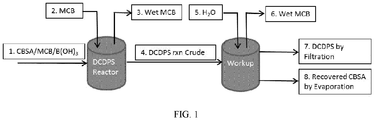
- FIG. 1 is a flow diagram showing one embodiment of a process for preparing dichlorodiphenyl sulfone from chlorobenzene sulfonic acid, include a coupling step and a purification step.
- a process in accordance with a first embodiment includes a process for preparing a sulfone of the formula wherein X 1 and X 2 are each independently H, halogen, C 1 -C 6 alkyl, C 6 -C 10 aryl, -C 1 -C 6 alkyl-(C 6 -C 10 aryl), -OC 1 -C 6 alkyl or -OC 6 -C 10 aryl, wherein each hydrogen atom in C 1 -C 6 alkyl, C 6 -C 10 aryl, -C 1 -C 6 alkyl-(C 6 -C 10 aryl), -OC 1 -C 6 alkyl or -OC 6 -C 10 aryl is independently optionally substituted with a halogen, C 1 -C 6 alkyl, C 6 -C 10 aryl, -C 1 -C 6 alkyl-(C 6 -C 10 aryl), - OC 1 -C 6 alkyl or
- alkyl includes a chain of carbon atoms, which is optionally branched and contains from 1 to 20 carbon atoms. It is to be further understood that in certain embodiments, alkyl may be advantageously of limited length, including C 1 -C 12 , C 1 -C 10 , C 1 -C 9 , C 1 -C 8 , C 1 -C 7 , C 1 -C 6 , and C 1 -C 4 , Illustratively, such particularly limited length alkyl groups, including C 1 -C 8 , C 1 -C 7 , C 1 -C 6 , and C 1 -C 4 , and the like may be referred to as "lower alkyl.” Illustrative alkyl groups include, but are not limited to, methyl, ethyl, n-propyl, isopropyl, n-butyl, isobutyl, sec-butyl, tert-butyl, pentyl,
- Alkyl may be substituted or unsubstituted.
- alkyl may be combined with other groups, such as those provided above, to form a functionalized alkyl.
- the combination of an "alkyl” group, as described herein, with a “carboxy” group may be referred to as a “carboxyalkyl” group.
- Other non-limiting examples include hydroxyalkyl, aminoalkyl, and the like.
- aryl refers to an all-carbon monocyclic or fused-ring polycyclic groups of 6 to 12 carbon atoms having a completely conjugated pi-electron system. It will be understood that in certain embodiments, aryl may be advantageously of limited size such as C 6 -C 10 aryl. Illustrative aryl groups include, but are not limited to, phenyl, naphthalenyl and anthracenyl. The aryl group may be unsubstituted, or substituted as described for alkyl or as described in the various embodiments provided herein. It will be understood that "aryl” may be combined with other groups, to form a functionalized aryl.
- hydroxy or ""hydroxyl” refers to an -OH group.
- alkoxy refers to an -O-(alkyl) group, such as an -OC 1 -C 6 alkyl. Representative examples include, but are not limited to, methoxy, ethoxy, propoxy, butoxy, cyclopropyloxy, cyclobutyloxy, cyclopentyloxy, cyclohexyloxy, and the like.
- aryloxy refers to an -O-aryl group, such as an -OC 6 -C 10 aryl.
- mercapto refers to an -SH group.
- alkylthio refers to an -S-(alkyl) or an -S-(unsubstituted cycloalkyl) group. Representative examples include, but are not limited to, methylthio, ethylthio, propylthio, butylthio, cyclopropylthio, cyclobutylthio, cyclopentylthio, cyclohexylthio, and the like.
- arylthio refers to an -S-aryl or an -S-heteroaryl group. Representative examples include, but are not limited to, phenylthio, pyridinylthio, furanylthio, thienylthio, pyrimidinylthio, and the like.
- cyano refers to a -CN group.
- oxo represents a carbonyl oxygen.
- a cyclopentyl substituted with oxo is cyclopentanone.
- halogen refers to fluorine (F), chlorine (Cl), bromine (Br), and iodine (I). Halogens in their anionic forms or when covalently bonded to another atom may be alternatively referred to as "halides.” Illustratively, a bond between carbon and a halogen is understood to be a covalent bond and may be alternatively referred to as a carbon-halogen or carbon-halide bond.
- bond refers to a covalent bond
- substituted means that the specified group or moiety bears one or more substituents.
- unsubstituted means that the specified group bears no substituents.
- substitution is meant to occur at any valency-allowed position on the system.
- substituted means that the specified group or moiety bears one, two, or three substituents.
- substituted means that the specified group or moiety bears one or two substituents.
- substituted means the specified group or moiety bears one substituent.
- each hydrogen atom in C 1 -C 6 alkyl is independently optionally substituted by halogen
- a halogen may be but need not be present on the C 1 -C 6 alkyl replacement of a hydrogen atom for each halogen group, and the description includes situations where a C 1 -C 6 alkyl, for example, is substituted with a halogen, and situations where a C 1 -C 6 alkyl, for example, is not substituted with a halogen.
- the process of the present disclosure additionally includes a first step comprising contacting a reactant of the formula wherein X 1 is H, halogen, C 1 -C 6 alkyl, C 6 -C 10 aryl, -C 1 -C 6 alkyl-(C 6 -C 10 aryl), -OC 1 -C 6 alkyl or -OC 6 -C 10 aryl, wherein each hydrogen atom in C 1 -C 6 alkyl, C 6 -C 10 aryl, -C 1 -C 6 alkyl-(C 6 -C 10 aryl), -OC 1 -C 6 alkyl or -OC 6 -C 10 aryl is independently optionally substituted with a halogen, C 1 -C 6 alkyl, C 6 -C 10 aryl, -C 1 -C 6 alkyl-(C 6 -C 10 aryl), -OC 1 -C 6 alkyl or -OC 6 -C 10 aryl
- the first step is generally described by the equation:
- the first step may be performed in a first reaction vessel and the product mixture produced by the first step may be transferred to a second reaction vessel after the first step for use in a coupling step.
- the product mixture of the first step may comprise a sulfonic acid, an aryl halide, and a sulfone.
- the sulfonic acid may be chlorobenzene sulfonic acid
- the aryl halide may be monocholorbenzene
- the sulfone may be dichlorodiphenyl sulfone.
- the first product mixture comprises about 53% of the sulfonic acid, about 6% of the aryl halide, and about 41% of the sulfone.
- the process of the present disclosure comprises a coupling step comprising contacting a sulfonic acid of the formula wherein X 1 is a halogen, with an aryl halide of the formula wherein X 2 is H, halogen, C 1 -C 6 alkyl, C 6 -C 10 aryl, -C 1 -C 6 alkyl-(C 6 -C 10 aryl), -OC 1 -C 6 alkyl or -OC 6 -C 10 aryl, wherein each hydrogen atom in C 1 -C 6 alkyl, C 6 -C 10 aryl, -C 1 -C 6 alkyl-(C 6 -C 10 aryl), -OC 1 -C 6 alkyl or -OC 6 -C 10 aryl is independently optionally substituted with a halogen, C 1 -C 6 alkyl, C 6 -C 10 aryl, -C 1 -C 6 alkyl-(C 6 -C 10
- the coupling step is generally described by the equation:
- a bond is formed between a carbon of the aryl halide and the sulfur of sulfur trioxide.
- the bond may form as a result of an electrophilic aromatic substitution reaction in which sulfur trioxide replaces an aryl hydrogen.
- the coupling step occurs in the presence of a catalyst, and resulting water is removed during the coupling step.
- resulting water describes water formed as a result of the coupling step.
- the coupling step may comprise adding the catalyst to the product mixture of the first step.
- the catalyst is boric acid.
- the first step and the coupling steps are separate steps of a batch process. In another aspect of the present disclosure, the first step and the coupling steps are separate steps of a continuous process. In other embodiments, the first step is a batch process, and the coupling step is a continuous process.
- X 1 and X 2 are Cl.
- the sulfone is of the formula
- yield describes the actual amount of a product produced by a reaction relative to the theoretical maximum amount of the product predicted by a stoichiometric calculation.
- determining yield by the sulfone relative to the sulfonic acid may include determining the theoretical maximum amount of the sulfone based on the number of moles of the sulfonic acid in the initial reaction mixture. Calculating yield is well understood in the art.
- crude yield describes yield determined after reaction workup or quenching, prior to additional purification steps.
- purified yield describes yield determined after reaction workup or quenching and after one or more purification steps.
- the process produces sulfone products with enhanced yields.
- the crude yield of the coupling step is about 50% to about 100%, about 55% to about 100%, about 60% to about 100%, about 65% to about 100%, about 70% to about 100%, about 75% to about 100%, about 80% to about 100%, about 85% to about 100%, about 50% to about 95%, about 55% to about 95%, about 60% to about 95%, about 65% to about 95%, about 70% to about 95%, about 75% to about 95%, about 80% to about 95%, about 85% to about 95%, about 50% to about 90%, about 55% to about 90%, about 60% to about 90%, about 65% to about 90%, about 70% to about 90%, about 75% to about 90%, about 80% to about 90%, or about 85% to about 90%.
- the crude yield of the coupling step as determined by the sulfone relative to the sulfonic acid, may be about 60% to about 95%. Additionally, the crude yield of the coupling step, as determined by the sulfone relative to the sulfonic acid, may be about 82% to about 93%.
- the purified yield of the coupling step is about 40% to about 95%, about 45% to about 95%, about 50% to about 95%, about 55% to about 95%, about 60% to about 95%, about 65% to about 95%, about 70% to about 95%, about 75% to about 95%, about 80% to about 95%, 40% to about 90%, about 45% to about 90%, about 50% to about 90%, about 55% to about 90%, about 60% to about 90%, about 65% to about 90%, about 70% to about 90%, about 75% to about 90%, about 80% to about 90%, 40% to about 85%, about 45% to about 85%, about 50% to about 85%, about 55% to about 85%, about 60% to about 85%, about 65% to about 85%, about 70% to about 85%, about 75% to about 85%, or about 80% to about 85%.
- the purified yield of the coupling step may be about 50% to about 85%. Additionally, the purified yield of the coupling step, as determined by the sulfone relative to the sulfonic acid, may be about 70% to about 75%.
- the coupling step is initiated under anhydrous conditions.
- the coupling step is initiated with less than about 10 wt% water, less than about 5 wt% water, less than about 1 wt% water, or less than about 0.5 wt% water.
- the coupling step is initiated with less than about 10 wt% water.
- the resulting water in the coupling step is removed continuously during the coupling step.
- the resulting water may be removed by distillation.
- the concentration of water throughout the coupling step is less than about 10 wt% water, less than about 5 wt% water, less than about 1 wt% water, or less than about 0.5 wt% water.
- the concentration of water throughout the coupling step may be less than about 10 wt% water.
- the coupling step is performed without a dehydrating reagent.
- a "dehydrating reagent” is a reagent that prevents the production of water as a reaction product during the coupling step by reacting with other reactants involved in sulfone formation.
- An example of a dehydrating reagent is trifluoroacetic anhydride when used with cholorbenzene and sulfuric acid.
- the concentration of the catalyst relative to all components of the coupling step, when the coupling step is initiated is about 0.1 wt% to about 10 wt%, about 0.1 wt % to about 5 wt%, about 0.5 wt% to about 2 wt%, about 0.7 wt% to about 1.1 wt%, or about 0.9 wt%.
- the concentration of the catalyst relative to all components of the coupling step, when the coupling step is initiated may be about 0.1 wt% to about 5 wt%.
- the concentration of the catalyst relative to all components of the coupling step, when the coupling step is initiated may be about 0.7 wt% to about 1.1 wt%.
- amount of the catalyst relative to the sulfonic acid, when the coupling step is initiated may be about 0.01 equivalent to about 1 equivalent, about 0.01 equivalent to about 0.5 equivalent, about 0.01 equivalent to about 0.1 equivalent, about 0.01 to about 0.075 equivalent, about 0.02 equivalent to about 1 equivalent, about 0.02 equivalent to about 0.5 equivalent, about 0.02 equivalent to about 0.1 equivalent, about 0.02 to about 0.075 equivalent, about 0.025 equivalent, or about 0.05 equivalent.
- the concentration of the catalyst relative to the sulfonic acid, when the coupling step is initiated may be about 0.01 equivalent to about 0.1 equivalent.
- the concentration of the catalyst relative to the sulfonic acid, when the coupling step is initiated may be about 0.025 equivalent to about 0.05 equivalent.
- the catalyst is a boron catalyst, an iron catalyst, a zinc catalyst, a tin catalyst, a titanium catalyst, a zirconium catalyst, a bismuth catalyst, an antimony catalyst, a silica catalyst, a metal sulfate catalyst, a metal oxide catalyst, a sulfonic acid catalyst, an iodine catalyst, or a combination thereof.
- the catalyst may be aluminum oxide, antimony oxide, zirconium oxide, bismuth oxide, boric anhydride, boric acid, ferric oxide, stannic oxide, titanium oxide, titanium sulfate, zinc oxide, iodine, lithium iodide, methane sulfonic acid, trifluoromethane sulfonic acid, silica, or dimethylsulfate.
- the catalyst may be aluminum oxide.
- the catalyst may be antimony oxide.
- the catalyst may be zirconium oxide.
- the catalyst may be bismuth oxide.
- the catalyst may be boric anhydride.
- the catalyst may be boric acid.
- the catalyst may be ferric oxide. In certain embodiments, the catalyst may be stannic oxide. In certain embodiments, the catalyst may be titanium oxide. In certain embodiments, the catalyst may be titanium sulfate. In certain embodiments, the catalyst may be zinc oxide. In certain embodiments, the catalyst may be iodine. In certain embodiments, the catalyst may be lithium iodide. In certain embodiments, the catalyst may be methane sulfonic acid. In certain embodiments, the catalyst may be trifluoromethane sulfonic acid. In certain embodiments, the catalyst may be silica. In certain embodiments, the catalyst may be dimethylsulfate.
- the coupling step results in less than 20% of a 2,4' isomer of the formula wherein X 1 and X 2 are independently H, halogen, C 1 -C 6 alkyl, C 6 -C 10 aryl, -C 1 -C 6 alkyl-(C 6 -C 10 aryl), -OC 1 -C 6 alkyl or -OC 6 -C 10 aryl, wherein each hydrogen atom in C 1 -C 6 alkyl, C 6 -C 10 aryl, -C 1 -C 6 alkyl-(C 6 -C 10 aryl), -OC 1 -C 6 alkyl or -OC 6 -C 10 aryl is independently optionally substituted with a halogen, C 1 -C 6 alkyl, C 6 -C 10 aryl, -C 1 -C 6 alkyl-(C 6 -C 10 aryl), -OC 1 -C 6 alkyl or -OC 6 -C 10
- the coupling step results in less than 20% of a 3,4' isomer of the formula wherein X 1 and X 2 are independently H, halogen, C 1 -C 6 alkyl, C 6 -C 10 aryl, -C 1 -C 6 alkyl-(C 6 -C 10 aryl), -OC 1 -C 6 alkyl or -OC 6 -C 10 aryl, wherein each hydrogen atom in C 1 -C 6 alkyl, C 6 -C 10 aryl, -C 1 -C 6 alkyl-(C 6 -C 10 aryl), -OC 1 -C 6 alkyl or -OC 6 -C 10 aryl is independently optionally substituted with a halogen, C 1 -C 6 alkyl, C 6 -C 10 aryl, -C 1 -C 6 alkyl-(C 6 -C 10 aryl), -OC 1 -C 6 alkyl or -OC 6 -C 10
- the coupling step results in less than 20% of a 2,4' isomer of the formula wherein X 1 and X 2 are independently halogen, as determined by the 2,4' isomer relative to all sulfone products. In other embodiments, the coupling step results in less than 10% of the 2,4' isomer.
- X 1 and X 2 may be Cl.
- the coupling step results in less than 20% of a 3,4' isomer of the formula wherein X 1 and X 2 are independently halogen, as determined by the 3,4' isomer relative to all sulfone products. In other embodiments, the coupling step results in less than 10% of the 3,4' isomer.
- X 1 and X 2 may be Cl.
- the aryl halide or aryl compound is added to the sulfonic acid continuously during the coupling step.
- the aryl halide may be added to the sulfonic acid continuously for about 0.5 hour to about 20 hours, about 1 hour to about 20 hours, about 2 hours to about 20 hours, about 7 hours to about 20 hours, about 9 hours to about 20 hours, about 10 hours to about 20 hours, about 0.5 hour to about 15 hours, about 1 hour to about 15 hours, about 2 hours to about 15 hours, about 7 hours to about 15 hours, about 9 hours to about 15 hours, about 10 hours to about 15 hours, about 0.5 hour to about 13 hours, about 1 hour to about 13 hours, about 2 hours to about 13 hours, about 7 hours to about 13 hours, about 9 hours to about 13 hours, about 10 hours to about 13 hours, about 0.5 hour to about 12 hours, about 1 hour to about 12 hours, about 2 hours to about 12 hours, about 7 hours to about 12 hours, about 9 hours to about 12 hours, about 10 hours to about 12 hours, or about
- the aryl halide may be added to the sulfonic acid continuously for about 7 hours to about 13 hours. Additionally, the aryl halide may be added to the sulfonic acid continuously for about 9 hours to about 12 hours. Moreover, the aryl halide may be added to the sulfonic acid continuously for about 10 hours.
- the aryl halide or aryl compound is added to the sulfonic acid continuously at the same time that water is removed continuously from the sulfonic acid. In certain embodiments, the aryl halide or aryl compound is added to the sulfonic acid continuously at the same time that wet chlorobenzene is removed continuously from the sulfonic acid.
- the aryl halide or aryl compound may be added at a flow rate of about 0.1 mL/min to about 10 mL/min, about 0.5 mL/min to about 5 mL/min, about 0.5 mL/min to about 3 mL/min, or about 1.5mL/min. More specifically, the aryl halide may be added at a flow rate of about 1.5mL/min.
- the coupling step is performed at a coupling temperature of about 150 °C to about 280 °C, about 160 °C to about 280 °C, about 170 °C to about 280 °C, about 180 °C to about 280 °C, about 150 °C to about 260 °C, about 160 °C to about 260 °C, about 170 °C to about 260 °C, about 180 °C to about 260 °C, about 150 °C to about 240 °C, about 160 °C to about 240 °C, about 170 °C to about 240 °C, or about 180 °C to about 240 °C.
- the coupling step is performed at a coupling temperature of about 180 °C to about 240 °C.
- the coupling temperature may be increased during the coupling step.
- the process may include increasing the coupling temperature from about 180 °C to about 240 °C during the coupling step.
- the coupling temperature may be increased continuously for about 5 minutes to about 120 minutes, about 15 minutes to about 120 minutes, about 30 minutes to about 120 minutes, about 45 minutes to about 120 minutes, about 60 minutes to about 120 minutes, about 90 minutes to about 120 minutes, about 5 minutes to about 90 minutes, about 15 minutes to about 90 minutes, about 30 minutes to about 90 minutes, about 45 minutes to about 90 minutes, about 60 minutes to about 90 minutes, about 5 minutes to about 60 minutes, about 15 minutes to about 60 minutes, about 30 minutes to about 60 minutes, about 45 minutes to about 60 minutes, about 5 minutes to about 45 minutes, about 15 minutes to about 45 minutes, about 30 minutes to about 45 minutes, about 5 minutes to about 30 minutes, about 15 minutes to about 30 minutes, or about 5 minutes to about 15 minutes.
- the coupling temperature is increased continuously for about 15 minutes to about 45 minutes.
- the coupling temperature is increased continuously for about 15 minutes
- aryl halide or aryl compound may be added continuously at the same time that the coupling temperature is increased.
- the aryl halide or aryl compound may be the solvent of the coupling step.
- the coupling step is performed at a pressure of about 15 pounds per square inch (psi) to about 100 psi, about 30 psi to about 100 psi, about 40 psi to about 100 psi, about 15 psi to about 75 psi, about 30 psi to about 75 psi, about 40 psi to about 75 psi, about 15 psi to about 60 psi, about 30 psi to about 60 psi, about 40 psi to about 60 psi, about 15 psi to about 50 psi, about 30 psi to about 50 psi, about 40 psi to about 50 psi, or about 45 psi.
- the coupling step may be performed at a pressure of about 30 psi to about 60 psi.
- coupling step may be performed at a pressure of about 45 psi.
- the process includes one or more purification methods.
- the aryl halide or aryl compound is removed from the sulfone after the coupling step.
- the aryl halide or aryl compound may be removed from the sulfone by distillation.
- the sulfone is cooled to a quenching temperature of about 50 °C to about 70 °C.
- the process may include cooling the sulfone to a quenching temperature of about 60 °C.
- the process includes extracting the sulfone after the coupling step.
- the sulfone may be extracted with an aromatic solvent after the coupling step.
- the sulfone is extracted with toluene after the coupling step.
- the extracting step may be performed after removing the aryl halide or aryl compound from the sulfone.
- the extracting step results in an amber colored solution comprising the sulfone.
- the process of the present disclosure may further comprise washing the sulfone with water.
- the washing step may be performed after extracting the sulfone.
- the washing step may result in the sulfone being substantial free of the sulfonic acid.
- the process may include crystallizing the sulfone.
- a crystallizing step may be performed after washing and extracting the sulfone.
- the crystallizing step may result in the sulfone having a purity of greater than about 95%.
- the crystallizing step results in the sulfone having a purity of greater than about 99%.
- the crystallizing step may result in the sulfone having a purity of about 99.9%.
- the first step of the process of the present disclosure is performed under anhydrous conditions.
- the concentration of water in the first product mixture may be less than about 10 wt% water, less than about 5 wt% water, less than about 1 wt% water, or less than about 0.5 wt% water. In certain embodiments, the concentration of water in the first product mixture is less than about 10 wt% water.
- the first step may be performed at a sulfonation temperature of about 30 °C to about 100 °C, about 40 °C to about 100 °C, about 50 °C to about 100 °C, about 60 °C to about 100 °C, about 30 °C to about 90 °C, about 40 °C to about 90 °C, about 50 °C to about 90 °C, about 60 °C to about 90 °C, about 30 °C to about 80 °C, about 40 °C to about 80 °C, about 50 °C to about 80 °C, about 60 °C to about 80 °C, about 30 °C to about 75 °C, about 40 °C to about 75 °C, about 50 °C to about 75 °C, or about 60 °C to about 75 °C.
- the first step occurs without external cooling.
- FIG. 1 a process for preparing dichlorodiphenyl sulfone from chlorobenzene sulfonic acid is shown.
- the process includes a coupling step and a purification step.
- the coupling step includes first combining chlorobenzene sulfonic acid, monochlorobenzene (also referred to herein as chlorobenzene), and boric acid in a DCDPS reactor (Step 1). After chlorobenzene sulfonic acid, monochlorobenzene, and boric acid are combined in the DCDPS reactor, monochlorobenzene is added (Step 2) while wet monochlorobenezene is removed (Step 3). The coupling step results in a crude dichlorodiphenyl sulfone mixture.
- the purification step includes transferring the crude dichlorodiphenyl sulfone mixture to another vessel fitted with a Dean-Stark trap (Step 4). Water is added to the crude dichlorodiphenyl sulfone mixture (Step 5) while wet monochlorbenzene is removed (Step 6). Dichlorophenyl sulfone is obtained by filtration (Step 7). Chlorobenzene sulfonic acid is recovered by evaporation (Step 8).
- the process of the present disclosure efficiently affords 4,4'-dichlorodiphenylsulfone in high yield and high selectivity with minimal byproduct formation, as further demonstrated by the Examples below.
- a 0.5 L autoclave fitted with an addition pump for chlorobenzene, backflow regulator, and condenser was charged with 50 g conc. sulfuric acid, 100 g chlorobenzene, and 1.5 g boric acid catalyst.
- the back flow regulator was set to 65 psi and the contents of the autoclave were heated to 180 °C at which point condensate began to drip from the condenser.
- Chlorobenzene addition was started at a flow rate of 1.5 mL/min and heating was continued until the reactor reached 240 °C (approximately 1 hour). The chlorobenzene addition was continued for a total of 16 hours while distilling off excess chlorobenzene and any water formed during the reaction.
- the reactor was cooled to 120 °C the autoclave was opened and found to contain a 69 g of a black tar in unreacted chlorobenzene. Analysis showed it to contain 60.5% 4,4'-dichlorodiphenyl sulfone relative to the other dichlorodiphenyl sulfone isomers (see Table 1), but many other unidentified byproducts were also present. The amount of 4.4'-dichlorodiphenyl sulfone in the tar corresponded to a 14% yield relative to reacted chlorobenzene. Attempts to separate the desired material from the byproducts were unsuccessful.
- EXAMPLE 1 Improved process for preparing 4,4'-Dichlorodiphenyl Sulfone using boric acid catalyst
- Chlorobenzene addition was started at a flow rate of 1.5 mL/ min and heating was continued until the reactor temperature reached 240 °C (approximately 30 minutes). The chlorobenzene addition was continued for a total of 10 hours while simultaneously removing wet chlorobenzene though the condenser. At the end of the addition the autoclave contained 50 g chlorobenzene, 29.3 g 4-chlorobenzenesulfonic acid, and 102 g of 4,4'-dichlorodiphenylsulfone and related isomers (85% yield when adjusted for unreacted chlorobenzenesulfonic acid and subtraction of unwanted isomers).
- EXAMPLE 2 Improved process for preparing 4,4'-Dichlorodiphenyl Sulfone using boric acid catalyst and purchased 4-chlorobenzenesulfonic acid.
- the autoclave of example 1 was charged with 104.1 g 4-chlorobenzenesulfonic acid (tech grade, 87.4% by weight, 0.47 Mol) and 1.5 g boric acid.
- the back flow regulator was set to 45 psi and the contents of the autoclave were heated to 180 °C at which point condensate began to drip from the condenser.
- Chlorobenzene addition was started at a flow rate of 1.5 mL/ min and heating was continued until the reactor temperature reached 240 °C (approximately 30 minutes). The chlorobenzene addition was continued for a total of 10 hours while simultaneously removing wet chlorobenzene though the condenser.
- EXAMPLE 3 Preparation of 4,4'-Dichlorodiphenyl Sulfone using ferric oxide catalyst.
- Example 2 The procedure of Example 2 was followed except 0.40 g of ferric oxide was used in place of boric acid, the chlorobenzene addition rate was 1.0 mL/min, and the reaction time was 7.4 hours. 28.3 g of unreacted 4-chlorobenzenesulfonic acid was isolated and 82.3g of 4,4'-dichlorodiphenyl sulfone was obtained in 88.6% isomeric purity (88% yield adjusted for unreacted chlorobenzenesulfonic acid).
- Example 3 The procedure of Example 3 was followed except 3.66 g of stannic oxide was used in place of boric acid, the chlorobenzene addition rate was 1.0 mL/min, and the reaction time was 7.4 hours. 24.4 g unreacted 4-chlorobenzenesulfonic acid was isolated and 84.5 g of 4,4'-dichlorodiphenyl sulfone was obtained in 88.6% isomeric purity (85% yield adjusted for unreacted chlorobenzenesulfonic acid).
- EXAMPLE 5 Preparation of 4,4'-Dichlorodiphenyl Sulfone using titanium sulfate catalyst.
- Example 3 The procedure of Example 3 was followed except 7.3 g of titanium sulfate was used in place of boric acid, the chlorobenzene addition rate was 1.0 mL/min, and the reaction time was 7.4 hours. 27.4 g unreacted 4-chlorobenzenesulfonic acid was isolated and 87.5g of 4,4'-dichlorodiphenyl sulfone was obtained in 86.4% isomeric purity (89% yield adjusted for unreacted chlorobenzenesulfonic acid).
- Example 3 The procedure of Example 3 was followed except 3.16 g of iodine was used in place of boric acid, the chlorobenzene addition rate was 1.0 mL/min, and the reaction time was 12 hours. 27.6 g unreacted 4-chlorobenzenesulfonic acid was isolated and 91.8 g of 4,4'-dichlorodiphenyl sulfone was obtained in 86.7% isomeric purity (87% yield adjusted for unreacted chlorobenzenesulfonic acid).
- Example 3 The procedure of Example 3 was followed except 4.0 g of lithium iodide was used in place of boric acid, the chlorobenzene addition rate was 1.0 mL/min, and the reaction time was 7.4 hours. 44.1 g unreacted 4-chlorobenzenesulfonic acid was isolated and 59.7 g of 4,4'-dichlorodiphenyl sulfone was obtained in 82.1% isomeric purity (81% yield adjusted for unreacted chlorobenzenesulfonic acid).
- EXAMPLE 8 Improved process for preparing 4,4'-Dichlorodiphenyl Sulfone using boric acid catalyst (B400-07)
- a solution of 100 g monochlorobenzene, 95.20 g chlorobenzene sulfonic acid, and 1.5 g boric acid (0.05 equiv) were charged to the autoclave of Example 1.
- the solution contained 7.27 g water.
- the back flow regulator was set to 45 psi and the contents of the autoclave were heated to 180 °C at which point condensate began to drip from the condenser.
- Chlorobenzene addition was started at a flow rate of 1 mL/ min until 454.40 g chlorobenzene was added and heating was continued until the reactor temperature reached 240 °C.
- the chlorobenzene addition was continued while simultaneously removing wet chlorobenzene though the condenser.
- the autoclave contained 56.00 g chlorobenzene, 35.68 g 4-chlorobenzenesulfonic acid, and 82.30 g of 4,4'-dichlorodiphenylsulfone and related isomers (58.0% yield when adjusted for unreacted chlorobenzenesulfonic acid).
- the contents of the autoclave were transferred to a round-bottom flask fitted with a Dean-Stark trap.
- the remaining chlorobenzene was then steam distilled from the mixture while returning the water back into the flask.
- the resultant grey slurry was cooled to 60 °C and extracted twice with toluene.
- EXAMPLE 9 Improved process for preparing 4,4'-Dichlorodiphenyl Sulfone using ferric oxide catalyst (B400-08)
- a solution of 100 g monochlorobenzene, 95.75 g chlorobenzene sulfonic acid, and 0.40 g Fe 2 O 3 (0.025 equiv) were charged to the autoclave of Example 1.
- the solution contained 7.32 g water.
- the back flow regulator was set to 45 psi and the contents of the autoclave were heated to 180 °C at which point condensate began to drip from the condenser.
- Chlorobenzene addition was started at a flow rate of 1 mL/ min until 452.20 g chlorobenzene was added and heating was continued until the reactor temperature reached 240 °C.
- the chlorobenzene addition was continued while simultaneously removing wet chlorobenzene though the condenser.
- the autoclave contained 39.00 g chlorobenzene, 36.17 g 4-chlorobenzenesulfonic acid, and 82.29 g of 4,4'-dichlorodiphenylsulfone and related isomers (57.6% yield when adjusted for unreacted chlorobenzenesulfonic acid).
- the contents of the autoclave were transferred to a round-bottom flask fitted with a Dean-Stark trap.
- the remaining chlorobenzene was then steam distilled from the mixture while returning the water back into the flask.
- the resultant grey slurry was cooled to 60 °C and extracted twice with toluene.
- EXAMPLE 10 Improved process for preparing 4,4'-Dichlorodiphenyl Sulfone using stannic oxide catalyst (B400-24)
- a solution of 100 g monochlorobenzene, 95.80 g chlorobenzene sulfonic acid, and 3.66 g SnO 2 (0.05 equiv) were charged to the autoclave of Example 1.
- the solution contained 7.32 g water.
- the back flow regulator was set to 45 psi and the contents of the autoclave were heated to 180 °C at which point condensate began to drip from the condenser.
- Chlorobenzene addition was started at a flow rate of 1 mL/ min until 482.20 g chlorobenzene was added and heating was continued until the reactor temperature reached 240 °C.
- the chlorobenzene addition was continued while simultaneously removing wet chlorobenzene though the condenser.
- the autoclave contained 47.00 g chlorobenzene, 34.45 g 4-chlorobenzenesulfonic acid, and 84.50 g of 4,4'-dichlorodiphenylsulfone and related isomers (59.2% yield when adjusted for unreacted chlorobenzenesulfonic acid).
- the contents of the autoclave were transferred to a round-bottom flask fitted with a Dean-Stark trap.
- the remaining chlorobenzene was then steam distilled from the mixture while returning the water back into the flask.
- the resultant grey slurry was cooled to 60 °C and extracted twice with toluene.
- EXAMPLE 11 Improved process for preparing 4,4'-Dichlorodiphenyl Sulfone using titanium sulfate catalyst (B400-29)
- a solution of 100 g monochlorobenzene, 95.80 g chlorobenzene sulfonic acid, and 1.5 g TiSO 4 were charged to the autoclave of Example 1.
- the solution contained 7.32 g water.
- the back flow regulator was set to 45 psi and the contents of the autoclave were heated to 180 °C at which point condensate began to drip from the condenser.
- Chlorobenzene addition was started at a flow rate of 1 mL/ min until 473.70 g chlorobenzene was added and heating was continued until the reactor temperature reached 240 °C.
- the chlorobenzene addition was continued while simultaneously removing wet chlorobenzene though the condenser.
- the autoclave contained 49.00 g chlorobenzene, 37.36 g 4-chlorobenzenesulfonic acid, and 87.50 g of 4,4'-dichlorodiphenylsulfone and related isomers (61.3% yield when adjusted for unreacted chlorobenzenesulfonic acid).
- the contents of the autoclave were transferred to a round-bottom flask fitted with a Dean-Stark trap.
- the remaining chlorobenzene was then steam distilled from the mixture while returning the water back into the flask.
- the resultant grey slurry was cooled to 60 °C and extracted twice with toluene.
- EXAMPLE 12 Improved process for preparing 4,4'-Dichlorodiphenyl Sulfone using iodine catalyst (B400-36)
- a solution of 74.77 g monochlorobenzene, 89.41 g chlorobenzene sulfonic acid, and 1.5 g I 2 were charged to the autoclave of Example 1.
- the solution contained 0.1 g water and 7.74 g dichlorodiphenylsulfone.
- the back flow regulator was set to 45 psi and the contents of the autoclave were heated to 180 °C at which point condensate began to drip from the condenser.
- Chlorobenzene addition was started at a flow rate of 1 mL/ min until 760.84 g chlorobenzene was added and heating was continued until the reactor temperature reached 240 °C.
- the chlorobenzene addition was continued while simultaneously removing wet chlorobenzene though the condenser.
- the autoclave contained 48.00 g chlorobenzene, 28.90 g 4-chlorobenzenesulfonic acid, and 91.80 g of 4,4'-dichlorodiphenylsulfone and related isomers (68.9% yield when adjusted for unreacted chlorobenzenesulfonic acid).
- the contents of the autoclave were transferred to a round-bottom flask fitted with a Dean-Stark trap. The remaining chlorobenzene was then steam distilled from the mixture while returning the water back into the flask.
- the resultant grey slurry was cooled to 60 °C and extracted twice with toluene.
- the combined organic layers were washed once with water, and the combined aqueous extracts dewatered to afford 28.90 g unreacted 4-chlorobenzenesulfonic acid.
- Analysis of the toluene extracts determined 86.7% 4,4'-dichlorodiphenylsulfone, 8.2% 2,4'-dichlorodiphenylsulfone, and 5.1% 3,4'-dichlorodiphenylsulfone, each compared to the other dichlorodiphenyl sulfone isomers.
- EXAMPLE 13 Improved process for preparing 4,4'-Dichlorodiphenyl Sulfone using lithium iodide catalyst (B400-40)
- a solution of 105.00 g monochlorobenzene, 96.70 g chlorobenzene sulfonic acid, and 1.5 g LiI were charged to the autoclave of Example 1.
- the solution contained 7.39 g water.
- the back flow regulator was set to 45 psi and the contents of the autoclave were heated to 180 °C at which point condensate began to drip from the condenser.
- Chlorobenzene addition was started at a flow rate of 1 mL/ min until 487.70 g chlorobenzene was added and heating was continued until the reactor temperature reached 240 °C.
- the chlorobenzene addition was continued while simultaneously removing wet chlorobenzene though the condenser.
- the autoclave contained 35.00 g chlorobenzene, 44.10 g 4-chlorobenzenesulfonic acid, and 59.73 g of 4,4'-dichlorodiphenylsulfone and related isomers (41.4% yield when adjusted for unreacted chlorobenzenesulfonic acid).
- the contents of the autoclave were transferred to a round-bottom flask fitted with a Dean-Stark trap.
- the remaining chlorobenzene was then steam distilled from the mixture while returning the water back into the flask.
- the resultant grey slurry was cooled to 60 °C and extracted twice with toluene.
- a reaction vessel was charged with 113 g of chlorobenzene and catalyst (See table 2 for catalysts and amounts used). A gentle flow of SO 3 was introduced into the reaction vessel until a total of 41.5 g of SO 3 was delivered to the reaction vessel. During this time, the internal temperature of the reaction vessel reached a maximum of 75 °C. The mixture was heated to 200 °C during and most of the solvent distilled off. This hot residue was treated with 275g chlorobenzene over a 4 hour period via syringe pump while driving off excess chlorobenzene and any water formed. At the end of the 4 hour period, the reaction was quenched with water (125 mL) and the resultant solid filtered and air dried for 3-4 hours to provide crude DCDPS as a grey solid.
Landscapes
- Chemical & Material Sciences (AREA)
- Organic Chemistry (AREA)
- Chemical Kinetics & Catalysis (AREA)
- Engineering & Computer Science (AREA)
- Materials Engineering (AREA)
- Organic Low-Molecular-Weight Compounds And Preparation Thereof (AREA)
- Low-Molecular Organic Synthesis Reactions Using Catalysts (AREA)
Applications Claiming Priority (3)
| Application Number | Priority Date | Filing Date | Title |
|---|---|---|---|
| US201562173283P | 2015-06-09 | 2015-06-09 | |
| EP16808250.1A EP3307710B1 (en) | 2015-06-09 | 2016-06-09 | Improved process for making diaryl sulfones |
| PCT/US2016/036587 WO2016201039A1 (en) | 2015-06-09 | 2016-06-09 | Improved process for making diaryl sulfones |
Related Parent Applications (1)
| Application Number | Title | Priority Date | Filing Date |
|---|---|---|---|
| EP16808250.1A Division EP3307710B1 (en) | 2015-06-09 | 2016-06-09 | Improved process for making diaryl sulfones |
Publications (1)
| Publication Number | Publication Date |
|---|---|
| EP3805202A1 true EP3805202A1 (en) | 2021-04-14 |
Family
ID=57504373
Family Applications (2)
| Application Number | Title | Priority Date | Filing Date |
|---|---|---|---|
| EP20196720.5A Withdrawn EP3805202A1 (en) | 2015-06-09 | 2016-06-09 | Improved process for making diaryl sulfones |
| EP16808250.1A Active EP3307710B1 (en) | 2015-06-09 | 2016-06-09 | Improved process for making diaryl sulfones |
Family Applications After (1)
| Application Number | Title | Priority Date | Filing Date |
|---|---|---|---|
| EP16808250.1A Active EP3307710B1 (en) | 2015-06-09 | 2016-06-09 | Improved process for making diaryl sulfones |
Country Status (6)
| Country | Link |
|---|---|
| US (2) | US10745348B2 (enExample) |
| EP (2) | EP3805202A1 (enExample) |
| JP (2) | JP2018516952A (enExample) |
| KR (1) | KR102629634B1 (enExample) |
| CN (1) | CN107922325B (enExample) |
| WO (1) | WO2016201039A1 (enExample) |
Families Citing this family (4)
| Publication number | Priority date | Publication date | Assignee | Title |
|---|---|---|---|---|
| US10809947B2 (en) * | 2016-04-06 | 2020-10-20 | Emerge Print Management, Llc | Apparatus and method for metering and monitoring printer related data on non-networked printers |
| EP3441393B1 (en) * | 2017-08-07 | 2020-03-18 | Rhodia Operations | New cycloadduct precursors of dihalodiphenylsulfones and preparations thereof |
| WO2021037797A1 (en) * | 2019-08-27 | 2021-03-04 | Basf Se | (c)crystal composition (cc) comprising 4,4'-dichlorodiphenylsulfone crystals (c) |
| US20220388949A1 (en) | 2019-11-13 | 2022-12-08 | Basf Se | A process for working up water containing 4,4'-dichlorodiphenyl sulfoxide and/or 4,4'-dichlorodiphenyl sulfone as impurities |
Citations (5)
| Publication number | Priority date | Publication date | Assignee | Title |
|---|---|---|---|---|
| JPS5785363A (en) * | 1980-11-18 | 1982-05-28 | Mitsui Toatsu Chem Inc | Preparation of diaryl sulfone |
| US4778932A (en) * | 1986-07-16 | 1988-10-18 | New Japan Chemical Co., Ltd. | Process for preparing diarylsulfones |
| US4937387A (en) | 1986-09-05 | 1990-06-26 | Amoco Corporation | Processes for preparing diaryl sulfones |
| US4983773A (en) | 1988-10-19 | 1991-01-08 | Basf Aktiengesellschaft | Preparation of bis-(4-chlorophenyl) sulfone |
| WO2012143281A1 (en) | 2011-04-18 | 2012-10-26 | Solvay Specialty Polymers Usa, Llc | Process for the manufacture of dihalodiphenylsulfones |
Family Cites Families (32)
| Publication number | Priority date | Publication date | Assignee | Title |
|---|---|---|---|---|
| US2971985A (en) | 1958-07-05 | 1961-02-14 | Roussel Uclaf | Process for the preparation of 4, 4'-dichlorodiphenylsulfone |
| GB895464A (en) * | 1958-07-05 | 1962-05-02 | U C L A F | Improvements in or relating to sulphones |
| US3309409A (en) | 1964-04-10 | 1967-03-14 | Stauffer Chemical Co | Purification of acidic chlorophenylsulfones |
| US3355497A (en) | 1965-02-01 | 1967-11-28 | Plains Chemical Dev Co | Manufacture of 4, 4'-dichlorodiphenyl sulfone |
| CH497396A (de) | 1968-11-06 | 1970-10-15 | Inventa Ag | Verfahren zum Reinigen von Halogendiphenylsulfonen |
| US3855312A (en) * | 1970-02-06 | 1974-12-17 | Ici Ltd | Production of di-4-chlorophenyl sulphone |
| JPS5182237A (en) | 1975-01-16 | 1976-07-19 | Nippon Soda Co | 4*4** jikurofuenirusurupponnoseizojiniokeru jimechiruryusannokaishuhoho |
| JPS5188938A (en) | 1975-01-31 | 1976-08-04 | Kojundo 4*4** jikurorujifuenirusurupponnobunrihoho | |
| JPS6368556A (ja) * | 1986-09-09 | 1988-03-28 | New Japan Chem Co Ltd | ジアリ−ルスルホン類の製造方法 |
| DE3704932A1 (de) | 1987-02-17 | 1988-09-01 | Basf Ag | Verfahren zur herstellung von 4,4'-dichlordiphenylsulfon |
| US4822916A (en) * | 1987-09-21 | 1989-04-18 | Akzo America Inc. | Preparation of diaryl sulfones |
| US4876390A (en) | 1988-08-19 | 1989-10-24 | Uop | Process for separating dichlorodiphenylsulfone isomers |
| DE3902894A1 (de) * | 1989-02-01 | 1990-08-02 | Basf Ag | Verfahren zur herstellung von bis-(4-chlorphenyl)-sulfon |
| DE3902890A1 (de) | 1989-02-01 | 1990-08-02 | Basf Ag | Verfahren zur herstellung von bis-(4-chlorphenyl)-sulfon |
| GB9007577D0 (en) * | 1990-04-04 | 1990-05-30 | Ici Plc | Preparation of aromatic compounds |
| JPH06116231A (ja) * | 1992-10-06 | 1994-04-26 | Ube Ind Ltd | 4,4’−ジクロロジフェニルスルホンの精製法 |
| JPH09143150A (ja) | 1995-11-28 | 1997-06-03 | Tokuyama Corp | 芳香族スルホンの製造方法 |
| JPH09157246A (ja) | 1995-12-13 | 1997-06-17 | Tokuyama Corp | 4,4’−ジクロロジフェニルスルホンの単離方法 |
| JPH09165366A (ja) | 1995-12-15 | 1997-06-24 | Tokuyama Corp | 芳香族スルホンの製造方法 |
| JP3188173B2 (ja) | 1996-01-10 | 2001-07-16 | 株式会社トクヤマ | 芳香族スルホンの製造方法 |
| JPH1017542A (ja) * | 1996-06-28 | 1998-01-20 | New Japan Chem Co Ltd | ジアリールスルホン類の製造方法 |
| RO113981B1 (ro) | 1998-01-30 | 1998-12-30 | Inst Cercetari Chim | Procedeu de obținere a 4,4' -diclor |
| CN1623982A (zh) | 2003-12-02 | 2005-06-08 | 马炳荣 | 4,4’-二氯二苯砜的制备方法 |
| GB0921069D0 (en) * | 2009-12-01 | 2010-01-13 | Bandodkar Hemant R | Process for the production of a sulfone polymer |
| WO2011107465A1 (de) | 2010-03-05 | 2011-09-09 | Basf Se | Verfahren zur herstellung von 4-chlorbenzolsulfonsäure und 4,4'-dichlordiphenylsulfon |
| EP2383256A1 (de) | 2010-04-22 | 2011-11-02 | Basf Se | Verfahren zur Herstellung von 4,4'-Dichlordiphenylsulfon |
| US20110263902A1 (en) | 2010-04-22 | 2011-10-27 | Basf Se | Process for preparing 4,4'-dichlorodiphenyl sulfone |
| EP2383257A1 (de) | 2010-04-22 | 2011-11-02 | Basf Se | Verfahren zur Herstellung von 4,4'-Dichlordiphenylsulfon |
| US20110263903A1 (en) | 2010-04-22 | 2011-10-27 | Basf Se | Process for preparing 4,4'-dichlorodiphenyl sulfone |
| CN102351759A (zh) | 2011-08-25 | 2012-02-15 | 吴江市北厍盛源纺织品助剂厂 | 改进的制备4.4-二氯二苯砜的三氧化硫方法 |
| JP6585347B2 (ja) * | 2011-12-15 | 2019-10-02 | ソルベイ スペシャルティ ポリマーズ ユーエスエー, エルエルシー | ジハロジアリールスルホンの異性体の混合物からハロアリール化合物を製造する方法 |
| WO2013153412A1 (en) | 2012-04-12 | 2013-10-17 | Hemant Ratanakar Bandodkar | Process for the conversion of isomeric mixture of dichlorodiphenyl sulfones to chlorobenzene |
-
2016
- 2016-06-09 US US15/580,486 patent/US10745348B2/en active Active
- 2016-06-09 WO PCT/US2016/036587 patent/WO2016201039A1/en not_active Ceased
- 2016-06-09 EP EP20196720.5A patent/EP3805202A1/en not_active Withdrawn
- 2016-06-09 EP EP16808250.1A patent/EP3307710B1/en active Active
- 2016-06-09 KR KR1020177037284A patent/KR102629634B1/ko active Active
- 2016-06-09 CN CN201680047207.1A patent/CN107922325B/zh active Active
- 2016-06-09 JP JP2017563946A patent/JP2018516952A/ja active Pending
-
2020
- 2020-07-16 US US16/930,627 patent/US20210171457A1/en not_active Abandoned
- 2020-11-17 JP JP2020190852A patent/JP7027509B2/ja active Active
Patent Citations (5)
| Publication number | Priority date | Publication date | Assignee | Title |
|---|---|---|---|---|
| JPS5785363A (en) * | 1980-11-18 | 1982-05-28 | Mitsui Toatsu Chem Inc | Preparation of diaryl sulfone |
| US4778932A (en) * | 1986-07-16 | 1988-10-18 | New Japan Chemical Co., Ltd. | Process for preparing diarylsulfones |
| US4937387A (en) | 1986-09-05 | 1990-06-26 | Amoco Corporation | Processes for preparing diaryl sulfones |
| US4983773A (en) | 1988-10-19 | 1991-01-08 | Basf Aktiengesellschaft | Preparation of bis-(4-chlorophenyl) sulfone |
| WO2012143281A1 (en) | 2011-04-18 | 2012-10-26 | Solvay Specialty Polymers Usa, Llc | Process for the manufacture of dihalodiphenylsulfones |
Non-Patent Citations (2)
| Title |
|---|
| A.R. HAJIPOUR, ET AL.: "Direct sulfonylation of aromatic rings with aryl or alkyl sulfonic acid using supported P2O5/Al2O3", PHOSPHORUS, SULFUR AND SILICON AND THE RELATED ELEMENTS, vol. 180, no. 9, September 2005 (2005-09-01), Taylor & Francis, US, pages 2029 - 2034, XP055522493, ISSN: 1042-6507, DOI: 10.1080/104265090902796 * |
| G.A. OLAH, ET AL.: "Nafion-H catalysed sulfonylation of aromatics with arene/alkenesulfonic acids for the preparation of sulfones", CHEMICAL COMMUNICATIONS, no. 17, 16 August 2001 (2001-08-16), Royal Society of Chemistry, Cambridge, GB, pages 1696 - 1697, XP055522320, ISSN: 1359-7345, DOI: 10.1039/b104603a * |
Also Published As
| Publication number | Publication date |
|---|---|
| US20210171457A1 (en) | 2021-06-10 |
| EP3307710A4 (en) | 2018-12-19 |
| CN107922325B (zh) | 2021-09-07 |
| EP3307710B1 (en) | 2020-09-30 |
| KR20180016425A (ko) | 2018-02-14 |
| KR102629634B1 (ko) | 2024-01-25 |
| CN107922325A (zh) | 2018-04-17 |
| JP7027509B2 (ja) | 2022-03-01 |
| JP2018516952A (ja) | 2018-06-28 |
| JP2021042221A (ja) | 2021-03-18 |
| EP3307710A1 (en) | 2018-04-18 |
| WO2016201039A1 (en) | 2016-12-15 |
| US10745348B2 (en) | 2020-08-18 |
| US20180179153A1 (en) | 2018-06-28 |
Similar Documents
| Publication | Publication Date | Title |
|---|---|---|
| US20210171457A1 (en) | Process for making diaryl sulfones | |
| KR0184272B1 (ko) | 트리유기포스핀촉매를 사용하는 고리형유기 카본에이트와의 페놀 및 티오페놀류의 히드록시알킬화방법 | |
| EP3157930B1 (en) | Methods for the preparation of 1,3-benzodioxole heterocyclic compounds | |
| US20080275265A1 (en) | Process for the Preparation of (Aminoalkylamino)Alkyl Halides and Conversion to Amifostine | |
| US3678115A (en) | Process for production of sulfur-containing phenols | |
| EP0270724B1 (en) | Preparation of alkyl trifluoroacetoacetate | |
| NO861988L (no) | Mellomprodukter for fremstilling av nye substituerte heterocykliske fenoksyaminer og fremgangsmaate for fremstilling derav. | |
| CN113735785B (zh) | 3,6-二氯吡嗪-2-甲腈的制备方法 | |
| US4093667A (en) | Preparation of 4-n-hexylresorcinol | |
| US5210314A (en) | Preparation of canthaxanthin and astaxanthin | |
| KR950009481B1 (ko) | 1,4-비스(4-하이드록시벤조일)벤젠의 제조방법 | |
| GB2080294A (en) | Method for the Production of N- Cyclohexylbenzothiazole-2- sulfenamide | |
| JP2008162902A (ja) | ジフルオロ酢酸エステルの製造方法 | |
| JPH0460457B2 (enExample) | ||
| JPH02304061A (ja) | 含硫黄脂肪族カルボン酸エステル及びその酸の製造方法 | |
| JP2001058968A (ja) | 1,3−ジ(2−p−ヒドロキシフェニル−2−プロピル)ベンゼンの製造方法 | |
| KR101081115B1 (ko) | 베타카로텐의 제조방법 | |
| JPS5962542A (ja) | 精製2,2−ビス(4−ヒドロキシフエニル)プロパンのフエノ−ル付加物の製法 | |
| JPS6232188B2 (enExample) | ||
| JPH0625151A (ja) | オルソベンゼンジチオール類の製造方法 | |
| JPH05500813A (ja) | アルキル―〔3クロロフェニル〕―スルホンの製造方法 | |
| CN121021350A (zh) | 一种2,6-二叔丁基-4-巯基苯酚的制备方法 | |
| CN115010694A (zh) | 氟代碳酸乙烯酯及其制备方法 | |
| KR20220157077A (ko) | 방향족 화합물의 제조방법 | |
| CN119707763A (zh) | 一种合成硫代酰胺的方法 |
Legal Events
| Date | Code | Title | Description |
|---|---|---|---|
| PUAI | Public reference made under article 153(3) epc to a published international application that has entered the european phase |
Free format text: ORIGINAL CODE: 0009012 |
|
| STAA | Information on the status of an ep patent application or granted ep patent |
Free format text: STATUS: THE APPLICATION HAS BEEN PUBLISHED |
|
| AC | Divisional application: reference to earlier application |
Ref document number: 3307710 Country of ref document: EP Kind code of ref document: P |
|
| AK | Designated contracting states |
Kind code of ref document: A1 Designated state(s): AL AT BE BG CH CY CZ DE DK EE ES FI FR GB GR HR HU IE IS IT LI LT LU LV MC MK MT NL NO PL PT RO RS SE SI SK SM TR |
|
| STAA | Information on the status of an ep patent application or granted ep patent |
Free format text: STATUS: THE APPLICATION IS DEEMED TO BE WITHDRAWN |
|
| 18D | Application deemed to be withdrawn |
Effective date: 20211015 |