EP3769959B1 - Film, metal-clad laminate, flexible substrate, manufacturing method for film, manufacturing method for metal-clad laminate, and manufacturing method for flexible substrate - Google Patents
Film, metal-clad laminate, flexible substrate, manufacturing method for film, manufacturing method for metal-clad laminate, and manufacturing method for flexible substrate Download PDFInfo
- Publication number
- EP3769959B1 EP3769959B1 EP20738489.2A EP20738489A EP3769959B1 EP 3769959 B1 EP3769959 B1 EP 3769959B1 EP 20738489 A EP20738489 A EP 20738489A EP 3769959 B1 EP3769959 B1 EP 3769959B1
- Authority
- EP
- European Patent Office
- Prior art keywords
- polyamic acid
- precursor
- layer
- film
- adhesive layer
- Prior art date
- Legal status (The legal status is an assumption and is not a legal conclusion. Google has not performed a legal analysis and makes no representation as to the accuracy of the status listed.)
- Active
Links
Images


Classifications
-
- B—PERFORMING OPERATIONS; TRANSPORTING
- B32—LAYERED PRODUCTS
- B32B—LAYERED PRODUCTS, i.e. PRODUCTS BUILT-UP OF STRATA OF FLAT OR NON-FLAT, e.g. CELLULAR OR HONEYCOMB, FORM
- B32B15/00—Layered products comprising a layer of metal
- B32B15/04—Layered products comprising a layer of metal comprising metal as the main or only constituent of a layer, which is next to another layer of the same or of a different material
- B32B15/08—Layered products comprising a layer of metal comprising metal as the main or only constituent of a layer, which is next to another layer of the same or of a different material of synthetic resin
-
- B—PERFORMING OPERATIONS; TRANSPORTING
- B32—LAYERED PRODUCTS
- B32B—LAYERED PRODUCTS, i.e. PRODUCTS BUILT-UP OF STRATA OF FLAT OR NON-FLAT, e.g. CELLULAR OR HONEYCOMB, FORM
- B32B27/00—Layered products comprising a layer of synthetic resin
- B32B27/28—Layered products comprising a layer of synthetic resin comprising synthetic resins not wholly covered by any one of the sub-groups B32B27/30 - B32B27/42
- B32B27/281—Layered products comprising a layer of synthetic resin comprising synthetic resins not wholly covered by any one of the sub-groups B32B27/30 - B32B27/42 comprising polyimides
-
- B—PERFORMING OPERATIONS; TRANSPORTING
- B29—WORKING OF PLASTICS; WORKING OF SUBSTANCES IN A PLASTIC STATE IN GENERAL
- B29C—SHAPING OR JOINING OF PLASTICS; SHAPING OF MATERIAL IN A PLASTIC STATE, NOT OTHERWISE PROVIDED FOR; AFTER-TREATMENT OF THE SHAPED PRODUCTS, e.g. REPAIRING
- B29C48/00—Extrusion moulding, i.e. expressing the moulding material through a die or nozzle which imparts the desired form; Apparatus therefor
- B29C48/001—Combinations of extrusion moulding with other shaping operations
- B29C48/0021—Combinations of extrusion moulding with other shaping operations combined with joining, lining or laminating
-
- B—PERFORMING OPERATIONS; TRANSPORTING
- B29—WORKING OF PLASTICS; WORKING OF SUBSTANCES IN A PLASTIC STATE IN GENERAL
- B29C—SHAPING OR JOINING OF PLASTICS; SHAPING OF MATERIAL IN A PLASTIC STATE, NOT OTHERWISE PROVIDED FOR; AFTER-TREATMENT OF THE SHAPED PRODUCTS, e.g. REPAIRING
- B29C48/00—Extrusion moulding, i.e. expressing the moulding material through a die or nozzle which imparts the desired form; Apparatus therefor
- B29C48/03—Extrusion moulding, i.e. expressing the moulding material through a die or nozzle which imparts the desired form; Apparatus therefor characterised by the shape of the extruded material at extrusion
- B29C48/07—Flat, e.g. panels
- B29C48/08—Flat, e.g. panels flexible, e.g. films
-
- B—PERFORMING OPERATIONS; TRANSPORTING
- B29—WORKING OF PLASTICS; WORKING OF SUBSTANCES IN A PLASTIC STATE IN GENERAL
- B29C—SHAPING OR JOINING OF PLASTICS; SHAPING OF MATERIAL IN A PLASTIC STATE, NOT OTHERWISE PROVIDED FOR; AFTER-TREATMENT OF THE SHAPED PRODUCTS, e.g. REPAIRING
- B29C48/00—Extrusion moulding, i.e. expressing the moulding material through a die or nozzle which imparts the desired form; Apparatus therefor
- B29C48/16—Articles comprising two or more components, e.g. co-extruded layers
- B29C48/18—Articles comprising two or more components, e.g. co-extruded layers the components being layers
-
- B—PERFORMING OPERATIONS; TRANSPORTING
- B29—WORKING OF PLASTICS; WORKING OF SUBSTANCES IN A PLASTIC STATE IN GENERAL
- B29C—SHAPING OR JOINING OF PLASTICS; SHAPING OF MATERIAL IN A PLASTIC STATE, NOT OTHERWISE PROVIDED FOR; AFTER-TREATMENT OF THE SHAPED PRODUCTS, e.g. REPAIRING
- B29C48/00—Extrusion moulding, i.e. expressing the moulding material through a die or nozzle which imparts the desired form; Apparatus therefor
- B29C48/16—Articles comprising two or more components, e.g. co-extruded layers
- B29C48/18—Articles comprising two or more components, e.g. co-extruded layers the components being layers
- B29C48/21—Articles comprising two or more components, e.g. co-extruded layers the components being layers the layers being joined at their surfaces
-
- B—PERFORMING OPERATIONS; TRANSPORTING
- B32—LAYERED PRODUCTS
- B32B—LAYERED PRODUCTS, i.e. PRODUCTS BUILT-UP OF STRATA OF FLAT OR NON-FLAT, e.g. CELLULAR OR HONEYCOMB, FORM
- B32B15/00—Layered products comprising a layer of metal
- B32B15/18—Layered products comprising a layer of metal comprising iron or steel
-
- B—PERFORMING OPERATIONS; TRANSPORTING
- B32—LAYERED PRODUCTS
- B32B—LAYERED PRODUCTS, i.e. PRODUCTS BUILT-UP OF STRATA OF FLAT OR NON-FLAT, e.g. CELLULAR OR HONEYCOMB, FORM
- B32B15/00—Layered products comprising a layer of metal
- B32B15/20—Layered products comprising a layer of metal comprising aluminium or copper
-
- B—PERFORMING OPERATIONS; TRANSPORTING
- B32—LAYERED PRODUCTS
- B32B—LAYERED PRODUCTS, i.e. PRODUCTS BUILT-UP OF STRATA OF FLAT OR NON-FLAT, e.g. CELLULAR OR HONEYCOMB, FORM
- B32B27/00—Layered products comprising a layer of synthetic resin
- B32B27/06—Layered products comprising a layer of synthetic resin as the main or only constituent of a layer, which is next to another layer of the same or of a different material
- B32B27/08—Layered products comprising a layer of synthetic resin as the main or only constituent of a layer, which is next to another layer of the same or of a different material of synthetic resin
-
- B—PERFORMING OPERATIONS; TRANSPORTING
- B32—LAYERED PRODUCTS
- B32B—LAYERED PRODUCTS, i.e. PRODUCTS BUILT-UP OF STRATA OF FLAT OR NON-FLAT, e.g. CELLULAR OR HONEYCOMB, FORM
- B32B37/00—Methods or apparatus for laminating, e.g. by curing or by ultrasonic bonding
- B32B37/0007—Methods or apparatus for laminating, e.g. by curing or by ultrasonic bonding involving treatment or provisions in order to avoid deformation or air inclusion, e.g. to improve surface quality
- B32B37/0015—Methods or apparatus for laminating, e.g. by curing or by ultrasonic bonding involving treatment or provisions in order to avoid deformation or air inclusion, e.g. to improve surface quality to avoid warp or curl
-
- B—PERFORMING OPERATIONS; TRANSPORTING
- B32—LAYERED PRODUCTS
- B32B—LAYERED PRODUCTS, i.e. PRODUCTS BUILT-UP OF STRATA OF FLAT OR NON-FLAT, e.g. CELLULAR OR HONEYCOMB, FORM
- B32B37/00—Methods or apparatus for laminating, e.g. by curing or by ultrasonic bonding
- B32B37/14—Methods or apparatus for laminating, e.g. by curing or by ultrasonic bonding characterised by the properties of the layers
- B32B37/15—Methods or apparatus for laminating, e.g. by curing or by ultrasonic bonding characterised by the properties of the layers with at least one layer being manufactured and immediately laminated before reaching its stable state, e.g. in which a layer is extruded and laminated while in semi-molten state
-
- B—PERFORMING OPERATIONS; TRANSPORTING
- B32—LAYERED PRODUCTS
- B32B—LAYERED PRODUCTS, i.e. PRODUCTS BUILT-UP OF STRATA OF FLAT OR NON-FLAT, e.g. CELLULAR OR HONEYCOMB, FORM
- B32B37/00—Methods or apparatus for laminating, e.g. by curing or by ultrasonic bonding
- B32B37/14—Methods or apparatus for laminating, e.g. by curing or by ultrasonic bonding characterised by the properties of the layers
- B32B37/15—Methods or apparatus for laminating, e.g. by curing or by ultrasonic bonding characterised by the properties of the layers with at least one layer being manufactured and immediately laminated before reaching its stable state, e.g. in which a layer is extruded and laminated while in semi-molten state
- B32B37/153—Methods or apparatus for laminating, e.g. by curing or by ultrasonic bonding characterised by the properties of the layers with at least one layer being manufactured and immediately laminated before reaching its stable state, e.g. in which a layer is extruded and laminated while in semi-molten state at least one layer is extruded and immediately laminated while in semi-molten state
-
- B—PERFORMING OPERATIONS; TRANSPORTING
- B32—LAYERED PRODUCTS
- B32B—LAYERED PRODUCTS, i.e. PRODUCTS BUILT-UP OF STRATA OF FLAT OR NON-FLAT, e.g. CELLULAR OR HONEYCOMB, FORM
- B32B38/00—Ancillary operations in connection with laminating processes
- B32B38/10—Removing layers, or parts of layers, mechanically or chemically
-
- B—PERFORMING OPERATIONS; TRANSPORTING
- B32—LAYERED PRODUCTS
- B32B—LAYERED PRODUCTS, i.e. PRODUCTS BUILT-UP OF STRATA OF FLAT OR NON-FLAT, e.g. CELLULAR OR HONEYCOMB, FORM
- B32B7/00—Layered products characterised by the relation between layers; Layered products characterised by the relative orientation of features between layers, or by the relative values of a measurable parameter between layers, i.e. products comprising layers having different physical, chemical or physicochemical properties; Layered products characterised by the interconnection of layers
- B32B7/04—Interconnection of layers
- B32B7/12—Interconnection of layers using interposed adhesives or interposed materials with bonding properties
-
- C—CHEMISTRY; METALLURGY
- C08—ORGANIC MACROMOLECULAR COMPOUNDS; THEIR PREPARATION OR CHEMICAL WORKING-UP; COMPOSITIONS BASED THEREON
- C08G—MACROMOLECULAR COMPOUNDS OBTAINED OTHERWISE THAN BY REACTIONS ONLY INVOLVING UNSATURATED CARBON-TO-CARBON BONDS
- C08G73/00—Macromolecular compounds obtained by reactions forming a linkage containing nitrogen with or without oxygen or carbon in the main chain of the macromolecule, not provided for in groups C08G12/00 - C08G71/00
- C08G73/06—Polycondensates having nitrogen-containing heterocyclic rings in the main chain of the macromolecule
- C08G73/10—Polyimides; Polyester-imides; Polyamide-imides; Polyamide acids or similar polyimide precursors
-
- C—CHEMISTRY; METALLURGY
- C08—ORGANIC MACROMOLECULAR COMPOUNDS; THEIR PREPARATION OR CHEMICAL WORKING-UP; COMPOSITIONS BASED THEREON
- C08L—COMPOSITIONS OF MACROMOLECULAR COMPOUNDS
- C08L79/00—Compositions of macromolecular compounds obtained by reactions forming in the main chain of the macromolecule a linkage containing nitrogen with or without oxygen or carbon only, not provided for in groups C08L61/00 - C08L77/00
- C08L79/04—Polycondensates having nitrogen-containing heterocyclic rings in the main chain; Polyhydrazides; Polyamide acids or similar polyimide precursors
- C08L79/08—Polyimides; Polyester-imides; Polyamide-imides; Polyamide acids or similar polyimide precursors
-
- C—CHEMISTRY; METALLURGY
- C09—DYES; PAINTS; POLISHES; NATURAL RESINS; ADHESIVES; COMPOSITIONS NOT OTHERWISE PROVIDED FOR; APPLICATIONS OF MATERIALS NOT OTHERWISE PROVIDED FOR
- C09D—COATING COMPOSITIONS, e.g. PAINTS, VARNISHES OR LACQUERS; FILLING PASTES; CHEMICAL PAINT OR INK REMOVERS; INKS; CORRECTING FLUIDS; WOODSTAINS; PASTES OR SOLIDS FOR COLOURING OR PRINTING; USE OF MATERIALS THEREFOR
- C09D179/00—Coating compositions based on macromolecular compounds obtained by reactions forming in the main chain of the macromolecule a linkage containing nitrogen, with or without oxygen, or carbon only, not provided for in groups C09D161/00 - C09D177/00
- C09D179/04—Polycondensates having nitrogen-containing heterocyclic rings in the main chain; Polyhydrazides; Polyamide acids or similar polyimide precursors
- C09D179/08—Polyimides; Polyester-imides; Polyamide-imides; Polyamide acids or similar polyimide precursors
-
- H—ELECTRICITY
- H05—ELECTRIC TECHNIQUES NOT OTHERWISE PROVIDED FOR
- H05K—PRINTED CIRCUITS; CASINGS OR CONSTRUCTIONAL DETAILS OF ELECTRIC APPARATUS; MANUFACTURE OF ASSEMBLAGES OF ELECTRICAL COMPONENTS
- H05K1/00—Printed circuits
- H05K1/02—Details
- H05K1/03—Use of materials for the substrate
- H05K1/0313—Organic insulating material
- H05K1/032—Organic insulating material consisting of one material
- H05K1/0346—Organic insulating material consisting of one material containing N
-
- H—ELECTRICITY
- H05—ELECTRIC TECHNIQUES NOT OTHERWISE PROVIDED FOR
- H05K—PRINTED CIRCUITS; CASINGS OR CONSTRUCTIONAL DETAILS OF ELECTRIC APPARATUS; MANUFACTURE OF ASSEMBLAGES OF ELECTRICAL COMPONENTS
- H05K3/00—Apparatus or processes for manufacturing printed circuits
- H05K3/0011—Working of insulating substrates or insulating layers
- H05K3/0017—Etching of the substrate by chemical or physical means
-
- B—PERFORMING OPERATIONS; TRANSPORTING
- B32—LAYERED PRODUCTS
- B32B—LAYERED PRODUCTS, i.e. PRODUCTS BUILT-UP OF STRATA OF FLAT OR NON-FLAT, e.g. CELLULAR OR HONEYCOMB, FORM
- B32B2250/00—Layers arrangement
- B32B2250/03—3 layers
-
- B—PERFORMING OPERATIONS; TRANSPORTING
- B32—LAYERED PRODUCTS
- B32B—LAYERED PRODUCTS, i.e. PRODUCTS BUILT-UP OF STRATA OF FLAT OR NON-FLAT, e.g. CELLULAR OR HONEYCOMB, FORM
- B32B2250/00—Layers arrangement
- B32B2250/04—4 layers
-
- B—PERFORMING OPERATIONS; TRANSPORTING
- B32—LAYERED PRODUCTS
- B32B—LAYERED PRODUCTS, i.e. PRODUCTS BUILT-UP OF STRATA OF FLAT OR NON-FLAT, e.g. CELLULAR OR HONEYCOMB, FORM
- B32B2250/00—Layers arrangement
- B32B2250/05—5 or more layers
-
- B—PERFORMING OPERATIONS; TRANSPORTING
- B32—LAYERED PRODUCTS
- B32B—LAYERED PRODUCTS, i.e. PRODUCTS BUILT-UP OF STRATA OF FLAT OR NON-FLAT, e.g. CELLULAR OR HONEYCOMB, FORM
- B32B2250/00—Layers arrangement
- B32B2250/40—Symmetrical or sandwich layers, e.g. ABA, ABCBA, ABCCBA
-
- B—PERFORMING OPERATIONS; TRANSPORTING
- B32—LAYERED PRODUCTS
- B32B—LAYERED PRODUCTS, i.e. PRODUCTS BUILT-UP OF STRATA OF FLAT OR NON-FLAT, e.g. CELLULAR OR HONEYCOMB, FORM
- B32B2307/00—Properties of the layers or laminate
- B32B2307/20—Properties of the layers or laminate having particular electrical or magnetic properties, e.g. piezoelectric
- B32B2307/202—Conductive
-
- B—PERFORMING OPERATIONS; TRANSPORTING
- B32—LAYERED PRODUCTS
- B32B—LAYERED PRODUCTS, i.e. PRODUCTS BUILT-UP OF STRATA OF FLAT OR NON-FLAT, e.g. CELLULAR OR HONEYCOMB, FORM
- B32B2307/00—Properties of the layers or laminate
- B32B2307/50—Properties of the layers or laminate having particular mechanical properties
- B32B2307/546—Flexural strength; Flexion stiffness
-
- B—PERFORMING OPERATIONS; TRANSPORTING
- B32—LAYERED PRODUCTS
- B32B—LAYERED PRODUCTS, i.e. PRODUCTS BUILT-UP OF STRATA OF FLAT OR NON-FLAT, e.g. CELLULAR OR HONEYCOMB, FORM
- B32B2307/00—Properties of the layers or laminate
- B32B2307/50—Properties of the layers or laminate having particular mechanical properties
- B32B2307/582—Tearability
- B32B2307/5825—Tear resistant
-
- B—PERFORMING OPERATIONS; TRANSPORTING
- B32—LAYERED PRODUCTS
- B32B—LAYERED PRODUCTS, i.e. PRODUCTS BUILT-UP OF STRATA OF FLAT OR NON-FLAT, e.g. CELLULAR OR HONEYCOMB, FORM
- B32B2307/00—Properties of the layers or laminate
- B32B2307/70—Other properties
- B32B2307/732—Dimensional properties
- B32B2307/734—Dimensional stability
-
- B—PERFORMING OPERATIONS; TRANSPORTING
- B32—LAYERED PRODUCTS
- B32B—LAYERED PRODUCTS, i.e. PRODUCTS BUILT-UP OF STRATA OF FLAT OR NON-FLAT, e.g. CELLULAR OR HONEYCOMB, FORM
- B32B2457/00—Electrical equipment
- B32B2457/08—PCBs, i.e. printed circuit boards
-
- B—PERFORMING OPERATIONS; TRANSPORTING
- B32—LAYERED PRODUCTS
- B32B—LAYERED PRODUCTS, i.e. PRODUCTS BUILT-UP OF STRATA OF FLAT OR NON-FLAT, e.g. CELLULAR OR HONEYCOMB, FORM
- B32B37/00—Methods or apparatus for laminating, e.g. by curing or by ultrasonic bonding
- B32B37/12—Methods or apparatus for laminating, e.g. by curing or by ultrasonic bonding characterised by using adhesives
-
- C—CHEMISTRY; METALLURGY
- C08—ORGANIC MACROMOLECULAR COMPOUNDS; THEIR PREPARATION OR CHEMICAL WORKING-UP; COMPOSITIONS BASED THEREON
- C08G—MACROMOLECULAR COMPOUNDS OBTAINED OTHERWISE THAN BY REACTIONS ONLY INVOLVING UNSATURATED CARBON-TO-CARBON BONDS
- C08G73/00—Macromolecular compounds obtained by reactions forming a linkage containing nitrogen with or without oxygen or carbon in the main chain of the macromolecule, not provided for in groups C08G12/00 - C08G71/00
- C08G73/06—Polycondensates having nitrogen-containing heterocyclic rings in the main chain of the macromolecule
- C08G73/10—Polyimides; Polyester-imides; Polyamide-imides; Polyamide acids or similar polyimide precursors
- C08G73/1067—Wholly aromatic polyimides, i.e. having both tetracarboxylic and diamino moieties aromatically bound
Definitions
- the present disclosure relates to a film, a metal clad laminate, a flexible substrate, a method for preparing a film, a method for preparing a metal clad laminate, and a method for preparing a flexible substrate.
- An FPC is capable of accomplishing three-dimensional wiring, movable portion wiring or the like, and is thereby capable of high density mounting in a limited space in an electronic device.
- FCCL flexible copper clad laminate
- etching treatment on the FCCL may include a cleaning process such as an etching, however, when the FCCL has low dewaterability, the cleaning water may remain in the FCCL structure for a long period of time. In such a case, the dimensions of the FCCL may not be stabilized until the cleaning water is completely removed from the FCCL, which sometimes decreases efficiency in FCCL mass production.
- Patent Document 1 Japanese Patent Application Laid-Open Publication No. 2006-051800
- TW 201609867 A US 2014/023847 A1 and WO 2006/107043 A1 disclose a film comprising: a matrix layer formed with a polyimide; a first adhesive layer formed on one surface of the matrix layer formed with first thermoplastic polyimides; and a second adhesive layer formed on the other surface of the matrix layer formed with second thermoplastic polyimide.
- the present disclosure is directed to providing a polyimide film and a metal clad laminate having high structural symmetry and excellent dimensional stability.
- One aspect of the present disclosure provides a film including a matrix layer formed with polyimide for a matrix obtained from pyromellitic dianhydride and m-tolidine, a first adhesive layer formed on one surface of the matrix layer and formed with first thermoplastic polyimide, and a second adhesive layer formed on the other surface of the matrix layer and formed with second thermoplastic polyimide, wherein maximum height roughness of a first interface between the matrix layer and the first adhesive layer and maximum height roughness of a second interface between the matrix layer and the second adhesive layer are 1.0 ⁇ m or less.
- the first thermoplastic polyimide and the second thermoplastic polyimide may be the same polyimide.
- the first thermoplastic polyimide and the second thermoplastic polyimide may be polyimide obtained from pyromellitic anhydride and 2,2-bis[4-(4-aminophenoxy)phenyl]propane.
- the first adhesive layer and the second adhesive layer may have approximately the same thickness.
- Another aspect of the present disclosure provides a metal clad laminate including the film of the aspect, and a metal clad layer formed on at least one surface of the film.
- the metal clad layer may be formed on both surfaces of the film, and peel strength to peel off the metal clad layer from the film may be 10 kg/cm or greater on both surfaces of the film.
- Another aspect of the present disclosure provides a flexible circuit including the film of the aspect, and a conductive pattern formed on at least one surface of the film.
- Another aspect of the present disclosure provides a method for preparing a film according to the invention using a thermal imidization method, the method including preparing a first precursor including first polyamic acid obtained from pyromellitic dianhydride and m-tolidine, preparing a second precursor including second polyamic acid and a third precursor including third polyamic acid, forming a laminate body having the first precursor sandwiched between the second precursor and the third precursor by simultaneously extrusion molding the first precursor, the second precursor and the third precursor, and obtaining a three-layer film by heating the laminate body.
- the obtaining of a three-layer film may include a process of conducting thermal imidization on the first polyamic acid, the second polyamic acid and the third polyamic acid by heating the laminate body to produce polyimide for a matrix derived from the first polyamic acid, first thermoplastic polyimide derived from the second polyamic acid, and second thermoplastic polyimide derived from the third polyamic acid.
- the second polyamic acid and the third polyamic acid may be the same polyamic acid.
- the second polyamic acid and the third polyamic acid may be polyamic acid obtained from pyromellitic anhydride and 2,2-bis[4-(4-aminophenoxy)phenyl]propane.
- Another aspect of the present disclosure provides a method for preparing a metal clad laminate according to the invention using a thermal imidization method, the method including preparing a first precursor including first polyamic acid obtained from pyromellitic dianhydride and m-tolidine, preparing a second precursor including second polyamic acid and a third precursor including third polyamic acid, forming a laminate body having the first precursor sandwiched between the second precursor and the third precursor by simultaneously extrusion molding the first precursor, the second precursor and the third precursor, obtaining a three-layer film by heating the laminate body, and laminating a metal clad layer on the three-layer film.
- Another aspect of the present disclosure provides a method for preparing a flexible circuit according to the invention using a thermal imidization method, the method including preparing a first precursor including first polyamic acid obtained from pyromellitic dianhydride and m-tolidine, preparing a second precursor including second polyamic acid and a third precursor including third polyamic acid, forming a laminate body having the first precursor sandwiched between the second precursor and the third precursor by simultaneously extrusion molding the first precursor, the second precursor and the third precursor, obtaining a three-layer film by heating the laminate body, laminating a metal clad layer on the three-layer film, and forming a conductive pattern on at least one surface of the three-layer film by conducting etching treatment on the metal clad layer.
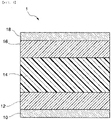
- FIG. 1 is a schematic sectional diagram illustrating a metal clad laminate according to an embodiment.
- the metal clad laminate (1) has a structure in which at least a first metal clad layer (10), a first adhesive layer (12), a matrix layer (14), a second adhesive layer (16) and a second metal clad layer (18) are laminated in this order.
- the metal clad laminate (1) includes a metal clad layer (10, 18) on both surfaces thereof, and between the metal clad layers (10, 18), a first adhesive layer (12), a matrix layer (14), and a second adhesive layer (16) are sandwiched.
- the metal clad laminate (1) has a symmetric structure around the matrix layer (14) with respect to a plane perpendicular to the laminating direction.
- one of the first metal clad layer (10) and the second metal clad layer (18) may not be included.
- the metal clad laminate (1) may have layers other than the above-described layers.
- Metal materials forming the metal clad layer (10, 18) are not particularly limited. Examples of the corresponding metal material may include any metal material such as copper, aluminum, stainless steel, iron, nickel or silver, or an alloy of two or more thereof. Preferably, the metal clad layer (10, 18) is formed with copper foil in terms of conductivity, distribution or costs. Materials of the metal clad layer (10, 18) may be the same as or different from each other.
- the adhesive layer (12, 16) is provided between the metal clad layer (10, 18) and the matrix layer (14) to adhere these to each other.
- the first adhesive layer (12) is located between the first metal clad layer (10) and the matrix layer (14), and the second adhesive layer (16) is located between the second metal clad layer (18) and the matrix layer (14).
- the adhesive layer (12, 16) is formed with thermoplastic polyimide.
- the 'polyimide' in the present specification means a polymer having an imide bond in the molecular structure.
- the adhesive layer (12, 16) may also include a plasticizer, a filler or the like in addition to the thermoplastic polyimide. Since the thermoplastic polyimide softens at a high temperature, the adhesive layer may function as an adhesive material adhering the metal clad layer (10, 18) and the matrix layer (14) to each other.
- pyromellitic dianhydride is preferably used as a tetracarboxylic acid component
- 2,2-bis[4-(4-aminophenoxy)phenyl]propane (4,4-BAPP) is preferably used as a diamine component.
- tetracarboxylic acid component of the polyimide of the adhesive layer (12, 16) 3,3',4,4'-biphenyltetracarboxylic dianhydride (s-BPDA), 2,3,3',4'-biphenyltetracarboxylic dianhydride (a-BPDA), 3,3',4,4'-diphenylsulfonetetracarboxylic dianhydride (DSDA), 4,4'-oxydiphthalic anhydride (ODPA), 3,3',4,4'-benzophenonetetracarboxylic dianhydride (BTDA), and derivatives thereof (for example, tetracarboxylic acids that are not anhydrides, or esters, halides or the like thereof) may be included.
- s-BPDA 3,3',4,4'-biphenyltetracarboxylic dianhydride
- a-BPDA 2,3,3',4'-biphenyltetracarboxy
- Two or more types of tetracarboxylic acid compounds may also be used in combination.
- the diamine component of the polyimide of the adhesive layer (12, 16) 1,3-bis(4-aminophenoxy)benzene (TPE-R), 1,4-bis(4-aminophenoxy)benzene (APB), derivatives thereof (for example, those having a benzene ring in the structure having a lower alkyl substituent or a lower alkoxy substituent, or the like) and the like may be included.
- Two or more types of diamine compounds may also be used in combination.
- the polyimide forming the first adhesive layer (12) and the polyimide forming the second adhesive layer (16) may be the same as or different from each other.
- the thickness of the first adhesive layer (12) and the thickness of the second adhesive layer (16) are approximately the same.
- the 'approximately the same' means that a difference in the thicknesses between the first adhesive layer (12) and the second adhesive layer (16) is 10% or less of the thickness of the first adhesive layer (12), and 10% or less of the thickness of the second adhesive layer (16).
- the matrix layer (14) functions as a matrix of the metal clad laminate (1).
- the 'matrix' in the present specification means a part that is a constituent of the metal clad laminate, and has a function supporting the metal clad laminate itself.
- the matrix layer (14) is formed with non-thermoplastic polyimide.
- the 'non-thermoplastic' in the present specification means a property that does not soften up to the temperature of decomposition even when raising a temperature, and includes a polymer having a softening temperature higher than a decomposition temperature or a thermo-curable polymer.
- the matrix layer (14) may also include, in addition to the non-thermoplastic polyimide, a plasticizer, a filler or the like.
- PMDA is used as the tetracarboxylic acid component
- m-tolidine (2,2'-dimethylbenzidine, 4,4'-diamino-2,2'-dimethylbiphenyl) is used as the diamine component.
- a first precursor for a matrix layer and a second precursor for an adhesive layer are prepared by reacting each raw material of polyimide forming the matrix layer and the adhesive layer (S100).
- the reaction temperature may be, for example, from 20°C to 60°C.
- the first precursor and the second precursor are obtained by dissolving polyamic acid produced from reacting a tetracarboxylic acid compound and a diamine compound, raw materials of polyimide, in a solvent (also referred to as varnish).
- the obtained first precursor and second precursor are extrusion molded in a form of a three-layer laminate body (three-layer sheet) in which the second precursor, the first precursor and the second precursor are laminated in this order using a dice for three-layer extrusion molding (S102).
- the dice for three-layer extrusion molding continuously supplies the extrusion molded three-layer laminate body onto a rotating annular smooth seamless belt (S104).
- the three-layer laminate body disposed on the seamless belt is properly dried using a heater or a hot air blower while being carried by the belt (S106).
- the drying temperature may be, for example, from 100°C to 200°C, and preferably from 130°C to 200°C.
- the three-layer laminate body is peeled off from the belt (S108), and heated using another dryer (for example, a tenter-type dryer) (S110).
- the drying temperature may be, for example, from 200°C to 500°C, and preferably from 200°C to 450°C.
- the solvent is completely removed thereby, and, in addition thereto, the polyamic acid of the first precursor and the second precursor is polyimidized by heat to obtain a three-layer polyimide film (S112).
- the three-layer polyimide film has a layer structure in which a first adhesive layer obtained from the second precursor, a matrix layer obtained from the first precursor, and a second adhesive layer obtained from the second precursor are consecutively laminated.
- the three-layer polyimide film passes between two rotating nip rollers together with metal foil, and is laminated with the metal foil (S114).
- the metal foil is formed on one surface or both surfaces of the three-layer polyimide film to obtain a metal clad laminate (S116).
- masking is conducted with a mask material in accordance with a target wiring pattern shape (S118), and after conducting etching on the non-mask portion with an etchant (S120), the mask material and the etchant are washed (S122), and as a result, a flexible circuit having a target wiring pattern formed thereon is obtained (S124).
- a method of performing polyimidization by heating without using a catalyst as above is referred to as a thermal imidization method', and a method of performing polyimidization using a catalyst is referred to as a 'chemical imidization method'.
- the polyimide film is prepared using a thermal imidization method that does not require a catalyst, and the manufacturing process may be simplified, and the manufacturing costs may be reduced.
- all the polyamic acid produced in the following synthesis examples is generally polyimidized using a thermal imidization method, and use of a chemical imidization method by a catalyst reaction is either impossible or at least difficult.
- Polyamic acid a1 was obtained by preparing a polyamic acid solution in the same manner as in Synthesis Example 1-1 except that the concentration of the solid was changed so as to have a viscosity of 500 poise (50 Pa.s). Polyamic acid a1 has the same chemical composition as polyamic acid A1.
- Polyamic acids b1 to b20 were respectively obtained by preparing a polyamic acid solution in the same manner as in Synthesis Examples 2-1 and 2-20 except that the concentration of the solid was changed so as to have viscosity of 500 poise (50 Pa.s). Polyamic acids b1 to b20 respectively have the same chemical composition as polyamic acids B1 to B20.
- Polyamic acid solution A1 and polyamic acid solution B1 were extrusion molded using a dice for three-layer extrusion molding. Specifically, by supplying polyamic acid solution A1 to an inner layer portion of the dice for three-layer extrusion molding and polyamic acid solution B1 to an outer layer portion on both sides of the corresponding inner layer portion, polyamic acid solutions A1 and B1 were continuously extruded on a seamless belt made of stainless steel from a discharging port of the dice in a three-layer sheet form in which polyamic acid solution B1, polyamic acid solution A1 and polyamic acid solution B1 are laminated in this order.
- This three-layer sheet was heated under a condition of 5 minutes at 130°C, 5 minutes at 160°C and 5 minutes at 180°C to remove DMAc of the solvent.
- Copper foil and a commercially-available polyimide film (used as a buffer layer) were prepared, and these were laminated by passing through two nip rollers heated to approximately 400°C under a nitrogen-substituted environment so as to be laminated in the order of the commercially-available polyimide film (buffer layer), the copper foil, the polyimide film c1-1, the copper foil and the commercially-available polyimide film (buffer layer).
- the nip roller an iron roller of which surface is chrome treated was used.
- a copper clad laminate was prepared in the same manner as in Example 1-1 except that the amount of each of the polyamic acid solutions supplied from the dice was adjusted so that the obtained polyimide film c1-2 had a thickness of 15 ⁇ m.
- copper clad laminate C1-2 including three-layer-structured polyimide film c1-2 (thickness 15 ⁇ m) was obtained.
- Copper clad laminates were prepared in the same manner as in Example 1-1 except that polyamic acid solutions B2 to B20 were respectively used instead of the polyamic acid solution B1 as the precursor for an adhesive layer.
- copper clad laminates C2-1 to C20-1 including three-layer-structured polyimide films c2-1 to c20-1 (thickness 20 ⁇ m) in which the matrix layer obtained from the polyamic acid solution A1 and the adhesive layer obtained from each of the polyamic acid solutions B2 to B20 are each laminated in the order of the adhesive layer, the matrix layer and the adhesive layer was obtained.
- Copper clad laminates were prepared in the same manner as in Example 1-2 except that polyamic acid solutions B2 to B20 were respectively used instead of the polyamic acid solution B1 as the precursor for an adhesive layer.
- copper clad laminates C2-2 to C20-2 including three-layer-structured polyimide films c2-2 to c20-2 (thickness 15 ⁇ m) in which the matrix layer obtained from the polyamic acid solution A1 and the adhesive layer obtained from each of the polyamic acid solutions B2 to B20 are each laminated in the order of the adhesive layer, the matrix layer and the adhesive layer was obtained.
- Polyamic acid solution b1 was uniformly coated on one surface of copper foil (first adhesive layer), and heated under a condition of 3 minutes at 40°C, 3 minutes at 60°C, 3 minutes at 80°C and 3 minutes at 120°C to remove some of the solvent.
- polyamic acid solution a1 was uniformly coated on this first adhesive layer (opposite side of copper foil) (matrix layer), and heated under a condition of 3 minutes at 40°C, 3 minutes at 60°C, 3 minutes at 80°C and 3 minutes at 120°C to remove some solvent.
- polyamic acid solution b1 was uniformly coated on this matrix layer (opposite side of first adhesive layer) (second adhesive layer), and heated under a condition of 3 minutes at 40°C, 3 minutes at 60°C, 3 minutes at 80°C and 3 minutes at 120°C to remove some solvent.
- this laminate body was dried under a condition of 3 minutes at 100°C, 3 minutes at 150°C, 3 minutes at 200°C, 3 minutes at 250°C, 3 minutes at 300°C and 3 minutes at 350°C using a roll-to-roll process for complete imidization, and as a result, single surface copper clad laminate D1-1' was prepared.
- Copper foil, and copper foil having a smooth surface were prepared, and these were laminated in the order of the copper foil having a smooth surface (buffer layer), the single surface copper clad laminate D1-1', the copper foil, the copper foil having a smooth surface (buffer layer), and then passed through two nip rollers heated to approximately 400°C under a nitrogen-substituted environment for lamination.
- nip roller an iron roller of which surface is chrome treated was used as the nip roller.
- a copper clad laminate was prepared in the same manner as in Comparative Example 1-1 except that the coated amount of each of the polyamic acid solutions was adjusted so that the final thickness became 15 ⁇ m.
- copper clad laminate D1-2 including three-layer-structured polyimide film d1-2 (thickness 15 ⁇ m) was obtained.
- Copper clad laminates were prepared in the same manner as in Comparative Example 1-1 except that polyamic acid solutions b2 to b20 were respectively used instead of the polyamic acid solution b1 as the precursor for an adhesive layer.
- copper clad laminates D2-1 to D20-1 including three-layer-structured polyimide films d2-1 to d20-1 (thickness 20 ⁇ m) in which the matrix layer obtained from the polyamic acid solution a1 and the adhesive layer obtained from each of the polyamic acid solutions b2 to b20 are each laminated in the order of the adhesive layer, the matrix layer and the adhesive layer was obtained.
- Copper clad laminates were prepared in the same manner as in Comparative Example 1-2 except that polyamic acid solutions b2 to b20 were respectively used instead of the polyamic acid solution b1 as the precursor for an adhesive layer.
- copper clad laminates D2-2 to D20-2 including three-layer-structured polyimide films d2-2 to d20-2 (thickness 15 ⁇ m) in which the matrix layer obtained from the polyamic acid solution a1 and the adhesive layer obtained from each of the polyamic acid solutions b2 to b20 are each laminated in the order of the adhesive layer, the matrix layer and the adhesive layer was obtained.
- a copper clad laminate was prepared in the same manner as in Example 1-1 except that polyamic acid solution A2 was used instead of the polyamic acid solution A1 as the precursor for a matrix layer.
- a copper clad laminate was prepared in the same manner as in Comparative Example 21-1 except that the amount of each of the polyamic acid solutions supplied from the dice was adjusted so that obtained polyimide film d21-2 had a thickness of 15 ⁇ m. As a result, copper clad laminate D21-2 including three-layer-structured polyimide film d21-2 (thickness 15 ⁇ m) was obtained.
- Copper clad laminates were prepared in the same manner as in Comparative Example 21-1 except that polyamic acid solutions B2 to B20 were respectively used instead of the polyamic acid solution B1 as the precursor for an adhesive layer.
- copper clad laminates D22-1 to D40-1 including three-layer-structured polyimide films d22-1 to d40-1 (thickness 20 ⁇ m) in which the matrix layer obtained from the polyamic acid solution A2 and the adhesive layer obtained from each of the polyamic acid solutions B2 to B20 are each laminated in the order of the adhesive layer, the matrix layer and the adhesive layer was obtained.
- Copper clad laminates were prepared in the same manner as in Comparative Example 21-2 except that polyamic acid solutions B2 to B20 were respectively used instead of the polyamic acid solution B1 as the precursor for an adhesive layer.
- copper clad laminates D22-2 to D40-2 including three-layer-structured polyimide films d22-2 to d40-2 (thickness 15 ⁇ m) in which the matrix layer obtained from the polyamic acid solution A2 and the adhesive layer obtained from each of the polyamic acid solutions B2 to B20 are each laminated in the order of the adhesive layer, the matrix layer and the adhesive layer was obtained.
- a cross section of each of the copper clad laminates obtained in the examples and the comparative examples was observed using a scanning electron microscope (SEM), and for each of the copper clad laminates, a thickness t T1 of the first adhesive layer of the polyimide film, a thickness t c of the matrix layer, a thickness t T2 of the second adhesive layer, interface roughness Rz1 between the first adhesive layer and the matrix layer, and interface roughness Rz2 between the second adhesive layer and the matrix layer were measured.
- SEM scanning electron microscope
- interface roughness Rz1 and interface roughness Rz2 were calculated in accordance with 'maximum height roughness Rz' defined in JIS B 0601, and were defined as a sum of the maximum peak height and the maximum bend depth of the roughness curve R of the two-layer interface (that is, difference in heights between the highest part and the deepest part).
- the dimension was measured before and after etching the copper foil to examine dimensional stability. Specifically, a marker for assignment was marked on the four corners of the copper clad laminate, and using a microscope IM7000 manufactured by KEYENCE Corporation, a longitudinal length and a horizontal length between the markers of the copper clad laminate were measured. Next, the copper foil was etched, and while measuring a longitudinal length and a horizontal length between the markers after that, time taken for the lengths to become the same lengths measured before the etching treatment was measured. Time required for such dimension stability generally corresponds to a dehydration time of the washing water after the etching treatment.
- Each of the copper clad laminates obtained in the examples and the comparative examples was soldered at approximately 340°C to examine whether each of the laminates had heat resistance (o) or not (X) enough to prevent damages making the copper clad laminate unusable.
- Results of Evaluations 1 to 4 performed on each of the copper clad laminates are shown in the following tables.
- peel strength of the first adhesive layer was described on the left side
- peel strength of the second adhesive layer was described on the right side.
- the film was formed by coating in the order of the first adhesive layer having thickness t T1 ⁇ the matrix layer the second adhesive layer having thickness t T2 .
- interface roughness Rz1 and interface roughness Rz2 of the matrix layer and the adhesive layer were all 1.0 ⁇ m or less in Examples 1-1 to 20-2 and Comparative Examples 21-1 to 40-2 preparing the copper clad laminate using the laminate method.
- Comparative Examples 1-1 to 20-2 preparing the copper clad laminate using the cast method one of interface roughness Rz1 and interface roughness Rz2 of the matrix layer and the adhesive layer was 1.0 ⁇ m or less, however, the other side roughness was greater than 1.0 ⁇ m.
- the copper clad laminate prepared using the laminate method had interface roughness suppressed on both sides of the matrix layer compared to the copper clad laminate prepared using the cast method.
- the cast method coating in the order of the first adhesive layer ⁇ the matrix layer ⁇ the second adhesive layer had asymmetric interface roughness on both sides of the matrix layer while having increased two layer mixing at the layer interface.
- a copper clad laminate having high structural symmetry including interface roughness as well as layer thickness was obtained in the laminate method compared to the cast method.
- peel strength of the copper foil on both surfaces of the copper clad laminate was all 10 kg/cm in Examples 1-1 to 20-2 and Comparative Examples 21-1 to 40-2 preparing the copper clad laminate using the laminate method.
- peel strength on the first adhesive layer side was 8 kg/cm, which was smaller than the value of the copper clad laminate prepared using the laminate method.
- peel strength on the second adhesive layer side was also 10 kg/cm in Comparative Examples 1-1 to 20-2.
- the copper clad laminate prepared using the laminate method was excellent in adhesion of the copper foil compared to the copper clad laminate prepared using the cast method.
- Comparative Examples 21-1 to 40-2 the copper clad laminates were all damaged at a soldering temperature regardless of the polyimide film thickness except for Comparative Example 21-1, Comparative Example 21-2, Comparative Example 22-1 and Comparative Example 22-2 using the polyamic acid B1 or B2 as the polyimide material forming the adhesive layer.
- a polyimide film including the matrix layer formed with the polyamic acid solution A1 using PMDA and m-tolidine as raw materials using the laminate method a polyimide film and a metal clad laminate having excellent adhesion, dimensional stability and heat resistance, and having little mixing between two layers at the layer interface were able to be prepared.
- the copper clad laminate prepared using the laminate method had higher structural symmetry compared to the copper clad laminate prepared using the cast method.
- the copper clad laminate prepared using the laminate method In the copper clad laminate prepared using the laminate method, bending of the laminate caused by an asymmetric structure on both sides of the laminate may be suppressed due to high structural symmetry compared to the copper clad laminate prepared using the cast method, and therefore, structural stability of the laminate may be enhanced.
- the copper clad laminate prepared using the laminate method had smaller interface roughness on both sides of the matrix layer compared to the copper clad laminate prepared using the cast method, and therefore, uniformity in the film is favorable, and handling is simple.
- the laminate method is capable of drying the whole laminate at once, and is thereby more efficient than the cast method repeating coating and drying for each layer.
Landscapes
- Chemical & Material Sciences (AREA)
- Engineering & Computer Science (AREA)
- Organic Chemistry (AREA)
- Chemical Kinetics & Catalysis (AREA)
- Mechanical Engineering (AREA)
- Health & Medical Sciences (AREA)
- Medicinal Chemistry (AREA)
- Polymers & Plastics (AREA)
- Microelectronics & Electronic Packaging (AREA)
- Life Sciences & Earth Sciences (AREA)
- Materials Engineering (AREA)
- Wood Science & Technology (AREA)
- Manufacturing & Machinery (AREA)
- Quality & Reliability (AREA)
- Laminated Bodies (AREA)
Applications Claiming Priority (2)
| Application Number | Priority Date | Filing Date | Title |
|---|---|---|---|
| JP2019003369A JP7195530B2 (ja) | 2019-01-11 | 2019-01-11 | フィルム、金属張積層板、フレキシブル基板、フィルムの製造方法、金属張積層板の製造方法、及びフレキシブル基板の製造方法 |
| PCT/KR2020/000409 WO2020145695A1 (ko) | 2019-01-11 | 2020-01-09 | 필름, 금속박 적층판, 플렉시블 기판, 필름의 제조 방법, 금속박 적층판의 제조 방법, 및 플렉시블 기판의 제조 방법 |
Publications (3)
| Publication Number | Publication Date |
|---|---|
| EP3769959A1 EP3769959A1 (en) | 2021-01-27 |
| EP3769959A4 EP3769959A4 (en) | 2021-07-14 |
| EP3769959B1 true EP3769959B1 (en) | 2022-09-28 |
Family
ID=71521722
Family Applications (1)
| Application Number | Title | Priority Date | Filing Date |
|---|---|---|---|
| EP20738489.2A Active EP3769959B1 (en) | 2019-01-11 | 2020-01-09 | Film, metal-clad laminate, flexible substrate, manufacturing method for film, manufacturing method for metal-clad laminate, and manufacturing method for flexible substrate |
Country Status (6)
| Country | Link |
|---|---|
| US (1) | US11845246B2 (enExample) |
| EP (1) | EP3769959B1 (enExample) |
| JP (1) | JP7195530B2 (enExample) |
| KR (1) | KR102452787B1 (enExample) |
| CN (1) | CN112020427A (enExample) |
| WO (1) | WO2020145695A1 (enExample) |
Families Citing this family (2)
| Publication number | Priority date | Publication date | Assignee | Title |
|---|---|---|---|---|
| WO2023053948A1 (ja) * | 2021-09-29 | 2023-04-06 | 信越ポリマー株式会社 | 金属張積層板 |
| WO2023090969A1 (ko) * | 2021-11-22 | 2023-05-25 | 피아이첨단소재 주식회사 | 폴리이미드 전구체 조성물 및 이를 포함하는 폴리이미드 필름 |
Family Cites Families (37)
| Publication number | Priority date | Publication date | Assignee | Title |
|---|---|---|---|---|
| DE69115171T2 (de) * | 1990-08-27 | 1996-05-15 | Du Pont | Flexible Polyimid-Mehrschichtlaminate und ihre Herstellung. |
| JP3265027B2 (ja) * | 1993-01-20 | 2002-03-11 | 三菱伸銅株式会社 | 金属膜付きポリイミドフィルム |
| TWI300744B (enExample) | 2001-04-19 | 2008-09-11 | Nippon Steel Chemical Co | |
| JP4128031B2 (ja) | 2002-06-14 | 2008-07-30 | 三井化学株式会社 | ポリイミド金属積層板 |
| EP1606108B1 (en) * | 2003-03-26 | 2015-08-19 | LG Chem Ltd. | Double-sided metallic laminate and method for manufacturing the same |
| JP2005186274A (ja) | 2003-12-24 | 2005-07-14 | Kaneka Corp | フレキシブル積層板およびその製造方法 |
| JP2005219463A (ja) * | 2004-02-09 | 2005-08-18 | Kaneka Corp | ポリイミド/金属積層体およびその製造方法、並びにその利用 |
| JP4619860B2 (ja) | 2004-07-13 | 2011-01-26 | 新日鐵化学株式会社 | フレキシブル積層板及びその製造方法 |
| JP4773726B2 (ja) | 2005-01-14 | 2011-09-14 | 株式会社カネカ | 多層押出ポリイミドフィルムおよびその利用 |
| CN101180178B (zh) * | 2005-04-04 | 2011-11-09 | 宇部兴产株式会社 | 敷铜层压体 |
| WO2007108284A1 (ja) * | 2006-03-17 | 2007-09-27 | Kaneka Corporation | 接着フィルム |
| WO2007116685A1 (ja) | 2006-03-31 | 2007-10-18 | Kurashiki Boseki Kabushiki Kaisha | 熱可塑性ポリイミド層を有するフレキシブル積層板及びその製造方法 |
| CN101484500A (zh) * | 2006-07-06 | 2009-07-15 | 东丽株式会社 | 热塑性聚酰亚胺、使用该聚酰亚胺的层合聚酰亚胺薄膜以及金属箔层合聚酰亚胺薄膜 |
| JPWO2008004496A1 (ja) * | 2006-07-06 | 2009-12-03 | 東レ株式会社 | 熱可塑性ポリイミド、これを用いた積層ポリイミドフィルムならびに金属箔積層ポリイミドフィルム |
| KR20090068256A (ko) * | 2006-09-15 | 2009-06-25 | 미쓰이 긴조꾸 고교 가부시키가이샤 | 가요성 배선 기판 제조용 금속 복합 적층체 및 가요성 배선 기판 |
| JP2008087254A (ja) * | 2006-09-29 | 2008-04-17 | Nippon Steel Chem Co Ltd | フレキシブル銅張積層板及びキャリア付フレキシブル銅張積層板 |
| JP4927963B2 (ja) | 2010-01-22 | 2012-05-09 | 古河電気工業株式会社 | 表面処理銅箔、その製造方法及び銅張積層基板 |
| KR101257413B1 (ko) * | 2010-02-10 | 2013-04-23 | 주식회사 엘지화학 | 내열성이 우수한 양면 금속 적층판 및 이의 제조방법 |
| JP2012006200A (ja) * | 2010-06-23 | 2012-01-12 | Asahi Kasei E-Materials Corp | ポリイミド金属積層体、及びそれを用いたプリント配線板 |
| CN103282180B (zh) | 2010-12-14 | 2016-04-27 | 株式会社钟化 | 三层共挤压式聚酰亚胺膜的制造方法 |
| JP5904202B2 (ja) * | 2011-03-30 | 2016-04-13 | 宇部興産株式会社 | ポリイミドフィルムおよびそれを用いた金属積層板 |
| JP2015129200A (ja) | 2012-04-19 | 2015-07-16 | 宇部興産株式会社 | 熱融着性ポリイミドフィルム、及びそれを用いたポリイミド金属積層体 |
| JP5931672B2 (ja) * | 2012-09-24 | 2016-06-08 | 新日鉄住金化学株式会社 | ポリイミド積層体及びその製造方法 |
| KR102038137B1 (ko) * | 2012-12-21 | 2019-10-30 | 주식회사 넥스플렉스 | 다층 연성금속박 적층체 및 이의 제조방법 |
| KR101516872B1 (ko) * | 2013-07-08 | 2015-05-04 | 주식회사 두산 | 연성 인쇄회로기판 형성용 절연 수지 시트 및 이의 제조방법, 이를 포함하는 인쇄회로기판 |
| KR101571086B1 (ko) * | 2013-12-27 | 2015-11-23 | 주식회사 두산 | 연성 인쇄회로기판 형성용 절연 수지 시트 및 이의 제조방법, 이를 포함하는 인쇄회로기판 |
| WO2016013627A1 (ja) * | 2014-07-24 | 2016-01-28 | 宇部興産株式会社 | 多層ポリイミドフィルム、多層ポリイミドフィルムの製造方法、それを用いたポリイミド積層体、及びそれらに用いられる共重合ポリイミド |
| JP6473028B2 (ja) | 2015-03-31 | 2019-02-20 | 日鉄ケミカル&マテリアル株式会社 | 銅張積層板、プリント配線板及びその使用方法 |
| JP6522395B2 (ja) * | 2015-03-31 | 2019-05-29 | 株式会社カネカ | ポリイミドフィルム、フレキシブル金属張積層板、およびフレキシブルプリント配線板の製造方法 |
| JP6971580B2 (ja) * | 2016-02-12 | 2021-11-24 | 株式会社カネカ | 多層ポリイミドフィルム、およびフレキシブル金属張積層板 |
| JP2017179149A (ja) * | 2016-03-30 | 2017-10-05 | 株式会社カネカ | ポリイミドフィルム |
| JP6839594B2 (ja) * | 2016-04-27 | 2021-03-10 | 日鉄ケミカル&マテリアル株式会社 | ポリイミドフィルム及び銅張積層板 |
| CN107793991B (zh) * | 2016-09-05 | 2022-03-08 | 荒川化学工业株式会社 | 柔性印刷布线板用覆铜层叠板和柔性印刷布线板 |
| JP6774285B2 (ja) | 2016-09-28 | 2020-10-21 | 日鉄ケミカル&マテリアル株式会社 | 金属張積層板 |
| JP6802131B2 (ja) * | 2016-09-29 | 2020-12-16 | 東レ・デュポン株式会社 | 接着剤付きポリイミドフィルム |
| JP2018145303A (ja) * | 2017-03-06 | 2018-09-20 | 株式会社カネカ | 多層ポリイミドフィルム |
| JP7043745B2 (ja) | 2017-06-14 | 2022-03-30 | スズキ株式会社 | 路面状態分析装置 |
-
2019
- 2019-01-11 JP JP2019003369A patent/JP7195530B2/ja active Active
-
2020
- 2020-01-09 US US17/056,885 patent/US11845246B2/en active Active
- 2020-01-09 EP EP20738489.2A patent/EP3769959B1/en active Active
- 2020-01-09 KR KR1020207028772A patent/KR102452787B1/ko active Active
- 2020-01-09 CN CN202080002404.8A patent/CN112020427A/zh active Pending
- 2020-01-09 WO PCT/KR2020/000409 patent/WO2020145695A1/ko not_active Ceased
Also Published As
| Publication number | Publication date |
|---|---|
| JP7195530B2 (ja) | 2022-12-26 |
| KR102452787B1 (ko) | 2022-10-07 |
| KR20200125720A (ko) | 2020-11-04 |
| US11845246B2 (en) | 2023-12-19 |
| EP3769959A4 (en) | 2021-07-14 |
| WO2020145695A1 (ko) | 2020-07-16 |
| CN112020427A (zh) | 2020-12-01 |
| JP2020110972A (ja) | 2020-07-27 |
| US20210268781A1 (en) | 2021-09-02 |
| EP3769959A1 (en) | 2021-01-27 |
Similar Documents
| Publication | Publication Date | Title |
|---|---|---|
| JP5880658B2 (ja) | ポリイミドフィルム、およびこれらのポリイミド積層体、ポリイミド金属積層体 | |
| JP5594289B2 (ja) | ポリイミドフィルムおよびポリイミドフィルムの製造方法 | |
| TWI486253B (zh) | 金屬化聚醯亞胺薄膜及使用它而獲得之撓性配線板 | |
| KR20020077188A (ko) | 폴리이미드 필름의 표면 처리 방법 및 금속 박막을 갖는폴리이미드 필름 | |
| KR20040108808A (ko) | 폴리이미드 필름 및 그의 제조 방법, 및 폴리이미드필름을 사용한 폴리이미드/금속 적층체 | |
| JP5345116B2 (ja) | 銅張積層板及びその製造方法、並びに該銅張積層板を含む配線基板 | |
| TW202140273A (zh) | 積層體、其製造方法及其使用方法 | |
| EP3769959A1 (en) | Film, metal-clad laminate, flexible substrate, manufacturing method for film, manufacturing method for metal-clad laminate, and manufacturing method for flexible substrate | |
| JP5391905B2 (ja) | ポリイミドフィルムおよびポリイミドフィルムの製造方法 | |
| JP2002321300A (ja) | 接着フィルム及びその製造方法 | |
| TWI417418B (zh) | 鍍敷用材料及其利用 | |
| CN101979451B (zh) | 粘接薄膜、柔性敷金属叠层板及其制备方法 | |
| EP0361461A2 (en) | Process for producing metal-polyimide composite article | |
| CN107428146A (zh) | 聚酰亚胺层叠膜、聚酰亚胺层叠膜的制造方法、热塑性聚酰亚胺的制造方法、以及柔性金属包覆层叠体的制造方法 | |
| CN101151946A (zh) | 柔性覆铜层叠基板的制造方法以及多层层叠体 | |
| KR20030076450A (ko) | 패키지화된 반도체 장치의 전기전도성 밀봉 소자용 방향족폴리이미드 필름 | |
| CN101258212B (zh) | 耐热性粘接片 | |
| JP5499555B2 (ja) | ポリイミドフィルムおよびポリイミドフィルムの製造方法 | |
| JP2000289167A (ja) | 化学メッキ用ベ−スフィルム及びメッキフィルム | |
| JP2006218767A (ja) | ポリイミド系多層フィルムの製造方法およびその利用 | |
| JP3115666B2 (ja) | Tab用テープ | |
| JPH05263049A (ja) | Tab用テープ及び該製造方法 | |
| JPH09148694A (ja) | フレキシブル回路基板 | |
| TW202523014A (zh) | 印刷配線基板用材料及印刷配線基板的製造方法 | |
| WO2013144991A1 (ja) | 銅張積層板及びその製造方法、並びに該銅張積層板を含む配線基板 |
Legal Events
| Date | Code | Title | Description |
|---|---|---|---|
| STAA | Information on the status of an ep patent application or granted ep patent |
Free format text: STATUS: THE INTERNATIONAL PUBLICATION HAS BEEN MADE |
|
| PUAI | Public reference made under article 153(3) epc to a published international application that has entered the european phase |
Free format text: ORIGINAL CODE: 0009012 |
|
| STAA | Information on the status of an ep patent application or granted ep patent |
Free format text: STATUS: REQUEST FOR EXAMINATION WAS MADE |
|
| 17P | Request for examination filed |
Effective date: 20201021 |
|
| AK | Designated contracting states |
Kind code of ref document: A1 Designated state(s): AL AT BE BG CH CY CZ DE DK EE ES FI FR GB GR HR HU IE IS IT LI LT LU LV MC MK MT NL NO PL PT RO RS SE SI SK SM TR |
|
| AX | Request for extension of the european patent |
Extension state: BA ME |
|
| A4 | Supplementary search report drawn up and despatched |
Effective date: 20210614 |
|
| RIC1 | Information provided on ipc code assigned before grant |
Ipc: B32B 15/08 20060101AFI20210608BHEP Ipc: B32B 27/28 20060101ALI20210608BHEP Ipc: B32B 7/12 20060101ALI20210608BHEP Ipc: B32B 37/15 20060101ALI20210608BHEP Ipc: C08L 79/08 20060101ALI20210608BHEP Ipc: C08G 73/10 20060101ALI20210608BHEP Ipc: C09D 179/08 20060101ALI20210608BHEP Ipc: B29C 48/18 20190101ALI20210608BHEP Ipc: H05K 3/00 20060101ALI20210608BHEP Ipc: H05K 1/03 20060101ALI20210608BHEP Ipc: B32B 27/08 20060101ALI20210608BHEP Ipc: B32B 15/20 20060101ALI20210608BHEP Ipc: B32B 15/18 20060101ALI20210608BHEP |
|
| DAV | Request for validation of the european patent (deleted) | ||
| DAX | Request for extension of the european patent (deleted) | ||
| GRAP | Despatch of communication of intention to grant a patent |
Free format text: ORIGINAL CODE: EPIDOSNIGR1 |
|
| STAA | Information on the status of an ep patent application or granted ep patent |
Free format text: STATUS: GRANT OF PATENT IS INTENDED |
|
| RIC1 | Information provided on ipc code assigned before grant |
Ipc: B32B 15/18 20060101ALI20220620BHEP Ipc: B32B 15/20 20060101ALI20220620BHEP Ipc: B32B 27/08 20060101ALI20220620BHEP Ipc: H05K 1/03 20060101ALI20220620BHEP Ipc: H05K 3/00 20060101ALI20220620BHEP Ipc: B29C 48/18 20190101ALI20220620BHEP Ipc: C09D 179/08 20060101ALI20220620BHEP Ipc: C08G 73/10 20060101ALI20220620BHEP Ipc: C08L 79/08 20060101ALI20220620BHEP Ipc: B32B 37/15 20060101ALI20220620BHEP Ipc: B32B 7/12 20060101ALI20220620BHEP Ipc: B32B 27/28 20060101ALI20220620BHEP Ipc: B32B 15/08 20060101AFI20220620BHEP |
|
| INTG | Intention to grant announced |
Effective date: 20220718 |
|
| RIN1 | Information on inventor provided before grant (corrected) |
Inventor name: PARK, YOUNGSEOK Inventor name: PARK, SOONYONG Inventor name: KINO, TAKASHI |
|
| GRAS | Grant fee paid |
Free format text: ORIGINAL CODE: EPIDOSNIGR3 |
|
| GRAA | (expected) grant |
Free format text: ORIGINAL CODE: 0009210 |
|
| STAA | Information on the status of an ep patent application or granted ep patent |
Free format text: STATUS: THE PATENT HAS BEEN GRANTED |
|
| AK | Designated contracting states |
Kind code of ref document: B1 Designated state(s): AL AT BE BG CH CY CZ DE DK EE ES FI FR GB GR HR HU IE IS IT LI LT LU LV MC MK MT NL NO PL PT RO RS SE SI SK SM TR |
|
| REG | Reference to a national code |
Ref country code: GB Ref legal event code: FG4D |
|
| REG | Reference to a national code |
Ref country code: CH Ref legal event code: EP |
|
| REG | Reference to a national code |
Ref country code: AT Ref legal event code: REF Ref document number: 1520999 Country of ref document: AT Kind code of ref document: T Effective date: 20221015 |
|
| REG | Reference to a national code |
Ref country code: DE Ref legal event code: R096 Ref document number: 602020005391 Country of ref document: DE |
|
| REG | Reference to a national code |
Ref country code: IE Ref legal event code: FG4D |
|
| REG | Reference to a national code |
Ref country code: LT Ref legal event code: MG9D |
|
| PG25 | Lapsed in a contracting state [announced via postgrant information from national office to epo] |
Ref country code: SE Free format text: LAPSE BECAUSE OF FAILURE TO SUBMIT A TRANSLATION OF THE DESCRIPTION OR TO PAY THE FEE WITHIN THE PRESCRIBED TIME-LIMIT Effective date: 20220928 Ref country code: RS Free format text: LAPSE BECAUSE OF FAILURE TO SUBMIT A TRANSLATION OF THE DESCRIPTION OR TO PAY THE FEE WITHIN THE PRESCRIBED TIME-LIMIT Effective date: 20220928 Ref country code: NO Free format text: LAPSE BECAUSE OF FAILURE TO SUBMIT A TRANSLATION OF THE DESCRIPTION OR TO PAY THE FEE WITHIN THE PRESCRIBED TIME-LIMIT Effective date: 20221228 Ref country code: LV Free format text: LAPSE BECAUSE OF FAILURE TO SUBMIT A TRANSLATION OF THE DESCRIPTION OR TO PAY THE FEE WITHIN THE PRESCRIBED TIME-LIMIT Effective date: 20220928 Ref country code: LT Free format text: LAPSE BECAUSE OF FAILURE TO SUBMIT A TRANSLATION OF THE DESCRIPTION OR TO PAY THE FEE WITHIN THE PRESCRIBED TIME-LIMIT Effective date: 20220928 Ref country code: FI Free format text: LAPSE BECAUSE OF FAILURE TO SUBMIT A TRANSLATION OF THE DESCRIPTION OR TO PAY THE FEE WITHIN THE PRESCRIBED TIME-LIMIT Effective date: 20220928 |
|
| REG | Reference to a national code |
Ref country code: NL Ref legal event code: MP Effective date: 20220928 |
|
| REG | Reference to a national code |
Ref country code: AT Ref legal event code: MK05 Ref document number: 1520999 Country of ref document: AT Kind code of ref document: T Effective date: 20220928 |
|
| PG25 | Lapsed in a contracting state [announced via postgrant information from national office to epo] |
Ref country code: HR Free format text: LAPSE BECAUSE OF FAILURE TO SUBMIT A TRANSLATION OF THE DESCRIPTION OR TO PAY THE FEE WITHIN THE PRESCRIBED TIME-LIMIT Effective date: 20220928 Ref country code: GR Free format text: LAPSE BECAUSE OF FAILURE TO SUBMIT A TRANSLATION OF THE DESCRIPTION OR TO PAY THE FEE WITHIN THE PRESCRIBED TIME-LIMIT Effective date: 20221229 |
|
| PG25 | Lapsed in a contracting state [announced via postgrant information from national office to epo] |
Ref country code: SM Free format text: LAPSE BECAUSE OF FAILURE TO SUBMIT A TRANSLATION OF THE DESCRIPTION OR TO PAY THE FEE WITHIN THE PRESCRIBED TIME-LIMIT Effective date: 20220928 Ref country code: RO Free format text: LAPSE BECAUSE OF FAILURE TO SUBMIT A TRANSLATION OF THE DESCRIPTION OR TO PAY THE FEE WITHIN THE PRESCRIBED TIME-LIMIT Effective date: 20220928 Ref country code: PT Free format text: LAPSE BECAUSE OF FAILURE TO SUBMIT A TRANSLATION OF THE DESCRIPTION OR TO PAY THE FEE WITHIN THE PRESCRIBED TIME-LIMIT Effective date: 20230130 Ref country code: ES Free format text: LAPSE BECAUSE OF FAILURE TO SUBMIT A TRANSLATION OF THE DESCRIPTION OR TO PAY THE FEE WITHIN THE PRESCRIBED TIME-LIMIT Effective date: 20220928 Ref country code: CZ Free format text: LAPSE BECAUSE OF FAILURE TO SUBMIT A TRANSLATION OF THE DESCRIPTION OR TO PAY THE FEE WITHIN THE PRESCRIBED TIME-LIMIT Effective date: 20220928 Ref country code: AT Free format text: LAPSE BECAUSE OF FAILURE TO SUBMIT A TRANSLATION OF THE DESCRIPTION OR TO PAY THE FEE WITHIN THE PRESCRIBED TIME-LIMIT Effective date: 20220928 |
|
| PG25 | Lapsed in a contracting state [announced via postgrant information from national office to epo] |
Ref country code: SK Free format text: LAPSE BECAUSE OF FAILURE TO SUBMIT A TRANSLATION OF THE DESCRIPTION OR TO PAY THE FEE WITHIN THE PRESCRIBED TIME-LIMIT Effective date: 20220928 Ref country code: PL Free format text: LAPSE BECAUSE OF FAILURE TO SUBMIT A TRANSLATION OF THE DESCRIPTION OR TO PAY THE FEE WITHIN THE PRESCRIBED TIME-LIMIT Effective date: 20220928 Ref country code: IS Free format text: LAPSE BECAUSE OF FAILURE TO SUBMIT A TRANSLATION OF THE DESCRIPTION OR TO PAY THE FEE WITHIN THE PRESCRIBED TIME-LIMIT Effective date: 20230128 Ref country code: EE Free format text: LAPSE BECAUSE OF FAILURE TO SUBMIT A TRANSLATION OF THE DESCRIPTION OR TO PAY THE FEE WITHIN THE PRESCRIBED TIME-LIMIT Effective date: 20220928 |
|
| REG | Reference to a national code |
Ref country code: DE Ref legal event code: R097 Ref document number: 602020005391 Country of ref document: DE |
|
| PG25 | Lapsed in a contracting state [announced via postgrant information from national office to epo] |
Ref country code: NL Free format text: LAPSE BECAUSE OF FAILURE TO SUBMIT A TRANSLATION OF THE DESCRIPTION OR TO PAY THE FEE WITHIN THE PRESCRIBED TIME-LIMIT Effective date: 20220928 Ref country code: AL Free format text: LAPSE BECAUSE OF FAILURE TO SUBMIT A TRANSLATION OF THE DESCRIPTION OR TO PAY THE FEE WITHIN THE PRESCRIBED TIME-LIMIT Effective date: 20220928 |
|
| PG25 | Lapsed in a contracting state [announced via postgrant information from national office to epo] |
Ref country code: DK Free format text: LAPSE BECAUSE OF FAILURE TO SUBMIT A TRANSLATION OF THE DESCRIPTION OR TO PAY THE FEE WITHIN THE PRESCRIBED TIME-LIMIT Effective date: 20220928 |
|
| PLBE | No opposition filed within time limit |
Free format text: ORIGINAL CODE: 0009261 |
|
| STAA | Information on the status of an ep patent application or granted ep patent |
Free format text: STATUS: NO OPPOSITION FILED WITHIN TIME LIMIT |
|
| REG | Reference to a national code |
Ref country code: CH Ref legal event code: PL |
|
| 26N | No opposition filed |
Effective date: 20230629 |
|
| PG25 | Lapsed in a contracting state [announced via postgrant information from national office to epo] |
Ref country code: LU Free format text: LAPSE BECAUSE OF NON-PAYMENT OF DUE FEES Effective date: 20230109 |
|
| REG | Reference to a national code |
Ref country code: BE Ref legal event code: MM Effective date: 20230131 |
|
| PG25 | Lapsed in a contracting state [announced via postgrant information from national office to epo] |
Ref country code: LI Free format text: LAPSE BECAUSE OF NON-PAYMENT OF DUE FEES Effective date: 20230131 Ref country code: CH Free format text: LAPSE BECAUSE OF NON-PAYMENT OF DUE FEES Effective date: 20230131 |
|
| PG25 | Lapsed in a contracting state [announced via postgrant information from national office to epo] |
Ref country code: SI Free format text: LAPSE BECAUSE OF FAILURE TO SUBMIT A TRANSLATION OF THE DESCRIPTION OR TO PAY THE FEE WITHIN THE PRESCRIBED TIME-LIMIT Effective date: 20220928 Ref country code: BE Free format text: LAPSE BECAUSE OF NON-PAYMENT OF DUE FEES Effective date: 20230131 |
|
| PG25 | Lapsed in a contracting state [announced via postgrant information from national office to epo] |
Ref country code: IE Free format text: LAPSE BECAUSE OF NON-PAYMENT OF DUE FEES Effective date: 20230109 |
|
| PG25 | Lapsed in a contracting state [announced via postgrant information from national office to epo] |
Ref country code: IT Free format text: LAPSE BECAUSE OF FAILURE TO SUBMIT A TRANSLATION OF THE DESCRIPTION OR TO PAY THE FEE WITHIN THE PRESCRIBED TIME-LIMIT Effective date: 20220928 |
|
| PG25 | Lapsed in a contracting state [announced via postgrant information from national office to epo] |
Ref country code: MC Free format text: LAPSE BECAUSE OF FAILURE TO SUBMIT A TRANSLATION OF THE DESCRIPTION OR TO PAY THE FEE WITHIN THE PRESCRIBED TIME-LIMIT Effective date: 20220928 |
|
| PG25 | Lapsed in a contracting state [announced via postgrant information from national office to epo] |
Ref country code: MC Free format text: LAPSE BECAUSE OF FAILURE TO SUBMIT A TRANSLATION OF THE DESCRIPTION OR TO PAY THE FEE WITHIN THE PRESCRIBED TIME-LIMIT Effective date: 20220928 |
|
| PG25 | Lapsed in a contracting state [announced via postgrant information from national office to epo] |
Ref country code: BG Free format text: LAPSE BECAUSE OF FAILURE TO SUBMIT A TRANSLATION OF THE DESCRIPTION OR TO PAY THE FEE WITHIN THE PRESCRIBED TIME-LIMIT Effective date: 20220928 |
|
| PG25 | Lapsed in a contracting state [announced via postgrant information from national office to epo] |
Ref country code: BG Free format text: LAPSE BECAUSE OF FAILURE TO SUBMIT A TRANSLATION OF THE DESCRIPTION OR TO PAY THE FEE WITHIN THE PRESCRIBED TIME-LIMIT Effective date: 20220928 |
|
| PG25 | Lapsed in a contracting state [announced via postgrant information from national office to epo] |
Ref country code: CY Free format text: LAPSE BECAUSE OF FAILURE TO SUBMIT A TRANSLATION OF THE DESCRIPTION OR TO PAY THE FEE WITHIN THE PRESCRIBED TIME-LIMIT; INVALID AB INITIO Effective date: 20200109 |
|
| PG25 | Lapsed in a contracting state [announced via postgrant information from national office to epo] |
Ref country code: HU Free format text: LAPSE BECAUSE OF FAILURE TO SUBMIT A TRANSLATION OF THE DESCRIPTION OR TO PAY THE FEE WITHIN THE PRESCRIBED TIME-LIMIT; INVALID AB INITIO Effective date: 20200109 |
|
| PG25 | Lapsed in a contracting state [announced via postgrant information from national office to epo] |
Ref country code: TR Free format text: LAPSE BECAUSE OF FAILURE TO SUBMIT A TRANSLATION OF THE DESCRIPTION OR TO PAY THE FEE WITHIN THE PRESCRIBED TIME-LIMIT Effective date: 20220928 |
|
| PGFP | Annual fee paid to national office [announced via postgrant information from national office to epo] |
Ref country code: GB Payment date: 20251222 Year of fee payment: 7 |
|
| PGFP | Annual fee paid to national office [announced via postgrant information from national office to epo] |
Ref country code: FR Payment date: 20251223 Year of fee payment: 7 |
|
| PGFP | Annual fee paid to national office [announced via postgrant information from national office to epo] |
Ref country code: DE Payment date: 20251222 Year of fee payment: 7 |