EP3741925B1 - Holzterrasse mit fugenverschlusselement und verfahren zum verschliessen von fugen in holzterrassen - Google Patents
Holzterrasse mit fugenverschlusselement und verfahren zum verschliessen von fugen in holzterrassen Download PDFInfo
- Publication number
- EP3741925B1 EP3741925B1 EP20167679.8A EP20167679A EP3741925B1 EP 3741925 B1 EP3741925 B1 EP 3741925B1 EP 20167679 A EP20167679 A EP 20167679A EP 3741925 B1 EP3741925 B1 EP 3741925B1
- Authority
- EP
- European Patent Office
- Prior art keywords
- wooden
- closure element
- gap
- joint
- terrace
- Prior art date
- Legal status (The legal status is an assumption and is not a legal conclusion. Google has not performed a legal analysis and makes no representation as to the accuracy of the status listed.)
- Active
Links
Images

Classifications
-
- E—FIXED CONSTRUCTIONS
- E04—BUILDING
- E04F—FINISHING WORK ON BUILDINGS, e.g. STAIRS, FLOORS
- E04F15/00—Flooring
- E04F15/02—Flooring or floor layers composed of a number of similar elements
- E04F15/02005—Construction of joints, e.g. dividing strips
- E04F15/02016—Construction of joints, e.g. dividing strips with sealing elements between flooring elements
-
- E—FIXED CONSTRUCTIONS
- E04—BUILDING
- E04B—GENERAL BUILDING CONSTRUCTIONS; WALLS, e.g. PARTITIONS; ROOFS; FLOORS; CEILINGS; INSULATION OR OTHER PROTECTION OF BUILDINGS
- E04B1/00—Constructions in general; Structures which are not restricted either to walls, e.g. partitions, or floors or ceilings or roofs
- E04B1/62—Insulation or other protection; Elements or use of specified material therefor
- E04B1/66—Sealings
- E04B1/68—Sealings of joints, e.g. expansion joints
- E04B1/6801—Fillings therefor
-
- E—FIXED CONSTRUCTIONS
- E04—BUILDING
- E04B—GENERAL BUILDING CONSTRUCTIONS; WALLS, e.g. PARTITIONS; ROOFS; FLOORS; CEILINGS; INSULATION OR OTHER PROTECTION OF BUILDINGS
- E04B1/00—Constructions in general; Structures which are not restricted either to walls, e.g. partitions, or floors or ceilings or roofs
- E04B1/62—Insulation or other protection; Elements or use of specified material therefor
- E04B1/66—Sealings
- E04B1/68—Sealings of joints, e.g. expansion joints
- E04B1/6812—Compressable seals of solid form
-
- E—FIXED CONSTRUCTIONS
- E04—BUILDING
- E04F—FINISHING WORK ON BUILDINGS, e.g. STAIRS, FLOORS
- E04F15/00—Flooring
- E04F15/02—Flooring or floor layers composed of a number of similar elements
- E04F15/02005—Construction of joints, e.g. dividing strips
-
- E—FIXED CONSTRUCTIONS
- E04—BUILDING
- E04F—FINISHING WORK ON BUILDINGS, e.g. STAIRS, FLOORS
- E04F15/00—Flooring
- E04F15/02—Flooring or floor layers composed of a number of similar elements
- E04F15/04—Flooring or floor layers composed of a number of similar elements only of wood or with a top layer of wood, e.g. with wooden or metal connecting members
-
- E—FIXED CONSTRUCTIONS
- E04—BUILDING
- E04F—FINISHING WORK ON BUILDINGS, e.g. STAIRS, FLOORS
- E04F15/00—Flooring
- E04F15/02—Flooring or floor layers composed of a number of similar elements
- E04F15/02177—Floor elements for use at a specific location
- E04F15/02183—Floor elements for use at a specific location for outdoor use, e.g. in decks, patios, terraces, verandas or the like
Definitions
- the invention relates to a joint sealing element for laying in joints of wooden terraces and/or between wooden floorboards outdoors with ventilation.
- the invention further relates to a wooden terrace for outdoor use.
- the invention relates to a method for closing joints in wooden terraces and/or between wooden floorboards outdoors with a joint closing element mentioned at the outset.
- the AT 5920 U2 tries to solve this problem by inserting a joint sealing profile with lateral slats and an internal cavity in the joints of wooden planks, which are brought to a maximum wood moisture content of 12 percent by artificial drying. When exposed to weather, the wood moisture content rises to 16 to 20 percent "and no longer falls below the 14% mark". Due to the moisture-related expansion of the wooden planks, the joint sealing profile pressed into the joints, resulting in a dust and water tightness of the wooden floor. The disadvantage of this, however, is that it is not possible to ventilate the wooden floor underneath and surface water cannot drain off. If there are also frequent changes between wet and dry periods, the resulting expansion and contraction of the wooden planks and the compressed joint sealing profile can cause damage to the wood.
- the KR 101 549 065 B discloses a joint closure element with a housing in which two rails are movably mounted, which are biased outwards by wave-shaped springs. This makes it possible to exert pressure in the axial direction on the adjacent planks and to close the joint almost completely. A construction that allows ventilation and water drainage cannot be realized with it.
- the DE 199 40 837 A a laying system for slabs in which a pretension is generated between the slabs by means of wave-shaped springs.
- the springs are not used to mechanically seal the joints or to influence water drainage.
- the joint closure element is designed as a zigzag-shaped strip section made of an elastic material, with the Joint closure element is intended to be included under prestress in the joint. So the spring effect of the joint closure element is used to keep it in the joint, even if there are fluctuations in the joint width.
- the zigzag-shaped design on the one hand ensures appropriate prestressing and on the other hand leaves the joint open enough that water can drain off unhindered and ventilation is guaranteed.
- the prestressing is preferably generated in that the strip section has an oversize in the non-assembled state compared to a joint width of the joints of 1.1 times to 1.9 times the joint width.
- the joint width mentioned here is the value that occurs with average humidity.
- the joint width can be significantly smaller, especially if the wood-based floorboards are very humid.
- This provides a water-permeable joint sealing element to protect against small parts falling through for joints in wooden terraces and wooden floorboards outdoors.
- the zigzag shape results in a spring effect on longitudinal tension, so that the joint sealing element is particularly easy to insert into existing terraces and a variation in the joint width due to changes in wood moisture can be accommodated without losing the clamping effect.
- the normal distance between at least two immediately adjacent extreme deflections of the zigzag-shaped strip section in a direction normal to a longitudinal direction of the joint closure element is between 1.1 times and 1.9 -Fold the joint width of the joints.
- the joint closure element is preferably made to consist of rectangular segments which are arranged essentially at right angles to the respective adjacent segments. As a result, the joint closure element is vertically prismatic when in use, leaving the maximum possible cross-section free for water drainage and ventilation.
- the object of the invention is also achieved according to the invention by a wooden terrace mentioned at the outset in that joint closure elements of the type described above are provided at least partially and/or in sections in the joints.
- the wooden floorboards are advantageously arranged on support beam elements, with the support beam longitudinal axes running transversely, preferably perpendicularly, to the direction of a floorboard's longitudinal axis.
- the support beam elements are arranged at a support beam distance of 30 cm to 90 cm, preferably 45 cm, from one another.
- the spring action of the joint closure element according to the invention can be utilized and the joint can be closed particularly quickly and reliably.
- a step a0) carried out before step a two or more joint closure elements are placed one inside the other in a form-fitting manner before steps a) to c) are carried out.
- Laying into one another in a form-fitting manner means here that the respective extreme deflections of the strip sections of the two or more joint closure elements are brought into engagement, so that the strip sections bear directly against one another.
- the change in length can then be achieved by exerting the tensile load on the respective end sections together.
- the wooden terrace is erected in an outdoor area by laying wood-based material planks, with joints with a joint width of between 5 mm and 9 mm, preferably with a joint width of 7 mm, being made between adjacent wood-based material planks . It is advantageous if the wooden floorboards are laid with a wood moisture content of 14 percent to 18 percent, preferably between 16 percent and 18 percent.
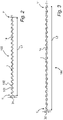
- the joint closure element 100 is designed as a zigzag-shaped strip section 1, which is essentially composed of a number of rectangular segments. This is to be understood as meaning a strip section 1 with a specific material thickness, which has a sequence of extreme deflections in a direction normal to a longitudinal axis 1a of the strip section 1 or of the joint closure element 100 .
- the extreme deflections form the boundaries of the successive segments. In this case, immediately successive extreme deflections extend in opposite directions from the longitudinal axis 1a, such as in particular 2 and 3 can be seen.
- a first extreme deflection 101 and an immediately adjacent second extreme deflection 102 are provided with reference symbols:
- the width of the strip section 1 results from the distance between these extreme deflections 101, 102 in a direction normal to the longitudinal axis 1a of the joint closure element 100.
- the band section 1 of the joint closure element 100 is made of an elastic material.
- elastic is understood to mean the property of absorbing acting tensile forces or acting pressure by deformation and resuming the original shape when the action ends.
- Plastics such as elastomers in particular have this property; for example, the band section 1 can be made of a thermoplastic elastomer.
- the shape and material selection of the joint closure element 100 according to the invention allow its width to be varied by longitudinal stretching—similar to an accordion. If a tensile load is applied to opposite end sections 1′, 1′′ of the strip section 1 in the direction of the longitudinal axis 1a, the result is an elongation with a simultaneous reduction in width.
- FIG. 2 shows a joint closure element 100 according to the invention in the non-assembled state, in which neither the action of a tensile nor a compressive load is present.
- the strip section 1 of the joint closure element 100 has a first width B1 and a first length L1.
- 3 Fig. 12 now shows this joint closure element 100 with an applied load - for example the first end section 1' is held and at the second end section 1" a tensile load is applied along the longitudinal axis 1a in a direction away from the second end section 1" or vice versa, or it is applied at both end sections 1' , 1" a tensile load is applied in opposite directions. Due to the zigzag shape of the strip section 1, the result is an extension to a second length L2 with a simultaneous reduction in width from the first width B1 to a narrower second width B2.
- the second width B2 is 20 percent less than the first width B1, while the second length L2 is 30 percent greater than the first length L1.
- the inventor's tests resulted in a reduction in width of 30 percent and an increase in length by 20 percent.
- the joint closure element 100 If, at the time the tensile load is ended, the joint closure element 100 is placed in a joint 2 that is narrower than the first width B1 but wider than the second width B2, the joint closure element 100 cannot return completely to its starting position with the first width B1, but is jammed himself in the joint 2.
- the joint closure element 100 thus enables simple, in particular also subsequent, laying in joints 2 of wooden terraces 3 and/or between wooden floorboards 4 outdoors, in that the strip section 1 is designed with an oversize compared to a joint width F0 in the non-assembled state.
- the oversize is 1.1 to 1.9 times the joint width F0.
- the zigzag-shaped strip section 1 in the sense of the present invention is not just a strip made of elastic material composed of flat segments, but also an alternatively shaped strip, as long as the clamping effect is guaranteed with appropriate pretensioning as long as the sharpest possible edge is formed between the segments. This avoids surface contact between the strip and the wooden floorboards, so that no accumulations of moisture can form as a result of capillary effects.
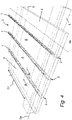
- In 4 is a wooden terrace 3, consisting of wooden floorboards 4, which are mounted on supporting beam elements 5 in the form of upholstered wood, shown, which is located outdoors, ie not carried out inside a building and is therefore exposed to the weather.
- the support beam longitudinal axes 5a run normal to the direction of the floorboard longitudinal axes 4a and the support beam elements 5 are arranged at a support beam spacing S1 of 45 cm from one another.
- the wooden floorboards 4 are arranged at a distance from one another, so that there are 4 joints 2 between the wooden floorboards.
- the Austrian Society for Wood Research (HFA- ⁇ GH) recommends a joint width F0 of at least 7 mm with a wood moisture content of 16 percent to 18 percent when erecting wooden terraces 3 . Since the moisture content of the wood changes due to the weather, the wooden floorboards 4 expand or contract accordingly, so that the joint width F0 varies. Practical measurements by the inventor have shown that the joint width F0 varies in the range of about 2 mm, with an assumed joint width F0 of 7 mm during installation, i.e. between 6 mm and 8 mm, depending on the moisture content of the wood during installation and the weather, larger fluctuations are also possible. The joint closure is thus faced with great challenges, which the invention solves accordingly.
- the width B1 of the strip section 1 of the joint closure element 100 in the non-assembled state is selected such that it has an excess of 1.1 times to 1.9 times the joint width F0 compared to the joint width F0.
- the normal distance between at least two immediately adjacent extreme deflections 101, 102 of the zigzag-shaped strip section 1 in a direction normal to the longitudinal axis 1a of the joint closure element 100 is between the 1.1 Lay up to 1.9 times the joint width F0 of joints 2.
- a joint closure element 100 with a first width B1 of 9.5 mm is used, for example.
- the width of the zigzag-shaped strip section 1 can be reduced by longitudinal traction to such an extent that it can simply be pushed into the joint 2 .
- the restoring force due to the elasticity of the material subsequently causes a permanent clamping in the joint 2 without the need for further mechanical fixation.
- corresponding joint closure elements 100 in the form of zigzag-shaped strip sections 1 are inserted into the joints 2.
- the given, zigzag-shaped geometry in conjunction with the selected, elastic material of the strip section 1 (eg thermoplastic polyolefin), causes a constant adaptation to the thermally hygric changes in the joint width F0 and thus its secure fixation.
- the joint closure element 100 is thus inserted into the joint 2 in such a way that the zigzag course runs in a direction parallel to the surface of the wooden terrace 3 or the wooden floorboards 4, so that the extreme deflections prevent jamming with the side surfaces 4 bordering the joint 2 ' (please refer figure 5 ) of the wooden floorboards 4 takes place.
- the grid-like closure of the joint 2 eliminates the conflict of objectives between the desired security against objects falling through and their physical construction required openness.
- the length of the band sections 1 is selected here so that the second length L2 is greater than the support bar spacing S1 when inserted. This simplifies installation because there is a stop for the strip sections 1 when they are pushed in if the joint closure elements 100 are pushed deeper into the joints 2 .
- the band sections 1 can be pressed in until they are present on the support beam elements 5 .
- the joint width F0 becomes larger than the first width B1 of the strip section 1 - this can be the case with extreme dryness and a corresponding decrease in wood moisture or with age-related decrease in the elasticity of the material of the strip section 1, but also due to Be due to errors when laying - ensures that the joint closure element 100 remains in the joint 2.
- a shorter strip section 1 can also be inserted into a longer strip section 1 in order to bridge a locally limited excess width of the joint 2 .
- the element height H1 (ie the height of the joint closure element 100 or its strip section 1) is selected such that it is between 0.5 times and 1.0 times the plank height H0. this is in figure 5 to discern where a cut along line AA in 4 is shown: The element height is about 0.75 times the floorboard height H0 and the strip section 1 is pushed all the way down into the joint 2, so that between the top of the strip section 1 and the surface of the wooden terrace 3 or the wooden floorboards 4 distance exists.
- the invention thus enables an elastic joint closure element 100 with ventilation for joints 2 of wooden terraces 3 and/or wooden floorboards 4 outdoors, with the selection of a zigzag-shaped geometry in connection with an elastic material allowing water to run off to a large extent from the terrace surface and dry it back from the underground is not affected.
- the formation of the flanks between the joint closure element 100 and the wooden side walls of the wooden floorboards 4 is designed in such a way that no capillary effect occurs.
- the purpose of the joint seal is to prevent insects from penetrating the terrace substructure and to prevent the loss of small objects through the joint. As shown in the figures, this takes place through a zigzag formation of a longitudinally and transversely elastic band section 1 made of plastic (preferably thermoplastic polyolefin).
- this enables simple insertion (reduction in width through longitudinal stretching) and the clamping effect required for fixing is achieved (oversize compared to the joint width F0).
- the grid-like design of the joint closure prevents small objects from falling through.
- the elastic deformability also ensures that the material-related changes in geometry of the joint 2 are accommodated.
- a method according to the invention for sealing joints 2 therefore comprises the following steps: First, a tensile load is applied to at least one of two opposite end sections 1', 1" of the strip section 1 in the longitudinal direction of the joint closure element 100; preferably, such a large tensile load is applied that the first width B1 of the strip section is reduced to a second width B2 , which is smaller than the joint width F0. If the joint 2 is wider or has sections with a greater width, two or more joint closure elements 100 can also be placed one inside the other in a preceding step, or a somewhat shorter section of tape 1 for the wider area can be placed in a longer section of tape 1 to be inserted.
- the joint closure element 100 is inserted into the joint 2. It does not matter whether the wooden terrace 3 has been freshly erected and the installation joint width is available or whether the joint sealing element 100 is introduced at a later point in time when the joint width F0 has changed due to the weather.
- the width of the joint closure element 100 can be adjusted accordingly by varying the tensile load.
- the tensile load on the joint closure element 100 is terminated. Due to the construction of an elastic material and the zigzag shape, the joint closure element 100 tries to restore its original state and to expand from the second width B2 back to the first width B1. This results in the clamping effect of the joint closure element 100 in the joint 2 and its permanent closure.
- the wooden terrace 3 is erected in an outdoor area in a previous step by laying wooden floorboards 4, with joints 2 between adjacent wooden floorboards 4 with a joint width F0 between 5 mm and 9 mm, preferably with a joint width F0 of 7 mm can be executed.
- wood material planks 4 with a wood moisture content of 14 percent to 18 percent are preferred laid, preferably between 16 percent and 18 percent, or it must be ensured before laying that drying is carried out if the wooden floorboards 4 are soaked through, for example due to careless storage.
Landscapes
- Engineering & Computer Science (AREA)
- Architecture (AREA)
- Civil Engineering (AREA)
- Structural Engineering (AREA)
- Physics & Mathematics (AREA)
- Electromagnetism (AREA)
- Life Sciences & Earth Sciences (AREA)
- Wood Science & Technology (AREA)
- Floor Finish (AREA)
Applications Claiming Priority (1)
| Application Number | Priority Date | Filing Date | Title |
|---|---|---|---|
| ATA190/2019A AT521692B1 (de) | 2019-05-20 | 2019-05-20 | Fugenverschlusselement und Holzterrasse mit Fugenverschlusselement |
Publications (2)
| Publication Number | Publication Date |
|---|---|
| EP3741925A1 EP3741925A1 (de) | 2020-11-25 |
| EP3741925B1 true EP3741925B1 (de) | 2022-10-12 |
Family
ID=70328909
Family Applications (1)
| Application Number | Title | Priority Date | Filing Date |
|---|---|---|---|
| EP20167679.8A Active EP3741925B1 (de) | 2019-05-20 | 2020-04-02 | Holzterrasse mit fugenverschlusselement und verfahren zum verschliessen von fugen in holzterrassen |
Country Status (3)
| Country | Link |
|---|---|
| EP (1) | EP3741925B1 (da) |
| AT (1) | AT521692B1 (da) |
| DK (1) | DK3741925T3 (da) |
Citations (2)
| Publication number | Priority date | Publication date | Assignee | Title |
|---|---|---|---|---|
| DE19940837A1 (de) * | 1998-10-26 | 2000-11-23 | Karl Boeckl | Verlegesystem und Verlegeverfahren |
| EP1083269B1 (de) * | 1999-09-11 | 2004-10-20 | Walter Gutjahr | Verlegehilfe für die Erstellung von aufgestelzten oder unterlüfteten Platten-Belägen |
Family Cites Families (5)
| Publication number | Priority date | Publication date | Assignee | Title |
|---|---|---|---|---|
| CH466533A (de) * | 1967-09-05 | 1968-12-15 | Daetwyler Ag | Dichtleiste aus elastisch verformbarem Material |
| DE9319436U1 (de) * | 1993-12-17 | 1994-03-03 | Moissl, Johann, 84178 Kröning | Holzfußboden |
| DE29917335U1 (de) * | 1999-10-02 | 2001-02-15 | Gutjahr, Walter, 64404 Bickenbach | Fugenstab für auf Stelzlagern verlegte Bodenplatten von Plattenbelägen |
| AT5920U3 (de) | 2002-09-23 | 2003-06-25 | Michael Ing Krippl | Holzboden mit dichtung zur verwendung im freien |
| KR101549065B1 (ko) * | 2015-01-20 | 2015-09-03 | 주식회사 기린에스아이 | 데크로드 및 목교 시스템 |
-
2019
- 2019-05-20 AT ATA190/2019A patent/AT521692B1/de active
-
2020
- 2020-04-02 EP EP20167679.8A patent/EP3741925B1/de active Active
- 2020-04-02 DK DK20167679.8T patent/DK3741925T3/da active
Patent Citations (2)
| Publication number | Priority date | Publication date | Assignee | Title |
|---|---|---|---|---|
| DE19940837A1 (de) * | 1998-10-26 | 2000-11-23 | Karl Boeckl | Verlegesystem und Verlegeverfahren |
| EP1083269B1 (de) * | 1999-09-11 | 2004-10-20 | Walter Gutjahr | Verlegehilfe für die Erstellung von aufgestelzten oder unterlüfteten Platten-Belägen |
Also Published As
| Publication number | Publication date |
|---|---|
| DK3741925T3 (da) | 2023-01-16 |
| AT521692B1 (de) | 2020-04-15 |
| AT521692A4 (de) | 2020-04-15 |
| EP3741925A1 (de) | 2020-11-25 |
Similar Documents
| Publication | Publication Date | Title |
|---|---|---|
| EP3581732B1 (de) | Paneel mit dichtungsrille und dichtungsleiste | |
| EP1200690A1 (de) | Verfahren zur verlegung und verriegelung von paneelen | |
| DE2935745C2 (de) | Lärmschutzwand | |
| DE2719857C2 (da) | ||
| DE60312728T2 (de) | Bausatz mit einem Parkettstab und einen Befestigungsbeschlag hierfür | |
| AT521692B1 (de) | Fugenverschlusselement und Holzterrasse mit Fugenverschlusselement | |
| DE2647839B2 (de) | Aus Kunststoff bestehendes Fugendichtungsprofil zum Abschließen einer Fuge | |
| DE3444305A1 (de) | Baueinheit zur bildung einer wand, decke oder tuer einer sauna- oder dampfbadkabine | |
| EP3420158B1 (de) | Einrichtung zum verriegeln zweier bodenpaneele | |
| DE8807858U1 (de) | Stahlbetonschlitzrohr zur Ableitung von Oberflächenwasser | |
| CH686383A5 (de) | Verfahren zur Herstellung einer nicht verschiebbaren Dichtungsprofilleiste und nach diesem Verfahren hergestellte Leiste. | |
| DE102014101112B4 (de) | Verschalung für Gebäudeteile | |
| DE20314720U1 (de) | Holzboden mit Dichtung zur Verwendung im Freien | |
| DE9319436U1 (de) | Holzfußboden | |
| DE202012007345U1 (de) | Verbindungsbauteil zum Aufbau einer im Wesentlichen ebenen Fläche | |
| EP0860562B1 (de) | Fussboden sowie Verlegeverfahren | |
| EP3208396B1 (de) | Schienenanordnung | |
| DE102015205095B4 (de) | Skimattensegment und Skimatte | |
| DE102020126028B4 (de) | Dichtungsvorrichtung für ein Torblatt, sowie ein Verfahren zur Ausführung der Dichtungsvorrichtung an einem Torblatt | |
| DE102008051440B4 (de) | Paneelelement | |
| DE19513700C1 (de) | Rolladen aus horizontalen Profilstäben | |
| DE29702662U1 (de) | Vorrichtung an einem Holzblockhaus | |
| DE2202083A1 (de) | Dichtung fuer bauwerkfugen | |
| DE29819809U1 (de) | Türanschlagdichtung | |
| DE20313709U1 (de) | Bodenbelag für Freilandräume |
Legal Events
| Date | Code | Title | Description |
|---|---|---|---|
| PUAI | Public reference made under article 153(3) epc to a published international application that has entered the european phase |
Free format text: ORIGINAL CODE: 0009012 |
|
| STAA | Information on the status of an ep patent application or granted ep patent |
Free format text: STATUS: THE APPLICATION HAS BEEN PUBLISHED |
|
| AK | Designated contracting states |
Kind code of ref document: A1 Designated state(s): AL AT BE BG CH CY CZ DE DK EE ES FI FR GB GR HR HU IE IS IT LI LT LU LV MC MK MT NL NO PL PT RO RS SE SI SK SM TR |
|
| AX | Request for extension of the european patent |
Extension state: BA ME |
|
| STAA | Information on the status of an ep patent application or granted ep patent |
Free format text: STATUS: REQUEST FOR EXAMINATION WAS MADE |
|
| 17P | Request for examination filed |
Effective date: 20210419 |
|
| RBV | Designated contracting states (corrected) |
Designated state(s): AL AT BE BG CH CY CZ DE DK EE ES FI FR GB GR HR HU IE IS IT LI LT LU LV MC MK MT NL NO PL PT RO RS SE SI SK SM TR |
|
| STAA | Information on the status of an ep patent application or granted ep patent |
Free format text: STATUS: EXAMINATION IS IN PROGRESS |
|
| 17Q | First examination report despatched |
Effective date: 20220527 |
|
| GRAP | Despatch of communication of intention to grant a patent |
Free format text: ORIGINAL CODE: EPIDOSNIGR1 |
|
| STAA | Information on the status of an ep patent application or granted ep patent |
Free format text: STATUS: GRANT OF PATENT IS INTENDED |
|
| INTG | Intention to grant announced |
Effective date: 20220706 |
|
| GRAS | Grant fee paid |
Free format text: ORIGINAL CODE: EPIDOSNIGR3 |
|
| GRAA | (expected) grant |
Free format text: ORIGINAL CODE: 0009210 |
|
| STAA | Information on the status of an ep patent application or granted ep patent |
Free format text: STATUS: THE PATENT HAS BEEN GRANTED |
|
| AK | Designated contracting states |
Kind code of ref document: B1 Designated state(s): AL AT BE BG CH CY CZ DE DK EE ES FI FR GB GR HR HU IE IS IT LI LT LU LV MC MK MT NL NO PL PT RO RS SE SI SK SM TR |
|
| REG | Reference to a national code |
Ref country code: GB Ref legal event code: FG4D Free format text: NOT ENGLISH |
|
| REG | Reference to a national code |
Ref country code: CH Ref legal event code: EP |
|
| REG | Reference to a national code |
Ref country code: DE Ref legal event code: R096 Ref document number: 502020001823 Country of ref document: DE |
|
| REG | Reference to a national code |
Ref country code: IE Ref legal event code: FG4D Free format text: LANGUAGE OF EP DOCUMENT: GERMAN |
|
| REG | Reference to a national code |
Ref country code: AT Ref legal event code: REF Ref document number: 1524254 Country of ref document: AT Kind code of ref document: T Effective date: 20221115 |
|
| REG | Reference to a national code |
Ref country code: NL Ref legal event code: FP |
|
| REG | Reference to a national code |
Ref country code: DK Ref legal event code: T3 Effective date: 20230113 |
|
| REG | Reference to a national code |
Ref country code: SE Ref legal event code: TRGR |
|
| REG | Reference to a national code |
Ref country code: LT Ref legal event code: MG9D |
|
| PG25 | Lapsed in a contracting state [announced via postgrant information from national office to epo] |
Ref country code: PT Free format text: LAPSE BECAUSE OF FAILURE TO SUBMIT A TRANSLATION OF THE DESCRIPTION OR TO PAY THE FEE WITHIN THE PRESCRIBED TIME-LIMIT Effective date: 20230213 Ref country code: NO Free format text: LAPSE BECAUSE OF FAILURE TO SUBMIT A TRANSLATION OF THE DESCRIPTION OR TO PAY THE FEE WITHIN THE PRESCRIBED TIME-LIMIT Effective date: 20230112 Ref country code: LT Free format text: LAPSE BECAUSE OF FAILURE TO SUBMIT A TRANSLATION OF THE DESCRIPTION OR TO PAY THE FEE WITHIN THE PRESCRIBED TIME-LIMIT Effective date: 20221012 Ref country code: FI Free format text: LAPSE BECAUSE OF FAILURE TO SUBMIT A TRANSLATION OF THE DESCRIPTION OR TO PAY THE FEE WITHIN THE PRESCRIBED TIME-LIMIT Effective date: 20221012 Ref country code: ES Free format text: LAPSE BECAUSE OF FAILURE TO SUBMIT A TRANSLATION OF THE DESCRIPTION OR TO PAY THE FEE WITHIN THE PRESCRIBED TIME-LIMIT Effective date: 20221012 |
|
| PG25 | Lapsed in a contracting state [announced via postgrant information from national office to epo] |
Ref country code: RS Free format text: LAPSE BECAUSE OF FAILURE TO SUBMIT A TRANSLATION OF THE DESCRIPTION OR TO PAY THE FEE WITHIN THE PRESCRIBED TIME-LIMIT Effective date: 20221012 Ref country code: PL Free format text: LAPSE BECAUSE OF FAILURE TO SUBMIT A TRANSLATION OF THE DESCRIPTION OR TO PAY THE FEE WITHIN THE PRESCRIBED TIME-LIMIT Effective date: 20221012 Ref country code: LV Free format text: LAPSE BECAUSE OF FAILURE TO SUBMIT A TRANSLATION OF THE DESCRIPTION OR TO PAY THE FEE WITHIN THE PRESCRIBED TIME-LIMIT Effective date: 20221012 Ref country code: IS Free format text: LAPSE BECAUSE OF FAILURE TO SUBMIT A TRANSLATION OF THE DESCRIPTION OR TO PAY THE FEE WITHIN THE PRESCRIBED TIME-LIMIT Effective date: 20230212 Ref country code: HR Free format text: LAPSE BECAUSE OF FAILURE TO SUBMIT A TRANSLATION OF THE DESCRIPTION OR TO PAY THE FEE WITHIN THE PRESCRIBED TIME-LIMIT Effective date: 20221012 Ref country code: GR Free format text: LAPSE BECAUSE OF FAILURE TO SUBMIT A TRANSLATION OF THE DESCRIPTION OR TO PAY THE FEE WITHIN THE PRESCRIBED TIME-LIMIT Effective date: 20230113 |
|
| P01 | Opt-out of the competence of the unified patent court (upc) registered |
Effective date: 20230509 |
|
| REG | Reference to a national code |
Ref country code: DE Ref legal event code: R097 Ref document number: 502020001823 Country of ref document: DE |
|
| PG25 | Lapsed in a contracting state [announced via postgrant information from national office to epo] |
Ref country code: SM Free format text: LAPSE BECAUSE OF FAILURE TO SUBMIT A TRANSLATION OF THE DESCRIPTION OR TO PAY THE FEE WITHIN THE PRESCRIBED TIME-LIMIT Effective date: 20221012 Ref country code: RO Free format text: LAPSE BECAUSE OF FAILURE TO SUBMIT A TRANSLATION OF THE DESCRIPTION OR TO PAY THE FEE WITHIN THE PRESCRIBED TIME-LIMIT Effective date: 20221012 Ref country code: EE Free format text: LAPSE BECAUSE OF FAILURE TO SUBMIT A TRANSLATION OF THE DESCRIPTION OR TO PAY THE FEE WITHIN THE PRESCRIBED TIME-LIMIT Effective date: 20221012 Ref country code: CZ Free format text: LAPSE BECAUSE OF FAILURE TO SUBMIT A TRANSLATION OF THE DESCRIPTION OR TO PAY THE FEE WITHIN THE PRESCRIBED TIME-LIMIT Effective date: 20221012 |
|
| PLBE | No opposition filed within time limit |
Free format text: ORIGINAL CODE: 0009261 |
|
| STAA | Information on the status of an ep patent application or granted ep patent |
Free format text: STATUS: NO OPPOSITION FILED WITHIN TIME LIMIT |
|
| PG25 | Lapsed in a contracting state [announced via postgrant information from national office to epo] |
Ref country code: SK Free format text: LAPSE BECAUSE OF FAILURE TO SUBMIT A TRANSLATION OF THE DESCRIPTION OR TO PAY THE FEE WITHIN THE PRESCRIBED TIME-LIMIT Effective date: 20221012 Ref country code: AL Free format text: LAPSE BECAUSE OF FAILURE TO SUBMIT A TRANSLATION OF THE DESCRIPTION OR TO PAY THE FEE WITHIN THE PRESCRIBED TIME-LIMIT Effective date: 20221012 |
|
| 26N | No opposition filed |
Effective date: 20230713 |
|
| PG25 | Lapsed in a contracting state [announced via postgrant information from national office to epo] |
Ref country code: SI Free format text: LAPSE BECAUSE OF FAILURE TO SUBMIT A TRANSLATION OF THE DESCRIPTION OR TO PAY THE FEE WITHIN THE PRESCRIBED TIME-LIMIT Effective date: 20221012 |
|
| PG25 | Lapsed in a contracting state [announced via postgrant information from national office to epo] |
Ref country code: LU Free format text: LAPSE BECAUSE OF NON-PAYMENT OF DUE FEES Effective date: 20230402 |
|
| PG25 | Lapsed in a contracting state [announced via postgrant information from national office to epo] |
Ref country code: MC Free format text: LAPSE BECAUSE OF FAILURE TO SUBMIT A TRANSLATION OF THE DESCRIPTION OR TO PAY THE FEE WITHIN THE PRESCRIBED TIME-LIMIT Effective date: 20221012 |
|
| PG25 | Lapsed in a contracting state [announced via postgrant information from national office to epo] |
Ref country code: MC Free format text: LAPSE BECAUSE OF FAILURE TO SUBMIT A TRANSLATION OF THE DESCRIPTION OR TO PAY THE FEE WITHIN THE PRESCRIBED TIME-LIMIT Effective date: 20221012 |
|
| REG | Reference to a national code |
Ref country code: IE Ref legal event code: MM4A |
|
| PG25 | Lapsed in a contracting state [announced via postgrant information from national office to epo] |
Ref country code: IE Free format text: LAPSE BECAUSE OF NON-PAYMENT OF DUE FEES Effective date: 20230402 |
|
| PG25 | Lapsed in a contracting state [announced via postgrant information from national office to epo] |
Ref country code: IE Free format text: LAPSE BECAUSE OF NON-PAYMENT OF DUE FEES Effective date: 20230402 |
|
| PG25 | Lapsed in a contracting state [announced via postgrant information from national office to epo] |
Ref country code: IT Free format text: LAPSE BECAUSE OF FAILURE TO SUBMIT A TRANSLATION OF THE DESCRIPTION OR TO PAY THE FEE WITHIN THE PRESCRIBED TIME-LIMIT Effective date: 20221012 |
|
| PGFP | Annual fee paid to national office [announced via postgrant information from national office to epo] |
Ref country code: DK Payment date: 20240425 Year of fee payment: 5 |
|
| PGFP | Annual fee paid to national office [announced via postgrant information from national office to epo] |
Ref country code: SE Payment date: 20240429 Year of fee payment: 5 |
|
| PG25 | Lapsed in a contracting state [announced via postgrant information from national office to epo] |
Ref country code: BG Free format text: LAPSE BECAUSE OF FAILURE TO SUBMIT A TRANSLATION OF THE DESCRIPTION OR TO PAY THE FEE WITHIN THE PRESCRIBED TIME-LIMIT Effective date: 20221012 |
|
| PG25 | Lapsed in a contracting state [announced via postgrant information from national office to epo] |
Ref country code: BG Free format text: LAPSE BECAUSE OF FAILURE TO SUBMIT A TRANSLATION OF THE DESCRIPTION OR TO PAY THE FEE WITHIN THE PRESCRIBED TIME-LIMIT Effective date: 20221012 |
|
| GBPC | Gb: european patent ceased through non-payment of renewal fee |
Effective date: 20240402 |
|
| PG25 | Lapsed in a contracting state [announced via postgrant information from national office to epo] |
Ref country code: GB Free format text: LAPSE BECAUSE OF NON-PAYMENT OF DUE FEES Effective date: 20240402 |
|
| PG25 | Lapsed in a contracting state [announced via postgrant information from national office to epo] |
Ref country code: GB Free format text: LAPSE BECAUSE OF NON-PAYMENT OF DUE FEES Effective date: 20240402 |
|
| PGFP | Annual fee paid to national office [announced via postgrant information from national office to epo] |
Ref country code: NL Payment date: 20250424 Year of fee payment: 6 |
|
| REG | Reference to a national code |
Ref country code: DE Ref legal event code: R081 Ref document number: 502020001823 Country of ref document: DE Owner name: HABIAN, ERICH, AT Free format text: FORMER OWNER: HABIAN, WOLFGANG, WIEN, AT |
|
| PGFP | Annual fee paid to national office [announced via postgrant information from national office to epo] |
Ref country code: DE Payment date: 20250428 Year of fee payment: 6 |
|
| PGFP | Annual fee paid to national office [announced via postgrant information from national office to epo] |
Ref country code: BE Payment date: 20250424 Year of fee payment: 6 |
|
| PGFP | Annual fee paid to national office [announced via postgrant information from national office to epo] |
Ref country code: FR Payment date: 20250424 Year of fee payment: 6 |
|
| PGFP | Annual fee paid to national office [announced via postgrant information from national office to epo] |
Ref country code: CH Payment date: 20250501 Year of fee payment: 6 |
|
| PGFP | Annual fee paid to national office [announced via postgrant information from national office to epo] |
Ref country code: AT Payment date: 20250721 Year of fee payment: 5 |
|
| PG25 | Lapsed in a contracting state [announced via postgrant information from national office to epo] |
Ref country code: CY Free format text: LAPSE BECAUSE OF FAILURE TO SUBMIT A TRANSLATION OF THE DESCRIPTION OR TO PAY THE FEE WITHIN THE PRESCRIBED TIME-LIMIT; INVALID AB INITIO Effective date: 20200402 |
|
| PG25 | Lapsed in a contracting state [announced via postgrant information from national office to epo] |
Ref country code: HU Free format text: LAPSE BECAUSE OF FAILURE TO SUBMIT A TRANSLATION OF THE DESCRIPTION OR TO PAY THE FEE WITHIN THE PRESCRIBED TIME-LIMIT; INVALID AB INITIO Effective date: 20200402 |
|
| REG | Reference to a national code |
Ref country code: BE Ref legal event code: PD Owner name: HABIAN, ERICH; AT Free format text: DETAILS ASSIGNMENT: CHANGE OF OWNER(S), ASSIGNMENT; FORMER OWNER NAME: HABIAN, WOLFGANG Effective date: 20250520 |
|
| REG | Reference to a national code |
Ref country code: DK Ref legal event code: EBP Effective date: 20250430 |
|
| REG | Reference to a national code |
Ref country code: SE Ref legal event code: EUG |
|
| REG | Reference to a national code |
Ref country code: NL Ref legal event code: PD Owner name: HABIAN, ERICH; AT Free format text: DETAILS ASSIGNMENT: CHANGE OF OWNER(S), ASSIGNMENT; FORMER OWNER NAME: HABIAN, WOLFGANG Effective date: 20251125 |
|
| PG25 | Lapsed in a contracting state [announced via postgrant information from national office to epo] |
Ref country code: TR Free format text: LAPSE BECAUSE OF FAILURE TO SUBMIT A TRANSLATION OF THE DESCRIPTION OR TO PAY THE FEE WITHIN THE PRESCRIBED TIME-LIMIT Effective date: 20221012 |
|
| PG25 | Lapsed in a contracting state [announced via postgrant information from national office to epo] |
Ref country code: SE Free format text: LAPSE BECAUSE OF NON-PAYMENT OF DUE FEES Effective date: 20250403 |
|
| PG25 | Lapsed in a contracting state [announced via postgrant information from national office to epo] |
Ref country code: DK Free format text: LAPSE BECAUSE OF NON-PAYMENT OF DUE FEES Effective date: 20250430 |