EP3553097B1 - Copolymère et film optique l'utilisant - Google Patents
Copolymère et film optique l'utilisant Download PDFInfo
- Publication number
- EP3553097B1 EP3553097B1 EP17879119.0A EP17879119A EP3553097B1 EP 3553097 B1 EP3553097 B1 EP 3553097B1 EP 17879119 A EP17879119 A EP 17879119A EP 3553097 B1 EP3553097 B1 EP 3553097B1
- Authority
- EP
- European Patent Office
- Prior art keywords
- group
- cyanocinnamate
- residue unit
- carbon atoms
- copolymer
- Prior art date
- Legal status (The legal status is an assumption and is not a legal conclusion. Google has not performed a legal analysis and makes no representation as to the accuracy of the status listed.)
- Active
Links
Classifications
-
- C—CHEMISTRY; METALLURGY
- C08—ORGANIC MACROMOLECULAR COMPOUNDS; THEIR PREPARATION OR CHEMICAL WORKING-UP; COMPOSITIONS BASED THEREON
- C08F—MACROMOLECULAR COMPOUNDS OBTAINED BY REACTIONS ONLY INVOLVING CARBON-TO-CARBON UNSATURATED BONDS
- C08F212/00—Copolymers of compounds having one or more unsaturated aliphatic radicals, each having only one carbon-to-carbon double bond, and at least one being terminated by an aromatic carbocyclic ring
- C08F212/02—Monomers containing only one unsaturated aliphatic radical
- C08F212/04—Monomers containing only one unsaturated aliphatic radical containing one ring
- C08F212/14—Monomers containing only one unsaturated aliphatic radical containing one ring substituted by heteroatoms or groups containing heteroatoms
- C08F212/26—Nitrogen
-
- C—CHEMISTRY; METALLURGY
- C08—ORGANIC MACROMOLECULAR COMPOUNDS; THEIR PREPARATION OR CHEMICAL WORKING-UP; COMPOSITIONS BASED THEREON
- C08F—MACROMOLECULAR COMPOUNDS OBTAINED BY REACTIONS ONLY INVOLVING CARBON-TO-CARBON UNSATURATED BONDS
- C08F212/00—Copolymers of compounds having one or more unsaturated aliphatic radicals, each having only one carbon-to-carbon double bond, and at least one being terminated by an aromatic carbocyclic ring
- C08F212/02—Monomers containing only one unsaturated aliphatic radical
- C08F212/04—Monomers containing only one unsaturated aliphatic radical containing one ring
- C08F212/06—Hydrocarbons
- C08F212/08—Styrene
-
- C—CHEMISTRY; METALLURGY
- C08—ORGANIC MACROMOLECULAR COMPOUNDS; THEIR PREPARATION OR CHEMICAL WORKING-UP; COMPOSITIONS BASED THEREON
- C08F—MACROMOLECULAR COMPOUNDS OBTAINED BY REACTIONS ONLY INVOLVING CARBON-TO-CARBON UNSATURATED BONDS
- C08F212/00—Copolymers of compounds having one or more unsaturated aliphatic radicals, each having only one carbon-to-carbon double bond, and at least one being terminated by an aromatic carbocyclic ring
- C08F212/02—Monomers containing only one unsaturated aliphatic radical
- C08F212/32—Monomers containing only one unsaturated aliphatic radical containing two or more rings
-
- C—CHEMISTRY; METALLURGY
- C08—ORGANIC MACROMOLECULAR COMPOUNDS; THEIR PREPARATION OR CHEMICAL WORKING-UP; COMPOSITIONS BASED THEREON
- C08F—MACROMOLECULAR COMPOUNDS OBTAINED BY REACTIONS ONLY INVOLVING CARBON-TO-CARBON UNSATURATED BONDS
- C08F220/00—Copolymers of compounds having one or more unsaturated aliphatic radicals, each having only one carbon-to-carbon double bond, and only one being terminated by only one carboxyl radical or a salt, anhydride ester, amide, imide or nitrile thereof
- C08F220/02—Monocarboxylic acids having less than ten carbon atoms; Derivatives thereof
- C08F220/10—Esters
- C08F220/12—Esters of monohydric alcohols or phenols
- C08F220/14—Methyl esters, e.g. methyl (meth)acrylate
-
- C—CHEMISTRY; METALLURGY
- C08—ORGANIC MACROMOLECULAR COMPOUNDS; THEIR PREPARATION OR CHEMICAL WORKING-UP; COMPOSITIONS BASED THEREON
- C08F—MACROMOLECULAR COMPOUNDS OBTAINED BY REACTIONS ONLY INVOLVING CARBON-TO-CARBON UNSATURATED BONDS
- C08F220/00—Copolymers of compounds having one or more unsaturated aliphatic radicals, each having only one carbon-to-carbon double bond, and only one being terminated by only one carboxyl radical or a salt, anhydride ester, amide, imide or nitrile thereof
- C08F220/02—Monocarboxylic acids having less than ten carbon atoms; Derivatives thereof
- C08F220/42—Nitriles
-
- C—CHEMISTRY; METALLURGY
- C08—ORGANIC MACROMOLECULAR COMPOUNDS; THEIR PREPARATION OR CHEMICAL WORKING-UP; COMPOSITIONS BASED THEREON
- C08F—MACROMOLECULAR COMPOUNDS OBTAINED BY REACTIONS ONLY INVOLVING CARBON-TO-CARBON UNSATURATED BONDS
- C08F224/00—Copolymers of compounds having one or more unsaturated aliphatic radicals, each having only one carbon-to-carbon double bond, and at least one being terminated by a heterocyclic ring containing oxygen
-
- C—CHEMISTRY; METALLURGY
- C08—ORGANIC MACROMOLECULAR COMPOUNDS; THEIR PREPARATION OR CHEMICAL WORKING-UP; COMPOSITIONS BASED THEREON
- C08F—MACROMOLECULAR COMPOUNDS OBTAINED BY REACTIONS ONLY INVOLVING CARBON-TO-CARBON UNSATURATED BONDS
- C08F226/00—Copolymers of compounds having one or more unsaturated aliphatic radicals, each having only one carbon-to-carbon double bond, and at least one being terminated by a single or double bond to nitrogen or by a heterocyclic ring containing nitrogen
- C08F226/06—Copolymers of compounds having one or more unsaturated aliphatic radicals, each having only one carbon-to-carbon double bond, and at least one being terminated by a single or double bond to nitrogen or by a heterocyclic ring containing nitrogen by a heterocyclic ring containing nitrogen
-
- C—CHEMISTRY; METALLURGY
- C08—ORGANIC MACROMOLECULAR COMPOUNDS; THEIR PREPARATION OR CHEMICAL WORKING-UP; COMPOSITIONS BASED THEREON
- C08F—MACROMOLECULAR COMPOUNDS OBTAINED BY REACTIONS ONLY INVOLVING CARBON-TO-CARBON UNSATURATED BONDS
- C08F226/00—Copolymers of compounds having one or more unsaturated aliphatic radicals, each having only one carbon-to-carbon double bond, and at least one being terminated by a single or double bond to nitrogen or by a heterocyclic ring containing nitrogen
- C08F226/06—Copolymers of compounds having one or more unsaturated aliphatic radicals, each having only one carbon-to-carbon double bond, and at least one being terminated by a single or double bond to nitrogen or by a heterocyclic ring containing nitrogen by a heterocyclic ring containing nitrogen
- C08F226/12—N-Vinylcarbazole
-
- C—CHEMISTRY; METALLURGY
- C08—ORGANIC MACROMOLECULAR COMPOUNDS; THEIR PREPARATION OR CHEMICAL WORKING-UP; COMPOSITIONS BASED THEREON
- C08J—WORKING-UP; GENERAL PROCESSES OF COMPOUNDING; AFTER-TREATMENT NOT COVERED BY SUBCLASSES C08B, C08C, C08F, C08G or C08H
- C08J5/00—Manufacture of articles or shaped materials containing macromolecular substances
- C08J5/18—Manufacture of films or sheets
-
- C—CHEMISTRY; METALLURGY
- C08—ORGANIC MACROMOLECULAR COMPOUNDS; THEIR PREPARATION OR CHEMICAL WORKING-UP; COMPOSITIONS BASED THEREON
- C08L—COMPOSITIONS OF MACROMOLECULAR COMPOUNDS
- C08L25/00—Compositions of, homopolymers or copolymers of compounds having one or more unsaturated aliphatic radicals, each having only one carbon-to-carbon double bond, and at least one being terminated by an aromatic carbocyclic ring; Compositions of derivatives of such polymers
- C08L25/02—Homopolymers or copolymers of hydrocarbons
- C08L25/04—Homopolymers or copolymers of styrene
- C08L25/08—Copolymers of styrene
-
- C—CHEMISTRY; METALLURGY
- C08—ORGANIC MACROMOLECULAR COMPOUNDS; THEIR PREPARATION OR CHEMICAL WORKING-UP; COMPOSITIONS BASED THEREON
- C08L—COMPOSITIONS OF MACROMOLECULAR COMPOUNDS
- C08L33/00—Compositions of homopolymers or copolymers of compounds having one or more unsaturated aliphatic radicals, each having only one carbon-to-carbon double bond, and only one being terminated by only one carboxyl radical, or of salts, anhydrides, esters, amides, imides or nitriles thereof; Compositions of derivatives of such polymers
- C08L33/04—Homopolymers or copolymers of esters
- C08L33/06—Homopolymers or copolymers of esters of esters containing only carbon, hydrogen and oxygen, which oxygen atoms are present only as part of the carboxyl radical
- C08L33/10—Homopolymers or copolymers of methacrylic acid esters
-
- C—CHEMISTRY; METALLURGY
- C08—ORGANIC MACROMOLECULAR COMPOUNDS; THEIR PREPARATION OR CHEMICAL WORKING-UP; COMPOSITIONS BASED THEREON
- C08L—COMPOSITIONS OF MACROMOLECULAR COMPOUNDS
- C08L37/00—Compositions of homopolymers or copolymers of compounds having one or more unsaturated aliphatic radicals, each having only one carbon-to-carbon double bond, and at least one being terminated by a heterocyclic ring containing oxygen; Compositions of derivatives of such polymers
-
- C—CHEMISTRY; METALLURGY
- C08—ORGANIC MACROMOLECULAR COMPOUNDS; THEIR PREPARATION OR CHEMICAL WORKING-UP; COMPOSITIONS BASED THEREON
- C08L—COMPOSITIONS OF MACROMOLECULAR COMPOUNDS
- C08L39/00—Compositions of homopolymers or copolymers of compounds having one or more unsaturated aliphatic radicals, each having only one carbon-to-carbon double bond, and at least one being terminated by a single or double bond to nitrogen or by a heterocyclic ring containing nitrogen; Compositions of derivatives of such polymers
- C08L39/04—Homopolymers or copolymers of monomers containing heterocyclic rings having nitrogen as ring member
-
- C—CHEMISTRY; METALLURGY
- C09—DYES; PAINTS; POLISHES; NATURAL RESINS; ADHESIVES; COMPOSITIONS NOT OTHERWISE PROVIDED FOR; APPLICATIONS OF MATERIALS NOT OTHERWISE PROVIDED FOR
- C09D—COATING COMPOSITIONS, e.g. PAINTS, VARNISHES OR LACQUERS; FILLING PASTES; CHEMICAL PAINT OR INK REMOVERS; INKS; CORRECTING FLUIDS; WOODSTAINS; PASTES OR SOLIDS FOR COLOURING OR PRINTING; USE OF MATERIALS THEREFOR
- C09D125/00—Coating compositions based on homopolymers or copolymers of compounds having one or more unsaturated aliphatic radicals, each having only one carbon-to-carbon double bond, and at least one being terminated by an aromatic carbocyclic ring; Coating compositions based on derivatives of such polymers
- C09D125/02—Homopolymers or copolymers of hydrocarbons
- C09D125/04—Homopolymers or copolymers of styrene
- C09D125/08—Copolymers of styrene
-
- C—CHEMISTRY; METALLURGY
- C09—DYES; PAINTS; POLISHES; NATURAL RESINS; ADHESIVES; COMPOSITIONS NOT OTHERWISE PROVIDED FOR; APPLICATIONS OF MATERIALS NOT OTHERWISE PROVIDED FOR
- C09D—COATING COMPOSITIONS, e.g. PAINTS, VARNISHES OR LACQUERS; FILLING PASTES; CHEMICAL PAINT OR INK REMOVERS; INKS; CORRECTING FLUIDS; WOODSTAINS; PASTES OR SOLIDS FOR COLOURING OR PRINTING; USE OF MATERIALS THEREFOR
- C09D125/00—Coating compositions based on homopolymers or copolymers of compounds having one or more unsaturated aliphatic radicals, each having only one carbon-to-carbon double bond, and at least one being terminated by an aromatic carbocyclic ring; Coating compositions based on derivatives of such polymers
- C09D125/18—Homopolymers or copolymers of aromatic monomers containing elements other than carbon and hydrogen
-
- C—CHEMISTRY; METALLURGY
- C09—DYES; PAINTS; POLISHES; NATURAL RESINS; ADHESIVES; COMPOSITIONS NOT OTHERWISE PROVIDED FOR; APPLICATIONS OF MATERIALS NOT OTHERWISE PROVIDED FOR
- C09D—COATING COMPOSITIONS, e.g. PAINTS, VARNISHES OR LACQUERS; FILLING PASTES; CHEMICAL PAINT OR INK REMOVERS; INKS; CORRECTING FLUIDS; WOODSTAINS; PASTES OR SOLIDS FOR COLOURING OR PRINTING; USE OF MATERIALS THEREFOR
- C09D133/00—Coating compositions based on homopolymers or copolymers of compounds having one or more unsaturated aliphatic radicals, each having only one carbon-to-carbon double bond, and at least one being terminated by only one carboxyl radical, or of salts, anhydrides, esters, amides, imides, or nitriles thereof; Coating compositions based on derivatives of such polymers
- C09D133/04—Homopolymers or copolymers of esters
- C09D133/06—Homopolymers or copolymers of esters of esters containing only carbon, hydrogen and oxygen, the oxygen atom being present only as part of the carboxyl radical
- C09D133/10—Homopolymers or copolymers of methacrylic acid esters
-
- C—CHEMISTRY; METALLURGY
- C09—DYES; PAINTS; POLISHES; NATURAL RESINS; ADHESIVES; COMPOSITIONS NOT OTHERWISE PROVIDED FOR; APPLICATIONS OF MATERIALS NOT OTHERWISE PROVIDED FOR
- C09D—COATING COMPOSITIONS, e.g. PAINTS, VARNISHES OR LACQUERS; FILLING PASTES; CHEMICAL PAINT OR INK REMOVERS; INKS; CORRECTING FLUIDS; WOODSTAINS; PASTES OR SOLIDS FOR COLOURING OR PRINTING; USE OF MATERIALS THEREFOR
- C09D137/00—Coating compositions based on homopolymers or copolymers of compounds having one or more unsaturated aliphatic radicals, each having only one carbon-to-carbon double bond, and at least one being terminated by a heterocyclic ring containing oxygen; Coating compositions based on derivatives of such polymers
-
- C—CHEMISTRY; METALLURGY
- C09—DYES; PAINTS; POLISHES; NATURAL RESINS; ADHESIVES; COMPOSITIONS NOT OTHERWISE PROVIDED FOR; APPLICATIONS OF MATERIALS NOT OTHERWISE PROVIDED FOR
- C09D—COATING COMPOSITIONS, e.g. PAINTS, VARNISHES OR LACQUERS; FILLING PASTES; CHEMICAL PAINT OR INK REMOVERS; INKS; CORRECTING FLUIDS; WOODSTAINS; PASTES OR SOLIDS FOR COLOURING OR PRINTING; USE OF MATERIALS THEREFOR
- C09D139/00—Coating compositions based on homopolymers or copolymers of compounds having one or more unsaturated aliphatic radicals, each having only one carbon-to-carbon double bond, and at least one being terminated by a single or double bond to nitrogen or by a heterocyclic ring containing nitrogen; Coating compositions based on derivatives of such polymers
- C09D139/04—Homopolymers or copolymers of monomers containing heterocyclic rings having nitrogen as ring member
-
- G—PHYSICS
- G02—OPTICS
- G02B—OPTICAL ELEMENTS, SYSTEMS OR APPARATUS
- G02B1/00—Optical elements characterised by the material of which they are made; Optical coatings for optical elements
- G02B1/04—Optical elements characterised by the material of which they are made; Optical coatings for optical elements made of organic materials, e.g. plastics
-
- G—PHYSICS
- G02—OPTICS
- G02B—OPTICAL ELEMENTS, SYSTEMS OR APPARATUS
- G02B5/00—Optical elements other than lenses
- G02B5/30—Polarising elements
- G02B5/3083—Birefringent or phase retarding elements
-
- G—PHYSICS
- G02—OPTICS
- G02F—OPTICAL DEVICES OR ARRANGEMENTS FOR THE CONTROL OF LIGHT BY MODIFICATION OF THE OPTICAL PROPERTIES OF THE MEDIA OF THE ELEMENTS INVOLVED THEREIN; NON-LINEAR OPTICS; FREQUENCY-CHANGING OF LIGHT; OPTICAL LOGIC ELEMENTS; OPTICAL ANALOGUE/DIGITAL CONVERTERS
- G02F1/00—Devices or arrangements for the control of the intensity, colour, phase, polarisation or direction of light arriving from an independent light source, e.g. switching, gating or modulating; Non-linear optics
- G02F1/01—Devices or arrangements for the control of the intensity, colour, phase, polarisation or direction of light arriving from an independent light source, e.g. switching, gating or modulating; Non-linear optics for the control of the intensity, phase, polarisation or colour
- G02F1/13—Devices or arrangements for the control of the intensity, colour, phase, polarisation or direction of light arriving from an independent light source, e.g. switching, gating or modulating; Non-linear optics for the control of the intensity, phase, polarisation or colour based on liquid crystals, e.g. single liquid crystal display cells
- G02F1/133—Constructional arrangements; Operation of liquid crystal cells; Circuit arrangements
- G02F1/1333—Constructional arrangements; Manufacturing methods
- G02F1/1335—Structural association of cells with optical devices, e.g. polarisers or reflectors
- G02F1/13363—Birefringent elements, e.g. for optical compensation
-
- G—PHYSICS
- G02—OPTICS
- G02F—OPTICAL DEVICES OR ARRANGEMENTS FOR THE CONTROL OF LIGHT BY MODIFICATION OF THE OPTICAL PROPERTIES OF THE MEDIA OF THE ELEMENTS INVOLVED THEREIN; NON-LINEAR OPTICS; FREQUENCY-CHANGING OF LIGHT; OPTICAL LOGIC ELEMENTS; OPTICAL ANALOGUE/DIGITAL CONVERTERS
- G02F1/00—Devices or arrangements for the control of the intensity, colour, phase, polarisation or direction of light arriving from an independent light source, e.g. switching, gating or modulating; Non-linear optics
- G02F1/01—Devices or arrangements for the control of the intensity, colour, phase, polarisation or direction of light arriving from an independent light source, e.g. switching, gating or modulating; Non-linear optics for the control of the intensity, phase, polarisation or colour
- G02F1/13—Devices or arrangements for the control of the intensity, colour, phase, polarisation or direction of light arriving from an independent light source, e.g. switching, gating or modulating; Non-linear optics for the control of the intensity, phase, polarisation or colour based on liquid crystals, e.g. single liquid crystal display cells
- G02F1/133—Constructional arrangements; Operation of liquid crystal cells; Circuit arrangements
- G02F1/1333—Constructional arrangements; Manufacturing methods
- G02F1/1335—Structural association of cells with optical devices, e.g. polarisers or reflectors
- G02F1/13363—Birefringent elements, e.g. for optical compensation
- G02F1/133634—Birefringent elements, e.g. for optical compensation the refractive index Nz perpendicular to the element surface being different from in-plane refractive indices Nx and Ny, e.g. biaxial or with normal optical axis
-
- G—PHYSICS
- G02—OPTICS
- G02F—OPTICAL DEVICES OR ARRANGEMENTS FOR THE CONTROL OF LIGHT BY MODIFICATION OF THE OPTICAL PROPERTIES OF THE MEDIA OF THE ELEMENTS INVOLVED THEREIN; NON-LINEAR OPTICS; FREQUENCY-CHANGING OF LIGHT; OPTICAL LOGIC ELEMENTS; OPTICAL ANALOGUE/DIGITAL CONVERTERS
- G02F2413/00—Indexing scheme related to G02F1/13363, i.e. to birefringent elements, e.g. for optical compensation, characterised by the number, position, orientation or value of the compensation plates
- G02F2413/13—Positive birefingence
-
- G—PHYSICS
- G02—OPTICS
- G02F—OPTICAL DEVICES OR ARRANGEMENTS FOR THE CONTROL OF LIGHT BY MODIFICATION OF THE OPTICAL PROPERTIES OF THE MEDIA OF THE ELEMENTS INVOLVED THEREIN; NON-LINEAR OPTICS; FREQUENCY-CHANGING OF LIGHT; OPTICAL LOGIC ELEMENTS; OPTICAL ANALOGUE/DIGITAL CONVERTERS
- G02F2413/00—Indexing scheme related to G02F1/13363, i.e. to birefringent elements, e.g. for optical compensation, characterised by the number, position, orientation or value of the compensation plates
- G02F2413/14—Negative birefingence
Definitions
- the present invention relates to a novel copolymer and an optical film using the same, and more particularly, relates to a novel copolymer suitable for an optical film having high retardation even in a thin film, in particular, an optical compensation film for a liquid crystal display device or a retardation film of a circularly polarizing plate for an organic EL, for example for an organic light-emitting diode.
- a liquid crystal display has been used as the most important display device in the multimedia society over a wide range, including a smart phone, a computer monitor, a laptop computer, and a television set.
- a retardation film fulfills a great role in, for example, improving the contrast or compensating the color tone when the display is viewed from the front or oblique direction.
- conventional retardation films polycarbonates and cyclic polyolefins are used, and all of these polymers are polymers having positive birefringence.
- the positive and negative of birefringence are defined as follows.
- the optical anisotropy of a polymer film molecularly oriented by stretching or the like can be represented by a refractive index ellipsoid with the refractive index in the fast axis direction in the film plane being nx, the refractive index in the film in-plane direction orthogonal to it being ny, and the refractive index in the thickness direction of the film being nz, in the case where the film is stretched.
- the refractive index in the stretching axis direction is small (fast axis: stretching direction)
- the refractive index in the axial direction orthogonal to the stretching axis is small (fast axis: direction perpendicular to the stretching direction).
- the polymer having negative birefringence includes an acrylic resin and a polystyrene, but the acrylic resin has a small retardation and is insufficient in the characteristic as a retardation film.
- the polystyrene is not used at present, because it has a problem on retardation stability, such as occurrence of a change in the retardation with a slight stress due to its large photoelastic coefficient in a low temperature region, and a problem in practical use, such as low heat resistance.
- a stretched film of a polymer exhibiting negative birefringence has a high refractive index in the thickness direction of the film, and becomes an unconventional retardation film. Therefore, the film is useful as a retardation film for compensating the viewing angle characteristics of polarizers or displays such as a super twisted nematic type liquid crystal display (STN-LCD), a vertical alignment type liquid crystal display (VA-LCD), an in-plane switching type liquid crystal display (IPS-LCD), and a reflection type liquid crystal display (reflection LCD).
- STN-LCD super twisted nematic type liquid crystal display
- VA-LCD vertical alignment type liquid crystal display
- IPS-LCD in-plane switching type liquid crystal display
- reflection LCD reflection type liquid crystal display
- Methods for producing a film in which the refractive index in the thickness direction of the film is increased using a polymer having positive birefringence have been proposed.
- One of the methods is a processing method where a heat-shrinkable film is adhered to one side or both sides of a polymer film, and the laminate is heat-stretched to apply a shrinking force in the film thickness direction of the polymer film (see, for example, Patent Documents 1 to 3).
- Patent Document 4 a method of uniaxially stretching a polymer film in a plane while applying an electric field to the film has been proposed (see, for example, Patent Document 4).
- Patent Documents 1 to 4 have a problem of poor productivity because the production processes are very complicated. Further, control of the uniformity of the retardation and the like is also extremely difficult as compared with the control by conventional stretching.
- the retardation film obtained in Patent Document 5 is a retardation film that exhibits negative birefringence by adding fine particles having negative optical anisotropy, and in view of simplification and economical efficiency of the production method, there is a demand for a retardation film that does not require the addition of the fine particles.
- the fumarate diester-based copolymers and the films composed thereof proposed in Patent Documents 6 to 12 have high retardation but, at present, a film having high retardation even in a thinner film state is required.
- Patent Document 15 relates to an optical compensation film and a retardation film which have excellent optical properties, such as a high refractive index in the film thickness direction, a large in-plane retardation, and a small wavelength dependence, and are effective in improving the contrast and viewing-angle characteristics of liquid-crystal displays.
- Patent Document 16 relates to a resin composition suitable for the manufacture of an optical film which shows reverse wavelength dispersion.
- Said resin composition comprises a polymer (A) having a negative intrinsic birefringence and having N-vinyl carbazole units and acrylonitrile units and a polymer (B) having a positive intrinsic birefringence. It also discloses an image display apparatus equipped with said optical film.
- the present invention is made in view of the above problems and an objective thereof is to provide a novel copolymer suitable for an optical film which is excellent in optical characteristics and has high retardation even in a thin film state, and an optical film containing the same.
- Another object of the present invention is to provide a copolymer excellent in optical characteristics and easy to form a composite with a different polymer, and an optical film composed of the same.
- the present invention resides in the following [1] to [14].
- the copolymer of the present invention is a copolymer comprising a residue unit A represented by the general formula (1) and a residue unit B represented by the general formula (2).
- the copolymer is characterized in that high retardation is exhibited even in a thin film because the copolymer comprises the residue unit A and the residue unit B.
- Examples of the linear alkyl group having 1 to 12 carbon atoms in X 1 to X 4 include a methyl group, an ethyl group, an n-propyl group, an n-butyl group, an n-pentyl group, an n-hexyl group, and the like.
- Examples of the branched alkyl group having 1 to 12 carbon atoms include an isopropyl group, a sec-butyl group, a tert-butyl group, an isobutyl group, and the like.
- Examples of the cyclic alkyl group having 3 to 6 carbon atoms in X 1 to X 3 include a cyclopropyl group, a cyclobutyl group, a cyclohexyl group, and the like.
- Examples of the cyclic group having 3 to 14 carbon atoms in X 4 include a cyclopropyl group, a cyclobutyl group, a cyclohexyl group, a phenyl group, a naphthyl group, and the like.
- R 1 in the general formula (1) of the present invention since higher retardation is expressed, preferred are a cyano group; ester groups such as a methyl ester group, an ethyl ester group, an n-propyl ester group, an isopropyl ester group, and an isobutyl ester group; amide groups such as a dimethylamide group, a diethylamide group, a di-n-propylamide group, and a diisopropylamide group; acyl groups such as an acetyl group, a propionyl group, and a benzoyl group, more preferred are a cyano group, a methyl ester group, an ethyl ester group, an n-propyl ester group, an isopropyl ester group, an isobutyl ester group, a dimethylamide group, a diethylamide group, a di-n-propylamide group, a diisopropyl
- R 2 in the general formula (1) of the present invention since higher retardation is expressed, preferred are hydrogen; a cyano group; ester groups such as a methyl ester group, an ethyl ester group, an n-propyl ester group, an isopropyl ester group, and an isobutyl ester group; more preferred are hydrogen, a cyano group, a methyl ester group, an ethyl ester group, an n-propyl ester group, an isopropyl ester group, and an isobutyl ester group, and particularly preferred are a cyano group and an isobutyl ester group.
- Examples of the linear alkyl group having 1 to 12 carbon atoms in R 3 to R 7 include a methyl group, an ethyl group, an n-propyl group, an n-butyl group, an n-pentyl group, and an n-hexyl group.
- Examples of the branched alkyl group having 1 to 12 carbon atoms include an isopropyl group, an isobutyl group, a sec-butyl group, a tert-butyl group, and the like.
- Examples of the cyclic alkyl group having 3 to 6 carbon atoms include a cyclopropyl group, a cyclobutyl group, a cyclohexyl group, and the like.
- halogen in R 3 to R 7 examples include fluorine, chlorine, bromine, and the like.
- Examples of the linear alkyl group having 1 to 12 carbon atoms in X 5 to X 12 include a methyl group, an ethyl group, an n-propyl group, an n-butyl group, an n-pentyl group, an n-hexyl group, and the like.
- Examples of the branched alkyl group having 1 to 12 carbon atoms include an isopropyl group, an isobutyl group, a sec-butyl group, a tert-butyl group, and the like.
- Examples of the cyclic alkyl group having 3 to 6 carbon atoms in include a cyclopropyl group, a cyclobutyl group, a cyclohexyl group, and the like.
- R 3 to R 7 in the general formula (1) of the present invention since higher retardation is expressed, preferred are a methyl group, an ethyl group, an n-propyl group, an isopropyl group, an n-butyl group, a sec-butyl group, a tert-butyl group, an isobutyl group, a cyclohexyl group, a fluorine atom, a chlorine atom, a bromine atom, a hydroxy group, a carboxy group, a formyl group, a cyano group, a nitro group, a methoxy group, an ethoxy group, an n-propoxy group, an isopropoxy group, a methyl ester group, an ethyl ester group, an n-propyl ester group, an isopropyl ester group, a dimethylamide group, a diethylamide group, a di-n-propylamide group, a
- residue unit A of the present disclosure represented by the general formula (1) include a methyl ⁇ -cyanocinnamate residue unit, a methyl 2-methyl- ⁇ -cyanocinnamate residue unit, a methyl 3-methyl- ⁇ -cyanocinnamate residue unit, a methyl 4-methyl- ⁇ -cyanocinnamate residue unit, a methyl 2-ethyl- ⁇ -cyanocinnamate residue unit, a methyl 3-ethyl- ⁇ -cyanocinnamate residue unit, a methyl 4-ethyl- ⁇ -cyanocinnamate residue unit, a methyl 2-fluoro- ⁇ -cyanocinnamate residue unit, a methyl 3-fluoro- ⁇ -cyanocinnamate residue unit, a methyl 4-fluoro- ⁇ -cyanocinnamate residue unit, a methyl 2-chloro- ⁇ -cyanocinnamate residue unit, a methyl 3-chloro- ⁇ -cyanocinnamate residue unit, a methyl
- ⁇ -cyanocinnamate ester residue units such as a methyl ⁇ -cyanocinnamate residue unit, an ethyl ⁇ -cyanocinnamate residue unit, an n-propyl ⁇ -cyanocinnamate residue unit, and an isopropyl ⁇ -cyanocinnamate residue unit; hydroxy- ⁇ -cyanocinnamate ester residue units such as a methyl 4-hydroxy- ⁇ -cyanocinnamate residue unit, an ethyl 4-hydroxy- ⁇ -cyanocinnamate residue unit, a methyl 2,3-dihydroxy- ⁇ -cyanocinnamate residue unit, and an ethyl 2,3-dihydroxy- ⁇ -cyanocinnamate residue unit; carboxy- ⁇ -cyanocinnamate ester residue units such as a methyl 4-carboxy- ⁇ -cyanocinnamate residue unit, an ethyl 4-carboxy- ⁇ -cyanocinnamate residue unit;
- ⁇ -cyanocinnamate ester residue units such as a methyl ⁇ -cyanocinnamate residue unit, an ethyl ⁇ -cyanocinnamate residue unit, an n-propyl ⁇ -cyanocinnamate residue unit, and an isopropyl ⁇ -cyanocinnamate residue unit; and a benzalmalononitrile residue unit.
- R 8 in the general formula (2) of the present invention represents an m-membered heterocyclic residue containing one or more heteroatoms or a 5-membered or 6-membered ring residue containing no heteroatom (provided that, when R 8 is a 6-membered ring residue containing no heteroatom, at least one of R 3 to R 7 in the general formula (1) represents a hydroxy group), and m represents an integer of 5 to 10.
- the m-membered heterocyclic residue, the 5-membered ring residue, and the 6-membered ring residue may form a fused ring structure together with another ring structure.
- R 8 in the general formula (2) of the present invention is preferably a 5-membered heterocyclic residue or a 6-membered heterocyclic residue containing one or more heteroatoms, and is more preferably a 5-membered heterocyclic residue or a 6-membered heterocyclic residue containing one or more nitrogen atoms or oxygen atoms.
- the heteroatom includes when R 8 in the general formula (2) of the present invention is the m-membered heterocyclic residue, for example, a nitrogen atom, an oxygen atom, a sulfur atom, and the like.
- R 8 is a 6-membered ring residue containing no heteroatom
- a copolymer in which any one or more of R 3 to R 7 in the general formula (1) is a hydroxy group exerts the effect of the present invention and is included in the present invention.
- residue unit B represented by the general formula (2) examples include a 1-vinylpyrrole residue unit, a 2-vinylpyrrole residue unit, a 1-vinylindole residue unit, a 9-vinylcarbazole residue unit, a 2-vinylquinoline residue unit, a 4-vinylquinoline residue unit, a 1-vinylisoquinoline residue unit, a 2-vinylpyridine residue unit, a 3-vinylpyridine residue unit, a 4-vinylpyridine residue unit, a 1-vinylimidazole residue unit, a 2-vinylimidazole residue unit, a 4-vinylimidazole residue unit, a 5-vinyl-2-pyrazoline residue unit, a 2-vinylpyrazine residue unit, a vinyl-s-triazine residue unit, a 10-vinyl-9-hydroacridine residue unit, a 1-vinyltetrazole residue unit, a 5-vinyltetrazole residue unit, a
- a 1-vinylpyrrole residue unit a 2-vinylpyrrole residue unit, a 1-vinylindole residue unit, a 9-vinylcarbazole residue unit, a 2-vinylquinoline residue unit, a 4-vinylquinoline residue unit, an N-vinylphthalimide residue unit, an N-vinylsuccinimide residue unit, a 2-vinylfuran residue unit, a 2-vinylbenzofuran residue unit, a styrene residue unit, and a 2-vinylnaphthalene residue unit. More preferred are a 9-vinylcarbazole residue unit and an N-vinylphthalimide residue unit.
- the copolymer of the present disclosure is not particularly limited as long as it contains the residue unit A represented by the general formula (1) and the residue unit B represented by the general formula (2).
- a film excellent in retardation is easily obtained when formed into a thin film
- preferred are an ⁇ -cyanocinnamate ester-1-vinylpyrrole copolymer, an ⁇ -cyanocinnamate ester-2-vinylpyrrole copolymer, an ⁇ -cyanocinnamate ester-1-vinylindole copolymer, an ⁇ -cyanocinnamate ester-9-vinylcarbazole copolymer, an ⁇ -cyanocinnamate ester-2-vinylquinoline copolymer, an ⁇ -cyanocinnamate ester-4-vinylquinoline copolymer, an ⁇ -cyanocinnamate ester-N-vinylphthalimide copolymer, an ⁇ -cyanocinnamate ester-N-viny
- the copolymer of the present invention becomes suitable for expressing good compatibility and facilitating composite formation with a different polymer.
- the copolymer of the present invention contains the residue unit A represented by the general formula (1) and further the residue unit B is a residue unit represented by the general formula (3) and/or the general formula (4).
- Examples of the halogen in R 9 to R 16 include fluorine, chlorine, bromine, and the like
- examples of the linear alkyl group having 1 to 12 carbon atoms include linear alkyl groups having 1 to 12 carbon atoms such as a methyl group, an ethyl group, a propyl group, a butyl group, a pentyl group, and a hexyl group
- examples of the branched alkyl group having 1 to 12 carbon atoms include branched alkyl groups having 1 to 12 carbon atoms such as an isopropyl group, an isobutyl group, a sec-butyl group, and a tert-butyl group
- examples of the cyclic group having 3 to 14 carbon atoms include cyclic groups having 3 to 14 carbon atoms such as a cyclopropyl group, a cyclobutyl group, a cyclopentyl group, a cyclohexyl group, ,
- alkoxy group examples include a methoxy group, an ethoxy group, and the like
- specific examples of the ester groups include a methyloxycarbonyl group, an ethyloxycarbonyl group, an acetoxy group, and a propoxy group
- specific examples of the amide group include a dimethylamide group, a diethylamide group, and the like
- specific examples of the acyl group include an acetyl group, a propionyl group, a benzoyl group, and the like
- specific examples of the amino group include a dimethylamino group, a diethylamino group, and the like.
- Examples of the linear alkyl group having 1 to 12 carbon atoms in X 13 to X 22 include a methyl group, an ethyl group, an n-propyl group, an n-butyl group, an n-pentyl group, an n-hexyl group, and the like
- examples of the branched alkyl group having 1 to 12 carbon atoms include an isopropyl group, a sec-butyl group, a tert-butyl group, an isobutyl group, and the like
- examples of the cyclic group having 3 to 14 carbon atoms include a cyclopropyl group, a cyclobutyl group, a cyclohexyl group, a phenyl group, a naphthyl group, and the like.
- residue unit represented by the general formula (3) examples include indole residue units such as an N-vinylindole residue unit, an N-methyl-3-vinylindole residue unit, 9-vinylcarbazole residue units such as a 9-vinylcarbazole residue unit, 3-methyl-N-vinylcarbazole residue unit, 3-chloro-N-vinylcarbazole residue unit, and the like.
- indole residue units such as an N-vinylindole residue unit, an N-methyl-3-vinylindole residue unit
- 9-vinylcarbazole residue units such as a 9-vinylcarbazole residue unit, 3-methyl-N-vinylcarbazole residue unit, 3-chloro-N-vinylcarbazole residue unit, and the like.
- 9-vinylcarbazole residue units are preferable, and a 9-vinylcarbazole residue unit is more preferable.
- Examples of the halogen in R 17 to R 20 include fluorine, chlorine, bromine, and the like
- examples of the linear alkyl group having 1 to 12 carbon atoms include linear alkyl groups having 1 to 12 carbon atoms such as a methyl group, an ethyl group, a propyl group, a butyl group, a pentyl group, and a hexyl group
- examples of the branched alkyl group having 1 to 12 carbon atoms include branched alkyl groups having 1 to 12 carbon atoms such as an isopropyl group, an isobutyl group, a sec-butyl group, and a tert-butyl group
- examples of the cyclic group having 3 to 14 carbon atoms include cyclic groups having 3 to 14 carbon atoms such as a cyclopropyl group, a cyclobutyl group, a cyclopentyl group, a cyclohexyl group, a
- alkoxy group examples include a methoxy group, an ethoxy group, and the like
- specific examples of the ester groups include a methyloxycarbonyl group, an ethyloxycarbonyl group, an acetoxy group, and a propoxy group
- specific examples of the amide group include a dimethylamide group, a diethylamide group, and the like
- specific examples of the acyl group include an acetyl group, a propionyl group, a benzoyl group, and the like
- specific examples of the amino group include a dimethylamino group, a diethylamino group, and the like.
- Examples of the linear alkyl group having 1 to 12 carbon atoms in X 23 to X 32 include a methyl group, an ethyl group, an n-propyl group, an n-butyl group, an n-pentyl group, an n-hexyl group, and the like
- examples of the branched alkyl group having 1 to 12 carbon atoms include an isopropyl group, a sec-butyl group, a tert-butyl group, an isobutyl group, and the like
- examples of the cyclic group having 3 to 14 carbon atoms include a cyclopropyl group, a cyclobutyl group, a cyclohexyl group, a phenyl group, a naphthyl group, and the like.
- residue unit represented by the general formula (4) examples include N-vinylsuccinimide residue units such as an N-vinylsuccinimide residue unit, N-vinylphthalimide residue units such as an N-vinylphthalimide residue unit, a 4-methylphthalimide residue unit, a 4-chloromethylphthalimide residue unit, and a 4-nitrophthalimide residue unit, N-vinylnaphthalenedicarboximides residue units such as an N-vinyl-2,3-naphthalenedicarboximide residue unit and an N-vinyl-1,8-naphthalenedicarboximide residue unit.
- N-vinylphthalimide residue units are preferable, and an N-vinylphthalimide residue unit is more preferable.
- the copolymer of the present invention may contain other monomer residue units unless it exceeds the scope of the present invention.
- the other monomer residue units include one or two or more selected from styrene residue units such as a styrene residue unit and an ⁇ -methylstyrene residue unit; (meth)acrylic acid residue units; (meth)acrylate ester residue units such as a methyl (meth)acrylate residue unit, ethyl (meth)acrylate residue unit, and a butyl (meth)acrylate residue unit; vinyl ester residue units such as a vinyl acetate residue unit and a vinyl propionate residue unit; acrylonitrile residue units; methacrylonitrile residue units; vinyl ether residue units such as a methyl vinyl ether residue unit, an ethyl vinyl ether residue unit, and a butyl vinyl ether residue unit; a diethyl fumarate residue unit, fumarate ester residue units; N-substituted maleimi
- the molar ratio A/B of the residue unit A represented by the general formula (1) to the residue unit B represented by the general formula (2) is preferably 0.05 to 6, more preferably 0.1 to 3, particularly preferably 0.18 to 2, and most preferably 0.25 to 1.
- the number-average molecular weight in terms of standard polystyrene obtained from the elution curve measured by gel permeation chromatography is preferably 3,000 to 500,000, more preferably 5,000 to 400,000 and particularly preferably 10,000 to 300,000.
- the number-average molecular weight in terms of standard pullulan obtained from the elution curve measured by gel permeation chromatography is preferably 3,000 to 500,000, more preferably 5,000 to 400,000 and particularly preferably 10,000 to 300,000.
- the production method of the polymer of the present invention is not particularly llimited but includes, for example, a production method of polymerization using a monomer represented by the general formula (5).
- X 1 to X 3 each independently represent a linear alkyl group having 1 to 12 carbon atoms, a branched alkyl group having 1 to 12 carbon atoms, or a cyclic alkyl group having 3 to 6 carbon atoms
- X 4 represents a linear alkyl group having 1 to 12 carbon atoms, a branched alkyl group having 1 to 12 carbon atoms, or a cyclic group having 3 to 14 carbon atoms
- the monomer in the general formula (5) of the present disclosure include methyl ⁇ -cyanocinnamate, methyl 2-methyl- ⁇ -cyanocinnamate, methyl 3-methyl- ⁇ -cyanocinnamate, methyl 4-methyl- ⁇ -cyanocinnamate, methyl 2-ethyl- ⁇ -cyanocinnamate, methyl 3-ethyl- ⁇ -cyanocinnamate, methyl 4-ethyl- ⁇ -cyanocinnamate, methyl 2-fluoro- ⁇ -cyanocinnamate, methyl 3-fluoro- ⁇ -cyanocinnamate, methyl 4-fluoro- ⁇ -cyanocinnamate, methyl 2-chloro- ⁇ -cyanocinnamate, methyl 3-chloro- ⁇ -cyanocinnamate, methyl 4-chloro- ⁇ -cyanocinnamate, methyl 2-bromo- ⁇ -cyanocinnamate, methyl 3-bromo- ⁇ -cyanocinnamate, methyl 4-brom
- the polymer may contain another monomer residue unit unless the polymer exceeds the scope of the present invention.
- the other monomer residue unit include one or two or more selected from ⁇ -substituted styrene residue units such as an ⁇ -methylstyrene residue unit; (meth) acrylic acid residue units; (meth)acrylate ester residue units such as a methyl (meth)acrylate residue unit, an ethyl (meth)acrylate residue unit, and a butyl (meth)acrylate residue unit; an acrylonitrile residue unit; a methacrylonitrile residue unit; olefin residue units such as an ethylene residue unit and a propylene residue unit; and fumarate diester residue units such as a di-n-butyl fumarate residue unit and a bis (2-ethylhexyl) fumarate residue unit.
- the copolymer of the present invention can be produced by any method as long as a copolymer including the residue unit A represented by the general formula (1) and the residue unit B represented by the general formula (2) is obtained and, for example, it can be produced by performing radical polymerization.
- a known polymerization method can be adopted as the radical polymerization, and any of a bulk polymerization method, a solution polymerization method, a suspension polymerization method, a precipitation polymerization method, and an emulsion polymerization method can be adopted.
- Examples of a polymerization initiator at the time of performing radical polymerization include organic peroxides such as benzoyl peroxide, lauryl peroxide, octanoyl peroxide, acetyl peroxide, di-t-butyl peroxide, t-butylcumyl peroxide, dicumyl peroxide, t-butyl peroxyacetate, t-butyl peroxybenzoate, and 2,5-dimethyl-2,5-di(2-ethylhexanoylperoxy)hexane; azo initiators such as 2,2'-azobis(2,4-dimethylvaleronitrile), 2,2'-azobis(2-butyronitrile), 2,2'-azobisisobutyronitrile, dimethyl-2'-azobisisobutyrate, 1,1'-azobis(cyclohexane-1-carbonitrile); and the like.
- organic peroxides such as benzoyl peroxid
- the solvent that can be used when the solution polymerization method, the suspension polymerization method, the precipitation polymerization method, or the emulsion polymerization method is employed.
- examples thereof include aromatic solvents such as benzene, toluene, and xylene; alcohol-based solvents such as methanol, ethanol, propanol, and butanol; cyclohexane; dioxane; tetrahydrofuran; acetone; methyl ethyl ketone; N,N-dimethylformamide; dimethyl sulfoxide; isopropyl acetate; water; and the like.
- Mixed solvents thereof may be also included.
- the polymerization temperature at the time of performing radical polymerization can be appropriately set according to the decomposition temperature of the polymerization initiator. Since the control of the reaction is easy, in general, the reaction is preferably performed in the range of 30 to 150°C.
- the copolymer of the present invention can be used as an optical film comprising the copolymer.
- the light transmittance is preferably 80% or more, and more preferably 85% or more, because the characteristics of the image quality become good.
- the haze (clouding degree) of the film is preferably 2% or less, and more preferably 1% or less, because the characteristics of the image quality become good.
- the copolymer of the present invention is used as an optical film, it is preferably used as a retardation film, because it is excellent in retardation characteristics.
- the retardation film using the copolymer of the present invention is characterized in that the retardation characteristics do not change over a long period of time. That is, since it is excellent in retardation stability and can maintain high image quality, it can be suitably used as a retardation film of a liquid crystal display or the like.
- the copolymer of the present invention As a retardation film using the copolymer of the present invention, only the copolymer can be used, or a composition mixed with another polymer can also be used. At this time, the other polymer to be mixed may be a polymer having negative birefringence or a polymer having positive birefringence.
- the ratio of the absolute value of the out-of-plane retardation (Rth) measured at a wavelength of 550 nm shown by the following equation (a) to the film thickness is preferably 6.5 nm/film thickness ( ⁇ m) or more, more preferably 8 nm/film thickness ( ⁇ m) or more, and particularly preferably 10 nm/film thickness ( ⁇ m) or more.
- Rth nx + ny / 2 ⁇ nz ⁇ d wherein d represents film thickness.
- the method for producing the optical film of the present invention is not particularly limited, and examples thereof include methods such as a solution casting method and a melt casting method.
- the solution casting method is a method of casting a solution containing the copolymer dissolved in a solvent (hereinafter referred to as a dope) on a supporting substrate and then removing the solvent by heating or the like to obtain a film.
- a method of casting the dope on the support substrate for example, a T-die method, a spin coater method, a doctor blade method, a bar coater method, a roll coater method, a lip coater method, or the like is used.
- a method of continuously extruding the dope from a die onto a belt-shaped or drum-shaped supporting substrate is industrially most common.
- the supporting substrate to be used examples include a glass substrate, a metal substrate of stainless steel or ferro type, and a film of polyethylene terephthalate or the like.
- the solution viscosity of the dope is a very important factor at the time of forming a film having high transparency and being excellent in thickness accuracy and surface smoothness, and is preferably 10 to 20,000 cPs and more preferably 100 to 10,000 cPs.
- the coating thickness of the copolymer at this time is preferably 1 to 200 ⁇ m after drying, more preferably 2 to 100 ⁇ m, and particularly preferably 3 to 50 ⁇ m, because handling of the film is easy.
- the melt casting method is a molding method of melting the copolymer in an extruder, extruding it from a slit of a T-die into a film shape, and then pulling it while being cooled with a roll, air, or the like.
- the retardation film using the copolymer of the present invention can be used after peeling it from the glass substrate or other optical film as a base material, and also used as a laminate with the glass substrate or other optical film as a base material. Further, the retardation film using the copolymer of the present invention may be stretched and used after film formation.
- the retardation film using the copolymer of the present invention can be laminated with a polarizing plate and used as a circular or elliptical polarizing plate, and also can be laminated with a polarizer containing polyvinyl alcohol/iodine or the like to form a polarizing plate. Furthermore, the retardation films using the copolymer of the present invention can be laminated with each other or with another retardation film.
- the retardation film using the copolymer of the present invention preferably contains an antioxidant in order to enhance the thermal stability at the film formation or of the retardation film itself.
- the antioxidant include hindered phenol-based antioxidants, phosphorus-based antioxidants, and other antioxidants. These antioxidants may be used alone or in combination. Since the antioxidant effect is synergistically improved, a hindered antioxidant and a phosphorus-based antioxidant are preferably used in combination, and in that case, for example, a phosphorus-based antioxidant is preferably used in an amount of 100 to 500 parts by weight with mixing together with 100 parts by weight of the hindered antioxidant.
- the addition amount of the antioxidant is preferably 0.01 to 10 parts by weight, and more preferably 0.5 to 1 part by weight with respect to 100 parts by weight of the copolymer constituting the retardation film using the copolymer of the present invention, because excellent antioxidant action is exhibited.
- an ultraviolet absorber such as benzotriazole, benzophenone, triazine, or a benzoate may be blended as needed, for example.
- the retardation film using the copolymer of the present invention can be blended with other polymers, surfactants, polymer electrolytes, conductive complexes, inorganic fillers, pigments, antistatic agents, anti-blocking agents, lubricants, and the like within the range not exceeding the gist of the present invention.
- the copolymer of the present invention is suitable for a retardation film having a large refractive index in the thickness direction of the film and having excellent optical characteristics, which film is useful as a compensation film for contrast and viewing angle characteristics of liquid crystal displays, a retardation film for circular polarizing plates of organic EL displays, for example of organic light-emitting diode displays, and an antireflection film.
- the copolymer of the present invention can be suitably used as a resin composition containing a resin having positive intrinsic birefringence and an optical compensation film formed using the resin composition.
- the resin having positive intrinsic birefringence is not particularly limited as long as an optical compensation film having excellent retardation characteristics is obtained by using the resin, and examples thereof include cellulose-based resins, polycarbonates, cyclic polyolefins, polyethylene, polypropylene, polyesters, polyimides, polyamides, polyurethanes, and the like. Since an optical compensation film having more excellent retardation characteristics can be obtained, a cellulose-based resin is preferable.
- the resin in the case where a cellulose-based resin is used as a resin having positive intrinsic birefringence, retardation characteristics and transparency are excellent, in-plane retardation Re is large, and further, stretching processability is excellent when the resin is formed into the optical compensation film, so that the resin is preferably a cellulose-based resin represented by the following general formula (6).
- the cellulose-based resin represented by the general formula (6) is a polymer in which ⁇ -glucose units are linearly polymerized and a part or all of the hydroxy groups at the 2-, 3-, and 6-positions of the glucose units are substituted.
- Examples of the linear alkyl group having 1 to 12 carbon atoms in R 21 to R 23 include a methyl group, an ethyl group, an n-propyl group, an n-butyl group, an n-pentyl group, an n-hexyl group, and the like.
- Examples of the branched alkyl group having 1 to 12 carbon atoms include an isopropyl group, a sec-butyl group, a tert-butyl group, an isobutyl group, and the like.
- Examples of the cyclic group having 3 to 14 carbon atoms include a cyclopropyl group, a cyclobutyl group, a cyclohexyl group, a phenyl group, a naphthyl group, and the like.
- Examples of the linear alkyl group having 1 to 12 carbon atoms in X 33 include a methyl group, an ethyl group, an n-propyl group, an n-butyl group, an n-pentyl group, an n-hexyl group, and the like.
- Examples of the branched alkyl group having 1 to 12 carbon atoms include an isopropyl group, a sec-butyl group, a tert-butyl group, an isobutyl group, and the like.
- Examples of the cyclic group having 3 to 14 carbon atoms include a cyclopropyl group, a cyclobutyl group, a cyclohexyl group, a phenyl group, a naphthyl group, and the like.
- R 21 to R 23 in the general formula (6) of the present invention include a methyl group, an ethyl group, an n-propyl group, an n-butyl group, an isopropyl group, a sec-butyl group, a tert-butyl group, an isobutyl group, a cyclopropyl group, a cyclobutyl group, a cyclohexyl group, a phenyl group, a naphthyl group, an acetyl group, a propionyl group, a butyryl group, a pentanoyl group, a hexanoyl group, a heptanoyl group, an isobutyryl group, a tert-butyryl group, a cyclohexanoyl group, a benzoyl group, a naphthoyl group, and the like.
- solubility and compatibility become more
- the degree of substitution in the substitution through the oxygen atom of the hydroxy group of the cellulose means the ratio of substitution of the hydroxy group of the cellulose (degree of substitution reaches 3 at 100% substitution) for each of the 2-, 3-, and 6-positions.
- the degree of substitution is preferably 1.5 to 3.0, and more preferably 1.8 to 2.8.
- cellulose-based resin of the present invention examples include methyl cellulose, ethyl cellulose, triacetyl cellulose, cellulose acetate, cellulose acetate butyrate, cellulose acetate propionate, and the like, and since a compensation film having more excellent retardation characteristics and transparency is obtained, ethyl cellulose, cellulose acetate butyrate, and cellulose acetate propionate are preferred.
- the number-average molecular weight (Mn) in terms of standard polystyrene obtained from an elution curve measured by gel permeation chromatography (GPC) is preferably 1,000 to 1,000,000, and more preferably 5,000 to 200,000.
- the resin composition of the present invention is obtained by blending the copolymer of the present invention and a resin having positive intrinsic birefringence, and when used as an optical compensation film, the resin composition is characterized in that the optical compensation film exhibits objective retardation characteristics. That is, since the copolymer of the present invention exhibits negative birefringence and the copolymer of the present invention and the resin having positive intrinsic birefringence exhibit excellent compatibility, when the resin composition according to the present invention, which is obtained by blending them, is used, it is possible to obtain an optical compensation film having practical transparency and excellent retardation characteristics.
- the proportion of the copolymer of the present invention to the resin having positive intrinsic birefringence in the resin composition of the present invention is preferably 1 to 90% by weight of the copolymer of the present invention and 99 to 10% by weight of the resin having positive intrinsic birefringence, because it is suitable for controlling the retardation when the resin composition is formed into an optical compensation film.
- the proportion is more preferably 10 to 85% by weight of the copolymer of the present invention and 90 to 15% by weight of the resin having positive intrinsic birefringence, and particularly preferably 20 to 80% by weight of the copolymer of the present invention and 80 to 20% by weight of the resin having positive intrinsic birefringence.
- the melt blending method is a method of production by melting and kneading a resin by heating.
- the solution blending method is a method of dissolving and blending a resin in a solvent.
- Solvents used for solution blending include, for example, chlorinated solvents such as methylene chloride and chloroform; aromatic solvents such as toluene and xylene; ketone solvents such as acetone, methyl ethyl ketone, methyl isobutyl ketone, cyclopentanone, and cyclohexanone; ester solvents such as ethyl acetate and butyl acetate; alcohol solvents such as methanol, ethanol, and propanol; ether solvents such as dioxane and tetrahydrofuran; dimethylformamide, N-methylpyrrolidone, and the like.
- the respective resins and additives can be also dissolved in a solvent and then blend, and the powders, pellets, or the like of respective resins can be also kneaded and then dissolved in a solvent.
- the resin composition of the present invention may contain an antioxidant in order to improve the thermal stability at the time of forming an optical compensation film.
- an antioxidant include hindered phenol-based antioxidants, phosphorus-based antioxidants, sulfur-based antioxidants, lactone-based antioxidants, amine-based antioxidants, hydroxylamine-based antioxidants, vitamin E-based antioxidants, other antioxidants, and the like. These antioxidants may be used singly or two or more thereof may be used in combination.
- the resin composition of the present invention may contain a hindered amine-based light stabilizer or an ultraviolet absorber in order to enhance the weather resistance at the time of formation into an optical compensation film.
- a hindered amine-based light stabilizer or an ultraviolet absorber examples include benzotriazole, benzophenone, triazine, a benzoate, and the like.
- a compound known as a so-called plasticizer may be added for the purpose of improving mechanical properties, imparting flexibility, imparting water absorption resistance, reducing water vapor transmittance, adjusting retardation, and the like when the resin composition is formed into an optical compensation film.
- the plasticizer include phosphate esters, carboxylate esters, and the like.
- acrylic polymers and the like are also used.
- phosphate esters examples include triphenyl phosphate, tricresyl phosphate, phenyl diphenyl phosphate, and the like.
- carboxylate esters examples include phthalate esters, citrate esters, fatty acid esters, glycerol esters, alkyl phthalyl alkyl glycolates, and the like.
- phthalate esters examples include dimethyl phthalate, diethyl phthalate, dicyclohexyl phthalate, dioctyl phthalate, diethylhexyl phthalate, and the like and examples of citrate esters include acetyl triethyl citrate, acetyl tributyl citrate, and the like.
- examples of the fatty acid esters include butyl oleate, methyl acetyl ricinoleate, dibutyl sebacate, and the like
- examples of the glycerol esters include triacetin, trimethylolpropane tribenzoate, the like
- examples of the alkyl phthalyl alkyl glycolates include methyl phthalyl methyl glycolate, ethyl phthalyl ethyl glycolate, propyl phthalyl propyl glycolate, butyl phthalyl butyl glycolate, octyl phthalyl octyl glycolate, methyl phthalyl ethyl glycolate, ethyl phthalyl methyl glycolate, ethyl phthalyl propyl glycolate, propyl phthalyl ethyl glycolate, methyl phthalyl propyl glycolate, methyl phthalyl butyl glycolate, ethy phthaly
- the resin composition of the present invention may contain an additive having an aromatic hydrocarbon ring or an aromatic heterocycle, for the purpose of adjusting the retardation at the time of formation into an optical compensation film.
- the birefringence ⁇ n represented by the following equation (A) of the additive to be used for the purpose of adjusting the retardation is not particularly limited, but is preferably 0.05 or more, more preferably 0.05 to 0.5, and particularly preferably 0.1 to 0.5, because the resin composition forms an optical compensation film having more excellent optical characteristics.
- the ⁇ n of the additive can be determined by molecular orbital calculation.
- ⁇ n nx ⁇ ny wherein nx represents the refractive index in the slow axis direction of the additive molecule, and ny represents the refractive index in the fast axis direction of the additive molecule.
- the number of the aromatic hydrocarbon rings or the aromatic heterocycles in the molecule is not particularly limited, but is preferably 1 to 12, and more preferably 1 to 8, because the resin composition forms an optical compensation film having excellent optical characteristic.
- aromatic hydrocarbon ring examples include 5-membered rings, 6-membered rings, 7-membered rings, or condensed rings composed of two or more aromatic rings and the like
- aromatic heterocycles include a furan ring, a thiophene ring, a pyrrole ring, an oxazole ring, a thiazole ring, an imidazole ring, a triazole ring, a pyridine ring, a pyrimidine ring, a pyrazine ring, a 1,3,5-triazine ring, and the like.
- the aromatic hydrocarbon ring or the aromatic heterocycle may have a substituent, and examples of the substituent include a hydroxy group, an ether group, a carbonyl group, an ester group, a carboxylic acid residue, an amino group, an imino group, an amide group, an imide group, a cyano group, a nitro group, a sulfonyl group, a sulfonic acid residue, a phosphonyl group, a phosphonic acid residue, and the like.
- Examples of the additive having an aromatic hydrocarbon ring or an aromatic heterocycle to be used in the present invention include phosphate ester-based compounds such as tricresyl phosphate, trixylenyl phosphate, triphenyl phosphate, 2-ethylhexyl diphenyl phosphate, cresyl diphenyl phosphate, and bisphenol A bis(diphenyl phosphate); phthalate ester-based compounds such as dimethyl phthalate, diethyl phthalate, dibutyl phthalate, dihexyl phthalate, di-normal octyl phthalate, 2-ethylhexyl phthalate, diisooctyl phthalate, dicapryl phthalate, dinonyl phthalate, diisononyl phthalate, didecyl phthalate, and diisodecyl phthalate; trimellitate ester compounds such as tributyl trimellitate, tri-normal hex
- tricresyl phosphate 2-ethylhexyl diphenyl phosphate, 2-hydroxy-4-methoxybenzophenone, and 2,2',4,4'-tetrahydroxybenzophenone are preferable, and one of them can be used or two or more of them can be used in combination as needed.
- the ratio of the additive having an aromatic hydrocarbon ring or an aromatic heterocycle is 0.01 to 30% by weight, more preferably 0.01 to 20% by weight, and particularly preferably 0.01 to 15% by weight.
- the resin composition of the present invention may contain other polymers, surfactants, polymer electrolytes, conductive complexes, pigments, dyes, antistatic agents, antiblocking agents, lubricants, and the like within the range not exceeding the gist of the present invention.
- the optical compensation film of the present invention preferably has a thickness of 5 to 200 ⁇ m, more preferably 5 to 150 ⁇ m, and particularly preferably 5 to 120 ⁇ m, from the viewpoint of film handleability and compatibility with thinning of optical members.
- the optical compensation film of the present invention has a light transmittance of preferably 80% or more, and more preferably 85% or more, because the characteristics of the image quality become good.
- the optical compensation film of the present invention has a film haze (clouding degree) of preferably 2% or less, and more preferably 1% or less, because the characteristics of the image quality become good.
- the retardation characteristics of the optical compensation film of the present invention is such that the in-plane retardation (Re) represented by the following equation (b) is preferably 50 to 500 nm, more preferably 100 to 450 nm, and particularly preferably 100 to 400 nm and the Nz coefficient represented by the following equation (c) is preferably 0 ⁇ Nz ⁇ 1.0, more preferably 0.30 ⁇ Nz ⁇ 0.65, and particularly preferably 0.35 ⁇ Nz ⁇ 0.60.
- the retardation characteristics at this time are measured under the conditions of a measurement wavelength of 589 nm using a fully automatic birefringence meter (manufactured by AXOMETRICS, trade name: AxoScan).
- nx represents the refractive index in the stretching axis direction in the film plane
- ny represents the refractive index in the direction perpendicular to the stretching axis in the film plane
- nz represents the out-of-plane (thickness direction) refractive index of the film
- d represents film thickness.
- the ratio Re(450)/Re(550) of retardation at 450 nm to retardation at 550 nm is preferably 0.60 ⁇ Re(450)/Re(550) ⁇ 1.10, more preferably 0.70 ⁇ Re(450)/Re (550) ⁇ 1.02, and particularly preferably 0.75 ⁇ Re(450)/Re(550) ⁇ 1.00.
- the solution casting method is a method of casting a resin solution (generally referred to as a dope) on a supporting substrate and evaporating the solvent by heating to obtain an optical film.
- a method of casting for example, a T-die method, a doctor blade method, a bar coater method, a roll coater method, a lip coater method, and the like are used, and industrially, a method of continuously extruding the dope from a die onto a belt-shaped or drum-shaped supporting substrate is generally used.
- the supporting substrate to be used include a glass substrate, a metal substrate of stainless steel or ferro type, and a plastic substrate of polyethylene terephthalate or the like.
- a metal substrate whose surface is mirror-finished is preferably used.
- the viscosity of the resin solution is a very important factor at the time of forming an optical compensation film having excellent thickness accuracy and surface smoothness in the solution casting method, and the viscosity of the resin solution depends on the concentration of the resin, molecular weight, and the type of solvent.
- the viscosity of the resin solution at the time of producing the optical compensation film of the present invention can be adjusted by the molecular weight of the polymer, the concentration of the polymer, and the type of the solvent.
- the viscosity of the resin solution is not particularly limited, but is preferably 100 to 10000 cps, more preferably 300 to 5000 cps, and particularly preferably 500 to 3000 cps, for making the film coating easier.
- Methods for producing the optical compensation film of the present invention include, for example, a method of dissolving a resin composition containing a resin having a residue unit represented by the general formula (1) and a resin having positive intrinsic birefringence into a solvent, casting the resulting resin solution onto a substrate, and peeling a film from the substrate after drying.
- the out-of-plane retardation (Rth) can be controlled by the concentration of the resin contained in the resin composition, the molecular weight of the resin, the type of the solvent, and the drying temperature for film formation.
- the optical compensation film of the present invention is preferably subjected to uniaxial stretching or unbalanced biaxial stretching for exhibiting the in-plane retardation (Re).
- a method of stretching the optical compensation film it is possible to use a longitudinal uniaxial stretching method by roll stretching, a transverse uniaxial stretching method by tenter stretching, an unbalanced sequential biaxial stretching method and an unbalanced simultaneous biaxial stretching method by combinations thereof, and the like.
- the retardation characteristics can be expressed without using a special stretching method in which stretching is performed under the action of the shrinkage force of a heat-shrinkable film.
- the thickness of the film at the time of stretching is preferably 10 to 200 ⁇ m, more preferably 30 to 150 ⁇ m, and particularly preferably 30 to 120 ⁇ m, from the viewpoint of easiness of the stretching process and suitability to thinning of the optical member.
- the stretching temperature is not particularly limited, but is preferably 50 to 200°C, and more preferably 100 to 180°C, because good retardation characteristics are obtained.
- the stretching ratio in the uniaxial stretching is preferably 1.05 to 3.5 times, and more preferably 1.1 to 3.0 times, because good retardation characteristics are obtained.
- the stretch ratio in unbalanced biaxial stretching is preferably 1.05 to 3.5 times, more preferably 1.1 to 3.0 times in the lengthwise direction, and is preferably 1.0 to 1.2 times, more preferably 1.0 to 1.1 times in the transverse direction, because good retardation characteristics are obtained.
- the in-plane retardation (Re) can be controlled by the stretching temperature and the stretching ratio.
- the optical compensation film of the present invention can be laminated with a film containing another resin, if necessary.
- the other resin include polyether sulfones, polyarylates, polyethylene terephthalate, polynaphthalene terephthalate, polycarbonates, cyclic polyolefins, maleimide-based resins, fluororesins, polyimides, and the like.
- a hard coat layer or a gas barrier layer can be also laminated.
- the copolymer of the present invention is a copolymer suitable for an optical film excellent in retardation characteristics, and particularly suitable for an optical compensation film for liquid crystal display devices and organic EL, for example for an organic light-emitting diode.
- the total light transmittance and haze of a film were measured using a haze meter (manufactured by Nippon Denshoku Industries Co., Ltd., trade name: NDH5000).
- the measurement was performed using an Abbe refractometer (manufactured by Atago) in accordance with JIS K 7142 (1981).
- a glass ampoule having a volume of 50 mL were charged 5.0 g (0.039 mol) of cinnamonitrile, 5.6 g (0.039 mol) of 1-vinylindole, and 0.28 g (0.00065 mol) of 2,5-dimethyl-2,5-di(2-ethylhexanoylperoxy)hexane that was a polymerization initiator. After nitrogen substitution and pressure reduction were repeated, the ampoule was melt-sealed in a reduced pressure state. The ampoule was placed in a thermostatic chamber at 62°C and held for 48 hours to perform radical polymerization.
- the number-average molecular weight of the obtained cinnamonitrile/1-vinylindole copolymer was 14,000 in terms of standard polystyrene.
- a glass ampoule having a volume of 50 mL were charged 5.0 g (0.039 mol) of cinnamonitrile, 7.5 g (0.039 mol) of 9-vinylcarbazole, and 0.28 g (0.00065 mol) of 2,5-dimethyl-2,5-di(2-ethylhexanoylperoxy)hexane that was a polymerization initiator. After nitrogen substitution and pressure reduction were repeated, the ampoule was melt-sealed in a reduced pressure state. The ampoule was placed in a thermostatic chamber at 62°C and held for 48 hours to perform radical polymerization.
- the number-average molecular weight of the obtained cinnamonitrile/9-vinylcarbazole copolymer was 25,000 in terms of standard polystyrene.
- the number-average molecular weight of the obtained methyl ⁇ -cyanocinnamate/9-vinylcarbazole copolymer was 33,000 in terms of standard polystyrene.
- a glass ampoule having a volume of 50 mL were charged 5.0 g (0.027 mol) of methyl ⁇ -cyanocinnamate, 3.4 g (0.027 mol) of N-vinylsuccinimide, and 0.19 g (0.00044 mol) of 2,5-dimethyl-2,5-di(2-ethylhexanoylperoxy)hexane that was a polymerization initiator. After nitrogen substitution and pressure reduction were repeated, the ampoule was melt-sealed in a reduced pressure state. The ampoule was placed in a thermostatic chamber at 62°C and held for 48 hours to perform radical polymerization.
- the number-average molecular weight of the obtained methyl ⁇ -cyanocinnamate/N-vinylsuccinimide copolymer was 21,000 in terms of standard pullulan.
- the number-average molecular weight of the obtained ethyl ⁇ -cyanocinnamate/N-vinylphthalimide copolymer was 25,000 in terms of standard pullulan.
- a glass ampoule having a volume of 50 mL were charged 5.0 g (0.025 mol) of ethyl ⁇ -cyanocinnamate, 3.6 g (0.025 mol) of 2-vinylbenzofuran, and 0.18 g (0.00042 mol) of 2,5-dimethyl-2,5-di(2-ethylhexanoylperoxy)hexane that was a polymerization initiator. After nitrogen substitution and pressure reduction were repeated, the ampoule was melt-sealed in a reduced pressure state. The ampoule was placed in a thermostatic chamber at 62°C and held for 48 hours to perform radical polymerization.
- the number-average molecular weight of the obtained ethyl ⁇ -cyanocinnamate/2-vinylbenzofuran copolymer was 17,000 in terms of standard polystyrene.
- a glass ampoule having a volume of 50 mL were charged 5.0 g (0.023 mol) of n-propyl ⁇ -cyanocinnamate, 3.6 g (0.023 mol) of 2-vinylquinoline, and 0.17 g (0.00039 mol) of 2,5-dimethyl-2,5-di(2-ethylhexanoylperoxy)hexane that was a polymerization initiator. After nitrogen substitution and pressure reduction were repeated, the ampoule was melt-sealed in a reduced pressure state. The ampoule was placed in a thermostatic chamber at 62°C and held for 48 hours to perform radical polymerization.
- the number-average molecular weight of the obtained n-propyl ⁇ -cyanocinnamate/2-vinylquinoline copolymer was 21,000 in terms of standard polystyrene.
- the number-average molecular weight of the obtained benzalmalononitrile/N-vinylphthalimide copolymer was 24,000 in terms of standard pullulan.
- the number-average molecular weight of the obtained benzalmalononitrile/9-vinylcarbazole copolymer was 90,000 in terms of standard polystyrene.
- the number-average molecular weight of the obtained 4-nitrobenzalmalononitrile/2-vinylbenzofuran copolymer was 26,000 in terms of standard polystyrene.
- the number-average molecular weight of the obtained N,N-diethylcinnamamide/2-vinylfuran copolymer was 8,000 in terms of standard polystyrene.
- Reference Example 12 Synthesis of chalcone/2-vinylquinoline copolymer
- a glass ampoule having a volume of 50 mL were charged 5.0 g (0.024 mol) of chalcone, 3.7 g (0.024 mol) of 2-vinylquinoline, and 0.17 g (0.00039 mol) of 2,5-dimethyl-2,5-di(2-ethylhexanoylperoxy)hexane that was a polymerization initiator. After nitrogen substitution and pressure reduction were repeated, the ampoule was melt-sealed in a reduced pressure state. The ampoule was placed in a thermostatic chamber at 62°C and held for 48 hours to perform radical polymerization.
- the number-average molecular weight of the obtained chalcone/2-vinylquinoline copolymer was 9,000 in terms of standard polystyrene.
- the number-average molecular weight of the obtained methyl ⁇ -cyanocinnamate/9-vinylcarbazole copolymer was 15,000 in terms of standard polystyrene.
- the number-average molecular weight of the obtained isobutyl 4-hydroxy- ⁇ -cyanocinnamate/9-vinylcarbazole copolymer was 16,000 in terms of standard polystyrene.
- a glass ampoule having a volume of 50 mL were charged 5.0 g of ethyl ⁇ -cyano-4-hydroxycinnamate, 4.4 g of 9-vinylcarbazole, 8.5 g of tetrahydrofuran as a polymerization solvent, and 0.17 g of 2,5-dimethyl-2,5-di(2-ethylhexanoylperoxy)hexane that was a polymerization initiator. After nitrogen substitution was performed, the ampoule was melt-sealed in a reduced pressure state. The glass ampoule was placed in a thermostatic chamber at 62°C and held for 48 hours to perform radical polymerization.
- the number-average molecular weight of the obtained ethyl ⁇ -cyano-4-hydroxycinnamate/9-vinylcarbazole copolymer was 22,000 in terms of standard polystyrene.
- a glass ampoule having a volume of 50 mL were charged 5.0 g of 4-hydroxybenzalmalononitrile, 4.5 g of 2-vinylnaphthalene, 10 g of tetrahydrofuran as a polymerization solvent, and 0.21 g of 2,5-dimethyl-2,5-di(2-ethylhexanoylperoxy)hexane that was a polymerization initiator. After nitrogen substitution was performed, the ampoule was melt-sealed in a reduced pressure state. The glass ampoule was placed in a thermostatic chamber at 62°C and held for 48 hours to perform radical polymerization.
- the number-average molecular weight of the obtained 4-hydroxybenzalmalononitrile/2-vinylnaphthalene copolymer was 12,000 in terms of standard polystyrene.
- the number-average molecular weight of the obtained 4-carboxybenzalmalononitrile/N-vinylphthalimide copolymer was 13,000 in terms of standard pullulan.
- the number-average molecular weight of the obtained cinnamonitrile/styrene copolymer was 46,000 in terms of standard polystyrene.
- the number-average molecular weight of the obtained ethyl ⁇ -cyanocinnamate/methyl acrylate copolymer was 13,000 in terms of standard polystyrene.
- the number-average molecular weight of the obtained benzalmalononitrile/styrene copolymer was 93,000 in terms of standard polystyrene.
- the number-average molecular weight of the obtained acrylonitrile/1-vinylindole copolymer was 12,000 in terms of standard polystyrene.
- the cinnamonitrile/1-vinylindole copolymer obtained in Reference Example 1 was dissolved in cyclopentanone to obtain a 35% by weight resin solution.
- the resin solution was cast on a glass substrate by means of a coater and dried at 60°C for 60 minutes to obtain a 10.1 ⁇ m-thick film using the cinnamonitrile/1-vinylindole copolymer.
- the obtained film had a total light transmittance of 87%, a haze of 0.6%, and a refractive index of 1.648.
- the out-of-plane retardation Rth was negatively as large as -169 nm. Further, the ratio of the absolute value of the out-of-plane retardation to the film thickness was 16.7 nm/film thickness ( ⁇ m).
- the cinnamonitrile/9-vinylcarbazole copolymer obtained in Reference Example 2 was dissolved in cyclopentanone to obtain a 30% by weight resin solution.
- the resin solution was cast on a glass substrate by means of a coater and dried at 60°C for 60 minutes to obtain an 8.8 ⁇ m-thick film using the cinnamonitrile/9-vinylcarbazole copolymer.
- the obtained film had a total light transmittance of 87%, a haze of 0.5%, and a refractive index of 1.655.
- the out-of-plane retardation Rth was negatively as large as -290 nm. Further, the ratio of the absolute value of the out-of-plane retardation to the film thickness was 32.9 nm/film thickness ( ⁇ m).
- the methyl ⁇ -cyanocinnamate/9-vinylcarbazole copolymer obtained in Reference Example 3 was dissolved in cyclopentanone to obtain a 20% by weight resin solution.
- the resin solution was cast on a glass substrate by means of a coater and dried at 130°C for 10 minutes to obtain a 12.2 ⁇ m-thick film using the methyl ⁇ -cyanocinnamate/9-vinylcarbazole copolymer.
- the obtained film had a total light transmittance of 87%, a haze of 0.6%, and a refractive index of 1.653.
- the out-of-plane retardation Rth was negatively as large as -376 nm. Further, the ratio of the absolute value of the out-of-plane retardation to the film thickness was 30.8 nm/film thickness ( ⁇ m).
- the methyl ⁇ -cyanocinnamate/N-vinylsuccinimide copolymer obtained in Reference Example 4 was dissolved in N,N-dimethylformamide to obtain a 30% by weight resin solution.
- the resin solution was cast on a glass substrate by means of a coater and vacuum-dried at 60°C for 3 hours to obtain a 10.5 ⁇ m-thick film using the methyl ⁇ -cyanocinnamate/N-vinylsuccinimide copolymer.
- the obtained film had a total light transmittance of 89%, a haze of 0.4%, and a refractive index of 1.575.
- the out-of-plane retardation Rth was negatively as large as -212 nm. Further, the ratio of the absolute value of the out-of-plane retardation to the film thickness was 20.2 nm/film thickness ( ⁇ m).
- the ethyl ⁇ -cyanocinnamate/N-vinylphthalimide copolymer obtained in Reference Example 5 was dissolved in N,N-dimethylformamide to obtain a 20% by weight resin solution.
- the resin solution was cast on a glass substrate by means of a coater and vacuum-dried at 60°C for 3 hours to obtain a 9.2 ⁇ m-thick film using the ethyl ⁇ -cyanocinnamate/N-vinylphthalimide copolymer.
- the obtained film had a total light transmittance of 88%, a haze of 0.6%, and a refractive index of 1.613.
- the out-of-plane retardation Rth was negatively as large as -247 nm. Further, the ratio of the absolute value of the out-of-plane retardation to the film thickness was 26.8 nm/film thickness ( ⁇ m).
- the ethyl ⁇ -cyanocinnamate/2-vinylbenzofuran copolymer obtained in Reference Example 6 was dissolved in toluene to obtain a 35% by weight resin solution.
- the resin solution was cast on a glass substrate by means of a coater and dried at 60°C for 60 minutes to obtain an 8.8 ⁇ m-thick film using the ethyl ⁇ -cyanocinnamate/2-vinylbenzofuran copolymer.
- the obtained film had a total light transmittance of 87%, a haze of 0.3%, and a refractive index of 1.634.
- the out-of-plane retardation Rth was negatively as large as -127 nm. Further, the ratio of the absolute value of the out-of-plane retardation to the film thickness was 14.4 nm/film thickness ( ⁇ m).
- the n-propyl ⁇ -cyanocinnamate/2-vinylquinoline copolymer obtained in Reference Example 7 was dissolved in cyclopentanone to obtain a 35% by weight resin solution.
- the resin solution was cast on a glass substrate by means of a coater and dried at 100°C for 10 minutes to obtain a 11.0 ⁇ m-thick film using the n-propyl ⁇ -cyanocinnamate/2-vinylquinoline copolymer.
- the obtained film had a total light transmittance of 88%, a haze of 0.3%, and a refractive index of 1.635.
- the out-of-plane retardation Rth was negatively as large as -190 nm. Further, the ratio of the absolute value of the out-of-plane retardation to the film thickness was 17.3 nm/film thickness ( ⁇ m).
- the benzalmalononitrile/N-vinylphthalimide copolymer obtained in Reference Example 8 was dissolved in N,N-dimethylformamide to obtain a 20% by weight resin solution.
- the resin solution was cast on a glass substrate by means of a coater and vacuum-dried at 60°C for 3 hours to obtain a 12.6 ⁇ m-thick film using the benzalmalononitrile/N-vinylphthalimide copolymer.
- the obtained film had a total light transmittance of 87%, a haze of 0.5%, and a refractive index of 1.638.
- the out-of-plane retardation Rth was negatively as large as -295 nm. Further, the ratio of the absolute value of the out-of-plane retardation to the film thickness was 23.4 nm/film thickness ( ⁇ m).
- the benzalmalononitrile/9-vinylcarbazole copolymer obtained in Reference Example 9 was dissolved in tetrahydrofuran to obtain a 20% by weight resin solution.
- the resin solution was cast on a glass substrate by means of a coater and dried at 130°C for 10 minutes to obtain a 11.8 ⁇ m-thick film using the benzalmalononitrile/9-vinylcarbazole copolymer.
- the obtained film had a total light transmittance of 87%, a haze of 0.4%, and a refractive index of 1.652.
- the out-of-plane retardation Rth was negatively as large as -380 nm. Further, the ratio of the absolute value of the out-of-plane retardation to the film thickness was 32.2 nm/film thickness ( ⁇ m).
- the 4-nitrobenzalmalononitrile/2-vinylbenzofuran copolymer obtained in Reference Example 10 was dissolved in methyl ethyl ketone to obtain a 35% by weight resin solution.
- the resin solution was cast on a glass substrate by means of a coater and dried at 60°C for 60 minutes to obtain a 9.8 ⁇ m-thick film using the 4-nitrobenzalmalononitrile/2-vinylbenzofuran copolymer.
- the obtained film had a total light transmittance of 87%, a haze of 0.5%, and a refractive index of 1.642.
- the out-of-plane retardation Rth was negatively as large as -189 nm. Further, the ratio of the absolute value of the out-of-plane retardation to the film thickness was 19.3 nm/film thickness ( ⁇ m).
- the N,N-diethylcinnamamide/2-vinylfuran copolymer obtained in Reference Example 11 was dissolved in cyclopentanone to obtain a 30% by weight resin solution.
- the resin solution was cast on a glass substrate by means of a coater and dried at 100°C for 10 minutes to obtain a 12.2 ⁇ m-thick film using the N,N-diethylcinnamamide/2-vinylfuran copolymer.
- the obtained film had a total light transmittance of 89%, a haze of 0.5%, and a refractive index of 1.577.
- the out-of-plane retardation Rth was negatively as large as -117 nm. Further, the ratio of the absolute value of the out-of-plane retardation to the film thickness was 9.6 nm/film thickness ( ⁇ m).
- the chalcone/2-vinylquinoline copolymer obtained in Reference Example 12 was dissolved in cyclopentanone to obtain a 35% by weight resin solution.
- the resin solution was cast on a glass substrate by means of a coater and dried at 100°C for 10 minutes to obtain a 7.9 ⁇ m-thick film using the chalcone/2-vinylquinoline copolymer.
- the obtained film had a total light transmittance of 87%, a haze of 0.6%, and a refractive index of 1.651.
- the out-of-plane retardation Rth was negatively as large as -73 nm. Further, the ratio of the absolute value of the out-of-plane retardation to the film thickness was 9.2 nm/film thickness ( ⁇ m).
- the methyl ⁇ -cyanocinnamate/9-vinylcarbazole copolymer obtained in Reference Example 13 was dissolved in cyclopentanone to obtain a 30% by weight resin solution.
- the resin solution was cast on a glass substrate by means of a coater and dried at 130°C for 10 minutes to obtain a 11.9 ⁇ m-thick film using the methyl ⁇ -cyanocinnamate/9-vinylcarbazole copolymer.
- the obtained film had a total light transmittance of 87%, a haze of 0.3%, and a refractive index of 1.650.
- the out-of-plane retardation Rth was negatively as large as -261 nm. Further, the ratio of the absolute value of the out-of-plane retardation to the film thickness was 21.9 nm/film thickness ( ⁇ m).
- the isobutyl 4-hydroxy- ⁇ -cyanocinnamate/9-vinylcarbazole copolymer obtained in Example 14 was dissolved in ethyl acetate to obtain a 30% by weight resin solution.
- the resin solution was cast on a glass substrate by means of a coater and dried at 100°C for 10 minutes to obtain a 12.4 ⁇ m-thick film using the isobutyl 4-hydroxy- ⁇ -cyanocinnamate/9-vinylcarbazole copolymer.
- the obtained film had a total light transmittance of 88%, a haze of 0.5%, and a refractive index of 1.613.
- the out-of-plane retardation Rth was negatively as large as -260 nm. Further, the ratio of the absolute value of the out-of-plane retardation to the film thickness was 21.0 nm/film thickness ( ⁇ m).
- Example 15 The ethyl ⁇ -cyano-4-hydroxycinnamate/9-vinylcarbazole copolymer obtained in Example 15 was dissolved in tetrahydrofuran and the solution was cast on a glass substrate by means of a coater and vacuum-dried at 60°C for 10 hours to obtain a 15.2 ⁇ m-thick film using the ethyl ⁇ -cyano-4-hydroxycinnamate/9-vinylcarbazole copolymer.
- the obtained film had a total light transmittance of 87%, a haze of 0.4%, and a refractive index of 1.689.
- the out-of-plane retardation Rth was negatively as large as -350 nm. Further, the ratio of the absolute value of the out-of-plane retardation to the film thickness was 23.0 nm/film thickness ( ⁇ m).
- Example 16 Into 4 g of tetrahydrofuran were dissolved 0.5 g of the 4-hydroxybenzalmalononitrile/2-vinylnaphthalene copolymer obtained in Example 16 and 0.5 g of polyethylene glycol (manufactured by Tokyo Kasei Co., Ltd., number-average molecular weight: 3,000). The solution was applied on a glass substrate by spin coating and vacuum-dried at 60°C for 10 hours to obtain a 12.4 ⁇ m-thick film using the 4-hydroxybenzalmalononitrile/2-vinylnaphthalene copolymer.
- polyethylene glycol manufactured by Tokyo Kasei Co., Ltd., number-average molecular weight: 3,000
- the obtained film had a total light transmittance of 86%, a haze of 0.4%, and a refractive index of 1.645.
- the out-of-plane retardation Rth was negatively as large as -425 nm. Further, the ratio of the absolute value of the out-of-plane retardation to the film thickness was 34.3 nm/film thickness ( ⁇ m).
- the 4-carboxybenzalmalononitrile/N-vinylphthalimide copolymer obtained in Reference Example 17 was dissolved in N,N-dimethylformamide and the solution was applied on a glass substrate by spin coating and vacuum-dried at 60°C for 180 minutes to obtain a 13.0 ⁇ m-thick film using the 4-carboxybenzalmalononitrile/N-vinylphthalimide copolymer.
- the obtained film had a total light transmittance of 87%, a haze of 0.5%, and a refractive index of 1.633.
- the out-of-plane retardation Rth was negatively as large as -274 nm. Further, the ratio of the absolute value of the out-of-plane retardation to the film thickness was 21.1 nm/film thickness ( ⁇ m).
- the number-average molecular weight of the obtained 4-carboxybenzalmalononitrile/1-vinylindole copolymer was 23,000 in terms of standard polystyrene.
- a film having a width of 150 mm was obtained (ethyl cellulose: 87% by weight, 4-carboxybenzalmalononitrile/1-vinylindole copolymer: 13% by weight).
- the obtained film was cut into 50 mm square, and uniaxially stretched at 140°C by 1.8 times (thickness after stretching: 80 ⁇ m).
- the obtained optical compensation film had high light transmittance, excellent transparency, small haze, and objective optical characteristics of the in-plane retardation (Re), the wavelength dispersion characteristics (Re (450)/Re (550)), and the Nz coefficient.
- Example 36 Polymerization of ethyl 4-hydroxy- ⁇ -cyanocinnamate/9-vinylcarbazole copolymer and Preparation of optical compensation film using resin composition containing the copolymer
- a glass ampoule having a volume of 50 mL were charged 5.0 g of ethyl 4-hydroxy- ⁇ -cyanocinnamate, 4.4 g of 9-vinylcarbazole, 0.17 g of 2,5-dimethyl-2,5-di(2-ethylhexanoylperoxy)hexane that was a polymerization initiator, and 8.5 g of tetrahydrofuran. After nitrogen substitution and pressure reduction were repeated, the ampoule was melt-sealed in a reduced pressure state. The ampoule was placed in a thermostatic chamber at 62°C and held for 48 hours to perform radical polymerization.
- the number-average molecular weight of the obtained ethyl 4-hydroxy- ⁇ -cyanocinnamate/9-vinylcarbazole copolymer was 22,000 in terms of standard polystyrene.
- a film having a width of 150 mm was obtained (ethyl cellulose: 87% by weight, ethyl 4-hydroxy- ⁇ -cyanocinnamate/9-vinylcarbazole copolymer: 13% by weight).
- the obtained film was cut into 50 mm square, and uniaxially stretched at 145°C by 1.5 times (thickness after stretching: 40 ⁇ m).
- the obtained optical compensation film had high light transmittance, excellent transparency, small haze, and objective optical characteristics of the in-plane retardation (Re), the wavelength dispersion characteristics (Re (450)/Re (550)), and the Nz coefficient.
- Example 37 Polymerization of 4-hydroxybenzalmalononitrile/2-vinylnaphthalene copolymer and Preparation of optical compensation film using resin composition containing the copolymer
- a glass ampoule having a volume of 50 mL were charged 5.0 g of 4-hydroxybenzalmalononitrile, 4.5 g of 2-vinylnaphthalene, 0.21 g of 2,5-dimethyl-2,5-di(2-ethylhexanoylperoxy)hexane that was a polymerization initiator, and 10 g of tetrahydrofuran. After nitrogen substitution and pressure reduction were repeated, the ampoule was melt-sealed in a reduced pressure state. The ampoule was placed in a thermostatic chamber at 62°C and held for 48 hours to perform radical polymerization.
- the number-average molecular weight of the obtained 4-hydroxybenzalmalononitrile/2-vinylnaphthalene copolymer was 12,000 in terms of standard polystyrene.
- a film having a width of 150 mm was obtained (ethyl cellulose: 83% by weight, 4-hydroxybenzalmalononitrile/2-vinylnaphthalene copolymer: 17% by weight).
- the obtained film was cut into 50 mm square, and uniaxially stretched at 140°C by 1.3 times (thickness after stretching: 40 ⁇ m).
- the obtained optical compensation film had high light transmittance, excellent transparency, small haze, and objective optical characteristics of the in-plane retardation (Re), the wavelength dispersion characteristics (Re (450)/Re (550)), and the Nz coefficient.
- the number-average molecular weight of the obtained isobutyl 4-hydroxy- ⁇ -cyanocinnamate/N-vinylsuccinimide copolymer was 16,000 in terms of standard pullulan.
- a film having a width of 150 mm was obtained (ethyl cellulose: 83% by weight, isobutyl 4-hydroxy- ⁇ -cyanocinnamate/N-vinylsuccinimide copolymer: 17% by weight).
- the obtained film was cut into 50 mm square, and uniaxially stretched at 140°C by 1.7 times (thickness after stretching: 60 ⁇ m).
- the total light transmittance, haze, retardation characteristics, and wavelength dispersion characteristics of the obtained optical compensation film were measured.
- the obtained optical compensation film had high light transmittance, excellent transparency, small haze, and objective optical characteristics of the in-plane retardation (Re), the wavelength dispersion characteristics (Re (450)/Re (550)), and the Nz coefficient.
- Example 39 Polymerization of ethyl 3,4-dihydroxy- ⁇ -cyanocinnamate/N-vinylphthalimide copolymer
- a glass ampoule having a volume of 50 mL were charged 5.0 g of ethyl 3,4-dihydroxy- ⁇ -cyanocinnamate, 3.7 g of N-vinylphthalimide, 0.15 g of 2,5-dimethyl-2,5-di(2-ethylhexanoylperoxy)hexane that was a polymerization initiator, and 8.5 g of tetrahydrofuran. After nitrogen substitution and pressure reduction were repeated, the ampoule was melt-sealed in a reduced pressure state. The ampoule was placed in a thermostatic chamber at 62°C and held for 48 hours to perform radical polymerization.
- the number-average molecular weight of the obtained ethyl 3,4-dihydroxy- ⁇ -cyanocinnamate/N-vinylphthalimide copolymer was 21,000 in terms of standard pullulan.
- a film having a width of 150 mm was obtained (ethyl cellulose: 87% by weight, ethyl 3,4-dihydroxy- ⁇ -cyanocinnamate/N-vinylphthalimide copolymer: 13% by weight).
- the obtained film was cut into 50 mm square, and uniaxially stretched at 145°C by 1.5 times (thickness after stretching: 40 ⁇ m).
- the obtained optical compensation film had high light transmittance, excellent transparency, small haze, and objective optical characteristics of the in-plane retardation (Re), the wavelength dispersion characteristics (Re (450)/Re (550)), and the Nz coefficient.
- the number-average molecular weight of the obtained 4-carboxy-3-hydroxybenzalmalononitrile/2-vinylfuran copolymer was 15,000 in terms of standard polystyrene.
- a film having a width of 150 mm was obtained (ethyl cellulose: 83% by weight, 4-carboxy-3-hydroxybenzalmalononitrile/2-vinylfuran copolymer: 17% by weight).
- the obtained film was cut into 50 mm square, and uniaxially stretched at 140°C by 1.2 times (thickness after stretching: 40 ⁇ m).
- the obtained optical compensation film had high light transmittance, excellent transparency, small haze, and objective optical characteristics of the in-plane retardation (Re), the wavelength dispersion characteristics (Re (450)/Re (550)), and the Nz coefficient.
- the number-average molecular weight of the obtained isobutyl 4-hydroxy- ⁇ -cyanocinnamate/9-vinylcarbazole copolymer was 12,000 in terms of standard polystyrene.
- a film having a width of 150 mm was obtained (ethyl cellulose: 83% by weight, isobutyl 4-hydroxy- ⁇ -cyanocinnamate/9-vinylcarbazole copolymer: 17% by weight).
- the obtained film was cut into 50 mm square, and uniaxially stretched at 150°C by 1.5 times (thickness after stretching: 40 ⁇ m).
- the obtained optical compensation film had high light transmittance, excellent transparency, small haze, and objective optical characteristics of the in-plane retardation (Re), the wavelength dispersion characteristics (Re (450)/Re (550)), and the Nz coefficient.
- the cinnamonitrile/styrene copolymer obtained in Synthesis Example 1 was dissolved in methyl ethyl ketone to obtain a 30% by weight resin solution.
- the resin solution was cast on a glass substrate by means of a coater and dried at 60°C for 60 minutes to obtain a 12.5 ⁇ m-thick film.
- the obtained film had a total light transmittance of 88%, a haze of 0.5%, and a refractive index of 1.604.
- the obtained film had negative birefringence and a large refractive index in the thickness direction, but the out-of-plane retardation was small and retardation characteristics were poor in a thin film state.
- the ethyl ⁇ -cyanocinnamate/methyl acrylate copolymer obtained in Synthesis Example 2 was dissolved in cyclopentanone to obtain a 30% by weight resin solution.
- the resin solution was cast on a glass substrate by means of a coater and dried at 100°C for 10 minutes to obtain a 9.5 ⁇ m-thick film.
- the obtained film had a total light transmittance of 88%, a haze of 0.3%, and a refractive index of 1.597.
- the obtained film had negative birefringence and a large refractive index in the thickness direction, but the out-of-plane retardation was small and retardation characteristics were poor in a thin film state.
- the benzalmalononitrile/styrene copolymer obtained in Synthesis Example 3 was dissolved in methyl ethyl ketone to obtain a 20% by weight resin solution.
- the resin solution was cast on a glass substrate by means of a coater and dried at 100°C for 10 minutes to obtain a 9.1 ⁇ m-thick film.
- the obtained film had a total light transmittance of 88%, a haze of 0.5%, and a refractive index of 1.623.
- the obtained film had negative birefringence and a large refractive index in the thickness direction, but the out-of-plane retardation was small and retardation characteristics were poor in a thin film state.
- the acrylonitrile/1-vinylindole copolymer obtained in Synthesis Example 4 was dissolved in cyclopentanone to obtain a 30% by weight resin solution.
- the resin solution was cast on a glass substrate by means of a coater and dried at 100°C for 10 minutes to obtain an 8.3 ⁇ m-thick film.
- the obtained film had a total light transmittance of 87%, a haze of 0.4%, and a refractive index of 1.630.
- the obtained film had negative birefringence and a large refractive index in the thickness direction, but the out-of-plane retardation was small and retardation characteristics were poor in a thin film state.
- Poly(9-vinylcarbazole) (number-average molecular weight: 264,000, manufactured by Tokyo Kasei Co., Ltd.) was dissolved in cyclopentanone to obtain a 15% by weight resin solution.
- the resin solution was cast on a glass substrate by means of a coater and dried at 100°C for 10 minutes to obtain a 13.2 ⁇ m-thick film using the poly(9-vinylcarbazole).
- the obtained film had a total light transmittance of 87%, a haze of 0.6%, and a refractive index of 1.685.
- the out-of-plane retardation Rth was negatively as large as -271 nm. Further, the ratio of the absolute value of the out-of-plane retardation to the film thickness was 20.5 nm/film thickness ( ⁇ m).
- the obtained film had negative birefringence and a large refractive index in the thickness direction. Further, the out-of-plane retardation was negatively large and the film had high retardation even in a thin film state.
- the out-of-plane retardation Rth and the ratio of the absolute value of the out-of-plane retardation to the film thickness were greatly decreased to -22 nm and 1.7 nm/film thickness ( ⁇ m), respectively, so that the film was not suitable for a retardation film because of its poor stability.
Landscapes
- Chemical & Material Sciences (AREA)
- Organic Chemistry (AREA)
- Health & Medical Sciences (AREA)
- Chemical Kinetics & Catalysis (AREA)
- Medicinal Chemistry (AREA)
- Polymers & Plastics (AREA)
- Engineering & Computer Science (AREA)
- Materials Engineering (AREA)
- Physics & Mathematics (AREA)
- Life Sciences & Earth Sciences (AREA)
- Wood Science & Technology (AREA)
- General Physics & Mathematics (AREA)
- Optics & Photonics (AREA)
- Manufacturing & Machinery (AREA)
- Polarising Elements (AREA)
Claims (14)
- Copolymère comprenant :un motif de résidu A représenté par la formule générale (1) ; etun motif de résidu B représenté par la formule générale (2) :
 dans laquelle chacun de R1 et R2 représente indépendamment l'hydrogène, à l'exception du cas où R1 et R2 sont tous deux des hydrogènes, un groupe cyano, un groupe ester (-C(=O)OX1), un groupe amide (-C(=O)N(X2)(X3)), ou un groupe acyle (-C(=O)X4), où chacun de X1 à X3 représente indépendamment un groupe alkyle linéaire ayant 1 à 12 atomes de carbone, un groupe alkyle ramifié ayant 1 à 12 atomes de carbone, ou un groupe alkyle cyclique ayant 3 à 6 atomes de carbone, et X4 représente un groupe alkyle linéaire ayant 1 à 12 atomes de carbone, un groupe alkyle ramifié ayant 1 à 12 atomes de carbone, ou un groupe cyclique ayant 3 à 14 atomes de carbone ;chacun de R3 à R7 représente l'hydrogène, un groupe alkyle linéaire ayant 1 à 12 atomes de carbone, un groupe alkyle ramifié ayant 1 à 12 atomes de carbone, un groupe cyclique ayant 3 à 14 atomes de carbone, un halogène, un groupe hydroxy, un groupe carboxy, un groupe nitro, un groupe cyano, un groupe alcoxy (-OX5), un groupe ester (-C(=O)OX6), un groupe amide (-C(=O)N(X7)(X8)), un groupe acyle (-C(=O)X9), un groupe amino (-N(X10)(X11)), ou un groupe sulfonyle (-SOOX12) , où chacun de X5 à X8 représente indépendamment un groupe alkyle linéaire ayant 1 à 12 atomes de carbone, un groupe alkyle ramifié ayant 1 à 12 atomes de carbone, ou un groupe alkyle cyclique ayant 3 à 6 atomes de carbone, et chacun de X9 à X12 représente indépendamment l'hydrogène, un groupe alkyle linéaire ayant 1 à 12 atomes de carbone, un groupe alkyle ramifié ayant 1 à 12 atomes de carbone, ou un groupe alkyle cyclique ayant 3 à 6 atomes de carbone ;l'un quelconque ou plusieurs de R3 à R7 est un groupe hydroxy ; etdes substituants adjacents parmi R3 à R7 peuvent former ensemble une structure cyclique condensée,
 dans laquelle R8 représente un résidu hétérocyclique à m chaînons contenant un ou plusieurs hétéroatomes ou un résidu cyclique à 5 ou 6 chaînons ne contenant pas d'hétéroatome, et m représente un entier de 5 à 10 ; etle résidu hétérocyclique à m chaînons, le résidu cyclique à 5 chaînons, et le résidu cyclique à 6 chaînons peuvent former une structure cyclique condensée avec une autre structure cyclique.
 - Copolymère selon la revendication 1,
dans lequel R1 est choisi dans l'ensemble constitué par un groupe cyano, un groupe ester, un groupe amide, et un groupe acyle. - Copolymère selon la revendication 1 ou 2,
dans lequel R2 est un groupe cyano. - Copolymère selon l'une quelconque des revendications 1 à 3,
dans lequel R8 est un résidu hétérocyclique à 5 chaînons ou un résidu hétérocyclique à 6 chaînons contenant au moins un atome d'azote ou un atome d'oxygène en tant qu'hétéroatome, le résidu hétérocyclique à 5 chaînons et le résidu hétérocyclique à 6 chaînons peuvent former une structure cyclique condensée avec une autre structure cyclique. - Copolymère selon la revendication 1,
dans lequel le motif de résidu A représenté par la formule générale (1) est un ou plusieurs choisis dans l'ensemble constitué par un motif de résidu d'ester α-cyanocinnamate, un motif de résidu de benzalmalononitrile, un motif de résidu de nitrobenzalmalononitrile, un motif de résidu de cinnamonitrile, un motif de résidu de chalcone, un motif de résidu d'alcoxychalcone, un motif de résidu de diester benzylidènemalonate, et un motif de résidu de N,N-dialkylcinnamamide. - Copolymère selon l'une quelconque des revendications 1 à 5, comprenant :le motif de résidu A représenté par la formule générale (1),dans lequel le motif de résidu B est un motif de résidu représenté par la formule générale (3) et/ou la formule générale (4) :
 dans laquelle chacun de R9 à R16 représente indépendamment l'hydrogène, un halogène, un groupe alkyle linéaire ayant 1 à 12 atomes de carbone, un groupe alkyle ramifié ayant 1 à 12 atomes de carbone, un groupe cyclique ayant 3 à 14 atomes de carbone, un groupe cyano, un groupe nitro, un groupe hydroxy, un groupe carboxy, un groupe thiol, un groupe alcoxy (-OX13), un groupe ester (-C(=O)OX14 ou -CO(=O)-X15), un groupe amide (-C(=O)N(X16)(X17) ou -NX18C(=O)X19), un groupe acyle (-C(=O)X20), ou un groupe amino (-N (X21)(X22)), où chacun de X13 à X15 représente indépendamment un groupe alkyle linéaire ayant 1 à 12 atomes de carbone, un groupe alkyle ramifié ayant 1 à 12 atomes de carbone, ou un groupe cyclique ayant 3 à 14 atomes de carbone, chacun de X16 à X22 représente indépendamment l'hydrogène, un groupe alkyle linéaire ayant 1 à 12 atomes de carbone, un groupe alkyle ramifié ayant 1 à 12 atomes de carbone, ou un groupe cyclique ayant 3 à 14 atomes de carbone ;des substituants adjacents parmi Rg à R16 peuvent former ensemble une structure cyclique condensée ; etRg et R15, et R10 et R16, peuvent former une structure cyclique avec les mêmes atomes,
 dans laquelle chacun de R17 à R20 représente indépendamment l'hydrogène, un halogène, un groupe alkyle linéaire ayant 1 à 12 atomes de carbone, un groupe alkyle ramifié ayant 1 à 12 atomes de carbone, un groupe cyclique ayant 3 à 14 atomes de carbone, un groupe cyano, un groupe nitro, un groupe hydroxy, un groupe carboxy, un groupe thiol, un groupe alcoxy (-OX23), un groupe ester (-C (=O)OX24 ou -CO(=O)-X25), un groupe amide (-C(=O)N(X26)(X27) ou -NX28C(=O)X29), un groupe acyle (=C(=O)X30), ou un groupe amino (-N (X31)(X32)), où chacun de X23 à X25 représente indépendamment un groupe alkyle linéaire ayant 1 à 12 atomes de carbone, un groupe alkyle ramifié ayant 1 à 12 atomes de carbone, ou un groupe cyclique ayant 3 à 14 atomes de carbone, chacun de X26 à X32 représente indépendamment l'hydrogène, un groupe alkyle linéaire ayant 1 à 12 atomes de carbone, un groupe alkyle ramifié ayant 1 à 12 atomes de carbone, ou un groupe cyclique ayant 3 à 14 atomes de carbone ;des substituants adjacents parmi R17 à R20 peuvent former ensemble une structure cyclique condensée ; etR17 et R18, et R19 et R20, peuvent former une structure cyclique avec les mêmes atomes.
 - Copolymère selon l'une quelconque des revendications 1 à 6,
dans lequel le motif de résidu B représenté par la formule générale (2) est un motif de résidu de 9-vinylcarbazole. - Copolymère selon l'une quelconque des revendications 1 à 7,
dans lequel le rapport molaire A/B du motif de résidu A représenté par la formule générale (1) au motif de résidu B représenté par la formule générale (2) est situé dans la plage allant de 0,05 à 6. - Copolymère selon l'une quelconque des revendications 1 à 8,
dans lequel la masse moléculaire moyenne en nombre du copolymère en termes de polystyrène étalon, obtenue à partir de la courbe d'élution mesurée par chromatographie d'exclusion diffusion quand le motif de résidu B est un motif de résidu B autre que de formule générale (4), ou en termes de pullulane étalon quand le motif de résidu B est un motif de résidu représenté par la formule générale (4), est de 3 000 à 500 000. - Procédé pour produire le copolymère selon l'une quelconque des revendications 1 à 9, comprenant :la mise en œuvre d'une polymérisation utilisant un monomère représenté par la formule générale (5) :
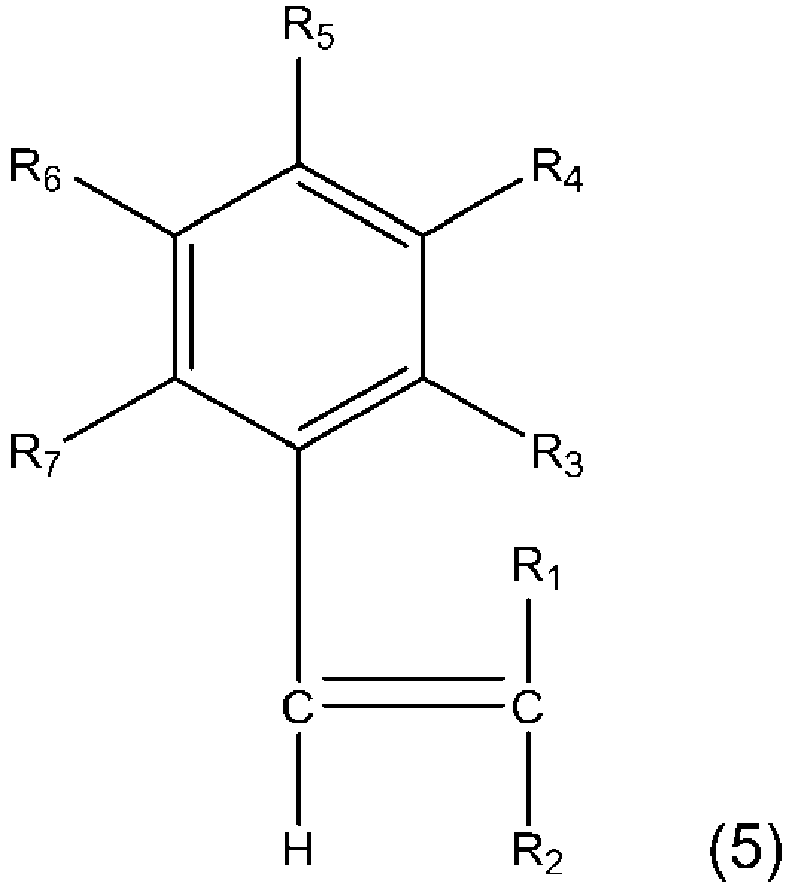 dans laquelle chacun de R1 et R2 représente indépendamment l'hydrogène, à l'exception du cas où R1 et R2 sont tous deux des hydrogènes, un groupe cyano, un groupe ester (-C(=O)OX1), un groupe amide (-C(=O)N(X2)(X3)), ou un groupe acyle (-C(=O)X4), où chacun de X1 à X3 représente indépendamment un groupe alkyle linéaire ayant 1 à 12 atomes de carbone, un groupe alkyle ramifié ayant 1 à 12 atomes de carbone, ou un groupe alkyle cyclique ayant 3 à 6 atomes de carbone, et X4 représente un groupe alkyle linéaire ayant 1 à 12 atomes de carbone, un groupe alkyle ramifié ayant 1 à 12 atomes de carbone, ou un groupe cyclique ayant 3 à 14 atomes de carbone ;chacun de R3 à R7 représente l'hydrogène, un groupe alkyle linéaire ayant 1 à 12 atomes de carbone, un groupe alkyle ramifié ayant 1 à 12 atomes de carbone, un groupe cyclique ayant 3 à 14 atomes de carbone, un halogène, un groupe hydroxy, un groupe carboxy, un groupe nitro, un groupe cyano, un groupe alcoxy (-OX5), un groupe ester (-C(=O)OX6), un groupe amide (-C(=O)N(X7)(X8)), un groupe acyle (-C(=O)X9), un groupe amino (-N(X10)(X11)), ou un groupe sulfonyle (-SOOX12), où chacun de X5 à X8 représente indépendamment un groupe alkyle linéaire ayant 1 à 12 atomes de carbone, un groupe alkyle ramifié ayant 1 à 12 atomes de carbone, ou un groupe alkyle cyclique ayant 3 à 6 atomes de carbone, et chacun de X9 à X12 représente indépendamment l'hydrogène, un groupe alkyle linéaire ayant 1 à 12 atomes de carbone, un groupe alkyle ramifié ayant 1 à 12 atomes de carbone, ou un groupe alkyle cyclique ayant 3 à 6 atomes de carbone ;l'un quelconque ou plusieurs de R3 à R7 est un groupe hydroxy ; etdes substituants adjacents parmi R3 à R7 peuvent former ensemble une structure cyclique condensée.
 - Film optique comprenant :
le copolymère selon l'une quelconque des revendications 1 à 9. - Film de retard utilisant le film optique selon la revendication 11,
dans lequel, dans le cas où l'indice de réfraction dans la direction de l'axe rapide dans le plan du film est nx, l'indice de réfraction dans la direction dans le plan du film orthogonal à celui-ci est ny, et l'indice de réfraction dans la direction de l'épaisseur du film est nz, la relation entre eux est nx ≅ ny < nz. - Composition de résine comprenant :le copolymère selon l'une quelconque des revendications 1 à 9 ; etune résine ayant une biréfringence intrinsèque positive.
- Film de compensation optique utilisant la composition de résine selon la revendication 13,dans lequel le retard dans le plan (Re) représenté par la formule (b) qui suit est de 50 à 500 nm ;le coefficient Nz représenté par la formule (c) qui suit est 0 ≤ Nz ≤ 1,0 ; etle rapport Re(450)/Re(550) du retard dans le plan (Re) à une longueur d'onde de lumière de 450 nm au retard dans le plan (Re) à une longueur d'onde de lumière de 550 nm est 0,60 < Re(450)/Re(550) < 1,10 :

 où nx représente l'indice de réfraction dans la direction de l'axe d'étirement dans le plan du film, ny représente l'indice de réfraction dans la direction perpendiculaire à l'axe d'étirement dans le plan du film, nz représente l'indice de réfraction hors du plan (direction de l'épaisseur) du film, et d représente l'épaisseur du film.
Applications Claiming Priority (6)
| Application Number | Priority Date | Filing Date | Title |
|---|---|---|---|
| JP2016237864 | 2016-12-07 | ||
| JP2017137230A JP7087295B2 (ja) | 2017-07-13 | 2017-07-13 | 重合体及びその製造方法並びにそれを用いた光学フィルム |
| JP2017137231 | 2017-07-13 | ||
| JP2017222844A JP7047340B2 (ja) | 2016-12-07 | 2017-11-20 | 共重合体及びそれを用いた位相差フィルム |
| JP2017223986A JP7151074B2 (ja) | 2017-07-13 | 2017-11-21 | 樹脂組成物およびそれを用いた光学補償フィルム |
| PCT/JP2017/043504 WO2018105561A1 (fr) | 2016-12-07 | 2017-12-04 | Copolymère et film optique l'utilisant |
Publications (3)
| Publication Number | Publication Date |
|---|---|
| EP3553097A1 EP3553097A1 (fr) | 2019-10-16 |
| EP3553097A4 EP3553097A4 (fr) | 2020-08-05 |
| EP3553097B1 true EP3553097B1 (fr) | 2022-05-04 |
Family
ID=62491969
Family Applications (1)
| Application Number | Title | Priority Date | Filing Date |
|---|---|---|---|
| EP17879119.0A Active EP3553097B1 (fr) | 2016-12-07 | 2017-12-04 | Copolymère et film optique l'utilisant |
Country Status (3)
| Country | Link |
|---|---|
| US (1) | US11225540B2 (fr) |
| EP (1) | EP3553097B1 (fr) |
| WO (1) | WO2018105561A1 (fr) |
Families Citing this family (4)
| Publication number | Priority date | Publication date | Assignee | Title |
|---|---|---|---|---|
| JP2020076009A (ja) * | 2018-11-08 | 2020-05-21 | 東ソー株式会社 | 光学フィルムの製造方法 |
| JP7293650B2 (ja) * | 2018-12-26 | 2023-06-20 | 東ソー株式会社 | 重合体及びそれを用いた光学フィルム |
| JP7585604B2 (ja) * | 2019-09-26 | 2024-11-19 | 東ソー株式会社 | 樹脂組成物およびそれを用いた光学フィルム |
| CN112812347B (zh) * | 2021-02-23 | 2022-08-30 | 新纶新材料股份有限公司 | 一种光学薄膜材料及其制备方法、偏光片 |
Family Cites Families (29)
| Publication number | Priority date | Publication date | Assignee | Title |
|---|---|---|---|---|
| JPS5320334A (en) | 1976-08-10 | 1978-02-24 | Mitsubishi Chem Ind | Photosensitive material for electrophotography |
| JPS592038A (ja) | 1982-06-29 | 1984-01-07 | Fujitsu Ltd | ネガ型レジスト組成物 |
| JP2774114B2 (ja) | 1988-11-09 | 1998-07-09 | 保治 大塚 | 非複屈折性材料 |
| JP2818983B2 (ja) | 1990-10-24 | 1998-10-30 | 日東電工株式会社 | 複屈折性フィルムの製造方法 |
| DE69124911T2 (de) | 1990-10-24 | 1997-06-19 | Nitto Denko Corp | Doppelbrechender Film, Verfahren zu seiner Herstellung, verzögernder Film, elliptischer Polarisator und Flüssigkristallanzeigevorrichtung |
| JPH05297223A (ja) | 1992-04-22 | 1993-11-12 | Fuji Photo Film Co Ltd | 複屈折性フィルムの製造方法、それを用いた位相差板及び液晶表示装置 |
| JPH05323120A (ja) | 1992-05-21 | 1993-12-07 | Fuji Photo Film Co Ltd | 複屈折性フィルムの製造方法、並びに位相差板及び液晶表示装置 |
| JPH0688909A (ja) | 1992-09-08 | 1994-03-29 | Fuji Photo Film Co Ltd | 複屈折フイルムの製造方法及び該複屈折フイルムを用いた液晶表示装置 |
| JP4813012B2 (ja) | 2003-11-25 | 2011-11-09 | 東ソー株式会社 | 位相差フィルム |
| TWI337186B (en) | 2005-01-13 | 2011-02-11 | Tosoh Corp | Fumaric diester copolymer |
| JP4529696B2 (ja) | 2005-01-13 | 2010-08-25 | 東ソー株式会社 | フマル酸ジエステル共重合体 |
| JP5245109B2 (ja) | 2006-10-04 | 2013-07-24 | 東ソー株式会社 | 光学フィルム |
| JP4905082B2 (ja) | 2006-11-22 | 2012-03-28 | 東ソー株式会社 | 位相差フィルム |
| JP4697098B2 (ja) | 2006-09-05 | 2011-06-08 | 東ソー株式会社 | 位相差フィルム |
| EP1898252B1 (fr) * | 2006-09-05 | 2014-04-30 | Tosoh Corporation | Empilement de films de compensation optique et film étiré à retard optique |
| JP5830949B2 (ja) | 2010-07-06 | 2015-12-09 | 東ソー株式会社 | 位相差フィルム用フマル酸ジエステル系樹脂及びそれよりなる位相差フィルム |
| JP2012078778A (ja) * | 2010-09-08 | 2012-04-19 | Nippon Shokubai Co Ltd | 樹脂組成物、光学フィルムおよび画像表示装置 |
| JP5803498B2 (ja) | 2010-09-28 | 2015-11-04 | セントラル硝子株式会社 | 抗菌剤およびそれを用いた基材の表面処理方法 |
| WO2014013982A1 (fr) | 2012-07-20 | 2014-01-23 | 東ソー株式会社 | Copolymère de (fumarate de diisopropyle)-(dérivé d'acide cinnamique), et film à différence de phase l'utilisant |
| KR102115142B1 (ko) | 2012-11-28 | 2020-05-26 | 도소 가부시키가이샤 | 푸마르산디에스테르-계피산에스테르계 공중합체, 그 제조 방법 및 그것을 사용한 필름 |
| JP6048446B2 (ja) | 2013-06-07 | 2016-12-21 | 東ソー株式会社 | 樹脂組成物およびそれを用いた光学補償フィルム |
| WO2015100257A1 (fr) | 2013-12-23 | 2015-07-02 | The General Hospital Corporation | Procédés et dosages pour la détermination d'une fonction de voie brca1 réduite dans une cellule cancéreuse |
| EP3208301B1 (fr) | 2014-10-15 | 2019-04-03 | Tosoh Corporation | Composition de résine et film de compensation optique l'utilisant |
| JP6572532B2 (ja) | 2014-10-15 | 2019-09-11 | 東ソー株式会社 | 樹脂組成物およびそれを用いた光学補償フィルム |
| WO2016060115A1 (fr) | 2014-10-15 | 2016-04-21 | 東ソー株式会社 | Composition de résine et film de compensation optique l'utilisant |
| US10052789B2 (en) | 2015-11-25 | 2018-08-21 | General Electric Company | Methods of processing ceramic fiber |
| TWI618577B (zh) | 2016-02-01 | 2018-03-21 | 新綠科學股份有限公司 | 金屬碳酸鹽之製造方法及其所用之觸媒 |
| JP7294766B2 (ja) | 2016-06-10 | 2023-06-20 | 日本ポリプロ株式会社 | ヒートシール用樹脂組成物及びそれを用いたフィルム |
| JP6551476B2 (ja) | 2017-08-29 | 2019-07-31 | ソニー株式会社 | 光学装置及び表示装置 |
-
2017
- 2017-12-04 WO PCT/JP2017/043504 patent/WO2018105561A1/fr not_active Ceased
- 2017-12-04 US US16/467,414 patent/US11225540B2/en active Active
- 2017-12-04 EP EP17879119.0A patent/EP3553097B1/fr active Active
Also Published As
| Publication number | Publication date |
|---|---|
| EP3553097A4 (fr) | 2020-08-05 |
| US11225540B2 (en) | 2022-01-18 |
| US20200095358A1 (en) | 2020-03-26 |
| EP3553097A1 (fr) | 2019-10-16 |
| WO2018105561A1 (fr) | 2018-06-14 |
Similar Documents
| Publication | Publication Date | Title |
|---|---|---|
| US9932488B2 (en) | Resin composition, optical compensation film using same, and production method for same | |
| TWI531822B (zh) | 未延伸相位差薄膜 | |
| US10126478B2 (en) | Resin composition and optical compensation film using same | |
| CN103717660B (zh) | 树脂组合物、使用其的光学补偿膜及光学补偿膜制造方法 | |
| JP7095355B2 (ja) | 共重合体及びそれを用いた光学フィルム | |
| US11225540B2 (en) | Copolymer and optical film using same | |
| JP6136253B2 (ja) | 樹脂組成物およびそれを用いた光学補償フィルム | |
| JP7151074B2 (ja) | 樹脂組成物およびそれを用いた光学補償フィルム | |
| JP6699260B2 (ja) | 樹脂組成物およびそれを用いた光学補償フィルム | |
| JP7293650B2 (ja) | 重合体及びそれを用いた光学フィルム | |
| CN108369312B (zh) | 光学补偿膜及其制造方法 | |
| WO2017122563A1 (fr) | Film de compensation optique et procédé de production de celui-ci | |
| JP5831174B2 (ja) | 位相差フィルム用フマル酸ジエステル系樹脂及びそれよりなる位相差フィルム | |
| JP7047340B2 (ja) | 共重合体及びそれを用いた位相差フィルム | |
| CN110248971B (zh) | 共聚物及使用该共聚物的光学膜 | |
| JP7287183B2 (ja) | 樹脂組成物およびそれからなるフィルム | |
| JP6237366B2 (ja) | 光学補償フィルム用重合体 | |
| JP2013142745A (ja) | 光学補償用積層フィルム | |
| JP2023152307A (ja) | 樹脂組成物およびそれを用いた光学フィルム | |
| JP2022046579A (ja) | 共重合体及びそれを用いた位相差フィルム | |
| JP6229561B2 (ja) | 光学補償フィルム用重合体 |
Legal Events
| Date | Code | Title | Description |
|---|---|---|---|
| STAA | Information on the status of an ep patent application or granted ep patent |
Free format text: STATUS: THE INTERNATIONAL PUBLICATION HAS BEEN MADE |
|
| PUAI | Public reference made under article 153(3) epc to a published international application that has entered the european phase |
Free format text: ORIGINAL CODE: 0009012 |
|
| STAA | Information on the status of an ep patent application or granted ep patent |
Free format text: STATUS: REQUEST FOR EXAMINATION WAS MADE |
|
| 17P | Request for examination filed |
Effective date: 20190607 |
|
| AK | Designated contracting states |
Kind code of ref document: A1 Designated state(s): AL AT BE BG CH CY CZ DE DK EE ES FI FR GB GR HR HU IE IS IT LI LT LU LV MC MK MT NL NO PL PT RO RS SE SI SK SM TR |
|
| AX | Request for extension of the european patent |
Extension state: BA ME |
|
| DAV | Request for validation of the european patent (deleted) | ||
| DAX | Request for extension of the european patent (deleted) | ||
| A4 | Supplementary search report drawn up and despatched |
Effective date: 20200702 |
|
| RIC1 | Information provided on ipc code assigned before grant |
Ipc: G02B 5/30 20060101ALI20200626BHEP Ipc: C08J 5/18 20060101ALI20200626BHEP Ipc: C08F 212/14 20060101ALI20200626BHEP Ipc: C08F 226/06 20060101ALI20200626BHEP Ipc: C08F 224/00 20060101AFI20200626BHEP Ipc: G02F 1/13363 20060101ALI20200626BHEP |
|
| REG | Reference to a national code |
Ref country code: DE Ref legal event code: R079 Ref document number: 602017057123 Country of ref document: DE Free format text: PREVIOUS MAIN CLASS: C08F0220420000 Ipc: C08F0224000000 |
|
| RIC1 | Information provided on ipc code assigned before grant |
Ipc: G02F 1/13363 20060101ALI20220105BHEP Ipc: C08F 212/14 20060101ALI20220105BHEP Ipc: G02B 5/30 20060101ALI20220105BHEP Ipc: C08J 5/18 20060101ALI20220105BHEP Ipc: C08F 226/06 20060101ALI20220105BHEP Ipc: C08F 224/00 20060101AFI20220105BHEP |
|
| GRAP | Despatch of communication of intention to grant a patent |
Free format text: ORIGINAL CODE: EPIDOSNIGR1 |
|
| STAA | Information on the status of an ep patent application or granted ep patent |
Free format text: STATUS: GRANT OF PATENT IS INTENDED |
|
| INTG | Intention to grant announced |
Effective date: 20220223 |
|
| GRAS | Grant fee paid |
Free format text: ORIGINAL CODE: EPIDOSNIGR3 |
|
| GRAA | (expected) grant |
Free format text: ORIGINAL CODE: 0009210 |
|
| STAA | Information on the status of an ep patent application or granted ep patent |
Free format text: STATUS: THE PATENT HAS BEEN GRANTED |
|
| AK | Designated contracting states |
Kind code of ref document: B1 Designated state(s): AL AT BE BG CH CY CZ DE DK EE ES FI FR GB GR HR HU IE IS IT LI LT LU LV MC MK MT NL NO PL PT RO RS SE SI SK SM TR |
|
| REG | Reference to a national code |
Ref country code: GB Ref legal event code: FG4D |
|
| REG | Reference to a national code |
Ref country code: CH Ref legal event code: EP |
|
| REG | Reference to a national code |
Ref country code: AT Ref legal event code: REF Ref document number: 1488995 Country of ref document: AT Kind code of ref document: T Effective date: 20220515 |
|
| REG | Reference to a national code |
Ref country code: IE Ref legal event code: FG4D Ref country code: DE Ref legal event code: R096 Ref document number: 602017057123 Country of ref document: DE |
|
| REG | Reference to a national code |
Ref country code: LT Ref legal event code: MG9D |
|
| REG | Reference to a national code |
Ref country code: NL Ref legal event code: MP Effective date: 20220504 |
|
| REG | Reference to a national code |
Ref country code: AT Ref legal event code: MK05 Ref document number: 1488995 Country of ref document: AT Kind code of ref document: T Effective date: 20220504 |
|
| PG25 | Lapsed in a contracting state [announced via postgrant information from national office to epo] |
Ref country code: SE Free format text: LAPSE BECAUSE OF FAILURE TO SUBMIT A TRANSLATION OF THE DESCRIPTION OR TO PAY THE FEE WITHIN THE PRESCRIBED TIME-LIMIT Effective date: 20220504 Ref country code: PT Free format text: LAPSE BECAUSE OF FAILURE TO SUBMIT A TRANSLATION OF THE DESCRIPTION OR TO PAY THE FEE WITHIN THE PRESCRIBED TIME-LIMIT Effective date: 20220905 Ref country code: NO Free format text: LAPSE BECAUSE OF FAILURE TO SUBMIT A TRANSLATION OF THE DESCRIPTION OR TO PAY THE FEE WITHIN THE PRESCRIBED TIME-LIMIT Effective date: 20220804 Ref country code: NL Free format text: LAPSE BECAUSE OF FAILURE TO SUBMIT A TRANSLATION OF THE DESCRIPTION OR TO PAY THE FEE WITHIN THE PRESCRIBED TIME-LIMIT Effective date: 20220504 Ref country code: LT Free format text: LAPSE BECAUSE OF FAILURE TO SUBMIT A TRANSLATION OF THE DESCRIPTION OR TO PAY THE FEE WITHIN THE PRESCRIBED TIME-LIMIT Effective date: 20220504 Ref country code: HR Free format text: LAPSE BECAUSE OF FAILURE TO SUBMIT A TRANSLATION OF THE DESCRIPTION OR TO PAY THE FEE WITHIN THE PRESCRIBED TIME-LIMIT Effective date: 20220504 Ref country code: GR Free format text: LAPSE BECAUSE OF FAILURE TO SUBMIT A TRANSLATION OF THE DESCRIPTION OR TO PAY THE FEE WITHIN THE PRESCRIBED TIME-LIMIT Effective date: 20220805 Ref country code: FI Free format text: LAPSE BECAUSE OF FAILURE TO SUBMIT A TRANSLATION OF THE DESCRIPTION OR TO PAY THE FEE WITHIN THE PRESCRIBED TIME-LIMIT Effective date: 20220504 Ref country code: ES Free format text: LAPSE BECAUSE OF FAILURE TO SUBMIT A TRANSLATION OF THE DESCRIPTION OR TO PAY THE FEE WITHIN THE PRESCRIBED TIME-LIMIT Effective date: 20220504 Ref country code: BG Free format text: LAPSE BECAUSE OF FAILURE TO SUBMIT A TRANSLATION OF THE DESCRIPTION OR TO PAY THE FEE WITHIN THE PRESCRIBED TIME-LIMIT Effective date: 20220804 Ref country code: AT Free format text: LAPSE BECAUSE OF FAILURE TO SUBMIT A TRANSLATION OF THE DESCRIPTION OR TO PAY THE FEE WITHIN THE PRESCRIBED TIME-LIMIT Effective date: 20220504 |
|
| PG25 | Lapsed in a contracting state [announced via postgrant information from national office to epo] |
Ref country code: RS Free format text: LAPSE BECAUSE OF FAILURE TO SUBMIT A TRANSLATION OF THE DESCRIPTION OR TO PAY THE FEE WITHIN THE PRESCRIBED TIME-LIMIT Effective date: 20220504 Ref country code: PL Free format text: LAPSE BECAUSE OF FAILURE TO SUBMIT A TRANSLATION OF THE DESCRIPTION OR TO PAY THE FEE WITHIN THE PRESCRIBED TIME-LIMIT Effective date: 20220504 Ref country code: LV Free format text: LAPSE BECAUSE OF FAILURE TO SUBMIT A TRANSLATION OF THE DESCRIPTION OR TO PAY THE FEE WITHIN THE PRESCRIBED TIME-LIMIT Effective date: 20220504 Ref country code: IS Free format text: LAPSE BECAUSE OF FAILURE TO SUBMIT A TRANSLATION OF THE DESCRIPTION OR TO PAY THE FEE WITHIN THE PRESCRIBED TIME-LIMIT Effective date: 20220904 |
|
| PG25 | Lapsed in a contracting state [announced via postgrant information from national office to epo] |
Ref country code: SM Free format text: LAPSE BECAUSE OF FAILURE TO SUBMIT A TRANSLATION OF THE DESCRIPTION OR TO PAY THE FEE WITHIN THE PRESCRIBED TIME-LIMIT Effective date: 20220504 Ref country code: SK Free format text: LAPSE BECAUSE OF FAILURE TO SUBMIT A TRANSLATION OF THE DESCRIPTION OR TO PAY THE FEE WITHIN THE PRESCRIBED TIME-LIMIT Effective date: 20220504 Ref country code: RO Free format text: LAPSE BECAUSE OF FAILURE TO SUBMIT A TRANSLATION OF THE DESCRIPTION OR TO PAY THE FEE WITHIN THE PRESCRIBED TIME-LIMIT Effective date: 20220504 Ref country code: EE Free format text: LAPSE BECAUSE OF FAILURE TO SUBMIT A TRANSLATION OF THE DESCRIPTION OR TO PAY THE FEE WITHIN THE PRESCRIBED TIME-LIMIT Effective date: 20220504 Ref country code: DK Free format text: LAPSE BECAUSE OF FAILURE TO SUBMIT A TRANSLATION OF THE DESCRIPTION OR TO PAY THE FEE WITHIN THE PRESCRIBED TIME-LIMIT Effective date: 20220504 Ref country code: CZ Free format text: LAPSE BECAUSE OF FAILURE TO SUBMIT A TRANSLATION OF THE DESCRIPTION OR TO PAY THE FEE WITHIN THE PRESCRIBED TIME-LIMIT Effective date: 20220504 |
|
| REG | Reference to a national code |
Ref country code: DE Ref legal event code: R097 Ref document number: 602017057123 Country of ref document: DE |
|
| PLBE | No opposition filed within time limit |
Free format text: ORIGINAL CODE: 0009261 |
|
| STAA | Information on the status of an ep patent application or granted ep patent |
Free format text: STATUS: NO OPPOSITION FILED WITHIN TIME LIMIT |
|
| PG25 | Lapsed in a contracting state [announced via postgrant information from national office to epo] |
Ref country code: AL Free format text: LAPSE BECAUSE OF FAILURE TO SUBMIT A TRANSLATION OF THE DESCRIPTION OR TO PAY THE FEE WITHIN THE PRESCRIBED TIME-LIMIT Effective date: 20220504 |
|
| 26N | No opposition filed |
Effective date: 20230207 |
|
| PG25 | Lapsed in a contracting state [announced via postgrant information from national office to epo] |
Ref country code: SI Free format text: LAPSE BECAUSE OF FAILURE TO SUBMIT A TRANSLATION OF THE DESCRIPTION OR TO PAY THE FEE WITHIN THE PRESCRIBED TIME-LIMIT Effective date: 20220504 |
|
| P01 | Opt-out of the competence of the unified patent court (upc) registered |
Effective date: 20230523 |
|
| REG | Reference to a national code |
Ref country code: CH Ref legal event code: PL |
|
| REG | Reference to a national code |
Ref country code: BE Ref legal event code: MM Effective date: 20221231 |
|
| PG25 | Lapsed in a contracting state [announced via postgrant information from national office to epo] |
Ref country code: LU Free format text: LAPSE BECAUSE OF NON-PAYMENT OF DUE FEES Effective date: 20221204 |
|
| PG25 | Lapsed in a contracting state [announced via postgrant information from national office to epo] |
Ref country code: LI Free format text: LAPSE BECAUSE OF NON-PAYMENT OF DUE FEES Effective date: 20221231 Ref country code: IE Free format text: LAPSE BECAUSE OF NON-PAYMENT OF DUE FEES Effective date: 20221204 Ref country code: CH Free format text: LAPSE BECAUSE OF NON-PAYMENT OF DUE FEES Effective date: 20221231 |
|
| PG25 | Lapsed in a contracting state [announced via postgrant information from national office to epo] |
Ref country code: BE Free format text: LAPSE BECAUSE OF NON-PAYMENT OF DUE FEES Effective date: 20221231 |
|
| PG25 | Lapsed in a contracting state [announced via postgrant information from national office to epo] |
Ref country code: IT Free format text: LAPSE BECAUSE OF FAILURE TO SUBMIT A TRANSLATION OF THE DESCRIPTION OR TO PAY THE FEE WITHIN THE PRESCRIBED TIME-LIMIT Effective date: 20220504 |
|
| PG25 | Lapsed in a contracting state [announced via postgrant information from national office to epo] |
Ref country code: HU Free format text: LAPSE BECAUSE OF FAILURE TO SUBMIT A TRANSLATION OF THE DESCRIPTION OR TO PAY THE FEE WITHIN THE PRESCRIBED TIME-LIMIT; INVALID AB INITIO Effective date: 20171204 |
|
| PG25 | Lapsed in a contracting state [announced via postgrant information from national office to epo] |
Ref country code: CY Free format text: LAPSE BECAUSE OF FAILURE TO SUBMIT A TRANSLATION OF THE DESCRIPTION OR TO PAY THE FEE WITHIN THE PRESCRIBED TIME-LIMIT Effective date: 20220504 |
|
| PG25 | Lapsed in a contracting state [announced via postgrant information from national office to epo] |
Ref country code: MK Free format text: LAPSE BECAUSE OF FAILURE TO SUBMIT A TRANSLATION OF THE DESCRIPTION OR TO PAY THE FEE WITHIN THE PRESCRIBED TIME-LIMIT Effective date: 20220504 |
|
| PG25 | Lapsed in a contracting state [announced via postgrant information from national office to epo] |
Ref country code: MC Free format text: LAPSE BECAUSE OF FAILURE TO SUBMIT A TRANSLATION OF THE DESCRIPTION OR TO PAY THE FEE WITHIN THE PRESCRIBED TIME-LIMIT Effective date: 20220504 |
|
| PG25 | Lapsed in a contracting state [announced via postgrant information from national office to epo] |
Ref country code: MC Free format text: LAPSE BECAUSE OF FAILURE TO SUBMIT A TRANSLATION OF THE DESCRIPTION OR TO PAY THE FEE WITHIN THE PRESCRIBED TIME-LIMIT Effective date: 20220504 |
|
| PG25 | Lapsed in a contracting state [announced via postgrant information from national office to epo] |
Ref country code: MT Free format text: LAPSE BECAUSE OF FAILURE TO SUBMIT A TRANSLATION OF THE DESCRIPTION OR TO PAY THE FEE WITHIN THE PRESCRIBED TIME-LIMIT Effective date: 20220504 |
|
| PG25 | Lapsed in a contracting state [announced via postgrant information from national office to epo] |
Ref country code: BG Free format text: LAPSE BECAUSE OF FAILURE TO SUBMIT A TRANSLATION OF THE DESCRIPTION OR TO PAY THE FEE WITHIN THE PRESCRIBED TIME-LIMIT Effective date: 20220504 |
|
| PG25 | Lapsed in a contracting state [announced via postgrant information from national office to epo] |
Ref country code: BG Free format text: LAPSE BECAUSE OF FAILURE TO SUBMIT A TRANSLATION OF THE DESCRIPTION OR TO PAY THE FEE WITHIN THE PRESCRIBED TIME-LIMIT Effective date: 20220504 |
|
| PG25 | Lapsed in a contracting state [announced via postgrant information from national office to epo] |
Ref country code: TR Free format text: LAPSE BECAUSE OF FAILURE TO SUBMIT A TRANSLATION OF THE DESCRIPTION OR TO PAY THE FEE WITHIN THE PRESCRIBED TIME-LIMIT Effective date: 20220504 |
|
| PGFP | Annual fee paid to national office [announced via postgrant information from national office to epo] |
Ref country code: DE Payment date: 20251028 Year of fee payment: 9 |
|
| PGFP | Annual fee paid to national office [announced via postgrant information from national office to epo] |
Ref country code: GB Payment date: 20251030 Year of fee payment: 9 |
|
| PGFP | Annual fee paid to national office [announced via postgrant information from national office to epo] |
Ref country code: FR Payment date: 20251110 Year of fee payment: 9 |