EP3436490B1 - Semi-crystalline block copolymers and compositions therefrom - Google Patents
Semi-crystalline block copolymers and compositions therefrom Download PDFInfo
- Publication number
- EP3436490B1 EP3436490B1 EP17771060.5A EP17771060A EP3436490B1 EP 3436490 B1 EP3436490 B1 EP 3436490B1 EP 17771060 A EP17771060 A EP 17771060A EP 3436490 B1 EP3436490 B1 EP 3436490B1
- Authority
- EP
- European Patent Office
- Prior art keywords
- block
- mol
- semi
- block copolymer
- hydrogenated
- Prior art date
- Legal status (The legal status is an assumption and is not a legal conclusion. Google has not performed a legal analysis and makes no representation as to the accuracy of the status listed.)
- Active
Links
Images
Classifications
-
- C—CHEMISTRY; METALLURGY
- C08—ORGANIC MACROMOLECULAR COMPOUNDS; THEIR PREPARATION OR CHEMICAL WORKING-UP; COMPOSITIONS BASED THEREON
- C08F—MACROMOLECULAR COMPOUNDS OBTAINED BY REACTIONS ONLY INVOLVING CARBON-TO-CARBON UNSATURATED BONDS
- C08F8/00—Chemical modification by after-treatment
- C08F8/04—Reduction, e.g. hydrogenation
-
- C—CHEMISTRY; METALLURGY
- C08—ORGANIC MACROMOLECULAR COMPOUNDS; THEIR PREPARATION OR CHEMICAL WORKING-UP; COMPOSITIONS BASED THEREON
- C08F—MACROMOLECULAR COMPOUNDS OBTAINED BY REACTIONS ONLY INVOLVING CARBON-TO-CARBON UNSATURATED BONDS
- C08F297/00—Macromolecular compounds obtained by successively polymerising different monomer systems using a catalyst of the ionic or coordination type without deactivating the intermediate polymer
- C08F297/02—Macromolecular compounds obtained by successively polymerising different monomer systems using a catalyst of the ionic or coordination type without deactivating the intermediate polymer using a catalyst of the anionic type
- C08F297/04—Macromolecular compounds obtained by successively polymerising different monomer systems using a catalyst of the ionic or coordination type without deactivating the intermediate polymer using a catalyst of the anionic type polymerising vinyl aromatic monomers and conjugated dienes
- C08F297/044—Macromolecular compounds obtained by successively polymerising different monomer systems using a catalyst of the ionic or coordination type without deactivating the intermediate polymer using a catalyst of the anionic type polymerising vinyl aromatic monomers and conjugated dienes using a coupling agent
-
- C—CHEMISTRY; METALLURGY
- C08—ORGANIC MACROMOLECULAR COMPOUNDS; THEIR PREPARATION OR CHEMICAL WORKING-UP; COMPOSITIONS BASED THEREON
- C08J—WORKING-UP; GENERAL PROCESSES OF COMPOUNDING; AFTER-TREATMENT NOT COVERED BY SUBCLASSES C08B, C08C, C08F, C08G or C08H
- C08J5/00—Manufacture of articles or shaped materials containing macromolecular substances
- C08J5/18—Manufacture of films or sheets
-
- C—CHEMISTRY; METALLURGY
- C08—ORGANIC MACROMOLECULAR COMPOUNDS; THEIR PREPARATION OR CHEMICAL WORKING-UP; COMPOSITIONS BASED THEREON
- C08L—COMPOSITIONS OF MACROMOLECULAR COMPOUNDS
- C08L23/00—Compositions of homopolymers or copolymers of unsaturated aliphatic hydrocarbons having only one carbon-to-carbon double bond; Compositions of derivatives of such polymers
- C08L23/02—Compositions of homopolymers or copolymers of unsaturated aliphatic hydrocarbons having only one carbon-to-carbon double bond; Compositions of derivatives of such polymers not modified by chemical after-treatment
- C08L23/04—Homopolymers or copolymers of ethene
- C08L23/06—Polyethylene
-
- C—CHEMISTRY; METALLURGY
- C08—ORGANIC MACROMOLECULAR COMPOUNDS; THEIR PREPARATION OR CHEMICAL WORKING-UP; COMPOSITIONS BASED THEREON
- C08L—COMPOSITIONS OF MACROMOLECULAR COMPOUNDS
- C08L23/00—Compositions of homopolymers or copolymers of unsaturated aliphatic hydrocarbons having only one carbon-to-carbon double bond; Compositions of derivatives of such polymers
- C08L23/02—Compositions of homopolymers or copolymers of unsaturated aliphatic hydrocarbons having only one carbon-to-carbon double bond; Compositions of derivatives of such polymers not modified by chemical after-treatment
- C08L23/04—Homopolymers or copolymers of ethene
- C08L23/08—Copolymers of ethene
- C08L23/0807—Copolymers of ethene with unsaturated hydrocarbons only containing four or more carbon atoms
- C08L23/0815—Copolymers of ethene with unsaturated hydrocarbons only containing four or more carbon atoms with aliphatic 1-olefins containing one carbon-to-carbon double bond
-
- C—CHEMISTRY; METALLURGY
- C08—ORGANIC MACROMOLECULAR COMPOUNDS; THEIR PREPARATION OR CHEMICAL WORKING-UP; COMPOSITIONS BASED THEREON
- C08L—COMPOSITIONS OF MACROMOLECULAR COMPOUNDS
- C08L23/00—Compositions of homopolymers or copolymers of unsaturated aliphatic hydrocarbons having only one carbon-to-carbon double bond; Compositions of derivatives of such polymers
- C08L23/02—Compositions of homopolymers or copolymers of unsaturated aliphatic hydrocarbons having only one carbon-to-carbon double bond; Compositions of derivatives of such polymers not modified by chemical after-treatment
- C08L23/10—Homopolymers or copolymers of propene
- C08L23/14—Copolymers of propene
-
- C—CHEMISTRY; METALLURGY
- C08—ORGANIC MACROMOLECULAR COMPOUNDS; THEIR PREPARATION OR CHEMICAL WORKING-UP; COMPOSITIONS BASED THEREON
- C08J—WORKING-UP; GENERAL PROCESSES OF COMPOUNDING; AFTER-TREATMENT NOT COVERED BY SUBCLASSES C08B, C08C, C08F, C08G or C08H
- C08J2353/00—Characterised by the use of block copolymers containing at least one sequence of a polymer obtained by reactions only involving carbon-to-carbon unsaturated bonds; Derivatives of such polymers
- C08J2353/02—Characterised by the use of block copolymers containing at least one sequence of a polymer obtained by reactions only involving carbon-to-carbon unsaturated bonds; Derivatives of such polymers of vinyl aromatic monomers and conjugated dienes
-
- C—CHEMISTRY; METALLURGY
- C08—ORGANIC MACROMOLECULAR COMPOUNDS; THEIR PREPARATION OR CHEMICAL WORKING-UP; COMPOSITIONS BASED THEREON
- C08J—WORKING-UP; GENERAL PROCESSES OF COMPOUNDING; AFTER-TREATMENT NOT COVERED BY SUBCLASSES C08B, C08C, C08F, C08G or C08H
- C08J2423/00—Characterised by the use of homopolymers or copolymers of unsaturated aliphatic hydrocarbons having only one carbon-to-carbon double bond; Derivatives of such polymers
- C08J2423/02—Characterised by the use of homopolymers or copolymers of unsaturated aliphatic hydrocarbons having only one carbon-to-carbon double bond; Derivatives of such polymers not modified by chemical after treatment
- C08J2423/04—Homopolymers or copolymers of ethene
- C08J2423/06—Polyethene
-
- C—CHEMISTRY; METALLURGY
- C08—ORGANIC MACROMOLECULAR COMPOUNDS; THEIR PREPARATION OR CHEMICAL WORKING-UP; COMPOSITIONS BASED THEREON
- C08L—COMPOSITIONS OF MACROMOLECULAR COMPOUNDS
- C08L2205/00—Polymer mixtures characterised by other features
- C08L2205/02—Polymer mixtures characterised by other features containing two or more polymers of the same C08L -group
-
- C—CHEMISTRY; METALLURGY
- C08—ORGANIC MACROMOLECULAR COMPOUNDS; THEIR PREPARATION OR CHEMICAL WORKING-UP; COMPOSITIONS BASED THEREON
- C08L—COMPOSITIONS OF MACROMOLECULAR COMPOUNDS
- C08L2205/00—Polymer mixtures characterised by other features
- C08L2205/03—Polymer mixtures characterised by other features containing three or more polymers in a blend
-
- C—CHEMISTRY; METALLURGY
- C08—ORGANIC MACROMOLECULAR COMPOUNDS; THEIR PREPARATION OR CHEMICAL WORKING-UP; COMPOSITIONS BASED THEREON
- C08L—COMPOSITIONS OF MACROMOLECULAR COMPOUNDS
- C08L2207/00—Properties characterising the ingredient of the composition
- C08L2207/06—Properties of polyethylene
- C08L2207/066—LDPE (radical process)
-
- C—CHEMISTRY; METALLURGY
- C08—ORGANIC MACROMOLECULAR COMPOUNDS; THEIR PREPARATION OR CHEMICAL WORKING-UP; COMPOSITIONS BASED THEREON
- C08L—COMPOSITIONS OF MACROMOLECULAR COMPOUNDS
- C08L53/00—Compositions of block copolymers containing at least one sequence of a polymer obtained by reactions only involving carbon-to-carbon unsaturated bonds; Compositions of derivatives of such polymers
- C08L53/02—Compositions of block copolymers containing at least one sequence of a polymer obtained by reactions only involving carbon-to-carbon unsaturated bonds; Compositions of derivatives of such polymers of vinyl-aromatic monomers and conjugated dienes
- C08L53/025—Compositions of block copolymers containing at least one sequence of a polymer obtained by reactions only involving carbon-to-carbon unsaturated bonds; Compositions of derivatives of such polymers of vinyl-aromatic monomers and conjugated dienes modified
Definitions
- the present disclosure is directed to a selectively hydrogenated, semi-crystalline block copolymer and to a method to produce highly isotropic, high strength melt cast films of block copolymers.
- Block copolymers having semi-crystalline blocks have been disclosed in U.S. Patent No. 3,670,054 to De La Mare et al.
- De La Mare et al. disclose linear pentablock copolymers which have semi-crystalline terminal blocks comprising hydrogenated vinyl content polybutadiene.
- the remaining blocks of the pentablock are homopolystyrene blocks and rubbery, hydrogenated, vinyl content polybutadiene or polyisoprene blocks.
- the reduced terminal block size and the chemical similarity of the terminal semi-crystalline blocks and the rubber conjugated diene blocks leads to a reduced tendency for these blocks to phase separate and thereby limits the development of superior physical properties.
- U.S. Patent No. 4107,236 to Naylor et al. discloses block copolymers having semi-crystalline blocks derived from hydrogenated polybutadiene and lacking a mono vinyl aromatic block.
- these hydrogenated block copolymers possessed terminal semi-crystalline, hydrogenated, vinyl butadiene blocks and interior non-crystalline, hydrogenated, rubbery vinyl butadiene blocks.
- the tendency for phase separation of the terminal and interior blocks was much reduced in these block copolymers thereby limiting the development of superior physical properties.
- US 5,306,779 discloses a hydrogenated diene block copolymer having a molecular weight of 50,000 to 600,000 g/mol, which is a hydrogenation product of an (A)-(B) block copolymer, in which (A) means i) an alkenyl aromatic compound polymer block and (B) means an alkenyl aromatic compound-conjugated diene random copolymer block wherein the vinyl content of the conjugated diene portion is 15-60%, ii) an (A)-(B)-(C) block copolymer in which (A) and (B) are as defined above and (C) means an alkenyl aromatic compound-conjugated diene copolymer tapered block wherein the proportion of the alkenyl aromatic compound increases gradually, or iii) an (A)-(B)-(A) block copolymer in which (A) and (B) are as defined above, in which block copolymer (1) the weight proportion of the alkenyl
- US 5,596,041 describes a hydrogenated block copolymer composition
- a hydrogenated block copolymer which consists essentially of: (a) a hydrogenation product of a star-branched block copolymer represented by the structural formula (A-B)n-X wherein A is a polybutadiene block having a 1,2-vinyl content of less than 25% by weight; B is a conjugated diene polymer block comprising at least 50% by weight of a conjugated diene compound whose vinyl content is at least 25% by weight; X is a polyfunctional coupling agent residue and n is an integer of 3 or more.
- US 2010/298514 A1 discloses a sulfonated block copolymer comprising at least two polymer end blocks A and at least one polymer interior block B, wherein each A block comprises one or more segments selected from polymerized (i) ethylene, (ii) monomers of conjugated dienes having a vinyl content less than 35 mol percent prior to hydrogenation and (iii) mixtures thereof, and each B block comprises segments of one or more vinyl aromatic monomers selected from polymerized (i) unsubstituted styrene monomers, (ii) ortho-substituted styrene monomers, (iii) meta-substituted styrene monomers, (iv) alpha-methylstyrene, (v) 1,1-diphenylethylene, (vi) 1,2-diphenylethylene and (vii) mixtures thereof.
- each A block comprises one or more segments selected from polymerized (i) ethylene, (ii) monomers of conjugated dienes
- Block copolymers having semi-crystalline blocks and hydrogenated, random styrene/butadiene blocks have been disclosed in U.S. Publication No. 2008/0188580 , Sasagawa et al.
- the block copolymers of Sasagawa et al. had mono vinyl aromatic comonomer in their soft blocks.
- mono vinyl aromatic contents of 55 to 90% were disclosed.
- physical properties were only demonstrated after peroxide cross-linking. Therefore, any physical cross-linking due to the semi-crystalline hard blocks was insufficient for producing materials having useful physical properties.
- Block copolymers having selectively hydrogenated, controlled distribution soft blocks have been disclosed in U.S. Patent No. 7,169,848 to Bening et al.
- the block copolymers did not possess semi-crystalline blocks.
- mono vinyl aromatic blocks, particularly polystyrene blocks provided physical cross-linking and resulted in materials useful for a wide variety of applications. In particular, these materials had novel "stretching stiffness" character.
- the mono vinyl aromatic blocks were susceptible to attack by solvents and in such environments dissolved or achieved inferior physical properties.
- thermo-processable rubber materials which are strong and solvent resistant.
- thermally processable block copolymers are desired which are easily melt processable while able to develop strength and solvent resistance in the solid state. This combination of strength and solvent resistance will allow practical application in a wide variety of environments in which they are exposed to some level of solvent vapor or liquid. Further, such block copolymers will be useful for the preparation of compositions in which solvent resistance, high processability, and strength are needed.
- highly isotropic elastomeric films The present disclosure addresses these needs.
- the present disclosure provides a selectively hydrogenated, semi-crystalline block copolymer comprising at least one A block and at least one B block wherein the A block is a hydrogenated block of polymerized 1,3-butadiene having a vinyl content of 20% or less and having a peak true molecular weight (Mp) of greater than 15 kg/mol to 80 kg/mol, measured according to ASTM D5296, and the B block is a copolymer block of conjugated diene and mono vinyl aromatic monomer units wherein the B block is a controlled distribution copolymer block of conjugated diene and mono vinyl aromatic monomer units wherein i.
- Mp peak true molecular weight
- the polymerized conjugated diene monomer units are hydrogenated to a level of 90 mol% or greater and between 0 and 10 mol% of the aromatic double bonds present in the polymerized mono vinyl aromatic monomer units are hydrogenated; ii. the amount of polymerized mono vinyl aromatic is between 10 wt% and 55 wt.%; and iii. the mono vinyl aromatic blockiness is less than 40%.
- a selectively hydrogenated block copolymer comprising at least one A block and at least one B block wherein the A block is a hydrogenated block of polymerized 1,3-butadiene having a vinyl content of 20% or less, and the B block is a controlled distribution copolymerized block of conjugated diene and mono vinyl aromatic monomer units wherein the conjugated diene monomer units are hydrogenated the amount of mono vinyl aromatic monomer is from about 10 wt.% to about 55 wt.%, and the mono vinyl aromatic blockiness is less than 40%.
- the selectively hydrogenated semi crystalline block copolymer presents a melting point characterized by a peak temperature superior to 50°C.
- the present disclosure provides a selectively hydrogenated, semi-crystalline block copolymer comprising at least one A block and at least one B block wherein the A block is a hydrogenated block of polymerized 1,3-butadiene having a vinyl content of 20% or less, and the B block is a random copolymerized block having a weight ratio of conjugated diene to mono vinyl aromatic monomer units from 90/10 to 60/40.
- the selectively hydrogenated semi crystalline block copolymer presents a melting point characterized by a peak temperature superior to 50°C.
- the present disclosure provides a selectively hydrogenated, semi-crystalline block copolymer to which has been grafted polar functional groups in post-polymerization reactions.
- groups include maleic anhydride, maleic acid or fumaric acid and their derivatives, silicon or boron containing compounds, alkoxy silane compounds, ethylene oxide, carbon dioxide, alkali metal alkyl compounds, and sulfonic compounds.
- the block copolymers described herein exhibit properties including high elasticity, tensile strength, and modulus while having high melt flow and processability even below 200°C. Importantly, the block copolymers show a significant degree of solvent resistance and have a low amount of extractable components due to chemical composition and their narrow molecular weight distributions resulting from their preparation by living anionic polymerization. The semi-crystalline nature of the block copolymers also imparts a non-sticky surface character to the block copolymers.
- the disclosure provides a composition comprising the selectively hydrogenated block copolymer and at least one component selected from thermoplastic resins, tackifiers, plasticizers and waxes.
- the disclosure provides an article comprising the selectively hydrogenated, semi-crystalline block copolymer which is a melt extruded or solvent cast film, coextruded multilayer films, melt blown films, melt blown multilayer films, an injection molded piece, a coating, a foamed shape, a fiber, a bicomponent, a multi-component fiber, a melt-blown fiber, a fibrous mat, a bundle of fibers, a powder, a gel of various shapes, extruded tubes, extruded profiles, injection molded pieces, a slush molded piece, or a rotationally molded piece.
- the selectively hydrogenated, semi-crystalline block copolymer which is a melt extruded or solvent cast film, coextruded multilayer films, melt blown films, melt blown multilayer films, an injection molded piece, a coating, a foamed shape, a fiber, a bicomponent, a multi-component fiber, a melt-blown fiber, a fibr
- the disclosure provides a novel method for producing highly isotropic, high strength films of melt cast block copolymers.
- the semi-crystalline A blocks are similar to polyethylene blocks.
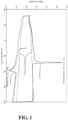
- FIG. 1 shows the DSC scans for Polymer 3 and Polymer 1.
- compositions described and claimed herein through use of the term “comprising” may include any additional additive or compound, unless stated to the contrary.
- the term, “consisting essentially of” if appearing herein excludes from the scope of any succeeding recitation any other component, step or procedure, excepting those that are not essential to operability and the term “consisting of', if used, excludes any component, step or procedure not specifically delineated or listed.
- ASTM D 1238 is entitled "Test Method for Melt Flow Rates of Thermoplastics by Extrusion Plastometer.”
- the term "ASTM D 1238" as used herein refers to the standard test method for determining melt flow rates of thermoplastics by extrusion plastometer. In general, this test method covers the determination of the rate of extrusion of molten thermoplastic resins using an extrusion plastometer. After a specified preheating time, resin is extruded through a die with a specified length and orifice diameter under prescribed conditions of temperature, load, and piston position in the barrel. This test method was published August 1, 2013. For the referenced ASTM standards, visit the ASTM website, www.astm.org, or contact ASTM Customer Service at service@astm.org.
- ASTM D 412 is entitled "Standard Test Methods for Vulcanized Rubber and Thermoplastic Elastomers - Tension.”
- ASTM D 412 refers to the standard test method for determining tensile properties of thermoplastics. In general, this test method covers the determination of modulus, tensile strength and elongation at break. The measurements and the test results were calculated in accordance with ASTM D 412. This test method was published December 1, 2015. For the referenced ASTM standards, visit the ASTM website, www.astm.org, or contact ASTM Customer Service at service@astm.org.
- the polymers according to the embodiments presented herein can be made by any suitable method known to produce block copolymers having polyethylene-like blocks. Preferred are anionic polymerization methods. Anionic polymerization of monoalkenyl arenes and conjugated dienes with lithium initiators is well known as described in U.S. Patent Nos. 4,039,593 and Re 27,145 . Polymerization commences with monolithium, dilithium or polylithium initiators which build a living polymer backbone at each lithium site.
- the polymers useful in the context of the present disclosure may be prepared by contacting the monomer or monomers with an organoalkali metal compound in a suitable solvent at a temperature range of from -150° to 300°C, preferably at a temperature range of 0 to 100°C.
- organoalkali metal compound in a suitable solvent at a temperature range of from -150° to 300°C, preferably at a temperature range of 0 to 100°C.
- Particularly effective polymerization initiators are organolithium compounds having the general formula RLi wherein R is an aliphatic, cycloaliphatic, or alkyl-substituted cycloaliphatic radical having from 1 to 20 carbon atoms.
- Suitable solvents include aliphatic hydrocarbons such as butane, pentane, hexane, heptanes or cyclohexane or cycloheptane, benzene, toluene and xylene and ethers such as tetrahydrofuran or diethylether.
- conjugated dienes examples include, but are not limited to, 1,3-butadiene (also referred to herein as “butadiene”), isoprene, piperylene, 1,3-hexadiene, myrcene, farnesene or a mixture thereof.
- Suitable mono vinyl aromatic monomers include but are not limited to styrene and substituted styrenes such as methylstyrene, p-tert-butylstyrene, dimethylstyrene, alpha-methylstyrene, diphenyl ethylenes and the like, including mixtures of these, but preferred is styrene.
- the total amount of mono vinyl aromatic monomer in the block copolymers is from 10 to 55 wt.% based upon the total monomer content of the block copolymer.
- Anionic polymerization of a conjugated diene may result in a polymer with all four of these carbons incorporated into the polymer backbone or, alternately, only two of these carbons (C 1 -C 2 or C 3 -C 4 ) incorporated into the polymer backbone.
- Incorporation of all four carbons in the polymer backbone occurs by way of 1,4-addition in the case of butadiene. Alternately, incorporation of only two carbons in the polymer backbone proceeds by 1,2-addition for butadiene.
- the amount of vinyl content in the A block ranges from 0 to 20 mol% of the polymerized monomers in the A block wherein the mol% is based upon the mol% of the total polymerized monomer content of the A block.. At vinyl contents higher than 20 mol% the melting point of the A block is deleteriously decreased to below 50°C.
- the vinyl content may range from 0 to 15 mol% based upon the mol% of the total monomer content of the A block. In other embodiments, the vinyl content may range from 0 to 10 mol% based upon the mol% of the total monomer content of the A block.
- the B block is a controlled distribution copolymer block.
- the controlled distribution of comonomers is neither random nor tapered.
- the combination of (1) a unique control for the comonomer addition and (2) the use of polar polymerization modifiers as a component of the solvent (which will be referred to as “distribution agents") results in characteristic distribution of the two monomers (herein termed a "controlled distribution” polymerization, i.e., a polymerization resulting in a "controlled distribution” structure), and also results in the presence of mono vinyl aromatic rich regions and conjugated diene rich regions in the copolymer block.
- controlled distribution refers to a molecular structure comprising an overall structure having relatively low blockiness.
- the blockiness of the controlled distribution (“B”) blocks can be shown by either the presence of only a single (“Tg”) intermediate between the Tg's of either monomer alone, when analyzed using differential scanning calorimetry (“DSC”) (thermal) methods or via mechanical methods, or as shown via proton nuclear magnetic resonance (“H 1 -NMR”) methods.
- DSC differential scanning calorimetry
- H 1 -NMR proton nuclear magnetic resonance
- the potential for blockiness can also be inferred from measurement of the UV-visible absorbance in a wavelength range suitable for the detection of polystyryllithium end groups, for example when styrene is the mono vinyl aromatic comonomer, during the polymerization of the B block. An increase in this value is indicative of a substantial increase in polystyryllithium chain ends.
- styrene blockiness may be measured using proton NMR, and is defined to be the proportion of mono vinyl aromatic (S) units in the polymer having two S nearest neighbors on the polymer chain. The styrene blockiness is determined after using H 1 -NMR to measure two experimental quantities as follows:
- the total number of styrene units is determined by integrating the total styrene aromatic signal in the H 1 -NMR spectrum from 7.5 to 6.2 ppm and dividing this quantity by 5 to account for the 5 aromatic hydrogens on each styrene aromatic ring.
- the blocky styrene units are determined by integrating that portion of the aromatic signal in the H 1 -NMR spectrum from the signal minimum between 6.88 and 6.80 to 6.2 ppm and dividing this quantity by 2 to account for the 2 ortho hydrogens on each blocky styrene aromatic ring.
- the assignment of this signal to the two ortho hydrogens on the rings of those styrene units which have two styrene nearest neighbors was reported in F. A. Bovey, High Resolution NMR of Macromolecules (Academic Press, New York and London, 1972), Chapter 6 .
- the amount of mono vinyl aromatic monomer in the B block ranges from 10 wt.% to 55 wt.% where the wt.% is based on the total weight of the B block.
- the amount of mono vinyl aromatic monomer is less than 10 wt.% the strength of phase separation of the A and B blocks is not sufficiently strong to maintain physical strength and oil resistance in the solid state.
- the amount of mono vinyl aromatic monomer is more than 55 wt.% then the rubbery character of the material is sacrificed.
- the measureable total mono vinyl aromatic monomer content of the block copolymer will range from about 10 to about 55 wt.% wherein the wt% is based on the total weight of the block copolymer.
- the B block is a random copolymer of conjugated diene and mono vinyl aromatic monomers.
- Methods for making such random copolymers are well known as disclosed in U.S. Patent No. 4,089,913 to Miki et al. and U.S. Patent No. 4,122,134 to Miki et al.
- such processes use a Lewis base randomizing agent during the living, anionic copolymerization step and/or continuously metered addition of comonomers.
- the B block is a random copolymer it is particularly important to control the amount of mono vinyl aromatic monomer to maintain elastomeric properties. It is particularly important that the degree of randomness is such that the B block appear homogeneous.
- Tgs may not be associated with conjugated diene or mono vinyl aromatic segments.
- the B block is a random copolymer the ratio of mono vinyl aromatic monomer to conjugated diene is from 90/10 to 60/40. At higher mono vinyl aromatic monomer contents the copolymer is not sufficiently soft and elastic. At lower mono vinyl aromatic monomer contents the copolymer does not present a sufficient thermodynamic driving force for phase separation of the A and B block and deficient mechanical properties are achieved.
- the A blocks have a molecular weight of greater than 15 kg/mol to 80 kg/mol and preferably 22 kg/mol to 50 kg/mol.
- the A block content in the total block copolymer is from 15 to 50 wt.% wherein wt.% is based on the total weight of the block copolymer.
- the preferred amount of the A block is from 20 to 45 wt.% and more preferred is 25 to 40 wt.% wherein wt.% is based on the total weight of the block copolymer.
- the B blocks have a molecular weight from 20 to 200 kg/mol and more preferably from 30 to 120 kg/mol.
- the B block content in the total block copolymer is from 40 to 80 wt.% wherein the wt.% is based on the total weight of the block copolymer.
- the preferred amount of the B block is from 50 to 80 wt% and more preferred is 60 to 75 wt.% wherein the wt.% is based on the total weight of the block copolymer.
- the present disclosure further relates to block copolymers having at least one polymer block of polymerized 1,3-butadiene (A) and at least one selectively hydrogenated copolymer block of mono vinyl aromatic monomer and a conjugated diene (B) formed in diblock, triblock, radial or starblock structures.
- a triblock copolymer comprises two terminal polybutadiene blocks and one copolymer block.
- Such diblocks may be made by a sequential polymerization process in which the first step comprises polymerizing 1,3-butadiene with an organolithium initiator until polymerization of the 1,3-butadiene is substantially complete.
- a mono vinyl aromatic monomer and a conjugated diene monomer are copolymerized from the living polymer block of polybutadiene produced from the first step.
- Polymerization occurs spontaneously, and is allowed to proceed until substantially all the comonomers have polymerized to form a polybutadiene -poly(mono vinyl aromatic/conjugated diene) copolymer diblock.
- Living diblocks may be terminated to form a diblock product or may be reacted with a coupling agent to form radial or star block copolymer structures.
- the A and B blocks may be adjacent or they may be separated by other blocks when the block copolymer structure is other than a diblock.
- n X for the radial block copolymer A is a block of polymerized 1,3-butadiene
- B is copolymer block comprising a mono vinyl aromatic monomer and a conjugated diene monomer, where n is an integer ranging from 2 to about 30, preferably from about 2 to about 5, and X is the remnant or residue of a coupling agent.
- A-B block copolymers are formed by sequential polymerization as described above.
- living diblock A-B copolymer "arms" are coupled together forming a triblock copolymer when "n" equals 2 (meaning 2 arms of diblock copolymers are coupled together) or a radial copolymer when "n" is greater than 2.
- the embodiments described herein are not limited to symmetric, coupled block copolymers.
- the coupled arms may be identical resulting in symmetrical, coupled polymers or they may be different resulting in asymmetric, coupled polymers. In asymmetric embodiments some arms may contain no polybutadiene block or no copolymer block.
- asymmetric, coupled block copolymers may contain arms in which the molecular weight of the A and B blocks, and the composition of the A and B block may vary.
- the block copolymers have structures according to the following general formulae: A-B, (A-B) n X, (A-B) n X-(A) m , or (A-B) n X-(B) m , wherein X is the residue of a coupling agent, n and m vary independently and are integers and range from 1 to 30, A represents polymer blocks of 1,3-butadiene, B represents copolymer blocks of conjugated diene and mono vinyl aromatic monomer units. In any coupled structure the composition and/or size of the (A-B) arms may vary independently.
- n X represents the possibility of coupling a mixture of (A-B), (A'-B), (A-B'), (A'B'), (A"-B), (A"-B'), (A-B"), (A'-B"), etc. living arms where A, A' and A' have different sizes and B, B', and B" have different sizes and/or comonomer compositions or distributions.
- the preferred range of n is from 2 to 10 and the more preferred range is from 2 to 6.
- the preferred range of m is from 1 to 10 and the more preferred range is from 1 to 6.
- the block copolymer structures of the present disclosure are not limited to those listed here. A broad variety of arrangements of the blocks may be made by sequential and coupling polymerization procedures.
- the coupling process used to construct radial block copolymers is a statistical one and that n and m represent average values for the total collection of coupled molecules in any material.
- Coupling agents may include, for example, dihalo alkanes, silicon halides, siloxanes, multifunctional epoxides, silica compounds, esters of monohydric alcohols with carboxylic acids, (e.g. dimethyl adipate) and epoxidized oils.
- Star-shaped polymers are prepared with polyalkenyl coupling agents as disclosed in, for example, U.S. Patent Nos. 3,985,830 ; 4,391,949 ; and 4,444,953 ; and Canadian Patent No. 716,645 .
- Suitable polyalkenyl coupling agents include divinylbenzene, and preferably m-divinylbenzene.
- tetra-alkoxysilanes such as tetra-ethoxysilane (TEOS) and tetra-methoxysilane
- alkyl-trialkoxysilanes such as methyl-trimethoxy silane (MTMS)
- MTMS methyl-trimethoxy silane
- aliphatic diesters such as dimethyl adipate and diethyl adipate
- diglycidyl aromatic epoxy compounds such as diglycidyl ethers deriving from the reaction of bis-phenol A and epichlorohydrin.
- the coupling efficiency depends on the structure desired and is defined as the proportion of polymer chain ends which are linked via the residue of the coupling agent at the completion of the coupling reaction to the total number of living, polymer-lithium chains at the end of polymerization and before coupling.
- the block copolymers described herein have a coupling efficiency of about 20 to 100%, including all points in-between.
- the preferred range of coupling efficiency is 70% or greater, more preferred is 80% or greater, and even more preferred is 90% or greater.
- GPC data is used to calculate the coupling efficiency for a polymer product.
- Hydrogenation can be carried out via any of the several hydrogenation or selective hydrogenation processes known in the prior art.
- hydrogenation may be accomplished using methods such as those disclosed in, for example, U.S. Patent Nos. 3,595,942 ; 3,634,549 ; 3,670,054 ; 3,700,633 ; and Re. 27,145 . These methods operate to hydrogenate polymers containing aromatic or ethylenic unsaturation and are based upon operation of a suitable catalyst.
- Such catalyst, or catalyst precursor preferably comprises a Group VIII metal such as nickel or cobalt which is combined with a suitable reducing agent such as an aluminum alkyl or hydride of a metal selected from Groups I-A, II-A and III-B of the Periodic Table of the Elements, particularly lithium, magnesium or aluminum.
- a suitable reducing agent such as an aluminum alkyl or hydride of a metal selected from Groups I-A, II-A and III-B of the Periodic Table of the Elements, particularly lithium, magnesium or aluminum.
- This preparation can be accomplished in a suitable solvent or diluent at a temperature from about 20°C to about 80°C.
- Other catalysts that are useful include titanium based catalyst systems.
- High levels of hydrogenation of the conjugated diene, particularly in the A block, are desirable for the selective hydrogenation described herein, High levels of hydrogenation in the A block lead to high levels of crystallinity. Conversely, unhydrogenated conjugated diene units disrupt crystallinity in the A block. It is also desired that minimal levels of hydrogenation of the mono vinyl aromatic double bonds are realized. Reduction of the aromatic double bonds is expected to lead to an increased aliphatic character of the B block and a reduced driving force for phase separation of the A and B blocks.
- the phase separated character of the block copolymer, presented herein, in the solid state is essential for development of crystallinity, solvent resistance, and physical strength.
- Selective hydrogenation is carried out under such conditions that 90 mol% or greater of the conjugated diene double bonds have been reduced, and between 0 and 10 mol% of the aromatic double bonds present in the polymerized mono vinyl aromatic units have been reduced.
- Preferred ranges are 95 mol% or greater of the conjugated diene double bonds reduced, and more preferably 97 mol% or greater of the conjugated diene double bonds are reduced, and most preferably 99 mol% or greater. In the preferred embodiments less than 5 mol% of the aromatic double bonds have been reduced and more preferably less than 1 mol% of the aromatic double bonds have been reduced.
- the A block is a semi-crystalline block comprising hydrogenated polybutadiene and as such is the hard block in the block copolymer. Before hydrogenation it has a low vinyl content.
- the vinyl content in the A block is 20 mol% or less wherein the mol% is based on the total polymer content of the A block.
- the vinyl content is 15 mol% or less and more preferably it is 10% or less wherein the mol% is based on the total polymer content of the A block.
- the A block is crystallizable and has an observable melting point as measured by DSC.
- the A block phase separates from the B block and it is the crystallization of the A blocks that gives the block copolymer its physical strength and resistance to solvents.
- the range of the melting point is from 50 to 120°C. In preferred embodiments the melting point is from 80 to 120°C, in more preferred embodiments from 90 to 120°C, and in most preferred embodiments from 105 to 120 °C.
- the B block comprises selectively hydrogenated polymerized conjugated diene monomer.
- the polymerization conditions used during formation of the B block lead to a relatively high vinyl content of the conjugated diene in this block.
- the vinyl content of the conjugated diene in the B blocks is 30% or greater.
- the vinyl content in this block is from 30 to 90 mol%, more preferably from 30 to 55 mol%, and even more preferably from 30 to 50 mol%, wherein the mol% of the vinyl content is based on the mol% of the total monomer content of the B block.
- the presence of the mono vinyl aromatic monomers further disrupts the formation of any crystallinity in the B block.
- the B block is an essentially non-crystalline, soft, rubbery block. If there is any crystallinity present in the B block it will be present at less than 5 wt.% of the B block and will have melting points well under 50°C. In preferred embodiments the amount of crystallinity in the B block is less than 1 wt.% and any melting point observable by DSC will be less than 25°C.
- conjugated diene is added to the living chain before coupling in order to enhance the coupling reaction.
- the preferred conjugated diene for this enhancement is butadiene.
- the molecular weight of this additional block of conjugated diene is less than 10 kg/mol, preferably less than 5 kg/mol and even more preferably less than 1 kg/mol.
- the vinyl content of this block of conjugated diene is from 30 to 90 mol%, more preferably from 30 to 55 mol%, and even more preferably from 30 to 50 mol%.
- Block copolymers generally develop strength in the solid state by phase separation of their distinct blocks. While phase separation is important in the solid state it can persist in the melt state and lead to high melt elasticities and low processability.
- the temperature at which the phase separation dissipates is the order-disorder transition temperature, or ODT. Above the ODT the block copolymer experiences a homogenous state and therefore low melt elasticities and good processability. High melt processability is desirable for the purposes of the present disclosure.
- the ODT is preferably 150°C or lower. When the ODT is higher than 150°C the advantage of high processability at low melt temperatures is lost.
- the ODT is 140°C or less and in most preferred embodiments it is 130°C or less.
- the selectively hydrogenated, semi-crystalline block copolymer has the ODT from 50°C to 150°C. In some embodiments, the selectively hydrogenated, semi-crystalline block copolymer has the ODT from 75°C to 120°C.
- the selectively hydrogenated, semi-crystalline block copolymer has a melt flow rate from 0.01 to 500 g/10 min as measured by ASTM D 1238 at 190°C/2.16 kg. In some embodiments, the selectively hydrogenated, semi-crystalline block copolymer has a melt flow rate ranging from 1 to 25 g/10 min as measured by ASTM D 1238 at 190C/2.16 kg. In some embodiments, the selectively hydrogenated, semi-crystalline block copolymer has a 100% modulus from 1 MPa to 15 MPa as measured by ASTM D 412. In some embodiments, the selectively hydrogenated, semi-crystalline block copolymer has an elongation at break of at least 300%.
- the selectively hydrogenated, semi-crystalline block copolymer has an elongation at break ranging from 300% to 2000% as measured by ASTM D 412. In some embodiments, the selectively hydrogenated, semi-crystalline block copolymer has a tensile strength of at least 6 MPa as measured according to ASTM D 412. In some embodiments, the selectively hydrogenated, semi-crystalline block copolymer has a tensile strength ranging from 6 MPa to 40 MPa as measured according to ASTM D 412. In some embodiments, the selectively hydrogenated, semi-crystalline block copolymer has a tensile strength ranging from 10 MPa to 30 MPa, measured according to ASTM D 412.
- the selectively hydrogenated, semi-crystalline block copolymer has a degree of swelling in toluene of less than 150 wt.% after 8 hours of immersions. In some embodiments, the selectively hydrogenated, semi-crystalline block copolymer exhibited a degree of swelling in toluene from 25 wt.% to 150 wt.% after 8 hours of immersion wherein wt.% is based upon the total wt.% of the block copolymer.
- the selectively hydrogenated, semi-crystalline block copolymer exhibited a degree of swelling in toluene from 1 wt.% to 150 wt.% after 8 hours of immersion wherein wt.% is based upon the total wt.% of the lock copolymer. In some embodiments, the selectively hydrogenated, semi-crystalline block copolymer had a degree of swelling in paraffinic oil of less than 40 wt.% after two weeks of immersion.
- the selectively hydrogenated, semi-crystalline block copolymer exhibited a degree of swelling in paraffinic oil ranging from 1 wt.% to 40 wt.% after two weeks of immersion wherein wt.% is based upon the total wt.% of the block copolymer. In some embodiments, the selectively hydrogenated, semi-crystalline block copolymer had a degree of swelling in cyclohexane of less than 150 wt.% after 8 hours of immersion.
- the selectively hydrogenated, semi-crystalline block copolymer showed a degree of swelling in cyclohexane from 25 wt.% to 150 wt.% after 8 hours of immersion wherein wt.% is based upon the total wt.% of the block copolymer.
- the block copolymer exhibited a degree of swelling in paraffinic oil from 1 wt.% to 40 wt.% after 8 hours of immersion wt.% is based upon the total wt.% of the block copolymer.
- the term "molecular weights" refers to the apparent molecular weight in kg/mol of the polymer or block of the copolymer.
- the molecular weights referred to in this specification and claims can be measured with gel permeation chromatography (GPC) using polystyrene calibration standards, such as is done according to ASTM D5296.
- GPC gel permeation chromatography
- polystyrene calibration standards such as is done according to ASTM D5296.
- GPC gel permeation chromatography
- the chromatograph is calibrated using commercially available polystyrene molecular weight standards.
- the molecular weight of copolymers measured using GPC so calibrated are styrene equivalent molecular weights and are referred to as apparent molecular weights.
- the apparent molecular weights differ from the absolute or true molecular weight when the composition of the polymer eluting through the GPC columns is different in composition from polystyrene. However, comparison to model polymers allows conversion from apparent molecular weight to true or absolute molecular weight when necessary.
- the detection method used is preferably a combination of ultraviolet and refractive index detectors. The molecular weights expressed herein are measured at the peak of the GPC trace, and are commonly referred to as "peak molecular weights" (Mp).
- the features of the copolymers presented herein are achieved in the absence of chemical crosslinking agents such as peroxides or photo-initiators. Further, the polymers are not crosslinked by radiation such as is commonly done using electron beams. The block copolymers as presented herein are free of crosslinking agents and are not crosslinked.
- the selectively hydrogenated, semicrystalline block copolymers incorporate polar functional groups after being grafted with maleic anhydride.
- the grafting reaction is performed after polymerization and hydrogenation and can be done by any method known in the art. Such methods may be performed in solution or in the melt state. The preferred method is melt extrusion reaction.
- the preferred monomers to be grafted onto the block copolymers are maleic anhydride, maleic acid, fumaric acid, and their derivatives.
- a further description of functionalizing such block copolymers is disclosed in Gergen et al, U.S. Patent No. 4,578,429 and in U.S. Patent No. 5,506,299 .
- the selectively hydrogenated block copolymer presented herein may be functionalized by grafting silicon or boron containing compounds to the polymer as disclosed in U.S. Patent No. 4,882,384 as well as vinyl silane compounds.
- the block copolymer presented herein may be contacted with an alkoxy-silane compound to form silane-modified block copolymer.
- the block copolymer of the present disclosure may be functionalized by grafting at least one ethylene oxide molecule to the polymer as disclosed in U.S. Patent No. 4,898,914 , or by reacting the polymer with carbon dioxide as disclosed in U.S. Patent No. 4,970,265 .
- block copolymers of the present disclosure may be metallated as disclosed in U.S. Patent Nos. 5,206,300 and 5,276,101 , wherein the polymer is contacted with an alkali metal alkyl, such as a lithium alkyl.
- the block copolymers of the present disclosure may be functionalized by grafting sulfonic groups to the polymer as disclosed in U.S. Patent No. 5,516,831 .
- compositions are made comprising the selectively hydrogenated, semi-crystalline block copolymers.
- the compositions include the block copolymer and at least one other component.
- the amount of selectively hydrogenated, semi-crystalline block copolymer ranges from 2 to 98% in the compositions.
- the additional component can be a thermoplastic resin, a tackifier, a plasticizer, and waxes.
- Exemplary thermoplastic resins may include polyolefins, copolyester elastomers, thermoplastic elastomers, polystyrene, styrene copolymers, and poly(phenylene ether).
- the additional polyolefins may preferably include polyethylene, polypropylene, and ethylene/alpha-olefin and propylene/alpha-olefin copolymers.
- the additional thermoplastic elastomers may preferably include styrenic block copolymers, both unsaturated and hydrogenated, thermoplastic polyurethanes, and copolyester elastomers.
- Styrene copolymers comprise high impact polystyrene (HIPS).
- a composition comprising the selectively hydrogenated, semi-crystalline block copolymers may have a modulus 100% ranging from 1.5 to 15MPa, as measured according to ASTM D 412; a tensile strength ranging from 6 to 35 MPa, as measured according to ASTM D 412; a degree of swelling in toluene after 8 hours of immersion ranging from 1 wt.% to 150 wt.%.
- the amount of composition recovered after toluene immersion and drying is greater than 95 wt.%, based on the original mass of the composition immersed in toluene.
- the amount of composition recovered after toluene immersion and drying is greater than 98 wt.%, based on the original mass of the composition immersed in toluene.
- polyethylenes include, for example, but are not limited to, substantially linear ethylene polymers, homogeneously branched linear ethylene polymers, heterogeneously branched linear ethylene polymers, including linear low density polyethylene (LLDPE), ultra or very low density polyethylene (ULDPE or VLDPE), medium density polyethylene (MDPE), high density polyethylene (HDPE) and high pressure low density polyethylene (LDPE).
- LLDPE linear low density polyethylene
- ULDPE or VLDPE ultra or very low density polyethylene
- MDPE medium density polyethylene
- HDPE high density polyethylene
- LDPE high pressure low density polyethylene
- the melt flow rate also referred to as melt flow index
- the preferred type of polyethylene is low density polyethylene with a melt flow rate of greater than 1 g/10 min (190°C/2.16 kg).
- Representative polypropylenes include, for example, but are not limited to, substantially isotactic propylene homopolymers, random alpha olefin/propylene copolymers where propylene is the major component on a molar basis and polypropylene impact copolymers where the polymer matrix is primarily a polypropylene homopolymer or random copolymer and the rubber phase is an alpha-olefin/propylene random copolymer.
- Suitable melt flow rates of polypropylenes are at least 1 g/10 min at 230°C and 2.16 kg according to ASTM D1238. More preferred are melt flow rates of at least 2 g/10 min. Most preferred are melt flow rates of at least 3 g/10 min.
- Polypropylene homopolymers are the preferred type of polypropylene.
- ethylene/alpha-olefin copolymers and propylene/alpha-olefin copolymers include, but are not limited to, AFFINITY, ENGAGE and VERSIFY polymers from Dow Chemical and EXACT and VISTAMAXX polymers from Exxon Mobil.
- Suitable melt flow rates of such copolymers must be at least 1 g/10 min at 230°C and 2.16 kg weight according to ASTM D1238. Preferred melt flow rates are at least 2 g/10 min and most preferred are melt flow rates of at least 3 g/10 min.
- Copolyester elastomers include, for example, copolymers of poly(butylene terephthalate) hard segments and soft segments composed of polyesters or polyethers, such as polytetramethylene ether glycol.
- suitable copolyester elastomers include Arnitel ® resins available from DSM, Hytrel ® resins available available from DuPont, Eastar ® resins available from Eastman Chemical, and Dynapol ® resins available from Evonik.
- Suitable tackifiers may be selected from the group of compatible C 5 , C 9 or C 5 /C 9 hydrocarbon resins, hydrogenated or partially hydrogenated C 5 or C 9 hydrocarbon resins, or styrenated C 5 or C 9 resins. Additionally, suitable tackifiers include terpenes, styrenated terpene resins, fully hydrogenated or partially hydrogenated terpene resins, rosin esters, rosin derivatives and mixtures thereof. Suitable commercially available tackifying resins may include Piccotac 1095-N, which is an aliphatic resin or Piccotac 8590 which is an aliphatic/aromatic resin.
- Additional auxiliary components may include one or more plasticizers.
- Suitable plasticizers include plasticizing oils such as paraffinic or naphthenic in character. Products such as these are available from Shell Oil Company under the trademark SHELLFLEX ® , also under the trademark CATENEX TM and EDELEX TM and ONDINA ® and Drake oils. EDELEX ® N956 is set forth in the Examples. Unlike block copolymers deriving their strength from the physical crosslinking of polystyrene domains, the polymers can be plasticized with esters such as dioctyl-phthalate (DOP) and the like without degradation of the polymer's strength.
- DOP dioctyl-phthalate
- Additional components may include one or more stabilizers, such as an antioxidant.
- the antioxidants can be used either as a primary antioxidant such as hindered phenols or secondary antioxidants such as phosphite derivatives, or blends thereof.
- Acceptable stabilizers are Irganox ® 565, 1010, 1076, or 1726 or Irgafos ® 168, all by BASF, or Sumilizer ® GS or T-PD from Sumitomo, or Ethanox 330 from Albemare.
- inorganic fillers can be important in the end use applications of the block copolymer and their compositions.
- fillers are important to increase the mass and density of articles intended as vibration damping compositions.
- the nature and amount of the inorganic fillers present in the damping composition have an important effect on the extent of damping and on how vibration propagation is affected by temperature and frequency.
- Different morphologies of inorganic filler can be used. For example, fillers having a platelet form or those having a non-platelet form can be used. Examples of inorganic fillers in platelet form are mica, talc, flaked aluminum, flaked lead, and graphite. Mica has been found to be particularly effective.
- non-platelet fillers may be employed, for example, clay, calcium carbonate, barytes (barium sulfate), silica and iron powder.
- a synergistic effect can be realized between the platelet and non-platelet fillers.
- Some of the fillers, such as Mg(OH) 2 and Al(OH) 3 may impart flame retardant properties to the composition.
- the total amount of filler employed can be high. As the amount increases the damping improves.
- the upper limit in filler content is determined by the required physical and mechanical properties of the final composition, such as, flexibility, tear strength and moldability.
- Blowing agents may be incorporated into the composition when foaming is desired.
- blowing agents are physical or chemical blowing agents.
- Physical blowing agents comprise gases (e.g. N 2 , CO 2 ) and liquids (e.g. water, pentane).
- Chemical blowing agents are exothermic and endothermic blowing agents. They decompose above a certain temperature, thereby releasing gas such as nitrogen, carbon dioxide or water, which causes a volume increase of the reaction mass. Chemical or physical blowing agents are usually used in combination with nucleating agents. Of the physical blowing agents, Carbon dioxide as well as nitrogen are preferred blowing agents.
- the preferred blowing agent is Hydrocerol TM BIH40 (which then also acts as nucleating agent). These blowing agents are used in amounts of from 0.5 to 10 wt.%, relative to the weight of the total composition.
- Slip agents may be a component of the composition presented herein and enhance the processability of the compound and reduce its stickiness.
- Suitable slip agents include low molecular weight amides, metallic stearates such as calcium and zinc stearates and the like, silicones, fluorinated hydrocarbons, acrylics and silicones, waxes and the like.
- Suitable primary amides are behanamide (available as Crodamide BR from Croda, and ARMOSLIP ® B from Akzo Nobel), erucamide (available as Crodamide E from Croda, ARMOSLIP E from Akzo Nobel, and ATMER ® SA 1753 from Uniqema), oleamide (available as Crodamide VRX from Croda, ARMOSLIP CP from Akzo Nobel, and ATMER SA 1758 from Uniqema), and stearamide (available as Crodamide SR from Croda, ARMOSLIP 18 LF from Akzo Nobel, and ATMER SA 1750 from Uniqema).
- suitable secondary amines are oleyl palitamide (available as Crodamide 203 from Croda) and stearyl erucamide (available as Crodamide 212 from Croda). Both saturated and unsaturated amides are suitable.
- the selectively hydrogenated, semi-crystalline block copolymers presented herein are useful in a broad range of articles.
- Such articles may comprise the neat polymer or may comprise compounds of the polymer such as described herein.
- the articles may be either solvent or melt cast films, coextruded multilayer films, melt blown films, melt blown multilayer films, an injection molded piece, cast or sprayed coatings, strands, powders, gels of various shapes, fibers, bicomponent fibers or multi-component fibers, melt-blown fibers, fibrous mats or bundles, foamed shapes, extruded tubes, injection molded articles, slush and rotationally molded pieces, extruded profiles of various shapes, and the like.
- melt flow rate is a measure of the melt flow of the polymer according ASTM D1238 at 230°C and 2.16 kg weight or 190°C and 2.16 kg or as otherwise specified. It is expressed in units of grams of polymer passing through a melt rheometer orifice in 10 minutes.
- the tack (stickiness) measurements were made using 2 mm compression molded plates.
- the tack test was done by placing two compression molded plates in contact for 24 hours at room temperature under a weight of 1.2 kg. The plates were then manual separated and their tack or stickiness evaluated by qualitative observation. When not sticky the plates freely separate. When the plates were sticky then a measurable force was required to separate the plates.
- Hardness was measured at 10 seconds on a stack of 3 compression molded plates, each 2 mm in thickness and are reported as Shore A hardness according to ASTMD2240.
- the tensile tests were conducted according to ISO37 using type 2 dumbbells cut from 2 mm thick compression molded plates or from ASTM D412 D type dumbbells prepared by melt cast films of thin compression molded films.
- the hysteresis tests were conducted using type 2 dumbbells cut from 2mm thick compression molded plates.
- the dumbbells were clamped at a fixed distance of 50 mm in a tensile testing device.
- the samples were elongated at 500 mm/min to reach 100 elongation (i.e., clamp distance of 100 mm) and then immediately relaxed to zero force at 500 mm/min.
- the residual deformation at zero force was set after the first cycle.
- the second cycle was initiated immediately after completion of the first cycle at the same extension rates. A total of 5 cycles were performed.
- Solvent resistance was measured by immersing 2mm thick compression molded specimens in a solvent such as but not limited to toluene at room temperature for a specific time. The weight of the sample was determined before immersion, immediately after immersion, and in some cases as indicated after complete drying.
- a solvent such as but not limited to toluene
- optical properties of transmittance and haze were measured using ASTM D1003.
- All of the polymers were prepared by batch, anionic polymerization in cyclohexane solvent.
- Polymers of the present disclosure were polymerized by first synthesizing the A block. Purified, dried cyclohexane solvent was added to a closed, nitrogen flushed batch reactor. Further purification of the solvent was done by titration of butyl lithium or by addition an amount of sec-butyl lithium to the initiation amount which corresponded to the expected amount of impurity. The amount of butyl lithium then required to initiate polymerization was added to the stirred cyclohexane. An amount of butadiene sufficient to achieve a specific molecular weight target was then added to the reactor.
- Polymerization of the butadiene to form the A block was conducted at a temperature in the range of 40 to 70°C for a time sufficient to consume essentially all of the butadiene monomer. Polymerization of controlled distribution B blocks was then conducted according to the methods disclosed in U.S. Patent No. 7,169,848 . Living arms so polymerized were then coupled by addition of an equivalent amount of coupling agent. Unless otherwise noted, the coupling agent was methyl-trimethoxy-silane (MTMS). After coupling any remaining anions were terminated by addition of alcohol.
- MTMS methyl-trimethoxy-silane
- the block copolymer so polymerized was then hydrogenated in a pressure vessel using a cobalt octoate/triethyl aluminum catalyst and hydrogen gas.
- the temperature of the hydrogenation was controlled such that the temperature remained above 50°C. Once the target hydrogenation level was achieved the reaction was terminated and the resulting selectively hydrogenated polymer was washed with hot acidic water to remove residual catalyst.
- the block copolymer was then isolated by coagulation in hot water and then dried.
- Polymer 1 was a radial block copolymer having the structure (A-B) n X. It was a primarily linear block copolymer having 87 wt.% linear (A-B) 2 X structure, 8 wt.% uncoupled A-B or one-armed block copolymer, 4 wt.% three-armed radial block copolymer, and 1 wt.% four-armed radial block copolymer. As such, it had an average arm number (n ave ) of 1.99.
- the apparent peak molecular weight (MWA) of the A block was 28.5 kg/mol and it had a vinyl content (VCA) of 8.1%.
- the B block was a controlled distribution copolymer block of styrene and butadiene and had an apparent peak molecular weight (MWB) of 60 kg/mol before coupling, it had a vinyl content (VCB) of 36.5%, a styrene content (PSCB) of 26.5 wt.%, and a blockiness of 9.7.
- the B block had been capped with approximately 9 repeat units of butadiene prior to coupling.
- the conjugated diene monomer units in both the A block and the controlled distribution block B were selectively hydrogenated such that greater than 99 mol% of the conjugated diene units were hydrogenated.
- the polymer 1 had a total mono vinyl aromatic content of 22 wt.% and a melting point characterized by a peak temperature of 102°C and a heat of fusion ( ⁇ H ⁇ ) of 19 J/g.
- the mono vinyl aromatic units were not hydrogenated to any measurable degree.
- the ODT of Polymer 1 was less than 150°C.
- Polymer 2 was a radial block copolymer having the structure (A-B) n X and had a resulting n ave of 2.14.
- A was a hydrogenated polybutadiene block
- B was a selectively hydrogenated controlled distribution block of copolymerized styrene and 1,3-butadiene.
- the B block had been capped with approximately 9 repeat units of butadiene prior to coupling.
- the molecular weight of the A block was 28.3 kg/mol, it had a vinyl content of 8.6 mol%, and its mass (MA) comprised 28 wt.% of the entire block copolymer.
- the controlled distribution block B had a vinyl content of 36 mol%, a styrene content of 29 wt.%, and a blockiness of 5.9%.
- the conjugated diene monomer units in both the A block and the controlled distribution block were selectively hydrogenated such that greater than 98 mol% of the conjugated diene units were hydrogenated.
- the mono vinyl aromatic units were not hydrogenated to any measurable degree.
- Polymer 2 had a total mono vinyl aromatic content of 21.2 wt.% and a melting point characterized by a peak temperature of 101°C. The ODT of Polymer 2 was less than 150°C.
- Polymer 3 was a radial block copolymer having the structure (A-B) n X and had a resulting n ave of 1.99.
- the molecular weight of the A block was 28.7 kg/mol and it had a vinyl content of 9%.
- the molecular weight of the controlled distribution block B was 66 kg/mol before coupling, it had a vinyl content of 34%, a styrene content of 30% wt., and a blockiness of 1.6%.
- the B block had been capped with approximately 9 repeat units of butadiene prior to coupling.
- the conjugated diene monomer units in both the A block and the controlled distribution block were selectively hydrogenated such that greater than 99 mol% of the conjugated diene units were hydrogenated.
- Polymer 3 had a total mono vinyl aromatic content of 21.2 wt.% and melting point characterized by a peak temperature of 100°C and a heat of fusion ( ⁇ H ⁇ ) of 26 J/g. Polymer 3 had a melt flow rate (MFR) of 5.7 g/10 min (230°C/2.16 kg). The ODT of Polymer 3 was less than 150°C.
- Polymer 4 was a radial block copolymer having the structure (A-B) n X and had a resulting n ave of 1.96.
- A was a hydrogenated polybutadiene block and the B block was a selectively hydrogenated controlled distribution block of copolymerized styrene and 1,3-butadiene.
- the B block had been capped with approximately 18 repeat units of butadiene prior to coupling.
- the molecular weight of the A block was 46 kg/mol, it had a vinyl content of 8.1 mol%, and it comprised 40 wt.% of the entire block copolymer.
- the controlled distribution block B had a vinyl content of 60 mol%, a styrene content of 36.6 wt.%, and a blockiness of 9%.
- the conjugated diene monomer units in both the A block and the controlled distribution block were selectively hydrogenated such that greater than 98 mol% of the conjugated diene units were hydrogenated.
- the mono vinyl aromatic units were not hydrogenated to any measurable degree.
- Polymer 4 had a total mono vinyl aromatic content of 21 wt.% and a melting point characterized by a peak temperature of 102°C and a heat of fusion ( ⁇ H ⁇ ) of 26.8 J/g.
- Polymer 4 had a melt flow rate (MFR) of 1.9 g/10 min (230°C/2.16 kg). The ODT of Polymer 4 was less than 150°C.
- Polymer 5 was a radial block copolymer having the structure (A-B) n X and had a resulting n ave of 2.64.
- A was a hydrogenated polybutadiene block and the B block was a selectively hydrogenated controlled distribution block of copolymerized styrene and 1,3-butadiene.
- the B block had been capped with approximately 18 repeat units of butadiene prior to coupling.
- the molecular weight of the A block was 21.9 kg/mol, it had a vinyl content of 9 mol%, and it comprised 26 wt.% of the entire block copolymer.
- the controlled distribution block B had a vinyl content of 38 mol%, a styrene content of 30 wt.%, and a blockiness of 3.6.
- the conjugated diene monomer units in both the A block and the controlled distribution block were selectively hydrogenated such that greater than 99 mol% of the conjugated diene units were hydrogenated.
- the mono vinyl aromatic units were not hydrogenated to any measurable degree.
- Polymer 5 had a total mono vinyl aromatic content of 22 wt.% and a melting point characterized by a peak temperature of 101°C and a heat of fusion ( ⁇ H ⁇ ) of 21.8 J/g.
- Polymer 5 had melt flow rates (MFR) of 2.7 g/10 min (190°C/2.16 kg) and 6.6 g/10 min (230°C/2.16 kg).
- the ODT of Polymer 5 was less than 150°C.
- Polymer 6 was a radial block copolymer having the structure (A-B-e/b) n X and had a resulting n ave of 1.97.
- A was a hydrogenated polybutadiene block and B was a selectively hydrogenated, controlled distribution block of copolymerized styrene and 1,3-butadiene.
- the B block had been capped with approximately 18 repeat units of butadiene prior to coupling.
- the molecular weight of the A block was 24.3 kg/mol, it had a vinyl content of 8.6 mol%, and it comprised 30 wt.% of the entire block copolymer.
- the controlled distribution block B had a vinyl content of 70 mol%, a styrene content of 32 wt.%, and a blockiness of 9.5.
- the conjugated diene monomer units in both the A block and the controlled distribution block B were selectively hydrogenated such that greater than 99 mol% of the conjugated diene units were hydrogenated.
- the mono vinyl aromatic units were not hydrogenated to any measurable degree.
- Polymer 6 had a total mono vinyl aromatic content of 22 wt.% and a melting point characterized by a peak temperature of 102°C and a heat of fusion ( ⁇ H ⁇ ) of 21.5 J/g.
- Polymer 6 had melt flow rates (MFR) of 19 g/10 min (190°C/2.16 kg) and 46 g/10 min (230°C/2.16 kg).
- the ODT of Polymer 6 was less than 150°C.
- Polymer 7 was a radial block copolymer having the structure (A-B) n X and had a resulting n ave of 2.12.
- A was a hydrogenated polybutadiene block and B was a selectively hydrogenated controlled distribution block of copolymerized styrene and 1,3-butadiene.
- the B block had been capped with approximately 18 repeat units of butadiene prior to coupling.
- the molecular weight of the A block was 35.2 kg/mol, it had a vinyl content of approximately 9 mol%, and it comprised 28 wt.% of the entire block copolymer.
- the controlled distribution block B had a vinyl content of 35 mol%, a styrene content of 32 wt.%, and a blockiness of 1%.
- the conjugated diene monomer units in both the A block and the controlled distribution block were selectively hydrogenated such that 90 mol% of the conjugated diene units were hydrogenated.
- the mono vinyl aromatic units were not hydrogenated to any measurable degree.
- Polymer 7 had a total mono vinyl aromatic content of 23 wt.% and a melting point characterized by a peak temperature of 99°C and a heat of fusion ( ⁇ H ⁇ ) of 25.4 J/g.
- Polymer 7 had a melt flow rate (MFR) of 1.7 g/10 min (230°C/2.16 kg).
- the ODT of Polymer 7 was less than 150°C.
- Polymer 8 was a radial block copolymer having the structure (A-B-eb) n X and has a resulting n ave of 1.93.
- A was a hydrogenated polybutadiene block
- B was a selectively hydrogenated controlled distribution block of copolymerized styrene and 1,3-butadiene
- eb was a relatively large hydrogenated polybutadiene segment with 36% vinyl and represented 19.1% of the total block copolymer.
- the molecular weight of the A block was 24.1 kg/mol, it had a vinyl content of approximately 9 mol%, and it comprised 26.7 wt.% of the entire block copolymer.
- the controlled distribution block B had a vinyl content of 36 mol%, a styrene content of 29.5 wt.%, and a blockiness of 1%.
- the conjugated diene monomer units in the A block, the B controlled distribution block and eb block were selectively hydrogenated such that greater than 99 mol% of the conjugated diene units were hydrogenated.
- the mono vinyl aromatic units were not hydrogenated to any measurable degree.
- Polymer 8 had a total mono vinyl aromatic content of 16 wt.% and a melting point characterized by a peak temperature of 102°C and a heat of fusion ( ⁇ H ⁇ ) of 24.5 J/g.
- Polymer 8 had a melt flow rate (MFR) of 5 g/10 min (230°C/2.16 kg). The ODT of Polymer 8 was less than 150°C.
- Polymer 9 was a radial block copolymer having the structure (A-B) n X and had a resulting n ave of 2.33.
- A was a hydrogenated polybutadiene block and B was a selectively hydrogenated controlled distribution block of copolymerized styrene and 1,3-butadiene.
- the B block had been capped with approximately 18 repeat units of butadiene prior to coupling.
- the molecular weight of the A block was 31 kg/mol, it had a vinyl content of approximately 10 mol%, and it comprised 36 wt.% of the entire block copolymer.
- the controlled distribution block B had a vinyl content of 40 mol%, a styrene content of 32 wt.%, and a blockiness of 3.6%.
- the conjugated diene monomer units in both the A block and the controlled distribution block were selectively hydrogenated such that greater than 99 mol% of the conjugated diene units were hydrogenated.
- the mono vinyl aromatic units were not hydrogenated to any measurable degree.
- Polymer 9 had a total mono vinyl aromatic content of 20 wt.% and a melting point characterized by a peak temperature of 99°C and a heat of fusion ( ⁇ H f ) of 20 J/g.
- Polymer 9 had a melt flow rate (MFR) of 10 g/10 min (230°C/2.16 kg).
- the ODT of Polymer 7 was less than 150°C.
- the butadiene monomer units have been hydrogenated to a level greater than 99 mol%.
- Polymer 10 had a total mono vinyl aromatic content of 42 wt% and no melting above 50°C was observed during DSC analysis. It had a MFR of 0.8 g/10 min (230°C/2.16 kg). The ODT of Polymer 10 was greater than 250°C.
- Polymer 11 (not in accordance with the present invention) was a hydrogenated conjugated diene block copolymer having polymerized conjugated diene blocks of differing vinyl content and a structure represented by (A - B) n X and had a resulting n ave of 2.04.
- a block was a polymerized block of polybutadiene having a vinyl content of 9.3 mol%, a molecular weight of 28.5 kg/mol, and comprised 30 wt.% of the entire block copolymer.
- the B block was a polymerized block of polybutadiene having a vinyl content of 49 mol%.
- Polymer 11 had a total mono vinyl aromatic content of 0 wt.% and a melting point characterized by a peak temperature of 99°C and a heat of fusion ( ⁇ H ⁇ ) of 11 J/g. It had a melt flow rate (MFR) of 8.4 g/10 min (230°C/2.16 kg). The ODT of Polymer 11 was less than 150°C.
- Polymer 12 (not in accordance with the present invention) was a radial block copolymer having the structure (A-B) n X and had a resulting n ave of 2.0.
- A was a hydrogenated polybutadiene block and B was a selectively hydrogenated controlled distribution block of copolymerized styrene and 1,3-butadiene.
- the B block had been capped with approximately 18 repeat units of butadiene prior to coupling.
- the molecular weight of the A block was 14 kg/mol, it had a vinyl content of 9 mol%, and it comprised 23 wt.% of the entire block copolymer.
- the controlled distribution block B had a vinyl content of 60 mol%, a styrene content of 31 wt.%, and a blockiness of 2.9%.
- the conjugated diene monomer units in both the A block and the controlled distribution block were selectively hydrogenated such that greater than 99 mol% of the conjugated diene units were hydrogenated.
- the mono vinyl aromatic units were not hydrogenated to any measurable degree.
- Polymer 12 had a total mono vinyl aromatic content of 23 wt.% and a melting point characterized by a peak temperature of 102°C and a heat of fusion ( ⁇ H ⁇ ) of 22.1 J/g. It had melt flow rates (MFR) of 68 g/10 min (190°C/2.16 kg) and 163 g/10 min (230°C/2.16 kg).
- the ODT of Polymer 12 was less than 150°C.
- Polymer 13 (not in accordance with the present invention) was a radial block copolymer having the structure (A-B- n X and has a resulting n ave of 2.43.
- A was a hydrogenated polybutadiene block
- B was a selectively hydrogenated controlled distribution block of copolymerized styrene and 1,3-butadiene.
- the B block had been capped with approximately 18 repeat units of butadiene prior to coupling.
- the molecular weight of the A block was 14.9 kg/mol, it had a vinyl content of approximately 9 mol%, and it comprised 19 wt.% of the entire block copolymer.
- the controlled distribution block B had a vinyl content of 37 mol%, a styrene content of 8 wt.%, and a blockiness of 1%.
- the conjugated diene monomer units in both the A block and the controlled distribution block had been selectively hydrogenated such that 98 mol% of the conjugated diene units were hydrogenated.
- the mono vinyl aromatic units were not hydrogenated to any measurable degree.
- Polymer 13 had a total mono vinyl aromatic content of 6 wt.% and a melting point characterized by a peak temperature of 99°C and a heat of fusion ( ⁇ H ⁇ ) of 20.3 J/g. It had a melt flow rate (MFR) of 10 g/10min (230°C/2.16 kg).
- MFR melt flow rate
- Polymer 14 (not in accordance with the present invention) was the non-hydrogenated precursor of Polymer 3. It was not selectively hydrogenated and did not exhibit any melting or crystallization behavior.
- Polymer 10 is a styrenic block copolymer having only homopolystyrene endblocks and a non-crystalline, controlled distribution rubber block of styrene and butadiene. While having measurable tensile properties before exposure to solvent, its lack of crystallinity led to complete dissolution in cyclohexane and in toluene. Likewise, Polymer 14 lacked crystallinity because its butadiene blocks were not hydrogenated. It also dissolved in cyclohexane and in toluene.
- Polymers 3 and 4 presented herein showed superior solvent resistance and superior resistance to oil swelling.
- the oil was a paraffinic oil (Primol ® 352 from ExxonMobil). They each possessed a semi-crystalline block and melting points of 100°C and 101°C, respectively.
- Polymer 11 did possess a semi-crystalline block with a Tm of 101°C.
- the rubber block was a relatively high vinyl butadiene block with no mono vinyl aromatic content and therefore possessed a lessened driving force for phase separation. The resulting degree of swelling in paraffinic oil was relatively high.
- Samples of the polymers were prepared by compression molding and then tested for their physical properties.
- the polymers were melt homogenized in a small Brabender internal mixer (40 g loading) with 0.2% wt. Irgafos 168 at 200°C, at 100 rpm for 5 minutes. Compression molding into 2 mm plates was carried out at 220°C (15 minutes at 20 kN followed by 5 minutes at 100 kN) and samples were cooled under pressure.
- the physical properties and chemical resistance properties of the neat polymers are listed in Table 3.
- Polymer 5 and Polymer 6 were block copolymers having semi-crystalline A blocks. These polymers had crystalline melting points of 101°C and 102°C, respectively, and had excellent resistance to swelling in toluene and paraffinic oil. In particular, these examples demonstrate a breadth of vinyl content in the B blocks. The vinyl contents of Polymer 5 and Polymer 6 were 38 mol% and 70 mol%, respectively. Polymer 12 was also a semi-crystalline block copolymer having a controlled distribution B block and having an elevated vinyl content of 60 mol% wherein mol% was based on the total monomer content of the B block.
- the semi-crystalline A block had a relatively low molecular weight at 14 kg/mol as compared to that of Polymer 5 (21.9 kg/mol) and Polymer 6 (24.3 kg/mol).
- Polymer 12 did not withstand immersion in toluene and dissolved.
- Polymers 7, 8 and 9 presented herein were easily cast by melt extrusion and had high modulus, low set and high elasticity as represented by high elongation at break and high recovered energy.
- Polymer 7 which had a total diene hydrogenation level of only 90%.
- Polymer 13 was a block copolymer having a controlled distribution rubber block B and semi-crystalline A blocks. However, the combination of low molecular weight of the A block (14.9 kg/mol) and low amount of mono vinyl aromatic in the B block (6 wt.%) yielded a material with deficient tensile strength.
- Drawn films were prepared by extrusion melt casting.
- a Goettfert single screw extruder was used to melt and convey the polymer and the draw ratio was affected by controlling the off-take rate of the cast film.
- the off-take speed corresponding to the melt speed at the cast film die was measured and set as stretching ratio 1.
- the imposed off-take speed of the extruded film was then increased in steps. Increased film off-take speeds were imposed to reach stretching ratios of 1, 3.5, 7 and 27.
- the polymers exhibited excellent drawability in the melt as indicated by the high draw ratios achieved.
- the polymers presented herein, when subjected to moderate to high draw ratios exhibited high isotropy and excellent hysteresis at 100%. Superior tensile properties were achieved after drawing as indicated by the increased tensile strength with increased draw ratio.
- Table 5 lists the melt extrusion conditions and the resulting measured physical properties.
- Polymer 3 exhibited excellent drawability in the melt as indicated by the high draw ratio achieved. It also exhibits high isotropy as indicated by comparison of the tensile strength and tensile modulus results measured in the machine direction (MD), or direction of drawing, and in the transverse direction (TD), or direction perpendicular to drawing. The polymers also exhibited excellent hysteresis at 100%. Of particular note is the ratio of polymer properties (MD/TD) which demonstrate the exceptional isotropy achieved by this processing method.
- Films were also prepared at a draw ratio of 27. Continuous films were produced at this condition without experiencing breakage of the film. However, with the equipment employed the films experienced oscillating behavior at the die and as such produced films whose properties could not be compared with the films prepared at draw ratios of 1, 3.5 and 7.
- Neat LDPE i.e., 0 wt.% Polymer 2
- Neat LDPE i.e., 0 wt.% Polymer 2
- Compounds containing up to 30 wt.% Polymer 2 exhibited a combination of improved optical and tensile properties.
- the compositions of the present disclosure including the semi-crystalline block copolymer and LDPE thus exhibited a high and surprising degree of compatibility. Incompatible blends would necessarily possess a degradation of both optical and mechanical properties.
- Arnitel EM400 is a copolyester thermoplastic elastomer having a melt flow of 33 cm 3 /10 min (230°C/2.16 kg) available from DSM.
- Compounds of the experimental polymers with Arnitel EM400 in 50/50 ratio (with 0.2% wt. Irganox 1010 and 0.2% wt. Irgafos 168) were produced in a Brabender internal mixer (40 g loading) at 200°C with a rotor speed of 100 rpm for 6 minutes. Compression molding into 2 mm plates was carried out at 220°C (15 minutes at 20 kN followed by 5 minutes at 100 kN) and samples were cooled under pressure. The resulting properties are listed in Table 8.
- the compounds demonstrated excellent flow with superior tensile strength, superior resistance to dissolution in toluene and to oil swelling. Of particular note was the recovery of material after toluene immersion. The compounds retained greater than 98 wt.% of their original mass. In contrast, the composition prepared with Polymer 10 showed a retention of only 60 wt.%, corresponding to 80% dissolution of the block copolymer component since the copolyester component was not soluble in toluene.
- HSBC 1 was a selectively hydrogenated styrenic block copolymer having the structure S -EB - S where S was a homopolystyrene block having a peak molecular weight of 28 kg/mol and EB was a selectively hydrogenated homopolybutadiene block having a vinyl content of 69 mol%.
- the total styrene content of HSBC 1 was 33 wt.%.
- the blending was done using twin screw extruder operated with a barrel temperature of 170°C at the entrance, 230°C in the mixing zone, and 190°C at the die. The extruded strands were pelletized. Test pieces were prepared by injection molding at 230°C to prepare 2 mm and 1.2 mm thick plates. The extraction tests were conducted according to GB4806: 80°C, n-hexane reflux for 30 min, 2 ml hexane/cm 2 of sample. The resulting properties are listed in Table 9.
- the compounds of the present disclosure showed superior flow and resistance to n-hexane extraction even in reflux conditions.
- the compound prepared with HSBC 1 a non-crystalline styrenic block copolymer, exhibited excessive extraction by hexane indicating deficient solvent resistance.
- the present disclosure provides a selectively hydrogenated, semi-crystalline block copolymer, compounds made with such block copolymer, and articles made from such block copolymer that fully satisfies the objects, aims, and advantages set forth above.
- TABLE 1 Sample Structure n ave MW A (kg/mol) VC A (%) M A (%) MW B (kg/mol) VC B (%) PSC B (wt.%) Blockiness (%) Polymer 1 (A-B) n X 1.99 28.5 8.1 --- 60 36.5 26.5 9.7 Polymer 2 (A-B) n X 2.14 28.3 8.6 28 --- 36 29 5.9 Polymer 3 (A-B) n X 1.99 28.7 9 --- 66 34 30 1.6 Polymer 4 (A-B) n X 1.96 46 8.1 40 --- 60 36.6 9 Polymer 5 (A-B) n X 2.64 21.9 9 26 --- 38 30 3.6 Polymer 6 (A-B) n X 1.97
- plastic 50 Polymer 4 % wt. of plastic 50 Polymer 11 % wt. of plastic 50 Polymer 10 % wt. of plastic 50 Arnitel EM400 % wt. of plastic 50 50 50 50 Irganox 1010 % wt. of plastic 0.2 0.2 0.2 0.2 Irgafos 168 % wt.
Landscapes
- Chemical & Material Sciences (AREA)
- Health & Medical Sciences (AREA)
- Chemical Kinetics & Catalysis (AREA)
- Medicinal Chemistry (AREA)
- Polymers & Plastics (AREA)
- Organic Chemistry (AREA)
- Manufacturing & Machinery (AREA)
- Engineering & Computer Science (AREA)
- General Chemical & Material Sciences (AREA)
- Materials Engineering (AREA)
- Inorganic Chemistry (AREA)
- Compositions Of Macromolecular Compounds (AREA)
- Graft Or Block Polymers (AREA)
- Shaping By String And By Release Of Stress In Plastics And The Like (AREA)
Applications Claiming Priority (2)
| Application Number | Priority Date | Filing Date | Title |
|---|---|---|---|
| US201662312743P | 2016-03-24 | 2016-03-24 | |
| PCT/US2017/023595 WO2017165521A1 (en) | 2016-03-24 | 2017-03-22 | Semi-crystalline block copolymers and compositions therefrom |
Publications (4)
| Publication Number | Publication Date |
|---|---|
| EP3436490A1 EP3436490A1 (en) | 2019-02-06 |
| EP3436490A4 EP3436490A4 (en) | 2020-01-22 |
| EP3436490B1 true EP3436490B1 (en) | 2023-08-16 |
| EP3436490C0 EP3436490C0 (en) | 2023-08-16 |
Family
ID=59896900
Family Applications (1)
| Application Number | Title | Priority Date | Filing Date |
|---|---|---|---|
| EP17771060.5A Active EP3436490B1 (en) | 2016-03-24 | 2017-03-22 | Semi-crystalline block copolymers and compositions therefrom |
Country Status (6)
| Country | Link |
|---|---|
| US (1) | US10633465B2 (enExample) |
| EP (1) | EP3436490B1 (enExample) |
| JP (1) | JP2019510858A (enExample) |
| CN (1) | CN108779221B (enExample) |
| TW (1) | TWI633125B (enExample) |
| WO (1) | WO2017165521A1 (enExample) |
Families Citing this family (7)
| Publication number | Priority date | Publication date | Assignee | Title |
|---|---|---|---|---|
| US11279821B2 (en) | 2018-03-23 | 2022-03-22 | Kraton Polymers Llc | Ultrahigh melt flow styrenic block copolymers |
| CN111819205B (zh) | 2018-03-23 | 2024-01-30 | 科腾聚合物有限责任公司 | 超高熔体流动性苯乙烯类嵌段共聚物 |
| CN111971355B (zh) * | 2018-04-13 | 2022-07-12 | 株式会社可乐丽 | 多层膜和具备该多层膜的成形体 |
| JP7264672B2 (ja) * | 2019-03-08 | 2023-04-25 | 株式会社Eneosマテリアル | エラストマー |
| KR102906918B1 (ko) * | 2019-10-14 | 2025-12-31 | 이네오스 스티롤루션 그룹 게엠베하 | 의료기기용 스티렌 부타디엔 블록 공중합체 조성물 |
| US20210139749A1 (en) * | 2019-11-08 | 2021-05-13 | Tsrc Corporation | Polymer composition and pressure sensitive adhesives or films made therefrom |
| EP4063416A1 (en) * | 2021-03-22 | 2022-09-28 | Kraton Polymers Research B.V. | Silane functionalized styrenic block copolymer |
Family Cites Families (67)
| Publication number | Priority date | Publication date | Assignee | Title |
|---|---|---|---|---|
| CA716645A (en) | 1965-08-24 | Shell Oil Company | Block polymers and process for preparing them | |
| GB1044068A (en) * | 1962-10-24 | 1966-09-28 | Union Carbide Corp | Production of coated biaxially oriented linear highly crystalline polyolefin films |
| US3595942A (en) | 1968-12-24 | 1971-07-27 | Shell Oil Co | Partially hydrogenated block copolymers |
| USRE27145E (en) | 1969-05-20 | 1971-06-22 | Side-chain | |
| US3634549A (en) | 1969-08-04 | 1972-01-11 | Shell Oil Co | Conjugated diene block copolymers having a random copolymer elastomeric block and their hydrogenated counterparts |
| US3670054A (en) | 1969-10-29 | 1972-06-13 | Shell Oil Co | Block copolymers having reduced solvent sensitivity |
| US3700633A (en) | 1971-05-05 | 1972-10-24 | Shell Oil Co | Selectively hydrogenated block copolymers |
| US4039593A (en) | 1973-05-18 | 1977-08-02 | Lithium Corporation Of America | Preparation of hydroxy-terminated conjugated diene polymers |
| US4089913A (en) | 1974-01-10 | 1978-05-16 | Sumitomo Chemical Company, Limited | Process for producing transparent block copolymer resin |
| US4122134A (en) | 1974-02-13 | 1978-10-24 | Sumitomo Chemical Company, Limited | Method for producing transparent block copolymer resin |
| US3936365A (en) * | 1974-05-28 | 1976-02-03 | The Dow Chemical Company | Radiation crosslinked block copolymer blends with improved impact resistance |
| US3985830B1 (en) | 1974-07-15 | 1998-03-03 | Univ Akron | Star polymers and process for the preparation thereof |
| US4107236A (en) | 1976-02-09 | 1978-08-15 | Phillips Petroleum Company | Hydrogenated block copolymers containing a block derived from low vinyl polybutadiene and a block derived from medium vinyl polybutadiene |
| US4237245A (en) | 1979-08-20 | 1980-12-02 | The Firestone Tire & Rubber Company | Hydrogenated block copolymers of butadiene containing a block of 1,4 and a block of 1,2-microstructure |
| US4252914A (en) | 1979-08-20 | 1981-02-24 | The Firestone Tire & Rubber Company | Thermoplastic elastomer blends of hydrogenated polybutadiene block copolymers with alpha-olefin polymers and copolymers |
| JPS5792014A (en) | 1980-11-27 | 1982-06-08 | Sumitomo Rubber Ind Ltd | Conjugated diene block polymer |
| US4391949A (en) | 1981-11-12 | 1983-07-05 | Shell Oil Company | Asymmetric block copolymers and corresponding adhesive formulations |
| US4444953A (en) | 1981-11-12 | 1984-04-24 | Shell Oil Company | Assymetric block copolymers and corresponding adhesive formulations |
| JPS59140240A (ja) | 1983-01-31 | 1984-08-11 | Japan Synthetic Rubber Co Ltd | ゴム組成物 |
| US4578429A (en) | 1984-08-31 | 1986-03-25 | Shell Oil Company | Selectively hydrogenated block copolymers modified with acid compounds or derivatives |
| US5371141A (en) | 1985-07-31 | 1994-12-06 | Shell Oil Company | High impact resistant blends of thermoplastic polyamides and modified block copolymers |
| JPS6241213A (ja) | 1985-08-16 | 1987-02-23 | シエル・インタ−ナシヨネイル・リサ−チ・マ−チヤツピイ・ベ−・ウイ | 変性ブロツクコポリマ−、該コポリマ−を含有する耐衝撃性組成物、及び該コポリマ−の製造法 |
| JPS62112640A (ja) | 1985-11-09 | 1987-05-23 | Toyo Tire & Rubber Co Ltd | タイヤトレツド用ゴム組成物 |
| US4882384A (en) | 1988-02-01 | 1989-11-21 | Shell Oil Company | Modified block copolymers |
| US4970265A (en) | 1989-03-27 | 1990-11-13 | Shell Oil Company | Functionalized polymers and process for modifying unsaturated polymers |
| DE69033210T2 (de) | 1989-05-19 | 1999-12-09 | Japan Synthetic Rubber Co., Ltd. | (Modifiziertes) hydriertes Dien-Blockcopolymer und dieses enthaltende Zusammensetzung |
| US5216074A (en) | 1989-07-17 | 1993-06-01 | Japan Synthetic Rubber Co., Ltd. | Thermoplastic elastomer composition |
| US5276100A (en) | 1990-01-16 | 1994-01-04 | Mobil Oil Corporation | Solid elastomeric block copolymers |
| US5206300A (en) | 1990-03-30 | 1993-04-27 | Shell Oil Company | Functionalized elastomeric polymers |
| KR0185671B1 (ko) | 1990-08-23 | 1999-05-15 | 요하네스 아르트 반 주트펜 | 블록 공중합체의 용융 금속화 방법 |
| US5132355A (en) | 1990-11-26 | 1992-07-21 | Boris Nahlovsky | Gels of polyethylene block copolymers and liquid hydrocarbons |
| US5665822A (en) | 1991-10-07 | 1997-09-09 | Landec Corporation | Thermoplastic Elastomers |
| US5516831A (en) | 1991-01-30 | 1996-05-14 | Shell Oil Company | Selectively sulfonated block copolymers/extender oils |
| JPH0532836A (ja) * | 1991-07-29 | 1993-02-09 | Japan Synthetic Rubber Co Ltd | シート、フイルム用重合体組成物 |
| US5395471A (en) * | 1991-10-15 | 1995-03-07 | The Dow Chemical Company | High drawdown extrusion process with greater resistance to draw resonance |
| JP2988080B2 (ja) * | 1991-11-13 | 1999-12-06 | ジェイエスアール株式会社 | 熱可塑性重合体組成物 |
| US5202387A (en) | 1992-05-08 | 1993-04-13 | The Goodyear Tire & Rubber Company | Elastomer with outstanding characteristics for use in making tire tread compounds |
| JP3349772B2 (ja) * | 1993-06-25 | 2002-11-25 | ダイセル化学工業株式会社 | エポキシ変性水添ブロック重合体およびその組成物 |
| JP3282364B2 (ja) * | 1994-04-04 | 2002-05-13 | ジェイエスアール株式会社 | 水添ブロック共重合体 |
| US5596041A (en) | 1994-04-04 | 1997-01-21 | Japan Synthetic Rubber Co., Ltd. | Hydrogenated block copolymer and hydrogenated block copolymer compositon |
| JP3510393B2 (ja) * | 1994-08-10 | 2004-03-29 | シエル・インターナシヨナル・リサーチ・マートスハツペイ・ベー・ヴエー | 光硬化性エラストマー組成物から得られるフレキソグラフ印刷プレート |
| AU4377396A (en) * | 1994-12-12 | 1996-07-03 | Dow Chemical Company, The | Hydrogenation of unsaturated polymers using divalent non-aromatic anionic dienyl-containing group iv metal catalysts |
| US5885908A (en) | 1996-10-04 | 1999-03-23 | Minnesota Mining And Manufacturing Co. | Anisotropic elastic films |
| US6100334A (en) * | 1999-01-05 | 2000-08-08 | Advanced Elastomer Systems, L.P. | Thermoplastic vulcanizates from a cyclic olefin rubber, a polyolefin, and a compatiblizer |
| DE60225175T2 (de) | 2001-10-23 | 2009-02-12 | Asahi Kasei Kabushiki Kaisha | Hydriertes copolymer |
| US7186779B2 (en) | 2002-01-31 | 2007-03-06 | Kraton Polymers U.S. Llc | Block copolymer compositions, having improved mechanical properties and processability |
| US6987142B2 (en) * | 2002-02-07 | 2006-01-17 | Kraton Polymers U.S. Llc | Adhesives and sealants from controlled distribution block copolymers |
| US20030181584A1 (en) * | 2002-02-07 | 2003-09-25 | Kraton Polymers U.S. Llc | Elastomeric articles prepared from controlled distribution block copolymers |
| WO2004003027A1 (ja) * | 2002-06-27 | 2004-01-08 | Asahi Kasei Chemicals Corporation | 水添共重合体及びその組成物 |
| US6703449B1 (en) | 2002-12-20 | 2004-03-09 | Kraton Polymers U.S. Llc | Block copolymers containing both polystyrene and low vinyl content polydiene hard blocks |
| EP1642928A4 (en) | 2003-07-04 | 2006-07-05 | Bridgestone Corp | RUBBER AND PNEUMATIC COMPOSITION PRODUCED THEREFROM |
| JP4259295B2 (ja) * | 2003-09-29 | 2009-04-30 | Jsr株式会社 | 水添ジエン系共重合体、重合体組成物、及び該重合体組成物を用いた成形体 |
| US20050215724A1 (en) * | 2004-03-25 | 2005-09-29 | Kraton Polymers U.S. Llc | Thermoplastic gel compositions that can be converted into thermoset gel compositions by exposure to radiation |
| ATE389691T1 (de) | 2004-03-29 | 2008-04-15 | Pirelli & C Spa | Thermoplastisches elastomer enthaltend in verteilter form vulkanisierten kautschuk |
| JP4421547B2 (ja) | 2005-02-10 | 2010-02-24 | 住友ゴム工業株式会社 | ゴム組成物およびそれを用いたトレッドを有するタイヤ |
| EP1702957A1 (en) | 2005-03-14 | 2006-09-20 | Kraton Polymers Research B.V. | Hydrogenated block copolymer composition for overmoulding onto thermoplastics |
| EP1707596A1 (en) | 2005-03-14 | 2006-10-04 | Kraton Polymers Research B.V. | Hydrogenated block copolymer composition for overmoulding onto thermoplastics |
| CN101166784B (zh) * | 2005-03-29 | 2011-09-21 | 大科能树脂有限公司 | 抗静电树脂组合物、抗静电/压敏粘合性树脂组合物、压敏粘合膜和它们的制备方法 |
| TWI326691B (en) * | 2005-07-22 | 2010-07-01 | Kraton Polymers Res Bv | Sulfonated block copolymers, method for making same, and various uses for such block copolymers |
| US7576148B2 (en) | 2005-11-09 | 2009-08-18 | Kraton Polymers U.S. Llc | Blown asphalt compositions |
| US7582702B2 (en) * | 2006-03-24 | 2009-09-01 | Kraton Polymers U.S. Llc | Block copolymer compositons |
| JP4984759B2 (ja) * | 2006-09-05 | 2012-07-25 | 富士通セミコンダクター株式会社 | 半導体記憶装置 |
| JP5058764B2 (ja) * | 2007-10-23 | 2012-10-24 | 電気化学工業株式会社 | クロス共重合体の製造方法及び得られるクロス共重合体、その用途 |
| US20110027660A1 (en) * | 2008-03-31 | 2011-02-03 | Hisashi Takeda | Polyolefin microporous film and roll |
| CN102007180A (zh) * | 2008-04-15 | 2011-04-06 | 电气化学工业株式会社 | 热塑性树脂组合物 |
| GB201403454D0 (en) * | 2014-02-27 | 2014-04-16 | Cambridge Entpr Ltd | Heart valve |
| WO2016200789A1 (en) * | 2015-06-12 | 2016-12-15 | Kraton Polymers U.S. Llc | Styrenic block copolymers as thermally-activated viscosifiers for oilfield applications |
-
2017
- 2017-03-22 US US15/466,207 patent/US10633465B2/en active Active
- 2017-03-22 WO PCT/US2017/023595 patent/WO2017165521A1/en not_active Ceased
- 2017-03-22 CN CN201780018978.2A patent/CN108779221B/zh active Active
- 2017-03-22 EP EP17771060.5A patent/EP3436490B1/en active Active
- 2017-03-22 JP JP2018549941A patent/JP2019510858A/ja active Pending
- 2017-03-23 TW TW106109663A patent/TWI633125B/zh active
Also Published As
| Publication number | Publication date |
|---|---|
| CN108779221B (zh) | 2022-07-05 |
| EP3436490C0 (en) | 2023-08-16 |
| TW201736419A (zh) | 2017-10-16 |
| JP2019510858A (ja) | 2019-04-18 |
| EP3436490A1 (en) | 2019-02-06 |
| TWI633125B (zh) | 2018-08-21 |
| CN108779221A (zh) | 2018-11-09 |
| WO2017165521A1 (en) | 2017-09-28 |
| EP3436490A4 (en) | 2020-01-22 |
| US20170275392A1 (en) | 2017-09-28 |
| US10633465B2 (en) | 2020-04-28 |
Similar Documents
| Publication | Publication Date | Title |
|---|---|---|
| US10633465B2 (en) | Block copolymers having semi-crystalline blocks and compositions and articles made therefrom | |
| EP1999205B1 (en) | Novel block copolymer compositions | |
| KR101389643B1 (ko) | 수소화된 블록 공중합체 조성물 | |
| US7169850B2 (en) | Block copolymers and method for making same | |
| KR100788123B1 (ko) | 흐름성 및 탄성이 높은 블록 공중합체를 함유하는 중합체조성물 | |
| US20100056721A1 (en) | Articles prepared from certain hydrogenated block copolymers | |
| CA2258555A1 (en) | High 1,2-content thermoplastic elastomer oil polyolefin composition | |
| EP1299442B1 (en) | Block copolymers containing both polystyrene and low vinyl content polydiene hard blocks | |
| US7582702B2 (en) | Block copolymer compositons | |
| JP2009534485A (ja) | 改良された熱可塑性エラストマー組成物 | |
| JP2010106200A (ja) | 樹脂組成物およびそれからなるシート状成形体 | |
| WO2022085492A1 (ja) | 樹脂組成物、伸縮性フィルム、シートおよびチューブ | |
| JP2004091530A (ja) | 熱可塑性重合体組成物 | |
| JP2513958B2 (ja) | ポリオレフィン組成物 | |
| US6703449B1 (en) | Block copolymers containing both polystyrene and low vinyl content polydiene hard blocks | |
| US20090247703A1 (en) | Process for improving tear resistance in elastic films | |
| JP2004091531A (ja) | ポリオレフィン系樹脂組成物およびその用途 | |
| JP2513962B2 (ja) | 耐衝撃性と耐熱変形性に優れたポリオレフィン組成物 | |
| JP2513951B2 (ja) | 耐衝撃性に優れたポリオレフィン組成物 | |
| JP2000514123A (ja) | 低アレーン含有熱可塑性エラストマー/油/ポリオレフィン組成物 | |
| KR20180014826A (ko) | 연질 외피용 조성물 및 이의 용도 | |
| KR20000022418A (ko) | 고 1,2-함량 열가소성 엘라스토머 오일 폴리올레핀 조성물 | |
| JP2004137389A (ja) | フィルム |
Legal Events
| Date | Code | Title | Description |
|---|---|---|---|
| STAA | Information on the status of an ep patent application or granted ep patent |
Free format text: STATUS: THE INTERNATIONAL PUBLICATION HAS BEEN MADE |
|
| PUAI | Public reference made under article 153(3) epc to a published international application that has entered the european phase |
Free format text: ORIGINAL CODE: 0009012 |
|
| STAA | Information on the status of an ep patent application or granted ep patent |
Free format text: STATUS: REQUEST FOR EXAMINATION WAS MADE |
|
| 17P | Request for examination filed |
Effective date: 20181011 |
|
| AK | Designated contracting states |
Kind code of ref document: A1 Designated state(s): AL AT BE BG CH CY CZ DE DK EE ES FI FR GB GR HR HU IE IS IT LI LT LU LV MC MK MT NL NO PL PT RO RS SE SI SK SM TR |
|
| AX | Request for extension of the european patent |
Extension state: BA ME |
|
| DAV | Request for validation of the european patent (deleted) | ||
| DAX | Request for extension of the european patent (deleted) | ||
| A4 | Supplementary search report drawn up and despatched |
Effective date: 20200102 |
|
| RIC1 | Information provided on ipc code assigned before grant |
Ipc: C08L 53/02 20060101ALI20191217BHEP Ipc: C08F 297/04 20060101AFI20191217BHEP Ipc: C08J 5/18 20060101ALI20191217BHEP Ipc: C08F 8/04 20060101ALI20191217BHEP Ipc: C08L 23/08 20060101ALI20191217BHEP |
|
| STAA | Information on the status of an ep patent application or granted ep patent |
Free format text: STATUS: EXAMINATION IS IN PROGRESS |
|
| 17Q | First examination report despatched |
Effective date: 20201001 |
|
| GRAP | Despatch of communication of intention to grant a patent |
Free format text: ORIGINAL CODE: EPIDOSNIGR1 |
|
| STAA | Information on the status of an ep patent application or granted ep patent |
Free format text: STATUS: GRANT OF PATENT IS INTENDED |
|
| INTG | Intention to grant announced |
Effective date: 20230315 |
|
| RIN1 | Information on inventor provided before grant (corrected) |
Inventor name: DOSSETT, ROBERT Inventor name: HANDLIN, DALE L. Inventor name: WILLIAMSON, DAVID T. Inventor name: MUYLDERMANS, XAVIER D.D.J. Inventor name: DE GROOT, HENDRIK Inventor name: BENING, ROBERT C. Inventor name: WILLIS, CARL L. Inventor name: FLOOD, JOHN E. |
|
| GRAS | Grant fee paid |
Free format text: ORIGINAL CODE: EPIDOSNIGR3 |
|
| GRAA | (expected) grant |
Free format text: ORIGINAL CODE: 0009210 |
|
| STAA | Information on the status of an ep patent application or granted ep patent |
Free format text: STATUS: THE PATENT HAS BEEN GRANTED |
|
| AK | Designated contracting states |
Kind code of ref document: B1 Designated state(s): AL AT BE BG CH CY CZ DE DK EE ES FI FR GB GR HR HU IE IS IT LI LT LU LV MC MK MT NL NO PL PT RO RS SE SI SK SM TR |
|
| REG | Reference to a national code |
Ref country code: GB Ref legal event code: FG4D |
|
| REG | Reference to a national code |
Ref country code: CH Ref legal event code: EP Ref country code: DE Ref legal event code: R096 Ref document number: 602017072805 Country of ref document: DE |
|
| REG | Reference to a national code |
Ref country code: IE Ref legal event code: FG4D |
|
| U01 | Request for unitary effect filed |
Effective date: 20230816 |
|
| U07 | Unitary effect registered |
Designated state(s): AT BE BG DE DK EE FI FR IT LT LU LV MT NL PT SE SI Effective date: 20230822 |
|
| PG25 | Lapsed in a contracting state [announced via postgrant information from national office to epo] |
Ref country code: GR Free format text: LAPSE BECAUSE OF FAILURE TO SUBMIT A TRANSLATION OF THE DESCRIPTION OR TO PAY THE FEE WITHIN THE PRESCRIBED TIME-LIMIT Effective date: 20231117 |
|
| PG25 | Lapsed in a contracting state [announced via postgrant information from national office to epo] |
Ref country code: IS Free format text: LAPSE BECAUSE OF FAILURE TO SUBMIT A TRANSLATION OF THE DESCRIPTION OR TO PAY THE FEE WITHIN THE PRESCRIBED TIME-LIMIT Effective date: 20231216 |
|
| PG25 | Lapsed in a contracting state [announced via postgrant information from national office to epo] |
Ref country code: RS Free format text: LAPSE BECAUSE OF FAILURE TO SUBMIT A TRANSLATION OF THE DESCRIPTION OR TO PAY THE FEE WITHIN THE PRESCRIBED TIME-LIMIT Effective date: 20230816 Ref country code: NO Free format text: LAPSE BECAUSE OF FAILURE TO SUBMIT A TRANSLATION OF THE DESCRIPTION OR TO PAY THE FEE WITHIN THE PRESCRIBED TIME-LIMIT Effective date: 20231116 Ref country code: IS Free format text: LAPSE BECAUSE OF FAILURE TO SUBMIT A TRANSLATION OF THE DESCRIPTION OR TO PAY THE FEE WITHIN THE PRESCRIBED TIME-LIMIT Effective date: 20231216 Ref country code: HR Free format text: LAPSE BECAUSE OF FAILURE TO SUBMIT A TRANSLATION OF THE DESCRIPTION OR TO PAY THE FEE WITHIN THE PRESCRIBED TIME-LIMIT Effective date: 20230816 Ref country code: GR Free format text: LAPSE BECAUSE OF FAILURE TO SUBMIT A TRANSLATION OF THE DESCRIPTION OR TO PAY THE FEE WITHIN THE PRESCRIBED TIME-LIMIT Effective date: 20231117 |
|
| PG25 | Lapsed in a contracting state [announced via postgrant information from national office to epo] |
Ref country code: PL Free format text: LAPSE BECAUSE OF FAILURE TO SUBMIT A TRANSLATION OF THE DESCRIPTION OR TO PAY THE FEE WITHIN THE PRESCRIBED TIME-LIMIT Effective date: 20230816 |
|
| PG25 | Lapsed in a contracting state [announced via postgrant information from national office to epo] |
Ref country code: ES Free format text: LAPSE BECAUSE OF FAILURE TO SUBMIT A TRANSLATION OF THE DESCRIPTION OR TO PAY THE FEE WITHIN THE PRESCRIBED TIME-LIMIT Effective date: 20230816 |
|
| PG25 | Lapsed in a contracting state [announced via postgrant information from national office to epo] |
Ref country code: SM Free format text: LAPSE BECAUSE OF FAILURE TO SUBMIT A TRANSLATION OF THE DESCRIPTION OR TO PAY THE FEE WITHIN THE PRESCRIBED TIME-LIMIT Effective date: 20230816 Ref country code: RO Free format text: LAPSE BECAUSE OF FAILURE TO SUBMIT A TRANSLATION OF THE DESCRIPTION OR TO PAY THE FEE WITHIN THE PRESCRIBED TIME-LIMIT Effective date: 20230816 Ref country code: ES Free format text: LAPSE BECAUSE OF FAILURE TO SUBMIT A TRANSLATION OF THE DESCRIPTION OR TO PAY THE FEE WITHIN THE PRESCRIBED TIME-LIMIT Effective date: 20230816 Ref country code: CZ Free format text: LAPSE BECAUSE OF FAILURE TO SUBMIT A TRANSLATION OF THE DESCRIPTION OR TO PAY THE FEE WITHIN THE PRESCRIBED TIME-LIMIT Effective date: 20230816 Ref country code: SK Free format text: LAPSE BECAUSE OF FAILURE TO SUBMIT A TRANSLATION OF THE DESCRIPTION OR TO PAY THE FEE WITHIN THE PRESCRIBED TIME-LIMIT Effective date: 20230816 |
|
| U20 | Renewal fee for the european patent with unitary effect paid |
Year of fee payment: 8 Effective date: 20240325 |
|
| REG | Reference to a national code |
Ref country code: DE Ref legal event code: R097 Ref document number: 602017072805 Country of ref document: DE |
|
| PLBE | No opposition filed within time limit |
Free format text: ORIGINAL CODE: 0009261 |
|
| STAA | Information on the status of an ep patent application or granted ep patent |
Free format text: STATUS: NO OPPOSITION FILED WITHIN TIME LIMIT |
|
| 26N | No opposition filed |
Effective date: 20240517 |
|
| REG | Reference to a national code |
Ref country code: CH Ref legal event code: PL |
|
| PG25 | Lapsed in a contracting state [announced via postgrant information from national office to epo] |
Ref country code: MC Free format text: LAPSE BECAUSE OF FAILURE TO SUBMIT A TRANSLATION OF THE DESCRIPTION OR TO PAY THE FEE WITHIN THE PRESCRIBED TIME-LIMIT Effective date: 20230816 |
|
| GBPC | Gb: european patent ceased through non-payment of renewal fee |
Effective date: 20240322 |
|
| PG25 | Lapsed in a contracting state [announced via postgrant information from national office to epo] |
Ref country code: MC Free format text: LAPSE BECAUSE OF FAILURE TO SUBMIT A TRANSLATION OF THE DESCRIPTION OR TO PAY THE FEE WITHIN THE PRESCRIBED TIME-LIMIT Effective date: 20230816 |
|
| PG25 | Lapsed in a contracting state [announced via postgrant information from national office to epo] |
Ref country code: GB Free format text: LAPSE BECAUSE OF NON-PAYMENT OF DUE FEES Effective date: 20240322 |
|
| PG25 | Lapsed in a contracting state [announced via postgrant information from national office to epo] |
Ref country code: IE Free format text: LAPSE BECAUSE OF NON-PAYMENT OF DUE FEES Effective date: 20240322 |
|
| PG25 | Lapsed in a contracting state [announced via postgrant information from national office to epo] |
Ref country code: IE Free format text: LAPSE BECAUSE OF NON-PAYMENT OF DUE FEES Effective date: 20240322 Ref country code: GB Free format text: LAPSE BECAUSE OF NON-PAYMENT OF DUE FEES Effective date: 20240322 Ref country code: CH Free format text: LAPSE BECAUSE OF NON-PAYMENT OF DUE FEES Effective date: 20240331 |
|
| U20 | Renewal fee for the european patent with unitary effect paid |
Year of fee payment: 9 Effective date: 20250325 |
|
| PG25 | Lapsed in a contracting state [announced via postgrant information from national office to epo] |
Ref country code: CY Free format text: LAPSE BECAUSE OF FAILURE TO SUBMIT A TRANSLATION OF THE DESCRIPTION OR TO PAY THE FEE WITHIN THE PRESCRIBED TIME-LIMIT; INVALID AB INITIO Effective date: 20170322 |
|
| PG25 | Lapsed in a contracting state [announced via postgrant information from national office to epo] |
Ref country code: HU Free format text: LAPSE BECAUSE OF FAILURE TO SUBMIT A TRANSLATION OF THE DESCRIPTION OR TO PAY THE FEE WITHIN THE PRESCRIBED TIME-LIMIT; INVALID AB INITIO Effective date: 20170322 |
|
| PG25 | Lapsed in a contracting state [announced via postgrant information from national office to epo] |
Ref country code: TR Free format text: LAPSE BECAUSE OF FAILURE TO SUBMIT A TRANSLATION OF THE DESCRIPTION OR TO PAY THE FEE WITHIN THE PRESCRIBED TIME-LIMIT Effective date: 20230816 |
|
| U20 | Renewal fee for the european patent with unitary effect paid |
Year of fee payment: 10 Effective date: 20260326 |