EP3433226B1 - Improved acrylic acid production process - Google Patents
Improved acrylic acid production process Download PDFInfo
- Publication number
- EP3433226B1 EP3433226B1 EP17770933.4A EP17770933A EP3433226B1 EP 3433226 B1 EP3433226 B1 EP 3433226B1 EP 17770933 A EP17770933 A EP 17770933A EP 3433226 B1 EP3433226 B1 EP 3433226B1
- Authority
- EP
- European Patent Office
- Prior art keywords
- catalyst
- acrylic acid
- reactor
- bpl
- beta
- Prior art date
- Legal status (The legal status is an assumption and is not a legal conclusion. Google has not performed a legal analysis and makes no representation as to the accuracy of the status listed.)
- Active
Links
Images

Classifications
-
- C—CHEMISTRY; METALLURGY
- C07—ORGANIC CHEMISTRY
- C07C—ACYCLIC OR CARBOCYCLIC COMPOUNDS
- C07C51/00—Preparation of carboxylic acids or their salts, halides or anhydrides
- C07C51/09—Preparation of carboxylic acids or their salts, halides or anhydrides from carboxylic acid esters or lactones
-
- B—PERFORMING OPERATIONS; TRANSPORTING
- B01—PHYSICAL OR CHEMICAL PROCESSES OR APPARATUS IN GENERAL
- B01J—CHEMICAL OR PHYSICAL PROCESSES, e.g. CATALYSIS OR COLLOID CHEMISTRY; THEIR RELEVANT APPARATUS
- B01J20/00—Solid sorbent compositions or filter aid compositions; Sorbents for chromatography; Processes for preparing, regenerating or reactivating thereof
- B01J20/22—Solid sorbent compositions or filter aid compositions; Sorbents for chromatography; Processes for preparing, regenerating or reactivating thereof comprising organic material
- B01J20/26—Synthetic macromolecular compounds
- B01J20/265—Synthetic macromolecular compounds modified or post-treated polymers
- B01J20/267—Cross-linked polymers
-
- B—PERFORMING OPERATIONS; TRANSPORTING
- B01—PHYSICAL OR CHEMICAL PROCESSES OR APPARATUS IN GENERAL
- B01J—CHEMICAL OR PHYSICAL PROCESSES, e.g. CATALYSIS OR COLLOID CHEMISTRY; THEIR RELEVANT APPARATUS
- B01J20/00—Solid sorbent compositions or filter aid compositions; Sorbents for chromatography; Processes for preparing, regenerating or reactivating thereof
- B01J20/30—Processes for preparing, regenerating, or reactivating
- B01J20/3085—Chemical treatments not covered by groups B01J20/3007 - B01J20/3078
-
- B—PERFORMING OPERATIONS; TRANSPORTING
- B01—PHYSICAL OR CHEMICAL PROCESSES OR APPARATUS IN GENERAL
- B01J—CHEMICAL OR PHYSICAL PROCESSES, e.g. CATALYSIS OR COLLOID CHEMISTRY; THEIR RELEVANT APPARATUS
- B01J27/00—Catalysts comprising the elements or compounds of halogens, sulfur, selenium, tellurium, phosphorus or nitrogen; Catalysts comprising carbon compounds
- B01J27/14—Phosphorus; Compounds thereof
- B01J27/16—Phosphorus; Compounds thereof containing oxygen, i.e. acids, anhydrides and their derivates with N, S, B or halogens without carriers or on carriers based on C, Si, Al or Zr; also salts of Si, Al and Zr
- B01J27/18—Phosphorus; Compounds thereof containing oxygen, i.e. acids, anhydrides and their derivates with N, S, B or halogens without carriers or on carriers based on C, Si, Al or Zr; also salts of Si, Al and Zr with metals other than Al or Zr
- B01J27/1802—Salts or mixtures of anhydrides with compounds of other metals than V, Nb, Ta, Cr, Mo, W, Mn, Tc, Re, e.g. phosphates, thiophosphates
- B01J27/1806—Salts or mixtures of anhydrides with compounds of other metals than V, Nb, Ta, Cr, Mo, W, Mn, Tc, Re, e.g. phosphates, thiophosphates with alkaline or alkaline earth metals
-
- B—PERFORMING OPERATIONS; TRANSPORTING
- B01—PHYSICAL OR CHEMICAL PROCESSES OR APPARATUS IN GENERAL
- B01J—CHEMICAL OR PHYSICAL PROCESSES, e.g. CATALYSIS OR COLLOID CHEMISTRY; THEIR RELEVANT APPARATUS
- B01J29/00—Catalysts comprising molecular sieves
- B01J29/04—Catalysts comprising molecular sieves having base-exchange properties, e.g. crystalline zeolites
- B01J29/06—Crystalline aluminosilicate zeolites; Isomorphous compounds thereof
- B01J29/08—Crystalline aluminosilicate zeolites; Isomorphous compounds thereof of the faujasite type, e.g. type X or Y
- B01J29/084—Y-type faujasite
-
- B—PERFORMING OPERATIONS; TRANSPORTING
- B01—PHYSICAL OR CHEMICAL PROCESSES OR APPARATUS IN GENERAL
- B01J—CHEMICAL OR PHYSICAL PROCESSES, e.g. CATALYSIS OR COLLOID CHEMISTRY; THEIR RELEVANT APPARATUS
- B01J29/00—Catalysts comprising molecular sieves
- B01J29/04—Catalysts comprising molecular sieves having base-exchange properties, e.g. crystalline zeolites
- B01J29/06—Crystalline aluminosilicate zeolites; Isomorphous compounds thereof
- B01J29/40—Crystalline aluminosilicate zeolites; Isomorphous compounds thereof of the pentasil type, e.g. types ZSM-5, ZSM-8 or ZSM-11, as exemplified by patent documents US3702886, GB1334243 and US3709979, respectively
-
- B—PERFORMING OPERATIONS; TRANSPORTING
- B01—PHYSICAL OR CHEMICAL PROCESSES OR APPARATUS IN GENERAL
- B01J—CHEMICAL OR PHYSICAL PROCESSES, e.g. CATALYSIS OR COLLOID CHEMISTRY; THEIR RELEVANT APPARATUS
- B01J4/00—Feed or outlet devices; Feed or outlet control devices
- B01J4/001—Feed or outlet devices as such, e.g. feeding tubes
-
- B—PERFORMING OPERATIONS; TRANSPORTING
- B01—PHYSICAL OR CHEMICAL PROCESSES OR APPARATUS IN GENERAL
- B01J—CHEMICAL OR PHYSICAL PROCESSES, e.g. CATALYSIS OR COLLOID CHEMISTRY; THEIR RELEVANT APPARATUS
- B01J8/00—Chemical or physical processes in general, conducted in the presence of fluids and solid particles; Apparatus for such processes
- B01J8/02—Chemical or physical processes in general, conducted in the presence of fluids and solid particles; Apparatus for such processes with stationary particles, e.g. in fixed beds
-
- B—PERFORMING OPERATIONS; TRANSPORTING
- B01—PHYSICAL OR CHEMICAL PROCESSES OR APPARATUS IN GENERAL
- B01J—CHEMICAL OR PHYSICAL PROCESSES, e.g. CATALYSIS OR COLLOID CHEMISTRY; THEIR RELEVANT APPARATUS
- B01J8/00—Chemical or physical processes in general, conducted in the presence of fluids and solid particles; Apparatus for such processes
- B01J8/02—Chemical or physical processes in general, conducted in the presence of fluids and solid particles; Apparatus for such processes with stationary particles, e.g. in fixed beds
- B01J8/0278—Feeding reactive fluids
-
- C—CHEMISTRY; METALLURGY
- C07—ORGANIC CHEMISTRY
- C07C—ACYCLIC OR CARBOCYCLIC COMPOUNDS
- C07C51/00—Preparation of carboxylic acids or their salts, halides or anhydrides
- C07C51/42—Separation; Purification; Stabilisation; Use of additives
- C07C51/43—Separation; Purification; Stabilisation; Use of additives by change of the physical state, e.g. crystallisation
- C07C51/44—Separation; Purification; Stabilisation; Use of additives by change of the physical state, e.g. crystallisation by distillation
-
- C—CHEMISTRY; METALLURGY
- C07—ORGANIC CHEMISTRY
- C07C—ACYCLIC OR CARBOCYCLIC COMPOUNDS
- C07C51/00—Preparation of carboxylic acids or their salts, halides or anhydrides
- C07C51/42—Separation; Purification; Stabilisation; Use of additives
- C07C51/50—Use of additives, e.g. for stabilisation
-
- C—CHEMISTRY; METALLURGY
- C07—ORGANIC CHEMISTRY
- C07C—ACYCLIC OR CARBOCYCLIC COMPOUNDS
- C07C57/00—Unsaturated compounds having carboxyl groups bound to acyclic carbon atoms
- C07C57/02—Unsaturated compounds having carboxyl groups bound to acyclic carbon atoms with only carbon-to-carbon double bonds as unsaturation
- C07C57/03—Monocarboxylic acids
- C07C57/04—Acrylic acid; Methacrylic acid
-
- C—CHEMISTRY; METALLURGY
- C07—ORGANIC CHEMISTRY
- C07D—HETEROCYCLIC COMPOUNDS
- C07D305/00—Heterocyclic compounds containing four-membered rings having one oxygen atom as the only ring hetero atoms
- C07D305/02—Heterocyclic compounds containing four-membered rings having one oxygen atom as the only ring hetero atoms not condensed with other rings
- C07D305/10—Heterocyclic compounds containing four-membered rings having one oxygen atom as the only ring hetero atoms not condensed with other rings having one or more double bonds between ring members or between ring members and non-ring members
- C07D305/12—Beta-lactones
-
- C—CHEMISTRY; METALLURGY
- C08—ORGANIC MACROMOLECULAR COMPOUNDS; THEIR PREPARATION OR CHEMICAL WORKING-UP; COMPOSITIONS BASED THEREON
- C08F—MACROMOLECULAR COMPOUNDS OBTAINED BY REACTIONS ONLY INVOLVING CARBON-TO-CARBON UNSATURATED BONDS
- C08F120/00—Homopolymers of compounds having one or more unsaturated aliphatic radicals, each having only one carbon-to-carbon double bond, and only one being terminated by only one carboxyl radical or a salt, anhydride, ester, amide, imide or nitrile thereof
- C08F120/02—Monocarboxylic acids having less than ten carbon atoms; Derivatives thereof
- C08F120/04—Acids; Metal salts or ammonium salts thereof
- C08F120/06—Acrylic acid; Methacrylic acid; Metal salts or ammonium salts thereof
-
- C—CHEMISTRY; METALLURGY
- C08—ORGANIC MACROMOLECULAR COMPOUNDS; THEIR PREPARATION OR CHEMICAL WORKING-UP; COMPOSITIONS BASED THEREON
- C08F—MACROMOLECULAR COMPOUNDS OBTAINED BY REACTIONS ONLY INVOLVING CARBON-TO-CARBON UNSATURATED BONDS
- C08F20/00—Homopolymers and copolymers of compounds having one or more unsaturated aliphatic radicals, each having only one carbon-to-carbon double bond, and only one being terminated by only one carboxyl radical or a salt, anhydride, ester, amide, imide or nitrile thereof
- C08F20/02—Monocarboxylic acids having less than ten carbon atoms, Derivatives thereof
- C08F20/04—Acids, Metal salts or ammonium salts thereof
- C08F20/06—Acrylic acid; Methacrylic acid; Metal salts or ammonium salts thereof
-
- B—PERFORMING OPERATIONS; TRANSPORTING
- B01—PHYSICAL OR CHEMICAL PROCESSES OR APPARATUS IN GENERAL
- B01J—CHEMICAL OR PHYSICAL PROCESSES, e.g. CATALYSIS OR COLLOID CHEMISTRY; THEIR RELEVANT APPARATUS
- B01J2208/00—Processes carried out in the presence of solid particles; Reactors therefor
- B01J2208/00008—Controlling the process
- B01J2208/00017—Controlling the temperature
-
- B—PERFORMING OPERATIONS; TRANSPORTING
- B01—PHYSICAL OR CHEMICAL PROCESSES OR APPARATUS IN GENERAL
- B01J—CHEMICAL OR PHYSICAL PROCESSES, e.g. CATALYSIS OR COLLOID CHEMISTRY; THEIR RELEVANT APPARATUS
- B01J2208/00—Processes carried out in the presence of solid particles; Reactors therefor
- B01J2208/00008—Controlling the process
- B01J2208/00539—Pressure
-
- B—PERFORMING OPERATIONS; TRANSPORTING
- B01—PHYSICAL OR CHEMICAL PROCESSES OR APPARATUS IN GENERAL
- B01J—CHEMICAL OR PHYSICAL PROCESSES, e.g. CATALYSIS OR COLLOID CHEMISTRY; THEIR RELEVANT APPARATUS
- B01J2208/00—Processes carried out in the presence of solid particles; Reactors therefor
- B01J2208/00743—Feeding or discharging of solids
- B01J2208/00752—Feeding
Definitions
- the present invention relates to an improved process for the production of acrylic acid, and more specifically to production of acrylic acid from ⁇ -propioiactone (bPL).
- SAPs acrylic acid-based superabsorbent polymers
- acrylic acid is typically derived from propylene oxidation.
- Propylene is primarily a product of oil refining and its price and availability are closely tied to crude oil prices. Because of this, acrylic acid prices remain tied closely to the price of oil and its fluctuations.
- US Patent 9,096,510 B2 teaches production of acrylic acid from bPL using a solid catalyst in at least partial gas phase conditions.
- WO20133191 teaches production of acrylic acid from bPL in a two-step process: at first bPL is polymerized to produce poly-propiolactone and then acrylic acid is produced via thermolysis of poly-propiolactone. This process capital intensive and has high operating costs as highly exothermic polymerization reaction is followed by highly endothermic thermolysis reaction.
- JP 2013 173088 relates to a catalyst for manufacturing an unsaturated carboxylic acid, wherein the catalyst is a solid acid, and the solid acid is desirability at least one chosen from a group consisting of solid phosphate, solid superacid, zeolite, heteropolyacid, layered silicate, clay mineral, and solidification sulfonic acid.
- US 2012/226003 relates to a process for producing a polymer, which comprises (I) producing a pure (meth)acrylic acid comprising the steps of (a) synthesizing a crude (meth)acrylic acid phase; (b) distillatively working-up the crude (meth)acrylic acid phase to obtain a (meth)acrylic acid phase and a dimer phase comprising (meth)acrylic acid dimers or (meth)acrylic acid oligomers or both; (c) splitting at least a part of the (meth)acrylic acid dimers or of the (meth)acrylic acid oligomers or both from the dimer phase to obtain a (meth)acrylic acid-comprising low boiling phase and a high boiling phase comprising less (meth)acrylic acid than the low boiling phase; (d) separating at least a part of the (meth)acrylic acid from the low boiling phase to obtain a pure (meth)acrylic acid, and a residue; (II) polymerizing a
- bPL beta-propiolactone
- a method and process are provided for producing acrylic acid from bPL, by combining bPL, a heterogeneous catalyst, and optionally a solvent or diluent; maintaining the bPL and any solvent or diluent in vapor phase while contacting the catalyst; and producing acrylic acid from at least a portion of the bPL.
- the heterogeneous catalyst comprises a crystalline microporous solid.
- the heterogeneous catalyst used in the present invention comprises a zeolite having Lewis and/or Bronsted acidity, wherein the zeolite is in hydrogen form or in a metal cation exchanged form.
- Suitable cations are alkali metals such as Na + or K + ; alkali-earth cations such as C a 2+ , Mg 2+ , Sr 2+ , or Ba 2+ ; Zn 2+ , Cu + , and Cu 2+ .
- the conversion of bPL to acrylic acid can be performed in a fixed bed continuous reactor or a continuous reactor and regeneration system, i.e. a reactor and regenerator that can continuously provide fresh catalyst or regenerated catalyst to the reaction zone.
- Continuous regeneration reactors include moving bed and fluidized bed reactor arrangements.
- the invention is a method producing acrylic acid that comprises passing a vapor phase feed stream comprising bPL and a polymerization inhibitor to a catalyst comprising a crystalline microporous solid at liquid or mixed phase conversion conditions; recovering a vapor phase product stream; and recovering a product stream containing acrylic acid from the fixed bed; and separating acrylic acid from the product stream in a separation zone.
- the entire conversion will take place in a single reactor.
- the invention is a method producing acrylic acid that comprises passing a vapor phase feed stream comprising bPL to a fixed bed of a zeolite catalyst at conversion conditions; recovering a vapor phase product stream; and recovering a product stream containing acrylic acid from the fixed bed; and separating acrylic acid from the product stream in a separation zone.
- bPL can be diluted with an inert solvent or inert gas prior to be fed to the conversion reactor.
- Acrylic acid can be recovered from the crude reaction product in one or more distillation columns.
- inert gas or solvent can be used to dilute bPL and un-reacted bPL can be recycled back to the conversion reactor.
- heterogeneous catalysts disclosed herein comprise silica-alumina molecular sieves, particularly those modified with phosphate compounds.
- Specific catalysts disclosed herein include alkaline-earth phosphates, supported phosphate salts, calcium hydroxyapatites, inorganic salts, metal oxides, and zeolites.
- an alumina- silicate molecular sieve heterogeneous catalyst is also disclosed herein.
- the heterogeneous catalyst comprises a zeolite having Lewis and/or Bronsted acidity, wherein the zeolite is in hydrogen form or in cation exchanged form.
- Suitable cations are alkali metals such as Na + or K + ; alkali-earth cations such as Ca 2+ , Mg 2+ , Sr 2+ , or Ba 2+ ; Zn 2+ , Cu + , and Cu 2+ .
- alkali metals such as Na + or K +
- alkali-earth cations such as Ca 2+ , Mg 2+ , Sr 2+ , or Ba 2+
- Zn 2+ , Cu + , and Cu 2+ Such methods produce acrylic acid from bPL in a single step reaction. Such methods may also produce acrylic acid in high yields, by minimizing other by-products that may form, such as poly-propiolactone and polyacrylic acid.
- the reaction zones will preferably be continuous with respect to the feed flow and will utilize a fixed bed, moving bed or fluidized particle reactor.
- the reactors will operate in the vapor phase.
- the fixed bed reactor arrangement may operate under atmospheric, sub-atmospheric (under vacuum), or super-atmospheric pressure and bPL enters the reactor in vapor phase.
- the bPL may enter the reactor in a diluted or undiluted state.
- the moving bed form of the continuous regeneration reactor may operate in the same manner.
- the bPL may enter the reaction zone together with inert gas (such as nitrogen) that together provide the suspended/fluidized in the flow the catalyst in the gas.
- the bPL can be diluted in a solvent in any of the above described process arrangements.
- the various reactor arrangement can operate under a variety of conditions.
- the conversion of bPL to acrylic acid may be conducted in the temperature range from 100°C to 300°C, preferably from 150°C to 250°C, and more preferably from 150°C to 225°C.
- Suitable pressure conditions range from vacuum conditions to pressures up to 100 psig.
- the product stream of the reaction contains acrylic acid and other materials attendant to the operation of the process.
- Such other materials may include low-boiling by-products (such as ethylene and CO 2 ), optionally inert gas (such as nitrogen), unreacted bPL and di-acrylic acid (dimer of acrylic acid), additional by products and diluents.
- the acrylic acid is recovered from the reaction products by means known in the art such as distillation in one or more distillation columns. It is well known in the art that when condensed at elevated temperatures (at temperatures greater than 80°C) acrylic acid tend to form di-acrylic acid and polyacrylic acid. Thus, the formed acrylic acid needs to be rapidly cooled as soon as it exits the reactor.
- the bPL used in the methods described herein may be produced by epoxide carbonylation.
- the bPL may be produced from ethylene oxide and carbon monoxide via a carbonylation reaction. See e.g., WO2010/118128 .
- the bPL is produced by reacting ethylene oxide with carbon monoxide in the presence of a carbonylation catalyst and optionally a solvent.
- the bPL is added to the reaction with an initial pressure of carbon monoxide. In other variations where the method is continuous, no initial pressure is required to add the bPL.
- a polymerization inhibitor is used in the conversion of the bPL to acrylic acid.
- the polymerization inhibitor may be a radical polymerization inhibitor.
- Suitable polymerization inhibitors may include, for example, phenothiazine.
- radical polymerization inhibitor is added at acrylic acid product recovery step after the vapor phase conversion reactor.
- the conversion of bPL to acrylic acid is performed neat. In other embodiments, the conversion of bPL to acrylic acid is performed in the presence of a solvent or diluent.
- the solvent selected (i) dissolves, or at least partially dissolves, the bPL, but does not react, or minimally reacts, with the bPL; or (ii) has a high boiling point so that the acrylic acid produced may be distilled while solvent remains in the reactor, or a combination of (i) and (ii).
- the solvent is a polar aprotic solvent.
- the solvent may be a high boiling polar aprotic solvent.
- the solvent includes sulfolane.
- the amount of solvent used may be varied to balance the metering of bPL added and the overall concentration of reagents in the reaction mixture.
- the ratio of bPL to solvent in the reaction is from about 3:1 to about 1:5.
- the solvent may be dried using any suitable methods or techniques known in the art prior to use.
- the rate of bPL addition may affect the yield of acrylic acid.
- the method further includes controlling the rate of addition of bPL.
- a slower rate of bPL addition was also unexpectedly observed to reduce the formation of other products, such as poly-propiolactone and polyacrylic acid.
- the method further includes minimizing or suppressing production of poly-propiolactone from at least a portion of the bPL. In one variation, little or no poly-propiolactone is produced.
- the method further includes minimizing or suppressing production of polyacrylic acid from at least a portion of the acrylic acid produced. In one variation, little or no polyacrylic acid is produced.
- the amount of bPL added may be metered by any suitable methods or techniques in the art. Such addition methods will vary with the scale of production to which the method is employed. Such addition methods may range from adding bPL in lab scale quantities by metering into the reactor via a needle valve to large scale addition through one or more valve and manifold arrangements. For fixed and moving bed operations the contacting may be at a throughput in a range of relative weight hourly space velocity (WHSV) of bPL between 0.1 h -1 to 2.1 h -1 or between 0.3 h -1 and 0.9 h- 1 .
- WHSV weight hourly space velocity
- the removal of acrylic acid produced may also affect the yield of acrylic acid. Stripping off of the acrylic acid produced was also unexpectedly observed to increase yield of the acrylic acid produced.
- the method further includes stripping off at least a portion of the acrylic acid produced ( e . g ., by distillation). In certain variations of the foregoing, stripping off at least a portion of the acrylic acid produced minimizes polymerization of the acrylic acid, and thus, formation of polyacrylic acid.
- the acrylic acid may be produced at a pressure that strips off at least a portion of the acrylic acid produced.
- the method may be performed at subatmospheric pressure of 100 mm Hg (absolute).
- reaction can be conducted at the absolute pressure between 2.67 kPa (20 mm Hg) and 26.67 kPa (200 mm Hg).
- bPL is converted to acrylic acid at superatmospheric pressure in the range of 3.45-689.48 kPa (0.5-100psig).
- the acrylic acid may be produced at elevated temperatures according to the methods described herein.
- the temperature is at least 100°C, at least 150°C, at least 200°C, at least 250°C or at least 300°C and may be in a range of between 100°C to 300°C, between 150°C and 250°C, and or between 190°C and 240°C.
- the reactor in which the method is performed the bPL, polymerization inhibitor, catalyst, and/or solvent is heated to the temperatures described herein in the reaction zone.
- the bPL, polymerization inhibitor, catalyst, and/or solvent is provided to the reactor at the temperatures described herein.
- acrylic acid is produced at a yield of at least 50%, at least 55%, at least 60%, at least 65%, at least 70%, at least 75%, at least 80%, at least 85%, at least 90%, or at least 95%.
- the acrylic acid produced has a purity of at least 95%, at least 96%, at least 97%, or at least 98%.
- the acrylic acid produced is isolated, e.g., by distillation, the acrylic acid has a purity of at least 98%, at least 98.5%, at least 99%, at least 99.1%, at least 99.2%, at least 99.3%, at least 99.4%, at least 99.5%, at least 99.6%, at least 99.7%, at least 99.8%, or at least 99.9%.
- the deactivation of the catalyst will occur over time as a result of at least one of organic material depositing on the surface of the catalyst and the production of coke within the pores and on the surface of the zeolite and/or the accumulation of polar, acidic compounds.
- the composition of the catalyst along with operating conditions, primarily temperature will determine the rate of catalyst deactivation by coke formation. Removal of coke and organic material by combustion at elevated temperatures can effectively restore the activity of the catalyst.
- Regeneration will typically occur at a temperature of 450°C or higher. Preferably regeneration will be in a range of between 450°C and 550°C.
- an in situ calcination of the deactivated catalyst can effect regeneration and restore its activity.
- calcination will pass an oxygen containing regeneration gas, in most cases air, through the catalyst bed at temperature 450°C or more.
- Regeneration will typically occur at a temperature of 450°C or higher.
- regeneration will be in a range of between 450°C and 550°C and for a period of from 4 to 10 hours.
- Gas flow may be continued for a selected time period to remove at least a portion of the deactivation deposits from the catalyst or until an essentially complete removal of the coke and any organic material takes place as evidence by the lack of combustion product in the spent gas (flue gas) from the regeneration step.
- the regeneration of the fixed or moving bed catalyst will include purging the regenerated catalyst with a an inert gas stream at a temperature of below 400°C and more preferably the inert gas stream will comprise nitrogen.
- the heterogeneous catalyst comprising the crystalline microporous solids comprises a zeolite having Lewis and/or Bronsted acidity, wherein the zeolite is in hydrogen form or in a metal cation exchanged form.
- the heterogeneous catalyst is a zeolite with Lewis acidity.
- such molecular sieves may be beneficially modified with phosphate compounds.
- catalysts of the type that include alkaline-earth phosphates, supported phosphate salts, calcium hydroxyapatites, inorganic salts, and zeolites.
- Suitable cations are alkali metal cations such as Na + or K + ; alkali-earth cations such as Ca 2+ , Mg 2+ , Sr 2+ , or Ba 2+ ; Zn 2+ , Cu + , and Cu 2+ .
- zeolites and zeolite framework types may be beneficially used to practice this invention.
- the different zeolite framework types that may be most beneficially used in this invention comprise MFI (pentasil), FAU (faujasite), MAU (mordenite), BEA (beta) and MWW zeolite structures.
- Useful zeolites from these classes may comprise one-dimensional (1D: ZSM-22), two-dimensional (2D: MCM-22 and ZSM-35), or three dimensional (3D: ZSM-5, ZSM-11, ZSM-5/ZSM-11, and ⁇ ) crystalline configurations.
- preferred zeolites include ZSM-5, zeolite beta, zeolite Y, and zeolite A.
- a higher silica alumina ratio in the zeolite would mean a lower population of framework Al and thus a lower capacity for exchangeable charge-compensating alkali ions (K+ + Na +). Such locations serve as Lewis acidic sites.
- the surface acidity decreases with increasing silica alumina ratio for most of the zeolite catalysts.
- the solid catalyst possesses both weakly acidic and weakly basic sites.
- the solid catalyst has a balance between the surface acidity and basicity.
- preferred zeolites will have a SiO2/Al2O3 ratio in a range of between 1.1 to 120; 10 to 50; or 10 to 20.
- the zeolites are ion exchanged with one or more alkali metal cations such as Na + or K + ; alkali-earth cations such as Ca 2+ , Mg 2+ , Sr 2+ , or Ba 2+ ; Zn 2+ , Cu + , and Cu 2+ .
- the zeolites are preferably ion exchanged with potassium cations.
- Particularly preferred zeolites are potassium exchanged ZSM-5, BEA zeolites Zeolite A and Zeolite Y.
- the zeolite is a Zeolite Y modified with alkali or alkaline-earth metals that contains both mild acid and basic sites.
- the fractional exchange degree of K+ is higher than 70%, higher than 80% or higher than 90%.
- the zeolite has a micropore volume of at least 30%. In one preferred embodiment the zeolite has a micropore volume in the range of between 30-80% or 60 to 80%. In another preferred embodiment the zeolite is a ZSM-5 zeolite or a Y zeolite having a micropore volume in a range of from 30 to 45%.
- the catalyst is preferably a sodium form ZSM-5 or beta zeolite that an at least 50%, at least 70% or at least 90% exchange of potassium cations with the available cation exchange sites.
- the catalyst is preferably a sodium form ZSM-5 that has an at least 50%, at least 70% or at least 90% exchange of potassium cations with the available cation exchange sites and a SiO2/Al2O3 ratio in a range of between 20 and 120, of between 20 and 50 or between 20 and 30.
- the particle sizes were in the range of between 0.1-1.8 ⁇ m and preferably 0.2-1.8 ⁇ m.
- the invention will produce high yields at good selectivity.
- the invention may attain selectivities to AA of greater than 50%, 60%, or 80%.
- the yield of AA may be greater than 50%, 60%, or 75%.
- Zeolites having a one dimensional 10-ring zeolite may be especially suited for use in the continuous regeneration reactor arrangements.
- the larger lattice space provided by such zeolites may be better suited for this unimolecular reaction and provide improvements in selectivity and/or conversion of the bPL to AA.
- the reduced number of pores per volume of zeolite associated with the larger lattice space can lead to faster filling of the pore volume of carbon deposits and organic materials.
- zeolites that provide a two or three dimensional pore structure.
- any reduction in selectivity or conversion can be balanced against longer life of the zeolite catalyst in the fixed bed.
- zeolites with the pentasil structure, namely ZSM-11 and ZSM-5 are preferred since they may produce the least amounts of carbon deposits.
- a combination of any of the catalysts described herein may also be used.
- the reactor system is a continuous fixed bed reactor.
- the reactor system comprises a moving bed reactor with optional continuous catalyst regeneration.
- the reactor may operate at subatmospheric or superatmospheric pressure.
- the reactor is preferably operated at the absolute pressure between 5.33 kPa (40 mmHg) and 33.33 kPa (250 mmHg) or from 3.44 kPa (0.5psig) to 689.48 kPa (100 psig).
- bPL is vaporized at the temperature between 80°C and 150°C and then bPL vapors are fed to the inlet of the reactor packed with catalyst.
- the reactor is operated in the temperature range from 100°C to 300°C, and preferably from 150°C to 250°C.
- the reactor can be a tubular shell-and-tube reactor with the catalyst loaded into the tubes and heat transfer fluid is fed to the shell side.
- the reactor may consist of several sections and additional heat exchangers installed between sections.
- all bPL is converted inside the reactor with the selectivity to acrylic acid greater than 50% that 90% and preferably greater than 95% and most preferably greater than 99%.
- only part of bPL is converted to acrylic acid and another part of bPL is exiting the reactor unconverted. Unconverted bPL can be recovered recycled back to the inlet of the reactor.
- the bPL to AA conversion in this embodiment is greater than 50%, greater than 70%, greater than 80%, greater than 90% or greater than 95%.
- the residence time in the reactor is sufficient to achieve the desired bPL conversion and is in the range from 0.1 second to 2 minutes.
- catalyst activity decreases, it can be regenerated in a flow of air or dilute oxygen to remove deposited coke.
- Such regeneration may be carried on a batch basis wherein flow of input streams to the reactor are suspended while the regeneration gas and other rejuvenating gases are passed through the catalyst in the reactor vessel.
- Regeneration will typically comprise an oxygen containing gas that will oxidize the coke and other volatile compounds present on the catalyst and that are causing or contributing to the deactivation of the catalyst.
- the regeneration gas may be heated to initiate combustion of the deactivating compounds. The heating of the combustion gas is typically only needed as regeneration is initiated and the heat released by the exothermic reaction of the coke and volatile compound with the regeneration gas will provide ample heat and in most gases excess heat in the reaction zone. For this reason the concentration of oxygen or other oxidizing reactant in the regeneration is usually fed to the deactivated catalyst in dilute phase as the regeneration is initiated or continues.
- Regeneration gas continues to pass to the reactor until the desired amount of carbonaceous and volatile compounds are removed from the catalyst. In most cases regeneration continues until it is essentially complete as shown by the removal of all carbonaceous deposits and volatile compounds from the catalyst. In most cases the addition of the oxidizing gas will initiate a burn wave that starts where the regeneration catalyst first contacts the bed of catalyst and progresses through the bed in the direction of gas flow until the catalyst bed is completely regenerated.
- additional gases may be passed through the bed.
- Inert gases may be passed through the bed to cool the catalyst.
- Other gas stream may pass through the catalyst bed to condition the catalyst and may include such steps as impregnation and ion exchange of the catalyst.
- the reactor may be brought back on-line for production of AA. This may begin by purging of the void space of the reaction zone of any residual gases followed by of the addition of vapor phase bPL into the reactor.
- the reactor may be operated as moving bed wherein the catalyst moves slowly, typically intermittently, through the bed under gravity flow as catalyst is withdrawn from the bottom of the reaction zone for regeneration.
- Such systems are shown in US Patent 3,647,680 .
- the deactivated catalyst particles descend downward through the reactor on an intermittent basis as catalyst for regeneration is removed from the bottom of the reactor and lifted to the top of a regeneration zone for passage thereto.
- the regeneration zone typically performs the same steps as previously described for the in-situ regeneration of the catalyst in the fixed bed reaction zone.
- the regeneration may provide such steps in a batch flow manner of as catalyst particles descend intermittently through the reaction zone and various stages of regeneration and treatment.
- the moving bed reaction zone may operate at sub-atmospheric, atmospheric or under pressure.
- the catalyst may be transferred between the reactor and the regeneration zone in a manner that maintains essentially the same pressure condition in each zone or the reaction zone and the regeneration zone may operate at different pressures including operation with vacuum conditions in the reaction zone.
- the invention may employ one or pressure isolation chambers, often referred to as lock hoppers, between the reactor and regeneration zones to vary the pressure relative pressure between the zones.
- the reactor system is again a continuous fixed bed reactor or a moving bed reactor with continuous catalyst regeneration.
- the reactor system may be operated at atmospheric pressure, at the pressure below atmospheric pressure, or at the pressure above atmospheric pressure.
- the reactor is operated the pressure between 33.33 kPa (250 mmHg) and 344.74 kPa (50 psig).
- the reactor is operated at the pressure from 34.47 kPa (5 psig) to 206.84 kPa (30 psig).
- the reactor may operated in a temperature range between 100°C and 300°C, and preferably between 150°C and 250°C.
- bPL is fed to the reactor in the flow of nitrogen or another inert gas.
- the weight ratio of bPL to inert gas is from 0.05:1 to about 1.5:1.
- inert gas is fed to the vessel containing liquid bPL that is maintained at the temperature required to achieve the desired concentration of bPL in the inert gas. Then the mixture of bPL and inert gas is fed to the inlet of the reactor.
- bPL is injected into the stream of inert gas near the inlet of the reactor.
- bPL is fed as solution in inert solvent. The concentration of bPL solution be in a range between 10% and 99%.
- the reactor can be a tubular shell-and-tube reactor with the catalyst loaded into the tubes and heat transfer fluid is fed to the shell side.
- the reactor may consist of several sections and additional heat exchangers installed between sections.
- all bPL is converted inside the reactor with the selectivity to acrylic acid greater that 90% and preferably greater than 95% and most preferably greater than 99%.
- only part of bPL is converted to acrylic acid and another part of bPL is exiting the reactor unconverted. Unconverted bPL can be recovered recycled back to the inlet of the reactor.
- the bPL conversion in this embodiment is greater than 75%, preferably, greater than 90%, and most preferably greater than 95%.
- the residence time in the reactor is sufficient to achieve the desired bPL conversion and is in the range from 0.1 second to 2 minutes.
- the inert gas is separated from the reaction products and is recycled back to the reactor.
- catalyst activity decreases, it can be regenerated in a flow of air or dilute oxygen to remove deposited coke.
- catalyst deactivation can again be addressed by operating the subject reactor arrangement in moving bed mode as previously described herein.
- the method of this invention may also operate with a fluidized reaction zone and regeneration zone that maintains the catalyst in fluidized transport mode.
- This arrangement is preferred for the use of catalysts the experience rapid deactivation by the accumulation of coke and other organic or inorganic compounds on the surface or in the pores of the catalyst.
- the reactor is equipped with a regeneration zone: the deactivated catalyst is carried from the reaction zone to the regeneration zone and then regenerated catalyst is fed back to the reaction zone.
- Processes that use solid catalyst particles in a fluidized state for the cyclic contacting of the catalyst with reactants and regeneration gas are well known. (See US Patents 9,567,531 ; 9,388,095 and 9,238,210 )
- the reactor may also be operated below atmospheric pressure, at atmospheric pressure or above atmospheric pressure.
- the reactor is operated the pressure between 5.33 kPa (40 mmHg) and 689.48 kPa (100 psig).
- the reactor is operated at the pressure from 34.47 kPa (5 psig) to 344.74 kPa (50 psig).
- the reactor is operated in the temperature range from 100°C to 300°C, and preferably from 150°C to 250°C.
- the reaction section of the fluidized reaction zone comprises a fluidized bed of solid catalyst particles wherein the passage of fluidizing gas does not transport the appreciable amounts of the catalyst out of the fluidized bed and the bPL feed stream passes into the fluidized bed.
- the density of the catalyst in the fluidized bed will typically be at least 400.46 kg/m 3 (25 lbs per cubic foot) and more typically the catalyst will have a density in a range between 480.55 kg/m 3 to 560.65 kg/m 3 (30 to 35 lbs per cubic foot).
- all or a portion of the bPL feed stream may provide a portion of the gas needed to maintain fluidization of the fluidized particles in the fluidized bed.
- additional gases are added to maintain fluidization of the catalyst particles in the fluidized bed.
- the reaction section of the fluidized reaction zone comprises a transport reaction zone wherein the catalyst particles are entrained in and carried by a fluidization gas as contacting takes place between the vapor phase feed stream and the catalyst particles.
- the vapor phase stream provides at least a portion of the fluidization gas.
- the catalyst density in the transport reaction zone will typically be less than 320.37 kg/m 3 (20 lbs per cubic foot) and more typically in a range of from 80.09 kg/m 3 to 240.28 kg/m 3 (5 to 15 lbs per cubic foot).
- regeneration gas will provide at least a portion of the fluidizing gas for fluidized movement of the catalyst within and from the regeneration zone.
- Inert gas such as nitrogen may also be fed to the reaction zone and/or the regeneration zone as additional fluidization media to further assist with the transport of the catalyst between the reaction and regeneration zones.
- the temperature of the gas stream entering the reactor can be adjusted to maintain the reactor at the desired temperature.
- bPL is injected into the bottom of the reactor and the reaction product (acrylic acid), by-products, and inert gas are exiting from the top of the reactor.
- the inert gas is separated from the reaction products and recycled to the inlet of the reactor.
- catalyst particles are removed from the vapor phase product stream as part of its recovery from the fluidized bed reaction zone ore the transport reaction zone.
- cyclones or other gas separation apparatus will remove catalyst particles and especially catalyst fines that become entrained with the gas streams that flow out of the reaction zone or the regeneration zone.
- Catalyst fines comprise broken catalyst particles along with small catalyst particles and catalyst residue created by abrasion of catalyst particles as they contact each other and surfaces of the process equipment in their fluidized state.
- all bPL is converted inside the reactor with the selectivity to acrylic acid greater that 90% and preferably greater than 95% and most preferably greater than 99%.
- only part of bPL is converted to acrylic acid and another part of bPL is exiting the reactor unconverted. Unconverted bPL can be recovered recycled back to the inlet of the reactor.
- the bPL conversion in this embodiment is greater than 75%, preferably, greater than 90%, and most preferably greater than 95%.
- the residence time in the reactor is sufficient to achieve the desired bPL conversion and is in the range from 0.1 second to 2 minutes.
- the inert gas is separated from the reaction products and is recycled back to the reactor.
- reaction products exiting the reactor consisting of acrylic acid, optionally unreacted bPL, optionally solvent, and optionally inert gas are rapidly cooled and then acrylic acid is separated from the reaction products in one or more distillation columns.
- a method of producing acrylic acid from beta-propiolactone by combining beta-propiolactone, a zeolite, and optionally a polymerization inhibitor; and producing acrylic acid from at least a portion of the beta-propiolactone.
- process 100 is an exemplary process to produce acrylic acid.
- Beta- propiolactone 102 is combined with zeolite 104 and polymerization inhibitor 106 to produce acrylic acid 110 .
- process 100 is performed neat.
- process 100 is performed in the presence of a solvent.
- the method further includes continuously isolating the acrylic acid produced.
- the acrylic acid is isolated by distillation.
- provided herein are systems for production of acrylic acid.
- System 200 is configured to produce acrylic acid from bPL, according to the methods described herein.
- System 200 includes reactor 210 , configured to receive bPL, a zeolite, and a polymerization inhibitor, and to produce acrylic acid from at least a portion of the bPL according to the methods described herein.
- Reactor 210 is configured to produce acrylic acid at an elevated temperature. Any of the temperatures described herein for the methods may be employed in the system.
- reactor 210 is configured to produce acrylic acid at a temperature between 170°C and 200°C. Suitable reactors may include, for example, a Parr reactor.
- reactor 210 is configured to control the rate of addition of one or more of the bPL, the zeolite, and the polymerization inhibitor added.
- a mixture of the bPL and the polymerization inhibitor may be slowly added using a control valve to a mixture of catalyst in a solvent.
- reactor 210 further includes vapor port 214 .
- reactor 210 is configured to continuously strip off at least a portion of the acrylic acid produced, and vapor port 214 is configured to pass acrylic acid vapors to collection vessel 220 .
- system 200 further includes acid/base scrubber 230 , configured to receive acrylic acid from collection vessel 220 .
- acid/base scrubber 230 may be omitted.
- elements 212 , 216 and 222 are dip tubes.
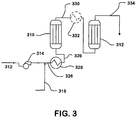
- Fig. 3 presents the method of this invention in an arrangement suitable for commercial practice of the invention in a fixed bed configuration.
- a bPL feed that may optionally be admixed with a solvent enters the process via a line 312 .
- a pair of reactors 310 and 312 each retaining multiple tubular beds of catalyst are configured to receive bPL from the feed line 312 at rate controlled by a feed pump 314 to control the rate of addition of bPL.
- the tubular form of reactor is preferred for removing heat from the catalyst bed during the reaction, but is not required and other types of reactors and arrangements may be used.
- the depiction of two reactors is for illustration purposes only and the process may use a single reactor or any number of reactors.
- Input line 316 may optionally supply additional process input streams such as diluents into admixture with the contents of line 324 to produce a reactor input stream 326 .
- Reactor input stream 326 undergoes heating to produce a vapor phase feed stream.
- a heat exchanger 320 supplies a heat input to reactor input stream 326 .
- Heat may be from an internal process stream or from an external heat source. The heating will be sufficient to insure that the reactor input stream is in a complete vapor phase before it enters reactor 326 .
- the contents of the feed stream are converted at least in part to acrylic acid in reactor 310 and reactor 312 .
- a transfer line 330 passes an intermediate stream containing unconverted bPL and acrylic acid along with any additional input materials added with the bPL to reactor 312 .
- An optional heat exchanger 332 may be added to control and adjust, typically by heat removal, the temperature of the intermediate stream before it enters reactor 312 .
- An effluent stream 334 is recovered from reactor 312 . Reactor effluent stream 334 contains any unconverted bPL, acrylic acid and any additional input materials that may have been added to the reactor input stream 326 .
- a product separation section receives effluent stream 334 to recover the acrylic acid product.
- the separation section will in most cases also recover unconverted bPL (which is usually recycle) and the diluent and the other additive streams that may have been added with the feed and are still recoverable while also rejecting unwanted by-products.
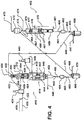
- FIG. 4 presents the method of this invention in an arrangement suitable for commercial practice of the invention in a moving bed configuration.
- a reactor vessel 410 houses an upper reaction section 412 that holds a bed of catalyst 416 and a lower reaction section 414 that holds a bed of catalyst 418 , with both reactor beds arranged for radial flow of reactants across each reactions section.
- fluid flow reactor vessel 410 is configured to receive a combined bPL feed stream comprising bPL.
- a feed line 420 delivers a bPL feed and an additive line 426 delivers any additives for combination into a combined feed 422 that passes through a heater 424 that heats the combined feed to insure delivery of an all vapor phase combined feed stream to reactor section 412 .
- the combined feed passes through a heat exchange vessel 430 that is provided in some embodiments to heat catalyst that is entering reactor vessel 410 via a catalyst transfer line 450 .
- the combined feed flows downward into an annular distribution space 432 that distributes it around catalyst bed 416 .
- a center pipe 436 collects an upper reactor effluent comprising AA, unreacted combined feed and any remaining additives for transfer from the vessel into an inter-heater 440 via a line 438 .
- Inter-heater 440 raises the temperature of the first reactor section effluent and returns the heated upper reactor effluent passes to the lower reactor section 414 via line 428 .
- Annular space 442 distributes the heated upper reactor effluent around the lower catalyst bed 418 .
- a lower reactor effluent passes through a center pipe 444 and into annular space 446 .
- a line 448 recovers the lower reactor effluent and passes it to facilities similar to those previously described for recovery of AA product and optional recycle of unconverted bPL, recovery of additives, and removal of by-products.
- catalyst is periodically removed from the bottom of reactor vessel 410 by line 443 and replaced at the top of reactor vessel 410 by line 450 .
- Catalyst flows through the vessel by dropping from into line 460 from collection pipes 452 that withdraw catalyst from the annular catalyst bed 418 .
- transfer pipes 454 add catalyst from catalyst bed 416 and distribute around catalyst bed 418 .
- transfer pipes 456 replace it with catalyst withdrawn from heat exchange section 458 of heat exchanger 430 that receives fresh and/or regenerated catalyst from catalyst supply line 450.
- the reactor vessel may operate with or without continuous regeneration. In the latter case, deactivated or partially deactivated catalyst withdrawn by line 460 may be discarded or transferred to remote regeneration facilities located on-site or off-site for reactivation and reuse of the spent catalyst.
- Line 450 will be used to supply reactivated or fresh catalyst to the reactor vessel 410 as catalyst is withdrawn vial line 460 .
- FIG. 4 shows regeneration system 462 that receives at least partially deactivated catalyst from reaction vessel 420 via line 471 and returns reactivated, and optionally treated catalyst to to reactor vessel 410 via lien 450 .
- the transfer of catalyst to the regeneration system 462 begins with the intermittent passage of catalyst to a lock hopper 464 through line 443 upon the opening and closing of an upper control valve 460 .
- Another control valve 463 regulates the movement of catalyst from lock hopper 464 into a lift vessel 466 .
- control valve 463 When catalyst is ready for regeneration transfer through line 471 , control valve 463 is closed and lift gas enters lift vessel 470 via line 468 and is carried to the bottom of lift vessel 466 by lift gas tube 470 .
- the lift gas carries the catalyst upward into a catalyst hopper 472 of regeneration system 462 . Lift gas disengages from the catalyst in vessel 472 and is removed from the regeneration section 479 by conduit 475 .
- Catalyst is regenerated as it flows intermittently from the top to the bottom of regeneration system 462 . Intermittent passage of catalyst begins with the opening of a valve 490 in a line 491 that results in catalyst from hopper 472 passing downwardly through a line 473 into an upper chamber 477 of a combustion vessel 476 as catalyst drops into a lower portion 488 of the combustion vessel 476 to replace catalyst the dropped into a lock hopper 492 . Valve 491 isolates lock hopper 492 for transfer of catalyst into lift vessel 496 . Catalyst is transported from lift vessel 496 into line 450 by closing valve 494 and injecting lift gas into lift vessel 496 via line 447 in the manner4 previously described.
- regeneration system passes a regeneration gas and may optionally pass one or more treatment and/or purge gases through the regeneration section.
- a baffle 467 divides the combustion vessel into the upper chamber 477 and the lower chamber 488 .
- the primary regeneration gas enters the regeneration section 462 via a line 478 and passes into the bottom of upper chamber 477, across a bed 482 of deactivation catalyst.
- a line 474 withdraws the regeneration gas from the top of upper chamber 477 .
- Additional regeneration gas or treatment gas enter the bottom of lower chamber 488 via line 487 .
- An additional gas stream typically a treatment gas may also enter a lower contact zone 489 via a line 461 .
- a line 479 withdraws gas from lower chamber 488 below baffle 467 . Since lower contact zone 489 communicates with combustion vessel 476 , conduit 479 also withdraws gas that enter the lower contact zone 489.
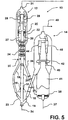
- Fig. 5 presents the method of this invention in an arrangement suitable for commercial practice of the invention in a fluidized reaction configuration.
- Fig. 5 shows a fluidized reactor arrangement that uses a dilute phase transfer zone as the catalyst contact zone (also referred to as riser.)
- Fig. 5 shows a typical fluidized reactor arrangement 10 for fluidized catalyst contacting that is integrated with a regeneration zone.
- a feed stream is contacted in reactor 12 with a regenerated conversion catalyst of this invention.
- regenerated conversion catalyst entering from a regenerator conduit 18 contacts the bPL combined feed stream comprising bPL and one or more of diluents fluidization gases, and other additives as herein described.
- the regenerated catalyst is at substantially higher temperature than the combined feed and additional heating of the feed by contact with the regenerated catalyst can provide additional fluidization to lift the catalyst and carry up the riser 20 of the reactor 12 .
- the regenerator conduit 18 is in downstream communication with the regenerator 14 .
- the riser 20 has an inlet 19 in downstream communication with said regenerator conduit 18 .
- the regenerator conduit 19 is connected to the riser 20 at a lower end.
- a control valve located between sections 18 and 19 of the regenerator conduit regulates the flow of catalyst out of the regenerated catalyst conduit and provides a pressure drop that prevents any substantial flow of the feed stream up the section 18 of the regeneration conduit.
- spent cracking catalyst entering from a recycle catalyst conduit 19 and a riser inlet tube 23 is contacted with the combined bPL feed stream riser 20 of the reactor 12 without the spent catalyst undergoing regeneration. Again a valve at the top of riser inlet tube 23 regulates the flow of catalyst through tube 23.
- the spent catalyst recycle will allow additional control of the temperature and/or the activity of the catalyst in the reactor 12 and can increase the coke concentration of catalyst in the reactor 12 to aid in the regulation of regenerator temperatures and catalyst regeneration.
- the recycle of spent catalyst through the recycle catalyst conduit can also be used to increase the ratio of catalyst-to-feed in the reactor.
- the catalyst-to-feed weight ratio is in a range between 5 and 20 and preferably between 10 and 15.
- portions of the bPL feed may be fed to the riser 20 through elevated distributors 16 and this can be used to maintain conversion of the bPL as the catalyst passes up the riser 20.
- the recycle conduit 19 is in downstream communication with a riser outlet 25 .
- the recycle conduit 19 is connected to the riser 20 at the outlet end of the recycle conduit by riser tube 23 .
- the recycle conduit 19 bypasses the regenerator 14 by being in downstream communication with the riser outlet 25 and the riser tube 23 being in direct, downstream communication with the recycle conduit. Consequently, spent catalyst entering the recycle conduit 19 passes back to the riser 20 before any of it enters the regenerator 14 .
- the recycle conduit 19 has no direct communication with the regenerator 14 .
- the AA containing product gases and spent catalyst in the riser 20 are thereafter discharged from the riser outlet 25 into a disengaging chamber 27 which contains the riser outlet.
- the gas stream containing AA product is disengaged from the catalyst in the disengaging chamber 27 using a rough cut separator 26 .
- Cyclonic separators which may include one or two stages of cyclones 28 in the reactor vessel 22 further separate catalyst from AA products.
- Product containing gases exit the reactor vessel 22 through an outlet 31 for transport to downstream product separation facilities to recover AA, recycle bPL, diluents and additives.
- the recycle conduit 19 and the regenerator conduit 18 are in downstream communication with the disengaging chamber 27 .
- the outlet temperature of the product containing gas leaving the riser 20 should be less than 325°C and preferably less than less than 300°C.
- catalyst After separation from product containing gases catalyst falls into a stripping section 34 where an inert gas is injected through a nozzle 35 and distributed to purge any residual product vapor or gas.
- a portion of the spent catalyst is fed to the catalyst regenerator 14 through a spent catalyst conduit 36 .
- the catalyst regenerator 14 may be in downstream communication with the riser 20 , specifically, the riser outlet 25 .
- a portion of the spent catalyst is recycled through recycle catalyst conduit 19 to the riser 20 as previously described.
- Fig. 5 depicts a vessel 14 for the regeneration of catalyst having a combustor 41 as the primary zone for the regeneration of the catalyst by combustion of the coke and the displacement of other volatile compounds from the surface of the catalyst.
- Other embodiments of the invention may use other configurations and arrangement of regenerators.
- a stream of oxygen-containing gas such as air
- a distributor 38 to contact the coked catalyst, burn coke deposited thereon, and provide regenerated catalyst and a gas stream comprising the products of the combustion and generally referred to as flue gas.
- Catalyst and air flow upwardly together through the combustor 41 and along a combustor riser 40 located within the catalyst regenerator 14 .
- the catalyst which is at least partially regenerated is discharged through a disengager 42 to effect an initial separation of the catalyst from the flue gas.
- a series of cyclonic separation steps in cyclones 44 and 46 effect further separation of regenerated catalyst and flue gas.
- the cyclones direct the catalyst separated therein into the conduits that extend downwardly from the cyclones and are referred to as diplegs.
- the flue gas which is relatively free of catalyst exits cyclones 44 , 46 and flows out of the regenerator vessel 14 through line 48 . Regenerated catalyst is recycled back to the reactor riser 20 through the regenerated catalyst conduit 18 .
- the flue gas will typically contain carbon dioxide, water vapor, and lesser amounts of carbon monoxide. Depending on the type and the erosion properties of the catalyst the flue gas may also contain small amounts of extremely fine catalyst particles typically in the range of between .2 and 2 micrometers which in some applications will require additional treatment of the flue gas for removal of such particles.
- acrylic acid produced according to the methods described herein may be used for various applications.
- acrylic acid may be used to make polyacrylic acid for superabsorbent polymers (SAPs).
- SAPs superabsorbent polymers
- the SAPs find use in diapers, adult incontinence products, and feminine hygiene products among other things.
- a method for producing a superabsorbent polymer by: polymerizing the acrylic acid produced according to any of the methods described herein in the presence of a cross-linker to produce the superabsorbent polymer.
- This Example demonstrates the production of acrylic acid from bPL using a zeolite.
- a mixture of bPL (3.0 g) and phenothiazine (9.0 mg) was added using a needle value to a mixture of sulfolane (40.0g) and Zeolite Y hydrogen (20.0 g) at 165°C with 344.74 kPa (50 psi) of carbon monoxide.
- Zeolite Y hydrogen 80:1 mole ratio SiO2/Al2O3, powder S.A. 780 m 2 /g
- Phenothiazine was the polymerization inhibitor used.
- Sulfolane was the solvent used, and was dried over 3A molecular sieves prior to use.
- the bPL was added slowly using the needle valve over about 8.6 minutes. The reaction mixture was heated to 170°C to produce acrylic acid.
- H-ZSM-5 catalyst 11 grams were loaded into jacketed stainless steel 316 pipe reactor (ID 1.27 cm (0.5 inch), the catalyst was supported between glass beads columns (stainless steel wool was placed below and above glass beads).
- Multi point thermocouple was inserted through the center of the reactor and hot oil was circulated through the reactor jacket to maintain the desired reactor temperature.
- the pressure of reactor and saturator was maintained at 65.5 kPa (9.5 psig).
- the reaction products were absorbed in chilled to 10°C dichloromethane and the solution of reaction products in dichloromethane was analyzed by gas chromatography.
- the line between the saturator and the reactor as well as the line between the reactor and absorber were heat traced to prevent condensation of bPL and acrylic acid.
- the reaction was conducted at the reactor temperature of 210°C. At this conditions bPL conversion of greater than 99.9% was observed with selectivity of acrylic acid product of greater than 98% (WHSV at these conditions was 0.45 h -1 ).
Landscapes
- Chemical & Material Sciences (AREA)
- Organic Chemistry (AREA)
- Engineering & Computer Science (AREA)
- Chemical Kinetics & Catalysis (AREA)
- Oil, Petroleum & Natural Gas (AREA)
- Crystallography & Structural Chemistry (AREA)
- Materials Engineering (AREA)
- Health & Medical Sciences (AREA)
- Medicinal Chemistry (AREA)
- Polymers & Plastics (AREA)
- Analytical Chemistry (AREA)
- Organic Low-Molecular-Weight Compounds And Preparation Thereof (AREA)
- Catalysts (AREA)
- Polyesters Or Polycarbonates (AREA)
- Low-Molecular Organic Synthesis Reactions Using Catalysts (AREA)
Applications Claiming Priority (2)
| Application Number | Priority Date | Filing Date | Title |
|---|---|---|---|
| US201662311262P | 2016-03-21 | 2016-03-21 | |
| PCT/US2017/023269 WO2017165323A1 (en) | 2016-03-21 | 2017-03-21 | Improved acrylic acid production process |
Publications (3)
| Publication Number | Publication Date |
|---|---|
| EP3433226A1 EP3433226A1 (en) | 2019-01-30 |
| EP3433226A4 EP3433226A4 (en) | 2019-11-06 |
| EP3433226B1 true EP3433226B1 (en) | 2021-12-15 |
Family
ID=59855298
Family Applications (2)
| Application Number | Title | Priority Date | Filing Date |
|---|---|---|---|
| EP17770933.4A Active EP3433226B1 (en) | 2016-03-21 | 2017-03-21 | Improved acrylic acid production process |
| EP17770939.1A Active EP3433222B1 (en) | 2016-03-21 | 2017-03-21 | Acrylic acid, and methods of producing thereof |
Family Applications After (1)
| Application Number | Title | Priority Date | Filing Date |
|---|---|---|---|
| EP17770939.1A Active EP3433222B1 (en) | 2016-03-21 | 2017-03-21 | Acrylic acid, and methods of producing thereof |
Country Status (14)
| Country | Link |
|---|---|
| US (3) | US20200325093A1 (https=) |
| EP (2) | EP3433226B1 (https=) |
| JP (2) | JP2019509307A (https=) |
| KR (2) | KR20180128018A (https=) |
| CN (3) | CN114736111B (https=) |
| AU (2) | AU2017236914A1 (https=) |
| BR (2) | BR112018069337A2 (https=) |
| CA (2) | CA3018118A1 (https=) |
| CO (1) | CO2018010877A2 (https=) |
| MX (2) | MX2018011139A (https=) |
| SA (2) | SA518400053B1 (https=) |
| TW (1) | TW201802061A (https=) |
| WO (2) | WO2017165344A1 (https=) |
| ZA (1) | ZA201807001B (https=) |
Families Citing this family (31)
| Publication number | Priority date | Publication date | Assignee | Title |
|---|---|---|---|---|
| JP2014527456A (ja) | 2011-05-13 | 2014-10-16 | ノボマー, インコーポレイテッド | 触媒的カルボニル化用触媒および方法 |
| CN110183402B (zh) | 2013-12-07 | 2024-04-02 | 诺沃梅尔公司 | 纳米过滤膜和使用方法 |
| US10858329B2 (en) | 2014-05-05 | 2020-12-08 | Novomer, Inc. | Catalyst recycle methods |
| US10597294B2 (en) | 2014-05-30 | 2020-03-24 | Novomer, Inc. | Integrated methods for chemical synthesis |
| WO2016015019A1 (en) | 2014-07-25 | 2016-01-28 | Novomer, Inc. | Synthesis of metal complexes and uses thereof |
| MA41513A (fr) | 2015-02-13 | 2017-12-19 | Novomer Inc | Procédé de distillation pour la production d'acide acrylique |
| MA41507A (fr) | 2015-02-13 | 2017-12-19 | Novomer Inc | Systèmes et procédés de production de polymères |
| US10221150B2 (en) | 2015-02-13 | 2019-03-05 | Novomer, Inc. | Continuous carbonylation processes |
| HK1245243A1 (zh) | 2015-02-13 | 2018-08-24 | 诺沃梅尔公司 | 灵活的化学生产平台 |
| MA41514A (fr) | 2015-02-13 | 2017-12-19 | Novomer Inc | Procédés intégrés de synthèse chimique |
| MA41510A (fr) | 2015-02-13 | 2017-12-19 | Novomer Inc | Procédé de production d'acide acrylique |
| KR20170134375A (ko) | 2015-02-13 | 2017-12-06 | 노보머, 인코포레이티드 | 폴리프로피오락톤의 제조를 위한 방법 및 시스템 |
| MA41508A (fr) | 2015-02-13 | 2017-12-19 | Novomer Inc | Systèmes et procédés de production d'acide polyacrylique |
| MX2018001404A (es) | 2015-07-31 | 2018-08-15 | Novomer Inc | Sistema de produccion/proceso de producción para acido acrilico y sus precursores. |
| JP2019512585A (ja) | 2016-03-21 | 2019-05-16 | ノボマー, インコーポレイテッド | 高吸収性ポリマーを生成するためのシステムおよび方法 |
| AU2017236914A1 (en) | 2016-03-21 | 2018-11-08 | Novomer, Inc. | Improved acrylic acid production process |
| US20180305286A1 (en) | 2016-03-21 | 2018-10-25 | Novomer, Inc. | Systems and Processes for Producing Organic Acids Direct from Beta-Lactones |
| EP3535235A4 (en) | 2016-11-02 | 2020-07-08 | Novomer, Inc. | ABSORBENT POLYMERS, METHODS AND SYSTEMS OF PRODUCTION AND USES THEREOF |
| US10144802B2 (en) | 2016-12-05 | 2018-12-04 | Novomer, Inc. | Beta-propiolactone based copolymers containing biogenic carbon, methods for their production and uses thereof |
| US10500104B2 (en) | 2016-12-06 | 2019-12-10 | Novomer, Inc. | Biodegradable sanitary articles with higher biobased content |
| CN110022909A (zh) * | 2016-12-19 | 2019-07-16 | 宝洁公司 | 含沸石的制品 |
| US10065914B1 (en) | 2017-04-24 | 2018-09-04 | Novomer, Inc. | Thermolysis of polypropiolactone to produce acrylic acid |
| US10676426B2 (en) | 2017-06-30 | 2020-06-09 | Novomer, Inc. | Acrylonitrile derivatives from epoxide and carbon monoxide reagents |
| US10590099B1 (en) | 2017-08-10 | 2020-03-17 | Novomer, Inc. | Processes for producing beta-lactone with heterogenous catalysts |
| EP3691785A4 (en) | 2017-10-05 | 2021-08-04 | Novomer, Inc. | ISOCYANATES, DERIVATIVES AND METHOD FOR THEIR MANUFACTURING |
| CN112384299A (zh) * | 2018-06-29 | 2021-02-19 | 诺沃梅尔公司 | 直接由β-内酯生产有机酸的系统和方法 |
| ES2991139T3 (es) | 2018-07-13 | 2024-12-02 | Novomer Inc | Espumas de polilactona y métodos de fabricación de las mismas |
| KR20210137037A (ko) | 2019-03-08 | 2021-11-17 | 노보머, 인코포레이티드 | 아미드 및 니트릴 화합물을 생산하기 위한 통합 방법 및 시스템 |
| FR3110570B1 (fr) * | 2020-05-19 | 2022-05-20 | Commissariat Energie Atomique | PROCEDE DE PREPARATION D’ACIDE ACRYLIQUE A PARTIR DE β-PROPIOLACTONE |
| EP4591980A4 (en) * | 2022-09-19 | 2026-01-21 | Lg Chemical Ltd | CATALYST FOR THE PREPARATION OF UNSATURATED CARBOXYLIC ACIDS AND THEIR DERIVATIVES |
| EP4545309A1 (fr) | 2023-10-26 | 2025-04-30 | Airbus SAS | Procédé d'impression pour réaliser un support peint |
Family Cites Families (79)
| Publication number | Priority date | Publication date | Assignee | Title |
|---|---|---|---|---|
| US3037346A (en) * | 1958-05-29 | 1962-06-05 | Scient Design Co | Heat storage in chemical processes |
| US3462484A (en) * | 1959-10-20 | 1969-08-19 | Celanese Corp | Condensation of acrylic acid |
| US3176042A (en) * | 1959-10-20 | 1965-03-30 | Celanese Corp | Treating propiolactone with heated phosphoric acid to produce acrylic acid |
| US3849457A (en) | 1969-01-27 | 1974-11-19 | Mobil Oil Corp | Preparation of carboxylic acids by hydrogenolysis of esters |
| US3647680A (en) | 1969-09-25 | 1972-03-07 | Universal Oil Prod Co | Continuous reforming-regeneration process |
| US3689533A (en) | 1971-03-15 | 1972-09-05 | Monsanto Co | Production of carboxylic acids and esters |
| BE786398A (fr) * | 1971-07-21 | 1973-01-18 | Basf Ag | Procede de preparation de l'acide acrylique anhydre |
| US3885155A (en) | 1973-11-01 | 1975-05-20 | Stanford Research Inst | Mass spectrometric determination of carbon 14 |
| US4427884A (en) | 1982-01-25 | 1984-01-24 | The Research Foundation Of State University Of New York | Method for detecting and quantifying carbon isotopes |
| JPS601205A (ja) * | 1983-06-20 | 1985-01-07 | Kao Corp | 高吸水性ポリマ−の製造法 |
| JPS61213206A (ja) * | 1985-03-20 | 1986-09-22 | Mitsubishi Petrochem Co Ltd | 高吸水性ポリマ−の製造方法 |
| DK160599C (da) * | 1986-06-04 | 1991-09-02 | Jydsk Varmekedelfab As | Fremgangsmaade og apparat til rensning af roeggas samt genvinding af varme herfra |
| US5198578A (en) * | 1986-07-17 | 1993-03-30 | Union Carbide Chemicals | Anhydrous diluents for the propylene oxidation reaction to acrolein and acrolein oxidation to acrylic acid |
| US4973841A (en) | 1990-02-02 | 1990-11-27 | Genus, Inc. | Precision ultra-sensitive trace detector for carbon-14 when it is at concentration close to that present in recent organic materials |
| DE4123912A1 (de) * | 1991-07-18 | 1993-01-21 | Klaus Oesterle | Fuer tensid- bzw. salzhaltiges wasser geeignete vorrichtung zur trennung von wasser und oel |
| SG45321A1 (en) | 1992-10-02 | 1998-01-16 | Rhone Poulenc Chimie | Process for isomerization of lactones to pentenoic acids by acidic or basic catalysts |
| US5438194A (en) | 1993-07-30 | 1995-08-01 | High Voltage Engineering Europa B.V. | Ultra-sensitive molecular identifier |
| US5661299A (en) | 1996-06-25 | 1997-08-26 | High Voltage Engineering Europa B.V. | Miniature AMS detector for ultrasensitive detection of individual carbon-14 and tritium atoms |
| JP2003173088A (ja) | 2001-12-07 | 2003-06-20 | Pfu Ltd | トナーリサイクルシステムのトナー濃度調整方式 |
| WO2005095320A1 (en) * | 2004-04-02 | 2005-10-13 | Ciba Specialty Chemicals Water Treatments Limited | Preparation of acrylic acid derivatives from alpha or beta-hydroxy carboxylic acids |
| DE102005039156B4 (de) * | 2005-08-17 | 2014-12-24 | Evonik Degussa Gmbh | Verfahren zur Herstellung von (Meth)Acrylsäure mit Schwersiedeaufarbeitung durch Kristallisation |
| US7902416B2 (en) * | 2006-12-28 | 2011-03-08 | Uop Llc | Fluidized bed reactor with back-mixing for dehydrogenation of light paraffins |
| WO2009155086A2 (en) | 2008-05-30 | 2009-12-23 | E. I. Du Pont De Nemours And Company | Renewably resourced chemicals and intermediates |
| JP5339845B2 (ja) | 2008-10-14 | 2013-11-13 | Jx日鉱日石エネルギー株式会社 | 流動接触分解方法 |
| MY179719A (en) | 2009-04-08 | 2020-11-11 | Novomer Inc | Process for beta-lactone production |
| WO2011060099A2 (en) | 2009-11-10 | 2011-05-19 | Laboratory Skin Care, Inc. | Sunscreen compositions comprising uniform, rigid, spherical, nanoporous calcium phosphate particles, and methods of making and using the same |
| MX2012009134A (es) | 2010-02-11 | 2012-11-30 | Metabolix Inc | Proceso para producir componente monomerico de biomasa de polihidroxialcanoato geneticamente modificado. |
| WO2012030619A1 (en) | 2010-08-28 | 2012-03-08 | Novomer, Inc. | Succinic anhydride from ethylene oxide |
| DE102010040757A1 (de) | 2010-09-14 | 2012-03-15 | Man Diesel & Turbo Se | Rohrbündelreaktor |
| SMT201900513T1 (it) | 2010-10-11 | 2019-11-13 | Novomer Inc | Miscele polimeriche |
| FR2966161B1 (fr) | 2010-10-15 | 2013-12-20 | Total Raffinage Marketing | Procede de reaction et de stripage etage dans une unite de fcc pour maximisation de la production d'olefines |
| AU2011327947B2 (en) * | 2010-11-11 | 2016-05-05 | Lucite International Uk Limited | A process for the production of ethylenically unsaturated carboxylic acids or esters and a catalyst therefor |
| SG193629A1 (en) * | 2011-03-28 | 2013-11-29 | Agency Science Tech & Res | Synthesis of diacids |
| JP2014527456A (ja) | 2011-05-13 | 2014-10-16 | ノボマー, インコーポレイテッド | 触媒的カルボニル化用触媒および方法 |
| US20110319849A1 (en) | 2011-07-01 | 2011-12-29 | Dimitris Ioannis Collias | Absorbent article comprising a synthetic polymer derived from a renewable resource and methods of producing said article |
| HUE039449T2 (hu) * | 2011-10-26 | 2018-12-28 | Novomer Inc | Eljárás akrilátok elõállítására epoxidokból |
| JP2015511947A (ja) | 2012-02-13 | 2015-04-23 | ノボマー, インコーポレイテッド | エポキシドから酸無水物を生成するためのプロセス |
| HRP20190420T1 (hr) | 2012-02-22 | 2019-04-19 | Novomer, Inc. | Postupci proizvodnje akrilne kiseline |
| JP5818716B2 (ja) * | 2012-02-24 | 2015-11-18 | 株式会社日本触媒 | 不飽和カルボン酸類製造用触媒及びその触媒を用いた不飽和カルボン酸製造方法 |
| US9850192B2 (en) | 2012-06-08 | 2017-12-26 | Cj Cheiljedang Corporation | Renewable acrylic acid production and products made therefrom |
| JP2015522091A (ja) | 2012-06-27 | 2015-08-03 | ノボマー, インコーポレイテッド | ポリエステル生成のための触媒および方法 |
| BR112015000002A2 (pt) | 2012-07-02 | 2017-06-27 | Novomer Inc | processo para produção de acrilato |
| DE102012212424A1 (de) | 2012-07-16 | 2014-01-16 | Basf Se | Verfahren zur Herstellung von Acrylsäure durch eine mit wenigstens einer molekularen Wirkverbindung katalysierte Thermolyse von Poly-3-hydroxypropionat |
| CN110183402B (zh) | 2013-12-07 | 2024-04-02 | 诺沃梅尔公司 | 纳米过滤膜和使用方法 |
| US9238210B2 (en) | 2013-12-20 | 2016-01-19 | Kellogg Brown & Root Llc | Baffle system for fluid catalytic cracking |
| KR20160135300A (ko) | 2014-03-14 | 2016-11-25 | 노보머, 인코포레이티드 | 에폭사이드 카보닐화용 촉매 |
| US10858329B2 (en) | 2014-05-05 | 2020-12-08 | Novomer, Inc. | Catalyst recycle methods |
| US10597294B2 (en) | 2014-05-30 | 2020-03-24 | Novomer, Inc. | Integrated methods for chemical synthesis |
| WO2016015019A1 (en) | 2014-07-25 | 2016-01-28 | Novomer, Inc. | Synthesis of metal complexes and uses thereof |
| MA41510A (fr) | 2015-02-13 | 2017-12-19 | Novomer Inc | Procédé de production d'acide acrylique |
| MA41514A (fr) | 2015-02-13 | 2017-12-19 | Novomer Inc | Procédés intégrés de synthèse chimique |
| MA41508A (fr) | 2015-02-13 | 2017-12-19 | Novomer Inc | Systèmes et procédés de production d'acide polyacrylique |
| HK1245243A1 (zh) | 2015-02-13 | 2018-08-24 | 诺沃梅尔公司 | 灵活的化学生产平台 |
| MA41513A (fr) | 2015-02-13 | 2017-12-19 | Novomer Inc | Procédé de distillation pour la production d'acide acrylique |
| MA41507A (fr) | 2015-02-13 | 2017-12-19 | Novomer Inc | Systèmes et procédés de production de polymères |
| US10221150B2 (en) | 2015-02-13 | 2019-03-05 | Novomer, Inc. | Continuous carbonylation processes |
| KR20170134375A (ko) | 2015-02-13 | 2017-12-06 | 노보머, 인코포레이티드 | 폴리프로피오락톤의 제조를 위한 방법 및 시스템 |
| WO2017004455A1 (en) | 2015-07-01 | 2017-01-05 | Novomer, Inc. | Polymer compositions produced from biobased ethanol |
| MX2018001404A (es) | 2015-07-31 | 2018-08-15 | Novomer Inc | Sistema de produccion/proceso de producción para acido acrilico y sus precursores. |
| JP2019512585A (ja) | 2016-03-21 | 2019-05-16 | ノボマー, インコーポレイテッド | 高吸収性ポリマーを生成するためのシステムおよび方法 |
| US20180305286A1 (en) | 2016-03-21 | 2018-10-25 | Novomer, Inc. | Systems and Processes for Producing Organic Acids Direct from Beta-Lactones |
| AU2017236914A1 (en) * | 2016-03-21 | 2018-11-08 | Novomer, Inc. | Improved acrylic acid production process |
| US20180282251A1 (en) | 2017-03-21 | 2018-10-04 | Novomer, Inc. | Systems and processes for producing organic acids direct from beta-lactones |
| EP3535235A4 (en) | 2016-11-02 | 2020-07-08 | Novomer, Inc. | ABSORBENT POLYMERS, METHODS AND SYSTEMS OF PRODUCTION AND USES THEREOF |
| MA46727A (fr) | 2016-11-02 | 2019-09-11 | Novomer Inc | Polymères absorbants, procédés de production et utilisations associés |
| US10144802B2 (en) | 2016-12-05 | 2018-12-04 | Novomer, Inc. | Beta-propiolactone based copolymers containing biogenic carbon, methods for their production and uses thereof |
| US10500104B2 (en) | 2016-12-06 | 2019-12-10 | Novomer, Inc. | Biodegradable sanitary articles with higher biobased content |
| CN106831389B (zh) | 2016-12-12 | 2020-03-31 | 中国科学技术大学 | 羧酸类化合物的制备方法 |
| AR110833A1 (es) | 2017-01-19 | 2019-05-08 | Novomer Inc | Métodos y sistemas para el tratamiento de óxido de etileno |
| WO2018170006A1 (en) | 2017-03-17 | 2018-09-20 | Novomer Inc. | Polyamides, and methods of producing thereof |
| US10065914B1 (en) | 2017-04-24 | 2018-09-04 | Novomer, Inc. | Thermolysis of polypropiolactone to produce acrylic acid |
| US10781156B2 (en) | 2017-06-30 | 2020-09-22 | Novomer, Inc. | Compositions for improved production of acrylic acid |
| US20190002385A1 (en) | 2017-06-30 | 2019-01-03 | Novomer, Inc. | Compositions for improved production of acrylic acid |
| US10961209B2 (en) | 2017-08-10 | 2021-03-30 | Novomer, Inc. | Processes for producing beta-lactone and beta-lactone derivatives with heterogenous catalysts |
| TW201920077A (zh) | 2017-09-09 | 2019-06-01 | 美商諾沃梅爾公司 | 醯胺及腈化合物及其製造與使用方法 |
| US20190076835A1 (en) | 2017-09-11 | 2019-03-14 | Novomer, Inc. | Processses using multifunctional catalysts |
| US20190076834A1 (en) | 2017-09-11 | 2019-03-14 | Novomer, Inc. | Processes Using Multifunctional Catalysts |
| EP3691785A4 (en) | 2017-10-05 | 2021-08-04 | Novomer, Inc. | ISOCYANATES, DERIVATIVES AND METHOD FOR THEIR MANUFACTURING |
| CN112639393B (zh) | 2018-12-28 | 2021-10-15 | 深圳市柔宇科技股份有限公司 | 纸沓厚度识别装置、纸沓厚度识别方法及手写输入装置 |
-
2017
- 2017-03-21 AU AU2017236914A patent/AU2017236914A1/en not_active Abandoned
- 2017-03-21 KR KR1020187030170A patent/KR20180128018A/ko not_active Withdrawn
- 2017-03-21 US US16/087,051 patent/US20200325093A1/en not_active Abandoned
- 2017-03-21 US US15/464,346 patent/US10662139B2/en active Active
- 2017-03-21 EP EP17770933.4A patent/EP3433226B1/en active Active
- 2017-03-21 TW TW106109417A patent/TW201802061A/zh unknown
- 2017-03-21 KR KR1020187030358A patent/KR20180118797A/ko not_active Withdrawn
- 2017-03-21 WO PCT/US2017/023302 patent/WO2017165344A1/en not_active Ceased
- 2017-03-21 CN CN202210426954.3A patent/CN114736111B/zh active Active
- 2017-03-21 MX MX2018011139A patent/MX2018011139A/es unknown
- 2017-03-21 MX MX2018011485A patent/MX2018011485A/es unknown
- 2017-03-21 BR BR112018069337A patent/BR112018069337A2/pt not_active IP Right Cessation
- 2017-03-21 AU AU2017238018A patent/AU2017238018A1/en not_active Abandoned
- 2017-03-21 BR BR112018069019A patent/BR112018069019A2/pt not_active IP Right Cessation
- 2017-03-21 CN CN201780029803.1A patent/CN109153628B/zh active Active
- 2017-03-21 JP JP2018549537A patent/JP2019509307A/ja active Pending
- 2017-03-21 WO PCT/US2017/023269 patent/WO2017165323A1/en not_active Ceased
- 2017-03-21 EP EP17770939.1A patent/EP3433222B1/en active Active
- 2017-03-21 CA CA3018118A patent/CA3018118A1/en not_active Abandoned
- 2017-03-21 CN CN201780018126.3A patent/CN108884000A/zh active Pending
- 2017-03-21 JP JP2018549946A patent/JP6997459B2/ja active Active
- 2017-03-21 CA CA3018208A patent/CA3018208A1/en not_active Abandoned
-
2018
- 2018-09-19 SA SA518400053A patent/SA518400053B1/ar unknown
- 2018-09-25 SA SA518400104A patent/SA518400104B1/ar unknown
- 2018-10-10 CO CONC2018/0010877A patent/CO2018010877A2/es unknown
- 2018-10-19 ZA ZA2018/07001A patent/ZA201807001B/en unknown
-
2021
- 2021-01-19 US US17/152,248 patent/US11827590B2/en active Active
Non-Patent Citations (1)
| Title |
|---|
| None * |
Also Published As
Similar Documents
| Publication | Publication Date | Title |
|---|---|---|
| EP3433226B1 (en) | Improved acrylic acid production process | |
| US12152004B2 (en) | Systems and processes for producing organic acids directly from beta-lactones | |
| US20180282251A1 (en) | Systems and processes for producing organic acids direct from beta-lactones | |
| RU2374215C2 (ru) | Превращение спиртового оксигената в пропилен с применением технологии подвижного слоя и этапа этерификации | |
| KR101217915B1 (ko) | 에탄올로부터의 올레핀의 제조 방법 | |
| EP2303805B1 (en) | Process to make olefins from oxygenates | |
| US10737991B2 (en) | Process for producing light olefins | |
| EP2303806B1 (en) | Process to make olefins from oxygenates | |
| JP4829227B2 (ja) | 移動床技術を用いてのオキシジェネートのプロピレンへの転化 | |
| EP2300396B1 (en) | Process to make olefins from oxygenates | |
| EP2303807B1 (en) | Process to make olefins from oxygenates | |
| EP0088494B1 (en) | Process for converting methanol into olefins | |
| US8609916B2 (en) | Processes for preparing alkylated aromatic compounds | |
| WO2014005996A1 (en) | Process for preparing ethylene and/or propylene | |
| JP4604508B2 (ja) | プロピレンの製造方法 | |
| HK40002882A (en) | Improved acrylic acid production process | |
| KR20010014595A (ko) | ε-카프로락탐의 제조 장치 및 제조 방법 | |
| EP3814005B1 (en) | Systems and processes for producing organic acids directly from beta-lactones | |
| CN118647592A (zh) | 乙醇的转化方法和其它烃的制造方法 | |
| JPH10218819A (ja) | (ポリ)アルキレングリコールモノアルキルエーテルの製造方法 | |
| JPH10168019A (ja) | (ポリ)アルキレングリコールモノアルキルエーテルの製造方法 |
Legal Events
| Date | Code | Title | Description |
|---|---|---|---|
| STAA | Information on the status of an ep patent application or granted ep patent |
Free format text: STATUS: THE INTERNATIONAL PUBLICATION HAS BEEN MADE |
|
| PUAI | Public reference made under article 153(3) epc to a published international application that has entered the european phase |
Free format text: ORIGINAL CODE: 0009012 |
|
| STAA | Information on the status of an ep patent application or granted ep patent |
Free format text: STATUS: REQUEST FOR EXAMINATION WAS MADE |
|
| 17P | Request for examination filed |
Effective date: 20181012 |
|
| AK | Designated contracting states |
Kind code of ref document: A1 Designated state(s): AL AT BE BG CH CY CZ DE DK EE ES FI FR GB GR HR HU IE IS IT LI LT LU LV MC MK MT NL NO PL PT RO RS SE SI SK SM TR |
|
| AX | Request for extension of the european patent |
Extension state: BA ME |
|
| DAV | Request for validation of the european patent (deleted) | ||
| DAX | Request for extension of the european patent (deleted) | ||
| RAP1 | Party data changed (applicant data changed or rights of an application transferred) |
Owner name: NOVOMER, INC. |
|
| A4 | Supplementary search report drawn up and despatched |
Effective date: 20191008 |
|
| RIC1 | Information provided on ipc code assigned before grant |
Ipc: B01J 27/18 20060101ALI20191001BHEP Ipc: C07C 57/04 20060101ALI20191001BHEP Ipc: C07C 51/09 20060101AFI20191001BHEP Ipc: B01J 8/02 20060101ALI20191001BHEP Ipc: B01J 29/40 20060101ALI20191001BHEP Ipc: C07C 51/50 20060101ALI20191001BHEP |
|
| STAA | Information on the status of an ep patent application or granted ep patent |
Free format text: STATUS: EXAMINATION IS IN PROGRESS |
|
| 17Q | First examination report despatched |
Effective date: 20200814 |
|
| GRAP | Despatch of communication of intention to grant a patent |
Free format text: ORIGINAL CODE: EPIDOSNIGR1 |
|
| STAA | Information on the status of an ep patent application or granted ep patent |
Free format text: STATUS: GRANT OF PATENT IS INTENDED |
|
| INTG | Intention to grant announced |
Effective date: 20210623 |
|
| RIN1 | Information on inventor provided before grant (corrected) |
Inventor name: SOOKRAJ, SADESH H. Inventor name: TSEITLIN, ALEXANDER Inventor name: POKROVSKI, KONSTANTIN Inventor name: MUKADDAM, WAHEED |
|
| GRAS | Grant fee paid |
Free format text: ORIGINAL CODE: EPIDOSNIGR3 |
|
| GRAA | (expected) grant |
Free format text: ORIGINAL CODE: 0009210 |
|
| STAA | Information on the status of an ep patent application or granted ep patent |
Free format text: STATUS: THE PATENT HAS BEEN GRANTED |
|
| RAP3 | Party data changed (applicant data changed or rights of an application transferred) |
Owner name: NOVOMER, INC. |
|
| AK | Designated contracting states |
Kind code of ref document: B1 Designated state(s): AL AT BE BG CH CY CZ DE DK EE ES FI FR GB GR HR HU IE IS IT LI LT LU LV MC MK MT NL NO PL PT RO RS SE SI SK SM TR |
|
| REG | Reference to a national code |
Ref country code: GB Ref legal event code: FG4D Ref country code: CH Ref legal event code: EP |
|
| REG | Reference to a national code |
Ref country code: IE Ref legal event code: FG4D Ref country code: DE Ref legal event code: R096 Ref document number: 602017050979 Country of ref document: DE |
|
| REG | Reference to a national code |
Ref country code: AT Ref legal event code: REF Ref document number: 1455403 Country of ref document: AT Kind code of ref document: T Effective date: 20220115 |
|
| REG | Reference to a national code |
Ref country code: LT Ref legal event code: MG9D |
|
| REG | Reference to a national code |
Ref country code: NL Ref legal event code: MP Effective date: 20211215 |
|
| PG25 | Lapsed in a contracting state [announced via postgrant information from national office to epo] |
Ref country code: RS Free format text: LAPSE BECAUSE OF FAILURE TO SUBMIT A TRANSLATION OF THE DESCRIPTION OR TO PAY THE FEE WITHIN THE PRESCRIBED TIME-LIMIT Effective date: 20211215 Ref country code: LT Free format text: LAPSE BECAUSE OF FAILURE TO SUBMIT A TRANSLATION OF THE DESCRIPTION OR TO PAY THE FEE WITHIN THE PRESCRIBED TIME-LIMIT Effective date: 20211215 Ref country code: FI Free format text: LAPSE BECAUSE OF FAILURE TO SUBMIT A TRANSLATION OF THE DESCRIPTION OR TO PAY THE FEE WITHIN THE PRESCRIBED TIME-LIMIT Effective date: 20211215 Ref country code: BG Free format text: LAPSE BECAUSE OF FAILURE TO SUBMIT A TRANSLATION OF THE DESCRIPTION OR TO PAY THE FEE WITHIN THE PRESCRIBED TIME-LIMIT Effective date: 20220315 |
|
| REG | Reference to a national code |
Ref country code: AT Ref legal event code: MK05 Ref document number: 1455403 Country of ref document: AT Kind code of ref document: T Effective date: 20211215 |
|
| PG25 | Lapsed in a contracting state [announced via postgrant information from national office to epo] |
Ref country code: SE Free format text: LAPSE BECAUSE OF FAILURE TO SUBMIT A TRANSLATION OF THE DESCRIPTION OR TO PAY THE FEE WITHIN THE PRESCRIBED TIME-LIMIT Effective date: 20211215 Ref country code: NO Free format text: LAPSE BECAUSE OF FAILURE TO SUBMIT A TRANSLATION OF THE DESCRIPTION OR TO PAY THE FEE WITHIN THE PRESCRIBED TIME-LIMIT Effective date: 20220315 Ref country code: LV Free format text: LAPSE BECAUSE OF FAILURE TO SUBMIT A TRANSLATION OF THE DESCRIPTION OR TO PAY THE FEE WITHIN THE PRESCRIBED TIME-LIMIT Effective date: 20211215 Ref country code: HR Free format text: LAPSE BECAUSE OF FAILURE TO SUBMIT A TRANSLATION OF THE DESCRIPTION OR TO PAY THE FEE WITHIN THE PRESCRIBED TIME-LIMIT Effective date: 20211215 Ref country code: GR Free format text: LAPSE BECAUSE OF FAILURE TO SUBMIT A TRANSLATION OF THE DESCRIPTION OR TO PAY THE FEE WITHIN THE PRESCRIBED TIME-LIMIT Effective date: 20220316 |
|
| PG25 | Lapsed in a contracting state [announced via postgrant information from national office to epo] |
Ref country code: NL Free format text: LAPSE BECAUSE OF FAILURE TO SUBMIT A TRANSLATION OF THE DESCRIPTION OR TO PAY THE FEE WITHIN THE PRESCRIBED TIME-LIMIT Effective date: 20211215 |
|
| PG25 | Lapsed in a contracting state [announced via postgrant information from national office to epo] |
Ref country code: SM Free format text: LAPSE BECAUSE OF FAILURE TO SUBMIT A TRANSLATION OF THE DESCRIPTION OR TO PAY THE FEE WITHIN THE PRESCRIBED TIME-LIMIT Effective date: 20211215 Ref country code: SK Free format text: LAPSE BECAUSE OF FAILURE TO SUBMIT A TRANSLATION OF THE DESCRIPTION OR TO PAY THE FEE WITHIN THE PRESCRIBED TIME-LIMIT Effective date: 20211215 Ref country code: RO Free format text: LAPSE BECAUSE OF FAILURE TO SUBMIT A TRANSLATION OF THE DESCRIPTION OR TO PAY THE FEE WITHIN THE PRESCRIBED TIME-LIMIT Effective date: 20211215 Ref country code: PT Free format text: LAPSE BECAUSE OF FAILURE TO SUBMIT A TRANSLATION OF THE DESCRIPTION OR TO PAY THE FEE WITHIN THE PRESCRIBED TIME-LIMIT Effective date: 20220418 Ref country code: ES Free format text: LAPSE BECAUSE OF FAILURE TO SUBMIT A TRANSLATION OF THE DESCRIPTION OR TO PAY THE FEE WITHIN THE PRESCRIBED TIME-LIMIT Effective date: 20211215 Ref country code: EE Free format text: LAPSE BECAUSE OF FAILURE TO SUBMIT A TRANSLATION OF THE DESCRIPTION OR TO PAY THE FEE WITHIN THE PRESCRIBED TIME-LIMIT Effective date: 20211215 Ref country code: CZ Free format text: LAPSE BECAUSE OF FAILURE TO SUBMIT A TRANSLATION OF THE DESCRIPTION OR TO PAY THE FEE WITHIN THE PRESCRIBED TIME-LIMIT Effective date: 20211215 |
|
| PG25 | Lapsed in a contracting state [announced via postgrant information from national office to epo] |
Ref country code: PL Free format text: LAPSE BECAUSE OF FAILURE TO SUBMIT A TRANSLATION OF THE DESCRIPTION OR TO PAY THE FEE WITHIN THE PRESCRIBED TIME-LIMIT Effective date: 20211215 Ref country code: AT Free format text: LAPSE BECAUSE OF FAILURE TO SUBMIT A TRANSLATION OF THE DESCRIPTION OR TO PAY THE FEE WITHIN THE PRESCRIBED TIME-LIMIT Effective date: 20211215 |
|
| REG | Reference to a national code |
Ref country code: DE Ref legal event code: R097 Ref document number: 602017050979 Country of ref document: DE |
|
| PG25 | Lapsed in a contracting state [announced via postgrant information from national office to epo] |
Ref country code: IS Free format text: LAPSE BECAUSE OF FAILURE TO SUBMIT A TRANSLATION OF THE DESCRIPTION OR TO PAY THE FEE WITHIN THE PRESCRIBED TIME-LIMIT Effective date: 20220415 |
|
| PLBE | No opposition filed within time limit |
Free format text: ORIGINAL CODE: 0009261 |
|
| STAA | Information on the status of an ep patent application or granted ep patent |
Free format text: STATUS: NO OPPOSITION FILED WITHIN TIME LIMIT |
|
| PG25 | Lapsed in a contracting state [announced via postgrant information from national office to epo] |
Ref country code: MC Free format text: LAPSE BECAUSE OF FAILURE TO SUBMIT A TRANSLATION OF THE DESCRIPTION OR TO PAY THE FEE WITHIN THE PRESCRIBED TIME-LIMIT Effective date: 20211215 Ref country code: DK Free format text: LAPSE BECAUSE OF FAILURE TO SUBMIT A TRANSLATION OF THE DESCRIPTION OR TO PAY THE FEE WITHIN THE PRESCRIBED TIME-LIMIT Effective date: 20211215 Ref country code: AL Free format text: LAPSE BECAUSE OF FAILURE TO SUBMIT A TRANSLATION OF THE DESCRIPTION OR TO PAY THE FEE WITHIN THE PRESCRIBED TIME-LIMIT Effective date: 20211215 |
|
| REG | Reference to a national code |
Ref country code: CH Ref legal event code: PL |
|
| 26N | No opposition filed |
Effective date: 20220916 |
|
| PG25 | Lapsed in a contracting state [announced via postgrant information from national office to epo] |
Ref country code: SI Free format text: LAPSE BECAUSE OF FAILURE TO SUBMIT A TRANSLATION OF THE DESCRIPTION OR TO PAY THE FEE WITHIN THE PRESCRIBED TIME-LIMIT Effective date: 20211215 |
|
| REG | Reference to a national code |
Ref country code: BE Ref legal event code: MM Effective date: 20220331 |
|
| PG25 | Lapsed in a contracting state [announced via postgrant information from national office to epo] |
Ref country code: LU Free format text: LAPSE BECAUSE OF NON-PAYMENT OF DUE FEES Effective date: 20220321 Ref country code: LI Free format text: LAPSE BECAUSE OF NON-PAYMENT OF DUE FEES Effective date: 20220331 Ref country code: IE Free format text: LAPSE BECAUSE OF NON-PAYMENT OF DUE FEES Effective date: 20220321 Ref country code: CH Free format text: LAPSE BECAUSE OF NON-PAYMENT OF DUE FEES Effective date: 20220331 |
|
| PG25 | Lapsed in a contracting state [announced via postgrant information from national office to epo] |
Ref country code: BE Free format text: LAPSE BECAUSE OF NON-PAYMENT OF DUE FEES Effective date: 20220331 |
|
| PG25 | Lapsed in a contracting state [announced via postgrant information from national office to epo] |
Ref country code: IT Free format text: LAPSE BECAUSE OF FAILURE TO SUBMIT A TRANSLATION OF THE DESCRIPTION OR TO PAY THE FEE WITHIN THE PRESCRIBED TIME-LIMIT Effective date: 20211215 |
|
| P01 | Opt-out of the competence of the unified patent court (upc) registered |
Effective date: 20230505 |
|
| PG25 | Lapsed in a contracting state [announced via postgrant information from national office to epo] |
Ref country code: HU Free format text: LAPSE BECAUSE OF FAILURE TO SUBMIT A TRANSLATION OF THE DESCRIPTION OR TO PAY THE FEE WITHIN THE PRESCRIBED TIME-LIMIT; INVALID AB INITIO Effective date: 20170321 |
|
| PG25 | Lapsed in a contracting state [announced via postgrant information from national office to epo] |
Ref country code: MK Free format text: LAPSE BECAUSE OF FAILURE TO SUBMIT A TRANSLATION OF THE DESCRIPTION OR TO PAY THE FEE WITHIN THE PRESCRIBED TIME-LIMIT Effective date: 20211215 Ref country code: CY Free format text: LAPSE BECAUSE OF FAILURE TO SUBMIT A TRANSLATION OF THE DESCRIPTION OR TO PAY THE FEE WITHIN THE PRESCRIBED TIME-LIMIT Effective date: 20211215 |
|
| PG25 | Lapsed in a contracting state [announced via postgrant information from national office to epo] |
Ref country code: TR Free format text: LAPSE BECAUSE OF FAILURE TO SUBMIT A TRANSLATION OF THE DESCRIPTION OR TO PAY THE FEE WITHIN THE PRESCRIBED TIME-LIMIT Effective date: 20211215 |
|
| PG25 | Lapsed in a contracting state [announced via postgrant information from national office to epo] |
Ref country code: MT Free format text: LAPSE BECAUSE OF FAILURE TO SUBMIT A TRANSLATION OF THE DESCRIPTION OR TO PAY THE FEE WITHIN THE PRESCRIBED TIME-LIMIT Effective date: 20211215 |
|
| PGFP | Annual fee paid to national office [announced via postgrant information from national office to epo] |
Ref country code: GB Payment date: 20260327 Year of fee payment: 10 |
|
| PGFP | Annual fee paid to national office [announced via postgrant information from national office to epo] |
Ref country code: DE Payment date: 20260327 Year of fee payment: 10 |
|
| PGFP | Annual fee paid to national office [announced via postgrant information from national office to epo] |
Ref country code: FR Payment date: 20260325 Year of fee payment: 10 |