EP3428209A1 - Teilkristalline mischung von polyesterpolyolen und deren verwendung - Google Patents
Teilkristalline mischung von polyesterpolyolen und deren verwendung Download PDFInfo
- Publication number
- EP3428209A1 EP3428209A1 EP17181193.8A EP17181193A EP3428209A1 EP 3428209 A1 EP3428209 A1 EP 3428209A1 EP 17181193 A EP17181193 A EP 17181193A EP 3428209 A1 EP3428209 A1 EP 3428209A1
- Authority
- EP
- European Patent Office
- Prior art keywords
- dicarboxylic acids
- mol
- diols
- mixture
- preferably less
- Prior art date
- Legal status (The legal status is an assumption and is not a legal conclusion. Google has not performed a legal analysis and makes no representation as to the accuracy of the status listed.)
- Granted
Links
Images


Classifications
-
- C—CHEMISTRY; METALLURGY
- C08—ORGANIC MACROMOLECULAR COMPOUNDS; THEIR PREPARATION OR CHEMICAL WORKING-UP; COMPOSITIONS BASED THEREON
- C08G—MACROMOLECULAR COMPOUNDS OBTAINED OTHERWISE THAN BY REACTIONS ONLY INVOLVING UNSATURATED CARBON-TO-CARBON BONDS
- C08G18/00—Polymeric products of isocyanates or isothiocyanates
- C08G18/06—Polymeric products of isocyanates or isothiocyanates with compounds having active hydrogen
- C08G18/28—Polymeric products of isocyanates or isothiocyanates with compounds having active hydrogen characterised by the compounds used containing active hydrogen
- C08G18/40—High-molecular-weight compounds
- C08G18/42—Polycondensates having carboxylic or carbonic ester groups in the main chain
- C08G18/4244—Polycondensates having carboxylic or carbonic ester groups in the main chain containing oxygen in the form of ether groups
- C08G18/4247—Polycondensates having carboxylic or carbonic ester groups in the main chain containing oxygen in the form of ether groups derived from polyols containing at least one ether group and polycarboxylic acids
- C08G18/4252—Polycondensates having carboxylic or carbonic ester groups in the main chain containing oxygen in the form of ether groups derived from polyols containing at least one ether group and polycarboxylic acids derived from polyols containing polyether groups and polycarboxylic acids
-
- C—CHEMISTRY; METALLURGY
- C08—ORGANIC MACROMOLECULAR COMPOUNDS; THEIR PREPARATION OR CHEMICAL WORKING-UP; COMPOSITIONS BASED THEREON
- C08G—MACROMOLECULAR COMPOUNDS OBTAINED OTHERWISE THAN BY REACTIONS ONLY INVOLVING UNSATURATED CARBON-TO-CARBON BONDS
- C08G63/00—Macromolecular compounds obtained by reactions forming a carboxylic ester link in the main chain of the macromolecule
- C08G63/02—Polyesters derived from hydroxycarboxylic acids or from polycarboxylic acids and polyhydroxy compounds
- C08G63/12—Polyesters derived from hydroxycarboxylic acids or from polycarboxylic acids and polyhydroxy compounds derived from polycarboxylic acids and polyhydroxy compounds
- C08G63/16—Dicarboxylic acids and dihydroxy compounds
- C08G63/18—Dicarboxylic acids and dihydroxy compounds the acids or hydroxy compounds containing carbocyclic rings
- C08G63/181—Acids containing aromatic rings
- C08G63/183—Terephthalic acids
-
- C—CHEMISTRY; METALLURGY
- C08—ORGANIC MACROMOLECULAR COMPOUNDS; THEIR PREPARATION OR CHEMICAL WORKING-UP; COMPOSITIONS BASED THEREON
- C08G—MACROMOLECULAR COMPOUNDS OBTAINED OTHERWISE THAN BY REACTIONS ONLY INVOLVING UNSATURATED CARBON-TO-CARBON BONDS
- C08G18/00—Polymeric products of isocyanates or isothiocyanates
- C08G18/06—Polymeric products of isocyanates or isothiocyanates with compounds having active hydrogen
- C08G18/28—Polymeric products of isocyanates or isothiocyanates with compounds having active hydrogen characterised by the compounds used containing active hydrogen
- C08G18/40—High-molecular-weight compounds
- C08G18/42—Polycondensates having carboxylic or carbonic ester groups in the main chain
- C08G18/4244—Polycondensates having carboxylic or carbonic ester groups in the main chain containing oxygen in the form of ether groups
- C08G18/4247—Polycondensates having carboxylic or carbonic ester groups in the main chain containing oxygen in the form of ether groups derived from polyols containing at least one ether group and polycarboxylic acids
-
- C—CHEMISTRY; METALLURGY
- C08—ORGANIC MACROMOLECULAR COMPOUNDS; THEIR PREPARATION OR CHEMICAL WORKING-UP; COMPOSITIONS BASED THEREON
- C08G—MACROMOLECULAR COMPOUNDS OBTAINED OTHERWISE THAN BY REACTIONS ONLY INVOLVING UNSATURATED CARBON-TO-CARBON BONDS
- C08G18/00—Polymeric products of isocyanates or isothiocyanates
- C08G18/06—Polymeric products of isocyanates or isothiocyanates with compounds having active hydrogen
- C08G18/28—Polymeric products of isocyanates or isothiocyanates with compounds having active hydrogen characterised by the compounds used containing active hydrogen
- C08G18/40—High-molecular-weight compounds
- C08G18/42—Polycondensates having carboxylic or carbonic ester groups in the main chain
- C08G18/4244—Polycondensates having carboxylic or carbonic ester groups in the main chain containing oxygen in the form of ether groups
- C08G18/4247—Polycondensates having carboxylic or carbonic ester groups in the main chain containing oxygen in the form of ether groups derived from polyols containing at least one ether group and polycarboxylic acids
- C08G18/425—Polycondensates having carboxylic or carbonic ester groups in the main chain containing oxygen in the form of ether groups derived from polyols containing at least one ether group and polycarboxylic acids the polyols containing one or two ether groups
-
- C—CHEMISTRY; METALLURGY
- C08—ORGANIC MACROMOLECULAR COMPOUNDS; THEIR PREPARATION OR CHEMICAL WORKING-UP; COMPOSITIONS BASED THEREON
- C08G—MACROMOLECULAR COMPOUNDS OBTAINED OTHERWISE THAN BY REACTIONS ONLY INVOLVING UNSATURATED CARBON-TO-CARBON BONDS
- C08G18/00—Polymeric products of isocyanates or isothiocyanates
- C08G18/06—Polymeric products of isocyanates or isothiocyanates with compounds having active hydrogen
- C08G18/28—Polymeric products of isocyanates or isothiocyanates with compounds having active hydrogen characterised by the compounds used containing active hydrogen
- C08G18/40—High-molecular-weight compounds
- C08G18/42—Polycondensates having carboxylic or carbonic ester groups in the main chain
- C08G18/4244—Polycondensates having carboxylic or carbonic ester groups in the main chain containing oxygen in the form of ether groups
- C08G18/4247—Polycondensates having carboxylic or carbonic ester groups in the main chain containing oxygen in the form of ether groups derived from polyols containing at least one ether group and polycarboxylic acids
- C08G18/4255—Polycondensates having carboxylic or carbonic ester groups in the main chain containing oxygen in the form of ether groups derived from polyols containing at least one ether group and polycarboxylic acids derived from polyols containing oxyalkylated carbocyclic groups and polycarboxylic acids
-
- C—CHEMISTRY; METALLURGY
- C08—ORGANIC MACROMOLECULAR COMPOUNDS; THEIR PREPARATION OR CHEMICAL WORKING-UP; COMPOSITIONS BASED THEREON
- C08G—MACROMOLECULAR COMPOUNDS OBTAINED OTHERWISE THAN BY REACTIONS ONLY INVOLVING UNSATURATED CARBON-TO-CARBON BONDS
- C08G59/00—Polycondensates containing more than one epoxy group per molecule; Macromolecules obtained by polymerising compounds containing more than one epoxy group per molecule using curing agents or catalysts which react with the epoxy groups
- C08G59/18—Macromolecules obtained by polymerising compounds containing more than one epoxy group per molecule using curing agents or catalysts which react with the epoxy groups ; e.g. general methods of curing
- C08G59/40—Macromolecules obtained by polymerising compounds containing more than one epoxy group per molecule using curing agents or catalysts which react with the epoxy groups ; e.g. general methods of curing characterised by the curing agents used
- C08G59/62—Alcohols or phenols
-
- C—CHEMISTRY; METALLURGY
- C08—ORGANIC MACROMOLECULAR COMPOUNDS; THEIR PREPARATION OR CHEMICAL WORKING-UP; COMPOSITIONS BASED THEREON
- C08G—MACROMOLECULAR COMPOUNDS OBTAINED OTHERWISE THAN BY REACTIONS ONLY INVOLVING UNSATURATED CARBON-TO-CARBON BONDS
- C08G63/00—Macromolecular compounds obtained by reactions forming a carboxylic ester link in the main chain of the macromolecule
- C08G63/02—Polyesters derived from hydroxycarboxylic acids or from polycarboxylic acids and polyhydroxy compounds
- C08G63/12—Polyesters derived from hydroxycarboxylic acids or from polycarboxylic acids and polyhydroxy compounds derived from polycarboxylic acids and polyhydroxy compounds
- C08G63/16—Dicarboxylic acids and dihydroxy compounds
- C08G63/18—Dicarboxylic acids and dihydroxy compounds the acids or hydroxy compounds containing carbocyclic rings
- C08G63/199—Acids or hydroxy compounds containing cycloaliphatic rings
-
- C—CHEMISTRY; METALLURGY
- C08—ORGANIC MACROMOLECULAR COMPOUNDS; THEIR PREPARATION OR CHEMICAL WORKING-UP; COMPOSITIONS BASED THEREON
- C08G—MACROMOLECULAR COMPOUNDS OBTAINED OTHERWISE THAN BY REACTIONS ONLY INVOLVING UNSATURATED CARBON-TO-CARBON BONDS
- C08G63/00—Macromolecular compounds obtained by reactions forming a carboxylic ester link in the main chain of the macromolecule
- C08G63/66—Polyesters containing oxygen in the form of ether groups
- C08G63/668—Polyesters containing oxygen in the form of ether groups derived from polycarboxylic acids and polyhydroxy compounds
- C08G63/672—Dicarboxylic acids and dihydroxy compounds
-
- C—CHEMISTRY; METALLURGY
- C08—ORGANIC MACROMOLECULAR COMPOUNDS; THEIR PREPARATION OR CHEMICAL WORKING-UP; COMPOSITIONS BASED THEREON
- C08L—COMPOSITIONS OF MACROMOLECULAR COMPOUNDS
- C08L67/00—Compositions of polyesters obtained by reactions forming a carboxylic ester link in the main chain; Compositions of derivatives of such polymers
- C08L67/02—Polyesters derived from dicarboxylic acids and dihydroxy compounds
-
- C—CHEMISTRY; METALLURGY
- C09—DYES; PAINTS; POLISHES; NATURAL RESINS; ADHESIVES; COMPOSITIONS NOT OTHERWISE PROVIDED FOR; APPLICATIONS OF MATERIALS NOT OTHERWISE PROVIDED FOR
- C09J—ADHESIVES; NON-MECHANICAL ASPECTS OF ADHESIVE PROCESSES IN GENERAL; ADHESIVE PROCESSES NOT PROVIDED FOR ELSEWHERE; USE OF MATERIALS AS ADHESIVES
- C09J167/00—Adhesives based on polyesters obtained by reactions forming a carboxylic ester link in the main chain; Adhesives based on derivatives of such polymers
- C09J167/02—Polyesters derived from dicarboxylic acids and dihydroxy compounds
-
- C—CHEMISTRY; METALLURGY
- C09—DYES; PAINTS; POLISHES; NATURAL RESINS; ADHESIVES; COMPOSITIONS NOT OTHERWISE PROVIDED FOR; APPLICATIONS OF MATERIALS NOT OTHERWISE PROVIDED FOR
- C09J—ADHESIVES; NON-MECHANICAL ASPECTS OF ADHESIVE PROCESSES IN GENERAL; ADHESIVE PROCESSES NOT PROVIDED FOR ELSEWHERE; USE OF MATERIALS AS ADHESIVES
- C09J175/00—Adhesives based on polyureas or polyurethanes; Adhesives based on derivatives of such polymers
- C09J175/04—Polyurethanes
- C09J175/06—Polyurethanes from polyesters
-
- C—CHEMISTRY; METALLURGY
- C08—ORGANIC MACROMOLECULAR COMPOUNDS; THEIR PREPARATION OR CHEMICAL WORKING-UP; COMPOSITIONS BASED THEREON
- C08G—MACROMOLECULAR COMPOUNDS OBTAINED OTHERWISE THAN BY REACTIONS ONLY INVOLVING UNSATURATED CARBON-TO-CARBON BONDS
- C08G2170/00—Compositions for adhesives
- C08G2170/20—Compositions for hot melt adhesives
Definitions
- the present invention relates to a partially crystalline melt-recrystallizing mixture of polyester polyols obtainable by polycondensation of a reaction mixture comprising one or more dicarboxylic acids selected from saturated aliphatic dicarboxylic acids having an even number of at least 8 methylene groups and one or more diols selected from aliphatic diols containing at least one Ether function.
- the invention relates to a polymeric material resulting from the chemical modification of the mixture of polyester polyols with organic compounds containing at least one isocyanate and / or epoxide group.
- the mixtures and materials of the invention are characterized by relatively low enthalpies of fusion, while the melting temperature can be adjusted within a range of -30 to 60 ° C, so that easily fusible formulations containing the mixtures and materials of the invention are accessible.
- the mixtures and materials according to the invention give such formulations high elasticity and breaking strength.
- the present invention therefore encompasses the use of the polyester polyols and polymeric materials according to the invention as molding, melting and extrusion aids in thermoplastic materials, and their use for the production of adhesives and sealants, in particular of hot melt adhesives and reactive adhesives.
- polyester polyols Of particular commercial importance for adhesives generally are polyesters having terminal hydroxyl groups, so-called polyester polyols. As such, these are extremely stable and easily chemically modified and are therefore frequently used as a prepolymeric constituent of reactive adhesive systems.
- the EP 1 149 850 A1 crystalline polyester polyols having an average molecular weight of 1,500-15,000 g / mol obtainable by condensation of a polybasic carboxylic acid with 1,10- or 1,12-dodecanediol, which may be part of a hot melt adhesive modified with an isocyanate resin.
- polyester polyols or the polyester polyols modified with isocyanate resins allow the hotmelt adhesive to set rapidly at the application temperature and to provide an adhesive bond with high mechanical stability below the crystallization temperature.
- the DE 11 2015 003 392 T5 Hotmelt adhesives based on low melting point polyester polyols of 130-135 ° C which result from a mixture of different dicarboxylic acids, inter alia, dodecanedioic acid and a mixture of diols, inter alia, dipropylene glycol after polycondensation.
- polyester polyols as a constituent of adhesive or sealant formulations, a low enthalpy of fusion during the application of the adhesive film is advantageous for an energy-efficient production process. Furthermore, in these applications, the requirement is made that a high elasticity and mechanical stability of the adhesive connection or the seal is ensured after setting of the adhesive film or the seal. This often results in the difficulty that an improvement in the mechanical stability often comes at the expense of elasticity and the material tends to cohesive failure under mechanical stress.
- a material whose enthalpy of fusion is low also has a low-grade crystallinity, so that the provision of a material with a relatively low enthalpy of fusion coupled with high mechanical stability and breaking strength, ie elasticity, is accompanied by considerable development and testing effort.
- thermoplastic materials by means of extrusion or injection molding processes and, moreover, that the material has a high elasticity and mechanical stability below its softening point.
- the present invention therefore has for its object to provide a mixture of polyester polyols, via a relatively low enthalpy of fusion at a melting temperature in the range of -30 ° C to 60 ° C is accessible, but at the same time as a component of adhesives and / or sealants and Thermoplastics below the softening point gives a high elasticity and mechanical stability.
- mixtures of partially crystalline polyester polyols which are composed of certain long-chain dicarboxylic acids and certain ether-group-containing diols, recrystallise on melting and thus need a relatively lower amount of heat to melt.
- such mixtures can fulfill the above-described requirement profile for high mechanical stability combined with excellent breaking strength, ie elasticity in the area of adhesives and sealants, as well as thermoplastics.
- the mixture of the polyester polyols obtained according to the invention is heated after the latter has been heated to above the softening point and brought to a temperature immediately after passing through the last crystallization peak at a rate of at least 10 Kelvin per minute, the difference calorimetrically still up to a temperature of -50 ° C can be detected. If reference is made below to the softening point of the mixture of the polyesters, then the softening point ring-ball measured according to DIN EN 1238: 2011 is meant.
- a dicarboxylic acid or a diol are aliphatic if, apart from oxygen atoms, they are composed exclusively of carbon and hydrogen atoms.
- a dicarboxylic acid in the context of the present invention also encompasses the corresponding particular single or double methyl and / or ethyl esters, the respective acid anhydride and the corresponding simple or double acid chlorides.
- a carbon atom is quaternary when it is covalently bonded to four other carbon atoms, while a tertiary carbon atom is covalently linked to three other carbon atoms.
- polyester polyols according to the invention which are obtainable by polycondensation of components a) and b), require a lower enthalpy of fusion due to their recrystallization tendency and are therefore readily meltable.
- the softening point of the polyester polyols is in a temperature range of -30 to 60 ° C and can be well adjusted in this range, for example by selecting the aliphatic chain length of the dicarboxylic acid or that of the diol to a narrow temperature interval in this range.
- the mixtures according to the invention give thermoplastic materials and also adhesives and / or sealants, insofar as they are present in sufficient amounts, excellent mechanical stability combined with good elastic properties.
- the dicarboxylic acids according to component a) not more than 24 methylene groups, more preferably not more than 18 methylene groups, particularly preferably not more than 16 Methylene groups, independently of which the dicarboxylic acids according to component a) should preferably comprise at least 10 methylene groups in order to provide such polyester polyols for which the recrystallization is maximally pronounced at the lowest possible softening point.
- Preferred representatives of the dicarboxylic acids according to component a) are therefore 1,10-decamethylenedicarboxylic acid, 1,12-dodecamethylenedicarboxylic acid, 1,14-tetradecamethylenedicarboxylic acid and 1,16-hexadecamethylenedicarboxylic acid.
- the expression of the recrystallization of the mixture of polyester polyols according to the invention is greatly attenuated by the presence of other long-chain dicarboxylic acids which are not dicarboxylic acids according to component a) of the mixture according to the invention.
- the proportion of dicarboxylic acids which have no saturated aliphatic dicarboxylic acids with an even number of at least 8 methylene groups but at least 9 carbon atoms, based on the total amount of dicarboxylic acids in the reaction mixture is less than 20 mol%, more preferably less than 10 mol%, particularly preferably less than 4 mol%.
- a proportion of aromatic dicarboxylic acids in the polyester polyols according to the invention also has a positive effect on tackiness, if the latter are frequently used modified with isocyanates and / or epoxides in adhesives and / or sealants.
- unsaturated dicarboxylic acids having fewer than 9 carbon atoms are present, since mixtures are provided which can be crosslinked via the aliphatic double bond and thus gain mechanical stability and cohesion of the adhesive bond or seal can.
- the proportion of unsaturated dicarboxylic acids having less than 9 carbon atoms and / or aromatic dicarboxylic acids wherein an admixture of aromatic dicarboxylic acids is particularly effective for improving the mechanical stability and cohesion in Particular mention should be made of adhesive compounds or gaskets, based on the total amount of dicarboxylic acids in the reaction mixture, for preparing the mixture of polyesterpolyols according to the invention, in each case at least 2 mol%, particularly preferably at least 8 mol%, particularly preferably at least 15 mol% is.
- the softening point is set at the lowest possible temperatures, but the mixture is nevertheless sufficiently semicrystalline that the recrystallization effect occurs.
- the softening point can be reduced, but at the same time this is at the expense of the material's ability to recrystallize.
- diols are, in addition to diethylene glycol, triethylene glycol or dipropylene glycol, tripropylene glycol and the respective other homologs, also diols which are composed of ethylene glycol and 1,3-propylene glycol units, for example 3-oxahexane-1,6-diol, 3.7 Dioxanonan-1,9-diol, 3,8-dioxaoctan-1,10-diol.
- m is 2, x is 1, y is zero and z is preferably less than 10, more preferably less than 8, most preferably less than 6.
- diols are diethylene glycol, triethylene glycol, tetraethylene glycol, pentaethylene glycol and hexaethylene glycol.
- aliphatic diols in the reaction mixture which have no ether function and not more than 10 carbon atoms, may be useful when the mixture is required to completely melt the polyester polyol at a certain temperature interval.
- aliphatic linear diols of small chain length shift the softening point to higher temperatures, while branched diols cause softening point depression.
- aliphatic diols which have no ether function and not more than 10 carbon atoms, which in turn are preferably selected from ethylene glycol, Propandiol, 1,4-butanediol, 1,6-hexanediol and / or 1,8-octanediol, wherein their proportion based on the total content of the diols preferably at least 1 mol .-%, but preferably less than 40 mol .-%, especially is preferably less than 20 mol .-% and most preferably less than 10 mol .-%, in order to bring about a significant shift of the softening point, but on the other hand, the tendency of the resulting mixture of polyester polyols for recrystallization not cancel.
- Unbranched ⁇ -, ⁇ -, ⁇ - and / or ⁇ -hydroxycarboxylic acids which may also be present in their lactone form in small amounts, increase the elasticity of such materials consisting of isocyanate- and / or epoxy-modified mixtures according to the invention emerge the polyester polyols.
- the proportion of unbranched ⁇ -, ⁇ -, ⁇ - and / or ⁇ -hydroxycarboxylic acids which are also present in their lactone form may be present, based on the total proportion of dicarboxylic acids at least 1 mol .-%, particularly preferably at least 4 mol .-% is, however, to preserve the Property of the polyester polyols easy to melt preferably total less than 35 mol .-%, more preferably less than 22 total mol .-%, more preferably total less than 15 mol .-% of such hydroxycarboxylic acids based on the total amount of dicarboxylic acids in the reaction mixture.
- a condensable organic compound is to be understood as meaning a compound capable of reacting with the dicarboxylic acids or with the diols of the reaction mixture in their functional groups to form a covalent bond with elimination of water or acids, or under the reaction conditions chosen to add under ring opening, in particular in the present case are to be understood by a condensable compound hydroxyl and / or carboxyl-containing organic compounds and lactones.
- an isocyanate group is understood as meaning both free and blocked or protected isocyanate groups.
- the diols in the reaction mixture in molar excess based on the Dicarboxylic acids are included, but preferably not above an excess of 1.2: 1, otherwise a portionwise addition of the diol to Reaction mixture or the template of the diol in the process control is necessary to achieve a sufficiently high average molecular weight of the polyester polyols of the mixture, which mixtures are then structurally similar to those obtainable from stoichiometric reactions and are characterized only by an increased proportion of unreacted diols, which is also to be avoided.
- such mixtures of polyester polyols have been found which have an acid number less than 50 mg KOH / g, more preferably less than 10 mg KOH / g, more preferably less than 5 mg KOH / g and most preferably less than 2 mg KOH / g each per gram of the reaction mixture, wherein the hydroxyl value preferably in the range of 10 to 150 mg KOH / g, more preferably in the range of 20 to 120 mg KOH / g, in each case per gram of the reaction mixture.
- the acid number is according to the invention an experimentally to be determined measure, which is a measure of the number of free acid groups in the respective defined reference amount, for example, per gram of the reaction mixture.
- the acid number is determined by dissolving a weighed sample of the reference quantity in a solvent mixture of methanol and distilled water in the volume ratio 3: 1 and then titrating potentiometrically with 0.05 mol / l KOH in methanol.
- the potentiometric measurement is carried out using a combination electrode (LL-Solvotrode® from Metrohm, reference electrolyte: 0.4 mol / l tetraethylammonium bromide in ethylene glycol).
- the acid number corresponds to the added amount of KOH per gram of the reference quantity at the inflection point of the potentiometric titration curve.
- the invention provides that the hydroxyl number can be determined experimentally by potentiometric titration as a measure of the number of free hydroxyl groups in the respectively defined reference quantity, for example per gram of the reaction mixture.
- a weighed sample of the reference amount is heated in a reaction solution of 0.1 mol / l phthalic anhydride in pyridine at 130 ° C for 45 minutes and first with 1.5 times the volume of the reaction solution of pyridine and then with 1.5 times the volume the reaction solution to deionized water ( ⁇ ⁇ 1 ⁇ Scm -1 ).
- the liberated amount of phthalic acid is titrated in this mixture by means of 1 M sodium hydroxide solution.
- the potentiometric measurement is carried out using a combination electrode (LL-Solvotrode® from Metrohm, reference electrolyte: 0.4 mol / l tetraethylammonium bromide in ethylene glycol).
- the hydroxyl number corresponds to the added amount of NaOH per gram of the reference quantity at the inflection point of the potentiometric titration curve.
- the mixture according to the invention of the polyesterpolyols is brought about by condensation of the constituents of the reaction mixture.
- the condensation is carried out in bulk at a temperature in the range of 50 to 300 ° C, more preferably above 80 ° C, but more preferably below 240 ° C and optionally in the presence of a catalyst, which is preferably selected from Alkoxides of the element titanium.
- a catalyst which is preferably selected from Alkoxides of the element titanium.
- condensate ie in particular water or methanol / ethanol or HCl, insofar as the corresponding esters or acid chlorides are used, from the reaction mixture, preferably at reduced pressure, which is preferably at least temporarily below 50 mbar, removed.
- the polymeric material retains its thermoplastic properties with high tackiness and, moreover, can easily be melted.
- the polymeric material according to the invention is therefore suitable both as a component of thermoplastic materials, preferably as a tackifier in adhesives and / or sealants, more preferably as a constituent of hot melt adhesives, as well as a component in crosslinking reactive adhesives.
- Table 1 shows the respective initial weights and the specific monomers for the preparation of the respective polyester polyols.
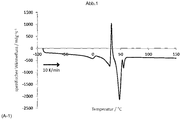
- the polyester polyols prepared according to Table 1 were measured by differential scanning calorimetry, wherein a sample of the reaction mixture was first heated to 150 ° C, and then brought to -90 ° C at a cooling rate of 10 Kelvin per minute. After 10 minutes at -90 ° C, the sample of the reaction mixture was heated to 150 ° C at a rate of 10 Kelvin per minute and the DSC plot recorded.
- illustration 1 For example, a DSC diagram characteristic of mixtures of polyester polyols according to the present invention is shown by the specific example A-1 which illustrates the effect of exothermic recrystallization superimposed on the endothermic melting process.
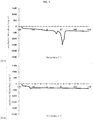
- polyester polyol mixtures (A-2) and (A-3) according to the invention each also have an exothermic recrystallization peak in superposition with the melting process.
- the melting process can be shifted to a much lower temperature range of 0-20 ° C when using the polyethylene glycol, wherein the proportion of recrystallization in relation to the endothermic melting peak remains virtually unchanged, so that further results in a good meltable mixture of polyester polyols.
- the admixture of 2,5-furandicarboxylic acid (A-3) or isophthalic acid (B-1) hardly reduces the expression of recrystallization behavior, wherein a shift in the melting range does not occur.
- Example V-1 of Figure 4 can be clearly seen that crystallinity is not causal for the presence of recrystallization and here structural properties due to the chemical constitution cause the effect of recrystallization, so that the use of exclusively linear diols, which have no ether function, is not effective. Similar results for polyester polyols, which arise from dicarboxylic acids, the number of methylene groups remaining behind the invention required and only provide an amorphous material that does not have the desired mechanical stability and elasticity.
Landscapes
- Chemical & Material Sciences (AREA)
- Organic Chemistry (AREA)
- Chemical Kinetics & Catalysis (AREA)
- Health & Medical Sciences (AREA)
- Medicinal Chemistry (AREA)
- Polymers & Plastics (AREA)
- Polyesters Or Polycarbonates (AREA)
- Adhesives Or Adhesive Processes (AREA)
- Polyurethanes Or Polyureas (AREA)
Abstract
Description
- Vorliegende Erfindung betrifft eine teilkristalline, beim Schmelzen rekristallisierende Mischung von Polyesterpolyolen erhältlich durch Polykondensation einer Reaktionsmischung umfassend ein oder mehrere Dicarbonsäuren ausgewählt aus gesättigten aliphatischen Dicarbonsäuren mit einer geraden Anzahl von mindestens 8 Methylen-Gruppen sowie ein oder mehrere Diole ausgewählt aus aliphatischen Diolen, die mindestens eine Etherfunktion, aufweisen. In einem weiteren Aspekt betrifft die Erfindung ein polymeres Material, das aus der chemischen Modifizierung der Mischung von Polyesterpolyolen mit organischen Verbindungen hervorgeht, die zumindest eine Isocyanat- und/oder Epoxid-Gruppe enthalten. Die erfindungsgemäßen Mischungen und Materialien zeichnen sich durch verhältnismäßig niedrige Schmelzenthalpien aus, während die Schmelztemperatur in einem Bereich von -30 bis 60 °C eingestellt werden kann, so dass leicht aufschmelzbare Rezepturen enthaltend die erfindungsgemäßen Mischungen und Materialien zugänglich sind. Zudem verleihen die erfindungsgemäße Mischungen und Materialien derartigen Rezepturen eine hohe Elastizität und Bruchfestigkeit. Die vorliegende Erfindung umfasst daher die Verwendung der erfindungsgemäßen Polyesterpolyole und polymeren Materialien als Verform-, Aufschmelz- und Extrusionshilfsmittel in thermoplastischen Materialien, sowie deren Verwendung zur Herstellung von Klebstoffen und Dichtstoffen, insbesondere von Schmelzklebstoffen und Reaktivklebstoffen.
- Von besonderer kommerzieller Bedeutung für Kleb- bzw. Dichtstoffe im Allgemeinen sind Polyester, die endständige Hydroxyl-Gruppen aufweisen, sogenannte Polyesterpolyole. Diese sind als solche überaus stabil und chemisch einfach zu modifizieren und werden daher häufig als präpolymerer Bestandteil von reaktiven Klebstoffsystemen eingesetzt. In diesem Zusammenhang offenbart die
EP 1 149 850 A1 kristalline Polyesterpolyole mit einer mittleren Molmasse von 1.500-15.000 g/mol erhältlich durch Kondensation einer mehrbasigen Carbonsäure mit 1,10- bzw. 1,12-Dodekandiol, die mit einem Isocyanat-Harz modifiziert Bestandteil eines Schmelzklebstoffes sein können. Die Polyesterpolyole bzw. die mit Isocyanat-Harzen modifizierten Polyesterpolyole ermöglichen, dass der Schmelzklebstoff bei der Applikationstemperatur schnell abbindet und unterhalb der Kristallisationstemperatur eine Klebeverbindung mit hoher mechanischer Stabilität liefert. Auf demselben technischen Gebiet offenbart dieDE 11 2015 003 392 T5 Schmelzklebstoffe auf Basis von Polyesterpolyolen mit niedrigem Schmelzpunkt von 130 - 135 °C, die aus einer Mischung von verschiedenen Dicarbonäuren unter anderem Dodekandisäure und einer Mischung von Diolen unter anderem Dipropylenglykol nach Polykondensation hervorgehen. - Für Polyesterpolyole als Bestandteil von Kleb- bzw. Dichtstoffrezepturen ist demnach eine niedrige Schmelzenthalpie bei der Applikation des Klebefilmes für ein energieeffizientes Fertigungsverfahren von Vorteil. Weiterhin wird in diesen Anwendungen die Anforderung gestellt, dass nach dem Abbinden des Klebfilms bzw. der Abdichtung eine hohe Elastizität und mechanische Stabilität der Klebeverbindung bzw. der Dichtung gewährleistet ist. Hierbei ergibt sich häufig die Schwierigkeit, dass eine Verbesserung der mechanischen Stabilität häufig zu Lasten der Elastizität geht und das Material bei mechanischer Beanspruchung zu Kohäsionsbruch neigt. Üblicherweise weist ein Material, dessen Schmelzenthalpie gering ist, auch eine nur geringgradige Kristallinität, so dass die Bereitstellung eines Materials mit verhältnismäßig niedriger Schmelzenthalpie bei gleichzeitig hoher mechanischer Stabilität und Bruchfestigkeit also Elastizität mit erheblichen Entwicklungs- und Erprobungsaufwand einhergeht.
- Ein ähnliches Anforderungsprofil ist auch in von Klebstoffen deutlich verschiedenen Anwendungsgebieten von Vorteil und wird daher gefordert. So ist für die Formgebung von thermoplastischen Materialien mittels Extrusions- oder Spritzgussverfahren ganz offenkundig eine niedrige Schmelzenthalpie vorteilhaft und zudem erwünscht, dass das Material unterhalb seines Erweichungspunktes eine hohe Elastizität und mechanische Stabilität aufweist.
- Die vorliegende Erfindung stellt sich daher die Aufgabe ein Mischung von Polyesterpolyolen bereitzustellen, über die eine verhältnismäßig niedrige Schmelzenthalpie bei einer Schmelztemperatur im Bereich von -30 °C bis 60 °C zugänglich ist, die aber gleichzeitig als Bestandteil von Kleb- und/oder Dichtstoffen sowie Thermoplasten unterhalb des Erweichungspunktes eine hohe Elastizität und mechanische Stabilität verleiht.
- Zu teilkristallinen Polyestern und ihren Derivaten existiert ein umfangreicher wissenschaftlicher Kenntnisstand, der auch in der Patentliteratur in einer Vielzahl von Anwendungen dieser Stoffklasse dokumentiert ist. So ist unter anderem aus der Encyclopedia of Polymer Science and Technology, 1964-1977, Vol. 11, Herman F. Mark, Polyesters bekannt, dass lineare acyclische Polyester mit einer zahlenmittleren Molmasse Mn oberhalb von 5.000 g/mol meist wachsartige kristalline Festkörper darstellen, die einen Schmelzbereich von 30 bis 120 °C aufweisen, wobei der Schmelzpunkt mit der Anzahl an Methylengruppen in der Wiederholungseinheit der Polyester ansteigt und Werte erreicht, die denen des entsprechenden Polyethylens entsprechen, während Polyester der Malonsäure extrem niedrige Schmelzpunkte von bis zu -20 °C aufweisen können. In diesem Zusammenhang ist ebenfalls allgemein bekannt, dass, insoweit Alkyl-Gruppen in die lineare Polyesterkette eingeführt werden, der Schmelzpunkt weiter erniedrigt wird und so auch bei höheren Molekulargewichten noch bei 20 °C flüssige Polymermischungen erhalten werden können. Jedoch kann über eine Erhöhung des paraffinischen Charakters der Dicarbonsäure Kristallinität zurückerhalten werden, wie es beispielsweise bei dem Polyester der Sebazinsäure mit 1,2-Propandiol der Fall ist. Basieren die Polyester mehrheitlich auf einem Monomer, das cyclische Struktureinheiten aufweist, so kann der Schmelzpunkt derartiger kristalliner Polyester oberhalb von 200 °C liegen und durch Beimischung von die Amorphizität erhöhenden Monomeren auf nur bis zu 50 °C gesenkt werden.
- Es besteht also ein reichhaltiger Erfahrungsschatz darin, die kristallinen Eigenschaften von Polyestermischungen und damit auch deren Schmelzpunkt über strukturelle Modifikation der Monomere anzupassen und auf diese Weise für bestimmte Anwendungen anzupassen.
- Überraschenderweise wurde jedoch gefunden, dass Mischungen von teilkristallinen Polyesterpolyolen, die aus bestimmten langkettigen Dicarbonsäuren und bestimmten Ethergruppen-haltigen Diolen aufgebaut sind, beim Schmelzen rekristallisieren und damit eine verhältnismäßig niedrigere Wärmemenge zum Aufschmelzen benötigen. Ebenso überraschend können derartige Mischungen das zuvor beschriebene Anforderungsprofil für eine hohe mechanischer Stabilität bei gleichzeitig hervorragender Bruchfestigkeit also Elastizität im Bereich der Kleb- und Dichtstoffe sowie Thermoplaste erfüllen.
- Das Anforderungsprofil und damit die Aufgabe der vorliegenden Erfindung wird also dadurch gelöst, dass eine teilkristalline, beim Schmelzen rekristallisierende Mischung von Polyesterpolyolen bereitgestellt wird, die erhältlich ist durch Polykondensation einer Reaktionsmischung umfassend ein oder mehrere Dicarbonsäuren sowie ein oder mehrere Diole, wobei
- a) mindestens 50 Mol.-% der Dicarbonsäuren ausgewählt sind aus gesättigten aliphatischen Dicarbonsäuren mit einer geraden Anzahl von mindestens 8 Methylen-Gruppen, die weder ein tertiäres noch ein quartäres Kohlenstoffatom aufweisen; und
- b) mindestens 40 Mol.-% der Diole ausgewählt sind aus aliphatischen Diolen, die mindestens eine Etherfunktion, jedoch weder ein tertiäres noch ein quartäres Kohlenstoffatom aufweisen.
- Teilkristalline, beim Schmelzen rekristallisierende Mischungen von Polyesterpolyolen, die erfindungsgemäß aus der Reaktionsmischung der Komponenten a) und b) erhalten werden, besitzen unterhalb ihrer Erweichungspunkt Ring-Kugel gemessen gemäß DIN EN 1238:2011 kristalline Phasen und zeichnen sich zudem dadurch aus, dass während des endothermen Schmelzvorganges vor Erreichen des Erweichungspunktes, d.h. dem Übergang in die flüssige Phase, eine exotherme Rekristallisation auftritt. Die Rekristallisation im Schmelzvorgang ist eine typische Materialeigenschaft der erfindungsgemäßen Mischung der Polyester und kann mittels Differential Scanning Calorimetry (DSC) bei einer Aufheizrate von nicht mehr als 10 Kelvin pro Minute als exothermer Kristallisationspeak in Überlagerung mit dem endothermen Schmelzpeak vor dem Erreichen des Erweichungspunktes nachgewiesen werden. Hierfür heizt man die erfindungsgemäße erhaltene Mischung der Poylesterpolyole auf, nachdem selbige zuvor bis oberhalb des Erweichungspunkts aufgeheizt und mit einer Abkühlungsrate von mindestens 10 Kelvin pro Minute auf eine Temperatur unmittelbar nach dem Durchlaufen des letzten Kristallisationspeaks gebracht wurde, der differenzkalorimetrisch noch bis zu einer Temperatur von -50 °C nachgewiesen werden kann. Wenn im Folgenden auf den Erweichungspunkt der Mischung der Polyester Bezug genommen wird, so ist der Erweichungspunkt Ring-Kugel gemessen gemäß DIN EN 1238:2011 gemeint.
- Eine Dicarbonsäure bzw. ein Diol sind im Sinne der vorliegenden Erfindung dann aliphatisch, wenn sie neben Sauerstoffatomen ausschließlich aus Kohlenstoff und Wasserstoffatomen zusammengesetzt sind. Eine Dicarbonsäure im Sinne der vorliegenden Erfindung umfasst auch die entsprechenden jeweiligen einfachen oder zweifachen Methyl- und/oder Ethylester, das jeweilige Säureanhydrid sowie die entsprechenden einfachen oder zweifachen Säurechloride.
- Ein Kohlenstoffatom ist quartär wenn es kovalent an vier weitere Kohlenstoffatome gebunden ist, während ein tertiäres Kohlenstoffatom kovalent mit drei weiteren Kohlenstoffatomen verbunden ist.
- Erfindungsgemäße Mischungen von Polyesterpolyolen, die durch Polykondensation der Komponenten a) und b) erhältlich sind, benötigen aufgrund ihrer Rekristallisationsneigung eine geringere Schmelzenthalpie und sind insofern leicht schmelzbar. Weiterhin liegt der Erweichungspunkt der Polyesterpolyole in einem Temperaturbereich von -30 bis 60 °C und kann in diesem Bereich beispielsweise durch Auswahl der aliphatischen Kettenlänge der Dicarbonsäure oder derjenigen des Diols gut auf ein schmales Temperaturintervall in diesem Bereich eingestellt werden.
- Erstaunlicherweise verleihen die erfindungsgemäßen Mischungen thermoplastischen Materialien und auch Kleb- und/oder Dichtstoffen, insoweit sie in ausreichenden Mengen enthalten sind, eine hervorragende mechanische Stabilität bei gleichzeitig guten elastischen Eigenschaften.
- Für eine stärkere Ausprägung des Rekristallisationsverhaltens der erfindungsgemäßen Mischung ist es bevorzugt, dass mindestens 60 Mol.-%, besonders bevorzugt mindestens 70 Mol.-% der Dicarbonsäuren ausgewählt sind aus Dicarbonsäuren gemäß Komponente
- a) der Reaktionsmischung und/oder mindestens 60 Mol.-%, besonders bevorzugt mindestens 70 Mol.-% der Diole ausgewählt sind aus Diolen gemäß Komponente b) der Reaktionsmischung. Hierüber wird erreicht, dass die Rekristallisation der erfindungsgemäßen Mischung stärker ausgeprägt ist und damit die Wärmemenge, die für das Erreichen des Erweichungspunktes erforderlich ist, weiter erniedrigt wird.
- Um andererseits einen Erweichungspunkt einzustellen, der nicht oberhalb von 60 °C liegt, ist es bevorzugt, dass die Dicarbonsäuren gemäß Komponente a) nicht mehr als 24 Methylen-Gruppen, besonders bevorzugt nicht mehr als 18 Methylen-Gruppen, insbesondere bevorzugt nicht mehr als 16 Methylen-Gruppen, wobei hiervon unabhängig die Dicarbonsäuren gemäß Komponente a) vorzugsweise mindestens 10 Methylen-Gruppen umfassen sollten, um solche Polyesterpolyole bereitzustellen, für die die Rekristallisation bei einem möglichst niedrigem Erweichungspunkt maximal ausgeprägt ist. Bevorzugte Vertreter der Dicarbonsäuren gemäß Komponente a) sind also 1,10-Decamethylendicarbonsäure, 1,12-Dodecamethylendicarbonsäure, 1,14-Tetradecamethylendicarbonsäure und 1,16-Hexadecamethylendicarbonsäure.
- Die Ausprägung der Rekristallisation der erfindungsgemäßen Mischung von Polyesterpolyolen wird durch die Anwesenheit andere langkettiger Dicarbonsäuren, die keine Dicarbonsäuren gemäß Komponente a) der erfindungsgemäßen Mischung darstellen, stark abgeschwächt. In einer bevorzugten Ausführungsform ist daher der Anteil an Dicarbonsäuren, die keine gesättigten aliphatischen Dicarbonsäuren mit einer geraden Anzahl von mindestens 8 Methylen-Gruppen, jedoch mindestens 9 Kohlenstoffatome aufweisen, bezogen auf den Gesamtanteil an Dicarbonsäuren in der Reaktionsmischung kleiner als 20 Mol.-%, besonders bevorzugt kleiner als 10 Mol.-%, insbesondere bevorzugt kleiner als 4 Mol.-% ist.
- Andererseits können bestimmte Dicarbonsäuren, insofern sie der Reaktionsmischung enthalten sind und damit auch struktureller Bestandteil der Polyesterpolyole werden, der erfindungsgemäßen Mischung Eigenschaften verleihen, die für bestimmte Anwendungen vorteilhaft sind. So kann die mechanische Stabilität von Materialien, die die erfindungsgemäßen der Polyesterpolyole in signifikanten Mengen enthalten, erheblich erhöht werden, wenn die Polyesterpolyole zu einem gewissen Anteil aus aromatischen Dicarbonsäuren bestehen. Hier sind insbesondere die Isophtalsäure, Terephtalsäure, Orthophtalsäure, Furandicarbonsäure, insbesondere 2,5-Furandicarbonsäure, zu nennen, die in einer besonders bevorzugten Ausführungsform zusätzlich in der Reaktionsmischung enthalten sind. Positiv wirkt sich ein Anteil an aromatischen Dicarbonsäuren in den erfindungsgemäßen Polyesterpolyolen auch auf die Klebrigkeit aus, wenn selbige häufig mit Isocyanaten und/oder Epoxiden modifiziert in Kleb- und/oder Dichtstoffen eingesetzt werden. In diesem Anwendungsgebiet können auch solche erfindungsgemäßen Polyesterpolyole verwendet werden, in denen ungesättigte Dicarbonsäuren mit weniger als 9 Kohlenstoffatomen enthalten sind, da hierüber Mischungen bereitgestellt sind, die über die aliphatische Doppelbindung vernetzt werden können und somit zur mechanischer Stabilität und Kohäsion der Klebeverbindung bzw. Dichtung gewinnen können. Hier sind insbesondere die Itakonsäure, Fumarsäure und/oder Maleinsäure zu nennen, die in einer besonders bevorzugten Ausführungsform zusätzlich in der Reaktionsmischung enthalten sind.
- Damit sich der positive Effekt dieser Beimischungen zur Reaktionsmischung entfalten kann, ist bevorzugt, dass der Anteil an ungesättigten Dicarbonsäuren mit weniger als 9 Kohlenstoffatomen und/oder aromatischen Dicarbonsäuren, wobei eine Beimischung von aromatischen Dicarbonsäuren als besonders effektiv für die Verbesserung der mechanischen Stabilität und Kohäsion in Klebeverbindungen bzw. Dichtungen hervorzuheben ist, bezogen auf den Gesamtanteil der Dicarbonsäuren in der Reaktionsmischung zur Herstellung der erfindungsgemäßen Mischung der Polyesterpolyole jeweils mindestens 2 Mol.-%, besonders bevorzugt jeweils mindestens 8 Mol.-%, insbesondere bevorzugt jeweils mindestens 15 Mol.-% beträgt.
- Die Beimischung dieser Dicarbonsäuren zur Verbesserung der mechanischen Stabilität der hat jedoch mit Bedacht zu erfolgen und sollte nicht die generelle Eigenschaft der Polyesterpolyole leicht aufschmelzbar zu sein in erheblichen Maße mindern. Daher sind die Anteile an ungesättigten Dicarbonsäuren mit weniger als 9 Kohlenstoffatomen und aromatischen Dicarbonsäuren in der Summe vorzugsweise kleiner als 40 Mol.-%, besonders bevorzugt kleiner als 30 Mol.-% bezogen auf den Gesamtanteil der Dicarbonsäuren in der Reaktionsmischung.
- Andererseits ist es essentiell für das Vorliegen der Rekristallisation der Mischung der Polyesterpolyole, dass ein erheblicher Anteil von mindestens 40 Mol.-% der aliphatischen Diole der Reaktionsmischung weder quartäre noch tertiäre Kohlenstoffatome aufweist und damit linear aufgebaut ist. Weiterhin von Bedeutung ist auch hier, dass der Erweichungspunkt bei möglichst niedrigen Temperaturen eingestellt ist, aber die Mischung dennoch hinreichend teilkristallin ist, dass der Effekt der Rekristallisation eintritt. So kann durch mehrfache Etherfunktionalitäten im Diol der Erweichungspunkt reduziert werden, gleichzeitig geht dies jedoch zu Lasten der Fähigkeit des Materials zur Rekristallisation. In einer bevorzugten Ausführungsform sind die aliphatischen Diole der Komponente b) der erfindungsgemäßen Mischung daher ausgewählt aus Diolen der allgemeinen Strukturformel H-([O-(CH2)m]x-[O-(CH2)n]y)z-OH mit m, n als positive ganze Zahlen von 1 bis 4, mit x, y als nicht negative ganze Zahlen, wobei x+y mindestens 1 ist, und mit z als positiver ganzer Zahl, wobei (x+y)z mindestens 2 und z(x(m+1)+y(n+1)) kleiner als 40 ist. Vertreter derartige Diole sind neben Diethylenglykol, Triethylenglykol bzw. Dipropylenglykol, Tripropylenglykol und den jeweiligen weiteren Homologen auch Diole, die sich aus Ethylenglykol- und 1,3-Propylenglykol-Einheiten zusammensetzen, beispielsweise 3-Oxahexan-1,6-diol, 3,7-Dioxanonan-1,9-diol, 3,8-Dioxaoctan-1,10-diol.
- In diesem Zusammenhang besonders bevorzugt gilt für die aliphatischen Diole gemäß Komponente b), dass m gleich 2, x gleich 1, y gleich Null und z vorzugsweise kleiner als 10, besonders bevorzugt kleiner als 8, ganz besonders bevorzugt kleiner als 6 ist. Derartige Diole sind Diethylenglykol, Triethylenglykol, Tetraethylenglykol, Pentaethylenglykol und Hexaethylenglykol.
- Auch für die übrigen aliphatischen Diole gilt, dass deren Anteil insoweit es sich nicht um Diole gemäß der Komponente b) handelt, nicht in einem solchen Maß in der Reaktionsmischung enthalten sein sollten, dass die Ausprägung der Mischung von Polyesterpolyolen zur Rekristallisation signifikant gemindert wird. Hier kommt es entscheidend auf den überwiegenden linearen Aufbau der Diole mit Etherfunktionalität an, so dass in einer bevorzugten Ausführungsform der Anteil an Diolen, die keine Diole gemäß Komponente b) darstellen und sowohl mindestens eine Etherfunktion als auch tertiäre und/oder quartäre Kohlenstoffatome aufweisen, bezogen auf den Gesamtanteil an Diolen in der Reaktionsmischung zur Herstellung der erfindungsgemäßen Mischung an Polyesterpolyolen kleiner als 20 Mol.-%, besonders bevorzugt kleiner als 10 Mol.-%, insbesondere bevorzugt kleiner als 4 Mol.-% ist.
- Ein gewisser Anteil an solchen aliphatischen Diolen in der Reaktionsmischung, die keine Etherfunktion aufweisen und nicht mehr als 10 Kohlenstoffatome aufweisen, kann jedoch nützlich sein, wenn an die Mischung der Polyesterpolyol die Anforderung gestellt wird, in einem bestimmten Temperaturintervall vollständig aufzuschmelzen. So verschieben aliphatische lineare Diole mit geringer Kettenlänge, den Erweichungspunkt zu höheren Temperaturen, während verzweigte Diole eine Erweichungspunkterniedrigung herbeiführen.
- Daher sind in einer bevorzugten Ausführungsform in der Reaktionsmischung zur Herstellung der erfindungsgemäßen Polyesterpolyole zusätzlich zu den Diolen gemäß Komponente b) aliphatische Diole enthalten sind, die keine Etherfunktion und nicht mehr als 10 Kohlenstoffatome aufweisen, die wiederum vorzugsweise ausgewählt sind aus Ethylenglykol, 1,3-Propandiol, 1,4-Butandiol, 1,6-Hexandiol und/oder 1,8-Oktandiol, wobei deren Anteil bezogen auf den Gesamtanteil der Diole vorzugsweise mindestens 1 Mol.-%, jedoch vorzugsweise kleiner als 40 Mol.-%, besonders bevorzugt kleiner als 20 Mol.-% und ganz besonders bevorzugt kleiner als 10 Mol.-% ist, um einerseits einen signifikante Verschiebung des Erweichungspunktes herbeiführen zu können, aber andererseits die Neigung der erhaltenen Mischung an Polyesterpolyolen zur Rekristallisation nicht aufzuheben.
- Unverzweigte β-, γ-, δ- und/oder ε-Hydroxycarbonsäuren, die auch in ihrer Lacton-Form vorliegen können in geringen Mengen, die Elastizität von solchen Materialien erhöhen, die aus mit Isocyanat- und/oder Epoxid-Gruppen modifizierten erfindungsgemäßen Mischungen der Polyesterpolyole hervorgehen. Dementsprechend kann für spezielle Anwendungen, in denen eine hohe Elastizität eines polymeren Materials abverlangt wird, das auf die erfindungsgemäßen Polyesterpolyole abstellt, bevorzugt sein, dass der Anteil an unverzweigten β-, γ-, δ- und/oder ε-Hydroxycarbonsäuren, die auch in ihrer Lacton-Form vorliegen können, bezogen auf den Gesamtanteil der Dicarbonsäuren mindestens 1 Mol.-%, besonders bevorzugt mindestens 4 Mol.-% beträgt, jedoch zur Wahrung der Eigenschaft der Polyesterpolyole leicht zu schmelzen vorzugsweise insgesamt weniger als 35 Mol.-%, besonders bevorzugt insgesamt weniger als 22 Mol.-%, insbesondere bevorzugt insgesamt weniger als 15 Mol.-% derartiger Hydroxycarbonsäuren bezogen auf den Gesamtanteil der Dicarbonsäuren in der Reaktionsmischung.
- Für eine weitreichende Konversion der monomeren Bestandteile der Reaktionsmischung zu einer erfindungsgemäßen Mischung der Polyesterpolyole, die im festen Zustand Teilkristallinität inne hat und beim Schmelzen rekristallisert, ist bevorzugt, dass der Anteil anderer kondensationsfähiger organischer Verbindungen, die weder Dicarbonsäuren noch Diole noch eine Hydroxycarbonsäure ausgewählt aus unverzweigten β-, γ-, δ- und/oder ε-Hydroxycarbonsäuren darstellen, in der Reaktionsmischung insgesamt kleiner als 10 Gew.-% bezogen auf den Gesamtanteil der Dicarbonsäuren und Diole ist. In diesem Zusammenhang ist unter einer kondensationsfähigen organischen Verbindung, eine Verbindung zu verstehen, die unter den gewählten Reaktionsbedingungen in der Lage ist entweder mit den Dicarbonsäuren oder mit den Diolen der Reaktionsmischung an deren funktionelle Gruppen unter Ausbildung einer kovalenten Verbindung unter Abspaltung von Wasser oder Säuren oder unter Ringöffnung zu addieren, insbesondere sind vorliegend unter einer kondensationsfähigen Verbindung Hydroxyl- und/oder Carboxylgruppenhaltige organische Verbindungen sowie Lactone zu verstehen.
- Aus gleichen Erwägungsgründen ist es vorteilhaft, wenn der Anteil an organischen Verbindungen, die Isocyanat-Gruppen aufweisen, in der Reaktionsmischung kleiner als 1 Gew.-% berechnet als HN=C=O bezogen auf den Gesamtanteil der Dicarbonsäuren und Diole ist. Unter einer Isocyanat-Gruppe werden in diesem Zusammenhang sowohl freie als auch blockierte bzw. geschützte Isocyanat-Gruppen verstanden.
- Um der erfindungsgemäße Mischung von Polyesterpolyolen für eine nachfolgende chemische Modifizierung durch Addition von Isocyanat-Gruppen und/oder Epoxid-Gruppen eine ausreichende Anzahl an terminalen Hydroxyl-Gruppen zu verleihen, ist es vorteilhaft, wenn die Diole in der Reaktionsmischung im molaren Überschuss bezogen auf die Dicarbonsäuren enthalten sind, jedoch vorzugsweise nicht oberhalb eines Überschusses von 1,2 : 1, da anderenfalls eine portionsweise Zugabe des Diols zur Reaktionsmischung oder die Vorlage des Diols bei der Verfahrensführung notwendig wird, um ein genügend hohes mittleres Molekulargewicht der Polyesterpolyole der Mischung zu erzielen, wobei diese Mischungen dann denjenigen erhältlich aus stöchiometrischen Umsetzungen strukturell ähnlich sind und sich lediglich durch einen erhöhten Anteil an unreagierten Diolen auszeichnen, was ebenfalls zu vermeiden ist.
- Als ideal hinsichtlich Molmassenverteilung, die wesentlich das Rekristallisationsverhalten der Mischung bestimmt, und Hydroxyl-Funktionalität, die die Kompatibilität mit mono- und polyfunktionellen Isocyanaten und/oder Epoxiden bestimmt, haben sich solche Mischungen von Polyesterpolyolen herausgestellt, die eine Säurezahl kleiner als 50 mg KOH/g, besonders bevorzugt kleiner als 10 mg KOH/g, insbesondere bevorzugt kleiner als 5 mg KOH/g und ganz besonders bevorzugt kleiner als 2 mg KOH/g jeweils pro Gramm der Reaktionsmischung aufweisen, wobei die Hydroxylzahl vorzugsweise im Bereich von 10 bis 150 mg KOH/g, besonders bevorzugt im Bereich von 20 bis 120 mg KOH/g jeweils pro Gramm der Reaktionsmischung liegt. In einer besonders bevorzugten Ausführungsform besitzt die erfindungsgemäße Mischung der Polyesterpolyole eine Säurezahl unterhalb von 5 mg KOH/g und ist erhältlich aus einer Reaktionsmischung der Komponenten a) und b), wobei die Diole in molarem Überschuss bezogen auf die Dicarbonsäuren in der Reaktionsmischung enthalten sind, jedoch nicht oberhalb eines Überschusses von 1,2 : 1.
- Die Säurezahl ist erfindungsgemäß eine experimentell zu bestimmende Messgröße, die ein Maß für die Anzahl der freien Säuregruppen in der jeweils definierten Bezugsmenge ist, beispielsweise pro Gramm der Reaktionsmischung. Die Säurezahl wird bestimmt, indem eine eingewogene Probe der Bezugsmenge in einem Lösemittelgemisch aus Methanol und destilliertem Wasser im Volumenverhältnis 3 : 1 gelöst und anschließend mit 0,05 mol/l KOH in Methanol potentiometrisch titriert wird. Die potentiometrische Messung erfolgt mit einer Einstabmesskette (LL-Solvotrode® der Fa. Metrohm; Bezugselektrolyt: 0,4 mol/l Tetraethylammoniumbromid in Ethylenglykol). Die Säurezahl entspricht dabei der hinzugesetzten Menge an KOH pro Gramm der Bezugsmenge im Wendepunkt der potentiometrischen Titrationskurve.
- Analog gilt erfindungsgemäß, dass die Hydroxylzahl als Maß für die Anzahl an freien Hydroxylgruppen in der jeweils definierten Bezugsmenge, beispielsweise pro Gramm der Reaktionsmischung, experimentell durch potentiometrische Titration bestimmt werden kann. Hierfür wird eine eingewogene Probe der Bezugsmenge in einer Reaktionslösung von 0,1 mol/l Phtalsäureanhydrid in Pyridin bei 130 °C für 45 Minuten erwärmt und zunächst mit dem 1,5 fachen Volumen der Reaktionslösung an Pyridin und anschließend mit dem 1,5 fachen Volumen der Reaktionslösung an entionisiertem Wasser (κ < 1 µScm-1) versetzt. Die freigesetzte Menge an Phtalsäure wird in diesem Gemisch mittels 1 M Natronlauge titriert. Die potentiometrische Messung erfolgt mit einer Einstabmesskette (LL-Solvotrode® der Fa. Metrohm; Bezugselektrolyt: 0,4 mol/l Tetraethylammoniumbromid in Ethylenglykol). Die Hydroxylzahl entspricht dabei der hinzugesetzten Menge an NaOH pro Gramm der Bezugsmenge im Wendepunkt der potentiometrischen Titrationskurve.
- Die zuvor bezüglich Säure- und Hydroxylzahl definierten Mischungen weisen üblicherweise eine zahlenmittlere Molmasse im Bereich von 2.000 - 5.000 g/mol bei einer Polydispersität von weniger als 2,5 auf, so dass dieser Molmassenbereich und die dazugehörige Polydispersität ebenfalls erfindungsgemäß bevorzugt sind, um Mischungen zu erhalten, die sowohl leicht aufschmelzbar sind als auch in chemisch modifizierter Form polymeren Materialien eine hohe Elastizität und mechanische Stabilität verleihen können. Die zahlenmittlere Molmasse kann anhand einer Probe der Reaktionsmischung mittels Gelpermeationschromatographie nach Kalibration gegen Polystyrol-Standards bestimmt werden. Hierzu ist bei einer Säulenofentemperatur von 40 °C durch Eluation mit Tetrahydrofuran zu chromatographieren, wobei die Verteilungskurve mittels eines konzentrationsabhängigen RI-Detektors aufgenommen wird, der kontinuierlich den Brechungsindex im Eluat bei einer Temperatur von ebenfalls 40°C bestimmt.
- Die erfindungsgemäße Mischung der Polyesterpolyole wird durch Kondensation der Bestandteile der Reaktionsmischung herbeigeführt. In einer bevorzugten Ausführungsform erfolgt die Kondensation in Substanz bei einer Temperatur im Bereich von 50 bis 300 °C, besonders bevorzugt oberhalb von 80 °C, jedoch besonders bevorzugt unterhalb von 240 °C und ggf. in Anwesenheit eines Katalysators, der vorzugsweise ausgewählt ist aus Alkoxiden des Elements Titan. Weiterhin ist bevorzugt, dass aus der Reaktionsmischung Kondensat also insbesondere Wasser bzw. Methanol/Ethanol oder HCl, insofern die entsprechende Ester oder Säurechloride eingesetzt werden, vorzugsweise bei vermindertem Druck, der vorzugsweise zumindest zeitweise unterhalb von 50 mbar liegt, entfernt wird.
- In einer besonders bevorzugten Ausführungsform betrifft die vorliegende Erfindung daher eine teilkristalline, beim Schmelzen rekristallisierende Mischung von Polyesterpolyolen mit einer Säurezahl unterhalb von 5 mg KOH/g erhältlich oder hergestellt durch Polykondensation einer Reaktionsmischung umfassend ein oder mehrere Dicarbonsäuren sowie ein oder mehrere Diole, wobei
- a) mindestens 50 Mol.-% der Dicarbonsäuren ausgewählt sind aus gesättigten aliphatischen Dicarbonsäuren mit einer geraden Anzahl von mindestens 8 Methylen-Gruppen, die weder ein tertiäres noch ein quartäres Kohlenstoffatom aufweisen;
- b) mindestens 40 Mol.-% der Diole ausgewählt sind aus aliphatischen Diolen, die mindestens eine Etherfunktion, jedoch weder ein tertiäres noch ein quartäres Kohlenstoffatom aufweisen;
- c) ggf. einen Katalysator, vorzugsweise ausgewählt aus Alkoxiden des Elements Ti;
- Insofern betrifft die vorliegende Erfindung auch ein Verfahren zur Herstellung einer teilkristallinen, beim Schmelzen rekristallisierenden Mischung eines Polyesterpolyols, bei dem eine Reaktionsmischung umfassend ein oder mehrere Dicarbonsäuren sowie ein oder mehrere Diole und ggf. einen Katalysator, vorzugsweise ausgewählt aus Alkoxiden des Elements Ti, wobei die Diole im molaren Überschuss bezogen auf die Dicarbonsäuren enthalten sind und
- a) mindestens 50 Mol.-% der Dicarbonsäuren ausgewählt sind aus gesättigten aliphatischen Dicarbonsäuren mit einer geraden Anzahl von mindestens 8 Methylen-Gruppen, die weder ein tertiäres noch ein quartäres Kohlenstoffatom aufweisen, sowie
- b) mindestens 40 Mol.-% der Diole ausgewählt sind aus aliphatischen Diolen, die mindestens eine Etherfunktion, jedoch weder ein tertiäres noch ein quartäres Kohlenstoffatom aufweisen,
- In einem bevorzugten erfindungsgemäßen Verfahren wird zumindest phasenweise, und während eine Temperatur im Bereich von 50 - 300 °C eingestellt ist, Kondensat, also insbesondere Wasser bzw. Methanol/Ethanol oder HCl, insofern die entsprechende Ester oder Säurechloride eingesetzt werden, aus der Reaktionsmischung, vorzugsweise bei vermindertem Druck, der vorzugsweise zumindest zeitweise unterhalb von 50 mbar liegt, entfernt.
- Die bevorzugten Ausführungsformen, die bezüglich der erfindungsgemäßen Mischung der Polyesterpolyole angeführt sind, gelten sinngemäß auch für das erfindungsgemäße Verfahren zur Herstellung der Mischung.
- Die vorliegende Erfindung umfasst ferner ein polymeres Material erhältlich durch Addition solcher organischen Verbindungen, die mindestens eine Epoxid- und/oder Isocyanat-Gruppe, vorzugsweise mindestens zwei dieser Gruppen und besonders bevorzugt mindestens zwei Isocyanat-Gruppen enthalten, an terminale Hydroxyl-Gruppen einer erfindungsgemäßen Mischung von Polyesterpolyolen. Unter einer Isocyanat-Gruppe werden in diesem Zusammenhang sowohl freie als auch blockierte bzw. geschützte Isocyanat-Gruppen verstanden. Ein solches polymeres Material weist eine hohe Elastizität auch dann noch auf, wenn eine weitere Vernetzung über addierte aber noch unreagierten Isocyanat-Gruppen, bspw. nach Modifikation mit polyfunktionellen Isocyanaten, die entweder zumindest eine weitere Isocyanat-Gruppe oder zusätzliche vernetzende funktionale Gruppen, wie Epoxid-, Alkoxysilyl- und/oder Acrylat-Gruppen, aufweisen, stattfindet. Werden die bereits an die Polyesterpolyole addierten organischen Verbindungen, die weitere unreagierte Isocyanat-Gruppen aufweisen, durch Zugabe von Alkoholen "abgelöscht" so behält das polymere Material seine thermoplastischen Eigenschaften bei einer hohen Klebrigkeit und kann zudem leicht aufgeschmolzen werden. Das erfindungsgemäße polymere Material eignet sich daher sowohl als Bestandteil von thermoplastischen Materialien, vorzugsweise als Klebrigmacher in Kleb- und/oder Dichtstoffen, besonders bevorzugt als Bestandteil von Schmelzklebstoffen, als auch als Bestandteil in vernetzenden Reaktivklebstoffen. Bezüglich des erfindungsgemäßen polymeren Materials ist eine chemische Modifizierung mittels Toluol-2,4-diisocyanat, Hexamethylendiisocyanat, Isophorondiisocyanat, 1,4-Cyclohexyldiisocyanat und/oder Diphenylmethandiisocyanat bevorzugt.
- Demnach betrifft die vorliegende Erfindung in einem besonderen Aspekt auch die Verwendung der erfindungsgemäßen Mischung der Polyesterpolyole oder des erfindungsgemäßen polymeren Materials als Bestandteil eines thermoplastischen Materials oder eines Kleb-und/oder Dichtstoffes. Während die erfindungsgemäße Mischung der Polyesterpolypole sowohl in Thermoplasten als Verform- und Extrusionshilfsmittel oder auch als Aufschmelzhilfsmittel für physikalisch abbindende Kleb- und/oder Dichtstoffe verwendet werden kann, findet das erfindungsgemäße polymere Material sowohl in Thermoplasten und als Klebrigmacher in Klebstoffen, vorzugsweise in Schmelzklebstoffen, als auch in vernetzenden Reaktivklebstoffen Anwendung, da über das enthaltene erfindungsgemäße polymere Material eine niedrige Applikationstemperatur und eine hohe Elastizität und mechanische Stabilität der Klebeverbindung zugänglich ist.
- Im Folgenden wird die Herstellung der erfindungsgemäßen Mischungen der Polyesterpolyole dargelegt und das jeweilige Schmelzverhalten mittels dynamischer Differenzkalorimetrie (DSC) charakterisiert und mit Polyesterpolyolen verglichen, die aus Dicarbonsäuren und Diolen hergestellt wurde, die keine Komponente a) oder b) gemäß erstem Anspruch der vorliegenden Erfindung darstellen.
- Die Herstellung der Mischungen der Polyesterpolyole erfolgte nach folgendem Schema:
- In einem 1 Liter-Vierhalskolben ausgerüstet mit Stickstoffeinleitung, Thermostat, Flügelrührer und Destillationsarm wurde eine Menge der Dicarbonsäure(n) mit der entsprechenden Menge an Diol in molarem Überschuss bezogen auf die Menge der Dicarbonsäure(n) vorgelegt und gemischt. Die Reaktionsmischung wurde aufgeheizt und bei einer Temperatur von 200 °C im Stickstoffstrom für ungefähr 8 Stunden gerührt. Sodann wurde die Reaktionsmischung abgekühlt und 0,02 Gew.-% bezogen auf die Reaktionsmischung an Tetraisopropyltitanat hinzugegeben. Im Anschluss daran wurde die Reaktionsmischung auf 200 °C erhitzt und der Druck im Reaktionskolben schrittweise auf 30 mbar reduziert. Die Säurezahl wurde laufend, wie zuvor in der Beschreibung der Erfindung detailliert erläutert, kontrolliert. Sobald die Säurezahl unterhalb eines Wertes von 3 mg KOH/g bezogen auf die Reaktionsmischung sank, wurde die Reaktionsmischung zunächst auf 80 °C abgekühlt und abgekühlt, wonach man die Reaktionsmischung weiter auf Raumtemperatur abkühlen ließ. Hernach wurde die Säurezahl und Hydroxylzahl endgültig bei 20 °C bestimmt und die Mischung chromatographisch charakterisiert.
- Zur chromatographischen Charakterisierung mittels Gelpermeationschromatographie (GPC) wurde eine Probe der Reaktionsmischung mit Tetrahydrofuran gelöst und auf die Säule gegeben und im Folgenden auch mit Tetrahydrofuran eluiert. Die Gelpermeationschromatographie (GPC) mit RI-Detektor nach Kalibrierung mittels Polystyrol-Standards erfolgte bei einer Säulenofentemperatur von 40 °C und einer Temperatur im Detektor von ebenfalls 40 °C. Aus der Molmassenverteilungskurve wurden die relativen zahlen- und gewichtsmittleren Molmassenmittelwerte ermittelt und daraus die Polydispersität bestimmt.
- In der Tabelle 1 sind die jeweiligen Einwaagen und die spezifischen Monomere zur Herstellung der jeweiligen Polyesterpolyole wiedergegeben.
- Die Polyesterpolyole, die gemäß der Tabelle 1 hergestellt wurden, wurden differenzkalorimetrisch vermessen, wobei eine Probe der Reaktionsmischung zunächst auf 150 °C aufgeheizt wurde, um anschließend mit einer Abkühlrate von 10 Kelvin pro Minute auf -90 °C gebracht zu werden. Nach 10 Minuten bei -90 °C wurde die Probe der Reaktionsmischung mit einer Aufheizrate von 10 Kelvin pro Minute auf 150 °C gebracht und das DSC-Diagramm aufgezeichnet.
- In
Abbildung 1 ist ein für erfindungsgemäße Mischungen von Polyesterpolyolen charakteristisches DSC-Diagramm anhand des konkreten Beispiels A-1wiedergegeben, das den Effekt der exothermen Rekristallisation in Überlagerung mit dem endothermen Schmelzvorgang veranschaulicht. - Aus der
Abbildung 2 wird ersichtlich, dass die erfindungsgemäßen Polyesterpolyolmischungen (A-2) und (A-3) jeweils auch einen exothermen Rekristallisationspeak in Überlagerung mit dem Schmelzvorgang aufweisen. Der Schmelzvorgang kann bei Verwendung des Polyethylenglykols hin zu einem deutlich niedrigeren Temperaturbereich von 0-20 °C verschoben werden, wobei der Anteil der Rekristallisation im Verhältnis zum endothermen Schmelzpeak nahezu unverändert bleibt, so dass weiterhin eine gut aufschmelzbare Mischung an Polyesterpolyolen resultiert. Auch die Beimischung von 2,5-Furandicarbonsäure (A-3) oder Isophtalsäure (B-1) verringert kaum die Ausprägung des Rekristallisationsverhaltens, wobei eine Verschiebung des Schmelzbereiches nicht eintritt. - Umgekehrt kann aus dem Beispiel V-1 der
Abbildung 4 deutlich entnommen werden, dass Kristallinität nicht kausal für das Vorliegen von Rekristallisation ist und hier strukturelle Eigenheiten aufgrund der chemischen Konstitution den Effekt der Rekristallisation bedingen, so dass die Verwendung von ausschließlich linearen Diolen, die keine Etherfunktion aufweisen, nicht zielführend ist. Ähnliches ergibt sich für Polyesterpolyole, die aus Dicarbonsäuren hervorgehen, deren Anzahl an Methylen-Gruppen hinter der erfindungsgemäß erforderlichen zurückbleibt und lediglich eine amorphes Material liefern, dass nicht die gewünschte mechanische Stabilität und Elastizität aufweist. - Über die Variation der Kettenlänge der Dicarbonsäuren kann in erfindungsgemäßen Mischungen von Polyesterpolyolen der Schmelzbereich pro zusätzlicher Ethylen-Einheit um ca. 10 °C zu höheren Temperaturen verschoben werden und damit applikationsspezifisch angepasst werden (siehe Beispiele B-1, B-2 und B-3 in
Abbildung 3 ).Tab. 1 Bsp. Dicarbonsäure Diol SZ1 HZ2 MN 3 P4 Typ Einwaage / g Typ Einwaage / g A-1 DMS 188 DEG 113 1,2 98 2466 1,9 A-2 DMS 68 PEG 232 1,8 63 2519 2,0 B-1 DMS 216 DEG 144 0,8 43 4303 2,3 IPS 42 B-2 DDMS 226 DEG 135 1,0 53 4211 2,0 IPS 40 B-3 TDMS 236 DEG 127 1,0 38 4738 2,4 IPS 37 A-3 DMS 216 DEG 144 2,0 50 3696 2,3 FS 40 V-1 DMS 145 BD 96 1,4 39 5134 2,3 FS 29 V-2 HMS 173 DEG 127 1,7 62 3136 2,1 DMS 1,10-Decamethylendicarbonsäure DDMS 1,12-Dodecamethylendicarbonsäure TDMS 1,14-Tetradecamethylendicarbonsäure IPS Isophtalsäure FS 2,5-Furandicarbonsäure HMS 1,7-Heptamethylendicarbonsäure DEG Diethylenglykol PEG Polyethyleneglykol (Molmasse 400 g/mol) BD 1,4-Butandiol 1 Säurezahl in mg KOH pro Gramm der Reaktionsmischung 2 Hydroxylzahl in mg KOH pro Gramm der Reaktionsmischung 3 zahlenmittlere Molmasse in g/mol 4 Polydispersität
Claims (15)
- Teilkristalline, beim Schmelzen rekristallisierende Mischung von Polyesterpolyolen erhältlich durch Polykondensation einer Reaktionsmischung umfassend ein oder mehrere Dicarbonsäuren sowie ein oder mehrere Diole, wobeia) mindestens 50 Mol.-% der Dicarbonsäuren ausgewählt sind aus gesättigten aliphatischen Dicarbonsäuren mit einer geraden Anzahl von mindestens 8 Methylen-Gruppen, die weder ein tertiäres noch ein quartäres Kohlenstoffatom aufweisen; undb) mindestens 40 Mol.-% der Diole ausgewählt sind aus aliphatischen Diolen, die mindestens eine Etherfunktion, jedoch weder ein tertiäres noch ein quartäres Kohlenstoffatom aufweisen.
- Mischung gemäß Anspruch 1, dadurch gekennzeichnet, dass mindestens 60 Mol.-%, vorzugsweise mindestens 70 Mol.-% der Dicarbonsäuren ausgewählt sind aus Dicarbonsäuren gemäß Komponente a) der Reaktionsmischung.
- Mischung gemäß einem oder beiden der Ansprüche 1 und 2, dadurch gekennzeichnet, dass mindestens 60 Mol.-%, vorzugsweise mindestens 70 Mol.-% der Diole ausgewählt sind aus Diolen gemäß Komponente b) der Reaktionsmischung.
- Mischung gemäß einem oder mehreren der vorherigen Ansprüche, dadurch gekennzeichnet, dass die Dicarbonsäuren gemäß Komponente a) nicht mehr als 24 Methylen-Gruppen, vorzugsweise nicht mehr als 18 Methylen-Gruppen, besonders bevorzugt nicht mehr als 16 Methylen-Gruppen, jedoch vorzugsweise mindestens 10 Methylen-Gruppen aufweisen.
- Mischung gemäß einem oder mehreren der vorherigen Ansprüche, dadurch gekennzeichnet, dass die aliphatischen Diole der Komponente b) ausgewählt sind aus Diolen der allgemeinen Strukturformel H-([O-(CH2)m]x-[O-(CH2)n]y)z-OH mit m, n als positive ganze Zahlen von 1 bis 4, mit x, y als nicht negative ganze Zahlen, wobei x+y mindestens 1 ist, und mit z als positiver ganzer Zahl, wobei (x+y)z mindestens 2 und z(x(m+1)+y(n+1)) kleiner als 40 ist, wobei vorzugsweise gilt, dass m gleich 2, x gleich 1, y gleich Null und z vorzugsweise kleiner als 10, besonders bevorzugt kleiner als 8 und ganz besonders bevorzugt kleiner als 6 ist.
- Mischung gemäß einem oder mehreren der vorherigen Ansprüche, dadurch gekennzeichnet, dass der Anteil von Dicarbonsäuren, die keine gesättigten aliphatischen Dicarbonsäuren mit einer geraden Anzahl von mindestens 8 Methylen-Gruppen, jedoch mindestens 9 Kohlenstoffatome aufweisen, bezogen auf den Gesamtanteil an Dicarbonsäuren in der Reaktionsmischung kleiner als 20 Mol.-%, vorzugsweise kleiner als 10 Mol.-%, besonders bevorzugt kleiner als 4 Mol.-% ist.
- Mischung gemäß einem oder mehreren der vorherigen Ansprüche, dadurch gekennzeichnet, dass zusätzlich zu den Dicarbonsäuren, die gesättigte aliphatische Dicarbonsäuren mit einer geraden Anzahl von mindestens 8 Methylen-Gruppen darstellen, ungesättigte Dicarbonsäuren mit weniger als 9 Kohlenstoffatomen und/oder aromatische Dicarbonsäuren enthalten sind, die vorzugsweise ausgewählt sind aus Isophtalsäure, Terephtalsäure, Orthophtalsäure, Furandicarbonsäure, Itakonsäure, Fumarsäure und/oder Maleinsäure, wobei deren Anteil bezogen auf den Gesamtanteil der Dicarbonsäuren vorzugsweise jeweils mindestens 2 Mol.-%, vorzugsweise mindestens 8 Mol.-%, besonders bevorzugt mindestens 15 Mol.-%, jedoch in der Summe vorzugsweise kleiner als 40 Mol.-%, besonders bevorzugt kleiner als 30 Mol.-% ist.
- Mischung gemäß einem oder mehreren der vorherigen Ansprüche, dadurch gekennzeichnet, dass der Anteil an Diolen, die keine Diole gemäß Komponente b) darstellen und sowohl mindestens eine Etherfunktion als auch tertiäre und/oder quartäre Kohlenstoffatome aufweisen, bezogen auf den Gesamtanteil an Diolen kleiner als 20 Mol.-%, vorzugsweise kleiner als 10 Mol.-%, besonders bevorzugt kleiner als 4 Mol.-% ist.
- Mischung gemäß einem oder mehreren der vorherigen Ansprüche, dadurch gekennzeichnet, dass zusätzlich zu den Diolen gemäß Komponente b) aliphatische Diole enthalten sind, die keine Etherfunktion und nicht mehr als 10 Kohlenstoffatome aufweisen, die vorzugsweise ausgewählt sind aus Ethylenglykol, 1,3-Propandiol, 1,4-Butandiol, 1,6-Hexandiol und/oder 1,8-Oktandiol, wobei deren Anteil bezogen auf den Gesamtanteil der Diole vorzugsweise mindestens 1 Mol.-%, jedoch vorzugsweise kleiner als 40 Mol.-%, besonders bevorzugt kleiner als 20 Mol.-% und ganz besonders bevorzugt kleiner als 10 Mol.-% ist.
- Mischung gemäß einem oder mehreren der vorherigen Ansprüche, dadurch gekennzeichnet, dass die Reaktionsmischung zusätzlich unverzweigte β-, γ-, δ- und/oder ε-Hydroxycarbonsäuren enthält, die auch in ihrer Lacton-Form vorliegen können, wobei deren Anteil bezogen auf den Gesamtanteil der Dicarbonsäuren vorzugsweise mindestens 1 Mol.-%, jedoch vorzugsweise kleiner als 35 Mol.-%, besonders bevorzugt kleiner als 22 Mol.-% ist.
- Mischung gemäß einem oder mehreren der vorherigen Ansprüche, dadurch gekennzeichnet, dass der Anteil anderer kondensationsfähiger organischer Verbindungen, die weder Dicarbonsäuren noch Diole noch Hydroxycarbonsäuren gemäß Anspruch 10 darstellen, in der Reaktionsmischung kleiner als 10 Gew.-% bezogen auf den Gesamtanteil der Dicarbonsäuren und Diole ist.
- Mischung gemäß einem oder mehreren der vorherigen Ansprüche, dadurch gekennzeichnet, dass die Diole in der Reaktionsmischung im molaren Überschuss bezogen auf die Dicarbonsäuren enthalten sind, jedoch vorzugsweise nicht oberhalb eines Überschusses von 1,2 : 1.
- Mischung gemäß einem oder mehreren der vorherigen Ansprüche, dadurch gekennzeichnet, dass selbige eine Säurezahl kleiner als 50 mg KOH/g, vorzugsweise kleiner als 10 mg KOH/g, besonders bevorzugt kleiner als 5 mg KOH/g, besonders bevorzugt kleiner als 2 mg KOH/g, und eine Hydroxylzahl im Bereich von 10 bis 150 mg KOH/g, vorzugsweise im Bereich von 20 bis 120 mg KOH/g aufweist.
- Polymeres Material erhältlich durch Addition solcher organischen Verbindungen, die mindestens eine Epoxid- und/oder Isocyanat-Gruppe, vorzugsweise mindestens zwei dieser Gruppen und besonders bevorzugt mindestens zwei Isocyanat-Gruppen enthalten, an terminale Hydroxyl-Gruppen der Mischung gemäß einem oder beiden der Ansprüche 12 und 13.
- Verwendung der Mischung nach einem oder mehreren der Ansprüche 1 bis 13 oder des Materials nach Anspruch 14 als Bestandteil eines thermoplastischen Materials oder eines Kleb-und/oder Dichtstoffes.
Priority Applications (9)
| Application Number | Priority Date | Filing Date | Title |
|---|---|---|---|
| EP17181193.8A EP3428209B1 (de) | 2017-07-13 | 2017-07-13 | Teilkristalline mischung von polyesterpolyolen und deren verwendung |
| PL17181193T PL3428209T3 (pl) | 2017-07-13 | 2017-07-13 | Częściowo krystaliczna mieszanina poliestropolioli i ich zastosowanie |
| ES17181193T ES2762076T3 (es) | 2017-07-13 | 2017-07-13 | Mezcla semicristalina de polioles de poliéster y su uso |
| CN201880045836.XA CN110869405B (zh) | 2017-07-13 | 2018-06-04 | 聚酯多元醇的半结晶混合物及其用途 |
| PCT/EP2018/064662 WO2019011529A1 (de) | 2017-07-13 | 2018-06-04 | Teilkristalline mischung von polyesterpolyolen und deren verwendung |
| KR1020197021674A KR102569069B1 (ko) | 2017-07-13 | 2018-06-04 | 폴리에스테르 폴리올의 반결정질 혼합물, 및 이의 용도 |
| RU2020106573A RU2020106573A (ru) | 2017-07-13 | 2018-06-04 | Частично кристаллическая смесь сложных полиэфирполиолов и их применение |
| JP2020501245A JP7287939B2 (ja) | 2017-07-13 | 2018-06-04 | ポリエステルポリオールの半結晶性混合物、およびその使用 |
| US16/739,324 US11807714B2 (en) | 2017-07-13 | 2020-01-10 | Semi-crystalline mixture of polyester polyols, and the use thereof |
Applications Claiming Priority (1)
| Application Number | Priority Date | Filing Date | Title |
|---|---|---|---|
| EP17181193.8A EP3428209B1 (de) | 2017-07-13 | 2017-07-13 | Teilkristalline mischung von polyesterpolyolen und deren verwendung |
Publications (2)
| Publication Number | Publication Date |
|---|---|
| EP3428209A1 true EP3428209A1 (de) | 2019-01-16 |
| EP3428209B1 EP3428209B1 (de) | 2019-10-30 |
Family
ID=59485128
Family Applications (1)
| Application Number | Title | Priority Date | Filing Date |
|---|---|---|---|
| EP17181193.8A Active EP3428209B1 (de) | 2017-07-13 | 2017-07-13 | Teilkristalline mischung von polyesterpolyolen und deren verwendung |
Country Status (9)
| Country | Link |
|---|---|
| US (1) | US11807714B2 (de) |
| EP (1) | EP3428209B1 (de) |
| JP (1) | JP7287939B2 (de) |
| KR (1) | KR102569069B1 (de) |
| CN (1) | CN110869405B (de) |
| ES (1) | ES2762076T3 (de) |
| PL (1) | PL3428209T3 (de) |
| RU (1) | RU2020106573A (de) |
| WO (1) | WO2019011529A1 (de) |
Families Citing this family (7)
| Publication number | Priority date | Publication date | Assignee | Title |
|---|---|---|---|---|
| CN112442164B (zh) * | 2019-09-03 | 2023-03-31 | 万华化学(广东)有限公司 | 聚氨酯或聚氨酯脲的水分散体、其制备方法和用途 |
| WO2021122091A1 (de) | 2019-12-16 | 2021-06-24 | Henkel Ag & Co. Kgaa | Formstabile, abreibbare klebemasse auf basis teilkristalliner polyester |
| CN114846048B (zh) | 2019-12-16 | 2024-07-02 | 汉高股份有限及两合公司 | 尺寸稳定、可涂抹、基于改性的聚醚聚氨酯的粘合剂物料 |
| CN115551912A (zh) * | 2020-06-10 | 2022-12-30 | 陶氏环球技术有限责任公司 | 具有多元醇和异氰酸酯的组合物 |
| CN114790283A (zh) * | 2021-01-25 | 2022-07-26 | 中国科学院大连化学物理研究所 | 一种含呋喃环结构的聚合物多元醇及其制备方法 |
| CN112920755A (zh) * | 2021-01-28 | 2021-06-08 | 无锡莱恩科技有限公司 | 灯具开关用单组份无溶剂热熔胶及其制备方法、使用方法 |
| JP7688821B2 (ja) * | 2021-06-09 | 2025-06-05 | 三菱ケミカル株式会社 | ポリエステル系樹脂組成物、粘着剤組成物、粘着剤、粘着シートおよび両面粘着シート |
Citations (2)
| Publication number | Priority date | Publication date | Assignee | Title |
|---|---|---|---|---|
| EP1149850A1 (de) | 2000-04-24 | 2001-10-31 | Ube Industries, Ltd. | Kristallines Polyesterpolyol und Heissschmelzkleber |
| DE112015003392T5 (de) | 2014-07-22 | 2017-04-20 | East China University Of Science And Technology | Verfahren zur Herstellung von Polyester-Heissschmelzkleber mit hoher Viskosität und lokal empfindlichen Viskositäts-Temperatur-Eigenschaften |
Family Cites Families (27)
| Publication number | Priority date | Publication date | Assignee | Title |
|---|---|---|---|---|
| US3699187A (en) | 1969-12-13 | 1972-10-17 | Dynamit Nobel Ag | Hot melt adhesives comprising {11 to {11 aliphatic dicarboxylic acid modified phthalic acid polyester mixtures |
| JPS5043516A (de) * | 1973-08-23 | 1975-04-19 | ||
| JPH0543516A (ja) * | 1991-08-07 | 1993-02-23 | Harima Chem Inc | 新規ポリエステルジオール |
| DE4304354A1 (de) | 1993-02-13 | 1994-08-18 | Hoechst Ag | Esterverbindungen, Verfahren zu ihrer Herstellung und ihre Verwendung |
| JP3503260B2 (ja) * | 1995-04-27 | 2004-03-02 | 大日本インキ化学工業株式会社 | 乳酸系ポリエーテルポリエステルの製造方法 |
| EP1274756B1 (de) | 2000-04-20 | 2005-11-09 | Akzo Nobel Coatings International B.V. | Verzweigtes hydroxy-funktionelles polyesterharz und seine verwendung in wässrigen vernetzbaren bindemittelzusammensetzungen |
| CN1247656C (zh) * | 2003-08-07 | 2006-03-29 | 烟台万华聚氨酯股份有限公司 | 一种聚酯多元醇与其改性原料的生产工艺和用途 |
| JP2006078982A (ja) | 2004-09-13 | 2006-03-23 | Canon Inc | トナー |
| CN1302035C (zh) * | 2005-02-24 | 2007-02-28 | 烟台万华聚氨酯股份有限公司 | 一种聚合物聚酯多元醇、其生产工艺及其应用 |
| EP1826224A1 (de) | 2006-02-28 | 2007-08-29 | Cytec Surface Specialties, S.A. | Strahlungshärtbare Zusammensetzung |
| CN101501096A (zh) * | 2006-08-31 | 2009-08-05 | 宇部兴产株式会社 | 反应性热熔组合物以及使用了该组合物的成型品 |
| DE102007038807A1 (de) | 2007-08-16 | 2009-02-19 | Evonik Degussa Gmbh | Klebstoffe auf der Basis von Polyester-pfropf-Poly(meth)acrylat-Copolymeren |
| CN101469259B (zh) * | 2007-12-27 | 2012-09-19 | 上海轻工业研究所有限公司 | 聚氨酯反应性热熔结构胶 |
| ITMI20081480A1 (it) | 2008-08-06 | 2010-02-06 | Dow Global Technologies Inc | Poliesteri aromatici, miscele palioliche che li comprendono e prodotti risultanti |
| EP2331598B1 (de) * | 2008-09-18 | 2016-07-06 | Basf Se | Polyurethane basierend auf polyesterdiolen mit verbessertem kristallisationsverhalten |
| SI2340269T1 (sl) | 2008-10-15 | 2013-01-31 | Basf Se | Poliesterski polioli na bazi terefthalične kisline |
| KR20110093842A (ko) | 2008-11-06 | 2011-08-18 | 바이엘 머티리얼사이언스 아게 | 적은 양의 디옥산 폐기물을 가지는 폴리에스테르 폴리올의 제조 방법 |
| KR101699098B1 (ko) * | 2009-04-09 | 2017-02-01 | 코베스트로 도이칠란드 아게 | 테레프탈산 및 올리고알킬 옥시드로부터의 폴리에스테르 폴리올 |
| CN102115528B (zh) * | 2009-12-31 | 2013-02-27 | 浙江华峰新材料股份有限公司 | 一种提高烃发泡剂相容性的芳族聚酯多元醇及其制备方法 |
| CN101974147B (zh) * | 2010-09-15 | 2012-01-11 | 旭川化学(苏州)有限公司 | 一种聚酯多元醇及超细纤维合成革用聚氨酯树脂 |
| JP6245785B2 (ja) | 2011-10-04 | 2017-12-13 | キヤノン株式会社 | トナー粒子の製造方法 |
| CN103044665B (zh) * | 2013-01-05 | 2015-03-18 | 旭川化学(苏州)有限公司 | 一种耐水解聚酯多元醇及其制备方法 |
| US9785074B2 (en) | 2014-02-04 | 2017-10-10 | Ricoh Company, Ltd. | Polyester resin for toner, toner, developer, and image formation device |
| US9938429B2 (en) | 2014-07-18 | 2018-04-10 | BASF Coating GmbH | Coatings with flexible hyperbranched polyols |
| CN106397755A (zh) * | 2015-08-02 | 2017-02-15 | 青岛科技大学 | 制备含二硫键聚酯多元醇的方法 |
| US10336925B2 (en) * | 2015-09-08 | 2019-07-02 | Resinate Materials Group, Inc. | Polyester polyols for reactive hot-melt adhesives |
| CN105399937B (zh) | 2015-12-16 | 2017-07-04 | 南京工业大学 | 一种聚酯多元醇的制备方法 |
-
2017
- 2017-07-13 EP EP17181193.8A patent/EP3428209B1/de active Active
- 2017-07-13 ES ES17181193T patent/ES2762076T3/es active Active
- 2017-07-13 PL PL17181193T patent/PL3428209T3/pl unknown
-
2018
- 2018-06-04 CN CN201880045836.XA patent/CN110869405B/zh active Active
- 2018-06-04 RU RU2020106573A patent/RU2020106573A/ru unknown
- 2018-06-04 WO PCT/EP2018/064662 patent/WO2019011529A1/de not_active Ceased
- 2018-06-04 KR KR1020197021674A patent/KR102569069B1/ko active Active
- 2018-06-04 JP JP2020501245A patent/JP7287939B2/ja active Active
-
2020
- 2020-01-10 US US16/739,324 patent/US11807714B2/en active Active
Patent Citations (2)
| Publication number | Priority date | Publication date | Assignee | Title |
|---|---|---|---|---|
| EP1149850A1 (de) | 2000-04-24 | 2001-10-31 | Ube Industries, Ltd. | Kristallines Polyesterpolyol und Heissschmelzkleber |
| DE112015003392T5 (de) | 2014-07-22 | 2017-04-20 | East China University Of Science And Technology | Verfahren zur Herstellung von Polyester-Heissschmelzkleber mit hoher Viskosität und lokal empfindlichen Viskositäts-Temperatur-Eigenschaften |
Non-Patent Citations (2)
| Title |
|---|
| HERMAN F. MARK: "Encyclopedia of Polymer Science and Technology", vol. 11, 1964 |
| WEICKENMEIER M ET AL: "THREADING OF CYCLODEXTRINS ONTO A POLYESTER OF OCTANEDICARBOXYLIC ACID AND POLYETHYLENE GLYCOL", MACROMOLECULAR RAPID COMMUNICATIONS, WILEY-VCH, DE, vol. 18, no. 12, 1 December 1997 (1997-12-01), pages 1109 - 1115, XP000738980, ISSN: 1022-1336, DOI: 10.1002/MARC.1997.030181215 * |
Also Published As
| Publication number | Publication date |
|---|---|
| EP3428209B1 (de) | 2019-10-30 |
| US20200148814A1 (en) | 2020-05-14 |
| KR102569069B1 (ko) | 2023-08-21 |
| JP7287939B2 (ja) | 2023-06-06 |
| JP2020526643A (ja) | 2020-08-31 |
| KR20200030494A (ko) | 2020-03-20 |
| CN110869405A (zh) | 2020-03-06 |
| US11807714B2 (en) | 2023-11-07 |
| CN110869405B (zh) | 2023-01-24 |
| ES2762076T3 (es) | 2020-05-22 |
| RU2020106573A (ru) | 2021-08-13 |
| RU2020106573A3 (de) | 2021-10-07 |
| WO2019011529A1 (de) | 2019-01-17 |
| PL3428209T3 (pl) | 2020-05-18 |
Similar Documents
| Publication | Publication Date | Title |
|---|---|---|
| EP3428209B1 (de) | Teilkristalline mischung von polyesterpolyolen und deren verwendung | |
| EP0150444B1 (de) | Verfahren zur Herstellung gemischter Polyurethan-Prepolymerer | |
| DE2431072C3 (de) | Thermoplastische Copolyester und Verfahren zu ihrer Herstellung | |
| DE60027126T2 (de) | Verfahren zur herstellung von polyesterblockcopolymeren, polyesterblockcopolymer-zusammensetzungen und verfahren zu ihrer herstellung | |
| EP1362879B1 (de) | Interpenetrierende Netzwerke | |
| LV11476B (en) | Moisture-hardening polyurethane fusion adhesive | |
| EP3253815B1 (de) | Isocyanatfreie synthese carbonatmodifizierter polymere | |
| EP3265501B1 (de) | Klebstoffe mit geringen voc und fogging-werten | |
| DE19700014A1 (de) | Monomerenarmes PU-Prepolymer | |
| EP1237971A1 (de) | Haftungsverstärker für monomerfreie reaktive polyurethane | |
| EP2121800A1 (de) | Kristalline copolyester mit guter löslichkeit in nicht halogenierten lösungsmitteln und ihre verwendung | |
| DE2514816A1 (de) | Polyesterharzmasse fuer pulverfoermige farben | |
| DE3306559A1 (de) | Verfahren zur herstellung von polyurethan-praepolymeren mit endstaendigen isocyanatgruppen und vermindertem restmonomergehalt | |
| DE3240933C2 (de) | ||
| WO2004026986A1 (de) | Reaktive polyurethan-hotmelts mit grossem haftklebebereich | |
| DE2043187C2 (de) | Verfahren zur Herstellung von Polyestern | |
| DE2408149C2 (de) | ||
| DE19957351A1 (de) | Polyurethan-Zusammensetzungen mit niedrigem Gehalt an Isocyanatmonomeren | |
| DE60203156T2 (de) | Polyesterpolyole als Kompatibilisierungsmittel, sowie Schmelzkleber enthaltend dieselben | |
| EP2089446A1 (de) | Isocyanatprepolymer mit unterschiedlich reaktiven nco-gruppen | |
| EP3450476A1 (de) | Reaktivklebstoffe mit niedrigem gehalt an monomerem diisocyanat | |
| EP3487897B1 (de) | Pulverlackformulierung | |
| DE3703973A1 (de) | Verfahren zur herstellung von isocyanatgruppen aufweisenden praepolymeren, die so hergestellten praepolymeren und ihre verwendung | |
| DE3008360A1 (de) | Verwendung von copolyestern als schmelzkleber | |
| WO2013102583A1 (de) | Reaktive polyurethan-zubereitungen |
Legal Events
| Date | Code | Title | Description |
|---|---|---|---|
| PUAI | Public reference made under article 153(3) epc to a published international application that has entered the european phase |
Free format text: ORIGINAL CODE: 0009012 |
|
| STAA | Information on the status of an ep patent application or granted ep patent |
Free format text: STATUS: THE APPLICATION HAS BEEN PUBLISHED |
|
| AK | Designated contracting states |
Kind code of ref document: A1 Designated state(s): AL AT BE BG CH CY CZ DE DK EE ES FI FR GB GR HR HU IE IS IT LI LT LU LV MC MK MT NL NO PL PT RO RS SE SI SK SM TR |
|
| AX | Request for extension of the european patent |
Extension state: BA ME |
|
| STAA | Information on the status of an ep patent application or granted ep patent |
Free format text: STATUS: REQUEST FOR EXAMINATION WAS MADE |
|
| 17P | Request for examination filed |
Effective date: 20190503 |
|
| RBV | Designated contracting states (corrected) |
Designated state(s): AL AT BE BG CH CY CZ DE DK EE ES FI FR GB GR HR HU IE IS IT LI LT LU LV MC MK MT NL NO PL PT RO RS SE SI SK SM TR |
|
| GRAP | Despatch of communication of intention to grant a patent |
Free format text: ORIGINAL CODE: EPIDOSNIGR1 |
|
| STAA | Information on the status of an ep patent application or granted ep patent |
Free format text: STATUS: GRANT OF PATENT IS INTENDED |
|
| RIC1 | Information provided on ipc code assigned before grant |
Ipc: C09J 175/06 20060101ALI20190613BHEP Ipc: C08G 18/42 20060101AFI20190613BHEP Ipc: C08G 63/672 20060101ALI20190613BHEP Ipc: C08G 59/18 20060101ALI20190613BHEP |
|
| INTG | Intention to grant announced |
Effective date: 20190710 |
|
| GRAS | Grant fee paid |
Free format text: ORIGINAL CODE: EPIDOSNIGR3 |
|
| GRAA | (expected) grant |
Free format text: ORIGINAL CODE: 0009210 |
|
| STAA | Information on the status of an ep patent application or granted ep patent |
Free format text: STATUS: THE PATENT HAS BEEN GRANTED |
|
| AK | Designated contracting states |
Kind code of ref document: B1 Designated state(s): AL AT BE BG CH CY CZ DE DK EE ES FI FR GB GR HR HU IE IS IT LI LT LU LV MC MK MT NL NO PL PT RO RS SE SI SK SM TR |
|
| REG | Reference to a national code |
Ref country code: GB Ref legal event code: FG4D Free format text: NOT ENGLISH |
|
| REG | Reference to a national code |
Ref country code: CH Ref legal event code: EP |
|
| REG | Reference to a national code |
Ref country code: AT Ref legal event code: REF Ref document number: 1196057 Country of ref document: AT Kind code of ref document: T Effective date: 20191115 |
|
| REG | Reference to a national code |
Ref country code: DE Ref legal event code: R096 Ref document number: 502017002708 Country of ref document: DE |
|
| REG | Reference to a national code |
Ref country code: IE Ref legal event code: FG4D Free format text: LANGUAGE OF EP DOCUMENT: GERMAN |
|
| REG | Reference to a national code |
Ref country code: NL Ref legal event code: FP |
|
| REG | Reference to a national code |
Ref country code: LT Ref legal event code: MG4D |
|
| PG25 | Lapsed in a contracting state [announced via postgrant information from national office to epo] |
Ref country code: GR Free format text: LAPSE BECAUSE OF FAILURE TO SUBMIT A TRANSLATION OF THE DESCRIPTION OR TO PAY THE FEE WITHIN THE PRESCRIBED TIME-LIMIT Effective date: 20200131 Ref country code: LT Free format text: LAPSE BECAUSE OF FAILURE TO SUBMIT A TRANSLATION OF THE DESCRIPTION OR TO PAY THE FEE WITHIN THE PRESCRIBED TIME-LIMIT Effective date: 20191030 Ref country code: NO Free format text: LAPSE BECAUSE OF FAILURE TO SUBMIT A TRANSLATION OF THE DESCRIPTION OR TO PAY THE FEE WITHIN THE PRESCRIBED TIME-LIMIT Effective date: 20200130 Ref country code: BG Free format text: LAPSE BECAUSE OF FAILURE TO SUBMIT A TRANSLATION OF THE DESCRIPTION OR TO PAY THE FEE WITHIN THE PRESCRIBED TIME-LIMIT Effective date: 20200130 Ref country code: FI Free format text: LAPSE BECAUSE OF FAILURE TO SUBMIT A TRANSLATION OF THE DESCRIPTION OR TO PAY THE FEE WITHIN THE PRESCRIBED TIME-LIMIT Effective date: 20191030 Ref country code: PT Free format text: LAPSE BECAUSE OF FAILURE TO SUBMIT A TRANSLATION OF THE DESCRIPTION OR TO PAY THE FEE WITHIN THE PRESCRIBED TIME-LIMIT Effective date: 20200302 Ref country code: SE Free format text: LAPSE BECAUSE OF FAILURE TO SUBMIT A TRANSLATION OF THE DESCRIPTION OR TO PAY THE FEE WITHIN THE PRESCRIBED TIME-LIMIT Effective date: 20191030 Ref country code: LV Free format text: LAPSE BECAUSE OF FAILURE TO SUBMIT A TRANSLATION OF THE DESCRIPTION OR TO PAY THE FEE WITHIN THE PRESCRIBED TIME-LIMIT Effective date: 20191030 |
|
| REG | Reference to a national code |
Ref country code: ES Ref legal event code: FG2A Ref document number: 2762076 Country of ref document: ES Kind code of ref document: T3 Effective date: 20200522 |
|
| PG25 | Lapsed in a contracting state [announced via postgrant information from national office to epo] |
Ref country code: IS Free format text: LAPSE BECAUSE OF FAILURE TO SUBMIT A TRANSLATION OF THE DESCRIPTION OR TO PAY THE FEE WITHIN THE PRESCRIBED TIME-LIMIT Effective date: 20200229 Ref country code: HR Free format text: LAPSE BECAUSE OF FAILURE TO SUBMIT A TRANSLATION OF THE DESCRIPTION OR TO PAY THE FEE WITHIN THE PRESCRIBED TIME-LIMIT Effective date: 20191030 Ref country code: RS Free format text: LAPSE BECAUSE OF FAILURE TO SUBMIT A TRANSLATION OF THE DESCRIPTION OR TO PAY THE FEE WITHIN THE PRESCRIBED TIME-LIMIT Effective date: 20191030 |
|
| PG25 | Lapsed in a contracting state [announced via postgrant information from national office to epo] |
Ref country code: AL Free format text: LAPSE BECAUSE OF FAILURE TO SUBMIT A TRANSLATION OF THE DESCRIPTION OR TO PAY THE FEE WITHIN THE PRESCRIBED TIME-LIMIT Effective date: 20191030 |
|
| PG25 | Lapsed in a contracting state [announced via postgrant information from national office to epo] |
Ref country code: EE Free format text: LAPSE BECAUSE OF FAILURE TO SUBMIT A TRANSLATION OF THE DESCRIPTION OR TO PAY THE FEE WITHIN THE PRESCRIBED TIME-LIMIT Effective date: 20191030 Ref country code: DK Free format text: LAPSE BECAUSE OF FAILURE TO SUBMIT A TRANSLATION OF THE DESCRIPTION OR TO PAY THE FEE WITHIN THE PRESCRIBED TIME-LIMIT Effective date: 20191030 Ref country code: RO Free format text: LAPSE BECAUSE OF FAILURE TO SUBMIT A TRANSLATION OF THE DESCRIPTION OR TO PAY THE FEE WITHIN THE PRESCRIBED TIME-LIMIT Effective date: 20191030 Ref country code: CZ Free format text: LAPSE BECAUSE OF FAILURE TO SUBMIT A TRANSLATION OF THE DESCRIPTION OR TO PAY THE FEE WITHIN THE PRESCRIBED TIME-LIMIT Effective date: 20191030 |
|
| REG | Reference to a national code |
Ref country code: DE Ref legal event code: R097 Ref document number: 502017002708 Country of ref document: DE |
|
| PG25 | Lapsed in a contracting state [announced via postgrant information from national office to epo] |
Ref country code: SM Free format text: LAPSE BECAUSE OF FAILURE TO SUBMIT A TRANSLATION OF THE DESCRIPTION OR TO PAY THE FEE WITHIN THE PRESCRIBED TIME-LIMIT Effective date: 20191030 Ref country code: SK Free format text: LAPSE BECAUSE OF FAILURE TO SUBMIT A TRANSLATION OF THE DESCRIPTION OR TO PAY THE FEE WITHIN THE PRESCRIBED TIME-LIMIT Effective date: 20191030 |
|
| PLBE | No opposition filed within time limit |
Free format text: ORIGINAL CODE: 0009261 |
|
| STAA | Information on the status of an ep patent application or granted ep patent |
Free format text: STATUS: NO OPPOSITION FILED WITHIN TIME LIMIT |
|
| 26N | No opposition filed |
Effective date: 20200731 |
|
| PG25 | Lapsed in a contracting state [announced via postgrant information from national office to epo] |
Ref country code: SI Free format text: LAPSE BECAUSE OF FAILURE TO SUBMIT A TRANSLATION OF THE DESCRIPTION OR TO PAY THE FEE WITHIN THE PRESCRIBED TIME-LIMIT Effective date: 20191030 |
|
| PG25 | Lapsed in a contracting state [announced via postgrant information from national office to epo] |
Ref country code: MC Free format text: LAPSE BECAUSE OF FAILURE TO SUBMIT A TRANSLATION OF THE DESCRIPTION OR TO PAY THE FEE WITHIN THE PRESCRIBED TIME-LIMIT Effective date: 20191030 |
|
| PG25 | Lapsed in a contracting state [announced via postgrant information from national office to epo] |
Ref country code: IE Free format text: LAPSE BECAUSE OF NON-PAYMENT OF DUE FEES Effective date: 20200713 |
|
| PG25 | Lapsed in a contracting state [announced via postgrant information from national office to epo] |
Ref country code: TR Free format text: LAPSE BECAUSE OF FAILURE TO SUBMIT A TRANSLATION OF THE DESCRIPTION OR TO PAY THE FEE WITHIN THE PRESCRIBED TIME-LIMIT Effective date: 20191030 Ref country code: MT Free format text: LAPSE BECAUSE OF FAILURE TO SUBMIT A TRANSLATION OF THE DESCRIPTION OR TO PAY THE FEE WITHIN THE PRESCRIBED TIME-LIMIT Effective date: 20191030 Ref country code: CY Free format text: LAPSE BECAUSE OF FAILURE TO SUBMIT A TRANSLATION OF THE DESCRIPTION OR TO PAY THE FEE WITHIN THE PRESCRIBED TIME-LIMIT Effective date: 20191030 |
|
| PG25 | Lapsed in a contracting state [announced via postgrant information from national office to epo] |
Ref country code: MK Free format text: LAPSE BECAUSE OF FAILURE TO SUBMIT A TRANSLATION OF THE DESCRIPTION OR TO PAY THE FEE WITHIN THE PRESCRIBED TIME-LIMIT Effective date: 20191030 |
|
| P01 | Opt-out of the competence of the unified patent court (upc) registered |
Effective date: 20230530 |
|
| PGFP | Annual fee paid to national office [announced via postgrant information from national office to epo] |
Ref country code: NL Payment date: 20250721 Year of fee payment: 9 Ref country code: LU Payment date: 20250721 Year of fee payment: 9 |
|
| PGFP | Annual fee paid to national office [announced via postgrant information from national office to epo] |
Ref country code: ES Payment date: 20250826 Year of fee payment: 9 |
|
| PGFP | Annual fee paid to national office [announced via postgrant information from national office to epo] |
Ref country code: DE Payment date: 20250722 Year of fee payment: 9 |
|
| PGFP | Annual fee paid to national office [announced via postgrant information from national office to epo] |
Ref country code: PL Payment date: 20250703 Year of fee payment: 9 Ref country code: IT Payment date: 20250724 Year of fee payment: 9 |
|
| PGFP | Annual fee paid to national office [announced via postgrant information from national office to epo] |
Ref country code: BE Payment date: 20250721 Year of fee payment: 9 Ref country code: GB Payment date: 20250722 Year of fee payment: 9 |
|
| PGFP | Annual fee paid to national office [announced via postgrant information from national office to epo] |
Ref country code: AT Payment date: 20250722 Year of fee payment: 9 Ref country code: FR Payment date: 20250725 Year of fee payment: 9 |
|
| PGFP | Annual fee paid to national office [announced via postgrant information from national office to epo] |
Ref country code: CH Payment date: 20250801 Year of fee payment: 9 |