EP3378091B1 - Bildgebendes massenspektrometer - Google Patents
Bildgebendes massenspektrometer Download PDFInfo
- Publication number
- EP3378091B1 EP3378091B1 EP16867005.7A EP16867005A EP3378091B1 EP 3378091 B1 EP3378091 B1 EP 3378091B1 EP 16867005 A EP16867005 A EP 16867005A EP 3378091 B1 EP3378091 B1 EP 3378091B1
- Authority
- EP
- European Patent Office
- Prior art keywords
- ion
- ions
- array
- positions
- detector
- Prior art date
- Legal status (The legal status is an assumption and is not a legal conclusion. Google has not performed a legal analysis and makes no representation as to the accuracy of the status listed.)
- Active
Links
Images





Classifications
-
- H—ELECTRICITY
- H01—ELECTRIC ELEMENTS
- H01J—ELECTRIC DISCHARGE TUBES OR DISCHARGE LAMPS
- H01J49/00—Particle spectrometers or separator tubes
- H01J49/26—Mass spectrometers or separator tubes
- H01J49/34—Dynamic spectrometers
- H01J49/40—Time-of-flight spectrometers
- H01J49/406—Time-of-flight spectrometers with multiple reflections
-
- H—ELECTRICITY
- H01—ELECTRIC ELEMENTS
- H01J—ELECTRIC DISCHARGE TUBES OR DISCHARGE LAMPS
- H01J49/00—Particle spectrometers or separator tubes
- H01J49/0004—Imaging particle spectrometry
-
- H—ELECTRICITY
- H01—ELECTRIC ELEMENTS
- H01J—ELECTRIC DISCHARGE TUBES OR DISCHARGE LAMPS
- H01J49/00—Particle spectrometers or separator tubes
- H01J49/02—Details
- H01J49/06—Electron- or ion-optical arrangements
- H01J49/061—Ion deflecting means, e.g. ion gates
-
- H—ELECTRICITY
- H01—ELECTRIC ELEMENTS
- H01J—ELECTRIC DISCHARGE TUBES OR DISCHARGE LAMPS
- H01J49/00—Particle spectrometers or separator tubes
- H01J49/02—Details
- H01J49/06—Electron- or ion-optical arrangements
- H01J49/062—Ion guides
-
- H—ELECTRICITY
- H01—ELECTRIC ELEMENTS
- H01J—ELECTRIC DISCHARGE TUBES OR DISCHARGE LAMPS
- H01J49/00—Particle spectrometers or separator tubes
- H01J49/26—Mass spectrometers or separator tubes
- H01J49/34—Dynamic spectrometers
- H01J49/40—Time-of-flight spectrometers
-
- H—ELECTRICITY
- H01—ELECTRIC ELEMENTS
- H01J—ELECTRIC DISCHARGE TUBES OR DISCHARGE LAMPS
- H01J49/00—Particle spectrometers or separator tubes
- H01J49/26—Mass spectrometers or separator tubes
- H01J49/34—Dynamic spectrometers
- H01J49/40—Time-of-flight spectrometers
- H01J49/401—Time-of-flight spectrometers characterised by orthogonal acceleration, e.g. focusing or selecting the ions, pusher electrode
Definitions
- This invention relates to the field of mass-spectrometry, and in particular to a multi-reflecting time-of-flight mass spectrometer with a folded ion path.
- Such analyzers typically image a small sample area by illuminating the sample with a homogeneous ion beam or laser, and then using toroidal or spherical electric sectors to transfer the resulting sample ions to a position sensitive detector in a manner that provides point to point imaging.
- These analyzers provide first order time-per-energy focusing and possess imaging properties, i.e. provide point to point transfer with first order tolerance to angular and energy spreads.
- two dimensional imaging and mass measurement may be performed simultaneously.
- Such analyzers may have a spatial resolution of approximately 1 micron for a 1 mm field of view, while providing a mass resolution of approximately 1000.
- sector-based imaging TOF mass spectrometers can only be applied to microscopy analysis of surfaces in case analyzed ions have a small energy spread, otherwise mass resolution is destroyed by large chromatic TOF aberrations.
- multi-sector TOF mass spectrometers are not suitable for the analysis of a large field of view due to their large spatial third-order aberrations, mainly induced by fringing-field effects in the electrostatic sector fields. As such, these systems do not provide high mass resolution and are poorly suited to imaging relatively large fields of view, e.g. above 1 mm.
- FIGS. 6A and 6B depict an embodiment which includes a deflector for producing a plurality of ion beams, each of which is reflected a single time in a mirror, then detected in a distinct detection region of a detector.
- EP 2599104 discloses a mass spectrometer and uses thereof for detecting ions or subsequently-ionised neutral particles from samples and a method wherein ions of a predetermined ion mass or of a predetermined range of ion masses are decoupled from a first pulsed ion beam as a decoupled ion beam.
- WO 2015/153644 relates to a GC-TOF MS with an improved detection limit.
- US 2004/119012 discloses a time-of flight mass analyzer with multiple flight paths.
- WO 2015/153630 relates to a multi-reflecting time-of-flight mass spectrometer with an axial pulsed converter.
- WO 2006/102430 relates to a multi-reflecting time-of-flight mass spectrometer with an isochronous curved ion interface.
- the present invention provides a time-of-flight mass spectrometer as claimed in claim 1
- the inventors have recognized that scanning or stepping an ion beam over the entrance to ion mapping optics that comprises an ion mirror provides a time of flight instrument with relatively high duty cycle, mass resolution and spatial resolution.
- Ions at any given position in the first array of positions may be mapped to the same relative position in the second array of positions on the detector.
- the ion deflector may comprise at least one electrode and at least one voltage supply for applying voltages to said at least one electrode, and the voltage supply may be configured to vary the voltage applied to the at least one electrode with time so as to deflect the ions to different positions in said first array of positions at different times such that the ions are mapped to corresponding different positions in the second array of positions on the detector at different times.
- the voltage supply may be configured to step the voltage between different, discrete values with time so that the ions are deflected to different, discrete positions in said first array of positions with time and are mapped to corresponding different, discrete positions on said detector.
- the voltage supply may be configured to continuously vary the voltage with time so that the ions are continuously swept across the first array of different positions with time and are mapped to different positions on said detector at different times.
- the ion deflector may be configured to receive ions along a first axis, and to deflect ions with a velocity component orthogonal to the first axis so that the ions exit the ion deflector along a second axis that is substantially parallel to the first axis, wherein the second axis is displaced from the first axis by a distance that varies with time.
- the ion deflector may comprise at least one entrance electrode and at least one voltage source for deflecting the ions in a first direction, at any given time, and at least one downstream exit electrode and at least one voltage source for deflecting the same ions in a second, opposite direction at said given time.
- Said at least one entrance electrode may comprise a pair of entrance electrodes between which the ions pass. Voltages may be applied to both of the electrodes in the pair so as to deflect the ions in the first direction, e.g. voltages of different magnitude or polarity may be applied to the different electrodes in the pair so as to deflect the ions. Additionally, or alternatively, said at least one exit electrode may comprise a pair of exit electrodes between which the ions pass. Voltages may be applied to both of the electrodes in the pair so as to deflect the ions in the second direction, e.g. voltages of different magnitude or polarity may be applied to the different electrodes in the pair so as to deflect the ions.
- the spectrometer may comprise one or more ion focusing member arranged between the at least one entrance electrode and the at least one exit electrode.
- the ion deflector is configured to deflect ions in a first dimension and the one or more ion focusing member may be configured to focus ions in a second dimension orthogonal to the first dimension.
- the one or more ion focusing member may comprise opposing planar electrodes between which the ions pass.
- the spectrometer may comprise an ion accelerator for pulsing the ions from said first array of positions into the ion optics and towards the detector.
- the spectrometer may further comprise an ion guide or ion trap upstream of the ion accelerator, and optionally upstream of the ion deflector, and configured to release packets of ions to the ion accelerator, wherein the ion guide or ion trap and the ion accelerator are configured such that the releasing of packets of ions from the ion guide or ion trap is synchronized with the pulsing of ions from the ion accelerator towards the detector.
- the spectrometer may comprise configured to provide a delay time between the release of each packet of ions from the ion guide or ion trap and the time at which these ions are pulsed from the ion accelerator towards the detector, and wherein the delay time is varied as a function of the mass to charge ratio or ion mobility of the ions released from the ion guide or ion trap.
- the ion guide or ion trap may be configured to release the packets of ions in a mass selective or ion mobility selective manner, such that different packets of ions that are released at different times have different mass to charge ratios (or different mass to charge ratio ranges) or different ion mobilities (or different ion mobility ranges).
- An ion separation device, a source of ions or an ion filter may be arranged upstream of said ion guide or ion trap for supplying ions of different mass to charge ratio or ion mobility to said ion guide or ion trap at different times.
- the ion guide or ion trap may comprise an ion filter and may be configured such that the mass to charge ratio or range of mass to charge ratios stored by the ion guide or ion trap, or the ion mobility or range of ion mobilities stored by the ion guide or ion trap, vary with time.
- the mass filter may, for example, comprise a multipole rod set such as a quadrupole rod set.
- RF and DC voltages may be applied to the electrodes of the mass filter and these voltages varied with time so as to filter out ions of different mass to charge ratios or ion mobilities at different times.
- the spectrometer may comprise an ion separator arranged upstream of the ion deflector and configured to separate ions according to a physicochemical property, such as mass to charge ratio or ion mobility.
- the spectrometer may be configured to control the ion deflector so as to deflect ions having different values of said physicochemical property to different positions in said first array of positions such that ions having said different values of said physicochemical property are guided to different positions in second array of positions at different times.
- the spectrometer may comprise a fragmentation or reaction device arranged upstream of the ion deflector and configured to fragment or react ions under fragmentation or reaction conditions that vary with time so as to produce fragment or product ions.
- the spectrometer may be configured to control the ion deflector so as to deflect fragment or product ions generated at different times to different positions in said first array of positions such that these fragment or product ions are guided to different positions in second array of positions at different times.
- the fragmentation or reaction device may be a collision cell and the step of varying the fragmentation or reaction conditions may comprise varying the fragmentation energy in the collision cell with time.
- the spectrometer may comprise a controller configured to control the separator device to perform a plurality of ion separation cycles, during each of which ions are separated according to said physicochemical property, and to control the ion deflector to perform a corresponding plurality of ion deflection cycles, during each of which ions are deflected to said different positions within said first array of positions at different times; and wherein the ion deflection cycles are synchronized with the ion separation cycles.
- the spectrometer may comprise a controller configured to control the fragmentation or reaction device to perform a plurality of fragmentation or reaction cycles, during each of which the fragmentation or reaction conditions are varied with time, and to control the ion deflector to perform a corresponding plurality of ion deflection cycles, during each of which ions are deflected to said different positions within said first array of positions at different times; and wherein the ion deflection cycles are synchronized with the fragmentation or reaction cycles.
- the spectrometer may comprise a controller and memory configured to store data relating to ions detected at different positions on said detector separately, wherein the data relating to ions detected at any given position on the detector during the plurality of cycles are summed and stored.
- the spectrometer may comprise an ion source for supplying and/or generating said ions.
- the ions received at the ion deflector may be in the form or a continuous ion beam, or a discontinuous ion beam or ion packets.
- the spectrometer may comprise a plurality of different sources of ions, wherein the ion deflector is configured to deflect ions from said different sources of ions to different positions in said first array of positions.
- the spectrometer may comprise an ion source having a sample plate or target plate, and wherein the ion deflector is configured to deflect ions from different regions of the sample plate or target plate to different positions in said first array of positions.
- the spectrometer may be used to map ions from multiple different samples to separate spots at the detector, or may be used to map multiple spots from different areas of a single sample to different areas on the detector.
- Conventional spectrometers such as sector based TOF mass spectrometers, are poorly suited to both of these modes due to large spatial geometric and chromatic aberrations when a large field of view is used as well as large chromatic TOF aberrations created by energy spreads in most of the ionization methods.
- the spectrometer may comprise an ion accelerator for pulsing the ions from said first array of positions into the ion optics and towards the detector, and wherein the spectrometer is configured to determine the flight times of the ions from the ion accelerator to the detector.
- the spectrometer may therefore be configured to determine the mass to charge ratios of the ions from the flight times.
- the ion accelerator may be an orthogonal accelerator for accelerating the ions orthogonally. However, it is also contemplated that the ion accelerator could be a linear accelerator that does not change the direction of the ions.
- the ion accelerator may be a gridless ion accelerator.
- a gridless ion accelerator is an ion accelerator having an ion acceleration or flight region that is free from grids or meshes, such as electrode grids or meshes used to maintain electric fields.
- the first array of positions may be an array of positions at the ion accelerator.
- the ion accelerator may be downstream of the telescopic converter or lens such that relatively narrow ion beams are provided to the ion accelerator, thus preserving the separation of the ion beams from each other.
- the ion accelerator may be configured to pulse ions towards the detector in a series of ion accelerator pulses, wherein the timings of the pulses are determined by an encoding sequence that varies the duration of the time interval between adjacent pulses as the series of pulses progresses; and wherein the spectrometer comprises a processor configured to use the timings of the pulses in the encoding sequence to determine which ion data detected at the detector relate to which ion accelerator pulse so as to resolve spectral data obtained from the different ion accelerator pulses.
- the ion accelerator may be configured to pulse ions towards the detector at a rate such that some of the ions pulsed towards the detector in any given pulse arrive at the detector after some of the ions that are pulsed towards the detector in a subsequent pulse.
- the ion accelerator may be configured to pulse ions to any given one of said positions in said second array of positions at the detector in a series of ion accelerator pulses such that ions arrive at said given position from each of the ion accelerator pulses, wherein the timings of the pulses are determined by an encoding sequence that varies the duration of the time interval between adjacent pulses as the series of pulses progresses; and wherein the spectrometer comprises a processor configured to use the timings of the pulses in the encoding sequence to determine which ion data detected at said given position relate to which ion accelerator pulse so as to resolve spectral data obtained from the different ion accelerator pulses at said given position.
- the ion accelerator may be configured to pulse ions towards said given position at a rate such that some of the ions pulsed towards said given position in any given pulse arrive at said given position after some of the ions that are pulsed towards said given position in a subsequent pulse.
- the use of the encoding sequence i.e. an encoded frequency pulsing method
- the method of deflecting the ions onto different regions of the detector with the ion deflector helps bypass dynamic range limits of encoded frequency pulsing methods, e.g. posed by signal overlaps with peaks of chemical noise. For example, deflecting the ions over different parts of the detector may reduce interference between high and low mass to charge ratio ions that would otherwise be detected at the same detector region.
- Said position sensitive detector may comprise an array of separate detection regions, and ions received at different detection regions may be determined or assigned as having originated from different positions in the first array of positions. Alternatively, or additionally, ions received at any given position in the second array of positions at the detector may be determined or assigned as having originated from the corresponding first position in the array of positions at the ion source array.
- Ions detected at different locations of said second array of locations at the detector may be recorded or summed separately.
- Said two ion mirrors may be spaced apart from each other in a first dimension (X-dimension) and may be each elongated in a second dimension (Z-dimension) or along a longitudinal axis that is orthogonal to the first dimension; wherein the spectrometer is configured such that the ions drift in the second dimension (Z-dimension) or along the longitudinal axis towards the detector as they are reflected between the mirrors.
- the ion mirrors may be planar ion mirrors and/or the longitudinal axis may be straight. Alternatively, the longitudinal axis may be curved.
- the spectrometer may comprise an ion introduction mechanism or ion accelerator for introducing packets of ions into the space between the mirrors such that they travel along a trajectory that is arranged at an angle to the first and second dimensions such that the ions repeatedly oscillate in the first dimension (X-dimension) between the mirrors as they drift through said space in the second dimension (Z-dimension).
- the ion introduction mechanism may be arranged and configured to introduce one or more first packets of ions into the space between the ion mirrors so as to have a component of velocity in a first direction in the first dimension (X-dimension), and to introduce one or more second packets of ions into the space between the ion mirrors so as to have a component of velocity in a second, opposite direction in the first dimension (X-dimension).
- the ion introduction means may be a pulsed converter that emits or ejects ions from different sides (as determined in the first dimension). For example, ion packets may be ejected or emitted from alternate sides.
- the one or more first packets of ions may be received on a first side of a detector, and the one or more second packets of ions may be received on a second side of the detector.
- the ion packets may be received on the same side of the detector, but at different locations in the second dimension (Z-dimension).
- Said at least one ion mirror or at least two ion mirrors are gridless ion mirrors.
- ion mirrors in such instruments has not been contemplated for multiple practical reasons. For example, ion scattering caused by the electrode meshes in the ion mirrors and their ion accelerators would be thought to prevent a useful spatial resolution at the detector from being attained.
- a gridless ion mirror is an ion mirror having an ion flight region that is free from grids or meshes, such as electrode grids or meshes used to maintain electric fields.
- At least two ion mirrors and at least one sector may be provided, which are configured such that the at least one sector repeatedly guides ions between the ion mirrors such that the ions are reflected by each ion mirror a plurality of times.
- a plurality of electrostatic or magnetic sectors may be provided for repeatedly receiving the ions from an ion mirror and repeatedly guiding ions back into the ion mirror such that the ions are reflected by the ion mirror a plurality of times.
- Each ion mirror may be spaced apart from each sector in a first dimension (X-dimension) such that the ions travel in the first dimension between the mirror(s) and sector(s), and each ion mirror or sector may be configured to guide or allow ions to drift towards the detector along an axis that is orthogonal to the first dimension.
- the axis may be linear or may be curved.
- the ion guiding region of the at least one sector may be substantially hemispherical or a portion of a hemisphere; or the ion guiding region of said at least one sector may be substantially a half-cylinder.
- Such sectors are useful for preserving the 1D or 2D ion mapping.
- the half-cylindrical sectors may be used for 1D mapping, or the hemispherical sectors may be used for 2D mapping.
- Said at least one ion mirror, or one or more of said at least two ion mirrors, may be planar ion mirrors.
- the spectrometer may be configured such that ions are reflected in each ion mirror, or in all of the ion mirrors in the spectrometer, for a number of ion reflections selected from the group consisting of: ⁇ 2; ⁇ 4; ⁇ 6; ⁇ 8; ⁇ 10; ⁇ 12; ⁇ 14; ⁇ 16; ⁇ 18; ⁇ 20; ⁇ 22; ⁇ 24; ⁇ 26; ⁇ 28; ⁇ 30; ⁇ 32; ⁇ 34; ⁇ 36; ⁇ 38; and ⁇ 40.
- the spectrometer may be configured such that ions travel a distance of ⁇ d cm in at least one of the ion mirrors, between two of the ion mirrors, or between an ion mirror and a sector; wherein d is selected from the group consisting of: 20; 25; 30; 35; 40; 45; 50; 55; 60; 65; 70; 75; 80; 85; 90; 95; 100; 110; 120; and 140.
- All of the ion mirrors in the spectrometer may be gridless ion mirrors.
- the ion optics may be configured to reflect ions multiple times in a first dimension (X-dimension) as the ions drift in a second, orthogonal dimension (Z-dimension); and the ion optics may comprise one or more ion optical lens through which the ions pass, in use, for focusing ions in a plane defined by the first and second dimensions (X-Z plane).
- the ions Whilst the ions are reflected multiple times in the first dimension (X-dimension) they may only pass through gridless ion optics.
- the first and second arrays of positions may be one-dimensional arrays, or two-dimensional arrays.
- Each position in the first array of positions may be spatially separated from all of the other positions in the first array of positions, and/or each position in the second array of positions may be spatially separated from all of the other positions in the second array of positions.
- the spectrometer may comprise an ion source configured to supply or generate ions at an array of spatially separated positions.
- each position in the first array of positions may not be spatially separated from adjacent positions in the first array of positions, and/or each position in the second array of positions may not be spatially separated from adjacent positions in the second array of positions.
- the spectrometer may comprise an ion source array configured to supply or generate multiple ion beams or packets of ions from different portions of the same analytical sample source, or from different analytical sample sources.
- the ion source may comprise a target plate and an ionizing device for generating at least one primary ion beam, at least one laser beam, or at least one electron beam for ionizing one or more analytical samples located on the target plate at said array of positions.
- the ionizing device may be configured to direct one of the primary ion beams, laser beams or electron beams at each position in an array of positions at the ion source.
- Said at least one primary ion beam, at least one laser beam or at least one electron beam may be continuously scanned or stepped between different positions on the target plate.
- Each position of the different positions on the target plate may comprise an area, and said at least one primary ion beam, at least one laser beam or at least one electron beam may be continuously scanned or stepped across different portions of said area. This is useful when ionizing unstable samples, since it enables the ionizing beam intensity at any given portion at any given time to be kept relatively low whilst continuing to ionize the sample at each position.
- the target plate may comprise a plurality of sample wells.
- the ion source may comprise a single ion source for generating ions and an ion divider for dividing or guiding the ions generated by the ion source to an array of positions.
- the ions may be generated or supplied at said ion source in a pulsed manner or in a continuous manner.
- the ion source may comprise atmospheric pressure or ambient pressure ion source(s). Additionally, or alternatively, the ion source array may comprise sub-atmospheric pressure or sub-ambient pressure ion source(s).
- the ion source may comprise at least one type of ion source selected from the list of: ESI, APCI, APPI, CGD, DESI, DART, MALDI, electron impact, chemical ionization, and glow discharge ion sources.
- the at least one ion mirror may be configured to receive an array of ion packets (over multiple ion accelerator pulses of ions into the mirror) from the first array of different positions.
- the at least one ion mirror reflects the ions in a first dimension (X-dimension), wherein the array of ion packets may be distributed in a plane substantially perpendicular to the first dimension.
- the first array of positions may extend ⁇ x mm in a first direction, wherein x is selected from the group consisting of: 1; 2; 3; 4; 5; 6; 7; 8; 9; and 10.
- the first array of positions may extend ⁇ y mm in a second direction orthogonal to the first direction, wherein y may be selected from the group consisting of: 1; 2; 3; 4; 5; 6; 7; 8; 9; and 10.
- the first array of positions may be in the form of a matrix having ⁇ n elements or positions in a first direction and optionally ⁇ m elements or positions in a second orthogonal direction, wherein n may be selected from the group consisting of: 1; 2; 3; 4; 5; 6; 7; 8; 9; 10; 15; 20; 25; 30; 35; 40; 45; 50; 55; 60; 65; 70; 75; 80; 85; 90; 95; 100; 120; 140; 160; 180; and 200, and/or wherein m may be selected from the group consisting of: 1; 2; 3; 4; 5; 6; 7; 8; 9; 10; 15; 20; 25; 30; 35; 40; 45; 50; 55; 60; 65; 70; 75; 80; 85; 90; 95; 100; 120; 140; 160; 180; and 200.
- the matrix may have a size in a first dimension selected from the group consisting of: ⁇ 0.1 mm; ⁇ 0.2 mm; ⁇ 0.3 mm; ⁇ 0.4 mm; ⁇ 0.5 mm; ⁇ 0.6 mm; ⁇ 0.7 mm; ⁇ 0.8 mm; ⁇ 0.9 mm; ⁇ 1 mm; ⁇ 2.5 mm; ⁇ 5 mm; ⁇ 10 mm; ⁇ 15 mm; ⁇ 20 mm; ⁇ 25 mm; ⁇ 30 mm; ⁇ 35 mm; ⁇ 40 mm; and ⁇ 50 mm; and optionally the matrix may have a size in a second dimension orthogonal to the first dimension that is selected from the group consisting of: ⁇ 0.1 mm; ⁇ 0.2 mm; ⁇ 0.3 mm; ⁇ 0.4 mm; ⁇ 0.5 mm; ⁇ 0.6 mm; ⁇ 0.7 mm; ⁇ 0.8 mm; ⁇ 0.9 mm; ⁇ 1 mm; ⁇ 2.5
- Each ion beam or ion packet at the first array of different positions may have a diameter of at least 0.25 mm, at least 0.5 mm, at least 0.75 mm, at least 1 mm, at least 1.25 mm, or at least 1.5 mm.
- Each ion beam or ion packet received at the detector may have a diameter of at least 0.25 mm, at least 0.5 mm, at least 0.75 mm, at least 1 mm, at least 1.25 mm, or at least 1.5 mm.
- each ion beam or ion packet may be larger at the detector than at the first array of positions.
- the spatial pitch between the ion beams or ion packets in the first array of positions may be selected from the list comprising: ⁇ 0.1 mm; ⁇ 0.2 mm; ⁇ 0.3 mm; ⁇ 0.4 mm; ⁇ 0.5 mm; ⁇ 0.6 mm; ⁇ 0.7 mm; ⁇ 0.8 mm; ⁇ 0.9 mm; ⁇ 1 mm; ⁇ 2.5 mm; ⁇ 5 mm; and ⁇ 10 mm.
- the spectrometer may comprise an electrostatic or magnetic sector for guiding ions from the ion deflector downstream towards the at least one ion mirror and/or further comprising an electrostatic or magnetic sector for guiding ions from the at least one ion mirror downstream towards the detector.
- sector interfaces allows a relatively ion deflector (and ion source) and detector to be arranged outside of the TOF region, whilst introducing ions into and extracting ions from the TOF region. Also, sectors are capable of removing excessive energy spread of the ions so as to optimize spatial and mass resolution with only moderate ion losses. Sectors may also be used as part of telescopic arrangements for optimal adoption of spatial scales between the ion source, the TOF analyzer and the detector. The relatively low ion optical quality of sectors is not problematic, since ions spend only a relatively small portion of flight time in these sectors.
- the sector for guiding ions from the ion deflector towards the ion mirror and/or the electrostatic or magnetic sector for guiding ions from the ion mirror towards the detector may be substantially hemispherical or a portion of a hemisphere; or may have an ion guiding region that is substantially a half-cylinder.
- Such sectors are useful for 1D or 2D ion mapping.
- the half-cylindrical sectors may be used for 1D mapping, or the hemispherical sectors may be used for 2D mapping.
- the spectrometer may comprise an array of quadrupoles, ion guides or ion traps configured so that ions generated or supplied at different positions, in said first array of positions, are transmitted into different quadrupoles, ion guides or ion traps in said array of quadrupoles, ion guides or ion traps.
- the spectrometer may be configured to apply electrical potentials at the exits of the quadrupoles, ion guides or ion traps so as to trap and release ions from the quadrupoles, ion guides or ion traps in a pulsed manner downstream towards the detector.
- the spectrometer may comprise a telescopic converter or lens arranged downstream of the ion deflector, wherein the telescopic converter or lens increases or decreases the width in a first dimension of the ion beams or ion packets; and/or wherein the telescopic converter or lens increases or decreases the width in a second, different dimension of the ion beams or ion packets.
- the telescopic converter or lens may be used to reduce the angular spread of the ion beams or ion packets. Alternatively, or additionally, the telescopic converter or lens may be used to interface the spatial scales of the ion deflector, analyzer and detector.
- the ion optics may comprise an array of micro-lenses arranged and configured for focusing ions from the first array of positions, optionally wherein different lenses of the micro-lens array focus ions from different positions of the first array of positions.
- the spectrometer may comprise a fragmentation or reaction device downstream of the ion source for fragmenting the ions to produce fragment ions or for reacting the ions with reagent ions or molecules so as to form product ions; and wherein said detector or another detector is provided to detect the fragment or product ions.
- the spectrometer may be configured to repeatedly switch the fragmentation or reaction device between a first fragmentation or reaction mode that provides a high level of fragmentation or reaction and a second fragmentation or reaction mode that provides a lower level or no fragmentation or reaction, during a single experimental run; and/or the spectrometer may be configured to repeatedly switch between a first mode in which ions are fragmented or reacted in the fragmentation or reaction device and a second mode in which ions bypass the fragmentation or reaction device, during a single experimental run.
- the spectrometer may be configured to correlate precursor ion data detected in the second mode with fragment or product ion data that is detected in the first mode.
- the present invention also provides a method of time of flight mass spectrometry comprising operating the spectrometer as described herein.
- the present invention also provides a method of time-of-flight mass spectrometry as claimed in claim 10
- the spectrometer or components thereof, have been described as being configured to perform various optional method steps.
- the method of the present invention may optionally perform those method steps.
- the spectrometer may comprise an ion source selected from the group consisting of: (i) an Electrospray ionisation (“ESI”) ion source; (ii) an Atmospheric Pressure Photo lonisation (“APPI”) ion source; (iii) an Atmospheric Pressure Chemical Ionisation (“APCI”) ion source; (iv) a Matrix Assisted Laser Desorption Ionisation (“MALDI”) ion source; (v) a Laser Desorption Ionisation (“LDI”) ion source; (vi) an Atmospheric Pressure Ionisation (“API”) ion source; (vii) a Desorption lonisation on Silicon (“DIOS”) ion source; (viii) an Electron Impact (“EI”) ion source; (ix) a Chemical Ionisation (“Cl”) ion source; (x) a Field Ionisation (“Fl”) ion source; (xi) a Field Desorption (“FD”) ion source; (
- the spectrometer may comprise one or more continuous or pulsed ion sources.
- the spectrometer may comprise one or more ion guides.
- the spectrometer may comprise one or more ion mobility separation devices and/or one or more Field Asymmetric Ion Mobility Spectrometer devices.
- the spectrometer may comprise one or more ion traps or one or more ion trapping regions.
- the spectrometer may comprise one or more collision, fragmentation or reaction cells selected from the group consisting of: (i) a Collisional Induced Dissociation (“CID”) fragmentation device; (ii) a Surface Induced Dissociation (“SID”) fragmentation device; (iii) an Electron Transfer Dissociation (“ETD”) fragmentation device; (iv) an Electron Capture Dissociation (“ECD”) fragmentation device; (v) an Electron Collision or Impact Dissociation fragmentation device; (vi) a Photo Induced Dissociation (“PID”) fragmentation device; (vii) a Laser Induced Dissociation fragmentation device; (viii) an infrared radiation induced dissociation device; (ix) an ultraviolet radiation induced dissociation device; (x) a nozzle-skimmer interface fragmentation device; (xi) an in-source fragmentation device; (xii) an in-source Collision Induced Dissociation fragmentation device; (xiii) a thermal or temperature source
- the spectrometer may comprise a mass analyser selected from the group consisting of: (i) a quadrupole mass analyser; (ii) a 2D or linear quadrupole mass analyser; (iii) a Paul or 3D quadrupole mass analyser; (iv) a Penning trap mass analyser; (v) an ion trap mass analyser; (vi) a magnetic sector mass analyser; (vii) Ion Cyclotron Resonance ("ICR”) mass analyser; (viii) a Fourier Transform Ion Cyclotron Resonance (“FTICR”) mass analyser; (ix) an electrostatic mass analyser arranged to generate an electrostatic field having a quadro-logarithmic potential distribution; (x) a Fourier Transform electrostatic mass analyser; (xi) a Fourier Transform mass analyser; (xii) a Time of Flight mass analyser; (xiii) an orthogonal acceleration Time of Flight mass analyser; and (xiv) a linear acceleration
- the spectrometer may comprise one or more energy analysers or electrostatic energy analysers.
- the spectrometer may comprise one or more ion detectors.
- the spectrometer may comprise one or more mass filters selected from the group consisting of: (i) a quadrupole mass filter; (ii) a 2D or linear quadrupole ion trap; (iii) a Paul or 3D quadrupole ion trap; (iv) a Penning ion trap; (v) an ion trap; (vi) a magnetic sector mass filter; (vii) a Time of Flight mass filter; and (viii) a Wien filter.
- mass filters selected from the group consisting of: (i) a quadrupole mass filter; (ii) a 2D or linear quadrupole ion trap; (iii) a Paul or 3D quadrupole ion trap; (iv) a Penning ion trap; (v) an ion trap; (vi) a magnetic sector mass filter; (vii) a Time of Flight mass filter; and (viii) a Wien filter.
- the spectrometer may comprise a device or ion gate for pulsing ions; and/or a device for converting a substantially continuous ion beam into a pulsed ion beam.
- the spectrometer may comprise a C-trap and a mass analyser comprising an outer barrel-like electrode and a coaxial inner spindle-like electrode that form an electrostatic field with a quadro-logarithmic potential distribution, wherein in a first mode of operation ions are transmitted to the C-trap and are then injected into the mass analyser and wherein in a second mode of operation ions are transmitted to the C-trap and then to a collision cell or Electron Transfer Dissociation device wherein at least some ions are fragmented into fragment ions, and wherein the fragment ions are then transmitted to the C-trap before being injected into the mass analyser.
- the spectrometer may comprise a stacked ring ion guide comprising a plurality of electrodes each having an aperture through which ions are transmitted in use and wherein the spacing of the electrodes increases along the length of the ion path, and wherein the apertures in the electrodes in an upstream section of the ion guide have a first diameter and wherein the apertures in the electrodes in a downstream section of the ion guide have a second diameter which is smaller than the first diameter, and wherein opposite phases of an AC or RF voltage are applied, in use, to successive electrodes.
- the spectrometer may comprise a device arranged and adapted to supply an AC or RF voltage to the electrodes.
- the AC or RF voltage optionally has an amplitude selected from the group consisting of: (i) about ⁇ 50 V peak to peak; (ii) about 50-100 V peak to peak; (iii) about 100-150 V peak to peak; (iv) about 150-200 V peak to peak; (v) about 200-250 V peak to peak; (vi) about 250-300 V peak to peak; (vii) about 300-350 V peak to peak; (viii) about 350-400 V peak to peak; (ix) about 400-450 V peak to peak; (x) about 450-500 V peak to peak; and (xi) > about 500 V peak to peak.
- the AC or RF voltage may have a frequency selected from the group consisting of: (i) ⁇ about 100 kHz; (ii) about 100-200 kHz; (iii) about 200-300 kHz; (iv) about 300-400 kHz; (v) about 400-500 kHz; (vi) about 0.5-1.0 MHz; (vii) about 1.0-1.5 MHz; (viii) about 1.5-2.0 MHz; (ix) about 2.0-2.5 MHz; (x) about 2.5-3.0 MHz; (xi) about 3.0-3.5 MHz; (xii) about 3.5-4.0 MHz; (xiii) about 4.0-4.5 MHz; (xiv) about 4.5-5.0 MHz; (xv) about 5.0-5.5 MHz; (xvi) about 5.5-6.0 MHz; (xvii) about 6.0-6.5 MHz; (xviii) about 6.5-7.0 MHz; (xix) about 7.0-7.5 MHz; (xx) about 7.5-8.0 MHz
- the spectrometer may comprise a chromatography or other separation device upstream of an ion source.
- the chromatography separation device may comprise a liquid chromatography or gas chromatography device.
- the separation device may comprise: (i) a Capillary Electrophoresis (“CE”) separation device; (ii) a Capillary Electrochromatography (“CEC”) separation device; (iii) a substantially rigid ceramic-based multilayer microfluidic substrate (“ceramic tile”) separation device; or (iv) a supercritical fluid chromatography separation device.
- the ion guide may be maintained at a pressure selected from the group consisting of: (i) ⁇ about 0.0001 mbar; (ii) about 0.0001-0.001 mbar; (iii) about 0.001-0.01 mbar; (iv) about 0.01-0.1 mbar; (v) about 0.1-1 mbar; (vi) about 1-10 mbar; (vii) about 10-100 mbar; (viii) about 100-1000 mbar; and (ix) > about 1000 mbar.
- Analyte ions may be subjected to Electron Transfer Dissociation ("ETD") fragmentation in an Electron Transfer Dissociation fragmentation device.
- ETD Electron Transfer Dissociation
- Analyte ions may be caused to interact with ETD reagent ions within an ion guide or fragmentation device.
- analyte ions are fragmented or are induced to dissociate and form product or fragment ions upon interacting with reagent ions; and/or (b) electrons are transferred from one or more reagent anions or negatively charged ions to one or more multiply charged analyte cations or positively charged ions whereupon at least some of the multiply charged analyte cations or positively charged ions are induced to dissociate and form product or fragment ions; and/or (c) analyte ions are fragmented or are induced to dissociate and form product or fragment ions upon interacting with neutral reagent gas molecules or atoms or a non-ionic reagent gas; and/or (d) electrons are transferred from one or more neutral, non-ionic or uncharged basic gases or vapours to one or more multiply charged analyte cations or positively charged ions whereupon at least some of the multiply charged analy
- the multiply charged analyte cations or positively charged ions may comprise peptides, polypeptides, proteins or biomolecules.
- the reagent anions or negatively charged ions are derived from a polyaromatic hydrocarbon or a substituted polyaromatic hydrocarbon; and/or (b) the reagent anions or negatively charged ions are derived from the group consisting of: (i) anthracene; (ii) 9,10 diphenyl-anthracene; (iii) naphthalene; (iv) fluorine; (v) phenanthrene; (vi) pyrene; (vii) fluoranthene; (viii) chrysene; (ix) triphenylene; (x) perylene; (xi) acridine; (xii) 2,2' dipyridyl; (xiii) 2,2' biquinoline; (xiv) 9-anthracenecarbonitrile; (xv) dibenzothiophene; (xvi) 1,10'-phenanthroline;
- the process of Electron Transfer Dissociation fragmentation may comprise interacting analyte ions with reagent ions, wherein the reagent ions comprise dicyanobenzene, 4-nitrotoluene or azulene.
- a chromatography detector may be provided, wherein the chromatography detector comprises either:
- the spectrometer may be operated in various modes of operation including a mass spectrometry ("MS”) mode of operation; a tandem mass spectrometry (“MS/MS”) mode of operation; a mode of operation in which parent or precursor ions are alternatively fragmented or reacted so as to produce fragment or product ions, and not fragmented or reacted or fragmented or reacted to a lesser degree; a Multiple Reaction Monitoring (“MRM”) mode of operation; a Data Dependent Analysis (“DDA”) mode of operation; a Data Independent Analysis (“DIA”) mode of operation a Quantification mode of operation or an Ion Mobility Spectrometry (“IMS”) mode of operation.
- MRM Multiple Reaction Monitoring
- DDA Data Dependent Analysis
- DIA Data Independent Analysis
- IMS Ion Mobility Spectrometry
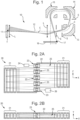
- Fig. 1 shows a mass microscope 10 as described in US 5128543 .
- the mass microscope comprises a target T that is illuminated by a laser pulse, a position sensitive Time of Flight (TOF) detector 16, and an analyzer that is formed by lenses L, slits S and three 90-degree spherical electrostatic sectors 13, 14 and 15 that are separated by field-free regions.
- Secondary ion packets originate from point 11 on the target T with an angular spread.
- the ions travel within the dashed curved area of trajectories and are focused onto the position sensitive detector 16 at point 17.
- a multiplicity of emitting spots form a magnified two dimensional image on the detector 16, while the TOF detector also measures the ion masses by their flight times.
- a dual microchannel plate (MCP) detector with resistive anode is used to determine the X and Y positions of rare striking ions.
- imaging may be performed on a phosphor screen downstream of an MCP by using higher ion fluxes and selecting ions of a single mass with a time gate.
- the typical size of the image field is 200 microns, the spatial resolution is 3 ⁇ m and the magnification from the target to the detector is x60.
- a moderate mass resolution of about 3,000 is achieved, although this is limited by the short flight path available in the sectors 13-15.
- More recent multi-sector systems provide higher mass resolutions, although at a compromised spatial resolution of 100 ⁇ m for DE-MALDI sources.
- a small viewing field, and moderate spatial and mass resolutions are characteristic for electric sector TOF instruments since they have a limited flight path length and compensate only for first order spatial and time-of-flight aberrations.
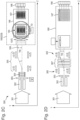
- Figs. 2A and 2B illustrate a prior art instrument according to WO 2005/001878 .
- the instrument is a multi-reflecting mass spectrometer 20 comprising a pair of planar mirrors 21, a drift space 22, a periodic lens array 23, a pulsed ion source 24 and a detector 26.
- the planar ion mirrors 21 are formed by metal frames and are extended in a direction along the ion drift direction Z.
- the ions pulsed into the drift space 22 between the ion mirrors 21 such that they perform multiple reflections between the ion mirrors 21 as they drift in the z-direction to the detector 26.
- the multiple mirror reflections extend the flight path of the ions, which improves mass resolution.
- the periodic lens 23 confine the ion packets along the main zig-zag trajectory 25.
- Fig. 2B shows a view in the X-Y plane. Due to lower order lens time of flight aberrations, the analyzer has higher acceptance in the Y-direction.
- WO2007044696 proposes using an orthogonal accelerator oriented in vertical Y-direction.
- the present invention employs a time of flight region comprising at least one ion mirror for mapping ions onto a position sensitive detector.
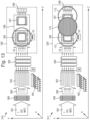
- Fig 2C shows an embodiment of the present invention comprising an ion source 301, a radio frequency quadrupole ion guide 302, an exit aperture 303, a ion optical lens 304; an ion deflector system 305 for ion beam displacement in the Y-direction; and a 1D mapping MRTOF 180 comprising a 1D mapping orthogonal accelerator 185.
- the ion source may emit or generates a single flow of ions.
- the ion flow may be substantially constant or may vary with time.
- the ions are guided along a central axis in the Z-direction by the ion guide 302 and ion optical lens 304 until they reach the ion deflector system 305.
- the ion deflector system 305 comprises a pair of entrance deflector plates and a pair of exit deflector plates.
- the ions are received at the deflector system 305 and are deflected away from the central axis by the entrance deflector plates. This is achieved by supplying opposing electrodes of the entrance deflector plates with voltages of opposing polarities.
- the ions continue to travel away from the central axis as they travel in the Z-direction and until they reach the exit deflector plates.
- the exit deflector plates are supplied with voltages so as to halt the motion of the ions away from the central axis and so as to compensate for the motion in the Y-direction imparted to the ions by the entrance deflector plates.
- the ions then continue downstream along a longitudinal axis extending in the Z-direction that is parallel to the central axis. Accordingly, the ion deflector system 305 has displaced the ions in the Y-direction, as shown by ion beam 306 in Fig. 2C .
- the deflected ions are then transmitted into the orthogonal accelerator 185, wherein they are accelerated into the MRTOF 180 for time of flight mass analysis.
- the MRTOF 180 maps the positions of the ions entering the MRTOF to corresponding positions on the position sensitive detector 187. Accordingly, the ions deflected to position 306 by the ion deflector system 305 are received at a corresponding position on the position sensitive detector 187 that is displaced from the central axis of the detector 187.
- the voltages applied to the ion deflector system 305 are varied with time such that the displacement of the ions in the Y-direction at the exit of the ion deflector system 305 varies with time. Accordingly, the displacement of the ions received at the position sensitive detector 187 also varies in a corresponding manner.
- the ions have a relatively long time of flight in the MRTOF 180 due to the multiple reflections between the ion mirrors. This enables the ions in each pulse become temporally well separated in the time of flight region, thus providing the instrument with a high resolution.
- pulsing the ions into the MRTOF 180 at too high a rate would lead to spectral overlap in which slow ions from a first ion injection pulse are detected after fast ions from a second, later ion injection pulse. This limits the rate at which ions can be pulsed into the MRTOF 180 before spectral overlap occurs, thus limiting the duty cycle of the instrument.
- the instrument may be operated in an encoded frequency pulsing (EFP) mode.
- EFP encoded frequency pulsing
- the orthogonal accelerator 185 pulses ions into the Time of Flight region in a series of pulses, wherein the time delay between pairs of adjacent ion injection pulses is varied in a predetermined manner, as opposed to the conventional method of employing a uniform time delay between all of the pairs of adjacent pulses.
- the ions may then be pulsed into the MRTOF 180 at a relatively high rate, in which the ions in a first pulse temporally overlap with the ions in a subsequent pulse.
- the detector 187 detects the arrival times of the ions and obtains a signal corresponding to the overlapping spectra.
- variable time delays between ion injection pulses are known in the EFP method
- this can be used to unpick overlapping peaks in the TOF spectra so as to obtain non-overlapping spectra. This may be performed by correlating the overlapping spectra with the encoded sequence for injecting ions into the MRTOF 180.
- the EFP mode enables ions to be injected into the TOF device at time intervals that are shorter than the TOF separation time and so enables the duty cycle of the spectrometer to be increased.
- the orthogonal accelerator may be operated with an average pulse period of 5 to 10 ⁇ s.
- the method of deflecting the ions onto different regions of the detector 187 with the ion deflection system 305 may bypass dynamic range limits in the EFP method, e.g. posed by signal overlaps with peaks of chemical noise such as in LC-MS analysis and parent ion detection in data dependent LC-MS-MS analysis (DDA).
- DDA data dependent LC-MS-MS analysis
- the ion flow may be considered to be constant relative to the time scale of spectral acquisition.
- the spectral dynamic range may be limited by chemical background noise.
- the number of spectral overlaps may be reduced by deflecting the ions using the ion deflector system 305 such that the same ion beam is deflected onto different strips of the detector 187 at different times. This improves the dynamic range of the instrument during EFP spectral acquisition. Splitting the ion signal between different detector data channels in this manner retains the useful ion signal, whilst reducing the number of overlaps with chemical background peaks in a manner that is proportional to the number of data acquisition channels that the ion beam is split between.
- a device upstream of the ion deflecting system 305 may transmit different ions at different times to the ion deflecting system 305.
- the ions may be released from the upstream device in a cyclical manner.
- the upstream device may be a mass or ion mobility separator that cyclically separates ions according to mass or ion mobility.
- the upstream device may be fragmentation cell that cyclically varies the fragmentation energy.
- the ion deflecting system 305 may deflect ions across the detector 187 in a cyclical manner, and may be synchronized with the cycle time of the upstream device. Accordingly, different ions from the upstream device are able to be mapped onto different regions of the detector 187.
- This method enables mapping of ions that are separated over relatively fast time-scales, while using longer accumulation times of the data acquisition system 188, and enables data for multiple cycles to be summed. For example, the signal detected at each detector position in multiple cycles may be summed. If an EFP mode is use the method also provides an improved dynamic range.
- the exit aperture 303 may be operated as an ion gate by selectively applying a voltage to it that blocks the path of ions through the exit aperture 303.
- the voltage may be operated so as allow ions to pass through the exit aperture in pulses.
- the pulses may be synchronized with the pulsed orthogonal extraction of the orthogonal accelerator 185 so as to optimize the duty cycle of the instrument.
- Voltages may be applied to the quadrupole 302 such that it operates as a mass filter, in which only ions of selected mass to charge ratio(s) are stable and are transmitted by the quadrupole 302.
- the quadrupole may be operated with a low mass cut-off, a high-mass cut off, or as a band pass filter.
- the exit aperture 303 is operated as an ion gate, the delay time between a pulse of ions being released through the ion gate and that same pulse of ions being orthogonally accelerated in the orthogonal accelerator 185, may be selected based on the value(s) of the mass to charge ratio(s) transmitted by the quadrupole 302.
- Fig. 2D shows a schematic of an embodiment that is substantially the same as that of Fig. 2C , except that ion focusing elements are provided between the pairs of deflector electrodes in the ion deflecting system 305 for focusing the ions in the X-direction.
- the ion focusing elements may be opposing planar electrodes spaced apart in the X-direction and between which the ions pass.
- the ion deflecting system 305 may receive a beam of ions that varies in intensity as a function of time. Alternatively, or additionally, the ion deflecting system 305 may receive a beam of ions having a physicochemical property value that changes with time. For example, the mass to charge ratios or ion mobilities of the ions received at the ion deflecting system 305 may vary with time.
- the ion deflecting system 305 may deflect different portions of the time varying ion beam to different positions on the detector 187, thereby providing a set of independent spectra. For example, different mass to charge ratios or mass to charge ratio ranges may be directed to different parts of the detector by the ion deflecting system 305. Alternatively, different ion mobilities or ion mobility ranges may be directed to different parts of the detector by the ion deflecting system 305. Alternatively, or additionally, ions from different ion sources may be directed to different parts of the detector by the ion deflecting system 305.
- ions derived from different channels in a multi-channel LC device, or from different sprays in a multiple sprays device may be directed to different parts of the detector by the ion deflecting system 305.
- ions generated from different regions of an analytical sample, from different samples, or from different regions on a sample plate may be directed to different parts of the detector by the ion deflecting system 305.
- ions from different spots on a MALDI sample plate may be directed to different parts of the detector by the ion deflecting system 305.
- ions fragmented with different fragmentation energies in a collisionally induced fragmentation cell or generated by time-variable in-source fragmentation may be directed to different parts of the detector by the ion deflecting system 305.
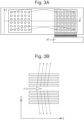
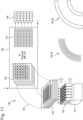
- Fig. 3A schematically illustrates the ability of analyzer to transfer ions from pixels of the ion source array 44 to corresponding pixels of the ion detector array 45.
- Pixelated detectors such as those disclosed in US 8884220 , may be used to record time-of-flight signals from a matrix of individual pixels in the detector by using an array channel data system 47.
- the spatial dimensions of the ion source array may be, for example, up to 7-10 mm and that the number of spots may form a 6x6 matrix, whilst retaining a mass resolution of approximately 100,000-200,000 for each individual pixel.
- the combination of a large field of view, and the spatial and mass resolutions provided is unprecedented and provides opportunities for high throughput mass spectrometric analysis.
- the analyzers may have a larger field of view and/or a larger source matrix density, such as a field of view up to 15-20 mm and/or a source matrix density of at least 10x10.
- the mapping MRTOF described herein may be used for a number of applications.
- the instrument may be used for crude surface imaging at a high throughput rate.
- the instrument may be used for analyzing multiple samples deposited onto a surface as a macroscopic sample array. Such an analysis may be enhanced by sample micro-scanning within a pixel, i.e. within a sample well.
- the instrument may be used to analyze ions from multiple independent ionization sources, such as atmospheric or ambient sources, for high throughput analysis.
- the instrument may analyze multiple sample spots ionized by ambient sources.
- a sample may be spatially separated by mass or mobility, and the instrument may be used for simultaneous parallel mass analysis of different separation fractions.
- the ion mapping from the ion source to the detector may be performed in one dimension or in two dimensions.
- one dimensional ion mapping ions may be generated from multiple sample regions that are distributed along the Y- dimension (or Z-dimension) of the ion source, and these ions may be mapped onto the detector at respective multiple regions that are distributed along the Y-dimension (or Z-dimension) of the detector.
- two dimensional ion mapping ions may be generated from multiple sample regions that are distributed in the Y-Z plane of the ion source, and these ions may be mapped onto the detector at respective multiple regions that are distributed in the Y-Z plane of the detector.
- the field of view of an analyzer may be limited in in both the Y- and Z- dimensions, before high order spatial aberrations degrade spatial resolution and cross-term aberrations degrade mass resolution.
- the field of view may be 1 mm or less in any dimension.
- the position sensitive detector and/or the source array may occupy a relatively large area (e.g. larger than 1 mm in any dimension), or may have a relatively large (or small) pixel size.
- the ion source and detector may be different sizes.
- the imaging and mapping system therefore may be subjected to a mismatch in spatial scales and/or a lack of space within the MRTOF analyzer to accommodate the source or detector. This may be accommodated for, as discussed further below.
- the spatial resolution of the described embodiment is moderate in terms of number of resolved pixels, it is very unusual for TOF analyzers to sustain imaging properties at large fields of view in comparison to prior art TOF mass microscopes, in which the imaging field is well under 1 mm.
- the analyzer transfers ions from a matrix of ion source spots to a corresponding matrix of spots on the detector.
- This system may allow independent acquisition of a matrix of ion beams or ion packets, with minimal ion losses and without any signal interference between individual pixels at the detector. This leads to an improvement in the analysis throughput.
- a 6x6 matrix of ion sources has been described, denser matrices and larger fields of view may be provided using the analyzer.
- Fig. 3B shows a schematic of an orthogonal accelerator for increasing the duty cycle of the instrument.
- the ions are illustrated as being accelerated from only one side of the orthogonal accelerator 24.
- the orthogonal accelerator may inject ion packets into the Time of Flight region in two opposite directions.
- the ions injected in the opposite directions are reflected by the ion mirrors multiple times before they hit the detector.
- the detector 26 may be replaced by a double-sided ion detector and ions injected in opposite directions into the Time of Flight region may impact on opposite sides of the detector.
- the ions injected in opposite directions into the Time of Flight region may be injected at acute angles to the X-dimension that are different to each other such that the ions injected in the opposite directions travel a different total distance in the Z-dimension by the time that they impact on the detector.
- the ions injected in opposite directions into the Time of Flight region may therefore be detected at different positions on the detector 26.
- Voltages may be applied to the orthogonal accelerator so as to alternately eject ions from opposite sides of the orthogonal accelerator.
- the orthogonal accelerator of Fig. 3B allows ion packets to be introduced into the analyzer at a faster rate without spectral overlap.
- Telescopic e.g. microscopic ion optical sets, including lenses, mirrors or sectors may be used to map the ions from the source to the detector.
- Figs. 4A-4C show telescopic and microscopic lens arrangements that may be used.
- Fig. 4A shows a schematic of a telescopic device for interfacing a source array that is relatively wide in the Y- and Z- dimensions to an analyzer having a detector that is smaller in the Y- and Z-dimensions.
- Fig. 4B shows a schematic of a microscope lens set for expanding the ion beams from a source array in the Y- and Z- dimensions.
- the microscope lens set may image a small surface with a field of view of about 1 mm in each of the Y- and Z-dimensions to a wider ion packet array within the analyzer, e.g. optimized to an array size of about 3-5 mm in each of the Y- and Z-dimensions.
- Fig. 4C shows a schematic of a telescopic expander for expanding the ion beams from a source array that is relatively small in the Y- and Z- dimensions to an analyzer having a detector that is larger in the Y- and Z-dimensions (e.g. 15-25 mm).
- a detector may be used to retain macroscopic pixels and handle larger ion fluxes.
- Fig. 5 shows an arrangement not in accordance with the claimed invention which comprises a multi-beam ion source 71 for forming a 1D or 2D array of continuous ion beams.
- a static telescopic lens system 72 is provided for converting the beam array to a beam array having smaller dimensions.
- a beam converter 73 is provided for forming pulsed ion packets.
- An isochronous and imaging sector 75 is provided for transferring ion packets into the TOF region 76. The ions then separate according to time of flight in the TOF region 76.
- An isochronous imaging sector 77 is provided for guiding ions out of the TOF region 76 and through a magnifying lens 78 and then onto a pixelated detector 79.
- the use of sectors, such as electrostatic sectors, is particularly useful as it allows the ion source or detector to be moved externally from the MRTOF analyzer.
- Both sectors 75 and 77 may be either cylindrical, toroidal or spherical, depending on whether 1D or 2D ion mapping is desired.
- a cylindrical sector may be used for 1D mapping, or toroidal or spherical sectors may be used for 2D mapping.
- the sectors may be combined with electrostatic lenses. Both sectors may be composed of several sector sections for optimal spatial resolution and isochronicity. The sector steering angles may be optimized depending on the overall arrangement, for example, as described in WO 2006/102430 .
- Electrostatic sectors serve multiple functions. They allow a relatively large ion source array and detector to be arranged outside of the MRTOF, whilst introducing ions into and extracting ions from the TOF region. Also, sectors are capable of removing excessive energy spread of the ions so as to optimize spatial and mass resolution with only moderate ion losses. Sectors may also be used as part of telescopic arrangements for optimal adoption of spatial scales between the ion source, the TOF analyzer and the detector.
- spatial resolution may be primarily limited by high order spatial aberrations, such as spherical aberration Y
- spatial resolution is expected to improve at smaller ion trajectory offset and smaller view field.
- the smaller view field may be magnified with telescopic lenses or sectors, also may incorporate diverging trajectories of the MRTOF analyzer, as has been described in relation to Fig. 4 .
- planar ion mirrors for the TOF region have been described above, it is contemplated that other geometries may be employed.
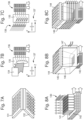
- Fig. 6 shows various different topologies of planar and curved electrodes that may be used to form two-dimensional electrostatic fields for use as the TOF regions in the analyzers of embodiments. These topologies may be used to provide the ion mapping properties described above, whilst providing denser packaging of ion trajectories. It may be desired for the analyzers to combine both sectors and ion mirrors, since ion mirrors are capable of compensating for multiple sector aberrations. Combined (hybrid) systems may have similar ion optical properties to systems built from only ion mirrors.
- the topology labeled 101 schematically illustrates the electrode arrangement for the planar MRTOF that has already been described above, having two parallel, straight ion mirrors.
- the topology labeled 102 schematically illustrates the electrode arrangement for a hybrid folded analyzer having a sector that guides ions between two ion mirrors.
- the topology labeled 103 schematically illustrates the electrode arrangement for another hybrid system built using multiple sectors and an ion mirror.
- the topology labeled 104 schematically illustrates the electrode arrangement for another analyzer that may be used for multiplexing, e.g. as described in WO 2011/086430 .
- the topology labeled 105 schematically illustrates the electrode arrangement for an analyzer that is similar to topology 101, except that the mirrors are cylindrically wrapped.
- the topology labeled 106 schematically illustrates the electrode arrangement for an analyzer that is similar to topology 102, except that the mirrors and sector are cylindrically wrapped.
- the topology labeled 107 schematically illustrates the electrode arrangement for an analyzer that is similar to topology 105, except that the upper mirror is replaced by a spherical sector.
- the illustrated instruments having mixed symmetry and employing curved ion trajectory axes provide compact analyzers and allow geometrical up-scaling at a given instrument size. Ion mapping and imaging properties, as with TOF resolution, are rapidly improved with the analyzer up-scaling due to the fast reduction of high order aberrations.
- the pixelated detector may provide independent mass spectral analysis for each individual pixel, or groups of pixels in the ion source.
- Prior art ion mapping instruments typically have a field of view with each dimension under 1 mm.
- the embodiments described herein may provide instruments having lower resolution ion mapping but with a much larger field of view, such as up to 10x10 mm in combination with parallel (simultaneous) acquisition of high resolution mass spectra for all mapped pixels.
- the mass spectral mapping of macroscopic size spots e.g. spots having a dimension in each direction of 1-2 mm
- ion source arrays ion transfer arrays, ion optics arrays, and forming appropriate pulsed converters for such arrays, enabling multi-channel MRTOF with high throughput analysis.
- mapping MRTOF allows parallel analysis of multiple ion flows.
- Various arrays of ambient ion sources are known, although they are conventionally multiplexed in an atmospheric or vacuum interface for analysis in a single channel mass spectrometer.
- the ion source arrays may be used in the present invention for parallel analysis and hence the instrument provides a much higher throughput than prior art instruments.
- Figs.7A-7C show various arrays of ion sources that may be used with the mapping MRTOF.
- the ion sources may comprise an array of independent ion sources, such as ESI, APCI, APPI, CGD, DESI, DART, or MALDI ion sources. Each array may comprise multiple ion sources of the same type or of different types.
- the arrays of ion sources may operate at atmospheric pressure, or at lower pressures, such as 1-100 Torr gas pressure, e.g. in the case of gaseous MALDI ion sources or conditioned glow discharge (e.g. as described in WO 2012/024570 ).
- the ion sources in any given ion source array may ionize multiple different samples simultaneously and therefore may provide the instrument with a high throughput.
- the ion sources in any given ion source array may be connected to multiple samples, e.g. to multiple chromatographic channels or may be used for surface imaging at ambient gas pressure.
- ion sources may be used in any given array of ion sources.
- the ion sources may be used for the simultaneous analysis of the same sample, for example, for obtaining additional information due to variations in softness, charge states, selectivity, fragmentation patterns, variations in discrimination effects, or for calibrations in mass, intensity or at quantitative concentration measurements.
- Fig. 7A shows a schematic of an ion source array comprising an array of ESI spray micro-tips 132 connected to a multi-well sample plate 131.
- the sample flow to spray tips 132 may be induced by pressurizing the sample with gas. If a relatively large array dimension is used (e.g. 386 wells), the well plate 131 may be incrementally moved across the array of sampling nozzles 132.
- the instrument may be used for proteomic analyses.
- State of the art proteomic analyses with single channel LC-MS-MS may last for several hours, as several thousand runs may be required for each study.
- the multi-channel MRTOF described herein may be used.
- the proteomic samples may be pre-separated, e.g. by affinity separation or salt exchange chromatography and prior to the step of enzymatic digestion. Then separated fractions may be analyzed in parallel using multiple independent LC-MS channels or LC-MS E channels (more preferable), whilst using a single mapping MRTOF mass spectrometer as described herein.
- the MRTOF is expected to obtain more information per sample (e.g. in research programs) or obtain the same information at much faster LC gradients (e.g. for high throughput clinical analysis).
- multiple proteomic samples may be analyzed in parallel for higher throughput with a LC-MS E method. Higher throughput may also be highly desirable for other LC-MS and GC-MS analyses in clinical, environmental, and metabolomic studies.
- Fig. 7B shows a schematic of an ion source array for 1D array flow sampling.
- the ion source may be used for ambient surface imaging.
- a DART or DESI flux 134 of primary particles e.g. charged droplets or metastable Penning Argon atoms
- a linear array of nozzles 136 may be provided to sample ions from a linear array of parallel surface pixels on the target surface 135.
- the spatial resolution i.e. pixel size
- the nozzle diameter may be chosen to be 0.1-0.3 mm for a spatial resolution of 0.3-1 mm.
- the sample plate may be scanned across the entrances to the nozzles.
- the resolution of the surface imaging may be somewhat improved with sample plate scans 137.
- the array analysis notably accelerates the surface analysis with DART and DESI, which is slow with existing single channel mass spectrometers.
- Fig. 7C shows a schematic of another ion source array.
- the spatial resolution of the ambient surface analysis may be enhanced in this embodiment by using an array of small size ionizing beams, such as focused laser beams 139.
- the laser beams 139 may be produced using an array of micro-lenses or using interference of coherent laser beams.
- the sample plate may be scanned across the laser beams, or vice versa. For example, each laser beam may be scanned across the target plate within a portion corresponding to a pixel on the target plate.
- This embodiment provides parallel analysis of the source array with ion mapping to the detector and high mass resolution.
- Fig. 8A shows a further embodiment of the source array.
- ESI spray tips 130 are assisted with focusing electrodes in order to provide sharper focused ESI plumes.
- Ion flows from multiple sources 130 are sampled by electric fields and by gas flow into an array of heated capillaries 141.
- the heated capillaries may have sharp tips or cones with sampling apertures at their tops.
- the ions may then be transmitted into and confined in channels 142.
- the channels may be defied by apertured plates and RF potentials may be applied to these plates so as to confine the ions in the channels.
- a capillary diameter of about 0.5 mm nay be used for higher sensitivity, leading to approximately 1 L/s gas flux through the 36 channels.
- a mechanical pump e.g. a scroll pump
- Fig. 8B shows a further embodiment of the source array wherein the sampling plate 144 comprises sharp cones with relatively smaller sampling nozzles apertures, limiting the sampled gas flow. Ions are further sampled by gas flow into relatively wider channels 146 that may be machined in a heated block 145, for example by point EDM. Once gas flow is limited by apertures of sampling plate 144, the internal part of the block 145 may be constructed of split pieces, for example, from plates, cylinders, cones, or wedges, for ease of making channels 146 and for cleaning.
- the nozzle spacing may be spread spatially for efficient sampling from an array of multiple macroscopic ion sources, while channels 146 may converge towards the exit. Since ion collection diameter may be desired to be at least three times the nozzle aperture diameter, for imaging applications, the nozzle diameter could be reduced, for example, to 0.3 mm so as to reduce the gas load through the nozzle array, which may be about 0.4 L/s for 36 channels. A single mechanical pump pumping at 10 L/s may be provided to drop the gas pressure to under 30 Torr. Even lower gas loads may be provided by using finer nozzles for surface imaging at higher spatial resolutions.
- Fig. 8C shows a further embodiment of the source array that is similar to that of Fig. 8B , except that a sectioned nozzle array 149 is provided with distributed pumping, as shown by the white arrows.
- the nozzle array 149 may comprise two or more aligned stages of heated channels with differential gas evacuation in between the stages. Ion transfer between the stages may be assisted by gas dynamic focusing of ions on the axis of each heated capillary and/or by electrostatic focusing onto sharp capillary tips of the second stage.
- the nozzle array may comprise perforated apertures with alternated DC potentials and with distributed pumping between the plates. Gas jets formed on the axis of each channel will transfer ions at nearly sonic speed this way, generating the time alternated force required to provide spatial confinement of ions to the axis.
- ion beams and ion packets e.g. for small size arrays.
- Figs.9A-9C depict a schematic of a multi-channel MRTOF having a 1D array of ambient ion sources, not in accordance with the claimed invention, and configured to perform 1D ion mapping onto the detector 175.
- the instrument comprises a 1D array of RF quadrupoles 165, a set of micro-lenses 171 for forming a low divergence beam array 172, a telescopic lens 173 (e.g. having a magnification of one, or having size compression), an orthogonal accelerator 175 with a wire mesh 176, a lens 178 terminating the field of the orthogonal accelerator 175, and a sectioned deflector 177.
- Fig. 9B depicts the ion focusing downstream of the quadrupole array 165 by micro-lens 171.
- the pitch of quadrupole array is 2 mm with inscribed diameter of each quadrupole being 1.4 mm.
- the reduction of the angular divergence of the beams serves two important purposes: it reduces ion beam interference at mapping, and it proportionally reduces the turn-around time in the orthogonal accelerator 175.
- the array of ion beams then enters the telescopic lens 173.
- the telescopic lens is used for delivering narrow ion beams into the orthogonal accelerator 175, thus preserving ion beam separation.
- the telescopic lens also interfaces the spatial scale of the ion source to MRTOF field of view. For example, a 20 mm wide beam array may be compressed into a beam array within the accelerator 175 that is 7-10 mm wide.
- the icon 173 illustrates a particular example of the telescopic lens with unit magnification. The view is compressed about twice in the Z scale.
- the lens is 120 mm long and with a 30 mm inner diameter.
- the beam array is refocused by two lenses without any additional spreading of beam width, despite an initial divergence angle of 2 degrees.
- the telescopic lens may be tuned to provide spatial ion beam refocusing in the middle of the accelerator 175. Without the telescopic lens, the ion beams would spread for 1 mm while passing into the accelerator, which must be spaced from the quadrupole array, at least for reasons of differential pumping.
- the orthogonal accelerator 175 shown in Fig.9C is designed to accept a wide (e.g. 10 mm) array of ion beams while minimizing angular ion scattering if using any mesh.
- the intermediate stages of the accelerator 175 may employ a mesh 176 made of wires oriented along ion beams, but may use an accelerating field of equal strength around the mesh to minimize the ion scattering on the mesh.
- the exit stage of the accelerator may be terminated by a wide open lens 177 to avoid angular ion scattering. Any ion beam angular focusing is accounted for and balanced with other spatially focusing elements of the MRTOF, e.g. either the ion mirror 21 or periodic lenses 23 of Figs. 2 or 5 .
- the ion beams at the entrance of the orthogonal accelerator 175 may have a diameter under 1 mm, a mean ion energy of 50 eV, and an angular divergence of about 0.5 degrees.
- the accelerator may be arranged with a large extraction field, e.g. 300-500 V/mm, thus creating an energy spread of about 300-500eV.
- the MRTOF may be operated at the highest practical acceleration voltage applied to drift region, e.g. -8 to -10 kV.
- the ion packet advance would appear too high, i.e. 70 mm per mirror reflection, which would require an MRTOF having a large width in the Z-direction.
- the orthogonal accelerator 175 is tilted at the angle ⁇ , and the packets are then steered by a deflector for the same angle ⁇ .
- the deflector 178 may be composed of several sections for a more uniform deflection field.
- the ion beam energy at the accelerator entrance may be adjusted so that both the tilt and steering provide mutual compensation of the first order time aberration, as described in WO 2007/044696 .
- Fig.10 shows an arrangement 180, not in accordance with the present invention, of 1D multi-channel MR-TOF.
- the MRTOF instrument may comprise an array of ambient ion sources forming an array of ion flows 181, or may comprise a single ion source producing a single ion flow that is then split into multiple ion flows 182.
- the instrument comprises a multi-channel interface 183, oriented along the Z-axis, or a similar multi-channel interface 184 being oriented along the Y direction.
- the instrument comprises a 1D or 2D imaging MRTOF analyser 186, as described herein, and a pixelated detector 187 that is connected to a multi-channel data acquisition system 188.
- the array interfaces 183 or 184 may comprise a nozzle array 140 of type described above, an array of RF ion guide channels 163, an array of RF quadrupoles 165 having exit skimmers (optionally connected to pulse generator 185), an array of micro-lens 171, a telescopic lens 173, and an orthogonal accelerator 175.
- ion flows 181 may be separately transferred from individual ion sources, through individual channels of interface 183, into the orthogonal accelerator 175 as spatially separated ion beams. Each of the ions beams is then converted into spatially distinguished ion packets, elongated in the Z-direction and narrow in the Y-direction.
- the mapping MRTOF 186 transfers ion packets to the pixelated detector 187 without mixing the packets.
- the pixels of data system may be combined into strips along the Z-direction, and data system188 may acquire multiple mass spectra in parallel, for each channel.
- the MRTOF 180 effectively forms an array of parallel operating mass spectrometers, while sharing a common vacuum chamber, differential pumping system, electronics and unifying analytical components, e.g. including making multiple apertures in one block rather than making multiple blocks for the nozzles, RF ion guide channels, RF quadrupoles, and ion optics.
- extraction pulses are applied (from block 185) to the exit skimmers of the RF quadrupoles 165 in a manner that traps and releases ions in the RF quadrupoles.
- the pulses of the orthogonal accelerator 175 are synchronized in time with the pulses of the ions from the quadrupoles.
- a single pulse may be applied to the quadrupoles and the orthogonal accelerator in order to analyze ions from all channels simultaneously. This method enables an improvement in the duty cycle of the accelerator, though at the expense of a narrower mass range being admitted in each pulse. It is also contemplated that the timing of the extraction pulses 185 may vary between channels or between accelerator shots.
- the pulsed ion release may also be used to form a crude mass separation in the second direction, along the ion beams.
- the two dimensional pixelated detector may thus detect a narrow mass range per pixel, which reduces spectral population per pixel.
- Fig.11 illustrates a MRTOF for performing two-dimensional mapping, which is not in accordance with the claimed invention.
- the 2D Multi-channel MRTOF 190 comprises a 2D array of ambient sources 191, a 2D nozzle array 192, a 2D array of RF ion guide channels 193, a 2D curved interface 194; a 2D array pulsed converter 195, a 2D imaging MRTOF analyzer 197, a 2D pixelated detector 197, and a 2D array data system 198.
- the 2D array of ambient sources 191 may be of the type described herein above, e.g. in the form of a 2D array of spray tips 130.
- the 2D nozzle array 192 may be of the type described herein above, e.g. in the form of capillary array 141 and heated block 143 with machined channels (optionally a split heated block 148 of plates with channels).
- the curved interface 194 may be a 2D array of RF ion guide channels (194 RF), e.g. composed of mutually tilted perforated plates or PCB boards.
- the curved interface 194 may be a 2D array of electrostatic sectors (194 ES) for bypassing fringing fields of the ion mirrors, e.g. as described in US 7326925 (X -inlet).
- the curved interface 194 allows the ion source array to be located externally to the MRTOF analyzer such that it does not interfere with the MRTOF analyzer.
- vacuum ion sources Compared to ambient sources, arranging an array of vacuum ion sources is the task of relatively lower complexity, since vacuum ion sources do not require multi-channel ion transfer interfaces and a powerful pumping system. The task is even simpler if using naturally pulsed ion sources, like pulsed SIMS, MALDI or DE-MALDI.
- Fig. 12A shows an arrangement not in accordance with the claimed invention of a 2D mapping MRTOF having an array of pulsed vacuum ion sources 210.
- the instrument may comprise a mapped target plate 211, which may be a mapped sample or a multi-well sample plate.
- An array of focused primary ion beams 212 may be directed onto the target plate 211 in order to ionize the sample thereon.
- an array of laser beams may be used to ionize the samples on the target plate 211. Different ion beams or laser beams may be directed onto different regions of the target plate 211 in order to ionize different areas/pixels on the target plate 211.
- a laser beam such as a scanning focused beam 213, may be scanned across the target plate to ionize the sample thereon.
- the beam may be scanned across the target plate so as to ionize different areas/pixels at different times.
- the instrument further comprises a mapping MRTOF analyzer 196, a pixelated detector 197, and a multi-channel data system 198 for parallel mass spectral acquisition.
- an array 212 of fine-focused primary laser beams may be provided from a single, wide laser beam with the aid of multiple UV lenses or by an array of concave reflectors.
- a single laser beam 213 is scanned across the target plate to ionize the sample, this may be performed with galvanic fast-moved mirrors.
- the laser beam(s) may be pulsed for MALDI, LD or DE MALDI ionization.
- an array 212 of primary ion beams e.g.
- the primary ion beams 213 may be scanned across the target plate in a stepped or continuous and smooth manner.
- the ion beams may be scanned in at least one direction by electrostatic deflectors.
- the secondary ions i.e. analyte ions
- the primary beams may be focused to a much finer spot size (e.g. 10-100 ⁇ m) as compared to pixel size (e.g. 0.1-1 mm)
- the sample plate and/or ion beams and/or laser beam(s) may be micro-scanned (e.g.
- the ion or laser beams may aligned in a 1D array on the target plate that extends in a first direction, and the 1D array may be scanned or stepped across the target plate in a second (e.g. orthogonal) direction.
- Fig. 12B shows an arrangement 214, not in accordance with the claimed invention that uses a close view mask 215 for separating individual secondary ion beams emitted from the target plate, e.g. if a continuous glow discharge ionization process is used.
- the spatial focusing of individual ion beams may be assisted by a micro-lens array 216 that may be followed by a large aperture single lens 217.
- Ion packets may be formed by pulsed acceleration past the mask 215.
- the parallel analysis by mapping multiple spots in a vacuum highly accelerates the analysis throughput.
- Using relatively fine ionizing beams in a vacuum allows multiple strategies for high spatial resolution for large overall sample sizes.
- the primary beam 213 may be rastered across the target plate. Rastering the primary beam 213 may be of assistance where the dose of the primary beam is limited by the sample stability. Rastering of the primary beam may be performed at a faster time scale than the period of the pulsed acceleration. In this manner, a single ion beam effectively acts as multiple beams.
- the rastering may use stepped selection of ionization spots, rather than smooth scanning.
- the primary beam spots may be selected with a strategy of non-redundant sampling (NRS), e.g. as described in WO 2013/192161 and depicted by icon 215. The combination of spots within a pixel/area may be varied between acceleration pulses.
- NRS non-redundant sampling
- the signal on the detector may be acquired as a data string without losing time information.
- the mass spectrum for a particular fine spot may then be extracted by correlation with the position of the spot.
- the encoding pattern may be the same for all pixels and may be performed with surface 2D stepped rastering.
- the resolution of MRTOF devices is limited by the initial parameters of the incoming ion beam.
- the angular divergence of a continuous ion beam introduces velocity spread ⁇ V in the TOF direction, which leads to so-called turn-around time ⁇ T.
- the field strength is limited by the energy acceptance of the analyzer ⁇ X*E ⁇ K.
- the problem may be solved by using finer size quadrupoles, however, this requires the use of multiple quadrupoles to avoid space-charge expansion of the ion cloud at practical ion currents of several nA to tens of nA.
- Fig.13 illustrates an arrangement, not in accordance with the claimed invention, comprising a single source 301, a distributing RF guide 308, 1D array of small quadrupoles (RFQ) 165, a planar lens 305; and either a mapping MRTOF 180 or a mapping Re-TOF 220.
- a single ion flow (e.g. up to a few nano-Amperes for LC-MS instruments) from the source 301 is distributed into multiple ion beams by the distributor 308, which may be, for example, a slit RF channel.
- the ions then enter multiple channels of the 1D RFQ array 165.
- the 1D RFQ array 165 may be made by EDM for better precision and a small inscribed diameter of RFQ. Distribution of the ion current between multiple RFQ channels drops the ion current per channel, thus avoiding (or reducing) space-charge effects and the resulting beam expansion.
- Ion beams may be extracted from the RFQ array 165 by a negative bias on skimmers, which form local crossovers near the skimmer plane.
- the planar optics 305 then provide ion beam spatial expansion while reducing angular divergence in the X-direction, say by 10-fold (e.g. in line with US 8895920 ).
- Planar optics 365 allow mixing of multiple beams in the Y-direction, thus forming wide ion packets in the orthogonal accelerator 185, illustrated by the dark square.
Landscapes
- Chemical & Material Sciences (AREA)
- Analytical Chemistry (AREA)
- Physics & Mathematics (AREA)
- Spectroscopy & Molecular Physics (AREA)
- Other Investigation Or Analysis Of Materials By Electrical Means (AREA)
- Electron Tubes For Measurement (AREA)
Claims (10)
- Flugzeit-Massenspektrometer, umfassend:einen lonendeflektor (305), der konfiguriert ist, um Ionen zu unterschiedlichen Zeiten an unterschiedliche Positionen in einem ersten Array von Positionen abzulenken, wobei der lonendeflektor konfiguriert ist, um die Ionen abzulenken, sodass die Ionen aus dem lonendeflektor zu unterschiedlichen Zeiten entlang unterschiedlicher Achsen in einem Array paralleler Achsen austreten;einen positionsempfindlichen Ionendetektor (187); gekennzeichnet durchlonenoptiken (180), die angeordnet und konfiguriert sind, um Ionen von dem ersten Array von Positionen zu dem positionsempfindlichen Detektor zu führen, um Ionen von dem ersten Array von Positionen zu einem zweiten Array von Positionen auf dem zweiten positionsempfindlichen Detektor abzubilden;wobei die lonenoptiken entweder beinhalten:(i) mindestens zwei lonenspiegel (101), die angeordnet und konfiguriert sind, sodass die Ionen von jedem der Spiegel und zwischen den Spiegeln eine Vielzahl von Malen reflektiert werden, bevor sie den Detektor erreichen; oder(ii) mindestens einen lonenspiegel zum Reflektieren von Ionen und mindestens einen elektrostatischen oder magnetischen Sektor (102) zum Empfangen von Ionen und Führen der Ionen in den mindestens einen lonenspiegel; wobei der mindestens eine lonenspiegel und der mindestens eine Sektor konfiguriert sind, sodass die Ionen von dem mindestens einen Sektor in jeden Spiegel eine Vielzahl von Malen übertragen werden, sodass die Ionen von dem jeweiligen lonenspiegel eine Vielzahl von Malen reflektiert werden.
- Spektrometer nach Anspruch 1, wobei Ionen an einer beliebigen gegebenen Position in dem ersten Array von Positionen auf die gleiche relative Position in dem zweiten Array von Positionen auf dem Detektor (187) abgebildet werden.
- Spektrometer nach Anspruch 1 oder 2, wobei der lonendeflektor (305) mindestens eine Elektrode und mindestens eine Spannungsversorgung zum Anlegen von Spannungen an die mindestens eine Elektrode umfasst, und wobei die Spannungsversorgung konfiguriert ist, um die an die mindestens eine Elektrode angelegte Spannung mit der Zeit zu variieren, um die Ionen zu unterschiedlichen Zeiten an unterschiedliche Positionen in dem ersten Array von Positionen abzulenken, sodass die Ionen zu unterschiedlichen Zeiten auf entsprechende unterschiedliche Positionen in dem zweiten Array von Positionen auf dem Detektor abgebildet werden.
- Spektrometer nach einem vorstehenden Anspruch, wobei der lonendeflektor (305) konfiguriert ist, um Ionen entlang einer ersten Achse zu empfangen und Ionen mit einer Geschwindigkeitskomponente orthogonal zu der ersten Achse abzulenken, sodass die Ionen aus dem lonendeflektor entlang einer zweiten Achse austreten, die im Wesentlichen parallel zu der ersten Achse ist, wobei die zweite Achse um eine Distanz, die sich mit der Zeit ändert, von der ersten Achse verschoben ist; und/oder
wobei der lonendeflektor mindestens eine Eintrittselektrode und mindestens eine Spannungsquelle zum Ablenken der Ionen zu einem beliebigen gegebenen Zeitpunkt in einer ersten Richtung und mindestens eine stromabwärts gelegene Austrittselektrode und mindestens eine Spannungsquelle zum Ablenken derselben Ionen zu dem gegebenen Zeitpunkt in eine zweite, entgegengesetzte Richtung umfasst. - Spektrometer nach Anspruch 4, das ein oder mehrere lonenfokussierungselemente (307) umfasst, die zwischen der mindestens einen Eintrittselektrode und der mindestens einen Austrittselektrode angeordnet sind; wobei der lonendeflektor (305) konfiguriert ist, um Ionen in einer ersten Dimension abzulenken, und das eine oder mehrere lonenfokussierungselemente konfiguriert sind, um Ionen in einer zweiten Dimension, die orthogonal zu der ersten Dimension ist, zu fokussieren.
- Spektrometer nach einem vorstehenden Anspruch, das weiter einen lonenbeschleuniger (185) zum Pulsen der Ionen von dem ersten Array von Positionen in die lonenoptiken und in Richtung des Detektors (187) umfasst, wobei ein lonenleiter oder eine lonenfalle stromaufwärts des lonenbeschleunigers angeordnet und konfiguriert ist, um lonenpakete an den lonenbeschleuniger abzugeben, wobei der lonenleiter oder die lonenfalle und der lonenbeschleuniger konfiguriert sind, sodass das Abgeben von Ionenpaketen aus dem lonenleiter oder der lonenfalle mit dem Pulsen von Ionen aus dem lonenbeschleuniger in Richtung des Detektors synchronisiert ist;
wobei das Spektrometer konfiguriert ist, um eine Verzögerungszeit zwischen dem Abgeben eines jeden lonenpakets aus dem lonenleiter oder der lonenfalle und dem Zeitpunkt bereitzustellen, zu dem diese Ionen von dem lonenbeschleuniger zu dem Detektor gepulst werden, und wobei die Verzögerungszeit in Abhängigkeit von dem Masse-Ladungs-Verhältnis oder der lonenmobilität der aus dem lonenleiter oder der lonenfalle abgegebenen Ionen variiert wird. - Spektrometer nach Anspruch 6, wobei eine lonentrennvorrichtung, eine lonenquelle oder ein lonenfilter stromaufwärts des lonenleiters oder der lonenfalle zum Zuführen von Ionen mit unterschiedlichem Masse-Ladungs-Verhältnis oder lonenmobilität zum lonenleiter oder zur lonenfalle zu unterschiedlichen Zeitpunkten angeordnet sind; und/oder
wobei der lonenleiter oder die lonenfalle einen lonenfilter oder lonenseparator umfasst und konfiguriert ist, sodass das Masse-Ladungs-Verhältnis oder der Bereich von Masse-Ladungs-Verhältnissen, die durch den lonenleiter oder die lonenfalle gespeichert werden, oder die lonenmobilität oder ein Bereich von lonenmobilitäten, die durch den lonenleiter oder die lonenfalle gespeichert werden, mit der Zeit variieren. - Spektrometer nach einem vorstehenden Anspruch, das einen lonenseparator umfasst, der stromaufwärts des lonendeflektors angeordnet ist, und konfiguriert ist, um Ionen gemäß einer physisch-chemischen Eigenschaft, wie etwa dem Masse-Ladungs-Verhältnis oder der lonenmobilität, zu trennen, und wobei das Spektrometer konfiguriert ist, um den lonendeflektor steuern, um Ionen, die unterschiedliche Werte der physisch-chemischen Eigenschaft aufweisen, zu unterschiedlichen Positionen in dem ersten Array von Positionen abzulenken, sodass Ionen, die unterschiedliche Werte der physisch-chemischen Eigenschaft aufweisen, zu unterschiedlichen Zeiten zu unterschiedlichen Positionen in dem zweiten Array von Positionen geführt werden; und/oder
eine Fragmentierungs- oder Reaktionsvorrichtung umfassend, die stromaufwärts des lonendeflektors angeordnet ist und konfiguriert ist, um Ionen unter Fragmentierungs- oder Reaktionsbedingungen, die mit der Zeit variieren, zu fragmentieren oder reagieren zu lassen, um Fragment- oder Produktionen zu erzeugen; und wobei das Spektrometer konfiguriert ist, um den lonendeflektor zu steuern, um zu unterschiedlichen Zeiten erzeugte Fragment- oder Produktionen zu unterschiedlichen Positionen in dem ersten Array von Positionen abzulenken, sodass diese Fragment- oder Produktionen zu unterschiedlichen Zeiten zu unterschiedlichen Positionen in dem zweiten Array von Positionen geführt werden. - Spektrometer nach einem vorstehenden Anspruch, das einen lonenbeschleuniger (185) zum Pulsen der Ionen von dem ersten Array von Positionen in die lonenoptiken und in Richtung des Detektors (187) umfasst, und wobei das Spektrometer konfiguriert ist, um die Flugzeiten der Ionen vom lonenbeschleuniger zum Detektor zu bestimmen;
wobei der lonenbeschleuniger konfiguriert ist, um Ionen in einer Reihe von lonenbeschleunigerimpulsen in Richtung des Detektors zu pulsen, wobei die Zeitpunkte der Impulse durch eine Codierungssequenz bestimmt werden, welche die Dauer des Zeitintervalls zwischen benachbarten Impulsen während des Fortschreitens der Impulsreihe variiert; und wobei das Spektrometer einen Prozessor umfasst, der konfiguriert ist, um die Zeitpunkte der Impulse in der Codierungssequenz zu verwenden, um zu bestimmen, welche an dem Detektor erfassten lonendaten welchen lonenbeschleunigerimpuls betreffen, um die aus den unterschiedlichen lonenbeschleunigerimpulsen erhaltenen Spektraldaten aufzulösen. - Verfahren zur Flugzeit-Massenspektrometrie, umfassend:Ablenken von Ionen zu unterschiedlichen Positionen in einem ersten Array von Positionen zu unterschiedlichen Zeiten unter Verwendung eines lonendeflektors (305), wobei der lonendeflektor die Ionen ablenkt, sodass die Ionen aus dem lonendeflektor zu unterschiedlichen Zeiten entlang unterschiedlicher Achsen in einem Array paralleler Achsen austreten; undVerwenden von lonenoptiken, um Ionen von dem ersten Array von Positionen zu einem positionsempfindlichen Detektor (187) zu führen, um Ionen von dem ersten Array von Positionen zu einem zweiten Array von Positionen auf dem zweiten positionsempfindlichen Detektor (187) abzubilden;wobei die lonenoptiken entweder beinhalten:(i) mindestens zwei lonenspiegel (101), welche die Ionen zwischen den Spiegeln eine Vielzahl von Malen reflektieren, bevor sie den Detektor erreichen; oder(ii) mindestens einen lonenspiegel, der die Ionen reflektiert und mindestens einen elektrostatischen oder magnetischen Sektor (102) der die Ionen empfängt und die Ionen in den mindestens einen lonenspiegel führt, sodass die Ionen von dem mindestens einen Sektor eine Vielzahl von Malen in jeden Spiegel übertragen werden, sodass die Ionen von jedem lonenspiegel eine Vielzahl von Malen reflektiert werden.
Applications Claiming Priority (2)
| Application Number | Priority Date | Filing Date | Title |
|---|---|---|---|
| GBGB1520134.6A GB201520134D0 (en) | 2015-11-16 | 2015-11-16 | Imaging mass spectrometer |
| PCT/US2016/062203 WO2017087470A1 (en) | 2015-11-16 | 2016-11-16 | Imaging mass spectrometer |
Publications (3)
| Publication Number | Publication Date |
|---|---|
| EP3378091A1 EP3378091A1 (de) | 2018-09-26 |
| EP3378091A4 EP3378091A4 (de) | 2019-06-26 |
| EP3378091B1 true EP3378091B1 (de) | 2025-01-15 |
Family
ID=55132816
Family Applications (1)
| Application Number | Title | Priority Date | Filing Date |
|---|---|---|---|
| EP16867005.7A Active EP3378091B1 (de) | 2015-11-16 | 2016-11-16 | Bildgebendes massenspektrometer |
Country Status (5)
| Country | Link |
|---|---|
| US (1) | US10593533B2 (de) |
| EP (1) | EP3378091B1 (de) |
| CN (1) | CN108292587B (de) |
| GB (2) | GB201520134D0 (de) |
| WO (1) | WO2017087470A1 (de) |
Families Citing this family (31)
| Publication number | Priority date | Publication date | Assignee | Title |
|---|---|---|---|---|
| GB201609747D0 (en) * | 2016-06-03 | 2016-07-20 | Micromass Ltd | Data directed desi-ms imaging |
| GB201609743D0 (en) | 2016-06-03 | 2016-07-20 | Micromass Ltd | Mass Spectrometry imaging |
| GB201613988D0 (en) | 2016-08-16 | 2016-09-28 | Micromass Uk Ltd And Leco Corp | Mass analyser having extended flight path |
| WO2018087634A1 (en) * | 2016-11-11 | 2018-05-17 | Dh Technologies Development Pte. Ltd. | Spatial, mass and energy focused ion injection method and device |
| LU100109B1 (de) | 2017-02-28 | 2018-09-07 | Luxembourg Inst Science & Tech List | Ionenquellenvorrichtung |
| JP6859450B2 (ja) * | 2017-03-27 | 2021-04-14 | レコ コーポレイションLeco Corporation | 多重反射飛行時間型質量分析計、及び質量分光分析の方法 |
| GB2567794B (en) | 2017-05-05 | 2023-03-08 | Micromass Ltd | Multi-reflecting time-of-flight mass spectrometers |
| GB2563571B (en) | 2017-05-26 | 2023-05-24 | Micromass Ltd | Time of flight mass analyser with spatial focussing |
| US11049712B2 (en) | 2017-08-06 | 2021-06-29 | Micromass Uk Limited | Fields for multi-reflecting TOF MS |
| US11817303B2 (en) | 2017-08-06 | 2023-11-14 | Micromass Uk Limited | Accelerator for multi-pass mass spectrometers |
| WO2019030472A1 (en) | 2017-08-06 | 2019-02-14 | Anatoly Verenchikov | IONIC MIRROR FOR MULTI-REFLECTION MASS SPECTROMETERS |
| CN111164731B (zh) | 2017-08-06 | 2022-11-18 | 英国质谱公司 | 进入多通道质谱分析仪的离子注入 |
| EP3662502A1 (de) | 2017-08-06 | 2020-06-10 | Micromass UK Limited | Ionenspiegel mit gedruckter schaltung mit kompensation |
| WO2019030471A1 (en) | 2017-08-06 | 2019-02-14 | Anatoly Verenchikov | ION GUIDE INSIDE PULSED CONVERTERS |
| WO2019030475A1 (en) | 2017-08-06 | 2019-02-14 | Anatoly Verenchikov | MASS SPECTROMETER WITH MULTIPASSAGE |
| JP6808669B2 (ja) | 2018-03-14 | 2021-01-06 | 日本電子株式会社 | 質量分析装置 |
| GB201806507D0 (en) | 2018-04-20 | 2018-06-06 | Verenchikov Anatoly | Gridless ion mirrors with smooth fields |
| LU100773B1 (en) * | 2018-04-24 | 2019-10-24 | Luxembourg Inst Science & Tech List | Multiple beam secondary ion mass spectometry device |
| GB201807605D0 (en) | 2018-05-10 | 2018-06-27 | Micromass Ltd | Multi-reflecting time of flight mass analyser |
| GB201807626D0 (en) | 2018-05-10 | 2018-06-27 | Micromass Ltd | Multi-reflecting time of flight mass analyser |
| GB201808530D0 (en) | 2018-05-24 | 2018-07-11 | Verenchikov Anatoly | TOF MS detection system with improved dynamic range |
| GB201810573D0 (en) | 2018-06-28 | 2018-08-15 | Verenchikov Anatoly | Multi-pass mass spectrometer with improved duty cycle |
| US10663428B2 (en) * | 2018-06-29 | 2020-05-26 | Thermo Finnigan Llc | Systems and methods for ion separation using IMS-MS with multiple ion exits |
| GB201901411D0 (en) | 2019-02-01 | 2019-03-20 | Micromass Ltd | Electrode assembly for mass spectrometer |
| GB201903779D0 (en) * | 2019-03-20 | 2019-05-01 | Micromass Ltd | Multiplexed time of flight mass spectrometer |
| GB2587249B (en) * | 2019-04-15 | 2023-11-08 | Bruker Daltonics Gmbh & Co Kg | A method for controlling the mass filter in a hybrid IMS/MS system |
| US11069519B1 (en) * | 2019-10-25 | 2021-07-20 | Thermo Finnigan Llc | Amplifier amplitude control for a mass spectrometer |
| GB202011470D0 (en) * | 2020-07-24 | 2020-09-09 | Micromass Ltd | ION mobility separation |
| GB202110152D0 (en) * | 2021-07-14 | 2021-08-25 | Micromass Ltd | Mass or mobility spectrometer having high sampling duty cycle |
| US12387925B2 (en) | 2022-08-31 | 2025-08-12 | Thermo Fisher Scientific (Bremen) Gmbh | Electrostatic ion trap configuration |
| KR20250003210A (ko) * | 2023-06-30 | 2025-01-07 | 에이치비솔루션㈜ | 경원소 분석 장치 및 방법 |
Citations (3)
| Publication number | Priority date | Publication date | Assignee | Title |
|---|---|---|---|---|
| WO2006102430A2 (en) * | 2005-03-22 | 2006-09-28 | Leco Corporation | Multi-reflecting time-of-flight mass spectrometer with isochronous curved ion interface |
| WO2015153630A1 (en) * | 2014-03-31 | 2015-10-08 | Leco Corporation | Multi-reflecting time-of-flight mass spectrometer with an axial pulsed converter |
| EP2599104B1 (de) * | 2010-07-30 | 2019-10-30 | ION-TOF Technologies GmbH | Verfahren und massenspektrometer sowie verwendung für den nachweis von ionen oder in der folge ionisierten neutralen partikeln aus proben |
Family Cites Families (140)
| Publication number | Priority date | Publication date | Assignee | Title |
|---|---|---|---|---|
| DE3025764C2 (de) | 1980-07-08 | 1984-04-19 | Hermann Prof. Dr. 6301 Fernwald Wollnik | Laufzeit-Massenspektrometer |
| DE3524536A1 (de) | 1985-07-10 | 1987-01-22 | Bruker Analytische Messtechnik | Flugzeit-massenspektrometer mit einem ionenreflektor |
| EP0237259A3 (de) | 1986-03-07 | 1989-04-05 | Finnigan Corporation | Massenspektrometer |
| JP2523781B2 (ja) | 1988-04-28 | 1996-08-14 | 日本電子株式会社 | 飛行時間型/偏向二重収束型切換質量分析装置 |
| SU1725289A1 (ru) | 1989-07-20 | 1992-04-07 | Институт Ядерной Физики Ан Казсср | Врем пролетный масс-спектрометр с многократным отражением |
| US5017780A (en) | 1989-09-20 | 1991-05-21 | Roland Kutscher | Ion reflector |
| US5128543A (en) | 1989-10-23 | 1992-07-07 | Charles Evans & Associates | Particle analyzer apparatus and method |
| US5689111A (en) | 1995-08-10 | 1997-11-18 | Analytica Of Branford, Inc. | Ion storage time-of-flight mass spectrometer |
| US5654544A (en) | 1995-08-10 | 1997-08-05 | Analytica Of Branford | Mass resolution by angular alignment of the ion detector conversion surface in time-of-flight mass spectrometers with electrostatic steering deflectors |
| US5619034A (en) * | 1995-11-15 | 1997-04-08 | Reed; David A. | Differentiating mass spectrometer |
| US5814813A (en) | 1996-07-08 | 1998-09-29 | The Johns Hopkins University | End cap reflection for a time-of-flight mass spectrometer and method of using the same |
| US6316768B1 (en) | 1997-03-14 | 2001-11-13 | Leco Corporation | Printed circuit boards as insulated components for a time of flight mass spectrometer |
| AUPO557797A0 (en) | 1997-03-12 | 1997-04-10 | Gbc Scientific Equipment Pty Ltd | A time of flight analysis device |
| US6107625A (en) | 1997-05-30 | 2000-08-22 | Bruker Daltonics, Inc. | Coaxial multiple reflection time-of-flight mass spectrometer |
| US6469295B1 (en) | 1997-05-30 | 2002-10-22 | Bruker Daltonics Inc. | Multiple reflection time-of-flight mass spectrometer |
| US5955730A (en) | 1997-06-26 | 1999-09-21 | Comstock, Inc. | Reflection time-of-flight mass spectrometer |
| GB9802115D0 (en) | 1998-01-30 | 1998-04-01 | Shimadzu Res Lab Europe Ltd | Time-of-flight mass spectrometer |
| US6013913A (en) | 1998-02-06 | 2000-01-11 | The University Of Northern Iowa | Multi-pass reflectron time-of-flight mass spectrometer |
| GB9820210D0 (en) | 1998-09-16 | 1998-11-11 | Vg Elemental Limited | Means for removing unwanted ions from an ion transport system and mass spectrometer |
| JP4540230B2 (ja) | 1998-09-25 | 2010-09-08 | オレゴン州 | タンデム飛行時間質量分析計 |
| JP3571546B2 (ja) | 1998-10-07 | 2004-09-29 | 日本電子株式会社 | 大気圧イオン化質量分析装置 |
| EP1196940A2 (de) | 1999-06-11 | 2002-04-17 | Perseptive Biosystems, Inc. | Tandemflugzeitmassenspektrometer mit stosszellendämpfung und verfahren zu seiner anwendung |
| DE10005698B4 (de) | 2000-02-09 | 2007-03-01 | Bruker Daltonik Gmbh | Gitterloses Reflektor-Flugzeitmassenspektrometer für orthogonalen Ioneneinschuss |
| US6570152B1 (en) | 2000-03-03 | 2003-05-27 | Micromass Limited | Time of flight mass spectrometer with selectable drift length |
| US7038197B2 (en) | 2001-04-03 | 2006-05-02 | Micromass Limited | Mass spectrometer and method of mass spectrometry |
| DE10116536A1 (de) | 2001-04-03 | 2002-10-17 | Wollnik Hermann | Flugzeit-Massenspektrometer mit gepulsten Ionen-Spiegeln |
| SE0101555D0 (sv) | 2001-05-04 | 2001-05-04 | Amersham Pharm Biotech Ab | Fast variable gain detector system and method of controlling the same |
| US6717133B2 (en) | 2001-06-13 | 2004-04-06 | Agilent Technologies, Inc. | Grating pattern and arrangement for mass spectrometers |
| US6744042B2 (en) | 2001-06-18 | 2004-06-01 | Yeda Research And Development Co., Ltd. | Ion trapping |
| JP2003031178A (ja) | 2001-07-17 | 2003-01-31 | Anelva Corp | 四重極型質量分析計 |
| US6747271B2 (en) | 2001-12-19 | 2004-06-08 | Ionwerks | Multi-anode detector with increased dynamic range for time-of-flight mass spectrometers with counting data acquisition |
| US6888130B1 (en) | 2002-05-30 | 2005-05-03 | Marc Gonin | Electrostatic ion trap mass spectrometers |
| US7034292B1 (en) | 2002-05-31 | 2006-04-25 | Analytica Of Branford, Inc. | Mass spectrometry with segmented RF multiple ion guides in various pressure regions |
| GB2390935A (en) | 2002-07-16 | 2004-01-21 | Anatoli Nicolai Verentchikov | Time-nested mass analysis using a TOF-TOF tandem mass spectrometer |
| US7196324B2 (en) | 2002-07-16 | 2007-03-27 | Leco Corporation | Tandem time of flight mass spectrometer and method of use |
| DE10248814B4 (de) | 2002-10-19 | 2008-01-10 | Bruker Daltonik Gmbh | Höchstauflösendes Flugzeitmassenspektrometer kleiner Bauart |
| JP2004172070A (ja) | 2002-11-22 | 2004-06-17 | Jeol Ltd | 垂直加速型飛行時間型質量分析装置 |
| US6933497B2 (en) | 2002-12-20 | 2005-08-23 | Per Septive Biosystems, Inc. | Time-of-flight mass analyzer with multiple flight paths |
| US7041968B2 (en) * | 2003-03-20 | 2006-05-09 | Science & Technology Corporation @ Unm | Distance of flight spectrometer for MS and simultaneous scanless MS/MS |
| US7385187B2 (en) | 2003-06-21 | 2008-06-10 | Leco Corporation | Multi-reflecting time-of-flight mass spectrometer and method of use |
| GB2403063A (en) | 2003-06-21 | 2004-12-22 | Anatoli Nicolai Verentchikov | Time of flight mass spectrometer employing a plurality of lenses focussing an ion beam in shift direction |
| JP4208674B2 (ja) | 2003-09-03 | 2009-01-14 | 日本電子株式会社 | 多重周回型飛行時間型質量分析方法 |
| JP4001100B2 (ja) | 2003-11-14 | 2007-10-31 | 株式会社島津製作所 | 質量分析装置 |
| US7504621B2 (en) * | 2004-03-04 | 2009-03-17 | Mds Inc. | Method and system for mass analysis of samples |
| JP4980583B2 (ja) * | 2004-05-21 | 2012-07-18 | 日本電子株式会社 | 飛行時間型質量分析方法及び装置 |
| EP1759402B1 (de) | 2004-05-21 | 2015-07-08 | Craig M. Whitehouse | Hf-oberflächen und hf-ionenführungen |
| JP4649234B2 (ja) | 2004-07-07 | 2011-03-09 | 日本電子株式会社 | 垂直加速型飛行時間型質量分析計 |
| US7351958B2 (en) | 2005-01-24 | 2008-04-01 | Applera Corporation | Ion optics systems |
| US7180078B2 (en) | 2005-02-01 | 2007-02-20 | Lucent Technologies Inc. | Integrated planar ion traps |
| JP4691712B2 (ja) | 2005-03-17 | 2011-06-01 | 独立行政法人産業技術総合研究所 | 飛行時間質量分析計 |
| US7482582B2 (en) | 2005-05-27 | 2009-01-27 | Ionwerks, Inc. | Multi-beam ion mobility time-of-flight mass spectrometry with multi-channel data recording |
| WO2007044696A1 (en) | 2005-10-11 | 2007-04-19 | Leco Corporation | Multi-reflecting time-of-flight mass spectrometer with orthogonal acceleration |
| US7582864B2 (en) | 2005-12-22 | 2009-09-01 | Leco Corporation | Linear ion trap with an imbalanced radio frequency field |
| US7863558B2 (en) | 2006-02-08 | 2011-01-04 | Dh Technologies Development Pte. Ltd. | Radio frequency ion guide |
| JP2007227042A (ja) | 2006-02-22 | 2007-09-06 | Jeol Ltd | らせん軌道型飛行時間型質量分析装置 |
| GB0605089D0 (en) | 2006-03-14 | 2006-04-26 | Micromass Ltd | Mass spectrometer |
| EP2033209B1 (de) | 2006-05-22 | 2020-04-29 | Shimadzu Corporation | Parallelplatten-elektrodenanordnungsvorrichtung und verfahren |
| JP4973659B2 (ja) | 2006-05-30 | 2012-07-11 | 株式会社島津製作所 | 質量分析装置 |
| US7501621B2 (en) | 2006-07-12 | 2009-03-10 | Leco Corporation | Data acquisition system for a spectrometer using an adaptive threshold |
| KR100744140B1 (ko) | 2006-07-13 | 2007-08-01 | 삼성전자주식회사 | 더미 패턴을 갖는 인쇄회로기판 |
| JP4939138B2 (ja) | 2006-07-20 | 2012-05-23 | 株式会社島津製作所 | 質量分析装置用イオン光学系の設計方法 |
| GB0620398D0 (en) | 2006-10-13 | 2006-11-22 | Shimadzu Corp | Multi-reflecting time-of-flight mass analyser and a time-of-flight mass spectrometer including the time-of-flight mass analyser |
| GB0624677D0 (en) | 2006-12-11 | 2007-01-17 | Shimadzu Corp | A co-axial time-of-flight mass spectrometer |
| US7663100B2 (en) | 2007-05-01 | 2010-02-16 | Virgin Instruments Corporation | Reversed geometry MALDI TOF |
| US8013292B2 (en) | 2007-05-09 | 2011-09-06 | Shimadzu Corporation | Mass spectrometer |
| GB0712252D0 (en) | 2007-06-22 | 2007-08-01 | Shimadzu Corp | A multi-reflecting ion optical device |
| DE102007048618B4 (de) | 2007-10-10 | 2011-12-22 | Bruker Daltonik Gmbh | Gereinigte Tochterionenspektren aus MALDI-Ionisierung |
| JP4922900B2 (ja) | 2007-11-13 | 2012-04-25 | 日本電子株式会社 | 垂直加速型飛行時間型質量分析装置 |
| GB2455977A (en) | 2007-12-21 | 2009-07-01 | Thermo Fisher Scient | Multi-reflectron time-of-flight mass spectrometer |
| US7709789B2 (en) | 2008-05-29 | 2010-05-04 | Virgin Instruments Corporation | TOF mass spectrometry with correction for trajectory error |
| CN102131563B (zh) | 2008-07-16 | 2015-01-07 | 莱克公司 | 准平面多反射飞行时间质谱仪 |
| CN101369510A (zh) | 2008-09-27 | 2009-02-18 | 复旦大学 | 环形管状电极离子阱 |
| JP4957848B2 (ja) | 2008-10-09 | 2012-06-20 | 株式会社島津製作所 | 質量分析装置 |
| US7932491B2 (en) | 2009-02-04 | 2011-04-26 | Virgin Instruments Corporation | Quantitative measurement of isotope ratios by time-of-flight mass spectrometry |
| GB2470599B (en) | 2009-05-29 | 2014-04-02 | Thermo Fisher Scient Bremen | Charged particle analysers and methods of separating charged particles |
| US20100301202A1 (en) | 2009-05-29 | 2010-12-02 | Virgin Instruments Corporation | Tandem TOF Mass Spectrometer With High Resolution Precursor Selection And Multiplexed MS-MS |
| GB2470600B (en) | 2009-05-29 | 2012-06-13 | Thermo Fisher Scient Bremen | Charged particle analysers and methods of separating charged particles |
| US8847155B2 (en) | 2009-08-27 | 2014-09-30 | Virgin Instruments Corporation | Tandem time-of-flight mass spectrometry with simultaneous space and velocity focusing |
| US20110168880A1 (en) * | 2010-01-13 | 2011-07-14 | Agilent Technologies, Inc. | Time-of-flight mass spectrometer with curved ion mirrors |
| GB2476964A (en) | 2010-01-15 | 2011-07-20 | Anatoly Verenchikov | Electrostatic trap mass spectrometer |
| GB2478300A (en) | 2010-03-02 | 2011-09-07 | Anatoly Verenchikov | A planar multi-reflection time-of-flight mass spectrometer |
| GB201007210D0 (en) | 2010-04-30 | 2010-06-16 | Verenchikov Anatoly | Time-of-flight mass spectrometer with improved duty cycle |
| WO2011154731A1 (en) | 2010-06-08 | 2011-12-15 | Micromass Uk Limited | Mass spectrometer with beam expander |
| GB201012170D0 (en) * | 2010-07-20 | 2010-09-01 | Isis Innovation | Charged particle spectrum analysis apparatus |
| US9048080B2 (en) | 2010-08-19 | 2015-06-02 | Leco Corporation | Time-of-flight mass spectrometer with accumulating electron impact ion source |
| DE112011102744T5 (de) | 2010-08-19 | 2013-07-04 | Leco Corporation | Massenspektrometer mit weicher ionisierender Glimmentladung und Konditionierer |
| GB2485825B (en) | 2010-11-26 | 2015-05-20 | Thermo Fisher Scient Bremen | Method of mass selecting ions and mass selector |
| GB2496994B (en) | 2010-11-26 | 2015-05-20 | Thermo Fisher Scient Bremen | Method of mass separating ions and mass separator |
| GB2486484B (en) | 2010-12-17 | 2013-02-20 | Thermo Fisher Scient Bremen | Ion detection system and method |
| WO2012086630A1 (ja) | 2010-12-20 | 2012-06-28 | 国立大学法人神戸大学 | 飛行時間型質量分析装置 |
| GB201022050D0 (en) | 2010-12-29 | 2011-02-02 | Verenchikov Anatoly | Electrostatic trap mass spectrometer with improved ion injection |
| DE102011004725A1 (de) | 2011-02-25 | 2012-08-30 | Helmholtz-Zentrum Potsdam Deutsches GeoForschungsZentrum - GFZ Stiftung des Öffentlichen Rechts des Landes Brandenburg | Verfahren und Vorrichtung zur Erhöhung des Durchsatzes bei Flugzeitmassenspektrometern |
| GB201103361D0 (en) | 2011-02-28 | 2011-04-13 | Shimadzu Corp | Mass analyser and method of mass analysis |
| GB201104310D0 (en) | 2011-03-15 | 2011-04-27 | Micromass Ltd | Electrostatic gimbal for correction of errors in time of flight mass spectrometers |
| US20140138538A1 (en) * | 2011-04-14 | 2014-05-22 | Battelle Memorial Institute | Resolution and mass range performance in distance-of-flight mass spectrometry with a multichannel focal-plane camera detector |
| US8299443B1 (en) | 2011-04-14 | 2012-10-30 | Battelle Memorial Institute | Microchip and wedge ion funnels and planar ion beam analyzers using same |
| US8642951B2 (en) | 2011-05-04 | 2014-02-04 | Agilent Technologies, Inc. | Device, system, and method for reflecting ions |
| KR101790534B1 (ko) * | 2011-05-13 | 2017-10-27 | 한국표준과학연구원 | 초고속 멀티 모드 질량 분석을 위한 비행시간 기반 질량 현미경 시스템 |
| GB2495899B (en) * | 2011-07-04 | 2018-05-16 | Thermo Fisher Scient Bremen Gmbh | Identification of samples using a multi pass or multi reflection time of flight mass spectrometer |
| GB201111560D0 (en) | 2011-07-06 | 2011-08-24 | Micromass Ltd | Photo-dissociation of proteins and peptides in a mass spectrometer |
| GB2495127B (en) | 2011-09-30 | 2016-10-19 | Thermo Fisher Scient (Bremen) Gmbh | Method and apparatus for mass spectrometry |
| GB201116845D0 (en) | 2011-09-30 | 2011-11-09 | Micromass Ltd | Multiple channel detection for time of flight mass spectrometer |
| GB201118279D0 (en) | 2011-10-21 | 2011-12-07 | Shimadzu Corp | Mass analyser, mass spectrometer and associated methods |
| WO2013063587A2 (en) | 2011-10-28 | 2013-05-02 | Leco Corporation | Electrostatic ion mirrors |
| WO2013067366A2 (en) | 2011-11-02 | 2013-05-10 | Leco Corporation | Ion mobility spectrometer |
| GB201122309D0 (en) * | 2011-12-23 | 2012-02-01 | Micromass Ltd | An imaging mass spectrometer and a method of mass spectrometry |
| EP3008748A4 (de) | 2011-12-30 | 2017-02-15 | Dh Technologies Development Pte. Ltd. | Optische ionenelemente |
| US9053915B2 (en) | 2012-09-25 | 2015-06-09 | Agilent Technologies, Inc. | Radio frequency (RF) ion guide for improved performance in mass spectrometers at high pressure |
| US8507848B1 (en) | 2012-01-24 | 2013-08-13 | Shimadzu Research Laboratory (Shanghai) Co. Ltd. | Wire electrode based ion guide device |
| GB201201403D0 (en) | 2012-01-27 | 2012-03-14 | Thermo Fisher Scient Bremen | Multi-reflection mass spectrometer |
| GB201201405D0 (en) | 2012-01-27 | 2012-03-14 | Thermo Fisher Scient Bremen | Multi-reflection mass spectrometer |
| GB2499587B (en) | 2012-02-21 | 2016-06-01 | Thermo Fisher Scient (Bremen) Gmbh | Apparatus and methods for ion mobility spectrometry |
| US9472390B2 (en) | 2012-06-18 | 2016-10-18 | Leco Corporation | Tandem time-of-flight mass spectrometry with non-uniform sampling |
| JP6027239B2 (ja) | 2012-07-31 | 2016-11-16 | レコ コーポレイションLeco Corporation | 高スループットを有するイオン移動度分光計 |
| GB2506362B (en) | 2012-09-26 | 2015-09-23 | Thermo Fisher Scient Bremen | Improved ion guide |
| US9941107B2 (en) | 2012-11-09 | 2018-04-10 | Leco Corporation | Cylindrical multi-reflecting time-of-flight mass spectrometer |
| CN103065921A (zh) | 2013-01-18 | 2013-04-24 | 中国科学院大连化学物理研究所 | 一种多次反射的高分辨飞行时间质谱仪 |
| US9865445B2 (en) | 2013-03-14 | 2018-01-09 | Leco Corporation | Multi-reflecting mass spectrometer |
| CN105051530B (zh) | 2013-03-14 | 2018-05-01 | 莱克公司 | 用于串联质谱分析的系统和方法 |
| JP6244012B2 (ja) | 2013-04-23 | 2017-12-06 | レコ コーポレイションLeco Corporation | 高スループットを有する多重反射質量分析計 |
| WO2015026727A1 (en) * | 2013-08-19 | 2015-02-26 | Virgin Instruments Corporation | Ion optical system for maldi-tof mass spectrometer |
| DE102013018496B4 (de) | 2013-11-04 | 2016-04-28 | Bruker Daltonik Gmbh | Massenspektrometer mit Laserspotmuster für MALDI |
| RU2564443C2 (ru) | 2013-11-06 | 2015-10-10 | Общество с ограниченной ответственностью "Биотехнологические аналитические приборы" (ООО "БиАП") | Устройство ортогонального ввода ионов во времяпролетный масс-спектрометр |
| JP6461994B2 (ja) | 2014-03-18 | 2019-01-30 | ボストン サイエンティフィック サイムド,インコーポレイテッドBoston Scientific Scimed,Inc. | 肉芽および炎症を低減するステントの設計 |
| CN106461628A (zh) | 2014-03-31 | 2017-02-22 | 莱克公司 | 靶向质谱分析的方法 |
| JP6430531B2 (ja) * | 2014-03-31 | 2018-11-28 | レコ コーポレイションLeco Corporation | 検出限界が改善されたgc−tof ms |
| CN106463336B (zh) | 2014-03-31 | 2018-07-31 | 莱克公司 | 具有延长使用寿命的直角飞行时间检测器 |
| JP6546655B2 (ja) | 2014-05-16 | 2019-07-17 | レコ コーポレイションLeco Corporation | クロマトグラフシステムにおけるマルチプレックス化情報をデコードするための方法および機器 |
| GB2528875A (en) | 2014-08-01 | 2016-02-10 | Thermo Fisher Scient Bremen | Detection system for time of flight mass spectrometry |
| JP6505213B2 (ja) | 2014-10-23 | 2019-04-24 | レコ コーポレイションLeco Corporation | 多重反射飛行時間型分析器 |
| US9972480B2 (en) | 2015-01-30 | 2018-05-15 | Agilent Technologies, Inc. | Pulsed ion guides for mass spectrometers and related methods |
| US9905410B2 (en) | 2015-01-31 | 2018-02-27 | Agilent Technologies, Inc. | Time-of-flight mass spectrometry using multi-channel detectors |
| GB201507363D0 (en) | 2015-04-30 | 2015-06-17 | Micromass Uk Ltd And Leco Corp | Multi-reflecting TOF mass spectrometer |
| US9373490B1 (en) | 2015-06-19 | 2016-06-21 | Shimadzu Corporation | Time-of-flight mass spectrometer |
| GB2543036A (en) | 2015-10-01 | 2017-04-12 | Shimadzu Corp | Time of flight mass spectrometer |
| RU2660655C2 (ru) | 2015-11-12 | 2018-07-09 | Общество с ограниченной ответственностью "Альфа" (ООО "Альфа") | Способ управления соотношением разрешающей способности по массе и чувствительности в многоотражательных времяпролетных масс-спектрометрах |
| US9870906B1 (en) | 2016-08-19 | 2018-01-16 | Thermo Finnigan Llc | Multipole PCB with small robotically installed rod segments |
| GB201617668D0 (en) | 2016-10-19 | 2016-11-30 | Micromass Uk Limited | Dual mode mass spectrometer |
| GB2555609B (en) | 2016-11-04 | 2019-06-12 | Thermo Fisher Scient Bremen Gmbh | Multi-reflection mass spectrometer with deceleration stage |
| CN111164731B (zh) | 2017-08-06 | 2022-11-18 | 英国质谱公司 | 进入多通道质谱分析仪的离子注入 |
-
2015
- 2015-11-16 GB GBGB1520134.6A patent/GB201520134D0/en not_active Ceased
-
2016
- 2016-11-16 US US15/776,704 patent/US10593533B2/en active Active
- 2016-11-16 GB GB1809957.2A patent/GB2560474B/en active Active
- 2016-11-16 WO PCT/US2016/062203 patent/WO2017087470A1/en not_active Ceased
- 2016-11-16 CN CN201680066671.5A patent/CN108292587B/zh active Active
- 2016-11-16 EP EP16867005.7A patent/EP3378091B1/de active Active
Patent Citations (3)
| Publication number | Priority date | Publication date | Assignee | Title |
|---|---|---|---|---|
| WO2006102430A2 (en) * | 2005-03-22 | 2006-09-28 | Leco Corporation | Multi-reflecting time-of-flight mass spectrometer with isochronous curved ion interface |
| EP2599104B1 (de) * | 2010-07-30 | 2019-10-30 | ION-TOF Technologies GmbH | Verfahren und massenspektrometer sowie verwendung für den nachweis von ionen oder in der folge ionisierten neutralen partikeln aus proben |
| WO2015153630A1 (en) * | 2014-03-31 | 2015-10-08 | Leco Corporation | Multi-reflecting time-of-flight mass spectrometer with an axial pulsed converter |
Also Published As
| Publication number | Publication date |
|---|---|
| EP3378091A1 (de) | 2018-09-26 |
| GB2560474A (en) | 2018-09-12 |
| GB2560474B (en) | 2022-10-12 |
| US10593533B2 (en) | 2020-03-17 |
| GB2560474A8 (en) | 2018-10-17 |
| CN108292587B (zh) | 2020-06-23 |
| GB201809957D0 (en) | 2018-08-01 |
| US20180366313A1 (en) | 2018-12-20 |
| EP3378091A4 (de) | 2019-06-26 |
| CN108292587A (zh) | 2018-07-17 |
| GB201520134D0 (en) | 2015-12-30 |
| WO2017087470A1 (en) | 2017-05-26 |
Similar Documents
| Publication | Publication Date | Title |
|---|---|---|
| US10593533B2 (en) | Imaging mass spectrometer | |
| EP3378090B1 (de) | Bildgebendes massenspektrometer | |
| US10636646B2 (en) | Ion mirror and ion-optical lens for imaging | |
| US20230343575A1 (en) | Ion separator | |
| US11309175B2 (en) | Multi-reflecting time-of-flight mass spectrometers | |
| JP6698698B2 (ja) | オーバーサンプル型飛行時間質量分析 | |
| JP6389480B2 (ja) | 対象イオンについて最適化されたイオン移動度分離タイムスケール | |
| US11488815B2 (en) | Trap fill time dynamic range enhancment | |
| US10991567B2 (en) | Quadrupole devices | |
| JP2016526168A (ja) | イオン信号を較正する方法 | |
| EP3510628B1 (de) | Quadrupolvorrichtungen | |
| US11282690B2 (en) | Ion guide exit transmission control | |
| WO2003103007A1 (en) | Mass spectrometer |
Legal Events
| Date | Code | Title | Description |
|---|---|---|---|
| STAA | Information on the status of an ep patent application or granted ep patent |
Free format text: STATUS: THE INTERNATIONAL PUBLICATION HAS BEEN MADE |
|
| PUAI | Public reference made under article 153(3) epc to a published international application that has entered the european phase |
Free format text: ORIGINAL CODE: 0009012 |
|
| STAA | Information on the status of an ep patent application or granted ep patent |
Free format text: STATUS: REQUEST FOR EXAMINATION WAS MADE |
|
| 17P | Request for examination filed |
Effective date: 20180618 |
|
| AK | Designated contracting states |
Kind code of ref document: A1 Designated state(s): AL AT BE BG CH CY CZ DE DK EE ES FI FR GB GR HR HU IE IS IT LI LT LU LV MC MK MT NL NO PL PT RO RS SE SI SK SM TR |
|
| AX | Request for extension of the european patent |
Extension state: BA ME |
|
| DAV | Request for validation of the european patent (deleted) | ||
| DAX | Request for extension of the european patent (deleted) | ||
| A4 | Supplementary search report drawn up and despatched |
Effective date: 20190524 |
|
| RIC1 | Information provided on ipc code assigned before grant |
Ipc: H01J 49/06 20060101ALI20190520BHEP Ipc: H01J 49/40 20060101AFI20190520BHEP Ipc: H01J 49/00 20060101ALI20190520BHEP |
|
| STAA | Information on the status of an ep patent application or granted ep patent |
Free format text: STATUS: EXAMINATION IS IN PROGRESS |
|
| 17Q | First examination report despatched |
Effective date: 20210701 |
|
| GRAP | Despatch of communication of intention to grant a patent |
Free format text: ORIGINAL CODE: EPIDOSNIGR1 |
|
| STAA | Information on the status of an ep patent application or granted ep patent |
Free format text: STATUS: GRANT OF PATENT IS INTENDED |
|
| INTG | Intention to grant announced |
Effective date: 20240906 |
|
| GRAS | Grant fee paid |
Free format text: ORIGINAL CODE: EPIDOSNIGR3 |
|
| GRAA | (expected) grant |
Free format text: ORIGINAL CODE: 0009210 |
|
| STAA | Information on the status of an ep patent application or granted ep patent |
Free format text: STATUS: THE PATENT HAS BEEN GRANTED |
|
| AK | Designated contracting states |
Kind code of ref document: B1 Designated state(s): AL AT BE BG CH CY CZ DE DK EE ES FI FR GR HR HU IE IS IT LI LT LU LV MC MK MT NL NO PL PT RO RS SE SI SK SM TR |
|
| P01 | Opt-out of the competence of the unified patent court (upc) registered |
Free format text: CASE NUMBER: APP_64754/2024 Effective date: 20241206 |
|
| RBV | Designated contracting states (corrected) |
Designated state(s): AL AT BE BG CH CY CZ DE DK EE ES FI FR GR HR HU IE IS IT LI LT LU LV MC MK MT NL NO PL PT RO RS SE SI SK SM TR |
|
| REG | Reference to a national code |
Ref country code: CH Ref legal event code: EP |
|
| REG | Reference to a national code |
Ref country code: DE Ref legal event code: R096 Ref document number: 602016090973 Country of ref document: DE |
|
| REG | Reference to a national code |
Ref country code: IE Ref legal event code: FG4D |
|
| REG | Reference to a national code |
Ref country code: NL Ref legal event code: MP Effective date: 20250115 |
|
| PG25 | Lapsed in a contracting state [announced via postgrant information from national office to epo] |
Ref country code: NL Free format text: LAPSE BECAUSE OF FAILURE TO SUBMIT A TRANSLATION OF THE DESCRIPTION OR TO PAY THE FEE WITHIN THE PRESCRIBED TIME-LIMIT Effective date: 20250115 |
|
| PG25 | Lapsed in a contracting state [announced via postgrant information from national office to epo] |
Ref country code: RS Free format text: LAPSE BECAUSE OF FAILURE TO SUBMIT A TRANSLATION OF THE DESCRIPTION OR TO PAY THE FEE WITHIN THE PRESCRIBED TIME-LIMIT Effective date: 20250415 |
|
| PG25 | Lapsed in a contracting state [announced via postgrant information from national office to epo] |
Ref country code: FI Free format text: LAPSE BECAUSE OF FAILURE TO SUBMIT A TRANSLATION OF THE DESCRIPTION OR TO PAY THE FEE WITHIN THE PRESCRIBED TIME-LIMIT Effective date: 20250115 |
|
| PG25 | Lapsed in a contracting state [announced via postgrant information from national office to epo] |
Ref country code: PL Free format text: LAPSE BECAUSE OF FAILURE TO SUBMIT A TRANSLATION OF THE DESCRIPTION OR TO PAY THE FEE WITHIN THE PRESCRIBED TIME-LIMIT Effective date: 20250115 |
|
| PG25 | Lapsed in a contracting state [announced via postgrant information from national office to epo] |
Ref country code: ES Free format text: LAPSE BECAUSE OF FAILURE TO SUBMIT A TRANSLATION OF THE DESCRIPTION OR TO PAY THE FEE WITHIN THE PRESCRIBED TIME-LIMIT Effective date: 20250115 |
|
| REG | Reference to a national code |
Ref country code: LT Ref legal event code: MG9D |
|
| PG25 | Lapsed in a contracting state [announced via postgrant information from national office to epo] |
Ref country code: NO Free format text: LAPSE BECAUSE OF FAILURE TO SUBMIT A TRANSLATION OF THE DESCRIPTION OR TO PAY THE FEE WITHIN THE PRESCRIBED TIME-LIMIT Effective date: 20250415 Ref country code: IS Free format text: LAPSE BECAUSE OF FAILURE TO SUBMIT A TRANSLATION OF THE DESCRIPTION OR TO PAY THE FEE WITHIN THE PRESCRIBED TIME-LIMIT Effective date: 20250515 |
|
| REG | Reference to a national code |
Ref country code: AT Ref legal event code: MK05 Ref document number: 1760407 Country of ref document: AT Kind code of ref document: T Effective date: 20250115 |
|
| PG25 | Lapsed in a contracting state [announced via postgrant information from national office to epo] |
Ref country code: HR Free format text: LAPSE BECAUSE OF FAILURE TO SUBMIT A TRANSLATION OF THE DESCRIPTION OR TO PAY THE FEE WITHIN THE PRESCRIBED TIME-LIMIT Effective date: 20250115 |
|
| PG25 | Lapsed in a contracting state [announced via postgrant information from national office to epo] |
Ref country code: PT Free format text: LAPSE BECAUSE OF FAILURE TO SUBMIT A TRANSLATION OF THE DESCRIPTION OR TO PAY THE FEE WITHIN THE PRESCRIBED TIME-LIMIT Effective date: 20250515 Ref country code: LV Free format text: LAPSE BECAUSE OF FAILURE TO SUBMIT A TRANSLATION OF THE DESCRIPTION OR TO PAY THE FEE WITHIN THE PRESCRIBED TIME-LIMIT Effective date: 20250115 |
|
| PG25 | Lapsed in a contracting state [announced via postgrant information from national office to epo] |
Ref country code: BG Free format text: LAPSE BECAUSE OF FAILURE TO SUBMIT A TRANSLATION OF THE DESCRIPTION OR TO PAY THE FEE WITHIN THE PRESCRIBED TIME-LIMIT Effective date: 20250115 Ref country code: GR Free format text: LAPSE BECAUSE OF FAILURE TO SUBMIT A TRANSLATION OF THE DESCRIPTION OR TO PAY THE FEE WITHIN THE PRESCRIBED TIME-LIMIT Effective date: 20250416 |
|
| PG25 | Lapsed in a contracting state [announced via postgrant information from national office to epo] |
Ref country code: AT Free format text: LAPSE BECAUSE OF FAILURE TO SUBMIT A TRANSLATION OF THE DESCRIPTION OR TO PAY THE FEE WITHIN THE PRESCRIBED TIME-LIMIT Effective date: 20250115 |
|
| PG25 | Lapsed in a contracting state [announced via postgrant information from national office to epo] |
Ref country code: SE Free format text: LAPSE BECAUSE OF FAILURE TO SUBMIT A TRANSLATION OF THE DESCRIPTION OR TO PAY THE FEE WITHIN THE PRESCRIBED TIME-LIMIT Effective date: 20250115 |
|
| PG25 | Lapsed in a contracting state [announced via postgrant information from national office to epo] |
Ref country code: SM Free format text: LAPSE BECAUSE OF FAILURE TO SUBMIT A TRANSLATION OF THE DESCRIPTION OR TO PAY THE FEE WITHIN THE PRESCRIBED TIME-LIMIT Effective date: 20250115 |
|
| PG25 | Lapsed in a contracting state [announced via postgrant information from national office to epo] |
Ref country code: DK Free format text: LAPSE BECAUSE OF FAILURE TO SUBMIT A TRANSLATION OF THE DESCRIPTION OR TO PAY THE FEE WITHIN THE PRESCRIBED TIME-LIMIT Effective date: 20250115 |
|
| PG25 | Lapsed in a contracting state [announced via postgrant information from national office to epo] |
Ref country code: IT Free format text: LAPSE BECAUSE OF FAILURE TO SUBMIT A TRANSLATION OF THE DESCRIPTION OR TO PAY THE FEE WITHIN THE PRESCRIBED TIME-LIMIT Effective date: 20250115 |
|
| REG | Reference to a national code |
Ref country code: DE Ref legal event code: R097 Ref document number: 602016090973 Country of ref document: DE |
|
| PG25 | Lapsed in a contracting state [announced via postgrant information from national office to epo] |
Ref country code: EE Free format text: LAPSE BECAUSE OF FAILURE TO SUBMIT A TRANSLATION OF THE DESCRIPTION OR TO PAY THE FEE WITHIN THE PRESCRIBED TIME-LIMIT Effective date: 20250115 Ref country code: CZ Free format text: LAPSE BECAUSE OF FAILURE TO SUBMIT A TRANSLATION OF THE DESCRIPTION OR TO PAY THE FEE WITHIN THE PRESCRIBED TIME-LIMIT Effective date: 20250115 |
|
| PG25 | Lapsed in a contracting state [announced via postgrant information from national office to epo] |
Ref country code: RO Free format text: LAPSE BECAUSE OF FAILURE TO SUBMIT A TRANSLATION OF THE DESCRIPTION OR TO PAY THE FEE WITHIN THE PRESCRIBED TIME-LIMIT Effective date: 20250115 |
|
| PG25 | Lapsed in a contracting state [announced via postgrant information from national office to epo] |
Ref country code: SK Free format text: LAPSE BECAUSE OF FAILURE TO SUBMIT A TRANSLATION OF THE DESCRIPTION OR TO PAY THE FEE WITHIN THE PRESCRIBED TIME-LIMIT Effective date: 20250115 |
|
| PLBE | No opposition filed within time limit |
Free format text: ORIGINAL CODE: 0009261 |
|
| STAA | Information on the status of an ep patent application or granted ep patent |
Free format text: STATUS: NO OPPOSITION FILED WITHIN TIME LIMIT |
|
| 26N | No opposition filed |
Effective date: 20251016 |
|
| PGFP | Annual fee paid to national office [announced via postgrant information from national office to epo] |
Ref country code: DE Payment date: 20251022 Year of fee payment: 10 |