EP3356310B1 - Cold sintering ceramics and composites - Google Patents
Cold sintering ceramics and composites Download PDFInfo
- Publication number
- EP3356310B1 EP3356310B1 EP16852372.8A EP16852372A EP3356310B1 EP 3356310 B1 EP3356310 B1 EP 3356310B1 EP 16852372 A EP16852372 A EP 16852372A EP 3356310 B1 EP3356310 B1 EP 3356310B1
- Authority
- EP
- European Patent Office
- Prior art keywords
- solvent
- ceramic
- sintered
- inorganic compound
- sintering
- Prior art date
- Legal status (The legal status is an assumption and is not a legal conclusion. Google has not performed a legal analysis and makes no representation as to the accuracy of the status listed.)
- Active
Links
Images




Classifications
-
- C—CHEMISTRY; METALLURGY
- C04—CEMENTS; CONCRETE; ARTIFICIAL STONE; CERAMICS; REFRACTORIES
- C04B—LIME, MAGNESIA; SLAG; CEMENTS; COMPOSITIONS THEREOF, e.g. MORTARS, CONCRETE OR LIKE BUILDING MATERIALS; ARTIFICIAL STONE; CERAMICS; REFRACTORIES; TREATMENT OF NATURAL STONE
- C04B37/00—Joining burned ceramic articles with other burned ceramic articles or other articles by heating
- C04B37/003—Joining burned ceramic articles with other burned ceramic articles or other articles by heating by means of an interlayer consisting of a combination of materials selected from glass, or ceramic material with metals, metal oxides or metal salts
- C04B37/006—Joining burned ceramic articles with other burned ceramic articles or other articles by heating by means of an interlayer consisting of a combination of materials selected from glass, or ceramic material with metals, metal oxides or metal salts consisting of metals or metal salts
-
- C—CHEMISTRY; METALLURGY
- C04—CEMENTS; CONCRETE; ARTIFICIAL STONE; CERAMICS; REFRACTORIES
- C04B—LIME, MAGNESIA; SLAG; CEMENTS; COMPOSITIONS THEREOF, e.g. MORTARS, CONCRETE OR LIKE BUILDING MATERIALS; ARTIFICIAL STONE; CERAMICS; REFRACTORIES; TREATMENT OF NATURAL STONE
- C04B35/00—Shaped ceramic products characterised by their composition; Ceramics compositions; Processing powders of inorganic compounds preparatory to the manufacturing of ceramic products
- C04B35/622—Forming processes; Processing powders of inorganic compounds preparatory to the manufacturing of ceramic products
- C04B35/64—Burning or sintering processes
-
- C—CHEMISTRY; METALLURGY
- C04—CEMENTS; CONCRETE; ARTIFICIAL STONE; CERAMICS; REFRACTORIES
- C04B—LIME, MAGNESIA; SLAG; CEMENTS; COMPOSITIONS THEREOF, e.g. MORTARS, CONCRETE OR LIKE BUILDING MATERIALS; ARTIFICIAL STONE; CERAMICS; REFRACTORIES; TREATMENT OF NATURAL STONE
- C04B35/00—Shaped ceramic products characterised by their composition; Ceramics compositions; Processing powders of inorganic compounds preparatory to the manufacturing of ceramic products
- C04B35/622—Forming processes; Processing powders of inorganic compounds preparatory to the manufacturing of ceramic products
- C04B35/64—Burning or sintering processes
- C04B35/645—Pressure sintering
-
- B—PERFORMING OPERATIONS; TRANSPORTING
- B32—LAYERED PRODUCTS
- B32B—LAYERED PRODUCTS, i.e. PRODUCTS BUILT-UP OF STRATA OF FLAT OR NON-FLAT, e.g. CELLULAR OR HONEYCOMB, FORM
- B32B18/00—Layered products essentially comprising ceramics, e.g. refractory products
-
- C—CHEMISTRY; METALLURGY
- C04—CEMENTS; CONCRETE; ARTIFICIAL STONE; CERAMICS; REFRACTORIES
- C04B—LIME, MAGNESIA; SLAG; CEMENTS; COMPOSITIONS THEREOF, e.g. MORTARS, CONCRETE OR LIKE BUILDING MATERIALS; ARTIFICIAL STONE; CERAMICS; REFRACTORIES; TREATMENT OF NATURAL STONE
- C04B35/00—Shaped ceramic products characterised by their composition; Ceramics compositions; Processing powders of inorganic compounds preparatory to the manufacturing of ceramic products
- C04B35/01—Shaped ceramic products characterised by their composition; Ceramics compositions; Processing powders of inorganic compounds preparatory to the manufacturing of ceramic products based on oxide ceramics
- C04B35/26—Shaped ceramic products characterised by their composition; Ceramics compositions; Processing powders of inorganic compounds preparatory to the manufacturing of ceramic products based on oxide ceramics based on ferrites
- C04B35/2683—Other ferrites containing alkaline earth metals or lead
-
- C—CHEMISTRY; METALLURGY
- C04—CEMENTS; CONCRETE; ARTIFICIAL STONE; CERAMICS; REFRACTORIES
- C04B—LIME, MAGNESIA; SLAG; CEMENTS; COMPOSITIONS THEREOF, e.g. MORTARS, CONCRETE OR LIKE BUILDING MATERIALS; ARTIFICIAL STONE; CERAMICS; REFRACTORIES; TREATMENT OF NATURAL STONE
- C04B35/00—Shaped ceramic products characterised by their composition; Ceramics compositions; Processing powders of inorganic compounds preparatory to the manufacturing of ceramic products
- C04B35/01—Shaped ceramic products characterised by their composition; Ceramics compositions; Processing powders of inorganic compounds preparatory to the manufacturing of ceramic products based on oxide ceramics
- C04B35/447—Shaped ceramic products characterised by their composition; Ceramics compositions; Processing powders of inorganic compounds preparatory to the manufacturing of ceramic products based on oxide ceramics based on phosphates, e.g. hydroxyapatite
-
- C—CHEMISTRY; METALLURGY
- C04—CEMENTS; CONCRETE; ARTIFICIAL STONE; CERAMICS; REFRACTORIES
- C04B—LIME, MAGNESIA; SLAG; CEMENTS; COMPOSITIONS THEREOF, e.g. MORTARS, CONCRETE OR LIKE BUILDING MATERIALS; ARTIFICIAL STONE; CERAMICS; REFRACTORIES; TREATMENT OF NATURAL STONE
- C04B35/00—Shaped ceramic products characterised by their composition; Ceramics compositions; Processing powders of inorganic compounds preparatory to the manufacturing of ceramic products
- C04B35/01—Shaped ceramic products characterised by their composition; Ceramics compositions; Processing powders of inorganic compounds preparatory to the manufacturing of ceramic products based on oxide ceramics
- C04B35/453—Shaped ceramic products characterised by their composition; Ceramics compositions; Processing powders of inorganic compounds preparatory to the manufacturing of ceramic products based on oxide ceramics based on zinc, tin, or bismuth oxides or solid solutions thereof with other oxides, e.g. zincates, stannates or bismuthates
-
- C—CHEMISTRY; METALLURGY
- C04—CEMENTS; CONCRETE; ARTIFICIAL STONE; CERAMICS; REFRACTORIES
- C04B—LIME, MAGNESIA; SLAG; CEMENTS; COMPOSITIONS THEREOF, e.g. MORTARS, CONCRETE OR LIKE BUILDING MATERIALS; ARTIFICIAL STONE; CERAMICS; REFRACTORIES; TREATMENT OF NATURAL STONE
- C04B35/00—Shaped ceramic products characterised by their composition; Ceramics compositions; Processing powders of inorganic compounds preparatory to the manufacturing of ceramic products
- C04B35/01—Shaped ceramic products characterised by their composition; Ceramics compositions; Processing powders of inorganic compounds preparatory to the manufacturing of ceramic products based on oxide ceramics
- C04B35/46—Shaped ceramic products characterised by their composition; Ceramics compositions; Processing powders of inorganic compounds preparatory to the manufacturing of ceramic products based on oxide ceramics based on titanium oxides or titanates
- C04B35/462—Shaped ceramic products characterised by their composition; Ceramics compositions; Processing powders of inorganic compounds preparatory to the manufacturing of ceramic products based on oxide ceramics based on titanium oxides or titanates based on titanates
- C04B35/465—Shaped ceramic products characterised by their composition; Ceramics compositions; Processing powders of inorganic compounds preparatory to the manufacturing of ceramic products based on oxide ceramics based on titanium oxides or titanates based on titanates based on alkaline earth metal titanates
- C04B35/468—Shaped ceramic products characterised by their composition; Ceramics compositions; Processing powders of inorganic compounds preparatory to the manufacturing of ceramic products based on oxide ceramics based on titanium oxides or titanates based on titanates based on alkaline earth metal titanates based on barium titanates
- C04B35/4682—Shaped ceramic products characterised by their composition; Ceramics compositions; Processing powders of inorganic compounds preparatory to the manufacturing of ceramic products based on oxide ceramics based on titanium oxides or titanates based on titanates based on alkaline earth metal titanates based on barium titanates based on BaTiO3 perovskite phase
-
- C—CHEMISTRY; METALLURGY
- C04—CEMENTS; CONCRETE; ARTIFICIAL STONE; CERAMICS; REFRACTORIES
- C04B—LIME, MAGNESIA; SLAG; CEMENTS; COMPOSITIONS THEREOF, e.g. MORTARS, CONCRETE OR LIKE BUILDING MATERIALS; ARTIFICIAL STONE; CERAMICS; REFRACTORIES; TREATMENT OF NATURAL STONE
- C04B35/00—Shaped ceramic products characterised by their composition; Ceramics compositions; Processing powders of inorganic compounds preparatory to the manufacturing of ceramic products
- C04B35/01—Shaped ceramic products characterised by their composition; Ceramics compositions; Processing powders of inorganic compounds preparatory to the manufacturing of ceramic products based on oxide ceramics
- C04B35/48—Shaped ceramic products characterised by their composition; Ceramics compositions; Processing powders of inorganic compounds preparatory to the manufacturing of ceramic products based on oxide ceramics based on zirconium or hafnium oxides, zirconates, zircon or hafnates
- C04B35/486—Fine ceramics
-
- C—CHEMISTRY; METALLURGY
- C04—CEMENTS; CONCRETE; ARTIFICIAL STONE; CERAMICS; REFRACTORIES
- C04B—LIME, MAGNESIA; SLAG; CEMENTS; COMPOSITIONS THEREOF, e.g. MORTARS, CONCRETE OR LIKE BUILDING MATERIALS; ARTIFICIAL STONE; CERAMICS; REFRACTORIES; TREATMENT OF NATURAL STONE
- C04B35/00—Shaped ceramic products characterised by their composition; Ceramics compositions; Processing powders of inorganic compounds preparatory to the manufacturing of ceramic products
- C04B35/01—Shaped ceramic products characterised by their composition; Ceramics compositions; Processing powders of inorganic compounds preparatory to the manufacturing of ceramic products based on oxide ceramics
- C04B35/495—Shaped ceramic products characterised by their composition; Ceramics compositions; Processing powders of inorganic compounds preparatory to the manufacturing of ceramic products based on oxide ceramics based on vanadium, niobium, tantalum, molybdenum or tungsten oxides or solid solutions thereof with other oxides, e.g. vanadates, niobates, tantalates, molybdates or tungstates
-
- C—CHEMISTRY; METALLURGY
- C04—CEMENTS; CONCRETE; ARTIFICIAL STONE; CERAMICS; REFRACTORIES
- C04B—LIME, MAGNESIA; SLAG; CEMENTS; COMPOSITIONS THEREOF, e.g. MORTARS, CONCRETE OR LIKE BUILDING MATERIALS; ARTIFICIAL STONE; CERAMICS; REFRACTORIES; TREATMENT OF NATURAL STONE
- C04B35/00—Shaped ceramic products characterised by their composition; Ceramics compositions; Processing powders of inorganic compounds preparatory to the manufacturing of ceramic products
- C04B35/515—Shaped ceramic products characterised by their composition; Ceramics compositions; Processing powders of inorganic compounds preparatory to the manufacturing of ceramic products based on non-oxide ceramics
- C04B35/5152—Shaped ceramic products characterised by their composition; Ceramics compositions; Processing powders of inorganic compounds preparatory to the manufacturing of ceramic products based on non-oxide ceramics based on halogenides other than fluorides
-
- C—CHEMISTRY; METALLURGY
- C04—CEMENTS; CONCRETE; ARTIFICIAL STONE; CERAMICS; REFRACTORIES
- C04B—LIME, MAGNESIA; SLAG; CEMENTS; COMPOSITIONS THEREOF, e.g. MORTARS, CONCRETE OR LIKE BUILDING MATERIALS; ARTIFICIAL STONE; CERAMICS; REFRACTORIES; TREATMENT OF NATURAL STONE
- C04B35/00—Shaped ceramic products characterised by their composition; Ceramics compositions; Processing powders of inorganic compounds preparatory to the manufacturing of ceramic products
- C04B35/622—Forming processes; Processing powders of inorganic compounds preparatory to the manufacturing of ceramic products
-
- C—CHEMISTRY; METALLURGY
- C04—CEMENTS; CONCRETE; ARTIFICIAL STONE; CERAMICS; REFRACTORIES
- C04B—LIME, MAGNESIA; SLAG; CEMENTS; COMPOSITIONS THEREOF, e.g. MORTARS, CONCRETE OR LIKE BUILDING MATERIALS; ARTIFICIAL STONE; CERAMICS; REFRACTORIES; TREATMENT OF NATURAL STONE
- C04B35/00—Shaped ceramic products characterised by their composition; Ceramics compositions; Processing powders of inorganic compounds preparatory to the manufacturing of ceramic products
- C04B35/622—Forming processes; Processing powders of inorganic compounds preparatory to the manufacturing of ceramic products
- C04B35/626—Preparing or treating the powders individually or as batches ; preparing or treating macroscopic reinforcing agents for ceramic products, e.g. fibres; mechanical aspects section B
- C04B35/62605—Treating the starting powders individually or as mixtures
- C04B35/6261—Milling
-
- C—CHEMISTRY; METALLURGY
- C04—CEMENTS; CONCRETE; ARTIFICIAL STONE; CERAMICS; REFRACTORIES
- C04B—LIME, MAGNESIA; SLAG; CEMENTS; COMPOSITIONS THEREOF, e.g. MORTARS, CONCRETE OR LIKE BUILDING MATERIALS; ARTIFICIAL STONE; CERAMICS; REFRACTORIES; TREATMENT OF NATURAL STONE
- C04B35/00—Shaped ceramic products characterised by their composition; Ceramics compositions; Processing powders of inorganic compounds preparatory to the manufacturing of ceramic products
- C04B35/622—Forming processes; Processing powders of inorganic compounds preparatory to the manufacturing of ceramic products
- C04B35/626—Preparing or treating the powders individually or as batches ; preparing or treating macroscopic reinforcing agents for ceramic products, e.g. fibres; mechanical aspects section B
- C04B35/62605—Treating the starting powders individually or as mixtures
- C04B35/62625—Wet mixtures
- C04B35/6263—Wet mixtures characterised by their solids loadings, i.e. the percentage of solids
-
- C—CHEMISTRY; METALLURGY
- C04—CEMENTS; CONCRETE; ARTIFICIAL STONE; CERAMICS; REFRACTORIES
- C04B—LIME, MAGNESIA; SLAG; CEMENTS; COMPOSITIONS THEREOF, e.g. MORTARS, CONCRETE OR LIKE BUILDING MATERIALS; ARTIFICIAL STONE; CERAMICS; REFRACTORIES; TREATMENT OF NATURAL STONE
- C04B35/00—Shaped ceramic products characterised by their composition; Ceramics compositions; Processing powders of inorganic compounds preparatory to the manufacturing of ceramic products
- C04B35/622—Forming processes; Processing powders of inorganic compounds preparatory to the manufacturing of ceramic products
- C04B35/626—Preparing or treating the powders individually or as batches ; preparing or treating macroscopic reinforcing agents for ceramic products, e.g. fibres; mechanical aspects section B
- C04B35/62605—Treating the starting powders individually or as mixtures
- C04B35/62625—Wet mixtures
- C04B35/6264—Mixing media, e.g. organic solvents
-
- C—CHEMISTRY; METALLURGY
- C04—CEMENTS; CONCRETE; ARTIFICIAL STONE; CERAMICS; REFRACTORIES
- C04B—LIME, MAGNESIA; SLAG; CEMENTS; COMPOSITIONS THEREOF, e.g. MORTARS, CONCRETE OR LIKE BUILDING MATERIALS; ARTIFICIAL STONE; CERAMICS; REFRACTORIES; TREATMENT OF NATURAL STONE
- C04B35/00—Shaped ceramic products characterised by their composition; Ceramics compositions; Processing powders of inorganic compounds preparatory to the manufacturing of ceramic products
- C04B35/622—Forming processes; Processing powders of inorganic compounds preparatory to the manufacturing of ceramic products
- C04B35/626—Preparing or treating the powders individually or as batches ; preparing or treating macroscopic reinforcing agents for ceramic products, e.g. fibres; mechanical aspects section B
- C04B35/62605—Treating the starting powders individually or as mixtures
- C04B35/62685—Treating the starting powders individually or as mixtures characterised by the order of addition of constituents or additives
-
- C—CHEMISTRY; METALLURGY
- C04—CEMENTS; CONCRETE; ARTIFICIAL STONE; CERAMICS; REFRACTORIES
- C04B—LIME, MAGNESIA; SLAG; CEMENTS; COMPOSITIONS THEREOF, e.g. MORTARS, CONCRETE OR LIKE BUILDING MATERIALS; ARTIFICIAL STONE; CERAMICS; REFRACTORIES; TREATMENT OF NATURAL STONE
- C04B35/00—Shaped ceramic products characterised by their composition; Ceramics compositions; Processing powders of inorganic compounds preparatory to the manufacturing of ceramic products
- C04B35/622—Forming processes; Processing powders of inorganic compounds preparatory to the manufacturing of ceramic products
- C04B35/626—Preparing or treating the powders individually or as batches ; preparing or treating macroscopic reinforcing agents for ceramic products, e.g. fibres; mechanical aspects section B
- C04B35/63—Preparing or treating the powders individually or as batches ; preparing or treating macroscopic reinforcing agents for ceramic products, e.g. fibres; mechanical aspects section B using additives specially adapted for forming the products, e.g.. binder binders
- C04B35/6303—Inorganic additives
-
- C—CHEMISTRY; METALLURGY
- C04—CEMENTS; CONCRETE; ARTIFICIAL STONE; CERAMICS; REFRACTORIES
- C04B—LIME, MAGNESIA; SLAG; CEMENTS; COMPOSITIONS THEREOF, e.g. MORTARS, CONCRETE OR LIKE BUILDING MATERIALS; ARTIFICIAL STONE; CERAMICS; REFRACTORIES; TREATMENT OF NATURAL STONE
- C04B35/00—Shaped ceramic products characterised by their composition; Ceramics compositions; Processing powders of inorganic compounds preparatory to the manufacturing of ceramic products
- C04B35/622—Forming processes; Processing powders of inorganic compounds preparatory to the manufacturing of ceramic products
- C04B35/626—Preparing or treating the powders individually or as batches ; preparing or treating macroscopic reinforcing agents for ceramic products, e.g. fibres; mechanical aspects section B
- C04B35/63—Preparing or treating the powders individually or as batches ; preparing or treating macroscopic reinforcing agents for ceramic products, e.g. fibres; mechanical aspects section B using additives specially adapted for forming the products, e.g.. binder binders
- C04B35/632—Organic additives
-
- C—CHEMISTRY; METALLURGY
- C04—CEMENTS; CONCRETE; ARTIFICIAL STONE; CERAMICS; REFRACTORIES
- C04B—LIME, MAGNESIA; SLAG; CEMENTS; COMPOSITIONS THEREOF, e.g. MORTARS, CONCRETE OR LIKE BUILDING MATERIALS; ARTIFICIAL STONE; CERAMICS; REFRACTORIES; TREATMENT OF NATURAL STONE
- C04B35/00—Shaped ceramic products characterised by their composition; Ceramics compositions; Processing powders of inorganic compounds preparatory to the manufacturing of ceramic products
- C04B35/622—Forming processes; Processing powders of inorganic compounds preparatory to the manufacturing of ceramic products
- C04B35/626—Preparing or treating the powders individually or as batches ; preparing or treating macroscopic reinforcing agents for ceramic products, e.g. fibres; mechanical aspects section B
- C04B35/63—Preparing or treating the powders individually or as batches ; preparing or treating macroscopic reinforcing agents for ceramic products, e.g. fibres; mechanical aspects section B using additives specially adapted for forming the products, e.g.. binder binders
- C04B35/632—Organic additives
- C04B35/634—Polymers
-
- C—CHEMISTRY; METALLURGY
- C04—CEMENTS; CONCRETE; ARTIFICIAL STONE; CERAMICS; REFRACTORIES
- C04B—LIME, MAGNESIA; SLAG; CEMENTS; COMPOSITIONS THEREOF, e.g. MORTARS, CONCRETE OR LIKE BUILDING MATERIALS; ARTIFICIAL STONE; CERAMICS; REFRACTORIES; TREATMENT OF NATURAL STONE
- C04B2235/00—Aspects relating to ceramic starting mixtures or sintered ceramic products
- C04B2235/02—Composition of constituents of the starting material or of secondary phases of the final product
- C04B2235/30—Constituents and secondary phases not being of a fibrous nature
- C04B2235/32—Metal oxides, mixed metal oxides, or oxide-forming salts thereof, e.g. carbonates, nitrates, (oxy)hydroxides, chlorides
- C04B2235/3201—Alkali metal oxides or oxide-forming salts thereof
-
- C—CHEMISTRY; METALLURGY
- C04—CEMENTS; CONCRETE; ARTIFICIAL STONE; CERAMICS; REFRACTORIES
- C04B—LIME, MAGNESIA; SLAG; CEMENTS; COMPOSITIONS THEREOF, e.g. MORTARS, CONCRETE OR LIKE BUILDING MATERIALS; ARTIFICIAL STONE; CERAMICS; REFRACTORIES; TREATMENT OF NATURAL STONE
- C04B2235/00—Aspects relating to ceramic starting mixtures or sintered ceramic products
- C04B2235/02—Composition of constituents of the starting material or of secondary phases of the final product
- C04B2235/30—Constituents and secondary phases not being of a fibrous nature
- C04B2235/32—Metal oxides, mixed metal oxides, or oxide-forming salts thereof, e.g. carbonates, nitrates, (oxy)hydroxides, chlorides
- C04B2235/3201—Alkali metal oxides or oxide-forming salts thereof
- C04B2235/3203—Lithium oxide or oxide-forming salts thereof
-
- C—CHEMISTRY; METALLURGY
- C04—CEMENTS; CONCRETE; ARTIFICIAL STONE; CERAMICS; REFRACTORIES
- C04B—LIME, MAGNESIA; SLAG; CEMENTS; COMPOSITIONS THEREOF, e.g. MORTARS, CONCRETE OR LIKE BUILDING MATERIALS; ARTIFICIAL STONE; CERAMICS; REFRACTORIES; TREATMENT OF NATURAL STONE
- C04B2235/00—Aspects relating to ceramic starting mixtures or sintered ceramic products
- C04B2235/02—Composition of constituents of the starting material or of secondary phases of the final product
- C04B2235/30—Constituents and secondary phases not being of a fibrous nature
- C04B2235/32—Metal oxides, mixed metal oxides, or oxide-forming salts thereof, e.g. carbonates, nitrates, (oxy)hydroxides, chlorides
- C04B2235/3231—Refractory metal oxides, their mixed metal oxides, or oxide-forming salts thereof
- C04B2235/3256—Molybdenum oxides, molybdates or oxide forming salts thereof, e.g. cadmium molybdate
-
- C—CHEMISTRY; METALLURGY
- C04—CEMENTS; CONCRETE; ARTIFICIAL STONE; CERAMICS; REFRACTORIES
- C04B—LIME, MAGNESIA; SLAG; CEMENTS; COMPOSITIONS THEREOF, e.g. MORTARS, CONCRETE OR LIKE BUILDING MATERIALS; ARTIFICIAL STONE; CERAMICS; REFRACTORIES; TREATMENT OF NATURAL STONE
- C04B2235/00—Aspects relating to ceramic starting mixtures or sintered ceramic products
- C04B2235/02—Composition of constituents of the starting material or of secondary phases of the final product
- C04B2235/30—Constituents and secondary phases not being of a fibrous nature
- C04B2235/32—Metal oxides, mixed metal oxides, or oxide-forming salts thereof, e.g. carbonates, nitrates, (oxy)hydroxides, chlorides
- C04B2235/3231—Refractory metal oxides, their mixed metal oxides, or oxide-forming salts thereof
- C04B2235/3258—Tungsten oxides, tungstates, or oxide-forming salts thereof
-
- C—CHEMISTRY; METALLURGY
- C04—CEMENTS; CONCRETE; ARTIFICIAL STONE; CERAMICS; REFRACTORIES
- C04B—LIME, MAGNESIA; SLAG; CEMENTS; COMPOSITIONS THEREOF, e.g. MORTARS, CONCRETE OR LIKE BUILDING MATERIALS; ARTIFICIAL STONE; CERAMICS; REFRACTORIES; TREATMENT OF NATURAL STONE
- C04B2235/00—Aspects relating to ceramic starting mixtures or sintered ceramic products
- C04B2235/02—Composition of constituents of the starting material or of secondary phases of the final product
- C04B2235/30—Constituents and secondary phases not being of a fibrous nature
- C04B2235/32—Metal oxides, mixed metal oxides, or oxide-forming salts thereof, e.g. carbonates, nitrates, (oxy)hydroxides, chlorides
- C04B2235/327—Iron group oxides, their mixed metal oxides, or oxide-forming salts thereof
- C04B2235/3272—Iron oxides or oxide forming salts thereof, e.g. hematite, magnetite
- C04B2235/3274—Ferrites
-
- C—CHEMISTRY; METALLURGY
- C04—CEMENTS; CONCRETE; ARTIFICIAL STONE; CERAMICS; REFRACTORIES
- C04B—LIME, MAGNESIA; SLAG; CEMENTS; COMPOSITIONS THEREOF, e.g. MORTARS, CONCRETE OR LIKE BUILDING MATERIALS; ARTIFICIAL STONE; CERAMICS; REFRACTORIES; TREATMENT OF NATURAL STONE
- C04B2235/00—Aspects relating to ceramic starting mixtures or sintered ceramic products
- C04B2235/02—Composition of constituents of the starting material or of secondary phases of the final product
- C04B2235/30—Constituents and secondary phases not being of a fibrous nature
- C04B2235/44—Metal salt constituents or additives chosen for the nature of the anions, e.g. hydrides or acetylacetonate
- C04B2235/442—Carbonates
-
- C—CHEMISTRY; METALLURGY
- C04—CEMENTS; CONCRETE; ARTIFICIAL STONE; CERAMICS; REFRACTORIES
- C04B—LIME, MAGNESIA; SLAG; CEMENTS; COMPOSITIONS THEREOF, e.g. MORTARS, CONCRETE OR LIKE BUILDING MATERIALS; ARTIFICIAL STONE; CERAMICS; REFRACTORIES; TREATMENT OF NATURAL STONE
- C04B2235/00—Aspects relating to ceramic starting mixtures or sintered ceramic products
- C04B2235/02—Composition of constituents of the starting material or of secondary phases of the final product
- C04B2235/30—Constituents and secondary phases not being of a fibrous nature
- C04B2235/44—Metal salt constituents or additives chosen for the nature of the anions, e.g. hydrides or acetylacetonate
- C04B2235/444—Halide containing anions, e.g. bromide, iodate, chlorite
-
- C—CHEMISTRY; METALLURGY
- C04—CEMENTS; CONCRETE; ARTIFICIAL STONE; CERAMICS; REFRACTORIES
- C04B—LIME, MAGNESIA; SLAG; CEMENTS; COMPOSITIONS THEREOF, e.g. MORTARS, CONCRETE OR LIKE BUILDING MATERIALS; ARTIFICIAL STONE; CERAMICS; REFRACTORIES; TREATMENT OF NATURAL STONE
- C04B2235/00—Aspects relating to ceramic starting mixtures or sintered ceramic products
- C04B2235/02—Composition of constituents of the starting material or of secondary phases of the final product
- C04B2235/30—Constituents and secondary phases not being of a fibrous nature
- C04B2235/44—Metal salt constituents or additives chosen for the nature of the anions, e.g. hydrides or acetylacetonate
- C04B2235/448—Sulphates or sulphites
-
- C—CHEMISTRY; METALLURGY
- C04—CEMENTS; CONCRETE; ARTIFICIAL STONE; CERAMICS; REFRACTORIES
- C04B—LIME, MAGNESIA; SLAG; CEMENTS; COMPOSITIONS THEREOF, e.g. MORTARS, CONCRETE OR LIKE BUILDING MATERIALS; ARTIFICIAL STONE; CERAMICS; REFRACTORIES; TREATMENT OF NATURAL STONE
- C04B2235/00—Aspects relating to ceramic starting mixtures or sintered ceramic products
- C04B2235/02—Composition of constituents of the starting material or of secondary phases of the final product
- C04B2235/50—Constituents or additives of the starting mixture chosen for their shape or used because of their shape or their physical appearance
- C04B2235/54—Particle size related information
- C04B2235/5418—Particle size related information expressed by the size of the particles or aggregates thereof
- C04B2235/5436—Particle size related information expressed by the size of the particles or aggregates thereof micrometer sized, i.e. from 1 to 100 micron
-
- C—CHEMISTRY; METALLURGY
- C04—CEMENTS; CONCRETE; ARTIFICIAL STONE; CERAMICS; REFRACTORIES
- C04B—LIME, MAGNESIA; SLAG; CEMENTS; COMPOSITIONS THEREOF, e.g. MORTARS, CONCRETE OR LIKE BUILDING MATERIALS; ARTIFICIAL STONE; CERAMICS; REFRACTORIES; TREATMENT OF NATURAL STONE
- C04B2235/00—Aspects relating to ceramic starting mixtures or sintered ceramic products
- C04B2235/02—Composition of constituents of the starting material or of secondary phases of the final product
- C04B2235/50—Constituents or additives of the starting mixture chosen for their shape or used because of their shape or their physical appearance
- C04B2235/54—Particle size related information
- C04B2235/5418—Particle size related information expressed by the size of the particles or aggregates thereof
- C04B2235/5445—Particle size related information expressed by the size of the particles or aggregates thereof submicron sized, i.e. from 0,1 to 1 micron
-
- C—CHEMISTRY; METALLURGY
- C04—CEMENTS; CONCRETE; ARTIFICIAL STONE; CERAMICS; REFRACTORIES
- C04B—LIME, MAGNESIA; SLAG; CEMENTS; COMPOSITIONS THEREOF, e.g. MORTARS, CONCRETE OR LIKE BUILDING MATERIALS; ARTIFICIAL STONE; CERAMICS; REFRACTORIES; TREATMENT OF NATURAL STONE
- C04B2235/00—Aspects relating to ceramic starting mixtures or sintered ceramic products
- C04B2235/02—Composition of constituents of the starting material or of secondary phases of the final product
- C04B2235/50—Constituents or additives of the starting mixture chosen for their shape or used because of their shape or their physical appearance
- C04B2235/54—Particle size related information
- C04B2235/5418—Particle size related information expressed by the size of the particles or aggregates thereof
- C04B2235/5454—Particle size related information expressed by the size of the particles or aggregates thereof nanometer sized, i.e. below 100 nm
-
- C—CHEMISTRY; METALLURGY
- C04—CEMENTS; CONCRETE; ARTIFICIAL STONE; CERAMICS; REFRACTORIES
- C04B—LIME, MAGNESIA; SLAG; CEMENTS; COMPOSITIONS THEREOF, e.g. MORTARS, CONCRETE OR LIKE BUILDING MATERIALS; ARTIFICIAL STONE; CERAMICS; REFRACTORIES; TREATMENT OF NATURAL STONE
- C04B2235/00—Aspects relating to ceramic starting mixtures or sintered ceramic products
- C04B2235/60—Aspects relating to the preparation, properties or mechanical treatment of green bodies or pre-forms
- C04B2235/602—Making the green bodies or pre-forms by moulding
- C04B2235/6025—Tape casting, e.g. with a doctor blade
-
- C—CHEMISTRY; METALLURGY
- C04—CEMENTS; CONCRETE; ARTIFICIAL STONE; CERAMICS; REFRACTORIES
- C04B—LIME, MAGNESIA; SLAG; CEMENTS; COMPOSITIONS THEREOF, e.g. MORTARS, CONCRETE OR LIKE BUILDING MATERIALS; ARTIFICIAL STONE; CERAMICS; REFRACTORIES; TREATMENT OF NATURAL STONE
- C04B2235/00—Aspects relating to ceramic starting mixtures or sintered ceramic products
- C04B2235/60—Aspects relating to the preparation, properties or mechanical treatment of green bodies or pre-forms
- C04B2235/612—Machining
-
- C—CHEMISTRY; METALLURGY
- C04—CEMENTS; CONCRETE; ARTIFICIAL STONE; CERAMICS; REFRACTORIES
- C04B—LIME, MAGNESIA; SLAG; CEMENTS; COMPOSITIONS THEREOF, e.g. MORTARS, CONCRETE OR LIKE BUILDING MATERIALS; ARTIFICIAL STONE; CERAMICS; REFRACTORIES; TREATMENT OF NATURAL STONE
- C04B2235/00—Aspects relating to ceramic starting mixtures or sintered ceramic products
- C04B2235/65—Aspects relating to heat treatments of ceramic bodies such as green ceramics or pre-sintered ceramics, e.g. burning, sintering or melting processes
- C04B2235/656—Aspects relating to heat treatments of ceramic bodies such as green ceramics or pre-sintered ceramics, e.g. burning, sintering or melting processes characterised by specific heating conditions during heat treatment
-
- C—CHEMISTRY; METALLURGY
- C04—CEMENTS; CONCRETE; ARTIFICIAL STONE; CERAMICS; REFRACTORIES
- C04B—LIME, MAGNESIA; SLAG; CEMENTS; COMPOSITIONS THEREOF, e.g. MORTARS, CONCRETE OR LIKE BUILDING MATERIALS; ARTIFICIAL STONE; CERAMICS; REFRACTORIES; TREATMENT OF NATURAL STONE
- C04B2235/00—Aspects relating to ceramic starting mixtures or sintered ceramic products
- C04B2235/70—Aspects relating to sintered or melt-casted ceramic products
- C04B2235/74—Physical characteristics
- C04B2235/77—Density
-
- C—CHEMISTRY; METALLURGY
- C04—CEMENTS; CONCRETE; ARTIFICIAL STONE; CERAMICS; REFRACTORIES
- C04B—LIME, MAGNESIA; SLAG; CEMENTS; COMPOSITIONS THEREOF, e.g. MORTARS, CONCRETE OR LIKE BUILDING MATERIALS; ARTIFICIAL STONE; CERAMICS; REFRACTORIES; TREATMENT OF NATURAL STONE
- C04B2237/00—Aspects relating to ceramic laminates or to joining of ceramic articles with other articles by heating
- C04B2237/02—Aspects relating to interlayers, e.g. used to join ceramic articles with other articles by heating
- C04B2237/12—Metallic interlayers
- C04B2237/125—Metallic interlayers based on noble metals, e.g. silver
-
- C—CHEMISTRY; METALLURGY
- C04—CEMENTS; CONCRETE; ARTIFICIAL STONE; CERAMICS; REFRACTORIES
- C04B—LIME, MAGNESIA; SLAG; CEMENTS; COMPOSITIONS THEREOF, e.g. MORTARS, CONCRETE OR LIKE BUILDING MATERIALS; ARTIFICIAL STONE; CERAMICS; REFRACTORIES; TREATMENT OF NATURAL STONE
- C04B2237/00—Aspects relating to ceramic laminates or to joining of ceramic articles with other articles by heating
- C04B2237/30—Composition of layers of ceramic laminates or of ceramic or metallic articles to be joined by heating, e.g. Si substrates
- C04B2237/32—Ceramic
- C04B2237/34—Oxidic
Definitions
- the present disclosure relates to sintering inorganic compounds, e.g., ceramics, with or without other substances, at low temperatures.
- Ultra Low Temperature Cofired Ceramics are fired between 450 °C and 750 °C. See for example, He et al., "Low-Temperature Sintering Li2MoO4/Ni0.5Zn0.5Fe2O4 Magneto-Dielectric Composites for High-Frequency Application", J. Am. Ceram. Soc. 2014:97(8):1-5 . Also Kahari et al. describe improving the dielectric properties of Li 2 MoO 4 by moistening water-soluble Li 2 MoO 4 powder, compressing it, and post processing the samples at 120°C.
- Kahari et al., J. Am. Ceram. Soc. 2015:98(3):687-689 .
- Kahari discloses the particle size of its powders were less than 180 microns but that smaller particle sizes complicates the even moistening of the powders resulting in clay-like clusters, non-uniform density, warpage and cracking and that a large particle size is advantageous.
- Still others prepare ceramics by combining reaction components to synthesize the ceramic at low temperatures. See, e.g., US 8313802 . Such preparations take long periods of time lasting several hours to days to produce dense ceramics.
- US 2009/142578 A1 discloses a method of producing a monolithic body from a porous matrix.
- JP 2004-115297 A addresses the problem of how to provide a method for manufacturing a hydroxyapatite porous sintered material that solves or reduces problems in the current manufacturing method of a ceramic porous material.
- JP H107411 A addresses the problem of how to obtain a solidified phosphate salt excellent in mechanical strength.
- JP H038752 A discloses a raw material composed of a clay mineral containing at least either of sepiolite and a gel having the composition similar to that of the sepiolite which are calcined by a hydrothermal hot-pressing method.
- An advantage of the present disclosure is a process to densify materials using a solvent and at a temperature around the boiling point of the solvent which is well below typical temperatures to sinter a material by many hundreds of degrees centigrade.
- the processes of the present disclosure can use an aqueous based solvent and temperatures no more than 200 °C above the boiling point of the solvent.
- a process for preparing a sintered material by combining at least one inorganic compound in particle form with a solvent that can partially solubilize the inorganic compound to form a mixture; and applying pressure and heat to the mixture to evaporate the solvent and densify the at least one inorganic compound to form the sintered material.
- the applied heat is at a temperature of no more than 200 °C above the boiling point of the solvent.
- Another aspect of the present disclosure includes a process for preparing a sintered composite, the process comprising combining at least one inorganic compound in particle form and at least one other substance with a solvent that can partially solubilize the inorganic compound to form a mixture; and applying pressure and heat to the mixture to evaporate the solvent and densify the at least one inorganic compound to form the composite.
- the applied heat is at a temperature of no more than 200 °C above the boiling point of the solvent.
- the other substance can be a different inorganic compound or it can be a polymer, metal or other material such as a glass or carbon fibers, for example.
- the low temperature sintering of the present disclosure allows cold sintering of other substances that degrade or oxide at a temperature above 200 °C.
- Another aspect of the present disclosure includes a process for preparing a sintered inorganic compound on a substrate.
- the process includes depositing an inorganic compound (e.g., a ceramic) on a substrate (e.g., a substrate comprised of a metal, ceramic, polymer or combinations thereof).
- the inorganic compounds can be deposited on multiple substrates to form laminates.
- Solvent can be combined with the inorganic compound before, during or after deposition thereof.
- the process includes depositing an inorganic compound (e.g., a ceramic) on a substrate followed combining the inorganic compound with a solvent such as by exposing a deposited ceramic to an aqueous solvent to form a wetted deposited ceramic.
- Heat and pressure can be applied to the wetted deposited ceramic to sinter the ceramic on the substrate.
- the applied heat can be no more than 200 °C.
- the applied pressure no more than 5,000 MPa.
- the ceramic can be sintered to a relative density of no less than 85% in a short period of time.
- Embodiments of the present disclosure include one or more of the following features individually or combined.
- the cold sintering of the present disclosure is applicable to both inorganic compounds that have congruent dissolution and incongruent dissolution in the solvent.
- the solvent can include one or more source compounds.
- the at least one inorganic compound has a particle size of less than 50 ⁇ m, or less than 30 ⁇ m, 20 ⁇ m, 10 ⁇ m, and even less than about 5 ⁇ m or less than about 1 ⁇ m and into the nanometer regime.
- the solvent can include water with soluble salts and one or more of a C 1-12 alcohol, ketone, ester, and/or an organic acid with one or more soluble salts or source compounds wherein the solvent has a boiling point below about 200 °C.
- the heat applied to the mixture is at a temperature below about 250 °C, e.g., below about 200 °C or below about 150 °C, such as below about 100 °C.
- the inorganic compound and solvent can be combined by exposing the inorganic compound to a controlled relative atmosphere of the solvent, e.g., a humid atmosphere when the solvent is water based, or by mixing the solvent with the inorganic compound such as mixing a solvent that includes at least 50% by weight of water.
- a controlled relative atmosphere of the solvent e.g., a humid atmosphere when the solvent is water based
- mixing the solvent with the inorganic compound such as mixing a solvent that includes at least 50% by weight of water.
- the cold sintering process of the present disclosure can advantageously provide dense sintered materials, e.g., dense inorganic compounds, ceramics, composites.
- the process of the present disclosure can densify the material to a relative density of greater than 60%, e.g., greater than 80% such as no less than 85% and even greater than 90%.
- the cold sintering process of the present disclosure can densify the sintered material in short time periods.
- the cold sintering process of the present disclosure densifies the sintered material to a relative density of at least 85% and even at least 90% in less than 180 minutes, e.g., less than 120 minutes, such as no more than 60 minutes.
- the cold sintering process of the present disclosure densifies the sintered material to a relative density of at least 85% and even at least 90% in no more than 30 minutes, for example.
- Sintering refers to a process that transforms a solid to a dense solid and typically includes thermal energy and/or pressure.
- the present disclosure relates to cold sintering processes. That is, the present disclosure relates to processes to densify materials using a solvent that at least partially dissolves a component of the material and at a temperature within about the boiling point of the solvent and temperatures up to 200 °C above the boiling point (i.e., cold sintering).
- the applied heat is at a temperature at the boiling point of the solvent and temperatures 50 to 80 °C above the boiling point.
- the boiling point of the solvent is the boiling point at 1 atmosphere.
- the sintering temperature is no more than 200 °C.
- the process of the present disclosure can achieve dense solids at low temperatures across a wide variety of chemistries and composites.
- the process includes combining at least one inorganic compound in particle form with a solvent that can partially solubilize the inorganic compound to form a mixture.
- Other components e.g., other substances, can also be included with the inorganic compound.
- the process sinters (e.g., densifies) the inorganic compound, with or without other components, by application of pressure and heat at a temperature to evaporate the solvent.
- the application of pressure and heat at a temperature to evaporate the solvent advantageously causes the solvent to evaporate and densifies the inorganic compound, with or without other components, to form a densified material or composite.
- the other substance is a substance that is different from the at least one inorganic compound.
- the other substance can be a different inorganic compound or it can be a polymer, metal, or other material, for example.
- Inorganic compounds useful for the present disclosure include, for example, ceramics, such as metal oxides, such as lithium metal oxides and non-lithium metal oxides, metal carbonates, metal sulfates, metal selenides, metal fluorides, metal tellurides, metal arsenide, metal bromides, metal iodides, metal nitrides, metal sulphides, metals and metal carbides.
- ceramics such as metal oxides, such as lithium metal oxides and non-lithium metal oxides, metal carbonates, metal sulfates, metal selenides, metal fluorides, metal tellurides, metal arsenide, metal bromides, metal iodides, metal nitrides, metal sulphides, metals and metal carbides.
- Fine powders for the at least one inorganic compound prior to forming the mixture advantageously gave better properties for the densified material.
- Fine powders can be produced by milling the inorganic compound such as by ball milling, attrition milling, vibratory milling and jet milling, for example.
- the at least one inorganic compound in particle form has a particle size of or less than 50 ⁇ m, or less than 30 ⁇ m, 20 ⁇ m, 10 ⁇ m, and even less than about 5 ⁇ m or less than about 1 ⁇ m.
- Particle size can be determined by sedigraph methods, laser diffraction or equivalent methods in which at least 95% of the particles are at or below the stated particle size.
- the temperature applied is no more than about 200 °C above the boiling point of the solvent. It is believed that the application of heat causes the solvent to evaporate, supersaturate the solubilized species and densifies the at least one inorganic compound to form the sintered material and/or composite.
- the heat applied to the mixture is at a temperature below about 250 °C, e.g., below about 200 °C or below about 150 °C, such as below about 100 °C.
- the materials of the present disclosure can be sintered under pressure of no more than about 5,000 MPa and preferably under an intermediate pressure, e.g., about 30 MPa to about 2,000 MPa, e.g., from about 250 MPa to about 750 MPa.
- the pressure can be applied to aid cold sintering while the solvent can evaporate from the system.
- Solvents useful in practicing the disclosure include one or more of a C 1-12 alcohol, ketone, ester, water and/or mixtures thereof.
- Water can also be a solvent either alone or with one or more of a C 1-12 alcohol, ketone, or ester or mixtures thereof with or without a soluble salt.
- Other components can be added to the solvent to adjust its pH, such as acidic components, including organic acids, e.g., citric acid, acetic acid, formic acid, nitric acid, oleic acid, etc.
- the solvent can be an aqueous medium including water with optionally one or more soluble salts and optionally one or more C 1-12 alcohols, ketones, esters, and/or organic acids.
- Embodiments include an aqueous solvent which includes at least 50% by weight of water and one or more other components such an organic acid or one or more of a C 1-12 alcohol, ketone, ester, or soluble salt or mixtures thereof.
- the solvent has a boiling point below about 200 °C, e.g., below about 120 °C.
- water and slightly acidic water can be added to the material in powder form before consolidation or afterwards in the form of water vapor.
- Other solvents can be used to control the kinetics of the process, but water works sufficiently well in terms of practice.
- the solvent can be combined with the inorganic compound and optional other components of the mixed with the inorganic compound by directly adding it to a prepared mixture of a fine powder of the inorganic compound and optionally other components or by exposing the inorganic compound and optional other components with vapor from the solvent.
- the inorganic compound and optional other components can be under partial pressure during the addition of the solvent.
- the solvent can simply be mixed in a small amount, e.g., less than about 30% by weight of the total solids such as less than about 0.3g/1g wt/wt, or by exposing the inorganic compound in powder form to a controlled relative atmosphere of the solvent such as exposing the inorganic compound to humid atmosphere for an aqueous solvent.
- the cold sintering process densities the material.
- the relative density of the sintered material e.g., inorganic compound, ceramic or composite, is greater than 60%, e.g., greater than 80% such as no less than 85% and even greater than 90%.
- the relative density of the sintered material is determined by Mass/Geometry ratio or Archimedes' method or an equivalent method.
- the cold sintering process of the present disclosure densifies the sintered material in short time periods.
- the cold sintering process of the present disclosure densities the sintered material to a relative density of at least 85% and even at least 90% in less than 180 minutes, e.g., less than 120 minutes, such as no more than 60 minutes.
- the cold sintering process of the present disclosure densifies the sintered material to a relative density of at least 85% and even at least 90% in no more than 30 minutes, for example.
- the cold sintering process of the present disclosure is believed to be a low temperature liquid phase sintering process using a solvent, e.g., an aqueous medium, as a transient solvent.
- a solvent e.g., an aqueous medium
- a ceramic powder is uniformly moisturized with a small amount of solvent, e.g., an aqueous solution. It is believed that the solid surfaces of the ceramic powder decompose and partially dissolve in the solvent, so that a controlled amount of liquid phase is intentionally introduced at the particle-particle interfaces. This can be accomplished by simply mixing in a small amount, such as a few drops of the solvent, or exposing the powder to a controlled relative atmosphere of the solvent such as humid atmosphere for an aqueous solvent.
- a subsequent growth stage is created through the evaporation of the solvent that enables supersaturated state of the liquid phase at a low temperature right above the boiling point of the solvent, e.g., right above 100 °C for an aqueous solvent, triggering a large chemical driving force for the solid and liquid phases to reach high levels of densification.
- ceramics can be sintered at low temperature.
- the process includes a ceramic in particle form that is exposed to a solvent, e.g., an aqueous solvent, in an amount of from 1 to 25wt% whereupon there is a partial dissolution of the ceramic to form a mixture, e.g., a particle bed.
- a solvent e.g., an aqueous solvent
- This particle bed with solvent can be exposed to a uniaxial pressure and under a controlled drying rate can provide particle rearrangement and precipitation to densify the particles and sinter to a dense ceramic, e.g., to a relative density of no less than 85%, such as greater than 90% in a short time period, e.g., less than 120 minutes such as 60 minutes or less.
- Table 1 shows materials that have already been demonstrated to undergo cold sintering according to the present disclosure.
- Table 1 Binary Compounds Binary Compounds Ternary Compounds Ternary Compounds Quaternary Compounds Quinary Compounds MoO 3 NaCl Li 2 CO 3 BiVO 4 LiFePO 4 Li 1.5 Al 0.5 Ge 1.5 (PO 4 ) 3 WO 3 ZnTe CsSO 4 AgVO 3 LiCoPO 4 Li 0.5x Bi 1-0.5x Mo x V 1-x O 4 V 2 O 3 AgI Li 2 MoO 4 Na 2 ZrO 3 KH 2 PO 4 V 2 O 5 CuCl Na 2 Mo 2 O 7 BaTiO 3 Ca 5 (PO 4 ) 3 (OH) ZnO ZrF 4 K 2 Mo 2 O 7 NaNO 2 (LiBi) 0.5 MoO 4 Bi 2 O 3 ⁇ -Al 2 O 3 ZnMoO 4 Mg 2 P 2 O 7 CsBr ZrO 2 PSZ Li 2 WO 4 BaMoO 4 MgO ZrO 2 Cub
- the materials provided in Table 1 were cold sintered in accordance with the present disclosure to a density of no less than 80% and most of the materials were cold sintered in accordance with the present disclosure to a density of no less than 85%.
- PZT materials such as PbZrTiO 3 can also be cold sintered.
- HA hydroxyapatite
- many composites and integrated devices can be formed through the cold sintering process. These can be in the form of mixed materials, laminated materials, and interconnected materials through thick film methods as used in electronic packages.
- the low temperatures and fast sintering times under cold sintering permits us to also integrate with the sintered material polymers, nanometals, nanoceramics, biomaterials, biological cells, proteins, drugs, and glass or carbon fibers for mechanical strength, all giving greater design flexibility and functionality that has previously not been available to bulk ceramics and composites. Electroceramics and refractories can also be fabricated.
- laminated ceramics can be formed through the tape casting process and using low temperature binder systems, such as QPac TM , (polyalkylene carbonate) and its appropriate solvents and plasticizers. This can be used to cast the ceramic materials, and then these can be laminated. First, we can remove the binder at temperature 170 °C to 200 °C in air or nitrogen atmospheres. These materials can then carefully be exposed to high humidity to take up water in the surface of the particles. After a sufficient time, these unsintered laminates can be put in a uniaxial press and heated at 100 °C to less than 200 °C as a cold co-sintering process.
- QPac TM polyalkylene carbonate
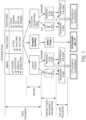
- Figure 1 shows basic mechanisms for the cold sintering process according to certain embodiments.
- the process is a basic, unique liquid phase sintering process that has not been exploited in the manufacture of ceramic materials.
- Figure 2 shows the basic diversity and integration contemplated for cold sintering of the present disclosure.
- Typical examples include microwave devices, electronic packages, and thermoelectric energy-conversion systems, as well as electrochemical systems, such as Li-ion batteries, where polymer separators and binders are interfaced with ceramic anode and cathode materials.
- electrochemical systems such as Li-ion batteries
- polymer separators and binders are interfaced with ceramic anode and cathode materials.
- the impact would also be in systems that involve development of nanocomposites, and even simple monolithic applications, such as substrates, ceramic filters, and catalytic supports that could be processed at significantly lower temperatures with fast production times, enabling manufacturing to have higher throughput, cost- and energy-savings.
- Figures 3a-3e illustrate microstructural development through varying processing conditions of time, temperature and pressure.
- Figures 3a-3e are SEM micrographs of K 2 Mo 2 O 7 in various forms.
- Figure 3(a) shows the K 2 Mo 2 0 7 powder;
- Figure 3(b) shows the K 2 Mo 2 O 7 ceramic sintered at 120 °C for 5 min at a pressure of 350 MPa;
- Figure 3(c) shows the K 2 Mo 2 O 7 ceramic sintered at 180 °C for 5 min at a pressure of 350 MPa;
- Figure 3(d) shows the K 2 Mo 2 O 7 ceramic sintered at 120 °C for 15 min at a pressure of 350 MPa;
- Figure 3(e) shows the K 2 Mo 2 O 7 ceramic sintered at 120 °C for 30 min at a pressure of 350 MPa.
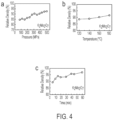
- Figures 4a to 4c show densification trends for time, temperature and pressure variables.
- Figures 4a to 4c are charts showing the relative densities of K 2 Mo 2 O 7 ceramics sintered under various conditions.
- Figure 4a is a chart of the relative densities of K 2 Mo 2 O 7 ceramics sintered at 120 °C for 5 min with different pressures;
- Figure 4b is a chart showing the relative densities of K 2 Mo 2 O 7 ceramics sintered at a pressure of 350 MPa for 5 min with different temperatures;
- Figure 4c is a chart showing the relative densities of K 2 Mo 2 O 7 ceramics sintered at 120 °C at a pressure of 350 MPa with different holding times.
- the data in these figure show how time, temperature and pressure can affect cold sintering of a give system.
- the amorphous-crystalline interface is typically arranged in a terrace-ledge manner, which is consistent with the classic Terrace-Ledge-Kink (TLK) model used to describe the equilibrium state of a crystal surface growing from the vapor or liquid; the terrace ends in a ledge and steps down to another one, and the missing atoms in the ledge forms kink sites.
- TLK Terrace-Ledge-Kink
- the step ledges and kinks provide energetically favorable sites for atomic diffusion and surface free energy minimization during liquid phase sintering, as the ionic species attached to these sites can establish a sufficient number of chemical bonds with the crystal surface so as to resist re-dissolving.
- nanometer-sized precipitates are also observed to nucleate on the crystal surface.
- An advantage of cold sintering processes of the present disclosure includes the electrical properties of cold sintered Li 2 MoO 4 , Na 2 Mo 2 O 7 , K 2 Mo 2 O 7 , and V 2 O 5 ceramics, which are comparable to those prepared by conventional thermal sintering at 540 °C, 575 °C, 460 °C, and 450-660 °C, respectively (Table 3, in the Examples section below).
- the data demonstrates that many simple and mixed metal oxides, metal chlorides and composites in a number of crystal structures with a variety of different melting temperatures can be sintered between room temperature and 200 °C; certain of the cold sintered inorganic compounds are listed in Table 1.
- the processes of cold sintering of the present disclosure are applicable to both inorganic compounds that have congruent dissolution and incongruent dissolution in the solvent.
- Congruent dissolution involves substantially no change in the composition of the compound upon its dissolution whereas incongruent dissolution involves a substantial change in composition of the compound upon its dissolution in the solvent.
- Incongruent dissolution is prevalent in a large number of materials, and which also have limited solubility in aqueous media, especially for the close-packed structures in which the atoms/molecules/ligands are tightened by strong chemical bonding.
- a well-known example is BaTiO 3 , which is not thermodynamically stable in aqueous environment of pH ⁇ 12. As BaTiO 3 particles react with water, Ba is preferentially leached out from the surface area, resulting in a Ba deficient layer with a Ti-rich amorphous shell. This amorphous layer is detrimental for the precipitation process since it separates the solution and crystal lattices and significantly impedes crystal growth from the supersaturated solution by limiting the mass transport between them. Therefore, simply mixing water with a BaTiO 3 powder and applying heat does not densify the ceramic.
- inorganic compounds that would ordinarily incongruently dissolve in a solvent can be cold sintered, with or without other substances.
- the process includes combining at least one inorganic compound in particle form with a solvent that can partially solubilize the inorganic compound to form a mixture.
- the solvent is saturated or supersaturated with one or more source compounds prior to contacting the solvent with the inorganic compound.
- the source compounds are preferable compounds that can synthesize the inorganic compound.
- the source compounds are compounds that substantially prevent incongruent dissolution of the inorganic compound when in contact with the solvent.
- Saturating to supersaturating the solvent with one or more source compounds prior to contact with the inorganic compound minimizes or prevents leaching of elements form the inorganic compound. It is believed leaching is due to the concentration difference between the solvent and the solid surface of the inorganic particles and adding the source compounds to the solvent to reach the concentration in saturate or supersaturation states prevents or minimizes leaching. While this aspect of the process of the present disclosure is particularly useful for inorganic compounds that incongruently dissolve in the solvent, it can be used for congruent dissolving compounds as well.
- solvents including source compounds in the cold sintering process of the present disclosure is different from a process of combining reactive compounds to synthesize an inorganic compound in that the cold sintering process of the present disclosure starts with a fully synthesized inorganic compound and densities the compound rather than to synthesize the compound from reaction components.
- the process continues by applying pressure and heat to the mixture to evaporate the solvent and densify the at least one inorganic compound to form a sintered material or composite.
- the applied heat in the embodiment is the same as in earlier embodiments, e.g., the applied heat is at a temperature of no more than 200 °C above the boiling point of the solvent or at a temperature below about 250 °C, e.g., below about 200 °C or below about 150 °C, such as below about 100 °C..
- the at least one inorganic compound can include particles sized less than 100 ⁇ m, or less than 50 ⁇ m, 30 ⁇ m, 20 ⁇ m, 10 ⁇ m, and even less than about 5 ⁇ m or less than about 1 ⁇ m.
- a high relative density can be achieved in a short time period, e.g., a relative density of at least 85% and even greater than 90% can be achieved in less than 180 minutes, e.g., less than 120 minutes, such as no more than 60 minutes or no more than 30 minutes.
- BaTiO 3 is a good material to demonstrate the advantages of cold sintering process of the present invention because: (1) it is a widely used ceramic material, particularly for multilayer ceramic capacitor (MLCC), (2) a dense BaTiO 3 ceramic is generally accomplished at ⁇ 1200-1400 °C by conventional thermal sintering, and (3) compared to the micrometer-sized powder, BaTiO 3 nanoparticles are generally more chemically reactive due to their high surface energy.
- MLCC multilayer ceramic capacitor
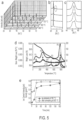
- Figure 5a displays the phase structure evolution of as-cold-sintered BaTiO 3 ceramics and after post annealing at 700 - 900 °C. Further details within a specific angular range are also magnified as Figures 5b and 5c for better illustration.
- impurity phase is identified, as circled by the dash line ( Figure 5b ). It has been commonly reported that BaCO 3 generally appears as a by-product during hydrothermal synthesis of BaTiO 3 since a certain amount of barium species react with CO 2 at certain temperatures.
- Figure 5d illustrates the thermogravimetric property of the cold-sintered ceramic during annealing process. Even though only a slightly total weight loss of ⁇ 1.8% is observed, sharp changes can still be detected at different temperature stages, and this can be more easily identified when a weight loss derivative with respective to the temperature is considered, as marked by peaks P1 - P4. With the assistance of mass spectrum, these peaks perfectly correlate with the burning out of two chemical species, the OH - (or H 2 O) and CO 2 . Firstly, the water vapor comes off at ⁇ 100 °C, which might be attributed to the water detachment from the surface areas of ceramic powders. Heating up to ⁇ 300 °C, the detection of OH - suggests a decomposition of certain hydroxide.
- BaTiO 3 nanoparticles are first homogeneously wetted with the water suspension containing the constituents for hydrothermal synthesis of BaTiO 3 .
- the liquid phase redistributes itself and fills into the pores between the particles, aiding particle compaction and rearrangement. Raising up the temperature facilitates the hydrothermal reactions to generate a glass phase, and also speeds up the partial dissolving of BaTiO 3 surfaces into the solution, resulting in a round shape of the crystallite.
- the shape of the crystallite accommodates: a rounded configuration is generally manifested when the glass phase is prevalent, while polyhedron with flat facets is normally developed when the volume of glass phase is significantly reduced. Simultaneously, mass transport during this process minimizes the excess free energy of the surface area and removes surface and porosity; the areas of crystallite-crystallite contacts increase, leading to a formation of rigid particulate skeletal network, and also resulting in a further improvement of the density to ⁇ 95% relative dense.
- the other one is the “dissolution-precipitation mechanism", which suggests that TiO 2 particles first dissolve into the aqueous solution to generate amorphous hydroxytitanium complexes (Ti(OH) n- ), and then react with dissolved barium to precipitate BaTiO 3 homogeneously from the solution/glass environment.
- Ti(OH) n- ) amorphous hydroxytitanium complexes
- BaTiO 3 amorphous hydroxytitanium complexes
- Ti element is found to be uniformly distributed into the glass phase. From this point of view, it seems to suggest that the presented cold sintering process most likely takes place via the dissolution-precipitation path aided by the epitaxial growth on BaTiO 3 particles.
- the processes of cold sintering of the present disclosure are applicable to preparing composites of sintered inorganic compounds, e.g. ceramics, with polymers.
- Co-sintering ceramic and polymers, e.g., thermoplastic polymers to form composites in a single step with very high volume fractions of ceramics seems unlikely, given the vast differences in the typical sintering temperatures of ceramics versus polymers.
- these processing limitations can be overcome with the sintering processes of the present disclosure.
- composites including one or more sintered inorganic compounds with one or more polymers can be formed.
- the process includes combining at least one inorganic compound in particle form with at least one polymer and a solvent that can partially solubilize the inorganic compound to form a mixture.
- the process continues by applying pressure and heat to the mixture to evaporate the solvent and densify the at least one inorganic compound to form a sintered material or composite.
- the applied heat in the embodiment is the same as in earlier embodiments, e.g., the applied heat is at a temperature of no more than 200 °C above the boiling point of the solvent or at a temperature below about 250 °C, e.g., below about 200 °C or below about 150 °C, such as below about 100 °C..
- the at least one inorganic compound can include a certain percentage of particles sized less than 100 ⁇ m, or less than 50 ⁇ m, 30 ⁇ m, 20 ⁇ m, 10 ⁇ m, and even less than about 5 ⁇ m or less than about 1 ⁇ m.
- a high relative density of the inorganic compound can be achieved in a short time period, e.g., a relative density of at least 85% and even greater than 90% can be achieved in less than 180 minutes, e.g., less than 120 minutes, such as no more than 60 minutes or 30 minutes.
- thermoplastic polymers suitable for cold sintering according to embodiments of the present disclosure.
- Table 2 Thermoplastic Polymers Common Abbreviations Acrylonitrile butadiene styrene ABS Aliphatic polyamides Poly(3,4-ethylenedioxythiophene) PEDOT:PSS polystyrene sulfonate Poly(methyl methacrylate) PMMA Poly(p-phenylene oxide) PPE Polybenzimidazole PBI Polycarbonate PC Polyetherether ketone PEEK Polyetherimide PEI Polyethersulfone PES Polyethylene PE Polypropylene PP Polystyrene PS Polytetrafluoroethylene PTFE Polyurethanes Polyvinyl chloride PVC Polyvinylidene difluoride PVDF Sulfonated tetrafluoroethylene (Nafion)
- the sintering conditions of the present disclosure make it possible to co-sinter polymers and ceramic materials in a one-step sintering process.
- Three illustrative examples include: microwave dielectric Li 2 MoO 4 -(-C 2 F 4 -) n (PTFE), electrolyte Li 1.5 Al 0.5 Ge 1.5 (PO 4 ) 3 - (-CH 2 CF 2 -) x [-CF 2 CF(CF 3 )-] y (PVDF-HFP), and semiconductor V 2 O 5 - PEDOT:PSS (poly(3,4-ethylenedioxythiophene) polystyrene sulfonate) composites to show a range of electrical functionalities created by the ability to co-process dense ceramics with polymers as the minor filler phase into previously unrealized composites.
- PTFE microwave dielectric Li 2 MoO 4 -(-C 2 F 4 -) n
- PVDF-HFP electrolyte Li 1.5 Al 0.5 Ge 1.5
- Dense Li 2 MoO 4 (LM), Li 1.5 Al 0.5 Ge 1.5 (PO 4 ) 3 (LAGP) and V 2 O 5 ceramics can be cold sintered at 120 °C for 15-60 minutes, as shown in Figure 6a-c , in contrast to high conventional thermal sintering temperatures and long holding times at 540 °C for 2 hours, 825 °C for 8 hours, and 450-660 °C for 2 to 26 hours, respectively.
- the polymer is a light weight material, and thereby the densities of the ceramic-polymer composites decrease with increasing amount of polymer ( Figure 6a-c ).
- the polymers were specifically selected to compliment the properties of the ceramic materials.
- PTFE is a very good dielectric material
- PVDF-HFP is an excellent host for Li-salts in polymer gel electrolytes
- PEDOT:PSS is a good electronic conducting polymer.
- the relative densities of all the (1-x) LM - x PTFE and (1-x) V 2 O 5 -x PEDOT:PSS samples are higher than 90%, and the densities of (1-x) LAGP - x (PVDF-HFP) samples range between 80 to 88%, indicating that the ceramic-polymer composites can be sintered well by a cold sintered process.
- the PEDOT:PSS is a hydrophilic polymer with a pH value around 1.5-2.5 in aqueous solution (3-4% PEDOT:PSS).
- the lower pH value of PEDOT:PSS can enhance the dissolution rate of V 2 O 5 in water and slightly improve the relative density of (1-x) V 2 O 5 - x PEDOT:PSS composites.
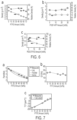
- the performance of ceramic-polymer composites depends on the properties of the component materials, their volume fractions, phase connectivity, particle sizes, porosity, etc. Dense ceramic-polymer composites can be obtained by cold sintering according to the present disclosure. Therefore, by changing the amount of polymer, it is possible to design the properties of ceramic-polymer composites, such as electrical and mechanical properties, as illustrated in Figure 7a .
- the microwave dielectric (electrical) properties of (1-x) LM - x PTFE composites as a function of x value are plotted in Figure 7b-d .
- the permittivity of PTFE is lower than that of Li 2 MoO 4 , so that the relative permittivity of composites decrease from 5.8 to 2.9, with x increasing from 0 to 0.7.
- the measured relative permittivity of (1-x) LM - x PTFE composites are lower than the calculated ones obtained from parallel mixing law and higher than that calculated from series mixing law.
- the assumption of either perfectly parallel or perpendicular alignment is not appropriate for the real samples, and many modified models are deduced.
- Equation 3 becomes parallel and series mixing laws, respectively.
- Figure 7a shows that the measured permittivity data are in good agreement with the trends predicted by Equation 4.
- Figure 7c shows that the Q ⁇ f (f, resonant frequency) value has no obvious deterioration when the amount of PTFE changes, indicating that the (1-x) LM - x PTFE composite can be used for microwave application.
- LM and PTFE have different TCF values, therefore, with x increasing from 0 to 0.7, the TCF value of (1-x) LM - x PTFE composites shift from -170 to -7.2 ppm °C -1 ( Figure 7d ). This result reveals that the thermal stability of resonate frequency of LM can be improved by adding PTFE.
- TCF 1 and TCF 2 are TCF values of phase 1 and phase 2, respectively. It is seen that the experimental TCF values are similar to the predictions of Equation 5.
- Polymers are relatively soft materials compared to ceramics which are stiff materials, so that the elastic and shear moduli of the (1-x) LM - x PTFE composites decrease with increasing PTFE content, as shown in Figure 7e .
- the upper and lower bounds can be determined assuming that the composite materials are aligned parallel and perpendicular (series) to the direction of loading, respectively.
- the modulus lies between the upper and lower bounds, as demonstrated in Figure 7e .
- the measured modulus of composites has good agreement with the calculated one.
- PTFE When the amount of PTFE is large, the measured modulus is a little smaller than that of calculated one. In this region, PTFE can be considered as the matrix and the ceramic is the filler. Many other models can be used to predict the modulus of (1-x) LM - x PTFE composites.
- Well-crystallized, conventionally sintered LAGP has a conductivity of 3 ⁇ 10 -4 S cm -1 at 25 °C.
- the total activation energy of cold sintered LAGP with and without polymer is consistent with a partially amorphous grain boundary (0.60 eV). Grain boundaries dominate the total conduction and total activation energy of cold sintered LAGP with and without polymer. In contrast, well-crystallized, conventionally sintered LAGP grain and grain boundary regions have similar activation energies (0.40 ⁇ 0.02 eV).
- Literature describes the origin of grain boundary resistance to be geometrical current constriction from limited grain boundary contact area. While co-sintering ceramic with polymer may physically bridge resistive grain boundaries, soaking the composite in liquid electrolyte is required to ionically bridge these resistive grain boundaries. Polymer swelling through liquid electrolyte uptake also increases grain boundary contact area.
- compositions with polymer loadings ⁇ 30 vol.%, where polymer swelling changes the composite dimensions has been reported in flexible, solvent cast composites. After sixty days of soaking in liquid electrolyte at room temperature, dimensions of composite electrolytes of x ⁇ 0.30 in (1-x) LAGP - x (PVDF-HFP) did not change. No change in composite electrolyte dimensions is related to the cold sintered ceramic constraining the polymer's swelling.
- V 2 O 5 is a wide bandgap semiconductor, which has an electronic DC conductivity ( ⁇ ) of 10 -5 ⁇ 10 -3 S cm -1 at room temperature and activation energy of 0.17-0.21 eV.
- the DC conductivity (4.8 ⁇ 10 -4 S cm -1 ) and activation energy (0.25 eV) of cold sintered V 2 O 5 ceramics are comparable to that obtained by the conventional thermal sintering.
- PEDOT:PSS with a high conductivity of 150 S cm -1 (18 ⁇ m film) at room temperature, further enhanced conductivity can be considered. This is demonstrated in cold sintered composites with the DC conductivity improving systematically with PEDOT:PSS additions, as shown in Figure 8c .
- the DC conductivity of (1-x) V 2 O 5-x PEDOT:PSS composites can be increased by 1-2 orders only by adding up to 1-2% PEDOT:PSS.
- the activation energy of (1-x) V 2 O 5 - x PEDOT:PSS (0.8 ⁇ x ⁇ 0.27) composites is in the range of 0.22-0.23 eV, and lower than that of pure V 2 O 5 ceramic ( Figure 8d ).
- ceramic - polymer composites can be prepared using cold sintering processes of the present disclosure.
- the composites can include a wide range of polymers and can be sintered to high densities by a low sintering temperature (e.g., as low as 120 °C) and for short time periods (e.g., ranging from 15-60 minutes).
- the electrical and mechanical properties of composites can be predicted by the mixing law.
- the cold sintering processes of the present disclosure can bridge the processing gap of ceramics and polymers, and open up a simple and effective way for material systems and devices using ceramics and polymers that are traditionally incompatible. Typically, hundreds of degrees separate the ability to co-process these materials in one step with high volume fractions of ceramic materials.
- the cold sintering processes of the present disclosure allows fabrication of sintered materials and composites that include a substance that degrades or oxides at a temperature above about 200 °C.
- Cold sintering allows for the fabrication of new materials and devices due primarily to its the low temperature process.
- the cold sintering process of the present disclosure allows densification of different materials such as ceramics, polymers and metals on the same substrate to obtain functional circuitry.
- Such materials and devices can be fabricated by depositing a ceramic, such as a ceramic paste, with or without other substances, on to a substrate (e.g., a substrate comprised of a metal, ceramic, polymer).
- the substrate can have an electrode layer between the deposited ceramic and substrate among other device layers.
- the ceramic can be combined with a solvent such as by exposing the deposited ceramic to an aqueous solvent to form a more or less uniformly wetted deposited ceramic.
- Heat and pressure can then be applied to the deposited and wetted ceramic to sinter the ceramic on the substrate in the same manner as heat and pressure were described for other embodiments.
- the process can be heated to less than 200 °C, e.g., less than 150 °C, with a pressure of no more than 5,000 MPa, e.g., less than 2,000 Mpa, or between about 30 Mpa to about 1,000 MPa.
- the sintered ceramic on the substate can achieve a relative density of greater than 80% such as no less than 85% and even greater than 90%.
- the high relative density of the ceramic can be achieved in a short time period, e.g., a relative density of at least 85% and even greater than 90% can be achieved in less than 180 minutes, e.g., less than 120 minutes, such as no more than 60 minutes and even no more than 30 minutes. Fabrication of cold sintered capacitors on both metal and polymeric substrates are provided in the examples below.
- BaFe 12 O 19 (97%) nanopowders, V 2 O 5 (98%), and ZnO (99%) were provided by Sigma-Aldrich.
- Bi 2 O 3 (99.9%), E-glass fibers (70 ⁇ m) and Teflon (PTFE) were purchased from MCP Inc., TAP Plastics Inc. and Howard Piano Industries, respectively.
- Li 2 MoO 4 , Na 2 Mo 2 O 7 , K 2 Mo 2 O 7 and Li 2 WO 4 powders were synthesized by the solid state reaction method using stoichiometric amounts of Li 2 CO 3 , Na 2 CO 3 , K 2 CO 3 , MoO3 and WO 3 . Mixtures of raw materials were milled with zirconia balls in ethanol for 24 h.
- Li 2 MoO 4 powders were mixed with BaFe 12 O 19 , PTFE, and E-glass fibers (abbreviated as "EG") according to the following formula: 0.8Li 2 MoO 4 -0.2BaFe 12 O 19 , 0.5Li 2 MoO 4 -0.5PTFE, and 0.8Li 2 MoO 4 -0.2EG (Volume Fraction).
- EG E-glass fibers
- Method 1 All the powders except ZnO were mixed with 4 ⁇ 25wt% deionized water using a pipet. ZnO was mixed with an aqueous acetic acid solvent with concentration of 0.5 - 5.0 M acetic acid (pH value of about 2-4). After being stirred with a mortar and pestle, the moistened powders were hot-pressed with a steel die into dense pellets (12.7 mm in diameter and 1-5 mm in height) under a uniaxial pressure of 80 ⁇ 570 MPa at 120 °C. The die was preheated at 120 °C for more than 1h. Finally, the pellets were placed into an oven at 120 °C for 6h to remove the possibility of water residue.
- Method 2 All the dry powders were pressed into soft pellets under a low pressure (30 ⁇ 70 MPa) at room temperature. Then, the pellets were put in a humid atmosphere (water vapor generated by heating deionized water or humidity chamber) for 10 ⁇ 360min. The moistened pellets were hot-pressed with a steel die into dense pellets under a uniaxial pressure of 80 ⁇ 570 MPa at 120 °C. The die was preheated at 120 °C for more than 1h. Finally, the pellets were placed into an oven at 120 °C for 6h to remove the possibility of water residue.
- a humid atmosphere water vapor generated by heating deionized water or humidity chamber
- Li2MoO4 and K2Mo2O7 tapes were prepared by the tape casting procedure.
- the powders were first added into a solution of 96wt% methylethylketone (MEK) and 4wt% Qpac, and milled with zirconia balls. Then, another solution of 66.3wt% methylethylketone (MEK), 28.4wt% Qpac and 5.3wt% Santicizer-160 was added into the slurry, followed by an additional ball milling.
- Tape casting was performed using a laboratory-type casting machine with a doctor blade casting head. Silicone-coated mylar (polyethylene terephthalate) was used as a carrier film.
- Li 2 MoO 4 -K 2 Mo 2 O 7 multilayer Li 2 MoO 4 and K 2 Mo 2 O 7 green tapes were stacked alternately.
- Li 2 MoO 4 -Ag multilayer silver paste was printed on the Li 2 MoO 4 green tape and two silver-printed layers and ten Li 2 MoO 4 layers were stacked together. Then, the stacked Li 2 MoO 4 -K 2 Mo 2 O 7 and Li 2 MoO 4 -Ag layers were laminated under an isostatic pressure of 20 MPa at 80 °C for 20 min. The binders were burn out at 175 °C for 10h in air with a heating rate of 0.5 °C /min.
- the multilayers were sintered using a cold-sintering fabrication step, as described previously.
- the multilayers were put in a humid atmosphere (water vapor generated by heating deionized water or humidity chamber) for 10 ⁇ 360min.
- the moistened multilayers were hot-pressed with a steel die into dense ceramics under a uniaxial pressure of 80 ⁇ 570 MPa at 120 °C.
- the die was preheated at 120 °C for more than 1h.
- the co-fired multilayers were placed into an oven at 120 °C for 6h to remove the possibility of residual hydroxides.
- the bulk densities of the sintered samples were measured by Mass/Geometry ratio and Archimedes' method. Relative densities were determined by the ratio of experiment measured bulk density over the density of corresponding density of the materials in the form of single crystals.
- Table 3 below provides densities and performance characteristics for certain ceramics prepared with a cold sintering step including water as a solvent and at 120 °C under a pressure of 350 MPa.
- CSP Cold Sintering Process
- BaTiO 3 nanopowders (99.9%, 50nm with cubic phase) were purchased from commercial resource (e.g., US Research Nanomaterials, Inc.).
- Ba(OH) 2 /TiO 2 suspension was made by mixing corresponding chemicals with deionized water. The molar ratio of Ba(OH) 2 :TiO 2 was 1.2:1, and the concentration of Ba(OH) 2 was 0.1 mol L -1 .
- 0.14 - 0.15 g Ba(OH) 2 /TiO 2 suspension was added to 0.56 g BaTiO 3 nanopowders; the mixtures were grinded using pestle and mortar for 3 minutes.
- the mixture was uniaxially pressed under 430 MPa first at room temperature (25 °C) for 10 minutes, and then the temperature was ramped up to 180 °C with an overall rate of 9 °C min -1 .
- the temperature was isothermally kept for 1 minute to 3 hours to obtain a series of samples.
- the as-prepared ceramic pellets were first baked at 200 °C overnight to further remove possible water residue, and then further annealed at 700 - 900 °C for 3 hours with a temperature ramp rate of 5 °C min -1 in air.
- the densities were measured by Archimedes method using acetone (0.791 g cm -3 ) as a liquid media.
- phase structures were checked by X-ray diffraction (Panalytical, X'Pert PRO) with Cu-K ⁇ radiation.
- platinum was sputtered as electrodes, and the dielectric properties were measured at 1 kHz - 1 MHz by LCR meter (HP4284A, Agilent Technologies) during cooling from 200 °C to room temperature with 2 °C min-1 rate.
- Thermogravimetric-Mass Spectrum (TGA-MS Q50, TA Instrument) analysis was performed in helium atmosphere from 30 to 900 °C with 10 °C min-1. Ceramic powders crushed from the sintered pellets were used. Before heating up, the samples were kept at 30 °C for 1 hour to reach an equilibrium state.
- TEM specimens were prepared via standard procedures including mechanical thinning, polishing, and ion milling. The specimens were polished down to ⁇ 30 ⁇ m thick, and then mounted on molybdenum grids. The foils were further thinned with an Ar-ion mill (Gatan, PIPS II) until an electron transparent perforation was formed. A cryogenic stage was used to cool the specimen to the liquid N 2 temperature during ion milling to minimize structural damage and artifacts. Microstructural and chemical studies were performed on a Talos (FEI, Talos) microscopy equipped with an Energy Dispersive X-ray Spectroscopy (EDS) system operating at an accelerating voltage of 200 kV.
- EDS Energy Dispersive X-ray Spectroscopy
- PTFE Howard Piano Industries
- Li 1.5 Al 0.5 Ge 1.5 (PO 4 ) 3 powder preparation Stoichiometric amounts of Li 2 CO 3 (Alfa Aesar, 99%), Al 2 O 3 (Tape Casting Warehouse, Inc.), GeO 2 (Alfa Aesar, 99.98%), and NH 4 H 2 PO 4 (Alfa Aesar, 98%) were ball milled for 24 h, calcined in air at 750 °C for 30 min, and again ball milled for 24 h. Milled powder was placed in a covered alumina crucible and melted in air at 1380 °C for 1 h before being splat-quenched. Splat-quenched glass was annealed at 450 °C for 3.75 h and crystallized in air at 825 °C for 8 h. Glass-ceramic powder was sieved through a 74 ⁇ m mesh.
- Dense composites were prepared by a cold sintering process.
- (1-x) LM - x PTFE appropriate amounts of deionized water (6 to 12 wt.%) were added to the mixture of Li 2 MoO 4 and PTFE, and mixed homogeneously with a mortar and pestle. Afterwards, the moistened powders were pressed into dense samples under 350 MPa uniaxial pressure at 120 °C for 15-20 min.
- (1-x) LAGP - x (PVDF-HFP) 30 to 39 vol.% of deionized water was added to LAGP and homogenized in a mortar and pestle.
- LAGP and PVDF-HFP were mixed by swirling in liquid nitrogen and pressed under 400 MPa uniaxial pressure at 120 °C for 1 h.
- (1-x) V 2 O 5 - x PEDOT:PSS moistening took place with deionized water (11 to 17 wt.%) and dense ceramic-polymer composites were pressed under a uniaxial pressure of 350 MPa at 120 °C for 20-30 min.
- phase purity and composition of composites after cold sintering were determined by X-ray diffraction (PANalytical Empyrean).
- An environmental scanning electron microscope (ESEM, FEI, Quanta 200) with an energy dispersive spectrometer (EDS) was used to analyze microstructures and elemental distribution of Cold Sintered samples on cross section. Bulk densities were measured by mass/geometric volume ratio and Archimedes method.
- the microwave dielectric properties (permittivity and Q ⁇ f valve) of (1-x) LM - x PTFE were identified using the Hakki-Coleman method in TE 011 mode with a vector network analyzer (Anritsu 37369D).
- TCF temperature coefficient of resonant frequency
- the disks were cut into bars with a dimension of 10 ⁇ 2 ⁇ 1 mm. After polishing the bars, Pt electrodes were deposited and Ag wires were attached with Ag epoxy (Epo-tek H20E). The DC electrical conductivity was measured using a four terminal technique with a Keithley 2700 Integra series digital multimeter.
- Table 4 below provides densities and dielectric properties of 0.9Li 2 MoO 4 -0.1PTFE composite prepared by Hot Press and Cold Sintering Process (CSP) Table 4 Density (g cm -3 ) Relative Density (%) ⁇ r Q ⁇ f (GHz) tan ⁇ Hot Press 2.5 85 4.7 10430 1.7 ⁇ 10 -3 (22.9 GHz) CSP 2.85 95.8 5.2 25150 7.2 ⁇ 10 -4 (18.1 GHz)
- a ceramic ink was prepared using Lithium Molybdenum Oxide powder (99+%, Alfa Aesar, Ward Hill, MA) that was ball-milled in ethanol for 48-100 hours before use.
- a printing vehicle was made by mixing QPAC 40 (poly(propylene carbonate)) resin (Empower Materials, New Castle, DE) with Ethylene Glycol Diacetate (97%, Alfa Aesar, Ward Hill, MA) in amounts of 15 and 85 wt% respectively in a planetary centrifugal mixer (AR250, Thinky USA, Website, CA) until the resin was completely dissolved in the solvent.
- QPAC 40 poly(propylene carbonate) resin
- Ethylene Glycol Diacetate 97%, Alfa Aesar, Ward Hill, MA
- Li 2 MoO 4 the printing vehicle, additional ethylene glycol diacetate and Butyl Benzyl Phthalate S-160 (Tape Casting Warehouse, Morrisville, PA) in amounts of 66.1, 22.0, 11.0, and 0.9 wt% respectively were blended and homogenized in the planetary centrifugal mixer.
- Substrates were prepared by cutting PET (Polyethylene terephthalate) sheets (Tape Casting Warehouse, Morrisville, NJ) into 32 by 32 mm squares, and then metallized using silver ink (5029, DuPont, Wilmington, DE, USA) in a 25.4 by 25.4 mm square pattern to form a bottom electrode.
- a 200 mesh stainless steel screen (UTZ LLC, Little Falls, NJ) was used to print the pattern.
- the silver ink was cured at 120°C for 30 minutes.
- 50 micron thick Nickel foil (99+%, Alfa Aesar, Ward Hill, MA) substrates were also prepared.
- a ceramic ink was printed onto the metallized PET substrates using a 400 calendared mesh stainless steel screen with a pattern of 5 by 5 mm squares.
- a double pass was used for each printed layer of the double-layered prints, where the ink was dried at 120°C for 15 minutes between layers. Ceramic ink was also printed onto the Nickel Foil substrates using a 25.4 by 25.4 mm square pattern, 200 mesh screen as described above. Single layered prints were dried as above. Binder burnout was performed at 0.2 °C/min to 150 °C for the Nickel samples, and 175°C for the PET samples, with a dwell at peak temperature for 6 hours.
- Cold Sintering was performed by first exposing the printed samples to water vapor in a sealed beaker at 35-40°C until the bright white prints just turned a dull gray color, which indicated that water had absorbed into the printed ink squares. Wetted samples were allowed to sit for approximately a minute to allow excess water to equilibrate before placing a silicone coated PET sheet on top of the printed film. The sample was then placed between several sheets of paper or Polytetrafluoroethylene (PTFE) sheets and loaded into the platen press preheated to 120°C. The paper and PTFE were used to help evenly distribute pressure on the samples with a 70 to 100 MPa pressure being applied to the stacks for 12-15 minutes.
- PTFE Polytetrafluoroethylene
- top electrodes were applied in a circular configuration using colloidal silver paste (PELCO, Ted Pella, Redding, CA). The electrodes were allowed to dry at room temperature for 10 minutes.
- Capacitance and loss at room temperature 1 kHz were measured and permittivity was calculated based on a determined print thickness of 20-21 microns for the single-layered capacitors on Nickel foil, and 30-31 microns for the double-layered printed capacitors on PET film. It appears that lamination conditions, such as the type of paper or plastic surrounding the sample during pressing can influence electrical properties. It was observed that several sheets of glossy paper gave the smoothest, and most even lamination condition, as all 9 capacitors in the array appeared to be densified. This was indicated by a color change from white, which represented green state samples to a dull gray which indicated densified samples, and similar electrical characteristics. Results of the averaged dielectric properties are summarized in Table 5 along with various modifications to the process.
- the Li 2 MoO 4 ceramic coexists with Ag electrodes, indicating that the printed Li 2 MoO 4 ceramic can be co-sintered with Ag electrodes by a cold sintering process at 120 °C.
- Table 5 Summary of Electrical Properties of Cold sintered Li 2 MoO 4 printed capacitors tested at room temperature, 1 kHz Substrate Type Pressing Conditions Capacitance Tan ⁇ Dielectric Constant Pressing Aid Ni Foil 100 MPa, 15 min. @ 120°C 52 pF 0.012 4.4 paper Ni Foil 100 MPa, 15 min. @ 120°C 47 pF 0.025 3.6 PFTE PET 100 MPa, 12 min. @ 120°C 17.1 pF 0.006 5.0 Glossy paper
- Cold sintered printed Li 2 MoO 4 capacitors have electrical and microstructural properties that are similar to those that have been conventionally processed.
- the ability to co-process incompatible materials systems, such as low temperature polymers with high temperature ceramics, allows production of variety of new composites for device construction.
- energy and time savings by employing the cold sintering method are significant when compared to conventional sintering methods.
- Figure 10 is a plot comparing relative density to sintering temperature of inorganic materials (example BaTiO 3 ) made by different processes.
- CS Conventional Sintering
- TSS Two-Step Sintering
- RCS Rate-Controlled Sintering
- SPS Spark Plasma Sintering
- MVS Microwave Sintering
- HPS High Pressure Sintering
- FS Flash Sintering
- Combined RRS (Rapid-Rate Sintering)-RCS-LP (Low Pressure)-TSS
Landscapes
- Chemical & Material Sciences (AREA)
- Engineering & Computer Science (AREA)
- Ceramic Engineering (AREA)
- Manufacturing & Machinery (AREA)
- Materials Engineering (AREA)
- Structural Engineering (AREA)
- Organic Chemistry (AREA)
- Inorganic Chemistry (AREA)
- Composite Materials (AREA)
- Compositions Of Oxide Ceramics (AREA)
Priority Applications (1)
| Application Number | Priority Date | Filing Date | Title |
|---|---|---|---|
| EP24164739.5A EP4365152A3 (en) | 2015-09-29 | 2016-09-26 | Cold sintering ceramics and composites |
Applications Claiming Priority (3)
| Application Number | Priority Date | Filing Date | Title |
|---|---|---|---|
| US201562234389P | 2015-09-29 | 2015-09-29 | |
| US201662349444P | 2016-06-13 | 2016-06-13 | |
| PCT/US2016/053772 WO2017058727A1 (en) | 2015-09-29 | 2016-09-26 | Cold sintering ceramics and composites |
Related Child Applications (2)
| Application Number | Title | Priority Date | Filing Date |
|---|---|---|---|
| EP24164739.5A Division EP4365152A3 (en) | 2015-09-29 | 2016-09-26 | Cold sintering ceramics and composites |
| EP24164739.5A Division-Into EP4365152A3 (en) | 2015-09-29 | 2016-09-26 | Cold sintering ceramics and composites |
Publications (3)
| Publication Number | Publication Date |
|---|---|
| EP3356310A1 EP3356310A1 (en) | 2018-08-08 |
| EP3356310A4 EP3356310A4 (en) | 2019-03-13 |
| EP3356310B1 true EP3356310B1 (en) | 2024-05-01 |
Family
ID=58427850
Family Applications (2)
| Application Number | Title | Priority Date | Filing Date |
|---|---|---|---|
| EP16852372.8A Active EP3356310B1 (en) | 2015-09-29 | 2016-09-26 | Cold sintering ceramics and composites |
| EP24164739.5A Pending EP4365152A3 (en) | 2015-09-29 | 2016-09-26 | Cold sintering ceramics and composites |
Family Applications After (1)
| Application Number | Title | Priority Date | Filing Date |
|---|---|---|---|
| EP24164739.5A Pending EP4365152A3 (en) | 2015-09-29 | 2016-09-26 | Cold sintering ceramics and composites |
Country Status (7)
| Country | Link |
|---|---|
| EP (2) | EP3356310B1 (enExample) |
| JP (2) | JP6871257B2 (enExample) |
| KR (2) | KR20240147696A (enExample) |
| CN (2) | CN108137417B (enExample) |
| CA (1) | CA2996051C (enExample) |
| MX (1) | MX2018003476A (enExample) |
| WO (1) | WO2017058727A1 (enExample) |
Families Citing this family (39)
| Publication number | Priority date | Publication date | Assignee | Title |
|---|---|---|---|---|
| EP3481789A1 (en) | 2016-07-05 | 2019-05-15 | ETH Zürich | High performance ceramics from cold sintered nanoscale powders |
| EP3504173A1 (en) * | 2016-08-26 | 2019-07-03 | SABIC Global Technologies B.V. | Ceramic-polymer composites obtained by a cold sintering process |
| KR20190052678A (ko) * | 2016-08-26 | 2019-05-16 | 사빅 글로벌 테크놀러지스 비.브이. | 냉간 소결에 의한 세라믹 복합 재료의 제조 방법 |
| CN111278790A (zh) * | 2017-08-25 | 2020-06-12 | 沙特基础工业全球技术公司 | 包含聚合物和陶瓷冷烧结材料的基板 |
| CN108933283A (zh) * | 2018-07-13 | 2018-12-04 | 国联汽车动力电池研究院有限责任公司 | 低温溶剂辅助烧结制备固体电解质的方法 |
| CN109133911A (zh) * | 2018-09-25 | 2019-01-04 | 桂林电子科技大学 | 一种超低温冷烧结ZnO基陶瓷的方法 |
| CN109336572A (zh) * | 2018-10-24 | 2019-02-15 | 湖南科技大学 | 一种制备氧化物陶瓷的冷压烧结方法 |
| CN109053173A (zh) * | 2018-10-24 | 2018-12-21 | 湘潭大学 | 一种氧化硅陶瓷烧结方法 |
| CN109494350B (zh) * | 2018-11-21 | 2021-09-14 | 上海科技大学 | 一种电极、制备方法及锂离子电池 |
| CN109867519B (zh) * | 2019-04-25 | 2022-04-15 | 重庆大学 | 一种高电位梯度ZnO压敏陶瓷及其制备方法 |
| CN110183227B (zh) * | 2019-04-29 | 2021-09-10 | 杭州电子科技大学 | 一种Li2MoO4-Mg2SiO4基复合陶瓷微波材料及其制备方法 |
| CN110078038B (zh) * | 2019-05-27 | 2022-12-06 | 淄博新维陶瓷科技有限公司 | 一种羟基磷灰石及其制备方法与应用 |
| JP2020200230A (ja) * | 2019-06-13 | 2020-12-17 | 日本特殊陶業株式会社 | セラミックス体およびセラミックス体の製造方法 |
| EP4039664A4 (en) * | 2019-09-30 | 2022-11-23 | Panasonic Intellectual Property Management Co., Ltd. | PLANT STRUCTURE AND COMPONENT AND INTERIOR WITH IT |
| WO2021067036A1 (en) * | 2019-09-30 | 2021-04-08 | The Penn State Research Foundation | Cold sintering process for densification and sintering of powdered metals |
| JP7555011B2 (ja) * | 2019-09-30 | 2024-09-24 | パナソニックIpマネジメント株式会社 | 複合部材 |
| CN114728856A (zh) * | 2019-10-04 | 2022-07-08 | 宾州研究基金会 | 水化助熔剂辅助的致密化 |
| WO2021116531A1 (en) * | 2019-12-13 | 2021-06-17 | Oulun Yliopisto | Electroceramic composite material and method of manufacturing it |
| CN112080039B (zh) * | 2020-08-31 | 2022-01-14 | 浙江工业大学 | 一种锂基钒基低温烧结瓷化粉及其应用 |
| CN112143932A (zh) * | 2020-09-10 | 2020-12-29 | 深圳金斯达应用材料有限公司 | 一种铜基钯涂层键合引线及其制作方法 |
| CN112876251A (zh) * | 2021-03-09 | 2021-06-01 | 杭州电子科技大学 | 基于冷烧结技术制备的高性能低介微波陶瓷及方法 |
| CN113149609B (zh) * | 2021-03-29 | 2022-05-27 | 国网湖南省电力有限公司 | 一种多元陶瓷的烧结方法 |
| GB2606204A (en) | 2021-04-29 | 2022-11-02 | Ilika Tech Ltd | Component for use in an energy storage device or an energy conversion device and method for the manufacture thereof |
| CN112979312A (zh) * | 2021-04-30 | 2021-06-18 | 昆明理工大学 | 一种ab2o6型铌酸盐陶瓷及其制备方法 |
| CN115432998B (zh) * | 2021-06-03 | 2023-05-09 | 中国科学院上海硅酸盐研究所 | 一种直书写用透明陶瓷浆料的制备方法 |
| CN113527082B (zh) * | 2021-06-29 | 2022-04-22 | 西安交通大学 | 一种电子功能陶瓷及其制造方法和应用 |
| CN113800920B (zh) * | 2021-08-25 | 2023-02-28 | 中国华能集团清洁能源技术研究院有限公司 | 陶瓷片的制备方法和密封组件 |
| CN114163241B (zh) * | 2021-10-21 | 2022-09-02 | 杭州电子科技大学 | 一种低温热压制备的高性能低介微波介质陶瓷及其方法 |
| CN113855861B (zh) * | 2021-11-24 | 2022-08-09 | 吉林大学 | 一种高强度可原位载药的ha-pla复合材料低温制备方法 |
| CN114464858A (zh) * | 2022-02-15 | 2022-05-10 | 吉林大学 | 一种盐/陶瓷复合电解质材料的制备方法 |
| CN114477950B (zh) * | 2022-03-17 | 2022-10-18 | 二向箔(苏州)微波介质材料有限公司 | 一种基于芳纶纤维织物的陶瓷基复合材料的制备方法 |
| CN116924802A (zh) * | 2022-04-01 | 2023-10-24 | 武汉纺织大学 | 高致密块体Cu2SnSe3热电材料及其低温烧结制备方法 |
| CN115477539A (zh) * | 2022-08-02 | 2022-12-16 | 桂林电子科技大学 | 一种氟化钙透明陶瓷及低温制备方法 |
| CN116063065B (zh) * | 2022-08-30 | 2024-07-02 | 重庆大学 | 一种精细α-Al2O3陶瓷的热辅助冷烧结方法 |
| CN115947596B (zh) * | 2023-01-16 | 2023-12-05 | 西安交通大学 | 一种基于微波冷烧结的微波介质陶瓷材料及低碳制备方法 |
| CN116903355B (zh) * | 2023-07-25 | 2025-07-18 | 安徽工业大学 | 一种具有优异铁电性能的铁酸铋-钛酸钡/钡铁氧体复合陶瓷冷烧结辅助制备方法 |
| CN116813324B (zh) * | 2023-08-30 | 2023-11-07 | 南昌大学 | 一种复合铁氧体材料及其制备方法 |
| CN117383931B (zh) * | 2023-10-12 | 2025-10-31 | 中国工程物理研究院材料研究所 | 一种冷烧结-闪烧技术的两联法细晶陶瓷制备方法 |
| CN117820006A (zh) * | 2023-11-08 | 2024-04-05 | 浙江沁园水处理科技有限公司 | 一种高性能除氯矿化陶瓷微球及其制备方法 |
Family Cites Families (19)
| Publication number | Priority date | Publication date | Assignee | Title |
|---|---|---|---|---|
| US4961778A (en) * | 1988-01-13 | 1990-10-09 | The Dow Chemical Company | Densification of ceramic-metal composites |
| JP2588254B2 (ja) * | 1988-07-30 | 1997-03-05 | マツダ株式会社 | 耐摩性摺動部材 |
| JP2603539B2 (ja) * | 1989-06-02 | 1997-04-23 | 株式会社豊田中央研究所 | 粘土鉱物焼結体およびその製造方法 |
| JP3863207B2 (ja) * | 1994-09-28 | 2006-12-27 | 東燃ゼネラル石油株式会社 | ランタンクロマイト系セラミックス、それを含有するセパレータ及び該セパレータを用いた固体電解質型燃料電池 |
| JP3656129B2 (ja) * | 1995-04-20 | 2005-06-08 | 秀明 高橋 | 炭酸カルシウム固化体の製造方法並びに製造用原料粉末及び原料粉末の製造方法 |
| JPH107411A (ja) * | 1996-06-20 | 1998-01-13 | Nakamichi Yamazaki | 含水物質の焼結方法、リン酸塩固化体、炭酸カルシウム固化体及びそれらの製造方法 |
| JP3315887B2 (ja) * | 1997-01-28 | 2002-08-19 | 品川白煉瓦株式会社 | 炭素含有耐火物の製造方法 |
| EP1432664B1 (en) * | 2001-10-01 | 2007-06-13 | Heraeus, Incorporated | Self-constrained low temperature glass-ceramic unfired tape for microelectronics and methods for making and using the same |
| JP2004115297A (ja) * | 2002-09-25 | 2004-04-15 | Shiraishi Kogyo Kaisha Ltd | ハイドロキシアパタイト多孔質燒結体の製造方法 |
| JP2005306725A (ja) * | 2004-03-22 | 2005-11-04 | Atsushi Nakahira | ゼオライト成形体およびその製造方法 |
| US20070102672A1 (en) * | 2004-12-06 | 2007-05-10 | Hamilton Judd D | Ceramic radiation shielding material and method of preparation |
| US20080171647A1 (en) * | 2007-01-17 | 2008-07-17 | Wei-Chang Lee | Low temperature cofired ceramic materials |
| CA2705749C (en) | 2007-11-15 | 2016-08-02 | Richard E. Riman | Method of hydrothermal liquid phase sintering of ceramic materials and products derived therefrom |
| KR20110034747A (ko) * | 2009-09-29 | 2011-04-06 | (주)에스에이치이씨 | 고강도 저온소결 세라믹의 제조방법 |
| CN101664979B (zh) * | 2009-10-09 | 2011-09-28 | 山东双连制动材料有限公司 | 一种摩擦材料的制备方法 |
| KR101260675B1 (ko) * | 2011-06-08 | 2013-05-10 | 고려대학교 산학협력단 | 저온 소결용 압전체의 제조방법 및 이를 이용한 압전체 |
| EP2608217B1 (en) * | 2011-12-21 | 2014-07-16 | Agfa-Gevaert | A dispersion comprising metallic, metal oxide or metal precursor nanoparticles, a polymeric dispersant and a sintering additive |
| CN103848627A (zh) * | 2012-11-28 | 2014-06-11 | 大连大友高技术陶瓷有限公司 | 一种氮化硅陶瓷 |
| US10315357B2 (en) * | 2013-11-06 | 2019-06-11 | Rutgers, The State University Of New Jersey | Production of monolithic bodies from a porous matrix using low temperature solidification in an additive manufacturing process |
-
2016
- 2016-09-26 EP EP16852372.8A patent/EP3356310B1/en active Active
- 2016-09-26 KR KR1020247031505A patent/KR20240147696A/ko active Pending
- 2016-09-26 MX MX2018003476A patent/MX2018003476A/es unknown
- 2016-09-26 CN CN201680056988.0A patent/CN108137417B/zh active Active
- 2016-09-26 JP JP2018536075A patent/JP6871257B2/ja active Active
- 2016-09-26 CN CN202110570969.2A patent/CN113277860A/zh active Pending
- 2016-09-26 CA CA2996051A patent/CA2996051C/en active Active
- 2016-09-26 WO PCT/US2016/053772 patent/WO2017058727A1/en not_active Ceased
- 2016-09-26 KR KR1020187011458A patent/KR102710637B1/ko active Active
- 2016-09-26 EP EP24164739.5A patent/EP4365152A3/en active Pending
-
2021
- 2021-04-15 JP JP2021069025A patent/JP7270667B2/ja active Active
Non-Patent Citations (1)
| Title |
|---|
| HANNA K?H?RI ET AL: "Improvements and Modifications to Room-Temperature Fabrication Method for Dielectric Li 2 MoO 4 Ceramics", JOURNAL OF THE AMERICAN CERAMIC SOCIETY, vol. 98, no. 3, 22 January 2015 (2015-01-22), US, pages 687 - 689, XP055385073, ISSN: 0002-7820, DOI: 10.1111/jace.13471 * |
Also Published As
| Publication number | Publication date |
|---|---|
| JP6871257B2 (ja) | 2021-05-12 |
| KR20240147696A (ko) | 2024-10-08 |
| CN108137417A (zh) | 2018-06-08 |
| JP7270667B2 (ja) | 2023-05-10 |
| JP2018537393A (ja) | 2018-12-20 |
| EP4365152A2 (en) | 2024-05-08 |
| CN108137417B (zh) | 2021-06-25 |
| KR102710637B1 (ko) | 2024-09-27 |
| EP3356310A4 (en) | 2019-03-13 |
| CA2996051A1 (en) | 2017-04-06 |
| CA2996051C (en) | 2024-09-10 |
| EP3356310A1 (en) | 2018-08-08 |
| EP4365152A3 (en) | 2024-07-10 |
| JP2021107324A (ja) | 2021-07-29 |
| WO2017058727A1 (en) | 2017-04-06 |
| KR20180067554A (ko) | 2018-06-20 |
| HK1252963A1 (en) | 2019-06-06 |
| CN113277860A (zh) | 2021-08-20 |
| MX2018003476A (es) | 2018-06-20 |
Similar Documents
| Publication | Publication Date | Title |
|---|---|---|
| US12077478B2 (en) | Cold sintering ceramics and composites | |
| EP3356310B1 (en) | Cold sintering ceramics and composites | |
| KR102594619B1 (ko) | 리튬-가넷 고체 전해질 복합체, 테이프 제품, 및 이의 방법 | |
| Guo et al. | Hydrothermal-assisted cold sintering process: a new guidance for low-temperature ceramic sintering | |
| Davaasuren et al. | Impact of sintering temperature on phase formation, microstructure, crystallinity and ionic conductivity of Li1. 5Al0. 5Ti1. 5 (PO4) 3 | |
| WO2020018209A2 (en) | Ceramic oxide composites reinforced with 2d mx-enes | |
| Boston et al. | Reactive intermediate phase cold sintering in strontium titanate | |
| US20190177238A1 (en) | Thin film ceramics and cermets processed using nanopowders of controlled compositions | |
| US20210028444A1 (en) | Thin film ceramics that offer electric and electrochemical properties using nanopowders of controlled compositions | |
| Xu et al. | Enhanced energy storage properties and superior thermal stability in SNN-based tungsten bronze ceramics through substitution strategy | |
| KR101909727B1 (ko) | 고체 전해질, 이의 제조 방법, 및 이를 포함하는 리튬 이차 전지 | |
| CN110870123A (zh) | 固体电解质片及其制造方法、以及全固体二次电池 | |
| Sutapun et al. | Phase transitional behavior and dielectric properties of lead free (1− x)(K0. 5Na0. 5) NbO3− xBi (Zn0. 5Ti0. 5) O3 ceramics | |
| KR20170011859A (ko) | 고체 전해질, 이의 제조 방법, 및 이를 포함하는 리튬 이차 전지 | |
| Supriya | Cold Sintered ABO3-Type Materials: Crystal Structure Design and Dielectric Anomalies | |
| HK1252963B (en) | Cold sintering ceramics and composites | |
| JP7267154B2 (ja) | イオン伝導性酸化物、及びそれを用いた電池、並びにイオン伝導性酸化物の製造方法 | |
| Ahmad et al. | Origin of the enhanced Li+ ionic conductivity in Gd+ 3 substituted Li 5+ 2x La 3 Nb 2− x Gd x O 12 lithium conducting garnets | |
| Wang | Low Temperature Processing of Electro-Ceramic Materials and Devices | |
| Ichangi et al. | Chemical modification of lead zirconate titanate piezoceramics through cold-sintering process | |
| Shlyakhtina et al. | Ionic conductivity in the Lu2O3-TiO2 system | |
| US20220388856A1 (en) | Cold sintering process of using sodium beta alumina | |
| KR100975006B1 (ko) | 고체산화물 연료전지 공기극용 세라믹 복합 분말 제조 방법 | |
| WO2023243327A1 (ja) | 酸化物焼結体および酸化物焼結体の製造方法 | |
| Osman et al. | Characterization of Yb-doped Ba (Ce, Zr) 03 Nanopowders Prepared by Pechini Method |
Legal Events
| Date | Code | Title | Description |
|---|---|---|---|
| STAA | Information on the status of an ep patent application or granted ep patent |
Free format text: STATUS: THE INTERNATIONAL PUBLICATION HAS BEEN MADE |
|
| PUAI | Public reference made under article 153(3) epc to a published international application that has entered the european phase |
Free format text: ORIGINAL CODE: 0009012 |
|
| STAA | Information on the status of an ep patent application or granted ep patent |
Free format text: STATUS: REQUEST FOR EXAMINATION WAS MADE |
|
| 17P | Request for examination filed |
Effective date: 20180328 |
|
| AK | Designated contracting states |
Kind code of ref document: A1 Designated state(s): AL AT BE BG CH CY CZ DE DK EE ES FI FR GB GR HR HU IE IS IT LI LT LU LV MC MK MT NL NO PL PT RO RS SE SI SK SM TR |
|
| AX | Request for extension of the european patent |
Extension state: BA ME |
|
| DAV | Request for validation of the european patent (deleted) | ||
| DAX | Request for extension of the european patent (deleted) | ||
| A4 | Supplementary search report drawn up and despatched |
Effective date: 20190213 |
|
| RIC1 | Information provided on ipc code assigned before grant |
Ipc: C04B 35/63 20060101ALI20190207BHEP Ipc: C04B 35/632 20060101ALI20190207BHEP Ipc: C04B 35/622 20060101ALI20190207BHEP Ipc: C04B 35/626 20060101ALI20190207BHEP Ipc: C04B 35/64 20060101AFI20190207BHEP |
|
| REG | Reference to a national code |
Ref country code: HK Ref legal event code: DE Ref document number: 1252963 Country of ref document: HK |
|
| STAA | Information on the status of an ep patent application or granted ep patent |
Free format text: STATUS: EXAMINATION IS IN PROGRESS |
|
| 17Q | First examination report despatched |
Effective date: 20200309 |
|
| GRAP | Despatch of communication of intention to grant a patent |
Free format text: ORIGINAL CODE: EPIDOSNIGR1 |
|
| STAA | Information on the status of an ep patent application or granted ep patent |
Free format text: STATUS: GRANT OF PATENT IS INTENDED |
|
| INTG | Intention to grant announced |
Effective date: 20231206 |
|
| P01 | Opt-out of the competence of the unified patent court (upc) registered |
Effective date: 20240117 |
|
| GRAS | Grant fee paid |
Free format text: ORIGINAL CODE: EPIDOSNIGR3 |
|
| GRAA | (expected) grant |
Free format text: ORIGINAL CODE: 0009210 |
|
| STAA | Information on the status of an ep patent application or granted ep patent |
Free format text: STATUS: THE PATENT HAS BEEN GRANTED |
|
| AK | Designated contracting states |
Kind code of ref document: B1 Designated state(s): AL AT BE BG CH CY CZ DE DK EE ES FI FR GB GR HR HU IE IS IT LI LT LU LV MC MK MT NL NO PL PT RO RS SE SI SK SM TR |
|
| REG | Reference to a national code |
Ref country code: GB Ref legal event code: FG4D |
|
| REG | Reference to a national code |
Ref country code: CH Ref legal event code: EP |
|
| REG | Reference to a national code |
Ref country code: IE Ref legal event code: FG4D |
|
| REG | Reference to a national code |
Ref country code: DE Ref legal event code: R096 Ref document number: 602016087325 Country of ref document: DE |
|
| REG | Reference to a national code |
Ref country code: NL Ref legal event code: FP |
|
| REG | Reference to a national code |
Ref country code: LT Ref legal event code: MG9D |
|
| PG25 | Lapsed in a contracting state [announced via postgrant information from national office to epo] |
Ref country code: IS Free format text: LAPSE BECAUSE OF FAILURE TO SUBMIT A TRANSLATION OF THE DESCRIPTION OR TO PAY THE FEE WITHIN THE PRESCRIBED TIME-LIMIT Effective date: 20240901 |
|
| PG25 | Lapsed in a contracting state [announced via postgrant information from national office to epo] |
Ref country code: BG Free format text: LAPSE BECAUSE OF FAILURE TO SUBMIT A TRANSLATION OF THE DESCRIPTION OR TO PAY THE FEE WITHIN THE PRESCRIBED TIME-LIMIT Effective date: 20240501 |
|
| PG25 | Lapsed in a contracting state [announced via postgrant information from national office to epo] |
Ref country code: FI Free format text: LAPSE BECAUSE OF FAILURE TO SUBMIT A TRANSLATION OF THE DESCRIPTION OR TO PAY THE FEE WITHIN THE PRESCRIBED TIME-LIMIT Effective date: 20240501 Ref country code: HR Free format text: LAPSE BECAUSE OF FAILURE TO SUBMIT A TRANSLATION OF THE DESCRIPTION OR TO PAY THE FEE WITHIN THE PRESCRIBED TIME-LIMIT Effective date: 20240501 |
|
| PG25 | Lapsed in a contracting state [announced via postgrant information from national office to epo] |
Ref country code: GR Free format text: LAPSE BECAUSE OF FAILURE TO SUBMIT A TRANSLATION OF THE DESCRIPTION OR TO PAY THE FEE WITHIN THE PRESCRIBED TIME-LIMIT Effective date: 20240802 |
|
| PG25 | Lapsed in a contracting state [announced via postgrant information from national office to epo] |
Ref country code: PT Free format text: LAPSE BECAUSE OF FAILURE TO SUBMIT A TRANSLATION OF THE DESCRIPTION OR TO PAY THE FEE WITHIN THE PRESCRIBED TIME-LIMIT Effective date: 20240902 |
|
| REG | Reference to a national code |
Ref country code: AT Ref legal event code: MK05 Ref document number: 1682197 Country of ref document: AT Kind code of ref document: T Effective date: 20240501 |
|
| PG25 | Lapsed in a contracting state [announced via postgrant information from national office to epo] |
Ref country code: ES Free format text: LAPSE BECAUSE OF FAILURE TO SUBMIT A TRANSLATION OF THE DESCRIPTION OR TO PAY THE FEE WITHIN THE PRESCRIBED TIME-LIMIT Effective date: 20240501 |
|
| PG25 | Lapsed in a contracting state [announced via postgrant information from national office to epo] |
Ref country code: AT Free format text: LAPSE BECAUSE OF FAILURE TO SUBMIT A TRANSLATION OF THE DESCRIPTION OR TO PAY THE FEE WITHIN THE PRESCRIBED TIME-LIMIT Effective date: 20240501 |
|
| PG25 | Lapsed in a contracting state [announced via postgrant information from national office to epo] |
Ref country code: PL Free format text: LAPSE BECAUSE OF FAILURE TO SUBMIT A TRANSLATION OF THE DESCRIPTION OR TO PAY THE FEE WITHIN THE PRESCRIBED TIME-LIMIT Effective date: 20240501 |
|
| PG25 | Lapsed in a contracting state [announced via postgrant information from national office to epo] |
Ref country code: LV Free format text: LAPSE BECAUSE OF FAILURE TO SUBMIT A TRANSLATION OF THE DESCRIPTION OR TO PAY THE FEE WITHIN THE PRESCRIBED TIME-LIMIT Effective date: 20240501 |
|
| PG25 | Lapsed in a contracting state [announced via postgrant information from national office to epo] |
Ref country code: PT Free format text: LAPSE BECAUSE OF FAILURE TO SUBMIT A TRANSLATION OF THE DESCRIPTION OR TO PAY THE FEE WITHIN THE PRESCRIBED TIME-LIMIT Effective date: 20240902 Ref country code: PL Free format text: LAPSE BECAUSE OF FAILURE TO SUBMIT A TRANSLATION OF THE DESCRIPTION OR TO PAY THE FEE WITHIN THE PRESCRIBED TIME-LIMIT Effective date: 20240501 Ref country code: NO Free format text: LAPSE BECAUSE OF FAILURE TO SUBMIT A TRANSLATION OF THE DESCRIPTION OR TO PAY THE FEE WITHIN THE PRESCRIBED TIME-LIMIT Effective date: 20240801 Ref country code: LV Free format text: LAPSE BECAUSE OF FAILURE TO SUBMIT A TRANSLATION OF THE DESCRIPTION OR TO PAY THE FEE WITHIN THE PRESCRIBED TIME-LIMIT Effective date: 20240501 Ref country code: IS Free format text: LAPSE BECAUSE OF FAILURE TO SUBMIT A TRANSLATION OF THE DESCRIPTION OR TO PAY THE FEE WITHIN THE PRESCRIBED TIME-LIMIT Effective date: 20240901 Ref country code: HR Free format text: LAPSE BECAUSE OF FAILURE TO SUBMIT A TRANSLATION OF THE DESCRIPTION OR TO PAY THE FEE WITHIN THE PRESCRIBED TIME-LIMIT Effective date: 20240501 Ref country code: GR Free format text: LAPSE BECAUSE OF FAILURE TO SUBMIT A TRANSLATION OF THE DESCRIPTION OR TO PAY THE FEE WITHIN THE PRESCRIBED TIME-LIMIT Effective date: 20240802 Ref country code: FI Free format text: LAPSE BECAUSE OF FAILURE TO SUBMIT A TRANSLATION OF THE DESCRIPTION OR TO PAY THE FEE WITHIN THE PRESCRIBED TIME-LIMIT Effective date: 20240501 Ref country code: ES Free format text: LAPSE BECAUSE OF FAILURE TO SUBMIT A TRANSLATION OF THE DESCRIPTION OR TO PAY THE FEE WITHIN THE PRESCRIBED TIME-LIMIT Effective date: 20240501 Ref country code: BG Free format text: LAPSE BECAUSE OF FAILURE TO SUBMIT A TRANSLATION OF THE DESCRIPTION OR TO PAY THE FEE WITHIN THE PRESCRIBED TIME-LIMIT Effective date: 20240501 Ref country code: AT Free format text: LAPSE BECAUSE OF FAILURE TO SUBMIT A TRANSLATION OF THE DESCRIPTION OR TO PAY THE FEE WITHIN THE PRESCRIBED TIME-LIMIT Effective date: 20240501 Ref country code: RS Free format text: LAPSE BECAUSE OF FAILURE TO SUBMIT A TRANSLATION OF THE DESCRIPTION OR TO PAY THE FEE WITHIN THE PRESCRIBED TIME-LIMIT Effective date: 20240801 |
|
| PG25 | Lapsed in a contracting state [announced via postgrant information from national office to epo] |
Ref country code: DK Free format text: LAPSE BECAUSE OF FAILURE TO SUBMIT A TRANSLATION OF THE DESCRIPTION OR TO PAY THE FEE WITHIN THE PRESCRIBED TIME-LIMIT Effective date: 20240501 |
|
| PG25 | Lapsed in a contracting state [announced via postgrant information from national office to epo] |
Ref country code: EE Free format text: LAPSE BECAUSE OF FAILURE TO SUBMIT A TRANSLATION OF THE DESCRIPTION OR TO PAY THE FEE WITHIN THE PRESCRIBED TIME-LIMIT Effective date: 20240501 |
|
| PG25 | Lapsed in a contracting state [announced via postgrant information from national office to epo] |
Ref country code: CZ Free format text: LAPSE BECAUSE OF FAILURE TO SUBMIT A TRANSLATION OF THE DESCRIPTION OR TO PAY THE FEE WITHIN THE PRESCRIBED TIME-LIMIT Effective date: 20240501 |
|
| PG25 | Lapsed in a contracting state [announced via postgrant information from national office to epo] |
Ref country code: RO Free format text: LAPSE BECAUSE OF FAILURE TO SUBMIT A TRANSLATION OF THE DESCRIPTION OR TO PAY THE FEE WITHIN THE PRESCRIBED TIME-LIMIT Effective date: 20240501 Ref country code: SK Free format text: LAPSE BECAUSE OF FAILURE TO SUBMIT A TRANSLATION OF THE DESCRIPTION OR TO PAY THE FEE WITHIN THE PRESCRIBED TIME-LIMIT Effective date: 20240501 |
|
| PG25 | Lapsed in a contracting state [announced via postgrant information from national office to epo] |
Ref country code: SM Free format text: LAPSE BECAUSE OF FAILURE TO SUBMIT A TRANSLATION OF THE DESCRIPTION OR TO PAY THE FEE WITHIN THE PRESCRIBED TIME-LIMIT Effective date: 20240501 |
|
| PG25 | Lapsed in a contracting state [announced via postgrant information from national office to epo] |
Ref country code: SM Free format text: LAPSE BECAUSE OF FAILURE TO SUBMIT A TRANSLATION OF THE DESCRIPTION OR TO PAY THE FEE WITHIN THE PRESCRIBED TIME-LIMIT Effective date: 20240501 Ref country code: SK Free format text: LAPSE BECAUSE OF FAILURE TO SUBMIT A TRANSLATION OF THE DESCRIPTION OR TO PAY THE FEE WITHIN THE PRESCRIBED TIME-LIMIT Effective date: 20240501 Ref country code: RO Free format text: LAPSE BECAUSE OF FAILURE TO SUBMIT A TRANSLATION OF THE DESCRIPTION OR TO PAY THE FEE WITHIN THE PRESCRIBED TIME-LIMIT Effective date: 20240501 Ref country code: EE Free format text: LAPSE BECAUSE OF FAILURE TO SUBMIT A TRANSLATION OF THE DESCRIPTION OR TO PAY THE FEE WITHIN THE PRESCRIBED TIME-LIMIT Effective date: 20240501 Ref country code: DK Free format text: LAPSE BECAUSE OF FAILURE TO SUBMIT A TRANSLATION OF THE DESCRIPTION OR TO PAY THE FEE WITHIN THE PRESCRIBED TIME-LIMIT Effective date: 20240501 Ref country code: CZ Free format text: LAPSE BECAUSE OF FAILURE TO SUBMIT A TRANSLATION OF THE DESCRIPTION OR TO PAY THE FEE WITHIN THE PRESCRIBED TIME-LIMIT Effective date: 20240501 |
|
| REG | Reference to a national code |
Ref country code: DE Ref legal event code: R097 Ref document number: 602016087325 Country of ref document: DE |
|
| PG25 | Lapsed in a contracting state [announced via postgrant information from national office to epo] |
Ref country code: IT Free format text: LAPSE BECAUSE OF FAILURE TO SUBMIT A TRANSLATION OF THE DESCRIPTION OR TO PAY THE FEE WITHIN THE PRESCRIBED TIME-LIMIT Effective date: 20240501 |
|
| PLBE | No opposition filed within time limit |
Free format text: ORIGINAL CODE: 0009261 |
|
| STAA | Information on the status of an ep patent application or granted ep patent |
Free format text: STATUS: NO OPPOSITION FILED WITHIN TIME LIMIT |
|
| 26N | No opposition filed |
Effective date: 20250204 |
|
| PG25 | Lapsed in a contracting state [announced via postgrant information from national office to epo] |
Ref country code: MC Free format text: LAPSE BECAUSE OF FAILURE TO SUBMIT A TRANSLATION OF THE DESCRIPTION OR TO PAY THE FEE WITHIN THE PRESCRIBED TIME-LIMIT Effective date: 20240501 Ref country code: SI Free format text: LAPSE BECAUSE OF FAILURE TO SUBMIT A TRANSLATION OF THE DESCRIPTION OR TO PAY THE FEE WITHIN THE PRESCRIBED TIME-LIMIT Effective date: 20240501 |
|
| REG | Reference to a national code |
Ref country code: CH Ref legal event code: PL |
|
| PG25 | Lapsed in a contracting state [announced via postgrant information from national office to epo] |
Ref country code: LU Free format text: LAPSE BECAUSE OF NON-PAYMENT OF DUE FEES Effective date: 20240926 |
|
| REG | Reference to a national code |
Ref country code: BE Ref legal event code: MM Effective date: 20240930 |
|
| PG25 | Lapsed in a contracting state [announced via postgrant information from national office to epo] |
Ref country code: BE Free format text: LAPSE BECAUSE OF NON-PAYMENT OF DUE FEES Effective date: 20240930 |
|
| PG25 | Lapsed in a contracting state [announced via postgrant information from national office to epo] |
Ref country code: CH Free format text: LAPSE BECAUSE OF NON-PAYMENT OF DUE FEES Effective date: 20240930 |
|
| PG25 | Lapsed in a contracting state [announced via postgrant information from national office to epo] |
Ref country code: IE Free format text: LAPSE BECAUSE OF NON-PAYMENT OF DUE FEES Effective date: 20240926 |
|
| PGFP | Annual fee paid to national office [announced via postgrant information from national office to epo] |
Ref country code: NL Payment date: 20250704 Year of fee payment: 10 |
|
| PG25 | Lapsed in a contracting state [announced via postgrant information from national office to epo] |
Ref country code: SE Free format text: LAPSE BECAUSE OF FAILURE TO SUBMIT A TRANSLATION OF THE DESCRIPTION OR TO PAY THE FEE WITHIN THE PRESCRIBED TIME-LIMIT Effective date: 20240501 |
|
| PGFP | Annual fee paid to national office [announced via postgrant information from national office to epo] |
Ref country code: DE Payment date: 20250702 Year of fee payment: 10 |
|
| PGFP | Annual fee paid to national office [announced via postgrant information from national office to epo] |
Ref country code: GB Payment date: 20250703 Year of fee payment: 10 |
|
| PGFP | Annual fee paid to national office [announced via postgrant information from national office to epo] |
Ref country code: FR Payment date: 20250808 Year of fee payment: 10 |