EP3356295B1 - Briquettes cuites contenant un compose calco-magnesien vif et des ferrites de calcium et leur procede de fabrication - Google Patents
Briquettes cuites contenant un compose calco-magnesien vif et des ferrites de calcium et leur procede de fabrication Download PDFInfo
- Publication number
- EP3356295B1 EP3356295B1 EP17737265.3A EP17737265A EP3356295B1 EP 3356295 B1 EP3356295 B1 EP 3356295B1 EP 17737265 A EP17737265 A EP 17737265A EP 3356295 B1 EP3356295 B1 EP 3356295B1
- Authority
- EP
- European Patent Office
- Prior art keywords
- calcium
- briquettes
- particles
- composition
- weight
- Prior art date
- Legal status (The legal status is an assumption and is not a legal conclusion. Google has not performed a legal analysis and makes no representation as to the accuracy of the status listed.)
- Active
Links
Images


Classifications
-
- C—CHEMISTRY; METALLURGY
- C04—CEMENTS; CONCRETE; ARTIFICIAL STONE; CERAMICS; REFRACTORIES
- C04B—LIME, MAGNESIA; SLAG; CEMENTS; COMPOSITIONS THEREOF, e.g. MORTARS, CONCRETE OR LIKE BUILDING MATERIALS; ARTIFICIAL STONE; CERAMICS; REFRACTORIES; TREATMENT OF NATURAL STONE
- C04B14/00—Use of inorganic materials as fillers, e.g. pigments, for mortars, concrete or artificial stone; Treatment of inorganic materials specially adapted to enhance their filling properties in mortars, concrete or artificial stone
- C04B14/02—Granular materials, e.g. microballoons
- C04B14/30—Oxides other than silica
- C04B14/308—Iron oxide
-
- C—CHEMISTRY; METALLURGY
- C04—CEMENTS; CONCRETE; ARTIFICIAL STONE; CERAMICS; REFRACTORIES
- C04B—LIME, MAGNESIA; SLAG; CEMENTS; COMPOSITIONS THEREOF, e.g. MORTARS, CONCRETE OR LIKE BUILDING MATERIALS; ARTIFICIAL STONE; CERAMICS; REFRACTORIES; TREATMENT OF NATURAL STONE
- C04B18/00—Use of agglomerated or waste materials or refuse as fillers for mortars, concrete or artificial stone; Treatment of agglomerated or waste materials or refuse, specially adapted to enhance their filling properties in mortars, concrete or artificial stone
- C04B18/02—Agglomerated materials, e.g. artificial aggregates
- C04B18/021—Agglomerated materials, e.g. artificial aggregates agglomerated by a mineral binder, e.g. cement
-
- C—CHEMISTRY; METALLURGY
- C04—CEMENTS; CONCRETE; ARTIFICIAL STONE; CERAMICS; REFRACTORIES
- C04B—LIME, MAGNESIA; SLAG; CEMENTS; COMPOSITIONS THEREOF, e.g. MORTARS, CONCRETE OR LIKE BUILDING MATERIALS; ARTIFICIAL STONE; CERAMICS; REFRACTORIES; TREATMENT OF NATURAL STONE
- C04B22/00—Use of inorganic materials as active ingredients for mortars, concrete or artificial stone, e.g. accelerators or shrinkage compensating agents
- C04B22/06—Oxides, Hydroxides
- C04B22/062—Oxides, Hydroxides of the alkali or alkaline-earth metals
- C04B22/064—Oxides, Hydroxides of the alkali or alkaline-earth metals of the alkaline-earth metals
-
- C—CHEMISTRY; METALLURGY
- C04—CEMENTS; CONCRETE; ARTIFICIAL STONE; CERAMICS; REFRACTORIES
- C04B—LIME, MAGNESIA; SLAG; CEMENTS; COMPOSITIONS THEREOF, e.g. MORTARS, CONCRETE OR LIKE BUILDING MATERIALS; ARTIFICIAL STONE; CERAMICS; REFRACTORIES; TREATMENT OF NATURAL STONE
- C04B22/00—Use of inorganic materials as active ingredients for mortars, concrete or artificial stone, e.g. accelerators or shrinkage compensating agents
- C04B22/06—Oxides, Hydroxides
- C04B22/066—Magnesia; Magnesium hydroxide
-
- C—CHEMISTRY; METALLURGY
- C04—CEMENTS; CONCRETE; ARTIFICIAL STONE; CERAMICS; REFRACTORIES
- C04B—LIME, MAGNESIA; SLAG; CEMENTS; COMPOSITIONS THEREOF, e.g. MORTARS, CONCRETE OR LIKE BUILDING MATERIALS; ARTIFICIAL STONE; CERAMICS; REFRACTORIES; TREATMENT OF NATURAL STONE
- C04B35/00—Shaped ceramic products characterised by their composition; Ceramics compositions; Processing powders of inorganic compounds preparatory to the manufacturing of ceramic products
- C04B35/01—Shaped ceramic products characterised by their composition; Ceramics compositions; Processing powders of inorganic compounds preparatory to the manufacturing of ceramic products based on oxide ceramics
- C04B35/26—Shaped ceramic products characterised by their composition; Ceramics compositions; Processing powders of inorganic compounds preparatory to the manufacturing of ceramic products based on oxide ceramics based on ferrites
- C04B35/2683—Other ferrites containing alkaline earth metals or lead
-
- C—CHEMISTRY; METALLURGY
- C04—CEMENTS; CONCRETE; ARTIFICIAL STONE; CERAMICS; REFRACTORIES
- C04B—LIME, MAGNESIA; SLAG; CEMENTS; COMPOSITIONS THEREOF, e.g. MORTARS, CONCRETE OR LIKE BUILDING MATERIALS; ARTIFICIAL STONE; CERAMICS; REFRACTORIES; TREATMENT OF NATURAL STONE
- C04B35/00—Shaped ceramic products characterised by their composition; Ceramics compositions; Processing powders of inorganic compounds preparatory to the manufacturing of ceramic products
- C04B35/622—Forming processes; Processing powders of inorganic compounds preparatory to the manufacturing of ceramic products
- C04B35/626—Preparing or treating the powders individually or as batches ; preparing or treating macroscopic reinforcing agents for ceramic products, e.g. fibres; mechanical aspects section B
- C04B35/63—Preparing or treating the powders individually or as batches ; preparing or treating macroscopic reinforcing agents for ceramic products, e.g. fibres; mechanical aspects section B using additives specially adapted for forming the products, e.g.. binder binders
-
- C—CHEMISTRY; METALLURGY
- C21—METALLURGY OF IRON
- C21C—PROCESSING OF PIG-IRON, e.g. REFINING, MANUFACTURE OF WROUGHT-IRON OR STEEL; TREATMENT IN MOLTEN STATE OF FERROUS ALLOYS
- C21C7/00—Treating molten ferrous alloys, e.g. steel, not covered by groups C21C1/00 - C21C5/00
- C21C7/04—Removing impurities by adding a treating agent
- C21C7/064—Dephosphorising; Desulfurising
- C21C7/0645—Agents used for dephosphorising or desulfurising
-
- C—CHEMISTRY; METALLURGY
- C22—METALLURGY; FERROUS OR NON-FERROUS ALLOYS; TREATMENT OF ALLOYS OR NON-FERROUS METALS
- C22B—PRODUCTION AND REFINING OF METALS; PRETREATMENT OF RAW MATERIALS
- C22B1/00—Preliminary treatment of ores or scrap
- C22B1/14—Agglomerating; Briquetting; Binding; Granulating
- C22B1/24—Binding; Briquetting ; Granulating
- C22B1/242—Binding; Briquetting ; Granulating with binders
-
- C—CHEMISTRY; METALLURGY
- C22—METALLURGY; FERROUS OR NON-FERROUS ALLOYS; TREATMENT OF ALLOYS OR NON-FERROUS METALS
- C22B—PRODUCTION AND REFINING OF METALS; PRETREATMENT OF RAW MATERIALS
- C22B1/00—Preliminary treatment of ores or scrap
- C22B1/14—Agglomerating; Briquetting; Binding; Granulating
- C22B1/24—Binding; Briquetting ; Granulating
- C22B1/242—Binding; Briquetting ; Granulating with binders
- C22B1/243—Binding; Briquetting ; Granulating with binders inorganic
-
- C—CHEMISTRY; METALLURGY
- C22—METALLURGY; FERROUS OR NON-FERROUS ALLOYS; TREATMENT OF ALLOYS OR NON-FERROUS METALS
- C22B—PRODUCTION AND REFINING OF METALS; PRETREATMENT OF RAW MATERIALS
- C22B1/00—Preliminary treatment of ores or scrap
- C22B1/14—Agglomerating; Briquetting; Binding; Granulating
- C22B1/24—Binding; Briquetting ; Granulating
- C22B1/242—Binding; Briquetting ; Granulating with binders
- C22B1/244—Binding; Briquetting ; Granulating with binders organic
-
- C—CHEMISTRY; METALLURGY
- C22—METALLURGY; FERROUS OR NON-FERROUS ALLOYS; TREATMENT OF ALLOYS OR NON-FERROUS METALS
- C22B—PRODUCTION AND REFINING OF METALS; PRETREATMENT OF RAW MATERIALS
- C22B1/00—Preliminary treatment of ores or scrap
- C22B1/14—Agglomerating; Briquetting; Binding; Granulating
- C22B1/24—Binding; Briquetting ; Granulating
- C22B1/242—Binding; Briquetting ; Granulating with binders
- C22B1/244—Binding; Briquetting ; Granulating with binders organic
- C22B1/245—Binding; Briquetting ; Granulating with binders organic with carbonaceous material for the production of coked agglomerates
-
- C—CHEMISTRY; METALLURGY
- C04—CEMENTS; CONCRETE; ARTIFICIAL STONE; CERAMICS; REFRACTORIES
- C04B—LIME, MAGNESIA; SLAG; CEMENTS; COMPOSITIONS THEREOF, e.g. MORTARS, CONCRETE OR LIKE BUILDING MATERIALS; ARTIFICIAL STONE; CERAMICS; REFRACTORIES; TREATMENT OF NATURAL STONE
- C04B2111/00—Mortars, concrete or artificial stone or mixtures to prepare them, characterised by specific function, property or use
- C04B2111/00474—Uses not provided for elsewhere in C04B2111/00
- C04B2111/00732—Uses not provided for elsewhere in C04B2111/00 for soil stabilisation
-
- C—CHEMISTRY; METALLURGY
- C04—CEMENTS; CONCRETE; ARTIFICIAL STONE; CERAMICS; REFRACTORIES
- C04B—LIME, MAGNESIA; SLAG; CEMENTS; COMPOSITIONS THEREOF, e.g. MORTARS, CONCRETE OR LIKE BUILDING MATERIALS; ARTIFICIAL STONE; CERAMICS; REFRACTORIES; TREATMENT OF NATURAL STONE
- C04B2111/00—Mortars, concrete or artificial stone or mixtures to prepare them, characterised by specific function, property or use
- C04B2111/00474—Uses not provided for elsewhere in C04B2111/00
- C04B2111/00758—Uses not provided for elsewhere in C04B2111/00 for agri-, sylvi- or piscicultural or cattle-breeding applications
-
- C—CHEMISTRY; METALLURGY
- C04—CEMENTS; CONCRETE; ARTIFICIAL STONE; CERAMICS; REFRACTORIES
- C04B—LIME, MAGNESIA; SLAG; CEMENTS; COMPOSITIONS THEREOF, e.g. MORTARS, CONCRETE OR LIKE BUILDING MATERIALS; ARTIFICIAL STONE; CERAMICS; REFRACTORIES; TREATMENT OF NATURAL STONE
- C04B2111/00—Mortars, concrete or artificial stone or mixtures to prepare them, characterised by specific function, property or use
- C04B2111/00474—Uses not provided for elsewhere in C04B2111/00
- C04B2111/0087—Uses not provided for elsewhere in C04B2111/00 for metallurgical applications
-
- C—CHEMISTRY; METALLURGY
- C04—CEMENTS; CONCRETE; ARTIFICIAL STONE; CERAMICS; REFRACTORIES
- C04B—LIME, MAGNESIA; SLAG; CEMENTS; COMPOSITIONS THEREOF, e.g. MORTARS, CONCRETE OR LIKE BUILDING MATERIALS; ARTIFICIAL STONE; CERAMICS; REFRACTORIES; TREATMENT OF NATURAL STONE
- C04B2111/00—Mortars, concrete or artificial stone or mixtures to prepare them, characterised by specific function, property or use
- C04B2111/00474—Uses not provided for elsewhere in C04B2111/00
- C04B2111/0087—Uses not provided for elsewhere in C04B2111/00 for metallurgical applications
- C04B2111/00887—Ferrous metallurgy
-
- C—CHEMISTRY; METALLURGY
- C04—CEMENTS; CONCRETE; ARTIFICIAL STONE; CERAMICS; REFRACTORIES
- C04B—LIME, MAGNESIA; SLAG; CEMENTS; COMPOSITIONS THEREOF, e.g. MORTARS, CONCRETE OR LIKE BUILDING MATERIALS; ARTIFICIAL STONE; CERAMICS; REFRACTORIES; TREATMENT OF NATURAL STONE
- C04B2235/00—Aspects relating to ceramic starting mixtures or sintered ceramic products
- C04B2235/02—Composition of constituents of the starting material or of secondary phases of the final product
- C04B2235/30—Constituents and secondary phases not being of a fibrous nature
- C04B2235/32—Metal oxides, mixed metal oxides, or oxide-forming salts thereof, e.g. carbonates, nitrates, (oxy)hydroxides, chlorides
- C04B2235/3205—Alkaline earth oxides or oxide forming salts thereof, e.g. beryllium oxide
- C04B2235/3206—Magnesium oxides or oxide-forming salts thereof
-
- C—CHEMISTRY; METALLURGY
- C04—CEMENTS; CONCRETE; ARTIFICIAL STONE; CERAMICS; REFRACTORIES
- C04B—LIME, MAGNESIA; SLAG; CEMENTS; COMPOSITIONS THEREOF, e.g. MORTARS, CONCRETE OR LIKE BUILDING MATERIALS; ARTIFICIAL STONE; CERAMICS; REFRACTORIES; TREATMENT OF NATURAL STONE
- C04B2235/00—Aspects relating to ceramic starting mixtures or sintered ceramic products
- C04B2235/02—Composition of constituents of the starting material or of secondary phases of the final product
- C04B2235/30—Constituents and secondary phases not being of a fibrous nature
- C04B2235/32—Metal oxides, mixed metal oxides, or oxide-forming salts thereof, e.g. carbonates, nitrates, (oxy)hydroxides, chlorides
- C04B2235/3205—Alkaline earth oxides or oxide forming salts thereof, e.g. beryllium oxide
- C04B2235/3208—Calcium oxide or oxide-forming salts thereof, e.g. lime
Definitions
- the present invention relates to a composition in the form of cooked briquettes containing a bright calco-magnesium compound and calcium ferrites, its method of manufacture, and to its use.
- the term "bright calco-magnesium compound” is intended to mean a solid mineral material whose chemical composition is mainly calcium oxide and / or magnesium oxide.
- the calco-magnesium compounds alive in the sense of the present invention therefore comprise quicklime (calcium lime), bright magnesium lime, dolomitic lime or bright calcined dolomite.
- the living calco-magnesium compounds contain impurities, namely compounds such as silica, SiO 2 or alumina, Al 2 O 3 , etc., up to a few percent. It is understood that these impurities are expressed in the aforementioned forms but may actually appear in different phases.
- Lime means a mineral solid whose chemical composition is mainly calcium oxide, CaO.
- Quicklime is commonly obtained by calcination of limestone, mainly consisting of CaCO 3 .
- Quicklime contains impurities, that is, compounds such as magnesium oxide, MgO, silica, SiO 2 or alumina, Al 2 O 3 , etc., up to a certain -cents. It is understood that these impurities are expressed in the aforementioned forms but may actually appear in different phases. It also generally contains a few percent of residual CaCO 3 , called incuits, and a few percent of residual Ca (OH) 2 , due to the partial hydration of calcium oxide CaO during the cooling phases. handling and / or storage.
- the term "briquette” means a compact having an oblong shape, having a mass of about 5 to 100 g per briquettes, inscribed in an ellipsoid of flattened or elongated revolution (in English oblate ellipsoid of revolution or prolate ellipsoid of revolution).
- the briquettes have a soap bar shape or are called briquettes "egg” (in English “egg briquettes”)
- tablets that are typically in the form of pellets as produced by the presses “Titan” of the company “Eurotab”.
- tablets for industrial use are of regular shape, more particularly in the form of low cylinder height.
- Briquettes are known from the state of the art, see for example the document WO2015007661 .
- compacts namely briquettes or tablets
- the compacts may also contain additives, particularly iron oxide.
- the compacts described generally have a test Shatter index of less than 10%.
- the term "Shatter test number” is used to mean the mass percentage of fines less than 10 mm generated after 4 drops of 2 m from 10 kg of product. These fines are quantified by sieving through a 10 mm square screen at the end of the 4 drops of 2 m.
- the document US5186742 discloses lime briquettes containing from 55 to 85% by weight of lime, from 10 to 40% by weight of ash and from 0.1 to 10% by weight of paper fibers and optionally a lubricant.
- the briquettes disclosed in the document US 5186742 are tested for drop resistance, which is not comparable to the test for measuring the Shatter test index and has a compressive strength between 150 and 300 pounds, which corresponds to a Shatter test well above 10%.
- Calco-Magnesium compounds are used in many industries, such as iron and steel, gas processing, water and sludge treatment, agriculture, building industry, public works and others. They can be used either in the form of pebbles or pieces, or in the form of fines (generally less than 7 mm in size). In some industries, the shape of pebble is nevertheless preferred.
- the heaters always maintain an equilibrium of the materials between the calco-magroidiens compounds in roller and the fines generated before and during the calcination as well as during the manipulations and subsequent operations. Nevertheless, in some cases, an excess of fines is produced. These fines can then be agglomerated to one another in the form of briquettes or the like, which not only gives the possibility of removing excess fines but also artificially increasing the production of calcium and magnesium compounds by adding pebbles. these briquettes or the like with pebbles.
- Lubricants and binders are additives often used in agglomeration processes in the form of briquettes or the like.
- Lubricants can be of two types, internal or external. Internal lubricants are intimately mixed with briquetting materials. They favor on the one hand the flowability of the mixture during the feeding of the briqueteuse and on the other hand the rearrangement of the particles within the mixture during the compression. External lubricants are applied to the surfaces of the briquetting rollers and primarily assist in the demolding. In both cases, they reduce the friction on the surface and thus the wear. Lubricants can be liquids such as mineral oils, silicones, etc. or solids such as talc, graphite, paraffins, stearates, etc. In the case of compositions based on living calco-magnesium compounds, stearates are preferred and more particularly calcium stearate or magnesium stearate.
- Binders are substances having the property of agglomerating the particles together, either by adhesion forces or by a chemical reaction. They can be of mineral origin (cements, clays, silicates %), of vegetable or animal origin (celluloses, starches, gums, alginates, pectin, glues, %), of synthetic origin (polymers, waxes ). In many cases, they are used and implemented with water which activates their agglomeration properties.
- a composition of bright calco-magnesium compounds such as quicklime and / or live dolostone and scrap are introduced into a converter to control the kinetics and chemistry of the reaction. slag formation, thus facilitating the removal of impurities and protecting the refractory lining of the oven against excessive wear.
- the bright calco-magnesium compounds introduced float on the hot metal bath thus forming an interface.
- the molten metal is introduced into the tank in which scrap can also be introduced.
- the molten metal from the melting of metal compounds typically has an initial carbon content of 40 to 45 kg per ton of molten metal and an initial phosphorus content of 0.7 to 1.2 kg per ton of molten metal.
- the bright calco-magnesium compounds are loaded and float above the bath of molten metal. Oxygen is blown for a predetermined period of time in order to burn off the carbon and oxidize directly and / or indirectly the phosphorus compounds and the silicon. During insufflation, the calco-magnesian compounds are immersed in the molten metal bath and dissolve / melt slightly at the interface with the molten metal, the calc-magnesian compounds still floating.
- the slag is the layer of oxides floating above the bath and results from the formation of SiO 2 due to the oxidation of silicon, the formation of other oxides (MnO and FeO) during the insufflation, the addition of bright calco-magnesium compounds to neutralize the action of SiO 2 on the refractory lining and to liquefy and activate the slag, and MgO from the wear of the refractory lining.
- a metal / gas reaction occurs in which the carbon is burned to form CO and gaseous CO 2 .
- the carbon content is reduced to about 0.5 kg per ton of molten metal, which means about 500 ppm.
- a metal / slag reaction is produced to dephosphor the molten metal.
- the phosphorus content is about 0.1 kg or less per ton of molten metal, which means about 100 ppm or less.
- the metal is iron and the calc-magnesium compound is calcium lime
- the chemical reaction is as follows: 5 FeO + 4 CaO + 2P ⁇ 4 CaO. P 2 O 5 + 5 Fe
- FeO (iron oxide) and phosphorus come from hot metal, while CaO is added to the converter. This reaction is exothermic and the goal is to shift the balance to the right side. This can be done by reducing the temperature, fluidizing the slag as much as possible, homogenizing the metal bath (performed by insufflation of argon and / or nitrogen by the bottom in most cases), maintaining the basicity CaO / SiO 2 between 3 and 6 (ratio by weight of calcium oxide to silica which is acidic), maintenance of the level of magnesite to less than 9% in the slag, and creation of sufficient quantities of slag.
- Magnesite is typically present in the slag and comes from the wear of the refractory lining, which can be reduced by the controlled addition of live dolomite. However, to promote the kinetics of the reaction in the slag, the magnesite level should be kept below 9%.
- the refining of the hot metal is not so easy, and it would be necessary to achieve its optimization to obtain a given amount of liquid metal, by action on the mass balance of the metal, a given chemical analysis, by action on the mass balance of oxygen (oxidation reaction), and a given temperature at the end of the insufflation (action on thermal equilibrium).
- the complexity of improving the dephosphorization during hot metal refining is due, among other things, to the simultaneous respect of the three equilibria.
- This patent focuses on the improvement of the dephosphorization during a process in a slag cooling converter in the second half of the process.
- Patent US 3 771999 Another method of phosphorus removal is known from the document Slag-Making Methods And Materials, Patent US 3 771999 .
- This patent focuses on the improvement of the dephosphorization in the process using a converter, using products based on lime briquettes having 0.5 to 15% CaCl 2 , NaCl, KCl and / or NaF 2 .
- the techno-economic point of view is penalized (specific furnace, energy consumption, loss of production capacity, partial sintering, ie reduction of the specific surface area and reduction porous volume).
- the present invention aims to solve at least some of these disadvantages by providing a method to significantly reduce the loss of lime and improve the efficiency of lime in slag formation.
- composition in the form of cooked briquettes comprising a bright calco-magnesium compound, preferentially in the form of quicklime and an iron-based compound in the form of calcium ferrite, in which said calcium ferrite forms a matrix in which particles of bright calco-magnesium compound are dispersed.
- Said matrix must be understood as being a continuous phase based on calcium ferrite in which particles of bright calco-magnesium compound, in particular quicklime, are dispersed.
- particles of bright calco-magnesium compound are of small size so that they melt visually in the matrix based on calcium ferrite of the case where particles of bright calco-magnesian compounds are larger in size appearing as inclusions of bright calco-magnesian compound in said matrix.
- the aforementioned distinction is materialized by using a section of a briquette according to the invention, on which scanning electron microscopy is performed, coupled with dispersive energy analysis.
- the particles of calco-magnesian compound also appear in two dimensions on the plane of section.
- three-dimensional size it is customary to assimilate three-dimensional particles to spheres and to determine their size by the diameter of the equivalent sphere (three-dimensional" size)
- the two-dimensional sizes are calculated by a program making for each particle of bright calco-magnesium compound dispersed in the continuous matrix of calcium ferrite the sum of the smallest and the largest dimension divided by two of its cutting surface. . This sum divided by two represents the diameter of the equivalent disk.
- the particles of bright calco-magnesium compound melt or merge in said matrix (continuous phase) of calcium ferrite when said particles of bright calco-magnesium compound have a two-dimensional size less than 63 microns, observable by scanning electron microscopy coupled with dispersive energy analysis, in a section of the briquette.
- inclusions of bright calco-magnesium compound are present in the matrix based on calcium ferrite, when particles of bright calco-magnesium compound having a two-dimensional size greater than 63 ⁇ m, but less than 5 mm, observable by scanning electron microscopy coupled with the energy dispersive analysis, in a section of the briquette cover at least 20% of the surface of said section.
- Briquettes of calcium ferrites without significant presence of inclusion of bright calco-magnesium compounds are therefore usable in the iron and steel industry, in particular as a converter for the refining of molten metal in order to facilitate the formation of slag. Such briquettes therefore clearly offer an advantage of accelerating the formation of slag and increasing its fluidity.
- An advantageous alternative according to the invention is to provide inclusions of bright calco-magnesian compounds, in particular quicklime dispersed in the continuous phase (matrix) of calcium ferrite, as described above. Indeed, the bright calco-magnesium compound is then available in situ where the calcium ferrites have promoted the formation of the slag, acting as a flux to allow the bright calco-magnesium compound to act immediately.
- said composition is therefore characterized in that said particles of bright calco-magnesium compound have a two-dimensional size less than 63 ⁇ m, observable by scanning electron microscopy coupled to the energy dispersive analysis, in a section of said briquette.
- said composition is characterized in that it further comprises particles of bright calco-magnesium compound of two-dimensional size greater than 63 ⁇ m and less than 5 mm, observable by scanning electron microscopy coupled to the dispersive energy analysis in a section of said briquette.
- said composition is characterized in that it comprises said particles of bright calco-magnesium compound with a two-dimensional size greater than 63 ⁇ m and less than 5 mm, observable by electron microscopy. scanning coupled to the energy dispersive analysis, in a section of said briquette and covering at least 20% of the surface of said section.
- said composition is characterized in that it comprises said particles of bright calco-magnesium compound of two-dimensional size greater than 63 ⁇ m and less than 5 mm, observable by scanning electron microscopy coupled to the dispersive energy analysis, in a cutting said briquette and covering at most 60% of the surface of said section of the briquette.
- said composition is characterized in that it comprises said particles of bright calco-magnesium compound of two-dimensional size greater than 63 ⁇ m and less than 5 mm, observable by scanning electron microscopy coupled to the dispersive analysis in energy, in a section of said briquette and covering less than 20%, preferably less than 10% of the surface of said section.
- said composition is characterized in that at least 70% by weight, preferably 80% by weight, more preferably 90% by weight of said iron-based compound is in the form of calcium ferrite.
- said composition is therefore characterized in that at least 40% by weight, preferably 50% by weight of said calcium ferrite is in the form of mono-calcium ferrite CaFe 2 O 4 .
- said composition is characterized in that at least 40% by weight, preferably 50% by weight, of said calcium ferrite is in the form of di-calcium ferric Ca 2 Fe 2 O 5 .
- said composition is characterized in that it has a BET specific surface area greater than or equal to 0.4 m 2 / g, preferably greater than or equal to 0.6 m 2 / g, more preferably greater than or equal to 0, 8 m 2 / g.
- said composition is characterized in that has a porosity greater than or equal to 20%, preferably greater than or equal to 22%, more preferably greater than or equal to 24%.
- porosity of the composition in the form of briquettes is meant in the sense of the present invention, the total pore volume of mercury determined by mercury intrusion porosimetry according to part 1 of the ISO 15901-1: 2005E standard which consists in dividing the difference between the skeletal density, measured at 30000 psia, and the apparent density, measured at 0.51 psia, by the skeletal density.
- the measurement of porosity can also be measured by oil intrusion porosimetry.
- the density and the porosity of the briquettes are determined by intrusion of kerosene, according to a measuring protocol resulting from the EN ISO 5017 standard. The measurements are carried out on 5 briquettes.
- the density of the briquettes is calculated according to the formula m1 / (m3 - m2) x Dp and the porosity in percent according to the formula (m3 - m1) / (m3 - m2) x 100.
- m1 is the mass of these 5 briquettes
- m2 is the mass of these 5 briquettes immersed in oil
- m3 is the mass of these 5 "wet" briquettes, that is to say impregnated by oil.
- Dp is the density of oil.
- said briquettes are characterized in that they have a test Shatter index of less than 10%, preferably less than 8%, advantageously less than 6%.
- the term "Shatter test number” is used to mean the mass percentage of fines less than 10 mm generated after 4 drops of 2 m from 10 kg of product. These fines are quantified by sieving through a 10 mm square screen at the end of the 4 drops of 2 m.
- the determination of the% by weight of equivalent CaO + MgO, but also Fe 2 O 3 is carried out by X-ray fluorescence spectrometry (XRF) as described in standard EN 15309.
- XRF X-ray fluorescence spectrometry
- Chemical analysis, semi-quantitative, by XRF to determine the relative mass concentration of the elements whose atomic mass is between 16 (oxygen) and 228 (uranium) is carried out at the start of the samples milled at 80 .mu.m and shaped in the form of pellet.
- the samples are introduced into a PANalytical / MagiX PRO PW2540 apparatus, operating in wavelength dispersion.
- the measurement is carried out with a power of 50kV and 80 mA, with a Duplex detector.
- the present invention it has indeed been found that, unlike the known compositions, in the briquettes according to the present invention, firstly because the mixture formed is homogeneous, but also because of the large quantity of the iron-based compound present in the form of iron oxide, a Large amount of iron oxide was converted to calcium ferrite, after heat treatment, thus forming a continuous phase called matrix under the specific conditions identified as advantageous in the process according to the present invention.
- the particle size distribution of the iron-based compound which is used in the process is determined by laser granulometry. The measurement is therefore based on the diffraction of light and follows the theories of Fraunhofer and Mie.
- the particles are spherical non-porous and opaque.
- the measurement is carried out according to ISO 13320 in methanol, without sonication.
- an iron-based compound an iron compound with a very fine particle size distribution is understood to mean, for example, an iron-based compound, preferably based on iron oxide, characterized by a median size d 50 of less than 100 microns, preferably 50 microns and a size of 90 less than 200 microns, preferably less than 150 microns, preferably less than 130 microns, more preferably less than 100 microns.
- the process according to the present invention therefore makes it possible to obtain cooked calco-magnesian compound briquettes whose mechanical strength is not penalized by the addition of fluxes, the iron oxide of which has a very fine particle size distribution characterized by a median size d 50 less than 100 ⁇ m), preferably 50 ⁇ m and a dso size less than 200 ⁇ m, preferably less than 150 ⁇ m, preferably less than 130 ⁇ m, more preferentially less than 100 microns, and which is also very flexible and powerful, without the aforementioned constraints.
- the said iron-based compound may be formed of one or more iron-based compounds, totaling in the composition a content of at least 20%, preferably at least 25%, more preferably at least 30%, preferably at least 35% by weight.
- the notation d x represents a diameter expressed in ⁇ m, measured by laser particle size in methanol without sonication, with respect to which x% by volume of the particles measured are smaller or equal.
- the method of measuring the particle size is by sieving and not by laser diffraction. The percentages are then naturally expressed by weight.
- the method according to the present invention further comprises a heat treatment of said green briquettes collected at a temperature between 900 ° C and 1200 ° C, preferably between 1050 ° C and 1200 ° C inclusive, plus preferably between 1100 ° C and 1200 ° C inclusive.
- the heat treatment time is preferably carried out for a predetermined time of between 3 and 20 minutes, preferably greater than or equal to 5 minutes and less than or equal to 15 minutes, with formation and obtaining of cooked briquettes, in which said iron oxide is converted to calcium ferrite, i.e., cooked briquettes comprising a bright calco-magnesium compound and an iron-based compound comprising at least calcium ferrite.
- the heat treatment time can be increased to allow time for the heat to penetrate the heart of the briquette bed.
- the heat treatment makes it possible to obtain cooked briquettes comprising a calc-magnesium compound and an iron-based compound containing calcium ferrite, the porosity and specific surface area of which is not or slightly impaired and the mechanical strength is improved. In other words, at these temperatures, the sintering phenomenon is avoided briquettes.
- briquettes obtained by the process according to the present invention not only have a sufficiently high calcium ferrite content, but that the briquettes exhibit a mechanical strength represented by the Shatter index test of particular interest.
- the cooked briquettes have a test Shatter index of less than 8%, more particularly less than 6%, preferably less than 4%, more particularly less than 3%, or even around 2%.
- the method according to the present invention comprises a fines recycling step of said briquetting step and / or said heat treatment step and a step of introducing said fines into said mixing step.
- the process according to the present invention comprises a pretreatment of modified atmosphere briquettes containing at least 2% by volume of CO 2 and at most 30%, in particular at most 20%, advantageously at most 15%, preferably at most 10% by volume of CO 2 with respect to said modified atmosphere.
- said bright calco-magnesium compound is a calco-magnesian compound with soft or medium cooking, preferably soft cooking.
- the calco-magnesian compound brought in the form of a homogeneous mixture also sufficiently reactive, so as to form cohesive briquettes with the iron-based compound after heat treatment.
- the bright calco-magnesium compound is sufficiently reactive.
- Live calco-magnesium compounds are industrially produced by cooking natural limestones in different types of furnaces such as straight furnaces (regenerative furnaces with double flow, ring furnaces, standard straight furnaces, etc.). rotary kilns.
- the quality of the calco-magnesium compound, such as for example quicklime, especially its reactivity to water, and the consistency of this quality, are partly related to the type of oven used, the conditions of use of the oven, to the nature of the limestone from which the living calco-magnesium compound originates, or even to the nature and quantity of the fuel used.
- said bright calco-magnesium compound is quicklime.
- the quick lime obtained by gentle firing generally have specific surfaces measured by nitrogen adsorption manometry after degassing under vacuum at 190 ° C for at least 2 hours and calculated according to the BET multi-point method. as described in ISO 9277: 2010E greater than 1 m 2 / g whereas over-cooked quicklime generally has surfaces well below 1 m 2 / g.
- the reactivity of quicklime is measured using the water reactivity test of the European standard EN 459-2: 2010 E.
- 150g of quicklime are added with stirring in a Dewar cylindrical 1.7dm 3 capacity containing 600cm 3 of permutated water at 20 ° C.
- the quicklime is brought in the form of fines of size between 0 and 1 mm.
- the stirring at 250 rpm is carried out by means of a specific pale.
- the evolution of the temperature is measured as a function of time, which makes it possible to draw a curve of reactivity. From this curve can be deduced the value t 60 which is the time necessary to reach 60 ° C.
- the reactivity of the cooked dolomite is measured using this same reactivity test.
- 120 g of cooked dolomite (dolime vivid - dolime in English) are added with stirring in a cylindrical dewar of 1.7dm 3 capacity containing 400 cm 3 of deionized water at 40 ° C.
- the cooked dolomite is brought in the form of fines of size between 0 and 1 mm.
- the stirring at 250 rpm is carried out by means of a specific pale.
- the evolution of the temperature is measured as a function of time, which makes it possible to draw a curve of reactivity. From this curve can be deduced the value t 70 which is the time necessary to reach 70 ° C.
- composition according to the present invention preferably comprises a calco-magnesium compound with soft or medium cooking, preferably soft, which is therefore necessarily relatively reactive thus providing reactive briquettes.
- a calco-magnesian compound with soft or medium cooking is characterized by a value t 60 of less than 10 min, preferably 8 min, preferentially 6 min, and still more preferably 4 min when the calco- Magnesium is a quicklime and a value of t 70 less than 10 min, preferably 8 min, preferably 6 min, and more preferably 4 min when the calco-magnesian compound is a cooked dolomite.
- binder or lubricant can be added directly to the feed of the roller press, said binder or lubricant is added to the mixer, wherein said binder or lubricant is included in said homogeneous powder mixture.
- said calco-magnesium compound contains at least 10% by weight of quicklime in the form of crushed particles relative to the weight of said composition.
- said calco-magnesium compound according to the present invention contains at least 40% by weight, preferably at least 50% by weight, preferably at least 60% by weight, particularly at least 65% by weight, in particular at least 70% by weight. weight, preferably at least 80% by weight, advantageously at least 90% by weight, or even 100% by weight of quicklime in the form of crushed particles relative to the weight of said composition.
- Quicklime in the form of crushed particles is called lime fines from the grinding of quicklime and therefore corresponds to a dimensional reduction of the rock lime.
- the grinding can be indifferently made from the all-out oven and / or output silo or from the all-out oven and / or output silo previously screened.
- the grinding can be carried out using different types of mill (impact mill, hammer mill, double rotor mill, conical mill ...), either in open circuit (no recirculation loop), or in closed circuit (recirculation loop).
- Quicklime in the form of crushed particles is distinguished from lime screen.
- Screen lime is called lime fines from lime screen.
- the particle size is defined by the size of the screen. For example, a lime screened at 3 mm results in a 0-3 mm screening lime. Thus the screening on the all-out oven led to a "primary” screening lime. Screening on the all-out storage silo leads to a "secondary" screening lime.
- quicklime in the form of crushed particles lime fines generally containing more than very fine lime fines screening.
- quicklime fines in the form of crushed particles will typically contain at least 30% by weight, most often at least 40% by weight, or even at least 50% by weight. by weight of very fine less than 100 microns, while the screening lime fines often contain at most 25% by weight, or even at most 15% by weight of very fine less than 100 microns.
- the chemical composition of crushing lime fines is generally more homogeneous than that of lime fines.
- a lime in rock 10-50 mm cooked with a fuel which generates ashes such as coal (lignite, coal, anthracite ...) or petroleum coke and that the the 0-3 mm fines resulting from the grinding or the screening of this rock lime are characterized, it will be noted that the fraction 0-200 ⁇ m of the fines 0-3 mm resulting from the grinding has a chemistry similar to that of the fraction 200 ⁇ m-3 mm, while the 0-200 ⁇ m fraction of the 0-3 mm fines from the screen contains more impurities than that of the 200 ⁇ m-3 mm fraction.
- Crushing lime fines are generally more reactive than lime fines.
- the grinding fines typically have t 60 values of less than 5 min where the Primary screening fines often have t 60 values greater than 5 min.
- said quicklime in the form of crushed particles is a quick-cooking quick-cooking or medium-baking lime, preferably soft-cooking, said quicklime in the form of crushed particles being characterized by a value t 60 of less than 10 min, preferably less than 8 min, preferably less than 6 min, and more preferably less than 4 min.
- said bright calco-magnesium compound comprises one or more bright calco-magnesium compounds.
- the bright calco-magnesium compound is selected from the group consisting of quicklime (calcium), magnesium lime, bright dolomitic lime, calcined dolomite and mixtures thereof, preferably in the form of particles, such as particles from screening, grinding, filter dust and mixing.
- Said bright calco-magnesium compound can therefore be considered as a calco-magnesian component of the composition in the form of briquettes, which may contain other compounds.
- said powder mixture comprises at most 97% by weight, preferably at most 90% by weight, more preferably at most 88%, in some embodiment at most 60% by weight. equivalent CaO + MgO with respect to the weight of said composition.
- a binder or a lubricant more particularly chosen from the group consisting of binders of mineral origin such as cements, clays, silicates, binders of plant or animal origin, such as as celluloses, starches, gums, alginates, pectin, glues, binders of synthetic origin, such as polymers, waxes, liquid lubricants such as oils or silicones, solid lubricants such as talc, graphite, paraffins, stearates, in particular calcium stearate, magnesium stearate and mixtures thereof, preferably calcium stearate and / or stearate.
- magnesium at a content of between 0.1 and 1% by weight, preferably between 0.15 and 0.6% by weight, more preferably between 0.2 and 0.5% by weight relative to the total weight. the composition may be added during mixing in the process according to the present invention.
- the invention also relates to a use of a composition in the form of briquettes cooked according to the present invention in the iron and steel industry, in particular in oxygen converters or in electric arc furnaces.
- the briquettes baked according to the present invention are used in oxygen converters or in electric arc furnaces, mixed with briquettes of bright calco-magnesium compounds or with rolls of bright calco-magnesium compounds.
- composition according to the present invention thus doped with fluxing agents, is found to melt faster than lime rock, and helps to form a liquid slurry earlier in the process, in comparison with conventional processes, because of homogeneous mixing and shaping of this homogenized mixture which further accelerates the slag forming process and minimizes the formation of high melting slag components such as calcium silicates which usually form during the aforementioned method of the state of the art.
- the invention also relates to the use of a composition in the form of briquettes cooked in a molten metal refining process, in particular dephosphorization of molten metal and / or desulfurization of molten metal and / or reduction of loss. in refined metal in the slag.
- the use according to the present invention also potentially comprises a step of adding quicklime, preferably quicklime rock or compacts of quicklime, in particular tablets or briquettes lime.
- the present invention relates to a method for briquetting fine particles of calco-magnesian compounds and iron-based compound, said iron-based compound having a very fine particle size distribution characterized by a median size d 50 of less than 100 ⁇ m, preferably less than 100 ⁇ m. 50 microns and a d90 size less than 200 microns, preferably less than 150 microns, preferably less than 130 microns, more preferably less than 100 microns.
- the briquetting process comprises feeding a pulverulent mixture comprising at least one bright calco-magnesium compound, said mixture comprising at least 40% by weight of CaO + MgO equivalent relative to the weight of said composition and exhibiting a molar ratio Ca / Mg greater than or equal to 1, preferably greater than or equal to 2, more particularly greater than or equal to 3 and an iron-based compound having a very fine particle size distribution characterized by a median size dso of less than 100 ⁇ m preferably 50 ⁇ m and a size d 90 of less than 200 ⁇ m, preferably less than 150 ⁇ m, preferably less than 130 ⁇ m, more preferably less than 100 ⁇ m; wherein said bright calco-magnesium compound comprising at least 40% by weight of CaO + MgO equivalent also comprises at least one fraction of calco-magnesian compound particles having a particle size of ⁇ 90 ⁇ m, which further comprises at least 20% by weight CaO equivalent based on the weight of said powder mixture and wherein said
- said fraction of particles of calco-magnesian compound have a particle size ⁇ 90 ⁇ m contains at most 60% by weight of CaO equivalent relative to the weight of said powder mixture.
- the substantially homogeneous mixture in which the iron-based compound is homogeneously distributed is fed to a roller press, also sometimes referred to as a tangential press, for example a Komarek press, Sahut Konreur, Hosokawa Bepex, Köppern.
- the homogeneous powder mixture is compressed, optionally in the presence of a binder or a lubricant, more particularly chosen from the group consisting of binders of mineral origin such as cements, clays, silicates, binders of vegetable or animal origin, such as celluloses, starches, gums, alginates, pectin, glues, binders of synthetic origin, such as polymers, waxes, liquid lubricants such as mineral oils or silicones, solid lubricants such as talc, graphite, paraffins, stearates, in particular calcium stearate, magnesium stearate, and mixtures thereof, preferably calcium stearate and / or magnesium stearate, at a content of between 0.1 and 1% by weight, preferably between 0.15 and 0.6% by weight, more preferably between 0.2 and 0.5% by weight relative to total weight of said b riquettes.
- binders of mineral origin such as cements, clays, silicates
- the rollers of the roller press develop linear speeds at the periphery of the rolls of between 10 and 100 cm / s, preferably between 20 and 80 cm / s, and linear pressures of between 60 and 160 kN / cm, preferably between 80 and 140 kN / cm, and even more preferably between 80 and 120 kN / cm.
- the surface pressure is between 300 and 500 MPa, preferably between 300 and 450 MPa, and more preferably between 350 and 450 MPa.
- the calco-magnesian composition in the form of raw briquettes is obtained and these are collected.
- the collected raw briquettes are heat treated at a temperature between 900 ° C. and 1200 ° C., preferably between 1050 ° C. and 1200 ° C., more preferably between 1100 ° C. and 1200 ° C. inclusive. .
- the heat treatment time is preferably carried out for a predetermined period of time ranging from 3 to 20 minutes, to obtain cooked briquettes in which said iron oxide is converted into calcium ferrite and forms a calcium ferrite matrix in which particles of calco-magnesian compound are dispersed.
- Said matrix must be understood as being a continuous phase based on calcium ferrite in which particles of bright calco-magnesium compound, in particular quicklime, are dispersed.
- particles of bright calco-magnesium compound are of small size so that they melt visually into the matrix based on calcium ferrite in the case where particles of bright calco-magnesium compound are larger. appearing as inclusions of bright calco-magnesium compound in said matrix.
- the aforementioned distinction is materialized by using a section of a briquette according to the invention, on which scanning electron microscopy is performed, coupled with dispersive energy analysis.
- the particles of calco-magnesian compound also appear in two dimensions on the plane of section.
- three-dimensional size it is customary to assimilate three-dimensional particles to spheres and to determine their size by the diameter of the equivalent sphere (three-dimensional" size)
- the two-dimensional sizes are calculated by a program making for each particle of bright calco-magnesium compound dispersed in the continuous matrix of calcium ferrite the sum of the smallest and the largest dimension divided by two of its cutting surface. . This sum divided by two represents the diameter of the equivalent disk.
- the particles of bright calco-magnesium compound melt or merge into said matrix (continuous phase) of ferrite calcium when said particles of bright calco-magnesium compound have a two-dimensional size less than 63 microns, observable by scanning electron microscopy coupled to the energy dispersive analysis, in a section of the briquette.
- the thermal treatment of the raw briquettes is carried out in a high temperature rotary kiln, possibly equipped with a preheater
- the heat treatment is carried out in a horizontal oven such as a tunnel oven, a passage oven, a rack oven, a roller oven or a mesh belt furnace.
- a horizontal oven such as a tunnel oven, a passage oven, a rack oven, a roller oven or a mesh belt furnace.
- any other type of conventional oven but not leading to the alteration of the integrity of the compacts, for example due to too much attrition, can be used.
- Cooling can either be carried out conventionally in the downstream part of the furnace or outside the furnace, for example in a countercurrent vertical cooler for the cooling air or in a fluidized bed cooler. cooling air in case of quenching.
- the cooling after the heat treatment is carried out rapidly in less than 15 min, preferably in less than 10 min, in a fluidized bed by cooling air.
- iron-based compounds iron oxides Fe 2 O 3 , Fe 3 O 4 , CaFe 2 O 4 calcium ferrites, Ca 2 Fe 2 O 5 .
- This method consists in simulating a diffractogram from a crystallographic model of the sample, and then adjusting the parameters of this model so that the simulated diffractogram is as close as possible to the experimental diffractogram.
- the total amount of iron expressed in Fe 2 O 3 equivalent does not differ by more than 10% from the values obtained by XRF.
- the percentage of total iron in the form of calcium ferrites is obtained by a simple division (Fe in ferrites divided by Fe in all iron-based compounds).
- said powder mixture also comprises less than 10% of particles of bright calco-magnesium compound having a particle size ⁇ 90 ⁇ m and ⁇ 5 mm relative to the total weight of said mixture powder.
- the briquettes obtained by the process according to the present invention have a relative grain size homogeneity, namely that the briquette, when cut, has a granular composition in most of its volume.
- a continuous phase formed of calcium ferrite, calco-magnesium compound, such as for example quicklime and optionally iron-based compound, such as iron oxide, depending on the initial content in the raw briquette of calc-magnesium compound, calcium component therein, of iron-based compound.
- said powder mixture further comprises between 10% and 60% of particles of bright calco-magnesium compound having a particle size ⁇ 90 ⁇ m and ⁇ 5 mm by weight. total of said powder mixture.
- An advantageous alternative according to the invention is to provide inclusions of bright calco-magnesian compounds, in particular quicklime dispersed in the continuous phase (matrix) of calcium ferrite, as described above. Indeed, the bright calco-magnesium compound is then available in situ where the calcium ferrites have promoted the formation of the slag, acting as a flux to allow the bright calco-magnesium compound to act immediately.
- said at least one iron-based compound is present at a content greater than or equal to 20% by weight relative to the total weight of said powder mixture.
- the content of iron-based compound is at least 20% by weight per relative to the weight of the pulverulent mixture, but also that the presence of CaO in the very fine particulate matter (d 30 ⁇ 90 ⁇ m) in the calco-magnesian compound is at least 20% by weight, not only the formation of ferrite calcium is improved and has a conversion efficiency of iron oxide to calcium ferrite of about 90%, but also the balance between the formation of mono-calcium ferrites and di-calcium ferrites is moving towards formation of di-calcium ferrites, especially when the CaO and Fe 2 O 3 equivalents are very balanced. It has indeed proved interesting from an industrial point of view to be able to control the proportion of di-calcium ferrites with respect to the proportion of mono-calcium ferrites according to needs and vice versa.
- the% by weight of quicklime in the fraction of bright calco-magnesium compound having a particle size ⁇ 90 ⁇ m relative to the total% by weight of quicklime in the fraction of calco-magnesium compound having a particle size ⁇ 90 ⁇ m and the Fe 2 O 3 equivalent of said iron-based compound with a very fine particle size distribution is ⁇ 30%, preferably ⁇ 32%, more preferably ⁇ 34%, particularly preferably ⁇ 36%.
- the% by weight of quicklime in the fraction of bright calco-magnesium compound having a particle size ⁇ 90 ⁇ m relative to the total of% by weight of quicklime in the fraction of calco-magnesian compound having a particle size ⁇ 90 ⁇ m and the Fe 2 O 3 % equivalent of said iron-based compound with a very fine particle size distribution is ⁇ 30%, preferably ⁇ 32%, more preferably ⁇ 34%, particularly preferably ⁇ 36%. ; briquette cooking will favor the formation of di-calcium ferrite (Ca 2 Fe 2 O 5 ).
- the mass ratio "P1 / (P1 + P3)” is a key parameter that must be controlled to form either predominantly major mono-calcium ferrites or is predominantly di-calcium ferritic majority, it comes more generally than the mass ratio " P1.C1 / (P1.C1 + P3.C3) " is one of the possibilities of the formation of major mono-calcium ferrite or di-calcium ferrite majority,
- said heat treatment is preferably a heat treatment at a temperature of less than or equal to 1150 ° C., preferably less than or equal to 1100 ° C., more particularly greater than or equal to 900 ° C., preferably the relation (predetermined duration) / (heat treatment temperature - 1000 ° C)> 5.
- the percentage P2 is a key parameter that must be controlled to form briquettes with or without inclusions of bright calco-magnesium compound having a two-dimensional size greater than 63 ⁇ m.
- said iron-based compound comprises at least 50% by weight, preferably at least 60% by weight, more preferably at least 70% by weight, more preferably at least 80% by weight and so in particular, more than 95% by weight of iron oxide in the form of magnetite Fe 3 O 4 relative to the total weight of the iron-based compound expressed as Fe 2 O 3 equivalent.
- the amount of iron-based is ⁇ 40, preferably ⁇ 38, more preferably ⁇ 36% to influence briquette formation of mono-calcium ferrites.
- said heat treatment is a heat treatment at a temperature of less than or equal to 1150 ° C., preferably less than or equal to 1100 ° C., more particularly greater than or equal to 900 ° C., preferably according to the relationship (predetermined time) / (heat treatment temperature - 1000 ° C)> 5, which further promotes the formation of mono-calcium ferrites.
- said iron-based compound comprises at least 50% by weight, preferably at least 60% by weight, more preferably at least 70% by weight, more preferably at least 80% by weight. % by weight and in particular more than 95% by weight of iron oxide in the form of hematite Fe 2 O 3 relative to the total weight of the iron-based compound expressed as Fe 2 O 3 equivalent.
- At least 40%, preferably at least 50%, preferably at least 60% and even more preferably at least 70% of the total iron is in the form of calcium ferrites.
- Quantification of the calcium ferrites is carried out by XRD / Rietveld analysis after crushing the briquettes, as for the raw briquettes.
- the baked briquettes of the present invention have a Shatter Test Index ("STI", i.e. mass percentage of fines less than 10mm after 4 drops of 2m) of less than 6%, regardless of the content of iron-based compounds.
- STI Shatter Test Index
- the porosity is greater than or equal to 20%, preferably 22%, preferably 24%.
- the baked briquettes have an apparent density of between 2.0 and 3.0 and preferably between 2.2 and 2.8.
- Cooked briquettes have good resistance to aging. Thus, when they are exposed to a humid atmosphere containing, for example, 5 to 15 g / m 3 of absolute humidity, the degradation of their mechanical properties (STI) occurs only above 4% of mass preferentially 4.5% of weight gain, and still preferably 5% of weight gain, following the hydration reaction of CaO quicklime Ca (OH) 2 .
- STI mechanical properties
- Crushed quick lime fines were prepared from a soft-baked rock lime produced in a parallel-flow regenerative furnace.
- the grinding is carried out in a hammer mill equipped with a 2 mm screen and a recirculation loop for sizes greater than 2 mm.
- These fine bright grinding lime contains 29% of particle size of particles less than 90 .mu.m (d 30 ⁇ 90 microns), 71% of greater than 90 .mu.m particles, 37% of greater than 500 .mu.m particles, 21% particles greater than 1 mm and 1% of particles between 2 and 3 mm.
- the t 60 value of the water reactivity test is 0.9 min.
- the BET specific surface area (measured by nitrogen adsorption manometry after degassing under vacuum at 190 ° C. for at least two hours and calculated according to the BET multipoint method as described in the ISO 9277: 2010E standard) is 1.7 m2 / g.
- These quick lime grinding fines contain 95.7% CaO and 0.8% MgO by weight.
- the total flow rate of the powder is 300 kg / h and the residence time is 3.5 s.
- the mixture obtained is very homogeneous. This means that the Fe content for different 10 g samples taken from the final mixture is always within plus or minus 5% of the average value.
- a tangential press with a diameter of 604 mm and a width of 145 mm is used for the production of briquettes of theoretical volume of 7,2 cm 3 with a form soap (4 rows of 67 pockets by fret, that is to say 268 pockets by fret) and which can developed a linear pressure of up to 120 kN / cm.
- the tangential press is fed and compacted at a speed of 12 revolutions per minute (ie a linear velocity of 38 cm / s) at a linear pressure of 120 kN / cm (ie a calculated surface pressure). 455 MPa for 0.5 degree angle).
- briquettes Nearly several tons of briquettes are obtained with an average volume of 8.4 cm 3 , an average weight of 21.4 g and an average density of 2.4. These briquettes have a length of about 36 mm, a width of about 26 mm and a thickness of about 15.8 mm. These briquettes develop a total pore volume of mercury (determined by mercury intrusion porosimetry according to part 1 of ISO 15901-1: 2005E which consists of dividing the difference between skeletal density, measured at 30000 psia, and apparent density. , measured at 0.51 psia, by skeletal density).
- the water reactivity of the briquettes is determined by adding a predetermined quantity of these briquettes, previously crushed in the form of fines of size between 0 and 1 mm, to 600 ml of water at 20 ° C., so as to correspond to 150 g of quicklime ..
- the particle size distribution of the iron-based particles in the briquette composition is determined by scanning electron microscopy and X-ray mapping, coupled with image analysis.
- the briquettes are also characterized by performing a heat treatment (charging / hot turning) on several of these briquettes after which a powder of particle size less than 80 microns is prepared. This is characterized by X-ray diffraction and phase quantification is performed by Rietveld analysis.
- Raw briquettes are produced according to the invention with crushed quicklime containing particles of sizes between 0 and 2 mm, but having different grain size profiles and iron oxide contents of hematite type, expressed in Fe 2 O equivalent. 3 ranging from 10% to 60%.
- the iron oxide used in these examples is characterized by a d 10 of 0.5 ⁇ m, d 50 of 12.3 ⁇ m and 90 of 35.7 ⁇ m.
- the grinding quicklime particles having a size of between 0 and 2 mm have at least 30% of particles which are smaller than 90 ⁇ m.
- the preparation protocol is described in Example 1.
- the Shatter test indices are less than 20% for raw briquettes with iron compound contents expressed in Fe 2 O 3 equivalent of less than 40%, whereas for cooked briquettes, all Shatter tests are less than 10% or even 6%.
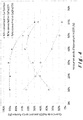
- the figure 3 presents a graph showing the evolution of the yield of iron-based compound (iron oxide) converted to calcium ferrite, as a function of iron oxide content expressed in Fe 2 O 3 equivalent, as well as the amounts of iron oxide converted to mono-calcium ferrite and di-calcium ferrite.
- the heat treatment is carried out in a static bed for 20 min at 1100 ° C. in a tunnel oven over 100 mm thick briquettes.
- the conversion efficiency to calcium ferrite begins to decrease for iron oxide contents expressed as Fe 2 O 3 equivalent greater than 40%.
- the percentage of mono-calcium ferrites goes through a maximum for iron oxide contents of 40%.
- the percentage of di-calcium ferrite formation decreases with the iron oxide content
- the figure 4 presents the evolution of the calcium ferrite content expressed as Fe 2 O 3 equivalent in the baked briquettes as a function of the iron oxide content expressed in Fe 2 O 3 equivalent in the raw briquettes before heat treatment.
- Example 4 baked briquettes having a conversion efficiency to calcium ferrite of 98% and containing 55.3% by weight of mono-calcium ferrite relative to the amount of calcium ferrites are produced after heat treatment at 1200. ° C for 20 minutes on green briquettes containing about 40% by weight of hematite and 60% by weight of quicklime having a d 97 equal to 2 mm and a d 30 equal to 90 ⁇ m (ie 30% of particles smaller than 90 microns), in the presence of 0.25% by weight of calcium stearate, relative to the total weight of the raw briquettes.
- Example 6 baked briquettes having a conversion yield of 90% calcium ferrite and containing 69.9% by weight of mono-calcium ferrite relative to the amount of calcium ferrites are produced after 1100 heat treatment. ° C for 20 minutes on green briquettes containing about 50% by weight of hematite and 25% by weight of quicklime having a d 97 equal to 2 mm and a d 30 equal to 90 ⁇ m (ie 30% of particles smaller than 90 ⁇ m) and 25% by weight of quicklime having a d 97 equal to 90 ⁇ m, in the presence of 0.25% by weight of calcium stearate, relative to the total weight of the raw briquettes.
- Example 7 cooked briquettes having a conversion efficiency of 96% calcium ferrite and containing 47.2% by weight of mono-calcium ferrite relative to the amount of calcium ferrites are produced after heat treatment at 1100. ° C for 20 minutes on raw briquettes containing about 50% by weight of hematite and 50% by weight of quicklime having a d 100 equal to 90 microns.
- the mono-calcium ferrite yield can be increased by lowering the temperature of the heat treatment to 1100 ° C., the presence of 0.25% by weight of calcium stearate, relative to the total weight of the raw briquettes.
- Example 8 baked briquettes having a 99% calcium ferrite conversion yield and containing 43.9% by weight of mono-calcium ferrite relative to the amount of calcium ferrites are produced after heat treatment. 1200 ° C. for 20 minutes on raw briquettes containing about 50% by weight of hematite and 25% by weight of quicklime having a d 97 equal to 2 mm and a d 30 equal to 90 ⁇ m (ie 30% of lower particles). at 90 ⁇ m) and 25% by weight of quicklime having a d 97 equal to 90 ⁇ m, in the presence of 0.25% by weight of calcium stearate, relative to the total weight of the raw briquettes.
- Example 9 baked briquettes having a conversion efficiency to calcium ferrite of 61% and containing 82.6% by weight of mono-calcium ferrite relative to the amount of calcium ferrites are produced after heat treatment at 1100. C. for 20 minutes on raw briquettes containing approximately 50% by weight of hematite and 50% by weight of quicklime having a d 97 equal to 2 mm and a d 30 equal to 90 ⁇ m (ie 30% of particles less than 90 ⁇ m).
- the mono-calcium ferrite yield can be increased by increasing the amount by weight of quicklime having a d 100 equal to 90 ⁇ m, in the presence of 0.25% by weight of calcium stearate, based on the total weight of the briquettes floods.
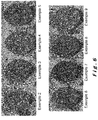
- the figure 5 shows the photographs of the briquette sections of Examples 2 to 9.
- the textures of the cooked briquettes of Examples 2 to 9 were analyzed by scanning electron microscopy coupled to the energy dispersive analysis by cutting these briquettes, encapsulating these briquettes in a resin, and polishing the cutting surface. These analyzes make it possible to reconstruct a mapping of the distribution of each element in a section of the briquettes.
- An image analysis software makes it possible to combine the maps obtained for each element and to measure the size distribution and the relative coverage of each element.
- the calcium ferrite forms a matrix (or continuous phase) in which particles of quicklime (discontinuous phase) are dispersed.
- Calcium ferrite matrix may be obtained after heat treatment for 20 minutes at temperatures between 900 ° C and 1200 ° C, preferably between 1050 and 1200 ° C of raw briquettes containing at least 20% by weight of calco compound particles -Magnesian, preferably in the form of quicklime and at least 20% by weight of iron oxide having a d90 of less than 200 ⁇ m, preferably less than 150 ⁇ m, more preferably less than 100 ⁇ m and a d 50 of less than 50.
- the two-dimensional sizes of Lime particles dispersed in the matrix are calculated by a program averaging the smallest and highest dimension of each lime particle in the calcium ferrite matrix.
- the particles are classified into a first group of particles whose two-dimensional size is less than 63 ⁇ m and greater than the detection limit of the measuring apparatus, and a second group of particles whose two-dimensional size is greater than 63 ⁇ m.
- Table 2 shows, for the briquettes of Examples 2 to 9, the relative covers of the calcium ferrite matrix, particles of quicklime less than 63 ⁇ m and particles of quicklime greater than 63 ⁇ m in the section. cutting each briquette. ⁇ u> Table 2.
- the surface coverage percentages of quicklime particles greater than 63 ⁇ m are less than 25% for cooked briquettes having calcium ferrite contents greater than 60% by weight of the composition.
- Raw briquettes were made with 38.85% by weight of iron oxide in the form of magnetite Fe 3 O 4 having a d 97 of 150 ⁇ m and with 60.9% by weight of quicklime having a d97 of less than 2 mm and a d 30 of less than 90 ⁇ m and 0.25% by weight of calcium stearate, based on the weight of the briquette.
- the heat treatment was carried out on a static bed of three layers of briquettes for 20 min at 1100 ° C in order to obtain cooked briquettes and the weight percentage of iron converted to mono-calcium ferrite is 8% while the percentage of Iron converted to di-calcium ferrite is 82%.
- Raw briquettes were made with 39.9% by weight of iron oxide as Fe 2 O 3 hematite having a characterized by a d 10 of 0.5 microns, 12.3 microns and dso d 90 of 35 7 .mu.m and 59.85% by weight of quicklime having a d 97 less than 2 mm and a d 30 of less than 90 ⁇ m and 0.25% by weight of calcium stearate based on the weight of the briquette.
- the raw briquettes obtained were heat-treated under the same conditions as in Example 17 in order to obtain cooked briquettes. In this In this case, the percentage of iron converted to mono-calcium ferrite is 65% by weight and the percentage of iron converted to di-calcium ferrite is 24% by weight.
- the compressive strength tests of the briquettes were carried out using a Pharmatron Multitest 50, one of whose plates is equipped with a tip.
- the presence of a tip decreases the force required to break the briquettes compared to a compression test performed without tip.
- pre-treatment tests with varying parameters as shown in Table 4.- are performed by charging each time 10 new raw briquettes in an electric 11-liter muffle furnace. All these pretreatments are carried out between 20 and 450 ° C under a flow of 10 liters per minute of a mixture of gas formed of N 2 , H 2 O and CO 2 . The temperature ramps are between 2 and 10 ° C / min.
- the volume concentrations of H 2 O in the gas are between 3.9 and 20.1%.
- the volume concentrations of CO2 in the gas range between 0.9 and 9.1%.
- the 10 briquettes are characterized by the compressive strength test.
- the entirety of the 10 pretreated briquettes is also analyzed to determine the weight gains relative to the hydration dm (H2O) / m and carbonation dm (CO2) / m.
- the overall results are summarized in Table 3.-.
- the Shatter test scores were compared to the compressive strength on several raw briquette samples to establish the correlation between the test Shatter index and the compressive force.
- the raw briquettes tested included quicklime with a particle size ranging from 0 to 3 mm with different iron oxide contents, from 0 to 60% by weight and different lubricant contents, ranging from 0.125 to 0.5% by weight, based on the total weight of the briquettes.
- the parameters of the briquetting process were also modified to ensure that the population for correlation was sufficiently wide.
- a compressive force greater than 144 kg is required, corresponding to 317.5 pounds for briquettes having a test Shatter number of less than 10%.
Landscapes
- Chemical & Material Sciences (AREA)
- Engineering & Computer Science (AREA)
- Organic Chemistry (AREA)
- Materials Engineering (AREA)
- Ceramic Engineering (AREA)
- Manufacturing & Machinery (AREA)
- Metallurgy (AREA)
- Geochemistry & Mineralogy (AREA)
- Geology (AREA)
- Mechanical Engineering (AREA)
- General Life Sciences & Earth Sciences (AREA)
- Environmental & Geological Engineering (AREA)
- Life Sciences & Earth Sciences (AREA)
- Structural Engineering (AREA)
- Civil Engineering (AREA)
- Inorganic Chemistry (AREA)
- Manufacture And Refinement Of Metals (AREA)
- Refinement Of Pig-Iron, Manufacture Of Cast Iron, And Steel Manufacture Other Than In Revolving Furnaces (AREA)
- Carbon Steel Or Casting Steel Manufacturing (AREA)
- Compounds Of Alkaline-Earth Elements, Aluminum Or Rare-Earth Metals (AREA)
- Treatment Of Steel In Its Molten State (AREA)
- Compounds Of Iron (AREA)
- Pharmaceuticals Containing Other Organic And Inorganic Compounds (AREA)
- Chemical Kinetics & Catalysis (AREA)
- Magnetic Ceramics (AREA)
- Oil, Petroleum & Natural Gas (AREA)
- Manufacture Of Iron (AREA)
- Solid Fuels And Fuel-Associated Substances (AREA)
- Magnetic Treatment Devices (AREA)
- Lubricants (AREA)
Priority Applications (1)
| Application Number | Priority Date | Filing Date | Title |
|---|---|---|---|
| PL17737265T PL3356295T3 (pl) | 2016-07-08 | 2017-07-07 | Wypalane brykiety zawierające wapno tlenkowo-magnezowe i ferryty wapniowe oraz sposób ich wytwarzania |
Applications Claiming Priority (2)
| Application Number | Priority Date | Filing Date | Title |
|---|---|---|---|
| BE20165575A BE1023884B1 (fr) | 2016-07-08 | 2016-07-08 | Procédé de fabricatrion de briquettes contenant de l'oxyde de fer actif, et briquettes ainsi obtenues |
| PCT/EP2017/067135 WO2018007607A1 (fr) | 2016-07-08 | 2017-07-07 | Briquettes cuites contenant un compose calco-magnesien vif et des ferrites de calcium et son procede de fabrication |
Publications (2)
| Publication Number | Publication Date |
|---|---|
| EP3356295A1 EP3356295A1 (fr) | 2018-08-08 |
| EP3356295B1 true EP3356295B1 (fr) | 2019-03-13 |
Family
ID=56609627
Family Applications (5)
| Application Number | Title | Priority Date | Filing Date |
|---|---|---|---|
| EP17737265.3A Active EP3356295B1 (fr) | 2016-07-08 | 2017-07-07 | Briquettes cuites contenant un compose calco-magnesien vif et des ferrites de calcium et leur procede de fabrication |
| EP17735178.0A Withdrawn EP3481772A1 (fr) | 2016-07-08 | 2017-07-07 | Procede de fabrication de briquettes contenant un compose calco-magnesien et un compose a base de fer, et briquettes ainsi obtenues |
| EP17740708.7A Revoked EP3481774B1 (fr) | 2016-07-08 | 2017-07-07 | Procede de fabrication de briquettes contenant un compose calco-magnesien et un compose a base de fer, et briquettes ainsi obtenues |
| EP17740709.5A Active EP3481775B1 (fr) | 2016-07-08 | 2017-07-07 | Procede de fabrication de briquettes contenant un compose calco-magnesien et un compose a base de fer, et briquettes ainsi obtenues |
| EP17737558.1A Active EP3356296B1 (fr) | 2016-07-08 | 2017-07-07 | Procede de fabrication de briquettes contenant un compose calco-magnesien et un compose a base de fer, et briquettes ainsi obtenues |
Family Applications After (4)
| Application Number | Title | Priority Date | Filing Date |
|---|---|---|---|
| EP17735178.0A Withdrawn EP3481772A1 (fr) | 2016-07-08 | 2017-07-07 | Procede de fabrication de briquettes contenant un compose calco-magnesien et un compose a base de fer, et briquettes ainsi obtenues |
| EP17740708.7A Revoked EP3481774B1 (fr) | 2016-07-08 | 2017-07-07 | Procede de fabrication de briquettes contenant un compose calco-magnesien et un compose a base de fer, et briquettes ainsi obtenues |
| EP17740709.5A Active EP3481775B1 (fr) | 2016-07-08 | 2017-07-07 | Procede de fabrication de briquettes contenant un compose calco-magnesien et un compose a base de fer, et briquettes ainsi obtenues |
| EP17737558.1A Active EP3356296B1 (fr) | 2016-07-08 | 2017-07-07 | Procede de fabrication de briquettes contenant un compose calco-magnesien et un compose a base de fer, et briquettes ainsi obtenues |
Country Status (24)
| Country | Link |
|---|---|
| US (5) | US20190337847A1 (enExample) |
| EP (5) | EP3356295B1 (enExample) |
| JP (6) | JP2019519686A (enExample) |
| KR (5) | KR20190026664A (enExample) |
| CN (4) | CN110023243A (enExample) |
| AR (2) | AR108988A1 (enExample) |
| AU (5) | AU2017294109A1 (enExample) |
| BE (8) | BE1023884B1 (enExample) |
| BR (5) | BR112018075560A2 (enExample) |
| CA (4) | CA3027017A1 (enExample) |
| CL (4) | CL2018003655A1 (enExample) |
| ES (3) | ES2841328T3 (enExample) |
| FR (7) | FR3053679A1 (enExample) |
| MX (4) | MX2018015790A (enExample) |
| PE (4) | PE20190775A1 (enExample) |
| PH (4) | PH12018502566A1 (enExample) |
| PL (3) | PL3356295T3 (enExample) |
| PT (3) | PT3481774T (enExample) |
| SG (4) | SG11201810995TA (enExample) |
| TR (1) | TR201908317T4 (enExample) |
| TW (2) | TW201821366A (enExample) |
| UA (3) | UA123366C2 (enExample) |
| WO (7) | WO2018007638A1 (enExample) |
| ZA (3) | ZA201808206B (enExample) |
Families Citing this family (11)
| Publication number | Priority date | Publication date | Assignee | Title |
|---|---|---|---|---|
| BE1023884B1 (fr) * | 2016-07-08 | 2017-09-04 | Lhoist Rech Et Developpement Sa | Procédé de fabricatrion de briquettes contenant de l'oxyde de fer actif, et briquettes ainsi obtenues |
| EP3693478A1 (en) | 2019-02-06 | 2020-08-12 | S.A. Lhoist Recherche Et Developpement | Process for refining steel and dephosphorization agent used in said process |
| EP3812475A1 (en) * | 2019-10-23 | 2021-04-28 | Carmeuse Research And Technology | Compacted calcium-based granules |
| JP7348519B2 (ja) * | 2019-12-17 | 2023-09-21 | 日本製鉄株式会社 | 溶銑の脱りん方法 |
| RU2718838C1 (ru) * | 2020-01-28 | 2020-04-14 | федеральное государственное бюджетное образовательное учреждение высшего образования "Нижегородский государственный технический университет им. Р.Е. Алексеева" (НГТУ) | Брикет для производства чугуна в вагранке |
| DE102020111459A1 (de) * | 2020-04-27 | 2021-10-28 | Voestalpine Stahl Gmbh | Verfahren zur Kreislaufführung metallurgischer Schlacken |
| CN112645705B (zh) * | 2020-12-31 | 2023-03-14 | 中钢天源(马鞍山)通力磁材有限公司 | 一种提高永磁铁氧体磁瓦器件抗折极限的工艺方法 |
| CN112892544B (zh) * | 2021-01-18 | 2022-07-05 | 山东大学 | 一种高活性CaO基双功能材料及其制备方法与应用 |
| CN115572817A (zh) * | 2022-10-24 | 2023-01-06 | 中南大学 | 一种用于强化高FeO尖晶石型铁精矿氧化及球团焙烧固结的多功能添加剂 |
| EP4516934A1 (en) * | 2023-09-01 | 2025-03-05 | S.A. Lhoist Recherche et Développement | Composition for use in a steel making process |
| WO2025068733A1 (en) * | 2023-09-26 | 2025-04-03 | S.A. Lhoist Recherche Et Développement | Stabilized agglomerated compositions made using byproducts from steelmaking operations |
Citations (15)
| Publication number | Priority date | Publication date | Assignee | Title |
|---|---|---|---|---|
| US1415094A (en) | 1914-06-22 | 1922-05-09 | David B Jones | Ore briquette |
| DE1955869A1 (de) | 1968-11-12 | 1970-06-18 | Yawata Iron & Steel Co | Schlackenbildner fuer die Stahlerzeugung sowie Verfahren zur Herstellung dieses Schlackenbildners |
| US3519471A (en) | 1967-06-30 | 1970-07-07 | Mcdowell Wellman Eng Co | Process for producing coated lime product |
| US3645719A (en) | 1969-10-15 | 1972-02-29 | Corson G & W H | Slagging in basic steel-making process and compositions therefor |
| US3649248A (en) | 1968-10-28 | 1972-03-14 | Yawata Iron & Steel Co | Process for producing a calcium ferrite for making steels |
| US3721548A (en) | 1968-12-23 | 1973-03-20 | Republic Steel Corp | Treatment of iron-containing particles |
| US5186742A (en) | 1991-11-27 | 1993-02-16 | Chemical Lime Company | Method and composition for use in recycling metal containing furnace dust |
| JPH0598359A (ja) | 1991-08-21 | 1993-04-20 | Kobe Steel Ltd | 焼結鉱の製造方法 |
| JP2000248309A (ja) | 1999-03-02 | 2000-09-12 | Nkk Corp | 溶鉄精錬用カルシウムフェライトの製造方法 |
| JP2000256731A (ja) | 1999-03-09 | 2000-09-19 | Nkk Corp | 溶鉄精錬用カルシウムフェライトの製造方法 |
| JP2007169707A (ja) | 2005-12-21 | 2007-07-05 | Nippon Steel Corp | 焼結機を用いた製鋼用脱リン剤の製造方法 |
| WO2008046452A1 (de) | 2006-10-20 | 2008-04-24 | Arcelormittal Bremen Gmbh | Calciumferrit-sinter, ihre herstellung und verwendung |
| KR101008694B1 (ko) | 2010-02-12 | 2011-01-17 | 쌍용양회공업(주) | 제철용 칼슘페라이트 소결체의 제조방법 |
| WO2015007661A1 (fr) | 2013-07-15 | 2015-01-22 | S.A. Lhoist Recherche Et Developpement | Composition comprenant un ou des composes calco-magnesiens sous forme de compacts |
| WO2016110574A1 (en) | 2015-01-09 | 2016-07-14 | S.A. Lhoist Recherche Et Developpement | Process for dephosphorization of molten metal during a refining process |
Family Cites Families (32)
| Publication number | Priority date | Publication date | Assignee | Title |
|---|---|---|---|---|
| US1994378A (en) * | 1933-03-17 | 1935-03-12 | Battelle Memorial Institute | Iron-bearing briquette and method of making the same |
| GB917967A (en) | 1959-12-16 | 1963-02-13 | Knapsack Ag | Process for briquetting quicklime |
| US3309196A (en) | 1964-10-28 | 1967-03-14 | Wyandotte Chemicals Corp | Fluxing agent |
| DE2019553A1 (de) | 1970-04-23 | 1971-11-04 | Rwk Rhein Westfael Kalkwerke | Verfahren zur Herstellung von Kalk-Flussmittel-Briketts fuer metallurgische Zwecke |
| US3771999A (en) | 1970-12-03 | 1973-11-13 | Republic Steel Corp | Slag-making methods and materials |
| JPS51133200A (en) * | 1975-05-15 | 1976-11-18 | Ishikawajima Harima Heavy Ind Co Ltd | The manufacturing technique of the granular calcium ferrite |
| JPS5798616A (en) * | 1980-12-09 | 1982-06-18 | Denki Kagaku Kogyo Kk | Dephosphorizing agent for molten iron |
| JPS5836046B2 (ja) * | 1981-04-08 | 1983-08-06 | 電気化学工業株式会社 | 石灰系脱燐剤 |
| JPS59159945A (ja) * | 1983-03-04 | 1984-09-10 | Yoshizawa Sekkai Kogyo Kk | ドロマイトより金属マグネシウム及びカルシウム・フエライトを製造する方法 |
| JPS6135938A (ja) | 1984-07-30 | 1986-02-20 | Sintokogio Ltd | 厚層状繊維質成形層体の製造方法 |
| US5362471A (en) * | 1991-09-27 | 1994-11-08 | Air Products And Chemicals, Inc. | Process for producing gypsum flake from flue gas desulfurization |
| FR2760003B1 (fr) | 1997-02-25 | 2001-11-16 | Council Scient Ind Res | Laitier riche en fer, ciment hydraulique et leur procede de preparation |
| US5908801A (en) | 1997-05-23 | 1999-06-01 | Servicios Industriales Penoles, S.A. De C.V. | Process for the production of synthetic dolomite |
| JPH11209817A (ja) | 1998-01-28 | 1999-08-03 | Mitsuo Hanada | 製鋼用フラックス、その製造方法およびそれを使用する製鋼方法 |
| RU2175987C1 (ru) | 2000-05-15 | 2001-11-20 | Открытое акционерное общество "Уральский институт металлов" | Способ производства высокоосновного агломерата |
| JP3985471B2 (ja) | 2001-02-06 | 2007-10-03 | 住友金属工業株式会社 | 精錬処理後のスラグの製造方法 |
| AUPR678301A0 (en) * | 2001-08-02 | 2001-08-23 | Commonwealth Scientific And Industrial Research Organisation | Iron ore briquetting |
| WO2004050924A1 (en) | 2002-12-02 | 2004-06-17 | Council Of Scientific And Industrial Research | Cold briquetting and pelletisation of mineral fines using an iron-bearing hydraulic binder |
| US7896963B2 (en) * | 2003-09-23 | 2011-03-01 | Hanqing Liu | Self-reducing, cold-bonded pellets |
| JP4625952B2 (ja) | 2005-04-22 | 2011-02-02 | 国立大学法人名古屋大学 | 酸化触媒の製造方法 |
| JP2009074158A (ja) * | 2007-08-27 | 2009-04-09 | Nakayama Sekkai Kogyo Kk | 鉄含有層で被覆した生石灰粉粒体 |
| JP5194667B2 (ja) * | 2007-09-14 | 2013-05-08 | ソニー株式会社 | 可変抵抗素子および記憶装置 |
| JP5160848B2 (ja) * | 2007-09-18 | 2013-03-13 | 株式会社神戸製鋼所 | 油分含有製鉄所ダストを用いた炭材内装ブリケットの製造方法 |
| FR2938530B1 (fr) * | 2008-11-19 | 2011-07-29 | Kerneos | Clinker magnesien poreux, procede de fabrication et utilisation comme flux pour le traitement des laitiers d'acierie |
| JP5729256B2 (ja) * | 2011-10-20 | 2015-06-03 | 新日鐵住金株式会社 | 非焼成溶銑脱りん材および非焼成溶銑脱りん材を用いた溶銑の脱りん方法 |
| CN102912085B (zh) * | 2012-11-09 | 2014-08-06 | 四川金广技术开发有限公司 | 提高气氧精炼转炉和LF炉渣MgO含量的不锈钢冶炼方法 |
| CZ2013531A3 (cs) * | 2013-07-08 | 2015-02-04 | Ecofer, S.R.O. | Tavidlo pro aglomeraci, způsob výroby tavidla, aglomerační směs pro výrobu aglomerátu a použití strusek sekundární metalurgie jako tavidel pro přípravu aglomerační směsi |
| US20150115076A1 (en) * | 2013-10-28 | 2015-04-30 | General Electric Company | Waste disposal with external rotor configuration and shaftless cutter plate connection |
| HUE026614T2 (hu) | 2013-12-02 | 2016-06-28 | Refractory Intellectual Property Gmbh & Co Kg | Eljárás a vas- és acélkohászatban egy metallurgiai edényben levõ fémolvadékon található salaknak a kondicionálására |
| BE1023414B1 (fr) * | 2015-01-09 | 2017-03-13 | S.A. Lhoist Recherche Et Developpement | Composition comprenant un ou plusieurs composes de calcium et de magnesium sous forme de compacts |
| BE1023887B1 (fr) * | 2016-07-08 | 2017-09-04 | Lhoist Recherche Et Developpement Sa | Composition sous forme de briquettes comprenant des composes calco-magnesiens vifs, son procede d'obtention et leur utilisation |
| BE1023884B1 (fr) * | 2016-07-08 | 2017-09-04 | Lhoist Rech Et Developpement Sa | Procédé de fabricatrion de briquettes contenant de l'oxyde de fer actif, et briquettes ainsi obtenues |
-
2016
- 2016-07-08 BE BE20165575A patent/BE1023884B1/fr active IP Right Grant
-
2017
- 2017-07-07 WO PCT/EP2017/067177 patent/WO2018007638A1/fr not_active Ceased
- 2017-07-07 BE BE2017/5487A patent/BE1024903B1/fr not_active IP Right Cessation
- 2017-07-07 FR FR1756480A patent/FR3053679A1/fr not_active Withdrawn
- 2017-07-07 UA UAA201812166A patent/UA123366C2/uk unknown
- 2017-07-07 PE PE2019000021A patent/PE20190775A1/es unknown
- 2017-07-07 PL PL17737265T patent/PL3356295T3/pl unknown
- 2017-07-07 FR FR1756482A patent/FR3053681A1/fr not_active Withdrawn
- 2017-07-07 PE PE2019000007A patent/PE20190862A1/es unknown
- 2017-07-07 WO PCT/EP2017/067178 patent/WO2018007639A1/fr not_active Ceased
- 2017-07-07 CN CN201780042641.5A patent/CN110023243A/zh active Pending
- 2017-07-07 AU AU2017294109A patent/AU2017294109A1/en not_active Abandoned
- 2017-07-07 UA UAA201901237A patent/UA123517C2/uk unknown
- 2017-07-07 US US16/309,204 patent/US20190337847A1/en not_active Abandoned
- 2017-07-07 BR BR112018075560-5A patent/BR112018075560A2/pt not_active Application Discontinuation
- 2017-07-07 FR FR1756481A patent/FR3053680A1/fr not_active Withdrawn
- 2017-07-07 AR ARP170101881A patent/AR108988A1/es unknown
- 2017-07-07 PE PE2018003238A patent/PE20190537A1/es unknown
- 2017-07-07 AU AU2017294107A patent/AU2017294107B2/en not_active Ceased
- 2017-07-07 AU AU2017294559A patent/AU2017294559B2/en not_active Ceased
- 2017-07-07 CA CA3027017A patent/CA3027017A1/en not_active Abandoned
- 2017-07-07 EP EP17737265.3A patent/EP3356295B1/fr active Active
- 2017-07-07 CA CA3027109A patent/CA3027109A1/en not_active Abandoned
- 2017-07-07 MX MX2018015790A patent/MX2018015790A/es unknown
- 2017-07-07 BR BR112018075593-1A patent/BR112018075593A2/pt not_active Application Discontinuation
- 2017-07-07 WO PCT/EP2017/067165 patent/WO2018007629A1/fr not_active Ceased
- 2017-07-07 KR KR1020187035839A patent/KR20190026664A/ko not_active Withdrawn
- 2017-07-07 FR FR1756465A patent/FR3053676A1/fr not_active Ceased
- 2017-07-07 EP EP17735178.0A patent/EP3481772A1/fr not_active Withdrawn
- 2017-07-07 PE PE2019000020A patent/PE20190305A1/es unknown
- 2017-07-07 EP EP17740708.7A patent/EP3481774B1/fr not_active Revoked
- 2017-07-07 MX MX2019000010A patent/MX2019000010A/es unknown
- 2017-07-07 SG SG11201810995TA patent/SG11201810995TA/en unknown
- 2017-07-07 MX MX2019000315A patent/MX2019000315A/es unknown
- 2017-07-07 SG SG11201810909QA patent/SG11201810909QA/en unknown
- 2017-07-07 TR TR2019/08317T patent/TR201908317T4/tr unknown
- 2017-07-07 SG SG11201811053WA patent/SG11201811053WA/en unknown
- 2017-07-07 CN CN201780042642.XA patent/CN109843805A/zh active Pending
- 2017-07-07 BE BE2017/5486A patent/BE1024910B1/fr not_active IP Right Cessation
- 2017-07-07 BE BE2017/5484A patent/BE1024908B1/fr active IP Right Grant
- 2017-07-07 KR KR1020187035846A patent/KR102038246B1/ko not_active Expired - Fee Related
- 2017-07-07 BE BE2017/5483A patent/BE1024907B1/fr active IP Right Grant
- 2017-07-07 JP JP2018566601A patent/JP2019519686A/ja not_active Abandoned
- 2017-07-07 US US16/308,293 patent/US10851017B2/en not_active Expired - Fee Related
- 2017-07-07 CN CN201780042793.5A patent/CN109982971B/zh not_active Expired - Fee Related
- 2017-07-07 EP EP17740709.5A patent/EP3481775B1/fr active Active
- 2017-07-07 SG SG11201811051SA patent/SG11201811051SA/en unknown
- 2017-07-07 PT PT177407087T patent/PT3481774T/pt unknown
- 2017-07-07 FR FR1756477A patent/FR3053677A1/fr not_active Withdrawn
- 2017-07-07 EP EP17737558.1A patent/EP3356296B1/fr active Active
- 2017-07-07 TW TW106122964A patent/TW201821366A/zh unknown
- 2017-07-07 JP JP2018566597A patent/JP6744434B2/ja not_active Expired - Fee Related
- 2017-07-07 AR ARP170101882A patent/AR108989A1/es unknown
- 2017-07-07 JP JP2018566589A patent/JP2019522111A/ja active Pending
- 2017-07-07 WO PCT/EP2017/067175 patent/WO2018007636A1/fr not_active Ceased
- 2017-07-07 ES ES17740708T patent/ES2841328T3/es active Active
- 2017-07-07 AU AU2017294103A patent/AU2017294103B2/en not_active Ceased
- 2017-07-07 US US16/307,567 patent/US10947157B2/en active Active
- 2017-07-07 CN CN201780042635.XA patent/CN109641756A/zh active Pending
- 2017-07-07 CA CA3027025A patent/CA3027025A1/fr not_active Abandoned
- 2017-07-07 UA UAA201812173A patent/UA123511C2/uk unknown
- 2017-07-07 KR KR1020187035843A patent/KR102022214B1/ko not_active Expired - Fee Related
- 2017-07-07 ES ES17737558T patent/ES2766858T3/es active Active
- 2017-07-07 ES ES17737265T patent/ES2730811T3/es active Active
- 2017-07-07 PT PT17737265T patent/PT3356295T/pt unknown
- 2017-07-07 CA CA3027003A patent/CA3027003A1/fr not_active Abandoned
- 2017-07-07 KR KR1020187035837A patent/KR102022213B1/ko not_active Expired - Fee Related
- 2017-07-07 KR KR1020187035818A patent/KR102037023B1/ko not_active Expired - Fee Related
- 2017-07-07 BR BR112018075537-0A patent/BR112018075537A2/pt not_active Application Discontinuation
- 2017-07-07 US US16/309,044 patent/US20190345066A1/en not_active Abandoned
- 2017-07-07 JP JP2018566554A patent/JP6633781B2/ja not_active Expired - Fee Related
- 2017-07-07 WO PCT/EP2017/067176 patent/WO2018007637A1/fr not_active Ceased
- 2017-07-07 BR BR112018075623-7A patent/BR112018075623A2/pt not_active Application Discontinuation
- 2017-07-07 JP JP2018566599A patent/JP6663517B2/ja not_active Expired - Fee Related
- 2017-07-07 PT PT177375581T patent/PT3356296T/pt unknown
- 2017-07-07 BE BE2017/5485A patent/BE1024911B1/fr not_active IP Right Cessation
- 2017-07-07 FR FR1756478A patent/FR3053678A1/fr not_active Withdrawn
- 2017-07-07 WO PCT/EP2017/067173 patent/WO2018007635A1/fr not_active Ceased
- 2017-07-07 FR FR1756453A patent/FR3053673A1/fr not_active Ceased
- 2017-07-07 US US16/308,735 patent/US20190144336A1/en not_active Abandoned
- 2017-07-07 MX MX2019000314A patent/MX2019000314A/es active IP Right Grant
- 2017-07-07 PL PL17737558T patent/PL3356296T3/pl unknown
- 2017-07-07 BR BR112018075553-2A patent/BR112018075553A2/pt not_active Application Discontinuation
- 2017-07-07 PL PL17740708T patent/PL3481774T3/pl unknown
- 2017-07-07 WO PCT/EP2017/067135 patent/WO2018007607A1/fr not_active Ceased
- 2017-07-07 TW TW106122940A patent/TW201834970A/zh unknown
- 2017-07-10 BE BE2017/5488A patent/BE1024902B1/fr not_active IP Right Cessation
- 2017-07-10 BE BE2017/5489A patent/BE1024901B1/fr not_active IP Right Cessation
-
2018
- 2018-12-05 ZA ZA2018/08206A patent/ZA201808206B/en unknown
- 2018-12-05 ZA ZA2018/08210A patent/ZA201808210B/en unknown
- 2018-12-05 ZA ZA2018/08204A patent/ZA201808204B/en unknown
- 2018-12-06 PH PH12018502566A patent/PH12018502566A1/en unknown
- 2018-12-10 PH PH12018502590A patent/PH12018502590A1/en unknown
- 2018-12-10 PH PH12018502591A patent/PH12018502591A1/en unknown
- 2018-12-10 PH PH12018502589A patent/PH12018502589A1/en unknown
- 2018-12-17 CL CL2018003655A patent/CL2018003655A1/es unknown
- 2018-12-19 CL CL2018003686A patent/CL2018003686A1/es unknown
-
2019
- 2019-01-08 CL CL2019000055A patent/CL2019000055A1/es unknown
- 2019-01-08 CL CL2019000054A patent/CL2019000054A1/es unknown
- 2019-12-12 JP JP2019224416A patent/JP2020073437A/ja not_active Ceased
- 2019-12-24 AU AU2019284111A patent/AU2019284111B2/en not_active Expired - Fee Related
Patent Citations (16)
| Publication number | Priority date | Publication date | Assignee | Title |
|---|---|---|---|---|
| US1415094A (en) | 1914-06-22 | 1922-05-09 | David B Jones | Ore briquette |
| US3519471A (en) | 1967-06-30 | 1970-07-07 | Mcdowell Wellman Eng Co | Process for producing coated lime product |
| US3649248A (en) | 1968-10-28 | 1972-03-14 | Yawata Iron & Steel Co | Process for producing a calcium ferrite for making steels |
| DE1955869A1 (de) | 1968-11-12 | 1970-06-18 | Yawata Iron & Steel Co | Schlackenbildner fuer die Stahlerzeugung sowie Verfahren zur Herstellung dieses Schlackenbildners |
| US3721548A (en) | 1968-12-23 | 1973-03-20 | Republic Steel Corp | Treatment of iron-containing particles |
| US3645719A (en) | 1969-10-15 | 1972-02-29 | Corson G & W H | Slagging in basic steel-making process and compositions therefor |
| JPH0598359A (ja) | 1991-08-21 | 1993-04-20 | Kobe Steel Ltd | 焼結鉱の製造方法 |
| US5186742A (en) | 1991-11-27 | 1993-02-16 | Chemical Lime Company | Method and composition for use in recycling metal containing furnace dust |
| JP2000248309A (ja) | 1999-03-02 | 2000-09-12 | Nkk Corp | 溶鉄精錬用カルシウムフェライトの製造方法 |
| JP2000256731A (ja) | 1999-03-09 | 2000-09-19 | Nkk Corp | 溶鉄精錬用カルシウムフェライトの製造方法 |
| JP2007169707A (ja) | 2005-12-21 | 2007-07-05 | Nippon Steel Corp | 焼結機を用いた製鋼用脱リン剤の製造方法 |
| WO2008046452A1 (de) | 2006-10-20 | 2008-04-24 | Arcelormittal Bremen Gmbh | Calciumferrit-sinter, ihre herstellung und verwendung |
| KR101008694B1 (ko) | 2010-02-12 | 2011-01-17 | 쌍용양회공업(주) | 제철용 칼슘페라이트 소결체의 제조방법 |
| WO2015007661A1 (fr) | 2013-07-15 | 2015-01-22 | S.A. Lhoist Recherche Et Developpement | Composition comprenant un ou des composes calco-magnesiens sous forme de compacts |
| US20160115076A1 (en) | 2013-07-15 | 2016-04-28 | S. A. Lhoist Recherche Et Developpement | Compositions Comprising One or More Calcium-Magnesium Compounds in the Form of Compacts |
| WO2016110574A1 (en) | 2015-01-09 | 2016-07-14 | S.A. Lhoist Recherche Et Developpement | Process for dephosphorization of molten metal during a refining process |
Non-Patent Citations (6)
| Title |
|---|
| I.M. MORSI ET AL.: "Silicothermic Reduction of 2001 Dolomite Ore Under Inert Atmosphere", CANADIAN METALLURGICAL QUARTERLY, vol. 41, no. 1, 1 January 2002 (2002-01-01), pages 15 - 28, XP055199243, ISSN: 0008-4433 |
| JEON, J.W. ET AL.: "Formation of Calcium Ferrites under Controlled Oxygen", POTENTIALS AT 1273 KISIJ INTERNATIONAL, vol. 50, no. 8, 2010, pages 1064 - 1070, XP055657181 |
| KAHRIZSANGI, S.G. ET AL.: "The Effect of Nano-Additives on the Hydration Resistance of Materials Synthesized From the MgO-CaO System", IJE TRANSACTIONS A: BASICS, vol. 29, no. 4, April 2016 (2016-04-01), pages 539 - 545, XP055655361, DOI: 10.5829/idosi.ije.2016.29.04a.13 |
| OREWCZYK, J.: "Application of thermal analysis for the investigation of calcium ferrites", JOURNAL OF THERMAL ANALYSIS, vol. 36, 1990, pages 2153 - 2156, XP055657184 |
| SCHIELE, W. ET AL., HERSTELLUNG - EIGENSCHAFTEN - VERWENDUNG, 1972, Düsseldorf |
| XUE, W. ET AL.: "Effect of Fe2O3 on the Sintering Property of MgO-CaO Refractory", ADVANCED MATERIALS RESEARCH, vol. 233-235, 2011, pages 2395 - 2398, XP055657177 |
Also Published As
Similar Documents
| Publication | Publication Date | Title |
|---|---|---|
| EP3356295B1 (fr) | Briquettes cuites contenant un compose calco-magnesien vif et des ferrites de calcium et leur procede de fabrication | |
| EP3481773A1 (fr) | Composition sous forme de briquettes comprenant des composes calco-magnesiens vifs, son procede d'obtention et leur utilisation | |
| FR3053675A1 (fr) | Composition sous forme de tablettes comprenant des composes calco-magnesiens vifs, son procede d'obtention et leur utilisation |
Legal Events
| Date | Code | Title | Description |
|---|---|---|---|
| STAA | Information on the status of an ep patent application or granted ep patent |
Free format text: STATUS: UNKNOWN |
|
| STAA | Information on the status of an ep patent application or granted ep patent |
Free format text: STATUS: THE INTERNATIONAL PUBLICATION HAS BEEN MADE |
|
| PUAI | Public reference made under article 153(3) epc to a published international application that has entered the european phase |
Free format text: ORIGINAL CODE: 0009012 |
|
| STAA | Information on the status of an ep patent application or granted ep patent |
Free format text: STATUS: REQUEST FOR EXAMINATION WAS MADE |
|
| 17P | Request for examination filed |
Effective date: 20180504 |
|
| AK | Designated contracting states |
Kind code of ref document: A1 Designated state(s): AL AT BE BG CH CY CZ DE DK EE ES FI FR GB GR HR HU IE IS IT LI LT LU LV MC MK MT NL NO PL PT RO RS SE SI SK SM TR |
|
| AX | Request for extension of the european patent |
Extension state: BA ME |
|
| GRAP | Despatch of communication of intention to grant a patent |
Free format text: ORIGINAL CODE: EPIDOSNIGR1 |
|
| STAA | Information on the status of an ep patent application or granted ep patent |
Free format text: STATUS: GRANT OF PATENT IS INTENDED |
|
| INTG | Intention to grant announced |
Effective date: 20181130 |
|
| GRAS | Grant fee paid |
Free format text: ORIGINAL CODE: EPIDOSNIGR3 |
|
| GRAA | (expected) grant |
Free format text: ORIGINAL CODE: 0009210 |
|
| STAA | Information on the status of an ep patent application or granted ep patent |
Free format text: STATUS: THE PATENT HAS BEEN GRANTED |
|
| AK | Designated contracting states |
Kind code of ref document: B1 Designated state(s): AL AT BE BG CH CY CZ DE DK EE ES FI FR GB GR HR HU IE IS IT LI LT LU LV MC MK MT NL NO PL PT RO RS SE SI SK SM TR |
|
| DAV | Request for validation of the european patent (deleted) | ||
| DAX | Request for extension of the european patent (deleted) | ||
| REG | Reference to a national code |
Ref country code: GB Ref legal event code: FG4D Free format text: NOT ENGLISH |
|
| REG | Reference to a national code |
Ref country code: AT Ref legal event code: REF Ref document number: 1107446 Country of ref document: AT Kind code of ref document: T Effective date: 20190315 Ref country code: CH Ref legal event code: EP |
|
| REG | Reference to a national code |
Ref country code: IE Ref legal event code: FG4D Free format text: LANGUAGE OF EP DOCUMENT: FRENCH |
|
| REG | Reference to a national code |
Ref country code: DE Ref legal event code: R096 Ref document number: 602017002727 Country of ref document: DE |
|
| REG | Reference to a national code |
Ref country code: PT Ref legal event code: SC4A Ref document number: 3356295 Country of ref document: PT Date of ref document: 20190612 Kind code of ref document: T Free format text: AVAILABILITY OF NATIONAL TRANSLATION Effective date: 20190531 |
|
| REG | Reference to a national code |
Ref country code: RO Ref legal event code: EPE |
|
| REG | Reference to a national code |
Ref country code: NL Ref legal event code: FP |
|
| REG | Reference to a national code |
Ref country code: SE Ref legal event code: TRGR |
|
| REG | Reference to a national code |
Ref country code: LT Ref legal event code: MG4D |
|
| PG25 | Lapsed in a contracting state [announced via postgrant information from national office to epo] |
Ref country code: NO Free format text: LAPSE BECAUSE OF FAILURE TO SUBMIT A TRANSLATION OF THE DESCRIPTION OR TO PAY THE FEE WITHIN THE PRESCRIBED TIME-LIMIT Effective date: 20190613 Ref country code: LT Free format text: LAPSE BECAUSE OF FAILURE TO SUBMIT A TRANSLATION OF THE DESCRIPTION OR TO PAY THE FEE WITHIN THE PRESCRIBED TIME-LIMIT Effective date: 20190313 |
|
| PG25 | Lapsed in a contracting state [announced via postgrant information from national office to epo] |
Ref country code: BG Free format text: LAPSE BECAUSE OF FAILURE TO SUBMIT A TRANSLATION OF THE DESCRIPTION OR TO PAY THE FEE WITHIN THE PRESCRIBED TIME-LIMIT Effective date: 20190613 Ref country code: RS Free format text: LAPSE BECAUSE OF FAILURE TO SUBMIT A TRANSLATION OF THE DESCRIPTION OR TO PAY THE FEE WITHIN THE PRESCRIBED TIME-LIMIT Effective date: 20190313 Ref country code: LV Free format text: LAPSE BECAUSE OF FAILURE TO SUBMIT A TRANSLATION OF THE DESCRIPTION OR TO PAY THE FEE WITHIN THE PRESCRIBED TIME-LIMIT Effective date: 20190313 Ref country code: HR Free format text: LAPSE BECAUSE OF FAILURE TO SUBMIT A TRANSLATION OF THE DESCRIPTION OR TO PAY THE FEE WITHIN THE PRESCRIBED TIME-LIMIT Effective date: 20190313 Ref country code: GR Free format text: LAPSE BECAUSE OF FAILURE TO SUBMIT A TRANSLATION OF THE DESCRIPTION OR TO PAY THE FEE WITHIN THE PRESCRIBED TIME-LIMIT Effective date: 20190614 |
|
| REG | Reference to a national code |
Ref country code: SK Ref legal event code: T3 Ref document number: E 31220 Country of ref document: SK |
|
| PG25 | Lapsed in a contracting state [announced via postgrant information from national office to epo] |
Ref country code: EE Free format text: LAPSE BECAUSE OF FAILURE TO SUBMIT A TRANSLATION OF THE DESCRIPTION OR TO PAY THE FEE WITHIN THE PRESCRIBED TIME-LIMIT Effective date: 20190313 Ref country code: AL Free format text: LAPSE BECAUSE OF FAILURE TO SUBMIT A TRANSLATION OF THE DESCRIPTION OR TO PAY THE FEE WITHIN THE PRESCRIBED TIME-LIMIT Effective date: 20190313 |
|
| REG | Reference to a national code |
Ref country code: ES Ref legal event code: FG2A Ref document number: 2730811 Country of ref document: ES Kind code of ref document: T3 Effective date: 20191112 |
|
| PG25 | Lapsed in a contracting state [announced via postgrant information from national office to epo] |
Ref country code: SM Free format text: LAPSE BECAUSE OF FAILURE TO SUBMIT A TRANSLATION OF THE DESCRIPTION OR TO PAY THE FEE WITHIN THE PRESCRIBED TIME-LIMIT Effective date: 20190313 |
|
| REG | Reference to a national code |
Ref country code: DE Ref legal event code: R026 Ref document number: 602017002727 Country of ref document: DE |
|
| PLBI | Opposition filed |
Free format text: ORIGINAL CODE: 0009260 |
|
| PG25 | Lapsed in a contracting state [announced via postgrant information from national office to epo] |
Ref country code: IS Free format text: LAPSE BECAUSE OF FAILURE TO SUBMIT A TRANSLATION OF THE DESCRIPTION OR TO PAY THE FEE WITHIN THE PRESCRIBED TIME-LIMIT Effective date: 20190713 |
|
| PLAX | Notice of opposition and request to file observation + time limit sent |
Free format text: ORIGINAL CODE: EPIDOSNOBS2 |
|
| REG | Reference to a national code |
Ref country code: FI Ref legal event code: MDE Opponent name: FELS VERTRIEBS- UND SERVICE GMBH & CO. KG Ref country code: FI Ref legal event code: MDE Opponent name: CARMEUSE RESEARCH AND TECHNOLOGY |
|
| 26 | Opposition filed |
Opponent name: CARMEUSE RESEARCH AND TECHNOLOGY Effective date: 20191212 Opponent name: FELS VERTRIEBS- UND SERVICE GMBH & CO. KG Effective date: 20191212 |
|
| PG25 | Lapsed in a contracting state [announced via postgrant information from national office to epo] |
Ref country code: DK Free format text: LAPSE BECAUSE OF FAILURE TO SUBMIT A TRANSLATION OF THE DESCRIPTION OR TO PAY THE FEE WITHIN THE PRESCRIBED TIME-LIMIT Effective date: 20190313 |
|
| PG25 | Lapsed in a contracting state [announced via postgrant information from national office to epo] |
Ref country code: MC Free format text: LAPSE BECAUSE OF FAILURE TO SUBMIT A TRANSLATION OF THE DESCRIPTION OR TO PAY THE FEE WITHIN THE PRESCRIBED TIME-LIMIT Effective date: 20190313 |
|
| PLBB | Reply of patent proprietor to notice(s) of opposition received |
Free format text: ORIGINAL CODE: EPIDOSNOBS3 |
|
| PG25 | Lapsed in a contracting state [announced via postgrant information from national office to epo] |
Ref country code: IE Free format text: LAPSE BECAUSE OF NON-PAYMENT OF DUE FEES Effective date: 20190707 |
|
| PGFP | Annual fee paid to national office [announced via postgrant information from national office to epo] |
Ref country code: RO Payment date: 20200625 Year of fee payment: 4 |
|
| PGFP | Annual fee paid to national office [announced via postgrant information from national office to epo] |
Ref country code: PT Payment date: 20200706 Year of fee payment: 4 Ref country code: TR Payment date: 20200706 Year of fee payment: 4 Ref country code: FI Payment date: 20200722 Year of fee payment: 4 Ref country code: ES Payment date: 20200922 Year of fee payment: 4 |
|
| PGFP | Annual fee paid to national office [announced via postgrant information from national office to epo] |
Ref country code: CH Payment date: 20200721 Year of fee payment: 4 Ref country code: IT Payment date: 20200731 Year of fee payment: 4 |
|
| PLAB | Opposition data, opponent's data or that of the opponent's representative modified |
Free format text: ORIGINAL CODE: 0009299OPPO |
|
| PG25 | Lapsed in a contracting state [announced via postgrant information from national office to epo] |
Ref country code: CY Free format text: LAPSE BECAUSE OF FAILURE TO SUBMIT A TRANSLATION OF THE DESCRIPTION OR TO PAY THE FEE WITHIN THE PRESCRIBED TIME-LIMIT Effective date: 20190313 |
|
| R26 | Opposition filed (corrected) |
Opponent name: CARMEUSE RESEARCH AND TECHNOLOGY Effective date: 20191212 |
|
| PG25 | Lapsed in a contracting state [announced via postgrant information from national office to epo] |
Ref country code: MT Free format text: LAPSE BECAUSE OF FAILURE TO SUBMIT A TRANSLATION OF THE DESCRIPTION OR TO PAY THE FEE WITHIN THE PRESCRIBED TIME-LIMIT Effective date: 20190313 Ref country code: HU Free format text: LAPSE BECAUSE OF FAILURE TO SUBMIT A TRANSLATION OF THE DESCRIPTION OR TO PAY THE FEE WITHIN THE PRESCRIBED TIME-LIMIT; INVALID AB INITIO Effective date: 20170707 |
|
| PGFP | Annual fee paid to national office [announced via postgrant information from national office to epo] |
Ref country code: PL Payment date: 20210624 Year of fee payment: 5 |
|
| PG25 | Lapsed in a contracting state [announced via postgrant information from national office to epo] |
Ref country code: SI Free format text: LAPSE BECAUSE OF FAILURE TO SUBMIT A TRANSLATION OF THE DESCRIPTION OR TO PAY THE FEE WITHIN THE PRESCRIBED TIME-LIMIT Effective date: 20190313 |
|
| PGFP | Annual fee paid to national office [announced via postgrant information from national office to epo] |
Ref country code: LU Payment date: 20210726 Year of fee payment: 5 Ref country code: CZ Payment date: 20210707 Year of fee payment: 5 |
|
| PGFP | Annual fee paid to national office [announced via postgrant information from national office to epo] |
Ref country code: SE Payment date: 20210721 Year of fee payment: 5 Ref country code: SK Payment date: 20210701 Year of fee payment: 5 Ref country code: GB Payment date: 20210722 Year of fee payment: 5 |
|
| REG | Reference to a national code |
Ref country code: FI Ref legal event code: MAE Ref country code: CH Ref legal event code: PL |
|
| PG25 | Lapsed in a contracting state [announced via postgrant information from national office to epo] |
Ref country code: LI Free format text: LAPSE BECAUSE OF NON-PAYMENT OF DUE FEES Effective date: 20210731 Ref country code: FI Free format text: LAPSE BECAUSE OF NON-PAYMENT OF DUE FEES Effective date: 20210707 Ref country code: CH Free format text: LAPSE BECAUSE OF NON-PAYMENT OF DUE FEES Effective date: 20210731 |
|
| PG25 | Lapsed in a contracting state [announced via postgrant information from national office to epo] |
Ref country code: PT Free format text: LAPSE BECAUSE OF NON-PAYMENT OF DUE FEES Effective date: 20220107 Ref country code: RO Free format text: LAPSE BECAUSE OF NON-PAYMENT OF DUE FEES Effective date: 20210707 |
|
| PG25 | Lapsed in a contracting state [announced via postgrant information from national office to epo] |
Ref country code: TR Free format text: LAPSE BECAUSE OF NON-PAYMENT OF DUE FEES Effective date: 20210707 Ref country code: MK Free format text: LAPSE BECAUSE OF FAILURE TO SUBMIT A TRANSLATION OF THE DESCRIPTION OR TO PAY THE FEE WITHIN THE PRESCRIBED TIME-LIMIT Effective date: 20190313 |
|
| PG25 | Lapsed in a contracting state [announced via postgrant information from national office to epo] |
Ref country code: IT Free format text: LAPSE BECAUSE OF NON-PAYMENT OF DUE FEES Effective date: 20210707 |
|
| REG | Reference to a national code |
Ref country code: ES Ref legal event code: FD2A Effective date: 20220826 |
|
| PLCK | Communication despatched that opposition was rejected |
Free format text: ORIGINAL CODE: EPIDOSNREJ1 |
|
| REG | Reference to a national code |
Ref country code: AT Ref legal event code: UEP Ref document number: 1107446 Country of ref document: AT Kind code of ref document: T Effective date: 20190313 |
|
| PG25 | Lapsed in a contracting state [announced via postgrant information from national office to epo] |
Ref country code: ES Free format text: LAPSE BECAUSE OF NON-PAYMENT OF DUE FEES Effective date: 20210708 |
|
| APBM | Appeal reference recorded |
Free format text: ORIGINAL CODE: EPIDOSNREFNO |
|
| APBP | Date of receipt of notice of appeal recorded |
Free format text: ORIGINAL CODE: EPIDOSNNOA2O |
|
| APAH | Appeal reference modified |
Free format text: ORIGINAL CODE: EPIDOSCREFNO |
|
| PG25 | Lapsed in a contracting state [announced via postgrant information from national office to epo] |
Ref country code: CZ Free format text: LAPSE BECAUSE OF NON-PAYMENT OF DUE FEES Effective date: 20220707 |
|
| APBQ | Date of receipt of statement of grounds of appeal recorded |
Free format text: ORIGINAL CODE: EPIDOSNNOA3O |
|
| REG | Reference to a national code |
Ref country code: SE Ref legal event code: EUG |
|
| GBPC | Gb: european patent ceased through non-payment of renewal fee |
Effective date: 20220707 |
|
| PG25 | Lapsed in a contracting state [announced via postgrant information from national office to epo] |
Ref country code: SE Free format text: LAPSE BECAUSE OF NON-PAYMENT OF DUE FEES Effective date: 20220708 Ref country code: LU Free format text: LAPSE BECAUSE OF NON-PAYMENT OF DUE FEES Effective date: 20220707 |
|
| PG25 | Lapsed in a contracting state [announced via postgrant information from national office to epo] |
Ref country code: GB Free format text: LAPSE BECAUSE OF NON-PAYMENT OF DUE FEES Effective date: 20220707 |
|
| P01 | Opt-out of the competence of the unified patent court (upc) registered |
Effective date: 20230525 |
|
| REG | Reference to a national code |
Ref country code: SK Ref legal event code: MM4A Ref document number: E 31220 Country of ref document: SK Effective date: 20220707 |
|
| REG | Reference to a national code |
Ref country code: AT Ref legal event code: MM01 Ref document number: 1107446 Country of ref document: AT Kind code of ref document: T Effective date: 20220707 |
|
| PG25 | Lapsed in a contracting state [announced via postgrant information from national office to epo] |
Ref country code: AT Free format text: LAPSE BECAUSE OF NON-PAYMENT OF DUE FEES Effective date: 20220707 |
|
| PG25 | Lapsed in a contracting state [announced via postgrant information from national office to epo] |
Ref country code: SK Free format text: LAPSE BECAUSE OF NON-PAYMENT OF DUE FEES Effective date: 20220707 Ref country code: PL Free format text: LAPSE BECAUSE OF NON-PAYMENT OF DUE FEES Effective date: 20220707 |
|
| REG | Reference to a national code |
Ref country code: DE Ref legal event code: R100 Ref document number: 602017002727 Country of ref document: DE |
|
| APBU | Appeal procedure closed |
Free format text: ORIGINAL CODE: EPIDOSNNOA9O |
|
| PLBN | Opposition rejected |
Free format text: ORIGINAL CODE: 0009273 |
|
| STAA | Information on the status of an ep patent application or granted ep patent |
Free format text: STATUS: OPPOSITION REJECTED |
|
| 27O | Opposition rejected |
Effective date: 20240527 |
|
| PGFP | Annual fee paid to national office [announced via postgrant information from national office to epo] |
Ref country code: NL Payment date: 20250723 Year of fee payment: 9 |
|
| PGFP | Annual fee paid to national office [announced via postgrant information from national office to epo] |
Ref country code: DE Payment date: 20250725 Year of fee payment: 9 |
|
| PGFP | Annual fee paid to national office [announced via postgrant information from national office to epo] |
Ref country code: BE Payment date: 20250723 Year of fee payment: 9 |
|
| PGFP | Annual fee paid to national office [announced via postgrant information from national office to epo] |
Ref country code: FR Payment date: 20250723 Year of fee payment: 9 |