EP3271337B1 - Verfahren zur herstellung von (4s)-4-[4-cyano-2-(methylsulfonyl)phenyl]-3,6-dimethyl-2-oxo-1-[3-(trifluormethyl)phenyl]-1,2,3,4-tetrahydro pyrimidin-5-carbonitril - Google Patents
Verfahren zur herstellung von (4s)-4-[4-cyano-2-(methylsulfonyl)phenyl]-3,6-dimethyl-2-oxo-1-[3-(trifluormethyl)phenyl]-1,2,3,4-tetrahydro pyrimidin-5-carbonitril Download PDFInfo
- Publication number
- EP3271337B1 EP3271337B1 EP16713747.0A EP16713747A EP3271337B1 EP 3271337 B1 EP3271337 B1 EP 3271337B1 EP 16713747 A EP16713747 A EP 16713747A EP 3271337 B1 EP3271337 B1 EP 3271337B1
- Authority
- EP
- European Patent Office
- Prior art keywords
- formula
- compound
- reaction
- reacting
- methyl
- Prior art date
- Legal status (The legal status is an assumption and is not a legal conclusion. Google has not performed a legal analysis and makes no representation as to the accuracy of the status listed.)
- Active
Links
- 0 CC(N(c1cc(C(F)(F)F)ccc1)C(N(**)C1c(c(S(C)(=O)=O)c2)ccc2C#N)=O)=C1C(O)=O Chemical compound CC(N(c1cc(C(F)(F)F)ccc1)C(N(**)C1c(c(S(C)(=O)=O)c2)ccc2C#N)=O)=C1C(O)=O 0.000 description 3
- VXJUYZIPYDCBGN-GOSISDBHSA-N CC(N(c1cc(C(F)(F)F)ccc1)C(N[C@@H]1c(c(S(C)(=O)=O)c2)ccc2C#N)=O)=C1C(O)=O Chemical compound CC(N(c1cc(C(F)(F)F)ccc1)C(N[C@@H]1c(c(S(C)(=O)=O)c2)ccc2C#N)=O)=C1C(O)=O VXJUYZIPYDCBGN-GOSISDBHSA-N 0.000 description 3
- VXJUYZIPYDCBGN-UHFFFAOYSA-N CC(N(c1cc(C(F)(F)F)ccc1)C(NC1c(c(S(C)(=O)=O)c2)ccc2C#N)=O)=C1C(O)=O Chemical compound CC(N(c1cc(C(F)(F)F)ccc1)C(NC1c(c(S(C)(=O)=O)c2)ccc2C#N)=O)=C1C(O)=O VXJUYZIPYDCBGN-UHFFFAOYSA-N 0.000 description 1
- IUJGUSHEQZCJEW-JOCHJYFZSA-N CC(N(c1cc(C(F)(F)F)ccc1)C(N[C@@H]1c(c(S(C)(=O)=O)c2)ccc2C#N)=O)=C1C(OCCC=C)=O Chemical compound CC(N(c1cc(C(F)(F)F)ccc1)C(N[C@@H]1c(c(S(C)(=O)=O)c2)ccc2C#N)=O)=C1C(OCCC=C)=O IUJGUSHEQZCJEW-JOCHJYFZSA-N 0.000 description 1
- VXJUYZIPYDCBGN-SFHVURJKSA-N CC(N(c1cc(C(F)(F)F)ccc1)C(N[C@H]1c(ccc(C#N)c2)c2S(C)(=O)=O)=O)=C1C(O)=O Chemical compound CC(N(c1cc(C(F)(F)F)ccc1)C(N[C@H]1c(ccc(C#N)c2)c2S(C)(=O)=O)=O)=C1C(O)=O VXJUYZIPYDCBGN-SFHVURJKSA-N 0.000 description 1
- YVENNJQASKVLSZ-LJQANCHMSA-N CN(CCC1)C([C@@H](c2c(cc(cc3)OC)c3ncc2)O)=C1C=C Chemical compound CN(CCC1)C([C@@H](c2c(cc(cc3)OC)c3ncc2)O)=C1C=C YVENNJQASKVLSZ-LJQANCHMSA-N 0.000 description 1
Images

Classifications
-
- C—CHEMISTRY; METALLURGY
- C07—ORGANIC CHEMISTRY
- C07D—HETEROCYCLIC COMPOUNDS
- C07D239/00—Heterocyclic compounds containing 1,3-diazine or hydrogenated 1,3-diazine rings
- C07D239/02—Heterocyclic compounds containing 1,3-diazine or hydrogenated 1,3-diazine rings not condensed with other rings
- C07D239/20—Heterocyclic compounds containing 1,3-diazine or hydrogenated 1,3-diazine rings not condensed with other rings having two double bonds between ring members or between ring members and non-ring members
- C07D239/22—Heterocyclic compounds containing 1,3-diazine or hydrogenated 1,3-diazine rings not condensed with other rings having two double bonds between ring members or between ring members and non-ring members with hetero atoms directly attached to ring carbon atoms
-
- A—HUMAN NECESSITIES
- A61—MEDICAL OR VETERINARY SCIENCE; HYGIENE
- A61K—PREPARATIONS FOR MEDICAL, DENTAL OR TOILETRY PURPOSES
- A61K31/00—Medicinal preparations containing organic active ingredients
- A61K31/33—Heterocyclic compounds
- A61K31/395—Heterocyclic compounds having nitrogen as a ring hetero atom, e.g. guanethidine or rifamycins
- A61K31/495—Heterocyclic compounds having nitrogen as a ring hetero atom, e.g. guanethidine or rifamycins having six-membered rings with two or more nitrogen atoms as the only ring heteroatoms, e.g. piperazine or tetrazines
- A61K31/505—Pyrimidines; Hydrogenated pyrimidines, e.g. trimethoprim
- A61K31/513—Pyrimidines; Hydrogenated pyrimidines, e.g. trimethoprim having oxo groups directly attached to the heterocyclic ring, e.g. cytosine
-
- A—HUMAN NECESSITIES
- A61—MEDICAL OR VETERINARY SCIENCE; HYGIENE
- A61P—SPECIFIC THERAPEUTIC ACTIVITY OF CHEMICAL COMPOUNDS OR MEDICINAL PREPARATIONS
- A61P11/00—Drugs for disorders of the respiratory system
-
- A—HUMAN NECESSITIES
- A61—MEDICAL OR VETERINARY SCIENCE; HYGIENE
- A61P—SPECIFIC THERAPEUTIC ACTIVITY OF CHEMICAL COMPOUNDS OR MEDICINAL PREPARATIONS
- A61P17/00—Drugs for dermatological disorders
- A61P17/02—Drugs for dermatological disorders for treating wounds, ulcers, burns, scars, keloids, or the like
-
- A—HUMAN NECESSITIES
- A61—MEDICAL OR VETERINARY SCIENCE; HYGIENE
- A61P—SPECIFIC THERAPEUTIC ACTIVITY OF CHEMICAL COMPOUNDS OR MEDICINAL PREPARATIONS
- A61P43/00—Drugs for specific purposes, not provided for in groups A61P1/00-A61P41/00
-
- A—HUMAN NECESSITIES
- A61—MEDICAL OR VETERINARY SCIENCE; HYGIENE
- A61P—SPECIFIC THERAPEUTIC ACTIVITY OF CHEMICAL COMPOUNDS OR MEDICINAL PREPARATIONS
- A61P9/00—Drugs for disorders of the cardiovascular system
-
- A—HUMAN NECESSITIES
- A61—MEDICAL OR VETERINARY SCIENCE; HYGIENE
- A61P—SPECIFIC THERAPEUTIC ACTIVITY OF CHEMICAL COMPOUNDS OR MEDICINAL PREPARATIONS
- A61P9/00—Drugs for disorders of the cardiovascular system
- A61P9/12—Antihypertensives
-
- C—CHEMISTRY; METALLURGY
- C07—ORGANIC CHEMISTRY
- C07C—ACYCLIC OR CARBOCYCLIC COMPOUNDS
- C07C315/00—Preparation of sulfones; Preparation of sulfoxides
-
- C—CHEMISTRY; METALLURGY
- C07—ORGANIC CHEMISTRY
- C07B—GENERAL METHODS OF ORGANIC CHEMISTRY; APPARATUS THEREFOR
- C07B2200/00—Indexing scheme relating to specific properties of organic compounds
- C07B2200/07—Optical isomers
-
- C—CHEMISTRY; METALLURGY
- C07—ORGANIC CHEMISTRY
- C07B—GENERAL METHODS OF ORGANIC CHEMISTRY; APPARATUS THEREFOR
- C07B2200/00—Indexing scheme relating to specific properties of organic compounds
- C07B2200/13—Crystalline forms, e.g. polymorphs
Definitions
- the present application relates to improved processes for the preparation of (4S) -4- [4-cyano-2- (methylsulfonyl) phenyl] -3,6-dimethyl-2-oxo-1- [3- (trifluoromethyl) phenyl] -1 , 2,3,4-tetrahydro pyrimidine-5-carbonitrile and its crystal form (A), which is used for the production of drugs.
- the compound of the formula (I) is an inhibitor of human leukocyte elastase (HLE, EC 3.4.21.37), also called human neutrophil elastase (HNE, hNE).
- Human leukocyte elastase belongs to the serine protease family. The proteolytic enzyme is found in the azurophilic granules of the polymorphonuclear leukocytes ( PMN leukocytes ). Intracellular elastase plays an important role in defense against pathogens by breaking down foreign particles that have been absorbed via phagocytosis.
- HNE Activated neutrophils release the HNE from the granules into the extracellular space (extracellular HNE), with part of the released HNE remaining on the outside of the neutrophil cell membrane (membrane-based HNE).
- the highly active enzyme is able to break down a large number of connective tissue proteins, for example the proteins elastin, collagen and fibronectin. Elastin occurs in high concentrations in all types of tissue that show high elasticity, for example in the lungs and arteries.
- pathological processes e.g. tissue injuries
- HNE plays a role in tissue degradation and remodeling.
- the HNE is an important modulator in inflammatory processes. For example, HNE induces increased gene expression of interleukin-8 (IL-8).
- IL-8 interleukin-8
- HNE plays an important role in many diseases, injuries and pathological changes, the development and / or progression of which is related to an inflammatory process and / or a proliferative and hypertrophic tissue and vascular remodeling. This can in particular diseases and / or damage to the lungs or of the cardiovascular system, or it can be sepsis, cancer or other inflammatory diseases. HNE inhibitors are used in particular for the treatment and / or prevention of diseases of the lungs and the cardiovascular system.
- WO 2009/080199 A1 also describes a method for the preparation of the compound of the formula (I), which is considered to be the closest prior art.
- the target compound (I) is prepared in 10 stages with a total yield of 4.45% of theory.
- the compound is obtained as an amorphous solid by evaporating chromatography fractions; a defined crystallization process in the final stage for establishing a defined crystal form has not yet been described.
- the reaction scheme outlined above is in WO 2009/080199 A1 is described as follows: The reaction sequence of a compound of the formula (II) via the compounds of the formulas (III), (IV) and (V) to a compound of the formula (VI) in Scheme 6 and Examples 1A, 2A, Method B, 3A method B and 4A method B; the reaction sequence from a compound of the formula (VI) via a compound of the formula (IX) to a compound of the formula (X) in Scheme 1 and Examples 3 and 4; and the reaction sequence from a compound of the formula (X) via the compounds of the formulas (XI) and (XII) to a compound of the formula (XIII) in Scheme 2 and Examples 5A, 5 and 6.
- the synthesis of the compound of the formula ( I) method B is described in Example 33.
- process variant (A) provides the target compound (I) in 8 stages (see schemes 7, 2 and 3, below) in more than 17% of the total yield without chromatographic purification of intermediate stages.
- B) (see schemes 7, 4, 5 and 6, below) of the process according to the invention provides the target compound (I) in 9 stages, likewise without chromatographic purification of intermediate stages, the overall yield depending on the reaction procedure as described below.
- Process variant (A) comprises the steps a-1), a-2), c), d), e), f) and g) described above.
- the resolution, a key step in the synthesis takes place in process variant (A) at the stage of the compound of the formula (XXVI) in which R 1 is methyl.
- Process variant (B) comprises the steps b-1), c), d), e), b-2), b-3), b-4), f) and g) described above.
- the resolution, a key step of the synthesis takes place in process variant (B) at the stage of the compound of the formula (XXVI) in which R 1 is hydrogen.
- R 1 is methyl and the process comprises the reaction steps a-1), a-2), c) described above, d), e), f) and g).
- R 1 is hydrogen and the process comprises the above-described reaction steps b-1), c), d), e) , b-2), b-3), b-4), f) and g).
- R 1 is hydrogen and the process comprises the above-described reaction steps b-1), c), d), e) , b-2), b-3), b-4), f) and g) and following reaction step c) a compound of the formula (XXIX) is isolated, this is added according to reaction step e) in the presence of a strong acid a compound of the formula (XXX) is reacted; then a compound of the formula (XXX) is reacted according to reaction step b-2) in the presence of an allyl halide or sulfonate and a base to give a compound of the formula (XXXI); subsequently becomes h) a compound of the formula (XXXI) is converted into the racemate of the formula (IX) in the presence of a strong, non-nucleophilic base in a solvent and with
- Methylating agents which can be used for reaction steps a-1) and b-3) are, for example, methyl iodide, dimethyl sulfate, dimethyl carbonate, methyl toluenesulfonate or methyl methanesulfonate, methyl iodide and dimethyl sulfate are preferred.
- Bases which can be used for reaction steps a-1) and b-3) are, for example, sodium hydride, sodium hexamethyldisilazane or lithium hexamethyldisilazane, sodium hexamethyldisilazane and lithium hexamethyldisilazane are preferred.
- the solvent used for reaction step a-1) is, for example, tetrahydrofuran (THF) in a 4-6 fold excess based on the weight of the compound of the formula (IX).
- the reaction temperature is -70 to 40 ° C, preferably 0 to 30 ° C.
- the methylating agent used in reaction steps a-1) and b-3) is 2 eq.
- the racemic allyl ester of the formula (IX) is prepared in analogy to that in FIG WO 2009/080199 A1 synthesis described (Example 122) methylated.
- the methylation of the allyl ester in the process according to the invention takes place at the stage of the racemate.
- the reaction according to the invention shows significant improvements over the prior art. By using NaHMDS as the base, the reaction can be carried out at a temperature of 20 ° C.
- Palladium catalysts which can be used for the saponification of the allyl ester of the formula (XVI), (IX) or (XXIII) according to reaction steps a-2), b-1) and b-4) are, for example, palladium- (0) -phosphine complexes such as tetrakis (triphenylphosphine) palladium (0) (Pd (PPh 3 ) 4 ) or palladium acetate / triphenylphosphine (PdOAc 2 / PPh 3 ), Pd acetate / tripenylphosphine is preferred.
- palladium- (0) -phosphine complexes such as tetrakis (triphenylphosphine) palladium (0) (Pd (PPh 3 ) 4 ) or palladium acetate / triphenylphosphine (PdOAc 2 / PPh 3 ), Pd acetate / tripenylpho
- Secondary amine bases which can be used for reaction step a-2) are, for example, morpholine, piperidine, diisopropylamine or N-methyl-piperazine, morpholine and N-methyl-piperazine are preferred.
- the solvent used for reaction steps a-2), b-1) and b-4) is, for example, tetrahydrofuran (THF) in a 3-5 fold excess, based on the weight of the compound of the formula (XVI), (IX) or ( XXIII) is used.
- reaction steps a-2), b-1) and b-4 in reaction steps a-2), b-1) and b-4), palladium acetate (PdOAc 2 ) with triphenylphosphine (PPh 3 ) as ligand and morpholine as base is used as the palladium catalyst.
- PdOAc 2 palladium acetate
- Ph 3 triphenylphosphine
- the relatively expensive and air-sensitive catalyst palladium tetrakistriphenylphosphine is replaced by the stable palladium acetate with the addition of triphenylphosphine as a ligand. Furthermore, the amount of catalyst of 0.05 eq. to 0.003 eq. be reduced.
- the palladium-catalyzed allyl ester cleavage is carried out in a 3 to 5-fold excess of THF, based on the weight of the compound of the formula (XVI), at temperatures of 40 to 60 ° C. in 1 to 3 hours with the addition of morpholine as base.
- the product (XVII) which is obtained as THF solvate, can be isolated directly from the reaction mixture by precipitation of water. After isolation, it is dried in vacuo. The yields of this conversion are usually> 95% of theory.
- the resolution of the acids of the formula (XXVI), in which R 1 is hydrogen or methyl, according to reaction step c) of the present invention is a key step of the process according to the invention for the preparation of the compound of the formula (I).
- China alkaloids which can be used for reaction step c) (racemate resolution) are selected from the group consisting of quinine, quinidine, cincholine and cincholidine. Quinine and quinidine are preferred.
- Solvents which can be used for reaction step c) are, for example, aqueous alcoholic systems, preferably isopropanol / water, particularly preferably isopropanol / water in a ratio of 9: 1.
- Esters of acetic acid preferably the C 2 to C 5 alkyl acetic acid esters, particularly preferably n-butyl acetate, can also be used as solvents for reaction step c).
- the china alkaloid for reaction step c) is selected from the group consisting of quinine and quinidine.
- the solvent for reaction step c) is selected from C 2 -C 5 -alkyl esters of acetic acid, C 1 -C 6 alcohols and mixtures of C 1 -C 6 alcohols and water.
- a combination of quinidine as the china alkaloid and n-butyl acetate as the solvent is used for reaction step c) in the case of the reaction of a compound of the formula (XXVI) in which R 1 is methyl.
- the diastereomeric quinidine salts of the compound of the formula (XXVI), in which R 1 is methyl can be prepared by the process according to the invention in solvents such as the esters of acetic acid, preferably the C 2 to C 5 substituted esters, particularly preferably n-butyl acetate, be separated from each other.
- the diastereomeric quinidine salt of the S acid (compound of the formula (XX)) predominantly crystallizes out, while the R form (compound of the formula (XXI)) remains in solution.
- reaction step d) To isolate the compound of the formula (XXVIII) in which R 1 is hydrogen or methyl, in reaction step d) the solid is filtered off, washed with the solvent used in reaction step c) and dried in vacuo.
- Strong acids that can be used for reaction step e) are, for example, aqueous hydrochloric acid, aqueous hydrobromic acid or aqueous sulfuric acid.
- acidification to pH 1 is carried out with aqueous hydrochloric acid in reaction step e).
- reaction step e the diastereomerically pure quinidine salt (compound of the formula (XX)) is suspended in water to liberate the acid.
- the auxiliary base quinidine remains in solution as the hydrochloride, while the enantiomerically pure acid (compound of the formula (XXVII), in which R 1 stands for methyl) precipitates.
- the S-acid compound of the formula (XXVII), in which R 1 stands for methyl
- the other isomer can also be obtained from the mother liquor of the racemate resolution by concentration and subsequent aqueous acidic work-up.
- a combination of quinine as the china alkaloid and a mixture of isopropanol and water is used as the reaction step c) for the case of the reaction of a compound of the formula (XXVI) in which R 1 is hydrogen Solvent used.
- the diastereomeric quinine salts of the acid of the formula (XXVI), in which R 1 stands for hydrogen, are separated from one another in aqueous alcoholic systems, preferably isopropanol / water, particularly preferably isopropanol / water in a ratio of 9: 1.
- the racemic acid of the formula (XXVI), in which R 1 is hydrogen is used in 6 to 10-fold excess of isopropanol / water, based on the weight of the compound of the formula (XXVI), with the addition of 1.0 up to 1.1 eq. Quinine reacted at 40 ° C to 60 ° C.
- the diastereomeric quinine salt of the S acid (compound of the formula (XXIV)) predominantly crystallizes, while the R form (compound of the formula (XXV)) remains in solution.
- step e) the diastereomerically pure quinine salt (XXIV) is suspended in water in order to liberate the acid of the formula (XXVII), in which R 1 is hydrogen.
- XXVII the acid of the formula (XXVII)
- R 1 is hydrogen.
- the auxiliary base quinine remains in solution as the hydrochloride, while the Enantiomerically pure acid precipitates. After isolation, it is dried in vacuo.
- the yields of this racemate resolution and the release to the S-acid of the formula (XXVII), in which R 1 stands for hydrogen, are generally> 45% of theory. with an enantiomeric excess of> 98%.
- the overall yield of this reaction sequence is 18%.
- the other isomer can also be obtained from the mother liquor of the racemate resolution by concentration and subsequent aqueous acidic work-up.
- reaction step b-2 This is done according to the methods known in principle to the person skilled in the art according to reaction step b-2) of the present invention by alkylation with an allyl halide or sulfonate, for example allyl bromide, allyl chloride, allyl iodide, allyl methanesulfonate or allyl toluenesulfonate in the presence of bases, for example potassium carbonate, sodium hydroxide, potassium hydroxide, sodium hydride in solvents, for example acetone.
- bases for example potassium carbonate, sodium hydroxide, potassium hydroxide, sodium hydride in solvents, for example acetone.
- the carboxylic acid (XI) can thus be converted into the corresponding allyl ester (X) in a yield of 95%.
- the following steps for the target compound (I) are carried out analogously to the process described in variant (A).
- allyl bromide in the presence of potassium carbonate is used for reaction step b-2).
- amide from the acid was carried out in the synthesis according to WO 2009/080199 A1 carried out with the aid of the rather expensive amide coupling reagent O - (7-azabenzotriazol-1-yl) - N , N , N ' , N'- tetramethyluronium hexafluorophosphate (HATU).
- HATU tetramethyluronium hexafluorophosphate
- activating reagent can be used, for example, 1,1'-carbonyldiimidazole together with ammonia or 1,1'-carbonyldiimidazole together with hexamethyldisilazane.
- reaction solution is slowly metered into water.
- product precipitates and can be isolated by filtration or centrifugation. It is washed with water and dried in vacuo at an elevated temperature (30 to 100 ° C., preferably at 40 ° C. to 70 ° C.).
- elevated temperature (30 to 100 ° C., preferably at 40 ° C. to 70 ° C.).
- the yields are very high and are generally> 90% of theory. Theory.
- nitrile from the amide was carried out in the synthesis according to WO 2009/080199 A1 by dewatering with 2 eq. Trifluoroacetic anhydride carried out in THF.
- the nitrile could only be obtained after purification by chromatography. It is obvious that such a process cannot be implemented on an industrial scale and that there was therefore a great need for an alternative process.
- Suitable dehydrating agents for dehydrating amides to nitriles according to reaction step g) of the process according to the invention are, for example, 1-propanephosphonic anhydride (T3P) or trifluoroacetic anhydride.
- T3P 1-propanephosphonic anhydride
- T3P has proven itself for this reaction step. This reagent is available as a 50% solution in ethyl acetate. It is much easier to handle than trifluoroacetic anhydride, which is extremely sensitive to hydrolysis.
- the amide of the formula (XIX) in ethyl acetate is first mixed with diisopropylethylamine (Hünig base) and then with 1-propanephosphonic anhydride (T3P). To complete the reaction, the mixture is briefly refluxed. After the reaction has ended, water is added and the mixture is extracted. The organic phase is then washed with saturated sodium hydrogen carbonate solution and the organic phase, which contains the compound of the formula (I), is separated off.
- Another embodiment of the invention is the compound of formula (I) in crystal form (A), characterized in that the X-ray diffraction pattern of the compound shows peak maxima of the 2 theta angle at 7.5, 12.4, 15.1, 18.5, 18.7, 22.9, 24.7 and 26.5 .
- the process according to the invention provides the compound of the formula (I) in the crystal form (A), characterized in that the X-ray diffraction pattern of the compound of the formula (I) has peak maxima of the 2 theta angle at 7.5, 12.4, 15.1, 18.5, 18.7, 22.9, 24.7 and 26.5 shows.
- An embodiment of the invention is also the compound of the formula (I) in the crystal form (A), characterized in that the Raman spectrum of the compound has band maxima at 3075, 2928, 2918, 2236, 2216, 1646, 1605, 1195 and 1004 cm - 1 shows.
- the process according to the invention provides the compound of the formula (I) in the crystal form (A), characterized in that the Raman spectrum of the compound has band maxima at 3075, 2928, 2918, 2236, 2216, 1646, 1605, 1195 and 1004 cm -1 shows.
- One embodiment of the invention is a process for the preparation of the compound of the formula (I) in the crystal form (A), characterized in that a compound of the formula (I), present in one or more crystal forms or as a solvate, in an alcohol, is preferred Ethanol, is crystallized out, then the resulting crystal slurry is heated to 50-80 ° C and stirred for 2-5 h at this temperature.
- One embodiment of the invention is the compound of the formula (I) in the crystal form (A) for the treatment of diseases.
- One embodiment of the invention is the compound of the formula (I) in the crystal form (A) for use in a method for the treatment and / or prevention of diseases of the lungs and the cardiovascular system and for promoting wound healing, in particular in chronic wounds.
- One embodiment of the invention is the compound of the formula (I) in the crystal form (A) for use in a method for the treatment and / or prevention of pulmonary arterial hypertension (PAH) and other forms of pulmonary hypertension (PH) of chronic obstructive disorders Lung Diseases (COPD), Acute Lung Injury (ALI), Acute Respiratory Syndrome (ARDS), Pulmonary Emphysema, Alpha-1 Antitrypsin Deficiency (AATD), Cystic Fibrosis (CF), Bronchiectasis and to promote wound healing, in particular for chronic wounds.
- PAH pulmonary arterial hypertension
- PH pulmonary hypertension
- COPD chronic obstructive disorders Lung Diseases
- ALI Acute Lung Injury
- ARDS Acute Respiratory Syndrome
- AATD Alpha-1 Antitrypsin Deficiency
- CF Cystic Fibrosis
- Bronchiectasis Bronchiectasis and to promote wound healing, in particular for chronic wound
- One embodiment of the invention is a medicament containing the compound of the formula (I) in the crystal form (A) in more than 90 percent by weight based on the total amount of the compound of the formula (I) contained.
- One embodiment of the invention is the use of the compound of the formula (I) in the crystal form (A) for the production of a medicament for the treatment of diseases of the lungs and the cardiovascular system and for promoting wound healing, especially in chronic wounds.
- One embodiment of the invention is a method for treating diseases of the lungs and the cardiovascular system and for promoting wound healing, especially in chronic wounds, by administering an effective amount of the compound of the formula (I) in the crystal form (A).
- a further embodiment of the invention is a process for the preparation of a compound of the formula (I) in the crystal form (A), characterized in that a compound of the formula (I) is prepared according to the process according to the invention from the compound of the formula (I) the organic phase from reaction step g) of the process according to the invention crystallizes out in an alcohol, preferably ethanol, then the resulting crystal slurry is heated to 50-80 ° C. and stirred at this temperature for 2-5 hours.
- an alcohol preferably ethanol
- the product solution in ethyl ester is first subjected to particle filtration and then ethanol is added at reflux temperature (60 ° C - 80 ° C); preference is given to using ethanol denatured with toluene.
- the ethyl ester is distilled off with continued addition of ethanol (toluene denatured).
- the compound of the formula (I) crystallizes out in the process.
- the crystal slurry is heated to 60 ° C.-80 ° C. and stirred at this temperature for 4 hours. It is cooled to 20.degree. C., then the crystals are isolated and dried at 40-50.degree. C. in vacuo.
- the yields are generally> 80% of theory. Theory. The achieved chemical purity of> 99.2% and the content of approx. 100% correspond to the criteria for commercial products according to the ICH guideline. The amount of residual solvent, in this case ethanol, is ⁇ 0.1%. The optical purity is >> 99% e.e.
- the crystallization process is very robust and provides the desired crystal form (A) (melting point 232 ° C.) in a reproducible manner.
- the compound of the formula (I) is usually micronized and formulated into tablets in pharmacy. It is found that the crystal form (A) has very good stability properties, even at high atmospheric humidity, and can be stored for more than 3 years without any loss of stability.
- the NH-allyl ester of the formula (XXXI) can be obtained by isolating a compound of the formula (XXIX), converting it according to reaction step e) in the presence of a strong acid to a compound of the formula (XXX) and then converting a compound of the formula ( XXX) according to reaction step b-2) in the presence of an allyl halide or sulfonate and a base.
- this NH-allyl ester of the formula (XXXI) can be racemized. This makes it possible to use the undesired enantiomer, which is in large amounts are obtained, to be converted back into the racemic form and thus fed back into the process.
- the predominantly R-containing carboxylic acid obtained from the mother liquors of the resolution is first converted into an allyl ester under the conditions described above analogously to step b-2) according to the invention.
- allyl ester By treating with strong, non-nucleophilic bases, for example 1,8-diazabicyclo [5.4.0] undec-7-en (DBU) in solvents, for example THF, the predominantly R-containing mixture can be almost completely refluxed for several hours be racemized. After the reaction mixture has been added to water, the racemic allyl ester of the formula (IX) precipitates and is isolated and dried.
- the overall yield of the reaction sequence could be increased from the original 18% to 25%.
- reaction conditions for this reaction sequence are as described above.
- Another embodiment of the present description is a process for the preparation of a compound of the formula (VI) characterized in that a compound of the formula (XV) in the presence of NaSO 2 Me and DMSO or sulfolane at 40-60 ° C to form a compound of the formula (VI).
- reaction of the compound of the formula (XV) to the compound of the formula (VI) is carried out in a 3-5 fold excess of DMSO or sulfolane, based on the weight of the compound of the formula (XV).
- the starting material used for 4-formyl-3- (methylsulfonyl) benzonitrile of the formula (VI) is 4-bromo-2-fluorobenzaldehyde of the formula (XIV), which is first used in a manner known per se according to methods familiar to those skilled in the art ( Synth. Commun. 1994, 887-890 , Angew. Chemistry 2003, 1700-1703 , Tetrahedron Lett. 2007, 2555-2557 , Tetrahedron Lett. 2004, 1441-1444 , JACS 2003, 125, 2890-2891 , Journal of Organometallic Chemistry 689 (2004), 4576-4583 ) is converted into 3-fluoro-4-formylbenzonitrile of the formula (XV).
- the present description also relates to compounds of the formula (XXVII) in which R 1 stands for hydrogen or methyl, as well as their salts and solvates.
- Scheme 2 below shows in detail the intermediate stages passed through in process variant (A).
- the steps shown in scheme 3 below are carried out in the resolution of racemate in the context of process variant (A).
- the steps shown in scheme 5 below are run through in the resolution of racemate in the context of process variant (B).
- the steps shown in scheme 6 below are run through in the resolution of racemate in the context of process variant (B), the undesired R-isomer being racemized and fed back into the process.
- This reaction sequence can optionally be repeated one or more times.
Landscapes
- Chemical & Material Sciences (AREA)
- Health & Medical Sciences (AREA)
- Organic Chemistry (AREA)
- Public Health (AREA)
- Animal Behavior & Ethology (AREA)
- Veterinary Medicine (AREA)
- Life Sciences & Earth Sciences (AREA)
- General Health & Medical Sciences (AREA)
- Medicinal Chemistry (AREA)
- Pharmacology & Pharmacy (AREA)
- Engineering & Computer Science (AREA)
- Nuclear Medicine, Radiotherapy & Molecular Imaging (AREA)
- Chemical Kinetics & Catalysis (AREA)
- General Chemical & Material Sciences (AREA)
- Bioinformatics & Cheminformatics (AREA)
- Heart & Thoracic Surgery (AREA)
- Cardiology (AREA)
- Pulmonology (AREA)
- Dermatology (AREA)
- Epidemiology (AREA)
- Pharmaceuticals Containing Other Organic And Inorganic Compounds (AREA)
- Plural Heterocyclic Compounds (AREA)
Description
- Die vorliegende Anmeldung betrifft verbesserte Verfahren zur Herstellung von (4S)-4-[4-Cyano-2-(methylsulfonyl)phenyl]-3,6-dimethyl-2-oxo-1-[3-(trifluormethyl)phenyl]-1,2,3,4-tetrahydro pyrimidin-5-carbonitril und seiner Kristallform (A), die zur Herstellung von Arzneimitteln dient.
- Die Verbindung (4S)-4-[4-Cyano-2-(methylsulfonyl)phenyl]-3,6-dimethyl-2-oxo-1-[3-(trifluormethyl)phenyl]-1,2,3,4-tetrahydropyrimidin-5-carbonitril ist aus
WO 2009/080199 A1 bekannt und entspricht der Formel (I)
- Bei der Verbindung der Formel (I) handelt es sich um einen Inhibitor der humanen Leukozyten-Elastase (HLE, EC 3.4.21.37), auch Humane Neutrophile Elastase (HNE, hNE) genannt. Die Humane Leukozyten-Elastase gehört zur Familie der Serinproteasen. Das proteolytische Enzym findet sich in den azurophilen Granula der polymorphkernigen Leukozyten (engl. polymorphonuclear leukocytes, PMN leukocytes). Die intrazelluläre Elastase nimmt eine wichtige Funktion in der Pathogenabwehr wahr, indem über Phagozytose aufgenommene Fremdpartikel abgebaut werden. Aktivierte neutrophile Zellen setzen die HNE aus den Granula in den Extrazellulärraum frei (extrazelluläre HNE), wobei ein Teil der freigesetzten HNE an der Außenseite der neutrophilen Zellmembran verbleibt (membranständige HNE). Das hochaktive Enzym ist in der Lage, eine Vielzahl von Bindegewebsproteinen abzubauen, z.B. die Proteine Elastin, Kollagen und Fibronektin. Elastin kommt in hohen Konzentrationen in allen Gewebetypen vor, die eine hohe Elastizität zeigen, z.B. in der Lunge und in Arterien. Bei einer Vielzahl von pathologischen Prozessen (z.B. Gewebeverletzungen) spielt die HNE eine Rolle beim Gewebeab- und -umbau (engl. tissue remodeling). Darüber hinaus ist die HNE ein wichtiger Modulator bei entzündlichen Prozessen. HNE induziert beispielsweise eine erhöhte Genexpression von Interleukin-8 (IL-8).
- Es wird daher angenommen, dass die HNE bei vielen Erkrankungen, Verletzungen und pathologischen Veränderungen, deren Entstehung und/oder Progression mit einem entzündlichen Geschehen und/oder einem proliferativen und hypertrophen Gewebe- und Gefäßumbau in Zusammenhang steht, eine wichtige Rolle spielt. Dies können insbesondere Erkrankungen und/oder Schädigungen der Lunge oder des Herz-Kreislauf-Systems sein, oder es kann sich hierbei um eine Sepsis, um Krebs-Erkrankungen oder um andere entzündliche Erkrankungen handeln. HNE-Inhibitoren werden insbesondere zur Behandlung und/oder Prävention von Erkrankungen der Lunge und des Herz-Kreislauf-Systems verwendet.
- In
WO 2009/080199 A1 ist auch eine Methode zur Herstellung der Verbindung der Formel (I) beschrieben, die als nächster Stand der Technik angesehen wird. Hierbei wird ausgehend von 3-Fluor-4-methylbenzonitril die Zielverbindung (I) in 10 Stufen mit einer Gesamtausbeute von 4,45 % der Theorie hergestellt. Die Verbindung wird durch Eindampfen von Chromatographie-Fraktionen als amorpher Feststoff erhalten, ein definiertes Kristallisations-Verfahren der Endstufe zur Einstellung einer definierten Kristallform ist bisher nicht beschrieben. - Das nachfolgende Schema zeigt im Einzelnen die in der
WO 2009/080199 A1 durchlaufenen Zwischenstufen.
- Das oben skizzierte Reaktionsschema ist in der
WO 2009/080199 A1 wie folgt beschrieben: Die Reaktionssequenz von einer Verbindung der Formel (II) über die Verbindungen der Formeln (III), (IV) und (V) zu einer Verbindung der Formel (VI) in Schema 6 und den Beispielen 1A, 2A Methode B, 3A Methode B und 4A Methode B; die Reaktionssequenz von einer Verbindung der Formel (VI) über eine Verbindung der Formel (IX) zu einer Verbindung der Formel (X) in Schema 1 und den Beispielen 3 und 4; und die Reaktionssequenz von einer Verbindung der Formel (X) über die Verbindungen der Formeln (XI) und (XII) zu einer Verbindung der Formel (XIII) in Schema 2 und den Beispielen 5A, 5 und 6. Die Synthese der Verbindung der Formel (I) ist in Beispiel 33 Methode B beschrieben. - Es werden 4 chromatographische Aufreinigungen benutzt, sowie eine chirale Chromatographie-Stufe zur Auftrennung der Enantiomere (IX).
- Dieses aus
WO 2009/080199 A1 bekannte Verfahren weist verschiedene Nachteile in der Reaktionsführung auf, die sich besonders ungünstig bei der Herstellung der Verbindung der Formel (I) in technischem Maßstab auswirken. - Die Gesamtausbeute ist mit ca. 4,45 % der Theorie sehr gering. Viele Schritte verlaufen in sehr hoher Verdünnung und mit sehr hohen Reagenz-Überschüssen. So ist insbesondere die Sequenz zur Herstellung der Nitril-Aldehyd Zwischenstufe 4-Formyl-3-(methylsulfonyl)benzonitril (VI), die eine zentrale Rolle in dieser Synthese einnimmt, aus atomökonomischer Sicht nicht akzeptabel.
- In der Synthese gemäß
WO 2009/080199 A1 wurde der racemische Allylester der Formel (IX) mittels chiraler Chromatographie in die Enantiomeren aufgetrennt und dabei das S-Enantiomer (X) in 35% Ausbeute isoliert. Solch eine chromatographische Auftrennung der Racemate ist sehr kosten- und zeitintensiv und somit für eine Synthese in großtechnischem Maßstab unvorteilhaft. - Des Weiteren ist dieses in der
WO 2009/080199 beschriebene Verfahren nicht in den technischen Maßstab zu übertragen, da zum einen sehr teure Reagenzien, wie Trifluoressigsäureanhydrid und O-(7-Azabenzotriazol-1-yl)-N,N,N,N'-tetramethyluronium-Hexafluorophosphat (HATU) eingesetzt werden. Trifluoressigsäureanhydrid wird für die Umsetzung der Verbindung der Formel (XII) zur Verbindung der Formel (XIII) verwendet, HATU wird für die Umsetzung der Verbindung der Formel (XI) zur Verbindung der Formel (XII) verwendet. Auch erlaubt eine Durchführung in technischem Maßstab keine toxischen Reagenzien. Dies ist per se von Nachteil, darüber hinaus müssen diese toxischen Substanzen aus dem Endprodukt (I) bis unterhalb der jeweils im Produkt aus regulatorischen Gründen zulässigen Höchstgrenze entfernt werden, was einen zusätzlichen Aufwand bedeutet. Dies betrifft vor allem die Alkylierung mit Methyliodid in fünffachem Überschuss als letzten Schritt der Synthesesequenz, da sichergestellt werden muss, dass das als karzinogen eingestufte Alkylierungsreagenz Methyliodid vollständig abgereinigt wird. Auch der Einsatz von Benzotriazolen, z.B. HATU, ist in großtechnischem Maßstab aus Gründen der Toxizität verboten. Des Weiteren werden gemäß dem in derWO 2009/080199 beschriebenen Verfahren viele chromatographische Zwischenreinigungen durchgeführt, die in der Regel sehr kostenintensiv sind. Es bestand daher der Bedarf an einer großtechnisch praktikablen Synthese, die die Verbindung der Formel (I) reproduzierbar in hoher Gesamtausbeute, niedrigen Gestehungskosten und hoher Reinheit liefert und allen regulatorischen Anforderungen entspricht, die einzuhalten sind, damit der Wirkstoff in klinischen Prüfungen eingesetzt und für eine spätere behördliche Einreichung verwendet werden kann. Vorteilhaft wäre auch, wenn man das nicht gewünschte Enantiomer isomerisieren, und das dabei gewonnene Racemat erneut dem Prozess zuführen könnte. - Überraschenderweise wurde nun ein sehr effizientes Verfahren zur Herstellung der Verbindung der Formel (I) gefunden, das die oben genannten Anforderungen erfüllt. Das neue erfindungsgemäße Verfahren (Verfahrensvariante (A) liefert die Zielverbindung (I) in 8 Stufen (siehe Schemata 7, 2 und 3, unten) in mehr als 17 % d. Th. Gesamtausbeute ohne eine chromatographische Aufreinigung von Zwischenstufen. Eine alternative Verfahrensvariante (B) (siehe Schemata 7, 4, 5 und 6, unten) des erfindungsgemäßen Verfahrens liefert die Zielverbindung (I) in 9 Stufen, ebenfalls ohne eine chromatographische Aufreinigung von Zwischenstufen, wobei die Gesamtausbeute wie unten beschrieben von der Reaktionsführung abhängt.
- Gegenstand der vorliegenden Erfindung ist ein Verfahren zur Herstellung von Verbindungen der Formel (I)


- a-1) in Gegenwart eines Methylierungsmittels und einer Base zu einer Verbindung der Formel (XVI)

- a-2) eine Verbindung der Formel (XVI) in Gegenwart eines Palladiumkatalysators und einer sekundären Amin-Base zu einer Verbindung der Formel (XXVI)

oder - b-1) in Gegenwart eines Palladiumkatalysators und einer sekundären Amin-Base zu einer Verbindung der Formel (XXVI) umsetzt, in welcher R1 für Wasserstoff steht;
anschließend - c) eine Verbindung der Formel (XXVI), in welcher R1 für Wasserstoff oder Methyl steht, in Gegenwart eines China-Alkaloids und eines Lösungsmittels zu Verbindungen der Formeln (XXVIII) und (XXIX)

- d) eine Verbindung der Formel (XXVIII) isoliert; anschließend
- e) eine Verbindung der Formel (XXVIII) in Gegenwart einer starken Säure zu einer Verbindung der Formel (XXVII)

- b-2) für den Fall dass R1 in der Verbindung der Formel (XXVII) für Wasserstoff steht, eine Verbindung der Formel (XXVII) in Gegenwart eines Allyl-halogenids oder -sulfonats und einer Base zu einer Verbindung der Formel (X)

- b-3) eine Verbindung der Formel (X) in Gegenwart eines Methylierungsmittels und einer Base zu einer Verbindung der Formel (XXIII)

- b-4) eine Verbindung der Formel (XXIII) in Gegenwart eines Palladiumkatalysators und einer Base zu einer Verbindung der Formel (XXVII)

- f) eine Verbindung der Formel (XXVII), in welcher R1 für Methyl steht, in Gegenwart eines Aktivierungsreagenzes zu einer Verbindung der Formel (XIX)

- g) eine Verbindung der Formel (XIX) in Gegenwart eines Dehydratisierungsmittels zu einer Verbindung der Formel (I) umsetzt;
und gegebenenfalls im Anschluss an Reaktionsschritt c) eine Verbindung der Formel (XXIX) isoliert


- h) eine Verbindung der Formel (XXXI) in Gegenwart einer starken, nicht nukleophilen Base in einem Lösungsmittel und unter gleichzeitigem Erwärmen in das Racemat der Formel (IX)

und gegebenenfalls die Reaktionsschritte der Isolierung einer Verbindung der Formel (XXIX) deren Umsetzung gemäß Reaktionsschritt e) in Gegenwart einer starken Säure zu einer Verbindung der Formel (XXX), die anschließende Umsetzung einer Verbindung der Formel (XXX) gemäß Reaktionsschritt b-2) in Gegenwart eines Allylhalogenids oder -sulfonats und einer Base zu einer Verbindung der Formel (XXXI), und anschließende Durchführung der Reaktionsschritte h), b-1), c), d), e), b-2), b-3), b-4), f) und g) einmal oder mehrmals wiederholt. - Das erfindungsgemäße Verfahren wird in zwei Verfahrensvarianten beschrieben. Verfahrensvariante (A) umfasst die oben beschriebenen Schritte a-1), a-2), c), d), e), f) und g). Die Racematspaltung, ein Schlüsselschritt der Synthese, findet in der Verfahrensvariante (A) auf der Stufe der Verbindung der Formel (XXVI) statt, in der R1 für Methyl steht. Verfahrensvariante (B) umfasst die oben beschriebenen Schritte b-1), c), d), e), b-2), b-3), b-4), f) und g). Die Racematspaltung, ein Schlüsselschritt der Synthese, findet in der Verfahrensvariante (B) auf der Stufe der Verbindung der Formel (XXVI) statt, in der R1 für Wasserstoff steht.
- Gemäß einer Ausführungsform der vorliegenden Erfindung steht in den Formeln (XXVI), (XXVII), (XXVIII) und (XXIX) R1 für Methyl und das Verfahren umfasst die oben beschriebenen Reaktionsschritte a-1), a-2), c), d), e), f) und g).
- Gemäß einer Ausführungsform der vorliegenden Erfindung steht in den Formeln (XXVI), (XXVII), (XXVIII) und (XXIX) R1 für Wasserstoff und das Verfahren umfasst die oben beschriebenen Reaktionsschritte b-1), c), d), e), b-2), b-3), b-4), f) und g).
- Gemäß einer Ausführungsform der vorliegenden Erfindung steht in den Formeln (XXVI), (XXVII), (XXVIII) und (XXIX) R1 für Wasserstoff und das Verfahren umfasst die oben beschriebenen Reaktionsschritte b-1), c), d), e), b-2), b-3), b-4), f) und g) und im Anschluss an Reaktionsschritt c) wird eine Verbindung der Formel (XXIX) isoliert, diese wird gemäß Reaktionsschritt e) in Gegenwart einer starken Säure zu einer Verbindung der Formel (XXX) umsetzt; anschließend wird eine Verbindung der Formel (XXX) gemäß Reaktionsschritt b-2) in Gegenwart eines Allylhalogenids oder -sulfonats und einer Base zu einer Verbindung der Formel (XXXI) umgesetzt; anschließend wird
h) eine Verbindung der Formel (XXXI) in Gegenwart einer starken, nicht nukleophilen Base in einem Lösungsmittel und unter gleichzeitigem Erwärmen in das Racemat der Formel (IX) umgesetzt; anschließend
wird eine Verbindung der Formel (IX) gemäß den oben beschriebenen Reaktionsschritten b-1), c), d), e), b-2), b-3), b-4), f) und g) zu einer Verbindung der Formel (I) umgesetzt;
und gegebenenfalls die Schritte der Isolierung einer Verbindung der Formel (XXIX) deren Umsetzung gemäß Reaktionsschritt e) in Gegenwart einer starken Säure zu einer Verbindung der Formel (XXX), die anschließende Umsetzung einer Verbindung der Formel (XXX) gemäß Reaktionsschritt b-2) in Gegenwart eines Allylhalogenids oder -sulfonats und einer Base zu einer Verbindung der Formel (XXXI), und anschließende Durchführung der oben beschriebenen Reaktionsschritte h), b-1), c), d), e), b-2), b-3), b-4), f) und g) einmal oder mehrmals wiederholt. - Methylierungsmittel, die für die Reaktionsschritte a-1) und b-3) verwendet werden können, sind beispielsweise Methyliodid, Dimethylsulfat, Dimethylcarbonat, Toluolsulfonsäuremethylester oder Methansulfonsäuremethylester, bevorzugt sind Methyliodid und Dimethylsulfat. Basen, die für die Reaktionsschritte a-1) und b-3) verwendet werden können sind beispielsweise Natriumhydrid, Natriumhexamethyldisilazan oder Lithiumhexamethyldisilazan, bevorzugt sind Natriumhexamethyldisilazan und Lithiumhexamethyldisilazan. Als Lösungsmittel wird für den Reaktionsschritt a-1) beispielsweise Tetrahydrofuran (THF) in 4-6 fachem Überschuss bezogen auf das Gewicht der Verbindung der Formel (IX) verwendet. Die Reaktionstemperatur beträgt -70 bis 40 °C, bevorzugt 0 bis 30 °C.
- Gemäß einer Ausführungsform der vorliegenden Erfindung werden in den Reaktionsschritten a-1) und b-3) als Methylierungsmittel 2 eq. Dimethylsulfat (Me2SO4) und als Base Natrium-bis(trimethylsilyl)amid (NaHMDS) verwendet.
- In der
WO 2009/080199 A1 wird auch ein Syntheseweg beschrieben, welcher es erlaubt, die Methylgruppe schon auf der Allylesterstufe (X) einzuführen. Unter Verwendung von LiHMDS wurde bei einer Temperatur von -78 °C deprotoniert und anschließend durch Zugabe von 5 eq. Methyliodid die Methylgruppe eingeführt. Der methylierte S-Allylester wurde nach Aufarbeitung und chromatographischer Reinigung in einer Ausbeute von 59 % gewonnen (Beispiel 122). Die Verseifung zur entsprechenden Säure (XVIII) ist ebenfalls beschrieben (Beispiel 35A). Allerdings ist eine weitere Umsetzung zum Endprodukt der Formel (I) über das Amid (XIX) hier nicht beschrieben. - Mit dem Ziel, eine Alkylierung mit Methyliodid auf der Endstufe zu vermeiden, wird gemäß einer Ausführungsform des erfindungsgemäßen Verfahrens der racemische Allylester der Formel (IX) in Analogie zu der in der
WO 2009/080199 A1 beschriebenen Synthese (Beispiel 122) methyliert. Im Gegensatz zu der in derWO 2009/080199 A1 beschriebenen Synthese erfolgt die Methylierung des Allylesters im erfindungsgemäßen Verfahren auf der Stufe des Racemats. Die erfindungsgemäße Reaktion weist gegenüber dem Stand der Technik signifikante Verbesserungen auf. Durch die Verwendung von NaHMDS als Base kann die Reaktion bei einer Temperatur von 20 °C in einem 4 bis 6 fachen Überschuss an THF, bezogen auf das Gewicht der Verbindung der Formel (IX), durchgeführt werden. Dies ist von Bedeutung für eine Synthese im großtechnischen Maßstab, da nun kein kostenintensiver Tieftemperaturreaktor benötigt wird. Außerdem kann das recht teure Alkylierungsreagenz Methyliodid durch das preiswerte Alkylierungsreagenz Dimethylsulfat ersetzt werden. Es werden 2 eq. Dimethylsulfat eingesetzt. Der Überschuss an Methylierungsmittel wird nach beendeter Reaktion durch Zugabe von wässriger Ammoniak-Lösung entfernt. Das Produkt (XVI) kann direkt aus der Reaktionsmischung durch Wasserfällung isoliert werden. Nach Isolierung wird im Vakuum getrocknet. Die Ausbeuten dieser Umsetzung sind in der Regel > 80 % d.Th.. - Palladiumkatalysatoren, die für die Verseifung des Allylesters der Formel (XVI), (IX) oder (XXIII) gemäß Reaktionsschritten a-2), b-1) und b-4) verwendet werden können, sind beispielsweise Palladium-(0)-phosphankomplexe wie Tetrakis(triphenylphosphine)palladium(0) (Pd(PPh3)4) oder PalladiumAcetat/Triphenylphosphin (PdOAc2/PPh3), bevorzugt ist Pd-Acetat/Tripenylphosphin. Sekundäre Amin-Basen, die für den Reaktionsschritt a-2) verwendet werden können, sind beispielsweise Morpholin, Piperidin, Diisopropylamin oder N-Methyl-piperazin, bevorzugt sind Morpholin und N-Methyl-piperazin. Als Lösungsmittel wird für die Reaktionsschritte a-2), b-1) und b-4) beispielsweise Tetrahydrofuran (THF) in 3-5 fachem Überschuss, bezogen auf das Gewicht der Verbindung der Formel (XVI), (IX) bzw. (XXIII), verwendet.
- Gemäß einer Ausführungsform der vorliegenden Erfindung wird in den Reaktionsschritten a-2), b-1) und b-4) als Palladiumkatalysator Palladiumacetat (PdOAc2) mit Triphenylphosphin (PPh3) als Liganden und als Base Morpholin verwendet.
- Die Verseifung des racemischen Allylesters (XVI) zur freien Säure (XVII) erfolgt in Anlehnung an die in
WO 2009/080199 A1 publizierte Vorschrift (Beispiel 5A, hier auf der Stufe des S-Enantiomers). Die erfindungsgemäße Reaktion weist gegenüber dem Stand der Technik signifikante Verbesserungen auf. - So wird der relativ teure sowie luftempfindliche Katalysator Palladiumtetrakistriphenylphosphin durch das stabile Palladiumacetat unter Zusatz von Triphenylphosphin als Ligand ersetzt. Weiterhin kann auch die Katalysatormenge von 0.05 eq. auf 0.003 eq. reduziert werden. Die palladiumkatalysierte Allylesterspaltung wird in einem 3 bis 5 fachen Überschuss an THF, bezogen auf das Gewicht der Verbindung der Formel (XVI), bei Temperaturen von 40 bis 60 °C in 1 bis 3 h unter Zugabe von Morpholin als Base durchgeführt. Das Produkt (XVII), welches als THF-Solvat anfällt, kann direkt aus der Reaktionsmischung durch Wasserfällung isoliert werden. Nach der Isolierung wird im Vakuum getrocknet. Die Ausbeuten dieser Umsetzung sind in der Regel > 95 % d.Th..
- Die Racematspaltung der Säuren der Formel (XXVI), worin R1 Wasserstoff oder Methyl ist, gemäß Reaktionsschritt c) der vorliegenden Erfindung ist ein Schlüsselschritt des erfindungsgemäßen Verfahrens zur Herstellung der Verbindung der Formel (I). China-Alkaloide, die für den Reaktionsschritt c) (Racematspaltung) verwendet werden können, sind ausgewählt aus der Gruppe bestehend aus Chinin, Chinidin, Cincholin und Cincholidin. Bevorzugt sind Chinin und Chinidin. Lösungsmittel, die für den Reaktionsschritt c) verwendet werden können, sind beispielsweise wässrige alkoholische Systeme, bevorzugt Isopropanol/Wasser, besonders bevorzugt Isopropanol/Wasser im Verhältnis 9:1. Als Lösungsmittel können für den Reaktionschritt c) außerdem Ester der Essigsäure, bevorzugt die C2 bis C5 Alkyl-Essigsäureester, besonders bevorzugt n-Butylacetat verwendet werden.
- Gemäß einer Ausführungsform der vorliegenden Erfindung ist das China-Alkaloid für Reaktionsschritt c) ausgewählt aus der Gruppe bestehend aus Chinin und Chinidin.
- Gemäß einer Ausführungsform der vorliegenden Erfindung ist das Lösungsmittel für Reaktionsschritt c) ausgewählt aus C2-C5-Alkylestern der Essigsäure, C1-C6 Alkoholen und Mischungen aus C1-C6 Alkoholen und Wasser.
- Gemäß einer Ausführungsform der vorliegenden Erfindung wird für den Reaktionsschritt c) im Fall der Umsetzung von einer Verbindung der Formel (XXVI), in der R1 für Methyl steht, eine Kombination aus Chinidin als China-Alkaloid und n-Butylacetat als Lösungsmittel verwendet. Die diastereomeren Chinidin-Salze der Verbindung der Formel (XXVI), in der R1 für Methyl steht, können nach dem erfindungsgemäßen Verfahren in Lösungsmitteln wie den Estern der Essigsäure, bevorzugt die C2 bis C5 substituierten Ester, besonders bevorzugt n-Butylacetat, voneinander abgetrennt werden. So wird die racemische Verbindung der Formel (XXVI), in der R1 für Methyl steht, beispielsweise in einem 4 bis 6 fachen Überschuss an Butylacetat, bezogen auf das Gewicht der Verbindung der Formel (XXVI mit R1=Methyl), unter Zugabe von 1,0 bis 1,1 eq. Chinidin bei 40°C bis 60 °C umgesetzt. Dabei kristallisiert überwiegend das diastereomere Chinidinsalz der S-Säure (Verbindung der Formel (XX)) aus, während die R-Form (Verbindung der Formel (XXI)) in Lösung bleibt.
- Zur Isolierung der Verbindung der Formel (XXVIII), in der R1 für Wasserstoff oder Methyl steht, in Reaktionsschritt d) wird der Feststoff abfiltriert, mit dem in Reaktionsschritt c) verwendeten Lösungsmittel gewaschen und im Vakuum getrocknet.
- Starke Säuren, die für den Reaktionsschritt e) verwendet werden können, sind beispielsweise wässrige Salzsäure, wässrige Bromwasserstoffsäure oder wässrige Schwefelsäure.
- Gemäß einer Ausführungsform der vorliegenden Erfindung wird im Reaktionsschritt e) mit wässriger Salzsäure bis pH 1 angesäuert.
- Gemäß einer Ausführungsform der vorliegenden Erfindung wird in Reaktionsschritt e) das Diastereomeren-reine Chinidinsalz (Verbindung der Formel (XX)) zur Freisetzung der Säure in Wasser suspendiert. Nach Ansäuern mit wässriger Salzsäure (bis pH = 1) verbleibt die Hilfsbase Chinidin als Hydrochlorid in Lösung, während die Enantiomeren-reine Säure (Verbindung der Formel (XXVII), in der R1 für Methyl steht) ausfällt. Nach Isolierung wird im Vakuum getrocknet. Die Ausbeuten dieser Racematspaltung und Freisetzung zur S-Säure (Verbindung der Formel (XXVII), in der R1 für Methyl steht) sind in der Regel > 40 % d.Th. mit einem Enantiomerenüberschuss von >98%.
- Das andere Isomer kann ebenfalls aus der Mutterlauge der Racematspaltung durch Aufkonzentrieren und anschließende wässrige saure Aufarbeitung gewonnen werden.
- Gemäß einer weiteren Ausführungsform der vorliegenden Erfindung wird für den Reaktionsschritt c) für den Fall der Umsetzung einer Verbindung der Formel (XXVI), in der R1 für Wasserstoff steht, eine Kombination aus Chinin als China-Alkaloid und einer Mischung aus Isopropanol und Wasser als Lösungsmittel verwendet. Die diastereomeren Chinin-Salze der Säure der Formel (XXVI), in der R1 für Wasserstoff steht, werden in wässrigen alkoholischen Systemen, bevorzugt Isopropanol/Wasser, besonders bevorzugt Isopropanol/Wasser im Verhältnis 9:1, voneinander abgetrennt. Gemäß dieser Ausführungsform wird die racemische Säure der Formel (XXVI), in der R1 für Wasserstoff steht, in 6 bis 10 fachem Überschuss an Isopropanol/Wasser, bezogen auf das Gewicht der Verbindung der Formel (XXVI), unter Zugabe von 1,0 bis 1,1 eq. Chinin bei 40°C bis 60 °C umgesetzt. Dabei kristallisiert überwiegend das diastereomere Chininsalz der S-Säure (Verbindung der Formel (XXIV)), während die R-Form (Verbindung der Formel (XXV)) in Lösung bleibt.
- Zur Isolierung der Verbindung der Formel (XXIV) gemäß Reaktionsschritt d) wird der Feststoff abfiltriert, mit Isopropanol/Wasser gewaschen und im Vakuum getrocknet.
- Gemäß Schritt e) wird zur Freisetzung der Säure der Formel (XXVII), in der R1 für Wasserstoff steht, das Diastereomeren-reine Chininsalz (XXIV) in Wasser suspendiert. Nach Ansäuern mit wässriger Salzsäure (bis pH = 1) verbleibt die Hilfsbase Chinin als Hydrochlorid in Lösung, während die Enantiomeren-reine Säure ausfällt. Nach Isolierung wird im Vakuum getrocknet. Die Ausbeuten dieser Racematspaltung und der Freisetzung zur S-Säure der Formel (XXVII), in der R1 für Wasserstoff steht, sind in der Regel > 45 % d.Th. mit einem Enantiomerenüberschuss von >98%. Die Gesamtausbeute dieser Reaktionssequenz beträgt 18 %.
- Das andere Isomer kann ebenfalls aus der Mutterlauge der Racematspaltung durch Aufkonzentrieren und anschließende wässrige saure Aufarbeitung gewonnen werden.
- Der Erfolg einer solchen Racematspaltung ist in hohem Maß Substanz-abhängig und nicht vorhersehbar. Das in Reaktionsschritt c) beschriebene erfindungsgemäße Verfahren zur Racematspaltung ist daher überraschend.
- Die Methylierung der Verbindung der Formel (XXVII), in der R1 für Wasserstoff steht, kann nicht direkt mit der freien Carbonsäure der Formel (XXVII, R1=Wasserstoff) durchgeführt werden. Daher muss die Carbonsäure der Formel (XXVII, R1=Wasserstoff) erst in einen entsprechenden Ester, bevorzugt wieder in einen Allylester der Formel (X) überführt werden. Dies geschieht nach den dem Fachmann grundsätzlich bekannten Methoden gemäß Reaktionsschritt b-2) der vorliegenden Erfindung durch Alkylierung mit einem Allylhalogenid oder -sulfonat beispielsweise Allylbromid, Allylchlorid, Allyliodid, Allylmethansulfonat oder Allyltoluolsulfonat in Gegenwart von Basen beispielsweise Kaliumcarbonat, Natriumhydroxid, Kaliumhydroxid, Natriumcarbonat oder Natriumhydrid in Lösungsmitteln beispielsweise Aceton. So lässt sich die Carbonsäure (XI) in einer Ausbeute von 95% in den entsprechenden Allylester (X) überführen. Die folgenden Stufen zur Zielverbindung (I), werden analog zu dem in Variante (A) beschriebenen Verfahren durchgeführt.
- Gemäß einer Ausführungsform wird für den Reaktionsschritt b-2) Allylbromid in Gegenwart von Kaliumcarbonat verwendet.
- Die Bildung des Amides aus der Säure wurde in der Synthese gemäß
WO 2009/080199 A1 unter Zuhilfenahme des recht teuren Amid-Kopplungsreagenzes O-(7-Azabenzotriazol-1-yl)-N,N,N',N'-tetramethyluronium-Hexafluorophosphat (HATU) durchgeführt. Das Amid konnte erst nach chromatographischer Aufreinigung gewonnen werden. Es liegt auf der Hand, dass ein solches Verfahren nicht im großtechnischen Maßstab realisiert werden kann und somit ein hoher Bedarf an einer alternativen Verfahrensweise bestand. - Es wurde überraschenderweise gefunden, dass bei einer Umsetzung der Carbonsäure der Formel (XXVII, R1=Methyl) in THF das Amid der Formel (XIX) direkt nach Wasserfällung aus der Reaktionslösung auskristallisiert und in hoher Ausbeute und Reinheit erhalten werden kann. Hierzu wird in Reaktionsschritt f) gemäß der vorliegenden Erfindung die Carbonsäure der Formel (XXVII, R1=Methyl) mit einem Aktivierungsreagenz zunächst zum Imidazolid umgesetzt. Als Aktivierungsreagenz kann beispielsweise 1,1'-Carbonyldiimidazol zusammen mit Ammoniak oder 1,1'-Carbonyldiimidazol zusammen mit Hexamethyldisilazan eingesetzt werden.
- Gemäß einer Ausführungsform der vorliegenden Erfindung wird die Carbonsäure der Formel (XXVII, R1=Methyl) mit 1,2 bis 1,7 eq., bevorzugt 1,4 - 1,5 eq. 1,1'-Carbonyldiimidazol in THF bei Temperaturen zwischen 20 - 50 °C zunächst zum Imidazolid umgesetzt. Als bevorzugtes Vorgehen hat sich erwiesen, zuerst 1 bis 2 Stunden bei 20 °C zu rühren und dann 2 bis 3 Stunden bei 50 °C nachzurühren. Nach beendeter Aktivierung setzt man 5 - 20 eq., bevorzugt 10 eq. wässrige Ammoniaklösung zu und rührt 16-24 Stunden, bevorzugt 16 Stunden bei Raumtemperatur. Durch kurzes Erwärmen kann der überschüssige Ammoniak aus der Reaktionsmischung ausgegast werden. Zur Aufarbeitung wird die Reaktionslösung langsam auf Wasser dosiert. Dabei fällt das Produkt aus und kann durch Filtration oder Zentrifugieren isoliert werden. Man wäscht mit Wasser nach und trocknet im Vakuum bei erhöhter Temperatur (30 bis 100°C, bevorzugt bei 40°C bis 70°C). Die Ausbeuten sind sehr hoch und betragen in der Regel > 90% d. Theorie.
- Die Bildung des Nitrils aus dem Amid wurde in der Synthese gemäß
WO 2009/080199 A1 durch Entwässern mit 2 eq. Trifluoressigsäureanhydrid in THF durchgeführt. Das Nitril konnte erst nach chromatographischer Aufreinigung gewonnen werden. Es liegt auf der Hand, dass ein solches Verfahren nicht im großtechnischen Maßstab realisiert werden kann und somit ein hoher Bedarf nach einer alternativen Verfahrensweise bestand. - Geeignete Dehydratisierungsmittel zum Dehydratisieren von Amiden zu Nitrilen gemäß Reaktionsschritt g) des erfindungsgemäßen Verfahrens sind beispielsweise 1-Propanphosphonsäureanhydrid (T3P) oder Trifluoressigsäureanhydrid. Insbesondere hat sich 1-Propanphosphonsäureanhydrid (T3P) für diesen Reaktionsschritt bewährt. Dieses Reagenz kann als 50%ige Lösung in Ethylacetat bezogen werden. Es ist deutlich einfacher zu handhaben als das extrem hydrolyseempfindliche Trifluoressigsäureanhydrid. Hierzu wird das Amid der Formel (XIX) in Ethylacetat zunächst mit Diisopropylethylamin (Hünig-Base) und dann mit 1-Propanphosphonsäureanhydrid (T3P) versetzt. Zur Vervollständigung der Reaktion wird kurz unter Rückfluss erhitzt. Nach beendeter Reaktion wird mit Wasser versetzt und extrahiert. Anschließend wird die organische Phase mit gesättigter Natriumhydrogencarbonat-Lösung gewaschen und die organische Phase, die die Verbindung der Formel (I) enthält, abgetrennt.
- Da die Verbindung der Formel (I) in Form einer Tablette entwickelt wird, besteht ein hoher Bedarf daran, dass man die isolierte Verbindung der Formel (I) reproduzierbar in einer definierten kristallinen Form isoliert, sodass man eine reproduzierbare Bioverfügbarkeit gewährleisten kann.
- Eine Ausführungsform der Erfindung ist auch die Verbindung der Formel (I) in der Kristallform (A), dadurch gekennzeichnet, dass das Röntgendiffraktogramm der Verbindung Peakmaxima des 2 Theta Winkels bei 7.5, 12.4, 15.1, 18.5, 18.7, 22.9, 24.7 und 26.5 zeigt.
- Gemäß einer Ausführungsform der Erfindung liefert das erfindungsgemäße Verfahren die Verbindung der Formel (I) in der Kristallform (A), dadurch gekennzeichnet, dass das Röntgendiffraktogramm der Verbindung der Formel (I) Peakmaxima des 2 Theta Winkels bei 7.5, 12.4, 15.1, 18.5, 18.7, 22.9, 24.7 und 26.5 zeigt.
- Eine Ausführungsform der Erfindung ist auch die Verbindung der Formel (I) in der Kristallform (A), dadurch gekennzeichnet, dass das Raman Spektrum der Verbindung Bandenmaxima bei 3075, 2928, 2918, 2236, 2216, 1646, 1605, 1195 und 1004 cm-1 zeigt.
- Gemäß einer Ausführungsform der Erfindung liefert das erfindungsgemäße Verfahren die Verbindung der Formel (I) in der Kristallform (A), dadurch gekennzeichnet, dass das Raman Spektrum der Verbindung Bandenmaxima bei 3075, 2928, 2918, 2236, 2216, 1646, 1605, 1195 und 1004 cm-1 zeigt.
- Eine Ausführungsform der Erfindung ist ein Verfahren zur Herstellung der Verbindung der Formel (I) in der Kristallform (A), dadurch gekennzeichnet, dass eine Verbindung der Formel (I), vorliegend in einer oder mehreren Kristallformen oder als Solvat, in einem Alkohol, bevorzugt Ethanol, auskristallisiert wird, anschließend der dabei entstehenden Kristallbrei auf 50-80 °C erhitzt und 2-5 h bei dieser Temperatur nachgerührt wird.
- Eine Ausführungsform der Erfindung ist die Verbindung der Formel (I) in der Kristallform (A) zur Behandlung von Krankheiten.
- Eine Ausführungsform der Erfindung ist die Verbindung der Formel (I) in der Kristallform (A) zur Verwendung in einem Verfahren zur Behandlung und/oder Prävention von Erkrankungen der Lunge und des Herz-Kreislaufsystems und zur Förderung der Wundheilung, insbesondere bei chronischen Wunden.
- Eine Ausführungsform der Erfindung ist die Verbindung der Formel (I) in der Kristallform (A) zur Verwendung in einem Verfahren zur Behandlung und/oder Prävention von pulmonaler arterieller Hypertonie (PAH) und anderen Formen der pulmonalen Hypertonie (PH), von chronisch-obstruktiven Lungenerkrankungen (COPD), der akuten Lungenschädigung (ALI), des akuten Atemwegssyndroms (ARDS), des Lungenemphysems, der alpha-1-Antitrypsin-Defizienz (AATD), der zystischen Fibrose (CF), der Bronchiektasie und zur Förderung der Wundheilung, insbesondere bei chronischen Wunden.
- Eine Ausführungsform der Erfindung ist ein Arzneimittel enthaltend die Verbindung der Formel (I) in der Kristallform (A) in mehr als 90 Gewichtsprozente bezogen auf die Gesamtmenge der enthaltenen Verbindung der Formel (I).
- Eine Ausführungsform der Erfindung ist die Verwendung der Verbindung der Formel (I) in der Kristallform (A) zur Herstellung eines Arzneimittels zur Behandlung von Erkrankungen der Lunge und des Herz-Kreislaufsystems und zur Förderung der Wundheilung, insbesondere bei chronischen Wunden.
- Eine Ausführungsform der Erfindung ist ein Verfahren zur Behandlung von Erkrankungen der Lunge und des Herz-Kreislaufsystems und zur Förderung der Wundheilung, insbesondere bei chronischen Wunden durch Verabreichung einer wirksamen Menge der Verbindung der Formel (I) in der Kristallform (A).
- Eine weitere Ausführungsform der Erfindung ist ein Verfahren zur Herstellung einer Verbindung der Formel (I) in der Kristallform (A), dadurch gekennzeichnet, dass man eine Verbindung der Formel (I) gemäß dem erfindungsgemäßen Verfahren herstellt, die Verbindung der Formel (I) aus der organische Phase aus Reaktionsschritt g) des erfindungsgemäßen Verfahrens in einem Alkohol, bevorzugt Ethanol, auskristallisiert, anschließend den dabei entstehenden Kristallbrei auf 50-80 °C erhitzt und 2-5 h bei dieser Temperatur nachrührt.
- Für das abschließende Kristallisations-Verfahren wird aus GMP-technischen Gründen die ProduktLösung in Ethylester zuerst einer Partikelfiltration unterzogen und anschließend bei Rückflusstemperatur (60 °C - 80 °C) mit Ethanol versetzt, bevorzugt wird mit Toluol vergälltes Ethanol eingesetzt. Unter fortgesetzter Zugabe von Ethanol (Toluol-vergällt) wird der Ethylester abdestilliert. Dabei kristallisiert die Verbindung der Formel (I) aus. Um eine bessere Filtrierbarkeit zu gewährleisten, wird der Kristallbrei auf 60 °C - 80 °C erhitzt und 4 h bei dieser Temperatur nachgerührt. Es wird auf 20°C abgekühlt, anschließend werden die Kristalle isoliert und im Vakuum bei 40 - 50 °C getrocknet. Die Ausbeuten sind in der Regel > 80% d. Theorie. Die erzielte chemische Reinheit von > 99,2 % und der Gehalt von ca. 100 % entsprechen den Kriterien für Handelsprodukte nach ICH-Guideline. Die Menge an Restlösungsmittel, in diesem Fall Ethanol, ist < 0,1 %. Die optische Reinheit beträgt >> 99 % e.e.
- Das Kristallisations-Verfahren ist sehr robust und liefert in reproduzierbarer Weise die gewünschte Kristallform (A) (Schmp. 232°C). Die Verbindung der Formel (I) wird in der Regel mikronisiert und in der Pharmazie zu Tabletten formuliert. Es zeigt sich, dass die Kristallform (A) sehr gute Stabilitäts-Eigenschaften besitzt, auch bei hoher Luftfeuchtigkeit, und über mehr als 3 Jahre hinweg ohne Stabilitätseinbußen gelagert werden kann.
- Wie oben beschrieben kann der NH-Allylester der Formel (XXXI) durch Isolierung einer Verbindung der Formel (XXIX), deren Umsetzung gemäß Reaktionsschritt e) in Gegenwart einer starken Säure zu einer Verbindung der Formel (XXX) und anschließende Umsetzung einer Verbindung der Formel (XXX) gemäß Reaktionsschritt b-2) in Gegenwart eines Allylhalogenids oder -sulfonats und einer Base hergestellt werden. Dass dieser NH-Allylester der Formel (XXXI) racemisiert werden kann wurde überraschenderweise gefunden. Hiermit ist es möglich, das nicht gewünschte Enantiomer, welches in großen Mengen anfällt, wieder in die racemische Form umzuwandeln und somit wieder dem Prozess zuzuführen. Dazu wird die aus den Mutterlaugen der Racematspaltung gewonnene überwiegend R-haltige Carbonsäure zunächst unter den oben beschriebenen Bedingungen analog erfindungsgemäßem Schritt b-2) in einen Allylester überführt. Durch Behandeln mit starken, nicht nukleophilen Basen, beispielsweise 1,8-Diazabicyclo[5.4.0]undec-7-en (DBU) in Lösungsmitteln, beispielsweise THF, kann die überwiegend R-haltige Mischung durch Erwärmen über mehrere Stunden unter Rückfluss nahezu vollständig racemisiert werden. Nach Zugabe der Reaktionsmischung in Wasser fällt der racemische Allylester der Formel (IX) aus, wird isoliert und getrocknet. Der Allylester der Formel (IX) wird dann erneut unter den oben beschriebenen Bedingungen gemäß Reaktionsschritt b-1) zur Säure der Formel (XXVI, R1 = Wasserstoff) verseift. Mit diesem Verfahren konnten 40% der zur Racematspaltung eingesetzten Menge an Säure der Formel (XXVI, R1 = Wasserstoff) zurückgewonnen werden. Mit einem Rückgewinnungs-Zyklus konnte die Gesamtausbeute der Reaktionssequenz von ursprünglich 18 % auf 25 % gesteigert werden.
- Eine weitere Ausführungsform der vorliegenden Beschreibung ist ein Verfahren zur Herstellung einer Verbindung der Formel (XXVII)

- c) eine Verbindung der Formel (XXVI)


- d) eine Verbindung der Formel (XXVIII) isoliert; anschließend
- e) eine Verbindung der Formel (XXVIII) in Gegenwart einer starken Säure in eine Verbindung der Formel (XXVII) umsetzt,
- Die Reaktionsbedingungen für diese Reaktionssequenz sind wie oben beschrieben.
- Eine weitere Ausführungsform der vorliegenden Beschreibung ist ein Verfahren zur Herstellung einer Verbindung der Formel (VI)


- Gemäß einer Ausführungsform der vorliegenden Beschreibung wird die Umsetzung der Verbindung der Formel (XV) zur Verbindung der Formel (VI) in einem 3-5 fachen Überschuss an DMSO oder Sulfolan, bezogen auf das Gewicht der Verbindung der Formel (XV), durchgeführt.
- Ein Vorteil dieser hohen Konzentration der Verbindung der Formel (XV) in dem Reaktionsansatz ist eine erhöhte Ökonomie des Verfahrens.
- Als Ausgangsmaterial für 4-Formyl-3-(methylsulfonyl)benzonitril der Formel (VI) wird 4-Brom-2-Fluorbenzaldehyd der Formel (XIV) eingesetzt, welcher zunächst in an sich bekannter Weise nach dem Fachmann geläufigen Methoden (Synth. Commun. 1994, 887-890, Angew. Chemie 2003, 1700-1703, Tetrahedron Lett. 2007, 2555-2557, Tetrahedron Lett. 2004, 1441-1444, JACS 2003, 125, 2890-2891, Journal of Organometallic Chemistry 689 (2004), 4576-4583) in 3-Fluor-4-formylbenzonitril der Formel (XV) überführt wird. Besonders vorteilhaft hat sich erwiesen, eine Palladium katalysierte Umsetzung mit Kaliumhexacyanoferrat ∗ 3 H2O als Cyanid-Quelle durchzuführen (Tetrahedron Lett. 48 (2007), 1087-1090). Hierzu wird 4-Brom-2-Fluorbenzaldehyd (XIV) in DMF (4- 6 facher Überschuss, bezogen auf das Gewicht der Verbindung der Formel (XIV)) vorgelegt, 0,22 eq. Kaliumhexacyanoferrat ∗ 3 H2O und 1 eq. Natriumhydrogencarbonat vorgelegt und anschließend 0,005 eq. Palladiumacetat zugesetzt. Man erwärmt 3 Stunden auf 120°C. Die Lösung wird auf 20°C abgekühlt, anschließend Wasser und MtBE zugesetzt. Die organische Phase wird abgetrennt, die wässrige Phase wird erneut mit MtBE nachgewaschen und anschließend werden die vereinigten MtBE-Phasen unter Zugabe von Wasser aufkonzentriert. Dabei fällt das Produkt aus. Nach Isolierung wird im Vakuum getrocknet. Die Ausbeuten dieser Umsetzung sind in der Regel > 75 % d.Th.. 3-Fluor-4-formylbenzonitril (XV) ist mittlerweile auch kommerziell erhältlich.
- Die Einführung einer Methylsulfonylgruppe in einen 2-Fluor substituierten Benzaldehyd ist beispielhaft in
WO 2004/52858 (ELI LILLY - Somit wurde ein sehr effizienter Zugang zur Zwischenstufe 4-Formyl-3-(methylsulfonyl)benzonitril (VI) gefunden.
- Das Kondensations-Produkt der Biginelli-Reaktion, (rac)-Allyl 4-(4-cyano-2--(methylsulfonyl)phenyl)-6-methyl-2-oxo-1-[3-(trifluormethyl)phenyl]-1,2,3,4-tetrahydropyrimidin-5-carboxylat (IX) aus 4-Formyl-3-(methylsulfonyl)benzonitril (VI), 1-[3-(Trifluormethyl)phenyl]harnstoff (VII) und Allyl-3-oxobutanoat (VIII) konnte in Anlehnung an die in
WO 2009/080199 A1 publizierte Synthese-Vorschrift hergestellt werden. Auch hier konnte die Ausbeute signifikant von 64 % auf 87% gesteigert werden. - Gegenstand der vorliegenden Beschreibung sind auch Verbindungen der Formel (XXVII)

- Das nachfolgende Schema 2 zeigt im Einzelnen die durchlaufenen Zwischenstufen von Verfahrensvariante (A).
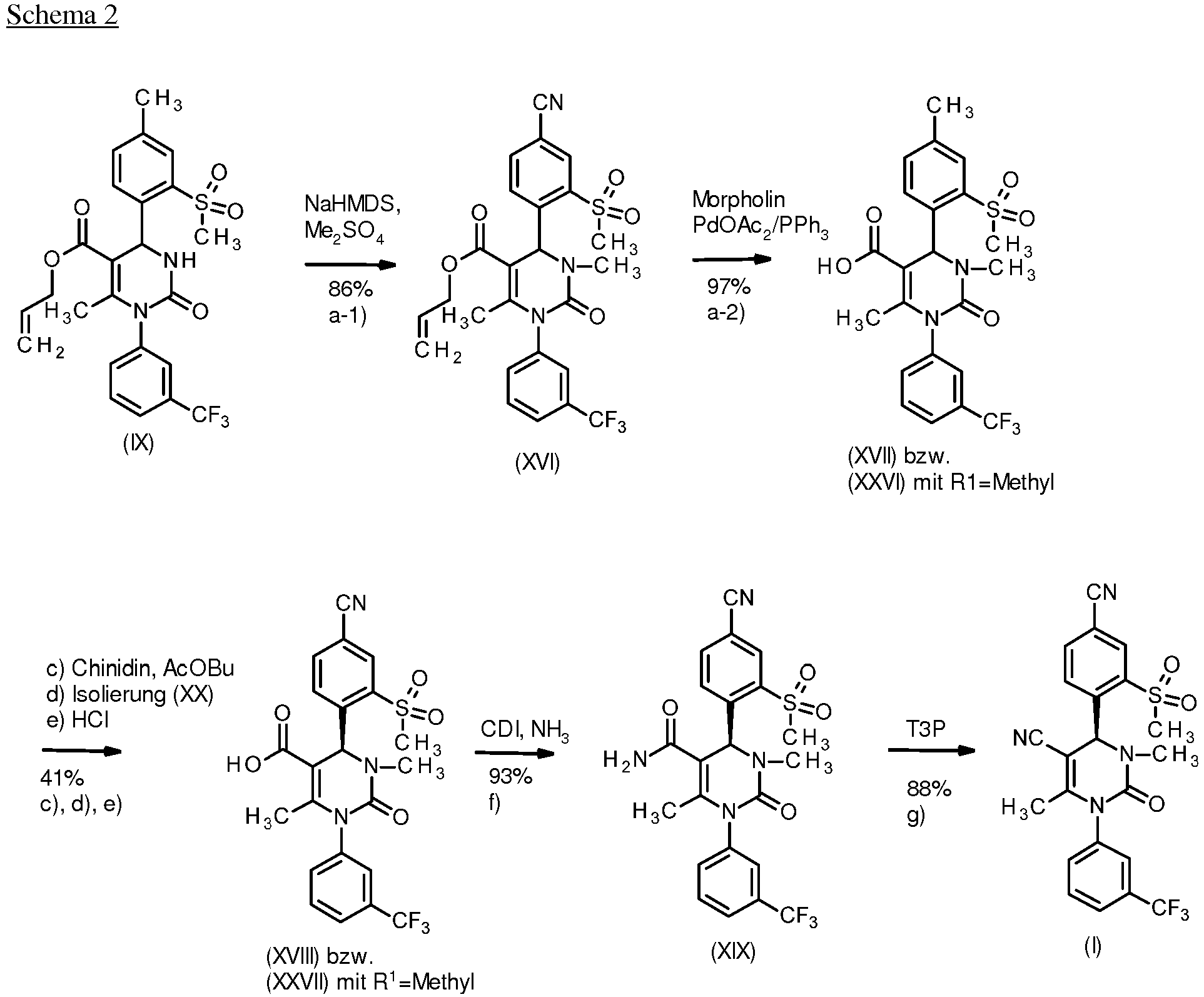
- Gemäß einer Ausführungsform der vorliegenden Erfindung werden bei der Racematspaltung im Rahmen von Verfahrensvariante (A) die im nachfolgenden Schema 3 gezeigten Schritte durchlaufen.

- Das nachfolgende Schema 4 zeigt im Einzelnen die durchlaufenen Zwischenstufen von Verfahrensvariante (B):

- Gemäß einer Ausführungsform der vorliegenden Erfindung werden bei der Racematspaltung im Rahmen von Verfahrensvariante (B) die im nachfolgenden Schema 5 gezeigten Schritte durchlaufen.

- Gemäß einer Ausführungsform der vorliegenden Erfindung werden bei der Racematspaltung im Rahmen von Verfahrensvariante (B) die im nachfolgenden Schema 6 gezeigten Schritte durchlaufen, wobei das nicht gewünschte R-Isomer racemisiert und wieder dem Prozess zugeführt wird. Diese Reaktionssequenz kann gegebenenfalls einmal oder mehrmals wiederholt werden.

- Die Reaktionsfolge der Synthese von 4-Brom-2-Fluorbenzaldehyd der Formel (XIV) bis zur Verbindung der Formel (IX) ist in folgendem Schema 7 dargestellt:

- Mit der neuen erfinderischen Synthese ist es gelungen in sehr effizienter Weise die Zielverbindung (I) herzustellen. Das Verfahren bietet gegenüber dem Stand der Technik erhebliche Vorteile, was die Skalierbarkeit und technische Durchführung betrifft. Die Gesamtausbeute ist verglichen mit publizierten Daten signifikant höher, außerdem wird eine sehr hohe Reinheit des Wirkstoffs erzielt. Das neue Verfahren ermöglicht die reproduzierbare, ökonomische Herstellung der nicht im Stand der Technik vorbeschriebenen, definierten Kristallform (A). Mit dem hier vorgestellten erfinderischen Verfahren wurden bereits erfolgreich mehrere kg Material für klinische Prüfungen hergestellt.
-
- AllBr
- Allylbromid
- aq.
- wässrig, wässrige Lösung
- c
- Konzentration
- cat.
- katalytisch
- CDI
- N,N'-Carbonyldiimidazol
- DBU
- 1,8-Diazabicyclo[5.4.0]undec-7-en
- DCI
- direkte chemische Ionisation (bei MS)
- dest.
- destilliert
- DIEA
- N,N-Diisopropylethylamin
- DMAP
- 4-N,N-Dimethylaminopyridin
- DMF
- Dimethylformamid
- DMSO
- Dimethylsulfoxid
- d. Th.
- der Theorie (bei Ausbeute)
- ee
- Enantiomerenüberschuss
- ent
- enantiomerenrein, Enantiomer
- eq.
- Äquivalent(e)
- ESI
- Elektrospray-Ionisation (bei MS)
- Et
- Ethyl
- GC-MS
- Gaschromatographie-gekoppelte Massenspektrometrie
- h
- Stunde(n)
- HATU
- O-(7-Azabenzotriazol-1-yl)-N,N,N',N'-tetramethyluronium-Hexafluorophosphat
- HPLC
- Hochdruck-, Hochleistungsflüssigchromatographie
- konz.
- konzentriert
- LC-MS
- Flüssigchromatographie-gekoppelte Massenspektrometrie
- Me
- Methyl
- min
- Minute(n)
- MS
- Massenspektrometrie
- MTBE
- Methyl-tert.-butylether
- NaHMDS
- Natrium-bis(trimethylsilyl)amid
- NMR
- Kernresonanzspektrometrie
- Ph
- Phenyl
- quant.
- quantitativ (bei Ausbeute)
- rac
- racemisch, Racemat
- RT
- Raumtemperatur
- Rt
- Retentionszeit (bei HPLC)
- Schmp.
- Schmelzpunkt
- TFAA
- Trifluoressigsäureanhydrid
- THF
- Tetrahydrofuran
- T3P
- 1-Propanphosphonsäureanhydrid
- UV
- Ultraviolett-Spektrometrie
- v/v
- Volumen zu Volumen-Verhältnis (einer Lösung)
- 400 g (1,97 mol) 4-Brom-2-fluorbenzaldehyd (XIV) als Lösung in 2,0 l DMF wurden mit 183 g (0,433 mol) Kaliumhexacyanoferrat (K4[Fe(CN)6]) und 165,5 g (1,97 mol) Natriumhydrogencarbonat vorgelegt und 2,2 g (9,85 mmol) Palladiumacetat zugegeben. Es wurde 2,5 Stunden bei 120°C gerührt. Es wurde auf 20°C abkühlen gelassen, dann wurden 2,0 l Wasser zum Ansatz gegeben. Es wurde mit 4,0 l MtBE extrahiert und die wässrige Phase wurde nochmals mit 1,5 l MtBE nachgewaschen. Die organischen Phasen wurden vereinigt und mit 2 l Wasser versetzt. Das MtBE wurde weitgehend bei 30 °C im leichten Vakuum abdestilliert. Dabei kristallisierte das Produkt aus. Es wurde auf 3°C abgekühlt und eine Stunde bei dieser Temperatur gerührt. Das Produkt wurde abfiltriert und mit Wasser (2 mal 0,8 l) nachgewaschen. Es wurde bei 40°C im Vakuum getrocknet. Ausbeute: 241 g (80 % d. Theorie) eines beigefarbenen Feststoffes.
MS (EIpos): m/z = 150 [M+H]+
1H-NMR (400 MHz, DMSO-d6): δ = 7.87 (d, 1H), 7.01 (s, 1H), 8,10 (d, 1H), 10.25 (s, 1H). - 200 g (1,34 mol) 4-Formyl-2-fluorbenzonitril (XV) als Lösung in 0,8 l DMSO wurden vorgelegt und 192 g (1,88 mol) Methansulfinsäure Natriumsalz zugegeben. Es wurde 4 Stunden bei 50°C gerührt. Man ließ auf 20°C abkühlen. Das Reaktionsgemisch wurde auf 8,0 l Wasser zudosiert. Dabei kristallisierte das Produkt aus. Man rührte eine Stunde bei Raumtemperatur. Das Produkt wurde abfiltriert und mit Wasser (2 mal 0,1 l) nachgewaschen. Es wurde bei 40°C im Vakuum getrocknet. Ausbeute: 256 g (91 % d. Theorie) eines beigefarbenen Feststoffes.
MS (ESIpos): m/z (%) = 191.1 (15) [M-18]+, 161.0 (100).
1H-NMR (400 MHz, DMSO-d6): δ = 3,57 (s, 3H), 8,10 (d, 1H), 8,38 (d, 1H), 8,45 (s, 1H), 10.62 (s, 1H). - Zu Phosphorsäuretriethylester (124,3 g, 683 mmol) wurde Diphosphorpentoxid (64,6 g, 455 mmol) in 3 Portionen bei 20 °C zugegeben und 3 h bei 40°C gerührt. Dann wurde mit THF (115 ml) verdünnt, 30 min bei 20 °C nachgerührt, und es wurden 4-Formyl-3-(methylsulfonyl)benzonitril (VI) (119 g, 569 mmol) sowie 1-[3-(Trifluormethyl)phenyl]harnstoff (VII) (116 g, 569 mmol) zugegeben. Anschließend wurde während 20 min Allylacetoacetat (VIII) (121 g, 852 mmol) zudosiert, wobei die Temperatur auf ca. 60°C anstieg. Das Gemisch wurde 4 h bei 80 °C gerührt. Zur Aufarbeitung wurde bei 40 °C Wasser (115 ml) zugegeben und 30 min bei 25 °C gerührt. Das Produkt wurde abfiltriert und mit Wasser (280 ml) nachgewaschen. Der Rückstand wurde mit MtBE (280 ml) für 20 min verrührt, erneut abfiltriert und mit MtBE (220 ml) gewaschen. Es wurde bei 40°C im Vakuum getrocknet. Ausbeute: 259 g (87 % d. Theorie) eines beigefarbenen Feststoffes.
MS (ESIpos): m/z (%) = 520.2 (100) [M+H]+
1H-NMR (400 MHz, DMSO-d6): δ = 2.15 (s, 3H), 3.45 (s, 3H), 4.45 (m, 2H), 4.95 (d, 1H), 5.05 (d, 1H), 5.65 (m, 1H), 6.40 (d, 1H), 7.20 (d, 1H), 7.70 (m, 2H), 7.80 (m, 1H), 7.85 (br. s, 1H), 8.10 (br. d, 1H), 8.25 (d, 1H), 8.35 (s, 1H). - (rac)-4-[4-Cyano-2-(methylsulfonyl)phenyl]-6-methyl-2-oxo-1-[3-(trifluormethyl)phenyl]-1,2,3,4-tetrahydropyrimidin-5-carbonsäure-allylester (IX) (500 g, 0.962 mol) wurde bei 20 °C in THF (2,5 l) vorgelegt und mit einer 1 M Lösung von Natriumhexamethyldisilazid (NaHMDS) in THF (203 g; 1,107 mol) versetzt. Nach 10 min Rühren wurde Dimethylsulfat (243 g; 1,925 mol) zugegeben und die Mischung für 2 h bei RT gerührt. Das Reaktionsgemisch wurde auf eine Lösung von 26%iger wässriger Ammoniaklösung (315 g; 4,812 mol) in 3 l Wasser gegeben und mit 250 ml THF nachgespült. Es wurde über Nacht nachgerührt, auf 5 °C abgekühlt. Das Produkt wurde abfiltriert und mit Wasser (1 l) nachgewaschen. Man trocknet bei 40°C im Vakuum.
Ausbeute: 443 g (86 % d. Theorie) eines beigefarbenen Feststoffes.
MS (ESIpos): m/z (%) = 534.1 (100) [M+H]+; MS (ESIneg): m/z (%) = 532.1 (100) [M-H]-.
1H-NMR (400 MHz, DMSO-d6): δ = 2.05 (s, 3H), 2.79 (s, 3H), 3.51 (s, 3H), 4.55 (m, 2H), 5,03 (d, 1H), 5.12 (d, 1H), 5.72 (m, 1H), 6.80 (s, 1H), 7.70 (m, 2H), 7.80 (m, 1H), 7.95 (br. s, 1H), 8.15 (br. d, 1H), 8.25 (d, 1H), 8.52 (s, 1H). - (rac)-4-[4-Cyano-2-(methylsulfonyl)phenyl]-3,6-dimethyl-2-oxo-1-[3-(trifluormethyl)phenyl]-1,2,3,4-tetrahydropyrimidin-5-carbonsäure-allylester (XVI) (485,6 g, 0.910 mol) wurde bei 20 °C in THF (2,275 l) vorgelegt und mit Morpholin (118,9 g; 1,365 mol) versetzt. Es wurde für 1 h Stickstoff in die Reaktionsmischung eingeleitet. Anschließend wurde auf 50 °C erwärmt, mit Palladium-(II)-acetat (511 mg; 2,275 mmol) und Triphenylphosphin (2388 mg; 9,102 mmol) versetzt und die Mischung für 2 h bei 50 °C gerührt. Nach Abkühlen wurde das Reaktionsgemisch in 4,5 1 Wasser gegeben. Es wurde mit 2 N Salzsäure auf pH = 2 eingestellt und das dabei entstehende Kristallisat über Nacht nachgerührt. Das Produkt wurde abfiltriert und mit Wasser (1.8 l) nachgewaschen. Es wurde bei 40°C im Vakuum getrocknet. Ausbeute: 504 g (98 % d. Theorie; bezogen auf das Mono-THF-Solvat) eines beigefarbenen Feststoffes.
MS (ESIpos): m/z (%) = 494.0 (100) [M+H]+.
1H-NMR (400 MHz, DMSO-d6): δ = 1.76 (m, 4 H; THF), 2.08 (s, 3H), 2.77 (s, 3H), 3.48 (s, 3H), 3,60 (m, 4H, THF), 6.72 (s, 1H), 7.75 (m, 2H), 7.82 (m, 1H), 7.92 (br. s, 1H), 8.11 (br. d, 1H), 8.27 (d, 1H), 8.46 (s, 1H), 12.75 (br. s, 1H). - (rac)-4-[4-Cyano-2-(methylsulfonyl)phenyl]-3,6-dimethyl-2-oxo-1-[3-(trifluormethyl)phenyl]-1,2,3,4-tetrahydropyrimidin-5-carbonsäure THF-solvat (XXVI) (555 g, 0.910 mol) wurde bei 20 °C in Butylacetat (2,22 l) vorgelegt und mit (+)-Chinidin (334,3 g; 1,03 mol) versetzt. Anschließend wurde auf 50 °C erwärmt und 1 h bei 50 °C gerührt. Nach Abkühlen auf 5 °C wurde abfiltriert und der Filterkuchen mit Butylacetat (1.2 l) ausgerührt, erneut abfiltriert und mit Butylacetat (0,7 l) nachgewaschen. Es wurde bei 40°C im Vakuum getrocknet. Ausbeute: 361 g (45 % d. Theorie) eines cremefarbenen Feststoffes.
1H-NMR (400 MHz, DMSO-d6): δ = 1.58 (m, 2H), 1.79 (m, 1H), 2.04 (m, 1H), 2.07 (s, 3H), 2.33 (m, 1H), 2.77 (s, 3H), 2.79 (m, 1H), 2.90 (m, 2H), 3.21 (m, 1H), 3,33 (m, 2H), 3.51 (s, 3H), 3.90 (s, 3H), 5.11 (d, 1H), 5,14 (d, 1H), 5.53 (br. s, 1H), 6,09 (ddd, 1H), 6.72 (s, 1H), 7.75 (m, 2H), 7.82 (m, 1H), 7.92 (br. s, 1H), 8.11 (br. d, 1H), 8.27 (d, 1H), 8.46 (s, 1H), 12.75 (br. s, 1H). - (S)-4-[4-Cyano-2-(methylsulfonyl)phenyl]-3,6-dimethyl-2-oxo-1-[3-(trifluormethyl)phenyl]-1,2,3,4-tetrahydropyrimidin-5-carbonsäure Chinidin Salz (XXVIII) (360 g, 0.405 mol) wurde bei 60 °C in einer Mischung aus Wasser (3,9 l) und Isopropanol (0,4 l) suspendiert und mit 2 N Salzsäure auf pH = 1 gestellt und 1 h bei 60 °C gerührt. Nach Abkühlen auf 20 °C wurde abfiltriert, mit Wasser (0.6 l) nachgewaschen und der Filterkuchen mit Wasser (1.2 l) ausgerührt, erneut abfiltriert und mit Wasser (1,2 l) nachgewaschen. Es wurde bei 40°C im Vakuum getrocknet. Ausbeute: 196 g (92 % d. Theorie) eines cremefarbenen Feststoffes.
MS (ESIpos): m/z (%) = 494.0 (100) [M+H]+.
1H-NMR (400 MHz, DMSO-d6): δ = 2.08 (s, 3H), 2.77 (s, 3H), 3.48 (s, 3H), 6.72 (s, 1H), 7.75 (m, 2H), 7.82 (m, 1H), 7.92 (br. s, 1H), 8.11 (br. d, 1H), 8.27 (d, 1H), 8.46 (s, 1H), 12.75 (br. s, 1H). - (S)-4-[4-Cyano-2-(methylsulfonyl)phenyl]-3,6-dimethyl-2-oxo-1-[3-(trifluormethyl)phenyl]-1,2,3,4-tetrahydropyrimidin-5-carbonsäure (XXVII) (390,5 g, 0.791 mol) wurde in THF (3,9 l) gelöst. Zur Entfernung von restlichen Wasserspuren wurden bei 80 °C Badtemperatur 2 l THF abdestilliert. Es wurde bei 0 °C mit 1,1-Carbonyldiimidazol (192,5 g, 1,187 mol) versetzt und 1 h bei 20 °C sowie 2 h bei 50 °C nachgerührt. Anschließend wurde bei 25 °C 26%ige wässrige Ammoniaklösung (518 g, 7,91 mol) zudosiert und 16 h nachgerührt. Die Reaktionsmischung wurde für 2 h auf 50 °C erwärmt, dabei wurde überschüssiger Ammoniak ausgegast. Nach Abkühlen wurde das Reaktionsgemisch in 7,8 l Wasser langsam zugegeben und das dabei entstehende Kristallisat über Nacht nachgerührt. Das Produkt wurde abfiltriert und mit Wasser (2,4 l) nachgewaschen. Man trocknet bei 40°C im Vakuum. Ausbeute: 361 g (92 % d. Theorie) eines cremefarbenen Feststoffes.
MS (ESIpos): m/z (%) = 493.0 (100) [M+H]+.
1H-NMR (400 MHz, DMSO-d6): δ = 1,73 (s, 3H), 2.73 (s, 3H), 3.45 (s, 3H), 6.55 (s, 1H), 7.34 (br. s, 1H), 7.48 (br. s, 1H), 7.73 (m, 2H), 7.80 (m, 2H), 8.11 (d, 1H), 8.43 (d, 1H), 8.47 (s, 1H). - (S)-4-[4-Cyano-2-(methylsulfonyl)phenyl] -3,6-dimethyl-2-oxo-1-[3-(trifluormethyl)phenyl]-1,2,3,4-tetrahydropyrimidin-5-carbamid (XIX) (400 g, 0.812 mol) wurde in Ethylacetat (1,6 l) gelöst. Es wurde bei 20 °C mit N-Ethyldiisopropylamin (262,4 g, 2.031 mol) versetzt und 15 min bei 20 °C nachgerührt. Anschließend wurde bei 2 °C 26%ige eine 50%ige Lösung von 1-Propanphosponsäureanhydrid in Ethylacetat (1,137 kg, 1.79 mol) zudosiert, auf Rückflusstemperatur erwärmt und 2 h nachgerührt. Man ließ auf 20°C abkühlen und gab 3,4 l Wasser zum Ansatz. Nach Phasentrennung wurde die organische Phase mit gesättigter Natriumhydrogencarbonat-Lösung (1,2 l) gewaschen. Die organische Phase wurde auf 60 °C temperiert und unter gleichzeitiger Zugabe von Ethanol (Toluol vergällt) wurde im leichten Vakuum abdestilliert. Dabei kristallisiert das Produkt aus. Nach beendeter Kristallisation wurde auf Rückflusstemperatur erhitzt und 4 h nachgerührt. Es wurde auf 20°C abgekühlt und eine Stunde bei dieser Temperatur gerührt. Das Produkt wurde abfiltriert und einmal mit Wasser (1,2 l) und einmal mit Ethanol (Toluol vergällt) (0,4 l) nachgewaschen. Es wurde bei 50°C im Vakuum getrocknet. Ausbeute: 344 g (89 % d. Theorie) weiße Kristalle der stabilen Kristallform (A) mit einem Schmelzpunkt von 232 °C, Reinheit: 99,4 %, Gehalt: 99,3%
MS (ESIpos): m/z (%) = 475.1 (100) [M+H]+.
1H-NMR (400 MHz, DMSO-d6): δ = 1,81 (s, 3H), 2.70 (s, 3H), 3.52 (s, 3H), 6.48 (s, 1H), 7.65 - 8.40 (m, 6H), 8.46 (s, 1H). - (rac)-4-[4-Cyano-2-(methylsulfonyl)phenyl] -6-methyl-2-oxo-1-[3-(trifluormethyl)phenyl]-1,2,3,4-tetrahydropyrimidin-5-carbonsäure-allylester (IX) (420 g, 0.808 mol) wurde bei 20 °C in THF (2,1 l) vorgelegt und mit Morpholin (105,6 g; 1,213 mol) versetzt. Es wurde für 1 h Stickstoff in die Reaktionsmischung eingeleitet. Anschließend wurde mit Bis(triphenylphophin)palladium-(II)-chlorid (284 mg; 0,404 mmol) und Triphenylphosphin (424 mg; 1,617 mmol) versetzt und die Mischung für 2 h bei RT gerührt. Anschließend wurde nochmals mit Bis(triphenylphophin)palladium-(II)-chlorid (284 mg; 0,404 mmol) und Triphenylphosphin (424 mg; 1,617 mmol) versetzt und die Mischung für 2 h bei RT gerührt. Das Reaktionsgemisch wurde in 4 l Wasser gegeben. Es wurde mit 2 N Salzsäure auf pH = 2 eingestellt und das dabei entstehende Kristallisat über Nacht nachgerührt. Das Produkt wurde abfiltriert und mit Wasser (1,7 l) nachgewaschen. Es wurde bei 40°C im Vakuum getrocknet.
Ausbeute: 575 g (97 % d. Theorie) eines beigefarbenen Feststoffes.
MS (ESIpos): m/z (%) = 480.0 (100) [M+H]+.
1H-NMR (400 MHz, DMSO-d6): δ = 2.12 (s, 3H), 3.48 (s, 3H), 6.32 (s, 1H), 7,12 (s, 1H), 7.72 (m, 2H), 7.80 (m, 1H), 7.88 (br. s, 1H), 8.13 (br. d, 1H), 8.27 (d, 1H), 8.37 (s, 1H), 12.62 (br. s, 1H). - (rac)-4-[4-Cyano-2-(methylsulfonyl)phenyl]-6-methyl-2-oxo-1-[3-(trifluormethyl)phenyl]-1,2,3,4-tetrahydropyrimidin-5-carbonsäure (XXII) (563,7 g, 1,176 mol) wurde bei 20 °C in einer Mischung aus Isopropanol/Wasser (9 : 1; 4,2 l) vorgelegt und mit (-)-Chinin (381,4 g; 1,176 mol) versetzt. Anschließend wurde auf 50 °C erwärmt und 1 h bei 50 °C gerührt. Nach Abkühlen auf 5 °C wurde abfiltriert und der Filterkuchen dreimal mit einerMischung aus Isopropanol/Wasser (9 : 1; 1,2 l) nachgewaschen. Es wurde bei 40°C im Vakuum getrocknet.
Ausbeute: 432 g (46 % d. Theorie) eines cremefarbenen Feststoffes.
1H-NMR (400 MHz, DMSO-d6): δ = 1.58 (m, 2H), 1.79 (m, 1H), 2.04 (m, 1H), 2.10 (s, 3H), 2.33 (m, 1H), 2.79 (m, 1H), 2.90 (m, 2H), 3.21 (m, 1H), 3,33 (m, 2H), 3.46 (s, 3H), 3.90 (s, 3H), 5.11 (d, 1H), 5,14 (d, 1H), 5.53 (br. s, 1H), 6,09 (m, 1H), 6.33 (s, 1H), 7.10 (s, 1H), 7.73 (m, 2H), 7.82 (m, 1H), 7.90 (br. s, 1H), 8.11 (br. d, 1H), 8.27 (d, 1H), 8.44 (s, 1H), 12.70 (br. s, 1H). - (S)-4-[4-Cyano-2-(methylsulfonyl)phenyl]-6-methyl-2-oxo-1-[3-(trifluormethyl)phenyl]-1,2,3,4-tetrahydropyrimidin-5-carbonsäure Chinidin Salz (XXIV) (430 g, 0,535 mol) wurde bei 60 °C in einer Mischung aus Wasser (4,2 l) und Isopropanol (0,4 l) suspendiert und mit 2 N Salzsäure auf pH = 1 gestellt und 1 h bei 60 °C gerührt. Nach Abkühlen auf 20 °C wurde abfiltriert und der Filterkuchen dreimal mit Wasser (0,6 l) nachgewaschen. Es wurde bei 40°C im Vakuum getrocknet.
Ausbeute: 251 g (98 % d. Theorie) eines cremefarbenen Feststoffes.
MS (ESIpos): m/z (%) = 480.0 (100) [M+H]+.
1H-NMR (400 MHz, DMSO-d6): δ = 2.12 (s, 3H), 3.48 (s, 3H), 6.32 (s, 1H), 7,12 (s, 1H), 7.72 (m, 2H), 7.80 (m, 1H), 7.88 (br. s, 1H), 8.13 (br. d, 1H), 8.27 (d, 1H), 8.37 (s, 1H), 12.62 (br. s, 1H). - (S)-4- [4-Cyano-2-(methylsulfonyl)phenyl]-6-methyl-2-oxo-1-[3-(trifluormethyl)phenyl]-1,2,3,4-tetrahydropyrimidin-5-carbonsäure (XI) (250 g, 0.521 mol) wurde bei 20 °C in Aceton (1,5 l) vorgelegt und mit Kaliumcarbonat (72 g; 0,521 mol) versetzt. Nach 10 min Rühren wurde Allylbromid (79 g; 652 mol) zugegeben und die Mischung für 6 h unter Rückfluss gerührt. Nach Abkühlen wurden zum Reaktionsgemisch 1,4 l Wasser zugegeben und es wurde 60 min nachgerührt. Das Produkt wurde abfiltriert, zweimal mit Wasser (0,6 l) und zweimal mit MtBE (0,6 l) nachgewaschen. Es wurde bei 40°C im Vakuum getrocknet.
Ausbeute: 258 g (95 % d. Theorie) eines cremefarbenen Feststoffes.
MS (ESIpos): m/z (%) = 534.1 (100) [M+H]+.
1H-NMR (400 MHz, DMSO-d6): δ = 2.05 (s, 3H), 2.79 (s, 3H), 3.51 (s, 3H), 4.55 (m, 2H), 5,03 (d, 1H), 5.12 (d, 1H), 5.72 (m, 1H), 6.80 (s, 1H), 7.70 (m, 2H), 7.80 (m, 1H), 7.95 (br. s, 1H), 8.15 (br. d, 1H), 8.25 (d, 1H), 8.52 (s, 1H). - (S)-4- [4-Cyano-2-(methylsulfonyl)phenyl]-6-methyl-2-oxo-1-[3-(trifluormethyl)phenyl]-1,2,3,4-tetrahydropyrimidin-5-carbonsäure-allylester (X) (250 g, 0.481 mol) wurde bei 20 °C in THF (1,25 l) vorgelegt und mit einer 1 M Lösung von Natriumhexamethyldisilazid (NaHMDS) in THF (102 g; 0,554 mol) versetzt. Nach 10 min Rühren wurde Dimethylsulfat (122 g; 0,964 mol) zugegeben und die Mischung für 2 h bei RT gerührt. Das Reaktionsgemisch wurde auf eine Lösung von 26%iger wässriger Ammoniaklösung (178 g; 2,4 mol) in 1,5 l Wasser gegeben und mit 200 ml THF nachgespült. Es wurde über Nacht nachgerührt, auf 5 °C abgekühlt. Das Produkt wird abfiltriert und mit Wasser (0,6 l) nachgewaschen. Es wurde bei 40°C im Vakuum getrocknet.
Ausbeute: 230 g (89 % d. Theorie) eines beigefarbenen Feststoffes.
MS (ESIpos): m/z (%) = 534.1 (100) [M+H]+.
1H-NMR (400 MHz, DMSO-d6): δ = 2.05 (s, 3H), 2.79 (s, 3H), 3.51 (s, 3H), 4.55 (m, 2H), 5,03 (d, 1H), 5.12 (d, 1H), 5.72 (m, 1H), 6.80 (s, 1H), 7.70 (m, 2H), 7.80 (m, 1H), 7.95 (br. s, 1H), 8.15 (br. d, 1H), 8.25 (d, 1H), 8.52 (s, 1H). - Die gesammelten Mutterlaugen und Waschlaugen aus Beispiel 11 welche das Cininsalz der (R)-4-[4-Cyano-2-(methylsulfonyl)phenyl]-6-methyl-2-oxo-1-[3-(trifluormethyl)phenyl]-1,2,3,4-tetrahydropyrimidin-5-carbonsäure (XXV) enthalten wurden bis zum Kristallbrei eingeengt. Es wurde in Wasser (5,0 l) aufgenommen, mit 2 N Salzsäure auf pH = 1 gestellt und 1 h bei 60 °C gerührt. Nach Abkühlen auf 20 °C wurde abfiltriert und der Filterkuchen dreimal mit Wasser (1.0 l) nachgewaschen. Es wurde bei 40°C im Vakuum getrocknet.
Ausbeute: 293 g (52 % d. Theorie, bezogen auf Einsatz XXII) eines cremefarbenen Feststoffes.
Verhältnis R-Enantiomer : S-Enantiomer: 88 : 12
MS (ESIpos): m/z (%) = 480.0 (100) [M+H]+.
1H-NMR (400 MHz, DMSO-d6): δ = 2.12 (s, 3H), 3.48 (s, 3H), 6.32 (s, 1H), 7,12 (s, 1H), 7.72 (m, 2H), 7.80 (m, 1H), 7.88 (br. s, 1H), 8.13 (br. d, 1H), 8.27 (d, 1H), 8.37 (s, 1H), 12.62 (br. s, 1H). - (R)-4-[4-Cyano-2-(methylsulfonyl)phenyl]-6-methyl-2-oxo-1-[3-(trifluormethyl)phenyl]-1,2,3,4-tetrahydropyrimidin-5-carbonsäure (XXX) (292 g, 0,609 mol) wurde bei 20 °C in Aceton (1,6 l) vorgelegt und mit Kaliumcarbonat (84 g; 0,609 mol) versetzt. Nach 10 min Rühren wurde Allylbromid (92 g; 761 mol) zugegeben und die Mischung für 6 h unter Rückfluss gerührt. Nach abkühlen wurden zum Reaktionsgemisch 1,5 l Wasser zugegeben und wurde 60 min nachgerührt. Das Produkt wird abfiltriert, zweimal mit Wasser (0,6 l) und zweimal mit MtBE (0,6 l) nachgewaschen. Man trocknet bei 40°C im Vakuum.
Ausbeute: 301 g (95 % d. Theorie) eines cremefarbenen Feststoffes.
MS (ESIpos): m/z (%) = 534.1 (100) [M+H]+.
1H-NMR (400 MHz, DMSO-d6): δ = 2.05 (s, 3H), 2.79 (s, 3H), 3.51 (s, 3H), 4.55 (m, 2H), 5,03 (d, 1H), 5.12 (d, 1H), 5.72 (m, 1H), 6.80 (s, 1H), 7.70 (m, 2H), 7.80 (m, 1H), 7.95 (br. s, 1H), 8.15 (br. d, 1H), 8.25 (d, 1H), 8.52 (s, 1H). - (R)-4-[4-Cyano-2-(methylsulfonyl)phenyl]-6-methyl-2-oxo-1-[3-(trifluormethyl)phenyl]-1,2,3,4-tetrahydropyrimidin-5-carbonsäure (XXXI) (292 g, 0.609 mol) wurde bei 20 °C in Aceton (1,6 l) vorgelegt und mit Kaliumcarbonat (84 g; 0,609 mol) versetzt. Nach 10 min Rühren wurde Allylbromid (92 g; 761 mol) zugegeben und die Mischung für 6 h unter Rückfluss gerührt. Nach Abkühlen wurden zum Reaktionsgemisch 1,5 l Wasser zugegeben und wurde 60 min nachgerührt. Das Produkt wurde abfiltriert, zweimal mit Wasser (0,6 l) und zweimal mit MtBE (0,6 l) nachgewaschen. Es wurde bei 40°C im Vakuum getrocknet.
Ausbeute: 301 g (95 % d. Theorie) eines cremefarbenen Feststoffes.
MS (ESIpos): m/z (%) = 534.1 (100) [M+H]+.
1H-NMR (400 MHz, DMSO-d6): δ = 2.05 (s, 3H), 2.79 (s, 3H), 3.51 (s, 3H), 4.55 (m, 2H), 5,03 (d, 1H), 5.12 (d, 1H), 5.72 (m, 1H), 6.80 (s, 1H), 7.70 (m, 2H), 7.80 (m, 1H), 7.95 (br. s, 1H), 8.15 (br. d, 1H), 8.25 (d, 1H), 8.52 (s, 1H). - Gerät: Transmission diffractometer PANalytical X'Pert PRO with PIXcel counter (multichannel)
Scan-Achse 2Theta-Omega Startposition [°2Th.] 2,0000 Endposition [°2Th.] 37,9900 Art der Divergenzblende Fest Größe der Divergenzblende [°] 1,0000 Temperatur der Messung [°C] 25 Anodenmaterial Cu K-Alphal [Å] 1,54060 Generatoreinstellung 40 mA, 40 kV Diffraktometer Typ Transmissions Diffraktometer Goniometer Radius [mm] 240,00 Abstand Focus-Div.blende [mm] 91,00 Primärstrahl- Monochromator fokussierender Röntgenspiegel Probendrehung Ja Tabelle 1: Peakmaxima [2 Theta] des Röntgendiffraktogramms der Verbindung (I) in der Kristallform (A) Peakmaximum [2 Theta] Verbindung (I), Kristallform (A) 7.5 20.0 28.0 10.0 20.8 28.1 11.5 20.9 28.3 11.9 21.8 28.7 12.2 22.5 29.2 12.4 22.9 29.6 13.2 23.1 30.3 14.7 23.4 30.5 15.1 23.5 30.8 15.8 24.0 31.7 16.0 24.7 32.2 16.5 25.1 32.4 17.8 25.3 33.4 18.5 25.6 33.8 18.7 26.5 34.2 19.4 27.1 34.5 19.8 27.4 -
Gerät Bruker Raman RFS 100/S Anzahl Scans 64 Auflösung 2 - 4 cm-1 Laser Power 50 mW Laser Wellenlänge 1064 nm Tabelle 2: Bandenmaxima des Raman Spektrums der Verbindung (I) in der Kristallform (A) Bandenmaximum [cm-1] Modifikation I 3087 1312 589 3075 1299 580 3067 1238 535 3044 1195 490 3019 1169 471 2993 1154 457 2969 1142 443 2928 1091 435 2918 1077 403 2236 1066 365 2216 1056 346 2184 1015 329 1646 1004 298 1605 994 280 1443 910 255 1435 873 240 1418 795 217 1411 767 190 1395 761 171 1387 746 149 1361 683 128 1354 674 111 1331 645 -
-
Abbildung 1 : Röntgendiffraktrogramm derVerbindung der Formel (I) in der Kristallform (A) -
Abbildung 2 : Raman Spektrum der Verbindung der Formel (I) in der Kristallform (A)
Claims (9)
- Verbindung der Formel (I)

- Verbindung der Formel (I) in der Kristallform (A) nach Anspruch 1, dadurch gekennzeichnet, dass das Raman- Spektrum der Verbindung Bandenmaxima bei 3075, 2928, 2918, 2236, 2216, 1646, 1605, 1195 und 1004 cm-1 zeigt.
- Verfahren zur Herstellung der Verbindung der Formel (I) in der Kristallform (A) nach Anspruch 1 oder 2, dadurch gekennzeichnet, dass eine Verbindung der Formel (I), vorliegend in einer oder mehreren Kristallformen oder als Solvat, in einem Alkohol, bevorzugt Ethanol, auskristallisiert wird, anschließend der dabei entstehende Kristallbrei auf 50-80°C erhitzt und 2-5 h bei dieser Temperatur nachgerührt wird.
- Verbindung nach einem der Ansprüche 1 oder 2 zur Verwendung in einem Verfahren zur Behandlung von Krankheiten.
- Verbindung nach einem der Ansprüche 1 oder 2 zur Verwendung in einem Verfahren zur Behandlung und/oder Prävention von Erkrankungen der Lunge und des Herz-/Kreislaufsystems und zur Förderung der Wundheilung, insbesondere bei chronischen Wunden.
- Verbindung nach einem der Ansprüche 1 oder 2 zur Verwendung in einem Verfahren zur Behandlung und/oder Prävention von pulmonaler arterieller Hypertonie (PAH) und anderen Formen der pulmonalen Hypertonie (PH), von chronisch-obstruktiven Lungenerkrankungen (COPD), der akuten Lungenschädigung (ALI), des akuten Atemwegssyndroms (ARDS), des Lungenemphysems, der alpha-1-Antitrypsin-Defizienz (AATD), der zystischen Fibrose (CF), der Bronchiektasie und zur Förderung der Wundheilung, insbesondere bei chronischen Wunden.
- Arzneimittel enthaltend die Verbindung der Formel (I) in der Kristallform (A) gemäß einem der Ansprüche 1 oder 2 in mehr als 90 Gewichtsprozente bezogen auf die Gesamtmenge der enthaltenen Verbindung der Formel (I).
- Verwendung der Verbindung der Formel (I) in der Kristallform (A) gemäß einem der Ansprüche 1 oder 2 zur Herstellung eines Arzneimittels zur Behandlung von Erkrankungen der Lunge und des Herz-/Kreislaufsystems und zur Förderung der Wundheilung, insbesondere bei chronischen Wunden.
- Verfahren gemäß Anspruch 3 zur Herstellung einer Verbindung der Formel (I) in der Kristallform (A) nach einem der Ansprüche 1 oder 2

 a-1) in Gegenwart eines Methylierungsmittels und einer Base zu einer Verbindung der Formel (XVI)
 a-2) eine Verbindung der Formel (XVI) in Gegenwart eines Palladiumkatalysators und einer sekundären Amin-Base zu einer Verbindung der Formel (XXVI)
oderb-1) in Gegenwart eines Palladiumkatalysators und einer sekundären Amin-Base zu einer Verbindung der Formel (XXVI) umsetzt, in welcher R1 für Wasserstoff steht;anschließendc) eine Verbindung der Formel (XXVI), in welcher R1 für Wasserstoff oder Methyl steht, in Gegenwart eines China-Alkaloids und eines Lösungsmittels zu Verbindungen der Formeln (XXVIII) und (XXIX) d) eine Verbindung der Formel (XXVIII) isoliert; anschließende) eine Verbindung der Formel (XXVIII) in Gegenwart einer starken Säure zu einer Verbindung der Formel (XXVII)
 b-2) für den Fall, dass R1 in der Verbindung der Formel (XXVII) für Wasserstoff steht, eine Verbindung der Formel (XXVII) in Gegenwart eines Allylhalogenids oder -sulfonats und einer Base zu einer Verbindung der Formel (X)
 b-3) eine Verbindung der Formel (X) in Gegenwart eines Methylierungsmittels und einer Base zu einer Verbindung der Formel (XXIII)
 b-4) eine Verbindung der Formel (XXIII) in Gegenwart eines Palladiumkatalysators und einer sekundären Amin-Base zu einer Verbindung der Formel (XXVII)
 f) eine Verbindung der Formel (XXVII), in welcher R1 für Methyl steht, in Gegenwart eines Aktivierungsreagenzes zu einer Verbindung der Formel (XIX)
 g) eine Verbindung der Formel (XIX) in Gegenwart eines Dehydratisierungsmittels zu einer Verbindung der Formel (I) einsetzt;
gegebenenfalls im Anschluss an Reaktionsschritt c) eine Verbindung der Formel (XXIX) isoliert

 h) eine Verbindung der Formel (XXXI) in Gegenwart einer starken, nicht nukleophilen Base in einem Lösungsmittel und unter gleichzeitigem Erwärmen in das Racemat der Formel (IX)wobei man die Verbindung der Formel (I) aus der organischen Phase aus Reaktionsschritt g) in einem Alkohol, bevorzugt Ethanol, auskristallisiert, anschließend den dabei entstehenden Kristallbrei auf 50-80°C erhitzt und 2-5 h bei dieser Temperatur nachrührt.
und gegebenenfalls die Reaktionsschritte der Isolierung einer Verbindung der Formel (XXIX) deren Umsetzung gemäß Reaktionsschritt e) in Gegenwart einer starken Säure zu einer Verbindung der Formel (XXX), die anschließende Umsetzung einer Verbindung der Formel (XXX) gemäß Reaktionsschritt b-2) in Gegenwart eines Allylhalogenids oder -sulfonats und einer Base zu einer Verbindung der Formel (XXXI), und anschließende Durchführung der Reaktionsschritte h), b-1), c), d), e), b-2), b-3), b-4), f) und g) einmal oder mehrmals wiederholt;
wobei gegebenenfalls in den Formeln (XXVI), (XXVII), (XXVIII) und (XXIX) R1 für Methyl steht und das Verfahren die Reaktionsschritte a-1), a-2), c), d), e), f) und g) umfasst;
wobei gegebenenfalls in den Formeln (XXVI), (XXVII), (XXVIII) und (XXIX) R1 für Wasserstoff steht und das Verfahren die Reaktionsschritte b-1), c), d), e), b-2), b-3), b-4), f) und g) umfasst;gegebenenfalls dadurch gekennzeichnet, dass manim Anschluss an Reaktionsschritt c) eine Verbindung der Formel (XXIX) isoliert, diese gemäß Reaktionsschritt e) in Gegenwart einer starken Säure zu einer Verbindung der Formel (XXX) umsetzt; anschließend eine Verbindung der Formel (XXX) gemäß Reaktionsschritt b-2) in Gegenwart eines Allylhalogenids oder -sulfonats und einer Base zu einer Verbindung der Formel (XXXI) umsetzt; anschließend
h) eine Verbindung der Formel (XXXI) in Gegenwart einer starken, nicht nukleophilen Base in einem Lösungsmittel und unter gleichzeitigem Erwärmen in das Racemat der Formel (IX) umsetzt; anschließendeine Verbindung der Formel (IX) gemäß den oben beschriebenen Reaktionsschritten b-1), c), d), e), b-2), b-3), b-4), f) und g) zu einer Verbindung der Formel (I) umsetzt;und gegebenenfalls die Reaktionsschritte der Isolierung einer Verbindung der Formel (XXIX) deren Umsetzung gemäß Reaktionsschritt e) in Gegenwart einer starken Säure zu einer Verbindung der Formel (XXX), die anschließende Umsetzung einer Verbindung der Formel (XXX) gemäß Reaktionsschritt b-2) in Gegenwart eines Allylhalogenids oder -sulfonats und einer Base zu einer Verbindung der Formel (XXXI), und anschließende Durchführung der Reaktionsschritte h), b-1), c), d), e), b-2), b-3), b-4), f) und g) einmal oder mehrmals wiederholt
Applications Claiming Priority (2)
| Application Number | Priority Date | Filing Date | Title |
|---|---|---|---|
| EP15159570 | 2015-03-18 | ||
| PCT/EP2016/055498 WO2016146607A1 (de) | 2015-03-18 | 2016-03-15 | Verfahren zur herstellung von (4s)-4-[4-cyano-2-(methylsulfonyl)phenyl]-3,6-dimethyl-2-oxo-1-[3-(trifluormethyl)phenyl]-1,2,3,4-tetrahydro pyrimidin-5-carbonitril |
Publications (2)
| Publication Number | Publication Date |
|---|---|
| EP3271337A1 EP3271337A1 (de) | 2018-01-24 |
| EP3271337B1 true EP3271337B1 (de) | 2021-03-03 |
Family
ID=52684127
Family Applications (1)
| Application Number | Title | Priority Date | Filing Date |
|---|---|---|---|
| EP16713747.0A Active EP3271337B1 (de) | 2015-03-18 | 2016-03-15 | Verfahren zur herstellung von (4s)-4-[4-cyano-2-(methylsulfonyl)phenyl]-3,6-dimethyl-2-oxo-1-[3-(trifluormethyl)phenyl]-1,2,3,4-tetrahydro pyrimidin-5-carbonitril |
Country Status (9)
| Country | Link |
|---|---|
| US (2) | US10316001B2 (de) |
| EP (1) | EP3271337B1 (de) |
| JP (4) | JP7390100B2 (de) |
| KR (1) | KR20170129191A (de) |
| CN (2) | CN107635972A (de) |
| AU (1) | AU2016232270B2 (de) |
| CA (1) | CA2980071A1 (de) |
| ES (1) | ES2877583T3 (de) |
| WO (1) | WO2016146607A1 (de) |
Families Citing this family (4)
| Publication number | Priority date | Publication date | Assignee | Title |
|---|---|---|---|---|
| CA2980071A1 (en) | 2015-03-18 | 2016-09-22 | Bayer Pharma Aktiengesellschaft | Method for preparation of (4s)-4-[4-cyano-2-(methylsulfonyl)phenyl]-3,6-dimethyl-2-oxo-1-[3-(trifluoromethyl)phenyl]-1,2,3,4-tetrahydro pyrimidine-5-carbonitrile |
| KR20210002573A (ko) | 2018-04-24 | 2021-01-08 | 주식회사 피에이치파마 | 간 질환에 호중구 엘라스타제 저해제의 사용 |
| CA3151997A1 (en) * | 2019-08-23 | 2021-03-04 | Ph Pharma Co., Ltd. | Use of a neutrophil elastase inhibitor in lung disease |
| CN112304919B (zh) * | 2020-09-18 | 2022-07-05 | 公安部物证鉴定中心 | 一种乌头碱类植物毒素的定性定量检测方法 |
Family Cites Families (22)
| Publication number | Priority date | Publication date | Assignee | Title |
|---|---|---|---|---|
| GB9214053D0 (en) | 1992-07-02 | 1992-08-12 | Ici Plc | Heterocyclic amides |
| US6372936B1 (en) * | 1999-06-09 | 2002-04-16 | Eli Lilly And Company | Optical resolution of aminoisobobutyric acid |
| MY125533A (en) | 1999-12-06 | 2006-08-30 | Bristol Myers Squibb Co | Heterocyclic dihydropyrimidine compounds |
| GB0219896D0 (en) | 2002-08-27 | 2002-10-02 | Bayer Ag | Dihydropyridine derivatives |
| GB0220962D0 (en) * | 2002-09-10 | 2002-10-23 | Bayer Ag | Heterocyclic derivatives |
| CA2498052C (en) | 2002-09-10 | 2011-05-17 | Bayer Healthcare Ag | Heterocyclic derivatives |
| MXPA05002644A (es) | 2002-09-10 | 2005-09-20 | Bayer Healthcare Ag | Derivados de pirimidinona como agentes terapeuticos contra procesos de remodelacion, isquemicos e inflamatorios agudos y cronicos. |
| US20060079554A1 (en) | 2002-12-06 | 2006-04-13 | Barry Peter C | Inhibitors of monomine uptake |
| US7166603B2 (en) | 2003-07-23 | 2007-01-23 | Bristol-Myers Squibb Co. | Dihydropyrimidone inhibitors of calcium channel function |
| ES2394177T3 (es) * | 2004-02-26 | 2013-01-23 | Bayer Intellectual Property Gmbh | 1,4-diaril-dihidropirimidin-2-onas y su uso como inhibidores de elastasa de neutrófilos humanos |
| JP4825195B2 (ja) | 2004-02-26 | 2011-11-30 | バイエル・シェーリング・ファルマ・アクチェンゲゼルシャフト | 1,4−ジアリール−ジヒドロピリミジン−2オン化合物およびヒト好中球エラスターゼ阻害剤としてのそれらの使用 |
| GB0502258D0 (en) | 2005-02-03 | 2005-03-09 | Argenta Discovery Ltd | Compounds and their use |
| GB0512940D0 (en) | 2005-06-24 | 2005-08-03 | Argenta Discovery Ltd | Compounds and their use |
| GB0520743D0 (en) | 2005-10-12 | 2005-11-23 | Argenta Discovery Ltd | Compounds and their use |
| AU2006321947A1 (en) * | 2005-12-05 | 2007-06-14 | Wyeth | Process for preparing substituted aryl cycloalkanol derivatives |
| DK2024367T3 (da) | 2006-05-04 | 2011-01-03 | Pulmagen Therapeutics Inflammation Ltd | Tetrahydropyrrolopyrimidindioner og deres anvendelse som inhibitorer af human neutrofil elastase |
| US20100010024A1 (en) | 2006-07-01 | 2010-01-14 | Bayer Healthcare Ag | Use of1,4-diaryl-dihydropyrimidine-2-on derivatives for treating pulmonary arterial hypertension |
| US20110003858A1 (en) | 2006-09-04 | 2011-01-06 | Bergstroem Lena | Multimeric heterocyclic compounds useful as neutrophil elastase inhibitors |
| DE102008022521A1 (de) | 2008-05-07 | 2009-11-12 | Bayer Schering Pharma Aktiengesellschaft | 1,4-Diaryl-pyrimidopyridazin-2,5-dione und ihre Verwendung |
| HRP20120457T1 (hr) | 2007-12-20 | 2012-06-30 | Bayer Pharma Aktiengesellschaft | 4-(4-cijano-2-tioaril)dihidropirimidinoni i njihova uporaba |
| DE102009016553A1 (de) | 2009-04-06 | 2010-10-07 | Bayer Schering Pharma Aktiengesellschaft | Sulfonamid- und Sulfoximin-substituierte Diaryldihydropyrimidinone und ihre Verwendung |
| CA2980071A1 (en) | 2015-03-18 | 2016-09-22 | Bayer Pharma Aktiengesellschaft | Method for preparation of (4s)-4-[4-cyano-2-(methylsulfonyl)phenyl]-3,6-dimethyl-2-oxo-1-[3-(trifluoromethyl)phenyl]-1,2,3,4-tetrahydro pyrimidine-5-carbonitrile |
-
2016
- 2016-03-15 CA CA2980071A patent/CA2980071A1/en active Pending
- 2016-03-15 ES ES16713747T patent/ES2877583T3/es active Active
- 2016-03-15 JP JP2017549057A patent/JP7390100B2/ja active Active
- 2016-03-15 EP EP16713747.0A patent/EP3271337B1/de active Active
- 2016-03-15 AU AU2016232270A patent/AU2016232270B2/en not_active Ceased
- 2016-03-15 KR KR1020177029441A patent/KR20170129191A/ko not_active Ceased
- 2016-03-15 CN CN201680028214.7A patent/CN107635972A/zh active Pending
- 2016-03-15 WO PCT/EP2016/055498 patent/WO2016146607A1/de not_active Ceased
- 2016-03-15 US US15/559,385 patent/US10316001B2/en active Active
- 2016-03-15 CN CN201911315571.3A patent/CN110981815A/zh active Pending
-
2019
- 2019-04-25 US US16/394,811 patent/US10676443B2/en active Active
-
2020
- 2020-07-03 JP JP2020115899A patent/JP7125450B2/ja not_active Expired - Fee Related
-
2021
- 2021-05-12 JP JP2021081100A patent/JP7117415B2/ja not_active Expired - Fee Related
-
2022
- 2022-08-12 JP JP2022128861A patent/JP2022145951A/ja active Pending
Non-Patent Citations (1)
| Title |
|---|
| None * |
Also Published As
| Publication number | Publication date |
|---|---|
| KR20170129191A (ko) | 2017-11-24 |
| CA2980071A1 (en) | 2016-09-22 |
| EP3271337A1 (de) | 2018-01-24 |
| JP7125450B2 (ja) | 2022-08-24 |
| CN107635972A (zh) | 2018-01-26 |
| JP2018508549A (ja) | 2018-03-29 |
| US20180072685A1 (en) | 2018-03-15 |
| JP7117415B2 (ja) | 2022-08-12 |
| US10676443B2 (en) | 2020-06-09 |
| JP2020172529A (ja) | 2020-10-22 |
| WO2016146607A1 (de) | 2016-09-22 |
| AU2016232270B2 (en) | 2020-09-03 |
| US10316001B2 (en) | 2019-06-11 |
| JP2021138711A (ja) | 2021-09-16 |
| JP7390100B2 (ja) | 2023-12-01 |
| CN110981815A (zh) | 2020-04-10 |
| ES2877583T3 (es) | 2021-11-17 |
| JP2022145951A (ja) | 2022-10-04 |
| US20190248750A1 (en) | 2019-08-15 |
| AU2016232270A1 (en) | 2017-10-19 |
Similar Documents
| Publication | Publication Date | Title |
|---|---|---|
| EP4045501A1 (de) | Verfahren zur herstellung von 2-cyanoethyl (4s)-4-(4-cyano-2-methoxy-phenyl)-5-ethoxy-2,8-dimethyl-1,4-dihydro-1,6-naphthyridine-3-carboxylat durch racemat-spaltung mittels diastereomerer weinsäureester | |
| DE69723846T2 (de) | Verfahren zur Herstellung von Sildenafil | |
| EP3784668A1 (de) | Verfahren zur herstellung (4s)- 4-(4-cyano-2-methoxyphenyl)-5-ethoxy-2,8-dimethyl-1,4- dihydro-1,6-naphthyridin-3-carbox-amid durch racemat-spaltung mittels diastereomerer weinsäureester | |
| DE69709938T2 (de) | N-benzylpiperidin- und tetrahydropyridin-derivate | |
| AT7109U2 (de) | Verfahren zur herstellung von amlodipinmaleat | |
| US10676443B2 (en) | Method for producing (4S)-4-[4-cyano-2-(methylsulfonyl)phenyl]-3,6-dimethyl-2-oxo-1-[3-(trifluoromethyl)phenyl]-1,2,3,4-tetrahydro pyrimidine-5-carbonitrile | |
| DE112020001032T5 (de) | Verfahren zur Herstellung von Levoamphetamin | |
| EP0282502B1 (de) | Imidazol-derivate | |
| EP0252353B1 (de) | 4-Benzyloxy-3-pyrrolin-2-on-1-yl-acetamid, dessen Herstellung und Verwendung | |
| DE10155018A1 (de) | Deuterierte Pyrazolopyrimidinone sowie diese Verbindungen enthaltende Arzneimittel | |
| DE60002303T2 (de) | Verfahren zur herstellung von paroxetin | |
| WO2004058774A1 (de) | Verfahren zur herstellung von pyridoxin oder seines säureadditionssalzes | |
| EP1115683B1 (de) | Verfahren zur drucklosen herstellung von alpha, alpha-dimethylphenylessigsäure aus alpha, alpha-dimethylbenzylcyanid | |
| EP0385423B1 (de) | Verfahren zur Herstellung der optischen Isomeren von 1,4-Dihydro-5-isopropoxy-2-methyl-4-(2-trifluormethylphenyl)-1,6-naphthyridin-3-carbonsäure-ethyl-ester und 1,4-Dihydro-5-isopropoxy-2-methyl-4-(2-trifluormethylphenyl)-1,6-naphthyridin-3-carbonsäure- 2-(N-methyl-N-phenylmethylamino)ethyl ester | |
| DD240207A5 (de) | Verfahren zur herstellung asymmetrischer hydantoine | |
| CH620414A5 (de) | ||
| EP0208200A1 (de) | Phenylessigsäurederivate, diese Verbindungen enthaltende Arzneimittel und Verfahen zu ihrer Herstellung | |
| DE19947953A1 (de) | Verfahren zur selektiven Spaltung cyclischer Carbonsäureanhydride | |
| EP2563762B1 (de) | Verfahren zur herstellung substituierter pyridin- 2 - one | |
| EP0816343A1 (de) | Verfahren zur Herstellung chiraler, nicht racemischer (4-Aryl-2,5-dioxoimidazolidin-1-yl)-essigsäuren | |
| AT350059B (de) | Verfahren zur herstellung von neuen ringsubstituierten pyrazino-isochinolin- derivaten und ihren salzen und optisch aktiven formen | |
| DE2264663C3 (de) | Ungesättigte Sulfoxyde und Verfahren zu ihrer Herstellung | |
| AT215417B (de) | Verfahren zur Herstellung neuer N-Carbalkoxy- bzw. -aralkoxyalkyl-β-(3,4-dihydroxyphenyl)-β-hydroxyäthylamine und deren Salze | |
| WO2023213445A1 (de) | Verfahren zur herstellung von 4-[5-[bis(2-chlorethyl)amino]-1-methyl-1h-benzo[d]imidazol-2-yl]butansäurealkylestern und formylierten derivaten | |
| DE10205432A1 (de) | Deuterierte biphenylsubstituierte Spirocyclopentanimidazoline sowie diese Verbindungen enthaltende Arzneimittel |
Legal Events
| Date | Code | Title | Description |
|---|---|---|---|
| STAA | Information on the status of an ep patent application or granted ep patent |
Free format text: STATUS: THE INTERNATIONAL PUBLICATION HAS BEEN MADE |
|
| PUAI | Public reference made under article 153(3) epc to a published international application that has entered the european phase |
Free format text: ORIGINAL CODE: 0009012 |
|
| STAA | Information on the status of an ep patent application or granted ep patent |
Free format text: STATUS: REQUEST FOR EXAMINATION WAS MADE |
|
| 17P | Request for examination filed |
Effective date: 20171012 |
|
| AK | Designated contracting states |
Kind code of ref document: A1 Designated state(s): AL AT BE BG CH CY CZ DE DK EE ES FI FR GB GR HR HU IE IS IT LI LT LU LV MC MK MT NL NO PL PT RO RS SE SI SK SM TR |
|
| AX | Request for extension of the european patent |
Extension state: BA ME |
|
| DAV | Request for validation of the european patent (deleted) | ||
| RAX | Requested extension states of the european patent have changed |
Extension state: BA Payment date: 20171012 |
|
| STAA | Information on the status of an ep patent application or granted ep patent |
Free format text: STATUS: EXAMINATION IS IN PROGRESS |
|
| 17Q | First examination report despatched |
Effective date: 20190322 |
|
| RAP1 | Party data changed (applicant data changed or rights of an application transferred) |
Owner name: PH PHARMA CO. LTD. |
|
| GRAP | Despatch of communication of intention to grant a patent |
Free format text: ORIGINAL CODE: EPIDOSNIGR1 |
|
| STAA | Information on the status of an ep patent application or granted ep patent |
Free format text: STATUS: GRANT OF PATENT IS INTENDED |
|
| INTG | Intention to grant announced |
Effective date: 20200818 |
|
| GRAS | Grant fee paid |
Free format text: ORIGINAL CODE: EPIDOSNIGR3 |
|
| GRAA | (expected) grant |
Free format text: ORIGINAL CODE: 0009210 |
|
| STAA | Information on the status of an ep patent application or granted ep patent |
Free format text: STATUS: THE PATENT HAS BEEN GRANTED |
|
| AK | Designated contracting states |
Kind code of ref document: B1 Designated state(s): AL AT BE BG CH CY CZ DE DK EE ES FI FR GB GR HR HU IE IS IT LI LT LU LV MC MK MT NL NO PL PT RO RS SE SI SK SM TR |
|
| AX | Request for extension of the european patent |
Extension state: BA |
|
| REG | Reference to a national code |
Ref country code: GB Ref legal event code: FG4D Free format text: NOT ENGLISH |
|
| REG | Reference to a national code |
Ref country code: AT Ref legal event code: REF Ref document number: 1367064 Country of ref document: AT Kind code of ref document: T Effective date: 20210315 Ref country code: CH Ref legal event code: EP |
|
| REG | Reference to a national code |
Ref country code: DE Ref legal event code: R096 Ref document number: 502016012503 Country of ref document: DE |
|
| REG | Reference to a national code |
Ref country code: IE Ref legal event code: FG4D Free format text: LANGUAGE OF EP DOCUMENT: GERMAN |
|
| RAP4 | Party data changed (patent owner data changed or rights of a patent transferred) |
Owner name: PH PHARMA CO., LTD. |
|
| REG | Reference to a national code |
Ref country code: LT Ref legal event code: MG9D |
|
| PG25 | Lapsed in a contracting state [announced via postgrant information from national office to epo] |
Ref country code: NO Free format text: LAPSE BECAUSE OF FAILURE TO SUBMIT A TRANSLATION OF THE DESCRIPTION OR TO PAY THE FEE WITHIN THE PRESCRIBED TIME-LIMIT Effective date: 20210603 Ref country code: HR Free format text: LAPSE BECAUSE OF FAILURE TO SUBMIT A TRANSLATION OF THE DESCRIPTION OR TO PAY THE FEE WITHIN THE PRESCRIBED TIME-LIMIT Effective date: 20210303 Ref country code: GR Free format text: LAPSE BECAUSE OF FAILURE TO SUBMIT A TRANSLATION OF THE DESCRIPTION OR TO PAY THE FEE WITHIN THE PRESCRIBED TIME-LIMIT Effective date: 20210604 Ref country code: FI Free format text: LAPSE BECAUSE OF FAILURE TO SUBMIT A TRANSLATION OF THE DESCRIPTION OR TO PAY THE FEE WITHIN THE PRESCRIBED TIME-LIMIT Effective date: 20210303 Ref country code: LT Free format text: LAPSE BECAUSE OF FAILURE TO SUBMIT A TRANSLATION OF THE DESCRIPTION OR TO PAY THE FEE WITHIN THE PRESCRIBED TIME-LIMIT Effective date: 20210303 Ref country code: BG Free format text: LAPSE BECAUSE OF FAILURE TO SUBMIT A TRANSLATION OF THE DESCRIPTION OR TO PAY THE FEE WITHIN THE PRESCRIBED TIME-LIMIT Effective date: 20210603 |
|
| REG | Reference to a national code |
Ref country code: NL Ref legal event code: MP Effective date: 20210303 |
|
| PG25 | Lapsed in a contracting state [announced via postgrant information from national office to epo] |
Ref country code: SE Free format text: LAPSE BECAUSE OF FAILURE TO SUBMIT A TRANSLATION OF THE DESCRIPTION OR TO PAY THE FEE WITHIN THE PRESCRIBED TIME-LIMIT Effective date: 20210303 Ref country code: LV Free format text: LAPSE BECAUSE OF FAILURE TO SUBMIT A TRANSLATION OF THE DESCRIPTION OR TO PAY THE FEE WITHIN THE PRESCRIBED TIME-LIMIT Effective date: 20210303 Ref country code: PL Free format text: LAPSE BECAUSE OF FAILURE TO SUBMIT A TRANSLATION OF THE DESCRIPTION OR TO PAY THE FEE WITHIN THE PRESCRIBED TIME-LIMIT Effective date: 20210303 Ref country code: RS Free format text: LAPSE BECAUSE OF FAILURE TO SUBMIT A TRANSLATION OF THE DESCRIPTION OR TO PAY THE FEE WITHIN THE PRESCRIBED TIME-LIMIT Effective date: 20210303 |
|
| PG25 | Lapsed in a contracting state [announced via postgrant information from national office to epo] |
Ref country code: NL Free format text: LAPSE BECAUSE OF FAILURE TO SUBMIT A TRANSLATION OF THE DESCRIPTION OR TO PAY THE FEE WITHIN THE PRESCRIBED TIME-LIMIT Effective date: 20210303 |
|
| PG25 | Lapsed in a contracting state [announced via postgrant information from national office to epo] |
Ref country code: CZ Free format text: LAPSE BECAUSE OF FAILURE TO SUBMIT A TRANSLATION OF THE DESCRIPTION OR TO PAY THE FEE WITHIN THE PRESCRIBED TIME-LIMIT Effective date: 20210303 Ref country code: EE Free format text: LAPSE BECAUSE OF FAILURE TO SUBMIT A TRANSLATION OF THE DESCRIPTION OR TO PAY THE FEE WITHIN THE PRESCRIBED TIME-LIMIT Effective date: 20210303 Ref country code: SM Free format text: LAPSE BECAUSE OF FAILURE TO SUBMIT A TRANSLATION OF THE DESCRIPTION OR TO PAY THE FEE WITHIN THE PRESCRIBED TIME-LIMIT Effective date: 20210303 |
|
| REG | Reference to a national code |
Ref country code: CH Ref legal event code: PL |
|
| REG | Reference to a national code |
Ref country code: ES Ref legal event code: FG2A Ref document number: 2877583 Country of ref document: ES Kind code of ref document: T3 Effective date: 20211117 |
|
| PG25 | Lapsed in a contracting state [announced via postgrant information from national office to epo] |
Ref country code: IS Free format text: LAPSE BECAUSE OF FAILURE TO SUBMIT A TRANSLATION OF THE DESCRIPTION OR TO PAY THE FEE WITHIN THE PRESCRIBED TIME-LIMIT Effective date: 20210703 Ref country code: RO Free format text: LAPSE BECAUSE OF FAILURE TO SUBMIT A TRANSLATION OF THE DESCRIPTION OR TO PAY THE FEE WITHIN THE PRESCRIBED TIME-LIMIT Effective date: 20210303 Ref country code: SK Free format text: LAPSE BECAUSE OF FAILURE TO SUBMIT A TRANSLATION OF THE DESCRIPTION OR TO PAY THE FEE WITHIN THE PRESCRIBED TIME-LIMIT Effective date: 20210303 Ref country code: PT Free format text: LAPSE BECAUSE OF FAILURE TO SUBMIT A TRANSLATION OF THE DESCRIPTION OR TO PAY THE FEE WITHIN THE PRESCRIBED TIME-LIMIT Effective date: 20210705 |
|
| REG | Reference to a national code |
Ref country code: DE Ref legal event code: R097 Ref document number: 502016012503 Country of ref document: DE |
|
| REG | Reference to a national code |
Ref country code: BE Ref legal event code: MM Effective date: 20210331 |
|
| PLBE | No opposition filed within time limit |
Free format text: ORIGINAL CODE: 0009261 |
|
| STAA | Information on the status of an ep patent application or granted ep patent |
Free format text: STATUS: NO OPPOSITION FILED WITHIN TIME LIMIT |
|
| PG25 | Lapsed in a contracting state [announced via postgrant information from national office to epo] |
Ref country code: DK Free format text: LAPSE BECAUSE OF FAILURE TO SUBMIT A TRANSLATION OF THE DESCRIPTION OR TO PAY THE FEE WITHIN THE PRESCRIBED TIME-LIMIT Effective date: 20210303 Ref country code: IE Free format text: LAPSE BECAUSE OF NON-PAYMENT OF DUE FEES Effective date: 20210315 Ref country code: CH Free format text: LAPSE BECAUSE OF NON-PAYMENT OF DUE FEES Effective date: 20210331 Ref country code: AL Free format text: LAPSE BECAUSE OF FAILURE TO SUBMIT A TRANSLATION OF THE DESCRIPTION OR TO PAY THE FEE WITHIN THE PRESCRIBED TIME-LIMIT Effective date: 20210303 Ref country code: MC Free format text: LAPSE BECAUSE OF FAILURE TO SUBMIT A TRANSLATION OF THE DESCRIPTION OR TO PAY THE FEE WITHIN THE PRESCRIBED TIME-LIMIT Effective date: 20210303 Ref country code: LU Free format text: LAPSE BECAUSE OF NON-PAYMENT OF DUE FEES Effective date: 20210315 Ref country code: LI Free format text: LAPSE BECAUSE OF NON-PAYMENT OF DUE FEES Effective date: 20210331 |
|
| 26N | No opposition filed |
Effective date: 20211206 |
|
| PG25 | Lapsed in a contracting state [announced via postgrant information from national office to epo] |
Ref country code: SI Free format text: LAPSE BECAUSE OF FAILURE TO SUBMIT A TRANSLATION OF THE DESCRIPTION OR TO PAY THE FEE WITHIN THE PRESCRIBED TIME-LIMIT Effective date: 20210303 |
|
| REG | Reference to a national code |
Ref country code: AT Ref legal event code: MM01 Ref document number: 1367064 Country of ref document: AT Kind code of ref document: T Effective date: 20210315 |
|
| PG25 | Lapsed in a contracting state [announced via postgrant information from national office to epo] |
Ref country code: IS Free format text: LAPSE BECAUSE OF FAILURE TO SUBMIT A TRANSLATION OF THE DESCRIPTION OR TO PAY THE FEE WITHIN THE PRESCRIBED TIME-LIMIT Effective date: 20210703 |
|
| PG25 | Lapsed in a contracting state [announced via postgrant information from national office to epo] |
Ref country code: BE Free format text: LAPSE BECAUSE OF NON-PAYMENT OF DUE FEES Effective date: 20210331 |
|
| PG25 | Lapsed in a contracting state [announced via postgrant information from national office to epo] |
Ref country code: AT Free format text: LAPSE BECAUSE OF NON-PAYMENT OF DUE FEES Effective date: 20210315 |
|
| PG25 | Lapsed in a contracting state [announced via postgrant information from national office to epo] |
Ref country code: CY Free format text: LAPSE BECAUSE OF FAILURE TO SUBMIT A TRANSLATION OF THE DESCRIPTION OR TO PAY THE FEE WITHIN THE PRESCRIBED TIME-LIMIT Effective date: 20210303 |
|
| PG25 | Lapsed in a contracting state [announced via postgrant information from national office to epo] |
Ref country code: HU Free format text: LAPSE BECAUSE OF FAILURE TO SUBMIT A TRANSLATION OF THE DESCRIPTION OR TO PAY THE FEE WITHIN THE PRESCRIBED TIME-LIMIT; INVALID AB INITIO Effective date: 20160315 |
|
| P01 | Opt-out of the competence of the unified patent court (upc) registered |
Effective date: 20230704 |
|
| PG25 | Lapsed in a contracting state [announced via postgrant information from national office to epo] |
Ref country code: MK Free format text: LAPSE BECAUSE OF FAILURE TO SUBMIT A TRANSLATION OF THE DESCRIPTION OR TO PAY THE FEE WITHIN THE PRESCRIBED TIME-LIMIT Effective date: 20210303 |
|
| PG25 | Lapsed in a contracting state [announced via postgrant information from national office to epo] |
Ref country code: TR Free format text: LAPSE BECAUSE OF FAILURE TO SUBMIT A TRANSLATION OF THE DESCRIPTION OR TO PAY THE FEE WITHIN THE PRESCRIBED TIME-LIMIT Effective date: 20210303 |
|
| PG25 | Lapsed in a contracting state [announced via postgrant information from national office to epo] |
Ref country code: MT Free format text: LAPSE BECAUSE OF FAILURE TO SUBMIT A TRANSLATION OF THE DESCRIPTION OR TO PAY THE FEE WITHIN THE PRESCRIBED TIME-LIMIT Effective date: 20210303 |
|
| PGFP | Annual fee paid to national office [announced via postgrant information from national office to epo] |
Ref country code: DE Payment date: 20240921 Year of fee payment: 9 |
|
| PGFP | Annual fee paid to national office [announced via postgrant information from national office to epo] |
Ref country code: GB Payment date: 20240905 Year of fee payment: 9 |
|
| PGFP | Annual fee paid to national office [announced via postgrant information from national office to epo] |
Ref country code: FR Payment date: 20240905 Year of fee payment: 9 |
|
| PGFP | Annual fee paid to national office [announced via postgrant information from national office to epo] |
Ref country code: IT Payment date: 20240906 Year of fee payment: 9 |
|
| PGFP | Annual fee paid to national office [announced via postgrant information from national office to epo] |
Ref country code: ES Payment date: 20241213 Year of fee payment: 9 |
|
| REG | Reference to a national code |
Ref country code: DE Ref legal event code: R119 Ref document number: 502016012503 Country of ref document: DE |
|
| GBPC | Gb: european patent ceased through non-payment of renewal fee |
Effective date: 20250315 |
|
| PG25 | Lapsed in a contracting state [announced via postgrant information from national office to epo] |
Ref country code: DE Free format text: LAPSE BECAUSE OF NON-PAYMENT OF DUE FEES Effective date: 20251001 |
|
| PG25 | Lapsed in a contracting state [announced via postgrant information from national office to epo] |
Ref country code: GB Free format text: LAPSE BECAUSE OF NON-PAYMENT OF DUE FEES Effective date: 20250315 |
|
| PG25 | Lapsed in a contracting state [announced via postgrant information from national office to epo] |
Ref country code: FR Free format text: LAPSE BECAUSE OF NON-PAYMENT OF DUE FEES Effective date: 20250331 Ref country code: IT Free format text: LAPSE BECAUSE OF NON-PAYMENT OF DUE FEES Effective date: 20250315 |
|
| REG | Reference to a national code |
Ref country code: ES Ref legal event code: FD2A Effective date: 20260504 |
|
| PG25 | Lapsed in a contracting state [announced via postgrant information from national office to epo] |
Ref country code: ES Free format text: LAPSE BECAUSE OF NON-PAYMENT OF DUE FEES Effective date: 20250316 |