EP3040366B1 - Fenster für eine anzeigevorrichtung und anzeigevorrichtung mit dem fenster - Google Patents
Fenster für eine anzeigevorrichtung und anzeigevorrichtung mit dem fenster Download PDFInfo
- Publication number
- EP3040366B1 EP3040366B1 EP15202722.3A EP15202722A EP3040366B1 EP 3040366 B1 EP3040366 B1 EP 3040366B1 EP 15202722 A EP15202722 A EP 15202722A EP 3040366 B1 EP3040366 B1 EP 3040366B1
- Authority
- EP
- European Patent Office
- Prior art keywords
- group
- window
- bis
- display device
- substituted
- Prior art date
- Legal status (The legal status is an assumption and is not a legal conclusion. Google has not performed a legal analysis and makes no representation as to the accuracy of the status listed.)
- Active
Links
Images
Classifications
-
- C—CHEMISTRY; METALLURGY
- C08—ORGANIC MACROMOLECULAR COMPOUNDS; THEIR PREPARATION OR CHEMICAL WORKING-UP; COMPOSITIONS BASED THEREON
- C08J—WORKING-UP; GENERAL PROCESSES OF COMPOUNDING; AFTER-TREATMENT NOT COVERED BY SUBCLASSES C08B, C08C, C08F, C08G or C08H
- C08J7/00—Chemical treatment or coating of shaped articles made of macromolecular substances
- C08J7/04—Coating
- C08J7/0427—Coating with only one layer of a composition containing a polymer binder
-
- G—PHYSICS
- G09—EDUCATION; CRYPTOGRAPHY; DISPLAY; ADVERTISING; SEALS
- G09F—DISPLAYING; ADVERTISING; SIGNS; LABELS OR NAME-PLATES; SEALS
- G09F9/00—Indicating arrangements for variable information in which the information is built-up on a support by selection or combination of individual elements
-
- G—PHYSICS
- G02—OPTICS
- G02F—OPTICAL DEVICES OR ARRANGEMENTS FOR THE CONTROL OF LIGHT BY MODIFICATION OF THE OPTICAL PROPERTIES OF THE MEDIA OF THE ELEMENTS INVOLVED THEREIN; NON-LINEAR OPTICS; FREQUENCY-CHANGING OF LIGHT; OPTICAL LOGIC ELEMENTS; OPTICAL ANALOGUE/DIGITAL CONVERTERS
- G02F1/00—Devices or arrangements for the control of the intensity, colour, phase, polarisation or direction of light arriving from an independent light source, e.g. switching, gating or modulating; Non-linear optics
- G02F1/01—Devices or arrangements for the control of the intensity, colour, phase, polarisation or direction of light arriving from an independent light source, e.g. switching, gating or modulating; Non-linear optics for the control of the intensity, phase, polarisation or colour
- G02F1/13—Devices or arrangements for the control of the intensity, colour, phase, polarisation or direction of light arriving from an independent light source, e.g. switching, gating or modulating; Non-linear optics for the control of the intensity, phase, polarisation or colour based on liquid crystals, e.g. single liquid crystal display cells
- G02F1/133—Constructional arrangements; Operation of liquid crystal cells; Circuit arrangements
- G02F1/1333—Constructional arrangements; Manufacturing methods
- G02F1/133305—Flexible substrates, e.g. plastics, organic film
-
- C—CHEMISTRY; METALLURGY
- C08—ORGANIC MACROMOLECULAR COMPOUNDS; THEIR PREPARATION OR CHEMICAL WORKING-UP; COMPOSITIONS BASED THEREON
- C08J—WORKING-UP; GENERAL PROCESSES OF COMPOUNDING; AFTER-TREATMENT NOT COVERED BY SUBCLASSES C08B, C08C, C08F, C08G or C08H
- C08J7/00—Chemical treatment or coating of shaped articles made of macromolecular substances
- C08J7/04—Coating
- C08J7/046—Forming abrasion-resistant coatings; Forming surface-hardening coatings
-
- C—CHEMISTRY; METALLURGY
- C08—ORGANIC MACROMOLECULAR COMPOUNDS; THEIR PREPARATION OR CHEMICAL WORKING-UP; COMPOSITIONS BASED THEREON
- C08G—MACROMOLECULAR COMPOUNDS OBTAINED OTHERWISE THAN BY REACTIONS ONLY INVOLVING UNSATURATED CARBON-TO-CARBON BONDS
- C08G73/00—Macromolecular compounds obtained by reactions forming a linkage containing nitrogen with or without oxygen or carbon in the main chain of the macromolecule, not provided for in groups C08G12/00 - C08G71/00
- C08G73/06—Polycondensates having nitrogen-containing heterocyclic rings in the main chain of the macromolecule
- C08G73/10—Polyimides; Polyester-imides; Polyamide-imides; Polyamide acids or similar polyimide precursors
- C08G73/14—Polyamide-imides
-
- C—CHEMISTRY; METALLURGY
- C08—ORGANIC MACROMOLECULAR COMPOUNDS; THEIR PREPARATION OR CHEMICAL WORKING-UP; COMPOSITIONS BASED THEREON
- C08J—WORKING-UP; GENERAL PROCESSES OF COMPOUNDING; AFTER-TREATMENT NOT COVERED BY SUBCLASSES C08B, C08C, C08F, C08G or C08H
- C08J2369/00—Characterised by the use of polycarbonates; Derivatives of polycarbonates
-
- C—CHEMISTRY; METALLURGY
- C08—ORGANIC MACROMOLECULAR COMPOUNDS; THEIR PREPARATION OR CHEMICAL WORKING-UP; COMPOSITIONS BASED THEREON
- C08J—WORKING-UP; GENERAL PROCESSES OF COMPOUNDING; AFTER-TREATMENT NOT COVERED BY SUBCLASSES C08B, C08C, C08F, C08G or C08H
- C08J2379/00—Characterised by the use of macromolecular compounds obtained by reactions forming in the main chain of the macromolecule a linkage containing nitrogen with or without oxygen, or carbon only, not provided for in groups C08J2361/00 - C08J2377/00
- C08J2379/04—Polycondensates having nitrogen-containing heterocyclic rings in the main chain; Polyhydrazides; Polyamide acids or similar polyimide precursors
- C08J2379/08—Polyimides; Polyester-imides; Polyamide-imides; Polyamide acids or similar polyimide precursors
-
- C—CHEMISTRY; METALLURGY
- C08—ORGANIC MACROMOLECULAR COMPOUNDS; THEIR PREPARATION OR CHEMICAL WORKING-UP; COMPOSITIONS BASED THEREON
- C08J—WORKING-UP; GENERAL PROCESSES OF COMPOUNDING; AFTER-TREATMENT NOT COVERED BY SUBCLASSES C08B, C08C, C08F, C08G or C08H
- C08J2400/00—Characterised by the use of unspecified polymers
- C08J2400/20—Polymers characterized by their physical structure
- C08J2400/21—Polyrotaxanes; Polycatenanes
-
- C—CHEMISTRY; METALLURGY
- C08—ORGANIC MACROMOLECULAR COMPOUNDS; THEIR PREPARATION OR CHEMICAL WORKING-UP; COMPOSITIONS BASED THEREON
- C08J—WORKING-UP; GENERAL PROCESSES OF COMPOUNDING; AFTER-TREATMENT NOT COVERED BY SUBCLASSES C08B, C08C, C08F, C08G or C08H
- C08J2433/00—Characterised by the use of homopolymers or copolymers of compounds having one or more unsaturated aliphatic radicals, each having only one carbon-to-carbon double bond, and only one being terminated by only one carboxyl radical, or of salts, anhydrides, esters, amides, imides, or nitriles thereof; Derivatives of such polymers
- C08J2433/04—Characterised by the use of homopolymers or copolymers of compounds having one or more unsaturated aliphatic radicals, each having only one carbon-to-carbon double bond, and only one being terminated by only one carboxyl radical, or of salts, anhydrides, esters, amides, imides, or nitriles thereof; Derivatives of such polymers esters
- C08J2433/06—Characterised by the use of homopolymers or copolymers of compounds having one or more unsaturated aliphatic radicals, each having only one carbon-to-carbon double bond, and only one being terminated by only one carboxyl radical, or of salts, anhydrides, esters, amides, imides, or nitriles thereof; Derivatives of such polymers esters of esters containing only carbon, hydrogen, and oxygen, the oxygen atom being present only as part of the carboxyl radical
-
- C—CHEMISTRY; METALLURGY
- C08—ORGANIC MACROMOLECULAR COMPOUNDS; THEIR PREPARATION OR CHEMICAL WORKING-UP; COMPOSITIONS BASED THEREON
- C08J—WORKING-UP; GENERAL PROCESSES OF COMPOUNDING; AFTER-TREATMENT NOT COVERED BY SUBCLASSES C08B, C08C, C08F, C08G or C08H
- C08J2463/00—Characterised by the use of epoxy resins; Derivatives of epoxy resins
-
- C—CHEMISTRY; METALLURGY
- C08—ORGANIC MACROMOLECULAR COMPOUNDS; THEIR PREPARATION OR CHEMICAL WORKING-UP; COMPOSITIONS BASED THEREON
- C08J—WORKING-UP; GENERAL PROCESSES OF COMPOUNDING; AFTER-TREATMENT NOT COVERED BY SUBCLASSES C08B, C08C, C08F, C08G or C08H
- C08J2467/00—Characterised by the use of polyesters obtained by reactions forming a carboxylic ester link in the main chain; Derivatives of such polymers
- C08J2467/04—Polyesters derived from hydroxy carboxylic acids, e.g. lactones
-
- C—CHEMISTRY; METALLURGY
- C08—ORGANIC MACROMOLECULAR COMPOUNDS; THEIR PREPARATION OR CHEMICAL WORKING-UP; COMPOSITIONS BASED THEREON
- C08J—WORKING-UP; GENERAL PROCESSES OF COMPOUNDING; AFTER-TREATMENT NOT COVERED BY SUBCLASSES C08B, C08C, C08F, C08G or C08H
- C08J2475/00—Characterised by the use of polyureas or polyurethanes; Derivatives of such polymers
- C08J2475/04—Polyurethanes
-
- C—CHEMISTRY; METALLURGY
- C08—ORGANIC MACROMOLECULAR COMPOUNDS; THEIR PREPARATION OR CHEMICAL WORKING-UP; COMPOSITIONS BASED THEREON
- C08J—WORKING-UP; GENERAL PROCESSES OF COMPOUNDING; AFTER-TREATMENT NOT COVERED BY SUBCLASSES C08B, C08C, C08F, C08G or C08H
- C08J2483/00—Characterised by the use of macromolecular compounds obtained by reactions forming in the main chain of the macromolecule a linkage containing silicon with or without sulfur, nitrogen, oxygen, or carbon only; Derivatives of such polymers
- C08J2483/04—Polysiloxanes
-
- G—PHYSICS
- G02—OPTICS
- G02B—OPTICAL ELEMENTS, SYSTEMS OR APPARATUS
- G02B1/00—Optical elements characterised by the material of which they are made; Optical coatings for optical elements
- G02B1/04—Optical elements characterised by the material of which they are made; Optical coatings for optical elements made of organic materials, e.g. plastics
-
- G—PHYSICS
- G02—OPTICS
- G02B—OPTICAL ELEMENTS, SYSTEMS OR APPARATUS
- G02B1/00—Optical elements characterised by the material of which they are made; Optical coatings for optical elements
- G02B1/10—Optical coatings produced by application to, or surface treatment of, optical elements
- G02B1/14—Protective coatings, e.g. hard coatings
Definitions
- a window for a display device and a display device including the same are disclosed.
- a portable display device such as a smart phone or a tablet PC has been an object of active research due to its attractively high performance and popularity.
- a light-weight flexible (i.e., bendable or foldable) portable display device has been studied and developed for commercializing.
- the portable display device of a liquid crystal display or the like includes a protective window for protecting a display module such as a liquid crystal layer.
- a display module such as a liquid crystal layer.
- most portable display devices include a window including a rigid glass substrate. However, the glass is easily broken by extraneous impacts and is difficult to be applied in a flexible display.
- the window for a display including a plastic substrate is light in weight and is readily used in a flexible (bendable or foldable) display.
- the window disposed on the uppermost surface of the flexible display may be repeatedly folded under high temperature and high humidity as well as room temperature and normal humidity.
- the mechanical properties of the plastic material may be dramatically changed depending upon humidity and temperature. Accordingly, the mechanical properties and/or the optical properties of the plastic substrate may be significantly deteriorated under the high temperature and the high humidity conditions even when the plastic substrate has good resistance to bending and folding under room temperature and usual humidity.
- EP 2 800 104 discloses a plastic substrate, including: a polyimide film; a hard coating layer formed on one side of the polyimide film; and a transparent electrode layer formed on the other side of the polyimide film.
- WO 2014/163352 discloses a polyimide cover substrate, which is configured such that a device protection layer is formed of a urethane acrylate compound on at least one side of the polyimide film.
- An embodiment provides a light-weight protective window applicable for use in a flexible (bendable or foldable) display in a wide range of temperature/humidity.
- Another embodiment provides a display device including the protective window.
- a window for a display device is provided in accordance with claim 1.
- the plastic substrate may have a yellow index ASTM E313 of less than or equal to 3.5.
- the hard coating layer may be an acrylate polymer, polycaprolactone, a urethane-acrylate copolymer, polyrotaxane, an epoxy polymer, an organosilicon material such as polysilsesquioxane, an inorganic hard coating material, or a combination thereof.
- a display device may include the window.
- the window may be disposed on a display module of the display device.
- the term “and/or” includes any and all combinations of one or more of the associated listed items.
- the term “or” means “and/or.” Expressions such as "at least one of” when preceding a list of elements, modify the entire list of elements and do not modify the individual elements of the list.
- first, second, third etc. may be used herein to describe various elements, components, regions, layers and/or sections, these elements, components, regions, layers and/or sections should not be limited by these terms. These terms are only used to distinguish one element, component, region, layer or section from another element, component, region, layer, or section. Thus, a first element, component, region, layer, or section discussed below could be termed a second element, component, region, layer, or section without departing from the teachings of the present embodiments.
- Exemplary embodiments are described herein with reference to cross section illustrations that are schematic illustrations of idealized embodiments. As such, variations from the shapes of the illustrations as a result, for example, of manufacturing techniques and/or tolerances, are to be expected. Thus, embodiments described herein should not be construed as limited to the particular shapes of regions as illustrated herein but are to include deviations in shapes that result, for example, from manufacturing. For example, a region illustrated or described as flat may, typically, have rough and/or nonlinear features. Moreover, sharp angles that are illustrated may be rounded. Thus, the regions illustrated in the figures are schematic in nature and their shapes are not intended to illustrate the precise shape of a region and are not intended to limit the scope of the present claims.
- Matture as used herein is inclusive of all types of combinations, including blends, alloys, solutions, and the like.
- substituted refers to one substituted with at least one substituent selected from a halogen (-F, -Cl, -Br, or -I), a hydroxy group, a nitro group, a cyano group, an amino group, an amidino group, a hydrazine group, a hydrazone group, a carboxyl group, an ester group, a ketone group, a substituted or unsubstituted alkyl group, a substituted or unsubstituted alicyclic organic group, a substituted or unsubstituted aryl group, a substituted or unsubstituted alkenyl group, a substituted or unsubstituted alkynyl group, a substituted or unsubstituted heteroaryl group, and a substituted or unsubstituted heterocyclic group, instead of at least one hydrogen of the given functional group,
- alkyl group refers to a C1 to C30 alkyl group
- cycloalkyl group refers to a C3 to C30 cycloalkyl group
- alkoxy group refers to a C1 to C30 alkoxy group
- aryl group refers to a C6 to C30 aryl group.
- alkyl group may refer to a group derived from a straight or branched chain saturated aliphatic hydrocarbon having the specified number of carbon atoms and having a valence of one.
- alkoxy group may refer to “alkyl-O-", wherein the term “alkyl” has the same meaning as described above.
- cycloalkyl group may refer to a monovalent group having one or more saturated rings in which all ring members are carbon.
- cycloalkoxy group may refer to “cycloalkyl-O-", wherein the term “cycloalkyl” has the same meaning as described above.
- aryl which is used alone or in combination, may refer to a monovalent aromatic hydrocarbon group containing at least one ring and having the specified number of carbon atoms.
- aryl may be construed as including a group with an aromatic ring fused to at least one cycloalkyl ring.
- aryloxy group may refer to “aryl-O-”, wherein the term “aryl” has the same meaning as described above.
- heteroaryl group may refer to a monovalent aromatic group including carbon and 1 to 3 heteroatoms selected from the group consisting of N, O, S, and P as ring atoms.
- alkylene group may refer to a straight or branched saturated aliphatic hydrocarbon group having a valence of at least two (e.g., a valence of two), optionally substituted with one or more substituents where indicated, provided that the valence of carbon is not exceeded.
- cycloalkylene group may refer to a cyclic hydrocarbon group having a valence of at least two (e.g., a valence of two), optionally substituted with one or more substituents where indicated, provided that the valence of carbon is not exceeded.
- arylene group may refer to a functional group having a valence of at least two (e.g., a valence of two) obtained by removal of two or more (e.g., two) hydrogens in an aromatic ring, optionally substituted with one or more substituents where indicated, provided that the valence of carbon is not exceeded.
- heterocyclic group refers to a group including 1 to 3 heteroatoms selected from O, S, N, P, Si, and a combination thereof in one ring, and may be, for example, pyridine, thiophene, pyrazine, and the like, but is not limited thereto.
- a window for a display device includes a plastic substrate and a hard coating layer disposed on at least one side of the plastic substrate, wherein the plastic substrate has a yield strain of greater than or equal to 0.8 % at 85 degrees Celsius and 85 % relative humidity.
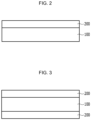
- the window for a display device includes the plastic substrate 100 and a hard coating layer 200 disposed on at least one side (e.g., one side or both sides) of the plastic substrate 100 (referring to FIGS. 2 and 3 ).
- the window may preferably include a plastic substrate having excellent flexure resistance compared to a glass substrate.
- the plastic substrate may have excellent flexure resistance at room temperature and humidity of less than or equal to 50 %.
- the mechanical properties thereof may be rapidly deteriorated under the conditions of high temperature and high humidity, so the appearance of the plastic substrate may be easily deformed when flexural-stressed.
- the window according to the invention includes a plastic substrate having a yield strain of greater than or equal to 0.8 % at a temperature of 85 °C and relative humidity of 85 %.
- the yield strain is determined as follows: a specimen having a size of about 5 to 10 millimeters (mm) width and a length of about 15 to 20 mm is allowed to stand at a predetermined temperature/humidity (i.e., a temperature of about 85 °C and relative humidity of 85 %) for greater than or equal to about 30 minutes.
- the specimen is applied with constantly increasing force in a DMA (Dynamic Mechanical Analysis) device to provide a stress-strain curve.
- a force increasing by about 0.5 Newtons per minute (N/min) - 18 N/min is applied to the specimen to provide a stress-strain curve, and elastic modulus may be obtained from the initial linear region of the curve.
- the linear region is defined by the case when the coefficient of determination (R2) of the linear trend line is the maximum or greater than or equal to about 0.999, and the yield strain is defined by the strain approaching the stress-strain curve at 0.2 % offset of linear slope line.
- the film When the time during which the film is allowed to stand at a predetermined high temperature and a high humidity (i.e., about 85 °C and 85 % relative humidity) is less than about 30 minutes, the physical property of the film is less deteriorated, so it is difficult to evaluate the flexure resistance at high temperature and high humidity.
- the film may be slowly or rapidly bent or unbent, so the film having a high yield strain regardless of speed may have sufficient flexure resistance to provide a window film for a foldable display.
- the window film may have higher mechanical properties such as a high modulus or a high yield strain in drawing the same at a high speed, the properties may be measured while slowly drawing in order to satisfy the flexure resistance at the various conditions.
- the force is slowly applied at a speed of about 0.5 N/min to measure the yield strain.
- the yield strain of a film refers to a strain showing yield behavior in the stress-strain curve.
- the film In the elastic region before the yielding point, the film is returned to the original state when stress is removed. However, when is deformed higher than the yield strain, the film is not returned to the original state even when stress is removed and the film is permanently deformed. Accordingly, in order to provide a window applicable for the foldable display device or the like with flexure resistance, the window film may have to have a high yield strain.
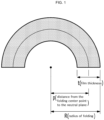
- the neutral plane has no change in length, the outer surface with respect to the neutral plane is stretched, and the inner surface is compressed.
- the outer surface when the radius of folding is high and when the film is thin, the outer surface may have lower extensional strain. On the contrary, when the radius of folding is low and the film is thick, the outer surface may have the higher extensional strain.
- the strains of the outer surface according to a radius of folding and a thickness are shown in the following Table 1.
- the yield strain required for the plastic substrate may depend on a radius of folding and a thickness of film.
- the strain of the outer surface is about 0.8 %, and the strain of the outer surface is 0.5 % when the film thickness is about 50 ⁇ m.
- the strain of the outer surface is about 1.4 %, and the strain of the outer surface is 0.8 % when the film thickness is about 50 ⁇ m.
- the plastic substrate has a yield strain of greater than or equal to 0.8 %, and thus, it may satisfy the flexure resistance for a film having a thickness of less than or equal to about 80 ⁇ m at a radius of folding of greater than or equal to about 5 mm (5R).
- the plastic substrate may satisfy the flexure resistance for a film having a thickness of less than or equal to about 50 ⁇ m at a radius of folding of greater than or equal to about 3 mm.
- the plastic substrate may satisfy the flexure resistance for a film having a thickness of less than or equal to about 15 ⁇ m at a radius of folding of greater than or equal to about 1 mm.
- the plastic substrate has a yield strain of greater than 0.8 % under the severe conditions of a temperature of 85 °C and relative humidity of 85 %, so the window including the plastic substrate may ensure excellent flexure resistance even if included in the bendable or foldable display under the severe conditions of a high temperature and high humidity as well as under the conditions of room temperature and usual humidity.
- the plastic substrate includes a poly(imide-amide) copolymer including an imide unit and an amide unit.
- the imide unit consists of a first repeating unit represented by the following Chemical Formula 1-1 and a second repeating unit represented by the following Chemical Formula 1-2
- a 3 may include a residual group including a side chain (e.g., a relatively bulky side chain). That is, in Chemical Formula 2, A 3 may include an aromatic ring (e.g., phenylene, biphenylene, cyclohexylene, and the like) substituted with at least one C1 to C3 fluoroalkyl group (e.g., a trifluoromethyl group); or two aliphatic or aromatic rings linked to each other by a C1 to C10 alkylene group having at least one residual group selected from a C1 to C10 linear or branched aliphatic hydrocarbon residual group (e.g., methyl, ethyl, propyl, isopropyl, and the like), a C1 to C10 fluorine alkyl residual group (e.g., trifluoromethyl group), a C6 to C20 aromatic hydrocarbon residual group (e.g., benzyl, fluorenyl, and the like), and
- the poly(imide-amide) copolymer may include the residual group having the bulky side chain at a ratio of greater than or equal to 1 %, for example, greater than or equal to about 5 %, greater than or equal to 10 %, greater than or equal to about 20 %, greater than or equal to about 30 %, greater than or equal to about 40 %, greater than or equal to about 50 %, or greater than or equal to about 60 %, based on the total mole number of residues of the poly(imide-amide) copolymer.
- a 3 may be represented by the following formula.
- the plastic substrate may be obtained by making a film having a desirable thickness using a poly(imide-amide) copolymer.
- the diamine monomer, the acid dianhydride monomer, and the aromatic dicarbonyl monomer may be appropriately selected depending on the structure of the final poly(imide-amide).
- the polymerization may be performed under known conditions (e.g., temperature and time) for preparation of polyamic acid and polyamide.
- the solvent may be a known polymerization solvent for preparation of polyamic acid and polyamide.
- Examples of the acid dianhydride monomer may include 3,3',4,4'-biphenyl tetracarboxylic dianhydride (BPDA), bicyclo[2.2.2]oct-7-ene-2,3,5,6-tetracarboxylic dianhydride (BTDA), 3,3',4,4'-diphenylsulfone tetracarboxylic dianhydride (DSDA), 4,4'-(hexafluoroisopropylidene)diphthalic anhydride (6FDA), 4,4'-oxydiphthalic anhydride (ODPA), pyromellitic dianhydride (PMDA), 4-(2,5-dioxotetrahydrofuran-3-yl)-1,2,3,4-tetrahydronaphthalene-1,2-dicarboxylic anhydride (DTDA), 1,2,4,5-benzene tetracarboxylic dianhydride; 1,2,3,4-benzene tetracarboxy
- the acid dianhydride monomer may be used alone or as a mixture of two or more dianhydrides, if needed.
- the acid dianhydride monomer may be a mixture of 4,4'-(hexafluoroisopropylidene) diphthalic anhydride (6FDA) as a first acid anhydride and biphenyl tetracarboxylic acid dianhydride (BPDA) as a second acid anhydride.
- 6FDA 4,4'-(hexafluoroisopropylidene) diphthalic anhydride
- BPDA biphenyl tetracarboxylic acid dianhydride
- the diamine monomer may be one or more selected from the following compounds:
- the diamine monomer may be selected from the following chemical formulae:
- diamine monomer may be m-phenylene diamine; p-phenylene diamine; 1,3-bis(4-aminophenyl) propane; 2,2-bis(4-aminophenyl) propane; 4,4'-diamino-diphenyl methane; 1,2-bis(4-aminophenyl) ethane; 1,1-bis(4-aminophenyl) ethane; 2,2'-diamino-diethyl sulfide; bis(4-aminophenyl) sulfide; 2,4'-diamino-diphenyl sulfide; bis(3-aminophenyl) sulfone; bis(4-aminophenyl) sulfone; 4,4'-diamino-dibenzyl sulfoxide; bis(4-aminophenyl) ether; bis(3-aminophenyl) ether; bis((4
- the diamine monomer may be used alone or as a mixture of two or more, if needed (e.g., when a polyimide copolymer is prepared). Such diamine monomers may be synthesized by a known method, or may be commercially available.
- aromatic dicarbonyl monomer may be terephthalic acid, dimethyl terephthalate, terephthaloyl chloride (TPCL), 4,4'-benzoyl chloride, 2,6-naphthalene dicarboxylic dichloride, or 1,5-naphthalene dicarboxylic dichloride, but are not limited thereto.
- TPCL terephthaloyl chloride
- 4,4'-benzoyl chloride 2,6-naphthalene dicarboxylic dichloride
- 1,5-naphthalene dicarboxylic dichloride but are not limited thereto.
- Examples of the acid dianhydride monomer satisfying the definition may include 6FDA, 1,3-bis(3,4-dicarboxylphenyl)hexafluoropropane dianhydride, 1,1-bis(3,4-dicarboxylphenyl)-1-phenyl-2,2,2-trifluoroethane dianhydride; 2,2-bis[4-(3,4-dicarboxylphenoxy)phenyl] hexafluoropropane dianhydride, 1,1-bis[4-(3,4-dicarboxylphenoxy) phenyl]-1-phenyl-2,2,2-trifluoroethanedianhydride; 4,4'-bis[2-(3,4-dicarboxylphenyl)hexafluoroisopropyl] diphenyl ether dianhydride, 2,2-bis(3,4-dicarboxylphenyl) propane dianhydride, 2,2-bis[4-(2,3-dicarboxylphenoxy) pheny
- Examples of the diamine monomer satisfying the definition may include 2,2'-bis(trifluoromethyl)benzidine (TFDB), 2,2-bis(4-aminophenyl) hexafluoropropane; 2,2-bis(3-aminophenyl) hexafluoropropane; 2-(3-aminophenyl)-2-(4-aminophenyl)hexafluoropropane; 2,2-bis[4-(4-aminophenoxy)phenyl] hexafluoropropane; 2,2-bis[4-(2-chloro-4-aminophenoxy)phenyl hexafluoropropane; 1,1-bis(4-aminophenyl)-1-phenyl - 2,2,2-trifluoroethane; 1,1-bis[4-(4-aminophenoxy)phenyl]-1-phenyl-2,2,2-trifluoroethane, 1,3-bis(3-aminophen
- the methods of preparing a film from the polyimide polymer or copolymer are similar to the known methods of manufacturing a polyimide film, and are not particularly limited.
- a solution including the final polymer (i.e., polyimide) or the precursor thereof (polyamic acid) is prepared, the solution is casted on a support, and the heat treatment is performed, if needed (e.g., for imidizing and/or for drying) to provide a film.
- the plastic substrate may include polycarbonate.
- the window for a display device includes a hard coating layer 200 disposed on one side or both sides of the plastic substrate 100 (referring to FIGS. 2 and 3 ).
- the hard coating layer may include one or more layers.
- the hard coating layer heightens surface hardness of the window.
- a window for a display device according to an embodiment may have hardness of greater than or equal to about 7H, for example greater than or equal to about 9H.
- Materials for forming a hard coating layer (that is, the hard coating material) may be thermally curable or photocurable materials.
- the material may be an acrylate polymer, polycaprolactone, a urethane-acrylate copolymer, polyrotaxane, an epoxy polymer, an organosilicon material such as polysilsesquioxane, and an inorganic hard coating material such as silica, but are not limited thereto.
- the acrylate polymer may be a polymer of a monomer mixture including multi-functional acrylate monomers.
- Examples of the multi-functional acrylate monomer may be trimethylolpropane triacrylate (TMPTA), ethoxylated trimethylolpropane triacrylate (TMPEOTA), propoxylated glycerine triacrylate (GPTA), pentaerythritol tetraacrylate (PETA), and dipentaerythritol hexaacrylate (DPHA), but are not limited thereto.
- TMPTA trimethylolpropane triacrylate
- TMPEOTA ethoxylated trimethylolpropane triacrylate
- GPTA propoxylated glycerine triacrylate
- PETA pentaerythritol tetraacrylate
- DPHA dipentaerythritol hexaacrylate
- the urethane acrylate material and the multi-functional acrylate material have excellent adherence and high productivity.
- the window for a display device has excellent mechanical properties such as a high rigidity and tensile strength, and simultaneously has good optical properties such as a low yellow index. Particularly, when not using a glass substrate, the window is light in weight and has high flexibility, so it is usable in a flexible display.
- a display device including the window is provided.
- the window may be disposed on a display module of the display device.
- the display module may be a liquid crystal display module, an organic light emitting display module, a plasma display module, an electric field effect display module, an electrophoretic display module, and the like, but is not limited thereto.
- TFDB 2,2'-bis-trifluoromethyl-4,4'-biphenyldiamine
- acetic anhydride which is a chemical imidization catalyst
- poly(amic acid-amide) solution 15.225 mol
- acetic anhydride which is a chemical imidization catalyst
- the chemically-imidized solution is purified as a powder through a precipitation process as follows. First, the solution is added into distilled water to be solidified, and then the solid is ground in water to provide a powder. Subsequently, the powder is recovered by filtering and then ground in water to provide a fine powder. Then the powder recovered through filtering is dispersed and agitated in alcohols to extract impurities.
- the powder recovered through filtering is vacuum dried at 120 °C for 24 hours to obtain pure product.
- the obtained powder is re-dissolved in dimethyl acetamide to provide a poly(imide-amide) copolymer solution.
- the obtained solution is coated on a glass plate by a doctor blade method to provide a film and pre-baked on a heating plate at 80 °C for 1 hour.
- the film is heated in a furnace or an oven up to 250 °C at a rate of 3 °C /minute to perform drying and thermal imidization to provide a final film having a thickness of 50 ⁇ m.
- a film is obtained in accordance with the same procedure as in Example 1, except that the film has a thickness of 80 ⁇ m.
- a film is obtained in accordance with the same procedure as in Example 1, except that the molar ratio of BPDA:6FDA:TPCL is 20:15:65.
- a film is obtained in accordance with the same procedure as in Example 1, except that the molar ratio of BPDA:6FDA:TPCL is 40:15:45.
- the obtained polyamic acid is chemically imidized and thermally imidized in accordance with the same procedure as in Example 1 to provide a polyimide film having a thickness of 50 ⁇ m.
- a polyimide film is obtained in accordance with the same procedure as in Reference Example 5, except that the molar ratio of BPDA:6FDA is 10:90.
- a polyimide film is obtained in accordance with the same procedure as in Reference Example 6, except that the film has a thickness of 100 ⁇ m.
- a commercially available polycarbonate film (S-148) having a thickness of 50 ⁇ m (manufactured by Teijin Chemical) is prepared.
- a commercially available PEN film (NX10) having a thickness of 50 ⁇ m (manufactured by SKC) is prepared.
- a commercially available PET film (SR50) having a thickness of 50 ⁇ m (manufactured by SKC) is prepared.
- the poly(imide-amide) films obtained from Examples 1 to 4, the polyimide films obtained from Reference Examples 5 to 7, the polycarbonate (PC, S-148) film according to Example 8 obtained from Teijin, the PEN (NX10) according to Comparative Example 1, and the PET (SR50) according to Comparative Example 2 obtained from SKC are measured for a modulus and a yield strain at a temperature of 85 °C and relative humidity of 85 % as follows, and the results are shown in Table 2.
- a film is prepared to have a size of greater than or equal to a 25 millimeters (mm) in length and a 5.3 mm in width. Then, the film is held by a grid and stretched to prepare a specimen having the initial length of 15-20 mm.
- a DMA Dynamic Mechanical Analyzer, manufacturer: TA Instruments Trade name: Q800
- Q800 Dynamic Mechanical Analyzer, manufacturer: TA Instruments Trade name: Q800
- a specimen is mounted in the chamber and controlled at about 85 °C and relative humidity of 85 %. After the specimen is allowed to stand for 30 minutes, a stress-strain curve is obtained by constantly increasing force at 0.5 N/min. From the curve, the elastic modulus at the initial linear region may be obtained.
- the linear region is defined by the case when the coefficient of determination (R 2 ) of the linear trend line is the maximum or greater than or equal to about 0.999, and the yield strain is defined by a strain approaching the stress-strain curve at 0.2% offset of linear slope line.
- the films obtained from Examples 1 to 4, Reference Examples 5 to 8, and Comparative Examples 1 and 2 are bent at a curvature radius of 3 mm and allowed to stand at a high temperature and high humidity (about 85 °C and relative humidity of 85 %) for 30 minutes. Then, the degree of bending (or a strain angle) of the film after being allowed to stand is measured by a goniometer with respect to the flat film.
- Yellow index is measured using a UV spectrophotometer (Spectrophotometer, Konica Minolta, cm-3600d) with reference to the ASTM E313 standard. Table 2 Thickness ( ⁇ m) Modulus (GPa) Yield strain (%) Strain angle (degree) Yellow index
- the films obtained from Examples 1 to 4 have a yield strain of greater than or equal to about 0.8 % even under the severe conditions of a temperature of 85 °C and relative humidity of 85 % and have a low strain angle, it is confirmed that the films may have high flexure resistance under the conditions of a high temperature and high humidity.
- the high yield strain is a main parameter to provide a high flexure resistance regardless modulus.
- the films obtained from Examples 1 to 4 have a yellow index of less than or equal to about 3.5, so they are suitable for providing a window film satisfying the excellent light characteristic and flexure resistance. Accordingly, the films may be applicable to the window for a flexible display having high yield elongation under an atmosphere of a high temperature and high humidity.
Landscapes
- Chemical & Material Sciences (AREA)
- Physics & Mathematics (AREA)
- Health & Medical Sciences (AREA)
- Chemical Kinetics & Catalysis (AREA)
- Medicinal Chemistry (AREA)
- Polymers & Plastics (AREA)
- Organic Chemistry (AREA)
- Nonlinear Science (AREA)
- General Physics & Mathematics (AREA)
- Engineering & Computer Science (AREA)
- Theoretical Computer Science (AREA)
- Mathematical Physics (AREA)
- Crystallography & Structural Chemistry (AREA)
- Optics & Photonics (AREA)
- Macromolecular Compounds Obtained By Forming Nitrogen-Containing Linkages In General (AREA)
- Electroluminescent Light Sources (AREA)
- Liquid Crystal (AREA)
Claims (11)
- Fenster für eine Anzeigevorrichtung, umfassend:ein Kunststoffsubstrat und eine harte Beschichtungsschicht, die auf zumindest einer Seite des Kunststoffsubstrats angeordnet ist,wobei das Kunststoffsubstrat eine Streckdehnung von größer als oder gleich 0,8 % bei 85 Grad Celsius und 85 % relativer Luftfeuchtigkeit aufweist,wobei die Streckdehnung gemäß dem Verfahren in der Beschreibung gemessen wird,wobei das Kunststoffsubstrat eine Dicke von 25 Mikrometern bis 100 Mikrometern aufweist, undwobei das Kunststoffsubstrat ein Poly(Imid-Amid-)Copolymer umfasst, das eine Imid-Einheit und eine Amid-Einheit beinhaltet,wobei die Imid-Einheit aus einer ersten Wiederholungseinheit dargestellt durch die folgende chemische Formel 1-1 und einer zweiten Wiederholungseinheit dargestellt durch die folgende chemische Formel 1-2 besteht:

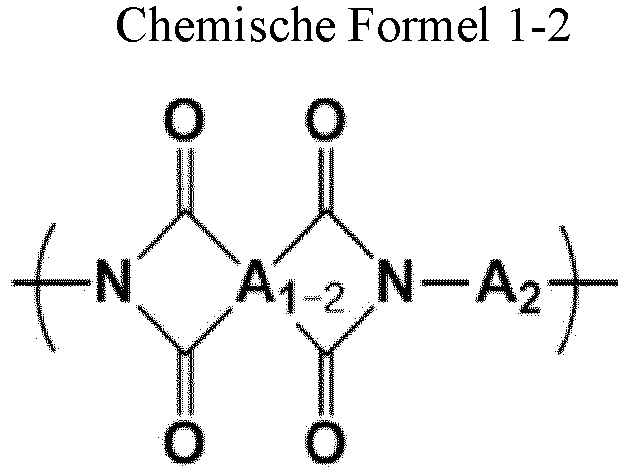 wobei A1-1 durch die folgende Formel 1 dargestellt ist:
 wobei L eine Einfachbindung, -O-, -S-, -C(=O)-, -SO2-, -Si(CH3)2- oder - (CR'2)p- ist, wobei 1≤p≤10, und R' Wasserstoff, eine Hydroxygruppe, eine C1- bis C3-Alkylgruppe oder eine C1- bis C3-Fluoralkylgruppe ist),A1-2 durch die folgende Formel dargestellt ist:
 A2 durch die folgende Formel dargestellt ist:
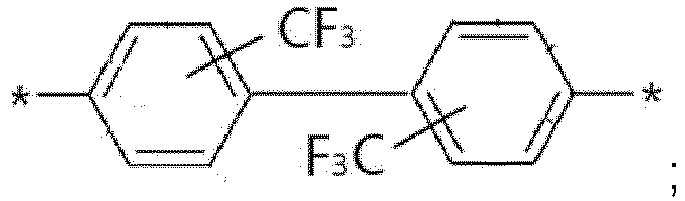 wobei die Amid-Einheit einen Anteil dargestellt durch die chemische Formel 2 umfasst:
 wobei in der chemischen Formel 2 A3 ein Anteil ausgewählt aus einer substituierten oder unsubstituierten zweiwertigen aliphatischen zyklischen C5- bis C24-Gruppe, einer substituierten oder unsubstituierten zweiwertigen aromatischen C6- bis C24-Ringgruppe, einer substituierten oder unsubstituierten zweiwertigen heteroaromatischen C4- bis C24-Ringgruppe und -L-SiR2-O-SiR2-L- ist, wobei L eine Einfachbindung oder eine C1- bis C10-Alkylengruppe ist und R2 eine C1- bis C10-Alkylgruppe ist, wobei die aliphatische oder aromatische Ringgruppe allein vorhanden ist; zwei oder mehr Ringe aneinander kondensiert sind, um einen polyzyklischen aromatischen Ring bereitzustellen; oder die zwei oder mehr aliphatischen Ringe oder die zwei oder mehr aromatischen Ringe verknüpft sind durch eine Einfachbindung, -O-, -S-, -CO-, -CH(OH)-, - SO2-, -Si(CH3)2-, -(CH2)p-, wobei 1≤p≤10, -(CF2)q-, wobei 1≤q≤10, eine zweiwertige C1- bis C10-Alkylengruppe mit zumindest einem Substituenten ausgewählt aus einer linearen oder verzweigten aliphatischen C1- bis C10-Kohlenwasserstoffgruppe, einer C1- bis C10-Fluoralkylgruppe, einer aromatischen C6- bis C20-Kohlenwasserstoffgruppe und einer alizyklischen C6- bis C20-Kohlenwasserstoffgruppe oder -C(=O)NH-, undA4 eine substituierte oder unsubstituierte zweiwertige Phenylenrestgruppe, eine substituierte oder unsubstituierte zweiwertige Naphthalinrestgruppe oder eine Restgruppe ist, wobei zwei substituierte oder unsubstituierte aromatische Ringe verknüpft sind durch eine Einfachbindung, -O-, -S-, -C(=O)-, -SO2-, -Si(CH3)2-, -(CR'2)p-, wobei 1≤p≤10, R' Wasserstoff, eine Hydroxygruppe, eine C1- bis C3-Alkylgruppe oder eine C1- bis C3-Fluoralkylgruppe ist), oder (CF2)q, wobei 1≤q≤10.
 - Fenster für eine Anzeigevorrichtung nach Anspruch 1, wobei das Kunststoffsubstrat einen ASTM-E313-Gelbindex von kleiner als oder gleich 3,5 aufweist.
- Fenster für eine Anzeigevorrichtung nach Anspruch 1 oder 2, wobei die harte Beschichtungsschicht ein Acrylatpolymer, ein Polycaprolacton, ein Urethanacrylatcopolymer, Polyrotaxan, ein Epoxidpolymer, Polysilsesquioxan oder eine Kombination davon umfasst.
- Fenster nach einem der Ansprüche 1-3, wobei die harte Beschichtungsschicht auf beiden Seiten des Kunststoffsubstrats angeordnet ist.
- Fenster nach einem der Ansprüche 1-4, wobei A3 eine Restgruppe beinhaltet, die einen aromatischen Ring beinhaltet, der mit zumindest einer C1- bis C3-Fluoralkylgruppe substituiert ist, oder zwei aliphatische oder aromatische Ringe, die durch eine C1- bis C10-Alkylengruppe miteinander verknüpft sind, die zumindest eine Restgruppe aufweist, ausgewählt aus einer linearen oder verzweigten aliphatischen C1- bis C10-Kohlenwasserstoffrestgruppe, einer C1- bis C10-Fluoralkylrestgruppe, einer aromatischen C6- bis C20-Kohlenwasserstoffrestgruppe und einer alizyklischen C6- bis C20-Kohlenwasserstoffrestgruppe; oder eine Kombination davon.
- Fenster nach Anspruch 5, wobei das Poly(Imid-Amid-)Copolymer die Restgruppe in einem Verhältnis von größer als oder gleich 1 %, bevorzugt in einem Verhältnis von größer als oder gleich 10 %, basierend auf der Gesamtmolzahl von Resten des Poly(Imid-Amid-)Copolymers beinhaltet.
- Fenster nach einem der Ansprüche 1-6, wobei A1-2 in einer Menge von größer als oder gleich etwa 20 % basierend auf der Gesamtmolmenge von Anteilen, die von Säureanhydriden stammen, in dem Poly(Imid-Amid-)Copolymer vorhanden ist.
- Fenster nach einem der Ansprüche 1-7, wobei A3 durch die folgende Formel dargestellt ist:

- Anzeigevorrichtung, umfassend das Fenster nach einem der Ansprüche 1-8.
- Anzeigevorrichtung nach Anspruch 9, wobei das Fenster auf einem Anzeigemodul der Anzeigevorrichtung angeordnet ist.
- Anzeigevorrichtung nach Anspruch 10, wobei das Anzeigemodul eines von einem Flüssigkristallanzeigemodul, einem organischen lichtemittierenden Anzeigemodul, einem Plasmaanzeigemodul, einem Anzeigemodul mit elektrischem Feldeffekt und einem elektrophoretischen Anzeigemodul ist.
Applications Claiming Priority (1)
| Application Number | Priority Date | Filing Date | Title |
|---|---|---|---|
| KR1020140191068A KR102327147B1 (ko) | 2014-12-26 | 2014-12-26 | 표시장치용 윈도우 및 이를 포함하는 표시 장치 |
Publications (2)
| Publication Number | Publication Date |
|---|---|
| EP3040366A1 EP3040366A1 (de) | 2016-07-06 |
| EP3040366B1 true EP3040366B1 (de) | 2025-02-12 |
Family
ID=55174518
Family Applications (1)
| Application Number | Title | Priority Date | Filing Date |
|---|---|---|---|
| EP15202722.3A Active EP3040366B1 (de) | 2014-12-26 | 2015-12-24 | Fenster für eine anzeigevorrichtung und anzeigevorrichtung mit dem fenster |
Country Status (4)
| Country | Link |
|---|---|
| US (1) | US9914811B2 (de) |
| EP (1) | EP3040366B1 (de) |
| KR (1) | KR102327147B1 (de) |
| CN (1) | CN105739150B (de) |
Families Citing this family (29)
| Publication number | Priority date | Publication date | Assignee | Title |
|---|---|---|---|---|
| US8889193B2 (en) | 2010-02-25 | 2014-11-18 | The Johns Hopkins University | Sustained delivery of therapeutic agents to an eye compartment |
| US10568975B2 (en) | 2013-02-05 | 2020-02-25 | The Johns Hopkins University | Nanoparticles for magnetic resonance imaging tracking and methods of making and using thereof |
| JP6846351B2 (ja) | 2015-01-27 | 2021-03-24 | ザ・ジョンズ・ホプキンス・ユニバーシティー | 粘膜表面における活性薬剤の増強された輸送のための低張ヒドロゲル製剤 |
| JP7056878B2 (ja) * | 2016-09-21 | 2022-04-19 | スリーエム イノベイティブ プロパティズ カンパニー | ガラスを含む保護ディスプレイフィルム |
| KR102452649B1 (ko) | 2016-10-21 | 2022-10-07 | 삼성전자주식회사 | 적층 투명 필름, 표시 장치용 윈도우 및 표시 장치 |
| US10591761B2 (en) | 2016-10-21 | 2020-03-17 | Samsung Electronics Co., Ltd. | Flexible plastic substrate and display device including same |
| WO2018110984A1 (ko) | 2016-12-16 | 2018-06-21 | 엘지이노텍 주식회사 | 디스플레이용 커버 기재 및 이를 포함하는 디스플레이 장치 |
| KR102109787B1 (ko) | 2016-12-27 | 2020-05-12 | 주식회사 엘지화학 | 플라스틱 적층 필름 |
| JP7180375B2 (ja) * | 2017-02-20 | 2022-11-30 | 東洋紡株式会社 | ポリエステルフィルムとその用途 |
| JP7220025B2 (ja) * | 2017-06-09 | 2023-02-09 | 三星電子株式会社 | ポリイミドまたはポリ(アミド-イミド)コポリマーを含むフィルム、該フィルムを含む表示装置、および該フィルムの製造方法 |
| WO2019065624A1 (ja) * | 2017-09-27 | 2019-04-04 | 大日本印刷株式会社 | フィルム、ポリイミドフィルム、積層体、ディスプレイ用部材、タッチパネル部材、液晶表示装置、及び有機エレクトロルミネッセンス表示装置 |
| KR102651308B1 (ko) * | 2017-09-29 | 2024-03-27 | 다이니폰 인사츠 가부시키가이샤 | 광학 필름 및 화상 표시 장치 |
| KR102459607B1 (ko) | 2017-11-08 | 2022-10-31 | 삼성디스플레이 주식회사 | 표시 장치용 윈도우, 그 윈도우의 제조 방법 및 그 윈도우를 포함하는 표시 장치 |
| EP4317273B1 (de) * | 2017-12-04 | 2025-05-28 | Kolon Industries, Inc. | Film auf polyimidbasis |
| US11084914B2 (en) * | 2017-12-20 | 2021-08-10 | Rohm And Haas Electronic Materials Llc | Hardcoat |
| KR102036227B1 (ko) * | 2018-01-31 | 2019-10-24 | 에스케이씨 주식회사 | 폴리아마이드-이미드 필름 및 이의 제조방법 |
| JP6345894B1 (ja) * | 2018-02-08 | 2018-06-20 | リンテック株式会社 | フレキシブルディスプレイ |
| KR20200066828A (ko) * | 2018-12-03 | 2020-06-11 | 에스케이아이이테크놀로지주식회사 | 하드코팅 필름 및 이의 제조 방법 |
| US12427709B2 (en) | 2018-12-04 | 2025-09-30 | Kolon Industries, Inc. | Method for manufacturing polyimide-based film and polyimide-based film manufacture |
| JP6792660B2 (ja) * | 2019-03-04 | 2020-11-25 | 住友化学株式会社 | 光学積層体及びその製造方法 |
| KR102698866B1 (ko) * | 2019-06-14 | 2024-08-28 | 삼성디스플레이 주식회사 | 표시 장치용 윈도우 부재, 표시 장치 및 표시 장치 제조 방법 |
| KR102774295B1 (ko) * | 2019-09-18 | 2025-03-05 | 삼성디스플레이 주식회사 | 윈도우 및 이를 포함하는 표시 장치 |
| KR102147297B1 (ko) * | 2019-09-30 | 2020-08-24 | 에스케이이노베이션 주식회사 | 윈도우 커버 필름 및 이를 포함하는 플렉서블 디스플레이 패널 |
| KR102147367B1 (ko) * | 2019-09-30 | 2020-08-24 | 에스케이이노베이션 주식회사 | 윈도우 커버 필름 및 이를 포함하는 플렉서블 디스플레이 패널 |
| KR102147349B1 (ko) | 2019-09-30 | 2020-08-25 | 에스케이이노베이션 주식회사 | 윈도우 커버 필름 및 이를 이용한 플렉서블 디스플레이 패널 |
| KR102147299B1 (ko) * | 2019-09-30 | 2020-08-24 | 에스케이이노베이션 주식회사 | 윈도우 커버 필름 및 이를 포함하는 플렉서블 디스플레이 패널 |
| US11630239B2 (en) * | 2019-10-28 | 2023-04-18 | Skc Co., Ltd. | Polyester film and flexible display apparatus comprising same |
| KR20210080707A (ko) | 2019-12-20 | 2021-07-01 | 삼성디스플레이 주식회사 | 표시 장치 및 캐리어 필름 |
| KR102280933B1 (ko) | 2020-04-14 | 2021-07-23 | 에스케이이노베이션 주식회사 | 윈도우 커버 필름 및 이를 포함하는 플렉서블 디스플레이 패널 |
Citations (3)
| Publication number | Priority date | Publication date | Assignee | Title |
|---|---|---|---|---|
| US20120296050A1 (en) * | 2011-05-18 | 2012-11-22 | Samsung Electronics Co., Ltd. | Poly(amide-imide) block copolymer, article including same, and display device including the article |
| WO2013048126A1 (en) * | 2011-09-30 | 2013-04-04 | Kolon Industries, Inc. | Polyamide-imide copolymer film and method of preparing polyamide-imide copolymer |
| WO2014163352A1 (en) * | 2013-04-02 | 2014-10-09 | Kolon Industries, Inc. | Polyimide cover substrate |
Family Cites Families (16)
| Publication number | Priority date | Publication date | Assignee | Title |
|---|---|---|---|---|
| US5866272A (en) | 1996-01-11 | 1999-02-02 | The Boeing Company | Titanium-polymer hybrid laminates |
| WO2006112286A1 (ja) | 2005-04-14 | 2006-10-26 | Mitsubishi Gas Chemical Company, Inc. | ポリイミドフィルムの製造方法 |
| KR101738645B1 (ko) * | 2010-11-08 | 2017-05-23 | 삼성디스플레이 주식회사 | 터치 스크린 패널 및 그 제조방법 |
| US8274744B2 (en) | 2010-11-18 | 2012-09-25 | Sabic Innovative Plastics Ip B.V. | Polyimide optical article |
| KR20130055311A (ko) * | 2011-11-18 | 2013-05-28 | 삼성디스플레이 주식회사 | 표시장치용 윈도우 패널 및 이를 포함하는 표시 장치 |
| JP2013119604A (ja) * | 2011-12-08 | 2013-06-17 | Hitachi Chemical Co Ltd | 画像表示装置用粘着性樹脂組成物、それを用いた画像表示装置用粘着シート及び画像表示装置 |
| KR101688173B1 (ko) * | 2011-12-26 | 2016-12-21 | 코오롱인더스트리 주식회사 | 플라스틱 기판 |
| WO2013120269A1 (en) * | 2012-02-17 | 2013-08-22 | Sabic Innovative Plastics Ip B.V. | Transparent thin-wall scratch-resistant article |
| KR101470464B1 (ko) | 2012-08-23 | 2014-12-08 | 주식회사 엘지화학 | 하드코팅 필름 |
| KR101415838B1 (ko) | 2012-08-23 | 2014-07-09 | 주식회사 엘지화학 | 하드코팅 조성물 |
| KR101415840B1 (ko) | 2012-08-23 | 2014-07-09 | 주식회사 엘지화학 | 하드코팅 필름 |
| KR101415839B1 (ko) | 2012-08-23 | 2014-07-09 | 주식회사 엘지화학 | 하드코팅 필름 |
| WO2014061597A1 (ja) * | 2012-10-19 | 2014-04-24 | コニカミノルタ株式会社 | ガスバリアー性フィルムの製造方法、ガスバリアー性フィルム及び電子デバイス |
| KR20140126824A (ko) * | 2013-04-22 | 2014-11-03 | 삼성디스플레이 주식회사 | 표시장치용 윈도우 및 이를 포함하는 표시 장치 |
| KR102164314B1 (ko) * | 2014-02-10 | 2020-10-12 | 삼성전자주식회사 | 폴리이미드 또는 폴리(이미드-아미드) 복합 필름, 및 상기 복합 필름을 포함하는 디스플레이 장치 |
| KR102281847B1 (ko) * | 2014-06-17 | 2021-07-26 | 삼성디스플레이 주식회사 | 플렉서블 표시 장치 |
-
2014
- 2014-12-26 KR KR1020140191068A patent/KR102327147B1/ko active Active
-
2015
- 2015-12-24 EP EP15202722.3A patent/EP3040366B1/de active Active
- 2015-12-28 US US14/980,699 patent/US9914811B2/en active Active
- 2015-12-28 CN CN201510999947.2A patent/CN105739150B/zh active Active
Patent Citations (3)
| Publication number | Priority date | Publication date | Assignee | Title |
|---|---|---|---|---|
| US20120296050A1 (en) * | 2011-05-18 | 2012-11-22 | Samsung Electronics Co., Ltd. | Poly(amide-imide) block copolymer, article including same, and display device including the article |
| WO2013048126A1 (en) * | 2011-09-30 | 2013-04-04 | Kolon Industries, Inc. | Polyamide-imide copolymer film and method of preparing polyamide-imide copolymer |
| WO2014163352A1 (en) * | 2013-04-02 | 2014-10-09 | Kolon Industries, Inc. | Polyimide cover substrate |
Also Published As
| Publication number | Publication date |
|---|---|
| CN105739150B (zh) | 2020-05-12 |
| US9914811B2 (en) | 2018-03-13 |
| US20160185926A1 (en) | 2016-06-30 |
| KR20160079549A (ko) | 2016-07-06 |
| EP3040366A1 (de) | 2016-07-06 |
| KR102327147B1 (ko) | 2021-11-16 |
| CN105739150A (zh) | 2016-07-06 |
Similar Documents
| Publication | Publication Date | Title |
|---|---|---|
| EP3040366A1 (de) | Fenster für eine anzeigevorrichtung und anzeigevorrichtung mit dem fenster | |
| US10738173B2 (en) | Poly(amide-imide) copolymer film, window for display device, and display device | |
| KR102710589B1 (ko) | 적층 필름, 및 적층 필름을 포함하는 표시 장치 | |
| CN109134858B (zh) | 一种透明聚酰亚胺薄膜及其制备方法 | |
| EP3425431B1 (de) | Laminierte folie und anzeigevorrichtung damit | |
| EP3187528B1 (de) | Zusammensetzung zur herstellung von transparenter polymerfolie, transparente polymerfolie und elektronische vorrichtung damit | |
| CN108473677B (zh) | 粘接力提高了的聚酰胺酸组合物及包含其的聚酰亚胺膜 | |
| TWI638842B (zh) | 無色聚醯胺醯亞胺樹脂及其薄膜 | |
| JP6921758B2 (ja) | ポリアミド酸、ポリイミド、ポリアミド酸溶液、ポリイミド積層体、フレキシブルデバイス基板、及びそれらの製造方法 | |
| KR20170076171A (ko) | 폴리(아미드-이미드) 코폴리머 필름, 및 이를 포함하는 표시 장치 | |
| EP3176219B1 (de) | Transparente polymerfolie und elektronische vorrichtungen damit | |
| JP2019513887A (ja) | 無色透明のポリアミド−イミドフィルムおよびその製造方法 | |
| US20150322218A1 (en) | Polyimide films and production methods thereof | |
| KR20180094840A (ko) | 필름, 수지 조성물 및 폴리아미드이미드 수지의 제조 방법 | |
| US20210221953A1 (en) | Polyimide or poly(amide-imide) film, display device including same, and method for preparing same | |
| KR20190000513A (ko) | 폴리이미드 또는 폴리(이미드-아미드) 코폴리머 제조용 조성물, 폴리이미드 또는 폴리(이미드-아미드) 코폴리머, 폴리이미드 또는 폴리(이미드-아미드) 코폴리머를 포함하는 성형품, 상기 성형품을 포함하는 표시 장치 | |
| EP3441418A1 (de) | Poly(amid-imid)copolymer, zusammensetzung zur herstellung von poly(amid-imid)copolymer, gegenstand mit poly(amid-imid)copolymer und anzeigevorrichtung mit diesem gegenstand | |
| TWI746423B (zh) | 二胺合成及用其製備的液晶配向劑 | |
| KR20210014533A (ko) | 적층 필름, 및 적층 필름 제조용 조성물 | |
| CN106458847B (zh) | 新型二胺合成及利用其的液晶取向剂 | |
| JP5325491B2 (ja) | 新規な塗布型光学補償フィルムおよびその製造方法 | |
| WO2020196103A1 (ja) | 無色透明樹脂フィルムの製造方法 | |
| JP5015070B2 (ja) | 新規な塗布型光学補償フィルムおよびその製造方法 |
Legal Events
| Date | Code | Title | Description |
|---|---|---|---|
| PUAI | Public reference made under article 153(3) epc to a published international application that has entered the european phase |
Free format text: ORIGINAL CODE: 0009012 |
|
| AK | Designated contracting states |
Kind code of ref document: A1 Designated state(s): AL AT BE BG CH CY CZ DE DK EE ES FI FR GB GR HR HU IE IS IT LI LT LU LV MC MK MT NL NO PL PT RO RS SE SI SK SM TR |
|
| AX | Request for extension of the european patent |
Extension state: BA ME |
|
| STAA | Information on the status of an ep patent application or granted ep patent |
Free format text: STATUS: REQUEST FOR EXAMINATION WAS MADE |
|
| 17P | Request for examination filed |
Effective date: 20170109 |
|
| RBV | Designated contracting states (corrected) |
Designated state(s): AL AT BE BG CH CY CZ DE DK EE ES FI FR GB GR HR HU IE IS IT LI LT LU LV MC MK MT NL NO PL PT RO RS SE SI SK SM TR |
|
| TPAC | Observations filed by third parties |
Free format text: ORIGINAL CODE: EPIDOSNTIPA |
|
| STAA | Information on the status of an ep patent application or granted ep patent |
Free format text: STATUS: EXAMINATION IS IN PROGRESS |
|
| 17Q | First examination report despatched |
Effective date: 20201015 |
|
| P01 | Opt-out of the competence of the unified patent court (upc) registered |
Effective date: 20230530 |
|
| RIC1 | Information provided on ipc code assigned before grant |
Ipc: C08J 7/046 20200101ALI20230630BHEP Ipc: C08J 7/04 20060101AFI20230630BHEP |
|
| GRAP | Despatch of communication of intention to grant a patent |
Free format text: ORIGINAL CODE: EPIDOSNIGR1 |
|
| STAA | Information on the status of an ep patent application or granted ep patent |
Free format text: STATUS: GRANT OF PATENT IS INTENDED |
|
| INTG | Intention to grant announced |
Effective date: 20240906 |
|
| GRAS | Grant fee paid |
Free format text: ORIGINAL CODE: EPIDOSNIGR3 |
|
| GRAA | (expected) grant |
Free format text: ORIGINAL CODE: 0009210 |
|
| STAA | Information on the status of an ep patent application or granted ep patent |
Free format text: STATUS: THE PATENT HAS BEEN GRANTED |
|
| AK | Designated contracting states |
Kind code of ref document: B1 Designated state(s): AL AT BE BG CH CY CZ DE DK EE ES FI FR GB GR HR HU IE IS IT LI LT LU LV MC MK MT NL NO PL PT RO RS SE SI SK SM TR |
|
| REG | Reference to a national code |
Ref country code: GB Ref legal event code: FG4D |
|
| REG | Reference to a national code |
Ref country code: CH Ref legal event code: EP |
|
| REG | Reference to a national code |
Ref country code: DE Ref legal event code: R096 Ref document number: 602015090980 Country of ref document: DE |
|
| REG | Reference to a national code |
Ref country code: IE Ref legal event code: FG4D |
|
| REG | Reference to a national code |
Ref country code: NL Ref legal event code: FP |
|
| PG25 | Lapsed in a contracting state [announced via postgrant information from national office to epo] |
Ref country code: RS Free format text: LAPSE BECAUSE OF FAILURE TO SUBMIT A TRANSLATION OF THE DESCRIPTION OR TO PAY THE FEE WITHIN THE PRESCRIBED TIME-LIMIT Effective date: 20250512 |
|
| PG25 | Lapsed in a contracting state [announced via postgrant information from national office to epo] |
Ref country code: FI Free format text: LAPSE BECAUSE OF FAILURE TO SUBMIT A TRANSLATION OF THE DESCRIPTION OR TO PAY THE FEE WITHIN THE PRESCRIBED TIME-LIMIT Effective date: 20250212 |
|
| PG25 | Lapsed in a contracting state [announced via postgrant information from national office to epo] |
Ref country code: PL Free format text: LAPSE BECAUSE OF FAILURE TO SUBMIT A TRANSLATION OF THE DESCRIPTION OR TO PAY THE FEE WITHIN THE PRESCRIBED TIME-LIMIT Effective date: 20250212 |
|
| PG25 | Lapsed in a contracting state [announced via postgrant information from national office to epo] |
Ref country code: ES Free format text: LAPSE BECAUSE OF FAILURE TO SUBMIT A TRANSLATION OF THE DESCRIPTION OR TO PAY THE FEE WITHIN THE PRESCRIBED TIME-LIMIT Effective date: 20250212 |
|
| REG | Reference to a national code |
Ref country code: LT Ref legal event code: MG9D |
|
| PG25 | Lapsed in a contracting state [announced via postgrant information from national office to epo] |
Ref country code: IS Free format text: LAPSE BECAUSE OF FAILURE TO SUBMIT A TRANSLATION OF THE DESCRIPTION OR TO PAY THE FEE WITHIN THE PRESCRIBED TIME-LIMIT Effective date: 20250612 Ref country code: NO Free format text: LAPSE BECAUSE OF FAILURE TO SUBMIT A TRANSLATION OF THE DESCRIPTION OR TO PAY THE FEE WITHIN THE PRESCRIBED TIME-LIMIT Effective date: 20250512 |
|
| PG25 | Lapsed in a contracting state [announced via postgrant information from national office to epo] |
Ref country code: HR Free format text: LAPSE BECAUSE OF FAILURE TO SUBMIT A TRANSLATION OF THE DESCRIPTION OR TO PAY THE FEE WITHIN THE PRESCRIBED TIME-LIMIT Effective date: 20250212 |
|
| PG25 | Lapsed in a contracting state [announced via postgrant information from national office to epo] |
Ref country code: LV Free format text: LAPSE BECAUSE OF FAILURE TO SUBMIT A TRANSLATION OF THE DESCRIPTION OR TO PAY THE FEE WITHIN THE PRESCRIBED TIME-LIMIT Effective date: 20250212 Ref country code: PT Free format text: LAPSE BECAUSE OF FAILURE TO SUBMIT A TRANSLATION OF THE DESCRIPTION OR TO PAY THE FEE WITHIN THE PRESCRIBED TIME-LIMIT Effective date: 20250612 |
|
| PG25 | Lapsed in a contracting state [announced via postgrant information from national office to epo] |
Ref country code: BG Free format text: LAPSE BECAUSE OF FAILURE TO SUBMIT A TRANSLATION OF THE DESCRIPTION OR TO PAY THE FEE WITHIN THE PRESCRIBED TIME-LIMIT Effective date: 20250212 Ref country code: GR Free format text: LAPSE BECAUSE OF FAILURE TO SUBMIT A TRANSLATION OF THE DESCRIPTION OR TO PAY THE FEE WITHIN THE PRESCRIBED TIME-LIMIT Effective date: 20250513 |
|
| REG | Reference to a national code |
Ref country code: AT Ref legal event code: MK05 Ref document number: 1766034 Country of ref document: AT Kind code of ref document: T Effective date: 20250212 |
|
| PG25 | Lapsed in a contracting state [announced via postgrant information from national office to epo] |
Ref country code: SE Free format text: LAPSE BECAUSE OF FAILURE TO SUBMIT A TRANSLATION OF THE DESCRIPTION OR TO PAY THE FEE WITHIN THE PRESCRIBED TIME-LIMIT Effective date: 20250212 |
|
| PG25 | Lapsed in a contracting state [announced via postgrant information from national office to epo] |
Ref country code: SM Free format text: LAPSE BECAUSE OF FAILURE TO SUBMIT A TRANSLATION OF THE DESCRIPTION OR TO PAY THE FEE WITHIN THE PRESCRIBED TIME-LIMIT Effective date: 20250212 |
|
| PG25 | Lapsed in a contracting state [announced via postgrant information from national office to epo] |
Ref country code: DK Free format text: LAPSE BECAUSE OF FAILURE TO SUBMIT A TRANSLATION OF THE DESCRIPTION OR TO PAY THE FEE WITHIN THE PRESCRIBED TIME-LIMIT Effective date: 20250212 |
|
| PG25 | Lapsed in a contracting state [announced via postgrant information from national office to epo] |
Ref country code: IT Free format text: LAPSE BECAUSE OF FAILURE TO SUBMIT A TRANSLATION OF THE DESCRIPTION OR TO PAY THE FEE WITHIN THE PRESCRIBED TIME-LIMIT Effective date: 20250212 |
|
| PG25 | Lapsed in a contracting state [announced via postgrant information from national office to epo] |
Ref country code: AT Free format text: LAPSE BECAUSE OF FAILURE TO SUBMIT A TRANSLATION OF THE DESCRIPTION OR TO PAY THE FEE WITHIN THE PRESCRIBED TIME-LIMIT Effective date: 20250212 |
|
| PG25 | Lapsed in a contracting state [announced via postgrant information from national office to epo] |
Ref country code: EE Free format text: LAPSE BECAUSE OF FAILURE TO SUBMIT A TRANSLATION OF THE DESCRIPTION OR TO PAY THE FEE WITHIN THE PRESCRIBED TIME-LIMIT Effective date: 20250212 Ref country code: CZ Free format text: LAPSE BECAUSE OF FAILURE TO SUBMIT A TRANSLATION OF THE DESCRIPTION OR TO PAY THE FEE WITHIN THE PRESCRIBED TIME-LIMIT Effective date: 20250212 |
|
| PG25 | Lapsed in a contracting state [announced via postgrant information from national office to epo] |
Ref country code: RO Free format text: LAPSE BECAUSE OF FAILURE TO SUBMIT A TRANSLATION OF THE DESCRIPTION OR TO PAY THE FEE WITHIN THE PRESCRIBED TIME-LIMIT Effective date: 20250212 |
|
| PG25 | Lapsed in a contracting state [announced via postgrant information from national office to epo] |
Ref country code: SK Free format text: LAPSE BECAUSE OF FAILURE TO SUBMIT A TRANSLATION OF THE DESCRIPTION OR TO PAY THE FEE WITHIN THE PRESCRIBED TIME-LIMIT Effective date: 20250212 |
|
| REG | Reference to a national code |
Ref country code: DE Ref legal event code: R097 Ref document number: 602015090980 Country of ref document: DE |
|
| PGFP | Annual fee paid to national office [announced via postgrant information from national office to epo] |
Ref country code: NL Payment date: 20251126 Year of fee payment: 11 |
|
| PLBE | No opposition filed within time limit |
Free format text: ORIGINAL CODE: 0009261 |
|
| STAA | Information on the status of an ep patent application or granted ep patent |
Free format text: STATUS: NO OPPOSITION FILED WITHIN TIME LIMIT |
|
| REG | Reference to a national code |
Ref country code: CH Ref legal event code: L10 Free format text: ST27 STATUS EVENT CODE: U-0-0-L10-L00 (AS PROVIDED BY THE NATIONAL OFFICE) Effective date: 20251224 |
|
| PGFP | Annual fee paid to national office [announced via postgrant information from national office to epo] |
Ref country code: DE Payment date: 20251111 Year of fee payment: 11 |
|
| PGFP | Annual fee paid to national office [announced via postgrant information from national office to epo] |
Ref country code: GB Payment date: 20251113 Year of fee payment: 11 |
|
| 26N | No opposition filed |
Effective date: 20251113 |
|
| PG25 | Lapsed in a contracting state [announced via postgrant information from national office to epo] |
Ref country code: LT Free format text: LAPSE BECAUSE OF FAILURE TO SUBMIT A TRANSLATION OF THE DESCRIPTION OR TO PAY THE FEE WITHIN THE PRESCRIBED TIME-LIMIT Effective date: 20250212 |
|
| PG25 | Lapsed in a contracting state [announced via postgrant information from national office to epo] |
Ref country code: MC Free format text: LAPSE BECAUSE OF FAILURE TO SUBMIT A TRANSLATION OF THE DESCRIPTION OR TO PAY THE FEE WITHIN THE PRESCRIBED TIME-LIMIT Effective date: 20250212 |
|
| REG | Reference to a national code |
Ref country code: CH Ref legal event code: H13 Free format text: ST27 STATUS EVENT CODE: U-0-0-H10-H13 (AS PROVIDED BY THE NATIONAL OFFICE) Effective date: 20260723 |