EP2999759B1 - Binder composition for an electrode and methods for producing the same - Google Patents
Binder composition for an electrode and methods for producing the same Download PDFInfo
- Publication number
- EP2999759B1 EP2999759B1 EP14732733.2A EP14732733A EP2999759B1 EP 2999759 B1 EP2999759 B1 EP 2999759B1 EP 14732733 A EP14732733 A EP 14732733A EP 2999759 B1 EP2999759 B1 EP 2999759B1
- Authority
- EP
- European Patent Office
- Prior art keywords
- range
- present
- slurry
- latex
- precursor composition
- Prior art date
- Legal status (The legal status is an assumption and is not a legal conclusion. Google has not performed a legal analysis and makes no representation as to the accuracy of the status listed.)
- Active
Links
Images




Classifications
-
- H—ELECTRICITY
- H01—ELECTRIC ELEMENTS
- H01M—PROCESSES OR MEANS, e.g. BATTERIES, FOR THE DIRECT CONVERSION OF CHEMICAL ENERGY INTO ELECTRICAL ENERGY
- H01M4/00—Electrodes
- H01M4/02—Electrodes composed of, or comprising, active material
- H01M4/62—Selection of inactive substances as ingredients for active masses, e.g. binders, fillers
- H01M4/621—Binders
- H01M4/622—Binders being polymers
-
- C—CHEMISTRY; METALLURGY
- C08—ORGANIC MACROMOLECULAR COMPOUNDS; THEIR PREPARATION OR CHEMICAL WORKING-UP; COMPOSITIONS BASED THEREON
- C08L—COMPOSITIONS OF MACROMOLECULAR COMPOUNDS
- C08L1/00—Compositions of cellulose, modified cellulose or cellulose derivatives
- C08L1/08—Cellulose derivatives
- C08L1/26—Cellulose ethers
- C08L1/28—Alkyl ethers
- C08L1/286—Alkyl ethers substituted with acid radicals, e.g. carboxymethyl cellulose [CMC]
-
- C—CHEMISTRY; METALLURGY
- C08—ORGANIC MACROMOLECULAR COMPOUNDS; THEIR PREPARATION OR CHEMICAL WORKING-UP; COMPOSITIONS BASED THEREON
- C08L—COMPOSITIONS OF MACROMOLECULAR COMPOUNDS
- C08L25/00—Compositions of, homopolymers or copolymers of compounds having one or more unsaturated aliphatic radicals, each having only one carbon-to-carbon double bond, and at least one being terminated by an aromatic carbocyclic ring; Compositions of derivatives of such polymers
- C08L25/02—Homopolymers or copolymers of hydrocarbons
- C08L25/04—Homopolymers or copolymers of styrene
- C08L25/08—Copolymers of styrene
- C08L25/14—Copolymers of styrene with unsaturated esters
-
- C—CHEMISTRY; METALLURGY
- C08—ORGANIC MACROMOLECULAR COMPOUNDS; THEIR PREPARATION OR CHEMICAL WORKING-UP; COMPOSITIONS BASED THEREON
- C08L—COMPOSITIONS OF MACROMOLECULAR COMPOUNDS
- C08L33/00—Compositions of homopolymers or copolymers of compounds having one or more unsaturated aliphatic radicals, each having only one carbon-to-carbon double bond, and only one being terminated by only one carboxyl radical, or of salts, anhydrides, esters, amides, imides or nitriles thereof; Compositions of derivatives of such polymers
-
- C—CHEMISTRY; METALLURGY
- C08—ORGANIC MACROMOLECULAR COMPOUNDS; THEIR PREPARATION OR CHEMICAL WORKING-UP; COMPOSITIONS BASED THEREON
- C08L—COMPOSITIONS OF MACROMOLECULAR COMPOUNDS
- C08L9/00—Compositions of homopolymers or copolymers of conjugated diene hydrocarbons
- C08L9/10—Latex
-
- C—CHEMISTRY; METALLURGY
- C09—DYES; PAINTS; POLISHES; NATURAL RESINS; ADHESIVES; COMPOSITIONS NOT OTHERWISE PROVIDED FOR; APPLICATIONS OF MATERIALS NOT OTHERWISE PROVIDED FOR
- C09J—ADHESIVES; NON-MECHANICAL ASPECTS OF ADHESIVE PROCESSES IN GENERAL; ADHESIVE PROCESSES NOT PROVIDED FOR ELSEWHERE; USE OF MATERIALS AS ADHESIVES
- C09J101/00—Adhesives based on cellulose, modified cellulose, or cellulose derivatives
- C09J101/08—Cellulose derivatives
- C09J101/26—Cellulose ethers
- C09J101/28—Alkyl ethers
-
- C—CHEMISTRY; METALLURGY
- C09—DYES; PAINTS; POLISHES; NATURAL RESINS; ADHESIVES; COMPOSITIONS NOT OTHERWISE PROVIDED FOR; APPLICATIONS OF MATERIALS NOT OTHERWISE PROVIDED FOR
- C09J—ADHESIVES; NON-MECHANICAL ASPECTS OF ADHESIVE PROCESSES IN GENERAL; ADHESIVE PROCESSES NOT PROVIDED FOR ELSEWHERE; USE OF MATERIALS AS ADHESIVES
- C09J101/00—Adhesives based on cellulose, modified cellulose, or cellulose derivatives
- C09J101/08—Cellulose derivatives
- C09J101/26—Cellulose ethers
- C09J101/28—Alkyl ethers
- C09J101/284—Alkyl ethers with hydroxylated hydrocarbon radicals
-
- C—CHEMISTRY; METALLURGY
- C09—DYES; PAINTS; POLISHES; NATURAL RESINS; ADHESIVES; COMPOSITIONS NOT OTHERWISE PROVIDED FOR; APPLICATIONS OF MATERIALS NOT OTHERWISE PROVIDED FOR
- C09J—ADHESIVES; NON-MECHANICAL ASPECTS OF ADHESIVE PROCESSES IN GENERAL; ADHESIVE PROCESSES NOT PROVIDED FOR ELSEWHERE; USE OF MATERIALS AS ADHESIVES
- C09J101/00—Adhesives based on cellulose, modified cellulose, or cellulose derivatives
- C09J101/08—Cellulose derivatives
- C09J101/26—Cellulose ethers
- C09J101/28—Alkyl ethers
- C09J101/286—Alkyl ethers substituted with acid radicals
-
- H—ELECTRICITY
- H01—ELECTRIC ELEMENTS
- H01M—PROCESSES OR MEANS, e.g. BATTERIES, FOR THE DIRECT CONVERSION OF CHEMICAL ENERGY INTO ELECTRICAL ENERGY
- H01M4/00—Electrodes
- H01M4/02—Electrodes composed of, or comprising, active material
- H01M4/13—Electrodes for accumulators with non-aqueous electrolyte, e.g. for lithium-accumulators; Processes of manufacture thereof
-
- H—ELECTRICITY
- H01—ELECTRIC ELEMENTS
- H01M—PROCESSES OR MEANS, e.g. BATTERIES, FOR THE DIRECT CONVERSION OF CHEMICAL ENERGY INTO ELECTRICAL ENERGY
- H01M4/00—Electrodes
- H01M4/02—Electrodes composed of, or comprising, active material
- H01M4/13—Electrodes for accumulators with non-aqueous electrolyte, e.g. for lithium-accumulators; Processes of manufacture thereof
- H01M4/139—Processes of manufacture
-
- C—CHEMISTRY; METALLURGY
- C08—ORGANIC MACROMOLECULAR COMPOUNDS; THEIR PREPARATION OR CHEMICAL WORKING-UP; COMPOSITIONS BASED THEREON
- C08L—COMPOSITIONS OF MACROMOLECULAR COMPOUNDS
- C08L2201/00—Properties
- C08L2201/52—Aqueous emulsion or latex, e.g. containing polymers of a glass transition temperature (Tg) below 20°C
-
- Y—GENERAL TAGGING OF NEW TECHNOLOGICAL DEVELOPMENTS; GENERAL TAGGING OF CROSS-SECTIONAL TECHNOLOGIES SPANNING OVER SEVERAL SECTIONS OF THE IPC; TECHNICAL SUBJECTS COVERED BY FORMER USPC CROSS-REFERENCE ART COLLECTIONS [XRACs] AND DIGESTS
- Y02—TECHNOLOGIES OR APPLICATIONS FOR MITIGATION OR ADAPTATION AGAINST CLIMATE CHANGE
- Y02E—REDUCTION OF GREENHOUSE GAS [GHG] EMISSIONS, RELATED TO ENERGY GENERATION, TRANSMISSION OR DISTRIBUTION
- Y02E60/00—Enabling technologies; Technologies with a potential or indirect contribution to GHG emissions mitigation
- Y02E60/10—Energy storage using batteries
Definitions
- the presently disclosed and/or claimed inventive process(es), procedure(s), method(s), product(s), result(s), and/or concept(s) (collectively hereinafter referred to as the "presently disclosed and/or claimed inventive concept(s)") relates generally to a composition of a binder for use in battery electrodes and methods of preparing such. More particularly, but not by way of limitation, the presently disclosed and/or claimed inventive concept(s) relates to a binder composition comprising an ionizable water soluble polymer and a redispersible powder containing a latex, a protective colloid, and an anticaking agent for use in the production and manufacture of electrodes of a lithium ion battery.
- the presently disclosed and/or claimed inventive concept(s) relates generally to electrode compositions and methods of making electrodes, both anodes and cathodes, with a binder composition containing an ionizable water soluble polymer and a redispersible powder.
- Lithium ion batteries are used in an array of products including medical devices, electric cars, airplanes, and most notably, consumer products such as laptop computers, cell phones, and cameras. Due to their high energy densities, high operating voltages, and low self-discharges, lithium ion batteries have overtaken the secondary battery market and continue to find new uses in developing industries and products.
- lithium ion batteries comprise an anode, a cathode, and an electrolyte material such as an organic solvent containing a lithium salt. More specifically, the anode and cathode (collectively, “electrodes”) are formed by mixing either an anode active material or a cathode active material with a binder and a solvent to form a paste or slurry which is then coated and dried on a current collector, such as aluminum or copper, to form a film on the current collector. The anodes and cathodes are then layered and coiled prior to being housed in a pressurized casing containing an electrolyte material, which all together forms a lithium ion battery.
- the binders used in lithium ion batteries generally consist of a cellulosic rheology modifier and a latex material, such as styrene butadiene (SB), which are mixed with an electrode active material and a dispersing agent in a multi-step process.
- SB styrene butadiene
- cellulosic materials are generally in powder form, they are not easily soluble in water and require a long time to dissolve unless subjected to a high shear at low concentrations of the cellulosic material (e.g., less than 3%).
- styrene butadiene latex is not stable at a high shear (and high temperature) and, therefore, cannot be mixed together with both the cellulosic material(s) and the electrode active material(s) in a single mixing step.
- the use of a latex material in the process typically requires the cellulosic material and the electrode active material to be separately mixed with water to first form individual solutions, which are then mixed together prior to adding the latex material.
- the number of steps required to produce binders containing a latex material increases the overall cost and time needed to produce lithium ion battery electrodes.
- styrene butadiene latex ( ⁇ 40 - 60% water) is not stable at room temperature and requires biocide(s) to store it for longer periods of time.
- biocide(s) biocide(s) to store it for longer periods of time.
- silicon has recently come to the forefront as a promising anode active material for LIBs. See, for example, On the Binding Mechanism of CMC in Si Negative Electrodes for Li-Ion Batteries, Electrochemistry Communications, vol. 9, 2801 - 2806 (2007 ), B. Lestriez, S. Bahri, I. Sandu, L. Roue, D. Guyomard.
- silicon has been known to undergo large volume changes during charging and discharging, which can cause problems for a battery's capacity and overall performance.
- the presently disclosed and/or claimed redispersible powder based binder composition comprising carboxymethyl hydroxyethyl cellulose actually improves the capacity of lithium ion batteries comprising silicon despite the tendency of silicon to cause large volume changes during charging. This is due in part to the higher percent elongation and flexibility of carboxymethyl hydroxyethyl cellulose relative to other celluloses presently used in binder compositions, including CMC. Furthermore, the redispersible powder based binder composition disclosed herein comprising carboxymethyl hydroxyethyl cellulose is capable of being used in both anodes and cathodes, which demonstrate improved electrochemical properties over the prior art.
- EP 2 254 193 A1 discloses electrodes for use in lithium ion secondary batteries made from an electrical conductive material and a binder based on carboxymethyl (hydroxyethyl) cellulose.
- the presently disclosed and/or claimed inventive concept(s) further encompasses a binder precursor composition(s) for use in the preparation of a lithium ion battery comprising an ionizable water soluble polymer and a redispersible powder comprising a protective colloid, an anticaking agent, and a latex polymer as defined in claim 1. It is contemplated that a slurry can be formed by adding water to the above-described binder precursor composition as defined in claim 7.
- the presently disclosed and/or claimed inventive concept(s) also encompasses an electrode for use in a lithium ion battery comprising (i) a film comprising: (1) an electrode active material, and (2) a binder comprising an ionizable water soluble polymer and a redispersible powder; and (ii) a current collector as defined in claim 11.
- the designated value may vary by plus or minus twelve percent, or eleven percent, or ten percent, or nine percent, or eight percent, or seven percent, or six percent, or five percent, or four percent, or three percent, or two percent, or one percent.
- the use of the term "at least one” will be understood to include one as well as any quantity more than one, including but not limited to, 1, 2, 3, 4, 5, 10, 15, 20, 30, 40, 50, 100, etc.
- the term “at least one” may extend up to 100 or 1000 or more depending on the term to which it is attached. In addition, the quantities of 100/1000 are not to be considered limiting as lower or higher limits may also produce satisfactory results.
- the hydrophilically modified cellulosic material can be a carboxyalkyl cellulose.
- the hydrophilically modified cellulosic material can be carboxymethyl cellulose.
- the degree of substitution of the hydrophilically modified cellulosic material employed in the compositions and methods of the presently disclosed and/or claimed inventive concept(s) can be in a range of from about 0.6 to 1.4, or from about 0.7 to about 1.2, or from about 0.8 to about 1.1.
- the hydrophilically modified cellulosic material can be a hydrophilically modified hydroxyalkyl cellulose.
- the hydrophilically modified hydroxyalkyl cellulose can be any hydroxyalkyl cellulose modified with a hydrophilic group.
- the hydroxyalkyl cellulose can be selected from the group comprising, consisting of, or consisting essentially of hydroxyethyl cellulose, hydroxypropyl cellulose, and combinations thereof.
- the hydrophilic group can be a carboxyalkyl group.
- the hydrophilically modified hydroxyalkyl cellulose can be selected from the group comprising, consisting of, or consisting essentially of carboxymethyl hydroxyethyl cellulose, carboxymethyl hydroxypropyl cellulose, and combinations thereof.
- the protective colloid in the redispersible powder is selected from the group consisting of polyvinyl alcohol, polyvinyl acetate, a hydroxyalkyl cellulose polymer, and combinations thereof.
- the hydroxyalkyl cellulose polymer can be hydroxyethyl cellulose.
- the anticaking agent in the redispersible powder is any material selected from the group consisting of calcium carbonate, kaolin, silica, carbon, lithium carbonate, and combinations thereof.
- the latex polymer in the redispersible powder is any material selected from the group consisting of styrene butadiene, vinyl acetate ethylene, styrene acrylic, vinyl acrylic, ethylene vinylversatate, and combinations thereof. It is also contemplated that the latex polymer in the presently disclosed and/or claimed inventive concept can be any polymer effective in a slurry such that it is capable of forming a film on a current collector with reasonable adhesive and electrochemical properties.
- the ionizable water soluble polymer is present in the binder precursor composition in a range of from 2 % to 75 %, or from about 20% to about 60 %, or from about 35% to about 45% by weight.
- the redispersible powder is present in the binder precursor composition in a range of from 25% to 98%, or from about 40% to about 80%, or from about 55% to about 65% by weight.
- the protective colloid is present in the redispersible powder in a range of from 0.1% to 10%, or from about 2% to about 8%, or from about 4% to about 6% by weight;
- the anticaking agent is present in the redispersible powder in a range of from 1% to 35%, or from about 10% to about 30%, or from about 25% to about 35% by weight;
- the latex polymer is present in the redispersible powder in a range of from 30% to 98.9%, or from about 65% to about 90%, or from about 70% to about 85% by weight.
- the redispersible powder can be in the form of particles, wherein the average diameter of the redispersible powder particles is less than about 500 ⁇ m, or less than about 300 ⁇ m, or less than about 150 ⁇ m.
- the binder precursor composition of the presently disclosed and/or claimed inventive concept(s) comprises an electrode active material, an ionizable water soluble polymer, and a redispersible powder which can comprise a protective colloid, an anticaking agent, and a latex polymer.
- the ionizable water soluble polymer is present in the binder precursor composition in a range from about 0.25% to about 2.25%, or from about 0.5% to about 1.75%, or from about 0.75% to about 1.25% by weight; the redispersible powder is present in the binder precursor composition in a range from about 0.25% to about 3.5%, or from about 0.75% to about 2.5%, or from about 1.25% to about 1.75% by weight; and the electrode active material is present in the binder precursor composition in a range from about 94.25% to about 99.5%, or from about 95% to about 99%, or from about 96.5% to about 98.5% by weight.
- the electrode active material is an anode active material.
- the anode active material can be any material consisting of (1) carbonaceous materials, (2) silicon-based alloys, (3) complex compounds comprising: i) a carbonaceous material(s) and ii) a metal(s) consisting of Al, Ag, Bi, In, Ge, Mg, Pb, Si, Sn, Ti, and combinations thereof, (4) a lithium complex metal oxide, (5) lithium-containing nitrides, and (6) combinations thereof.
- the anode active material in one non-limiting embodiment, can be a carbonaceous material wherein the material comprises an artificial graphite, a natural graphite, surface modified graphite, coke, carbon fiber, and combinations thereof.
- the anode active material can be a complex compound comprising a carbonaceous material and silicon.
- the anode active material in another non-limiting embodiment, can comprise lithium titanate oxide (LTO).
- the presently disclosed and/or claimed invention also encompasses a slurry compositioncomprising the above-described binder precursor compositions in water, wherein in one non-limiting embodiment, the binder precursor composition comprises an ionizable water soluble polymer, a redispersible powder, and an electrode active material, wherein the ionizable water soluble polymer can be present in the binder precursor composition in a range from about 0.25% to about 2.25%, or from about 0.5% to about 1.75%, or from about 0.75% to about 1.25% by dry weight basis; the redispersible powder can be present in the binder precursor composition in a range from about 0.25% to about 3.5%, or from about 0.75% to about 2.5%, or from about 1.25% to about 1.75% by dry weight basis, and the electrode active material can be present in the binder precursor composition in a range from about 94.25% to about 99.5%, or from about 95% to about 99%, or from about 96.5% to about 98.5% by dry weight basis.
- the slurry comprises the above-identified binder precursor composition(s) in water, wherein the ionizable water soluble polymer is present in the slurry in a range of from about 0.25% to about 2.25%, or from about 0.5% to about 1.75%, or from about 0.75% to about 1.25% by dry weight basis; the protective colloid is present in the slurry in a range of from about 0.05% to about 0.2%, or from about 0.1% to about 0.19%, or from about 0.165% to about 0.185% by dry weight basis; the anticaking agent is present in the slurry in a range of from about 0.1% to about 0.5%, or from about 0.2% to about 0.4%, or from about 0.25% to about 0.35% by dry weight basis; the latex polymer is present in the slurry in a range of from about 0.5% to about 4%, or from about 1% to about 3%, or from about 1.5% to about 2.5% by dry weight basis; and the electrode active material is present in the ionizable water
- the above-described slurry has a Brookfield viscosity in a range of from about 1,000 cps to about 15,000 cps, or from about 4000 cps to about 11,000 cps, or from about 5500 cps to about 8500 cps at a shear rate in a range of from about 10s -1 to about 40s -1 at 25°C.
- an electrode comprising (i) a film comprising (1) an electrode active material as described above, and (2) a binder precursor composition as described above, and (ii) a current collector.
- the ionizable water soluble polymer is present in the film in a range of from about 0.25% to about 2.25%, or from about 0.5% to about 1.75%, or from about 0.75% to about 1.25% by weight
- the protective colloid is present in the slurry in a range of from about 0.05% to about 0.2%, or from about 0.1% to about 0.19%, or from about 0.165% to about 0.185% by weight
- the anticaking agent is present in the slurry in a range of from about 0.1% to about 0.5%, or from about 0.2% to about 0.4%, or from about 0.25% to about 0.35% by weight
- the latex polymer is present in the slurry in a range of from about 0.5% to about 4%, or from about 1% to about 3%
- the film has a thickness in a range of from about 30 ⁇ m to about 150 ⁇ m, or from about 40 ⁇ m to about 130 ⁇ m, or from about 50 ⁇ m to about 100 ⁇ m.
- the current collector can be any material that acts as an electrical conductor for either the anode active material or the cathode active material.
- the current collector can be selected from the group of materials comprising, consisting of, or consisting essentially of aluminum, copper, stainless steel, nickel, zinc, silver, and combinations thereof.
- the current collector for the anode is a copper foil.
- the current collector for the cathode is an aluminum foil.
- the above-described film can be bound to a surface of the above-described current collector to form a bond.
- the adhesive strength of the bond is at least about 0.3 gf/mm, or at least about 0.6 gf/mm, or at least about 1.0 gf/mm as determined by the 90 Degree Peel Adhesion Test, which will be described below.
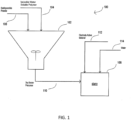
- FIG 1 is a schematic diagram of one embodiment of a method/system 100 of making a slurry for use in the manufacture of an electrode.
- the ionizable water soluble polymer is delivered to a vessel 102 via conduit 104 and the redispersible powder is delivered to the vessel 102 via conduit 106, wherein the ionizable water soluble polymer and the redispersible powder are dry admixed to form a dry binder precursor composition.
- the dry binder precursor composition is delivered to a vessel 108 via conduit 110, the electrode active material is delivered to vessel 108 via conduit 112, and the water is delivered to vessel 108 via conduit 114, wherein the ionizable water soluble polymer, the redispersible powder, the electrode active material, and the water are mixed to form the slurry.
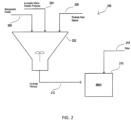
- FIG. 2 is a schematic diagram of an alternative embodiment of a method/system 200 of making a slurry for use in the manufacture of an electrode.
- the ionizable water soluble polymer is delivered to a vessel 202 via conduit 204
- the redispersible powder is delivered to the vessel 202 via conduit 206
- the electrode active material is delivered to vessel 202 via conduit 208, wherein the ionizable water soluble polymer, redispersible powder, and electrode active material are dry admixed to form a dry binder precursor composition.
- the dry binder precursor composition is delivered to a vessel 210 via conduit 212 and the water is delivered to vessel 210 via conduit 214, wherein the ionizable water soluble polymer, the redispersible powder, the electrode active material, and the water are mixed to form the slurry.
- FIG 3 is a schematic diagram of an additional alternative embodiment of a method/system 300 of making a slurry for use in the manufacture of an electrode.
- the ionizable water soluble polymer is first delivered to a vessel 302 via conduit 304 along with water which is delivered to the vessel 302 via conduit 306 to form an aqueous solution.
- the redispersible powder is delivered to vessel 308 via conduit 310 and the electrode active material is added to vessel 308 via conduit 312, wherein the redispersible powder and electrode active material are dry admixed and thereafter added to vessel 302 via conduit 314 for mixture with the ionizable water soluble polymer and water in vessel 302 to form the slurry.
- the ionizable water soluble polymer, electrode active material, and redispersible powder can all be pre-mixed or pre-mixed in various combinations and added to water at the same time or individually.
- the use of redispersible powders in the binder materials for lithium ion batteries can reduce the mixing efforts necessary to form a slurry for the production of lithium ion batteries, and actually leads to better electrochemical performances of the lithium ion batteries.
- the above-described electrodes have a capacity retention at a C-Rate of 0.05C and 25°C for 50 cycles which is greater than about 80%, or greater than about 90%, or greater than about 96%, wherein the film thickness is in the range from about 30 ⁇ m to about 100 ⁇ m, or from about 35 ⁇ m to about 95 ⁇ m, or from about 65 ⁇ m to about 75 ⁇ m.
- the capacity retention of the above-described electrodes have a capacity retention at a C-Rate of 0.05C and 25°C for 100 cycles which is greater than about 60%, or greater than about 80%, or greater than about 92%, wherein the film thickness is in the range from about 30 ⁇ m to about 100 ⁇ m, or from about 35 ⁇ m to about 90 ⁇ m, or from about 65 ⁇ m to about 75 ⁇ m.
- the above-described electrodes have an impedance less than about 300 R ct , or less than about 250 R ct , or less than about 200 R ct , wherein the film thickness is less than about 70 ⁇ m, or less than about 60 ⁇ m, or less than about 35 ⁇ m.
- Graphite slurries are prepared using two different formulations: a "wet” process and a “dry” process.
- the "wet" process for preparing graphite slurries comprises: 1) preparing a solution by adding either a carboxymethyl hydroxyethyl cellulose or a hydroxyethyl cellulose in water and then mixing for an amount of time using an overhead mixer; 2) dispersing graphite powder in water; 3) adding the carboxymethyl hydroxyethyl cellulose or hydroxyethyl cellulose to the graphite dispersion and then mixing for an amount of time with the overhead mixer; 4) adding either a latex emulsion (hereinafter "latex”) or a redispersible powder to the slurry comprising graphite and either carboxymethyl hydroxyethyl cellulose or hydroxyethyl cellulose, and then mixing with an overhead mixer for an amount of time.
- latex latex emulsion
- the "wet" process for preparing slurries containing a carboxymethyl cellulose comprised: 1) preparing a carboxymethyl cellulose solution in water at 25°C with an overhead mechanical mixer; 2) dispersing graphite powder in water in a 150 mL container; 3) adding the carboxymethyl cellulose solution to the graphite dispersion and then mixing for one hour with an overhead mixer; and 4) adding either a latex emulsion or a redispersible powder to the graphite/carboxymethyl cellulose slurry and thereafter mixing with an overhead mixer for 10 minutes.
- the "dry" process for preparing graphite slurries comprises: 1) dispersing an amount of a blend of graphite powder and either a carboxymethyl hydroxyethyl cellulose powder or a hydroxyethyl cellulose powder in water and mixing for an amount of time using an overhead mixer, and 2) adding either a latex or a redispersible powder to the graphite/cellulose slurry and thereafter mixing with an overhead mixer for an amount of time.
- the "dry” process for preparing slurries containing a carboxymethyl cellulose comprised: 1) dispersing a carboxymethyl cellulose powder and graphite powder blend in water in a 150 mL container and mixing for one hour with an overhead mixer, and 2) adding either a latex emulsion (hereinafter "latex”) or a redispersible powder to the graphite/carboxymethyl cellulose slurry and thereafter mixing with an overhead mixer for 10 minutes.
- latex latex emulsion
- redispersible powder redispersible powder
- the slurries were prepared using several different formulations.
- the total amount of solids i.e., graphite, carboxymethyl cellulose, and latex or redispersible powder
- the total amount of solids was approximately 47% by weight with the remaining 53% by weight comprising water.
- the amount, ratio, and type of graphite, carboxymethyl cellulose, and latex or redispersible powder varied throughout the examples; however, for those examples comprising redispersible powder instead of a latex, the redispersible powder was comprised of 75% by weight latex particles, 20% by weight anticaking agent, and 5% by weight protective colloid, wherein the anticaking agent was calcium carbonate (CaCO 3 ) and lithium carbonate, the protective colloid (or "redispersing aid") was polyvinyl alcohol (PVOH), and the latex particles varied depending on the redispersible powder as suggested in the tables below.
- the anticaking agent was calcium carbonate (CaCO 3 ) and lithium carbonate
- the protective colloid or "redispersing aid”
- PVOH polyvinyl alcohol
- Table 1 presents a detailed description of a slurry composition prepared by the "wet” process having a total solids (i.e., graphite, carboxymethyl cellulose, and latex or redispersible powder) amount of approximately 47% by weight, wherein the normalized ratio of graphite, carboxymethyl cellulose (CMC), and redispersible powder (RDP) or latex is 100/1/1.5.
- a slurry composition prepared by the "dry” process can be calculated from a normalized ratio of graphite, CMC, and RDP or latex taking into consideration that the CMC was mixed with the graphite prior to adding water to form an aqueous solution.
- the amount of RDP or latex (or CMC) can be increased such that the normalized ratio of graphite, carboxymethyl cellulose, and RDP or latex are adjusted to reflect the increase.
- the ratios 100/1/2, 100/1/2.5, and 100/1/3 are illustrated below.
- the weight percent of each component i.e., graphite, water, CMC, and either the RDP or the latex, can quickly be determined from the normalized ratio of solids in light of Table 1.
- the specific amounts of the components for each ratio are not expressly identified, as was previously done above.
- the following examples explicitly identify the ratio of CMC to RDP (or latex) keeping in mind that each ratio is normalized with respect to the amount of graphite in the composition.
- Silicon slurries are prepared using a "wet” process and a “dry” process.
- the "wet" process for preparing silicon slurries comprises: 1) preparing a solution by adding a carboxymethyl hydroxyethyl cellulose, a carboxymethylcellulose or a hydroxyethyl cellulose in water and then mixing for an amount of time using an overhead mixer; 2) dispersing a powder of a silicon containing compound in water; 3) adding the carboxymethyl hydroxyethyl cellulose, carboxymethylcellulose or hydroxyethyl cellulose to the dispersion of the silicon containing compound and then mixing for an amount of time with the overhead mixer; 4) adding either a latex or a redispersible powder to the slurry comprising the silicon containing compound and carboxymethyl hydroxyethyl cellulose, carboxymethylcellulose or hydroxyethyl cellulose, and then mixing with an overhead mixer for an amount of time.
- the "dry" process for preparing silicon slurries comprises: 1) dispersing an amount of a blend of powder comprising a silicon containing compound, and a carboxymethyl hydroxyethyl cellulose powder, a carboxymethylcellulose powder or a hydroxyethyl cellulose powder in water and mixing for an amount of time using an overhead mixer, and 2) adding either a latex or a redispersible powder to the silicon containing compound/cellulose slurry and thereafter mixing with an overhead mixer for an amount of time.
- Graphite/Silicon slurries are prepared using two different formulations: a "wet” process and a “dry” process.
- the "wet" process for preparing graphite/silicon slurries comprises: 1) preparing a solution by adding either a carboxymethyl hydroxyethyl cellulose or a hydroxyethyl cellulose in water and then mixing for an amount of time using an overhead mixer; 2) dispersing graphite powder and powder of a silicon containing compound in water; 3) adding the carboxymethyl hydroxyethyl cellulose or hydroxyethyl cellulose to the graphite/silicon dispersion and then mixing for an amount of time with the overhead mixer; 4) adding either a latex emulsion (hereinafter "latex”) or a redispersible powder to the slurry comprising graphite, the silicon containing compound, and either carboxymethyl hydroxyethyl cellulose or hydroxyethyl cellulose, and then mixing with an overhead mixer for an amount of time.
- latex a latex emulsion
- the "wet" process for preparing graphite/silicon slurries containing a carboxymethyl cellulose comprised: 1) preparing a carboxymethyl cellulose solution in water at 25°C with an overhead mechanical mixer; 2) dispersing graphite powder and SiO x powder in water in a 150 mL container; 3) adding the carboxymethyl cellulose solution to the graphite and SiO x dispersion and then mixing for one hour with an overhead mixer; and 4) adding either a latex emulsion or a redispersible powder to the graphite/SiO x /carboxymethyl cellulose slurry and thereafter mixing with an overhead mixer for 10 minutes.
- the "dry" process for preparing graphite/silicon slurries will comprise: 1) dispersing an amount of a blend of graphite powder, powder of a silicon containing compound, and either a carboxymethyl hydroxyethyl cellulose powder or a hydroxyethyl cellulose powder in water and mixing for an amount of time using an overhead mixer; and 2) adding either a latex or a redispersible powder to the graphite/silicon/cellulose slurry and thereafter mixing with an overhead mixer for an amount of time.
- the "dry” process for preparing slurries containing a carboxymethyl cellulose comprised: 1) dispersing a carboxymethyl cellulose powder and graphite powder/SiO x blend in water in a 150 mL container and mixing for one hour with an overhead mixer, and 2) adding either a latex emulsion (hereinafter "latex”) or a redispersible powder to the graphite/SiO x /carboxymethyl cellulose slurry and thereafter mixing with an overhead mixer for 10 minutes.
- latex latex emulsion
- redispersible powder redispersible powder
- RDP-1 was prepared by the following: 1) an amount of vinylacetate ethylene (VAE) copolymer latex having a Tg of +10°C (Celvolit ® 1328 from Celanese Co., Houston, TX) was added to an aqueous solution comprising 20 wt% of a redispersing agent (Celvol ® 504 from Celanese Co., Houston, TX) such as to form a liquid feed stock, wherein 45 wt% of the feedstock was comprised of the VAE latex and redispersing agent; 2) Separately, Calcium carbonate (CaCO 3 ) having a small particle size (e.g.
- the redispersible powder produced by the process, RDP-1 had a bulk density between 0.4 - 0.5 g/cm 3 , a particle size between 80 - 120 ⁇ m, a moisture content ⁇ 1 wt%, and ash contents between 5 - 20 wt%.
- RDP-2 was prepared by the following: 1) an amount of vinylacetate ethylene (VAE) copolymer latex having a Tg of -10°C (Celvolit ® 1388 from Celanese Co., Houston, TX) was added to an aqueous solution comprising 20 wt% of a redispersing agent (Celvol ® 504 from Celanese Co., Houston, TX) such as to form a liquid feed stock, wherein 45 wt% of the feedstock was comprised of the VAE latex and redispersing agent; 2) Separately, Calcium carbonate (CaCO 3 ) having a small particle size (e.g.
- ⁇ 2 ⁇ m was blended with a clay having a particle size ⁇ 1 ⁇ m in a weight ratio of 3:1 to form an anticaking agent; and 3) the liquid feed stock and the blended anticaking agent were co-fed to an SD-200-R-AB Spray Dryer from GEA Niro (Copenhagen, Denmark), wherein the liquid feed stock was fed at a temperature between 50-55°C and the sprayer outlet temperature was between 110-120°C.
- the redispersible powder produced by the process, RDP-2 had a bulk density between 0.4 - 0.5 g/cm 3 , a particle size between 80 - 120 ⁇ m, a moisture content ⁇ 1 wt%, and ash contents between 5- 20 wt%.
- select silicon slurry samples are measured by placing the slurries in capped cylindrical glass bottles which are then stored at room temperature for a week. Specifically, select slurry samples are placed in approximately 50 mL glass bottles for around 7 days during which the samples are monitored for phase separation phenomena every day. It is predicted that the unstable slurry samples separate such that the water or low viscosity solution form a top layer and the graphite or silicon solution form a bottom layer in the glass bottles. The slurries are determined to be stable if they stay in solution for around 5 or more days.
- Graphite slurry or Graphite/Silicon slurry stabilities was measured for select slurry samples by placing the slurries in capped cylindrical glass bottles which were then stored at room temperature for a week. Specifically, 30 g of the graphite slurry or the graphite/silicon slurry samples were placed in 50 mL glass bottles for 7 days during which the samples were monitored for phase separation phenomena every day. The unstable slurry samples were separated such that the water or low viscosity solution formed a top layer and the graphite or the graphite/silicon solution formed a bottom layer in the glass bottles. The graphite or graphite/silicon slurries were determined to be stable if they stayed in solution for 5 or more days.
- Viscosities of the experimental slurry compositions were measured with a TA Rheometer from TA Instruments ® (New Castle, Delaware) as a function of shear rate at 25°C using a cone and plate geometry.
- viscosities of several slurry compositions were also measured with a Brookfield ® viscometer from Brookfield Engineering Laboratories, Inc. (Middleboro, MA) at 3 rpm and 30 rpm with spindle 4 in a 50 mL sample of the below identified slurry compositions.
- Adhesion measurements were obtained by performing a 90 Degree Peel Test on electrodes formed by coating and drying the slurry compositions, as identified above, on copper current collectors.
- the electrodes were formed by coating the slurry compositions on copper current collectors having a thickness of approximately 20 ⁇ m and then used a tape caster (doctor blade) to lessen the slurry layer to a wet thickness of approximately 230 ⁇ m.
- the copper current collector coated with the slurry composition was dried at room temperature for a few hours until most of the water evaporated from the coated current collector and then it was placed in a vacuum oven at approximately 110°C for approximately 30 minutes to evaporate all the water from the slurry composition to form a film on the copper current collector having a thickness of approximately 120 ⁇ m, forming an anode electrode.
- the current collector coated with the dry film was then placed in a roll press for approximately one minute until the film had a thickness of approximately 70 ⁇ m.
- electrodes were made with a film thickness of approximately 35 ⁇ m.
- the electrodes were then subjected to a 90 degree peel test using a peel test fixture from Instron ® , Norwood, MA.
- the individual electrode samples were mounted on a stainless steel plate with 3M ® double sided scotch tape from 3M Corporation (St. Paul, MN) after which the film, which was also stuck to the scotch tape, was peeled off at a rate of 1 foot/min by the Instron ® instrument during which the Instron ® Instrument measured the force necessary to peel the film off the current collector.
- An adhesion above 0.3 gf/mm is generally considered to be acceptable, while an adhesion value above 0.5 gf/mm is considered to be good.
- Table 2 presents the formulations for Examples 1-5 which varied in the types of latex or redispersible powder used in the slurry compositions (see Table 1 for the ratio of components) but kept constant the type of graphite and carboxymethyl cellulose used therein. Examples 1-5 were prepared by the "wet” process and the normalized ratio of graphite, carboxymethyl cellulose, and redispersible powder (or latex) was held constant at 100/1/1.5, respectively.
- Examples 1-5 were subjected to the above-described tests to determine rheology measurements and adhesion measurements. Table 3 presents the results. As is apparent from Table 3, the slurries were subjected to both the TA Rheometer at 25°C using a cone and plate geometry and the Brookfield ® viscometer at 30 rpm with spindle 4.
- Example 3 the viscosities of the compositions containing redispersible powders instead of just latex (Examples 2-4) are comparable to Example 1 which contains latex. Additionally, the slurry samples containing various redispersible powders (Examples 2-4) were stable (i.e., the graphite and binder did not separate) during the 5 days of storage. Further, Table 3 suggests that the adhesion values of the films bonded to copper foil and comprised of redispersible powders and CMC (Examples 2-4) are equal in acceptable quality (i.e., close to or over 0.5 gf/mm) to the film comprised of latex and CMC (Example 1). Examples 2-4 also have much better adhesion and higher flexibility than the film with only CMC and graphite (Example 5).
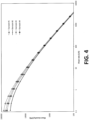
- Figure 4 is a graphical representation of the viscosities of Examples 1-4 as obtained by the TA Rheometer.
- Table 4 presents the formulations for Examples 6-12 which vary in the types and amounts of latex or redispersible powder used in the slurry compositions (see Table 1 for the ratio of components) but keep constant the type of graphite and carboxymethyl cellulose used therein.
- Examples 6-12 were prepared by the "wet” process and the normalized ratio of graphite, carboxymethyl cellulose, and redispersible powder (or latex) ranged from 100/1/1.5 to 100/1/3 due to the increased levels of RDP or latex for some of the examples.
- Examples 6-12 were subjected to the above-described tests to determine rheology measurements, slurry stability test, and adhesion measurements. Table 5 presents the results. As is apparent from Table 5, the slurries of Examples 6-12 were also subjected to both the TA Rheometer at 25°C using a cone and plate geometry and the Brookfield ® viscometer at 30 rpm with spindle 4.
- the viscosities of the compositions containing redispersible powders instead of just latex are comparable to Examples 6, 11, and 12, which only contain a latex.
- Table 5 also suggests that the adhesion measurements of the films comprising redispersible powders instead of just latex (Examples 7-10) are equal in acceptable quality (i.e., close to or over 0.5 gf/mm) to Examples 6 and 11, which contained only a latex.
- Table 5 suggests that Aqualon ® Aqu D-5284 carboxymethyl cellulose may improve the adhesion of the binder composition to the copper current collector, especially when added to increasing amounts of redispersible powder, when compared with Table 3, which presents the adhesion data for compositions containing Aqualon ® Aqu D-5139.
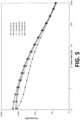
- Figure 5 is a graphical representation of the viscosities of Examples 7-12 as obtained by the TA Rheometer.
- Examples 13-24 which vary in the types and amounts of latex or redispersible powder and vary in the types of carboxymethyl cellulose used in the slurry compositions but keep constant the type of MAG graphite used therein.
- Examples 13-24 were prepared by the "wet" process (with 40% total solid in water) and the normalized ratio of graphite, carboxymethyl cellulose, and redispersible powder (or latex) ranged from 100/1/1.5 to 100/1/3 due to the increased levels of RDP or latex for some of the examples.
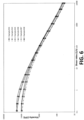
- FIG. 6 presents the viscosity data for Examples 13 -18
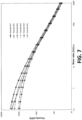
- FIG. 7 presents the viscosity data for Examples 17-22
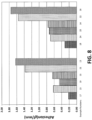
- FIG. 8 presents the adhesion data for Examples 13-24.
- FIGS. 6 and 7 show the viscosities versus shear rates for Examples 13-22, which indicate that the type of carboxymethyl cellulose do not greatly impact the rheology of the compositions.
- FIG. 6 presents the viscosity data for Examples 13 -18
- FIG. 7 presents the viscosity data for Examples 17-22
- FIG. 8 presents the adhesion data for Examples 13-24.
- FIGS. 6 and 7 show the viscosities versus shear rates for Examples 13-22, which indicate that the type of carboxymethyl cellulose do not greatly impact the rheology of the compositions.
- FIG. 6 and 7 show the viscosities versus shear rates for Examples 13-22, which indicate that the type of carboxymethyl cellulose do not greatly impact the rheology of the compositions.
- FIG. 8 suggests that the adhesion measurements of the films comprising redispersible powders instead of just latex (Examples 13-16 and 19-22) are equal in acceptable quality, if not better (i.e., close to or over 0.5 gf/mm), as the examples which only contain a latex (Examples 17-18 and 23-24).
- FIG. 8 suggests that compositions containing Aqualon ® Aqu D-5283 carboxymethyl cellulose (Examples 14, 16, 18, 20, 22, and 24) instead of Aqualon ® Aqu D-5139 (Examples 13, 15, 17, 19, 21, and 23) may improve the adhesion of the binder composition to the copper current collector, especially when added in increasing amounts (See, Examples 16 and 22 compared with Examples 15 and 21).
- Examples 25-32 which vary in the types of carboxymethyl cellulose and latex or redispersible powder used in the slurry compositions (40% total solids formulation) but keep constant the type of graphite used therein. Additionally, Examples 25-32 vary as to the preparation process used to make the samples, i.e., Examples 25, 27, 29, and 31 were prepared by the "dry” process and Examples 26, 28, and 30 were prepared by the "wet” process, wherein the normalized ratio of graphite, carboxymethyl cellulose, and redispersible powder (or latex) was held constant at 100/1/1.5, respectively, for the compositions prepared by both the wet or dry processes. Examples 25-32 were also subjected to the adhesion test as described above, the results of which are presented in Table 7.
- the adhesion measurements of the films comprising redispersible powders instead of just latex are acceptable (i.e., close to or over 0.5 gf/mm) and, in fact are equal to or better than Examples 25 and 26 which contained just latex.
- Table 7 suggests that Aqualon ® Aqu D-5283 carboxymethyl cellulose (Examples 29, 30, and 32) may improve the adhesion of the binder composition to the copper current collector when compared to Aqualon ® Aqu D-5139 (25-28, and 31) and Aqualon ® Aqu D-5284 carboxymethyl celluloses (See, Examples 6-12 of Table 5).
- Table 7 suggests that both the wet and dry processes can provide very good adhesion (i.e., approximately 0.5 gf/mm or more).
- Table 8 presents Examples 33-38 which vary in the types of graphite and latex or redispersible powder used in the slurry compositions but keep constant the type of carboxymethyl cellulose used therein.
- Examples 33-38 were prepared by the "dry” process, wherein the normalized ratio of graphite, carboxymethyl cellulose, and redispersible powder (or latex) was held constant at 100/1/1.5, respectively.
- Examples 33-38 were also subjected to the above-described adhesion test, the results of which are also presented in Table 8.
- JSR ® TR2001 Commercially-available styrene butadiene latex from JSR Corporation, Tokyo, Japan.
- Dehydro ® 6480 Redispersible powder from Acquos Pty Ltd. (Camp Bettefield, Australia) comprising vinyl acrylic latex.
- Dehydro ® 7552 Redispersible powder from Acquos Pty Ltd. (Camp Bettefield, Australia) comprising styrene acrylic latex.
- Electrodes specifically anodes, were prepared by coating copper current collectors with slurry compositions containing electrode-active materials, using the methods described above, to form films of a prescribed thickness on the current collectors.
- the electrodes prepared had either a film thickness of 35 ⁇ m or 70 ⁇ m.
- the slurries coated on the copper current collectors were prepared using the above-described "wet" process.
- the process comprised: (1) adding 22.9 g of a 0.7wt% carboxymethyl cellulose (CMC) solution to 15.6 g of graphite and mixing the CMC/graphite mixture for 20 minutes using an overhead mixer, (2) adding 0.6 g of either: (i) a redispersible powder (RDP) solution or (ii) a 40wt% latex solution to the CMC/graphite mixture, and mixing the CMC/graphite/RDP or latex solution for 20 minutes using an overhead mixer, and (3) adding 0.9 g of deionized water to the CMC/graphite/RDP or latex solution and mixing for 20 minutes with an overhead mixer.
- CMC carboxymethyl cellulose
- the slurries were prepared using several different formulations.
- the total amount of solids i.e., graphite, carboxymethyl cellulose, and latex or redispersible powder
- the total amount of solids was approximately 47% by weight with the remaining 53% by weight comprising water.
- the type of carboxymethyl cellulose and latex or redispersible powder varied throughout the examples; however, for those examples comprising redispersible powder instead of a latex, the redispersible powder was comprised of 75% by weight latex particles, 20% by weight anticaking agent, and 5% by weight protective colloid, wherein the anticaking agent was calcium carbonate (CaCO 3 ), the protective colloid (or “redispersing aid") was polyvinyl alcohol (PVOH), and the latex particles varied depending on the redispersible powder as presented in the tables below.
- the anticaking agent was calcium carbonate (CaCO 3 )
- the protective colloid or "redispersing aid”
- PVOH polyvinyl alcohol
- Table 10 presents a detailed description of the different slurry compositions that were prepared.
- the ratio of the dry components i.e., only the graphite, carboxymethyl cellulose, and redispersible powder
- the latex comprised a mixture of Zeon ® BM-400 and Zeon ® BM-480B latexes in an equal ratio, such that the ratio of dry components, i.e., only the graphite, carboxymethyl cellulose, Zeon ® BM-400, and Zeon ® BM-480, was 97.5/1/0.75/0.75, respectively.
- Aqualon ® Aqu D-5139 Commercially available carboxymethyl cellulose from Ashland, Inc. (Wilmington, DE) with a degree of substitution from 0.82-0.95 and a Brookfield ® viscosity of 5,700-9,000 cps for a 1% solution at 30 rpm with spindle 4.
- Aqualon ® Aqu D-5283 Commercially available carboxymethyl cellulose from Ashland, Inc. (Wilmington, DE) with a degree of substitution from 0.65-0.9 and a Brookfield ® viscosity of 4,000-9,000 cps for a 1% solution at 30 rpm with spindle 4.
- Zeon ® BM-480B Commercially-available styrene butadiene latex from Zeon Corporation, Tokyo, Japan.
- Zeon ® BM-400 Commercially-available styrene butadiene latex from Zeon Corporation, Tokyo, Japan.
- Half coin cells having a 20 mm diameter and a 3.2 mm height were produced using the anodes described above in combination with lithium metal disc cathodes, a Celgard ® polyolefin separator from Celgard LLC (Charlotte, North Carolina), and an electrolyte comprising a mixture of organic solvents of ethylene carbonate (EC), ethylmethyl carbonate (EMC), propylene carbonate (PC), and fluorobenzene (FB) in a 30/55/5/10 ratio and 1.1 mole of lithium hexafluorophosphate (IiPF 6 ) as the lithium salt.
- EC ethylene carbonate
- EMC ethylmethyl carbonate
- PC propylene carbonate
- FB fluorobenzene
- the solid loading for the anode having a 35 ⁇ m thick film was 5 mg/cm 2 and 10 mg/cm 2 for the anode having a 70 ⁇ m thick film.
- the half coin cells were subjected to cyclic and rate capability tests at various rates, as well as a test to determine impedance of the half coin cells. For each test method, the results for Sample A were considered as the reference point for comparison between Samples B-F due to its similarity to typical commercial anodes.
- the discharge capacities for the half coin cells described above were evaluated at room temperature, 25°C, using a current rate of 0.05 Coulomb (C) wherein the anodes had a film thickness of 35 ⁇ m and 70 ⁇ m.
- the electrodes were evaluated in the voltage range from 0.01 to 1.4 V versus Li/Li + , with a 10 minutes rest time between charging and discharging.
- a constant voltage ("CV") mode and a constant current (“CC”) mode were used in the case of the charging state, i.e. Li insertion into the graphite, and the discharge state, i.e., Li extraction from the graphite, respectively.
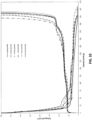
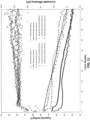
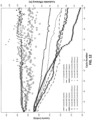
- the results are shown in Tables 11A and 11B and FIGS. 9 and 10 .
- the rate capabilities of the half coin cells described above were also evaluated at room temperature, 25°C, charging and discharging the half coin cells at a rate of 0.5 Coulomb ⁇ for 100 cycles, wherein the anodes had a film of 35 ⁇ m and 70 ⁇ m.
- the results are shown in Table 12 and FIGS. 11 and 12 .
- the rate capabilities of the above-described half coin cells were also evaluated for a range by charging and discharging the cells at a rate of 0.05 C, 0.2 C, and 0.5 C for approximately 5 cycles per rate. The results are shown in Table 13 and FIG. 13 .
- Impedance of the above-described 2032 half coin cells was evaluated for anodes having a film thickness of 70 ⁇ m.
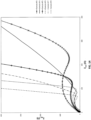
- the battery impedance data was measured using a Solartron ® 1260 from Solartron Analytical (Leicester, UK). The results are shown in Table 14 and FIG. 14 .
- Tables 11A and 11B suggest that anodes prepared with redispersible powders instead of latex (Examples 44, 46, 48, 50, 52, and 54) perform as well as, if not better than, anodes prepared with latexes instead of redispersible powders (Examples 43, 45, 47, 49, 51, and 53).
- FIGS. 9 and 10 graphically depict the charge and discharge capacities over the range of voltages.
- Samples A-F were subjected to the above-defined rate capabilities test by charging and discharging the half coin cells at a rate of 0.5 Coulomb (C) for 100 cycles, wherein the anodes had a film thickness of 35 ⁇ m and 70 ⁇ m.
- Table 12 highlights measurements taken at 50 cycles and 100 cycles, however, FIGS. 11 and 12 graphically present the data obtained for the entire 100 cycles.
- Table 12 The results presented in Table 12 suggest that the majority of the anodes prepared with redispersible powders instead of a latex (Examples 56, 58, 60, 62, 64, 66) perform as well as, if not better than, anodes prepared with latexes instead of redispersible powders (Examples 55, 57, 59, 61, 63, and 65).
- FIGS. 11 and 12 graphically depict the charge and discharge capacities over the range of voltages.
- FIG. 13 graphically presents the data obtained for each rate.
- Table 13 Example # Sample # Capacity Retention (%) for 5 cycles at 0.05C Capacity Retention (%) for 5 cycles at 0.2C Capacity Retention (%) for 5 cycles at 0. 5C 67 A 100 96 78 68 B 100 99 84 69 C 99 98 79 70 D 100 98 87 71 E 100 98 85 72 F 100 97 83
- FIG. 14 graphically presents the data obtained for each sample.
- Table 14 Example # Sample # Impedance (R ct ) 73 A 227.7 74 B 82.9 75 C 118.8 76 D 66.0 77 E 75.1 78 F 96.0
- samples B, D, and F (corresponding to Experiment numbers 74, 76, and 78) all perform better than the industry standard, noting that lower impedance is preferred.
- Table 15 & 16 present a detailed description of the different slurry compositions that were prepared.
- Each slurry composition contained graphite (MAG)/ Si oxide(SiO x ) anode (92/5), carboxymethyl cellulose (Aqu D-5283), and redispersible powder(RDP) binder,(dry ratio was 100/0.67/1.19) in water.
- the solid content in the slurry was 40-50%.
- the composition containing latex the latex comprised a mixture of Zeon ® BM-400 and Zeon ® BM-480B latexes in an equal ratio, such that the ratio of dry components, i.e., only the graphite/SiO x , carboxymethyl cellulose, Zeon ® BM-400, and Zeon ® BM-480B, was 97.5/1/0.75/0.75.
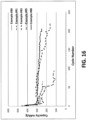
- the slurry was coated onto the copper foil to prepare the half coin cells and their electro chemistry and cycle performance was evaluated. The data is presented in Table 15 and plots in Fig. 15 & Fig. 16 .
- Dehydro 6880,7660 & 6150 are redispersible powder purchased from Acquos Pty Ltd, Australia). They are made of styrene-acrylic or vinyl acrylic emulsion latex, anticaking agent and protective colloid with spray drier.
- Zeon ® BM-480B Commercially-available styrene butadiene latex from Zeon Corporation, Tokyo, Japan.
- Zeon ® BM-400 Commercially-available styrene butadiene latex from Zeon Corporation, Tokyo, Japan.
- ICE Initial Coulombic Efficiency
- a two-quart stirred autoclave glass bowl was charged with 64.8 g (0.4 moles) cotton linters (dry weight) and 1000 ml t-butyl alcohol (99.5+ %). The bowl was then sealed to the reactor and purged of oxygen, evacuating to 26 inches gauge vacuum followed by pressurization to 20 psig with nitrogen. This vacuum-pressurized cycle was repeated 5 times, after which a caustic solution (61.7 g 50% NaOH/73 ml H 2 O) was added, via a syringe, to the stirred cellulose slurry under vacuum. The reactor was given another five degassing cycles, as above. The alkali cellulose was allowed to stir for 60 minutes at 15°-20° C under10 psig nitrogen.
- a monochloroacetic acid solution (10.4 g MCA/25 ml. tert-butyl alcohol) was then introduced to the slurry, under vacuum, via a syringe. After pressurization to 10 psig N 2 , the reaction was then heated to 70° C (approximately 30-minute heatup period) and maintained for 30 minutes. Upon cooling to 40° C and evacuating to approximate 20 inches vacuum, 79.0 g. ethylene oxide condensed in a Fischer-Porter tube, was added. After pressurization to 10 psig N 2 , the reaction was held at 45° C. for 60 minutes, then at 80° C. for 120 minutes.
- reaction mixture Upon cooling to less than 30° C., the reaction mixture was neutralized with 31 ml. HNO 3 (70%) and 5 ml. glacial acetic acid. After filtration, the wet cake was batch washed in acetone, then dehydrated with 99.5% acetone and dried. The final product had HEMS: 1.9-2.5, CMDS: 0.3- 0.5, and 1% viscosity: 3000 cps
- Table 17 & 18 present a detailed description of the different slurry compositions that were prepared.
- the solid content of the slurry was 40-50%.
- the composition containing latex the latex comprised of Zeon ® BM-480B latex.
- the slurry was coated onto the copper foil to prepare the anode electrode. The slurry viscosity and adhesions were measured. The data is presented in Table 18.
- the electrode from formulation 93 has good adhesion, flexible and good coating appearance.
- Table 17 Components Weight (g) Weight % of total slurry Normalized ratio of solids SiO x anode powder 2.06 2.4 100 MAG Graphite anode powder 37.94 43.4 CHMEC (Example A) 0.4 0.5 1 RDP 0.6 0.7 1.5 Water 46.5 53.1 Total 87.5 100
- Table 18 Examples Binder formulation composition viscosity (3 RPM), cps viscosity (30 RPM), cps adhesion, gf/mm 90 CMHEC-A* /RDP-1(1/1.5) 32593 8578 0.244 91 CMHEC-B/RDP-1(1/1.5) 21595 6079 0.266 92 CMHEC-A/Zeon BM-480B (1/1.5) 13597 4979 0.656 93 CMHEC-A/Dehydro 7930** (1/1.5) 26398 13077 0.723 * CMHEC-A & C
Landscapes
- Chemical & Material Sciences (AREA)
- Chemical Kinetics & Catalysis (AREA)
- Organic Chemistry (AREA)
- Electrochemistry (AREA)
- General Chemical & Material Sciences (AREA)
- Engineering & Computer Science (AREA)
- Medicinal Chemistry (AREA)
- Polymers & Plastics (AREA)
- Health & Medical Sciences (AREA)
- Materials Engineering (AREA)
- Manufacturing & Machinery (AREA)
- Battery Electrode And Active Subsutance (AREA)
- Paints Or Removers (AREA)
- Cell Electrode Carriers And Collectors (AREA)
Priority Applications (1)
| Application Number | Priority Date | Filing Date | Title |
|---|---|---|---|
| EP24156280.0A EP4350815A3 (en) | 2013-05-23 | 2014-05-21 | Binder composition for an electrode and methods for producing the same |
Applications Claiming Priority (3)
| Application Number | Priority Date | Filing Date | Title |
|---|---|---|---|
| US201361826794P | 2013-05-23 | 2013-05-23 | |
| US201361840098P | 2013-06-27 | 2013-06-27 | |
| PCT/US2014/038978 WO2014190059A1 (en) | 2013-05-23 | 2014-05-21 | Binder composition for an electrode and methods for producing the same |
Related Child Applications (1)
| Application Number | Title | Priority Date | Filing Date |
|---|---|---|---|
| EP24156280.0A Division EP4350815A3 (en) | 2013-05-23 | 2014-05-21 | Binder composition for an electrode and methods for producing the same |
Publications (2)
| Publication Number | Publication Date |
|---|---|
| EP2999759A1 EP2999759A1 (en) | 2016-03-30 |
| EP2999759B1 true EP2999759B1 (en) | 2024-02-14 |
Family
ID=50983176
Family Applications (2)
| Application Number | Title | Priority Date | Filing Date |
|---|---|---|---|
| EP14732733.2A Active EP2999759B1 (en) | 2013-05-23 | 2014-05-21 | Binder composition for an electrode and methods for producing the same |
| EP24156280.0A Pending EP4350815A3 (en) | 2013-05-23 | 2014-05-21 | Binder composition for an electrode and methods for producing the same |
Family Applications After (1)
| Application Number | Title | Priority Date | Filing Date |
|---|---|---|---|
| EP24156280.0A Pending EP4350815A3 (en) | 2013-05-23 | 2014-05-21 | Binder composition for an electrode and methods for producing the same |
Country Status (10)
| Country | Link |
|---|---|
| US (1) | US11502301B2 (enExample) |
| EP (2) | EP2999759B1 (enExample) |
| JP (1) | JP6550377B2 (enExample) |
| KR (1) | KR102210836B1 (enExample) |
| CN (1) | CN105246998B (enExample) |
| CA (1) | CA2912212C (enExample) |
| ES (1) | ES2974524T3 (enExample) |
| HU (1) | HUE066219T2 (enExample) |
| PL (1) | PL2999759T3 (enExample) |
| WO (1) | WO2014190059A1 (enExample) |
Families Citing this family (16)
| Publication number | Priority date | Publication date | Assignee | Title |
|---|---|---|---|---|
| CN105131875B (zh) * | 2015-08-26 | 2017-07-07 | 深圳市贝特瑞新能源材料股份有限公司 | 一种锂离子电池用水性粘合剂、制备方法及其用途 |
| IT201600090617A1 (it) * | 2016-09-07 | 2018-03-07 | Vinavil Spa | Uso di polimeri a base di acetato di vinile per la realizzazione di elettrodi per batterie agli ioni di litio |
| KR102277226B1 (ko) * | 2016-10-26 | 2021-07-15 | 주식회사 엘지에너지솔루션 | 이차전지용 전극의 제조 방법 |
| CN106669520B (zh) * | 2016-11-17 | 2023-07-28 | 山东精工电子科技股份有限公司 | 一种锂离子电池浆料的制备装置及方法 |
| JP6732644B2 (ja) * | 2016-12-02 | 2020-07-29 | 日本ペイント・サーフケミカルズ株式会社 | 熱交換器、及び熱交換器の親水化処理方法 |
| JP2018156891A (ja) * | 2017-03-21 | 2018-10-04 | 第一工業製薬株式会社 | 負極ペーストおよびこれを用いた非水電解液二次電池 |
| JP6424934B1 (ja) * | 2017-09-28 | 2018-11-21 | 住友大阪セメント株式会社 | リチウムイオン二次電池用正極材料、リチウムイオン二次電池用正極、リチウムイオン二次電池 |
| US12341199B2 (en) | 2018-03-22 | 2025-06-24 | Livent USA Corp. | Printed lithium foil and film |
| US11735764B2 (en) * | 2018-03-22 | 2023-08-22 | Livent USA Corp. | Printable lithium compositions |
| WO2020081639A1 (en) | 2018-10-16 | 2020-04-23 | Hercules Llc | Aqueous binder composition for an electrode and methods for producing the same |
| CN109860600A (zh) * | 2019-03-09 | 2019-06-07 | 珠海光宇电池有限公司 | 一种锂离子电池用正极粘结剂、正极极片和锂离子电池 |
| CN111971829A (zh) * | 2019-10-31 | 2020-11-20 | 帝伯爱尔株式会社 | 粘合剂 |
| CN111029528B (zh) * | 2019-12-27 | 2022-08-30 | 重庆力宏精细化工有限公司 | 一种锂电池浆料及锂电池极片 |
| KR20220144387A (ko) | 2020-02-19 | 2022-10-26 | 리벤트 유에스에이 코포레이션 | 고속 충전 사전 리튬화 규소 애노드 |
| US20220173429A1 (en) * | 2020-11-27 | 2022-06-02 | Semiconductor Energy Laboratory Co., Ltd. | Storage battery and vehicle including storage battery |
| CN117160282A (zh) * | 2022-05-27 | 2023-12-05 | 蔚来汽车科技(安徽)有限公司 | 用于干法电极膜的物料混合装置 |
Family Cites Families (24)
| Publication number | Priority date | Publication date | Assignee | Title |
|---|---|---|---|---|
| JP2002069198A (ja) * | 2000-08-29 | 2002-03-08 | Dai Ichi Kogyo Seiyaku Co Ltd | 再分散性良好な合成樹脂粉末 |
| US7213603B2 (en) * | 2002-08-02 | 2007-05-08 | Violight, Inc. | System and method for toothbrush sanitization and storage |
| JP2004095391A (ja) * | 2002-08-30 | 2004-03-25 | Sony Corp | 電池およびその製造方法 |
| JP2004221674A (ja) | 2003-01-09 | 2004-08-05 | Ntt Docomo Inc | 通信システム並びに通信システムに使用される配信管理装置及び通信方法 |
| FR2851081B1 (fr) | 2003-02-11 | 2016-06-03 | Cit Alcatel | Electrode non-frittee pour generateur electrochimique a electrolyte alcalin |
| KR100537613B1 (ko) * | 2003-06-20 | 2005-12-19 | 삼성에스디아이 주식회사 | 리튬 전지용 음극 조성물과 이를 채용한 음극 및 리튬 전지 |
| PL1767566T3 (pl) * | 2005-09-14 | 2007-11-30 | Nat Starch & Chemical Investment Holding Corp | Nowe kleje wodne do zastosowań przemysłowych |
| TW200924265A (en) | 2007-07-12 | 2009-06-01 | Sumitomo Chemical Co | Electrode for electrochemical energy storage device |
| CN201178103Y (zh) | 2007-11-24 | 2009-01-07 | 比亚迪股份有限公司 | 一种锂离子电池隔圈和含有该隔圈的锂离子电池 |
| JP2009129741A (ja) * | 2007-11-26 | 2009-06-11 | Kyushu Univ | ナトリウムイオン二次電池およびそれに用いる負極活物質 |
| JP5201030B2 (ja) | 2008-03-19 | 2013-06-05 | 住友化学株式会社 | 電極およびそれを有する電池 |
| EP2300394A1 (en) * | 2008-06-27 | 2011-03-30 | Akzo Nobel N.V. | Redispersible polymer powder |
| JP2010080297A (ja) | 2008-09-26 | 2010-04-08 | Sanyo Electric Co Ltd | 非水電解質二次電池用負極、非水電解質二次電池及び非水電解質二次電池用負極の製造方法 |
| JP2010165493A (ja) * | 2009-01-14 | 2010-07-29 | Sanyo Electric Co Ltd | 非水電解質二次電池用負極、非水電解質二次電池及び非水電解質二次電池用負極の製造方法 |
| GB2470190B (en) | 2009-05-11 | 2011-07-13 | Nexeon Ltd | A binder for lithium ion rechargeable battery cells |
| GB0908089D0 (en) | 2009-05-11 | 2009-06-24 | Nexeon Ltd | A binder for lithium ion rechargaable battery cells |
| KR101069155B1 (ko) * | 2009-09-29 | 2011-09-30 | 건국대학교 산학협력단 | 압전소자가 구비된 탄성교량받침 |
| WO2011048699A1 (ja) | 2009-10-23 | 2011-04-28 | トヨタ自動車株式会社 | 攪拌装置 |
| EP2341083B1 (en) | 2009-12-30 | 2015-07-08 | Dow Global Technologies LLC | Stabilized redispersible polymer powder compositions |
| CN102763244B (zh) | 2010-01-21 | 2015-07-29 | 丰田自动车株式会社 | 锂二次电池 |
| US8641712B2 (en) * | 2010-07-28 | 2014-02-04 | Covidien Lp | Local optimization of electrode current densities |
| US10122015B2 (en) | 2011-03-22 | 2018-11-06 | Samsung Sdi Co., Ltd. | Positive electrode for lithium secondary battery and lithium secondary battery comprising the same |
| CN102738446B (zh) * | 2011-04-15 | 2015-07-22 | 比克国际(天津)有限公司 | 锂离子电池浆料及其制备方法,及锂离子电池 |
| GB2493375A (en) * | 2011-08-03 | 2013-02-06 | Leclancha S A | Aqueous slurry for battery electrodes |
-
2014
- 2014-05-21 US US14/283,889 patent/US11502301B2/en active Active
- 2014-05-21 HU HUE14732733A patent/HUE066219T2/hu unknown
- 2014-05-21 JP JP2016515054A patent/JP6550377B2/ja active Active
- 2014-05-21 EP EP14732733.2A patent/EP2999759B1/en active Active
- 2014-05-21 KR KR1020157035907A patent/KR102210836B1/ko active Active
- 2014-05-21 WO PCT/US2014/038978 patent/WO2014190059A1/en not_active Ceased
- 2014-05-21 CA CA2912212A patent/CA2912212C/en active Active
- 2014-05-21 ES ES14732733T patent/ES2974524T3/es active Active
- 2014-05-21 PL PL14732733.2T patent/PL2999759T3/pl unknown
- 2014-05-21 EP EP24156280.0A patent/EP4350815A3/en active Pending
- 2014-05-21 CN CN201480029716.2A patent/CN105246998B/zh active Active
Also Published As
| Publication number | Publication date |
|---|---|
| WO2014190059A1 (en) | 2014-11-27 |
| EP4350815A2 (en) | 2024-04-10 |
| CN105246998B (zh) | 2017-11-17 |
| US11502301B2 (en) | 2022-11-15 |
| KR20160014655A (ko) | 2016-02-11 |
| US20140349184A1 (en) | 2014-11-27 |
| HUE066219T2 (hu) | 2024-07-28 |
| CA2912212A1 (en) | 2014-11-27 |
| CN105246998A (zh) | 2016-01-13 |
| PL2999759T3 (pl) | 2024-06-03 |
| CA2912212C (en) | 2019-09-24 |
| JP2016521907A (ja) | 2016-07-25 |
| KR102210836B1 (ko) | 2021-02-02 |
| JP6550377B2 (ja) | 2019-07-24 |
| EP2999759A1 (en) | 2016-03-30 |
| ES2974524T3 (es) | 2024-06-27 |
| EP4350815A3 (en) | 2024-05-15 |
Similar Documents
| Publication | Publication Date | Title |
|---|---|---|
| EP4350815A2 (en) | Binder composition for an electrode and methods for producing the same | |
| EP3108526B1 (en) | Modified guaran binder for lithium ion batteries | |
| CN111433951B (zh) | 用于制造锂二次电池正极的粘结剂和通过使用所述粘结剂制造正极的方法 | |
| JP2016521907A5 (enExample) | ||
| EP2526583B1 (en) | Flexible battery electrodes and the production thereof | |
| KR20160127050A (ko) | 리튬 이온 배터리용 바인더 시스템으로서의 중합체 조성물 | |
| TW201505240A (zh) | 電極組合物、電化學電池及電化學電池之製造方法 | |
| US11424439B2 (en) | Negative electrode of nonaqueous electrolyte secondary battery, and nonaqueous electrolyte secondary battery | |
| CN107925090A (zh) | 电极活性材料浆料和包含其的锂二次电池 | |
| JP2022064465A (ja) | 負極スラリー、負極及び二次電池 | |
| CN109196692A (zh) | 电池的负极材料的制备方法、锂离子电池和固态电池 | |
| JP6852747B2 (ja) | 非水電解液二次電池用正極組成物、非水電解液二次電池、及び非水電解液二次電池用正極組成物の製造方法。 | |
| TW201628236A (zh) | 電極組成物、電化學電池及製造電化學電池之方法 | |
| KR101902054B1 (ko) | 성능이 개선된 이차전지용 바인더 및 이를 포함하는 이차전지용 음극 | |
| WO2022174086A1 (en) | Rheologically modified slurries for electrochemical cells and components made therefrom | |
| JP3736842B2 (ja) | アルカリ電解液電池用電極およびそれを用いたアルカリ電解液電池 | |
| TW201916437A (zh) | 負極活性物質塗料、負極以及二次電池 | |
| EP4106056A1 (en) | Binder for nonaqueous electrolyte secondary batteries, electrode composition for nonaqueous electrolyte secondary batteries, electrode for nonaqueous electrolyte secondary batteries, nonaqueous electrolyte secondary battery and method for producing binder for nonaqueous electrolyte secondary batteries | |
| JP2001316655A (ja) | 導電性接着剤およびその製造方法 | |
| TWI750759B (zh) | 非水電解質二次電池用電極、及其製造方法 | |
| JP2021047989A (ja) | 非水電解質二次電池用結合剤、非水電解質二次電池用電極組成物、非水電解質二次電池用電極および非水電解質二次電池 | |
| CN121790349A (zh) | 一种负极材料、含其的锂离子电池及其制备方法 | |
| JP2021128888A (ja) | 非水電解質二次電池用結合剤、非水電解質二次電池用電極組成物、非水電解質二次電池用電極、非水電解質二次電池および非水電解質二次電池用結合剤の製造方法 | |
| KR20260040298A (ko) | 비수 전해질 이차전지 전극용 결합제, 비수 전해질 이차전지용 전극 조성물, 비수 전해질 이차전지용 전극 및 비수 전해질 이차전지 | |
| JP2021128886A (ja) | 非水電解質二次電池用結合剤、非水電解質二次電池用電極組成物、非水電解質二次電池用電極、非水電解質二次電池および非水電解質二次電池用結合剤の製造方法 |
Legal Events
| Date | Code | Title | Description |
|---|---|---|---|
| PUAI | Public reference made under article 153(3) epc to a published international application that has entered the european phase |
Free format text: ORIGINAL CODE: 0009012 |
|
| 17P | Request for examination filed |
Effective date: 20151223 |
|
| AK | Designated contracting states |
Kind code of ref document: A1 Designated state(s): AL AT BE BG CH CY CZ DE DK EE ES FI FR GB GR HR HU IE IS IT LI LT LU LV MC MK MT NL NO PL PT RO RS SE SI SK SM TR |
|
| AX | Request for extension of the european patent |
Extension state: BA ME |
|
| DAX | Request for extension of the european patent (deleted) | ||
| RAP1 | Party data changed (applicant data changed or rights of an application transferred) |
Owner name: HERCULES LLC |
|
| STAA | Information on the status of an ep patent application or granted ep patent |
Free format text: STATUS: EXAMINATION IS IN PROGRESS |
|
| 17Q | First examination report despatched |
Effective date: 20200131 |
|
| GRAP | Despatch of communication of intention to grant a patent |
Free format text: ORIGINAL CODE: EPIDOSNIGR1 |
|
| STAA | Information on the status of an ep patent application or granted ep patent |
Free format text: STATUS: GRANT OF PATENT IS INTENDED |
|
| INTG | Intention to grant announced |
Effective date: 20230913 |
|
| GRAS | Grant fee paid |
Free format text: ORIGINAL CODE: EPIDOSNIGR3 |
|
| GRAA | (expected) grant |
Free format text: ORIGINAL CODE: 0009210 |
|
| STAA | Information on the status of an ep patent application or granted ep patent |
Free format text: STATUS: THE PATENT HAS BEEN GRANTED |
|
| AK | Designated contracting states |
Kind code of ref document: B1 Designated state(s): AL AT BE BG CH CY CZ DE DK EE ES FI FR GB GR HR HU IE IS IT LI LT LU LV MC MK MT NL NO PL PT RO RS SE SI SK SM TR |
|
| REG | Reference to a national code |
Ref country code: GB Ref legal event code: FG4D |
|
| REG | Reference to a national code |
Ref country code: CH Ref legal event code: EP |
|
| REG | Reference to a national code |
Ref country code: DE Ref legal event code: R096 Ref document number: 602014089480 Country of ref document: DE |
|
| REG | Reference to a national code |
Ref country code: IE Ref legal event code: FG4D |
|
| REG | Reference to a national code |
Ref country code: NL Ref legal event code: FP |
|
| REG | Reference to a national code |
Ref country code: SE Ref legal event code: TRGR |
|
| P01 | Opt-out of the competence of the unified patent court (upc) registered |
Effective date: 20240403 |
|
| REG | Reference to a national code |
Ref country code: SK Ref legal event code: T3 Ref document number: E 43956 Country of ref document: SK |
|
| REG | Reference to a national code |
Ref country code: LT Ref legal event code: MG9D |
|
| REG | Reference to a national code |
Ref country code: ES Ref legal event code: FG2A Ref document number: 2974524 Country of ref document: ES Kind code of ref document: T3 Effective date: 20240627 |
|
| PG25 | Lapsed in a contracting state [announced via postgrant information from national office to epo] |
Ref country code: IS Free format text: LAPSE BECAUSE OF FAILURE TO SUBMIT A TRANSLATION OF THE DESCRIPTION OR TO PAY THE FEE WITHIN THE PRESCRIBED TIME-LIMIT Effective date: 20240614 |
|
| PG25 | Lapsed in a contracting state [announced via postgrant information from national office to epo] |
Ref country code: LT Free format text: LAPSE BECAUSE OF FAILURE TO SUBMIT A TRANSLATION OF THE DESCRIPTION OR TO PAY THE FEE WITHIN THE PRESCRIBED TIME-LIMIT Effective date: 20240214 |
|
| PG25 | Lapsed in a contracting state [announced via postgrant information from national office to epo] |
Ref country code: GR Free format text: LAPSE BECAUSE OF FAILURE TO SUBMIT A TRANSLATION OF THE DESCRIPTION OR TO PAY THE FEE WITHIN THE PRESCRIBED TIME-LIMIT Effective date: 20240515 |
|
| REG | Reference to a national code |
Ref country code: AT Ref legal event code: MK05 Ref document number: 1657018 Country of ref document: AT Kind code of ref document: T Effective date: 20240214 |
|
| PG25 | Lapsed in a contracting state [announced via postgrant information from national office to epo] |
Ref country code: RS Free format text: LAPSE BECAUSE OF FAILURE TO SUBMIT A TRANSLATION OF THE DESCRIPTION OR TO PAY THE FEE WITHIN THE PRESCRIBED TIME-LIMIT Effective date: 20240514 Ref country code: HR Free format text: LAPSE BECAUSE OF FAILURE TO SUBMIT A TRANSLATION OF THE DESCRIPTION OR TO PAY THE FEE WITHIN THE PRESCRIBED TIME-LIMIT Effective date: 20240214 |
|
| PG25 | Lapsed in a contracting state [announced via postgrant information from national office to epo] |
Ref country code: AT Free format text: LAPSE BECAUSE OF FAILURE TO SUBMIT A TRANSLATION OF THE DESCRIPTION OR TO PAY THE FEE WITHIN THE PRESCRIBED TIME-LIMIT Effective date: 20240214 |
|
| REG | Reference to a national code |
Ref country code: HU Ref legal event code: AG4A Ref document number: E066219 Country of ref document: HU |
|
| PG25 | Lapsed in a contracting state [announced via postgrant information from national office to epo] |
Ref country code: RS Free format text: LAPSE BECAUSE OF FAILURE TO SUBMIT A TRANSLATION OF THE DESCRIPTION OR TO PAY THE FEE WITHIN THE PRESCRIBED TIME-LIMIT Effective date: 20240514 Ref country code: LT Free format text: LAPSE BECAUSE OF FAILURE TO SUBMIT A TRANSLATION OF THE DESCRIPTION OR TO PAY THE FEE WITHIN THE PRESCRIBED TIME-LIMIT Effective date: 20240214 Ref country code: IS Free format text: LAPSE BECAUSE OF FAILURE TO SUBMIT A TRANSLATION OF THE DESCRIPTION OR TO PAY THE FEE WITHIN THE PRESCRIBED TIME-LIMIT Effective date: 20240614 Ref country code: HR Free format text: LAPSE BECAUSE OF FAILURE TO SUBMIT A TRANSLATION OF THE DESCRIPTION OR TO PAY THE FEE WITHIN THE PRESCRIBED TIME-LIMIT Effective date: 20240214 Ref country code: GR Free format text: LAPSE BECAUSE OF FAILURE TO SUBMIT A TRANSLATION OF THE DESCRIPTION OR TO PAY THE FEE WITHIN THE PRESCRIBED TIME-LIMIT Effective date: 20240515 Ref country code: FI Free format text: LAPSE BECAUSE OF FAILURE TO SUBMIT A TRANSLATION OF THE DESCRIPTION OR TO PAY THE FEE WITHIN THE PRESCRIBED TIME-LIMIT Effective date: 20240214 Ref country code: BG Free format text: LAPSE BECAUSE OF FAILURE TO SUBMIT A TRANSLATION OF THE DESCRIPTION OR TO PAY THE FEE WITHIN THE PRESCRIBED TIME-LIMIT Effective date: 20240214 Ref country code: AT Free format text: LAPSE BECAUSE OF FAILURE TO SUBMIT A TRANSLATION OF THE DESCRIPTION OR TO PAY THE FEE WITHIN THE PRESCRIBED TIME-LIMIT Effective date: 20240214 |
|
| PG25 | Lapsed in a contracting state [announced via postgrant information from national office to epo] |
Ref country code: PT Free format text: LAPSE BECAUSE OF FAILURE TO SUBMIT A TRANSLATION OF THE DESCRIPTION OR TO PAY THE FEE WITHIN THE PRESCRIBED TIME-LIMIT Effective date: 20240614 |
|
| PG25 | Lapsed in a contracting state [announced via postgrant information from national office to epo] |
Ref country code: PT Free format text: LAPSE BECAUSE OF FAILURE TO SUBMIT A TRANSLATION OF THE DESCRIPTION OR TO PAY THE FEE WITHIN THE PRESCRIBED TIME-LIMIT Effective date: 20240614 Ref country code: LV Free format text: LAPSE BECAUSE OF FAILURE TO SUBMIT A TRANSLATION OF THE DESCRIPTION OR TO PAY THE FEE WITHIN THE PRESCRIBED TIME-LIMIT Effective date: 20240214 |
|
| PG25 | Lapsed in a contracting state [announced via postgrant information from national office to epo] |
Ref country code: DK Free format text: LAPSE BECAUSE OF FAILURE TO SUBMIT A TRANSLATION OF THE DESCRIPTION OR TO PAY THE FEE WITHIN THE PRESCRIBED TIME-LIMIT Effective date: 20240214 |
|
| PG25 | Lapsed in a contracting state [announced via postgrant information from national office to epo] |
Ref country code: SM Free format text: LAPSE BECAUSE OF FAILURE TO SUBMIT A TRANSLATION OF THE DESCRIPTION OR TO PAY THE FEE WITHIN THE PRESCRIBED TIME-LIMIT Effective date: 20240214 |
|
| PG25 | Lapsed in a contracting state [announced via postgrant information from national office to epo] |
Ref country code: CZ Free format text: LAPSE BECAUSE OF FAILURE TO SUBMIT A TRANSLATION OF THE DESCRIPTION OR TO PAY THE FEE WITHIN THE PRESCRIBED TIME-LIMIT Effective date: 20240214 Ref country code: EE Free format text: LAPSE BECAUSE OF FAILURE TO SUBMIT A TRANSLATION OF THE DESCRIPTION OR TO PAY THE FEE WITHIN THE PRESCRIBED TIME-LIMIT Effective date: 20240214 |
|
| PG25 | Lapsed in a contracting state [announced via postgrant information from national office to epo] |
Ref country code: SM Free format text: LAPSE BECAUSE OF FAILURE TO SUBMIT A TRANSLATION OF THE DESCRIPTION OR TO PAY THE FEE WITHIN THE PRESCRIBED TIME-LIMIT Effective date: 20240214 Ref country code: RO Free format text: LAPSE BECAUSE OF FAILURE TO SUBMIT A TRANSLATION OF THE DESCRIPTION OR TO PAY THE FEE WITHIN THE PRESCRIBED TIME-LIMIT Effective date: 20240214 Ref country code: EE Free format text: LAPSE BECAUSE OF FAILURE TO SUBMIT A TRANSLATION OF THE DESCRIPTION OR TO PAY THE FEE WITHIN THE PRESCRIBED TIME-LIMIT Effective date: 20240214 Ref country code: DK Free format text: LAPSE BECAUSE OF FAILURE TO SUBMIT A TRANSLATION OF THE DESCRIPTION OR TO PAY THE FEE WITHIN THE PRESCRIBED TIME-LIMIT Effective date: 20240214 Ref country code: CZ Free format text: LAPSE BECAUSE OF FAILURE TO SUBMIT A TRANSLATION OF THE DESCRIPTION OR TO PAY THE FEE WITHIN THE PRESCRIBED TIME-LIMIT Effective date: 20240214 |
|
| REG | Reference to a national code |
Ref country code: DE Ref legal event code: R097 Ref document number: 602014089480 Country of ref document: DE |
|
| PLBE | No opposition filed within time limit |
Free format text: ORIGINAL CODE: 0009261 |
|
| STAA | Information on the status of an ep patent application or granted ep patent |
Free format text: STATUS: NO OPPOSITION FILED WITHIN TIME LIMIT |
|
| REG | Reference to a national code |
Ref country code: CH Ref legal event code: PL |
|
| PG25 | Lapsed in a contracting state [announced via postgrant information from national office to epo] |
Ref country code: MC Free format text: LAPSE BECAUSE OF FAILURE TO SUBMIT A TRANSLATION OF THE DESCRIPTION OR TO PAY THE FEE WITHIN THE PRESCRIBED TIME-LIMIT Effective date: 20240214 |
|
| PG25 | Lapsed in a contracting state [announced via postgrant information from national office to epo] |
Ref country code: LU Free format text: LAPSE BECAUSE OF NON-PAYMENT OF DUE FEES Effective date: 20240521 |
|
| 26N | No opposition filed |
Effective date: 20241115 |
|
| PG25 | Lapsed in a contracting state [announced via postgrant information from national office to epo] |
Ref country code: MC Free format text: LAPSE BECAUSE OF FAILURE TO SUBMIT A TRANSLATION OF THE DESCRIPTION OR TO PAY THE FEE WITHIN THE PRESCRIBED TIME-LIMIT Effective date: 20240214 Ref country code: LU Free format text: LAPSE BECAUSE OF NON-PAYMENT OF DUE FEES Effective date: 20240521 Ref country code: CH Free format text: LAPSE BECAUSE OF NON-PAYMENT OF DUE FEES Effective date: 20240531 |
|
| PG25 | Lapsed in a contracting state [announced via postgrant information from national office to epo] |
Ref country code: IE Free format text: LAPSE BECAUSE OF NON-PAYMENT OF DUE FEES Effective date: 20240521 |
|
| PG25 | Lapsed in a contracting state [announced via postgrant information from national office to epo] |
Ref country code: SI Free format text: LAPSE BECAUSE OF FAILURE TO SUBMIT A TRANSLATION OF THE DESCRIPTION OR TO PAY THE FEE WITHIN THE PRESCRIBED TIME-LIMIT Effective date: 20240214 |
|
| PGFP | Annual fee paid to national office [announced via postgrant information from national office to epo] |
Ref country code: NL Payment date: 20250526 Year of fee payment: 12 |
|
| PGFP | Annual fee paid to national office [announced via postgrant information from national office to epo] |
Ref country code: PL Payment date: 20250505 Year of fee payment: 12 Ref country code: DE Payment date: 20250529 Year of fee payment: 12 |
|
| PGFP | Annual fee paid to national office [announced via postgrant information from national office to epo] |
Ref country code: GB Payment date: 20250527 Year of fee payment: 12 Ref country code: ES Payment date: 20250602 Year of fee payment: 12 |
|
| PGFP | Annual fee paid to national office [announced via postgrant information from national office to epo] |
Ref country code: HU Payment date: 20250515 Year of fee payment: 12 Ref country code: NO Payment date: 20250530 Year of fee payment: 12 |
|
| PGFP | Annual fee paid to national office [announced via postgrant information from national office to epo] |
Ref country code: BE Payment date: 20250527 Year of fee payment: 12 Ref country code: IT Payment date: 20250521 Year of fee payment: 12 |
|
| PGFP | Annual fee paid to national office [announced via postgrant information from national office to epo] |
Ref country code: FR Payment date: 20250526 Year of fee payment: 12 |
|
| PGFP | Annual fee paid to national office [announced via postgrant information from national office to epo] |
Ref country code: SK Payment date: 20250505 Year of fee payment: 12 |
|
| PGFP | Annual fee paid to national office [announced via postgrant information from national office to epo] |
Ref country code: SE Payment date: 20250527 Year of fee payment: 12 |
|
| PG25 | Lapsed in a contracting state [announced via postgrant information from national office to epo] |
Ref country code: CY Free format text: LAPSE BECAUSE OF FAILURE TO SUBMIT A TRANSLATION OF THE DESCRIPTION OR TO PAY THE FEE WITHIN THE PRESCRIBED TIME-LIMIT; INVALID AB INITIO Effective date: 20140521 |